

Laars EBP0110, EBP0175, EDP0110, EDP0175, EDN0110 Installation, Operation And Maintanance Manual
...Page 1
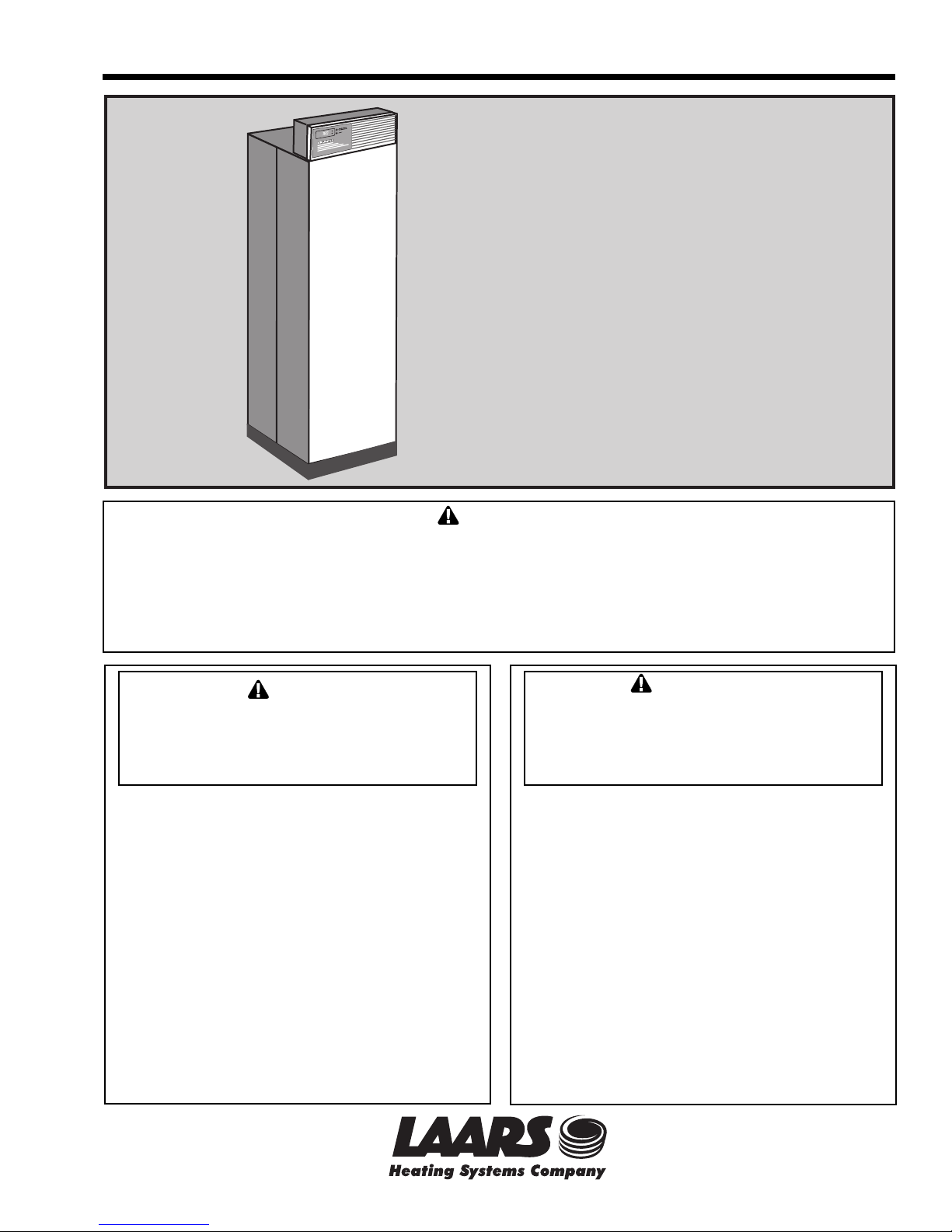
Installation, Operation and Maintenance Instructions Document 1187B
Installation,
Operation and
Maintenance
Instructions for
Endurance
EBP Series Modulating Combination Boiler
(natural or propane gas)
EDP Series Modulating Hydronic Boiler
(natural or propane gas)
EDN Series Modulating Boiler, non ferrous
(natural or propane gas)
WARNING
FOR YOUR SAFETY: This product must be installed and serviced by a professional service technician,
qualified in hot water boiler installation and maintenance. Improper installation and/or operation could
create carbon monoxide gas in flue gases which could cause serious injury, property damage, or
death. Improper installation and/or operation will void the warranty. As an additional measure of safety,
Laars strongly recommends installation of suitable carbon monoxide detectors in the vicinity of this
appliance and in any adjacent occupied spaces.
If the information in this manual is not
WARNING
followed exactly, a fire or explosion may
result causing property damage, personal
injury or loss of life.
Do not store or use gasoline or other
flammable vapors and liquids in the vicinity
of this or any other appliance.
WHAT TO DO IF YOU SMELL GAS
• Do not try to light any appliance.
• Do not touch any electrical switch; do not
use any phone in your building.
• Immediately call your gas supplier from a
nearby phone. Follow the gas supplier's
instructions.
• If you cannot reach your gas supplier, call
the fire department.
Installation and service must be performed by
a qualified installer, service agency, or gas
supplier.
Assurez-vous de bien suivres les instructions
données dans cette notice pour réduire au
minimum le risque d’incendie ou d’explosion ou
pour éviter tout dommage matériel, toute
blessure ou la mort.
Ne pas entreposer ni utiliser d’essence ni
d’autres vapeurs ou liquides inflammables dans
le voisinage de cet appareil ou de tout autre
appareil.
QUE FAIRE SI VOUS SENTEZ UNE ODEUR DE GAZ:
• Ne pas tenter d’allumer d’appareils.
• Ne touchez à aucun interrupteur. Ne pas vous
servir des téléphones dansle bâtiment où vous
vous trouvez.
• Appelez immédiatement votre fournisseur de
gaz depuis un voisin. Suivez les instructions
du fournisseur.
• Si vous ne pouvez rejoindre le fournisseur de
gaz, appelez le sservice des incendies.
L’installation et l’entretien doivent être assurés par
un installateur ou un service d’entretien qualifié ou
par le fournisseur de gaz.
AVERTISSEMENT
H2313500B
A subsidiary of BRADFORD WHITE Corporation
Page 2

Page 2
TABLE OF CONTENTS
SECTION 1.
General Information
1.1 Introduction................................................... 3
1.2 Codes and Standards................................... 3
1.3 Unpacking the Appliance.............................. 4
1.4 Locating the Appliance ................................. 4
1.5 Clearances ................................................... 4
SECTION 2.
Venting Options
2.1 Concentric Direct Vent ................................. 5
2.1.1 Concentric Vent Description ......................... 5
2.1.2 Laars Concentric Vent Kits ........................... 5
2.1.3 Horizontal Concentric Vent Location ............ 5
2.2 Stainless Steel Single Pipe Horizontal
and Vertical Vents — Category IV ................ 9
2.3 Air Source For Combustion (when not
ducted to the Endurance) ........................... 11
2.3.1 Air From Inside the Building ....................... 11
2.3.2 All Air From Outdoors .................................11
2.3.3 Connecting Special Gas Vent to the
Appliance.................................................... 12
2.4 Non-Concentric Combustion Air ................. 12
SECTION 3.
Gas Piping
3.1 Gas Piping .................................................. 12
3.2 Domestic Water Piping (EBP only) ............. 13
3.3 Anti-Freeze — Domestic Water .................. 14
SECTION 4.
Hydronic Heat Piping
4.1 Hydronic Piping .......................................... 14
4.2 Using in a Combined Hot Water Heating
and Chilled Water Cooling System ............. 17
4.3 Water Quality and Treatment ..................... 17
4.4 Anti-Freeze ................................................. 17
4.4.1 Endurance Boiler Low
Temperature Feature ................................. 17
4.4.2 Anti-Freeze Boiler Additives ....................... 17
SECTION 5.
Electrical Connections
5.1 Electrical Connections ................................ 20
SECTION 6.
Using the Boiler Control
6.1 Front Panel Display .................................... 22
6.2 Control Logic .............................................. 22
6.3 View Menu.................................................. 22
6.4 Setpoint Menu ............................................ 24
6.4.1 “SP” Supply Temperature ........................... 24
6.4.2 “PO” Pump Operation ................................. 24
6.4.3 “Pd” Pump Delay ........................................ 24
6.4.4 “Oar” Outdoor Reset................................... 24
6.4.5 “Oal” Minimum Outdoor Reset Point .......... 25
6.4.6 “rc” Outdoor Reset Ratio ............................ 25
6.4.7 “oTo” Warm Outdoor Shutdown ................. 25
6.4.8 “unl” Temperature Units ............................. 25
LAARS Heating Systems
6.4.9 “Add” Control Address ................................ 25
6.4.10 “Dif” Burner On Differential ......................... 25
6.5 Calculated Control Values .......................... 25
6.5.1 ACV Release (EBP only) ............................ 25
6.5.2 Tank Charge Setting (EBP only) ................ 25
6.5.3 Burner On Point.......................................... 25
6.5.4 Modulation Point......................................... 25
6.6 Other Control Functions ............................. 25
6.6.1 Using Buttons on Control ........................... 25
6.6.2 Alarm Acknowledge.................................... 26
6.6.3 Power On/Off .............................................. 26
6.6.4 Low Fire Hold ............................................. 26
6.6.5 High Fire Hold ............................................ 26
6.6.6 Pump Operation ......................................... 26
6.6.7 Anti-Condense Valve Operation ................. 26
6.6.8 Field-Supplied Outdoor Reset Controls ...... 27
SECTION 7.
Boiler Start Up
7.1 Removal of Boiler From Common Vent ...... 27
7.2 Filling the System ....................................... 28
7.3 Firing Burner............................................... 28
SECTION 8.
Maintenance and Component Description
8.1 Unit Pump................................................... 29
8.2 Gas Valve ................................................... 29
8.3 Safety Limit Switch ..................................... 29
8.4 Boiler Control.............................................. 29
8.5 Ignition Control ........................................... 30
8.6 Ignitor / Flame Sensor Assembly................ 30
8.7 Transformer ................................................ 30
8.8 PMW Board ................................................ 30
8.9 Blower ........................................................ 30
8.10 Transfer Tank (EBP) .................................. 30
8.11 Thermostatic Union (EDP/EDN) ................. 31
8.12 Cleaning the Boiler Coil .............................. 31
SECTION 9.
Servicing
9.1 Sequence of Operation .............................. 31
9.2.1 Fault Code Identification ............................. 33
9.2.2 Fault Correction .......................................... 33
9.2.3 Resolving Lockouts (LO) ............................ 33
SECTION 10.
Air Orifice and Gas Valve Adjustment
................................................................... 35
SECTION 11.
Symptom Evaluations
11.1 Delayed Ignition.......................................... 35
11.2 Short Cycling .............................................. 36
11.3 Noisy Operation.......................................... 36
11.4 Insufficient Hot Water (EBP only) ............... 36
11.5 High Gas Consumption .............................. 37
SECTION 12.
Parts Identification
................................................................... 38
Page 3
Endurance
Page 3
SECTION 1.
General Information
1.1 Introduction
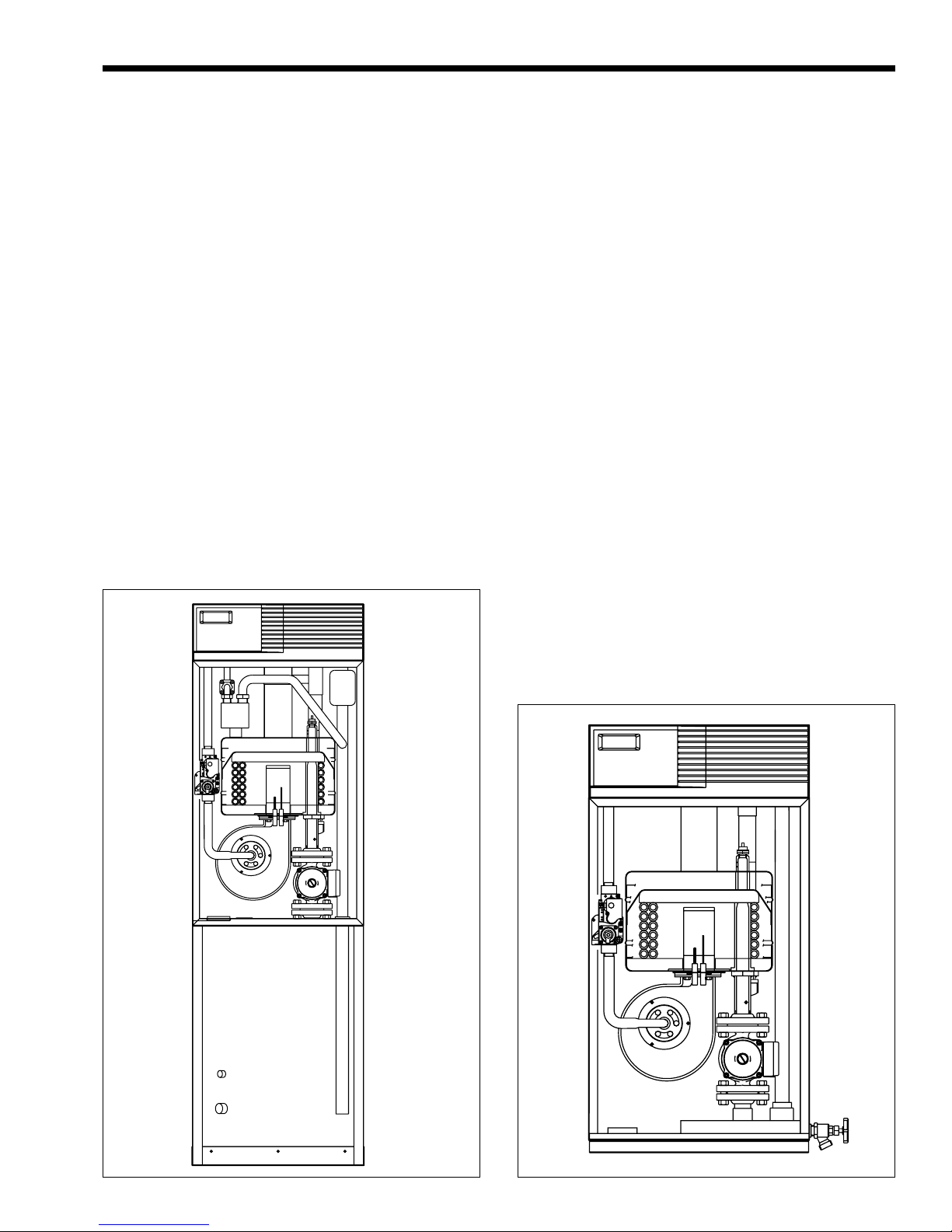
EBP - This appliance is a low pressure, direct
vent, hot water boiler that provides priority domestic
hot water on demand as well as hydronic space
heating. The unit has a twenty gallon tank which holds
boiler water (as opposed to domestic water storage).
The boiler water is kept hot at all times to
provide immediate response to call for heat or
domestic water. Domestic water is heated by the boiler
water through a stainless steel plate heat exchanger.
EDP/EDN - This appliance is a low pressure,
direct vent, cold start hot water boiler that provides
heat for hydronic space heating. The model number
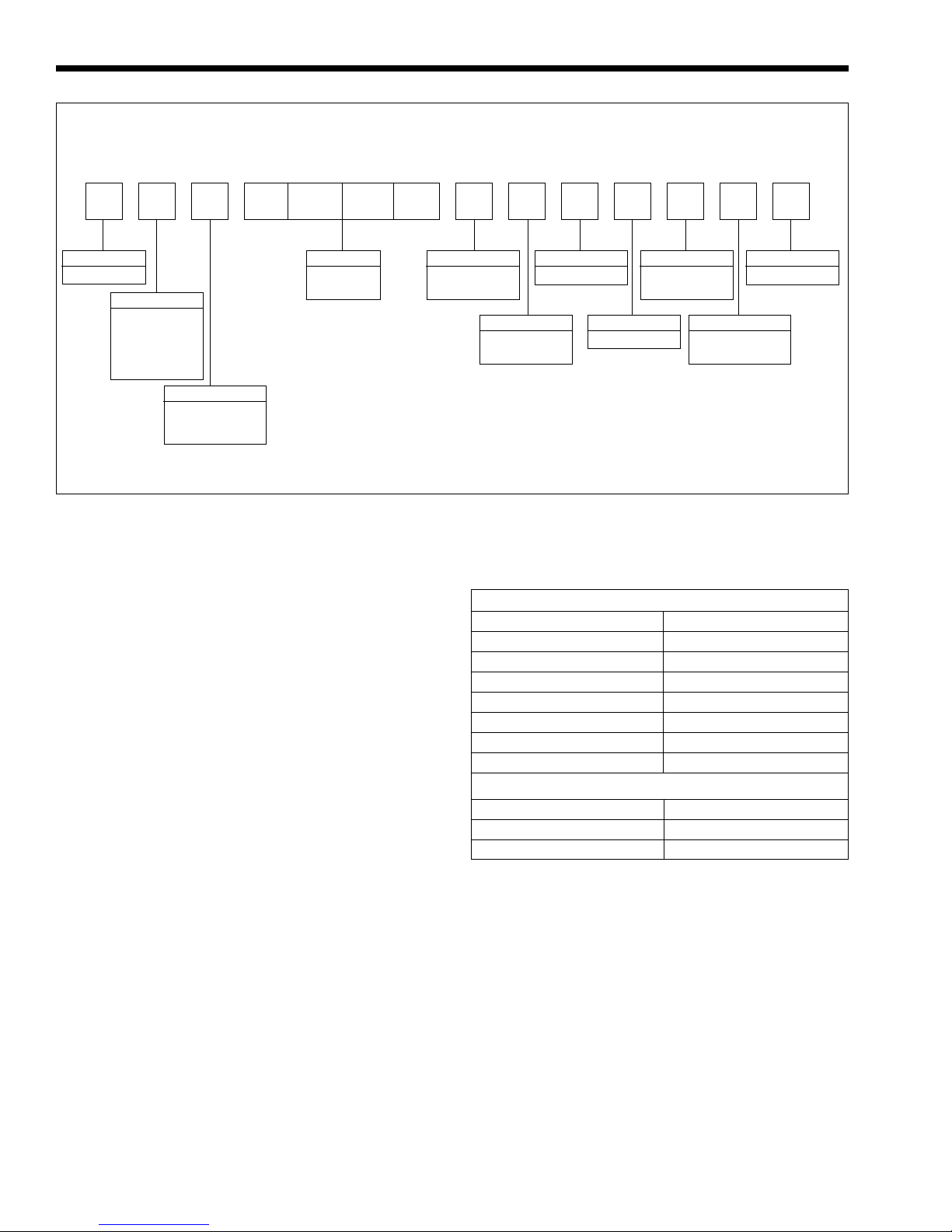
structure is shown in Figure 3.
Both appliances incorporate a circulating pump
and a bypass loop, and provide circulation for the
heating system and adequate flow for its own needs.
It may be necessary to install a system circulator to
achieve the required flow rate through the system.
Both appliances feature a forced draft, premixed
combustion system. All air for combustion is supplied
with the gas to the burner (flame holder). Both the
intake air and the gas are metered through separate
orifices before entering the combustion air blower. The
blower forces the air/fuel mixture through the flame
holder and into the combustion chamber. The mixture
is ignited from the hot surface ignitor and burns. Hot
gases are forced out between the passes of the heat
exchanger into the flue collector. Flue gases are
discharged into the outside atmosphere through the
vent terminal.
The appliance can operate with a concentric vent
system that will provide outside air for combustion.
Other venting arrangements can be provided for the
appliance to include an alternative 50 equivalent feet
maximum horizontal or condensate trapped vertical
vent.
1.2 Codes and Standards
The Endurance may be a direct vent or Category
IV Boiler. All installations must be made in
accordance with:
a. The National Fuel Gas Code, ANSI Z223.1/
NFPA 54 latest edition, or
b. CSA B149.1 Natural Gas and Propane
Installation Code.
c. The requirements of the local utility or other
authorities having jurisdiction take precedence
over the general instructions contained herein.
All electrical wiring is to be done in accordance with:.
a. The National Electrical Code (NFPA 70), latest
edition or
Figure 1. Combo Heating/Domestic Water (Model EBP).
Figure 2. Heating Unit (Model EDP/EDN).
Page 4
Page 4
1234567891011121314
E IF2 X
LAARS Heating Systems
Prod. Line
E = Endurance
Usage
B = Combination,
Heating &
Domestic
Water
D =Heating Only
Type
P =Standard
N =Non Ferrous
(ED Units Only)
Figure 3. Model Structure.
BTU Input
0 1 1 0
0 1 7 5
b. The Canadian Electrical Code (CSA C22.1),
latest edition.
c. All applicable local installation codes must also
be adhered to.
All vent installations must be made in accordance with:
a. The applicable venting requirements of the
National Fuel Gas Code (ANSI Z223.1/NFPA
54), latest edition; or
b. in Canada, The Natural Gas and Propane
Installation Code (CSA B149.1), latest edition.
All applicable provisions of local building codes
should also be adhered to.
Fuel
N =Natural Gas
P =Propane
A = 0' - 5,000'
H =Over 5,000'
Altitude
Location
I = Indoor
Firing Mode
F = Modulating
Revision
2 = Second
Revision
Country of Sale
A = USA & Canada
R =Russia
1.5 Clearances
The dimension and criteria in Table 1 should be
followed when choosing the location for the unit.
Minimum Clearances From Combustible Materials
Back 1 inch 25mm
Left Side 1 inch 25mm
Right Side 1 inch 25mm
Front 1 inch 25mm
Top (Alcove Install) 1 inch 25mm
Top (Closet Install)* 22 inches 559mm
Vent: Concentric, Direct 0 inch 0mm
Vent: Category 3 inches 76mm
Options Code
X =None
1.3 Unpacking the Appliance
Remove all packing and tie down materials.
Make immediate claims (to the carrier) if the appliance
and its packaging are damaged.
1.4 Locating the Appliance
The appliance is designed for installation on
combustible flooring, in alcoves, basements, closets, or
utility rooms. It must NOT be installed on carpeting.
IF INSTALLED IN A FINISHED AREA,
PROVISION SHOULD BE MADE FOR DRAINAGE
OF ANY ACCIDENTAL SPILLAGE OR LEAKAGE.
The location for the unit should be chosen with
regard to venting dimensions, convenient access to
piping, and accessibility for service and cleaning.
The boiler shall be installed so that the gas
ignition system components are protected from water
(dripping, spraying, rain, etc.) during appliance
operation or service (circulator replacement, control
replacement, etc.).
Suggested Serviceability Clearances
Front 18 inches 457mm
Left Side 6 inches 152mm
Right Side 6 inches 152mm
*Minimum closet height 6'9" 206 cm
Table 1. Clearances.
SECTION 2.
Venting Options
The Endurance boilers are certified as direct
vent, sealed combustion boilers, when vented using
one of the following two methods:
1) Concentric direct vent, which has a flue gas pipe
inside a combustion air pipe.
2) Non-concentric direct vent, using separate pipes
for the flue gases and the combustion air.
The Endurance boilers can also take air from the
space (when properly sized), and be vented as a
Category IV appliance.
Page 5
Endurance
Page 5
The following sections describe the requirements
for each of these methods.
IMPORTANT NOTE REGARDING ENDURANCE
VENTING: Regardless of the venting arrangement
being used, the flue gas vent material used with
the Endurance MUST be stainless steel special
gas vent listed to U.L. Standard 1738 and U.L.C.
Standard 636. Endurance flue gases must never
be vented into a masonry chimney or vented with
B-vent or other galvanized vent material.
Endurance units are not permitted to be common
vented with any other appliance(s), including
other Endurance appliances.
2.1 Concentric Direct Vent
2.1.1 Concentric Vent Description
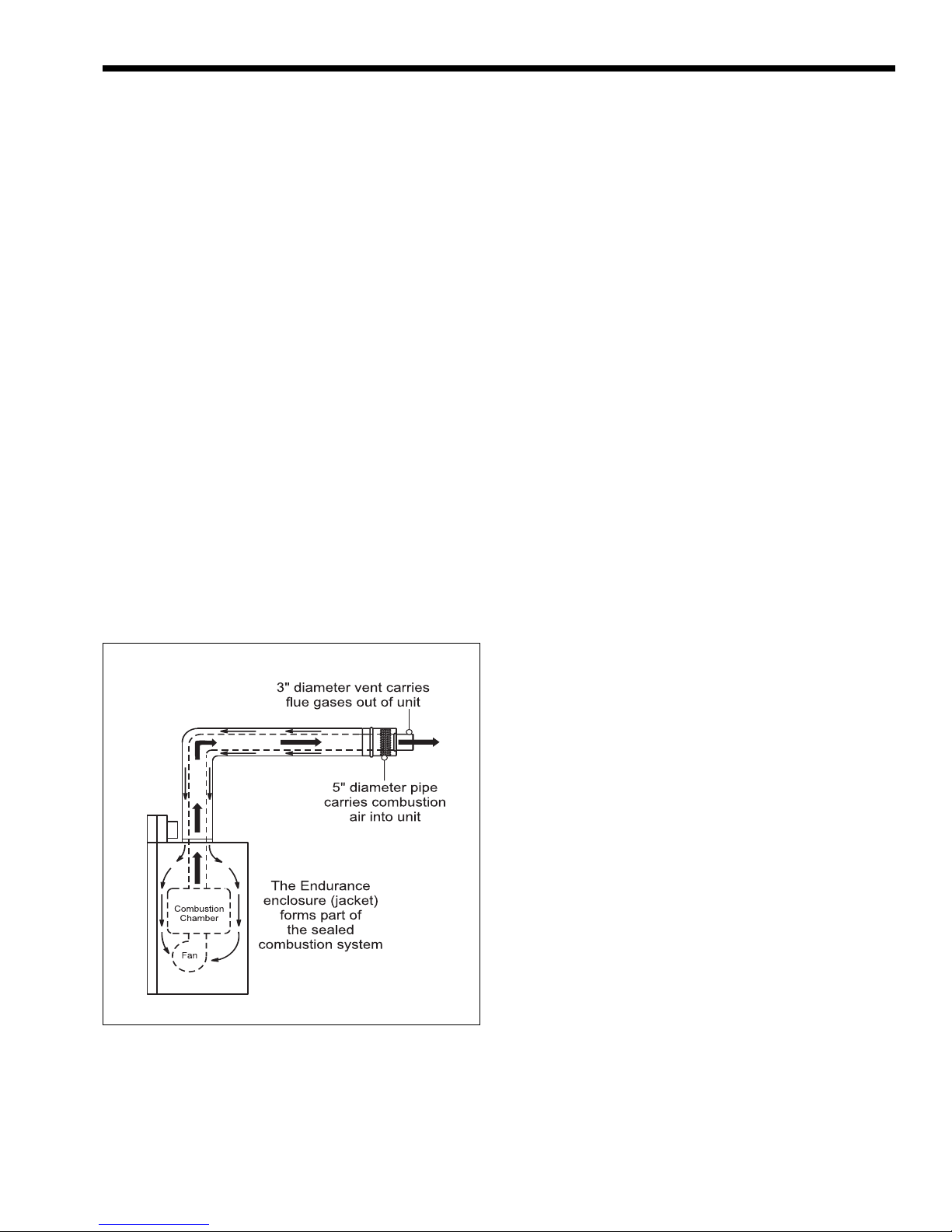
Endurance concentric direct vent is a sealedcombustion system. It can be used for vent systems
with a maximum of 15 linear feet (4.6m) and three
elbows. All of the air is drawn in from the outside
through a 5" stainless steel outer pipe. Flue gases are
vented through a 3" stainless steel pipe that is
positioned inside the 5" intake pipe. Hot flue gases are
surrounded by the intake flow of cooler outdoor air
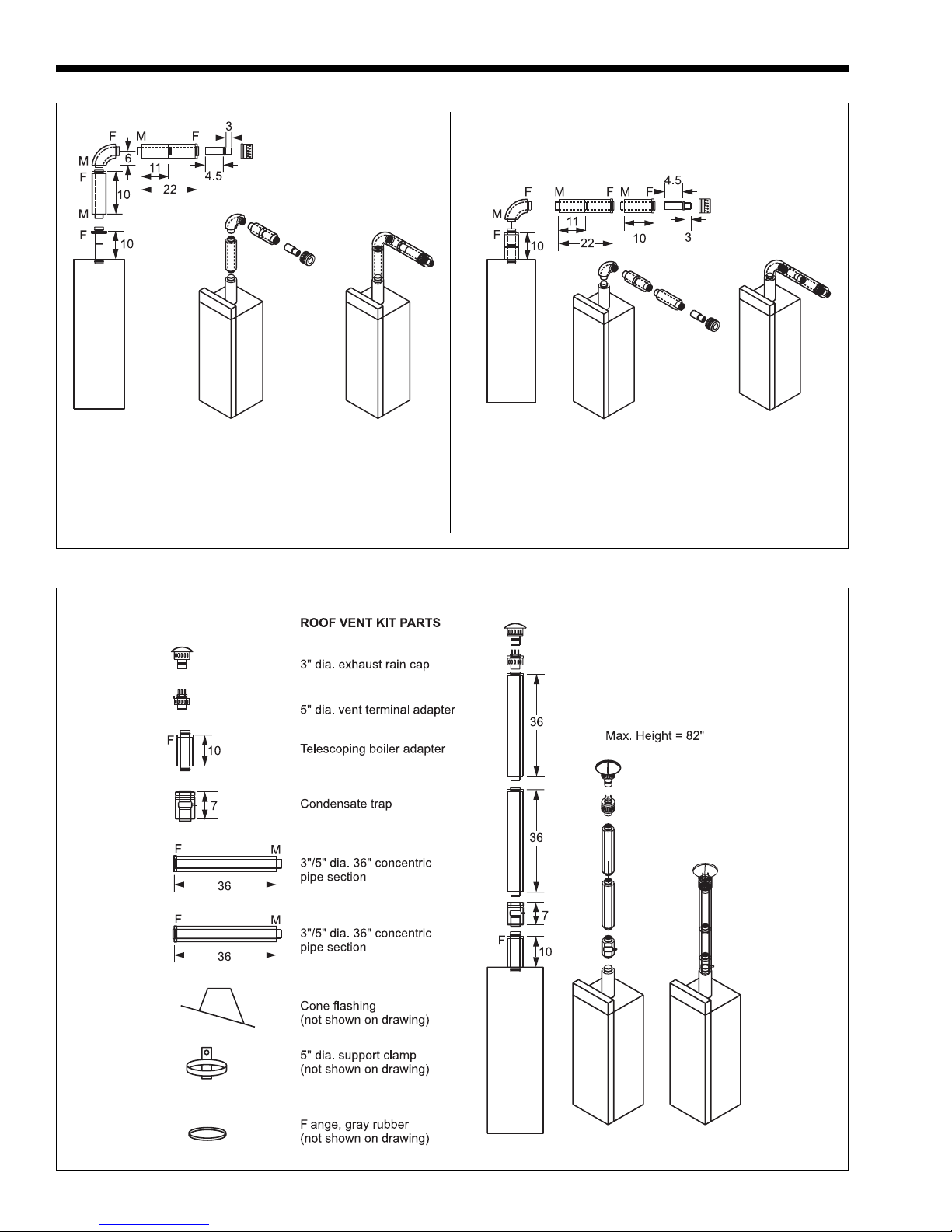
(see Figure 4). Laars offers two concentric vent kits,
described in section 2.1.2. Laars concentric vents may
be installed through, and be in contact with,
combustible materials.
Figure 4. Combustion Air and Flue Gas Paths.
2.1.2 Laars Concentric Vent Kits
The Endurance is certified with a maximum of
15 linear feet (4.6m) of concentric piping and three
sets of elbows. There are two concentric vent kits
offered by Laars. Both kits, and all Laars Endurance
vent material meet the requirements of U.L. Standard
1738 and U.L.C. Standard 636. The horizontal vent kit
is part number 2400-009. The vertical vent kit is part
number 2400-011. See Figures 5 and 6, which show
the components included with the kits and venting
configurations. Installation instructions are included
with the kits. Rules for concentric venting, vent
material and vent terminal placement are discussed in
the rest of section 2 of this manual.
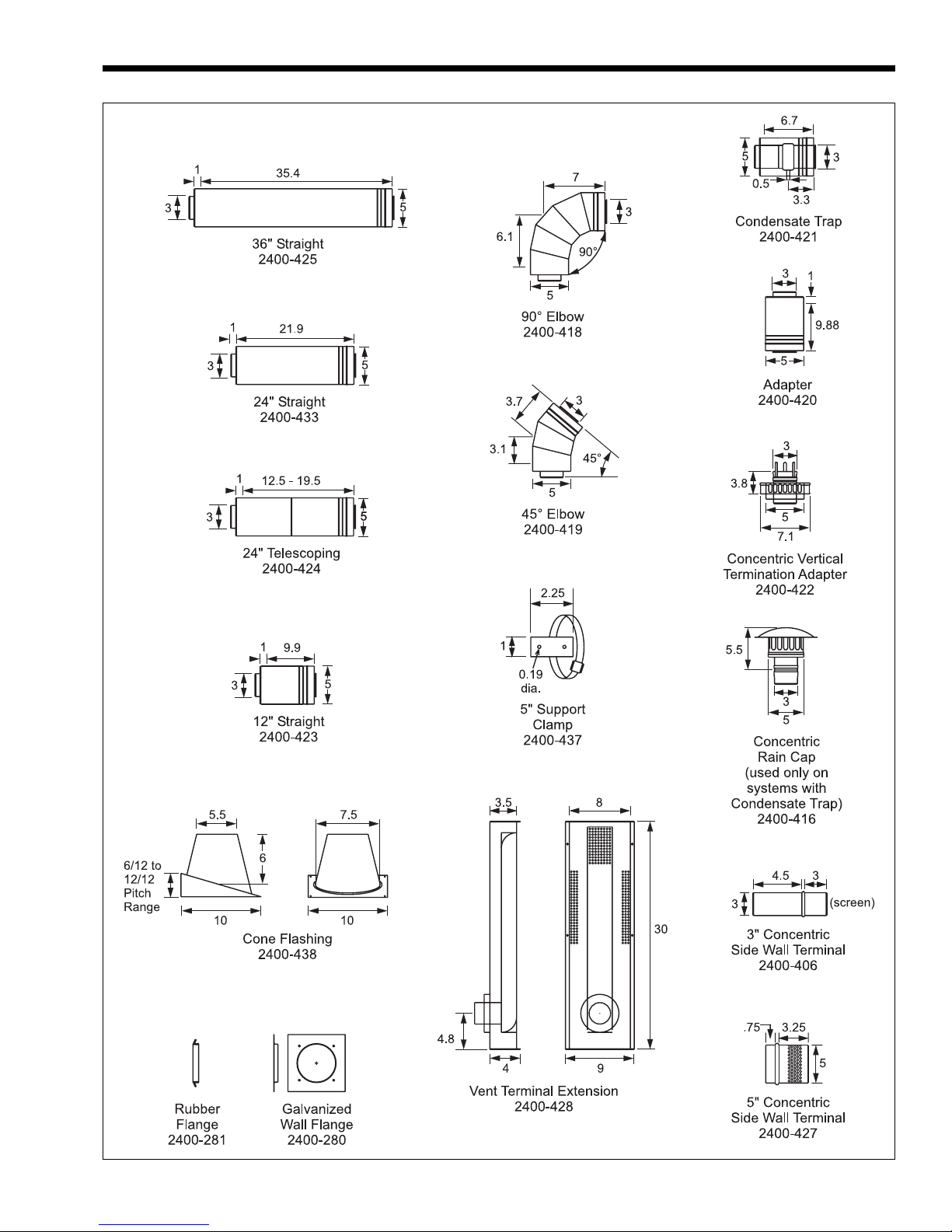
For additional length, and/or fittings, to extend
the kits to maximum 15 linear feet (4.6m) and three
elbows, individual components are available. These
components are shown in Figure 7.
2.1.3 Horizontal Concentric Vent
Location
The centerline of the vent opening must be at
least 16-1/2" (42cm) above grade, outside. Should it
be impossible to locate the opening centerline 16-1/2"
(42cm) above grade, use optional concentric vent
terminal extension (part number 2400-428), shown in
Figure 7.
In the U.S., vent terminals must be at least 3 feet
(0.9m) above any forced air inlet located within 10
feet (3.0m). In Canada, vent terminals must be at least
6 feet (1.8m) from any forced air inlet.
In the U.S., a direct vent terminal must be at least
12" (30cm) from any window or door that may be
opened, or any other nonmechanical opening. For an
Endurance that is not direct vented (vented as
Category IV), the vent terminal must be at least 4 feet
(1.2m) below or to the side of, and 12" (30cm) above
any such opening.
In Canada, a direct vent or non-direct vent
terminal must be at least 36" (91cm) from any window
or door that may be opened, or any other nonmechanical opening.
The vent opening should be well away from
shrubbery or other obstructions that would prevent
free air flow to and from the vent terminal.
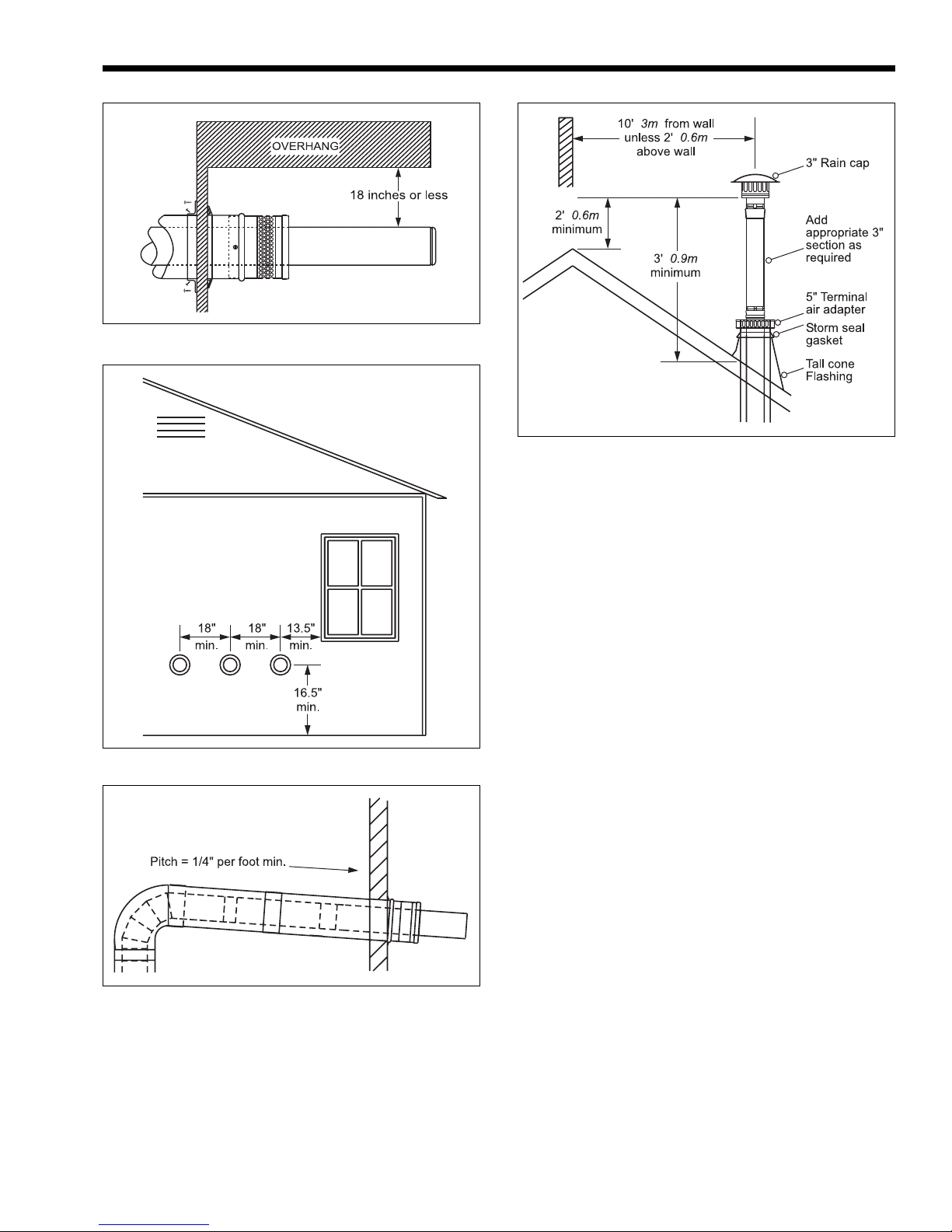
If the vent terminal location chosen is less than
18" (46cm) below an overhang, the 3" vent pipe must
extend to the outside edge of the overhang, to prevent
the accumulation of flue gas (see Figure 9).
Accumulating flue gas can contaminate the
combustion air, causing nuisance lockouts of the
ignition system. In addition, accumulation of flue
gases can settle on, and damage the structure’s
surfaces.
Vent terminals must not terminate in a location
where condensate or vapor may be a nuisance, hazard,
or could be a detriment to other equipment. See Figure
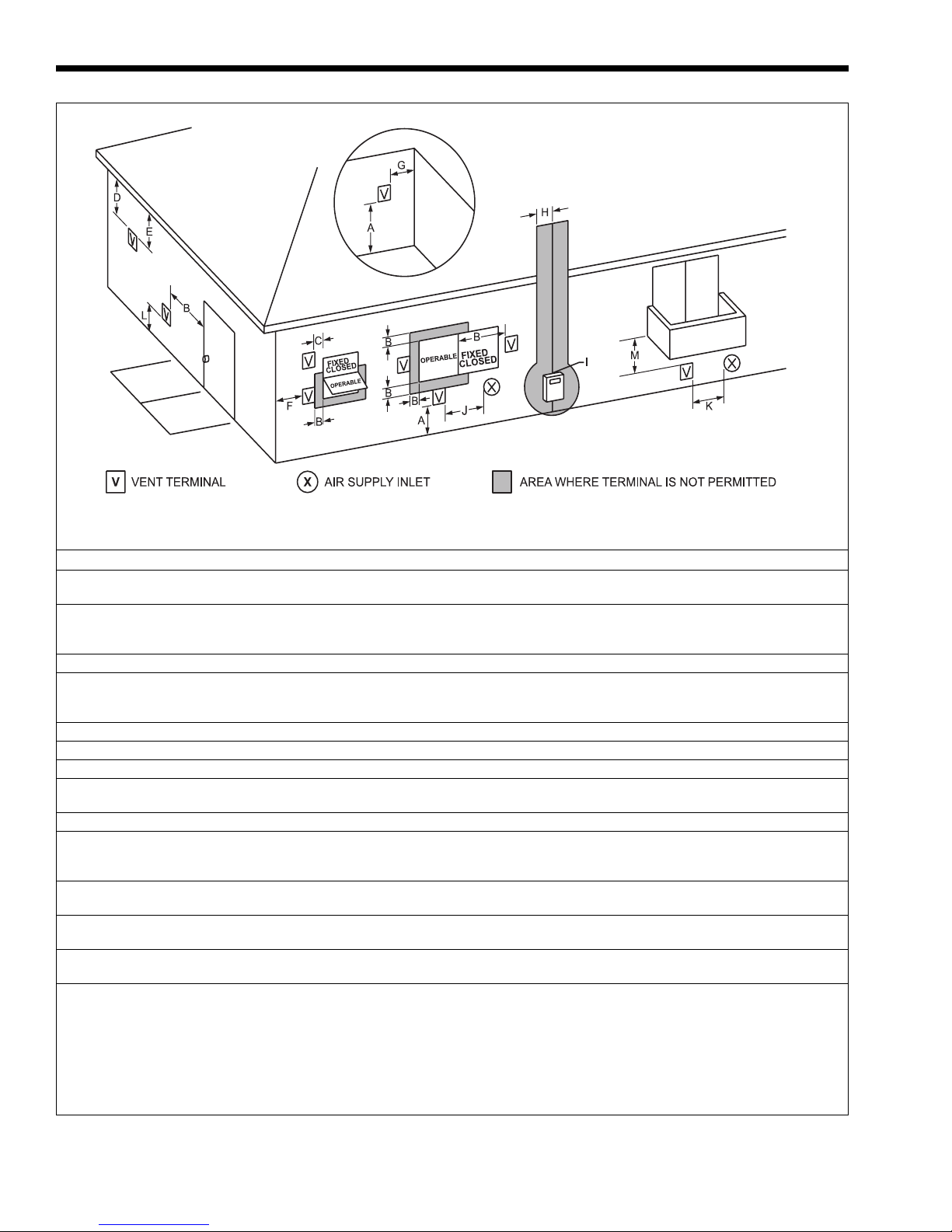
8 for more detail concerning vent terminal placement
in the U.S. and Canada.
Do not locate the vent terminal where blockage
by snow is a possibility, or where flue products could
strike against building materials and cause
degradation.
When multiple Endurance units are used, the
concentric vent terminals may be side-by-side,
Page 6
Page 6
LAARS Heating Systems
Configuration 1:
Maximum horizontal = 28"
Maximum vertical = 26"
(Measurements are from the centerlineof the venting to
the boiler top or face of outside wall.)
Dimensions shown in inches.
Figure 5. Horizontal Vent Kit 2400-009.
Configuration 2:
Maximum horizontal = 38"
Maximum vertical = 16"
(Measurements are from the centerline of the venting to
the boiler top or face of outside wall.)
Dimensions shown in inches.
Figure 6. Vertical Vent Kit 2400-011.
Page 7
Endurance
Page 7
Figure 7. Concentric Vent Parts.
Dimensions shown in inches.
Page 8
Page 8
LAARS Heating Systems
U.S. Installations (see note 1) Canadian Installations (see note 2)
A= Clearance above grade, veranda, porch, 12 inches (30 cm) 12 inches (30 cm)
deck, or balcony
B= Clearance to window or door that may Direct Vent Only: 12 inches (30 cm)
be opened Other Than Direct Vent: 4 feet (1.2 m) below or 36 inches (91 cm)
C= Clearance to permanently closed window See note 4 See note 5
D= Vertical clearance to ventilated soffit located
above the terminal within a horizontal See note 4 See note 5
distance of 2 feet (61cm) from the center line of the terminal
E= Clearance to unventilated soffit See note 4 See note 5
F= Clearance to outside corner See note 4 See note 5
G= Clearance to inside corner See note 4 See note 5
H= Clearance to each side of center line See note 4 3 feet (91 cm) within a height 15 feet
extended above meter/regulator assembly above the meter/regulator assembly
I= Clearance to service regulator vent outlet See note 4 3 feet (91 cm)
J= Clearance to nonmechanical air supply Direct Vent Only: 12 inches (30 cm)
inlet to building or the combustion air inlet Other Than Direct Vent: 4 feet (1.2 m) below or 36 inches (91 cm)
to any other appliance to side of opening; 1 foot (30 cm) above opening
K= Clearance to a mechanical air supply inlet 3 feet (91 cm) above if within 10 feet (3 m) 6 feet (1.83 m)
L= Clearance above paved sidewalk or paved Vent termination not allowed in this location Vent termination not allowed in this
driveway located on public property location
M= Clearance under veranda, porch, deck, See note 4 12 inches (30 cm) (see note 3)
or balcony
Notes:
1. In accordance with the current ANSI Z223.1 / NFPA 54 National Fuel Gas Code.
2. In accordance with the current CAN/CGA-B149 Installation Codes.
3. Permitted only if veranda, porch, deck, or balcony is fully open on a minimum of two sides beneath the floor.
4. For clearances not specified in ANSI Z223.1 / NFPA 54, clearance is in accordance with local installation codes and the requirements of
the gas supplier.
5. For clearances not specified in CAN/CGA-B149, clearance is in accordance with local installation codes and the requirements of the gas
supplier.
to side of opening; 1 foot (30 cm) above opening
horizontally
Figure 8. Vent Terminal Clearance.
Page 9
Endurance
Figure 9. Clearance from Overhang.
Figure 10. Multiple Concentric Vent Clearances.
Page 9
Figure 12. Vertical Vent Terminal Placement.
The vertical vent terminal must be placed such
that the bottom of the vent cap is at least 2-feet (0.6m)
above any structure (such as the peak of a roof or
adjacent wall) within 10 feet (3.0m), and must be at
least 3 feet (0.9m) above where the vent pipe exits the
roof (see Figure 12).
When vertical vent systems have horizontal
components, they must have a condensate drip tee in
the offset. All horizontal portions of the vent system
must slope a minimum 1/4" per foot toward the
condensate drip tee. Laars vertical vent kit and
individual venting components have condensate tees
that work in a vertical vent system, and therefore it is
not necessary to have an offset in a vertical vent
system that uses these parts.
Figure 11. Vent System Pitch.
provided that they are at least 18" (46cm) apart,
centerline to centerline (see Figure 10).
A horizontal vent system must pitch downward,
toward the terminal and away from the Endurance, as
shown in Figure 11. It must pitch at least 1/4" per foot
(21mm per meter). Be sure to take this into
consideration when choosing the vent terminal
location.
2.2 Stainless Steel Single Pipe Horizontal
and Vertical Vents – Category IV
Stainless steel special gas vent listed to U.L.
Standard 1738 and U.L.C. Standard 636 must be used
to vent all models. Three-inch or 4-inch material can
be used. Vent pipe and fittings are manufactured to
these standards by HeatFab, Inc. under the trade name
of Saf-T Vent
®
Vent
, and by ProTech Systems, Inc. under the trade
name FasNSeal
manufacturer’s instructions regarding design, location
and assembly of the vent system.
The appliance may be vented with any number
of elbows or fittings, providing that the maximum
equivalent feet of venting is not exceeded. Equivalent
feet of vent material is shown in table 2, along with
information about vent temperature and pressure.
Elbows (90°) in the vent system shall be considered to
be 5 equivalent feet (1.5m).
A horizontal vent system must pitch downward,
toward the terminal and away from the Endurance, as
shown in Figure 11. It must pitch at least 1/4" per foot
®
, by Z-Flex™ under the trade name of Z-
®
. Follow the special gas vent
Page 10
Page 10
LAARS Heating Systems
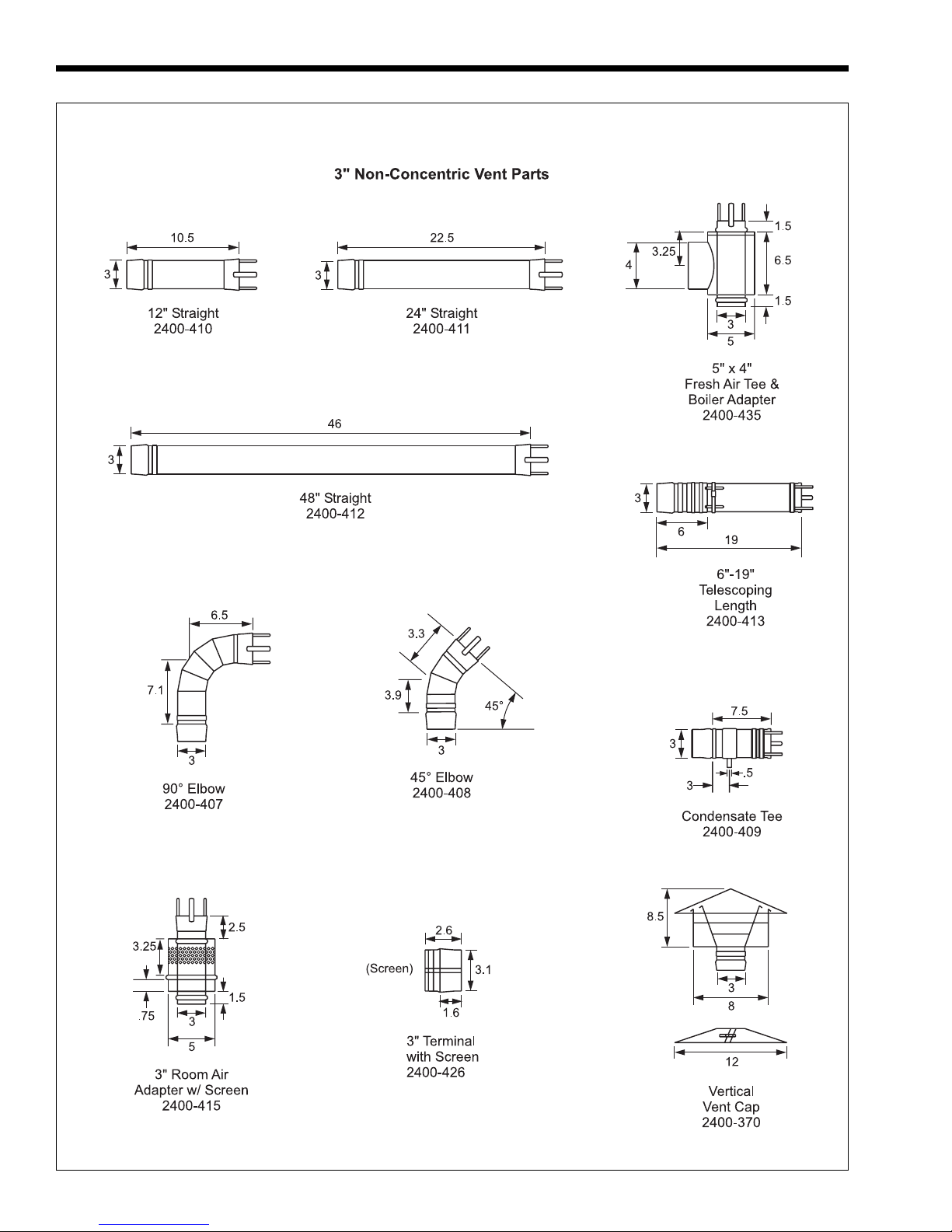
Figure 13. 3" Vent Parts.
Dimensions shown in inches.
Page 11

Endurance
Page 11
Minimum clearance from
combustibles (vent) U.S.* 3" 8cm
Minimum clearance from
combustibles (vent) Canada 6" 15cm
Max. flue gas temp. 325°F 163°C
Max vent pressure 1.5" w.c. 0.4kPa
Max. equivalent ft. of 3" venting (any 50 15
combination of horizontal or vertical) equiv. feet equiv. meters
Max. equivalent ft. of 4" venting (any 100 30
combination of horizontal or vertical) equiv. feet equiv. meters
*Note: To use 3" (8cm) clearance, the vent must be open on at
least one side. If fully enclosed, clearance is 6" (15cm)
Table 2. Category IV Vent Parameters.
(21mm per meter). Be sure to take this into
consideration when choosing the vent terminal
location.
For applications requiring vertical venting
through a roof, the same limitations for length and
fittings apply (see Table 2). Vertical vents greater than
7 feet (2.1m) in length must use a condensate trap.
When vertical vent systems have horizontal
components, they must have a condensate drip tee in
the offset. All horizontal portions of the vent system
must slope a minimum 1/4" per foot toward the
condensate drip tee. Laars vertical vent kit and
individual venting components have condensate tees
that work in a vertical vent system, and therefore it is
not necessary to have an offset in a vertical vent
systems that use these parts.
The vertical vent terminal must be placed such
that the bottom of the vent cap is at least 2-feet (0.6m)
above any structure (such as the peak of a roof or
adjacent wall) within 10 feet (3.0m), and must be at
least 3 feet (0.9m) above where the vent pipe exits the
roof (see Figure 12).
Laars offers 3" vent parts for non-concentric
venting, including an in-line condensate tee and vent
caps for vertical venting. See Figure 13 for 3" vent
parts, and Figure 15 for an example of the inline
condensate in a vertical vent system.
IMPORTANT NOTE REGARDING ENDURANCE
VENTING: Regardless of the venting arrangement
being used, the flue gas vent material used with the
Endurance MUST be stainless steel special gas
vent listed to U.L. Standard 1738 and U.L.C.
Standard 636. Endurance flue gases must never be
vented into a masonry chimney or vented with B-vent
or other galvanized vent material. Endurance units
are not permitted to be common vented with any
other appliance(s), including other Endurance
appliances.
2.3 Air Source For Combustion
(when not ducted to the Endurance)
When using Category IV venting methods the
appliance draws all combustion air through its top and
from the adjacent space. When locating the appliance
in unconfined spaces in buildings, infiltration may be
adequate to provide air for combustion and
ventilation. However, in buildings of unusually tight
construction, or when locating the appliance in a
confined space, additional air should be provided and
the guidelines below must be followed:
2.3.1 Air From Inside the Building
The following method shall be used to size the
air openings for boilers that are getting all of their
combustion air from inside the building.
The confined space shall be provided with two
permanent openings communicating directly with
other spaces of sufficient volume so that the combined
volume of all such spaces meets the criteria for an
unconfined space. The total input of all gas utilization
equipment installed in the combined spaces shall be
used to determine the required minimum volume.
Each opening shall have a minimum free area of not
less than 1 in.
2
/1000 Btu/hr (220 mm2/kW) of the total
input rating of all gas utilization equipment in the
confined space, but not less than 100 in.
2
(645 cm2).
One opening shall commence within 12 in. (30 cm) of
the top, and one opening shall commence within 12 in.
(30cm) of the bottom, of the enclosure. The minimum
dimension of air openings shall be not less than 3 in.
(8 cm).
2.3.2 All Air From Outdoors
When all air is provided from outdoors, but not
ducted directly to the Endurance, the following
methods shall be used to size the air opening(s).
a. Two permanent openings, one commencing
within 12 in. (30 cm) of the top and one
commencing within 12 in. (30 cm) of the bottom,
of the enclosure shall be provided. The openings
shall communicate directly, or by ducts, with the
outdoors or spaces (crawl or attic) that freely
communicate with the outdoors.
a1. Where directly communicating with the
outdoors or where communicating to the
outdoors through vertical ducts, each
opening shall have a minimum free area of
2
1 in.
/4000 Btu/hr (550 mm2/kW) of total
input rating of all equipment in the
enclosure.
a2. Where communicating with the outdoors
through horizontal ducts, each opening
shall have a minimum free area of not less
than 1 in.
2
/2000 Btu/hr (1100 mm2/kW) of
total input rating of all equipment in the
enclosure.
b. One permanent opening, commencing within 12
in. (30 cm) of the top of the enclosure, shall be
permitted where the equipment has clearances of
at least 1 in. (2.5 cm) from the sides and back
and 6 in. (16 cm) from the front of the appliance.
Page 12

Page 12
LAARS Heating Systems
The opening shall directly communicate with the
outdoors or shall communicate through a vertical
or horizontal duct to the outdoors or spaces that
freely communicate with the outdoors and shall
have a minimum free area of:
b1. 1 in.
2
/3000 Btu/hr (700 mm2/kW) of total
input rating of all equipment in the
enclosure, and
b2. Not less than the sum of the areas of all
vent connectors in the confined space.
2.3.3 Connecting Special Gas Vent to
the Appliance
When drawing combustion air from the adjacent
space, part number 2400-415 (room adapter with
screen) can be used. One portion of this assembly
connects to the 5" air collar (with a screen for the
combustion air) and the other part connects to the 3"
flue opening (see Figure 14). The rest of the 3" vent
system can be connected to the adapter within the
2400-415.
2400-435 tee
(to separate
venting from
combustion
air)
Combustion
Chamber
Fan
2400-416
concentric rain cap
(use only on systems
with condensate trap)
2400-435 tee
(to separate
venting from
combustion air)
3" diameter vent
(50 equivalent feet, maximum)
4" combustion air pipe
(15 equivalent feet, maximum)
Non-Concentric Direct Vent with
Horizontal Vent.
2400-370
vertical vent cap
(can be used on system with
or without condensate trap)
2400-409 condensate trap
(used if vent height is
greater than 7 feet)
4" combustion air pipe
2400-426
3" vent termination
with screen
vent
gases
combustion
air
4" air terminal
(field-supplied)
combustion
air
Figure 14. Combustion Air from Room.
2.4 Non-Concentric Combustion Air
An alternate, non-concentric combustion air
source may be installed (as shown in Figure 15),
provided that the minimum 4" diameter combustion
air duct does not exceed 15' (4.6m). Termination
should include an air screen and be located in a
qualified air space (see Section 2.3) or outside.
Separated combustion air / flue gas may be
considered either “mechanical draft” or “direct vent”.
To be considered “direct vent”, all of the combustion
air and flue gas piping must be sealed stainless steel
special gas vent, listed to U.L. 1738 and U.L.C. 636.
4" air terminal
(field-supplied)
Combustion
Chamber
Fan
Figure 15. Non-Concentric Combustion Air.
Non-Concentric Direct Vent with
Vertical Vent.
When the system meets this requirement, vent
terminal clearances may be less than that of a nondirect vent system. See Figure 8 for direct vent
terminal clearances.
The combustion air pipe may be galvanized
material, but if used, the system is a “mechanical
vent” system, and the vent terminal clearances must be
per the rules for “mechanical vent” systems. See
Figure 8.
SECTION 3.
3.1 Gas Piping
The appliance requires an inlet gas pressure of at
least 4" w.c. (1.0kPa) and no greater than 13" WC
Page 13

Endurance
Length Capacity of Pipe
of Pipe 1/2" 3/4" 1" 1-1/4"
ft. m MBTU/h kW MBTU/h kW MBTU/h kW MBTU/h kW
10 3 132 38.7 278 81.5 520 152.4 1050 307.7
20 6.1 92 27 190 55.7 350 102.6 730 213.9
30 9.1 73 21.4 152 44.5 285 83.5 590 172.9
40 12.2 63 18.5 130 38.1 245 71.8 500 146.5
50 15.2 115 33.7 215 63 440 128.9
75 22.9 93 27.2 175 51.3 360 105.5
100 30.5 79 23.1 150 44 305 89.4
150 45.7 64 18.8 120 35.2 250 73.3
Additional length to be added for each tee or elbow
ft m ft m ft m ft m
1.3 0.4 1.7 0.5 2.2 0.7 2.7 0.8
Table 3. Gas Pipe Sizing.
Page 13
(3.2kPa). Check with your local gas utility or supplier
for availability of this pressure range.
Refer to Table 3 to size the supply piping to
minimize pressure drop between meter or regulator
and unit.
1. Run gas supply line in accordance with all
applicable codes.
2. Locate and install manual shutoff valves in
accordance with state and local requirements.
3. Install drip leg, ground joint union and drip cap
to trap sediment and for test gauge access.
4. Support all piping with proper hangers.
5. All threaded joints should be coated with piping
compound resistant to the action of liquefied
petroleum gas.
6. The boiler and its individual shutoff valve must
be disconnected from the gas supply piping
system during any pressure testing of that system
at test pressures in excess of ½ psig (3.5kPa).
7. The boiler must be isolated from the gas supply
piping system by closing its individual manual
shutoff valve during any pressure testing of the
gas supply piping system at test pressures equal
to or less than ½ psig (3.5kPa)
8. The boiler and its gas connection must be leak
tested before placing the boiler in operation.
9. Purge all air from gas lines.
3.2 Domestic Water Piping (EBP only)
1. Connect tempering (mixing) valve 12 “Hot” port
to hot water outlet from unit. This valve should
be rated no higher than 120°F mixed delivery
temperature or as local codes dictate.
RECOMMENDS ANTI-SCALD TEMPERING
(MIXING) VALVES (see Figure 16).
2. Connect gate or shutoff valve 13 to tempering
(mixing) valve 12 “MIX” port, and cold
water inlet.
3. Install supplied flow restrictor 14 ahead of
tempering (mixing) valve tee.
4. Connect pressure relief valve 1 (if required by
codes), rated at maximum 150 PSI as close to the
unit as possible. No other valves or restrictions
may be installed between the Endurance and the
relief valve.
DO NOT USE A TEMPERATURE/PRESSURE
RELIEF VALVE AS THIS IS NOT A STORAGE
HOT WATER HEATER.
NOTE: Installations with water containing 10 or
more grains of hardness, must be installed with
appropriate water treatment.
LAARS
Figure 16. Domestic Water Piping. Figure 17. Domestic Water Piping With Storage Tank.
Page 14

Page 14
Figure 18. EBP Domestic Water Piping with Recirculating Loop.
LAARS Heating Systems
WARNING
Failure to install a hot water tempering (mixing)
valve (12) creates a scalding hazard with potential for
serious bodily injury.
(mixing) valves are not designed as anti-scald valves.
Some brands of tempering
Where domestic water is supplying multiple
apartments or large whirlpool tubs, an additional
storage tank may be connected as shown in Figure 17.
The bronze circulator shown must be connected to the
tank aquastat and must not run continuously. If the
circulator is wired to run continuously, the unit’s
domestic water flow switch will keep the unit in
domestic water priority, and no water will be allowed
to be sent to the heating system.
Where domestic water is supplying a
recirculating loop, pipe per Figure 18. If the circulator
is wired to run continuously, the unit’s domestic water
flow switch will keep the unit in domestic water
priority, and no water will be sent to the heating
system. Wire the loop’s circulator through an aquastat
to maintain domestic water priority, while still
allowing the heating systems to function properly.
3.3 Anti-Freeze — Domestic Water
Endurance EBP units use a flat plate heat
exchanger to heat domestic (potable) water indirectly.
Endurance units are equipped with a Low
Temperature control feature that recognizes when the
boiler water temperature (not the domestic/potable
water temperature) has fallen below 39° (4°C). If this
condition is recognized, the Endurance pump will run
for 5 minutes, or until the boiler water temperature
reaches 45°F (7°C). If the boiler water temperature
remains below 45°F (7°C) for 5 minutes, the appliance
will start its ignition sequence, in hopes of firing, and
heating the boiler water. The display will show [ICE]
during this time.
This feature is intended to assist in protecting the
boiler from freezing conditions, and does not help to
protect any other part of the boiler or water heater
system. This feature will not help to protect the
domestic (potable) water in the system from freezing
conditions.
Caution
Power outage, interruption of gas supply, failure of
system components, activation of safety devices,
etc., may prevent a heater from firing. Any time a
heater is subjected to freezing conditions, and
the heater is not able to fire, and/or the water is
not able to circulate, there is a risk of freezing in
the heater or in the pipes in the system. When
water freezes, it expands. This can result in
bursting of pipes in the system, or damage to the
heater, which could result in leaking or flooding
conditions.
SECTION 4.
Hydronic Heat Piping
4.1 Hydronic Piping
The appliance incorporates its own circulating
pump and bypass loop and is capable of providing
flow through heating zones, in addition to what it
needs for itself. Model size 110 is capable of providing
flow for two heating zones (up to 67 feet of ¾"
baseboard each), and model 175 is capable of
providing flow for four heating zones (up to 67 feet of
¾" baseboard, each).
Page 15

Endurance
Figure 19. Hydronic Piping EDP/EBP with Zone Valves.
Page 15
Figure 20. Piping, Single EDP/EBP Boiler for Multiple Temperature Systems.
Figure 21. Piping, Model “EDP/EDN” for Radiant Floor.
Page 16

Page 16
Figure 22. Hydronic Piping EBP/EDP for Systems Zoned with Circulators.
LAARS Heating Systems
Figure 23. Hydronic Piping EDP for Low-Temp and/or Multi-Temp Systems.
EDP/EDN boilers installed in radiant (in floor)
systems and other low mass boilers should be provided
with a buffer/blender tank to assure a controlled supply
temperature, and to prevent short cycling. In radiant
systems utilizing 3-way tempering valves, a bypass
pipe must be installed between supply and return piping.
1. EBP ONLY: Connect system supply to 1¼"
supply connection marked “SUPPLY”.
2. EDP/EDN ONLY: Connect 1¼" thermostatic
union to system supply connection in direction
designated with union.
3. Pipe the discharge of the relief valve, full size, to
a drain or in a manner to prevent injury in the
event of pressure relief.
4. Install an air purger in flow supply line as shown
in piping diagrams.
5. Install automatic float type air vent on air scoops.
6. Install a diaphragm expansion tank in boiler
outlet piping. To ensure sufficient expansion
volume for the hydronic system water, due to
heat-up and cool-down during normal operation,
a #30 or larger expansion tank must be used on
EBP combo units.
NOTE: Never install expansion tank and auto fill
valve on return.
7. If necessary, install a properly sized circulator
with optional isolation valves in supply beyond
expansion tank.
Caution
To avoid the risk of fire which can result in property
damage, all hot water pipes must be installed with a
minimum 1" (25mm) clearance from combustible
materials.
Page 17

Endurance
Page 17
8. Connect boiler feed water supply with shut off
valve to inlet connection of automatic fill valve.
Locate in boiler outlet piping.
9. If codes require, install suitable back flow
preventer between automatic fill valve and city
main.
10. The appliance may be installed in single and
multiple zone systems (using either zone valves
or zone circulators) in the same manner as any
other residential boiler.
Caution
The EBP/EDP appliance must not be direct
connected to a heating system utilizing oxygen
permeable tubing (see warranty). Provide a water to
water heat exchanger between systems to prevent
corrosion of tank or other components. Non-toxic
heating system antifreeze may be added to the
hydronic system provided that the concentration
does not exceed 35% and the antifreeze contains
an anti foamant.
4.2 Use in a Combined Hot Water Heating
and Chilled Water Cooling System
When the appliance is used in connection with a
refrigeration system, it must be installed so that the
chilled medium is piped in parallel with the boiler with
appropriate valves to prevent the chilled medium from
entering it.
The boiler piping system of an appliance
connected to heating coils located in air handling units
where they may be exposed to refrigerated air
circulation must be equipped with flow control valves
or other automatic means to prevent gravity circulation
of the boiler water during the cooling cycle.
4.3 Water Quality and Treatment
Water quality control is steadily increasing in
importance in view of the use of modern regulation
technology and the modern boiler designs used in
central heating systems.
The life of a central heating boiler can be
severely diminished as a result of the formation of
scale deposits and/or corrosion products. The
formation of such deposits should be prevented
wherever possible.
Continual water make-up is not permitted.
A suitable water treatment may be used to
prevent excessive scale deposits in the boiler and
corrosion in the system.
4.4 Anti-Freeze
Proper precautions for freeze protection are
recommended for boiler installations in areas where
the danger of freezing exists.
4.4.1 Endurance Boiler Low
Temperature Feature
Endurance boilers are equipped with a Low
Temperature control feature that recognizes when the
water temperature at the outlet of the boiler has fallen
below 39°F (4°C). If this condition is recognized, the
Endurance pump will run for 5 minutes, or until the
boiler outlet temperature reaches 45°F (7°C). If the
boiler outlet temperature remains below 45°F (7°C) for
5 minutes, the appliance will start its ignition
sequence, in hopes of firing the boiler and heating the
water. The display will show [ICE] during this time.
This feature is intended to assist in protecting the
boiler from freezing conditions, and does not help to
protect any other part of the heating system. This
feature will only help when there is power to the boiler
and when the internal water flow components in the
Endurance are working properly. This feature will not
be able to prevent freezing if the low temperature
water condition persists. See Section 4.4.2 for
information concerning further freeze protection for
the Endurance.
4.4.2 Anti-Freeze Boiler Additives
Caution
Power outage, interruption of gas supply, failure of
system components, activation of safety devices,
etc., may prevent a boiler from firing. Any time a
boiler is subjected to freezing conditions, and
the boiler is not able to fire, and/or the water is
not able to circulate, there is a risk of freezing in
the boiler or in the pipes in the system. When
water freezes, it expands. This can result in
bursting of pipes in the system, or damage to the
boiler, which could result in leaking or flooding
conditions.
Do not use automotive anti-freeze. When the
Endurance is the combination space heating domestic
water model (EBP), a non-toxic anti-freeze, such as
propylene glycol, must be used. Maintaining a mixture
of minimum 65% water and maximum 35% properly
inhibited HVAC glycol, which contains an antifoamant, is the preferred method of freeze protection
for Endurance boilers. Percentage of glycol used in
the Endurance boiler must not exceed 35%.
Typically, this mixture will serve as burst protection
for temperatures down to approximately -35°F (-30°C).
IMPORTANT NOTES: Different glycol products may
provide varying degrees of protection. Glycol
products must be maintained properly in a heating
system, or they may become ineffective. Consult the
glycol specifications, or the glycol manufacturer, for
information about specific products, maintenance of
solutions, and set up according to your particular
conditions.
Page 18

Page 18
LAARS Heating Systems
FOR YOUR SAFETY READ BEFORE OPERATING
WARNING
If you do not follow these instructions exactly, a fire or explosion
may result, causing property damage, personal injury or loss of life.
A. This appliance is equipped with an ignition
device which automatically lights the pilot. Do
not try to light the pilot by hand.
B. BEFORE OPERATING smell all around the
appliance area for gas. Be sure to smell next to
the floor because some gas is heavier than air
and will settle on the floor.
WHAT TO DO IF YOU SMELL GAS
• Do not try to light any appliance.
• Do not touch any electric switch; do not use
any phone in your building.
• Immediately call your gas supplier from a
neighbor's phone. Follow the gas supplier's
instructions.
OPERATING INSTRUCTIONS
1. STOP! Read the safety information above on
this label.
2. Set the thermostat to lowest setting.
3. Turn off all electric power to the appliance.
Gas Shutoff
Valve
Combination
Gas Control
• If you cannot reach your gas supplier, call
the fire department.
C. Use only your hand to push in or turn the gas
control knob. Never use tools. If the knob will
notpush in or turn by hand, don’t try to repair it,
call a qualified service technician. Force or
attempted repair may result in a fire or
explosion.
D. Do not use this appliance if any part has been
under water. Immediately call a qualified
service technician to inspect the appliance and
to replace any part of the control system and
any gas control which has been under water.
4. This appliance is equipped with an ignition
device which automatically lights the burner.
Do not try to light the burner by hand.
5. Remove front door.
6. Turn gas shutoff valve clockwise to “off”.
Handle will be horizontal, do not force.
7. Wait five (5) minutes to clear out any gas. Then
smell for gas, including near the floor. If you
smell gas, STOP! Follow “B” in the safety
information above (to the left) on this label. If
you don’t smell gas, go to the next step.
8. Turn gas shutoff valve counterclockwise to
“on”. Handle will be vertical.
9. Replace front door.
10. Turn on all electric power to appliance, depress
on/off button on control panel, depress black
button on top of control panel.
11. Set thermostat to desired setting.
12. If the appliance will not operate, follow the
instructions “To Turn Off Gas To Appliance”
and call your service technician or gas supplier.
TO TURN OFF GAS TO APPLIANCE
1. Set the thermostat to lowest setting.
2. Turn off all electric power to the appliance if
service is to be performed.
3. Remove front door.
4. Turn gas shutoff valve clockwise to “off”. Do
not force.
5. Replace front door.
Page 19

Endurance
PAR MESURE DE PRUDENCE, LISEZ CE QUI SUIT AVANT DE
FAIRE FONCTIONNER L’APPAREIL
MISE EN GARDE
Si vous ne suivez pas ces instructions à la lettre, un incendie ou une
explosion pourrait se produire et causer des dommages matériels,
des blessures personnelles ou même la mort.
A. Cet appareil est muni d'un dispostif d'allumage qui
allume automatiquement la veilleuse. Ne tentez pas
d'allumer la veilleuse manuellement.
B. AVANT D’UTILISER, vérifiez s’il n’y a pas d’odeur de
gaz près de l’appareil. Vérifiez s’il n’y a pas d’odeur
de gaz près du plancher, car le gaz est plus lourd
que l’air et peut se déposer sur le plancher.
QUE FAIRE EN CAS D’ODEUR DE GAZ
• N’essayez pas d’allumer n’importe quelque
appareil que ce soit.
• Ne touchez pas à un commutateur électrique.
N’utilisez pas le téléphone de votre résidence.
• Appelez immédiatement votre fournisseur de gaz
en utilisant le téléphone de votre voisin. Suivez
les instructions de votre fournisseur de gaz.
• Si vous ne pouvez joindre votre fournisseur de
gaz, appelez le service des incendies.
C. Ne ppoussez ou tournez la manette d'admission
du gaz qu'à la main ; ne jamais utiliser d'outil. Si
la manette reste coincée, ne tentez pas de la
réparer ; appelez un technicien qualifié. Le fait de
forcer la manette ou de la réparer peut
déclencher une explosion ou un incendie.
D. N’utilisez pas cet appareil si l’une des pièces a
été plongée sous l’eau. Communiquez
immédiatement avec un technicien de service
qualifié afin qu’il inspecte l’appareil et remplace
toute pièce du système de commande et toute
commande de gaz qui aurait été plongée sous
l’eau.
Page 19
NOTICE D’UTILISATION
1. ARRÊTEZ ! Lisez l’information de sécurité cidessus, sur cette étiquette.
2. Réglez le thermostat au réglage le plus bas.
3. Coupez l’alimentation électrique à l’appareil.
4. Cet appareil est doté d’un dispositif d’allumage
qui allumera automatiquement le brûleur.
Ne tentez
5. Enlever la porte avant.
Valve de fermeture
pas d’allumer le brûleur manuellement.
Commande de gaz
multifonctions
du gaz
6. Faites tourner la valve de fermeture du gaz dans
le sens des aiguilles d’une montre et mettez-la
à «off». La poignée sera horizontale. N’employez
pas de force.
7. Attendre cinq (5) minutes pour laisser échapper
tout le gaz. Reniflez tout autour de l'appareil, y
compris près du plancher, pour déceler une
odeur de gaz. Si vous sentez une odeur de gaz,
ARRÊTEZ ! Passez à l'étape B des instructions
de sécurité sur la pportion, supérieure (à gauche)
de cette étiquette. S'il n'y a pas d'odeur de gaz,
passez à l'étape suivante.
8. Faites tourner la valve de fermeture du gaz dans
le sens contraire des aiguilles d’une montre et
mettez-la à «on». La poignée sera verticale.
9. Replacer la pporte avant.
10. Rétablissez l’alimentation électrique à l’appareil,
appuyez sur le bouton «on/off» qui se trouve sur le
panneau de commande, appuyez sur le bouton noir
qui se trouve sur le panneau de commande.
11. Réglez le thermostat à la température désirée.
12. Si l’appareil ne se met pas en marche, suivez les
instructions intitulées “Comment couper l'admission
de gaz de l'appareil” et appelez un technicien
qualifié ou le fournisseur de gaz.
FERMETURE DE L’ALIMENTATION EN GAZ
1. Réglez le thermostat au réglage le plus bas.
2. Coupez toute alimentation électrique à l’appareil
si celui-ci doit faire l’objet d’un entretien.
3. Retirez le panneau d’accès aux commandes et le
couvercle avant qui se trouve sur le dessus.
4. Faites tourner la valve de fermeture du gaz dans
le sens des aiguilles d’une montre et mettez-la
à «off». N’utilisez pas de force.
5. Replacez le couvercle avant.
30-414A
Page 20

Page 20
SECTION 5.
Electrical Connections
5.1 Electrical Connections
All electrical wiring must conform to local codes
and/or the latest edition of the National Electric Code
(NEC; NFPA 70) or the Canadian Electric Code, Part
1 (CEC; CSA C22.1). Any applicable local codes must
also be adhered to.
The unit must be electrically grounded in
accordance with the requirements of the authority
having jurisdiction or, in the absence of such
requirement, with the latest edition of the National
Electric Code (NEC; NFPA 70) or the Canadian
Electric Code, Part 1 (CEC; CSA C22.1). Any
applicable local codes must also be adhered to.
Single pole switches, including those of safety
control and protective devices must not be wired in a
grounded line.
All electrical connections are made through the
electrical knockouts on the control panel. The
knockout on the right side of the control panel can be
used to mount a wiring box, if desired.
NOTE: All internal electric components have been
pre-wired. No attempt should be made to connect
electric wires to any other location except the wiring
box as described below.
1. Main power: Connect a fused 120 volt supply
(15 amp) to the main power switch (see
Figure 24) (hot leg is connected directly to
switch). Neutral leg to white wire. Ground wire
can be connected to the grounding screw in the
box or on the switch.
2. For single zone installations: (If external pump is
required, e.g., because of large system pressure
drop) connect room thermostat wires to the red
and white/red wires. Connect circulator (120 volt,
5 amps maximum) between the blue wire and the
white wire (neutral) (see Figure 25). Note that the
blue/white pump wire connects to a dry contact.
LAARS Heating Systems
ENDURANCE
FIELD WIRING BOX
BLU/WHT
WHT
BLU/WHT
BLK
GRN/YEL
WHT/RED
RED
Figure 24. Single Zone With Room Thermostat (internal
pump provides system flow).
ENDURANCE
FIELD WIRING BOX
BLU/WHT
WHT
BLU/WHT
BLK
GRN/YEL
WHT/RED
RED
Figure 25. Single Zone with Added Circulator(s) and
Room Thermostat(s).
120 VAC NEUT.
CIRCULATOR
120 VAC LINE
GROUND
T'STAT (T)
T'STAT (T)
120 VAC NEUT.
120 VAC LINE
GROUND
T'STAT (T)
T'STAT (T)
CIRCULATOR
C1
120 VAC
ROOM T'STAT
The line voltage and pump wire must be
connected per the wiring figures, or the pump
may not be energized.
3. Zone Valves and Thermostats: Install external 24
volt transformer of sufficient V.A. to power
combined load of zone valves. Consult zone
valve manufacturer’s instructions. Connect
BLU/WHT
WHT
BLU/WHT
BLK
GRN/YEL
WHT/RED
RED
ENDURANCE FIELD
WIRING BOX
Figure 26. Multiple Zones Utilizing Four Wire Zone Valves with (Dry) End Switches.
120 VAC NEUT.
CIRCULATOR
120 VAC LINE
GROUND
T'STAT (T)
T'STAT (T)
CIRCULATOR
C1
ZONE THERMOSTATS
120 VAC
TRANSFORMER
120 VAC
Page 21

Endurance
Page 21
ZONE THERMOSTATS
C1
BLU/WHT
WHT
BLU/WHT
BLK
GRN/YEL
WHT/RED
RED
ENDURANCE FIELD
CIRCULATOR
120 VAC NEUT.
CIRCULATOR
120 VAC LINE
GROUND
T'STAT (T)
T'STAT (T)
120 VAC
R
1
2
3
TACO ZONE VALVES
RELAY
24VAC COIL
N.O.CONTACTS
WIRING BOX
Figure 27. Multiple Zones with Three Wire Zone Valves (Requires Isolation Relay).
REMOVE CONNECT CONNECT
JUMPER BLUE/WHITE RED-RED/WHITE
FROM
ZC-ZR
ZC-ZR
ZC-LI
24VAC
POWER
PR,JN
ZC-P
PR,JN
THERMOSTATS
ZONE1
ZONE2
RED
RED/WHT
MFG&MODEL
ARGO AR8---
B&G ZT-
HONEYWELL R8---
TACO 005
TACO SR502
SINGLE RELAY 1-3
TRANSFORMER
24 VAC
11
22
33
120 VAC
NOTE: This wiring is NOT the same
as shown by valve manufacturer.
TO
ZC
ZC
ZC
ZC
3
ZONE3
TO
X-X
X-X
H1-H2
3-4
XI-X2
5-6
BLUE/WHT
WHT
BLK
FIELD
WIRING BOX
CIRULATOR/ZONE VALVE (HOT)
120 VAC (NEUTRAL)
120 VAC (HOT)
BOILER T-T
BOILER T-T
Figure 28. Multiple Zones with Circulators and Room Thermostats.
W
R
RELAY
24 VOLT
NO CONTACT
LAARS
P/N 2400-060
TYPICAL ZONE PUMPS RELAY
ZONE1
120 VOLT CIRCULATORS
Y
N
P ZC H X1 X2
G
Rc
(HOT)
L1
L2
ZONE3
ZONE2
NOTE: This wiring required only for
single zone applications utilizing clock
thermostats requiring 24 volt power
supply.
120
VAC
TO T-T BOILER
CONNECTIONS
Figure 29. Wiring for Single Zone Power Stealing Type Clock Thermostats That Require 24 VAC.
120V/24-20VA
TRANSFORMER
Page 22

Page 22
LAARS Heating Systems
circulator (120 volt, 5 amp maximum) between
the blue wire and the white wire (neutral) (see
Figure 26).
4. Multi zone/Multi-relay-circulator Installations:
Multiple circulators must not exceed 5 amps total
when connected to blue wire (see Figure 28).
NOTE: On zone valve systems such as Taco,
Automag and others which do not have isolated (dry)
contact end switches, a single pole isolating relay
must be utilized (see Figure 27).
SECTION 6.
Using the Boiler Control
6.1 Front Panel Display
Figure 30 shows the front panel display of the
boiler control. The Endurance boiler control has four
buttons, which are used to access viewing and
programming menus. The LED’s at the top of the
control show the sequence of events, from left to right:
Pump Status, TH Status (boiler attempting to run) and
Gas Valve Status.
There are three LEDs that illuminate at the top of
the controller, shown as L1, L2 and L3 in Figure 30.
These light from left to right, in order of the events
that happen when the Endurance receives a call for
heat.
L1 (LED on top left of display) lights when the
pump is energized.
L2 (LED in the middle top of display) lights
when the boiler is attempting to light burner.
L3 (LED on the top right of display) lights when
the gas valve is energized.
Figure 30. Boiler Control.
6.2 Control Logic
The user sets the Burner Control Point by
programming the Burner Off Point. The boiler control
modulates the burner to keep the boiler outlet
temperature at the boiler control point.
The Burner Off Point minus the Off Point
Differential is the Burner Control Point. The Off Point
Differential is fixed at 10°F (6°C).
For instance, if the Burner Off Point is chosen as
190°F (88°C), with a fixed 10°F (6°C) differential, the
control will strive to keep the supply temperature at
180°F (82°C).
In this example, when the Endurance gets the
initial call for heat, it will start at low fire, and begin
its heat-up. The control monitors how quickly the
supply temperature is increasing, and bases its
modulating rate (output Btu/hr) on that rate of change.
The output of the unit will reduce as the water
temperature approaches 180°F (80°C). It will attempt
to remain at 180°F (80°C) for the entire call for heat.
If the system requires less heat than the lowest
modulating rate, the outlet water temperature will rise
past the Burner Control Point of 180°F (82°C), and
will eventually reach the Burner Off Point of 190°F
(88°C) and shut off.
The control also has a Burner On Point that is
calculated by subtracting the Burner On Differential
from the Burner Control Point. The Burner On
Differential is adjustable from 4 to 30°F (2 to 17°C) in
the EDP/EDN models, and is fixed at 13°F (7°C) on
the EBP models (to ensure that the tank will always be
charged properly for domestic water calls for heat). In
the example here, with a 13°F (7°C) Burner On
Differential, that would mean a Burner On Point of
167°F (75°C). During a call for heat, if the Endurance
reaches its Burner Off Point, the control will allow the
supply temperature to drop to the Burner On Point of
167°F (75°C) before it fires again. Figure 31 shows a
graph of this example.
6.3 View Menu
The boiler control allows the user to view the
temperatures that are being read by the sensors.
The default display for the boiler control is the
supply temperature (defined below). To scroll through
and view the other readings, press the up or down
button. Figures 32 and 33 show the locations of the
temperature sensors in the EBP and EDP/EDN units.
Temperatures available in the view menu are:
a. Supply Temperature (shown as the default
display) — The temperature of the water leaving
the boiler heat exchanger.
b. Return Temperature (shown as “rtn”) – The
temperature of the water entering the boiler heat
exchanger. (Note that this is not system return
temperature. It is the inlet to the heat exchanger,
which is system return mixed with boiler outlet
water.)
c. Tank Temperature (shown as “tnt”, EBP only) –
The temperature of the water in the transfer tank.
d. Heat Exchanger Delta T (shown as “dt”) – The
temperature difference between the inlet and
outlet of the boiler heat exchanger.
5. Outdoor Air Temperature (shown as “Oat” when
used) – The temperature at the outdoor air
sensor.
Page 23

Endurance
Page 23
Figure 31. Control Logic Example.
6. Calculated Setpoint for Outdoor Reset (shown as
“CSP” – when used) – The temperature that the
controller has calculated for a setpoint, based on
the outdoor temperature, when outdoor reset is
being used.
Figure 32. EDP/EDN Flow Schematic.
Page 24

Page 24
LAARS Heating Systems
Figure 33. EBP Flow Schematic.
6.4 Setpoint Menu
The setpoint menu is accessed by pressing the
enter button, and holding it for 3 seconds. Move
through the setpoint parameters by pressing the up and
down arrows. When the desired parameter is
displayed, press the enter button. Use the up and down
arrows to change the value of that parameter, and
press enter to save the change. Parameters that can be
set on the Endurance boilers are shown in the next
sections.
The boiler control will automatically return to
the view mode if the control buttons are not pressed
for 30 seconds.
6.4.1 “SP” Supply Temperature
Shown as “SP” in the control, the supply
temperature is the Burner Off Point. When the
temperature of the water that is leaving the boiler heat
exchanger reaches this setting, the Endurance shuts
off. If there is still a call for heat, it will energize again
when it reaches the Burner On Point. Default value is
190°F (88°C). It is adjustable from 170-220°F (77104°C) on EBP units, and from 155-220°F (68-104°C)
on the EDP/EDN units. SP has a fixed 10°F (6°C)
differential to the Burner Control Point. SP minus the
10°F (6°C) differential gives you the Burner Control
Point, which is the temperature the Endurance will
attempt to maintain, using its modulation features. The
differential between SP and the Burner On Point is
adjustable, using the Burner On Differential.
6.4.2 “PO” Pump Operation
This parameter, shown as “PO” in the selection
screen, allows the user to choose between the
Endurance pump running continuously (“Con”), or
running in the automatic mode (“Aut”) such that the
pump is energized only when there is a call for heat,
and has the option of a pump time delay when the call
for heat ends.
6.4.3 “Pd” Pump Delay
Pump delay is shows as “Pd” on the screen.
When pump operation “PO” parameter is set for
automatic (“Aut”), the user can choose the pump delay
time. This is the length of time that the Endurance
pump will run after the call for heat has ended. It can
be used to purge heat from the boiler, putting it into
the system or transfer tank. It is adjustable from 0 to
10 minutes, and the default value is 3 minutes.
NOTE: Some systems are designed such that the
Endurance pump will be left with only the internal
recirculation path when a call for heat has ended.
Make sure the system design is known before setting
a pump time delay, so that the water has a path
during the purge time.
6.4.4 “Oar” Outdoor Reset
Outdoor reset can be turned on and off using the
“Oar” parameter. You must have an outdoor sensor,
properly located, to use this function.
IMPORTANT NOTE: The Endurance outdoor reset is
limited, to ensure that internal water temperature is
high enough to prevent heat exchanger
condensation. EBP units are limited further, to keep
the temperature of the water in the 20 gallon transfer
tank high enough to serve the domestic water plate
heat exchanger at all times. This feature is not meant
to replace or mimic a system outdoor reset controller.
Page 25

Endurance
Page 25
6.4.5 “Oal” Minimum Outdoor
Reset Point
The “Oal” parameter tells the controller what the
minimum allowable supply temperature can be,
regardless of the outdoor reset calculation.
For EDP/EDN units, the default setting is 170°F
(77°C) and it is adjustable 155-200°F (68-93°C).
For EBP units, the default setting is 170°F
(77°C) and it is adjustable 170-200°F (77-93°C). Note
that the difference between EBP and EDP/EDN
adjustment ranges is because the EBP units must be
able to keep the transfer tank at a high enough
temperature to generate the domestic water through
the DHW heat exchanger.
6.4.6 “rc” Outdoor Reset Ratio
The outdoor reset ratio is shown as “rc” in the
display. The ratio determines part of the relationship
between the outdoor temperature and the Endurance
supply temperature. It is adjustable between 0.1 and 5.
The reset number represents the increase in the
Calculated Setpoint (CSP)for every degree below the
warm outdoor shutdown temperature.
The boiler control calculates CSP = Oal + (oTo –
air temp) x rc.
6.4.7 “oTo” Warm Outdoor Shutdown
When in the outdoor reset function is on, the
control has the ability to shut down the boiler system
when the outdoor temperature sensor reads the “oTo”
temperature that is set. This parameter is adjustable
from 55°-70°F (13°-21°C) and has a default setting of
65°F (18°C). The warm outdoor shutdown feature
will, of course, not affect the generation of domestic
water in the EBP models.
6.4.8 “unI” Temperature Units
The control has the ability to display and be
programmed in both °F (Fahrenheit) or °C (Celsius).
The “unl” lets the user choose between °F and °C.
6.4.9 “Dif” Burner On Differential
The differential between the Burner Control
Point and the Burner On Point is shown as “Dif” in the
display. If the Endurance reaches the Burner Off Point
during a call for heat, and the call for heat continues,
this differential will determine at what point below the
Burner Control Point the Endurance will energize
again. In the EBP models, this differential is fixed at
13°F (7°C) to ensure that the transfer tank will be
properly charged. In the EDP/EDN models, this
differential is adjustable 4°-30°F (2°-17°C).
6.5 Calculated Control Values
There are several control values that are not
directly set by the user, but are calculated by the boiler
control, once the user has set the parameters in Section
6.4. These do not show on the control display, but it is
helpful to know how they affect the control logic of
the Endurance units.
6.5.1 ACV Release (EBP only)
When the EBP is in tank charge mode, and there
is a call for space heating, the EBP needs to know at
what temperature it can release the ACV (anticondensing valve) back to the space heating position,
allowing the hot water to go into the system. The ACV
release point is the “burner off” point minus 5°F
(3°C). For example, if the “burner off” point is 190°F
(88°C), the ACV release point is 185°F (85°C). This
means that when the supply temperature reads 185°F
(85°C) in the tank, it will release the ACV for heating
mode.
6.5.2 Tank Charge Setting (EBP only)
When the temperature at the tank sensor goes
below the tank charge setting, the EBP will be in “tank
charge” mode. The tank charge setting equals the
programmed “burner off” point minus a fixed 40°F
(22°C) differential. For example, if the “burner off”
point is 190°F (88°C), the EBP will go into “tank
charge” mode when the tank sensor reads below 150°F
(66°C). The ACV will close, and the EBP will run to
bring the supply temperature up to 185°F (85°C), and
the ACV will be released back to the space heating
mode (as long as there is no call for domestic hot
water).
6.5.3 Burner On Point
The “Burner On” point is calculated by
subtracting the “Burner On Differential (Dif)” from
the “Burner Control Point.” For EBP units the
differential is fixed at 13°F (7°C) and for EDP/EDN
units, it is adjustable (shown as “Dif” in the setup
menu) from 4°-30°F (2°-17°C). This value tells the
Endurance when to re-energize during a call for heat
in which the Endurance reached its “Burner Off
Point.”
6.5.4 Modulation Point
During a call for heat, the Endurance will ignite
at low fire and will begin to modulate to match the
load as it approaches the “Burner Control Point.”
There is no fixed temperature when this will occur,
and this value is not displayed on the Endurance.
6.6 Other Control Functions
6.6.1 Using Buttons on Control
Figure 30 shows a drawing of the control,
including the placement of the four buttons. Table 4
shows the actions associated with each of the buttons.
Page 26

Page 26
Button Action Result
Up Arrow Press for 1/2 second 1. Scrolls up through view menu
(Upper Right Button) 2. In setup menu, scrolls up through setup menu
3. In setup menu, after parameter is chosen, increases
the value of that parameter
Down Arrow Press for 1/2 second 1. Scrolls down through view menu
(Lower Right Button) 2. In setup menu, scrolls down through setup menu
3. In setup menu, after parameter is chosen, decreases
the value of that parameter
Enter Press and hold for 3 seconds Puts the control is setup mode
(Lower Left Button)
Enter Press for 1/2 second 1. When in setup view, chooses the parameter that the
(Lower Left Button) user wants to adjust
2. When in setup menu, saves an adjusted parameter
Enter & Up Arrow Together Press both together for 2 seconds High fire hold for 5 minutes
(Lower Left and Upper
Right Buttons Together)
Enter & Down Arrow Together Press both together for 2 seconds Low fire hold for 5 minutes
(Lower Left and Lower Right
Buttons Together)
Power Press for 1/2 second When in alarm mode, allows the user to scroll through
(Upper Left Button) menu for 30 seconds
Power Press and hold for 3 seconds Turns control off or on to allow programming without a
(Upper Left Button) call for heat interruption.
LAARS Heating Systems
Table 4. Boiler Control Button Functions.
6.6.2 Alarm Acknowledge
When an alarm is activated (LO or one of the F
codes), the control will flash between the alarm
display and the supply temperature. Pressing the
power button (upper left button) for half a second will
allow the user to scroll through the menus for 30
seconds, before reverting back to the alarm display.
6.6.3 Power On/Off
Pressing the power button on the control (upper
left button) for 3 seconds will turn the controller off.
This will not de-energize the boiler’s power, but will
de-energize the controller. The display will still work,
but the boiler will not acknowledge a call for heat, and
will not be able to fire. This allows the user to check
and set parameters when the boiler is unable to fire.
The display will show “OFF”. When the power button
is pressed again for 3 seconds, the display will show
“ON” briefly, and the boiler will then resume normal
operation.
6.6.4 Low Fire Hold
By pressing and holding the enter button and the
down arrow button for 2 seconds, the user will fix the
Endurance in low fire for 5 minutes. There is no
change in the boiler control display when the unit is in
this mode.
6.6.5 High Fire Hold
By pressing and holding the enter button and the
up arrow button for 2 seconds, the user will fix the
Endurance in high fire for 5 minutes. This can be used
to check and/or set combustion on the appliance.
There is no change in the boiler control display when
the unit is in this mode.
6.6.6 Pump Operation
The Endurance’s internal pump will operate
when any of the following conditions occur:
• Low temperature mode.
• Tank charge mode.
• Heating system (T-T) call for heat.
• Domestic hot water (DHW) call for heat.
• Error condition detected.
• Supply temperature detected as less than
“boiler on point”.
6.6.7 Anti-Condense Valve Operation
The control on the EBP unit opens and closes the
Anti-Condensing Valve (ACV) based on the following
boiler conditions:
ACV Open:
• Heating system (T-T) call for heat, when
there is no tank charge or DHW call for
heat.
• Cycles open and then closes every time the
EBP is powered up.
ACV Closed:
• Domestic hot water (DHW) call for heat.
• Tank charge mode.
• No heating system (T-T) call for heat.
Page 27

Endurance
Page 27
6.6.8 Field-Supplied Outdoor Reset
Controls
When a stand-alone outdoor reset control is used
with the Endurance, it will only have the ability to
reset the system water temperature, and start/stop a
call for heat. Although this will work, be aware that
this will likely cut into the modulation range that the
boiler control is calculating, because the boiler control
is not changing its temperature settings. This may
result in an Endurance that works like an on/off boiler,
rather than the modulating boiler, and may cycle on
and off more frequently than desired.
Endurance units have built-in outdoor reset
capability, with the addition of the outdoor reset
sensor. This will reset the boiler supply temperature,
while ensuring that the temperature is not dropped
enough to affect the EBP’s domestic water output, and
keeping the return temperature to the Endurance high
enough to prevent condensation on the heat
exchanger.
IMPORTANT NOTE: The Endurance outdoor reset is
limited, to ensure that internal water temperature is
high enough to prevent heat exchanger
condensation. EBP units are limited further, to keep
the temperature of the water in the 20 gallon transfer
tank high enough to serve the domestic water plate
heat exchanger at all times.
SECTION 7.
Boiler Start Up
7.1 Removal of Boiler From
Common Vent
NOTE: This section does not describe a method for
common venting Endurance boilers. It describes
what must be done when a unit is removed from a
common vent system. Endurance boilers are not
permitted to be common vented with any other
appliance(s), including other Endurance appliances.
At the time of removal of an existing boiler, the
following steps shall be followed with each appliance
remaining connected to the common venting system
placed in operation, while the other appliances
remaining connected to the common venting system
are not in operation.
1. Seal any unused opening in the common venting
system.
2. Visually inspect the venting system for proper
size and horizontal pitch and determine there is
no blockage or restriction, leakage, corrosion and
other deficiencies which could cause an unsafe
condition.
3. Insofar as is practical, close all building doors
and windows and all doors between the space in
which the appliances remaining connected to the
common venting system are located and other
spaces of the building. Turn on clothes dryers
and any appliance not connected to the common
venting system. Turn on any exhaust fans, such
as range hoods and bathroom exhausts, so they
will operate at maximum speed. Do not operate a
summer exhaust fan. Close fireplace dampers.
4. Place in operation the appliance being inspected.
Follow the lighting instructions. Adjust
thermostat so appliance will operate
continuously.
5. Test for spillage at the draft hood relief opening
after 5 minutes of main burner operation. Use the
flame of a match or candle, or smoke from a
cigarette, cigar or pipe.
6. After it has been determined that each appliance
remaining connected to the common venting
system properly vents, when tested as outlined
above, return doors, windows, exhaust fans,
fireplace dampers and any other gas burning
appliance to their previous conditions of use.
7. Any improper operation of the common venting
system should be corrected so the installation
conforms with:
1. The applicable venting requirements of the
National Fuel Gas Code (ANSI Z223.1/
NFPA 54), latest edition; or
2. in Canada, The Natural Gas and Propane
Installation Code (CSA B149.1), latest
edition.
All applicable provisions of local building codes
should also be adhered to.
When re-sizing any portion of the common
venting system, the common venting system should be
re-sized to approach the minimum size as determined
using the applicable section of the latest editions of the
above-referenced installation codes.
7.1 Enlèvement de la chaudière du
système de ventilation commun
REMARQUE : Cette partie ne décrit pas une
méthode pour les chaudières Endurance à
ventilation commune. Elle décrit ce qui doit être fait
lorsqu’une unité est enlevée d’un système de
ventilation commun. Il n’est pas autorise aux
chaudières Endurance d’avoir un système de
ventilation commun avec tout autre appareils, y
compris d’autres appareils Endurance.
Au moment du retrait d’une chaudière existante,
les mesures suivantes doivent être prises pour chaque
appareil toujours raccordé au système d’evacuation
commun et qui fonctionne alors que d’autres appareils
toujours raccordés au système d’évacuation ne
fonctionnent pas:
1. Sceller toutes les ouvertures non utilisées du
système d’évacuation.
2. Inspecter de façon visuelle le système
d’évacuation pour déterminer la grosseur et
Page 28

Page 28
LAARS Heating Systems
l’inclinaison horiztonale qui conviennent et
s’assurer que le système est exempt
d’obstruction, d’étranglement, de fuite, de
corrosion et autres défaillances qui pourraient
présenter des risques.
3. Dans la mesure du possible, fermer toutes les
portes et les fenêtres du bâtiment et toutes les
portes entre l’espace, où les appareils tojours
raccordés et les autres espaces du bâtiment.
Mettre en marche les sécheuses, tous les
appareils non raccordés au système d’évacuation
commun et tous les ventilateurs d’extraction
comme les hottes de cuisinère et les ventilateurs
des salles de bain. S’assurer que ces ventilateurs
fonctionnent à la vitesse maximale, Ne pas faire
fonctionner les ventilateurs d’été. Fermer les
registres des cheminées.
4. Mettre l’appareil inspecté en marche. Suivre les
instructions d’allumage. Régler le thermostat de
façon continue.
5. Faire fonctionner le brûleur principal pendant 5
min ensuite déterminer si le coupe-tirage déborde
à l’ouverture de décharge. Utiliser la flamme
d’une allumette ou d’une chandelle ou la afumée
d’une cigarette, d’une cigare ou d’une pipe.
6. Une fois qu’il a été déterminé, selon la méthode
indiquée ci-dessus, que chaque appareil raccordé
au systéme d’évacuation est mis à l’air libre de
façon adéquate. Remettre les portes et les
fenêres, les ventilateurs, les registres de
cheminées et les appareils au gaz à leur position
originale.
7. Tout fonctionnement incorrect du système de
ventilation commun doit être corrigé, aussi
l’installation est conforme aux :
1. conditions applicables aux systèmes de
ventilation du Code américain national sur
les gaz combustibles ou National Fuel Gas
Code (ANSI Z223.1/NFPA 54), dernière
édition ou
2. Code canadien d’installation du propane ou
du gaz naturel ou Natural Gas and Propane
Installation Code (CSA B149.1), dernière
édition.
Toutes les clauses applicables aux codes locaux
de construction doivent également être respectées.
Lors de la redimension de toute partie du
système de ventilation commun, le système de
ventilation commun doit être redimensionné pour
approcher la taille minimale comme celle déterminée
dans la partie en rapport de la plus récente publication
des codes d’installation ci-dessus références.
7.2 Filling the System
1. Open all supply and return valves.
2. Fill heating system to minimum operating
pressure 12 psig.
3. Loosen screw in coin vent and allow any trapped
air to escape. Collect any water that escapes so
that it does not drip on the blower electronics and
damage them. Small amounts of air that may
remain will be purged by the internal pump.
Tighten screw after purging.
It is helpful, for air removal, to manually open
the lever on the anti-condense valve on the EBP unit.
The “manual operation” lever located on the top of the
valve operator requires moderate pressure to latch the
valve open and then again to unlatch it and allow it to
close.
4. Purge all lines by opening vents.
5. Close gas shutoff valve located above gas valve.
6. Turn on 120 volt power, the display will initially
display [
OFFOFF
[
OFF].
OFFOFF
---
] for five seconds before displaying
7. If the temperature sensor detects a temperature
below 39°F (4°C) it will display [
ICEICE
ICE]. The
ICEICE
appliance will then be in its Low Temperature
Mode. The Endurance will call for the pump to
run for 5 minutes, or until the discharge
temperature reaches 45°F (7°C). (EBP ONLY:
When the internal zone valve is manually
opened, the water will be allowed to be pumped
to the space heating system, if the system zones
are also open. This is a good time to ensure that
the system is fully discharged of all air and the
water charge pressure is correct.)
8. If the display remains at [
OFFOFF
OFF], press the on/off
OFFOFF
button on the boiler control. The Endurance will
respond to any calls for heat it has (DHW, tank
charge, or space heating). The appliance will
attempt to ignite three times after which it will
lock out and display [
LOLO
LO]. The fan and the pump
LOLO
will then stop. Ensure that the system is fully
discharged of all air and the water charge
pressure is correct.
9. Turn the main electrical supply off.
10. EBP ONLY: Manually reset the internal zone
valve to its normal position.
11. System is now ready for operation.
7.3 Firing Burner
1. Be sure the system has been filled properly and
is leak tight.
2. Open gas shutoff valve.
3. Turn on main electrical switch.
4. If the temperature sensor detects a temperature
below 39°F (4°C) it will display [ICE]. The
appliance will then be in its Low Temperature
Mode.
5. If the display shows “OFF”, press the on/off
button on the front upper left of the boiler
control.
6. If the boiler had been locked out, the reset button
on top of the Endurance will need to be pressed.
Page 29

Endurance
Page 29
7. When there is a call for heat, the pump and the
blower will start, the display will show the
supply temperature. The appliance will attempt
to ignite three times, if ignition is not successful,
the appliance will lock out and display “LO”.
Ignition reset is done by pressing the reset button
on top of the control panel. EBP models will
continue to operate until the 20 gallon transfer
tank is up to temperature.
8. EBP only: Turn on a hot water tap. This puts the
appliance in the DHW mode.
Caution
Should any pronounced odor of gas be detected, or
if the gas burner does not appear to be functioning
in a normal manner, close main shutoff valve, do
not shut off switch, and contact your heating
contractor, gas company, or factory representative.
You MUST check flame monitoring control
(ignition system safety shut-off device).
9. Close gas shutoff valve with burner operating.
10. The gas valve status light will go out, and
immediately a new trial for ignition will begin.
The burner will not relight, because the gas is
off. The control will make two more attempts to
light the burner. Ignition will not occur, as the
gas is off. The boiler will lockout, and the
display will show “LO” after the gas valve has
closed on the third ignition attempt. The ignition
control LED will show a three-flash sequence.
11. Open gas shutoff valve. Press reset button on the
top of the control panel. The ignition sequence
will start again and the burner will start. The
appliance will return to its previous mode of
operation.
SECTION 8.
Maintenance and Component
Description
Figure 34 shows the location of the control panel
components. The parts sections show the other
components on the Endurance.
gallons (approx. 4-8L) of water from it. Turn off the
main disconnect switch and unplug the pump wires,
remove the pump motor. The pump housing need not
be removed. The replacement pump motor should be
installed in the reverse order from which the old pump
motor was removed. After filling the system be sure
the combustion chamber coil vents through the air vent
located on top of the boiler chamber (inlet manifold
extension).
8.2 Gas Valve
The gas valve is a 24VDC solenoid operated,
negative pressure regulated ratio valve. The outlet
pressure may be adjusted as described in the service
section. It is designed to operate with supply pressures
of 4-13 inches w.c. (1.0 to 3.2 kPa). To remove the gas
valve, shut off 120 volt power and the gas shutoff
valve, remove the 4 screws on the upper and lower
flanges and disconnect the wires from the gas valve,
the valve may now be removed. After the valve has
been removed, replace with a new valve in the reverse
order in which the old valve was removed. Turn on gas
shutoff valve and 120 volt power and check boiler
operation and gas tightness of gas valve connections.
8.3 Safety Limit Switch
The Safety Limit Switch is an automatic reset
switch with a fixed set point of 230°F (110°C). To
replace the switch, shut off the 120 volt power.
Disconnect the 2 wires from the quick connects at the
switch and remove the switch. To replace, perform the
same operations in reverse. Turn on disconnect switch
and check boiler.
8.4 Boiler Control
The Endurances uses an FX05 boiler control.
The control takes inputs from a domestic hot water
flow switch, an overheat thermostat (safety high
limit), external space heating switch, and temperature
sensors throughout the Endurance unit. Using these
signals, it works with the ignition control to ensure
proper and safe operation of the Endurance. It controls
call for heat, the modulating point for the blower, the
Endurance pump, and the signals that are sent to the
ignition control.
8.1 Unit Pump
The unit pump operates whenever there is a call
for heat or hot water.
It is a wetted-rotor type pump and should always
be filled with water when it is operating so that it will
cool properly.
If a pump change is required for any reason,
valve off the boiler and drain approximately 1 or 2
Figure 34. Control Panel.
Page 30

Page 30
LAARS Heating Systems
The control displays the supply temperature, by
default, and the user can access the heat exchanger
inlet temperature, tank temperature (EBP models),
heat exchanger delta T, outdoor air temperature (if
reset is used), and all of the setpoint and differentials
that are set on the boiler. 7 fault codes can also be
displayed, for diagnostic help.
To replace the boiler control, shut off 120V
power to the Endurance. Remove the two sheet metal
screws from the controller mounting bracket. Pull the
controller, attached to the mounting bracket out, to
access the electrical connectors.
Remove the electrical connectors from the
control. Pull out the tabs on the retaining clip, while
pulling the controller out through the front.
Replace in reverse order.
8.5 Ignition Control
The ignition control controls the hot surface
ignitor and proves that the flame signal is appropriate
for powering the gas valve. It also controls the
blower’s pre-purge and post-purge timing. It works
with the boiler control to ensure proper and safe
operation of the Endurance.
To replace the ignition control, shut off the 120volt power to the appliance. Remove the cover to the
Endurance control panel. Remove the electrical
connectors from the ignition control. Take out the
controller’s mounting screws, and pull the controller
out. Replace in reverse order.
8.6 Ignitor / Flame Sensor Assembly
The ignitor is a hot surface ceramic composite
device. It is energized whenever there is a call for heat
and switched off when ignition is established.
The flame sensor is a remote sensing flame rod
which is connected directly to the ignition control. The
ignitor should read 50 to 100 ohms resistance when at
room temperature.
If the ignitor fails and the assembly must be
replaced, always install a new ignitor gasket with the
replacement assembly.
For sequence of operation, see Section 9.1,
Servicing.
Caution
Ignitor gets hot.
8.7 Transformer
The control transformer accepts 120 VAC line
voltage and provides 100 VA of 24 VAC control
voltage for the boiler control ONLY. It is NOT
capable of supplying control voltage for external
devices such as zone valves, which MUST have their
own separate power supply.
Should the transformer require replacing, shut off
the 120 volt power. Unplug the transformer wires from
the transformer, unscrew the two fixing screws and
remove the transformer.
Fit the replacement transformer in reverse order.
8.8 PWM Board
The PWM board converts the 0-10V modulating
signal that comes from the boiler control to the PWM
(pulse width modulating) signal that is sent to the
blower to control the blower speed, and hence, the
modulating point of the Endurance.
This board also converts 24V AC to 24V DC,
which is used to power the boiler.
To replace the PWM board, shut off the 120 volt
power. Unplug the two electrical connectors to the
PWM board. Depress the barbs on the four standoffs
to free the board, and pull it out. Replace in reverse
order.
8.9 Blower
The combustion air blower is a high pressure
centrifugal blower. It is powered by a 24VDC motor
which is controlled by the boiler control with voltage
that has been converted by the PWM board. Its speed
will be varied according to the temperature of the
boiler flow.
If a blower change is required, turn off the 120
volt power and unplug the wires from the blower
motor. Remove the four nuts from the blower
discharge flange and the four screws that secure the
gas manifold to the gas valve. Remove the complete
assembly. Unscrew the combustion air inlet assembly
and register plate from the fan.
Fit the replacement fan in reverse order, ensuring
that all joints are made correctly and sealed.
After replacement the combustion should be
checked for correct air fuel ratio (see Section 10).
8.10Transfer Tank (EBP)
The transfer tank contains approximately 20
gallons of boiler water. It functions as an energy
storage vessel to reduce boiler cycling on small output
heating zones and to provide additional heat for
domestic hot water through the domestic hot water
(DHW) plate heat exchanger.
If a tank change is necessary, access to the tank is
possible by removing the jacket’s front door. This is
done by removing the screws that hold the panel at the
top and lifting the panel away. Isolate the appliance
and drain down using the drain cock at the base of the
tank. Remove the tank sensor. Undo the union and the
pump flange bolts that connect the tank to the boiler,
unscrew the panel between the upper and lower
compartments, support the upper components and
remove the tank. Installation of the new tank is done in
the reverse order. After installation purge all air from
the boiler before restarting.
Page 31

Endurance
Page 31
8.11Thermostatic Union (EDP/EDN)
The thermostatic union is a 1¼" NPTF union
which must be mounted at the flow outlet to control
boiler temperature. The union must be installed so that
union nut is on the boiler side of the connection. This
insures that the thermostat is properly positioned with
its spring facing up, toward the system. The element
has small bypass holes that allow some water to flow
into the system at all times. When the boiler first starts
and the element is closed, boiler water is re-circulated
back to the return until the supply water reaches 160°F
(71°C). The element then modulates open. If the
temperature does not exceed 150°F (66°C) within two
minutes after firing, the element is not functioning
properly. To replace the element, shut off and drain the
section of the system adjacent to the thermostatic
union. Open the union and replace the element with a
new one. The element should be installed so that its
spring and actuator are facing the system side (up).
Close the union, open the valves, refill and bleed the
system. Ensure that air is venting from the air vent on
top of the boiler chamber and it is left operational.
Restart boiler.
union nut from the boiler flow manifold, and remove
the four (4) screws from the bottom gas valve flange.
Unplug the blower and the ignitor. Remove the bolts
from the blower and pull the blower out. The boiler
assembly may now be removed from the jacket. After
removal of the boiler assembly from the jacket,
remove the ignitor and the burner from the combustion
chamber. Then, remove the four (4) long screws that
secure the top and bottom pans. Remove the air vent
and the top pan. Remove the insulation retainer and
the coil cover insulation. Clean the boiler coil with a
wire brush and vacuum debris from the combustion
chamber (avoid hitting the ignitor or the flame sensor
with the brush or vacuum hose because they are
fragile).
After cleaning, assemble the parts in the reverse
order, open isolation valves and bleed air from the
boiler and the system. Follow the lighting instructions
and start the boiler. Check operation.
SECTION 9
Servicing.
8.12Cleaning the Boiler Coil
The Endurance is equipped with a premixed
combustion system. This type of combustion system
does not create free carbon (soot) except in very rare
instances and therefor the combustion chamber coil
will probably never need cleaning. If cleaning is
required, proceed as follows: valve off the boiler,
switch off the electrical power at the disconnect
switch, drain 1-2 gallons (4-8L) of water from the
boiler drain, remove the flue assembly from the top of
the boiler, remove the pump flange bolts from the top
pump flange, disconnect the sensor wires from the
sensors (boiler flow, return and safety limit), undo the
Figure 35. Gas Valve.
9.1 Sequence of Operation
Figures 32 and 33 depict the flow paths and
temperature sensor locations for the space heating,
EDP/EDN, and the combined space heating and
domestic water heating, EBP, appliances.
The model EDP/EDN modulating boilers are
cold start boilers that will start only on a call for heat
from a room thermostat or zone control contact.
During normal operation the boiler control will
display the supply temperature. The Endurance call
for heat may come from any of the following:
1. Heating call for heat (TT) from thermostat, end
switch, etc.
2. Domestic water call for heat from domestic water
flow switch (EBP only).
3. Tank charge call for heat, when transfer tank is
less than 40°F (22°C) below the Off Point (EBP
only).
On a call for heat the following sequence will
occur.
1. For EBP units only, the anti-condensing valve is
put in the proper position.
2. The internal pump starts.
3. Blower pre-purge begins (7-seconds).
4. Boiler control sends the signal to the ignition
control that there is a call for heat.
5. After a self-check and 15 second ignition control
“pre-purge”, the ignition control begins the
ignitor warm-up period.
6. After the ignitor is warmed up, the gas valve
terminal on the ignition control is energized for
the 10-second trial for ignition.
Page 32

Page 32
FIELD WIRING
EDP ONLY
OUTSIDE CIRC. FEED
OUTSIDE CIRC.
BL/W
BL/W
BL/W
FIELD WIRING
OUTSIDE CIRC. FEED
BL/W
EBP ONLY
OUTSIDE CIRC.
FIELD WIRING
OAT SENSOR
TSTAT
G
W/R
EBP/EDP
TSTAT
OAT SENSOR
R
G
NEUTRAL
BLOWER
LINE
GROUND
LAARS Heating Systems
FUSE
G/Y
BK
NEU
HOT
LINE IN
TRANSFORMER
24 VAC
N
HOT
1
5
T1
BL
Y
BK
W
G/Y
Y
GAS
VALV E
O
G/Y
PUMP
W
BR
SWITCH (FWS)
FIELD WIRING
N HOT GND
W
BL
BK
R
4 AMP
EDP ONLY
ACV
EBP ONLY
3
2
FACTORYWIRING
24V
115V
YELLOW
G/Y-GREEN WITH
COLOUR LEGEND
W-WHITE
BK-BLACK
BL/W
GR
+
24V RELAY
W/R-WHITE WITH
Y-YELLOW
R-RED
-
FIELD WIRING
RED
W/BL-WHITE WITH
BR-BROWN
BL-BLUE
BL/W
Y
V
4
5
Com
1
24V
115V
BLUE
WHITE
BL/W-BLUE WITH
V-VIOLET
GR-GRAY
G-GREEN
O-ORANGE
11053300 PWM CONTROL
W/BL
W/BL
24VAC HOT (+)
BL
24 VAC NEUTRAL
BL
24 VAC
F2
F1
W/BL
R
R
RESET SWITCH
BK
SAFETY
SWITCH
EBP ONLY
E2316600 IGNITION CONTROL
BK
GR
GR
Blower
Com
PWM
V
O
Y
BL
BL
Digital Out2Digital Out1
BK
+24vdc
Signal
0-10 Com
0-10 Input
24 VAC (+)
24 VAC Com
CO
14
DO6
DO5
CO
13
DO4
V
CO
12
DO3
DO2
DO1
CO1
BK
NOTE 1
GR
E2316500 FOR EBP, E2316501 FOR EDP
BR
BL
Y
AOC
V
AO
O
DIC
BR
DI5
GR
DI4
DI3
Digital In
DI2
DI1
HOT
N
24 VAC
YBLRR
AIC
G
AI1
BL
AI2
O
AI3
R
Analog In
AI4
G
LINE CONN.
SUPPLY
FLOW SWITCH
GND
MV1
W
S2
FS
L2
L1
S1
120
S1
240
W
BK
R
BK
BL
FLAMEROD
W
IGNITOR
THERMISTOR
BL
RETURN
THERMISTOR
O
O
BL
TANK
THERMISTOR
R
EBP ONLY
R
Caution
Label all wires
prior to
disconnection
when servicing
controls.
Wiring errors
can cause
improper and
dangerous
operation.
Figure 36. EDP/EDN Wiring Diagram.
Verify proper
operation after
servicing.
ATTENTION
Au moment de
l’entretien des
commandes,
étiquetez tous
les fils avant
de les
débrancher.
Les erreurs de
câblage
peuvent nuire
au bon
fonctionnement
et être
dangereuses.
S’assurer que
l’apperiel
fonctionne
adéquatement
une fois
l’entretien
terminé.
Page 33

Endurance
Page 33
7. 10 seconds after establishing combustion and
proof of flame (via the flame rod signal to
ground), the ignitor will be de-energized.
8. For EDP/EDN units only, the display should
indicate a rapid rise in temperature to 150º F (1-2
min. duration). During this period the
thermostatic union at the flow outlet is closed
and the boiler is operating in the internal
recirculation mode. [Service note: If the
temperature rise is not rapid the thermostat may
be defective.] At 150° F the thermostat will
allow increased flow to the system.
9. A gradual rise in temperature will be indicated
until the temperature approaches the Burner
Control Point. The firing rate will modulate
based on the rate of change in temperature as it
seeks the control point.
10. If, during a call for heat, the temperature reaches
the Burner Off Point, the Endurance combustion
will be de-energized, and will allow the
temperature to fall to the Burner On Point before
turning on again.
11. When the call for heat ends on an EDP or EDN
model, the gas valve shuts off, and the pump
post-purge begins, if activated. When the call for
heat ends on an EBP model, the anti-condensing
valve closes, and the Endurance goes into tank
charge mode, until the burner off point
temperature is achieved on the supply sensor.
9.2.1 Fault Code Identification
The boiler control can display the following fault
codes:
• F1 = Boiler control internal error
• F3 = Gas valve status is on, with no call for
heat
• F4 = Supply sensor error
• F5 = Tank sensor error (EBP only)
• F6 = Return sensor error
• F8 = OAT sensor unreliable
• LO = Lockout
• OFF = Controller is off
• ICE = Low temperature protection
The boiler shows an alarm condition by flashing
the code and then showing the supply temperature. All
of the fault conditions shown on the boiler control will
prevent the Endurance from operating, with the
exception of F8. If the outside air temperature sensor
is found by the controller to be unreliable, the
controller will override the outdoor reset function, and
will run the Endurance in setpoint mode, instead of
outdoor reset mode.
The ignition control uses LED indication to
display the following fault codes:
• Steady On = Internal control failure
• 2 Flashes = Erroneous flame signal
• 3 Flashes = Ignition Control Lockout
9.2.2 Fault Correction
F-1 Switch off boiler and restart. If F-1 repeats,
replace boiler control.
F-3 In normal operation, the ignition control
sends a “gas valve energized” signal to the
boiler control, so the controller will be able
to time its PI algorithms correctly. An F-3
fault code indicates that the ignition control
is sending a signal that the gas valve has
been energized, but there is no call for heat.
The boiler control will not allow the
Endurance to fire in this condition. This
fault indicates that there is either something
mis-wired on the boiler, or that the relay in
this circuit has seized. Check the relay for
seized contacts first, and if the relay is
operational, check the wiring circuit on the
boiler.
F-4 Check for damaged wiring or poor
connection at sensor plug. If they are OK
disconnect the sensor plug and check the
resistance across the sensor terminals. The
resistance of a good sensor is 10,000 ohms
@ 77°F (25°C). Replace sensor if
resistance is less than 500 or more than
20,000 ohms.
F-5 Correct in the same manner as F-4.
F-6 Correct in the same manner as F-4.
F-8 Check that the outdoor air sensor is
installed properly, and that the wire and/or
connection are not damaged. If okay,
disconnect the sensor and check the
resistance across the sensor terminals. The
resistance of a good sensor is 10,000 ohms
at 77°F (25°C). Replace sensor is resistance
is less than 500 or more than 20,000 ohms.
LO See Section 9.2.3
OFF Control power is off. Press and hold the
power button (upper left button) on the
boiler control for 3 seconds to restore
control power. The control will flash “ON”
and then will return to normal operation.
9.2.3 Resolving Lockouts (LO)
There are many causes for lockouts. The six
most common causes are: (a) poor combustion,
(b) poor flame sensor signal, (c) inadequate gas
supply, (d) ignitor failure, (e) blocked or contaminated
air source, (f) safety limit trip. If you get LO on boiler
control, you need to check the ignition control to see if
Page 34

Page 34
LAARS Heating Systems
it is flashing three times, for ignition control lockout.
If it is, then that is a combustion lockout.
a. Poor Combustion: Poor combustion should be
suspected if there is a strong flue gas odor. The
odor may result from either an improper gas/air
ration (high or low CO
2) or contamination of the
combustion air supply. If an improper gas/air
ratio is suspected refer to “gas valve calibration
(offset adjustment)” in Section 10. If
contamination of the air source is suspected,
check the vent system for leaks back into the
combustion air.
b. Poor flame sensor signal: The boiler control
board will lockout if the flame sensor is
grounded or if the flame signal it receives is less
than 1 PA dc. To check for a grounded sensor,
remove the flame sensor wire (yellow) from the
boiler control board and check for continuity
between the yellow wire terminal and the
combustion chamber bottom pan. If there is
continuity, the flame sensor is grounded. An
alternate way to check for grounding of the
flame sensor is to check the ohms resistance
between the yellow wire terminal and the
combustion chamber bottom pan, using a meter
set for at least 100,000 ohms. The resistance
must be more than 250,000 ohms (some
technicians have been confused by meters which
report infinite resistance with what appears to
them as double zeros; an infinite resistance
reading means there is no grounding of the flame
sensor.) If there is continuity, or the ohms
resistance is less than 250,000 ohms, debris or
moisture in the combustion chamber may be the
cause. To correct, carefully remove the ignitor
and flame sensor assembly. Look for debris on
the assembly where the flame rod exits the
ceramic tube. If debris exists, remove it. If this
area is clean, insert a pencil or other round object
into the flame sensor hole in the bottom
combustion chamber pan and roll it around to
clear any debris that may exist inside the
combustion chamber. Replace the ignitor/flame
sensor assembly, reconnect the yellow wire and
start the boiler. If lockout persists, check the
flame signal. The minimum flame current
necessary to keep the system from lockout is 1
microamp (PA). There is no need to disconnect
anything to measure the flame current signal.
To measure the flame signal, connect an analog
DC microammeter to the FC terminals on the
ignition control, per Figure 37. The meter should
read 1PA or higher. (If the meter reads below
“0” on the scale, the meter leads are reversed.
Disconnect and reconnect the meter for correct
polarity.) If the meter reading is less than 1PA,
see the “poor combustion” section. (Check for air
leaks at inlet to blower.)
c. Inadequate gas supply: Before proceeding,
ensure that the gas supply has not been shutoff or
the LP tank (LP boilers) is not empty. Then, reset
the boiler and observe the operational cycle.
Approximately 20 seconds after the start of the
cycle, the GV LED on the boiler control should
light. If it does not, reset the boiler and check for
24 VAC at the boiler control. If the voltage is
less than 20 VAC, and transformer voltage is 24
VAC replace the boiler control. If the voltage is
correct, connect a pressure gauge to the offset
pressure port on the gas valve. Reset the boiler
and observe the offset pressure at startup and
after 20 seconds. The pressure will be ~ -2 in.
w.c. at startup (during prepurge) and should
become less negative (-0.1 in. w.c.) when the gas
valve opens and gas flow starts. If the pressure
remains at ~ -2 in. w.c. throughout the cycle
replace the gas valve.
d. Ignitor failure: If the boiler goes through a
normal start cycle but combustion does not
occur, ignitor failure should be suspected.
Check the ignitor by unplugging the ignitor plug
and measuring the ignitor resistance. It should be
50-100 (:) ohms. If the resistance is not 50-100
ohms (:), replace the ignitor. If the resistance is
correct, reset the boiler and check for 120 VAC
at the ignitor plug during the start cycle. If there
is no voltage, replace the boiler control or faulty
ignitor wires.
e. Blocked or contaminated air source: Before
proceeding, ensure that the vent terminal (Direct
Vent installations) or the air inlet (Category IV
installations) is not obstructed. In general, only
direct vent installations have the potential for
cross contamination (flue products entering the
combustion air stream) of the combustion air
source. This may be caused by leaky joints in the
3" flue pipe located inside the 5" combustion air
pipe. If this is suspected, remove the front panel
from the appliance, reset the boiler and allow it
Figure 37. Flame Sensor Current Check.
Page 35

Endurance
Page 35
to go through a normal cycle. If during this cycle
there is no flue odor, repair the leaky joints in the
flue pipe.
f. Safety limit trip: The safety limit on the
Endurance is interlocked with the boiler control.
If this limit detects outlet water temperature
greater than 230°F (110°C), or if there is a
component failure, the limit will open the boiler
circuit and the boiler control will indicate LO on
the display. The safety limit will automatically
reset when the water temperature drops. If the
temperature has exceeded 230°F (110°C),
determine the cause of the high water
temperature and correct. If the switch is tripped
when the water has not reached 230°F (110°C),
replace the switch.
SECTION 10.
Air Orifice and Gas
Valve Adjustment
If poor combustion is suspected because of a
strong exhaust smell, pulsation in the exhaust, or
nuisance flame failure lockouts (shown as “LO” on
LED), the air orifice may need to be adjusted.
Note: Direct vent installations may experience
poor combustion that results from cross contamination
of the combustion air source. Check for cross
contamination before attempting offset pressure
adjustment (see Section 9.2.3 step 5).
To adjust the air orifice, remove the door panel,
and remove the plug in the flue stack. Perform a CO
analysis while the boiler is running at the maximum
firing rate. (Pressing the enter button and the up arrow
on the boiler control, and holding them for 2 seconds,
places the Endurance in high fire for 5 minutes).
Natural Gas:
• If CO
• If CO
LP Gas:
• If CO
• If CO
Reinstall the flue stack plug when finished
testing.
If CO
calibration. (Always adjust the air orifice first.)
is greater than 9.6, open the holes on
2
the adjustable inlet. Adjust the cover until
CO
is within the range listed in table 5.
2
is less than 9.0, close off the
2
adjustable inlet. Adjust the cover until CO
is within the range listed in table 5.
is greater than 10.1, open the holes
2
on the adjustable inlet. Adjust the cover
until CO
is within the range listed in
2
table 5.
is less than 9.7, close off the
2
adjustable inlet. Adjust the cover until CO
is within the range listed in table 5.
is still out of range, adjust the gas valve
2
To adjust the gas valve calibration, see figure 35
for the location of the offset pressure port and the
offset adjustment. When adjusting the offset pressure,
the CO
will reduce as the offset pressure is adjusted
2
more negative. Adjust the offset pressure to achieve
the values shown in Table 5. Note that during the prepurge cycle, the gauge will indicate several inches
w.c. negative pressure.
Always check the CO
after making adjustment
2
to the gas valve.
IMPORTANT NOTE: FINAL ADJUSTMENT OF THE
OFFSET PRESSURE MUST ALWAYS RESULT IN
A NEGATIVE PRESSURE UPON COMPLETION.
Natural Gas LP Gas
CO
O
2
Offset -0.01 to -0.10 in. w.c. -0.01 to -0.10 in. w.c.
9.0 to 9.6 % 9.7 to 10.1 %
2
4.5 to 5.0% 4.5 to 5.0%
Table 5. Combustion Parameters.
SECTION 11.
Symptom Evaluations
11.1Delayed ignition
Possible Causes
a. High lockup pressure (LP boilers) - occurs on
start-up.
b. Gas valve regulation problem - occurs on start-up.
c. Incorrect gas orifice (Natural gas orifice in an LP
boiler) - occurs on start up
2
2
2
d. Defective burner - occurs on startup or at burner
shutdown.
High lock up pressure is the most common cause
of delayed ignitions on LP fueled boilers. It may result
from an improper second stage regulator selection or
from a faulty regulator.
Lock up can be detected by measuring the gas
supply pressure to the boiler at the inlet pressure tap
on the gas valve. The gas supply to the boiler must be
shut off before making this connection. Use a water
manometer or pressure gauge with a scale reading of
at least 25 in. w. c. or 15 oz/in
2
. Loosen the screw in
the gas valve pressure port one full turn and install a
hose from the pressure gauge over the pressure port.
Turn on the gas supply. The ENDURANCE boiler is
designed to operate with supply pressures of 4-13 in.
w. c. (2.3 - 7.5 oz/ in²). If the supply pressure exceeds
13 in. w. c. (7.5 oz/ in²) with the boiler not operating it
is possible that this may be the cause of delayed
ignitions and the pressure must be reset to ~ 9 in. w. c.
(5.2 oz/ in2). Restart the boiler and then switch it off
again. Lock up pressures
must be measured when the
boiler is not operating and preferably immediately
after boiler shutdown. If the gas pressure again
exceeds the allowable values, correct the lock up
problem.
Page 36

Page 36
LAARS Heating Systems
Gas valve regulation problems can also cause
delayed ignitions. See “Gas valve calibration”.
Incorrect gas orifice – Check orifice size.
A defective burner can cause a delayed ignition
during operation or at shutdown. If the gas supply
pressure is proper the gas valve is functioning
properly and the gas orifice is correct, the burner
should be inspected. To inspect it, remove the blower.
The burner is retained by the blower and it will drop
out of the bottom of the chamber when the blower is
removed. There should be
no distortion or perforations
in the burner other than the punched holes. Replace if
indicated.
11.2 Short Cycling
Possible causes
a. Reduced system flow - EDP
b. Thermostatic union (EDP) or anti-condensing
valve not opening (EBP).
c. T-T wires cross connected (jumped) –
improper
installation - EBP or EDP/EDN
d. Leakage of flue products into the combustion air
stream – Direct Vent Installations only, see
Section 9.2.3, Resolving Lockouts.
11.3 Noisy Operation
There are two principal sources of noisy
operation:
a. Combustion - high pitched noise - whistle or
hoot.
b. Boiling (kettling) - lower frequency noise which
varies with temperature - moan.
Many times it is difficult to determine the source
of the noise or if it is combustion related or boiling
related. Combustion noises always have the same
frequency; however, their volume may change from
the time that the burner first fires to the time that it
shuts off. A boiling noise is identified by rapidly
raising or lowering the system water pressure while
the noise is present. A change in the pitch or intensity
of the noise indicates a boiling problem.
Combustion noise occurs at any boiler
discharge temperature and is heard the loudest at the
flue outlet (especially on units that are sidewall
vented). There are two basic causes for the noise, rich
mixture (high CO
The mixture is determined by measuring the percent
O
2 or CO2 in the flue products. O2 readings lower than
4½ % or CO
and 10.8% (LP) will often cause combustion related
noise. The rich mixture could be caused by the miscalibration of the gas valve (offset adjustment) or by
the gas orifice size. To eliminate the noise; first, check
the gas valve calibration. If it is correct, install a
smaller gas orifice so that the O
or the CO
2 will drop to 8½% (natural) or 9½% (LP).
2 or low O2) or cross contamination.
2 readings higher than 9¼ % (natural gas)
2 will rise above 4½%
The CO
2 & O2 readings may be influenced by
cross contamination. Suspect cross contamination if
the noise returns when the front panel is replaced.
Boiling (kettling) may occur at boiler discharge
temperatures from 170°F to 210°F. The temperature at
which it starts will vary from one installation to
another. The primary cause of the problem is poor heat
transfer on the inside of the boiler coil. This may be
caused by foaming due to excessive concentration of
antifreeze in the system or by scaling from the boiler
water due to hardness of make up water.
Plumbing antifreezes should never be used in a
boiler system. Only boiler antifreezes, with effective
antifoamants, are appropriate for the ENDURANCE
boilers.
NOTE: The concentration of appropriate antifreeze
should be always be kept as low as possible to
minimize its effect on heat transfer and efficiency.
The method for eliminating the boiling noise is
the same regardless of the cause. However, if
antifreeze in the system is suspected of being the
cause, the concentration (<35%) and type should be
investigated.
Moisture
Although it is not a primary cause of lockouts,
moisture in the combustion chamber may cause
lockouts by weakening the flame signal to the boiler
control. It should be suspected if the boiler
temperature does not rise above 160°F during long
periods of operation. This condition can be caused by
a defective thermostat in the thermostatic union of
EDN or EDP boilers (or the omission of the
thermostatic union at installation) or failure of the
anticondensing valve in the EBP (combi) boilers.
Moisture can also get into the combustion chamber
through an incorrectly pitched or incorrectly installed
flue pipe (pitched back toward the boiler without a
condensate trap). The flue assembly of EBP, EDN and
EDP boilers installed as Direct Vent boilers should
always pitch down from the boiler.
11.4 Insufficient Hot Water (EBP only)
Possible cause:
a. No flow restrictor (supplied with unit - field
installed)
b. Water flow switch failure
c. Mixing valve setting or failure
d. Domestic hot water (DHW) heat exchanger
contamination
The most common cause for insufficient hot
water complaints results from failure to install a flow
restrictor. The absence of a flow restrictor allows
water to pass through the heat exchanger at a greater
rate than the boiler output is capable of heating to the
desired temperature.
Page 37

Endurance
Failure of the water flow switch to operate
during a hot water draw prevents boiler water from
flowing through the DHW heat exchanger and therefor
the DHW will not be heated.
To test the switch, place a temporary jumper
across the flow switch terminals. If the internal pump
operates and there is DHW generated then the water
flow switch is faulty and must be replaced. Note:
Switch orientation is critical for proper switch
operation, The identification plate on the switch must
face up and the arrow on the plate must point in the
direction of flow.
Failure of the mixing valve will allow cold water
to be mixed with the hot water from the DHW heat
exchanger during a DHW draw regardless of the
setting of the mixing valve or the temperature of the
water leaving the DHW heat exchanger. The failure
can be detected by observing the temperature of the
three pipes connected to the mixing valve. If the “mix”
temperature is luke warm or cool and the “hot”
temperature is hot and the “cold” temperature is cold
then the mixing valve is either faulty or incorrectly
adjusted and must be replaced or adjusted.
DHW heat exchanger scaling may occur in some
areas of the country where there are high
concentrations of minerals in the water. These
minerals may cause fouling of the DHW heat
exchanger over an extended period of time (lime build
up). Other minerals, which react more quickly in well
systems (mostly magnesium), cause slime on the
inside of the heat exchanger and prevent adequate heat
transfer. These minerals must be filtered out by a
special incoming water filter or by the addition of an
inhibitor to protect the coil and provide acceptable
water quality. Minerals may be removed when
necessary by flushing the coil with a cleaner such as
“Unlime®” or “Sizzle®”.
Page 37
11.5 High Gas Consumption
Boilers operating with an improper air/fuel ratio
are very inefficient and consequently, have very high
gas consumption. Because efficiency is high when the
CO
2 is high, boilers operating with low CO2
(especially LP boilers) consume more gas. Adjust the
CO
2 or O2 for optimum efficiency. If no combustion
analyzing equipment (CO
proper adjustment of the air/fuel ratio (CO
be accomplished. However, by briefly sniffing the flue
gases it is possible to determine if the CO
within the proper range. There is no significant flue
gas odor when combustion is proper. A strong
piercing smell indicates poor combustion and
generally a lean mixture (low CO
calibration (offset adjustment) and adjust if indicated.
Do not attempt to correct combustion by reorificing
without an O
2 or CO2 kit.
2 or O2) is available then a
2) can not
2 or O2 is
2). Check gas valve
Page 38

Page 38
LAARS Heating Systems
SECTION 12.
Parts Identification
Item # Description EBP0110 EBP0175 EDP0110 EDP0175 EDN0110 EDN0175
1. Pan, Combustion Chamber, Top 2400-502 2400-502 2400-449 2400-449 2400-449 2400-449
2. Pan, Combustion Chamber, Bottom 2400-504 2400-504 2400-504 2400-504 2400-504 2400-504
3. Insulation, Coil Cover 2400-506 2400-506 2400-506 2400-506 2400-506 2400-506
4. Insulation, Boiler Coil 2400-508 2400-508 2400-508 2400-508 2400-508 2400-508
5. Coil, Boiler 2400-510 2400-512 2400-510 2400-512 2400-510 2400-512
6. Gasket, Burner 2400-514 2400-514 2400-514 2400-514 2400-514 2400-514
7. Burner 2400-516 2400-518 2400-516 2400-518 2400-516 2400-518
8. Transfer Tank 2400-586 2400-586 ————
9. Boiler Drain 2400-522 2400-522 2400-522 2400-522 2400-522 2400-522
10. Blower, Combustion Air (with gasket) 2400-524 2400-524 2400-524 2400-524 2400-524 2400-524
11. Gasket, Blower 2400-540 2400-540 2400-540 2400-540 2400-540 2400-540
12. Ignitor / Flame Sensor (with gasket) 2400-526 2400-526 2400-526 2400-526 2400-526 2400-526
13. Gasket, Ignitor / Flame Sensor 2400-528 2400-528 2400-528 2400-528 2400-528 2400-528
14. Combustion Air Inlet 2400-142 2400-142 2400-142 2400-142 2400-142 2400-142
15. Coin Vent 2400-530 2400-530 2400-530 2400-530 2400-530 2400-530
16. Anti-Condensing Valve Repair Kit 2400-538 2400-538 ————
16. Anti-Condensing Valve, Operator Only 2400-539 2400-539 ————
17. Water Flow Switch 2400-542 2400-542 ————
18. Safety Limit, 230°F 2400-550 2400-550 2400-550 2400-550 2400-550 2400-550
19. Sensor, Tank 2400-445 2400-445 ————
20. Sensor, Supply 2400-445 2400-445 2400-445 2400-445 2400-445 2400-445
21. Sensor, Return 2400-446 2400-446 2400-446 2400-446 2400-446 2400-446
22. Thermostatic Union (not shown) — — 2400-030 2400-030 2400-447 2400-447
23. Pump 2400-592 2400-386 2400-592 2400-386 2400-388 2400-388
24. Gaskets, Pump Flange 2400-566 2400-566 2400-566 2400-566 2400-566 2400-566
25. Gas Valve 2400-548 2400-548 2400-548 2400-548 2400-548 2400-548
26. Gas Shutoff Valve 2400-560 2400-560 2400-560 2400-560 2400-560 2400-560
27. Heat Exchanger, DHW 2400-570 2400-570 ————
28. Gaskets, DHW Heat Exchanger 2400-572 2400-572 ————
29. Boiler Control 2400-439 2400-439 2400-440 2400-440 2400-440 2400-440
30. Ignition Control 2400-441 2400-441 2400-441 2400-441 2400-441 2400-441
31. Reset Switch 2400-568 2400-568 2400-568 2400-568 2400-568 2400-568
32. PWM Board 2400-442 2400-442 2400-442 2400-442 2400-442 2400-442
33. Transformer 2400-448 2400-448 2400-448 2400-448 2400-448 2400-448
34. Relay — — R2006100 R2006100 R2006100 R2006100
35. Wiring Harness (not shown) 2400-443 2400-443 2400-444 2400-444 2400-444 2400-444
36. Gauge, Pressure (not shown) 2400-574 2400-574 2400-574 2400-574 2400-574 2400-574
37. Pressure Relief Valve (not shown) 2400-112 2400-112 2400-112 2400-112 2400-112 2400-112
Page 39

Endurance
Page 39
Page 40

800.900.9276 • Fax 800.559.1583 (Customer Service, Service Advisors)
20 Industrial Way, Rochester, NH 03867 • 603.335.6300 • Fax 603.335.3355
1869 Sismet Road, Mississauga, Ontario, Canada L4W 1W8 • 905.238.0100 • Fax 905.366.0130
A subsidiary of BRADFORD WHITE Corporation
www.Laars.com Litho in U.S.A. © Laars Heating Systems 0805 Document 1187B
H2313500B
 Loading...