

Page 1
English
Operating manual
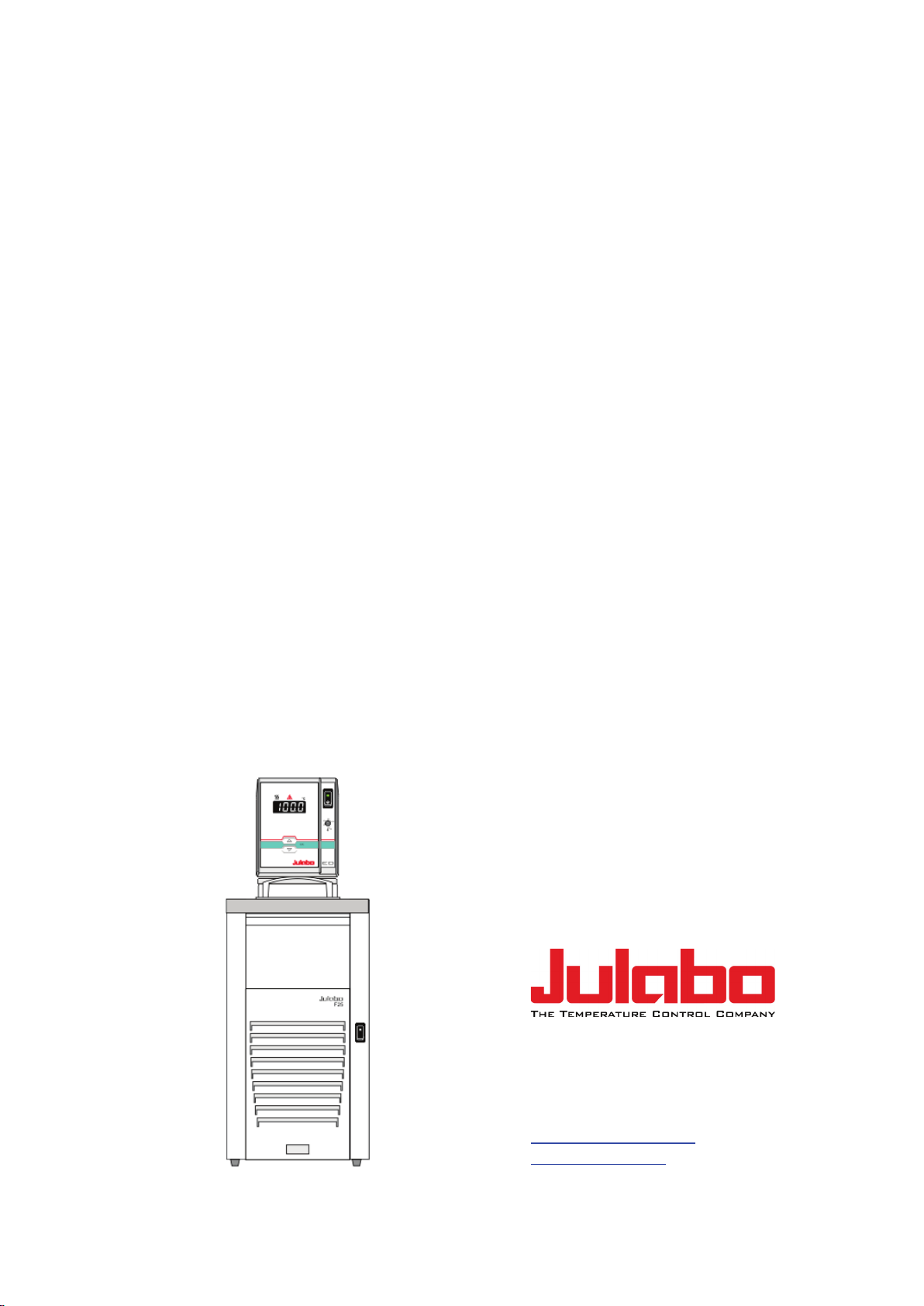
Refrigerated / Heating Circulator
F12-ED F25-ED
F26-ED
1.
951.0272-V3 02/16
Find Quality Products Online at: [email protected]
19510272-V3.doc 29.02.16
www.GlobalTestSupply.com
Page 2

Temperature control devices for research and industry are developed,
9001
Congratulations!
You have made an excellent choice.
JULABO thanks you for the trust you have placed in us.
This operating manual has been designed to help you gain an understanding of the operation
and possible applications of our circulators. For optimal utilization of all functions, we
recommend that you thoroughly study this manual prior to beginning operation.
The JULABO Quality Management System
produced, and distributed according to the requirements of ISO
and ISO 14001. Certificate Registration No. 01 100044846
Unpacking and inspecting
Unpack the circulator and accessories and inspect them for possible transport damage.
Damage should be reported to the responsible carrier, railway, or postal authority, and a
damage report should be requested. These instructions must be followed fully for us to
guarantee our full support of your claim for protecting against loss from concealed damage.
The form required for filing such a claim will be provided by the carrier.
Printed in Germany Changes without prior notification reserved
Important: keep original operating manual for future use
Find Quality Products Online at: [email protected]
2
www.GlobalTestSupply.com
Page 3
Operating manual
JULABO circulators are not suitable for direct temperature control of foods, semi-
medium (bath fluid).
PID1
Operating manual
1. Intended use
JULABO circulators have been designed to control the temperature of specific fluids in a bath
tank. The units feature pump connections for temperature control of external systems (loop
circuit).
luxury foods and tobacco, or pharmaceutical and medical products. Direct
temperature control means unprotected contact of the object with the bath
1.1. Description
The circulators are operated via the splash-proof keypad. The implemented
microprocessor technology allows to set and to store the setpoint that can
be indicated on the LED temperature display.
The PID temperature control adapts the heat supplied to the thermal
requirements of the bath.
Safety installations conforming to IEC 61010-2-010
The excess temperature protection is a safety installation independent from
the control circuit.
The safety value is set using a tool (screwdriver).
If the low level protection device is triggered, a complete shutdown of the
heater and circulating pump is effected.
2. Operator responsibility – Safety recommendations
The products of JULABO ensure safe operation when installed, operated, and maintained
according to common safety regulations. This section explains the potential dangers that may
arise when operating the circulator and also specifies the most important safety precautions to
preclude these dangers as far as possible.
Find Quality Products Online at: [email protected]
4
www.GlobalTestSupply.com
Page 4

ED
Persons:
The operator is responsible for the qualification of the personnel operating the units.
The operator should be constantly informed about the dangers involved with their job activities
as well as preventive actions.
Make sure all persons expected to carry out operation, installation and maintenance of the unit
read and understand the safety information and operating instructions.
Handling:
Nevertheless, avoid strikes to the housing, vibrations, damages to the keypad foil (keys,
display) or contamination.
Make sure the product is regularly checked for proper condition.
Regularly check (at least every 2 years) the proper condition of the mandatory, warning,
prohibition and safety labels.
Take care that the mains supply features a low impedance to avoid any negative affects on
the instrument being operated in the same mains.
This unit is designed for operation in a controlled electromagnetic environment. This
means that transmitting devices (e.g. cellular phones) should not be used in the immediate
vicinity.
Magnetic radiation may influence other units with components susceptible to magnetic
fields (e.g. a monitor). We recommend to keep a minimum distance of 1 m.
Permissible ambient temperature: max. 40 °C, min. 5 °C.
Permissible relative air humidity: 50 % (40 °C).
Do not store in an aggressive atmosphere. Protect from contaminations.
Do not expose to sunlight.
Appropriate operation:
Only qualified personnel is authorized to perform configuration, installation, maintenance and
repairs of the circulator.
Routine operation can also be carried out by untrained personnel who should however be
instructed by trained personnel.
Use:
The bath may not be filled with flammable materials. Fire hazard!
Only use recommended materials (bath fluids). Only use recommended materials (bath fluids).
Only use non-acid and non corroding materials.
Find Quality Products Online at: [email protected]
www.GlobalTestSupply.com
5
Page 5

Operator responsibility – Safety recommendations
F12-ED
F25-ED
Working temperature range
°C
-20 ... 100
-28 ... 100
Temperature stability
°C
±0,03
±0,03
Temperature selection
digital
digital
Temperature indication
LED
LED
Resolution
°C
0.1
0.1
Temperature control
PID1
Heater wattage (at 230 V)
kW
2,0
2,0
Heater wattage (at 115V)
kW
1,0
1,0
Medium ethanol
kW
0.16 0.1 0.02
0.26 0.2 0.06
Refrigerant
R134a
R134a
Circulating pump:
discharge, max.at 0 bar
l/min
15
15
pressure, max. at 0 l
bar
0.35
0.35
Overall dimensions (WxDxH)
cm
20x36x56
23x42x61
Bath opening (WxL)
cm
13x15
12x14
Bath depth
cm
13
14
Filling volume
liters
3 ... 4,5
3 ... 4,5
Weight
kg
22
30
Ambient temperature
°C
5 ... 40
5 ... 40
Mains power connection
V/ Hz
230 / 50
230 / 50
Current input (bei 230 V)
A
11 (CH 9 + 1)
12 (CH 9 + 2)
Mains power connection
V/ Hz
230 / 60
230 / 60
Current input (at 230 V)
A
11
12
Mains power connection
V/ Hz
115 / 60
115 / 60
Current input (at 115 V)
A
12
13
Mains power connection
V/ Hz
100 / 50/60
100 / 50/60
Current input (at 100 V)
A
15
13
2.4. Technical specifications
Cooling capacity
°C
+20 0 -20
+20 0 -20
All measurements have been carried out at:
rated voltage and frequency ambient temperature: 20 °C
Technical changes without prior notification reserved.
Find Quality Products Online at: [email protected]
12
www.GlobalTestSupply.com
Page 6

ED
F26-ED
Working temperature range
°C
-28 ... 100
Temperature stability
°C
±0,03
Temperature selection
digital
Temperature indication
LED
Resolution
°C
0.1
Temperature control
PID1
Heater wattage (at 230 V)
kW
2,0
Heater wattage (at 115V)
kW
1,0
Medium ethanol
kW
0.26 0.2 0.06
Refrigerant
R134a
Circulating pump:
discharge, max.at 0 bar
l/min
15 pressure, max. at 0 l
bar
0.35
Overall dimensions (WxDxH)
cm
42x42x42
Bath opening (WxL)
cm
12x14
Bath depth
cm
14 Filling volume
liters
3 ... 4,5
Weight
kg
30 Ambient temperature
°C
5 ... 40
Mains power connection
V/ Hz
230 / 50
Current input (at 230 V)
A
12 (CH 9 + 2)
Mains power connection 230 V/60 Hz
V/ Hz
230 / 60
Current input (at 230 V)
A
------
Mains power connection
V/ Hz
115 / 60
Current input (at 115 V)
A
13 Mains power connection
V/ Hz
100 / 50/60
Current input (at 100 V)
A
13
Cooling capacity
°C
+20 0 -20
All measurements have been carried out at:
rated voltage and frequency ambient temperature: 20 °C
Technical changes without prior notification reserved.
Find Quality Products Online at: [email protected]
www.GlobalTestSupply.com
13
Page 7

Operator responsibility – Safety recommendations
Caution:
Safety installations according to IEC 61010-2-010:
Excess temperature protection adjustable from 20 to 120 °C
Low liquid level protection float switch
Classification according to DIN 12876-1 class I
Alarm indication optical + audible (permanent)
Environmental conditions according to EN 61 010, part 1:
Use only indoor.
Altitude up to 2000 m - normal zero.
Ambient temperature: +5 ... +40 °C (for storage and transportation)
Air humidity:
Max. rel. humidity 80 % for temperatures up to +31 °C,
linear decrease down to 50 % relative humidity at a temperature of +40 °C
Max. mains fluctuation of ±10 % are permissible.
Protection class according to EN 60 529 IP21
The unit corresponds to Class I
Overvoltage category II
Pollution degree 2
The unit is not for use in explosive environment.
Standards for interference resistance according to EN 61326-1
This unit is an ISM device classified in Group 1 (using high frequency for internal purposes)
Class A (industrial and commercial range).
Find Quality Products Online at: [email protected]
14
www.GlobalTestSupply.com
Page 8

ED
Information about the used refrigerants
The Regulation (EU) No. 517/2014 on fluorinated greenhouse gases applies to all systems
which contain fluorinated refrigerants and replaces (EC) 842/2006.
The aim of the Regulation is to protect the environment by reducing emissions of fluorinated
greenhouse gases.
Among other things it regulates the emission limits, use and recovery of these substances. It
also contains requirements for operators of systems which require / contain these substances
to function.
Under Regulation 517/2014, the operator of a system of this nature has the following duties:
• The operator must ensure that the equipment is checked at regular intervals for leaks.
• These intervals depend on the CO2 equivalent of the system. This is calculated from the
refrigerant fill volume and type of refrigerant. The CO2 equivalent of your system is
shown on the model plate.
• The operator undertakes to have maintenance, repair, service, recovery and recycling
work carried out by certified personnel who have been authorized by JULABO.
• All such work must be documented. The operator must keep records and archive them
for at least five years. The records must be submitted to the relevant authority on
request.
Refer to the text of the Regulation for further information.
Find Quality Products Online at: [email protected]
www.GlobalTestSupply.com
15
Page 9
Operating instructions
In addition to the safety warnings listed, warnings are posted throughout the
Read and follow these important instructions for averting dangers.
Warning:
Caution:
dangerous situation. If this is not avoided, slight or minor
Notice:
anything in its surroundings can be damaged.
Note!
Draws attention to something special.
Important!
Indicates usage tips and other useful information.
inflammable material.
Operating instructions
3. Safety notes for the user
3.1. Explanation of safety notes
operating manual. These warnings are designated by an exclamation mark
inside an equilateral triangle. “Warning of a dangerous situation (Attention!
Please follow the documentation).”
The danger is classified using a signal word.
Describes a possibly highly dangerous situation. If these instructions are not
followed, serious injury and danger to life could result.
Describes a possibly
injuries could result. A warning of possible property damage may also be
contained in the text.
Describes a possibly harmful situation. If this is not avoided, the product or
3.2. Explanation of other notes
3.3. Safety recommendations
Follow the safety recommendations to prevent damage to persons or property.
Further, the valid safety instructions for working places must be followed.
• Only connect the unit to a power socket with earthing contact (PE –
protective earth)!
• The power supply plug serves as safe disconnecting device from the line
Find Quality Products Online at: [email protected]
16
and must be always easily accessible.
• Operation is permitted with non-flammable liquids only.
• Place the instrument on an even surface on a pad made of non-
www.GlobalTestSupply.com
Page 10

ED
• Some parts of the bath cover and the pump connections may become
caution when touching these parts.
screwdriver for example.
• Do not stay in the area below the unit.
• Make sure you read and understand all instructions and safety precautions
listed in this manual before installing or operating your unit.
• Never operate the unit without bath fluid in the bath.
• Check the filling level of the bath fluid from time to time. Pump and heater
must always be fully covered with the bath fluid!
• The instrument is not suited for unsupervised continuous operation.
• Do not drain the bath fluid while it is hot!
Check the temperature of the bath fluid prior to draining (by switching the
unit on for a short moment for example).
• Observe the limited working temperature range when using plastic bath
tanks.
• Employ suitable connecting tubing.
Make sure that the tubes are securely attached.
• Never operate damaged or leaking equipment.
• Always turn off the unit and disconnect the mains cable from the power
source before performing any service or maintenance procedures, or
before moving the unit.
• Always empty the bath before moving the unit.
• Never operate equipment with damaged mains power cables.
extremely warm during continuous operation. Therefore, exercise particular
Notice: Check the safety installations at least twice a year!
• Excess temperature protection according to IEC 61010-2-010.
With a screwdriver turn back the adjustable excess temperature protection
until the shut-down point (actual temperature).
• Low level protection according to IEC 61010-2-010.
To check the function of the float, it can be manually lowered with a
Find Quality Products Online at: [email protected]
www.GlobalTestSupply.com
17
Page 11

Safety notes for the user
Caution:
s shall help to recognize possible dangers and to reduce
The temperature controlling i.e. of fluids in a reactor constitutes normal
circulator practice.
We do not know which substances are contained within these vessels.
Many substances are:
• inflammable, easily ignited or explosive
• hazardous to health
• environmentally unsafe
i.e.: dangerous
The user alone is responsible for the handling of these substances!
The following question
the risks to a minimum.
• Are all tubes and electrical cables connected and installed?
Note:
sharp edges, hot surfaces in operation, moving machine parts, etc.
• Do dangerous steams or gases arise when heating?
Is an exhaust needed when working?
• What to do when a dangerous substance was spilled on or in the unit?
Before starting to work, obtain information concerning the substance and
determine the method of decontamination.
Find Quality Products Online at: [email protected]
18
www.GlobalTestSupply.com
Page 12
Keep the keys pressed for fast change of setpoint
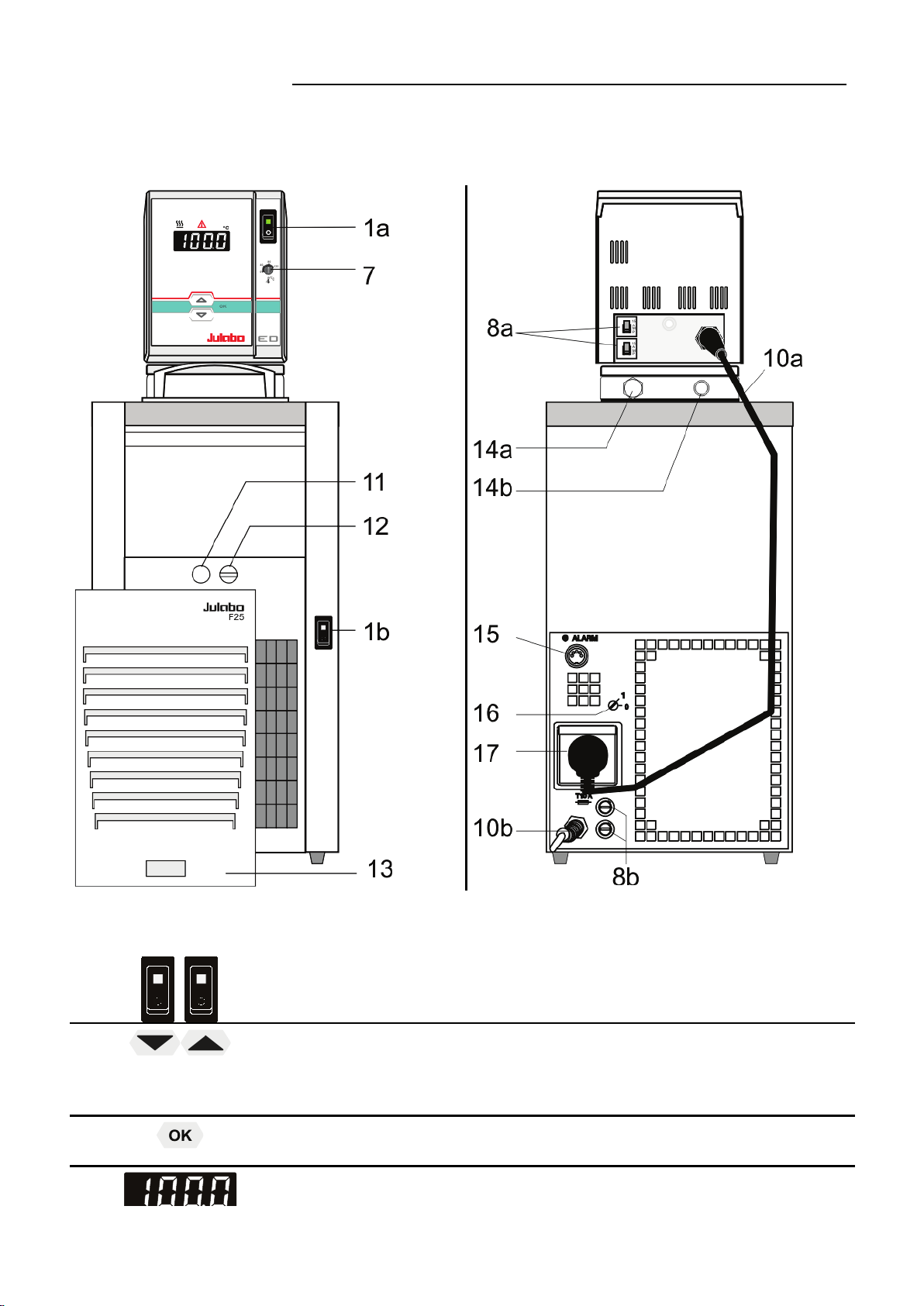
4. Operating controls and functional elements
Front view Rear view
ED
1a
1b
2
3
4
Find Quality Products Online at: [email protected]
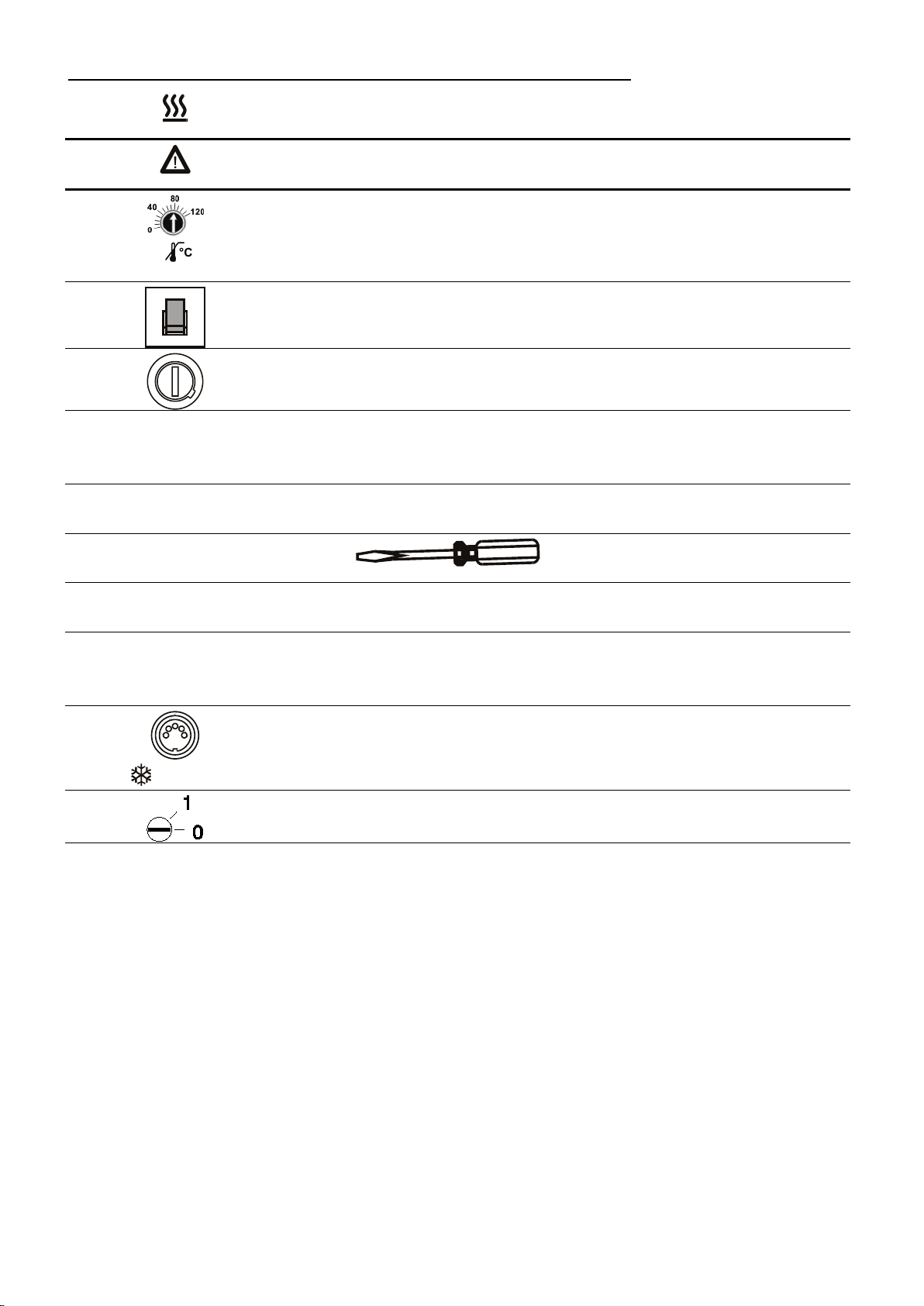
Mains power switch, illuminated for circulator
Mains power switch, illuminated for cooling machine
Edit keys
Setpoint increase or decrease
Press keys shortly for step-by-step changes,
OK key (store)
LED temperature display, menu indication
www.GlobalTestSupply.com
19
Page 13
Operating controls and functional elements
15
A
M
P
ALARM
5
6
7
8a
8b
10a
10b
Mains power cable with plug for circulator
Control indicator –Heating
Control indicator – Alarm
Adjustable excess temperature protection
according to IEC 61010-2-010
Circulator: Mains circuit breakers (resettable) 15 A
Mains fuses for cooling machine: T 10,0 A, D5 x 20 mm
Mains power cable with plug cooling machine
11 Drain port
12
Drain tap
13 Venting grid, removable
14a
14b
15
Pump connector for feed
Pump connector for return
Connector: Cooling machine control
(not in use for operation with ED circulator)
16
Selector dial for cooling machine
Position "0" for operation with ED circulator.
17 Built-in mains outlet for connection of circulator
Find Quality Products Online at: [email protected]
20
www.GlobalTestSupply.com
Page 14
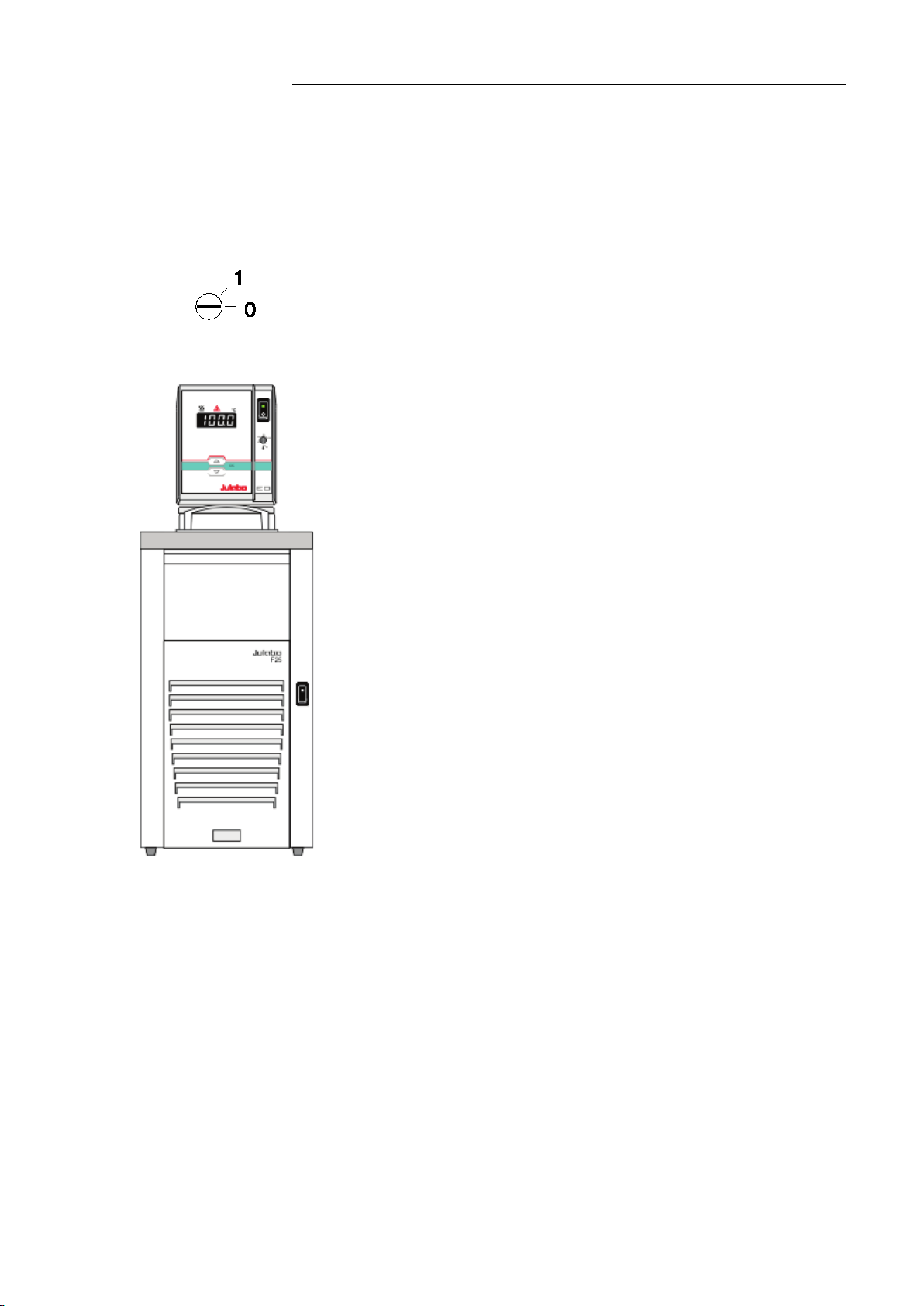
1 m3 is required.
5. Preparations
5.1. Installation
ED
• Place the unit on an even surface on a pad made of
non-flammable material.
• Set selector dial for cooling machine (16) in position
"0" for operation with ED circulator. (only F25, F26)
• Keep at least 20 cm of open space on the front and
rear venting grids.
• Do not set up the unit in the immediate vicinity of
heat sources and do not expose to sun light.
• Before operating the unit after transport, wait about
one hour after setting it up. This will allow any oil that
has accumulated laterally during transport to flow
back down thus ensuring maximum cooling
performance of the compressor.
• The place of installation should be large enough
and provide sufficient air ventilation to ensure the
room does not warm up excessively because of the
heat the instrument radiates to the environment.
(Max. permissible ambient temperature: 40 °C).
With regard to a disturbance in the cooling loop
(leakage), the guideline EN 378 prescribes a certain
room space to be available for each kg of
refrigerant.
The necessary amount of refrigerant is specified on
the type plate.
> For 0.25 kg of refrigerant R134a, a room space of
Find Quality Products Online at: [email protected]
www.GlobalTestSupply.com
21
Page 15
Preparations
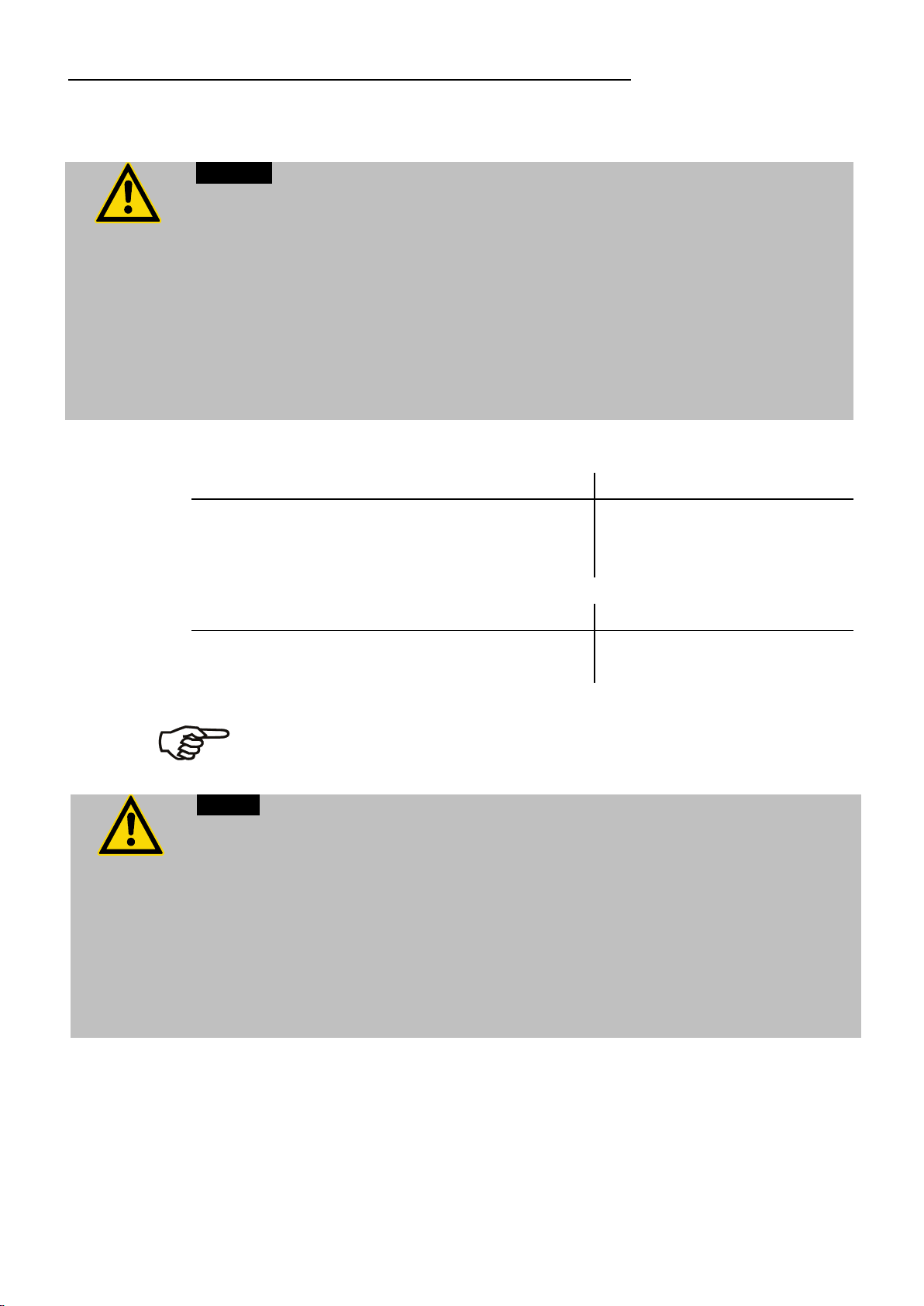
Caution:
corrosion in the bath, even in stainless steel.
Bath fluid
Temperature range
soft/decalcified water
5 °C to 80 °C
mixture water/glycol, mixture 1:1
-20°C to 50°C
Thermal G
-30°C to 80°C
JULABO Bath liquids
Order No.
Thermal G 10 Liters
8 940 124
Thermal G 5 Liters
8 940 125
Contact: see page 5
Notice:
• tend to cracking.
5.2. Bath fluids
No liability for use of other bath fluids!
Do not use flammable bath fluids!
Water: The quality of water depends on local conditions.
• Due to the high concentration of lime, hard water is not suitable for
temperature control because it leads to calcification in the bath.
• Ferrous water can cause corrosion - even on stainless steel.
• Chloric water can cause pitting corrosion.
• Distilled and deionized water is unsuitable. Their special properties cause
Recommended bath fluids:
See website for list of recommended bath fluids.
Please contact JULABO before using other than recommended bath fluids.
Only use non-acid and non corroding bath fluids.
JULABO takes no responsibility for damages caused by the selection of an
unsuitable bath fluid.
Unsuitable bath fluids are liquids which e.g.
• are very highly viscous
(much higher than 30 mm2 /s at the respective working temperature)
• have corrosive characteristics or
Find Quality Products Online at: [email protected]
22
www.GlobalTestSupply.com
Page 16
The instrument is not suited for unsupervised continuous operation.
on for a short moment, for example).
5.3. Filling / Draining
Notice: Filling
Check the filling level of the bath fluid from time to time. Pump and heater
must always be fully covered with the bath fluid!
ED
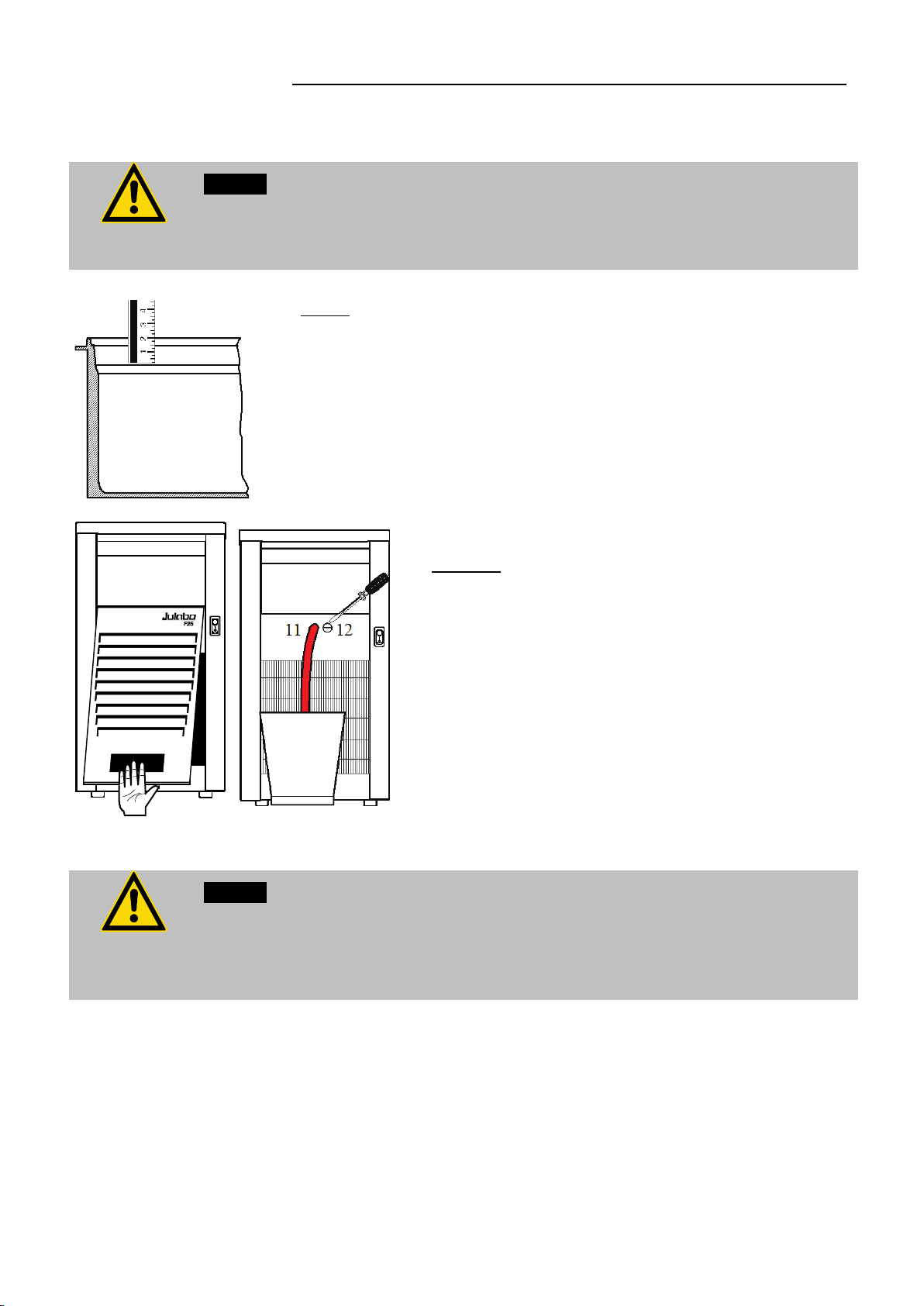
Filling
• Take care that no liquid enters the interior of the circulator.
• Recommended maximum filling level with water as bath liquid:
20 mm below the tank rim
After filling, immerse the samples in the bath or place the lid on
the bath, in case the opening is not to be used.
Draining:
• Turn off the circulator and cooling machine.
• Hold the venting grid, pull out and remove.
• Slide a short piece of tube onto the drain port
(11) and hold it into a pail.
(only F25, F26)
• Unscrew the drain tap (12) and empty the unit
Notice: Draining
Do not drain the bath fluid while it is hot!
Recommendation: Temperature range 5 °C to 40 °C
Check the temperature of the bath fluid prior to draining (by switching the unit
completely.
• Tighten the drain tap.
Find Quality Products Online at: [email protected]
www.GlobalTestSupply.com
23
Page 17
Preparations
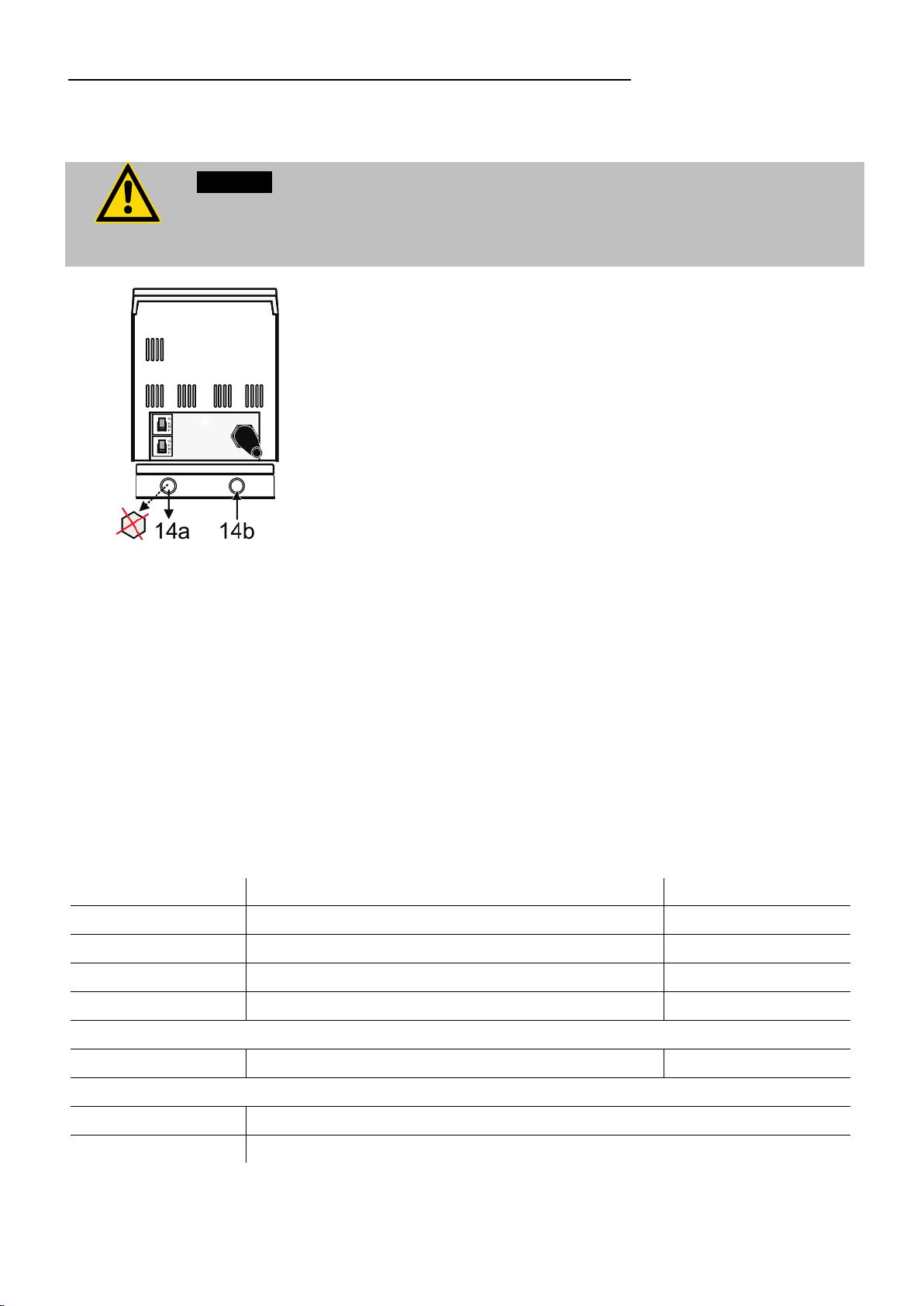
(14a) with the cap nut.
Feed Return
Order No. Length
Temperature range
8930008 1 m
CR® tubing 8 mm ID
-20 °C ... 120 °C
8930010 1 m
CR® tubing 10 mm ID
-20 °C ... 120 °C
8930108 1 m
Viton tubing 8 mm ID
-50 °C ... 200 °C
8930110 1 m
Viton tubing 10 mm ID
-50 °C ... 200 °C
8930410 1 m
Insulation for tubing 8 mm ID or 10 mm ID
-50 °C ... 100 °C
8970480
2 Tubing clamps, size 1 for tubing 8 mm ID
8970481
2 Tubing clamps, size 2 for tubing 10 or 12 mm ID
5.4. Temperature application to external systems
Caution:
Securely attach all tubing to prevent slipping.
If the circulator is operated without external system, close the pump connector
The circulator is used for temperature application to external,
closed systems (temperature loop) with simultaneous bath
internal temperature application.
Connecting an external system:
• Unscrew the collar nut from the pump connector (14a).
• Slide the tubing onto the pump connectors for feed and
return flow (14a, 14b). Secure the tubing with tubing
clamps.
Use tubing insulation.
5.5. Tubing
Recommended tubing:
Find Quality Products Online at: [email protected]
24
www.GlobalTestSupply.com
Page 18
Warning: Tubing:
At high working temperatures the tubing used for temperature application and
• Preventive maintenance: Replace the tubing from time to time.
1
2
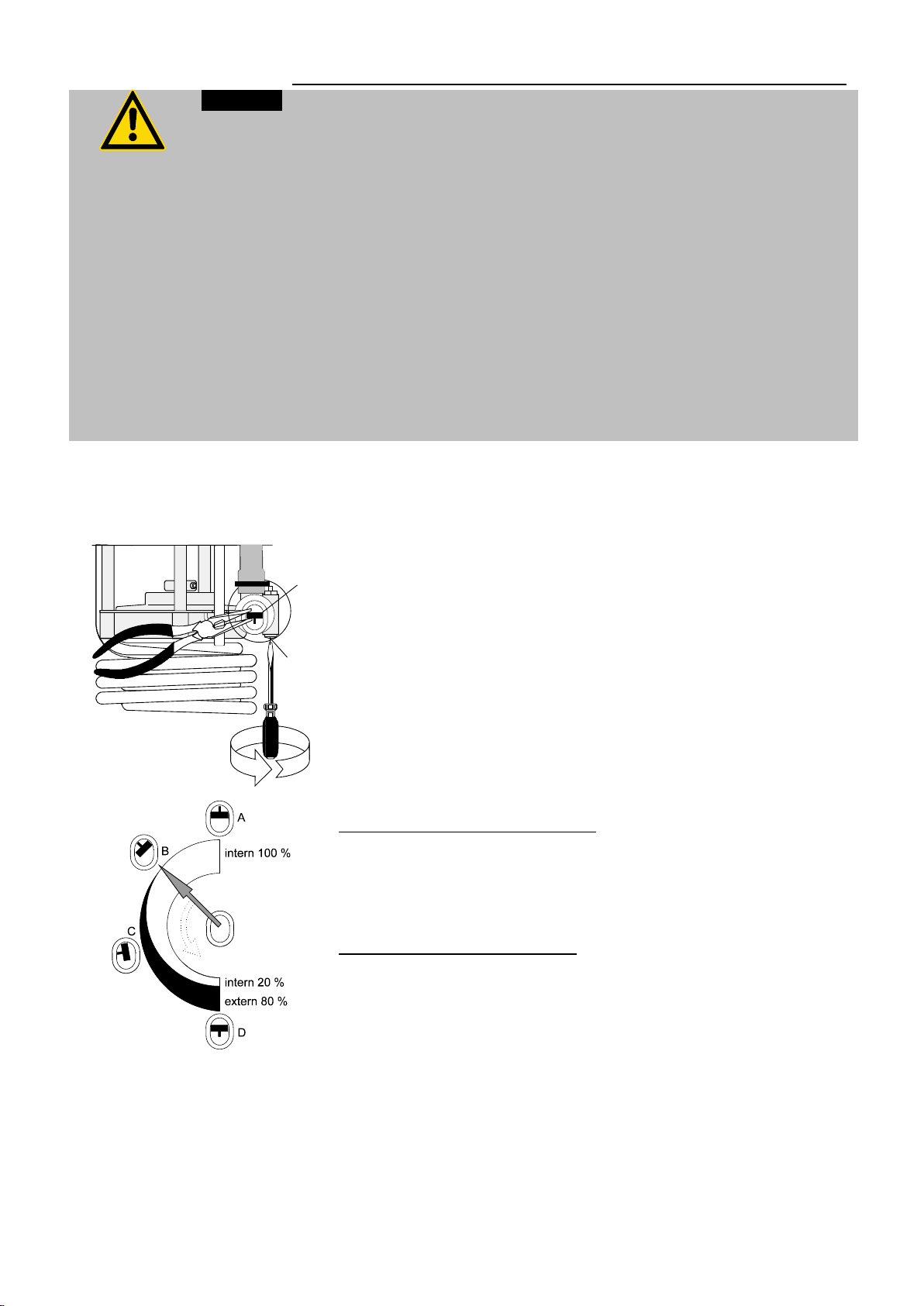
The pump flow is pre-adjusted in the factory and can be
Examples:
20 % internal circulation (for small bath tanks)
cooling water supply represents a danger source.
A damaged tubing line may cause hot bath fluid to be pumped out within a
short time.
This may result in:
• Burning of skin
• Difficulties in breathing due to hot atmosphere
Safety recommendations
• Employ suitable connecting tubing.
• Make sure that the tubing is securely attached.
• Avoid sharp bends in the tubing, and maintain a sufficient distance from
surrounding walls.
• Regularly check the tubing for material defects (e.g. for cracks).
5.6. Adjusting the pump flow
ED
modified to suit user requirements.
• Using a screwdriver turn the screw (1) anti-clockwise by
360 °.
• Using flat pliers turn the marking of the slide (2) to the
desired position.
• Tighten the screw.
Internal applications in the bath
A 100 % internal bath circulation (for large bath tanks)
B Reduced internal bath circulation
(for smooth surface of bath fluid)
External/internal applications
C 40 % external discharge,
60 % internal circulation (for large bath tanks)
D 80 % external discharge,
Find Quality Products Online at: [email protected]
www.GlobalTestSupply.com
25
Page 19
Operating procedures
Caution:
• We disclaim all liability for damage caused by incorrect line voltages!
voltage specified on the identification plate.
• Switching on:
6. Operating procedures
6.1. Power connection
• Only connect the unit to a power socket with earthing contact (PE –
protective earth)!
• The power supply plug serves as safe disconnecting device from the line
and must be always easily accessible.
• Never operate equipment with damaged mains power cables.
• Regularly check the mains power cables for material defects (e.g. for
cracks).
Check to make sure that the line voltage matches the supply
• Connect the circulator with mains power cable (10a) to the
mains outlet (17).
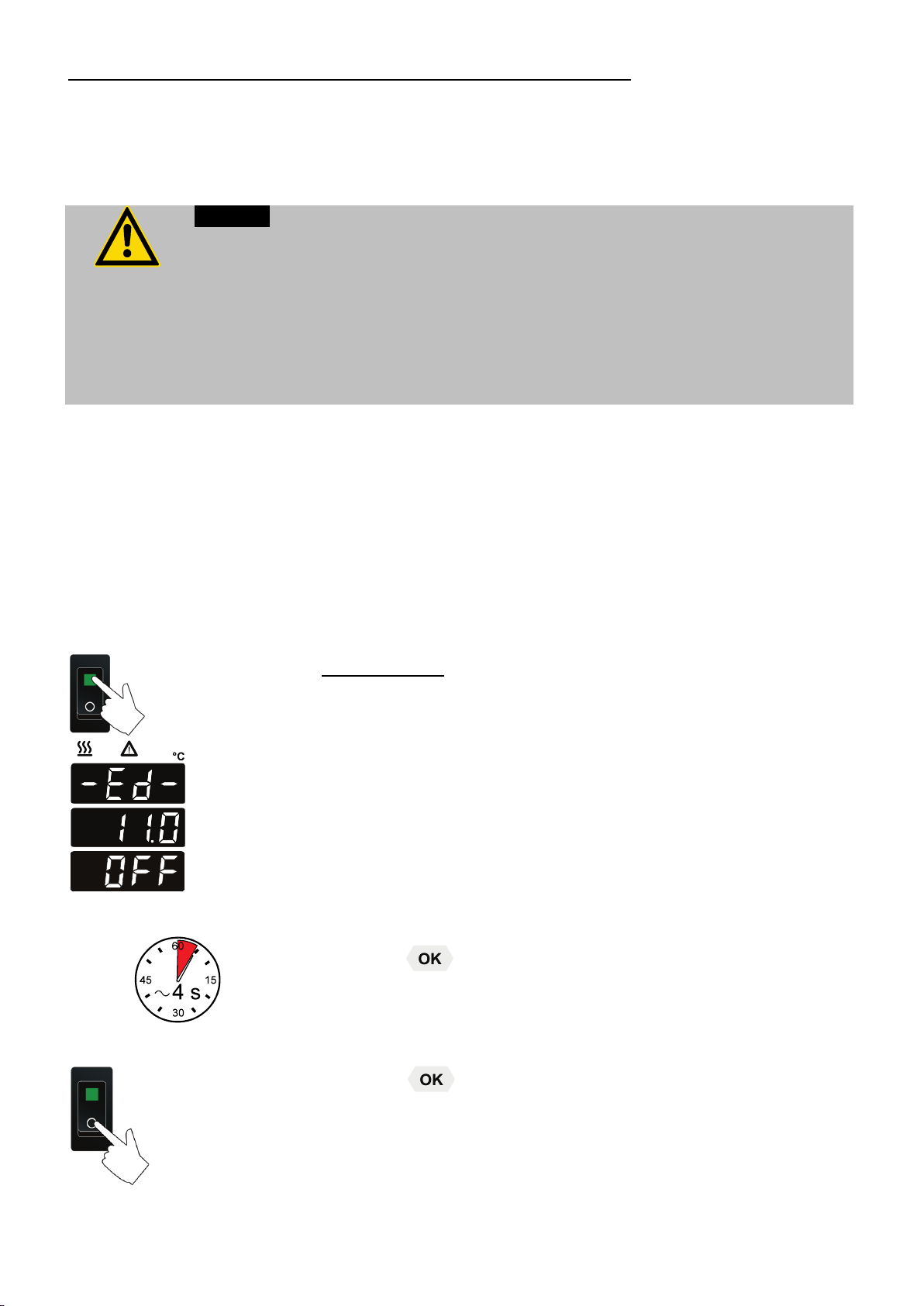
6.2. Switching on / Start – Stop
• Connect the refrigerated circulator with mains power cable
(10b) to the mains socket.
Circulator and cooling machine may be turned on and off with
separate mains switches. The integrated control light will
illuminate to indicate that power has been applied.
• The unit performs a self-test. The segments of the 4-digit LED
temperature DISPLAY and all indicator lights will illuminate (as
illustrated on the left).
Then the software version (example: 11.0) appears. The
display „OFF“ indicates the unit is ready to operate. (standby
mode).
Start:
• Press the key for about 4 seconds.
The LED temperature DISPLAY indicates the actual bath
temperature.
Stop:
• Press the key for about 4 seconds.
• Turn the unit off with the mains power switch.
Find Quality Products Online at: [email protected]
26
www.GlobalTestSupply.com
Page 20
Caution:
Danger of freezing when water is used as bath fluid!
NOTE:
Warning:
If the circulator is turned off with the mains switch (1a), the refrigerating unit
is not switched off simultaneously.
Turn off the refrigerating unit with the mains switch (1b) as well.
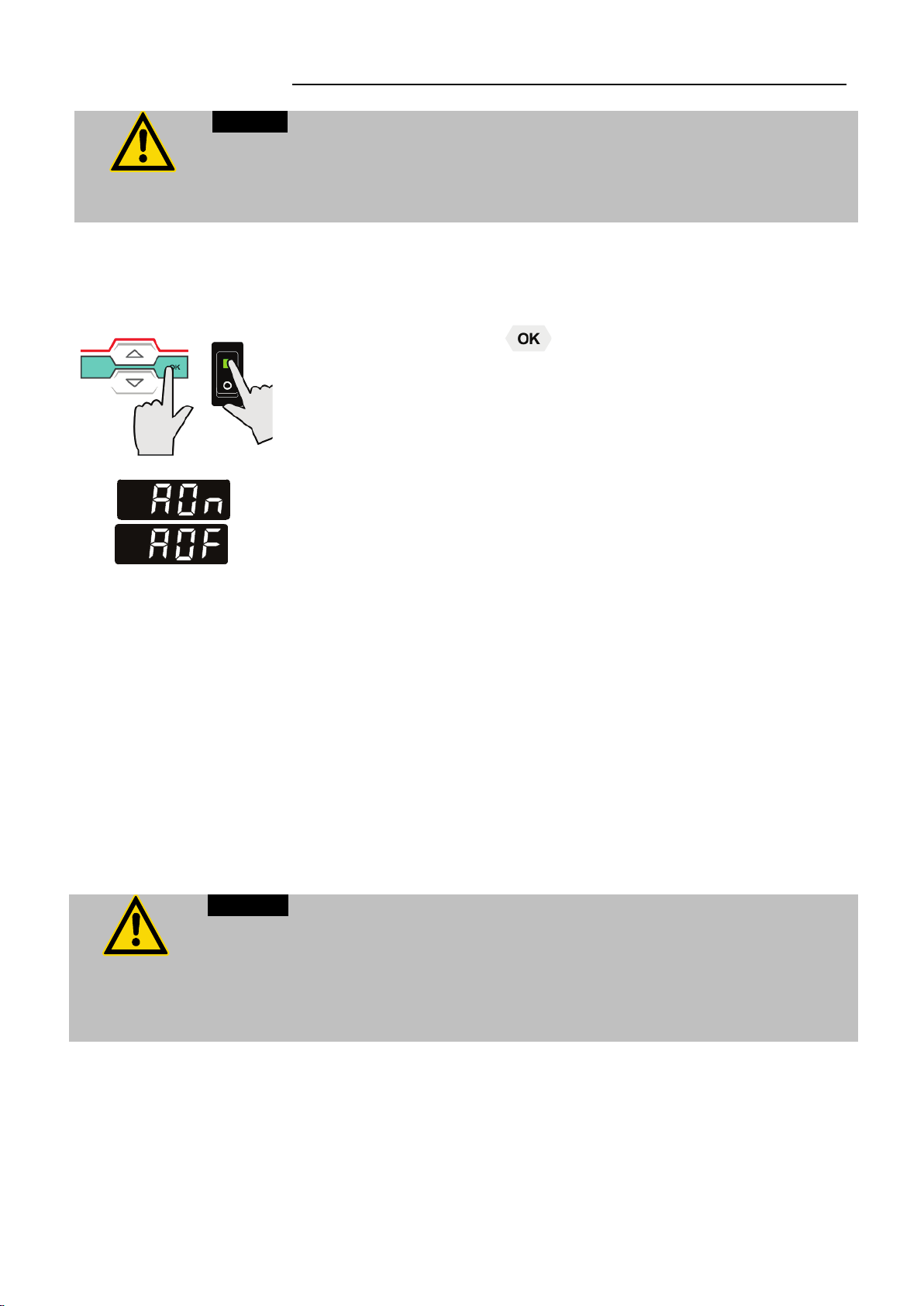
6.3. Automatic / non-automatic start mode
Keep depressed the key and
turn on the circulator with the mains power switch.
For a short while the LED temperature DISPLAY indicates the
effective start mode:
AUTOSTART on.
ED
AUTOSTART off.
The circulator has been configured and supplied by JULABO
according to N.A.M.U.R. recommendations. This means for the start
mode, that the unit must enter a safe operating state after a power
failure (non-automatic start mode). This safe operating state is
indicated by „OFF“ on the LED temperature display. A complete
shutdown of the main functional elements such as heater and
circulating pump is effected simultaneously.
Should such a safety standard not be required, the AUTOSTART
function (automatic start mode) may be activated, thus allowing the
start of the circulator directly by pressing the mains power switch or
using a timer.
For supervised or unsupervised operation with the AUTOSTART function,
avoid any hazardous situation to persons or property.
The circulator does no longer conform to N.A.M.U.R. recommendations.
Take care you fully observe the safety and warning functions of the circulator.
Find Quality Products Online at: [email protected]
The instrument is not suited for unsupervised continuous operation.
www.GlobalTestSupply.com
27
Page 21
Operating procedures
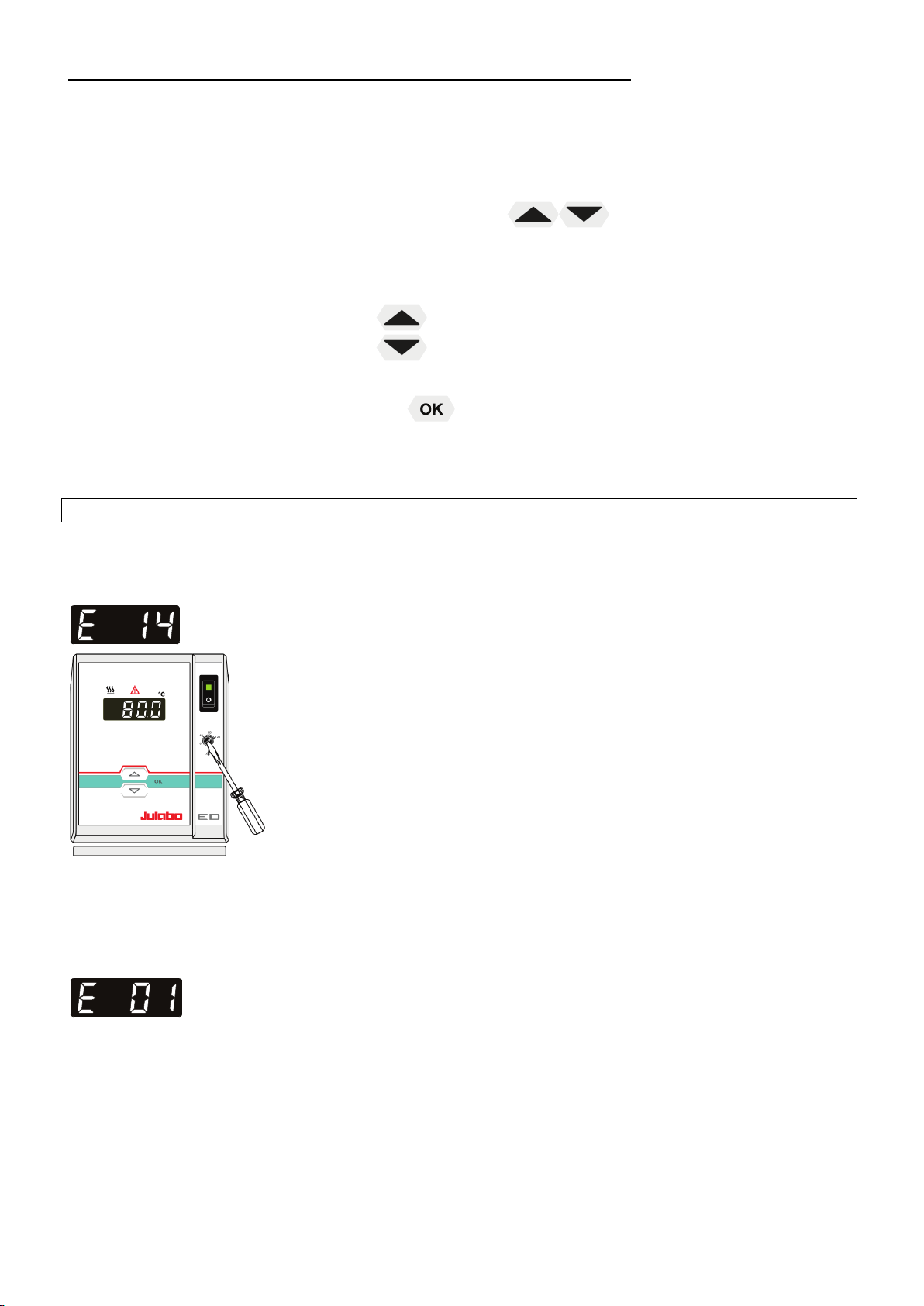
6.4. Setting the temperatures
Factory setting: 25 °C
6.5. Safety installations according to IEC 61010-2-010
Check the safety installations at least twice a year (see page 17)!
6.5.1. Excess temperature protection
Setting can be carried out in the start/stop condition.
1. Press one of the keys for a short moment. The
setpoint value instead of the actual value is indicated on the
display for about 8 seconds. The value can now be changed.
2. Change value:
Press to set a higher value.
Press to set a lower value.
Keep the keys depressed for the value to change fast.
3. Press the key to store the value.
This safety installation is independent of the control circuit. When
the temperature of the bath fluid has reached the safety
temperature, a complete shutdown of the heater and pump is
effected.
The alarm is indicated by optical and audible signals (continuous
tone) and on the LED-DISPLAY appears the error message
"Erro 14".
Setting range: 20 °C to 120 °C
• Using a screwdriver turn the setting screw to the desired value.
Recommendation:
Set the excess temperature protector at 5 to 10 °C above the
working temperature setpoint.
6.5.2. Low liquid level protection
This safety installation is independent of the control circuit.
If the low liquid level protection device is triggered, a complete
shutdown of the heater and circulating pump is effected.
The alarm is indicated by optical and audible signals (continuous
tone) and on the LED-DISPLAY appears the error message "Error
01".
Turn off the unit with the mains switch, refill bath fluid and turn
the unit on again!
Find Quality Products Online at: [email protected]
28
www.GlobalTestSupply.com
Page 22
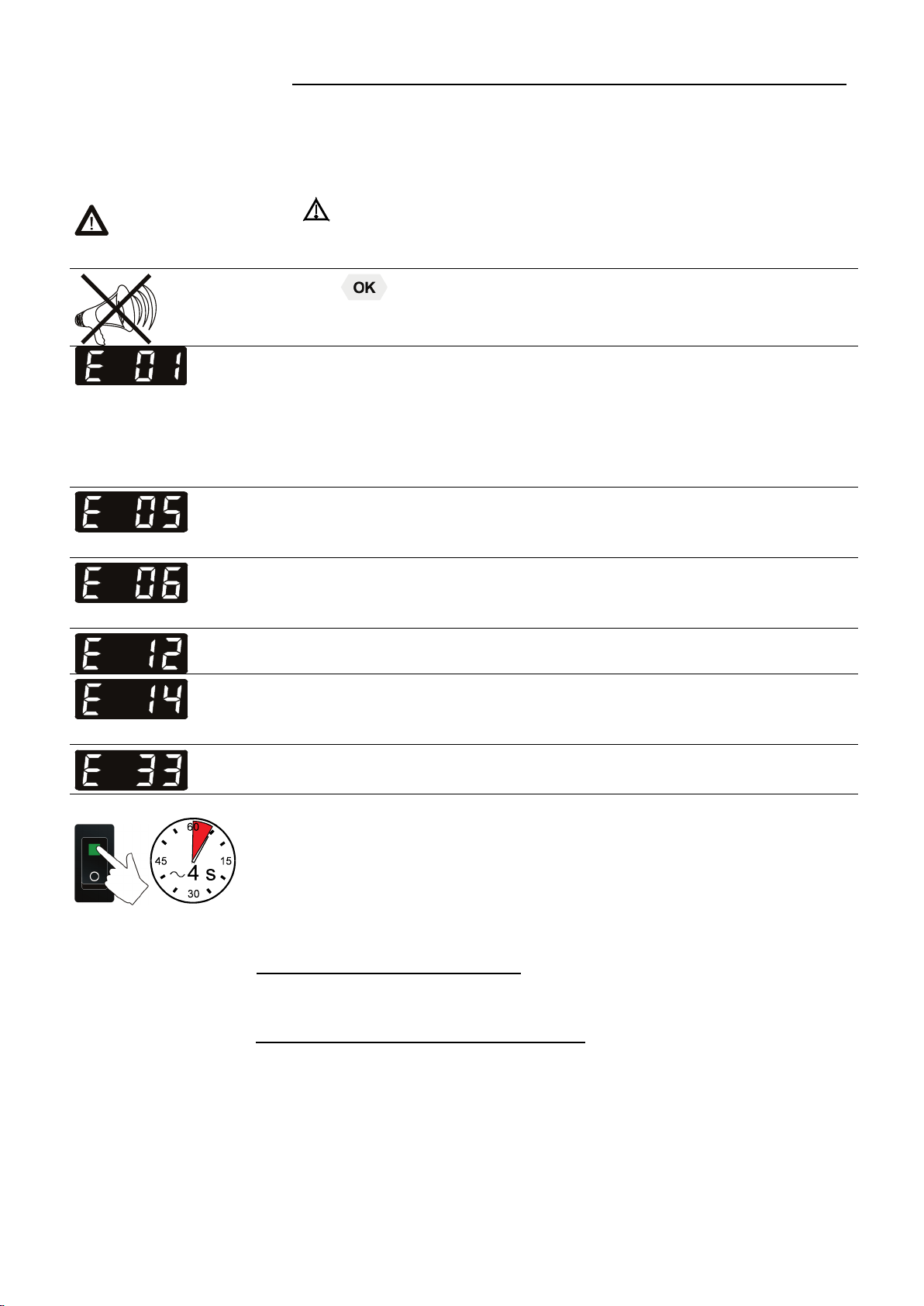
Whenever the microprocessor electronics registers a failure, a complete
of a code.
Tube breakage has occured (insufficient filling level due to excessive
tank with the bath fluid.
temperature difference of more than 35 K.
Set the excess temperature to a higher value.
circuited.
After eliminating the malfunction, press the mains power switch off and
interval, the motor will automatically start running.
(distance to walls, dirt accumulated on condenser) may cause the motor
7. Troubleshooting guide / Error messages
shutdown of the heater and circulating pump is performed. The alarm
ED
+
light " " illuminates and a continuous signal tone sounds.
The LED temperature display indicates the cause for the alarm in form
Press the key to quit the audible signal.
• The circulator is operated without bath fluid, or the liquid level is
insufficient.
Replenish the bath tank with the bath fluid.
•
bath fluid pumped out). Replace the tubing and replenish the bath
• Cable of the working temperature sensor interrupted or shortcircuited.
• Defect of the working or excess temperature sensor.
Working temperature and excess temperature sensors report a
• Error in A/D converter
• The excess temperature value lies below the working temperature
Cooling compressor overload protection
setpoint.
• Cable of the excess temperature sensor interrupted or short-
on again to cancel the alarm state.
If the unit cannot be returned to operation, contact an authorized
JULABO service station.
Disturbances that are not indicated.
Pump motor overload protection
The pump motor is protected against overloading. After a short cooling
The motor of the cooling compressor is equipped with an overload
protector, which will be activated by excessive temperature in the
capsule or by excessive current consumption. Poor air circulation
to be disconnected. After a short cooling interval, the motor will be
automatically reconnected.
Find Quality Products Online at: [email protected]
www.GlobalTestSupply.com
29
Page 23
Cleaning / repairing the unit
15
A
M
P
Warning:
Only use fine fuses with a nominal value as specified.
Manufacturer
Supplier
Type
Order No.
Wickmann
Wickmann
G- fuse insert
T10,0A 5x20 mm
No. 19195
Caution:
Circulator: Mains circuit breakers (resettable) 15 A
Cooling machine: Fuse T 10.0 A, dia.5 x 20 mm
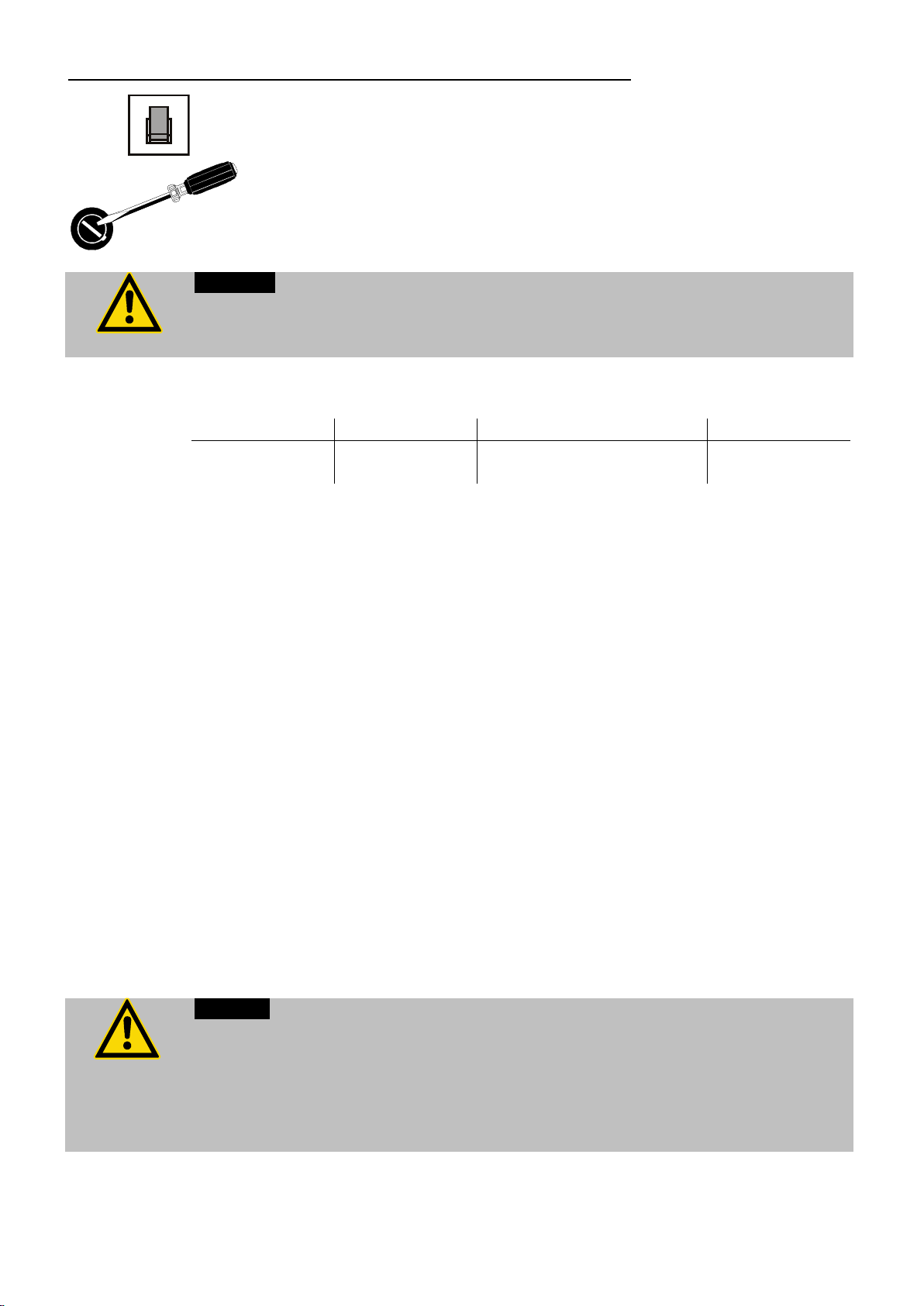
The mains fuses on the rear of the unit may easily be exchanged as
shown on the left.
Before exchanging the fuses, turn off the mains power switch and disconnect
the power plug from the mains socket!
Example:
8. Cleaning / repairing the unit
• Always turn off the unit and disconnect the mains cable from the power
Find Quality Products Online at: [email protected]
30
source before cleaning the unit.
• Prevent humidity from entering into the circulator.
• Electrical connections and any other work must be performed by qualified
personnel only.
www.GlobalTestSupply.com
Page 24
ED
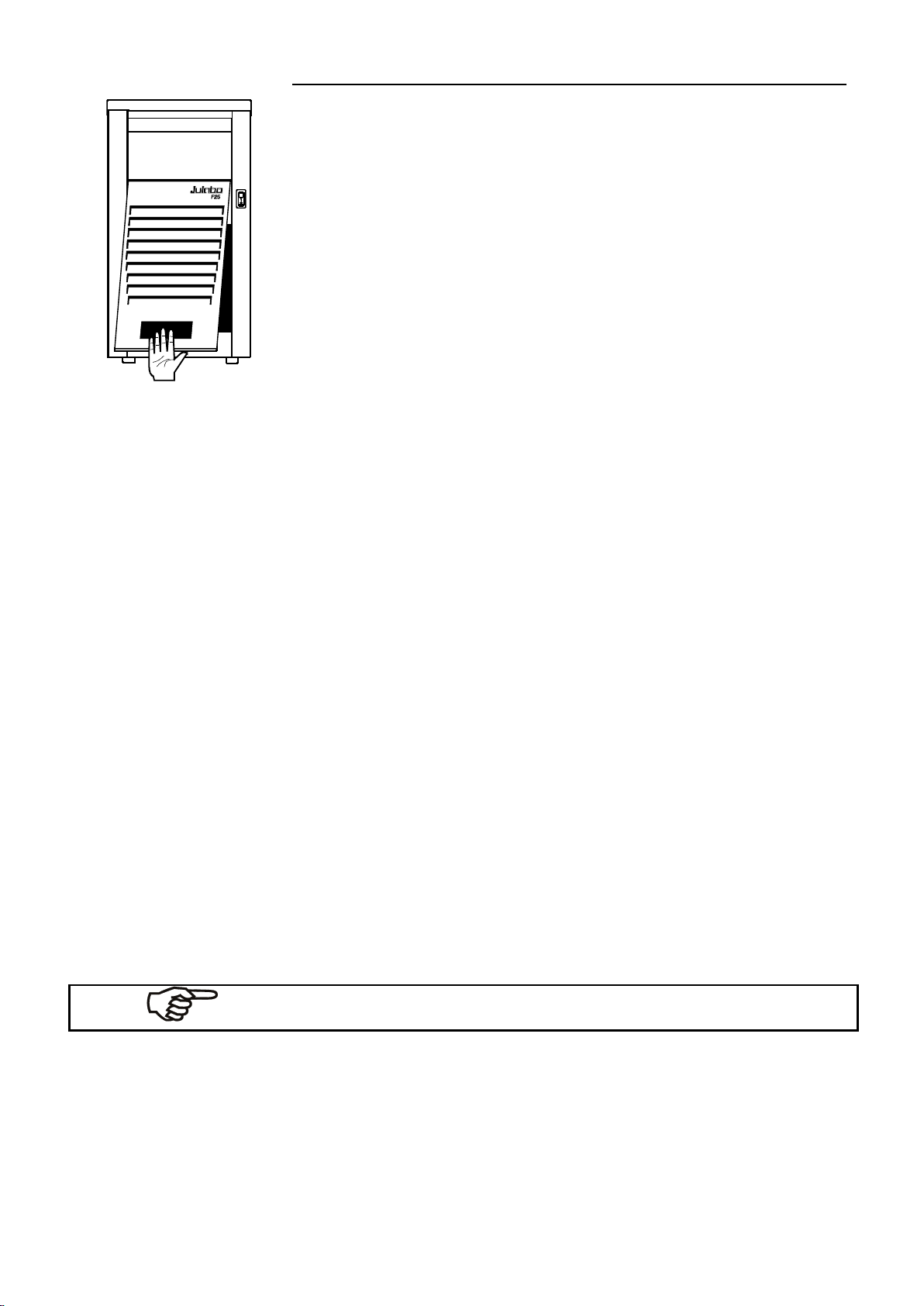
To maintain the full cooling performance, clean the condenser from
For cleaning the bath tank and the immersed parts of the circulator,
insufficient packing.
JULABO reserves the right to carry out technical modifications with
repairs for providing improved performance of a unit.
time to time.
• Switch off the unit, disconnect mains power cable.
• Hold the venting grid, pull out and remove.
• Clean the ribbed condenser with a vacuum cleaner.
• Replace the venting grid.
• Switch on the unit.
Cleaning
use low surface tension water (e.g., soap suds).
Clean the outside of the unit using a wet cloth and low surface
tension water.
The circulator is designed for continuous operation under normal
conditions. Periodic maintenance is not required.
The tank should be filled only with a bath fluid recommended by
JULABO. To avoid contamination, it is essential to change the bath
fluid from time to time.
Repairs
Before asking for a service technician or returning a JULABO
instrument for repair, please contact an authorized JULABO
service station.
When returning the unit:
• Clean the unit in order to avoid any harm to the service
personnel.
• Attach a short fault description.
• When returning a unit, take care of careful and adequate
packing.
• JULABO is not responsible for damages that might occur from
Find Quality Products Online at: [email protected]
www.GlobalTestSupply.com
31
 Loading...