

Page 1
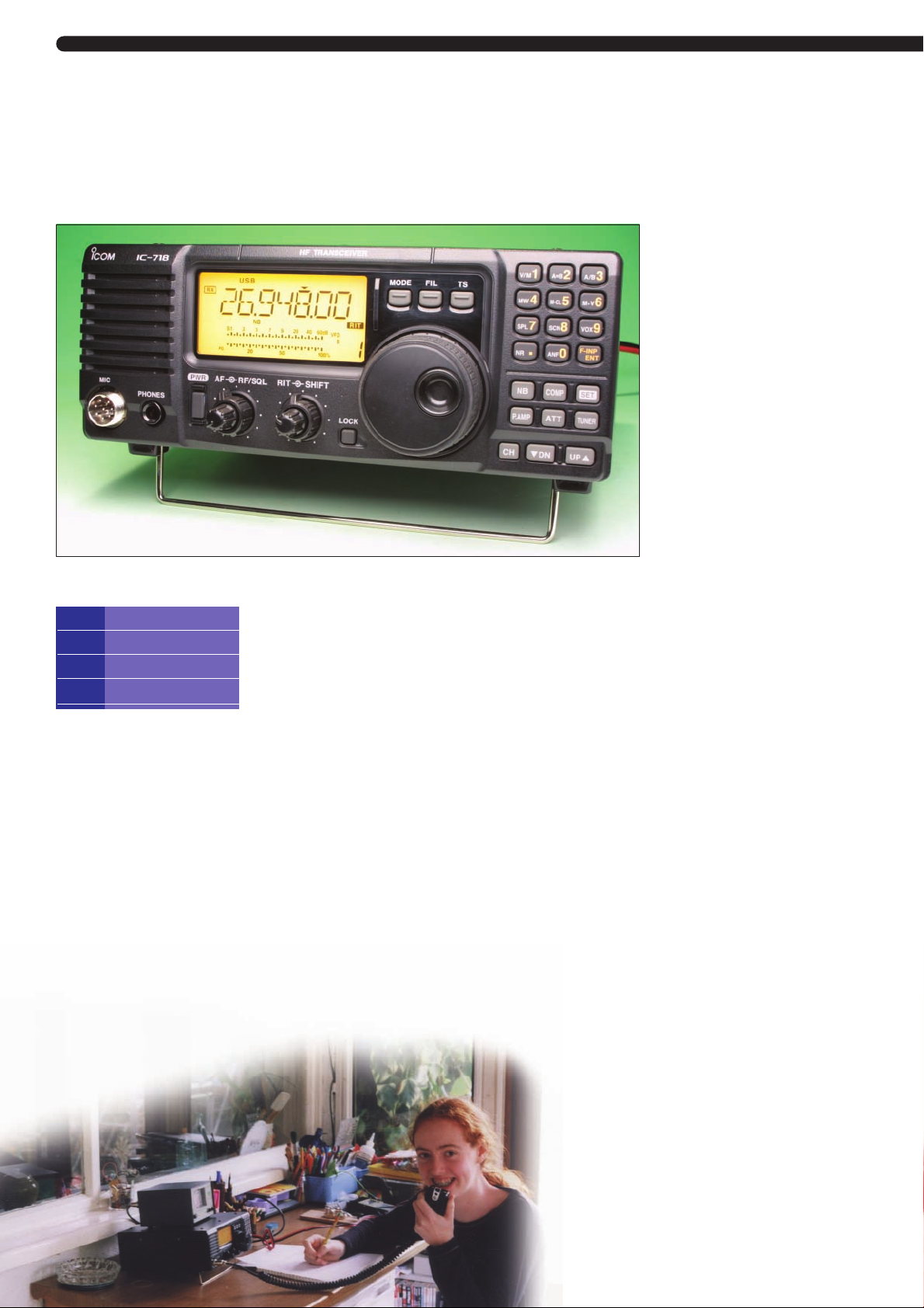
HELEN HAD FUN WITH THE BUDGET BAND BUSTER!
●
a.c. power supply on the IC-718. Dad then
erected a 7MHz dipole so we could see what we
Discovering
The Icom IC-718
could work on that band and 21MHz.
The transceiver has a built-in attenuator and
pre-amplifier, but may I just ask why they can be
put on at the same time? What’s the point?
We decided on 7MHz because this is the band
where the signals are strongest and so any
deficiencies in the transceiver would
become apparent. So, everything
was ready and it was switched
on...but there wasn’t any sound!
Dad said “Helen, why doesn’t it
work? There’s no sound coming from
it”! In reply I immediately went
over and examined it - and with a
slight twist of my wrist I turned the
RF/squelch and Hey Presto! There
was a sudden burst of life.
It turned out that the
RF/Squelch control was a dual
function. This is unlike most other
receivers with squelch and an r.f.
gain control that is normally left
fully clockwise.
● The Icom IC-718...great fun says
Helen 2E0AVH!
Product Icom IC-718 h.f. transceiver
Company Icom (UK) Ltd
Contact Sales
Tel (01227) 741741
Helen Watt 2E0AVH takes
I
transceiver was a perfect size, for a teenager’s
desk - 240mm length and width by about 105mm
height. The tuning knob was about 50mm
diameter, which is a great size and you can
actually hold it and accurately tune signals!
a look at the Icom IC-718
from the Novice Radio
Amateur’s, and busy
14-year old student’s point
of view on behalf of all
those in the same situation,
writing it up in the idiom
of her age group!
● Keen young Helen Watt 2E0AVH enjoying
using the IC-718. She enjoys using s.s.b.,
c.w.. and PSK31.
(Photo G3ZBU)
Really Cool!
The IC-718 transceiver’s also really ‘cool’ because
it’s a nice smart black all over with a funky orange
backlit l.c.d. display. And there’s matching orange
numbers on the numeric keypad - how groovy is
that?
There aren’t too many knobs on the rig - just
enough to control the basics. But most things can
be adjusted with the buttons of which there are 26
including power.
Now the fun started when we Dad (Alister
G3ZBU) and I) connected it up - we used a 12V
5.7AH lead acid battery because there’s no in-built
was very fortunate indeed to be chosen
by the Editor to write an article
specifically from the point of view of a
Novice (now Intermediate) Licensee,
taking a look at the ‘entry level’ IC-718
h.f. transceiver.
First impressions were that the
Watt’s 50W!
The IC-718 transceiver is capable of
putting out 100W which is far in
excess of the Novice (Intermediate)
requirements, so Dad’s first priority
was to adjust the power to 50W. His motto is “If
all else fails, read the instructions”...and
because there’s power adjustment knob on the
front panel, we decided to search thought the
instruction manual.
We discovered that you can use the Set
button to change a lot of features, power being
one of them. Then you just use the tuning knob
in conjunction with up-and-down control. We
would not have found this without the
instructions - there isn’t an F1 button for help
(moral...read the manual!).
When changing power you can see numbers
from L through to 99 and H. Dad set it to read
50, as he thought it would give out 50W. But
(usually) wise Dad was mistaken! The battery
voltage affects the output; and you really need an
accurate external power meter (although we
found that the values are not far off those
quoted).
On The Air
Next we went on the air; I contacted YT6A
(Yugoslavia‚ with 5+9 reports both ways. I also
heard a Scout station from Operate (Portugal).
The next weekend I did some operating on
21MHz in a CQWW phone contest and worked
from Canada to Russia at about one QSO a
minute!
Then my friend Richard Gale 2E0AVG had
a go and contacted 11 countries, got 25 QSOs and
7 CQ zones. Then Dad had a go and got 24
contacts and seven CQ zones.
The 2E0 callsign caused a lot of grief because
many people couldn’t understand it and didn’t
even know what country it was! However, the
further away we worked, the easier it became
and one American commented that Richard had
a “very neat’ callsign”!
After that, the next weekend, the Club Calls
contest was taking place on ‘Top Band’. Here I
38 Practical Wireless, February 2002
Page 2
worked 29 stations in just over an hour, six of them
were club stations.
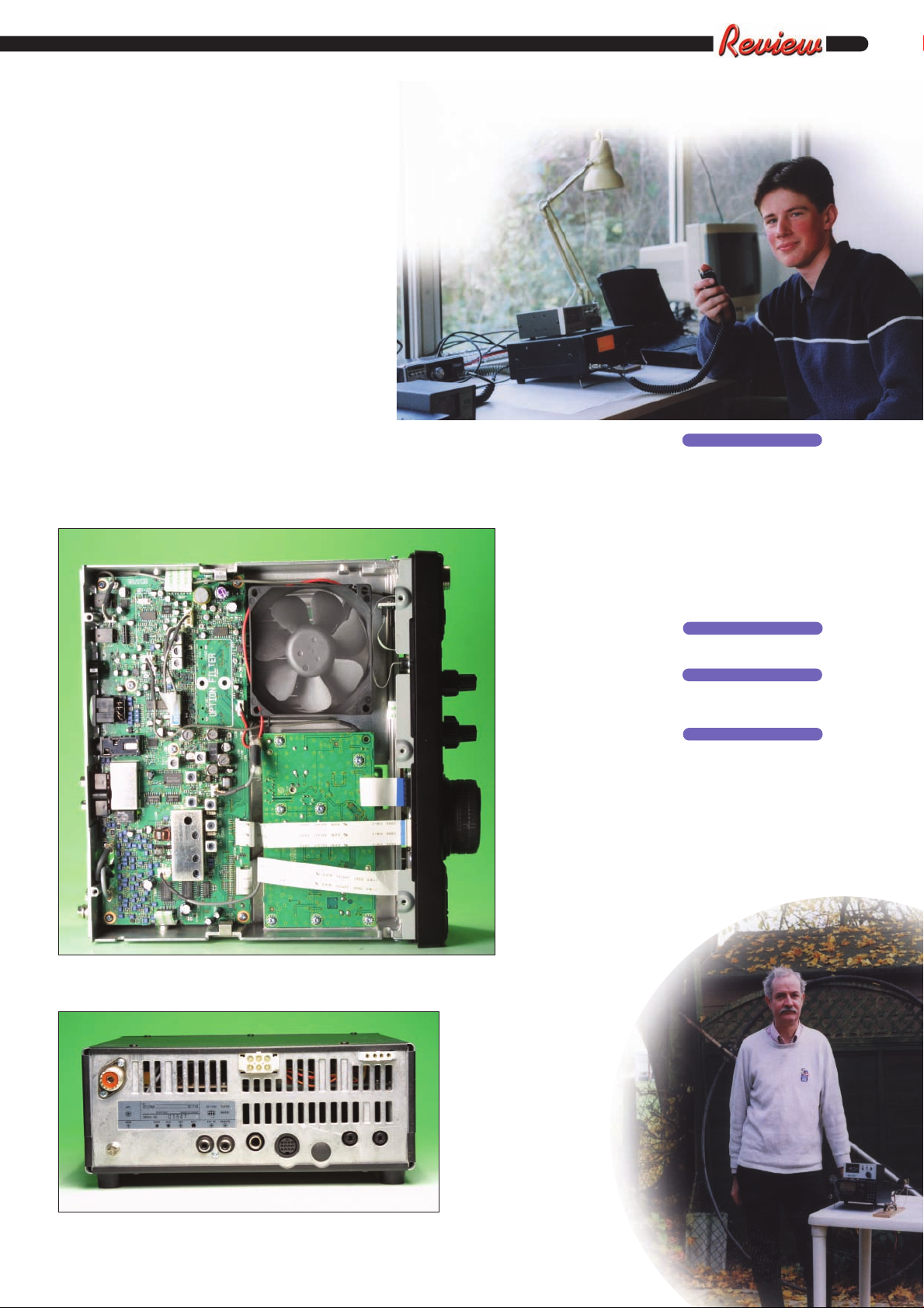
● Richard Gale 2E0AVG joined in the fun and worked some good DX with the budget-
priced IC-718.
(Photo G3ZBU)
Richard then took over and got 14 QSOs, eight of
which were club stations. Dad then had a go and got
23 in 48 minutes. Many people stopped briefly
during the busy contest to say how good the quality
of our signal was.
Looking back...it was really good fun, and so easy
to operate, you just ‘turn the knob and go basically’.
Richard, Dad and I all got such similar results too Dad was bursting with pride for us!
For operation on c.w. the IC-718 has a built in
electronic keyer which needs to be defeated if you
use a straight key like I use. The manual had to be
referred to because all else failed! I forgot Dad’s
golden rule) and for this you have to use a different
setting, and power up the rig with the Set button
pressed..
Dad connected the transceiver up to his laptop
and received PSK31 with WinPSKse software and I
played around with that, it was really good and I
decoded a Polish station who was working 2E0RAF.
The WinPSKse program can decode two QSOs
simultaneously by clicking the right and left mouse
buttons anywhere on the audio spectrum display; try
it....it’s great fun. PSK31 needs a stable receiver
and there was no noticeable drift on this rig at
all.
As an experiment we tried to see how low
it would go in receive mode and the answer is
30kHz. This allows you to receive the lowest
bands, which are 73 and 136kHz.
Small & Light
The IC-718 is so small
Pros & Cons
●
Pros: The Icom IC-718 was great fun
too and was also very nice little
rig that was easy to operate. We
all enjoyed playing about with it.
Very versatile and puts out more
than enough power for Novices
like myself.
and light it’s really
easily taken up the
garden to adjust
antenna tuning units.
Even though the rig has
a built in s.w.r. meter on
its l.c.d. display, it didn’t
exactly match the
results from an external
meter. You have to take
the readings with a
pinch of salt...that’s why
most people seem use
external meters with
their
transceivers...whatever
make they may be.
Cons: No internal power supply. And
you must read the manual!
Price
●
£699.99 RRP inc. VAT
Summary
●
Very versatile and puts out more than
enough power for Novices like myself.
Thanks
●
My thanks for the loan of the review
transceiver go to Icom (UK) Ltd., Sea
Street, Herne Bay, Kent CT6 8LD.
Tel: (01227) 741741, FAX: (01227)
741742. E-mail: [email protected]
There is an
adjustable noise blanker
on the rig. The default
position was set at 50
(which didn’t really do
● Dad, Alister G3ZBU provided the
antenna erecting expertise and support
for daughter Helen and also enjoyed
using the IC-718 too!
anything) but when
turned up it effectively
got rid of impulse noise.
However, if it was
● Small and light it may be (no internal power supply) but the IC-718 is no light-
weight performer and is well equipped with good heat-sinking and cooling.
turned up too high it would distort s.s.b.
signals, so it’s a control to be used
carefully.
The Icom IC-718 was
great fun too and was also a
very nice little rig that was
easy to operate. We all
enjoyed playing about
with it and it was very
versatile and puts out
more than enough power
for Novices like myself.
Guess what I’m going to
ask for next Christmas?
Thank you Icom for
loaning it to me!
● Rear panel view of the IC-718.
PW
Practical Wireless, February 2002 39
 Loading...