

Page 1
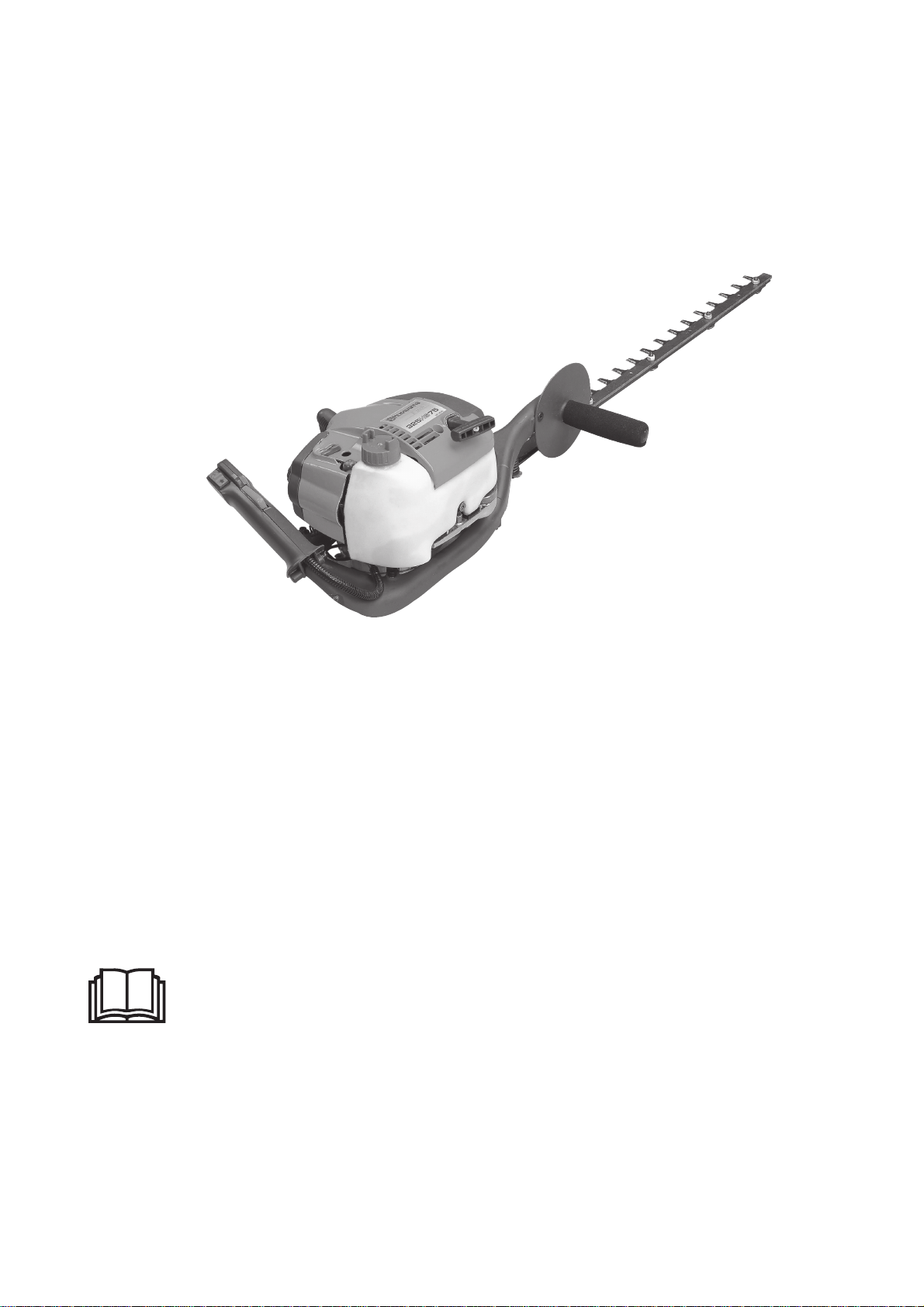
325HS75/HS99
Operator's Manual
Please read these instructions carefully and make sure
you understand them before using the hedge trimmer.
101 90 46-26
Page 2

SYMBOL EXPLANATION
Symbols
WARNING! The hedge trimmer
can be dangerous!
Careless or incorrect use can result in
serious, even fatal injury.
Read through the Operator‘s
Manual carefully and understand the
content before using the hedge
trimmer.
Always use
• Ear protection
• Approved eye protection
• This product is in accordance with
applicable CE directives.
Checks and/or maintenance should be
carried out with the engine switched off,
with the stop switch in the STOP
position.
Always use approved protective gloves.
Regular cleaning required.
Ocular control.
• Always wear approved protective
gloves.
Other symbols/decals on the machine refer to
special certification requirements for certain
markets.
Approved eye protection must always be
used.
2 – English
Page 3

CONTENTS
Husqvarna AB has a policy of continuous product
development and therefore reserves the right to modify the
design and appearance of products without prior notice.
WARNING!
!
Under no circumstances may the design
of the machine be modified without the
permission of the manufacturer. Always
use genuine accessories. Non-authorised
modifications and/or accessories can
result in serious personal injury or the
death of the operator or others.
List of contents
SYMBOL EXPLANATION
Symbols ............................................................................... 2
CONTENTS
List of contents .................................................................... 3
SAFETY INSTRUCTIONS
Personal protective equipment ............................................. 4
The machine’s protective equipment .................................... 4
Control, maintenance and service of the hedge trimmer’s
protective equipment ..................................................... 6
General safety instructions ................................................... 8
General working instructions for hedge trimmer.................. 9
WHAT IS WHAT?
What is what on the hedge trimmer? ................................. 11
FUEL HANDLING
Fuel ................................................................................... 12
Fuelling.............................................................................. 12
START AND STOP
Control before starting....................................................... 13
Start and stop..................................................................... 13
MAINTENANCE
Carburettor........................................................................ 14
Muffler .............................................................................. 16
Cooling system .................................................................. 16
Spark plug.......................................................................... 16
Air filter............................................................................. 17
Gearbox............................................................................. 17
Lubrication........................................................................ 17
Maintenance schedule........................................................ 18
TECHNICAL DATA
325HS75........................................................................... 20
325HS99........................................................................... 20
English – 3
Page 4
SAFETY INSTRUCTIONS
Personal protective eqipment
IMPORTANT INFORMATION
• Incorrect or careless use of a hedge trimmer can
turn it into a dangerous tool that can cause
serious or even fatal injury. It is extremely
important that you read and understand this
manual.
• When using a hedge trimmer, protective
equipment approved by the appropriate
authorities must be used. Personal protective
equipment does not eliminate the risk of
accidents, however, it can reduce the effects of an
injury in the event of an accident. Ask your dealer
for help when choosing protective equipment.
WARNING!
!
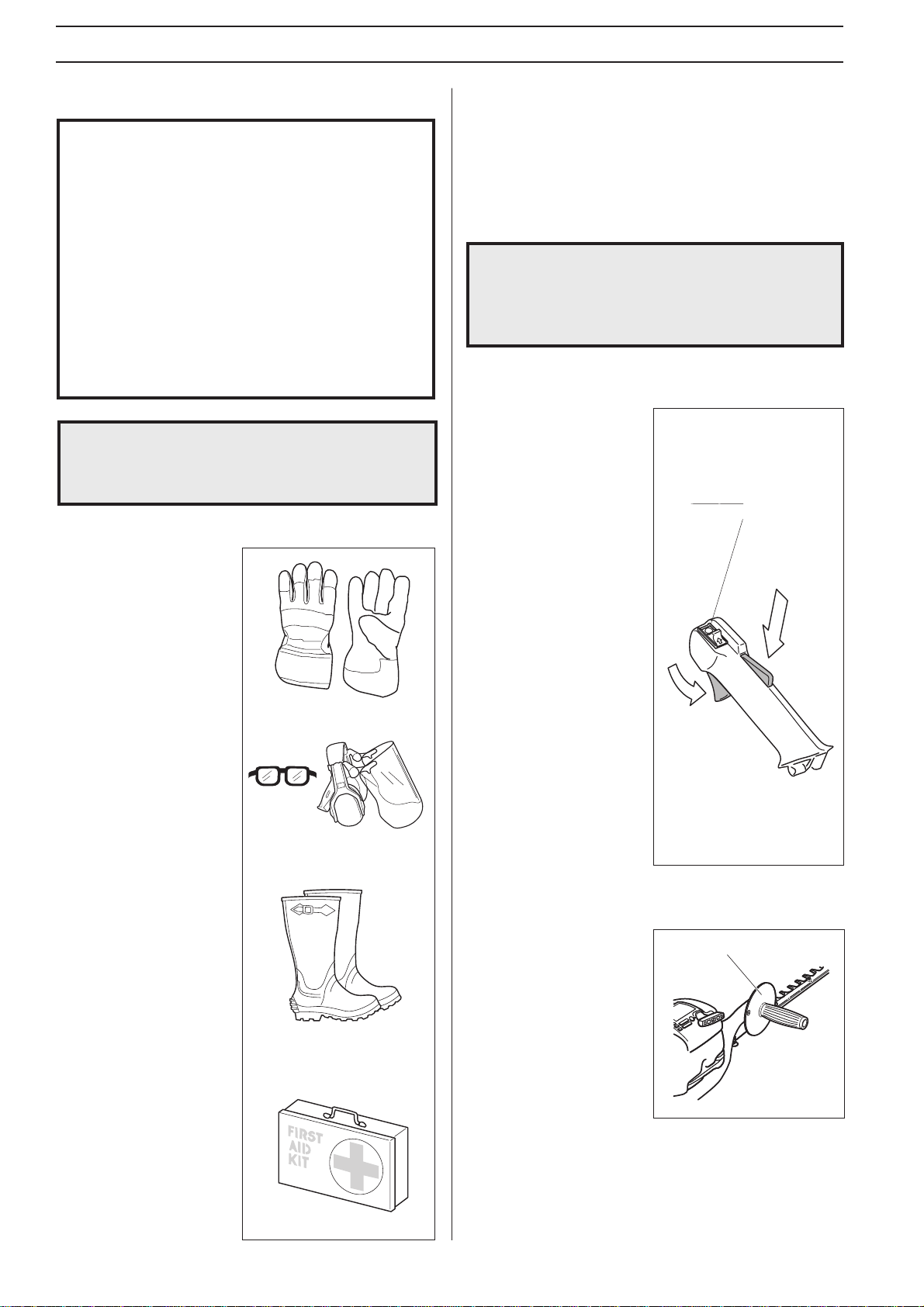
GLOVES
Gloves should be worn when
necessary, e.g., when
inspecting, cleaning or
assembling cutting equipment.
EAR PROTECTION
Ear protection offering
sufficient dampening effect
should be used.
Remove your hearing protection as soon as
you stop the engine, so that you can hear
any noises or warning signals.
The machine’s protective equipment
This section describes the hedge trimmer’s protective equip-
ment, its function and how checks and maintenance are
carried out to ensure that it operates correctly. (See the chapter
”What is what” to locate where this equipment is positioned on
your machine.)
WARNING!
Never use a hedge trimmer with defective
!
1. Throttle trigger lock
The throttle trigger lock is
designed to prevent the
throttle from accidentally
being engaged. The trigger
(A) can only be pressed in, if
the lock (B) is held in (= the
operator holding the
handle). When the grip on
the handle is released the
throttle and the throttle
trigger lock return to their
original positions. This
takes place via two independent return spring systems.
This means that the throttle
is automatically locked in
the idling position.
protective equipment. Follow the control,
maintenance and service instructions
described in this section.
C
"
B
A
EYE PROTECTION
Blows from branches or
objects thrown by the
moving blades can damage
the eyes.
BOOTS
Use anti-slip and stable
boots.
CLOTHING
Wear clothes made of a
strong fabric and avoid loose
clothing that can catch on
shrubs and branches. Always
wear heavy-duty long pants.
Do not wear jewellery,
shorts, sandals or go barefoot. Secure hair so it is
above shoulder level.
FIRST AID KIT
A first aid kit should be close
at hand.
2. Stop switch
The stop switch (C) should
be used to stop the engine.
3. Hand guard
D
The hand guard (D)
prevents the operator’s
hands from coming into
contact with the blades. For
example, if the operator
should loose his grip on the
front handle.
4 – English
Page 5
SAFETY INSTRUCTIONS
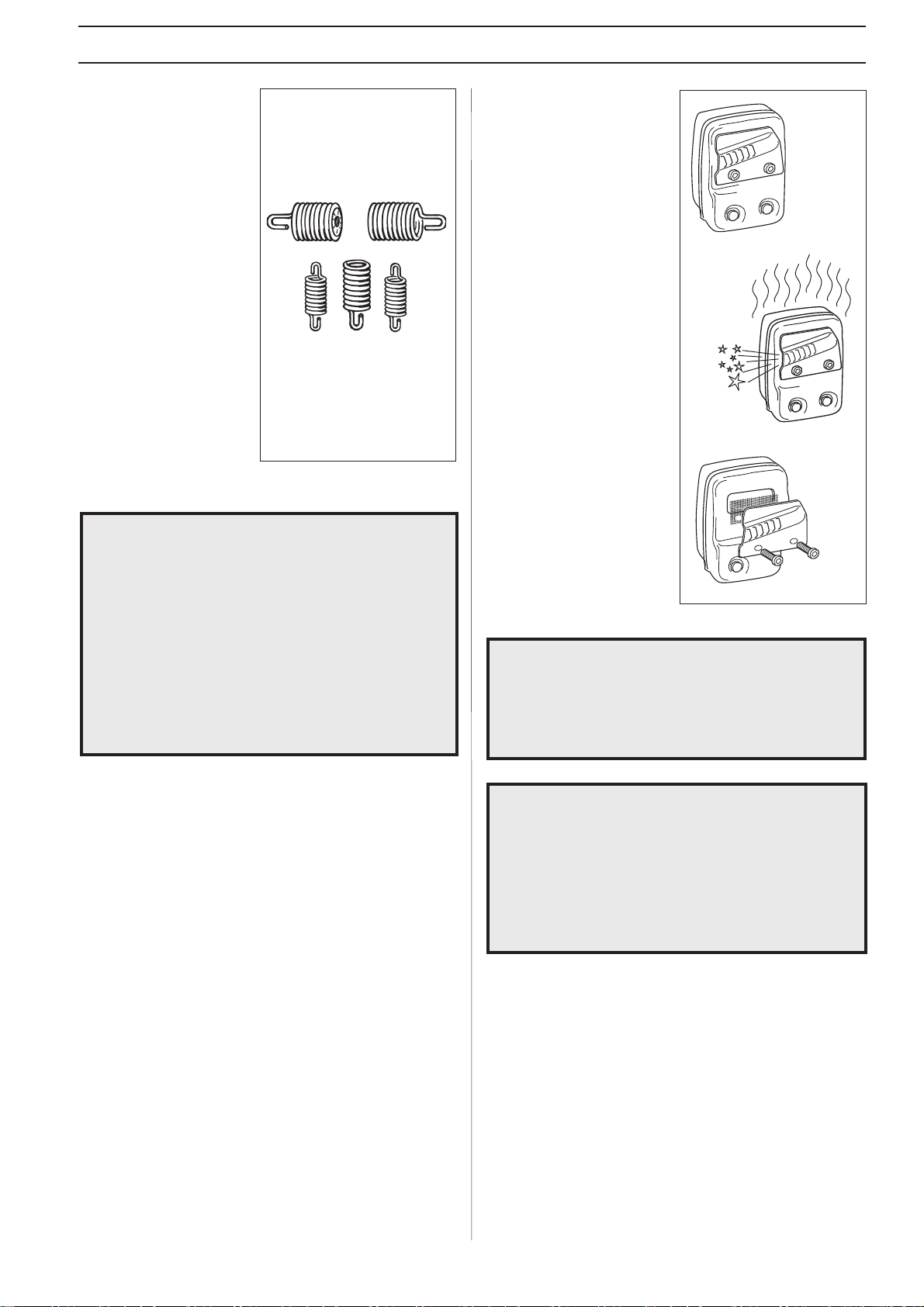
4. Vibration
damping system
The hedge trimmer is
equipped with a vibration
damping system, which is
designed to give as vibration-free and comfortable
use as possible.
The hedge trimmer’s
vibration damping system
reduces the transfer of
vibrations between the
engine/unit blades and the
hedge trimmer’s handles.
The engine body, including
the blades, is suspended on
the handlebar system by five
springs.
WARNING!
Over exposure to vibrations can result in
!
blood-vessel or nerve injury to persons
suffering with blood circulation problems.
Seek medical attention if you experience
physical symptoms that can be related to
over exposure to vibrations. Examples of
such symptoms are ”numbness”, lack of
feeling, ”tickling”, ”pricking”, ”pain”, lack
of or a reduction in normal strength,
changes in the colour of the skin or its
surfaces. These symptoms normally appear
in the fingers, hands or wrists.
5. Muffler
The muffler is designed to
give the lowest possible noise
level and to direct the
engine‘s exhaust fumes away
from the operator. Muffler
fitted with catalytic converter is also designed to
reduce harmful exhaust
components.
In countries that have a
warm and dry climate the
risk of fire is obvious. We
have therefore fitted certain
mufflers with a spark arrest
screen. Make sure that your
muffler is fitted with this
kind of screen.
It is extremely important
that the instructions for
checking, maintaining and
servicing the muffler are
followed. (See the section
“Control, maintenance and
service of the machine‘s safety
equipment“).
WARNING!
!
Mufflers fitted with catalytic converters
become extremely hot during use and
after stopping. This also applies at idling
speeds. Contact can result in burns to
the skin. Be observant to the risk of fire!
!
WARNING!
Bear in mind that exhaust fumes:
• contain carbon monoxide, which can
cause carbon monoxide poisoning.
Therefore never start or run the machine
indoors.
• are hot and can contain sparks that can
cause fires. Never start the machine
indoors or close to inflammable material.
English – 5
Page 6
SAFETY INSTRUCTIONS
Control, maintenance and service of
the hedge trimmer’s protective
equipment
IMPORTANT INFORMATION
• All service and repairs to the machine require
special training.
• This applies especially to the machine‘s safety
equipment. If the machine does not meet any of
he controls listed below you should contact
your service workshop.
• The purchase of one of our products
guarantees that professional repair and
servicing will be carried out on it. If the point of
purchase is not one of our servicing dealers,
please ask for details of the closest service
workshop.
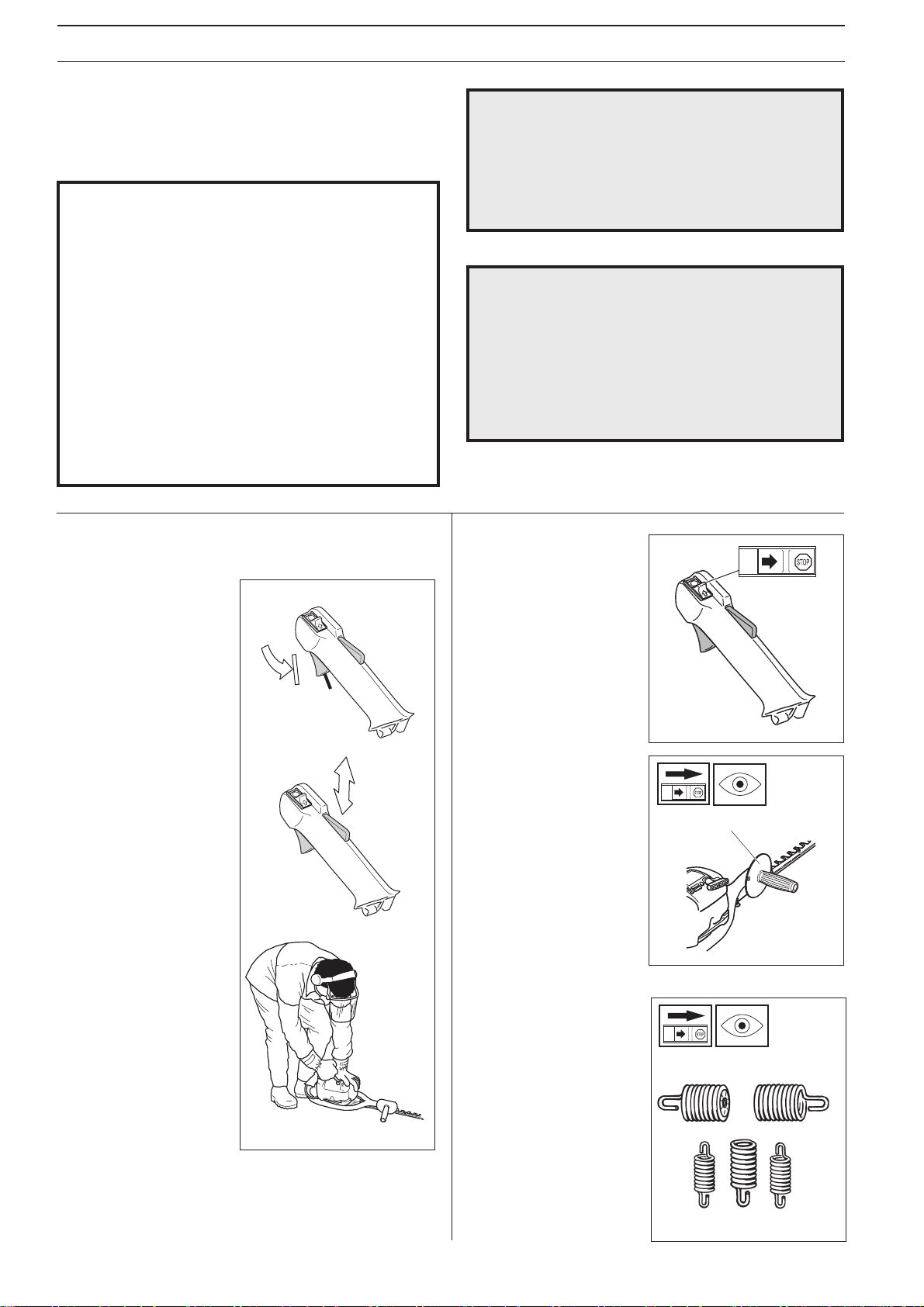
1. Throttle trigger lock
WARNING!
!
!
Never use a machine with defective safety
equipment. The safety equipment should
be maintained as described in this
section. If your machine does not meet
any of these controls you should contact
your service workshop.
WARNING!
Always stop the engine before starting
work on any part of the cutting
equipment. This continues to rotate even
after the throttle has been released.
Ensure that the cutting equipment has
stopped completely and remove the cable
from the spark plug before you start to
work on it.
2. Stop switch
• Check that the throttle is
locked in the “idling
position“ when the
throttle trigger lock is in
its original position.
• Press in the throttle
trigger lock and make
sure it returns to its
original position when
released.
• Ensure that the throttle
and throttle trigger lock
move easily and that their
return spring systems
function.
• See the section ”Start”.
Start the hedge trimmer
and apply full throttle.
Release the throttle and
check that the blades
stop and remain at a
standstill. If the blades
rotate with the throttle in
the idling position then
the carburettor’s idling
setting must be checked.
See chapter ”Mainte-
nance”.
• Start the engine and
make sure that the engine
stops when the stop
switch is moved to the
stop position.
3. Hand guard
• Ensure that the blade
guard is fitted correctly.
• Make sure the hand
guard is not damaged in
anyway.
4. Vibration
damping system
• Check the vibration
damping element
regularly for material
cracks and distortion.
• Check that the vibration
damping element is
securely attached
between the engine unit
and the handlebar unit.
D
6 – English
Page 7
SAFETY INSTRUCTIONS
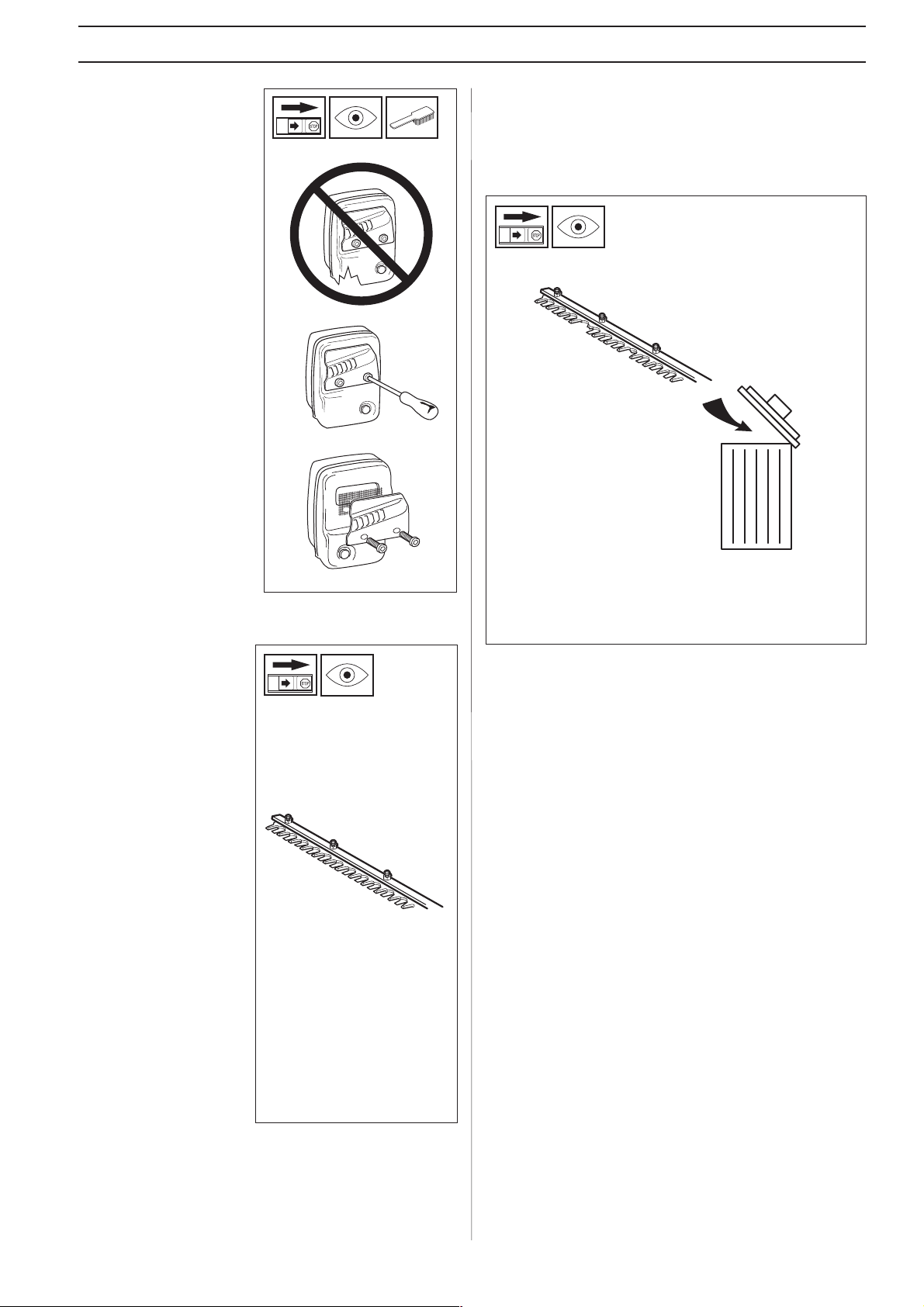
5. Muffler
• Never use a machine that
has a defective muffler.
• Check regularly that the
muffler is secure.
• If your muffler is fitted
with a spark arrest screen
then it should be cleaned
regularly. A blocked
screen leads to the engine
overheating with serious
damage as a result. Never
use a muffler with a
defective spark arrest
screen.
7. Blade guard
• Replace the blades if they
are bent or damaged.
6. Blades
To ensure good cutting
results it is important that
the contact pressure
between the blades is
correct.
The contact pressure
between the blades is
adjusted by tightening the
screws on the underside of
the bar as far as they will
go, then backing them off
1/4 turn. Lock the screws
using the locking nuts on
the top face of the bar.
The washers should still
slide freely under the
screw heads after the
screws have been tightened.
The edges of the blade are
too hard to be filed. Dull
blades should be sharpened using a grinder.
English – 7
Page 8

SAFETY INSTRUCTIONS
General safety instructions
IMPORTANT INFORMATION
• The machine is only designed for cutting
branches and twigs.
• Never use the machine if you are tired, if you
have consumed alcohol, or if you are taking
medicines that can affect your sight, your
judgement or the control of your body.
• Use personal protective equipment. See the
section
• Never use a machine that has been modified so
that it no longer corresponds with the original
design.
• Never use a machine that is faulty. Follow the
maintenance, control and service instructions in
this Operator’s Manual.
Some maintenance and service actions should
be carried out by trained and qualified
specialists. See the chapter
• All covers and guards must be fitted before
starting the machine. Check that the spark plug
cap and HT lead are not damaged, otherwise
you could get an electric shock.
!
Start
”Personal protective equipment”.
”Maintenance”
WARNING!
Faulty blades can increase the risk of
accidents.
Fuel safety
• Always use a fuel
container with an antispill valve.
• Never fill the machine
while the engine is
running. Always stop the
engine and let it cool for
a few minutes before
refuelling.
• Provide good ventilation
when filling or mixing
fuel (petrol and 2-stroke
oil).
• Move the machine at
least 3 m from the filling
position before starting.
.
• Never start the machine:
a) If you have spilt fuel on
it. Wipe up all spillage.
b) If you have spilt fuel on
yourself or your clothes.
Change your clothes.
c) If there is a fuel leak.
Make regular checks for
leakage from the fuel cap
and the fuel supply pipes.
Min. 3 m
(10 ft)
• The gearbox and clutch drum must be fitted before the
machine is started, otherwise the clutch can become loose
and cause personal injury.
• Never start the machine indoors. Bear in mind the dangers
of inhaling the engine’s exhaust fumes.
• Observe your surroundings and make sure that there is no
risk of people or animals coming into contact with the
cutting equipment.
• Place the machine on the
ground, make sure the
blades are free from
branches and stones.
Press the machine body
against the ground using
your left hand (NOTE!
Do not use your foot).
Grip the starter handle
with your right hand and
pull the starter cord.
Transport and storage
• Store and transport the machine and fuel so that any
leakage or fumes do not risk coming into contact with
sparks or naked flames. For example, electric machines,
electric motors, electrical switches/power switches, heaters
or the like.
• When storing and transporting fuel, approved containers
intended for this purpose must be used.
• When storing the machine for long periods the fuel tank
must be emptied. Contact your local petrol station to find
out how to dispose of excess fuel.
• The blades transport guard should always be fitted when
transporting or storing the hedge trimmer.
WARNING!
!
Exercise great care when handling fuel.
Bear in mind the risk of fire, explosions
and inhaling fumes.
8 – English
Page 9

SAFETY INSTRUCTIONS
Safety instructions when
using the hedge trimmer
WARNING!
!
!
NOTE! Read the Operator’s Manual carefully before using
the hedge trimmer.
The hedge trimmer can cause serious
personal injury. Read the safety
instructions carefully. Learn how to use
the machine.
WARNING!
Cutting tool. Do not touch the tool
without first switching off the engine.
Personal protection
• Always wear boots, and the
other safety equipment
described in the section
”Personal protective
equipment”.
Protective
instructions while
working
• Always ensure you have a
safe and firm working
position.
• Always use both hands to
hold the machine. Hold the
machine in front of you.
• Use your left hand to
operate the throttle.
• Make sure that your hands
and feet cannot come into
contact with the blades
when the engine is
running.
• Always wear working
clothes and thick, long
trousers.
• Never wear loose fitting
clothes or jewellery
• Secure hair so it is above
shoulder level.
Protective instructions regarding the
surroundings
• Never allow children to
use the machine.
• Ensure no one comes
within 15 metres while
working.
• Never allow anyone to use
the machine without first
being absolutely sure that
they understand the
contents of the Operator’s
Manual.
• When the engine is
switched off, keep your
hands and feet away from
the blades until they have
stopped.
• Do not cut too close to the ground. Stones and other objects
can be thrown.
• Make sure that there are no foreign objects, such as
electricity cables, etc., in your working area. Also remove any
objects that could damage the hedge trimmer, such as metal
items.
• If any object is hit or if vibrations occur stop the machine
immediately. Remove the spark plug cable from the spark
plug. Check that the machine is not damaged. Repair any
damage.
• Never work on a ladder,
stool or any other raised
position that is not fully
secured.
English – 9
Page 10

SAFETY INSTRUCTIONS
Protective instructions when
work is completed
• The transport guard should always be fitted to the blades
when the machine is not in use.
• Ensure the blades have stopped and remove the spark plug
cable from the spark plug before carrying out cleaning,
repairs or an inspection.
• Always wear heavy duty
gloves when repairing the
blades. The blades are
extremely sharp and can
easily causes cuts.
• Store the machine out of
reach from children.
• Only use original spare
parts when carrying out
repairs.
Basic working
techniques
• When cutting the sides
of a hedge, work from
the bottom upwards.
When cutting
horizontally, work from
right to left.
• Adjust the throttle
setting to suit the load.
• When trimming a hedge
the engine should always
be turned away from the
hedge.
• The hedge trimmer
should be held as close
to the body as possible
to get the best balance.
• Make sure that the tip
does not touch the
ground.
• Do not try to force the
work, but move at a
steady speed so that all
the stems are cut evenly.
10 – English
Page 11

WHAT IS WHAT?
17
19
18
3
2
5
6
7
8
9
10
4
11
1
What is what on the hedge trimmer?
1. Operator’s Manual
2. Grease nipple
3. Gearbox
4. Blades
5. Hand guard
6. Handle
7. Cylinder cover
8. Starter handle
9. Fuel cap
10. Fuel tank
11. Air purge
12. Choke
13. Throttle trigger lock
14. Throttle trigger
15. Stop switch
16
15
16. Air filter cover
17. Spark plug spanner
18. Allen key
19. Blade cover (Transport)
14
12
13
English – 11
Page 12

FUEL HANDLING
Fuel
NOTE!
The machine is fitted with a two-stroke engine and must
always be run on a mixture of petrol and two-stroke oil. It is
important to measure the quantity of oil accurately, to ensure
the correct mixture ratio. Small discrepancies in the amount of
oil have a great bearing on the proportions of the fuel mixture
when mixing small amounts of fuel.
WARNING!
!
Petrol
NOTE!
Always use an oil-mixed
quality petrol (at least 90
octane). If your machine is
equipped with a catalytic
converter, (see “technical
data”) an unleaded, oil
mixed quality petrol should
always be used. A leaded
petrol will destroy the
catalytic converter.
• The lowest recommended
octane rating is 90. If you
run the engine on a petrol
with a lower octane rating
than 90 so-called
“knocking“ can occur.
This leads to an increased
engine temperature,
which can result in a
serious engine
breakdown.
• When working at
continuous high revs a
higher octane rating is
recommended.
Two-stroke oil
• For the best results use
HUSQVARNA twostroke oil, which has been
specially produced for
HUSQVARNA’s small,
two-stroke engines.
Mixing ratio 1:50 (2%).
• If HUSQVARNA two-stroke oil is not available you can
use a high quality two-stroke oil intended for air cooled
engines. Contact your dealer when selecting an oil.
• Never use two-stroke oil intended for water cooled
outboard motors, so-called outboard motor oil.
• Never use oil intended for four-stroke engines.
Always provide good ventilation when
handling fuel.
Mixing ratio: 1:33 (3%).
Mixture
• Always mix petrol and oil in a clean container intended for
petrol.
• Always start by filling half the quantity of petrol required.
Then add the entire oil quantity. Mix (shake) the fuel
mixture. Fill the remaining quantity of petrol.
• Mix (shake) the fuel mixture carefully before filling in the
machine‘s fuel tank.
• Do not mix more than max. one month’s supply of fuel.
• If the machine is not used for a long period of time, the fuel
tank should be emptied and cleaned.
WARNING!
!
The catalytic converter muffler gets very hot
during and after use. This also applies
during idling. Be aware of the fire hazard,
especially when handling the saw near
flammable substances or vapours.
Fuelling
WARNING!
The following precautions reduce the risk
!
• Clean around the fuel
cap. Contamination in
the tank can disrupt
operations.
• Ensure that the fuel is
well mixed by shaking
the container before
filling the tank.
Gasolin
Benzin
Essence
Gasolina
Lit.
5
10
15
20
US
gallon
1
2 1/2
5
of fire:
Do not smoke or place any sources of heat
in the vicinity of the fuel. Never refuel
when the engine is running. Always stop
the engine and let it cool for a few minutes
before refuelling. Open the fuel cap slowly
when fuelling so that any over pressure is
released slowly. Tighten the fuel cap
carefully after refuelling. Always move the
machine from the fuelling place before
starting.
Min. 3 m
(10 ft)
Oil • Öl
Huile • Aceite
Lit.
US
fl. oz.
3% (1:33)
0,15
0,30
0,45
0,60
3% (1:33)
3 3/4
9 3/4
19 1/4
2% (1:50)
0,10
0,20
0,30
0,40
2% (1:50)
2 1/2
6 1/2
12 7/8
12 – English
Page 13

START AND STOP
Control before starting
• Inspect the working area. Remove objects that can be
thrown.
• Check the blades. Never
use blades that are dull,
cracked or damaged.
• Check that the hedge
trimmer is in full
working order. Check
that all nuts and bolts are
tightened correctly.
• Make sure the gearbox is lubricated correctly. See the
section ”Lubricating the blades”.
• Ensure the blades always stop when the engine is idling.
• Only use the machine for what it is intended for.
• Ensure that the handle and safety functions are in order.
Never use a machine that lacks a part or has been modified
outside of the specifications.
Start and stop
Start
Warm engine
IGNITION:
Set the stop switch to the
start position.
CHOKE:
Set the choke control in the
choke position and then
back again to its original
position (B)
In this way only the start
throttle is applied with no
choke.
AIR PURGE:
Press the air purge diaphragm repeatedly until fuel
begins to fill the diaphragm.
The diaphragm need not be
completely filled.
B
WARNING!
!
Cold engine
IGNITION:
Set the stop switch to the
start position.
CHOKE:
Set the choke control in the
choke position (A).
The choke position is also
the automatic start throttle
position.
AIR PURGE:
Press the air purge diaphragm repeatedly until fuel
begins to fill the diaphragm.
The diaphragm need not be
completely filled.
The gearbox and clutch drum must be
fitted before the machine is started,
otherwise the clutch can become loose
and cause personal injury.
Always move the hedge trimmer about 3
metres from the filling position before the
machine is started. Place the machine on
a hard surface. Bear in mind that the
blades could start to move when the
engine starts. Make sure the blades
cannot come into contact with any object.
Make sure that no unauthorised persons
are in the working area, otherwise there is
a risk of serious personal injury.
A
Press the machine body
against the ground using your
left hand (NOTE! Do not use
your foot). Grip the starter
handle with your right hand
and slowly pull the starter
cord out until you feel some
resistance, (the starter hooks
grip) now quickly and
powerfully pull the cord.
Immediately press the choke
control in when the engine
fires and repeat until the
engine starts. When the
engine starts, quickly apply
full throttle and the start
throttle will automatically
disengage.
NOTE! Do not pull the
starter cord out completely
and do not release the starter
cord from the fully extended
position. This can damage the
hedge trimmer.
Stop
The engine is stopped by
switching the ignition off
using the stop switch.
English – 13
Page 14

MAINTENANCE
Carburettor
Your Husqvarna product has been designed and manufactured to specifications that reduce harmful emissions.
After your unit has been run 8-10 tanks of fuel the engine
has broken in. To ensure that your unit is at peak performance and producing the least amount of harmful emissions
after break in, have your authorized servicing dealer, who has
a revolution counter at his disposal, to adjust your carburettor for optimum operating conditions.
WARNING!
The complete clutch cover and gear must
!
Operation
• The carburettor governs
the engine’s speed via the
throttle. Air/fuel is mixed
in the carburettor. The
air/fuel mixture is
adjustable. To take
advantage of the engine’s
optimal output the
adjustment must be
correct.
• The setting of the
carburettor means that
the engine is adapted to
local conditions, for
example, the climate,
altitude, petrol and the
type of 2-stroke oil.
• The carburettor is equipped with three adjustment
possibilities:
H = High speed needle
L = Low speed needle
T = Idle speed adjuster screw
• The fuel quantity in relation to the air flow permitted by
the throttle opening is adjusted using the L and H-needles.
Turning the needles clockwise gives a leaner fuel mixture
(less fuel) and turning them anti-clockwise gives a richer
fuel mixture (more fuel). A leaner mixture gives high revs
while a richer mixture give less revs.
• The T-screw regulates the position of the throttle while
the engine is idling. Turning the screw clockwise gives a
higher idling speed while turning it anti-clockwise gives a
lower idling speed.
be fitted before the machine is started,
otherwise the clutch may come loose and
cause injury .
H
L
T
Basic setting
• The carburettor is set to its basic setting when test run at
the factory. The basic setting is richer than the optimal
setting and should be kept during the machine’s first
working hours. Thereafter the carburettor should be finely
adjusted. Fine adjustment should be carried out by a skilled
technician.
NOTE! NOTE! If the blades move while the engine is idling
the T-screw should be turned anti-clockwise until the blades
stop.
Recommended idling speed is 2 700 rpm.
Recommended max. speed: See “technical data”.
WARNING!
!
If the idling speed cannot be adjusted so
that the blades stop, contact your
service workshop. Do not use the
machine until it has been correctly
adjusted or repaired.
Fine adjustment
• When the machine has been ”run-in” the carburettor should
be finely adjusted. The fine adjustment should be carried
out by qualified person. First adjust the L-jet, then the
idling screw T and then the H-jet.
Conditions
• Before any adjustments are made the airfilter should be clean
and the airfilter cover fitted. Adjusting the carburettor while
a dirty airfilter is in use will result in a leaner mixture when
the filter is finally cleaned. This can give rise to serious
engine damage.
• Carefully turn the L and H needle to the mid point between
fully turned in and fully turned out.
• Do not attempt to adjust the needles beyond the stops as
damage can occur.
• Now start the machine according to the starting instructions
and run it warm for 10 minutes.
NOTE! If the blades move, the T screw should be turned
counter-clockwise until the blades stop.
Low speed needle L
Try to find the highest idling
speed, turning the low speed
needle L clockwise respectively counter-clockwise.
When the highest speed has
been found, turn the low
speed needle L 1/4 turn
counter-clockwise.
NOTE! If the blades move
when the engine is idling,
turn the idling speed screw T
counter-clockwise until the
blades stop.
L
+ 1/4
14 – English
L
Page 15

MAINTENANCE
Adjusting the idle speed, T
Adjust the idling speed with
the screw T, if it is necessary
to readjust. First turn the
idle speed adjusting screw T
clockwise until the blades
start moving. Then turn the
screw anti-clockwise until
the blades stop. The idle
speed is correctly adjusted
when the engine runs
smoothly in every position.
There should also be a good
margin to the rpm at which
the blades start to move.
WARNING! Contact your dealer/service workshop if the idle
speed setting cannot be adjusted so that the blades stop. Do
not use the machine until it has been properly adjusted or
repaired.
T
Correctly adjusted carburettor
A correctly adjusted carburettor means that the machine
accelerates without hesitation and the machine 4-cycles a little
at max speed. Furthermore, the blades must not move at
idling. A too lean adjusted low speed needle L may cause
starting difficulties and bad acceleration.
A too lean adjusted high speed needle H gives lower power =
less capacity, bad acceleration and/or damage to the engine.
A too rich adjustment of the two speed needles L and H gives
acceleration problems or too low working speed.
High speed needle H
The high speed needle
affects the machine’s power,
speed, temperature and fuel
consumption. A too lean
adjustment on the high
speed needle H (the high
speed needle H is screwed
in too much) gives a too
high speed resulting in
engine damage. Do not
allow the engine to run at
full speed for more than 10
seconds.
Apply full throttle and turn
the high speed needle H
slowly anticlockwise until
the engine runs unevenly.
The high speed needle H is
then turned slowly clockwise a little until the engine
runs smoothly.
Note the engine should be
run unloaded when
adjusting the high speed
needle.
H
H
The high speed needle is adjusted correctly when the machine
‘splatters’ a little . If the machine smokes heavily at the same
time as it ‘splatters’ heavily the adjustment is too rich.
NOTE! For optimum setting of the carburettor, contact a
qualified servicing dealer who has a revolution counter at his
disposal.
English – 15
Page 16

MAINTENANCE
Muffler
NOTE!
Some mufflers are fitted with catalytic converters. See “Techni-
cal data” to find out if your machine is equipped with a
catalytic converter.
The muffler is designed to
dampen the noise level and
to direct the exhaust fumes
away from the user. The
exhaust fumes are hot and
can contain sparks, which
can result in fire if the
exhaust fumes are directed
towards a dry and inflammable material. Some
mufflers are equipped with a
special spark arrest screen. If
your machine is fitted with
this type of screen it should
be cleaned regularly. This is
done using a wire brush. On
mufflers without a catalytic
converter the screen should
be cleaned weekly, or
replaced if necessary. On
mufflers fitted with a
catalytic converter the
screen should be checked
and cleaned monthly. If the
screen is damaged it should
be replaced. If the screen is
frequently blocked, this can
be a sign that the function
of the catalytic converter is
impaired. Contact your
dealer to inspect the muffler.
A blocked screen will cause
the engine to overheat
resulting in damage to the
cylinder and piston. Also see
under “Maintenance”.
Cooling system
To maintain as low operating temperature as possible
the engine is equipped with
a cooling system.
The cooling system consists
of:
1. An air intake on the
starter unit.
2. Cooling fins on the
flywheel.
3. Cooling fins on the
cylinder
4. Cylinder cover (leads
cold air onto the
cylinder).
Clean the cooling system
using a brush at least once a
week, in difficult conditions
more often.
A dirty or blocked cooling
system leads to the engine
overheating resulting in
damage to the cylinder and
piston.
Spark plug
The condition of the spark
plug is affected by:
• An incorrect carburettor
setting.
• An incorrect fuel mixture
(too much or faulty oil).
• A dirty air filter.
These factors cause deposits
on the spark plug electrode
that may result in malfunction or starting difficulties.
1
2
0,5 mm
3
4
NOTE!
Never use a machine with a
defective muffler.
WARNING!
!
16 – English
Mufflers fitted with catalytic converters
become extremely hot during use and
after stopping. This also applies at idling
speeds. Contact can result in burns to
the skin. Be observant to the risk of fire!
If the machine is low on
power, difficult to start or
runs poorly while idling
always check the spark plug
first before taking other
action.
If the spark plug is dirty,
clean it and at the same time
check that the electrode gap
is 0.5 mm. The spark plug
should be changed after
about one month of operation or earlier if necessary.
NOTE! Always use the
recommended type of spark
plug. An incorrect spark plug
can damage the cylinder/
piston.
Page 17

MAINTENANCE
Air filter
The air filter (A) should be
cleaned regularly removing
dust and dirt to avoid:
• carburettor malfunction
• starting problems
• reduced engine power
• unnecessary wear to
engine parts
• abnormal fuel
consumption
A
Clean the filter after every
25 hours or more regularly if
operating conditions are
exceptionally dusty.
Cleaning the air filter
Dismantle the air filter cover (B) and remove the air filter.
Wash in clean, warm soapy water. Ensure that the filter is dry
before refitting.
An air filter used for a long period of time can never be cleaned
completely. Therefore it is necessary to replace the filter from
time to time with a new filter. A damaged air filter must always
be replaced.
If the machine is used in dusty conditions the air filter
should be soaked in oil, see the section on “Oiling the air
filter“.
B
Gearbox
There is a grease nipple (A)
on the gearbox. Use a grease
gun to top up with grease.
This should be carried out
after approximately every 20
working hours. Use
Husqvarna special grease,
No. 503 98 96-01.
Note that the gearbox must
not be filled completely
with grease. The grease
expands as the machine
heats up during operation.
If the gearbox was completely filled with grease it
could damage the seals and
lead to leakage.
The lubricant in the gearbox does not normally need to be
replaced other than with repair.
A
Lubrication
Always lubricate the blade
runners with special grease
531 00 60-74 (UL 21)
before use.
Oiling the air filter
Always use HUSQVARNA
filter oil, order no. 503 47
73-01. The filter oil contains a solvent to make it
spread evenly through the
filter. You should therefore
avoid skin contact. Put the
filter in a plastic bag and the
pour the filter oil over it.
Knead the plastic bag to
distribute the oil. Squeeze
the excess oil out of the filter
inside the plastic bag and
pour off the excess before
fitting the filter on the
machine. Never use common engine oil. This would
drain through the filter
quite quickly and collect in
the bottom.
English – 17
Page 18

MAINTENANCE
Maintenance schedule
Below follows some general maintenance instructions.
If you need further information please contact your service
workshop.
Daily maintenance
1
1. Clean the outside of the
machine.
2. Make sure the throttle
trigger lock and the
throttle function
correctly from a safety
point of view.
3. Check that the stop
switch functions.
4. Check that the blades do
not rotate while idling.
3
2
4
5. Clean the air filter.
Replace if necessary.
Weekly maintenance
1. Check the starter, the
starter cord and the
return spring.
2. Make sure that the
vibration damping
elements are not
damaged.
3. Clean the outside of the
spark plug. Remove and
check the electrode gap.
Adjust the gap to 0.5
mm or change the spark
plug.
4. Clean the cooling fins
on the flywheel.
5. Clean or replace the
muffler’s spark arrest
screen (not on mufflers
with a catalytic converter).
1
2
3
4
5
6. Check that the hand
guard is not damaged.
Replace the guard if
damaged.
7. Check that all nuts and
screws are tightened.
6
5
7
6. Clean the carburettor
area.
7. Clean the cooling fins
on the cylinder and
check that the air intake
in the starter unit is not
blocked.
8. Fill the gearbox with
grease. This should be
carried out after
approximately every 20
working hours.
9. Check that the bolts
keeping the blades
together are tightened,
(See the section “Con-
trol, maintenance and
service of the machine‘s
safety equipment“).
6
7
8
9
18 – English
Page 19

Monthly maintenance
1. Clean the fuel tank.
2. Clean the carburettor and
the area surrounding it.
3. Clean the fan wheel and
the area around it.
4. Check the fuel filter and
the fuel pipe, replace if
necessary.
MAINTENANCE
1
2
3
5. Check all cables and
connections.
6. Check the clutch, clutch
springs and the clutch
drum with regard to
wear. Replace if necessary.
7. Change the spark plug.
8. Check and clean the
muffler’s spark arrest
screen if necessary (only
mufflers with a catalytic
converter).
4
5
6
7
8
English – 19
Page 20

TECHNICAL DATA
Technical data
Engine
Cylinder capacity, cu. in/cm
Cylinder bore, inch/mm
Stroke length, inch/mm
Idling speed, rpm
Recommended max. speed, rpm
Max. engine output, acc. to ISO 8893
Catalytic converter muffler
Speed-regulated ignition system
gnition system
Manufacturer/type of ignition system
Spark plug
Electrod gap, inch/mm
Fuel lubrication system
Manufacturer/type of carburettor
Fuel tank capacity,US pint/ litres
Weight
Weight without fuel, Lbs/kg
Noise levels
Equivalent noise pressure levels at
the user’s ear , measured acc. to prEN 31806 and
ISO 7917, dB(A):
Equivalent noise power levels measured acc. to
prEN 31806 and ISO 10884, dB(A):
3
325HS75
1,55/25,4
1,34/34
1,10/28
2 700
11 000
0,9 kW/ 9 000 rpm
Yes
Yes
Walbro MB/CD
Champion RCJ 7Y
0,02/0,5
Walbro WT
0,85/0,4
12,1/5,5
96
104
325HS99
1,55/25,4
1,34/34
1,10/28
2 700
11 000
0,9 kW/ 9 000 rpm
Yes
Yes
Walbro MB/CD
Champion RCJ 7Y
0,02/0,5
Walbro WT
0,85/0,4
12,8/5,8
97
104
Vibration levels
Vibration levels on the handles measured
acc. to prEN 31806 and ISO 7916, m/s
Idling, rear/front handles:
Max. speed , rear/front handles:
Blades
Length, mm
Blade speed at 9 000 rpm, Cut/min
2
2,0/2,9
1,7/4,2
750
4 490
2,2/2,5
2,4/4,0
990
4 490
20 – English
Page 21

EU declaration of conformity (Only applies to Europe)
(Directive 98/37/EC, Annex II, A)
We, Husqvarna AB, S-561 82 Huskvarna, Sweden, tel: +46 36-146500, declare under sole responsibility that the
hedge trimmers Husqvarna 325HS75 and 325HS99 from 1999’s serial numbers and onwards (the year is clearly
stated in plain text on the type plate with subsequent serial number), are in conformity with the following standards or
other normative documents following the provisions in the COUNCIL’S DIRECTIVES:
- of June 22 1998 “relating to machinery” 98/37/EC and applicable supplements.
- of May 3 1989 “relating to electromagnetic compatibility” 89/336/EEC, and applicable supplements.
The following standards have been applied: EN292-2, CISPR 12:97, EN774.
SMP Svensk Maskinprovning AB, Fyrisborgsgatan 3 S-754 50 Uppsala, Sweden, has carried out voluntary type
approval for Husqvarna AB. The certificates are numbered: SEC/99/712 – 325HS75/HS99.
Huskvarna December 29, 1999
Bo Andréasson, Development manager.
Page 22

´*3$^¶6/¨
2000W03
Page 23

We hope you find the links below useful. For further gardening information visit
Gardening Tools Direct
Blower Vacs Brush cutters Brushcutters Chainsaws Chain saws
Cultivators Cylinder lawn
mowers
Electric
chainsaws
Garden tractors Garden vacuums Hayter lawn
Hover mowers Husqvarna
Lawn scarifiers Lawn tractors Leaf blowers Leaf vacuums Petrol chainsaws
Petrol hedge
cutters
Ryobi strimmers Scarifiers Strimmers Westwood lawn
Westwood
Fertiliser
spreaders
chainsaws
Ride on lawn
mowers
Cylinder mowers Echo chainsaws Echo Strimmers
Garden blowers Garden rollers Garden shredders
Hedge cutters
mowers
Kawasaki brush
cutters
Ride on mowers Rotary mowers Rotavators
tractors
Kawasaki
strimmers
tractors
Hedgecutters
Lawn mowers
Westwood ride on
mowers
 Loading...