

Page 1
Technical Reference Manual
Hardware and BIOS
HP Vectra VA 6/xxx and
XA 6/xxx PCs
Page 2

Notice
The information contained in this document is subject to change without notice.
Hewlett-Packard makes no warranty of any kind with regard to this
material, including, but not limited to, the implied warranties of
merchantability and fitness for a particular purpose.
Hewlett-Packard shall not be liable for errors contained herein or for incidental
or consequential damages in connection with the furnishing, performance, or use
of this material.
Hewlett-Packard assumes no responsibility for the use or reliability of its
software on equipment that is not furnished by Hewlett-Packard.
This document contains proprietary information that is protected by copyright.
All rights are reserved. No part of this document may be photocopied,
reproduced, or translated to another language without the prior written consent
of Hewlett-Packard Company.
Centronics® is a registered trademark of Centronics Data Computer
Corporation.
Microsoft®, Windows® and MS-DOS® are registered trademarks of the
Microsoft Corporation.
Novell® and Netware® are registered trademarks of Novell Inc.
OS/2
TM
is a trademark of International Business Machines Corporation.
NextStep
TM
is a trademark of Next Incorporated.
Pentium
TM
is a trademark of Intel Corporation.
SCO UNIX® is a registered trademark of the Santa Cruz Operation.
Solaris
TM
is a trademark of Sun Microsystems Incorporated.
SoundBlaster
TM
is a trademark of Creative Technology Limited.
Hewlett-Packard France
Grenoble Personal Computer Division
Technical Marketing
38053 Grenoble Cedex 9
France
1996 Hewlett-Packard Company
Page 3

iii
Preface
This manual is a technical reference and BIOS document for engineers and
technicians providing system level support. It is assumed that the reader
possesses a detailed understanding of AT-compatible microprocessor
functions and digital addressing techniques.
Technical information that is readily available from other sources, such as
manufacturer’s proprietary publications, has not been reproduced.
This manual contains summary information only. For additional reference
material, refer to the bibliography, on the next page.
Conventions
The following conventions are used throughout this manual to identify
specific numeric elements:
❒ Hexadecimal numbers are identified by a lower case h.
For example, 0FFFFFFFh or 32F5h
❒ Binary numbers and bit patterns are identified by a lower case b.
For example, 1101b or 10011011b
Page 4

iv
Bibliography
❒ HP Vectra VA 6/xxx PC User’s Guide manual (D4200-90001).
❒ HP Vectra VA 6/xxx MT PC User’s Guide manual (D4210-90001).
❒ HP Vectra XA 6/xxx PC User’s Guide manual (D4544-90001).
❒ HP Vectra VA and XA 6/xxx PC Familiarization Guide (D4200-90901).
❒ HP Network Administrator’s Guide (online).
❒ HP Vectra Accessories Service Handbook - 6th edition
(5964-8495).
❒ HP Vectra PC Service Handbook (Volume 1) - 10th edition
(5964-8494).
❒ Documentation CD-ROM (D4200-90921).
❒ HP Support Assistant CD-ROM (by subscription).
The following Intel® publication provides more detailed information:
❒ Pentium Pro Processor (242769-002)
Page 5

Contents
v
Preface . . . . . . . . . . . . . . . . . . . . . . . . . . . . . . . . . . . . . . . . . . . . . . . . . . iii
Conventions. . . . . . . . . . . . . . . . . . . . . . . . . . . . . . . . . . . . . . . . . . . . . . iii
Bibliography. . . . . . . . . . . . . . . . . . . . . . . . . . . . . . . . . . . . . . . . . . . . . . iv
1 System Overview
External Features . . . . . . . . . . . . . . . . . . . . . . . . . . . . . . . . . . . . . . . . . . 2
HP Vectra VA PC . . . . . . . . . . . . . . . . . . . . . . . . . . . . . . . . . . . . . . . . . . . . . 2
HP Vectra VA MT PC. . . . . . . . . . . . . . . . . . . . . . . . . . . . . . . . . . . . . . . . . . 3
HP Vectra XA PC. . . . . . . . . . . . . . . . . . . . . . . . . . . . . . . . . . . . . . . . . . . . . 4
Specifications and Characteristic Data . . . . . . . . . . . . . . . . . . . . . . . . 5
Control (Status) Panel . . . . . . . . . . . . . . . . . . . . . . . . . . . . . . . . . . . . . . . . 5
Physical Characteristics . . . . . . . . . . . . . . . . . . . . . . . . . . . . . . . . . . . . . . . 5
Electrical Specification . . . . . . . . . . . . . . . . . . . . . . . . . . . . . . . . . . . . . . . . 6
Environmental Specification . . . . . . . . . . . . . . . . . . . . . . . . . . . . . . . . . . . 8
Documentation and Software . . . . . . . . . . . . . . . . . . . . . . . . . . . . . . . . 9
Operating Systems . . . . . . . . . . . . . . . . . . . . . . . . . . . . . . . . . . . . . . . . . . . 9
Where to Find the Information. . . . . . . . . . . . . . . . . . . . . . . . . . . . . . . . . 10
2 System Board
System Board and Backplanes . . . . . . . . . . . . . . . . . . . . . . . . . . . . . . 12
Backplanes. . . . . . . . . . . . . . . . . . . . . . . . . . . . . . . . . . . . . . . . . . . . . . . . . 12
PCI Mapping Table . . . . . . . . . . . . . . . . . . . . . . . . . . . . . . . . . . . . . . . . . . 14
Architectural View . . . . . . . . . . . . . . . . . . . . . . . . . . . . . . . . . . . . . . . . . . 14
Devices on the Processor-Local Bus . . . . . . . . . . . . . . . . . . . . . . . . . 16
Intel Pentium Pro Microprocessor . . . . . . . . . . . . . . . . . . . . . . . . . . . . . . 16
Chip-Set. . . . . . . . . . . . . . . . . . . . . . . . . . . . . . . . . . . . . . . . . . . . . . . . . . . 17
Cache Memory. . . . . . . . . . . . . . . . . . . . . . . . . . . . . . . . . . . . . . . . . . . . . . 18
Page 6

Contents
vi
Processor-Local Bus . . . . . . . . . . . . . . . . . . . . . . . . . . . . . . . . . . . . . . . . . 18
Main Memory . . . . . . . . . . . . . . . . . . . . . . . . . . . . . . . . . . . . . . . . . . . . . . 19
Devices on the PCI Bus. . . . . . . . . . . . . . . . . . . . . . . . . . . . . . . . . . . . . 20
Video Controller . . . . . . . . . . . . . . . . . . . . . . . . . . . . . . . . . . . . . . . . . . . . 20
Integrated Drive Electronics (IDE). . . . . . . . . . . . . . . . . . . . . . . . . . . . . 20
Network Controller and External Start Connector . . . . . . . . . . . . . . . . 22
Other PCI Accessory Devices under Plug and Play . . . . . . . . . . . . . . . . 22
Devices on the ISA Bus. . . . . . . . . . . . . . . . . . . . . . . . . . . . . . . . . . . . . 23
Super I/O Controller . . . . . . . . . . . . . . . . . . . . . . . . . . . . . . . . . . . . . . . . . 23
Audio Controller. . . . . . . . . . . . . . . . . . . . . . . . . . . . . . . . . . . . . . . . . . . . 24
System ROM . . . . . . . . . . . . . . . . . . . . . . . . . . . . . . . . . . . . . . . . . . . . . . . 24
Little Ben . . . . . . . . . . . . . . . . . . . . . . . . . . . . . . . . . . . . . . . . . . . . . . . . . 26
Other ISA Accessory Devices under Plug and Play . . . . . . . . . . . . . . . . 26
3 Interface Boards and Mass-Storage Drives
Cirrus 5446 Video Controller Chip. . . . . . . . . . . . . . . . . . . . . . . . . . . . 28
Connectors . . . . . . . . . . . . . . . . . . . . . . . . . . . . . . . . . . . . . . . . . . . . . . . . 28
Video Memory. . . . . . . . . . . . . . . . . . . . . . . . . . . . . . . . . . . . . . . . . . . . . . 29
Video Modes . . . . . . . . . . . . . . . . . . . . . . . . . . . . . . . . . . . . . . . . . . . . . . . 29
Available Video Resolutions . . . . . . . . . . . . . . . . . . . . . . . . . . . . . . . . . . . 32
Further Information . . . . . . . . . . . . . . . . . . . . . . . . . . . . . . . . . . . . . . . . . 33
Matrox MGA Millennium Video Controller Board. . . . . . . . . . . . . . . 34
Connectors . . . . . . . . . . . . . . . . . . . . . . . . . . . . . . . . . . . . . . . . . . . . . . . . 35
Video Memory. . . . . . . . . . . . . . . . . . . . . . . . . . . . . . . . . . . . . . . . . . . . . . 35
Available Video Resolutions . . . . . . . . . . . . . . . . . . . . . . . . . . . . . . . . . . . 35
Video BIOS . . . . . . . . . . . . . . . . . . . . . . . . . . . . . . . . . . . . . . . . . . . . . . . . 37
Further Information . . . . . . . . . . . . . . . . . . . . . . . . . . . . . . . . . . . . . . . . . 37
Audio Controller . . . . . . . . . . . . . . . . . . . . . . . . . . . . . . . . . . . . . . . . . . 38
Enhanced Ethernet Network Board . . . . . . . . . . . . . . . . . . . . . . . . . . 39
Page 7

Contents
vii
Mass-Storage Drives . . . . . . . . . . . . . . . . . . . . . . . . . . . . . . . . . . . . . . . 41
Hard Disk Drives . . . . . . . . . . . . . . . . . . . . . . . . . . . . . . . . . . . . . . . . . . . . 41
Flexible Disk Drives . . . . . . . . . . . . . . . . . . . . . . . . . . . . . . . . . . . . . . . . . 42
CD-ROM Drives . . . . . . . . . . . . . . . . . . . . . . . . . . . . . . . . . . . . . . . . . . . . . 42
Internal Connectors . . . . . . . . . . . . . . . . . . . . . . . . . . . . . . . . . . . . . . . 43
4 Summary of the HP/Phoenix BIOS
HP/Phoenix BIOS Description. . . . . . . . . . . . . . . . . . . . . . . . . . . . . . . 46
Setup Program. . . . . . . . . . . . . . . . . . . . . . . . . . . . . . . . . . . . . . . . . . . . 48
Main Menu. . . . . . . . . . . . . . . . . . . . . . . . . . . . . . . . . . . . . . . . . . . . . . . . . 48
Configuration Menu . . . . . . . . . . . . . . . . . . . . . . . . . . . . . . . . . . . . . . . . . 48
Security Menu . . . . . . . . . . . . . . . . . . . . . . . . . . . . . . . . . . . . . . . . . . . . . . 50
Power Menu. . . . . . . . . . . . . . . . . . . . . . . . . . . . . . . . . . . . . . . . . . . . . . . . 51
Remote Power-On (RPO). . . . . . . . . . . . . . . . . . . . . . . . . . . . . . . . . . . 52
Magic Packet . . . . . . . . . . . . . . . . . . . . . . . . . . . . . . . . . . . . . . . . . . . . . . . 52
Activity within Setup . . . . . . . . . . . . . . . . . . . . . . . . . . . . . . . . . . . . . . . . 53
Advanced Power Management (APM). . . . . . . . . . . . . . . . . . . . . . . . . . . 54
Little Ben . . . . . . . . . . . . . . . . . . . . . . . . . . . . . . . . . . . . . . . . . . . . . . . . . . 57
BIOS Addresses. . . . . . . . . . . . . . . . . . . . . . . . . . . . . . . . . . . . . . . . . . . 59
System Memory Map. . . . . . . . . . . . . . . . . . . . . . . . . . . . . . . . . . . . . . . . . 59
Product Identification . . . . . . . . . . . . . . . . . . . . . . . . . . . . . . . . . . . . . . . . 59
HP I/O Port Map (I/O Addresses Used by the System). . . . . . . . . . . . . . 61
5 Power-On Self-Tests and Error Messages
Overview . . . . . . . . . . . . . . . . . . . . . . . . . . . . . . . . . . . . . . . . . . . . . . . . 66
Beep Codes . . . . . . . . . . . . . . . . . . . . . . . . . . . . . . . . . . . . . . . . . . . . . . 69
Page 8

Contents
viii
Error Messages . . . . . . . . . . . . . . . . . . . . . . . . . . . . . . . . . . . . . . . . . . . 70
Page 9

1
1
System Overview
This manual describes the HP Vectra VA and XA 6/xxx PCs, and provides
detailed system specifications.
This chapter introduces the external features, and lists the specifications
and characteristic data of the system. It also summarizes the documentation
which is available.
Page 10
2
1 System Overview
External Features
External Features
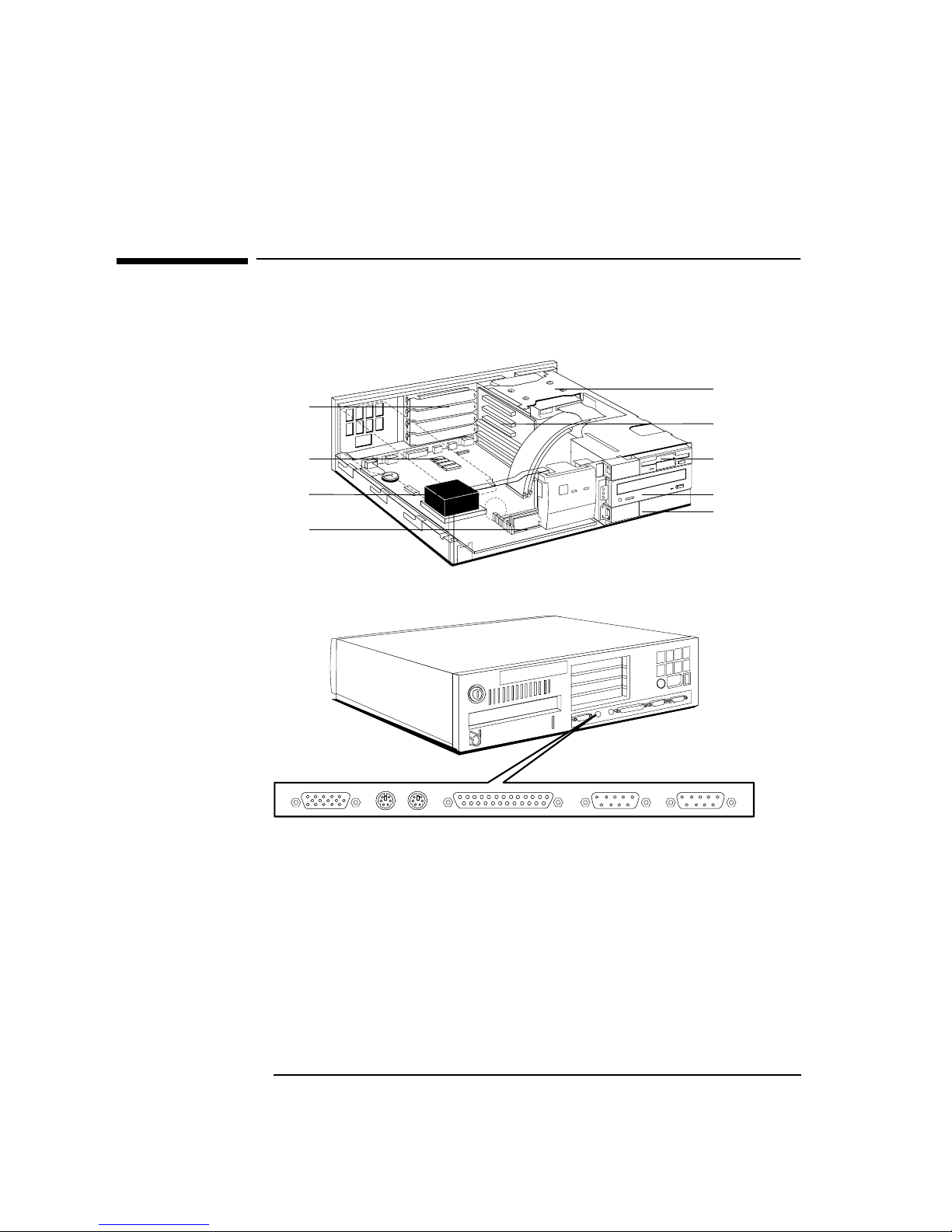
HP Vectra VA PC
1 hard disk drive
Backplane
Flexible disk drive
CD-ROM drive
Vacant slim
Pentium Pro
4 accessory slots
Memory modules
Video memory
processor
internal shelf
3.5/5.25-inch shelf
MouseKeyboard
Parallel Port Serial Port A
Serial Port B
Display
Page 11
3
1 System Overview
External Features
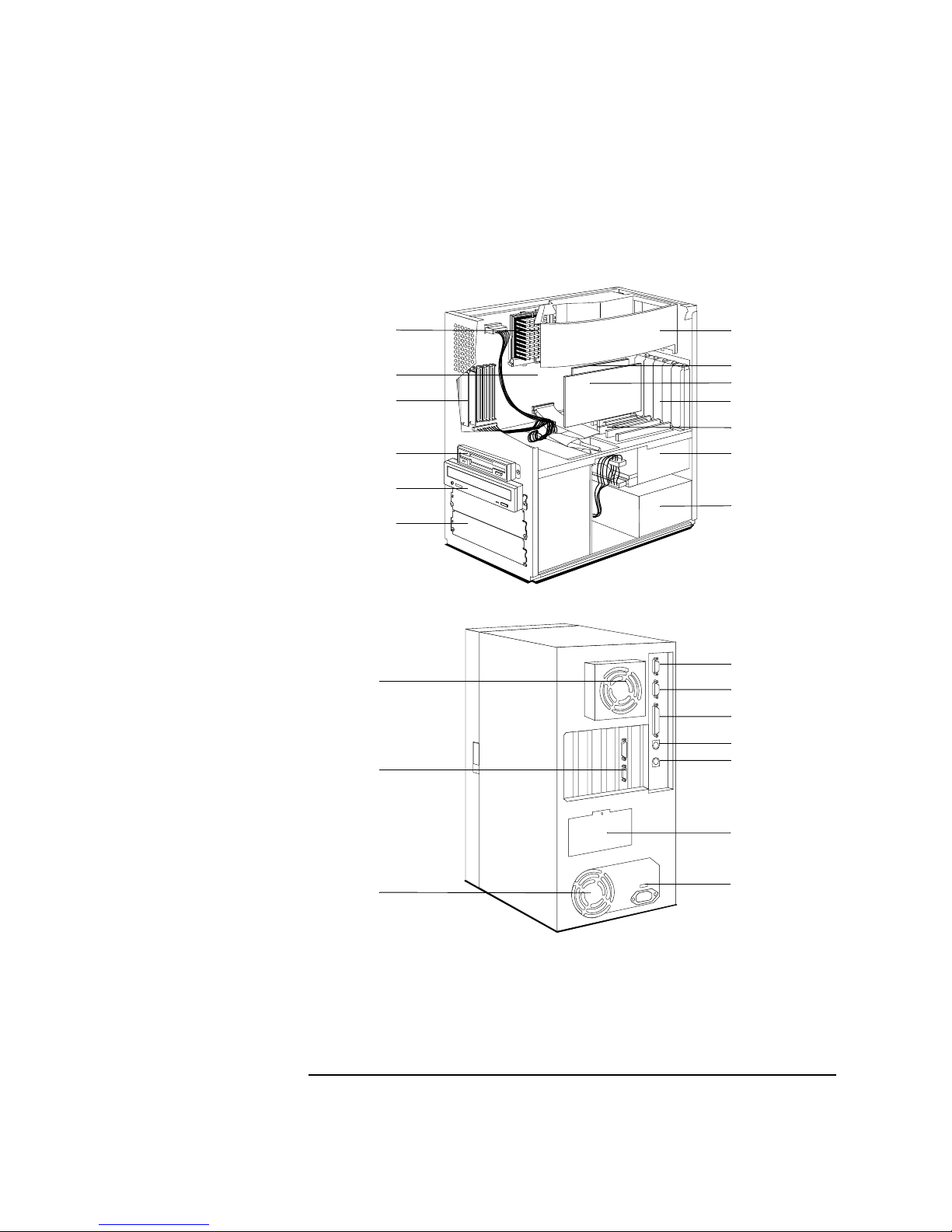
HP Vectra VA MT PC
Pentium Pro processor
Memory modules
Flexible disk drive
CD-ROM drive
2 vacant half height
System board
Video controller board
2 hard disk drive
Power supply
internal shelves
Backplane
5.25-inch shelves
Airflow guide
4 vacant accessory slots
Audio controller board
S
Serial port B
Mouse connector
Keyboard connector
Parallel port
Display connector
Processor fan
Serial port A
Power supply
Hard disk compartment
and fan
Voltage selection switch
Page 12
4
1 System Overview
External Features
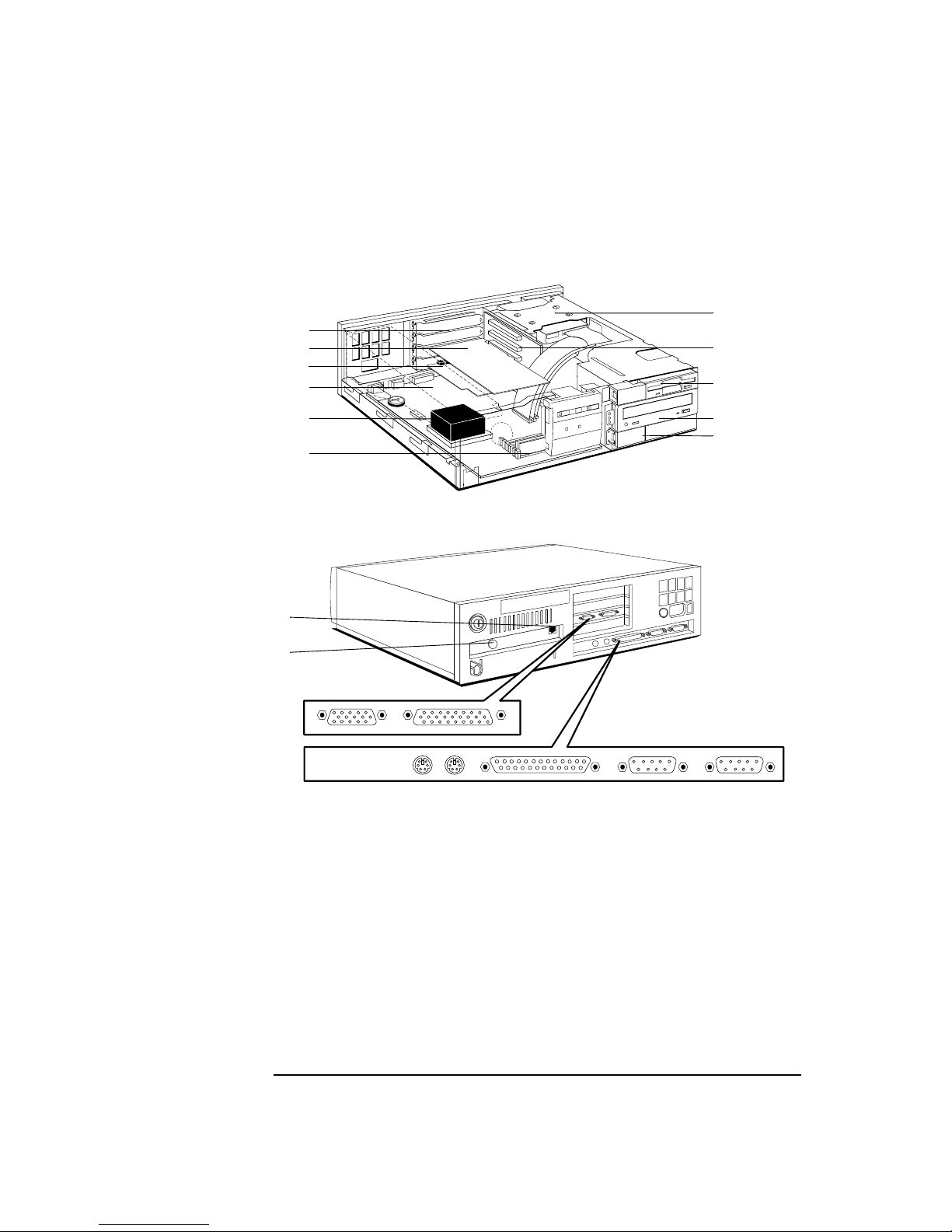
HP Vectra XA PC
1 hard disk drive
Backplane
Flexible disk drive
CD-ROM drive
Vacant slim
Pentium Pro
Memory modules
System board
processor
internal shelf
3.5/5.25-inch shelf
Audio board (ISA slot)
Matrox board (PCI slot)
2 vacant accessory slots
RJ-45 network
BNC coax hole
Mouse
Keyboard
Parallel Port
Serial Port A
Serial Port B
connector
metal plug
Display connector
Page 13
5
1 System Overview
Specifications and Characteristic Data
Specifications and Characteristic Data
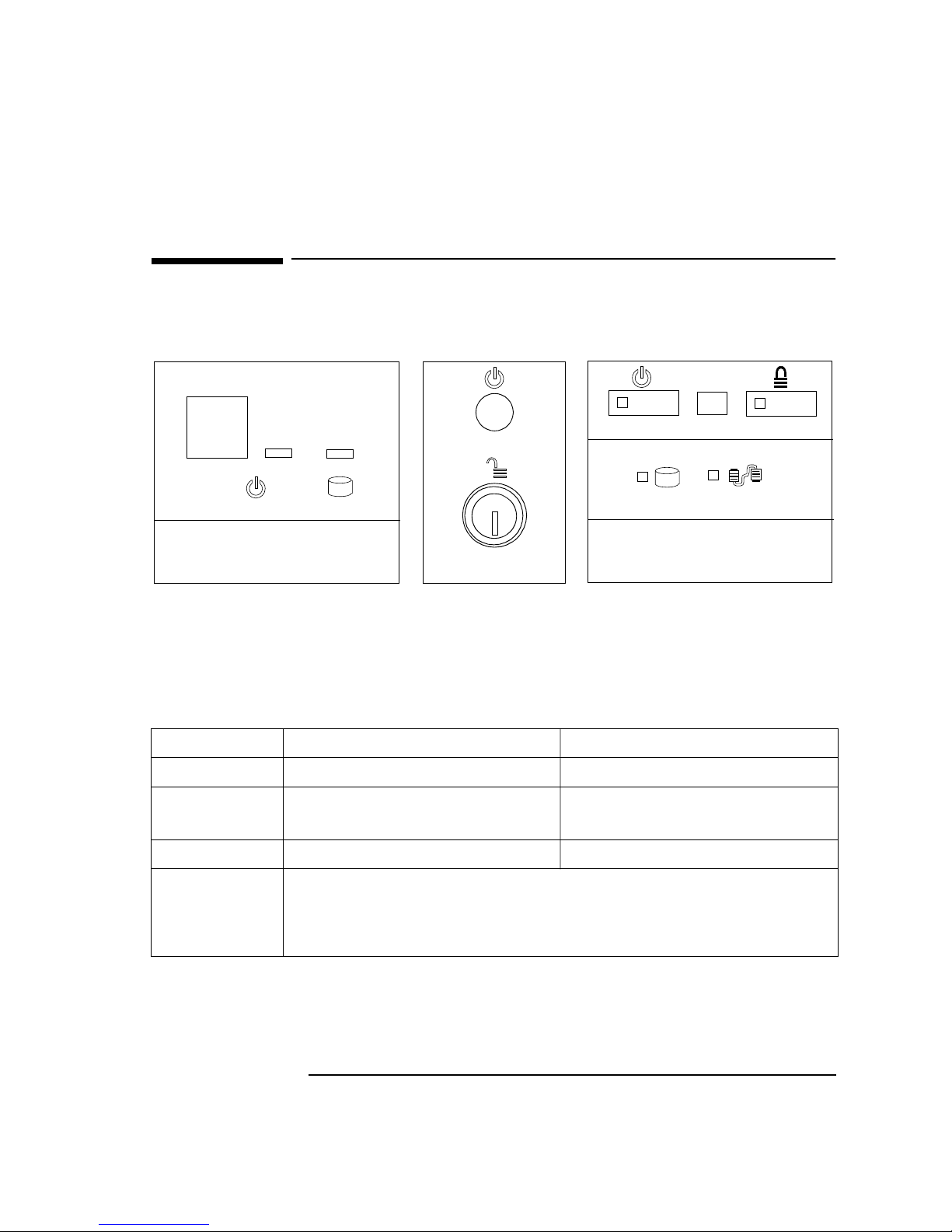
Control (Status) Panel
Physical Characteristics
System Processing Unit HP Vectra VA 6/xxx MT PC HP Vectra VA 6/xxx PC and HP Vectra XA 6/xxx PC
Weight: 33 lbs (15 kg) 20 lbs (9 kg)
Dimensions: 16.0 inches (D) by 8.3 inches (W) by 16.3 inches (H)
(40.5 cm by 21 cm by 41.5 cm)
15.3 inches (D) by 16.5 inches (W) by 4.9 inches (H)
(39 cm by 42 cm by 12.5 cm)
Footprint: 0.91 sq ft (0.085 m
2
) 1.8 sq ft (0.17 m2)
Keyboard: 18.3 inches (W) by 7 inches (D) by 1.3 inches (H), when flat, or
18.3 inches (W) by 7 inches (D) by 2 inches (H), when standing
(464 mm by 178 mm by 33 mm when flat, or
464 mm by 178 mm by 51 mm, when standing)
RESET
HP Vectra VA 6/xxx MT PC
HP Vectra VA 6/xxx PC
Cover lock on back panel
HP Vectra XA 6/xxx PC
Cover lock on back panel
Multimedia control panel on front
Page 14
6
1 System Overview
Specifications and Characteristic Data
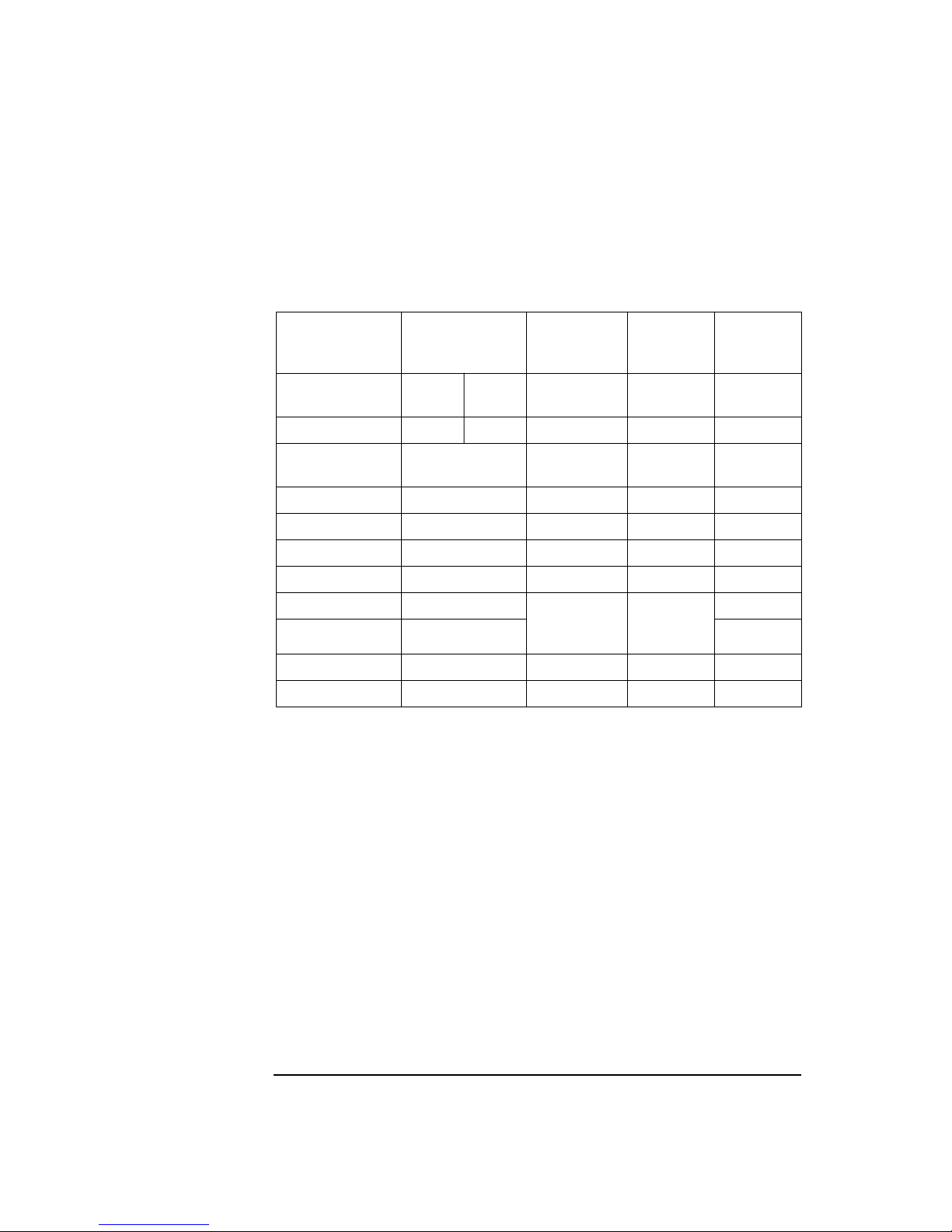
Electrical Specification
For the HP Vectra VA 6/xxx MT PC:
Parameter Total Rating
Notes Typical per
PCI Accessory
Slot
Typical per ISA
Accessory Slot
Input voltage 100-127
Vac
200-240
Vac
Switch selectable
Input current (max) 5 A 3 A
Input power (max) 220 W Less than 5 W
when turned off
Input frequency 47 Hz to 63 Hz
Available power 160 W (continuous) 15 W (max) 15 W (max)
Max current at +12 V 4.4 A
— 0.5 A 1.5 A
Max current at -12 V 0.5 A
— 0.1 A 0.3 A
Max current at +3.3 V 12 A Together, these
two must not
exceed 20 A
These must
not exceed
4.5 A per slot
—
Max current at +5 V 20 A 4.5 A
Max current at -5 V 0.2 A
——0.1 A
Max current at +5 Vst
0.05 A — — —
Page 15
7
1 System Overview
Specifications and Characteristic Data
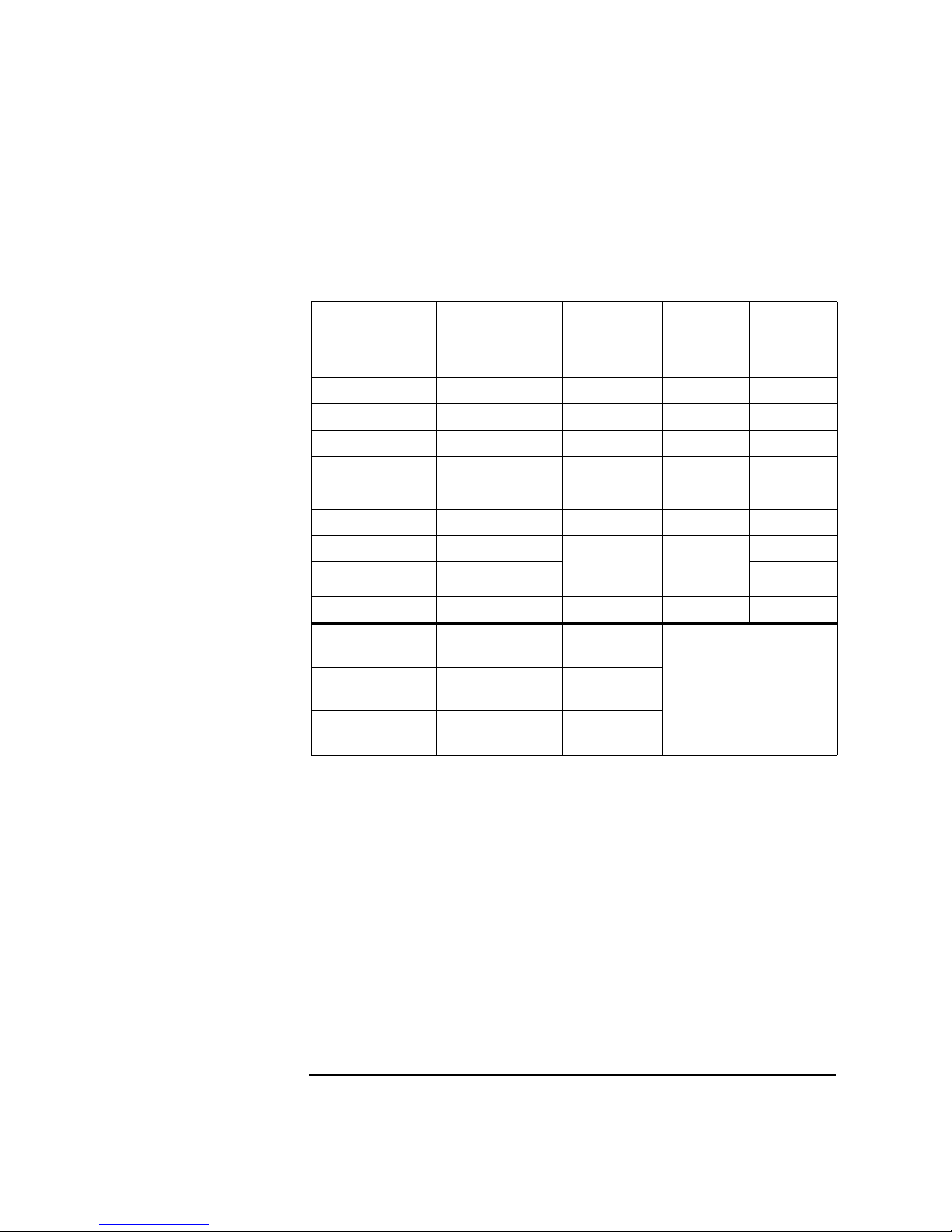
For the HP Vectra VA 6/xxx PC and HP Vectra XA 6/xxx PC:
Parameter
Limit for the Power
Supply
Notes Limit per PCI
Accessory Slot
Limit per ISA
Accessory Slot
Input voltage
100-240 Vac Auto-ranging — —
Input current (max) 3 A — —
Input power (max) 150 W — —
Input frequency 47 Hz to 63 Hz — —
Available power 100 W (continuous) 15 W (max) 15 W (max)
Max current at +12 V
4.5 A 0.5 A 1.5 A
Max current at -12 V
0.3 A 0.1 A 0.3 A
Max current at +3.3 V 6 A Together, these
two must not
exceed 65 W
4.5 A
—
Max current at +5 V 13.5 A 4.5 A
Max current at -5 V
0.1 A — 0.1 A
Input power (when
turned Off)
Less than 5 W When the HP Vectra XA 6/xxx PC
is Off, but still plugged in, an
independent mini power supply
keeps the network board active
enough to watch out for the
“Remote Power-On” (RPO) signal
(see page 52 for description)
Available power
(when Off)
0.25 W
Available current
(when Off)
0.05 A
Page 16
8
1 System Overview
Specifications and Characteristic Data
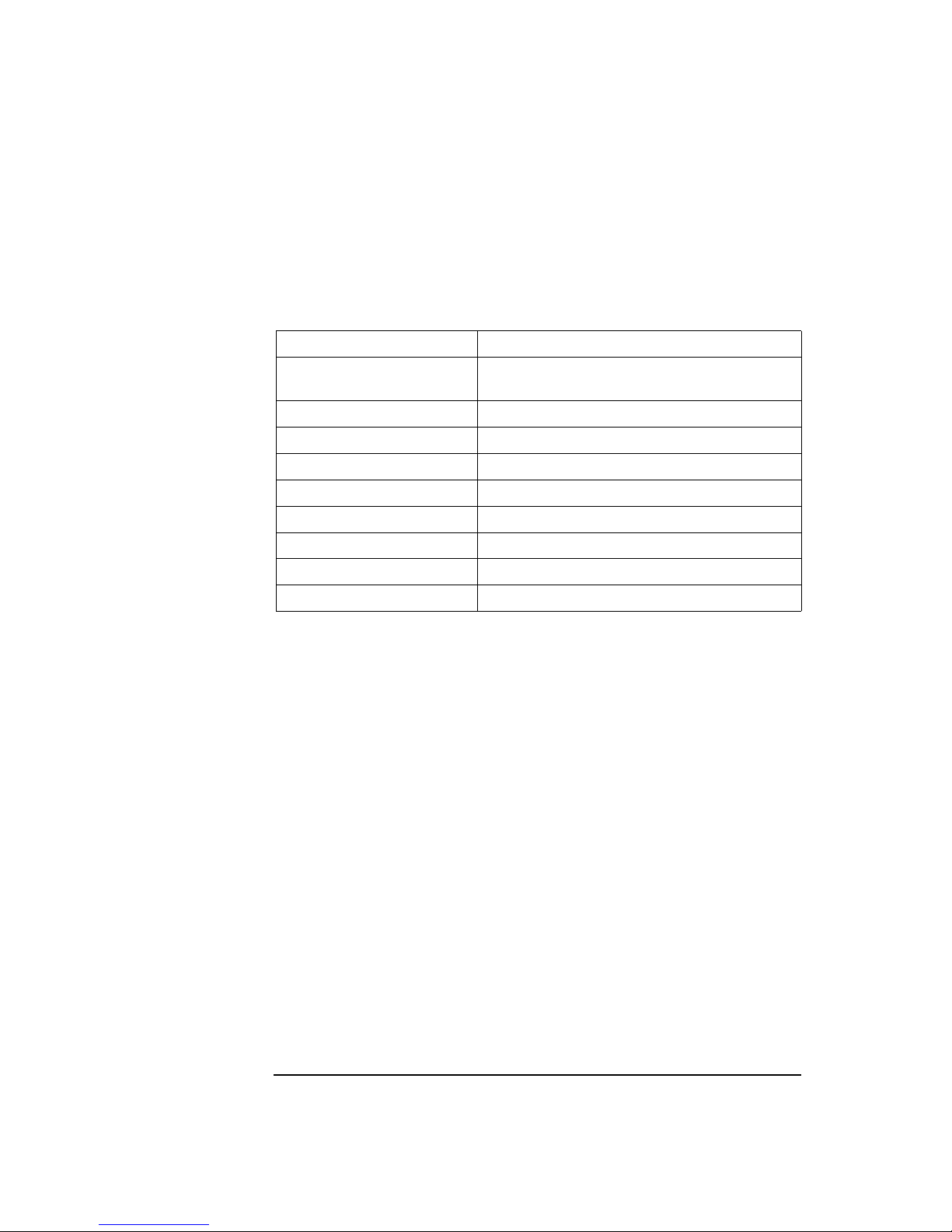
Environmental Specification
The following specifications are for the system processing unit, with a hard
disk.
Operating temperature and humidity ranges may vary depending upon the
mass storage devices installed. High humidity levels can cause improper
operation of disk drives. Low humidity levels can aggravate static electricity
problems and cause excessive wear of the disk surface.
Typical power consumption 30 W to 40 W (before installing any customer-specific accessories)
Acoustic noise emission less than 40 dB in the workplace under normal conditions as
defined by DIN 45635 T.19 and ISO 7779
Operating temperature + 40°F to 104° F (+5°C to +40°C)
Recommended operating temperature +59°F to +158°F (+15°C to +70°C)
Storage temperature -40°F to +158°F (-40°C to +70°C)
Over temperature shutdown +122°F (+50°C)
Operating humidity 15% to 80% RH (non-condensing)
Storage humidity 8% to 80% RH (non-condensing)
Operating altitude 10000 ft (3100 m) max
Storage altitude 40000 ft (12200 m) max
Page 17
9
1 System Overview
Documentation and Software
Documentation and Software
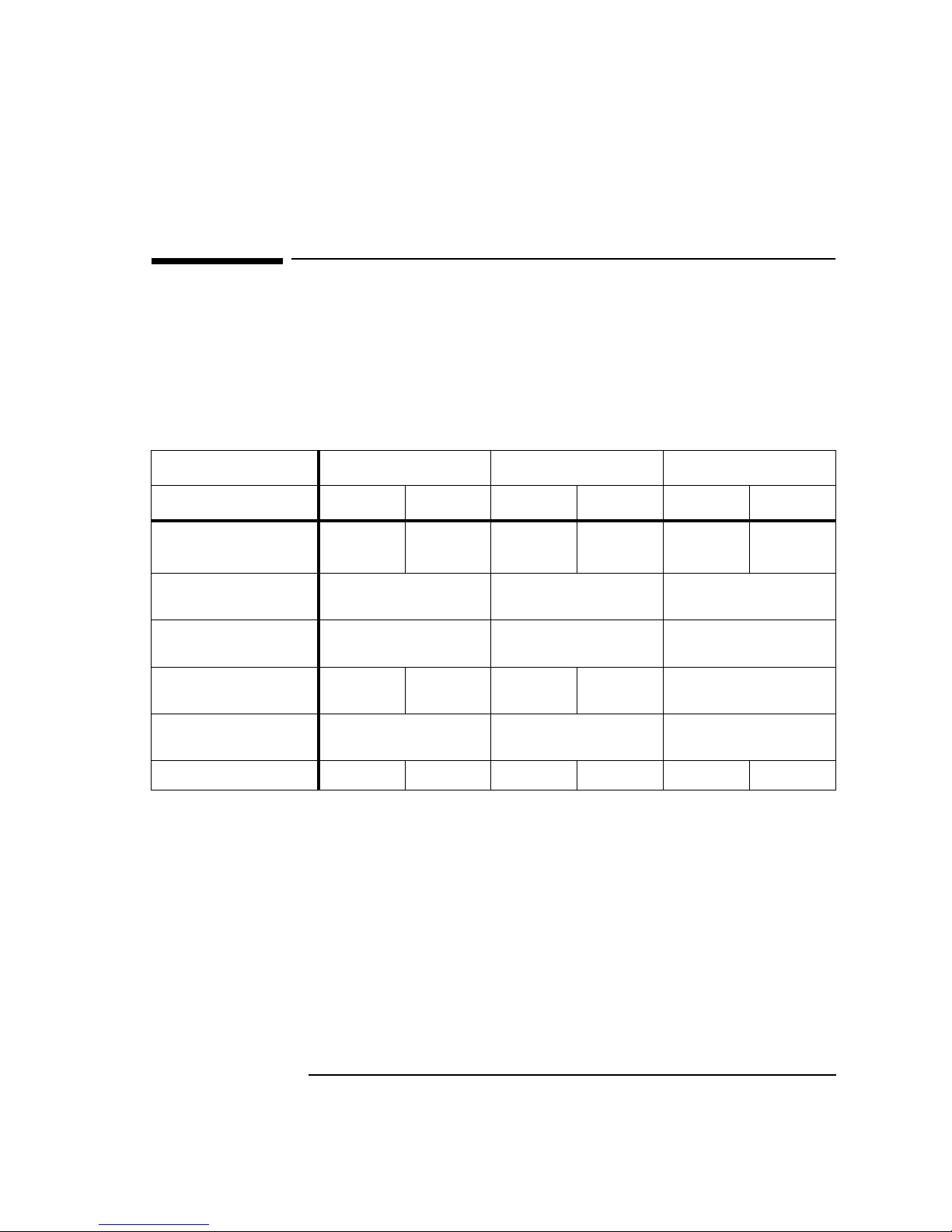
The table below summarizes the availability of the documentation that is
appropriate to the HP Vectra VA and XA 6/xxx PCs. Three dots, ‘...’, are
used to indicate ‘VA’ or ‘XA’, as appropriate.
Only selected publications are available in paper-based form. Most are
available as printable files from the HP division support servers, or from the
HP Support Assistant CD-ROM.
Division Support Server Support Assistant CD-ROM Paper-based
Line of HP Vectra 6/xxx PC: VA XA VA XA VA XA
HP Vectra ... 6/xxx User’s Guide yes yes yes yes DT: D4200A
MT: D4210A
D4544A
HP Vectra VA and XA 6/xxx
Familiarization Guide
yes yes D4200-90901
HP Vectra VA and XA 6/xxx
Technical Reference Manual
yes yes no
HP Vectra PC Service
Handbook (Vol 1, 10th Edition)
yes yes yes yes 5964-8494
HP Vectra Accessory Service
Handbook (6th Edition)
yes yes 5964-8495
Network Administrators Guide not applicable yes not applicable yes not applicable no
Page 18
10
1 System Overview
Documentation and Software
Where to Find the Information
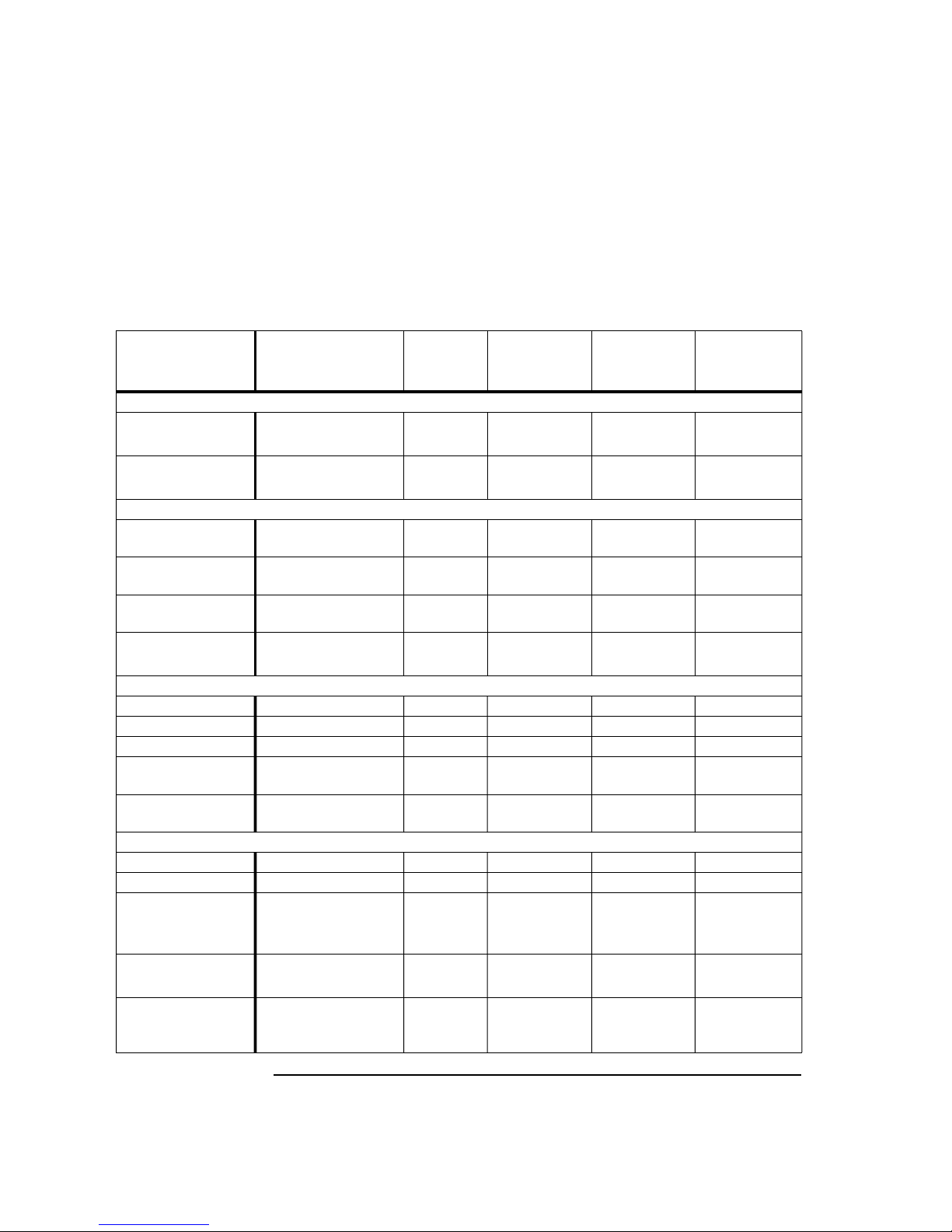
The table on the next page summarizes the availability of information within
the HP Vectra VA and XA 6/xxx PCs documentation set.
User Guide User Online
Familiarization
Guide
Service
Handbook
Technical
Reference
Manual
Introducing the PC
Product features Key features Exploring New features Exploded view
Parts list
Key features
Product model numbers Product range
CPL dates
Using the PC
Connecting cables and
turning on
Keyboard, mouse, display,
network, printer, power
Finding on-line
information
Finding READ.MEs and online documentation
Environmental Setting up the PC Working in
comfort
System overview
Formal documents License agreement
Warranty information
License
agreement
Upgrading the PC
Opening the PC Full details
Supported accessories Part number details Full PN details
Replacing accessories How to install New procedures
Configuring devices Installing drivers Configuring
peripherals
Problem fixes
Fields and their options
within Setup
Complete list Key fields
Repairing the PC
Troubleshooting Basic Service notes Advanced
Technical information Basic Detailed Advanced
System board Jumpers, switches and
connectors
Jumpers, switches
and connectors
How to replace
Jumpers,
switches and
connectors
Jumpers, switches
and connectors
Chip-set details
BIOS Basic details Upgrading Technical details
Memory maps
Power-On Self-Test
routines (POST)
Key error codes and
suggestions for corrective
action
Order of tests
Page 19

11
2
System Board
The next chapter describes the video, disk, audio and network devices
which are supplied with the PC.
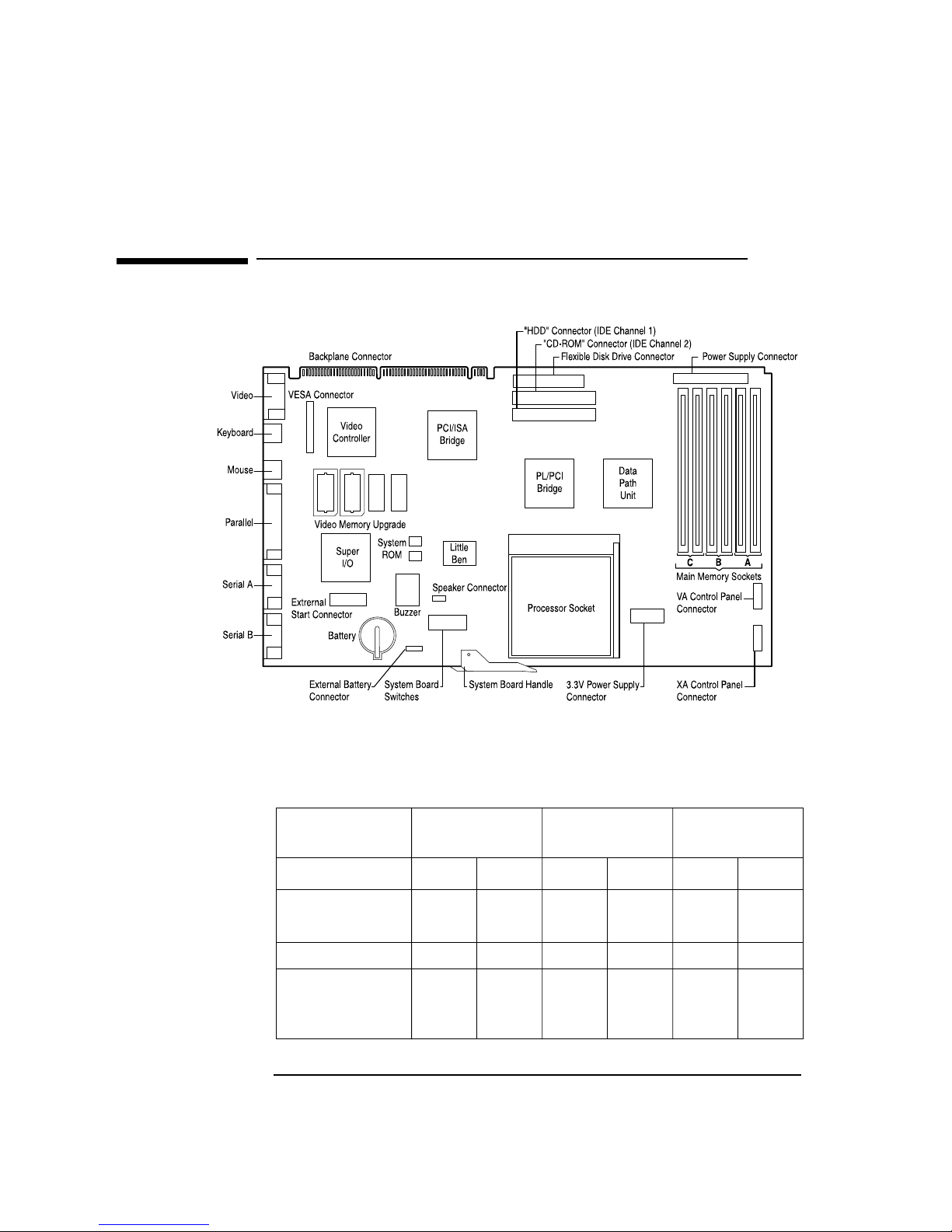
This chapter describes the components of the system board, taking in turn
the components of the Processor-Local Bus, the Peripheral Component
Interconnect (PCI) bus and the Industry Standard Architecture (ISA) bus.
Page 20
12
2 System Board
System Board and Backplanes
System Board and Backplanes
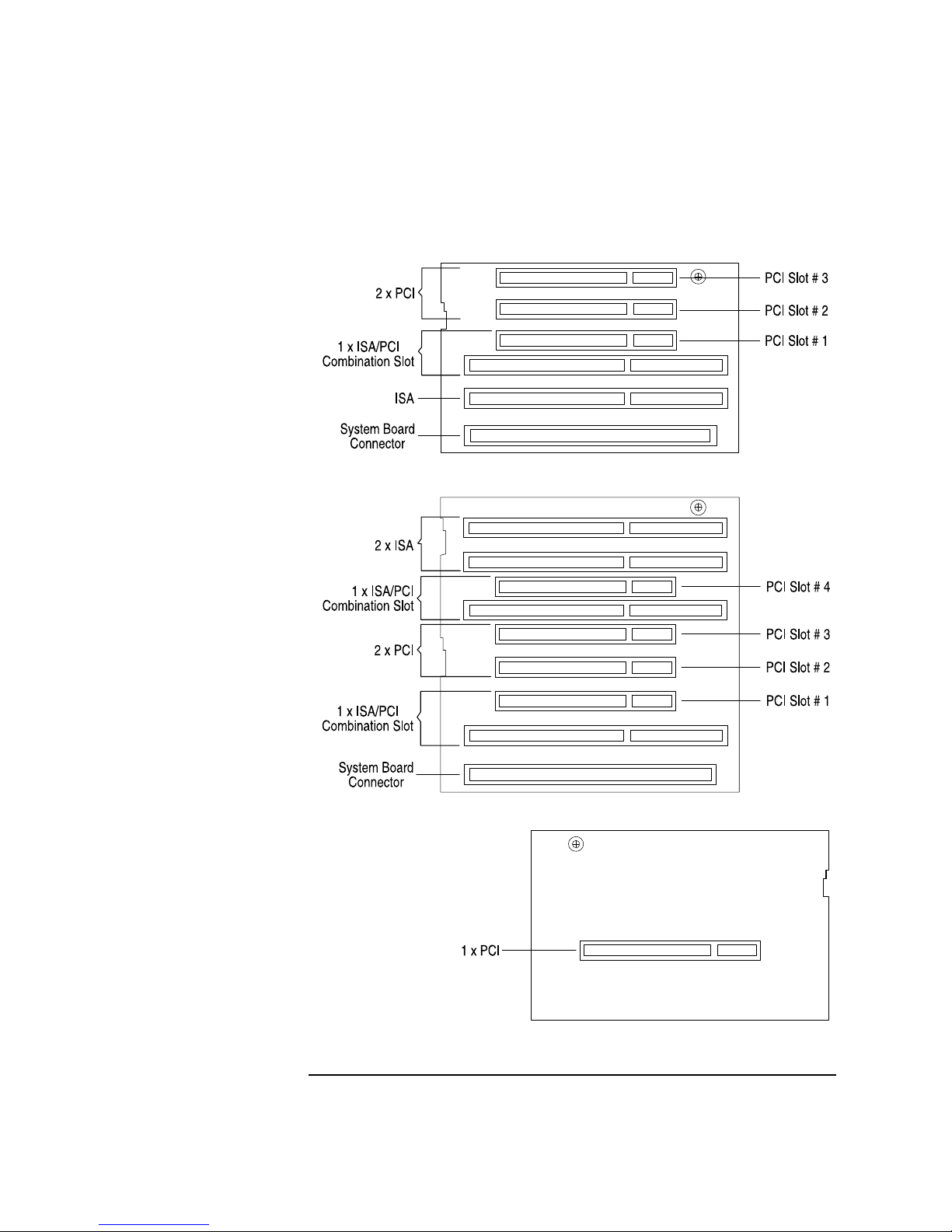
Backplanes
HP Vectra VA 6/xxx PCHP Vectra VA 6/xxx
MT PC
HP Vectra XA 6/xxx
PC
Total Occupied Total Occupied Total Occupied
PCI slots (normal) 2 0 2 1✕Video 2 1✕Video
PCI slots (network) 0 0 0 0 1 1✕LAN
PCI/ISA combination slots 1 0 2010
ISA slots (full length) 0 0 1000
ISA slots (26-cm/10.2-
inch maximum length)
1011✕Audio 1 1✕Audio
1
Present only on the desktop HP Vectra VA 6/xxx PC board
1
Page 21
13
2 System Board
System Board and Backplanes
VA Desktop
VA Minitower
XA Desktop (rear view)
The front of the XA backplane is the
same as that for the VA desktop.
Page 22
14
2 System Board
System Board and Backplanes
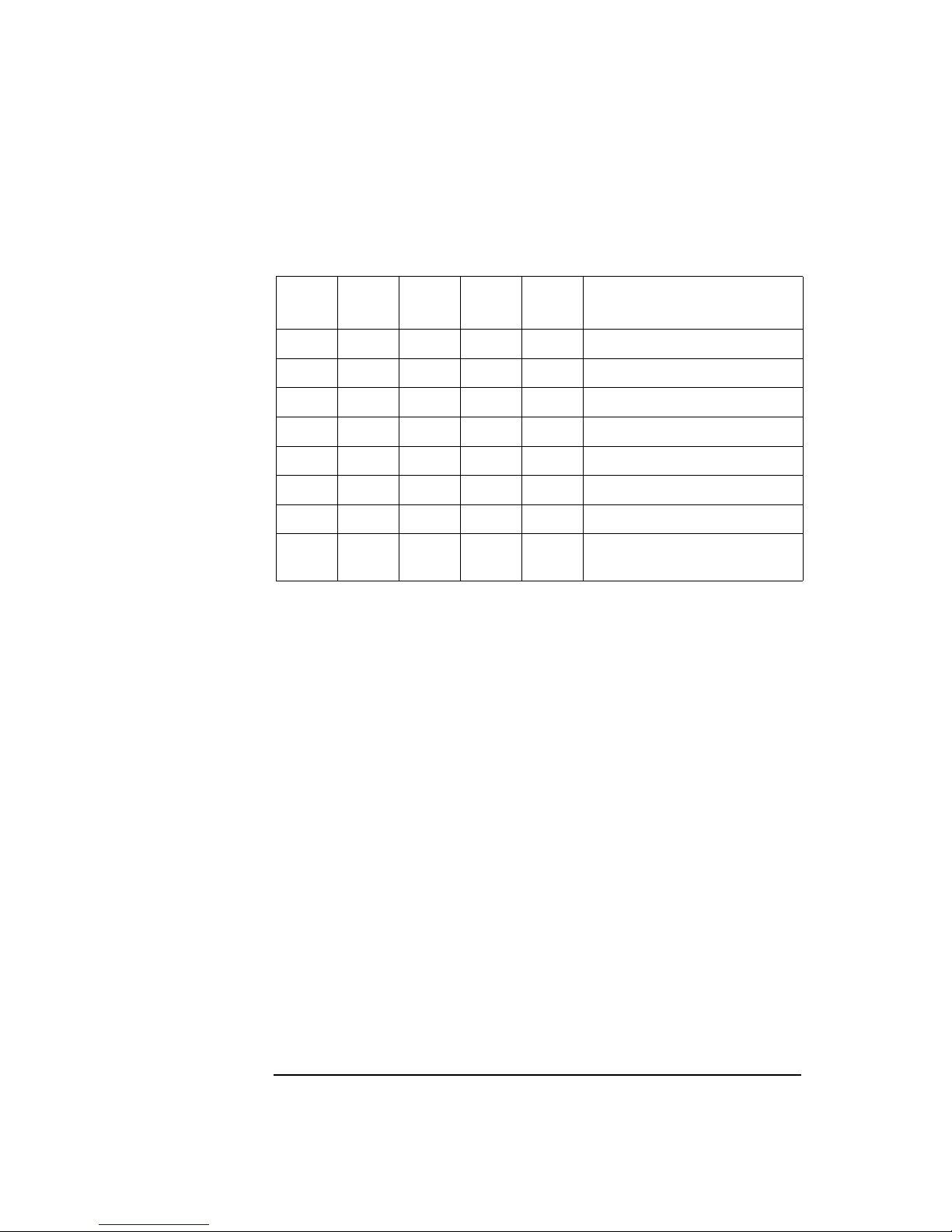
PCI Mapping Table
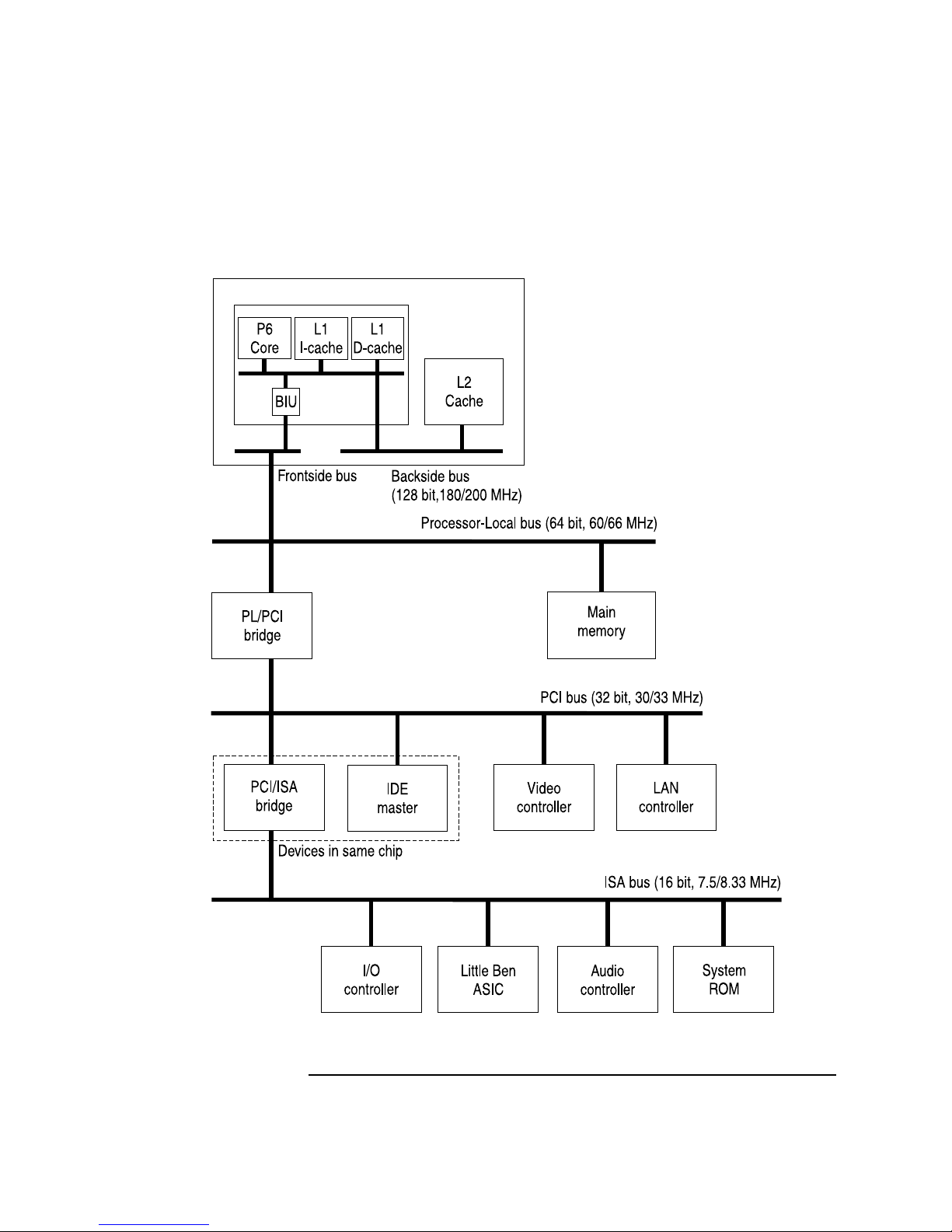
Architectural View
The following block diagram gives an architectural view.
VA VA MT XA
Device
Number
AD[xx] PCI Device
***011PL/PCI bridge (PMC)
***415PCI/ISA bridge (PIIX3)
* 13 24 Video controller (Cirrus Logic)
* 12 23 PCI slot #4
***617PCI slot #3
* * * 10 21 PCI slot #2
***718PCI slot #1
* 11 22 Enhanced Ethernet network controller
(rear PCI slot)
Page 23
15
2 System Board
System Board and Backplanes
Page 24
16
2 System Board
Devices on the Processor-Local Bus
Devices on the Processor-Local Bus
Intel Pentium Pro Microprocessor
The processor that is supplied can be P6 or P6S. The processor is packaged
in a 387-way pin-grid-array (PGA), which is seated on the system board in
a P6T overdrive zero-insertion-force (ZIF) socket 8. Only upgrades using
OverDrive processors, pin compatible with the original processor,
manufactured by Intel, are supported.
The voltage regulator module (VRM) is implemented directly on the
system board. The voltage is selected automatically by the processor (four
logic signals specify a voltage between 2.0 V to 3.5 V in steps of 0.1 V).
The cooling needs of the processor require there to be a good thermal
contact between it and the heat-sink. A thermal contact material made of
silicone-based grease, or of aluminium foil, must be placed on the top of the
processor before installing the heat-sink.
Although it is not pin compatible with the Pentium, the Pentium Pro is
backward code-compatible. Software written for previous HP Vectra PCs
will run on the Pentium Pro-based HP Vectra PCs.
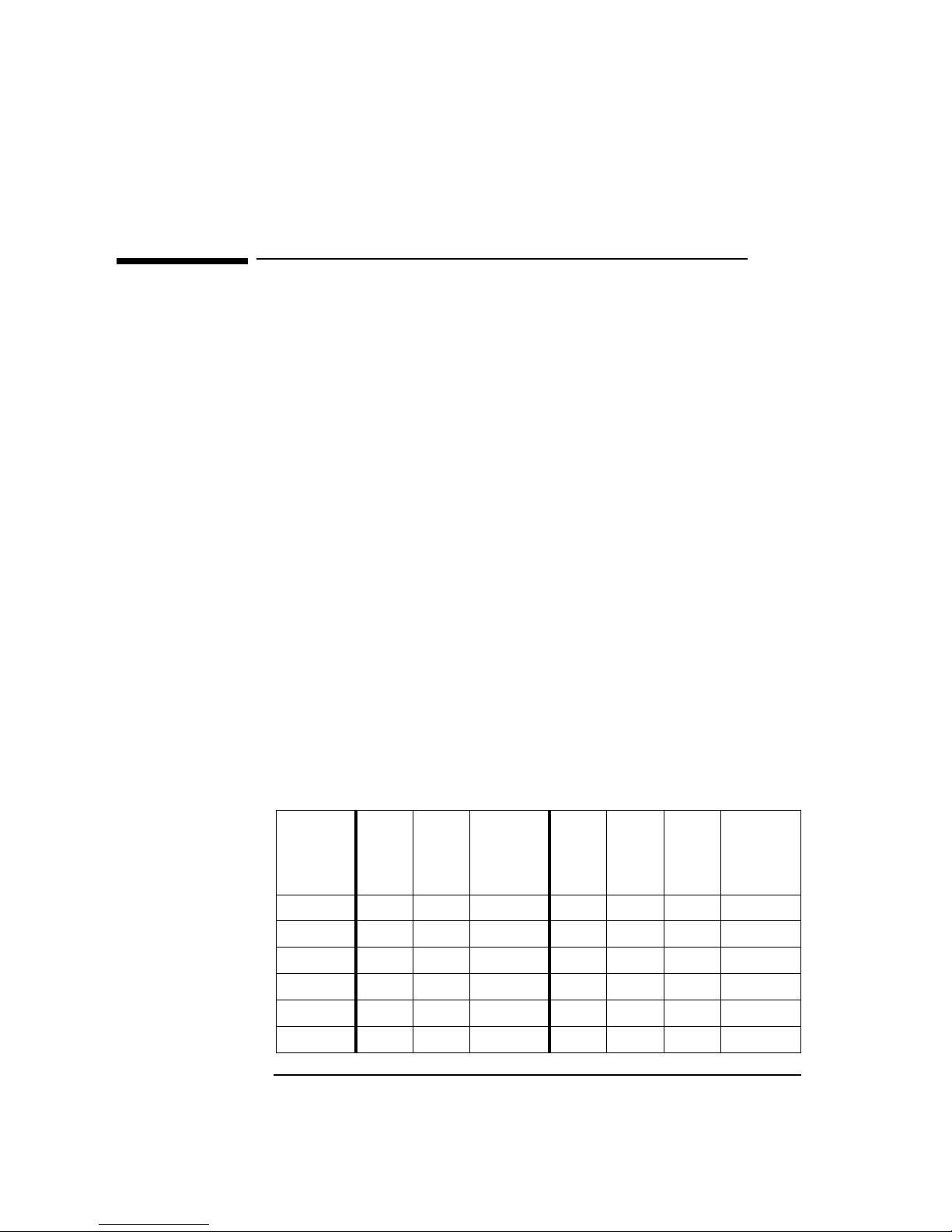
Bus Frequencies Like the Pentium and 80486 DX2 processors, the Pentium Pro uses internal
clock multiplication. For example, the Pentium Pro 200 MHz processor
multiplies the 66 MHz system clock by three. Switches 1 and 2 on the system
board switches set the frequency of the Processor-Local bus. Switches 3, 4
and 5 set the clock multiplier ratio.
Processor
Frequency
Switch 1Switch
2
Processor
Local Bus
Frequency
Switch 3Switch 4Switch
5
Frequency
Ratio
Processor :
Local Bus
150 MHz
Closed Open 60 MHz Open Open Closed 2.5 : 1
166 MHz Open Open 66 MHz Open Open
Closed 2.5 : 1
180 MHz
Closed Open 60 MHz Open Closed Open 3 : 1
200 MHz Open Open 66 MHz Open
Closed Open 3 : 1
233 MHz Open Open 66 MHz Open
Closed Closed 3.5 : 1
266 MHz Open Open 66 MHz
Closed Open Open 4 : 1
Page 25

17
2 System Board
Devices on the Processor-Local Bus
Chip-Set
The Intel 82440 FX chip-set comprises three chips. Two are concerned
with controlling memory accesses. These are the data bus accelerator
(DBX) chip (SB82442FX) and the combined PL/PCI bridge and memory
controller (PMC) chip (SB82441FX). The DBX chip, controlled by the PMC
chip, implements a 64-bit data path (not interleaved) between the
Processor-Local bus and main memory modules.
The PCI/ISA Bridge chip (otherwise known as PIIX3, or as the system I/O
chip, SIO-A) is an Intel SB82371SB. It is not only responsible for
transferring data between the PCI bus and the ISA expansion bus, but also
contains the IDE controller.
Main
Memory
82371SB
PCI/ISA Bridge
BIOS
Pentium Pro
Processor
82441FX
PL/PCI Bridge (PMC)
Processor-Local Bus
PCI Bus
ISA Bus
Clocks
and Misc.
IDE
Controller
ISA Bus
Controller
PCI
Master
PCI
Slave
APIC
DBX
Interface
Host
Interface
Main
Memory
Controller
PCI
Interface
82442FX
Data Bus Accelerator (DBX)
Host
Interface
DRAM
Interface
Clocks
and Misc.
PMC
Interface
Page 26

18
2 System Board
Devices on the Processor-Local Bus
Cache Memory
There are two integrated circuits sealed within a single Pentium Pro
package. One of these contains the Level-2 (L2) cache memory chip; the
other contains the processor, which itself includes two banks of Level-1 (L1)
cache memory (I-cache for instruction code, and D-cache for data).
Each L1 cache memory has a capacity of 8 KB. The I-cache is 4-way
set-associative (it consists of four 2 KB sub-banks). The D-cache is 2-way
set-associative (it consists of two 4 KB sub-banks) and is dual-ported (2
operations, such as 1 read and 1 write, can be performed simultaneously to
different lines in the bank).
The L2 cache memory has a capacity 256 KB, and is composed of 4-way setassociative static RAM. Data is stored in lines of 32-bytes (256 bits). Thus
four consecutive 64-bit transfers with the main memory are involved for
each transaction.
The amount of cache memory is set by Intel at the time of manufacture, so
cannot be changed. Versions of the Pentium Pro (P6) processor exist with
512 KB of L2 cache memory. These are specially designed for servers, and
are used in HP Netservers, but not yet in HP Vectra PCs.
Processor-Local Bus
The Processor-Local bus is 64 bits wide, and is clocked at 60 or 66 MHz.
Although carrying 64-bits of data, it is in fact composed of 141 signals. These
are implemented using Intel’s GTL+ technology. To reduce voltage over- and
under-shoots, the signals are clamped to a 0 to 1.5 voltage range, and are
filtered to prevent the logic edges from becoming too steep (that is, there is
a minimum constraint on the rise and fall times, as well as the usual
maximum constraint).
As a split-transaction bus, it allows a device (such as the Pentium Pro
processor) to send its request (such as asking for the contents of a given
memory address) and then to release the bus, rather than waiting for the
result, thereby allowing it to get on with other work. The target device then
requests the bus again when it is ready to respond, and sends the requested
data packet. Up to eight transactions are allowed to be outstanding at any
given time.
Page 27

19
2 System Board
Devices on the Processor-Local Bus
Main Memory
There are six main memory module sockets, arranged in three banks
(A to C), allowing installation up to 192 MB. One bank is already occupied
by the pair of memory modules that contain the 16 or 32 MB of memory that
is fitted as standard (depending on the model of the PC).
The PC can use 60 ns extended data-out (EDO) or 70 ns fast page-mode
(FPM) modules. When the PC is turned on, the chip set tests whether any
FPM modules are present. If so, it assumes an access time of 70 ns,
otherwise it assumes an access time of 60 ns.
Error correcting code (ECC) is available when using 36-bit modules (these
are available only in FPM technology, so the system performance will be
affected). The original 32-bit modules must be removed so that the memory
is populated only by 36-bit modules. The appropriate field must be set in
Memory sub-menu of the Configuration menu of the Setup program.
Using ECC memory, a single bit error in any 72-bit line of memory (64 data
bits plus 8 parity bits) will be corrected automatically and transparently. A
double bit error will cause an NMI to be generated, and the PC to be halted.
Page 28

20
2 System Board
Devices on the PCI Bus
Devices on the PCI Bus
Video Controller
The desktop HP Vectra VA 6/xxx PC has a Cirrus 5446 graphics chip
connected on the PCI bus with a VESA feature connector integrated on the
system board.
The HP Vectra VA 6/xxx MT PC the HP Vectra XA 6/xxx PC have these
spaces left vacant on the system board, and are supplied with a Matrox
Millennium video controller on board in a PCI accessory slot.
Both types of video system are described in more detail in the next chapter.
Integrated Drive Electronics (IDE)
The IDE controller is implemented as part of the PIIX3 chip (the PCI/ISA
bridge). It supports Enhanced IDE (EIDE) and Standard IDE. To use the
Enhanced IDE features, though, the drives must be compliant with
Enhanced IDE.
Up to four IDE devices are supported: two (one master and one slave)
connected to the primary channel, and two (one master and one slave) to
the secondary channel. If a single device (a hard disk drive or a CD-ROM
drive) is attached to a channel, it should be in the master position (the
connector that is closest to the system board).
It is possible to have a fast device, such as a hard disk drive, and a slow
device, such as a CD-ROM, on the same channel without affecting the
performance of the fast device. The BIOS sends a command to each drive,
and determines, automatically, the fastest configuration that it supports.
However, in general, the primary channel cable (the one with the grey
connectors) is recommended for hard disk drives, and the secondary
channel cable (the one with the red connectors) for CD-ROM drives.
On the HP Vectra VA 6/xxx MT PC, when the CD-ROM drive is installed in
the Master position of the IDE secondary channel, the hard disk drives
(1.2 GB or 2.5 GB) cannot be installed in the slave position of this channel
(problems could be experienced activating the 32-bit access drivers). The
hard disk drive should be installed in the master position of the secondary
channel with the CD-ROM drive in the slave position.
Page 29

21
2 System Board
Devices on the PCI Bus
Transfer Rates Versus
Modes of Operation
The controller supports 32-bit Windows and DOS I/O transfers. It has PCI
master capability, and supports programmed I/O (PIO) modes up to mode 4
(though modes 1 and 2 are handled as mode 0) and direct memory access
(DMA) modes up to mode 2. This gives a fastest cycle time of 120 ns, and a
transfer rate of 16.7 MB per second, in both cases. The five PIO modes allow
the following transfer rates:
The three DMA modes allow the following transfer rates:
Operated in SLAVE mode, the IDE controller saturates the PCI bus with
transfers, thus limiting the actual achieved transfer rate to 4 or 5 MBytes per
second. Operated in MASTER mode, though, the IDE controller is allowed
to work autonomously of the CPU, and the full 16.7 MBytes per second
transfer rate can be achieved, with less than 33% occupancy of the PCI bus
(so allowing the CPU to get on with other work for more than 67% of the
cycle times, whilst the IDE transfers are going on in parallel).
Disk Capacity Versus
Modes of Addressing
The amount of addressable space on a hard disk drive is limited by three
factors: the physical size of the hard disk, the addressing limit of the IDE
hardware, and the addressing limit of the BIOS. The Extended-CHS
addressing scheme allows larger disk capacities to be addressed than under
CHS, by performing a translation (for example regrouping the sectors so that
there are twice as many logical tracks as is possible under the CHS addressing
scheme).
Mode 01234
Cycle time (ns) 600 383 240 180 120
Transfer rate (MBytes/s) 3.33 5.22 8.33 11.1 16.7
Mode 0 1 2
Cycle time (ns) 480 150 120
Transfer rate (MBytes/s) 4.2 13.3 16.7
Cylinders per
Device
Heads per
Cylinder
Sectors per Track
Bytes per
Sector
Bytes per
Device
CHS 64 16 1024 512 528 M
ECHS 64 256 1024 512 8.4 G
Page 30

22
2 System Board
Devices on the PCI Bus
Network Controller and External Start Connector
The HP Vectra XA 6/xxx PC has an Enhanced Ethernet Network Board (as
described in the next chapter) installed in a PCI accessory slot.
The board is supplied with power, even whilst the rest of the PC is turned
off, via a line called VStandby on the External Start Connector. This
connector also carries the control lines which the network board uses to
turn on the main power supply, and to send or receive other control and
status information. (See the pin-out information on page 44, and the
description of the RPO function on page 52).
Other PCI Accessory Devices under Plug and Play
These PCs have a “PnP level 1.0A” BIOS and meets the “Windows 95
Required” level for Plug and Play. Accessory boards which are Plug and Play
are automatically configured by the operating system (Windows 95) or by
the BIOS (other operating systems).
Page 31

23
2 System Board
Devices on the ISA Bus
Devices on the ISA Bus
Super I/O Controller
The Super I/O chip (NS PC87308) provides the control for two FDC
devices, two serial ports and one bidirectional multi-mode parallel port.
Serial / parallel
communications ports
The two 9-pin serial ports (whose pin layouts are depicted on page 44)
support RS-232-C and are buffered by 16550 UARTs, with 16 Byte FIFOs.
They can be programmed as COM1, COM2, COM3, COM4, or disabled.
The 25-pin parallel port (also depicted on page 44) is Centronics
compatible, supporting IEEE 1284. It can be programmed as LPT1, LPT2, or
disabled. It can operate the four modes:
❒ Standard mode (PC/XT, PC/AT, and PS/2 compatible).
❒ Bidirectional mode (PC/XT, PC/AT, and PS/2 compatible).
❒ Enhanced mode (enhanced parallel port, EPP, compatible).
❒ High speed mode (MS/HP extended capabilities port, ECP, compatible).
FDC The integrated flexible drive controller (FDC) supports any combination of
two of the following: tape drives, 3.5-inch flexible disk drives, 5.25-inch
flexible disk drives. It is software and register compatible with the 82077AA,
and 100% IBM compatible. It has an A and B drive-swapping capability and a
non-burst DMA option.
RTC The real-time clock (RTC) is 146818A-compatible. The configuration RAM
is implemented as 256 bytes of CMOS memory.
Keyboard and Mouse
Controller
The PC has an 8042-based keyboard and mouse controller (the connector pin
layouts are shown on page 44). The PC is supplied with a Logitech 2-button
mouse, and a C3758A keyboard with the following features:
❒ Space bar power on, to start the computer from the Off state (if
power on
from keyboard
is enabled in the Setup program).
❒ Windows key (next to the keys), which has the same effect as
clicking the “Start” button on the Windows 95 task bar.
❒ Pull-down key (next to the right key), which has the same effect as
clicking the right mouse button.
Page 32

24
2 System Board
Devices on the ISA Bus
Serial EEPROM This is the non-volatile memory which holds the default values for the CMOS
memory (in the event of battery failure, or the user pressing in Setup).
When installing a new system board, the Serial EEPROM will have a blank
serial number field. This will be detected automatically by the BIOS, which
will then prompt the user to enter the serial number which is printed on the
identification label on the back of the PC.
Audio Controller
The audio controller is provided, on the HP Vectra VA 6/xxx MT PC and
HP Vectra XA 6/xxx PC, on a board in an ISA accessory slot, and is
described in the next chapter.
System ROM
The PC uses 256 KB of 200ns, Flash EEPROM implemented within a single
256 K ✕ 8-bit ROM chip. Flash EEPROM is ROM that can be returned to its
unprogrammed state by the application of appropriate electrical signals to
its pins, and hence can then be reprogrammed with the latest upgrade
firmware.
The System ROM contains the system BIOS (including the boot code, the
ISA and PCI initialization, RPO, DMI, the Setup program and the Power-On
Self-Test routines, plus their error messages). These are summarized in
Chapters 4 and 5.
Updating the System ROM
The System ROM can be updated with the latest BIOS firmware. This can be
ordered from HP or downloaded from one of HP’s online services. (For more
information on HP’s online services, refer to the Hewlett-Packard Support
and Information Services chapter in the User’s Guide that was supplied with
the computer.)
The System ROM is updated by running the PHLASH utility,
PHLASH.EXE,
which is supplied with the BIOS upgrade file,
GZ07xx.FUL, and the system
definition file,
platform.bin. You must specify the model number of the
PC since the utility which is supplied for a different model cannot be used
with this one. It must be run from diskette.
Page 33

25
2 System Board
Devices on the ISA Bus
Before flashing, it is necessary to type in the System Administrator’s
Password when starting up the computer. The PCI and PnP information is
erased in the process.
Do not switch off the computer until the system BIOS update procedure has
completed, successfully or not, otherwise irrecoverable damage to the ROM
may be caused. While updating the flash ROM, the control panel switches
are disabled to prevent accidental interruption of the flash programming
process.
Error Diagnostics and Suggested Corrective Actions
The programs and data in the system ROM are accompanied by a check-sum
code. If any of the programs or data ever become corrupted, the check-sum
will not correspond with the contents of the ROM, and the appropriate part
of the POST routine will attempt to report the error:
Cannot display error messages
Flash ROM may be defective
The suggested corrective action is to reprogram the system ROM by running
the same utility as has just been described for upgrading it.
System Board Switches
The first two of the system board switches set the frequency of the
Processor-Local bus, and the next three the ratio of processor-frequency to
Processor-Local-bus-frequency, as summarized on page 16. The next four
set the configuration for the PC, as summarized in the table below. The last
switch should not be used.
Switch Function Default
1-5 - Processor frequency, see the table on page 16 -
6
Open Normal operation
Open
Closed Clear the configuration data (in CMOS memory)
7
Open Normal operation
Open
Closed Clears all passwords
8
Open Disables keyboard power-on
Closed
Closed Enables the PC to be turned on from the space bar on the keyboard
9
Open Normal operation
Open
Closed Clears the Product Identification (VA)
10 Open Normal operation Open
Page 34

26
2 System Board
Devices on the ISA Bus
By setting switch 6 in the Closed position, not only is the configuration data
cleared (in the CMOS memory and the Serial EEPROM), but also all the
Plug-and-Play data that had been saved in the CMOS memory. However, the
serial number, the tattooing string, the date and the time are each retained.
By setting switch 8 in the
Closed position, the Power-On Space-Bar
function is enabled, provided that it is also enabled in the
Power-On
Space-Bar
field of the Power Menu in the Setup program.
Setting switch 9 in the
Closed position clears the product identification
field in the BIOS, and causes the PC to prompt for the new information. By
identifying the product correctly, the BIOS is able to tailor itself for the
particular product, and to enable the appropriate features.
Little Ben
Little Ben is an HP application specific integrated circuit (ASIC) that is
connected between the chip-set and the processor. It has been designed to
act as a companion to the Super I/O chip. It is described on page 57.
Other ISA Accessory Devices under Plug and Play
All PCI accessory boards are Plug and Play, although not all ISA boards are.
Check the accessory board’s documentation if you are unsure.
In general, in a Plug and Play configuration, resources for an ISA board have
to be reserved first (using a utility under Windows 95 or ICU for DOS/
Windows) and then you can plug in your board. When you run a non Plugand-Play operating system, such as OS/2 or Windows NT, if you want to
install an ISA board, you have to reserve the resources for the board using
the ICU (for Windows). Failure to do so may lead to resource conflicts.
The procedure for installing an ISA accessory board that is not Plug and
Play is described in the User’s Guide that is supplied with the PC.
Page 35

27
3
Interface Boards and Mass-Storage Drives
This chapter describes the video, mass storage, audio and network devices
which are supplied with the PC. It also summarizes the pin connections on
internal and external connectors.
Page 36

28
3 Interface Boards and Mass-Storage Drives
Cirrus 5446 Video Controller Chip
Cirrus 5446 Video Controller Chip
The HP Vectra VA 6/xxx PC is supplied with a video controller chip
integrated on the system board (all other models are supplied with a Matrox
MGA Millennium PCI video controller on a board fitted in a PCI accessory
slot, as described in the next section of this chapter). The Cirrus Logic
CL-GD5446, can be characterized as follows:
• 100% hardware- and BIOS-compatible with IBM
®
VGA display standard
• 32-bit video memory access with 1 MB DRAM. This increases to 64-bit
access when an additional 1 MB DRAM is installed
• Hardware acceleration of graphical user interface (GUI) operations
through a bit-block transfer mechanism
• Support for up to 4 MB, 50 ns EDO video DRAM (though space is only
provided on the system board for 2 MB)
• Integrated 24-bit, 135 MHz RAMDAC
• Integrated programmable, dual-clock synthesizer
• Green PC power saving features
• Standard and Enhanced Video Graphics Array (VGA) modes
• Acceleration for playback, continuous interpolation on X, continuous
interpolation on Y
• DDC 2B compliant.
• Superior TV-like quality video performance: hardware video window; YUV
video support; color key, chroma key; X & Y interpolated zooming.
Connectors
The Video Electronics Standards Association (VESA) defines a standard
video connector, variously known as the VESA feature connector,
auxiliary connector, or pass-through connector. The video controller
supports an input/output VESA feature connector. This connector (whose
pin names are listed in a table on page 44) is integrated on the system board,
and is connected directly to the pixel data bus and the synchronization
signals.
Page 37

29
3 Interface Boards and Mass-Storage Drives
Cirrus 5446 Video Controller Chip
Video Memory
The video RAM (also known as the frame buffer) is a local block of 50 ns
EDO DRAM for holding both the on-screen surface (reflecting what is
currently displayed on the screen), and the off-screen surface (video frame,
fonts, double buffer).
Some models are supplied with 1 MB of video memory, and a socket for
installation of an additional 1 MB. Other models are supplied with the full
2 MB already installed
Many different types of video memory chip will physically fit in the upgrade
sockets, but not all of them will work with this PC. Installation of the wrong
types of chip will result in garbage being displayed on the screen. In the case
of display problems, check the markings on the video memory chips.
Video Modes
The following table details the standard VGA modes which are currently
implemented in the video BIOS. These modes are supported by standard
BIOS functions; that is, the video BIOS (which is mapped contiguously in
the address range C0000h to C7FFFh) contains all the routines required to
configure and access the video subsystem.
Standard VGA Modes
Mode No. Standard
Interface
Type
Resolution
No. of
Colors
Vertical
Refresh
Horizontal
Refresh
Notes
00h, 01h
02h, 03h
CGA
CGA
text
text
360 x 400
720 x 400
16/256K
16/256K
70 Hz
70 Hz
31.5 kHz
31.5 kHz
04h, 05h
06h
CGA
CGA
graphics
graphics
320 x 200
640 x 200
4/256K
2/256K
70 Hz
70 Hz
31.5 kHz
31.5 kHz
07h MDA text 720 x 400 monochrome 70 Hz 31.5 kHz
0Dh
0Eh
0Fh
10h
EGA
EGA
EGA
EGA
graphics
graphics
graphics
graphics
320 x 200
640 x 200
640 x 350
640 x 350
16/256K
16/256K
monochrome
16/256K
70 Hz
70 Hz
70 Hz
70 Hz
31.5 kHz
31.5 kHz
31.5 kHz
31.5 kHz
11h
11h+
11h+
12h
12h+
12h+
12h+
13h
VGA
VGA
VGA
VGA
VGA
VGA
VGA
VGA
graphics
graphics
graphics
graphics
graphics
graphics
graphics
graphics
640 x 480
640 x 480
640 x 480
640 x 480
640 x 480
640 x 480
640 x 480
320 x 200
2/256K
2/256K
2/256K
16/256K
16/256K
16/256K
16/256K
256/256K
60 Hz
72 Hz
75 Hz
60 Hz
72 Hz
75 Hz
85 Hz
70 Hz
31.5 kHz
37.9 kHz
37.5 kHz
31.5 kHz
37.9 kHz
37.5 kHz
43.3 kHz
31.5 kHz
Page 38

30
3 Interface Boards and Mass-Storage Drives
Cirrus 5446 Video Controller Chip
Extended Video Modes
Extended
Mode No.
VESA
Mode No.
Interface
Type
Resolution
No. of
Colors
Vertical
Refresh
Horizontal
Refresh
Notes
58h, 6Ah
58h, 6Ah
58h, 6Ah
58h, 6Ah
102h
102h
102h ergo
102h ergo
graphics
graphics
graphics
graphics
800 x 600
800 x 600
800 x 600
800 x 600
16/256K
16/256K
16/256K
16/256K
56 Hz
60 Hz
72 Hz
75 Hz
35.2 kHz
37.8 kHz
48.1 kHz
46.9 kHz
5Ch
5Ch
5Ch
5Ch
5Ch
103h
103h
103h ergo
103h ergo
103h ergo
graphics
graphics
graphics
graphics
graphics
800 x 600
800 x 600
800 x 600
800 x 600
800 x 600
256/256K
256/256K
256/256K
256/256K
256/256K
56 Hz
60 Hz
72 Hz
75 Hz
85 Hz
35.2 kHz
37.9 kHz
48.1 kHz
46.9 kHz
53.7 kHz
5Dh i
5Dh
5Dh
5Dh
5Dh
104h
104h
104h
104h
104h ergo
graphics
graphics
graphics
graphics
graphics
1024 x 768
1024 x 768
1024 x 768
1024 x 768
1024 x 768
16/256K
16/256K
16/256K
16/256K
16/256K
43 Hz i
60 Hz
70 Hz
72 Hz
75 Hz
35.5 kHz
48.3 Hz
56 kHz
58 kHz
60 kHz
interlaced
5Eh 100h graphics 640 x 400 256/256K 70 Hz 31.5 kHz
5Fh
5Fh
5Fh
5Fh
101h
101h ergo
101h ergo
101h ergo
graphics
graphics
graphics
graphics
640 x 480
640 x 480
640 x 480
640 x 480
256/256K
256/256K
256/256K
256/256K
60 Hz
72 Hz
75 Hz
85 Hz
31.5 kHz
37.9 kHz
37.5 kHz
43.3 kHz
60h i
60h
60h
60h
60h
60h d
105h
105h
105h
105h
105h ergo
105h ergo
graphics
graphics
graphics
graphics
graphics
graphics
1024 x 768
1024 x 768
1024 x 768
1024 x 768
1024 x 768
1024 x 768
256/256K
256/256K
256/256K
256/256K
256/256K
256/256K
43 Hz i
60 Hz
70 Hz
72 Hz
75 Hz
85 Hz
35.5 kHz
48.3 kHz
56 kHz
58 kHz
60 kHz
68.3 kHz
interlaced
clock-doubled 8 bpp
64h
64h
64h
64h
111h
111h ergo
111h ergo
111h ergo
graphics
graphics
graphics
graphics
640 x 480
640 x 480
640 x 480
640 x 480
65,536
65,536
65,536
65,536
60 Hz
72 Hz
75 Hz
85 Hz
31.5 kHz
37.9 kHz
37.5 kHz
43.3 kHz
65h
65h
65h
65h
65h
114h
114h
114h ergo
114h ergo
114h ergo
graphics
graphics
graphics
graphics
graphics
800 x 600
800 x 600
800 x 600
800 x 600
800 x 600
65,536
65,536
65,536
65,536
65,536
56 Hz
60 Hz
72 Hz
75 Hz
85 Hz
35.2 kHz
37.8 kHz
48.1 kHz
46.9 kHz
53.7 kHz
66h
66h
66h
66h
110h
110h ergo
110h ergo
110h ergo
graphics
graphics
graphics
graphics
640 x 480
640 x 480
640 x 480
640 x 480
32,768
32,768
32,768
32,768
60 Hz
72 Hz
75 Hz
85 Hz
31.5 kHz
37.8 kHz
37.5 kHz
43.3 kHz
67h
67h
67h
67h
67h
113h
113h
113h ergo
113h ergo
113h ergo
graphics
graphics
graphics
graphics
graphics
800 x 600
800 x 600
800 x 600
800 x 600
800 x 600
32,768
32,768
32,768
32,768
32,768
56 Hz
60 Hz
72 Hz
75 Hz
85 Hz
35.2 kHz
37.8 kHz
48.1 kHz
46.9 kHz
53.7 kHz
Page 39

31
3 Interface Boards and Mass-Storage Drives
Cirrus 5446 Video Controller Chip
The “non Vesa timing”, on modes 68h, 74h and 79h, arises because the VESA
pixel frequency on the 5446 is 87.7 MHz, as opposed to 94.5 MHz. This
should not present major problems; most of the displays that can support
such video modes are high end displays that use micro-controller based
electronics.
68h i
68h
68h
68h
68h
116h
116h
116h ergo
116h ergo
116h ergo
graphics
graphics
graphics
graphics
graphics
1024 x 768
1024 x 768
1024 x 768
1024 x 768
1024 x 768
32,768
32,768
32,768
32,768
32,768
43 Hz i
60 Hz
70 Hz
75 Hz
85 Hz
35.5 kHz
48.3 kHz
56 kHz
60 kHz
68.3 kHz
interlaced
non Vesa timing
69h i 119h graphics 1280 x 1024 32,768 43 Hz i 48 kHz interlaced
6Ch i 106h graphics 1280 x 1024 16/256K 43 Hz i 48 kHz interlaced
6Dh i
6Dh d
6Dh d
6Dh d
107h
107h
107h ergo
107h ergo
graphics
graphics
graphics
graphics
1280 x 1024
1280 x 1024
1280 x 1024
1280 x 1024
256/256K
256/256K
256/256K
256/256K
43 Hz i
60 Hz
71.2 Hz
75 Hz
48 kHz
65 kHz
76 kHz
80 kHz
interlaced
clock-doubled
clock-doubled
clock-doubled
71h
71h
71h
71h
112h
112h
112h
112h
graphics
graphics
graphics
graphics
640 x 480
640 x 480
640 x 480
640 x 480
16.7 M
16.7 M
16.7 M
16.7 M
60 Hz
72 Hz
75 Hz
85 Hz
31.5 kHz
37.8 kHz
37.5kHz
43.3 kHz
74h i
74h
74h
74h
74h
117h
117h
117h ergo
117h ergo
117h ergo
graphics
graphics
graphics
graphics
graphics
1024 x 768
1024 x 768
1024 x 768
1024 x 768
1024 x 768
65,536
65,536
65,536
65,536
65,536
43 Hz i
60 Hz
70 Hz
75 Hz
85 Hz
35.5 kHz
48.3 kHz
56 kHz
60 kHz
68.3 kHz
interlaced
non Vesa timing
75h i 11Ah graphics 1280 x 1024 65,536 43 Hz i 48 kHz interlaced
78h
78h
78h
78h
78h
115h
115h
115h
115h
115h
graphics
graphics
graphics
graphics
graphics
800 x 600
800 x 600
800 x 600
800 x 600
800 x 600
16.7 M
16.7 M
16.7 M
16.7 M
16.7 M
56 Hz
60 Hz
72 Hz
75 Hz
85 Hz
35.2 kHz
37.8 kHz
48.1 kHz
46.9 kHz
53.7 kHz
79h i
79h
79h
79h
79h
118h
118h
118h ergo
118h ergo
118h ergo
graphics
graphics
graphics
graphics
graphics
1024 x 768
1024 x 768
1024 x 768
1024 x 768
1024 x 768
16.7 M
16.7 M
16.7 M
16.7 M
16.7 M
43 Hz i
60 Hz
70 Hz
75 Hz
85 Hz
35.5 kHz
48.3 kHz
56 kHz
60 kHz
68.3 kHz
interlaced
non Vesa timing
7Ch d
7Ch d
-
-
graphics
graphics
1152 x 864
1152 x 864
256/256K
256/256K
70 Hz
75 Hz
63.9 kHz
67.5 kHz
clock-doubled
clock-doubled 8 bpp
Extended
Mode No.
VESA
Mode No.
Interface
Type
Resolution
No. of
Colors
Vertical
Refresh
Horizontal
Refresh
Notes
Page 40

32
3 Interface Boards and Mass-Storage Drives
Cirrus 5446 Video Controller Chip
Available Video Resolutions
The number of colors supported is limited by the graphics device and the
video memory. The resolution/color/refresh-rate combination is limited by a
combination of the display driver, the graphics device, and the video
memory. If the resolution/refresh-rate combination is set higher than the
display can support, you risk damaging the display.
The following table lists the video resolutions that are available from the
BIOS:
Drivers are provided on the CD-ROM that is supplied with the PC (5011-
3802). At the time of release, these bear the following version numbers:
1.12, for Windows NT 3.51; 1.00d, for Windows 95; and 1.00 for OS/2 Warp.
The following table lists the available video resolutions using these drivers.
The available resolutions may be different with later versions of each of
these drivers.
1.
Interlaced.
Resolution Number of colors Refresh Rate (Hz) Memory
640 x 480 16, 256, 32K, 64K, 16M 60, 72, 75, 85 1 MB
800 x 600
16
256, 32K, 64K
56, 60, 72, 75
56, 60, 72, 75, 85
1024 x 768
16
256
i87
1
, 60, 70, 75
i87
1
, 60, 70, 75, 85
1280 x 1024 16 i87
1
800 x 600 16M 56, 60, 72, 75, 85 2 MB
(additional modes
available)
1024 x 768 64K i87
1
, 60, 70, 75, 85
1280 x 1024 256 i87
1
, 60, 72, 75
Page 41

33
3 Interface Boards and Mass-Storage Drives
Cirrus 5446 Video Controller Chip
Further Information
For information on Cirrus Logic graphics devices, contact Cirrus Logic Inc.:
3100 West Warren Avenue, Fremont, USA, CA 94538
Telephone: (510) 226-8300; Fax: 1-510-249-4200 (or 800-359-6414 if calling
from the USA); email: ui-support@corp.cirrus.com, or automatically from
publications@corp.cirrus.com; www: http://www.cirrus.com
1.
Interlaced.
Resolution Number of colors Refresh Rate (Hz) Memory
Windows NT 640 x 480 16, 256, 32K, 64K, 16M 60, 75, 85 1 MB
800 x 600
16
256, 64K
56, 60, 72, 75
56, 60, 72, 75, 85
1024 x 768
16
256
i87
1
, 60, 70, 75
i87
1
, 60, 70, 75, 85
1280 x 1024 16 i87
1
800 x 600 16M 60, 72, 75, 85 2 MB
1024 x 768 64K i87
1
, 60, 70, 75, 85
1280 x 1024 256 i87
1
, 60, 72, 75
Windows 95 640 x 480 16, 256, 64K, 16M 60, 72, 75, 85 1 MB
800 x 600
16
256, 64K
56, 60, 72, 75
56, 60, 72, 75, 85
1024 x 768 256 i87
1
, 60, 70, 75, 85
800 x 600 16M 56, 60, 72, 75, 85 2 MB
(additional modes
available)
1024 x 768 64K i87
1
, 60, 70, 75, 85
1280 x 1024 256 i87
1
, 60, 72, 75
OS/2 640 x 480 256, 64K 60, 72, 75, 85 1 MB
800 x 600 256, 64K 56, 60, 72, 75, 85
1024 x 768 256 i87
1
, 60, 70, 75, 85
1024 x 768 64K i87
1
, 60, 70, 75, 85 2 MB (additional
modes available)
1280 x 1024 256 i87
1
, 60, 72, 75
Page 42

34
3 Interface Boards and Mass-Storage Drives
Matrox MGA Millennium Video Controller Board
Matrox MGA Millennium Video Controller Board
With the exception of the HP Vectra VA 6/xxx PC, which is supplied with a
video controller chip integrated on the system board (as described in the
previous section of this chapter), all models are supplied with a Matrox MGA
Millennium PCI video controller on a board fitted in a PCI accessory slot. Its
on-board MGA-2064W processor communicates with the Pentium Pro
processor along the PCI bus. The controller can be characterized as follows:
• 100% hardware- and BIOS-compatible with IBM
®
VGA display standard
• 64-bit video memory access
• Hardware acceleration of graphical user interface (GUI) operations
• Support for up to 8 MB Window RAM (WRAM) at 60 ns
• Integrated 24-bit, 175 MHz RAMDAC
• Pixel clock maximum frequency of 135 MHz
• Green PC power saving features
• Standard and Enhanced Video Graphics Array (VGA) modes
• Acceleration for 3D, playback, MPEG (when an optional upgrade module
from Matrox is fitted), continuous interpolation on X, replication on Y
• DDC 2B compliant.
VESA pass-through connector
Display connector
Matrox VESA connector
Graphics processor chips
2 MB memory chips
Top half of upgrade socket
Bottom half of upgrade socket
Configuration switches
Top and bottom halves of the
upgrade socket. (For the
installation of a video memory
upgrade module or the Matrox
MPEG module).
Configuration switches. (Set to
their bottom position for
normal operation).
Page 43

35
3 Interface Boards and Mass-Storage Drives
Matrox MGA Millennium Video Controller Board
Connectors
The Video Electronics Standards Association (VESA) defines a standard
video connector, variously known as the VESA feature connector,
auxiliary connector, or pass-through connector. The video controller
supports an output-only VESA feature connector in VGA mode. This
connector (whose pin names are listed in a table on page 44) is integrated
on the PCI board, and is connected directly to the pixel data bus and the
synchronization signals.
There are two connectors on the back panel: the normal DB15 VGA
connector, for connecting to HP displays, and a Matrox VESA connector.
The layout of the pins for the DB15 VGA connector are shown on page 44.
If you install a VESA-standard video accessory board that uses the MGA
video adapter, connect the accessory board’s cable to the VESA passthrough connector on the board.
Video Memory
The video memory (also known as window RAM, or WRAM) is a local block
of RAM for holding two major data structures: the double buffer (to hold one
frame steady on the screen whilst the next one is being processed), and the
Z-buffer (for storing depth information for each pixel). It is dual ported, so
that it can be inputting and outputting simultaneously.
The Matrox MGA Millennium video board is supplied with 2 MB of video
memory. This can be upgraded to 4 MB with a D3557A upgrade module, or
to 8 MB with an MGA-MIL/MOD6 upgrade module (ordered from Matrox).
The upgrade socket can alternatively be used for the installation of the
Matrox MGA Media XL upgrade module (also ordered from Matrox) to
support MPEG. The switch settings do not have to be changed.
Available Video Resolutions
The number of colors supported is limited by the graphics device and the
video memory. The resolution/color/refresh-rate combination is limited by a
combination of the display driver, the graphics device, and the video
memory. If the resolution/refresh-rate combination is set higher than the
display can support, you risk damaging the display.
Page 44

36
3 Interface Boards and Mass-Storage Drives
Matrox MGA Millennium Video Controller Board
Drivers are provided on the CD-ROM that is supplied with the PC (5011-
3802) for Windows NT 3.51, Windows 95 and OS/2 Warp. At the time of
release, these bear the version number BC.02.08.
The table below summarizes the video resolutions which are supported.
Note, though, SCO Unix only supports 15 bpp (bits per pixel), instead of
16 bpp, and does not support 32 bpp; OS/2 does not support 24 bpp.
1.
The upper limit of refresh rate for HP monitors is 60Hz at this resolution.
1.
1152 ✕ 882 is not supported by HP displays
2.
The upper limit of refresh rate for HP monitors is 60Hz at this resolution.
Resolution Number of colors Video Adapter Maximum
Refresh Rate (Hz)
Memory
640 x 480 256, 64K, 16M 120 2 MB
800 x 600 256, 64K, 16M
1024 x 768 256, 64K
1280 x 1024 256 90
1600 x 1200
1
256 72
640 x 480 256, 64K, 16M 120 4 MB
800 x 600 256, 64K, 16M
1024 x 768 256, 64K, 16M
1280 x 1024 256, 64K, 16M (24 bpp) 90
1600 x 1200
1
256, 64K 72
640 x 480 256, 64K, 16M 120 8 MB
800 x 600 256, 64K, 16M
1024 x 768 256, 64K, 16M
1280 x 1024 256, 64K, 16M 90
1600 x 1200
1
256, 64K, 16M 72
Number of
Colors
256 64 K
Hi-Color
16.7 M
True-Color
16.7 M
True-Color
Bits per Pixel
8 162432
640 ✕ 480
2 MB, 120 Hz
800 ✕ 600
2 MB, 120 Hz
1024 ✕ 768
2 MB, 120 Hz 4 MB, 120Hz
1152 ✕ 882
1
2 MB, 100 Hz 4 MB, 100 Hz
1280 ✕ 1024
2 MB, 90 Hz 4 MB, 90 Hz 8 MB, 90 Hz
1600 ✕ 1200
2
2 MB, 72 Hz 4 MB, 72 Hz 8 MB, 72 Hz Not supported
Page 45

37
3 Interface Boards and Mass-Storage Drives
Matrox MGA Millennium Video Controller Board
The maximum 2D resolutions for any given video memory capacity and
color scale can be found from the following table:
Video BIOS
The capability to flash program the video BIOS is a feature of the Matrox
MGA Millennium board. This is achieved as follows:
1 Set SW-1, on the Matrox board, to ON (BIOS unprotected).
2 Set the “Operating System” field in the Setup program to
Others.
3 Run the
updbios.bat command file (provided by HP), to execute the
video BIOS flash program,
progbios.exe, and the associated *.bin file.
4 Set SW-1, on the Matrox board, to OFF (BIOS protected).
5 Set the “Operating System” field in the Setup program back to an appro-
priate setting.
Further Information
For more information on the Matrox MGA Millennium video adapter board,
contact Matrox Electronic Systems:
Matrox Electronic Systems Ltd., 1055 St. Regis Blvd., Dorval, Quebec,
Canada H9P 2T4
Telephone: (514) 685-2630; Fax: (514) 685-2853; BBS: (514) 685-6008
1.
1152 ✕ 882 is not supported by HP displays
Number of
Colors
256 64 K
Hi-Color
16.7 M
True-Color
16.7 M
True-Color
Bits per Pixel
8 162432
2 MB 1600 ✕ 1200 1024 ✕ 768 800 ✕ 600 800 ✕ 600
4 MB 1600 ✕ 1200 1600 ✕ 1200 1280 ✕ 1024 1152 ✕ 882
1
8 MB 1600 ✕ 1200 1600 ✕ 1200 1600 ✕ 1200 Not supported
Page 46

38
3 Interface Boards and Mass-Storage Drives
Audio Controller
Audio Controller
The Creative Labs Vibra 16S CT2504 SoundBlaster 16 audio interface,
supplied on some models in an ISA slot, can be summarized as follows:
•83 dB SNR
• 8-bit and 16-bit stereo sampling from 5 kHz to 44.1 kHz
• Creative OPL3 synthesizer (11 polyphonic voices)
• connector for WaveBlaster standard (wave-table synthesizer) board
• connector for MIDI /joystick interface (MPU-401 UART compatible)
• microphone input (600 ohms, 30 mV to 200 mV peak-to-peak)
• line-out (stereo) jack can supply 2 W per channel into a 4 ohm load
Drivers are provided on the CD-ROM that is supplied with the PC (5011-
3802) for Windows NT 3.51 and OS/2 Warp. These are required since the
board is Plug-and-Play, but these operating systems are not. The
HP supplied drivers are capable of downloading the required configuration
information for the audio board. The user can select the default
configuration or change any of the parameters. The drivers are not Plugand-Play, so they are not able to signal conflicts with other devices. At the
time of release, they bear the version number A.01.02. Windows 95 is a true
Plug-and-Play operating system, and does not need such drivers.
Audio control chip
Line-In
MIC-In
Line-Out
Speaker-Out
Joystick
Microphone
Wavetable
Internal
Modem
Front panel (XA only)
CD-Audio
Aux2 (MPEG)
Goldfinch
Speaker
Page 47

39
3 Interface Boards and Mass-Storage Drives
Enhanced Ethernet Network Board
Enhanced Ethernet Network Board
The Enhanced Ethernet Network board (AMD PCnet-PCI-II AM79C970A) is
supplied on all models of the HP Vectra XA 6/xxx PC, in a dedicated PCI
accessory slot underneath the internal, hard disk drive, rear-shelf. It is
plugged into the PCI accessory slot that is situated on the rear of the
double-sided backplane board.
This controller is fully compliant with the 10-BaseT, 10 Mbits per second,
ISO 8802-3 (IEEE/ANSI 802.3) standard. There is a socket to support an
Option ROM of up to 32 KB. On the rear panel there is an RJ-45 unshielded
twisted-pair (UTP) connector, whose pin-out is shown in the diagram on
page 44.
There is a cable from the Remote Start connector, on the network board, to
the External Start connector, on the system board. This is used by the
Remote Power-On feature (RPO) that is described in the next chapter. This
Coax adapter board
Remote start
RJ-45 UTP 10 BaseT network
Hole to accept network coax BNC
Network controller
Page 48

40
3 Interface Boards and Mass-Storage Drives
Enhanced Ethernet Network Board
cable must be routed through the hole in the chassis. Not doing so, and
allowing the cable to be routed with the flexible disk drive and IDE cables,
will raise the risk of radio frequency interference (RFI) cross-talk.
When shutdown into its RPO state, the board draws 35 mA, well within the
50 mA capability of the special RPO power supply.
The board can be configured completely by software (no switches or
jumpers need changing). Drivers for the network board are provided on the
CD-ROM that is supplied with the PC (5011-3802) for Windows NT 3.51. At
the time of release, these bear the version number N.01.00. Drivers for Soft
Power Down are provided for Windows NT 3.51. At the time of release,
these bear the version number A.01.01.
Installing the D3979A
Coax Adapter
To use a BNC coax connection, instead of the RJ-45 connection, a coax
adapter (D3979A) is required. Its installation is described in the HP Vectra
Accessory Service Handbook (5964-8495).
Switching between the UTP and coax connections is achieved automatically.
If both are connected, and are being used, the UTP connection is given
priority, unless specifically configured by the user.
The adapter draws 200 mA from the main power supply. Consequently, the
Remote Power-On (RPO) facility does not work when using the coax
adapter.
The Network Administrator’s Guide (online) is a useful source of further
information.
Page 49

41
3 Interface Boards and Mass-Storage Drives
Mass-Storage Drives
Mass-Storage Drives
The IDE controller is described on page 20. The flexible disk controller is
described on page 23.
Drivers for the IDE controller are provided on the CD-ROM that is supplied
with the PC (5011-3802) for Windows NT 3.51, Windows 95 and OS/2 Warp.
At the time of release, these bear the version number GZ.07.03.
Hard Disk Drives
A 3.5-inch hard disk drive is supplied on an internal shelf in some models.
2.5 GB IDE 1.28 GB IDE
HP product number D2784A D2930A
Manufacturer Quantum Quantum
Product name Alize Fireball 2
Interface ATA ATA
Random average seek time (read) 11 ms 11 ms
Spindle speed 4500 rpm 5400 rpm
Cylinders 4969 2484
Heads (logical) 16 16
Sectors per track 63 63
Disks 3 2
Heads (physical) 6 4
Tracks per surface 5900 4142
Total tracks 35400 16568
Total user sectors 5 008 K 2 503 872
Bytes per sector 512 512
Formatted storage capacity 2550 MB 1281 MB
Maximum linear density (fci) 113404 115774
Encoding technology 16/17 PRML 16/17 PRML
Track density (tpi) 5850 4270
Total buffer size 128 KB 128 KB
Cache segment size 80 KB 80 KB
Track to track seek time (average) 2.5 ms 3.1 ms
Full stroke seek time (average) 20 ms 19 ms
Average rotational latency 6.3 ms 5.6 ms
External burst rate (PIO mode) 6.0 MB/s 6.7 MB/s
External burst rate (PIO mode+ IORDY) 16.7 MB/s (mode 4) 16.7 MB/s (mode 4)
External burst rate (DMA) 16.7 MB/s 16.7 MB/s
Sound pressure at 1m (idle) 33 dBA 32 dBA
Page 50

42
3 Interface Boards and Mass-Storage Drives
Mass-Storage Drives
Flexible Disk Drives
A 3.5-inch, 1.44 MB flexible disk drive (D2035B) is supplied on the top
front-access shelf of all models.
CD-ROM Drives
All models have a 8✕ IDE CD-ROM drive (D4381A) supplied in a 5.25-inch
front-access shelf.
If a disk is still in the drive after power failure or drive failure, the disk can
be reclaimed by inserting a stout wire, not unlike a straightened paper-clip,
into the dedicated hole at the bottom of the door.
In order to allow correct CD-ROM drive detection by the BIOS, leave the
device configuration jumper on the rear connector in the cable select (CS)
or master (MA) positions.
8✕ IDE
HP product number D4381A
Manufacturer Hitachi
Product name CDR-7930
Formatted storage capacity 650 MB
Total buffer size 128 KB
External burst rate (PIO mode+ IORDY) 11.1 MB/s (mode 3)
Page 51

43
3 Interface Boards and Mass-Storage Drives
Internal Connectors
Internal Connectors
Hard Disk Drive Data Connector Flexible Disk Drive Data Connector
Pin Signal Pin Signal Pin Signal Pin Signal
1 Reset# 2 Ground 1 Ground 2 LDENSEL#
3 HD7 4 HD8 3 Ground 4 Microfloppy
5 HD6 6 HD9 5 Ground 6 EDENSEL
7 HD5 8 HD10 7 Ground 8 INDX#
9 HD4 10 HD11 9 Ground 10 MTEN1#
11 HD3 12 HD12 11 Ground 12 DRSEL0#
13 HD2 14 HD13 13 Ground 14 DRSEL1#
15 HD1 16 HD14 15 Ground 16 DTEN0#
17 HD0 18 HD15 17 Ground 18 DIR#
19 Ground 20 orientation key 19 Ground 20 STP#
21 DMARQ 22 Ground 21 Ground 22 WRDATA#
23 DIOW# 24 Ground 23 Ground 24 WREN#
25 DIOR# 26 Ground 25 Ground 26 TRK0#
27 IORDY 28 SPSYNC:CSEL 27 Ground 28 WRPRDT#
29 DMACK# 30 Ground 29 Ground 30 RDDATA#
31 INTRQ 32 IOCS16# 31 Ground 32 HDSEL1#
33 DA1 34 PDIAG# 33 Ground 34 DSKCHG#
35 DA0 36 DA2
37 CS0# 38 CS1#
39 DASP# 40 Ground
Control Panel Connector Power Supply Connector for System Board
Pin Signal Pin Signal Pin Signal Pin Signal
1A Error_LED# 1B Keylock_LED# 1 PwrGood 8 +5 Vstdby
2A RstDis_Allow# 2B HD_LEDG# 2 orientation key 9 +5 V supply
3A Keylock_Button 3B Off_Ask# 3 Remote_On1 10 +5 V supply
4A PwrGood 4B Remote_On1 4 Ground 11 +5 V supply
5A Remote_On2 5B +5 Volt supply 5 Ground 12 -12 V supply
6A Reset_Ask# 6B not connected 6 Ground 13 -5 V supply
7A FPanel4 7B Ground 7 +12 V supply
Page 52

44
3 Interface Boards and Mass-Storage Drives
Internal Connectors
Socket Pin Layouts
VESA Connector
Battery Pack
Connector
Pin Signal Pin Signal Pin Signal
1 Ground 13 PA0 1 Ground
2 Ground 14 PA1 2 not connected
3 Ground 15 PA2 3 orientation key
4 EVideo 16 PA3 4 VBATT
5 ESync 17 PA4
6 EDclk 18 PA5
3.3 V Connector
7 not connected 19 PA6
Pins Signal
8 Ground 20 PA7
1 Ground
9 Ground 21 DClk
2 Ground
10 Ground 22 BlankP#
3 Ground
11 Ground 23 HSyncB
4 3.3 V
12 not connected 24 VSyncB
5 3.3 V
25 Ground
6 3.3 V
Ethernet UTP Connector
Keyboard and Mouse Connector
Serial Port Connector
VGA Connector
Parallel Port Connector
Page 53

45
4
Summary of the HP/Phoenix BIOS
This chapter and the following chapter give an overview of the
features of the HP/Phoenix BIOS.
Page 54

46
4 Summary of the HP/Phoenix BIOS
HP/Phoenix BIOS Description
HP/Phoenix BIOS Description
The System ROM contains the BIOS (System BIOS, video BIOS and low
option ROM), and the power-on self-test routines displays a diagnosis, as
well as suggestions for corrective action. This chapter and the following
chapter give an overview:
• menu-driven Setup with context-sensitive help (in US English only),
described next in this chapter.
• The address space, with details of the interrupts used, described at the
end of this chapter.
• The Remote Power-On (RPO), which is the mechanism for turning on the
PC remotely from the network, described later in this chapter.
• The Power-On-Self-Test or POST, which is the sequence of tests the PC
performs to ensure that the system is functioning correctly, described in
the next chapter.
The system BIOS is identified by the version number GZ.07.xx. The
procedure for updating the System ROM firmware is described on page 24.
You can press , to run the Setup program, while the initial “Vectra” logo
is being displayed. Alternatively, you can press to view the summary
configuration screen, an example of which is depicted on the next page. By
default, this remains on the screen for 20 seconds, but by pressing once,
it can be held on the screen until is pressed. Pressing will cause the
PC to be turned off.
Page 55

47
4 Summary of the HP/Phoenix BIOS
HP/Phoenix BIOS Description
XA/200 — Copyright 1995 Hewlett-Packard — GZ.07.xx
Any line of text can be entered here as a ‘tatoo’ for the PC
BIOS version GZ.07.xx PC Serial Number FR54011111
CPU Date Code N/A LAN MAC address 08-0009-85-03-00
System RAM : 32 MB COM1 : 3F8H (Serial A)
Bank A : 32 MB (EDO) COM2 : 2F8H (Serial B)
Bank B : None COM3 : None
Bank C : None) COM4 : None
Video RAM : 2 MB LPT1 : 378H
System Cache : None LPT2 : None
Video Device : Matrox LPT3 : None
1st IDE Device : HDD 848 MB Flexible Disk A : 1.44 MB
2nd IDE Device : None Flexible Disk B : None
3rd IDE Device : None Display type : Not Available
4th IDE Device : None
ISA PnP : Not Installed PCI Slot #1 : Not Installed
ISA PnP : Not Installed PCI Slot #2 : Not Installed
PCI Slot #3 : Not Installed
<F1> to continue, <F2> to run Setup, <F10> to power off, <F5> to retain
Page 56

48
4 Summary of the HP/Phoenix BIOS
Setup Program
Setup Program
You can interrupt the POST to run the Setup program by pressing once
the
F2=Setup message appears on the initial “Vectra” logo screen.
The band along the top of the screen offers five menus: Main, Configuration,
Security, Power, and Exit. These are selected using the left and right arrow
keys. Each menu is discussed in the following sub-sections. For a more
complete description, see the User’s Guide that was supplied with the PC.
Main Menu
The Main Menu presents the user with a list of fields, such as “System Time”
and “Key auto-repeat speed”. These can be selected using the up and down
arrow keys, and can have their values changed using the and keys.
The “Item-Specific Help” field changes automatically as the user moves the
cursor between the fields. It tells the user what the presently highlighted
field is for, and what the options are.
Some fields are not changeable. Examples include fields that are for
information only, and fields whose contents become “frozen” by the setting
of a value in some other field. Such fields are displayed in a different color,
without the “[” and “]” brackets. When the user moves the cursor with the up
and down arrow keys, such fields are skipped.
Some fields disappear completely when a choice in another field makes their
appearance inappropriate (for example, the “Key auto-repeat speed” and
“Delay before auto-repeat” fields disappear when the user selects
Yes in the
“Running Windows 95” field, since these parameters can then be set within
the operating system).
Configuration Menu
The Configuration Menu does not have the same structure as the Main Menu
and Power Menu. Instead of presenting a list of fields, it offers the user a list
of sub-menus. Again, the user steps between the options using the up and
down arrow keys, but presses the key to enter the chosen submenu (and the key to go back again when finished).
If access to devices has been disabled in the Security Menu, then the
configuration of those devices on the Configuration Menu becomes frozen,
as shown in the diagram below for Serial port A. The field becomes starred,
appears in a different color and cannot be changed.
Page 57

49
4 Summary of the HP/Phoenix BIOS
Setup Program
Disabling a device in the Configuration Menu (for example, Serial port B in
the diagram above) has the advantage of freeing the resources (such as
IRQs and peripheral addresses). Disabling a device in the Security Menu
disables the access, not the device. It does not have the advantage of freeing
the resources, but has the advantage of temporarily disabling the device
without losing the configuration settings.
Under the “Memory and Cache” sub-menu, memory caching can be set to
internal only or disabled; the memory hole can be enabled between
15 MB and 16 MB; the graphic POST can be
disabled if there is a Display
Option ROM installed; the shadow/cache ISA option ROMs can be made
accessible if detected as being fitted.
Under the “IDE” sub-menu, multi-sector transfers can be
disabled, or set
to
2, 4, 8, or 16; the translation method can be set to extended or
standard; the integrated bus adapters can be set to none, primary=IRQ15,
secondary=IRQ14, or both.
Phoenix BIOS Setup — Copyright 1985-95 Phoenix Technologies Ltd.
Copyright 1995 Hewlett-Packard Rev. GZ.07.xx
Configuration
Integrated I/O Ports Item-Specific Help
Enables or disables the
on-board parallel port at
the specific address.
‘Disabled’ frees
resources used by the
port.
Parallel port [378h IRQ7
]
Parallel port mode [Centronix TM]
Serial port A * 3F8h IRQ4
Serial port B [Disabled]
[*] = The device is disabled for security reasons.
To enable it, use the Security/Hardware Protection menu.
F1
ESC
Help
Exit
↕↔Select Item
Select Menu
F7/F8
Enter
Change Values
Select >Sub-Menu
F9
F10
Setup Defaults
Previous Values
Page 58

50
4 Summary of the HP/Phoenix BIOS
Setup Program
Security Menu
Sub-menus are presented for changing the characteristics and values of the
User Password, the System Administrator Password, the amount of
protection against use of the system’s drives and network connections
(using the Hardware Protection sub-menu), and the amount of protection
against being able to boot from the system’s drives and network connections
(using the Start-Up Center sub-menu).
The minimum lengths of either type of password can be set to a specific
number of characters, or to
none. The maximum length of each is 32
characters. A limit can be set for the maximum number of retries that are
permitted if the password is mistyped, and whether a delay should be
imposed (of successively increasing lengths: 4 seconds, 8 seconds, 16
seconds, and finally 32 seconds) before successive retries are accepted
(using the
exponential setting for the “Lock Time Between Attempts”
field).
The “User Password” sub-menu grants access to the keyboard lock timer
option. Once this password has been set, the menu gives access to the main
sub-menu of user preferences.
Under the “Hardware Protection” sub-menu, the following devices can have
their access
enabled/disabled: flexible disk controller, IDE controllers,
serial and parallel ports, network controller. Writes to the flexible disk can
be
disabled, so as to prevent the exporting of data. Writes to the hard disk
drive boot sector can be
disabled, for instance as a protection against
viruses.
Under the “Start-Up Center” sub-menu, the Setup program not only allows
the user to select which devices are
enabled or disabled for booting up
the system, but also indicates their order of precedence when more than one
is enabled: network, flexible disk drive, CD-ROM drive, or hard disk drive.
If the “Start from Network” field is not changeable with and , either
only enter the Setup program after the 50% position on the histogram has
been reached, or use to go to the summary screen, and press from
there.
If the system will not boot from the network, when there is a hard disk drive
present, disable the IDE, and remove the hard disk drive.
Page 59

51
4 Summary of the HP/Phoenix BIOS
Setup Program
Power Menu
The “Power” menu allows the user to set the standby delay. It also allows the
system administrator to decide whether the network, serial ports, mouse, or
space bar are enabled as a means of reactivating the system from Standby
or Suspend. It is also possible to specify whether the network is enabled as
a means of reactivating the system from Off, using the remote power-on
(RPO) facility (as described in the next section of this chapter).
Page 60

52
4 Summary of the HP/Phoenix BIOS
Remote Power-On (RPO)
Remote Power-On (RPO)
All models of the HP Vectra XA 6/xxx PC are supplied with a tailor-made
Enhanced Ethernet 10 BaseT network board fitted in a dedicated PCI bus
slot.
Besides the standard suite of network-ready features, the HP Vectra XA
6/xxx PC includes all the hardware and firmware modifications necessary to
implement remote wake-up from any state. These include special BIOS,
Magic Packet capability, and a separate miniature power supply to keep the
start-up hardware active when the machine is Off.
Remote power-on (RPO) is a way to turn on the PC from a communication
channel, such as a Network or Modem, using facilities that have been
incorporated in the Little Ben chip and the ExtStart connector. It allows
system administrators, and authorized users, switch on the PC from
anywhere over an Ethernet network, perform remote administration or
other tasks, and return it to Off or Suspend mode afterwards.
Magic Packet
Magic packet is a standard for remote wake-up developed by HP and
Advanced Micro Devices (AMD). It defines a standard signal for awakening a
dormant computer. The standard defines a Magic Packet frame as the PC’s
unique Ethernet Media Access Control (MAC) address (which it has stored
in an EEPROM on the network board), repeated 16 times and encoded in a
valid network packet.
Any Magic Packet-compatible management application (such as HP
OpenView Workgroup Node Manager) can send a Magic Packet frame. An
administrator can do this manually, or can incorporate it into a management
script.
The packet travels over any type of Ethernet LAN to the target HP Vectra
XA 6/xxx PC.
The only component not completely off in the PC is the network chip, which
rests in a special low power mode. Power is supplied by a line called
VStandby (VSTD), on the ExtStart connector (whose pin layout is shown in
the table on page 43), as long as the power cord is plugged in. The
Page 61

53
4 Summary of the HP/Phoenix BIOS
Remote Power-On (RPO)
independent mini power supply provides the power necessary to keep the
network chip half awake (see page 6 for electrical specifications), and ready
to receive a wake-up signal. This is the only signal it can respond to in this
state.
The network chip sends a signal over the HP external start connector, where
it is received by the special network remote power chip. This in turn
switches on the main power supply.
The HP Vectra XA 6/xxx PC boots normally from whatever operating
system is installed, just as if the power supply had been switched on from
the external power switch. The display does not itself need to have RPO. If a
password has been set, the
Start with keyboard locked option must be
enabled, to allow the operating system to boot.
At the end of the session, the HP Vectra XA 6/xxx PC needs to be shut
down again. This can be achieved remotely if it is running Windows 95.
Otherwise, using remote DMI, it can be configured to go back to Suspend
mode.
Activity within Setup
Since the user is not physically present, the level of security must be tighter.
There must be a distinction between the user-boot process, and the RPOboot process. HP provides all the necessary Setup options to keep users
from interfering with the PC during the remote session. Administrators can
set the management package to toggle on options like:
• Keyboard lock mode: This offers the same suite of security features as the
external “keyboard lock” button (keyboard, mouse, reset and power
button disabled).
• Floppy disable: this makes sure the PC cannot be disrupted by re-booting
from a diskette.
RPO is available when the POST routines have finished executing. It is
initialized by an SMI which is triggered from the mains power button.
A power failure when the PC is in RPO mode will deactivate the RPO
feature. RPO is intended for resource management (such as virus cleaners,
nightly backups, etc.), not for crisis management (thunderstorm recovery,
power failure, etc.).
Page 62

54
4 Summary of the HP/Phoenix BIOS
Remote Power-On (RPO)
Advanced Power Management (APM)
APM is incorporated in Windows for Workgroups 3.11, Windows 95 and
OS/2. A file called
power.exe is needed for APM under DOS.
APM is a standard, defined by Intel and Microsoft, for a power-saving mode
that is applicable under a wide range of operating systems. It consists of the
following modes: Fully-on, Standby, Suspend, Hibernation, Off. Of these,
APM 1.1 supports: Fully-on, Standby, Suspend, Off.
The Suspend mode, which used also to be known as Sleep, is now managed
at the operating system level only, and by pressing the “sleep” icon. There is
no longer the inter-activity between BIOS Setup and operating systems, and
no longer a “sleep at” item in the desktop configuration menus, to avoid the
BIOS from shutting down the system at the wrong moment.
RPO defines a variation from the standard Off state. In RPO mode, the main
CPU hardware is off while a RPO function is powered by a power supply
called VStandby. VStandby is active as soon as the PC is plugged in. RPO
hardware can produce a triggering signal which turns on the PC.
The following diagram gives a simplified view of the useful states that the PC
can be in: the three On states (Fully-On, Standby and Suspend), the RPO
state (when the CPU is Off, and the RPO hardware is powered by
VStandby), the Off state (when everything is powered off), and the state
that is caused by power failure or unplugging the PC.
Page 63

55
4 Summary of the HP/Phoenix BIOS
Remote Power-On (RPO)
Page 64

56
4 Summary of the HP/Phoenix BIOS
Remote Power-On (RPO)
The following diagram gives a more accurate, more detailed account of the
valid state changes.
Page 65

57
4 Summary of the HP/Phoenix BIOS
Remote Power-On (RPO)
Little Ben
Little Ben is an HP application specific integrated circuit (ASIC), designed
to be a companion to the Super I/O chip, that is connected between the
chip-set and the processor. It contains the following:
• BIOS timer
❒ hardware wired 50 ms long 880 Hz beep module.
❒ automatic blinker that feeds the LEDs module with a 1 Hz oscillator
signal.
• security protection (access, flash and anti-virus protection)
❒ For 128, 256 or 512 KB Flash EEPROMs.
❒ For the Super I/O space: the Serial EEPROM, serial ports, parallel port
and mass storage drives (disable write on Flexible Disk Drive, disable
boot on any drive, disable use of any embedded drive)
• hard and soft control for the power supply (available with Windows NT
and Windows 95, but not with OS/2)
• Advanced power management (APM) version 1.1 (available with
Windows 95 and OS/2, but not with Windows NT)
• glue logic (such as programmable chip selects)
The PC can be turned on by typing the space-bar on the keyboard, or when
it receives an external signal from a fax or modem. Little Ben is powered by
battery, so its consumption has been kept as low as possible. When VccState
and PowerGood pins are both low, all output pins are in tri-state mode,
except for RemoteOnBen which continues to be driven. This allows the PC
to be restarted even after a power loss has occurred.
When the user requests a ShutDown from the operating system, the
environment is first cleared. Any request to turn off the PC, from the control
panel, or from the operating system, can only be granted if the PC is not
locked by Little Ben’s lock bit (otherwise the power remains on, a red light is
illuminated, and the buzzer is sounded).
SMI_OFF is asserted if the Hard Soft Power Down mode (HSPD) is enabled
when Little Ben wants to turn off the computer (via the control panel or soft
power down). The BIOS first performs some RPO initialization, and then
proceeds to power down the computer. If the watch-dog timer detects that
the BIOS is inactive (and not reloading the timer once every 6 seconds), the
PC is turned off without further BIOS acknowledgment.
Page 66

58
4 Summary of the HP/Phoenix BIOS
Remote Power-On (RPO)
1.
➹ indicates triggered on a rising edge; ➷ indicates triggered on a falling edge
Signal
1
Address Description
SMI_OFF User wants to power off: PC enters RPO shutdown mode
(PC clock, HDDs all stopped; only RTC, Little Ben and network
board still active)
SMI_RWU ➹ pin 69, LBen channel 7 Signal from RTC, FAX, control panel, and power key on keyboard.
Magic Frame from network board: PC wakes up from RPO mode.
CoffeeBreak# ➷ pin 66, LBen channel 0 Connected to the lock button (coffee break) on the control panel.
ASL# ➷ pin 65, LBen channel 4 Connected to the Super IO Auto Soft Lock (ASL) timer.
Reset by an interrupt from the keyboard or mouse.
APM chip-set SMI# ➷ pin 67, LBen channel 2 SMIs from the chip set pass first to Little Ben, then are sent on to
the processor on the SMI# line
SMI#
StopClk# Stops the processor clock
SMI_CONFIG Tells Little Ben that the processor is in SMM
SMI_ACT#
SMI_TRIG_EN
SMI channels index Ah Used to enable individual SMI channels during the boot process
SMI_EN index Bh, bit 0 Enable general SMI generation (during the boot process)
SMI status register index 10h This register is cleared when the PC is re-booted
SM index 11h, bit 1 When set, PC mains button is disabled
index 11h, bit 2 When set, Flash ROM is write protected; Super IO space is write
protected (Serial EEPROM access, serial ports configuration,
parallel port configuration, flexible disk drive configuration)
index 11h, bit 4 When set, flexible disk drive is write protected
PWD_EN pin 21
index Dh, bit 3
Not used
Super Secure Mode pin 64 (shared with
FLPWPT#)
Not used
Page 67

59
4 Summary of the HP/Phoenix BIOS
BIOS Addresses
BIOS Addresses
This section provides a summary of the main features of the HP system
BIOS. This is software that provides an interface between the computer
hardware and the operating system.
System Memory Map
Reserved memory used by accessory boards must be located in the area
from C8000h to EFFFFh.
Memory addresses in the range DC00h to F000h are used by the BIOS and
are not available for third party products.
Product Identification
The reserved addresses in the 64 KB BIOS ROM data area, which contain
various product identification and BIOS identification strings, are no longer
accessed directly. Instead, the information is obtained from utilities in the
Desk Management Interface (DMI).
The following product identification strings are located in the 64 KB BIOS
ROM data area.
00000h - 9FFFFh 640 KB–Base Memory Area
A0000h - BFFFFh 128 KB–Video Memory
C0000h - C7FFFh 32 KB–Video BIOS
C8000h - DFFFFh 96 KB–Accessory Boards Memory
E0000h - E7FFFh 32 KB–Available
E8000h - EFFFFh Reserved
F0000h - FFFFFh 64 KB–System BIOS
100000h - FFFFFFFFh 1 MB plus–Extended Memory
Location Size Contents Description
0F000:00F2h byte 5Fh
63h
64h
System number: HP Vectra VA 6/xxx MT PC
System number: HP Vectra VA 6/xxx PC
System number: HP Vectra XA 6/xxx PC
0F000:00F3h byte 14h Extended identification byte: Pentium Pro
0F000:00F4h byte speed (in MHz) High processor clock frequency
Page 68

60
4 Summary of the HP/Phoenix BIOS
BIOS Addresses
BIOS Version Number
0F000:00FCh = BIOS version number
Length = two bytes
Encoding is as follows:
ppss
where pp = Primary version number and ss = Secondary version number
For these PCs, all BIOS releases have GZ as the prefix and 07 as the primary
version number.
For example; BIOS release GZ.07.01 would be expressed as:
0701
Note that if you use DEBUG to look at the bytes, the numbers will be
reversed (0107) due to Intel’s little endian architecture implementation.
Year of the ROM BIOS Release
0F000:00FEh = Year of ROM BIOS release in Binary Coded Decimal (BCD)
Length = one byte
Encoding is as follows:
yy
where yy is the difference between the current year and 1960 in BCD.
0F000:00F5h byte 08h Low processor clock frequency
0F000:00F8h word 4646h HP Vectra PC ID (ASCII “FF”)
0F000:00FAh byte FFh Product Identification
0F000:00FCh word ppssh BIOS version number
pp = primary number
ss = secondary number
0F000:00FEh byte yyh ROM release year (since 1960) stored in BCD
0F000:00FFh byte nnh Week of the year stored in BCD
0F000:0102h word 4850h Computer ID (ASCII “HP”)
Location Size Contents Description
Page 69

61
4 Summary of the HP/Phoenix BIOS
BIOS Addresses
For example; if the current year is 1996, the year code would be 1996 minus
1960, which is 36h expressed in BCD.
Week of the ROM BIOS Release
0F000:00FFh = Week of the ROM BIOS release in Binary Coded Decimal
(BCD)
Length = one byte
Encoding is as follows:
nn
where nn is the week in which the BIOS ROMs were released expressed
in BCD. The range is 01h to 52h.
HP I/O Port Map (I/O Addresses Used by the System1)
Peripheral devices, accessory devices and system controllers are accessed
via the system I/O space, which is not located in system memory space. The
64 KB of addressable I/O space comprises 8-bit and 16-bit registers (called
I/O ports) located in the various system components. When installing an
accessory board, ensure that the I/O address space selected is in the free
area of the space reserved for accessory boards (100h to 3FFh).
This is not BIOS dependent. It applies to the operating system, too.
However, the Setup program can be used to change some settings.
1. If configured.
I/O Address Ports Function
0000h - 000Fh DMA controller 1
0020h - 0021h Interrupt controller 1
0040h - 0043h Interval timer 1
0060h, 0064h Keyboard controller
0061h System speaker
0070h NMI mask register, RTC and CMOS address
0071h RTC and CMOS data
0081h - 0083h, 008Fh DMA low page register
0092h Alternate reset and A20 Function
Page 70

62
4 Summary of the HP/Phoenix BIOS
BIOS Addresses
DMA Channel Controllers
0096h - 009Fh Internal ports (Little Ben)
00A0h - 00A1h Interrupt controller 2
00C0h - 00DFh DMA controller 2
00EAh - 00EBh Internal port
00F0h - 00FFh Co-processor error
0170h - 0177h IDE hard disk drive controller secondary channel
01F0h - 01F7h IDE hard disk drive controller primary channel
0200h - 0207h Joystick port (Soundblaster)
0220h - 022Fh Audio controller (Soundblaster)
0270h - 0273h IO read data port for ISA Plug and Play enumerator
0278h - 027Fh Parallel port 2
02E8h - 02EFh Serial port 4
02F8h - 02FFh Serial port 2
0300h - 030Bh MPU-401 1 (Soundblaster)
0330h - 033Bh MPU-401 2 (Soundblaster)
0370h - 0371h Super I/O controller
0372h - 0375h Secondary flexible disk drive controller
0376h IDE hard disk drive controller secondary channel
0377h Secondary flexible disk drive controller
0378h - 037Ah Parallel port 1
0388h - 038Bh Ad-lib / FM (Soundblaster)
03B0h - 03DFh Video controller
03E8h - 03EFh Serial port 3
03F0h - 03F5h Primary flexible disk drive controller
03F6h IDE hard disk drive controller primary channel
03F7h Primary flexible disk drive controller
03F8h - 03FFh Serial port 1
0678h - 067Bh Parallel port if ECP mode is selected 2
0778h - 077Bh Parallel port if ECP mode is selected 1
0CF8h - 0CFFh Configuration registers for PCI devices
I/O Address Ports Function
Page 71

63
4 Summary of the HP/Phoenix BIOS
BIOS Addresses
Only “I/O-to-memory” and “memory-to-I/O” transfers are allowed.
“I/O-to-I/O” and “memory-to-memory” transfers are disallowed by the
hardware configuration.
The system controller supports seven DMA channels, each with a page
register used to extend the addressing range of the channel to 16 MB. The
following table summarizes how the DMA channels are allocated.
Interrupt Controllers
The system has two 8259A compatible interrupt controllers. They are
arranged as a master interrupt controller and a slave that is cascaded
through the master.
The following table shows how the master and slave controllers are
connected. The Interrupt Requests (IRQ) are numbered sequentially,
starting with the master controller, and followed by the slave.
First DMA controller (used for 8-bit transfers)
Channel Function
0 Available
1 Available or ECP mode for parallel port
2 Flexible disk I/O
3 Available or ECP mode for parallel port
Second DMA controller (used for 16-bit transfers)
Channel Function
4 Cascade from first DMA controller
5-6 Available
6-7 Available
Page 72

64
4 Summary of the HP/Phoenix BIOS
BIOS Addresses
Using the Setup program:
• IRQ3 can be made available by disabling serial ports 2 and 4.
• IRQ4 can be made available by disabling serial ports 1 and 3.
• IRQ5 can be made available by disabling the parallel port 2.
• IRQ7 can be made available by disabling parallel ports 1 and 2.
• IRQ12 can be made available by disabling the mouse interrupt.
None of the interrupt service routines (ISRs), for the above lines, directly
flush any of the cache memories.
PCI Interrupt Request Lines
PCI devices generate interrupt requests using up to four PCI interrupt
request lines (INTA#, INTB#, INTC#, and INTD#).
When a PCI device makes an interrupt request, the request is re-directed to
the system interrupt controller. The interrupt request will be re-directed to
one of the IRQ lines made available for PCI devices.
All PCI devices with interrupt transfer support will use and share INTA#.
A multiple-function PCI device may use several INT lines. These devices will
require more than one system interrupt request line.
IRQ (Interrupt Vector) Interrupt Request Description
IRQ0(08h) System Timer
IRQ1(09h) Keyboard Controller
IRQ2(0Ah) Slave IRQ Cascade connection from INTC2 (Interrupt Controller 2)
IRQ8(70h) Real Time Clock
IRQ9(71h) Available for accessory board (ISA/PCI)
IRQ10(72h) SoundBlaster3, or Available for accessory board (ISA/PCI)
IRQ11(73h) Available for accessory board (ISA/PCI)
IRQ12(74h) Mouse, or ISA accessory board
IRQ13(75h) Co-processor
IRQ14(76h) IDE, or ISA accessory board
IRQ15(77h) 2nd IDE or ISA/PCI accessory board
IRQ3(0Bh) Serial Port 2, Serial Port 4, or ISA accessory board
IRQ4(0Ch) Serial Port 1, Serial Port 3, or ISA accessory board
IRQ5(0Dh) SoundBlaster1, Parallel Port 2, or ISA accessory board
IRQ6(0Eh) Flexible Disk Controller
IRQ7(0Fh) SoundBlaster2, Parallel Port 1, or ISA accessory board
Page 73

65
5
Power-On Self-Tests and Error Messages
This chapter describes the Power-On Self-Test (POST) routines, which are
contained in the PC’s ROM BIOS, the error messages which can result, and
the suggestions for corrective action.
Page 74

66
5 Power-On Self-Tests and Error Messages
Overview
Overview
Each time the system is powered on, or a reset is performed, the POST is
executed. The POST process verifies the basic functionality of the system
components and initializes certain system parameters.
The POST starts by displaying a graphic screen with the initial HP “Vectra”
logo. If the POST detects an error, the error message is displayed inside a
view system errors screen, in which the error message utility (EMU) not
only displays the error diagnosis, but the suggestions for corrective action.
Error codes are no longer displayed.
To see the tests performed during the POST, press when the initial
HP “Vectra” logo appears, and the display will switch to text mode. In this
mode, a summary configuration screen will be displayed at the end of the
POST. Pressing the PAUSE/BREAK key at any time will allow you to inspect
the screen contents. Press any key to resume.
Devices, such as memory and hard disks, are configured automatically. The
user is not requested to confirm the change. However, the user is prompted
if a device is found to have gone missing since the previous boot. The user
can simply accept the new configuration by pressing . Note, though, that
the POST does not detect when a slave hard disk drive (“HDD 1” or
“HDD 3” in the Setup) has been installed or changed.
During the POST, the BIOS and other ROM data is copied into high-speed
shadow RAM. The shadow RAM is addressed at the same physical location
as the original ROM in a manner which is completely transparent to
applications. It therefore appears to behave as very fast ROM. This
technique provides faster access to the system BIOS firmware.
The table on the following page lists the POST routines in the order in which
they are executed (from the shadow RAM). If the POST is initiated by a soft
reset and , the RAM tests are not executed and shadow
RAM is not cleared. In all other respects, the POST executes in the same
way following power-on or a soft reset.
Delete
Page 75

67
5 Power-On Self-Tests and Error Messages
Overview
Test Description
System BIOS Tests
LED Test
Tests the LEDs on the control panel.
System (BIOS) ROM Test
Calculates an 8-bit checksum. Test failure causes the boot process to
abort.
RAM Refresh Timer Test
Tests the RAM refresh timer circuitry. Test failure causes the boot process
to abort.
Interrupt RAM Test
Checks the first 64 KB of system RAM used to store data corresponding to
various system interrupt vector addresses. Test failures cause the boot
process to abort.
Shadow the System ROM
BIOS
Tests the system ROM BIOS and shadows it. Failure to shadow the ROM
BIOS will cause an error code to display. The boot process will continue,
but the system will execute from ROM. This test is not performed after a
soft reset (using and ).
Load CMOS Memory
Checks the serial EEPROM and returns an error code if it has been
corrupted. Copies the contents of the EEPROM into CMOS RAM.
CMOS RAM Test
Checks the CMOS RAM for start-up power loss, verifies the CMOS RAM
checksum(s). Test failure causes error codes to display.
CPU Cache Memory Test
Tests the processor’s internal level-one cache RAM. Test failure causes an
error code to display and the boot process to abort.
Video Tests
Initialize the Video
Initializes the video subsystem, tests the video shadow RAM, and, if
required, shadows the video BIOS. A failure causes an error code to
display, but the boot process continues.
System Board Tests
8042 Self-Test
Downloads the 8042 and invokes the 8042 internal self-test. A failure
causes an error code to display.
Timer 0/Timer 2 Test
Tests Timer 0 and Timer 2. Test failure causes an error code to display.
DMA Subsystem Test
Checks the DMA controller registers. Test failure causes an error code to
display.
Interrupt Controller Test
Tests the Interrupt masks, the master controller interrupt path (by forcing
an IRQ0), and the industry-standard slave controller (by forcing an IRQ8).
Test failure causes an error code to display.
Real-Time Clock Test
Checks the real-time clock registers and performs a test that ensures that
the clock is running. Test failure causes an error code to display.
Audio Test
If the audio board is present, invokes a built-in self-test. Test failure
causes an error code to display.
Memory Tests
RAM Address Line
Independence Test
Verifies the address independence of real-mode RAM (no address lines
stuck together). Test failure causes an error code to display.
Delete
Page 76

68
5 Power-On Self-Tests and Error Messages
Overview
Size Extended Memory
Sizes and clears the protected mode (extended) memory and writes the
value into CMOS bytes 30h and 31h. If the system fails to switch to
protected mode, an error code is displayed.
Real-Mode Memory Test
(First 640KB)
Read/write test on real-mode RAM. (This test is not done during a reset
using and ). The test checks each block of
system RAM to determine how much is present. Test failure of a 64 KB
block of memory causes an error code to display, and the test is aborted.
Shadow RAM Test
Tests shadow RAM in 64 KB segments (except for segments beginning at
A000h, B000h, and F000h). If they are not being used, segments C000h,
D000h and E000h are tested. Test failure causes an error code to display.
Protected Mode RAM Test
(Extended RAM)
Tests protected RAM in 64 KB segments above 1 MB. (This test is not
done during a reset using and ). Test failure
causes an error code to display.
Keyboard / Mouse Tests
Keyboard Test
Invokes a built-in keyboard self-test of the keyboard’s microprocessor and
tests for the presence of a keyboard and for stuck keyboard keys. Test
failure causes an error code to display.
Mouse Test
If a mouse is present, invokes a built-in mouse self-test of the mouse’s
microprocessor and for stuck mouse buttons. Test failure causes an error
code to display.
LAN Test
If the network board is present, invokes a built-in self-test. Test failure
causes an error code to display.
Tests of Flexible Disk Drive A
Flexible Disk Controller
Subsystem Test
Tests for proper operation of the flexible disk controller. Test failure
causes an error code to display.
Coprocessor Tests
Internal Numeric Coprocessor
Test
Checks for proper operation of the numeric coprocessor part of the
processor. Test failure causes an error code to display.
Communication Port Tests
Parallel Port Test
Tests the integrated parallel port registers, as well as any other parallel
ports. Test failure causes an error code to display.
Serial Port Test
Tests the integrated serial port registers, as well as any other serial ports.
Test failure causes an error code to display.
Hard Disk Drive Tests
Hard Disk Controller
Subsystem Test
Tests for proper operation of the hard disk controller. Test failure causes
an error code to display. The test does not detect hard disk replacement
or changes in the size of the hard disk.
Delete
Delete
Page 77

69
5 Power-On Self-Tests and Error Messages
Beep Codes
Beep Codes
If a terminal error occurs during POST, the system issues a beep code before
attempting to display the error. Beep codes are useful for identifying the
error when the system is unable to display the error message.
1.
Values indicate number and relative length of beep signals. For example,
1-2-2-3 is one long beep, followed by two short beeps, followed by
another two short beeps, and finally three short beeps.
System Configuration Tests
System Generation
Initiation of the system generation (SYSGEN) process, which compares
the configuration information stored in the CMOS memory with the actual
system. If a discrepancy is found, an error code will be displayed.
Plug and Play
Configuration
Configures any Plug and Play device detected (either PCI or ISA):
❒ All PCI devices, and any ISA device necessary for loading the operating
system will be configured for use.
❒ Any ISA device that is not required for loading the operating system,
will be initialized (prepared for loading of a device driver), but not fully
configured for use.
Beep Code
1
Numeric Code Description
1-2-2-3 16h BIOS ROM checksum failure
1-3-1-1 20h DRAM refresh test failure
1-3-1-3 22h 8742 Keyboard controller test failure
1-3-4-1 2C RAM failure
1-3-4-3 2E RAM failure on data bits in low byte of memory bus
1-4-1-1 30 RAM failure on data bits in high byte of memory bus
2-1-2-3 46 ROM copyright notice check failure
2-2-3-1 58 Unexpected interrupts test failure
1-2 98 Video configuration failure or
Option ROMs checksum failure
1 B4 This does not indicate an error.
There is one short beep before system startup.
Page 78

70
5 Power-On Self-Tests and Error Messages
Error Messages
Error Messages
When the PC is switched on or reset, a power-on hardware test is
performed. If an error occurs, an error message is displayed.
HP’s new style BIOS does not display POST error codes (such as 910B)
which existed in the BIOS of previous HP Vectra PCs.
Message Corrective Action and/or Explanation
Operating system not found Check whether the disk, HDD, FDD or CD-ROM disk drive is
connected.
If it is connected, check that it is detected by Setup.
Check that your boot device is enabled on the Setup
Security menu.
If the problem persists, check that the boot device contains
the operating system.
Missing operating system If you have configured HDD user parameters, check that
they are correct. Otherwise, use HDD type “Auto”
parameters.
Failure fixed disk
(preceded by a 30” time-out)
Check that HDD is connected.
Check that HDD is detected in Setup.
Check that boot on hard disk drive is enabled in Setup.
Diskette Drive A (or B) error Check whether the diskette drive is connected. Check
Setup for the configuration.
System battery is dead You may get this message if the PC is disconnected for a
few days. When you Power-on the PC, run Setup to update
the configuration information. The message should no
longer be displayed. Should the problem persist, replace the
battery.
Keyboard error Check that the keyboard is connected.
Resource Allocation Conflict -PCI
device 0079 on motherboard
Clear CMOS.
Video Plug and Play interrupted or
failed Re-enable in Setup and try again
You may have powered your PC Off/On too quickly and the
PC turned off Video plug and play as a protection.
System CMOS checksum bad - run
Setup
CMOS contents have changed between 2 power-on
sessions. Run Setup for configuration.
I/O device IRQ conflict Serial ports A and B may have been assigned the same IRQ.
Assign a different IRQ to each serial port and save the
configuration.
No message, system “hangs” after
POST
Check that cache memory and main memory are correctly
set in their sockets.
Other An error message may be displayed and the PC may “hang”
for 20 seconds and then beep. The POST is probably
checking for a mass storage device which it cannot find and
the PC is in Timeout Mode. After Timeout, run Setup to
check the configuration.
 Loading...