

Page 1

HP BladeSystem c-Class SAN connectivity
technology brief
Abstract.............................................................................................................................................. 2
Introduction......................................................................................................................................... 2
HP BLadeSystem c-Class architecture...................................................................................................... 2
c-Class server FC interconnect options ................................................................................................ 3
FC HBAs ..................................................................................................................................... 3
c-Class FC SAN interconnect modules.............................................................................................4
Port mapping of server blade FC HBA mezzanine cards....................................................................... 6
FC SAN connectivity ............................................................................................................................ 8
Port redundancy strategies ................................................................................................................ 9
Selecting interconnect module types ................................................................................................. 10
Connecting with pass-thru modules ...............................................................................................10
Connecting with HP Virtual Connect modules................................................................................. 11
Connecting with SAN switches ....................................................................................................12
Interconnect bay loading summary ............................................................................................... 12
HP software for server deployment/SAN connectivity............................................................................. 12
Conclusion........................................................................................................................................ 13
For more information.......................................................................................................................... 13
Call to action .................................................................................................................................... 13
Page 2
p
r
Abstract
This paper describes the hardware and software required to connect HP BladeSystem c--Class server
blades to Storage Area Networks
1
(SANs) using Fibre Channel (FC) interconnect technology.
Introduction
The HP BladeSystem c-Class solutions provide high performance and high availability for multi-tiered
data center architectures. BladeSystem c-Class architecture offers unique flexibility for connecting
server blades to storage systems to provide high-performance, robust, and manageable SANs.
HP BLadeSystem c-Class architecture
The BladeSystem c-Class architecture is extremely modular and flexible. This adaptive infrastructure
can easily accommodate changing business needs. The BladeSystem c-Class architecture was first
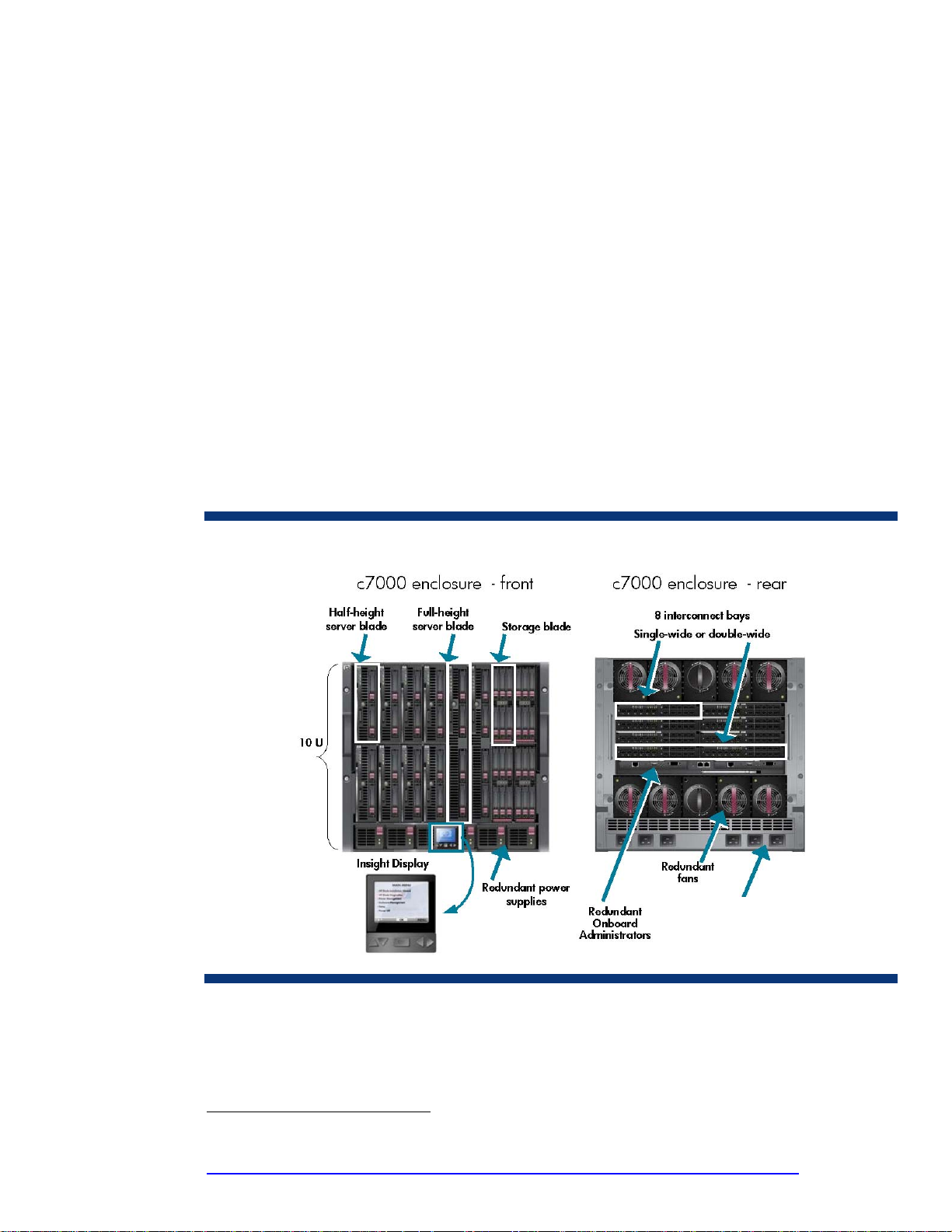
implemented in the HP BladeSystem c7000 Enclosure, a 10U-sized unit that can support half-height
and full-height server blades, storage blades, and single-wide and double-wide interconnect modules
(Figure 1). Front-loading server or storage blades and rear-loading interconnect modules slide into the
enclosure and mate with a signal midplane that provides data connections, including those for
optional interfaces.
Figure 1. Architecture of the HP BladeSystem c7000 Enclosure
Redundant
single-phase or
three-
hase powe
The enclosure also houses power supplies and HP Active Cool Fans. An HP Insight Display on the
front of the enclosure provides convenient local access to determine system status.
1
For information about supported HP StorageWorks SAN configurations, refer to the "HP StorageWorks SAN
design reference guide" at
http://h20000.www2.hp.com/bc/docs/support/SupportManual/c00403562/c00403562.pdf.
Page 3
pp
(
)
(upper)
(
)
c-Class server FC interconnect options
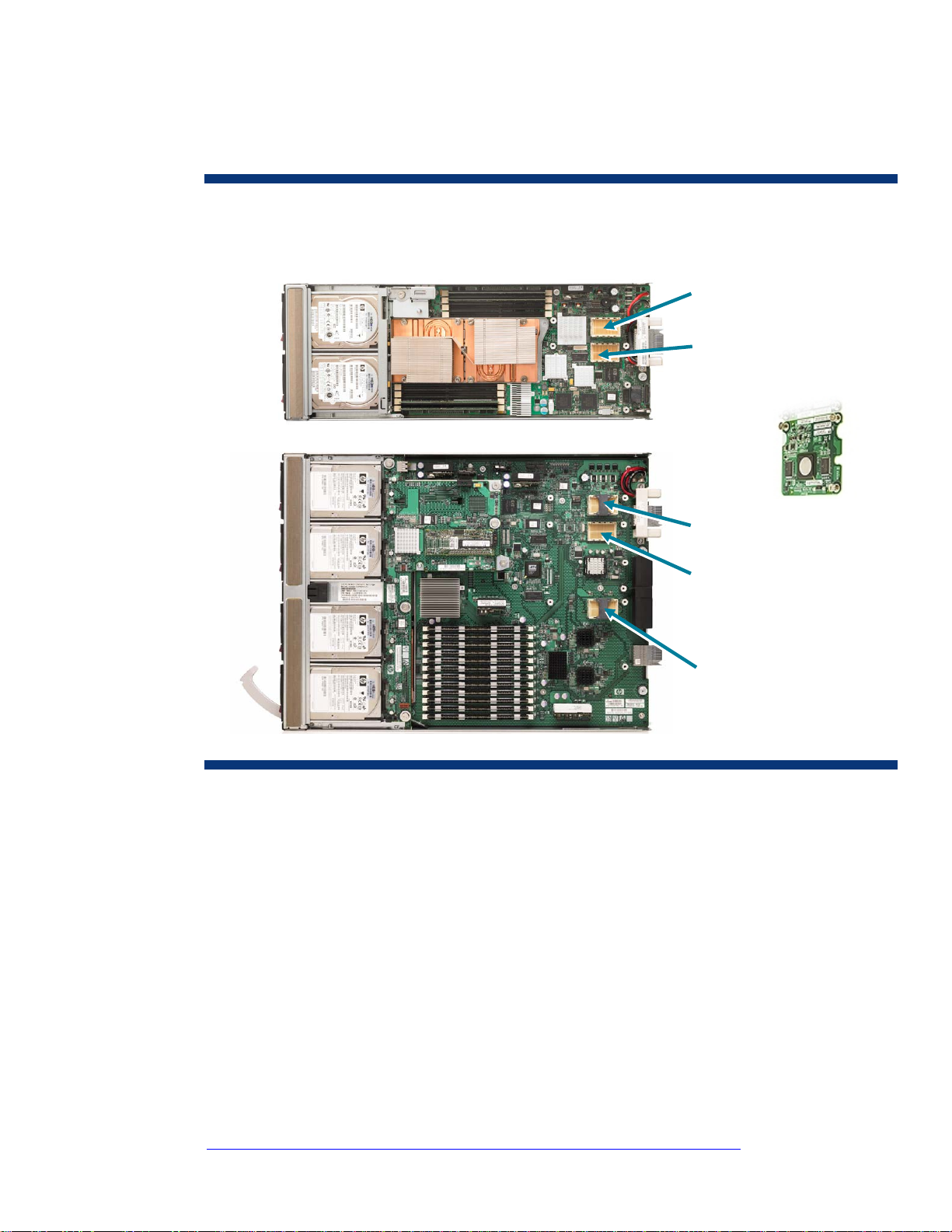
All c-Class server blades provide expansion slots that accept optional mezzanine cards in support of
several fabric options. Half-height server blades provide two mezzanine slots; full-height blades
provide three slots (Figure 2).
Figure 2. BladeSystem c-Class server blades and mezzanine cards
Half-height BL465c server blade
Full-height BL480c server blade
Mezzanine
slot 2 (u
Mezzanine
slot 1
lower
Mezzanine
slot 2
Mezzanine
slot 1
lower
Mezzanine
slot 3
er)
Optional
Mezzanine card
FC HBAs
Two FC HBA mezzanine cards are available for c-Class server blades:
• Emulex LPe1105-HP 4Gb FC HBA mezzanine card for the HP c-Class BladeSystem
• QLogic QMH2462 4Gb FC HBA mezzanine card for the HP c-Class BladeSystem
The Emulex card provides dual-port 4-Gb/s FC connectivity and is driver-compatible with all Emulex
HBAs. The Emulex card uses a firmware-based architecture that allows firmware upgrades without
taking the server offline, rebooting, or upgrading the driver.
The QLogic card provides dual-port 4-Gb/s FC connectivity along with intelligent networking features
specific to enterprise class data centers. In addition, QLogic’s unified driver model, whereby firmware
is bundled with the driver, eliminates any potential interoperability issues between the driver and
firmware and reduces the number of software components to be managed.
The Emulex and QLogic cards are compatible with all ProLiant c-Class server blades. Software and
driver support for both mezzanine cards is available at the following URL:
http://h18004.www1.hp.com/products/blades/components/c-class-sans.html
Page 4
c-Class FC SAN interconnect modules
Eight single-wide interconnect bays are provided at the rear of the HP BladeSystem c7000 Enclosure.
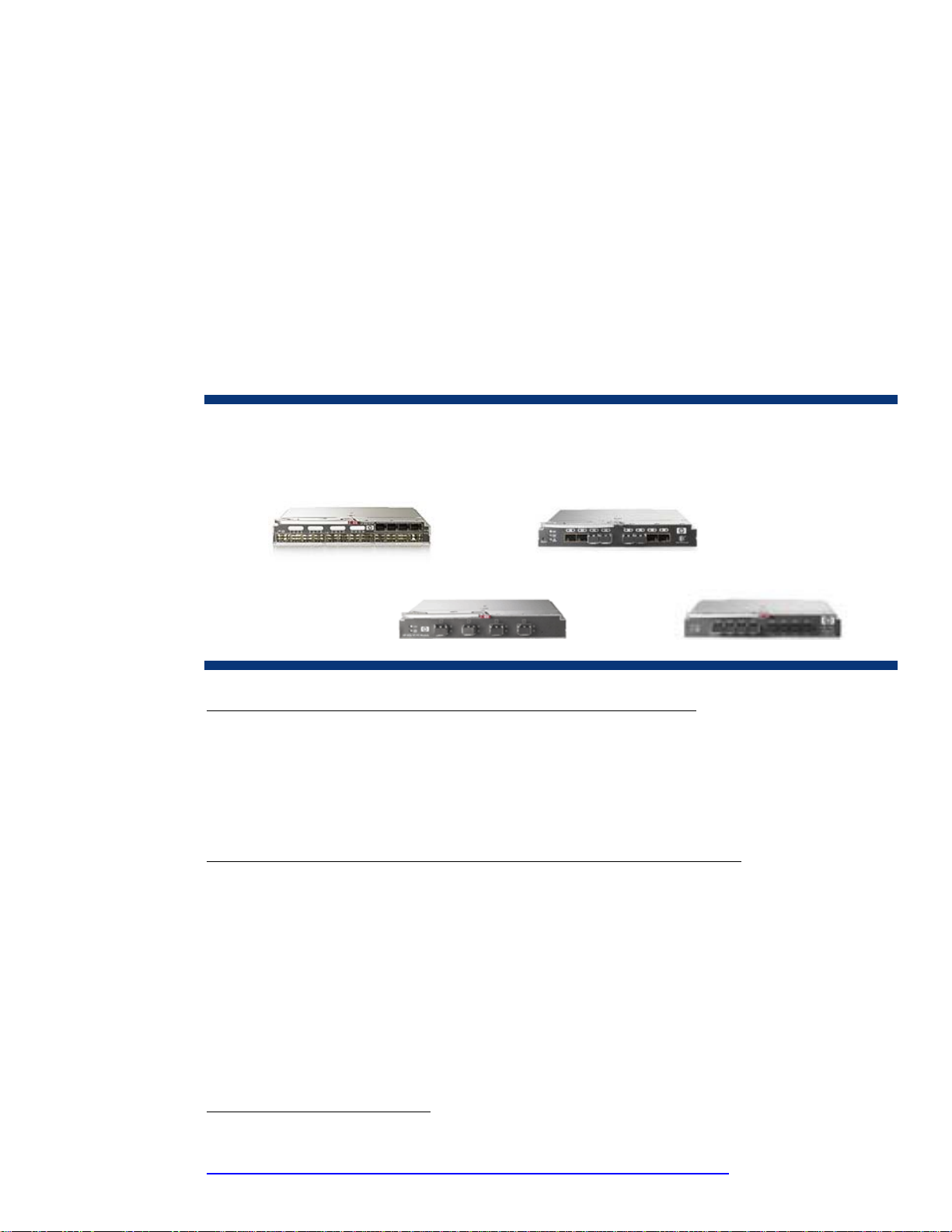
Four FC options are available for connecting the c-Class FC HBAs to a SAN:
• HP 4Gb Fibre Channel Pass-Thru Module for the c-Class BladeSystem
• HP 4Gb FC Virtual Connect Fibre Channel Module for the c-Class BladeSystem
• Brocade 4Gb SAN Switch for HP c-Class BladeSystem
• Cisco MDS 9124e Fabric Switch (Figure 3)
Up to six of these single-wide, hot-pluggable modules can be installed into the interconnect bays at
the rear of the HP BladeSystem c7000 enclosure. The modules provide external ports that accept short
wave or long wave 4-Gb small form factor pluggable (SFP) optical transceivers. The SFPs can operate
at 1, 2, or 4 Gb/s as needed based on the SAN infrastructure.
HP recommends installing the SAN interconnect modules in pairs to complement the high availability,
dual-FC port capability of the HBA mezzanine cards.
Figure 3. ProLiant c-Class FC SAN interconnect modules
HP 4Gb Pass-Thru Module
Brocade 4Gb SAN Switch
HP 4Gb VC-FC
Module
Cisco MDS 9124e
Fabric Switch
HP 4Gb Fibre Channel Pass-Thru Module for the HP c-Class BladeSystem
The HP 4Gb Pass-Thru Module provides transparent, 1:1 port connectivity (16 internal/16 external)
between HBA mezzanine ports and external SAN devices or switches. The module, which provides
16 ports with short-wave 4-Gb SFP transceivers, provides a solution for connecting the c-Class FC
HBAs to a local SAN. It is suitable for installations where the SAN is in close proximity and the
amount of cabling is not a major concern.
HP 4-Gb Virtual Connect Fibre Channel Module for the HP c-Class BladeSystem
The HP 4-Gb VC-FC Module cleanly separates SAN and server management and simplifies SAN
installation. The module appears to the SAN as one to four HBAs (depending on the number of ports
used), but provides certain switch-like benefits such as reduced cabling and shared, high-performance
auto-negotiating external SFP ports. The FC Virtual Connect module allows server blades to be moved
or replaced efficiently without involving SAN administrators. Each module provides 16 internal ports
for connections with HBAs and four external ports for connection to the SAN. Four short-wave 4-Gb
SFP transceivers are included. The module can selectively aggregate multiple FC HBA ports on up to
four external FC ports for connection to external SAN switches. The HP Virtual Connect Ethernet
Module (required when the FC Virtual Connect module is used) can manage server profiles and can
be deployed anywhere within a Virtual Connect
2
For more information about Virtual Connect technology, refer to the white paper “HP Virtual Connect
Technology implementation for the HP BladeSystem c-Class,” which is available at
http://h18004.www1.hp.com/products/servers/technology/whitepapers/index.html .
2
domain.
Page 5

Brocade 4Gb SAN Switch for HP c-Class BladeSystem
The Brocade 4Gb SAN Switch installs directly into c-Class enclosures. Integrating the switch within the
enclosure reduces SAN network deployment costs by requiring fewer optical SFPs and cables along
with less manpower for installation. Cost is further reduced by sharing intelligent power and cooling
resources provided by the enclosure. The Dynamic Ports on Demand (DPOD) function of the switch
allows flexibility in switch port allocation without constraining server slot population. The Brocade
4Gb SAN Switch includes WebTools software that allows IT administrators to easily monitor and
manage the switch with a Java-capable Web browser running on a standard PC or laptop. The
Brocade 4Gb SAN Switch is provided with Brocade Access Gateway technology, a Brocade Fabric
®
OS
feature that enables seamless connectivity to Brocade SAN fabrics and HP-supported SAN
fabrics from other vendors for enhanced scalability and simplified manageability. By making server
blades appear as if they are directly connected to the fabric, the Brocade Access Gateway eliminates
switch/domain considerations while improving SAN scalability. The Brocade switch integrates with
HP Onboard Administrator for BladeSystem, HP Systems Insight Manager, and HP Storage Essentials,
and it can leverage HP B-series SAN Switch management tools. With an optional ISL Trunking
3
license
, the external switch ports can be grouped into two, four-port trunks for increased bandwidth
with other ISL-compatible switches.
The Brocade 4-Gb SAN Switch is available in the following configurations:
• The12-port model supports any combination of internal-to-external ports with two short wave 4-Gb
SFP transceivers included. The Dynamic Ports on Demand (DPOD) function of this model allows
flexibility in switch port allocation without constraining server slot population. It includes hardware
enforced zoning, Access Gateway technology, dynamic path selection, and web tools. It is
upgradeable to 24-port support with a license key.
• The 24-port model provides connectivity for a full complement of servers (16) and 8 external ports
with four short wave 4-Gb SFP transceivers. It includes hardware enforced zoning, Access Gateway
technology, dynamic path selection, and web tools.
• The 24-port model with Power Pack configuration has the same functionality as the 24-port model
above, but it also includes the Power Pack bundle and management tools for supporting ISL
trunking, extended fabric operation, and advanced performance monitoring.
4
Cisco MDS 9124e Fabric Switch for HP c-Class BladeSystem
The Cisco MDS 9124e Fabric Switch installs directly into c-Class enclosures. Integrating the switch
within the enclosure simplifies SAN network deployment by reducing the costs of cabling, SFP
transceivers, and installation time. Cost is further reduced by sharing intelligent power and cooling
resources provided by the enclosure. The Cisco 4-Gb SAN Switch includes Cisco Fabric Manager for
integrated, comprehensive SAN management including fabric configuration, verification, and
monitoring. Also included is a broad range of integration tools, including the Cisco MDS 9000 family
Command Line Interface (CLI) and industry-standard third-party SNMP and SMI-S application
programming interfaces (APIs). This switch is available in 12-port and 24-port models that include two
and four short-wave 4-Gb SFP transceivers respectively. A 12-port upgrade license is available for the
12-port model. Additional capabilities include:
• Traffic management – Simplified deployment with virtual output queuing and Fastest Shortest Path
First (FSPF) technology optimizes the fabric performance.
• Virtual SAN (VSAN) support – Up to 16 VSANs per switch that can be managed as independent
fabrics for more efficiency and lower cost through shared use, and for increased security through
isolation of devices on the same physical SAN.
3
ISL Trunking License is not supported with Brocade Access Gateway
4
Brocade Access Gateway is available with this model but cannot be used with extended features and therefore
is not recommended.
Page 6

Port mapping of server blade FC HBA mezzanine cards
The mapping of server blade communications ports is hard-wired into the signal midplane of c-Class
enclosures. All c-Class server blades include two or four embedded network interface controllers
(NICs) connected by the midplane to interconnect bays 1 and 2, which are dedicated for Ethernet
modules. The fabric designation of interconnect bays 3 through 8 is dependent upon the optional
mezzanine cards installed on the server blades. Figure 4 shows the mapping of FC options for the HP
BladeSystem c7000 enclosure.
Figure 4. Mapping of server blade FC HBA ports in the HP BladeSystem c7000 Enclosure
Half-height server blade
(one of up to 16)
Full-height server blade
(one of up to 8)
FC HBA
mezz
Slot 1
card 1
FC HBA
mezz
Slot 2
card 2
FC HBA
mezz
Slot 1
card 1
FC HBA
mezz
Slot 2
card 2
FC HBA
mezz
Slot 3
card 3
NIC 1
NIC 2
Port 1
Port 2
Port 1
Port 2
NIC 1
NIC 2
NIC 3
NIC 4
Port 1
Port 2
Port 1
Port 2
Port 1
Port 2
Midplane
Bay 1
Bay 2
Bay 3
Bay 4
Bay 5
Bay 6
Ethernet module
Ethernet module
Pass-thru, Virtual Connect,
or
SAN switch
Pass-thru, Virtual Connect,
or
SAN switch
Pass-thru, Virtual Connect,
or
SAN switch
Pass-thru, Virtual Connect,
or
SAN switch
Pass-thru, Virtual Connect,
Bay 7
Pass-thru, Virtual Connect,
Bay 8
or
SAN switch
or
SAN switch
Figure 4 illustrates the maximum FC connection capability of the c7000 enclosure. In practice, server
blades can support a mix of mezzanine cards of different interface types (FC, Ethernet, or InfiniBand)
simultaneously within the enclosure. Having two or more FC HBA mezzanine cards on each server
blade offers enhanced redundancy and throughput.
NOTE:
Technical information for all c-Class enclosures is available
at
http://h71028.www7.hp.com/enterprise/cache/316735-0-
0-0-121.html
Page 7

NOTE:
The mezzanine slot fabric designation of all blades in a
given enclosure must be consistent. For example, the
mezzanine card installed in slot 1 of each blade must be the
same technology (FC, Ethernet, or InfiniBand) to work with
the FC, Ethernet, or InfiniBand interconnect modules in
interconnect bays 3 and 4. However, it is not mandatory
that every server blade include a mezzanine card if a
connection to a fabric is not required by a server.
The HP BladeSystem c-Class system includes the HP Onboard Administrator for BladeSystem. This
Onboard Administrator provides run-time management and configuration of all components in the
enclosure. When the system is booted, the Onboard Administrator of the enclosure checks the
configuration of server blades and interconnect modules for errors. The system status, including
interconnect data, appears on the HP Insight Display at the front of the enclosure.
Figure 5 shows screen shots from the HP Insight Display of the c7000 enclosure. A display
highlighted in green indicates no errors; a display highlighted in amber indicates that an error has
been detected.
Figure 5. Onboard Administrator Health Summary screens for the HP BladeSystem c7000 Enclosure
No errors Error condition
For more information, refer to the c-Class enclosure installation and user guides available at
www.hp.com/servers/blades
Page 8

g
FC SAN connectivity
Figure 6 shows FC port communication paths for full-height and half-height server blades (with a dualport FC HBA mezzanine card installed in slot 1) connecting to a SAN with the HP BladeSystem
c7000 Enclosure.
Figure 6. Server blade-to-SAN connection for the HP BladeSystem c7000 Enclosure, dimensional view
FC interconnect
module
in bay 4
FC HBA
mezzanine
card in slot 1
SAN
FC interconnect
module in bay 3
Full-height
server blade
c7000
Port 1 routing
Port 2 routin
Half-height
server blade
enclosure
midplane
Each FC interconnect module (pass-thru, virtual connect, or switch) provides connections for up to 16
server blades. To ensure high availability, each FC HBA mezzanine card is dual-ported, and each
port is routed to a separate interconnect bay. For example, as indicated in Figure 6 and in Table 1,
the ports on an HBA mezzanine card in slot 1 are routed to bays 3 and 4. Interconnect modules must
be installed in pairs if redundancy capability is required.
Table 1. Slot-to-interconnect bay port routing for server blade mezzanine cards in the HP BladeSystem
c7000 Enclosure
Server blade
mezzanine slot
Slot 1:
Port 1
Port 2
Interconnect
bay
3
4
Slot 2:
Port 1
Port 2
Slot 3:
Port 1
Port 2
5
6
7
8
Page 9

The number of FC interconnect modules required for an HP BladeSystem c7000 Enclosure is
determined by the number of FC ports per server blade (Table 2). HP recommends the use of
redundant SANs. To provide redundancy for FC HBA mezzanine cards:
• One or more server blades with a dual-port FC HBA card require two FC interconnect modules.
• One or more server blades with two dual-port FC HBA cards require four interconnect modules.
• One or more full-height server blades with three dual-port FC HBA cards require the maximum of six
FC interconnect modules.
Table 2. FC SAN configurations for the HP BladeSystem c7000 Enclosure
Server blades Total # of
HBA ports
16 half-height blades
each with 1 dual-port FC HBA
16 half-height blades
each with 2 dual-port FC HBAs
8 full-height blades
each with 1 dual-port FC HBA
8 full-height blades
each with 2 dual-port FC HBAs
8 full-height blades
each with 3 dual-port FC HBAs
4 full-height blades
each with 3 dual-port FC HBAs
And
8 half-height blades
Each with 2 dual-port FC HBAs
32 2 256 Gb/s
64 4 512 Gb/s
16 2 128 Gb/s
32 4 256 Gb/s
48 6 384 Gb/s
56 6 448 Gb/s
# of interconnect
modules required
NOTE:
Technical data for all c-Class enclosures is available at
http://h71028.www7.hp.com/enterprise/cache/316735-0-00-121.html
Server aggregate
bandwidth
Port redundancy strategies
With the mix/match loading capability of the HP BladeSystem c-Class architecture, numerous
configurations are possible to achieve SAN availability and redundancy goals. Each FC HBA
mezzanine card provides two FC ports. However, the infrastructure designer can choose to achieve
redundancy by installing two mezzanine cards per server blade but use only one port per card.
For example, if both mezzanine slots 1 and 2 are populated with FC HBA mezzanine cards but only
port 1 is enabled for each mezzanine card, interconnect modules installed in interconnect bays 3 and
5 will provide redundant server blade connectivity. In the event an FC card, interconnect module, or
associated external SFP transceiver or optical cable should fail, the server blade still retains
connectivity through the alternate port path provided by the second HBA mezzanine card.
Page 10

Selecting interconnect module types
The optimum type of interconnect module for use in a system will be determined by several factors
such as SAN proximity, fabric size, number of server blades to be connected, and performance and
availability goals. Pre-existing SAN attributes also affect the choice of interconnects.
Connecting with pass-thru modules
The HP 4Gb FC Pass-Thru Module provides a solution for connecting server blades to a SAN when
the customer does not want to deploy Fibre Channel switches in the BladeSystem enclosure. Such a
choice may result in an increase in the number of SFPs and optical cables used. This solution may be
desirable if only a small number of the server blades in the enclosure will ever require a SAN
connection. Each pass-thru module provides dedicated paths between to up to 16 server blades and
an equal number of SAN switch ports or SAN target ports.
Note that the one-to-one nature of the pass-thru module means that connecting an external port
directly to a SAN device will provide only one FC path for a server blade. A typical infrastructure
would include an external switch that connects the pass-thru ports to the SAN device. For redundant
paths between a server blade and a SAN device, two pass-thru modules and two external SAN
switches are required, as shown in Figure 7 for the c7000 enclosure.
Note that there is a direct relationship between the server HBA ports and the external ports on the
pass-thru module. No switching is provided by a pass-thru module. Each server HBA port has only
one external port available on one pass-thru module.
Figure 7. Pass-thru connectivity for the HP BladeSystem c7000 Enclosure
HP BladeSystem c7000 Enclosure
Internal FC ports 1-16
to server blades
(Devices 1-16, Port 1)
Internal FC ports 1-16
to server blades
(Devices 1-16, Port 2)
Pass-thru
interconnect
module #1
(bay 3, 5, or 7)
Pass-thru
interconnect
module #2
(bay 4, 6, or 8)
External
FC Ports 1-16
External
FC Ports 1-16
Note that mapping is direct between the device bays (server blades) and the external ports on each
pass-thru module (HBA in server 1 to external FC port 1, HBA in server 2 to external FC port 2, etc.).
Page 11

Connecting with HP Virtual Connect modules
The HP 4Gb VC-FC Module provides the ability to quickly assign SAN storage to a server. Virtual
Connect also provides the ability to quickly migrate server SAN storage assignments from one server
to another allowing easy reallocation of servers and storage resources. In the event that a server
needs to be taken offline, Virtual Connect allows another server to quickly assume the personality of
the original server such that the assigned SAN Storage is accessible by the replacement server.
The HP 4Gb VC-FC Module provides high-speed switching for connecting up to 16 servers to four
external FC ports. This four-to-one over-subscription ratio significantly reduces cabling and SFP
requirements (Figure 8) while maintaining robust bandwidth. The HP Virtual Connect module provides
switch-like performance without adding a switch to the domain. A SAN manager is able to see all the
HBAs in the c-Class enclosure without having to manage an additional switch. A Virtual Connect
Ethernet module that provides the shared management resources is required when using the HP
Virtual Connect module. Each Server HBA port can see only one external port on one HP 4Gb VC-FC
Module. Two HP 4Gb VC-FC Modules are required for redundant FC path support for server blades.
Figure 8. HP 4Gb VC-FC Module connectivity for the HP BladeSystem c7000 Enclosure
HP BladeSystem c7000 Enclosure
Internal FC ports 1-16
to server blades
(Devices 1-16, Port 1)
HP Virtual
Connect
module #1
(bays 3, 5, or 7)
External 4-Gb
FC Ports 1-4
to SAN devices
or Switches
Internal FC ports 1-16
to server blades
(Devices 1-16, Port 2)
HP Virtual
Connect
module #2
(bays 4, 6, or 8)
External 4-Gb
FC Ports 1-4
to SAN devices
or Switches
Table 3 lists the default mapping configuration of server blades to the external uplink ports for the HP
4GB VC-FC Module.
Table 3. External FC port mapping (default) for the HP 4Gb VC-FC Module
Server
blades
1 – 4 1
5 – 8 2
9 – 12 3
13 – 16 4
Note: The user may select other mappings. Refer to the HP Virtual Connect Fibre Channel Module Users Manual.
External Uplink Port
Page 12

(bay
,
)
Connecting with SAN switches
Embedded SAN switches provide all the features and high-speed switching of external switches. They
also offer flexibility in connecting redundant paths from server blades to dual-path Fibre Channel
SANs. Brocade and Cisco embedded switches are each capable of a maximum 16-to-8 internal-toexternal port configuration (Figure 9). The Brocade 4-Gb SAN Switch includes the Access Gateway
feature that enables the device to present its ports to the fabric as HBA ports. This allows for
scalability and interoperability between supported fabrics. Both switches can be ordered with 12 or
24 ports enabled. Modules with 12 ports enabled are upgradeable with a 12-port licensing option
for a pay-as-you-grow strategy. Two switches are required for redundant path support. SAN
Management controls the embedded SAN switches and also manages SAN resource access and
security. Each server HBA port can see any or all of the eight external FC ports on the SAN Switch
Figure 9. SAN switch connectivity for the HP BladeSystem c7000 Enclosure
HP BladeSystem c7000 Enclosure
Internal FC ports to
server blades
(Devices 1-16, Port 1)
SAN
switch
module #1
s 3, 5
or 7
External FC ports
to SAN switches
or targets
Internal FC ports to
server blades
(Devices 1-16, Port 2)
SAN
switch
module #2
(bays 4, 6, or 8)
External FC ports
to SAN switches
or targets
Interconnect bay loading summary
The previous examples illustrate interconnect modules being installed in like-pairs. Actual installations
can involve a mixed configuration of FC modules. One interconnect bay can be populated with a
pass-thru module while its associated redundant bay can have a SAN switch. The possible
topography variations to meet availability and redundancy goals are too numerous to describe in this
document. The general rule is that the technologies of redundant bays must be the same. However,
not all combinations are supported even when this rule is followed. Always consult product-specific
information to determine supported configurations.
HP software for server deployment/SAN connectivity
The HP ProLiant Essentials Rapid Deployment Pack simplifies the installation, configuration, and
deployment of high volumes of server blades via a drag-and-drop, GUI-based console. For example,
IT personnel can install operating systems, service packs, virus patches, and other software on
computers using either scripting or imaging technology. The Rapid Deployment Pack combines two
powerful products: Altiris eXpress Deployment Solution and the ProLiant Integration Module. Rapid
Deployment Pack - Windows Edition 3.10 or later and Rapid Deployment Pack - Linux Edition 1.10 or
later provide enhanced SAN support. For more information, select the web link for the RDP
Knowledge Base in the “
For more information” section of this document.
Page 13

HP Storage Essentials is an additional software tool for efficiently deploying HP BladeSystem server
blades to a large existing SAN or to a new SAN. The software can be used to set up and manage the
Brocade 4-Gb SAN Switch and the Cisco MDS 9124e Fabric Switch.
HP SAN Visibility and SAN Designer are free HP programs that can be downloaded and used to
discover, view, and provide an extensive report on existing SAN configuration. These programs can
assist in determining what is needed to add HP BladeSystem server blades to an existing SAN. Both
programs are available for downloading at the URLs provided in the “
For more information” section
of this paper.
Conclusion
The interconnect design of HP BladeSystem c-Class enclosures offers close integration with SAN
devices. Since HP BladeSystem c-Class architecture supports various interconnect methods, HP
BladeSystem c-Class products provide the flexibility to meet a wide range of SAN connectivity goals.
For more information
For additional information related to the topics covered in this document, refer to the resources listed
below.
Resource description Web address
HP StorageWorks SAN Design Guide http://h20000.www2.hp.com/bc/docs/support/SupportMan
ual/c00403562/c00403562.pdf.
HP SAN Visibility Software Utility
http://h18004.www1.hp.com/storage/networking/sans
olutions.html?jumpid=reg_R1002_USEN
HP SAN Designer Software Utility
http://h18004.www1.hp.com/storage/networking/sand
esigner.html?jumpid=reg_R1002_USEN
Care Pack (for hardware and software
information and for orderable part
numbers)
Rapid Deployment Pack Knowledge Base
HP BladeSystem c-Class technical
documentation
http://www.hp.com/hps/carepack/servers/
http://www.hp.com/servers/rdp/kb
http://h71028.www7.hp.com/enterprise/cache/316735-0-0-0-
121.html
Call to action
Send comments about this paper to TechCom@HP.com.
© 2007 Hewlett-Packard Development Company, L.P. The information contained
herein is subject to change without notice. The only warranties for HP products and
services are set forth in the express warranty statements accompanying such
products and services. Nothing herein should be construed as constituting an
additional warranty. HP shall not be liable for technical or editorial errors or
omissions contained herein.
TC070607TB, June 2007
 Loading...