

Page 1
/ Instruction Manual
T-Link Communications Card
"OPC-G1-TL"
Fuji Electric Co., Ltd. INR-SI47-1330c-JE
Page 2

English Version
Page 3

Page 4
Preface
Thank you for purchasing our T-Link Communications Card OPC-G1-TL.
The communications card is used to connect our general-purpose inverter series FRENIC-MEGA to a T-Link
network. Mounting this communications card on your FRENIC-MEGA allows you to connect the FRENIC-MEGA
to a Fuji MICREX series of programmable logic controllers (T-Link module) and control it as a slave unit using
run and frequency commands, and accessing function codes.
This instruction manual does not contain inverter handling instructions. Read through this instruction manual in
conjunction with the FRENIC-MEGA Instruction Manual and be familiar with proper handling and operation of
this product. Improper handling might result in incorrect operation, a short life, or even a failure of this product.
Keep this manual in a safe place.
Related Publications
Listed below are the other materials related to the use of the T-Link communications card "OPC-G1-TL." Read
them in conjunction with this manual as necessary.
RS-485 Communication User's Manual
FRENIC-MEGA Instruction Manual
The materials are subject to change without notice. Be sure to obtain the latest editions for use.
Read through this instruction manual and be familiar with the T-Link communications card before
proceeding with installation, connections (wiring), operation, or maintenance and inspection.
Improper handling might result in incorrect operation, a short life, or even a failure of this product as
well as the motor.
Deliver this manual to the end user of this product. Keep this manual in a safe place until this product
is discarded.
Safety precautions
Read this manual thoroughly before proceeding with installation, connections (wiring), operation, or
maintenance and inspection. Ensure you have sound knowledge of the device and familiarize yourself with all
safety information and precautions before proceeding to operate the inverter.
Safety precautions are classified into the following two categories in this manual.
Failure to heed the information indicated by this symbol may lead to
dangerous conditions, possibly resulting in death or serious bodily
injuries.
Failure to heed the information indicated by this symbol may lead to
dangerous conditions, possibly resulting in minor or light bodily injuries
and/or substantial property damage.
Failure to heed the information contained under the CAUTION title can also result in serious consequences.
These safety precautions are of utmost importance and must be observed at all times.
1
Page 5
Installation and wiring
Before starting installation and wiring, turn OFF the power and wait at least five minutes for inverters
with a capacity of 22 kW or below, or at least ten minutes for inverters with a capacity of 30 kW or
above. Make sure that the LED monitor and charging lamp are turned OFF. Further, make sure,
using a multimeter or a similar instrument, that the DC link bus voltage between the terminals P(+)
and N(-) has dropped to the safe level (+25 VDC or below).
Qualified electricians should carry out wiring.
Otherwise, an electric shock could occur.
Do not use the product that is damaged or lacking parts.
Doing so could cause a fire, an accident, or injuries.
Prevent lint, paper fibers, sawdust, dust, metallic chips, or other foreign materials from getting into
the inverter and the communications card.
Otherwise, a fire or an accident might result.
Incorrect handling in installation/removal jobs could cause a failure.
A failure might result.
Noise may be emitted from the inverter, motor and wires. Implement appropriate measure to prevent
the nearby sensors and devices from malfunctioning due to such noise.
Otherwise, an accident could occur.
Operation
Be sure to install the front cover before turning the inverter's power ON. Do not remove the cover
when the inverter power is ON.
Otherwise, an electric shock could occur.
Do not operate switches with wet hands.
Doing so could cause an electric shock.
If you configure the function codes wrongly or without completely understanding FRENIC-MEGA
Instruction Manual and the FRENIC-MEGA User's Manual, the motor may rotate with a torque or at a
speed not permitted for the machine. Confirm and adjust the setting of the function codes before
running the inverter.
Otherwise, an accident could occur.
Maintenance and inspection, and parts replacement
Before proceeding to the maintenance/inspection jobs, turn OFF the power and wait at least five
minutes for inverters with a capacity of 22 kW or below, or at least ten minutes for inverters with a
capacity of 30 kW or above. Make sure that the LED monitor and charging lamp are turned OFF.
Further, make sure, using a multimeter or a similar instrument, that the DC link bus voltage between
the terminals P(+) and N(-) has dropped to the safe level (+25 VDC or below).
Otherwise, an electric shock could occur.
Maintenance, inspection, and parts replacement should be made only by qualified persons.
Take off the watch, rings and other metallic objects before starting work.
Use insulated tools.
Otherwise, an electric shock or injuries could occur.
2
Page 6
Disposal
Treat the communications card as an industrial waste when disposing of it.
Otherwise injuries could occur.
Others
Never modify the communications card.
Doing so could cause an electric shock or injuries.
Icons
The following icons are used throughout this manual.
This icon indicates information which, if not heeded, can result in the product not operating to full
efficiency, as well as information concerning incorrect operations and settings which can result in
accidents.
This icon indicates information that can prove handy when performing certain settings or operations.
This icon indicates a reference to more detailed information.
3
Page 7

Table of Contents
Preface ..................................................................... 1
Safety precautions ............................................................ 1
Chapter 1 BEFORE USE ................................................... 5
1.1 Acceptance Inspection ............................................ 5
1.2 Applicable Inverters ................................................. 5
Chapter 2 NAMES AND FUNCTIONS ............................... 6
2.1 Parts Names ............................................................ 6
2.2 Station Address Switches (RSW1 and RSW2) ........ 6
2.3 T-Link Terminal Block (TB11) ................................... 6
Chapter 3 INSTALLATION AND REMOVAL OF THE
COMMUNICATIONS CARD ............................. 7
3.1 Installing the Communications Card ........................ 7
3.2 Removing the Communications Card ...................... 8
Chapter 4 WIRING AND CABLING ................................... 9
4.1 Basic Connection Diagram ...................................... 9
4.2 Wiring for T-Link Terminal Block (TB11) ................. 10
4.3 Wiring to Inverter .................................................... 11
Chapter 5 CONFIGURING INVERTER'S FUNCTION
CODES FOR T-Link COMMUNICATION ........ 12
5.1 Inverter's Function Codes ...................................... 12
5.2 Error Processing for T-Link Network Breaks .......... 12
Chapter 6 ESTABLISHING A T-Link COMMUNICATIONS
LINK ................................................................ 13
6.1 Starting Procedure ................................................. 13
6.2 I/O Relay Area Occupied ....................................... 14
6.3 Address Configuration Example ............................ 14
Chapter 7 COMMUNICATIONS FORMAT ....................... 15
7.1 About Communications Format ............................. 15
7.2 Data Allocation Addresses in I/O Relay Area ......... 15
7.3 Descriptions of Communications Formats ............. 16
7.4 Example of Communication Data .......................... 22
Chapter 8 LIST OF INVERTER ALARM CODES ............ 24
Chapter 9 PROTECTIVE FUNCTIONS ........................... 25
Chapter 10 SPECIFICATIONS .......................................... 26
10.1 Operating Environment .......................................... 26
10.2 T-Link Specifications .............................................. 27
4
Page 8
Chapter 1 BEFORE USE
1.1 Acceptance Inspection
Unpack the package and check the following:
(1) A communications card, two screws (M3 8), and the T-Link Communications Card Instruction Manual (this
document) are contained in the package.
(2) The communications card is not damaged during transportation--no defective parts, dents or warps.
(3) The model name "OPC-G1-TL" is printed on the communications card. (See Figure 2.1.)
If you suspect the product is not working properly or if you have any questions about your product, contact the
shop where you bought the product or your local Fuji branch office.
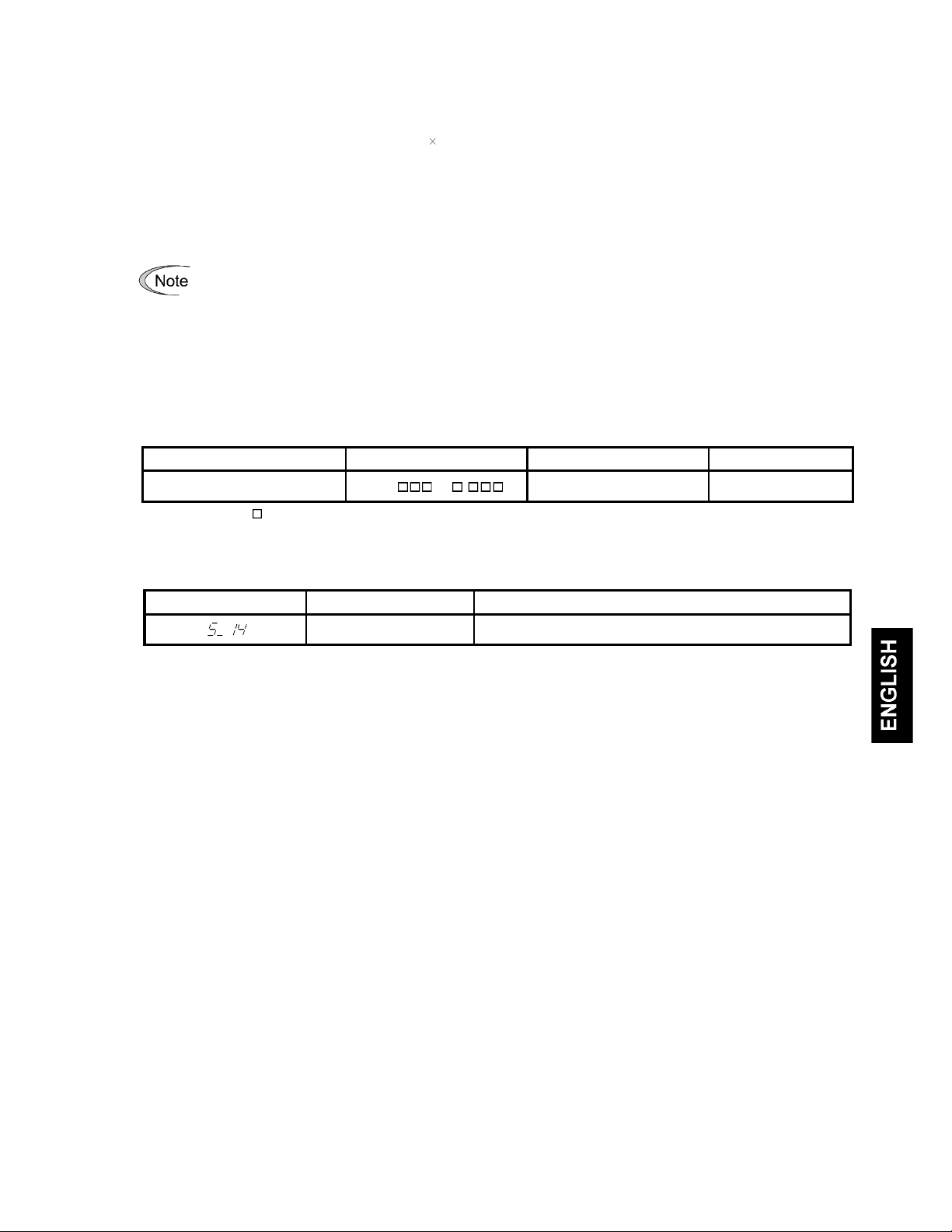
No terminating resistor comes with this communications card.
A pair of resistors with the following specifications must be used: 100 ohm, 1 watt
1.2 Applicable Inverters
The T-Link communications card is applicable to the following inverters and ROM version.
(The terminating resistors that come with the T-Link module of the MICREX series can be used.)
Table 1.1 Applicable Inverters and ROM Version
Series Inverter type Applicable motor rating ROM version
FRENIC-MEGA FRN G1 - All capacities 0500 or later
* The boxes replace alphanumeric letters depending on the nominal applied motor, enclosure, power supply voltage, etc.
To check the inverter's ROM version, use Menu #5 "Maintenance Information" on the keypad. (Refer to the
FRENIC-MEGA Instruction Manual, Chapter 3, Section 3.4.6 "Reading maintenance information."
Display on LED Monitor Item Description
Inverter's ROM version Shows the inverter's ROM version as a 4-digit code.
5
Page 9
Chapter 2 NAMES AND FUNCTIONS
2.1 Parts Names
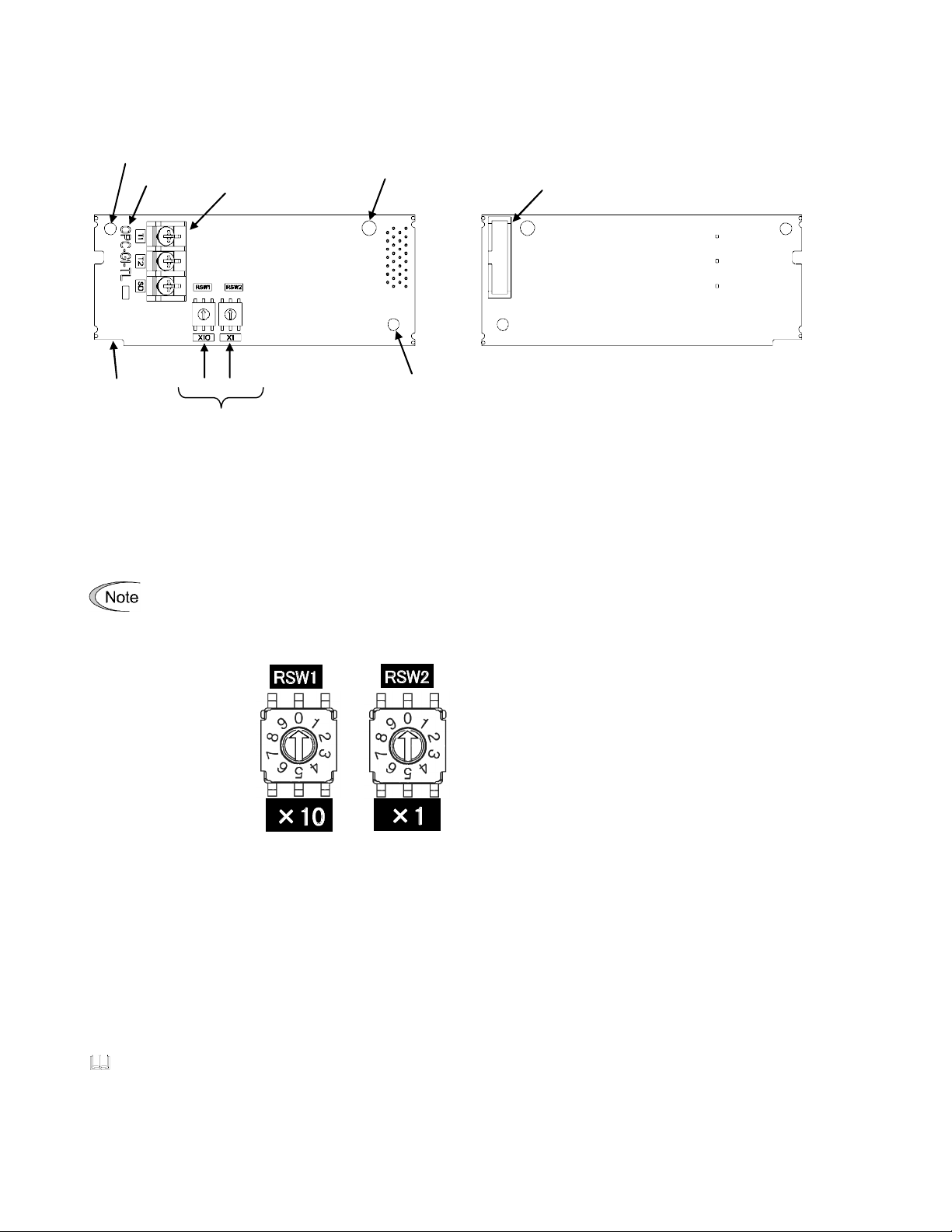
Figure 2.1 shows the names of the parts on the T-Link communications card.
Screw hole (left)
(Front) (Back)
Positioning
cutout
Model name
RSW1 RSW2
Station address switches
T-Link terminal
block (TB11)
Figure 2.1 Names of Parts on T-Link Communications Card
2.2 Station Address Switches (RSW1 and RSW2)
Release knob
Screw hole (right)
Connector CN1
The station address switches on the communications card are rotary ones (RSW1 and RSW2) that are used to
configure the station address of the communications card on a T-link. The setting range is from 00 to 99.
The station address switches should be accessed when the inverter power is OFF. Access with the
inverter power ON will result in a communications error.
RSW1: Upper digit (x10)
RSW2: Lower digit (x1)
Note 1: When two or more communications cards are used on the same T-Link network,
the same station address should not be double assigned.
Note 2: Factory default: RSW1 = 0, RSW2 = 0 (Station address = 00)
Figure 2.2 Station Address Switches (RSW1 and RSW2)
2.3 T-Link Terminal Block (TB11)
Connect the T-Link communications cable to the T-Link terminal block.
For details about wiring, refer to Chapter 4 "WIRING AND CABLING."
6
Page 10
Chapter 3 INSTALLATION AND REMOVAL OF THE COMMUNICATIONS CARD
Before starting installation and wiring, turn OFF the power and wait at least five minutes for inverters with a
capacity of 22 kW or below, or at least ten minutes for inverters with a capacity of 30 kW or above. Make
sure that the LED monitor and charging lamp are turned OFF. Further, make sure, using a multimeter or a
similar instrument, that the DC link bus voltage between the terminals P(+) and N(-) has dropped to the safe
level (+25 VDC or below).
Otherwise, an electric shock could occur.
Do not use the product that is damaged or lacking parts.
Doing so could cause a fire, an accident, or injuries.
Prevent lint, paper fibers, sawdust, dust, metallic chips, or other foreign materials from getting into
the inverter and the communications card.
Otherwise, a fire or an accident might result.
Incorrect handling in installation/removal jobs could cause a failure.
A failure might result.
3.1 Installing the Communications Card
Before mounting the communications card, perform the wiring for the main circuit terminals and control
circuit terminals.
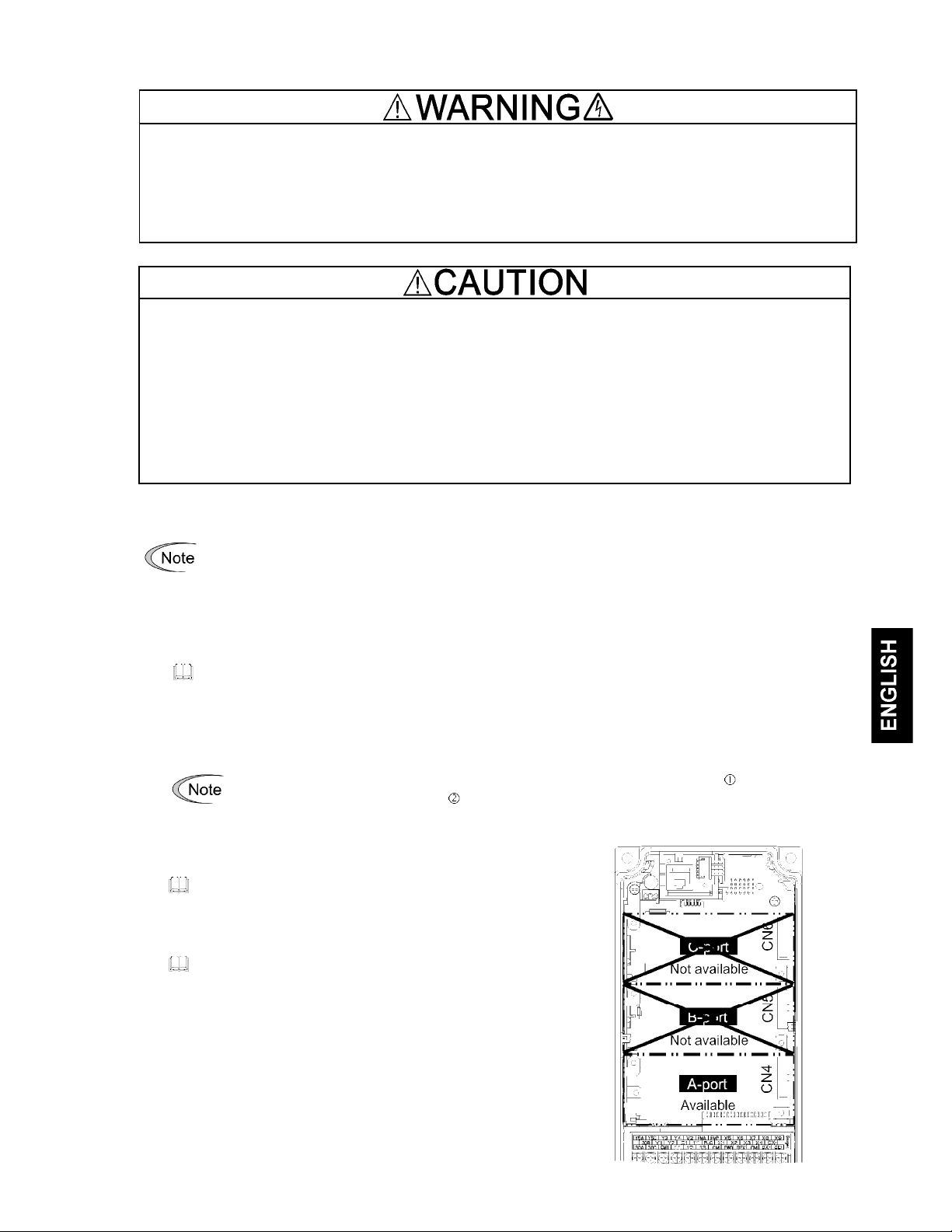
(1) Remove the front cover from the inverter and expose the control printed circuit board (control PCB). As
shown in Figure 3.1, the communications card can be connected to the A-port only, out of three option
connection ports (A-, B-, and C-ports) on the control PCB.
To remove the front cover, refer to the FRENIC-MEGA Instruction Manual, Chapter 2, Section 2.3.
For inverters with a capacity of 30 kW or above, open also the keypad enclosure.
(2) Insert connector CN1 on the back of the communications card (Figure 1.1) into the A-port (CN4) on the
inverter's control PCB. Then secure the communications card with the two screws that come with the card.
(Figure 3.3)
Check that the positioning cutout (shown in Figure 2.1) is fitted on the tab ( in Figure 3.2) and
connector CN1 is fully inserted ( in Figure 3.2). Figure 3.3 shows the communications card
correctly mounted.
(3) Perform wiring to the communications card.
For details, refer to Chapter 4 "WIRING AND
CABLING."
(4) Put the front cover back into place.
To put back the front cover, refer to the FRENIC-MEGA
Instruction Manual, Chapter 2, Section 2.3.
For inverters with a capacity of 30 kW or above, close
also the keypad enclosure.
Figure 3.1 In the case of 0.4 kW
7
Page 11

Tab
Fit the positioning cutout of the communications
card over the tab on the inverter to determine
the mounting position.
Insert connector CN1 on the communications
card into the corresponding port on the
inverter's control PCB.
Note: Be sure to follow the order of and .
Inserting CN1 first may lead to insufficient
insertion, resulting in a contact failure.
Figure 3.2 Mounting the Communications Card
(Release knob)
Figure 3.3 Mounting Completed
3.2 Removing the Communications Card
Remove the two screws that secure the communications card and pull the release knob (shown above) to take
the communications card out of the inverter.
8
Page 12

Chapter 4 WIRING AND CABLING
Before starting installation and wiring, turn OFF the power and wait at least five minutes for inverters with
a capacity of 22 kW or below, or at least ten minutes for inverters with a capacity of 30 kW or above.
Make sure that the LED monitor and charging lamp are turned OFF. Further, make sure, using a
multimeter or a similar instrument, that the DC link bus voltage between the terminals P(+) and N(-) has
dropped to the safe level (+25 VDC or below).
Qualified electricians should carry out wiring.
Otherwise, an electric shock could occur.
In general, the covers of the control signal wires are not specifically designed to withstand a high voltage
(i.e., reinforced insulation is not applied). Therefore, if a control signal wire comes into direct contact with
a live conductor of the main circuit, the insulation of the cover might break down, which would expose the
signal wire to a high voltage of the main circuit. Make sure that the control signal wires will not come into
contact with live conductors of the main circuit.
Failure to observe this precaution could cause an electric shock or an accident.
Noise may be emitted from the inverter, motor and wires. Take appropriate measures to prevent the nearby
sensors and devices from malfunctioning due to such noise.
An accident could occur.
4.1 Basic Connection Diagram
FRENIC-MEGA
L1/R
L2/S
L3/T
OPC-G1-TL
T-Link
terminal block
Station address switches
T1
T2
SD
U
V
W
Motor
G
Terminating
resistor
Terminating
resistor
T1
MICREX series
T2
processor
T1
T2
module
Station
address
Station
address
SD
T1
T2
SD
SD
G
G
Figure 4.1 Basic Connection Diagram
9
Page 13

4.2 Wiring for T-Link Terminal Block (TB11)
(1) Use either of the following cables as a T-Link communications cable.
- Twisted pair cable CPEV-SB 0.9 dia. x 1 pair (manufactured by Furukawa Electric)
- Twisted pair cable KPEV-SB 0.5 mm2 x 1 pair (manufactured by Furukawa Electric)
(2) Wiring to T-Link terminal block (TB11)
The pin assignment on the T-Link terminal block, the terminal functions, and the terminal specifications are
shown in Figure 4.2, Tables 4.1 and 4.2, respectively.
T1 T2 SD
Figure 4.2 Pin Assignment on T-Link Terminal Block
Table 4.1 Functions of T-Link Terminals
Symbol Name Functions
T1
T-Link terminals Terminals for connecting the T-Link communications line
T2
SD Shield Terminal for connecting the cable shield
Table 4.2 Terminal Specifications
Item Specifications
Terminal screw size M3
Tightening torque 0.5 N m
(3) Terminating resistor
T-Link requires a terminating resistor to be mounted externally on each end of the trunk line. Check that the
trunk line is terminated on both ends; if it is not terminated, mount a terminating resistor(s) on the missing
end(s).
No terminating resistor comes with this communications card.
A pair of resistors with the following specifications must be used: 100 ohm, 1 watt
(The terminating resistors that come with the T-Link module of the MICREX series can be used.)
10
Page 14

4.3 Wiring to Inverter
Route the T-Link communications cable as far from the wiring of the main circuit as possible.
For inverters with a capacity of 22 kW or below
Otherwise electric noise may cause malfunctions.
Pass the T-Link communications cable between the control circuit terminal block and the front cover.
In the case of 0.4 kW
For inverters with a capacity of 30 kW or above
In the case of 75 kW
Figure 4.3 Examples of Wiring
11
Page 15

Chapter 5 CONFIGURING INVERTER'S FUNCTION CODES FOR T-Link
COMMUNICATION
5.1 Inverter's Function Codes
Before running the inverter for practical operation, configure the inverter's function codes listed in Table 5.1. It is
recommended to configure them before starting T-Link communication, since a T-Link network break could
occur immediately after the start of communication.
Table 5.1 Inverter's Function Code Settings Required for T-Link Communication
Function
codes
o27
o28
o30
y98
Select error processing for
T-Link network breaks
Set the operation timer to be
used in error processing for
network breaks
Specify T-link communications
format
Select run/frequency
command sources
Description
Changing o30 data may cause an option error (T-Link communications error) . If it occurs, reset
the MICREX.
5.2 Error Processing for T-Link Network Breaks
Factory
default
setting
0 0 to 15
0.0 s 0.0 to 60.0 s
Select one of the following:
0: G11 standard format
0
2: G9 compatible format
1, 3 to 255: (Not allowed)
Select from the following choices:
Frequency
y98
command source
0
0
1
2
3
Function code data Remarks
For details about
function codes o27
and o28, see Table
5.2.
For details about
communications
format, refer to
Chapter 7.
If there is no special
Run command
source
Inverter Inverter
T-Link Inverter
Inverter T-Link
T-Link T-Link
problem with your
system, y98 = 3 is
recommended.
Inverter's function codes o27 and o28 define error processing that the inverter should perform when it detects a
T-Link network break, as listed in Table 5.2.
If no run or frequency command via the communications link is enabled, the inverter does not issue ,
performing no error processing.
Table 5.2 Error Processing for T-Link Network Breaks, Defined by Function Codes o27 and o28
o27 o28
0, 4 to 9 Invalid Immediately coast to a stop and trip with .
1 0.0 to 60.0 s After the time specified by o28, coast to a stop and trip with .
2 0.0 to 60.0 s
3,
13 to 15
10 Invalid Immediately decelerate to a stop. After the stop, trip with . The inverter's
11 0.0 to 60.0 s
12 0.0 to 60.0 s
Invalid Continue to run, ignoring the error (No trip).
If the communications link is restored within the time specified
by o28, ignore the communications error. If a timeout occurs,
coast to a stop and trip with .
After the time specified by o28, decelerate to a stop. After the
stop, trip with .
If the communications link is restored within the time specified
by o28, ignore the communications error. If a timeout occurs,
decelerate to a stop and trip with .
after Detection of T-Link Network Break
Error Processing
Remarks
function code F08
specifies the
deceleration time.
Same as above.
Same as above.
12
Page 16

Chapter 6 ESTABLISHING A T-Link COMMUNICATIONS LINK
6.1 Starting Procedure
After confirming that wiring to the T-Link has been completed, establish a T-Link communications link between
the MICREX and the inverter and start T-Link communication, using the procedure given in this chapter.
T-Link communication enables the MICREX to issue run commands and monitor the inverter's operation.
For details, refer to Chapter 7 "COMMUNICATIONS FORMAT."
(1) Configure the MICREX.
- Set a station address of the T-Link communications card (e.g., 00) using the MICREX loader. The relay
area should not be double assigned by any other T-Link station address.
- Allocate read and write areas on the T-Link communications card. Each of those areas is 4 words in
length, regardless of the format.
- In the I/O group setting, register the T-Link communications card as both input and output devices.
For details about the relay area to be occupied, refer to Chapter 6, Section 6.2 "I/O Relay Area
Occupied."
For details about configuring MICREX, refer to the MICREX user's manual.
(2) Configure the station address switches (RSW1 and RSW2) on the communications card. (Refer to Section
2.2.)
- Before accessing the station address switches, make sure that both the inverter power and the T-Link
communications card power are turned OFF.
- Set the station address switches to the station address that matches the one specified by the loader.
(3) Turn the inverter power ON and configure the inverter's function codes.
- Select the communications format with the inverter's function code o30.
- Configure the inverter's function codes o27, o28, and y98, if necessary.
For details about the communications format, refer to Chapter 7 "COMMUNICATIONS FORMAT."
(4) Power ON the MICREX and send a T-Link connection request to the inverter.
For details about how to send a connection request from the MICREX, refer to the MICREX user's
manual.
(5) Start I/O data exchange.
In response to the connection request from the MICREX, the T-Link communications link will be established
if the MICREX and the T-Link communications card have been properly configured and wiring between
them is correct.
The MICREX exchanges data with the inverter in accordance with the communications format selected,
making it possible to control the inverter.
When the error LED on the MICREX T-Link module is ON, no T-Link communication is possible.
13
Page 17

6.2 I/O Relay Area Occupied
T-Link communication uses a consecutive eight-word area per inverter in the I/O relay area as shown below.
The two-digit address (** in WB00**) should be configured with rotary switches RSW1 and RSW2 on the
communications card.
WB0000
WB00**
(Inverter MICREX) data
RSW1
RSW2
(MICREX Inverter) data
WB00**+7
WB0099
6.3 Address Configuration Example
In the case of G11 standard format, 4 W + 4 W
Station address 50: RSW1 = 5, RSW2 = 0
WB0050
WB0051
WB0057
Output frequency monitor (Motor speed monitor)
(4 words)
(4 words)
Running status monitor
Selecting data
I/O relay area
For details about communications format, refer to Chapter 7 "COMMUNICATIONS FORMAT."
14
Page 18

Chapter 7 COMMUNICATIONS FORMAT
7.1 About Communications Format
The T-Link communications card supports two types of communications formats: G11 standard format and G9
compatible format.
Use of the G11 standard format is recommended since the G9 compatible format may not be supported in the
future.
Table 7.1 Details of Function Code o31
Data for o30 Function Occupied Words
0 G11 standard format 4 W + 4 W
2 G9 compatible format 4 W + 4 W
Other than the above *
(1, 3 to 255)
* Do not set the o30 data to any values other than "0" and "2" with the T-Link
communications card connected.
Disable --
7.2 Data Allocation Addresses in I/O Relay Area
(1) G11 Standard Format
(MSB) (LSB)
WB00**
+0
+1
+2
+3
+4
+5
+6
+7
Polling communications #
Selecting communication #
(2) G9 Compatible Format
Output frequency monitor (Motor speed monitor)
Frequency command (Motor speed command)
Running status monitor
Polling data
Run command, Di, RESET input
Selecting data
Empty (All fixed at 0)
Polling communication #
Inverter
MICREX
MICREX
Inverter
(MSB) (LSB)
WB00**
+0
+1
+2
+3
+4
+5
+6
+7
Running status monitor, Extended data read
Output frequency
Read/write function code monitor
Read function code data monitor
Run command, Extended data written
Frequency command
Read/write function code
Written function code data
Inverter
MICREX
MICREX
Inverter
15
Page 19

7.3 Descriptions of Communications Formats
(1) G11 standard format: o30 = 0 (factory default)
The G11 standard format is common to the G11 and FRENIC-MEGA series of inverters. Note that there are
some differences in the function codes between those series of inverters; therefore, be sure to confirm
function codes that are used for reading/writing before replacing the G11 series with the FRENIC-MEGA
series.
For details about the different function codes, refer to the FRENIC-MEGA User's Manual, App. G
"Replacement Information."
MICREX Inverter
Word 0 1 2 3 4 5 6 7 8 9 A B C D E F
4 RST XR XF - - X9 X8 X7 X6 X5 X4 X3 X2 X1 REV FWD
5 Frequency command (100% = 20000 p.u.)
6 Selecting communication number Polling communication number
7 Selecting data
FWD: Run forward command
REV: Run reverse command
X1 to X9: General-purpose input (whose functions are specified by E01 to E09)
XF: General-purpose input (whose function is specified by E98)
XR: General-purpose input (whose function is specified by E99)
RST: Reset signal (Turning RST from "1" to "0" releases an inverter alarm.)
(This data should be "0" in ordinary operation.)
Frequency command: Frequency command to be specified, assuming that the maximum frequency (e.g.,
F03) is 20000 (=100%)
Frequency com mand
Frequency com mand [Hz]
Maxim um frequency (F03) [Hz]
Polling communication number: Can be read from FRENIC-MEGA's major function codes
Selecting communication number: Can be written into FRENIC-MEGA's major function codes
Selecting data: Can be written into the function code specified by the "Selecting
communication number"
For details about the communication number, refer to Table 7.2.
The inverter's function code data is subject to the data format of each function code. For details about
the data format, refer to the RS-485 Communication User's Manual, Chapter 5, Section 5.2 "Data
Formats."
The RST signal received via the communications card cannot be checked in "I/O Checking" on
the keypad.
20000
16
Page 20

Inverter MICREX
Word 0 1 2 3 4 5 6 7 8 9 A B C D E F
0 BUSY ERR 1 R/L ALM DEC ACC IL VL TL NUV BRK INT EXT REV FWD
1 Output frequency monitor (100% = 20000 p.u.)
2 Polling communication number Empty data
3 Polling data
(Each item is ON when its data is "1.")
FWD: Running forward
REV: Running reverse
EXT: During DC braking or pre-exciting
INT: Inverter shutdown
BR: Braking
NUV: DC link bus voltage established
TL: Torque limiting
VL: Output voltage limiting
IL: Output current limiting
ACC: During acceleration
DEC: During deceleration
ALM: Alarm relay output
R/L: Link enabled/disabled (When either one of run and frequency commands can be specified via the
communications card, the link becomes enabled and the R/L is turned ON.)
ERR: Selecting or polling error *
BUSY: Selecting or polling
Output frequency monitor: Output frequency under monitoring, assuming that the maximum
frequency (e.g., F03) is 20000 (=100%)
Polling communication number: Value specified by the polling communication number
Polling data: Data specified by the polling communication number
* If the ERR bit is "1" during polling or selecting, an error has occurred so that reading or writing of a function code is
not completed. Check your specification conditions such as: whether a communication number having no function
code assignment (EMPTY in Table 7.2) is specified or a function code having the attribute of "writing not allowed
during running" is specified when the inverter is running. Then try reading/writing again.
17
Page 21

The table below lists the correspondence between the communication numbers (COM#) and
FRENIC-MEGA function codes in the G11 standard format.
Accessing any of the EMPTY COM numbers other than 0 will cause a communications error.
Table 7.2 Correspondence Between the COM# and Function Codes in the G11 Standard Format
COM #
Function
code
1 S01 51 M37 101 EMPTY 151 P01 201 EMPTY 251 EMPTY
2 S02 52 M38 102 EMPTY 152 P02 202 EMPTY 252 EMPTY
3 S03 53 M39 103 EMPTY 153 P03 203 EMPTY 253 EMPTY
4 EMPTY 54 M40 104 EMPTY 154 P06 204 EMPTY 254 EMPTY
5 S05 55 M41 105 EMPTY 155 P07 205 EMPTY 255 EMPTY
6 S06 56 M42 106 E01 156 P08 206 d01
7 S07 57 M43 107 E02 157 P09 207 d15
8 S08 58 M44 108 E03 158 P11 208 d03
9 S09 59 M45 109 E04 159 P12 209 d04
10 S10 60 M46 110 E05 160 EMPTY 210 d02
11 S11 61 M47 111 E06 161 EMPTY 211 EMPTY
12 S13 62 M48 112 E07 162 H07 212 EMPTY
13 EMPTY 63 M70 113 E08 163 H09 213 EMPTY
14 EMPTY 64 M74 114 E09 164 F37 214 EMPTY
15 M01 65 M86 115 E10 165 J03 215 EMPTY
16 M02 66 M87 116 E11 166 J04 216 EMPTY
17 M03 67 M88 117 E16 167 J05 217 EMPTY
18 M04 68 M89 118 E17 168 H28 218 EMPTY
19 M05 69 EMPTY 119 E20 169 H30 219 EMPTY
20 M06 70 EMPTY 120 E21 170 A13 220 EMPTY
21 M07 71 EMPTY 121 E22 171 Y97 221 EMPTY
22 M08 72 EMPTY 122 E23 172 Y98 222 EMPTY
23 M09 73 F03 123 E24 173 EMPTY 223 EMPTY
24 M10 74 F04 124 E30 174 EMPTY 224 EMPTY
25 M11 75 F05 125 E31 175 EMPTY 225 EMPTY
26 M12 76 F06 126 E32 176 EMPTY 226 EMPTY
27 M13 77 F07 127 EMPTY 177 EMPTY 227 EMPTY
28 M14 78 F08 128 E34 178 EMPTY 228 EMPTY
29 M15 79 F09 129 E35 179 A01 229 EMPTY
30 M16 80 F10 130 E98 180 A02 230 EMPTY
31 M17 81 F11 131 E99 181 A03 231 o27
32 M18 82 F12 132 EMPTY 182 A04 232 o28
33 M19 83 F15 133 EMPTY 183 A05 233 o30
34 M20 84 F16 134 C05 184 A06 234 EMPTY
35 M21 85 C32 135 C06 185 A07 235 EMPTY
36 M22 86 F18 136 C07 186 A08 236 EMPTY
37 M23 87 F20 137 C08 187 A14 237 EMPTY
38 M24 88 F21 138 C09 188 A15 238 EMPTY
39 M25 89 F22 139 C10 189 A16 239 EMPTY
40 M26 90 F23 140 C11 190 A17 240 EMPTY
41 M27 91 F24 141 EMPTY 191 A20 241 EMPTY
42 M28 92 F25 142 EMPTY 192 A21 242 EMPTY
43 M29 93 F40 143 EMPTY 193 A22 243 EMPTY
44 M30 94 F41 144 EMPTY 194 A23 244 EMPTY
45 M31 95 F42 145 EMPTY 195 A25 245 EMPTY
46 M32 96 EMPTY 146 EMPTY 196 A26 246 EMPTY
47 M33 97 EMPTY 147 EMPTY 197 EMPTY 247 EMPTY
48 M34 98 EMPTY 148 EMPTY 198 EMPTY 248 EMPTY
49 M35 99 EMPTY 149 EMPTY 199 EMPTY 249 EMPTY
50 M36 100 EMPTY 150 EMPTY 200 EMPTY 250 EMPTY
COM #
Function
code
COM #
Function
code
COM #
Function
code
COM #
Function
code
COM #
Function
code
18
Page 22

(2) G9 compatible format: o30 = 2
This format has been designed to minimize software modification required in the MICREX for replacement
of the G11 series with the FRENIC-MEGA series. Note that this format is not fully compatible. For
restrictions, see the table below.
Replacing the G9 series with the FRENIC-MEGA series, using the G9 compatible format
Function Compatibility Description
Running status monitor,
Extended data read
Yes No extended data read is used.
Output frequency Yes
In the M code group, only M01 (Output current
Function code data read No
monitor), M02 (Output voltage monitor), and M03
(Calculated torque value monitor) are available
(full-compatible).
Run command,
Extended data written
Yes No extended data written is used.
Frequency command Yes
Function code data written No
MICREX Inverter
Word 0 1 2 3 4 5 6 7 8 9 A B C D E F
- - - - - - - X5 X4 X3 X2 X1 RDT BX REV FWD
4
5 Frequency command (Hz)
6 Function code number Function code group Request code
7 Selecting data
In G9 format, X6 to X9 are not available.
FWD: Run forward command
REV: Run reverse command
X1 to X5: General-purpose input (to be specified by E01 to E05)
BX: Coast to a stop command
RST: Reset signal (Changing the data from "1" to "0" clears the inverter alarm) *1
Frequency command: Speed command value [Hz] (in increments of 0.01 Hz) *2
Function code number: Specifies the function code number from/into which data is read/written. (BCD)
Function code group: Specifies the function code group to be read or written
Request code: Depending on the specified data (see the table below), reading/writing data
from/into the inverter is enabled or disabled.
Table 7.3 Request Codes
BCD
Request Code (binary) Processing
000b Disable
001b Write
010b Read
BCD: Switches the frequency command format between binary and BCD. (1: BCD, 0: Binary)
Selecting data: Specifies the data to be written into the selecting function code
*1 This data should be "0" in ordinary operation.
*2 If specified in BCD, the data is expressed in increments of 0.1 Hz.
Example) If BCD data is "0": 50.00 Hz = 1368 hex.
If BCD data is "1": 50.00 Hz = 0500 hex.
The RST signal received via the communications card cannot be checked in "I/O Checking" on
the keypad.
19
Page 23

Inverter MICREX
Word 0 1 2 3 4 5 6 7 8 9 A B C D E F
0
1
2
3
- - - - - - - - - R/L 30 Y5 Y4 Y3 Y2 Y1
Output frequency (Hz)
Function code number Function code group Response code BCD
Polling data
Y1 to Y5: General-purpose output (to be specified by E20 to E24)
30: General-purpose output (to be specified by E27)
R/L: Link enabled or disabled (When either one of run and frequency commands can be entered via the
communications card, the link is regarded as enabled and the R/L is turned ON.)
Output frequency: Output frequency in Hz (in increments of 0.01 Hz) *
Function code number: Numeral part of an inverter's function code (BCD)
Function code group: Group code of a function code listed in Table 7.5
Response code: Returns a response related to the requested function code
Table 7.4 Response Codes
Response Codes (binary) Status
000b Accessed to a nonexistent function code
010b - Writing or reading normally completed
- No request
011b Writing or reading in progress (BUSY)
100b Selecting data out of range error
110b Parameter protection error
BCD: Indicates whether the motor output frequency is monitored in BCD format
(1: BCD, 0: binary)
Polling data: Data part of a function code read
* If monitored in BCD, the data is expressed in increments of 0.1 Hz.
Example) If BCD data is "0": 50.00 Hz = 1368 hex.
If BCD data is "1": 50.00 Hz = 0500 hex.
20
Page 24

Configuring inverter's function codes in G9 compatible format
Configure a function code data by specifying the function code number in binary-coded decimal and the code
group in binary (listed in Table 7.5).
Function code group (see Table 7.5)
Function code number (BCD)
Table 7.5 Function Code Group
Group Group Code Function Code Group Group Code Function Code
F * 0 0000b Fundamental function H 6 0110b High performance function
O 1 0001b Option function A 7 0111b Motor 2 parameters
M 2 0010b Monitored data J 8 1000b Application function 1
E 3 0011b Terminal function y 9 1001b Link function
C 4 0100b Control function d 10 1010b Application function 2
P 5 0101b Motor 1 parameters
Example: For E27, E 0011 (binary)
27 0010 0111 (binary)
"0010 0111 0011"
* Function code response F00 (0000 0000 0000b) may mean "function code disabled" or "waiting for response."
M codes in G9 compatible format
Accessed in the G9 compatible format, each of the following M codes serves as a special function code to
read the corresponding value. (Writing is not allowed.)
Table 7.6 M Codes
Function
Code
M01 Output current monitor 0.00 to 2000 A
M02 Output voltage monitor 0 to 500 V
M03 Calculated torque value monitor 0 to 255 %
Name Range Unit Data Format
[2]
[1]
[1]
Given below are the data formats for M codes in the G9 compatible format.
Data format [1]
(MSB) (LSB)
0 1 2 3 4 5 6 7 8 9 A B C D E F
Function data x 1 16-bit data
Data format [2]
(MSB) (LSB)
0 1 2 3 4 5 6 7 8 9 A B C D E F
Current data (BCD) Exponent part
Actual Current Significand Exponent Part
0.00 to 9.99 001 to 999 0
10.0 to 99.9 100 to 999 1
100 to 999 100 to 999 2
1000 to 2000 100 to 200 3
21
Page 25

7.4 Example of Communication Data
This section shows an example of communication data in the G11 standard format (factory default). The
example assumes that the maximum frequency (F03) is 60 Hz.
(1) Example of operation pattern
Figure 7.1 shows an example of an inverter's operation pattern. To drive the inverter according to this
operation pattern, the communication data should be as shown in item (2) below.
Forward
Reverse
Figure 7.1 Operation Pattern
(2) Communication data (in hexadecimal)
Commands: Run command OFF, Speed command 1800 r/min (30 Hz = 10000 p.u. = 2710h)
WB00** +4 00 00
+5 27 10
+6 00 00
+7 00 00
1800 r/min
Time (s)
Response: Being stopped, Inverter ready
WB00** +0 30 28
+1 00 00
+2 00 00
+3 00 00
Commands: Run forward command, Speed command 1800 r/min (= 2710h)
WB00** +4 00 01
+5 27 10
+6 00 00
+7 00 00
Response: Running forward during acceleration, Output speed increasing
WB00** +0 32 21
+1 ** **
+2 00 00
+3 00 00
22
Page 26

Commands: Run forward command, Speed command 1800 r/min (= 2710h)
WB00** +4 00 01
+5 27 10
+6 00 00
+7 00 00
Response: Running forward, Arrived at the reference speed
WB00** +0 30 21
+1 27 10
+2 00 00
+3 00 00
Commands: Run command OFF, Speed command 1800 r/min (= 2710h)
WB00** +4 00 00
+5 27 10
+6 00 00
+7 00 00
Response: Running forward during deceleration, Output speed decreasing
WB00** +0 34 21
+1 ** **
+2 00 00
+3 00 00
Commands: Run command OFF, Change the speed command to 300 r/min (1667 p.u. = 0683h)
WB00** +4 00 00
+5 06 83
+6 00 00
+7 00 00
Response: Being stopped, Inverter ready
WB00** +0 30 28
+1 00 00
+2 00 00
+3 00 00
23
Page 27

Chapter 8 LIST OF INVERTER ALARM CODES
Through T-Link, the MICREX can monitor the information on alarms that have occurred in the inverter. Their
alarm codes are stored in the inverter's communication-dedicated function codes M16 to M19 (latest, last, 2nd
last, and 3rd last alarm codes), as listed below.
Table 8.1 Alarm Codes
Alarm codes
in
M16 to M19
0 (00H) No alarm --- 29 (1DH) NTC thermistor wire break
1 (01H) Overcurrent
(during acceleration)
2 (02H) Overcurrent
(during deceleration)
3 (03H) Overcurrent
(During running at constant
speed)
5 (05H) Grounding fault 34 (22H) Option communications error
6 (06H) Overvoltage
(during acceleration)
7 (07H) Overvoltage
(during deceleration)
8 (08H) Overvoltage
(during running at constant
speed or stopped)
Description
Alarm codes
in
M16 to M19
31 (1FH) Memory error
32 (20H) Keypad communications error
33 (21H) CPU error
(Communications card hardware
error)
35 (23H) Option error
(T-Link communications error)
36 (24H) Operation protection
37 (25H) Tuning error
Description
10 (0AH) Undervoltage 38 (26H) RS-485 communications error
(COM port 1)
11 (0BH) Input phase loss 44 (2CH) Overload of motor 3
14 (0EH) Fuse blown 45 (2DH) Overload of motor 4
16 (10H) Charger circuit fault 46 (2EH) Output phase loss
17 (11H) Heat sink overheat 47 (2FH) Speed mismatch
(Excessive speed deviation)
18 (12H) External alarm 51 (33H) Data saving error during
undervoltage
19 (13H) Inverter internal overheat 53 (35H) RS-485 communications error
(COM port 2)
20 (14H) Motor protection
(PTC/NTC thermistor)
22 (16H) Braking resistor overheat 56 (38H) Positioning control error
23 (17H) Overload of motor 1 57 (39H) EN circuit failure
24 (18H) Overload of motor 2 58 (3AH) PID feedback wire break
25 (19H) Inverter overload 59 (3BH) Braking transistor broken
27 (1BH) Overspeed 254 (FEH) Mock alarm
54 (36H) Hardware error
28 (1CH) PG wire break
24
Page 28

Chapter 9 PROTECTIVE FUNCTIONS
If the inverter judges that any error relating to the T-Link communications card has occurred, it trips with or
displayed. If this happens, check the communications card following the instructions below.
Option communications error (Communications card hardware error) ( )
Problem A communications error occurred between the T-Link communications card and the inverter.
Possible Causes What to Check and Suggested Measures
(1) There was a problem with the
connection between the
communications card and the
Check whether the connector on the communications card is properly
engaged with that on the inverter.
Reload the communications card into the inverter.
inverter.
(2) Strong electrical noise. Check whether appropriate noise control measures have been
implemented (e.g. correct grounding and routing of signal wires,
communications cables, and main circuit wires).
Implement noise control measures.
(3) More than one communications
card of the same type is
mounted.
(4) More than one communications
card of different types is
mounted.
Check the type of the communications cards mounted on the inverter.
Mount only one communications card of the same type on the inverter.
Check whether any other type of the communications card (e.g.,
DeviceNet) is mounted.
Mount only one communications card on the inverter.
If the inverter does not display o codes (option functions) even if the communications card is mounted,
check whether the connector on the communications card is properly engaged with that on the inverter
although does not appear.
Option error (T-Link communications error) ( )
Problem An error detected by the communications card.
Possible Causes What to Check and Suggested Measures
(1) Mismatch of T-Link station
address.
Check whether the station address specified on the T-Link
communications card matches with the one specified at the MICREX.
Configure the station address of the T-Link communications card
properly using the station address switches (RSW1 and RSW2).
(2) T-Link data area double
assigned.
Check whether the T-Link station address is double assigned by any
other device on the same T-Link network.
Review the T-Link station address settings.
For details, refer to the MICREX user's manual.
(3) Incorrect wiring of T-Link
communications cable
Check the cable specifications and wiring.
Replace the cable if broken and correct the wiring.
(4) Strong electrical noise. Check whether appropriate noise control measures have been
implemented (e.g. correct grounding and routing of signal wires,
communications cables, and main circuit wires).
Implement noise control measures.
(5) Improper terminating
resistors.
(6) Error that has occurred in any
other option card.
Check whether the terminating resistors are mounted as specified.
Mount the terminating resistors as specified.
Find out the option card causing an error.
Refer to the instruction manual of the option card that has caused
.
25
Page 29

Chapter 10 SPECIFICATIONS
10.1 Operating Environment
Table 10.1 lists the environmental requirements for the inverter equipped with the communications card. For the
items not covered in this section, the specifications of the inverter itself apply.
Table 10.1 Environmental Requirements
Item Specifications
Site location Indoors
Surrounding temperature Refer to the FRENIC-MEGA Instruction Manual, Chapter 2.
Relative humidity 5 to 95% (No condensation)
Atmosphere
Altitude 1,000 m max.
Atmospheric pressure 86 to 106 kPa
Vibration Refer to the FRENIC-MEGA Instruction Manual, Chapter 2.
(Note) Do not install the inverter in an environment where it may be exposed to lint, cotton waste or moist dust or dirt which will
clog the heat sink of the inverter. If the inverter is to be used in such an environment, install it in a dustproof panel of your
system.
The inverter must not be exposed to dust, direct sunlight, corrosive gases, flammable
gases, oil mist, vapor or water drops.
Pollution degree 2 (IEC60664-1) (Note)
The atmosphere can contain a small amount of salt. (0.01 mg/cm2 or less per year)
The inverter must not be subjected to sudden changes in temperature that will
cause condensation to form.
26
Page 30

10.2 T-Link Specifications
Table 10.2 lists the T-Link specifications for this communications card. For the items not covered in this section,
the specifications of the T-Link apply.
Table 10.2 T-Link Specifications
Item Specifications
Name T-Link communications card
Model name OPC-G1-TL
Applicable inverters FRENIC-MEGA series of inverters, ROM Ver. 0500 or later
Applicable controller MICREX series
Transmission specifications T-Link slave I/O transmission
Number of words occupied
in transmission
T-Link communications
cable
Number of units connectable Max. 12 units
Transmission speed 500 kbps
Run command Run forward and reverse commands, Alarm reset command,
Reference frequency,
output frequency
monitor
Running status monitor The following signals can be monitored:
Function codes Able to read and write data from/to major function codes.
Recovery from T-Link
network breaks
Checking alarms
Protective functions
Total 8 words
(MICREX Inverter: 4 W, Inverter MICREX: + 4 W)
Furukawa Electric twisted pair cable CPEV-SB 0.9 dia. x 1 pair or
Furukawa Electric twisted pair cable KPEV-SB 0.5 mm2 x 1 pair
X1 to X9, XF, and XR commands
(G11 standard format)
Run forward and reverse commands, Alarm reset command,
X1 to X5, and BX commands
(G9 compatible format)
Reference frequency 20000 Maximum frequency (F03) 16-bit data
(G11 standard format)
Reference resolution (binary code 0.01 Hz), (BCD code 0.1 Hz)
(G9 compatible format)
Running forward, Running reverse, During DC braking, Inverter shutdown, Braking,
DC link bus voltage established, Torque limiting, Output voltage limiting, Output
current limiting, During acceleration, During deceleration, Alarm relay output, Link
enabled/disabled, Write/read error from the T-Link, and Data writing in progress
(G11 standard format)
The following signals can be monitored:
General-purpose output signals on terminals Y1 to Y5 (such as inverter running,
frequency arrival signal, and frequency detected), Alarm relay output, Link
enabled/disabled
(G9 compatible format)
For function codes that can be read/written by the T-Link communications card, refer
to Chapter 7, Table 7.2 "Correspondence Between the COM# and Function Codes in
the G11 standard format."
(G11 standard format)
Able to read and write data from/to the following function codes:
F, o, E, C, P, H, A, J, y, and d codes. Also, it can read the output current, output
voltage, and calculated torque value of the M codes.
(G9 compatible format)
o27 defines error processing that the inverter should perform when it detects a T-Link
network break.
If the inverter causes an alarm due to the error processing selected, removing the
alarm factor and issuing a Reset command resumes the inverter operation.
Able to check the alarm contents using M codes. (G11 standard format t only)
: Option communications error (Communications card hardware error)
(A communications error between the communications card and the inverter)
: Option error (T-Link communications error)
(A communications error between the MICREX and the communications card)
27
Page 31

28
Page 32

T-Link Communications Card
"OPC-G1-TL"
Instruction Manual
First Edition, July 2008
Fourth Edition, April 2011
Fuji Electric Co., Ltd.
The purpose of this manual is to provide accurate information in the handling, setting up and operating of the
T-Link Communications Card for the FRENIC-MEGA series of inverters. Please feel free to send your comments
regarding any errors or omissions you may have found, or any suggestions you may have for generally
improving the manual.
In no event will Fuji Electric Co., Ltd. be liable for any direct or indirect damages resulting from the application of
the information in this manual.
Page 33

URL http://www.fujielectric.co.jp/
Fuji Electric Co., Ltd.
Gate City Ohsaki, East Tower, 11-2, Osaki 1-chome,
Shinagawa-ku, Tokyo, 141-0032, Japan
Phone: +81 3 5435 7283 Fax: +81 3 5435 7425
URL http://www.fujielectric.com/
2011-04 (D11c/G08) 1CM
 Loading...