

Page 1

CP15 & CP18 & CP24
93011403_02
THE EXPERTS IN ROOM AIR CONDITIONING
Chill
115 Volts-208/230V
Room Air Conditioner
Service & Parts Manual
2014-2015
Page 2

—2—
1. PREFACE
1.1 SAFETY PRECAUTIONS ...............................2
1.2 INSULATION RESISTANCE TEST.................2
1.3 PRODUCT SPECIFICATIONS .......................3
1.4 OPERATING INSTRUCTIONS.......................4
2.
DISASSEMBLY INSTRUCTIONS
2.1 MECHANICAL PARTS....................................5
2.1.1 FRONT GRILLE .....................................5
2.1.2 CABINET................................................5
2.1.3 CONTROL BOX .....................................5
2.2 AIR HANDLING PARTS..................................6
2.2.2 FAN........................................................7
2.2.3 SHROUD................................................7
2.3 ELECTRICAL PARTS .....................................7
2.3.1 MOTOR..................................................7
2.3.2 COMPRESSOR .....................................7
2.3.3 CAPACITOR ..........................................8
2.3.4 POWER CORD ......................................8
2.3.5 THERMISTOR .......................................8
2.4 REFRIGERATION CYCLE.................................10
2.4.1 CONDENSER ......................................10
2.4.2 EVAPORATOR ....................................10
2.4.3 CAPILLARY TUBE...............................10
4.
TROUBLESHOOTING GUIDE
4.1 PIPING SYSTEM ..........................................14
4.2 TROUBLESHOOTING GUIDE......................15
3. SCHEMATIC DIAGRAM
3.1 CIRCUIT DIAGRAM......................................13
5. EXPLODED VIEW
..................................20
1. PREFACE
This SERVICE MANUAL provides various service information, including the mechanical and electrical
parts etc. This room air conditioner was manufactured and assembled under a strict quality control system.
The refrigerant is charged at the factory. Be sure to read the safety precautions prior to servicing the unit.
1.1 SAFETY PRECAUTIONS
1. When servicing the unit, turn off the air conditioner
and unplug the power cord.
2. Observe the original lead dress.
If a short circuit is found, replace all parts which
have been overheated or damaged by the short
circuit.
3. After servicing the unit, make an insulation
resistance test to protect the customer from being
exposed to shock hazards.
1.2
INSULATION RESISTANCE TEST
1. Unplug the power cord and connect a jumper
between 2 pins (black and white).
2. The grounding conductor (green or green & yellow)
is to be open.
3. Measure the resistance value with an ohm meter
between the jumpered lead and each exposed
metallic part on the equipment.
4. The value should be over 1M .
CONTENTS
2.2.1 COVER (AT THE TOP)..........................6
2.2.2 AIR GUIDE AND BLOWER....................6
2.3.6 SYNCHRONOUS MOTOR.....................9
6. SERVICE PARTS LIST ......................21
Page 3

1.3 PRODUCT SPECIFICATIONS
—3—
Buyer Model CP15G10A CP18G30A CP24G30A
PERFORMANCE
BTU performance (Cooling)
15000 17,500/18,000 23000/23500
BTU performance (Heating)
EER
11.2 11.2/11.2 9.8/9.8
COP
Dehumid. ( Pts/Hr)
4.0 4.5 6.8
Dry Air Flow (CFM)
400 520 590
dBA Level (Indoor / Outdoor)
57/63 57/63 60/66
Est. Cooling Area (SQ.FT)
800 1000 1440
Electrical Ratings
Voltage / 60 Hz
115 208/230
208/230
Watts (Cooling)
1330 1,560/1,600 2,340/2,390
Watts (Heating)
Rated Amps (Cooling)
12 7.8/7.3 11.8/10.9
Rated Amps (Heating)
Features
Thermostat Control
Thermistor Thermistor Thermistor
Air Diflection
4-Way 4-Way 4-Way
Remote controller
Yes Yes Yes
Auto swing
Yes Yes Yes
Auto Restart
Yes Yes Yes
Energy saver fuction
Yes Yes Yes
Timer
24Hr,On/Off 24Hr,On/Off 24Hr,On/Off
Sleep
- - -
Filter Alarm Function
Yes Yes Yes
Fan Speed: Cooling(Heating)
3 3 3
Fan Only
3 3 3
Compressor
ROTARY ROTARY ROTARY
In Door Fan Type
TURBO TURBO TURBO
Type Air Discharge
Side Side Side
Outdoor Vent / Exhaust
Yes Yes Yes
Rear grille
Yes Yes Yes
Chassis Type
Slide In-Out Slide In-Out Slide In-Out
Others
Carton Height(inch)
21 3/16 21 3/16 21 3/16
Width
29 3/8 29 3/8 29 3/8
Depth
29 9/32 33 33
Demension Height(inch)
16 27/32 16 27/32 16 27/32
Width
25 1/2 25 1/2 25 1/2
Depth
26 9/16 30 5/16 30 5/16
Net Weight(lbs.)
114 125 131
Shippling Weight(lbs.)
125 138 144
Stuffing Quantity (20/4040Hi ft)
84/192/192 84/176/176 84/176/176
Page 4

Check Filter: Your ‘Check Filter’ LED will
light up after approximately 250 hours of
operation, notifying you that your filter needs
to be cleaned.
*Timer Clear: On remote control, ‘Timer Clear’ button
will cancel the timer setting
8
2
1
3
4
5
6
7
8
3
2
5
6
7
Filter Reset: press ‘Temp ∨∧’ together to
turn off ‘Check Filter’ light.
*Filter Reset must be done from unit control
panel, not remote control
Push the ‘Mode’ button to rotate between
MoneySaver → Fan → Dry→Cool modes.
(select Dry mode for dry/dehumidifier
operation)
MoneySaver: The fan will stop when the compressor
stops cooling. The fan will turn on approximately
every 3 minutes to sample to room air and determine
if more cooling is needed.
Cool: fan runs continually for normal cooling operation
Fan Only: Fan-only operation
*MoneySaver has it’s own button on your remote
control
4. CHECK FILTER & FILTER RESET
6. OPERATION MODE SELECTOR
1.4 OPERATING INSTRUCTIONS
—4—
Page 5
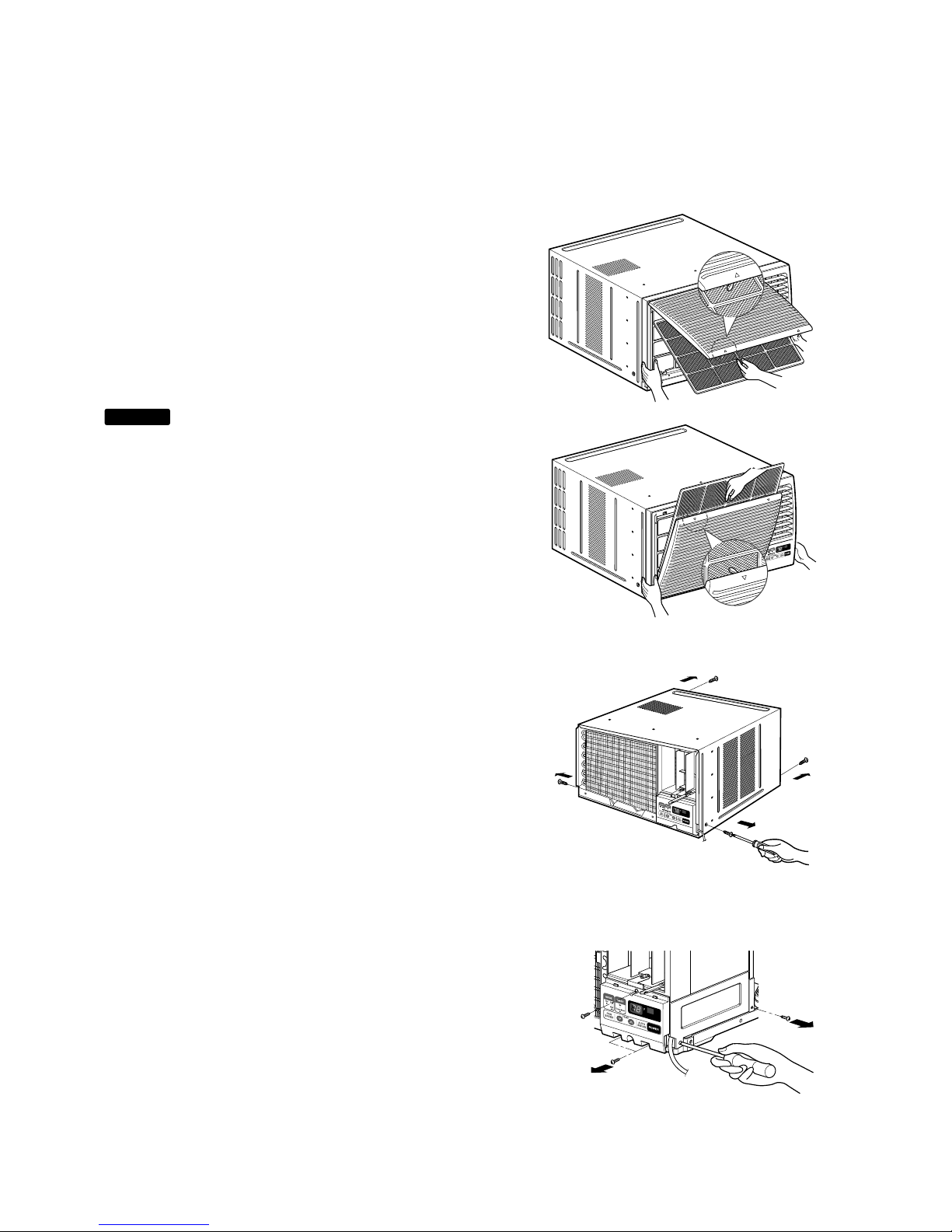
1. Open the inlet grille upward or downward.
2. Remove the screw which fastens the front grille.
3. Pull the front grille from the right side.
4. Remove the front grille. (See Fig. 16)
5. Re-install the component by referring to the
removal procedure.
Mark of inlet grille means opening direction.
NOTICE
Figure 16
Figure 17
Figure 18
1. After disassembling the front grille, remove the screws
which fasten the cabinet at both sides. Keep these for
later use.
2. Remove the two screws which fasten the cabinet at
back. (See Fig. 17)
3. Pull the base pan forward.
1. Remove the front grille. (Refer to section 1)
2. Pull the base pan forward so that you can remove the
2 screws which fasten the cover control at the right
side. (See Fig. 18)
3. Remove the 3 screws which fasten the controlbox.
(See Fig. 18)
4. Discharge the capacitor by placing a 20,000 ohm
resistor across the capacitor terminals.
5. Disconnect two wire housings in the control box.
6. Pull the control box forward completely.
7. Re-install the components by referring to the removal
procedure. (See Fig. 18)
(Refer to the wiring diagram found on page 29~30 in this
manual and on the control box.)
— Before the following disassembly, POWER SWITCH is set to OFF and disconnected the power cord.
2. DISASSEMBLY INSTRUCTIONS
2.1.1
FRONT GRILLE
2.1.2 CABINET
2.1.3 CONTROL BOX
2.1 MECHANICAL PARTS
—5—
Page 6

Air handling parts
2.2.1 Cover (at the top)
1. Remove the front grille. (Refer to section 1)
2. Remove the cabinet. (Refer to section 2)
3. Remove 11 screws which fasten the brace and covers.
4. Remove the covers and the brace. (See Fig. 19)
5. Re-install the components by referring to the removal
procedure, above.
Figure 19
2.2 AIR HANDLING PARTS
—6—
2.2.2. AIR GUIDE AND BLOWER
1. Remove the front grille.
2. Remove the cabinet.
3. Remove the control box.
4. Remove the 3 screws which fasten the brace.
5. Remove the brace.
6. Remove the 2 screws which fasten the evaporator.
7. Move the evaporator forward and pulling it upward
slightly. (See Figure 20)
8. Move the evaporator to the left carefully.
9. Pull out the hook of orifice by pushing the tabs and
remove it. (See Figure 21)
10. Remove the clamp with a hand plier which
secures the blower.
11. Remove the blower.
12. Remove the 4 screws which fasten the air guide
from the barrier.
13. Move the air guide backward, pulling out from the
base pan.
14. Re-install the components by referring to the
removal procedure, above.
Figure 20
Figure 21
Figure 22
Page 7
2.2.3 Fan
1. Remove the cabinet. (Refer to section 2)
2. Remove the brace and shroud cover.
(Refer to section 4)
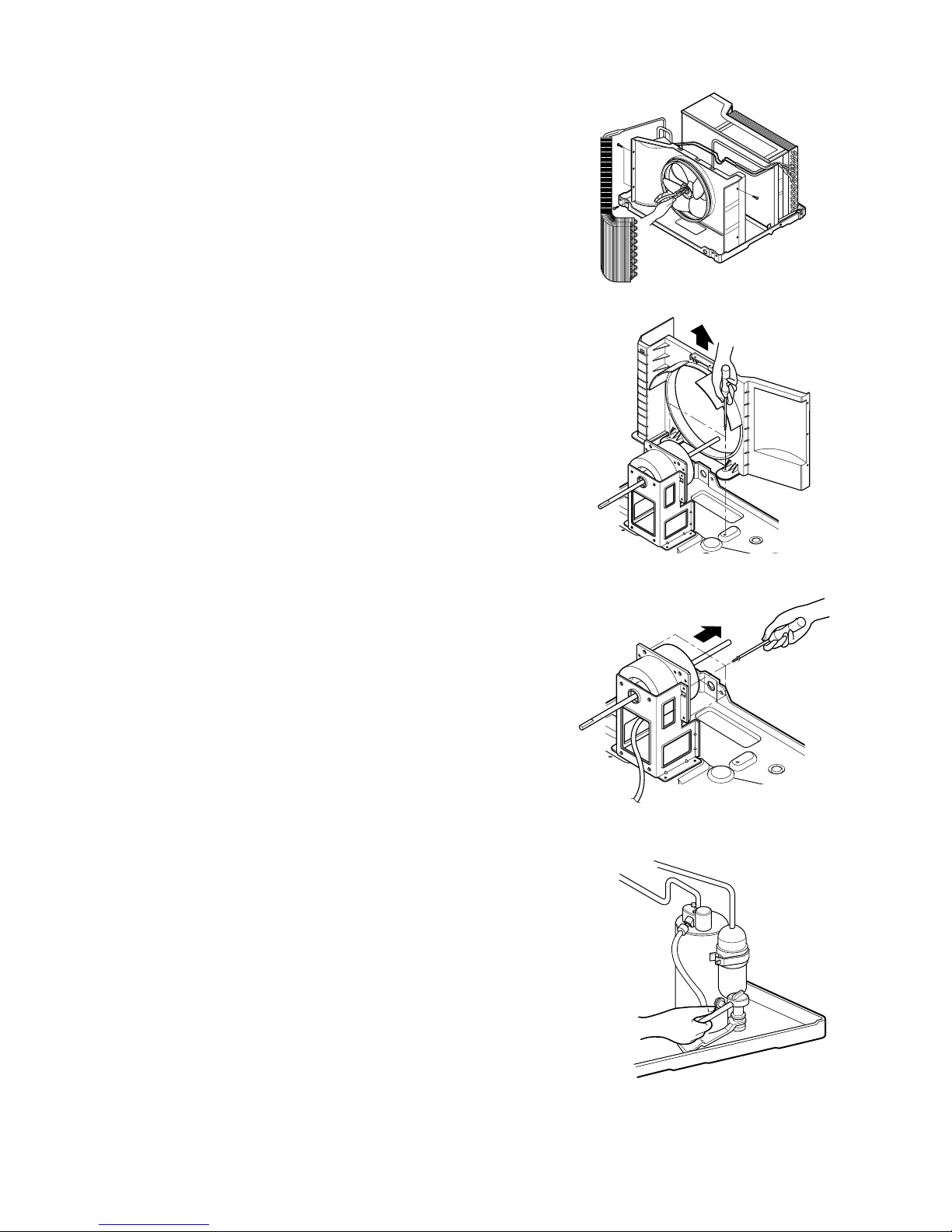
3. Remove the side cover with 2 screws.(See Fig. 23)
4. Remove the 5 or 6 screws which fasten the condenser.
5. Move the condenser sideways carefully.
6. Remove the clamp which secures the fan.
7. Remove the fan. (See Fig. 23)
8. Re-install the components by referring to the removal
procedure, above.
2.2.4 Shroud
1. Remove the fan. (Refer to section 6)
2. Remove the 2 screws which fasten the shroud.
3. Remove the shroud. (See Fig. 24)
4. Re-install the component by referring to the removal
procedure, above.
2.3.1 Motor
1. Remove the cabinet. (Refer to section 2)
2. Remove the cover control and disconnect a wire housing in control box. (Refer to section 3)
3. Remove the blower. (Refer to section 5)
4. Remove the fan. (Refer to section 6)
5. Remove the 4 screws which fasten the motor. (See Fig.
25)
6. Remove the motor.
7. Re-install the components by referring to the removal
procedure, above.
2.3.2 Compressor
1. Remove the cabinet. (Refer to section 2)
2. Discharge the refrigerant system using FreonTM
Recovery System.
If there is no valve to attach the recovery system,
install one (such as a watco a-1) before venting the
Freon
TM
. Leave the valve in place after servicing the
system.
3. Disconnect the 3 leads from the compressor.
4. After purging the unit completely, unbraze the suction
and discharge tubes at the compressor connections.
5. Remove the 3 nuts and the 3 washers which fasten the
compressor. (See Fig. 26)
6. Remove the compressor.
7. Re-instill the components by referring to the removal
procedure, above.
Figure 23
Figure 24
Figure 25
Figure 26
2.3 ELECTRICAL PARTS
—7—
Page 8
2.3.3 CAPACITOR
1. Remove the control box. (Refer to section 3)
2. Remove the screw and knobs which fasten the display
panel.
3. Disconnect the 2 leads from the rocker switch and
remove the panel.
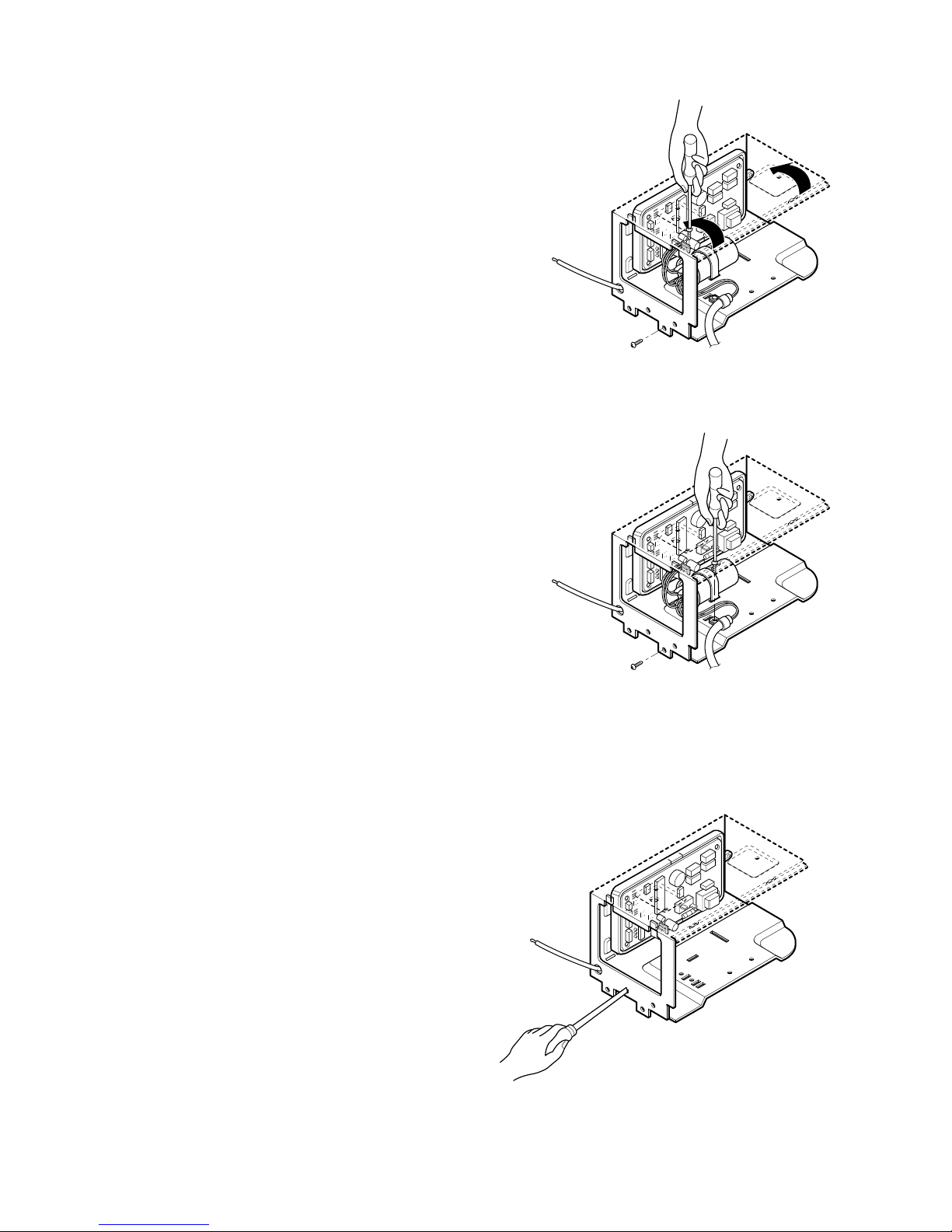
4. Remove a screw and unfold the control box.
(See Fig. 27)
5. Remove the screw and the clamp which fastens the
capacitor. (See Fig. 27)
6. Disconnect all the leads of capacitor terminals.
7. Re-install the components by referring to the removal
procedure, above.
2.3.4 POWER CORD
1. Remove the control box. (Refer to section 3)
2. Unfold the control box. (Refer to section 10)
3. Disconnect the grounding screw from the control box.
4. Disconnect 2 receptacles.
5. Remove a screw which fastens the clip cord.
6. Pull the power cord. (See Fig. 28)
7. Re-install the component by referring to the removal
procedure, above.
(Use only one ground-marked hole for ground connection.)
8. If the supply cord of this appliance is damaged, it must
be replaced by the special cord.
(The special cord means the cord which has the
same specification marked on the supply cord fitted
to the unit.)
2.3.5 THERMISTOR
1. Remove the control box. (Refer to section 3)
2. Unfold the control box. (Refer to section 10)
3. Disconnect the thermistor terminals from main P.W.B
assembly.
4. Remove the thermistor.
5. Re-install the components by referring to the removal
procedure above. (See Figure 30)
—8—
Figure 28
Figure 27
Figure 29
Page 9

2.3.6 SYNCHRONOUS MOTOR
1. Remove the control box. (Refer to section 3)
2. Unfold the control box. (Refer to section 10)
3. Remove the crankshaft.
4. Disconnect all the leads of the synchronous motor.
5. Remove the 2 screws which fasten the synchronous
motor. (See Fig. 30)
6. Re-install the components by referring to the removal
procedure, above.
—9—
Figure 30
Page 10

—10—
CAUTION: Discharge the refrigerant system using FreonTMRecovery System.If
there is no valve to attach the recovery system, install one (such as a WATCO A-1)
before venting the Freon
TM
. Leave the valve in place after servicing the system.
2.4.1 CONDENSER
1. Remove the cabinet. (Refer to section 2)
2. Remove the brace and the shroud cover.
(Refer to section 4)
3.
Remove 2 screws which fasten the side cover.(See Fig.
31)
4. Remove the 5 or 6 screws which fasten the condenser.
5. After discharging the refrigerant completely, unbraze
the interconnecting tube at the condenser connections.
6. Remove the condenser.
7. Re-install the components by referring to notes.
(See Fig. 31)
2.4.2 EVAPORATOR
1. Remove the cabinet. (Refer to section 2)
2. Remove the top cover and the brace.
(Refer to section 4)
3. Discharge the refrigerant completely.
4. Remove the 3 screws which fasten the evaporator at
the left side and the top side.
5. Move the evaporator sideward carefully and then
unbraze the interconnecting tube at the evaporator
connectors.
6. Remove the evaporator.
7. Re-install the components by referring to notes.
(See Fig. 32)
2.4.3 CAPILLARY TUBE
1. Remove the cabinet. (Refer to section 2)
2. Remove the brace. (Refer to section 4)
3. After discharging the refrigerant completely, unbraze
the interconnecting tube at the capillary tube.
4. Remove the capillary tube.
5. Re-install the components by referring to notes.
Figure 31
Figure 32
2.4 REFRIGERATION CYCLE
Page 11

- Replacement of the refrigeration cycle.
1. When replacing the refrigeration cycle, be sure to
discharge the refrigerant system using a Freon
TM
recovery System.
If there is no valve to attach the recovery system,
install one (such as a WATCO A-1) before venting
the FreonTM. Leave the valve in place after
servicing the system.
2. After discharging the unit completely, remove the
desired component, and unbrace the pinch-off tubes.
3. Solder service valves into the pinch-off tube ports,
leaving the valves open.
4. Solder the pinch-off tubes with Service valves.
5. Evacuate as follows.
1) Connect the vacuum pump, as illustrated Fig. 35A.
2) Start the vacuum pump, slowly open manifold
valves A and B with two full turns counterclockwise and leave the valves closed.
The vacuum pump is now pulling through valves A
and B up to valve C by means of themanifold
and entire system.
3) Operate the vacuum pump for 20 to 30 minutes,
until 600 microns of vacuum is obtained. Close
valves A and B, and observe vacuum gauge for
a few minutes. A rise in pressure would indicate a
possible leak or moisture remaining in the system. With valves A and B closed, stop the vacuum pump.
4) Remove the hose from the vacuum pump and
place it on the charging cylinder. See Fig. 35B.
Open valve C.
Discharge the line at the manifold connection.
5) The system is now ready for final charging.
6. Recharge as follows :
1) Refrigeration cycle systems are charged from the
High-side. If the total charge cannot be put in the
High-side, the balance will be put in the suction
line through the access valve which you installed
as the system was opened.
2) Connect the charging cylinder as shown in Fig.
35B.
With valve C open, discharge the hose at the
manifold connection.
3) Open valve A and allow the proper charge to
enter the system. Valve B is still closed.
4) If more charge is required, the high-side will not
take it. Close valve A.
5) With the unit running, open valve B and add the
balance of the charge.
a. Do not add the liquid refrigerant to the Low-
side.
b. Watch the Low-side gauge; allow pressure to
rise to 30 lbs.
c. Turn off valve B and allow pressure to drop.
d. Repeat steps B and C until the balance of the
charge is in the system.
6) When satisfied the unit is operating correctly, use
the pinch-off tool with the unit still running and
clamp on to the pinch-off tube. Using a tube cutter, cut the pinch-off tube about 2 inches from the
pinch-off tool. Use sil-fos solder and solder pinchoff tube closed. Turn off the unit, allow it to set for
a while, and then test the leakage of the pinch-off
connection.
—11—
NOTICE
CAUTION: If high vacuum equipment is used, just crack valves A
and B for a few minutes, then
open slowly with the two full turns counterclockwise. This will keep oil from
foaming and being drawn into the vacuum pump.
Page 12

Equipment needed: Vacuum pump, Charging cylinder, Manifold gauge, Brazing equipment. Pin-off tool capable
of making a leak-proof seal, Leak detector, Tubing cutter, Hand Tools to remove components, Service valve.
A
COMPOUND GAUGE
EVAPORATOR
(LOW PRESSURE SIDE)
COMPRESSOR
CAPILLARY TUBE
CONDENSER
(HIGH PRESSURE SIDE)
SEE INSETS
BELOW
MANIFOLD
GAUGE
B
Figure 31A-Pulling Vacuum
Figure 31B-Charging
A
B
EXTERNAL
VACUUM PUMP
A
CHARGING
CYLINDER
LOW
HI
B
C
—12—
Page 13

3. SCHEMATIC DIAGRAM
3.1 CIRCUIT DIAGRAM
—13—
(SMPS)
250V/T3.15A
PN:MEZ65238803
BR
CN-N3
CN-PRESS
Pressure
Switch
BK
BK
BR
Error No. Error Item Error Content
CH01 Indoor Air Sensor Error
CH09
CH34 High Pressure Error
Fault Codes
As high pressure,comp off over 10 times in 1 hour.
Indoor air sensor open or short
EEPROM reading date error
EEPROM CheckSum Error
Page 14

4. TROUBLESHOOTING GUIDE
4.1 PIPING SYSTEM
—14—
Figure 32 is a brief description of the important components and their function in what is called the refrigeration
system. This will help you to understand the refrigeration cycle and the flow of the refrigerant in the cooling cycle.
MOTOR
COMPRESSOR
OIL
(LIQUID REFRIGERANT)
CAPILLARY TUBE
OUTSIDE COOLING
AIR FOR REFRIGERANT
PASS THROUGH
SUCTION LINE
COOL LOW PRESSURE VAPOR
COOLED
AIR
COMPLETE LIQUID
BOIL OFF POINT
LIQUID
PRESSURE
DROP
ROOM AIR HEAT LOAD
VAPOR INLET
HOT
DISCHARGED
AIR
LIQUID OUTLET
HIGH PRESSURE VAPOR
LIQUID REFRIGERANT
LOW PRESSURE VAPOR
ROOM AIR CONITIONER
EVAPORATOR COILS CONDENSER COILS
CYCLE OF REFRIGERATION
CAPILLARY TUBE
COMPRESSOR
BLOWER
EVAPORATOR COIL
CONDENSER COIL
FAN
MOTOR
Figure 32
Page 15

In general, possible trouble is classified in two causes.
The one is called Starting Failure which is caused from an electrical defect, and the other is Ineffective Air
Conditioning caused by a defect in the refrigeration circuit and improper application.
Unit is running but cooling is ineffective
Ineffective Cooling
Check of outdoor coil
(heat exchanger) & the fan
operation.
Check gas leakage.
Repair gas leak.
Replacement of unit if the
unit is beyond repair.
Satisfactory operation with
temperature difference of
inlet & outlet air ; 44.6~50
F
Check heat load increase.
Unexpected residue
Overloaded Circuit
Check of inside gas
pressure.
Adjusting of refrigerant
charge
Malfunction of compressor
Replacement of
compressor
Check of cold air circulation
for smooth flow.
Dirty indoor coil
(Heat exchanger)
Malfunction of fan
Clogged of air filter
Obstruction at air outlet
Correct above trouble
Stop of auto air-swing
Check clogging in
refrigeration circuit.
Repair clogging in
refrigeration circuit.
4.2 TROUBLESHOOTING GUIDE
—15—
Page 16

Fails to Start
Check of circuit breaker
and fuse.
Gas leakage of feeler bulb
of thermostat
Check of control switch.
Only fan fails to start.
Improper wiring.
Defect of fan motor
capacitor.
Irregular motor resistance
( ).
Irregular motor insulation
( ).
Replacement of fan motor
Regular but fails to start
Replacement of compressor
(locking of rotor, metal)
Improper thermostat setting
Loose terminal connection.
Improper wiring
Irregular motor resistance ( )
Irregular motor insulation ( )
Replacement of compressor
(Motor damaged)
Drop of power voltage.
Check capacitor.
Replacement.
Only compressor fails to
start.
Defect of compressor
capacitor.
Check of power source.
Check of control switch
setting.
—16—
Page 17

COMPLAINT CAUSE REMEDY
Check voltage at outlet. Correct if none.
Check voltage to rotary switch. If none, check
power supply cord. Replace cord if circuit is open.
Check switch continuity. Refer to wiring diagram
for terminal identification. Replace switch if
defective.
Connect wire. Refer to wiring diagram for terminal
identification. Repair or replace loose terminal.
Test capacitor.
Replace if not within ±10% of manufacturer's
rating. Replace if shorted, open, or damaged.
Fan blade hitting shroud or blower wheel hitting
scroll. Realign assembly.
Units using slinger ring condenser fans must
have
1
/4to5/16inch clearance to the base. If it is
hitting the base, shim up the bottom of the fan
motor with mounting screw(s).
Check fan motor bearings; if motor shaft will not
rotate, replace the motor.
Check voltage. See limits on this page. If not within
limits, call an electrician.
Test capacitor.
Check bearings. Does the fan blade rotate freely?
If not, replace fan motor.
Pay attention to any change from high speed to
low speed. If the speed does not change, replace
the motor.
Check grommets; if worn or missing, replace them.
If cracked, out of balance, or partially missing,
replace it.
If cracked, out of balance, or partially missing,
replace it.
Tighten it.
If knocking sounds continue when running or
loose, replace the motor. If the motor hums or
noise appears to be internal while running,
replace motor.
No power
Power supply cord
Rotary switch
Wire disconnected or
connection loose
Capacitor (Discharge
capacitor before testing.)
Will not rotate
Revolves on overload.
Grommets
Fan
Turbo fan
Loose set screw
Worn bearings
Fan motor will not run.
Fan motor runs
intermittently
Fan motor noise.
—17—
Page 18

NAME PLATE RATING MINIMUM MAXIMUM
115V 103.5V 126.5V
208/230V 187V 253V
COMPLAINT CAUSE REMEDY
Check voltage. See the limits on the preceding.
page. If not within limits, call an electrician.
Check the wire connections, if loose, repair or
replace the terminal. If wires are off, refer to wiring
diagram for identification, and replace. Check wire
locations. If not per wiring diagram, correct.
Check for continuity, refer to the wiring diagram
for terminal identification. Replace the switch if
circuit is open.
Check the position of knob If not at the coldest
setting, advance the knob to this setting and
restart unit.
Check continuity of the thermostat. Replace
thermostat if circuit is open.
Check the capacitor.
Replace if not within ±10% of manufacturers
rating. Replace if shorted, open, or damaged.
Check the compressor for open circuit or
ground. If open or grounded, replace the compressor.
Check the compressor overload, if externally
mounted. Replace if open. (If the compressor
temperature is high, remove the overload, cool it,
and retest.)
Voltage
Wiring
Rotary
Thermostat
Capacitor (Discharge
capacitor before
servicing.)
Compressor
Overload
Compressor will not run,
but fan motor runs.
ROOM AIR CONDITIONER VOLTAGE LIMITS
—18—
Page 19

COMPLAINT CAUSE
REMEDY
Check the voltage. See the limits on the preceding page. If not within limits, call an electrician.
Check overload, if externally mounted.
Replace if open. (If the compressor temperature
is high, remove the overload, cool, and retest.)
If not running, determine the cause. Replace if
required.
Remove the cabinet. inspect the interior surface
of the condenser; if restricted, clean carefully
with a vacuum cleaner (do not damage fins) or
brush. Clean the interior base before
reassembling.
If condenser fins are closed over a large area
on the coil surface, head pressures will increase,
causing the compressor to cycle. Straighten the
fins or replace the coil.
Test capacitor.
Check the terminals. If loose, repair or replace.
Check the system for a restriction.
If restricted, clean of replace.
Close if open.
Determine if the unit is properly sized for the area to
be cooled.
Check the set screw or clamp. If loose or missing,
correct. If the blower or fan is hitting air guide,
rearrange the air handling parts.
Remove the cabinet and carefully rearrange tubing
not to contact cabinet, compressor, shroud, and barrier.
Voltage
Overload
Fan motor
Condenser air flow
restriction
Condenser fins
(damaged)
Capacitor
Wiring
Refrigerating system
Air filter
Exhaust damper door
Unit undersized
Blower or fan
Copper tubing
Compressor cycles
on overload.
Insufficient cooling or heating
Excessive noise.
—19—
Page 20

152312
135303
268711-1
137215
238310
268711-2
147581
135312
554030
148000
352390
349600
346811
130410
354210
147582
349001
359012
749740
W48602
W48602
559011
149980
352113
35211A
552113-2
567480
146812
264110
W0CZZ
249950
135500
130910
731273
352115
135301
738900
—20—
5. EXPLODED VIEW
135200
422100
552113-1
550140
554160
567502
749750
267110
CP15G30A
Page 21

CP15G33A
CP18G33A
CP24G33A
130410 BASE PAN 67304014 1
130410 BASE PAN 67305568 1
352390 GUIDE ASSEMBLY AIR 67303510 1 1 1
349001 DAMPER VENT 67303509 1 1 1
349600 MOTOR BRACKET 67303609 1 1 1
147582 LOOVER VERTICAL 67306266 1 1
149980 SCHROUD 67303118 1 1 1
346811 MOTOR, AC 37303041 1
346811 MOTOR, AC 67303043 1
346811 MOTOR, AC 67303042 1
559011 FAN ASSEMBLY CONDENSOR 67302619 1 1 1
359012 TURBO FAN EVAP. 67302618 1 1 1
W48602 CLAMP SPRING 67302501 1 1 1
148000 SUPPORTER 67303912 1 1
148000 SUPPORTER 67303911 1
554160 COMPRESSOR 67305020 1
554160 COMPRESSOR 67305021 1
554160 COMPRESSOR 67305019 1
135500 COVER ASSY. TOP 67302750 1
567502 OVERLOAD 67301915 1
354210 EVAPORATOR 67302444 1 1
354210 EVAPORATOR 67302445 1
352113 TUBE ASSEMBLY, SUCTION 67302257 1
352113 TUBE ASSEMBLY, SUCTION 67302258 1
352113 TUBE ASSEMBLY, EVAPORATOR 67302443 1
352213 TUBE ASSEMBLY EVAPORATOR 67302253 1
352115 TUBE ASSEMBLY EVAPORATOR 67302447 1
554030 CONDENSOR ASSEMBLY 67302438 1 1
554030 CONDENSOR ASSEMBLY 67302439 1
352111 TUBE ASSEMBLY, CONDENSOR 67302260 1
352111 TUBE ASSEMBLY, CONDENSOR 67302141 1
35211A TUBE ASSEMBLY, DISCHARGE 67302256 1
35211A TUBE ASSEMBLY, DISCHARGE 67302259 1
35211A TUBE ASSEMBLY, DISCHARGE 67302254 1 1
552113 TUBE ASSEMBLY CONNECTOR 67302253 1
566000 PRESSUR SWITCH 67307669 1
249950 CASE ASSEMBLY CONTROL 67305578 1
249950 CASE ASSEMBLY CONTROL 67302751 1
249950 CASE ASSEMBLY CONTROL 67305576 1
352115 TUBE ASSEMBLY SUCTION 67302446 1
552113-1 TUBE ASSEMBLY CONDENSOR 67302141 1
552113-2 TUBE ASSEMPLY, CONNECTOR 67302253 1
NOTES
REF
DESCRIPTION
PART NO#
MODELS
Page 22

Page 23

152312
135303
268711-1
137215
238310
268711-2
147581
135312
554030
148000
352390
349600
346811
130410
354210
147582
349001
359012
749740
W48602
W48602
559011
149980
554160
567480
146812
264110
W0CZZ
249950
135500
130910
731273
135301
738900
—22—
5. EXPLODED VIEW
CP18G30A
135200
422100
352113
35211A
552113
352115
352111
749750
267110
Page 24

152312
135303
268711-1
137215
238310
268711-2
147581
135312
554030
148000
352390
349600
346811
130410
354210
147582
349001
359012
749740
W48602
W48602
559011
149980
554160
567480
146812
264110
W0CZZ
249950
135500
130910
731273
135301
738900
—
23—
135200
422100
352113
35211A
352111
352115
566000
749750
CP24G30A
267110
Page 25

CP15/CP18/CP24 (06/14) 93011403_02
 Loading...