

Ford 2013 FUSION HYBRID, 2013 MKZ HYBRID, 2013 FUSION ENERGI, FUSION HYBRID, MKZ HYBRID Emergency Response Manual
...Page 1
2013
FUSION HYBRID
MKZ HYBRID
FUSION ENERGI
EMERGENCY RESPONSE GUIDE
FCS-15129-13 SEP T E M B E R / 2 0 1 2
Page 2

Table of Contents
FOREWORD ..................................................................................................Page 1
ELECTRIC VEHICLE IDENTIFICATION .......................................................Page 2
VIN Layout............................................................................................. Page 3
HIGH-VOLTAGE ELECTRICAL DISCONNECT FEATURES .......................Page 4
HIGH-VOLTAGE WARNING DECALS .......................................................... Page 5
COMPONENT LOCATION AND IDENTIFICATION.......................................Pages 6-9
HIGH-VOLTAGE SERVICE DISCONNECTS ................................................ Page 10
HIGH-VOLTAGE BATTERY PACKS ............................................................. Pages 10-11
APPROACHING A DAMAGED HIGH-VOLTAGE VEHICLE ..........................Page 12
Follow Existing Training and Incident Commander Direction ........... Page 12
Approaching a Damaged Vehicle ...................................................... Pages 13-14
If The High-Voltage Battery Case Has Been Ruptured ...................... Page 14
Moving Damaged V ehicles ................................................................. Page 14
Special Note To Salvage Y ards ............................................................ Page 14
High-Voltage System - Do Not Cut Zones .......................................... Page 15
DAMAGED VEHICLE GUIDANCE FOR FORD MOTOR COMPANY
ELECTRIC AND HYBRID-ELECTRIC VEHICLES EQUIPPED WITH
HIGH-VOLTAGE BATTERIES .......................................................................Pages 16-17
FCS-15129-13 2013 Fusion MKZ Hybrid Emergency Response Guide
Page 3

FOREWORD
The emergency response procedures for the Fusion Hybrid, MKZ Hybrid and Fusion
Energi vehicles are similar to those for traditional gasoline-powered vehicles with the
addition of special considerations for the high-voltage electric system components.
The Fusion Hybrid, MKZ Hybrid and Fusion Energi vehicles use a conventional gasoline
engine in addition to an electric motor to power the vehicle.
• Gasoline is stored in a traditional fuel tank.
• Electricity is stored in a high-voltage battery pack.
The combination of a gasoline engine and electric motor provides for improved
performance (V6 performance with a 4-cylinder engine and electric motor), reduced
emissions and improved fuel economy . The Fusion Hybrid and MKZ Hybrid high-voltage
systems are self contained, never needing to be plugged into an electrical outlet for
recharging. The Fusion Energi high-voltage system can be plugged into an electric outlet
for recharging to optimize the vehicle’s extended electrical range. Both vehicle systems
incorporate a generator that charges the high-voltage battery during cruising and braking.
The information in this guide will allow response to emergencies involving the Fusion
Hybrid, MKZ Hybrid and Fusion Energi vehicles to be as safe as non-hybrid vehicles.
The Fusion Hybrid, MKZ Hybrid and Fusion Energi vehicles have been designed with
many safety features for your protection. These features help provide safe access to the
vehicle under various conditions; however, when approaching a high-volt age vehicle in a
fire, rescue or recovery situation, always follow one industry standard rule:
ALWAYS ASSUME THE VEHICLE’S
HIGH-VOLTAGE SYSTEM IS POWERED UP !
1
FCS-15129-13 2013 Fusion MKZ Hybrid Emergency Response Guide
Page 4
TOWING SPECIFICATION AND ILLUSTRATION TABLE
HYBRID VEHICLE IDENTIFICATION
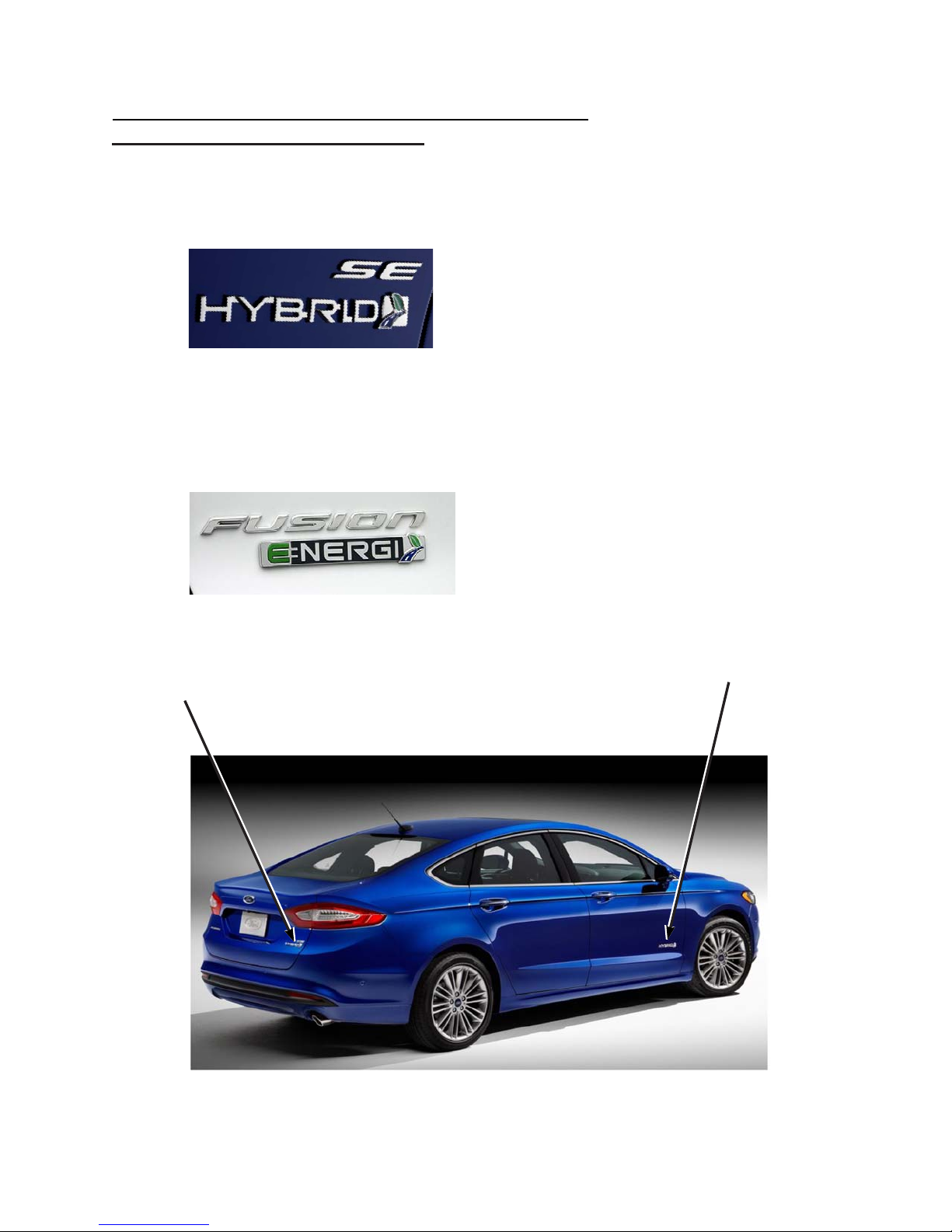
• The Fusion Hybrid and MKZ Hybrid vehicles can easily be identified by the
“Hybrid” badges located on the left and right front doors. There is a “Hybrid”
nameplate on the trunk lid (located on the right hand side) that also includes
the green leaf/blue highway “Hybrid” icon.
NOTE: Fusion Hybrid shown, MKZ Hybrid similar.
• The Fusion Energi vehicles can easily be identified by the “Energi” badges
located on the left and right front doors. There is a “Energi” nameplate on the
trunk lid (located on the left hand side) that also includes the green leaf/blue
highway “Hybrid” icon.
NOTE: Fusion Energi shown.
Hybrid/Energi nameplate and
icon on trunk lid.
Hybrid/Energi nameplate with
Hybrid icon on front doors.
FCS-15129-13 2013 Fusion MKZ Hybrid Emergency Response Guide
2
Page 5
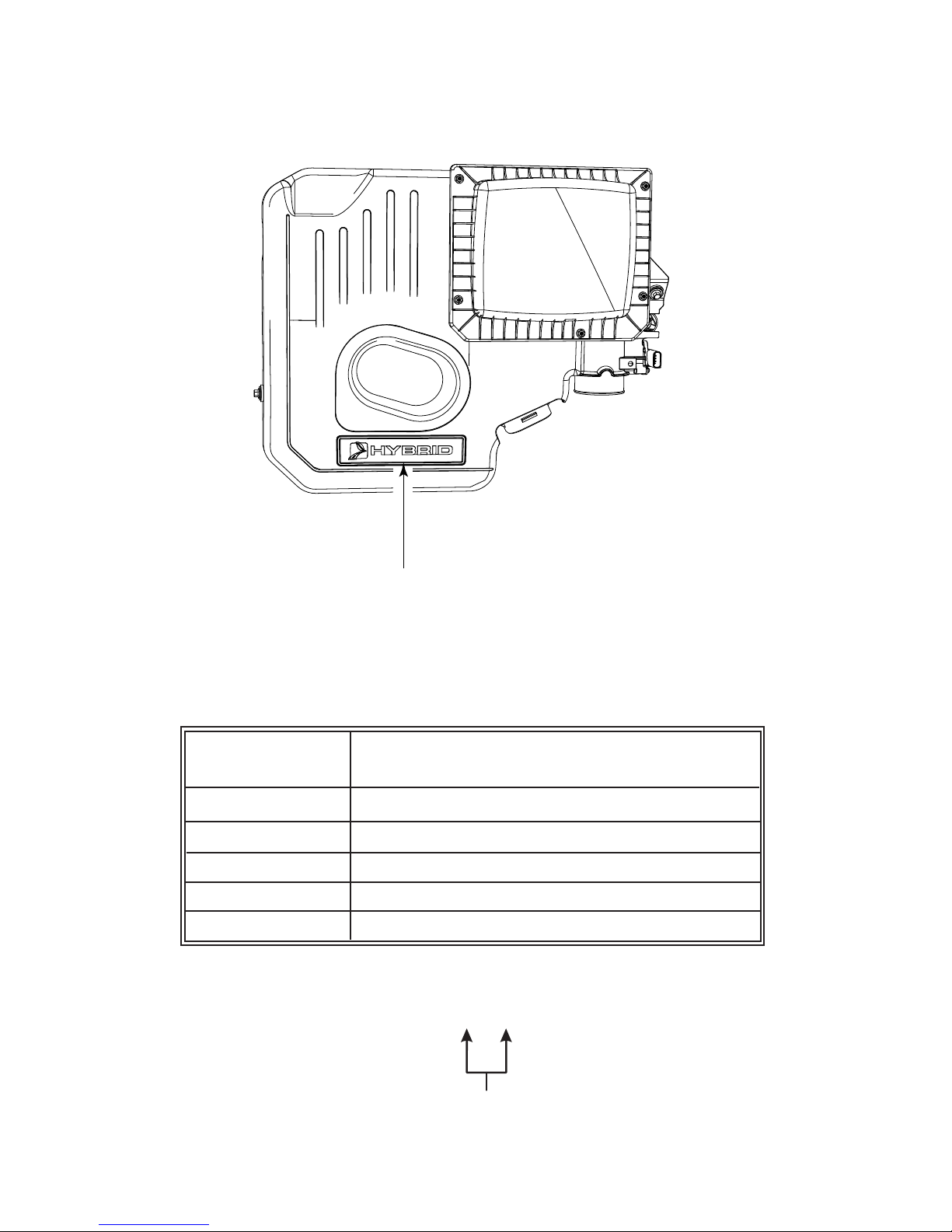
• The Fusion Hybrid and MKZ Hybrid vehicles have a unique engine
appearance cover with a raised “HYBRID” icon on it.
Unique Hybrid engine appearance cover
with raised lettering and icon
NOTE: Fusion/MKX Hybrid shown, Fusion Energi similar.
• The 5th, 6th and 7th digits of the V ehicle Identification Number (VIN)
identify the Hybrid vehicle line.
VIN POSITIONS
VEHICLE
5, 6 and 7
P0L
L2L
P0P
P0R
P0S
Fusion SE Full Hybrid
MKZ Hybrid Full Hybrid
Fusion SE Energi Plug-in Hybrid
Fusion Tit anium Full Hybrid
Fusion Tit anium Energi Plug In Hybrid
SAMPLE VIN
3 F A D P 0 L 3 0 A R 1 0 0 0 0 1
FCS-15129-13 2013 Fusion MKZ Hybrid Emergency Response Guide
Fusion Hybrid FWD
3
Page 6

HIGH-VOLTAGE ELECTRICAL DISCONNECT FEATURES
W ARNING: ELECTRIC VEHICLES DAMAGED BY A CRASH MA Y HA VE COMPROMISED
HIGH-VOL T AGE SAFETY SYSTEMS AND PRESENT A POTENTIAL HIGH-VOL T AGE
ELECTRICAL SHOCK HAZARD. EXERCISE CAUTION AND WEAR APPROPRIA TE
PERSONAL PROTECTIVE EQUIPMENT (PPE) SAFETY GEAR, INCLUDING HIGH-VOL T AGE
SAFETY GLOVES AND BOOTS. REMOVE ALL MET ALLIC JEWELR Y, INCLUDING WA TCHES
AND RINGS. ISOLA TE THE HV SYSTEM AS DIRECTED BY THE FORD EMERGENCY
RESPONSE GUIDE FOR THE VEHICLE. FAILURE TO FOLLOW THESE INSTRUCTIONS MA Y
RESUL T IN SERIOUS PERSONAL INJURY OR DEA TH.
The following list describes certain features that have been incorporated into the Fusion
Hybrid, MKZ Hybrid and Fusion Energi vehicles that allow for either simple or automatic
shut off of the high-voltage electrical systems.
• High-Volt age Fuse — In the event of a high-voltage short circuit, the high voltage fuse will open, disabling the high-voltage system.
• High-Voltage Interlock Circuit — Whenever a high-volt age connector
is disconnected, the high-voltage interlock circuit opens and disables
the high-voltage system.
• Ignition Key/Button in the OFF Position — Any time the ignition is in
the OFF position, the high-voltage system is disabled.
NOTE: If the vehicle is equipped with remote start, high-voltage may be
present in the system if the ignition is off.
NOTE: ENERGI vehicles, when plugged in for charging may have high-
voltage present in the system if the ignition is off.
• High-Volt age Service Disconnect — Whenever the high-voltage
service disconnect (located behind the rear seat back) is removed, the
high-voltage system is disabled. For additional information, refer to
Page 1 1 in this manual.
• Thermal Sensors — In the event the battery is exposed to extreme hot
ambient conditions and/or is being driven extremely aggressively with
compromised cooling, power limits will be employed to prevent overheating.
However, if the battery is in use and does become too hot, cont actors will
be opened and the vehicle will shut down. In some instances, if the ignition key
is left in the “ON” position, this could cause the high-voltage battery
temperature to exceed 60°C (140°F); if this temperature is reached, the
thermal sensors located near the high-voltage battery will automatically
disable the high-voltage battery .
FCS-15129-13 2013 Fusion MKZ Hybrid Emergency Response Guide
4
Page 7
HIGH-VOLTAGE WARNING DECALS
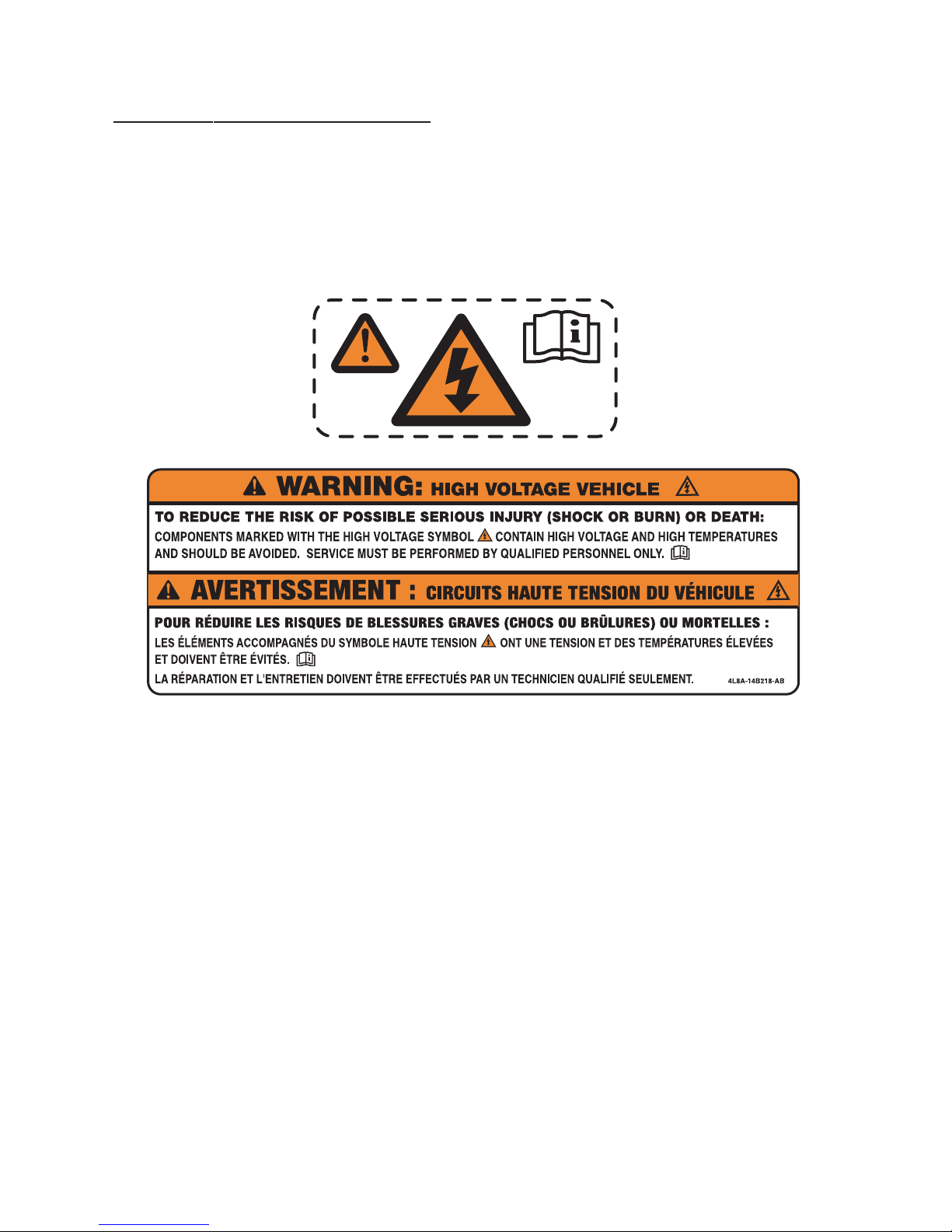
• On Hybrid and Energi vehicles, WARNING decals are located on components
in the high-voltage system throughout the vehicle. Please see example below .
2U5A-14B218-CA
FCS-15129-13 2013 Fusion MKZ Hybrid Emergency Response Guide
5
Page 8
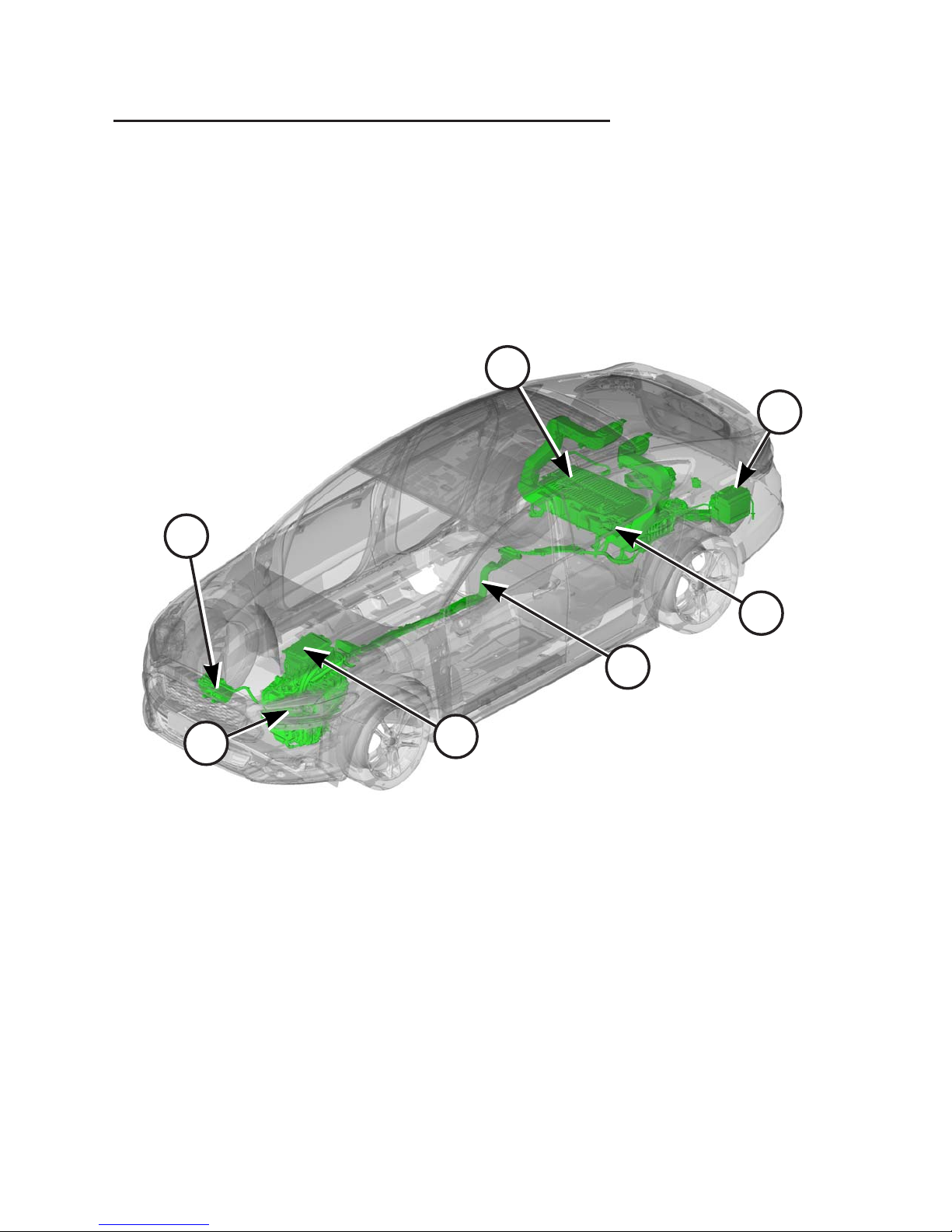
HYBRID COMPONENT LOCATION AND IDENTIFICATION
The illustration below and its defining chart on Page 7, provide the location, description
and basic function of the Hybrid system components.
NOTE: All high-volt age wires and harnesses are wrapped in orange-colored insulation.
NOTE: Fusion Hybrid shown, MKZ Hybrid similar.
1
2
7
6
3
4
5
FCS-15129-13 2013 Fusion MKZ Hybrid Emergency Response Guide
6
Page 9

HYBRID COMPONENT LOCATION AND IDENTIFICATION - CONTINUED
COMPONENT
1 High-Volt age Battery
Approximately 300-
LOCATION / DESCRIPTION
• Lies flat in the trunk area,
located behind the rear seat.
Volts DC
• Sealed lithium battery .
2 12-Volt Battery • Located in the trunk area of
the vehicle.
• T ypical automotive 6-cell
lead/acid design.
3 High-Voltage
Service Disconnect
• Located behind the rear
seatback.
• Orange rectangle with a
molded plastic handle, about
100 mm (4 in) in length.
4 High-V olt age Wiring • Runs along the vehicle’s
floorpan from the high-voltage
battery to the Electronically
Controlled Continuously
V ariable Transaxle (ECVT),
to the DC-to-DC converter
and then to the electric A/C
and heater units.
• All high-voltage wiring has
orange-colored insulation.
FUNCTION
Provides high-voltage storage
for vehicle’s electric motor.
Provides 12-volts for vehicle
accessories.
Provides means to disconnect
high-voltage battery for safely
servicing vehicle.
Provides physical connection
between high-voltage battery
and vehicle’s high-voltage
equipment.
5 Transmission
Control Module
6 Electronically
Controlled
Continuously
V ariable Transaxle
(ECVT)
7 Electric A/C
Compressor
• Located above the
transmission.
• Contains controlling
electronics for managing
propulsion.
• Transverse-mounted design,
similar to the non-Hybrid
Fusion MKZ vehicles.
• Located in front of the
engine.
• It has an orange high-voltage
wire attached to it using an
interlock connector.
Provides rotational force during
Electrical Drive Modes. Generates 3-phase AC high-volt age
electricity via two cables to and
from the traction motor and
generator.
Provides rotational force to the
wheels for vehicle propulsion and
transmits rotational force to the
engine’s generator to recharge
batteries.
Provides electric A/C operation;
replaces the belt driven A/C
compressor.
FCS-15129-13 2013 Fusion MKZ Hybrid Emergency Response Guide
7
Page 10
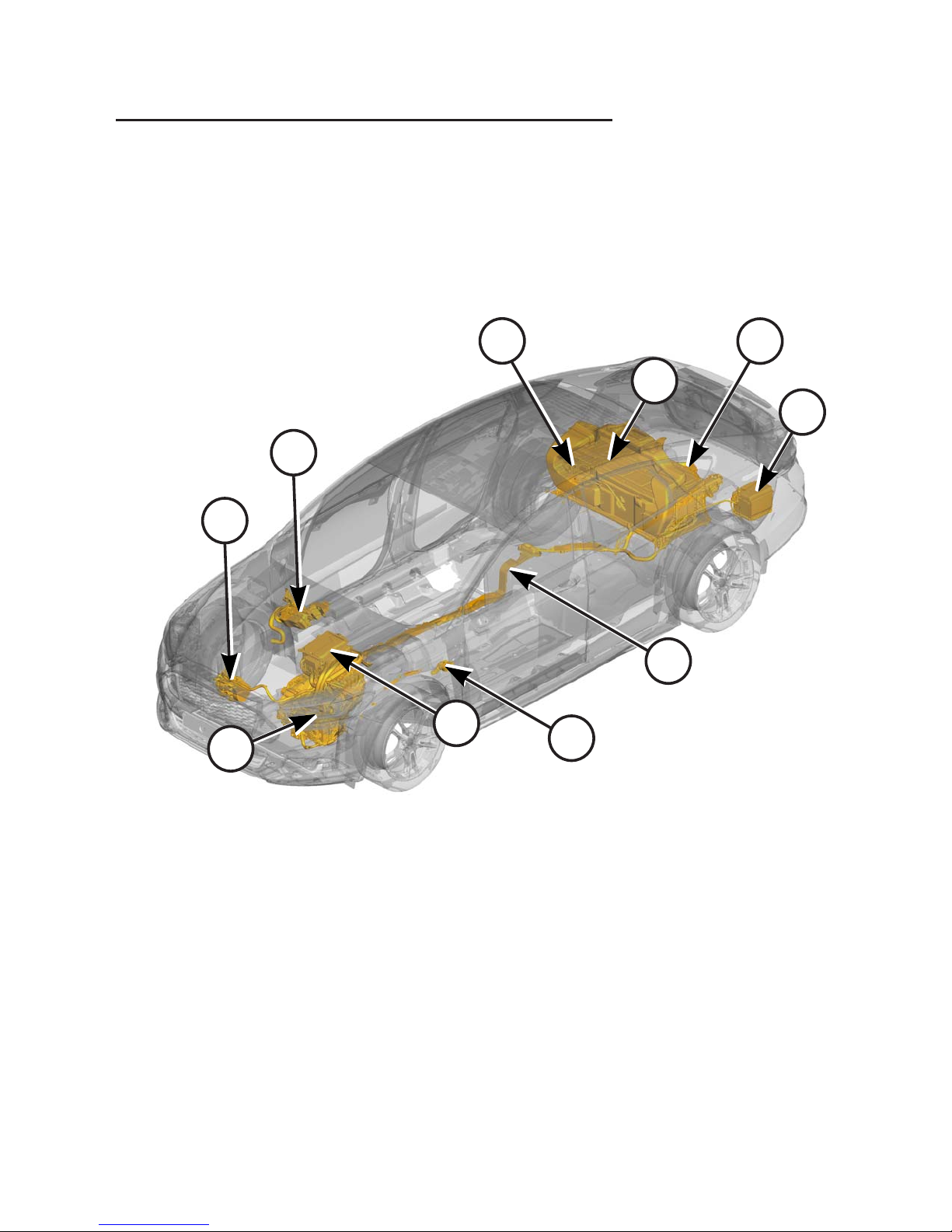
ENERGI COMPONENT LOCATION AND IDENTIFICATION
The illustration below and its defining chart on Pages 9 & 10, provide the location,
description and basic function of the Fusion Energi’s system components.
NOTE: All high-volt age wires and harnesses are wrapped in orange-colored insulation.
9
8
10
7
1
3
2
4
5
6
FCS-15129-13 2013 Fusion MKZ Hybrid Emergency Response Guide
8
Page 11

ENERGI COMPONENT LOCATION AND IDENTIFICATION - CONTINUED
COMPONENT
1 High-Voltage
Service Disconnect
2 High-Volt age Battery
Approximately 300
Volts DC
3 1 10-V olt Cordset
4 12-Volt Battery
5 High-Volt age Wiring
6 Charging Port
7 Transmission
Control Module
LOCATION / DESCRIPTION
• Located behind the rear
seat back.
• Orange rectangle with a
molded plastic handle, about
100 mm (4 in) in length.
• Lies flat in the trunk area,
located behind the rear seat.
• Sealed lithium battery.
• Located in the trunk area of
the vehicle.
• Located in the trunk area of
the vehicle.
• Typical automotive 6-cell
lead/acid design.
• Runs along the vehicle’s
floorpan from the high-voltage
battery to the Electronically
Controlled Continuously
V ariable Transaxle (ECVT),
to the DC-to-DC converter
and then to the electric A/C
and heater units.
• All high-voltage wiring has
orange-colored insulation.
• Located on the driver side
fender.
• Located above the
transmission.
• Contains controlling
electronics for managing
propulsion.
FUNCTION
Provides means to disconnect
high-voltage battery for safely
servicing vehicle.
Provides high-voltage storage
for vehicle’s electric motor.
Provides 1 10v charging option to
the high-voltage battery when
connected to the charging port .
Provides 12-volts for vehicle
accessories.
Provides physical connection
between High-Volt age battery
and vehicle’s High-V oltage
equipment.
Provides 1 10v charging option to
the high-voltage battery when the
vehicle is not in operation .
Provides rotational force during
Electrical Drive Modes. Generates 3-phase AC High V olt age
electricity via two cables to and
from the traction motor and
generator.
8 Electronically
Controlled
• Transverse-mounted design,
similar to the non-Hybrid
Continuously
V ariable Transaxle
(ECVT)
9 Electric A/C
• Located in front of the
Compressor
• It has an orange high voltage
10 Electric Heater
FCS-15129-13 2013 Fusion MKZ Hybrid Emergency Response Guide
• Located in the engine
Fusion MKZ vehicles.
engine.
wire attached to it using an
interlock connector.
compartment on the
passenger side.
9
Provides rotational force to the
wheels for vehicle propulsion and
transmits rotational force to the
engine’s generator to recharge
batteries.
Provides electric A/C operation;
replaces the belt driven A/C
compressor.
Provides passenger compartment with heat without the need
to turn the engine on.
Page 12
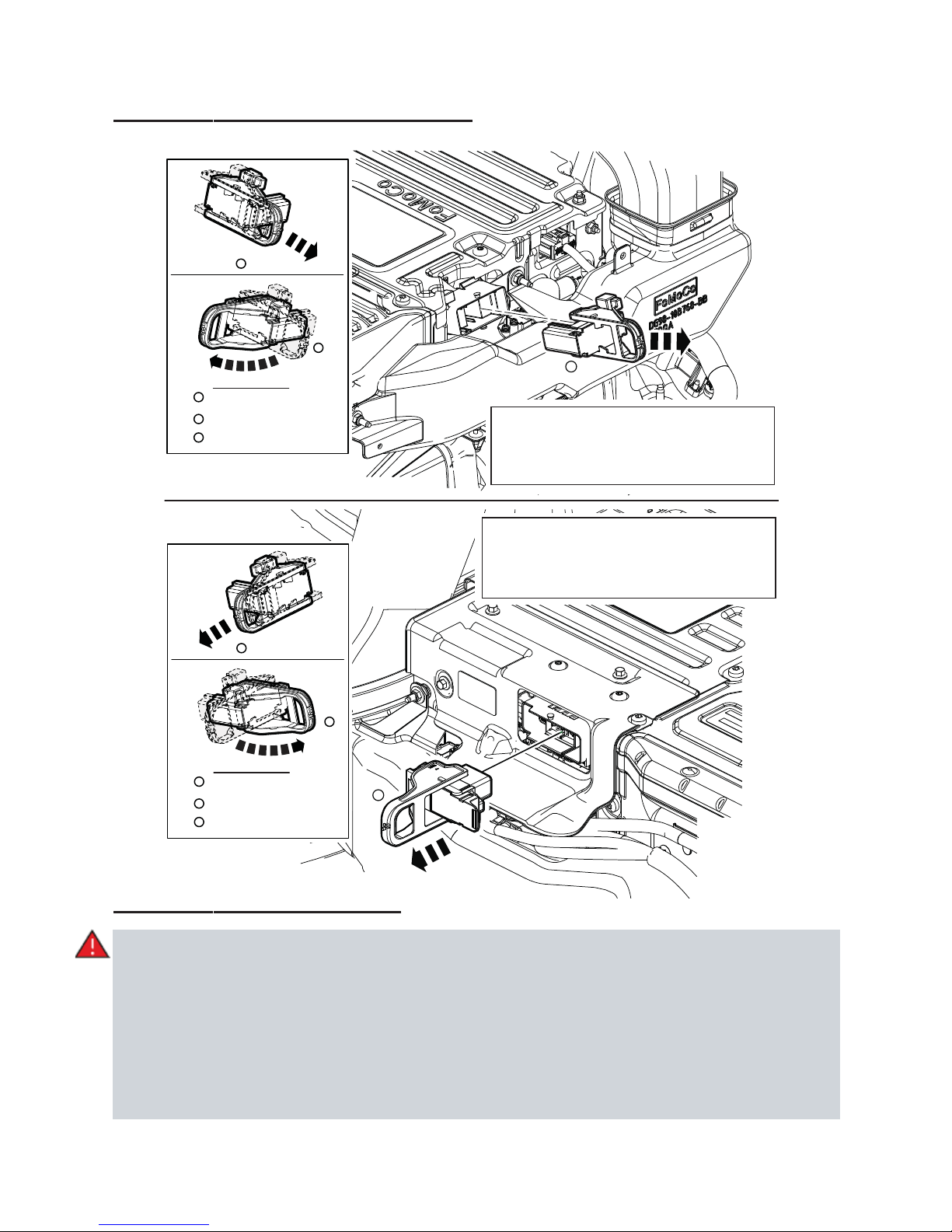
HIGH-VOLTAGE SERVICE DISCONNECT
NOTE: If possible, release and remove the high-voltage service disconnect.
1
2
3
REMOVAL INSTRUCTIONS
1
PULL LEVER HANDLE OUTWARD TO
DISENGAGE INTERLOCK.
2
ROTATE THE LEVER TO HORIZONTAL.
3
REMOVE THE HIGH-VOLTAGE SERVICE
DISCONNECT.
NOTE:
The Hybrid high-voltage service
disconnect is located behind the rear seat
back on the driver side. Fold the rear seat
back down and remove the cover to access.
NOTE:
The Energi high-voltage service
disconnect is located behind the rear seat
back on the passenger side. Fold the rear seat
back down and remove the cover to access.
1
2
2
REMOVAL INSTRUCTIONS
1
PULL LEVER HANDLE OUTWARD TO
DISENGAGE INTERLOCK.
2
ROTATE THE LEVER TO HORIZONTAL.
3
REMOVE THE HIGH-VOLTAGE SERVICE
DISCONNECT.
3
HIGH-VOLTAGE BATTERY PACK
W ARNING: ELECTRIC VEHICLES DAMAGED BY A CRASH MA Y HA VE COMPROMISED
HIGH-VOL T AGE SAFETY SYSTEMS AND PRESENT A POTENTIAL HIGH-VOL T AGE
ELECTRICAL SHOCK HAZARD. EXERCISE CAUTION AND WEAR APPROPRIA TE PERSONAL
PROTECTIVE EQUIPMENT (PPE) SAFETY GEAR, INCLUDING HIGH-VOL T AGE SAFETY
GLOVES AND BOOTS. REMOVE ALL MET ALLIC JEWELR Y , INCLUDING W A TCHES AND
RINGS. ISOLATE THE HV SYSTEM AS DIRECTED BY THE FORD EMERGENCY RESPONSE
GUIDE FOR THE VEHICLE. FAILURE TO FOLLOW THESE INSTRUCTIONS MA Y RESUL T IN
SERIOUS PERSONAL INJURY OR DEA TH.
10
FCS-15129-13 2013 Fusion MKZ Hybrid Emergency Response Guide
Page 13

HIGH-VOLTAGE BATTERY PACKS - CONTINUED
WARNING: FIRES IN CRASH-DAMAGED ELECTRIC VEHICLES MAY EMIT TOXIC OR
COMBUSTIBLE GASSES. SMALL AMOUNTS OF EYE, SKIN OR LUNG IRRITANTS MAY BE
PRESENT . WEAR PERSONAL PROTECTIVE EQUIPMENT (PPE) AND SELF-CONT AINED
BREA THING APP ARA TUS WHEN WORKING IN CLOSE PROXIMITY OR IN A CONFINED AREA,
SUCH AS A TUNNEL OR GARAGE. VENTILATE THE VEHICLE INTERIOR BY OPENING
VEHICLE WINDOWS OR DOORS. VENTILA TE THE WORKING AREA. FAILURE T O FOLLOW
THIS INSTRUCTION MA Y RESULT IN SERIOUS PERSONAL INJURY OR DEA TH.
• Do not cut the high-voltage battery case. Do not penetrate the
batteries or case in any way .
• The high-voltage battery is located in the forward portion of the luggage
compartment. The high-voltage battery lies flat just behind the rear seat back
under the luggage compartment cargo cover .
• Removing the high-voltage service disconnect will disconnect the high-voltage
from the vehicle. The battery pack will remain live and dangerous.
• The total voltage of the battery pack is approximately 300-volts DC.
• The battery cells contain a base electrolyte, consisting of lithium
hexafluorophosphate and organic solvents as the dominant active ingredient, that
is absorbed in special polymeric film. The electrolyte will not leak from the battery
under most conditions, however, if the battery is crushed, it is possible for a small
amount of electrolyte to leak.
NOTICE: The following must be followed when working with a damaged battery:
• If possible, isolate and avoid contact with high-voltage vehicle components. If
contact with the high-voltage system cannot be avoided, Personal Protective
Equipment (PPE) such as a splash shield or safety goggles, gloves (latex, rubber
or Nitrile), an apron or overcoat and rubber boots are required when handling
damaged batteries. Exposure to electrolyte could cause skin and/or eye
irritation/burns. If exposed, rinse with large amounts of water for 10-15 minutes.
• If the battery is exposed to intense heat (or other abusive conditions), it is
possible that flammable gases and liquid (electrolyte) have been released from
the cells. The gases include combustible hydrocarbons such as methane,
toxic gases such as carbon monoxide, and very small amounts of eye/skin/lung
irritants such as hydrofluoric acid could be released from the battery .
Appropriate precautions should be t aken to make sure the area is properly
ventilated, such as opening the vehicle’s windows or doors. First responders
should wear Personal Protective Equipment (PPE) and self contained breathing
apparatus to safeguard against thermal, electrical, respiratory and skin/eye
hazards.
FCS-15129-13 2013 Fusion MKZ Hybrid Emergency Response Guide
11
Page 14

APPROACHING A DAMAGED HIGH-VOLTAGE VEHICLE
W ARNING: ELECTRIC VEHICLES DAMAGED BY A CRASH MA Y HA VE COMPROMISED
HIGH-VOL T AGE SAFETY SYSTEMS AND PRESENT A POTENTIAL HIGH-VOL T AGE
ELECTRICAL SHOCK HAZARD. EXERCISE CAUTION AND WEAR APPROPRIA TE
PERSONAL PROTECTIVE EQUIPMENT (PPE) SAFETY GEAR, INCLUDING
HIGH-VOL T AGE SAFETY GLOVES AND BOOTS. REMOVE ALL MET ALLIC JEWELR Y,
INCLUDING WATCHES AND RINGS. ISOLATE THE HV SYSTEM AS DIRECTED BY THE
FORD EMERGENCY RESPONSE GUIDE FOR THE VEHICLE. FAILURE TO FOLLOW THESE
INSTRUCTIONS MA Y RESULT IN SERIOUS PERSONAL INJUR Y OR DEATH.
W ARNING: DAMAGED ELECTRIC VEHICLES SUBMERGED IN WA TER PRESENT A
POTENTIAL HIGH-VOL T AGE ELECTRICAL SHOCK HAZARD. EXERCISE CAUTION AND
WEAR APPROPRIA TE PERSONAL PROTECTIVE EQUIPMENT (PPE) SAFETY GEAR,
INCLUDING HIGH-VOL T AGE SAFETY GLOVES AND BOOTS. REMOVE ALL MET ALLIC
JEWELRY, INCLUDING WA TCHES AND RINGS. DO NOT A TTEMPT TO EXTRACT THE
VEHICLE UNTIL THE HIGH-VOL T AGE BA TTER Y HAS DISCHARGED INDICA TED BY THE
ABSENCE OF BUBBLING OR FIZZING . FAILURE TO FOLLOW THESE INSTRUCTIONS MA Y
RESUL T IN SERIOUS PERSONAL INJURY OR DEA TH.
1. FOLLOW EXISTING TRAINING AND INCIDENT COMMANDER DIRECTION
• Emergency responders should use LARGE amounts of water if fire is present
or suspected and, keeping in mind that fire can occur for a considerable
period after the crash, should proceed accordingly .
• This guide provides only supplemental information as it pertains to the
Fusion Hybrid, MKZ Hybrid and Fusion Energi vehicles. The same rules
apply when approaching any potential high-voltage situation. Always follow
your high-voltage safety training. Some precautions to take in a high-voltage
situation include:
— Remove all jewelry: Watches, necklaces and earrings. Remove any
metal objects that are conductors of electricity .
— Wear the necessary PPEs: High-voltage rubber gloves, face
shield, insulated boots, protective raincoat and apron.
• Bring the following equipment:
— Class ABC powder-type fire extinguisher .
— A nonconductive object, about 1.5 m (5 ft) long. This can be used to safely
push someone away from the vehicle if they accidentally come in contact
with high-voltage.
FCS-15129-13 2013 Fusion MKZ Hybrid Emergency Response Guide
12
Page 15

APPROACHING A DAMAGED HIGH-VOLTAGE VEHICLE - CONTINUED
2. APPROACHING A DAMAGED VEHICLE
• Disable the high-voltage electrical system using as many of the following
steps as possible:
— Secure the vehicle: Place the shift lever into the P ARK position.
Place the ignition in the OFF position to disconnect the high-voltage
system. Block the wheels, if necessary .
— Disconnect the negative cable from the 12-volt battery .
— If possible, remove the high-voltage service disconnect(s). For additional
information, refer to page 10 in this manual. If the service
disconnects cannot be removed, avoid the high-voltage system
components, and wear all appropriate PPE as outlined on page 13 of this
guide.
• If the vehicle is on fire, use a Class ABC powder-type extinguisher to cont ain
and smother the flames. If water is being used, LARGE amounts of water will
be required to extinguish the flames. A fire-hydrant or dedicated fire hose can
supply the needed amount. Water can cause some degree of arcing/shorting
across the cell and/or battery terminals; it can also react with the electrolyte
from the cells to generate additional combustible gas and other by-products
such as hydrofluoric acid; however, the cooling and smothering ef fects of
flushing the affected article with large amounts of water and/or other fire
suppression material is still beneficial for minimizing the severity of the event.
• If the vehicle has any exposed cables, make sure to wear high-voltage
rubber gloves and other appropriate PPE. Do not touch any broken or
damaged high-voltage orange cables. T reat severed cables as if they
contain high-voltage.
• If the vehicle is submerged in water, varying degrees of arcing/shorting within
the battery will take place. Do not touch any high-voltage components or orange
cables while extricating the occupant(s). Do not remove the vehicle until you are
sure the high-voltage battery is completely discharged. A submerged
high-voltage battery may produce a fizzing or bubbling reaction to the water . If
fizzing or bubbling is observed, the high-voltage battery will be discharged
when the fizzing or bubbling has completely stopped, however, still treat
it as if it was not discharged.
13
FCS-15129-13 2013 Fusion MKZ Hybrid Emergency Response Guide
Page 16

APPROACHING A DAMAGED VEHICLE - CONTINUED
3. IF THE HIGH-VOLTAGE BATTERY CASE HAS BEEN RUPTURED
• Just like any other battery , hose the area down with LARGE amounts of water
(ie. use a Fire Hose).
4. MOVING DAMAGED VEHICLES — WRECKER DRIVERS
• Rather than attempt to discharge a propulsion battery , an emergency
responder , tow truck operator , or storage facility manager should contact
experts at the vehicle manufacturer on that subject.
• If possible, remove the high-voltage service disconnect. For additional
information, refer to page 10 in this manual.
• Be alert. There is potential for delayed fire with damaged lithium-ion batteries.
• Call an authorized Ford Dealer or vehicle manufacturer representative, if
necessary , to determine additional steps that you should take to safely recover
or transport the vehicle.
• Follow the guidelines in the Wrecker T owing Manual.
— Front T ow: Wheel Lif t (FWD)
— Rear T ow: Wheel Lif t with Dolly (FWD)
— Flatbed: FWD and A WD
5. SPECIAL NOTE TO SALVAGE YARDS
• If a vehicle with a high-voltage battery is to be scrapped, the high-voltage
battery must be disposed of following all local, state/provincial and federal
guidelines.
• Operators of tow trucks and vehicle storage facilities should ensure the
damaged vehicle is kept in an open area instead of inside a garage or other
enclosed building.
FCS-15129-13 2013 Fusion MKZ Hybrid Emergency Response Guide
14
Page 17
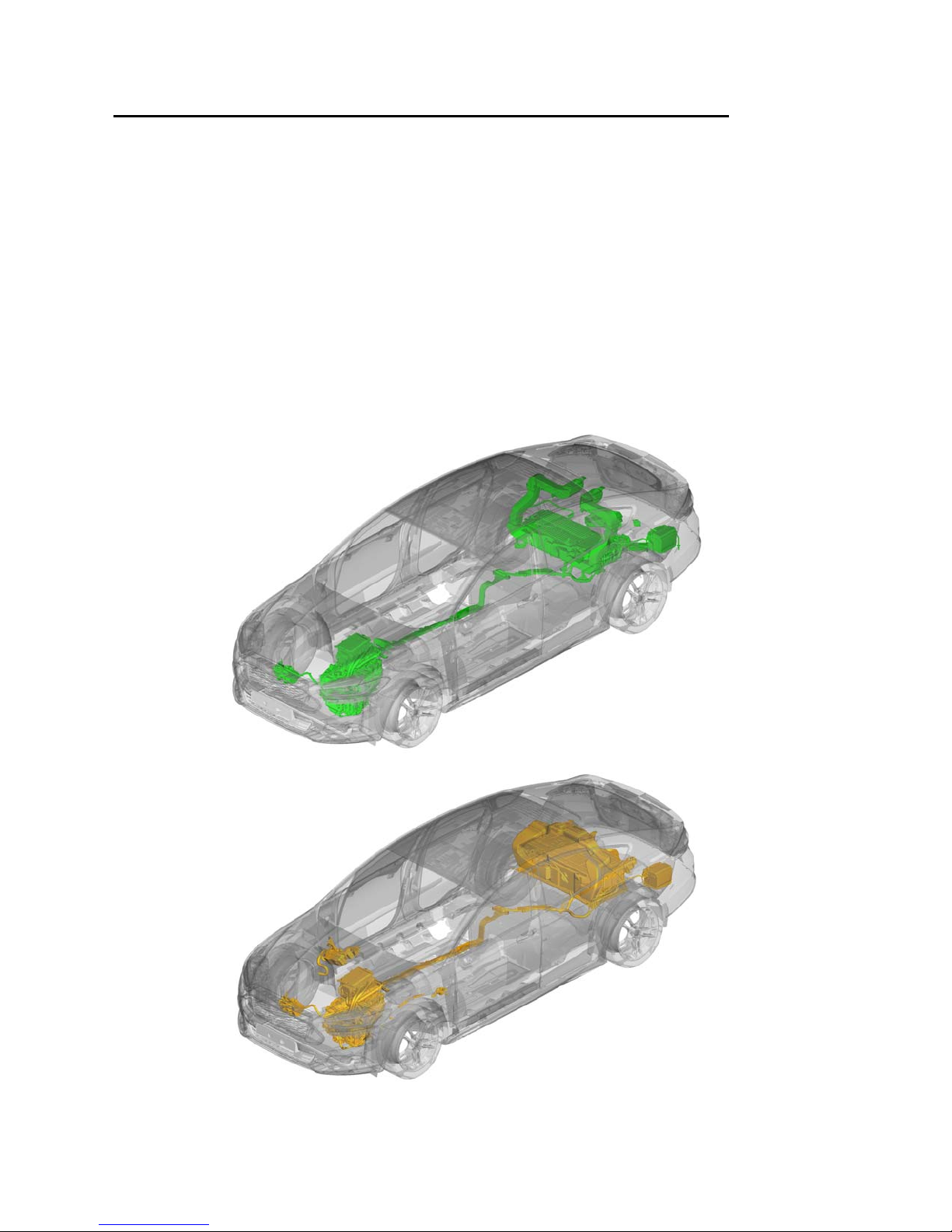
APPROACHING A DAMAGED HIGH-VOLTAGE VEHICLE - CONTINUED
6. High-V oltage System - Do Not Cut Zones
• If possible, remove the high-voltage battery service disconnect before
attempting any extrication procedure. Always assume the high-volt age cabling
and components are powered up.
• If occupant extrication is necessary , always use caution when cutting near the
vehicle high voltage system components. Do not cut any of the high-voltage
under vehicle or under hood cabling (all high-voltage cabling is orange in color).
High-voltage cabling runs from the high-voltage batteries under the left hand
side of the vehicle to the underhood compartment. Refer to the diagram below
for no cut zones in orange.
FCS-15129-13 2013 Fusion MKZ Hybrid Emergency Response Guide
15
Page 18

DAMAGED VEHICLE GUIDANCE FOR FORD MOTOR COMPANY ELECTRIC AND
HYBRID-ELECTRIC VEHICLES EQUIPPED WITH HIGH-VOLTAGE BATTERIES
(TOWING, RECOVERY OPERATORS AND VEHICLE STORAGE FACILITIES)
For questions contact Ford USA 1-800-392-3673 / Ford Canada 1-800-565-3673
1. In the event of damage to or fire involving an Electric Vehicle (EV) or
Hybrid Electric Vehicle (HEV).
• Always assume the high-voltage (HV) battery and associated components are
energized and fully charged.
• Exposed electrical components, wires, and HV batteries present potential HV
shock hazards.
• Venting/of f-gassing HV battery vapors are potentially toxic and flammable.
• Physical damage to the vehicle or HV battery may result in immediate or
delayed release of toxic and/or flammable gases and fire.
2. Vehicle Shutdown and High-Voltage System Disabling
Identify Vehicle
• Determine if the vehicle is an electric or hybrid-electric vehicle, and if it is,
advise your dispatch and all other responders that an electric or hybrid-electric
vehicle is involved.
• To identify potential symptoms of a damaged high-voltage system, contact an
authorized service center or vehicle manufacturer representative. Refer to the
Vehicle Owner Manual, Emergency Placard (included in the V ehicle Owner
Manual) and/or the Emergency Response Guide for appropriate
contact information.
• If you detect leaking fluids, sparks, smoke, flames, increased temperature,
gurgling, popping or hissing noises from the HV battery compartment, ventilate the
passenger area (i.e., roll down windows or open doors) and call 91 1.
• Be alert. There is a potential for delayed fire with damaged lithium-ion batteries.
FCS-15129-13 2013 Fusion MKZ Hybrid Emergency Response Guide
16
Page 19

DAMAGED VEHICLE GUIDANCE FOR FORD MOTOR COMPANY ELECTRIC AND
HYBRID-ELECTRIC VEHICLES EQUIPPED WITH HIGH-VOLTAGE BATTERIES
(TOWING, RECOVERY OPERATORS AND VEHICLE STORAGE FACILITIES) CONTINUED
3. Recovering/T ransporting Vehicle
• Call an authorized service center or vehicle manufacturer representative,
if necessary , to determine additional steps that you should take to safely recover
or transport the vehicle.
• Always approach the vehicle from the sides to stay out of potential travel path. It
may be difficult to determine if the vehicle is running due to lack of engine noise.
• Refer to vehicle manual/recovery guide to locate proper attachment/connection
points and transport method.
• A void contact with orange high-voltage cabling and areas identified as
high-voltage risk by warning labels.
4. Storing V ehicle
• For vehicles in the United States, notify Ford Motor Company
1-800-392-3673 (then follow the prompts on the voice response menu) or
an authorized Ford Dealer as soon as possible as there may be
additional steps necessary to secure, discharge, handle, and/or store the
HV battery and vehicle.
• For vehicles in Canada, notify Ford Motor Company 1-800-565-3673
(then follow the prompts on the voice response menu), or an authorized
Ford dealer as soon as possible. There may be additional steps
necessary to secure, discharge, handle and/or store the HV battery and
vehicle.
• Do not store a severely damaged vehicle with a lithium-ion battery inside a
structure or within 50 fe et of any str ucture or ve hicle.
• Ensure that passenger and cargo compartments remain ventilated.
• Prior to placing and while located in storage area/tow lot, continue to inspect
vehicle for leaking fluids, sparks, smoke, flames, gurgling or bubbling sounds
from the HV battery and call 91 1 if any of these are detected.
• Maintain clear access to stored vehicles for monitoring and emergency response
if needed.
For specific information and safety preparation regarding the high-voltage system, refer
to WWW.MOTORCRAFTSERVICE.COM, select quick guides for the appropriate
vehicle emergency response guide.
FCS-15129-13 2013 Fusion MKZ Hybrid Emergency Response Guide
17
 Loading...