

Page 1
LabelManager 220P
The easy-to-use label maker with PDA-style keyboard
User Guide
www.dymo.com
Page 2

Contents
About Your New Label Maker .......................................................5
Product Registration..............................................................................5
Getting Started ...........................................................................5
Connecting the Power ...............................................................................5
Inserting the Batteries...........................................................................5
Connecting the Optional Power Adapter ...............................................6
Inserting the Tape Cassette .......................................................................6
Using the Label Maker for the First Time .......................................7
Getting to Know the Label Maker .................................................7
Power ........................................................................................................7
LCD Display ................................................................................................8
Format ......................................................................................................8
Insert .........................................................................................................8
Settings .....................................................................................................8
CAPS Mode ................................................................................................8
Num Lock ..................................................................................................9
Backspace ..................................................................................................9
Clear ..........................................................................................................9
Navigation Keys ........................................................................................9
Cancel .......................................................................................................9
Formatting Your Label .................................................................9
Changing the Font Size .............................................................................9
Adding Font Styles ..................................................................................10
Adding Borders and Underline Styles ......................................................10
Creating Two-Line Labels ........................................................................11
2
Page 3

Aligning the Text .................................................................................... 11
Using Mirror Text .................................................................................... 11
Using Symbols and Special Characters .........................................12
Adding Symbols ...................................................................................... 12
Adding Punctuation ................................................................................ 13
Using the Currency Key ........................................................................... 13
Adding International Characters ............................................................. 13
Printing Options ........................................................................13
Previewing Your Label ............................................................................ 13
Printing Multiple Labels ......................................................................... 14
Creating Fixed-Length Labels ................................................................. 14
Adjusting the Print Contrast ................................................................... 14
Using the Label Maker Memory ..................................................15
Saving a Label ........................................................................................ 15
Opening Saved Labels ............................................................................. 15
Inserting Saved Text ............................................................................... 15
Caring for Your Label Maker .......................................................16
Troubleshooting ........................................................................17
Documentation Feedback ..........................................................18
Environmental Information .......................................................19
3
Page 4
Caps
A
ccent
1
2
3
4
5
6
7
8
9101112
13
14
16
17
19
18
20 21 22
231524
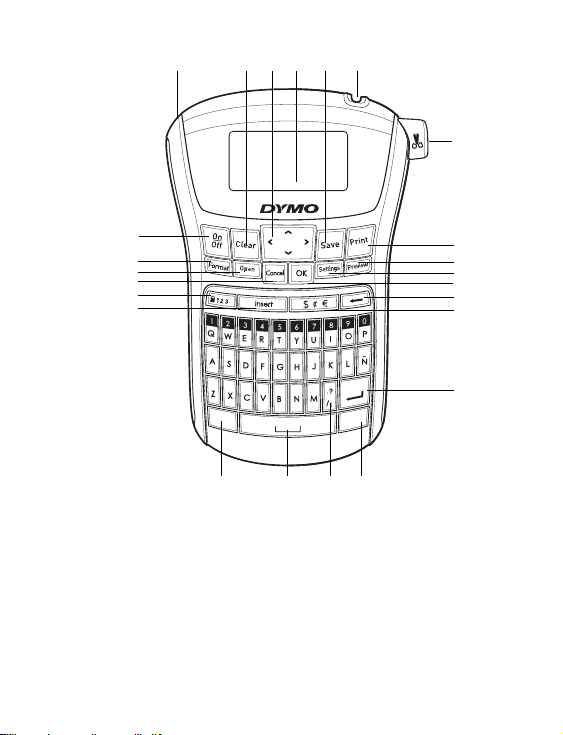
Figure 1 DYMO® LabelManager® 220P Electronic Label Maker
1 Tap e cu tte r 9 Accented char acter 17 Format
2 Print 10 Punctuati on 18 On/Off
3 Preview 11 Space bar 19 AC power connector
4 Settings 12 Caps 20 Clear
5 OK 13 Insert 21 Navigation
6 Backspace 14 Number Lock 22 LCD Dis play
7 Currenc y 15 Cance l 23 Save
4
8 Return 16 Recall 24 Tap e ex it
Page 5

About Your New Label Maker
With the DYMO® LabelManager® 220P electronic label maker, you can create a
wide variety of high-quality, self-adhesive labels. You can choose to print your
labels in many different font sizes and styles. The label maker uses DYMO D1
tape cassettes in widths of 1/4” (6 mm), 3/8” (9 mm), or 1/2” (12 mm). These
tape cassettes are available in a wide range of colors.
Visi t www.dymo.com for information on obtaining labels and accessories
for your label maker.
Product Registration
Visi t www.dymo.com/registration to register your label maker online.
Getting Started
Follow the instructions in this section to print your first label.
Connecting the Power
The label maker is powered by standard batteries or an AC power adapter. To
save power, the label maker automatically turns off after two minutes of
inactivity.
Inserting the Batteries
The label maker uses six high-capacity AA alkaline batteries.
5
Page 6
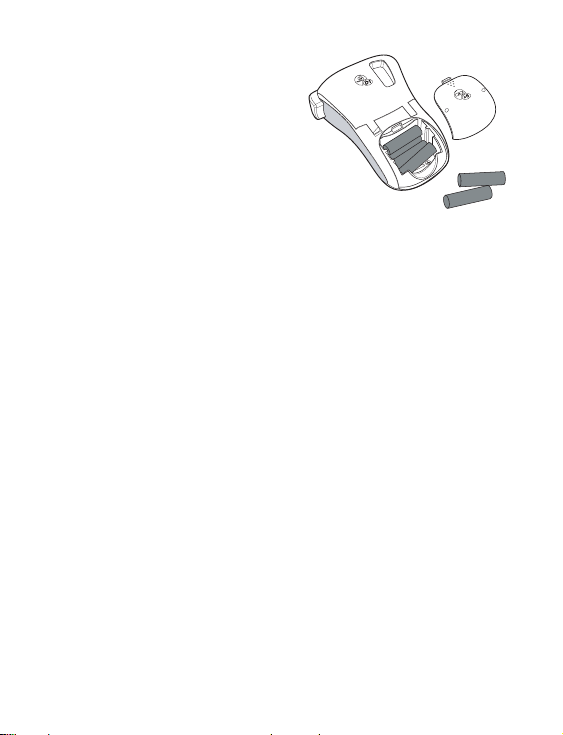
To insert the batteries
Figure 2
1. Slide the battery compartment cover
away from the label maker. See Figure 2.
2. Insert the batteries following the
polarity markings (+ and –).
3. Replace the cover.
Ç Remove the batteries if the label maker
will not be used for a long period of time.
Connecting the Optional Power Adapter
An optional 9 Volt, 1.5 A power adapter can also be used to power the label
maker. Connecting the AC adapter to the label maker disconnects the
batteries as a power source.
To connect the power adapter
1. Plug the power adapter into the power connector on the top, left side of
the label maker.
2. Plug the other end of the power adapter into a power outlet.
Ç Make sure the label maker power is turned off before you disconnect the
power adapter from the main power source. Otherwise, your most recent
memory settings will be lost.
6
Page 7
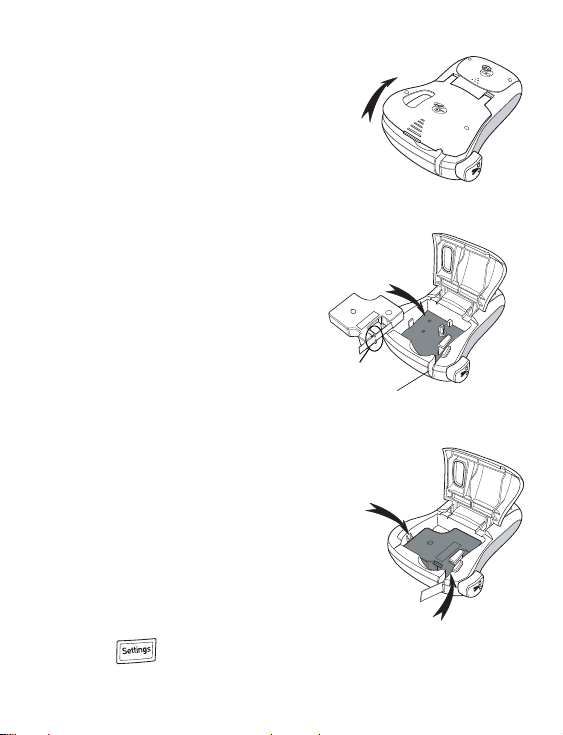
Inserting the Tape Cassette
Figure 3
Figure 4
Remove
cardboard insert
Guideposts
Figure 5
Click!
Click!
Your label maker comes with one tape cassette.
Visi t www.dymo.com for information about
purchasing additional tape cassettes.
To insert the tape cassette
1. Lift the tape cassette cover to open the tape
compartment. See Figure 3.
Ç Before using the label maker for
the first time, remove the protective
cardboard insert from the tape exit
slot. See Figure 4.
2. Insert the cassette with the label
facing up and positioned between the
guideposts.
3. Press firmly until cassette clicks into
place. See Figure 5.
4. Close the tape cassette cover.
Using the Label Maker for the First Time
The first time you turn on the power, you are
asked to select the language. This selection will
remain set until you change it, or until the label
maker is reset. You can change this selection
using the key.
7
Page 8
To set up the label maker
1. Press to turn on the power.
2. Select the language and press
By default, the language is set to English. The language option you choose
determines the character set that is available.
3. Select the width of the tape cassette currently in the label maker and press
}.
}.
You are now ready to print your first label.
To print a label
1. Enter text to create a simple label.
2. Press .
3. Select the number of copies.
4. Press
} to print.
5. Press the cutter button to cut the label.
Congratulations! You printed your first label. Continue reading to learn
more about the options available for creating labels.
Getting to Know the Label Maker
Become familiar with the location of the feature and function keys on your
label maker. Refer to Figure 1. The following sections describe each feature in
detail.
Power
The button turns the power on and off. After two minutes of no activity,
the power is switched off automatically. The last label created is remembered
and displayed when the power is turned back on. The previously selected style
settings are also restored.
8
Page 9
LCD Display
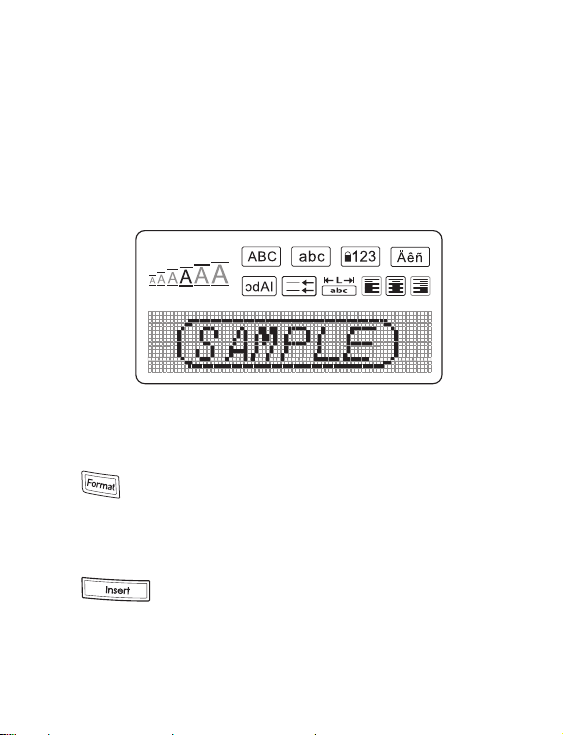
You can enter up to 99 characters and spaces. The display shows about 13
characters at a time. The number of characters displayed will vary due to
proportional spacing.
With DYMO’s exclusive graphical display, most of the formatting you add is
visible instantly. For example, the italics and rounded border added to the
text below is clearly displayed.
Feature indicators along the top of the LCD display appear black to let you
know when a feature is selected.
Form at
The key displays the Font Size, Clear Format, Mirror, Label Length,
Alignment, Underline, Borders, and Style submenus. These formatting
features are described later in this User Guide.
Insert
The key allows you to insert symbols or saved text on your label.
These features are described later in this User Guide.
9
Page 10
Settings
Caps
The key displays the Language, Label Width and Contrast submenus.
These features are described later in this User Guide.
CAPS Mode
The key toggles capitalization on or off. When Caps mode is on, the
Caps mode indicator is shown on the display and all letters that you enter will
be capitalized. The default setting is Caps mode on. When Caps mode is o ff, all
letters appear in lower case.
Num Lock
The key provides access to the numbers located on some of the
alphabetic keys. When Num Lock mode is turned on, the Num Lock indicator is
shown on the display and the numbers 0 through 9 appear when you press
the corresponding letter keys. Num Lock is turned off by default.
Backspace
The key removes the character to the left of the cursor.
Clear
The key gives you a choice to clear all label text, just the text
formatting, or both.
Navigation Keys
You can review and edit your label using the left and right arrow keys. You can
also navigate through menu selections using the up and down arrow keys,
and then press
} to make a selection.
10
Page 11
Cancel
The key allows you to exit from a menu without making a selection or
to cancel an action.
Formatting Your Label
You can choose from several format options to enhance the appearance of
your labels.
Changing the Font Size
Six font sizes are available for your labels: Extra Small, Small, Medium, Large,
Extra Large, and Extra Extra Large. The font size applies to all
characters on a label.
To set the font size
1. Press .
2. Select Fo nt Size and press
3. Select the desired font size and press
The font size indicator on the display changes as you select font sizes.
Adding Font Styles
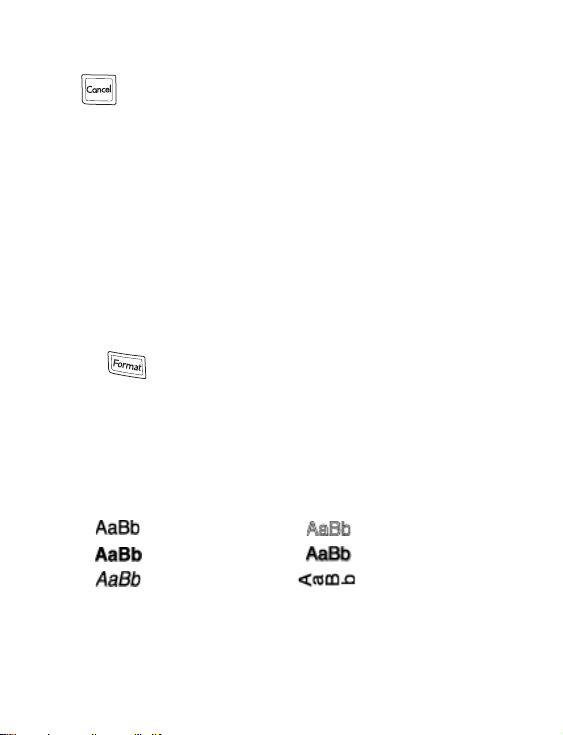
You can choose from six different font styles:
The style you select applies to all characters. Styles can be used with
alphanumeric characters and some symbols.
}.
}.
Normal Outline
Bold Shadow
Italic Vertical
11
Page 12
To set the font style
1. Press .
2. Select Style and press
3. Select a font style and press
}.
}.
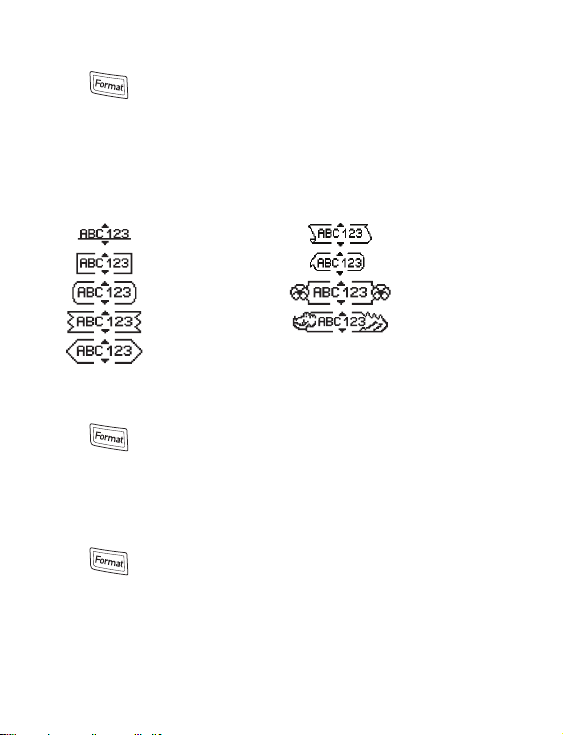
Adding Borders and Underline Styles
You can highlight your text by choosing a border or underline style.
Underline Parchment
Square Call Out
Rounded Flowers
Edged Crocodile
Point ed
A label can be underlined or enclosed in a border, but not both together.
To add a border style
1. Press .
2. Select Borders and press
3. Select a border style and press
When using borders on two-line labels, both lines are enclosed in one border.
To add an underline
1. Press .
2. Select Underline and press
3. Press
} again when the underlined text is shown in the display.
On two-line labels, both lines are underlined.
}.
}.
}.
12
Page 13
Creating Two-Line Labels
You can print a maximum of two lines on labels.
To create a two-line label
1. Type the text for the first line and press .
A new-line symbol ë is inserted at the end of the line, but will not print
on the label.
2. Type the text for the second line.
3. Press to print.
Aligning the Text
You can align the text to print left or right justified on the label. The default
alignment is centered.
To change the alignment
1. Press .
2. Select Alignment and press
3. Select right, left, or centered alignment and press
}.
}.
Using Mirror Text
The mirror format allows you to print text which reads from right to left, as
you would see it in a mirror.
To turn on mirror text
1. Press the key.
2. Select Mirror and press
3. Select On and press
}.
}.
13
Page 14
Using Symbols and Special Characters
(Subscripts/Superscripts)
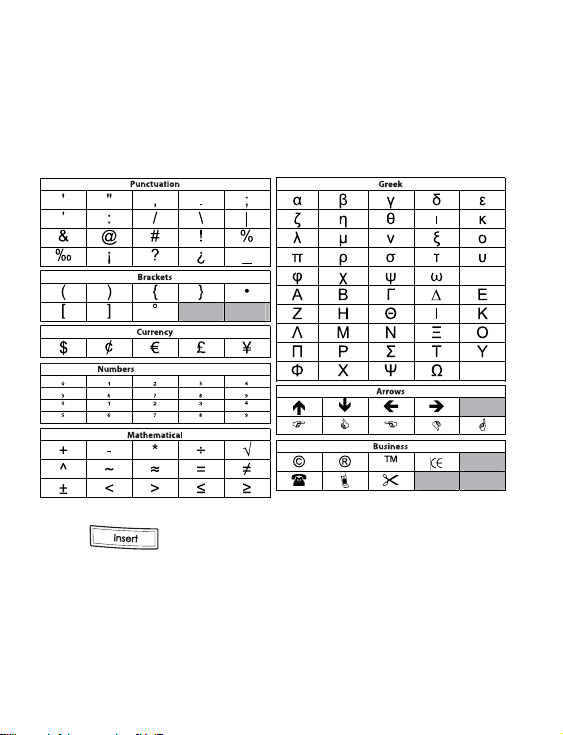
Symbols, punctuation, and special characters can be added to your labels.
Adding Symbols
The label maker supports the extended symbol set shown below.
To insert a symbol
1. Press , select Symbols, and press
2. Select the symbol category and press
3. Use the left and right arrow keys to move to your desired symbol.
4. When you locate the symbol, press
The left and right arrows move horizontally along a row of symbols. The up
and down arrow keys scroll vertically through the rows of symbol types.
} to add the symbol to your label.
}.
}.
14
Page 15
Adding Punctuation
You can quickly add punctuation using the punctuation shortcut key.
To insert punctuation
1. Press .
2. Select the punctuation mark you want and press
}.
Using the Currency Key
You can quickly add a currency symbol using the currency shortcut key.
To insert a currency symbol
1. Press .
2. Select the currency symbol you want and press
}.
Adding International Characters
The label maker supports the extended Latin character set using RACE
technology.
After pressing the Accent key, repeatedly pressing a letter scrolls through the
available variations of that letter.
For example, if French is selected as the language and you press the letter a,
you will see a à â æ and so on through all the variations available. The
character variations and the order in which the variations appear depend on
the language you use.
To add accented characters
ent
1. Press . The accented character indicator is shown on the display.
2. Press an alpha character. The accent variations are displayed.
3. When the desired accented character appears, wait a few seconds for the
cc
A
cursor to move beyond the character to continue entering text.
15
Page 16
Printing Options
You can preview your label, print multiple labels, and adjust the printing
contrast.
Previewing Your Label
You can preview the text or format of your label prior to printing. A two-line
label is previewed as a single-line label with a line break character between
the two lines.
To previ ew yo ur label
♦ Press .
The label length is displayed, then the text of the label scrolls across the
display.
Printing Multiple Labels
Each time you print, you are asked how many copies to print. You can print up
to ten copies at one time.
To print multiple labels
1. Press .
2. Select the number of copies to print, and press
When printing is finished, the number of copies to print returns to the default
value of 1.
Creating Fixed-Length Labels
Normally, the length of the label is determined by the length of the text.
However, you can choose to set the length of the label for a specific
application.
}.
16
Page 17
When you choose a fixed label length, the label text is automatically resized
to fit the label. If the text cannot be adjusted to fit within the fixed label
length, a message is displayed showing the smallest possible label length for
this text. You can choose a fixed length label up to 15” long.
To set the label length
1. Press the key.
2. Select Label Length and press
3. Select Fixed and press
4. Select the length for your label and press
}.
}.
}.
Adjusting the Print Contrast
You can adjust the print contrast to fine tune the print quality of your label.
To set the contrast
1. Press .
2. Select Contrast and press
3. Use the arrow keys to select a contrast setting between 1 (less contrast)
and 5 (more contrast), and press
}.
}.
Using the Label Maker Memory
The label maker has a powerful memory feature that allows you to save the
text of up to nine frequently-used labels. You can recall saved labels and you
can insert saved text into a label.
Saving a Label
You can save up to nine frequently-used labels. When you save a label, the
text and all formatting are saved.
17
Page 18
To save the curre nt label
1. Press .
The first available memory location is displayed.
2. Use the arrow keys to move through the locations.
You can store new text in any of the memory locations.
3. Select a memory location and press
Your label text is saved and you are returned to the label.
}.
Opening Saved Labels
You can easily open labels saved in memory to use at a later time.
To open saved labels
1. Press .
A message is displayed to confirm you want to overwrite the current label.
2. Press
}.
The first memory location is displayed.
3. Use the arrow keys to select a label to open and press
A message is displayed to confirm you want to overwrite the current label.
To clear a memory location, first select a location and then press .
}.
Inserting Saved Text
You can insert the text of a saved label into the current label. Only the saved
text is inserted, not the formatting.
To insert saved text
1. Position the cursor at the location in the label where you want to insert the
text.
18
Page 19
2. Press .
Print head
Figure 6
Press and
hold
The first memory location is displayed.
3. Use the arrow keys to select the text you want to insert.
4. Press
}. The text is inserted in the current label.
Caring for Your Label Maker
Your label maker is designed to give you long and trouble-free service, while
requiring very little maintenance. Clean your label maker from time to time to
keep it working properly. Clean the cutter blade each time you replace the
tape cassette.
To clean the cutter blade
1. Remove the tape cassette.
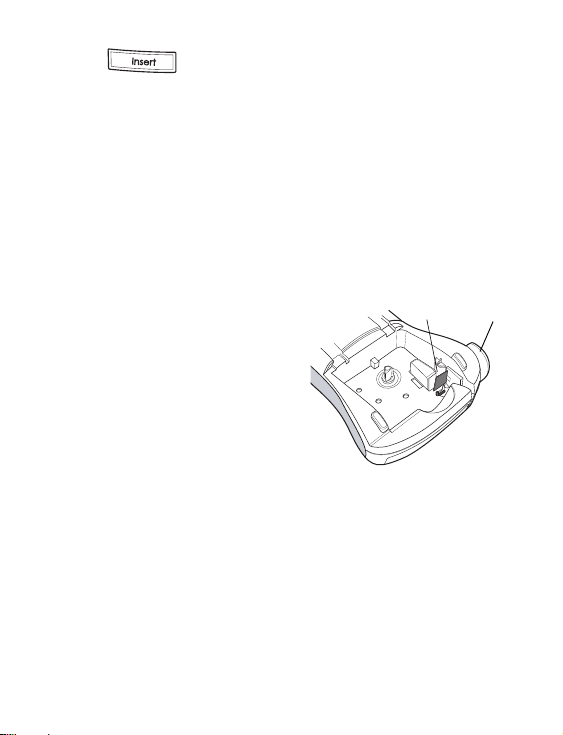
2. Press and hold the cutter button to
expose the cutter blade. See Figure 6.
3. Use a cotton ball and alcohol to clean
both sides of the blade.
è The cutter blade is extremely sharp.
Use caution when cleaning.
To clean the print head
1. Remove the tape cassette.
2. Remove the cleaning tool from inside the label compartment cover.
3. Gently wipe the padded side of the tool across the print head.
See Figure 6.
19
Page 20
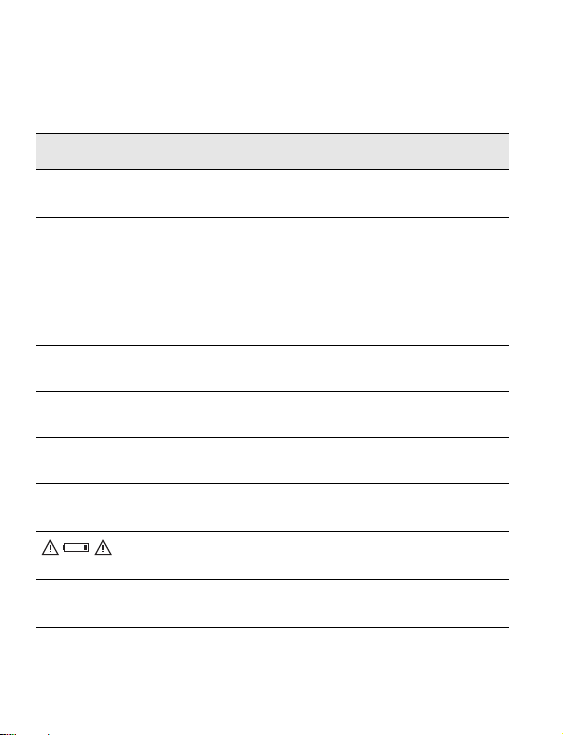
Troubleshooting
Review the following possible solutions if you encounter a problem while
using your label maker.
Problem/Error Message Solution
No display
Poor Print Quality
Poor Cutte r Perfo rmance
Printing . . .
Too many characters
Exceeded max. number of characters
Too many lines
Exceeded maximum number of lines
• Ensure the label maker is turned on.
• Replace discharged batteries.
• Replace batteries or attach power adapter.
• Set Contrast to higher level. See Adjusting
the Print Contrast.
• Ensure tape cassette is installed properly.
• Clean the print head.
• Replace the tape cassette.
Clean the cutter blade. See
Label Maker.
No action required.
Message disappears when printing is finished.
Delete some or all of the buffer text.
• Delete a line to fit on the tape width.
• Insert a wider tape cassette.
Caring for Your
Batteries almost discharged.
Tape Jam
Motor is stalled due to label jam.
Replace batteries or connect AC power adapter.
• Remove jammed label; replace tape cassette.
• Clean cutter blade.
If you still need assistance, contact DYMO Customer Support at
(203) 588-2500. You can also visit the DYMO Web site at www.dymo.com.
20
Page 21

Documentation Feedback
We are constantly working to produce the highest quality documentation for
our products. We welcome your feedback.
Send us your comments or suggestions about our user guides. Please include
the following information with your feedback:
• Product name, model number, and User Guide page number
• Brief description of instructions that are inaccurate or unclear, areas where
more detail is needed, and so on
We also welcome your suggestions about additional topics you would like to
see covered in the documentation.
Send email messages to: [email protected]
Please keep in mind that this email address is only for documentation
feedback. If you have a technical question, please contact Customer Support.
21
Page 22
Environmental Information
This product is CE marked in accordance with the E MC directive and the low voltage directive and is designed
to conform with the following international standards:
US FCC Class B Compatibility
Safety - UL, CUL, TUV, CE, T-Mark, SAA, BABT, C-Tick
EMC - EMI Compatibility
EN 55022; EN 61000 (+ addendums)
RoHS 2002/95/EC
The equipment that you have bought requires the extraction and use of
natural resources for its production. It may contain substances that are
hazardous to health and the environment.
In order to avoid the dissemination of those substances in our environment,
and to diminish the pressure on natural resources, we encourage you to use
the appropriate take-back systems. These systems will reuse or recycle most
of the materials of your end-of-life equipment in an environmentally sound
way.
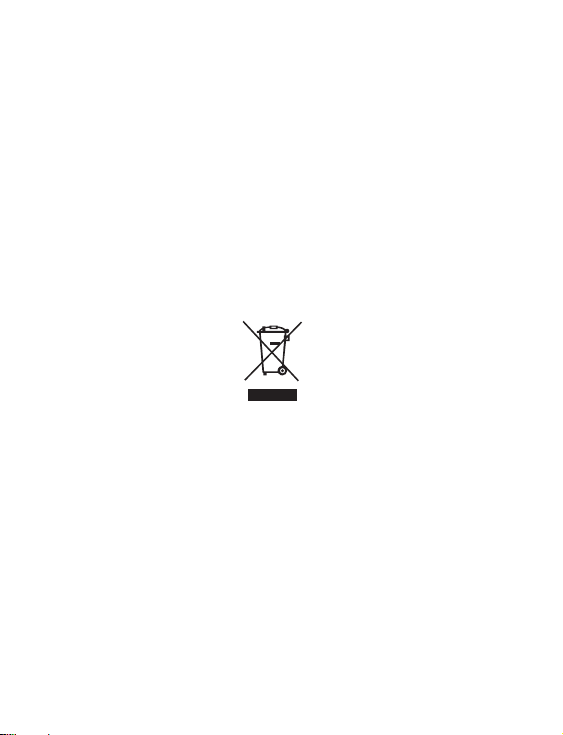
The crossed-bin symbol marked on your device indicates you should use these
systems.
If you need more information on the collection, reuse, and recycling of this
product, please contact your local or regional waste administration.
You can also contact us for more information on the environmental
performance of our products.
22
Page 23

23
Page 24

26
931415
www.sanford.com
Produced by:
DYMO
Stamford CT 06902
800-426-7827: www.dymo.com
©2007
A Newell Rubbermaid Company
 Loading...