

Page 1
Professional HD Action Cameras
DRIFT GHOST 4K
USER MANUAL
www.driftinnovation.com
Version 2.0
Page 2

Contents
Precautions ................................ 3
General Precautions
Attention
Optimal Camera Storage
Water Resistance
Overview ..................................... 5
Using the Camera ..................... 6
Initial Setup
Powering On and O
Charging
Battery Life
Using an External Power Supply
Selecting a MicroSD Card
Formatting Your Memory Card
Removing a MicroSD Card
Module Docking
Settings Menu (Continued)
Simultaneous Photo
Video Stabilisation
Microphone
Microphone Sensitivity
Speaker Volume
LED Status Indicator
LED Indicator Timer
Instant Record
Video Standard
Date
Date Stamp
Camera O
Thumbnail Files
Language
Reset Settings
Format Card
Serial Number
Firmware
Camera Menu System ............ 10
Mode Navigation
Settings Menu Navigation
Video Mode (Green LED)
Video Mode Selecting Resolution
and Frame Rate
Photo Mode (Yellow LED)
Timelapse Mode (Purple LED)
Photoburst Mode (Blue LED)
Settings Menu ........................... 12
Wi-Fi
Wi-Fi Frequency
BT Mode
Pair Remote
Field of View
Exposure
Self Timer
Bit Rate
Filters
ISO Sensitivity
Video Tagging
Car DVR
Mounting the Camera ............. 20
Initial Setup
Shot Setup
Connectivity ............................. 21
Connecting to a Windows PC
Connecting to a Mac
Connecting to a TV
Connecting to a Wi-Fi Device
Playing Video on a Computer
Compatibility
Camera Care ............................ 24
Cleaning the Camera
Cleaning the Lens
Storage
Updating Firmware ................ 25
Warranty .................................... 26
Disclosures ............................... 27
2EN
Page 3

Precautions
General Precautions
Please take note of the following guidelines when using your Ghost 4K camera:
• The camera is 2m shock resistant,
but not shock proof — please
take care of your camera and
accessories, mounting and storing
them securely.
• For your safety, do not press the
buttons on the camera during
sports activities.
• Do not store the camera anywhere
prone to dust or damp for extended
periods of time.
• Do not leave the camera exposed
to extremely high temperatures—
such as under direct sunlight—for
extended periods of time as this
may aect the camera housing and
internal components.
• Clean the lens and screen with
a micro fibre, antistatic cloth to
remove fingerprints or dust—no
cleaning chemicals are required.
• The camera has a working
temperature range of -10°C to
40°C (14°F to 104°F).
• Power o the camera before
removing the battery module or
memory card—the memory card
and stored data may be damaged if
it is removed or inserted while the
camera is powered on.
• Remove the memory card before
storing the camera for long periods
of time.
3EN
Page 4

Precautions
Attention
Rechargeable batteries are only to be charged under adult supervision.
DO NOT short-circuit the battery module terminals.
DO NOT open, puncture or otherwise damage the rechargeable battery
module, or dispose of it in fire.
Optimal Camera Storage
We recommend users to regularly store cameras for a minimum of 6-12 hours
with the battery module removed in a maximum of 30% humidity to help disperse
any moisture.
Avoid removing Ghost 4K modules in damp or humid conditions.
Water Resistance
The Ghost 4K is water resistant, but not waterproof. This means that you can use
your camera in the rain, providing the USB and memory card covers and a Ghost
4K module are securely in place, but the camera cannot be submerged.
For any activities where the camera may be subjected to impact of water or
submersion, the ghost 4K waterproof case (sold separately) is required.
Disclaimer
Drift Innovation will not, under any circumstances, be responsible for injuries or
property damaged incurred during participation of any high-risk sport or activity
not endorsed or recommended by Drift Innovation. Remember that the warranty
will only cover manufacturing defects.
4EN
Page 5
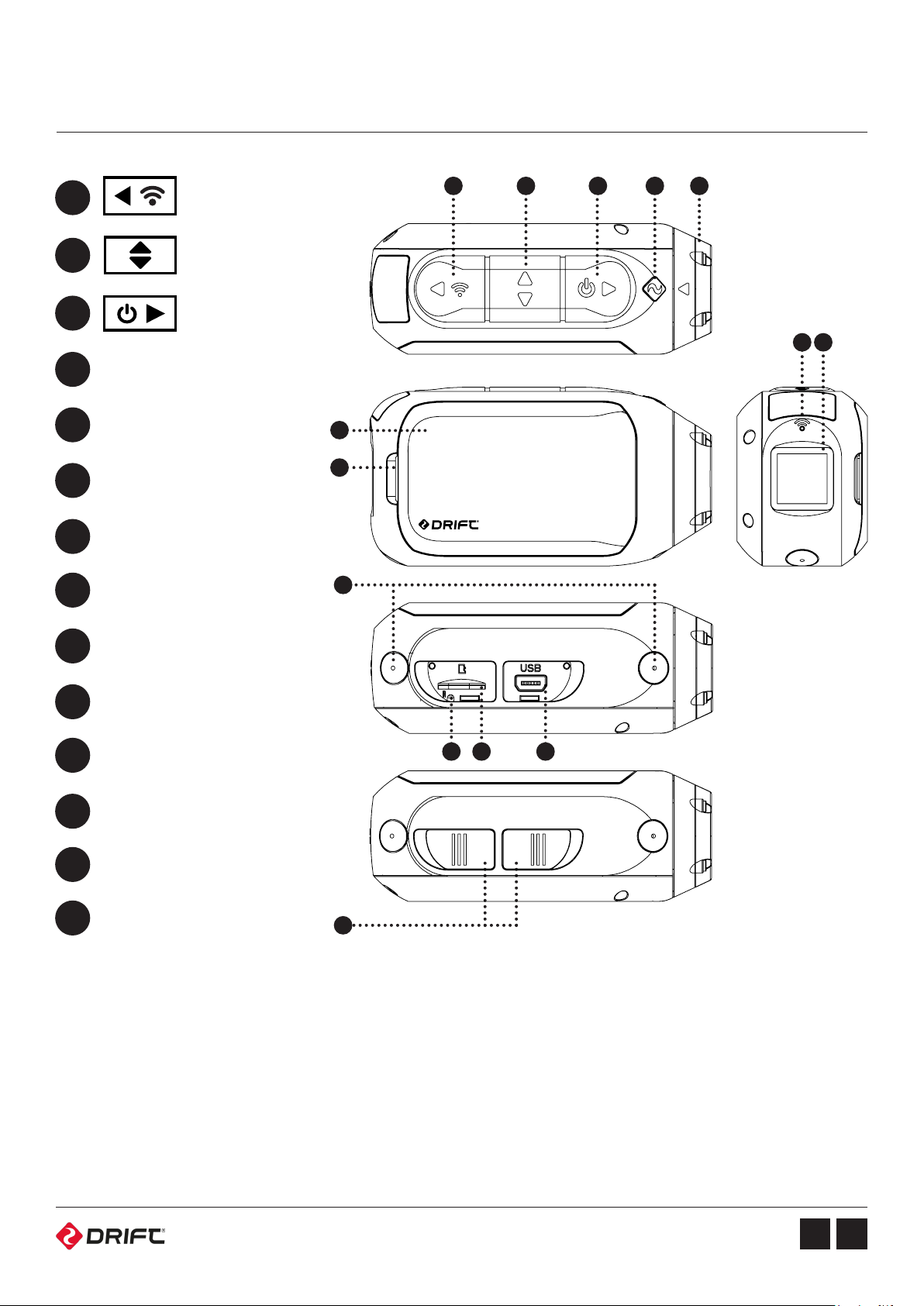
Overview
GHOST 4K
A
B
C
D
Status LED
E
Rotating Lens
F
Battery Module
G
Module Latch
H
Wi-Fi LED
Rear Button
Middle Button
Front Button
A B
F
G
J
C D E
I
H
I
Rear Screen
J
Dual microphones
K
Reset Button
L
MicroSD Card Slot
M
10 Pin Mini USB Port
N
Rubber Cover
MK L
N
5EN
Page 6
Using the Camera
GHOST 4K
3
4
1 2
5
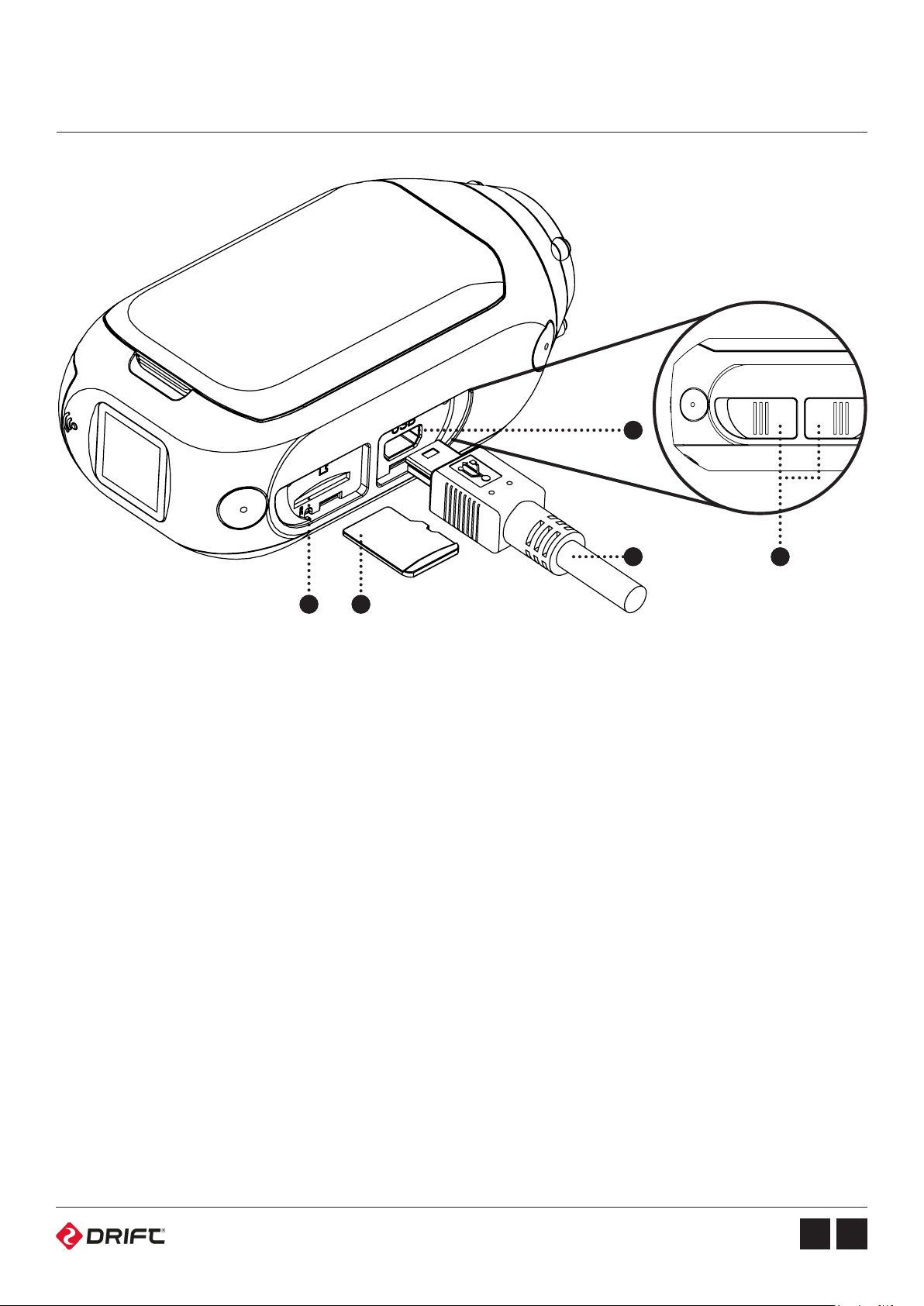
Initial Setup
1. Uncover the microSD slot by lifting its rubber cover.
2. Insert a Class 10 or higher microSD/HC/XC card (up to 128GB).
Format before first usage!
3. Uncover the mini USB port by lifting its rubber cover
4. Connect the camera via a mini USB cable to a powered USB port and charge
the battery for 2.5 hours before first use.
5. Replace the rubber covers securely to cover both the microSD slot and mini
USB port. You are ready to go!
6EN
Page 7

Using the Camera
Powering On and O
1. Press and hold the button for 2 seconds to power the camera on or o.
2. To power the camera on or o while charging, press and release button.
Charging
• For best results charge your camera and battery module simultaneously.
• Ensure that the Ghost 4K is powered o.
• Lift the front rubber port on the underside of the camera.
• Connect the included mini USB cable to a powered USB port, and then to your
Ghost 4K USB port.
If connected to a
powered USB port the
Ghost 4K screen will
show a charging icon.
• A full charge takes around 2.5 hours (min. 1A USB port). Once the camera is
fully charged, remove the mini USB cable, and replace the rubber port cover.
If connected to a
computer USB port the
Ghost 4K screen will
show a USB icon.
Battery Life
At a temperature of 25°C (77°F), recording continuously with the standard battery
module installed, your Ghost 4K battery will last for 2hrs 30mins on a full charge.
Using an External Power Supply
The camera can be powered by an external power supply such as a USB power
adaptor or power pack. We recommend you to power o your camera before
connecting to any external power supply.
Press the button to begin normal usage when using an external power
supply. If the external power is cut o for any reason during recording, the
camera will immediately start drawing power from the rechargeable battery
instead and continue recording, protecting your footage from file corruption.
7EN
Page 8
Using the Camera
Selecting a MicroSD Card
The Ghost 4K is compatible with Micro SD, Micro SDHC or Micro SDXC cards up
to 128GB. We recommend class 10/UHS1 memory cards.
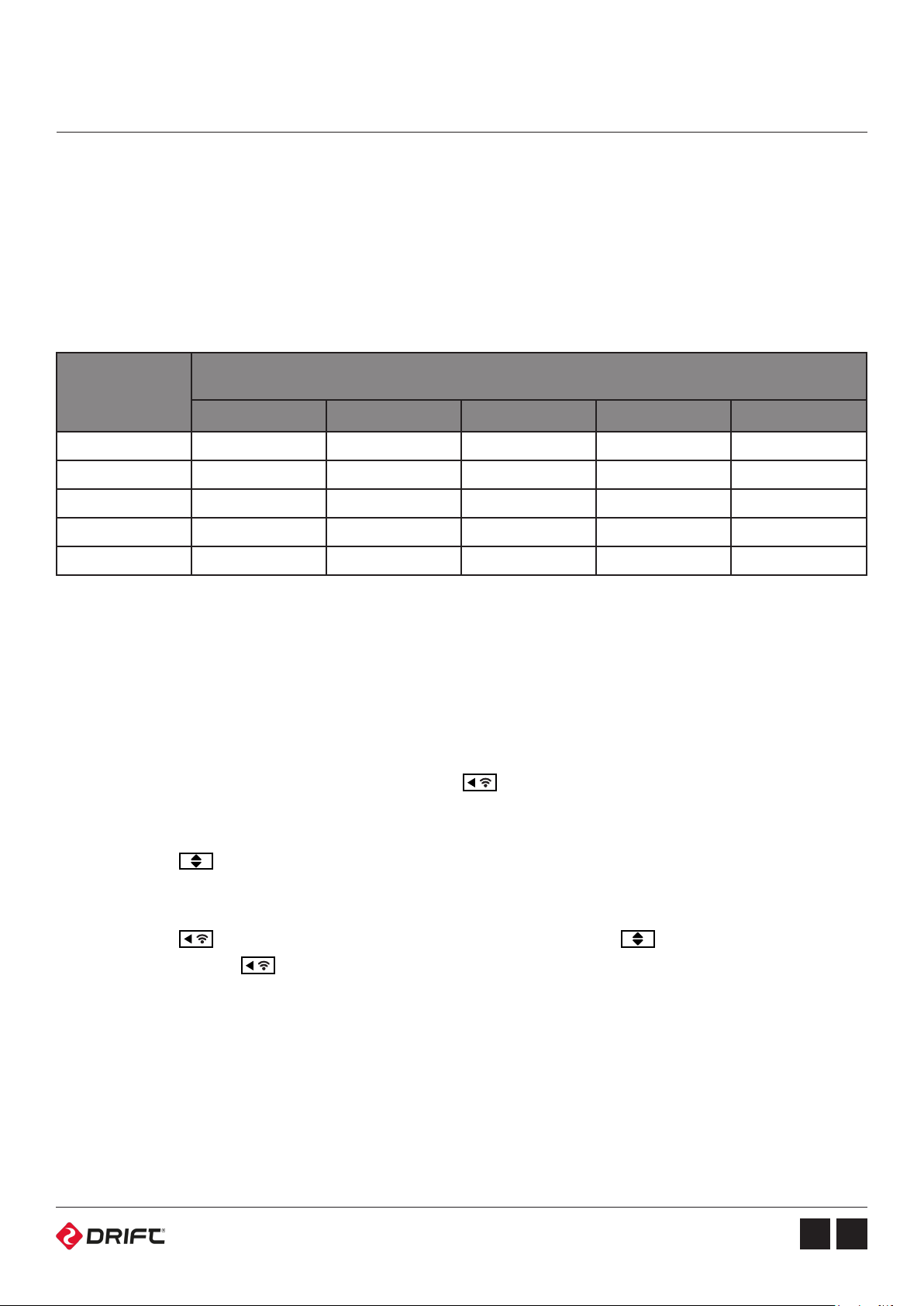
Below is a table of approximate video recording times against card size in normal
bit rate mode.
SD Card
Capacity
8GB 22 min 22 min 28 min 35 min 44 min
16GB 44 min 45 min 56 min 1h 10 min 1h 28 min
32GB 1h 28 min 1h 30 min 1h 52 min 2h 20 min 2h 56 min
64GB 2h 56 min 3h 3h 44 min 4h 40 min 5h 52 min
128GB 5h 52 min 6h 7h 28 min 9h 20 min 11h 44 min
4K 4K UHD 2.7K 1080p 720p
Resolution (25FPS, Normal Bit Rate)
Formatting Your Memory Card
Formatting will remove all files from a memory card. When using a new card for
the first time, always format the memory card using the camera. With the card
inserted in the camera:
1. Power the ghost 4K on, and press the button to scroll through the modes
until you reach the settings menu.
2. Press the button to scroll through the settings until you see the ‘Format SD
Card’ option.
3. Press the button to select this option, and use the button to highlight
‘YES’. Press the button once more to format the memory card.
Removing a MicroSD Card
Life the rubber cover to reveal the Micro SD card, then push down on the card
until you hear a click, then release. The Micro SD card will be ejected from the
spring-loaded card slot.
8EN
Page 9
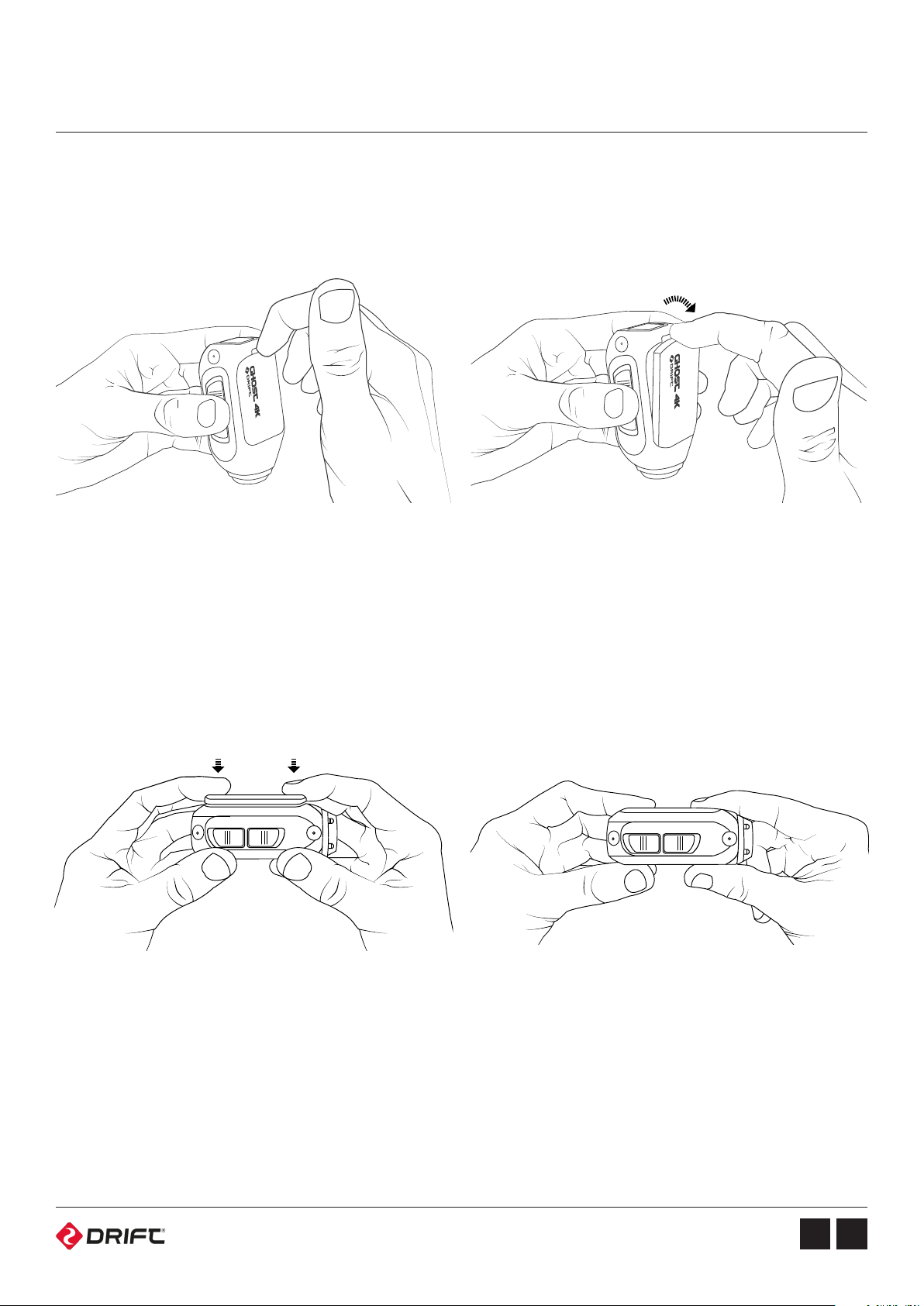
Module Docking
Module Removal
Before removing a module, please ensure that the camera is powered o.
If your camera has a module docked, remove by following these instructions:
1. Place index finger onto
the module notch.
Detaching the module exposes the female connector and module dock area.
A tool may be used alternatively to remove the module.
2. Pull outwards, pivoting
on the module.
Module Attachment
Before installing, please ensure that the camera is powered o.
1. Place the module on the camera,
ensuring that the 30 pin connector is
above the camera’s female connector.
Warning: Please ensure that the connectors are plugged together; if securement pins have
locked into place, but the connector remained undocked; remove the module and repeat
attachment. During step 2, you may press the module firmly on the connector side area, to
ensure connector docking before securement pins locking into place.
2. Press down on both ends
simultaneously, until the module
clicks into place.
9EN
Page 10
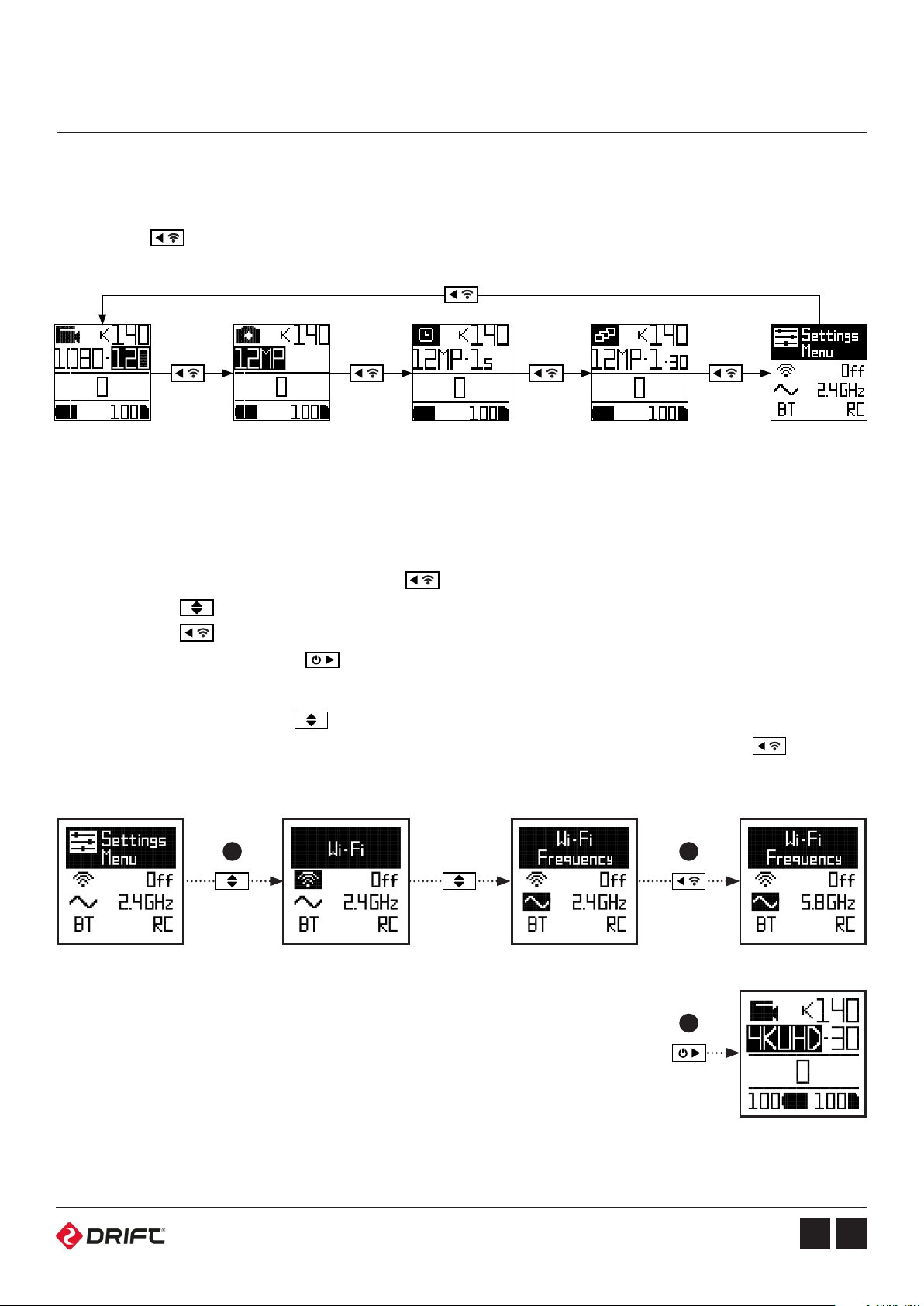
Camera Menu System
Mode navigation
Press the button to scroll through Video, Photo, Timelapse, Photoburst, and
Settings modes.
Video Photo Timelapse Photoburst Settings
Settings menu navigation
1. Scroll through modes using the button, until you reach the settings menu.
2. Press the button to scroll through the menu, highlights each setting in turn.
3. Press the button to change the option for that setting.
4. At any time, press the button to change mode (returning to Video).
In this example pressing once moves the highlight block to the next setting
(WiFi), pressing once more moves to WiFi Frequency. In step 2 pressing
changed frequency from 2.4GHz to 5.8GHz.
2 3
4
10EN
Page 11
Camera Menu System
Video Mode (Green LED)
Press the button to start recording. The Status LED and LCD backlight will
flash red to indicate recording. Press the button again to stop recording.
Video Mode - Selecting Resolution and Frame Rate
Press the button to highlight the currently selected resolution, or press twice
to highlight the frame rate. The button can be used to scroll through the
available options of the highlighted setting.
To change to a dierent mode, press until the video mode icon is highlighted.
You can then change mode with the button.
Photo Mode (Yellow LED)
The camera will capture still images when the button is pressed, and the
status LED and LCD screen will flash red each time a photo is captured.
To change photo resolution, press to highlight the currently selected
resolution, then use the rear button to scroll through the 5, 8 and 12MP options.
Timelapse Mode (Purple LED)
Press the button to capture a series of still images at a specified rate.
The Status LED and LCD screen will flash red each time an image is captured. To
stop recording, press the button once more.
To create a timelapse video, you’ll need to import a sequence of Ghost 4K
timelapse photos into video editing software.
Photoburst Mode (Cyan LED)
The camera will capture a burst of still images for an allotted duration and at a
specified rate, when the button is pressed. For best results, use a memory
card with the highest possible data rate.
11EN
Page 12
Settings Menu
Wi-Fi
Enable Wi-Fi for
connection to the Drift
Life app, turn o to
conserve battery life.
Wi-Fi Frequency
Choose between 2.4GHz and 5.8GHz to ensure the
best possible Wi-Fi connection. 2.4GHz achieves the
longest range, whilst 5.8GHz is recommended for
areas where there are multiple Wi-Fi networks in use.
BT Mode
Switch between ‘RC’ mode, for connecting your Ghost 4K remote control, and
‘App’ mode for live streaming using the Drift Life mobile app.
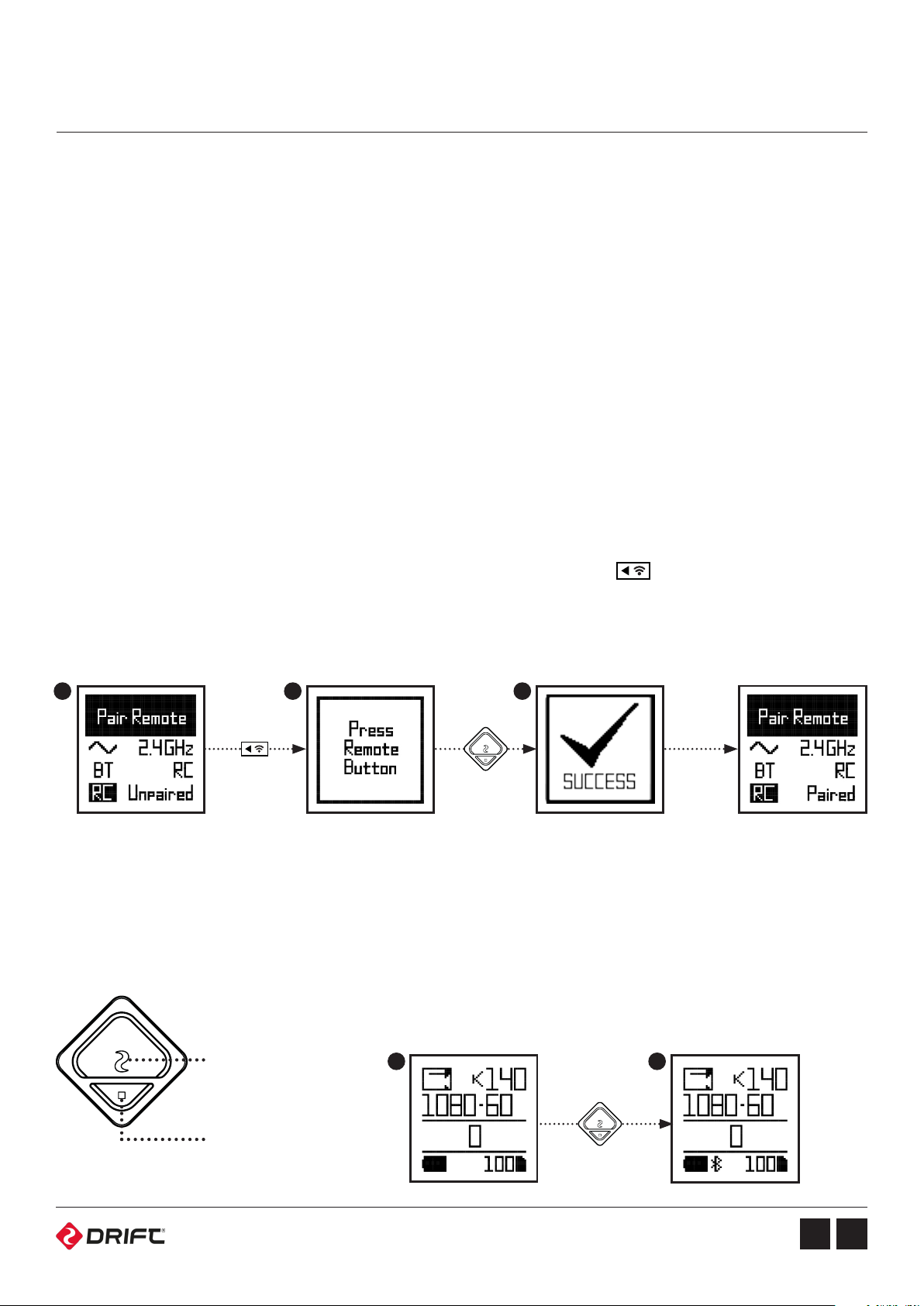
Pair Remote
To pair your Ghost 4K remote to your camera ensure that ‘BT Mode’ is set to RC.
1. Scroll down to the ‘Pair Remote’ option and press the button to select.
2. When the Ghost 4K screen shows ‘Press Remote Button’ you’ll need to press
the Drift Logo button on your remote.
3. After a few seconds the camera will indicate whether the pairing is successful.
1
2 3
Using Remote
Once connected, a single
press of the capture button
will begin recording.
LED Indicator:
Green – Video
Yellow – Photo
Purple – Timelapse
Cyan – Photoburst
Press the mode
button to cycle
through modes or
to stop recording.
Reconnect Remote
When powering on, you’ll need to reconnect.
1. Bluetooth icon will flash on the rear LCD,
press remote’s record button.
2. Remote LED flashes to confirm reconnection,
Bluetooth icon remains on the rear screen.
1 2
12EN
Page 13
Settings Menu
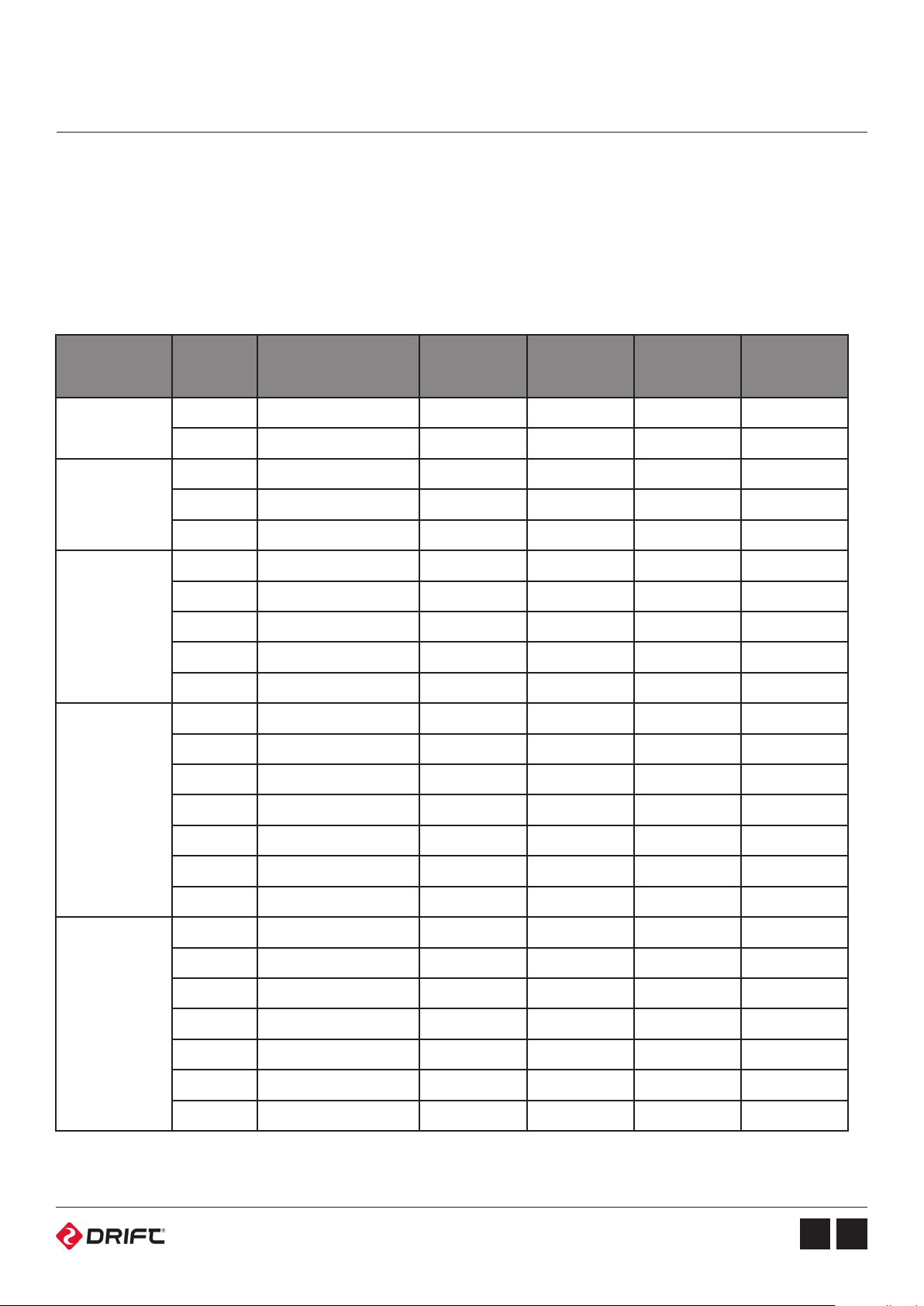
Field of View
For the best possible image quality the default FOV setting of 140° is ideal, but this
option can be used to narrow the FOV to 115° or 90°. Field of View adjustments
will aect video mode, as well as photo, timelapse and photoburst.
Resolution
4K
4K UHD
2.7K
Frame
Rate
25 90° / 115° / 140° N N Y N
24 90° / 115° / 140° N N Y N
30 90° / 115° / 140° N N Y N
25 90° / 115° / 140° N N Y N
24 90° / 115° / 140° N N Y N
60 90° / 115° N N Y N
50 90° / 115° / 140° N N Y N
30 90° / 115° / 140° Y N Y N
25 90° / 115° / 140° Y N Y N
24 90° / 115° / 140° N N Y N
120 90° / 115° / 140° N N Y N
100 90° / 115° / 140° N N Y N
60 90° / 115° / 140° Y N Y N
Available FOV EIS
Car DVR
Yes / No
Video
Tagging
Sim.
Photo
1080p
720p
50 90° / 115° / 140° Y N Y N
30 90° / 115° / 140° Y Y Y N
25 90° / 115° / 140° Y Y Y N
24 90° / 115° / 140° N N Y N
240 90° / 115° / 140° N N Y Y
200 90° / 115° / 140° N N Y Y
60 90° / 115° / 140° N N Y
50 90° / 115° / 140° N N Y Y
48 90° / 115° / 140° N N Y Y
30 90° / 115° / 140° N N Y
25
90° / 115° / 140°
N N Y
13EN
Page 14

Settings Menu
Exposure
The Ghost 4K features automatic exposure compensation, but also oers the
option to manually set exposure.
Self Timer
Set the Ghost 4K to start recording video or take a photo 3, 5 or 10 seconds after
pressing the record button.
Bit Rate
High bit rate modes preserves as much information as possible, to help you
achieve the best possible image quality. Low bit rate helps to keep file sizes
manageable, for easy storage and editing.
Filters
Normal: The default mode, with no filter applied.
Vivid: Select vivid mode for more saturated colours. This works well if you’re
shooting on an overcast day, and you want to make your footage look as exciting
as possible.
Lowlight: Increase the brightness of videos when shooting in very dark conditions.
Water: For use with the Ghost 4K waterproof case, when diving. Water mode
compensates for the loss of reds that occurs while filming underwater.
Filters are a global setting that are applied to all camera modes.
14EN
Page 15
Settings Menu
ISO Sensitivity
The Ghost 4K will automatically adjust ISO when set to the default ‘Auto’ setting,
or the ISO can be set to 100, 200, 400 or 800 manually. A higher ISO setting is
ideal for low light environments, but may result in a more ‘grainy’ image.
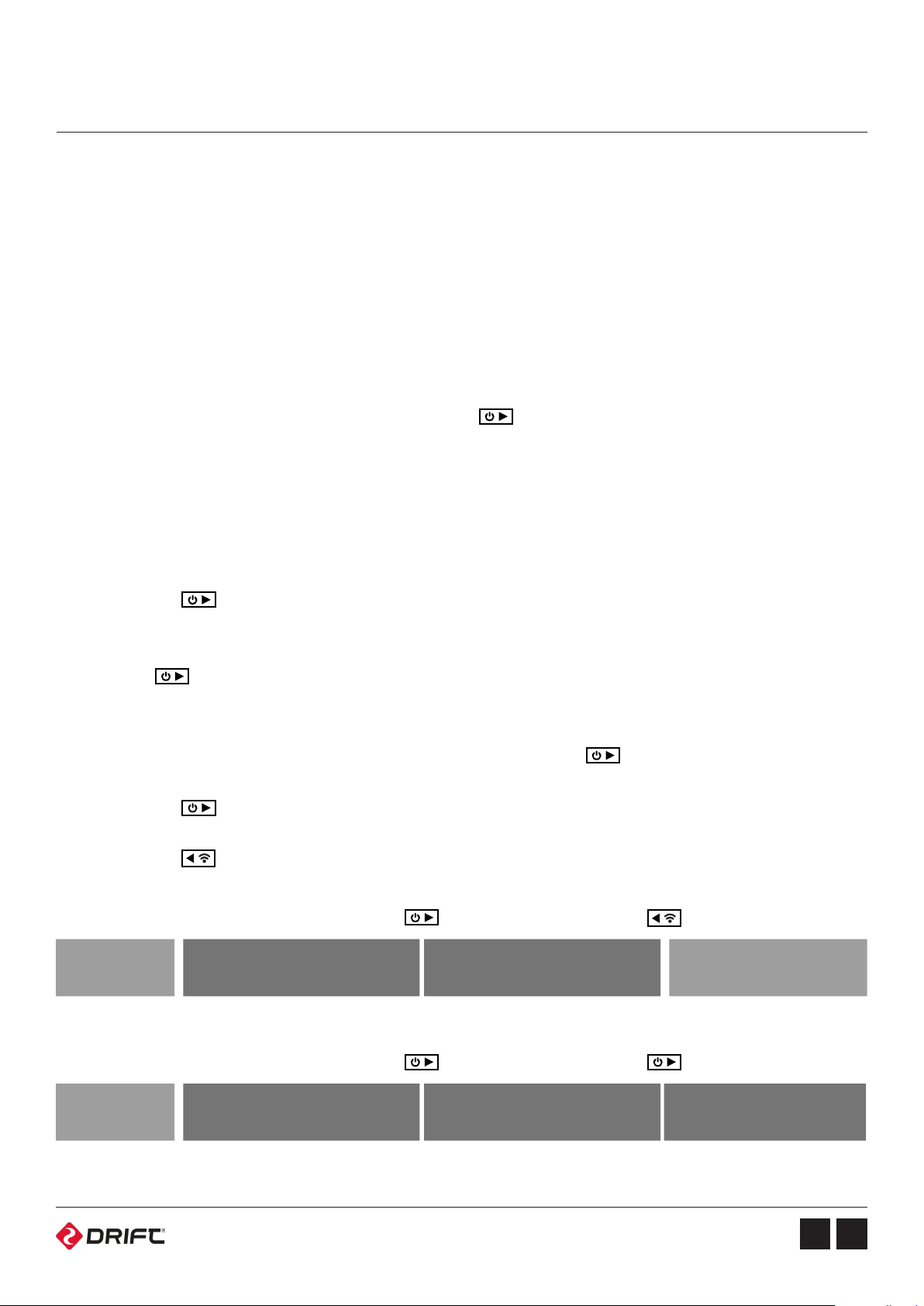
Video Tagging
Video tagging allows the user to press the button after an event, and still save
the video. This is ideal for capturing unexpected moments, and is a great tool for
saving space on your memory card.
With tagging mode enabled, the camera will record continuously, but will not
save any footage. The status LED will flash green when the camera is in this state.
Pressing the button will save the previous section of video – the duration that
you want to save can be set in the settings menu using the ‘Tag Interval’ option.
Once the button is pressed, the previous section of video is saved to your
memory card, and the camera will continue to record for the duration of that
interval.
For example, if a 30s interval is selected, pressing the button will save the
previous 30s of video, and the camera will continue to record for a further 30s.
Pressing the button again will extend your video by a further 30s.
Pressing the button while the camera is tagging will stop the recording.
Tagging ON
Previous Interval
Tag record previous and following interval
Following Interval
Stops Recording
Tagging ON
Previous Interval
Tag record previous and following interval
Following Interval Extended Interval
Adds Interval
15EN
Page 16
Settings Menu
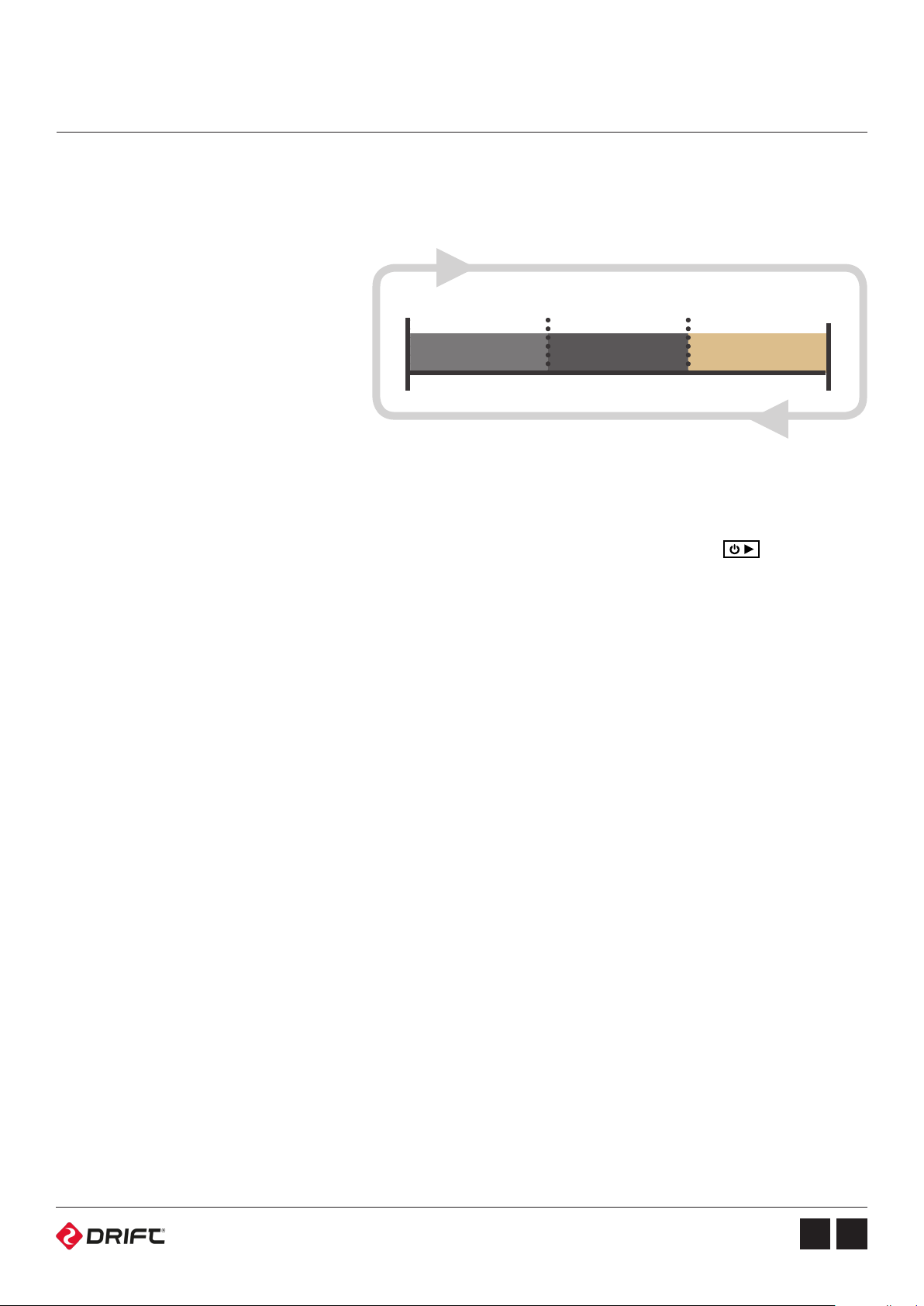
Car DVR
Car DVR mode allows you to
record continuously when
connected to a USB power
supply, without worrying
about memory card capacity.
Select a ‘Car DVR Loop Interval’
in the Ghost 4K settings
menu, and the camera will
continuously record videos of
the chosen duration.
When your memory card is full, the camera will automatically overwrite the oldest
video. If an event that you want to capture occurs, simply press the button to
stop the recording, and the footage will be saved.
The Ghost 4K can function as a hands free car DVR camera, when connected to
a 12v adapter, or your car’s USB port. Turn the ignition on, and when the camera
receives power it will turn on, and start recording automatically.
Oldest Footage
DVR Interval DVR Interval DVR Interval
Oldest footage will be deleted, to free up microSD
card capacity for new footage.
CAR DVR Loop
Newest Footage
Turn the ignition o, and the camera will record until the end of the selected
interval, then will power o automatically.
Before attempting to charge the Ghost 4K Car DVR mode should be disabled
in the settings menu, to ensure that the camera does not power on and start
recording when the USB cable is connected.
Simultaneous Photo
With Simultaneous Photo mode enabled your camera will automatically take
photos at the selected interval, during video recording. Select the desired interval
using the ‘Simultaneous Photo Interval’ option.
16EN
Page 17

Settings Menu
Video Stabilisation
Video stabilisation can help to remove the eects of camera shake during
recording, resulting in smoother footage. This setting is particularly suited to
removing vibration and low-amplitude camera movements, so is well suited to
helmet mounted or handheld video capture.
Please note that Image Stabilisation is not available at 4K, 4K UHD, or above 60fps
[Subject to FW].
Microphone
The Ghost 4K features two microphones - located in the front and the rear of
the camera, to help ensure the best possible sound at all times. We recommend
selection of the front microphone while the camera is stationary; the rear
microphone being ideal for reducing wind noise while the camera is moving. If
an external microphone is connected, via the included USB adapter, the Ghost 4K
will recognise this input automatically.
Microphone Sensitivity
The Ghost 4K microphone sensitivity can be adjusted or turned o in the settings
menu. Lowering the sensitivity is advised when recording in situations with very
high audio or wind noise levels. Options range from 1 to 5, with 5 oering the
highest sensitivity.
Speaker Volume
Select a speaker volume setting to adjust the volume of camera feedback
(‘beeps’), as well as audio playback when using the LCD module. The speaker can
also be turned o entirely.
17EN
Page 18

Settings Menu
LED Status Indicator
The Ghost 4K gives you the option to turn the LED status indicator, and LCD
backlight o, to conserve battery life.
LED Indicator Timer
Your ghost 4K status indicator and LED backlight can be set to turn o after
a specific duration, in order to save battery. Select from 5s, 10s, 20s or 1m
durations, or turn the timer o if you’d prefer the status indicator to remain on.
Instant Record
Enabling instant record allows you to power your Ghost 4K on, and start
recording with a single short press of the button.
Pressing and holding the button will power your camera on in idle mode.
Video Standard
Filter your frame rate options for faster navigation through PAL, NTSC, or
Cinematic frame rates. PAL allows you to select 25, 50, 100 or 200 frames per
second. NTSC frame rates are 30, 60, 120 and 240 frames per second, and
cinematic mode enables 24 and 48 frames per second.
Please see page 12 for a full list of available frame rates at each resolution setting.
Date
Set the correct time and date.
Date Stamp
Enabling the date stamp will imprint the time and date onto the bottom-right
corner of your photos and videos.
18EN
Page 19

Settings Menu
Camera O
Set your camera to power o if idle for a selected duration.
Thumbnail Files
The Ghost 4K will generate two files for each video or photo – one regular file,
and one smaller .THM file for use with the Drift Life app. The .THM files can be
disabled in the settings menu.
Language
English and Chinese language options are currently available (additional options
coming soon).
Reset Settings
Reset your Ghost 4K settings to factory defaults.
Format Card
Format your memory card to delete all files, and to ensure that the format is
correct for use with the Ghost 4K. Memory cards should be formatted regularly in
the Ghost 4K settings menu.
Serial Number
Your camera’s serial number can be found in the Ghost 4K settings menu.
Firmware Number
Current firmware version is displayed in the settings menu.
19EN
Page 20
Mounting the Camera
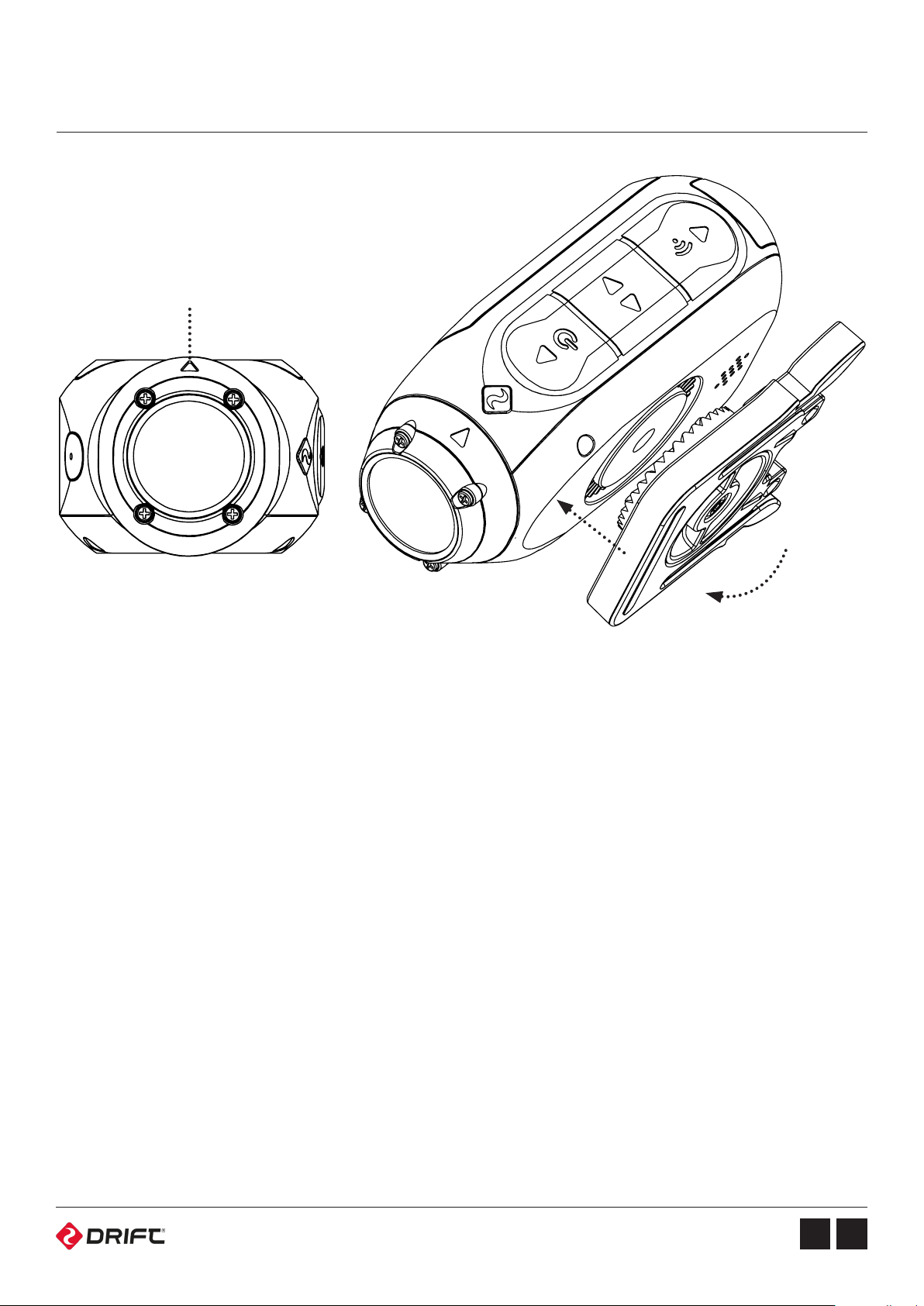
Lens Marker
Initial Setup
1. Attach the Universal Clip to the camera in any 360° orientation as needed –first
position the clip in the desired orientation, then secure by rotating the screw
base by hand.
2. Slide the Universal Clip into your chosen mount, ensuring that it ‘clicks’ into
place. *Double check it has been fully inserted by pushing out the clips.
3. Align your shot. Rotate the lens by hand, using the lens marker as an ‘up’
reference, mantaining it perpendicular to the ground for correct orientation.
Shot Setup
The Drift Life app is the fastest way to check your shot. Simply download the app
from Google Play (Android) or the App Store (iOS), launch the app.
Tap ‘Connect Camera’ and follow the instructions.
20EN
Page 21

Connectivity
Recorded video footage and photos can be copied to a computer using the USB
cable provided or—if your computer has an appropriate card reader—directly
from the Micro SD card.
Connecting to a Windows PC by USB Cable
1. Connect the camera to your PC using the USB cable. The camera screen will
display a USB logo and the LED status indicator will turn red.
2. Your PC’s operating system may be setup to open new devices automatically, if
not, open My Computer.
3. Your PC should recognise the camera as a removable device—look for your
memory card in the list of all devices and open.
4. Open the DCIM folder, inside you will find the 100DRIFT folder, which contains
all the files saved on the memory card by the camera
If there are a very large numbers of files, there will be multiple folders
(100DRIFT, 101DRIFT, etc).
5. Copy the desired files to your PC.
21EN
Page 22

Connectivity
Connecting to a Mac by USB Cable
1. Connect the camera to your Mac using the USB cable. The camera screen will
display a USB logo and the LED status indicator will turn red.
2. Your Mac’s operating system may be setup to open new devices automatically,
if not, open a new Finder window.
3. Your Mac should recognise the camera as a removable device—look for DRIFT
CARD in the list of devices and open.
4. Open the DCIM folder—inside, you will find the 100DRIFT folder which
contains all the files saved on the memory card by the camera.
If there are a very large numbers of files, there will be multiple folders
(100DRIFT, 101DRIFT, etc).
5. Copy the desired files to your Mac.
Connecting the Camera to a TV
1. While the camera is turned o, connect it to your TV using the included USB
cable.
2. Power on the camera, with a short press of the button.
3. Once booted up, you’ll be able to browse and play back media stored on your
memory card.
22EN
Page 23

Connectivity
Connecting to a Wi-Fi Device
1. Power the camera on, and press and hold the [Rear] button to turn the Wi-Fi
on. When the Wi-Fi indicator LED on the rear of the camera turns green, the
network is ready.
2. Download the Drift Life app form the Google Play (Android), or the App Store
(iOS).
3. Launch the Drift Life app, and tap ‘Connect Camera.’
4. Follow the in-app connection instructions to connect your Ghost-S to your
mobile device.
Please note that the Ghost 4K default Wi-Fi password is 1234567890
Playing Video on a Computer
Some computers may not have the correct codecs required for video playback
and editing. If you experience diculties playing video recorded with your
camera, you can download VLC media player for free from www.videolan.org. If
you are experiencing diculties editing video or do not wish to use VLC player
for playback, you will need to download and install a codec pack. The FFDshow
codec pack can be downloaded from www.free-codecs.com/FFDshow_
download.htm.
Compatibility
Windows XP and up / Mac OS 10.2 and up For 4K viewing a monitor capable of
playback is required. For viewing / editing minimum requirements include: 8GB
RAM integrated graphics, 4th generation i5 and 17 Intel® Core™ or AMD A107800 APU. Discreet graphics cards starting from GeForce® GTX™ 650, or AMD
Radeon™ HD 7000 Series and above.
Due to the immense processing required to render 4K, meeting system
requirements may still lead to staggered or choppy playback.
23EN
Page 24

Camera Care
The Ghost 4K is specifically designed for extreme sports. It is a very durable piece
of equipment. However, to ensure a long and healthy life for your camera, please
follow the guidelines below.
Cleaning the Camera
During your sporting activities, the camera will inevitably get dirty or wet.
Although this is not an issue, it is recommended that you clean the camera
after each use. Clean the camera thoroughly with a damp cloth and let it air dry
before uncovering ports, or rotating the lens. Modules should be removed
while allowing the camera to dry. Take extra care when cleaning the built-in
microphone and speaker.
Cleaning the Lens
In order to provide a clear image for high definition video, it is important to keep
the camera lens clean. Be careful not to scratch the camera lens whilst cleaning
it. Wipe o any surface mud or water from the lens with a damp cloth and use a
dry, micro fibre, scratch proof cloth to polish the lens once it is dry.
Scratch proof cloths are available from any camera shop or optician.
Storage
If unused for any length of time, please remove the memory card from your
Ghost 4K, and store the camera in a dry environment, away from direct sunlight.
Following use in wet weather it is recommended to store the camera in a warm
dry place for 24 hours, to allow any moisture to disperse.
24EN
Page 25

Updating Firmware
To download the latest Ghost 4K firmware please visit:
www.driftinnovation.com/blogs/support/Ghost4k
To install the update:
1. Format your memory card in the Ghost 4K settings menu. Make sure to save
any files you want before formatting, as this will delete all files.
2. Connect your camera to your computer.
3. Find your memory card (in your computer’s devices list), then drag and
drop the .bin firmware file from your downloads folder, into the root of your
memory card – beside, but not inside the DCIM folder.
4. Eject your camera from your computer, power it on, and the update will begin
automatically.
25EN
Page 26

Warranty
Drift Innovation (“Manufacturer”) warrants to the original End User (“Purchaser”)
that this product purchased from us or any authorized dealer is free from
manufacturing defects in material and workmanship for the applicable warranty
period, as set forth in the product specification, or 12 months—whichever is the
less. Drift Innovation products purchased from non-authorized dealers might not
be covered by the oered warranty.
The warranty period is considered valid from the issue date confirmed on the sale
invoice. This limited warranty covers defects encountered in the normal use of
the product during the warranty period and does not apply under the following
conditions:
• Product is damaged due to physical abuse, mishandling, accident, negligence
or failure to follow the supplied operating instructions;
• Product is physically modified by Purchaser in any manner other than that for
which it was intended or otherwise previously approved by the Manufacturer;
• Product is damaged or has developed defects caused by the use of
unauthorized parts or by an unauthorized repair service;
• The product has been subject to unsuitable operating or physical conditions
outside those recommended in product specifications as provided by the
Manufacturer;
• Product has it’s serial numbers altered or removed;
• Product is damaged due to improper packaging of the warranty return to the
dealer or Manufacturer.
In the event of a product failure under normal use and within the warranty period,
a repair or replacement will be provided at the discretion of the Manufacturer or
the authorized dealer.
The Manufacturer warranty does not cover loss, accidental damage or costs
incurred during the handling and shipping of repairs or replacement products.
The Manufacturer shall have no liability or responsibility whatsoever to Purchaser
or any other person for any loss, injury, death, or any damages derived from the
use of the product or accessories.
26EN
Page 27

Disclosures
FCC Information
This device complies with Part 15 of the FCC Rules. Operation is subject to the
following two conditions: (1) this device may not cause harmful interference, and
(2) this device must accept interference received, including interference that may
cause undesired operation.
WARNING
Changes or modifications to this unit not expressly approved by the party
responsible for compliance could void the user’s authority to operate the
equipment. The equipment has been tested and found to comply with the limits
for a Class B digital device, pursuant to Part 15 of the FCC Rules. These limits
are designed to provide reasonable protection against harmful interference
in a residential installation. This equipment generates, uses, and can radiate
radio frequency energy and, if not installed and used in accordance with the
instructions, may cause harmful interference to radio communications. However,
there is no guarantee that interference will not occur in a particular installation. If
this equipment does cause harmful interference to radio or television reception,
which can be determined by powering the equipment on and o, the user is
encouraged to try to correct the interference by one or more of the following
measures:
Reorient or relocate the receiving antenna;
Increase the separation between the equipment and the receiver;
Connect the equipment into an outlet on a circuit dierent from that which the
receiver is connected;
Consult the dealer or an experienced radio / TV technician for help.
This device complies with Industry Canada license-exempt RSS standard(s).
Operation is subject to the following two conditions: (1) this device may not
cause interference, and (2) this device must accept any interference, including
interference that may cause undesired operation of the device.
This Class [B] digital apparatus complies with Canadian ICES-003. Son
fonctionnement est soumis aux deux conditions suivantes: (1) cet appareil ne
peut pas causer l’intervention, et (2) cet appareil doit accepter de l’intervention, y
compris l’intervention qui peut causer l’opération non désirée de.
Cet appareil numérique de la classe [B] est conforme à la norme NMB-003 du
Canada.
Cet appareil s’accorde avec Industrie Canada licence-exempte RSS standard.
27EN
Page 28

Disclosures
FCC RADIATION EXPOSURE
This equipment complies with FCC radiation exposure limits set forth for an
uncontrolled environment. This equipment should be installed and operated with
minimum distance 20cm between the radiator & your body.
This transmitter must not be co-located or operating in conjunction with any
other antenna or transmitter.
MOTORCYCLE DISCLAIMER
Interacting with the camera while riding could cause a crash, which may lead to
serious injury or death to yourself or others.
• Keep eyes and mind on the road;
• Avoid looking at the camera for any long periods of time;
• Stop the vehicle in a safe location before adjusting the camera.
28EN
 Loading...