

Page 1

INTEGRATED CIRCUITS
XA-G49
XA 16-bit microcontroller family
64K FLASH/2K RAM, watchdog, 2 UARTs
Preliminary specification
Supersedes data of 1999 Jun 15
IC28 Data Handbook
2000 Apr 03
Page 2
Philips Semiconductors Preliminary specification
XA 16-bit microcontroller family
64K Flash/2K RAM, watchdog, 2 UARTs
GENERAL DESCRIPTION
The XA-G49 is a member of Philips’ 80C51 XA (eXtended
Architecture) family of high performance 16-bit single-chip
microcontrollers.
The XA-G49 contains 64k bytes of Flash program memory, and
provides three general purpose timers/counters, a watchdog timer,
dual UARTs, and four general purpose I/O ports with programmable
output configurations.
A default serial loader program in the Boot ROM allows In-System
Programming (ISP) of the Flash memory without the need for a
loader in the Flash code. User programs may erase and reprogram
the Flash memory at will through the use of standard routines
contained in the Boot ROM (In-Application Programming).
FEA TURES
•4.5V to 5.5V operation. For low voltage operation, consult factory.
•64K bytes of on-chip Flash program memory with In-System
Programming capability
•Five Flash blocks = two 8k byte blocks and three 16k byte blocks
•Nearly identical to XA-G3, except for double the program and
RAM memories
XA-G49
•Single supply voltage In-System Programming (ISP) of the Flash
memory (V
•Boot ROM contains low level Flash programming routines for
In-Application Programming and a default serial loader using the
UART
•2048 bytes of on-chip data RAM
•Supports off-chip program and data addressing up to 1 megabyte
(20 address lines)
•Three standard counter/timers with enhanced features (same as
XA-G3 T0, T1, and T2). All timers have a toggle output capability
•Watchdog timer
•Two enhanced UARTs with independent baud rates
•Seven software interrupts
•Four 8-bit I/O ports, with 4 programmable output configurations for
each pin
•30 MHz operating frequency at 5V
•Power saving operating modes: Idle and Power-Down.
Wake-Up from power-down via an external interrupt is supported.
•44-pin PLCC and 44-pin LQFP packages
= VDD, or VPP = 12V if desired)
PP
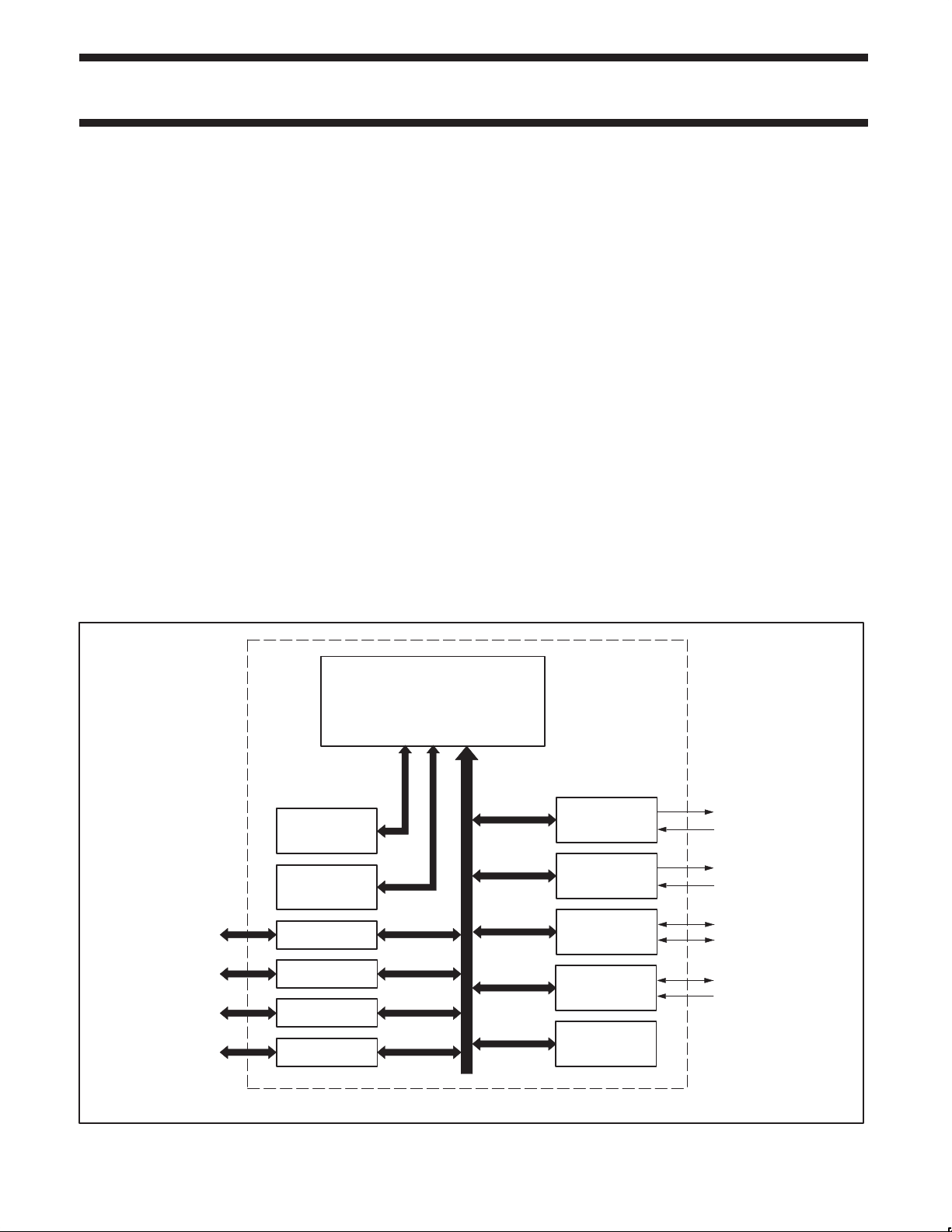
BLOCK DIAGRAM
64K Bytes
FLASH
2048 Bytes
Static RAM
Port 0
Port 1
Port 2
Port 3
XA CPU Core
Program
Memory
Bus
Data
Bus
SFR
bus
UART 0
UART 1
Timer 0, 1
Timer 2
Watchdog
Timer
2000 Apr 03
SU01002
2
Page 3

Philips Semiconductors Preliminary specification
XA 16-bit microcontroller family
64K Flash/2K RAM, watchdog, 2 UARTs
ORDERING INFORMATION
FLASH
PXAG49KBA
PXAG49KFA
LOGIC SYMBOL
TEMPERATURE RANGE (°C)
AND PACKAGE
0 to +70
44-pin Plastic Leaded Chip Carrier
–40 to +85
44-pin Plastic Leaded Chip Carrier
XTAL1
XTAL2
RST
EA/WAIT
PSEN
ALE
VDDV
XA-G49
FREQ.
(MHz)
30 SOT187-2
30 SOT187-2
SS
T2EX*
T2*
TXD1
D1
R
X
PORT 1PORT 2
A3
A2
A1
A0/WRH
BUS
ADDRESS
DRAWING
NUMBER
ALTERNATE FUNCTIONS
* NOT AVAILABLE ON 40-PIN DIP PACKAGE
RxD0
TxD0
INT0
INT1
T1/BUSW
WRL
RD
T0
PORT 3
ADDRESS AND DATA BUS
PORT 0
SU00526
2000 Apr 03
3
Page 4

Philips Semiconductors Preliminary specification
XA 16-bit microcontroller family
64K Flash/2K RAM, watchdog, 2 UARTs
PIN CONFIGURATIONS
44-Pin PLCC Package
6140
7
17
Pin Function
1V
SS
2 P1.0/A0/WRH
3 P1.1/A1
4 P1.2/A2
5 P1.3/A3
6 P1.4/RxD1
7 P1.5/TxD1
8 P1.6/T2
9 P1.7/T2EX
10 RST
11 P3.0/RxD0
12 NC
13 P3.1/TxD0
14 P3.2/INT0
15 P3.3/INT1
16 P3.4/T0
17 P3.5/T1/BUSW
18 P3.6/WR
19 P3.7/RD
20 XTAL2
21 XTAL1
22 V
L
SS
PLCC
18 28
Pin Function
23 V
24 P2.0/A12D8
25 P2.1/A13D9
26 P2.2/A14D10
27 P2.3/A15D11
28 P2.4/A16D12
29 P2.5/A17D13
30 P2.6/A18D14
31 P2.7/A19D15
32 PSEN
33 ALE
34 NC
35 EA
36 P0.7/A11D7
37 P0.6/A10D6
38 P0.5/A9D5
39 P0.4/A8D4
40 P0.3/A7D3
41 P0.2/A6D2
42 P0.1/A5D1
43 P0.0/A4D0
44 V
39
29
DD
/VPP/WAIT
DD
SU01035
44-Pin LQFP Package
44 34
1
11
12 22
Pin Function
1 P1.5/TxD1
2 P1.6/T2
3 P1.7/T2EX
4 RST
5 P3.0/RxD0
6NC
7 P3.1/TxD0
8 P3.2/INT0
9 P3.3/INT1
10 P3.4/T0
11 P3.5/T1/BUSW
12 P3.6/WRL
13 P3.7/RD
14 XTAL2
15 XTAL1
16 V
SS
17 V
DD
18 P2.0/A12D8
19 P2.1/A13D9
20 P2.2/A14D10
21 P2.3/A15D11
22 P2.4/A16/D12
LQFP
Pin Function
23 P2.5/A17D13
24 P2.6/A18D14
25 P2.7/A19D15
26 PSEN
27 ALE
28 NC
29 EA
30 P0.7/A11D7
31 P0.6/A10D6
32 P0.5/A9D5
33 P0.4/A8D4
34 P0.3/A7D3
35 P0.2/A6D2
36 P0.1/A5D1
37 P0.0/A4D0
38 V
39 V
40 P1.0/A0/WRH
41 P1.1/A1
42 P1.2/A2
43 P1.3/A3
44 P1.4/RxD1
/VPP/WAIT
DD
SS
SU01036
XA-G49
33
23
2000 Apr 03
4
Page 5

Philips Semiconductors Preliminary specification
MNEMONIC
TYPE
NAME AND FUNCTION
XA 16-bit microcontroller family
XA-G49
64K Flash/2K RAM, watchdog, 2 UARTs
PIN DESCRIPTIONS
PIN. NO.
LCC LQFP
V
SS
V
DD
P0.0 – P0.7 43–36 37–30 I/O Port 0: Port 0 is an 8-bit I/O port with a user-configurable output type. Port 0 latches have 1s
P1.0 – P1.7 2–9 40–44,
P2.0 – P2.7 24–31 18–25 I/O Port 2: Port 2 is an 8-bit I/O port with a user-configurable output type. Port 2 latches have 1s
P3.0 – P3.7 11,
RST 10 4 I Reset: A low on this pin resets the microcontroller, causing I/O ports and peripherals to take on
ALE 33 27 I/O Address Latch Enable: A high output on the ALE pin signals external circuitry to latch the address
1, 22 16 I Ground: 0V reference.
23, 44 17 I Power Supply: This is the power supply voltage for normal, idle, and power down operation.
written to them and are configured in the quasi-bidirectional mode during reset. The operation of
port 0 pins as inputs and outputs depends upon the port configuration selected. Each port pin is
configured independently. Refer to the section on I/O port configuration and the DC Electrical
Characteristics for details.
When the external program/data bus is used, Port 0 becomes the multiplexed low data/instruction
byte and address lines 4 through 11.
1–3
2 40 O A0/WRH: Address bit 0 of the external address bus when the external data bus is
3 41 O A1: Address bit 1 of the external address bus.
4 42 O A2: Address bit 2 of the external address bus.
5 43 O A3: Address bit 3 of the external address bus.
6 44 I RxD1 (P1.4): Receiver input for serial port 1.
7 1 O TxD1 (P1.5): Transmitter output for serial port 1.
8 2 I/O T2 (P1.6): Timer/counter 2 external count input/clockout.
9 3 I T2EX (P1.7): Timer/counter 2 reload/capture/direction control
13–195,7–13
11 5 I RxD0 (P3.0): Receiver input for serial port 0.
13 7 O TxD0 (P3.1): Transmitter output for serial port 0.
14 8 I INT0 (P3.2): External interrupt 0 input.
15 9 I INT1 (P3.3): External interrupt 1 input.
16 10 I/O T0 (P3.4): Timer 0 external input, or timer 0 overflow output.
17 11 I/O T1/BUSW (P3.5): Timer 1 external input, or timer 1 overflow output. The value on this pin is
18 12 O WRL (P3.6): External data memory low byte write strobe.
19 13 O RD (P3.7): External data memory read strobe.
I/O Port 1: Port 1 is an 8-bit I/O port with a user-configurable output type. Port 1 latches have 1s
written to them and are configured in the quasi-bidirectional mode during reset. The operation of
port 1 pins as inputs and outputs depends upon the port configuration selected. Each port pin is
configured independently. Refer to the section on I/O port configuration and the DC Electrical
Characteristics for details.
Port 1 also provides special functions as described below.
configured for an 8 bit width. When the external data bus is configured for a 16
bit width, this pin becomes the high byte write strobe.
written to them and are configured in the quasi-bidirectional mode during reset. The operation of
port 2 pins as inputs and outputs depends upon the port configuration selected. Each port pin is
configured independently. Refer to the section on I/O port configuration and the DC Electrical
Characteristics for details.
When the external program/data bus is used in 16-bit mode, Port 2 becomes the multiplexed high
data/instruction byte and address lines 12 through 19. When the external program/data bus is used in
8-bit mode, the number of address lines that appear on port 2 is user programmable.
I/O Port 3: Port 3 is an 8-bit I/O port with a user configurable output type. Port 3 latches have 1s
written to them and are configured in the quasi-bidirectional mode during reset. the operation of
port 3 pins as inputs and outputs depends upon the port configuration selected. Each port pin is
configured independently. Refer to the section on I/O port configuration and the DC Electrical
Characteristics for details.
Port 3 also provides various special functions as described below.
latched as the external reset input is released and defines the default
external data bus width (BUSW). 0 = 8-bit bus and 1 = 16-bit bus.
their default states, and the processor to begin execution at the address contained in the reset
vector. Refer to the section on Reset for details.
portion of the multiplexed address/data bus. A pulse on ALE occurs only when it is needed in order
to process a bus cycle.
2000 Apr 03
5
Page 6

Philips Semiconductors Preliminary specification
SFR
NAME
DESCRIPTION
SFR
XA 16-bit microcontroller family
XA-G49
64K Flash/2K RAM, watchdog, 2 UARTs
MNEMONIC NAME AND FUNCTIONTYPE
MNEMONIC NAME AND FUNCTIONTYPE
PSEN 32 26 O Program Store Enable: The read strobe for external program memory. When the microcontroller
EA/WAIT/
V
PP
XTAL1 21 15 I Crystal 1: Input to the inverting amplifier used in the oscillator circuit and input to the internal clock
XTAL2 20 14 O Crystal 2: Output from the oscillator amplifier.
SPECIAL FUNCTION REGISTERS
PIN. NO.
LQFPLCC
accesses external program memory, PSEN
is only active when external code accesses are performed.
35 29 I External Access/Wait/Programming Supply Voltage: The EA input determines whether the
internal program memory of the microcontroller is used for code execution. The value on the EA pin
is latched as the external reset input is released and applies during later execution. When latched
as a 0, external program memory is used exclusively, when latched as a 1, internal program
memory will be used up to its limit, and external program memory used above that point. After reset
is released, this pin takes on the function of bus Wait input. If Wait is asserted high during any
external bus access, that cycle will be extended until Wait is released. During EPROM
programming, this pin is also the programming supply voltage input.
generator circuits.
BIT FUNCTIONS AND ADDRESSES
ADDRESS
MSB LSB
is driven low in order to enable memory devices. PSEN
RESET
VALUE
AUXR Auxiliary function register 44C
BCR Bus configuration register 46A — — — WAITD BUSD BC2 BC1 BC0 Note 1
BTRH Bus timing register high byte 469 DW1 DW0 DWA1 DWA0 DR1 DR0 DRA1 DRA0 FF
BTRL Bus timing register low byte 468 WM1 WM0 ALEW — CR1 CR0 CRA1 CRA0 EF
CS Code segment 443 00
DS Data segment 441 00
ES Extra segment 442 00
IEH* Interrupt enable high byte 427 — — — — ETI1 ERI1 ETI0 ERI0 00
IEL* Interrupt enable low byte 426 EA — — ET2 ET1 EX1 ET0 EX0 00
IPA0 Interrupt priority 0 4A0 — PT0 — PX0 00
IPA1 Interrupt priority 1 4A1 — PT1 — PX1 00
IPA2 Interrupt priority 2 4A2 — — — PT2 00
IPA4 Interrupt priority 4 4A4 — PTI0 — PRI0 00
IPA5 Interrupt priority 5 4A5 — PTI1 — PRI1 00
P0* Port 0 430 AD7 AD6 AD5 AD4 AD3 AD2 AD1 AD0 FF
P1* Port 1 431 T2EX T2 TxD1 RxD1 A3 A2 A1 WRH FF
P2* Port 2 432 P2.7 P2.6 P2.5 P2.4 P2.3 P2.2 P2.1 P2.0 FF
P3* Port 3 433 RD WR T1 T0 INT1 INT0 TxD0 RxD0 FF
ENBOOT FMIDLE PWR_VLD
33F 33E 33D 33C 33B 33A 339 338
337 336 335 334 333 332 331 330
387 386 385 384 383 382 381 380
38F 38E 38D 38C 38B 38A 389 388
397 396 395 394 393 392 391 390
39F 39E 39D 39C 39B 39A 399 398
— — — — —
2000 Apr 03
6
Page 7

Philips Semiconductors Preliminary specification
XA 16-bit microcontroller family
XA-G49
64K Flash/2K RAM, watchdog, 2 UARTs
SFR
NAME
NAME
P0CFGA Port 0 configuration A 470 Note 5
P1CFGA Port 1 configuration A 471 Note 5
P2CFGA Port 2 configuration A 472 Note 5
P3CFGA Port 3 configuration A 473 Note 5
P0CFGB Port 0 configuration B 4F0 Note 5
P1CFGB Port 1 configuration B 4F1 Note 5
P2CFGB Port 2 configuration B 4F2 Note 5
P3CFGB Port 3 configuration B 4F3 Note 5
PCON* Power control register 404 — — — — — — PD IDL 00
PSWH* Program status word
PSWL* Program status word (low byte) 400 C AC — — — V N Z Note 2
PSW51* 80C51 compatible PSW 402 C AC F0 RS1 RS0 V F1 P Note 3
DESCRIPTION
DESCRIPTION
(high byte)
SFR
ADDRESS
ADDRESS
227 226 225 224 223 222 221 220
20F 20E 20D 20C 20B 20A 209 208
401 SM TM RS1 RS0 IM3 IM2 IM1 IM0 Note 2
207 206 205 204 203 202 201 200
217 216 215 214 213 212 211 210
BIT FUNCTIONS AND ADDRESSES
RESET
RESET
VALUE
VALUE
LSBMSB
RTH0 T imer 0 extended reload,
high byte
RTH1 T imer 1 extended reload,
high byte
RTL0 Timer 0 extended reload,
low byte
RTL1 Timer 1 extended reload,
low byte
S0CON* Serial port 0 control register 420 SM0_0 SM1_0 SM2_0 REN_0 TB8_0 RB8_0 TI_0 RI_0 00
S0STAT* Serial port 0 extended status 421 — — — — FE0 BR0 OE0
S0BUF Serial port 0 buffer register 460 x
S0ADDR Serial port 0 address register 461 00
S0ADEN Serial port 0 address enable
register
S1CON* Serial port 1 control register 424 SM0_1 SM1_1 SM2_1 REN_1 TB8_1 RB8_1 TI_1 RI_1 00
S1STAT* Serial port 1 extended status 425 — — — — FE1 BR1 OE1
S1BUF Serial port 1 buffer register 464 x
S1ADDR Serial port 1 address register 465 00
S1ADEN Serial port 1 address enable
register
455 00
457 00
454 00
456 00
307 306 305 304 303 302 301 300
30F 30E 30D 30C 30B 30A 309 308
STINT0
462 00
327 326 325 324 323 322 321 320
32F 32E 32D 32C 32B 32A 329 328
STINT1
466 00
00
00
SCR System configuration register 440 — — — — PT1 PT0 CM PZ 00
21F 21E 21D 21C 21B 21A 219 218
SSEL* Segment selection register 403
SWE Software Interrupt Enable 47A — SWE7 SWE6 SWE5 SWE4 SWE3 SWE2 SWE1 00
2000 Apr 03
ESWEN
R6SEG R5SEG R4SEG R3SEG R2SEG R1SEG R0SEG
7
00
Page 8

Philips Semiconductors Preliminary specification
XA 16-bit microcontroller family
XA-G49
64K Flash/2K RAM, watchdog, 2 UARTs
SFR
NAME
NAME
SWR* Software Interrupt Request 42A — SWR7 SWR6 SWR5 SWR4 SWR3 SWR2 SWR1 00
T2CON* Timer 2 control register 418 TF2 EXF2 RCLK0 TCLK0
T2MOD* Timer 2 mode control 419 — — RCLK1 TCLK1 — — T2OE DCEN 00
TH2 Timer 2 high byte 459 00
TL2 Timer 2 low byte 458 00
T2CAPH Timer 2 capture register,
T2CAPL Timer 2 capture register,
TCON* Timer 0 and 1 control register 410 TF1 TR1 TF0 TR0 IE1 IT1 IE0 IT0 00
TH0 Timer 0 high byte 451 00
TH1 Timer 1 high byte 453 00
TL0 Timer 0 low byte 450 00
TL1 Timer 1 low byte 452 00
TMOD Timer 0 and 1 mode control 45C GATE C/T M1 M0 GATE C/T M1 M0 00
TSTAT* Timer 0 and 1 extended status 411 — — — — — T1OE — T0OE 00
WDCON*
WDL Watchdog timer reload 45F 00
WFEED1
WFEED2
NOTES:
* SFRs are bit addressable.
1. At reset, the BCR register is loaded with the binary value 0000 0a11, where “a” is the value on the BUSW pin. This defaults the address bus
size to 20 bits since the XA-G49 has only 20 address lines.
2. SFR is loaded from the reset vector.
3. All bits except F1, F0, and P are loaded from the reset vector. Those bits are all 0.
4. Unimplemented bits in SFRs are X (unknown) at all times. Ones should not be written to these bits since they may be used for other
purposes in future XA derivatives. The reset value shown for these bits is 0.
5. Port configurations default to quasi-bidirectional when the XA begins execution from internal code memory after reset, based on the
condition found on the EA pin. Thus all PnCFGA registers will contain FF and PnCFGB registers will contain 00. When the XA begins
execution using external code memory, the default configuration for pins that are associated with the external bus will be push-pull. The
PnCFGA and PnCFGB register contents will reflect this difference.
6. The WDCON reset value is E6 for a W atchdog reset, E4 for all other reset causes.
7. The XA-G49 implements an 8-bit SFR bus, as stated in Chapter 8 of the
to write 16 bits to an SFR will actually write only the lower 8 bits. Sixteen bit SFR reads will return undefined data in the upper byte.
8. The AUXR reset value is typically 00h. If the Boot Loader is activated at reset because the Flash status byte is non-zero or because the Boot
Vector has been forced (by PSEN
generator is running and ready, otherwise it will be a 0.
V
PP
DESCRIPTION
DESCRIPTION
high byte
low byte
Watchdog control register 41F PRE2 PRE1 PRE0 — —
Watchdog feed 1 45D x
Watchdog feed 2 45E x
= 0, ALE = 1, EA = 1 at reset), the AUXR reset value will be 1x00 0000b. Bit 6 will be a 1 if the on-chip
SFR
ADDRESS
ADDRESS
357 356 355 354 353 352 351 350
2C7 2C6 2C5 2C4 2C3 2C2 2C1 2C0
2CF 2CE 2CD 2CC 2CB 2CA 2C9 2C8
45B 00
45A 00
287 286 285 284 283 282 281 280
28F 28E 28D 28C 28B 28A 289 288
2FF 2FE 2FD 2FC 2FB 2FA 2F9 2F8
BIT FUNCTIONS AND ADDRESSES
XA User Guide
EXEN2
. All SFR accesses must be 8-bit operations. Attempts
TR2 C/T2
WDRUN WDTOF
CP/RL2
RESET
RESET
VALUE
VALUE
LSBMSB
00
—
Note 6
2000 Apr 03
8
Page 9

Philips Semiconductors Preliminary specification
XA 16-bit microcontroller family
64K Flash/2K RAM, watchdog, 2 UARTs
FFFFFh
UP TO 1M BYTES
TOTAL CODE
MEMORY
10000h
FFFFh
0000h
64k BYTES
ON-CHIP
CODE MEMORY
Note: The Boot ROM replaces the top 2k bytes of Flash memory when it is enabled via the xxx bit in xxx.
Figure 1. XA-G49 Program Memory Map
2k BYTE BOOT ROM
XA-G49
FFFFh
F800h
SU01194
2k BYTES
ON-CHIP DATA
MEMORY
(RAM)
Data Segment 0
DATA MEMORY
(INDIRECTLY ADDRESSED,
OFF-CHIP)
DATA MEMORY
(INDIRECTLY ADDRESSED,
ON CHIP)
DATA MEMORY
(DIRECTLY AND INDIRECTLY
ADDRESSABLE, ON CHIP)
BIT-ADDRESSABLE
DATA AREA
DATA MEMORY
(DIRECTLY AND INDIRECTLY
ADDRESSABLE, ON CHIP)
FFFFFh
0800h
07FFh
0400H
03FFh
0040h
003Fh
0020h
001Fh
0000h
DIRECTLY ADDRESSED DATA
(1k PER SEGMENT)
FFFFFh
0400H
03FFh
0040h
003Fh
0020h
001Fh
0000h
Other Data Segments
DATA MEMORY
(INDIRECTLY ADDRESSED,
OFF-CHIP)
DATA MEMORY
(DIRECTLY AND INDIRECTLY
ADDRESSABLE, OFF-CHIP)
BIT-ADDRESSABLE
DATA AREA
DATA MEMORY
(DIRECTLY AND INDIRECTLY
ADDRESSABLE, OFF-CHIP)
2000 Apr 03
SU01195
Figure 2. XA-G49 Data Memory Map
9
Page 10

Philips Semiconductors Preliminary specification
XA 16-bit microcontroller family
64K Flash/2K RAM, watchdog, 2 UARTs
FLASH EPROM MEMORY
GENERAL DESCRIPTION
The XA-G49 Flash memory augments EPROM functionality with
in-circuit electrical erasure and programming. The Flash can be read
and written as bytes. The Chip Erase operation will erase the entire
program memory. The Block Erase function can erase any single
Flash block. In-circuit programming and standard parallel
programming are both available. On-chip erase and write timing
generation contribute to a user friendly programming interface.
The XA-G49 Flash reliably stores memory contents even after
10,000 erase and program cycles. The cell is designed to optimize
the erase and programming mechanisms. In addition, the
combination of advanced tunnel oxide processing and low internal
electric fields for erase and programming operations produces
reliable cycling. For In-System Programming, the XA-G49 can use a
single +5 V power supply. Faster In-System Programming may be
obtained, if required, through the use of a +12 V V
Parallel programming (using separate programming hardware) uses
a +12 V V
PP
supply
FEATURES
•Flash EPROM internal program memory with Single Voltage
Programming and Block Erase capability.
•Internal 2k byte fixed boot ROM, containing low-level
programming routines and a default loader. The Boot ROM can be
turned off to provide access to the full 64k byte Flash memory.
•Boot vector allows user provided Flash loader code to reside
anywhere in the Flash memory space. This configuration provides
flexibility to the user.
•Default loader in Boot ROM allows programming via the serial port
without the need for a user provided loader.
•Up to 1 Mbyte external program memory if the internal program
memory is disabled (EA
•Programming and erase voltage: V
power supply), or 12V ±5% for In System Programming. Using
12V V
for ISP may improve programming and erase time.
PP
= 0).
= VDD (single 5V ±5% chip
PP
•Read/Programming/Erase:
– Byte-wise read (60 ns access time at 4.5 V).
– Byte Programming (40 ms).
– Typical erase times:
Block Erase (8k bytes or 16k bytes) in t.b.d. seconds.
Full Erase (64k bytes) in t.b.d. seconds.
•In-circuit programming via user selected method, typically RS232
or parallel I/O port interface.
•Programmable security for the code in the Flash
•1,000 minimum erase/program cycles each byte over operating
temperature range
•10 year minimum data retention.
supply.
PP
XA-G49
CAPABILITIES OF THE PHILIPS 89C51
FLASH-BASED MICROCONTROLLERS
Flash organization
The XA-G49 contains 64k bytes of Flash program memory. This
memory is organized as 5 separate blocks. The first two blocks are
8k bytes in size, filling the program memory space from address 0
through 3FFF hex. The final three blocks are 16k bytes in size and
occupy addresses from 4000 through FFFF hex.
Figure 3 depicts the Flash memory configuration.
Flash Programming and Erasure
The XA-G49 Flash microcontroller supports a number of
programming possibilities for the on-chip Flash memory. The Flash
memory may be programmed in a parallel fashion on standard
programming equipment in a manner similar to an EPROM
microcontroller. The XA-G49 microcontroller is able to program its
own Flash memory while the application code is running. Also, a
default loader built into a Boot ROM allows programming blank
devices serially through the UART.
Using any of these types of programming, any of the individual blocks
may be erased separately, or the entire chip may be erased.
Programming of the Flash memory is accomplished one byte at a time.
Boot ROM
When the microcontroller programs its own Flash memory, all of the
low level details are handled by code that is permanently contained
in a 2k byte “Boot ROM” that is separate from the Flash memory. A
user program simply calls the entry point with the appropriate
parameters to accomplish the desired operation. Boot ROM
operations include things like: erase block, program byte, verify
byte, program security lock bit, etc. The Boot ROM overlays the
program memory space at the top of the address space from F800
to FFFF hex, when it is enabled by setting the ENBOOT bit at
AUXR1.7.. The Boot ROM may be turned off so that the upper 2k
bytes of Flash program memory are accessible for execution.
ENBOOT and PWR_VLD
Setting the ENBOOT bit in the AUXR register enables the Boot
ROM and activates the on-chip V
V
rather than 12V externally. The PWR_VLD flag indicates that
DD
V
is available for programming and erase operations. This flag
PP
should be checked prior to calling the Boot ROM for programming
and erase services. When ENBOOT is set, it typically takes
5 microseconds for the internal programming voltage to be ready.
The ENBOOT bit will automatically be set if the status byte is
non-zero during reset, or when PSEN
high at the falling edge of reset. Otherwise, ENBOOT will be cleared
during reset.
When programming functions are not needed, ENBOOT may be
cleared. This enables access to the 2k bytes of Flash code memory
that is overlaid by the Boot ROM, allowing a full 64k bytes of Flash
code memory.
generator if VPP is connected to
PP
is low, ALE is high, and EA is
2000 Apr 03
10
Page 11

Philips Semiconductors Preliminary specification
XA 16-bit microcontroller family
64K Flash/2K RAM, watchdog, 2 UARTs
FFFF
BLOCK 4
16k BYTES
C000
BLOCK 3
16k BYTES
PROGRAM
ADDRESS
8000
BLOCK 2
16k BYTES
4000
BLOCK 1
2000
0000
8k BYTES
BLOCK 0
8k BYTES
Figure 3. Flash Memory Configuration
BOOT ROM
SU01034
XA-G49
FFFF
F800
FMIDLE
The FMIDLE bit in the AUXR register allows saving additional power
by turning off the Flash memory when the CPU is in the Idle mode.
This must be done just prior to initiating the Idle mode, as shown
below.
OR AUXR,#$40 ; Set Flash memory
to idle mode.
OR PCON,#$01 ; Turn on Idle mode.
. . ; Execution resumes
here when Idle
mode terminates.
When the Flash memory is put into the Idle mode by setting FMIDLE,
restarting the CPU upon exiting Idle mode takes slightly longer,
about 3 microseconds. However, the standby current consumed by
the Flash memory is reduced from about 8mA to about 1mA.
Default Loader
A default loader that accepts programming commands in a
predetermined format is contained permanently in the Boot ROM. A
factory fresh device will enter this loader automatically if it is
powered up without first being programmed by the user. Loader
commands include functions such as erase block; program Flash
memory; read Flash memory; and blank check.
Boot Vector
The XA-G49 contains two special FLASH registers: the BOOT
VECTOR and the STATUS BYTE.
The “Boot Vector” allows forcing the execution of a user supplied
Flash loader upon reset, under two specific sets of conditions. At the
falling edge of reset, the XA-G49 examines the contents of the
Status Byte. If the Status Byte is set to zero, power-up execution
starts at location 0000H, which is the normal start address of the
user’s application code.
When the Status Byte is set to a value other than zero, the Boot
Vector is used as the reset vector (4 bytes), including the Boot
Program Counter (BPC) and the Boot PSW (BPSW). The factory
default settings are 8000h for the BPSW and F800h for the BPC,
which corresponds to the address F900h for the factory masked-ROM
ISP boot loader. The Status Byte is automatically set to a non-zero
value when a programming error occurs. A custom boot loader can
be written with the Boot Vector set to the custom boot loader.
NOTE: When erasing the Status Byte or Boot Vector, these
bytes are erased at the same time. It is necessary to reprogram
the Boot Vector after erasing and updating the Status Byte.
Hardware Activation of the Boot Vector
Program execution at the Boot Vector may also be forced from
outside of the microcontroller by setting the correct state on a few
pins. While Reset is asserted, the PSEN
ALE pin allowed to float high (need not be pulled up externally), and
pin driven to a logic high (or up to VPP). Then reset may be
the EA
released. This is the same effect as having a non-zero status byte.
This allows building an application that will normally execute the end
user’s code but can be manually forced into ISP operation. The Boot
ROM is enabled when use of the Boot Vector is forced as described
above, so the branch may go to the default loader. Conversely, user
code in the top 2k bytes of the Flash memory may not be executed
when the Boot Vector is used.
If the factory default setting for the BPC (F800h) is changed, it will no
longer point to the ISP masked-ROM boot loader code. If this happens,
the only possible way to change the contents of the Boot Vector is
through the parallel programming method, provided that the end user
application does not contain a customized loader that provides for
erasing and reprogramming of the Boot Vector and Status Byte.
After programming the FLASH, the status byte should be erased to
zero in order to allow execution of the user’s application code
beginning at address 0000H.
pin must be pulled low, the
2000 Apr 03
11
Page 12

Philips Semiconductors Preliminary specification
XA 16-bit microcontroller family
64K Flash/2K RAM, watchdog, 2 UARTs
V
CC
V
PP
RST
XTAL2
XTAL1
V
SS
Figure 4. In-System Programming with a Minimum of Pins
In-System Programming (ISP)
In-System Programming (ISP) is performed without removing the
microcontroller from the system. The In-System Programming (ISP)
facility consists of a series of internal hardware resources coupled
with internal firmware to facilitate remote programming of the
XA-G49 through the serial port. This firmware is provided by Philips
and embedded within each XA-G49 device.
The Philips In-System Programming (ISP) facility has made in-circuit
programming in an embedded application possible with a minimum
of additional expense in components and circuit board area.
The ISP function uses five pins: TxD, RxD, V
Figure 4). Only a small connector needs to be available to interface
your application to an external circuit in order to use this feature.
The V
supply should be adequately decoupled and VPP not
PP
allowed to exceed datasheet limits.
Table 1. ISP typical programming currents
@ 25°C, 22 MHz, 5 V
V
CC
5.0 V 5.0 V 60 µA 25 mA
ISP increases IDD by less than 1mA.
V
PP
I
DD
PP
ISP software is available on the Philips web site
1. With your browser, open this page:
www.semiconductors.com
2. Enter winzip.zip into the Search box at the top of the Philips
web page.
3. Click on Microcontrollers Software support.
4. Download disk1.zip and disk2.zip.
5. Create a directory on your hard drive named WINISP.
6. Unzip the two disk files into this new directory WINISP.
Using In-System Programming (ISP)
When ISP mode is entered, the default loader first disables the
watchdog timer to prevent a watchdog reset from occurring during
programming.
The ISP feature allows for a wide range of baud rates to be used in
the application, independent of the oscillator frequency. It is also
V
DD
TxD
RxD
, VDD, and VPP (see
SS
I
DD
XA-G49
VDD SUPPLY OR +12V ±5%
5V ±5%
TxD
RxD
V
SS
TRANSCEIVER
MC145406, MAX232,
OR EQUIVALENT
adaptable to a wide range of oscillator frequencies. This is
accomplished by measuring the bit-time of a single bit in a received
character. This information is then used to program the baud rate in
terms of timer counts based on the oscillator frequency. The ISP
feature requires that an initial character (a lowercase f) be sent to
the XA-G49 to establish the baud rate. The ISP firmware provides
auto-echo of received characters.
Once baud rate initialization has been performed, the ISP firmware
will only accept specific Intel Hex-type records. Intel Hex records
consist of ASCII characters used to represent hexadecimal values
and are summarized below:
:NNAAAARRDD..DDCC<crlf>
In the Intel Hex record, the “NN” represents the number of data
bytes in the record. The XA-G49 will accept up to 16 (10H) data
bytes. The “AAAA” string represents the address of the first byte in
the record. If there are zero bytes in the record, this field is often set
to 0000. The “RR” string indicates the record type. A record type of
“00” is a data record. A record type of “01” indicates the end-of-file
mark. In this application, additional record types will be added to
indicate either commands or data for the ISP facility. The maximum
number of data bytes in a record is limited to 16 (decimal). ISP
commands are summarized in Table 2.
As a record is received by the XA-G49, the information in the record
is stored internally and a checksum calculation is performed. The
operation indicated by the record type is not performed until the
entire record has been received. Should an error occur in the
checksum, the XA-G49 will send an “X” out the serial port indicating
a checksum error. If the checksum calculation is found to match the
checksum in the record, then the command will be executed. In
most cases, successful reception of the record will be indicated by
transmitting a “.” character out the serial port (displaying the
contents of the internal program memory is an exception).
In the case of a Data Record (record type 00), an additional check is
made. A “.” character will NOT be sent unless the record checksum
matched the calculated checksum and all of the bytes in the record
were successfully programmed. For a data record, an “X” indicates
that the checksum failed to match, and an “R” character indicates
that one of the bytes did not properly program.
The ISP facility was designed so that specific crystal frequencies
were not required in order to generate baud rates or time the
programming pulses.
FOR USE WITH WINISP
RS-232
FEMALE
DB-9
SU01072
2
3
5
2000 Apr 03
12
Page 13

Philips Semiconductors Preliminary specification
XA 16-bit microcontroller family
64K Flash/2K RAM, watchdog, 2 UARTs
User Supplied Loader
A user program can simply decide at any time, for any reason, to
begin Flash programming operations. All it has to do in advance is to
instruct external circuitry to apply +5V or +12V to the V
make certain that the Boot ROM is enabled. User code may contain
a loader designed to replace the application code contained in the
Flash memory by loading new code through any communication
medium available in the application. This is completely flexible and
defined by the designer of the system. It could be done serially using
RS-232, serially using some other method, or even parallel over a
user defined I/O port. The user has the freedom to choose a method
that does not interfere with the application circuit. As an added
feature, the application program may also use the Flash memory as
a long term data storage, saving configuration information, sensor
readings, or any other desired data.
The actual loader code would typically be programmed by the user
into the microcontroller in a parallel fashion or via the default loader
during their manufacturing process. The entire initial Flash contents
may be programmed at that time, or the rest of the application may
be programmed into the Flash memory at a later time, possibly
using the loader code to do the programming.
pin, and
PP
XA-G49
This application controlled programming capability allows for the
possibility of changing the application code in the field. If the
application circuit is embedded in a PC, or has a way to establish a
telephone data link to a user’s or manufacturer’s computer, new
code could be downloaded from diskette or a manufacturer’s
support system. There is even the possibility of conducting very
specialized remote testing of a failing circuit board by the
manufacturer by remotely programming a series of detailed test
programs into the application board and checking the results.
Any user supplied loader should take the watchdog timer into
account. Typically, the watchdog timer would be disabled upon entry
to the loader if it might be running, in order to prevent a watchdog
reset from occurring during programming.
XA Programming Specifications on Philips web site
Programming specifications for the XA family can be located on the
Philips Semiconductors web site at:
www.semiconductors.com/mcu/
Click on Support and Training, then Programming Specifications.
2000 Apr 03
13
Page 14

Philips Semiconductors Preliminary specification
XA 16-bit microcontroller family
64K Flash/2K RAM, watchdog, 2 UARTs
Table 2. Intel-Hex Records Used by In-System Programming
RECORD TYPE COMMAND/DATA FUNCTION
00 or 80 Data Record
:nnaaaa00dd....ddcc
Where:
Nn = number of bytes (hex) in record
Aaaa = memory address of first byte in record
dd....dd = data bytes
cc = checksum
Example:
:10008000AF5F67F0602703E0322CFA92007780C3FD
01 or 81 End of File (EOF), no operation
:xxxxxx01cc
Where:
xxxxxx = required field, but value is a “don’t care”
cc = checksum
Example:
:00000001FF
83 Miscellaneous Write Functions
:nnxxxx83ffssddcc
Where:
nn = number of bytes (hex) in record
xxxx = required field, but value is a “don’t care”
83 = Write Function
ff = subfunction code
ss = selection code
dd = data input (as needed)
cc = checksum
Subfunction Code = 01 (Erase Blocks)
ff = 01
ss = block number in bits 7:5, Bits 4:0 = zeros
block 0 : ss = 00h
block 1 : ss = 20h
block 2 : ss = 40h
block 3 : ss = 80h
block 4 : ss = C0h
Example:
:0200008301203C erase block 1
Subfunction Code = 04 (Erase Boot Vector and Status Byte)
ff = 04
ss = don’t care
dd = don’t care
Example:
:010000830478 erase boot vector and status byte
Subfunction Code = 05 (Program Security Bits)
ff = 05
ss = 00 program security bit 1 (inhibit writing to FLASH)
01 program security bit 2 (inhibit FLASH verify)
02 program security bit 3 (disable external memory)
Example:
:02000083050175 program security bit 2
Subfunction Code = 06 (Program Status Byte or Boot Vector)
ff = 06
ss = 00 program status byte
01 program boot vector
NOTE: Only four bits of these Special Cells may be programmed at one time.
Example:
:020000830601FC78 program boot vector to FC00h
XA-G49
2000 Apr 03
14
Page 15

Philips Semiconductors Preliminary specification
XA 16-bit microcontroller family
XA-G49
64K Flash/2K RAM, watchdog, 2 UARTs
RECORD TYPE COMMAND/DATA FUNCTION
84 Display Device Data or Blank Check – Record type 84 causes the contents of the entire FLASH array to be sent out
85 Miscellaneous Read Functions
the serial port in a formatted display. This display consists of an address and the contents of 16 bytes starting with that
address. No display of the device contents will occur if security bit 2 has been programmed. The dumping of the device
data to the serial port is terminated by the reception of any character.
General Format of Function 84
:05xxxx84sssseeeeffcc
Where:
05 = number of bytes (hex) in record
xxxx = required field, but value is a “don’t care”
84 = “Display Device Data or Blank Check” function code
ssss = starting address
eeee = ending address
ff = subfunction
00 = display data
01 = blank check
cc = checksum
Example:
:0500008440004FFF00E9 display 4000–4FFF
General Format of Function 85
:02xxxx85ffsscc
Where:
02 = number of bytes (hex) in record
xxxx = required field, but value is a “don’t care”
85 = “Miscellaneous Read” function code
ffss = subfunction and selection code
0000 = read signature byte – manufacturer id (15H)
0001 = read signature byte – device id # 1 (EAH)
0002 = read signature byte – device id # 2 (XA–G49 = 54H))
0700 = read security bits (returned value bits 3:1 = sb3,sb2,sb1)
0701 = read status byte
cc = checksum
Example:
:02000085000178 read signature byte – device id # 1
0702 = read boot vector
2000 Apr 03
15
Page 16

Philips Semiconductors Preliminary specification
XA 16-bit microcontroller family
64K Flash/2K RAM, watchdog, 2 UARTs
In-Application Programming Method
Several Application Program Interface (API) calls are available for
use by an application program to permit selective erasing and
programming of FLASH sectors. All calls are made through a
Table 3. API calls
API CALL PARAMETER
PROGRAM DATA BYTE Input Parameters:
ERASE BLOCK Input Parameters:
ERASE BPC and
STATUS BYTE
PROGRAM SECURITY BIT Input Parameters:
PROGRAM STATUS BYTE Input Parameters:
PROGRAM BPC high byte Input Parameters:
READ DEVICE DATA Input Parameters:
READ MANUFACTURER ID Input Parameters:
R0H = 02h or 92h
R6 = address of byte to program
R4L = byte to program
Return Parameter
R4L = 00 if pass, non-zero if fail
R0H = 01h or 93h
R6H = block number in bits 7:5, bits 4:0 = ’0’
block 0 : R6H = 00h
block 1 : R6H = 20h
block 2 : R6H = 40h
block 3 : R6H = 80h
block 4 : R6H = C0h
R6L = 00h
Return Parameter
R4L = 00 if pass, non-zero if fail
Input Parameters:
R0H = 04h
Return Parameter
R4L = 00 if pass, non-zero if fail
R0H = 05h
R6H = 00h
R6L = 00h – security bit # 1 (inhibit writing to FLASH)
01h – security bit # 2 (inhibit FLASH verify)
02h – security bit # 3 (disable external memory)
Return Parameter
none
R0H = 06h
R6H = 00h
R6L = 00h – program status byte
R4L = status byte
Return Parameter
R4L = 00 if pass, non-zero if fail
NOTE: Only four bits of this Special Cell may be programmed at one time.
R0H = 06h
R6H = 00h
R6L = 01h – program BPC
R4L = BPC[15:8] (BPC[7:0] unchanged)
Return Parameter
R4L = 00 if pass, non-zero if fail
NOTE: Only four bits of this Special Cell may be programmed at one time.
R0H = 03h
R6 = address of byte to read
Return Parameter
R4L = value of byte read
R0H = 00h
R6H = 00h
R6L = 00h (manufacturer ID)
Return Parameter
R4L = value of byte read
XA-G49
common interface, PGM_MTP. The programming functions are
selected by setting up the microcontroller’s registers before making
a call to PGM_MTP at FFF0H. Results are returned in the registers.
The API calls are shown in Table 3.
2000 Apr 03
16
Page 17

Philips Semiconductors Preliminary specification
XA 16-bit microcontroller family
64K Flash/2K RAM, watchdog, 2 UARTs
API CALL PARAMETER
READ DEVICE ID # 1 Input Parameters:
R0H = 00h
R6H = 00h
R6L = 01h (device ID # 1)
Return Parameter
R4L = value of byte read
READ DEVICE ID # 2 Input Parameters:
R0H = 00h
R6H = 00h
R6L = 02h (device ID # 2)
Return Parameter
R4L = value of byte read
READ SECURITY BITS Input Parameters:
R0H = 07h
R6H = 00h
R6L = 00h (security bits)
Return Parameter
R4L = value of byte read R4L[3:1] = sb3, sb2, sb1
READ STATUS BYTE Input Parameters:
R0H = 07h
R6H = 00h
R6L = 01h (status byte)
Return Parameter
R4L = value of BPC[15:8]
READ BPC Input Parameters:
R0H = 07h
R6H = 00h
R6L = 02h (boot vector)
Return Parameter
R4L = value of byte read (high byte of Boot PC)
PROGRAM ALL ZERO Input Parameters:
R0H = 90h
R6H = block number in bits 7:5, bits 4:0 = ‘0’
block 0 : r6h = 00h
block 1 : r6h = 20h
block 2 : r6h = 40h
block 3 : r6h = 80h
block 4 : r6h = C0h
R6L = 00h
Return Parameters:
R4L = 00 if pass, non–zero if fail
ERASE CHIP Input Parameters:
R0H = 91h
R4L = 55h (after chip erase, return to caller)
= AAh (after chip erase, reset chip)
= others: error
Return Parameters:
R4L = 00 if pass, non–zero if fail
PROGRAM SPECIAL CELL Input Parameters:
R0H = 94h
R6 = special cell address
0000h: program BPSW[7:0]
0001h: program BPSW[15:8]
0002h: program BPC[7:0]
0003h: program BPC[15:8]
0004h: program status byte
000Ah: program security bit #1
000Ch: program security bit #2
000Eh: program security bit #3
R4L = byte value to program
Return Parameters:
R4L = 00 if pass, non–zero if fail
NOTE: Only four bits of these Special Cells may be programmed at one time.
XA-G49
2000 Apr 03
17
Page 18

Philips Semiconductors Preliminary specification
PROTECTION DESCRIPTION
XA 16-bit microcontroller family
64K Flash/2K RAM, watchdog, 2 UARTs
API CALL PARAMETER
ERASE SPECIAL CELL Input Parameters:
R0H = 95h
R6 = special cell address
0000h: erase BPSW[7:0]
0001h: erase BPSW[15:8]
0002h: erase BPC[7:0]
0003h: erase BPC[15:8]
0004h: erase status byte
Return Parameters:
R4L = 00 if pass, non–zero if fail
READ SPECIAL CELL Input Parameters:
R0H = 96h
R6 = special cell address
0000h: read BPSW[7:0]
0001h: read BPSW[15:8]
0002h: read BPC[7:0]
0003h: read BPC[15:8]
0004h: read status byte
0006h: read manufacturer ID
0007h: read device ID #1
0008h: read device ID #2
000Ah: read security bit #1
000Ch: read security bit #2
000Eh: read security bit #3
Return Parameters:
R4L = value of byte read
XA-G49
Security
The security feature protects against software piracy and prevents the contents of the Flash from being read. The Security Lock bits are located
in Flash. The XA-G49 has 3 programmable security lock bits that will provide different levels of protection for the on-chip code and data (see
Table 4).
Table 4.
SECURITY LOCK BITS
Level SB1 SB2 SB3
1 0 0 0 No program security features enabled.
2 1 0 0 Inhibit writing to Flash. Also, MOVC instructions executed from external program memory
3 1 1 0 Same as level 2, plus program verification is disabled
4 1 1 1 Same as level 3, plus external execution is disabled.
NOTE:
1. Any other combination of the Lock bits is not defined.
1
are disabled from fetching code bytes from internal memory.
2000 Apr 03
18
Page 19

Philips Semiconductors Preliminary specification
XA 16-bit microcontroller family
64K Flash/2K RAM, watchdog, 2 UARTs
XA-G49 TIMER/COUNTERS
The XA has two standard 16-bit enhanced Timer/Counters: Timer 0
and Timer 1. Additionally, it has a third 16-bit Up/Down
timer/counter, T2. A central timing generator in the XA core provides
the time-base for all XA Timers and Counters. The timer/event
counters can perform the following functions:
– Measure time intervals and pulse duration
– Count external events
– Generate interrupt requests
– Generate PWM or timed output waveforms
All of the timer/counters (Timer 0, Timer 1 and Timer 2) can be
independently programmed to operate either as timers or event
counters via the C/T bit in the TnCON register. All timers count up
unless otherwise stated. These timers may be dynamically read
during program execution.
The base clock rate of all of the timers is user programmable. This
applies to timers T0, T1, and T2 when running in timer mode (as
opposed to counter mode), and the watchdog timer. The clock
driving the timers is called TCLK and is determined by the setting of
two bits (PT1, PT0) in the System Configuration Register (SCR).
The frequency of TCLK may be selected to be the oscillator input
divided by 4 (Osc/4), the oscillator input divided by 16 (Osc/16), or
the oscillator input divided by 64 (Osc/64). This gives a range of
possibilities for the XA timer functions, including baud rate
XA-G49
generation, Timer 2 capture. Note that this single rate setting applies
to all of the timers.
When timers T0, T1, or T2 are used in the counter mode, the
register will increment whenever a falling edge (high to low
transition) is detected on the external input pin corresponding to the
timer clock. These inputs are sampled once every 2 oscillator
cycles, so it can take as many as 4 oscillator cycles to detect a
transition. Thus the maximum count rate that can be supported is
Osc/4. The duty cycle of the timer clock inputs is not important, but
any high or low state on the timer clock input pins must be present
for 2 oscillator cycles before it is guaranteed to be “seen” by the
timer logic.
Timer 0 and Timer 1
The “Timer” or “Counter” function is selected by control bits C/T in
the special function register TMOD. These two Timer/Counters have
four operating modes, which are selected by bit-pairs (M1, M0) in
the TMOD register. T imer modes 1, 2, and 3 in XA are kept identical
to the 80C51 timer modes for code compatibility. Only the mode 0 is
replaced in the XA by a more powerful 16-bit auto-reload mode. This
will give the XA timers a much larger range when used as time
bases.
The recommended M1, M0 settings for the different modes are
shown in Figure 6.
SCR Address:440
Not Bit Addressable
Reset Value: 00H
PT1 PT0 OPERATING
0 0 Osc/4
0 1 Osc/16
1 0 Osc/64
1 1 Reserved
CM Compatibility Mode allows the XA to execute most translated 80C51 code on the XA. The
PZ Page Zero mode forces all program and data addresses to 16-bits only. This saves stack space
TMOD Address:45C
Not Bit Addressable
Reset Value: 00H
GATE Gating control when set. Timer/Counter “n” is enabled only while “INTn” pin is high and
C/T Timer or Counter Selector cleared for Timer operation (input from internal system clock.)
M1 M0 OPERATING
0 0 16-bit auto-reload timer/counter
0 1 16-bit non-auto-reload timer/counter
1 0 8-bit auto-reload timer/counter
1 1 Dual 8-bit timer mode (timer 0 only)
———
Prescaler selection.
XA register file must copy the 80C51 mapping to data memory and mimic the 80C51 indirect
addressing scheme.
and speeds up execution but limits memory access to 64k.
Figure 5. System Configuration Register (SCR)
GATE C/T M1
TIMER 1 TIMER 0
“TRn” control bit is set. When cleared Timer “n” is enabled whenever “TRn” control bit is set.
Set for Counter operation (input from “Tn” input pin).
Figure 6. Timer/Counter Mode Control (TMOD) Register
— PT1 PT0 CM PZ
M0 GATE C/T
M1 M0
LSBMSB
LSBMSB
SU00589
SU00605
2000 Apr 03
19
Page 20

Philips Semiconductors Preliminary specification
XA 16-bit microcontroller family
64K Flash/2K RAM, watchdog, 2 UARTs
New Enhanced Mode 0
For timers T0 or T1 the 13-bit count mode on the 80C51 (current
Mode 0) has been replaced in the XA with a 16-bit auto-reload
mode. Four additional 8-bit data registers (two per timer: RTHn and
RTLn) are created to hold the auto-reload values. In this mode, the
TH overflow will set the TF flag in the TCON register and cause both
the TL and TH counters to be loaded from the RTL and RTH
registers respectively.
These new SFRs will also be used to hold the TL reload data in the
8-bit auto-reload mode (Mode 2) instead of TH.
The overflow rate for Timer 0 or Timer 1 in Mode 0 may be
calculated as follows:
Timer_Rate = Osc / (N * (65536 – Timer_Reload_Value))
where N = the TCLK prescaler value: 4 (default), 16, or 64.
Mode 1
Mode 1 is the 16-bit non-auto reload mode.
Mode 2
Mode 2 configures the Timer register as an 8-bit Counter (TLn) with
automatic reload. Overflow from TLn not only sets TFn, but also
XA-G49
reloads TLn with the contents of RTLn, which is preset by software.
The reload leaves THn unchanged.
Mode 2 operation is the same for Timer/Counter 0.
The overflow rate for Timer 0 or Timer 1 in Mode 2 may be
calculated as follows:
Timer_Rate = Osc / (N * (256 – Timer_Reload_Value))
where N = the TCLK prescaler value: 4, 16, or 64.
Mode 3
Timer 1 in Mode 3 simply holds its count. The effect is the same as
setting TR1 = 0.
Timer 0 in Mode 3 establishes TL0 and TH0 as two separate
counters. TL0 uses the Timer 0 control bits: C/T, GA TE, TR0, INT0,
and TF0. TH0 is locked into a timer function and takes over the use
of TR1 and TF1 from Timer 1. Thus, TH0 now controls the “Timer 1”
interrupt.
Mode 3 is provided for applications requiring an extra 8-bit timer.
When Timer 0 is in Mode 3, Timer 1 can be turned on and of f by
switching it out of and into its own Mode 3, or can still be used by
the serial port as a baud rate generator, or in fact, in any application
not requiring an interrupt.
TCON Address:410
Bit Addressable
Reset Value: 00H
BIT SYMBOL FUNCTION
TCON.7 TF1 Timer 1 overflow flag. Set by hardware on Timer/Counter overflow.
This flag will not be set if T1OE (TSTAT.2) is set.
Cleared by hardware when processor vectors to interrupt routine, or by clearing the bit in software.
TCON.6 TR1 Timer 1 Run control bit. Set/cleared by software to turn Timer/Counter 1 on/off.
TCON.5 TF0 Timer 0 overflow flag. Set by hardware on Timer/Counter overflow.
This flag will not be set if T0OE (TSTAT.0) is set.
Cleared by hardware when processor vectors to interrupt routine, or by clearing the bit in software.
TCON.4 TR0 Timer 0 Run control bit. Set/cleared by software to turn Timer/Counter 0 on/off.
TCON.3 IE1 Interrupt 1 Edge flag. Set by hardware when external interrupt edge detected.
Cleared when interrupt processed.
TCON.2 IT1 Interrupt 1 type control bit. Set/cleared by software to specify falling edge/low level triggered
external interrupts.
TCON.1 IE0 Interrupt 0 Edge flag. Set by hardware when external interrupt edge detected.
Cleared when interrupt processed.
TCON.0 IT0 Interrupt 0 Type control bit. Set/cleared by software to specify falling edge/low level
triggered external interrupts.
Figure 7. Timer/Counter Control (TCON) Register
IE0IT1IE1TR0TF0TR1TF1
LSBMSB
IT0
SU00604C
2000 Apr 03
20
Page 21

Philips Semiconductors Preliminary specification
XA 16-bit microcontroller family
64K Flash/2K RAM, watchdog, 2 UARTs
T2CON Address:418
Bit Addressable
Reset Value: 00H
BIT SYMBOL FUNCTION
T2CON.7 TF2 Timer 2 overflow flag. Set by hardware on Timer/Counter overflow. Must be cleared by software.
TF2 will not be set when RCLK0, RCLK1, TCLK0, TCLK1 or T2OE=1.
T2CON.6 EXF2 Timer 2 external flag is set when a capture or reload occurs due to a negative transition on T2EX (and
EXEN2 is set). This flag will cause a Timer 2 interrupt when this interrupt is enabled. EXF2 is cleared by
software.
T2CON.5 RCLK0 Receive Clock Flag.
T2CON.4 TCLK0 Transmit Clock Flag. RCLK0 and TCLK0 are used to select Timer 2 overflow rate as a clock source for
UART0 instead of Timer T1.
T2CON.3 EXEN2 Timer 2 external enable bit allows a capture or reload to occur due to a negative transition on T2EX.
T2CON.2 TR2 Start=1/Stop=0 control for Timer 2.
T2CON.1 C/T2 Timer or counter select.
0=Internal timer
1=External event counter (falling edge triggered)
T2CON.0 CP/RL2 Capture/Reload flag.
If CP/RL2 & EXEN2=1 captures will occur on negative transitions of T2EX.
If CP/RL2=0, EXEN2=1 auto reloads occur with either Timer 2 overflows or negative transitions at T2EX.
If RCLK or TCLK=1 the timer is set to auto reload on Timer 2 overflow, this bit has no effect.
Figure 8. Timer/Counter 2 Control (T2CON) Register
C/T2TR2EXEN2TCLK0RCLK0EXF2TF2
LSBMSB
CP/RL2
XA-G49
SU01385
New Timer-Overflow Toggle Output
In the XA, the timer module now has two outputs, which toggle on
overflow from the individual timers. The same device pins that are
used for the T0 and T1 count inputs are also used for the new
overflow outputs. An SFR bit (TnOE in the TSTAT register) is
associated with each counter and indicates whether Port-SFR data
or the overflow signal is output to the pin. These outputs could be
used in applications for generating variable duty cycle PWM outputs
(changing the auto-reload register values). Also variable frequency
(Osc/8 to Osc/8,388,608) outputs could be achieved by adjusting
the prescaler along with the auto-reload register values. With a
30.0MHz oscillator, this range would be 3.58Hz to 3.75MHz.
Timer T2
Timer 2 in the XA is a 16-bit Timer/Counter which can operate as
either a timer or as an event counter. This is selected by C/T2 in the
special function register T2CON. Upon timer T2 overflow/underflow,
the TF2 flag is set, which may be used to generate an interrupt. It
can be operated in one of three operating modes: auto-reload (up or
down counting), capture, or as the baud rate generator (for either or
both UARTs via SFRs T2MOD and T2CON). These modes are
shown in Table 5.
Capture Mode
In the capture mode there are two options which are selected by bit
EXEN2 in T2CON. If EXEN2 = 0, then timer 2 is a 16-bit timer or
counter, which upon overflowing sets bit TF2, the timer 2 overflow
bit. This will cause an interrupt when the timer 2 interrupt is enabled.
If EXEN2 = 1, then Timer 2 still does the above, but with the added
feature that a 1-to-0 transition at external input T2EX causes the
current value in the Timer 2 registers, TL2 and TH2, to be captured
into registers RCAP2L and RCAP2H, respectively. In addition, the
transition at T2EX causes bit EXF2 in T2CON to be set. This will
cause an interrupt in the same fashion as TF2 when the Timer 2
interrupt is enabled. The capture mode is illustrated in Figure 11.
Auto-Reload Mode (Up or Down Counter)
In the auto-reload mode, the timer registers are loaded with the
16-bit value in T2CAPH and T2CAPL when the count overflows.
T2CAPH and T2CAPL are initialized by software. If the EXEN2 bit in
T2CON is set, the timer registers will also be reloaded and the EXF2
flag set when a 1-to-0 transition occurs at input T2EX. The
auto-reload mode is shown in Figure 12.
In this mode, Timer 2 can be configured to count up or down. This is
done by setting or clearing the bit DCEN (Down Counter Enable) in
the T2MOD special function register (see Table 5). The T2EX pin
then controls the count direction. When T2EX is high, the count is in
the up direction, when T2EX is low, the count is in the down
direction.
Figure 12 shows Timer 2, which will count up automatically, since
DCEN = 0. In this mode there are two options selected by bit
EXEN2 in the T2CON register. If EXEN2 = 0, then Timer 2 counts
up to FFFFH and sets the TF2 (Overflow Flag) bit upon overflow.
This causes the Timer 2 registers to be reloaded with the 16-bit
value in T2CAPL and T2CAPH, whose values are preset by
software. If EXEN2 = 1, a 16-bit reload can be triggered either by an
overflow or by a 1-to-0 transition at input T2EX. This transition also
sets the EXF2 bit. If enabled, either TF2 or EXF2 bit can generate
the Timer 2 interrupt.
In Figure 13, the DCEN = 1; this enables the Timer 2 to count up or
down. In this mode, the logic level of T2EX pin controls the direction
of count. When a logic ‘1’ is applied at pin T2EX, the Timer 2 will
count up. The Timer 2 will overflow at FFFFH and set the TF2 flag,
which can then generate an interrupt if enabled. This timer overflow,
also causes the 16-bit value in T2CAPL and T2CAPH to be
reloaded into the timer registers TL2 and TH2, respectively.
A logic ‘0’ at pin T2EX causes Timer 2 to count down. When
counting down, the timer value is compared to the 16-bit value
contained in T2CAPH and T2CAPL. When the value is equal, the
2000 Apr 03
21
Page 22

Philips Semiconductors Preliminary specification
XA 16-bit microcontroller family
64K Flash/2K RAM, watchdog, 2 UARTs
timer register is loaded with FFFF hex. The underflow also sets the
TF2 flag, which can generate an interrupt if enabled.
The external flag EXF2 toggles when Timer 2 underflows or
overflows. This EXF2 bit can be used as a 17th bit of resolution, if
needed. the EXF2 flag does not generate an interrupt in this mode.
As the baud rate generator, timer T2 is incremented by TCLK.
Baud Rate Generator Mode
By setting the TCLKn and/or RCLKn in T2CON or T2MOD, the
Timer 2 can be chosen as the baud rate generator for either or both
UARTs. The baud rates for transmit and receive can be
simultaneously different.
Programmable Clock-Out
A 50% duty cycle clock can be programmed to come out on P1.6.
This pin, besides being a regular I/O pin, has two alternate
functions. It can be programmed (1) to input the external clock for
Table 5. Timer 2 Operating Modes
TR2 CP/RL2 RCLK+TCLK DCEN MODE
0 X X X Timer off (stopped)
1 0 0 0 16-bit auto-reload, counting up
1 0 0 1 16-bit auto-reload, counting up or down depending on T2EX pin
1 1 0 X 16-bit capture
1 X 1 X Baud rate generator
Timer/Counter 2 or (2) to output a 50% duty cycle clock ranging from
3.58Hz to 3.75MHz at a 30MHz operating frequency.
To configure the Timer/Counter 2 as a clock generator, bit C/T2 (in
T2CON) must be cleared and bit T20E in T2MOD must be set. Bit
TR2 (T2CON.2) also must be set to start the timer.
The Clock-Out frequency depends on the oscillator frequency and
the reload value of Timer 2 capture registers (TCAP2H, TCAP2L) as
shown in this equation:
TCLK
2 (65536 * TCAP2H,TCAP2L)
In the Clock-Out mode Timer 2 roll-overs will not generate an
interrupt. This is similar to when it is used as a baud-rate generator.
It is possible to use Timer 2 as a baud-rate generator and a clock
generator simultaneously. Note, however, that the baud-rate will be
1/8 of the Clock-Out frequency.
XA-G49
TSTAT Address:411
Bit Addressable
Reset Value: 00H
BIT SYMBOL FUNCTION
TSTAT.2 T1OE When 0, this bit allows the T1 pin to clock Timer 1 when in the counter mode.
When 1, T1 acts as an output and toggles at every Timer 1 overflow.
TSTAT.0 T0OE When 0, this bit allows the T0 pin to clock Timer 0 when in the counter mode.
When 1, T0 acts as an output and toggles at every Timer 0 overflow.
Figure 9. Timer 0 And 1 Extended Status (TSTAT)
T2MOD Address:419
Bit Addressable
Reset Value: 00H
BIT SYMBOL FUNCTION
T2MOD.5 RCLK1 Receive Clock Flag.
T2MOD.4 TCLK1 Transmit Clock Flag. RCLK1 and TCLK1 are used to select Timer 2 overflow rate as a clock source
for UART1 instead of Timer T1.
T2MOD.1 T2OE When 0, this bit allows the T2 pin to clock T imer 2 when in the counter mode.
When 1, T2 acts as an output and toggles at every Timer 2 overflow .
T2MOD.0 DCEN Controls count direction for Timer 2 in autoreload mode.
DCEN=0 counter set to count up only
DCEN=1 counter set to count up or down, depending on T2EX (see text).
Figure 10. Timer 2 Mode Control (T2MOD)
—T1OE—————
T2OE——TCLK1RCLK1——
LSBMSB
T0OE
SU00612B
LSBMSB
DCEN
SU00610B
2000 Apr 03
22
Page 23

Philips Semiconductors Preliminary specification
XA 16-bit microcontroller family
64K Flash/2K RAM, watchdog, 2 UARTs
T2 Pin
T2EX Pin
T2 Pin
TCLK
Transition
Detector
TCLK
C/T2
= 0
= 1
C/T2
C/T2 = 0
C/T2
= 1
EXEN2
Control
TR2
Capture
Control
Figure 11. Timer 2 in Capture Mode
Control
TL2
(8-bits)
T2CAPL T2CAPH
TL2
(8-bits)
TH2
(8-bits)
TH2
(8-bits)
TF2
EXF2
XA-G49
Timer 2
Interrupt
SU00704
T2EX Pin
T2 PIN
TCLK
Transition
Detector
C/T2 = 0
= 1
C/T2
TR2
Reload
T2CAPL T2CAPH
Control
EXEN2
Figure 12. Timer 2 in Auto-Reload Mode (DCEN = 0)
(DOWN COUNTING RELOAD VALUE)
FFH FFH
OVERFLOW
TL2 TH2
CONTROL
TR2
T2CAPL T2CAPH
TF2
EXF2
COUNT
DIRECTION
1 = UP
0 = DOWN
TOGGLE
TF2
Timer 2
Interrupt
SU00705
EXF2
INTERRUPT
2000 Apr 03
(UP COUNTING RELOAD VALUE) T2EX PIN
Figure 13. Timer 2 Auto Reload Mode (DCEN = 1)
23
SU00706
Page 24

Philips Semiconductors Preliminary specification
XA 16-bit microcontroller family
64K Flash/2K RAM, watchdog, 2 UARTs
WATCHDOG TIMER
The watchdog timer subsystem protects the system from incorrect
code execution by causing a system reset when the watchdog timer
underflows as a result of a failure of software to feed the timer prior
to the timer reaching its terminal count. It is important to note that
the watchdog timer is running after any type of reset and must be
turned off by user software if the application does not use the
watchdog function.
Watchdog Function
The watchdog consists of a programmable prescaler and the main
timer. The prescaler derives its clock from the TCLK source that also
drives timers 0, 1, and 2. The watchdog timer subsystem consists of
a programmable 13-bit prescaler , and an 8-bit main timer. The main
timer is clocked (decremented) by a tap taken from one of the top
8-bits of the prescaler as shown in Figure 14. The clock source for
the prescaler is the same as TCLK (same as the clock source for
the timers). Thus the main counter can be clocked as often as once
every 32 TCLKs (see Table 6). The watchdog generates an
underflow signal (and is autoloaded from WDL) when the watchdog
is at count 0 and the clock to decrement the watchdog occurs. The
watchdog is 8 bits wide and the autoload value can range from 0 to
FFH. (The autoload value of 0 is permissible since the prescaler is
cleared upon autoload).
This leads to the following user design equations. Definitions: t
is the oscillator period, N is the selected prescaler tap value, W is
the main counter autoload value, P is the prescaler value from
Table 6, t
autoload value is 0), t
autoload value is FFH), t
t
= t
MIN
t
MAX
t
= t
D
The watchdog timer is not directly loadable by the user. Instead, the
value to be loaded into the main timer is held in an autoload register.
In order to cause the main timer to be loaded with the appropriate
value, a special sequence of software action must take place. This
operation is referred to as feeding the watchdog timer.
To feed the watchdog, two instructions must be sequentially
executed successfully. No intervening SFR accesses are allowed,
so interrupts should be disabled before feeding the watchdog. The
instructions should move A5H to the WFEED1 register and then
5AH to the WFEED2 register. If WFEED1 is correctly loaded and
WFEED2 is not correctly loaded, then an immediate watchdog reset
will occur. The program sequence to feed the watchdog timer or
cause new WDCON settings to take effect is as follows:
clr ea ; disable global interrupts.
mov.b wfeed1,#A5h ; do watchdog feed part 1
mov.b wfeed2,#5Ah ; do watchdog feed part 2
setb ea ; re-enable global interrupts.
This sequence assumes that the XA interrupt system is enabled and
there is a possibility of an interrupt request occurring during the feed
sequence. If an interrupt was allowed to be serviced and the service
routine contained any SFR access, it would trigger a watchdog
reset. If it is known that no interrupt could occur during the feed
sequence, the instructions to disable and re-enable interrupts may
be removed.
is the minimum watchdog time-out value (when the
MIN
× 4 × 32 (W = 0, N = 4)
OSC
= t
× 64 × 4096 × 256 (W = 255, N = 64)
OSC
× N × P × (W + 1)
OSC
is the maximum time-out value (when the
MAX
is the design time-out value.
D
OSC
XA-G49
The software must be written so that a feed operation takes place
every t
seconds from the last feed operation. Some tradeoffs may
D
need to be made. It is not advisable to include feed operations in
minor loops or in subroutines unless the feed operation is a specific
subroutine.
To turn the watchdog timer completely off, the following code
sequence should be used:
mov.b wdcon,#0 ; set WD control register to clear WDRUN.
mov.b wfeed1,#A5h ; do watchdog feed part 1
mov.b wfeed2,#5Ah ; do watchdog feed part 2
This sequence assumes that the watchdog timer is being turned off
at the beginning of initialization code and that the XA interrupt
system has not yet been enabled. If the watchdog timer is to be
turned off at a point when interrupts may be enabled, instructions to
disable and re-enable interrupts should be added to this sequence.
Watchdog Control Register (WDCON)
The reset values of the WDCON and WDL registers will be such that
the watchdog timer has a timeout period of 4 × 4096 × t
watchdog is running. WDCON can be written by software but the
changes only take effect after executing a valid watchdog feed
sequence.
Table 6. Prescaler Select Values in WDCON
PRE2 PRE1 PRE0 DIVISOR
0 0 0 32
0 0 1 64
0 1 0 128
0 1 1 256
1 0 0 512
1 0 1 1024
1 1 0 2048
1 1 1 4096
Watchdog Detailed Operation
When external RESET is applied, the following takes place:
•Watchdog run control bit set to ON (1).
•Autoload register WDL set to 00 (min. count).
•Watchdog time-out flag cleared.
•Prescaler is cleared.
•Prescaler tap set to the highest divide.
•Autoload takes place.
When coming out of a hardware reset, the software should load the
autoload register and then feed the watchdog (cause an autoload).
If the watchdog is running and happens to underflow at the time the
external RESET is applied, the watchdog time-out flag will be
cleared.
OSC
and the
2000 Apr 03
24
Page 25

Philips Semiconductors Preliminary specification
XA 16-bit microcontroller family
64K Flash/2K RAM, watchdog, 2 UARTs
WATCHDOG FEED SEQUENCE
MOV WFEED1,#A5H
MOV WFEED2,#5AH
PRESCALERTCLK
PRE2 PRE1 PRE0 — — WDRUN WDTOF
Figure 14. Watchdog Timer in XA-G49
When the watchdog underflows, the following action takes place
(see Figure 14):
•Autoload takes place.
•Watchdog time-out flag is set
•Watchdog run bit unchanged.
•Autoload (WDL) register unchanged.
•Prescaler tap unchanged.
•All other device action same as external reset.
Note that if the watchdog underflows, the program counter will be
loaded from the reset vector as in the case of an internal reset. The
watchdog time-out flag can be examined to determine if the
watchdog has caused the reset condition. The watchdog time-out
flag bit can be cleared by software.
WDCON Register Bit Definitions
WDCON.7 PRE2 Prescaler Select 2, reset to 1
WDCON.6 PRE1 Prescaler Select 1, reset to 1
WDCON.5 PRE0 Prescaler Select 0, reset to 1
WDCON.4 —
WDCON.3 —
WDCON.2 WDRUN Watchdog Run Control bit, reset to 1
WDCON.1 WDTOF Timeout flag
WDCON.0 —
UART s
The XA-G49 includes 2 UART ports that are compatible with the
enhanced UART used on the 8xC51FB. Baud rate selection is
somewhat different due to the clocking scheme used for the XA
timers.
Some other enhancements have been made to UART operation.
The first is that there are separate interrupt vectors for each UART’s
transmit and receive functions. The UART transmitter has been
double buffered, allowing packed transmission of data with no gaps
between bytes and less critical interrupt service routine timing. A
break detect function has been added to the UART. This operates
independently of the UART itself and provides a start-of-break status
bit that the program may test. Finally, an Overrun Error flag has
been added to detect missed characters in the received data
stream. The double buffered UART transmitter may require some
software changes in code written for the original XA-G49 single
buffered UART.
XA-G49
WDL
8–BIT DOWN
COUNTER
Each UART baud rate is determined by either a fixed division of the
oscillator (in UART modes 0 and 2) or by the timer 1 or timer 2
overflow rate (in UART modes 1 and 3).
Timer 1 defaults to clock both UART0 and UART1. Timer 2 can be
programmed to clock either UART0 through T2CON (via bits R0CLK
and T0CLK) or UART1 through T2MOD (via bits R1CLK and
T1CLK). In this case, the UART not clocked by T2 could use T1 as
the clock source.
The serial port receive and transmit registers are both accessed at
Special Function Register SnBUF. Writing to SnBUF loads the
transmit register, and reading SnBUF accesses a physically
separate receive register.
The serial port can operate in 4 modes:
Mode 0: Serial I/O expansion mode. Serial data enters and exits
through RxDn. TxDn outputs the shift clock. 8 bits are
transmitted/received (LSB first). (The baud rate is fixed at 1/16 the
oscillator frequency.)
Mode 1: Standard 8-bit UART mode. 10 bits are transmitted
(through TxDn) or received (through RxDn): a start bit (0), 8 data
bits (LSB first), and a stop bit (1). On receive, the stop bit goes into
RB8 in Special Function Register SnCON. The baud rate is variable.
Mode 2: Fixed rate 9-bit UART mode. 11 bits are transmitted
(through TxD) or received (through RxD): start bit (0), 8 data bits
(LSB first), a programmable 9th data bit, and a stop bit (1). On
Transmit, the 9th data bit (TB8_n in SnCON) can be assigned the
value of 0 or 1. Or, for example, the parity bit (P, in the PSW) could
be moved into TB8_n. On receive, the 9th data bit goes into RB8_n
in Special Function Register SnCON, while the stop bit is ignored.
The baud rate is programmable to 1/32 of the oscillator frequency.
Mode 3: Standard 9-bit UART mode. 11 bits are transmitted
(through TxDn) or received (through RxDn): a start bit (0), 8 data
bits (LSB first), a programmable 9th data bit, and a stop bit (1).
In fact, Mode 3 is the same as Mode 2 in all respects except baud
rate. The baud rate in Mode 3 is variable.
In all four modes, transmission is initiated by any instruction that
uses SnBUF as a destination register. Reception is initiated in
Mode 0 by the condition RI_n = 0 and REN_n = 1. Reception is
initiated in the other modes by the incoming start bit if REN_n = 1.
INTERNAL RESET
WDCON
—
SU00581A
2000 Apr 03
25
Page 26

Philips Semiconductors Preliminary specification
XA 16-bit microcontroller family
64K Flash/2K RAM, watchdog, 2 UARTs
Serial Port Control Register
The serial port control and status register is the Special Function
Register SnCON, shown in Figure 16. This register contains not only
the mode selection bits, but also the 9th data bit for transmit and
receive (TB8_n and RB8_n), and the serial port interrupt bits (TI_n
and RI_n).
TI Flag
In order to allow easy use of the double buffered UART transmitter
feature, the TI_n flag is set by the UART hardware under two
conditions. The first condition is the completion of any byte
transmission. This occurs at the end of the stop bit in modes 1, 2, or
3, or at the end of the eighth data bit in mode 0. The second
condition is when SnBUF is written while the UART transmitter is
idle. In this case, the TI_n flag is set in order to indicate that the
second UART transmitter buffer is still available.
Typically, UART transmitters generate one interrupt per byte
transmitted. In the case of the XA UART, one additional interrupt is
generated as defined by the stated conditions for setting the TI_n
flag. This additional interrupt does not occur if double buffering is
bypassed as explained below. Note that if a character oriented
approach is used to transmit data through the UART, there could be
a second interrupt for each character transmitted, depending on the
timing of the writes to SBUF. For this reason, it is generally better to
bypass double buffering when the UART transmitter is used in
character oriented mode. This is also true if the UART is polled
rather than interrupt driven, and when transmission is character
oriented rather than message or string oriented. The interrupt occurs
at the end of the last byte transmitted when the UART becomes idle.
Among other things, this allows a program to determine when a
XA-G49
message has been transmitted completely. The interrupt service
routine should handle this additional interrupt.
The recommended method of using the double buffering in the
application program is to have the interrupt service routine handle a
single byte for each interrupt occurrence. In this manner the
program essentially does not require any special considerations for
double buffering. Unless higher priority interrupts cause delays in
the servicing of the UART transmitter interrupt, the double buffering
will result in transmitted bytes being tightly packed with no
intervening gaps.
9-bit Mode
Please note that the ninth data bit (TB8) is not double buffered. Care
must be taken to insure that the TB8 bit contains the intended data
at the point where it is transmitted. Double buffering of the UART
transmitter may be bypassed as a simple means of synchronizing
TB8 to the rest of the data stream.
Bypassing Double Buffering
The UART transmitter may be used as if it is single buffered. The
recommended UART transmitter interrupt service routine (ISR)
technique to bypass double buffering first clears the TI_n flag upon
entry into the ISR, as in standard practice. This clears the interrupt
that activated the ISR. Secondly, the TI_n flag is cleared
immediately following each write to SnBUF. This clears the interrupt
flag that would otherwise direct the program to write to the second
transmitter buffer. If there is any possibility that a higher priority
interrupt might become active between the write to SnBUF and the
clearing of the TI_n flag, the interrupt system may have to be
temporarily disabled during that sequence by clearing, then setting
the EA bit in the IEL register.
2000 Apr 03
26
Page 27

Philips Semiconductors Preliminary specification
controlled by PT1, PT0
XA 16-bit microcontroller family
64K Flash/2K RAM, watchdog, 2 UARTs
CLOCKING SCHEME/BAUD RATE GENERATION
The XA UARTS clock rates are determined by either a fixed division
(modes 0 and 2) of the oscillator clock or by the Timer 1 or Timer 2
overflow rate (modes 1 and 3).
The clock for the UARTs in XA runs at 16x the Baud rate. If the
timers are used as the source for Baud Clock, since maximum
speed of timers/Baud Clock is Osc/4, the maximum baud rate is
timer overflow divided by 16 i.e. Osc/64.
In Mode 0, it is fixed at Osc/16. In Mode 2, however, the fixed rate is
Osc/32.
00 Osc/4
Pre-scaler
for all Timers T0,1,2
bits in SCR 11 reserved
Baud Rate for UART Mode 0:
Baud_Rate = Osc/16
Baud Rate calculation for UART Mode 1 and 3:
Baud_Rate = Timer_Rate/16
Timer_Rate = Osc/(N*(Timer_Range– Timer_Reload_V alue))
where N = the TCLK prescaler value: 4, 16, or 64.
and Timer_Range = 256 for timer 1 in mode 2.
The timer reload value may be calculated as follows:
Timer_Reload_Value = Timer_Range–(Osc/(Baud_Rate*N*16))
01 Osc/16
10 Osc/64
65536 for timer 1 in mode 0 and timer 2
in count up mode.
XA-G49
Using Timer 2 to Generate Baud Rates
Timer T2 is a 16-bit up/down counter in XA. As a baud rate
generator, timer 2 is selected as a clock source for either/both
UART0 and UART1 transmitters and/or receivers by setting TCLKn
and/or RCLKn in T2CON and T2MOD. As the baud rate generator,
T2 is incremented as Osc/N where N = 4, 16 or 64 depending on
TCLK as programmed in the SCR bits PT1, and PTO. So, if T2 is
the source of one UART, the other UART could be clocked by either
T1 overflow or fixed clock, and the UARTs could run independently
with different baud rates.
T2CON
0x418
T2MOD
0x419
Prescaler Select for Timer Clock (TCLK)
SCR
0x440
bit5 bit4
RCLK0 TCLK0
bit5 bit4
RCLK1 TCLK1
bit3 bit2
PT1 PT0
NOTES:
1. The maximum baud rate for a UART in mode 1 or 3 is Osc/64.
2. The lowest possible baud rate (for a given oscillator frequency
and N value) may be found by using a timer reload value of 0.
3. The timer reload value may never be larger than the timer range.
4. If a timer reload value calculation gives a negative or fractional
result, the baud rate requested is not possible at the given
oscillator frequency and N value.
Baud Rate for UART Mode 2:
Baud_Rate = Osc/32
SnSTAT Address: S0STAT 421
S1STAT 425
Bit Addressable
Reset Value: 00H
BIT SYMBOL FUNCTION
SnSTAT.3 FEn Framing Error flag is set when the receiver fails to see a valid ST OP bit at the end of the frame.
Cleared by software.
SnSTAT.2 BRn Break Detect flag is set if a character is received with all bits (including STOP bit) being logic ‘0’. Thus
it gives a “Start of Break Detect” on bit 8 for Mode 1 and bit 9 for Modes 2 and 3. The break detect
feature operates independently of the UARTs and provides the START of Break Detect status bit that
a user program may poll. Cleared by software.
SnSTAT.1 OEn Overrun Error flag is set if a new character is received in the receiver buffer while it is still full (before
the software has read the previous character from the buffer), i.e., when bit 8 of a new byte is
received while RI in SnCON is still set. Cleared by software.
SnSTAT.0 STINTn This flag must be set to enable any of the above status flags to generate a receive interrupt (RIn). The
only way it can be cleared is by a software write to this register.
Figure 15. Serial Port Extended Status (SnSTAT) Register
(See also Figure 17 regarding Framing Error flag)
LSBMSB
STINTn
OEnBRnFEn————
SU00607B
2000 Apr 03
27
Page 28

Philips Semiconductors Preliminary specification
XA 16-bit microcontroller family
64K Flash/2K RAM, watchdog, 2 UARTs
INTERRUPT SCHEME
There are separate interrupt vectors for each UART’s transmit and
receive functions.
Table 7. Vector Locations for UARTs in XA
Vector Address Interrupt Source Arbitration
A0H – A3H UART 0 Receiver 7
A4H – A7H UART 0 Transmitter 8
A8H – ABH UART 1 Receiver 9
ACH – AFH UART 1 Transmitter 10
NOTE:
The transmit and receive vectors could contain the same ISR
address to work like a 8051 interrupt scheme
Error Handling, Status Flags and Break Detect
The UARTs in XA has the following error flags; see Figure 15.
Multiprocessor Communications
Modes 2 and 3 have a special provision for multiprocessor
communications. In these modes, 9 data bits are received. The 9th
one goes into RB8. Then comes a stop bit. The port can be
programmed such that when the stop bit is received, the serial port
interrupt will be activated only if RB8 = 1. This feature is enabled by
setting bit SM2 in SCON. A way to use this feature in multiprocessor
systems is as follows:
When the master processor wants to transmit a block of data to one
of several slaves, it first sends out an address byte which identifies
the target slave. An address byte differs from a data byte in that the
9th bit is 1 in an address byte and 0 in a data byte. With SM2 = 1, no
slave will be interrupted by a data byte. An address byte, however,
will interrupt all slaves, so that each slave can examine the received
byte and see if it is being addressed. The addressed slave will clear
its SM2 bit and prepare to receive the data bytes that will be coming.
The slaves that weren’t being addressed leave their SM2s set and
go on about their business, ignoring the coming data bytes.
SM2 has no effect in Mode 0, and in Mode 1 can be used to check
the validity of the stop bit although this is better done with the
Framing Error (FE) flag. In a Mode 1 reception, if SM2 = 1, the
receive interrupt will not be activated unless a valid stop bit is
received.
Automatic Address Recognition
Automatic Address Recognition is a feature which allows the UART
to recognize certain addresses in the serial bit stream by using
hardware to make the comparisons. This feature saves a great deal
of software overhead by eliminating the need for the software to
examine every serial address which passes by the serial port. This
feature is enabled by setting the SM2 bit in SCON. In the 9 bit UART
modes, mode 2 and mode 3, the Receive Interrupt flag (RI) will be
automatically set when the received byte contains either the “Given”
address or the “Broadcast” address. The 9 bit mode requires that
the 9th information bit is a 1 to indicate that the received information
is an address and not data. Automatic address recognition is shown
in Figure 18.
Using the Automatic Address Recognition feature allows a master to
selectively communicate with one or more slaves by invoking the
XA-G49
Given slave address or addresses. All of the slaves may be
contacted by using the Broadcast address. Two special Function
Registers are used to define the slave’s address, SADDR, and the
address mask, SADEN. SADEN is used to define which bits in the
SADDR are to be used and which bits are “don’t care”. The SADEN
mask can be logically ANDed with the SADDR to create the “Given”
address which the master will use for addressing each of the slaves.
Use of the Given address allows multiple slaves to be recognized
while excluding others. The following examples will help to show the
versatility of this scheme:
Slave 0 SADDR = 1100 0000
SADEN = 1111 1101
Given = 1100 00X0
Slave 1 SADDR = 1100 0000
SADEN = 1111 1110
Given = 1100 000X
In the above example SADDR is the same and the SADEN data is
used to differentiate between the two slaves. Slave 0 requires a 0 in
bit 0 and it ignores bit 1. Slave 1 requires a 0 in bit 1 and bit 0 is
ignored. A unique address for Slave 0 would be 1100 0010 since
slave 1 requires a 0 in bit 1. A unique address for slave 1 would be
1100 0001 since a 1 in bit 0 will exclude slave 0. Both slaves can be
selected at the same time by an address which has bit 0 = 0 (for
slave 0) and bit 1 = 0 (for slave 1). Thus, both could be addressed
with 1100 0000.
In a more complex system the following could be used to select
slaves 1 and 2 while excluding slave 0:
Slave 0 SADDR = 1100 0000
SADEN = 1111 1001
Given = 1100 0XX0
Slave 1 SADDR = 1110 0000
SADEN = 1111 1010
Given = 1110 0X0X
Slave 2 SADDR = 1110 0000
SADEN = 1111 1100
Given = 1110 00XX
In the above example the differentiation among the 3 slaves is in the
lower 3 address bits. Slave 0 requires that bit 0 = 0 and it can be
uniquely addressed by 1110 01 10. Slave 1 requires that bit 1 = 0 and
it can be uniquely addressed by 1110 and 0101. Slave 2 requires
that bit 2 = 0 and its unique address is 1110 0011. To select Slaves 0
and 1 and exclude Slave 2 use address 1110 0100, since it is
necessary to make bit 2 = 1 to exclude slave 2.
The Broadcast Address for each slave is created by taking the
logical OR of SADDR and SADEN. Zeros in this result are teated as
don’t-cares. In most cases, interpreting the don’t-cares as ones, the
broadcast address will be FF hexadecimal.
Upon reset SADDR and SADEN are loaded with 0s. This produces
a given address of all “don’t cares” as well as a Broadcast address
of all “don’t cares”. This effectively disables the Automatic
Addressing mode and allows the microcontroller to use standard
UART drivers which do not make use of this feature.
2000 Apr 03
28
Page 29

Philips Semiconductors Preliminary specification
XA 16-bit microcontroller family
XA-G49
64K Flash/2K RAM, watchdog, 2 UARTs
SnCON Address: S0CON 420
Bit Addressable
Reset Value: 00H
BIT SYMBOL FUNCTION
SnCON.5 SM2 Enables the multiprocessor communication feature in Modes 2 and 3. In Mode 2 or 3, if SM2 is set to 1, then RI
SnCON.4 REN Enables serial reception. Set by software to enable reception. Clear by software to disable reception.
SnCON.3 TB8 The 9th data bit that will be transmitted in Modes 2 and 3. Set or clear by software as desired. The TB8 bit is not
SnCON.2 RB8 In Modes 2 and 3, is the 9th data bit that was received. In Mode 1, if SM2=0, RB8 is the stop bit that was
SnCON.1 TI Transmit interrupt flag. Set when another byte may be written to the UART transmitter. See text for details.
SnCON.0 RI Receive interrupt flag. Set by hardware at the end of the 8th bit time in Mode 0, or at the end of the stop bit time
S1CON 424
LSBMSB
RITIRB8TB8RENSM2SM1SM0
Where SM0, SM1 specify the serial port mode, as follows:
SM0 SM1 Mode Description Baud Rate
0 0 0 shift register f
OSC
/16
0 1 1 8-bit UART variable
1 0 2 9-bit UART f
OSC
/32
1 1 3 9-bit UART variable
will not be activated if the received 9th data bit (RB8) is 0. In Mode 1, if SM2=1 then RI will not be activated if a
valid stop bit was not received. In Mode 0, SM2 should be 0.
double buffered. See text for details.
received. In Mode 0, RB8 is not used.
Must be cleared by software.
in the other modes (except see SM2). Must be cleared by software.
SU00597C
Figure 16. Serial Port Control (SnCON) Register
D0 D1 D2 D3 D4 D5 D6 D7 D8
START
BIT
— — — — FEn BRn OEn STINTn
DATA BYTE
ONLY IN
MODE 2, 3
SnSTAT
Figure 17. UART Framing Error Detection
D0 D1 D2 D3 D4 D5 D6 D7 D8
SM0_n SM1_n SM2_n REN_n TB8_n RB8_n TI_n RI_n
1
1
RECEIVED ADDRESS D0 TO D7
PROGRAMMED ADDRESS
IN UART MODE 2 OR MODE 3 AND SM2 = 1:
INTERRUPT IF REN=1, RB8=1 AND “RECEIVED ADDRESS” = “PROGRAMMED ADDRESS”
– WHEN OWN ADDRESS RECEIVED, CLEAR SM2 TO RECEIVE DATA BYTES
– WHEN ALL DATA BYTES HAVE BEEN RECEIVED: SET SM2 TO WAIT FOR NEXT ADDRESS.
1
0
11 X
COMPARATOR
Figure 18. UART Multiprocessor Communication, Automatic Address Recognition
STOP
BIT
if 0, sets FE
SU00598
SnCON
SU00613
2000 Apr 03
29
Page 30

Philips Semiconductors Preliminary specification
XA 16-bit microcontroller family
64K Flash/2K RAM, watchdog, 2 UARTs
I/O PORT OUTPUT CONFIGURA TION
Each I/O port pin can be user configured to one of 4 output types.
The types are Quasi-bidirectional (essentially the same as standard
80C51 family I/O ports), Open-Drain, Push-Pull, and Off (high
impedance). The default configuration after reset is
Quasi-bidirectional. However , in the ROMless mode (the EA
low at reset), the port pins that comprise the external data bus will
default to push-pull outputs.
I/O port output configurations are determined by the settings in port
configuration SFRs. There are 2 SFRs for each port, called
PnCFGA and PnCFGB, where “n” is the port number. One bit in
each of the 2 SFRs relates to the output setting for the
corresponding port pin, allowing any combination of the 2 output
types to be mixed on those port pins. For instance, the output type
of port 1 pin 3 is controlled by the setting of bit 3 in the SFRs
P1CFGA and P1CFGB.
Table 8 shows the configuration register settings for the 4 port
output types. The electrical characteristics of each output type may
be found in the DC Characteristic table.
Table 8. Port Configuration Register Settings
pin is
XA-G49
of the reset jump must be located in the first 64k of code address on
power-up, all vectors are 16-bit values and so point to page zero
addresses only. After a reset the RAM contents are indeterminate.
Alternatively , the Boot Vector may supply the reset address. This
happens when use of the Boot Vector is forced or when the Flash
status byte is non-zero. These cases are described in the section
“Hardware Activation of the Boot Vector” on page 11.
V
DD
R
C
SOME TYPICAL VALUES FOR R AND C:
R = 100K, C = 1.0µF
R = 1.0M, C = 0.1µF
(ASSUMING THAT THE VDD RISE TIME IS 1ms OR LESS)
Figure 19. Recommended Reset Circuit
XA
RESET
SU00702
PnCFGB PnCFGA Port Output Mode
0 0 Open Drain
0 1 Quasi-bidirectional
1 0 Off (high impedance)
1 1 Push-Pull
NOTE:
Mode changes may cause glitches to occur during transitions. When
modifying both registers, WRITE instructions should be carried out
consecutively.
EXTERNAL BUS
The external program/data bus allows for 8-bit or 16-bit bus width,
and address sizes from 12 to 20 bits. The bus width is selected by
an input at reset (see Reset Options below), while the address size
is set by the program in a configuration register. If all off-chip code is
selected (through the use of the EA
be done with the maximum address size (20 bits).
pin), the initial code fetches will
RESET
The device is reset whenever a logic “0“ is applied to RST for at
least 10 microseconds, placing a low level on the pin re-initializes
the on-chip logic. Reset must be asserted when power is initially
applied to the XA and held until the oscillator is running.
The duration of reset must be extended when power is initially
applied or when using reset to exit power down mode. This is due to
the need to allow the oscillator time to start up and stabilize. For
most power supply ramp up conditions, this time is 10 milliseconds.
As RST
is brought high again, an exception is generated which
causes the processor to jump to the reset address. Typically, this is
the address contained in the memory location 0000. The destination
RESET OPTIONS
The EA pin is sampled on the rising edge of the RST pulse, and
determines whether the device is to begin execution from internal or
external code memory. EA
single-chip mode. If EA
mode. After Reset is released, the EA
signal for external bus transactions.
The BUSW/P3.5 pin is weakly pulled high while reset is asserted,
allowing simple biasing of the pin with a resistor to ground to select
the alternate bus width. If the BUSW pin is not driven at reset, the
weak pullup will cause a 1 to be loaded for the bus width, giving a
16-bit external bus. BUSW may be pulled low with a 2.7K or smaller
value resistor, giving an 8-bit external bus. The bus width setting
from the BUSW pin may be overridden by software once the user
program is running.
and BUSW must be held for three oscillator clock times
Both EA
after reset is deasserted to guarantee that their values are latched
correctly.
pulled high configures the XA in
is driven low, the device enters ROMless
/WAIT pin becomes a bus wait
POWER REDUCTION MODES
The XA-G49 supports Idle and Power Down modes of power
reduction. The idle mode leaves some peripherals running to allow
them to wake up the processor when an interrupt is generated. The
power down mode stops the oscillator in order to minimize power.
The processor can be made to exit power down mode via reset or
one of the external interrupt inputs. In order to use an external
interrupt to re-activate the XA while in power down mode, the
external interrupt must be enabled and be configured to level
sensitive mode. In power down mode, the power supply voltage may
be reduced to the RAM keep-alive voltage (2V), retaining the RAM,
register, and SFR values at the point where the power down mode
was entered.
2000 Apr 03
30
Page 31

Philips Semiconductors Preliminary specification
XA 16-bit microcontroller family
64K Flash/2K RAM, watchdog, 2 UARTs
INTERRUPTS
The XA-G49 supports 38 vectored interrupt sources. These include
9 maskable event interrupts, 7 exception interrupts, 16 trap
interrupts, and 7 s oftwar e interr upts. Th e maskable interrupts each
have 8 pr iority levels and may be globally and/or individually enabled
or disabled.
The XA defines four types of interrupts:
•Exception Interrupts – These are system level errors and other
very important occurrences which include stack overflow,
divide-by-0, and reset.
•Event interrupts – These are peripheral interrupts from devices
such as UARTs, timers, and external interrupt inputs.
•Software Interrupts – These are equivalent of hardware
interrupt, but are requested only under software control.
•Trap Interrupts – These are TRAP instructions, generally used to
call system services in a multi-tasking system.
Exception interrupts, software interrupts, and trap interrupts are
generally standard for XA derivatives and are detailed in the
User Guide
derivatives.
. Event interrupts tend to be different on different XA
XA
XA-G49
The XA-G49 supports a total of 9 maskable event interrupt sources
(for the various XA peripherals), seven software interrupts, 5
exception interrupts (plus reset), and 16 traps. The maskable event
interrupts share a global interrupt disable bit (the EA bit in the IEL
register) and each also has a separate individual interrupt enable bit
(in the IEL or IEH registers). Only three bits of the IPA register
values are used on the XA-G49. Each event interrupt can be set to
occur at one of 8 priority levels via bits in the Interrupt Priority (IP)
registers, IPA0 through IPA5. The value 0 in the IPA field gives the
interrupt priority 0, in effect disabling the interrupt. A value of 1 gives
the interrupt a priority of 9, the value 2 gives priority 10, etc. The
result is the same as if all four bits were used and the top bit set for
all values except 0. Details of the priority scheme may be found in
the XA User Guide.
The complete interrupt vector list for the XA-G49, including all 4
interrupt types, is shown in the following tables. The tables include
the address of the vector for each interrupt, the related priority
register bits (if any), and the arbitration ranking for that interrupt
source. The arbitration ranking determines the order in which
interrupts are processed if more than one interrupt of the same
priority occurs simultaneously.
Table 9. Interrupt Vectors
EXCEPTION/TRAPS PRECEDENCE
DESCRIPTION VECTOR ADDRESS ARBITRATION RANKING
Reset (h/w, watchdog, s/w) 0000–0003 0 (High)
Breakpoint (h/w trap 1) 0004–0007 1
Trace (h/w trap 2) 0008–000B 1
Stack Overflow (h/w trap 3) 000C–000F 1
Divide by 0 (h/w trap 4) 0010–0013 1
User RETI (h/w trap 5) 0014–0017 1
TRAP 0– 15 (software) 0040–007F 1
EVENT INTERRUPTS
DESCRIPTION FLAG BIT
External interrupt 0 IE0 0080–0083 EX0 IPA0.2–0 (PX0) 2
Timer 0 interrupt TF0 0084–0087 ET0 IPA0.6–4 (PT0) 3
External interrupt 1 IE1 0088–008B EX1 IPA1.2–0 (PX1) 4
Timer 1 interrupt TF1 008C–008F ET1 IPA1.6–4 (PT1) 5
Timer 2 interrupt TF2(EXF2) 0090–0093 ET2 IPA2.2–0 (PT2) 6
Serial port 0 Rx RI.0 00A0–00A3 ERI0 IPA4.2–0 (PRIO) 7
Serial port 0 Tx TI.0 00A4–00A7 ETI0 IPA4.6–4 (PTIO) 8
Serial port 1 Rx RI.1 00A8–00AB ERI1 IPA5.2–0 (PRT1) 9
Serial port 1 Tx TI.1 00AC–00AF ETI1 IPA5.6–4 (PTI1) 10
VECTOR
ADDRESS
ENABLE BIT INTERRUPT PRIORITY
ARBITRATION
RANKING
SOFTWARE INTERRUPTS
DESCRIPTION FLAG BIT
Software interrupt 1 SWR1 0100–0103 SWE1 (fixed at 1)
Software interrupt 2 SWR2 0104–0107 SWE2 (fixed at 2)
Software interrupt 3 SWR3 0108–010B SWE3 (fixed at 3)
Software interrupt 4 SWR4 010C–010F SWE4 (fixed at 4)
Software interrupt 5 SWR5 0110–01 13 SWE5 (fixed at 5)
Software interrupt 6 SWR6 0114–01 17 SWE6 (fixed at 6)
Software interrupt 7 SWR7 0118–011B SWE7 (fixed at 7)
2000 Apr 03
VECTOR
ADDRESS
ENABLE BIT INTERRUPT PRIORITY
31
Page 32

Philips Semiconductors Preliminary specification
SYMBOL
PARAMETER
TEST CONDITIONS
UNIT
XA 16-bit microcontroller family
XA-G49
64K Flash/2K RAM, watchdog, 2 UARTs
ABSOLUTE MAXIMUM RATINGS
PARAMETER RATING UNIT
Operating temperature under bias –55 to +125 °C
Storage temperature range –65 to +150 °C
Voltage on EA/VPP pin to V
Voltage on any other pin to V
SS
SS
Maximum IOL per I/O pin 15 mA
Power dissipation (based on package heat transfer limitations, not device power consumption) 1.5 W
DC ELECTRICAL CHARACTERISTICS
VDD = 4.5V to 5.5V unless otherwise specified;
= 0 to +70°C for commercial, –40°C to +85°C for industrial, unless otherwise specified.
T
amb
MIN TYP MAX
Supplies
I
DD
I
ID
I
PD
I
PDI
V
RAM
V
IL
V
IH
V
IH1
V
IL1
V
OL
V
OH1
V
OH2
C
IO
I
IL
I
LI
I
TL
NOTES:
1. Ports in Quasi bi-directional mode with weak pull-up (applies to ALE, PSEN
2. Ports in Push-Pull mode, both pull-up and pull-down assumed to be same strength
3. In all output modes
4. Port pins source a transition current when used in quasi-bidirectional mode and externally driven from 1 to 0. This current is highest when
is approximately 2V .
V
IN
5. Measured with port in high impedance output mode.
6. Measured with port in quasi-bidirectional output mode.
7. Load capacitance for all outputs=80pF.
8. Under steady state (non-transient) conditions, I
Maximum I
Maximum I
Maximum total I
If I
OL
test conditions.
Supply current operating 5.5V, 30 MHz 110 mA
Idle mode supply current 5.5V, 30 MHz 40 mA
Power-down current 30
Power-down current (–40°C to +85°C) 150
RAM-keep-alive voltage RAM-keep-alive voltage 1.5 V
Input low voltage –0.5 0.22V
Input high voltage, except XTAL1, RST At 5.0V 2.2 V
Input high voltage to XTAL1, RST At 5.0V 0.8V
Input low voltage to XATL1, RST At 5.0V 0.12V
Output low voltage all ports, ALE, PSEN
Output high voltage all ports, ALE, PSEN
Output high voltage, ports P0–3, ALE, PSEN
3
1
IOL = 3.2mA, VDD = 5.0V 0.5 V
IOH = –100mA, VDD = 4.5V
2
IOH = 3.2mA, VDD = 4.5V 2.4 V
2.4 V
Input/Output pin capacitance 15 pF
Logical 0 input current, P0–3
Input leakage current, P0–3
Logical 1 to 0 transition current all ports
6
5
4
VIN = 0.45V –25 –75
VIN = VIL or V
IH
At 5.5V –650
only during RESET).
must be externally limited as follows:
per port pin: 15mA (*NOTE: This is 85°C specification for VDD = 5V.)
OL
per 8-bit port: 26mA
OL
for all output: 71mA
exceeds the test condition, VOL may exceed the related specification. Pins are not guaranteed to sink current greater than the listed
OL
OL
0 to +13.0 V
–0.5 to VDD+0.5V V
LIMITS
DD
DD
DD
±10
mA
mA
V
V
mA
mA
mA
2000 Apr 03
32
Page 33

Philips Semiconductors Preliminary specification
SYMBOL
FIGURE
PARAMETER
UNIT
XA 16-bit microcontroller family
XA-G49
64K Flash/2K RAM, watchdog, 2 UARTs
AC ELECTRICAL CHARACTERISTICS (5V)
VDD = 4.5V to 5.5V; T
External Clock
f
C
t
C
t
CHCX
t
CLCX
t
CLCH
t
CHCL
Address Cycle
t
CRAR
t
LHLL
t
AVLL
t
LLAX
Code Read Cycle
t
PLPH
t
LLPL
t
AVIVA
t
AVIVB
t
PLIV
t
PXIX
t
PXIZ
t
IXUA
Data Read Cycle
t
RLRH
t
LLRL
t
AVDVA
t
AVDVB
t
RLDV
t
RHDX
t
RHDZ
t
DXUA
Data Write Cycle
t
WLWH
t
LLWL
t
QVWX
t
WHQX
t
AVWL
t
UAWH
Wait Input
t
WTH
t
WTL
NOTES:
1. Load capacitance for all outputs = 80pF.
2. Variables V1 through V13 reflect programmable bus timing, which is programmed via the Bus Timing registers (BTRH and BTRL).
Refer to the
XA User Guide
V1) This variable represents the programmed width of the ALE pulse as determined by the ALEW bit in the BTRL register.
V1 = 0.5 if the ALEW bit = 0, and 1.5 if the ALEW bit = 1.
= 0 to +70°C for commercial, –40°C to +85°C for industrial.
amb
VARIABLE CLOCK
MIN MAX
Oscillator frequency 0 30 MHz
26 Clock period and CPU timing cycle 1/f
26 Clock high time tC * 0.5
26 Clock low time tC * 0.4
C
7
7
26 Clock rise time 5 ns
26 Clock fall time 5 ns
25 Delay from clock rising edge to ALE rising edge 5 46 ns
20 ALE pulse width (programmable) (V1 * tC) – 6 ns
20 Address valid to ALE de-asserted (set-up) (V1 * tC) – 14 ns
20 Address hold after ALE de-asserted (tC/2) – 10 ns
20 PSEN pulse width (V2 * tC) – 10 ns
20 ALE de-asserted to PSEN asserted (tC/2) – 7 ns
20 Address valid to instruction valid, ALE cycle (access time) (V3 * tC) – 36 ns
21 Address valid to instruction valid, non-ALE cycle (access time) (V4 * tC) – 29 ns
20 PSEN asserted to instruction valid (enable time) (V2 * tC) – 29 ns
20 Instruction hold after PSEN de-asserted 0 ns
20 Bus 3-State after PSEN de-asserted (disable time) tC – 8 ns
20 Hold time of unlatched part of address after instruction latched 0 ns
22 RD pulse width (V7 * tC) – 10 ns
22 ALE de-asserted to RD asserted (tC/2) – 7 ns
22 Address valid to data input valid, ALE cycle (access time) (V6 * tC) – 36 ns
23 Address valid to data input valid, non-ALE cycle (access time) (V5 * tC) – 29 ns
22 RD low to valid data in, enable time (V7 * tC) – 29 ns
22 Data hold time after RD de-asserted 0 ns
22 Bus 3-State after RD de-asserted (disable time) tC – 8 ns
22 Hold time of unlatched part of address after data latched 0 ns
24 WR pulse width (V8 * tC) – 10 ns
24 ALE falling edge to WR asserted (V12 * tC) – 10 ns
24 Data valid before WR asserted (data setup time) (V13 * tC) – 22 ns
24 Data hold time after WR de-asserted (Note 6) (V11 * tC) – 7 ns
24 Address valid to WR asserted (address setup time) (Note 5) (V9 * tC) – 22 ns
24 Hold time of unlatched part of address after WR is de-asserted (V11 * tC) – 7 ns
25 W AIT stable after bus strobe (RD, WR, or PSEN) asserted (V10 * tC) – 30 ns
25 W AIT hold after bus strobe (RD, WR, or PSEN) assertion (V10 * tC) – 5 ns
for details of the bus timing settings.
ns
ns
ns
2000 Apr 03
33
Page 34

Philips Semiconductors Preliminary specification
XA 16-bit microcontroller family
XA-G49
64K Flash/2K RAM, watchdog, 2 UARTs
V2) This variable represents the programmed width of the PSEN
ALEW bits in the BTRL register.
– For a bus cycle with no ALE, V2 = 1 if CR1/0 = 00, 2 if CR1/0 = 01, 3 if CR1/0 = 10, and 4 if CR1/0 = 11. Note that during burst
mode code fetches, PSEN
determining peripheral timing requirements.
– For a bus cycle with an ALE, V2 = the total bus cycle duration (2 if CRA1/0 = 00, 3 if CRA1/0 = 01, 4 if CRA1/0 = 10,
and 5 if CRA1/0 = 11) minus the number of clocks used by ALE (V1 + 0.5).
V3) This variable represents the programmed length of an entire code read cycle with ALE. This time is determined by the CRA1 and
V4) This variable represents the programmed length of an entire code read cycle with no ALE. This time is determined by the CR1 and
V5) This variable represents the programmed length of an entire data read cycle with no ALE. this time is determined by the DR1 and
V6) This variable represents the programmed length of an entire data read cycle with ALE. The time is determined by the DRA1 and
V7) This variable represents the programmed width of the RD
V8) This variable represents the programmed width of the WRL and/or WRH pulse as determined by the WM1 bit in the BTRL register.
V9) This variable represents the programmed address setup time for a write as determined by the data write cycle duration (defined by
V10) This variable represents the length of a bus strobe for calculation of WAIT setup and hold times. The strobe may be RD
V11) This variable represents the programmed write hold time as determined by the WM0 bit in the BTRL register.
V12) This variable represents the programmed period between the end of the ALE pulse and the beginning of the WRL
V13) This variable represents the programmed data setup time for a write as determined by the data write cycle duration (defined by DW1
3. Not all combinations of bus timing configuration values result in valid bus cycles. Please refer to the XA User Guide section on the External
Bus for details.
4. When code is being fetched for execution on the external bus, a burst mode fetch is used that does not have PSEN
cycle. Thus, if WAIT is used to delay code fetch cycles, a change in the low order address lines must be detected to locate the beginning of
a cycle. This would be A3–A0 for an 8-bit bus, and A3–A1 for a 16-bit bus. Also, a 16-bit data read operation conducted on a 8-bit wide bus
similarly does not include two separate RD
the second half of such a cycle.
Example: If CRA1/0 = 10 and ALEW = 1, the V2 = 4 – (1.5 + 0.5) = 2.
CRA0 bits in the BTRL register. V3 = the total bus cycle duration (2 if CRA1/0 = 00, 3 if CRA1/0 = 01, 4 if CRA1/0 = 10,
and 5 if CRA1/0 = 11).
CR0 bits in the BTRL register. V4 = 1 if CR1/0 = 00, 2 if CR1/0 = 01, 3 if CR1/0 = 10, and 4 if CR1/0 = 11.
DR0 bits in the BTRH register. V5 = 1 if DR1/0 = 00, 2 if DR1/0 = 01, 3 if DR1/0 = 10, and 4 if DR1/0 = 11.
DRA0 bits in the BTRH register. V6 = the total bus cycle duration (2 if DRA1/0 = 00, 3 if DRA1/0 = 01, 4 if DRA1/0 = 10,
and 5 if DRA1/0 = 11).
BTRH register, and the ALEW bit in the BTRL register. Note that during a 16-bit operation on an 8-bit external bus, RD
and does not exhibit a transition between the first and second byte bus cycles. V7 still applies for the purpose of determining
peripheral timing requirements. The timing for the first byte is for a bus cycle with ALE, the timing for the second byte is for a bus
cycle with no ALE.
– For a bus cycle with no ALE, V7 = 1 if DR1/0 = 00, 2 if DR1/0 = 01, 3 if DR1/0 = 10, and 4 if DR1/0 = 11.
– For a bus cycle with an ALE, V7 = the total bus cycle duration (2 if DRA1/0 = 00, 3 if DRA1/0 = 01, 4 if DRA1/0 = 10,
and 5 if DRA1/0 = 11) minus the number of clocks used by ALE (V1 + 0.5).
Example: If DRA1/0 = 00 and ALEW = 0, then V7 = 2 – (0.5 + 0.5) = 1.
V8 1 if WM1 = 0, and 2 if WM1 = 1.
DW1 and DW0 or the DWA1 and DWA0 bits in the BTRH register), the WM0 bit in the BTRL register, and the value of V8.
– For a bus cycle with an ALE, V9 = the total bus write cycle duration (2 if DWA1/0 = 00, 3 if DWA1/0 = 01, 4 if DWA1/0 = 10, and
5 if DWA1/0 = 11) minus the number of clocks used by the WRL
hold time (0 if WM0 = 0 and 1 if WM0 = 1).
Example: If DWA1/0 = 10, WM0 = 1, and WM1 = 1, then V9 = 4 – 1 – 2 = 1.
– For a bus cycle with no ALE, V9 = the total bus cycle duration (2 if DW1/0 = 00, 3 if DW1/0 = 01, 4 if DW1/0 = 10, and
5 if DW1/0 = 11) minus the number of clocks used by the WRL
hold time (0 if WM0 = 0 and 1 if WM0 = 1).
Example: If DW1/0 = 11, WM0 = 1, and WM1 = 0, then V9 = 5 – 1 – 1 = 3.
cycles), WRL
by WAIT. V10 = V2 for WAIT associated with a code read cycle using PSEN
V10 = V7–1 for a data read cycle using RD
If WAIT is used to vary the duration of data read cycles, the RD
Also see Note 4.
V11 = 0 if the WM0 bit = 0, and 1 if the WM0 bit = 1.
as determined by the data write cycle duration (defined by the DWA1 and DWA0 bits in the BTRH register), the WM0 bit in the BTR L
register, and the values of V1 and V8. V12 = the total bus cycle duration (2 if DWA1/0 = 00, 3 if DWA1/0 = 01, 4 if DWA1/0 = 10, and 5
if DWA1/0 = 11) minus the number of clocks used by the WRL
time (0 if WM0 = 0 and 1 if WM0 = 1), minus the width of the ALE pulse (V1).
Example: If DWA1/0 = 11, WM0 = 1, WM1 = 0, and ALEW = 1, then V12 = 5 – 1 – 1 – 1.5 = 1.5.
and DW0 or the DWA1 and DWA0 bits in the BTRH register), the WM0 bit in the BTRL register, and the values of V1 and V8.
– For a bus cycle with an ALE, V13 = the total bus cycle duration (2 if DWA1/0 = 00, 3 if DWA1/0 = 01, 4 if DWA1/0 = 10, and
5 if DWA1/0 = 11) minus the number of clocks used by the WRL
data hold time (0 if WM0 = 0 and 1 if WM0 = 1), minus the number of clocks used by ALE (V1 + 0.5).
Example: If DWA1/0 = 11, WM0 = 1, WM1 = 1, and ALEW = 0, then V13 = 5 – 1 – 2 – 1 = 1.
– For a bus cycle with no ALE, V13 = the total bus cycle duration (2 if DW1/0 = 00, 3 if DW1/0 = 01, 4 if DW1/0 = 10, and
5 if DW1/0 = 11) minus the number of clocks used by the WRL
data hold time (0 if WM0 = 0 and 1 if WM0 = 1).
Example: If DW1/0 = 01, WM0 = 1, and WM1 = 0, then V13 = 3 – 1 – 1 = 1.
and/or WRH (for data write cycles), or PSEN (for code read cycles), depending on the type of bus cycle being widened
does not exhibit transitions at the boundaries of bus cycles. V2 still applies for the purpose of
. This means that a single clock data read cycle cannot be stretched using WAIT.
strobes. So, a rising edge on the low order address line (A0) must be used to trigger a WAIT in
pulse as determined by the CR1 and CR0 bits or the CRA1, CRA0, and
pulse as determined by the DR1 and DR0 bits or the DRA1, DRA0 in the
remains low
and/or WRH pulse (V8), minus the number of clocks used by data
and/or WRH pulse (V8), minus the number of clocks used by data
(for data read
. V10 = V8 for a data write cycle using WRL and/or WRH.
strobe width must be set to be at least two clocks in duration.
and/or WRH pulse
and/or WRH pulse (V8), minus the number of clocks used by data hold
and/or WRH pulse (V8), minus the number of clocks used by
and/or WRH pulse (V8), minus the number of clocks used by
edges in every fetch
2000 Apr 03
34
Page 35

Philips Semiconductors Preliminary specification
XA 16-bit microcontroller family
64K Flash/2K RAM, watchdog, 2 UARTs
5. This parameter is provided for peripherals that have the data clocked in on the falling edge of the WR
and in most applications this parameter is not used.
6. Please note that the XA-G49 requires that extended data bus hold time (WM0 = 1) to be used with external bus write cycles.
7. Applies only to an external clock source, not when a crystal or ceramic resonator is connected to the XTAL1 and XTAL2 pins.
t
LHLL
ALE
PSEN
MULTIPLEXED
ADDRESS AND DATA
UNMULTIPLEXED
ADDRESS
t
A4–A11 or A4–A19
AVLL
t
LLPL
t
LLAX
t
AVIVA
A0 or A1–A3, A12–19
t
PLIV
t
PLPH
t
PXIX
INSTR IN *
t
PXIZ
t
IXUA
strobe. This is not usually the case,
XA-G49
* INSTR IN is either D0–D7 or D0–D15, depending on the bus width (8 or 16 bits).
Figure 20. External Program Memory Read Cycle (ALE Cycle)
ALE
PSEN
MULTIPLEXED
ADDRESS AND DATA
UNMULTIPLEXED
ADDRESS
A4–A11 or A4–A19
A0 or A1–A3, A12–19
INSTR IN
*
* INSTR IN is either D0–D7 or D0–D15, depending on the bus width (8 or 16 bits).
Figure 21. External Program Memory Read Cycle (Non-ALE Cycle)
t
AVIVB
SU01073
A0 or A1–A3, A12–19
SU00707
2000 Apr 03
35
Page 36

Philips Semiconductors Preliminary specification
XA 16-bit microcontroller family
64K Flash/2K RAM, watchdog, 2 UARTs
ALE
t
t
LLAX
LLRL
t
AVDVA
A0 or A1–A3, A12–A19
RD
MULTIPLEXED
ADDRESS
AND DATA
UNMULTIPLEXED
ADDRESS
t
AVLL
A4–A11 or A4–A19
* DATA IN is either D0–D7 or D0–D15, depending on the bus width (8 or 16 bits).
Figure 22. External Data Memory Read Cycle (ALE Cycle)
t
RLDV
t
RLRH
t
RHDX
DATA IN *
t
RHDZ
t
DXUA
XA-G49
SU00947
ALE
MULTIPLEXED
ADDRESS
AND DATA
UNMULTIPLEXED
ADDRESS
RD
A4–A11
A0–A3, A12–A19
D0–D7
Figure 23. External Data Memory Read Cycle (Non-ALE Cycle)
t
AVDVB
A0–A3, A12–A19
DATA IN
SU00708A
*
2000 Apr 03
36
Page 37

Philips Semiconductors Preliminary specification
XA 16-bit microcontroller family
64K Flash/2K RAM, watchdog, 2 UARTs
ALE
t
LLWL
or WRH
WRL
MULTIPLEXED
ADDRESS
AND DATA
UNMULTIPLEXED
ADDRESS
t
AVLL
t
LLAX
A4–A11 or A4–A15
t
AVWL
t
QVWX
A0 or A1–A3, A12–A19
* DATA OUT is either D0–D7 or D0–D15, depending on the bus width (8 or 16 bits).
Figure 24. External Data Memory Write Cycle
t
WLWH
DATA OUT
*
t
UAWH
t
WHQX
XA-G49
SU00584C
XTAL1
ALE
ADDRESS BUS
WAIT
BUS STROBE
(WRL, WRH,
RD, OR PSEN)
t
CRAR
t
WTH
t
WTL
(The dashed line shows the strobe without WAIT.)
Figure 25. WAIT Signal Timing
SU00709A
2000 Apr 03
37
Page 38

Philips Semiconductors Preliminary specification
XA 16-bit microcontroller family
64K Flash/2K RAM, watchdog, 2 UARTs
VDD–0.5
0.45V
VDD–0.5
0.45V
NOTE:
AC inputs during testing are driven at VDD –0.5 for a logic ‘1’ and 0.45V for a logic ‘0’.
Timing measurements are made at the 50% point of transitions.
0.7V
DD
0.2VDD–0.1
t
CHCL
Figure 26. External Clock Drive
0.2V
+0.9
DD
0.2V
–0.1
DD
Figure 27. AC Testing Input/Output
t
CLCX
t
C
t
CHCX
t
CLCH
XA-G49
SU00842
SU00703A
V
LOAD
NOTE:
For timing purposes, a port is no longer floating when a 100mV change from load voltage occurs,
and begins to float when a 100mV change from the loaded V
RST
(NC)
CLOCK SIGNAL
XTAL2
XTAL1
V
SS
Figure 29. IDD Test Condition, Active Mode
All other pins are disconnected
V
LOAD
V
LOAD
+0.1V
–0.1V
V
DD
EA
SU00591B
TIMING
REFERENCE
POINTS
Figure 28. Float Waveform
V
DD
V
OH
V
OL
level occurs. IOH/IOL ≥ ±20mA.
OH/VOL
(NC)
CLOCK SIGNAL
Figure 30. IDD Test Condition, Idle Mode
All other pins are disconnected
+0.1V
V
DD
–0.1V
SU00011
RST
XTAL2
XTAL1
V
SS
V
DD
EA
SU00590B
V
DD
2000 Apr 03
38
Page 39

Philips Semiconductors Preliminary specification
XA 16-bit microcontroller family
64K Flash/2K RAM, watchdog, 2 UARTs
120
100
80
60
CURRENT (mA)
40
20
0
0102030
5 15 25
FREQUENCY (MHz)
Figure 31. IDD vs. Frequency
Valid only within frequency specification of the device under test.
XA-G49
MAX. IDD (ACTIVE)
MAX. IDD (IDLE)
SU00844
VDD–0.5
0.45V
0.7V
DD
0.2VDD–0.1
t
CHCL
t
CLCX
t
CHCX
t
CLCH
t
CL
SU00608A
Figure 32. Clock Signal Waveform for IDD Tests in Active and Idle Modes
t
= t
CHCL
= 5ns
V
DD
EA
SU00585A
V
DD
(NC)
CLCH
V
DD
RST
XTAL2
XTAL1
V
SS
Figure 33. IDD Test Condition, Power Down Mode
All other pins are disconnected. V
=2V to 5.5V
DD
2000 Apr 03
39
Page 40

Philips Semiconductors Preliminary specification
XA 16-bit microcontroller family
XA-G49
64K Flash/2K RAM, watchdog, 2 UARTs
PLCC44: plastic leaded chip carrier; 44 leads SOT187-2
2000 Apr 03
40
Page 41

Philips Semiconductors Preliminary specification
XA 16-bit microcontroller family
64K Flash/2K RAM, watchdog, 2 UARTs
NOTES
XA-G49
2000 Apr 03
41
Page 42

Philips Semiconductors Preliminary specification
XA 16-bit microcontroller family
64K Flash/2K RAM, watchdog, 2 UARTs
Data sheet status
Data sheet
status
Objective
specification
Preliminary
specification
Product
specification
Product
status
Development
Qualification
Production
Definition
This data sheet contains the design target or goal specifications for product development.
Specification may change in any manner without notice.
This data sheet contains preliminary data, and supplementary data will be published at a later date.
Philips Semiconductors reserves the right to make changes at any time without notice in order to
improve design and supply the best possible product.
This data sheet contains final specifications. Philips Semiconductors reserves the right to make
changes at any time without notice in order to improve design and supply the best possible product.
[1]
XA-G49
[1] Please consult the most recently issued datasheet before initiating or completing a design.
Definitions
Short-form specification — The data in a short-form specification is extracted from a full data sheet with the same type number and title. For
detailed information see the relevant data sheet or data handbook.
Limiting values definition — Limiting values given are in accordance with the Absolute Maximum Rating System (IEC 134). Stress above one
or more of the limiting values may cause permanent damage to the device. These are stress ratings only and operation of the device at these or
at any other conditions above those given in the Characteristics sections of the specification is not implied. Exposure to limiting values for extended
periods may affect device reliability.
Application information — Applications that are described herein for any of these products are for illustrative purposes only. Philips
Semiconductors make no representation or warranty that such applications will be suitable for the specified use without further testing or
modification.
Disclaimers
Life support — These products are not designed for use in life support appliances, devices or systems where malfunction of these products can
reasonably be expected to result in personal injury . Philips Semiconductors customers using or selling these products for use in such applications
do so at their own risk and agree to fully indemnify Philips Semiconductors for any damages resulting from such application.
Right to make changes — Philips Semiconductors reserves the right to make changes, without notice, in the products, including circuits, standard
cells, and/or software, described or contained herein in order to improve design and/or performance. Philips Semiconductors assumes no
responsibility or liability for the use of any of these products, conveys no license or title under any patent, copyright, or mask work right to these
products, and makes no representations or warranties that these products are free from patent, copyright, or mask work right infringement, unless
otherwise specified.
Philips Semiconductors
811 East Arques Avenue
P.O. Box 3409
Sunnyvale, California 94088–3409
Telephone 800-234-7381
Copyright Philips Electronics North America Corporation 2000
All rights reserved. Printed in U.S.A.
Date of release: 04-00
Document order number: 9397 750 07005
2000 Apr 03
42
 Loading...