

Page 1
Y
-DSR
S
-
GENERAL DESCRIPTION
ST16C550
UART WITH 16-BYTE FIFO’s
April 2005
The ST16C550 (550) is a universal asynchronous receiver and transmitter with 16 byte transmit and receive
FIFO. It operates at 2.97 to 5.5 volts. A programmable
baud rate generator can select transmit and receive
clock rates from 50 bps to 1.5 Mbps.
The ST16C550 is an improved version of the NS16C550
UART with higher operating speed and lower access
time. The ST16C550 on board status registers provides
the error conditions, type and status of the transfer
operation being performed. Included is complete MODEM control capability, and a processor interrupt
system that may be software tailored to the user’s
requirements. The ST16C550 provides internal loopback capability for on board diagnostic testing.
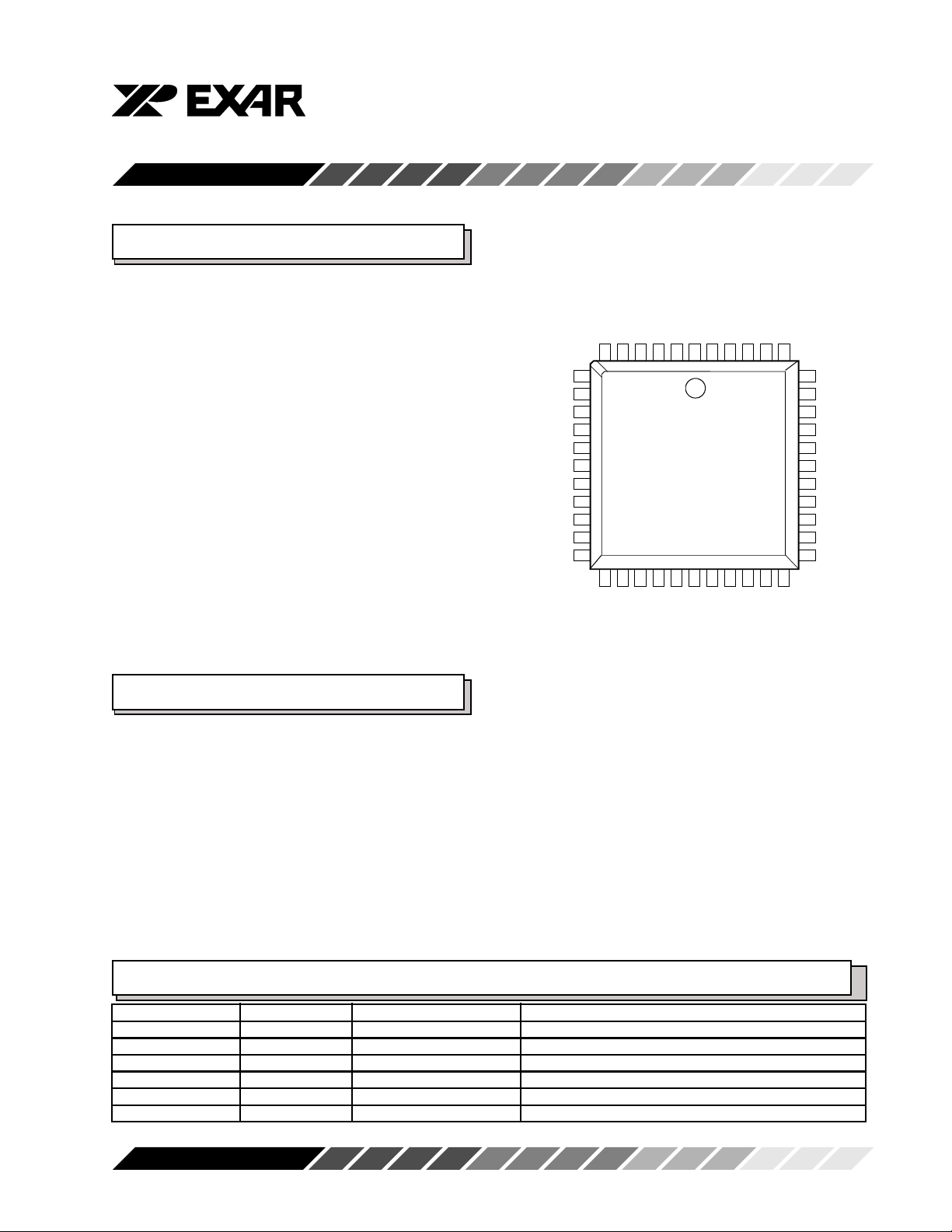
The ST16C550 is available in 40 pin PDIP, 44 pin PLCC,
and 48 pin TQFP packages. It is fabricated in an
advanced CMOS process to achieve low drain power
and high speed requirements.
FEATURES
RCLK
N.C.
CS0
CS1
-CS2
-BAUDOUT
PLCC Package
D4D3D2D1D0
6
5
4
7
D5
8
D6
9
D7
10
11
RX
12
13
TX
14
15
16
17
1819202122232425262728
-IOW
XTAL1
XTAL2
N.C.VCC
3
2
1
4443424140
ST16C550CJ44
N.C.
-IOR
GND
IOW
-RI
IOR
-CD
-CT
39
RESET
38
-OP1
37
-DTR
36
-RTS
35
-OP2
34
N.C.
33
INT
32
-RXRD
31
A0
30
A1
29
A2
-AS
-DDIS
TXRDY
• Pin to pin and functionally compatible to the Industry
Standard 16C550
• 2.97 to 5.5 volt operation
• 24MHz clock operation at 5V
• Standard modem interface
• Compatible with ST16C450
• Low operating current ( 1.2mA typ.)
• 16MHz clock operation at 3.3V
• 16 byte transmit FIFO
• 16 byte receive FIFO with error flags
• Full duplex operation
• Transmit and receive control
• Four selectable receive FIFO interrupt trigger levels
ORDERING INFORMATION
Part number Package Operating temperature Device Status
ST16C550CP40 40-Lead PDIP 0° C to + 70° C Active. See the ST16C550CQ48 for new designs.
ST16C550CJ44 44-Lead PLCC 0° C to + 70° C Active
ST16C550CQ48 48-Lead TQFP 0° C to + 70° C Active
ST16C550IP40 40-Lead PDIP -40° C to + 85° C Active. See the ST16C550IQ48 for new designs.
ST16C550IJ44 44-Lead PLCC -40° C to + 85° C Active
ST16C550IQ48 48-Lead TQFP -40° C to + 85° C Active
Rev. 5.01
EXAR Corporation, 48720 Kato Road, Fremont, CA 94538 • (510) 668-7000 • FAX (510) 668-7017
Page 2

ST16C550
-
Y
.
-
Y
Y
Figure 1, PACKAGE DESCRIPTION, ST16C550
48 Pin TQFP Package 40 Pin DIP Package
N.C.
RCLK
N.C.
CS0
CS1
-CS2
BAUDOUT
N.C.D4D3D2D1D0
4847464544434241403938
1
2
D5
3
D6
4
D7
5
6
7
RX
8
TX
9
10
11
12
1314151617181920212223
N.C.
XTAL1
XTAL2
ST16C550CQ48
-IOW
VCC
-RI
-CD
-DSR-CTSN.C
37
24
N.C.
IOR
-IOR
GND
IOW
-AS
-DDIS
-TXRDY
VCC
1
D0
2
D1
3
RCLK
RX
CS0
CS1
-CS2
BAUDOUT
XTAL1
XTAL2
-IOW
IOW
GND
D2
4
D3
5
D4
6
D5
7
D6
8
D7
9
10
11
TX
12
ST16C550CP40
13
14
15
16
17
18
19
20
N.C.
36
RESET
35
-OP1
34
-DTR
33
-RTS
32
-OP2
31
INT
30
-RXRD
29
A0
28
A1
27
A2
26
N.C.
25
40
-RI
39
-CD
38
-DSR
37
-CTS
36
RESET
35
-OP1
34
-DTR
33
-RTS
32
-OP2
31
INT
30
-RXRD
29
A0
28
A1
27
A2
26
-AS
25
-TXRD
24
-DDIS
23
IOR
22
-IOR
21
Rev. 5.01
2
Page 3
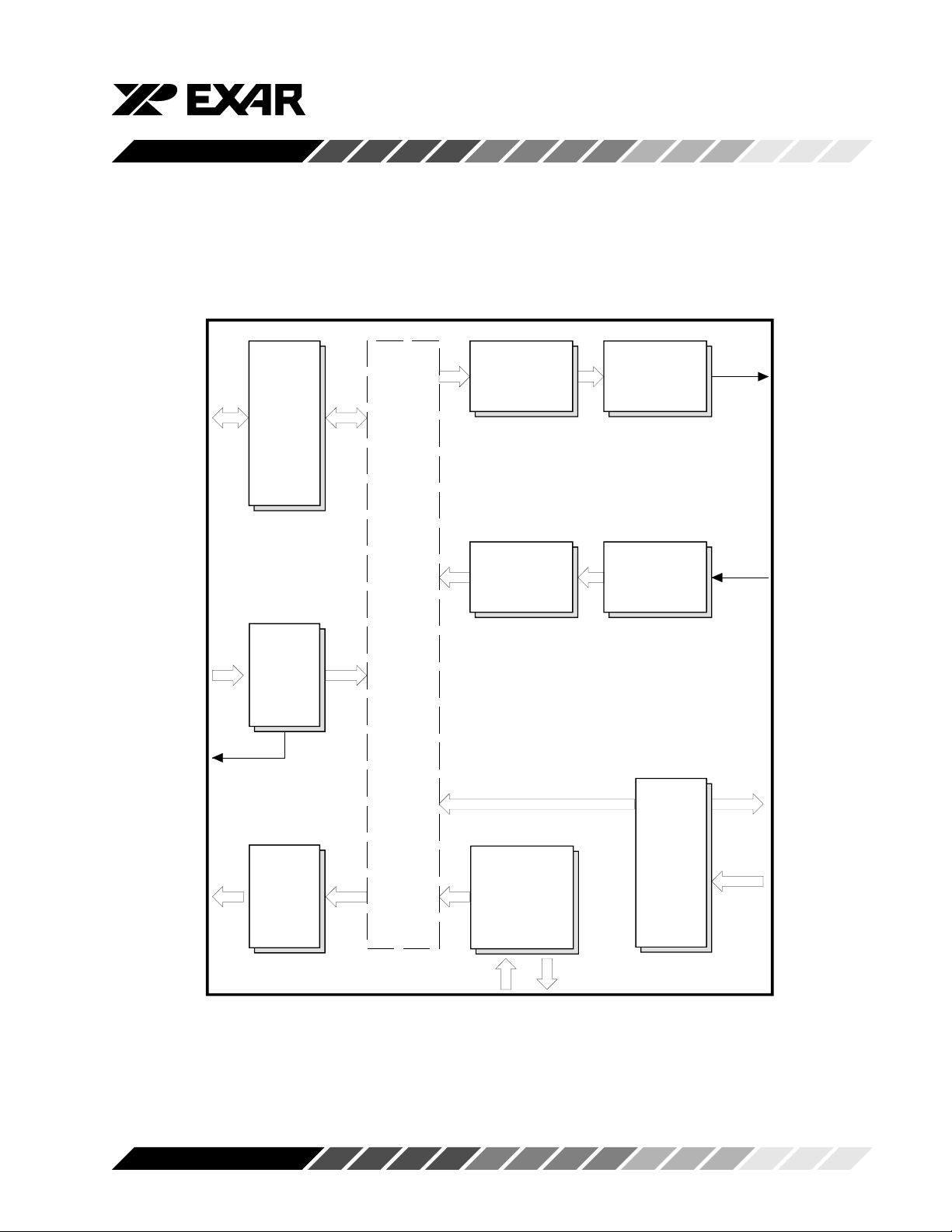
Figure 2, BLOCK DIAGRAM
-
-DTR,-RTS
2
-
ST16C550
Transmit
D0-D7
-IOR,IOR
IOW,IOW
RESET
A0-A2
-AS
CS0,CS1
-CS2
-DDIS
&
Data bus
Control Logic
&
Logic
Select
Register
Control signals
Inter Connec t Bus Li nes
FIFO
Registers
Receive
FIFO
Registers
Transmit
Shift
Register
Receive
Shift
Register
TX
RX
INT
-RXRDY
-TXRDY
Rev. 5.01
-OP1,-OP
Modem
Clock
&
Logic
Control
Interrupt
Baud Rate
Generator
3
RCLK
XTAL1
XTAL2
BAUDOUT
Control
Logic
-CTS
-RI
-CD
-DSR
Page 4
ST16C550
SYMBOL DESCRIPTION
Symbol Pin Signal Pin Description
40 44 48 type
A0 28 31 28 I Address-0 Select Bit Internal registers address selection.
A1 27 30 27 I Address-1 Select Bit Internal registers address selection.
A2 26 29 26 I Address-2 Select Bit Internal registers address selection.
IOR 22 25 20 I Read data strobe. Its function is the same as -IOR (see -
IOR), except it is active high. Either an active -IOR or IOR
is required to transfer data from 16C550 to CPU during a
read operation. Connect to logic 0 when using -IOR.
CS0 12 14 9 I Chip Select-0. Logical 1 on this pin provides the chip select-
0 function. Connect CS0 to logic 1 if using CS1 or -CS2.
CS1 13 15 10 I Chip Select-1. Logical 1 on this pin provides the chip select-
1 function. Connect CS1 to logic 1 if using CS0 or -CS2.
-CS2 14 16 11 I Chip Select -2. Logical 0 on this pin provides the chip select2 function. Connect to logic 0 if using CS0 or CS1.
IO W 19 21 17 I Write data strobe. Its function is the same as -IOW (see -
IOW), but it acts as an active high input signal. Either -IOW
or IOW is required to transfer data from the CPU to
ST16C550 during a write operation. Connect to logic 0 when
using -IOW.
-AS 2 5 2 8 2 4 I Address Strobe. A logic 1 transition on -AS latches the state
of the chip selects and the register select bits, A0-A2. This
input is used when address and chip selects are not stable
for the duration of a read or write operation, i.e., a microprocessor that needs to de-multiplex the address and data bits.
If not required, the -AS input can be permanently tied to a
logic 0.
D0-D7 1-8 2-9 43-47
2-4 I/O Data Bus (Bi-directional) - These pins are the eight bit, tri-
state data bus for transferring information to or from the
controlling CPU. D0 is the least significant bit and the first
data bit in a transmit or receive serial data stream.
GN D 2 0 22 18 Pw r Signal and Power Ground.
Rev. 5.01
4
Page 5
ST16C550
SYMBOL DESCRIPTION
Symbol Pin Signal Pin Description
40 44 48 type
-IOR 21 24 19 I Read data strobe (active low strobe). A logic 0 on this pin
transfers the contents of the ST16C550 data bus to the CPU.
Connect to logic 1 when using IOR.
-IOW 18 20 16 I Write data strobe (active low strobe). A logic 0 on this pin
transfers the contents of the CPU data bus to the addressed
internal register. Connect to logic 1 when using IOW.
INT 30 33 30 O Interrupt Request (active high). Interrupts are enabled in the
interrupt enable register (IER), and when an interrupt condition exists. Interrupt conditions include: receiver errors,
available receiver buffer data, transmit buffer empty, or
when a modem status flag is detected.
-RXRDY 29 32 29 O Receive Ready. When operating in the FIFO mode, one of
two types of DMA signaling can be selected using the FIFO
control register bit-3. When operating in the ST16C450
mode, only DMA mode “0” is allowed. Mode “0” supports
single transfer DMA in which a transfer is made between
CPU bus cycles. Mode “1” supports multi-transfer DMA in
which multiple transfers are made continuously until the
receiver FIFO has been emptied. In DMA mode “0” -RXRDY
is low, when there is at least one character in the receiver
FIFO or receive holding register. In DMA mode “1”, -RXRDY
is low, when the trigger level or the time-out has been
reached.
-TXRDY 24 27 23 O Transmit Ready. When operating in the FIFO mode, one of
two types of DMA signaling can be selected using the FIFO
control register bit-3. When operating in the ST16C450
mode, only DMA mode “0” is allowed. Mode “0” supports
single transfer DMA in which a transfer is made between
CPU bus cycles. Mode “1” supports multi-transfer DMA in
which multiple transfers are made continuously until the
transmit FIFO has been filled.
-BAUDOUT 15 17 12 O Baud Rate Generator Output. This pin provides the 16X
clock of the selected data rate from the baud rate generator.
The RCLK pin must be connected externally to -BAUDOUT
when the receiver is operating at the same data rate.
Rev. 5.01
5
Page 6
ST16C550
SYMBOL DESCRIPTION
Symbol Pin Signal Pin Description
40 44 48 type
-DDIS 23 26 22 O Drive Disable. This pin goes to a logic 0 when the external
CPU is reading data from the ST16C550. This signal can be
used to disable external transceivers or other logic functions.
-OP1 34 38 34 O Output-1 (User Defined) - See bit-2 of modem control
register (MCR bit-2).
RESET 35 39 35 I Reset. (active high) - A logic 1 on this pin will reset the
internal registers and all the outputs. The UART transmitter
output and the receiver input will be disabled during reset
time. (See ST16C550 External Reset Conditions for initialization details.)
RCLK 9 10 5 I Receive Clock Input. This pin is used as external 16X clock
input to the receiver section. External connection to Baudout pin is required in order to utilize the internal baud
rate generator.
-OP2 31 35 31 O Output-2 (User Defined). This pin provides the user a
general purpose output. See bit-3 modem control register
(MCR bit-3).
VCC 40 44 42 Pwr Power Supply Input.
XTAL1 16 18 14 I Crystal or External Clock Input - Functions as a crystal input
or as an external clock input. A crystal can be connected
between this pin and XTAL2 to form an internal oscillator
circuit. An external 1 MΩ resistor is required between the
XTAL1 and XTAL2 pins (see figure 3). Alternatively, an
external clock can be connected to this pin to provide
custom data rates (Programming Baud Rate Generator
section).
XTAL2 17 19 15 O Output of the Crystal Oscillator or Buffered Clock - (See also
XTAL1). Crystal oscillator output or buffered clock output.
-CD 38 42 40 I Carrier Detect (active low) - A logic 0 on this pin indicates
that a carrier has been detected by the modem.
Rev. 5.01
6
Page 7
ST16C550
SYMBOL DESCRIPTION
Symbol Pin Signal Pin Description
40 44 48 type
-CTS 36 40 38 I Clear to Send (active low) - A logic 0 on the -CTS pin
indicates the modem or data set is ready to accept transmit
data from the ST16C550. Status can be tested by reading
MSR bit-4. This pin has no effect on the UART’s transmit or
receive operation.
-DSR 37 41 39 I Data Set Ready (active low) - A logic 0 on this pin indicates
the modem or data set is powered-on and is ready for data
exchange with the UART. This pin has no effect on the
UART’s transmit or receive operation.
-DTR 33 37 33 O Data Terminal Ready (active low) - A logic 0 on this pin
indicates that the ST16C550 is powered-on and ready. This
pin can be controlled via the modem control register.
Writing a logic 1 to MCR bit-0 will set the -DTR output to
logic 0, enabling the modem. This pin will be a logic 1 after
writing a logic 0 to MCR bit-0, or after a reset. This pin has
no effect on the UART’s transmit or receive operation.
-RI 39 43 41 I Ring Indicator (active low) - A logic 0 on this pin indicates the
modem has received a ringing signal from the telephone
line. A logic 1 transition on this input pin will generate an
interrupt.
-RTS 32 36 32 O Request to Send (active low) - A logic 0 on the -RTS pin
indicates the transmitter has data ready and waiting to send.
Writing a logic 1 in the modem control register (MCR bit-1)
will set this pin to a logic 0 indicating data is available. After
a reset this pin will be set to a logic 1. This pin has no effect
on the UART’s transmit or receive operation.
RX 10 11 7 I Receive Data - This pin provides the serial receive data
input to the ST16C550. A logic 1 indicates no data or an idle
channel. During the local loop-back mode, the RX input pin is
disabled and TX data is internally connected to the UART RX
Input, internally, see figure 12.
TX 11 13 8 O Transmit Data - This pin provides the serial transmit data
from the ST16C550, the TX signal will be a logic 1 during
reset, idle (no data). During the local loop-back mode, the
TX pin is set to a logic 1 and TX data is internally connected
to the UART RX Input, see figure 12.
Rev. 5.01
7
Page 8

ST16C550
GENERAL DESCRIPTION
The ST16C550 provides serial asynchronous receive
data synchronization, parallel-to-serial and serial-toparallel data conversions for both the transmitter and
receiver sections. These functions are necessary for
converting the serial data stream into parallel data that
is required with digital data systems. Synchronization
for the serial data stream is accomplished by adding
start and stops bits to the transmit data to form a data
character (character orientated protocol). Data integrity is insured by attaching a parity bit to the data
character. The parity bit is checked by the receiver for
any transmission bit errors. The electronic circuitry to
provide all these functions is fairly complex especially
when manufactured on a single integrated silicon
chip. The ST16C550 represents such an integration
with greatly enhanced features. The ST16C550 is
fabricated with an advanced CMOS process.
The ST16C550 is an upward solution that provides 16
bytes of transmit and receive FIFO memory, instead
of 1 byte provided in the 16C450. The ST16C550 is
designed to work with high speed modems and shared
network environments, that require fast data processing time. Increased performance is realized in the
ST16C550 by the larger transmit and receive FIFO’s.
This allows the external processor to handle more
networking tasks within a given time. The 4 selectable
levels of FIFO trigger provided for maximum data
throughput performance especially when operating in
a multi-channel environment. The combination of the
above greatly reduces the bandwidth requirement of
the external controlling CPU, increases performance,
and reduces power consumption.
FUNCTIONAL DESCRIPTIONS
Internal Registers
The ST16C550 provides 12 internal registers for
monitoring and control. These registers are shown in
Table 3 below. These registers function as data holding registers (THR/RHR), interrupt status and control
registers (IER/ISR), a FIFO control register (FCR),
line status and control registers, (LCR/LSR), modem
status and control registers (MCR/MSR), programmable data rate (clock) control registers (DLL/DLM),
and a user assessable scratchpad register (SPR).
The ST16C550 is capable of operation to 1.5Mbps
with a 24 MHz crystal or external clock input.
With a crystal of 14.7464 MHz and through a software
option, the user can select data rates up to 460.8Kbps
or 921.6Kbps.
Rev. 5.01
8
Page 9

ST16C550
9
Page 10
ST16C550
ample: T = [(programmed word length = 7) + (stop bit
= 1) + (start bit = 1) = 9]. 40 (bit times divided by 9) =
4.4 characters.
Example -B: If the user programs the word length = 7,
with parity and one stop bit, the time out will be:
T = 4 X 7(programmed word length) + 12 = 40 bit times.
Character time = 40 / 10 [ (programmed word length
= 7) + (parity = 1) + (stop bit = 1) + (start bit = 1) = 4
characters.
Programmable Baud Rate Generator
The ST16C550 supports high speed modem technologies that have increased input data rates by
employing data compression schemes. For example
a 33.6Kbps modem that employs data compression
may require a 115.2Kbps input data rate. A 128.0Kbps
ISDN modem that supports data compression may
need an input data rate of 460.8Kbps. The ST16C550
can support a standard data rate of 921.6Kbps.
The programmable Baud Rate Generator is capable
of accepting an input clock up to 24 MHz, as required
for supporting a 1.5Mbps data rate. The ST16C550 can
be configured for internal or external clock operation.
For internal clock oscillator operation, an industry
standard microprocessor crystal (parallel resonant/
22 pF load) is connected externally between the
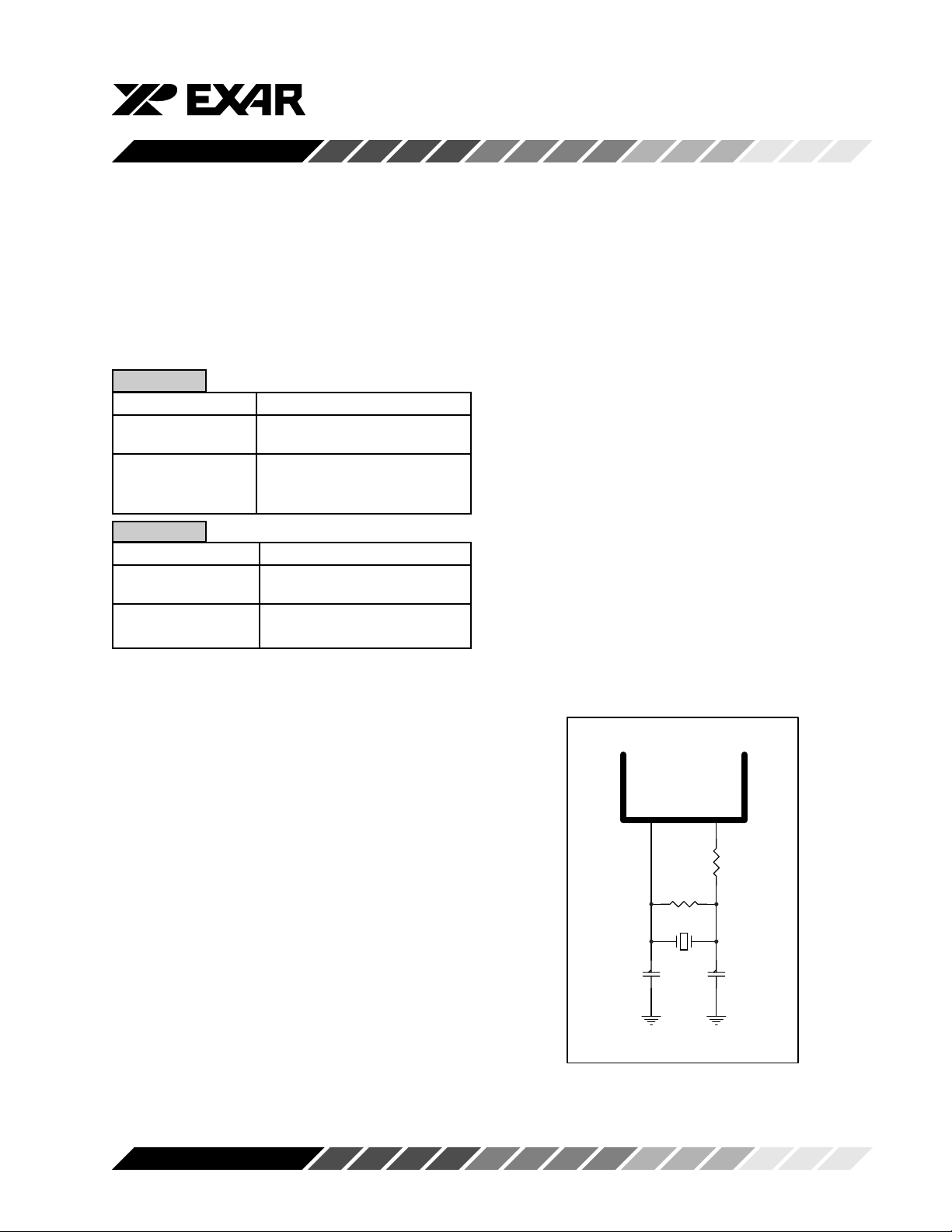
XTAL1 and XTAL2 pins, with an external 1 MΩ resistor
across it. Alternatively, an external clock can be
connected to the XTAL1 pin to clock the internal baud
rate generator for standard or custom rates. See
figure 3 for crystal oscillator connection.
The generator divides the input 16X clock by any
divisor from 1 to 216 -1. The ST16C550 divides the
basic crystal or external clock by 16. The frequency of
the -BAUDOUT output pin is exactly 16X (16 times) of
the selected baud rate (-BAUDOUT =16 x Baud Rate).
Customized Baud Rates can be achieved by selecting
the proper divisor values for the MSB and LSB sections of baud rate generator.
Programming the Baud Rate Generator Registers
DLM (MSB) and DLL (LSB) provides a user capability
for selecting the desired final baud rate. The example
in Table 3 below shows selectable baud rates when
using a 1.8432 MHz crystal.
For custom baud rates, the divisor value can be calculated using the following equation:
Divisor (in decimal) = (XTAL1 clock frequency) / (serial data rate x 16)
Table 3, BAUD RATE GENERATOR PROGRAMMING TABLE (1.8432 MHz CLOCK):
Output User User DLM DLL
Baud Rate 16 x Clock 16 x Clock Program Program
Divisor Divisor Value Value
(Decimal) (HEX) (HEX) (HEX)
50 2304 900 09 00
75 1536 600 06 00
150 768 300 03 00
300 384 180 01 80
600 192 C0 00 C0
1200 96 60 00 60
2400 48 30 00 30
4800 24 18 00 18
7200 16 10 00 10
9600 12 0C 00 0C
19.2k 6 0 6 00 06
38.4k 3 0 3 00 03
57.6k 2 0 2 00 02
115.2k 1 01 0 0 01
Rev. 5.01
10
Page 11
ST16C550
DMA Operation
The ST16C550 FIFO trigger level provides additional
flexibility to the user for block mode operation. The user
can optionally operate the transmit and receive FIFO’s
in the DMA mode (FCR bit-3). The DMA mode affects
the state of the -RXRDY and -TXRDY output pins. The
following tables show this:
-RXRDY pin:
Non-DMA mode DMA mode
1 = FIFO empty 0 to 1 transition when FIFO
empties
0 = at least 1 byte 1 to 0 transition when FIFO
in FIFO reaches trigger level, or
timeout occurs
-TXRDY pin:
Non-DMA mode DMA mode
1 = at least 1 byte 1 = FIFO is full
in FIFO
0 = FIFO empty 0 = FIFO has at least 1
empty location
Loop-back Mode
D0-D7. The user optionally compares the received
data to the initial transmitted data for verifying error
free operation of the UART TX/RX circuits.
In this mode , the receiver and transmitter interrupts are
fully operational. The Modem Control Interrupts are also
operational. The interrupts are still controlled by the
IER.
Figure 3, TYPICAL EXTERNAL CRYSTAL OSCILLATOR CONNECTION
The internal loop-back capability allows onboard diagnostics. In the loop-back mode the normal modem
interface pins are disconnected and reconfigured for
loop-back internally. In this mode MSR bits 4-7 are
also disconnected. However, MCR register bits 0-3
can be used for controlling loop-back diagnostic testing. In the loop-back mode -OP1 and -OP2 in the MCR
register (bits 0-1) control the modem -RI and -CD
inputs respectively. MCR signals -DTR and -RTS (bits
0-1) are used to control the modem -CTS and -DSR
inputs respectively. The transmitter output (TX) and the
receiver input (RX) are disconnected from their associated interface pins, and instead are connected together
internally (See Figure 4). The -CTS, -DSR, -CD, and -RI
are disconnected from their normal modem control
inputs pins, and instead are connected internally to DTR, -RTS, -OP1 and -OP2. Loop-back test data is
entered into the transmit holding register via the user
data bus interface, D0-D7. The transmit UART serializes the data and passes the serial data to the receive
UART via the internal loop-back connection. The receive
UART converts the serial data back into parallel data
that is then made available at the user data interface,
Rev. 5.01
XTAL1 XTAL2
R2
1M
Y1
C1
22-47pF
R1
0-120
(Optional)
1.8432 - 24 MHz
C2
22-47pF
11
Page 12

ST16C550
-
Figure 4, INTERNAL LOOP-BACK MODE DIAGRAM
Transmit
FIFO
D0-D7
-IOR,IOR
IOW,IOW
RESET
A0-A2
-AS
CS0,CS1
-CS2
Data bus
Register
&
Select
Control Logic
Logic
&
Control signals
Inter Connect Bus Lines
Registers
Receive
FIFO
Registers
Transmit
Shift
Register
Receive
Shift
Register
TX
MCR Bit-4=1
RX
-RTS
-CTS
-TXRDY
-RXRDY
Rev. 5.01
INT
-DTR
Logic
Control
Interrupt
-DSR
-OP1
Clock
&
Baud Rate
Generator
RCLK
XTAL1
12
Modem Control Logic
XTAL2
-RI
-OP2
-CD
Page 13

ST16C550
REGISTER FUNCTIONAL DESCRIPTIONS
The following table delineates the assigned bit functions for the twelve ST16C550 internal registers. The assigned
bit functions are more fully defined in the following paragraphs.
Table 4, ST16C550 INTERNAL REGISTERS
A2 A1 A0 Register BIT-7 BIT-6 BIT-5 BIT-4 BIT-3 BIT-2 BIT-1 BIT-0
[Default]
Note *2
General Register Set
0 0 0 RHR [XX] bit-7 bit-6 bit-5 bit-4 bit-3 bit-2 bit-1 bit-0
0 0 0 THR [XX] bit-7 bit-6 bit-5 bit-4 bit-3 bit-2 bit-1 bit-0
0 0 1 IER [00] 0000modem receive transmit receive
0 1 0 FCR [00] RCVR RCVR 0 0 DMA XMIT RCVR FIFO
trigger trigger mode FIFO FIFO enable
(MSB) (LSB) select reset reset
0 1 0 ISR [01] FIFO’s FIFO’s 0 0 INT INT INT INT
enabled enabled priority priority priority status
0 1 1 LCR [00] divisor set set even parity stop word word
latch break parity parity enable bits length length
enable bit-1 bit-0
1 0 0 MCR [00] 0 0 0 loopback -OP2 -OP1 -RTS -DTR
enable
status line holding holding
interrupt status register register
interrupt
bit-2 bit-1 bit-0
1 0 1 LSR [60] FIFO trans. trans. break framing parity overrun receive
1 1 0 MSR [X0] CD RI DSR CTS delta delta delta delta
1 1 1 SPR [FF] bit-7 bit-6 bit-5 bit-4 bit-3 bit-2 bit-1 bit-0
data empty holding interrupt error error error data
error empt y ready
-CD -RI -DSR -CTS
Baud Rate Generator Divisor Registers. Accessible when LCR bit-7 is set to logic 1. Note 1*
0 0 0 DLL [XX] bit-7 bit-6 bit-5 bit-4 bit-3 bit-2 bit-1 bit-0
0 0 1 DLM [XX] bit-15 bit-14 bit-13 bit-12 bit-11 bit-10 bit-9 bit-8
Note *1: The BRG registers are accessible only when LCR bit-7 is set to a logic 1.
Note *2: The value represents the register’s initialized HEX value. An “X” signifies a 4-bit un-initialized nibble.
Rev. 5.01
13
Page 14

ST16C550
Transmit and Receive Holding Register
The serial transmitter section consists of an 8-bit
Transmit Hold Register (THR) and Transmit Shift
Register (TSR). The status of the THR is provided in
the Line Status Register (LSR). Writing to the THR
transfers the contents of the data bus (D7-D0) to the
THR, providing that the THR or TSR is empty. The
THR empty flag in the LSR register will be set to a logic
1 when the transmitter is empty or when data is
transferred to the TSR. Note that a write operation can
be performed when the transmit holding register
empty flag is set (logic 0 = at least one byte in FIFO /
THR, logic 1= FIFO/THR empty).
The serial receive section also contains an 8-bit
Receive Holding Register, RHR. Receive data is
removed from the ST16C550 and receive FIFO by
reading the RHR register. The receive section provides a mechanism to prevent false starts. On the
falling edge of a start or false start bit, an internal
receiver counter starts counting clocks at 16x clock
rate. After 7 1/2 clocks the start bit time should be
shifted to the center of the start bit. At this time the start
bit is sampled and if it is still a logic 0 it is validated.
Evaluating the start bit in this manner prevents the
receiver from assembling a false character. Receiver
status codes will be posted in the LSR.
B) FIFO status will also be reflected in the user
accessible ISR register when the FIFO trigger level is
reached. Both the ISR register status bit and the
interrupt will be cleared when the FIFO drops below
the trigger level.
C) The data ready bit (LSR BIT-0) is set as soon as a
character is transferred from the shift register to the
receive FIFO. It is reset when the FIFO is empty.
IER Vs Receive/Transmit FIFO Polled Mode Operation
When FCR BIT-0 equals a logic 1; resetting IER bits
0-3 enables the ST16C550 in the FIFO polled mode of
operation. Since the receiver and transmitter have
separate bits in the LSR either or both can be used in
the polled mode by selecting respective transmit or
receive control bit(s).
A) LSR BIT-0 will be a logic 1 as long as there is one
byte in the receive FIFO.
B) LSR BIT 1-4 will indicate if an overrun error
occurred.
C) LSR BIT-5 will indicate when the transmit FIFO is
empty.
Interrupt Enable Register (IER)
The Interrupt Enable Register (IER) masks the interrupts from receiver ready, transmitter empty, line
status and modem status registers. These interrupts
would normally be seen on the ST16C550 INT output
pin.
IER Vs Receive FIFO Interrupt Mode Operation
When the receive FIFO (FCR BIT-0 = a logic 1) and
receive interrupts (IER BIT-0 = logic 1) are enabled,
the receive interrupts and register status will reflect
the following:
A) The receive data available interrupts are issued to
the external CPU when the FIFO has reached the
programmed trigger level. It will be cleared when the
FIFO drops below the programmed trigger level.
Rev. 5.01
D) LSR BIT-6 will indicate when both the transmit
FIFO and transmit shift register are empty.
E) LSR BIT-7 will indicate any FIFO data errors.
IER BIT-0:
Logic 0 = Disable the receiver ready interrupt. (normal
default condition)
Logic 1 = Enable the receiver ready interrupt.
IER BIT-1:
Logic 0 = Disable the transmitter empty interrupt.
(normal default condition)
Logic 1 = Enable the transmitter empty interrupt.
IER BIT-2:
Logic 0 = Disable the receiver line status interrupt.
(normal default condition)
Logic 1 = Enable the receiver line status interrupt.
14
Page 15

ST16C550
IER BIT-3:
Logic 0 = Disable the modem status register interrupt.
(normal default condition)
Logic 1 = Enable the modem status register interrupt.
IER BIT 4-7: Not used and set to “0”.
FIFO Control Register (FCR)
This register is used to enable the FIFO’s, clear the
FIFO’s, set the transmit/receive FIFO trigger levels,
and select the DMA mode. The DMA, and FIFO
modes are defined as follows:
DMA MODE:
See description and DMA tables on page 11.
FCR BIT-0:
Logic 0 = Disable the transmit and receive FIFO.
(normal default condition)
Logic 1 = Enable the transmit and receive FIFO. This
bit must be a “1” when other FCR bits are written to or
they will not be programmed.
FCR BIT-1:
Logic 0 = No FIFO receive reset. (normal default
condition)
Logic 1 = Clears the contents of the receive FIFO and
resets the FIFO counter logic (the receive shift register is not cleared or altered). This bit will return to a
logic 0 after clearing the FIFO.
3 = logic 0) and when there are no characters in the
transmit FIFO or transmit holding register, the TXRDY pin will be a logic 0. Once active the -TXRDY
pin will go to a logic 1 after the first character is loaded
into the transmit holding register.
Receive operation in mode “0”:
When the ST16C550 is in mode “0” (FCR bit-0 = logic
0) or in the FIFO mode (FCR bit-0 = logic 1, FCR bit3 = logic 0) and there is at least one character in the
receive FIFO, the -RXRDY pin will be a logic 0. Once
active the -RXRDY pin will go to a logic 1 when there
are no more characters in the receiver.
Transmit operation in mode “1”:
When the ST16C550 is in FIFO mode ( FCR bit-0 =
logic 1, FCR bit-3 = logic 1 ), the -TXRDY pin will be
a logic 1 when the transmit FIFO is completely full. It
will be a logic 0 if one or more FIFO locations are
empty.
Receive operation in mode “1”:
When the ST16C550 is in FIFO mode (FCR bit-0 =
logic 1, FCR bit-3 = logic 1) and the trigger level has
been reached, or a Receive Time Out has occurred,
the -RXRDY pin will go to a logic 0. Once activated, it
will go to a logic 1 after there are no more characters
in the FIFO.
FCR BIT 4-5: Not used.
FCR BIT-2:
Logic 0 = No FIFO transmit reset. (normal default
condition)
Logic 1 = Clears the contents of the transmit FIFO and
resets the FIFO counter logic (the transmit shift register is not cleared or altered). This bit will return to a
logic 0 after clearing the FIFO.
FCR BIT-3:
Logic 0 = Set DMA mode “0”. (normal default condition)
Logic 1 = Set DMA mode “1.”
Transmit operation in mode “0”:
When the ST16C550 is in the ST16C450 mode
(FIFO’s disabled, FCR bit-0 = logic 0) or in the FIFO
mode (FIFO’s enabled, FCR bit-0 = logic 1, FCR bit-
Rev. 5.01
FCR BIT 6-7: These bits are used to set the trigger level
for the receive FIFO interrupt.
An interrupt is generated when the number of characters
in the FIFO equals the programmed trigger level. However the FIFO will continue to be loaded until it is full.
BIT-7 BIT-6 R X F I F O t r i g g e r l e v e l
00 1
01 4
10 8
11 14
15
Page 16

ST16C550
Interrupt Status Register (ISR)
The ST16C550 provides four levels of prioritized interrupts to minimize external software interaction. The
Interrupt Status Register (ISR) provides the user with six
interrupt status bits. Performing a read cycle on the ISR
will provide the user with the highest pending interrupt
level to be serviced. No other interrupts are acknowledged until the pending interrupt is serviced. Whenever
the interrupt status register is read, the interrupt status
is cleared. However it should be noted that only the
current pending interrupt is cleared by the read. A lower
level interrupt may be seen after rereading the interrupt
status bits. The Interrupt Source Table 5 (below) shows
the data values (bit 0-3) for the four prioritized interrupt
levels and the interrupt sources associated with each
of these interrupt levels:
Table 5, INTERRUPT SOURCE TABLE
Priority [ISR]
Level Bit-3 Bit-2 Bit-1 Bit-0 Source of the interrupt
X 0001No interrupt pending
1 0110LSR (Receiver Line Status Register)
2 0100RXRDY (Received Data Ready)
2 1100RXRDY (Receive Data time out)
3 0010TXRDY ( Transmitter Holding Register Empty)
4 0000MSR (Modem Status Register)
Rev. 5.01
16
Page 17

ISR BIT-0:
Logic 0 = An interrupt is pending and the ISR contents
may be used as a pointer to the appropriate interrupt
service routine.
Logic 1 = No interrupt pending. (normal default condition)
ISR BIT 1-3: (logic 0 or cleared is the default condition)
These bits indicate the source for a pending interrupt at
interrupt priority levels 1, 2, and 3 (See Interrupt Source
Table).
ISR BIT 4-5: Not used and set to “0”.
ISR BIT 6-7: (logic 0 or cleared is the default condition)
These bits are set to a logic 0 when the FIFO is not being
used. They are set to a logic 1 when the FIFO’s are
enabled
Line Control Register (LCR)
The Line Control Register is used to specify the
asynchronous data communication format. The word
length, the number of stop bits, and the parity are
selected by writing the appropriate bits in this register.
LCR BIT 0-1: (logic 0 or cleared is the default condition)
These two bits specify the word length to be transmitted or received.
BIT-1 BIT-0 Word length
00 5
01 6
10 7
11 8
ST16C550
BIT-2 Word length Stop bit
length
(Bit time(s))
0 5,6,7,8 1
1 5 1-1/2
1 6,7,8 2
LCR BIT-3:
Parity or no parity can be selected via this bit.
Logic 0 = No parity (normal default condition)
Logic 1 = A parity bit is generated during the transmission, receiver checks the data and parity for transmission errors.
LCR BIT-4:
If the parity bit is enabled with LCR bit-3 set to a logic
1, LCR BIT-4 selects the even or odd parity format.
Logic 0 = ODD Parity is generated by forcing an odd
number of logic 1’s in the transmitted data. The
receiver must be programmed to check the same
format. (normal default condition)
Logic 1 = EVEN Parity is generated by forcing an even
the number of logic 1’s in the transmitted. The receiver
must be programmed to check the same format.
LCR BIT-5:
If the parity bit is enabled, LCR BIT-5 selects the
forced parity format.
LCR BIT-5 = logic 0, parity is not forced (normal
default condition)
LCR BIT-5 = logic 1 and LCR BIT-4 = logic 0, parity bit
is forced to a logical 1 for the transmit and receive
data.
LCR BIT-5 = logic 1 and LCR BIT-4 = logic 1, parity bit
is forced to a logical 0 for the transmit and receive
data.
LCR BIT-2: (logic 0 or cleared is the default condition)
The length of stop bit is specified by this bit in
conjunction with the programmed word length.
Rev. 5.01
LCR LCR LCR Parity selection
Bit-5 Bit-4 Bit-3
X X 0 No parity
0 0 1 Odd parity
0 1 1 Even parity
1 0 1 Force parity “1”
1 1 1 Forced “0”
17
Page 18

ST16C550
LCR BIT-6:
When enabled the Break control bit causes a break
condition to be transmitted (the TX output is forced to a
logic 0 state). This condition exists until disabled by
setting LCR bit-6 to a logic 0.
Logic 0 = No TX break condition. (normal default
condition)
Logic 1 = Forces the transmitter output (TX) to a logic
0 for alerting the remote receiver to a line break
condition.
LCR BIT-7:
The internal baud rate counter latch and Enhance
Feature mode enable.
Logic 0 = Divisor latch disabled. (normal default condition)
Logic 1 = Divisor latch and enhanced feature register
enabled.
Modem Control Register (MCR)
This register controls the interface with the modem or
a peripheral device.
MCR BIT-0:
Logic 0 = Force -DTR output to a logic 1. (normal
default condition)
Logic 1 = Force -DTR output to a logic 0.
MCR BIT-1:
Logic 0 = Force -RTS output to a logic 1. (normal
default condition)
Logic 1 = Force -RTS output to a logic 0.
MCR BIT-2:
Logic 0 = Set -OP1 output to a logic 1. (normal default
condition)
Logic 1 = Set -OP1 output to a logic 0.
MCR BIT-3:
Logic 0 = Set -OP2 output to a logic 1. (normal default
condition)
Logic 1 = Set -OP2 output to a logic 0.
MCR BIT-4:
Logic 0 = Disable loop-back mode. (normal default
condition)
Logic 1 = Enable local loop-back mode (diagnostics).
MCR BIT 5-7: Not used and set to “0”.
Line Status Register (LSR)
This register provides the status of data transfers
between. the ST16C550 and the CPU.
LSR BIT-0:
Logic 0 = No data in receive holding register or FIFO.
(normal default condition)
Logic 1 = Data has been received and is saved in the
receive holding register or FIFO.
LSR BIT-1:
Logic 0 = No overrun error. (normal default condition)
Logic 1 = Overrun error. A data overrun error occurred
in the receive shift register. This happens when additional data arrives while the FIFO is full. In this case
the previous data in the shift register is overwritten.
Note that under this condition the data byte in the
receive shift register is not transfer into the FIFO,
therefore the data in the FIFO is not corrupted by the
error.
LSR BIT-2:
Logic 0 = No parity error (normal default condition)
Logic 1 = Parity error. The receive character does not
have correct parity information and is suspect. In the
FIFO mode, this error is associated with the character
at the top of the FIFO.
LSR BIT-3:
Logic 0 = No framing error (normal default condition).
Logic 1 = Framing error. The receive character did not
have a valid stop bit(s). In the FIFO mode this error is
associated with the character at the top of the FIFO.
LSR BIT-4:
Logic 0 = No break condition (normal default condition)
Logic 1 = The receiver received a break signal (RX
was a logic 0 for one character frame time). In the
FIFO mode, only one break character is loaded into
the FIFO.
LSR BIT-5:
This bit is the Transmit Holding Register Empty indicator. This bit indicates that the UART is ready to
accept a new character for transmission. In addition,
Rev. 5.01
18
Page 19

this bit causes the UART to issue an interrupt to CPU
when the THR interrupt enable is set. The THR bit is
set to a logic 1 when a character is transferred from
the transmit holding register into the transmitter shift
register. The bit is reset to logic 0 concurrently with
the loading of the transmitter holding register by the
CPU. In the FIFO mode this bit is set when the transmit
FIFO is empty; it is cleared when at least 1 byte is
written to the transmit FIFO.
LSR BIT-6:
This bit is the Transmit Empty indicator. This bit is set
to a logic 1 whenever the transmit holding register and
the transmit shift register are both empty. It is reset to
logic 0 whenever either the THR or TSR contains a
data character. In the FIFO mode this bit is set to one
whenever the transmit FIFO and transmit shift register
are both empty.
LSR BIT-7:
Logic 0 = No Error (normal default condition)
Logic 1 = At least one parity error, framing error or
break indication is in the current FIFO data. This bit is
cleared when there are no remaining LSR errors in the
RX FIFO.
Modem Status Register (MSR)
ST16C550
MSR BIT-2:
Logic 0 = No -RI Change (normal default condition)
Logic 1 = The -RI input to the ST16C550 has changed
from a logic 0 to a logic 1. A modem Status Interrupt
will be generated.
MSR BIT-3:
Logic 0 = No -CD Change (normal default condition)
Logic 1 = Indicates that the -CD input to the has
changed state since the last time it was read. A
modem Status Interrupt will be generated.
MSR BIT-4:
CTS (active high, logical 1). Normally this bit is the
compliment of the -CTS input. In the loop-back mode,
this bit is equivalent to the RTS bit in the MCR register.
MSR BIT-5:
DSR (active high, logical 1). Normally this bit is the
compliment of the -DSR input. In the loop-back mode,
this bit is equivalent to the DTR bit in the MCR register.
MSR BIT-6:
RI (active high, logical 1). Normally this bit is the
compliment of the -RI input. In the loop-back mode
this bit is equivalent to the OP1 bit in the MCR register.
This register provides the current state of the control
interface signals from the modem, or other peripheral
device that the ST16C550 is connected to. Four bits
of this register are used to indicate the changed
information. These bits are set to a logic 1 whenever
a control input from the modem changes state. These
bits are set to a logic 0 whenever the CPU reads this
register.
MSR BIT-0:
Logic 0 = No -CTS Change (normal default condition)
Logic 1 = The -CTS input to the ST16C550 has
changed state since the last time it was read. A
modem Status Interrupt will be generated.
MSR BIT-1:
Logic 0 = No -DSR Change (normal default condition)
Logic 1 = The -DSR input to the ST16C550 has
changed state since the last time it was read. A
modem Status Interrupt will be generated.
Rev. 5.01
MSR BIT-7:
CD (active high, logical 1). Normally this bit is the
compliment of the -CD input. In the loop-back mode
this bit is equivalent to the OP2 bit in the MCR register.
Scratchpad Register (SPR)
The ST16C550 provides a temporary data register to
store 8 bits of user information.
19
Page 20

ST16C550
ST16C550 EXTERNAL RESET CONDITIONS
REGISTERS RESET STATE
IE R IER BITS 0-7 = logic 0
ISR ISR BIT-0=1, ISR BITS 1-7 = logic
0
LCR, MCR BITS 0-7 = logic 0
LSR LSR BITS 0-4 = logic 0,
LSR BITS 5-6 = logic 1 LSR, BIT
7 = logic 0
MSR MSR BITS 0-3 = logic 0,
MSR BITS 4-7 = logic levels of the
input signals
FCR BITS 0-7 = logic 0
SIGNALS RESET STATE
TX Logic 1
-OP1 Logic 1
-OP2 Logic 1
-RTS Logic 1
-DTR Logic 1
-RXRDY Logic 1
-TXRDY Logic 0
I N T Logic 0
Rev. 5.01
20
Page 21

ST16C550
AC ELECTRICAL CHARACTERISTICS
TA=0° - 70°C (-40° - +85°C for Industrial grade packages), Vcc=3.3 - 5.0 V ± 10% unless otherwise specified.
Symbol Parameter Limits Limits Units Conditions
3.3 5.0
Min Max Min Max
T1w,T
2w
T
3w
T4w Address strobe width 3 5 2 5 ns
T5s Address setup time 5 0 ns
T5h Address hold time 5 5 ns
T
6s
T6h Chip select hold time 0 0 ns
T
6s'
T
7d
T
7w
T
7w'
T
7h
T
7h'
T
8d
T
9d
T
11d
T
12d
T
12h
T
13d
T
13w
T
13w'
T
13h
T
14d
T
15d
T
16s
T
16h
T
17d
T
18d
T
19d
T
20d
T
21d
T
22d
T
23d
T
24d
T
25d
T
26d
T
27d
T
28d
T
R
N Baud rate divisor 1 216-1 1 216-1 Rclk
Clock pulse duration 17 17 ns
Oscillator/Clock frequency 16 24 MHz
Chip select setup time 5 0 ns
Address setup time 10 5 ns see Note 1
-IOR delay from chip select 10 10 ns
-IOR strobe width 77 38 ns
Chip select width 77 38 ns
Chip select hold time from -IOR 0 0 ns
Address hold time 5 5 ns see Note 1
-IOR delay from address 10 10 ns
Read cycle delay 77 38 ns
-IOR to -DDIS delay 1 5 10 ns 100 pF load
Delay from -IOR to data 3 5 25 ns
Data disable time 2 5 15 ns
-IOW delay from chip select 1 0 10 ns
-IOW strobe width 27 15 ns
Chip select width 77 38 ns
Chip select hold time from -IOW 0 0 ns
-IOW delay from address 10 10 ns
Write cycle delay 77 38 ns
Data setup time 20 15 ns
Data hold time 5 5 ns
Delay from -IOW to output 5 0 40 ns 100 pF load
Delay to set interrupt from MODEM input 4 0 3 5 ns 100 pF load
Delay to reset interrupt from -IOR 4 0 35 ns 100 pF load
Delay from stop to set interrupt 1 1 Rclk
Delay from -IOR to reset interrupt 4 5 40 ns 100 pF load
Delay from stop to interrupt 4 5 40 ns
Delay from initial INT reset to transmit 8 24 8 2 4 Rclk
start
Delay from -IOW to reset interrupt 4 5 40 ns
Delay from stop to set -RxRdy 1 1 Rclk
Delay from -IOR to reset -RxRdy 4 5 40 ns
Delay from -IOW to set -TxRdy 4 5 40 ns
Delay from start to reset -TxRdy 8 8 Rclk
Reset pulse width 40 40 ns
Note 1: Applicable only when -AS is tied low.
Rev. 5.01
21
Page 22

ST16C550
ABSOLUTE MAXIMUM RATINGS
Supply range 7 Volts
Voltage at any pin GND - 0.3 V to VCC +0.3 V
Operating temperature -40° C to +85° C
Storage temperature -65° C to 150° C
Package dissipation 500 mW
DC ELECTRICAL CHARACTERISTICS
TA=0° - 70°C (-40° - +85°C for Industrial grade packages), Vcc=3.3 - 5.0 V ± 10% unless otherwise specified.
Symbol Parameter Limits Limits Units Conditions
3.3 5.0
Min Max Min Max
V
ILCK
V
IHCK
V
IL
V
IH
V
OL
V
OL
V
OH
V
OH
I
IL
I
CL
I
CC
C
P
Clock input low level -0.3 0.6 -0.5 0.6 V
Clock input high level 2.4 VCC 3.0 VCC V
Input low level -0.3 0.8 -0.5 0.8 V
Input high level 2.0 VCC 2 . 2 VCC V
Output low level on all outputs 0.4 V IOL= 5 mA
Output low level on all outputs 0.4 V IOL= 4 mA
Output high level 2.4 V IOH= -5 mA
Output high level 2.0 V IOH= -1 mA
Input leakage ±10 ±10 µA
Clock leakage ±10 ±10 µA
Avg power supply current 1.3 3 m A
Input capacitance 5 5 pF
Rev. 5.01
22
Page 23

-
1
1
1
T1w
E
XTERNAL
1
CLOCK
BAUDOUT
ST16C550
T2w
T3w
/2 -BAUDOUT
/3 -BAUDOUT
/3> -BAUDOUT
X450-CK-
Clock timing
Rev. 5.01
23
Page 24

ST16C550
-
A
C
I
D
T4w
1
-
D
-
A
C
I
T4w
AS
0-A2
CS2
S1-CS0
IO R
OR
DDIS
0-D7
T8d
T5s
Valid
Address
T6s
Valid
T7d T7h
T11d
T12d
T7w
Active
Active
Data
General Read Timing when using -AS signal
T5h
T6h
T9d
T11d
T12h
X550-RD-1
AS
T5s
0-A2
CS2
S1-CS0
IOW
OW
0-D7
T13d T13h
T14d
Valid
Address
T6s
Valid
T13w
Active
T16s
Data
General Write Timing when using -AS signal.
T5h
T6h
T15d
T16h
X550-W D-
Rev. 5.01
24
Page 25

ST16C550
A0-A2
-CS
-IOR
D0-D7
Valid
Address
T6s'
T12d
Active
T7w
Active
T7h'
T9d
T12h
Data
T6s'
General Read Timing when -AS is tied to GND
Valid
Address
T7w’
Active
T12d
T7h'
T12h
A0-A2
-CS
-IOW
D0-D7
Rev. 5.01
Valid
Address
T6s'
Active
T13w
Active
T16s
Data
T7h'
T15d
T16h
T6s'
General Write Timing when -AS is tied to GND
Valid
Address
T7h'
Active
T16s
25
Page 26

ST16C550
I
-
-
-
-
-
I
I
-
1
IOW
OW
RTS
DTR
CD
CTS
DSR
NT
IOR
OR
RI
Active
Change of state
T17d
Change of state
Change of state
T18d T18d
Active Active
T19d
Active
Change of state
Active
Active Active
T18d
Change of state
X450-MD-
Modem input/output timing
Rev. 5.01
26
Page 27

ST16C550
STOP
START
R
I
I
X
NT
IOR
OR
BIT
D0 D1 D2 D3 D4 D5 D6 D7
DATA BITS (5-8)
5 DATA BITS
6 DATA BITS
7 DATA BITS
16 BAUD RATE CLOCK
PARITY
BIT
BIT
NEXT
DATA
START
BIT
T20d
Active
T21d
X450-RX-1
Receive timing
Rev. 5.01
27
Page 28

ST16C550
STOP
START
R
-
I
X
RXRDY
IOR
OR
BIT
D0 D1 D2 D3 D4 D5 D6 D7
DATA BITS (5-8)
Receive ready timing in non FIFO mode
PARITY
BIT
BIT
NEXT
DATA
START
BIT
T25d
Active
Data
Ready
T26d
Active
X550-RX-2
Rev. 5.01
28
Page 29

ST16C550
STOP
START
R
-
I
X
RXRDY
IOR
OR
BIT
D0 D1 D2 D3 D4 D5 D6 D7
DATA BITS (5-8)
Receive ready timing in FIFO mode
PARITY
BIT
BIT
First byte
that reaches
the trigger
level
T25d
Active
Data
Ready
T26d
Active
X550-RX-3
Rev. 5.01
29
Page 30

ST16C550
T
I
X
NT
IOW/
-IOW
T22d
Active
START
BIT
DATA BITS (5-8)
D0 D1 D2 D3 D4 D5 D6 D7
5 DATA BITS
6 DATA BITS
7 DATA BITS
Active TX Ready
T23d
STOP
BIT
PARITY
BIT
T24d
Active
16 BAUD RATE CLOCK
Transmit timing
Rev. 5.01
30
Page 31

ST16C550
STOP
START
T
-
2
X
-IOW
IOW
TXRDY
Active
BYTE #1
BIT
D0 D1 D2 D3 D4 D5 D6 D7
DATA BITS (5-8)
T27d
Active
Transmitter ready
PARITY
BIT
BIT
NEXT
DATA
START
BIT
T28d
Transmitter
not ready
X550-TX-
Transmit ready timing in non FIFO mode
Rev. 5.01
31
Page 32

ST16C550
START BIT
T
I
D
-
X
IOW
OW
0-D7
TXRDY
Active
BYTE #16
T27d
DATA BITS (5-8)
D0 D1 D2 D3 D4 D5 D6 D7
5 DATA BITS
6 DATA BITS
7 DATA BITS
T28d
FIFO Full
STOP BIT
PARITY BIT
X550-TX-3
Transmit ready timing in FIFO mode
Rev. 5.01
32
Page 33

PACKAGE OUTLINE DRAWING
ST16C550
D D
44LEAD PLASTIC LEADED CHIP CARRIER
(PLCC)
D
D
1
1
244
1
D
3
D
3
45° x H
45° x H
2
C
1
A
A
1
Seating Plane
A
2
B
1
B
e
R
D
2
Note: The control dimension is t he i nch column
SYMBOL
A
A
1
A
2
B
B
1
C
D
D
1
D
2
D
3
e
H
1
H
2
R
INCHES MILLIMETERS
MIN MAX MIN MAX
0.165
0.090
0.020
0.013
0.026
0.008
0.685
0.650
0.590
0.042
0.042
0.025
0.500 typ
0.50 BSC
0.180
0.120
-----
0.021
0.032
0.013
0.695
0.656
0.630
0.056
0.048
0.045
4.19
2.29
0.51
0.33
0.66
0.19
17.40
16.51
14.99
12.70 typ
1.07
1.07
0.64
4.57
3.05
------
0.53
0.81
0.32
17.65
16.66
16.00
1.27BSC
1.42
1.22
1.14
Rev. 5.01
33
Page 34

ST16C550
PACKAGE OUTLINE DRAWING
48 LEAD THIN QUAD FLAT PACK
(TQFP)
D
D
36 25
1
Seating
Plane
37
48
1
B
e
A
2
A
A
1
1
2
Note: The control dimension is the millimeter column
SYMBOL
A
A
1
A
2
B
C
D
D
1
e
L
α
INCHES MILLIMETERS
MIN MAX MIN MAX
0.039
0.002
0.037
0.007
0.004
0.346
0.272
0.047
0.006
0.041
0.011
0.008
0.362
0.280
1.00
0.05
0.95
0.17
0.09
8.80
6.90
0.20 BSC
0.018
0°
0.030
7°
0.45
0°
C
L
0.50BSC
24
13
D
1.20
0.15
1.05
0.27
0.20
9.20
7.10
0.75
7°
D
1
α
Rev. 5.01
34
Page 35

ST16C550
EXPLANATION OF DATA SHEET REVISIONS:
FROM TO CHANGES DATE
4.20 4.30 Added revision history. Added Device Status to front page. Sept 2003
4.30 5.00 Updated AC Timing values for IOW, CS and IOR pulse widths and
Read/Write cycle delays. This applies to devices with top mark date Feb 2005
code of "B2 YYWW" and newer.
5.00 5.01 Corrected the AC Timing values. Added Chip Select Width for Apr 2005
clarification.
NOTICE
EXAR Corporation reserves the right to make changes to the products contained in this publication in order to
improve design, performance or reliability. EXAR Corporation assumes no responsibility for the use of any circuits
described herein, conveys no license under any patent or other right, and makes no representation that the circuits
are free of patent infringement. Charts and schedules contained here in are only for illustration purposes and may
vary depending upon a user's specific application. While the information in this publication has been carefully
checked; no responsibility, however, is assumed for inaccuracies.
EXAR Corporation does not recommend the use of any of its products in life support applications where the failure
of the product can reasonably be expected to cause failure of the life support system or to significantly affect its
safety or effectiveness. Products are not authorized for use in such applications unless EXAR Corporation receives,
in writing, assurances to its satisfaction that: (a) the risk of injury or damage has been minimized; (b) the user
assumes all such risks; (c) potential liability of EXAR Corporation is adequately protected under the circumstances.
Copyright 2005 EXAR Corporation
Datasheet April 2005
Send your UART technical inquiry with technical details to hotline: uarttechsupport@exar.com
Reproduction, in part or whole, without prior written consent of EXAR Corporation is prohibited.
Rev. 5.01
35
 Loading...