

Page 1
sames
CMOS 256 X 256 DIGITAL SWITCHING MATRIX
FEATURES
■
Hardware (pin-to-pin) and software
compatible with M088 and M3488
■ 256 input and 256 output channel digital
switching matrix
■ Building block designed for large
capacity electronic exchanges, subsystems and PABX
■ Non-blocking single stage and higher
capacity blocks (512 or 1024 channels)
■ European and U.S. standard
compatible (32/24 serial channels per
frame)
■ PCM inputs and outputs mutually
compatible
SA3488
SA3488
■ Actual input-output channel
connections stored and modified via
an on chip 8-bit parallel microprocessor
interface
■ 6 main “Functions” or “Instructions”
available
■ Typical Bit Rate : 2Mbit/s
■ Typical Synchronization Rate : 8KHz
(time frame is 125µs)
■ 5V power supply with internally
generated bias voltage
■ MOS & TTL input/output levels
compatible
DESCRIPTION
The SA3488 is a non-blocking digital
switching matrix that is capable of routing
256 input channels to any of 256 output
channels. Data is fed into and out of the
device via eight serial PCM input and
output channels at 2MBits/sec. The device
can connect or disconnect each input
channel with any output channel, as well as
carry out other functions which are user
programmable via an eight bit parallel
microprocessor interface. The SA3488
sees its primary use as a building block in
high volume electronic exchanges, voice
data PABX and other standard data
communications applications. It can be
easily configured for operation in PCM 24
or PCM 30 formats.
SA3488
sames
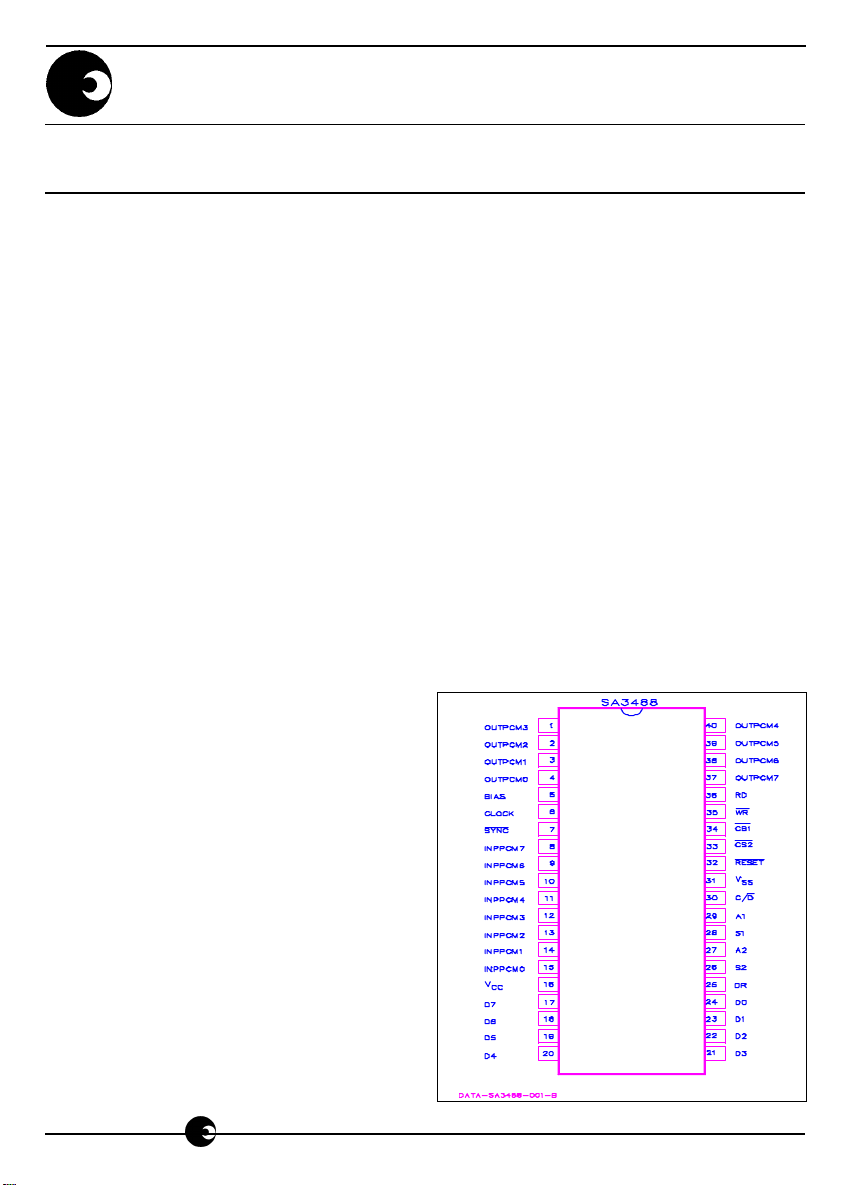
PIN CONNECTIONS:
1
Page 2
SA3488
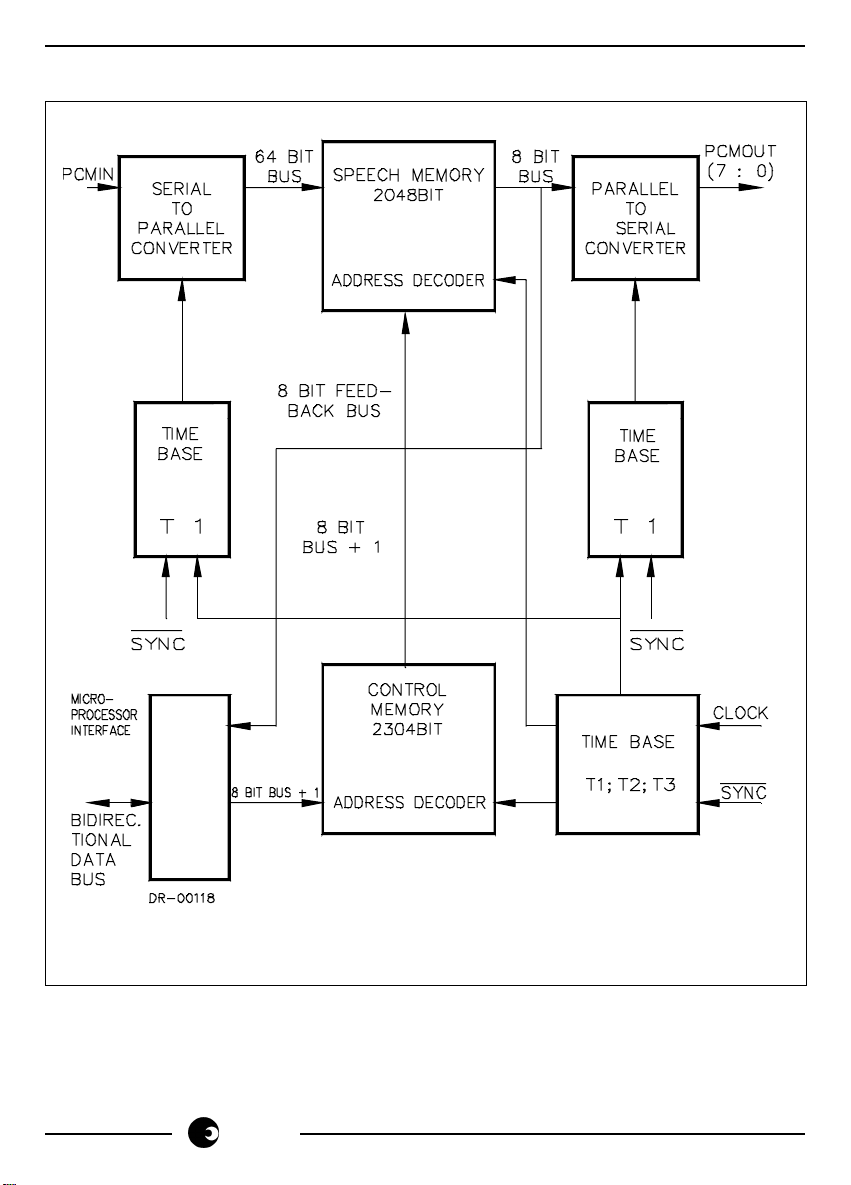
BLOCK DIAGRAM
sames
2
Page 3
SA3488
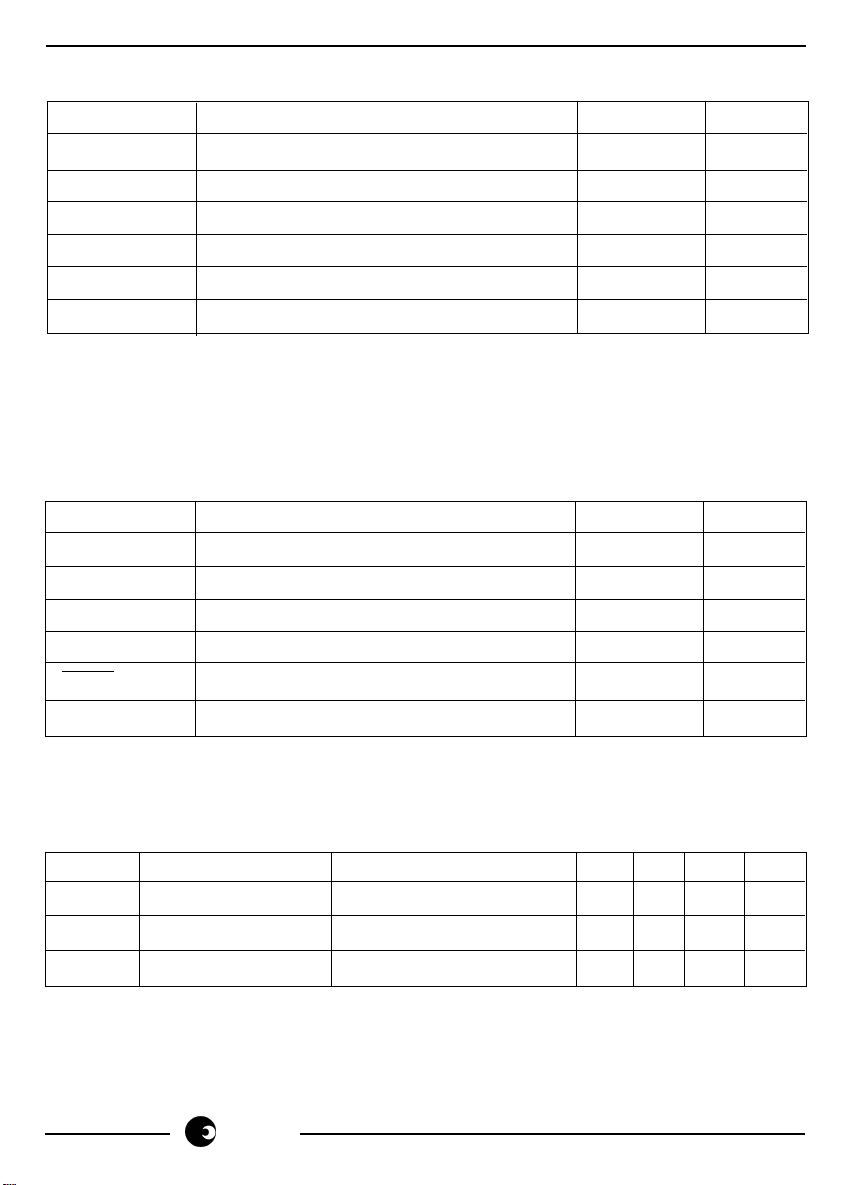
ABSOLUTE MAXIMUM RATINGS *
Symbol Parameter Value Unit
V
CC
V
I
V
O
P
tot
T
stg
T
op
Supply Voltage -0.3 to 7 V
Input Voltage -0.3 to 7 V
Off State Output 7 V
Total Package Power Dissipation 1.5 W
Storage Temperature Range -40 to +125 °C
Operating Temperature Range 0 to +70 °C
* Stresses above those listed under “Absolute Maximum Ratings” may cause permanent damage
to the device. This is a stress rating only. Functional operation of the device at these or any other
condition above those indicated in the operation sections of this specification, is not implied.
Exposure to Absolute Maximum Ratings for extended periods may affect device reliability.
RECOMMENDED OPERATING CONDITIONS
Symbol Parameter Value Unit
V
CC
V
I
V
O
Supply Voltage 4.75 to 5.25 V
Input Voltage 0 to 5.25 V
Off State Input Voltage 0 to 5.25 V
CLOCK Freq. Input Clock Frequency 4.096 MHz
SYNC Freq. Input Synchronization 8 KHz
T
op
Operating Temperature 0 to 70 °C
CAPACITANCES (Measuring freq. = 1MHz; T
= 0 to 70°C; unused pins tied to VSS)
op
Symbol Parameter Pins Min. Typ. Max. Unit
C
I
C
I/0
C
0
Input Capacitance 6 to 15; 26 to 30; 32 to 36 5 pf
I/O Capacitance 20 to 24 15 pf
Output Capacitance 1 to 4; 17 to 19; 37 to 40 10 pf
sames
3
Page 4

SA3488
D.C. ELECTRICAL CHARACTERISTICS (T
All D.C. characteristics are valid 250µs after V
= 0 to 70°C, V
amb
and clock have been applied.
CC
= 5V 5%)
CC
Symbol Parameter Pins Test Condition Min. Typ. Max. Unit
V
V
V
Clock Input Low Level 6 -0.3 0. 8 V
ILC
Clock Input High Level 6 2.4 V
IHC
Input Low Level 7 to 15 -0.3 0. 8
IL
20 to 24 V
CC
26 to 30
32 to 36
V
Input High Level 7 to 15 2.0 V
IH
CC
20 to 24 V
26 to 30
32 to 36
V
V
V
I
IL
Output Low Level 17 to 25 IOL = 1.8mA 0.4 V
OL
Output High Level 17 to 25 IOH = 250µA 2.4 V
OH
PCM Output Low Level 1 to 4 IOL = 2.0mA 0.4 V
OL
Input Leakage Current 6 to 15 V
37 to 40
26 to 30
= 0 to V
IN
CC
10 µA
32 to 36
I
DL
Data Bus Leakage 17 to 24 V
Current V
= 0 to V
IN
CC
and 36 tied to V
Device Initialization
CC
applied; Pins 35
CC
±10 µA
, after
V
I
CC
Supply Current 16 Clock Freq.= 4.096MHz 180 mA
sames
4
Page 5
SA3488
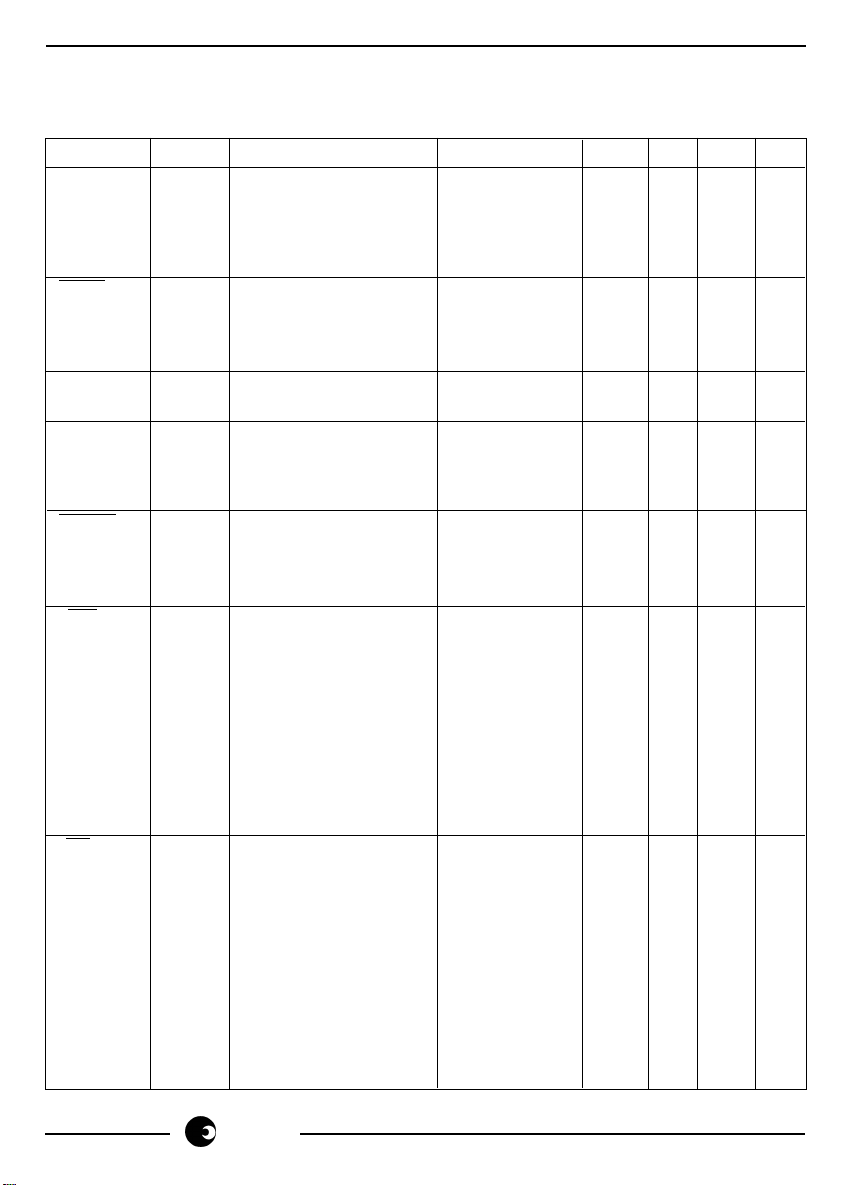
A.C. ELECTRICAL CHARACTERISTICS (T
All A.C. characteristics are valid 250µs after V
capacitive load and R
the test pull up resistor.
L
= 0 to 70°C, VCC = 5V ±5%)
amb
and clock have been applied. CL is the max.
CC
Signal Symbol Parameter Test Condition Min. Typ. Max. Unit
CK t
(clock) t
SYNC t
PCM input t
Busses t
PCM t
Output referred to CK low level
Busses t
PDmin
PDmax
RESET t
WR t
t
RD t
t
Clock Period 230 ns
CK
Clock Low Level Width 100 ns
WL
t
Clock High Level Width 100 ns
WH
Rise Time 25 ns
t
R
t
Fall Time 25 ns
F
Low Level Setup Time 80 ns
SL
t
Low Level Hold Time 40 ns
HL
High Level Setup Time 80 ns
t
SH
t
High Level Width t
WH
Setup Time -5 ns
S
Hold Time 45 ns
H
CK
Propagation time CL = 50pf,RL=2K 45 ns
Propagation time CL = 50pf,RL=2K 200 ns
referred to CK high level
Low Level Setup Time 100 ns
SL
Low Level Hold Time 50 ns
t
HL
t
High Level Setup Time 90 ns
SH
t
High Level Width t
WH
Low Level Width 150 ns
WL
t
High Level Width t
WH
Repetition Interval t
REP
between Active Pulses + t
t
High Level Setup Time + t
SH
to Active Read Strobe
High Level Hold Time 20 ns
t
HH
from Active Read Strobe
Rise Time 60 ns
t
R
t
Fall Time 60 ns
F
Low Level Width 180 ns
WL
t
High Level Width t
WH
Repetition Interval t
REP
between Active Pulses + t
t
High Level Setup Time 0 ns
SH
to Active Read Strobe
High Level Hold Time 20 ns
t
HH
= 40+2 t
REP
WL(CK) +
R(CK)
= 40+2 t
REP
WL
+ t
CK +
CK
R
CK
CK
see
formula
0ns
CK
see
formula
from Active Write Strobe
t
Rise Time 60 ns
R
t
Fall Time 60 ns
F
ns
ns
ns
ns
sames
5
Page 6
SA3488
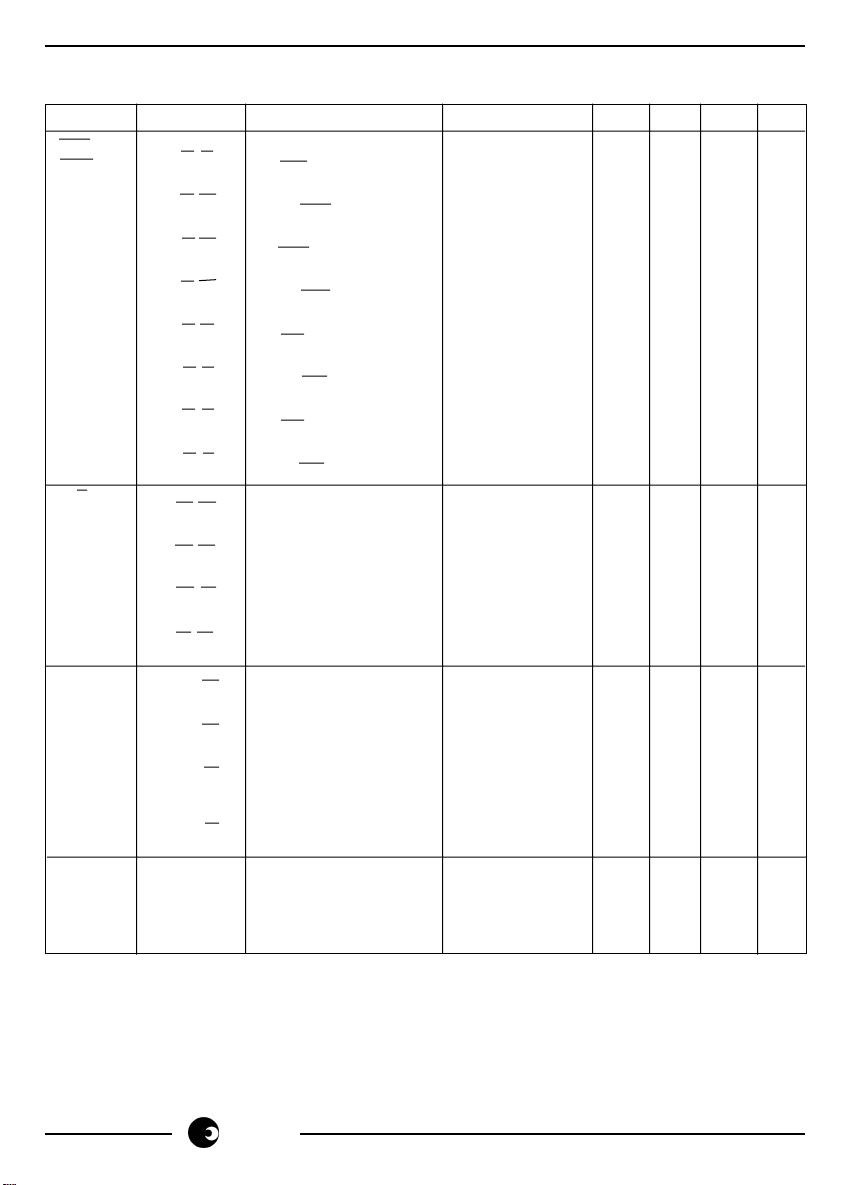
A.C. ELECTRICAL CHARACTERISTICS (Cont.)
Signal Symbol Parameter Test Conditions Min. Typ. Max. Unit
CS1, t
CS2 to WR falling edge
C/D t
A1,S1, t
A2,S2 strobe end
(match t
inputs) strobe end
DR t
(data t
ready) from write strobe end Instructions 5, 5.t
SL(CS-WR)
t
HL(CS-WR)
t
SH(CS-WR)
t
HH(CS-WR)
t
SL(CS-RD)
t
HL(CS-RD)
t
SH(CS-RD)
t
HH(CS-RD)
S(C/D-WR)
t
H(C/D-WR)
t
S(C/D-WR)
t
H(C/D-WR)
S(match-WR)
H(match-WR)
t
S(match-RD)
t
H(match-RD)
W
PD
Low level setup time Active Case 0 ns
Low level hold time Active Case 0 ns
from WR rising edge
High level setup time Inactive Case 0 ns
to WR falling edge
High level hold time Inactive Case 0 ns
from WR rising edge
Low level setup time Active Case 0 ns
to RD falling edge
Low level hold time Active Case 0 ns
from RD rising edge
High level setup time Inactive Case 0 ns
to RD falling edge
High level hold time Inactive Case 0 ns
from RD rising edge
Setup time to write
strobe end 130 ns
Hold time from
write strobe end 25 ns
Setup time to read
strobe start 20 ns
Hold time from read
strobe end 25 ns
Setup time to write 130 ns
Hold time from 25 ns
Setup time to read 20 ns
strobe start
Hold time from read 25 ns
strobe end
Low state width Instructions 5,6 2 t
DR output delay
(active command) CL= 50pf ns
CK
14 t
CK
CK
ns
sames
6
Page 7

SA3488
A.C. ELECTRICAL CHARACTERISTICS (Cont.)
Signal Symbol Parameter Test Conditions Min. Typ. Max. Unit
D0 to D7 t
(Interface write strobe end
bus) t
S(BUS-WR)
H(BUS-WR)
t
PD(BUS)
Input setup time to 130 ns
Input hold time 25 ns
from write strobe end
Propagation time CL= 200pf 120 ns
from (active) falling
edge of read strobe
t
HZ(BUS)
Propagation time 80 ns
from (active)rising
edge of read strobe
to high impedance
state
sames
7
Page 8

SA3488
PIN DESCRIPTION
Pin Designation Description
17 D7 Bidirectional data bus used to transfer data and instructions
18 D6 to and from the microprocessor. The output bus is 8 bits
19 D5 wide and the input 5 bits wide. D0 is the least significant
20 D4 digit. The bus is tristate and is not available for use while
21 D3 RESET is held low.
22 D2
23 D1
24 D0
30 C/D In a write operation C/D = 0 qualifies bus content as data,
while C/D = 1 qualifies it as a opcode. In a read operation
C/D = 0 selects OR1 whereas C/D = 1 selects OR2.
33 CS2 Chip select pins. Enable the device to perform valid read
34 CS1 and write operations (active low). The two pins allow for
row column selection for different types of microprocessors;
normally though one is tied low.
26 S 2 Address select or match pins. With S1 and S2 hardwired
27 A 2 to ground or VCC, signals on A1 and A2 give rise to a 28S1
matched or unmatched condition i.e. S1=A1, S2=A2 =>a
29 A 1 matched condition. Since in a matrix structure, devices in
the same row share the same PCM output bus, instructions
pertaining to channel connections (matched condition),
must be processed as channel disconnections in the other
devices (unmatched condition). Two channels can
therefore never collide.
35 WR When CS1 and CS2 are low, WR enables data transfer
from the microprocessor to the device. Data, opcode and
control signals are latched on the rising edge of WR. To
ensure simultaneous instruction execution in a multichip
configuration the WR rising edge must be 20 to 20 + t
nsec late relative to the clock falling edge.
WL(CK)
36 RD When CS1 and CS2 are low and a matched condition
exists, a low level on RD enables OR1 or OR2 for a read
operation. In addition the rising edge of RD latches C/D
and the matched condition pins in order to direct the
internal flow of operations. In a multichip configuration
the sametiming requirement must be met as in the WR
case.
sames
8
Page 9

SA3488
Pin Description (Cont.)
Pin Designation Description
32 RESET This pin is used to initialise the device. The initialisation
routine takes one time frame whatever the RESET pulse
width (one clock cycle minimum). All internal registers are
set 'high' and the control memory is set to all 'ones' i.e.
channel disconnection. The data bus is pulled to a high
impedance state as well as the PCM output channels.
25 DR DR is the data ready pin which is normally high. If DR goes
low the following information is available via this pin.
1. Invalid instruction code (The pin is held low until a valid
instruction is loaded).
2. An active output channel was found in a matrix of
devices with the same CS pins during the execution of
instruction 5. DR is low for two clock cycles.
3. Status register 2 was loaded with the total number of
messages in time slot 0 during the execution of
instruction 6. DR is active low for two clock cycles.
6 CLOCK Input clock frequency is typically 4.096Mhz. This signal
will set the internal input/ output channel bit rate to 2.048
Mbits/sec. The bit rate is set by division of the master
clock frequency.
7 SYNC The input synchronisation signal frequency is 8kHz and is
active low. Internally generated time bases that maintain
sequential addressing are synchonised via the SYNC
signal.
8 INP PCM7 The input PCM bus accepts a standard data rate of 2MBits/
sec.
9 INP PCM6
10 INP PCM5
11 INP PCM4
12 INP PCM3
13 INP PCM2
14 INP PCM1
15 INP PCM0
sames
9
Page 10

SA3488
Pin Description (Cont.)
Pin Designation Description
37 OUT PCM7 Output PCM channel bit rate is also 2MBits/sec. The
output 38 OUT PCM6 buffers are open drain simulating a wired
OR connection. 39 OUT PCM5 This minimises current spike problems in
multichip 40 OUT PCM4 configurations. Input and output channels
are driven in 1 OUT PCM3 such a manner as to reduce any analogue
delay time up to:
2 OUT PCM2 Time delay max = 1 bit time-(clock high prop. time - Clock
3 OUT PCM1 low prop. time).
4 OUT PCM0
5 BIAS Internally generated bias voltage (-2.5 to -3.0V for VCC in
the operating range). A maximum of 220pf capacitor
connected to pin 5 provides improved filtering.
sames
10
Page 11

SA3488
FUNCTIONAL OVERVIEW
The SA3488 is intended for large telephone switching systems, mainly central exchanges,
digital line concentrators and private branch exchanges where a distributed microcomputer
control approach is extensively used. It consists of a speech memory (SM), a control
memory (CM), a serial/parallel and a parallel/serial converter, an internal parallel bus,
an interface (8 data lines, 11 control signals) and dedicated logic. By means of repeated
clock division two time bases are generated. These are preset from an external
synchronization signal to two specific count numbers so that sequential scanning of the
bases give synchronous addresses to the memories and I/O channel controls. Different
preset count numbers are needed because of processing delays and data path direction.
The time-base for output channels is advanced with respect to the actual time. Each
serial PCM input channel is converted to parallel data and stored in the speech memory
at the beginning of any new time slot (according to first timebase) in the location
determined by input pin number and time slot number. The control memory CM
maintains the correspondences between input and output channels. More exactly, for
any output pin/output channel combination the control memory gives either the full
address of the speech memory location involved in the PCM transfer or an 8-bit word to
be supplied to the parallel/serial output converter. A 9th bit at each CM location defines
the data source for output links; low for SM, high for CM.
The late timebase is used to scan the output channels and to determine the pins to be
serviced within each channel. Enough idle cycles are left to the microprocessor for
synchronous instruction processing. Two 8-bit registers OR1 and OR2 supply feedback
data for control or diagnostic purposes; OR1 comes from the internal bus i.e. from
memories, while OR2 gives an opcode copy and additional data to the microcomputer.
A four byte, 5-bit stack register and an instruction register, under microcomputer control,
store input data available at the interface.
Dedicated logic, under control of the microprocessor interface, extracts the 0 channel
content of any selected PCM input bus, using spare cycles of SM.
sames
11
Page 12

SA3488
FUNCTIONAL DESCRIPTION OF SPECIFIC MICROPROCESSOR OPERATIONS
The device, under microprocessor control, performs the following instructions:
1 CHANNEL CONNECTION/DISCONNECTION
2 CHANNEL DISCONNECTION
3 INSERTION OF A BYTE ON A PCM OUTPUT CHANNEL/CHANNEL
DISCONNECTION)
4 TRANSFER OF A SINGLE OUTPUT CHANNEL SAMPLE
5 TRANSFER OF A SINGLE OUTPUT CHANNEL CONTROL WORD
6 TRANSFER OF SELECTED 0 CHANNEL PCM INPUT DATA ACCORDING TO AN
8-BIT MASK PREVIOUSLY STORED IN THE “EXPECTED MESSAGES”
REGISTER.
The instruction flow is as follows:
Any input protocol is started by the microprocessor interface loading the internal stack
register with 2 bytes (4 bytes for instructions 1 and 3) qualified as data bytes by C/D =
0 and a specific opcode qualified by C/D = 1 (match condition is normally needed).
After the code is loaded, the instruction register is immediately checked to see whether
it is acceptable; if not, it is rejected. If accepted the instruction is also processed as
regards match condition and is appended for execution during the memories’ space
cycles.
Four cases are possible:
a) the code is not valid; execution cannot take place, the DR output pin is reset to
indicate the error and all registers are saved;
b) the code is valid for types 2, 4 and 6 but it is unmatched; execution cannot take place,
and DR is not affected.
c) the code is valid for types 1 and 3 and it is unmatched; the instruction is interpreted
as a channel disconnection.
d) the code is valid and it either matches or is of type 5; the instruction is processed as
received.
Validation control takes only two cycles out of a total execution time of 5 to 13 cycles;
the last operation is the updating of the contents of registers OR1 and OR2.
sames
12
Page 13

SA3488
During a very long internal operation (device initialization after RESET going high or
execution of instruction 6) a new set of data bytes with a valid opcode is accepted while
a wrong code is rejected. At the end of the current routine execution takes place in the
same way as described before.
At the end of an instruction it is normally recommended to read one or both registers. To
enable instruction 6, however, it is necessary to read register OR2. This is because
instruction 6, used between other short instructions of type 1 to 5, must have a lower
priority and can be enabled only after the short instructions have been completed.
Instruction 6 normally has a long process and a special flow which is described below.
First a not-all-zero mask is stored in the “expected messages” register and in another
“background” register. This operation starts the second phase of instruction 6 which is
called “channel 0 extraction” and is repeated at the beginning of any new time frame. At
the beginning of the time frame a new copy of activated channels to be extracted is made
from the “background register” and put in the “expected messages” register. In addition
the latter register is modified to indicate the exact number of messages that have arrived.
The term messages covers any input 0 channel data with starting sequence different
from the label 01. So using this label the number of expected messages can be reduced
to correspond to the number of effective messages. If and only if the residual number
is different from zero will the device start the extraction protocol at the end of the current
routine.
The procedure is as follows: the DR output is pulsed low as a two cycle interrupt request
and OR2 is loaded with the total number of active channels to be extracted.
The transfer of OR2 contents to the microprocessor continues the extraction which
consists of repeated steps of OR1 and OR2 loading, indicating respectively the message
and the incoming bus number. Reading the registers in the order OR1, OR2 must be
continued until completion or until the time frame runs out.
With a new time frame a new extraction process begins, resuming the copy operation
from the background register.
During extraction the active channels are scanned from the highest to the lowest number
(from 7 to 0). While extraction is being carried out the time interval requirements between
active rising edges of RD are a minimum of 5 to 13 tCK for sequence OR2 - OR1 and a
minimum of 3 times tCK for sequence OR1 - OR2. More details are given in the following
tables.
sames
13
Page 14

SA3488
INSTRUCTION TABLES
The most significant digits of OR2 A7, A6, A5 are a copy of the PCM selected output bus;
the least significant digits or OR2 are the opcode while C8 is the control bit. In all cases
parentheses () define actual register contents.
INSTRUCTION 1: CHANNEL CONNECTION/DISCONNECTION
Control Signals Data Bus
Match C/D CS WR RD D7 D6 D5 D4 D3 D2 D1 D0 Notes
X 0 0 0 1 X X X X X Bi2 Bi1 Bi0 1st Data Byte:selected input bus
X 0 0 0 1 X X X Ci4 Ci3 Ci2 Ci1 Ci0 2nd Data Byte: selected input
X 0 0 0 1 X X X X X Bo2 Bo1 Bo0 3rd Data Byte: selected output
X 0 0 0 1 X X X Co4 Co3 Co2 Co1 Co0 4
Yes/No 1 0 0 1 X X X X 0 0 0 1 Instruction Opcode
Yes 0 0 1 0 C7 C6 C5 C4 C3 C2 C1 C0 0R1 : CM content copy,
(11111111)that is for mismatch
(Bi2 Bi1 Bi0 Ci4 Ci3 Ci2 Ci1 Ci0) condition or match
Yes1 010 A7A6A5C8000 1OR2
(Bo2 B01 Bo0 10001)
(Bo2 Bo1 Bo0 00001)
channel
bus
th
Data Byte: selected output
channel
condition
INSTRUCTION 2: OUTPUT CHANNEL DISCONNECTION
Control Signals Data Bus
Match C/D CS WR RD D7 D6 D5 D4 D3 D2 D1 D0 Notes
X 0 0 0 1 X X X X X Bo2 Bo1 Bo0 1
X 0 0 0 1 X X X Co4 Co3 Co2 Co1 Co0 2nd Data Byte: selected
Yes 1 0 0 1 X X X X 0 0 1 0 Instruction Opcode
Yes001011111111OR1 : CM Content Copy
Yes1010A7A6A510010OR2
(Bo2 Bo1 Bo0 10010)
st
Data Byte: selected output
bus
output channel
(output channel is inactive)
sames
14
Page 15

SA3488
INSTRUCTION 3: LOADING A MICROPROCESSOR BYTE
Control Signals Data Bus
Match C/D CS WR RD D7 D6 D5 D4 D3 D2 D1 D0 Notes
X 0 0 0 1 X X X X X Ci7 Ci6 Ci5 1
st
Data Byte: most significant
digits to be inserted
X 0 0 0 1 X X X Ci4 Ci3 Ci2 Ci1 Ci0 2nd Data Byte: least significant
digits to be inserted
X 0001XXXXXBo2Bo0Bo13
rd
Data Byte: selected output
bus
X 0 0 0 1 X X X Co4 Co3 Co2 Co1 Co0 4
th
Data Byte: selected output
channel
Yes/no 1 0 0 1 X X X X 0 1 0 0 Instruction Opcode
Yes 0 0 1 0 C7 C6 C5 C4 C3 C2 C1 C0 OR1 : CM
(1 1 1 1 1 1 1 1) content copy, that
(Ci7 Ci6 Ci5 Ci4 Ci3 Ci2 Ci1 Ci0) is for mismatch condition or
match condition
Yes1010A7A6A510100OR2
(Bo2 Bo1 Bo0 1 0 1 0 0)
INSTRUCTION 4: TRANSFER OF A SINGLE PCM SAMPLE
Control Signals Data Bus
Match C/D CS WR RD D7 D6 D5 D4 D3 D2 D1 D0 Notes
X 0001XXXXXBo2Bo1Bo01
X 0 0 0 1 X X X Co4 Co3 Co2 Co1 Co0 2
Yes 1 0 0 1 X X X X 1 0 1 1 Instruction Opcode
Yes 0 0 1 0 C7 C6 C5 C4 C3 C2 C1 C0 OR1 : CM Content
S7 S6 S5 S4 S3 S2 S1 S0 Copy if C8= 1; or
Yes1010A7A6A5C81011OR2
(Bo2 Bo1 Bo0 C 8 1 0 1 1)
Note: S7..S0 is a parallel copy of the PCM data; S7 is the most significant digit and the first of the sequence.
st
Data Byte: selected output
bus
nd
Data Byte: selected output
channel
SM Content Sample if C8=0
sames
15
Page 16

SA3488
INSTRUCTION 5: TRANSFER OF AN OUTPUT CHANNEL CONTROL WORD
Control Signals Data Bus
Match C/D CS WR RD D7 D6 D5 D4 D3 D2 D1 D0 Notes
X 0001XXXXXBo2Bo1Bo01st Data Byte: selected output
X 0 0 0 1 X X X Co4 Co3 Co2 Co1 Co0 2nd Data Byte: selected output
X 1 0 0 1 X X X X 1 0 0 0 Instruction Opcode
Yes 0 0 1 0 C7 C6 C5 C4 C3 C2 C1 C0 OR1 : CM selected CM word
Yes1010A7A6A5C81000OR2
(Bo2 Bo1 Bo0 C 8 1 0 0 0)
bus
channel
copy
INSTRUCTION 6: CHANNEL 0 SELECTION MASK STORE/DATA TRANSFER
Control Signals Data Bus
Match C/D CS WR RD D7 D6 D5 D4 D3 D2 D1 D0 Notes
X 0 0 0 1 X X X X X Mi7 Mi6 Mi5 1st Data Byte: most significant
X 0 0 0 1 X X X Mi4 Mi3 Mi2 Mi1 Mi0 2nd Data Byte: most significant
Yes 1 0 0 1 X X X X 1 1 1 0 Instruction Opcode
Mask store control
Yes 0 0 1 0 (previous content) OR1 : register is not affected
Yes 1 0 1 0 N2 N1 N0 Tn 1 1 1 0 OR2 : see below
First Data Transfer (after DR going low)
Yes 0 0 1 0 (previous content) OR1 : register is not affected
Yes 1 0 1 0 N2 N1 N0 Tn 1 1 1 0 OR2 : see below
Repeated Data Transfer (after first OR2 transfer)
Yes 0 0 1 0 S7 S6 S5 S4 S3 S2 S1 S0 OR1 : expected message stored
Yes1010P2P1P0Fn1110OR2
Notes: 1. Regarding mask bits Mi0 to Mi7 a logic “0” level means disabling condition, a logic “1” level means
enabling condition.
2. A null mask or a RESET pulse clears the mask and the deep background mask registers and disable
channel 0 extraction function.
3. Reading of OR2 is optional after mask store or redefinition, because function is activated only by notnull mask writing.
4. After mask store (N2 N1 N0) is the sum of activated channels, after DR is the sum of active channels;
Tn=1/0 means activation/suppression of the function after store while after DR only Tn = 1 can appear
indicating non-null configuration extraction.
5. Reading of OR2 is imperative after DR in order to step the data transfer; reading of OR1 is also needed
to scan in descending order the priority register. Relevant messages only are considered, i.e. only
messages with a MSD label different from 0 1.
6. (P2 P1 P0) is the PCM bus on which the message copied in OR1 was found; Fn is a continuation bit
telling respectively on level 1/0 for any more/no more extraction to be performed.
digits of selection mask
digits of selection mask
in SM
sames
16
Page 17

PCM TIMING, RESET
WRITE OPERATION TIMING
SA3488
sames
17
Page 18

SA3488
READ OPERATION TIMING
sames
18
Page 19

Notes:
SA3488
sames
19
Page 20

SA3488
Disclaimer: The information contained in this document is confidential and proprietary to South African Micro-
Electronic Systems (Pty) Ltd ("SAMES") and may not be copied or disclosed to a third party, in whole or in part,
without the express written consent of SAMES. The information contained herein is current as of the date of
publication; however, delivery of this document shall not under any circumstances create any implication that the
information contained herein is correct as of any time subsequent to such date. SAMES does not undertake to
inform any recipient of this document of any changes in the information contained herein, and SAMES expressly
reserves the right to make changes in such information, without notification,even if such changes would render
information contained herein inaccurate or incomplete. SAMES makes no representation or warranty that any
circuit designed by reference to the information contained herein, will function without errors and as intended by
the designer.
Any Sales or technical questions may be posted to our e-mail address below:
energy@sames.co.za
For the latest updates on datasheets, please visit out web site:
http://www.sames.co.za
South African Micro-Electronic Systems (Pty) Ltd
P O Box 15888, 33 Eland Street,
Lynn East, 0039 Koedoespoort Industrial Area,
Republic of South Africa, Pretoria,
Republic of South Africa
Tel: 012 333-6021 Tel: Int +27 12 333-6021
Fax: 012 333-8071 Fax: Int +27 12 333-8071
sames
20
 Loading...