

Page 1

INTEGRATED CIRCUITS
SA2421
2.45 GHz low voltage RF transceiver
Product specification
Supersedes data of 2000 Feb 11
2000 Mar 13
Page 2

Philips Semiconductors Product specification
SA24212.45 GHz low voltage RF transceiver
DESCRIPTION
The SA2421 transceiver is a combined low–noise amplifier, receive
mixer, transmit mixer and LO buffer IC designed using a 20 GHz f
T
BiCMOS process, QUBiC2, for high–performance low–power
communication systems for 2.4–2.5 GHz applications. The LNA has
a 3.2 dB noise figure at 2.45 GHz with 14.3 dB gain and an IP3
intercept of –3 dBm at the input. The wide–dynamic–range receive
mixer has a 11.2 dB noise figure and an input IP3 of +2.5 dBm at
2.45 GHz. The nominal current drawn from a single 3 V supply is
34 mA in transmit mode and 20 mA in receive mode. The SA2421
differs from the SA2420 by removal of the LO doubler and LO
switch. The LNA reverse isolation is improved, and a separate pin is
allocated for the transmit output.
FEA TURES
•Low current consumption: 34 mA nominal transmit mode and
20 mA nominal receive mode
•High system power gain: 24 dB (LNA + Mixer) at 2.45 GHz
•Excellent gain stability versus temperature and supply voltage
•Separate Rx IN and Tx OUT pins
•Wide IF range: 50–500 MHz
•–10dBm typical LO input power
•Improved LNA reverse isolation S12
•TSSOP24 package
PIN CONFIGURATION
GND
1
LNA IN
2
GND
3
4
GND
GND
LOP
Tx/Rx
LOM
5
6
7
8
9
10
11
12
Rx IF OUT
Rx IF OUT
Tx IF IN
Tx IF IN
Figure 1. Pin configuration
APPLICATIONS
•IEEE 802.11 (WLAN)
•2.45 GHz ISM band
DH Package
V
24
LNA OUT
23
GND
22
ATTEN SW
21
GND
20
19
Rx IN
GND
18
Tx OUT
17
GND
16
GND
15
V
14
CHIP EN
13
SR01756
CC
LO
CC
ORDERING INFORMATION
DESCRIPTION TEMPERATURE RANGE ORDER CODE DWG #
24-Pin Plastic Thin Shrink Small Outline Package (Surface-mount, TSSOP) –40°C to +85°C SA2421DH SOT355-1
BLOCK DIAGRAM
V
24 23 22 21 20
GND GND
LNA
OUT GND
CC
LNA
LNA
IN
GND
ATTEN
SW
ATTENUATOR
43215
GND
Figure 2. SA2421 block diagram
GND
Rx IF
OUT
Rx IN GND
19 18 17 16 15
RX
RX TX
Rx IF
OUT
Tx OUT GND
PRE-DRIVER
BPF
761098
Tx IFINTx IF
IN
LO
BUFFER
X1
V
CC
LO
14 13
Tx/RxGND LOP
CHIP
EN
1211
LOM
SR01757
2000 Mar 13 853-2189 23308
2
Page 3
Philips Semiconductors Product specification
SYMBOL
PARAMETER
TEST CONDITIONS
UNITS
I
Input bias current
SA24212.45 GHz low voltage RF transceiver
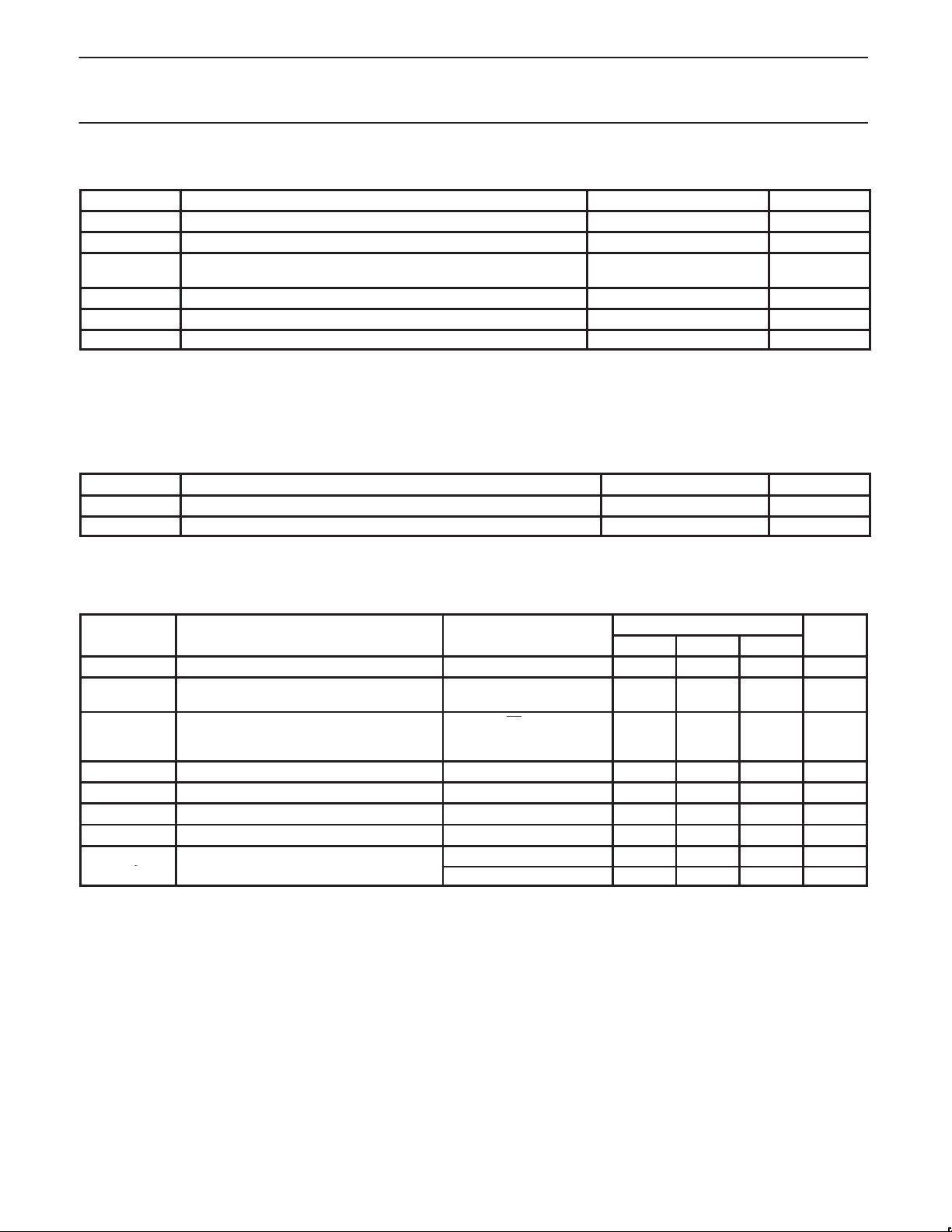
ABSOLUTE MAXIMUM RATINGS
SYMBOL PARAMETER RATING UNITS
V
CC
V
IN
P
D
T
JMAX
P
MAX
T
STG
NOTES:
1. Transients exceeding these conditions may damage the product.
2. Maximum dissipation is determined by the operating ambient temperature and the thermal resistance, and absolute maximum ratings may
impact product reliability θJA: 24-Pin TSSOP = 117°C/W
3. IC is protected for ESD voltages up to 2000 V, human body model.
RECOMMENDED OPERATING CONDITIONS
SYMBOL PARAMETER RATING UNITS
V
CC
T
amb
Supply voltage –0.3 to +6 V
Voltage applied to any pin –0.3 to (VCC + 0.3) V
Power dissipation, T
24-Pin Plastic TSSOP
= 25°C (still air)
amb
555 mW
Maximum operating junction temperature 150 °C
Maximum power (RF/IF/LO pins) +20 dBm
Storage temperature range –65 to +150 °C
Supply voltage 2.7 to 5.5 V
Operating ambient temperature range –40 to +85 °C
DC ELECTRICAL CHARACTERISTICS
VCC = +3V, T
I
CCTX
I
CCRX
I
CC OFF
V
LNA-IN
V
LO GHz
V
TX IF
V
TX IFB
BIAS
= 25°C; unless otherwise stated.
amb
Total supply current, Transmit Tx/Rx = Hi 22 34 42 mA
Total supply current, Receive
Power down mode
LNA input voltage Receive mode 0.855 V
LO buffer DC input voltage Tx/Rx = Lo –0.1 V
Tx Mixer input voltage Tx/Rx = Hi 1.7 V
Tx Mixer input voltage Tx/Rx = Hi 1.7 V
p
LIMITS
MIN TYP MAX
Tx/Rx mode = Lo,
LNA = Hi gain
14 20 26 mA
Tx/Rx = GND
Atten SW = V
Enable = GND
CC
10 µA
CC
Logic 1 6 µA
Logic 0 0 µA
V
2000 Mar 13
3
Page 4

Philips Semiconductors Product specification
SYMBOL
PARAMETER
TEST CONDITIONS
UNITS
SA24212.45 GHz low voltage RF transceiver
AC ELECTRICAL CHARACTERISTICS
VCC = +3 V, T
f
RF
f
IF
LNA High gain mode (In = Pin 2; Out = 23)
S
21
S
12
S
11
S
22
ISO Isolation: LOX to LNA
P
-1dB
IP3 Amplifier input third order intercept
NF Amplifier noise figure (50Ω) LNA gain = Hi 3.1 3.2 3.3 dB
LNA High Overload Mode (low gain mode)
S
21
S
12
S
11
S
22
ISO Isolation: LOX to LNA
P
-1dB
IP3 Amplifier input third order intercept
NF Amplifier noise figure (50 Ω) LNA gain = Low 18.5 dB
Rx Mixer (Rx IN = Pin 19, IF = Pins 5 and 6, LO = Pin 10 or 12, PLO = –10 dBm)
PG
C
S
11–RF
NF
M
P
-1dB
IP3 Input third order intercept f1 – f2 = 1MHz 1.8 2.2 2.6 dBm
Rx Mixer Spurious Components (PIN = P
P
RF-IF
P
LO-IF
= 25°C; LOIN = –10 dBm @ 2.1 GHz; fRF = 2.45 GHz; unless otherwise stated.
amb
LIMITS
MIN –3σ TYP +3σ MAX
RF frequency range
IF frequency range
3
3
2.4 2.45 2.5 GHz
300 350 400 MHz
Amplifier gain LNA gain = Hi 13.3 14.3 15.3 dB
Amplifier reverse isolation LNA gain = Hi –32 dB
Amplifier input match
Amplifier output match
1
1
IN
LNA gain = Hi –10 dB
LNA gain = Hi –9 dB
LNA gain = Hi –43 dB
Amplifier input 1dB gain compression LNA gain = Hi –15 dBm
f1 - f2 = 1 MHz,
LNA gain = Hi
–4.5 –3.2 –1.9 dBm
Amplifier gain LNA gain = Low –18.5 –19.4 –20.3 dB
Amplifier reverse isolation LNA gain = Low –26 dB
Amplifier input match
Amplifier output match
1
1
IN
LNA gain = Low –8 dB
LNA gain = Low –8 dB
LNA gain = Low –45 dB
Amplifier input 1dB gain compression LNA gain = Low 2 dBm
Power conversion gain into 50 Ω :
matched to 50 W using external balun
circuitry.
Input match at RF (2.45 GHz)
1
f1 – f2 = 1 MHz,
LNA gain = Low
fS = 2.45 GHz,
f
= 2.1 GHz,
LO
fIF = 350 MHz
9.5 10 10.5 dB
18 dBm
–11 dB
SSB noise figure (2.45 GHz) (50 Ω) 9.8 11.2 12.5 dB
Mixer input 1 dB gain compression –10.5 dBm
)
-1dB
CL = 2 pF per side -35 dBc
CL = 2 pF per side -32 dBc
RF feedthrough to IF
LO feedthrough to IF
4
5
2000 Mar 13
4
Page 5

Philips Semiconductors Product specification
SYMBOL
PARAMETER
TEST CONDITIONS
UNITS
SA24212.45 GHz low voltage RF transceiver
AC ELECTRICAL CHARACTERISTICS (continued)
LIMITS
MIN –3σ TYP +3σ MAX
Tx Mixer (Tx OUT = Pin 17, IF = Pins 7 and 8, LO = Pin 10 or 12, PLO = –10 dBm)
PG
S
NF
P
11–RF
-1dB
Power conversion gain: RL = 50 Ω
C
RS = 50 Ω
Output match at RF (2.45 GHz)
SSB noise figure (2.45 GHz) (50 Ω) 10.9 11.2 11.5 dB
M
1
Output 1dB gain compression 4.2 dBm
IP3 Output third order intercept f1 – f2 = 1 MHz 10.1 12.2 14.3 dBm
Tx Mixer Spurious Components (P
P
IF-RF
P
LO-RF
P
IMAGE-RF
IF feedthrough to RF
LO feedthrough to RF
Image feedthrough to RF
= P
OUT
4
5
6
–1dB
)
LO Buffer
P
LO IN
S
11-LO
f
LOG
Switching
t
Rx-Tx
t
Tx-Rx
t
POWER UP
t
PWR DWN
LO drive level –15 –10 –5 dBm
Mixer input match (LO = 2.1 GHz) –10 dB
LOG frequency range
2
3
Receive-to-transmit switching time 1 µs
Transmit-to-Receive switching time 1 µs
Chip enable time 1 µs
Chip disable time 1 µs
NOTES:
1. With simple external matching
2. With 50 pF coupling capacitors on all RF and IF parts
3. This part has been optimized for the stated frequency range. Operation outside this frequency range may yield performance other than
specified in this datasheet.
4. Measured 5dB lower than 1dB compression point, with typical output matching network.
5. Measured at 1dB compression point.
6. With typical output matching network (no image reject mixer is used).
fS = 2.45 GHz,
fLO = 2.1 GHz,
fIF = 350 MHz
22.5 23 23.5 dB
–10 dB
–50 dBc
–22 dBc
–20 dBc
1.9 2.1 2.3 GHz
2000 Mar 13
5
Page 6

Philips Semiconductors Product specification
SA24212.45 GHz low voltage RF transceiver
Table 1. Truth Table
Chip-En ATT-SW TX–R
0 X X Sleep N/S off off
1 1 0 Receive +14.3 dB on off
1 0 0 Receive –19 dB on off
1 X 1 Transmit N/S off on
X
Mode LNA Gain RX Mixer
TX Mixer and
Predriver
FUNCTIONAL DESCRIPTION
The SA2421 is a 2.45 GHz transceiver front-end available in the
TSSOP-24 package. This integrated circuit (IC) consists of a low
noise amplifier (LNA) and up- and down-converters. There is an
enable/disable switch available to power up/down the entire chip in
1 µs, typically. This transceiver has several unique features.
The LNA has two operating modes: 1) high gain mode with a gain =
+14.3 dB; and 2) low gain mode with a gain –19 dB. The switch for
this option is internal and is controlled externally by high and low
logic to the pin. When the LNA is switched into the attenuation
mode, active matching circuitry (on-chip) is switched in (reducing the
number of off-chip components required). To reduce power
consumption when the chip is transmitting, the LNA is automatically
switched into a “sleep” mode (internally) without the use of external
circuitry.
2000 Mar 13
6
Page 7

Philips Semiconductors Product specification
SA24212.45 GHz low voltage RF transceiver
23
22
21
20
19
Current (mA)
18
17
–40_C0_C25_C70_C85_C
TEMPERATURE (°C)
2.7V 3.8V3.0V 5.5V
SR02262
Figure 3. LNA / Receive Supply Current vs Supply Voltage and
Temperature
15
14
Gain (dB)
13
12
–40_C0_C25_C70_C85_C
TEMPERATURE (°C)
2.7V 3.8V3.0V 5.5V
SR02263
4.0
3.8
3.6
3.4
Noise (dB)
3.2
3.0
2.8
–40_C0_C25_C70_C85_C
TEMPERATURE (°C)
2.7V 3.8V3.0V 5.5V
Figure 6. LNA Noise Figure vs Supply Voltage and
Temperature
11.5
10.5
Gain dB
9.5
8.5
–40_C0_C25_C70_C85_C
TEMPERATURE (°C)
2.7V 3.8V3.0V 5.5V
SR02265
SR02266
Figure 4. LNA Gain vs Supply Voltage and Temperature
–1.0
–1.5
–2.0
–2.5
–3.0
–3.5
IP3 (dBm)
–4.0
–4.5
–5.0
–5.5
–40_C0_C25_C70_C85_C
TEMPERATURE (°C)
2.7V 3.8V3.0V 5.5V
SR02264
Figure 5. LNA Input IP3 vs Supply Voltage and Temperature
Figure 7. RX Gain vs Supply Voltage and Temperature
3.0
2.5
2.0
IP3 (dBm)
1.5
1
–40_C0_C25_C70_C85_C
TEMPERATURE (°C)
2.7V 3.8V3.0V 5.5V
SR02267
Figure 8. Receive Input IP3 vs Supply Voltage and Temp
2000 Mar 13
7
Page 8

Philips Semiconductors Product specification
SA24212.45 GHz low voltage RF transceiver
12.5
12.0
11.5
11.0
NF (dB)
10.5
10
–40_C0_C25_C70_C85_C
TEMPERATURE (°C)
2.7V 3.8V3.0V 5.5V
SR02268
Figure 9. Receive Noise Figure vs Supply Voltage and Temp
–9.0
–9.5
–10.0
–10.5
–11.0
–11.5
P–1dB (dBm)
–12.0
–12.5
–13
–40_C0_C25_C70_C85_C
TEMPERATURE (°C)
2.7V 3.8V3.0V 5.5V
SR02269
29
27
25
23
21
Gain (dB)
19
17
15
–40_C0_C25_C70_C85_C
TEMPERATURE (°C)
2.7V 3.8V3.0V 5.5V
SR02271
Figure 12. Transmit Gain vs Supply Voltage and Temp
20
18
16
14
12
10
8
6
Output IP3 (dBm)
4
2
0
–40_C0_C25_C70_C85_C
TEMPERATURE (°C)
2.7V 3.8V3.0V 5.5V
SR02272
Figure 10. RX 1dB Compression vs Supply Voltage and Temp
38
37
36
35
34
33
Current (mA)
32
31
30
–40_C0_C25_C70_C85_C
TEMPERATURE (°C)
2.7V 3.8V3.0V 5.5V
SR02270
Figure 11. Transmit Current vs Supply Voltage and Temp
Figure 13. Transmit Output IP3 vs Supply Voltage and Temp
13.0
12.5
12.0
11.5
11.0
10.5
10.0
NF (dB)
9.5
9.0
8.5
8
–40_C0_C25_C70_C85_C
TEMPERATURE (°C)
2.7V 3.8V3.0V 5.5V
SR02273
Figure 14. Transmit Noise Figure vs Supply Voltage and Temp
2000 Mar 13
8
Page 9

Philips Semiconductors Product specification
SA24212.45 GHz low voltage RF transceiver
9
8
7
6
5
4
3
P–1dB (dBm)
2
1
0
–1
–40_C0_C25_C70_C85_C
TEMPERATURE (°C)
2.7V 3.8V3.0V 5.5V
SR02274
Figure 15. TX 1dB compression vs Supply Voltage and Temp
–10
–11
–12
–13
–14
–15
P–1dB (dBm)
–16
–17
–18
–40_C25_C85_C
TEMPERATURE (°C)
2.7V 3.8V3.0V 5.5V
SR02275
Figure 16. LNA 1dB compression vs Supply Voltage and Temp
12.0
11.5
11.0
10.5
10.0
9.5
9.0
8.5
Receive Gain (dB)
8.0
7.5
7
–18 –16 –14 –12 –10 –8 –5 –2
LO Input (dBm)
–40C +25C0C +70C +85C
SR02276
Figure 17. Receive Gain vs LO Input over Temp Range
26
25
24
23
22
21
20
Transmit Gain (dB)
19
18
17
–18 –16 –14 –12 –10 –8 –5 –2
LO Input (dBm)
–40C +25C0C +70C +85C
SR02277
Figure 18. Transmit Gain vs LO Input over Temp Range
2000 Mar 13
The Rx IN port is matched to 50 Ω and has an input IP3 of +2.2 dBm
(mixer only). The down-convert mixer is buffered and has open
collectors at the pins to allow for matching to common SAW filters.
The up convert mixer has an input pin to output pin gain of 23 dB.
The output of the up-converter is designed for a power level =
+4.2 dBm (P
–1dB
).
9
Page 10

Philips Semiconductors Product specification
SA24212.45 GHz low voltage RF transceiver
J7
LNA OUT
J6
RxRF IN
2.45GHz
cc
V
23
LNA OUT
LNA IN
2
L7
1.2nH
GND
3
C1
1pF
22
GND
S3
21
ATTEN SW
GND
4
20
GND
Rx IF OUT
5
19
Rx IN
SA2421
Rx IF OUT
6
+
C17
10uF
cc
V
cc
V
1
2
JP1
C15
.1uF
24
cc
V
GND
U1
1
L1
3.9nH
18
GND
Tx IF IN
7
J5
2.45GHz
TxRF OUT
C14
17
Tx OUT
Tx IF IN
8
C9
100pF
L6
16
GND
GND
9
8.2pF
2.7nH
C10
15
GND
LOP
10
100pF
cc
V
14
LO
cc
V
Tx/Rx
11
C12
C13
100pF
33pF
13
CHIP EN
LOM
12
L5
2.7nH
C11
cc
V
S2
1.0pF
2000 Mar 13
L4
C6
Tx IN
33nH
10pF
350MHz
J4
C8
8.2pF
S1
C7
100pF
cc
V
J3
LO 2.1GHz
SR01758
J1
LNA IN
L2
39nH
cc
V
C16
100pF
C2
SEL
(0pF–1.0pF)
C3
10pF
Rx OUT
350MHz
L3
33nH
C5
SEL
(0pF–1.0pF)
C4
3.9pF
J2
Figure 19.
10
Page 11

Philips Semiconductors Product specification
SA24212.45 GHz low voltage RF transceiver
TSSOP24: plastic thin shrink small outline package; 24 leads; body width 4.4 mm SOT355-1
2000 Mar 13
11
Page 12

Philips Semiconductors Product specification
SA24212.45 GHz low voltage RF transceiver
Data sheet status
Data sheet
status
Objective
specification
Preliminary
specification
Product
specification
Product
status
Development
Qualification
Production
Definition
This data sheet contains the design target or goal specifications for product development.
Specification may change in any manner without notice.
This data sheet contains preliminary data, and supplementary data will be published at a later date.
Philips Semiconductors reserves the right to make changes at any time without notice in order to
improve design and supply the best possible product.
This data sheet contains final specifications. Philips Semiconductors reserves the right to make
changes at any time without notice in order to improve design and supply the best possible product.
[1]
[1] Please consult the most recently issued datasheet before initiating or completing a design.
Definitions
Short-form specification — The data in a short-form specification is extracted from a full data sheet with the same type number and title. For
detailed information see the relevant data sheet or data handbook.
Limiting values definition — Limiting values given are in accordance with the Absolute Maximum Rating System (IEC 134). Stress above one
or more of the limiting values may cause permanent damage to the device. These are stress ratings only and operation of the device at these or
at any other conditions above those given in the Characteristics sections of the specification is not implied. Exposure to limiting values for extended
periods may affect device reliability.
Application information — Applications that are described herein for any of these products are for illustrative purposes only. Philips
Semiconductors make no representation or warranty that such applications will be suitable for the specified use without further testing or
modification.
Disclaimers
Life support — These products are not designed for use in life support appliances, devices or systems where malfunction of these products can
reasonably be expected to result in personal injury . Philips Semiconductors customers using or selling these products for use in such applications
do so at their own risk and agree to fully indemnify Philips Semiconductors for any damages resulting from such application.
Right to make changes — Philips Semiconductors reserves the right to make changes, without notice, in the products, including circuits, standard
cells, and/or software, described or contained herein in order to improve design and/or performance. Philips Semiconductors assumes no
responsibility or liability for the use of any of these products, conveys no license or title under any patent, copyright, or mask work right to these
products, and makes no representations or warranties that these products are free from patent, copyright, or mask work right infringement, unless
otherwise specified.
Philips Semiconductors
811 East Arques Avenue
P.O. Box 3409
Sunnyvale, California 94088–3409
Telephone 800-234-7381
Copyright Philips Electronics North America Corporation 2000
All rights reserved. Printed in U.S.A.
Date of release: 03-00
Document order number: 9397 750 06949
2000 Mar 13
12
 Loading...