

Page 1
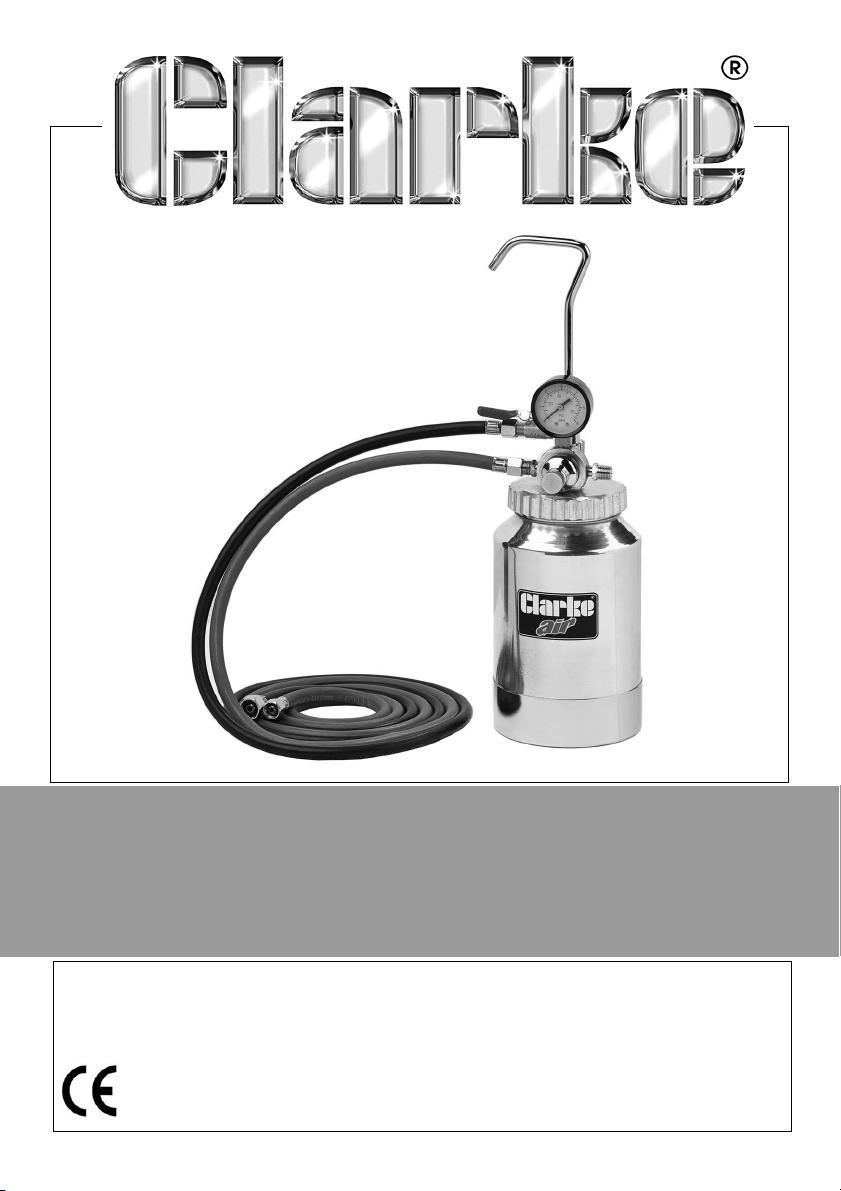
PRESSURISED PAINT CONTAINER
MODEL NO: CPP2B
PART NO: 3082115
OPERATION & MAINTENANCE
INSTRUCTIONS
GC0913
Page 2
INTRODUCTION
Thank you for purchasing this CLARKE Pressurised Paint Container.
Before attempting to use this product, please read this manual thoroughly and
follow the instructions carefully. In doing so you will ensure the safety of yourself
and that of others around you, and you can look forward to your purchase
giving you long and satisfactory service.
IMPORTANT
Please read all of the safety and operating instructions carefully before using
this product. Please pay particular attention to all sections of these instructions
that display warning symbols and notices.
WARNING: THIS SYMBOL IS USED THROUGHOUT THE USER GUIDE
WHENEVER THERE IS A RISK OF PERSONAL INJURY. ENSURE THAT
THESE WARNINGS ARE READ AND UNDERSTOOD AT ALL TIMES.
GUARANTEE
This product is guaranteed against faulty manufacture for a period of 12
months from the date of purchase. Please keep your receipt which will be
required as proof of purchase.
This guarantee is invalid if the product is found to have been abused or
tampered with in any way, or not used for the purpose for which it was
intended.
Faulty goods should be returned to their place of purchase, no product can
be returned to us without prior permission.
This guarantee does not effect your statutory rights.
2
Parts & Service: 020 8988 7400 / E-mail: [email protected] or [email protected]
Page 3
GENERAL SAFETY RULES
Before using this equipment it is in your own interest to read and pay attention
to the following safety rules.
1. Keep the work area clean. Cluttered areas invite injuries. Keep the work
area well lit.
2. Keep children away. Children must never be allowed in the work area.
3. Store idle equipment. When not in use, tools must be locked up in a dry
location. Always lock up tools and keep out of reach of children.
4. Use eye protection. Always wear approved impact safety goggles.
5. Stay alert. Watch what you are doing, use common sense. Do not operate
any tool when you are tired.
6. Check for damaged parts. Before using any tool or equipment, any part
that appears damaged should be carefully checked to determine that it
will operate properly and perform its intended function.
7. Do not operate the equipment if under the influence of alcohol or drugs. If
there is any doubt, do not operate the equipment.
COMPRESSED AIR EQUIPMENT
1. Compressed air can be dangerous. Ensure that you are thoroughly familiar
with all precautions relating to the use of compressors and a compressed
air supply.
2. Never direct a jet of compressed air at people or animals.
3. Always ensure that the equipment being used has a safe working pressure
exceeding the output pressure of the compressor that it is connected to.
4. Always ensure that the air supply is turned off at the tool outlet and vent all
compressed air from within the air hose and the equipment attached to it,
before disconnecting air hoses or other equipment from your compressor.
5. Ensure all fixed air connections are properly sealed using teflon tape or
pipe sealant.
PAINT SPRAYING EQUIPMENT
We strongly recommend that paint spraying equipment be used in
conjunction with appropriate eye and face protecting goggles, glasses or
spray masks, available from most DIY and hardware stores.
1. Always keep the equipment perfectly clean. This will not only prolong its
life, but will also ensure you get the best results. See ‘Maintenance.
3
Parts & Service: 020 8988 7400 / E-mail: [email protected] or [email protected]
Page 4

2. Always ensure there is adequate ventilation. Do not spray or handle paint
in enclosed areas.
3. Never spray close to any source of heat or flame.
4. Always wear a suitable approved breathing mask when spraying, to
protect against inhalation of paint spray or fumes. An air fed mask may be
required when spraying some types of toxic paint. If in doubt, check with
the paint manufacturer.
5. Always check the manufacturer’s data sheets for the paint products being
sprayed for any particular hazards and follow the manufacturer’s
instructions. Take particular care if spraying isocyanate paints. Products
used in a spray gun may be covered by COSHH Regulations.
6. Always disconnect the spray gun from the air supply when it is not in use,
and before any disassembly.
7. Never spray paint towards people or animals.
8. In the case of injury, seek expert medical advice immediately. Never
smoke while spraying or preparing paints, or spray near a naked flame,
heat source and electrical sparks. Many paints are flammable.
9. Never tamper with, or attempt to adjust the safety valve.
10. Never tamper with the product or modify it in any way, as this could prove
to be dangerous and will invalidate the guarantee. Only use the product
for the purpose for which it is intended.
11. When replacing parts, only use those supplied by Clarke International as
shown by the parts list on page 10.
4
Parts & Service: 020 8988 7400 / E-mail: [email protected] or [email protected]
Page 5
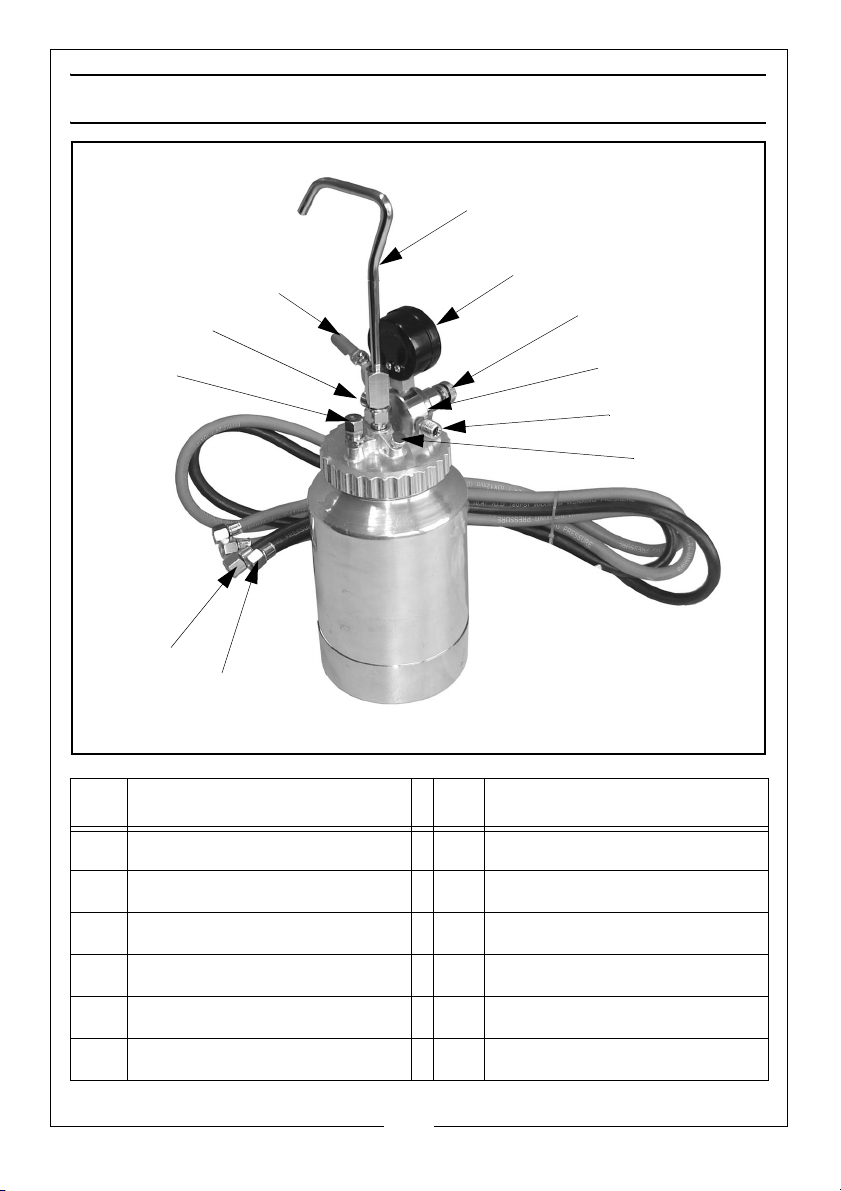
PRODUCT OVERVIEW
1
3
2
6
5
4
7
11
8
10
9
NO DESCRIPTION NO DESCRIPTION
1 Carrying / Support Handle 7 Air Outlet Hose (orange)
2 Air Pressure Gauge 8 Paint Delivery Hose (black)
3 Air Adjusting Screw 9 Safety Valve
4 Regulator 10 Air Outlet
5 Air Inlet 11 Paint Shut-off Valve
6 Vent Valve
Parts & Service: 020 8988 7400 / E-mail: [email protected] or [email protected]
5
Page 6
AIR SUPPLY
The air supply pressure to the container should be clean and not be greater
than 80 psi. Higher pressure or contaminated air will shorten the spray gun life
because of faster wear, and could become a safety hazard.
Water in the airline will also cause damage and may contaminate the paint
being used. Ensure the air supply is properly filtered.
The recommended procedure to connect the container to an air supply is
described below. A filter/regulator should always be incorporated in the air
supply line.
The air inlet used for connecting air supply has a standard ¼” BSP thread.
Airline pressure, or supply hose inside diameter, should be increased to
compensate for unusually long air hoses (over 10 m). The minimum hose
diameter should be 6mm (¼”) ID and fittings should have the same internal
dimensions.
OPERATION
This CPP2B paint container is designed primarily for spraying oil and solvent
based paint. Clarke International provides a range of spray guns which may
be used with this container. Please see examples on page 11.
WARNING: ALWAYS CHECK TO ENSURE THE CONTAINER IS NOT UNDER
PRESSURE BEFORE USE, BY CHECKING THE PRESSURE GAUGE AND
OPENING THE AIR OUTLET VALVE.
1. Mix the paint to the correct viscosity for spraying according to the
manufacturer’s instructions and strain it into the paint canister through a
fine mesh filter. When mixing the paint, make sure that you have enough
thinners left to clean the spray gun after use.
2. Unscrew the lid and fill the paint
container with paint. Replace the
lid and tighten securely.
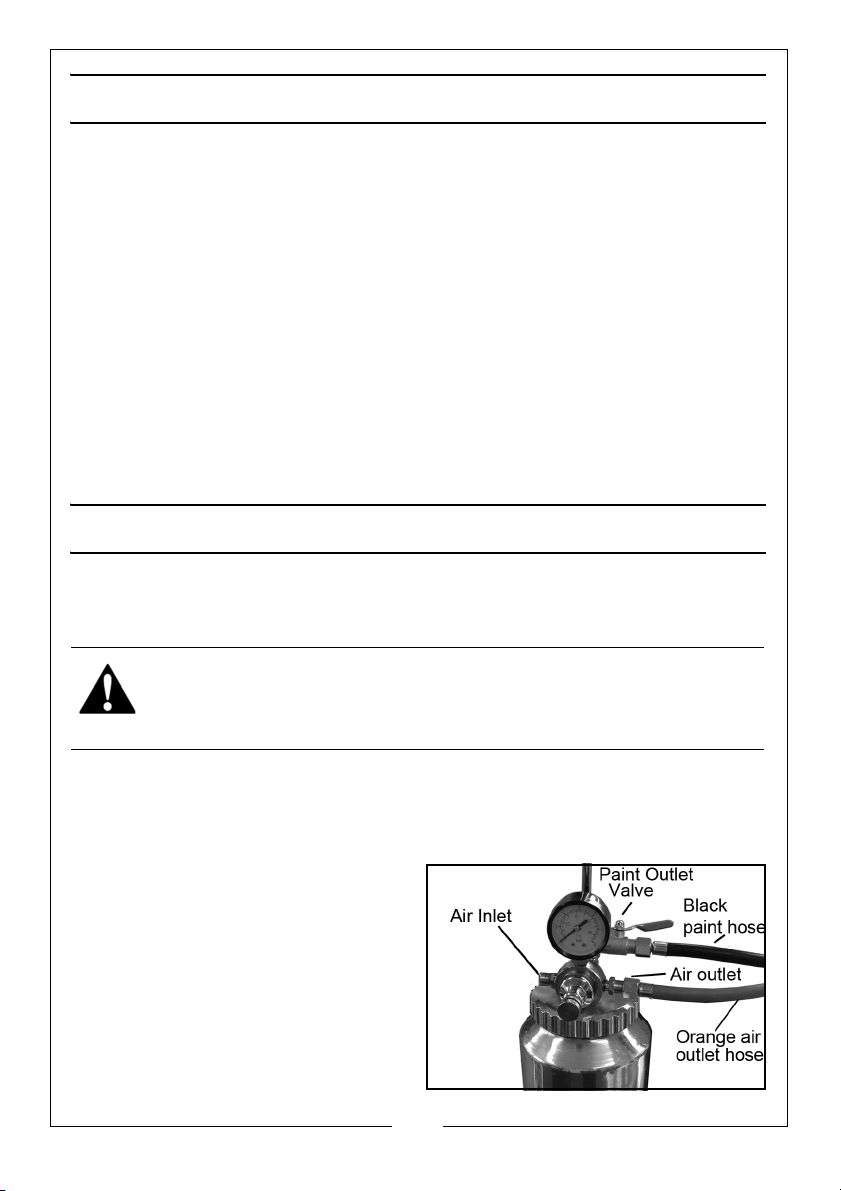
3. Connect the air supply hose to
the air inlet, (using a suitable inline connector if required).
4. Connect the (orange) air hose
from the spray gun, to the air
outlet.
6
Parts & Service: 020 8988 7400 / E-mail: [email protected] or [email protected]
Page 7
5. Connect the paint hose (black) from the spray gun to the paint outlet.
6. Ensure the pressure regulator knob is turned fully anticlockwise, then turn on
the air supply from your compressor/air supply to the paint container.
7. Turn the pressure regulator knob clockwise to pressurise the container until
the required pressure is achieved.
• Working pressure will depend upon the consistency of the paint, but
must never exceed 35 psi. If the paint is sluggish at this pressure, it
should be thinned.
8. Turn on the paint outlet valve.
9. Finally, begin spraying and make adjustments to the spray pattern
according to the spray gun instructions.
10. The paint should be agitated by gentle shaking at regular intervals during
use to ensure consistency and avoid colour differences due to the paint
settling in the container.
11. Set the spray pattern and fluid flow using the adjustment screws on the
spray gun.
SPECIFICATION
Container Volume 2 Litres
Air Inlet Connection ¼”BSP
Hose Length 1700 mm
Paint Hose Dia 3/8” BSP
Safety Valve Working Pressure 35 psi
Weight 1.51 kg
Height x Diameter 322 x 129 mm
7
Parts & Service: 020 8988 7400 / E-mail: [email protected] or [email protected]
Page 8
MAINTENANCE
It is essential to clean the equipment thoroughly after use. Dried paint in the
outlet and the hoses will undermine the performance of the equipment.
CLEANING PROCEDURE
1. Turn off the air supply to the container.
2. Open the air outlet valve.
3. Discharge the remaining pressure in the spraygun such that any paint
sprayed will land harmlessly on newspaper or similar.
4. Hold the spray gun and hose above the level of the container and pull the
spray gun trigger to allow any paint in the hose to drain back into the
container.
5. Empty the container of paint, before cleaning it thoroughly with solvent,
depending upon the type of paint being sprayed. Use a small bristle brush
and solvent to wash off accumulated paint.
6. With the container and other components cleaned thoroughly, pour clean
solvent or other cleaning agent into the container.
7. Replace the lid.
8. Turn on the air supply to the container and pull the spray gun trigger. Keep
it pressed until only clean solvent or other cleaner is discharged from the
spray gun.
9. Allow solvent or other cleaner to drain back into the container.
10. Finally, empty the container and dry all components thoroughly. Store in a
clean, dry place.
SAFETY CHECKS
1. Periodically before use, pressurise the container to 35 psi (2.5 bar) in order
to test the safety valve. If it does not release at this pressure, do not use the
container. Have the valve replaced immediately.
2. Inspect both the air and paint hoses for wear or damage periodically, and
replace if necessary. Do not use damaged or leaking hoses.
8
Parts & Service: 020 8988 7400 / E-mail: [email protected] or [email protected]
Page 9
Page 10
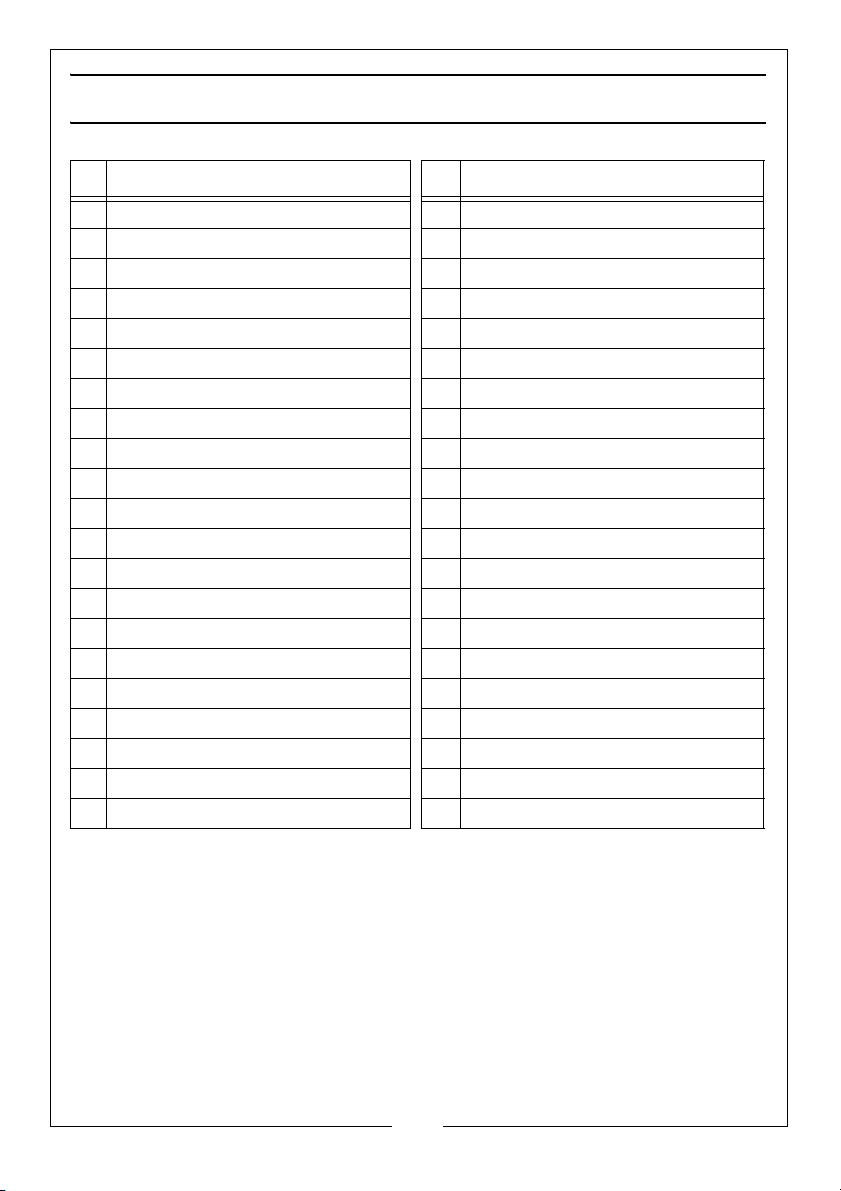
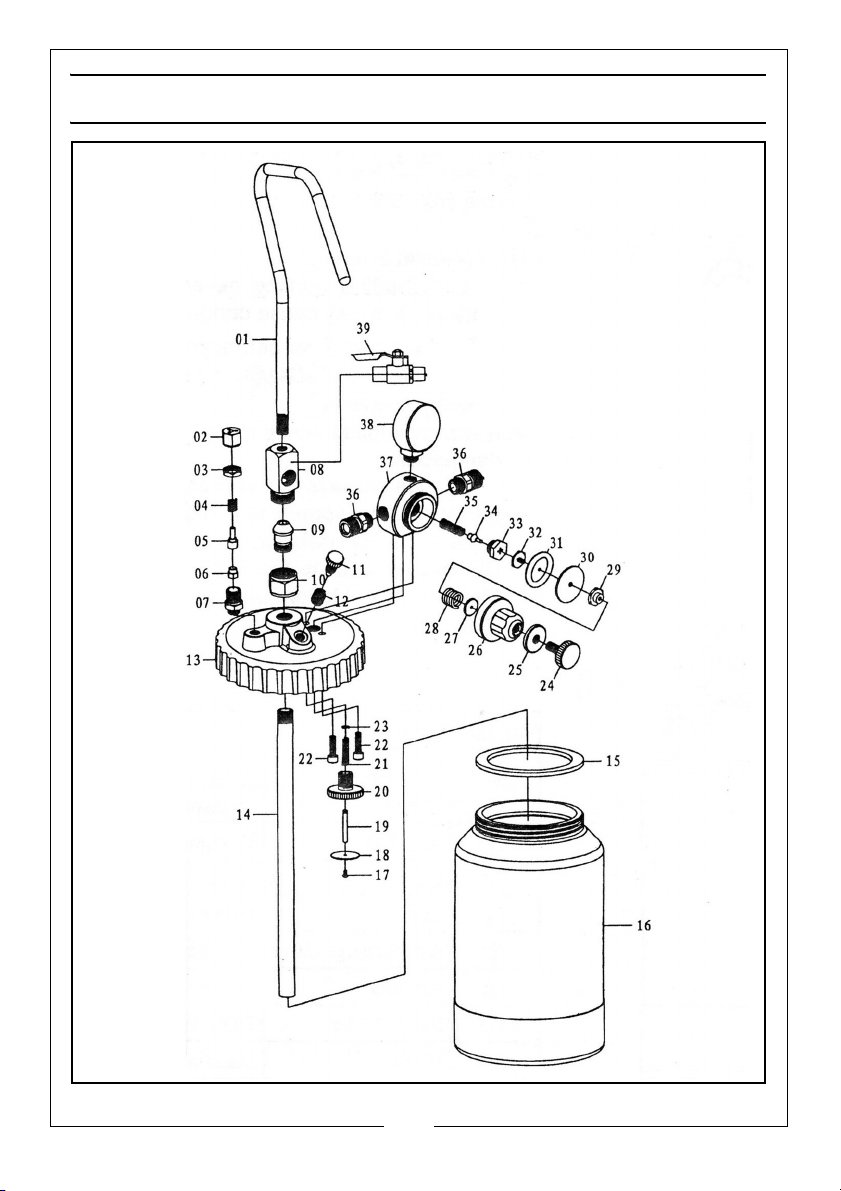
PARTS LIST
ID DESCRIPTION ID DESCRIPTION
1Handle 22Socket Screws
2 Adjusting Screw 23 Stopper
3 Locking Nut 24 Air Adjusting Screw
4 Spring 25 Locking Nut
5 Valve 26 Air Regulator Body
6 Valve Gasket 27 Spring Seat
7 Valve Seat 28 Spring
8 Connector 29 Sealing Nut
9 Olive 30 Laminated Gasket
10 Connector 31 Plastic Gasket
11 Vent Thumb Screw 32 Flat Nut
12 Spring 33 Needle Seat
13 Container Cap 34 Air Needle
14 Pick-up Tube 35 Spring
15 Gasket 36 Hose Connector
16 Container 37 Gauge Seat
17 Screw 38 Pressure Gauge
18 Round Film Gasket 39 Shut-off Valve
19 Tube 40 Fluid Hose
20 Brass Screw Fixing 41 Air Hose
21 Spring
10
Parts & Service: 020 8988 7400 / E-mail: [email protected] or [email protected]
Page 11
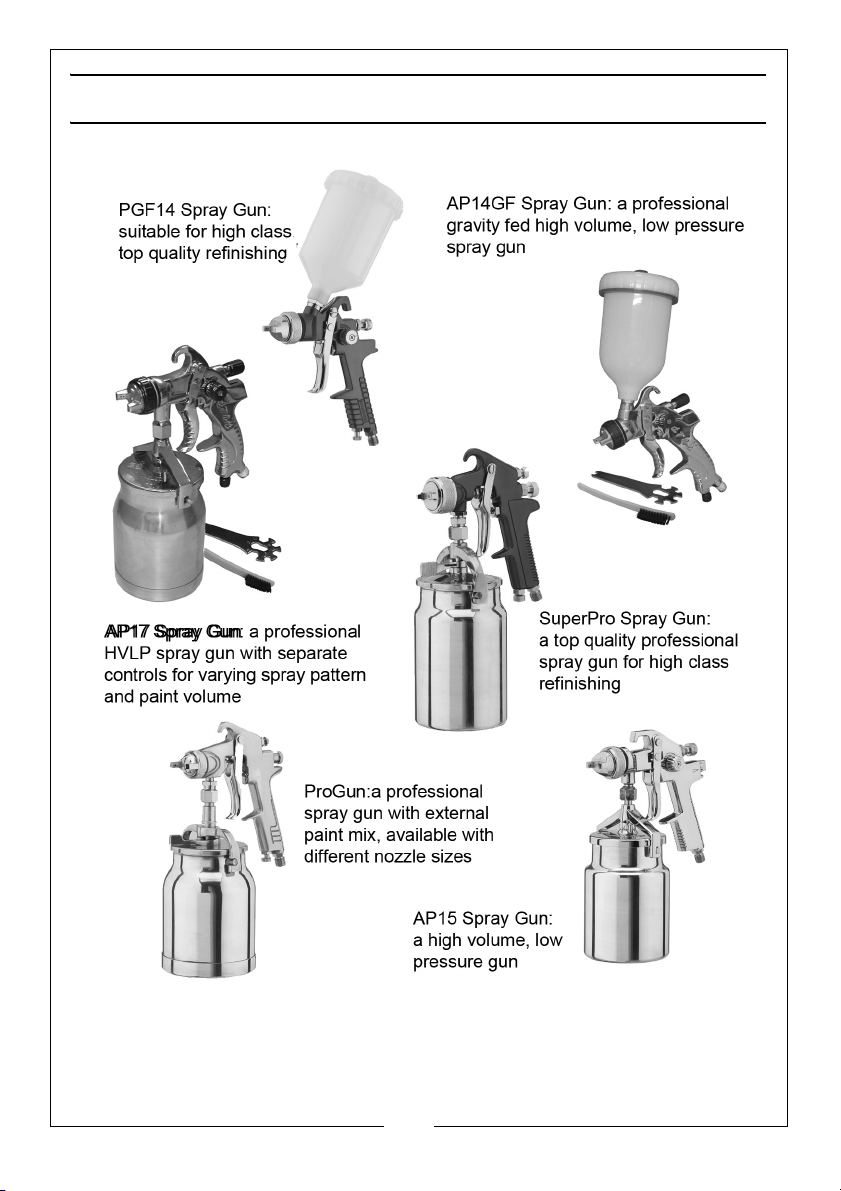
CLARKE SPRAY GUNS
A wide variety of Clarke spray guns can be used with this pressurised paint
container and are available from your local stockist.
11
Parts & Service: 020 8988 7400 / E-mail: [email protected] or [email protected]
Page 12
 Loading...