

Page 1

REVIEW
Blu Order
Establishing itself at the top of the budget Blu ray tree, Noel Keywood shows true faith in
Cambridge Audio's new 650BD...
ithin a very short
time of receiving this
Blu-ray player I was
enjoying the won
derfully smooth and
W
of the Mariinsky Theatre Orchestra
swelling up behind Lang Lang, play
ing Rachmaninov’s Piano Concerto
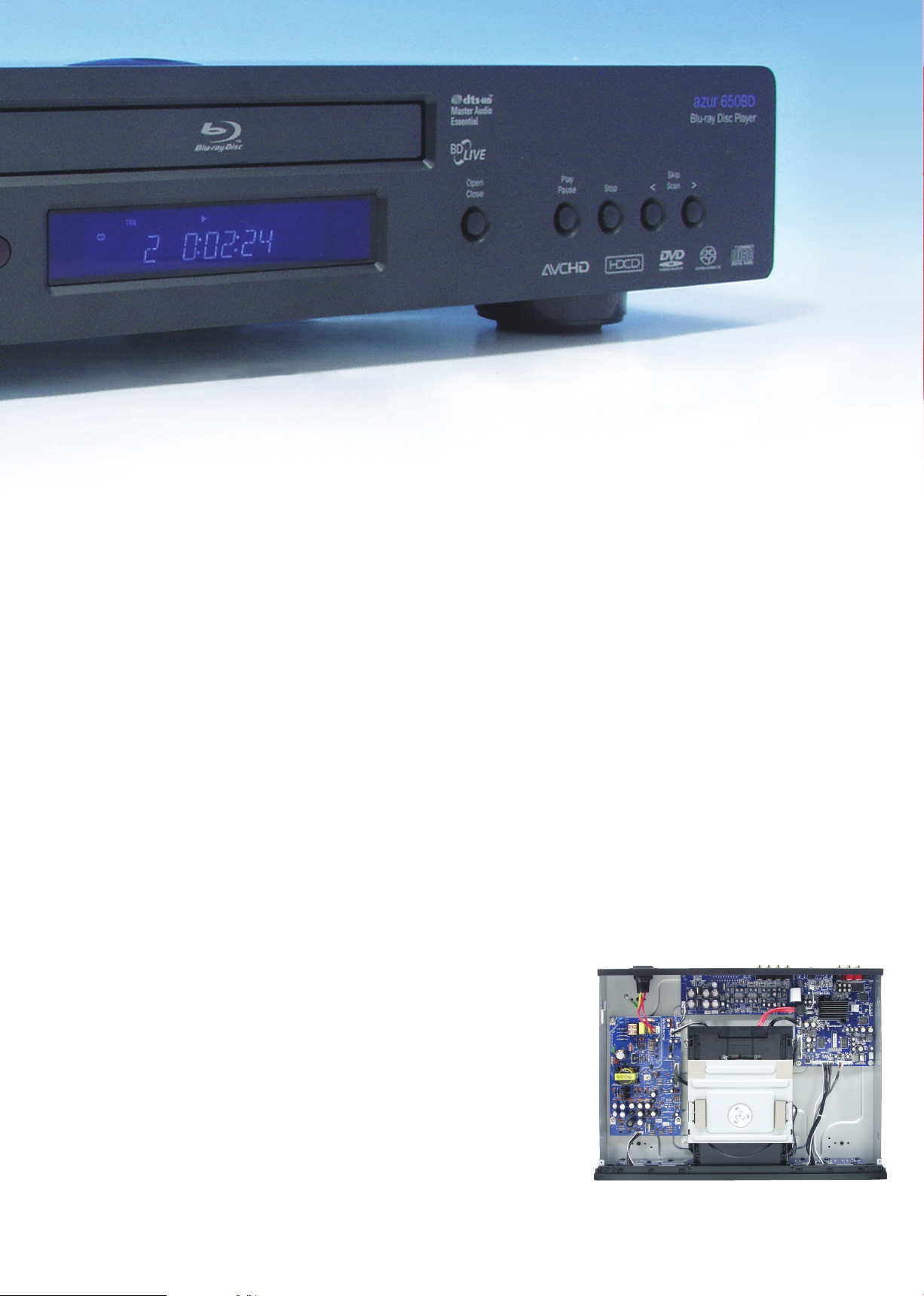
No2 – on SACD! The new 650BD
reviewed here is one of the first
‘universal’ players to become avail
able to Britons, able to play not just
Blu-ray discs of all varieties, but also
SACDs, DVD-As and CDs, no less.
The 650BD will play
except LPs, making Cambridge fast
off the mark in getting out a player
to rival the Oppos we mention so
often, sadly available only in U.S. Bluray Region A form. The Cambridge
comes in UK and U.S. versions.
This is a sophisticated player
and, being from a dedicated audio
manufacturer, has been purposed to
do a good job with every silver audio
disc ever conceived as a commercial
format. It also plays Blu-ray movies of
course, and DVD movies, upscaling
them to Blu-ray resolution, to
improve picture quality. To be crystal
clear though, the difference between
this Blu-ray player and most others
you’ll encounter lies in its ability to
lush sound of strings
all audio discs
34 HI-FI WORLD JUNE 2010 www.hi-fiworld.co.uk
-
-
-
play SACD and DVD-A, since even
budget models from Samsung and
Philips will play CD and DVD video,
as well as Blu-ray, but not these
‘obsolete’ formats. To date Blu-ray
has been seen as an AV format, all
about movies; only Oppo have made
an issue of audio quality – and their
players have become very popular
largely as a result. I have been
hankering after Oppo’s BDP-83 as a
one-box do-it-all machine, but instead
Cambridge Audio’s 650BD arrived at
our offices and turned out to be a
near equivalent – a pleasant surprise!
Audio buffs would sneer at using
a player like this as a stand alone CD
player within a hi-fi system, but you
can use it as a decent CD transport,
connected via S/PDIF to a DAC, or
HDMI to an AV receiver, because
our measurements show it has very
low jitter. However, Blu-ray players
like this are really purposed for use
with an AV receiver and Cambridge
Audio recommend their new 650R,
but I used a Marantz SR8002 7.1
receiver in what is effectively a
stereo hi-fi system driving World
Audio Design KLS9 loudspeakers
for the front stage, plus Usher S520s as Surrounds, in a 4.0 system
deliberately devoid of subwoofer
(don’t like ‘em!) and Centre
‘speaker (great if you like mono).
I do occasionally hook in Back
loudspeakers behind the listening
position but they contribute little
for music purposes. Most surroundsound music discs use the rear
Surround loudspeakers for ambience,
so do little work.
A system like this does a fine job
with pure audio discs like CD, SACD,
etc, and also with Blu-ray and DVD
music videos, as well as with movies,
although it isn’t purposed for massive
explosions. The new Cambridge
player can handle all of these discs, in
most of the flavours they come in.
Trying to understand what a
player like this offers is easiest if split
into roles. It can be connected up
simply using phono cables, because
it has ‘traditional’ analogue outputs,
in the form of phono sockets.
There’s a full set of eight (Front L&R,
Centre, Surround L&R, Back L&R,
Subwoofer) to feed an (old) receiver
having analogue inputs only. With a
player of this quality the HDMI digital
multichannel link should be used
in preference to analogue cables,
but Cambridge provide a full set of
phono outputs all the same, to aid
compatibility with a wide range of
older products out there. They also
provide an internal, user selectable
Page 2
REVIEW
mix-down associated with these
analogue outputs that turns them
to 5.1 or Stereo, or matrix encoded
Lt and Rt. There are no dedicated
Stereo outputs; the Front Left and
Right sockets are used with the mix
down set to Stereo.
I mention all this because it is a
little confusing. Even Cambridge omit
to mention that the Loudspeaker
Set Up menu of the player affects
only the analogue outputs, having
absolutely no affect upon the HDMI
link data. The analogue outputs are
secondary to the digital HDMI digital
link so do not use super high quality
onboard DACs. No one is pretending
this is a top quality standalone CD
player.
There are traditional S/PDIF
digital audio outputs too, in both
electrical phono socket form, and
optical TOSLINK. These transmit a
clean digital stereo signal and are a
good way to connect to an external
hi-fi DAC or receiver, another role.
Ideally, the player is connected
to a receiver via its HDMI cable,
which in 1.3 version is able to stream
basic digital (PCM), plus raw SACD
code (DSD) as well as DTS HD
Master Audio and Dolby TrueHD,
both forms of losslessly compressed
digital, at up to 24/192 resolution
per channel over seven channels
in the Blu-ray spec. Used like this,
where all processing is carried out
in the receiver, the 650BD becomes
a transport, simply sending raw data
to the receiver – and this is the best
arrangement. Ironically, it makes all
the onboard processing Cambridge
include redundant, but then this
affects all current Blu-ray players.
Alternatively, to match older
receivers unable to process anything
other than basic digital code, or
PCM, the 650BD can be set to
convert all proprietary digital formats
to PCM before sending them out
over the HDMI link. I tested both
arrangements, as usual, using a 24/192
2L ‘Divertimenti’ disc and the 650BD
converted SACD, DTS HD Master
Audio and Dolby TrueHD to PCM
without difficulty. Set to work as a
transport (i.e. to Bitstream output),
the Cambridge played a wide variety
of CDs. HDCDs (remember them?),
DVD-As and SACDs without a glitch,
and it also played all varieties of Bluray movie soundtrack, from Dolby
and DTS, as well as straight PCM,
making it a great universal player. This
is one of the UK’s first players to do
it all – and not at a daft price!
Because the 650BD carries as
many video options as audio options,
its set up menus are extensive and
the handbook is required reading. You
can find it at www.cambridgeaudio.
com. Ominously, there is a ‘get you
going‘ wizard and, in the tradition of
wizards, pioneered by Microsoft, it
was nonsensical, saying press ‘OK”
when there was no OK to press
(they mean Enter) and asking a user
to choose a video output, with no
instructions on how to do so...
Blu-ray players are deadly slow
to load and – more annoyingly – to
unload. The 650BD is advertised as
being ‘fast’ – and it is, taking just
10 seconds to load a Blu-ray disc
or CD, and 5 seconds to stop and
eject either. With the long-to-load
Java menu of John Meyer’s ‘Where
The Light Is’ disc, it took 30 seconds
to load, the same as the Philips
BDP7500 I tested in our March 2010
issue. The player returns to where
play last ended when switched on, or
stopped, even after a disc is ejected
and this takes some getting used to.
Stop must be pressed twice to clear
this behaviour. The disc menu (Top
menu) cannot be accessed from
standstill, only when playing.
Styling and finish were a little
prosaic, but build quality was
www.hi-fiworld.co.uk JUNE 2010 HI-FI WORLD 35
satisfactory. An excellent OSD
appears on the TV when the remote
control’s Info button is pressed;
you get data rate as well as coding
scheme. With DTS HD Master Audio
alone clocking up at 22Mbps, against
1.2Mbps for CD there’s no doubt
that Blu-ray delivers a lot of music
data. Slightly disappointing was a
swishing noise that came from the
player’s mechanism when playing Bluray discs (but not CDs), just audible
at times when 4m from the player,
during soft classical music.
The remote has a Draw Open
function, which saves time, plus
Power Off, and a Pure Audio function
that switches off the display and
video, which goes to Black Level
(video silence), a very nice touch. The
Marantz receiver has this too (Ken
Ishiwata of Marantz hates video being
on when audio is playing!). He’s right;
I often spot video breakthrough on
the test bench and, in my system,
switching all video and displays off
does make for a smoother sound.
Although the UK Region player
will play most Blu-ray discs, which
commonly lack regional coding, it will
not play U.S. DVDs, which are NTSC
as well as Region 1. Unrelated to the
zoning issue,
it will play
BDMV on
Verbatim
BD-Rs, I
found, and
Panasonic
BD-REs,
without a
hiccup.
VISION
Picture
quality
passed
all Silicon
Optix, High Quality Video tests with
ease, using both Blu-ray and DVD
Page 3
tests, but most quality Blu-ray
players manage this nowadays.
There were no jaggies at all, no
motion trailing or feathering,
nor strobing. Our more
rigorous Burosch DVD video
tests were also handled without
difficulty. With live video shot on a
tripod mounted Canon HV30 that I
find more revealing of picture quality,
reproduction of grass and trees
matched that of a Samsung BD-P1600
but did not improve on it, unlike
a Philips BD7500 that was clearly
better, making the 650BD very good
but not exceptional, and this was my
general impression with commercial
films too. The player had no trouble
reproducing the smooth blur of an
idling Tiger Moth propeller, where
some players break up, so its motion
handling is good. Not only are all
video resolutions catered for, but
there is even a video bypass mode,
called Source Direct.
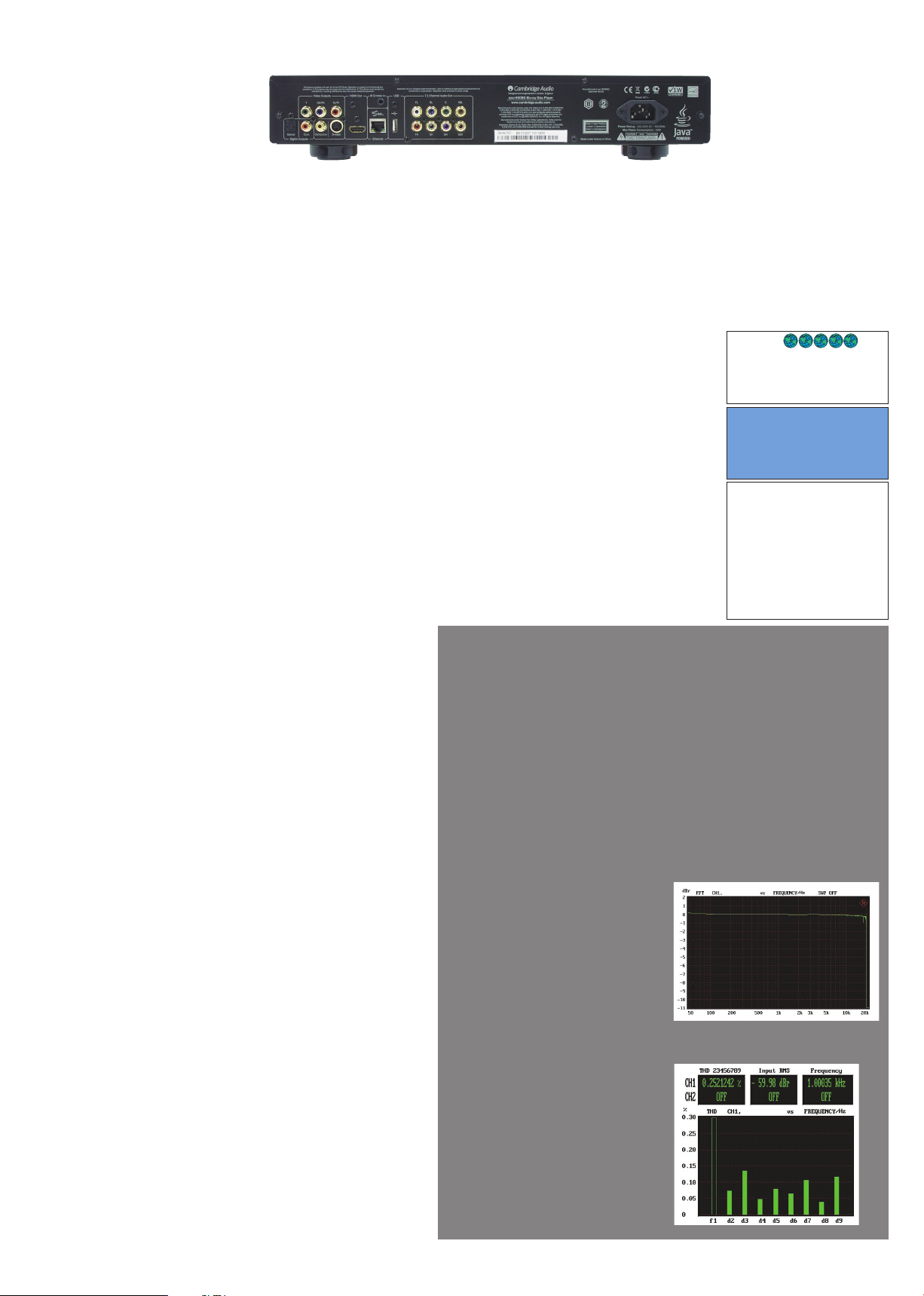
Cambridge fit a raft of legacy
video outputs for compatibility with
TVs, including Composite, S-Video
and Component but ideally, HDMI
should be used. There is no Scart.
Also on the rear panel and front
panel are USB sockets for mass
storage devices. Cambridge say each
will supply up to 0.5A to external
drives and those needing more will
have to be self powered. Formatting
must be in FAT32, which both PCs
and MACs can read and write to, but
the 650BD will
files from iTunes, only MP3, WMA and
WMA Pro and PCM.
There is an ethernet socket
on the rear panel too, for wired
connection to an internet router.
Where some machines even now will
not see my standard Netgear router
the 650BD did immediately, via
DHCP. This allows software update
and BD Live, about which I know
nothing – and I want to keep it that
way! Masochists can set the router
information manually and, usefully, the
player declares its MAC Address so it
can be spotted on a LAN client list.
Camcorder users may like to know
that AVCHD video can be read from
disc too.
not read AAC music
SOUND
My first impression of this player’s
sound was that it was lush and
smooth, and produced unusually
well defined, firm images – even
after rigorous comparative tests
against a Samsung BD-P1600. I
used both machines as a transport
to feed raw digital to the Marantz
receiver for processing, so there
should be no difference between
them. Where I have always felt my
2L disc of Divertimenti sounded a
little shrill when playing 24/192 PCM,
Dolby TrueHD or DTS HD Master
Audio streams into the Marantz
for processing from the Samsung,
the 650BD produced a fuller,
denser sound that was altogether
more balanced and impressive. The
explanation likely lies in lower jitter
(I used Pure Audio to switch off jitter
inducing video data). Lang Lang playing
Rachmaninov’s Piano Concerto No2
on SACD had never sounded so rich
and densely detailed before.
The strenuous but masterful
playing by Percy Grainger of Grieg’s
Piano Concerto was delivered with
eye popping closeness and clarity,
from another 2L disc carrying
DTS HD Master Audio in 24/192
resolution over 5.1 channels. The
listener is notionally placed on the
conductor’s podium in the middle of
the orchestra with this disc and as
a demonstration of the potential of
Blu-ray and players like the 650BD,
in conjunction, to reproduce classical
music with vivid
insight but sufficient
smoothness to be
both plausible and
acceptable, it was a
masterful demo. I fancy
the alternative SACD
disc sounded denser
and warmer, if perhaps
a trifle turgid, but
differences like this are
likely attributable to the
Marantz receiver. The
bottom line is, a good
Blu-ray player like the
Cambridge is able to
handle all these format
variations and discs,
and deliver great sound
quality.
The Insane Clown
Posse use surroundsound to bounce you
out of your seat with
rear stereo, and effects
coming from all around.
‘Get Your Wicked On’,
which I don’t advise
you to listen to (!),
left me shaken and
stirred; the 650BD
reproduced this DVDA superbly, with both
low frequency power
but also tight timing,
making for a visceral
experience. I popped a
Lady Gaga CD into the
Frequency response with CD via
the analogue outputs, shown in our
analysis, measured flat from 5Hz to
21kHz. Bass management put in the
usual filtering below 200Hz.
With SACD analogue output is
surprisingly from the DSD layer, not the
CD layer, shown by a high frequency
limit of 34kHz, above the limit of CD. So
the analogue outputs convey SACD’s
wider analogue bandwidth.
Distortion levels were not as low
as that of a good CD player, measuring
0.25% at -60dB from CD, against 0.18%
or so from a really good hi-fi player.
SACD gave the same result as CD. EIAJ
Dynamic range was a good 99dB with
CD all the same, and output a normal
2.2V.
Jitter on the digital signal measured
less than 20pS above 100Hz, right up
to 20kHz, a very low figure. There was
a little random noise below 100Hz that
registered up to 100pS or so, but this
‘wander’ is not uncommon.
The 650BD measured well,
although lack of deep bass from CD
via the analogue output was a peculiar
weakness that some users may well
notice. NK
Frequency response (-1dB)
CD 5Hz-21kHz
SACD 2Hz-34kHz
Distortion (%)
0dB 0.003
www.hi-fiworld.co.uk JUNE 2010 HI-FI WORLD 37
draw, pressed Play and ‘Bad Romance’
shook the room with its pulsive
synths and Gaga’s anthemic yells.
Again, the Cambridge sounds fulsome
and propulsive, but detailed too. It’s a
great listen and a lot of fun. Whatever
I threw at the player, from 24/192 in
all forms (i.e. DTS, Dolby and PCM)
downward, it sounded full bodied,
firm and clear, and set up stable
stereo images.
CONCLUSION
It might not be the loveliest thing to
look at, but the Cambridge Audio
650BD player does it all I found, and
very well too. Offering superb sound
quality from all silver discs, plus very
good picture quality, and with no
major weaknesses, Cambridge Audio
have pulled a rabbit out of the hat
here. It’s a must buy, being the first
audiophile Blu-ray player in the UK in
effect, one that is supremely capable,
priced competitively and, for the time
being, has no peer.
MEASURED PERFORMANCE
-6dB 0.0016
-60dB 0.25
-80dB 4.3
Separation (1kHz) 109dB
Noise (IEC A) -125dB
Dynamic range 99dB
Output 2.2V
FREQUENCY RESPONSE CD
DISTORTION CD
REVIEW
VERDICT
An audiophile Blu-ray transport/
player able to handle all silver discs
and deliver great sound. Top quality at
a brilliant price.
CAMBRIDGE AUDIO
650BD £399.95
)
+44 (0)845 900 1230
www.cambridgeaudio.com
FOR
- plays all silver discs
- superb sound
- good picture quality
AGAINST
- dull styling
- small display panel
 Loading...