

Page 1
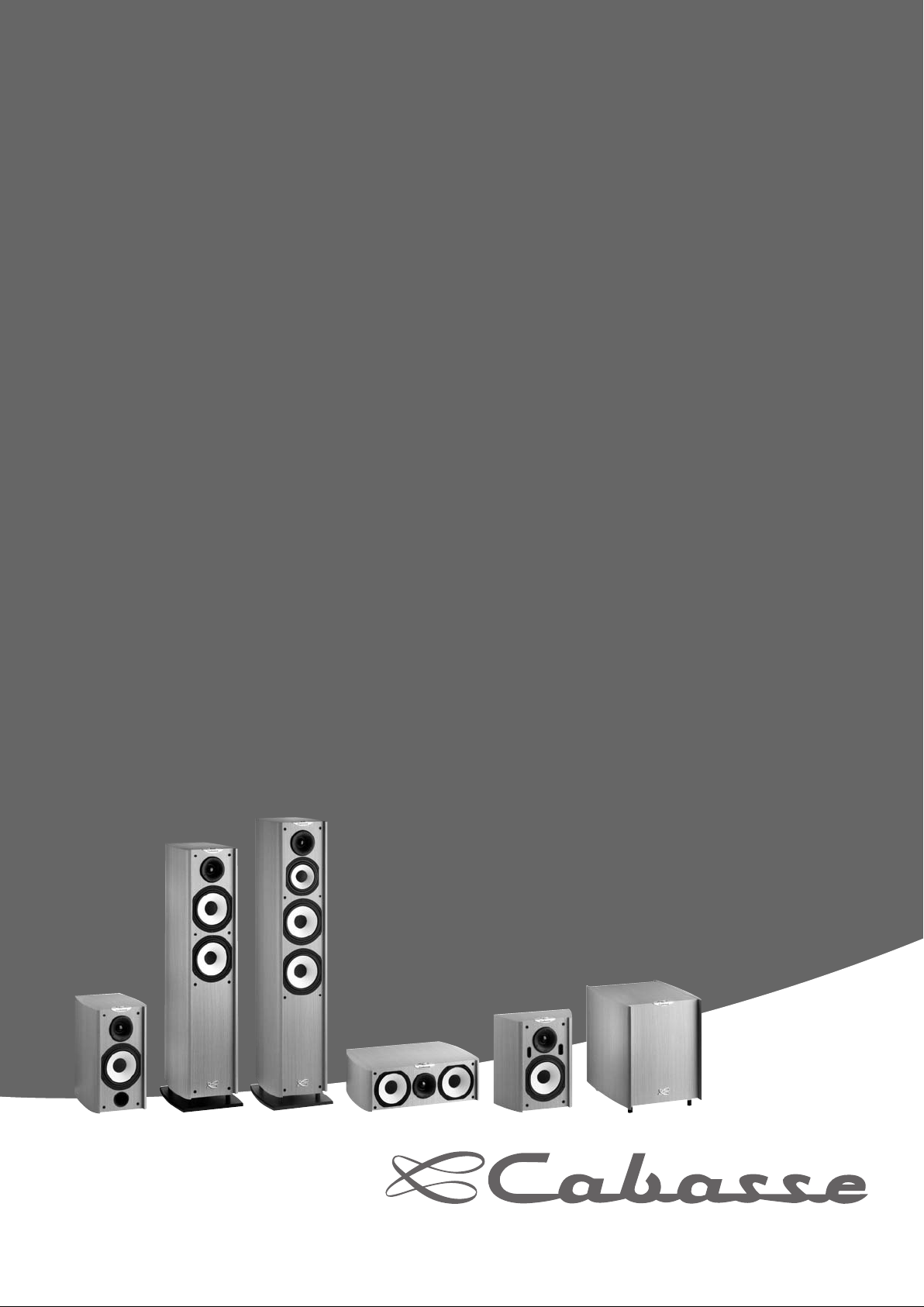
MT4
samoa•moorea•java
•
borneo
notice d’installation des enceintes acoustiques
loudspeakers owner’s manual
betriebsanleitung für lautsprecherboxen
faro•mercure
www.cabasse.com
Page 2
français english deutsch
1
3
4
5 6
d
d>1,5m/
d>5ft
d
7
Page 3
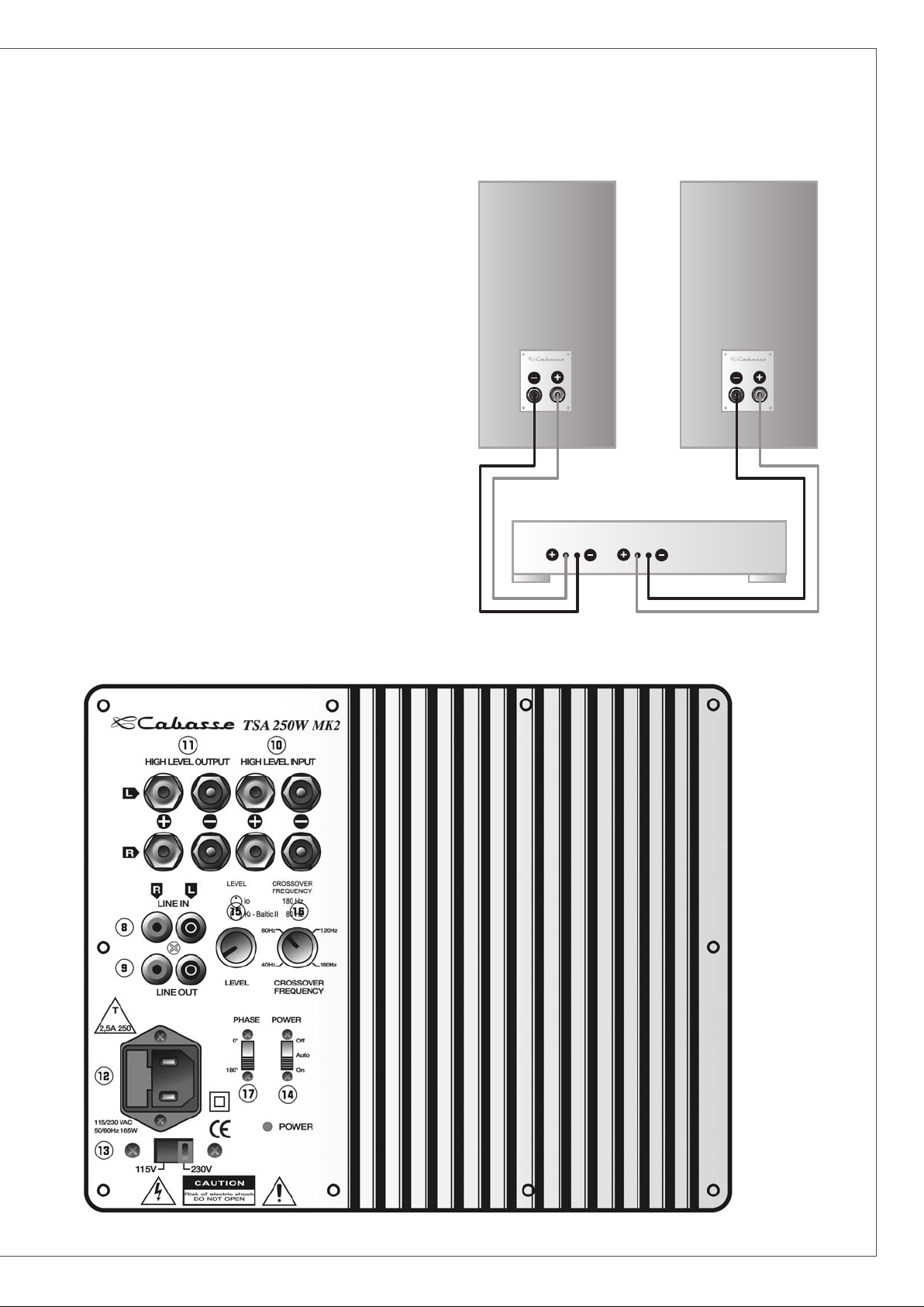
Cinch RCA LINE IN
LR
8
Cinch RCA LINE IN / Cinch RCA LINE IN Buchsen
Cinch RCA LINE OUT
9
Cinch RCA LINE OUT / Cinch RCA LINE OUT Buchsen
Bornes haut-parleurs HIGH LEVEL INPUT (amplificateur)
0
HIGH LEVEL INPUT connectors
HIGH LEVEL INPUT (vom Verstärker)
Bornes haut-parleurs HIGH LEVEL OUTPUT (vers enceintes)
-
HIGH LEVEL OUTPUT connectors
HIGH LEVEL OUTPUT (zu den Lautsprechern)
Alimentation secteur / Power supply / Netzstecker
=
Commutateur 115/230 V
q
AC voltage selector
Interrupteur POWER/ POWER / NETZ SHALTER
w
Réglage LEVEL/ LEVEL / LAUTSTÄRKEREGLER
e
Réglage de la fréquence de coupure-CROSSOVER FREQUENCY
r
/ Betriebspannungsshalter
CROSSOVER FREQUENCY / ÜBERGANGSFREQUENZREGLER
PHASE/ PHASE / PHASE
t
8
Amplificateur /Amplifier/VerstäkerMERCURE
Page 4
français
Vous venez d’acheter des enceintes Cabasse et nous vous remercions de votre confiance.
Dans le but d’optimiser au maximum votre installation, nous vous recommandons
de lire attentivement cette notice.
INSTRUCTIONS DE SECURITE
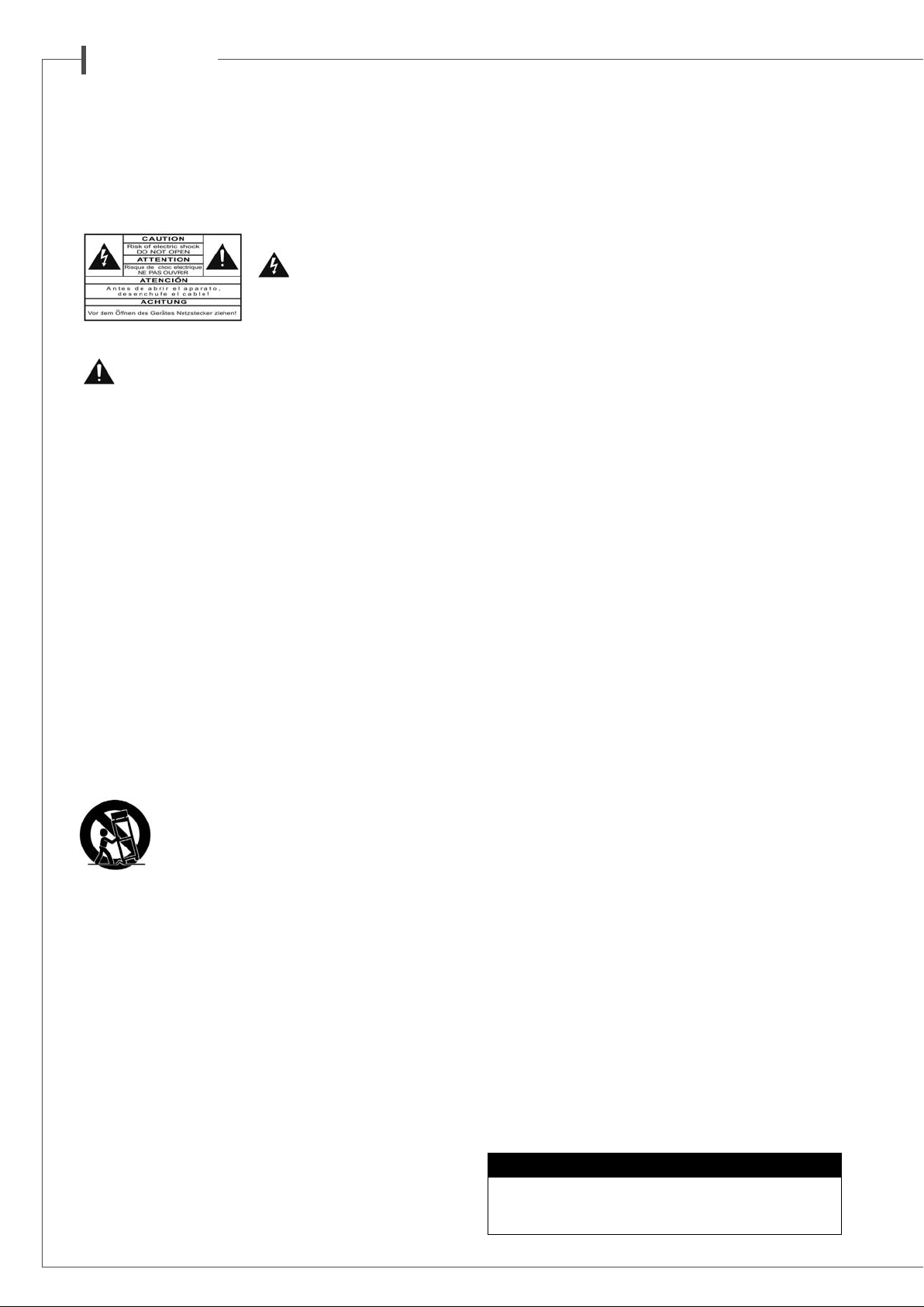
Explication des symboles -
L’éclair dans un triangle
équilatéral avertit de
l’existence de tension élevée dangereuse non isolée à l’intérieur
du coffret du produit, d’une
valeur suffisante pour présenter un risque d’électrocution.
Le point d’exclamation dans un triangle équilatéral aver-
tit de l’existence d’instructions importantes quant à l’utilisation et la maintenance dans la documentation jointe à ce
produit.
Instructions -
sation doivent avoir été lues avant d’allumer tout appareil
pour la première fois.
Retenez les instructions -
ce permanente pour tout ce qui suit.
Tenez compte des avertissements -
présents sur le produit ou dans les notices d’utilisation doivent
être pris en compte.
Suivez les instructions -
et de mise en œuvre doivent être scrupuleusement suivies.
Nettoyage -
N’utilisez pas de solutions nettoyantes sous forme liquide ou
en aérosols. Employez de préférence un chiffon humide.
Accessoires -
explicitement recommandés par le constructeur, sous peine
de risquer divers accidents.
Eau et humidité -
l’eau, par exemple à proximité d’une baignoire, d’un évier,
dans un sous-sol humide, près d’une piscine, ou de tout ce
qui y ressemble de près ou de loin.
Toutes les instructions de sécurité et d’utili-
Elles doivent servir de référen-
Les avertissements
Toutes les instructions d’utilisation
Débranchez l’appareil avant tout nettoyage.
N’utilisez pas d’accessoires qui ne soient pas
L’appareil ne doit pas être utilisé près de
Chariots et supports - La manutention doit
être effectuée seulement avec des chariots et supports agréés par le fabricant.
> Attention aux chariots de manutention
Installation sur mobiliers et supports -
cet appareil sur un support instable, qu’il s’agisse de pieds,
trépieds, tables, étagères, etc. Il pourrait tomber et causer des
blessures sérieuses à un enfant ou un adulte qui se trouverait
à proximité.
Ventilations -
qu’il ne gêne pas sa propre ventilation. Par exemple, il ne doit
pas être installé sur un lit, un canapé, une couverture ou des
surfaces similaires qui pourraient bloquer ses orifices d’aération. Il ne doit pas non plus être encastré dans des enceintes
confinées comme des étagères étroites ou des meubles qui
pourraient limiter la quantité d’air disponible aux entrées d’air.
Alimentation -
électrique du type écrit dans le mode d’emploi ou conforme à
la sérigraphie sur le produit. Si vous n’êtes pas sûr du type de
courant fourni à l’endroit où vous vous trouvez, adressez-vous
à votre revendeur ou à la compagnie électrique locale.
L’appareil doit être positionné de telle sorte
L’appareil ne doit être relié qu’à une source
Ne placez pas
Protection des câbles d’alimentation -
des câbles d’alimentation doit être prévu de telle sorte qu’ils ne
puissent pas être piétinés, pincés, coincés par d’autres appareils posés dessus, et une attention toute particulière doit être
accordée à l’adéquation des prises et à la liaison du cordon avec
l’appareil.
Foudre -
dant les orages ou s’il doit rester inutilisé pendant une longue
période, débranchez le cordon d’alimentation et débranchez
la prise d’antenne, vous éviterez ainsi les risques de détérioration dus à la foudre ou aux surtensions.
Surcharges électriques -
mentation, les prolongateurs ou les rappels d’alimentation. Il
pourrait en résulter incendies ou électrocutions.
Corps et liquides étrangers -
jamais laisser entrer d’éléments ou de liquides étrangers dans
l’appareil. Ils pourraient occasionner incendies ou électrocutions. Ne versez jamais aucun liquide d’aucune sorte sur l’appareil.
Entretien -
opérations de maintenance au-delà de celles décrites dans le
mode d’emploi. Tout ce qui dépasse le simple niveau de l’entretien doit être effectué par un personnel qualifié.
Maintenance -
vement débrancher votre appareil et le faire vérifier par un
technicien qualifié :
■ l’alimentation ou la prise a été endommagée.
■ des corps étrangers ou du liquide se sont introduits dans
l’appareil.
■ l’appareil a été exposé à la pluie ou a été aspergé d’eau.
■ l’appareil ne semble pas marcher correctement alors que
vous l’utilisez dans le cadre de ses instructions de fonctionnement normal. Ne manipulez que les contrôles couverts par le
mode d’emploi. Toute autre procédure pourrait le détériorer
et nécessiter l’intervention d’un technicien qualifié.
■ l’appareil est tombé ou bien sa carrosserie est endomma-
gée.
■ l’appareil affiche des performances nettement modifiées.
Pièces détachées -
de pièces détachées, assurez-vous que le technicien a bien utilisé les références préconisées par le fabricant ou présentant les
mêmes caractéristiques que les pièces originales. Des pièces non
conformes peuvent provoquer incendies, électrocutions ou
autres.
Vérifications -
dez au technicien d’effectuer des tests afin de garantir que
l’appareil fonctionne en toute sécurité.
Pour une meilleure protection de l’appareil pen-
Ne surchargez pas les prises d’ali-
On doit être attentif à ne
L’utilisateur ne doit pas tenter de s’occuper des
Dans les cas suivants, vous devez impérati-
Si la réparation a nécessité l’utilisation
Après toute intervention sur l’appareil, deman-
Exposition aux fortes températures -
être tenu éloigné de sources de chaleur comme radiateurs,
chauffage divers, amplificateurs, ou tous autres éléments susceptibles de le placer dans des conditions de températures
anormalement élevées.
Le cheminement
L’appareil doit
Valable aux USA, au Canada et autres pays concernés
Attention !
la plus large de la fiche dans la borne correspondante et pousser
jusqu’au fond
pour éviter les chocs électriques, introduire la lame
Page 5

français
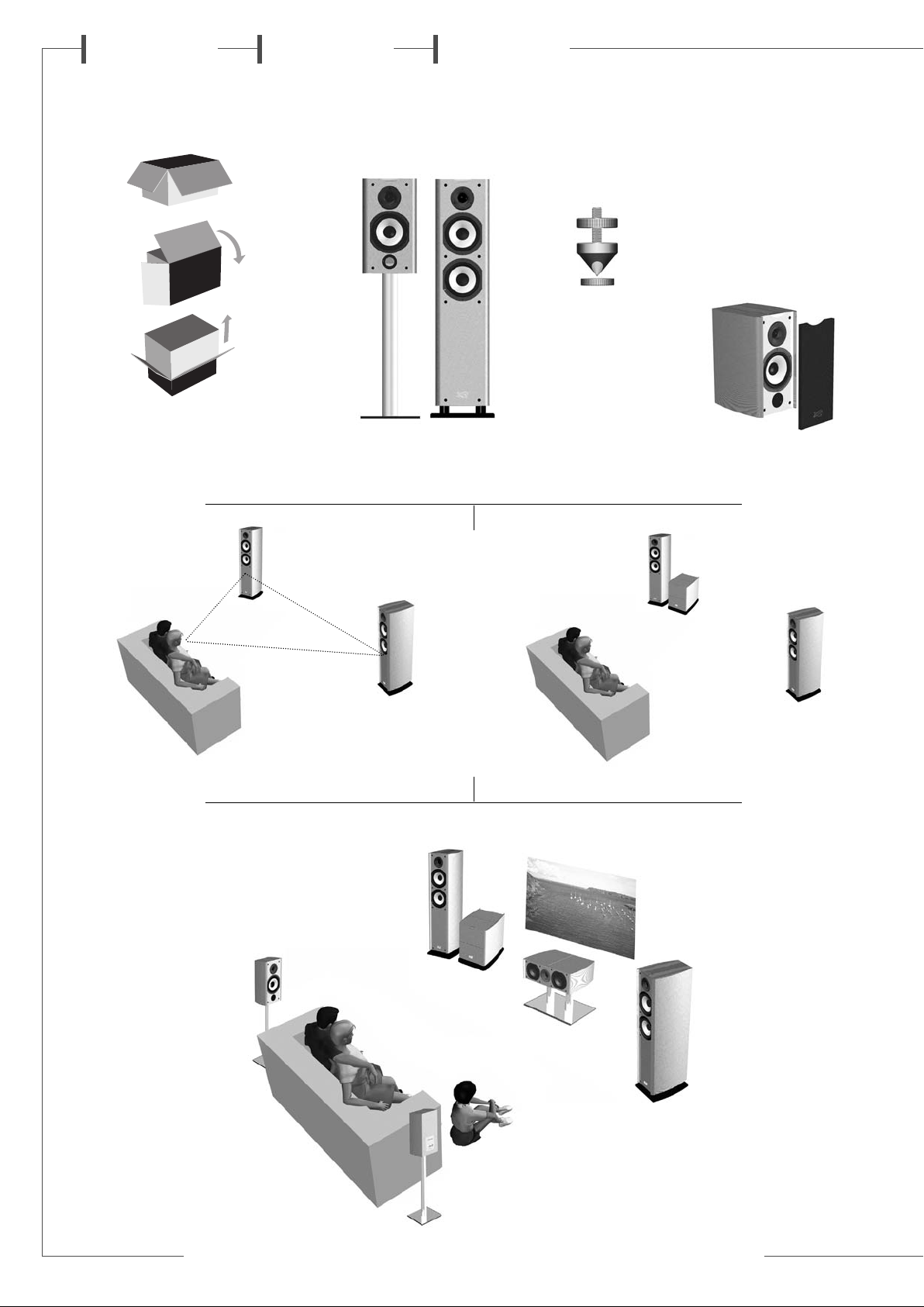
DEBALLAGE DES ENCEINTES
1
Ouvrir le côté mentionné sur le carton, replier sur les cotés les
rabats supérieurs du carton et retirer le cache de l’enceinte. Puis
retourner l’emballage avec son contenu, vider le carton de son
contenu et sortir l’enceinte de son emballage. Nous vous
conseillons de conserver l’emballage de votre enceinte à plat
pour une utilisation ultérieure éventuelle.
POSITIONNEMENT ET PLACEMENT
DES ENCEINTES ACOUSTIQUES
Positionnement des enceintes
Nos enceintes acoustiques sont prévues pour fonctionner
en position verticale, afin de respecter la courbe polaire
des haut-parleurs
2
.
La plupart de nos modèles sont livrés avec un jeu de pointes ou
cônes de découplage3. Ces accessoires sont à visser dans
l’emplacement prévu sous vos enceintes. Ces pointes ou cônes
de découplage permettent d’assurer une meilleure stabilité de
l’enceinte tout en limitant les résonances pouvant être générées
par certains types de sols comme les planchers par exemple.
Les enceintes sont livrées avec un tissu de protection en face
avant. II est possible de les utiliser sans ce tissu. Nous vous
recommandons de garder cette protection pour mieux protéger les haut-parleurs de votre enceinte
4
.
Le champ magnétique des moteurs des haut-parleurs va rayonner au delà de l’enveloppe de l’enceinte acoustique. Il faut
donc éloigner d’environ 50 cm les appareils et objets sensibles
à ce type de rayonnement (téléviseurs, écrans d’ordinateur,
disquettes informatiques, bandes magnétiques audio ou vidéo,
cartes à puces...). Les enceintes centrales ne sont pas concernées par ce type de problème car elles sont blindées magnétiquement.
Placement des enceintes dans une pièce
Outre la position des enceintes, il faut tenir compte de leur
emplacement dans la pièce, les propriétés acoustiques d’un
local étant un facteur capital dans la retransmission du son.
Le placement optimal
pour une écoute stéréo classique 2.0
■ Si l’on considère que d est la distance qui sépare les deux
enceintes, celle-ci doit être supérieure à 1.5 m. Les deux
enceintes doivent être à égale distance de la zone d’écoute qui
forme avec elles un triangle équilatéral.
■ Les haut-parleurs doivent être dirigés vers la zone d’écoute.
■ Les enceintes doivent, de préférence, diffuser dans le sens
de la plus grande dimension de la pièce.
■ D’une façon générale, on doit éviter de positionner les
enceintes dans les coins d’une pièce, car la disposition en angle
favorise Ies fréquences graves. De même, les enceintes doivent
se situer à une distance d’au moins 20 cm du mur.
■ Toujours dans le but d’obtenir une réponse équilibrée, il est
recommandé de surélever les enceintes compactes d’environ
30 à 40 cm du sol avec des supports pour enceintes, les tweeters
de l’enceinte devant se situer approximativement à la hauteur
des oreilles de l’auditeur lorsque celui-ci est en position assise.
■ Aucun élément (table, fauteuil...) ne doit gêner la propaga-
tion directe entre les enceintes et l’auditeur. Un effet de masque,
même partiel, déséquilibre complètement la reproduction
sonore car il provoque une atténuation des fréquences aiguës
et dans la majorité des cas des médiums également.
5
■ La disposition des enceintes dans des niches est également
en général à proscrire car elle modifie la courbe de
réponse de l’enceinte, particulièrement dans les fréquences
basses. S’il est impossible d’adopter une autre disposition, on
doit veiller à ce que l’enceinte s’encastre avec le minimum de
jeu dans la niche, pour éviter l’apparition de résonances diverses.
Par ailleurs, la partie visible du tissu devra être à l’extérieur de
la niche.
Le placement optimal
pour une écoute stéréo en 2.1
Dans le cadre d’une écoute stéréo avec 2 enceintes ou 2 satel-
lites et 1 caisson de graves, nous vous conseillons de placer le
caisson de graves dans la zone écoute avant. Le placement
du caisson contre un mur renforce l’extrême grave et limite les
réflexions de 80 à 200 Hz. Cependant, pour obtenir le meilleur
résultat, il est toujours nécessaire de faire des essais d’emplacement en fonction de l’acoustique de la pièce.
6
Le placement optimal
pour une écoute Home Cinéma ou 5.1
Pour la disposition d’un ensemble home cinéma, il est impor-
tant d’apporter la plus grande attention à la disposition des
enceintes supplémentaires spécifiques.
■ L’enceinte centrale doit être placée le plus près possible de
l’écran en recherchant la position dans le lieu d’écoute qui
apporte la plus grande cohésion sur les dialogues entre le son
et I’image. En pratique, cela revient à placer l’enceinte centrale au-dessus de l’écran si les enceintes principales sont plus
basses que celui-ci, et en dessous si les enceintes principales sont
plus hautes.
■ Les enceintes arrière, voies d’effet ou surround doivent être
disposées contre les murs latéraux, légèrement en hauteur.
Elles doivent être situées légèrement en arrière de la zone
d’écoute.
■ Le caisson de graves doit être placé dans la zone d’écoute
avant. Son placement contre un mur renforce l’extrême grave
et limite les réflexions de 80 à 200 Hz. Cependant, pour obtenir le meilleur résultat, il est toujours nécessaire de faire des
essais d’emplacement en fonction de l’acoustique de la pièce.
Votre amplificateur audio-vidéo permet le réglage des niveaux
et des distances de chaque enceinte. Ce réglage doit être ajusté avec soin de manière à obtenir une parfaite cohésion entre
les sources sonores.
Il est nécessaire d’éteindre tous les appareils avant la connexion
des enceintes. Pour le branchement de vos enceintes acoustiques, il faut tenir compte de la section des câbles et du respect des phases.
7
BRANCHEMENT
Section des câbles
Pour conserver toutes les qualités des enceintes acoustiques
et éviter les pertes de puissance, il faut que la résistance électrique des câbles de branchement entre I’enceinte et
I’amplificateur soit la plus
faible possible. Pour vous
aider à choisir la meilleure
section de câble pour votre
installation, veuillez suivre
le tableau récapitulatif .
Distance Section
ampli - enceinte
4,5 m 1,5 mm
6 m 2 mm
7,5 m 2,5 mm
9 m 3 mm
12 m 4 mm
2
2
2
2
2
Page 6

français
Phase
Les enceintes et les amplificateurs
ont leurs bornes de branchement
Attention
Avant tout branchement,
s’assurer que votre
tension secteur correspond
bien à la tension
secteur sélectionnée
sur le commutateur
115 V - 230 V
te aille à la borne rouge ou
de I’enceinte ira dans ce cas à la borne noire ou -de I’amplificateur.
t
repérées. Il y a deux façons courantes d’effectuer ce repère : soit
une borne rouge ou repère
une borne noire ou repère
Dans tous les cas, il faut que les deux
canaux soient branchés de façon
identique, c’est à dire par exemple
.
que la borne rouge ou
+ de l’amplificateur ; la borne noire ou-
de l’encein-
+
+, soit
-.
BRANCHEMENT HOME CINEMA
AVEC CAISSON DE GRAVES
Placement du caisson de graves
Les caissons de graves n’ont pas à priori une position impéra-
tive par rapport à la zone d’écoute si la fréquence des filtres de
coupure est aux alentours de 150 Hz, en effet, en dessous de
cette fréquence, le caisson n’est pas directif, et il est impossible
de détecter l’endroit d’où viennent les basses. Pour obtenir le
meilleur résultat, il est toujours nécessaire de faire des essais
d’emplacement, afin d’obtenir la meilleure réponse possible
dans les fréquences basses, en fonction de l’acoustique de la
pièce.
Branchement du caisson de graves
Le branchement de la modulation peut s’effectuer de 2 façons :
■ soit avec les entrées et sorties
OUT
en utilisant des cordons coaxiaux blindés,
9
Cinch RCA LINE IN8et
LINE
■ soit en utilisant les bornes haut-parleurs
INPUT
classique.
Les entrées sont stéréophoniques, le mélange des graves gauche
L (left)
signal provenant de la source est mono, une seule entrée
gauche
et
HIGH LEVEL OUTPUT-et du câble haut-parleur
0
et droite
L (left)
R (right)
ou droite
se fait dans l’amplificateur. Si le
R (right)
devra être utilisée.
HIGH LEVEL
Branchement avec les entrées et sorties
Cinch RCA LINE IN8et LINE OUT9en utilisant
des cordons coaxiaux blindés
■ Connexion par les prises LINE IN
Si votre préamplificateur ou amplificateur audio vidéo possè-
de une sortie stéréophonique à bas niveau, relier les sorties
gauche
entrées
de graves.
Si votre appareil ne possède qu’une seule sortie monophonique (subwoofer/LFE), relier celle-ci à l’entrée
gauche
■ Connexion par les prises LINE OUT
Les prises
délivrent la modulation mise à l’entrée
LINE OUT9peuvent vous servir à brancher l’amplificateur
de puissance destiné aux enceintes principales.
L (left)
et droite
LINE IN8gauche
L (left)
ou droite
LINE OUT9gauche
R (right)
R (right)
L (left)
:
8
du préamplificateur aux
et droite
indifféremment.
R (right)
du caisson
LINE IN
9
L (left)
et droite
LINE IN8. Ces sorties
R (right)
8
Branchement avec les bornes haut-parleurs
HIGH LEVEL INPUT0et HIGH LEVEL OUTPUT
-
et du câble haut-parleur classique
■ Connexion avec les bornes HIGH LEVEL INPUT
Si votre amplificateur intégré Hi Fi ne possède pas de sortie à
bas niveau, brancher les sorties de l’amplificateur aux extrémités
HIGH LEVEL INPUT0gauche
caisson de graves. Vous pouvez brancher le caisson de graves
sur les bornes de votre amplificateur qui servent à brancher les
haut-parleurs. En branchant les sorties gauche et droite de
L (left)
et droite
0
R (right)
du
SPECIFICATIONS
ET CARACTERISTIQUES TECHNIQUES
MT4 Utilisation Voies Haut-parleurs E
SAMOA
voie principale /socle 1x17 cm 17MD18LB1
MOOREA au sol 21 tweeter DOM42
voie principale 2 x 17 cm 17MD18LB1
JAVA au sol 31 tweeter DOM42
voie principale 1 x 13 cm 13MD15M2
FARO sur/sous 21 tweeter DOM42
voie centrale* écean 1x 13 cm 13MD15M2TV
BORNEO bibliothèque 21 tweeter DOM42
voie d’effets /au mur 1x 17 cm 17MD18LB1
MERCURE au sol 11x21 cm 21MT4
caisson de graves
* blindage magnétique
bibliothèque 21 tweeter DOM42
2
x 17 cm 17MD18LB1
Page 7

français
votre amplificateur aux entrées gauche et droite du caisson
de graves, faire bien attention à ne pas inverser les câbles en
phase, car vous risqueriez de provoquer une panne sur votre
amplificateur principal.
■ Connexion avec les bornes HIGH LEVEL OUTPUT
-
Ces bornes délivrent la même modulation que celles que vous
avez mises à l’entrée
HIGH LEVEL INPUT0. Elles permettent
de rebrancher par exemple les enceintes principales.
Secteur
L’alimentation=sert à alimenter le caisson de graves. La
sélection de la tension d’alimentation est effectuée par le
commutateur
l’interrupteur
BY
ou la position ON.
Dans la position
115V- 230 Vq. La mise en route s’effectue par
POWERw, en le mettant dans la position
STAND BY
, l’appareil se mettra en veille s’il n’y
STAND
a pas eu de modulation pendant quelques minutes. Dès que
la modulation réapparaît, le caisson de graves se met en fonctionnement.
Réglages
■ LEVEL
Pour un premier réglage du volume, mettre le
FREQUENCY
le
graves est suff isant. Il faudra sans doute retoucher
le niveau
de fréquence
■ CROSSOVER FREQUENCY
Ce potentiomètre sert à régler la fréquence supérieure de la
plage de travail du caisson de graves. Ce réglage va dépendre
du type d’enceintes principales qui est utilisé avec le caisson de
graves et de leur fonctionnement dans la pièce. Des essais
seront nécessaires pour déterminer la meilleure fréquence.
■ PHASE
Suivant la disposition du caisson de graves par rapport aux
enceintes satellites, on peut être amené à inverser la phase du
caisson de graves pour obtenir un son de meilleure qualité ; on
commute alors l’inverseur de position 0° à la position 180°.
e
CROSSOVER
à environ 120 Hz, et monter progressivement
r
LEVELejusqu’à ce que vous estimiez que le niveau des
LEVELequand vous aurez trouvé les bons réglages
CROSSOVER FREQUENCYret de
PHASEt.
r
t
A vous de déterminer quelle sera la phase la meilleure suivant
le réglage du potentiomètre
CROSSOVER FREQUENCYr.
Attention, si vous avez un deuxième caisson de graves, il faut
impérativement que cet inverseur de phase soit dans la même
position que celui du premier.
Nous vous invitons à consulter sur
www.cabasse.com les
réglages spécifiques que nous préconisons pour l’utilisation
de nos caissons de graves.
ENTRETIEN
Les ébénisteries de la gamme MT4, réalisées avec un revête-
ment spécifique enduit de deux vernis de protection et d’une
pellicule anti-rayures, ne nécessitent aucun entretien particulier, le matériau utilisé étant un produit de très haute technicité. Elles peuvent être nettoyées avec un chiffon humide.
En suivant les conseils d’installation, de branchement et d’emploi explicités dans cette notice, vous êtes assurés d’un fonctionnement parfait de vos enceintes acoustiques. Nous recevons tous les jours des lettres de clients satisfaits du choix de
leurs enceintes et ces lettres sont pour nous la plus belle récompense de nos efforts.
CAISSON DE GRAVES ACTIF
MERCURE MT4
Pression
impulsionnelle maximale 114dB
Sélecteur de phase 0° phase normale
180° phase inversée
Prises d’entrée 2 bas niveau-2 haut niveau
Alimentation 115/ 230 V AC-50 / 60Hz
Consommation maximum 165W
Efficacité Filtre Réponse Impédance Impédance Puissance Puissance Finition Dimensions Poids
1W/1m en fréquences nominale minimale nominale crête standards hxlxp (en kg)
(en dB) (en Hz) (en Hz) (en ohms) (en ohms) (en Watt) (en Watt) (en cm)
90 3000 65-22 000 8 4,1 80 560
90 2400 55-22 000 8 4 100 700
91 850- 50-22000 8 3,2 110 770
90 2800 70-22 000 8 3,6 90 630
92 2500 90-22 000 8 4 80 560
actif réglable 35-200 actif actif 250 750
30-180 cadre noir +
Étant donné l’évolution des techniques mises en œuvre pour une fiabilité accrue et une recherche constante de qualité optimale,
Cabasse se réserve le droit d’apporter toutes modifications aux modèles présentés sur les fiches techniques ou les documents publicitaires.
ébénisterie chêne clair
cadre beige
ébénisterie chêne clair
cadre beige
ébénisterie chêne clair
ébénisterie chêne clair
cadre beige
ébénisterie chêne clair
cadre beige
ébénisterie chêne clair
cadre beige
40 x 23 x 30 9
100 x 25 x 36 24
110 x 25 x 36 29
16 x 49 x 37 11
35 x 32 x 17 7
44 x 36 x 45 21
Page 8

english
Thank you very much for choosing Cabasse speakers.
Please read carefully these instructions before setting up your speakers.
SAFETY INSTRUCTIONS
Explanation of graphical
symbols -
angle, is intended to alert you
to the presence of uninsulated
“dangerous voltage” within the product’s enclosure that may
be of sufficient magnitude to constitute a risk of electric shock
to persons.
The exclamation point within an equilateral triangle is
intended to alert you to the presence of important operating and maintenance (servicing) instructions in the literature accompanying the appliance.
Instructions -
operating instructions before switching on any device for the
first time.
Carefully read through all the safety and
Keep these instructions in mind -
stantly referred to through this manual.
Pay special care to warnings -
the product or warning notes in the user’s manual must be
followed.
Follow the instructions -
lation and operation instructions.
Cleaning -
the device. Do not use cleaning solvent, whether liquid or air
spray. Using a soft damp cloth is recommended.
Accessories -
ly recommended by Cabasse.
Always take off the power cord before cleaning
To avoid incidents, only use accessories express-
Water and moisture -
damp or wet locations, such as humid basements, next to a
bathtub, sink, swimming pool or any other similar conditions.
Follow carefully all the instal-
The product shall not be used in
The lightning flash
with arrowhead symbol,
within an equilateral tri-
They will be con-
All the warning labels on
Carts and Stands - The appliance should be
used only with a cart or stand that is recommended by the manufacturer.
> Portable cart warning
Installation on a piece of furniture and stands -
Do not place this device on an unsteady surface, i.e. a stand,
tripod, table, shelf, etc. It may fall and cause serious injury to
a nearby child or adult.
Ventilation outlets -
position that restrains the operation of its fans. Avoid installing
the device on a bed, couch, blanket or other similar surfaces
that may prevent the appropriate air flow. Do not install the
device in a confined space, such as a book shelf or other piece
of furniture, that could prevent sufficient air from flowing
freely.
Power -
power compliant to the one described in this manual or on relevant printed labels on the product. If you are not sure of the
type of power available, please contact your reseller or the
local power company.
Applicable for USA, Canada or where approved for usage
Caution ! To prevent electric shock, match wide blade plug to wide
slot, insert fully.
The device shall only be connected to a source of
The device shall not be placed in a
Power cords -
way that they cannot be walked on, pinched, bent under other devices. Also pay special attention to the matching of the
plugs and the connection of the cord to the device.
Lightning -
device must remain unused for long stretches of time, unplug
the power cord and antenna jack. This minimizes potential
damages due to lightning or line surges.
Overloads -
cords or power relays. This could result in fire or electric shocks.
Foreign bodies and liquids -
rials or liquids enter the device. They could cause fire or electric shocks. Never spill any liquid on the device.
Maintenance -
device on their own, except for those maintenance operations
described in this manual. Any task beyond regular user maintenance must be performed by qualified service operators.
Troubleshooting -
power supply and have it checked by a qualified technician if:
■ The power supply or the plug is damaged.
■ Foreign bodies or liquid penetrated the device.
■ The device was exposed to dripping or splashing.
■ The device does not seem to work correctly under normal
operating conditions. Only operate the controls described in
this manual. Any other operation could damage the device
and require on-site visit of a qualified technician.
■ The device has fallen or its housing is damaged.
■ The performances of the device are strongly altered.
Spare parts -
make sure that the technician followed the manufacturer’s
recommendations or that the replacing parts feature the same
specifications as the original ones. Non-compliant parts can
result in multiple damages, including fire or electric shocks.
Checks -
cian to perform appropriate testing to make sure that the
device works safely.
Exposure to high temperatures -
be kept away from heating sources, such as radiators, heaters,
amplifiers or any other similar item likely to make the operating temperature rise excessively.
UNPACKING
After opening the top carton flaps, remove the grille. Then
fold the carton flaps right back and invert the carton contents.
Lift the carton clear of the contents and remove the inner packaging from the speakers. We suggest you to retain the packing
for future use.
The power cords must be laid out in such a
For better protection against lightning or if the
Avoid overloading the power plugs, extension
Avoid letting foreign mate-
Users must never attempt to maintain the
You must unplug your device from the
If spare parts are needed to repair the device,
After any servicing of the device, ask the techni-
The device should
1
POSITIONING
Speakers positioning
Our speakers have been designed to function in a vertical posi-
tion. Under these conditions, the polar response is most uniform
The majority of our models are delivered with a set of decoupling spikes or cones
the inserts under the cabinets. These accessories ensure the
stability of the speaker while limiting resonance coming from
2
.
, these accessories are to be screwed in
3
Page 9

english
certain types of grounds like wood floors.
Speakers are delivered with a front grille to protect drivers. It
is possible to use them without this front grille, but we recommend this protection to be kept on to prevent accidental damage to the drivers
4
.
Powerful drivers generate magnetic fields that can extend
beyond the boundaries of the speaker cabinet. We recommend you keep magnetically sensitive articles (TV, computer
screen, computer discs, audio and video tapes, swipe cards...)
at least 1.5 ft (50 cm) away from the speaker. Cabasse centre
speakers or the ones marked «TV» are not concerned with
this, being magnetically shielded.
Positioning speakers in a room
In addition to vertical position of the speakers themselves,
their location in the listening room, as well as the acoustical characteristics of the room, are also very important. As it is impossible to indicate a typical location of speaker systems without
a few tests, we suggest several general rules that are important to apply in order to obtain the best listening results.
Optimal positioning for a 2.0 or stereo system
■ For the ideal positioning of your speakers follow diagram.
If «d» is the distance between the two speakers, this distance
must be higher than 5 ft (1.5 m) and the two speakers must be
at equal distance from the listening area which forms with
them an equilateral triangle.
■ The drivers must be directed towards the listening area.
■ The speakers should be located so that their diffusion follows
the longest dimension of the room.
■ Generally speaking it is better to avoid putting the speakers
in the corners of a room as this amplifies the low frequencies
and tends to enhance the room resonances. If possible it is
better to place the speakers at least 8 inches (20 cm) from
the walls.
■ Moreover, in order to obtain a more accurate frequency res-
ponse, it is recommended to raise a compact speaker from
12 to 16 inches (30 to 40 cm) above the floor by placing them
on stands. The tweeters of the speakers must be roughly at
the same height of the listener’s ear when the listener is in sitting position.
■ No solid object or piece of furniture should be placed between
the speakers and the listener. An effect of mask, even partial disturbs completely the sound reproduction as it attenuates the
high frequencies and also, in most cases, the midrange frequencies.
■ Placing the speakers in niches is not recommended. Unless
designed for this application, bookshelf placement will alter the
frequency response of the speaker, especially in the low frequencies. If a bookshelf location cannot be avoid, the speaker
should be set up to minimize various resonance, and the visible
part of the grille must be outside the niche.
Optimal positioning for a 2.1
or stereo with a subwoofer system
For a stereo listening with 2 speakers or 2 satellites and 1 sub-
woofer, we recommend you to place the subwoofer in the
front listening area. The placement of the subwoofer against
a wall reinforces the low frequencies and limit the reflections
from 80 to 200 Hz. However to obtain the best results, it is
always necessary to carry out tests according to the acoustic
of the room.
6
Optimal positioning for a 5.1
or home theatre system
Setting up a multi-channel Audio-Video system requires great
7
5
care when positioning the specific AV speakers.
■ The centre speaker should be placed as close as possible to
the screen and where it sounds best from your listening spot
while offering the optimal picture/dialogues cohesion. Theoretically, the screen should be located within a virtual triangle
formed by the acoustical centres of the main speakers and the
centre speaker. Practically speaking, this means that the principal speaker should be placed above the screen if the main
speakers are below it, and below the screen if the main speakers are above. The centre speaker should also, if possible, be
set slightly back from the others, so that it is located at the same
distance from the listener as the main speakers.
■ The rear speakers or surround should be placed against the
side walls, at listening height. They should not be positioned
far behind the listening zone.
■ The subwoofer should be placed in the front listening area,
its position against a wall reinforces the extreme low register and
limits the reflections between 80 and 200 Hz. However to
obtain the best result, it is always necessary to carry out tests
according to the acoustics of the room.
Your AV processor enables the adjustment in level and delay of
each of the 5/6/7 channels of your system. Fine-tuning is necessary to obtain a perfect sound stage.
Turn off all the amplifiers before interconnecting them to the
loudspeakers. In order to connect loudspeakers properly, it is
most important to keep in mind the following two factors:
cable section and phase.
CONNECTION
Cable section
To get the full sonic potential of Cabasse loudspeakers and
avoid power losses, the cables connecting the speakers to the
power amplifier must
have the lowest possible electrical resistance. To help you in
choosing the correct
cable gauge, follow
diagram.
Phase
In order to maintain the phase relationship and frequency
balance of the loudspeaker system, both loudspeakers must be
properly connected to the power amplifier. When properly
connected, the cones of the drivers of both loudspeakers will
move in the same direction when driven by identical speakers
will move in the same signals. If the cones move in opposite
directions, the resulting out of phase signals will create a perceptible power loss, particularly in the low frequencies. The
stereophonic message will also be degraded. Amplifier and
speaker manufacturers typically indicate connection polarity in
one of two ways: red and black or plus and minus. In either
case, always connect red or plus to red or plus and black or
minus to black or minus. Connections should be identical for both
channels. To check that the speakers are in correct phase, switch
the system to mono while music
is being played. if the amplifier
does not have a phase inversion
switch, it will be necessary to
change over the connections on
one only of the loudspeakers. If
in correct phase, the image should
Lenght between recommanded
amplifier and loudspeakers section
4.5 m 1.5 mm
6 m 2 mm
7.5 m 2.5 mm
9 m 3 mm
12 m 4 mm
Attention,
before operating the unit,
be sure that the
operating voltage
of your unit is identical
with that of your local
power voltage.
2
2
2
2
2
Page 10

english
be distinctly located between the loudspeakers with a slight loss
of bass and low midrange level. If the image is confused and
not centrally located and there is a drastic loss of bass and
low midrange level, recheck your connections.
HOME THEATER CONNECTIONS
WITH AN ACTIVE SUBWOOFER
Subwoofer positioning
With a crossover point below or around 150 Hz, the installa-
tion position of subwoofers is not limited as human ears and
brains are not able to identify the emitting point of such low
frequencies. To get the best result, it is recommended to try different positions and choose the one giving the best response
in the low frequencies, taking into account the room acoustics.
Hooking up the subwoofer
2 possibilities are offered to connect the subwoofer with your
system:
■ the low level one requiring the use of the
and
LINE OUT9terminals and shielded coaxial connectors,
■ the high level one requiring the use of the
INPUT
loudspeaker cables.
The inputs are stereo ones, the mix of the
low frequencies being done by the amplifier of the subwoofer.
If the input signal is already mono, only one input
(right)
and
HIGH LEVEL OUTPUT-terminals and standard
0
should be used.
Cinch RCA LINE IN
HIGH LEVEL
L (left)
and
R (right)
L (left)
8
or
Interconnections with the Cinch RCA LINE IN
8
and LINE OUT9connectors
■ Connections to the LINE IN
If your preamplifier or your integrated amplifier is fitted with
a stereo low-level output, then connect its
outputs to the
woofer. If your amplifier offers a one mono output, connect it
to either the
■ Connections from the LINE OUT
The signal from the
tors is the one being brought in by the
IN
8
be used to bring the signal to the amplifier powering the main
loudspeaker.
L (left)
and
L (left)
or the
L (left)
connectors filtered at 40 Hz. These outputs can thus
8
L (left)
and
R (right)
R (right) LINE IN0inputs of the sub-
R (right)
subwoofer
LINE IN0inputs.
9
and
R (right) LINE OUT9connec-
L (left)
and
R (right) LINE
Interconnections with the speaker terminals
■ Connections to HIGH LEVEL INPUT
If the preamp section of your Hi Fi or audio-video system is not
fitted with a low level output, you should then connect the
subwoofer by using its loudspeaker terminals. When connecting the
to the
ful not to cross (-) and (+) cord of either
channel. Such a phase inversion might damage your main
amplifier.
R
L (left)
and
R (right)
HIGH LEVEL INPUT0plugs of the subwoofer, be care-
speaker outputs of your amplifier
0
plugs
L (left)
or
R (right)
SPECIFICATIONS & TECHNICAL DATA
MT4 Position Ways Drivers complement S
SAMOA
main speaker stand 1x 17 cm 17MD18LB1
MOOREA floorstanding 2 1 tweeter DOM42
main speaker 2 x 17 cm 17MD18LB1
JAVA floorstanding 3 1 tweeter DOM42
main speaker 1 x 13 cm 13MD15M2
FARO on/under 21 tweeter DOM42
center* screen 1 x 13 cm 13MD15M2TV
BORNEO on wall/ 21 tweeter DOM42
surround booksheft1x17 cm 17MD18LB1
MERCURE floorstanding 1 1 x21 cm 21MT4
active subwoofer
* Magnetic shielding
booksheft/ 21 tweeter DOM42
2
x 17 cm 17MD18LB1
Page 11

english
■ Connections HIGH LEVEL OUTPUT
These outputs can be used to bring the signal to the main
loudspeaker systems.
The signal from the
PUT
plugs is the one being brought in by the
-
INPUT
the signal to the main loudspeaker systems.
connectors. These outputs can thus be used to bring
0
L (left)
and
R (right) HIGH LEVEL OUT-
-
plugs
HIGH LEVEL
Power supply
The
AC in=cord must be connected to the mains to supply
the subwoofer. The selection of the right voltage 115V- 230V
is done with 115V-230V
or ON. With the switch on the
mute after a few minutes without input signal. The system
turns on automatically when signal comes back.
q
. Switch
STAND BY
POWERw, on
position, the unit will
STAND BY
Adjustments
■ LEVEL
For a first volume adjustment, position the
FREQUENCY
clockwise from minimum level up to a position where you feel that
the subwoofer sound level is appropriate. A check of the level
adjustment will be necessary after following steps.
■ CROSSOVER FREQUENCY
This potentiometer adjusts the cut-off frequency which deter-
mines the working bandwidth of the subwoofer. This adjustment should be done according to the specifications of the
main speakers and the room acoustics. Choose the best frequency after various listening tests.
■ PHASE
For a better sound integration of the subwoofer in the main
system, the
inverted (180° position), depending on the distance between
e
CROSSOVER
at around 120 Hz, and turn slowly the
r
r
t
PHASEtof the subwoofer might have to be
LEVEL
e
the subwoofer and the main speakers. You have to check the
PHASEteach time you move your speakers and each time
you adjust the
Attention, if you use 2 subwoofers, both phase switches must
be on the same position.
Our web site
ments we recommend for the use of our active subwoofers.
CROSSOVER FREQUENCYr.
www.cabasse.com
will give you the specific adjust-
MAINTENANCE
The MT4 cabinets are made of medium density fiber panels,
protected by synthetically veneer with two coats of varnish
and a special anti-scratch film. This hi-tech veneer does not
require any specific care. Use a wet cotton waste for cleaning,
or any cleaning device for wood or plastic.
ACTIVE SUBWOOFER MERCURE MT4
Pulsed sound pressure 114dB
Phase switch 0° normal
180° reverse
In put 2 low level- 2 hight level
Voltage 115/ 230 V AC-50 / 60Hz
Maximum power consumption 165W
Sensivity
1W/1m points response impedance impedance handling power finish h x lx p (cm) (kg)
(dB) (Hz) (Hz) (ohms) (ohms) (Watt) (Watt) hx l x p (”) (lbs)
90 3000 65-22 000 8 4.1 80 560
90 2400 55-22 000 8 4 100 700
91 850- 50-22 000 8 3.2 110 770
90 2800 70-22 000 8 3.6 90 630
92 2500 90-22 000 8 4 80 560
active adjustable 35-200 active active 250 750
Cross-over
30-180 black + beige
Because of technical improvements already under way in our constant search for optimum quality,
Cabasse
Frequency Nominal Minimum Power Peak Standard Dimensions Weight
light oak cabinetwork
frames
light oak cabinetwork
frames
light oak cabinetwork
light oak cabinetwork
frames
light oak cabinetwork
frames
light oak cabinetwork
frames
reserves the right to modify all the models presented in specification sheets, advertising materials and manuals without prior notice.
40 x 23 x 30 9
15.7” x 9” x 11.8”
100 x 25 x 36 24
39.4” x 9.8” x 14.2”
110 x 25 x 36 29
43.3” x 9.8” x 14.2”
16 x 49 x 37 11
6.3” x 19.3” x 14.6”
35 x 32 x 17 7
13.8” x 12.6” x 6.7”
44 x 36 x 45 21
17.3” x 14.2” x 17.7”
20lbs
53lbs
64lbs
24lbs
15lbs
46lbs
Page 12

deutsch
Sie haben kürzlich Cabasse Lautsprecher erworben und wir danken Ihnen für das uns
entgegengebrachte Vertrauen. Damit Sie den unvergleichliche Musikgenuss der Cabasse
Lautsprecher über lange Zeit genießen können, empfehlen wir Ihnen diese Hinweise
vor Inbetriebnahme der Lautsprecher sorgfältig zu lesen.
SICHERHEITSHINWEISE
Bedeutung der Symbole :
Der Blitz mit Pfeilspitze
in einem gleichseitigen
Dreieck dient als Warnhinweis
für unisolierte Stromspannung
innerhalb des Gerätegehäuses, die stark genug sein kann, um
eine Stromschlaggefahr zu bilden.
Das Ausrufezeichen in einem gleichseitigen Dreieck dient
als Warnhinweis für umfangreiche Bedienungs- und Ins-
tandhaltungshinweise in der beiliegenden Dokumentation.
Hinweise:
sen vor der Inbetriebnahme aufmerksam gelesen werden.
Hinweise beachten:
weise Bezug genommen werden.
Warnhinweise beachten:
in den Gebrauchsanleitungen sind grundsätzlich zu beachten.
Hinweise befolgen:
führungshinweise müssen genauestens befolgt werden.
Reinigung:
hen. Keine flüssigen oder Sprüh-Reinigungsmittel verwenden.
Am besten eignet sich ein feuchtes Tuch.
Zubehör:
le verwenden. Ansonsten besteht Unfallgefahr.
Wasser und Feuchtigkeit:
Nähe von Wasser, z.B. in der Nähe einer Badewanne, einer
Spüle, eines Swimmingpools, in einem feuchten Keller o.ä.,
benutzt werden.
Alle Sicherheits- und Verwendungshinweise müs-
Es muss grundsätzlich auf diese Hin-
Die Warnhinweise am Produkt oder
Alle Verwendungs- und Durch-
Vor jeder Reinigung ist der Gerätestecker zu zie-
Bitte nur vom Hersteller empfohlene Zubehörtei-
Das Gerät darf nicht in der
Rollwagen und Standfüße - Die Geräte soll-
ten nur mit vom Hersteller empfohlenen Rollwagen
oder Standfüßen verwendet werden.
> Warnung für transportable Rollwagen
Unterlage:
Standfüße, ein Stativ, Tisch, Regale o.ä. stellen, wo es herabfallen und Verletzungen verursachen könnte.
Belüftung:
tung nicht beeinträchtigt wird. Nicht auf ein Bett, Sofa, eine
Decke o.ä. stellen, weil sich die Belüftungsöffnungen verstopfen könnten. Es darf wegen der Gefahr des Luftmangels auch
nicht stark eingeengt werden, z.B. auf schmalen Regalen oder
in einem geschlossenen Schrank.
Stromversorgung:
le angeschlossen werden, wie in der Gebrauchsanleitung oder
auf dem Aufdruck beschrieben ist. Wenn Sie sich der verfügbaren Stromstärke nicht sicher sind, wenden Sie sich bitte an
Ihren Fachhändler oder Ihren Elektrizitätsversorgungsbetrieb.
Schutz der Netzanschlussleitungen:
schlussleitungen dürfen nicht gequetscht oder eingeklemmt
werden (z.B. von anderen, darauf stehenden Geräten). Es muss
insbesondere auf die richtigen Anschlüsse geachtet werden.
Gewitter:
ter nicht benutzt werden. Wenn es längere Zeit unbenutzt
bleibt, sollten Stecker und Antennenanschluss herausgezogen
Das Gerät nicht auf unstabile Unterlagen, z.B.
Das Gerät so unterbringen, dass die Eigenbelüf-
Das Gerät darf nur an eine Stromquel-
Die Netzan-
Aus Sicherheitsgründen sollte das Gerät bei Gewit-
werden, um Blitzeinschlag oder Beschädigungen durch elektrische Überlastung vorzubeugen.
Elektrische Überlastung:
Steckdosen nicht überlasten. Feuer- oder Stromschlaggefahr!
Fremdkörper und -flüssigkeiten:
keine Fremdkörper oder Flüssigkeiten in das Gerät gelangen.
Feuer- oder Stromschlaggefahr!
Wartung und Pflege:
die in der Gebrauchsanleitung beschriebenen Vorgänge hinausgehen, sind von qualifizierten Fachkräften auszuführen.
Instandhaltung:
gezogen und das Gerät von einer qualifizierten Fachkraft geprüft
werden:
■ Beschädigung an Netzkabel oder Anschluss .
■ Fremdkörper oder -flüssigkeiten im Gerät.
■ Das Gerät hat im Regen gestanden oder wurde mit Wasser
bespritzt.
■ Das Gerät scheint nicht einwandfrei zu funktionieren, obwohl
Sie es normal benutzen. Nur die in der Gebrauchsanleitung
beschriebenen Bedienelemente dürfen Sie selbst ausprobieren. Alle sonstigen Eingriffe sind von einer qualifizierten Fachkraft auszuführen.
■ Das Gerät ist heruntergefallen oder das Gehäuse ist beschä-
digt.
■ Die Geräteleistung scheint beeinträchtigt zu sein.
Ersatzteile:
wurden, stellen Sie bitte sicher, dass der Techniker die vom
Hersteller empfohlenen Ersatzteile oder solche Teile verwendet
hat, die die gleichen Merkmale wie die Originalteile besitzen.
Ansonsten besteht Feuer- oder Stromschlaggefahr o.ä.
Kontrollen:
tesicherheit von einer qualifizierten Fachkraft kontrolliert werden.
In folgenden Fällen muss der Gerätestecker
Wenn bei der Reparatur Teile ausgewechselt
Nach jedem technischen Eingriff sollte die Gerä-
Wärmeeinwirkung:
wie Heizkörpern, Heizelementen, Verstärkern oder sonstigen Teilen, die starke Wärme erzeugen, fern gehalten werden.
Verlängerungsleitungen oder
Darauf achten, dass
Instandhaltungsarbeiten, die über
Das Gerät muss von Wärmequellen
AUSPACKEN
DER LAUTSPRECHERBOXEN
Öffnen Sie den Karton auf der Seite mit der Aufschrift und
biegen Sie dann die oberen Klappen zurück, nehmen Sie die
Abdeckung aus dem Karton. Drehen Sie dann die Verpackung
mit Inhalt um, leeren Sie den Karton von seinem Inhalt und
befreien Sie den Lautsprecher von seiner Verpackung. Wir empfehlen Ihnen die Verpackung aufzubewahren und diese flach zu
lagern für eine spätere Verwendung.
1
AUFSTELLUNG
DER LAUTSPRECHER
Aufstellung der Lautsprecher
Unsere Lautsprecher sind für den vertikalen Betrieb entwickelt
worden um die optimale Ausbreitung der Schallwellen, in allen
Richtungen, zu gewährleisten
Die meisten unserer Modele werden mit Spikes zur Entkopplung ausgeliefert
, diese müssen in die dafür vorgesehenen
3
2
.
Page 13

deutsch
Stellen unter der Lautsprecherbox geschraubt werden. Diese
Spikes ermöglichen gleichzeitig einen besseren Stand und vermindern Schwingungen und Resonanzen, die bei gewissen
Fussböden, speziell Holzböden, entstehen.
Unsere Lautsprecher werden mit einer abnehmbaren Bespannung ausgeliefert. Man kann sie auch ohne diese Frontverkleidung benutzen. In diesem Fall besteht aber das Risiko der
zufälligen Beschädigung der Lautsprechersysteme
4
.
Das Magnetfeld der Lautsprecherchassis strahlt weiter als das
Gehäuse der Box aus, deshalb sollte man diese mindestens 50
cm weit von Geräten aufstellen, die auf Magnetsstrahlungen
empfindlich reagieren wie z.b. Fernseher, PC-Monitore,
Disketten, Magnetbänder, Speicher-und Chip-Karten. Unsere
Centerspeaker sind davon nicht betroffen da diese magnetisch
abgeschirmt sind.
Optimale Aufstellung
der Lautsprecher im Hörraum
Ausser der Aufstellung der Lautsprecherboxen muss man noch
deren Positionierung im Raum beachten. Die akustischen Eigenschaften des Hörraums sind ausschlaggebend für die gute
Übertragung des Klangs.
Die ideale Aufstellung
für ein klassisches Stereo 2.0 System
■ Für eine ideale Aufstellung nehmen Sie das Schema als Bei-
spiel. Wenn man den Abstand der beiden Lautsprecher mit
«d» annimmt, sollte die Entfernung zwischen den Lautsprechern mehr als 1,5 m sein. Der Abstand der Hörer von den
Lautsprechern sollte gleich sein und ein gleichwinkeliges Dreieck
bilden.
■ Die Lautsprecher müssen zu der Hörzone hin abstrahlen.
■ Die Lautsprecher sollten vorzugsweise so platziert werden, dass
sie in Richtung der größten Länge des Raumes abstrahlen.
■ Grundsätzlich sollte man es vermeiden, die Lautsprecher in
die Ecken des Raumes zu stellen, da dies die Wiedergabe der
Bässe verstärkt und gleichzeitig sollten die Lautsprecher mindestens 20 cm von den Wänden entfernt stehen.
■ Um eine ausgewogene Wiedergabe bei Kompaktboxen zu
erhalten, ist es empfehlenswert, diese 30-40 cm über den
Boden, auf Lautsprecherständern zu platzieren. Die Hochtöner
befinden sich dann in Ohrhöhe, wenn man sitzt.
■ Kein Mobiliar (Tisch, Sessel, usw.) darf die direkte Abstrah-
lung von den Lautsprechern zum Hörer beeinträchtigen. Das
teilweise Abdecken der Lautsprecher ruft eine Abschwächung
der hohen Frequenzen hervor und in den meisten Fällen auch
der mittleren Frequenzen. Dies bringt die Klangwiedergabe
vollständig aus dem Gleichgewicht.
■ Das Aufstellen der Lautsprecher in Raumnischen sollte eben-
falls möglichst vermieden werden, da auch hier die Tonwiedergabe, besonders im Tieffrequenzen Bereich, verändert wird.
Falls eine Aufstellung nicht anders möglich ist, sollte man
darauf achten die Box nicht zu tief in der Nische aufzustellen,
der sichtbare Teil der Frontbespannung sollte sich außerhalb
der Nische befinden.
Die ideale Aufstellung
für ein Stereo 2.1 System
Im Falle einer Stereo Abhörung mit 2 Lautsprecherboxen oder
2 Satellitenboxen und 1 Subwoofer, empfehlen wir Ihnen den
Subwoofer in der vorderen Hörzone aufzustellen. Die Aufstellung des Subwoofer in der Nähe einer Wand verstärk den Tiefbass, aber beschränkt damit die Reflexionen der Frequenzen von
80 bis 200 Hz. Um den besten Klang zu erzielen empfehlen
wir verschiedene Aufstellungsmöglichkeiten auszuprobieren.
6
5
Die ideale Aufstellung für ein
5.1 Audio-oder Heimkinosystem
Wird der Stereoanlage ein Heimkino-Set beigefügt, muss die
Aufstellung der zusätzlichen spezifischen Lautsprecherboxen
besonders aufmerksam vorgenommen werden.
■ Der Centerspeaker sollte so nah wie möglich am Bildschirm
aufgestellt werden, und zwar innerhalb der Hörzone dort, wo
in den Dialogen die höchstmögliche Kohärenz zwischen Bild und
Ton erreicht wird. In der Praxis sollte der Centerspeaker über
dem Bildschirm angebracht werden, wenn die Hauptlautsprecher niedriger sind als der Center, oder unterhalb des Bildschirms, falls die Hauptlautsprecher höher sind als der Center.
Soweit es möglich ist, sollte der Centerspeaker auch ein wenig
nach hinten aufgestellt werden, damit die Entfernung zwischen
dieser und dem Zuhörer die gleiche ist wie zwischen dem Hörer
und den Hauptboxen.
■ Die hinteren Effekt- oder Surround Lautsprecher sollten in der
Höhe, an den Seitenwänden aufgestellt werden. Sie sollten ein
wenig hinter der Hörzone angebracht werden.
■ Der Subwoofer sollte in der vorderen Hörzone aufgestellt
werden. Die Aufstellung des Subwoofers in der Nähe einer
Wand verstärkt den Tiefbass aber beschränkt die Reflexionen
der Frequenzen von 80 bis 200 Hz. Um den besten Klang zu
erzielen empfehlen wir verschiedene Aufstellungsmöglichkeiten auszuprobieren.
Ihr A/V Verstärker ermöglicht Ihnen, einen perfekten Abgleich
der Lautstärken und der Entfernungen der einzelnen Lautsprecherboxen zu ermitteln. Dieser Abgleich (Setup) sollte sehr
genau durchgeführt werden damit ein kohärentes Klangbild
erzielt wird.
Erster Schritt : alle Geräte ausser Betrieb nehmen. Um den
Anschluss der Boxen durchzuführen, muss man zwei Dinge
berücksichtigen : den Kabelquerschnitt und die Einhaltung der
Phasen die durch + und - gekennzeichnet werden.
7
ANSCHLUSS
Querschnitt des Kabels
Um die Qualität von Ihren Lautsprecherboxen voll auszu-
schöpfen und Leistungsverluste zu vermeiden, muss man den
elektrischen Widerstand der
Anschlusskabel zwischen
Box und Verstärker so gering
wie möglich halten. Um
Ihnen bei der Wahl des
Kabelquerschnitts zu helfen,
geben wir Ihnen nachste-
Abstand Querschnitt
Verstärker/Box
4,5 m 1,5 mm
6 m 2 mm
7,5 m 2,5 mm
9 m 3 mm
12 m 4 mm
2
2
2
2
2
hend eine Tabelle.
Phase
Die Lautsprecherboxen und die Verstärker haben markierte
Anschlussklemmen. Es gibt zwei gängige Arten, diese Kennzeichnung vorzunehmen : entweder eine Klemme rot und eine Klemme schwarz oder eine Klemme +
und eine Klemme -. Auf jeden Fall
müssen die beiden Kanäle auf die
gleiche Art und Weise angeschlossen werden ; d.h. z.B. dass die rote
Klemme des Verstärkers auf die +
Klemme der Box kommt ; die
schwarze Klemme des Verstärkers
geht in diesem Falle auf die Klemme der Box.
Achtung, bevor Sie Ihre
Anlage an das Stromnetz
anschließen,
müssen Sie sicherstellen,
dass die Netzspannung der
auf dem Schalter
selector 115V - 230 V
der angegebenen Spannung
AC voltage
t
entspricht.
Page 14

deutsch
AUFSTELLUNG IN DER KONFIGURATION
5.1 MIT AKTIVEM SUBWOOFER
Aufstellung des aktiven Subwoofers
Eigentlich brauchen Subwoofer nicht an ganz bestimmten Stel-
len innerhalb der Hörzone aufgestellt zu werden, wenn die
Trennfrequenz der Weiche um 150 Hz liegt. Unter dieser Frequenz hat der Lautsprecher keine Richtungsfunktion mehr,
und man kann nicht hören, aus welcher Richtung die Basstöne kommen. Für optimale Ergebnisse sollten Versuche an verschiedenen Stellplätzen vorgenommen werden, um in Abhängigkeit von der Raumakustik bei Tieffrequenzen die besten
Effekte zu erzielen.
Anschliessen des aktiven Subwoofers
Die Eingangssignalsanschlüsse können auf zwei verschiedene
Weisen vorgenommen werden :
■ entweder mit abgeschirmten Koaxialkabeln an den
RCA LINE IN
■ oder mit dem herkömmlichen Lautsprecherkabel an den
HIGH LEVEL INPUT0und
sprecheranschlüssen.
Die Eingänge sind stereophonisch, linke
(right)
Tieftöne werden im Verstärker gemischt. Falls ein Mono-
Signal am Subwoofer anliegen sollte, darf nur einer der Eingänge
L (left)
8
oder
und
LINE OUT9Ein- und Ausgängen,
HIGH LEVEL OUTPUT-Laut-
L (left)
R (right)
benutzt werden.
Cinch
und rechte
Anschluss über die Cinch RCA Buchsen
■ LINE IN
Wenn Ihr Vorverstärker oder der Verstärker Ihrer Audio/Video-
anlage einen Vorverstärker Stereo-Ausgang besitzt, müssen die
linken
oder Vorverstärkers mit den linken
LINE IN
Wenn Ihre Anlage nur über einen einzigen Monoausgang verfügt
(Subwoofer/LFE), muss dieser entweder mit dem linken
oder rechten
■ LINE OUT
Die linken
se geben die am
Signale wieder. An diesen
Verstärker der Hauptlautsprecher angeschlossen werden.
Buchsen
8
L (left)
und rechten
Eingängen des Subwoofers verbunden werden.
8
R (right) LINE IN8Eingang verbunden werden.
Buchsen
9
L (left)
und rechten
R (right)
LINE IN8Eingang ankommende NF-
LINE OUT9Ausgängen kann der
Ausgänge des Verstärkers
L (left)
und rechten
R (right) LINE OUT9Anschlüs-
R (right)
L (left)
Zusammenschaltung mit
den Lautsprecher-Anschlüssen
■ HIGH LEVEL INPUT
Wenn Ihr Vollverstärker keinen NF-Ausgang besitzt, müssen
die Ausgänge des Verstärkers an die linken
R
R (right) HIGH LEVEL INPUT0Anschlüsse des Subwoofers
angeschlossen werden. Sie können den Subwoofer an die für
Lautsprecher bestimmten Anschlüsse Ihres Verstärkers
anschließen. Wenn Sie die linken und rechten Ausgänge Ihres
Verstärkers an die linken und rechten Eingänge des Subwoofers
anschließen, dürfen Sie die Phasen (+ und - oder Rot und
Schwarz) der Kabel nicht vertauschen, sonst riskieren Sie eine
Panne des Haupt/Vollverstärkers.
■ HIGH LEVEL OUTPUT
Diese Anschlüsse geben das gleiche Signal wieder wie das an
die
HIGH LEVEL INPUT0Eingänge und erlauben zum Beispiel
einen Anschluss der Hauptlautsprecher.
Anschlüsse
0
-
Anschlüsse
L (left)
und rechten
TECHNISCHE DATEN
MT4 Verwendung Wege Chassis
SAMOA
Haupt 1 x 17 cm 17MD18LB1
MOOREA Standbox 2 1 Hochtöner DOM42
Haupt 2 x 17 cm 17MD18LB1
JAVA Standbox 3 1 Hochtöner DOM42
Haupt 1 x 13 cm 13MD15M2
FARO auf/unter 2 1 Hochtöner DOM42
Center* Shirm 1x 13 cm 13MD15M2TV
BORNEO Regal/ 21 Hochtöner DOM42
Surround Wand 1x17 cm 17MD18LB1
MERCURE Standbox 1 1 x21 cm 21MT4
Aktiv Subwoofer
* Magnetische Abschirmung
Regal 21 Hochtöner DOM42
2
x 17 cm 17MD18LB1
Page 15

deutsch
Netzanschluss
Der Stecker=dient zum Anschluss des Subwoofers. Die Netz-
spannung wird mit Hilfe des Schalters
Zum Einschalten wird der Schalter
115V- 230Vqeingestellt.
POWERwauf
standby
oder ongestellt.
In der Position
standby
geht das Gerät automatisch in den
Standby-Modus, wenn einige Minuten lang kein Signal empfangen wird. Bei Eintritt eines Signals schaltet sich der Subwoofer automatisch wieder ein.
Einstellungen
■ LEVEL
Bei einer ersten Einstellung der Lautstärke regeln Sie den
CROSSOVER FREQUENCYrauf ungefähr 120 Hz, dann
stellen Sie die Lautstärke
Tieftonstärke erreicht haben. Nach Einstellung der gewünschten Frequenz am
gewünschten Phase am
wahrscheinlich erneut die Lautstärke am Schalter
einstellen.
■ CROSSOVER FREQUENCY
Dieser Potentiometer dient zur Einstellung der oberen Fre-
quenzen der Tonwiedergabe des Subwoofers. Die Einstellung
hängt von den Hauptlautsprechern ab, die mit dem Subwoofer eingesetzt werden und von ihrer Funktionsweise im Raum.
Die beste Übergangsfrequenz ermitteln Sie mit Hilfe von Versuchen.
■
Je nachdem, wie der Subwoofer den Satellitenlautsprechern
gegenüber positioniert ist, kann es vorkommen, dass die Phase des Subwoofer für eine bessere Tonqualität umgekehrt werden muss. Hierfür muss der Schalter von 0° auf 180° verstellt
e
PHASE
LEVELehöher, bis Sie die gewünschte
CROSSOVER FREQUENCYrund der
PHASEtSchalter, müssen Sie
r
t
LEVEL
e
werden. Je nach Einstellung des
CROSSOVER FREQUENCY
r
Potentiometers müssen Sie selbst entscheiden, welche Phase die
beste ist. Achtung, wenn Sie einen zweiten Subwoofer einsetzen, muss dort der Phasenumschalter in der gleichen Position
stehen wie auf dem ersten Subwoofer.
Auf unserer Homepage können Sie die spezifischen Einstellungen ersehen, die wir für unsere Subwoofer empfehlen.
www.cabasse.com
PFLEGE
Gehäuse der Serien MT4 sind mit hochwertigem Kunststoff
Material furniert. Sie sind dank zweier Lackschichten und mit
einer zusätzlichen Schicht gegen Kratzer geschützt und können
mit einem feuchten Tuch abgerieben werden.
Wenn Sie unseren Aufbau- und Verkabelungs-Empfehlungen
folgen und Sie sich nach der Bedienungsanleitung orientieren,
ist ein perfektes Funktionieren Ihres Systems gesichert.
Zufriedene Kunden schreiben uns jeden Tag, und das ist für uns
die schönste Belohnung.
AKTIV SUBWOOFER MERCURE MT4
Max. Schalldruck 114dB
Phasenschalter 0° normale Phase
180° umgekehrte Phase
Signaleingänge 2 tief - 2 hoch
Stromversorgung 115/230 V AC-50 / 60Hz
Max. Leistungsaufnahme 165W
Wirkungsgrad
1W/1m bereich bereich Impedanz Minimum belastung belastung Aussführungen H
(dB) (Hz) (Hz) (ohms) (ohms) (Watt) (Watt) (cm)
90 3000 65-22 000 8 4,1 80 560
90 2400 55-22 000 8 4 100 700
91 850- 50-22 000 8 3,2 110 770
90 2800 70-22 000 8 3,6 90 630
92 2500 90-22 000 8 4 80 560
aktiv Regelbar 35-200 aktiv aktiv 250 750
Überganz- Übertragungs-
30-180 beigen+ schwarz-
Für hohe Zuverlässigkeit und optimale Qualität entwickelt Cabasse seine Geräte permanent weiter und behält sich deshalb das Recht vor,
an den auf technischen Unterlagen oder Werbematerial gezeigten Modellen Änderungen vorzunehmen.
Nenn Impedanz Nenn- Spitzen- Gehäuse Abmessungen Gewicht
Natureiche-Dekor
farbenen Rahmen
Natureiche-Dekor
farbenen Rahmen
Natureiche-Dekor
Natureiche-Dekor
farbenen Rahmen
Natureiche-Dekor
farbenen Rahmen
Natureiche-Dekor
farbenen Rahmen
xBx
T (kg)
40 x 23 x 30 9
100 x 25 x 36 24
110 x 25 x 36 29
16 x 49 x 37 11
35 x 32 x 17 7
44 x 36 x 45 21
Page 16

Cabasse SA - 210, rue René Descartes - BP 10 - 29280 Plouzané
Tel +33 (0)2 98 05 88 88 - Fax +33 (0)2 98 05 88 99
www.cabasse.com - info@cabasse.com
NT0227 05-06
Service Consommateur France
service-conso@cabasse.com
02 98 05 13 13
 Loading...