

Page 1
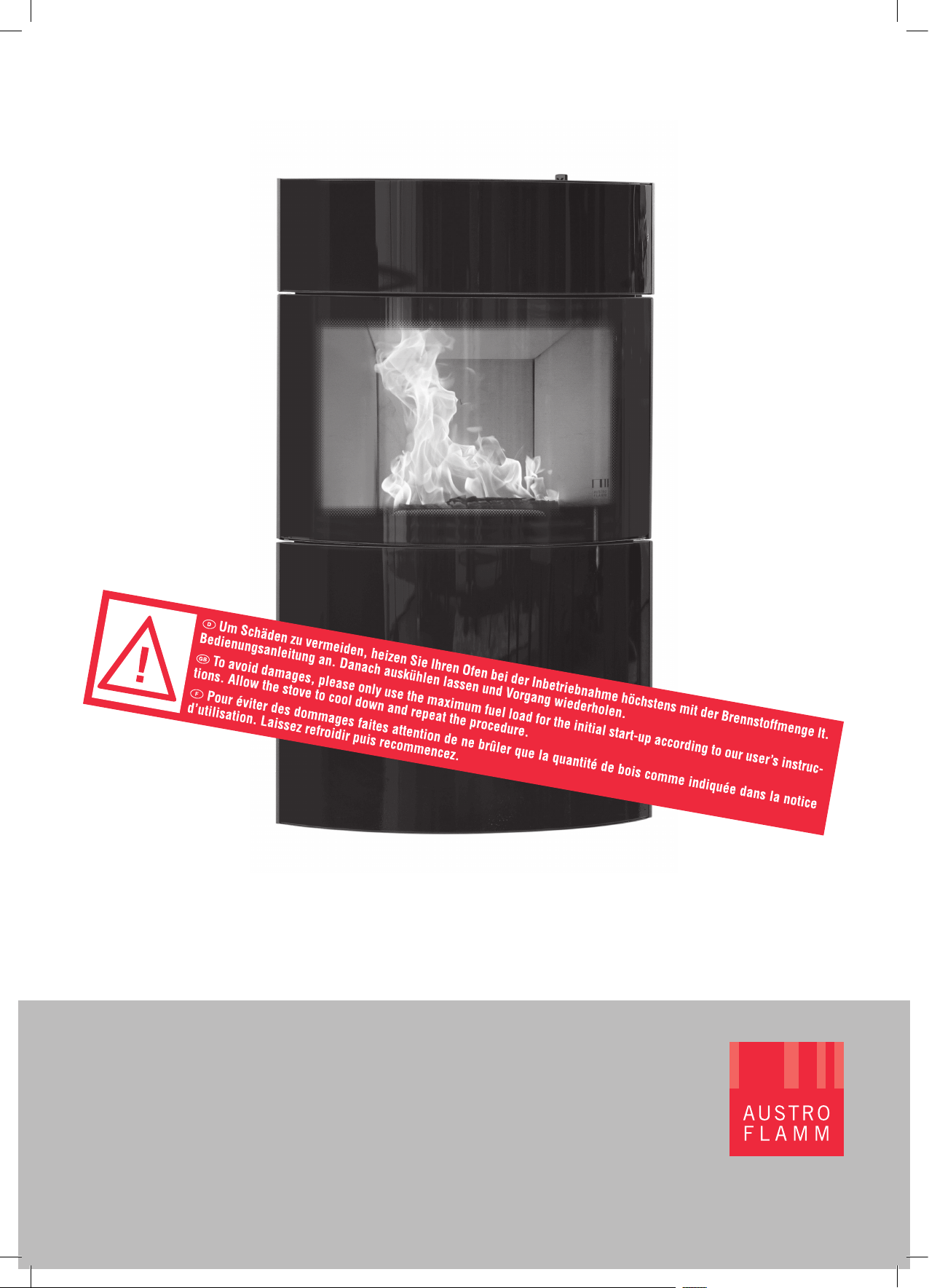
Benutzerhandbuch / user instructions
Istruzioni per l’uso / manuel d’instructions
Fynn Xtra
Page 2
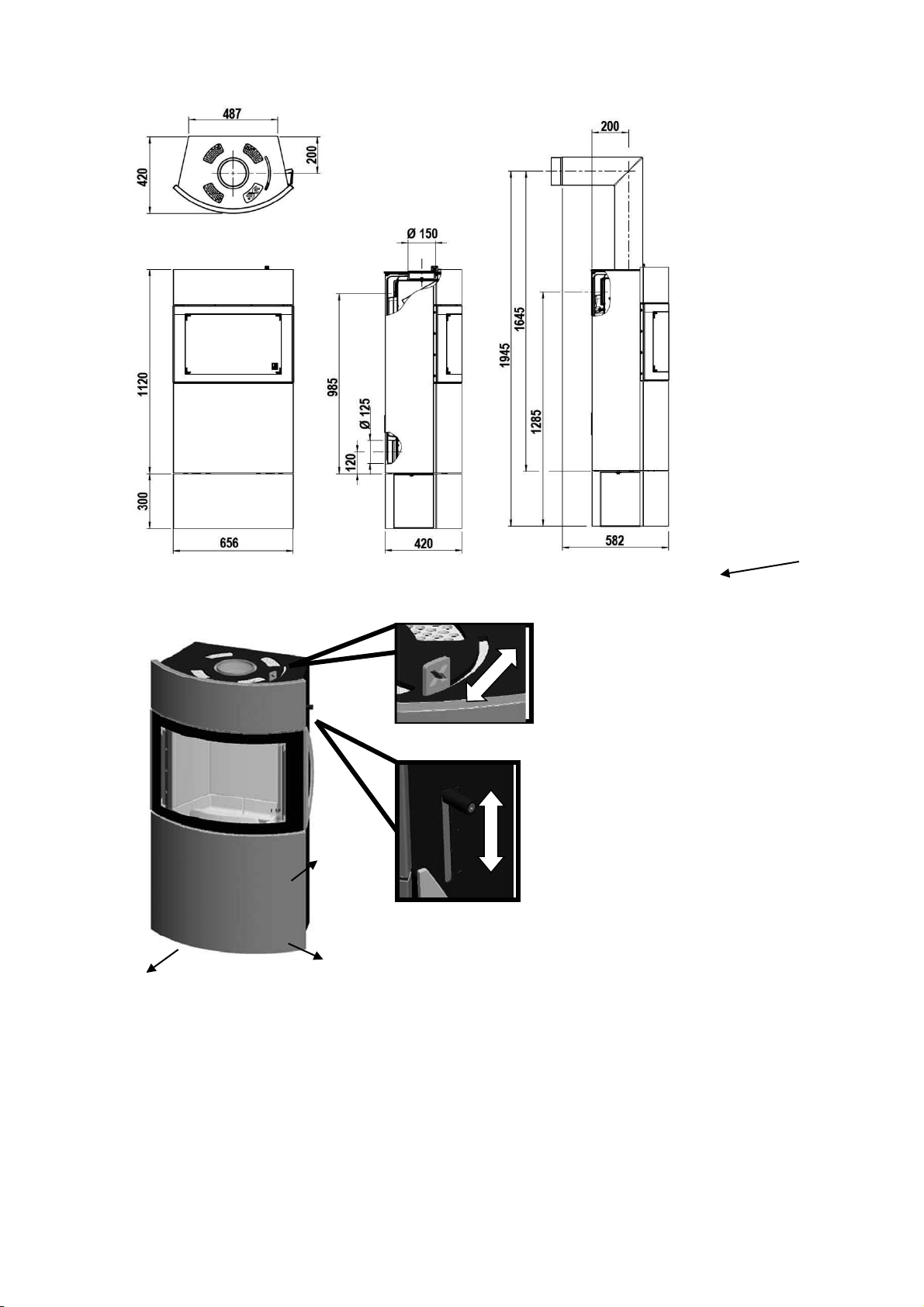
Fig. 1
Sockel
Fig. 2
(Zubehör)
Konvektionsluftschieber
Primär-/Sekundärluftschieber
c
a
deutsch english italiano français
AUF – ZU open – closed aperto – chiuso ouvert - fermé
Primärluftschieber primary air supply regolazione aria primaria coulisseau d’entrée d’air primaire
Konvektionsluftschieber convection air lever regolazione dell' aria convettiva manette de convection de l’air
b
deutsch english italiano français
Inhalt Contents Indice sommaire
1. Techn. Daten 1 1. Techn. data 5 1. Dati tecnici 9 1. Caractéristiques 13
2. Wichtige Informationen 1 2. Important information 5 2. Informazioni importanti 9 2. Infos importantes 13
3. So bedienen Sie Ihren 3. Correct operation 3. Per un uso corretto della 3. Bien utiliser votre
Kaminofen richtig 2 of your stove 6 vostra Kaminofen 10 poêle 14
4. Die wichtigsten 4. The most important 4. Prospetto dei ricambi 4. Principales pièces
Ersatzteile - Übersicht 3 spare parts - overview 7 principali 11 détachées 15
5. Ausstattungsmerkmale 4 5. Special features 8 5. Speciali caratteristiche 12 5. Particularites 16
Garantie 17 Guarantee 17 Garanzia 18 Garantie 18
Page 3
deutsch 1 Fynn Xtra
1. TECHNISCHE DATEN
Als Kaminofen der Bauart 1 ist ein Anschluss an einen
bereits mit anderen Öfen und Herden für feste Brennstoffe
belegten Schornstein möglich, sofern die
Schornsteinbemessung gemäß DIN 4705, Teil 3, dem nicht
widerspricht.
TECHNISCHE DATEN
Höhe 1120 mm
Breite
Tiefe 420 mm
Gesamtgewicht 242 kg
Gewicht HMS 105 kg
Rauchrohrabgang-Ø 150 mm
NW-Leistung lt. EN 13240 6 kW
Maximale Heizleistung 8 kW
Kleinste Heizleistung 3 kW
Raumheizvermögen (abhängig von der
Hausisolierung)
656 mm
65–165 m³
Abgaswerte für die Mehrfachbelegung des Schorn-steines
nach DIN 4705, Teil 3 bzw. zur Bemessung des
Schornsteines nach DIN 4705, Teil 2
Abgasmassenstrom geschlossen
Abgastemperatur geschlossen
Mindestförderdruck bei
Nennwärmeleistung (Nwl)
2. WICHTIGE INFORMATIONEN
Die Informationen in diesem Handbuch sind allgemeiner
Natur. Nationale und europäische Normen, örtliche und
baurechtliche Vorschriften sowie feuerpolizeiliche
Bestimmungen sind einzuhalten.
Allgemeine Sicherheitshinweise
zum Betrieb Ihres Kaminofens
x Lesen Sie vor der Inbetriebnahme des Ofens das
gesamte Handbuch gründlich durch und beachten Sie die
Warnhinweise.
x Für den Transport Ihres Heizgerätes dürfen nur
zugelassene Transporthilfen mit ausreichender
Tragfähigkeit verwendet werden.
x Ihr Heizgerät ist nicht zur Verwendung als Leiter oder
Standgerüst geeignet.
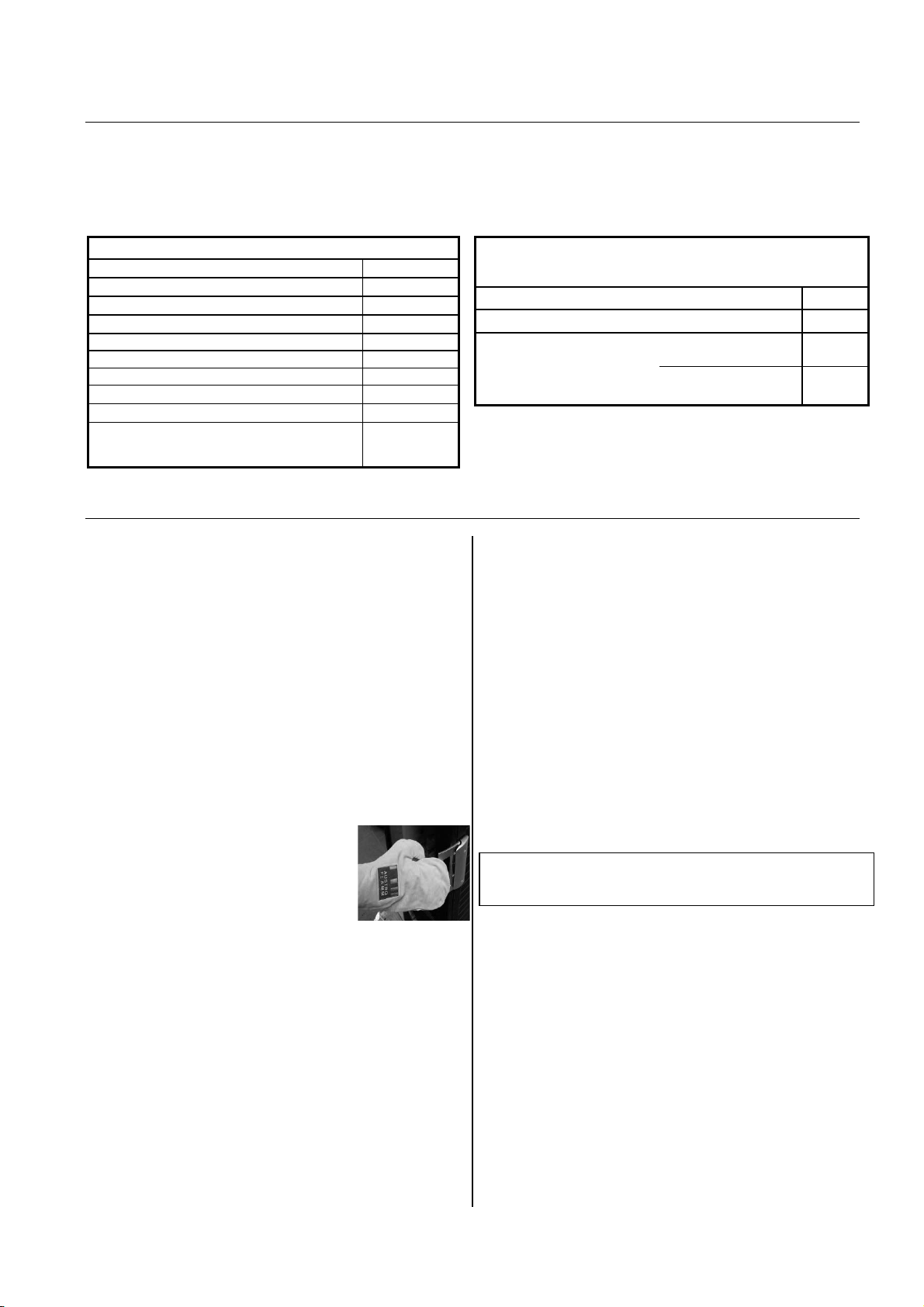
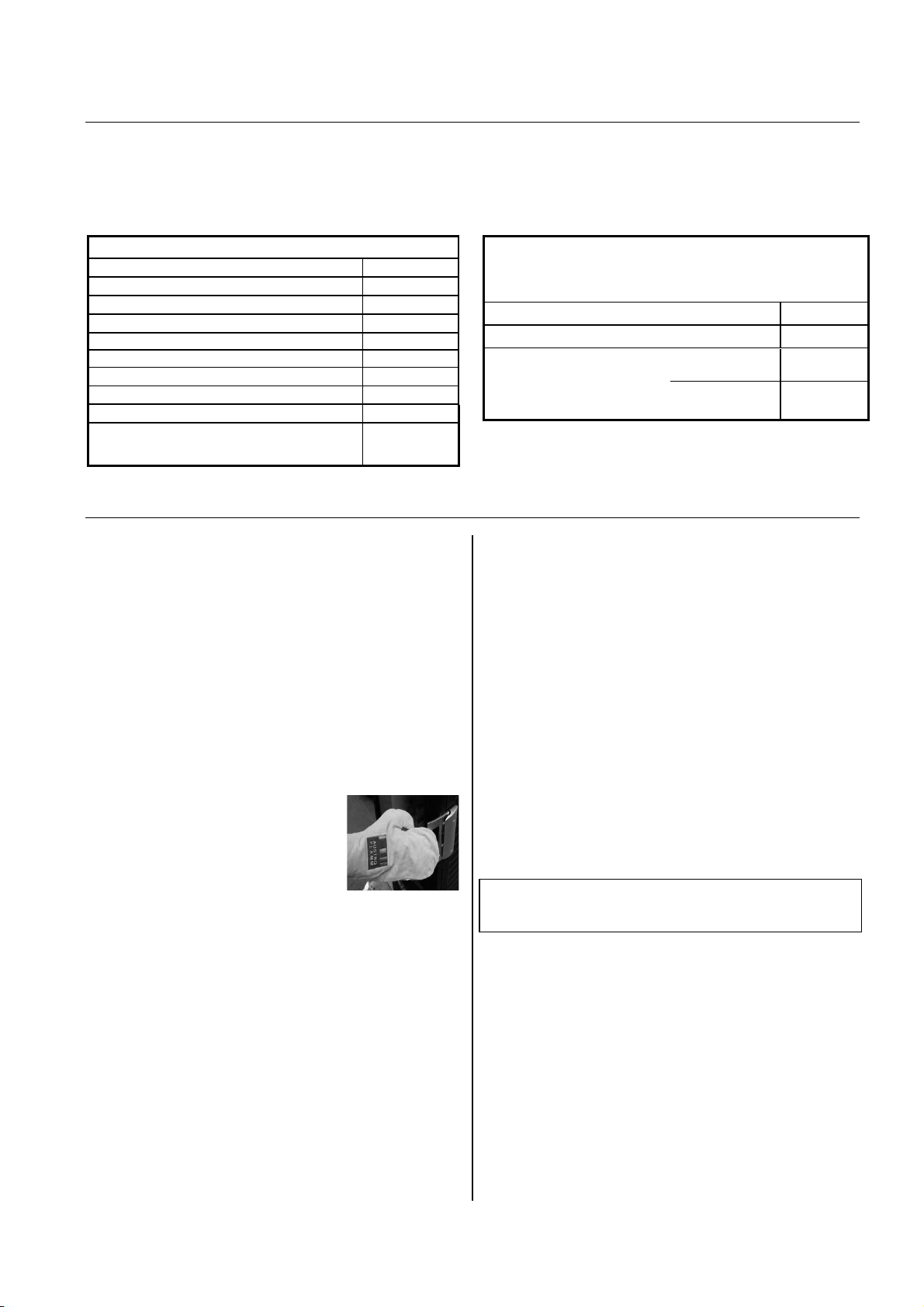
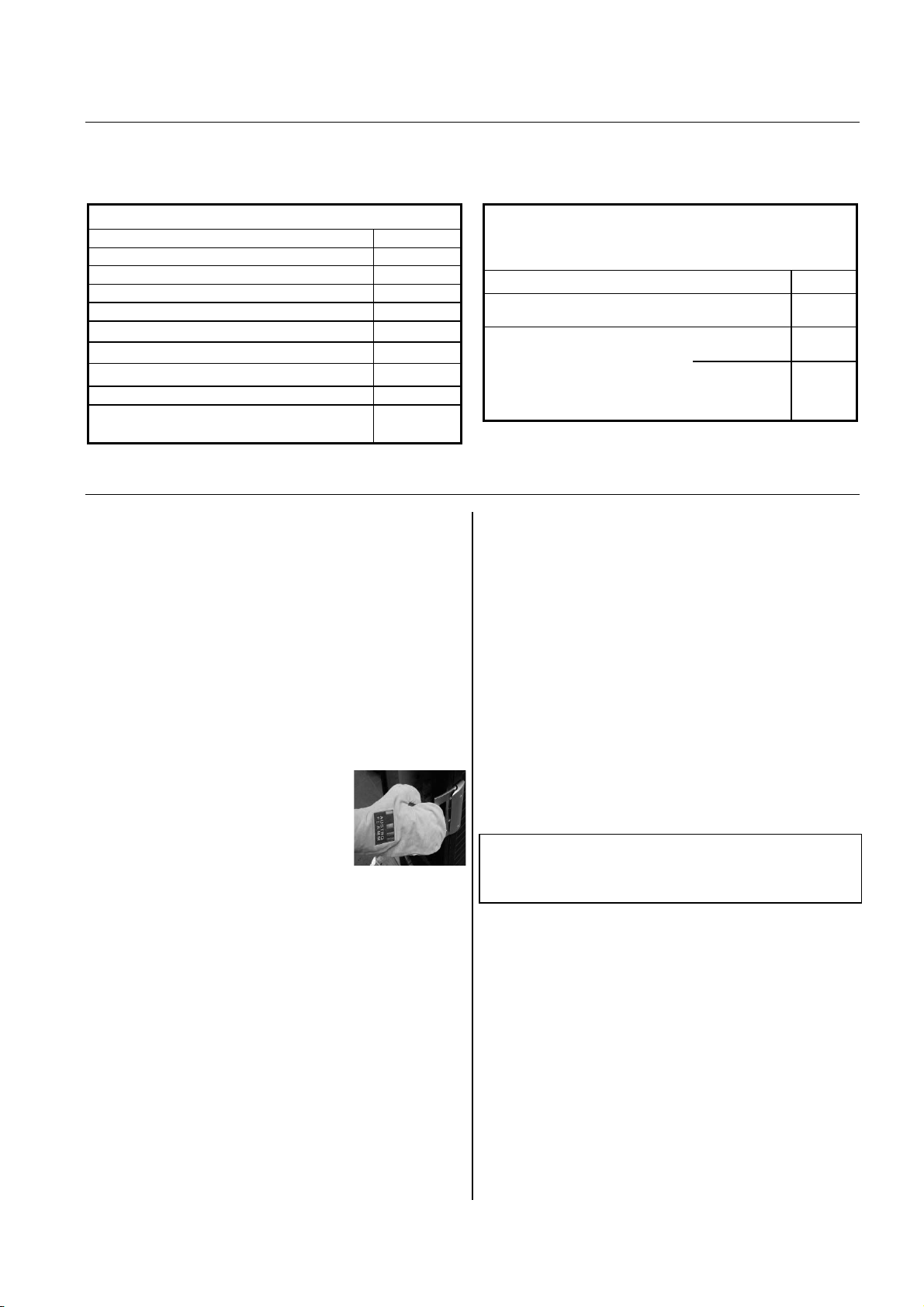
x Beachten Sie, dass sich Oberflächen
des Kaminofens während des Betriebes
stark erwärmen. Zur Bedienung des
Kaminofens empfehlen wir die
Benützung des Schutzhandschuhs.
Machen Sie Kinder auf diese Gefahren
aufmerksam und halten Sie sie während des Betriebes von
der Feuerstätte fern.
x Achtung – Lack ist kein Rostschutz!
x Verbrennen Sie ausschließlich das im Kapitel „saubere
Verbrennung“ angeführte, genehmigte Heizmaterial.
x Das Verbrennen oder Einbringen von leicht brennbaren
oder explosiven Stoffen, wie leere Spraydosen und dgl. in
den Brennraum, sowie deren Lagerung in unmittelbarer
Nähe Ihres Heizgerätes, ist wegen Explosionsgefahr
strengstens verboten.
x Beim Nachlegen sollen keine weiten oder leicht
brennbaren Kleidungsstücke getragen werden.
x Das Abstellen von nicht hitzebeständigen Gegenständen
auf dem Heizgerät oder in dessen Nähe ist verboten.
x Legen Sie keine Wäschestücke zum Trocknen auf den
Ofen. Auch Wäscheständer oder dgl. müssen in
ausreichendem Abstand vom Heizgerät aufgestellt werden –
Brandgefahr.
x Dieser Kaminofen ist keine Dauerbrand-Feuerstelle.
x Beim Betrieb Ihres Heizgerätes ist das Verarbeiten von
leicht brennbaren und explosiven Stoffen im selben oder in
anschließenden Räumen verboten.
x Das Gerät ist nur mit geschlossenen Türen zu betreiben.
x Die Tür sowie alle Einstelleinrichtungen des Geräts sind
zu schließen, wenn das Gerät außer Betrieb ist.
Kaminofenaufstellung
Einzuhaltende Sicherheitsabstände
(Mindestabstände - siehe auch Typenschild)
Fig. 2
Bitte beachten Sie, dass der Aufstellungsraum mind. eine
Türe / ein Fenster ins Freie aufweist oder mit einem
derartigen Raum direkt verbunden sein muss. Andere
Feuerstätten und Dunstabzugshauben dürfen nicht im
Raumluftverbund mit Feuerstätten betrieben werden.
Bodentragfähigkeit
Prüfen Sie vor dem Aufstellen, ob die Tragfähigkeit der
Unterkonstruktion dem Gewicht Ihres Kaminofens standhält.
350 °C
geschlossen
bei 0,8facher NWL
a > 950 mm (a - vorne im Strahlungsbereich)
b > 330 mm (b - seitlich)
c > 230 mm (c – hinten)
5,0
12 Pa
10 Pa
Technische und optische Änderungen, Satz- und Druckfehler vorbehalten.
Page 4
deutsch 2 Fynn Xtra
Verbrennungsluft
Als Betreiber müssen Sie für ausreichende
Verbrennungsluft sorgen. Bei abgedichteten Fenstern und
Türen kann es sein, dass die Frischluftzufuhr nicht mehr
gewährleistet ist bzw. das Zugverhalten des Ofens
beeinträchtigt wird. Ggf. muss für eine zusätzliche
Frischluftzufuhr gesorgt werden. Bitte befragen Sie Ihren
Fachhändler. Stellen Sie sicher, dass
Verbrennungsluftöffnungen nicht verschlossen sind!
Rauchrohranschluss
Für den Anschluss der Rauchrohre an den Schornstein gibt
es zu Ihrer eigenen Sicherheit strenge Richtlinien. Ihr
Kaminofen-Fachhändler kennt diese. Beauftragen Sie daher
unbedingt Ihren Fachhändler mit dem Rauchrohranschluss.
3. SO BEDIENEN SIE IHREN KAMINOFEN RICHTIG
Zugelassene Brennstoffe
Trockenes, gut abgelagertes, naturbelassenes Holz
(Hartholz bevorzugt), Holzbriketts.
Maximale Brennstoffmenge
Maximal aufzugebende Brennstoffmenge: 1,6 kg Holz oder
Briketts.
Größere Brennstoffmengen können zu Überhitzung und
Beschädigungen am Ofen führen!
Saubere Verbrennung
Das Brennholz muss trocken (rel. Holzfeuchte < 15 %) und
unbehandelt sein. Außerdem muss die richtige
Brennholzmenge verbrannt werden, um eine saubere,
emissionsarme Verbrennung zu erreichen.
Schließen Sie die Türe!
Am besten diese erste Holzauflage ohne Änderung der
Luftschieberstellung abbrennen lassen.
Wenn nur noch Grundglut vorhanden ist (keine Flammen
mehr), dann können Sie, falls gewünscht, wieder eine
Auflage Scheitholz (ca. 1,6 kg) nachlegen.
Beim Nachlegen gehen Sie prinzipiell wie beim Anheizen
vor: Luftregler nach oben schieben, Ofentüre vorsichtig
öffnen, Holz nachlegen, Türe schließen.
Inbetriebnahme
Während der ersten 3-4 Abbrandzyklen - bei
Nennwärmeleistung - kann es zu Geruchsentwicklung
kommen und der Lack ist noch nicht ausgehärtet
Richtig Feuer machen
Für den richtigen und sicheren Betrieb der Feuerstätte ist
darauf zu achten, dass der Schornstein den erforderlichen
Förderdruck aufbaut. Dies muss besonders bei jeder
Erstinbetriebnahme (z.B. nach der Sommerzeit) und in der
Übergangszeit (z.B. bei starkem Wind) kontrolliert werden.
Wenn nicht genügend Förderdruck vorhanden ist, dann
können zunächst Papier oder Weichholzspäne verbrannt
werden, um Ofen und Kamin auf Temperatur zu bringen.
Die Lufteintrittsöffnung des Kaminofens darf nicht
verschlossen werden.
Rost reinigen, bei Bedarf Aschekasten entleeren (Vorsicht
auf Glutstücke).
Primär-/Sekundärluftschieber ganz nach oben schieben
(siehe Fig. 2, siehe auch Fig. 4).
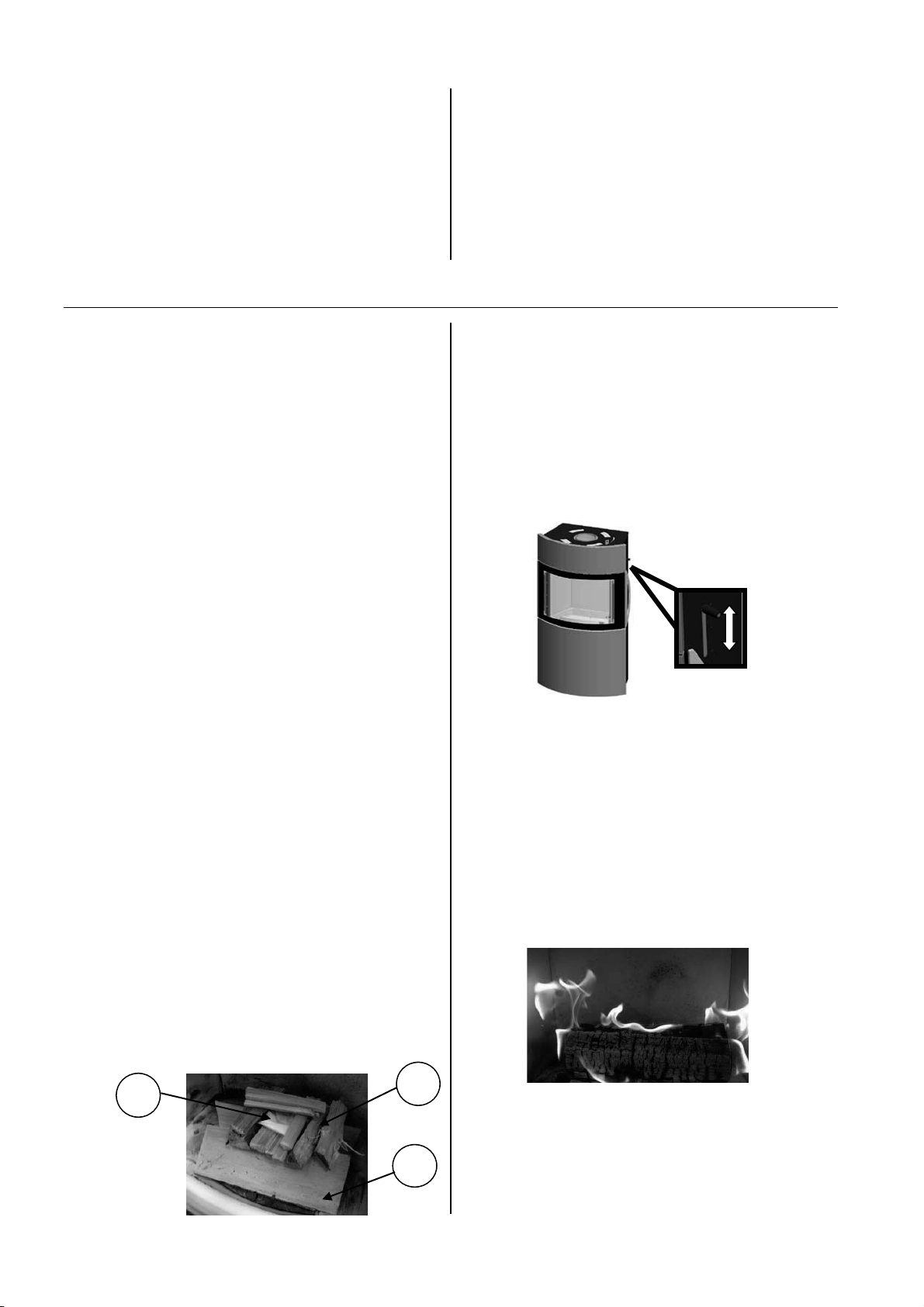
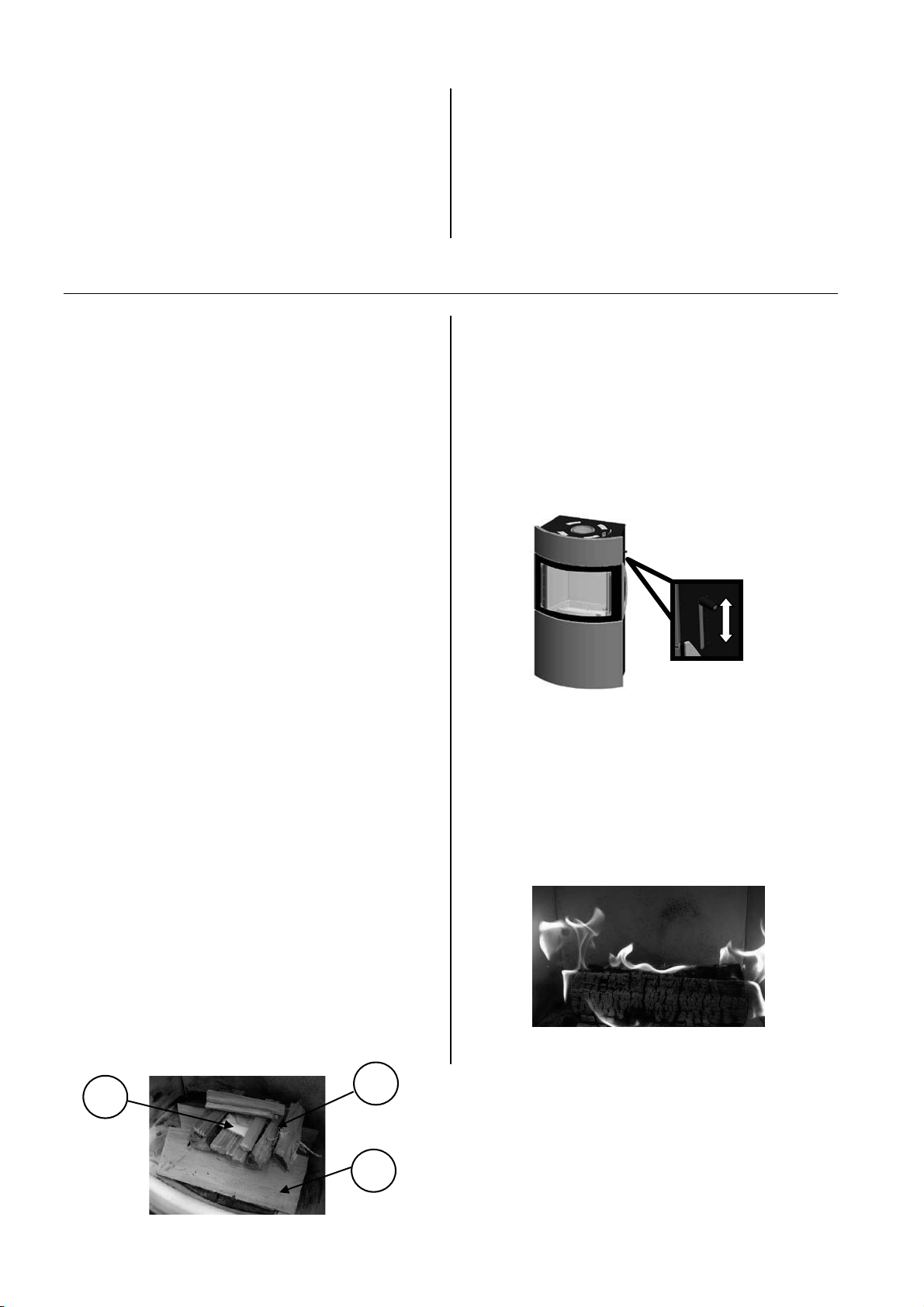
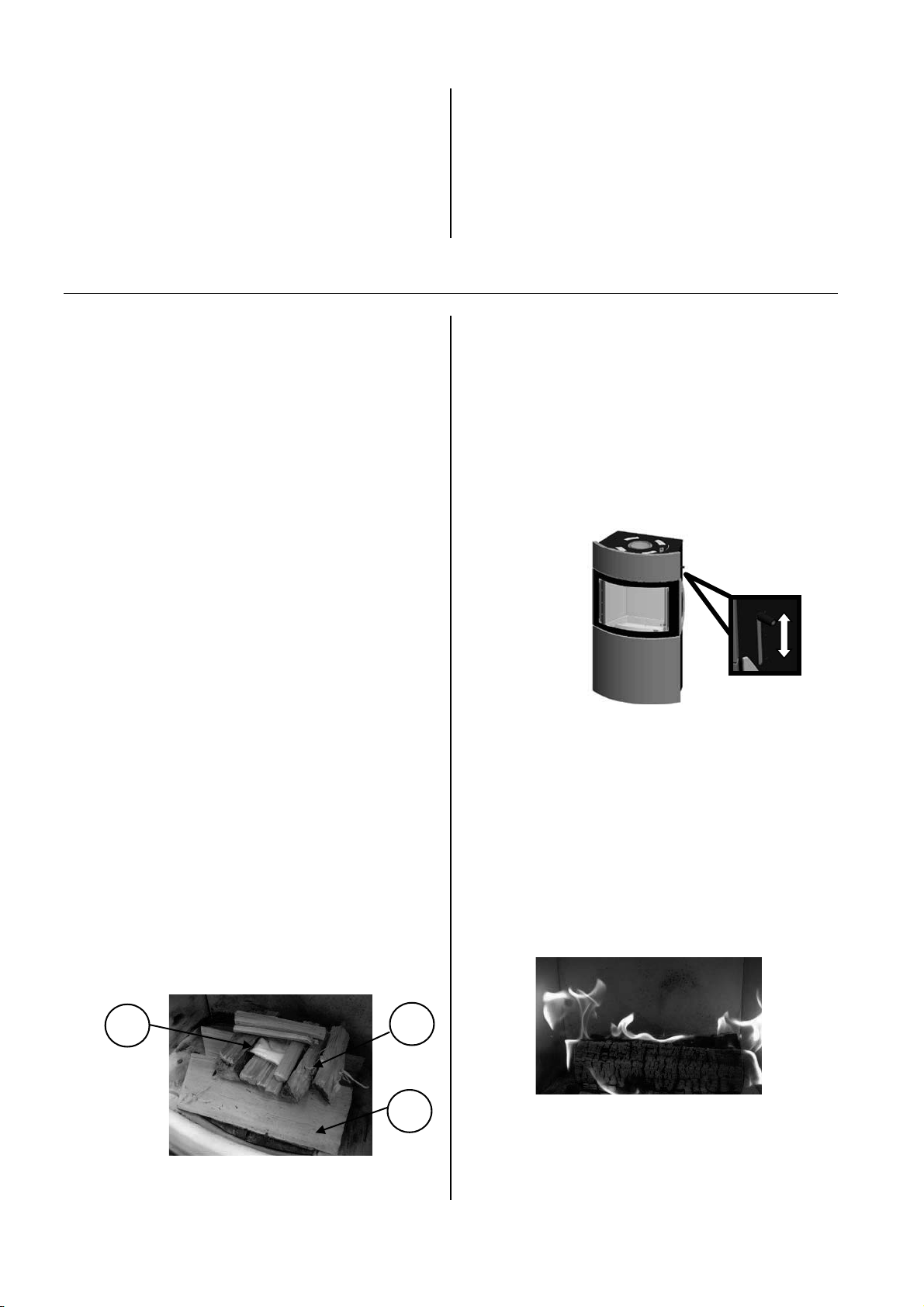
Legen Sie 2 – 3 Stück Scheitholz (gesamt ca. 1,1 kg) unten
quer in den Feuerraum (1), mit ausreichend Abstand
zueinander (mind. 2 cm). Darüber kommen ca. 0,5 kg
Weichholzspäne (2). Darauf legen Sie in die Mitte eine
Anzündhilfe (3) und zünden diese an. (siehe Fig. 3)
2
3
Symbolabbildungen
Fig. 4: Luftschieber
Sobald nach einigen Minuten die Holzscheite rundherum gut
brennen (helle, hohe Flammen – siehe Fig. 5), können Sie
nun mit dem Luftschieber die Heizleistung regulieren
(Regler auf Maximalstellung oben = maximale Heizleistung),
die Flammen sollten aber immer gelb und nie blau bzw. mit
schwarzen Flammenspitzen brennen (sonst wieder mehr
Luft zuführen) – siehe Fig. 4. Während des Abbrands die
Luftzufuhr nicht gänzlich schließen. (Verpuffungsgefahr!)
Die Feuerraumtüre darf nur zur Brennstoffaufgabe oder
zum Entaschen geöffnet werden und ist danach wieder
zu schließen.
Fig.5: Flammenbild
Symbolabbildungen
1
Fig. 3: Vor dem Anzünden
Page 5
deutsch 3 Fynn Xtra
Heizen in der Übergangszeit
In der Übergangszeit, d.h. bei höheren Außentemperaturen,
kann es bei plötzlichem Temperaturanstieg zu Störungen
des Schornsteinzuges kommen, so dass die Heizgase nicht
vollständig abgezogen werden. Die Feuerstätte ist dann mit
geringeren Brennstoffmengen zu befüllen und bei weiter
geöffnetem Luftregler so zu betreiben, dass der vorhandene
Brennstoff schneller (mit Flammentwicklung) abbrennt und
dadurch der Schornsteinzug stabilisiert wird.
Hinweis bei Schornsteinbrand
Wird falscher oder zu feuchter Brennstoff verwendet, kann
es aufgrund von Ablagerungen im Schornstein zu einem
Schornsteinbrand kommen. Verschließen Sie sofort alle
Luftöffnungen am Kamin und informieren Sie die
Feuerwehr. Nach dem Ausbrennen des Schornsteins diesen
vom Fachmann auf Risse bzw. Dichtheit überprüfen lassen.
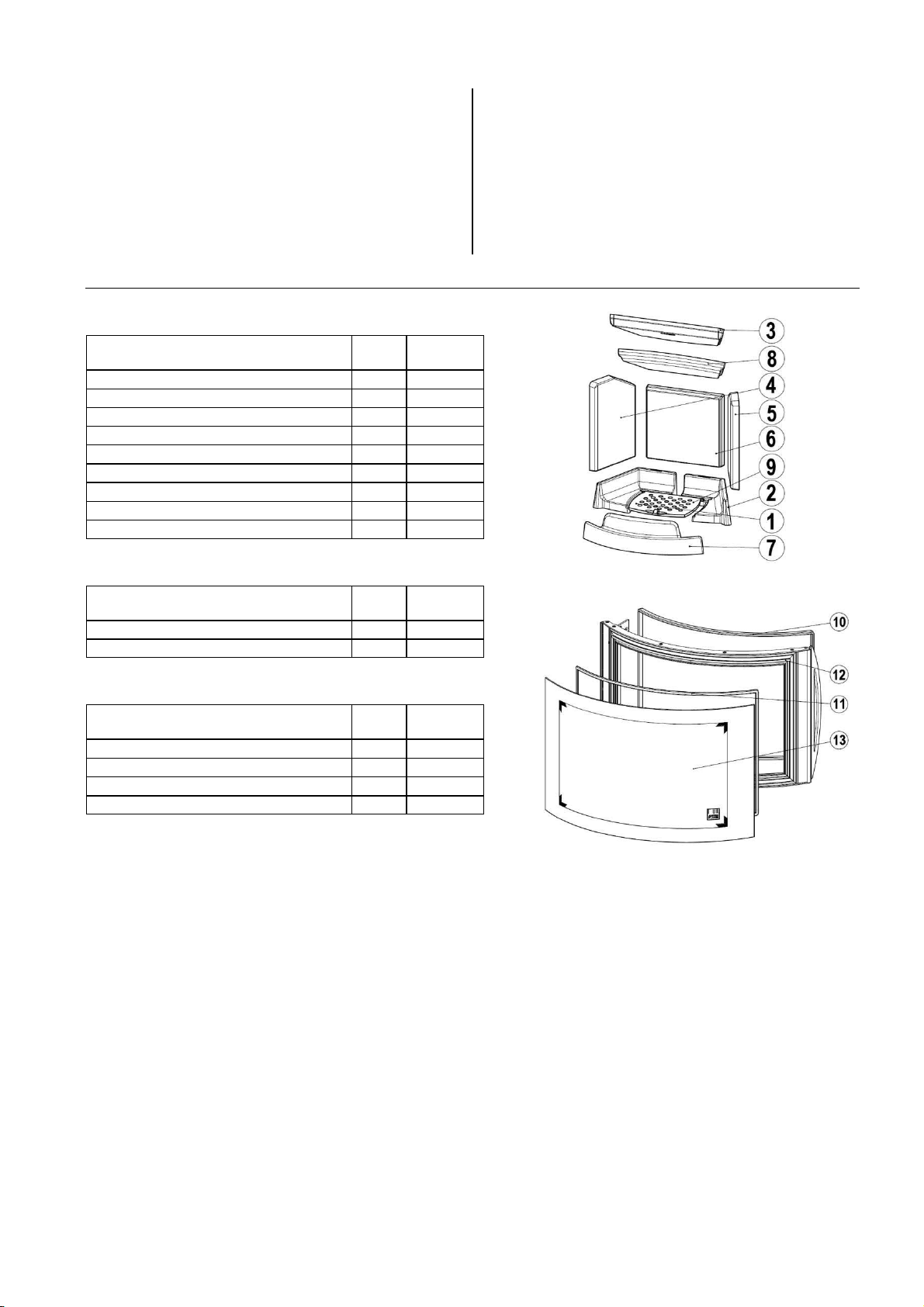
4. DIE WICHTIGSTEN ERSATZTEILE - ÜBERSICHT
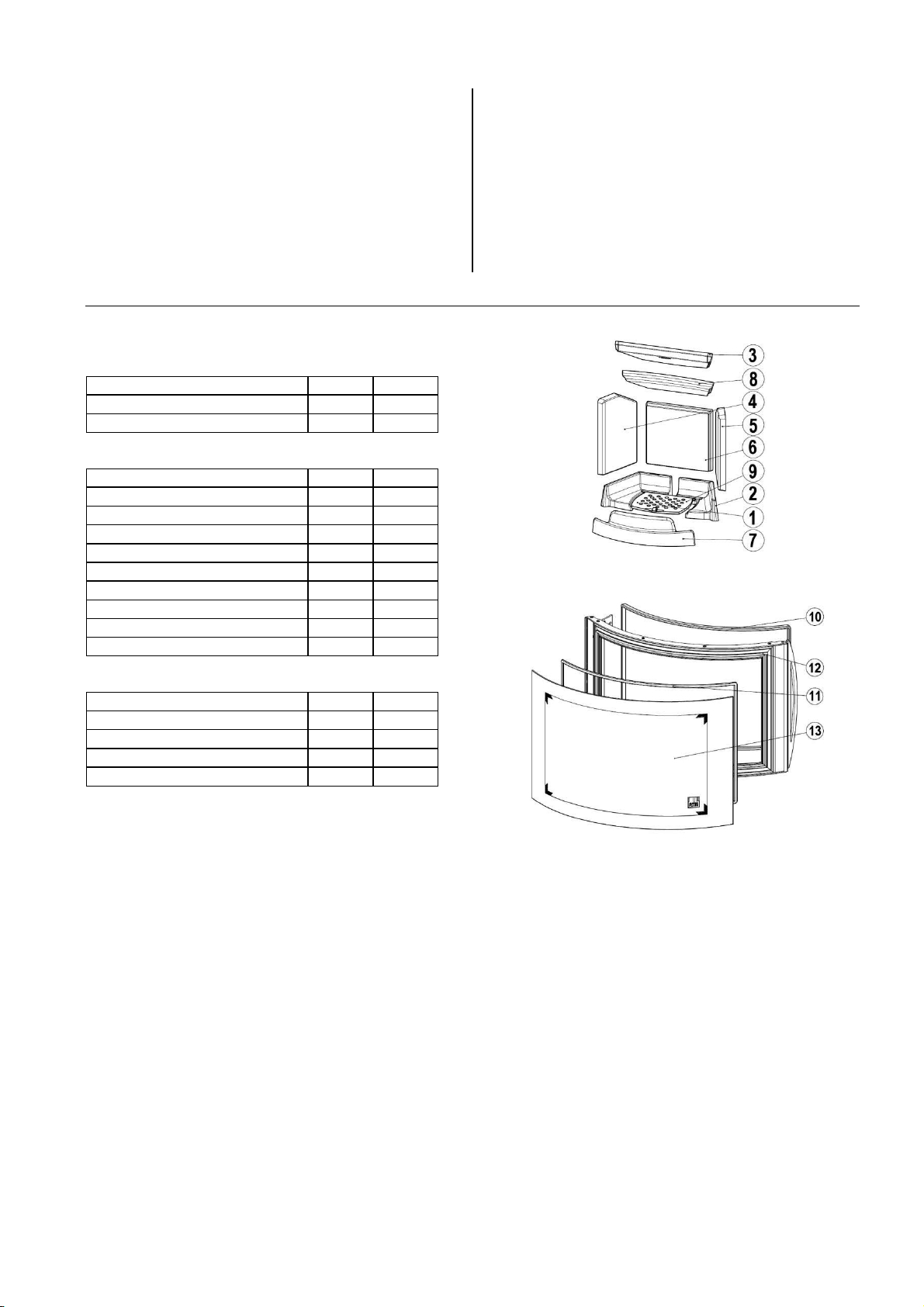
Keramott
Nr.-
Bezeichnung
Keramottboden links 1 720281
KeramottBoden rechts 2 720282
Keramott Zugplatte 2 3 720283
Keramottwand links 4 720284
Keramottwand rechts 5 720285
Keramottwand hinten 6 720286
Keramott Holzfänger 7 720287
Keramott Zugplatte 1 8 720288
Bodenrost 9 716408
Skizze Artikelnr.
Dichtungen
Nr.-
Bezeichnung
Ovaldichtung fein 16x8x L=1940 mm 10 718764
Flachdichtung 10x5x L=1890 mm 11 718438
Skizze Artikelnr.
Nummerierung Keramott = Einbaureihenfolge!
Sonstiges
Nr.-
Bezeichnung
Tür komplett 12 720250
Türglas 13 720255
Glasreiniger 0,5l -- 640070
Ofenlack -- 650002
Skizze Artikelnr.
Zubehör
Bei Ihrem Fachhändler erhalten Sie Bodenplatten aus Glas oder Stahl und Pflegemittel.
WICHTIG: Lassen Sie defekte Teile ausschließlich von Ihrem Kaminofenfachhändler austauschen. Damit ist
gewährleistet, dass Ihr Kaminofen sicher und funktionstüchtig ist und bleibt.
Die Feuerstätte darf nicht verändert werden.
Pflege
Zur Glasreinigung verwenden Sie bitte ein Spezialprodukt wie Thermohit Glasreiniger. Lackierte Oberflächen dürfen nur mit
einem Tuch (ev. feucht) gereinigt werden. Für Edelstahloberflächen gibt es ebenfalls Spezialreiniger. Nur intakte Dichtungen
gewährleisten die einwandfreie Funktion Ihres Kaminofens!
Reinigung
Der Kaminofen, die Rauchgaswege und Rauchrohre sollten jährlich – evtl. auch öfter, z.B. nach der Reinigung des
Schornsteines – nach Ablagerungen untersucht und ggf. gereinigt werden. Der Schornstein muss ebenfalls regelmäßig
durch den Schornsteinfeger gereinigt werden. Über die notwendigen Intervalle gibt Ihr zuständiger Schornsteinfegermeister
Auskunft. Der Kaminofen sollte jährlich durch einen Fachmann überprüft werden.
Page 6
deutsch
4 Fynn Xtra
5. AUSSTATTUNGSMERKMALE Fynn XTRA
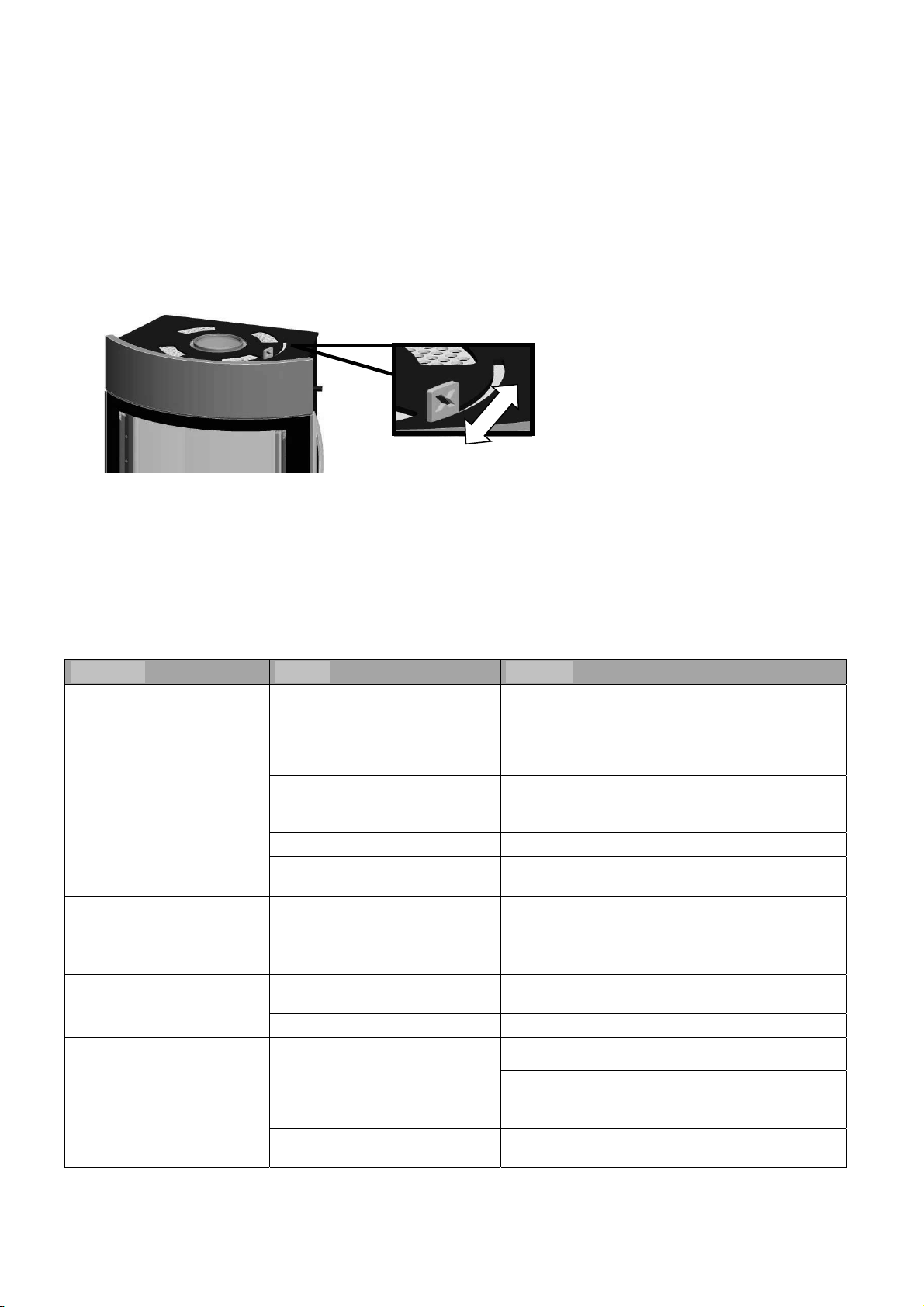
Xtra Wärmespeichertechnologie
Das Modell Fynn Xtra ist mit der einzigartigen Xtra Wärmespeichertechnologie ausgerüstet. Diese basiert auf dem
patentierten Heat Memory System, aber auch auf der speziellen Rauchgasführung und der regelbaren bzw. sogar
absperrbaren Konvektionsluft. Somit wird ein schnelles Heizsystem mit außergewöhnlicher Wärmespeicherung kombiniert.
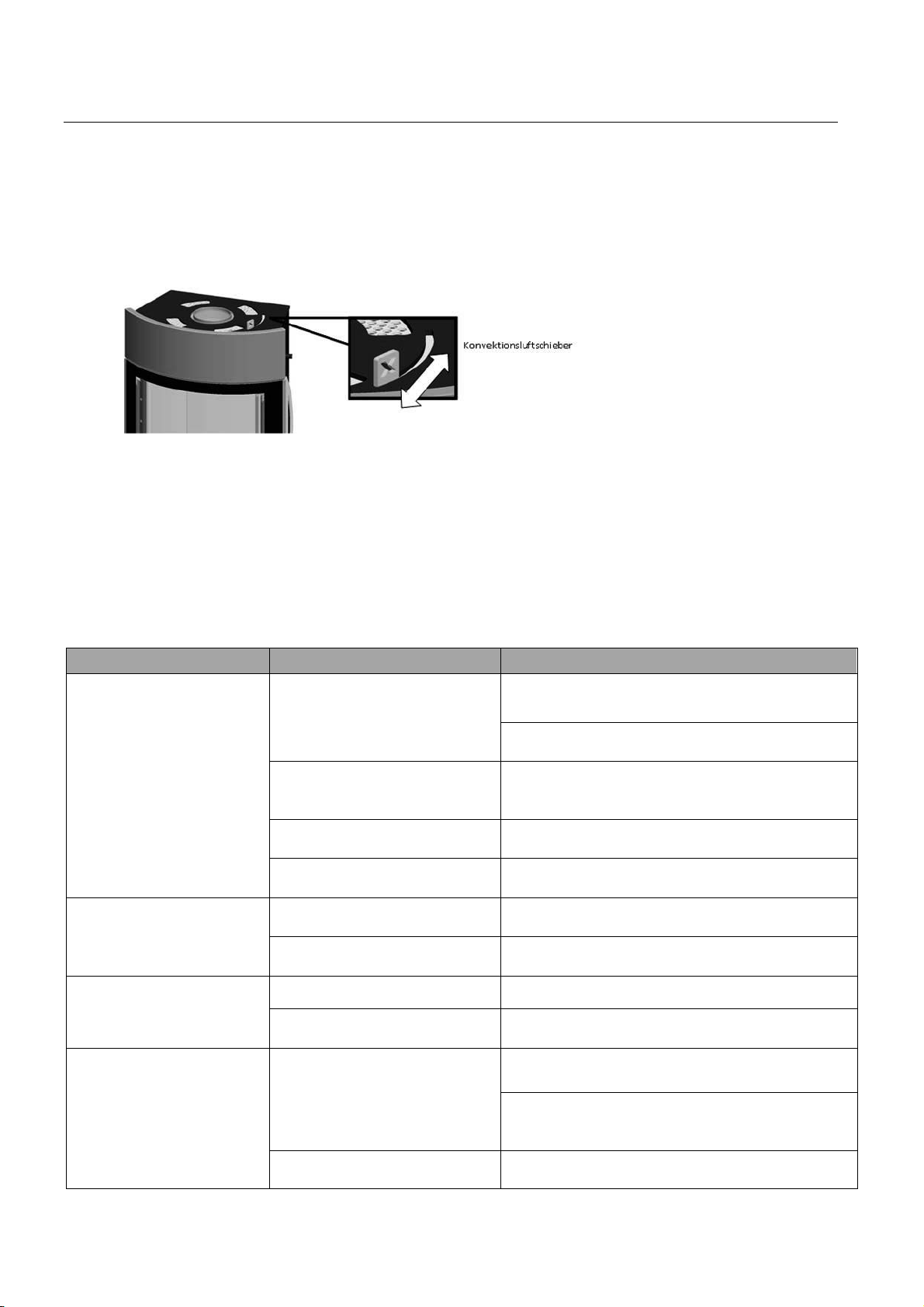
Die Konvektionsluft können Sie nach Bedarf mit dem dazugehörigen Regler (siehe Abbildung) steuern. Je mehr die
Konvektionsluftöffnungen im Deckel offen sind, desto schnellere, aber kürzer anhaltende Wärme erreichen Sie. Dagegen
führt ein geschlossener Deckel zu langsamerer Erwärmung und längerer Wärmeabgabe.
Konvektionsluftschieber
Unser Tipp: Während das Feuer brennt die Konvektionsluft offen lassen und danach schließen, um eine lange,
gleichmäßige Wärmeabgabe zu erreichen.
Raumluftunabhängiger Betrieb
Das Modell Fynn Xtra kann auch als raumluftunabhängiger Kaminofen betrieben werden. Wird die Verbrennungsluft mittels
dichter Leitung mit Absperrvorrichtung vom Freien direkt der Feuerstätte zugeführt, so darf der Ofen auch in
Nutzungseinheiten mit mechanischen Be- oder Entlüftungen betrieben werden.
Wird der Kaminofen auf diese Art genutzt, ist jedoch die Mehrfachbelegung eines Schornsteins nicht zulässig.
Problem Grund Lösung
Grundsätzlich: von Zeit zu Zeit (je nach Gebrauch)
muss jede Glasscheibe mit Austroflamm Glasreiniger
gereinigt werden
Klärung mit Schornsteinfeger (ev. Schornstein
verlängern/Zugmessung)
Unbedingt gemäß Bedienungsanleitung den
Luftregler bedienen (wenn Sekundärluft geschlossen
ist, verrußt die Glasscheibe sehr schnell)
Mehr Brennstoff, trockenes Holz (< 15 % Restfeuchte)
verwenden, Luftregulierung beachten
Klärung mit Schornsteinfeger (ev. Schornstein
erhöhen/Zugmessung
Mehr Brennstoff, trockenes Holz (< 15 % Restfeuchte)
verwenden, Luftregulierung beachten
Verbindungsstellen überprüfen und ggf. neu
abdichten
Schornsteinzug überprüfen, Bedienung überprüfen –
Bedienvideo zu finden unter:
http://www.austroflamm.com/de/Video/index.html
Erst nachlegen, wenn nur noch Grundglut vorhanden
(keine sichtbaren Flammen mehr)
Glasscheibe verrußt zu schnell
Ofen zieht nicht ordentlich
Ofen riecht stark und raucht
außen
Rauchgasaustritt beim
Nachlegen und während der
Heizphase
schlechter Kaminzug
falsche Bedienung des Luftreglers
zu große Holzscheite Menge lt. Bedienungsanleitung einhalten
Betriebstemperatur wurde nicht
erreicht
Kaminzug unzureichend
Ofen ist innerlich verrußt
Einbrennphase des Lacks In den ersten Heizzyklen riecht der Lack!
Ofen ist verstaubt/verschmutzt Reinigen vor der Saison!
Zu geringer Schornsteinzug,
Rauchrohranschluss undicht
Tür geöffnet, bevor auf Grundglut
abgebrannt
Page 7
english 5 Fynn Xtra
1. TECHNICAL DATA
As a stove of construction type 1, it is possible to connect it
to the chimney together with an existing other stove or
another hearth for solid fuels, as long as the chimney
dimensioning complies with DIN 4705, Part 3.
TECHNICAL DATA
Height 1120mm
Width 656 mm
Depth 420 mm
Weight 242 kg
Weight HMS 105 kg
Flue pipe outlet diameter 150 mm
Nominal thermal output 6 kW
Max. thermal capacity 8 kW
Smallest heating capacity 3 kW
Room heating capacity (depending on
building insulation)
65–165 m³
2. IMPORTANT INFORMATION
The installation and operation information given here is of
general nature. National and European standards, local and
building regulations as well as fire prevention laws must be
observed during the operation of the stove.
General safety instructions for the
operation of your stove
x Read the entire manual before starting up your stove
thoroughly and observe the caution notices.
x Your heating unit must not be moved without approved
means of transport with sufficient load-bearing capacity.
x Your heating unit is not suitable to be used as a stand or
as a ladder.
x Please keep in mind that your
stove’s surface heats up considerably
during operation. We therefore
recommend wearing a safety mitten
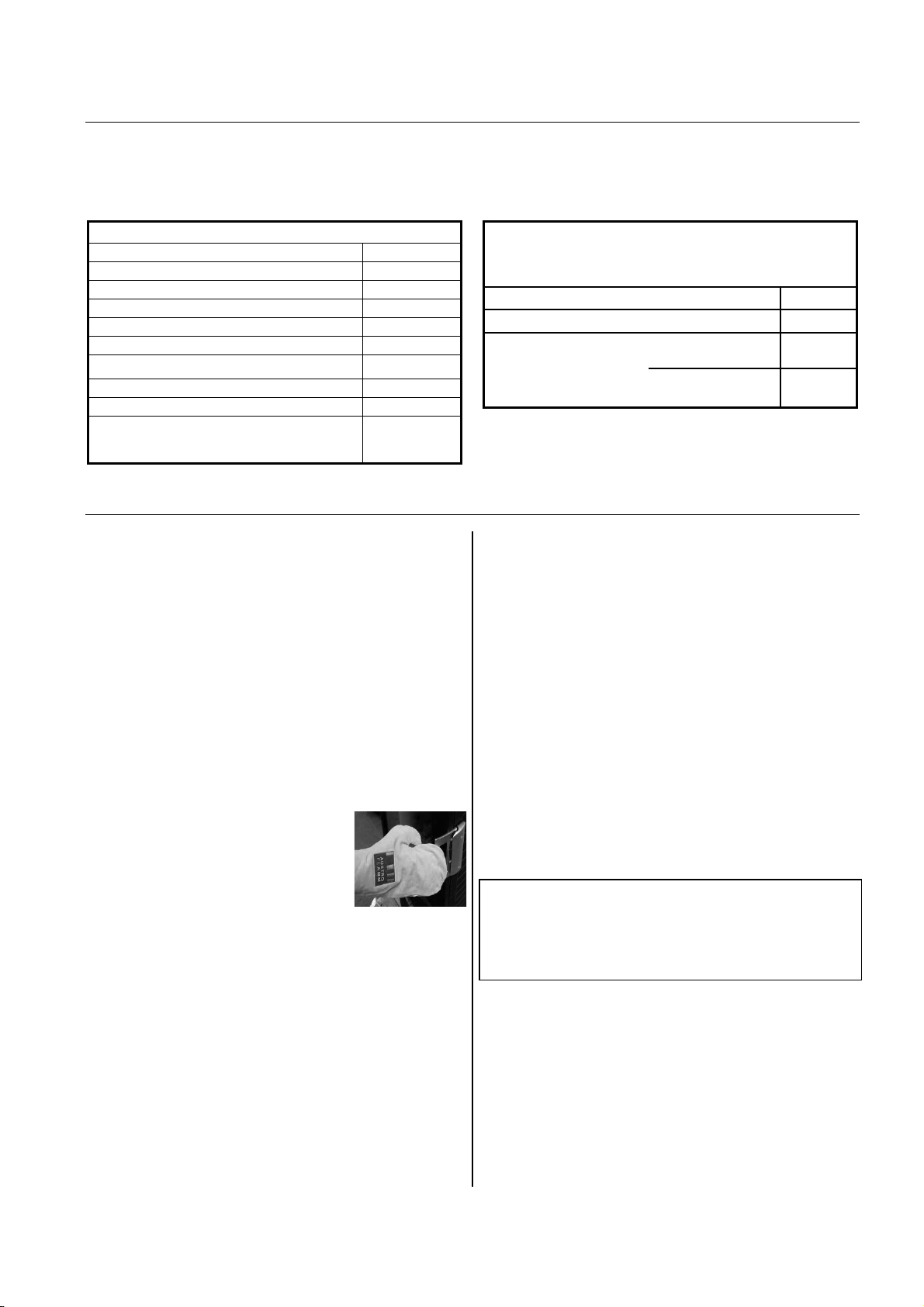
when operating your stove.
x Attention – stove varnish is no rust prevention!
x Make your children aware of this particular danger and
keep them at a distance from the heating unit whenever it is
in operation.
x Only burn approved fuels and materials as listed in the
chapter “Clean Burning”.
x The burning or placing of flammable or explosive
materials, like empty spray cans, etc. into the firebox as well
as the storage of such materials in the immediate vicinity of
your heating unit is strictly forbidden due to the danger of
explosion.
x Do not wear loose or flammable clothing when adding
fuel to the fire.
Exhaust values for multiple use of the chimney in
accordance with DIN 4705, Part 3 and for the calculation of
the chimney measurements in accordance with DIN 4705,
Part 2
Fluegas mass flow closed 5,0 g/s
Fluegas temperature closed 350 °C
Minimum feed pressure
Nominal thermal output
x Do not lay laundry onto the stove for drying. Laundry
hung up to dry must be kept at a safe distance from the
stove because of the danger of fire.
x The wood stove is not suitable for long term heating.
x During the operation of your heating unit it is forbidden to
use flammable or explosive materials in the same or an
adjacent room to the one in which your heating unit is
located.
x The appliance must be operated with the stove door
closed.
x The stove door and all fittings for adjusting the stove
must be closed, if the appliance is out of use.
closed 12 Pa
at 0.8 times n.
ther. outp.
10 Pa
Setting up your stove
Required safety distances (Minimum distances –
see name plate - in Fig. 2)
a > 950 mm - towards the front in the radiated area
b > 330 mm – to the side
c > 230 mm – to the back
Make sure that the room in which the stove is set up has at
least one door or window into the outside or is directly
adjacent to such a room. Other fireplaces and extractor
hoods must not be operated in the same room as the stove.
Floor load capacity
Make sure that the load capacity of the supporting
construction is sufficient to carry the weight of the entire
unit, before the heating unit is installed.
Subject to technical and optical modifications. Formatting and printing errors excepted.
x Placing non-heat-resistant objects on the heating unit or
in the vicinity of the heating unit is forbidden.
Page 8
english 6 Fynn Xtra
Combustion air
Being the user of the stove you must take care of a
sufficient combustion air supply. Sealed-up windows and
doors may not allow a sufficient combustion air supply or
disturb the draught behaviour of your stove. Please ensure
the additional supply of fresh combustion air if necessary.
For details please consult your specialist retailer. Make sure
that the combustion air intakes are not blocked!
Stove pipe connection
For your own safety stringent laws apply for connecting the
stove pipes to the chimney. Your professional dealer or
distributor knows these laws. Please have your certified
retailer carry out the connection of your stove.
3. CORRECT OPERATION OF YOUR STOVE
Approved fuels
Dry, well cured and natural wood (hardwood preferred),
wood briquettes.
Maximum amount of fuel
Maximum amount of fuel to be added: 1,6 kg wood or
briquettes. Larger amounts of fuel can lead to overheating
and thus damage the stove.
Clean burning
The wood must be dry (relative wood moisture < 15%) and
untreated and the right amount of wood must be burned in
order to ensure a clean fire that releases only small
amounts of emissions.
Close the door!
We recommend to let the first load burn down without
changing the air lever position.
As soon as no visible flames are left (only embers in the
combustion chamber), you can put another load of logs
(approx. 1,6 kg) in the combustion chamber if desired. (see
fig. 5)
When reloading the stove please repeat the procedure as
mentioned under “first lighting”: air lever top position (=
open), open door carefully, place logs, close door.
Startup procedures
During the first 3-4 operations - at nominal heat output there may be some odour development and the varnish has
not yet hardened.
Making a fire
For the correct and safe operation of your stove please pay
attention of the chimney developing the necessary feed
pressure. This must especially be considered before the
initial operation (or e.g. after the summer heating break) and
during the mid-season heating periods (e.g. at strong wind,
etc.).
If there is not enough feed pressure, please light only some
paper or small kindling first, in order to “warm up” the stove
and the chimney.
The air inlet must not be covered or closed.
Clean grate, empty ash drawer if necessary (watch out for
ambers!)!
Position the lever for the combustion air to the open (“AUF”)
position (see fig. 2 and 4).
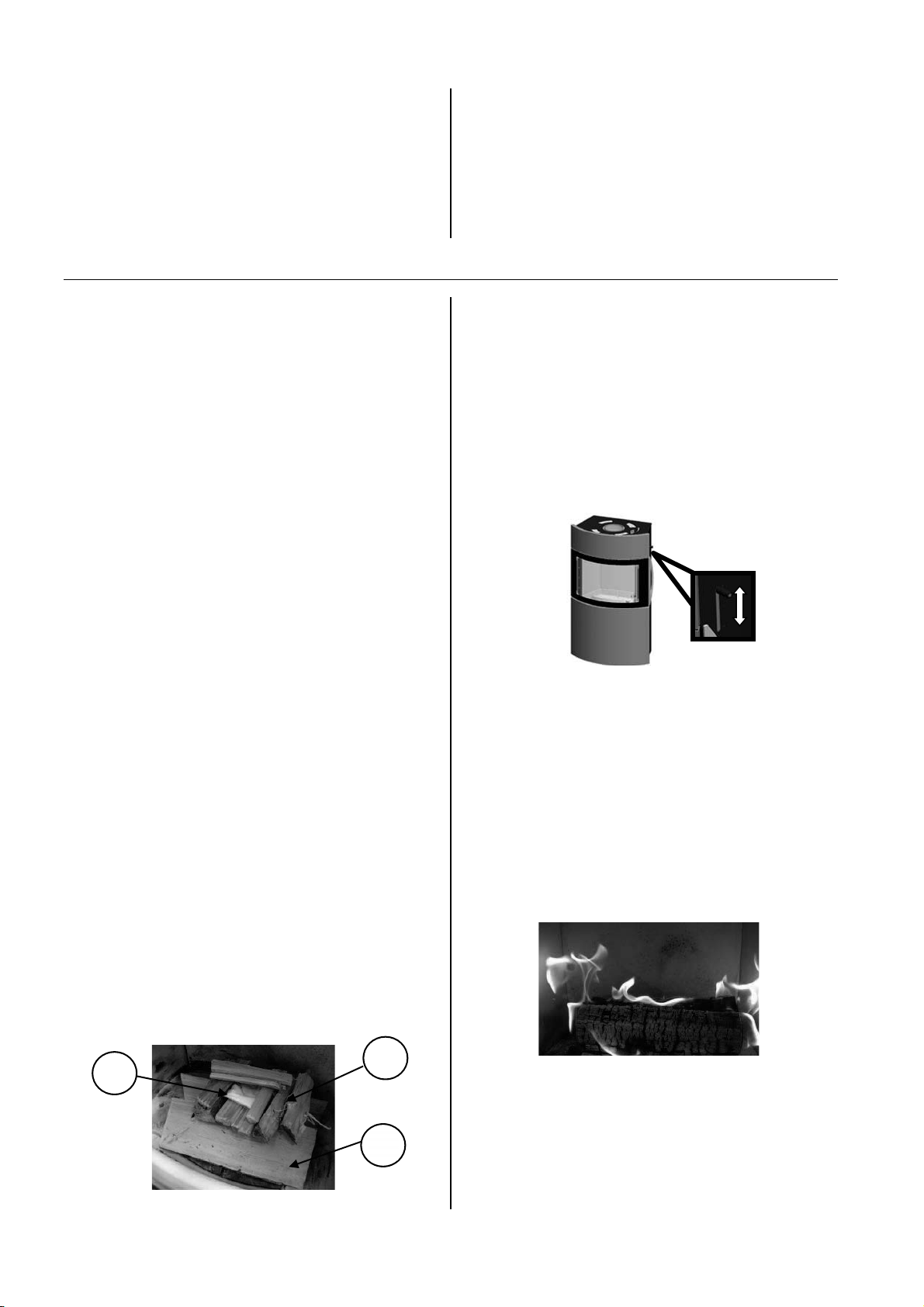
Place 2-3 logs (approx. 1,1 kg in total) crossways in the
combustion chamber (1) with sufficient distance from each
other (min. 2 cm), on top of that place some softwood
chippings (approx. 0.5 kg) (2) and some ignition aid and
light. (3) (see fig. 3)
symbol figures
Fig. 4: air knob
After a few minutes, when the logs burn well on all sides
(bright, high flames), you can adjust the heat output with the
air lever (lever on top position = maximum heat output), the
flames should be yellow and never look blueish or have
black tips (otherwise add more air) – see fig. 4. Never close
air supply completely during operation. (danger of flash-fire!)
The stove door may be opened only for refuelling or
disposing of ashes and is to be closed again afterwards.
Figure 5
3
symbol figures
2
1
Figure 3:ignite the fire
Page 9
english 7 Fynn Xtra
Heating in-between seasons
If you heat the stove in between seasons, when the outside
temperatures are higher, the flue gases may not be able to
escape completely and this may lead to disturbances in the
chimney draught, especially if the temperatures are rising
suddenly. The stove has to be charged with less wood then
and the primary air has to be increased so that the wood
can burn down faster (with visible flames) and thus the
chimney draught can stabilize.
Chimney fire
A chimney fire may occur, due to sooting and deposits in the
chimney, if impropes or humid fuel is used. In case of a
chimney fire close all air inlets on the fireplace/chimney
immediately and call the fire brigade. Please have an expert
inspect your chimney for cracks and air-tightness after the
burning out of the chimney.
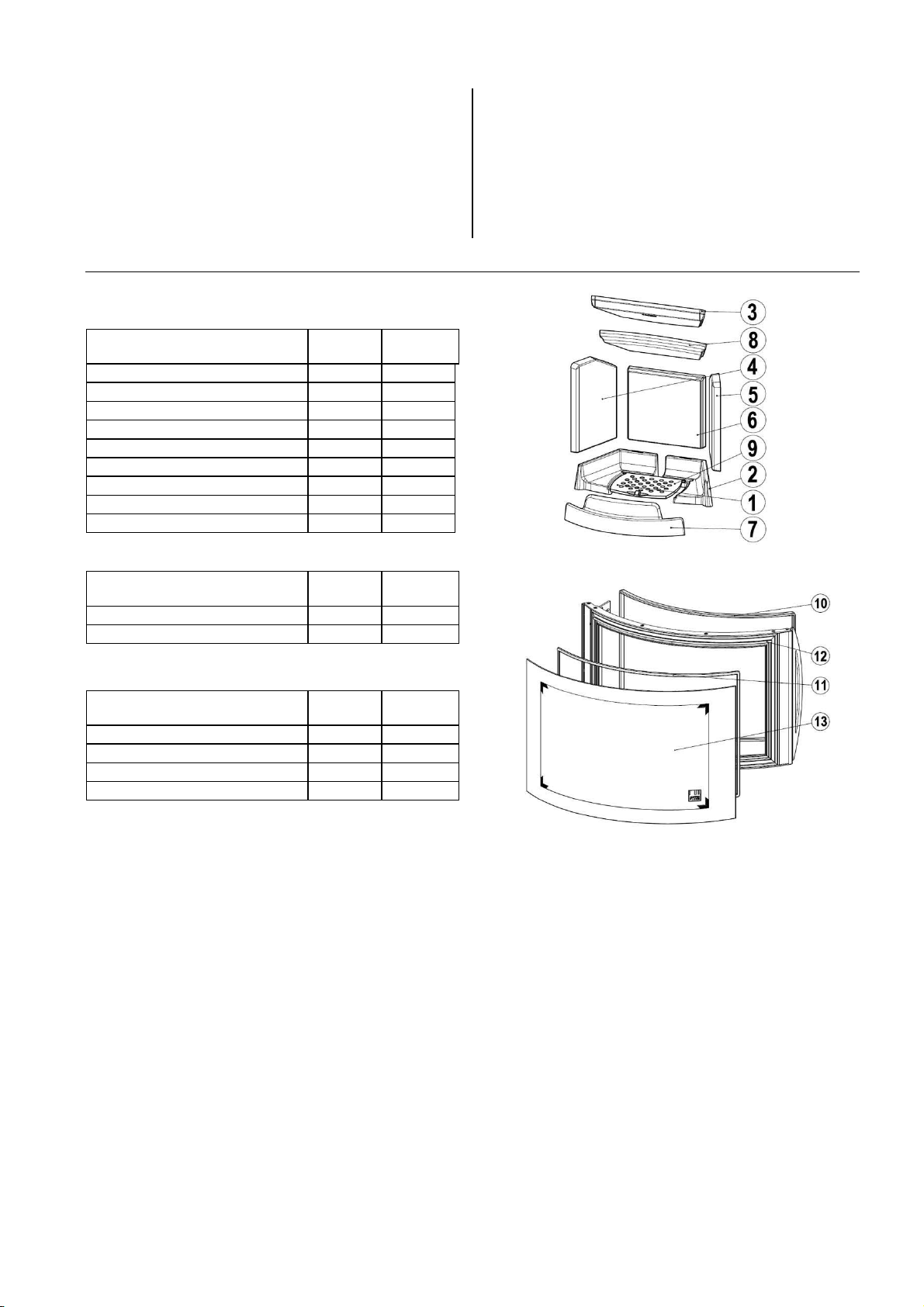
4. THE MOST IMPORTANT SPARES—OVERVIEW
Keramott
Part
Description No.drawing
Bottom left, Keramott 1 720281
Bottom right, Keramott 2 720282
Baffle plate rear 2, Keramott 3 720283
Side component left, Keramott 4 720284
Side component right, Keramott 5 720285
Rear, Keramott 6 720286
Wood retainer, Keramott 7 720287
Baffle plate rear 1, Keramott 8 720288
Grate 9 716408
number
Gaskets
Part
Description No.drawing
Gasket 16x8x, L=1940 mm 10 718764
Gasket 10x5x, L=1890mm 11 718438
number
Keramott numbering = installation instructions!
Other parts
Part
Description No.drawing
door 12 720250
door glass 13 720255
Glass cleaner ½ litre -- 640070
Stove lacquer -- 650002
number
Accessories
You can obtain floor plates of glass or steel or care products from your certified dealer.
IMPORTANT: Have defective parts replaced by your certified dealer. This will guarantee that your stove functions
properly and safely.
The fireplace must not be attered.
Maintenance
To clean the glass, please use a specialised product such as Thermohit glass cleaner. Lacquered surfaces are to be
cleaned only with a cloth (may be damp). Special cleaning agents should also be used for stainless steel surfaces. Only
gaskets in good order ensure the proper function of your stove!
Cleaning
The stove, flue outlets and smoke pipes should be cleaned and inspected for deposits every year – if necessary more often,
e.g. after the cleaning of the chimney. The chimney also has to be cleaned regularly by the chimneysweeper. Your
chimneysweeper will inform you of the necessary inspection intervals. An expert should inspect the stove annually.
Page 10
english 8 Fynn Xtra
5. SPECIAL FEATURES Fynn Xtra
Xtra heat storing technology
The models Fynn Xtra have been equipped with the unique Xtra heat storing technology. This technology is based on the
patented Heat Memory System, but also on the special flue gas guidance and the convection air which can be regulated or
shut off completely. Consequently a fast heating system is being combined with an extraordinarily efficient heat storing.
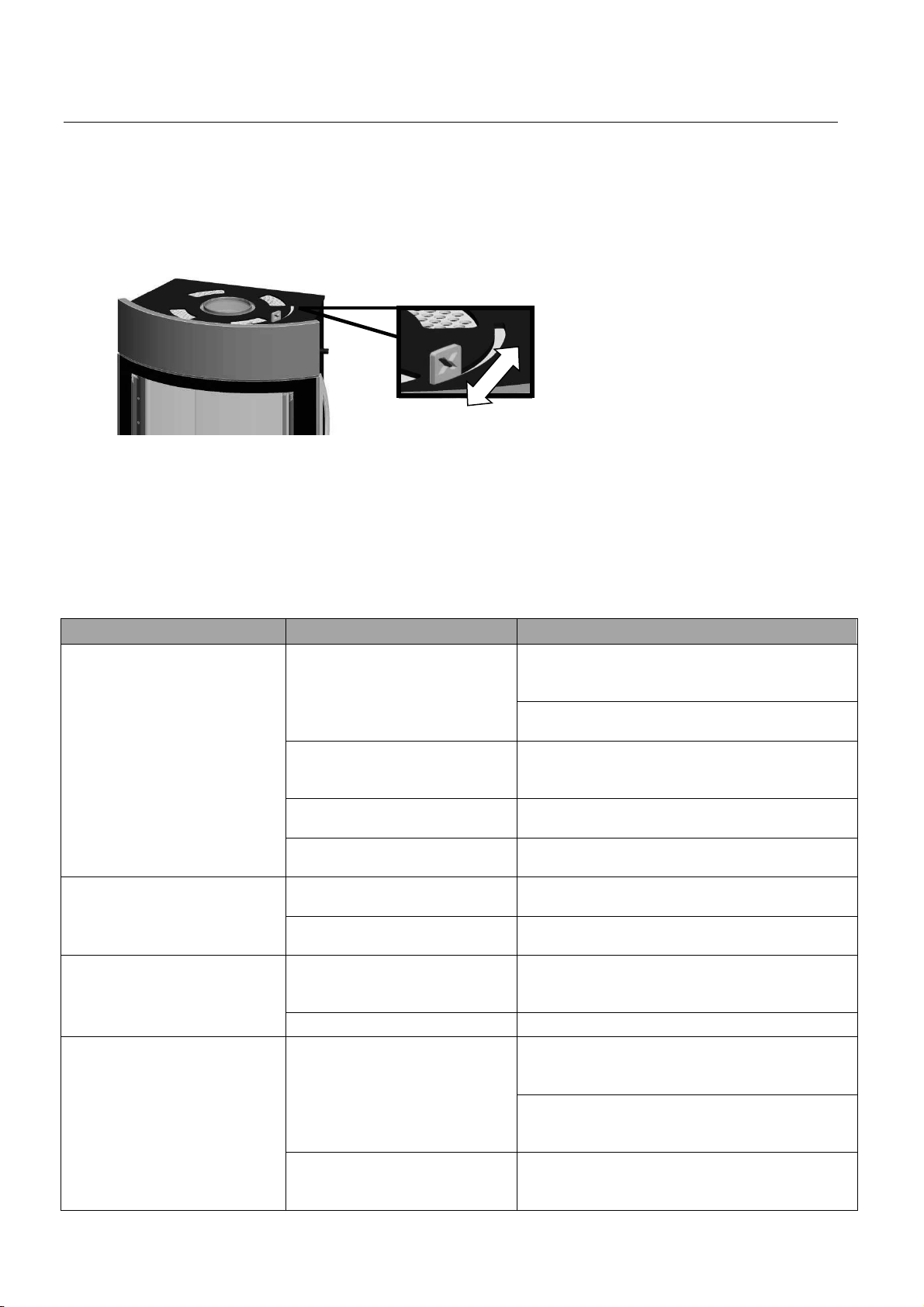
The convection air can be regulated according to demand with the attached lever (see picture). The more the convection air
outlets of the top plate are open, the faster heat but less heat storing can be reached. A closed top plate will however lead to
slow heat and longer heat storing.
Konvektionsluftschieber
Konvektionsluftschieber = convection air lever
Our hint: while the fire still burns let the convection air outlets open; close them after the fire has burnt down in order to reach
a steady heat emission.
Operation with external air supply
Fynn Xtra can be operated with an external air connection. If the combustion air is being supplied directly to the furnace by
an air-tight pipe including closing mechanism from the outside, then the stove may be used in residential property with
mechanical ventilation.
If the stove in being used like that, a multiple stove installation on the same chimney is forbidden.
problem possible reason solution
generally: door glasses must be cleaned with
Austroflamm glass cleaner from time to time
(depending on the frequency of use)
contact your chimney sweep (elongate
chimney/draught metering)
please operate air lever according to user's
instructions (if secondary air is closed, the door glass
soots rather fast)
keep to the max. fuel quantity according to user's
instruction
more fuel, use dry wood (< 15 % residual moisture),
attend air regulation
contact your chimney sweep (elongate
chimney/draught metering)
more fuel, use dry wood (< 15 % residual moisture),
attend air regulation
there may be some odour development during the
first operations
door glass gets sooty too fast
stove does not get enough
combustion air
stove smells strongly and there is
smoke on the outside surface
bad chimney draught
incorrect use of the combustion air
supply lever
wood logs are too large
operating temperature was not
reached
chimney draught not sufficient
stove is sooted inside
baking phase of the varnish
stove is dusty/dirty cleaning before the heating season starts!
exhaust gas emission while
putting more wood on the fire and
during operation
chimney draught no sufficient, flue
pipe connection leaky
the stove door was opened before
the wood has burnt down to
embers
inspect joints and seal up again if necessary
check chimney draught, examine operating - for info
video follow:
http://www.austroflamm.com/de/Video/index.html
put more fuel wood into the combustion chamber
only if there are only embers left (no more visible
flame)
Page 11
italiano 9 Fynn Xtra
1. DATI TECNICI
Questa stufa-caminetto (Kaminofen del tipo Bauart 1) è
adatta per essere collegata ad una canna fumaria già
utilizzata per altre stufe o fonti di calore che impiegano
combustibili solidi, se le dimensioni della canna fumaria lo
consentono (norma DIN 4705, Parte 3).
DATI TECNICI
Altezza
Larghezza 656 mm
Profondità 420 mm
Peso 242 mm
Peso HMS 105 kg
Diametro uscita fumi 150 mm
Rendimento nominale 6 kW
Rendimento massimo 8 kW
Rendimento minimo 3 kW
Volume riscaldabile (dipende dalle
condizioni di isolamento )
1120 mm
65-165 m³
Valori delle emissioni per allacciamento multiplo alla
canna fumaria (secondo norma DIN 4705, Parte 3) e per il
calcolo delle dimensioni della canna fumaria (secondo DIN
4705, Parte 2)
Flusso fumi chiuso
Temperatura fumi chiuso
Depressione minima con
rendimento nominale
Con potenza calorifica
nominale di 0,8 volte
chiuso
con r.nom. di 0,8
volte
5,0 g/s
350 °C
12 Pa
10 Pa
2. INFORMAZIONI IMPORTANTI
Questo manuale contiene informazioni generali. Devone
essere rispettate sia le norme nazionale e europee, le
disposizioni locali e le leggi sul edilizia ed anche le
disposizioni dei vigili del fuoco.
Avvertenze generali e precauzioni
nell'impiego della Kaminofen
x Prima di mettere in funzione la stufa vi raccomandiamo
di leggere attentamente l'intero manuale che vi fornisce
importanti informazioni e avvertimenti.
x Per il trasporto della stufa utilizzate mezzi idonei, la cui
portata sia sufficiente a sostenerne il peso.
x Non utilizzate la stufa come se fosse una scala o
un'impalcatura per salirvi sopra.
x Attenzione ! Durante il
funzionamento, la superficie del
apparecchio si riscalda. In caso di
contatto consigliamo l'utilizzo di un
apposito guanto durante il
funzionamento.
x Attenzione – questa vernice non è antiruggine.
x Istruite i vostri bambini su questi inconvenienti e teneteli
lontani dalla stufa quando è accesa.
x Utilizzate solo i combustibili indicati nel capitolo
„Combustibili adatti“.
x Nella camera di combustione non devono essere infilate
e bruciate sostanze facilmente infiammabili od esplosive,
come bombolette spray vuote e simili. E’ severamente
vietato lasciare tali oggetti nelle immediate vicinanze della
stufa (pericolo di esplosione).
x Mentre si ricarica legna nella stufa accesa è sconsigliato
portare capi di abbigliamento che possano prendere fuoco
facilmente.
x Non appoggiate oggetti non resistenti al calore sulla
stufa o nelle sue immediate vicinanze.
x Non mettete ad asciugare biancheria sopra la stufa.
x Stendibiancheria o simili devono essere collocati ad una
distanza adeguata dalla stufa (pericolo di incendio).
x La stufa non e una stufa da tenere in funzione
ininterrotamente.
x Quando la stufa è in funzione è sconsigliato l’ utilizzo di
sostanze facilmente infiammabili o esplosive nella stessa
stanza o in stanze adiacenti.
x L’apparecchio deve funzionare ad antina chiusa.
x Antina e regolazioni devono essere chiusi quando il
modello non è in funzione.
Installazione della stufa
Distanze di sicurezza (distanze minime) Fig. 2
a > 950 mm
b > 330 mm
c > 230 mm
(a – anteriormente nell’area di irradiazione)
(b – lateralmente)
(c – posteriormente)
Il luogo in cui installate la stufa deve disporre di almeno una
porta / finestra che dia all’esterno oppure deve essere
collegato direttamente ad un ambiente con accesso
all’esterno. Non devono essere messi in funzione nella
stessa stanza, altre stufe, caminetti o estrattori fumi.
Portata del pavimento
Prima di installare la stufa, accertatevi che la struttura
sottostante al punto in cui volete sistemarla sia in grado di
sopportarne il peso.
Salvo modifiche di carattere tecnico ed estetico o errori di fotocomposizione e stampa.
Page 12
italiano 10 Fynn Xtra
Fornimento d'arai fresca
Il gestore del focolare deve garantire la fornitura di un
sufficiente volume d'aria fresca. In ambienti con porte e
finestre chiuse ermeticamente la fornitura d'aria fresca non
sempre e'garantita. Questo puo influenzare il tiraggio del
focolare. Eventualmente deve essere previsto un aflusso
d'aria supplementare. Rivolgetevi al vostro rivenditore per
ulteriori informazioni. Assicurarsi che le prese d’aria
comburenti non siano ostruite!
Collegamento del tubo di uscita fumi
Per garantire la vostra sicurezza, il collegamento dei tubi di
uscita fumi alla canna fumaria è regolato da apposite
norme. Per l’installazione e il collegamento rivolgetevi quindi
al vostro rivenditore, che è a conoscenza di tali disposizioni.
3. PER UN USO CORRETTO DELLA VOSTRA KAMINOFEN
Combustibili adatti
Legna naturale e non trattata, secca e sufficiente-mente
depositata (preferibilmente legno resistente/
duro), tronchetti di legno pressato.
Quantità massime di combustibili
La massima quantità di combustibile consigliata: 1,9 kg di
legna o bricchetto per volta. Non introducete quantità
eccessive di combustibile per evitare un surriscaldamento
ed un conseguente danneggiamento della stufa.
Combustione ed ecologia
Per ottenere una combustione corretta con un minimo di
emissioni la legna deve essere secca (< 15 % di umidità
relativa) e non trattata e non si devono superare le quantità
di combustibile consigliate.
Chiudete la porta!
Lasciate ardere la prima carica di legna senza modificare la
posizione della regolazione dell'aria.
Potete procedere alla successiva carica di legna (ca. 1,6 kg)
quando all'interno della camera di combustione sono
rimaste solo le brace (e si vedono più le fiamme).
Quest’operazione va ripetuta per ogni carica successiva:
aprite la levetta della regolazione dell'aria spostandola in
posizione "alto/aperto", poi aprite l'anta, aggiungete la legna
e richiudete infine l'anta.
Prime accensioni
Durante le prime 3-4 accensioni – a regime normale – la
vernice, biscottandosi, può liberare odore.
Per una corretta accensione
Per un utilizzo corretto e sicuro della vostra stufa-caminetto
occorre prestare attenzione che all’interno della canna
fumaria si sviluppi un tiraggio adatto. Soprattutto durante
ogni prima accensione (per esempio dopo il periodo estivo)
e durante le stagioni transitorie di primavera e autunno (per
esempio sotto condizioni di forte vento) questo controllo è
molto importante. Se il tiraggio è insufficiente, potete usare
carta o trucioli di legno dolce per portare a temperatura la
stufa o il caminetto.
La presa d’aria non deve mai essere tappata o chiusa.
Durante le operazione di pulizia griglia o svuotamento
ceneri, da eseguire all’occorrenza, prestare attenzione alle
braci.
Tirate in alto la regolazione dell'aria (vedi fig.2, vedi anche
fig. 4).
Sistemate in diagonale 2 -3 ceppi di legna (peso totale ca.
1,1 kg) sul fondo della camera di combustione, ad una
distanza sufficiente l'uno dall'altro (minimo 2 cm) (1).
Distribuite sopra di essi ca. 0,5 kg di trucioli di legno dolce
(2) infine posizionate l'accendi fuoco e accendete (3). (vedi
fig. 3)
Spiegazione dei simboli
Fig. 4: Regolazione della levetta dell'aria
Quando i ceppi avranno iniziato ad ardere bene (fiamma è
chiara e alta – vedi fig. 5), potete regolare il rendimento
della stufa con la levetta della regolazione dell'aria ( la
levetta in posizione alta corrisponde alla rendimento
massimo). Qualora la fiamma sia blu anziché gialla oppure
nera in punta aprite la levetta della regolazione d'aria per
aumentare l'alimentazione d'aria - vedi fig.4. Non chiudete
completamente la regolazione d'aria durante il
funzionamento. (pericolo d’incendio!)
Si consiglia di aprire l’antina solo per il ricaricamento di
legna o la sistemazione delle braci e di richiuderla poi
immediatamente.
3
III. Fig. 5
1
2
Spiegazione dei simboli
lIl. Fig. 3 : Accensione
Page 13
italiano 11 Fynn Xtra
gg
Il riscaldamento durante le mezze stagioni
Se accendete la stufa durante le mezze stagioni, quando le
temperature sono più elevate, possono sussistere
condizioni di tiraggio sfavorevolli in modo tale da non
evacuare il fumo interamente, specialmente se le
temperature si alzano in modo repentino. Consigliamo
quindi di caricare meno legna e di tenere la presa d'aria
aperta del tutto per permettere una combustione più
rapida, con una fiamma più alta. In tal modo il tiraggio della
canna fumaria si stabilisce.
Autocombustione della canna fumaria
Fuliggine e depositi causati da legna inadeguata o troppo
umida possono provocare l'autocombustione della canna
fumaria. Chiudete immediatamente tutte le prese d'aria
presenti su stufa e camino e chiamate i vigili del fuoco. Fate
poi ispezionare la vostra canna fumaria da personale
specializzato che ne verifichi le crepe e la tenuta.
4. PROSPETTO DEI RICAMBI PRINCIPALI
Guarnizioni
Denominazione N. su dis. N. art.
Guarnizione 10x5, L=1940 mm 10 718764
Guarnizione 16x8, L =1890 mm 11 718438
Keramott
Denominazione N. su dis. N. art.
Keramott di basa sinistra 1 720281
Keramott di basa destra 2 720282
Keramott tagliafiamme 2 3 720283
Keramott lateral sinistra 4 720284
Keramott lateral destra 5 720285
Keramott posteriore 6 720286
Keramott fermalegna 7 720287
Keramott tagliafiamme 2 8 720288
Griglia 9 716408
Numerazione dei refrattari = ordine da seguire per il
monta
io!
Altre parti
Denominazione N. su dis. N. art.
Porta 12 720250
Yan Xtra vetroceramico antina 13 720255
Detergente vetroceramico 0,5 l -- 640070
Vernice -- 650002
Accessori
Presso il vostro rivenditore potete acquistare basi di protezione in vetro o acciaio e prodotti per la cura e pulizia.
IMPORTANTE: per la sostituzione di parti difettose rivolgetevi esclusivamente al vostro rivenditore di Kaminofen, in
questo modo avrete la garanzia che la vostra stufa continuerà a funzionare in modo corretto e sicuro.
Il focolalere non deve essere modificato.
Pulizia
Per la pulizia del vetro ceramico dell'antina utilizzate gli appositi prodotti in vendita presso i rivenditori di stufe (ad es.
Thermohit). Le superfici laccate della stufa vanno pulite solamente con un panno (eventualmente umido). Anche le superfici
in acciaio inox vanno trattate con gli appositi detergenti.
Il buon funzionamento della vostra stufa dipende dal buono stato delle guarnizioni.
Stufa, uscite fumi e tubi dovrebbero essere controllati e puliti ogni anno - anche più spesso, se necessario, per esempio in
seguito alla manutenzione della canna fumaria, che dev'essere anch'essa eseguita periodicamente dal servizio
spazzacamino. Sarà proprio il vostro spazzacamino ad indicarvi i regolari intervalli per la manutenzione. Personale
specializzato dovrebbe ispezionare la stufa annualmente.
Page 14
italiano 12 Fynn Xtra
5. speciali caratteristiche Fynn Xtra
Tecnologia di accumulo calore Xtra
Il modelli Fynn Xtra sono stato dotato del rivoluzionario sistema ad accumulo di calore Xtra. Questa tecnologia è
un'evoluzione del consolidato e brevettato Heat Memory System, combinata alla regolazione di evacuazione dei fumi e aria
convettiva la quale può essere regolata fino a totale chiusura. Il risultato è una combinazione perfetta fra rapida diffusione
del calore ed una straordinaria capacità di accumulo e di mantenimento.
L'aria convettiva può essere regolata manualmente attraverso un apposito leverismo (vedi disegno). Più gli spazi convettivi
sul piano superiore sono aperti, più è rapida la diffusione del calore, mentre diminuisce la capacità di accumulo. A piano
superiore chiuso, invece, si beneficia di un elevato mantenimento del calore.
Consiglio: mantenete gli spazi convettivi aperti mentre il fuoco arde; richiudeteli quando la fiamma lascia il posto alle braci
per ottenere un'emissione di calore costante ed equilibrata.
Konvektionsluftschieber = regolazione dell' aria convettiva
Funzionamento con presa d'aria esterna
Il modello Fynn Xtra è dotato anche di una presa d'aria esterna .
E' possibile installare la stufa caminetto in ambienti nei quali viene utilizzato un sistema di aereazione meccanico se
l'alimentazione con aria comburente avviene dall'esterno tramite un condotto ermetico dotato di valvola registro aria.
In caso di funzionamento con presa d'aria esterna non è consentito l'allacciamento multiplo ad una singola canna fumaria.
problema possibile causa soluzione
in generale: i vetri antina devono essere puliti
saltuariamente con un prodotto specifico (secondo la
frequenza di utilizzo)
contattate lo spazzacamino di fiducia (allungare il tratto
di evacuazione fumi)
la leva della presa d'aria deve essere utilizzata come da
manuale (se la presa d'aria secondaria è chiusa, il vetro
si annerisce più rapidamente)
rispettate le quantità di carico combustibile indicate sul
manuale
aggiungere legna con basso tasso d'umidità (< 15 %),
regolare presa d'aria
contattate lo spazzacamino di fiducia (allungare il tratto
di evacuazione fumi)
aggiungere legna con basso tasso d'umidità (< 15 %),
regolare presa d'aria
può svilupparsi un forte odore durante le prime
accensioni
prima della stagione, procedere ad una pulizia generale
della stufa
il vetro si annerisce troppo
velocemente
la stufa non riceve sufficiente
aria comburente
la stufa libera un forte odore
ed il rivestimento esterno fa
fumo
cattivo tiraggio
uso improprio della presa d'aria
comburente
i ceppi sono troppo grandi
non è stata raggiunta la
temperatura interna necessaria
tiraggio insufficiente
la stufa è sporca internamente
fase di indurimento della vernice
la stufa è sporca / impolverata
fuoriuscita di fumo durante
operazione di ricaricamento e
durante il funzionamento
tiraggio insufficiente, perdita nel
condotto fumario
l'antina è stata aperta prima che la
legna diventasse brace
controllate le guarnizioni e risigillate se necessario
controllate il tiraggio, controllate modalità d'uso - per
info video: http:
www.youtube.com/watch?v=5Mg5MahGEwA
ricaricare solo quando la legna si è trasformata in brace
(e la fiamma non è più visibile)
Page 15
français 13 Fynn Xtra
1. CARACTÉRISTIQUES TECHNIQUES
Le poêle de type 1 peut être raccordé à une cheminée déjà
occupée par d’autres poêles ou cuisinières à combustibles
solides, à condition toutefois que les dimensions de la
cheminée selon la norme DIN 4705 Partie 3 l’autorisent.
CARACTÉRISTIQUES TECHNIQUES
Hauteur 1120 mm
Largeur
Profondeur 420mm
Poids 242 kg
Poids HMS 105 kg
Diamètre à la base du carneau 150 mm
Puissance calorifique selon EN 13240 6 kW
Puissance calorifique maximale 8 kW
Puissance calorifique minimale 3 kW
Volume chauffé (selon
l’isolation du bâtiment)
656 mm
65-165 m³
Caractéristiques des gaz de combustion en vue de
l’installation de plusieurs appareils sur une cheminée
selon DIN 4705 Partie 3 ou du dimensionnement de la
cheminée selon DIN 4705 Partie 2
Débit de gaz de combustion fermé 5,0 g/s
Température des gaz de
combustion
Pression d’extraction minimale
à la puissance nominale
fermé
fermé 12 Pa
à 0,8 fois la
puissance
nominale
350 °C
10 Pa
2. INFORMATIONS IMPORTANTES
Les informations dans ce manuel, sont présentées d’une
façon générale. Les normes nationales et européennes,
les directives de construction régionales ainsi que les
accords concernant la sécurité incendie sont à respecter.
Remarques générales concernant la
sécurité
x Lisez attentivement l’ensemble du manuel avant de
mettre le poêle en service et respectez les avertissements
relatifs à la sécurité.
x Le transport de l’appareil doit toujours être effectué au
moyen d’un appareillage de capacité suffisante.
x Le poêle ne doit pas être utilisé comme marchepied ou
estrade.
x Merci de prêter attention à la surface
du poêle qui devient trés chaude
pendant son fonction-nement. Nous
recom-mandons d’utiliser le gant de
protection.
x Attention – la peinture n’est pas une protection antirouille.
x Expliquez bien le risque de brûlures à vos enfants et
tenez-les éloignés de l’appareil lorsque celui-ci fonctionne.
x Utilisez toujours le combustible autorisé selon le chapitre
« Combustion non polluante ».
x La combustion ou l’introduction de matières très
inflammables ou explosives dans le foyer, par exemple de
bombes aérosols vides, est strictement interdite en raison
du risque d’explosion, de même que la conservation de tels
produits à proximité de l’appareil.
x Les étendages et égouttoirs à linge ou autres doivent
être placés suffisamment loin de l’appareil pour éviter tout
risque d’incendie.
x Lorsque le poêle est en marche, ne travaillez jamais
avec des matières facilement inflammables ou combustibles
dans le local où il se trouve ni dans une pièce adjacente.
x Le poêle est un chauffage d'appoint.
x L’appareil doit être utilisé portes fermées.
x La porte ainsi que tous les équipements de réglage de
l’appareil sont à fermer quand celui-ci ne fonctionne pas.
Installation du poêle
Distances de sécurité à respecter (distances
minimum – voir également plaque d’identification) (Fig. 2)
a > 950 mm - sur l’avant dans la zone
de rayon nnement
b > 330 mm – sur les côtes
c > 230 mm – sur l’arrière
Attention: le local dans lequel vous installez le poêle doit
être pourvu au minimum d’une porte ou d’une fenêtre
donnant à l’extérieur, ou communiquer avec une autre pièce
donnant à l’extérieur.
Capacité portante du sol
Avant d’installer l’appareil, vérifiez si le sol pourra en
supporter le poids.
Sous réserve de modifications techniques et optiques, ainsi que d'erreurs de composition et d'impression.
x Ne rechargez pas le poêle alors que vous portez des
vêtements amples ou en matières inflammables.
x Il est interdit de déposer des objets ne résistant pas à la
chaleur sur l’appareil ou à proximité.
x Ne faites pas sécher de linge sur le poêle.
Page 16
français 14 Fynn Xtra
Air de combustion
En tant qu’utilisateur, vous devez faire en sorte qu’il y ait
suffisamment d’air de combustion. Si toutes les fenêtres et
portes sont fermées hermétiquement , il se peut que l’entrée
d’air frais ne se fasse plus correctement voire même que le
tirage du poêle en soit affecté. Dans ce cas, une arrivée
d’air frais supplémentaire est nécessaire. Merci de vous
adresser alors à votre revendeur. Assurez-vous que les
ouvertures de combustion ne soient pas obstruées !
Raccordement au conduit de cheminée
Pour votre sécurité, des consignes strictes doivent être
respectées pour le raccordement des tuyaux au conduit.
Votre installateur professionnel connaît bien ces règles. Il
faut donc impérativement confier à ce professionnel le
raccordement au conduit.
3. POUR BIEN UTILISER VOTRE POÊLE
Combustibles autorisés
Bois naturel sec et bien conservé, briquettes de bois.
Quantité maximale de combustible
Au maximum 1,6 kg de bois ou de briquettes. N’utilisez pas
plus de combustible, sous peine de provoquer une
surchauffe qui endommagera le poêle.
Combustion non polluante
Le bois doit être sec (humidité relative < 15 %) et non traité.
Il doit être utilisé en quantité adéquate pour obtenir une
combustion propre et dégageant peu d’émissions.
Fermer la porte !
Le mieux est de laisser cette charge brûler sans modifier la
position de la manette d’arrivée d’air.
Et seulement quand il n’y a plus qu’un tas de braise (plus de
flammes donc), vous pouvez, si vous le souhaitez, remettre
des bûches de bois (env. 1,6 kg).
Au moment de la recharge, procédez de la même façon
qu’à l’allumage : manette d’arrivée d’air sur position en haut,
ouvrir la porte prudemment, poser le bois, fermer la porte.
Mise en service
Lors des 3-4 premiers feux, en puissance nominale, des
odeurs peuvent se faire sentir, dûes à la peinture pas
encore durcie.
Pour bien faire du feu
Pour un fonctionnement correct et sécurisé de votre
appareil de chauffe, il faut vérifier que le conduit produit
suffisamment de tirage (pression de refoulement). Cela doit
tout particuliérement être contrôlé à chaque début de saison
(aprés l’été) et dans les intersaisons (en cas de vent fort par
exemple). Si le tirage dans le conduit n’est pas assez
important, il suffit de brûler tout d’abord du papier ou du petit
bois pour amener le poêle et le conduit à température.
L’arrivée d’air ne doit pas être obstruée.
Nettoyer la grille et au besoin vider le cendrier (attention aux
braises !).
Tirer la manette de l’arrivée d’air vers en haut (voir position
image 2 et image 4).
Poser 2-3 bûches (en tout 1,1 kg) dans le travers du foyer,
avec suffisamment de distance entre elles (au moins 2 cm)
(1). Ensuite ajouter environ 0,5 kg de petit bois (2). Puis
poser dans le milieu un allume-feu et allumer. (3) (voir
image 3)
Fig. 4: régler l’arrivée d’air
Dés que les bûches de bois sont bien enflammées – aprés
quelques minutes (flammes claires et hautes – voir image
5), vous pouvez alors réduire l’arrivée d’air (manette sur
position maximale en haut = puissance de chauffe
maximale) mais les flammes doivent rester bien jaunes et
ne jamais devenir bleues ou présenter des pointes noires
(sinon il faut faire entrer plus d’air) – voir image 4. Lors de la
flambée il ne faut jamais fermer l’arrivée d’air complétement.
(risque d’explosion!)
La porte du foyer ne peut être ouverte que pour recharger
du bois ou enlever la cendre et doit ensuite être refermée.
1
2
Fig. 5
3
Représentation des symboles
Fig. 3: Allumage
Page 17
français 15 Fynn Xtra
Chauffer à la mi-saison
A la mi-saison, c’est-à-dire quand les températures
extérieures sont plus élevées, il arrive que le tirage du
conduit de cheminée soit mauvais à cause de l’élévation
soudaine des températures : les gaz ne sont pas
complètement tirés vers le haut.
Il faut alors remplir la cheminée avec des quantités de bois
moindres et ouvrir le régulateur d’air primaire à fond afin
que le combustible brûle plus vite (formation de flammes),
ce qui stabilisera le tirage du conduit.
Information en cas d’incendie dans le
conduit
En cas d’utilisation d’un mauvais combustible ou d’un
combustible trop humide, il en résulterait des dépôts dans le
conduit qui pourraient alors provoquer un incendie.
Fermez aussitôt toutes les arrivées d’air de la cheminée et
prévenez les pompiers.
Après l’incendie, faîtes vérifier votre conduit par un
spécialiste car il peut avoir subi des dommages (félures,
détérioration de l’étanchéité).
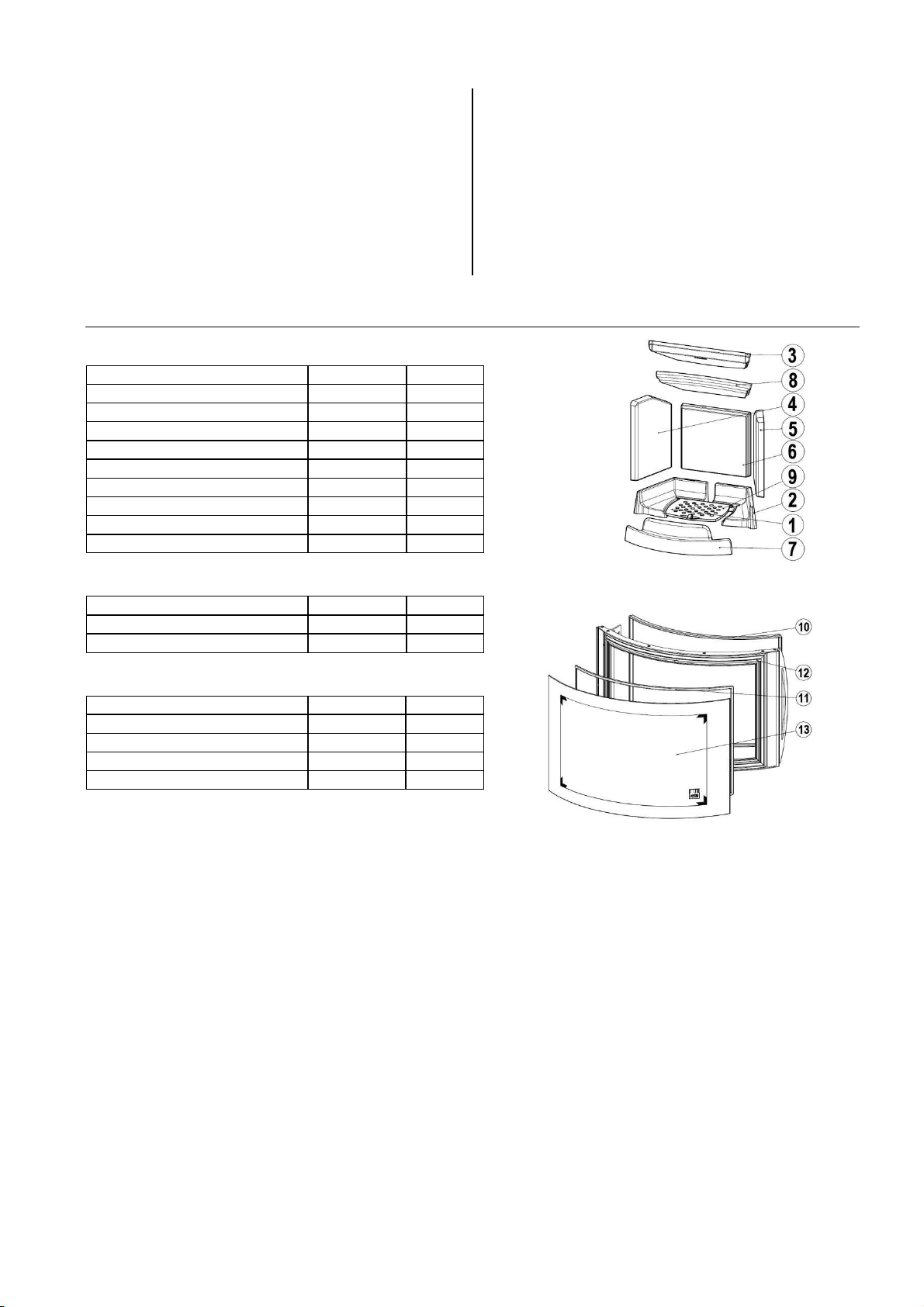
4. PRINCIPALES PIÈCES DÉTACHÉES
Céramique réfractaire
Désignation N° sur schéma Réf. article
Keramott en bas à gauche 1 720281
Keramott en bas à droit 2 720282
Keramott déflecteur 2 3 720283
Keramott côté gauche 4 720284
Keramott côté droit 5 720285
Keramott au centre 6 720286
Keramott pare-bûche 7 720287
Keramott déflecteur 1 8 720288
Grille 9 716408
Joints
Désignation N° sur schéma Réf. article
Joint 10x5, L= 1940 mm 10 718764
Joint 16x8, L= 1890 mm 11 718438
Numérotation des céramiques réfractaires =
instructions de montage !
Autres
Désignation N° sur schéma Réf. article
Porte 12 720250
Vitre du porte 13 720255
Nettoyant pour vitres 0,5 l -- 640070
Vernis pour poêle -- 650002
Accessoires
Vous trouverez chez votre revendeur spécialisé des plaques de fond en verre ou en métal et des produits d’entretien.
IMPORTANT: Les pièces défectueuses doivent toujours être remplacées par votre revendeur spécialisé, afin que le
poêle reste sûr et en bon état de marche.
L'appareil ne doit pas être modifié.
Entretien
Pour le nettoyage de la vitre, utilisez un produit pour vitre comme "Thermohit". Les parties laquées doivent être nettoyés
uniquement avec un chiffon (éventuellement humide). Utilisez pour les superficies en inox, des produits spéciaux prévus
pour ce revêtement.
Seuls des joints en parfait état garantissent un fonctionnement impeccable de votre poêle à bois .
Nettoyage
Le poêle, le dispositif d’évacuation des fumées et les tuyaux doivent être contrôlés et en cas de dépôts, être nettoyés au
moins une fois par an, si ce n’est plus, par exemple lors du ramonage du conduit de cheminée. Le conduit doit également
être nettoyé régulièrement par un ramoneur. C’est celui-ci qui vous indiquera dans quelles intervalles un ramonage est
nécessaire. Le poêle doit être vérifier une fois par an par un spécialiste.
Page 18
français 16 Fynn Xtra
5. PARTICULARITES DU Fynn XTRA
Technologie d’accumulation de chaleur Xtra
Les modèles Fynn Xtra sont équipés du système unique en son genre d’accumulation de chaleur Xtra. Celui-ci est fondé sur
la base du système breveté Heat Memory System, mais aussi sur la circulation spéciale des fumées ainsi que sur l’air de
convection que l’on peut régler voire complétement couper. On combine ainsi un système de chauffe trés rapide avec une
accumulation de chaleur exceptionnelle.
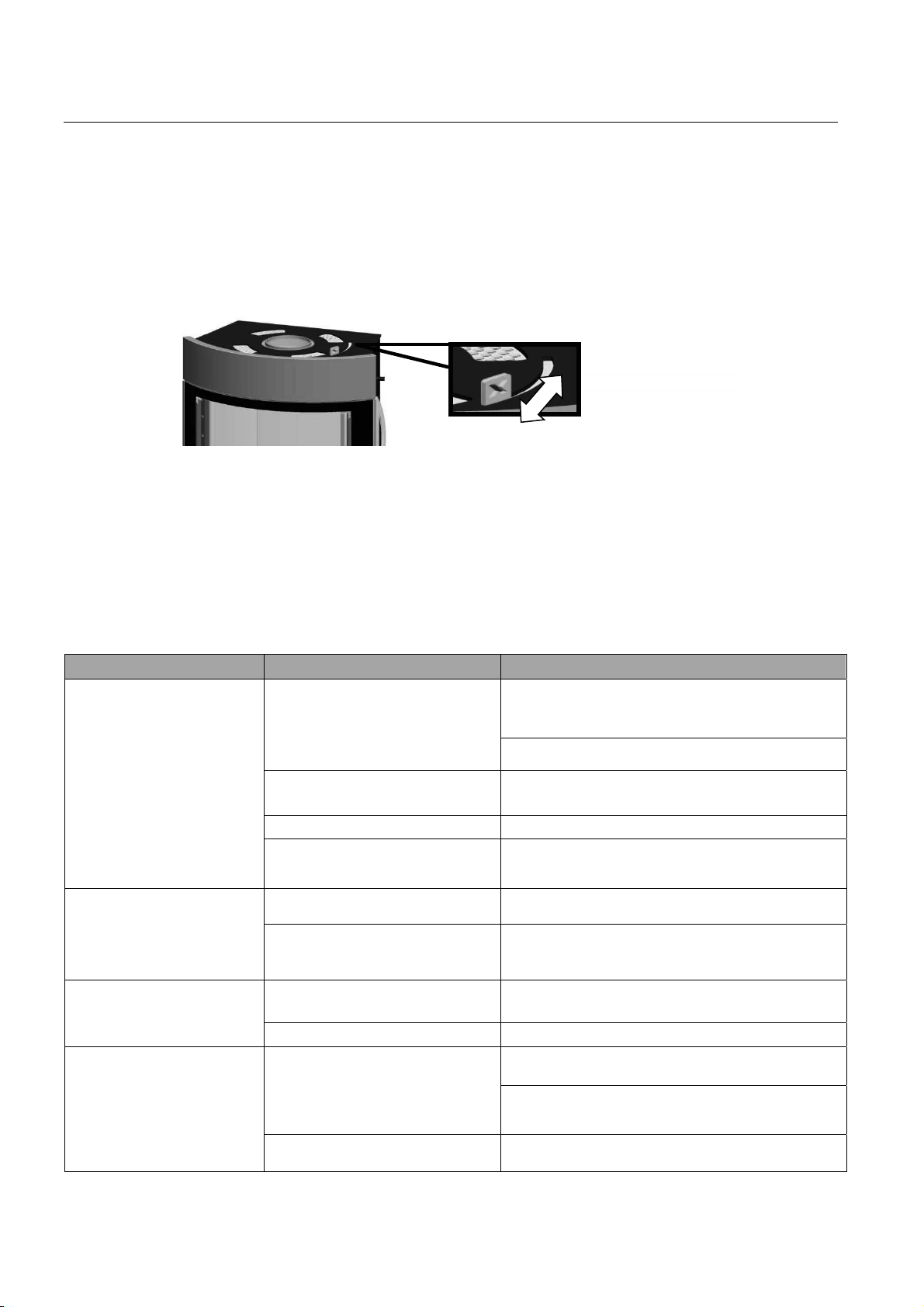
Vous pouvez régler l’arrivée d’air de convection selon vos besoins grâce à la manette prévue à cet effet (voire photo). Plus
les ouvertures laissant passer l’air de convection dans le couvercle sont ouvertes, plus vite vous atteindrez une chaleur
agréable mais qui en contrepartie tiendra moins longtemps. Par contre un couvercle fermé permet de chauffer plus
lentement avec une restitution de la chaleur bien plus longue.
manette de régulation de
l’air de convection
Notre conseil : pendant l’utilisation, laisser l’air de convection ouvert puis fermer pour obtenir une restitution de la chaleur
régulière et longue.
Utilisation indépendante de l’air ambiant
Le modèle Fynn Xtra peut également être utilisé en tant que poêle fonctionnant à l’air indépendant de la piéce. Dans le cas
où l’air de combustion et ammené directement de l’extérieur vers la chambre de combustion moyennant une prise d’air
extérieur étanche munie d’un système de verouillage, le poêle peut être utilisé dans des pièces équipées de systèmes
mécaniques d’aération ou d’évacuation d’air.
Si le poêle est installé dans ce genre de pièce, une utilisation multiple du conduit de cheminée n’est pas autorisée.
problème cause solution
En règle générale, il est nécessaire de nettoyer
chaque vitre de temps en temps (selon utilisation)
avec un produit nettoyage vitre Austroflamm
A vérifier avec l'installateur (surélever éventuellement
le conduit / mesurer le tirage)
Vérifier absolument la notice d'utilisation (si l'air
secondaire est fermé, la vitre noircit trés vite)
Utiliser plus de combustible, du bois bien sec (< 15%
d'humidité), ne pas fermer complétement l'arrivée
d'air.
Vérifier avec l'installateur (surélever le conduit /
mesurer le tirage)
Utiliser davantage de combustible, du bois bien sec (<
15% d'humidité), ne pas fermer complétement
l'arrivée d'air.
Lors des premiers feux, la peinture dégage une forte
odeur
Vérifier les points de raccordements, changer
éventuellement les joints
Vérifier le tirage, vérifier le mode d'utilisation Regarder la vidéo
http://www.austroflamm.com/de/Video/index.html
Ne recharger que lorsqu'il ne reste que de la braise
(plus de flammes visibles)
La vitre noircit trop vite
Le poêle ne tire pas
correctement
Le poêle dégage de fortes
odeurs et fume à l’extérieur
Dégagement de fumées lors
de la recharge et de la
chauffe
mauvais tirage
mauvaise utilisation de la manette
d'arrivée d'air
Bûches de bois trop grosses Respecter la quantité de bois recommandée
Température de fonctionnement non
atteinte
Tirage du conduit insuffisant
Le poêle est noir de suie à l'intérieur
Période de cuisson de la peinture
Le poêle est poussiéreux, sale Nettoyer avant le début de la saison!
Tirage insuffisant, raccordement
non étanche
La porte a été ouverte, avant que
tout le bois soit devenu de la braise
Page 19

GARANTIE / GUARANTEE / GARANZIA / GARANTIE
Garantie
Für Ihren AUSTROFLAMM-Kaminofen garantieren wir
für die einwandfreie Funktion des Korpus 6 Jahre, aller
weiteren Bauteile aus Stahl und Guß 2 Jahre ab dem
Erstverkaufsdatum. Stahl- und Gußteile, die während der
Garantiezeit Material- und / oder Verarbeitungsmängel
aufweisen, werden gegen Neuteile ersetzt.
Wir gewähren keine Garantie auf Verschleißteile (z. B.:
Keramott, Dichtungen, Bodenrost),
Oberflächenbeschichtungen, Lack, Glas und Keramiken.
Voraussetzungen für unsere Garantieleistung sind:
1. Ihr AUSTROFLAMM-Kaminofen wurde gemäß dem
Benutzerhandbuch betrieben und von einem
Fachmann installiert.
2. Der Garantieanspruch wird mit der vollständig
ausgefüllten Garantiekarte und der Rechnung bei
einem AUSTROFLAMM-Fachhändler geltend
gemacht.
Guarantee
We guarantee full functionality of the stove carcass for 6
years and all stove components made of steel or cast
iron for a full two years from the date of purchase. Steel
and cast-iron components which show defect in materials
or workmanship during the guarantee period shall be
replaced with new components.
We do not guarantee wearable components (such as
Keramott, gaskets, floor grid), surface coatings, lacquer,
glass and ceramics.
Conditions of the Guarantee:
1. Your AUSTROFLAMM stove was installed by a
certified professional and is operated in accordance
with the operator’s manual.
2. Claims to the guarantee shall be subject to a
completely filled-out Guarantee Card and submittal
of the original invoice issued by a certified
AUSTROFLAMM sales agent.
WICHTIG: Unsere Garantieleistung umfasst die
kostenlose Zurverfügungstellung der Neuteile.
Arbeits- und Wegzeiten für den Ein- und Ausbau sowie
Liefer- und Versandkosten sind davon nicht umfasst.
Eine ungerechtfertigte Garantieinanspruchnahme wird
dem Betreiber rückbelastet.
IMPORTANT: Our guarantee includes the free
provision of spare parts. Labour and call-out fees for
disassembly and assembly as well as shipping and
handling charges are not included. An unjustified claim
under guarantee will be redebited to the operator.
--------------------------------------------------------------------------------------------------------------------------------
Im Garantiefall herausschneiden und Ihrem AUSTROFLAMM-Fachhändler vorlegen!
In the event of claims to the guarantee, separate here and present this proof of purchase to your certified AUSTROFLAMM dealer.
GARANTIE / GUARANTEE / GARANZIA / GARANTIE
Händlerstempel / Dealer’s Stamp / Timbro concessionario /
tampon du concessionnaire
Serien No. / serial no. / no. di serie / no. de série
(siehe Typenschild / see manufacturer’s plate /
vedi targhetta / voir plaque signalétique)
Kaufdatum / date of purchase / data d’acquisto / date d’achat
Modellname / Name of model / modello / nom du produit
F Y N N X T R A
angeschlossen von / Installed by / installato da / raccordée par
Page 20
GARANTIE / GUARANTEE / GARANZIA / GARANTIE
garanzia
Garantiamo piena funzionalità del corpo stufa per una
durata di 6 anni. I componenti in acciaio o ghisa sono
garantiti due anni dalla data di acquisto. Le parti in
acciaio e ghisa che dovessero presentare difetti di
materiale e/o lavorazione durante il periodo di garanzia
verranno sostituite con parti nuove.
Sono escluse dalla garanzia le parti soggette ad usura
(ad es. elementi in keramott, guarnizioni, griglie della
camera di combustione), nonché i rivestimenti delle
superfici, vernici, vetroceramico ed elementi in ceramica.
Per avere diritto alle prestazioni di garanzia:
1. La vostra Kaminofen AUSTROFLAMM deve essere
installata da personale specializzato e fatta
funzionare osservando le istruzioni del manuale.
2. Occorre presentare la cartolina di garanzia
correttamente compilata e lo scontrino / la fattura / la
ricevuta fiscale ad uno dei rivenditori
AUSTROFLAMM.
IMPORTANTE: La nostra garanzia include la
fornitura gratuita dei pezzi di ricambio. I costi
sostenuti per manodopera, diritti di chiamata, spese di
trasporto e di gestione non sono inclusi. Nel caso in cui
la richiesta di sostituzione in garanzia risultasse
ingiustificata, il costo sarà girato all’utente.
.
Garantie
Nous garantissons le fonctionnement irréprochable du
corps de l'appareil de votre poêle AUSTROFLAMM
pendant 6 ans, toutes les autres pièces en acier et en
fonte étant garanties 2 ans. Les pièces en acier et en
fonte présentant un défaut de matériau et/ou de
fabrication pendant la durée de la garantie seront
remplacées par des pièces neuves
Nous déclinons toute garantie pour les pièces d’usure
(par ex. céramique réfractaire, joints, grille de fond), les
joints de surfaces, la peinture, les vitres et les
céramiques.
Conditions d’application de la garantie :
1. Votre poêle AUSTROFLAMM doit avoir été installé
par un spécialiste et utilisé conformément au mode
d’emploi.
2. La demande de garantie doit être présentée à un
revendeur spécialisé AUSTROFLAMM en même
temps que la carte de garantie complétée et que la
facture.
IMPORTANT : La garantie comprend la mise à
disposition des piéces neuves. La main d’oeuvre et les
trajets ainsi que les frais de livraison et de transport ne
sont pas compris dans la garantie. En cas d’abus du
droit à la garantie, nous pourrions exiger le
remboursement des frais engagés.
Austroflamm GmbH, Austroflamm Platz 1, 4631 Krenglbach, Austria, Stand 012/15
-------------------------------------------------------------------------------------------------------------------------------
In caso di richiesta di garanzia, ritagliare la cartolina e presentarla al rivenditore AUSTROFLAMM!
Découpez selon les pointillés et présentez ce coupon à votre revendeur AUSTROFLAMM.
GARANTIE / GUARANTEE / GARANZIA / GARANTIE
Kunde / Customer / cliente / client
an/ to / per / pour
Marke
Stamp
Francobollo
affranchir
 Loading...