

Page 1
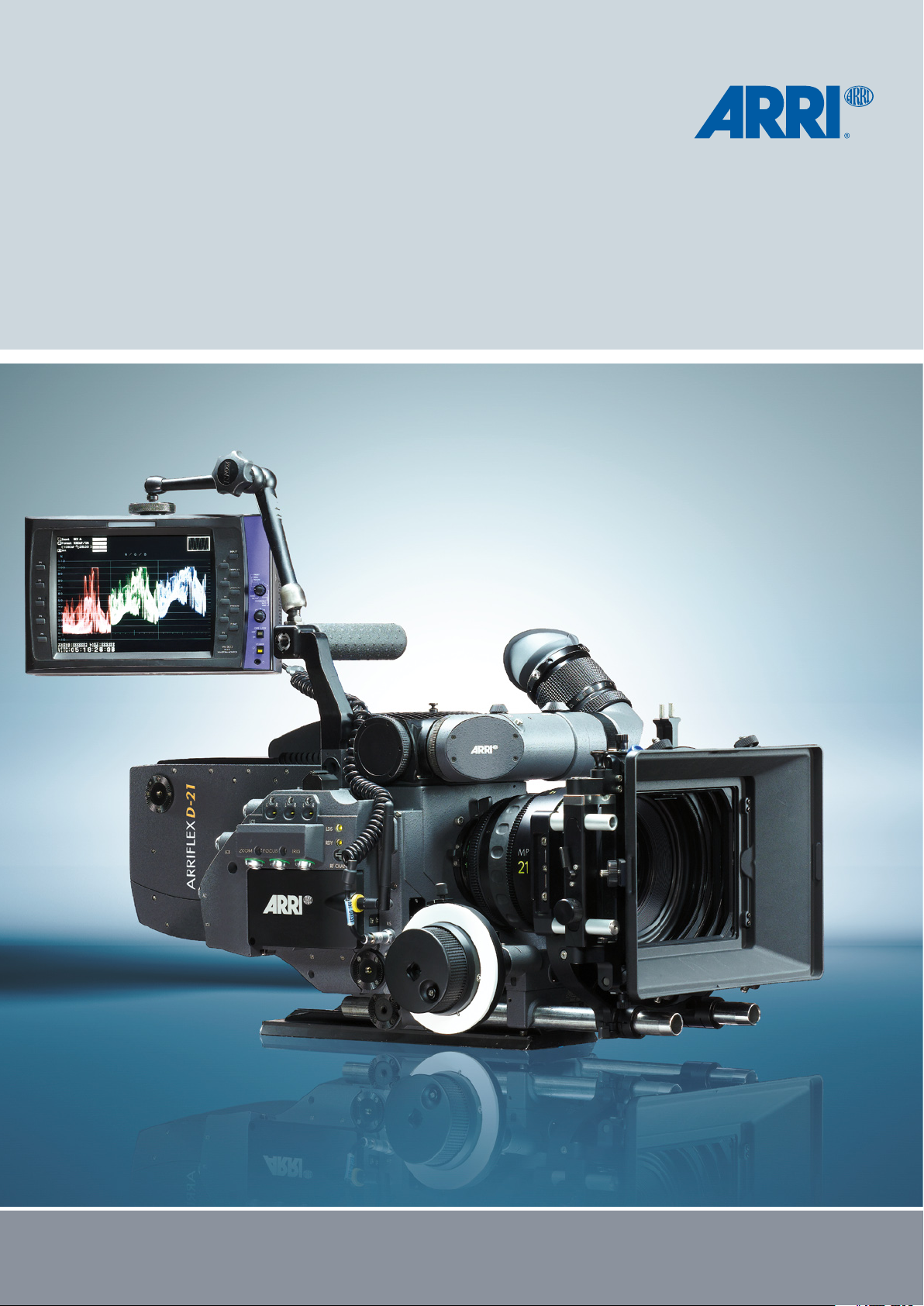
ARRIFLEX D-21 / D-21 HD
The Film Style Digital Cameras
Page 2
2
ARRIFLEX D-21 / D-21 HD
The Film Style Digital Cameras
The ARRIFLEX D-21 and D-21 HD combine leading edge digital technology
with lm camera features that have been rened over ARRI’s 90-year history.
They allow directors and cinematographers to shoot in the same way as
they would with 35 mm lm, while taking advantage of the immediacy and
economy of digital acquisition.
As the top of the line digital cameras from ARRI, the market leader in
professional imaging, they are equipped with a number of unique features:
an optical viewnder, the MscopeTM anamorphic output, a 4:3 format sensor,
simple operation and an unequalled lm-like image quality. In addition, the
D-21 is the only camera capable of simultaneously outputting raw data and HD.
The bright optical viewnder has zero delay, works without power and
shows an image area outside the primary image. Through ARRI Imaging
Technology (AIT), both cameras produces brilliant images with a cinematic
look and feel, a high dynamic range, high contrast and the most lm-like
motion and color reproduction of any digital motion picture camera.
The cameras’ single, Super 35-sized CMOS sensor exhibits the same
cinematic depth of eld as 35 mm lm. The industry standard PL lens mount
accepts the same vast variety of prime, zoom and specialty lm lenses used
on 35 mm lm cameras. Since both cameras are the only digital high-end
cameras with a 4:3 aspect ratio sensor, they easily accommodate all image formats, including anamorphic 2.40:1. The anamorphic image can be
recorded in the new and innovative MscopeTM mode, utilizing a standard HD
workow, or, on the D-21, also in Data Mode.
Further lm style features include variable frame rates from 1 to 60 fps
(D-21)/1-30 fps (D-21 HD), exposure compensated speed ramps, compatibility with ARRI lm style accessories, simple to use controls and the robust
construction and ergonomic design for which ARRI cameras are famous.
The ARRIRAW format enables the D-21 to output raw uncompressed
data. Alternatively, both D-21 and D-21 HD can output an uncompressed
HD signal that works perfectly in the established HD infrastructure. With
such exibility, both ARRIFLEX D-21 and D-21 HD easily adapt to a variety of
production requirements and budgets.
Page 3

3
ARRI | ARRIFLEX D-21 / D-21 HD
Page 4
4
Main Features
n Two Models
ARRIFLEX D-21
· the most versatile lm style digital camera for all applications
· 1 - 60 fps maximum fps range
· raw data, MscopeTM and HD output modes
ARRIFLEX D-21 HD
· the lm style digital camera for HD productions
· 1 - 30 fps maximum fps range
· MscopeTM and HD output modes
n Cinematic Image Quality
· ARRI Imaging Technology for a cinematic look
· rotating mirror shutter for lm-like motion portrayal
· single, Super 35 sized sensor for 35 format depth of eld
· highest dynamic range of any digital motion picture camera
· super sharp, alias-free images
· extended color space for natural, lm-like color reproduction
· consistent matching between cameras
n ARRI Imaging Technology (AIT)
· custom designed CMOS sensor
· powerful imaging hardware engine
· unique ARRI image processing software
· carefully tuned system integration
n Modular Architecture
· sensor, electronics and rmware can be upgraded
· secure investment
· long product cycle
n Flexible Output Option
· 1.33:1 format sensor supports all image formats including anamorphic 2.40:1
· simultaneous data and HD outputs (D-21)
· Mscope: anamorphic images with standard HD workow
· Data Mode: 4:3 ARRIRAW
uncompressed data for lm-like data workow (D-21)
· Data Mode: ARRIRAW T-Link connects camera
to data recorders (D-21)
· HD mode: 16:9 uncompressed HD output
· HD Mode: linear or logarithmic,
4:2:2 YCbCr or 4:4:4 RGB, normal or extended range
· bre optic option allows cable length of up to 500 m/1,600'
Page 5
5
ARRI | ARRIFLEX D-21 / D-21 HD
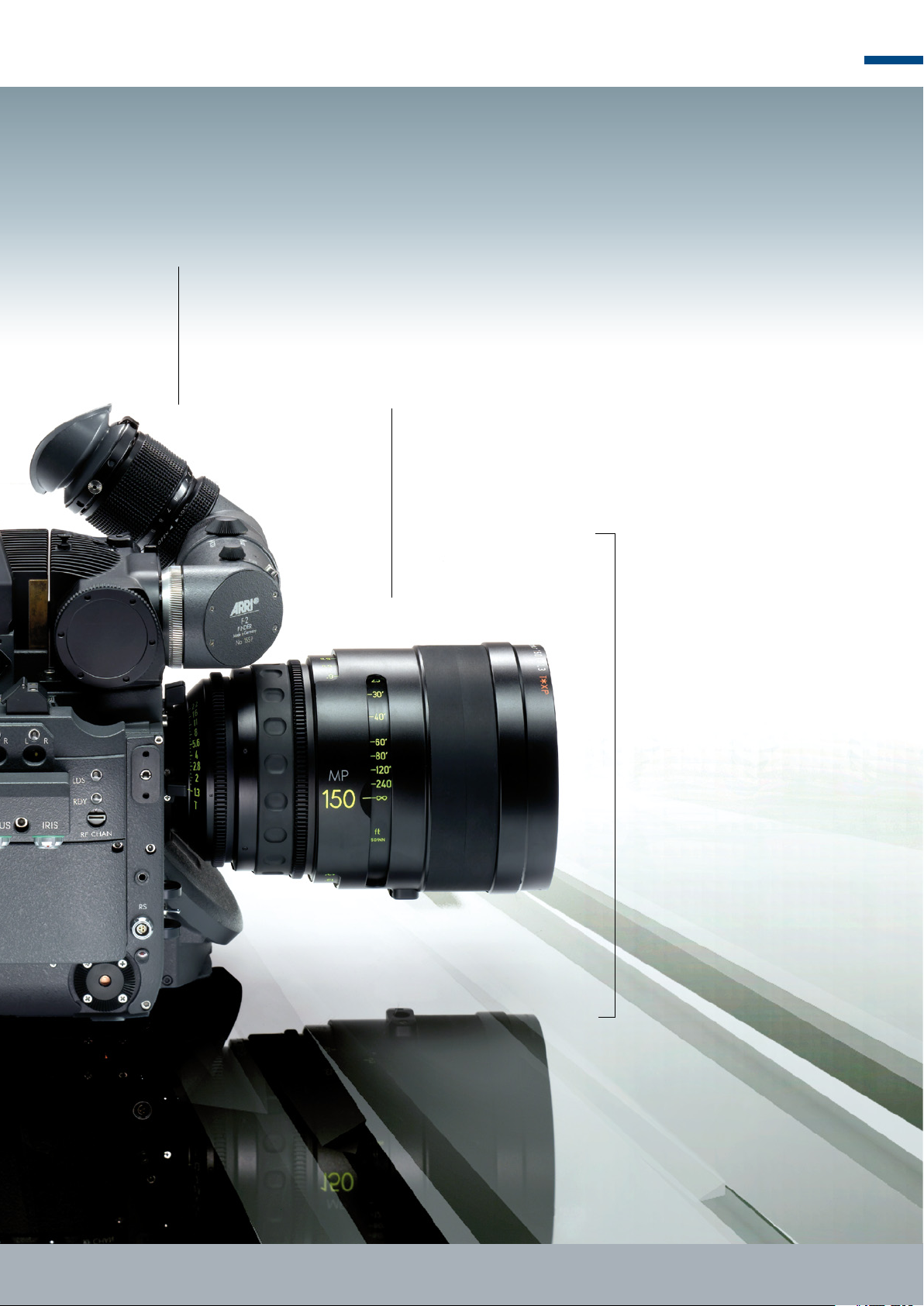
n Optical Viewnder
· zero delay
· outside image area
· bright, full color image
· works without power
· fatigue-free viewing
n Industry Standard PL Mount
· use 35 format lm lenses
· unequalled variety of prime, zoom and specialty lenses
· compatible with spherical and anamorphic lenses
n Compatibility with 35 Format Film
Accessories and Support Equipment
· ARRI matte boxes, follow focus,
wireless remote control
· dollies, cranes, Steadicam, etc.
n A True ARRI Camera
· silent running
· simple operation
· robust construction
· ergonomic design
· variable speed and shutter angle
· exposure compensated speed ramps
Page 6
6
ARRI Imaging Technology
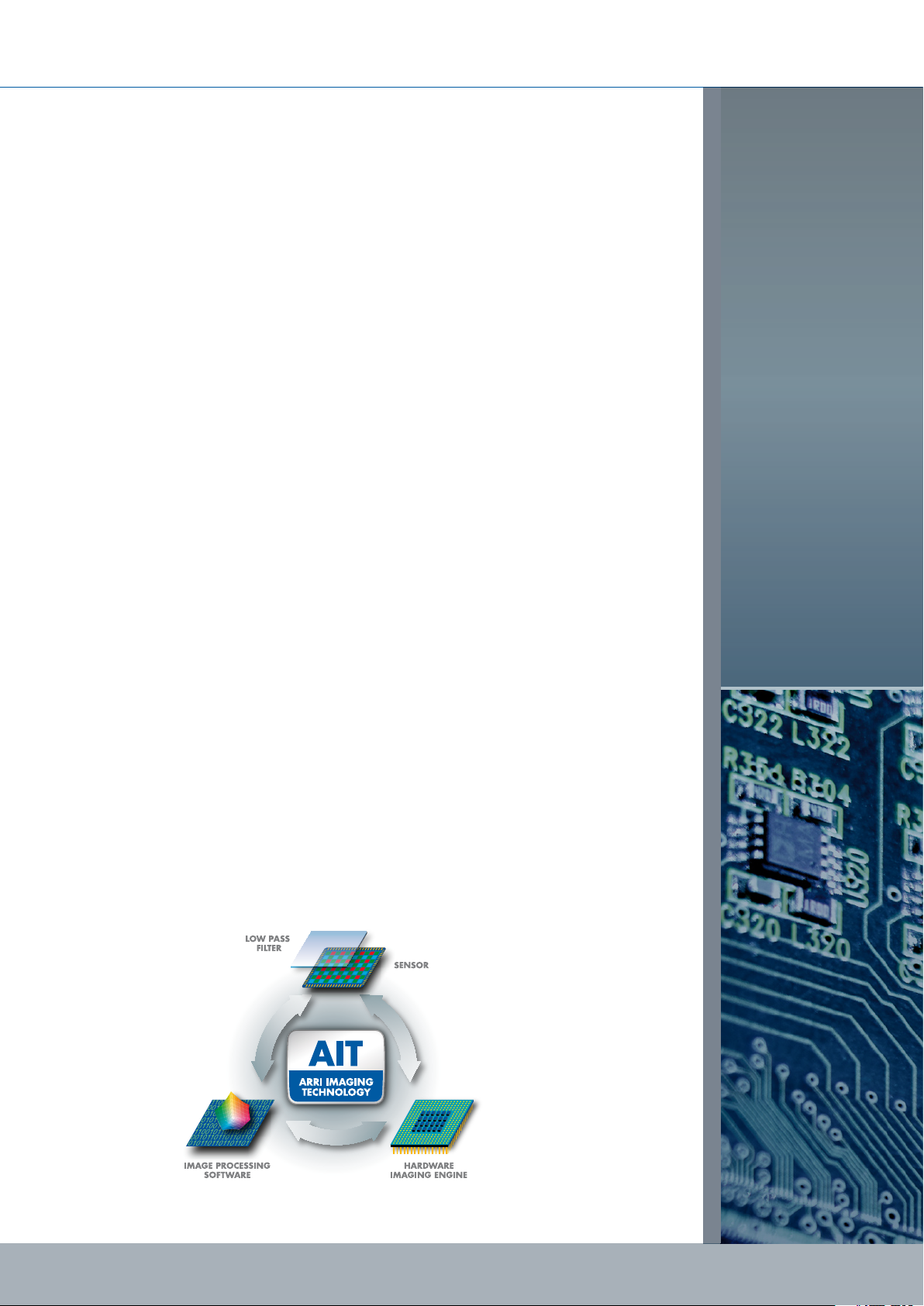
Each component of the D-21 and D-21 HD has been purpose-built with one goal in
mind: to create the most gorgeous cinematic images possible. Those images are the
result of a custom designed CMOS sensor, a carefully crafted optical low pass lter, a
powerful imaging hardware engine and advanced image processing algorithms. Having
full control of the imaging chain down to the smallest detail allows an optimization of
the whole system far beyond what would be possible with off-the-shelf components.
The smart orchestration of all these proprietary components is ARRI Imaging Technology (AIT).
AIT, which is in constant development, combines ground-breaking research and
development with knowledge, feedback and suggestions gleaned from an on-going dialogue with professional lmmakers. AIT provides super sharp, alias-free images through
over sampling, a nely tuned optical low pass lter and advanced image reconstruction
algorithms.
AIT also ensures that crews can concentrate on the creative aspects of making
images, by automating many of the technical aspects. The D-21 and D-21 HD have, for
instance, an automated black balancing circuit (Correlated Double Sampling - CDS),
which continuously calibrates the black level of each pixel in each frame without any
user intervention. In addition, an automated Defect Pixel Correction (DPC) guarantees
that no single defective pixel will ever be visible. DPC is a highly sophisticated process
that analyzes every pixel plus a surrounding pixel eld in every frame (for a staggering
total of 2.5 billion pixels analyzed each second) in real-time as the camera is running.
STAT E O F T H E A R T
TECHNOLOGY
Through AIT, the D-21 and D-21 HD produce outstanding images with a cinematic
look and feel, high contrast, the highest dynamic range and the most lm-like color
reproduction of any digital motion picture camera.
Page 7
7
ARRI | ARRIFLEX D-21 / D-21 HD
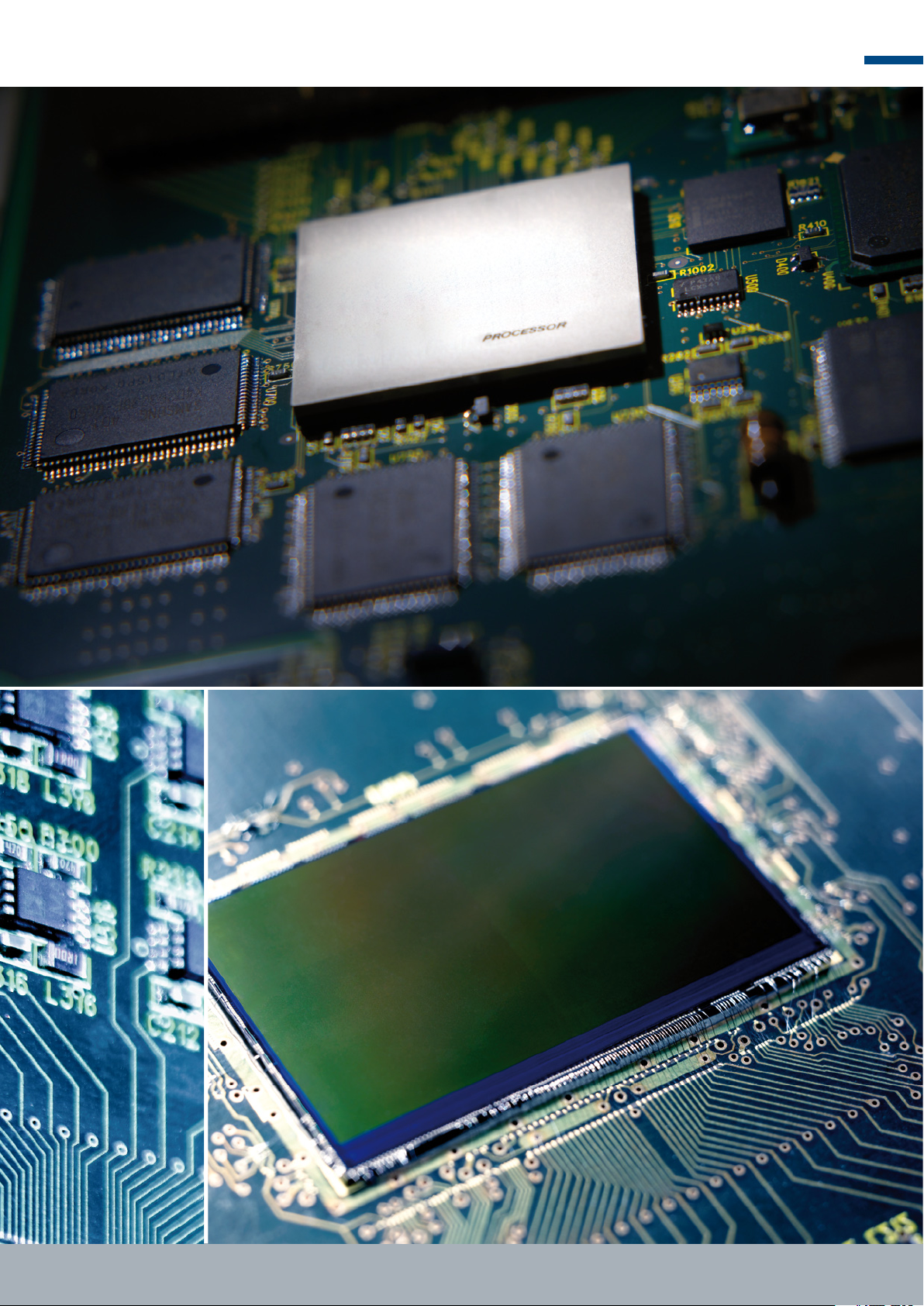
The cameras’ CMOS sensor was
specically designed and developed
for use in ARRI high-end digital motion
picture cameras.
A number of powerful FPGAs (Field Programmable
Gate Arrays) constitute the imaging hardware engine
inside the D-21 and D-21 HD. They are a crucial
component of ARRI Imaging Technology.
Page 8
8
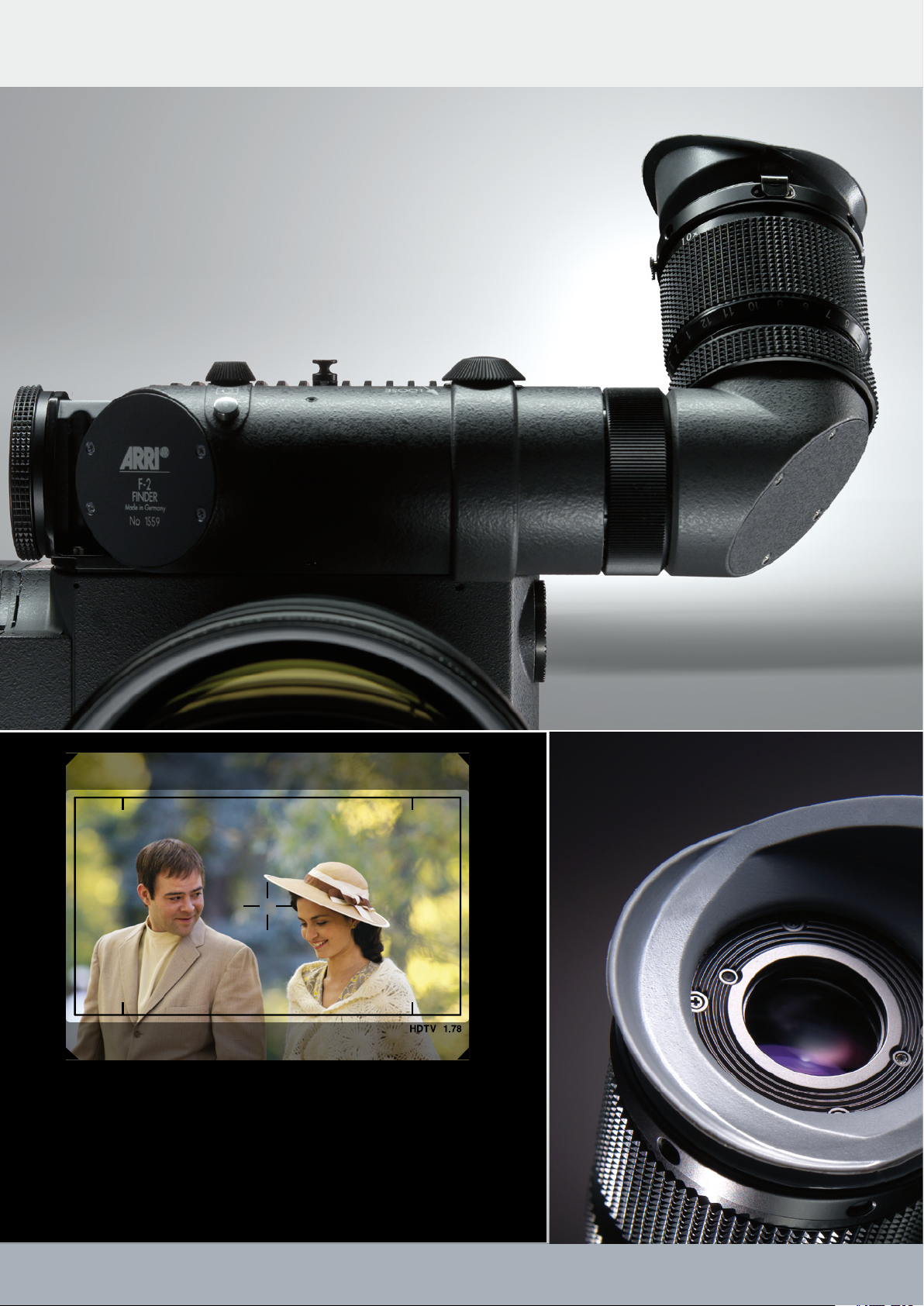
An optical viewnder is the preferred choice of both cinematographers and
camera operators. The clear, full color image enables accurate assessment of
focus and facilitates precise and comfortable operating for complex camera
moves through a complete lack of any delay. Most crucial of all is the fact that
an optical viewnder shows an image larger than that being recorded and
therefore allows the operator to see not just what is in frame, but also what is
just outside the frame. This safety area permits meticulous composition and
helps the operator prevent unwanted objects (such as a boom or microphone)
from entering a shot.
The Company; Photo: © Sony Pictures TV
Page 9

9
ARRI | ARRIFLEX D-21 / D-21 HD
The Optical Viewnder
While most digital cameras use electronic viewnders, the D-21 and D-21 HD
are equipped with the same optical viewnder as all other ARRI cameras. Thus
the cameras’ viewnder always shows an image area larger than the image
being recorded, and it can be used even when they are not powered up.
Light entering the taking lens is diverted by a spinning mirror shutter and
generates a bright, magnied full color image in the viewnder. This direct light
path, free of any electronic image processing, ensures fatigue-free viewing as
well as zero delay, a crucial feature when shooting fast action, where a delay of
even a few frames can be very confusing. But even something as mundane as
following a person getting up from a chair can become horrifying guesswork if
the viewnder image is delayed.
A CLEAR VIEW
The D-21 and D-21 HD optical viewnder can be freely rotated, extended or
ipped to the other camera side for comfortable viewing in any camera position.
An extension viewnder, eyepiece leveler and a heated eyepiece are useful
accessories in many shooting situations.
Page 10

10
A Film Sized Sensor & Film Lenses for a Film Look
Depth of eld is the one of the most powerful creative tools available to
cinematographers, and the shallow depth of eld of 35 mm lm cameras has
become associated with cinematic imagery in the minds of movie audiences
over the last 100 years. The D-21’s and D-21 HD’s sensor has the same size as
a Super 35 mm lm frame to give cinematographers the same versatility and
control of depth of eld.
Having a wide range of lenses available is of immense importance, as it
gives cinematographers the greatest exibility in expressing their vision. The
35 lm format enjoys the widest variety of prime, zoom and specialty lenses
available for any format, and the D-21 and D-21 HD are compatible with all
those lenses thanks to their industry standard PL lens mount. Since the D-21
and the D-21 HD are the only high-end digital cameras with a 4:3 aspect
ratio like 35 mm lm, they are also the only digital cameras that can take full
advantage of the unique CinemaScope look of anamorphic lenses.
Further enhancing the lm-like quality of the images is the rotating mirror
shutter, which functions exactly as it does on 35 mm ARRI lm cameras. This
method of progressive image capture results in the most lm-like motion
portrayal possible.
The ARRIFLEX D-21 and D-21 HD are the only digital high-end
cameras that can make full use of anamorphic lenses for the
CinemaScope format.
The image, as recorded by the D-21
with an anamorphic lens.
A simple 2:1 stretch and slight crop of the sides
in post results in a CinemaScope format image.
FOR AN AUTHENTIC CINEMATIC LOOK
The PL lens mount.
Inside, the sensor is visible on
the left, and the half closed
mirror shutter is visible on
the right.
Page 11

11
ARRI | ARRIFLEX D-21 / D-21 HD
Typical 2/3" video camera sensor
aspect ratio: 1.78:1
dimensions: 9.40 mm x 5.30 mm / 0.370" x 0.209"
D-21 sensor active pixel area
aspect ratio: 1.33:1
dimensions: 23.76 mm x 17.82 mm / 0.9354” x 0.7016”
ANSI Super 35 Silent camera aperture
aspect ratio 1.33:1
dimensions: 24.90 mm x 18.70 mm / 0.980" x 0.7362"
The rotating reex mirror shutter.
The mirror portion can be seen to the left, and to
the right the variable shutter blade is visible, here
restricting the open shutter angle to 11.2º.
The left upper area shows the sensor
used in the D-21 and D-21 HD on its
electronic backplane.
The right bottom area shows the
sensor frame that also holds the protective glass and the low pass lter.
Page 12

12
MscopeTM – A New and Unique Output Format
A new and unique feature of both D-21 and D-21 HD is the patented Mscope
process, which combines for the rst time the use of anamorphic lenses with the
economy of HD acquisition.
Filmmakers and audiences alike have grown up with the uniquely cinematic anamorphic look and associate it with the emotional impact of big-screen movies. The
sheer width and clarity of the format, its shallow depth of eld, the way it handles out
of focus backgrounds and ares, all of these have been burned into the subconscious
of cinema-goers for over half a century.
Both D-21 and D-21 HD are uniquely positioned to allow the use of anamorphic
lenses through their 4:3 format sensor, which captures the whole image projected by
anamorphic lenses. Most other digital cameras with their 16:9 sensors are less than
ideal for anamorphic lenses; the MscopeTM frames contain approximately 80% more
scanning lines than equivalent 2.40:1 scope images derived from ordinary 16:9 HD.
TM
TRUE ANAMORPHIC IN HD
The anamorphically squeezed image as it
appears on the D-21 or D-21 HD 4:3 sensor
(2880 x 2160 pixels)
After post production the image has been downscaled and cropped to cover a 2.40:1 area
(1920 x 800 pixels for HD distribution or 1728 x 1440 for ARRILASER lm recording)
Page 13

13
ARRI | ARRIFLEX D-21 / D-21 HD
2x HD-SDI 4:2:2 2x HD-SDI 4:2:2
D-21 / D-21 HD
Anamorphic lens squeezes
the image by a factor of 2
(circles become ovals).
Camera sensor creates a
2880 x 2160 pixel (1.33:1)
Bayer raster image.
Image is reconstructed and
downscaled to a 1920 x
1440 (1.33:1) HD image.
Image is split into two HDSDI streams, one containing the even, the other the
odd lines.
HD RECORDER
Each HD-SDI stream contains
1920 x 720 (2.66:1) pixels of
image content in the 1920 x
1080 HD image.
Any HD recorder capable
of recording in dual stream
mode can capture MscopeTM
images. Examples: SONY
SRW-1, S.two DFR2K, Codex
Digital.
Each stream contains half the
lines, thus presents an unsqueezed image (circles are
circles) for on set previewing.
STORAGE MEDIA
Both streams are
stored interleaved
on one tape or data
magazine.
POST INGEST
For off-line editing, only
one stream is used to save
bandwidth.
For image recombining,
both streams can be ingested either in parallel or
one after another.
RECOMBINING
After ingest, the two
streams are recombined
and rendered in postproduction, resulting in the same
anamorphically squeezed
1920 x 1440 (1.33:1) HD image that was present in the
camera.
The rst company to support MscopeTM is Quantel
with the Quantel iQ.
FURTHER POST
Images are de-squeezed,
cropped and scaled to the
desired delivery resolution,
for example HD Letterbox or
anamorphic lm-out.
CinemaScope in Standard HD
While the D-21 can record the full 4:3 sensor image in Data Mode,
both D-21 and D-21 HD can use the MscopeTM format which utilizes
a more economical standard HD workow. In MscopeTM, a regular
anamorphic lens is used on the D-21 or D-21 HD. The camera divides
the resulting 4:3 image into two HD streams: the A-stream contains
the even lines of the original frame while the B-stream contains the
odd lines. These streams are recorded on any HD recorder capable of
recording dual HD-SDI streams. In postproduction the two streams are
recombined to produce a high resolution MscopeTM HD image. From
then on the project can be treated as a 35mm anamorphic feature,
right up to HD distribution or laser lm-out for theatrical distribution.
An added benet of the process is how easy it is to monitor an
undistorted image of the proper aspect ratio on set. Though the anamorphic lens creates a squeezed image, each of the two HD streams
contains only half the lines of that image, so a monitor displaying
either the A or B-link will show a picture of the correct proportions.
The quality of this picture is more than adequate for assessing performance, exposure and focus; furthermore, either stream can be used
immediately for off-line editing.
The MscopeTM process divides the anamorphically
squeezed image into two HD streams. Since each
stream consists of half the image lines, the image is
automatically stretched and thus an undistorted
HD image can be previewed on the set and used
for off-line editing.
Page 14

14
D-21 Only: Data Mode Main Features
n Best Image Quality
- uncompressed, unprocessed 12 bit
raw Bayer sensor data (ARRIRAW)
- the output option with the highest dynamic
range and lowest noise
- improved image quality through advanced
image processing in post
- 2880 x 2160 (4:3) at 1 - 25 fps
2880 x 1620 (16:9) at 1 - 30 fps
n CinemaScope
- anamorphic lenses can be used
n Greatest Flexibility on the Set
- ARRIRAW T-Link: transport ARRIRAW via dual link HD-SDI
- simultaneous data and HD output for HD video monitoring
and ofine editing
- ingest converted data les from data recorder to NLE
n Greatest Flexibility in Post
- ner detail and crisper edges
- higher resolution works better for compositing
- familiar workow: 2K output les have the
same resolution and colorimetry as 2K scans from lm
- color conversion and lookup table decisions
can be made in post
- simple image reposition and cropping
- upgraded image reconstruction can be applied to
archived raw data for better image quality
ARRIFLEX D-21 2x BNC Cables
D-21 Raw
Bayer Data
D-21 Raw Bayer Data
RGBA Transport
Stream Mapping
Dual Link HD-SDI Stream
D-21 Raw Bayer Data mapped
into RGBA Transport Stream
DataRecorder
D-21 Raw
Bayer Data
RGBA Format RGBA Format
File Formatting
Real-Time
Image Processing
Recorder File
Format Unpacking
RGBA Transport
Stream Extraction
Image
Reconstruction
HD Preview Image RGB Image
D-21 Raw
Bayer Data
Recorder
File Format
Postproduction
Non-Real-Time
Image Processing
Recorder File
Format Unpacking
RGBA Transport
Stream Extraction
Image
Reconstruction
Page 15

15
ARRI | ARRIFLEX D-21 / D-21 HD
Different Productions Require Different Outputs
Different projects have different production requirements, budgets and distribution channels; the equipment chosen has to be exible enough to accommodate
those differences. The unique construction of the ARRIFLEX D-21 and D-21
HD allows for various output signals to be generated, accommodating diverse
production needs and pipelines.
Both the D-21 and the D-21 HD are capable of generating the Mscope signal,
as well as a number of HD signals. HD output options include 'Linear' or Logarithmic output, 4:2:2 YCbCr or 4:4:4 RGB, Normal or Extended Range, as well as
an optional ber optic link. These output formats are well established standards
that integrated the cameras seamlessly into the existing HD infrastructure.
FLEXIBLE OUTPUT OPTIONS
Data recorders that can
record and play back the
ARRIRAW T-Link signal
can be certied by ARRI.
Additionally, the D-21 is capable of generating a raw data signal that can be
output concurrently with the HD signal. The uncompressed, 12 bit raw Bayer
data from the D-21's 4:3 sensor is thus available in full resolution. The ARRIRAW
T-link (Transport Link) is a method of transporting the ARRIRAW data over a
standard dual link HD-SDI connection. The data les which result from processing of the ARRIRAW recordings are as easy to grade as those scanned from lm
because they have the same pixel raster and colorimetry as lm scans.
ARRIRAW T-Link
One of the obstacles that has held back the use of raw data in the past has been the problem of how
to get data easily from the camera to a recorder. ARRI engineers have found a way to utilize a standard
dual link HD-SDI connection to transport the raw D-21 Bayer data. This transport method is called "ARRIRAW T-Link" (Transport Link). It allows any recorder capable of recording an uncompressed dual link
HD-SDI stream to record raw D-21 Bayer data, greatly simplifying the raw data workow for manufacturers and users alike. The properties of the dual link HS-SDI connection are dened in SMPTE 372M.
The standard species a maximum data rate of 2.97 Gb/s, which is enough bandwidth to carry the 12
bit D-21 raw Bayer data. SMPTE 372M also denes a number of standardized source signal formats to
be sent through two BNC cables (affectionately known as Link A and Link B).
One of those source signal formats is the RGBA format. RGBA stands for red, green and blue plus an
alpha channel, technically called 4:4:4:4 (R'G'B'+A)/10 bit. The ARRIRAW T-Link works by mapping the
12 bit raw Bayer data into this RGBA data stream, so that it can be transported via a dual link HD-SDI
connection.
Any recorder that is capable of recording a SMPTE 372M compliant RGBA signal and playing it back
without compression or further encoding can record this signal. If the signal is recorded by a data recorder, the additional option of a live preview exists. The data recorder can extract the original D-21 raw
Bayer data out of the RGBA data stream, and use a real-time image reconstruction algorithm to display
the 4:3 image as a 1440 x 1080 preview HD image. If anamorphic lenses are used on the D-21 a suitably
"de-squeezed" image can be displayed on an HD monitor.
A similar but more rened process is used in postproduction. The original raw Bayer data is extracted
from the RGBA stream, and advanced image reconstruction algorithms are used to reconstruct a
pristine image in HD, 2K or 2.8K. Doing this in post has the added advantage that it does not have to
be done in real-time, so a signicantly better image quality and greater exibility are possible. Note that
throughout the whole process, the image always stays uncompressed, at the highest quality.
Page 16

16
A True ARRI Camera
The D-21 and the D-21 HD are true ARRI cameras; they run silently and have the
same robust construction and ergonomic design for which ARRI cameras are famous.
Their controls are also simple and straightforward for fast and safe operation.
Both cameras are compatible with a broad selection of lm accessories. Mounted
on a standard sliding baseplate, they share matte box, support rod and follow focus
options with the ARRI 35 mm lm cameras.
The extensive range of available accessories allows the D-21 and D-21 HD to be
congured for any style of shooting. A studio setup might involve a production matte
box and follow focus, extension eyepiece with leveler and a heavy zoom lens, while a
stripped-down setup would permit handheld or Steadicam shooting.
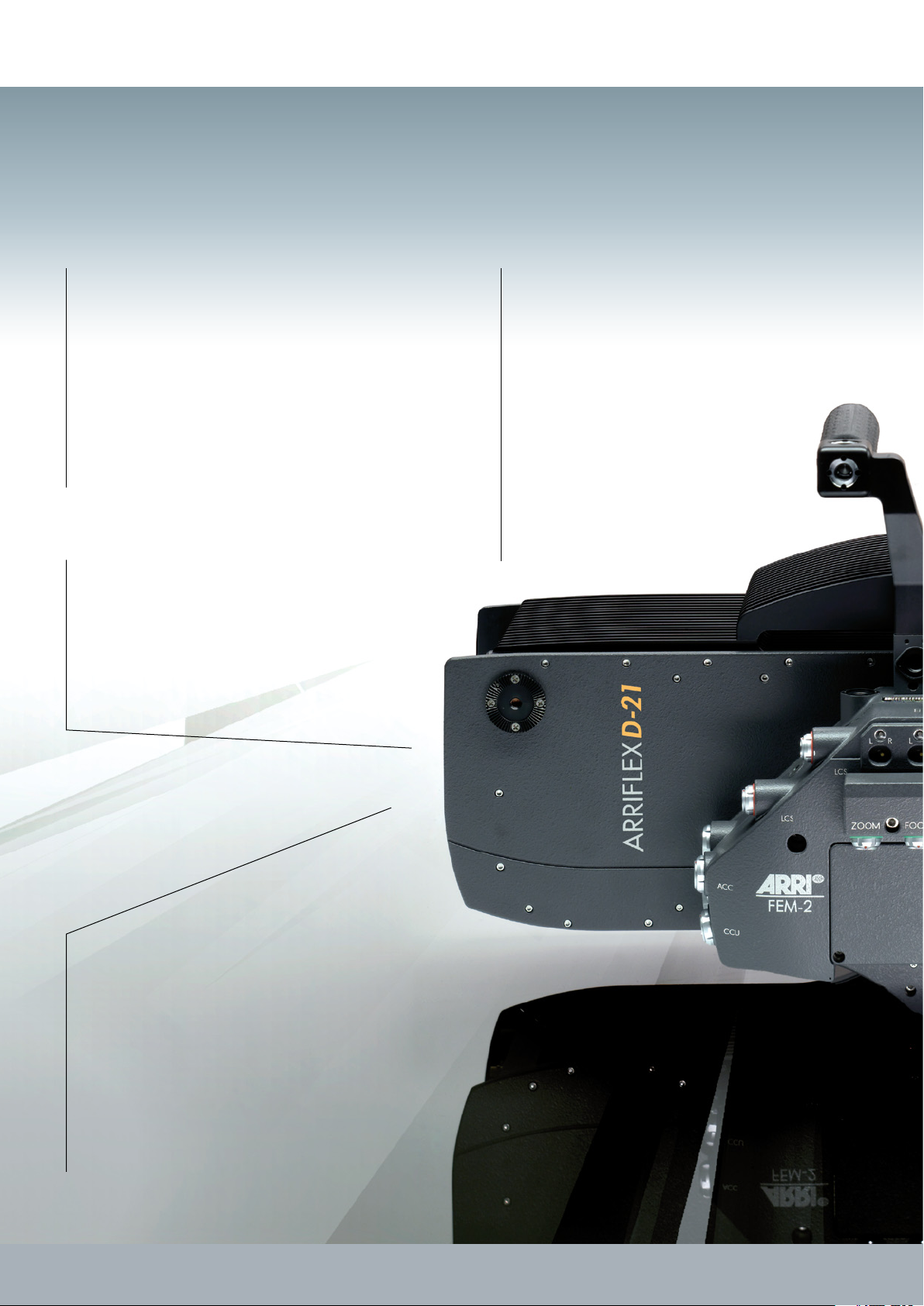
The FEM-2, a Functional Expansion Module that attaches to the side of the D-21
and D-21 HD, houses a built-in radio module for lens and camera control with the
ARRI Wireless Remote System (WRS). It also contains motor drive electronics that
allow the ARRI Controlled Lens Motors (CLM) to be plugged directly into the cameras,
minimizing the number of boxes attached.
The cameras’ modular system architecture allows upgrading when advances in
sensor, electronics or rmware technology become available, thus ensuring a long
product cycle for the camera.
Lens motors plug directly into the FEM-2 portion of the D-21
and D-21 HD, which can also accommodate the Universal Radio
Module URM-3 for wireless lens and camera remote control.
A COMPLETE SYSTEM
Page 17

17
ARRI | ARRIFLEX D-21 / D-21 HD
Page 18

18
The Company; Photo: Jan Thijs © Turner Broadcasting 2006
The Company; Photo: © Sony Pictures TV The Company; Photo: © Sony Pictures TV
Optical viewnders are the preferred choice of both cinematographers and
camera operators. The clear, full color image enables accurate assessment of
focus and facilitates precise and comfortable operating for complex camera
moves. Most crucial of all is the fact that an optical viewnder shows an image
larger than that being recorded and therefore allows the operator to see not just
what is in frame, but also what is just outside the frame. This safety area permits
meticulous composition and helps the operator prevent unwanted objects (such
as a boom mic) from entering a shot.
The Andromeda Strain;
Marty McNally, A Camera Operator (center)
with Jon Jofn, Cinematographer (right)
Photo: © A&E/Diyah Pera
Page 19

19
ARRI | ARRIFLEX D-21 / D-21 HD
Mikael Salomon, ASC Director of The Company and The Andromeda Strain
“I'm very pleased with the nal look of the six-hour miniseries The Company,
which we shot in Canada, Hungary and Puerto Rico under very varied circum-
stances.”
“I've had questions from industry professionals asking how much was digital
and how much was shot on lm. Great surprise when they learn that it was
all digital except for a few slo-mo shots - the lm intercuts seamlessly with the
digital images.”
“Ridley [Scott] asked me to direct another miniseries and we decided - once
again - to go with the ARRI digital camera. We're currently shooting in the
Vancouver and getting great feedback on dailies.”
FROM THE FIELD
“I've been elding calls from DP's interested in using the ARRI digital camera
system. As I tell them, the best recommendation is that I'm using it again!”
The Company; from left to right:
Michael Zimbrich (1st AD), Ben Nott (Cinematographer),
Michael Carella (A Cam OP), Michael Salomon (Director)
Photo: Jan Thijs © Turner Broadcasting 2006
Page 20

20
Prisoners of the Sun; Cinematographer Ed Wild
Ed Wild - Cinematographer on Prisoners of the Sun
“Because it's a full-sized chip and a PL mount, there is a full
choice of all the lm lenses.”
Prisoners of the Sun; Photo © Miromar Entertainment AG
Frank Küpper - Cinematographer
on Afrika, Mon Amour
“No grain, instant availability of full
resolution images and a 35 mm look.”
Afrika Mon Amour;
Cinematographer Frank Küpper framing a detail shot,
Photos: © Andreas Berkl
Afrika Mon Amour;
Camera equipped with
“workhorse” ARRI Master Zoom
Page 21

21
ARRI | ARRIFLEX D-21 / D-21 HD
Jason Statham stars in THE BANK JOB. Photo: © Jack English
FROM THE FIELD
Before and after compositing:
the nal scene with visual effects and Seattle background footage.
Michael Coulter, BSC - Cinematographer on The Bank Job
“After using the ARRI digital camera on The Bank Job, I was very pleased with
the end result. I look forward to the future developments of this camera.”
Sam Nicholson - Cinematographer and
VFX Supervisor on VFX scenes for Grey’s Anatomy
“As predicted, it pulled the keys beautifully and the
cinematography looks great as well.”
Sam Nicholson - Cinematographer and
VFX Supervisor on VFX scenes for Grey's Anatomy
Photos: © American Broadcasting Companies, Inc.
Page 22

22
Common Technical Data
ARRIFLEX D-21 / D-21 HD
Lens mount
Display
Shutter
Viewnder
Video assist
Recording
Common connections
54 mm PL, centered for Super 35, with Lens Data System (LDS) contacts
Flange focal depth 52 mm nominal
Camera display on left side with individual buttons for:
camera RUN, PHASE (electronic inching & mirror rotation),
NORM-PS/CCU control, LOCK, MODE, SEL and SET.
Video menu over composite video output for control of operational parameters:
Output mode, standard frame rates, white balance and color matrix, signal output range, contrast characteristic and sensitivity.
Spinning, electronically adjustable reex mirror shutter.
Adjustable to 11.2°, 22.5°, 30°, 45°, 60°, 75°, 90°, 105°, 120°, 135°, 144°, 150°, 172.8° and 180°
Optical reex viewnder with interchangeable ground glass.
Spherical or universal (adjustable to spherical or anamorphic) viewnders available. Viewnders are adjustable in two axes with automatic or manual
image compensation, laterally extendable for left eye operation and show illuminated frame lines (ARRIGLOW, adjustable in brightness). Optional
medium or long nder extender including magnier. Optional heated eyecup.
SD monitoring (PAL/NTSC video downscaled from captured image) with composite video or S-Video outputs
HD recording devices supporting HD-SDI (SMPTE 292M) or dual link HD-SDI (SMPTE 372M) signals for HD Mode operation.
Optional on-board HD recording using solid-state memory recorder Flash Mag.
2x composite video out (CVBS),
1x S-Video out (Y/C),
1x power in (BAT),
1x 12 V accessory power out (Fisher 11-pin),
1x 24 V accessory power out (RS),
1x lens data display (LDD),
2x lens control system bus (LCS),
1x accessory interface (ACC),
1x camera control unit (CCU), 1 each focus, iris, zoom for lens motors.
Power
Power consumption
Sound
Dimensions
Accessories
Misc.
All data subject to change without notice.
24V DC (acceptable voltage range: 20.5 to 36 V DC)
2.1 A @ 24 fps, 1.9 A in Standby
Less than 20 dB(A) @ 24 fps
Length: 39 cm/15.35”
Width (viewnder left): 27 cm/10.83”
Height with handle: 30 cm/11.81”
Height without handle: 23 cm/9.06”
Accepts the whole range of ARRI matte boxes (15 or 19 mm rods), follow focus and ARRI electronic accessories, Lens Data System (LDS),
Wireless Remote System (WRS), Wireless Remote Control WRC-2, Iris Control Unit for speed/iris ramps (ICU-1), Remote On/Off Switch (RS-4),
External Synchronization Unit (ESU-1).
Specically for ARRIFLEX D-21/D-21 HD: Low mode support set for Steadicam operation or underslung use and top-mounting of accessories
without bridge plate, Flash Mag Mounting Adapter (FMA-1), Fibre Unit and Fibre Remote for an optical link to the recorder.
Extra attachment points for rigging
Page 23

23
ARRI | ARRIFLEX D-21 / D-21 HD
Divergent Technical Data
ARRIFLEX D-21 ARRIFLEX D-21 HD
Camera type
HD-SDI connections
Frame rate
Aperture
35 format digital lm style camera with an optical viewnder 35 format lm style HD camera with an optical viewnder
2x dual link HD-SDI out 1x dual link HD-SDI out
Mode Setting Camera fps Mode Setting Camera fps
HD Mode
TM
Mscope
Data Mode
Frame rates other than the standard HD video frame rates of 23.976 PsF,
24 PsF, 25 PsF, 29.97 PsF, 30 PsF, 48 PsF, 50 PsF, 59.94 PsF and 60 PsF
can be achieved with a recorder that can interpret the Variframe Flag.
All frame rates are crystal controlled and can be set with 0.001 fps precision.
Exposure compensated speed ramps are supported by the electronic mirror shutter.
23.760 x 13.365 mm/0.9354” x 0.5262” in HD Mode
23.760 x 17.820 mm/0.9354” x 0.7016” max. in Data Mode & Mscope
HD Mode – HD-SDI (SMPTE 292M):
- 1920 x 1080 4:2:2 YCbCr 10 bit @ 23.976, 24, 25, 29.97, 30 PsF
HD422 (16:9) 1 - 60
HD444 (16:9) 1 - 30 HD444 (16:9) 1 - 30
MscopeTM HD422 (4:3) 1 - 25
ARRIRAW (16:9) 1 - 30
ARRIRAW (4:3) 1 - 25
HD Mode
Mscope
Frame rates other than the standard HD video frame rates of 23.976 PsF,
24 PsF, 25 PsF, 29.97 PsF and 30 PsF can be achieved with a recorder
that can interpret the Variframe Flag.
23.760 x 13.365 mm/0.9354” x 0.5262” in HD Mode
TM
23.760 x 17.820 mm/0.9354” x 0.7016” in Mscope
HD Mode – HD-SDI (SMPTE 292M):
- 1920 x 1080 4:2:2 YCbCr 10 bit @ 23.976, 24, 25, 29.97, 30 PsF
TM
HD422 (16:9) 1 - 30
MscopeTM HD422 (4:3) 1 - 25
TM
Signal output
Weight (without lens)
HD Mode – dual link HD-SDI (SMPTE 372M):
- 1920 x 1080 4:4:4 RGB 10 bit @ 23.976, 24, 25, 29.97, 30 PsF
- 1920 x 1080 4:2:2 YCbCr 10 bit @ 48, 50, 59.94, 60PsF
MscopeTM – dual link HD-SDI (SMPTE 372M):
- 1920 x 1080 4:2:2 YCbCr 10 bit @ 23.976, 24, 25 PsF
Data Mode – ARRIRAW T-Link (ARRIRAW transmission protocol
mapped into RGBA dual link HD-SDI stream according to SMPTE 372M):
- 2880 x 2160 RAW 12 bit Bayer data @ 23.976p, 24p, 25p
- 2880 x 1620 RAW 12 bit Bayer data @ 29.97p, 30p
Body only: 8.6 kg/19.0 lbs
Body and viewnder: 10.9 kg/24.0 lbs
HD Mode – Dual link HD-SDI (SMPTE 372M):*
- 1920 x 1080 4:4:4 RGB 10 bit @ 23.976, 24, 25, 29.97, 30 PsF
* available with software packet 1.16
MscopeTM – dual link HD-SDI (SMPTE 372M):
- 1920 x 1080 4:2:2 YCbCr 10 bit @ 23.976, 24, 25 PsF
Body only: 8.5 kg/18.8 lbs
Body and viewnder: 10.8 kg/23.8 lbs
Page 24

Germany
Arnold & Richter Cine Technik (Headquarters, Sales & Service)
Türkenstraße 89, D-80799 Munich, Germany
Tel: +49 (0)89 3809 0, Fax: +49 (0)89 3809 1245
Great Britain
ARRI GB Limited (Sales & Service)
2 Highbridge, Oxford Road, Uxbridge, Middlesex, UB8 1LX, Great Britain
Imaging Equipment Sales: Allan Fyfe, afyfe@arri-gb.com
Tel: +44 (0)1895 457 000, Fax: +44 (0)1895 457 001
Italy
ARRI Italia S.r.l. (Sales & Service, Milan)
Viale Edison 318, 20099 Sesto San Giovanni (Milano), Italy
General Manager: Antonio Cazzaniga, acazzaniga@arri.it
Tel: +39 (02)262 271 75, Fax: +39 (02)242 1692
ARRI Italia S.r.l. (Sales & Service, Rome)
Via Placanica 97, 00040 Morena (Roma), Italy
Camera Sales: Mauro Sembroni, msembroni@arri.it
Tel: +39 (06)79 89 021, Fax: +39 (06)79 89 02 206
USA
ARRI Inc. (Sales & Service, East Coast)
617 Route 303, Blauvelt, NY 10913-1109, USA
Vice President: Jürgen Schwinzer, jschwinzer @arri.com
Tel: +1 (845)353 1400, Fax: +1 (845)425 1250
ARRI Inc. (Sales & Service, West Coast)
600 North Victory Blvd., Burbank, CA 91502-1639, USA
Vice President: Bill Russell, brussell@arri.com
Tel: +1 (818)841 7070, Fax: +1 (818)848 4028
Canada
ARRI Canada Limited (Sales & Service)
415 Horner Ave. Unit 11 & 12, Toronto, Ontario M8W 4W3, Canada
Accounts Manager, Camera & Digital Systems:
Sébastien Laffoux, seb@arrican.com
Tel: +1 (416)255 3335, Fax: +1 (416)255 3399
Asia
ARRI Asia Limited
3B, 29/F, The Centrium, 60 Wyndham Street, Central, Hong Kong
General Manager: Paul Ivan, pivan@arriasia.hk
Tel: +852 2571 6288, Fax: +852 2875 9181
Australia
ARRI Australia PTY Limited
Unit 6C, 5 Talavera Road, Macquarie Park NSW 2113, Sydney, Australia
General Manager: Stefan Sedlmeier, ssedlmeier@arri.com.au
Tel: +61 (2)9855 4308, Fax: +61 (2)9855 4301
This ARRI FLEX D -21 product b rochur e (K5.70447.0) is pub lished by A rnold & Ri chter Cin e Technik, Se ptember 01, 20 08 © ARRI /2008
Technical da ta and of ferings a re subjec t to change without n otice. A ll rights r eser ved. With out any warr anty. Not bi nding 09 /2008 . ARRI is a re gister ed tradem ark of Ar nold & Rich ter Cine Techni k GmbH & Co. Be triebs KG.
Arnold & Richte r Cine Technik GmbH & Co. Betrieb s KG · Türkenstrasse 8 9 · D- 80799 Munich · phone +49 (0)89 3 809 0 · fa x +49 (0)89 38 09 1245 · www.arri.com
 Loading...