

Page 1

Bluetooth SMART Module
Model: BLE-MODULE
Main Features
- Complete Bluetooth® low energy SoC (4.2 specification)
- 32-bit ARM Cortex M0 microcontroller
- Size : 25 X 19 X 5 mm
- Operating Frequency : 2,402MHz ~ 2,480MHz
- Output Power : -2dBm
- Rx sensitivity : Typical -93dBm
- Power consumption : Max 4.8mA
- Sleep mode : Under 600nA
- Storage Temperatur range : -20℃ ~55℃
- Supply Voltage : Typical DC 3.0V
Table PIN Descriptions
Page 2
Pin Nr Pin Name Pin Type Description
1 P0_0 Digital I/O
2 P0_1 Digital I/O
3 P0_2 Digital I/O
4 P0_3 Digital I/O
5 P0_4 Digital I/O
INPUT/OUTPUT with selectable pull up/down resistor. Pull-down
enabled during and after reset. General purpose I/O port bit or
alternate function nodes. Contains state retention mechanism
during power down.
6 P0_5 Digital I/O
7 P0_6 Digital I/O
8 P0_7 Digital I/O
9 VDD Power
DC Power (3.0V)
10 P2_0 Digital I/O
11 P2_1 Digital I/O
12 P2_2 Digital I/O
13 P2_3 Digital I/O
14 P2_4 Digital I/O
15 P2_5 Digital I/O
16 P2_8 Digital I/O
17 P2_9 Digital I/O
INPUT/OUTPUT with selectable pull up/down resistor. Pull-down
enabled during and after reset. General purpose I/O port bit or
alternate function nodes. Contains state retention mechanism
during power down.
18 P1_0 Digital I/O
19 P1_1 Digital I/O
20 P1_5 Digital I/O
21 P1_4 Digital I/O
22 P1_2 Digital I/O
23 P1_3 Digital I/O
24 GND Ground Tied to ground
25 GND Ground Tied to ground
26 GND Ground Tied to ground
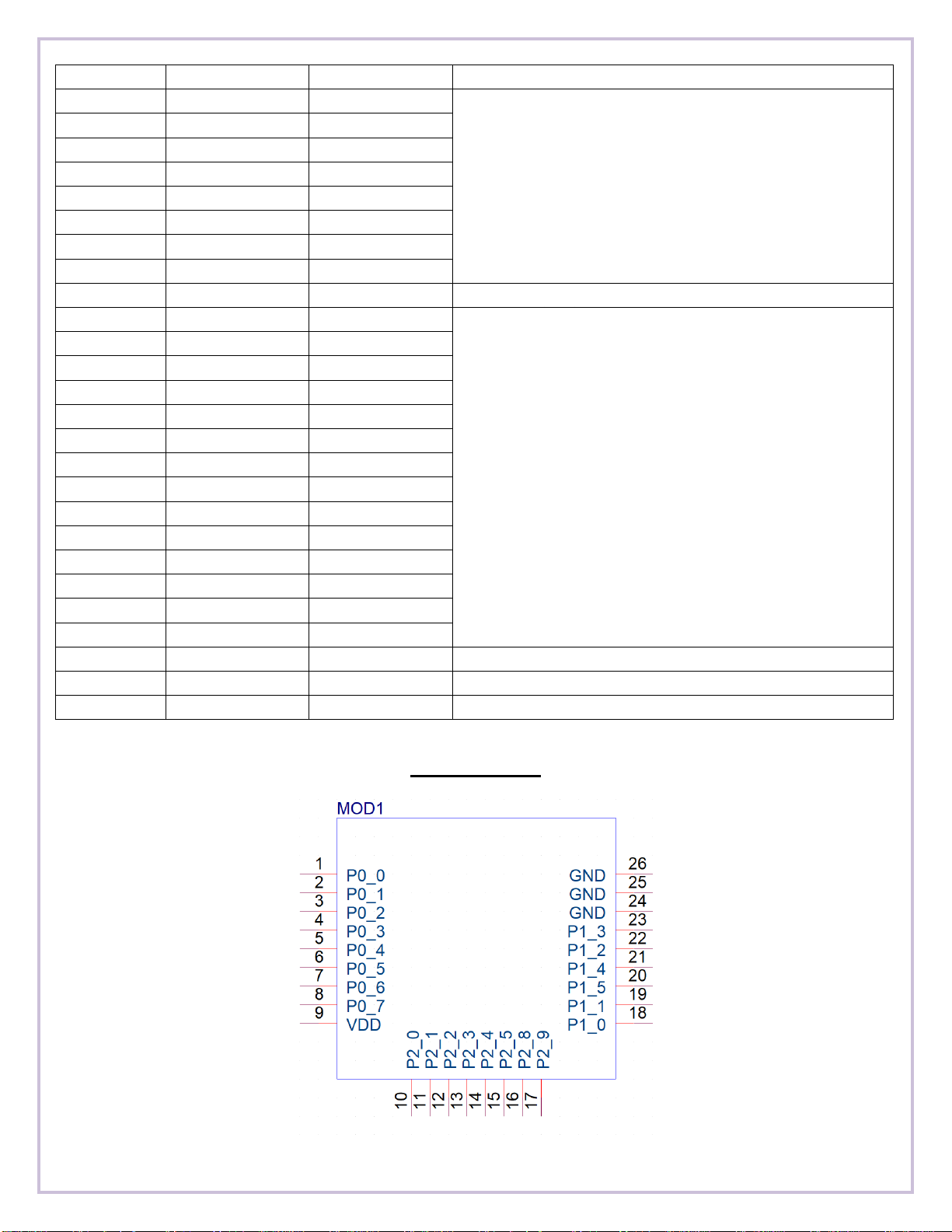
Module Pin-Out
Page 3

Certifications
FCC STATEMENT
This device complies with Part 15 of the FCC Rules. Operation is subject to the following two conditions:
(1) This device may not cause harmful interference.
(2) This device must accept any interference received, including interference that may cause undesired operation.
CAUTION: Changes or modifications not expressly approved by the party responsible for
compliance could void the user's authority to operate the equipment.
NOTE: This equipment has been tested and found to comply with the limits for a Class B digital device, pursuant to Part 15
of the FCC Rules. These limits are designed to provide reasonable protection against harmful interference in a residential
installation. This equipment generates uses and can radiate radio frequency energy and, if not installed and used in
accordance with the instructions, may cause harmful interference to radio communications. However, there is no
guarantee that interference will not occur in a particular installation. If this equipment does cause harmful interference to
radio or television reception, which can be determined by turning the equipment off and on, the user is encouraged to try
to correct the interference by one or more of the following measures:
- Reorient or relocate the receiving antenna.
- Increase the separation between the equipment and receiver.
- Connect the equipment into an outlet on a circuit different from that to which the receiver is connected.
- Consult the dealer or an experienced radio/TV technician for help.
FCC Radiation Exposure Statement:
This equipment complies with FCC radiation exposure limits set forth for an uncontrolled environment. This equipment
should be installed and operated with minimum distance 20 cm between the radiator & your body.
OEM INTEGRATION INSTRUCTIONS:
This device is intended only for OEM integrators under the following conditions:
The module must be installed in the host equipment such that 20 cm is maintained between the antenna and users, and the
transmitter module may not be co-located with any other transmitter or antenna. The module shall be only used with the
internal on-board antenna that has been originally tested and certified with this module. External antennas are not
supported. As long as these 3 conditions above are met, further transmitter test will not be required.
However, the OEM integrator is still responsible for testing their end-product for any additional compliance requirements
required with this module installed (for example, digital device emissions, PC peripheral requirements, etc.). The endproduct may need Verification testing, Declaration of Conformity testing, a Permissive Class II Change or new Certification.
Please involve a FCC certification specialist in order to determine what will be exactly applicable for the end-product.
Validity of using the module certification:
In the event that these conditions cannot be met (for example certain laptop configurations or co-location with another
transmitter), then the FCC authorization for this module in combination with the host equipment is no longer considered
valid and the FCC ID of the module cannot be used on the final product. In these circumstances, the OEM integrator will be
responsible for re-evaluating the end product (including the transmitter) and obtaining a separate FCC authorization. In
such cases, please involve a FCC certification specialist in order to determine if a Permissive Class II Change or new
Certification is required.
Page 4

Upgrade Firmware:
The software provided for firmware upgrade will not be capable to affect any RF parameters as certified for the FCC for this
module, in order to prevent compliance issues.
End product labeling:
This transmitter module is authorized only for use in device where the antenna may be installed such that 20 cm may be
maintained between the antenna and users. The final end product must be labeled in a visible area with the following:
“Contains FCC ID: 2AP7P-BLE-MODULE”.
Information that must be placed in the end user manual:
The OEM integrator has to be aware not to provide information to the end user regarding how to install or remove this RF
module in the user's manual of the end product which integrates this module. The end user manual shall include all
required regulatory information/warning as show in this manual.
 Loading...