

Page 1

Z820
Mobile Phone
User Manual
Page 2

LEGAL INFORMATION
Copyright © 2012 ZTE Corporation.
All rights reserved.
No part of t his publication may be quoted, reproduced,
translated or used in any form or by any means, electronic or
mechanical, including photocopying and microfilm, without
the prior written permission of ZTE Corporation.
Corporation reserves the right to make modifications on
ZTE
print errors or update specifications in this guide without prior
notice.
Version No.: R1.0
Edition Time: 2015.05.08
2
Page 3

Contents
For Your Safety ........................................................ 8
General Safety ................................................................. 8
Distraction ........................................................................ 9
Driving ........................................................................ 9
Operating Machinery .................................................. 9
Product Handling ........................................................... 10
General Statement on Handling and Use ................. 10
Small Children .......................................................... 11
Demagnetization ...................................................... 12
Electrostatic Discharge (ESD) .................................. 12
Antenna .................................................................... 12
Normal Use Position ................................................. 12
Air Bags .................................................................... 12
Seizures/ Blackouts .................................................. 12
Repetitive Motion Injuries ......................................... 12
Emergency Calls ...................................................... 13
Loud Noise ............................................................... 13
Phone Heating .......................................................... 13
Electrical Safety ............................................................. 14
Accessories .............................................................. 14
Connection to a Car ................................................. 14
Faulty and Damaged Products ................................. 14
Interference .................................................................... 15
General Statement on Interface ............................... 15
3
Page 4

Pacemakers ............................................................. 15
Hearing Aids ............................................................ 15
Medical Devices ....................................................... 15
Hospitals .................................................................. 16
Aircraft ...................................................................... 16
Interference in Cars ................................................. 16
Explosive Environments ................................................ 17
Petrol Stations and Explosive Atmospheres ............ 17
Blasting Caps and Areas ......................................... 17
FCC Compliance ........................................................... 17
Health and safety information ........................................ 18
Radio Frequency (RF) Energy ................................. 18
Getting Started ....................................................... 23
Keys Explanation ........................................................... 23
Starting up ..................................................................... 24
Installing the SIM/SD Card ....................................... 24
Removing the SIM/SD Card ..................................... 26
Charging the Battery ................................................ 26
Switching Your Phone On/Off ....................................... 27
Setting Up Your Phone for the First Time ................ 27
Switching to Sleep Mode ......................................... 27
Waking Up Your Phone ........................................... 27
Getting Around Your Phone .......................................... 28
Touch Control .......................................................... 28
Home Screen ........................................................... 28
Status and Notification Icons ................................... 30
4
Page 5

Using the Notification Panel ..................................... 30
Phone Calls ............................................................ 31
Making Calls .................................................................. 31
Calling from the Phone ............................................. 31
Calling from Your Contacts ...................................... 31
Calling from Your Call History .................................. 32
Calling from a Text Message .................................... 32
Receiving Calls .............................................................. 32
Answering a Call ...................................................... 32
Rejecting a Call ........................................................ 32
Muting a Call ............................................................ 33
Turning the Speakerphone On/Off ........................... 33
Contacts ................................................................. 33
Creating a Contact ......................................................... 33
Searching for a Contact ................................................. 34
Messaging .............................................................. 34
The Message Box .......................................................... 34
Sending a Message ....................................................... 34
Message Settings .......................................................... 35
Touch Input Settings ...................................................... 35
Adding a New Network Connection ..................... 36
Turning On Wi-Fi............................................................ 36
Connecting to a Wi-Fi Network ...................................... 36
Checking the Wi-Fi Network Status ............................... 37
Mobile HotSpot .............................................................. 37
5
Page 6

Enabling USB tethering ............................................ 37
Disabling USB tethering ........................................... 37
Enabling the Wi-Fi hotspot ....................................... 38
Disabling the Wi-Fi Hotspot ..................................... 38
Browsing the Internet ............................................ 38
Browsing Options .......................................................... 39
Using Bookmarks .......................................................... 39
Editing a Bookmark .................................................. 39
Deleting a Bookmark ................................................ 40
Changing Browser Settings ........................................... 40
Bluetooth ................................................................ 40
Making the Most of Multimedia ............................. 41
Taking Pictures with Your Camera ................................ 41
Shooting Video with Your Camcorder ........................... 41
Playing Your Music ........................................................ 42
Opening Your Gallery .................................................... 42
Making Voice Memos .................................................... 42
Using Your Google Applications .......................... 43
Gmail ............................................................................. 43
Using Google Talk ......................................................... 43
Sorting out Your Phone Settings .......................... 44
Setting Date and Time ................................................... 44
Display Settings ............................................................. 44
Sound Settings .............................................................. 44
6
Page 7

Language Settings ......................................................... 45
Switching Network Modes ........................................ 45
Switching Networks .................................................. 45
Setting Access Point Names .................................... 45
Security Settings ............................................................ 46
Protecting Your Phone with a Pattern ...................... 46
Protecting Your Phone with a PIN or Password ....... 47
Disabling Screen Unlock Security ............................ 47
Protecting Your SIM Card with a PIN ....................... 47
Setting up Credential Storage .................................. 48
Managing Your Device Memory .................................... 49
Privacy: Reset to Factory Settings ................................. 49
Applications.................................................................... 49
Installing an Application ............................................ 49
Removing an Application .......................................... 50
Moving an Application .............................................. 50
Managing Other Settings ............................................... 51
Accessibility .............................................................. 51
Text-to-speech output .............................................. 51
Other Applications ................................................. 51
Alarms ............................................................................ 51
Calculator ....................................................................... 52
7
Page 8
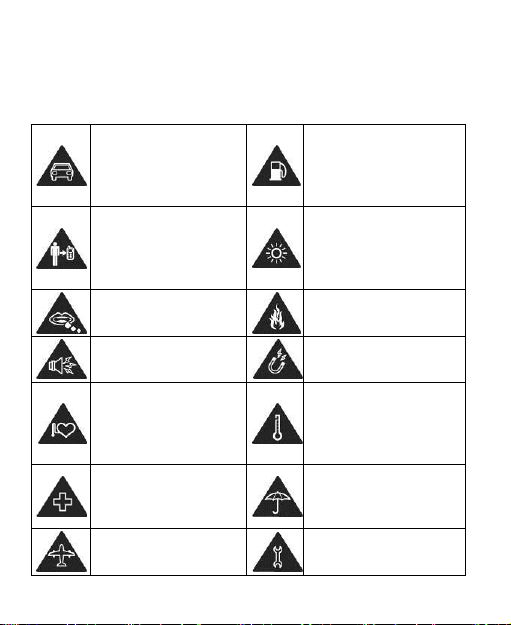
For Your Safety
Don’t make or receive
handheld calls while
driving. And never text
while driving.
Don’t use at petrol
stations.
Keep your phone at
least 15 mm away from
your ear or body while
making calls.
Your phone may produce
a bright or flashing light.
Small parts may cause
a choking.
Don’t dispose of your
phone in fire.
Your phone can
produce a loud sound.
Avoid contacting with
anything magnetic.
Keep away from
pacemakers and other
electronic medical
devices.
Avoid extreme
temperatures.
Switch off when asked
to in hospitals and
medical facilities.
Avoid contacting with
liquids. Keep your phone
dry.
Switch off when told to
in aircrafts and airports.
Don’t take your phone
apart.
General Safety
8
Page 9
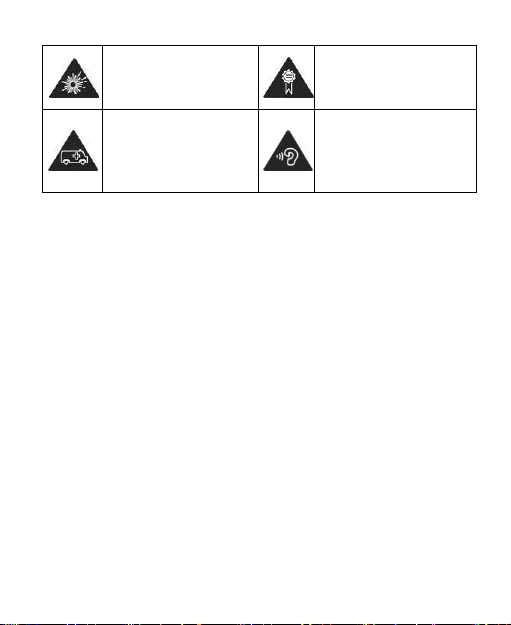
Switch off when near
explosive materials or
liquids.
Only use approved
accessories.
Don’t rely on your
phone for emergency
communications.
To prevent possible
hearing damage, do not
listen at high volume
levels for long periods.
Distraction
Driving
Full attention must be given to driving at all times in order to
reduce the risk of an accident. Using a phone while driving
(even with a hands free kit) can cause distraction and lead to
an accident. You must comply with local laws and
regulations restricting the use of wir eless devices while
driving.
Operating Machinery
Full attention must be given to operating the machinery in
order to reduce the risk of an accident.
9
Page 10

Product Handling
General Statement on Handling and Use
You alone are responsible for how you use your phone and
any consequences of its use.
You must always switch off your phone wherever the use of a
phone is prohibited. Use of your phone is subject to safety
measures designed to protect users and their environment.
Always treat your phone and its accessories with care
and keep it in a clean and dust-free place.
Do not expose your phone or its accessories to open
flames or lit tobacco products.
Do not expose your phone or its accessories to liquid,
moisture or high humidity.
Do not drop, throw or try to bend your phone or its
accessories.
Do not use harsh chemicals, cleaning solvents, or
aerosols to clean the device or its accessories.
Do not paint your phone or its accessories.
Do not attempt to disassemble your phone or its
accessories, only authorized personnel can do so.
Do not expose your phone or its accessories to extreme
temperatures, minimum [0] and maximum + [45] degrees
Celsius.
10
Page 11

The phone's normal operating temperature is 0℃ ~
.In order to ensure the normal phone functions, do
45℃
not use this phone outside the temperature range.
Please check local regulations for disposal of electronic
products.
Do not carry your phone in your back pocket as it could
break when you sit down.
Use careful with the earphone maybe possible excessive
sound pressure from earphones and headphones can
cause hearing loss.
The product shall only be connected to a USB interface of
version USB2.0.
CAUTION : RISK OF EXPLOSION IF BATTERY IS
REPLACED BY AN INCORRECT TYPE. DISPOSE OF
USED BATTERIES ACCORDING TO THE
INSTRUCTIONS.
Small Children
Do not leave your phone and its accessories within the reach
of small children or allow them to play with it.
They could hurt themselves or others, or could accidentally
damage the phone.
Your phone contains small parts with sharp edges that may
cause an injury or may become detached and create a
choking hazard.
11
Page 12

Demagnetization
To avoid the risk of demagnetization, do not allow electronic
devices or magnetic media close to your phone for a long
time.
Electrostatic Discharge (ESD)
Do not touch the SIM card’s metal connectors.
Antenna
Do not touch the antenna unnecessarily.
Normal Use Position
When placing or receiving a phone call, hold your phone to
your ear, with the bottom towards your mouth.
Air Bags
Do not place a phone in the area over an air bag or in the air
bag deployment area.
Store the phone safely before driving your vehicle.
Seizures/ Blackouts
The phone can produce a bright or flashing light.
Repetitive Motion Injuries
To minimize the risk of RSI when texting or playing games
with your phone:
12
Page 13

Do not grip the phone too tightly.
Press the buttons lightly.
Use the special features which are designed to minimize
the times of pressing buttons, such as Message
Templates and Predictive Text.
Take lots of breaks to stretch and relax.
Emergency Calls
This phone, like any wireless phone, operates using radio
signals, which cannot guarantee connection in all conditions.
Therefore, you must never rely solely on any wireless phone
for emergency communications.
Loud Noise
This phone is capable of producing loud noises, which may
damage your hearing. Turn down the volume before using
headphones, Bluetooth stereo headsets or other audio
devices.
Phone Heating
Your phone may become warm during charging and during
normal use.
13
Page 14

Electrical Safety
Accessories
Use only approved accessories.
Do not connect with incompatible products or accessories.
Take care not t o touch or allow metal objects, such as
coins or key ri ngs, to contact or short-circuit in the battery
terminals.
Connection to a Car
Seek professional advice when connecting a phone interface
to the vehicle electrical system.
Faulty and Damaged Products
Do not attempt to disassemble the phone or its accessory.
Only qualified personnel can service or repair the phone or
its accessory.
If your phone or its accessory has been submerged in water,
punctured, or subjected to a severe fall, do not use it until
you have taken it to be checked at an authorized service
centre.
14
Page 15

Interference
General Statement on Interface
Care must be taken when using the phone in close
proximity to personal medical devices, such as pacemakers
and hearing aids.
Pacemakers
Pacemaker manufacturers recommend that a minimum
separation of 15 cm be maintained between a mobile phone
and a pacemaker to avoid potential interference with the
pacemaker. To achieve this, use the phone on the opposite
ear to your pacemaker and do not carry it in a breast pocket.
Hearing Aids
People with hearing aids or other cochlear implants may
experience interfering noises when using wireless devices or
when one is nearby.
The level of interference will depend on the type of hearing
device and the distance from the interference source,
increasing the separation between them may reduce the
interference. You may also consult your hearing aid
manufacturer to discuss alternatives.
Medical Devices
Please consult your doctor and the device manufacturer
15
Page 16

to determine if operation of your phone may interfere with
the operation of your medical device.
Hospitals
Switch off your wireless device when requested to do so in
hospitals, clinics or health care facilities. These requests are
designed to prevent possible interference with sensitive
medical equipment.
Aircraft
Switch off your wireless device whenever you are instructed
to do so by airport or airline staff.
Consult the airline staff about the use of wireless devices on
board the aircraft. If your device offers a ‘Airplane mode’, this
must be enabled prior to boarding an aircraft.
Interference in Cars
Please note that because of possible interference to
electronic equipment, some vehicle manufacturers forbid
the use of mobile phones in their vehicles unless a
hands-free kit with an external antenna is included in the
installation.
16
Page 17

Explosive Environments
Petrol Stations and Explosive Atmospheres
In locations with potentially explosive atmospheres, obey all
posted signs to turn off wireless devices such as your phone
or other radio equipment.
Areas with potentially explosive atmospheres include fuelling
areas, below decks on boats, fuel or chemical transfer or
storage facilities, areas where the air contains chemicals or
particles, such as grain, dust, or metal powders.
Blasting Caps and Areas
Power off your mobile phone or wireless device when in a
blasting area or in areas posted power off “two-way radios”
or “electronic devices” to avoid interfering with blasting
operations.
FCC Compliance
This device complies with part 15 of the FCC Rules.
Operation is subject to the condition that this device does not
cause harmful interference.
Caution: Changes or modifications not expressly approved
by the manufacturer could void the user’s authority to
operate the equipment.
17
Page 18

Note: This equipment has been tested and found to comply
with the limits for a Class B digital device, pursuant to part 15
of the FCC Rules. These limits are designed to provide
reasonable protection against harmful interference in a
residential installation. This equipment generates, uses and
can radiate radio frequency energy and, if not installed and
used in accordance with the instructions, may cause harmful
interference to radio communications. However, there is no
guarantee that interference will not occur in a particular
installation. If this equipment does cause harmful
interference to radio or television reception, which can be
determined by turning the equipment off and on, the user is
encouraged to try to correct the interference by one or more
of the following measures:
—Reorient or relocate the receiving antenna.
—Increase the separation between the equipment and
receiver.
—Connect the equipment into an outlet on a circuit different
from that to which the receiver is connected.
—Consult the dealer or an experienced radio/ TV technician
for help.
Health and safety information
Radio Frequency (RF) Energy
This model phone meets the government’s requirements for
exposure to radio waves.
18
Page 19

This phone is designed and manufactured not to exceed the
emission limits for exposure to radio frequency (RF) energy
set by the Federal Communications Commission of the U.S.
Government:
The exposure standard for wireless mobile phones employs
a unit of measurement known as the Specific Absorption
Rate, or SAR. The SAR limit set by the FCC is 1.6W/kg.
Tests for SAR are conducted using standard operating
positions accepted by the FCC with the phone transmitting at
its highest certified power level in all tested frequency bands.
Although the SAR is determined at the highest certified
power level, the actual SAR level of the phone while
operating can be well below the maximum value. This is
because the phone is designed to operate at multiple power
levels so as to use only the poser required to reach the
network. In general, the closer you are to a wireless base
station antenna, the lower the power output.
The highest SAR value for the model phone as reported to
the FCC when tested for use at the ear is 1.08W/kg and
when worn on the body, as described in this user guide, is
0.88W/kg (Body-worn measurements differ among phone
models, depending upon available enhancements and FCC
requirements).
While there may be differences between the SAR levels of
various phones and at various positions, they all meet the
government requirement.
The FCC has granted an Equipment Authorization for this
19
Page 20

model phone with all reported SAR levels evaluated as in
compliance with the FCC RF exposure guidelines. SAR
information on this model phone is on file with the FCC and
can be found under the Display Grant section of
http://www.fcc.gov/oet/fccid after searching on
FCC ID: SRQ-Z820
For body worn operation, this phone has been tested and
meets the FCC RF exposure guidelines for use with an
accessory that contains no metal and the positions the
handset a minimum of 1.0 cm from the body. Use of other
enhancements may not ensure compliance with FCC RF
exposure guidelines. If you do not use a body-worn
accessory and are not holding the phone at the ear, position
the handset a minimum of 1.0 cm from your body when the
phone is switched on.
Hearing Aid Compatibility (HAC) regulations
for Mobile phones
In 2003, the FCC adopted rules to make digital wireless
telephones compatible with hearing aids and cochlear
implants. Although analog wireless phones do not usually
cause interference with hearing aids or cochlear implants,
digital wireless phones sometimes do because of
electromagnetic energy emitted by the phone's antenna,
backlight, or other components. Your phone is compliant with
FCC HAC regulations (ANSI C63.19- 2011). While some
20
Page 21

wireless phones are used near some hearing devices
(hearing aids and cochlear implants), users may detect a
buzzing, humming, or whining noise. Some hearing devices
are more immune than others to this interference noise and
phones also vary in the amount of interference they generate.
The wireless telephone industry has developed a rating
system for wireless phones to assist hearing device users in
finding phones that may be compatible with their hearing
devices. Not all phones have been rated. Phones that are
rated have the rating on their box or a label located on the
box. The ratings are not guarantees. Results will vary
depending on the user's hearing device and hearing loss. If
your hearing device happens to be vulnerable to interference,
you may not be able to use a rated phone successfully.
Trying out the phone with your hearing device is the best way
to evaluate it for your personal needs.
This phone has been tested and rated for use with hearing
aids for some of the wireless technologies that it uses.
However, there may be some newer wireless technologies
used in this phone that have not been tested yet for use with
hearing aids. It is important to try the different features of this
phone thoroughly and in different locations, using your
hearing aid or cochlear implant, to determine if you hear any
interfering noise. Consult your service provider or the
manufacturer of this phone for information on hearing aid
compatibility. If you have questions about return or exchange
policies, consult your service provider or phone retailer.
21
Page 22

M-Ratings: Phones rated M3 or M4 meet FCC requirements
and are likely to generate less interference to hearing
devices than phones that are not labeled. M4 is the
better/higher of the two ratings.
T-Ratings: Phones rated T3 or T4 meet FCC requirements
and are likely to be more usable with a hearing device’s
telecoil (“T Switch” or “Telephone Switch”) than unrated
phones. T4 is the better/ higher of the two ratings. (Note that
not all hearing devices have telecoils in them.)
Your phone meets the M4/T3 level rating.
Hearing devices may also be rated. Your hearing device
manufacturer or hearing health professional may help you
find this rating. For more information about FCC Hearing Aid
Compatibility, please go to http://www.fcc.gov/cgb/dro.
22
Page 23

Getting Started
Key
Function
1.Speaker
Put a voice outside.
2.Touch Screen
Display user interface.
Keys Explanation
23
Page 24
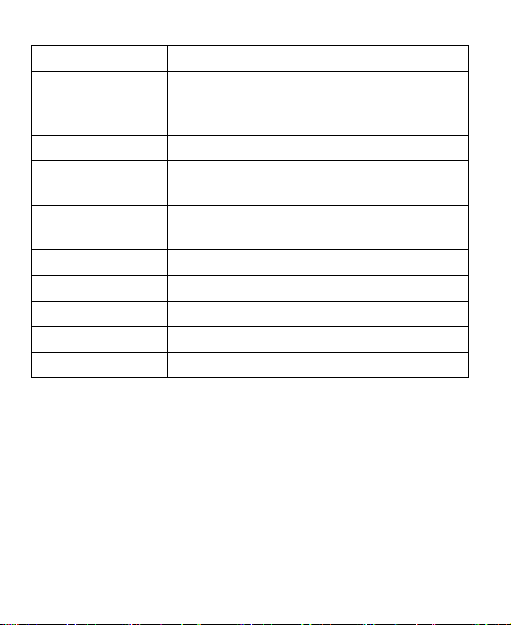
Key
Function
3.Power Key
Press to switch your phone to Sleep
mode.
Press to wake up your phone.
4.Earphone
Receiving sound during a call.
5.Headphone
Interface
External headphone cable.
6. Volume Keys
Press or hold to turn the volume up or
down.
7.Rear Camera
Photographed using parts.
8.USB Interface
External USB data cable.
9.Microphone
Send voice during a call.
10.Front camera
Photographed using parts.
11.Flash Light
Instant illumination in low light situations.
Starting up
Installing the SIM/SD Card
Switch off your phone before installing or replacing the SIM, or
memory card.
1. Remove the back cover.
24
Page 25
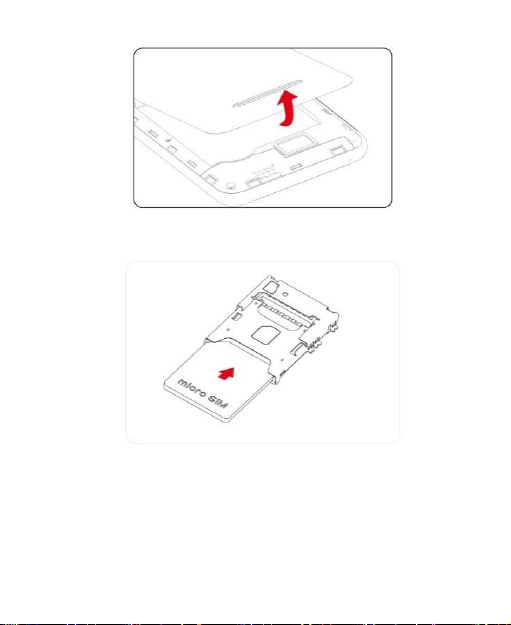
2. Hold the SIM card with the cut corner oriented as shown,
and slip it into the card holder.
3. Insert the memory card into the metal slot with the metal
contacts facing down until it clicks to the right position.
25
Page 26
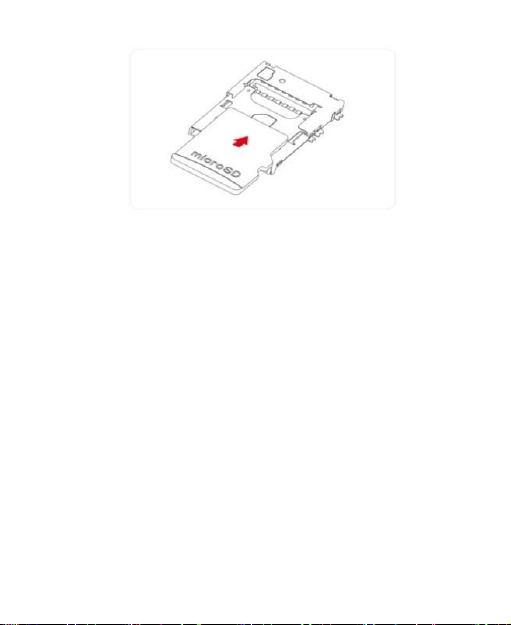
4. Press the cover gently back into place until you hear a
click.
Removing the SIM/SD Card
1. Make sure that your mobile phone is off.
2. Remove the back cover.
3. Slide the SIM card out.
4. Slide the SD card out.
Charging the Battery
When you first get your new phone, you’ll need to charge the
battery.
1. Connect the adapter to the charger jack. Ensure that the
adapter is inserted with the correct orientation. Do not
force the connector into the charger jack.
2. Connect the charger to a standard AC wall outlet.
26
Page 27

3. Disconnect the charger when the battery is fully charged.
Switching Your Phone On/Off
Make sure the SIM card is in your device and the battery is
charged.
Hold Power Key to switch on your phone.
To switch it off, hold Power Key and then Power off.
Setting Up Your Phone for the First Time
When you first power on your phone after you purchase it or
reset it to factory settings, you need to do some settings
before using it.
Tap Menu Key in the standby mode, then select System
settings > Language & input > Language to change the
language you want to use, if needed.
Switching to Sleep Mode
To save battery power, Sleep Mode suspends your device to
a low-power-consumption state while the display is off. Your
device also goes into Sleep Mode by itself when the display
is automatically turned off after a certain period of time. You
can start sleep mode by the following method.
Press Power Key to switch to Sleep Mode.
Waking Up Your Phone
1. Press Power Key to activate your screen display.
27
Page 28

2. Touch the screen and slide up to unlock the screen.
NOTE: If you have set an unlock pattern, PIN or password for
your phone, you’ll need to draw the pattern or enter the
PIN/password to unlock your screen.
Getting Around Your Phone
Touch Control
You can use finger gestures to control your phone. The
controls on your touch-screen change dynamically
depending on the tasks you’re performing.
1. Tap the buttons, icons, or applications to select items or to
open applications.
2. Flick the screen to scroll up, down, left or right.
3. Hold and drag to move particular items across the screen.
4. Double-tap the screen to zoom in/out an image. Pinch on
with two fingers to zoom in/out a web page.
Home Screen
In the Home screen, besides the shortcut icon is displayed,
you can also set your own wallpaper, add the widgets or
application shortcuts you need, or remove them as you like.
Extended Home Screen
The Home Screen extends beyond the screen width, giving
you loads more space to add more stuff. Simply slide your
28
Page 29

finger to the left or right.
Choosing Your Wallpaper
1.Press Home Key to return to the Home Screen.
2. Tap Menu Key and select Wallpaper.
3. Tap Desktop Wallpapers, Live Wallpapers, Gallery ,
Photos, Wallpapers and choose the image or animation
you want to use as the wallpaper . Some cropping may be
needed for Gallery images.
4. Tap Set wallpaper.
Adding Items to Your Home Screen
1. Press Home Key > tap to enter the Application
Program Interface.
2. In the list of applications, touch and hold the icon until its
vibration, when the main screen appears, move the
application icon to the idle position, release the finger.
Removing Items from Your Home Screen
1. Press Home Key to return to the Home Screen.
2. Tap and hold the item you want to delete until the
Remove appears on the screen.
3. Drag the item to the remove icon and release your finger
when the item turns red.
29
Page 30
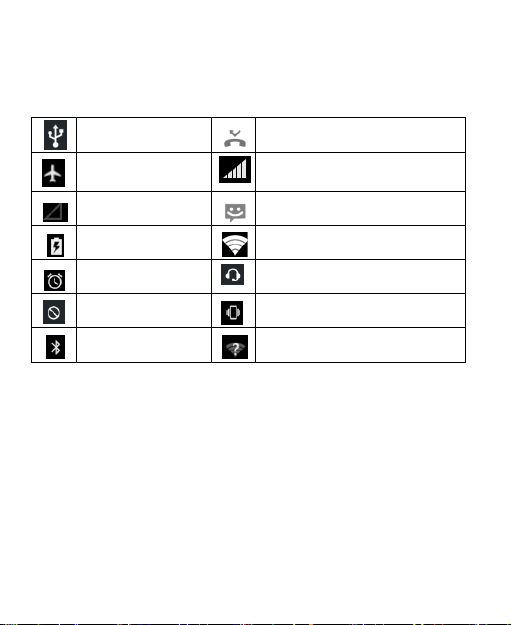
Status and Notification Icons
USB connected
Missed call
Airplane mode
Signal strength
No signal
New message
Battery charge
Wi-Fi network
Alarm set
Earphone insert
Silent mode
Vibrate mode
Bluetooth icon
New Wi-Fi network detected
Your phone will tell you exactly what’s going on by showing
you simple icons. Here’s what they mean.
Using the Notification Panel
Flick the status bar downwards from across the top of the
screen to open the Notification Panel, where you can see
your calendar events, new Messaging, and current settings
– such as call forwarding or call status. From here you can
also open new Messaging, reminders, etc.
Open Recently-Used Applications
1. Hold Menu Key from any screen. The phone will display
thumbnails of applications you used recently.
30
Page 31
2. Tap the application you want to open.
Phone Calls
Making Calls
There are many ways to make a call with your phone. And
they’re all easy to do.
Calling from the Phone
1. Press Home key > tap >
Home Screen.
2. Enter the phone number using the on-screen keypad.
Tap to delete wrong digits.
3.Tap the dial icon.
TIPS: To make international calls, hold the 0 key to enter the
“+”.
Calling from Your Contacts
1. Press Home key> tap > Contacts.
2. Slide your finger to scroll the contacts list and tap the
contact you want to call.
You can search for a contact by tapping > Search in the
top of the screen.
3. Tap the phone number in search box.
Phone or tap on the
31
Page 32
Calling from Your Call History
1. Press Home key > tap > Phone.
2. Tap
3. Touch a contact to view more call information. You can:
> Call History to open the call log.
Touch CALL BACK/REDIAL to call it.
Touch DETAILS to view contact details.
Calling from a Text Message
If a text message contains a phone number that you want to
call, you can make the call while viewing the text message.
1. Press Home key > tap > Messaging.
2. Tap the conversation and then find the message that
contains the phone number you need.
3. Tap the message, the phone will list the options.
Receiving Calls
Answering a Call
Drag over to answer the call.
Rejecting a Call
Drag over to reject the call.
32
Page 33
Muting a Call
During a call, you can mute your microphone so that the
person you are speaking to cannot hear you, but you can still
hear them.
Tap
to turn your microphone off. To turn your microphone
back on, tap
again.
Turning the Speakerphone On/Off
Tap
again to turn off the speakerphone
Tap to finish a call.
during a call to turn the speakerphone on. Tap
ending a Call
Contacts
You can add contacts on your phone and synchronize them with
the contacts in your Google account or other accounts that
support contact syncing.
To see your contacts, Press Home key > tap >
Contacts.
Creating a Contact
1. Tap from the Contacts Screen.
2. Touch the account field near the top of the screen to
choose where to save the contact. If a sync account is
selected, the contacts will be synced automatically with your
account online.
33
Page 34
3. Enter the contact name, phone numbers, and other
information, and then save it.
Searching for a Contact
1. Tap > Search in the bottom of the Contacts Screen.
2. Input the contact name you want to search for. The
contacts matched will be listed.
Messaging
Your SMS and MMS (multimedia messaging service) are
combined into one menu in Home Key > tap >
Messaging.
The Message Box
Instead of an inbox and outbox, your phone organizes all
Messaging you sent and received into one box, where
Messaging exchanged with the same number are grouped
into one message thread in the Messaging Screen. You can
tap a thread to see the conversation you have had with
someone.
Sending a Message
1. Press Home key > tap
2. Tap to create new message.
3. Enter the recipient’s number or name. As you type,
> Messaging.
34
Page 35

matching contacts will appear. Tap a suggested contact to
add as a recipient. You can also tap to select recipients
from the contacts.
4. Tap Type text message and type your message.
Tap Menu Key to insert quick text or contact and tap
of the input to insert smiley.
If you are sending an MMS, tap Menu Key to add a
subject, or tap to attach pictures, videos, audio, or
slideshow.
5. Tap to send your message.
NOTE: Add an attachment to text message and it will be
converted into an MMS automatically. Likewise if you remove
all attachments and the subject from an MMS, it’ll
automatically become a text message.
Message Settings
The phone’s message settings are pre-configured for you to
use immediately. To change them, tap Menu Key > Settings
from the Messaging Screen.
Touch Input Settings
Choose the touch input settings by tapping Home key > tap
> Settings > Language & input
35
Page 36
In the Keyboard & input methods section, you can
choose the settings that you need.
Adding a New Network Connection
To get connected via your mobile network you need a data
plan with your service provider. Also if the networks settings
are not pre-configured on your phone, please contact your
provider to get the necessary information.
You can view settings by pressing Home key > tap >
Settings > More > Cellular networks > Access Point
Names.
Turning On Wi-Fi
Wi-Fi provides wireless Internet access over distances of up
to about 300 feet.
1. Press Home key > tap > Settings > Wi-Fi.
2. Click on the top of the screen you can turn on the
Wi-Fi function,
Connecting to a Wi-Fi Network
1. Press Home key > tap > Settings > Wi-Fi.
When the WIFI is on, the Wi-Fi access points, or
“hotspots”, that your phone has detected are displayed
with their names and security settings.
2. Tap an access point to connect to it.
click you can turn off the Wi-Fi function.
36
Page 37

NOTE: If security features are implemented, you’ll need to
enter a password.
Checking the Wi-Fi Network Status
You can check the Wi-Fi network by looking at the icon
in the status bar.
Mobile HotSpot
Share your phone’s data connection via USB or as a Mobile
HotSpot.
Enabling USB tethering
TIPS: The PC accesses the Internet via the phone’s mobile
network. Therefore, set up the networks connection correctly
before you try to use the phone as a modem. Connect the PC
and device with a USB cable.
Press Home Key > tap > Settings > More > Mobile
HotSpot and tick the USB tethering check box.
Disabling USB tethering
Press Home Key > tap > Settings > More> Mobile
HotSpot and clear the USB tethering check box.
You can also just pull out the USB cable.
37
Page 38

Enabling the Wi-Fi hotspot
You can use the phone as a portable WLAN router, to share
your phone’s internet connection with one or more PC or
other devices.
NOTE:
When the portable Wi-Fi hotspot function is enabled, you
can’t use your phone’s applications to access the internet
via its Wi-Fi connection.
You can configure the Wi-Fi hotspot as follows:
1. Press Home Key > tap > Settings > More> Mobile
HotSpot and Click next to the Wi-Fi hotspot menu to
turn it on.
2. Tap Mobile HotSpot settings and tap Configure Mobile
HotSpot to set up & manage portable Wi-Fi hotspot.
3. Tap Save. Now you can find the hotspot on other devices
and connect to it.
Disabling the Wi-Fi Hotspot
Press Home Key > tap > Settings > More > Mobile
HotSpot and click you can turn off the Wi-Fi hotspot
function.
Browsing the Internet
You can use your phone to get on the Internet via a network
or Wi-Fi connection.
38
Page 39

Press Home Key > tap
There are different ways to open web pages:
Tap the address bar to enter the website you want to
browse. Then tap on the touch keyboard.
> Chrome.
Browsing Options
When you browse the Web, you can also do the following:
Press Menu Key > Bookmarks/History and select a
bookmark or history to open.
Press Menu Key > Settings to configure browser
settings.
Using Bookmarks
If you know the Web address, you can manually add
bookmarks. To bookmark a web page, open it press Menu
Key and tap . Give the bookmark a name and save it.
Editing a Bookmark
1. Open a Browser window.
2. Tap Menu Key > Bookmarks.
3. Select an item you want to edit and hold on it until the
shortcut menu pops up.
4. Select Edit bookmark.
5. Edit the name, and then tap Save to save it.
39
Page 40

Deleting a Bookmark
1. Open a Browser window.
2. Tap Menu Key > Bookmarks.
3. Select an item you want to delete and hold on it until the
shortcut menu pops up.
4. Select Delete bookmark.
Changing Browser Settings
Tap Menu Key > Settings from a browser window to change
browser settings.
Bluetooth
Bluetooth is a short-range wireless communication technology.
Phones or other devices with Bluetooth capabilities can
exchange information wirelessly within a distance of about 10
meters. The Bluetooth devices must be paired before the
communication is performed.
1. Press Home Key > tap > Settings > Bluetooth.
Click on the top of the screen.
When Bluetooth is on, the icon will appear in the status
bar.
2. Your phone will show all visible Bluetooth devices in
range.
3. Tap the device you want to pair with and
40
operate
Page 41

according to the message prompt.
When the owner of the device to be paired accept the
connection, the pairing is completed.
TIPS: Tap your device name to make your phone discoverable
if other devices try to pair with your phone.
Making the Most of Multimedia
Taking Pictures with Your Camera
Your phone has camera function. Open it by pressing Home
Key > tap > Camera.
Tap to take a shot. To view it, just tap the picture in the
right corner of the screen.
NOTE: Before taking a picture, click the corresponding icon
on camera screen to complete the camera-related settings.
Shooting Video with Your Camcorder
Open the camcorder by pressing Home Key > tap >
Camera > tap
Then tap to pause, and tap to start shooting. Tap
to stop and save video.
corner of the screen to view the video you’ve just shot.
Select the picture in the right
41
Page 42

Playing Your Music
You can play digital audio files from your phone’s memory
card in Music. Before playing music, you need to copy music
files to memory card location.
1. Press Home Key >tap > Music to open the Music
Screen.
2. Click the Music category label > music files to start playing.
3. Adjust the volume with Volume Keys.
Opening Your Gallery
Press Home Key > tap > Gallery. You can use Gallery
to view pictures and play videos. You can also do some
basic editing of your pictures – such as setting them as
wallpaper or contact icons, and sharing with friends.
Making Voice Memos
Sound Recorder enables you to record your voice memos.
1. Press Home Key > tap > Sound Recorder.
2. Tap to start recording.
3. Tap to stop recording.
4. Tap to play back the voice recording.
5. Save the voice recording after stop, or tap
delete the recording.
42
DISCARD to
Page 43

Using Your Google Applications
Signing into your Google Account lets you synchronize
Gmail, Calendar, and Contacts between your phone and the
web. And if you don’t have an account, you can easily create
one.
1. Tap a Google application that needs a Google account,
such as Play Store.
2. If you’ve got a Google account, enter your username and
password. Then Follow the instructions. (Or tap Or create
a new account if you don’t have a Google account.)
Gmail
Gmail is a web-based email service that’s configured when
you sign into your Google account. Depending on your
synchronization settings, the Gmail on your phone can be
automatically synchronized with your Gmail account on the
web. This is how to enter Gmail:
Open Gmail by Pressing Home Key > tap > Gmail.
Using Google Talk
Google Talk is Google’s instant messaging program, which
enables you to communicate with other people who also use
it. Press Home Key >tap > Hangouts
43
Page 44

Sorting out Your Phone Settings
Setting Date and Time
1. Press Home key > tap
2. Click the Automatic date & time and select Off if you
want to set the time and date by yourself.
3. Set date, time and change the other options.
> Settings > Date & time.
Display Settings
Press Home key > tap > Settings > Display, you can
adjust the display settings as you like:
Wallpaper: Choose wallpaper.
Brightness level: Adjust brightness of the screen.
Sleep: Set the delay for the screen to automatically turn
off.
When device is rotated: Rotate the contents of the
screen or Stay in portrait view.
Sound Settings
By pressing Home Key > tap > Settings > Sound &
notification, you can select the profile, adjust the sound
settings, such as ringtones, volume and vibrate.
44
Page 45

Language Settings
You can change the language of your phone system in two
simple steps.
1. Press Home key > tap > Settings > Language &
input > Language.
2. Select a language from the list given.
Switching Network Modes
1. Press Home key > tap > Settings > More > Cellular
networks > Preferred networks type
2. Select one of the following: LTE On(Automatic
LTE/4G/3G/2G), LTE OFF(Automatic 4G/3G/2G), or 2G
only.
Switching Networks
1. Press Home key> tap > Settings > More > Cellular
networks > Network operators. The phone automatically
searches for all available networks.
2. Tap a network to register manually, or tap Choose
automatically.
Setting Access Point Names
To connect to the Internet you can use the default Access
Point Names (APN)
Press Home key> tap > Settings > More > Cellular
45
Page 46

networks > Access Point Names.
Security Settings
Here’s how to protect your phone and SIM card from
unauthorized use.
Protecting Your Phone with a Pattern
Creating Your Screen Unlock Pattern
1. Press Home key > tap > Settings >
Security >Screen lock > Pattern.
2. Drag your finger to connect at least four dots, draw the
pattern.
3. Touch Continue.
4. Redraw your pattern to confirm.
Unlocking the Screen with Your Pattern
1. Press Power Key to wake up the screen.
2. Draw the pattern you set to unlock the screen.
If you make a mistake, your phone will tell you Wrong
Pattern and then try again.
46
Page 47

Protecting Your Phone with a PIN or
Password
Creating a PIN or Password
1. Press Home key > tap > Settings > Security >
Screen lock.
2. Tap PIN or Password.
3. Read the instructions and according to this instruction to
complete your PIN or password settings.
Unlocking the Screen with Your PIN or Password
1. Press Power Key to wake up the phone.
2. Enter the PIN or password you set.
Disabling Screen Unlock Security
If you have created an unlock pattern, PIN or password, you
can disable it.
1. Press Home key > tap > Settings > Security >
Screen lock.
2. Draw the screen unlock pattern or enter your PIN/
password you have created.
3. Tap None.
Protecting Your SIM Card with a PIN
Every SIM card comes with a PIN. The initial PIN is provided
by your mobile phone carrier. It’s best to lock your SIM card
47
Page 48

as soon as you can.
1. Press Home key > tap > Settings > Security > Set
up SIM card lock.
2. Click the Lock SIM card check box.
3. Enter the PIN you’ve been given and tap OK.
TIPS: If you enter the wrong SIM PIN more times than
allowed, your SIM card will be locked and you cannot access
the mobile phone network. Contact your operator for a PIN
Unlock Key (PUK) to restore the SIM card.
Changing Your SIM PIN
You can change the PIN you’ve been given to one easier for
you to remember and harder for others to guess.
1. Press Home key > tap > Settings > Security > Set
up SIM card lock.
2. Make sure you already tick the Lock SIM card check box.
3. Tap Change SIM PIN.
Setting up Credential Storage
This lets you select applications to access secure certificates
and other credentials.
Deleting Secure Credentials
1. Press Home Key > tap > Settings > Security.
2. Tap Clear credentials to clear credentials if have.
48
Page 49

Managing Your Device Memory
Press Home Key > tap > Settings > Storage.
You can view the space information of the SD card as well as
the phone storage.
Unmount SD card: You can unmount the SD card to
safely remove it.
Erase SD card: Erase all data on the SD card.
Privacy: Reset to Factory Settings
Press Home key > tap > Settings > Backup & reset >
Factory data reset > RESET PHONE > ERASE
EVERYTHING.
WARNING: All your personal information and downloaded
applications on your phone will be erased after the resetting.
Applications
Press Home Key > tap > Settings > Apps.
Installing an Application
You can install an application from the Play store (Home
Key > tap > Play Store).
You can also install a non-Marketing application if you have
allowed the installation of it. Make sure that you select an
application developed for your device and processor type
49
Page 50

before installing it.
1. Copy the application file to the SD card and install the card
on your phone.
2. Press Home key > tap > File Manager, and open the
folder where the application file is.
3. Tap the file to start installation.
4. Read the installation instructions that come with the
application and follow it to complete the setup.
NOTE: please take your handset as the standard.
Removing an Application
1. Press Home key > tap > Settings > Apps .
2. Select the application you want to delete.
3. Tap UNINSTALL and OK to confirm.
Moving an Application
You can move the applications downloaded or installed on
your phone to the memory card when the phone memory is
full. You can also move applications to your phone if the
memory card is getting full.
NOTE: Not all applications can be move to your phone or
memory card.
1. Press Home key > tap > Settings > Apps .
2. Click the application you want to move on the
50
Page 51

Downloaded tab.
Managing Other Settings
Accessibility
You can configure accessibility options for
accessibility-related applications by pressing Home Key > tap
> Settings > Accessibility.
Text-to-speech output
You can set the text-to-speech and voice recognition options
by pressing Home Key > tap > Settings >Language &
input > Text-to-speech output.
NOTE: You need to download voice data in order to use the
text-to-speech function.
Other Applications
Alarms
1. Press Home key > tap > Clock> .
2. Tap the default alarm to configure it. Or to create a new
alarm, tap .
3. Set up the alarm options.
51
Page 52

Calculator
You can use the phone directly perform simple mathematical
calculations.
1. Press Home Key > Tap > Calculator.
2. Click the button corresponding with the calculator
display, perform basic arithmetic.
TIPS: Sliding from right to left to use scientific calculation.
52
 Loading...