

Page 1

ZTE-G R621
Mobile Phone
User Manual
Page 2

LEGAL INFORMATION
Copyright © 2012 ZTE CORPORATION.
All rights reserved.
No part of this publication may be excerpted, reproduced, translated or
utilized in any form or by any means, electronic or mechanical, including
photocopying and microfilm, without the prior written permission of ZTE
Corporation.
The manual is published by ZTE Corporation. We reserve the right to
make modifications on print errors or update specifications without prior
notice.
Version No.: R 1.0
Edition Time: 2012.06.14
Page 3

Table of Cont e nts
SECURITY ................................ 4
SAFETY PRECAUTIONS ......... 4
FCC COMPLIANCE ................ 13
HEALTH AND SAFETY
INFORMATION ....................... 14
LIMITATION OF LIABILITY ... 17
KEY FUNCTIONS ................... 18
INTERFACE ICONS ............... 20
BATTE RY ................................ 20
INSERTING THE SIM/SD CARD
................................................ 22
CHARGING THE BATTERY ... 24
POWERING YOUR PHONE
ON/OFF ................................... 26
WRITING TEXT ....................... 26
ADDING CONTACT TO THE
PHONEBOOK ......................... 27
MAKING AND RECEIVING
CALLS .................................... 28
USER PROFILES ................... 30
CALL CENTER ....................... 31
SETTING YOUR PHONE ........ 32
ORGANIZER ........................... 33
FILE MANAGER ..................... 35
MULTIMEDIA .......................... 34
USING SERVICES .................. 36
3
Page 4

Se c urity
To protect your mobile phone from illegal use, take the security
measures as follows:
Set PIN codes of the SIM card.
Set handset lock code.
Set call restrictions.
Sa fety Precaut ions
This section includes some important information on safe and efficient
operation. Please read this information before using the phone.
Operational Precautions
Please use your phone properly. When making or receiving a call,
please hold your phone as holding a wireline telephone. Make sure
that the phone is at least one inch (about two point five centimeters)
from your body when transmitting.
4
Page 5

Do not touch the antenna when the phone is in use. Touching the
antenna area affects call quality and may cause the phone to operate
at a higher power level than needed.
Some people may be susceptible to epileptic seizures or blackouts when
exposed to flashing lights, such as when watching television or playing
video games. If you have experienced seizures or blackouts, or if
you have a family history of such occurrences, please consult your
doctor before playing video games on your phone or enabling a flashinglight feature on your phone. (The flashing-light feature is not available
on all products.)
Keep the phone out of the reach of small children. The phone may
cause injury if used as a toy.
Precautions While Driving
Please pay attention to the traffic safety. Check the laws and regulations
on the use of your phone in the area where you drive. Always obey
them.
5
Page 6

Use hands-free function of the phone, if available.
Pull off the road and park before making or answering a call if conditions
require.
Precautions for Medical Devices and Facilities
When using your phone near pacemakers, please always keep the
phone more than eight inches (about twenty centimeters) from the
pacemaker when the phone is switched on. Do not carry the phone in
the breast pocket. Use the ear opposite the pacemaker to minimize
the potential for interference. Switch off the phone immediately if
necessary.
Some phones may interfere with some hearing aids. In the event
of such interference, you may consult your hearing aids manufacturer
to discuss alternatives.
If you use any other personal medical device, please consult the
manufacturer of your device to determine if it is adequately shielded
from RF energy.
6
Page 7

In those facilities with special demand, such as hospital or health care
facilities, please pay attention to the restriction on the use of mobile
phone. Switch off your phone if required.
Mobile Phone
Please use original accessories or accessories approved by the
phone manufacturer. Using any unauthorized accessories may
affect your mobile phone’s performance, damage your phone or even
cause danger to your body and violate related local regulations about
telecom terminals.
Turn off your phone before you clean it. Use a damp or anti-static cloth
to clean the phone. Do not use a dry cloth or electrostatically charged
cloth. Do not use chemical or abrasive cleaners as these could damage
the phone.
As your mobile phone can produce electromagnetic field, do not place
it near magnetic items such as computer disks.
Using the phone near electrical appliances such as TV, telephone,
radio and personal computer can cause interference.
7
Page 8

Do not expose your mobile phone to direct sunlight or store it in hot
areas. High temperatures can shorten the life of electronic devices.
Keep your phone dry. Any liquid may damage your phone.
Do not drop, knock or harshly treat the phone. Rough handling can
break internal circuit boards.
Do not connect the phone with any incompatible enhancement.
Do not attempt to disassemble the mobile phone or battery.
Do not store the phone with flammable or explosive articles.
Do not charge the mobile phone without battery.
Some electronic devices are susceptible to electromagnetic interference
sent by phone if inadequately shielded. Please use phone at least 20
cm or as far away as you can from TV set, radio and other automated
office equipment so as to avoid electromagnetic interference.
Operating phone may interfere with medical devices like hearing aides
and pacemakers, or other medical devices in hospital. Consult a
physician or the manufacturer of the medical device before using phone.
8
Page 9

Be aware of the usage limitation when using phone at places such as
oil warehouses, or chemical factories, where there are explosive
gases or explosive products being processed, because even if your
phone is in idle state, it still transmits radio frequency (RF) energy.
Therefore, power off your phone if required.
Do not touch the antenna while calling. Otherwise it will affect the
quality of calling and waste battery energy. The damaged antenna
will cause slight burn while touching your skin.
Keep phone out of the reach of small children. Phone may cause
injury if used as a toy.
Do not put other things on the terminal to avoid overlaying radiator.
Keep the antenna free from obstructions and position the antenna
straight up. This will ensure best call quality.
Precautions for Potentially Explosive Atmospheres
Switch off your phone prior to entering any area with potentially explosive
atmospheres, such as fueling areas, fuel or chemical transfer or
9
Page 10

storage facilities.
Do not remove, install, or charge batteries in such areas. Spark in a
potentially explosive atmosphere can cause an explosion or fire
resulting in bodily injury or even death.
To avoid possible interference with blasting operations, switch off
your phone when you are near electrical blasting caps, in a blasting
area, or in areas posted “Turn off electronic devices”. Obey all signs
and instructions.
Precautions for Electronic Devices
Some electronic devices are susceptible to electromagnetic interference
sent by mobile phone if inadequately shielded, such as electronic
system of vehicles. Please consult the manufacturer of the device before
using the phone if necessary.
Safety and General Use in Vehicles
Safety airbag, brake, speed control system and oil eject system
10
Page 11

shouldn’t be affected by wireless transmission. If you do meet problems
above, please contact your automobile provider. Do not place your
phone in the area over an airbag or in the airbag deployment area.
Airbags inflate with great force. If a phone is placed in the airbag
deployment area and the airbag inflates, the phone may be propelled
with great force and cause serious injury to occupants of the vehicle.
Please turn off your mobile phone at a refueling point, and the same
to the place where the use of two-way radio is prohibited.
Aircraft Safety
Please turn off your mobile phone before the airplane takes off. In
order to protect airplane’s communication system from interference,
it is forbidden to use mobile phone in flight. Safety regulations require
you to have permission from a crew member to use your phone while
the plane is on the ground.
If the mobile phone has the function of automatic timing power-on,
please check your alarm setting to make sure that your phone will not
be automatically turned on during flight.
11
Page 12

Battery Use
Do not short-circuit the battery, as this can cause the unit to overheat
or ignite.
Do not store battery in hot areas or throw it into fire. Otherwise, it
will cause explosion.
Do not disassemble or refit the battery. Otherwise, it will cause liquid
leakage, overheating, explosion and ignition of the battery.
Please store the battery in a cool dry place if you don’t use it for a long
period.
The battery can be recharged for hundreds of times, but it will eventually
wear out. When the operating time (talk time and standby time) is
noticeably shorter than normal, it is time to replace it with a new one.
Please stop using the charger and battery when they are damaged
or show evidence of aging.
Return the worn-out battery to the provider or dispose of it in accordance
with environment regulations. Do not dispose of it in household rubbish.
Please use original batteries or batteries approved by the phone
12
Page 13

manufacturer. Using any unauthorized battery may affect your handset
performance or may cause danger of explosion, etc.
Warning: If the battery is damaged, do not discharge it. If the leakage
does come into contact with the eyes or skin, wash thoroughly in clean
water and consult a doctor.
FCC Complia nce
This mobile phone complies with part 15 of the FCC Rules. Operation is
subject to the following two conditions:
(1)This device may not cause harmful interference, and (2) this device
must accept any interference received, including interference that may
cause undesired operation.
Caution: Changes or modifications not expressly approved by the
manufacturer could void the user’s authority to operate the equipment.
Note: This equipment has been tested and found to comply with the
limits for a Class B digital device, pursuant to part 15 of the FCC Rules.
13
Page 14

These limits are designed to provide reasonable protection against
harmful interference in a residential installation. This equipment
generates, uses and can radiate radio frequency energy and, if not
installed and used in accordance with the instructions, may cause
harmful interference to radio communications. However, there is no
guarantee that interference will not occur in a particular installation. If
this equipment does cause harmful interference to radio or television
reception, which can be determined by turning the equipment off and on,
the user is encouraged to try to correct the interference by one or more
of the following measures:
—Reorient or relocate the receiving antenna.
—Increase the separation between the equipment and receiver.
—Connect the equipment into an outlet on a circuit different from that to
which the receiver is connected.
—Consult the dealer or an experienced radio/ TV technician for help.
Healt h a nd sa fety inform a t ion
14
Page 15

Radio Frequency (RF) Energy
This model phone meets the government’s requirements for
exposure to radio waves.
This phone is designed and manufactured not to exceed the
emission limits for exposure to radio frequency (RF) energy set by
the Federal Communications Commission of the U.S. Government:
The exposure standard for wireless mobile phones employs a unit of
measurement known as the Specific Absorption Rate, or SAR. The
SAR limit set by the FCC is 1.6W/kg. *Tests for SAR are conducted
using standard operating positions accepted by the FCC with the
phone transmitting at its highest certified power level in all tested
frequency bands. Although the SAR is determined at the highest
certified power level, the actual SAR level of the phone while
operating can be well below the maximum value. This is because
the phone is designed to operate at multiple power levels so as to
use only the poser required to reach the network. In general, the
closer you are to a wireless base station antenna, the lower the
15
Page 16

power output.
The highest SAR value for the model phone as reported to the FCC
when tested for use at the ear is
body, as described in this user guide, is
measurements differ among phone models, depending upon
available enhancements and FCC requirements.)
While there may be differences between the SAR levels of various
phones and at various positions, they all meet the government
requirement.
The FCC has granted an Equipment Authorization for this model
phone with all reported SAR levels evaluated as in compliance with
the FCC RF exposure guidelines. SAR information on this model
phone is on file with the FCC and can be found under the Display
Grant section of http://www.fcc.gov/oet/fccid after searching on
FCC ID:Q78-GR621
For body worn operation, this phone has been tested and meets the
FCC RF exposure guidelines for use with an accessory that contains
1.34W/kg and when worn on the
0.868W/kg (Body-worn
16
Page 17

no metal and the positions the handset a minimum of 1.5 cm from
the body. Use of other enhancements may not ensure compliance
with FCC RF exposure guidelines. If you do no t use a body-worn
accessory and are not holding the phone at the ear, position the
handset a minimum of 1.5 cm from your body when the phone is
switched on.
Limit a t ion of Liability
ZTE shall not be liable for any loss of profits or indirect, special, incidental
or consequential damages resulting from or arising out of or in connection
with using this product, whether or not ZTE had been advised, knew or
should have known the possibility of such damages. The user should
refer to the enclosed warranty card for full warranty and service information.
Note: The pictures and icons shown in the manual are just schematic
drawings for function demonstration. If they are inconsistent with your
handset, please take your handset as the standard. If the inconsistency
exits in the manual because of the handset function updating, please
17
Page 18

refer to the follow-up public information from ZTE CORPORATION.
18
Page 19
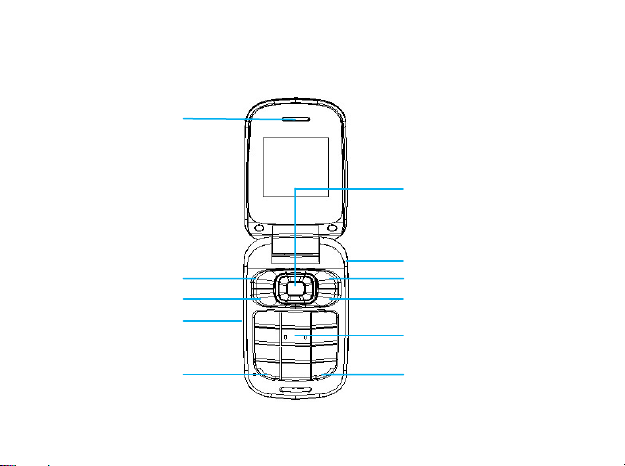
Key Func t ions
Earpiece
4-Way
Navigation keys
and Centre key
Left soft key
Send key End/Power key
Torch
* key
Charger interface
Right soft key
Alpha/Numeric keys
# key
19
Page 20
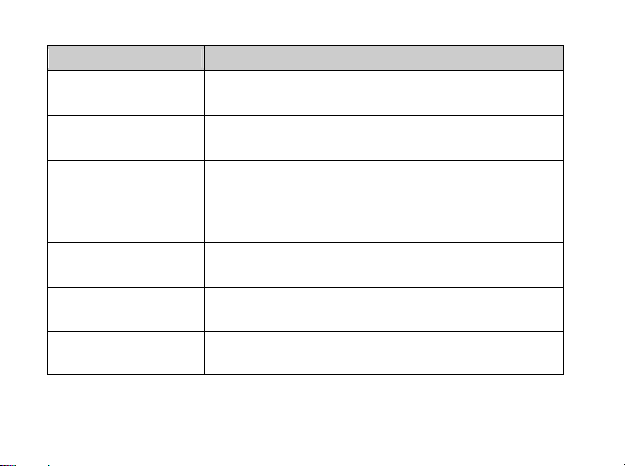
Function Description
Left soft key
Right soft key
4-Way
Navigation keys and
Center key
Send key
End/Power key
Alpha numeric keys
Performs the function indicated at the left bottom of the
screen.
Performs the function indicated at the right bottom of the
screen.
These keys (UP, DOWN, LEFT and RIGHT) allow for
navigation through menu options and quick accessing to
some function menus.
Press to confirm actions and make selections.
Press to dial a phone number or answer a call, or view
the call history.
Press to exit to the standby mode.
Hold to switch on/off the phone.
Press to enter characters 0-9 and the alphabets from a-z.
Note: In this User Manual, “press a key” means to press the key and
20
Page 21
release it, while “hold a key” means to press the key for at least two
seconds and then release it.
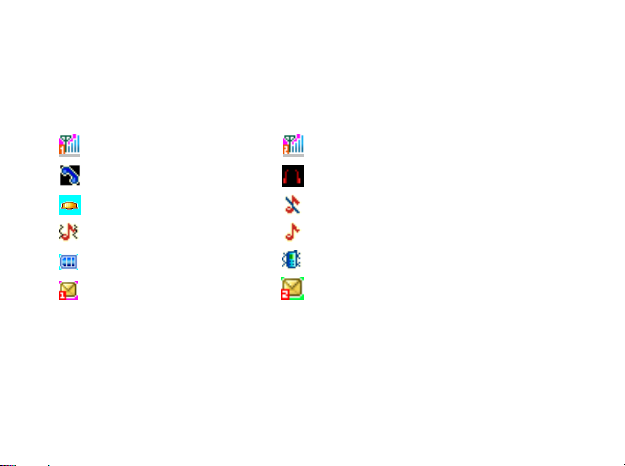
Int e rfa c e ic ons
SIM1_Signal strength SIM2_Signal strength
Missed call Headset
Alarm clock set Silent
Outdoor General
Battery status Meeting
SIM1_New SMS SIM2_New SMS
Ba t t e r y
The lithium ion battery of the mobile phone can be immediately used
after unpacking.
21
Page 22
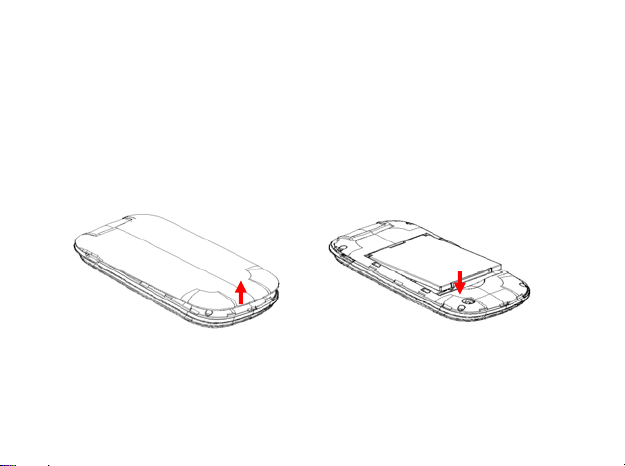
Installing and removing the battery
1. Make sure that your phone is off and remove the battery cover.
2. Insert the battery by aligning the metal contacts with the contacts in
the battery slot. And then push down the upper section of the battery
until it clicks into place.
To remove the battery, pull it up and remove it from the mobile phone.
3. Replace the battery cover and close it gently until you hear a click.
Remove the battery cover Push down the battery
22
Page 23
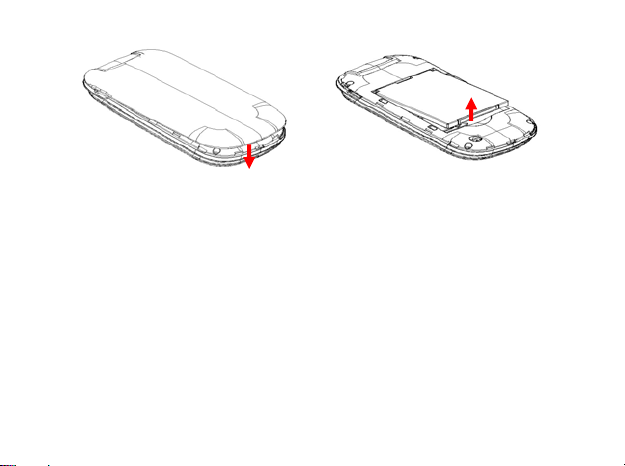
Replace the battery cover Push up the battery from here
Inserting the SI M /SD card
Insert the SIM card and memory card as follows:
1. Make sure that the phone is switched off and the charger is
disconnected from the phone.
2. Turn the phone over and remove the battery cover.
3. Remove the battery if it is already installed.
4. Hold your SIM card with the cut corner oriented as shown and then
slide it into the card holder with the metal contacts facing downward.
23
Page 24
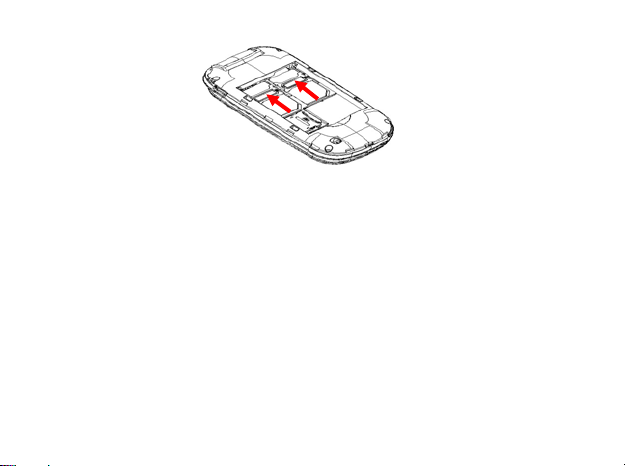
SIM card (Subscriber Identity Module) is a micro-chip that holds your
personal information such as names and phone numbers. Your phone
won’t work without it. If you already have contacts on your SIM card,
they can be transferred in most cases.
5. Insert the memory card with the metal contacts facing down until it
clicks to the right position.
24
Page 25
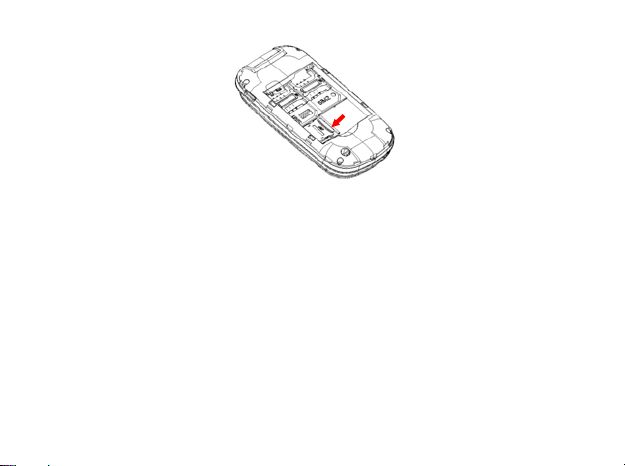
Insert the memory card
6. Replace the battery first.
7. Replace the battery cover.
Note: You can use a memory card to expand the storage of the phone.
You can store or copy files such as videos, photos, music, and so on.
Do not take out the card or switch off the phone while transmitting or
saving data, which may cause data loss or damage to the phone/card.
Charging t he battery
Your phone is powered by a rechargeable battery. For maximum battery
25
Page 26
performance, it is recommended that you first use up the battery power
and then charge it completely. A new battery’s full performance is achieved
only after three complete charge and discharge cycles.
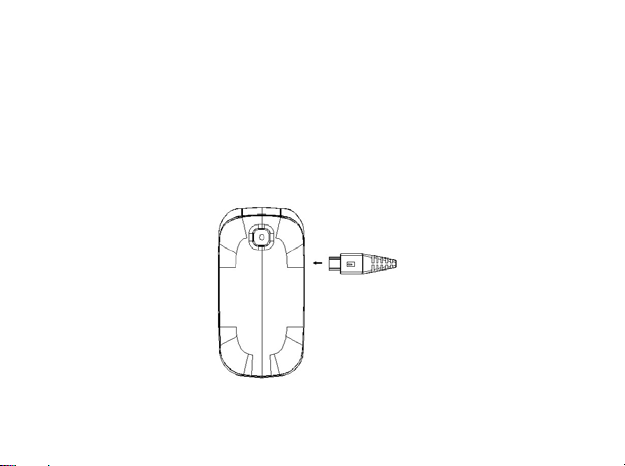
1. Connect your travel adapter to the right of your mobile phone as
shown in the diagram.
2. Connect the other end of the travel adapter to the mains socket.
3. When the battery is fully charged, disconnect the charger.
26
Page 27

Pow e ring your phone on/off
Make sure that your SIM card is in your mobile phone and that the battery
is charged.
Hold the End/Power key to power on/off the phone. The phone will
automatically search for the network when switched on.
Writ ing t e x t
Text Mode
Your mobile phone provides the following input methods: alphabetic
(Smart abc abc Smart ABC ABC) mode and Numeric (123) mode.
The current input mode is displayed on the screen above the input
field. You can press Options>Input method to select the input mode.
Change input mode: Press the # key to change the input mode.
Input Letters: Press A~Z to enter desired characters. It does not work in
numeric mode.
Input Digits: In numeric mode, press digit key once to input a digit.
27
Page 28

Input Symbol: Press * key to select the Desired symbol (common
symbols) by pressing the Navigation keys and then press the Left soft
key or Center key to confirm it.
Input Space: Press the 0 key to input space. It does not work in
numeric mode.
Delete Character: Press the Right soft key to clear a character. Hold
the Right soft key to delete all characters and clear the display.
Move cursor to left or right: Among the text, press the Left/Right
navigation keys to move the cursor to left or right.
Ad ding contact to the Phonebook
There are some numbers that you may want to call again and again, so
it makes sense to add these numbers to your Phonebook. You can
then access these numbers quickly and easily.
1. Go to Menu>Phonebook>Add new contact.
2. Edit the information and save it.
28
Page 29

You can also save a number right after you’ve made or received a
phone call or a text message from someone who is not yet in your
Contacts list.
To delete someone from your Phonebook list, first select the name,
then select Options>Delete.
Making and r e c e iving calls
Basic way to make a call
In idle screen, press the numeric keys to input the number and
press the Send key to dial.
Dial from the Phonebook
Go to Menu>Phonebook. Find the name of the person you want to
call, and press the Send key.
Make an emergency call
You can make emergency calls without the SIM card inserted so long
as you are in an area with network coverage.
29
Page 30

Answer a call
Press the Send key.
End a call
Press the End key.
Make sure that you are in an area with sufficient coverage to make
calls. The strength of the network signal is indicated on the Status
Bar of the screen.
Se nding a nd receiving messa ge s
You can use your mobile phone to send and receive messages.
Send a message
1. Go to Menu>Messaging>Write message>Text/Multimedia
message.
2. Write your message. For more information on input method,
see section ‘Text Input’. When you write an SMS, press
Options>Send to, and edit the recipient. When you write an
MMS, you can edit Change to To, Change to Cc, Change to Bcc,
Subject and content. In content field, you can select Options and
30
Page 31

then select to add picture, sound, video and so on.
3. When you finish writing an SMS/MMS, select Options to send or
save the message.
Receive a message
Upon receiving a message, the mobile phone will alert you with a
ringtone, prompt, or a new message icon.
1. Press View to enter the Inbox directly and then press the center
key to open the message.
2. Use the Up/Down keys to view the message.
While the message is open, use Options to reply, delete, or forward the
message. You can also call back the sender.
Use r profiles
Go to Menu>User profiles. You can select your preferred profile in this
menu. The profile options are: General, Silent, Meeting and Outdoor .
The default settings for each individual profile are preset at the factory.
31
Page 32

You can select Options>Activate to activate a profile. Or you can
select Options>Customize to edit a profile.
Ca ll cent e r
Go to Menu>Call center.
Call history
Dialled calls, Received calls and Missed calls are saved in Call
history. If the records are full, the earliest saved records will be
deleted.
Also, you can delete call logs and view call timers in Call history.
Call settings
You can set call waiting, call divert and call barring and so on.
Se t t ing your phone
You can adjust various settings of your phone. Go to Menu>Settings.
Phone settings: Set time and date and schedule power on/off, select
32
Page 33

language, Pref. input method and Display, etc.
Network settings: Set to automatically or manually select network,
and set the preferred networks.
Security settings: Set security features to protect your phone and SIM
card from unauthorized use.
Connectivity: You can add and view Data account.
Restore factory settings: Enter the phone lock code to restore to the
factory settings. Some personal information might be lost if you use
this function, so be careful.
Note: You may be required to input the phone password in some of the
security settings interfaces. The default password is 0000.You can also
change the password in Settings.
Orga nizer
Go to Menu>Organizer.
33
Page 34

Calendar
Go to Organizer >Calendar. The calendar of the current month will be
displayed on the screen and the current date will be marked by a
background box in a special color.
Alarm
Organizer >Alarm. You can view and edit the alarm clocks
Go to
settings. You can also enable or disable the alarms.
Calculator
You can perform simple calculations. You can use 4-Way Navigation
keys to perform add, subtract, multiply or divide calculation.
World clock
You can view the time in different cities.
34
Page 35

File mana ge r
Go to Menu>File manager. You can check all the folders in the phone
or memory card, create new ones or rename, delete, or sort, etc. The
files you download from the internet will be stored in these folders.
Note: When you select Format, the data will be lost, so please be careful
with this function.
Multim e dia
Go to Menu>Multimedia.
Camera
Aim the camera lens at the object and then press the Center key to
take the shot.
Image viewer
The images you want to view in Image viewer must be put in the
Photos folder in the phone or memory card, and in
35
Page 36

Options>Storage, the storage must be set to phone or memory card
correspondingly.
You can select an image and view it.
Audio player
You can play the audio in your phone or the memory card.
Video player
You can play the video in your phone or the memory card.
FM radio
With the radio, you can search for radio channels and listen to them.
In the FM radio interface, you can press the */# keys to adjust volume,
press the Left/Right keys to tune the frequency, and press the
Center key to pause. Select Options to enter the submenu.
Note: please take your handset as the standard.
Fun&Games
Your mobile phone has classic games. Select a game and start it,
you can view Help to see the rules of the game.
36
Page 37

Using Services
Go to Menu>Services.
Services allows you to view internet content.
Your phone supports Wireless Application Protocol (WAP). You can get
access to this service through your network provider.
You can perform the following operations:
Homepage: Homepage is a WAP site you set in
Settings>Homepage.
Bookmarks: Access your phone’s preset websites. Select a
bookmark and press Options>Go to to load the website.
Search or input URL: Input a URL and press Options>Go to to
visit the site.
Last web address: View the last web address.
Recent pages: Display the pages you’ve visited recently.
Select an item and choose Options>Go to to visit the page
again.
37
Page 38

Settings: You can select profile, set Browser options,
Preferences and so on.
STK
SIM card Toolkit (STK) services are value-added services provided
by your network provider.
Your mobile phone supports STK service, but if your SIM card and
network provider do not support the service, these functions can’t be
used.
38
 Loading...