

Page 1
USER MANUAL v1.0
2019.01
Page 2

ABOUT THIS MANUAL
WHAT IS IN THE DOCUMENT
To get you started quickly by creating an XDynamics account and ensure the Evolve Ground Station and aircraft can
connect to our server to download any latest updates and register your product before your rst ight.
1Evolve User Manual V1.0 by XDynamics Limited
Page 3

LEGEND
Within this manual the following Legends are used:
Safety Warning
Important
User Hints and Tips
Reference
SECURITY DISCLAIMER
Security of information for aircraft products has become a major concern for UAS operators that do not wish for their ight
information and collected imagery to be accessed by outside entities or governments. Most leading aircraft manufacturers
do not have the ability to secure this type of information. A typical consumer aircraft sends all the metadata information,
such as aircraft position history and copies of all video and photography les, to unsecured cloud accounts. Some
aircraft manufacturers require the operator/owner of the aircraft to create an online cloud account before the aircraft
can be activated. This cloud account downloads all the information and history from the aircraft every time the system
is connected to the internet or when a rmware update is performed regardless of whether the operator/owner gives
consent. This raises serious security concerns for UAS operators that y their aircrafts near secure and sensitive locations,
such as military installations and airports.
REQUIREMENTS BEFORE THE FIRST FLIGHT
Read the following information before using the Evolve
1. Evolve User Manual
2. Quick Start Guide
PRODUCT SUPPORT
Store Website
Please visit the y safe page and download information related to the Evolve here -
https://store.xdynamics.com/y-safe/
Support Website
Find more information, tips, and troubleshooting and browse our comprehensive articles at -
https://store.xdynamics.com/support/
XDynamics uniquely offers secure aircraft products not available by many other aircraft manufactures. We understand the
need for secure aircraft systems and will never download secured or private metadata information without the consent of
our customers. XDynamics believes in guarding our customers privacy and will continue to strive for more secure aircraft
products in the future.
Tutorials
Browse our tutorials at -
https://store.xdynamics.com/tutorials/
2 3Evolve User Manual V1.0 by XDynamics Limited
Page 4

DISCLAIMER AND WARNING
This product is not a toy, and should only be operated by persons over the age of 18. Please keep it out of reach
of children, and pay particular attention to the possible scenarios of children’s unexpected appearance during ight
operation. It is highly recommended that any pilot using this product have a Small Unmanned aircraft Systems‘ Remote
Pilot Airman Certicate.
Be sure to read this document carefully before using the product to fully understand your legal rights, responsibilities and
safety instructions. Failure to do so, may cause property damage, safety accidents and personal safety risks. Once this
product is used, it is deemed that you have understood, recognized and have accepted all the terms and conditions of this
statement. The user is responsible for all the consequences of his/her actions and consequences. The user agrees to use
the product for his/her sole & legal purpose, and agrees with the terms & conditions of this agreement, and other relevant
policies & guidelines that may be specied by XDynamics LLC.
Under the maximum permission by law and approved circumstances, XDynamics LLC is exempt of liability for any indirect,
punitive, consequential, special or criminal damages, including the purchase cost, or for loss of income due to the loss of
use of the aircraft.
*XDynamics LLC is exempt from the user‘s liabilities for damage(s) to person/s or property, or injuries incurred directly or indirectly
from the use of this produc t in the following conditions:
INTELLIGENT FLIGHT BATTERY SAFETY GUIDELINES
All instructions and other collateral documents are subject to change at the sole discretion of XDynamics LLC. For up-to-
date product information, visit http://www.xdynamics.com and click on the product page for this product.
Read the ENTIRE user manual to become familiar with the features of this product before operating. Failure to operate
the product correctly can result in damage to the product or personal property and cause serious injuries. This is a
sophisticated product. It must be operated with caution and common sense and requires some basic mechanical
abilities. Failure to operate this product in a safe and responsible manner could result in injury or damage to the product
or other property. This product is not intended for use by children without direct adult supervision. DO NOT use with
incompatible components or alter this product in any way outside of the documents provided by XDynamics LLC. These
Safety Guidelines contain instructions for safety, operation and maintenance. It is essential to read and follow all of the
instructions and warnings in the user manual prior to assembly, setup or use, in order to operate the product correctly and
avoid damage or serious injuries.
WARNING
To avoid re, serious injuries, and property damage, observe the following safety guidelines when using,
charging, or storing your batteries.
• Damage(s) or injuries incurred when the user/s are under the inuence of alcohol, drugs or medication.
• Any malfunction caused by operators’ failure to follow the guidance of the manual to assemble and set up,
or operate the aircraft as described, and designed.
• Damage(s) or injuries that may occur due to failure to study the tutorial videos, and the user manual before
ying the aircraft.
• Damage(s) or injuries caused to a person/s or property, due to failure in correctly calibrating the UAV as
outlined in the manual, prior to ight.
• Damage(s) or injuries incurred as a result of the use or installation of any unauthorized third party accessories
or counterfeit parts - which were not provided and approved of by XDynamics.
• Damage(s) or injuries as a result of ying the aircraft out of eyesight range, or more than 300m away from the
controller.
• Damage(s) or injuries caused by ying the aircraft in areas of magnetic elds & radio interference.
• Damage(s) or injuries caused by ying in a NO-FLY ZONE that is regulated by local laws & rules.
• Damage(s) or injuries including crashes, loss of control or water ingress caused by abusing or modifying the
original aircraft structure.
• Damage(s) or injuries caused by using broken & ageing components.
*XDynamics LLC reserves all the rights for final interpretation.
4 5Evolve User Manual V1.0 by XDynamics Limited
Page 5

CONTENTS
PRODUCT PROFILE ________________________________________________________8
PRODUCT DESCRIPTION ____________________________________________________9
KEY FEATURES _________________________________________________________9
AIRCRAFT ANNOTATED DIAGRAM ______________________________________________10
GROUND STATION ANNOTATED DIAGRAM _________________________________________11
AIRCRAFT _____________________________________________________________12
INSERTING THE AIRCRAFT BATTERY _____________________________________________13
REMOVING THE AIRCRAFT BATTERY _____________________________________________14
AIRCRAFT FLIGHT CONTROL _________________________________________________15
AIRCRAFT AND PILOT ORIENTATION _____________________________________________15
BEGINNER MODE _______________________________________________________16
FLIGHT MODES ________________________________________________________17
TURN ON THE AIRCRAFT ___________________________________________________18
TURN OFF THE AIRCRAFT __________________________________________________19
TURNING ON/OFF AIRCRAFT BATTERY ____________________________________________20
AIRCRAFT LED INDICATORS _________________________________________________21
4K CAMERA / GIMBAL INDICATORS _____________________________________________24
AIRCRAFT BATTERY ______________________________________________________25
CHARGING THE AIRCRAFT BATTERY _____________________________________________26
CAMERA AND GIMBAL SECTION _______________________________________________57
AIRCRAFT CALIBRATION ___________________________________________________58
AIRCRAFT CALIBRATION ___________________________________________________61
AIRCRAFT CALIBRATION ___________________________________________________62
ARMING THE AIRCRAFT ____________________________________________________63
ARMING PRE-CHECK _____________________________________________________63
ARMING ____________________________________________________________63
DISARMING THE AIRCRAFT __________________________________________________64
AUTO TAKE OFF _______________________________________________________65
AUTO LANDING ________________________________________________________66
RETURN TO HOME ______________________________________________________67
USING THE RETURN TO HOME BUTTON ON THE CONTROLLER _______________________________68
RETURN TO HOME BUTTON CANCELLATION ________________________________________69
DETERMINING THE RETURN TO HOME ALTITUDE ______________________________________70
APPENDIX _____________________________________________________________71
PRODUCT SPECIFICATION __________________________________________________72
GROUND STATION _______________________________________________________29
TURNING ON THE REMOTE CONTROLLER __________________________________________30
GROUND STATION LED INDICATORS _____________________________________________31
FLIGHT MODE (MODE 2) ___________________________________________________32
PREPARE THE GROUND STATION _______________________________________________36
REMOTE CONTROLLER ____________________________________________________37
APPLICATION ___________________________________________________________38
SCREEN INTRODUCTION ___________________________________________________39
WARNINGS AND ALERTS ___________________________________________________41
SETTINGS MENU _______________________________________________________42
LINKING THE REMOTE CONTROLLER _____________________________________________43
MAP PRELOADING (OFFLINE MAP) ______________________________________________44
RUN WAYPOINT PLAN _____________________________________________________45
CAMERA AND GIMBAL SECTION _______________________________________________46
ALBUM AND IMAGE EDITING _________________________________________________47
WI-FI NETWORK ________________________________________________________48
BLUETOOTH __________________________________________________________48
FIRMWARE UPDATES _____________________________________________________49
FLIGHT _______________________________________________________________50
PREFLIGHT CHECKLIST ____________________________________________________51
FLIGHT SYSTEM LIMITATIONS _________________________________________________53
ENSURE CORRECT PROPELLER ALIGNMENT _________________________________________54
ATTACHING AND DETACHING THE PROPELLERS _______________________________________55
PREPARING AIRCRAFT FOR FLIGHT ______________________________________________56
Page 6

PRODUCT DESCRIPTION
Within this section, the Evolve aircraft and Ground Station are explained and the individual components are listed. The
Evolve aircraft and Ground Station form a powerful system offering a true ultra low latency FPV video downlink with 4K
local video recording, combined with an out the box, ready to use fully integrated dual screen controller.
KEY FEATURES
FHD Ultra Low Latency Live View
Evolve aircraft delivers incredible wireless live view performance including: 1080p Full HD video at 60 frames per
second, with the latency as low as 10 milliseconds. With ultra low latency transmission over distances up to 600 meters,
videographers can capture the intended shots and never miss a critical shot. It is ideal for video production for TV
commercials, documentaries, feature movies and other applications that require delay-free control of a camera and aircraft.
Dual-screen aircraft Controller
PRODUCT PROFILE
Aerial photography and lming experience with XDynamics Evolve begins at your ngertips. Drawing inspiration from
handheld game consoles, the foldable Ground Station holds two separate high brightness screens in the palm of your
hand, a 7” FPV viewnder and a 5” multi-touch control panel, which is complemented with uncluttered buttons and
thumbstick gimbals.
Smart Pilot System (SPS)
The Evolve by XDynamics boasts the world’s most advanced dual-screen pilot assistant system, an integrated system which
combines all the required assistant functions under a single interface.
• Aircraft Radar: know where your aircraft is.
• Alert Centre: fully understand your aircraft‘s status.
• Map Preloading: ensure you can view your map at ight.
• Dual-Screen Editing: retouch your aerial images and edit your footages more conveniently.
Ultra-Precise Positioning System
Combined with algorithms and a comprehensive suite of positioning tools, including a GNSS module that supports GPS/
QZSS, GLONASS and BeiDou navigation systems, covering 99% of the world, as well as advanced optical ow and LiDAR
sensors, Evolve provides position tracking with higher precision than general aircrafts with ultrasonic or visual sensors.
4K Camera with Sony CMOS Sensor
Equipped with a 21mm f/2.8 lens and a Sony CMOS image sensor, with effective pixels of 12.4M, the Evolve supports
video capture at 4K@30/25fps, FHD1920p@120/60/30fps, HD1280@240/120/60/30fps, accommodating to various
scenarios and themes, from peaceful landscapes to dynamic sport shorts. It supports RAW image le outputs (DNG format)
and records videos at 60Mbit/s, preserving sufcient data for post-production.
9Evolve User Manual V1.0 by XDynamics Limited
Page 7

AIRCRAFT ANNOTATED DIAGRAM
Detailed Schematic of the Evolve aircraft
GROUND STATION ANNOTATED DIAGRAM
Detailed Schematic of the Evolve remote controller
2
1
3
1. Propellers – 2 CW and 2 CCW
2. 4K Camera
3. LED Light
4. Battery
5. Gimbal
6. 4K Camera LED Status
7. Battery Display
8. Motor
9. Rear LED Indicator
10. Battery Release Latch (Lower)
11. FPV RF Heatsink
12. Optical Flow Camera
13. Camera SD Data Card
14. Battery Release Latch (Top)
15. Top Illuminated X Logo
16. USB Connection Port
17. Lidar (Altitude Sensor)
18. Pairing Button
4
11
1
7
9
121513
1. Sel Camera
2. Proximity and Ambient Light Sensor
3. FPV Display 7” Screen
4
5
4. Power Button and LED Indicator
2
3
A. Blue = Battery Level is enough
B. Amber = Recharge Battery
6
7
5. Microphone
6. Control Stick (Left)
7. Control Stick (Right)
8. Take Off Button
9. Return Home Button
8
10
9
10. 5” Touch Screen
11. Customise Button C1+C2
5
6
12. Battery Connector
11
13. External Power to Battery Charger
8
14. Tripod Thread, (Standard Camera Thread)
15. Micro SD Storage Card
16. Lanyard points
17. Mode Select Switch
A. G - GPS Mode
B. C - Smart Mode
C. A – Attitude Mode
18. Camera Exposure Wheel
19. Gimbal Pan Control Wheel
20. Video Record Button
10
21. Photo Capture Button
22. HDMI Output
12
13
16
14
15
17
23. Desk Stand / Carrying Handle
14
24. USB Connector
18
20
16 17 18
10 11Evolve User Manual V1.0 by XDynamics Limited
22
23
24
19
21
Page 8
AIRCRAFT
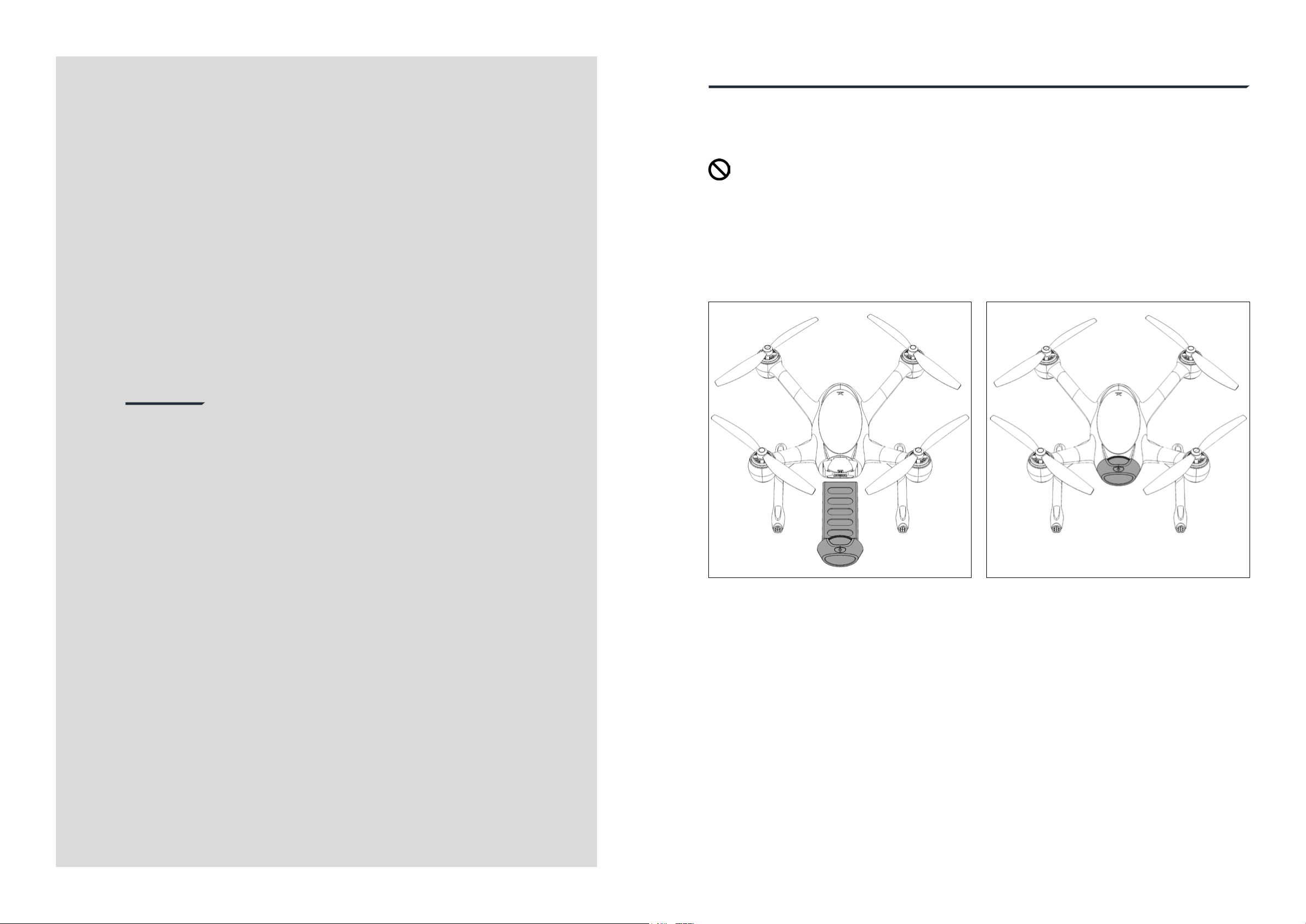
INSERTING THE AIRCRAFT BATTERY
Be sure that the aircraft battery is fully charged ( Refer to Charging the aircraft Battery Section )
The aircraft battery contains a contact lubricant suitable for electronic connectors.The grease is white in
appearance and can be seen on the aircraft power connector and aircraft battery. The lubricant is designed
to last for full lifetime of the aircraft and improve electrical performance. The white appearance is normal.
The user MUST not attempt to replace the grease with any other products. No attempts should be made to
remove the lubricant.
See diagram for battery installation intructions
Steps for aircraft battery installation:
1. First ensure the battery is turned OFF .
2. Then ensure the orientation of the battery is correct, the OLED display should be pointing upwards.
3. Insert by pushing the battery gently into the aircraft until the two latches of the battery engage into the aircraft.
13Evolve User Manual V1.0 by XDynamics Limited
Page 9
REMOVING THE AIRCRAFT BATTERY
AIRCRAFT FLIGHT CONTROL
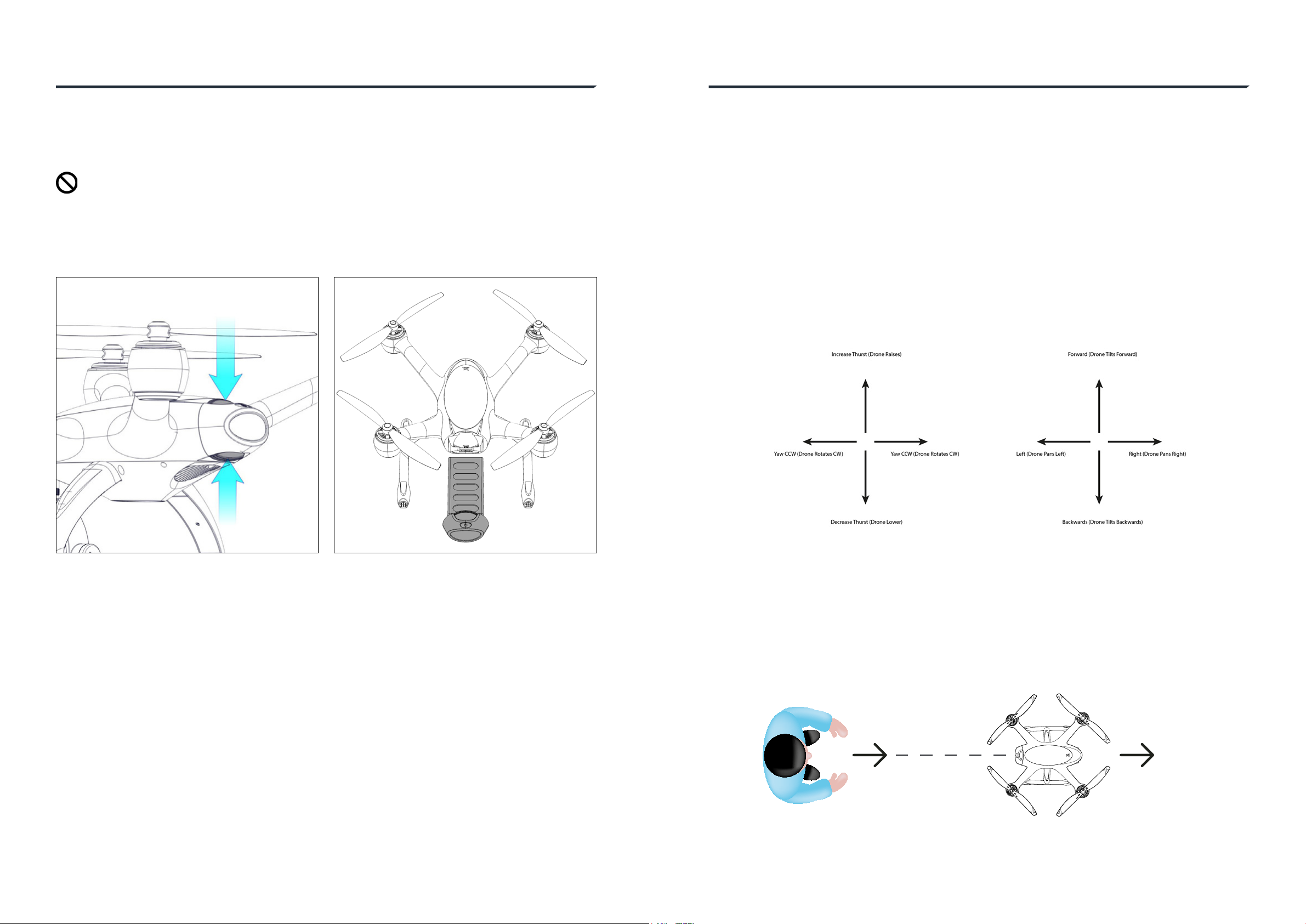
Remove the battery by squeezing the battery mechanical latches and pulling the battery out of the aircraft.
Ensure the aircraft battery is turned OFF before inserting or removing it from the aircraft or battery charger.
When removing the battery from the aircraft allow the battery to cool to room temperature before charging
the battery with the supplied charger.
See diagram for removing the aircraft battery below
Flight control of the Evolve is accomplished by manipulating the control sticks on the ground controller. Proper orientation
must always be considered when ying the aircraft. A basic rule of thumb when remote piloting a aircraft is to realize
that when the aircraft’s nose, or front end, is facing the pilot the control inputs for roll and yaw are backwards. This
disorientation is the leading cause of all aircraft accidents that are due to pilot error. Therefore, it is very important to
practice piloting in the proper orientation. This includes
• Positioning the aircraft’s nose, or front end, away from the pilot.
• Be sure to stand at least 6ft directly behind the aircraft and keep the nose pointed away from you.
• Fly in an open area free of obstacles such as trees, power lines, and buildings.
• Make sure you are ying in GPS mode. (The aircraft will automatically hold position when the control sticks
are released )
• Ensure that all spectators are standing behind you.
Steps for removing the aircraft battery:
1. First ensure the battery is turned OFF.
2. Squeeze the top and bottom latches to disengage the lock.
3. Remove by rmly gripping and pulling the battery from the aircraft.
(MODE 2)
AIRCRAFT AND PILOT ORIENTATION
Ensure that thr operator and aircraft are both facing the same direction prior to launch.
14 15Evolve User Manual V1.0 by XDynamics Limited
Page 10
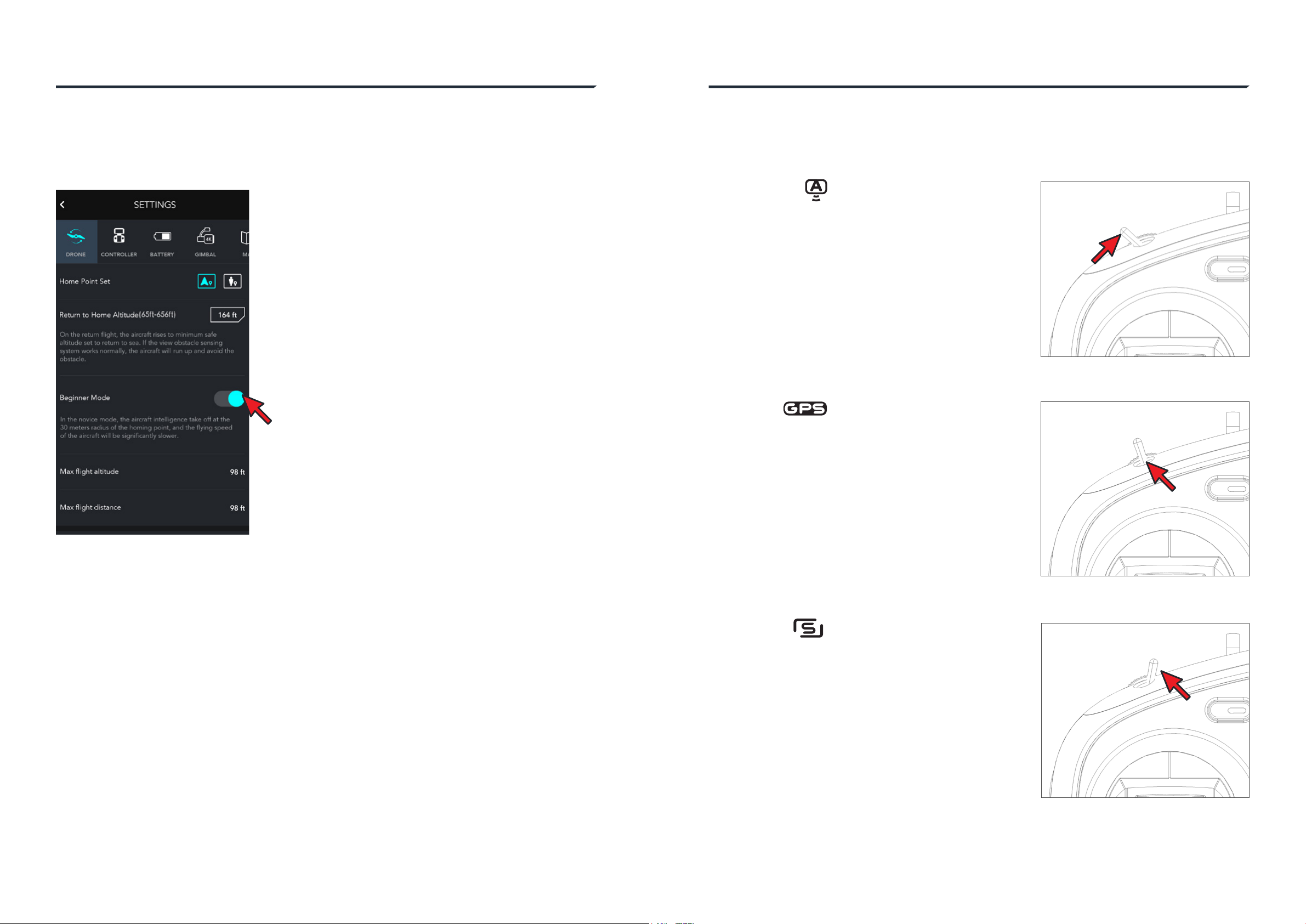
BEGINNER MODE
User may enable Beginner Mode at the Settings Page. After enabling the Beginner Mode, the aircraft can only be own
within a spherical radius of 30m from the take-off point.
FLIGHT MODES
The Evolve aircraft has 3 ight modes that the operator can choose from. The modes are selected by a 3-position switch
located on the top left of the remote controller. Below is a description of each:
1. Attitude Mode
(Left position on the 3-position Switch)
In this mode the aircraft will hold in level attitude orientation when
the control sticks are released, but it will not hold position. This
results in the aircraft drifting in the direction the wind is blowing
and the operator must control position at all times. This mode is
only recommended for experienced operators and it is meant for
smoother breaking reactions and camera panning.
Position 1 – Attitude Mode
2. GPS Mode
(Centre position on 3-position Switch)
In this mode, with a strong GPS signal, the aircraft will hold position
when the control sticks are released. This mode is suggested for
beginner operators.
3. Smart Mode
(Right position on 3-position Switch)
In this mode, with a strong GPS signal, the aircraft can perform the
Smart Pilot functions such as Waypoint Operation, Point of interest,
Easy Course and other modes. When the aircraft is not performing a
smart function it will y in GPS Mode.
Position 2 – GPS Mode
Position 3 – Smart Mode
16 17Evolve User Manual V1.0 by XDynamics Limited
Page 11
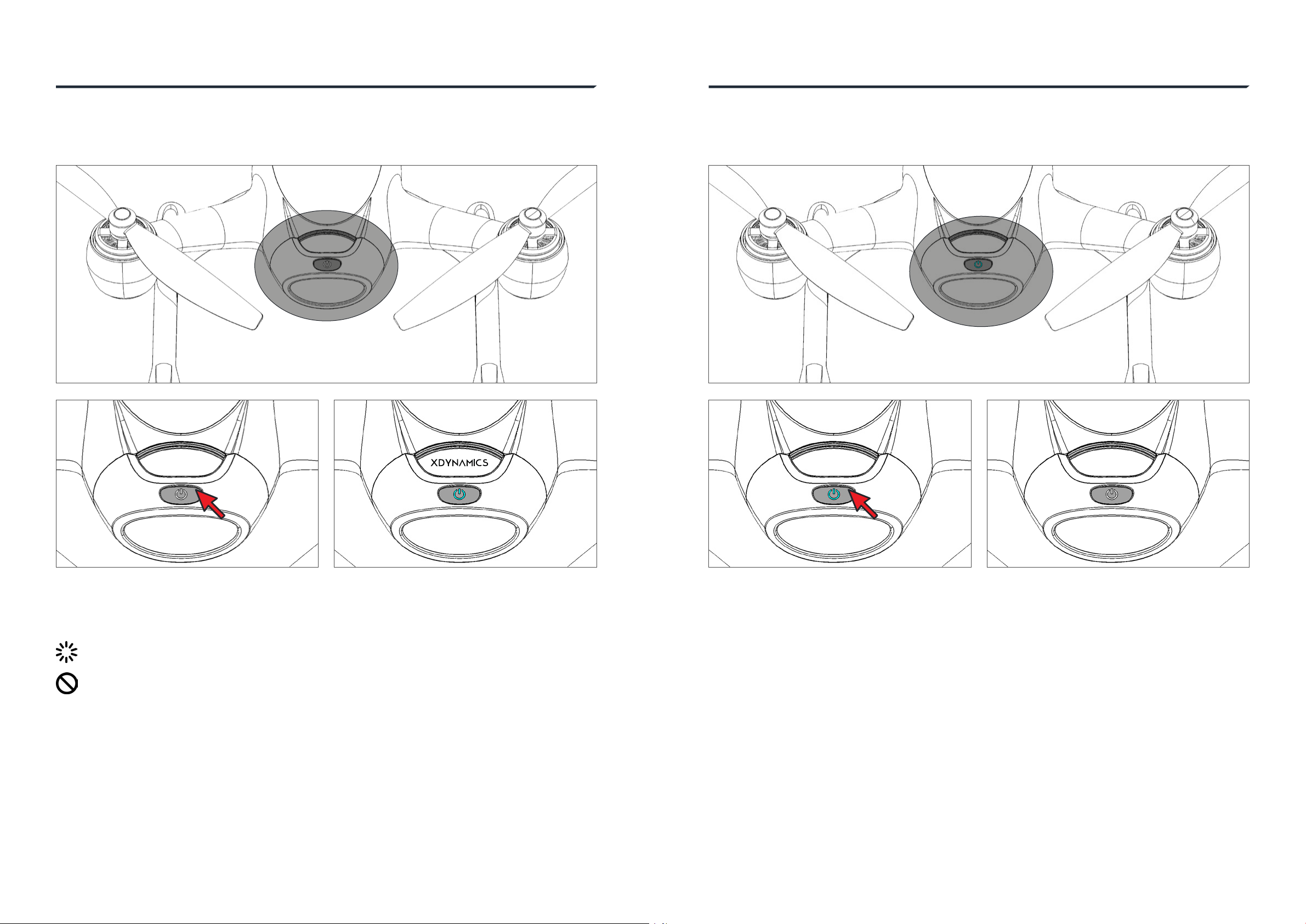
TURN ON THE AIRCRAFT
The battery has a dual press feature to avoid the user accidentally turning on the battery with a single button press.
TURN OFF THE AIRCRAFT
Press and release the battery switch then press again and hold battery switch until the XDynamics logo runs across the
screen.
100%
Press and release the battery switch then press again and hold
the battery switch until the XDynamics logo runs across the
screen.
The battery will turn on regarless of whether it is installed in the aircraft or not.
If the battery is still turned on when removed from the aircraft, ensure the battery connect terminals are left
unobstructed to prevent short circuiting.
The aircraft is powered on when the battery light is illuminated
and the power percentage of charge is displayed.
100%
Press and release the battery switch then press again and hold
battery switch until the XDynamics logo turns off.
The aircraft is powered off when the OLED Logo and Power
button LED are off.
18 19Evolve User Manual V1.0 by XDynamics Limited
Page 12
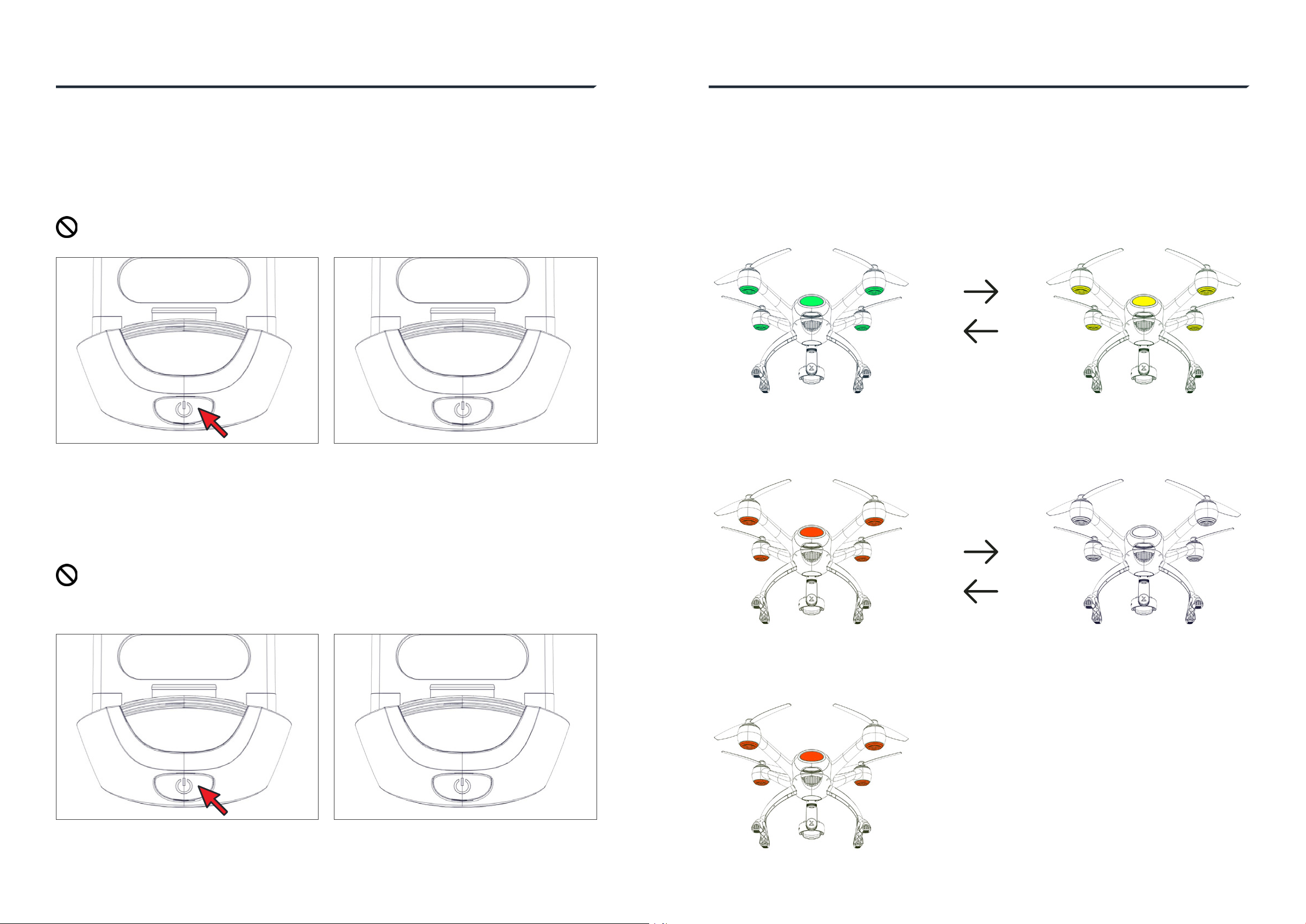
TURNING ON/OFF AIRCRAFT BATTERY
AIRCRAFT LED INDICATORS
Turning the Battery On When not Plugged into the aircraft
Press and release the battery switch then press again and hold battery switch until the XDynamics logo runs across the
screen.
Note: Never short out any of the pins of the battery or try to connect to any other equipment other than the Evolve
aircraft and the supplied charger.
100%
The aircraft LED indicators are located under each motor and at the rear of the aircraft. The LED indicates the current state
of the aircraft. See diagrams below for indications.
LED Powering Up / Arming Flight Control
(Green / Yellow Alternating Fast Blinking LED)
Initializing / Waiting for RC Signal
(Blinking Red LED)
Turning the Battery Off When not Plugged into the aircraft
Press and release the battery switch then press again and hold battery switch until the XDynamics logo runs across the
screen.
Note: Never short out any of the pins of the battery or try to connect to any other equipment other than the Evolve
aircraft and the supplied charger.
15%
Error State
(Solid Red LED) - Refer to Troubleshooting Section
20 21Evolve User Manual V1.0 by XDynamics Limited
Page 13
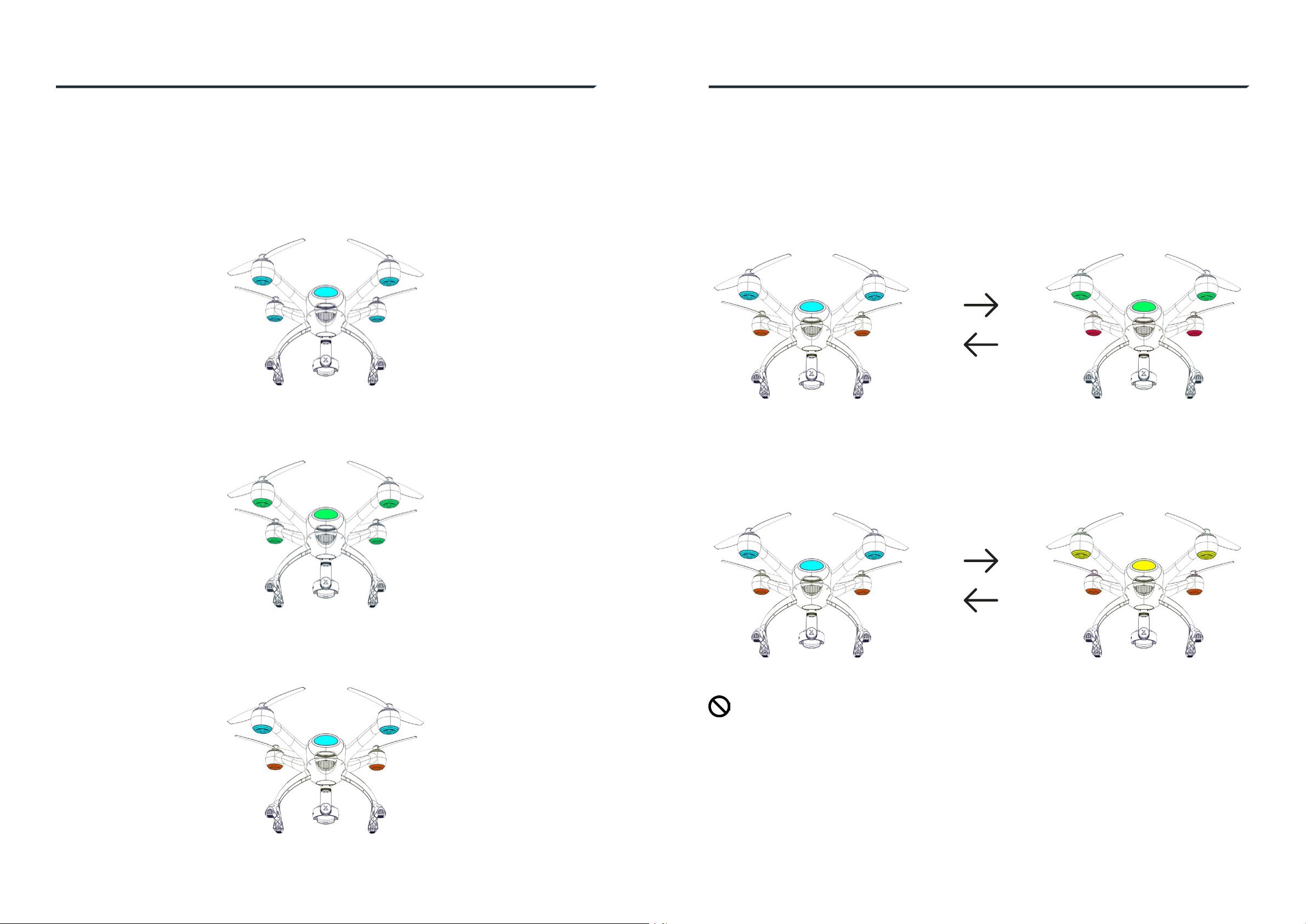
AIRCRAFT LED INDICATORS
The aircraft LED indicators are located under each motor and at the rear of the aircraft. The LED indicates the current state
of the aircraft. See diagrams below for indications.
AIRCRAFT LED INDICATORS
The aircraft LED indicators are located under each motor and at the rear of the aircraft. The LED indicates the current state
of the aircraft. See diagrams below for indications.
Ready for Flight (GPS Mode)
(Solid Blue LED) – Ready for Smart Pilot App Launch
GPS Ready (Can be own in GPS Mode)
(Solid Green LED) - Sets home position
Landing Mode
(Red Front / Green Rear Solid LED) – Make sure landing zone is clear
Malfunction During Flight
(Consult smart pilot / troubleshooting for more details)
Normal Flight Mode
(Red Front / Blue Rear Solid LED) - All systems functional
If the ‘Malfunctioning During Flight’ LED warning is showing land aircraft immediately.
22 23Evolve User Manual V1.0 by XDynamics Limited
Page 14

4K CAMERA / GIMBAL INDICATORS
AIRCRAFT BATTERY
The camera gimbal has an LED indicator located below the base of the mount. This indicator states the status of the
camera. This is a visual reference for the operator to conrm the state of the camera such as taking video or taking still
photography.
GIMBAL
LED
Blinking Blue LED = Gimbal Initializing
Battery Overview
Below is a diagram identifying the different components of the aircraft battery:
Components of the aircraft battery:
1. Heat Ventilation Holes
2. Aircraft Rear Light
3. Power Button
4. Battery Power Status (OLED Display)
5. Battery Connector
Solid Blue LED = Gimbal Ready (Please note that when LED turns off when recording video or still images)
Camera LED
GREEN on N/A Normal, Idle
N/A BLUE toggles once Single Shot
GREEN toggles till shots complete BLUE toggles once Burst
GREEN toggles gently BLUE LED off Video Recording
YELLOW toggles rapidly N/A System Start Up
YELLOW & GREEN toggles alternately N/A SD Card Failure
YELLOW on N/A High Temp / SD Card Missing
YELLOW & GREEN toggles alternately N/A Firmware Upgrading
Gimbal LED
Status
Auto Landing
Important – Monitoring the battery level during ight is crucial to safety and ight planning.
During ight, you can monitor the aircraft›s battery level on the top right corner of the top screen using both battery icon
and charge percentage located beside each other
• The ight mode and environmental conditions should be considered while ying the aircraft and the battery
level should be monitored.
• The aircraft’s battery level icon is found at the top right of the FPV screen on the remote controller.
When the aircraft battery reaches 10% charge, a Force Landing will be activated.
24 25Evolve User Manual V1.0 by XDynamics Limited
Page 15

CHARGING THE AIRCRAFT BATTERY
CHARGING THE AIRCRAFT BATTERY
Battery Charger Overview
Below is a diagram identifying the different components of the battery charger
1
2 3
Components of the battery charger:
1. Power Lord Cable
2. Adapter
3. Chanrger Splilter Block
4. Aircraft Battery Connector
5. Ground Station Battery Connector
Follow the steps below to charge the aircraft battery:
4
Battery Charger Overview
The battery charge level can be checked even if it is not installed in the aircraft by following these steps:
1. Press and release power switch.
2. Battery level percentage will be displayed.
3. Followed by a battery level icon.
4. The display will go blank and the battery will power off.
Fully Charged Battery
5
100%
1. Plug in the charger to a wall socket for power supply.
2. Plug square connector into the back of the battery.
3. Battery display screen will show the percentage battery state during charge.
4. When the percentage is at 100% the battery is fully charged.
Press and release the battery switch.
Low Power Battery
Press and release the battery switch.
The battery level percentage will
be displayed.
10%
If the power status is low (under 10%),
the digits and icon will blink to draw
users‘ attention. Blink interval are 0.5s.
Followed by a battery level icon.
*The OLED display will automatically
turn off after 10s.
26 27Evolve User Manual V1.0 by XDynamics Limited
Page 16

CHARGING THE AIRCRAFT BATTERY
Power Status Range Indications
When determining the estimated ight time and distance range of any aircraft ight, the operator needs to have an idea
of how much ight time is remaining according to the current power percentage left. Below describes the estimated ight
times for battery percentages.
Battery Level Status
Consider the following battery levels for decision making:
100% - Fully Charged
Flight time around 20 minutes
75% - Minimum Level Amount for a New Flight
Flight time around 15 minutes
50% - Half Charged
At this level voltage and current draw has the most effect on ight time
Approximately 10 minutes remaining.
30% - Low Charge Level
Consider returning home and landing soon.
15% - Land Immediately
The battery failsafe mode is triggered and RTL happens
Warning: Never drain the battery to 5% or less, this may damage battery or make the battery unreliable on next
charge.
GROUND STATION
28
Page 17

TURNING ON THE REMOTE CONTROLLER
GROUND STATION LED INDICATORS
When powering on the Ground Station, be sure to provide at least 3 to 6ft (1 to 2m) of space between the controller and
the aircraft. (If the controller and aircraft are too close together the system may not properly connect).
Press and release the power switch and then press and hold the switch until the Ground Station screens come on (this
double press procedure assures that accidental power ups will not happen). While the controller is initializing, power on
the aircraft battery (Refer to Turn On/Off aircraft).
It is important to power on the controller and then the aircraft, in that specic order, to achieve a proper RC
connection.
See diagram for turning on the Ground Station below
1. Short and Long Press Power Button
2. Blue Light Indicates
3. Device Power On
The Ground Station LED indicator is located below the bottom screen. The LED indicates the current state of the Ground
Station battery.
When on charge, the Ground Station LED will be blinking Amber, until the battery is fully charged and the LED stops
blinking (constant off).
During normal operation, the LED will be displayed in constant blue. When the Ground Station battery level has dropped
to a point requiring immediate recharge, the LED will turn to Amber.
It is not recommended to start a new ight with an amber indication on the LED.
See diagram for Ground Station screen below
Press ‘ START HERE ’ on the Evolve home screen to complete the
connection as instructed by the upper screen notice.
GROUND STATION LED INDICATOR
30 31Evolve User Manual V1.0 by XDynamics Limited
Page 18

FLIGHT MODE (MODE 2)
FLIGHT MODE (MODE 2)
Throttle – Increase (Aircraft rises up)
Move left thumbstick up
Keep right thumbstick centred
(Left)
(Right)
Throttle – Decrease (Aircraft lowers down)
Move left thumbstick down
Keep right thumbstick centred
Yaw Counter Clockwise (Aircraft rotates CCW)
Move left thumbstick left
Keep right thumbstick centred
(Left)
(Right)
Yaw Clockwise (Aircraft rotates CW)
Move left thumbstick right
Keep right thumbstick centred
(Left)
(Left)
32 33Evolve User Manual V1.0 by XDynamics Limited
(Right)
(Right)
Page 19

FLIGHT MODE (MODE 2)
FLIGHT MODE (MODE 2)
Forward Movement – (Aircraft tilts forward)
Keep left thumbstick centred
Move right thumbstick up
(Left)
(Right)
Backwards Movement – (Aircraft tilts backwards)
Keep left thumbstick centred
Move right thumbstick down
Roll Left – (Aircraft moves left)
Keep left thumbstick centred
Move right thumbstick left
(Left)
Roll Right – (Aircraft moves right)
Keep left thumbstick centred
Move right thumbstick right
(Right)
(Left)
34 35Evolve User Manual V1.0 by XDynamics Limited
(Right)
(Left)
(Right)
Page 20

PREPARE THE GROUND STATION
REMOTE CONTROLLER
Remove the battery by sliding the battery mechanical latches and pulling the battery out of the aircraft.
See diagram for battery installation below
Charging the Ground Station battery
The Ground Station battery can be charged with the supplied battery charger whilst inserted into the Ground Station‘s
main housing.
Follow the steps below to charge the Ground Station battery:
1. Plug in power supply to wall socket power supply.
2. Plug silver round connector into the remote controller.
3. When the LED indicator on the GS turns off battery is fully charged.
Please note the Ground Station battery can also be charged simultaneously with the Evolve aircraft battery.
Steps for preparing the remote controller:
1. First ensure the battery is turned OFF.
2. Slide the latch to the right to disengage the lock.
3. Remove by rmly gripping and pulling the battery from the Ground Station.
36 37Evolve User Manual V1.0 by XDynamics Limited
Page 21

SCREEN INTRODUCTION
See below indicators for reference.
APPLICATION
39Evolve User Manual V1.0 by XDynamics Limited
Page 22

SCREEN INTRODUCTION
Flight Data is displayed as below:
WARNINGS AND ALERTS
Smart Pilot System provides notications on warnings and alerts, and will provide suggested actions on solving the issues.
The top screen shows the warnings at the top left corner.
The bottom screen also shows the alerts on the left side. You may also refer to the Alert button at the top right corner for
current warnings. Alert button at the top right corner. Tapping the Alert button on the screen will bring you to the Warning
List. You may check all the existing warnings and tap the suggested action to solve the issue.
40 41Evolve User Manual V1.0 by XDynamics Limited
Page 23

SETTINGS MENU
LINKING THE REMOTE CONTROLLER
The settings menu allows the operator to congure the aircraft to suit their preferences. Settings include aircraft,
Controller, Battery, Gimbal, Map and General.
The Evolve aircraft system is pre linked from the factory. If there‘s a situation which requires the Ground Station and the
aircraft to be re-linked follow the steps below:
To pair the Ground Station to a new aircraft follow these steps:
1. Navigate to the Smart Pilot System aircraft Pairing Page. (Settings > Controller > Pairing)
2. Turn on the aircraft.
3. Keep the aircraft at least 3ft away from the remote controller.
4. Tap “Start Pairing” on the Ground Station screen.
5. Follow the instructions on screen to complete the pairing.
6. The screen shows the modules pairing status.
7. The whole pairing process may take up to 1 minute.
Only required if pilot is trying to pair a new aircraft to the Ground Station or a new controller to the aircraft.
Aircraft Settings Controller Settings Battery Settings
Map SettingsGimbal Settings General Settings
42 43Evolve User Manual V1.0 by XDynamics Limited
Page 24

MAP PRELOADING (OFFLINE MAP)
RUN WAYPOINT PLAN
To ensure that the map can be displayed outdoor without network, Smart Pilot System offers the ofine map download
feature. Follow the steps below to download the map.
1. Connect Ground Station to WiFi internet connection with download capabilities
2. Navigate to the Smart Pilot System Ofine Map Page (Setting > Map > Offline Map)
3. Tap “+” to create a new ofine map area
4. Search for plane or address
5. Drag and pinch the map to the designated area
6. Tap Download to start downloading
7. Smart Pilot System will indicate the download progress
Setting Waypoints
To execute the waypoints path, select Smart Mode by choosing the right position on the ight mode switch and then
choose waypoint mode and follow the steps outlined below. Once the plan has been selected and completed, the aircraft
will hover or return to home (RTH) from last waypoint. Auto mode can be cancelled any time by switching the ight mode
switch to the left for GPS mode. The pilot has full control of the position and yaw angle of the aircraft during auto ight.
To execute the plan, you may enter the Fly page by following these steps:
1. Navigate to the Smart Pilot System Fly Page.
2. Tap the Smart GPS Button and select Waypoints.
3. Select the Fly and Point.
4. Fly the aircraft to the interest point and tap C1 to record.
5. Tap “Start” to execute.
44 45Evolve User Manual V1.0 by XDynamics Limited
Page 25

CAMERA AND GIMBAL SECTION
Camera Settings Page
The aircraft camera has full control of key video shooting settings, all of these settings can be found at the camera settings
page in the Smart Co-Pilot System. Select the icon indicated in the diagram below to open the congure settings for the
camera. The standard settings are similar to those found in most digital camera systems, including ISO, shutter speed, EV ,
quality, format etc.
ALBUM AND IMAGE EDITING
You may view your photos and videos on the Smart Pilot Systems page. The editing tool is also available for quick edits.
1. Navigate to the Smart Pilot System Album page.
2. The bottom screen shows the images and videos on the remote controller.
3. Tap the media on the screen.
4. The top screen shows the photos/videos in full screen mode, while the bottom screen provides the detailed
information and control for the photos/videos.
5. Tap Edit on the top right corner to enter the photo editing section.
6. Users can Crop / Apply Filters / Adjust Brightness / Change Contrast / Saturation / Sharpness on this interface.
Media on the controller is a DVR recording from the FPV downlink. For full quality images, remove the SD card and
upload les to your computer.
46 47Evolve User Manual V1.0 by XDynamics Limited
Page 26

WI-FI NETWORK
To download maps and connect to social media services, the Ground Station needs connect to a Wi-Fi network. Navigate
to the Wi-Fi Network page on the Smart Pilot APP and connect to the desired Wi-Fi network.
FIRMWARE UPDATES
The Ground Station App will guide the user through the Firmware Update process. Firmware Update requests are
displayed on the Ground Station screen. Whenever an update is available, the Smart Co-Pilot system will request the
operator perform the update when the Ground Station is connected to a Wi-Fi source. This process can be simply
accessed from the alerts page by selecting update.
BLUETOOTH
To listen to voice alerts form the Smart Piot APP, the Ground Station must be connected to connect to Bluetooth capable
devices. Navigate to the Bluetooth page on the Smart Pilot APP and connect to the desired Bluetooth device. Be sure to
make Bluetooth devices detectable to the Ground Station.
48 49Evolve User Manual V1.0 by XDynamics Limited
Page 27

PREFLIGHT CHECKLIST
The checklist below is recommended before every aircraft ight. Aircraft operators are encouraged to add more items that
might be required for particular operations.
1. Weather Limitations
Although the Evolve is a high performance aircraft, weather can be a crucial factor to ight performance and safe
operations. Caution must be observed when it comes to weather planning. Effective weather planning breaks down to
these criteria:
• Weather information gathering – This can be achieved by watching your local news weather station and by
using the web and APP tools like The Weather Channel and NOAA.
• Knowledge of weather patterns in your operational area – Search for local weather patterns with similar APP
tools for forecasting weather.
• Executing ight plan and go or no go situations based on the weather information – Be sure to make
informed decisions based on accurate weather information and remember no ight is too important to
ignore hazards created by inclement weather.
If these criteria are met, the chances of a crash or close calls are substantially reduced.
Below is the weather limitation of the Evolve:
FLIGHT
• Wind speed - 25mph for maximum safe operations.
• Outside temperature - 0°C ( coldest recommended temperature ) - 40°C ( hottest recommended
temperature).
• Visibility – At least 5 statute miles of clear visibility and a minimum cloud cover ceiling of 400ft.
• Fog – Not recommended to y.
• Rain – Do not y.
2. aircraft PreFlight Checklist
• Gimbal Clamp (Removed; Stowed)
• Micro SD Card (Installed; Available Space)
• Format SD Card (As Necessary)
• Battery (Installed; Status Check Fully Charged)
• Propeller (Check Condition; Installed Black on Black, Silver On Silver)
• CHECK COMPLETE
51Evolve User Manual V1.0 by XDynamics Limited
Page 28

3. Ground Station PreFlight Checklist
• Wi-Fi Internet Service (Connected)
• Maps (Loaded)
• Waypoints (Loaded if necessary)
• Flight Mode Switch (GPS mode) VERY IMPORTANT for BEGINNERS
• Battery (Status Check Fully Charged)
• CHECK COMPLETE
FLIGHT SYSTEM LIMITATIONS
Below are the ight limitations of the Evolve:
Speed
• Assenting – 16.4ft/s (5m/s)
• Descending – 6.6ft/s (2m/s)
• Horizontal – 47mph (75km/h) (For higher top speeds contact customer support for signing of warranty wavier
prior to activation)
4. Ground Station Before aircraft Initialization Checklist
• Power On (Controller)
• Pilot App (Launch)
• Aircraft initialization done. (Blue or Green light states)
• Start Here
• Check checklist page ( App )
• Check software update
• Check satellite connectivity
• CHECK COMPLETE
Distance
• 3281ft /1000m
Height
• 3281ft above sea level / 1000m
Weight
• 5.2lbs / 2.36kg
Maximum. Flight time
• approx. 20mins
52 53Evolve User Manual V1.0 by XDynamics Limited
Page 29

ENSURE CORRECT PROPELLER ALIGNMENT
The propellers need to be mounted with the correct CW (clock-wise) and CCW (counter-clock-wise) congurations. Two
propellers are marked with white rings and two propellers have no markings. Mount the propellers with the white rings to
the motors with a white ring on top. Please follow the steps on the following page to ensure all propellers are securely in
place.
See diagram for attaching and detaching the propellers
ATTACHING AND DETACHING THE PROPELLERS
The Evolve aircraft employs a sturdily constructed attach and detach propeller system. With a quick half turn installation
the aircraft can be ready to y within minutes of pulling it out of the pack. To detach the propellers follow the steps below
in reverse. Before installing the props, please make sure that the pre-lght check list is complete.
See diagram for attaching and detaching the propellers
Step 1 - Ensure that the CW / CCW direction of the propeller is
aligned with the direction of the motor.
CW
CCW
CCW
CW
Step 1
Step 2 - Place the propeller on top of the motor and apply a
downwards twisting force that matches the direction of the
arrow shown on top of the propeller.
Step 2
Step 3 - Keep twisting the propeller with downwards force
until the red dot on the propeller and the do on the motor are
aligned. Once you release the downward force, the propeller
should pop up and lock securely into place. Conrm this is
• Ensure that both CW props with white circle markings match motors with white circle markings.
• Ensure that both CCW props with no circle markings match motors with no circle markings.
secure by twisting the propeller left and right and checking
that the propeller is securely xed to the motor.
Step 3
54 55Evolve User Manual V1.0 by XDynamics Limited
Page 30

PREPARING AIRCRAFT FOR FLIGHT
CAMERA AND GIMBAL SECTION
For the rst ight of the Evolve be sure to have a level surface available that is clear of obstacles and loose debris. Ensure
that there are no overhead structures or trees that might interfere with the Evolve connecting to GPS satellites. Do not
place the Evolve on metal surfaces or with metal nearby (metal interferes with the internal compass of the ight system
and can cause directional errors). For the rst ights of the Evolve be sure to y in low wind (below 10kt) and high visibility
conditions. Avoid ying in low visibility (like heavy fog) and rainy conditions.
REMOVING CAMERA PROTECTOR
See diagram for removing the camera protector
Removing Filter Cover (Allows for cleaning)
To remove the camera lter unscrew CCW as shown in the diagram below.
56 57Evolve User Manual V1.0 by XDynamics Limited
Page 31

AIRCRAFT CALIBRATION
Accelerometer Calibration Procedures
Please note that the aircraft calibration procedures are subject to change. Always follow the procedures indicated in
the Ground Station. Please ensure all rmware is up to date and follow on screen instructions if any variance from the
instructions outlined below.
To calibrate the accelerometer follow these steps
1. For safety reasons, please remove the propellers from the aircraft.
2. Make sure the GS and aircraft are powered on and connected.
3. Navigate to the accelerometer calibration page on the smart pilot APP
(Settings > General > Sensor > Accelerometer).
4. Press “ OK ” on the accelerometer calibration page.
5. Ensure that the aircraft is on a levelled surface and press “next”.
6. Follow the on screen instructions for aircraft placement and push “next” when prompted.
7. Once complete, the APP will indicate a failed or successful calibration.
8. If failed switch off the aircraft and controller power and restart at Step 1.
AIRCRAFT CALIBRATION
Accelerometer Calibration Procedures
Accelerometer calibration is only required when requested by the Smart Pilot System.
58 59Evolve User Manual V1.0 by XDynamics Limited
Page 32

AIRCRAFT CALIBRATION
Accelerometer Calibration Procedures
AIRCRAFT CALIBRATION
Compass Calibration Procedures:
The electronic compass on the Evolve aircraft is used to determine the direction which aircraft is pointing to in reference
to true north. The compass is a sensitive sensor that is affected by electromagnetic interference from sources such as radio
towers and high voltage power lines. The compass can give false readings if the aircraft is placed over a surface composed
of metal or if there is metal under the surface, such as rebar under concrete. If a compass error occurs simply relocate the
aircraft in a different location until the metal interference is gone. If relocating the aircraft does not clear the compass error
or if the smart pilot APP requires a compass calibration follow the steps below.
To calibrate the compass follow these steps:
1. For safety reasons, please remove the propellers from the aircraft.
2. Make sure the GS and aircraft are powered on and connected.
3. Navigate to the compass calibration page on the smart pilot APP.
4. Press “OK ” on the compass calibration page. (Settings > General > Sensor > Compass)
5. Follow the on screen instructions to rotate the aircraft on the proper plane.
6. Only upon starting and ending will there be an audio prompt. Once success, aircraft will restart.
7. When complete the APP will indicate calibration success or failure.
8. If failed switch off the aircraft and controller power and restart at Step 1.
60 61Evolve User Manual V1.0 by XDynamics Limited
Page 33

AIRCRAFT CALIBRATION
Please ensure that all rmware is up to date and follow on screen instructions if there is any variance from the instructions
outlined below.
ARMING THE AIRCRAFT
When arming or disarming commands are given to the ight controller, the aircraft’s state may change suddenly
requiring the operator to react immediately in order to maintain full control of the aircraft.
ARMING PRE-CHECK
The Evolve makes several internal calibrations and adjustments before each ight. If for any reason, any of the vital sensors
or internal equipment has a safety issue, the aircraft will not ARM upon the ARM command given by the operator’s stick
and the LEDs under each motor will turn RED. Please refer to the Smart Pilot screen to check for the diagnoses in order to
correct the problem.
The most common reason for not arming is the calibration of compass on a different or magnetically noisy
environment. Please refer to Compass calibration and try again.
There is a 5 second delay on the arming and disarming of the stick commands to avoid accidental spinning of the
motors or disarming the aircraft in mid-air causing the aircraft to crash.
ARMING
Before arming the aircraft make sure pre-ight check lists are complete and the aircraft is in an area clear of obstacles
and loose debris as loose debris can damage the propellers and possibly cause loose debris to act as projectiles doing
damage to surrounding property and personnel.
Push the left throttle stick down and to the right and wait
for the LED’s light change. During arming, the LEDs color
will fast blink different colors followed by a long beep,
the motors will then engage and the propellers will start
spinning. Move the throttle stick to the middle position and
the aircraft is ready to take off manually.
(Left) (Right)
62 63Evolve User Manual V1.0 by XDynamics Limited
Page 34

DISARMING THE AIRCRAFT
AUTO TAKE OFF
After a landing the aircraft, hold the throttle stick down and to the left to disarm the motors. The LED indicators will
change color followed by a long beep and propellers will stop spinning. Make sure all the LED indicators are solidly lit by
the same color (either Green or Blue) with no blinking before moving the sticks back to central position. If the LEDs are
blinking the aircraft is still in arming mode, keep the sticks in the same position until all the LEDs are solid (either Green or
Blue).
OR
For ease of operation and to assist beginner operators, the evolve aircraft can take off and land automatically.
Follow the steps below:
1. Short Press and Long Press the Auto Take Off button for 3 seconds.
2. The aircraft will arm itself and take off.
3. The aircraft will rise to 4 to 5 feet. ( If the aircraft is in GPS mode it will hold position until the operator takes over, but
if it is in manual mode the operators needs to correct the altitude to prevent drifting.)
Follow the previous pre-ight check, as stated in arming the aircraft above.
Push the left throttle stick down and to the left and wait for
the LED’s light change. During disarming the LEDs color
will fast blink rapidly with different colors followed by a
long beep, the motors will then engage and the propellers
will start spinning. Move the throttle stick to the middle
position and the aircraft is ready to take off manually.
(Left) (Right)
Ensure the aircraft is fully disarmed (either solid Green or Blue LED) before returning the left thumb stick to the
middle position.
64 65Evolve User Manual V1.0 by XDynamics Limited
Page 35

AUTO LANDING
RETURN TO HOME
For ease of operation and to assist beginner operators, the evolve aircraft can take off and land automatically.
Follow the steps below:
1. Short Press and Long Press the Auto Take Off button for 3 seconds.
2. The Ground Station will voice over to indicate the aircraft ready to descent. ( during the descent the operator can
reposition the aircraft to clear obstacles or land in preferred spot )
3. When landed, the aircraft will disarm automatically.
After conrming the land operation, the Ground Station will update the status to indicate that the aircraft is landing.
This feature brings the aircraft back to the location it rst acquired a home lock position utilizing the GPS signal. Ensure
GPS signal is xed before takeoff (when all 4 LED lights located under the motors are solid green a GPS home lock is
achieved) to bring it back to your home point position, when it reaches the home position the aircraft will hover for 5
seconds then land automatically. During the landing descent the operator can move the aircraft’s position to clear away
from obstacles on the ground or land in a preferred spot. At any point during the RTH mode, it can be modied by
pressing the RTH button again and conrming the RTH cancel. The aircraft will then switch back into the mode which the 3
position switch mode is selected.
The number of GPS satellites acquired and the health of the GPS signal can also be checked on the top screen of the
remote controller. 6 is the minimum number of satellites needed. The signal health will be conrmed by a (Excellent /
Good / Fair / Poor) message on the APP.
66 67Evolve User Manual V1.0 by XDynamics Limited
Page 36

USING THE RETURN TO HOME BUTTON ON THE CONTROLLER
RETURN TO HOME BUTTON CANCELLATION
Follow the steps below:
1. Make sure GPS Signal is showing at least ‘Good’ (if not, visually track the aircraft as it ies back to home position).
2. Press and hold the Return to Home button for 3 seconds.
3. The aircraft will ascend to a pre-set altitude, or if at a greater altitude than the programed altitude it will remain at that
altitude, and then return to the Home Point in shortest path (straight line).
4. Smart Pilot System indicates the aircraft is under Return to Home Mode.
5. When reaching the home point the aircraft will hover for few seconds then proceed to auto land (during the descent
the operator can reposition the aircraft to clear away from obstacles or land in preferred spot).
During the return home ight the user may stop the Return to Home process by following the steps below
1. Press the cancel button to stop the Return to Home process.
2. The aircraft will continue in the mode at which the 3 position switch mode is selected.
Press and hold the Return to Home button for 3 seconds
Return to home successful
Return to home failed
Press the Cancel But ton
to stop the Return to Home process
68 69Evolve User Manual V1.0 by XDynamics Limited
Page 37

DETERMINING THE RETURN TO HOME ALTITUDE
Depending on the ight conditions and obstacles in the return to home ight path, the operator can choose a safe return
altitude for the Return to Home function. This altitude should be set up before ight under the APP conguration tab.
A low altitude setting is not recommended for obstacle clearance (such as trees or buildings). Also notice the maximum
legal ight altitude for each ight. This conguration allows the aircraft to reach a programed altitude before starting to
ying back to the home position. If the aircraft is below the programed altitude it will ascend to the programmed altitude
then proceed to the home position. If the aircraft is above the programed altitude it will remain at that altitude and then
proceed to the home position.
Note: This altitude setting is also used for Return to Home function in case the failsafe is triggered due to loss of
signal or power loss of controller.
To congure the Return to Home Altitude, user may enter the Settings Page. At the aircraft section, there is the RTH
Altitude, tap and change the value.
APPENDIX
70
Page 38

PRODUCT SPECIFICATION
GIMBAL
ITEM SPECIFICATION
Controllable Range Pitch -90° to +10°
Gimbal Accuracy Static stability: ±0.01°, motion stability: ±0.2°
Stabilization 3-axis (pitch, roll, yaw)
Power Output 120W
Voltage 18 V
Output Current 6.6A
Net Weight 663g
Dimensions 190mm*67.5mm*40mm
Operating Temperature 0 to 40°C
Input Voltage 110V – 240V a.c. 50Hz/60Hz
CAMERA
ITEM SPECIFICATION
CMOS Sensor Sony 1/2.3” CMOS, Effective pixels:12.4M
FOV: 94 Degree
Lens
21mm, f/2.8, focus at innite
REMOTE CONTROLLER
ITEM SPECIFICATION
Processor Quad Core 2.0GHz 64-bit CPU+ PowerVR GPU
Operating System Android 6.0
Memory 4GB DDR3
Internal Storage 64GB eMMC
Supported SD Card Types Micro SD (SD/SDHC/SDXC) / Max. 64GB
7” 720p Screen
Upper Display (View Finder)
Lower Display (Console)
Embedded Camera 5MP Front Camera
R/C & Telemetry Operating Frequency 2.4-2.47GHz
Max Transmission Distance 1 km, FCC Compliant, unobstructed and no interference
Live View Working Frequency 5.1-5.8GHz
Max Live View Distance 3280ft , FCC Compliant, unobstructed and no interference
Live View Quality 1080p @ 60 fps
Anti-reective Coating
Luminance: 600 cd/m2
5” 1080p Multi-Touch Screen
Anti-reective Coating
Luminance: cd/m2
ISO Range ISO 100-3200
Shutter Speed 1/8000s – 1s
4000 x 3000 ( 4 : 3 )
Max Photo Resolution
3840 x 2160 ( 16 : 9 )
4K: 3840 x 2160 @ 30 fps / 25 fps
Video Resolution
FHD: 1920 x 1080 @ 120 fps / 60 fps / 30 fps
HD: 1280 x 720 @ 240 fps / 120 fps / 60 fps / 30 fps
Max Video Bit Rate 60Mbit/s
Photo File Formats JPEG, DNG
Video File Formats MP4, MOV
Supported SD Card Types Micro SD (SD/SDHC/SDXC) / Max. 64GB
Connectivity Micro USB 2.0
Weight (including RTC battery) 4.2 oz (120 g)
Dimensions 2.28in x 1.96in x 2.09in (58mm x 50mm x 53mm)
Encoding H.264, H.265
Live View Transmission Latency <10ms
Bluetooth 2.1 EDR
Wireless Connectivity
Peripheral Connectors
4.0 BLE Wi-Fi (802.11b/g/n/ac)
Miracast & DLNA support
USB 3.0 OTG x 1
USB 3.0 Host x 1
Micro HDMI-out x 1
Microphone-in jack x 1
Headphone-out jack x 1
SD Card Slot x 1
DC-in x 1
72 73Evolve User Manual V1.0 by XDynamics Limited
Page 39

REMOTE CONTROLLER
AIRCRAFT BATTERY
ITEM SPECIFICATION
Magnetometer
Accelerometer
Sensors
Operating Temperature 32°F - 104°F (0 - 40°C)
Battery 6000 mAh Li-Po 3S
Transmitter Power (EIRP) FCC: 20 dBm (not released)
Operating Voltage 11.1V @ 4A (max)
Dimensions
Weight (including battery) 3.40 lbs (1.55kg)
Three-axis gyroscope
Proximity Detector
Microphone
6.7in(D) x 4in(H) x 9in(W)
(171 x 105 x 230 mm)
ITEM SPECIFICATION
Capacity 6700 mAh 4 Cell LiPo
Voltage 14.8V
Battery Type Lithium-ion Polymer
Energy 99.16 Wh
Net Weight <650g
Dimensions 190mm*67.5mm*40mm
Operating Temperature 0 to 40°C
Max Charging Voltage 17.4V
GROUND STATION BATTERY
ITEM SPECIFICATION
Capacity 6000 mAh Li-Po 3S
Voltage 11.1V @ 4A(max)
Battery Type Lithium-ion Polymer
Energy 66 Wh
Net Weight <440 g
Dimensions 156.7 mm*68.4 mm*40.7 mm
Operating Temperature 0 to 40°C
Max Charging Voltage 18V
74 75Evolve User Manual V1.0 by XDynamics Limited
Page 40

BATTERY
Battery Use
• DO NOT allow the batteries to come into contact with any kind of liquid. DO NOT leave batteries out in the
rain or near a source of moisture. DO NOT drop the battery into water. If the inside of the battery comes into
contact with water, corrosion may occur, potentially resulting in the battery catching on re, and may even
lead to an explosion.
• Never use non-XDynamics batteries. Go to www.xdynamics.com to purchase new batteries. XDynamics takes
no responsibility for any damage caused by non-XDynamics batteries.
• Never use or charge swollen, leaky, or damaged batteries. If your batteries are abnormal, contact XDynamics
or an XDynamics authorized dealer for further assistance.
• Never install or remove the battery from the aircraft when it is turned on. DO NOT insert or remove batteries
if the plastic cover has been torn or compromised in any way.
• The battery should be used in temperatures from 32
environments above 50oC can lead to a re or explosion. Use of battery below 32oF (0oC) can lead to
permanent damage
o
F to 104oF (0oC to 40oC). Use of the battery in
• DO NOT use the battery in strong electrostatic or electromagnetic environments. Otherwise, the battery
control board may malfunction and cause a serious accident during ight.
• Never disassemble or pierce the battery in any way or the battery may leak, catch re, or explode.
• Electrolytes in the battery are highly corrosive. If any electrolytes make contact with your skin or eyes,
immediately wash the affected area with fresh running water for at least 15 minutes, and then see a doctor
immediately.
• DO NOT use the battery if it was involved in a crash or heavy impact.
• If the battery falls into water with the aircraft during ight, take it out immediately and put it in a safe and
open area. Maintain a safe distance from the battery until it is completely dry. Never use the battery again,
and dispose of the battery properly as described in the Battery Disposal section below. DO NOT heat
batteries. Put out any battery re using sand or a dry powder re extinguisher
• DO NOT put batteries in a microwave oven or in a pressurized container.
• DO NOT place loose battery cells on any conductive surface, such as a metal table.
• DO NOT put the loose cells in a pocket, bag or drawer where they may short-circuit against other items or
where the battery terminals could be pressed against each other.
• DO NOT drop or strike batteries. DO NOT place heavy objects on the batteries or charger. Avoid dropping
batteries.
• Clean battery terminals with a clean, dry cloth.
• Before carrying the Intelligent Flight Battery onto an airplane, the battery must rst be discharged to below
5%. Only discharge the battery in a reproof location.
Battery Use
• Make sure the batteries are fully charged before each ight.
• Land the aircraft immediately when low battery levels are activated.
Battery Charging
• The Intelligent Flight Battery is designed to stop charging when it is full. However it is a good practice to
monitor the charging progress and disconnect the batteries when fully charged.
• Ensure the Intelligent Flight Battery is turned off at all times during charging.
Battery Storage
• Discharge the battery to 40%-65% if it will NOT be used for 10 days or more. This can greatly extend the
battery life.
• The battery automatically discharges to below 65% when it is idle for more than 10 days to prevent it from
swelling. It takes approximately 3 days to discharge the battery to 65%. It is normal that you may feel
moderate heat emitting from the battery during the discharge process.
• DO NOT store the battery for an extended period after fully discharging it. Doing so may over-discharge the
battery and cause irreparable battery cell damage.
• The battery will enter hibernation mode if depleted and stored for a long period.
• Recharge the battery to bring it out of hibernation.
• Remove batteries from the aircraft when stored for an extended period.
Battery Disposal
• If the power on/off button on the Intelligent Flight Battery is disabled and the battery cannot be fully
discharged, please contact a professional battery disposal/recycling agent for further assistance.
Battery Maintenance
• Never over-discharge, as this may lead to battery cell damage.
• Battery life may be reduced if not used for a long time.
• Fully charge and discharge the battery at least once every 3 months to maintain battery health.
Travel Notice
• Store Intelligent Flight Batteries in a ventilated location.
76 77Evolve User Manual V1.0 by XDynamics Limited
Page 41

Battery Charging
• DO NOT attach the batteries to wall outlets or car charger sockets directly, and always
use a XDynamics approved adapter.
XDynamics takes no responsibility if the battery is charged using a non-XDynamics charger.
• Never leave the battery unattended during charging. DO NOT charge the battery near ammable materials
or on ammable surface such as carpet or wood.
• DO NOT charge battery immediately after ight, because the battery temperature may be too high. DO
NOT charge the battery until it cools down to near room temperature. Charging the battery outside of the
temperature range of 59oF - 104oF (15°C - 40°C) may lead to leakage, overheating, or battery damage.
• Disconnect the charger when not in use. Examine the charger regularly for damage to the cord, plug,
enclosure, or other parts. DO NOT clean the charger with denatured alcohol or other ammable solvents.
Never use a damaged charger.
Battery Storage
• Keep batteries out of the reach of children and pets.
• DO NOT leave the battery near heat sources such as a furnace or heater. DO NOT leave the batteries inside
of a vehicle on hot days. The ideal storage temperature is (72oF - 82oF) 22°C - 28°C.
• Keep the battery dry. Never drop the battery into water.
• DO NOT drop, strike, impale, or manually short-circuit the battery
• Keep the battery away from metal objects such as glasses, watches, jewelry, and hairpins.
• Never transport a damaged battery or a battery with power level higher than 30%.
Battery Disposal
• Dispose of the battery in specic recycling boxes only after a complete discharge.
• DO NOT place the battery in regular trash containers. Strictly follow your local regulations regarding the
disposal and recycling of batteries.
Battery Maintenance
• Never use the battery when the temperature is too high or too low.
• Never store the battery in environments with a temperature higher than 140
o
F (60°C).
78
Page 42

USER MANUAL v1.0
2019.01
 Loading...