

Page 1
Page 2

Wise for Windows Installer, Version 6.0
Copyright
Notice
Trademarks
©1994-2004 Wise Solutions, Inc. All Rights Reserved.
This documentation and the accompanying software are copyrighted materials. Making unauthorized copies is prohibited
by law. No part of the software or documentation may be reproduced, transmitted, transcribed, stored in a retrieval
system or translated into any human or computer language without prior written permission of Wise Solutions, Inc. Wise
Solutions, Inc. asserts its “Moral Right” to be identified as the author of this work, in all jurisdictions which recognize the
“Moral Right.”
Unless otherwise provided by written agreement with Wise Solutions, Inc., this publication, and the software sold with
this publication, are provided “as is” without warranty of any kind either express or implied, including but not limited to
the implied warranties of merchantability and fitness for a particular purpose. The entire risk arising out of the use or
performance of this publication and software remains with you. In no event will Wise Solutions, Inc., or any of its
suppliers, be liable for any lost profits, lost savings, direct, incidental or indirect damages or other economic or
consequential damages, even if Wise Solutions, Inc., or its suppliers, have been advised of the possibility of such
damages. Wise Solutions, Inc. reserves the right to modify this document at any time without obligation to notify
anyone. In no event shall Wise Solutions, Inc.’s or its suppliers’ liability under this agreement exceed the sum of any
amounts paid hereunder by the customer to Wise or the supplier.
Wise Solutions, Inc. owns a number of registered and unregistered Trademarks and Service Marks (the “Marks”). These
Marks are extremely valuable to Wise Solutions, Inc. and shall not be used by you, or any other person, without Wise
Solutions, Inc.’s express written permission. The Marks include, but are not necessarily limited to the following:
Application Isolation Wizard™; ApplicationWatch™; ConflictManager®; ExpressBuild™; Installation Development Life
Cycle™; InstallBuilder®; InstallMaker®; InstallManager®; InstallTailor™; MSI Debugger™; MSI Script™;
PackageManager™; Preflight Deployment™; SetupCapture®; SmartMonitor™; SmartPatch®; Software Distribution
Made Easy™; Software Installations Made Easy®; Visual MSIDiff™; Virtual Capture™; WebDeploy™; Wise Installation
System®; Wise Package Studio®; Wise Software Repository™; Wise Solutions®; WiseScript™; WiseScript Express™;
WiseUpdate®; WiseUser®; and the Wise Solutions logo.
In addition to Wise Solutions, Inc.’s Marks, some Wise Products may include Trademarks or Service Marks owned by
other corporations. These other Marks include, but are not necessarily limited to Microsoft® Windows® and Microsoft®
Visual Studio® .NET, which are registered Trademarks of Microsoft Corporation.
You shall not use any of the Trademarks or Service Marks of Wise Solutions, Inc., Microsoft Corporation, or any other
entity, without the express written permission of such Trademark or Service Mark owner.
Wise Solutions, Inc.
47911 Halyard Drive; Plymouth, Michigan 48170 USA
Phone: 734-456-2100 • Fax: 734-456-2456 • [email protected] • www.wise.com
2
Page 3

Contents
1 Welcome . . . . . . . . . . . . . . . . . . . . . . . . . . . . . . . . . . . . . . . . . . . . 14
Documentation Roadmap . . . . . . . . . . . . . . . . . . . . . . . . . . . . . . . . . . . . . . . . 15
Getting Help and Product Support . . . . . . . . . . . . . . . . . . . . . . . . . . . . . . . . . . 16
Getting Updates Over the Web . . . . . . . . . . . . . . . . . . . . . . . . . . . . . . . . . . . . 18
2 Basics . . . . . . . . . . . . . . . . . . . . . . . . . . . . . . . . . . . . . . . . . . . . . . 19
Product Editions . . . . . . . . . . . . . . . . . . . . . . . . . . . . . . . . . . . . . . . . . . . . . . 20
About Visual Studio .NET Integration . . . . . . . . . . . . . . . . . . . . . . . . . . . . . . . . 22
Using Installation Expert . . . . . . . . . . . . . . . . . . . . . . . . . . . . . . . . . . . . . . . . 23
About the Product Home Page. . . . . . . . . . . . . . . . . . . . . . . . . . . . . . . . . . . . . 28
Using the Task List. . . . . . . . . . . . . . . . . . . . . . . . . . . . . . . . . . . . . . . . . . . . . 29
Where are Installation Resources Stored?. . . . . . . . . . . . . . . . . . . . . . . . . . . . . 32
Using the Enterprise Edition . . . . . . . . . . . . . . . . . . . . . . . . . . . . . . . . . . . . . . 34
Downloading Redistributable Files . . . . . . . . . . . . . . . . . . . . . . . . . . . . . . . . . . 39
About Page Views. . . . . . . . . . . . . . . . . . . . . . . . . . . . . . . . . . . . . . . . . . . 24
Customizing Page Views . . . . . . . . . . . . . . . . . . . . . . . . . . . . . . . . . . . . . . 25
Using the Current Feature Drop-Down List . . . . . . . . . . . . . . . . . . . . . . . . . 26
Using the Current Release Drop-Down List . . . . . . . . . . . . . . . . . . . . . . . . . 27
Filtering the Task List . . . . . . . . . . . . . . . . . . . . . . . . . . . . . . . . . . . . . . . . 30
Finding Table Errors From the Task List. . . . . . . . . . . . . . . . . . . . . . . . . . . . 30
Adding User-Defined Tasks . . . . . . . . . . . . . . . . . . . . . . . . . . . . . . . . . . . . 31
Sharing Installation Resources . . . . . . . . . . . . . . . . . . . . . . . . . . . . . . . . . . 34
About the Share Point Directory . . . . . . . . . . . . . . . . . . . . . . . . . . . . . . . . . 35
How Source Files Are Indexed . . . . . . . . . . . . . . . . . . . . . . . . . . . . . . . . . . 36
Generating Package Contents Reports . . . . . . . . . . . . . . . . . . . . . . . . . . . . 37
Generating Shared Resource Reports . . . . . . . . . . . . . . . . . . . . . . . . . . . . . 37
Downloading Redistributables From the Wise Web Site or Product CD. . . . . . . 39
Downloading Redistributables From Other Vendors’ Web Sites . . . . . . . . . . . . 40
3 Setting Up . . . . . . . . . . . . . . . . . . . . . . . . . . . . . . . . . . . . . . . . . . . 42
Setting Options . . . . . . . . . . . . . . . . . . . . . . . . . . . . . . . . . . . . . . . . . . . . . . . 43
Setting General Options . . . . . . . . . . . . . . . . . . . . . . . . . . . . . . . . . . . . . . 43
Setting .NET Assembly Options . . . . . . . . . . . . . . . . . . . . . . . . . . . . . . . . . 45
Setting Advertising Options . . . . . . . . . . . . . . . . . . . . . . . . . . . . . . . . . . . . 46
Setting Digital Signature Options . . . . . . . . . . . . . . . . . . . . . . . . . . . . . . . . 48
Setting ExpressBuild Options . . . . . . . . . . . . . . . . . . . . . . . . . . . . . . . . . . . 49
Setting Installation Expert Options . . . . . . . . . . . . . . . . . . . . . . . . . . . . . . . 51
Setting Merge Module Directories . . . . . . . . . . . . . . . . . . . . . . . . . . . . . . . . 52
Activating Suppressed Prompts . . . . . . . . . . . . . . . . . . . . . . . . . . . . . . . . . 53
Setting Repository Options . . . . . . . . . . . . . . . . . . . . . . . . . . . . . . . . . . . . 54
Setting Source Control Options . . . . . . . . . . . . . . . . . . . . . . . . . . . . . . . . . 55
Setting the Default Target Platform . . . . . . . . . . . . . . . . . . . . . . . . . . . . . . 56
Setting Visual Studio Options. . . . . . . . . . . . . . . . . . . . . . . . . . . . . . . . . . . 57
Setting Wildcard Groups . . . . . . . . . . . . . . . . . . . . . . . . . . . . . . . . . . . . . . 59
3
Page 4

Creating and Editing Installation Templates. . . . . . . . . . . . . . . . . . . . . . . . . . . . 60
Component Rules . . . . . . . . . . . . . . . . . . . . . . . . . . . . . . . . . . . . . . . . . . . . . 63
About Component Rules . . . . . . . . . . . . . . . . . . . . . . . . . . . . . . . . . . . . . . 63
Selecting a Component Rule Set . . . . . . . . . . . . . . . . . . . . . . . . . . . . . . . . 64
Using Component Rules to Align GUIDs in an Upgrade . . . . . . . . . . . . . . . . . 65
Customizing Component Rules. . . . . . . . . . . . . . . . . . . . . . . . . . . . . . . . . . 66
Microsoft Best Practices Component Rule Set. . . . . . . . . . . . . . . . . . . . . . . . 68
One File Per Component Rule Set. . . . . . . . . . . . . . . . . . . . . . . . . . . . . . . . 69
4 Working With Wise Installation Files . . . . . . . . . . . . . . . . . . . . . . 71
Before You Create an Installation. . . . . . . . . . . . . . . . . . . . . . . . . . . . . . . . . . . 72
File Types . . . . . . . . . . . . . . . . . . . . . . . . . . . . . . . . . . . . . . . . . . . . . . . . . . . 73
Project Files and Database Files. . . . . . . . . . . . . . . . . . . . . . . . . . . . . . . . . . . . 74
Starting a New Installation . . . . . . . . . . . . . . . . . . . . . . . . . . . . . . . . . . . . . . . 75
Creating an Installation Within a Solution . . . . . . . . . . . . . . . . . . . . . . . . . . 76
Creating a Stand-alone Installation. . . . . . . . . . . . . . . . . . . . . . . . . . . . . . . 77
Creating a Device Driver Installation. . . . . . . . . . . . . . . . . . . . . . . . . . . . . . 78
Options for New Installations . . . . . . . . . . . . . . . . . . . . . . . . . . . . . . . . . . . . . 79
Specifying the Target Platform in an Installation . . . . . . . . . . . . . . . . . . . . . . . . 82
What’s Different in a 64-Bit Installation?. . . . . . . . . . . . . . . . . . . . . . . . . . . 82
Entering Project Settings . . . . . . . . . . . . . . . . . . . . . . . . . . . . . . . . . . . . . . . . 84
Overview Page . . . . . . . . . . . . . . . . . . . . . . . . . . . . . . . . . . . . . . . . . . . . . 84
Project Type Page . . . . . . . . . . . . . . . . . . . . . . . . . . . . . . . . . . . . . . . . . . 85
Projects Page. . . . . . . . . . . . . . . . . . . . . . . . . . . . . . . . . . . . . . . . . . . . . . 85
Main Project Page. . . . . . . . . . . . . . . . . . . . . . . . . . . . . . . . . . . . . . . . . . . 86
Project Outputs Page . . . . . . . . . . . . . . . . . . . . . . . . . . . . . . . . . . . . . . . . 87
How the Installation Integrates With the Solution . . . . . . . . . . . . . . . . . . . . . . . 88
Scanning the Solution for New Files . . . . . . . . . . . . . . . . . . . . . . . . . . . . . . 89
Opening an Installation Package . . . . . . . . . . . . . . . . . . . . . . . . . . . . . . . . . . . 90
Comparing Windows Installer Files. . . . . . . . . . . . . . . . . . . . . . . . . . . . . . . . . . 92
Saving an Installation as XML . . . . . . . . . . . . . . . . . . . . . . . . . . . . . . . . . . . . . 93
Working With Installations in the Software Manager Database . . . . . . . . . . . . . . 94
Compiling, Testing, and Running An Installation . . . . . . . . . . . . . . . . . . . . . . . . 95
Compiling An Installation . . . . . . . . . . . . . . . . . . . . . . . . . . . . . . . . . . . . . 95
Testing An Installation . . . . . . . . . . . . . . . . . . . . . . . . . . . . . . . . . . . . . . . 96
Running An Installation . . . . . . . . . . . . . . . . . . . . . . . . . . . . . . . . . . . . . . . 96
5 Defining an Installation Project . . . . . . . . . . . . . . . . . . . . . . . . . . 98
Project Summary Page . . . . . . . . . . . . . . . . . . . . . . . . . . . . . . . . . . . . . . . . . . 99
Product Details Page . . . . . . . . . . . . . . . . . . . . . . . . . . . . . . . . . . . . . . . . . . 100
Adding Meta Data to the Software Manager Database. . . . . . . . . . . . . . . . . 102
Incrementing the Version . . . . . . . . . . . . . . . . . . . . . . . . . . . . . . . . . . . . 103
Setting the Default Installation Directory. . . . . . . . . . . . . . . . . . . . . . . . . . 104
General Information Page. . . . . . . . . . . . . . . . . . . . . . . . . . . . . . . . . . . . . . . 105
Add/Remove Programs Page . . . . . . . . . . . . . . . . . . . . . . . . . . . . . . . . . . . . . 106
Features Page . . . . . . . . . . . . . . . . . . . . . . . . . . . . . . . . . . . . . . . . . . . . . . . 107
Strategies for Organizing Files Into Features . . . . . . . . . . . . . . . . . . . . . . . 108
Adding a New Feature. . . . . . . . . . . . . . . . . . . . . . . . . . . . . . . . . . . . . . . 110
Configuring a Feature Using Its Drop-Down List . . . . . . . . . . . . . . . . . . . . . 110
4
Page 5

Configuring a Feature Using the Feature Details Dialog. . . . . . . . . . . . . . . . 112
Using Conditions With Features . . . . . . . . . . . . . . . . . . . . . . . . . . . . . . . . 115
Adding and Deleting Feature Conditions . . . . . . . . . . . . . . . . . . . . . . . . . . 115
Managing Binary Resources . . . . . . . . . . . . . . . . . . . . . . . . . . . . . . . . . . . . . 117
Adding Binary Resources. . . . . . . . . . . . . . . . . . . . . . . . . . . . . . . . . . . . . 118
Refreshing Binary Resources . . . . . . . . . . . . . . . . . . . . . . . . . . . . . . . . . . 118
6 Assembling an Installation . . . . . . . . . . . . . . . . . . . . . . . . . . . . . 120
Files or Web Files Page . . . . . . . . . . . . . . . . . . . . . . . . . . . . . . . . . . . . . . . . . 121
Installation Directories . . . . . . . . . . . . . . . . . . . . . . . . . . . . . . . . . . . . . . 122
Files or Web Files Page Icons. . . . . . . . . . . . . . . . . . . . . . . . . . . . . . . . . . 123
Adding Files to an Installation . . . . . . . . . . . . . . . . . . . . . . . . . . . . . . . . . 123
Adding Assembly Dependencies . . . . . . . . . . . . . . . . . . . . . . . . . . . . . . . . 125
Adding Merge Modules Instead of Files . . . . . . . . . . . . . . . . . . . . . . . . . . . 126
Adding Files From the Wise Software Repository . . . . . . . . . . . . . . . . . . . . 127
Adding Contents of Directories to the Installation. . . . . . . . . . . . . . . . . . . . 127
Adding Files From Outside the Solution . . . . . . . . . . . . . . . . . . . . . . . . . . . 129
Adding .NET Assemblies to the Installation . . . . . . . . . . . . . . . . . . . . . . . . 130
Editing Settings for Automatic Updating . . . . . . . . . . . . . . . . . . . . . . . . . . 131
Removing a File From the Destination Computer . . . . . . . . . . . . . . . . . . . . 132
Copying and Moving Files on the Destination Computer . . . . . . . . . . . . . . . 133
Editing File Details . . . . . . . . . . . . . . . . . . . . . . . . . . . . . . . . . . . . . . . . . 134
How Self-Registration Information is Captured . . . . . . . . . . . . . . . . . . . . . . 142
Registry Page . . . . . . . . . . . . . . . . . . . . . . . . . . . . . . . . . . . . . . . . . . . . . . . 144
Adding Registry Keys . . . . . . . . . . . . . . . . . . . . . . . . . . . . . . . . . . . . . . . 145
Removing Registry Entries From the Destination Computer . . . . . . . . . . . . . 146
Importing and Exporting Registry Entries . . . . . . . . . . . . . . . . . . . . . . . . . 148
Configuring General Registry Settings. . . . . . . . . . . . . . . . . . . . . . . . . . . . 148
Setting Permissions for Registry Keys . . . . . . . . . . . . . . . . . . . . . . . . . . . . 150
Viewing Shared Registry Resources . . . . . . . . . . . . . . . . . . . . . . . . . . . . . 150
Special Registry Keys . . . . . . . . . . . . . . . . . . . . . . . . . . . . . . . . . . . . . . . 151
INI Files Page . . . . . . . . . . . . . . . . . . . . . . . . . . . . . . . . . . . . . . . . . . . . . . . 152
Creating and Editing .INI Files . . . . . . . . . . . . . . . . . . . . . . . . . . . . . . . . . 152
Shortcuts Page . . . . . . . . . . . . . . . . . . . . . . . . . . . . . . . . . . . . . . . . . . . . . . 154
Adding a Shortcut to an Installation . . . . . . . . . . . . . . . . . . . . . . . . . . . . . 154
Editing a Shortcut Configuration. . . . . . . . . . . . . . . . . . . . . . . . . . . . . . . . 155
Adding an Environment Variable . . . . . . . . . . . . . . . . . . . . . . . . . . . . . . . . . . 157
Adding File Associations . . . . . . . . . . . . . . . . . . . . . . . . . . . . . . . . . . . . . . . . 158
Determining Extension Settings . . . . . . . . . . . . . . . . . . . . . . . . . . . . . . . . 159
Adding Command Verbs . . . . . . . . . . . . . . . . . . . . . . . . . . . . . . . . . . . . . 159
Selecting MIME Types . . . . . . . . . . . . . . . . . . . . . . . . . . . . . . . . . . . . . . . 160
Services Page . . . . . . . . . . . . . . . . . . . . . . . . . . . . . . . . . . . . . . . . . . . . . . . 161
Adding a Service to the Destination Computer . . . . . . . . . . . . . . . . . . . . . . 161
Controlling Services on the Destination Computer . . . . . . . . . . . . . . . . . . . 162
Adding an ODBC Item . . . . . . . . . . . . . . . . . . . . . . . . . . . . . . . . . . . . . . . . . 164
Setting ODBC Driver Details . . . . . . . . . . . . . . . . . . . . . . . . . . . . . . . . . . 165
Setting ODBC Translator Details. . . . . . . . . . . . . . . . . . . . . . . . . . . . . . . . 165
5
Page 6

7 Your Installation on the Destination Computer . . . . . . . . . . . . . 166
About System Requirements . . . . . . . . . . . . . . . . . . . . . . . . . . . . . . . . . . . . . 167
Setting a Requirement on the System Requirements Page . . . . . . . . . . . . . 167
Setting a Requirement by Creating a Launch Condition. . . . . . . . . . . . . . . . 168
Performing a System Search . . . . . . . . . . . . . . . . . . . . . . . . . . . . . . . . . . . . . 170
Searching For Files or Directories . . . . . . . . . . . . . . . . . . . . . . . . . . . . . . . 170
Searching For Items in .INI Files . . . . . . . . . . . . . . . . . . . . . . . . . . . . . . . 172
Searching For a Registry Value . . . . . . . . . . . . . . . . . . . . . . . . . . . . . . . . 174
Searching For a Previously-Installed Component . . . . . . . . . . . . . . . . . . . . 175
Setting Features for Installation Types . . . . . . . . . . . . . . . . . . . . . . . . . . . . . . 177
8 Organizing Your Installation Into Releases . . . . . . . . . . . . . . . . 179
About Releases . . . . . . . . . . . . . . . . . . . . . . . . . . . . . . . . . . . . . . . . . . . . . . 180
Creating a New Release . . . . . . . . . . . . . . . . . . . . . . . . . . . . . . . . . . . . . 180
Outputting a Multiple-Language Release . . . . . . . . . . . . . . . . . . . . . . . . . . 182
Customizing a Release . . . . . . . . . . . . . . . . . . . . . . . . . . . . . . . . . . . . . . . . . 183
Customizing Properties for a Release . . . . . . . . . . . . . . . . . . . . . . . . . . . . 183
Customizing Summary Items for a Release . . . . . . . . . . . . . . . . . . . . . . . . 184
Defining a Feature Set for a Release. . . . . . . . . . . . . . . . . . . . . . . . . . . . . 184
Sharing Settings Between Releases . . . . . . . . . . . . . . . . . . . . . . . . . . . . . 185
Example: Creating a Demo Release . . . . . . . . . . . . . . . . . . . . . . . . . . . . . 185
Setting Build Options for a Release . . . . . . . . . . . . . . . . . . . . . . . . . . . . . . . . 187
Adding Prerequisites to a Release . . . . . . . . . . . . . . . . . . . . . . . . . . . . . . . . . 189
Editing the WiseScript that Creates the Installation .EXE. . . . . . . . . . . . . . . 191
Creating a Clean Build . . . . . . . . . . . . . . . . . . . . . . . . . . . . . . . . . . . . . . . . . 193
Creating Web-Based Installations With WebDeploy . . . . . . . . . . . . . . . . . . . . . 195
The WebDeploy Process . . . . . . . . . . . . . . . . . . . . . . . . . . . . . . . . . . . . . 197
Tips for Creating an Efficient WebDeploy Installation . . . . . . . . . . . . . . . . . 197
Creating a WebDeploy Installation . . . . . . . . . . . . . . . . . . . . . . . . . . . . . . 198
Uploading a WebDeploy Installation to the Web . . . . . . . . . . . . . . . . . . . . . 199
Setting Up Media for Distribution . . . . . . . . . . . . . . . . . . . . . . . . . . . . . . . . . . 202
Adding a Media Item. . . . . . . . . . . . . . . . . . . . . . . . . . . . . . . . . . . . . . . . 202
Adding a Media Destination . . . . . . . . . . . . . . . . . . . . . . . . . . . . . . . . . . . 204
Including Features and Components in Media Items . . . . . . . . . . . . . . . . . . 205
Sharing Media Settings Between Releases . . . . . . . . . . . . . . . . . . . . . . . . . 206
Example: Spanning an Installation Across Media and Sharing Media Size
Information . . . . . . . . . . . . . . . . . . . . . . . . . . . . . . . . . . . . . . . . . . . . . . 207
9 Advanced Installations . . . . . . . . . . . . . . . . . . . . . . . . . . . . . . . . 209
About Command Lines . . . . . . . . . . . . . . . . . . . . . . . . . . . . . . . . . . . . . . . . . 210
Command Line Options For WFWI.EXE . . . . . . . . . . . . . . . . . . . . . . . . . . . 210
Adding a Digital Signature to Your Installation. . . . . . . . . . . . . . . . . . . . . . . . . 212
Creating an Installation for Microsoft SMS . . . . . . . . . . . . . . . . . . . . . . . . . . . 213
Creating a .NET Installation When You Have the .NET Framework . . . . . . . . . . . 214
Creating a .NET Installation Without the .NET Framework. . . . . . . . . . . . . . . . . 215
About Web Installations . . . . . . . . . . . . . . . . . . . . . . . . . . . . . . . . . . . . . . . . 217
Features That Support Web Installations. . . . . . . . . . . . . . . . . . . . . . . . . . 217
Creating a Web Site . . . . . . . . . . . . . . . . . . . . . . . . . . . . . . . . . . . . . . . . 219
Creating a Virtual Directory . . . . . . . . . . . . . . . . . . . . . . . . . . . . . . . . . . . 220
Creating a New Web Folder . . . . . . . . . . . . . . . . . . . . . . . . . . . . . . . . . . . 221
6
Page 7

Setting Installation Options for a Web Installation . . . . . . . . . . . . . . . . . . . 222
Setting Details for Web Sites, Virtual Directories, and Web Folders. . . . . . . . 224
Configuring a Microsoft SQL Server During Installation. . . . . . . . . . . . . . . . . . . 226
Tips on Using the SQL Server Scripts Page . . . . . . . . . . . . . . . . . . . . . . . . 227
Setting SQL Connection Strings . . . . . . . . . . . . . . . . . . . . . . . . . . . . . . . . 227
Specifying SQL Statements . . . . . . . . . . . . . . . . . . . . . . . . . . . . . . . . . . . 228
Specifying Replacements in SQL Statements . . . . . . . . . . . . . . . . . . . . . . . 229
Importing .NET Framework Security Settings . . . . . . . . . . . . . . . . . . . . . . . . . 230
MTS/COM+ Page . . . . . . . . . . . . . . . . . . . . . . . . . . . . . . . . . . . . . . . . . . . . . 232
Adding an MTS or COM+ Application. . . . . . . . . . . . . . . . . . . . . . . . . . . . . 232
10 Mobile Devices. . . . . . . . . . . . . . . . . . . . . . . . . . . . . . . . . . . . . . . 234
Mobile Devices Page Compared to Mobile Device Package Editor . . . . . . . . . . . . 235
About the Mobile Devices Page . . . . . . . . . . . . . . . . . . . . . . . . . . . . . . . . . . . 236
About Mobile Device Package Editor. . . . . . . . . . . . . . . . . . . . . . . . . . . . . . . . 237
Pocket PC and Smartphone Installations. . . . . . . . . . . . . . . . . . . . . . . . . . . . . 238
How a Pocket PC or Smartphone Installation Works . . . . . . . . . . . . . . . . . . 238
Processor and Platform Support for Pocket PC . . . . . . . . . . . . . . . . . . . . . . 239
Creating a Pocket PC or Smartphone Installation . . . . . . . . . . . . . . . . . . . . 239
Compiling a Pocket PC or Smartphone Installation . . . . . . . . . . . . . . . . . . . 240
Setting Application Information for a Mobile Device . . . . . . . . . . . . . . . . . . . . . 241
Setting Platform Support for a Mobile Device . . . . . . . . . . . . . . . . . . . . . . . . . 242
Setting Platform Information for a Mobile Device. . . . . . . . . . . . . . . . . . . . . . . 244
Setting Files for a Mobile Device . . . . . . . . . . . . . . . . . . . . . . . . . . . . . . . . . . 245
Editing Details for Mobile Device Files . . . . . . . . . . . . . . . . . . . . . . . . . . . . . . 246
Setting Registry for a Mobile Device. . . . . . . . . . . . . . . . . . . . . . . . . . . . . . . . 248
Setting Shortcuts for a Mobile Device. . . . . . . . . . . . . . . . . . . . . . . . . . . . . . . 250
Setting Desktop Computer Details for a Mobile Device Installation. . . . . . . . . . . 251
Palm OS Installations . . . . . . . . . . . . . . . . . . . . . . . . . . . . . . . . . . . . . . . . . . 252
11 Translating an Installation . . . . . . . . . . . . . . . . . . . . . . . . . . . . . 254
About the Languages Page . . . . . . . . . . . . . . . . . . . . . . . . . . . . . . . . . . . . . . 255
Creating a Translated .MSI . . . . . . . . . . . . . . . . . . . . . . . . . . . . . . . . . . . 256
Creating a Language Transform . . . . . . . . . . . . . . . . . . . . . . . . . . . . . . . . 257
Sharing Language Settings Between Releases . . . . . . . . . . . . . . . . . . . . . . 258
Removing a Language from an Installation . . . . . . . . . . . . . . . . . . . . . . . . 259
Defining and Translating Into Additional Languages . . . . . . . . . . . . . . . . . . . . . 260
About the New Language Wizard . . . . . . . . . . . . . . . . . . . . . . . . . . . . . . . 260
Defining a New Language and Exporting All Text for Translation . . . . . . . . . 261
Importing All Text Strings After Translation . . . . . . . . . . . . . . . . . . . . . . . . 262
Importing All Text Strings With the New Language Wizard . . . . . . . . . . . . . 263
Translating Text Strings You’ve Added or Changed . . . . . . . . . . . . . . . . . . . . . . 265
Translating Text Strings by Exporting to a File . . . . . . . . . . . . . . . . . . . . . . 265
Translating Text Directly Without Exporting It . . . . . . . . . . . . . . . . . . . . . . 267
Resizing Dialog Controls After Translation . . . . . . . . . . . . . . . . . . . . . . . . . . . . 270
About the Language Menu . . . . . . . . . . . . . . . . . . . . . . . . . . . . . . . . . . . . . . 271
Changing the Default Language . . . . . . . . . . . . . . . . . . . . . . . . . . . . . . . . 271
About the Default Release Language. . . . . . . . . . . . . . . . . . . . . . . . . . . . . 273
About the Language Strings Dialog . . . . . . . . . . . . . . . . . . . . . . . . . . . . . . . . 274
7
Page 8

Keeping Track of Changed Text Strings. . . . . . . . . . . . . . . . . . . . . . . . . . . 274
What Pre-Translated Languages Are Available? . . . . . . . . . . . . . . . . . . . . . . . . 276
Language IDs . . . . . . . . . . . . . . . . . . . . . . . . . . . . . . . . . . . . . . . . . . . . . . . 277
12 Distributing an Installation . . . . . . . . . . . . . . . . . . . . . . . . . . . . . 279
Package Distribution . . . . . . . . . . . . . . . . . . . . . . . . . . . . . . . . . . . . . . . . . . 280
Copying an Installation to the Share Point Directory . . . . . . . . . . . . . . . . . . 280
Copying an Installation to a Network Directory . . . . . . . . . . . . . . . . . . . . . 282
Copying an Installation to an FTP Server. . . . . . . . . . . . . . . . . . . . . . . . . . 282
Performing an Administrative Installation . . . . . . . . . . . . . . . . . . . . . . . . . 283
Copying an Installation to Removable Media . . . . . . . . . . . . . . . . . . . . . . . 284
WiseUpdate . . . . . . . . . . . . . . . . . . . . . . . . . . . . . . . . . . . . . . . . . . . . . . . . 286
The WiseUpdate Process . . . . . . . . . . . . . . . . . . . . . . . . . . . . . . . . . . . . . 287
Using WiseUpdate in an Installation . . . . . . . . . . . . . . . . . . . . . . . . . . . . . 288
Options for Running WiseUpdate Client . . . . . . . . . . . . . . . . . . . . . . . . . . . 293
WiseUpdate Tips . . . . . . . . . . . . . . . . . . . . . . . . . . . . . . . . . . . . . . . . . . 294
Troubleshooting WiseUpdate . . . . . . . . . . . . . . . . . . . . . . . . . . . . . . . . . . 295
13 Upgrading Applications . . . . . . . . . . . . . . . . . . . . . . . . . . . . . . . . 296
Preparing for Software Updates. . . . . . . . . . . . . . . . . . . . . . . . . . . . . . . . . . . 297
Archive the Shipping Version of the .MSI. . . . . . . . . . . . . . . . . . . . . . . . . . 297
Determine the Form of the Update . . . . . . . . . . . . . . . . . . . . . . . . . . . . . . 297
Determine the Product Code and Product Version. . . . . . . . . . . . . . . . . . . . 298
Check the Installation With UpgradeSync . . . . . . . . . . . . . . . . . . . . . . . . . 298
UpgradeSync. . . . . . . . . . . . . . . . . . . . . . . . . . . . . . . . . . . . . . . . . . . . . . . . 300
Using UpgradeSync . . . . . . . . . . . . . . . . . . . . . . . . . . . . . . . . . . . . . . . . 300
Patches . . . . . . . . . . . . . . . . . . . . . . . . . . . . . . . . . . . . . . . . . . . . . . . . . . . 302
About Patch Sequencing . . . . . . . . . . . . . . . . . . . . . . . . . . . . . . . . . . . . . 303
Creating a Patch File. . . . . . . . . . . . . . . . . . . . . . . . . . . . . . . . . . . . . . . . 304
Upgrades . . . . . . . . . . . . . . . . . . . . . . . . . . . . . . . . . . . . . . . . . . . . . . . . . . 311
Creating an Upgrade. . . . . . . . . . . . . . . . . . . . . . . . . . . . . . . . . . . . . . . . 311
14 Working With Source Paths. . . . . . . . . . . . . . . . . . . . . . . . . . . . . 314
Using Source Control . . . . . . . . . . . . . . . . . . . . . . . . . . . . . . . . . . . . . . . . . . 315
Adding an Installation to Source Control . . . . . . . . . . . . . . . . . . . . . . . . . . 316
Adding Files to an Installation in Source Control. . . . . . . . . . . . . . . . . . . . . 317
Checking Files Into Source Control . . . . . . . . . . . . . . . . . . . . . . . . . . . . . . 318
Checking Files Out from Source Control . . . . . . . . . . . . . . . . . . . . . . . . . . 318
Getting Latest Version of Files . . . . . . . . . . . . . . . . . . . . . . . . . . . . . . . . . 319
Removing Files from Source Control . . . . . . . . . . . . . . . . . . . . . . . . . . . . . 319
Undoing the Check Out of Files . . . . . . . . . . . . . . . . . . . . . . . . . . . . . . . . 319
Showing History of the Installation File . . . . . . . . . . . . . . . . . . . . . . . . . . . 320
Showing the Differences Between Installation Files. . . . . . . . . . . . . . . . . . . 320
Comparing the Current Installation to the Latest in Source Control. . . . . . . . 321
About Path Variables . . . . . . . . . . . . . . . . . . . . . . . . . . . . . . . . . . . . . . . . . . 322
Turning Path Variable Substitution On and Off . . . . . . . . . . . . . . . . . . . . . . 322
Creating a User-Defined Path Variable . . . . . . . . . . . . . . . . . . . . . . . . . . . 323
Creating a Path Variable Based on an Environment Variable . . . . . . . . . . . . 323
Creating a Path Variable Based on a Registry Value . . . . . . . . . . . . . . . . . . 324
Changing Source Paths in an Installation . . . . . . . . . . . . . . . . . . . . . . . . . . . . 325
8
Page 9

Changing Source Directories . . . . . . . . . . . . . . . . . . . . . . . . . . . . . . . . . . 325
Converting to Relative Source File Paths . . . . . . . . . . . . . . . . . . . . . . . . . . 326
Converting to UNC-Based Source File Paths. . . . . . . . . . . . . . . . . . . . . . . . 327
Changing the Source Directory Dynamically During Compile . . . . . . . . . . . . 327
15 Merge Modules and Transforms . . . . . . . . . . . . . . . . . . . . . . . . . 329
About Merge Modules. . . . . . . . . . . . . . . . . . . . . . . . . . . . . . . . . . . . . . . . . . 330
Available Tabs and Pages in Merge Modules. . . . . . . . . . . . . . . . . . . . . . . . 331
Creating a Merge Module As a New Installation . . . . . . . . . . . . . . . . . . . . . 334
Creating a Merge Module Within a Solution . . . . . . . . . . . . . . . . . . . . . . . . 336
Creating a Merge Module From Existing Components . . . . . . . . . . . . . . . . . 337
Creating a Configurable Merge Module . . . . . . . . . . . . . . . . . . . . . . . . . . . 338
About the Merge Modules Page . . . . . . . . . . . . . . . . . . . . . . . . . . . . . . . . 344
About Transforms . . . . . . . . . . . . . . . . . . . . . . . . . . . . . . . . . . . . . . . . . . . . 348
Creating a Transform Based on an Existing .MSI . . . . . . . . . . . . . . . . . . . . 348
Setting Transform Details . . . . . . . . . . . . . . . . . . . . . . . . . . . . . . . . . . . . 349
Applying a Transform to an Installation. . . . . . . . . . . . . . . . . . . . . . . . . . . 350
Multiple Instance Installations . . . . . . . . . . . . . . . . . . . . . . . . . . . . . . . . . 351
16 Tools . . . . . . . . . . . . . . . . . . . . . . . . . . . . . . . . . . . . . . . . . . . . . . 354
ApplicationWatch . . . . . . . . . . . . . . . . . . . . . . . . . . . . . . . . . . . . . . . . . . . . . 355
Convert InstallShield Professional . . . . . . . . . . . . . . . . . . . . . . . . . . . . . . . . . 356
Convert SMS Installer or WiseScript Installation . . . . . . . . . . . . . . . . . . . . . . . 358
Import Visual Studio Projects . . . . . . . . . . . . . . . . . . . . . . . . . . . . . . . . . . . . 360
Importing an Installation From a Visual Studio Project . . . . . . . . . . . . . . . . 361
Importing an Installation From a Visual Basic Project . . . . . . . . . . . . . . . . . 362
MSI to WSI Conversion . . . . . . . . . . . . . . . . . . . . . . . . . . . . . . . . . . . . . . . . 365
Converting an .MSI to a .WSI File. . . . . . . . . . . . . . . . . . . . . . . . . . . . . . . 365
Specifying Merge Module Source Directories . . . . . . . . . . . . . . . . . . . . . . . 366
Specifying File Source Directories. . . . . . . . . . . . . . . . . . . . . . . . . . . . . . . 367
Package Validation. . . . . . . . . . . . . . . . . . . . . . . . . . . . . . . . . . . . . . . . . . . . 370
Validating a Package. . . . . . . . . . . . . . . . . . . . . . . . . . . . . . . . . . . . . . . . 370
Customizing Validation Modules . . . . . . . . . . . . . . . . . . . . . . . . . . . . . . . . 372
Predefined Validation Modules . . . . . . . . . . . . . . . . . . . . . . . . . . . . . . . . . 378
17 Setup Editor. . . . . . . . . . . . . . . . . . . . . . . . . . . . . . . . . . . . . . . . . 380
About Setup Editor . . . . . . . . . . . . . . . . . . . . . . . . . . . . . . . . . . . . . . . . . . . 381
Product Tab. . . . . . . . . . . . . . . . . . . . . . . . . . . . . . . . . . . . . . . . . . . . . . . . . 383
Specifying Summary Information . . . . . . . . . . . . . . . . . . . . . . . . . . . . . . . 383
Features Tab . . . . . . . . . . . . . . . . . . . . . . . . . . . . . . . . . . . . . . . . . . . . . . . . 385
Assigning a Component to a Feature. . . . . . . . . . . . . . . . . . . . . . . . . . . . . 386
Modules Icon . . . . . . . . . . . . . . . . . . . . . . . . . . . . . . . . . . . . . . . . . . . . . 387
Advertising Icon. . . . . . . . . . . . . . . . . . . . . . . . . . . . . . . . . . . . . . . . . . . 387
Creating a Folder in Setup Editor . . . . . . . . . . . . . . . . . . . . . . . . . . . . . . . 388
Creating Duplicate File Entries . . . . . . . . . . . . . . . . . . . . . . . . . . . . . . . . . 388
Components Tab . . . . . . . . . . . . . . . . . . . . . . . . . . . . . . . . . . . . . . . . . . . . . 390
Component Errors . . . . . . . . . . . . . . . . . . . . . . . . . . . . . . . . . . . . . . . . . 391
Adding and Editing a Component . . . . . . . . . . . . . . . . . . . . . . . . . . . . . . . 391
Moving Items Between Components . . . . . . . . . . . . . . . . . . . . . . . . . . . . . 394
About the Key Path. . . . . . . . . . . . . . . . . . . . . . . . . . . . . . . . . . . . . . . . . 394
9
Page 10

Isolating a .DLL With an .EXE . . . . . . . . . . . . . . . . . . . . . . . . . . . . . . . . . 395
Adding Published Components . . . . . . . . . . . . . . . . . . . . . . . . . . . . . . . . . 395
Tables Tab. . . . . . . . . . . . . . . . . . . . . . . . . . . . . . . . . . . . . . . . . . . . . . . . . . 397
Creating a New Table . . . . . . . . . . . . . . . . . . . . . . . . . . . . . . . . . . . . . . . 398
Creating a New Row in a Table. . . . . . . . . . . . . . . . . . . . . . . . . . . . . . . . . 399
Editing Existing Tables . . . . . . . . . . . . . . . . . . . . . . . . . . . . . . . . . . . . . . 399
Searching for Table Data. . . . . . . . . . . . . . . . . . . . . . . . . . . . . . . . . . . . . 400
Finding Validation Errors . . . . . . . . . . . . . . . . . . . . . . . . . . . . . . . . . . . . . 400
Editing Binary Data in the Icon Table . . . . . . . . . . . . . . . . . . . . . . . . . . . . 401
About Wise Tables . . . . . . . . . . . . . . . . . . . . . . . . . . . . . . . . . . . . . . . . . 402
18 Using Conditions and Properties . . . . . . . . . . . . . . . . . . . . . . . . . 405
Conditions . . . . . . . . . . . . . . . . . . . . . . . . . . . . . . . . . . . . . . . . . . . . . . . . . 406
Where Can You Use Conditions?. . . . . . . . . . . . . . . . . . . . . . . . . . . . . . . . 406
Condition Guidelines . . . . . . . . . . . . . . . . . . . . . . . . . . . . . . . . . . . . . . . . 407
Examples of Conditions . . . . . . . . . . . . . . . . . . . . . . . . . . . . . . . . . . . . . . 408
WiseFixConditions . . . . . . . . . . . . . . . . . . . . . . . . . . . . . . . . . . . . . . . . . 409
Creating Conditions With Condition Builder . . . . . . . . . . . . . . . . . . . . . . . . 409
Properties. . . . . . . . . . . . . . . . . . . . . . . . . . . . . . . . . . . . . . . . . . . . . . . . . . 414
How Do You Use Properties? . . . . . . . . . . . . . . . . . . . . . . . . . . . . . . . . . . 414
Creating a New Property . . . . . . . . . . . . . . . . . . . . . . . . . . . . . . . . . . . . . 415
Build Properties . . . . . . . . . . . . . . . . . . . . . . . . . . . . . . . . . . . . . . . . . . . 416
INI File Properties . . . . . . . . . . . . . . . . . . . . . . . . . . . . . . . . . . . . . . . . . 420
Runtime Properties . . . . . . . . . . . . . . . . . . . . . . . . . . . . . . . . . . . . . . . . . 422
19 Working With Dialogs . . . . . . . . . . . . . . . . . . . . . . . . . . . . . . . . . 424
About Dialogs . . . . . . . . . . . . . . . . . . . . . . . . . . . . . . . . . . . . . . . . . . . . . . . 425
About the Wizard Dialogs . . . . . . . . . . . . . . . . . . . . . . . . . . . . . . . . . . . . 425
Using the Dialogs Page. . . . . . . . . . . . . . . . . . . . . . . . . . . . . . . . . . . . . . . . . 428
Changing the Theme of Dialogs . . . . . . . . . . . . . . . . . . . . . . . . . . . . . . . . 429
Adding and Editing Dialog Themes . . . . . . . . . . . . . . . . . . . . . . . . . . . . . . 429
Importing Text into License and Readme Dialogs . . . . . . . . . . . . . . . . . . . . 430
About the Dialogs Tab . . . . . . . . . . . . . . . . . . . . . . . . . . . . . . . . . . . . . . . . . 431
Adding Controls to Dialogs . . . . . . . . . . . . . . . . . . . . . . . . . . . . . . . . . . . 431
Editing Dialog Details . . . . . . . . . . . . . . . . . . . . . . . . . . . . . . . . . . . . . . . . . . 433
Creating a New Dialog . . . . . . . . . . . . . . . . . . . . . . . . . . . . . . . . . . . . . . . . . 434
About Dialog Controls . . . . . . . . . . . . . . . . . . . . . . . . . . . . . . . . . . . . . . . . . 435
Types of Dialog Controls . . . . . . . . . . . . . . . . . . . . . . . . . . . . . . . . . . . . . 435
Editing Dialog Controls . . . . . . . . . . . . . . . . . . . . . . . . . . . . . . . . . . . . . . 436
Organizing and Aligning Controls on Dialogs . . . . . . . . . . . . . . . . . . . . . . . 442
About Billboards . . . . . . . . . . . . . . . . . . . . . . . . . . . . . . . . . . . . . . . . . . . . . 444
Adding Billboards to a Dialog . . . . . . . . . . . . . . . . . . . . . . . . . . . . . . . . . . 444
Obtaining Logon Information From a Dialog . . . . . . . . . . . . . . . . . . . . . . . . . . 447
Adding the Logon Information Dialog . . . . . . . . . . . . . . . . . . . . . . . . . . . . 447
About the SQL Connection Dialog . . . . . . . . . . . . . . . . . . . . . . . . . . . . . . . . . 449
Adding the SQL Connection Dialog to an Installation. . . . . . . . . . . . . . . . . . 449
Editing Additional SQL Connection Dialogs. . . . . . . . . . . . . . . . . . . . . . . . . 450
Adding the Custom Property Dialog . . . . . . . . . . . . . . . . . . . . . . . . . . . . . . . . 452
10
Page 11

20 OLE Automation. . . . . . . . . . . . . . . . . . . . . . . . . . . . . . . . . . . . . . 453
About OLE Automation . . . . . . . . . . . . . . . . . . . . . . . . . . . . . . . . . . . . . . . . . 454
About Macro Files . . . . . . . . . . . . . . . . . . . . . . . . . . . . . . . . . . . . . . . . . . . . 455
Creating, Editing, and Running a Macro. . . . . . . . . . . . . . . . . . . . . . . . . . . 455
Events That Can Trigger a Macro . . . . . . . . . . . . . . . . . . . . . . . . . . . . . . . 457
About the Macro Editor Window. . . . . . . . . . . . . . . . . . . . . . . . . . . . . . . . . . . 458
OLE Automation Function Reference. . . . . . . . . . . . . . . . . . . . . . . . . . . . . . . . 460
AddComPlusApp . . . . . . . . . . . . . . . . . . . . . . . . . . . . . . . . . . . . . . . . . . . 460
AddComPlusApp2 . . . . . . . . . . . . . . . . . . . . . . . . . . . . . . . . . . . . . . . . . . 460
AddComponent . . . . . . . . . . . . . . . . . . . . . . . . . . . . . . . . . . . . . . . . . . . 461
AddComponentToFeature . . . . . . . . . . . . . . . . . . . . . . . . . . . . . . . . . . . . 461
AddFeature . . . . . . . . . . . . . . . . . . . . . . . . . . . . . . . . . . . . . . . . . . . . . . 462
AddFile . . . . . . . . . . . . . . . . . . . . . . . . . . . . . . . . . . . . . . . . . . . . . . . . . 462
AddFileEx . . . . . . . . . . . . . . . . . . . . . . . . . . . . . . . . . . . . . . . . . . . . . . . 463
AddMergeModule . . . . . . . . . . . . . . . . . . . . . . . . . . . . . . . . . . . . . . . . . . 464
AddRegistryValue . . . . . . . . . . . . . . . . . . . . . . . . . . . . . . . . . . . . . . . . . . 464
AddRegistryValueEx . . . . . . . . . . . . . . . . . . . . . . . . . . . . . . . . . . . . . . . . 465
AddShortcut . . . . . . . . . . . . . . . . . . . . . . . . . . . . . . . . . . . . . . . . . . . . . 465
AddShortcutEx . . . . . . . . . . . . . . . . . . . . . . . . . . . . . . . . . . . . . . . . . . . . 466
AddVirtualDirectory . . . . . . . . . . . . . . . . . . . . . . . . . . . . . . . . . . . . . . . . 467
AddWildcard . . . . . . . . . . . . . . . . . . . . . . . . . . . . . . . . . . . . . . . . . . . . . 468
Compile . . . . . . . . . . . . . . . . . . . . . . . . . . . . . . . . . . . . . . . . . . . . . . . . 469
CreatePatch. . . . . . . . . . . . . . . . . . . . . . . . . . . . . . . . . . . . . . . . . . . . . . 469
DeleteFeature . . . . . . . . . . . . . . . . . . . . . . . . . . . . . . . . . . . . . . . . . . . . 469
EnableExceptions . . . . . . . . . . . . . . . . . . . . . . . . . . . . . . . . . . . . . . . . . . 470
EnableRelease . . . . . . . . . . . . . . . . . . . . . . . . . . . . . . . . . . . . . . . . . . . . 470
GenerateGuid . . . . . . . . . . . . . . . . . . . . . . . . . . . . . . . . . . . . . . . . . . . . 470
GetComponentDirectory . . . . . . . . . . . . . . . . . . . . . . . . . . . . . . . . . . . . . 470
GetLastError . . . . . . . . . . . . . . . . . . . . . . . . . . . . . . . . . . . . . . . . . . . . . 470
GetProperty . . . . . . . . . . . . . . . . . . . . . . . . . . . . . . . . . . . . . . . . . . . . . . 471
New . . . . . . . . . . . . . . . . . . . . . . . . . . . . . . . . . . . . . . . . . . . . . . . . . . . 471
NewEx . . . . . . . . . . . . . . . . . . . . . . . . . . . . . . . . . . . . . . . . . . . . . . . . . 471
Open . . . . . . . . . . . . . . . . . . . . . . . . . . . . . . . . . . . . . . . . . . . . . . . . . . 471
QueryDisplayValidation . . . . . . . . . . . . . . . . . . . . . . . . . . . . . . . . . . . . . . 472
QueryFixValidation . . . . . . . . . . . . . . . . . . . . . . . . . . . . . . . . . . . . . . . . . 472
RunScriptMacro . . . . . . . . . . . . . . . . . . . . . . . . . . . . . . . . . . . . . . . . . . . 472
Save . . . . . . . . . . . . . . . . . . . . . . . . . . . . . . . . . . . . . . . . . . . . . . . . . . . 472
SetComponentGuid. . . . . . . . . . . . . . . . . . . . . . . . . . . . . . . . . . . . . . . . . 473
SetComponentKeyPath . . . . . . . . . . . . . . . . . . . . . . . . . . . . . . . . . . . . . . 473
SetFileSelfRegister . . . . . . . . . . . . . . . . . . . . . . . . . . . . . . . . . . . . . . . . . 473
SetMediaOption . . . . . . . . . . . . . . . . . . . . . . . . . . . . . . . . . . . . . . . . . . . 474
SetProperty . . . . . . . . . . . . . . . . . . . . . . . . . . . . . . . . . . . . . . . . . . . . . . 474
SetRestartIIS. . . . . . . . . . . . . . . . . . . . . . . . . . . . . . . . . . . . . . . . . . . . . 475
SetSilent . . . . . . . . . . . . . . . . . . . . . . . . . . . . . . . . . . . . . . . . . . . . . . . . 475
UseScriptFile . . . . . . . . . . . . . . . . . . . . . . . . . . . . . . . . . . . . . . . . . . . . . 475
OLE Automation Object Reference . . . . . . . . . . . . . . . . . . . . . . . . . . . . . . . . . 476
WColumn . . . . . . . . . . . . . . . . . . . . . . . . . . . . . . . . . . . . . . . . . . . . . . . 476
WColumnDef . . . . . . . . . . . . . . . . . . . . . . . . . . . . . . . . . . . . . . . . . . . . . 477
WColumnDefs . . . . . . . . . . . . . . . . . . . . . . . . . . . . . . . . . . . . . . . . . . . . 477
WColumns . . . . . . . . . . . . . . . . . . . . . . . . . . . . . . . . . . . . . . . . . . . . . . . 477
WFWI.Document . . . . . . . . . . . . . . . . . . . . . . . . . . . . . . . . . . . . . . . . . . 477
11
Page 12

WRow . . . . . . . . . . . . . . . . . . . . . . . . . . . . . . . . . . . . . . . . . . . . . . . . . . 477
WRows . . . . . . . . . . . . . . . . . . . . . . . . . . . . . . . . . . . . . . . . . . . . . . . . . 478
WTable . . . . . . . . . . . . . . . . . . . . . . . . . . . . . . . . . . . . . . . . . . . . . . . . . 479
WTables . . . . . . . . . . . . . . . . . . . . . . . . . . . . . . . . . . . . . . . . . . . . . . . . 479
Visual Basic Functions . . . . . . . . . . . . . . . . . . . . . . . . . . . . . . . . . . . . . . . . . 480
21 Debugger for Windows Installer . . . . . . . . . . . . . . . . . . . . . . . . . 481
About the Debugger. . . . . . . . . . . . . . . . . . . . . . . . . . . . . . . . . . . . . . . . . . . 482
The Debugger Window . . . . . . . . . . . . . . . . . . . . . . . . . . . . . . . . . . . . . . 482
Running the Debugger . . . . . . . . . . . . . . . . . . . . . . . . . . . . . . . . . . . . . . . . . 484
Setting and Clearing Debugger Breakpoints. . . . . . . . . . . . . . . . . . . . . . . . 484
Evaluating Conditions . . . . . . . . . . . . . . . . . . . . . . . . . . . . . . . . . . . . . . . 485
Working With Temporary Tables and Columns . . . . . . . . . . . . . . . . . . . . . . 485
Searching For Text in Tables . . . . . . . . . . . . . . . . . . . . . . . . . . . . . . . . . . 485
22 Using MSI Script . . . . . . . . . . . . . . . . . . . . . . . . . . . . . . . . . . . . . 486
The MSI Script Window . . . . . . . . . . . . . . . . . . . . . . . . . . . . . . . . . . . . . . . . 487
About MSI Script . . . . . . . . . . . . . . . . . . . . . . . . . . . . . . . . . . . . . . . . . . . . . 488
About Installation Modes . . . . . . . . . . . . . . . . . . . . . . . . . . . . . . . . . . . . . 488
About Installation Sequences. . . . . . . . . . . . . . . . . . . . . . . . . . . . . . . . . . 490
Finding Text in MSI Script . . . . . . . . . . . . . . . . . . . . . . . . . . . . . . . . . . . . 491
Editing Sequences . . . . . . . . . . . . . . . . . . . . . . . . . . . . . . . . . . . . . . . . . . . . 492
Types of Actions in MSI Script Sequences . . . . . . . . . . . . . . . . . . . . . . . . . 492
About the Standard and Custom Tabs. . . . . . . . . . . . . . . . . . . . . . . . . . . . 492
Adding and Editing Actions . . . . . . . . . . . . . . . . . . . . . . . . . . . . . . . . . . . 493
Commenting Out Script Lines . . . . . . . . . . . . . . . . . . . . . . . . . . . . . . . . . 493
Calling WiseScripts with Custom Actions. . . . . . . . . . . . . . . . . . . . . . . . . . . . . 494
WiseScript Editing Tools . . . . . . . . . . . . . . . . . . . . . . . . . . . . . . . . . . . . . 494
Examples of WiseScripts You Run From an .MSI. . . . . . . . . . . . . . . . . . . . . 495
Guidelines for Using Custom Actions . . . . . . . . . . . . . . . . . . . . . . . . . . . . . . . 499
Guidelines for Custom Action Location . . . . . . . . . . . . . . . . . . . . . . . . . . . 499
Guidelines for Custom Action Conditions . . . . . . . . . . . . . . . . . . . . . . . . . . 500
Guidelines for Nested Installation Custom Actions . . . . . . . . . . . . . . . . . . . 501
Guidelines for Calling VBScripts and JScripts . . . . . . . . . . . . . . . . . . . . . . . 502
Guidelines for Calling .DLLs . . . . . . . . . . . . . . . . . . . . . . . . . . . . . . . . . . . 502
Launching a Custom Action from a Dialog. . . . . . . . . . . . . . . . . . . . . . . . . . . . 504
Custom Actions That Are Added Automatically . . . . . . . . . . . . . . . . . . . . . . . . 505
Troubleshooting Custom Actions . . . . . . . . . . . . . . . . . . . . . . . . . . . . . . . . . . 506
23 Custom Action Reference . . . . . . . . . . . . . . . . . . . . . . . . . . . . . . 507
Call Custom DLL From Destination . . . . . . . . . . . . . . . . . . . . . . . . . . . . . . 507
Call Custom DLL From Installation . . . . . . . . . . . . . . . . . . . . . . . . . . . . . . 508
Call Custom DLL From Installed Files . . . . . . . . . . . . . . . . . . . . . . . . . . . . 509
Configuring .DLL Parameter Settings . . . . . . . . . . . . . . . . . . . . . . . . . . . . 510
Call DLL From Installation . . . . . . . . . . . . . . . . . . . . . . . . . . . . . . . . . . . . 510
Call DLL From Installed Files . . . . . . . . . . . . . . . . . . . . . . . . . . . . . . . . . . 511
Call JScript From Embedded Code . . . . . . . . . . . . . . . . . . . . . . . . . . . . . . 512
Call JScript From Installation . . . . . . . . . . . . . . . . . . . . . . . . . . . . . . . . . . 512
Call JScript From Installed Files . . . . . . . . . . . . . . . . . . . . . . . . . . . . . . . . 513
Call JScript From Property . . . . . . . . . . . . . . . . . . . . . . . . . . . . . . . . . . . . 514
12
Page 13

Call VBScript From Embedded Code . . . . . . . . . . . . . . . . . . . . . . . . . . . . . 514
Call VBScript From Installation. . . . . . . . . . . . . . . . . . . . . . . . . . . . . . . . . 515
Call VBScript From Installed Files . . . . . . . . . . . . . . . . . . . . . . . . . . . . . . . 516
Call VBScript From Property. . . . . . . . . . . . . . . . . . . . . . . . . . . . . . . . . . . 516
Display Message. . . . . . . . . . . . . . . . . . . . . . . . . . . . . . . . . . . . . . . . . . . 517
Download File From Internet . . . . . . . . . . . . . . . . . . . . . . . . . . . . . . . . . . 518
End Statement. . . . . . . . . . . . . . . . . . . . . . . . . . . . . . . . . . . . . . . . . . . . 518
Execute Program From Destination. . . . . . . . . . . . . . . . . . . . . . . . . . . . . . 519
Execute Program From Installation. . . . . . . . . . . . . . . . . . . . . . . . . . . . . . 519
Execute Program From Installed Files . . . . . . . . . . . . . . . . . . . . . . . . . . . . 520
Execute Program From Path . . . . . . . . . . . . . . . . . . . . . . . . . . . . . . . . . . 520
If Statement . . . . . . . . . . . . . . . . . . . . . . . . . . . . . . . . . . . . . . . . . . . . . 521
Install MSI From Destination . . . . . . . . . . . . . . . . . . . . . . . . . . . . . . . . . . 521
Install MSI From Installation . . . . . . . . . . . . . . . . . . . . . . . . . . . . . . . . . . 522
Install MSI From Relative Path . . . . . . . . . . . . . . . . . . . . . . . . . . . . . . . . . 523
Launch Web Page . . . . . . . . . . . . . . . . . . . . . . . . . . . . . . . . . . . . . . . . . . 524
Open Document From Installed Files. . . . . . . . . . . . . . . . . . . . . . . . . . . . . 524
Pause Installation. . . . . . . . . . . . . . . . . . . . . . . . . . . . . . . . . . . . . . . . . . 525
Post Data to HTTP Server . . . . . . . . . . . . . . . . . . . . . . . . . . . . . . . . . . . . 525
Remark . . . . . . . . . . . . . . . . . . . . . . . . . . . . . . . . . . . . . . . . . . . . . . . . . 526
Run WiseScript From Destination . . . . . . . . . . . . . . . . . . . . . . . . . . . . . . . 526
Run WiseScript From Installation . . . . . . . . . . . . . . . . . . . . . . . . . . . . . . . 527
Run WiseScript From Installed Files . . . . . . . . . . . . . . . . . . . . . . . . . . . . . 528
Set Directory . . . . . . . . . . . . . . . . . . . . . . . . . . . . . . . . . . . . . . . . . . . . . 529
Set Feature State . . . . . . . . . . . . . . . . . . . . . . . . . . . . . . . . . . . . . . . . . . 530
Set Property . . . . . . . . . . . . . . . . . . . . . . . . . . . . . . . . . . . . . . . . . . . . . 530
Terminate Installation. . . . . . . . . . . . . . . . . . . . . . . . . . . . . . . . . . . . . . . 531
Using the Custom Action Location Tab . . . . . . . . . . . . . . . . . . . . . . . . . . . . . . 532
Using the Custom Action Location Tab for Merge Modules . . . . . . . . . . . . . . . . . 533
Using the Custom Action Properties Tab . . . . . . . . . . . . . . . . . . . . . . . . . . . . . 534
24 Windows Installer and .NET Technologies . . . . . . . . . . . . . . . . . 537
About Microsoft Windows Installer . . . . . . . . . . . . . . . . . . . . . . . . . . . . . . . . . 538
Frequently Asked Questions About Microsoft Windows Installer . . . . . . . . . . 538
Working With Components and Features . . . . . . . . . . . . . . . . . . . . . . . . . . 540
About GUIDs . . . . . . . . . . . . . . . . . . . . . . . . . . . . . . . . . . . . . . . . . . . . . 540
About Microsoft .NET Technology . . . . . . . . . . . . . . . . . . . . . . . . . . . . . . . . . . 541
Frequently Asked Questions About Microsoft .NET . . . . . . . . . . . . . . . . . . . 541
Requirements for Creating a .NET Installation . . . . . . . . . . . . . . . . . . . . . . 543
Index . . . . . . . . . . . . . . . . . . . . . . . . . . . . . . . . . . . . . . . . . . . . . . . . . 545
13
Page 14

Chapter 1
Welcome
Wise for Windows Installer is an installation development system for creating and
editing Windows® Installer (.MSI) installation packages. It is a complete and userfriendly front end for generating Windows Installer database files, which are executed by
the Windows Installer engine. With Wise for Windows Installer, you can create
installations that are compliant with Microsoft’s Windows 2000 logo program. Use Wise
for Windows Installer to edit and refine installations that you’ve converted from other
formats, and use it to import development projects.
Through its Visual Studio integrated editor, Wise for Windows Installer offers a complete,
seamless integration of the entire installation authoring environment directly into the
Microsoft® Visual Studio® .NET development environment. This tight integration allows
for automatic synchronization of your development project with your installation, saving
you time and significantly improving the quality of your installations.
Microsoft® Windows® Installer is a Microsoft technology that provides a standard
installation engine that can be used for the installation of any 32-bit or 64-bit Windows
software product. It resides on the destination computer and performs the installation of
applications. Windows Installer technology provides developers with features not
currently available in traditional installation-building products.
Topics include:
! Documentation Roadmap.
! Getting Help and Product Support.
! How to Check Online Help.
! Getting Updates Over the Web.
14
Page 15

Documentation Roadmap
The Wise for Windows Installer documentation assumes that you are proficient in the
use of the Windows operating system. If you need help using the operating system,
consult its user documentation.
Use the following sources of information to learn the product.
Online Help
The online help contains detailed technical information and step-by-step instructions for
performing common tasks. For details on using help, see Check Online Help on page 16.
Reference Manual
All the material in the online help is also available in .PDF-format reference manuals.
Reference manual .PDFs are provided for Wise for Windows Installer and WiseScript
Express. The Enterprise Edition also includes a Software Manager reference manual. To
access the .PDF reference manuals, select Help menu > Reference Manual from within
each product. (In Visual Studio: Help menu > Wise Help > Reference Manual.)
Getting Started Guide
The printed Getting Started Guide contains system requirements, installation
instructions, and a tutorial. To access a .PDF version of the Getting Started Guide, select
Help menu > Getting Started. (In Visual Studio: Help menu > Wise Help > Getting
Started.)
Documentation Roadmap
Windows Installer SDK Help
You can get technical details about Windows Installer from its own help system, which is
written by Microsoft for a developer audience. In Wise for Windows Installer, select Help
menu > Windows Installer SDK Help. (In Visual Studio: Help menu > Wise Help >
Windows Installer SDK Help. Windows Installer SDK help topics are also available within
the Visual Studio .NET help collection.)
Release Notes
A release notes document, in .HTM format, covers new features, enhancements, bug
fixes, and known issues for the current version of this product. It also contains links to
release notes for other versions. Access the release notes in the following ways:
! Browse the product CD.
! Select Help menu > Release Notes. (In Visual Studio: Help menu > Wise Help >
Release Notes.)
! If you are a registered user, visit http://support.wise.com to enter the Support
Center, and then click the Downloads link.
15
Page 16

Getting Help and Product Support
Wise Solutions offers many resources to help you use our products. You can search the
product help or reference manual .PDF for answers, or you can use one of the many
support resources available to you as a registered Wise Solutions customer.
Check Online Help
You can access help in the following ways:
! To display context-sensitive help for the active page or dialog, press F1.
! To select a help topic from a table of contents, index, or search, select Help menu >
Help Topics. (In Visual Studio: Help menu > Wise Help > Help Topics.)
Select other commands from the Help menu to view the Windows Installer SDK Help, to
view the .PDF-format reference manual or getting started guide, to view Wise Solutions
resources on the Web, or to check for upgrades.
If you need help and cannot find the answer in the documentation, explore our technical
support options below.
Use the Wise Solutions Technical Support Center
Registered Wise Solutions customers can use the Technical Support Center, located at
www.wise.com/support.asp, to submit online support requests, register products,
manage customer information, download updates, or search the Knowledgebase. The
Knowledgebase contains how-to procedures, answers to common support questions,
and workarounds.
Getting Help and Product Support
Visit Our Newsgroups
Visit Wise Solutions Newsgroups at www.altiris.com/support/forum/default.asp.
Newsgroup postings by your peers contain answers, tips, analysis, and other comments.
Contribute your own expertise to help others.
Subscribe to TechInfo
TechInfo is a free e-mail newsletter that contains technical tips, product updates, and
other important technical information. To subscribe or to read back issues, visit
www.wise.com/techinfo.asp.
Ask Our Support Team
If you can’t find an answer in our online resources, you can obtain support by phone or
online at www.wise.com/support.asp. Wise Solutions offers flexible payment options to
meet your support needs. For additional details about our support services, visit
www.wise.com/supportoptions.asp or call 1-734-456-2600.
Before you contact technical support, obtain the following:
! Serial number and product version, which you can find by selecting Help menu >
About.
! Operating system version and service pack version if applicable.
! A description of what you do before the problem occurs.
! The text of any error messages that appear.
! Your name, company name, and how to contact you.
! Contract number or payment information, if applicable.
16
Page 17

Getting Help and Product Support
Take Advantage of our Consulting and Training Services
When you have a challenging repackaging or installation problem, turn to Wise
Solutions. Our consultants can help with script writing, repackaging, installation
development, and other solutions that are fully customizable to fit your project and
budget. Visit www.wise.com/consulting.asp for details.
To upgrade your installation and packaging skills, consider Wise Solutions training. Our
certified instructors draw from practical experience to provide relevant course content.
Visit www.wise.com/training.asp for course descriptions and schedules.
Contact Wise Solutions Sales
Contact Wise Solutions’ Sales department to purchase additional products, upgrades,
support services, or consulting and training services.
U.S.: 1-800-554-8565
Europe/Netherlands: +31 70 392 72 20
Other International: 734-456-2100 (in U.S.)
Web Site: www.wise.com/ordercentermain.asp
17
Page 18

Getting Updates Over the Web
You can get the latest version of Wise for Windows Installer using your active Internet
connection. Minor point releases (x.01, x.02, and so on) are generally free, while major
number releases generally incur an upgrade fee. Point releases generally contain
maintenance updates such as bug fixes and minor feature additions.
To check for updates:
1. Connect to the Internet.
2. In Wise for Windows Installer, select Help menu > Check for Updates.
A confirmation prompt appears, then you are connected to the Wise Solutions Web
site.
• If you have not registered this product, follow the screen prompts to create a
user account with Wise and register. You will need a valid product serial number.
After you complete the registration, enter the Wise Technical Support Center and
click the Downloads link.
• If you have registered this product, you are connected to the Downloads page.
3. Follow the instructions on the Web page to download the appropriate update.
Getting Updates Over the Web
Note
Wise for Windows Installer can remind you to check for updates. Select an option in the
Check for Updates drop-down list in Wise Options. This sets the frequency at which you will
be reminded to check for updates.
18
Page 19

Chapter 2
Basics
Read this overview before creating your first installation. It contains information on
getting started with Wise for Windows Installer.
Topics include:
! Product Editions.
! About Visual Studio .NET Integration.
! Using Installation Expert.
! About the Product Home Page.
! Using the Task List.
! Where are Installation Resources Stored?
! Using the Enterprise Edition.
! Downloading Redistributable Files such as merge modules and Windows Installer and
.NET runtimes.
19
Page 20

Product Editions
Wise for Windows Installer is available in 3 editions, each designed to fulfill the needs of
a particular type of user. The edition you purchase determines what features are
available to you.
! Enterprise Edition is a Windows Installer® and .NET installation authoring tool
supporting organizations that develop multiple applications that share common
resources. It helps professional developers create installations that adhere to their
organization’s standards, thereby decreasing the risk of deployment errors.
! Professional Edition is a Windows Installer® and .NET installation authoring tool for
professional software developers who want to create installations for the next
generation of applications, including desktop, server, Web, and mobile devices.
! Standard Edition is a Windows Installer® and .NET installation authoring tool for
professional software developers who want basic but robust support for creating
Windows Installer® and .NET installations.
The following table, which does not include all features, summarizes the differences
between each edition. If a feature is not listed, it is included in all product editions. For a
more comprehensive list of features, visit the Products section of the Wise Solutions
Web site (www.wise.com). For new features and enhancements in the current release,
see the Release Notes, available from the Help menu. (In Visual Studio: select Help
menu > Wise Help.)
Product Editions
Feature Std Pro Ent
General
Specify the target platform for an installation X X
Create configurable merge modules XX
Macro Editor XX
OLE Automation XX
User-defined tasks X
Use merge modules from the Software Manager database X
Add meta data to the Software Manager database X
Enable the Logon Information dialog to configure server software after installation to run
under a particular user
Enable the SQL Connection dialog to generate a valid connection string X X
Enable the Custom Property dialog to gather data from the end user during installation X X
ExpressBuild (distributed compiles) XX
Debugger for Windows Installer XX
Package Contents Reports X
WiseScript Express XXX
Wise Options
Repository options X
Sharing Installation Resources
Open an installation package from the Wise Software Repository X
XX
20
Page 21

Product Editions
Feature Std Pro Ent
Share installation resources in the share point directory X
Distribute to the share point directory X
View and use resources shared by other applications X
Shared Resource Reports in Wise for Windows Installer X
Installation Expert Pages
.NET Framework Security page XX
Clean Build page XX
Mobile Devices page XX
MTS/COM+ page XX
SQL Server Scripts page XX
Web Files page, ability to edit .XML files X X
WebDeploy page XX
WiseUpdate page XX
Tools
Patch Creation and patch support X X X
Software Manager X
Upgrade Sync XXX
Package Validation
Turn individual rules on and off XX
Create a new validation module (.CUB file) X
Create new validation rules X
21
Page 22

About Visual Studio .NET Integration
You can use Wise for Windows Installer from within Visual Studio .NET. The Visual Studio
integrated editor lets you create all the same installation file types that you create in the
stand-alone Wise editor. The Wise editor and Visual Studio integrated editor are different
interfaces for the same product; they share the same preferences, recently-used file
lists, dialog templates, themes, and installation templates. (The Visual Studio integrated
editor was formerly sold separately as Wise for Visual Studio .NET.)
There are several differences between the Wise editor and the Visual Studio integrated
editor that are inherent in the Visual Studio .NET development environment.
Examples:
! In the Visual Studio integrated editor, you have different choices about how to start a
new project, and you can set source paths to update automatically according to
Visual Studio’s build configuration.
! In the Visual Studio integrated editor, installations synchronize automatically with the
other projects in the solution. Example: adding .EXEs, .DLLs, .OCXs, and assemblies
to the solution adds them to the installation.
! Installation meta data fields (examples: application name, version, manufacturer,
and default directory) are populated using data from the Visual Studio .NET solution.
When you double-click an installation file in Windows Explorer, you are prompted to
select which editor to open the file in. You can set an option on this dialog to always
open that file in a specific editor.
If you create an installation project in the Visual Studio integrated editor, and then
uninstall Microsoft Visual Studio .NET, you can continue working on the installation
project in the Wise editor. However, if you right-click a .WSI or .MSI, an option still exists
to edit in the Visual Studio integrated editor, which is no longer possible. Initiate a repair
on Wise for Windows Installer to remove options that have to do with the Visual Studio
integrated editor.
About Visual Studio .NET Integration
22
Page 23
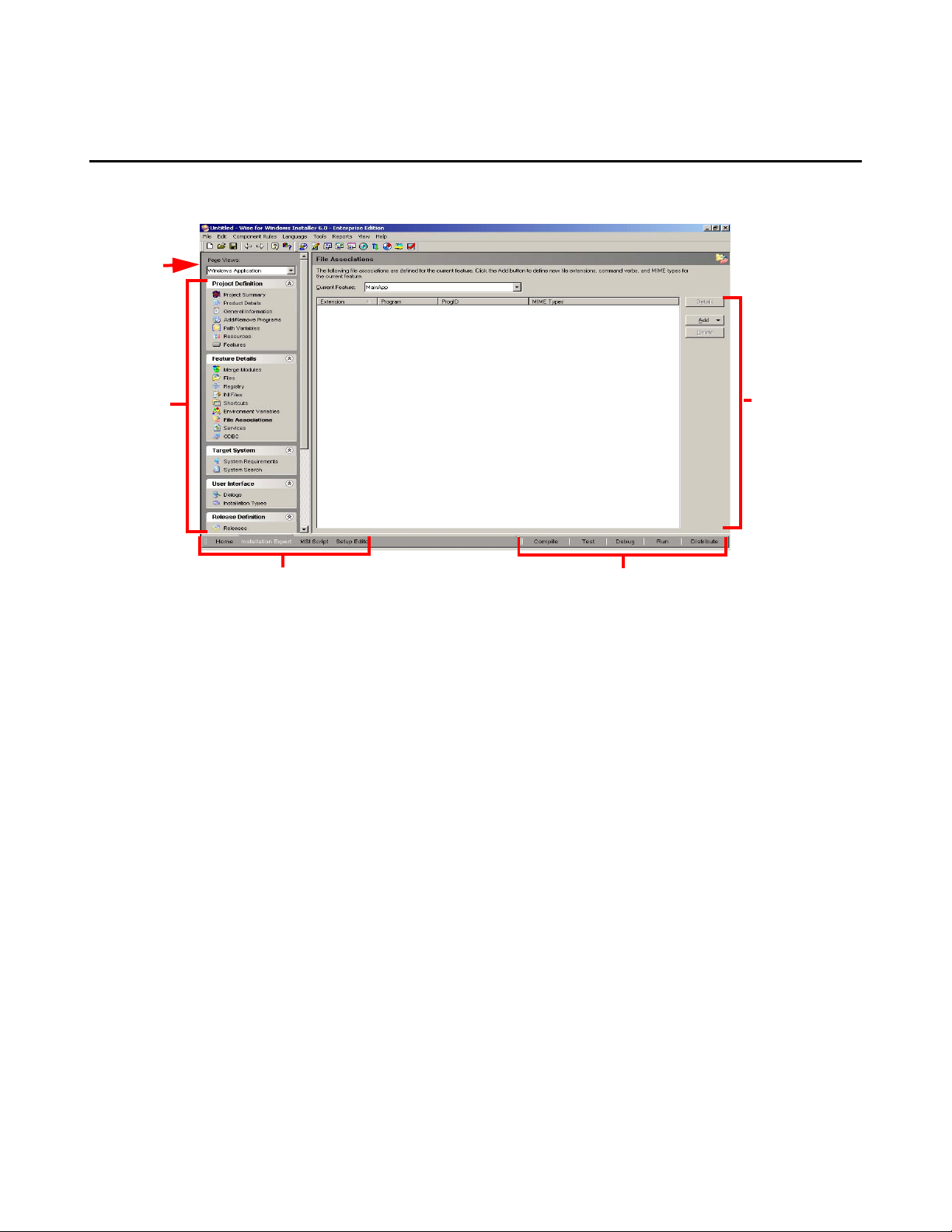
Using Installation Expert
To access Installation Expert, click Installation Expert at the lower left of the Wise for
Windows Installer main window.
Page Views
Using Installation Expert
Page Groups
Page Area
View Navigation
Testing and Distribution
Page Views
Use the Page Views drop-down list to select a page view, which is a set of Installation
Expert page groups and pages. See About Page Views on page 24 and Customizing Page
Views on page 25.
Page Groups
When you select a page view, its pages are organized into page groups. Click the group
name to expand or collapse its pages. Click a page name to display that page.
Page Area
When you click a page name in a page group, this area displays the page’s options. Each
page lets you define a specific aspect of the installation. (Examples: On the Files page,
you define what files are included in the installation. On the Registry page, you define
what registry keys and values are created on the destination computer.) Complete just
the pages that are pertinent to your particular installation, in any order. If required
information is missing, Wise for Windows Installer alerts you to the problem during
compile.
To display help for the current page, press F1. To return an Installation Expert page to
its last saved state, select Edit menu > Reset Page.
View Navigation
Click these tabs to change views. (In Visual Studio: these are buttons instead of tabs.)
23
Page 24

Testing and Distribution
Compile, Test, Debug, and Run buttons test and compile the installation. The Distribute
button copies the installation package to various locations, such as an FTP site or
network directory. It also performs administrative installations. (In Visual Studio: These
buttons are not available, but the same functionality is available through menu
commands.)
About Page Views
A page view is a set of Installation Expert page groups and pages that you select from
the Page Views drop-down list. Select a page view to display only specific page groups
and pages. There are 3 types of page views:
! Predefined page views that display the groups and pages most frequently used for a
particular type of installation. The All page view displays all page groups and pages.
The Merge Module page view appears for all merge modules. You cannot edit or
delete predefined page views.
! Custom page views that you create to meet your specific needs. See Customizing
Page Views on page 25.
! Page views that are created when you create an installation template. You cannot
delete these page views. See Creating and Editing Installation Templates on
page 60.
The page views are arranged alphabetically in the Page Views drop-down list with the
exception of the All page view, which is always first. The list also includes <New
View...> and <Customize Page Views...>, which are at the end of the list and are
used to create or customize page views.
Using Installation Expert
Predefined Templates and Page Views
Most predefined installation templates have an associated page view. When you create a
new installation by using one of these templates, the page view that is associated with
that template becomes the default page view of the installation. When you open the
installation, this page view appears in the Page Views drop-down list. You can select a
different page view from the list at any time (with the exception of the Merge Module
page view, which can only be used with merge modules). When you select a different
page view, it changes the pages displayed in Installation Expert but does not change the
installation type. If you change the page view and save the installation, this new page
view displays the next time you open the installation, unless you clear the Display the
page view associated with a project when a project is opened checkbox in Wise
Options.
Custom Templates and Page Views
When you create an installation template, a page view is created with the same name
and is listed in the Page Views drop-down list. For details on creating custom
templates, see Creating and Editing Installation Templates on page 60. However, when
you use a template to create an installation, the default page view is the page view that
was displayed when the template was created. If the template’s default page view is a
custom page view, you can customize it. See Customizing Page Views on page 25.
(Enterprise Edition only.) You can share page views that are associated with an
installation template because the page view is stored in the template, which is located in
the share point directory.
24
Page 25
Which Page View Appears?
! The Display the page view associated with a project when a project is
opened checkbox in Wise Options determines what page view appears. If you clear
this checkbox, the page view in Installation Expert does not change when you open a
project regardless of its associated page view. See Setting Installation Expert
Options on page 51.
! The All page view is used when you open an installation file that does not have an
associated page view. An .MSI does not have an associated page view.
Customizing Page Views
You can create customized Installation Expert page views that display only the page
groups and pages that you use most often. You can customize the page view of custom
installation templates or create customized page views that are not associated with a
template. You cannot customize the predefined page views, but you can make a copy of
a predefined page view and then customize it.
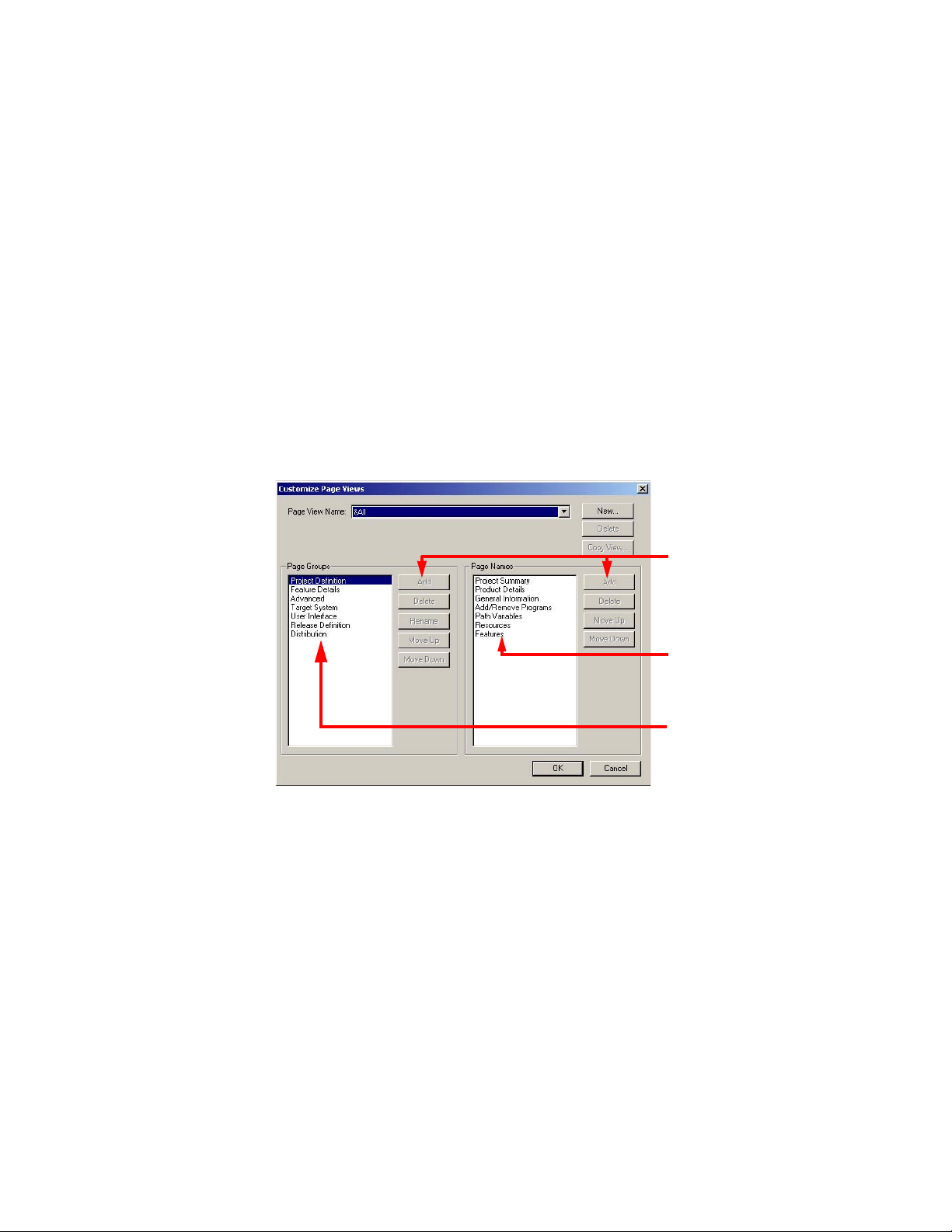
When you customize a page view, you can specify how many page groups appear, what
the group names are, and what pages appear under each group.
Using Installation Expert
Buttons to edit page groups
and pages are disabled
when a predefined page
view is selected in Page
View Name.
These pages appear under
the group selected in Page
Groups.
The page groups appear on
the left side of Installation
Expert.
To create a page view:
1. From the Page Views drop-down list in Installation Expert, select <New View...>.
The Enter Name dialog appears.
2. Enter a name for the page view.
To create an access key for the name, type & before a letter in the name. The page
view access keys appear only in the page group’s right-click menu accessed by
using the context menu key (the key next to the right Ctrl key).
3. Click OK.
On the Customized Page Views dialog, the new page view is selected in Page View
Name, but it has no page groups or page names.
4. To copy the page groups and pages of an existing page view:
• Click Copy View. The Copy View dialog appears.
• Select the page view to copy and click OK.
25
Page 26
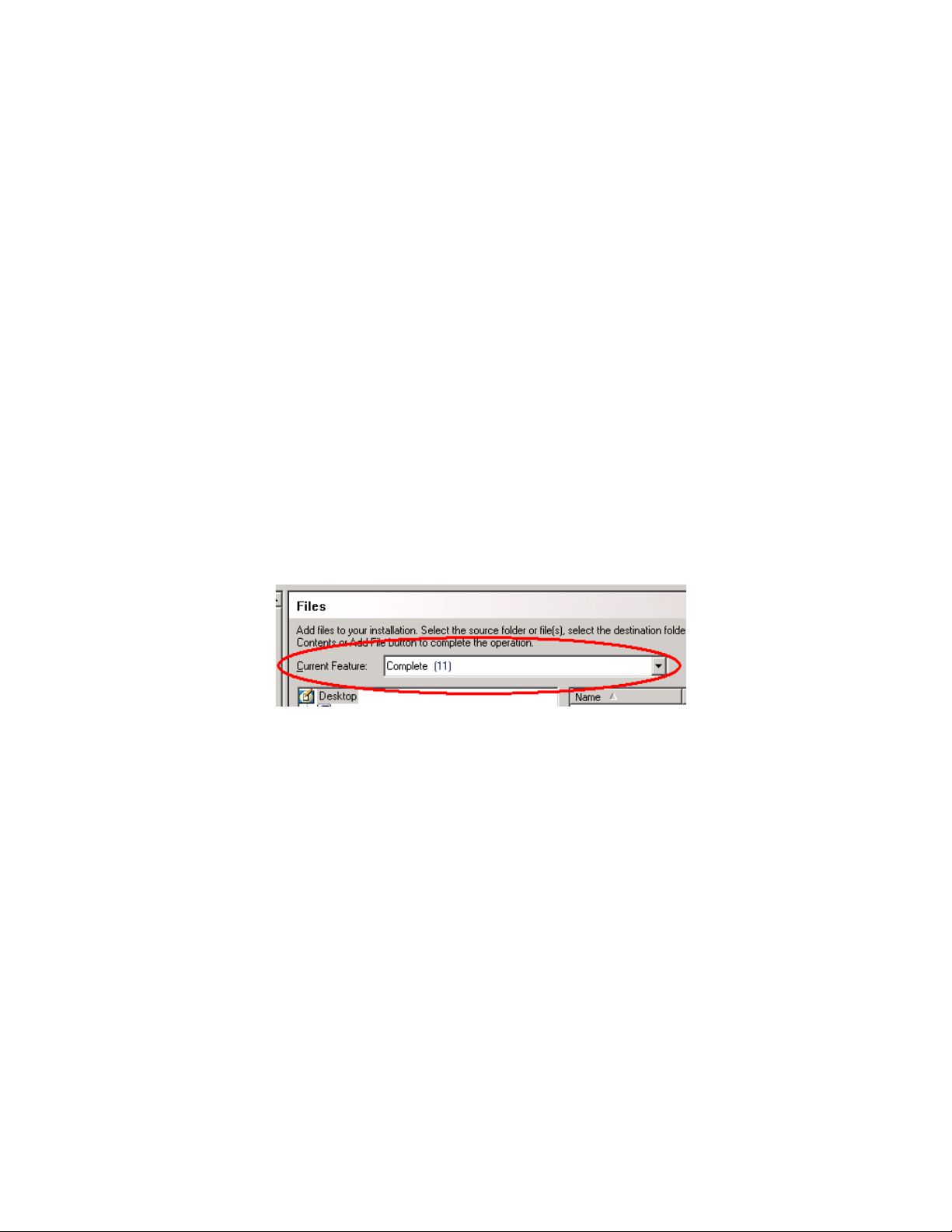
You can now customize the page view by changing its page groups and pages.
To customize a page view:
1. From the Page Views drop-down list in Installation Expert, select <Customize
Page Views...>.
The Customize Page Views dialog appears.
2. Select the page view from Page View Name, and do any of the following:
• To add a new page group, click the Page Groups Add button and enter a name.
• To rename a page group, select the page group and click Rename.
• To add a page to a page group, select the page group and click the Add button to
the right of Page Names. In the Select Pages to Add dialog, select one or more
pages and click OK.
• To delete a page group or a page name, select it and click its Delete button.
3. Click OK on the Customize Page Views dialog.
To delete a page view, select it from Page View Name and click the top Delete button.
Using the Current Feature Drop-Down List
The Current Feature drop-down list appears on pages in the Feature Details page
group. When it appears, you can set options on a per-feature or per-condition basis. You
add features and conditions on the Features page, then select a feature from Current
Feature before setting options on other pages.
Using Installation Expert
Example: Suppose you have 3 features, and each feature requires different registry
entries. On the Registry page, you select the first feature from Current Feature, create
its registry entries, select the second feature in the list, create its registry entries, and
so on. Follow the same steps on the Files or Web Files page: select a feature from
Current Feature, then add files for that feature.
During installation, files, registry entries, and other system changes are installed only if
the feature they belong to is installed. The same applies to conditions; add files, registry
entries, and other changes to a condition, and during installation, those files and
registry entries are installed only if the condition is true and the feature is installed.
The All Features (Modify/Delete only) option in Current Feature displays
information for all features at once. (Example: On the Files page this option displays all
folders and files for all features.) Add and New buttons are disabled while all features
are displayed; you must select a single feature to add items.
On some pages, Current Feature also contains numbers in parentheses, which
represents the number of that page’s items (files or registry keys) that are assigned to
each feature or condition.
26
Page 27
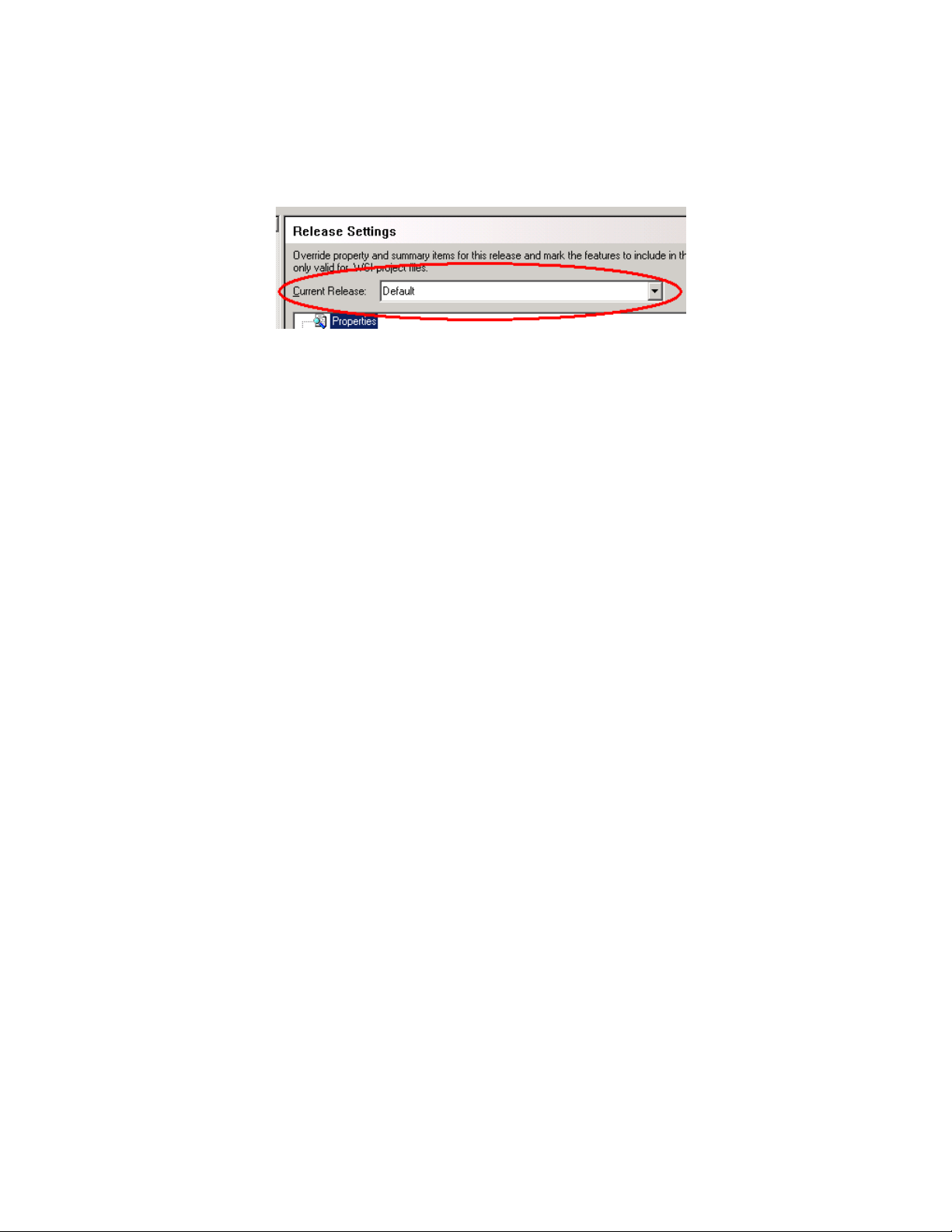
Using the Current Release Drop-Down List
The Current Release drop-down list appears on pages in the Release Definition page
group.
A release is a special version of your application. Example: a 30-day evaluation release
for evaluators. Use Current Release to configure separate settings, media, and
language options for each release.
Using Installation Expert
27
Page 28

About the Product Home Page
The Product Home page provides information about your installation of Wise for
Windows Installer, quick access to areas of the current installation, and access to Wise
Solutions resources on the Web.
The Product Home page appears by default when you start Wise for Windows Installer.
To prevent the Home page from appearing by default, clear Display Home page at
startup on Wise Options > General tab. To go to the Product Home page, click Home at
the lower left of the Wise for Windows Installer main window.
Two Product Home pages are available:
! A static page that is installed with Wise for Windows Installer. This appears if you do
not have an Internet connection, or if you disable the dynamic Home page.
! A dynamic page that is downloaded from the Wise Solutions Web site if you are
connected to the Internet when you start Wise for Windows Installer. To prevent a
dynamic page from being downloaded from the Internet, mark Don’t get Home
page from Internet on Wise Options > General tab.
The contents of the page vary depending on the edition of Wise for Windows Installer
that you are using. Typical contents are:
! List of most recently used installation files.
! Shortcut links for creating a new installation project or opening an existing one.
About the Product Home Page
28
Page 29

Using the Task List
When Wise for Windows Installer encounters installation issues that could cause
problems, it displays them in the Task List. You can manually display or hide the Task
List from the View menu.
The Task List gathers all installation issues into one place, and makes it easy to analyze
their causes. If the issue is caused by an error in a table, you can quickly jump from the
Task List to the row in the table that caused the error. See Finding Table Errors From the
Task List on page 30.
When you resolve the issue that corresponds to a task, the task is deleted the next time
you run the procedure that generated the task. Example: If a task was added to the
Task List because of a compile error and you resolve that error, the next time you
compile the installation that task is removed from the list.
How Tasks are Added to the Task List
! Save or Compile
If errors occur when you save or compile the installation, the errors are displayed in
the Task List.
! Package Validation
When you run Package Validation, validation issues appear in the View / Correct
dialog. If you mark the Add to Task List checkbox on the View / Correct dialog,
each issue becomes a task in the Task List when you click Finish. If Package
Validation encounters save or compile errors, the package validation process ends
and the errors are added to the Task List. See Package Validation on page 370.
! Check Tables
When you check tables, the installation is searched for component and table errors
and results are placed in the Task List. To check tables, select Setup Editor > Tables
tab, right-click in the left pane and select Check Tables. See Finding Validation Errors
on page 400.
! User-Defined
In the Enterprise Edition, you can add user-defined tasks to the task list. See Adding
User-Defined Tasks on page 31. (Not available in the Visual Studio integrated editor.)
! Meta Data
In the Enterprise Edition, when you create an .MSI or .WSI, a task is added to
remind you to add the package meta data to the Software Manager database by
filling in the Application and Package fields on the Product Details page.
Using the Task List
Note
When you close an installation, all tasks, except user-defined tasks, are removed from the
Task List. (In the Visual Studio integrated editor, user-defined tasks are not available.)
Task List Icons
The following icons help you quickly identify the types of tasks:
An error that will cause incorrect behavior and must be fixed.
29
Page 30
Operations You Can Perform in the Task List
! Filter tasks by type. See Filtering the Task List.
! Find table errors. See Finding Table Errors From the Task List on page 30.
! Sort a Task List’s column by clicking its header.
! Copy a task’s description by right-clicking its description.
! Delete a task by right-clicking its description.
Filtering the Task List
1. Right-click in the Task List and select Show Tasks, then select a filter. (In Visual
Studio: right-click in the Visual Studio .NET Task List and select Show Tasks.)
• Save/Compile
(In Visual Studio: this is called Build Errors.) Tasks that correspond to errors
generated when you save or compile.
•Validation
Tasks that correspond to issues generated during Package Validation.
• Component
Tasks that correspond to component errors generated when you check tables.
For information on how to check tables, see Using the Task List on page 29.
•Table
Tasks that correspond to table validation errors generated when you check
tables. For information on how to check tables, see Using the Task List on
page 29.
•User-Defined
Tasks that you have created. (Enterprise Edition only).
When you set a filter, it is in effect until you change it. However, when you encounter
installation issues, the filter is reset to All so installation issues can be displayed.
Using the Task List
Validation issues found by Package Validation. See Validating a
Package on page 370.
A task you created. In the Enterprise Edition, this icon also appears
with a task that reminds you to add the package meta data to the
Software Manager database.
Finding Table Errors From the Task List
If a task is associated with a table, you can access that table directly from the Task List,
which helps you discover the problem that caused the issue.
Example: If a source file for the installation was moved or deleted at its source, a
WiseSourcePath table error appears during compile. When you double-click this task,
the WiseSourcePath table appears in Setup Editor, and the row in the table that is the
cause of the problem is highlighted. Use the source path information in the row to
ascertain and resolve the problem.
30
Page 31

Caution
Deleting, adding, or editing table data directly is not recommended unless you are an
experienced Windows Installer developer with a clear understanding of Windows Installer
database technology. Editing table data might result in unexpected, undesirable results,
including damage to the installation. Wise Solutions cannot provide technical support for
problems arising from table editing.
To find table errors from the Task List:
If the task has a table listed in the Table column, double-click the task. The table is
displayed in Setup Editor > Tables tab, and the row in the table associated with the task
is highlighted. (In Visual Studio: a table is displayed only if a table is associated with the
task.)
If you need more information, check the task’s description or press F1 to display the
help topic for the selected table in the Windows Installer SDK Help.
Adding User-Defined Tasks
" Enterprise edition only. Not available in the Visual Studio integrated editor.
Using the Task List
You can add tasks to the Task List. Example: Add user-defined tasks to define work that
must be completed on the installation. Tasks you add to the Task List are saved with the
installation. You can only add user-defined tasks to a .WSI; you cannot add them to an
.MSI.
1. On the first line of the Task List, click Click here to add a new item twice and type
the task.
If Click here to add a new item does not appear in the Task List, save the
installation file and it will appear.
2. Click anywhere outside the box that contains the new task.
The task is added to the Task List and appears in the Description column. Userdefined tasks do not use the Tables column.
Also see Using the Task List on page 29.
31
Page 32

Where are Installation Resources Stored?
Where are Installation Resources Stored?
Wise for Windows Installer uses resources such as installation templates, component
rules, language files, and so on, to create installations. In the Standard and Professional
Editions, these resources are stored in subdirectories of the Wise application directory.
In the Enterprise Edition, they are stored in subdirectories of the share point directory.
(Enterprise Edition only.) You can specify alternate locations for storing resources. See
Setting Repository Options on page 54.
Subdirectories Where Resources Are Stored
Directory Contents
000, 001, and so on (Enterprise Edition only.) Contains source files associated with each package’s
installation. The subdirectories are numbered sequentially, such as 000\001,
000\002, and so on. They are created when someone uses Package Distribution to
distribute to the share point. For details, see How Source Files Are Indexed on
page 36.
Custom Actions (Enterprise Edition only.) Provides a shared location in which you can place files used
in custom actions, such as WiseScripts, VBScripts, .DLLs, and so on, that you use in
Windows Installer installations.
Languages Contains the language resource files used to change the language of installations.
Merge Modules (Enterprise Edition only.) This is the default target location for downloading merge
modules, and the default directory from which you select merge modules to add to an
installation. In the Standard and Professional Editions, the default merge modules
directory is Program Files\Common Files\Merge Modules\Wise Solutions.
Reports (Enterprise Edition only.) Contains the predefined reports (.RPT) that are used in
Software Manager. Also contains the Report.ini file, which stores information about
the predefined reports and about any report customizations.
Projects (Enterprise Edition only.) The default location for new installations you create.
Resources Contains installation resources such as bitmap and icon files.
Scripts (Enterprise Edition only.) Contains temporary files (.QUE) representing packages that
have been distributed to but not yet imported into the Software Manager database.
For details, see About .QUE Files in the Software Manager Help.
The Scripts directory also stores information about package subscriptions.
Templates Contains installation templates, WfWI macros, and additional template files used by
Package Distribution.
Templates\Dialogs Contains the Wise Standard.MSI that provides information used by the New Dialog
Wizard to add a new dialog to an installation.
Templates\File Contains templates used to create a new installation. In the Visual Studio integrated
editor, these templates create installations that are not associated with a Visual
Studio .NET solution.
Templates\Project (Visual Studio integrated editor only.) Contains templates used to create an
installation as a project within a Visual Studio .NET solution.
Templates\Reports (Enterprise Edition only.) Contains the template files that are used to format the
shared resources reports in Wise for Windows Installer.
32
Page 33

Where are Installation Resources Stored?
Directory Contents
Themes Contains Themes.ini, which stores information about themes you’ve added or
customized. Also contains subdirectories that store the images for each theme.
Validation Contains the predefined validation modules (.CUB files) that are used by Package
Validation.
Virtual OS (Enterprise Edition only.) Provides a shared location in which you can place Virtual OS
files (.WOS) that are used by the Universal Import feature of Software Manager.
Also see About the Share Point Directory on page 35.
33
Page 34

Using the Enterprise Edition
Enterprise Edition only.
"
With the Enterprise Edition of Wise for Windows Installer, you can develop consistent,
accurate, and high quality installations based on corporate standards. The Enterprise
Edition ensures that you use the correct versions of resources, such as files and registry
keys, that are shared across multiple applications. Example: A developer who adds or
updates a .DLL in an installation can instantly view a list of other applications that use
that .DLL and the versions used. The developer can use this information to ensure that
the new application uses the correct version of the .DLL and therefore will not break
existing applications.
The Enterprise Edition lets you share commonly used templates, dialog themes,
translations, and other installation resources within a single development team or
among multiple development teams. This lets developers throughout the organization
create installations with common settings and a consistent look and feel. See Sharing
Installation Resources.
The Enterprise Edition also helps organizations that use Wise Package Studio. It
eliminates the need to repackage internally developed applications, because the
organization’s developers can create installations that adhere to corporate standards. It
also reduces rework of internally developed installations by the development team and
reduces end-user downtime, because the developers who create installations can be
sure to use the correct versions of files and other resources before giving installations to
the IT deployment team. See Sharing the Software Manager Database With Wise
Package Studio in the Software Manager Help.
Using the Enterprise Edition
Also see:
About the Share Point Directory on page 35
Generating Package Contents Reports on page 37
Generating Shared Resource Reports on page 37
Sharing Installation Resources
" Enterprise Edition only.
A key feature of the Enterprise Edition is the ability to develop and enforce standards for
how installations are created. You enforce standards by storing all installation-related
resources in a common location and making sure all developers use those resources in
their installations.
In Wise Options, you can specify the directories that contain shared resources you will
use in installations. See Setting Repository Options on page 54.
You can share the following resources:
! Component rules ensure that every installation will be organized the same way,
which greatly simplifies the management of multiple product installations.
! Custom actions, such as .DLL files, JScript files, and VBScript files, that can be
added to installations.
! Installation templates, dialogs, dialog themes, languages, and resources,
such as bitmaps and icons, that are used in installations. Create installations with
common settings and a consistent look and feel.
34
Page 35

Using the Enterprise Edition
! Merge modules ensure that developers always access approved versions of merge
modules by storing merge modules in a central location, or by using merge modules
that are in the Software Manager database.
! Validation modules (.CUB files) simplify the quality assurance process by ensuring
every installation passes the same validation tests.
! Reports let you share customized report menus and custom reports.
Sharing installation resources is accomplished through the share point directory, the
Software Manager database, and the Software Manager tool.
! The share point directory is typically installed on a shared network drive. Use the
share point directory to store resources, such as templates, dialogs, and themes,
used to create installations as well as the source files used in the application itself.
The share point directory can also contain information about applications that are
waiting to be imported into the Software Manager database and the source files used
by those applications. See About the Share Point Directory on page 35 and Where
are Installation Resources Stored? on page 32.
! The Software Manager database contains information about every resource used by
every application your organization develops. This lets developers see what
resources are used by other applications and select source files from the Wise
Software Repository, to ensure that they use the correct versions of file resources in
applications they develop. Geographically dispersed development teams can
maintain multiple Software Manager databases and use a publish/subscribe model to
pass information between repositories. See About the Wise Software Repository in
the Software Manager Help, and How Source Files Are Indexed on page 36.
! Software Manager lets you manage the information in the Software Manager
database. Use it to import applications into the database, subscribe to applications in
other Software Manager databases, and view information about the resources used
by applications in the database.
In addition to importing Windows Installer installations and merge modules,
Software Manager can import other installation formats such as WiseScripts, SMS
Installer files, InstallShield® Developer executables, and any other installation
format. This lets you import legacy installations without converting them to Windows
Installer format.
See Software Manager Basics in the Software Manager Help.
Also see Sharing the Software Manager Database With Wise Package Studio in the
Software Manager Help.
About the Share Point Directory
" Enterprise Edition only.
During the Wise for Windows Installer installation, you specify a share point directory.
The default directory name is Wise Share Point, however, you can change the name at
installation time.
For recommendations on where to locate the share point directory, see Choosing the
Location for the Share Point Directory in the Wise for Windows Installer Getting Started
Guide. You can change the share point directory in Wise Options. See Setting Repository
Options on page 54.
The Software Manager database is associated with a specific share point directory. When
you change the default share point directory, you also change the default database.
35
Page 36

Using the Enterprise Edition
Share Point Directory Contents
! Resources that are used to create Windows Installer installations. Examples:
installation templates, component rules, language files, and so on.
! Predefined reports.
! Temporary .QUE files representing packages that have been distributed but not
imported into the Software Manager database.
! Source files of installations you import into the Software Manager database.
! The default Microsoft Access-based Software Manager database, if you choose to
install it.
If your organization uses Wise Package Studio, the share point directory might contain
additional information that is unique to that product.
For a list of the share point subdirectories and their contents, see Where are Installation
Resources Stored? on page 32.
Deleting Files From the Share Point Directory
Caution
Do not edit or delete the contents of the share point directory or its subdirectories outside of
Wise for Windows Installer or other Wise Solutions tools. Doing so will cause problems in
Software Manager and can result in loss of data.
A common question is “Can I clean up the share point by deleting unused source files?”
The answer is no. It is too difficult to know which files are safe to delete.
The only recommended way to delete files from the share point directory is to delete the
entire package from the Software Manager database. When you do so, you can delete
the package’s source files from the share point subdirectories (000, 001, and so on), if
those files are not referenced by any other application. See Deleting a Package in the
Software Manager Help.
Also see Sharing Installation Resources on page 34.
How Source Files Are Indexed
A sequentially-numbered directory structure is created under the share point directory
to store occurrences of installation source files when:
! You distribute a package to the share point directory.
! You import a single package or multiple packages to the Software Manager database,
and you distribute source files.
An index file named wamdb.idx, located in the share point directory, records the location
of the source files. Because files are indexed, distributing source files to the share point
eliminates storage of duplicate files and results in smaller storage requirements than if
you distribute to a network directory.
Example:
Suppose you have 3 packages, each containing a version of report.dll. The first time you
distribute a package containing report.dll, the file is placed in the share point’s 000\001
directory. If you distribute another package containing the same version of report.dll,
the file is not saved a second time, but a counter is set for that file in wamdb.idx. If you
distribute a third package that uses a different version of report.dll, the file is stored in a
36
Page 37

second directory, 000\002. The result is a set of all the unique source files used by all
the packages in the Software Manager database.
Also see:
About the Share Point Directory on page 35
Copying an Installation to the Share Point Directory on page 280
Importing From the Share Point Directory in the Software Manager Help
Generating Package Contents Reports
" Enterprise Edition only.
Package contents reports provide an overview of the contents of an installation file and
make it easy to provide this information to end users. Two reports are available:
! Package Contents Summary
Lists detailed information for every resource in an installation, including files, registry
keys, shortcuts, file associations, and merge modules. You can generate this report
for .WSI, .MSI, .WSM, and .MSM files.
! Package Contents By Feature
Contains the same information as the Package Contents Summary report, but
arranges it by feature. You can generate this report for .WSI and .MSI files.
Using the Enterprise Edition
To generate a package contents report:
Select Reports menu > Package Contents and select either Summary or By Feature. (In
Visual Studio: Project menu > Reports > Package Contents and select either Summary
or By Feature.)
The report is generated and opens in a dialog.
Use a report’s table of contents to quickly access information about a specific type of
resource. You can print the report or save it as an HTML or XML file.
Generating Shared Resource Reports
" Enterprise Edition only.
Shared resource reports provide a quick way to review the resources that are shared by
the current installation and other packages in the Software Manager database. Two
reports are available:
! Shared Files Report
Lists the files that are shared by the current installation and applications in the
Software Manager database. For each file, the report lists each application that uses
the file and shows detailed file information (examples: version, date/time, path, and
so on).
! Shared Registry Report
Lists the registry keys that are shared by the current installation and applications in
the Software Manager database. For each registry key, the report lists each
application that uses the registry key and shows the key value.
In order to generate the shared resources reports, you must be connected to a share
point directory that is associated with a Software Manager database. Typically, this
connection is made during installation. To use a different share point directory and
Software Manager database, see Setting Repository Options on page 54.
37
Page 38

Using the Enterprise Edition
The reports are displayed in HTML format. The .XSL templates used to format these
reports are located in the Templates\Reports subdirectory of the share point directory.
You can customize the .XSL templates to supply branding information, to filter data, or
to transform the data to another format.
You also can generate resource reports in Software Manager. The Software Manager
reports contain similar information. See Predefined Software Manager Reports in the
Software Manager Help.
To generate a shared resource report:
1. Select Reports menu and select either Shared Files Report or Shared Registry
Report. (In Visual Studio: Project menu > Reports > Shared Files Report or Project
menu > Reports > Shared Registry Report.)
The Welcome dialog appears.
2. In Data Source, specify the Software Manager database that contains the
resources you want to review. If the Software Manager database you want is not
listed, click Open to select it.
3. From Group, select the group that contains the packages to compare this
installation to.
4. Click Next.
The report is generated and displayed in the Shared Files Report or Shared Registry
Report dialog.
You can save the or print the table report from this dialog. Saving to HTML is
available only on computers that contain MSXML.DLL, which is included in Internet
Explorer 5.x and higher.
5. When you finish reviewing, saving, or printing the report, click Finish.
Also see Sharing Installation Resources on page 34.
38
Page 39

Downloading Redistributable Files
The Download Redistributables wizard, available from the Help menu, lets you obtain
merge modules, Windows Installer runtime installers, and .NET Framework runtime
installers. You need the Windows Installer runtimes if you decide to pre-install Windows
Installer with an installation. You need the .NET Framework if you are creating an
installation that contains .NET elements. Because of size and obsolescence
considerations, these files are distributed via the Internet or product CD.
Note
This wizard appears any time Wise for Windows Installer detects a dependency on other
merge modules or other redistributables. Example: If you run ApplicationWatch and a file gets
added that must be installed with a certain merge module, the Download Redistributables
wizard appears and prompts you to download the necessary merge module. This wizard might
also appear if you install runtimes with the installation, or if you add files on the Files page
that are part of a merge module.
Download redistributable files from the following locations:
! Wise Solutions’ Web Site
Select and download one or more redistributables from Wise Solutions’ Web site.
Available redistributables are authored by Wise Solutions or are authored by thirdparty vendors and redistributed by Wise Solutions. See Downloading Redistributables
From the Wise Web Site or Product CD on page 39.
! Other Vendors’ Web Sites
Select and download a redistributable from a third-party vendor’s Web site. Available
redistributables are authored by the respective vendor, and you need to contact the
vendor for information or help on these redistributables. See Downloading
Redistributables From Other Vendors’ Web Sites on page 40.
Downloading Redistributable Files
Note
If you need to go through a firewall or proxy server to get to the Internet, click the Advanced
button near the bottom of the Source Location dialog to modify your Internet connection
settings; the Source Location dialog is the first dialog that appears when you use the
Download Redistributables wizard. An Advanced Settings dialog appears, where you can
specify information for your proxy server. For help with these options, ask your network
administrator.
! Product CD
Select and download one or more redistributables from the CD that was used to
install the product. Merge modules available from the product CD are authored by
Wise Solutions or are authored by third-party vendors and redistributed by Wise
Solutions. See Downloading Redistributables From the Wise Web Site or Product CD
on page 39.
Downloading Redistributables From the Wise Web Site or Product CD
You must be in an active Wise installation to follow this procedure.
1. Select Help menu > Download Redistributables. (In Visual Studio: Help menu >
Wise Help > Download Redistributables.)
The Source Location dialog appears.
39
Page 40

Downloading Redistributable Files
2. Mark Wise Solutions’ Web Site or Product CD and click Next.
3. If you marked Product CD, specify the location of the CD in the Product CD
Location dialog. Then click Next.
A Download Files dialog appears while all available redistributable files are retrieved.
The Available Redistributable Files dialog then appears.
4. From Redistributable Type, select the type of redistributable to download.
5. The dialog changes depending on what type of redistributable you selected.
If you selected Merge Modules, the following lists appear:
•Modules Installed
This list contains merge modules in the directories specified in Wise Options. See
Setting Merge Module Directories on page 52
•Modules Available
This list contains merge modules available on Wise Solutions’ Web site or the
product CD that are:
# Not in your list of current modules.
# In your list of current modules but are a newer version of those merge
modules.
If you selected Windows Installer Runtimes, .NET Framework, or .NET
Compact Framework, the following lists appear:
• Versions Installed
This list contains redistributables that are located in the Wise for Windows
Installer Stub directory
• Versions Available
This list contains the versions of redistributables that are available on the Wise
Web site
6. In the Modules Available or Versions Available list, mark one or more
checkboxes for the redistributables to download.
7. Click Next. If you chose to download any merge modules, the Target Location dialog
appears, where you specify merge modules’ download location; otherwise the
download starts and you can skip the next step. Runtimes are downloaded to
private directories where they are accessed as needed by Wise for Windows
Installer.
8. From Target Location, select the directory to download the selected merge
modules to, then click Next.
The drop-down list shows all merge module directories specified in Wise Options.
See Setting Merge Module Directories on page 52.
The selected redistributables are downloaded from the Internet or CD.
9. Click Finish on the Download Files dialog to exit the wizard.
The merge modules you selected are now in the directory you specified as the target
location. If any merge modules had dependencies on other merge modules, those merge
modules were also downloaded. Other runtimes are located in their required directories.
.
.
.
Downloading Redistributables From Other Vendors’ Web Sites
You must be in an active Wise installation to follow this procedure. Wise Solutions has no
control over other vendor’s redistributable files. Check with the vendor for product
support.
40
Page 41

Downloading Redistributable Files
1. Select Help menu > Download Redistributables. (In Visual Studio: Help menu >
Wise Help > Download Redistributables.)
The Source Location dialog appears.
2. Mark Other Vendors’ Web Sites and click Next. When all available redistributables
are retrieved, the Available Redistributable Files dialog appears.
3. In the list box, select the redistributable to download, then click Download to launch
your Internet browser, if necessary, and connect to the corresponding vendor’s Web
site.
4. Follow the links and prompts on the Web site to download the redistributable. Be
sure to download merge modules to a directory specified in Wise Options. See
Setting Merge Module Directories on page 52.
5. When the download is complete, return to the Available Redistributable Files dialog
and click Next.
6. Click Finish on the Download Files dialog to exit the wizard.
The merge modules and other runtimes you selected are now in the directory you
specified as the target location. If any merge modules had dependencies on other merge
modules, those merge modules were also downloaded.
41
Page 42

Chapter 3
Setting Up
Before you create and edit installations, set up Wise for Windows Installer to reflect your
company’s standards:
! Set options that control the installations you create and determine the installation
resources you use.
! Decide whether you need to customize the templates that installations are based on.
! Decide which rule set to use to help you manage the creation of components in
installations. You can edit the predefined rule sets or create new rule sets. If the
predefined rule sets do not meed your needs, you can duplicate them and modify the
copies as needed, or you can create new rule sets.
Topics include:
! Setting Options.
! Creating and Editing Installation Templates.
! Component Rules.
42
Page 43

Setting Options
You can set options that control the installations you create and determine the
installation resources you use. Some of the options are global; they are set for all files
you open with Wise for Windows Installer, including files you created previously. Other
options provide defaults for new files and do not affect existing files.
You set options on the Options dialog, which you access by selecting Tools menu >
Options. In Visual Studio: select Tools menu > Options and click Wise Options in the list
at the left of the dialog.
The Options dialog contains several tabs. (In the Visual Studio integrated editor they are
called pages.) See:
Setting General Options
Setting .NET Assembly Options on page 45
Setting Advertising Options on page 46
Setting Digital Signature Options on page 48
Setting ExpressBuild Options on page 49
Setting Installation Expert Options on page 51
Setting Merge Module Directories on page 52
Activating Suppressed Prompts on page 53
Setting Repository Options on page 54
Setting Source Control Options on page 55
Setting the Default Target Platform on page 56
Setting Visual Studio Options on page 57
Setting Wildcard Groups on page 59
Setting Options
Setting General Options
To set general options, select Tools menu > Options and click the General tab. (In Visual
Studio: Tools menu > Options > Wise Options > General.)
Note
(Visual Studio integrated editor.) To display context-sentitive help, click the Wise Help link on
this dialog.
Automatic Options
! Create backup copy during save
Mark this to create a new backup file every time you save. The backup file name
consists of the current file name plus a number. (Example: if the current file name is
Sample.wsi, the backups are named Sample1.wsi, Sample2.wsi, and so on.) Only the
file you are working on is backed up. (Example: if you open a .WSI and save it, the
corresponding .MSI is not backed up.) Use caution with this option if you are working
with large installation files; if you save often, your disk space will quickly become
depleted.
! Add default remarks to installation sequences
Although most Wise project (.WSI) files have remarks that explain the actions in the
sequences, compiled .MSIs do not. Mark this to add remarks to the current .MSI and
all .MSIs that you open subsequently. Remarks are added to .WSIs only if no
remarks already exist.
! Don’t get Home page from Internet
Mark this to disable the dynamic Product Home page that is downloaded from the
Wise Solutions Web site and display the static Product Home page that is installed
with Wise for Windows Installer.
43
Page 44

Setting Options
! Create XML copy during save
Mark this to update a copy of the installation in XML format every time you save. If a
copy does not exist, it is created. The copy has the same name as the installation file
with the extension .XML appended, and it is saved in the same directory. (Example:
If the current file name is Application.wsi, the XML copy is named
Application.wsi.xml.) This lets you check the XML version of the installation into a
source code control system and use text-based file comparison tools to find changes.
See Saving an Installation as XML on page 93.
Compiler Options
The following options are default settings for all new compiles. Changing these settings
does not affect installations that have already been compiled.
! Add custom actions for predefined folders in merge modules
This affects the merging of merge modules that place files in predefined directories,
such as \Windows, \System32, and so on. Mark this to have the merge emulate the
behavior of Microsoft’s merge tool, mergemod.dll, which uses custom actions to
handle predefined directories. Clearing this checkbox can fix potential problems with
capitalization inconsistencies in the directory name.
Note
Wise for Windows Installer has its own code for merging a module into an .MSI, but this
checkbox causes your merge to follow the Microsoft conventions for merging. Microsoft’s
merging code adds a custom action to the installation for each predefined directory
referenced in each included merge module. The custom action uses a Set Property action
to set the predefined directory name, whereas the Wise for Windows Installer code sets
the predefined directory name by adding an item to the Directory table of the Windows
Installer database.
! Display error if merge modules conflict with main installation rows
Merge module errors occur if a merge module contains a row that has the same key
as a row in the main installation. Clear this to ignore such errors and let the merge
module row overwrite the row in the main installation.
! Enable Quick Compile
Mark this to speed the compile process by compressing only previously
uncompressed or changed files. Quick Compile writes the .MSI table information. If a
file or media has changed, a full compile will occur instead. Quick Compile is for
project files only. You can also speed compile time by using ExpressBuild, a multiprocessor compile feature in the Professional and Enterprise Editions. See Setting
ExpressBuild Options on page 49.
Startup Options
! Display Home page at startup
Mark this to have the Product Home page appear by default when you start Wise for
Windows Installer.
! Check for Updates
Select an option to set the frequency at which you will be reminded to check for
updates to Wise for Windows Installer. Update reminders occur only when Wise for
Windows Installer is launched.
! Preferred Editor
This option appears only if Microsoft Visual Studio .NET is installed. It determines
which editor is launched when you double-click a Windows Installer file. Always
44
Page 45

Prompt always shows a dialog that prompts you to choose the editor. Last Saved
In uses the editor in which the installation file was last saved.
! Reload last project at startup
Mark this to open the last installation you worked on when you launch Wise for
Windows Installer. (Not available in the Visual Studio integrated editor.)
! Refresh Projects Integrated with Visual Studio .NET
When you open a project that has been integrated with Visual Studio .NET, this
option causes the Visual Studio solution to be rebuilt so that this installation has the
most recent files. “Integrated” means the project has been added as part of a Visual
Studio .NET solution. (Not available in the Visual Studio integrated editor.)
Setting .NET Assembly Options
" Windows Installer 2.0 or later only.
You can specify whether you create standard Win32 or .NET installations, and customize
how Wise for Windows Installer handles the .NET assemblies. Select Tools menu >
Options and click the .NET Assemblies tab. (In Visual Studio: Tools menu > Options >
Wise Options > Assemblies.)
Note
(Visual Studio integrated editor.) To display context-sentitive help, click the Wise Help link on
this dialog.
Setting Options
Note
If the options on the .NET Assemblies tab are disabled, install the .NET Framework and run a
manual repair of the Wise for Windows Installer .MSI from Add/Remove Programs. (Not
applicable in the Visual Studio integrated editor.)
COM Interop Options
! Default Application Type
This determines the default setting for the Application Type field on the Product
Details page for new installations. Changing this field does not affect existing
installations.
• Win 32 (non .NET)
Select this if you typically create standard Win32 installations without .NET
assemblies.
• .NET Application
Select this if you typically create .NET installations with only .NET elements.
• Mixed (.NET and Win32)
Select this if you typically create installations containing both Win32 and .NET
elements. When this option is selected, .NET assemblies you add to an
installation are registered so that they can be called as though they were COM
components. For information on COM interoperability, search for “Interoperating
with Unmanaged Code” in the MSDN Library (msdn.microsoft.com/library/).
! Rescan COM interop registry keys on compile
Mark this to scan and update interop registry keys for .NET assemblies each time you
compile. This checkbox is available only if the .NET Framework is installed on your
computer.
45
Page 46

Setting Options
Assembly Scanning Options
The scanning options are available only if the .NET Framework is installed on your
computer.
! Scan Dependencies
Specify how dependency assemblies are added to an installation. You can add them
manually or have Wise for Windows Installer scan the assembly manifest for
dependencies and add them automatically. Changing this option does not affect
assemblies that have already been added to installations.
• Never scan dependencies
If you select this, you must add dependency assemblies to installations manually
on the Files or Web Files page.
• Prompt to scan dependencies
When you add a .NET assembly to an installation, Wise for Windows Installer
scans its manifest for dependencies and prompts you to select which ones to add
to the installation.
• Always scan dependencies
When you add a .NET assembly to an installation, Wise for Windows Installer
scans its manifest for dependencies and adds them to the installation.
! Rescan assembly dependencies on compile
Mark this to scan for new assembly dependencies each time you compile.
! Rescan assembly attributes on compile
Mark this to rescan and update assembly attributes each time you compile. This
checkbox is marked by default.
Note
On .NET Framework versions earlier than 1.1, scanning does not occur when you add an
assembly from a UNC or mapped network drive (example: the share point directory). To
enable scanning of such assemblies, either upgrade to .NET Framework version 1.1 or later, or
change your .NET security so that the share point directory is fully trusted.
Setting Advertising Options
You can specify how to gather self-registration and advertising information for files you
add to an installation. Windows Installer considers some kinds of registry entries, such
as file extension definitions, to be advertising information. For details, see Platform
Support of Advertisement in the Windows Installer SDK Help.
To set advertising options, select Tools menu > Options and click the Advertising tab. (In
Visual Studio: Tools menu > Options > Wise Options > Advertising.)
Note
(Visual Studio integrated editor.) To display context-sentitive help, click the Wise Help link on
this dialog.
The following options are default settings for all new components. Changing these
settings will not affect existing components.
! Advertising Setting
Select one of the “scan” options to have Wise for Windows Installer inspect your
computer’s registry and the files in the installation and automatically add Windows
Installer advertising information for the files that you add to the installation.
46
Page 47

Setting Options
The different scan options let you determine whether the advertising information is
added to the advertising tables (AppId, Class, Extension, Mime, ProgId, TypeLib,
Verb), to the registry, or both. The scan options also cause AppPath registry
information to be added to the installation automatically, although it is not related to
advertising. Only AppPath information at
HKEY_LOCAL_MACHINE\Software\Microsoft\Windows\CurrentVersion\App Paths\ is
added.
This system of registration is more robust than letting the file self-register at
installation time because it does not depend on the presence of other files on the
destination computer, nor does it depend on how well the .OCX or .DLL file adheres
to self-registration conventions. However, the .OCX or .DLL files must already be
registered correctly on your computer. If you prefer not to register installation files
on your computer, you can run the scan routine as a stand-alone utility on a different
computer. See Using WiseComCapture.exe on page 143.
• Do not scan advertising information
Use self-registration for components that support it. Wise for Windows Installer
will not scan files or the registry.
• Scan advertising information into registry keys
Add advertising information to the installation as registry keys only; do not
create entries in advertising tables. This results in an installation that does not
support advertising through COM.
• Scan advertising information into advertising tables
Place registry entries that are considered to be advertising information into
advertising tables. Create registry entries for any information that cannot be
placed in the advertising tables. This results in an installation that supports
advertising.
• Scan advertising into both advertising tables and registry
Place registry entries that are considered to be advertising information into
advertising tables AND into registry keys. This way, all advertising information is
included in the installation; none is lost.
Caution
When registry entries are created for any information that cannot be placed in the
advertising tables, the installation is more accurate because no information is lost.
However, this might cause an error or warning when you run the Application Specification
Logo test in Package Validation.
! Automatically add self-registration
Mark this to add self-registration information to the installation whenever you add an
.OCX or .DLL file that supports self-registration. Typically, .OCX and .DLL files are
self-registered dynamically on the destination computer by calling self-registration
functions. If you mark this checkbox, Windows Installer registers your .OCX and .DLL
files. The .DLL or .OCX may require certain files to be installed already in order to
self-register properly.
! Default to rescan advertising for new components
If the advertising information contained in your files might change during the
development process, mark this to scan the advertising information and update the
installation every time you compile. The scan options in the Advertising Setting
field above only read the advertising information that’s present in the file when you
first add it to the installation.
47
Page 48

This field sets the default for new components; if you change it, existing components
are not affected. The Rescan advertising information during compile checkbox
on the Component Details dialog can override this setting for individual components.
Setting Digital Signature Options
You can add a digital signature to an installation on the Digital Signature page. If an
installation includes a digital signature, you use the signcode.exe utility to:
! Create a hash of the code, using an algorithm such as MD5 or SHA;
! Encrypt the hash using your private key
! Create a package containing the code, the encrypted hash, and the publisher’s
certificate.
For information on digital signatures, visit www.verisign.com.
To set global options for digital signatures, select Tools menu > Options and click the
click Digital Signature tab. (In Visual Studio: Tools menu > Options > Wise Options >
Digital Signature.)
Note
(Visual Studio integrated editor.) To display context-sentitive help, click the Wise Help link on
this dialog.
Setting Options
The following options apply to all future installations. They do not affect installations you
created previously.
! Signcode.exe Location
Enter the pathname of the signcode.EXE that performs the signing tasks. For details,
refer to the ActiveX SDK.
! Credentials File
Enter the pathname of the credentials file that contains your Digital ID; the path can
be relative to the .WSI you’re compiling. Your credentials file is provided by Verisign
or another certificate authority. You must use the same computer to apply for and
obtain your Digital ID. You can then use the private key and Digital ID to sign files on
a different computer.
! Private Key File
Enter the pathname of the private key file generated by your browser during the
process of applying for a Software Publisher’s ID; the path can be relative to the
.WSI you’re compiling. A private key file has the extension .PVK. If this key is lost or
stolen, contact Verisign or your certificate authority immediately.
Also see:
Adding a Digital Signature to Your Installation on page 212
48
Page 49

Setting ExpressBuild Options
" Professional and Enterprise Editions only.
Note
For multi-processor compile to occur using distributed computers, all source files of the
installation must be on a shared drive and must be specified in the installation with UNC
paths. (Example: \\SERVER\file.exe). In addition, when you open the installation file, you
must open it in such a way that it is referenced by a UNC path. Example: After selecting File >
Open, browse to the installation underneath the My Network Places icon or type the entire
UNC path in the File Name field. These requirements do not apply to using multiple
processors within one computer.
With ExpressBuild, you can use multiple processors to speed compile time for large
builds. Use multiple processors on the local computer, and use the main processor of
multiple distributed computers (called a build group). The processors on the local
computer can be physical or virtual processors. You can also set up your own computer
to provide processing power for another build computer.
ExpressBuild speeds compile time by distributing the time-consuming task of
compressing .CAB files among multiple processors. Therefore, the greatest time savings
are realized when you have multiple .CAB files. Specify .CAB file creation rules in
Installation Expert > Media page.
If you turn ExpressBuild on, it is turned on globally; that is, it is in effect for all
installation files you open, regardless of when they were created.
Setting Options
How ExpressBuild Groups Work
" Professional and Enterprise Editions only.
You can specify a build group of computers within the same NT domain or workgroup to
share processing of compiles. To specify a build group, first you select an arbitrary name
for the build group. Then, on those computers that will be part of a build group, you do
one of 2 things:
! If Wise for Windows Installer is not installed, then run WiseExpressBuild.exe, which
is located in the share point directory. The Wise ExpressBuild dialog opens. Specify
the group name and whether the WiseExpressBuild.exe should open at system
startup. WiseExpressBuild.exe runs in the background and responds to and manages
compile requests from the build computer. You can open it and edit its properties by
double-clicking on its icon in the Windows taskbar.
! If Wise for Windows Installer is installed, open it on that computer. Select Tools menu
> Options, click the ExpressBuild tab, and mark the Allow My Computer to Build
for Others checkbox. (In Visual Studio: Tools menu > Options > Wise Options >
Prompts.) Then enter the group name of the build group your computer will build for.
Do this on each computer that will share processing as part of a single build group.
When you click OK on the Options dialog, the WiseExpressBuild.exe immediately
begins running on your computer, with its icon showing in the system tray area of
your taskbar.
Note
Performance slowdowns will occur on computers in build groups when they are called upon to
help process compiles.
49
Page 50

Setting Options
Requirements for Using ExpressBuild
" Professional and Enterprise Editions only.
! The computer that initiates the compile of the installation must be running Windows
NT, Windows 2000, or Windows XP or later.
! If you use a computer running Windows 9.x or Me to share compile processing, the
workgroup name of the 9.x/Me computer must match its domain name. Also, the
build group name must be in 8.3 file name format.
! In the following instances, because of .CAB formation issues, multi-processor
compile does not take place and normal compiling occurs:
• If you select Uncompressed external files from the Compression Option
field on the Media page.
•If you select One Cab in the Cab Options field on the Media page, or if the .MSI
contains only one .CAB for some other reason.
• If you select any size other than zero in the Max Media Size field on the Media
page.
• If you are in a merge module.
! Because each processor compresses .CAB files, using multiple processors is more
efficient if files are arranged into multiple, moderately-sized .CAB files. To achieve
this, select One Cab per feature or One Cab per component in the Cab Options
field on the Media page.
Additional requirements for using the option to Build Using Multiple
Distributed Computers:
! All the installation source files must be shared so that all members of the build group
have network privileges to access them.
! The paths to all installation source files must be in UNC notation. Change paths to
UNC notation using Tools menu > Convert Source Paths. (In Visual Studio: select
Project menu > Convert Source Paths.) If any source files have paths to the local
drive (Example: C:\MyFiles\file.jpg) then multi-processor compile does not occur. For
information on using this tool, see Changing Source Paths in an Installation on
page 325.
! The path to the installation file must be referenced in UNC notation. When you open
the installation file, open it in such a way that it is referenced by a UNC path.
Example: When opening a file, browse to the installation underneath the My Network
Places icon or type the entire UNC path in the File Name field. If you browse under
the My Computer icon, the path will not be referenced in UNC notation.
ExpressBuild Options
" Professional and Enterprise Editions only.
To set ExpressBuild options, select Tools menu > Options and click the ExpressBuild tab.
(In Visual Studio: Tools menu > Options> Wise Options > ExpressBuild.)
Note
(Visual Studio integrated editor.) To display context-sentitive help, click the Wise Help link on
this dialog.
50
Page 51

Setting Options
You can mark any combination of the 3 checkboxes below. After you mark either of the
first 2 checkboxes, compiles will attempt to use multi-processor compile unless
prevented from doing so. If you mark Allow My Computer to Build for Others, your
computer is immediately available to assist in compiles being performed on other
computers.
See Requirements for Using ExpressBuild on page 50 for requirements for using the
following options, and for reasons why multi-processor compile does not take place.
! Build Using Multiple Local Processors
Mark this to have multiple processors within this computer help process compiles.
The processors on this computer can be physical or virtual processors. You must also
enter the number of local processors in the field below. There are several
requirements for using this option.
• Number of Local Processors
Enter the number of physical or virtual processors available on the current
computer.
! Build Using Multiple Distributed Computers
Mark this to have more than one computer help process compiles. You must have
previously set up a build group to use this option. There are several requirements for
using this option.
• Build Group Name
Enter the build group name. See How ExpressBuild Groups Work on page 49.
• Build Group Domain
Enter the NT domain name of the build group. All members of a single build
group must be in the same NT domain.
! Allow My Computer to Build for Others
Mark this to have this computer be available to help process compiles initiated on
another build computer. Performance degrades while this computer helps to process
compiles. This causes WiseExpressBuild.exe to start immediately.
• Build Group Name
Enter the group name of the build group that your computer will be a member of.
If another computer compiles using your build group name, then your processor
will be used to help compile.
Setting Installation Expert Options
To set general options for Wise for Windows Installer and Installation Expert, select Tools
menu > Options and click the Installation Expert tab. (In Visual Studio: Tools menu >
Options > Wise Options > Installation Expert.)
Note
(Visual Studio integrated editor.) To display context-sentitive help, click the Wise Help link on
this dialog.
! View directories for all features on Files page
Mark this to display all directories on the Files page, regardless of what feature the
directory was created for.
Clear this to display only the directories that were created for the current feature
(the feature selected in the Current Feature drop-down list.) Example: If you
create a directory for FeatureA, and then use the Current Feature drop-down list to
51
Page 52

Setting Options
go to FeatureB, you no longer see the directory you made for FeatureA. This does not
apply to the Web Files page.
! View registry keys for all features on Registry page
Mark this to display all registry keys on the Registry page, regardless of what feature
the registry key was created for. This displays a composite view of all registry keys
created for all features. If this checkbox is not marked, only keys created for the
currently selected feature (in the Current Feature drop-down list) are displayed.
! Show merge module components
Mark this to view the files and registry entries from merge modules in Installation
Expert. You can only view merge module components in an .MSI. By default, these
items are hidden.
! Listbox Compatibility Mode
If your computer has certain video drivers, you might have problems selecting items
from list boxes within Wise for Windows Installer. If items you select from list boxes
are continually misinterpreted by Wise for Windows Installer, mark this checkbox to
eliminate list box problems.
The following 3 checkboxes determine how features are displayed on the Features page.
You can override these settings using the right-click menu on that page.
! Expand all features on Features page
! Display Feature title instead of name on Features page
! Display hidden features on Features page
! Display the page view associated with a project when a project is opened.
Mark this to display an installation project’s default page view when the installation
opens. If you clear this checkbox, the page view in Installation Expert does not
change when you open a project regardless of its associated page view.
! Use advanced drawing routines (restart required)
If a black box appears at the bottom of the Installation Expert page group list,
cutting off the last several pages in the list, mark this checkbox and restart your
computer to eliminate the problem.
! Display Project Summary Page when a project is opened
Mark this to have the Project Summary page appear when an installation is opened.
Setting Merge Module Directories
To set default directories for storing merge modules, select Tools menu > Options and
click the Merge Modules tab. (In Visual Studio: Tools menu > Options> Wise Options >
Merge Modules.) You also can access these options when you add a merge module to an
installation; click the Directories button on the Select Merge Module dialog. See Adding a
Merge Module to an Installation on page 344.
Note
(Visual Studio integrated editor.) To display context-sentitive help, click the Wise Help link on
this dialog.
You can store merge modules on a local drive or a shared network drive. When you add
a merge module to an installation, you can select from the merge modules in the
directories you specify here. When you use the Download Redistributables wizard, you
can download merge modules to directories you specify here.
52
Page 53

Setting Options
In the Enterprise Edition, you can use merge modules that are in the Software Manager
database, which helps ensure that developers always access approved versions of
merge modules.
! Default Merge Module Directory
Shows the path to the default merge module directory. All merge modules that are in
this directory—along with the merge modules that are in the directories shown in the
Directory list below—are listed on the Select Merge Module dialog that appears
when you click the Add button at the right of the Merge Modules page.
To exclude the merge modules in the default directory from the list, mark Do not
show merge modules from the Default Merge Module Directory.
! Read Merge Modules List From Software Manager Database
(Enterprise Edition only.) Mark this to include merge modules from the Software
Manager database on the Select Merge Module dialog that appears when you click
the Add button on the Merge Modules page.
! Directory
Enter additional directories where merge modules are stored. Merge modules in
these directories are listed on the Select Merge Modules dialog. Example: If you save
your company’s user-created merge modules in the shared network directory
V:\Modules, and you add V:\Modules to the Directory list, the merge modules in
that directory will appear on the Select Merge Module dialog.
To add a directory to the list, click Add, browse for the directory, and click OK. To
include subdirectories in the search, mark the checkbox in the Include Subdirs
column. The next time you click the Add button on the Merge Modules page, modules
in that directory appear on the Select Merge Module dialog.
To delete a directory from the list, click the directory and click Delete. Merge modules
in that directory will no longer appear on the Select Merge Module dialog.
Activating Suppressed Prompts
Some of the prompts that appear in Wise for Windows Installer contain a Don’t show
this message again checkbox that lets you suppress the prompt in the future.
To reactivate prompts that you previously suppressed:
1. Select Tools menu > Options and click the Prompts tab. (In Visual Studio: Tools
menu > Options > Wise Options > Prompts.)
The dialog lists the prompts you have suppressed and shows your last response to
each prompt. If you have not suppressed any Wise for Windows Installer prompts,
nothing is listed.
2. Select the prompt message line and click Activate.
The prompt is removed from the list. The next time you encounter a situation in
which that prompt applies, the prompt will appear.
Note
(Visual Studio integrated editor.) To display context-sentitive help, click the Wise Help link on
this dialog.
53
Page 54

Setting Repository Options
" Enterprise Edition only.
You can specify the directories that contain shared resources you use in installations.
Select Tools menu > Options and click the Repository tab. (In Visual Studio: Tools menu
> Options > Wise Options > Repository.) You also can change the share point directory
and Software Manager database from this dialog.
Note
(Visual Studio integrated editor.) To display context-sentitive help, click the Wise Help link on
this dialog.
For information about sharing resources, see Sharing Installation Resources on page 34.
Note
Changing the share point directory or a specific path does not copy resources to the new
location. The new location you specify must already contain resources. Typically, you will
specify a share point or path that is already in use by another team.
! Share Point
(Read-only.) This displays the share point directory that contains the shared
resources. You cannot edit this field, however, you can click Configure to connect to a
different share point directory. When you click Configure, the Share Point Directory
dialog appears. Browse to an existing share point directory and click Next. If the
share point you selected was created in an older version of Wise software, then you
might also be prompted to enter the Software Manager database name and the
server where it resides. When the share point has been changed, click Finish to end
the wizard.
Setting Options
Note
(Visual Studio integrated editor only.) You must restart Visual Studio .NET for the share
point change to take effect.
! Repository Data Source
(Read-only.) This displays the Software Manager database data source that is
associated with the share point directory above. The database displayed here is used
as the default in Package Distribution when you distribute to the share point
directory.
Default locations are set for specific types of resources based on the share point
directory above. Typically, you will use the default locations. If you want to set individual
share locations for specific resources, click Advanced. The Repository Advanced Settings
dialog appears. To change a default location, double-click one of the following items in
the list box and browse to a new path.
You can use the variable [WiseSharePoint] to represent the share point directory in the
following paths. You also can use the predefined variables that appear on the Path
Variables page. However, you cannot use other user-defined path variables because they
are specific to a single installation and the following paths are global options.
! Component Rules
Specify the location of ComponentRules.ini, which contains the rules that govern how
components are created in installations.
54
Page 55

Setting Options
Caution
If you are sharing component rules in the Enterprise Edition, be careful when editing
existing rule sets because your changes will overwrite rule sets used by other members of
the development team.
! Custom Actions
Specify the location in which you will save files used in custom actions (examples:
WiseScripts, .DLL files, JScript files, and VBScript files) that can be added to
installations. This is the default location whenever you browse for a file in a custom
action dialog.
! Default Project Directory
Specify the default directory in which all new installations will be saved. The default
is the Projects subdirectory of the share point directory.
Note
Changes in this field do not take effect until you exit and restart the product.
! Dialogs
Specify the location of the Wise Standard.MSI that contains information used by the
New Dialog Wizard to add a new dialog to an installation.
! Languages
Specify the location of language resource files.
! Resources
Specify the location of the icon and bitmap resources that are used in installations.
! Templates
Specify the location of installation templates and WfWI macros.
! Themes
Specify the location of the themes that are used to customize installation dialogs.
! Validation Modules
Specify the location of the validation modules (.CUB files) and settings used in
Package Validation.
Also see Setting Options on page 43.
Setting Source Control Options
" Not available in the Visual Studio integrated editor.
You can set options that enable source control functionality. Select Tools menu > Options
and click the Source Control tab.
The following global options set the levels of interaction Wise for Windows Installer has
with your source code control system (SCCS). For details, see Using Source Control on
page 315.
The following options apply to the current installation and all future installations.
Changing these options does not affect installations you created previously.
55
Page 56

Setting Options
Note
If the following options do not appear on the Source Control tab, you probably don’t have a
source code control system on your computer. It could also be that your SCCS is unrecognized
or that there are communications problems between the SCCS server and your computer.
! Enable source control
Mark this to enable all source control functionality both in the current installation and
all future installations. When you mark this checkbox, the following 3 checkboxes are
enabled, as well as the items in the Source Control menu. When source control is
enabled, you can add files to source control, check files in and out, get the latest
version of files, track history, and view differences.
! Check out file when it is opened
If this is marked, then each time you open a file that has been previously checked in,
the file will be automatically checked out for you. If your source code control system
is not available, you can cancel attempts to connect and work on the local copy of the
file.
! Check in file when it is closed
If this is marked, then each time you open a file that has been previously checked
out, the file will be automatically checked in for you.
! Add new files to source control
If this is marked, then each time you create a new installation file and save it, you
will be prompted to add it to your source code control system.
Enabling the source control options above does not implement source control in the
installation. It merely enables you to add and remove files from the source code control
system, and to check them in and out. Use the options on the Source Control menu to
perform these tasks.
Setting the Default Target Platform
" Professional and Enterprise Editions only.
You can determine the default platform for new installations and set options for
converting existing 32-bit installations to 64-bit. Select Tools menu > Options and click
the Target Platform tab. (In Visual Studio: Tools menu > Options > Wise Options >
Target Platform.)
Note
(Visual Studio integrated editor.) To display context-sentitive help, click the Wise Help link on
this dialog.
Note
64-bit installations are supported only by Windows Installer 2.0 or later.
! Target Platform Selection
The options in this section determine whether new installations you create are
enabled for 64-bit or 32-bit platforms.
56
Page 57

Setting Options
Note
(Visual Studio integrated editor only.) The Setup Wizard contains options that let you
change the target platform for a particular project.
• Default to 64-bit .MSI/.WSIs
If you mark this, all new .MSI and .WSIs that you create are 64-bit enabled.
• Default to 32-bit .MSI/.WSIs
If you mark this, all new .MSI and .WSIs that you create are 32-bit enabled.
• Select platform in New Installation File dialog
If you mark this, you can select the platform for each new installation in the
Target Platform section of the New Installation File dialog. (Not available in the
Visual Studio integrated editor.)
! Convert 32-bit .MSI/.WSIs to 64-bit
Mark this to convert 32-bit .MSI and .WSIs to 64-bit when you open them.
Caution
If you mark this checkbox but not the next 2 checkboxes, then every 32-bit installation
file you open is converted to and saved as 64-bit.
When you mark this checkbox, the following checkboxes are available:
• Prompt before converting 32-bit files to 64-bit
Mark this to display a warning message each time you are about to convert a 32bit file to 64-bit.
• Preserve original 32-bit .MSI/.WSIs when converting to 64-bit
Mark this to leave the original 32-bit installation file intact and create a 64-bitenabled copy. When you save the 64-bit file, its file name defaults to the original
file name with “(64-bit)” appended to the end. Example: If your original file is
named MyApp.wsi, the file name for the new 64-bit installation file will be MyApp
(64-bit).wsi.
Note
You cannot convert 64-bit installations to 32-bit.
Also see:
Specifying the Target Platform in an Installation on page 82
Setting Options on page 43
Setting Visual Studio Options
" Visual Studio integrated editor only.
To set global defaults for the way your installations integrate with Visual Studio .NET
solutions, select Tools menu > Options > Wise Options and click Visual Studio. The
Visual Studio options apply only to installations that are integrated with a Visual Studio
.NET solution. The Visual Studio options provide defaults for future installations.
Changing these options does not affect installations you created previously.
57
Page 58

Setting Options
Note
(Visual Studio integrated editor.) To display context-sentitive help, click the Wise Help link on
this dialog.
Projects Options
To override these defaults for individual installations, or to change them for existing
installations, edit the Projects page of the installation project settings. See Entering
Project Settings on page 84.
! Scan Method
Each time you load, save, or build an installation project or change its settings, Wise
for Windows Installer can scan the other projects in the solution for new files to add
to the installation. See Scanning the Solution for New Files on page 89.
Specify the default level of scanning that will occur for new installations.
• Never scan solution
If you select this, you must add new files to installations manually using the Files
page. Also, when files are removed from a solution, you must remove them from
the installations manually.
• Prompt only when new files are detected
Select this to be prompted each time there are new files in the solution that need
to be added to the installation. The prompt appears during save, build, or
compile.
• Prompt when any files are detected
This is the highest level of prompting. Like the previous option, the prompt
appears during save, build, or compile when there are new files. Also, if you
previously excluded files by clearing their checkboxes, you’ll be prompted to
confirm that those files should be excluded.
• Always scan solution
Each time Wise for Windows Installer scans a solution, it adds new files to the
installation and deletes files that have been removed from the solution.
! Bind installed files to the solution build configuration
Mark this to set the default for new projects you create. This option causes the
installation source paths to change automatically when you change a project’s build
configuration. To change this option for an existing project, right-click a project name
in Solution Explorer, and select Properties.
Main Project Options
To override these defaults for individual installations, or to change them for existing
installations, edit the Main Project page of the installation project settings. See Main
Project Page on page 86.
! Automatically Update Product Information
Mark this to update the installation’s product name, version, and manufacturer
whenever you rebuild the solution or whenever the version number of the main
target file changes.
! Create Shortcut
Mark this to add a shortcut for the main target file to each installation.
Also see Setting Options on page 43.
58
Page 59

Setting Wildcard Groups
On the Wildcard Groups tab, you can create groups of wildcards so you don’t have to
type multiple wildcards repeatedly. Select Tools menu > Options and click the Wildcard
Groups tab. (In Visual Studio: Tools menu > Options> Wise Options > Wildcard Groups.)
On the Files and Web Files pages in Installation Expert, you use the wildcard groups
when you add directory contents. Wildcard groups on in the Wildcard Groups tab appear
in the Include Wildcards list on the Add Contents and Wildcard Details dialogs. Select
a wildcard group to add just a subset of the files in the directory whose contents you are
adding.
Several wildcard groups are predefined, which you can edit. If you delete them, they are
recreated on application launch. Also, wildcards that you enter in any Include
Wildcards field are added to the list of wildcard groups.
Note
(Visual Studio integrated editor.) To display context-sentitive help, click the Wise Help link on
this dialog.
To add a wildcard group so it appears in Include Wildcards:
1. On the Wildcard Groups tab, click the Add button.
The Wildcard Group Details dialog appears.
2. Complete the dialog and click OK:
• Group Name
Enter a name to precede the wildcards in the Include Wildcards list. This is a
visual identifier to help you quickly find the wildcards in the list.
• Wildcards
Enter semi-colon delimited wildcards. (Example: Enter *.EXE;*.DLL for all .EXE
and .DLL files. A ? represents any one character.)
Later, when you add contents or set automatic updating on the Files or Web Files page,
this wildcard group is available from the Include Wildcards list.
Setting Options
59
Page 60

Creating and Editing Installation Templates
Creating and Editing Installation Templates
When you create a new installation or merge module, it gets its configuration from a
template file. Templates contain logical defaults and commonly used settings. Some
template files are predefined and appear when you create a new installation. You also
can create your own templates.
Example: Suppose that all the installations you create have the same system
configuration requirements and the same dialogs. You can create a new template that
has those changes preconfigured. To do this, you would create a new installation, make
the necessary changes to the System Requirements and Dialogs pages, and then save
the installation in a specific location. Thereafter, every time you create a new
installation, the template you saved is available to base new installations on.
Templates are stored in the Templates directory.
! In the Standard and Professional Editions, the Templates directory is under the Wise
for Windows Installer application directory.
! In the Enterprise Edition, the Templates directory is under the share point directory.
This lets all developers in your organization access the same templates.
For details, see Sharing Installation Resources on page 34 and Where are Installation
Resources Stored? on page 32.
Caution
Editing predefined templates is not recommended, because they might be overwritten during
upgrades. Instead, save customized templates with different names, or make copies of the
predefined templates and edit the copies.
To create a custom template in the Wise editor:
1. Select File menu > New.
The New Installation File dialog appears.
2. Select a template file on which to base the new template and click OK. Only icons
that have a corresponding file in the Templates directory are templates; other icons
cannot be used to create or edit templates.
A new installation or merge module opens.
3. Make all the changes that should appear in installations created with this template.
4. To include a description that will appear in the New Installation File dialog when you
click this template:
• Select Setup Editor > Product tab.
• Click the Summary icon.
• In the upper right pane, double-click Comments.
• On the Summary Details dialog that appears, enter a description of this template
in Value and click OK.
5. When you finish editing the installation, select File menu > Save As. In the Save As
dialog, name the file and save it in the Templates\File directory as a .WSI. .MSI,
WSM, or .MSM.
When you save the installation template, a page view is created with the same
name and is listed in the Page Views drop-down list. However, when you use the
template to create an installation, the default page view is the page view that was
60
Page 61

Creating and Editing Installation Templates
displayed when the template was created. If the template’s default page view is a
custom page view, you can customize it. See Customizing Page Views on page 25.
6. To test the new template, select File menu > New.
The New Installation File dialog appears and the file you just created appears in the
Custom Templates category. If the New Installation File dialog does not contain
the new template, verify that you saved the installation as a .WSI or .WSM in the
Tem p l at es d i r ec to ry.
7. Select the template you just created and click OK.
8. To test the template, verify that the changes you made in the installation template
are present in this new installation file.
To create a custom template in the Visual Studio integrated editor:
1. If a solution is open in Visual Studio .NET, close it.
2. Select File menu > New > File.
The New File dialog appears.
3. From the Categories list, select Wise Files.
4. In the Templates list, select an icon on which to base the new template. Some
icons are not templates, but instead invoke an import process or prompt to create a
new transform.
• To create a template in .WSI or .WSM format, select a project icon (name ends
with “Project”).
• To create a template in .MSI or .MSM format, select a file icon (name ends with
“File”).
5. Click Open.
A new installation or merge module opens.
6. Make all the changes that should appear in installations created with this template.
7. When you finish editing the installation, select File menu > Save As. Name the file,
and save it in either:
• Templates\Project directory (.WSI or .WSM). These templates appear when you
select File menu > New > Project.
• Templates\File directory (.MSI, .MSM or .WSI). These templates appear when
you select File menu > New > File.
When you save the installation template, a page view is created with the same
name and is listed in the Page Views drop-down list. However, when you use the
template to create an installation, the default page view is the page view that was
displayed when the template was created. If the template’s default page view is a
custom page view, you can customize it. See Customizing Page Views on page 25.
8. To test the new template, do the following:
• If you saved the template in the Templates\Project directory, select File menu >
New > Project. On the New Project dialog, click Wise Setup and Deployment
Projects in the Project Types list. Your new template should appear in the
Templates list.
• If you saved the template in the Templates\File directory, select File menu > New
> File. On the New File dialog, click Wise Files in the Categories list. Your new
template should appear in the Templates list.
9. Select the template you just created and click OK.
61
Page 62

Creating and Editing Installation Templates
10. To test the template, verify that the changes you made in the installation template
are present in this new installation file.
62
Page 63

Component Rules
You can select or create rules that help you manage the creation of components in an
installation. Using component rules eliminates the need to specify component
information for every individual resource you add to an installation and ensures that
components are created consistently across all installations. Component rules can also
help you align component GUIDs in an upgrade with component GUIDs in previous
versions of the installation.
When you first create an installation, you select a component rule set to manage
components you add to that installation. Then, whenever you add a resource, such as a
file, registry key, shortcut, or anything else that can be installed, components are
created for those resources in accordance with the rule set you selected. Example: You
can always create a new component for each new file added to the installation, or you
can group related resources, such as help files, into one component.
Two predefined rule sets are provided. You might find that they manage your
components satisfactorily and no customization is necessary. If the predefined rule sets
do not meed your needs, you can duplicate them and modify the copies as needed, or
you can create new rule sets to reflect your company’s standards. For descriptions of the
predefined rule sets, see Microsoft Best Practices Component Rule Set on page 68 and
One File Per Component Rule Set on page 69. For instructions on creating new rule sets,
see Customizing Component Rules on page 66.
(Enterprise Edition only.) You can share component rules with others in your
organization via a share point directory. Sharing component rules ensures that you
always use the most current set of rules and that your installations always adhere to
company standards for creating components. To share component rules, select Tools
menu > Options, click the Repository tab, and click the Advanced button. (In Visual
Studio: Tools menu > Options > Wise Options > Repository.) Make sure a shared
directory is specified for the Component Rules path. See Setting Repository Options on
page 54.
Component Rules
About Component Rules
A component rule set manages components that are added to installations.
! A rule set is a collection of rules.
! A rule consists of one or more conditions and one or more actions.
! A condition determines the criteria that a resource must meet in order for an action
to be performed. Example: If you select the condition Added resource is a Shortcut,
the action is only performed for shortcut resources.
! An action determines how a resource will be assigned to a component.
In the Standard and Professional Editions, rule sets are stored in the registry. In the
Enterprise Edition, rule sets are stored in an .INI file located in the share point directory.
You can change the location; see Setting Repository Options on page 54. Do not attempt
to edit the .INI file outside of the Component Rules dialogs.
Caution
If you are sharing component rules, when you edit existing rule sets your changes will
overwrite rule sets used by other members of your team.
63
Page 64

How Component Rules Are Applied
Component rules are applied in the order they appear from top to bottom in the list of
rules on the Customize Component Rules dialog. When a rule has multiple conditions,
only resources that meet all the conditions have the rule applied to them. Once an
added resource matches the conditions in a rule, the action is applied and no
subsequent rules are evaluated for that resource. If you add a resource that does not
meet any of the conditions in the rule set, then the Microsoft Best Practices rule set is
used for that resource.
Selecting a Component Rule Set
Use the Component Rule Selection dialog to select a rule set and component naming
conventions for the current installation or to set the default rule options for all future
installations.
The component key values you enter on the Component Rule Selection dialog can be
overridden by specific rules. Example: If you use a rule set that contains rules for
naming certain types of components, then only the components that do not meet the
conditions in the rule set will be named using the component key value options you
specify here.
To select a component rule set:
1. Select Component Rules menu > Select Rule Set. (In Visual Studio: Project menu >
Component Rules > Select Rule Set.)
The Component Rule Selection dialog appears.
2. From Rule Set Name, select the rule set to use for this installation.
3. To make the specified rule set the default for all future installations, mark Make
this the default rule set for all Windows Installer files.
4. In the Component Key Values section, select an option from the Default list to
determine the naming convention for new components. If the rule set you use
specifies the component naming under certain conditions, the naming convention
you specify here will be overridden when those conditions are met.
• Set component key to a named Base
Select this to name new components with specified text plus an incremental
number. Selecting this option enables the Base field. Enter text to serve as a
base for the component name (example: Component). Component names will be
incremented from this base (example: Component1, Component2, and so on).
• Set component key to key of keypath or first resource
Select this to name components as follows:
# If the resource is a file, registry key, or ODBC data source, give the
component the same name as the key of the keypath.
# For any other type of resource, give the component the same name as the
key of the first resource in the component.
• Set component key to table name of keypath or first resource
Select this to give new components the name of the table in which the keypath
or first resource resides. If multiple components are named for the same table,
an incremental number is added to the component name (example: File1, File2,
and so on).
5. From Files, you can select a different naming convention for components that are
based on file resources. You can use the long file name of the keypath file, the short
Component Rules
64
Page 65

file name of the keypath file, or the naming convention specified in the Default field
above.
6. To make the options in the Component Key Values section the defaults for all
future installations, mark Make this the default key naming convention for all
installations.
7. Click OK on the Component Rule Selection dialog.
All resources that you add to this installation from this time forward will be organized
into components according to the rule set and other conventions you specified.
Using Component Rules to Align GUIDs in an Upgrade
Component rules can help you align component GUIDs in an upgrade with component
GUIDs in previous versions of the installation. If GUIDS or key paths for the same
component don’t match between the new and old .MSI, the component could
inadvertently get deleted because Windows Installer does not recognize the components
as being the same. Aligning component GUIDs for matching components prevents
upgrades from deleting necessary files in the newer version.
If you are working on an upgrade installation, you specify the previous versions of the
installation on the Previous Installation Versions dialog. Then, make sure you use a
component rule set that contains a rule for aligning component GUIDs with previous
versions. Example: The 2 predefined rule sets contain a rule in which, if the keypath
resource matches a resource in the previous .MSI list, the component layout of the
previous .MSI is matched and the component key is set to match the previous version.
All new resources you add to the upgrade installation will be checked against the
previous installations.
To ensure that all resources you add to an upgrade installation are aligned with previous
versions, specify the previous installation versions before adding any resources to the
installation. If you have already added resources to the installation, as is the case when
you use a copy of a previous .WSI as a starting point for creating an upgrade
installation, you must run UpgradeSync to align GUIDs for existing components.
Component Rules
To use component rules to align GUIDs in an upgrade:
1. Create or open the upgrade installation.
2. If you have already added resources to the upgrade installation, run UpgradeSync to
align GUIDs for existing components. See Using UpgradeSync on page 300.
3. Select a rule set to use for this upgrade. See Selecting a Component Rule Set on
page 64. Make sure the rule set you select contains a rule for aligning component
GUIDs with previous versions; this should be the first rule in the rule set.
For best results, use the same rule set, if any, that was used in the previous
versions. That way, component creation in the upgrade will be consistent with the
previous versions.
4. Select Component Rules menu > Previous Versions. (In Visual Studio: Project menu
> Component Rules > Previous Versions.)
The Previous Installation Versions dialog appears.
5. On the Previous Installation Versions dialog, specify the previous versions of this
installation.
• To add a previous version .MSI to the list, click Add, click to browse to the
.MSI, and click Open. The .MSI is added to the list.
• The previous versions will be checked in the order they appear in this list.
65
Page 66

6. Click OK on the Previous Installation Versions dialog.
All new resources you add to the upgrade installation will be checked against and
aligned with the previous installations you specified.
Customizing Component Rules
If the predefined component rule sets do not reflect your company’s standards, you can
create a new rule set. The predefined rule sets, Microsoft Best Practices and One file per
component, are read-only and cannot be modified. However, you can copy a predefined
rule set and modify the copy.
When creating new rules, refer to Microsoft’s rules for creating components; see
Organizing Applications into Components and Changing the Component Code in the
Windows Installer SDK Help.
Caution
If you are sharing component rules, when you edit existing rule sets your changes will
overwrite rule sets used by other members of your team.
To add a new component rule set:
1. Select Component Rules menu > Customize. (In Visual Studio: Project menu >
Component Rules > Customize.)
The Component Rules Manager dialog appears, listing the predefined rule sets and
custom rule sets you have created.
2. Click New.
The Enter Rule Set Name dialog appears.
3. Enter a unique Rule Set Name to identify this rule set and click OK.
The new rule set name appears and is selected in the Component Rules Manager
dialog.
4. Click Modify.
The Customize Component Rules dialog appears.
5. In the Customize Component Rules dialog, click Add to add the first rule for this rule
set.
This starts the Component Rule Wizard, which you step through to add the
conditions and actions that comprise the rule. For details on using the Component
Rule Wizard, see Adding and Editing Component Rules on page 67.
6. When you have finished adding rules to the rule set, click OK in the Customize
Component Rules dialog and then click OK in the Component Rules Manager dialog.
The new rule set is added to the list of available rule sets. To use the new rule set for the
current installation or to make it the default for all future installations, you must select it
as described in Selecting a Component Rule Set on page 64.
Component Rules
To customize an existing component rule set:
1. Select Component Rules menu > Customize. (In Visual Studio: Project menu >
Component Rules > Customize.)
The Component Rules Manager dialog appears, listing the predefined rule sets and
any custom rule sets you have created.
2. Click a rule set.
66
Page 67

Component Rules
• To copy the rule set, click Copy, type the new name on the Enter Rule Set Name
dialog, and click OK.
• To modify the rule set, click Modify. The Customize Component Rules dialog
appears, where you can add, edit, and delete rules. For details, see Adding and
Editing Component Rules on page 67.
Note
If you selected a predefined rule set, all the buttons on the Customize Components
Rules dialog are disabled because the predefined rule sets are read-only. However,
you can use this dialog to view the rules in a predefined rule set.
• To rename the rule set, click Rename, type the new name on the Enter Rule Set
Name dialog, and click OK.
• To delete the rule set, click the Delete button to the right of the rule set name.
3. Click OK in the Customize Component Rules dialog.
Adding and Editing Component Rules
You can add component rules to a rule set, edit existing component rules, and delete
component rules.
The predefined rule sets, Microsoft Best Practices and One file per component, are readonly and cannot be modified.
Caution
If you are sharing component rules, when you edit existing rule sets your changes will
overwrite rule sets used by other members of your team.
To edit a component rule:
1. Select Component Rules menu > Customize. (In Visual Studio: Project menu >
Component Rules > Customize.)
The Component Rules Manager dialog appears, listing the predefined rule sets and
any custom rule sets you have created.
2. Click a rule set and click Modify.
The Customize Component Rules dialog appears.
• To add a rule, click Add. This starts the Component Rule Wizard, which lets you
define component rules. For details, see the procedure below.
• To edit a rule, click the rule in the rules list and click Details. This starts the
Component Rule Wizard, which you can step through to change the rule name or
change any of the conditions or actions. For details, see the procedure below.
3. When you finish, click OK on the Customize Component Rules dialog.
The Component Rules Manager dialog reappears.
4. Click OK.
To add or edit a component rule:
1. On the Name dialog of the Component Rule Wizard, enter a name for the new rule
and click Next. If this is an existing rule, the name is already entered and you can
accept or change it.
The Conditions dialog appears.
67
Page 68

Component Rules
2. In the Which condition(s) do you want to check? list, mark the checkbox next
to each condition to check.
When there are no conditions for performing the action(s) in this rule, select the
condition Always perform associated action.
As you mark checkboxes, the conditions appear in the Rule description list. If you
select a condition that is incompatible with a condition you’ve already selected, the
first condition you selected is removed from the list.
3. If a condition contains underlined text, click the underlined text to open a Rule
Details dialog. There you can select a value for the underlined text.
Example: If you selected the condition Added resource is a file with name any
you would click the word any and enter a specific file name. Wildcards are allowed.
4. When you’ve added all conditions that comprise the rule, click Next on the
Conditions dialog.
The Actions dialog appears.
5. In the Which action(s) do you want to perform? list, mark the checkbox next to
the action or actions to perform.
The actions you mark appear in the Rule description list. If you select an action
that is incompatible with an action you’ve already selected, the first action you
selected is removed from the list.
6. If an action contains underlined text, click the underlined text to open a Rule Details
dialog. There you can specify a value for the underlined text.
Example: If you selected the action Set component key to Component
would click the word Component and enter specific text.
7. When you’ve added all actions to the rule, click Finish on the Actions dialog.
The Customize Component Rules dialog reappears. The rule is displayed in the
upper list box and its details are displayed in the Rule description list.
8. You can continue to add and edit rules. When you finish, click OK on the Customize
Component Rules dialog.
The new rules are added to the rule set and the Component Rules Manager dialog
reappears.
9. Click OK.
, you
,
Microsoft Best Practices Component Rule Set
When you use this predefined rule set, components are created using Microsoft’s
component creation guidelines; see Organizing Applications into Components and
Changing the Component Code in the Windows Installer SDK Help.
If an added resource does not meet the conditions in a rule, the next rule is evaluated
for that resource. If the resource does not meet the conditions in any of the rules, the
component is created according to the final rule.
! Match components in previous versions of the .MSI
If the keypath resource matches a resource in the previous .MSI list, match the
component layout of the previous .MSI and set the component key to match the
previous version.
! Add all executable files to their own components
If the added resource is a 32-bit executable file (.DLL, .OCX, or .EXE), create a new
component.
68
Page 69

Component Rules
! Add all .TLB files to their own components
If the added resource is a .TLB file, create a new component.
! Group Matching .HLP and .CNT files together
If resource file names are the same and their file extensions are .HLP or .CNT, add
them to the same component. The .HLP will be the keypath file.
! Group matching .CHM and .CHI files together
If resource file names are the same and their extensions are .CHM or .CHI, add them
to the same component. The .CHM will be the keypath file.
! Put registry keys associated with files or components in matching
components
If the added resource is a registry key, and the registry value name or value refers to
a file or component, add the resource to an existing component that contains the
same type of resource.
! Put Current User registry keys in their own component
If the added resource is a registry key under HKEY_CURRENT_USER, add the
resource to the component matching the conditions and set the component key base
to CurrentUser. The component key base will be incremented for each new
component matching this condition. Example: CurrentUser1, CurrentUser2, and so
on.
! Put non-Current User registry keys in their own component
If the added resource is a registry key NOT under HKEY_CURRENT_USER, add the
resource to an existing component that contains the same type of resource.
! Group all non-executable files to their own component
If the added resource is not a 32-bit executable file (.DLL, .OCX, or .EXE), add the
resource to an existing component that contains the same type of resource.
! Name new non-advertised shortcuts by destination directory
If the added resource is a shortcut, add it to an existing component containing nonadvertised shortcuts in the same destination directory.
! Group non-keypath resources by resource type
If the added resource cannot be set to the keypath, that is, if it is not a file, registry
key, or ODBC data source, add the resource to an existing component that contains
the same type of resource.
! Create new components for resources not matching other criteria
For all other resources that do not match the criteria above, create a new component
for the resource and set the component key to the table name of the keypath or the
first resource. If multiple components are named for the same table, an incremental
number is added to the component name. Example, File1, File2, and so on.
One File Per Component Rule Set
When you use this predefined rule set, each file you add to the installation becomes its
own component.
If an added resource does not meet the conditions in a rule, the next rule is evaluated
for that resource. If the resource does not meet the conditions in any of the rules, the
component is created according to the final rule.
! Match components in previous versions of the .MSI
If the keypath resource matches a resource in the previous .MSI list, match the
component layout of the previous .MSI and set the component key to match the
previous version.
69
Page 70

Component Rules
! Add all files to their own components
If the added resource is a file, create a new component.
! Put registry keys associated with files or components in matching
components
If the added resource is a registry key, and the registry value name or value refers to
a file or component, add the resource to an existing component that contains the
same type of resource.
! Put Current User registry keys in their own component
If the added resource is a registry key under HKEY_CURRENT_USER, add the
resource to the component matching the conditions and set the component key base
to CurrentUser. The component key base will be incremented for each new
component matching this condition. Example: CurrentUser1, CurrentUser2, and so
on.
! Put non-Current user registry keys in their own component
If the added resource is a registry key NOT under HKEY_CURRENT_USER, add the
resource to an existing component that contains the same type of resource.
! Name new non-advertised shortcuts by destination directory
If the added resource is a shortcut, add it to an existing component containing nonadvertised shortcuts in the same destination directory.
! Group non-keypath resources by resource type
If the added resource cannot be set to the keypath, that is, if it is not a file, registry
key, or ODBC data source, add the resource to an existing component that contains
the same type of resource.
! Create new components for resources not matching other criteria
For all other resources that do not match the criteria above, create a new component
for the resource and set the component key to the table name of the keypath or the
first resource. If multiple components are named for the same table, an incremental
number is added to the component name. Example: File1, File2, and so on.
70
Page 71

Chapter 4
Working With Wise Installation Files
This section describes the basic procedures for working with installation files.
Topics include:
! Before You Create an Installation.
! File Types.
! Project Files and Database Files.
! Options for New Installations.
! Starting a New Installation.
! Specifying the Target Platform in an Installation.
! Entering Project Settings.
! How the Installation Integrates With the Solution.
! Scanning the Solution for New Files.
! Opening an Installation Package.
! Comparing Windows Installer Files.
! Saving an Installation as XML.
! Working With Installations in the Software Manager Database.
! Compiling, Testing, and Running An Installation.
71
Page 72

Before You Create an Installation
To avoid interruptions during installation development, gather the following information
before you begin creating an installation in Wise for Windows Installer.
! All the files to install on the destination computer. This includes program files, files
necessary for optional features, related .DLLs, drivers, and other support files.
(Visual Studio integrated editor only.) Some of these files (examples: .DLLs, .OCXs,
and .EXEs) might be added automatically when you create the installation project.
! Any third-party installations that the installation will provide. Example: Adobe
Acrobat Reader.
! Which files and other system changes comprise which features. (In Windows
Installer, a feature is a distinct part of your application’s functionality. Examples: a
spell-checker, a thesaurus, or a collection of clip art.) If the installation will let end
users select optional components, you must organize files into features when you
create the installation.
! A list of the changes that must be made to system information files (examples: .INI
files, the registry, and so on) for your application to run properly.
! The application’s system requirements in as much detail as possible. Consider not
only memory and disk requirements, but also the minimum screen depth and
resolution, and the minimum required version of the operating system.
! Any custom graphics, referred to as billboards, that should be displayed during
installation.
! Any changes that should be made to the dialogs that will be displayed during
installation. See Using the Dialogs Page on page 428 for a list of dialogs.
! If applicable, a Readme file and a license agreement file.
Before You Create an Installation
72
Page 73

File Types
File Types
In Wise for Windows Installer, you can create and edit different types of Windows
Installer database files. You can work in the Windows Installer database file or in a
project file that contains instructions for compiling the Windows Installer database file.
See Project Files and Database Files on page 74. Each extension is described below.
Extension Description
.MSI Windows Installer database, which is a distributable installation. The .MSI extension is
associated with the Windows Installer executable, MSIExec.EXE. When an .MSI is
opened, Windows Installer executes it, thereby installing the application. You can open
and edit an .MSI in Wise for Windows Installer; however, options that have to do with
creating an .MSI, such as those on the Releases, Release Settings, and Media page,
are disabled. To convert an .MSI to a project file (.WSI), see MSI to WSI Conversion on
page 365.
.WSI Windows Installer project file, which describes an .MSI but does not store contents. It
is in the same format as an .MSI. You edit a .WSI in Wise for Windows Installer and
compile it to the corresponding .MSI. The .WSI is smaller in size and you can set
multiple options for the output of the .MSI.
.MSM Windows Installer merge module, which is a pre-compiled library of components (files,
registry changes, and other system changes) that installs a discrete part of your
application. It cannot be run alone, but must be merged with an .MSI during the .MSI
compile. Merge modules provide flexibility in developing installations because you can
break the installation into logical parts and share merge modules between
installations. See About Merge Modules on page 330.
.WSM Windows Installer merge module project, which describes an .MSM, but does not store
merge module contents. You edit a .WSM in Wise for Windows Installer and compile it
to the corresponding .MSM. See About Merge Modules on page 330.
.MST Windows Installer transform, which changes a Windows Installer package at runtime
and must be applied from the command line. See About Transforms on page 348.
.MSP Windows Installer patch, which updates an existing installed application. Patches
contain only the differences between the old and new versions of an application.
Create a patch with the Patch Creation tool, which creates an .MSP file to distribute to
end users. See Patches on page 302.
.PCP Windows Installer patch project, which describes and compiles to a Windows Installer
patch. A .PCP file is created from the Patch Creation tool. See Patches on page 302.
.EXE You can compile an .EXE that encapsulates the .MSI or that calls an external .MSI.
Doing so gives you the option of pre-installing Windows Installer software before
performing your own installation, which ensures the installation will run. For details,
see Setting Build Options for a Release on page 187 and Adding Prerequisites to a
Release on page 189.
73
Page 74

Project Files and Database Files
Typically, the installation you distribute is an .MSI. Windows Installer operates on .MSIs,
which are a type of relational database that stores installation information and files in
tables. See About Microsoft Windows Installer on page 538.
On the Build Options page (see Setting Build Options for a Release on page 187) or on
the Media page (see Setting Up Media for Distribution on page 202), you can specify to
output an installation in different ways:
! As a single-file .MSI, which contains compressed installation files.
! As an .MSI that has external compressed .CAB files.
! As an .MSI that has external uncompressed files.
! As an .EXE that contains the .MSI and installation files.
! As an .EXE that launches an external .MSI.
If you to output an .EXE, you can then pre-install Windows Installer or other runtimes.
When you create an installation, you can work either in a .WSI (project) file or an .MSI.
The same applies to merge modules; work in an .MSM file or a .WSM (project) file.
Project Files and Database Files
How are installation
files and paths
stored?
Can you create
releases?
Compiling does
what?
Can you switch from
working on one file
type to the other?
If you work in .WSI or .WSM (Wise
project)
Externally. The project contains paths to
the installation files. During compile, they
are compiled into the resulting .MSI or
.EXE.
Yes. Use the Releases page and other
Release Definition pages.
Reads the project information and compiles
a database file (.MSI or .MSM), which
contains installation files.
You can switch from a project file to a
database file by compiling the project,
opening the resulting database file, and
continuing development in the database
file. However, an .MSI created by compiling
a .WSI does not contain file paths; it
contains only the files themselves.
Therefore, any files added prior to the
switch will not be refreshed from disk
because they have no file path. Only those
files you add after the switch contain file
paths and are refreshed from disk.
If you work in .MSI or .MSM
(Windows Installer database)
Inside the database file. Files are
refreshed from disk unless Don’t update
or recompress files when saving is
marked on the Product Details page.
No. Because you are already working in
the final output file, options for multiple
output files are disabled, which includes
all Release Definition pages.
Refreshes files from disk unless Don’t
update or recompress files when
saving is marked on the Product Details
page.
Use MSI to WSI Conversion (see MSI to
WSI Conversion on page 365) to convert
an .MSI to a .WSI. It extracts installation
files from an .MSI, saves them to disk at
locations you specify, and creates a .WSI
that points to those files.
74
Page 75

Starting a New Installation
Follow the steps below to create a new standard Windows Installer installation. To create
a new transform, see Creating a Transform Based on an Existing .MSI on page 348, and
to create a new merge module, see Creating a Merge Module As a New Installation on
page 334.
To start a new installation in the Wise editor:
1. Select Start menu > Programs > Wise Solutions > Wise for Windows Installer.
The New Installation File dialog appears. If it doesn’t appear, select File menu >
New. For details on options in the New Installation File dialog, see:
• Options for New Installations on page 79.
• File Types on page 73.
• Project Files and Database Files on page 74.
2. In the Categories list, click Predefined Templates.
3. In the Templates/Tools list, click the Windows Application icon.
A Windows Application installation is a standard installation intended for a Windows
computer or server.
For information on other icons in the list, see:
• Web Application icon: About Web Installations on page 217.
• Server Application icon: Obtaining Logon Information From a Dialog on
page 447.
• Pocket PC Application and Smartphone Application icons: Creating a Pocket PC or
Smartphone Installation on page 239.
• Palm Application icon: Palm OS Installations on page 252.
4. In the File type section, specify the type of file to create:
• Create an .MSI (Windows Installer database), which is a distributable
installation. Because an .MSI typically encapsulates all the files in the
installation, it is larger and takes longer to save. Also, some options that
determine the output of an .MSI are not available when you work with the .MSI
itself.
• Create a .WSI (Windows Installer project), which contains instructions for
compiling an .MSI. When you work in a .WSI instead of an .MSI, the .WSI file is
smaller and you can set multiple options for the output of the .MSI.
For information on .MSI and .WSI files, see File Types on page 73 and Project Files
and Database Files on page 74.
5. Select a target platform if necessary: 32-bit or 64-bit. For details, see Specifying the
Target Platform in an Installation on page 82.
The Target Platform section appears only if Select platform in New Installation
File dialog is marked in Wise Options.
6. Click OK. The new installation opens.
Starting a New Installation
To start a new installation in the Visual Studio integrated editor:
When you start a new installation, you have several options for how to proceed. Not only
do you choose whether to create a project associated with a solution, but you also
choose what kind of file to create. Typically, you will create an installation in one of these
ways:
75
Page 76

! As a project integrated with a Visual Studio .NET solution. Do this to create an
installation for an application you’ve developed in Visual Studio .NET. See Creating an
Installation Within a Solution on page 76.
! As a stand-alone installation that is not integrated with a solution. Do this to package
application files that are not already in a Visual Studio .NET solution into an
installation. See Creating a Stand-alone Installation on page 77.
Creating an Installation Within a Solution
" Visual Studio integrated editor only.
When you work in the Visual Studio integrated editor, you typically create an installation
as a project within a Visual Studio .NET solution. Because the installation is
synchronized with the other projects in the solution, additions or changes you make in
the other projects can be added to the installation automatically. For information on
what gets updated, see How the Installation Integrates With the Solution on page 88.
Each Visual Studio installation project contains settings that control how it interacts with
other projects in the solution. You can enter project settings when you create a new
installation, or you can create an installation with default settings. You can edit project
settings at any time. See Entering Project Settings on page 84.
To create a stand-alone installation that is not integrated with a Visual Studio .NET
solution, see Creating a Stand-alone Installation on page 77.
Starting a New Installation
Note
For best results, build the solution before creating the installation. This ensures that the target
files are available for integration into the installation. If the main project’s target file does not
exist when you create the installation, project information might not appear on the Product
Details page as expected. The data will be included in the compiled .MSI, and will appear on
the Projects page the next time you compile the installation project.
To create an installation within a solution:
1. Start Visual Studio .NET and open a solution.
2. Select File menu > New > Project.
The New Project dialog appears.
3. In the Project Types list, select Wise Setup and Deployment Projects.
4. In the Templates list, do one of the following:
• (Professional and Enterprise Editions.) Select the Setup Wizard icon to create a
new Windows Application installation and enter its project settings.
• (Standard Edition.) Select the Windows Application icon, which creates a new
installation with default settings, which you can change later.
A Windows Application installation is a standard installation intended for a Windows
computer or server.
For information on the other icons in the list, see:
• Web Application icon: About Web Installations on page 217.
• Server Application icon: Obtaining Logon Information From a Dialog on
page 447.
• Merge Module icon: Available Tabs and Pages in Merge Modules on page 331.
76
Page 77

Starting a New Installation
5. In Name, enter a name for the installation file. In Location, specify the directory in
which to save the project.
6. Mark Add to Solution.
7. Click OK.
If you selected the Windows Application icon, an installation project is created in the
location you specified and is listed in Solution Explorer. Skip to the last step.
If you selected the Setup Wizard icon, the Wise Setup Wizard appears.
8. Step through the Wise Setup Wizard:
• On the wizard’s Overview page, review the project settings.
• On the wizard’s Project Type page, select the Windows Application option.
• For information on other settings in this wizard, see Entering Project Settings on
page 84.
•Click Finish.
An installation project is created in the location you specified and is listed in Solution
Explorer.
9. Double-click the .WSI file in Solution Explorer.
The installation opens.
Also see:
Starting a New Installation on page 75
Options for New Installations on page 79
Creating a Stand-alone Installation
" Visual Studio integrated editor only.
You can create an installation that is not associated with a Visual Studio .NET solution.
Example: You might do this when you are not creating the .EXE and .DLL files that make
up the installation. In such cases, there is no need to synchronize the installation with
other Visual Studio projects.
To create an installation that is part of a Visual Studio .NET solution, see Creating an
Installation Within a Solution on page 76.
To create a stand-alone installation:
1. Start Visual Studio .NET. If a solution is open, close it.
2. Select File menu > New > File.
The New File dialog appears.
3. In the Categories list, select Wise Files.
4. In the Templates list, click one of the following icons:
• Windows Application File
Create an .MSI (Windows Installer database), which is a distributable
installation. Because an .MSI typically encapsulates all the files in the
installation, it is larger and takes longer to save. Also, some options that
determine the output of an .MSI are not available when you work with the .MSI
itself.
77
Page 78

• Windows Application Project
Create a .WSI (Windows Installer project), which contains instructions for
compiling an .MSI. When you work in a .WSI instead of an .MSI, the .WSI file is
smaller and you can set multiple options for the output of the .MSI.
For information on .MSI and .WSI files, see File Types on page 73 and Project Files
and Database Files on page 74.
5. Click Open.
A new installation opens.
Also see:
Starting a New Installation on page 75
Options for New Installations on page 79
Creating a Device Driver Installation
" Supported by Windows 2000, Windows XP, Windows Server 2003, or later.
You can create an installation that supports Microsoft’s Driver Install Frameworks
(DIFx). Microsoft created the Driver Install Frameworks to significantly improve the
quality of device driver installations. For information on this initiative, search for “Driver
Install Frameworks” in the MSDN Library (msdn.microsoft.com/library/).
Wise for Windows Installer contains an installation template that simplifies the process
of creating installations that install device drivers. This template includes custom actions
that are needed to install the driver using Driver Install Frameworks for Applications
(DIFxApp), as well as custom actions to uninstall the driver when the application is
uninstalled.
1. Make sure your device driver meets Microsoft’s requirements for driver packages
that are used with the Driver Install Frameworks.
2. Start a new installation and select the Device Driver icon on the New Installation File
dialog. See Starting a New Installation on page 75. (In Visual Studio: start a new
stand-alone installation and select the Device Driver icon on the New File dialog. See
Creating a Stand-alone Installation on page 77.)
3. Select Setup Editor > Components tab.
4. In the left pane, right-click the INF component and select New > File.
The Add Files to Installation dialog appears.
5. Specify the .INF file that is associated with your device driver and click Open.
6. In the left pane, right-click the INF component and select Details.
The Components Details dialog appears.
7. Make the following changes and click OK:
•Directory
Change this to match the target location of this .INF file.
•File Key Path
Select the .INF file that you just added to the installation.
8. Continue authoring the installation.
Starting a New Installation
78
Page 79

Options for New Installations
There are several ways to create new installations. To display options, select File menu
> New. (In Visual Studio: select File menu > New Project or File menu > New File, and
select the Wise project type or category.)
You can create new files either in Windows Installer database format (.MSI, .MSM) or in
Wise’s project format (.WSI, .WSM). See Project Files and Database Files on page 74.
Some options let you start a new installation by using a tool (example: Palm Application)
and some let you create different kinds of Windows Installer installations from
templates. You can create custom templates, which appear as additional options for new
installations. See Creating and Editing Installation Templates on page 60.
Tips
! In the Wise editor, templates are organized in category subfolders. Examples:
Predefined Templates, Custom Templates, and so on.
! In the Visual Studio integrated editor, templates are organized by integrated project
and stand-alone files:
• Select File menu > New > Project > Wise Setup and Deployment Projects for
new projects that are integrated with a solution.
• Select File menu > New > File > Wise Files for stand-alone files.
Options for New Installations
New Installation Options
Note
In the Visual Studio integrated editor, to determine the file type of a given option, select the
option and then view the help text that appears at the bottom of the dialog. In the Wise
editor, the file type is determined by the file type options.
! Setup Wizard
(Visual Studio integrated editor only. Not available in Standard edition.) Runs a
wizard that creates a Windows Application, Web Application, Server Application, or
Merge Module installation. With this wizard, you can customize the settings rather
than accepting the defaults of the standard templates. See Creating an Installation
Within a Solution on page 76.
! Windows Application
Creates a standard installation with default settings. See Starting a New Installation
on page 75. (In the Visual Studio integrated editor, see Creating an Installation
Within a Solution on page 76. If this name ends with “File”, it creates a stand-alone
file that’s not part of a solution; see Creating a Stand-alone Installation on page 77.)
! Web Application
(Professional and Enterprise editions only.) Creates an installation intended to be run
on Microsoft Internet Information Server (IIS). See About Web Installations on
page 217.
! Server Application
(Professional and Enterprise editions only.) Creates an installation intended to be run
on Microsoft IIS, with an additional dialog for recording logon information. See
Obtaining Logon Information From a Dialog on page 447. Installations created from
this template work only on Windows NT, Windows 2000, or Windows XP.
79
Page 80

Options for New Installations
! Device Driver
Creates an installation that installs a device driver. This template supports Microsoft’s
Driver Install Frameworks (DIFx). It includes custom actions that install and uninstall
the device driver properly. See Creating a Device Driver Installation on page 78.
! Merge Module
See Creating a Merge Module As a New Installation on page 334. (In Visual Studio:
see Creating a Merge Module Within a Solution on page 336. If this name ends with
“File”, it creates a stand-alone file that’s not part of a solution; see Creating a Merge
Module As a New Installation on page 334.)
! Transform
See Creating a Transform Based on an Existing .MSI on page 348.
! Mobile Device Tools
(Professional and Enterprise editions only.) The following tools create an installation
for a mobile device.
• Pocket PC Application
See Creating a Pocket PC or Smartphone Installation on page 239.
• Palm Application
See Palm OS Installations on page 252.
• Smartphone Application
See Creating a Pocket PC or Smartphone Installation on page 239.
! Conversion Tools
The following tools convert an existing installation from another format to Windows
Installer format.
• SMS Installer or WiseScript Installation
See Convert SMS Installer or WiseScript Installation on page 358.
• InstallShield Professional
See Convert InstallShield Professional on page 356.
! Import Tools
The following tools open an import wizard, where you select a development project
file to import. Target file information is extracted from the project file and added to
the installation. See Import Visual Studio Projects on page 360.
• Visual Basic
(In Visual Studio: this is named Import Visual Basic.)
• Visual C#
(Not available in the Visual Studio integrated editor.)
• Visual J#
(Not available in the Visual Studio integrated editor.)
! File type options
(Wise editor only.) Select the format of the file:
• Create standard .MSI or .MSM file that contains all binary and cabinet
files
Mark this to create a new Windows Installer database file. Because the
installation file generally encapsulates all the files of the installation, an .MSI is
usually larger in size and takes longer to save. Also, some options that
determine the output of an .MSI are not available if you work with the .MSI itself.
• Create .WSI or .WSM project file that can be compiled into an .MSI or
.MSM
Mark this to create a project file instead of a installation file. Unlike .MSIs,
project files are not distributable installation files; they describe and compile a
80
Page 81

Options for New Installations
distributable file. They do not contain installation files. This option lets you edit
and save the .WSI quickly and has more options for outputting the .MSI. A .WSI
compiles to an .MSI, and a .WSM compiles to an .MSM (merge module).
! Target Platform options
(Professional and Enterprise editions only.) This section appears if the Select
platform in New Installation File dialog option is marked in Wise Options. For
information about 64-bit installations, see What’s Different in a 64-Bit Installation?
on page 82.
• Create installation for 32-bit platform
Enables the installation for 32-bit platforms.
• Create installation for 64-bit platform
Enables the installation for 64-bit platforms.
81
Page 82

Specifying the Target Platform in an Installation
Specifying the Target Platform in an Installation
Professional and Enterprise Editions only.
"
You can specify whether installations are enabled for 32-bit or 64-bit platforms. The
target platform is set when the installation is first created; you cannot change the target
platform after the file is created. The target platform default for new installations is
controlled by the Target Platform Selection setting in Wise Options. See Setting the
Default Target Platform on page 56.
(Visual Studio only.) When you create a project with the Setup Wizard, you can override
the default target platform for that particular project. You do this on the Main Project
page of the Setup Wizard. See Entering Project Settings on page 84.
(Wise editor only.) If you specify Select platform in New Installation File dialog in
Wise Options, a Target Platform section appears on the New Installation File dialog when
you select File menu > New. In this section, you can change the default platform when
you create a new installation.
Note
64-bit installations are supported only by Windows Installer 2.0 or later.
Also see What’s Different in a 64-Bit Installation? on page 82.
What’s Different in a 64-Bit Installation?
" Professional and Enterprise Editions only.
A 64-bit installation file differs from a 32-bit installation in the following ways:
! The minimum version of Windows Installer is set to 2.00 in the Installer Version
field on the General Information page. Do not override this setting in a 64-bit
installation, because 64-bit installations are not supported by Windows Installer
versions earlier than 2.0.
Note
Installations with an Installer Version of 2.0 or later cannot run on Windows NT 4.0,
Service Pack 5 or earlier. This is a Microsoft restriction.
! The value Intel64 is added to the Template Summary summary item, which
indicates the platform and language versions supported by the installation. To display
this value, select Setup Editor > Product tab > Summary icon. Do not change this
value in a 64-bit installation, however, you can change the language ID.
! Condition Builder contains 2 additional property values: VersionNT64 and Intel64.
! The Directory table contains additional folders with “64” appended to their names.
! The Files page contains an additional predefined directory, Program Files (x86).
! You can designate a component as a 64-bit component by marking the 64-bit
component checkbox on the Component Details dialog. See Adding and Editing a
Component on page 391.
82
Page 83

Specifying the Target Platform in an Installation
! The Read Registry Value dialog contains a checkbox that lets you include 64-bit
components in a registry value search. See Searching For a Registry Value on
page 174.
! When you create a custom action that calls a JScript or VBScript file, a checkbox lets
you call a 64-bit script.
! The Target Platform field on the Product Details page provides a quick way to
determine for which platform an installation is enabled. See Product Details Page on
page 100.
Also see Specifying the Target Platform in an Installation on page 82.
83
Page 84

Entering Project Settings
Visual Studio integrated editor only.
"
Each Visual Studio installation project has settings that control how it interacts with
other projects in the solution.
Stand-alone installations that are not integrated with a Visual Studio .NET solution do
not have project settings.
To access project settings:
Do one of the following:
! While creating a new installation project, select Setup Wizard on the New Project
dialog. (Professional and Enterprise Editions only.) See Creating an Installation
Within a Solution on page 76.
The Wise Setup Wizard dialog appears. Available pages are: Overview, Project Type,
Projects, and Main Project.
! Right-click an existing installation project in Solution Explorer and select Properties.
The Property Pages dialog appears. Available pages are: Projects, Project Outputs,
and Main Project.
Entering Project Settings
Overview Page
Note
The Property Pages dialog contains a link to the Configuration Properties page, however,
configuration properties do not apply to Wise editor installation projects.
Also see:
Overview Page on page 84
Project Type Page on page 85
Projects Page on page 85
Main Project Page on page 86
Project Outputs Page on page 87
" Visual Studio integrated editor only.
The Overview page summarizes the project settings for the project you are creating.
Review the settings to make sure they are correct. To change these settings, click the
links at the left to access the Project Type, Projects, or Main Project pages.
Also see:
Creating an Installation Within a Solution on page 76
Entering Project Settings on page 84
84
Page 85

Project Type Page
" Visual Studio integrated editor only.
The Project Type page lets you specify what kind of installation project you are creating.
This page is accessible only from the Wise Setup Wizard when you create a new
installation (Professional and Enterprise Editions only).
! Windows Application
Create a standard Windows Installer installation (.WSI). This is intended for
installation to Windows computers or servers. See Creating an Installation Within a
Solution.
! Web Application or Web Service
Create a standard Windows Installer installation (.WSI). This has options
preconfigured to enable it to be installed to a Microsoft Internet Information Server.
See About Web Installations on page 217.
! Server Application
Create a standard Windows Installer installation (.WSI). This is the same as the Web
Application above except that it also prompts the end user to enter valid NT logon
information. See Obtaining Logon Information From a Dialog on page 447.
! Merge Module
Create a standard merge module project (.WSM). See Creating a Merge Module
Within a Solution on page 336.
Entering Project Settings
Projects Page
Also see:
Creating an Installation Within a Solution on page 76
Entering Project Settings on page 84
" Visual Studio integrated editor only.
On the Projects page, you select projects to add to the installation you are creating.
Access this page either from the Wise Setup Wizard when you create a new installation,
or by right-clicking a project in a solution and selecting Properties.
! Select the projects to include in this package
From this list of all projects in the current solution, select the ones to add to this
installation. (All projects are selected by default.) Output files of the selected
projects are added to this installation.
If you add a project to this solution later, it will be added to the project list and
selected for inclusion.
To exclude a project from the installation, deselect it.
! Scan Method
Each time you load, save, or build an installation project or change its settings, Wise
for Windows Installer can scan projects in the solution for new files to add to the
installation. See Scanning the Solution for New Files on page 89.
Specify the level of scanning that will occur for this installation. The default is
determined by the Scan Method option in Wise Options.
85
Page 86

Entering Project Settings
• Never scan solution
If you select this, you must add new files to installations manually using the Files
page. Also, when files are removed from a solution, you must remove them from
the installations manually.
• Prompt only when new files are detected
Select this to be prompted each time there are new files in the solution that need
to be added to the installation. The prompt appears during save, build, or
compile.
• Prompt when any files are detected
This is the highest level of prompting. Like the previous option, the prompt
appears during save, build, or compile when there are new files. Also, if you
previously excluded files by clearing their checkboxes, you’ll be prompted to
confirm that those files should be excluded.
• Always scan solution
Each time Wise for Windows Installer scans a solution, it adds new files to the
installation and deletes files that have been removed from the solution.
! Bind installed files to the solution build configuration
Mark this to have the installation source paths change automatically when you
change this project’s build configuration. The default is determined by a checkbox in
Wise Options.
Also see:
Creating an Installation Within a Solution on page 76
Entering Project Settings on page 84
Main Project Page
" Visual Studio integrated editor only.
On the Main Project page, you specify the main project and set options that affect the
main project. Access this page either from the Wise Setup Wizard when you create a
new installation, or by right-clicking a project in a solution and selecting Properties.
! Main Project
Select the project that generates the main target, or executable file, for your
application. (Example: If the main executable for the project is Sample.exe, you
would select the project that generates Sample.exe.) When you select a project, a
shortcut is generated for the main target and the version number in the Wise project
is updated from the main target.
If you select <None>, or if you are in a merge module, shortcut generation and
version updating does not occur.
! Automatically Update Product Information
Mark this to update the installation’s product name, version, and manufacturer
whenever you rebuild the solution or whenever the version number of the main
target file changes. (In a merge module, only the version is updated .) The default is
determined by a checkbox in Wise Options. This is disabled if you select <None> in
Main Project.
! Create Shortcut
Mark this to add a shortcut for the main target file to the installation. The default is
determined by a checkbox in Wise Options. This is disabled if you select <None> in
Main Project.
86
Page 87

! Target Platform
(Wise Setup Wizard only.) This defaults to the Target Platform Selection in Wise
Options. You can change the target platform for this particular installation project.
Because you cannot change the target platform after the project is created, this
option does not appear on the Property Pages dialog.
Also see:
Creating an Installation Within a Solution on page 76
Entering Project Settings on page 84
Project Outputs Page
" Visual Studio integrated editor only.
By default, the installation includes only the main output file (.EXE or .DLL) from each
project in the solution, and the content files from each project. On the Project Outputs
page, you select which projects to include in the installation and specify additional
project output files to include in the installation.
This page is accessible only on the Project Properties dialog. Right-click a project in a
solution and select Properties.
! Project
Select the project to specify additional outputs for.
! Output Groups
Select one or more types of output files to include in the installation:
• Debug Symbols
Include the project’s debugging (.PDB) files.
• Localized Resources
Include files marked as resources for the project. Example: additional files for a
specific language.
•Source Files
Include all source code files in the project.
• Content Files
Include all files marked as content within the project, that is, files that are not
compiled but are meant to be distributed with the application. Examples: HTML,
ASP, and ASPX files.
• Primary Output
Include the .DLL or .EXE built by the project.
Entering Project Settings
Also see:
Creating an Installation Within a Solution on page 76
Entering Project Settings on page 84
87
Page 88

How the Installation Integrates With the Solution
How the Installation Integrates With the Solution
Visual Studio integrated editor only.
"
When you add an installation to a Visual Studio .NET solution, as described in Creating
an Installation Within a Solution on page 76, the following items are added to the
installation project:
! All primary outputs (.EXEs and .DLLs) of the projects in the solution, and all content
files in the solution. (Content files are not compiled but are meant to be distributed
with the application. Examples: HTML, ASP, and ASPX files.) When a project consists
only of a .DLL or .OCX, has no additional content, and is a dependent of another
project, it is not added to the installation by default.
To add other outputs to the installation, select them on the Project Outputs page in
the project settings.
Wise for Windows Installer can scan for files you add or delete after you’ve created
the installation project, and can add them to or delete them from the project. See
Scanning the Solution for New Files on page 89.
! Assembly dependencies, if you have selected one of the rescan assembly options in
Wise Options.
View these in Installation Expert > Files page.
! The application name, version, and manufacturer from the main project in the
solution.
View these in Installation Expert > Product Details page. The default directory is
filled in with the same name as the main project. You can change the main project on
the Main Project page in the project settings.
Note
Except for the product version, once the information on the Product Details page is set, it
does not change if you change the information in the main project.
! An advertised shortcut for the application.
On the Project Outputs page in the project settings, you can choose not to create a
shortcut.
When you add a new project to the solution, its outputs are added to the installation.
To exclude a project from the installation, or to change how the installation project
integrates with the solution, edit the installation’s project settings. See Entering Project
Settings on page 84.
Note
Only files that reside in the directory where the solution (.sln) file resides and its
subdirectories can be managed with source control. Files that reside in system directories or
other locations outside the solution directory are not managed by source control, and
therefore do not appear in the Other Files or Source Files folders under the installation project
in Solution Explorer.
88
Page 89

Scanning the Solution for New Files
" Visual Studio integrated editor only.
Wise for Windows Installer can scan projects in a solution for new output files that need
to be added to the installation, and add those files to the installation.
Scanning occurs when you:
! Load, save, or build an installation project within a solution.
! Change the installation’s project settings. Examples: output types, projects to
include.
How and when the solution is scanned is determined by the Scan Method option. The
default is set in Wise Options and can be changed for specific installations on the
Projects page in the project settings. See Setting Visual Studio Options on page 57 and
Projects Page on page 85.
! If you add an existing .WSI to a solution, the .WSI project’s original scan method
setting is preserved.
! If you add an existing .WSI project to a solution and no scan method setting is
found, the default scan method is used.
You can specify the level of scanning that should occur for each installation. See Projects
Page on page 85.
How the Installation Integrates With the Solution
Add Project Outputs to Installation Dialog
This dialog appears during save, build, or compile when the scan method is set to
prompt. On this dialog, you can:
! Mark checkboxes for files to add them to the installation project.
! Edit the destination feature and target directory by clicking a file and editing the
appropriate cell.
! Add and edit multiple files at once by selecting them and clicking the Properties
button. On the Project Output Properties dialog that appears, you can add a new
feature and add a new directory for all of the selected files.
Note
In a Web installation, you can only change the destination feature.
Why Would You Change the Scan Method?
You can change the scan method for specific installations on the Projects page in the
project settings.
You might want to change an installation’s scan method at various stages of the
development cycle. Example:
! At the beginning of a development project when you are continually creating new
projects and files, you would want to add all new files automatically.
! As development continues and you become more discriminating about the files you
add to the installation, you might want to be prompted to add files.
! At the end of the development cycle, you can turn the scanning off altogether so you
don’t introduce any new files into the installation.
Also see How the Installation Integrates With the Solution on page 88.
89
Page 90

Opening an Installation Package
Enterprise Edition only. Not available in the Visual Studio integrated
"
editor.
In the Enterprise Edition, when you select File menu > Open, the Open dialog that
appears contains two tabs that let you open an installation package from a directory or
from the Wise Software Repository.
The Repository tab on the Open dialog provides a centralized list of installation packages
and eliminates the need to navigate your file system to find an installation file. Because
packages can be added to the repository early in the development cycle, use this
method to ensure that you open the correct file.
When you select a package from the repository:
! The package opens from its location in the repository. Typically, this is the Scripts
directory or your default project directory.
! If the package status is Available, you are prompted to change the status to Under
Development.
Caution
Use caution when changing available packages, because they might have been deployed
to end users.
Opening an Installation Package
! If you try to save the package, a prompt asks if you want to overwrite the file that is
in the repository.
To open a package from a directory:
Click the File System tab on the Open dialog. This tab is the same as the standard
Windows Open dialog.
To open a package from the Wise Software Repository:
1. Click the Repository tab on the Open dialog.
Packages are displayed in the list box if they have a valid path to an installation file
(.MSI, .WSI, and so on). If a package’s path to its installation file is missing or
broken, or is not accessible by the current computer, that package is not listed. Also,
subscription packages are not listed.
2. Database displays the current Software Manager database. To select a package
from a different database, click .
The Select Data Source dialog appears. This is a standard Windows ODBC
connection wizard, which lets you connect to a database via an ODBC data source.
3. Specify criteria for filtering the packages that are displayed:
•Groups
This lists the groups defined in Software Manager.
•Status
This lists the possible package statuses.
• Package Type
This lists the available package types.
4. Select a package in the list and click Open.
90
Page 91

Opening an Installation Package
If you change an installation that you opened from the repository, re-import it into the
Software Manager database. Otherwise, changes will not be reflected in the repository.
91
Page 92

Comparing Windows Installer Files
Visual MSIDiff lets you compare .MSI, .WSI, .MSM, .WSM, or .MST files and see the
differences in the Tables tab in Setup Editor.
Options for Comparing Files
! Compare the current file to another file.
! Compare any two files. (Not available in the Visual Studio integrated editor.)
! Compare a transform to its base .MSI, to see the items the transform changes in the
.MSI.
To view differences between two Windows Installer files:
1. Open a file.
2. Select Tools menu > Visual MSIDiff and then select an option. (In Visual Studio:
Project menu > Visual MSIDiff.)
• Compare Current File to Another File
A standard file dialog appears. Specify the file to compare the current file to and
click Open.
•Compare Any Two Files
The Compare Windows Installer Files dialog appears. Specify the files to
compare and click OK. The file you specify in the Compare field becomes the
current file. (Not available in the Visual Studio integrated editor.)
• Compare Transform to Base .MSI
(Transform files only.) Automatically compares the .MST to its base .MSI.
You are taken to Setup Editor > Tables tab and the Visual MSIDiff Key dialog
appears, which describes icons that indicate changes. Changes are shown in the
tables and rows where they occur.
3. On the Visual MSIDiff Key dialog, take note of the symbols and colors that indicate
changes and click OK.
If the Visual MSIDiff Key dialog does not appear, you might have marked its Do not
show this dialog again checkbox. You can reactivate this prompt in Wise Options.
4. Scroll through tables on the Tables tab, looking for the symbols for changed tables.
Click on changed tables to view differences in rows, which are indicated by symbols
and colors.
As you work in the installation file, the symbols indicating changed items are
updated dynamically. The compare stays on until you end it.
5. To end the compare, select Tools menu > Visual MSIDiff > End Current Compare.
(In Visual Studio: Project menu > Visual MSIDiff > End Current Compare.) This
turns off compare symbols and closes the comparison file.
Comparing Windows Installer Files
Also see Tables Tab on page 397.
92
Page 93

Saving an Installation as XML
You can save a copy of an installation (.WSI, .MSI, WSM, or .MSM) in XML format. This
lets you check the XML version of the installation into a text-based source code control
system (SCCS), use text-based file comparison tools to find changes, or perform
analyses with XML reporting tools.
You can set a global option in Wise Options to create an XML copy every time you save
an installation file, or you can export to an XML file on an as-needed basis. Depending
on the size of the installation file, creating an XML copy can take several minutes.
You cannot open an XML-format file in Wise for Windows Installer.
To create an XML file during saves:
Use this method when you plan to check the XML file into an SCCS from Wise for
Windows Installer. This ensures that the XML copy is always synchronized with the
original installation file.
1. Select Tools menu > Options and click the General tab. (In Visual Studio: Tools >
Options > Wise Options > General.)
2. Mark the Create XML copy during save checkbox.
This global option causes an XML copy to be created every time you save an installation
file. The copy has the same name as the installation file with the extension .XML
appended, and it is saved in the same directory. (Example: If the current file name is
Application.wsi, the XML copy is named Application.wsi.xml.)
Saving an Installation as XML
To export an XML file as needed:
Use this method when you do not have an integrated SCCS, or to compare the version of
the installation you’re working in to the version that you checked out of your SCCS.
1. Select File menu > Export to XML. (In Visual Studio: Project > Export to XML.)
2. In the Save As dialog that appears, specify a file name with the extension .XML and
click Save.
If you have not named the installation file yet, name and save the installation file on
the Save As dialog. When the Save As dialog reappears, specify the .XML file.
The current installation is saved and exported to XML format.
93
Page 94

Working With Installations in the Software Manager Database
Working With Installations in the Software Manager
Database
Enterprise Edition only.
"
There are restrictions on editing and saving an installation that has been added to the
Software Manager database (either by adding its meta data or importing it).
When the Package Path Matches a Package in the Database
If you open an installation file and the Software Manager database contains a package
with the same package path, the application and package names on the Product Details
page are disabled. This is because the installation is connected to the package in the
database. You can only edit these names on the Package Attributes dialog in Software
Manager.
If you edit the installation’s meta data, the meta data in the database is updated when
you save the installation. If you change the installation, re-import it to the Software
Manager database to update its resources.
Opening a Copy of a Package in the Database
If you open an installation file that is a copy of a package in the Software Manager
database, the application and package names are populated and enabled. Change one
or both of these names before saving the installation to avoid overwriting the package in
the database. Then, when you then save the installation, a new package and its meta
data are added to the Software Manager database.
Example: You want to create a patch for an installation that is in the Software Manager
database. You open a copy of the installation file to change it. Before you save the
installation, you change its package name on the Product Details page. When you save
the installation, a new package with the same application name, and its meta data, are
added to the database.
Duplicate Package in Software Manager Database Dialog
If you open an installation file that is a copy of a package in the Software Manager
database, and you don’t change the application and package name on the Product
Details page, the Duplicate Package in Software Manager Database dialog appears when
you try to save the installation. Select an option and click OK:
! Create a New Package (recommended)
Mark this to create a new package in the Software Manager database. The Product
Details page opens so that you can change the application or package name before
saving the installation file.
! Overwrite Existing Package
Mark this to overwrite the package in the Software Manager database. The meta data
of the package in the database is overwritten, and its resources are removed from
the database.
! Work Disconnected
Mark this to keep the installation file disconnected from the Software Manager
database. When you save the installation, its meta data is not added to the
database.
To connect the installation file to the Software Manager database, change the
application or package name on the Product Details page and save the installation. A
new package and its meta data are added to the database.
94
Page 95

Compiling, Testing, and Running An Installation
Compiling, Testing, and Running An Installation
To test an installation, you can:
! Compile the installation to an executable .MSI or .EXE. See Compiling An
Installation.
! Test the installation, which appears to run but does not make any modifications on
your system. See Testing An Installation on page 96.
! Debug the installation in an .MSI debugger, which lets you step through the
installation while viewing the property values and other table data. This actually runs
the installation, and lets you see exactly what it is doing at any time. See Running
the Debugger on page 484. The Debugger for Windows Installer is available in the
Professional and Enterprise Editions only.
! Run the compiled installation, which is either an .MSI or an .EXE. See Running An
Installation on page 96.
Note
When working in a .WSI, you can set the installation to generate more than one installation
program by adding releases to the Releases page. If you test, debug, or run an installation
that contains multiple releases, you are prompted to select a release.
Compiling An Installation
Compiling an installation compresses its files, builds .CABs if necessary, and creates the
installation .MSI. Depending on the .EXE option you select on the Build Options page,
compiling can also create an installation .EXE. (In Visual Studio: compiling and building
do the same thing.)
The number and type of files generated depend on the settings you select on the Build
Options and Media pages. If the installation contains multiple releases, all releases in
the installation are compiled. To compile a specific release, go to the Releases page,
select one or more releases, and click the Compile button at the right of the Releases
page.
If you are working in a .WSI or .WSM file, you can speed the compile process by
marking the Enable Quick Compile checkbox in Wise Options. Quick Compile
compresses only previously uncompressed or changed files. If a file or media entry has
changed, a full compile occurs instead. You can also speed compile time by using
ExpressBuild, a multi-processor compile feature in the Professional and Enterprise
Editions. See the description of Quick Compile in Setting General Options on page 43
and see Setting ExpressBuild Options on page 49.
To compile an installation in the Wise editor:
! Click Compile at the lower right of the main window.
To compile an installation in the Visual Studio integrated editor:
Select one of the following commands from the Build menu:
! Build Solution
Compiles all projects in the current solution. If quick compile is enabled and you have
already built this solution, this command compiles only what has changed since the
last build.
95
Page 96

Compiling, Testing, and Running An Installation
! Build <project name>
Compiles only the project you have selected in Solution Explorer. If quick compile is
enabled and you have already built this project, this command compiles only what
has changed since the last build.
! Rebuild Solution
Compiles all files in all projects in the solution.
! Rebuild <project name>
Compiles all files in the project you have selected in Solution Explorer.
! Compile
Compiles the current project or installation file. This is the only command available
for installations that are not part of a Visual Studio .NET installation.
Compile Results
If you are working in an .MSI or .MSM, compiling saves the file. If file paths are stored in
the .MSI, compiling first refreshes the files with the latest version. If files cannot be
read, or other errors occur, errors are listed in the Task List. (In Visual Studio: errors
appear in the Visual Studio .NET Output window as they are encountered and then, at
the end of the compile, they are listed in the Task List.) Use the Task List to determine
the source of the errors; see Using the Task List on page 29.
If you see messages that files are missing, you can suppress the file refresh by marking
the Don’t update or recompress files when saving checkbox on the Product Details
page. If merge modules are missing, you can download them using Help menu >
Download Redistributables. (In Visual Studio: Help menu > Wise Help > Download
Redistributables.)
Testing An Installation
You can compile and test an installation in test mode, which does not install or modify
files or change the system. This lets you run through the UI and logic of an installation
without making changes. Click Test at the lower right of the main window. (In Visual
Studio: select Project menu > Start in Test Mode.)
If this installation contains multiple releases, you are prompted to select one.
You cannot test a transform or a merge module by itself. It can only be run in
conjunction with an .MSI. To run a transform or merge module, run the base .MSI from
the command line with the appropriate command line options, which are documented in
the Windows Installer SDK Help.
Note
If you change the installation and then test it, but the change is not apparent, exit the
installation and compile it. Then test it again.
Running An Installation
Compile and run an installation to install a release on your computer. To do so, click Run
at the lower right of the main window. (In Visual Studio: in Solution Explorer, right-click
the installation project icon and select Set as StartUp Project. Then, select Debug menu
> Start Without Debugging. The additional options below are not available.) Then
choose the type of installation from the button menu:
96
Page 97

Compiling, Testing, and Running An Installation
! Force Reinstall
Normally, if an application is installed and you attempt to install it again, Windows
Installer prompts you to remove it. This option uses command lines to bypass the
uninstall. Existing resources are replaced, and new resources are laid down. (The
command line msiexec.exe /FAMSUV [MSIFILENAME] is used. See Command Line
Options in the Windows Installer SDK Help.)
! Uninstall --> Install
If the application is already installed, this option first uninstalls it automatically, then
installs.
! Run
Runs the installation normally. If the application is already installed, you are
prompted to uninstall it.
If this installation contains multiple releases, you are prompted to select one.
The installation runs as it would on the destination computer, actually installing files and
modifying the system.
You cannot run a transform or a merge module by itself. It can only be run in
conjunction with an .MSI. To run a transform or merge module, run the base .MSI from
the command line with the appropriate command line options, which are documented in
the Windows Installer SDK Help.
Note
If you change the installation and then run it, but the change is not apparent, exit the
installation and compile it. Then run it again.
97
Page 98

Chapter 5
Defining an Installation Project
When you start a new installation, you enter information about the installation and the
application, and define the structure of the installation.
Topics include:
! Project Summary Page.
! Product Details Page.
! General Information Page.
! Add/Remove Programs Page.
! Features Page.
! Managing Binary Resources.
98
Page 99

Project Summary Page
The Installation Expert > Project Summary page provides the following information
about the current installation project and quick access to areas of the installation:
! Links to Installation Expert pages that have content in the current installation and,
where appropriate, the number of items defined on each page. Examples: how many
features are defined on the Features page, how many files have been added to the
Files page, and so on.
! (Enterprise Edition only.) Links to the Package Contents reports.
! Installation package meta data (read-only). To edit the meta data, see Product
Details Page on page 100.
A checkbox in Wise Options determines whether the Project Summary page appears
when an installation is opened.
Project Summary Page
99
Page 100

Product Details Page
Use Installation Expert > Product Details page to enter, edit, or view an installation’s
meta data. Meta data is displayed for .MSI, .WSI, and .MST files. In the Value column of
the Package Meta Data table, you can enter or edit meta data that is not read-only.
Note
The meta data that appears when you create a transform comes from the base .MSI. If you
change a transform’s meta data, it is set when the transform is applied.
(Enterprise Edition only.) If you define meta data fields in Software Manager, they
appear on the Product Details page unless the Software Manager database cannot be
found. You can edit these meta data fields on the Product Details page or in Software
Manager. In Software Manager, you can also change the order in which the meta data
fields appear on the Product Details page. See Defining Custom Meta Data Fields in the
Software Manager Help.
(Enterprise Edition only.) For an .MSI or .WSI, you can add the meta data that appears
on the Product Details page to the Software Manager database. This lets you add
package information to the Software Manager database early in the development
process. It also eliminates the need to enter the meta data manually in Software
Manager and ensures that every package in the database has meta data that meets
your corporate standards. See Adding Meta Data to the Software Manager Database on
page 102. Also see How to Get Packages Into the Software Manager Database in the
Software Manager Help.
Product Details Page
Note
(Visual Studio integrated editor only.) Except for the product version, once the information on
the Product Details page is set, it does not change if you change the information in the main
project.
! Application
(Enterprise Edition only.) Enter the name to use for this application in the Software
Manager database. This can be the same as the Product Name meta data field.
! Package
(Enterprise Edition only.) Enter a unique name to identify this package in the
Software Manager database. Typically, you use the Application name plus specific
version information. Example: If the Application name is Product, the Package
name might be Product 5.05.
! Product Type
(Read-only.) This displays Windows Installer for installations and Transform for
transforms.
! Product Name
Enter the name of the application, which by default is the name of the first directory
you create on the Files or Web Files page. The end user sees this name during
installation and in the Add/Remove Programs dialog.
(Visual Studio integrated editor only.) If this installation is part of a Visual Studio
.NET solution, this is pre-filled.
! Manufacturer
Enter the manufacturer or publisher of the application.
100
 Loading...