

Page 1
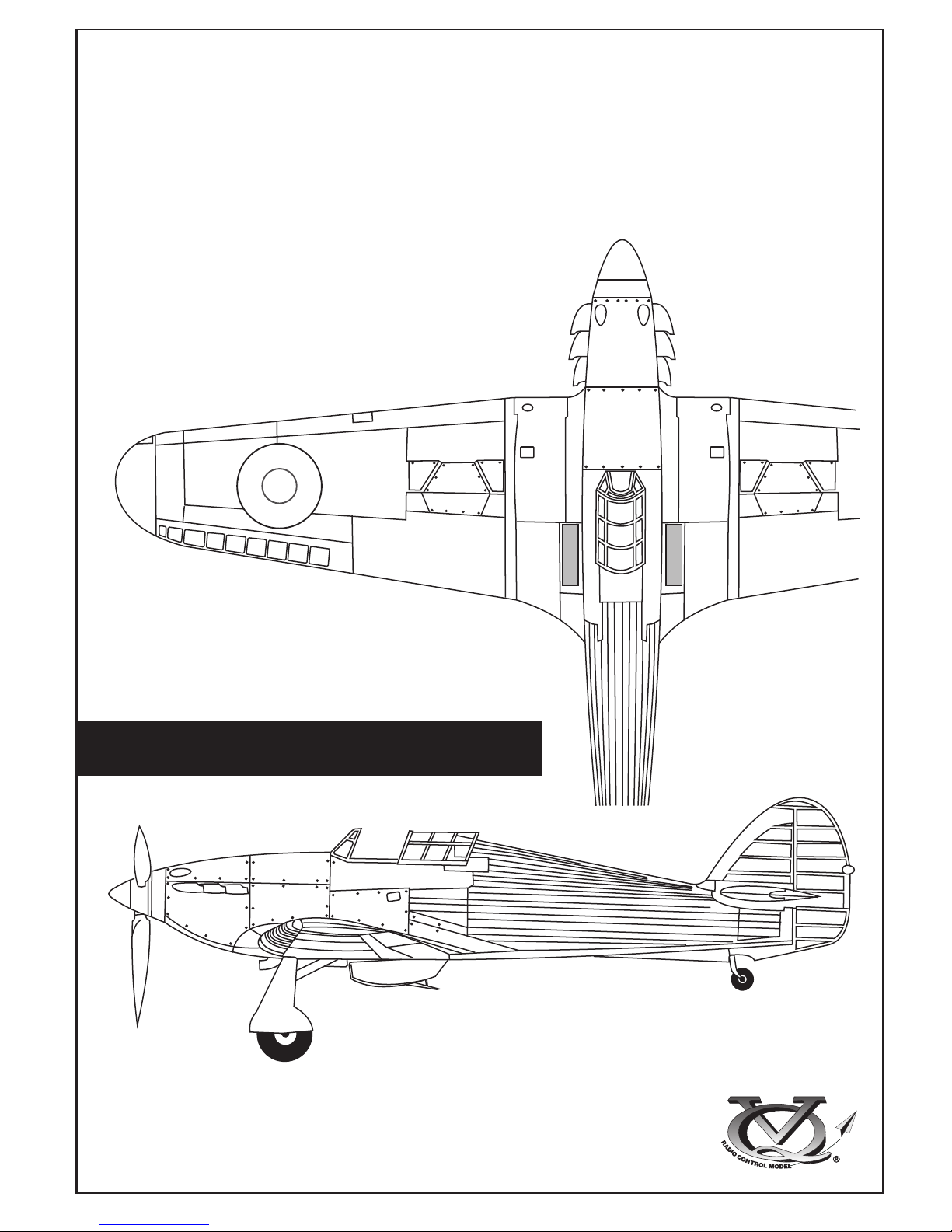
RADIO CONTROL MODEL
INSTRUCTION MANUAL
SPECIFICATIONS
Wingspan.......63 in. / 161cm
Length............50 in. / 129cm
Engine.............50~60 2T / 70~90 4T
Or Electric equivalent.
WARNING!
This radio control model is not a toy. If modified or flow carelessly it could go out of control
and cause serious bodily injury or property damage.
Before flying your airplane, ensure the air field is spacious enough.
Always fly it outdoors in safe areas with no debris or obstacles.
Almost ready to fly
HURRICANE
VQAA040G
VQAA040B
RC Functions:
Motor - Rudder - Aileron - elevator
Flap - Retract landing gear
Page 2
1.5mm
A
B
!
CA
L/R
Assemble left and right
sides the same way.
X
Drill holes using the stated
size of drill
(in this case 1.5 mm Ø)
Use epoxy glue
Take particular care here
Hatched-in areas:
remove covering
film carefully
Not included.
These parts must be
purchased separately
Check during assembly that these
parts move freely, without binding
Apply cyano glue
The pre-covered film on ARF kit may wrinkle due to variations
of temperature. Smooth out as explained right.
* Use an iron or heat gun. Start as low setting. Increase the
setting if necsessary. If it is too high, you may damage the
film
Low setting
SILICON
EPOXY A
EPOXY B
CA
GLUE
Epoxy Glue ( 5 minute type)
Silicon sealer
Cyanoacrylate
Glue
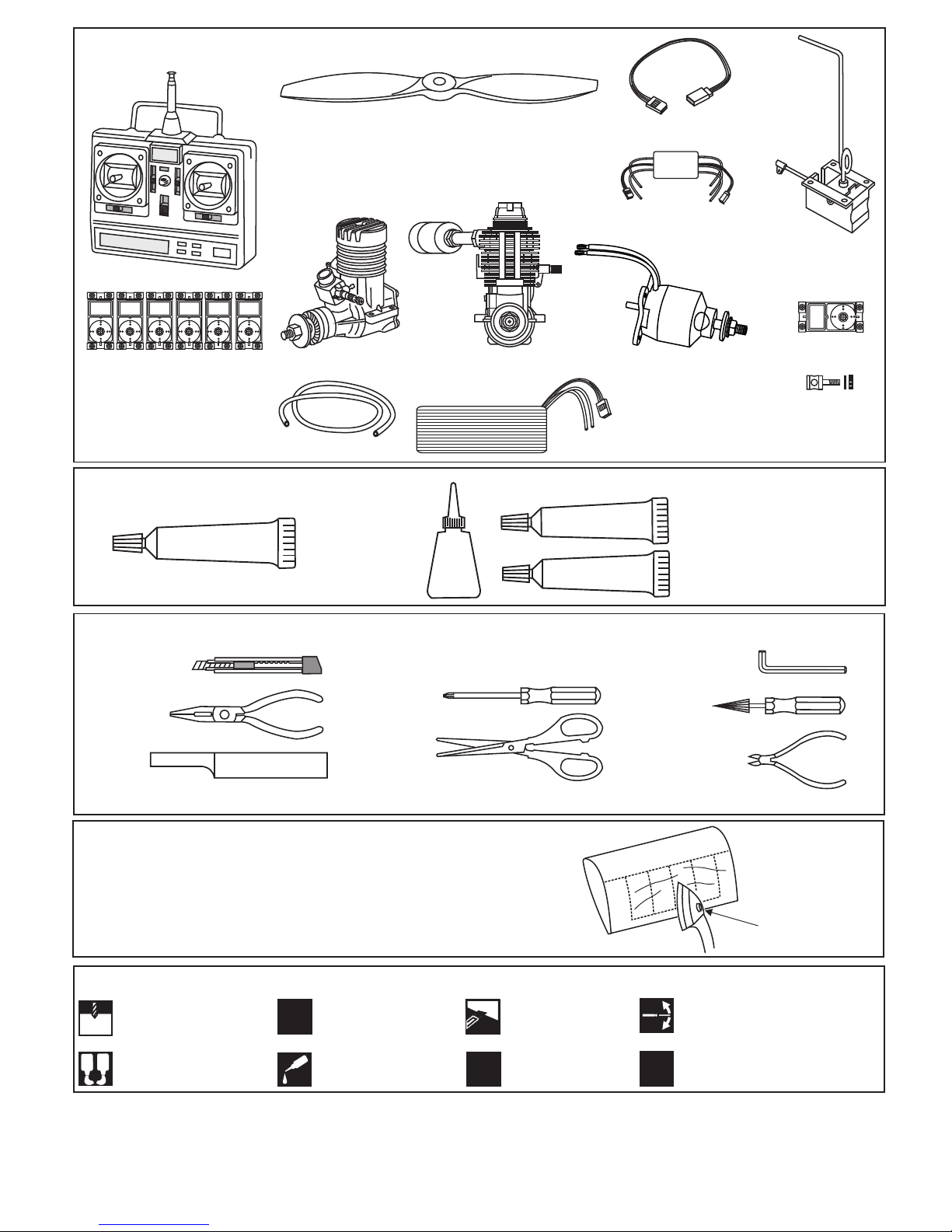
Minimum 6 channel radio
for airplane with 6 servos
.70 ~.90 - 4 cycle
12x6 for .60 - 2 cycle engine
13x6 for .70 - 4 cycle engine
14x6 for .90 - 4 cycle engine
14x8 ~ 15x8 - Brushless Motor
Silicone tube
Extension for aileron
servo, retract servo.
.50 ~ .60 - 2 cycle
REQUIRED FOR OPERATION (Purchase separately)
Linkage Stopper x2
(for retract servo)
Epoxy Glue (30 minute type)
TOLLS REQUIRED
Hobby knife
Needle nose Pliers
Phillip screw driver
Awl
Scissors
Wire Cutters
(Purchase separately)
Hex Wrench
.........................................................
.........................................................
.........................................................
.........................................................
.........................................................
.........................................................
.........................................................
.........................................................
.........................................................
.........................................................
.........................................................
Sander
Masking tape - Straight Edged Ruler - Pen or pencil - Rubbing alcohol - Drill and Assorted Drill Bits
Read through the manual before you begin, so you will have an overall idea of what to do.
Symbols used throughout this instruction manual, comprise:
(Purchase separately)
Retract landing
gear
VQAR06
Retract servo
x1
.Motor control x1 .Aileron x2
.Elevator x1 .Rudder x1
-Flap x1
Quantum 4120/07
Brushless Motor
or equivalent.
Brushless
Motor Control
Li-Po Battery.
CONVERSION TABLE
1.0mm = 3/64”
1.5mm = 1/16”
2.0mm = 5/64”
2.5mm = 3/32”
3.0mm = 1/8”
4.0mm = 5/32”
5.0mm = 13/64”
6.0mm = 15/64”
10mm = 13/32”
12mm = 15/32”
15mm = 19/32”
20mm = 51/64”
25mm = 1”
30mm = 1-3/16”
45mm = 1-51/64”
Page 3
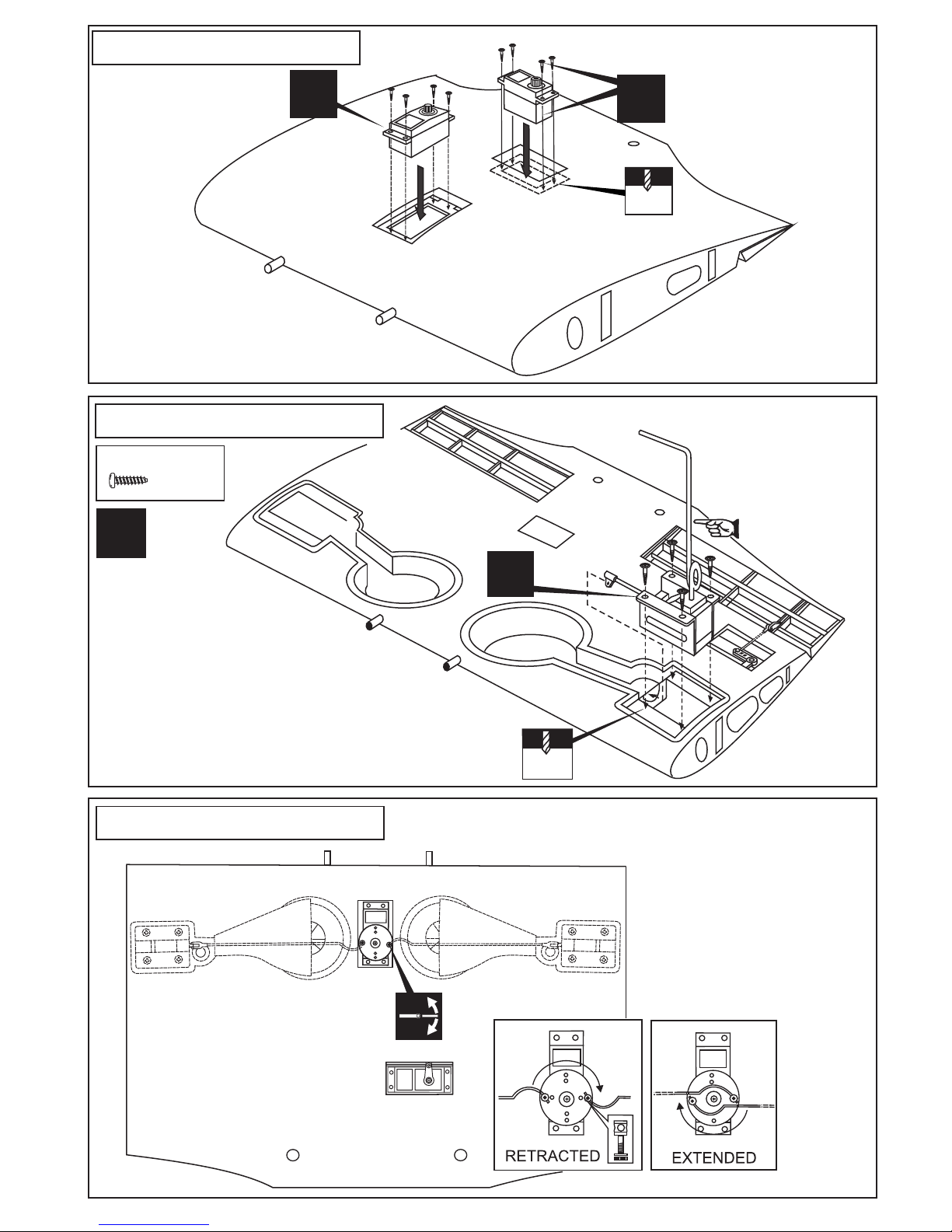
1- Retract / Flap servo
5/64
Flap servo
X
Retract servo
X
CENTER WING - TOP VIEW
3- Retract landing gear
L/R
3x12mm screw
..........8
X
2- Retract landing gear
CENTER WING - BOTTOM VIEW
Bend wire for
smooth retracting
CENTER WING - TOP VIEW
5/64
Ensure smooth
non-binding movement
Trial fit the push rod into
the wing. Join the pushrod to
the retract gear arm and trial fit
the retract into the wing.
Pull and push the retract push rod by hand
to be sure to adjust the stroke so that the landing
gear locks in both up and down position.
After checking that the retract works smoothly with the
servos, fix the retract on the wing with 3x12mm screws
Link the servo and retract gear
arm with push rod.
Be sure to adjust the stroke so
that the landing gear locks in
both up and down position.
Included with the radio set.
Page 4
CA
ABS gear cover
ABS gear strap
2x3mm screw
Plastic strap
Main landing gear
Gear mount
(hard wood)
Ply gear mount
plate
Square plastic
3x10mm
3x10mm
2x12mm
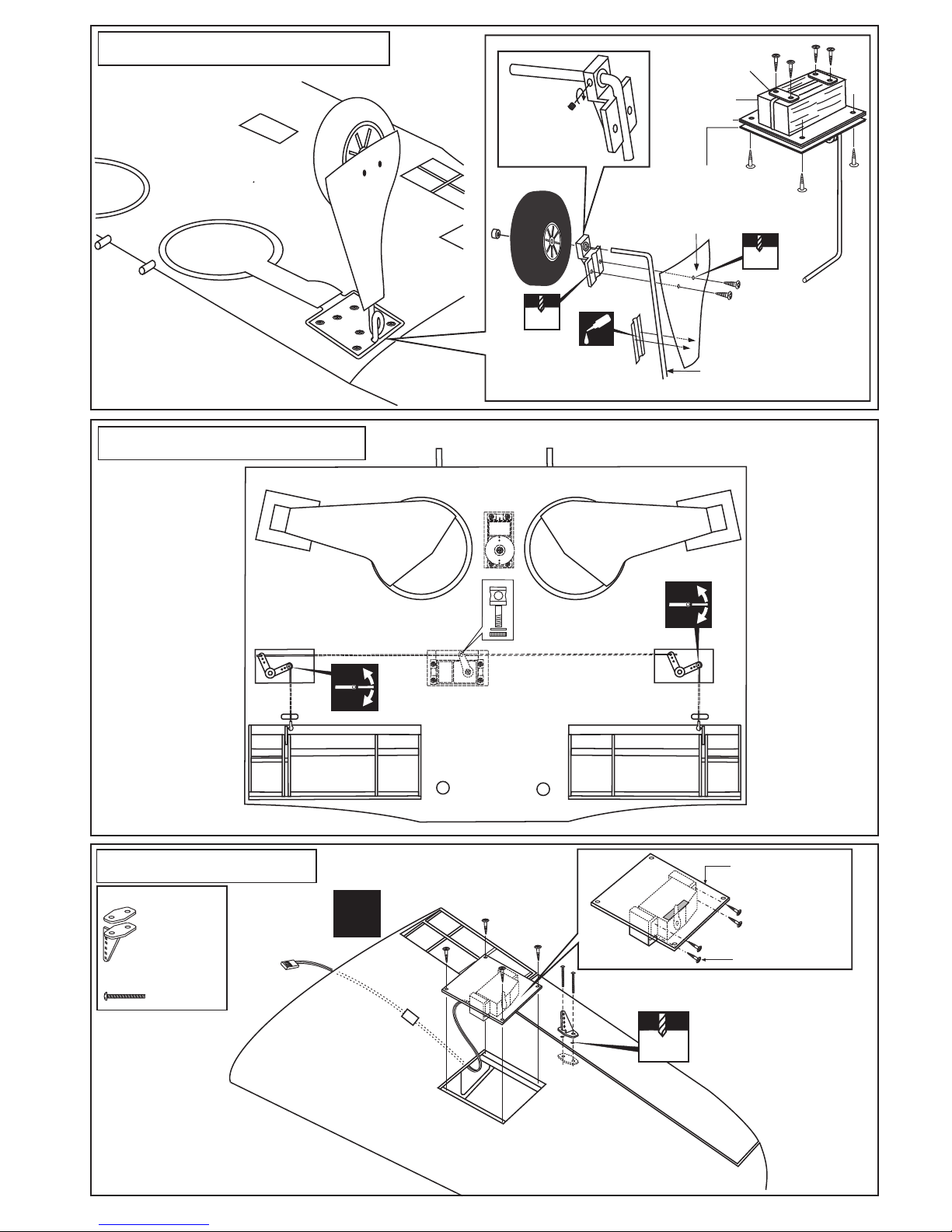
4-Center wing - Fix gear
Main landing gear
FIX GEAR INSTALLATION
5- Center wing - Flap
CENTER WING - BOTTOM VIEW
6- Aileron servo
X
Plastic control horn
....................2
2x30mm screw
...............4
5/64
Included with the
radio set
Aileron servo
hatch (ply 3mm)
Aileron servo
extension
cord
CENTER WING - BOTTOM VIEW
Ensure smooth non-binding
movement
1/16
5/64
5/64(2x10mm)
screw
5/64(2x20mm)
screw
Page 5

7- Aileron servo
WING - BOTTOM VIEW
L/R
Assemble left and right wings
the same way
LEFT- WING
CENTER-WING
Dowel
Dowel
CA
8- Joining the wing
A
B
Metal rod, D=5/64 in. (2mm) do not glue here
A
B
WING - TOP VIEW
!Securely glue together, If coming
off during flights, you lose control
of your airplane which leads to
accidents !
1- Trial fit the wing joiner, into one of the wing panels. It should insert smoothly up to the center line marked. Next,
slide the other wing half onto the dihedral brace until the wing panels meet. If the fit is overly tight, it may be
necessary to lightly sand the dihedral brace.
2- Check for the correct dihedral angle
3- Apply a generous amount of epoxy into the wing joiner cavity of one wing half. Next, Coat one half of the dihedral
brace with epoxy up to the center line. Install the epoxy-coated side of the dihedral brace into the wing joiner cavity
up to the center line.
4- Do the same way with the other wing half. Carefully slide the wing halves together, ensuring that they are accurately
aligned. Firmly press the two halves together, allowing the excess epoxy to run out. Clean off the excess epoxy.
5- Apply masking tape at the wing joint to hold the wing together securely while the epoxy cures.
Aileron servo
extension (N.I)
L/R
Assemble left and right wings
the same way
Flap servo
Flap push-rod
Retract servo
Aileron servo
Aileron push-rod
9- Linkages
WING - BOTTOM VIEW
Flap push-rod
IMPORTANT:
Please do not clean off the excess epoxy on the wing with strong solvent or pure alcohol, only use
kerosene to keep the colour of your model not fade.
Page 6

10- Tail wheel
1
2
3x15mm screw
...............4
...................1
2mm tail gear horn
Tail gear mount
................1
Four nuts are installed at factory.
3
4
5
NOTE: Insert the tail gear
pushrod into the tail gear
horn before insert the tail
gear horn on to the tail
gear mount (step 2)
!Securely glue together. If coming
off during flight, you lose control
of your air plane.
-Trial fit each part before gluing . Be certain that there are no gaps.
If the parts will join, but with a gaps, sand or trim the parts a little
at a time until the parts meet exactly with no gaps.
-When joining the stabilizer it is extremely important to use plenty of epoxy (30 minutes) or CA
glue (thin type).
-Carefully slide the stabilizer into the fin, ensuring that they are accurately aligned, using rubbing
alcohol and paper towel, clean off the excess epoxy.
A
B
Cut away only the film
(top and bottom)
A = A’
B = B’
A
A’
11- Vertical / Horizontal Tail
Plastic control horn
....................3
2x25mm screw
...............6
C = C’
B
B’
C
C’
5/64(2x25mm)
screw
Hinge
Petroleum
jelly
STABILIZER
A
B
Apply 5 min.
Epoxy both the
top and bottom.
3/8 in. (9.5mm)
Apply a thin layer of machine oil or petroleum jelly to only the pivot point of the hinges on
the elevator, then push the elevator and its hinges into the hinge slots in the trailing edge
of the horizontal stabilizer.
There should be a minimal hinge gap.
When satisfied with the and alignment, hinge the elevator to the horizontal stabilizer using
5 minute epoxy. Make sure to apply a thin layer of epoxy to the top and bottom of both hinges
and to inside the hinge slots. Repeat the previous procedures to hinge the second elevator to
the other side of the horizontal stabilizer.
A
B
A
B
5mn epoxy
5mn epoxy
30mn epoxy
Page 7

12- Servo installation
Throttle servo
Rudder servo
Elevator servo
X
X
X
BOTTOM VIEW
NOTE: Place of throttle servos may be change depend
of engine (Four-stoke or two-stroke engine)
Throttle servo
Throttle
pushrod
13- Push rod
Elevator / Rudder servo
Elevator pushrod
Connector
Connector
Connector
............2
............2
Elevator push rod
Elevator push rod
Rudder push rod
Tail wheel push rod
Rudder servo
Elevator servo
Throttle servo
BOTTOM VIEW
5/64(2mm) screw
5/64
5/64(2mm) screw
5/64
Page 8

14- Engine mounts
1
2
3
3mm ply wood (A)
Engine thrust on balk head is
already adjust at factory
4
Attach the plywood (A) to the plywood template(B)
Secure them together with one 3x10mm screw, ensure
that these parts move freely.
Insert the plywood template into the fire wall and
drill four 13/64”(5mm) holes through the fire wall
13/64
5mm
13/64
5mm
Plywood template(B)
........4
................4
4x25mm screw
Blind-nut
! Engine thrust on balk head is already adjust at factory.
15- Engine mounts / Engine
1
2
(140 - 142mm)
5.51 ~ 5.59in.
In case of 2 stroke engine
with hang silencer.
In case of 4 stroke engine.
! Align the mark on both mounts
with the mark on the fuselage.
In case of 4 stroke
engine with side
silencer.
Page 9

X
To muffler
Filler tube
To engine
Rubber
stopper
Cap
Stopper
16- Fuel tank installation
Firewall
140~142mm
B’
B
B=B’
SIDE-VIEW
A
A=A’
A’
TOP-VIEW
! Engine thrust on balk head
is already adjust at factory
Using a aluminum motor mounting plate as
a template, mark the plywood motor mounting
plate where the four holes are to be drilled (2).
Remove the aluminum motor mounting
plate and drill a 1/8”(3mm) hole through
the plywood at each of the four marks
marked .
CA
3mm
1
2
Note: The aluminum motor mounting included
with electric motor set.
After confirming the direction . Insert this assembly, clunk end first, into
the fuel tank and tighten and screw the fuel tank cap on firmly.
3x35 mm screw
4mm
2
1
17- Electric Motor mount
Page 10

2.5x10mm.....5
1.5mm
18- Cowling
1~2mm
Board
Adhesive
Board
Attach the board or transparent plastic on the side of
the fuselage with the adhesive as show.
Using a pencil or felt tipped pen trace around the engine
head where it meet the cowl. Cut the opening the board
or transparent plastic for the engine head as marked
before.
Remove the engine and insert the cowl on to the fuselage
so the distance from the fire wall to the front of the cowl is
140 to 142mm (section 14).
Remove the cowl from the fuselage and carefully cut the
opening for the engine head as marked above. Do the
same way with the hole for needle-valve.
Again. Insert the cowl on to the fuselage and secure it in
place with five 2x5mm screws.
123mm
Ruler
CA
ABS cover
ABS cover
ABS cover
2mm screw
19- ABS Cover
2x6mm.......6
Page 11

ABS cover
(clear)
ABS cover
(clear)
A
B
A
B
22- Light
Do not use CA glue to much or it will make the ABS light cover white
5 min.
5 min.
20- Canopy
Sticker
Instrument panel
sticker
2x6mm screw
ABS air scoop
ABS cover
CA
CA
Cut away only the film
Cut away only the film
BOTTOM VIEW
21- Air scoop
Page 12

Wing center section
DO NOT try to fly an out-of-balance model !
23- Balance
(85 ~ 90mm)
Add weight to nose (as show) until the correct balance is achieved.
Stick-on weights are available at your local hobby shop and work
well for this purpose.
Battery pack
3.3 ~ 3.5 in.
To get the correct C.G., Several strips of
lead weight were required in the nose of
this model . To minimize the amount of
weight required, it is desirable to position
the weight as far forward as possible. This
can be done by making a platform form
leftover basswood stick and 3.2mm (1/8”)
ply wood. Using 4x35mm bolts to mount
the engine would also be long enough to
mount the flatform. The lead should be
permanently glued on with epoxy.
IMPORTANT: Recheck the C.G. After the
weight has been installed.
How to add nose-weight
Securely install the nose-weight ensuring it will
not come loose during flights.
!
35 mm
35 mm
8mm
8mm
10mm
10mm
RUDDER STROKE
ELEVATOR STROKE
AILERON STROKE
24- Control Surface
Adjust the travel of the control surfaces to achieve the values stated in the diagrams.
These value will be suitable for average flight requirements. Adjust the values to suit your particular needs.
Securely install the battery pack ensuring it will
not come loose during flights.
!
BEFORE FLYING CHECK EVERYTHING
Before each flight, inspect the airplane for any loose parts. Check the hinges, make sure the pushrods are still firmly
attached, and check the engine mounting bolts. In general, check everything on the plane that might possibly come
loose.
CHECK THE FREQUENCE BEFORE FLYING
DO NOT FLY NEAR A POWER LINE
The power lines cause radio interference, so avoid flying near them.
Basswood stick
Flatform
(3.2mm ply)
Lead should be
permanently glued
on flatform with
epoxy
Battery pack
IMPORTANT:
Please do not clean your model with pure alcohol, only use liquid soap with water or use glass cleaner to
clean on surface of your model to keep the colour not fade.
 Loading...