

Page 1
Viking Installation Guide
IMPORTANT–Please Read and Follow!
• Before beginning, please read these instructions completely and carefully.
• Be sure to DISCONNECT THE PLUG of the microwave oven from the electrical outlet before installing the built-in trim kit.
Remove the turntable from the oven cavity.
• Because the kit includes metal parts, caution should be used in handling and installation to avoid the possibility of injury.
• Do not remove permanently affixed labels, warnings, or plates from the product. This may void the warranty.
• Please observe all local and national codes and ordinances.
• Theinstallershouldleavethese instructionswiththe consumerwhoshouldretainfor localinspector’suse andfor
futurereference.
• This built-in trim kit is designed for use ONLY WITH VIKING CONVECTION AND CONVENTIONAL MICROWAVE OVENS
SPECIFYING BUILT-IN TRIM KIT VMTK272, VMTK302, VMTK362, VMTK277, VMTK307 or VMTK367 on the rating label on
the bottom face plate of the oven cavity.
• YOUR OVEN CAN BE BUILT INTO A CABINET OR WALL BY ITSELF OR ABOVE ANY ELECTRIC WALL OVEN OR WARMING
DRAWER.
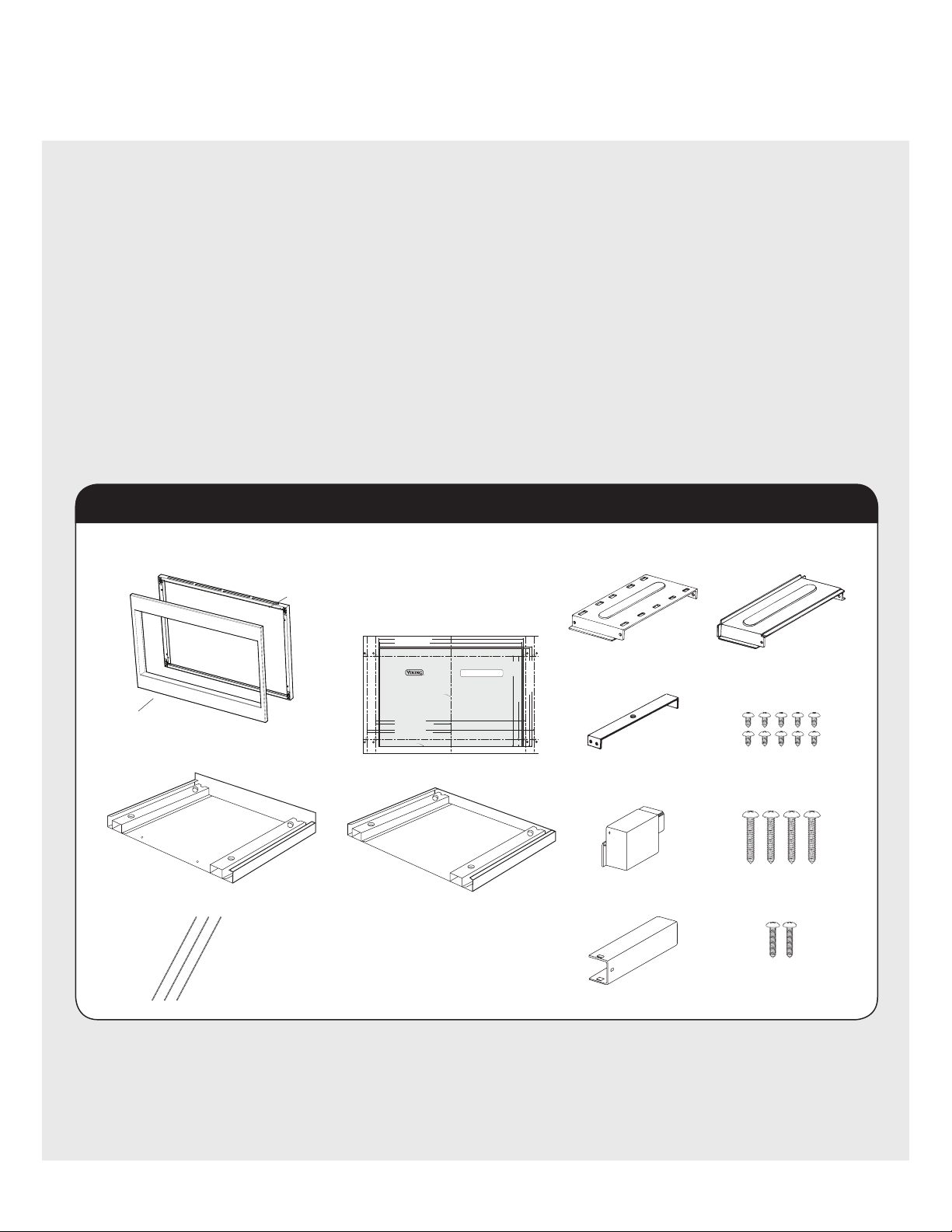
Parts Included in VMTK kits
Front Frame Assembly QTY 1
Front Frame
QTY 1
Bottom Duct Assembly QTY 1
Cushion QTY 3
Back Frame
QTY 1
27" & 30"Surface Mount
Tem p l ate 2- s ided
or 36"Surface Mount
Template single-sided
QTY 1
Maximum Cutout Opening Width 24-11/16" (627.06 mm)
Minimum Cutout Opening Width 24-3/8" (619.13 mm)
USE THIS SIDE OF TEMPLATE FOR MODELS
Center Line
VMTK272 and VMTK302 ONLY.
1. Align the mounting template center line with the center of the cutout
and the floor line with the floor of the cutout. Tape it into place.
2. For VMTK272, predrill 4 holes marked A with a 1/16" drill bit.
For VMTK302, predrill 4 holes marked B with a 1/16" drill bit.
3. Remove template from the cabinet.
BUILT-IN TRIM KIT TEMPLATE
FOR CUSTOM SERIES MICROWAVE OVEN
Distance between holes A 25-9/16" (649.3 mm)
Distance between centerline to holes
Distance between holes B 28-9/16" (725.5 mm)
Distance between centerline to holes
Floor Line of Cutout Opening
12-13/16" (324.65 mm)
14-5/16" (362.75 mm)
*
TINSKB133MRR0
15-13/32" (391.45 mm)
Maximum Height distance between holes 14-1/4" (361.825 mm)
1-5/32"
(29.6 mm)
Duc t (A) -1 QTY 1 * Duct (A)-3 QTY 1 *
3/4" (425.5 mm)
-
Maximum Cutout Opening Height 17" (431.8 mm)
Minimum Cutout Opening Height 16
Duct (A)-2 QTY 1 *
Duct (B) QTY 1 *
Duct (C) QTY 1 *
Screw A (1/2" length)
QTY 10 *
Screw B (1-3/4" length)
QTY 4
Screw C (3/4" length)
QTY 2
*VMTK277, VMTK307 and VMTK367 O NLY.
Custom Series Convection /
Conventional Microwave Built-In Trim Kit
111 Front Street
Greenwood, Mississippi 38930 USA
Page 2
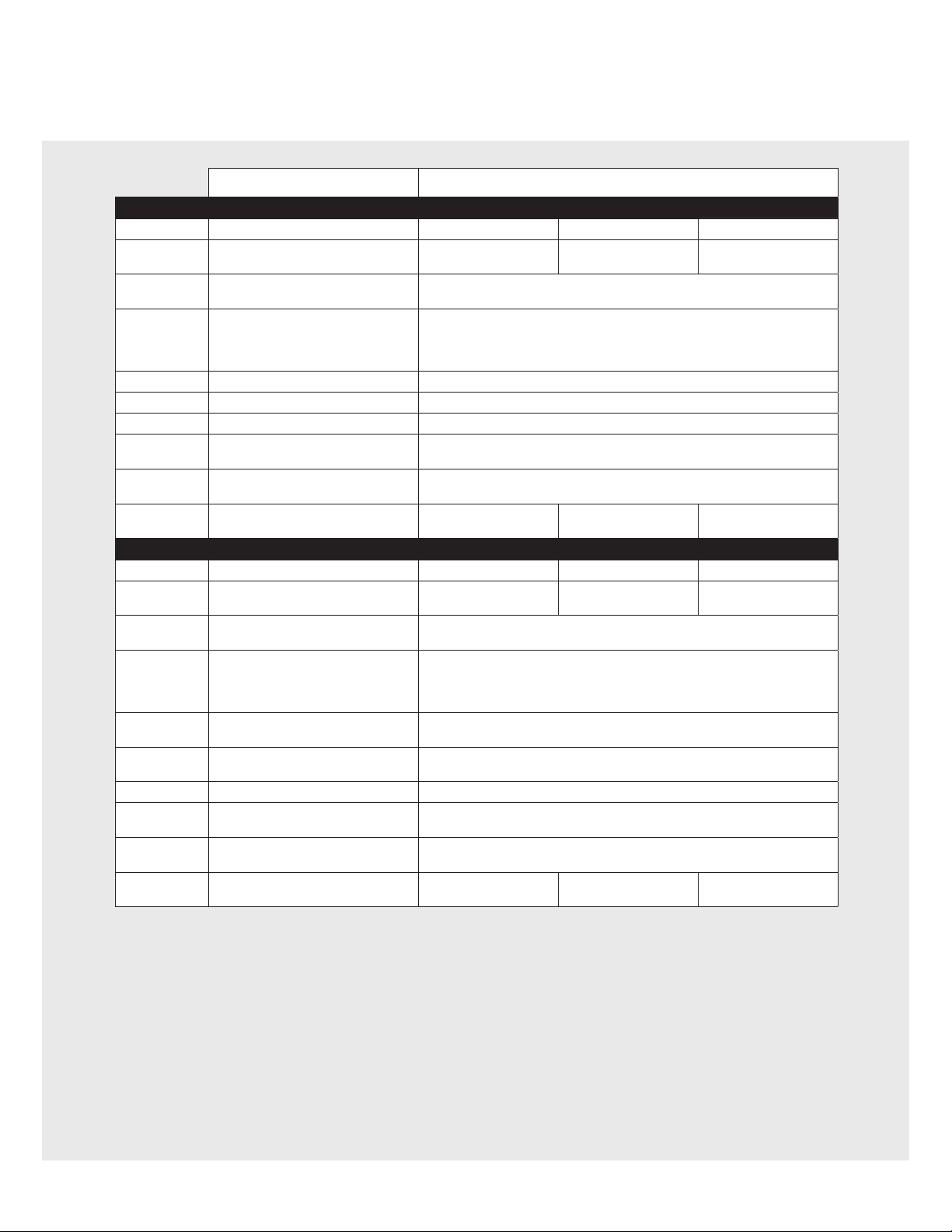
Basic Specifications
MicrowaveOven Built-InCustomTrimKits
Description CONVECTIONVMOC206 VMTK277 VMTK307 VMTK367
Overall Width 24-5/8" (62.5 cm) 26-1/2" (67. 3 cm) 29-1/2" (74.9 cm) 35-1/4" (89.5 c m)
Overall Height
from Bottom
Overall Depth
from Rear
Oven Interior
Cutout Width N/A Min. 25" (63.5 cm)
Cutout Height N/A Min. 18 -11/16" (46.9 cm)
Cutout Depth N/A Min. 20 -1/8" (51.1 c m)
Electrical
Requirements
Maximum Amp
Usage
Approximate
Shipping Wt.
Description CONVENTIONALVMOS201 VMTK272 VMTK302 VMTK362
Overall Width 24" (60.9 cm) 26-1/2" (67. 3 cm) 29-1/2" (74.9 c m) 35 -1/4" (89. 5 cm)
Overall Height
from Bottom
Overall Depth
from Rear
Oven Interior
Cutout Width N/A
Cutout Height N/A
Cutout Depth N/A Min. 20" (50.3 cm)
Electrical
Requirements
Maximum Amp
Usage
Approximate
Shipping Wt.
14-7/8" (37.7 c m ) 19-13 /16" (5 0 .1 c m) 19-13 /16" (5 0 .1 c m) 19-13 /16" (5 0 .1 c m)
19" (48.3 cm) N/A
Width
Height
Depth
Overall
120VAC/60 Hz (UL)
117VAC/60 Hz (CSA)
1.55 KW
1.5 KW
60 lbs. (27. 2 k g ) 19 lbs. (8.6 kg) 20 lbs. (9.1 k g ) 23 lbs. 10.5 kg
13- 3/8" (33.9 cm) 18-1/4" (46.3 cm) 18 -1/4" (46.3 cm) 18 -1/4" (46.3 cm)
19-1/4" (48.9 cm) N/A
Width
Height
Depth
Overall
120VAC /60 Hz N/A
1.5 KW 13 amps N/A
46 lbs. (20.9 kg) 14 lbs . (6.5 kg) 15 lbs. (6.9 kg) 18 lbs. (8.2 kg)
16-1/8"
9-5/8"
16-1/8"
1.5 cu. ft.
13 amps (UL)
13 (CS A)
17-3 /8"
10-1/2"
18-5/8"
2.0 cu. ft.
(40.9 cm)
(24.4 cm)
(40.9 cm)
(4 4 .1 c m)
(26.6 cm)
(4 7. 3 cm )
Min.
Max.
Min.
Max.
N/A
N/A
N/A
N/A
24-3/8"
24 -11/16"
16-3/4"
17"
(61.9 c m )
(62.7 cm)
(42.5 cm)
(43.2 cm)
E2
Page 3
Cabinet or Wall Cutout
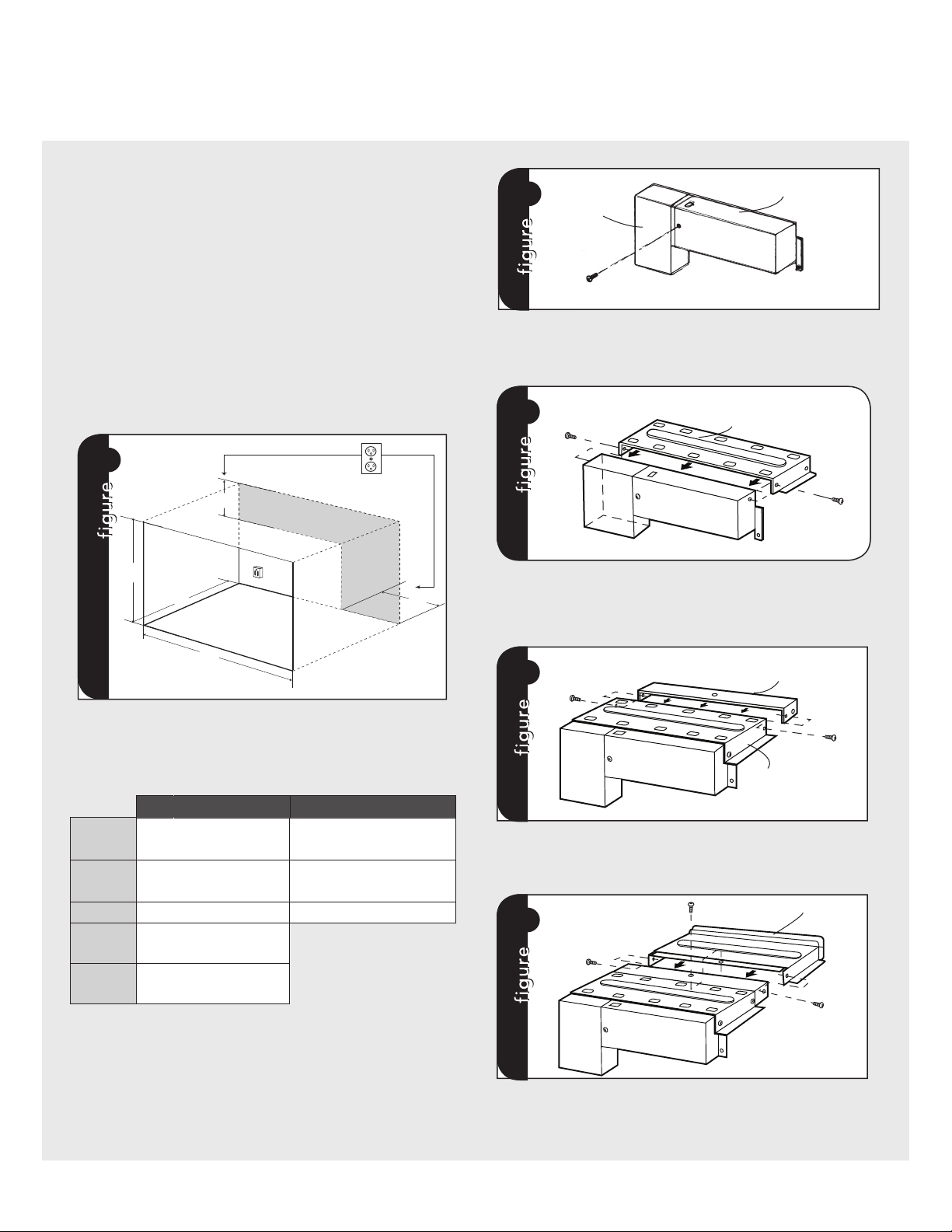
Provide an opening in the wall or cabinet as indicated
in figure 1. The depth should be a minimum of 20-1/8"
(51.1 cm). If the Depth (C) dimension is greater than 21"
(53.3 cm), the outlet location may be in any area on the
rear wall. The floor of the opening should be constructed
of plywood strong enough to support the weight of the
oven (about 100 lbs.) and should be level for proper
operation of the oven.
Exhaust Duct Assembly
2
DUCT (B)
SCREW (A)
DUCT (C)
Note: While the proper functioning of the oven does not
require that the opening be enclosed (with sides, ceiling
and rear partition), this may be required by local code,
and it is suggested that the local code be checked for
any such requirement.
1
E
A
C
B
SurfaceMountCutoutDimensions
* For flush mount dimensions please see installation template and
FLUSH MOUNT INSTALLATION on page 5-6.
CONVECTION CONVENTIONAL
(A) Height
(B) Width
(C) Depth Min. 20 -1/8" (51.1 c m) Min. 20-1/8" (51.1 c m )
(D)
(E)
ELECTRICAL OUTLET LOCATION: Outlet should NOT be in the
shaded area as indicated on figure 1. At the rear of the opening,
provide a 3-pronged, polarized, electrical outlet, 115-120 volt AC,
15 amp or larger.
18-1/2" (46.9 c m) Min. 16-3/4" (42.5 cm)
Max. 17" (43.2 cm)
25" (63.5 cm) Min. 24-3/8" (61.9 cm)
Max. 24-11/16" (62.7 cm)
Min.
Max.6"11-1/2"
Min.
Max.4"5"
(15.2 cm)
(2 9. 2 cm)
(10.2 cm)
(12.7 cm)
D
EXHAUST DUCT ASSEMBLY: Insert the edge of DUCT (B) into the
hold lip of DUCT (C). Secure together by using a SCREW (A) provided
in the kit. See figure 2.
3
SCREW (A)
EXHAUST DUCT ASSEMBLY: Position DUCT (A)-1 on the top of the
oven inserting edge of DUCT (BC) assembly into hole lip of DUCT
(A)-1. Tighten two SCREWS (A), securing DUCT (A)-1 to DUCT (BC)
assembly. See figure 3.
SCREW (A)
4
EXHAUST DUCT ASSEMBLY: Position DUCT (A)-2 on the top of the
oven and insert it into the hold lip of DUCT (A)-1. Secure DUCT (A)-2
to DUCT (A)-1 using two SCREWS (A) provided. See figure 4.
SCREW (A)
DUCT (A)-1
DUCT (BC)
SCREW (A)
DUCT (A)-2
SCREW (A)
DUCT (A)-1
DUCT (A)-3
5
SCREW (A)
SCREW
(A)
DUCT (A)-2
EXHAUST DUCT ASSEMBLY: Position DUCT (A)-3 on top of the oven
and insert it into DUCT (A)-2. Secure DUCT (A)-3 using three screws
(A) provided. See figure 5.
E3
Page 4
Exhaust Duct Assembly Surface Installation
5
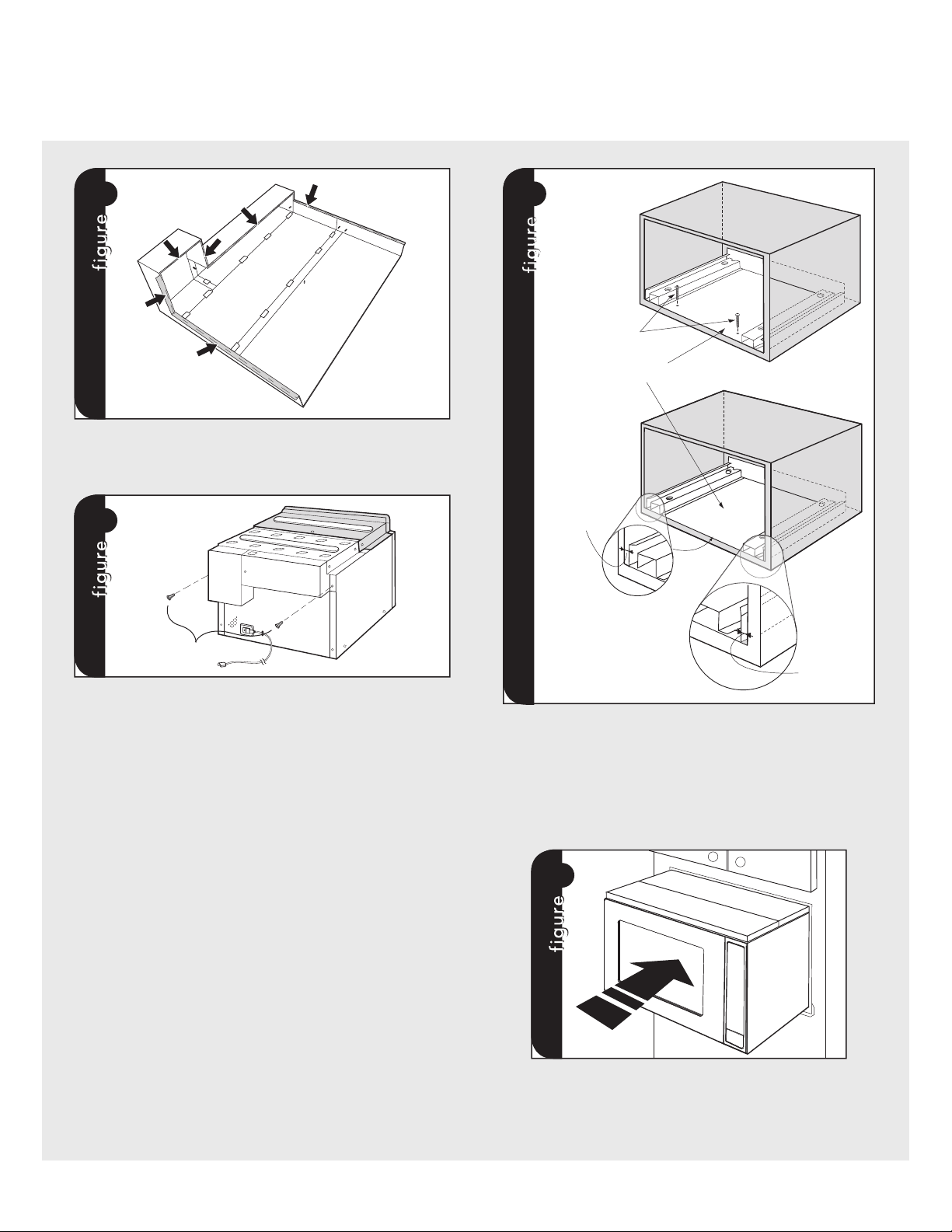
EXHAUST DUCT ASSEMBLY: Remove the cushions from the adhesive
backing. The cushion should be applied to the flanges of the duct
assembly as indicated by arrows. See figure 5A.
5
A
B
SCREW
6
BOTTOM DUCT ASSEMBLY
GAP "A"
NOTE: CENTER
BOTTOM DUCT
ASSEMBLY IN THE
OPENING
SCREW C
DETAIL A
GAP "B"
EXHAUST DUCT ASSEMBLY: Remove SCREW from the upper right
and left corners at the rear of the oven. Place duct assembly on the
top of the unit as shown and secure the duct assembly to the oven
using the two screws just removed from the oven. See figure 5B.
*Figures 2 - 5 for models VMTK277, 307 and 367 ON LY.
MOUNTING TEMPLATE: Identify the appropriate side of template
to use with your unit. Align the mounting template center line with
the center of the cutout and the floor line with the floor of the cutout.
Tape it into place.
• For VMTK272 only, predrill
4 holes marked “A” with a
1/16" drill bit.
• For VMTK302 only, predrill
4 holes marked “B” with a
1/16" drill bit.
• For VMTK362 only, predrill
4 holes marked “C” with a
1/16" drill bit.
Remove template from the cabinet.
• For VMTK277 only, predrill
4 holes marked “A” with a
1/16" drill bit.
• For VMTK307 only, predrill
4 holes marked “B” with a
1/16" drill bit.
• For VMTK367 only, predrill
4 holes marked “C” with a
1/16" drill bit.
BOTTOM DUCT ASSEMBLY: Place the Bottom Duct in the center of
the opening so that gap "A" is equal to gap "B". 1 When the Bottom
Duct Assembly for VMTK277SS, 307SS or 376SS is positioned properly,
the front edge of the duct will be flush with the front of the cabinet.
2 The VMTK272SS, 302SS, 372SS Exhaust Duct will be positioned
properly when the edge of the duct is recessed 5mm from the front
of the cabinet. See figure 6. Secure the Bottom Duct Assembly with
the two (¾") SCREWS (C).
7
CABINET INSTALLATION: Place the oven adjacent to the wall or
cabinet opening. Plug the power cord into the electrical outlet.
Carefully guide the assembled oven into the prepared opening. Slide
the oven on the Bottom Duct Assembly. See figure 7.
E4
Page 5
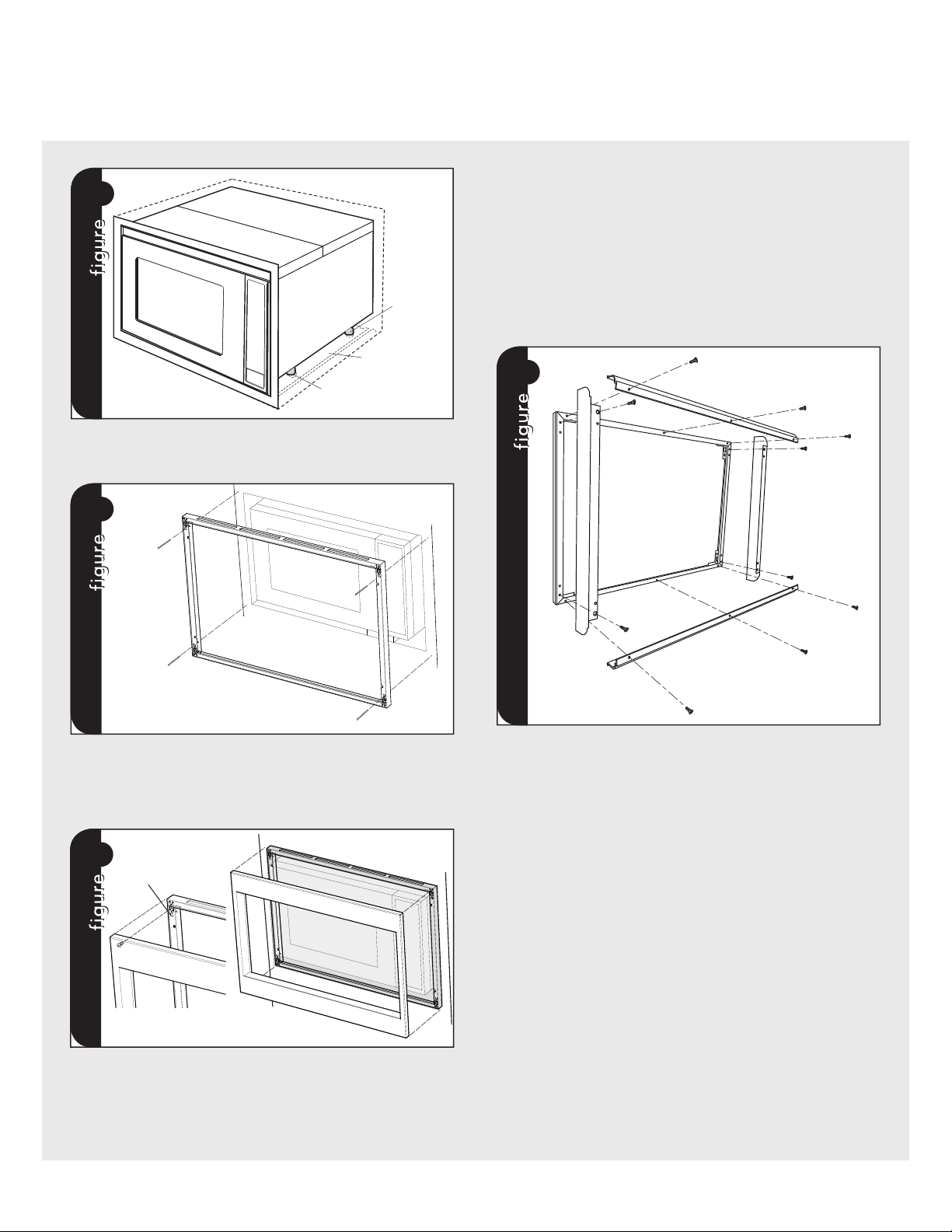
Surface Installation Flush Mount Installation
PARTS INCLUDED IN FLUSH MOUNT ACCESSORY KIT
8
FOOT
BOTTOM
DUCT
ASSEMBLY
DUCT RECESS
CABINET INSTALLATION: Avoid pinching the cord between the oven
and the wall. Adjust the position of the oven so that the feet of the oven
are fitted into the holes of the Bottom Duct Assembly. See figure 8.
(PURCHASED SEPARATELY):
•(2) Stainless Steel Scoops
•(10) Stainless Machine Screws
•(1) Flush Mount Template
•(2) Side Trim
* See FLUSH MOUNT TEMPLATE for additional installation instructions.
"
9
SCREW (B)
SCREW (B)
SCREW (B)
SCREW (B)
FRAME INSTALLATION: Position the BACK FRAME to align with the
predrilled holes that were drilled with the mounting template. Check
that it is level and then secure with four SCREWS (B). See figure 9.
Secure the bottom portion of the BACK FR AME with the two remaining
SCREWS (B).
SNAP
!
ATTACHM ENT
FLUSH MOUNT INSTALLATION: Place the 2 Scoops on the back of
the frame as shown and align the screw holes on the scoop with the
tapped holes in the frame. Secure the scoops to the frame using 6
of the machine screws provided in the kit. Place the side trim pieces
on the back of the frame as shown and align the top and bottom
most screw holes with the corresponding taped holes in the frame.
Secure the trim pieces with the 4 remaining machine screws provided.
Attach the frame assembly to the wooden side spacers by aligning
the mounting holes in the frame with the pre-drilled holes in the side
spacers and secure with SCREW (B) provided with the trim kit. See
figure ".
DECORATION INSTALLATION: Place the FRONT decoration onto the
FRAME and align ball studs and receivers. Secure the DECORATION
to the FRAME by firmly pushing the front frame onto the back frame
engaging the four (4) snap attachments. See figure !.
DECORATION INSTALLATION: Place the FRONT decoration onto the
FRAME and align ball studs and receivers. Secure the DECORATION
to the FRAME by firmly pushing the front frame onto the back frame
engaging the four (4) snap attachments. See figure !.
E5
Page 6
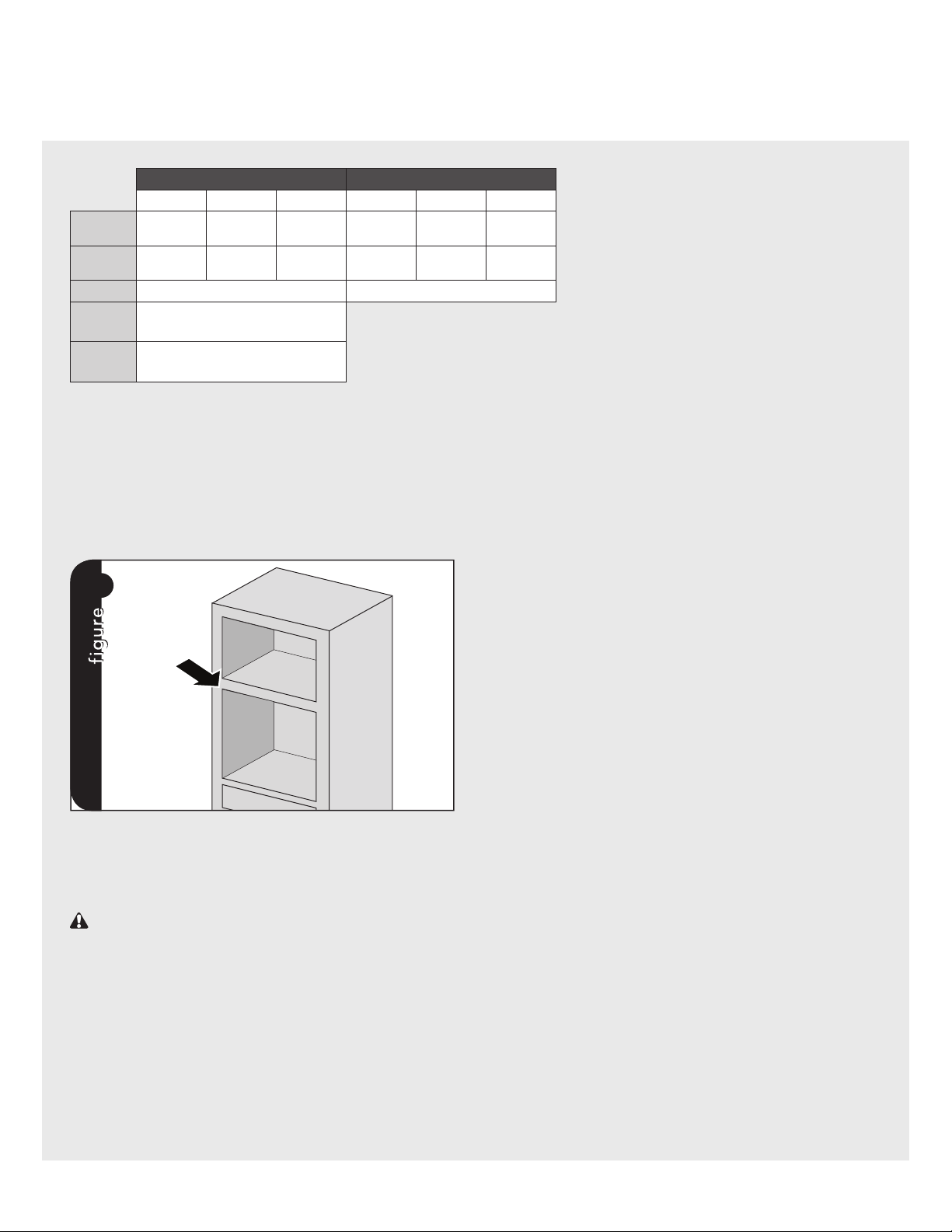
Flush Mount Installation
CONVECTION CONVENTIONAL
27" 30" 36" 27" 30" 36"
(A) Height
(B) Width
(C) Depth 22-1/16" (56.1 cm) 22-1/16" (56.1 cm)
(D)
(E)
21-5/16"
(542 cm)
26 -15/16"
(68.3 cm)
Min.
Max.
Min.
Max.
21-5/16"
(542 cm)
29 -15/16"
(76 cm)
6"
11-1/2"
4"
5"
21-5/16"
(542 cm)
35-5/8"
(90.4 cm)
(15.2 cm)
(2 9. 2 cm)
(10.2 cm)
(12.7 cm)
19-7/8"
(504 cm)
26 -15/16"
(68.3 cm)
19-7/8"
(504 cm)
29 -15/16"
(76 cm)
Installation
19-7/8"
(504 cm)
35-5/8"
(90.4 cm)
#
MICROWAVE
OPENING
LOWER OVEN
OPENING
OVER OVEN INSTALLATION: Space between the microwave and the
lower oven: 2" (5.08 cm) for 27"W and 30"W. See Figure #.
The trim kits described in this installation guide, and listed
below, are NOT TO BE INSTALLED ABOVE GAS OVENS.
VMTK272SS VMTK307SS VMTK362SS
VMTK277SS VMTK302SS VMTK367SS
For more product information, call
1-888-VIKING1 (845-4641) or visit our
website at http://www.vikingrange.com
E6
Page 7

Viking Directives d’installation
IMPORTANT–Prière de Lire et de Suivre !
• Prière de lire attentivement toutes ces directives avant de commencer.
• Veiller à DÉBRANCHER LA FICHE du four à micro-ondes de la prise électrique avant d’installer la garniture à encastrer. Retirer
la table tournante de la cavité du four.
• Le kit comprend des parties métalliques, il faut faire attention lors de la manipulation et de l’installation pour éviter éventuelles
blessures.
• Ne pas retirer de façon permanente les étiquettes, les mises en garde ou les plaques fixées au produit. Cela pourrait annuler
la garantie.
• Veuillez observer tous les codes et règlements locaux et national.
• L’installateurdevralaissercesdirectivesauclientquidevralesconserverpourl’usaged’uninspecteurlocaletpour
référenceultérieure.
• Ce kit à encastrer est destiné à être utilisé UNIQUEMENT AVEC LES FOURS À MICRO-ONDES TRADITIONNELS ET À
CONVECTION VIKING SPÉCIFIANT KIT À ENCASTRER VMTK272, VMTK302, VMTK362, VMTK277, VMTK307 ou VMTK367
sur l'étiquette des spécifications nominales présente sur la plaque frontale inférieure de la cavité du four.
• VOTRE FOUR PEUT ÊTRE INTÉGRÉ DANS UNE ARMOIRE OU LE MUR LUI-MÊME OU PAR-DESSUS TOUT FOUR ÉLECTRIQUE
OU AU MUR OU LE TIROIR DE RÉCHAUFFEMENT.
Pièces Comprises dans le Kit VMTK
Ensemble du châssis QTÉ 1
Châssis arrière
QTÉ 1
Châssis avant
QTÉ 1
Ensemble du conduit inférieur QTÉ1 *
Coussin QTY 3
Gabarit à montage en surface
2 faces de 27 & 30 po
ou gabarit à montage en
surface simple face de 36 po
QTÉ 1
Maximum Cutout Opening Width 24-11/16" (627.06 mm)
Minimum Cutout Opening Width 24-3/8" (619.13 mm)
USE THIS SIDE OF TEMPLATE FOR MODELS
VMTK272 and VMTK302 ONLY.
BUILT-IN TRIM KIT TEMPLATE
FOR CUSTOM SERIES MICROWAVE OVEN
Distance between holes A 25-9/16" (649.3 mm)
Distance between centerline to holes
Distance between holes B 28-9/16" (725.5 mm)
Distance between centerline to holes
Floor Line of Cutout Opening
12-13/16" (324.65 mm)
14-5/16" (362.75 mm)
Center Line
1. Align the mounting template center line with the center of the cutout
and the floor line with the floor of the cutout. Tape it into place.
2. For VMTK272, predrill 4 holes marked A with a 1/16" drill bit.
For VMTK302, predrill 4 holes marked B with a 1/16" drill bit.
3. Remove template from the cabinet.
15-13/32" (391.45 mm)
TINSKB133MRR0
1-5/32"
(29.6 mm)
Maximum Height distance between holes 14-1/4" (361.825 mm)
*
Conduit (A)-1 QTÉ 1 *
3/4" (425.5 mm)
-
Maximum Cutout Opening Height 17" (431.8 mm)
Minimum Cutout Opening Height 16
Conduit (A)-2 QTÉ1 *
Conduit (B) QTÉ 1 *
Conduit (C) QTÉ 1 *
Conduit (A)-3 QTÉ1 *
Vis A (1/2 po longueur)
QTÉ 10 *
Vis B (1-3/4 po
longueur) QTÉ 4
Vis
C (3/4 po longueur)
QTÉ 2
VMTK277, VMTK307 et VMTK367 UNIQUEMENT.
Kit à Encastrer pour Micro-Ondes Traditionnel /
À Convection de Série Personnalisée
111 Front Street
Greenwood, Mississippi 38930 USA
Page 8

Spécifications de Base
Fouràmicro-ondes Kitsdegarnitureàencastrer
Descriptión CONVECTIONVMOC206 VMTK277 VMTK307 VMTK367
Largeur hors tout 24-5/8 po (62,5 cm) 26-1/2 po (67, 3 cm ) 29-1/2 po (74,9 cm)
Hauteur hors tout
depuis le bas
Profondeur hors
tout depuis
l’arrière
Intérieur du four
Largeur de la
découpe
Hauteur de la
découpe
Profondeur de la
découpe
Alimentation
électrique
Ampèrage max.
Poids approx. à
l’expédition.
14-7/8 po (37, 7 c m) 19-13/16 po (5 0,1 c m) 19-13/16 po (5 0,1 c m)
19 po (48,3 cm) S/O
Largeur
Hauteur
Profondeur
Tot al
120VAC/60 Hz (UL)
117VAC/60 Hz (CSA)
1,55 K W
1,5 KW
60 lbs. (27, 2 k g) 19 lbs. (8,6 kg) 20 lbs. (9,1 kg)
16-1/8 po
9-5/8 po
16-1/8 po
1,5 cu. ft.
S/O
S/O
S/O
13 amps (UL)
13 (CS A)
(40,9 cm)
(24,4 cm)
(40,9 cm)
S/O
Min. 25 po (63,5 cm)
Min. 18 -11/16 po (46,9 cm)
Min. 20 -1/8 po (51,1 c m)
S/O
S/O
Descriptión TRADITIONNELVMOS201 VMTK272 VMTK302 VMTK362
Largeur hors tout 24 po (60,9 cm) 26-1/ 2 po (67,3 c m) 29 -1/2 p o (74,9 cm)
Hauteur hors tout
depuis le bas
Profondeur hors
tout depuis
l’arrière
Intérieur du four
Largeur de la
découpe
Hauteur de la
découpe
Profondeur de la
découpe
Alimentation
électrique
Ampèrage max. 1,5 K W 13 amps S/O
Poids approx. à
l’expédition.
13- 3/8 po (33,9 c m) 18-1/4 po (46,3 cm) 18-1/4 po (46,3 cm)
19-1/4 po (48,9 cm) S/O
Largeur
Hauteur
Profondeur
Tot al
120VAC/60 Hz S/O
46 lbs. (20,9 kg) 14 lbs. (6,5 kg) 15 lbs. (6,9 kg)
17-3 /8 p o
10-1/2 po
18-5/8 po
2,0 cu. ft.
S/O
S/O
S/O
(44,1 c m)
(26,6 cm)
(47, 3 c m )
S/O
Min.
Max.
Min.
Max.
24-3/8 po
24 -11/16 p o
16-3/4 po
17 po
Min. 20 po (50,3 cm)
35 -1/4 po (89,5 cm)
19-13/16 po (50,1 c m)
23 lbs. 10,5 kg
35 -1/4 po (89,5 cm)
18-1/4 po (46,3 cm)
18 lbs. (8.2 kg)
(61,9 c m )
(62,7 cm)
(42,5 cm)
(43,2 cm)
F8
Page 9

Découpe de l’armoire ou du mur
Ensemble du conduit d’évacuation
Faire une ouverture dans le mur ou l’armoire comme
indiqué à schéma 1. La profondeur doit être au minimum
de 20-1/8 po (51,1 cm). Si la profondeur (C) dépasse 21
po (53,3 cm), l'emplacement de la prise peut être situé
n'importe où sur le mur arrière. Le plancher de l’ouverture
doit être en contreplaqué assez fort pour supporter le
poids du four et sa propre charge (environ 45,5 Kg [100
lb]). Il doit être à un niveau convenable pour l’utilisation
du four.
Remarque : Bien que le bon fonctionnement du four ne
demande pas que l’ouverture soit close (avec cloisons
latérales, arrière et plafond), le code local pourrait
l’exiger; il est donc suggérer de vérifier ce point.
1
E
schéma
schéma
A
C
D
2
ENSEMBLE DU CONDUIT D’ÉVACUATION : Insérer le bord du
CONDUIT (B) dans le joint à lèvre du CONDUIT (C). Les fixer ensemble
à l’aide d’une VIS (A) fournis dans le kit. Voir schéma 2.
ENSEMBLE DU CONDUIT D’ÉVACUATION : Placer le CONDUIT (A)-1
au dessus du four en insérant le bord de l’ensemble du CONDUIT
(BC) dans la lèvre du CONDUIT (A)-1. Serrer deux VIS (A) pour fixer
le CONDUIT (A)-1 à l’ensemble du CONDUIT (BC). Voir schéma 3.
CONDUIT
VIS (A)
schéma
schéma
3
VIS (A)
schéma
schéma
(B)
CONDUIT (A)-1
CONDUIT (BC)
CONDUIT (C)
VIS (A)
B
Dimensionsdeladécoupepourmontageensurface
* Pour les dimensions relatives au montage encastré, veuillez
vous reporter au gabarit d'installation et à INSTALLATION POUR
MONTAGE ENCASTRÉ à la page 12.
CONVECTION TRADITIONNEL
(A)
Hauteur
(B) Largeur
(C)
Profondeur
(D)
(E)
EMPLACEMENT DE LA PRISE ÉLECTRIQUE : La prise NE doit PAS se
trouver dans l’aire ombrée comme indiqué à schéma 1. À l’arrière de
l’ouverture, installer une prise électrique polarisée pour fiche à trois
broches, 115-120 volt CA, 15 A ou plus.
18-1/2 po (46,9 cm) Min. 16-3/4 po (42,5 cm)
Max. 17" (43,2 cm)
25 po (63,5 cm) Min. 24-3/8 po (61,9 c m)
Max. 24-11/16 p o (62,7 cm)
Min. 20-1/8 po (51,1 cm) Min. 20-1/8 po (51,1 c m)
Min.
Max.
Min.
Max.4"5"
6 po
11-1/2 po
(15,2 c m)
(2 9, 2 c m)
(10,2 cm)
(12,7 cm)
VIS (A)
4
schéma
ENSEMBLE DU CONDUIT D’ÉVACUATION : Placer le CONDUIT (A)-2
au dessus du four et l’insérer dans le joint à lèvre du CONDUIT (A)-1.
Fixer le CONDUIT (A)-2 au CONDUIT (A)-1 à l’aide de deux VIS (A)
fournies. Voir schéma 4.
VIS (A)
CONDUIT
5
VIS (A)
schéma
schéma
ENSEMBLE DU CONDUIT D’ÉVACUATION : Placer le CONDUIT
(A)-3 au dessus du four et l’insérer dans le CONDUIT (A)-2. Fixer le
CONDUIT (A)-3 à l’aide de trois vis (A) fournies. Voir schéma 5.
CONDUIT
(A)-2
VIS (A)
(A ) -1
CONDUIT
(A)-3
VIS (A)
CONDUIT
(A)-2
F9
Page 10

Ensemble du conduit
d’évacuation
A
5
schéma
ASSEMBLAGE DU CONDUIT D'ÉVACUATION : Retirer les coussins
du support adhésif. Appliquer les coussins aux brides de l'ensemble
conduit comme indiqué par les flèches. Voir schéma 5A.
B
5
Installation en surface
6
schéma
VIS C
ENSEMBLE DU CONDUIT D’ÉVACUATION
ÉCART "A"
schéma
VIS
ASSEMBLAGE DU CONDUIT D'ÉVACUATION : Retirer la VIS des
coins supérieurs droit et gauche à l'arrière du four. Placer l'ensemble
conduit au-dessus de l'appareil comme illustré et fixer l'ensemble
conduit sur le four à l'aide des deux vis qui viennent d'être retirées.
Voir schéma 5B.
*Schémas 2 à 5 les modèles VMTK277, 307 et 367 UNIQUEMENT.
GABARIT DE MONTAGE : Déterminer le côté du gabarit qu'il convient
d'utiliser avec votre appareil. Aligner la ligne centrale du gabarit de
montage avec le centre de la découpe et la ligne de plancher avec
le plancher de la découpe. Coller en place avec du ruban adhésif.
• Pour VMTK272 uniquement,
percer les 4 trous marqués «
A » avec un foret de 1/16 po
(1,6 mm).
• Pour VMTK302 uniquement,
percer les 4 trous marqués «
B » avec un foret de 1/16 po
(1,6 mm).
• Pour VMTK362 uniquement,
percer les 4 trous marqués «
C » avec un foret de 1/16 po
(1,6 m m).
Enlever le gabarit de l’armoire.
• Pour VMTK277 uniquement,
percer les 4 trous marqués «
A » avec un foret de 1/16 po
(1,6 mm).
• Pour VMTK307 uniquement,
percer les 4 trous marqués «
B » avec un foret de 1/16 po
(1,6 mm).
• Pour VMTK367 uniquement,
percer les 4 trous marqués «
C » avec un foret de 1/16 po
(1,6 m m).
REMARQUE:
ENSEMBLE
DU CONDUIT
INFÉRIEUR
CENTRAL
DÉ TAIL A
ENSEMBLE DU CONDUIT D’ÉVACUATION : Placer le conduit inférieur
au centre de l’ouverture afin que l’écart “A” soit égal à l’écart “B”.
1 Quand l’ENSEMBLE DU CONDUIT INFÉRIEUR pour VMTK277SS,
307SS ou 376SS est placé correctement, les brides seront serrées
contre la bordure inférieure de l’ouverture. 2 Le VMTK272SS, 302SS
et 372SS conduits d'échappement sera est placé correctement quand
le bord du conduit est encastré de 5 mm à partir la bordure inférieure
de l’ouverture. Voir schéma 6. Fixer l’ENSEMBLE DU CONDUIT
INFÉRIEUR avec deux (¾ po) VIS (C) pour les modèles VMTK302SS,
VMTK362SS, VMTK307SS et VMTK367SS et utiliser les deux (1-3/16
po) (A) pour les modèles VMTK272 et VMTK277.
IM P OR TA N T:Fixer les vis à l’aide des trous dans la bride inférieure.
ÉCART "B"
F10
Page 11

Installation en surface
7
schéma
schéma
POSE DANS L’ARMOIRE : Placer le four près de l’ouverture du mur
ou de l’armoire. Brancher le cordon d’alimentation dans la prise
électrique. Guider avec précaution le four assemblé dans l’ouverture
préparée. Faire glisser le four sur l’ENSEMBLE DU CONDUIT
INFÉRIEUR. Voir schéma 7.
8
schéma
schéma
PATTE
9
VIS (B)
schéma
schéma
VIS (B)
INSTALLATION DU CHÂSSIS : Placer le CHÂSSIS ARRIÈRE pour qu’il
soit aligné avec les trous percés à l’aide du gabarit. Vérifier qu’il est de
niveau puis le fixer avec quatre VIS (B). Voir schéma 9. Fixer la partie
inférieure de l’ENSEMBLE DU CHÂSSIS avec deux VIS (B) restantes.
FIXATION À
!
RESSORT
schéma
schéma
VIS (B)
VIS (B)
ENSEMBLE
DU CONDUIT
INFÉRIEUR
ÉVIDEMENT DANS LE
CONDUIT
POSE DANS L’ARMOIRE : Éviter de pincer le cordon entre le four et le
mur. Ajuster la position du four de façon à ce que ses pattes entrent
dans les évidements de l’ENSEMBLE DU CONDUIT INFÉRIEUR. Voir
schéma 8.
INSTALLATION DE LA DÉCORATION : Placer la décoration AVANT
sur le CADRE et aligner les pivots à rotule avec les récepteurs. Fixer
la DÉCORATION sur le CADRE en poussant fermement le cadre avant
sur le cadre arrière en engageant les quatre (4) fixations à pression.
Voir schéma !.
F11
Page 12

Installation du montage encastré
Installation
PIÈCES INCLUSES DANS LE KIT D'ACCESSOIRES DE
MONTAGE ENCASTRÉ (ACHETÉ SÉPARÉMENT) :
•(2) Boules en acier inoxydable
•(10) Vis à métaux inoxydables
•(1) Gabarit de montage encastré
•(2) Garnitures latérales
* Voir GABARIT DE MONTAGE ENCASTRÉ pour obtenir des
instructions d'installation complémentaires.
"
schéma
schéma
INSTALLATION DE LA DÉCORATION : Placer la décoration AVANT
sur le CADRE et aligner les pivots à rotule avec les récepteurs. Fixer
la DÉCORATION sur le CADRE en poussant fermement le cadre avant
sur le cadre arrière en engageant les quatre (4) fixations à pression.
Voir schéma !.
#
DÉCOUPE POUR
LE MICRO-
ONDES
schéma
schéma
DÉCOUPE
DU FOUR
INFÉRIEUR
INSTALLATION AU DESSUS D’UN FOUR : L'espace entre les microondes et le four inférieur: 5,08 cm (2 po) pour un four inférieur de
68,6 cm (27 po) et 76,2 cm (30 po) de large. Voir schéma ".
Les kits à encastrer décrits dans ce guide d'installation, et
indiqués ci-dessous, NE DOIVENT PAS ÊTRE INSTALLÉS
AU-DESSUS DE FOURS À GAZ.
VMTK272SS VMTK307SS VMTK362SS
VMTK277SS VMTK302SS VMTK367SS
INSTALLATION DU MONTAGE ENCASTRÉ : Placer les 2 ouïes de
ventilation à l'arrière du cadre comme illustré et aligner les trous de
vis de l'ouïe avec les trous taraudés du cadre. Fixer les ouïes sur le
cadre avec les 6 vis à métaux fournies dans le kit. Placer les garnitures
latérales à l'arrière du cadre comme illustré et aligner les trous des vis
du haut et du bas avec les trous taraudés correspondants sur le cadre.
Fixer les garnitures avec les 4 vis à métaux restantes. Fixer le cadre
de porte sur les entretoises latérales en bois en alignant les trous de
montage sur le cadre avec les avant-trous sur les entretoises latérales
et serrer avec la VIS (B) incluse dans le kit. Voir figure ".
CONVECTION TRADITIONNEL
27 po 30 po 36 po 27 po 30 po 36 po
(A) Hauteur
(B) Largeur
(C) Profondeur 22-1/16 po (56,1 cm) 22-1/16 po (56,1 cm)
(D)
(E)
21-5/16 po
(542 cm)
26 -15/16 po
(68,3 cm)
Min,
Max,
Min,
Max,
21-5/16 po
(542 cm)
29-15/16 po
(76 cm)
6 po
11-1/2 po
4 po
5 po
21-5/16 po
(542 cm)
35-5/8 po
(90,4 cm)
(15,2 c m)
(2 9, 2 c m)
(10,2 cm)
(12,7 cm)
19-7/8 p o
(504 cm)
26 -15/16 po
(68,3 cm)
19-7/8 p o
(504 cm)
29-15/16 po
(76 cm)
19-7/8 p o
(504 cm)
35-5/8 po
(90,4 cm)
Pour plus d’information sur le produit,
appeler au 1-888-VIKING1 (845-4641),
ou consulter notre site Web à
http://www.vikingrange.com
F12
Page 13

Viking Instrucciones de Instalación
IMPORTANTE - Lea y siga las instrucciones
• Antes de comenzar, lea estas instrucciones completa y detalladamente.
• Asegúrese de DESCONECTAR el horno microondas del tomacorriente eléctrico antes de instalar el juego de moldura para
empotrado. Retire el plato giratorio de la cavidad del horno.
• El juego incluye partes de metal por lo que debe manipularlo e instalarlo con precaución para evitar el riesgo de lesiones.
• No retire las etiquetas, advertencias o placas permanentes del producto. Esto puede anular la garantía.
• Cumpla todos los códigos y normas locales y nacionales.
• Elinstaladordebedevolverestasinstruccionesalclientequiendebeconservarlasparausodelinspectorlocalypara
referenciasfuturas.
• Este juego de molduras para empotrado está diseñado para usarlo SÓLO CON HORNOS MICROONDAS DE CONVECCIÓN
VIKING Y CONVENCIONALES QUE ESPECIFIQUEN EL JUEGO DE MOLDURAS PARA EMPOTRADO VMTK272, VMTK302,
VMTK362, VMTK277, VMTK307 o VMTK367 en la etiqueta de potencia en la placa de la parte inferior de la cavidad del horno.
• EL HORNO PUEDE SER CONSTRUIDO EN UN GABINETE O EN LA PARED POR SÍ MISMO O POR ENCIMA DE CUALQUIER
HORNO DE PARED ELÉCTRICO O EL CAJÓN CALENTADOR.
Partes incluidas en los juegos VMTK
Conjunto del marco CANT. 1
nuevo marco de
CANT. 1
Marco frontal
CANT. 1
Conjunto de ducto inferior CANT. 1
Cojín
CANT. 3
Plantilla para montaje en superficie
de dos caras de 27" y 30"
o plantilla para montaje en
superficie de una cara de 36"
CANT. 1
Maximum Cutout Opening Width 24-11/16" (627.06 mm)
Minimum Cutout Opening Width 24-3/8" (619.13 mm)
3/4" (425.5 mm)
BUILT-IN TRIM KIT TEMPLATE
FOR CUSTOM SERIES MICROWAVE OVEN
Distance between holes A 25-9/16" (649.3 mm)
Distance between centerline to holes
Distance between holes B 28-9/16" (725.5 mm)
Distance between centerline to holes
Floor Line of Cutout Opening
12-13/16" (324.65 mm)
14-5/16" (362.75 mm)
Center Line
USE THIS SIDE OF TEMPLATE FOR MODELS
VMTK272 and VMTK302 ONLY.
1. Align the mounting template center line with the center of the cutout
and the floor line with the floor of the cutout. Tape it into place.
2. For VMTK272, predrill 4 holes marked A with a 1/16" drill bit.
For VMTK302, predrill 4 holes marked B with a 1/16" drill bit.
3. Remove template from the cabinet.
15-13/32" (391.45 mm)
TINSKB133MRR0
1-5/32"
(29.6 mm)
Maximum Height distance between holes 14-1/4" (361.825 mm)
-
Maximum Cutout Opening Height 17" (431.8 mm)
Minimum Cutout Opening Height 16
*
Duc to ( A )-1 CANT. 1 * Ducto (A)-3 CANT. 1 *
Ducto (A)-2 CANT. 1 *
Tornillo A (1/2" de largo)
CANT. 10 *
Ducto (B) CANT. 1 *
Ducto (C) CANT. 1 *
Tornillo B (1-3/4" de
largo)
CANT. 4
Tornillo C (3/4" de largo)
CANT. 2
*SÓLO VMTK277, VMTK307 y VMTK367.
Convección de Serie Personalizada / Juego de Molduras
para Empotrado para Horno Microondas Convencional
111 Front Street
Greenwood, Mississippi 38930 USA
Page 14

Especificaciones Básicas
HornoMicroondas JuegodeMoldurasparaEmpotrado
Descripción CONVECCIÓNVMOC206 VMTK277 VMTK307 VMTK367
Ancho total 24-5/8" (62,5 cm) 26-1/2" (67, 3 c m) 29-1/2" (74,9 cm) 35-1/4" ( 89,5 cm)
Altura total
desde la parte
inferior
Profundidad total
desde la parte
posterior
Parte interna del
horno
Ancho de recorte N/A Mín. 25" (63,5 cm)
Altura de recorte N/A Mín. 18 -11/16" (46,9 cm)
Profundidad de
recorte
Requisitos
eléctricos
Cap. máx. en
amperios
Peso aproximado
de embarque
Descripción CONVENCIONALVMOS201 VMTK272 VMTK302 VMTK362
Ancho total 24" (60,9 cm) 26-1/2" ( 6 7, 3 c m ) 29-1/2" (74,9 cm) 35-1/4" (89,5 cm)
Altura total
desde la parte
inferior
Profundidad total
desde la parte
posterior
Parte interna del
horno
Ancho de recorte
Altura de recorte
Profundidad de
recorte
Requisitos
eléctricos
Cap. máx. en
amperios
Peso aproximado
de embarque
14-7/8" (37,7 cm) 19-13/ 16" (50,1 cm) 19-13/16" ( 50,1 c m) 19-13 /16" (50,1 cm)
19" (48.3 cm) N/A
Ancho
Altura
Profun.
Tot al
120VAC/60 Hz (UL)
117VAC/60 Hz (CSA)
1,55 KW
1,5 KW
60 lbs. (27, 2 kg ) 19 l bs. (8,6 kg) 20 lbs. (9,1 kg) 23 lbs. 10,5 kg
13- 3/8" (33,9 cm) 18-1/4" (46,3 cm) 18-1/4" (46,3 cm) 18-1/4" (46,3 cm)
19-1/4" (48,9 cm) N/A
Ancho
Altura
Profun.
Tot al
120VAC /60 Hz N/A
1,5 KW 13 amps N/A
46 lbs. (20,9 kg) 14 lbs. (6,5 kg) 15 lbs. (6,9 kg) 18 lbs. (8,2 kg)
16-1/8"
9-5/8"
16-1/8"
pies
cúbicos
N/A Mín. 20 -1/8" (51,1 c m)
13 amps (UL)
13 (CS A)
17-3 /8"
10-1/2"
18-5/8"
2,0 pies
cúbicos
N/A
N/A
N/A Mín. 20" (50,3 cm)
(40,9 cm)
(24,4 cm)
(40,9 cm) N/A
N/A
N/A
(44,1 c m)
(26,6 cm)
(47, 3 c m) N/A
Mín.
Máx.
Mín.
Máx.
24-3/8"
24 -11/16"
16-3/4"
17"
(61,9 c m )
(62,7 cm)
(42,5 cm)
(43,2 cm)
S14
Page 15

Abertura del gabinete o pared
Ensamblaje del ducto de escape
Haga una abertura en la pared o en el gabinete como se
indica en la figura 1. La profundidad debe tener un mínimo
de 20-1/8" (51.1 cm). Si la dimensión de la profundidad
(C) es mayor a 21" (53.3 cm), la ubicación de la toma
de corriente puede estar en cualquier área de la pared
posterior. La superficie de la abertura debe ser construida
de madera laminada lo suficientemente resistente para
soportar el peso del horno (aproximadamente 100 libras)
y debe ser nivelada para obtener un funcionamiento
adecuado del horno.
Nota: Aunque el correcto funcionamiento del horno
no requiere que la abertura esté cerrada (con tabiques
laterales, superiores y posteriores), el código local puede
exigirlo y se sugiere revisar en el código local alguna
indicación de ese tipo.
1
E
figura
figura
A
C
D
2
DUCTO (B)
figura
figura
TORNILLO (A)
ENSAMBLAJE DEL DUCTO DE ESCAPE: Inserte el extremo del
DUCTO (B) en el borde de retención del DUCTO (C). Asegúrelos
usando un TORNILLO (A) incluido en el juego. Vea la figura 2.
3
TORNILLO (A)
figura
figura
DUCTO (BC)
ENSAMBLAJE DEL DUCTO DE ESCAPE: Coloque el DUCTO (A)-1
en la parte superior del horno inser tando el extremo del conjunto del
DUCTO (BC) en el borde de retención del DUCTO (A)-1. Ajuste dos
TORNILLOS (A), asegurando el DUCTO (A)-1 al conjunto del DUCTO
(BC). Vea la figura 3.
DUCTO (C)
DUCTO (A)-1
TORNILLO (A)
B
Dimensionesdelosrecortesparamontajeen
supercie
* Para dimensiones de montaje al ras vea la plantilla de instalación y
la INSTALACIÓN DE MONTAJE AL RAS en la página 17-18.
CONVECCIÓN CONVENCIONAL
(A) Altura
(B) Peso
(C)
Profundidad
(D)
(E)
UBICACIÓN DEL TOMACORRIENTE ELÉCTRICO: El tomacorriente
NO debe estar en el área sombreada como se indica en la figura 1. En
la par te posterior de la aber tura, debe haber un tomacorr iente eléctr ico
de tres clavijas polarizado de 115-120 volt CA, 15 amperios o mayor.
18-1/2" (46,9 cm) mín. 16-3/4" (42,5 cm)
máx. 17" (43,2 cm)
25" (63,5 cm) mín. 24-3/8" (61,9 cm)
máx. 24 -11/16" (62,7 cm)
mín. 20-1/8" (51,1 cm) mín. 20 -1/8" ( 51,1 c m)
mín.
máx.6"11-1/2"
mín.
máx.4"5"
(15,2 c m)
(2 9, 2 c m)
(10,2 cm)
(12,7 cm)
4
TORNILLO (A)
figura
figura
ENSAMBLAJE DEL DUCTO DE ESCAPE: Coloque el DUCTO (A)-2
en la parte superior del horno e insértela en el sostener labios de
DUCTO (A)-1. Asegure el DUCTO (A)-2 a DUCTO (A)-1 utilizando dos
TORNILLOS (A) incluidos.Vea la figura 4.
TORNILLO (A)
5
TORNILLO (A)
figura
figura
ENSAMBLAJE DEL DUCTO DE ESCAPE: Coloque el DUCTO (A)-3
en la parte superior del horno e insértela en el DUCTO (A)-2. Asegure
el DUCTO (A)-3 utilizando tres tornillos (A) incluidos. Vea la figura 5.
DUCTO (A)-2
TORNILLO (A)
DUCTO (A)-1
DUCTO (A)-3
TORNILLO (A)
DUCTO (A)-2
S15
Page 16

Ensamblaje del ducto de escape Instalación en superficie
A
5
figura
figura
ENSAMBLAJE DEL DUCTO DE ESCAPE: Retire los amortiguadores
del adhesivo. Los amortiguadores se deben aplicar a las bridas del
ensamblaje del ducto como indican las flechas. Vea la figura 5A.
B
5
figura
figura
TORNILLO
ENSAMBLAJE DEL DUCTO DE ESCAPE: Retire el TORNILLO de las
esquinas superior derecha e izquierda de la par te posterior del horno.
Coloque el ensamblaje del ducto en la parte superior de la unidad
como se indica y asegure el ensamblaje del ducto al horno usando
los dos tornillos que retiró del horno. Vea la figura 5B.
*Figuras 2 - 5SÓLO para modelos VMTK277, 307 y 367.
PLANTILLA DE MONTAJE: Identifique el lado apropiado de la
plantilla para utilizar con la unidad. Alinee la línea central de la plantilla
de montaje con el centro del recorte y la línea del piso con el piso del
recorte. Asegúrelo con cinta adhesiva.
• Sólo para VMTK272, taladre
4 agujeros marcados como
"A" con una broca de 1/16".
• Sólo para VMTK302, taladre
4 agujeros marcados como
"B" con una broca de 1/16".
• Sólo para VMTK362, taladre
4 agujeros marcados como
"C" con una broca de 1/16".
• Sólo para VMTK277, taladre
4 agujeros marcados como
"A" con una broca de 1/16".
• Sólo para VMTK307, taladre
4 agujeros marcados como
"B" con una broca de 1/16".
• Sólo para VMTK367, taladre
4 agujeros marcados como
"C" con una broca de 1/16".
6
figura
figura
TORNILLO C
CONJUNTO DE DUCTO INFERIOR
SEPARACIÓN
"A"
NOTA: CENTRE EL
CONJUNTO DEL
DUCTO INFERIOR
EN LA ABERTURA
SEPARACIÓN
DETALLE A
CONJUNTO DEL DUCTO INFERIOR: Coloque el ducto inferior
en el centro de la abertura para que la separación "A" sea igual
a la separación "B". 1 Cuando el conjunto de ducto inferior de
VMTK277SS, 307SS o 376SS esté colocado correctamente en la
abertura, el borde frontal del conjunto del ducto estará al ras con
la parte frontal del gabinete. 2 El VMTK272SS, 302SS o 372SS del
DUCTO DE ESCAPE será coloca correctamente cuando el borde de
la ducto está empotrado 5mm desde la frontal del gabinete. Vea la
figura 6. Asegure el conjunto del ducto inferior con dos TORNILLOS
(de ¾") (C).
"B"
7
figura
figura
Retire la plantilla del gabinete.
INSTALACIÓN EN GABINETE: Coloque el horno al lado de la pared
o la abertura del gabinete. Enchufe de el cable de alimentación
a la enchufe eléctrico. Cuidado el horno montado en la apertura
preparada. Diapositiva el horno en el CONJUNTO DEL DUCTO
INFERIOR. Vea la figura 7.
S16S16
Page 17

Instalación en superficie Instalación del montaje al ras
PARTES INCLUIDAS EN EL JUEGO DE ACCESORIO DE
8
figura
figura
BASE
CONJUNTO
DEL DUCTO
INFERIOR
CAVIDAD DEL
DUCTO
MONTAJE (SE COMPRA POR SEPARADO) :
•(2) De acero inoxidable bolas
•(10) Tornillos inoxidables de máquina
•(1) Plantilla para montaje al ras
•(2) Molduras laterales
* Vea PLANTILLA DE MONTAJE AL RAS para instrucciones adicionales
de instalación.
"
INSTALACIÓN EN GABINETE: Evite que el cable quede entre el
horno y la pared. Ajuste la posición del horno de modo que las patas
del horno encajen en los agujeros del CONJUNTO DEL DUCTO
INFERIOR. Vea la figura 8.
9
TORNILLO
(B)
figura
figura
TORNILLO
(B)
INSTALACIÓN DEL MARCO: Coloque el MARCO POSTERIOR
para que se alinee con los agujeros taladrados preparados con la
plantilla de montaje. Verifique que esté nivelado y asegúrelo con
dos TORNILLOS (B). Vea la figura 9. Asegure la parte inferior del
CONJUNTO DEL MARCO con los dos TORNILLOS (B) restantes.
MUESCAS A
!
PRESIÓN
figura
figura
TORNILLO (B)
TORNILLO (B)
figura
INSTALACIÓN DEL MONTAJE AL RAS: Coloque las 2 paletas en
la parte posterior del marco como se muestra en la imagen y alinee
los agujeros de los tornillos de la paleta con los agujeros de colada
del marco. Asegure las paletas al marco con 6 tornillos de máquina
proporcionados en el juego de accesorios. Coloque las molduras
laterales en la parte posterior del marco como se muestra en la imagen
y alinee los agujeros de los tornillos del lado superior e inferior con los
correspondientes agujeros de colada del marco. Asegure las molduras
con los 4 tornillos restantes proporcionados. Fije el conjunto del marco
de los separadores laterales de madera alineando los agujeros de
montaje del marco con los agujeros previamente perforados en los
separadores laterales y asegure con el TORNILLO (B), proporcionado
con el juego de molduras. Vea la figura ".
INSTALACIÓN DE LA DECORACIÓN: Coloque la decoración
FRONTAL en el MARCO y alinee los montantes redondos y
recibidores. Asegure la DECORACIÓN al MARCO presionando
firmemente el marco frontal dentro del marco posterior enganchando
las cuatro (4) muescas a presión. Vea la figura !.
INSTALACIÓN DE LA DECORACIÓN: Coloque la decoración
FRONTAL en el MARCO y alinee los montantes redondos y
recibidores. Asegure la DECORACIÓN al MARCO presionando
firmemente el marco frontal dentro del marco posterior enganchando
las cuatro (4) muescas a presión. Vea la figura !.
S17S17
Page 18

Instalación del montaje al ras
CONVECCIÓN CONVENCIONAL
27" 30" 36" 27" 30" 36"
(A) Altura
(B) Peso
(C) Profundidad 22-1/16" (56,1 cm) 22-1/16" (56,1 cm)
(D)
(E)
21-5/16"
(542 cm)
26 -15/16"
(68,3 cm)
mín,
máx,
mín,
máx,
21-5/16"
(542 cm)
29 -15/16"
(76 cm)
6"
11-1/2"
4"
5"
21-5/16"
(542 cm)
35-5/8"
(90,4 cm)
(15,2 c m)
(2 9, 2 c m)
(10,2 cm)
(12,7 cm)
19-7/8"
(504 cm)
26 -15/16"
(68,3 cm)
19-7/8"
(504 cm)
29 -15/16"
(76 cm)
Instalación
19-7/8"
(504 cm)
35-5/8"
(90,4 cm)
#
CAVIDAD
PARA EL
MICROONDAS
figura
figura
CAVIDAD
PARA HORNO
INFERIOR
INSTALACIÓN SOBRE EL HORNO: El espacio entre el microondas
y el horno inferior: 2" (5,08 cm) Para horno inferior de 27" de ancho
y 30" de ancho. Vea la figura #.
Los juegos de molduras descritos en esta guía de instalación,
y que se enumeran a continuación, NO DEBEN SER
INSTALADOS POR ENCIMA DE HORNOS A GAS.
VMTK272SS VMTK307SS VMTK362SS
VMTK277SS VMTK302SS VMTK367SS
Para más información sobre
productos llame al 1-888-VIKING1
(845-4641) o visite nuestro sitio
Web en http://www.vikingrange.com
S18
Page 19

Page 20

Viking Range Corporation
111 Front Street
Greenwood, Mississippi 38930 USA
(662) 455-1200
TINSLB016MRR0
 Loading...