

Page 1
PRODUCT MANUAL
Designed, Manufactured and Supported in the USA
COMMUNICATION & SECURITY SOLUTIONS
Tower Phones
ADA Compliant
Emergency Tower Phones
February 26, 2019
VIKING
Features
Applications
Specifications
• Campus Auditoriums
• Parking Ramps/Lots
• Automated Tellers (ATM)
Viking Tower Phones provide added safety for your patrons, employees, and students with the
addition of high visibility, ADA compliant communication. At the simple push of a button, the
E-1600A-AST-EWP or E-1600A-BLT-EWP will initiate a call to your personnel and send a
digital announcement to identify the location of the call. In addition, the tower phone’s bright
LED strobe light will instantly begin flashing to deter further activity and make it fast and easy
for Police or Security personnel to locate the site of the call. The strobe light can also be
programmed to provide a continuous-on lower intensity beacon when the phone is not in use.
Though the strobe requires external power to operate, rest assured that communication is
possible, even during power failures! All phone numbers, location numbers and programming
parameters are stored in non-volatile memory. No batteries are required to hold the memory.
These tower phones are equipped with Enhanced Weather Protection (EWP) for outdoor
installations where the unit is exposed to precipitation or condensation. EWP products feature
foam rubber gaskets, sealed connections, gel-filled butt connectors, as well as urethane or
thermal plastic potted circuit boards with internally sealed, field-adjustable trim pots and DIP
switches for easy on-site programming. For more information on EWP, see DOD 859.
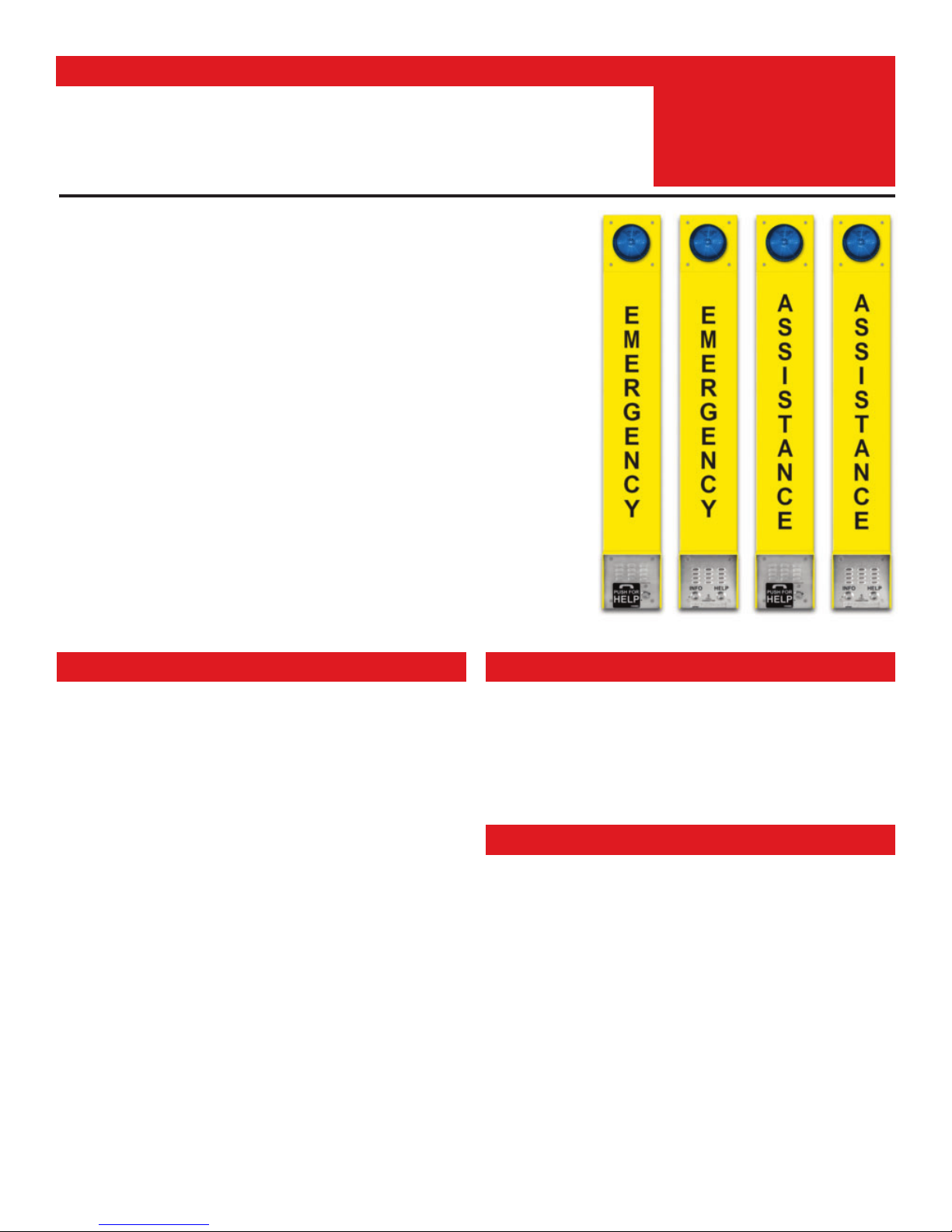
ADA Compliant Tower Phones with Blue
Steady On LED Beacon and Strobe Light
E-1600A-AST-EWP E-1600A-AS T2EWP
• Entryways
• Stairwells in Public Buildings
Phone Power: Telephone line powered. Minimum 24V DC talk battery voltage,
with a minimum loop current of 20mA. Loop current may be boosted on low
current lines with a Viking Model TBB-1B talk battery booster (DOD 632).
Beacon/Strobe Power: 120V AC / 12V DC power adapter (included)
Maximum Strobe Power Run: 200 feet using 24 AWG wire
Dimensions: 42” x 6” x 4.5” (1070mm x 152.4mm x 109.3mm)
Shipping Weight: 20 lbs (9.1 kg)
Mounting: Surface mount to rigid wall or post
Operating Temperature: -15°F to 130°F (-26°C to 54°C)
Humidity: Up to 100%
Strobe Flash Rate: 60 flashes per minute (default), see page 7 for more info
Maximum Strobe Light Output @ 15VDC: Clear lens: 323 lumens, Amber
lens: 242 lumens, Blue lens: 116 lumens, Red lens: 66 lumens
Maximum Power Supply Run Length on CAT-5: 1 pair = 125 ft, 2 pair =
225 ft, 3 pair = 325 ft, 4 pair = 475 ft
Enclosure Material: 0.125” aluminum, 3” x 6” (76.2mm x 152.4mm) tube,
powder painted high-visible yellow
Phone Panel Material: 0.074” (14 gauge) 316 marine grade stainless steel
with stainless steel button
Strobe Material: Vandal resistant polycarbonate plastic
Connections: Color-coded wires with gel-filled butt connectors
• New Automatic Noise Canceling (ANC) feature for proper
operation in noisy environments
• Enhanced Weather Protection (EWP), EWP products are designed
to meet IP66 Ingress Protection Rating (DOD 859)
• Meets ADA requirements for Emergency Phones:
- Automatically lights the “Call Connected” LED
- Transmits a unique location I.D. code or voice announcement
- Grade 2 Braille label for the visually impaired
• 16 second non-volatile digital voice announcer
• High power LED strobe and beacon visual indicator:
- High output / long life LED technology
- 4 programmable flash patterns: single, double, quad and flicker
- 6 programmable beacon and strobe brightness settings
• Advanced call progress detection
• Handsfree operation
• Phone line powered emergency phone (strobe requires power)
• Non-volatile memory (no batteries required)
• Marine grade 316 stainless steel and powder coated aluminum to
prevent corrosion
• Dials up to 5 emergency numbers
• Cycles through backup phone numbers on busy or no-answer
• E-1600A-AST2EWP and E-1600A-BLT2EWP can also dial up to 3
“Info” numbers
• Hangs up on CPC, silence, busy, dial tone, time-out or touch tone
• Programmable to auto-answer on incoming calls
• Remotely programmable
• Central Station Monitoring capability (dials 2 numbers)
• Separate central station voice speed dial number
• Optional PB-100 Polling System available (DOD 232)
CAUTION - When installing on an analog extension of a phone system: Some phone
systems do not conform to analog telecom standards and might not be compatible with the
1600A Series Emergency Phones. For a detailed description of the telephone line specifications
required for any of the 1600A Series phones, retrieve DOD 869.
E-1600A-BLT-EWP E-1600A-BLT2EWP
Page 2
2
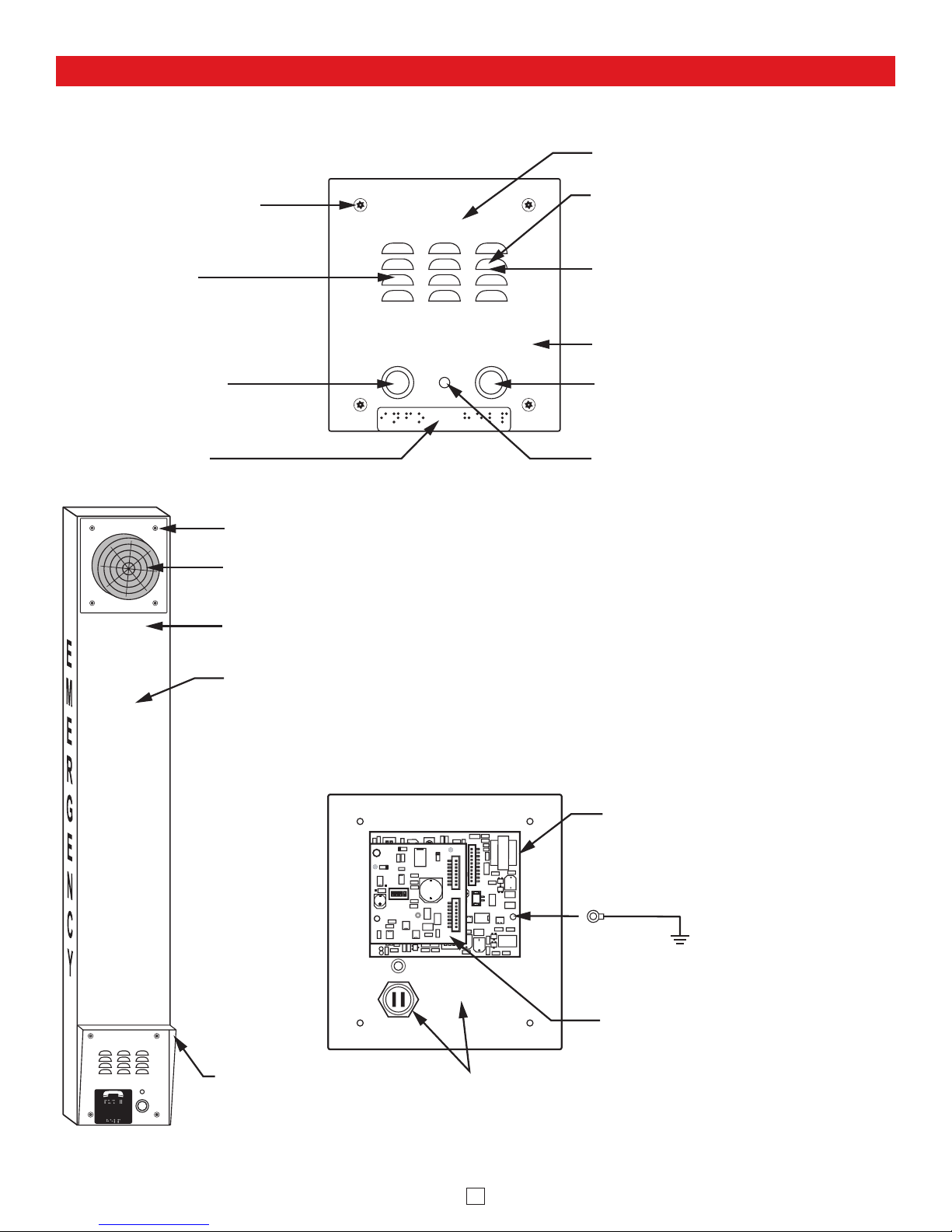
Features Overview
Mounting Screws: (4) T-10 Torx head
stainless steel, flat head, security
screws and drive bit included.
Microphone: Omni-directional
microphone with protective
water-resistant cloth.
“INFO” Push to Call Button
(models
and E-1600A-BLT2EWP
Solid 316 stainless steel
internally sealed per IP67.
E-1600A-AST2EWP
only):
Front View of the
Phone Panel
INFO HELP
CALL
CONNECTED
VIKING©
Faceplate: Marine grade 316 stainless steel.
Speaker: Mylar speaker with rubber
gasket to maintain water-tight seal and
eliminate water deterioration.
Speaker Screen: Speaker screen with
0.018" wide slots to prevent punctures
from paperclips, etc.
Laser Etched Graphics
“HELP” Push to Call Button: Solid 316
stainless steel internally sealed per IP67.
Grade 2 Braille Label
E
M
E
R
G
E
N
Mounting Screws: (4) T-10 Torx head stainless steel,
flat head, security screws and drive bit included.
SL-2 Strobe/Beacon: Blue shatter resistant polycarbonate
lens. Designed to meet IP66 ingress Protection Rating.
Tower Chassis: 8 gauge (0.125” thick) aluminum with
weather-resistant high-visibility yellow powder paint.
EMERGENCY or ASSISTANCE lettered in
black on three sides of the tower chassis.
Rear View of the
Phone Panel
ON
1
2
Ring Connector
Red Call Connected LED
1600A Emergency Phone Board
(included)
C
Y
CALL
CONNECTED
PUSH FOR
HELP
VIKING©
Rain Guard
(included)
ON
1
2
3
* Earth Ground
(optional)
BLK-4 Control Module
Marine grade 316 stainless steel faceplate
and push button switch (sealed per IP67)
Page 3
3
Installation and Specifications
A
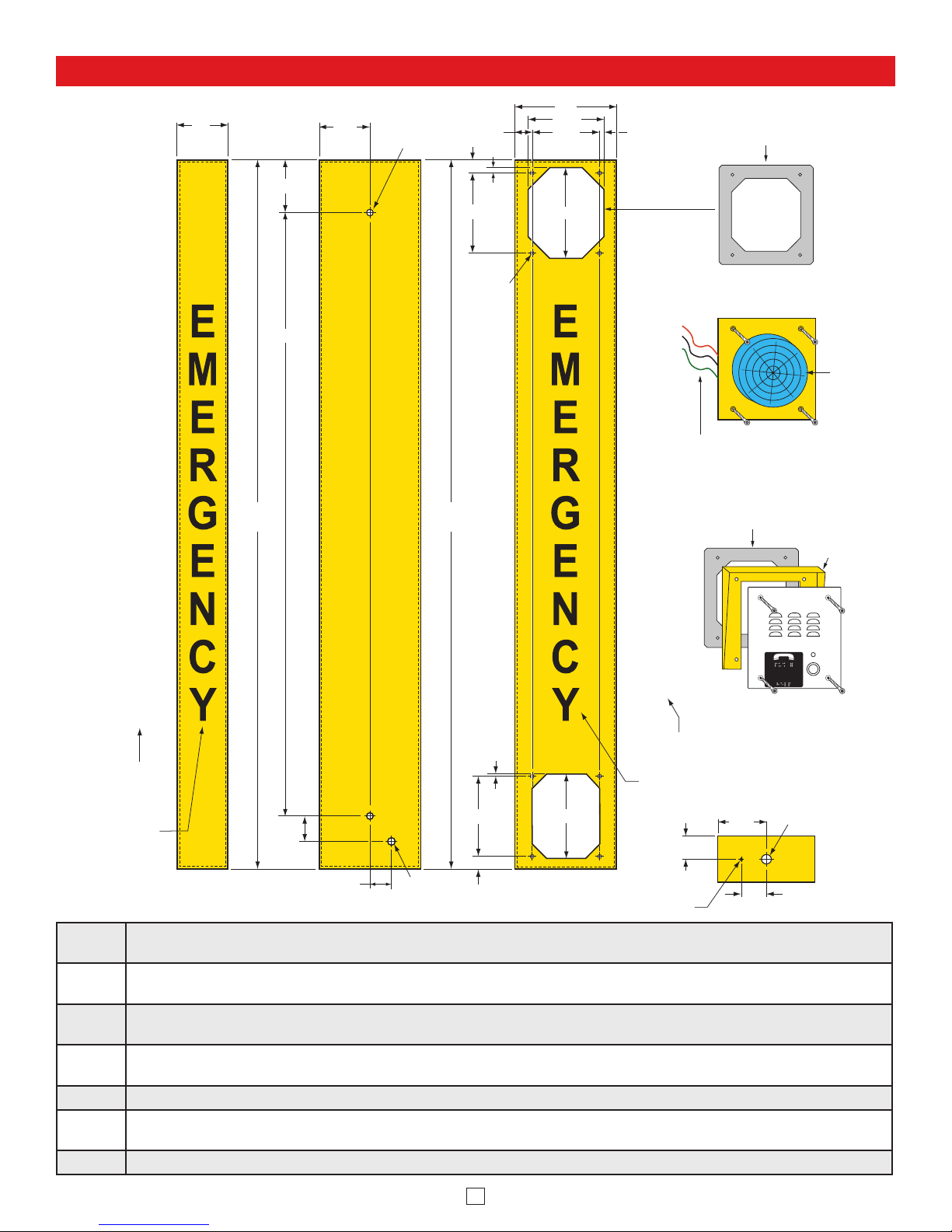
Step 1.
Mount the tower phone approximately 42” above the floor to a flat, sturdy surface using 5/16 hardware. Note: Flat
washers should be used on the main mounting bolts for additional strength.
Step 2.
Locate the strobe light panel and attach red, black and green 42” wire extensions with butt connectors then pass the red,
black and green wires from the strobe panel through the gasket and the upper hole in the tower.
Step 3.
Mount the strobe panel to the tower using the four security screws provided. Attention: To make sure water drain notch
between stobe and panel is facing down, attach strobe panel with wires exiting left side of panel.
Step 4.
Locate the phone panel. Using the gel-filled butt connectors, connect the red, black and green wires labeled “Strobe Light”
to the red, black and green wires on the strobe panel.
Step 5. Connect the phone line to the red and green wires (this connection is not polarity sensitive).
Step 6.
Connect the 12V DC adapter wires (-) and (+) to the black with red stripe (-) and red with black stripe (+) wires from the
BLK-4 control module.
Step 7. Mount the phone panel to the tower using the remaining four security screws.
3.0
0.35 Diameter
(2 places)
3.00
3.12
35.760
Use 5/16" bolt
and flat washer
(included)
1.000
0.75
0.325
4.750
Self-clinching
nut 6-32
(8 places)
6.0
4.500
4.000
5.400
0.250
A
Adhere gasket to chassis,
centering over mounting holes
Strobe Panel
S
S
I
S
42.0 in.
(± 0.1)
42.0 in.
(± 0.1)
T
A
N
C
E
“ASSISTANCE”
on models
E-1600A-AST-EWP
E-1600A-AST2EWP
or
“EMERGENCY”
on models
E-1600A-BLT-EWP
E-1600A-BLT2EWP
Side View
1.50
1.25
Back View
0.875 Dia.
4.750
0.75
0.125
5.000
Front View
S
S
Attention: To make sure water drain
notch between stobe and panel is
facing down, attach strobe panel with
I
wire exiting left side of panel.
S
T
A
N
C
E
“ASSISTANCE” on models
E-1600A-AST-EWP
E-1600A-AST2EWP
“EMERGENCY” on models
E-1600A-BLT-EWP
E-1600A-BLT2EWP
1.37
0.125 Diameter
Condensation
Drain Hole
Adhere gasket to chassis,
centering over mounting holes
PUSH FOR
HELP
VIKING
©
Phone
Panel
or
Knockout for
1/2 inch conduit
2.87
1.50
Rain Guard
(included)
CALL
CONNECTED
Bottom
View
SL-2
Strobe/
Beacon
Page 4
4
Wiring
3
3
2
ON
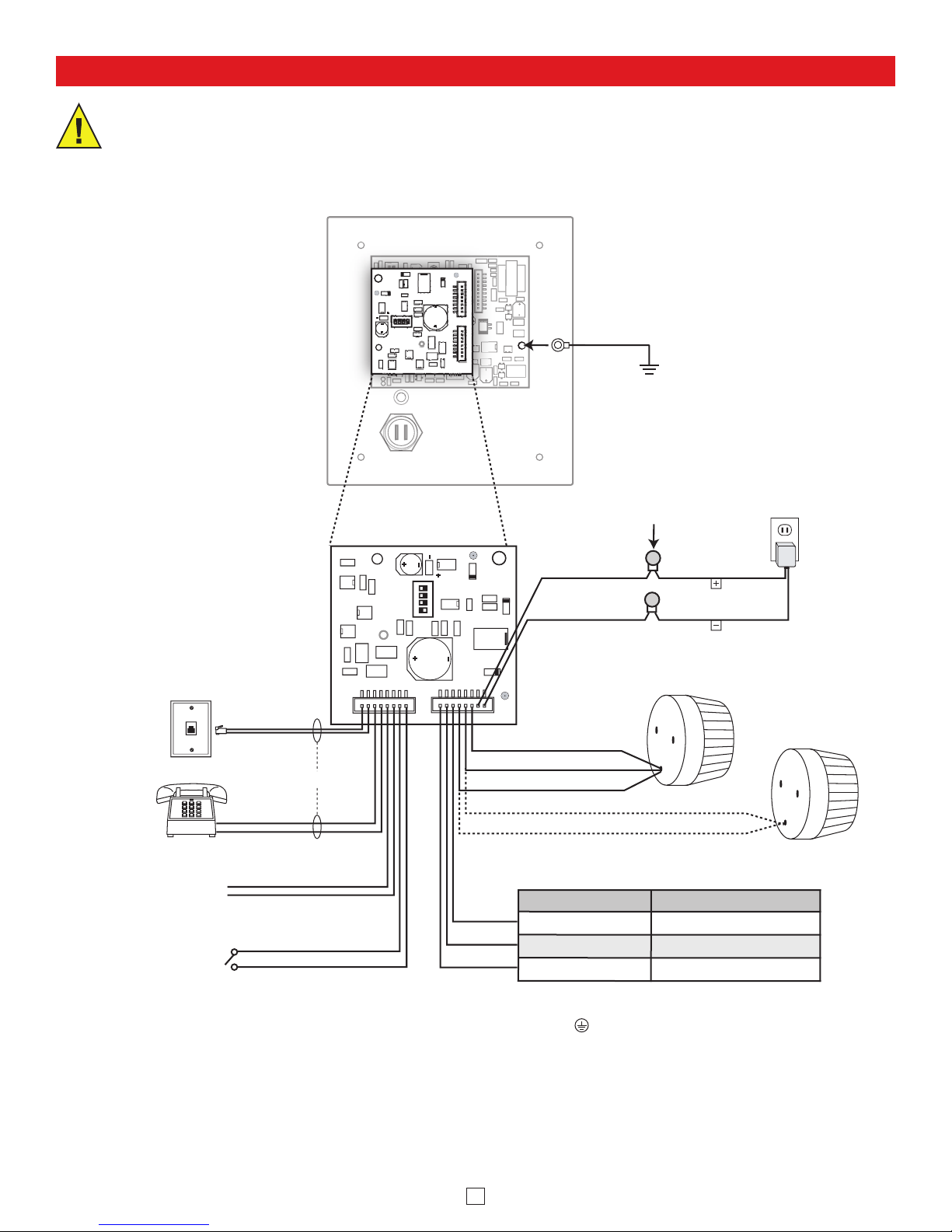
* Note: To increase surge protection, loosen the PCB mounting screw labeled (as shown) and fasten a wire with ring connector
(included) from the mounting screw to Earth Ground (grounding rod, water pipe, etc.)
IMPORTANT: Electronic devices are susceptible to lightning and power station electrical surges from both the AC outlet and the
telephone line. It is recommended that a surge protector be installed to protect against such surges.
** Note: The gel-filled (water-tight) butt connectors are designed for insulation displacement on 19-26 gauge wire with a maximum
insulation of 0.082 inches. Cut off bare wire ends prior to terminating.
*** Note: When wires are routed from above, a “drip loop” is recommended to keep water away from the circuit board.
DIP Switch 4 OFF
DIP Switch 4 ON
N.C.
+12VDC Normally ON
COM
+12VDC
N.O.
+12VDC Normally OFF
Rear View of the
Phone Panel
Ring Connector
(included)
* Earth Ground
(optional)
** Gel-Filled Butt
BLK-4 Control
Module (included)
rotated 90°
Connectors (included)
Note: Polarity Sensitive!
(+) Red with
Black stripe
(-) Black with
Red stripe
Positive
Negative
12V DC
Adapter
(included)
120V AC
*** Drip
Loop
Rear View of the SL-2
(included)
Rear View of Legacy
SL-1 Strobe Light
(included with 2012 and older
E-1600A-BLT-EWP models)
Incoming
Analog
Phone Line
Phone or
Terminal
Device
(not included)
Red with
Yellow stripe
Green with
Yellow stripe
Note: Not polarity sensitive.
Brown
Gray
Strobe Light
see Programming page 6
Red (+)
Black (-)
Green (see section F page 6)
Black
Red
Auxiliary Relay Contact Output
Disable Feature
(see section E on page 6)
Trigger Input for Optional
Remote Trigger Switch
(see section G on page 6)
Blue
Blue
White
White
Orange
Purple
Yellow
(see section D on page 5)
Page 5
5
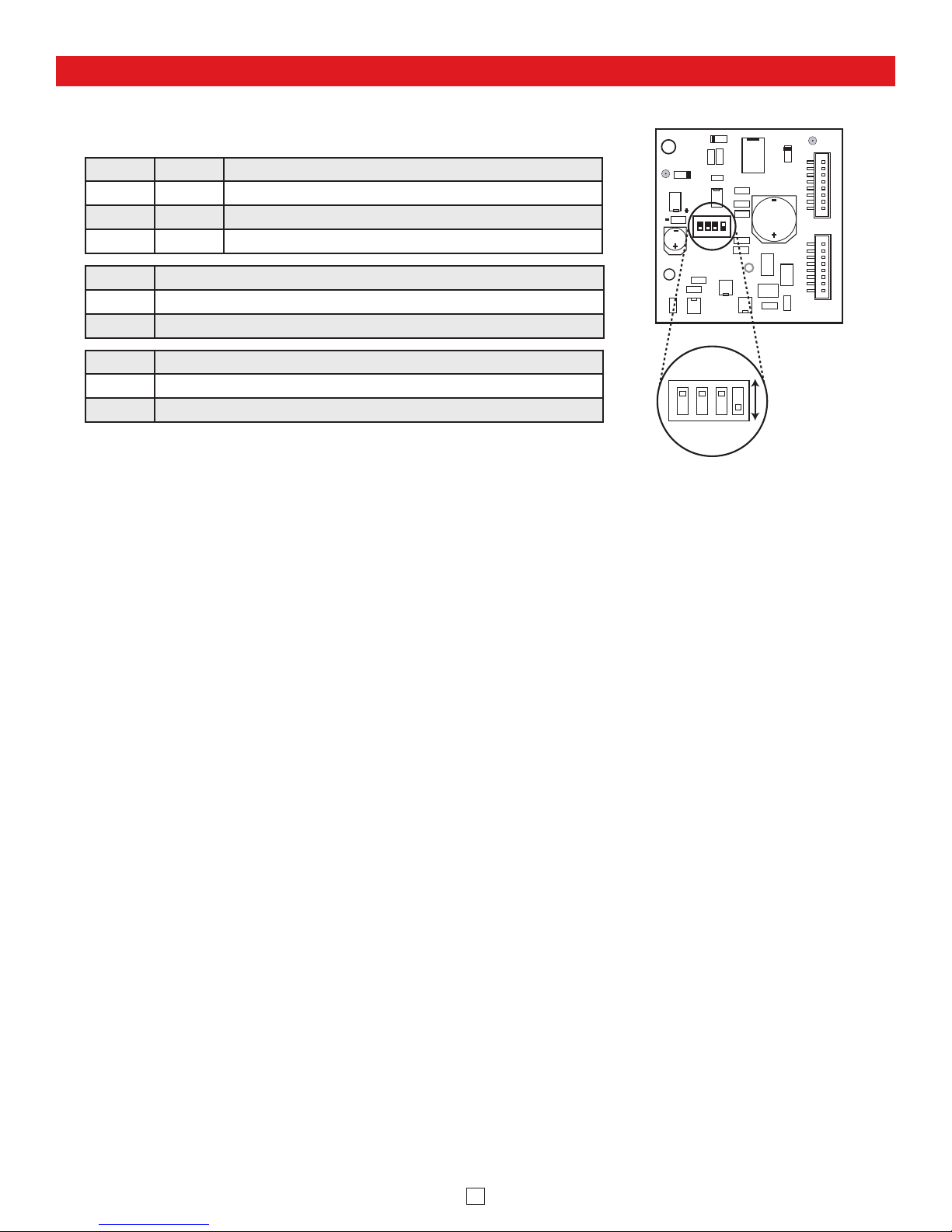
BLK-4 Control Module Programming
Switch 1 Switch 3 Description (see section B)
ON OFF Ring Detection Only
OFF ON Off-Hook/Loop Current Detection Only
ON ON Ring and Off-Hook/Loop Current Detection
Switch 2 Ring Cadence Mode (see section C)
ON Ring Cadence Mode ON - relay remains activated in between rings
OFF Ring Cadence Mode OFF - relay is activated only during ringing
Switch 4 Auxiliary Relay Contacts (see section D)
ON Wet (12VDC, 100mA maximum)
OFF Dry (1 Amp maximum @ 30VDC)
DIP switch 2 is used for switching between different ring detection modes. In the OFF position, the strobe light and
relay will activate only while ring voltage is present and will turn off between rings. In the ON position, the strobe light
and relay will remain on for up to 5.75 seconds after the ringing has stopped. This allows the strobe light and relay to
remain on between rings of a standard ring cadence. Note: To use the Ring Cadence Mode, ring detection MUST be
enabled (DIP switch 1 - ON).
With DIP switch 4 OFF, normally open and normally closed dry relay contacts are available on the orange, purple and
yellow wires. The contacts are rated at .5A @ 125VAC/1A @ 30VDC. If contacts are driving an inductive load, place a
suppression device at the load to snub high voltage spikes.
With DIP switch 4 ON, wet/switched +12VDC (100mA maximum) will be output on the yellow wire and “-” (GND) on the
black wire.
2. Loop/Off-hook Indication Only
Place DIP switch 1 OFF and DIP switch 3 ON. In this configuration, the E-1600A-AST-EWP will only flash the strobe
light while off-hook (while the emergency phone is in use).
1. Ring Indication Only
Place DIP switch 2 on the 1600A phone board in the OFF position (not shown in the diagram - see 1600A Phone
Board Programming section J). Note: With DIP switch 2 in the OFF position, the 1600A emergency phone board
will not answer an incoming call. The BLK-4 control module can monitor for ringing any place along the ringing
line. Place DIP switch 1 ON and DIP switch 3 OFF.
3. Both Ring and Loop/Off-hook Indication
If the application requires ring and loop/off-hook indication, place DIP switch 1 and 3 in the ON position.
A. DIP Switches
B. Configuring for Ring and/or Loop/Off-Hook Indication
C. Ring Cadence Mode
D. Auxiliary Relay Contacts
E. Disable Feature
The “Disable” input can be connected to a switch for remotely disabling/turning off the strobe light and the device
controlled by the auxiliary contacts (camera, etc.). Note: The disable feature on the E-1600A-AST2EWP and E-1600A-
BLT2EWP is factory pre-wired to the “Info” push button. This prevents the strobe from activating when the “Info” push
button is pressed.
BLK-4 Control Module
ON
1
23
4
Page 6

6
Programming the SL-2 Strobe / Beacon
F. Switched 12V DC Output
G. Trigger Input
The switched 12V DC output is a low current, 12-15VDC output that is turned on only while the trigger input is closed
or ring/loop detect relay is activated. This switched power output is ideal for triggering the included strobe light or
providing 12-15V DC power to any device that draws less than 400mAmps. The positive side is available on the green
wire, and the negative side is on the black wire. Once all the line and load connections have been made, plug in the
115 V AC wall adapter, and replace the cover.
The trigger input is available on the two white wires. The Strobe Light, Auxiliary relay contact and the switched 12 VDC
output will be activated for the duration of the contact closure across the two white wires.
Select the Feature: Momentarily touch the Green (Control) wire to the Black (-) wire 1 to 10 times to select which
feature to program (see Programming Features List, section C). The strobe should momentarily flash each time the
Green (Control) wire has touched the Black (-) wire.
Features 1-3 & 6-10: After selecting Programming Features 1-3 or 6-10, wait 3 seconds and the strobe should flash 2
times indicating that feature has been programmed. You can now exit programming or move on to programming the
Beacon or Strobe brightness settings.
Setting Strobe Brightness (factory set to 6/Brightest): After selecting Programming Feature 4 (Strobe Brightness),
wait 3 seconds and the strobe should begin flashing in the preprogrammed flash pattern. Touch and hold the Green
(Control) wire to the Black (-) wire. The SL-2 will begin flashing the strobe cycling through 6 different brightness settings
from lowest to highest. When the SL-2 flashes at the desired brightness level immediately remove the Green wire from
the Black. The SL-2 should flash twice indicating the selected brightness level has been set.
Setting Beacon Brightness (Factory set to 6/Brightest): After selecting Programming Feature 5 (Beacon Brightness),
wait 3 seconds and the beacon will light at its preprogrammed beacon brightness setting. Touch and hold the Green
(Control) wire to the Black (-) wire. The SL-2 will begin stepping through 6 different beacon brightness settings from
lowest to highest. When the SL-2 lights at the desired beacon brightness level immediately remove the Green wire
from the Black. The SL-2 should flash twice indicating the selected brightness level has been set.
Exiting Programming: To exit programming simply wait 20 seconds from the last programming command and the unit
will flash 3 times. This indicates the SL-2 has exited the programming mode and is now in the Run mode. Note: To
eliminate waiting 20 seconds, you can also exit programming after the last programming command by touching and
holding the Green (Control) wire to the Black (-) for 3 seconds. The strobe will flash 3 times indicating the unit has
exited the programming mode and is now in the Run mode.
The SL-2 can be user programmed as a Beacon only, Strobe only or Beacon/Strobe. The brightness setting can be
programmed separately for the Strobe or Beacon and one of 4 different Flash Patterns can be programmed for the Strobe
(See Strobe Flash Patterns, section D). Note: The SL-2 is factory default programmed as a steady on beacon with a single
flash strobe when activated. The beacon and strobe are set to their brightest settings. All programming should be done prior
to connecting to the BLK-4 control module.
A. Accessing the Programming Mode
(Optional, the SL-2 is factory programmed to the Beacon/Strobe Mode and brightest Beacon/Strobe settings).
Step 1. Apply 10-15 VDC power to the Red (+) and Black (-) wires.
Step 2.
Touch and hold the Green (Control) wire to the Black (-) wire for 3 seconds. The strobe should flash twice.
You are now in Programming mode. Note: Once in the programming mode, if a programming command
has not been entered for 20 seconds the strobe will flash 3 times indicating the unit has exited programming
and returned to the Run Mode.
B. Programming Desired Features (after accessing Programming Mode above)
Page 7

7
Operation
Feature Description
1 Beacon/Strobe (factory default)
2 Strobe Only
3 Beacon Only
4 Strobe Brightness 1-6 (factory default = 6, brightest)
5 Beacon Brightness 1-6 (factory default = 6, brightest)
C. Programming Features List
D. Strobe Flash Patterns
A. Ring Indication (DIP Switch 1 ON)
B. Off-Hook Indication (DIP Switch 3 ON)
Feature Description
6 Single Flash Strobe (factory default)
7 Double Flash Strobe
8 Quad Flash Strobe
9 Flicker Flash Strobe
10 Reset to Factory Default Settings
When the control module detects an incoming ring signal, it activates a set of normally open or normally closed contacts
and turns on the 12VDC output for activating the provided strobe light. With the Ring Cadence mode off (DIP switch 2
OFF), the relay will activate and the strobe light will flash only during ringing. With the Ring Cadence mode ON (DIP
switch 2 ON), the relay will remain activated and the strobe light will remain flashing between rings.
When the control module detects an off-hook condition (“Help” button is pressed) on the brown and gray wires, it
activates a set of normally open or normally closed contacts and turns on the 12VDC output for activating the provided
strobe light. The relay contacts will remain activated and the blue strobe light will flash during the off-hook condition
and will stop flashing approximately 3 seconds after the phone/terminal device on the brown and gray wires is back onhook. Note: A call initiated from the “Info” push button on the E-1600A-AST2EWP or E-1600A-BLT2EWP will not
activate the strobe light.
0.20 sec
Single
Flash:
Double
Flash:
Quad
Flash:
ON
0.10
sec
0.10
sec
ON ONOFF
0.05
sec
ON OFF ON ON ONOFF OFF
0.10
sec
0.10
sec
0.80 sec
Repeat
OFF
0.80 sec
Repeat
OFF
0.80 sec
Repeat
OFF
Flicker
Flash:
0.025
sec
Typ.
ON
0.025
sec
Typ.
OFFONOFFONOFFONOFFONOFFONOFFONOFF
ON
0.80 sec
Repeat
OFF
8 Pulses
Page 8

8
1600A P hone Board Programming
A. Accessing the Programming Mode
B. Quick Programming Features
The 1600A Series phones can be programmed from any Touch Tone phone using a C.O. line, analog PABX/KSU station,
or a DLE-200B Line Simulator. For more information on the DLE-200B, see DOD 605.
2. Without the Security Code
1. Using the Security Code
Warning: Failure to do step 5 above will cause the 1600A Series phone to call Viking Technical Support instead of your programmed number.
See Section I, Assisted Programming.
Note: If a valid memory position is entered, a double beep will be heard, four beeps indicate an error.
Note: A double beep indicates a valid memory position, four beeps indicate an error.
Step 1. Move DIP switch 2 to the ON position (sets unit to answer incoming calls, see section J).
Step 2. From a Touch Tone phone call the line attached to the 1600A Series phone.
Step 3.
When the 1600A Series phone answers, enter the 6-digit security code (factory set to 845464, see section C).
A double beep should then be heard indicating you have entered the programming mode.
Step 1. Move DIP switch 2 to the ON position (sets unit to answer incoming calls, see section J).
Step 2. Move DIP switch 3 to the OFF position (incoming calls enter programming without security code, see section J).
Step 3. From a Touch Tone phone call the line attached to the 1600A Series phone.
Step 4.
When the 1600A Series phone answers, a double beep should then be heard and will automatically enter the
programming mode.
Step 5. When finished programming, move DIP switch 3 back to the ON position (see section J).
DESCRIPTION DIGITS +
MEMORY
LOCATION
First “HELP” speed dial number 0-20 digits then #00
Second “HELP” speed dial number 0-20 digits then #01
Third “HELP” speed dial number 0-20 digits then #02
Fourth “HELP” speed dial number 0-20 digits then #03
Fifth “HELP” speed dial number 0-20 digits then #04
Central station receiver number 0-20 digits then #05
Central station voice number 0-20 digits then #06
First “INFO” speed dial number (E-1600A-AST2EWP and E-1600A-BLT2EWP only) 0-20 digits then #07
Second “INFO” speed dial number (E-1600A-AST2EWP and E-1600A-BLT2EWP only) 0-20 digits then #08
Third “INFO” speed dial number (E-1600A-AST2EWP and E-1600A-BLT2EWP only) 0-20 digits then #09
Voice announcer / miscellaneous options (factory set to 000210) 6 digits then #17
Timing/Dialing options (factory set to 234721) 6 digits then #18
Security code (factory set to 845464) 6 digits then #19
Identification number (factory cleared) 0-20 digits then #20
Second central station identification number (factory cleared) 0-20 digits then #21
To clear any speed dial number (no digits) then #00 - #09
To add a Q at any point in the dialing string
QQ
To add a # at any point in the dialing string
Q#
To add a four second pause at any point in the dialing string
Q7
Diagnostic tones (used to check mic and speaker operation)
Q0
Exit programming and disconnect #7
Reset all programming to factory default settings ###
Page 9

9
The security code allows the user/installer to program the 1600A series phone while DIP switch 3 is in the ON (normal)
position. The factory set security code is 845464 (V-I-K-I-N-G). It is recommended that the factory set security code
be changed. Example: To store 123456 as the security code:
Enter Your Security Code Here:
#19
Note: The security code must be 6 digits and cannot include a Qor a #.
The help speed dial number programmed in location #00 is the number that is
dialed when the “HELP” / ”CALL” button is first pressed. Additional speed dial
numbers will be dialed when there is no answer or a busy signal is detected and
the next number redial features are activated. To program, enter the desired
speed dial number followed by the location number (#00 - #04). To clear a speed
dial location, simply enter the memory location (#00 - #04) alone. The 1600A
series phone is factory set with no speed dial number programmed.
1. “HELP” / ”CALL” Speed Dial Numbers (memory locations #00 - #04)
Note: Up to 20 digits can be stored in each dial position. Special features such as pause, mode change, Touch Tone
Q
and # count as single digits.
The Touch Tone I.D. number (up to 20 digits) is used by assistance personnel to identify the location of the caller and
is given out when the receiving party presses a Touch Tone Q. The security office can display the number using a Touch
Tone decoder. To program the I.D. number, enter the desired number followed by #20. Example: To store 333 as the
I.D. number, enter: 3 3 3 # 2 0
2. “INFO” Speed Dial Numbers (E-1600A-AST2EWP / E-1600A-BLT2EWP) (memory locations #07 - #09)
The information speed dial number programmed in location #07 is the telephone or extension number that is dialed
when the “INFO” button is first pressed. Additional information speed dial numbers will be dialed when there is no
answer and the next number redial feature is activated. The E-1600A-AST2EWP / E-1600A-BLT2EWP phone will
cycle through the programmed speed dial numbers until answered. To program, enter the desired speed dial number
followed by the location number (#07 - #09). To clear a speed dial location, simply enter the location (#07 - #09)
alone.
3. Speed Dial Programming Examples
E. Identification Number (memory location #20)
D. Speed Dial Numbers
C. Security Code (memory location #19)
Step 1. Access programming as shown is Programming section A.
Step 2. Enter 123456 #19..
Step 3. Hang-up..
To Program: Enter:
Q QQ
#
Q#
4 second pause
Q7
0, 1, 2 .... 9 0, 1, 2 .... 9
To Program the 1600A Series Phone...
Step 1 -
See section A
Step 2 - Enter Digits:
...to store 555-1234 as the first speed dial number Enter Programming 5 5 5 1 2 3 4 # 0 0
...to store a Touch Tone 9, a four second pause and then 3334444 into the second “Info” speed dial memory position
Enter Programming
9 Q7 3 3 3 4 4 4 4 # 0 8
...to clear the first speed dial number Enter Programming # 0 0
Page 10

10
F. Timing/Dialing Options (memory location #18)
There are six positions in the timing/dialing options. To program these options, enter the six desired timing/dialing
numbers followed by #18. The six available timing/dialing options are defined as follows:
Dial: A + B + C+D+ E+F+#+1+8
Factory Default Setting: 2 + 3 + 4+7+ 2+ 1
Talk/Listen Delay
Call Length
Silence Time Out
Dial Next Number on Ring No Answer
Dial Next Number on Busy
Future Use (set to 1)
Enter Timing/Dialing Settings Here:
A B C D E F
#18
Setting A - Talk/Listen Delay
This feature selects switching time between talk and listen modes (VOX switching time).
Use chart at the right. * Note: The factory default is .2 seconds.
Setting B - Call Length Time Out
This feature selects the maximum length of time that calls can be connected. Programmable
in increments of 1 minute up to a maximum of 9 minutes (Touch Tones 1 - 9). Program 0 in
this location to disable the call length time out. With the call length disabled, the 1600A
series phone must rely on a CPC signal, busy signal, silence or return to dial tone to hangup. Use chart at the right. * Note: The factory default is 3 minutes.
Setting C - Silence Time Out
This feature selects the length of time that calls will remain connected without voice activity.
Programmable in increments of 10 seconds up to a maximum of 90 seconds (Touch Tones
1 - 9). To disable the silence time out, program 0 in this location. Use chart at the far right.
* Note: The factory default is 40 seconds.
Setting D - Dial Next Number on Ring No Answer
If enabled and a ring-no-answer is detected, the 1600A series phone
will dial the next programmed speed dial number, and continue to
cycle through the emergency numbers until a call is completed.
* Note: Factory set to redial if not answered after 7 rings.
Touch
Tone
Talk/Listen
Delay
1 .1 sec
2 .2 sec*
3 .3 sec
4 .4 sec
5 .5 sec
6 .6 sec
7 .7 sec
8 .8 sec
9 .9 sec
Touch
Tone
Call Length
Time Out
0 Disabled
1 1 min
2 2 min
3 3 min*
4 4 min
5 5 min
6 6 min
7 7 min
8 8 min
9 9 min
Touch
Tone
Silence
Time Out
0 Disabled
1 10 sec
2 02 sec*
3 03 sec
4 40 sec*
5 50 sec
6 60 sec
7 70 sec
8 80 sec
9 90 sec
Touch Tone Setting D
1 or 0 Disabled
2, 3, 4... 9
Dials second number after
2, 3, 4...9 rings respectively*
Page 11

11
Setting F - Future Use (set to 1)
The 1600A series phone is factory set to automatically start playing the voice
announcement after it has determined the call has been answered. Alternately,
the announcement may be programmed to play after a programmed amount
of time, from 1 to 99 seconds after dialing.
* Note: If the announcement delay time is used, you must allow enough time for the 1600A series phone to detect
ring-no-answer and busy signals when using the redial features. The factory default is set to play automatically.
The 1600A series phones have a built-in non-volatile digital voice announcer that may be used to identify the location of the phone
call. The 16 seconds of digital record time is recorded remotely from a Touch Tone phone. Programming options are as follows:
Dial: A +B+C+D+E+F+#+1+7
Factory Default Setting:0+0 +1+2+ 1+0
Two Digit Announcement Delay {
Repeat Announcement Setting
Hang-up on Return to Dial Tone
Double Ring Cadence Mode
Lap Counter
Enter Settings Here:
A B C D E F
#17
If enabled and a busy is detected, the 1600A series phone will dial the next
programmed speed dial number, and continue to cycle through the numbers until
a call is completed. * Notes: This feature is enabled in the factory default setting.
If the busy signal is interrupted with a promotional message, contact your central
office to have it removed.
Setting E - Dial Next Number on Busy
If enabled and a return dial tone is detected, the 1600A will hang up.
* Note: The factory default setting is enabled.
The 1600A can be programmed to play the announcement from 1-9 times, or
to continuously repeat the announcement every 8 seconds until a Touch Tone
Q is detected from the distant party. The call connected LED will turn on
automatically after the announcement has stopped repeating.
* Note: The factory default for the 1600A series phone is to play the voice announcement once (digit 1).
Touch Tone Setting E
1 Disabled
2 Enabled*
Touch Tone Setting A/B
00 Play automatically
01-99 1-99 seconds*
Touch Tone Setting C
0 repeat every 8 secs
1-9 Play 1-9 times*
Touch Tone Setting D
1 Disabled
2 Enabled*
G. Voice Announcer/Miscellaneous Options (memory location #17)
Settings A and B - Announcement Delay
Setting C - Repeat Announcement Option
Setting D - Hang Up on Return to Dial Tone
Page 12

12
H. Recording the Announcement
I. Assisted Programming
Setting E - Double Ring Cadence Mode
Setting F - Lap Counter
Example: “Elevator number 1215, located in the Financial Building, needs assistance. Press the asterisk (Q) key on
your telephone to hear this announcement again.”
The 1600A series phone can be programmed to recognize the double ring
cadence that is typical of many phone systems. If the 1600A series phone is
connected to an extension that provides a double ring cadence, enabling this
mode will allow for proper call progress detection.
* Note: This feature is disabled in the factory default setting.
With the lap counter disabled (factory setting), if the 1600A series phone
is programmed to dial the next number on ring-no-answer and/or busy
signal (see page 6-7), the 1600A series phone will continuously call its
programmed phone numbers forever until the call is answered.
The lap counter is a programmable counter that determines how many times the 1600A series phone will cycle
through its list of up to 5 emergency number (or up to 3 “Info” phone numbers), before it stops the dialing process
and hangs up. When all of the programmed phone numbers have been dialed, the lap counter is incremented and
the dialing process repeats. When the lap counter has been met, the dialing process stops and the 1600A series
phone hangs up. * Note: This feature is disabled in the factory default setting.
When attempting to program the 1600A Series phone, if the phone number of the line it is connected to is not known,
the phone can be set to automatically call Viking technical support for assistance. With DIP switch 3 set to OFF
(programming mode), pushing the CALL button will cause the 1600A Series phone to call Viking, whether it be
connected directly to a CO line, or behind a "dial 9" PBX.
The 1600A Series phone will first dial 9, and then listen for second dial tone; if detected it will continue to dial Viking’s
assisted programming phone number. If a second dial tone is not detected, it then knows is not behind a PBX, so it will
momentarily hang up and then directly dial Viking’s assisted programming phone number. Since this is a long distance
phone call, the line must be capable of placing long distance calls for the call to go through. When finished programming,
it is very important to set DIP switch 3 back to ON (normal operating mode), and place a test emergency call to be sure
all programming was done properly.
Warning: Failure to set DIP switch 3 back to ON when finished programming will cause the 1600A
Series phone to call Viking Technical Support, instead of your programmed number.
Yet, as a fail-safe
measure, after 3 calls to Viking, the unit will ignore switch 3 and dial its programmed phone numbers.
Touch Tone Setting E
1 Disabled*
2 Enabled
Touch Tone Setting F
1 Disabled*
2 Lap count = 1-9 times
Step 1. Call into the 1600A series phone with a Touch Tone phone and access programming.
Step 2.
Enter Q4, wait for the tone and then begin recording. Sixteen seconds of record time is available.
Step 3. Enter any Touch Tone to stop the recording. Playback is automatic.
Step 4.
Enter Q5 to review the announcement again.
Step 5.
If you choose to not use a voice announcement, enter Q3 to clear the recording.
Page 13

13
b. Enabling/Disabling Central Station Mode
The 1600A Series assistance phone can be placed in the “Central Station Mode” by entering a central station
phone number in position #05 while programming. To cancel the “Central Station Mode,” clear position #05 by
entering #05 only (see Programming section D).
c. Ring No Answer
When the 1600A Series emergency phone is in the “Central Station Mode”, it is best to have the ring no answer
set to a minimum of three, because some receivers send a long tone after answering the line that sounds like
a ring back. If the 1600A is set to a ring no answer of two, the phone will disconnect (see Programming
section F).
a. Accessing the Programming Mode
Before programming, you must access the programming mode (see Programming section A).
The standard 1600A assistance phone is capable of communicating using the “Ademco Contact I.D.”, “Ademco High
Speed”, “DTMF 4+1 Express”, or the “DTMF 4+2 Express” formats. All formats use the programming memory location
#20 to store the account code and alarm details.
A speaker volume POT is provided to increase or decrease the speakerphone volume. Note: The Microphone Sensitivity POT has
been removed because the microphone sensitivity is now microprocessor controlled. This allows the mic gain to be automatically
increased in a quiet environment, allowing the distant party to clearly hear even soft or distant sounds. The microprocessor will
automatically reduce the mic sensitivity when the location becomes noisy. This Automatic Noise Canceling (ANC) feature will allow
speakerphone two-way communications to work properly, even when subjected to loud noise such as a diesel engine or traffic.
J. DIP Switch Programming/Speaker and Microphone Adjustments
1. Central Station Programming Features
K. Central Station Programming
SwitchASwitch
B
Description
ON ON Normal audio detection
OFF OFF
Increase audio detect sensitivity for low level lines.
Useful in applications in which voice or busy signals
have trouble breaking over the speaker.
DIP
Switch
Position Description
1 ON
“CALL” button alternately connects and disconnects
calls (factory default)
1 OFF “CALL” button connects calls only
2 ON Incoming calls answered (factory setting)
2 OFF Incoming calls are not answered
3ONNormal operation mode (factory setting)
3 OFF
Learn mode - Any incoming calls are automatically
entered into the programming mode (no security code
required). Use this option if you have forgotten your
security code. Any outbound call will dial Viking
Technical Support (see section I). Warning: When
finished programming, set this switch back to the
ON position, otherwise the 1600A Series phone
will only call Viking Technical Support instead of
your programmed number.
Speaker
Volume
ON
OFF
ON
OFF
1 2 3
A
B
Standard
OFF ON
EWP
A B
Standard
OFF ON
1
2
3
EWP
To Program the 1600A Series Phone... Step 1: Step 2 - Enter Digits:
...to enable central station programming and dial 952-2567 Enter Programming 9 5 2 2 5 6 7 # 0 5
...to disable central station programming Enter Programming # 0 5
Page 14

14
d. Speed Dial Numbers
2. Central Station Formats
The following examples explain the receiver formats and how to properly program memory location #20. Each format starts with
a four digit account code. This is the code that is assigned by your central station for billing purposes. You must access the
programming mode before programming these features (see Programming section A). Important: If a number is shown, you
must use that number. If an “X” is shown, use any appropriate number.
Note: A second information alarm message can be sent to the receiver, for any receiver that requires two separate messages.
The second alarm message is programmed in #21 location. For additional information about the second alarm message, see
Operation section B.
a. Ademco Contact ID Format
This DTMF format consists of a four digit account code, two digit message type, and a nine digit data field.
Account Code
Message Type
New Event
XXXX 18 1 14000 XXX #20
Memory Location
Any number to identify phone
General Alarm
Enter Contact ID Settings Here: 18 1 14000 #20
b. Ademco High Speed Format
This DTMF format consists of a four digit account code, eight zone codes and one alarm type digit. With this
format you can identify up to eight different phones by using a zone per phone. A “5” in a zone positi
means no alarm. The following example shows an alarm from the third phone.
The 1600A Series phone can be programmed to dial a central station receiver only, or dial up to 5 voice numbers first, and
if no answer, then dial the central station receiver. When calling the first numbers (memory positions #00-#04 (see
Programming section D), the phone stays in “two-way talk mode” allowing two-way conversation. When calling the Central
Station number (memory position #05), the phone is in a “listen only
mode” in order to interpret the hand shake signals of the receiver.
A second central station number position has been provided in location
#06 that is used when the central station receiver does not have a talk
over mode. If a number is placed in position #05 and position #06 is
cleared, the E-1600A will call the central station monitor receiver. One
or two alarm messages can be sent to the receiver (see Operation
section B, note 3). After the receiver sends a kiss-off, the E-1600A
lights the “Call Connected” LED and goes into two-way talk mode. If
numbers are in both positions #05 and #06, the E-1600A will call the
receiver first, and after the kiss-off, will hang-up and redial the number
in position #06 for two-way voice communication.
Notes: If only a central station is to be dialed, the central station phone
number must be preprogrammed in memory location #05 and memory
locations #00-#04 must be cleared.
Account Code
Idle Zones
Alarmed Zone
XXXX 55155555 7 #20
Memory Location
Normal Alarm
Idle Zones
Enter Ademco High Speed ID Settings Here: 55155555 7 #20
Location Call Type
#00 Voice - Emergency
#01 Voice - Emergency
#02 Voice - Emergency
#03 Voice - Emergency
#04 Voice - Emergency
#05 Central Station Receiver
#06 Central Station Voice Line
#07
Voice - “Info” (E-1600A-AST2EWP and
E-1600A-BLT2EWP only)
#08
Voice - “Info” (E-1600A-AST2EWP and
E-1600A-BLT2EWP only)
#09
Voice - “Info” (E-1600A-AST2EWP and
E-1600A-BLT2EWP only)
c. 4+1 Express Format
This DTMF format consists of a four digit account code, two digit message type, and a single digit event code.
Account Code
Message Type
XXXX 17 X #20
Memory Location
Event Code
Enter 4+1 Express ID Settings Here: 17 #20
Page 15

15
d. 4+2 Express Format
This DTMF format consists of a four digit account code, two digit message type, and a two digit event code.
Account Code
Message Type
XXXX 27 XX #20
Memory Location
Event Code
Enter 4+2 Express ID Settings Here: 27 #20
When the “INFO” button is pressed (E-1600A-AST2EWP or E-1600A-BLT2EWP only), the phone goes off-hook
and dials the first “INFO” phone number programmed. If a busy signal is detected or the call goes unanswered,
the phone will cycle through all three “INFO” phone numbers until the call is answered. When answered, handsfree
communication is established. Note: The voice announcement is for Help calls only and will not play on a call
initiated from the “INFO” button.
When the “HELP” / “CALL” button is pressed, the 1600A series phone goes off-hook and dials a pre-programmed
telephone number. The Call Connected LED momentarily flashes during tone or pulse dialing. In the event the line
is busy or there is a ring-no-answer, the unit can be programmed to call additional phone numbers. The phone
then cycles through up to 5 pre-programmed emergency numbers until the call is answered. When the call is
answered, the digital voice announcer will automatically play to identify the location of the emergency call. The
phones are factory programmed to play the announcement once, and the automatically light the “Call Connected”
LED to show that handsfree communication to emergency personnel is established. The
Q key will send the I.D.
number (if programmed), and play the announcement again. The distant party will know the location of the
emergency call by either the voice announcement or by decoding the touch tone I.D. number. Once the “Call
Connected” LED is on, the # key can be used to force the phone to hang up.
Operation
A. Standard Operation
1. “HELP” / “CALL” Button
2. “INFO” Button (E-1600A-AST2EWP / E-1600A-BLT2EWP only)
B. Central Station Operation
After the “HELP” / “CALL” button on the 1600A Series phone has been pressed the 1600A Series phone will begin to
dial. If a voice number is programmed in memory locations #00-#04, these numbers will be dialed first. Upon detecting
a busy signal or after a preprogrammed ring delay the 1600A Series phone will hang-up and dial the central station
phone number stored in memory location #05. When the central station receiver answers, it will send a handshake
tone to the 1600A phone. Upon detecting the handshake tone, the 1600A Series phone will begin uploading the
information stored in memory location #20.
Once the 1600A Series phone has sent the information stored in memory location #20, it waits for a “kiss-off” tone
from the central station. When the “kiss-off” tone is received, the phone turns on the call connected LED and goes into
the “two-way talk mode” or hangs up and dials position #06 if programmed (see Note 3 below).
Notes:
1. The central station should have a “talk-over” feature that will allow a two-way conversation at this time. If your receiver does not
support “talk-over”, a voice phone number should be programmed into position #06.
2. If the central station answers the call, sends the handshake tone, but does not send a “kiss off” tone after the information is sent,
the 1600A resends the information three additional times, waiting for a “kiss-off” after each attempt. If “kiss-off” has not been received
after the fourth attempt, the 1600A hangs up and dials position #05 again.
3. The 1600A has the capability to send a second informational message to the receiver after the first “kiss-off” is received, but only
if a second informational message is stored in memory location #21. After the first “kiss-off” is received, the 1600A sends the
information stored in memory location #21. It then waits for a second “kiss-off” from the central station receiver. When the second
“kiss-off” is received, the phone turns on the call connected LED and goes into the “two-way talk mode” or hangs up and dials
position #06 if programmed.
Page 16

Printed in the U.S.A
16
ZF303550 Rev D
If trouble is experienced with the E-1600A-AS T-EWP / E-1600A-AST2EWP / E-1600A-BLT-EWP / E1600A-BLT2EWP, for repair or warranty information, please contact:
Viking Electronics, Inc., 1531 Industrial Street, Hudson, WI 54016 (715) 386-8666
If the equipment is causing harm to the telephone network, the telephone company may request that
you disconnect the equipment until the problem is resolved.
Connection to Party Line Service is subject to State Tariffs. Contact the state public utility commission,
public service commission or corporation commission for information.
WHEN PROGRAMMING EMERGENCY NUMBERS AND (OR) MAKING TEST CALLS TO
EMERGENCY NUMBERS:
Remain on the line and briefly explain to the dispatcher the reason for the call. Perform such activities
in the off-peak hours, such as early morning or late evenings.
It is recommended that the customer install an AC surge arrester in the AC outlet to which this device is
connected. This is to avoid damaging the equipment caused by local lightning strikes and other electrical
surges.
PART 15 LIMITATIONS
This equipment has been tested and found to comply with the limits for a Class A digital device, pursuant
to Part 15 of the FCC Rules. These limits are designed to provide reasonable protection against harmful
interference when the equipment is operated in a commercial environment. This equipment generates,
uses, and can radiate radio frequency energy and, if not installed and used in accordance with the
instruction manual, may cause harmful interference to radio communications. Operation of this equipment
in a residential area is likely to cause harmful interference in which case the user will be required to
correct the interference at his own expense.
FCC REQUIREMENTS
This equipment complies with Part 68 of the FCC rules and the requirements adopted by the ACTA. Inside
the front panel of this equipment is a label that contains, among other information, a product identifier in
the format US:AAAEQ##TXXXX. If requested, this number must be provided to the telephone company.
The REN is used to determine the number of devices that may be connected to a telephone line. Excessive
REN's on a telephone line may result in the devices not ringing in response to an incoming call. In most
but not all areas, the sum of the REN's should not exceed five (5.0) To be certain of the number of devices
that may be connected to a line, as determined by the total REN's, contact the local telephone company.
For products approved after July 23, 2001, the REN for this product is part of the product identifier that
has the format US:AAAEQ##TXXXX. The digits represented by ## are the REN without a decimal point
(e.g., 03 is a REN of 0.3). For earlier products, the REN is separately shown on the label.
The plug used to connect this equipment to the premises wiring and telephone network must comply with
the applicable FCC Part 68 rules and requirements adopted by the ACTA. If your home has specially wired
alarm equipment connected to the telephone line, ensure the installation of this E-1600A-AS T-EWP / E1600A-AST2EWP / E-1600A-BLT-EWP / E-1600A-BLT2EWP does not disable your alarm equipment. If
you have questions about what will disable alarm equipment, consult your telephone company or a qualified
installer.
If the E-1600A-AS T-EWP / E-1600A-AST2EWP / E-1600A-BLT-EWP / E-1600A-BLT2EWP causes harm
to the telephone network, the telephone company will notify you in advance that temporary discontinuance
of service may be required. But if advance notice isn't practical, the telephone company will notify the
customer as soon as possible. Also, you will be advised of your right to file a complaint with the FCC if
you believe it is necessary.
The telephone company may make changes in its facilities, equipment, operations, or procedures that
could affect the operation of the equipment. If this happens, the telephone company will provide advance
notice in order for you to make the necessary modifications to maintain uninterrupted service.
Due to the dynamic nature of the product design, the information contained in this document is subject to change without notice. Viking Electronics, and its affiliates and/or subsidiaries
assume no responsibility for errors and omissions contained in this information. Revisions of this document or new editions of it may be issued to incorporate such changes.
DOD 217
Product Support: 715-386-8666
IF YOU HAVE A PROBLEM WITH A VIKING PRODUCT, CONTACT: VIKING TECHNICAL SUPPORT AT 715-386-8666
Our Product Support Department is available for assistance Monday - Friday 8am - 5pm central time. So we can give you better service, before you call please:
1. Know the model number, the serial number and what software version you have (see serial label).
2. Have your Product Manual in front of you.
3. It is best if you are on site.
RETURNING PRODUCT FOR REPAIR
The following procedure is for equipment that needs repair:
1. Customer must contact Viking's Technical Support Department at 715-386-8666 to obtain a Return Authorization (RA) number. The customer MUST have a complete description of the problem, with all
pertinent information regarding the defect, such as options set, conditions, symptoms, methods to duplicate problem, frequency of failure, etc.
2. Packing: Return equipment in original box or in proper packing so that damage will not occur while in transit. Static sensitive equipment such as a circuit board should be in an anti-static bag, sandwiched
between foam and individually boxed. All equipment should be wrapped to avoid packing material lodging in or sticking to the equipment. Include ALL parts of the equipment. C.O.D. or freight collect shipments
cannot be accepted. Ship cartons prepaid to: Viking Electronics, 1531 Industrial Street, Hudson, WI 54016
3. Return shipping address: Be sure to include your return shipping address inside the box. We cannot ship to a PO Box.
4. RA number on carton: In large printing, write the R.A. number on the outside of each carton being returned.
RETURNING PRODUCT FOR EXCHANGE
The following procedure is for equipment that has failed out-of-box (within 10 days of purchase):
1. Customer must contact Viking’s Technical Support at 715-386-8666 to determine possible causes for the problem. The customer MUST be able to step through recommended tests for diagnosis.
2. If the Technical Support Product Specialist determines that the equipment is defective based on the customer's input and troubleshooting, a Return Authorization (R.A.) number will be issued. This number is
valid for fourteen (14) calendar days from the date of issue.
3. After obtaining the R.A. number, return the approved equipment to your distributor, referencing the R.A. number. Your distributor will then replace the Viking product using the same R.A. number.
4. The distributor will NOT exchange this product without first obtaining the R.A. number from you. If you haven't followed the steps listed in 1, 2 and 3, be aware that you will have to pay a
restocking charge.
TWO YEAR LIMITED WARRANTY
Viking warrants its products to be free from defects in the workmanship or materials, under normal use and service, for a period of two years from the date of purchase from any authorized Viking distributor. If
at any time during the warranty period, the product is deemed defective or malfunctions, return the product to Viking Electronics, Inc., 1531 Industrial Street, Hudson, WI., 54016. Customer must contact Viking's
Technical Support Department at 715-386-8666 to obtain a Return Authorization (R.A.) number.
This warranty does not cover any damage to the product due to lightning, over voltage, under voltage, accident, misuse, abuse, negligence or any damage caused by use of the product by the purchaser or
others. This warranty does not cover non-EWP products that have been exposed to wet or corrosive environments. This warranty does not cover stainless steel surfaces that have not been properly maintained.
NO OTHER WARRANTIES
. VIKING MAKES NO WARRANTIES RELATING TO ITS PRODUCTS OTHER THAN AS DESCRIBED ABOVE AND DISCLAIMS ANY EXPRESS OR IMPLIED WARRANTIES OR
MERCHANTABILITY OR FITNESS FOR ANY PARTICULAR PURPOSE.
EXCLUSION OF CONSEQUENTIAL DAMAGES
. VIKING SHALL NOT, UNDER ANY CIRCUMSTANCES, BE LIABLE TO PURCHASER, OR ANY OTHER PARTY, FOR CONSEQUENTIAL, INCIDENTAL,
SPECIAL OR EXEMPLARY DAMAGES ARISING OUT OF OR RELATED TO THE SALE OR USE OF THE PRODUCT SOLD HEREUNDER.
EXCLUSIVE REMEDY AND LIMITATION OF LIABILITY. WHETHER IN AN ACTION BASED ON CONTRACT, TORT (INCLUDING NEGLIGENCE OR STRICT LIABILITY) OR ANY OTHER LEGAL THEORY,
ANY LIABILITY OF VIKING SHALL BE LIMITED TO REPAIR OR REPLACEMENT OF THE PRODUCT, OR AT VIKING'S OPTION, REFUND OF THE PURCHASE PRICE AS THE EXCLUSIVE REMEDY AND
ANY LIABILITY OF VIKING SHALL BE SO LIMITED.
IT IS EXPRESSLY UNDERSTOOD AND AGREED THAT EACH AND EVERY PROVISION OF THIS AGREEMENT WHICH PROVIDES FOR DISCLAIMER OF WARRANTIES, EXCLUSION OF
CONSEQUENTIAL DAMAGES, AND EXCLUSIVE REMEDY AND LIMITATION OF LIABILITY, ARE SEVERABLE FROM ANY OTHER PROVISION AND EACH PROVISION IS A SEPARABLE AND INDEPENDENT
ELEMENT OF RISK ALLOCATION AND IS INTENDED TO BE ENFORCED AS SUCH.
Warranty
 Loading...