

Page 1
1
UDK 139
188
Semi-automatic Distillation Unit
Operating manual
Velp Scientifica thanks you for choosing the UDK 139 Semi-automatic Distillation Unit. The
UDK 139 is designed to perform nitrogen and protein content determination according to the
Kjeldahl Method (TKN) in the Food & Feed industry and has several other applications in
environmental control (nitrogen in water, soil and lubricants) and in the chemical and
pharmaceutical industry according to official AOAC, EPA, DIN e ISO procedures.
Safety warnings:
Do not dispose of this equipment as urban waste
This unit must be used for laboratory applications only.
The manufacturer declines all responsibility for any use of the unit that does not comply with
the instructions.
SAFETY PRECAUTIONS
In order to prevent the risk of electric shock, fire and personal injury when the unit is in use,
basic safety measures must always be taken including:
Ensure that liquids do not come into contact with the electric power cable or with the
Check that the power supply corresponds to the rating plate on the rear of the unit.
When replacing the power cable, make sure that the new cable has the same
Do not use the unit if it is not working correctly. In case of malfunctioning, contact your
The personal protective equipment must be compatible with the possible risks posed by
The test tube reaches a temperature of 100°C during distillation and also during the
The vessels and the products used during the work-cycle must be compatible with the
For further information on the handling of the reagents see Chapter 2 “Chemicals”.
Leave the transparent guard in place when the unit is running.
Follow the cleaning instructions described in this manual
The safety of the instrument is no longer guaranteed in the case of improper use or if the
instructions in this manual are not followed.
Before using the unit, please read the operating manual supplied with the apparatus
carefully.
Warning! Hot surface!
electrical parts of the instrument.
characteristics as the original and that it is earthed.
nearest service centre.
the material being processed and the glass of the containers.
cooling phase. Use the pincer supplied to remove the test-tube at the end of distilling.
temperatures reached by the unit (approx. 100°C).
10004762/B5
Page 2

Velp Scientifica – UDK139 Operating Manual
2
189
RÈGLES DE SÉCURITÉ
Pour éviter tout risque de choc électrique, incendie ou blessure corporelle pendant l'utilisation
de l'appareil, toujours appliquer les mesures de sécurité de base, y compris les
recommandations suivantes :
S'assurer que les liquides n'entrent pas en contact avec le cordon d'alimentation ou avec
toute autre pièce électrique à l'intérieur de l'appareil.
Vérifier que le cordon d'alimentation est inséré dans une prise électrique (dans une
position facilement accessible) correspondant aux valeurs décrites sur la plaque de
l'appareil.
Utiliser uniquement des cordons d'alimentation à trois bornes, c'est-à-dire avec cordon de
mise à la terre.
Ne pas utiliser l'appareil en cas de dysfonctionnement. Si cela se produit, contacter le
Service Après-Vente le plus proche.
Les équipements de protection individuelle doivent être compatibles avec les risques
encourus pour les matériaux à traiter et le verre des récipients.
Le tube à essai atteint une température de 100°C pendant la phase de distillation, mais
également pendant la phase de refroidissement. Utiliser les pinces fournies pour retirer le
tube à la fin de la distillation.
Les récipients et les produits utilisés pendant les analyses doivent être compatibles avec la
température réglée sur l'appareil (environ 100°C).
Pour toute autre information sur l'utilisation des réactifs utilisés, voir Chapitre 2 “Produits
chimiques”.
S'assurer que la protection transparente est en place lorsque l'appareil fonctionne.
Respecter les instructions d'entretien de l'appareil décrites dans ce manuel.
Le fabricant décline toute responsabilité pour toute utilisation de l'appareil non conforme à ces
instructions.
This unit has been designed and produced in compliance with the following standards:
Safety requirements for electrical apparatus for
measurement and control and for laboratory use IEC/EN 61010-1
IEC/EN 61010-2-010
IEC/EN 61010-2-081
UL Std. 61010-1 2
CAN/CSA 61010-1-04 2
nd
Ed.
nd
Ed.
CAN/CSA 61010-2-010-04
CAN/CSA 61010-2-081
Electrical equipment for measurement, control
and laboratory use - EMC requirements IEC/EN 61326-1 (2006)
FCC CFR 47 Part 15 Sub part B
Restrictions of the use of certain hazardous substances
in electrical and electronic equipment 2011/65/EU (RoHS)
On waste electrical and electronic equipment (WEEE) 2002/96/EC (WEEE)
The manufacturer is committed to constantly improving the quality of the products and reserves
the right to modify the characteristics without prior notice.
10004762/B5
Page 3

3
190
CONTENTS
1.1. Parts included .......................................................................................................... 6
1.2. Instrument description ................................................................ ............................. 7
2. Chemicals ................................................................ .............................................. 10
2.1. Products used ....................................................................................................... 10
2.2. Substances generated by digestion and distillation ................................................ 11
3. Assembly and installation ....................................................................................... 12
3.1. Hydraulic connections ........................................................................................... 13
3.2. Connection to the electric power supply ................................................................. 14
3.3. Connection to external devices .............................................................................. 15
3.4. Printer 15
3.4.1. Mouse .......................................................................................................... 16
3.5. Preliminary operations ........................................................................................... 16
4. Using the menus ................................................................ .................................... 17
4.1. Quick Guide .......................................................................................................... 17
4.2. Main menu ............................................................................................................ 19
4.3. Analysis 21
4.3.1. Wash-down .................................................................................................. 21
4.3.2. Distillation .................................................................................................... 23
4.4. Methods 26
4.5. Set-up 28
4.6. System 31
4.6.1. Check-up ..................................................................................................... 31
4.6.2. Calibration .................................................................................................... 38
4.6.3. Maintenance ................................................................................................ 39
4.6.4. Service ......................................................................................................... 40
5. Operating Controls ................................................................................................. 42
5.1. Safety devices, signals and warnings .................................................................... 42
5.1.1. Safety devices .............................................................................................. 42
5.1.2. Reserves and overfilling ............................................................................... 43
5.1.3. Warning signals and messages .................................................................... 44
5.1.4. Black-out ...................................................................................................... 45
5.2. Graph of steam production .................................................................................... 45
5.3. Graph of tap water consumption related to the water flow rate and temperature .... 46
6. Work cycle ................................................................................................ ............. 47
6.1. Analysis 47
6.2. Devarda’s analysis ................................................................................................ 47
7. End-of-work operations .......................................................................................... 48
8. Maintenance .......................................................................................................... 49
8.1. Routine maintenance ............................................................................................. 49
8.2. Extraordinary maintenance .................................................................................... 50
8.2.1. Periodic maintenance ................................................................................... 50
8.2.2. Operations to be performed only when necessary ........................................ 52
8.3. Expedients for transport......................................................................................... 53
9. Disposing of the unit ............................................................................................... 54
10. Accessories ........................................................................................................... 54
11. Spare parts ............................................................................................................ 55
12. Technical features .................................................................................................. 56
13. Wiring diagram ....................................................................................................... 58
14. Hydraulic scheme .................................................................................................. 60
15. Warranty 62
16. Suggestions ........................................................................................................... 62
17. General description of Kjeldahl's method for the measurement of organic Nitrogen 63
18. AOAC, method 960.52, Microchemical determination of nitrogen- Micro-Kjeldahl
method .............................................................................................................. 68
19. Analytical procedure Typical analytical scheme for organic Nitrogen ...................... 70
10004762/B5
Page 4

Velp Scientifica – UDK139 Operating Manual
4
191
20. Analytical Methods ................................................................................................. 71
1 - Kjeldahl method to determine the protein content on milk and derived products ...... 71
2 - Kjeldahl method to determine the protein content on almonds, nuts, hazelnuts ....... 72
3 - Kjeldahl method to determine the protein content on coconuts ................................ 73
4 - Kjeldahl method to determine the protein content on peanuts and Brazil nuts ......... 74
5 - Kjeldahl method to determine the protein content on beer ....................................... 75
6 – Kjeldahl method to determine the protein content on barley malt ............................ 76
7 - Kjeldahl method to determine the protein content on cereals and feed .................... 77
8 - Kjeldahl method to determine the protein content on wheat .................................... 78
9 - Kjeldahl method to determine the protein content on oats, barley, corn, rice, rye .... 79
10 - Kjeldahl method to determine the protein content on soya beans and lupins ......... 80
11 - Kjeldahl method to determine the protein content on canned cat/dog food ............ 81
12 - Kjeldahl method to determine the protein content on forage and straw .................. 82
13 - Kjeldahl method to determine the protein content on bacon, ham, hot dog, salami,
sausage ............................................................................................................... 83
14 - Kjeldahl method to determine the protein content on meat and derived products .. 84
15 - Kjeldahl method to determine the protein content on bread and baked products ... 85
16 - Kjeldahl method to determine the protein content on compressed and granular
yeast ............................................................................................................... 86
17 - Kjeldahl method to determine the protein content on liver patè ............................. 87
18 - Kjeldahl method to determine the protein content on sugar, syrup, molasses ........ 88
19 - Kjeldahl method to determine the protein content on wheat spaghetti and macaroni,
egg pasta ............................................................................................................... 89
20 - Kjeldahl method to determine the protein content on grain spaghetti, macaroni .... 90
21 - Kjeldahl method to determine the protein content on plants (vegetable) ................ 91
22 - Kjeldahl method to determine the protein content on mushrooms ......................... 92
23 - Kjeldahl method to determine total nitrogen on crude oil and fuels (ISO n. 333) .... 93
24 - Kjeldahl method to determine total nitrogen on ABS, SAN, rubber ........................ 94
25 - Kjeldahl method to determine total nitrogen in urea ............................................... 95
26 - Kjeldahl method to determine total nitrogen on water ............................................ 96
27 - Kjeldahl method to determine total nitrogen on soil ............................................... 97
28 - Kjeldahl method to determine gelatin on paper ..................................................... 98
29 - Kjeldahl method to determine casein on paper ...................................................... 99
30 - Kjeldahl method to determine total nitrogen on sludges from wastewater treatment
plants ............................................................................................................. 100
31 - Method to determine the alcohol strength on wines, musts and spirits by steam
distillation and volume ................................................................................................ 101
32 - Method to determine the residual urease activity in soya beans .......................... 103
33 - Method to determine urea nitrogen in feed and roughages.................................. 104
34 - Determination of the volatile acidity of tomato paste ............................................ 105
35 - Method to determine the volatile acidity of wines ................................................. 107
36 - Kjeldahl’s method to determine total nitrogen in crude oil, lubricants and fuel oils
(ASTM, D3228-96) ..................................................................................................... 110
37 - Method to determine nitric nitrogen on water after reduction to ammonia nitrogen
(Devarda’s alloy method) ........................................................................................... 112
38 - Method to separate ammonia in water from interfering substances ..................... 113
39 - Determination of phenols in drinking water and in industrial wastes .................... 114
40 - Separation of hydrocyanic acid from wastewaters ............................................... 116
41 - Method to control the efficiency of an anaerobic digester by determination of volatile
acids content in digesting sludge................................................................................ 118
42 - Determination of ammonia nitrogen in organic fertilizers according to the Kjeldahl
method ............................................................................................................. 120
43 - Determination of the total volatile basic nitrogen (TVBN) in fresh and frozen fish 121
21. Declaration of conformity ....................................................................... 122
10004762/B5
Page 5
Velp Scientifica – UDK139 Operating Manual
5
3
4
192
Introduction
Steam distillation is applied in the laboratory for the fractionation of water insoluble
liquids or solids according to Dalton's law of partial pressures in a gas mixture.
It is also used for stripping chemicals from mixtures or solutions after displacement of
the ionic equilibrium by adding acids or bases, as in the well known Kjeldahl's
method for total Nitrogen determination.
The Kjeldahl method remains the most used method for determining Nitrogen and
protein contents in foods and feeds (official methods).
This is simply due to its precision and reproducibility.
Since its initial design, many improvements have been introduced aimed at reducing
energy consumption, space requirements and sample quantities.
The UDK 139 Semi-automatic Distillation Unit has a color touch-screen with
electronic control for simple and user-friendly programming of parameters such as
distillation time, the volume of reagents such as sodium hydroxide, water and the
regulation of steam production from 10 to 100% in order to carry out Semi-automatic
distillation.
By modifying the distillation time and steam output it is possible to carry out fast or
slow distillation according to the product being analyzed. For example, the distillation
time for the determination of the protein content according to the Kjeldahl method
can be reduced to three minutes. In other cases (e.g. volatile acids in food products),
the distillation time can be increased to 30 minutes or more.
Analysis times are reduced thanks to the optimization of the applications:
10 programs that can be customized directly by the user.
NOTE: the software can be browsed directly from the touch-screen. Select the option
by hand, using a stylus or a mouse.
10004762/B5
Page 6
Velp Scientifica – UDK139 Operating Manual
6
Description
Code
Q.ty
UDK 139 Semi-automatic
Distillation Unit 1
F30200130
1
Test tube Ø 42 x 300 mm 2
A00001080
1
Collecting flask 250 ml
(used only without titration)
10001106
1
Pincer for test tube
10000247
1
Touch pen
10004936
1
Inlet tube
10000280
1
Tubes with sensors:
Inlet tube for H2O
Inlet tube for NaOH
Outlet tube for distillation
residues
40000153
40001023
40000387
3
PVC tube Ø10x14
10000020
10001087
2
193
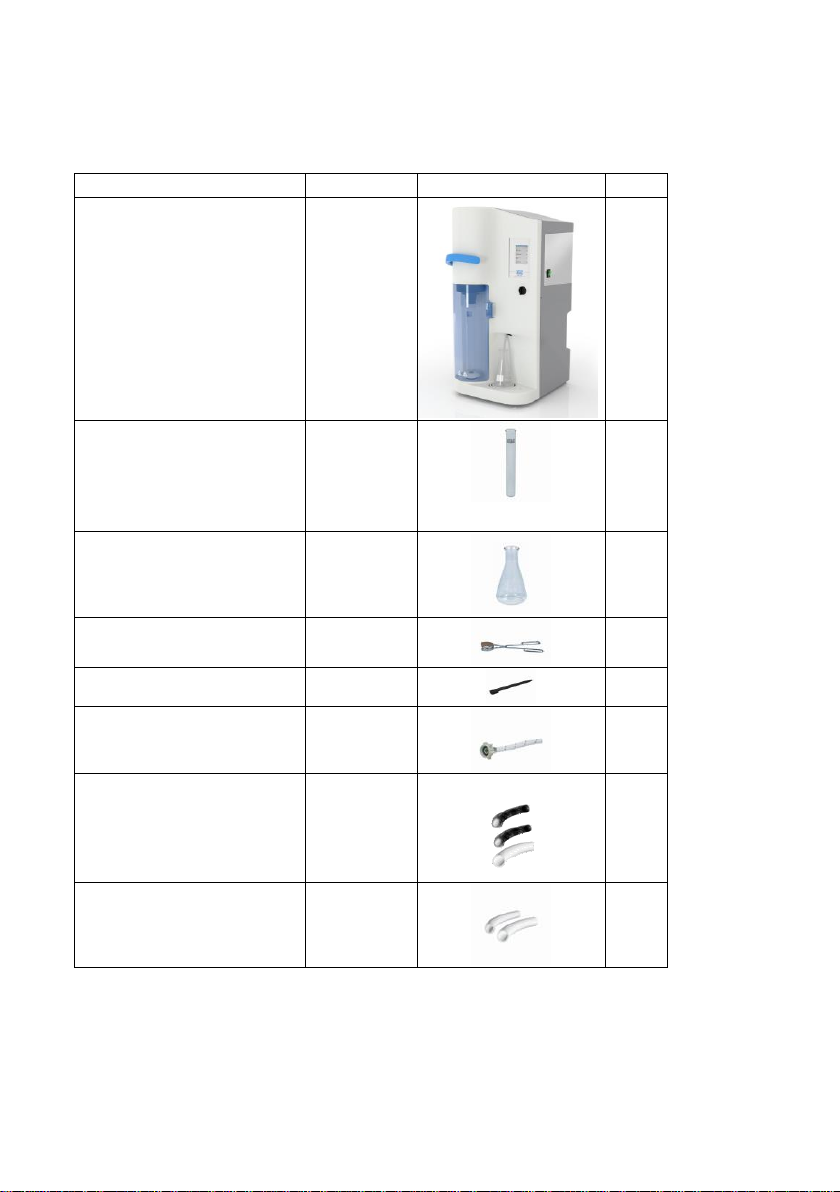
1.1. Parts included
Check that the unit is complete after unpacking.
The table below shows the parts included:
The operating manual is inside the distillation unit1 box .
The test tube2 is not sold separately (see chap. 10 Accessories).
The protective film for touch screen (code 40001798) is already placed on the
display.
NOTE: Keep the special shock-resistant packing material for future use.
10004762/B5
Page 7
Velp Scientifica – UDK139 Operating Manual
7
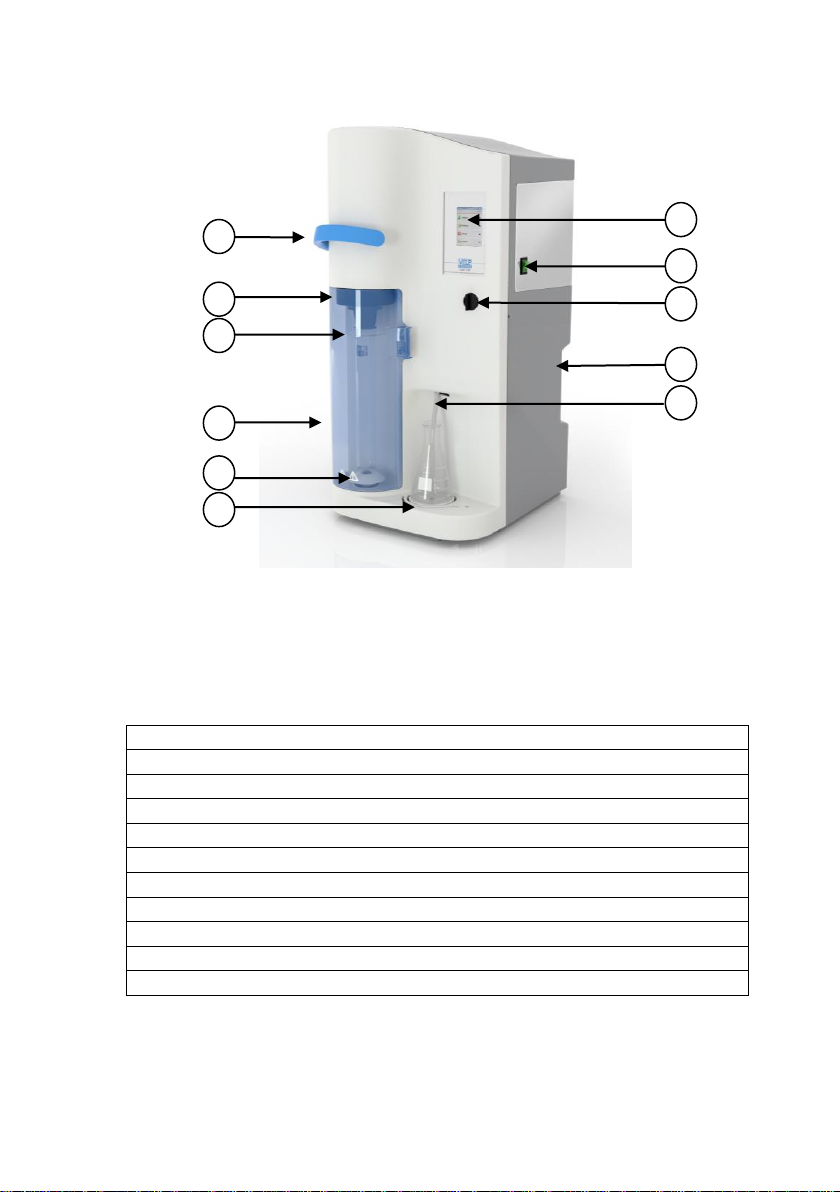
1 Color Touch Screen with protective film
2 On/Off switch
3 Service door catch
4 Flask stand
5 Safety guard
6 Lever for insertion of test tube
7 Test tube press
8 Test tube connection
9 Plastic guard for test tube connection
10 Socket panel
11 Distillate outlet tube
2 5 6 3 1
7 8 4
9
11
10
194
1.2. Instrument description
The UDK 139 Semi-automatic Distillation Unit uses innovative technology and
advanced electronics for the automation of the various stages and the highest
standards of reliability and safety.
The UDK 139 carries out all the stages of the distillation process such as the addition
of single reagents and the removal of distillation residues automatically.
Main components of the distillation unit:
The Semi-automatic distillation unit UDK139 is fitted with innovative devices and is
manufactured using innovative materials and advanced technology:
The instrument has a polymer structure that ensures greater resistance
against chemical reagents used during analysis and a high durability.
10004762/B5
Page 8

Velp Scientifica – UDK139 Operating Manual
8
195
The patented Velp Scientifica steam generator uses deionised or distilled water
and produces a constant and stable quantity of steam ensuring the
reproducibility of the analysis without requiring any routine maintenance. The
steam flow is controlled by a software which enables the user to choose
between rapid or slow distillations according to the product to be analyzed.
The innovative titanium condenser achieves outstanding heat exchange,
reduces water consumption, offers higher resistance than glass and is easily
and thoroughly cleaned. The display shows the water consumption during each
analysis.
The new technopolymer splash head assures optimal resistance to the high
temperatures and corrosive chemicals involved during the distillation process.
The graphic touch screen with its simple and user-friendly interface, enables
the user to program all the automatic distillation / titration parameters. The
protective film on the touch screen safeguards against wear and against the
majority of laboratory agents.
Choose from 6 different languages to communicate with the instrument.
The distillation unit can be connected to a printer via USB in order to print all the
information pertaining to the tests performed in accordance with GLP (Good
Laboratory Practice).
The UDK 139 ensures the highest safety standards: it signals the absence of
the test tube, test tube exchange at the end of analysis, safety guard open, the
absence of reagents and the absence of cooling water. The use of an innovative
system enables the operator to position the test tube in complete safety and
means that test tubes of various sizes can be used.
In a world where respect for the environment is increasingly important, the
distillation unit UDK 139 makes a significant contribution to this cause. The
cooling water supply shuts-off automatically during pauses considerably
reducing water consumption and the technopolymer housing is 100%
recyclable.
10004762/B5
Page 9

Velp Scientifica – UDK139 Operating Manual
9
196
The UDK series guarantees unmatched savings whist ensuring an extremely high
level of reliability.
The UDK139 is exceptional in providing savings, by using TEMSTM technology:
Time: Fast and frequent analyses; no heating delay between runs.
Energy: Cooling water consumption starting from only 0.5 l/min; excellent insulation
of internal parts.
Money: Cost reduction is substantial, in line with reduced power consumption.
Space: The extremely compact footprint saves useful laboratory bench space.
10004762/B5
Page 10

Velp Scientifica – UDK139 Operating Manual
10
197
2. Chemicals
2.1. Products used
The chemicals used for distillation and titration are potentially dangerous and must
be handled with care and with personal protective equipment: gloves, goggles and
pincer removal of the reaction hot test-tubes.
1) Boric acid (H3BO3): 4% solution. The low concentration is due to the fact that
boric acid crystallizes at low temperatures and this can cause problems in the
hydraulic circuits of the instrument. Ingestion or absorption may cause nausea,
vomiting and diarrhea. Diluted solutions are used as an antisceptic.
2) Sodium hydroxide (NaOH): Velp recommends a 30-35% w/v solution of sodium
hydroxide in order to avoid violent reactions in the test-tube. Corrosive to all body
tissues. Can cause severe burns. Protect the skin and the eyes. If the solution is
prepared using flakes or pellets, add these to water and not vice versa. Ingestion can
cause vomiting, prostration, collapse. Constrictive scarring can occur.
Caution: in case of ingestion DO NOT attempt to evacuate the stomach.
Chemicals used during the digestion phase:
3) Sulphuric Acid (H2SO4): concentrated (96-98%). Corrosive to all body tissues.
Skin contact can produce necrosis. Protect the skin and the eyes. When diluting, the
acid must be added to the diluent to prevent the generation of excessive heat and
the danger of splashes. Neutralize spills with dry sodium bicarbonate or calcium
carbonate powder.
4) Hydrogen peroxide (H2O2): 30% w/w. Can cause severe burns. Wear goggles
and rubber gloves. Avoid contact with combustible materials: drying of concentrated
solutions on paper, clothing and so on, can cause combustion. Heavy metals and
their salts, dust, irregular surfaces, can cause rapid decomposition resulting in the
production of oxygen and increased pressure. Stored hydrogen peroxide solutions
decompose slowly but nevertheless bottles must be fitted with vent caps. Empty
bottles must be rinsed with clean water. In case of contact, rinse immediately with
plenty of water.
10004762/B5
Page 11

Velp Scientifica – UDK139 Operating Manual
11
198
2.2. Substances generated by digestion and
distillation
1) Sulphur dioxide and sulphur trioxide-containing fumes. During digestion with
sulphuric acid the development of fumes occurs which contain mostly sulphur dioxide
plus smaller amounts of sulphur trioxide. Both these gases are intensely irritating to
eyes and respiratory tract, causing coughing and discomfort. The fumes generated
must be removed using efficient devices (i.e. Recirculating Water Pump model JP
code F30620198) and preferably neutralized before being released into the
atmosphere (i.e. Scrubber model SMS code F307C0199).
2) Distillation residues containing toxic catalysts. The use of toxic metals such as
mercury, selenium or copper as catalysts for digestion means that these substances
are present in the distillation residues. These residues should be collected in a
suitable vessel and disposed of in an environmentally friendly way.
10004762/B5
Page 12
Velp Scientifica – UDK139 Operating Manual
12
199
3. Assembly and installation
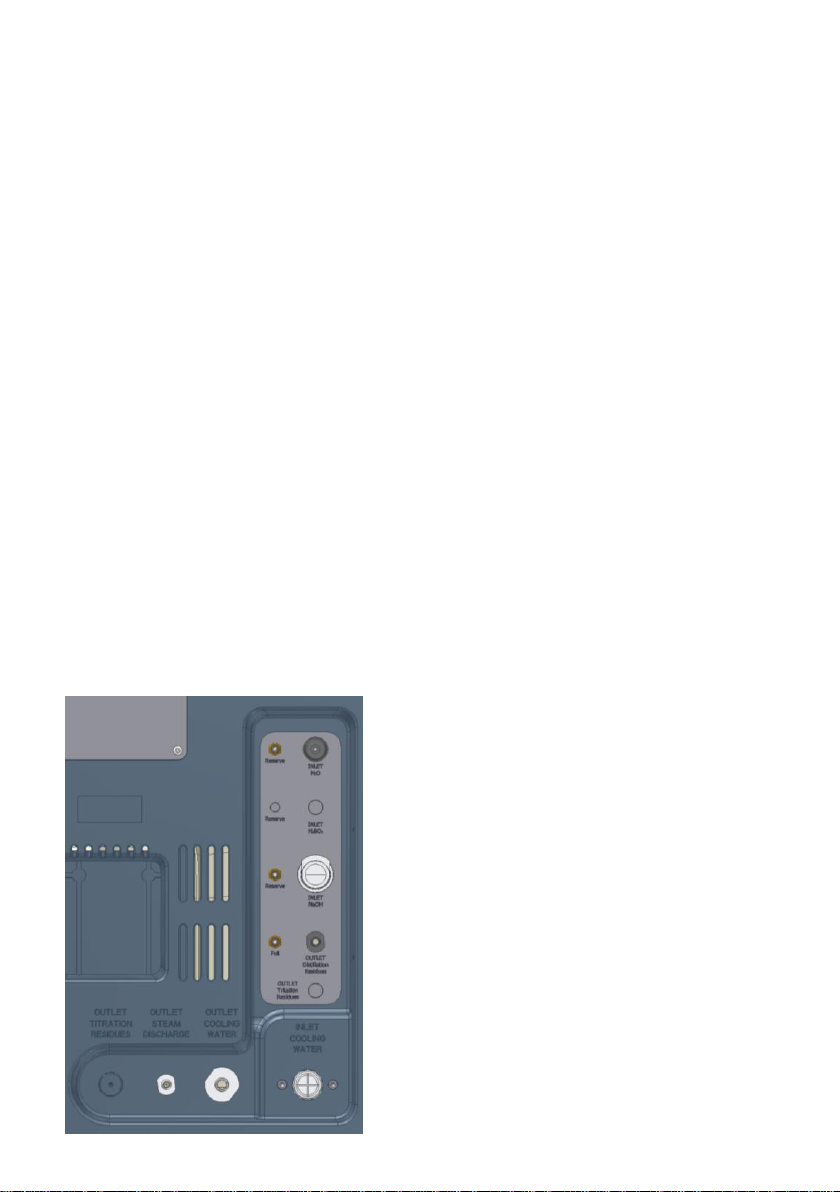
After unpacking the instrument position it on a laboratory bench or on a nonflammable surface at a distance of at least 30 cm from the walls so as not obstruct
the air vents on the rear.
NOTE:
The instrument weighs 31kg. If you need to move the instrument suitable
lifting devices should be used.
Do not remove the protective film from the touch screen.
Position the instrument near the socket power supply because it is
The instrument must be placed near a water tap (necessary for cooling the distillate)
with a maximum pressure of 5 bar, and sink in order to discharge the waste water.
The instrument requires a tap water flow rate (depending on the temperature of the
tap water) of approximately:
- 0.5 l/minute at a temperature of 15°C
- 1 l/minute at a temperature of 30°C
Water is required during the distilling phase only and is interrupted automatically
during the other phases.
Position the tanks for NaOH and H2O solutions and for collecting distillation residues
below or behind the unit. The tanks are not supplied with the instrument because
their volume is chosen according to specific requirements. Usually polythene carboys
of 5, 10 or 20l are used.
considered a means of disconnecting the device
The hydraulic tubes are supplied with the
instrument and the hydraulic connections
are clearing identified on the rear of the
instrument.
10004762/B5
Page 13
Velp Scientifica – UDK139 Operating Manual
13
INLET
Cooling Water
Cooling water inlet (tap water).
Connect the unit to the tap water supply using the red and
white tube with ¾” GAS threaded connections.
Open the tap water in order to obtain a tap water flow rate
sufficient to cool the distillate (see chapter 5.3). Tap water is
used during the distilling phase only for a considerable
reduction in consumption.
INLET
H2O
Distilled water inlet (or deionized, ammonia free) for supplying
the steam generator and diluting the sample.
Connect the black tube and the relative reserve connector
using the rapid connection and push the other end of the tube
with level sensor right to the bottom of the carboy.
INLET
NaOH
Sodium hydroxide inlet (32-35%w/v for Kjeldahl analysis)
Connect the white tube and the relative reserve connector
using the rapid connection. The rapid connection is different
from the other two (H2O and H3BO3) in order to avoid errors
and possible damage to tubes and internal components.
Push the end of the tube with level sensor to the bottom of the
corresponding carboy.
OUTLET
Cooling Water
Cooling water outlet.
Push the PVC tube supplied (diameter 10x14 mm) onto the
corresponding tube holder by hand and place the other end of
the tube in a sink/drain
Check the flow rate of the cooling water discharged from the
condenser during the distillation/titration - the minimum flow
rate using tap water at a temperature of about 15°C should be
0.5 l/min. (see chapter 5.3).
OUTLET
Distillation
Residues
Distillation residues outlet
Distillation residues are discharged from the test tube at the
end of distillation (if selected in the work program).
Connect the black tube and the relative full connector. Place
the end of the tube with level sensor in the collecting carboy
and regulate the height of the sensor according to the type of
vessel used.
Caution: high temperature solution.
OUTLET
Steam
Discharge
Steam discharge outlet.
Discharge of hot water from the steam generator.
At the end of each distillation the steam generator discharges
the excess hot water to the distilled water tank for re-use.
Push the silicone tube supplied (diameter 6x9 mm) onto the
corresponding tube holder by hand and place the other end of
the tube in the distilled water tank.
200
3.1. Hydraulic connections
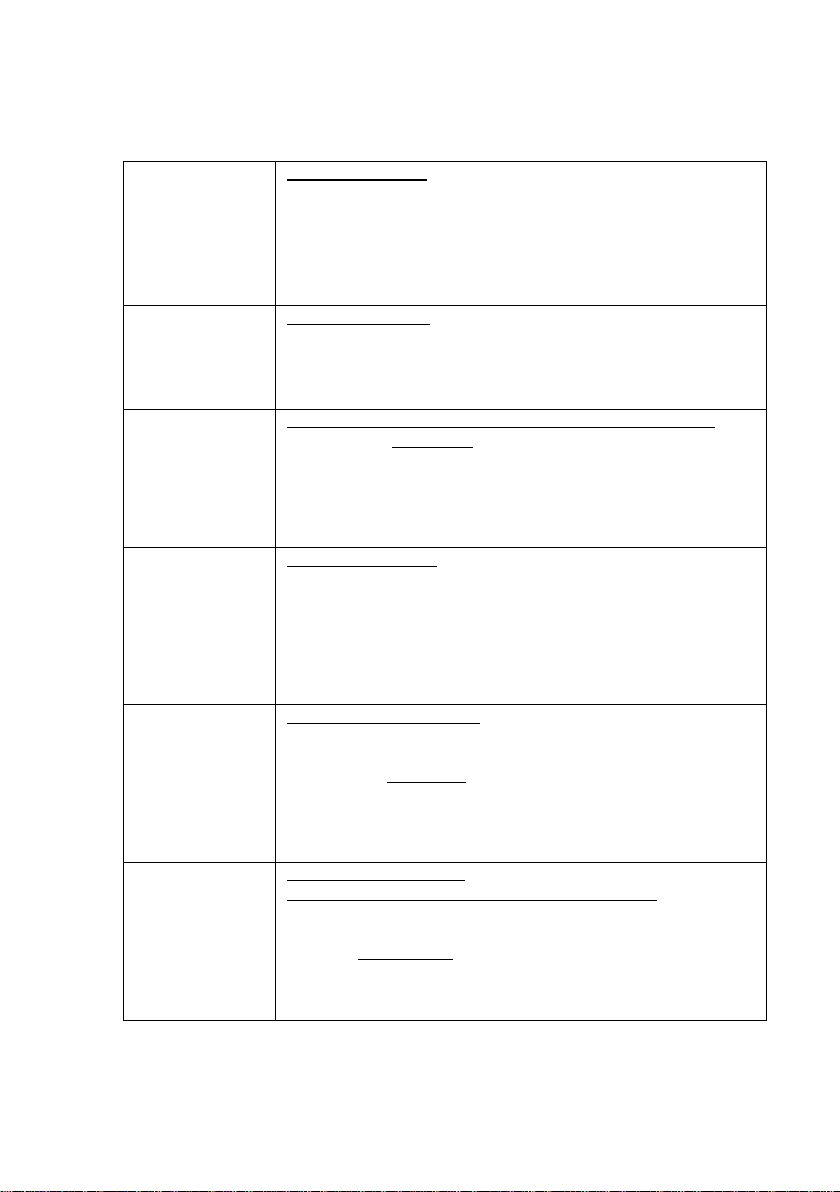
Connect the tubes supplied to the tube holders located on the rear panel following
the instructions below:
10004762/B5
Page 14

Velp Scientifica – UDK139 Operating Manual
14
201
IMPORTANT
Place the carboys for the H2O and NaOH solutions on the floor and not at the
same level as the unit on the bench in order to avoid air locks in the suction
tubes.
The sodium hydroxide tubes must be kept full or, alternatively, the tubes can be
emptied and washed at the end of the work cycle. This precaution will avoid the
formation of crystals when the solution comes into contact with air which may
block the tube and prevent the instrument from working correctly.
If the level sensors and full sensors are not plugged-in the instrument will
operate normally but the reserve and full indicators will not be functional.
3.2. Connection to the electric power supply
Before connecting the instrument to the power supply, make sure that the mains
switch is turned off and that the values on the labels correspond to those of the
power supply. Make sure the electrical network is earthed. Connect the instrument to
the power supply using the cable and plug supplied.
The instrument requires a 220-240V power supply and a frequency of 50 or 60 Hz.
The instrument is delivered already programmed for 230V/50Hz. If the power supply
is 230V/60Hz, the correct values must be selected in the menu Set up/Frequency
menu (see chapter 4.5).
NOTE: the mains switch can be used to disconnect the instrument from the power
supply when not in use in order to reduce energy consumption.
NOTE: When the service door is opened the power supply cuts-off automatically.
10004762/B5
Page 15
Velp Scientifica – UDK139 Operating Manual
15
202
3.3. Connection to external devices
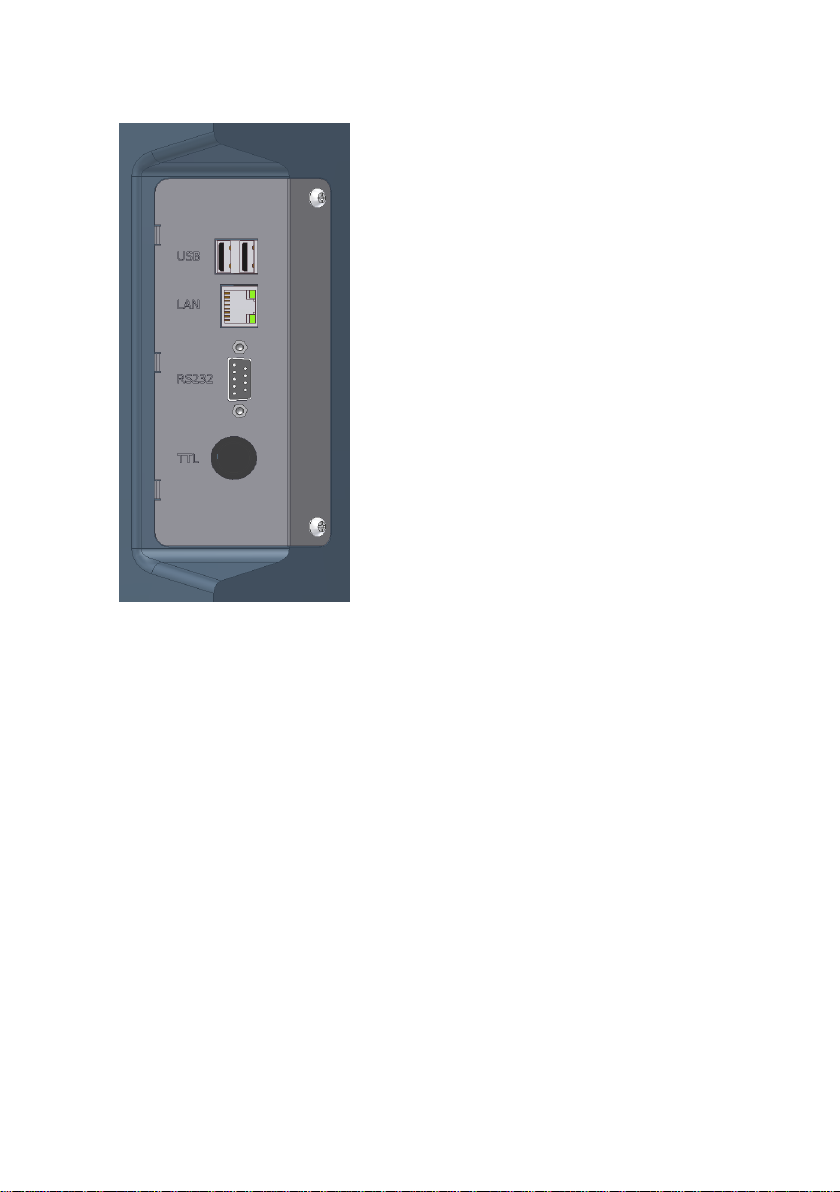
The UDK 139 Semi-automatic distillation unit can be
connected to various external devices useful for
optimizing operator productivity, using the sockets
on the rear:
Printer
Mouse
3.4. Printer
Connect the printer (item code A00001009) to one of the two USB ports in order to
obtain automatic print-outs at the end of analysis.
The serial port configuration of the printer should be:
Baud rate 4800
Data length 8
Parity None
Bit of Stop 1
Handshaking None Xon/ Xoff
For printer connection a USB/RS232 serial converter cable is required (item code
A00000195). Connect the RS232 converter plug to the printer and the USB plug to
the USB port on the instrument.
10004762/B5
Page 16

Velp Scientifica – UDK139 Operating Manual
16
203
3.4.1. Mouse
A mouse with USB plug can be connected to one of the two USB ports to navigate
the menus. Connect the mouse with the instrument turned on in order to activate the
pointer.
3.5. Preliminary operations
At the end of installation proceed as follows:
Open the safety guard;
Position the test tube;
NOTA: to position the test tube hold the blue handle down, slide the test tube into
place making sure that the Teflon tube remains inside the test tube and that the test
tube itself rests on the press test tube. Release the blue handle.
Close the safety guard;
Turn on the tap water;
Check that the distillate tube is in place in the flask.
Turn the instrument on by pressing the mains switch POWER (led on) on the right of
the instrument. The instrument automatically carries out the following steps
simultaneously:
Preheating (this takes 3 minutes. A yellow strip at the top of the display
reading “preheating” indicates that preheating is in progress, the
countdown indicates the time left);
Tap water check to ensure the presence of cooling water;
NOTA: During pre-heating the instrument menus can be accessed with the exception
of work cycles requiring the production of steam.
An acoustic signal indicates that pre-heating is complete, the strip at the top of the
display is blue and reads “UDK139”.
IMPORTANT: before beginning analysis enter the CHECK-UP menu in order to
fill the tubes (see chapter 4.6.1).
10004762/B5
Page 17
Velp Scientifica – UDK139 Operating Manual
17
Analysis
● Wash-down
● Distillation
Methods
Set-up
● Date
● Time
● Language
● Frequency
● Keyboard
sounds
● Lab. name
● Print
● Type
● Automatic
System
● Check-up
● Manual
check-up
● Automatic
check-up
● Diagnosis
● Check safety
device
● Safety guard
● Safety test tube
● Safety lever
● Check inlet
tubes
● Inlet tube for H2O
● Inlet tube for NaOH
● Residues tube
● Cooling H2O
● Calibration
● Cal. H2O pump
204
4. Using the menus
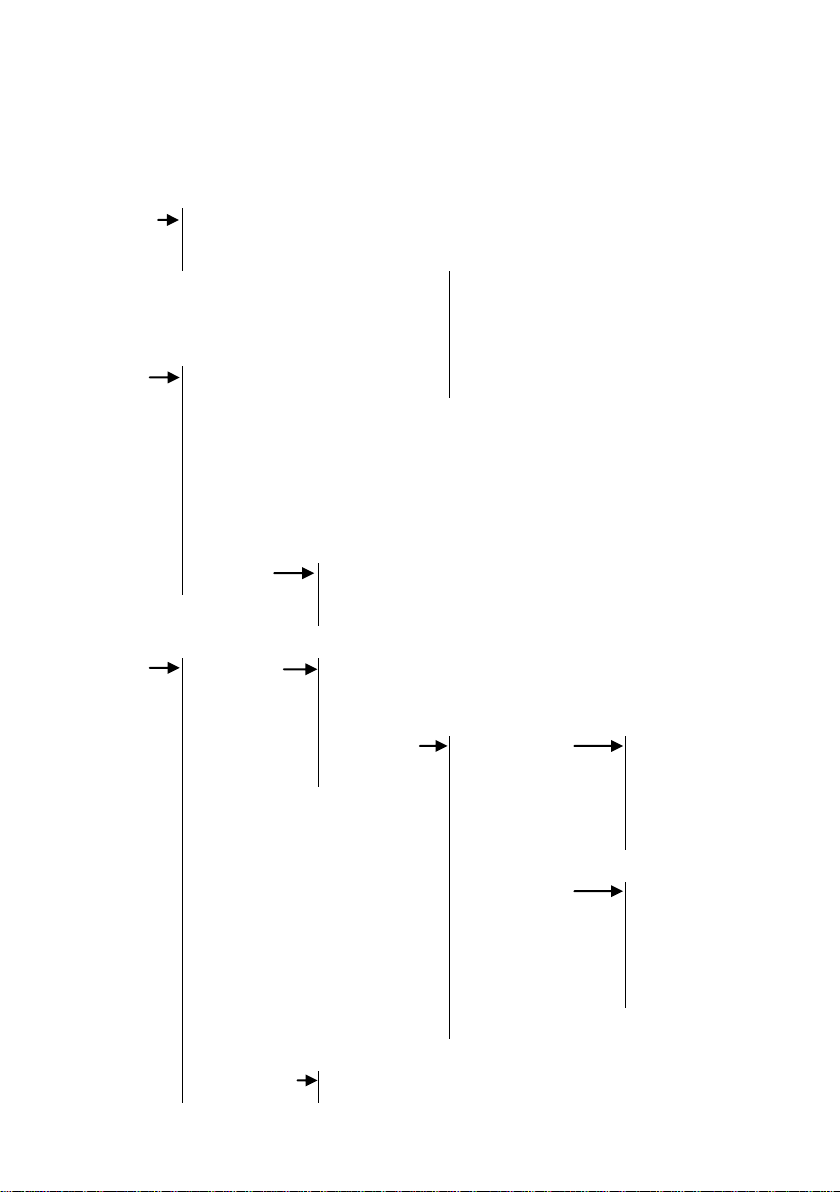
4.1. Quick Guide
This page shows the instrument software. The purpose is to help the user identify the
different possibilities offered by the instrument and how to reach them easily.
10004762/B5
Page 18

Velp Scientifica – UDK139 Operating Manual
18
● Cal. NaOH pump
● Maintenance
● Clean NaOH circuit
● Clean filters
● Test tube connection
● N° analyses
● Service
● Upload software
● Advanced settings
205
10004762/B5
Page 19
Velp Scientifica – UDK139 Operating Manual
19
206
4.2. Main menu
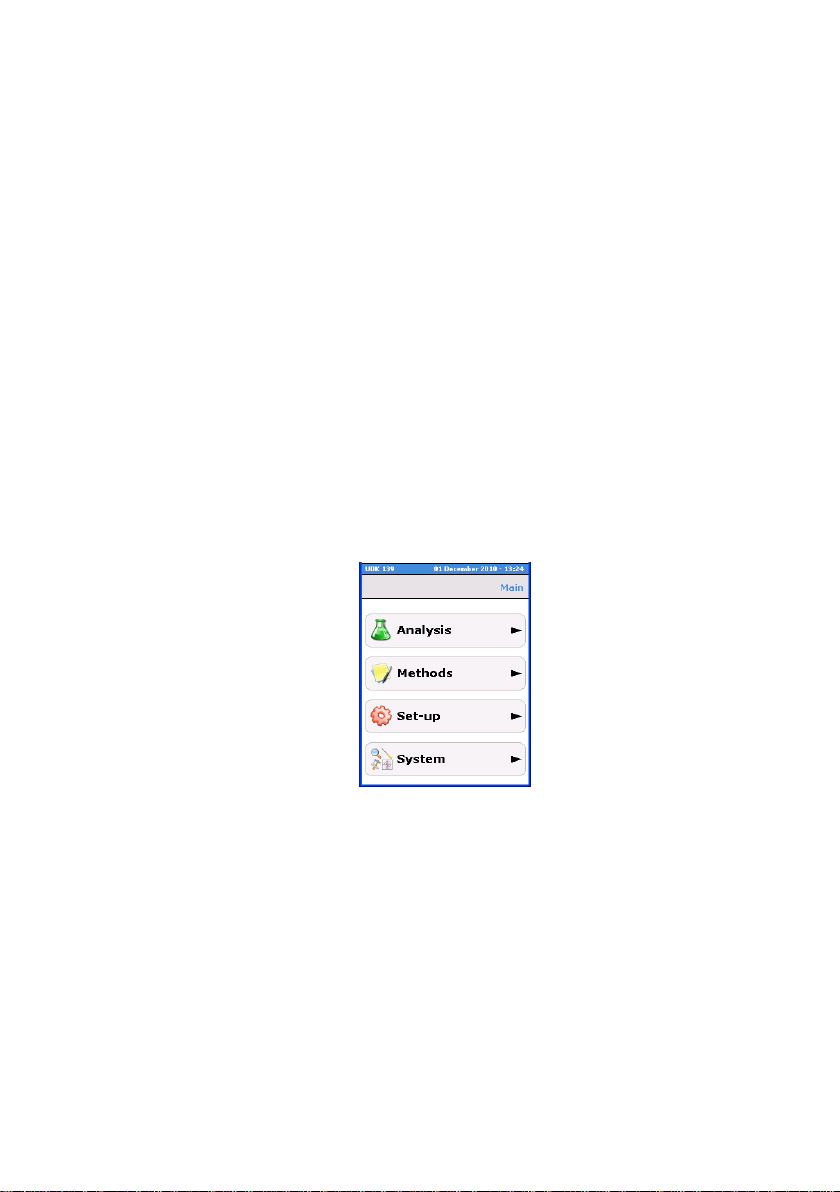
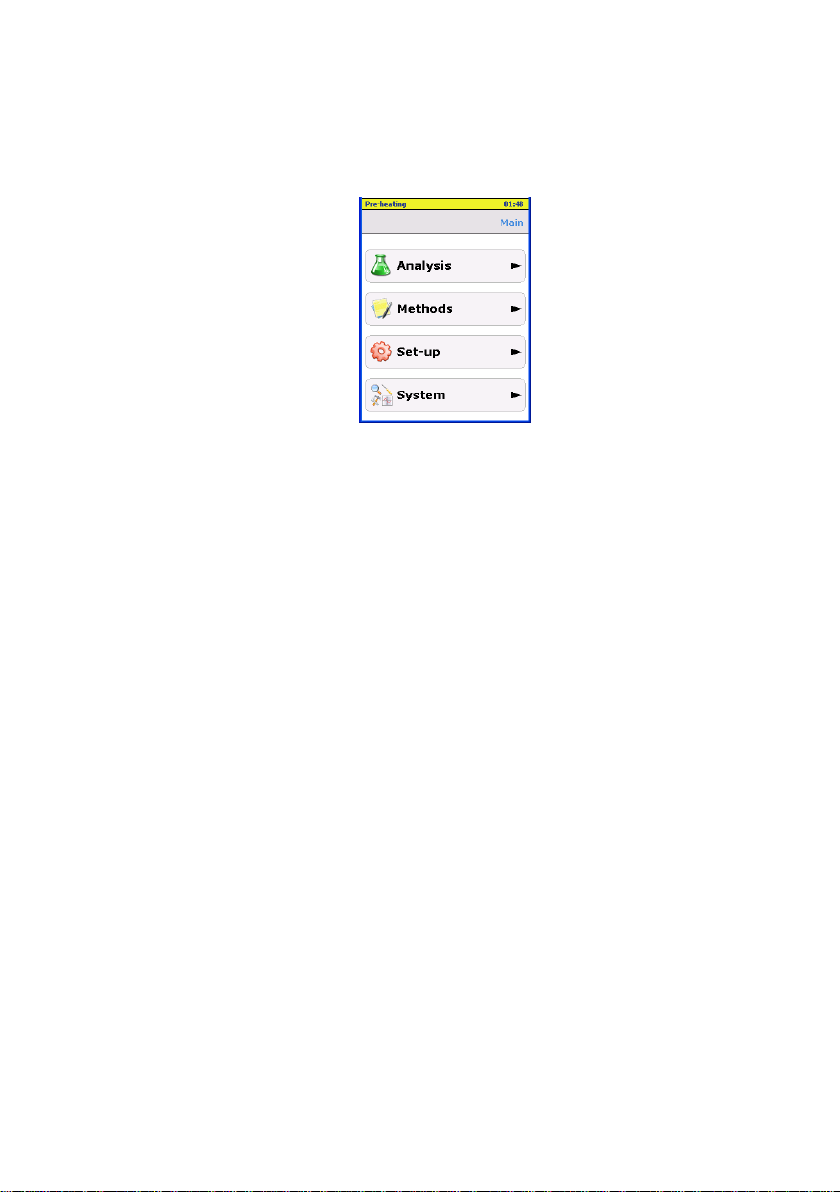
When the instrument is turned on, the display shows the name of the instrument and
the software version for a few seconds.
The main menu then appears:
The yellow strip at the top of the display (present on every page of the software)
indicates that preheating is in progress and shows the time left. During this phase it
is possible to navigate all the menus and submenus with the exception of work
processes that require steam production. An acoustic signal informs the operator that
preheating is complete. The band at the top of the display is now blue and reads
“UDK139” as well as giving the current date and time.
The second line gives the name of the menu viewed.
The main menu consists of 8 submenus that can be selected using the touch screen
or the pointer of the mouse (where present).
The "Main Menu" consists of the following submenus:
1. Analysis
1. Wash-down
2. Distillation
2. Methods
3. Set-up
1. Date
2. Time
3. Language
4. Frequency
5. Keyboard Sounds
6. Lab. name
7. Print
4. System
1. Check-up
2. Calibration
3. Maintenance
4. Service
10004762/B5
Page 20

Velp Scientifica – UDK139 Operating Manual
20
207
In each sub-menu the arrow in the upper left corner allows you to return to the
previous screen.
10004762/B5
Page 21
Velp Scientifica – UDK139 Operating Manual
21
208
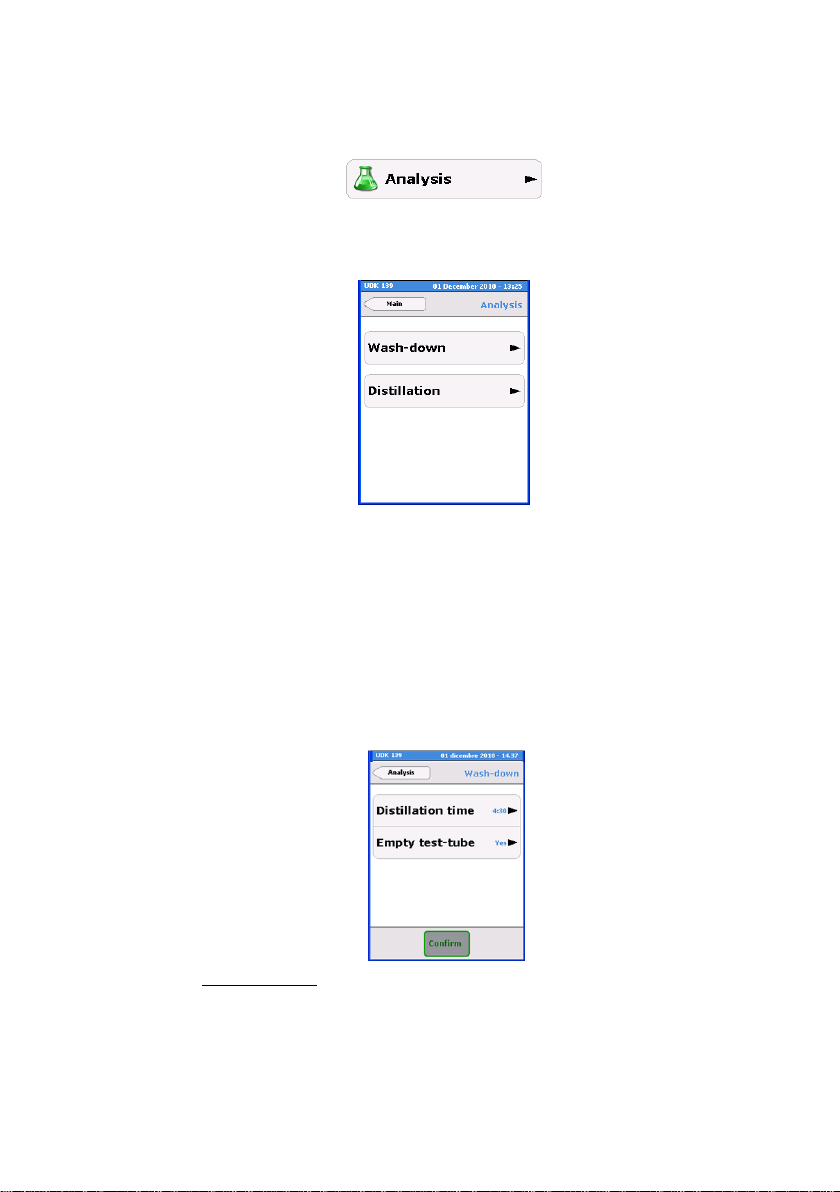
4.3. Analysis
Select "Analysis" from the main menu:
The sub-menus are shown below:
To return to the main menu press the arrow in the upper left corner.
4.3.1. Wash-down
During wash-down distillation is carried out using distilled water as a reagent in order
to “wash” the internal parts of the splash head and condenser. Wash-downs can be
carried out at any time.
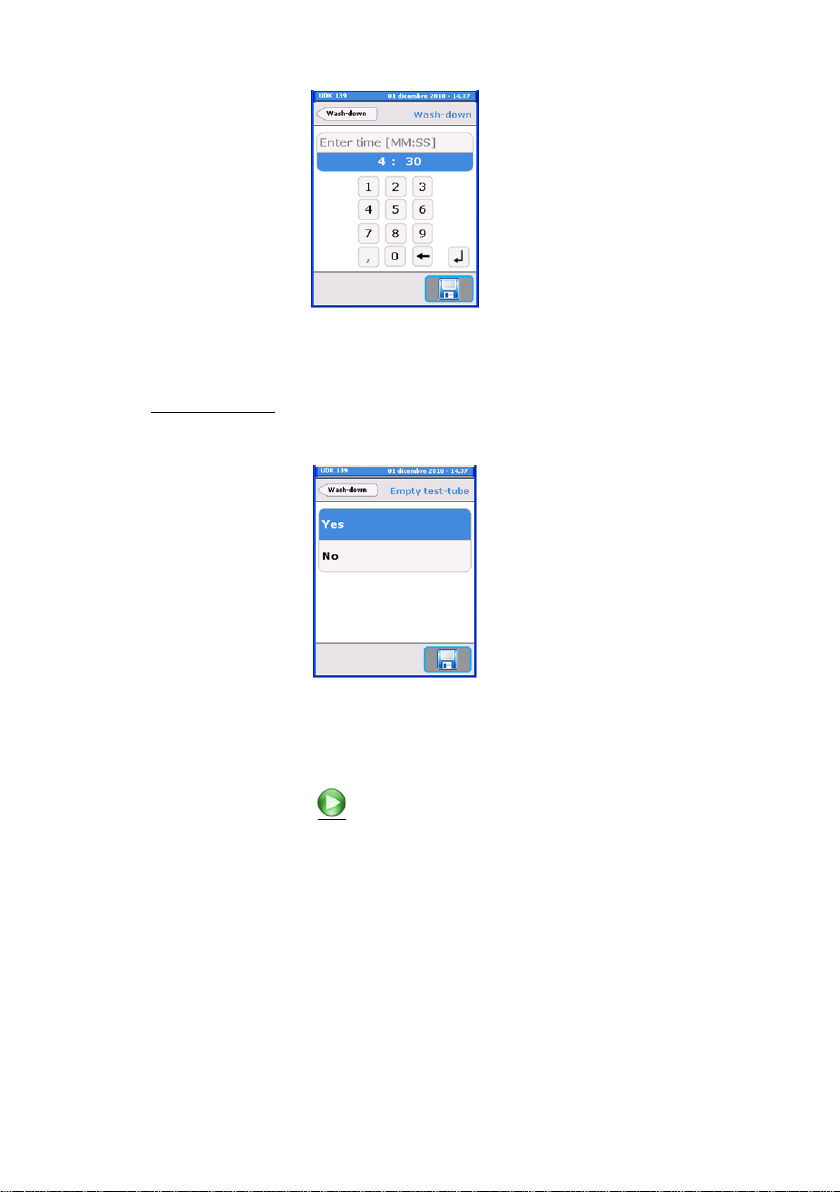
Use the touch-screen to select "Wash-down", the following window appears:
Pressing “Distillation time”, the alphanumeric keypad appears. Use it to set the wash
down time: min 2:00 – max 7:30.
10004762/B5
Page 22
Velp Scientifica – UDK139 Operating Manual
22
209
To return to the “Wash down” menu press the arrow in the upper left corner.
Pressing “Empty test tube”, it is possible to select or not the residues removing at the
end of wash down, with “Yes” or “No”.
To return to the “Wash down” menu press the arrow in the upper left corner.
To return to the “Analysis” menu press the arrow in the upper left corner.
To carry out a wash cycle press .
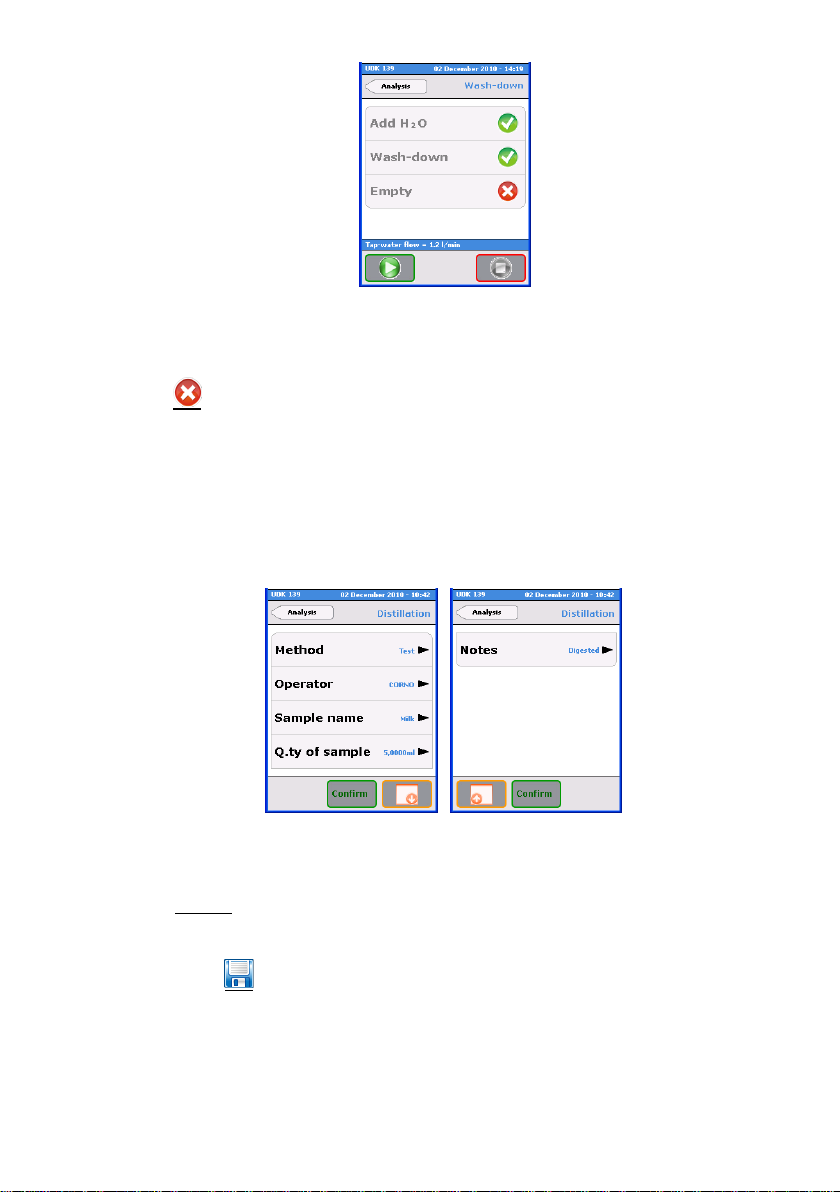
During the wash-down cycle the following three phases are carried out:
- Add H2O
- Washing
- Empty
10004762/B5
Page 23
Velp Scientifica – UDK139 Operating Manual
23
210
The green flag on the right indicates that the phase was carried out correctly, a red X
indicates that the phase did not terminate correctly. The blue line at the bottom of the
display indicates the cooling water flow rate (e.g. Tap-water flow = 1.2 l/min).
Press to stop the process at any time.
NOTE: Velp recommends that a wash-down is carried out every day before starting
sample analysis and at the end of the daily work-session.
4.3.2. Distillation
Select "Distillation” from the "Analysis" menu. The following window appears:
To return to the “Analysis” menu press the arrow in the upper left corner.
Select the various fields and enter the required analysis parameters.
Press Method to access the "Methods" menu (see Chapter 4.4 Methods). Choose
the method of interest.
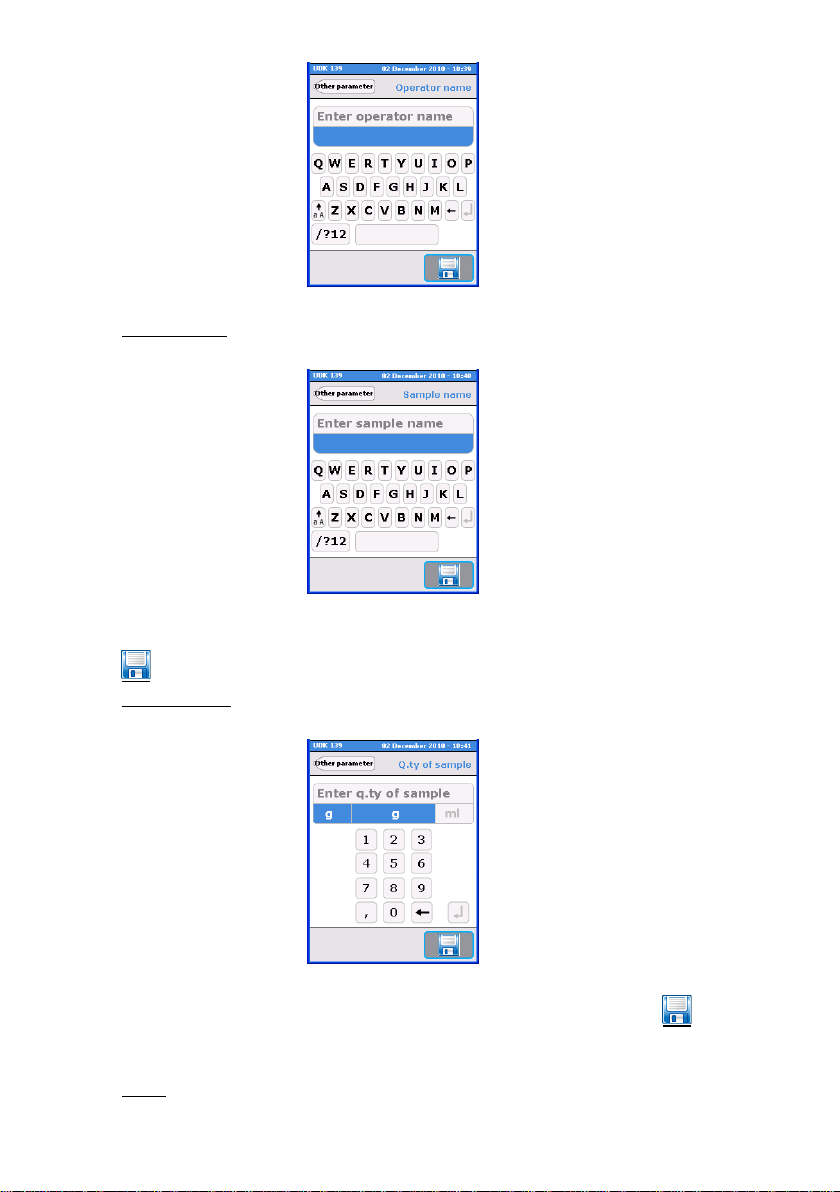
Press Operator and use the alphanumeric keypad to enter or modify the operator
name. Press to confirm.
10004762/B5
Page 24
Velp Scientifica – UDK139 Operating Manual
24
211
Press Sample name. The following window appears:
Enter the sample name (max. 13 characters) using the alphanumeric keypad.
Press to confirm.
Press Q.ty of sample and enter the sample quantity using the alphanumeric keypad:
Use the touch-screen to select the unit of measure required and press to
confirm.
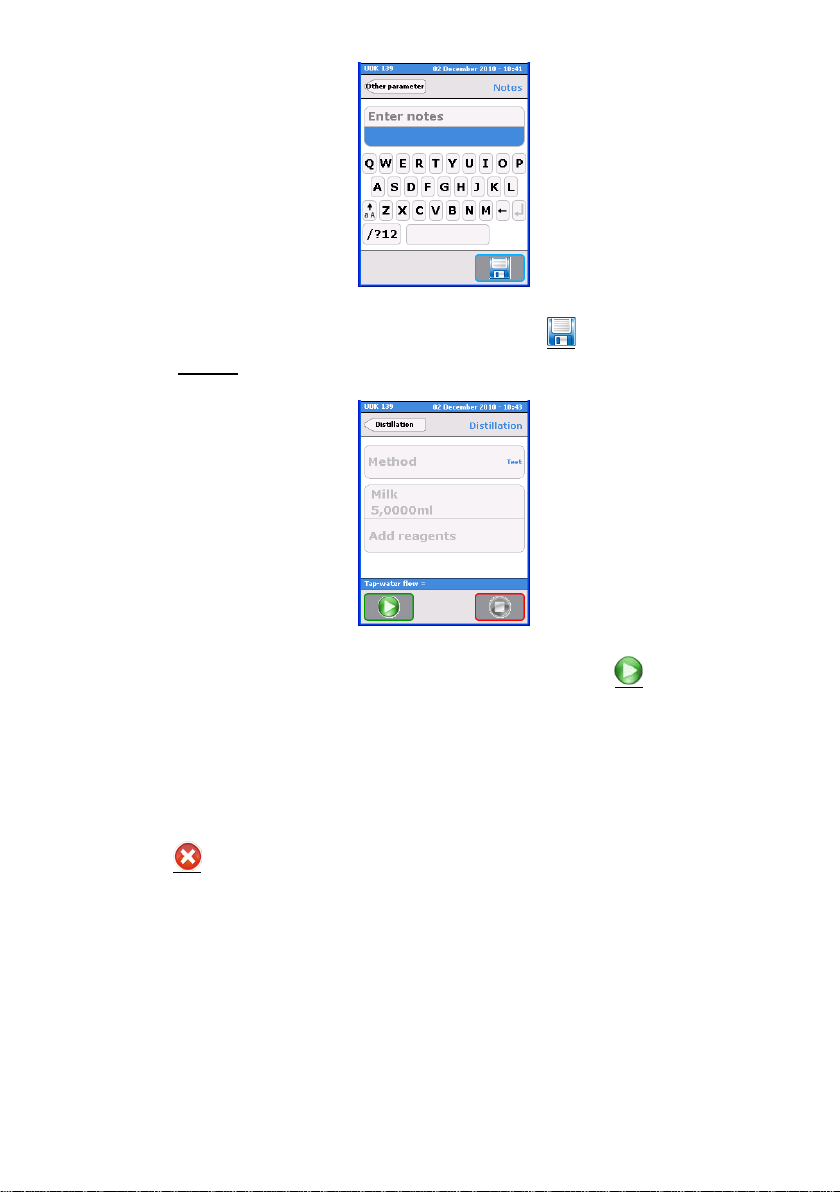
Press Notes. The following window appears:
10004762/B5
Page 25
Velp Scientifica – UDK139 Operating Manual
25
212
Use the alphanumeric keypad to enter notes and press to confirm.
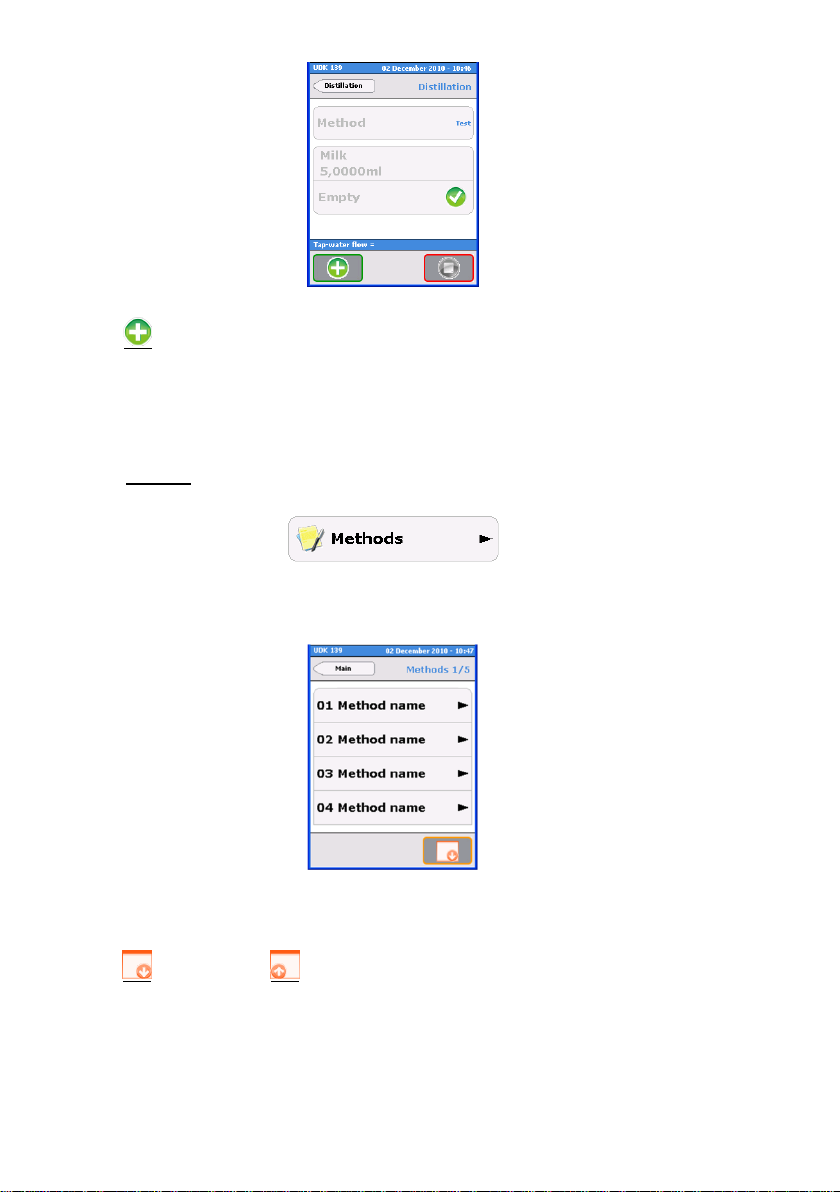
Press Confirm to confirm the parameter settings of the analysis. The following
window appears:
Position the test tube containing the sample in its seat and press .
During the distillation the following three phases are carried out in sequence:
- Add reagents
- Analysis
- Residues removal (only if previously selected)
The green flag on the right indicates that the analysis was carried out correctly, a red
X indicates that the phase did not terminate correctly.
Press to interrupt the process at any time.
The distillation time countdown is shown on the display during analysis.
The name and quantity of the sample selected in “Distillation" are also displayed.
At the end of distillation the display shows the following window:
10004762/B5
Page 26
Velp Scientifica – UDK139 Operating Manual
26
213
Press or the "Distillation" arrow top left to print the analysis data (if automatic
print-out has been selected) and return to the "Distillation" menu in order to with a
new analysis.
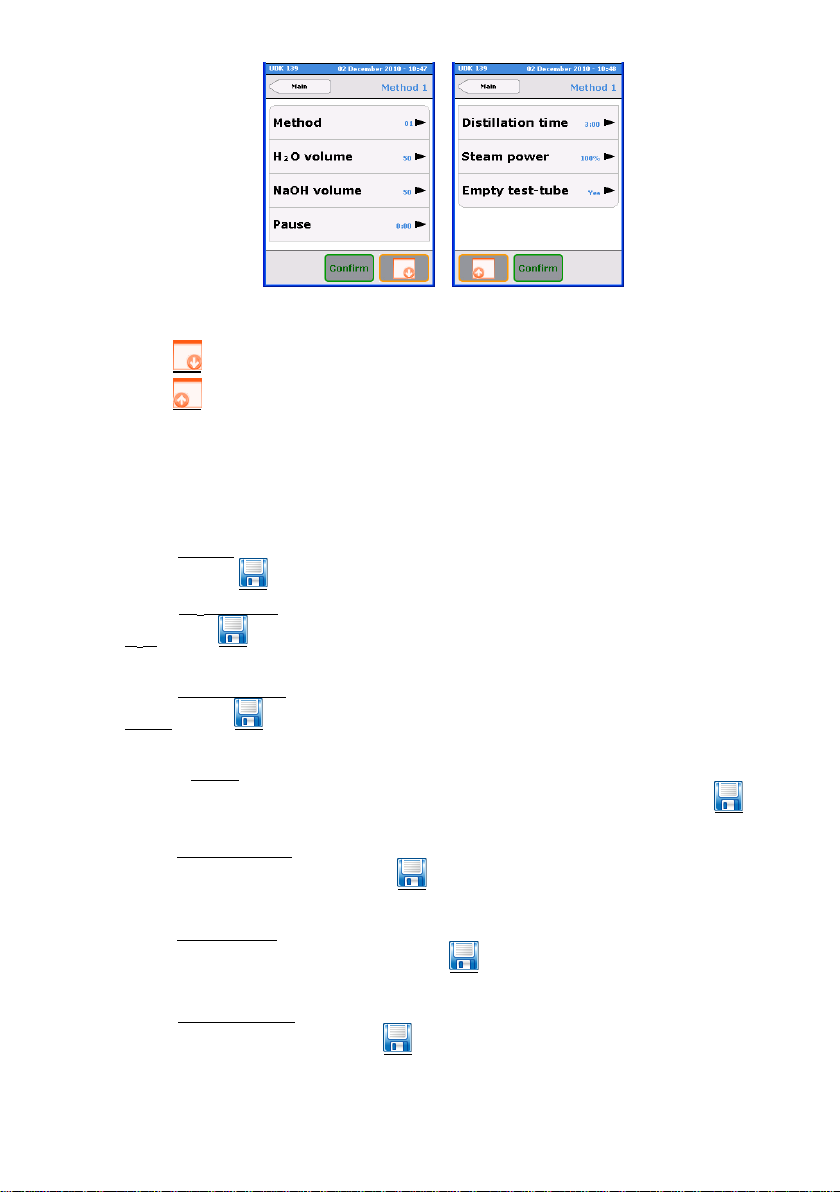
4.4. Methods
Select Methods from the "Main" menu.
The following window appears:
To return to the “Main” menu press the arrow in the upper left corner.
Press (next page) or (previous page) to scroll through the 20 customizable
methods listed.
Use the touch-screen to select the method required.
10004762/B5
Page 27
Velp Scientifica – UDK139 Operating Manual
27
214
Press button to move to the next window.
Press button to return to the previous window.
NOTE: upon receipt of the instrument all customizable methods include default
parameters entered by Velp.
Use the touch-screen to select each parameter and modify the value.
Select Method and use the alphanumeric keypad to enter or modify the name of the
method. Press to confirm.
Select H2O volume and use the numeric keypad to enter or modify the volume of
H2O . Press to confirm.
Select NaOH volume and use the numeric keypad to enter or modify the volume of
NaOH . Press to confirm.
Select Pause and use the numeric keypad to enter or modify the time lapse
between the entry of reagents and the beginning of steam production. Press to
confirm.
Select Distillation time and use the numeric keypad to enter or modify the distillation
time (steam production time). Press to confirm.
Select Steam power and use the numeric keypad to enter or modify the steam power
during distillation (from 10 to 100%). Press to confirm.
Select Empty test-tube and choose from the two options available. Select automatic
residues aspiration if needed. Press to confirm.
10004762/B5
Page 28
Velp Scientifica – UDK139 Operating Manual
28
215
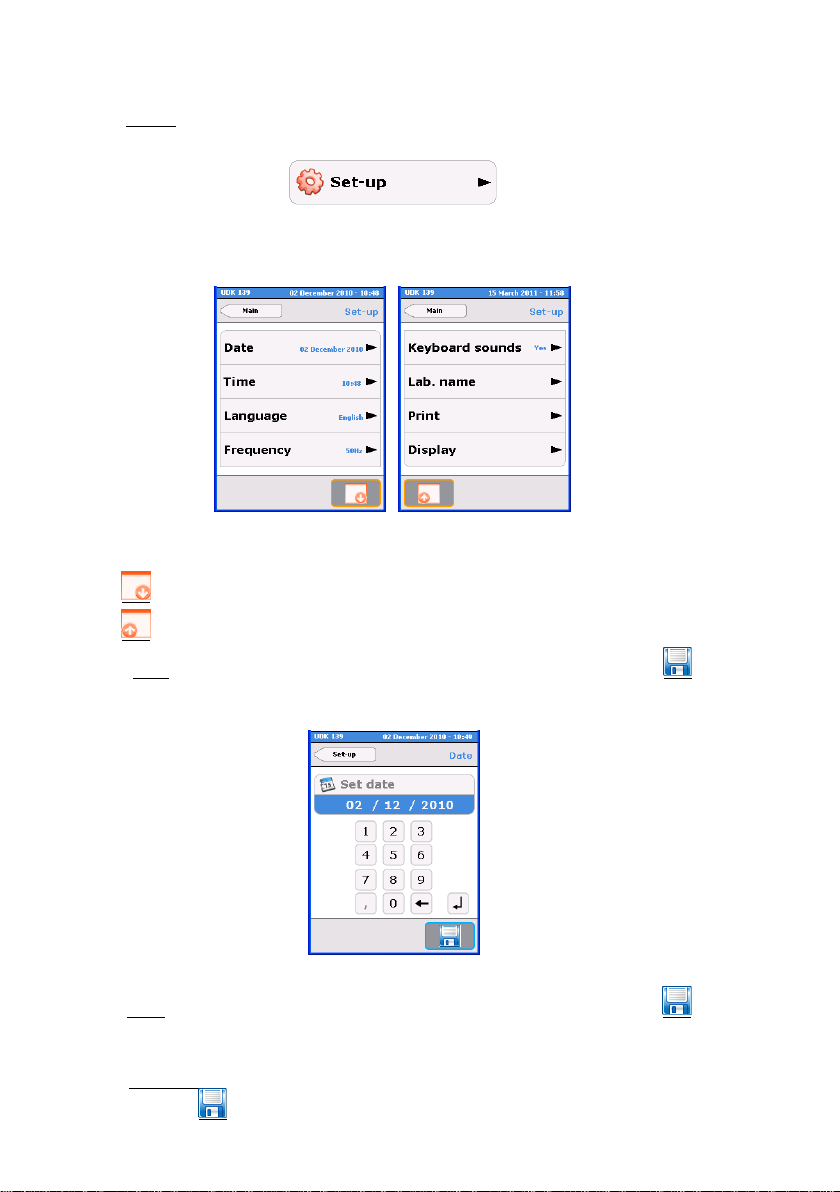
4.5. Set-up
Select Set-up from the "Main" menu.
The following submenus are listed:
To return to the "Main" menu press the arrow top left.
Press to move to the next window.
Press to return to the previous window.
Select Date and use the numeric keypad to enter or modify the date. Press to
confirm.
Select Time and use the numeric keypad to enter or modify the time. Press to
confirm.
Select Language and use the touch-screen to choose from the list of languages
available. Press to confirm..
10004762/B5
Page 29

Velp Scientifica – UDK139 Operating Manual
29
216
Select Frequency and use the touch-screen to select the frequency of the power
supply at the place of installation . Press to confirm.
Select Keyboard sounds and use the touch-screen to select YES/NO to
enable/disable the acoustic signal when touch-screen keys are pressed. Press
to confirm.
Select Laboratory name and use the alphanumeric keypad to enter or modify the
name of the laboratory. Press to confirm.
The name of the laboratory will be printed on the report.
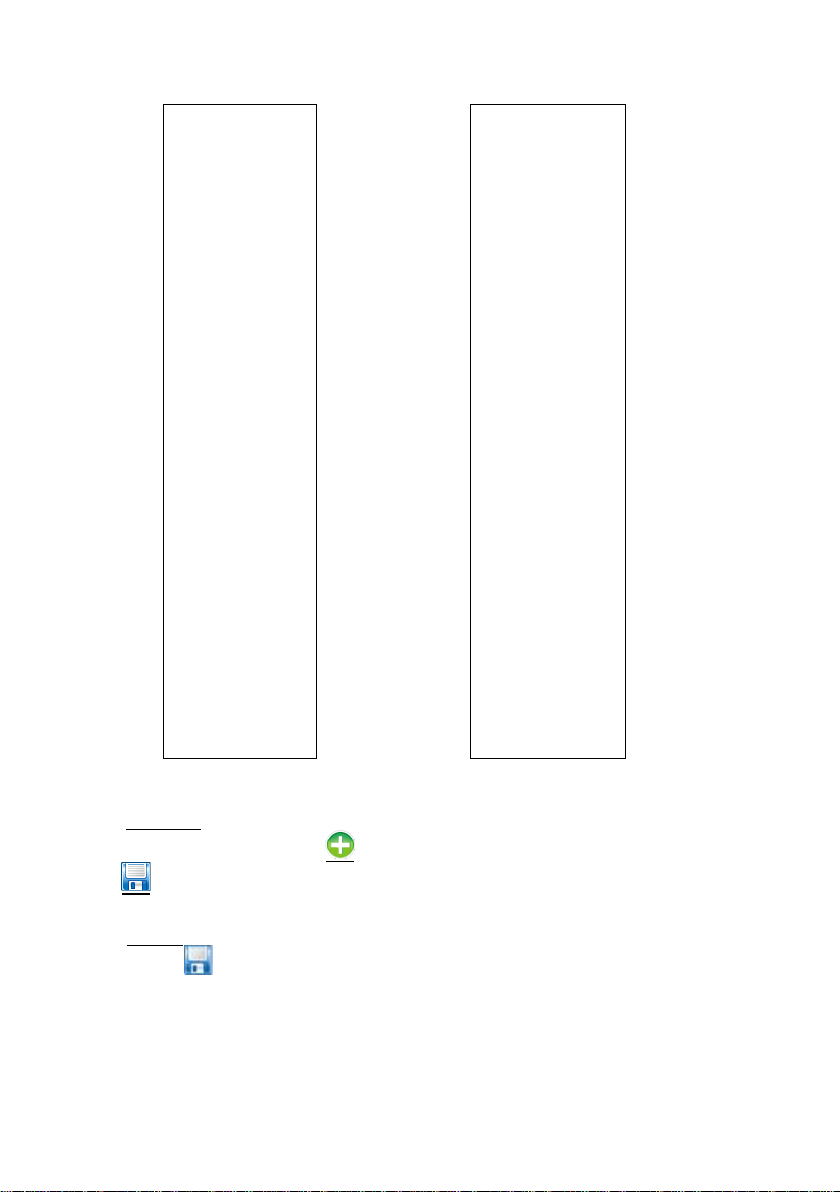
Select Print. The display shows:
Select Type and choose from the options available: Standard / Compressed. Press
to confirm.
10004762/B5
Page 30
30
Standard
Compressed
VELP SCIENTIFICA
Distillator: UDK139
Software Version: 1.0.0
______________________
Date:
20/09/2010
Time:
14.49
Laboratory name:
Velp Scientifica
Operator:
Paolo
ID:
4
Sample:
Milk
Q.ty sample:
5,0000ml
Method:
Test
H2O:
50ml
NaOH:
20ml
Pause:
00:00
Distill. Time:
03:00
Steam:
100%
Empty test tube:
Yes
Notes:
______________________
VELP SCIENTIFICA
Distillator: UDK139
Software Version: 1.0.0
______________________
Date:
20/09/2010
Time:
15.00
ID:
5
Sample:
Milk
Q.ty sample:
5,0000ml
Notes:
______________________
217
Select Automatic and choose YES/NO to enable/disable automatic print-out
at the end of each analysis when or the back arrow is pressed.
Press to confirm.
Select Display. Use the two sliding bars to adjust the contrast and brightness of the
display. Press to confirm.
Velp Scientifica – UDK139 Operating Manual
10004762/B5
Page 31
Velp Scientifica – UDK139 Operating Manual
31
218
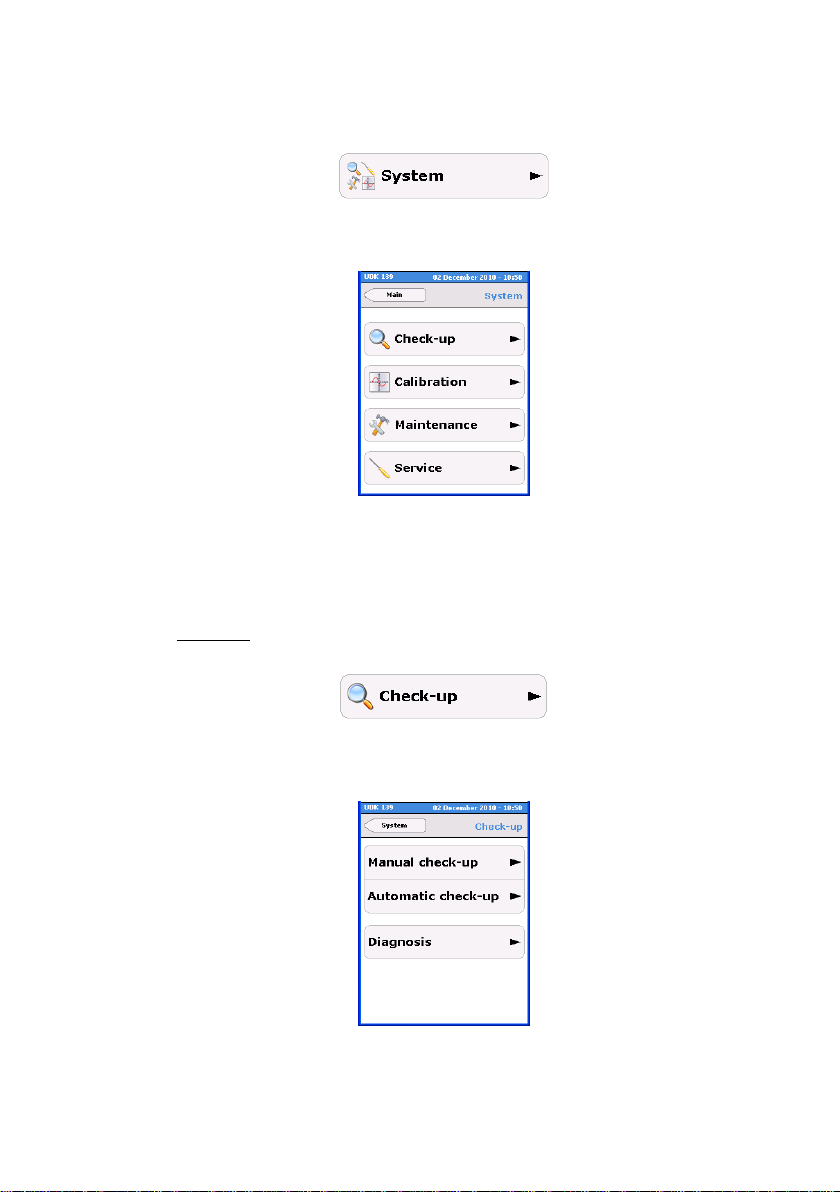
4.6. System
Select “System” from the main menu.
The four sub-menus are listed:
To return to the "Main" menu press the arrow top left.
4.6.1. Check-up
Select Check-up from the "Main" menu.
The three sub-menus are shown below:
To return to the “System” menu, press the arrow in the upper left corner.
The "Check-up" menu is used to fill/empty the hydraulic circuits of the reagents,
these checks can be carried automatically or manually at any time.
10004762/B5
Page 32
Velp Scientifica – UDK139 Operating Manual
32
219
It is also possible check the correct functioning of safety devices, level sensors and
the cooling water detector.
NOTE: it is fundamental that all the checks are carried out during installation in order
to fill the hydraulic circuits. Velp recommends the use of the automatic controls
during this phase.
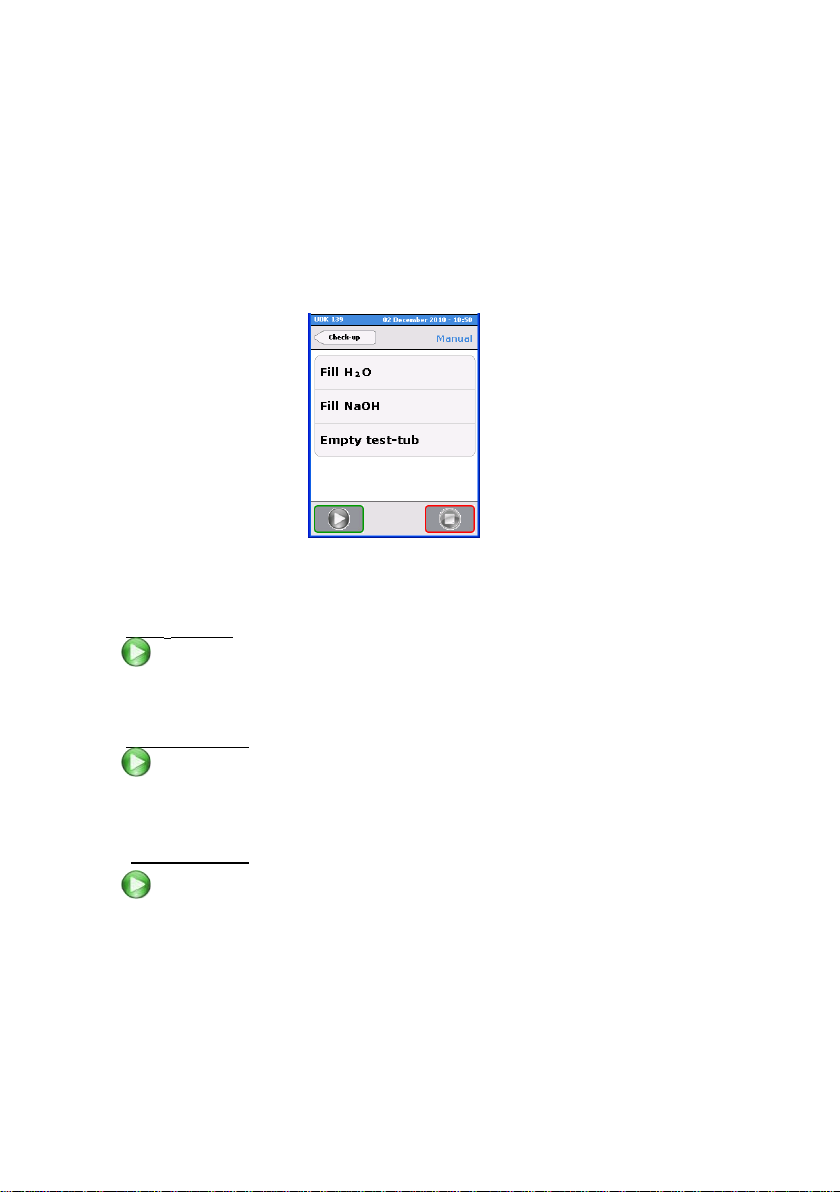
Manual check-up
Select “Manual check-up” from the “Check-up” menu. The following window
appears:
To return to the “Check-up” menu press the arrow in the upper left corner.
Select Fill H2O circuit to fill the dilution water circuit.
Press to start filling.
The green flag on the right indicates that the operation was carried out correctly, a
red X indicates that the operation was not successful.
Select Fill NaOH circuit to fill the sodium hydroxide circuit.
Press to start filling.
The green flag on the right indicates that the operation was carried out correctly, a
red X indicates that the operation was not successful.
Select Empty test-tube to remove the reagents from the test tube.
Press to start aspiration.
The green flag on the right indicates that the operation was carried out correctly, a
red X indicates that the operation was not successful.
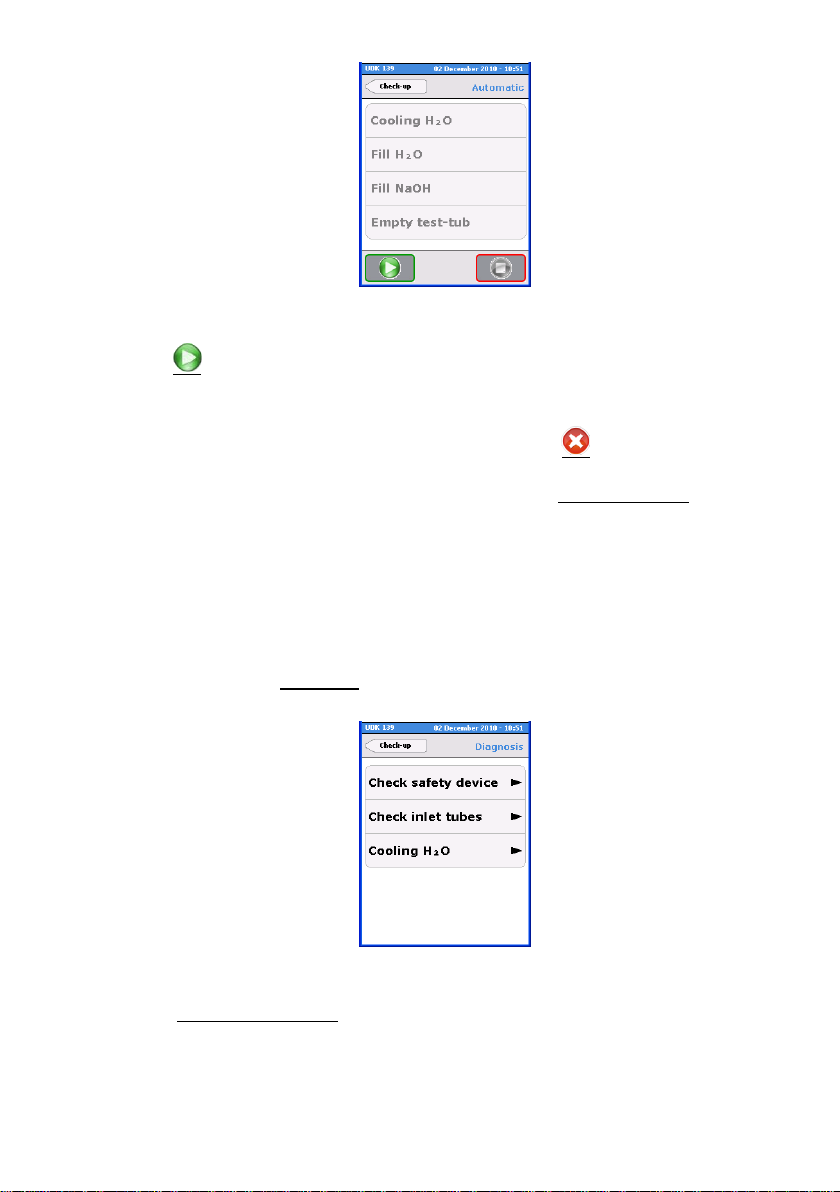
Automatic check-up
Select “Automatic check-up” from the “Check-up” menu. The display shows:
10004762/B5
Page 33
Velp Scientifica – UDK139 Operating Manual
33
220
To return to the “Check-up” menu press the arrow in the upper left corner.
Press to start all the operations listed automatically.
The green flag on the right indicates that the operation was carried out correctly, a
red X indicates that the operation was not successful.
The procedure can be interrupted at any time by pressing .
If at the end of the procedure one or more operations are marked with a red X, press
the back arrow to return to the "Check-up" menu. Select Manual check-up and carry
out the manual procedure for the option that failed during the automatic control.
NOTE: if a check-up has failed identify the cause before repeating the operation.
Diagnosis
This option is used to check the correct functioning of safety devices, level sensors
and water detector.
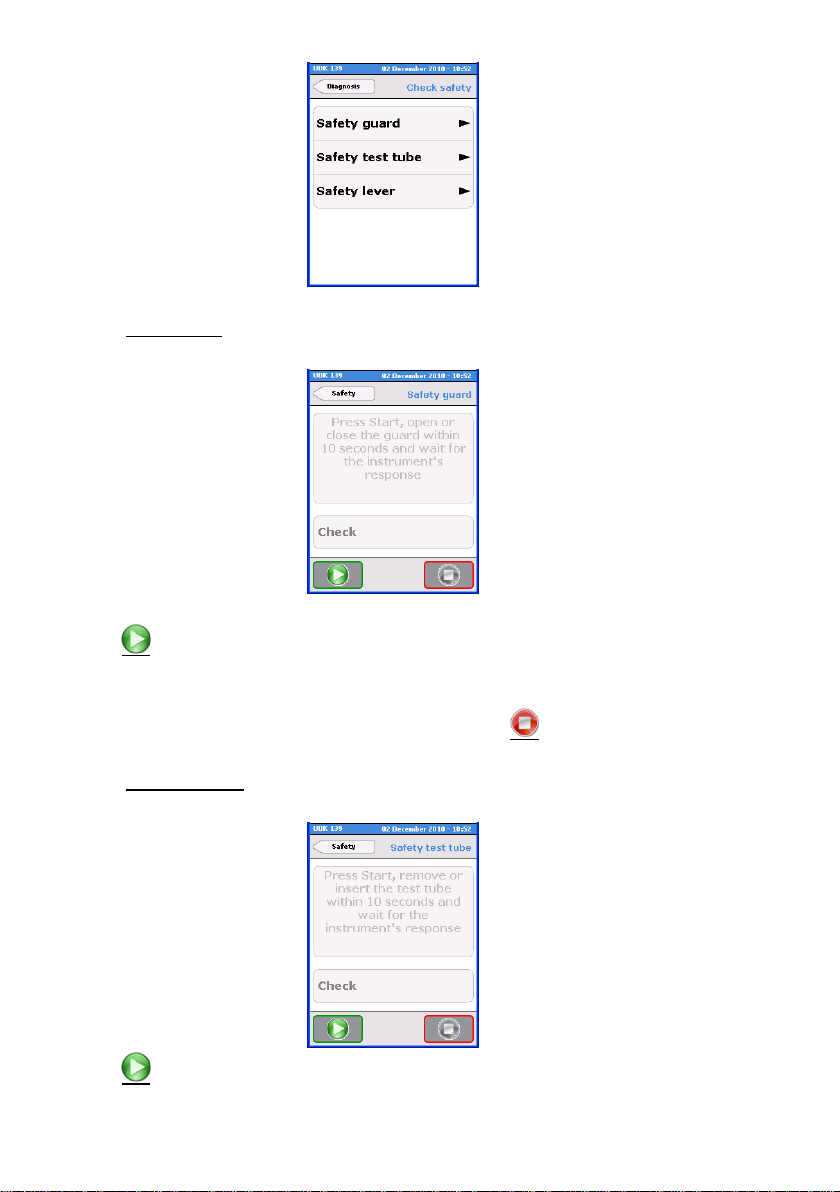
Select the submenu Diagnosis, the display shows:
To return to the “Check-up” menu press the arrow in the upper left corner.
Select Check safety devices. The display shows:
10004762/B5
Page 34
Velp Scientifica – UDK139 Operating Manual
34
221
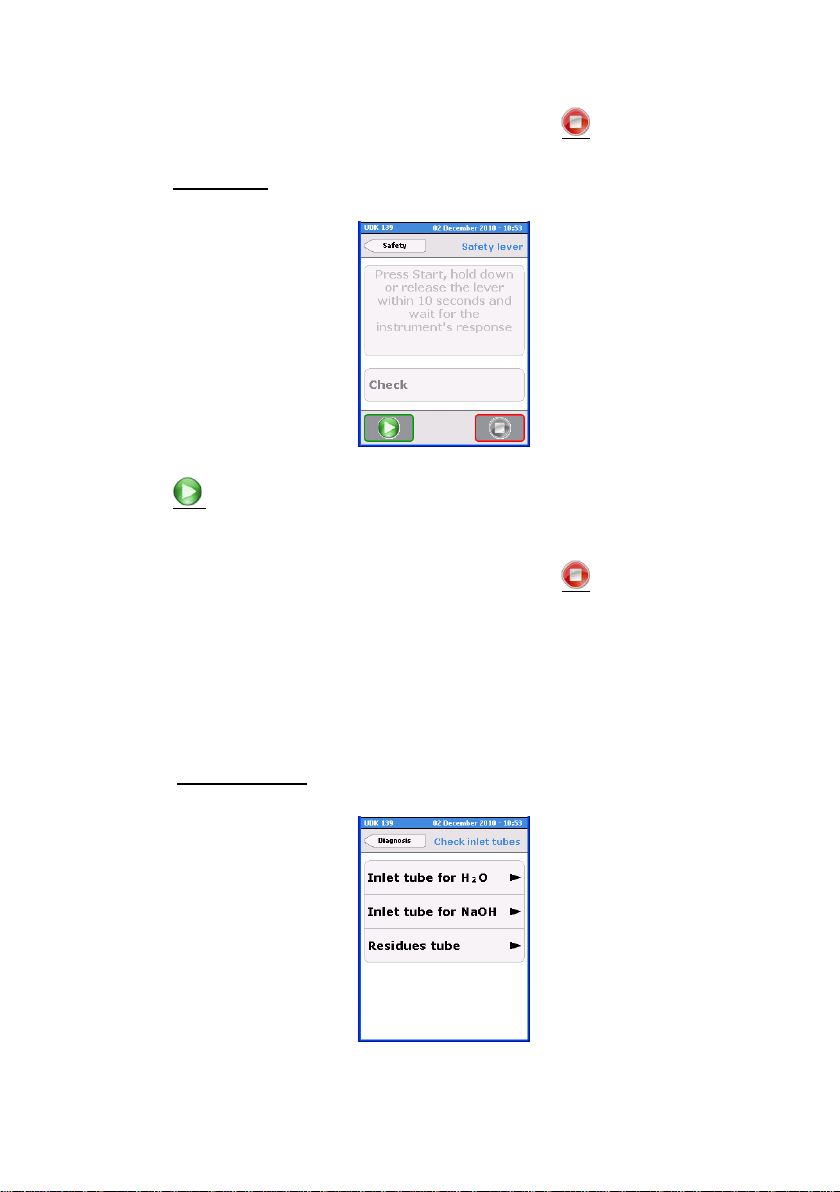
Select Safety guard. The display shows:
Press and follow the instructions on the display.
The green flag on the right indicates that the operation was carried out correctly, a
red X indicates that the operation was not successful.
The procedure can be interrupted at any time by pressing .
Select Safety test tube. The display shows:
Press and follow the instructions on the display.
10004762/B5
Page 35
Velp Scientifica – UDK139 Operating Manual
35
222
The green flag on the right indicates that the operation was carried out correctly, a
red X indicates that the operation was not successful.
The procedure can be interrupted at any time by pressing .
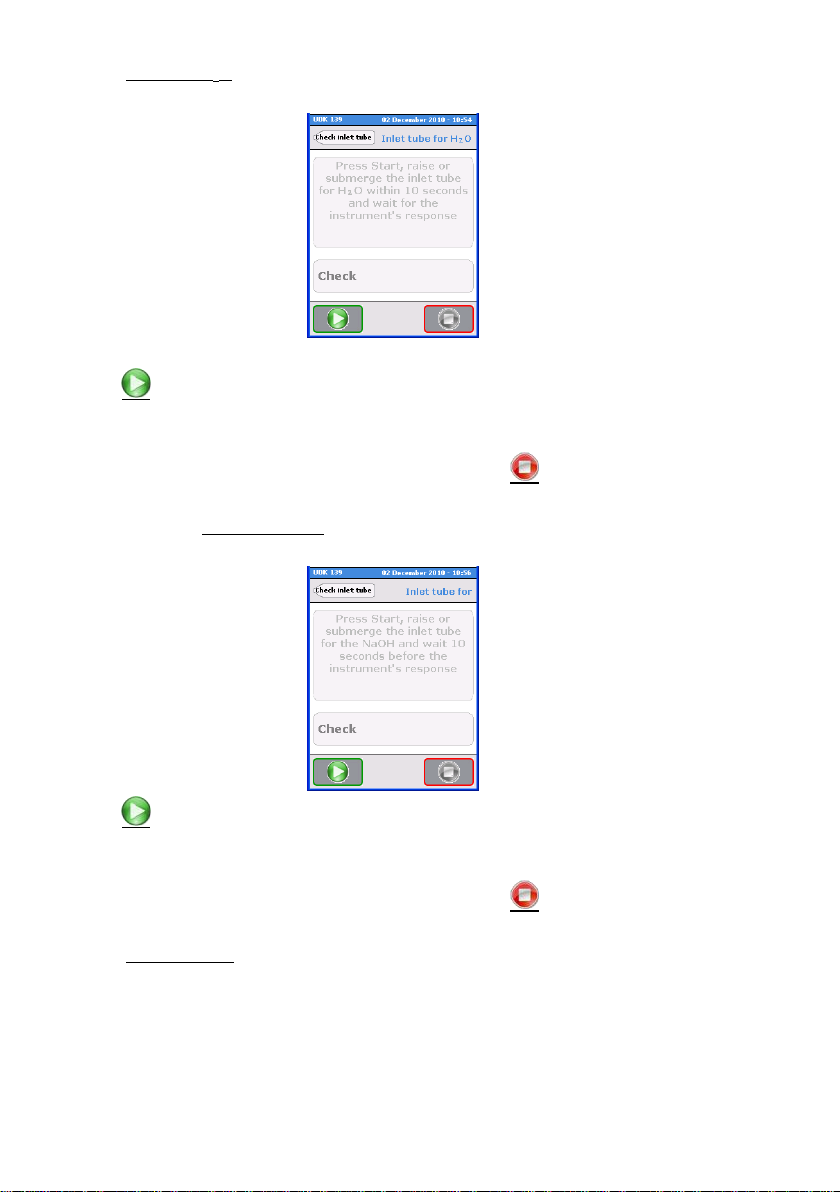
Press Safety lever. The display shows:
Press and follow the instructions on the display.
The green flag on the right indicates that the operation was carried out correctly, a
red X indicates that the operation was not successful.
The procedure can be interrupted at any time by pressing .
Press the arrow top left to return to the "Diagnosis" menu.
It is also possible to check the correct functioning of the level sensors on the tubes
supplied with the instrument for loading reagents and discharging the overflow of
residues.
Select Check inlet tubes. The display shows:
10004762/B5
Page 36
Velp Scientifica – UDK139 Operating Manual
36
223
Select Inlet tube H2O. The display shows:
Press and follow the instructions on the display.
The green flag on the right indicates that the operation was carried out correctly, a
red X indicates that the operation was not successful.
The procedure can be interrupted at any time by pressing .
Press the button Inlet tube NaOH. The display shows the following screen:
Press and follow the instruction on display.
The green flag on the right indicates that the operation was carried out correctly, a
red X indicates that the operation was not successful.
The procedure can be interrupted at any time by pressing .
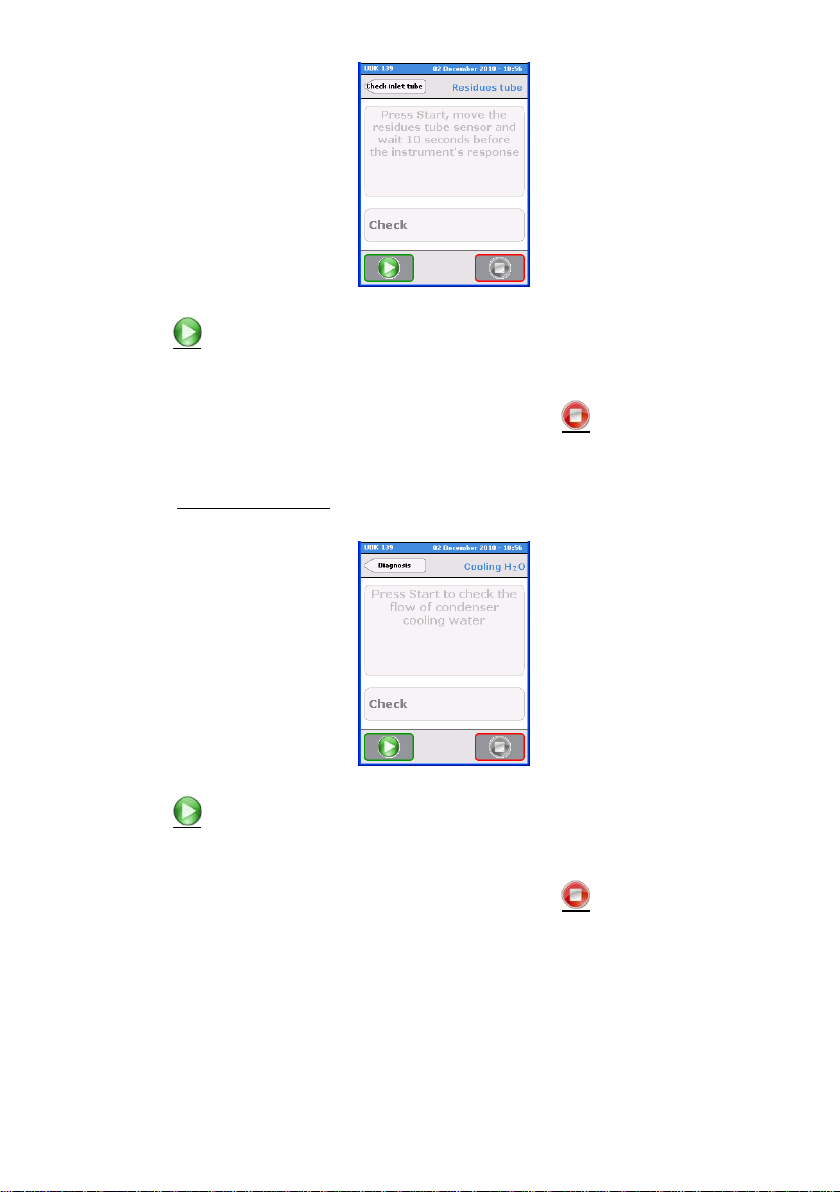
Select Residues tube. The display shows:
10004762/B5
Page 37
Velp Scientifica – UDK139 Operating Manual
37
224
Press and follow the instructions on the display.
The green flag on the right indicates that the operation was carried out correctly, a
red X indicates that the operation was not successful.
The procedure can be interrupted at any time by pressing .
Press the arrow top left to return to the "Diagnosis" menu.
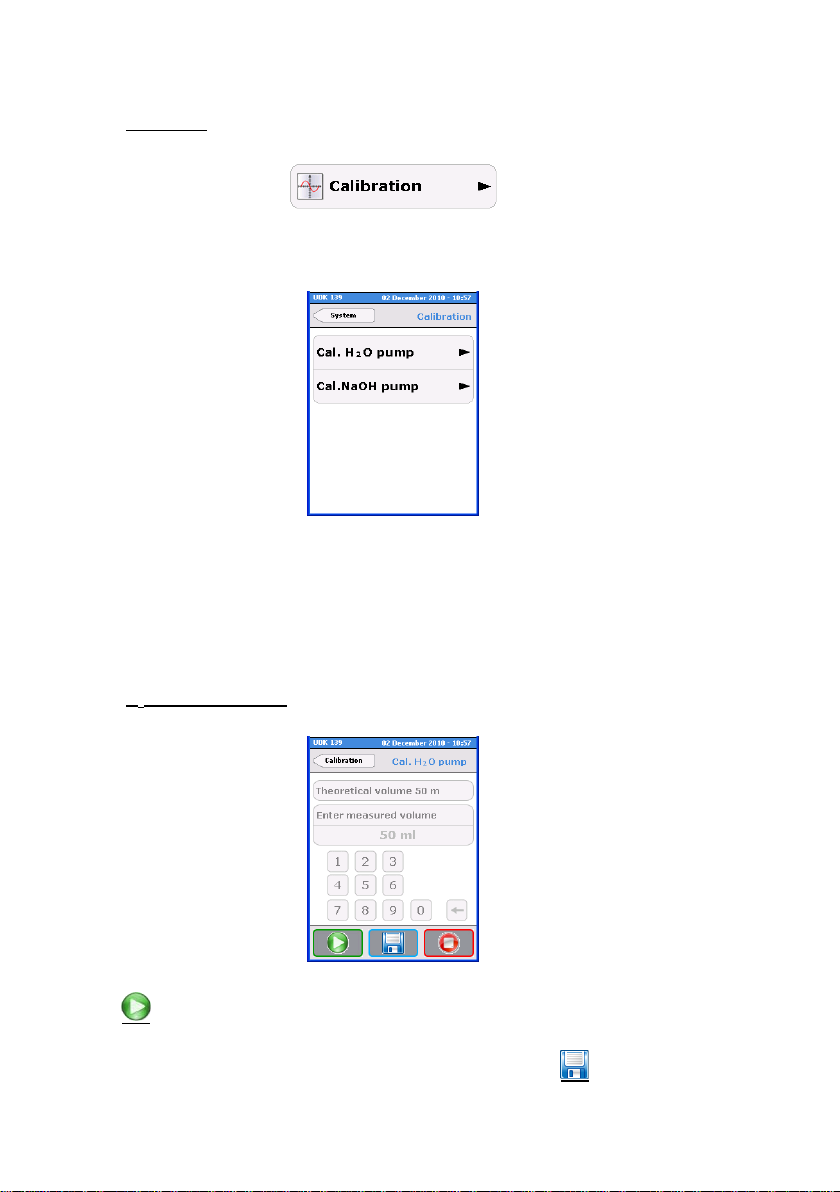
Select Check cooling water. The display shows:
Press to check the correct flow of cooling water in the hydraulic circuit.
The green flag on the right indicates that the operation was carried out correctly, a
red X indicates that the operation was not successful.
The procedure can be interrupted at any time by pressing .
10004762/B5
Page 38
Velp Scientifica – UDK139 Operating Manual
38
225
4.6.2. Calibration
Select Calibration from the “System” menu.
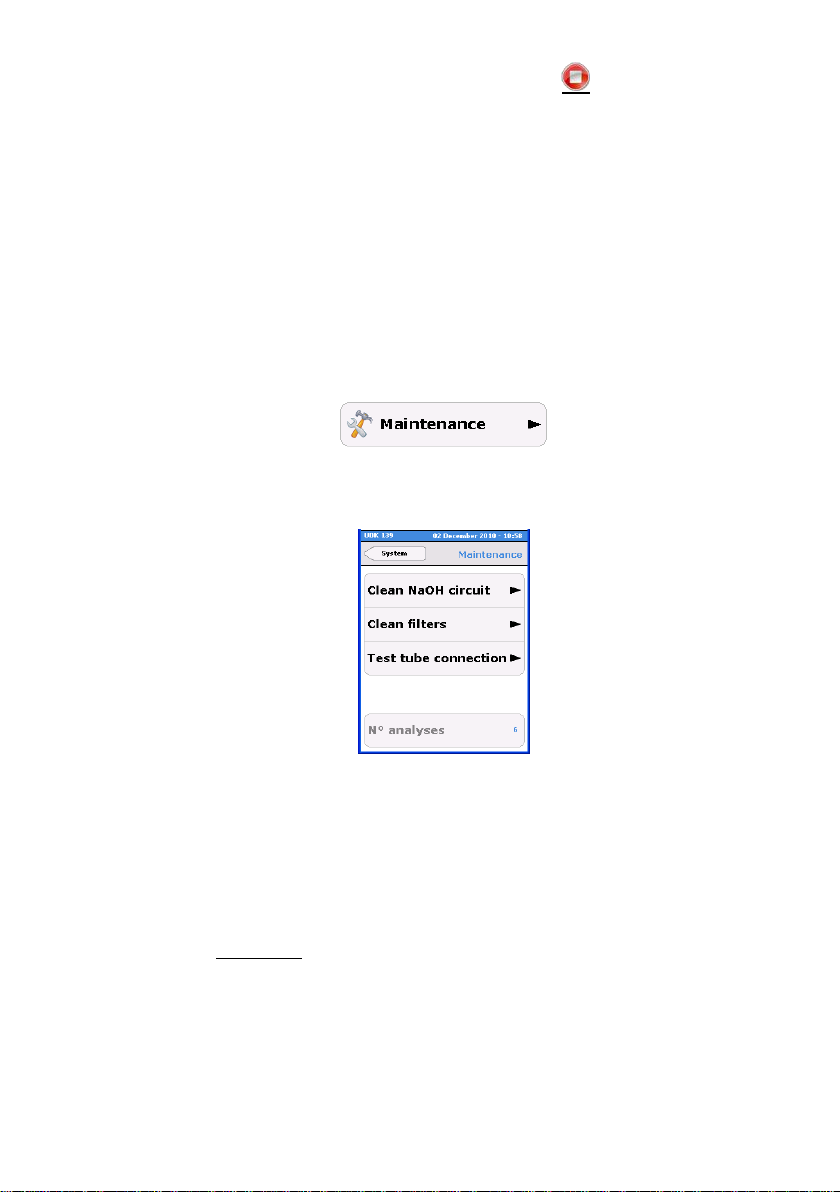
The following sub-menus are listed:
To return to the "System" menu press the arrow top left.
The "Calibration" menu is used to calibrate the flow rate of the reagent pumps.
NOTE: Make sure that the hydraulic circuits are filled before calibrating (see "Checkup").
Select H2O pump calibration. The display shows:
Press to begin the process. The instrument measures 50ml of diluting water.
Transfer the reagent (diluting water) to a graduated cylinder to measure the real
volume. Use the numeric keypad to enter the real volume, press confirm.
Repeat the procedure for the NaOH pump.
10004762/B5
Page 39
Velp Scientifica – UDK139 Operating Manual
39
226
The procedure can be interrupted at any time by pressing .
NOTE: If you wish to double-check correct dosage after calibration, this should be
done during a normal work-cycle since during calibration a theoretical volume of
50ml only can be measured.
NOTE: The instrument is calibrated before leaving the factory therefore calibration
by the user is only necessary if one of the reagent pumps is replaced or if a different
concentration of NaOH is used.
4.6.3. Maintenance
Select “Maintenance” from the “System” menu.
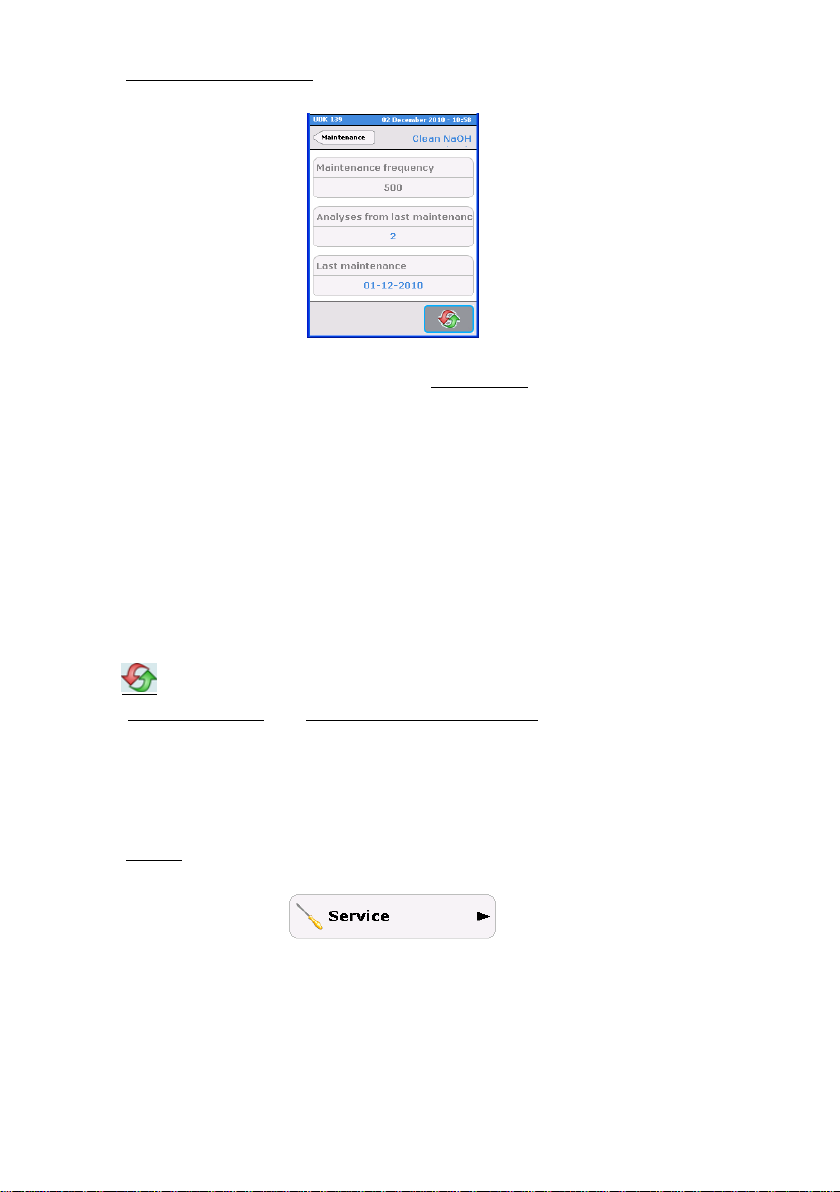
The following submenus are listed:
To return to the "System" menu press the arrow top left.
Each line shows the type of maintenance followed by the number of analyses
performed since the last maintenance was carried out and the recommended
maintenance interval. The maintenance interval is updated if the maintenance is
postponed.
The total number of analyses performed by the instrument is also shown.
NOTE: The N° analysis is a read-only field.
Cleaning the NaOH tubes and reagent filters and replacing the test tube
connection.
10004762/B5
Page 40
Velp Scientifica – UDK139 Operating Manual
40
227
Select Cleaning of NaOH circuit from the “Maintenance” menu, the display shows:
To return to the "Maintenance" menu press the Maintenance arrow top left.
The following information is displayed:
- Maintenance frequency. Maintenance is recommended every 500 analyses;
- Analyses from last maintenance;
- Date of last maintenance (DD-MM-YYYY).
Maintenance is recommended every 500 analyses (1000 analyses in case of
replacing the test tube connection). After 500 analyses from the last maintenance
(1000 analyses in case of replacing the test tube connection), when the instrument is
turned on a prompt recommends that maintenance be carried out. If the operator
chooses to defer maintenance, the prompt is repeated after an additional 20
analyses. In that case the maintenance interval is updated too (e.g. from 500 to
520).
Press to reset the analysis counter and date.
Select Cleaning of filters and Replace Test tube connection and repeat the above
steps to check the maintenance status of each.
4.6.4. Service
Select Service from the "System" menu.
The following submenus are listed:
10004762/B5
Page 41
Velp Scientifica – UDK139 Operating Manual
41
228
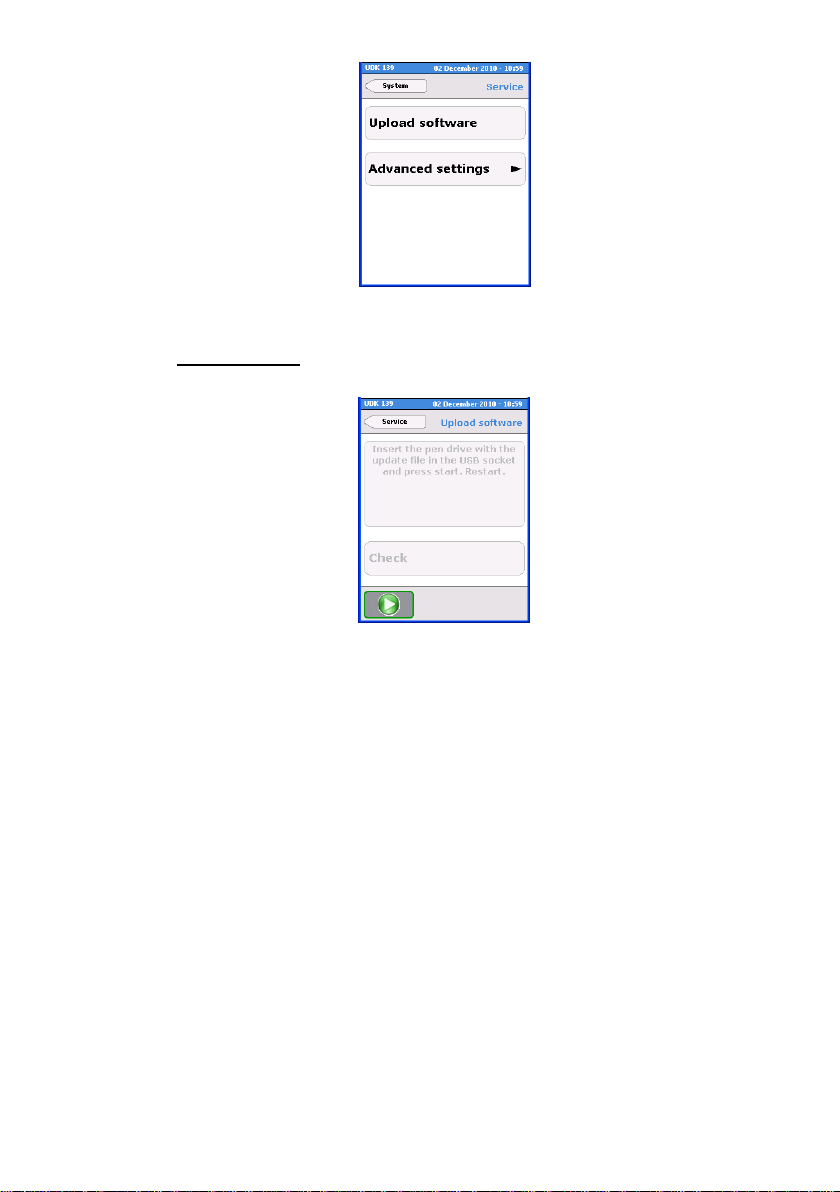
To return to the "System" menu press the arrow top left.
Select Upload software. The display shows:
The software can be upgraded by following a few simple, guided steps.
Insert the USB pen drive containing the updated software file into the USB port of
the instrument.
A green flag on the display indicates that the software was uploaded correctly, a red
X indicates that the procedure failed. In this case check that the USB pen drive is in
good working order, that it is inserted properly in the USB socket and that the name
of the file is UDK139_update.zip.
Follow the instructions on the display to complete the upgrade procedure.
If there is a power failure during upgrade, restore the electricity and turn the
instrument off for 5 seconds. Turn the instrument on again and check the software
version shown at the bottom of the display to make sure that the upgrade was
uploaded successfully.
10004762/B5
Page 42

Velp Scientifica – UDK139 Operating Manual
42
229
5. Operating Controls
5.1. Safety devices, signals and warnings
5.1.1. Safety devices
The instrument is equipped with various safety devices that can prevent start-up or
interrupt a work-cycle to protect the operator and the instrument itself.
Test tube:
If the test tube is not correctly positioned analysis will not start when START is
pressed. An acoustic signal warns the operator of an error and the following warning
message appears on the display for a few seconds: “AL3. Insert test tube”.
If an attempt is made to remove the test tube during a work cycle an acoustic signal
warns of the danger, the above warning message appears and the work cycle is
interrupted.
Safety guard:
If the safety guard in front of the test tube is not closed analysis will not start when
START is pressed. An acoustic signal warns the operator of an error and the
following warning message appears on the display: "AL4. Close protection".
If the safety guard is opened during a work cycle an acoustic signal warns of the
danger, the above warning message appears and the instrument continues the work
cycle in progress.
Safety lever:
If the lever is not released, analysis will not start when START is pressed. An
acoustic signal warns the operator of an error and the following warning message
appears on the display:"AL5. Release lever".
If the lever is lowered accidentally during a work cycle, an acoustic signal warns of
the danger, the above warning message appears and the instrument continues the
work cycle in progress.
Safety guard + Safety lever:
If during the work cycle the safety guard is not closed and the handle is not released,
an acoustic signal warns of the danger and the display shows the message "AL14.
Close safety guard. Release lever." automatically blocking the work-cycle.
These safety devices are active throughout analysis.
10004762/B5
Page 43

Velp Scientifica – UDK139 Operating Manual
43
230
5.1.2. Reserves and overfilling
Reserves
An automatic warning system notifies the operator of low reagent levels during
analysis. The external reagent tubes supplied with the unit are fitted with level
sensors. The level sensors should be connected to the “Reserve” contact of the
corresponding inlet connection on the rear panel of the unit.
If the level of reagent in the tank falls below the minimum, when Start is pressed from
the “Analysis” or “Check-up” menu, the display shows one or more of the following
messages:
“AL6. Low H2O level”
“AL7. Low NaOH level”
Top-up the tank in question with the relative reagent.
It is possible to start the work-cycle even with a reserve alert active by pressing
Continue.
NOTE: Check reagent levels using the "Check-up" menu, the instrument will indicate
if any of the reagents are in reserve (see chapter 4.6.1).
IMPORTANT
Do not remove the reagent tubes with level sensors from the tanks as this cause a
partial emptying of the tubes. When a reagent is in reserve the tank should be
topped-up rather than replaced in order to avoid emptying the tubes.
If a tank is replaced, fill the tubes as described in “Check-up" (Chapter 4.6.1).
Overfilling
The unit is fitted with a dedicated hydraulic circuit for the removal of distillation
residues which are conveyed to a tank for disposal according to the regulations in
force in the place of installation.
The residues removal tube with level sensor should be connected to OUTLET
Distillation Residues on the rear of the unit and the electric contact of the level
sensor to the corresponding “Full” contact .
If the level of waste inside the tank exceeds the threshold defined by the level
sensor, when Start is pressed in the "Analysis" or "Check-up" menu, the display
shows "AL9. Residues overflow”.
Empty or replace the residues tank.
It is possible to start the work-cycle even with the overflow alert active by pressing
Continue.
NOTE: Check the level of the overflow tank using the "Check-up" menu, the
instrument will report the overflow (see chapter 4.6.1).
10004762/B5
Page 44

Velp Scientifica – UDK139 Operating Manual
44
231
5.1.3. Warning signals and messages
Warning signals during the work-cycle
Insufficient cooling water
The unit is fitted with flow meter that measures the cooling water flow rate.
If the tap has not been turned on or the tap water flow rate is too low:
- when the instrument is turned on, the display shows "AL10. Flow rate H2O
insufficient" to remind the operator to restore a sufficient flow of water:
- in the case of insufficient water supply during the work-cycle, an acoustic signal
warns the operator of an error and the display shows the above message whilst
continuing the work-cycle. If the minimum flow-rate is not restored within 20 seconds
the cycle is automatically interrupted;
- in the case of insufficient water supply when Start is pressed in the "Automatic
Check-up" menu, the display shows the above message whilst continuing the workcycle;
- in the case of insufficient water supply when Start is pressed in the "Clean vessel"
menu, the display shows the above message and the cycle is automatically
interrupted.
Change test tube
The unit is fitted with a sensor that detects whether the test-tube has been changed
between analyses. If the test tube has not been changed, when START is pressed
an acoustic signal warns the operator of the error and the display shows the following
message:
”AL11. Change test tube”.
Press Start to start the cycle without changing the test tube.
Warning messages
Preheating
When the instrument is turned on a yellow stripe at the top of every page of the
software warns the operator that preheating of the steam generator is in progress. If
Start is pressed for a work-cycle that requires the production of steam, the display
shows: "Preheating in progress".
The end of preheating is signaled by a beep and the yellow stripe at the top of the
display is replaced by a blue stripe. Press Start to start the work-cycle.
Check name and quantity of sample
If Save was not pressed after entering the analysis parameters for Single distillation
or Distillation in series, when Confirm is pressed the following prompt appears:
“Check Name/Q.ty of sample”. Press Continue.
Press Confirm to confirm the sample name and quantity previously entered followed
by Start to proceed with the analysis.
Value out of range
When Save is pressed after entering the analysis parameters, the display will show
"Value out of range" to indicate an unacceptable value. Press Continue, the
incorrect value will automatically be deleted and a new value can be entered.
10004762/B5
Page 45
Velp Scientifica – UDK139 Operating Manual
45
0
5
10
15
20
25
30
35
40
0% 10% 20% 30% 40% 50% 60% 70% 80% 90% 100% 110%
DISTILLATION TIME (min)
STEAM FLOW (%)
WITH AN EMPTY TEST TUBE
WITH 100 ml OF WATER AT 15°C IN THE TEST TUBE
30'
34'
12'40''
11'30''
2
6'30''
5'45''
5'30''
4'45''
4'45''
4'
3'45''
3'20''
3'
2'45''
232
5.1.4. Black-out
A power failure during analysis will result in the analysis in progress being lost. The
previously entered analysis parameters will be retained. When the electricity is
restored the unit will carry out preheating before starting analysis.
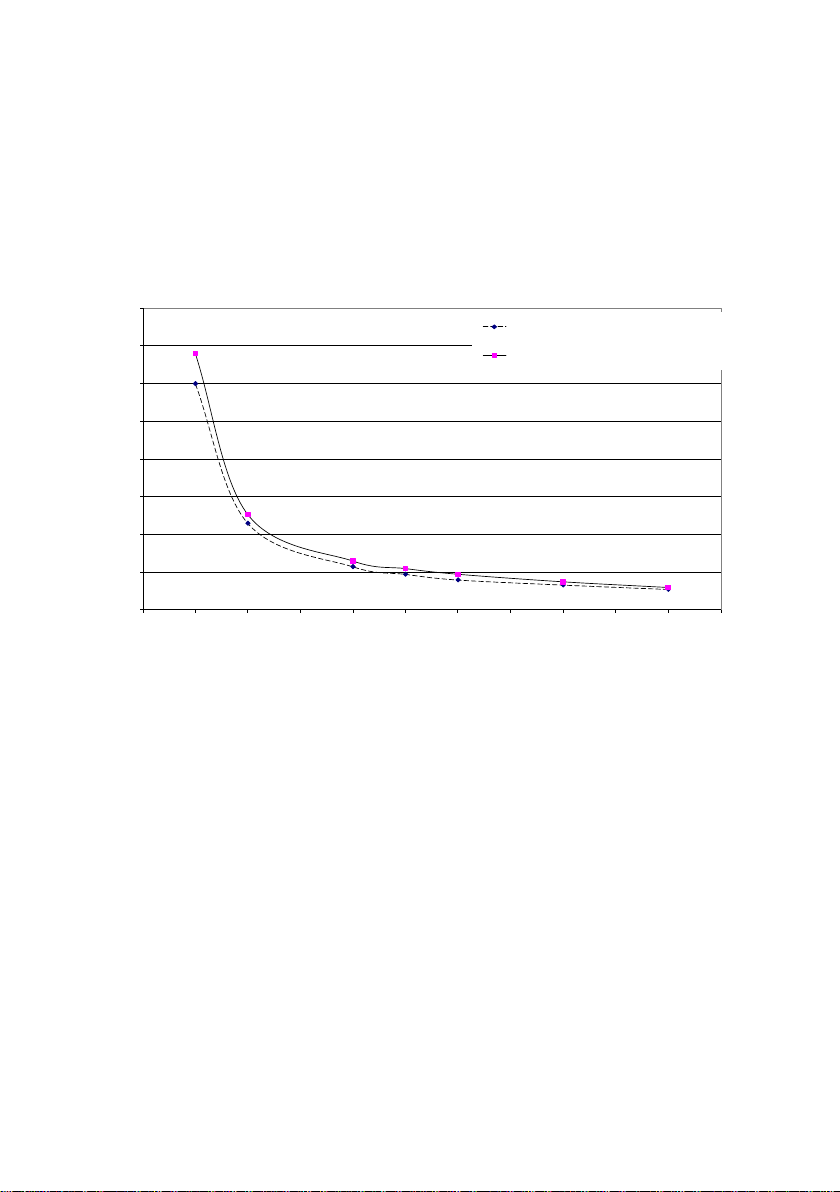
5.2. Graph of steam production
The time required to produce 100ml of distillate at different steam production rates is
shown in the following graph:
The UDK139 Semi-automatic Distillation Unit can produce 100ml of distillate in just 4
minutes (see graph). Steam production can be set from 10% to 100% in order to
perform fast or slow distillations.
10004762/B5
Page 46
Velp Scientifica – UDK139 Operating Manual
46
233
5.3. Graph of tap water consumption related to the
water flow rate and temperature
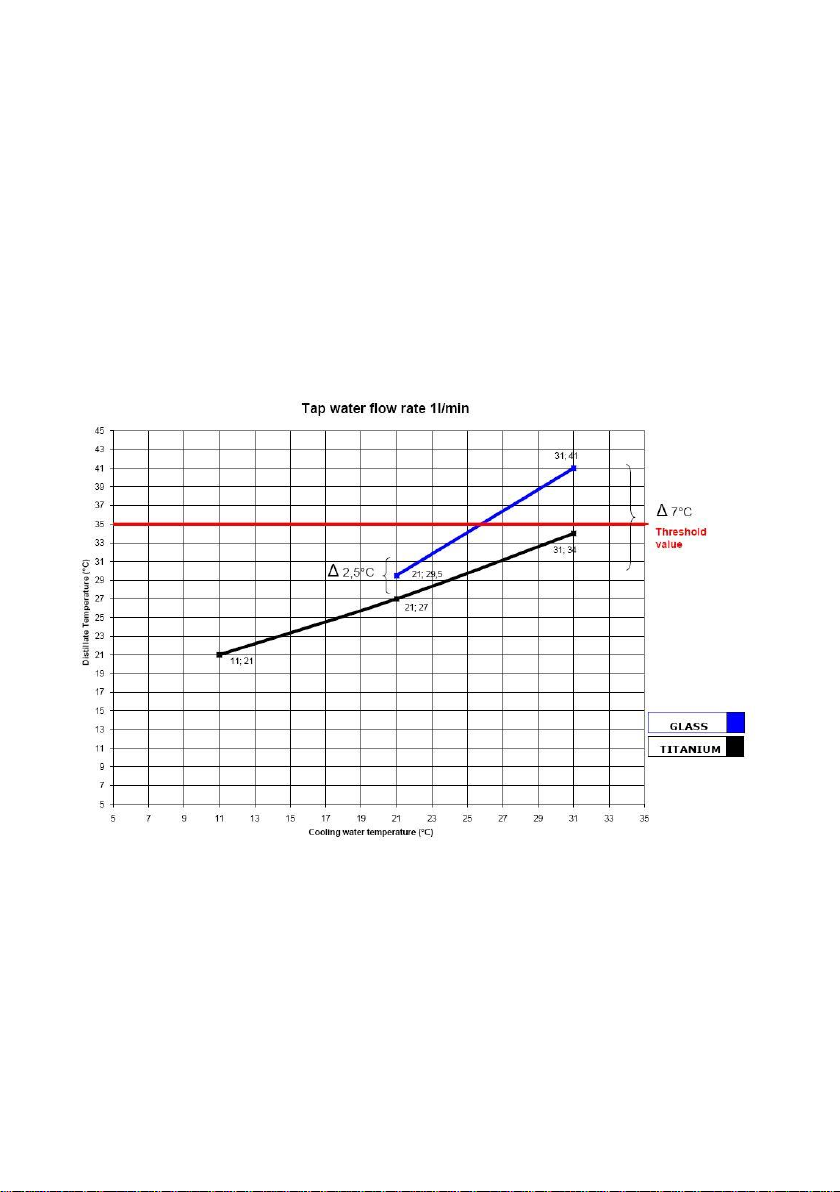
The graph below shows the efficiency of the patented Velp titanium condenser
compared to traditional glass condensers.
It is important to underline how the new titanium condenser keeps the temperature of
the distillate below the threshold value (35°C) indicated by the Kjeldahl method
without increasing the tap water flow rate (1l/min).
NOTE: The Kjeldahl method recommends a maximum distillate temperature of 35°C
in order to avoid loss of nitrogen.
As shown in the graph, a distillate temperature of 34°C is obtained by the titanium
condenser using tap water at a temperature of 31°C. The temperature of the distillate
using a conventional glass condenser would be 41°C under the same conditions.
The titanium condenser is also highly efficiency at low temperatures. With a tap
water temperature of 21°C, a distillate temperature of 27°C is obtained using the
titanium condenser compared to 29.5°C using a conventional glass condenser.
The new titanium condenser reduces tap water consumption to a minimum. In fact
the high thermal exchange means that a tap water flow rate of 0.5 l/min is sufficient
for the analyses to be carried out correctly.
10004762/B5
Page 47

Velp Scientifica – UDK139 Operating Manual
47
234
6. Work cycle
The unit can perform different types of analysis:
Analysis
Devarda’s analysis
The steps involved for each method are shown below.
6.1. Analysis
1. Switch on the instrument using the ON/OFF switch on the rh side of the
instrument;
2. The instrument carries out preheating lasting 3 minutes;
3. Turn on the tap water;
4. Position the empty test tube;
5. Position the anti-skid disk on the flask stand;
6. Position the flask on the anti-skid disk;
7. Make sure that the distillate outlet tube is correctly positioned in the flask (it
should reach the bottom of the flask)
8. Carry out manual or automatic check-up;
9. Carry out one or more wash-downs;
10. Carry out one or more blank analyses;
11. Position the test tube containing the sample;
12. Select the analytical method required.
13. Enter the GLP data for the analysis (operator name, sample name, sample
quantity, distillation time);
14. Start analysis.
15. An acoustic signal indicates that the work cycle has terminated.
16. Remove the test tube and replace it with a new sample. If distillation series has
finished, place an empty test tube in the unit.
17. Press to start a new analysis.
6.2. Devarda’s analysis
1. Switch on the instrument using the ON/OFF switch on the rh side of the
instrument;
2. The instrument carries out preheating lasting 3 minutes;
3. Turn on the tap water;
4. Position the empty test tube;
5. Position the anti-skid disk on the flask stand;
6. Position the flask on the anti-skid disk;
7. Make sure that the distillate outlet tube is correctly positioned in the flask (it
should reach the bottom of the flask)
8. Carry out manual or automatic check-up;
9. Carry out one or more wash-downs;
10. Carry out one or more blank analyses;
11. Position the test tube containing the sample;
12. Select the analytical method required making sure that a Pause value >0:00 has
been entered;
13. Enter the GLP data for the analysis (operator name, sample name, sample
quantity, distillation time);
10004762/B5
Page 48

Velp Scientifica – UDK139 Operating Manual
48
235
14. Start analysis.
15. An acoustic signal indicates that the work cycle has terminated.
16. Remove the test tube and replace it with a new sample. If distillation series has
finished, place an empty test tube in the unit.
17. Press to start a new analysis.
7. End-of-work operations
Before turning the instrument off at the end of the working day carry out a washdown from the “Analysis” menu;
At the end of the wash cycles:
1. Turn off the tap water;
2. Switch off the unit.
NOTE: Always leave an empty test tube in place to avoid drips.
10004762/B5
Page 49
Velp Scientifica – UDK139 Operating Manual
49
236
8. Maintenance
The instrument is fitted with a cycle counter that alerts the operator through
messages on the display when routine/extraordinary maintenance is required.
The front panel (service door) of the instrument opens fully to allow easy and safe
access to the internal parts in order to carry out the following operations:
Simple and immediate inspection of internal parts
Remove and clean the drip tray
Remove the test tube connection
Servicing the instrument (routine and extraordinary maintenance) is very important to
keep the unit in good working order and to extend its life time. Follow the instructions
given below.
8.1. Routine maintenance
Routine maintenance should be carried out at the end of each use. Follow the
instructions below:
Carry out a Wash-down before turning off the unit by selecting Wash-down from
the “Analysis” menu.
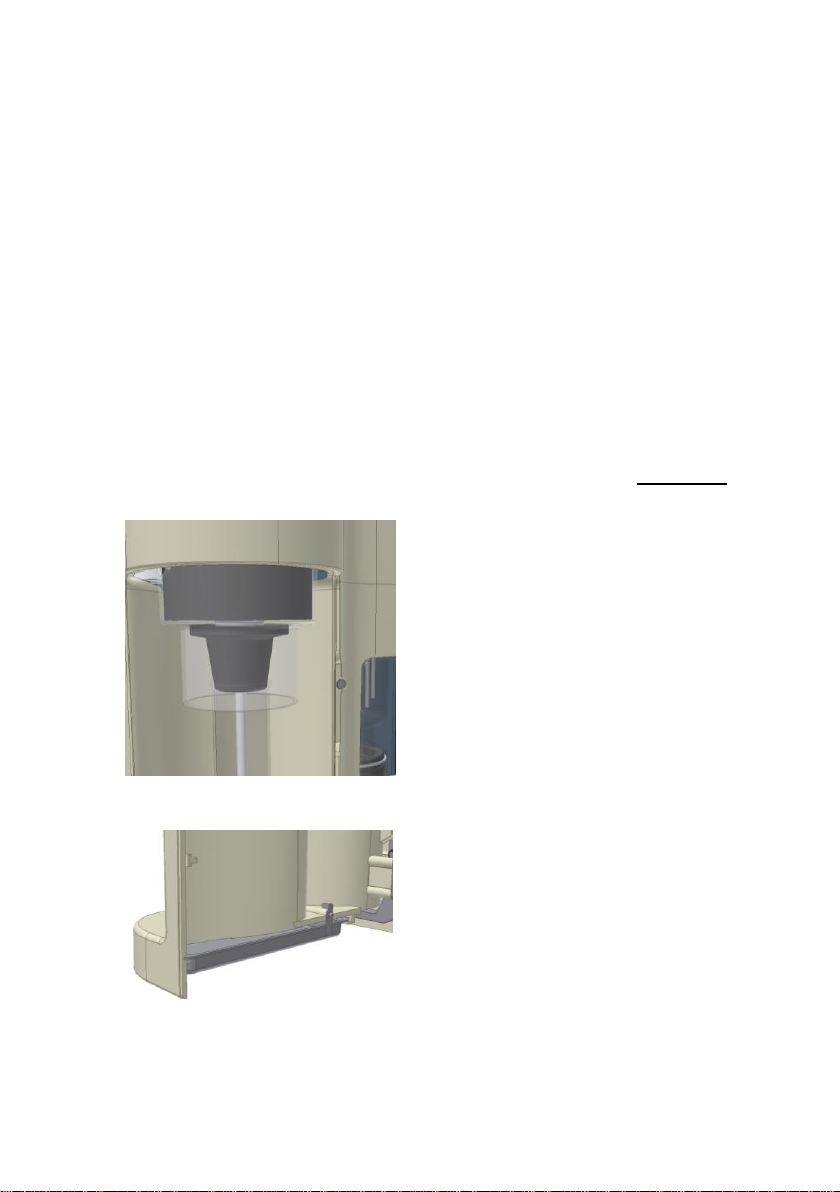
Clean the test-tube connection, the
plastic guard and any trace of sample on
the surface of the instrument using a
cloth or sponge dampened with plain
water
Rinse or wipe clean the drip tray (to
remove the drip tray open the service
door and release the catch).
10004762/B5
Page 50

Velp Scientifica – UDK139 Operating Manual
50
237
8.2. Extraordinary maintenance
Extraordinary maintenance operations not included in this manual and the
servicing of internal parts, must be carried out by persons expressly authorized by
VELP Scientifica.
In order to reduce the risks arising from contact with reagents or solutions, the use
of suitable personal protective equipment (gloves, etc.) is recommended.
Periodic maintenance
Clean the sodium hydroxide tubes (NaOH). Every 500 analyses.
Clean the filters. Every 500 analyses.
Replace the test tube connection. Every 1000 analyses.
NOTE: Extraordinary maintenance is recommended every 500 or 1000 analyses.
The counters can be reset and the date of last maintenance entered in
"Maintenance" menu.
Operations to be performed only when necessary:
Replace fuses
Clean the condenser
Clean the inside of the safety guard
8.2.1. Periodic maintenance
Cleaning the sodium hydroxide tubes
(Frequency: every 500 analyses)
These tubes must be kept full at all times. When the sodium hydroxide solution
comes into contact with air, crystals are formed which obstruct the tubes and
jeopardize the correct functioning of the internal parts.
The tubes must be cleaned as part of extraordinary maintenance operations as
follows:
Place an empty test-tube in the unit
Place the end of the sodium hydroxide with with level sensor in a vessel
containing warm distilled water (approx. 40°C).
Following the procedure for filling the tubes manually (see chapter 4.6.1),
fill the circuit with at least 1 litre of water.
Using the same procedure, fill the tubes with sodium hydroxide solution.
Cleaning the filters
(Frequency: Every month or after 500 analyses)
The unit is fitted with 4 filters to remove particles, sediment or any other foreign
bodies from the tap water and reagents.
NOTE: Disconnect the unit from the electric power supply and water supply
10004762/B5
Page 51
Velp Scientifica – UDK139 Operating Manual
51
238
The filters are found on the tap water inlet and on the reagent inlets:
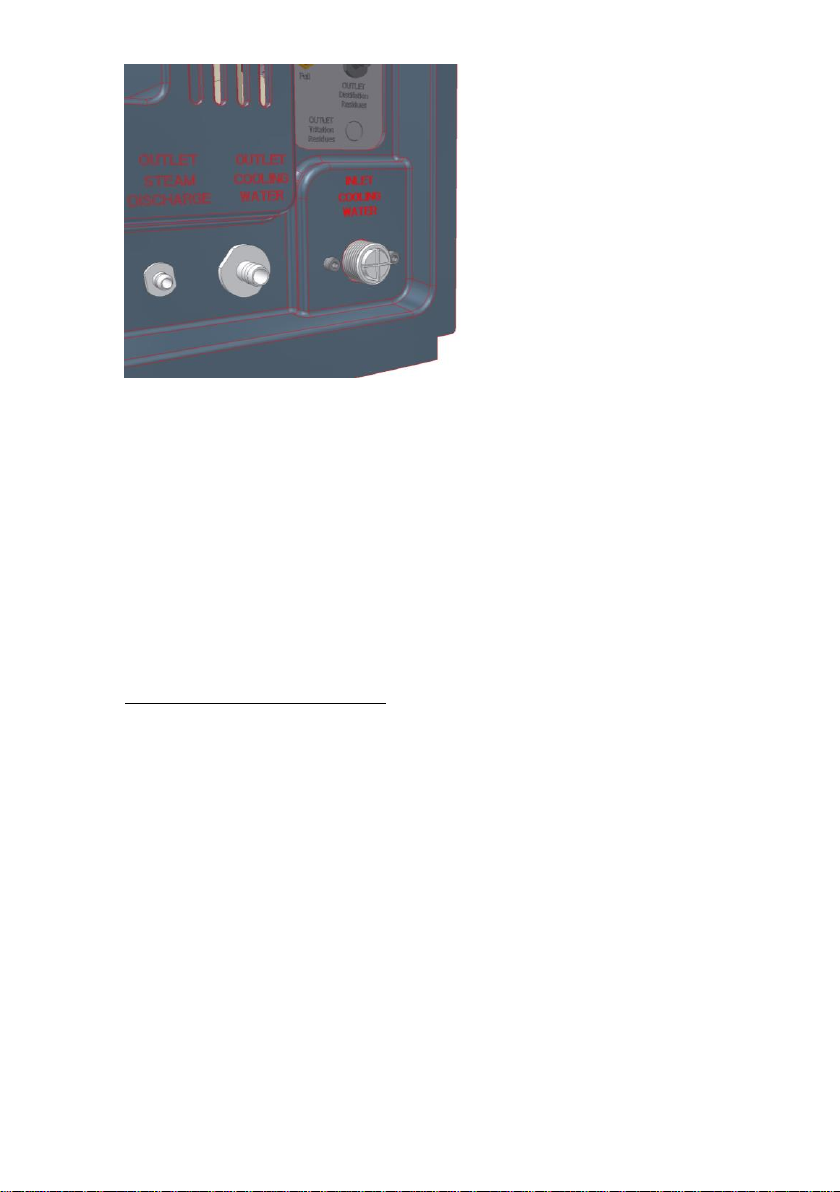
- Tap water inlet: remove the cooling water tube from the unit and pull the filter out
using small pincers. Clean the filter under running water or using compressed air
- Reagent inlets: the three reagent tubes with level sensors are fitted with filters
located at the lower extremity. Wearing protective gloves remove the filters by pulling
outwards. Open the filters by means of the ridge and wash under running water.
During this operation the tubes may empty. After repositioning the filters repeat the
manual filling of tubes (see chapter 4.6.1).
Replacing the test tube connection
(Frequency: Every 1000 analyses)
The test-tube connection must be replaced when it loses its elasticity, when it looks
deformed and does not provide a perfect seal, or after 500 analyses.
For easier removal carry out a wash-down cycle. The splash head can reach high
temperatures therefore take care when handling. Open the safety guard.
Remove the test tube, the test tube connection and the safety guard. The following
tips will facilitate removal:
1. Wearing a protective glove, grip the splash guard and rotate it whilst pulling
downwards.
2. Use a pointed tool or small screwdriver to exert leverage through the special
window accessed from the inside of the service door.
Proceed with replacement. The new test tube connection will be easily fitted if it is
soaked in warm water beforehand.
The splash guard should be cleaned using soft cloth dampened with warm water. Do
not use abrasive detergents or cleaning agents containing solvents.
10004762/B5
Page 52

Velp Scientifica – UDK139 Operating Manual
52
239
8.2.2. Operations to be performed only when necessary
Replacing fuses
Fuses should be replaced only when necessary, i.e. when the unit doesn’t turn on
and the mains switch does not light up. The fuses must only be replaced by qualified
personnel and only with fuses supplied by Velp Scientifica Srl.
To replace the fuses disconnect the unit from the power supply, unscrew the fuse
caps located on the back of the unit. The unit is fitted with one fuse for each phase:
FUSE diam. 6.3x32 mm, 15 A (250V).
Replacing the protective film on the touch screen
Only replace the protective film if it impairs visibility even after cleaning using a damp
cloth.
Cleaning the condenser
The condenser should be cleaned when it is heavily soiled with salts and organic
matter thus reducing the efficiency of heat exchange.
After switching off the unit:
1. Unscrew the water tube from the water tap and place the open end in a
receptacle containing water, preferably below the instrument. This triggers
the emptying of the hydraulic circuit and the condenser.
2. Open the service door of the instrument
3. Remove the metal clamp that supports the condenser by removing two
screws.
4. Detatch the black tube from the condenser inlet and outlet and remove it
from the instrument.
5. Unscrew the screw on the bottom flange of the condenser.
6. Unscrew the two white bushings on both flanges of the condenser.
7. Remove the coil. The condenser is now completely dismantled.
8. Wash the parts under running water or diluted hydrochloric acid to remove
any deposits.
9. Reassemble the condenser making sure the coil does not touch the walls
Cleaning the internal parts of the splash head
To clean the internal parts of the splash head and condenser, proceed as follows:
of the transparent tube and tighten the bushings and screws.
1. Fill a test tube with about 25ml of deionized water and 25ml of
concentrated acetic acid and position it in the unit.
2. Select a method without reagents, with a distillation time of 10 minutes and
without distillation residues removal;
3. Start analysis.
4. At the end of analysis empty the test tube by hand.
5. Carry out 2-3 distilling cycles with approx. 50ml of distilled water in the testtube to rinse the internal parts.
10004762/B5
Page 53

Velp Scientifica – UDK139 Operating Manual
53
240
8.3. Expedients for transport
The instrument must be transported in its original packaging and any indications
present on the original packaging must be followed (e.g. palletised). The caps must
be placed on the hydraulic connections.
NOTE: The tubes of the hydraulic circuit must be emptied and washed in order to avoid
reagent residues causing damage to the unit during the transport.
Before disconnecting the unit from the electric power supply and from the water
supply, empty the hydraulic circuit of tap water and reagent solutions following the
procedure described below
Place an empty test tube in the unit.
Remove the inlet tubes from their containers and turn them upside down to
prevent the reserve message appearing. Follow the instructions for filling the
tubes in “System” /"Check-up" / "Manual Check-up" to empty them completely.
Suck warm distilled water (approx. 40°C) into the sodium hydroxide tubes to
remove any crystals from the tubes and from the internal parts that come into
contact with the NaOH. Empty the circuit by removing the tube from the warm
distilled water and turning it upside down.
Disconnect the reagent tubes with level sensors from the connectors on the rear
panel of the unit (H2O, NaOH).
Unscrew the water tube from the water tap and place the open end in a
receptacle containing water, preferably below the instrument. This triggers the
emptying of the hydraulic circuit and the condenser.
When moving the instrument always use the special handles on the side of the
instrument.
10004762/B5
Page 54

Velp Scientifica – UDK139 Operating Manual
54
241
9. Disposing of the unit
For the temporary decommissioning always empty the tubes of reagents and
solutions, sodium hydrate in particular, as described in "Expedients for transport”.
The instrument is classified as electrical/electronic apparatus and must
be disposed of accordingly. The unit is subject to waste separation and
cannot be disposed of as urban waste under EEC directive 2002/96/CE.
For more information please contact the relative division of your local
town council.
10. Accessories
Description: Code
Test tube Ø 80x300 mm for alcohol determination A00001083
Test tube Ø 48x260 mm, 300 ml A00001088
Test tube diam. 42x300mm, 250ml, 3 pcs/box A00000144
Test tube diam. 26x300mm, 100ml, 6 pcs/box A00000146
Test tube Ø 50x300mm, 400ml A00000185
Spacer for test tube Ø 48x260 mm A00000206
Test tube connection Ø 26 mm, Ø 48 mm
and 500 ml Kjeldahl balloon A00000043
Printer (connection cable included) A00001009
Printer Adapter USB-RS232 A00000195
IQ/OQ/PQ Manual UDK 139 A00000204
Waterproof mouse A00000215
10004762/B5
Page 55

Velp Scientifica – UDK139 Operating Manual
55
Description (see chapter 1.2):
Code
Positioning disk with tube support
40001706
Standard test tube connection
10002322
Plastic guard for test tube connection
10004708
Inlet tube for H2O
40000153
Inlet tube for NaOH
40001023
Outlet tube for distillation residues
40000387
Inlet tube
10000280
PVC tube Ø10x14
10001087
Silicone tube Ø 6x9mm
10000020
Collecting flask 250 ml
10001106
Pincer for test tubes
10000247
Touch pen
10004936
Protective film for touch screen
* Retarded ceramic fuse 6,3x32mm 15A 250V
40001798
10006304
242
11. Spare parts
The above mentioned spare parts can be easily replaced by the operator. For other
spare parts (and for the complete list) please contact Velp Scientifica Srl’s nearest
Service Centre.
* Replace the fuses only when necessary, i.e. if the unit doesn’t turn on and the
mains switch does not light up. The fuses must only be replaced by qualified
personnel and only with fuses supplied by Velp Scientifica Srl.
To replace the fuses is needed:
- unplug the unit;
- locate the fuse holders at the back of the instrument;
- unscrew the fuse caps.
10004762/B5
Page 56

Velp Scientifica – UDK139 Operating Manual
56
243
12. Technical features
GENERAL
Power supply (AC) V/Hz 230~(+/- 10%)/50-60
Total electric power W 2200
Heating element power W 2000
Dimensions (W x H x D) mm 385x780x416
inch 15.2x30.7x16.4
Weight kg 26
lb 57.3
Display LCD graphic touch-screen
Languages UK – I – E – F – RUS - CN
Reserves Low reagent level signal
Overfilling Residues tank
Pollution degree 2
Overvoltage category II
Max. Altitude m 4000
Max. Admitted humidity % Max 85
Storage temperature range °C +5 ….+60
°F +41 …+140
Ambient temperature range °C +5 …..+40
°F +41 …+104
Fuses A 2x15A 250V
Sound Level dBA 35
PERFORMANCES
Nitrogen amount mgN 0.1 - 200
Reproducibility % ≤ 1
Recovery rate % 99.5
Detection limit mgN 0.1
Distilling time min:sec 4:00 (for 100ml of
distillate at 100%
steam output)
CONSUMPTION
Cooling water (during analysis only) l/1’ 1 to 30°C
from 0.5 to 15°C
Deionised water for Steam generator ml/1’ 50 at max. flow
Overflow signal
(Steam 100%)
10004762/B5
Page 57

Velp Scientifica – UDK139 Operating Manual
57
244
ANALYTICAL METHODS
Standard methods N° 10
Each method includes the following parameters:
Reference to official methods
H2O addition from 0 to 200 ml
NaOH addition from 0 to 150 ml
Pause from 00’.00” to 99’:59”
Distillation time up to 99’:59”
Steam power from 10 to 100 %
Distillation residues aspiration Yes/No
ANALYSIS DATA
The following parameters can be set for each analysis:
Method
Operator name
Sample name
Sample quantity g o ml
Notes
INTERFACES
N°2 USB for printer, USB pen drive, mouse
10004762/B5
Page 58
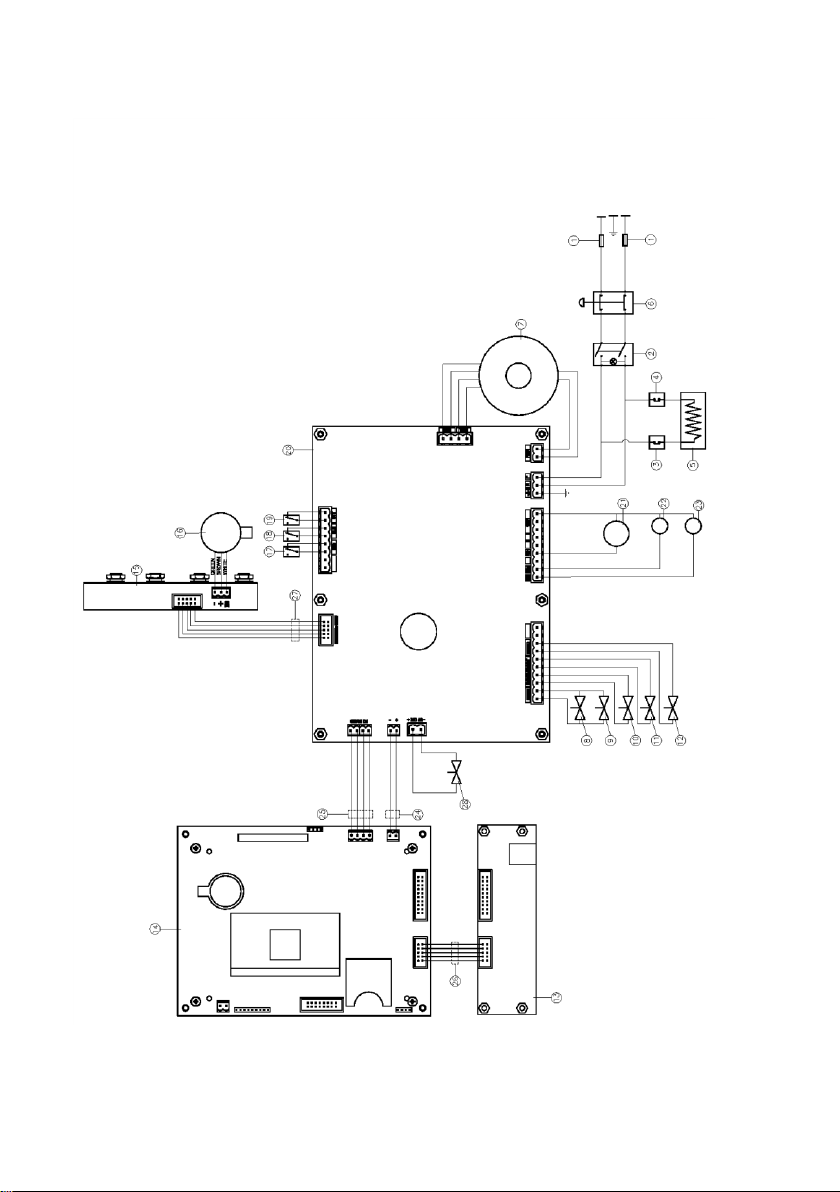
Velp Scientifica – UDK139 Operating Manual
58
245
13. Wiring diagram
10004762/B5
Page 59

Velp Scientifica – UDK139 Operating Manual
59
N°
Descrizione
1
Fuse 6.3x32 15A
2
ON/OFF switch with led
3
Operatingl thermostat
4
Safety thermostat
5
Steam generator
6
Door open trip switch
7
Steam generator
8
Steam electrovalve
9
Discharge electrovalve
10
Boiler outlet electrovalve
11
Distillation residues discharge electrovalve
12
Water inlet electrovalve
13
Electronic board for warning signals
14
Display board
15
Electronic board for reserve signals
16
Water flow detector
17
Safety microswitch for safety guard
18
Safety lever
19
Safety microswitch for test tube
20
Main board
21
Sodium hydroxide pump
22
Dilution water pump
23
Steam power pump
24
Cable 2 pole
25
Cable for PC board
26
Flat cable10-pole
27
Flat riserve
28
Vessel discharge electrovalve
246
10004762/B5
Page 60
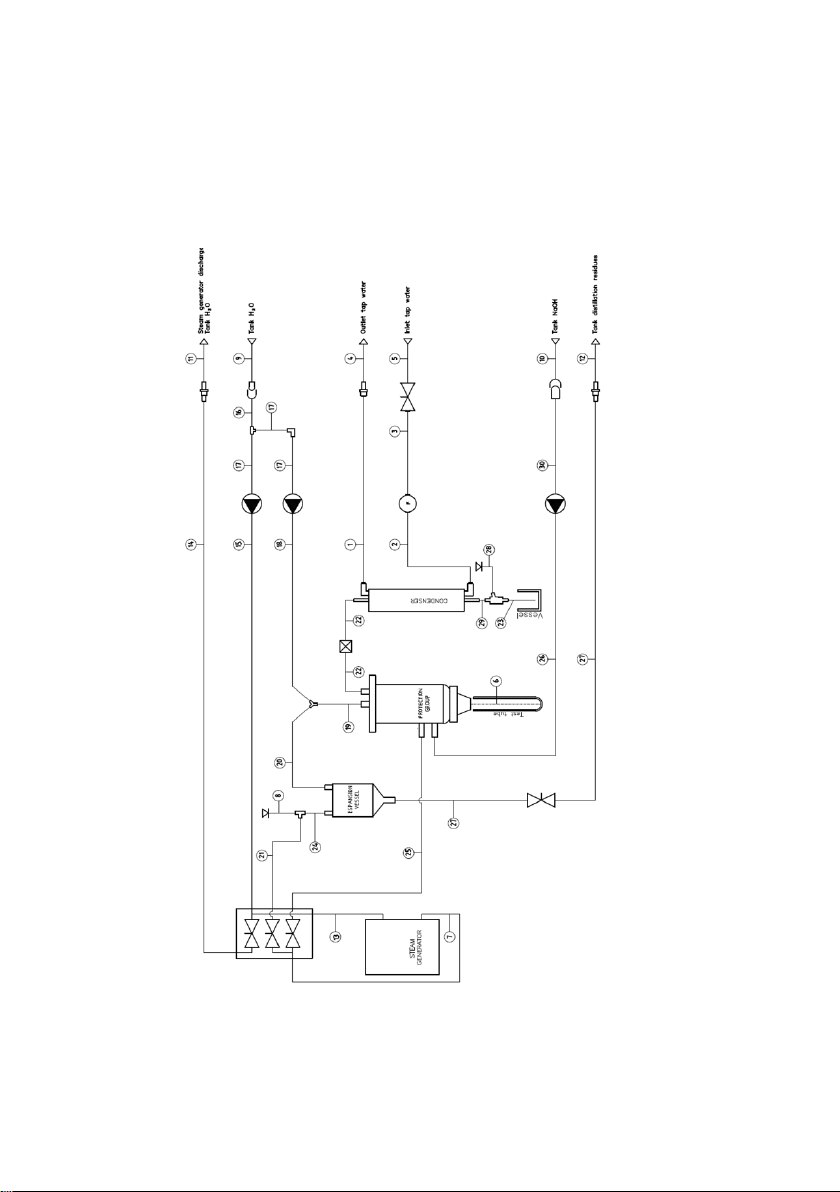
Velp Scientifica – UDK139 Operating Manual
60
247
14. Hydraulic scheme
10004762/B5
Page 61
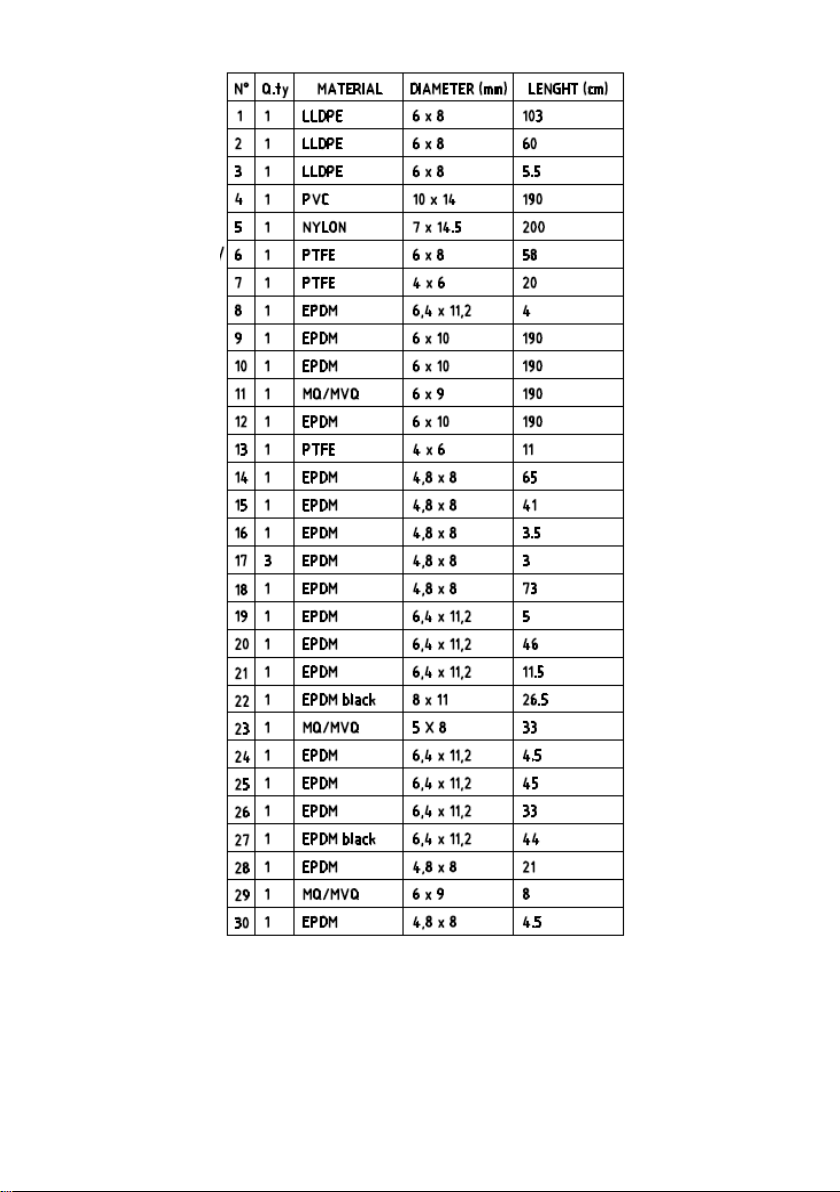
Velp Scientifica – UDK139 Operating Manual
61
248
10004762/B5
EPDM = Butyl
MQ/MVQ = Silicone
PTFE = Teflon
LLDPE = Low density polyethylene
Page 62

Velp Scientifica – UDK139 Operating Manual
62
249
15. Warranty
The unit is guaranteed against production defects for 25 months from our invoice
date.
Warranty claims can be accepted only if the system has been installed and used as
specified on the manual and carried out by qualified service personnel as appointed
by VELP Scientifica.
In accordance with this guarantee VELP SCIENTIFICA undertakes to repair any
units resulting as faulty due to the quality of the materials used or poor workmanship.
Units rendered faulty due to inexpert handling/use or carelessness will not be
replaced or repaired under warranty.
For more details please contact your Distributor.
Exclusions:
The guarantee will be considered null and void for faults resulting from:
- inexperience and carelessness of the operator
- repairs, maintenance or replacement of parts carried out by personnel or
Companies not authorized by the manufacturer
- use of the instrument that does not comply to the instructions/recommendations
given in the present operating manual
- use of non-original spare parts.
16. Suggestions
We will be pleased to receive any comments and/or suggestions that will help us to
improve this operating manual.
e-mail: [email protected]
10004762/B5
Page 63

Velp Scientifica – UDK139 Operating Manual
63
250
17. General description of Kjeldahl's method
for the measurement of organic Nitrogen
Since its first introduction, more than a century ago, the method underwent different
changes in digestion temperature and time, acid concentration and oxidation
catalysts. As an example, during years '30 the use of one drop of metallic Mercury as
catalyst and of concentrated fuming sulphuric acid (up to 80% Sulphur trioxide
added) was common. For practical safety reasons for operators and the environment
these prescriptions were modified.
In following paragraphs, the general lines of present Kjeldahl method with the use of
a high steam generation capacity apparatus as the model VELP UDK 139 are
described.
Sample range
2 - 150 mg of organic Nitrogen
15 - 1000 mg of proteins
Nitrogen standard
If the control of only the distillation steps is required, ammonium salts (chloride,
sulphate) are used. For example:
153 mg of ammonium chloride reagent grade are dissolved to 100.0 ml with
ammonia free water.
25.0 ml of this solution and 10 ml of 1 N sulfuric acid free of ammonia are diluted to
1000 ml with ammonia free water.
1 ml of the final solution contains 0.01 mg of N - NH3.
This solution is very diluted (1 mg of N-NH3 corresponds to 100 ml) and therefore
can be useful to use less diluted solutions. For example bringing the indicated
amounts to 100 ml (instead of 1000 ml) one obtains a final content of 0.1 mg
N-NH3 per ml of standard solution.
When the control of oxidative digestion is also required, pure Nitrogen containing
chemicals are used previously desiccated to constant weight.
- Glycine (glycocoll or aminoacetic acid) 18.66% Nitrogen
- Sulfamic acid (amidosulfonic acid) 14.43% Nitrogen
- Acetanilide 10.36% Nitrogen
- Cystine 11.66% Nitrogen
- Nicotinic acid 11.38% Nitrogen
For the analysis of inorganic nitric or ammonia Nitrogen the following standards can
be used:
- Ammonium dihydrogen phosphate (NH4H2PO4) 12.15% Nitrogen
- Potassium nitrate (KNO3) 13.85% Nitrogen
Digestion acid
Concentrated sulphuric acid (H2SO4) is used, reagent or technical grade, with a
reduced Nitrogen content (ammonia and nitrate), 98%, d 1.84 at 20 °C.
This acid is also specified "for Kjeldahl analysis". It is possible to use also
concentrated sulphuric acid not specified "for Kjeldahl", but in this case a regular
control by blanks is recommended.
There are recipes for the preparation of catalyst containing (Copper and Selenium)
sulphuric acid. For example: 10 g of cupric sulphate (CuSO4 5 H2O) are dissolved
by 500 ml of ammonia free water and then 500 ml of concentrated sulphuric acid are
slowly added while slowly shaking (do not add the water to acid to avoid dangerous
splashing). As an alternative, 2 g of cupric sulphate (CuSO4 5 H2O), 2 g of
10004762/B5
Page 64
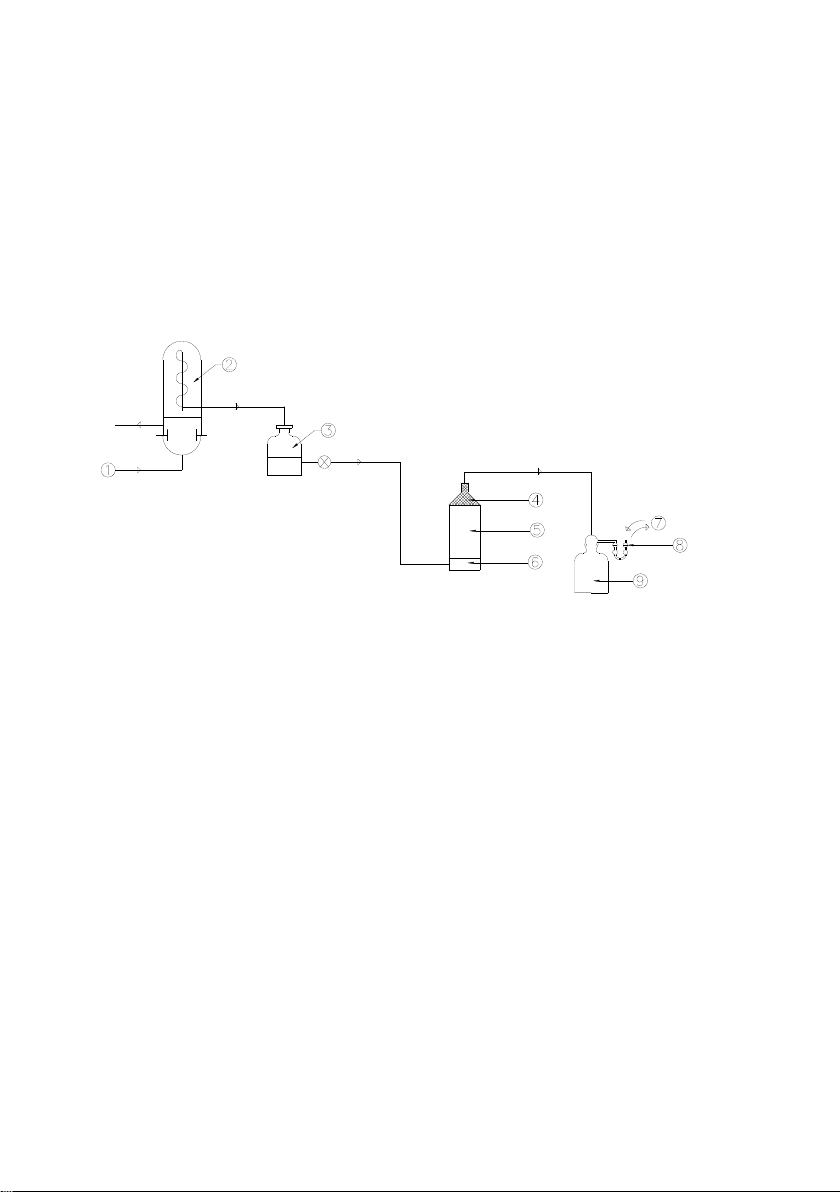
Velp Scientifica – UDK139 Operating Manual
64
251
Selenium dioxide (SeO2) and 100 g of anhydrous Sodium sulphate (Na2SO4) are
dissolved by 500 ml of ammonia free water and then 500 ml of concentrated
sulphuric acid are added.
Ammonia free distilled water for dilutions
Add 0.1 ml of concentrated sulphuric acid (H2SO4) to one liter of distilled water and
distill again.
It is also possible to use deionized water with very low conductivity, obtained by a
mixed bed of strong anionic and cationic resins, and tested for the absence of
ammonia and of Nitrogen containing organic matter (biofouling).
A complete equipment for the production of ammonia free distilled water is shown in
the following scheme:
1) Water supply 6) Fritted glass
2) Water still 7) Ari
3) distilled water collecting vessel 8) Liquid seal
4) Glass fiber 9) Ammonia-free distilled water collecting
5) Ion exchange column. Strongly acidic vessel
cation exchange resing mixed with a strongly
basic anion exchange resin
Sample to be analyzed
Liquid, semisolid or solid samples can be submitted to analysis. If a liquid is
measured by volume the result will be referred to volume and not to weight if the
density is different from 1.
When the result is to be referred to dry weight, solid or semisolid samples containing
water must be desiccated to constant weight. Grinding of samples is aimed to obtain
an easier digestion but is mostly aimed to homogenize the matter in order to obtain
significant results. Weighing accuracy is 0.1 mg.
To allow a quantitative transfer of a solid or semisolid sample into the digestion tube,
it is recommended to use weighing boxes made with Nitrogen free parchment paper
(Code CM0486000). These boxes will be introduced with the sample into the tubes
and digested without modifying the result. Sample dimensions are related to Nitrogen
content and must give at least 10-15 mg of ammonia Nitrogen. If a sample is
evaluated as poorly homogeneous, amounts larger than normal (e.g. 3-4 g) are to be
analyzed.
10004762/B5
Page 65

Velp Scientifica – UDK139 Operating Manual
65
252
Catalysts
Mercury is considered the best catalyst for Kjeldahl oxidative digestion, but its toxicity
for man and the environment brought to dismiss its use. The same can be said for
Selenium. To-day Copper sulphate (CuSO4 • 5 H2O) with lower environmental
damage is commonly used. It is previously mixed with anhydrous Potassium
sulphate (K2SO4) with a weight ratio of 9 K2SO4 to 1 CuSO4 • 5 H2O. Each sample is
added with 7.5 g of this mixture (Missouri catalyst). There are commercially available
tablets containing anhydrous Potassium sulphate and different types of catalysts in
pre-dosed amounts, easily used (for example packing of 1000 tablets by Velp
Scientifica).
Other additions
A rise of boiling temperature of the digestion acid is obtained by adding mineral salts,
mostly Potassium sulphate (K2SO4). The use of Hydrogen peroxide (H2O2)
35% (130 volumes) is aimed to assure a complete mineralization of samples.
This reagent is to be added to the cold mixture (sample + acid) before digestion in
order to avoid violent reaction and dangerous splashing.
Do not ever start heating if no acid is still added, because Hydrogen peroxide in
contact with a sample can give rise to explosions.
Digestion temperatures and times
Normal digestion temperature is 420°C. Lower temperatures increase digestion time.
At 420°C digestion is completed in 20-45 minutes.
A completed digestion gives raise to a clear colourless solution that crystallizes on
cooling. If this crystallization is not wanted it is enough to lower a little the amount of
the salt added for raising the boiling point of the acid.
Special samples as steel or coal may require a digestion time of many hours (up to
24).
Other reagents
An alkaline reaction of digested samples, before distillation, is obtained by adding a
concentrated (32-35%) solution of Sodium hydroxide (NaOH), ammonia free (50 ml
of NaOH for 7 ml of concentrated H2SO4).
1 ml of concentrated sulfuric acid 98% d. 1.84 contains 36.6 milliequivalents of acid.
1 ml of sodium hydroxide solution 32% w/w d.1.35 contains 10.8 milliequivalents of
alkali. Thus 1 ml of concentrated sulphuric acid is stoichiometrically neutralized by
3.39 ml of sodium hydroxide 32% solution. The distillation of ammonia requires a
highly alkaline environment which means that ammonia is completely in the so called
"free" form. This is obtained adding a 100% excess of alkali.
We suggest to use 50 ml of sodium hydroxide 32% solution for a sample digested
with 7 ml of concentrated sulphuric acid (70 ml for 10 ml or 100 ml for 15 ml acid).
10004762/B5
Page 66

Velp Scientifica – UDK139 Operating Manual
66
253
Steam distilled ammonia can be collected with the condensate from the water cooled
condenser in two different ways:
a) in a classical solution of sulphuric acid of known titre and following back-titration.
b) more recently, by a solution 4% of boric acid (H3BO3). Boric acid is practically un-
dissociated and allows direct titration of alkali (ammonia) by strong acids of known
titre.
Indicator solutions
A volume of 125-130 ml of solution to be titrated requires 10 drops about of indicator
solution.
a) for a back-titration of sulphuric acid with Sodium hydroxide: 20 - 30 mg of methyl
red in 100 ml of water; colour change from red to yellow at pH 4.9.
Or: 100 mg of bromocresol green and 30 mg of methyl red in 100 ml ethyl alcohol
96%; colour change from red to green at pH 4.5.
b) titration by sulphuric or hydrochloric acid of ammonia absorbed by boric acid
solution.
Tashiro's indicator: 0.6 g of methyl red are dissolved by 50 ml of 95% ethyl alcohol
and then added to a methylene blue solution (0.1 g in 50 ml of distilled water).
The colour is green in alkaline range and gray to pink (pH 4.9) in acid medium to red
with an excess of acid.
Potentiometric titration
It can be performed by using N/50 HCl and an end point of pH 4.7. The low
dissociation of boric acid allows direct titration of alkali (ammonia).
Colorimetric determination
Besides titration, ammonia nitrogen determination can be performed by colorimetric
methods, for example:
1. Method 417 B. Nesslerization or Method 417 C. Phenate: Standard Methods for
the Examination of Water and Wastewater. 16th Edition.
APHA-AWWA-WPCF. Washington D.C. 1985.
2. Method D 1426. Ammonia nitrogen. Book of Standards ASTM. Part. 23.
Water and Atmospheric Analysis. Philadelphia. 1983.
3. Analytical kits for water. Available on request.
In any case the ratio between weight or volume of sample and volume of distillate
used for ammonia determination must be taken into account.
Calculation
It is commonly agreed that protein content is obtained multiplying by 6.25 the weight
of Nitrogen obtained by the Kjeldahl method. This corresponds to consider all
proteins as composed by 16% Nitrogen.
As a matter of fact protein composition ranges from 15 to 18% Nitrogen.
This accounts for other factors, sometimes used, different from 6.25, generally lower.
AOAC suggests for specific products the following factors: 5.18 for almonds; 5.30 for
coconuts and other tree nuts, 5.46 for peanuts and Brasil nuts; 5.70 for wheat flour;
6.38 for milk and dairy products (official Methods of Analysis (1984). Association of
Official Analytical Chemists. Arlington, VA-USA).
FAO-WHO (1973) propose factor 5.70 for wheat meal and soy.
10004762/B5
Page 67

Velp Scientifica – UDK139 Operating Manual
67
254
Definitions
Total Kjeldahl nitrogen (TKN) is defined as the sum of ammonia nitrogen and organic
nitrogen converted to ammonium sulphate in the mineralization conditions adopted
by the method. Organic Kjeldahl nitrogen is given by the difference between the
value of total Kjeldahl nitrogen and the value of ammonia nitrogen.
If a direct determination is wanted, ammonia nitrogen is to be removed from the
sample before mineralization.
Digestion procedure
The weighed sample is quantitatively transferred into a digestion tube (1 g about)
and 7-15 ml of digestion acid and then, after placing on the digester two heat shields
which make the heating of the digestion tube more homogeneous, heating is started
(420°C) and continued till white fumes of Sulphur trioxide (SO3) are produced (20 30 minutes).
The apparatus should be under a hood or with a disposing mean for fumes in
operation with neutralization by concentrated solutions of strong alkalies
(e.g. SMS Scrubber Velp Scientifica, Code F307C0199). Sulphur trioxide fumes are
strongly irritant and aggressive for mucous membranes at concentrations as low as 1
ppm. If the liquid is not clear, one drop of Hydrogen peroxide solution (H2O2 30% 130
voll.) is added and boiling is continued for 10 minutes.
When digestion is finished the tubes are left to cool. Cooling time can be shortened
by blowing air with a fan. When the tubes are cool, 50 ml of ammonia free distilled
water are added and the tubes are shaken.
NOTE!
It’s strongly recommended NOT to introduce in the test tubes, during sample
digestion or distillation, boil-reducers (small glass balls, small pieces of
ceramic material) which could damage the distillator.
Distillation procedure
A cool digestion tube is placed into position in the steam distilling unit.
The same is done with an empty Erlenmeyer flask for distillate collection.
The automatic distillation program is set for the addition of boric acid 4% solution
(usually 25 ml) to the 250 ml Erlenmeyer flask for distillate collection; of an adequate
volume of sodium hydroxide 32% solution for neutralization and alkalinisation (from
50 to 100 ml) of the sample and of distilled or deionized water for its dilution (usually
50 ml). The end of the silicone tube from the condenser must be under the surface of
boric acid solution to avoid ammonia losses. Usually 100 ml of distillate are collected.
NOTE!
It’s strongly recommended NOT to use the distillation residues aspiration if the
sample to be distillate contains the solid residues, to avoid damages to the
distillation unit.
10004762/B5
Page 68
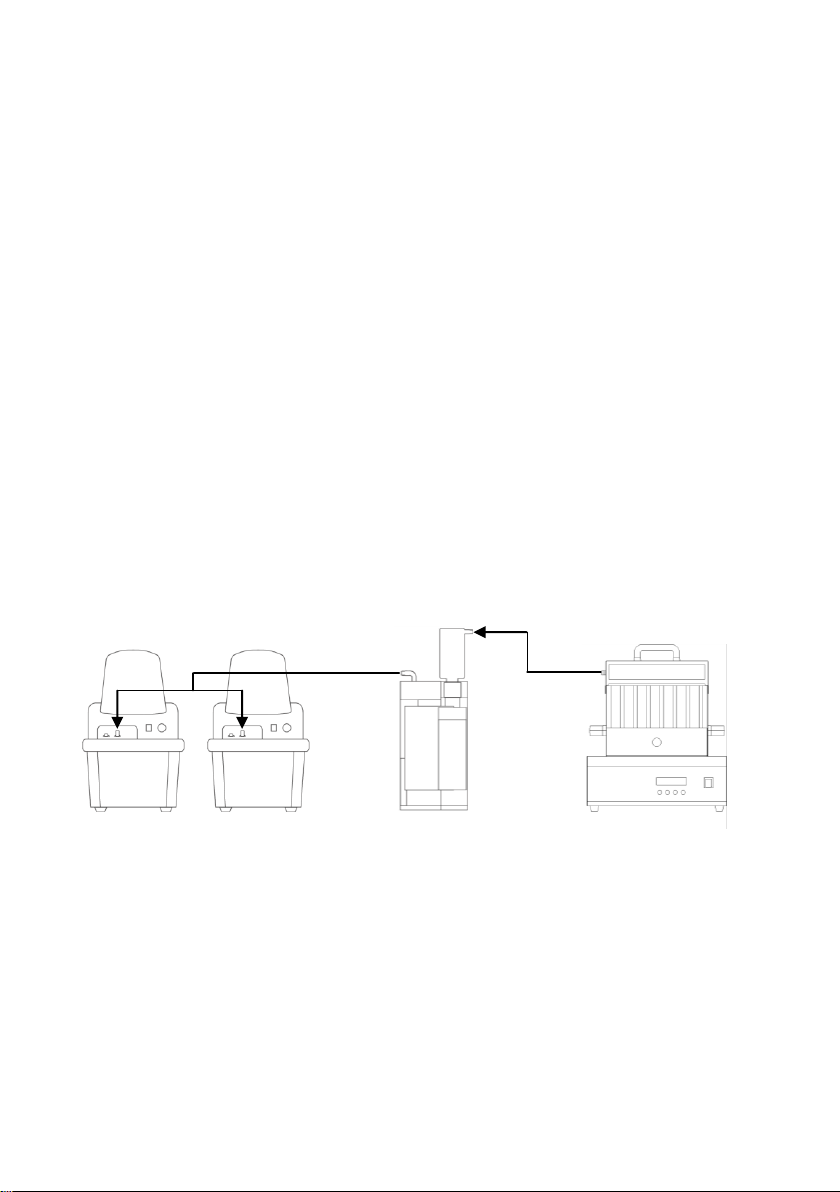
Velp Scientifica – UDK139 Operating Manual
68
255
18. AOAC, method 960.52, Microchemical
determination of nitrogen- Micro-Kjeldahl
method
AOAC International 1990. Official Methods of Analysis of AOAC
International , 15th ed., The Association , Arlington, VA.
This method ISN’T suitable for sample materials having N-N or N-O bonds.
Equipment:
- digester DK 20/26 code F30100185, or DK 42/26 code F30100186
- glass test tubes diam. 26mm x 300 mm, code A00001091
- adapter A00000043
- necessary accessories for DK 20/26:
glassware handle with heat shields, code A00001110
suction cup, code A00109626
support system, code A00001206
- necessary accessories for DK 42/26:
glassware handle with heat shields, code A00001109
suction cup, code A00109326
support system, code A00001204
- JP pump, code F30620198.When using DK 42/26 digester, Velp suggests to use 2
JP (for the connection refer to the below scheme) in order to guarantee an
effective fumes removal:
- SMS Scrubber, code F307C0199
- Steam distillator UDK139
Procedure:
1) Sample: weigh 10-30mg of sample, nitrogen free weighing boats can be used,
code CM0486000, and introduce it into the test tube.
Use for analysis an amount of sample which needs 3-10ml of 0.01 or 0.02N HCl
(containing 0.85-1.70mg of nitrogen).
10004762/B5
Page 69

Velp Scientifica – UDK139 Operating Manual
69
256
2) Reagents for digestion: for each sample add in the test tube:
1 catalyst tablets ST (code CT0006609) (containing Selenium as catalyst)
2.0ml of sulphuric acid concentrated, 96-98%
Normally, the sample weight to analyse is 15mg about; add 0.1ml of acid
more for every 10mg of dried organic substance >15mg.
Halve the amount of reagents above, if the sample is < 7mg, except when
using the weighing boats.
3) Digestion: heat at 420°C for 1 hour, 1 hour and a half.
4) Cooling: cool down test tubes to 50-60°C
5) Distillation: place in position in the distilling unit the digested sample.
Program:
Select a method with the following volumes of the reagents:
dilution water, 10 ml
Boric acid, 25 ml
Sodium hydroxide, 35% (W/V), 10 ml
Steam 100%
Distillation time: 4 min
Push START to initiate the analyses.
Titrate the distillate by HCl or H2SO4 0,01 N or 0,02 N programming an end point
titration to pH 4.7.
10004762/B5
Page 70
Velp Scientifica – UDK139 Operating Manual
70
A Grind or homogenize the sample
B Weight or pipette the sample
C Transfer quantitatively the measured sample to digestion tube
D Add digestion acid and salts
E Add catalysers if not present in the acid
F Place the digestion tube in the digestion unit: i.e. DK6 or DK20
G Digest the samples
H Cool the digestion tubes
I Place a digestion tube with sample in UDK 139 unit
L Start the programmed automatic distillation cycle
M Titrate distillate
N Compute the results
257
19. Analytical procedure
Typical analytical scheme for organic Nitrogen
10004762/B5
Page 71

Velp Scientifica – UDK139 Operating Manual
71
258
20. Analytical Methods
1 - Kjeldahl method to determine the protein content on milk and
derived products
The protein content of raw cow milk is meanly 3,2 g/100 ml (512 mg of nitrogen).
Human milk is poorer in proteins (1 g/100 ml), while the milk of other animals is richer
than cow milk (sheep 5,6 g/100 ml).
Procedure
1 Sample:
a_Milk sample (cow’s, goat’s and sheep’s milk)
Place the test sample in the water bath (e.g. OCB, code F40300240) at 38 °C to 40
°C. Mix gently by inversion without causing frothing or churning. Once the sample is
mixed thoroughly, cool to room temperature and add 5 ml of sample in the test tube.
b_ Cheese sample (cow’s, goat’s and sheep’s cheese)
Remove the rind, smear or mouldy surface layer of the cheese. Homogenize the
cheese manually with a spoon or a knife.
Weigh 1,000 g of sample into a nitrogen-free weighing boat (code CM0486000) and
place it the test tube.
2 Reagents for digestion
a_ For milk sample add in the test tube:
2 catalyst tablets CM (code CT0006650)
20 ml concentrated sulphuric acid (96-98%)
5 ml hydrogen peroxide (H2O2) 35% (130 voll.)
b_ For cheese sample add in the test tube:
2 catalyst tablets TCT (code CT0006621)
12 ml concentrated sulphuric acid (96-98%)
3 Digestion: heat for 15 min at 150 °C,
15 min at 250 °C,
40 min at 420 °C,
4 Cooling: let cool the digestion tubes to 50-60 °C.
5 Distillation-titration: place in position the test tube with the digested sample in the
unit UDK 139.
Factor: 6.38
Addition of reagents:
dilution water= 50ml
H3BO3= 30ml
NaOH= 70 ml
Titrant: HCl 0.1N
Distillation time= 4 min
Steam power= 100%
Press the button starting distillation cycle.
References: AOAC 991.20, ISO 8968-1:2014
10004762/B5
Page 72

Velp Scientifica – UDK139 Operating Manual
72
259
2 - Kjeldahl method to determine the protein content on almonds,
nuts, hazelnuts
Procedure
1 Sample: grind the sample by a suitable device. Weigh 0.5-0.8 g of sample with an
accuracy of 0.1mg.
2 Reagents for digestion: for each sample add in the test tube:
2 catalyst tablets CM (code CT0006650)
12 ml concentrated sulphuric acid (96-98%)
2 antifoam tablets S (code CT0006600)
shake gently the test tubes.
3 Digestion: 60 min at 420 °C.
4 Cooling: let cool the test tubes to 50-60 °C.
5 Distillation-titration: place in position the test tube with the digested sample in the
unit UDK 139.
Factor: 5.18
Addition of reagents:
dilution water= 50ml
H3BO3= 30ml
NaOH= 50 ml
Titrant: HCl 0.2 N
Distillation time= 4 min
Steam power= 100%
Press the button starting distillation cycle.
References: AOAC, “Official methods of analysis”, method 950.48
10004762/B5
Page 73

Velp Scientifica – UDK139 Operating Manual
73
260
3 - Kjeldahl method to determine the protein content on coconuts
Procedure
1 Sample: grind the sample by a suitable device. Weigh 0.5-0.8g of sample with an
accuracy of 0.1mg.
2 Reagents for digestion: for each sample add in the test tube:
2 catalyst tablets CM (code CT0006650)
12 ml concentrated sulphuric acid (96-98%)
2 antifoam tablets S (code CT0006600)
shake gently the test tubes
3 Digestion: 60 min at 420 °C.
4 Cooling: let cool the test tubes to 50-60 °C.
5 Distillation-titration: place in position the test tube with the digested sample in the
unit UDK 139.
factor: 5.30
Addition of reagents:
dilution water= 50ml
H3BO3= 30ml
NaOH= 50 ml
Titrant: HCl 0.2N
Distillation time= 4 min
Steam power= 100%
Press the button starting distillation cycle.
References: AOAC, “Official methods of analysis”, method 950.48
10004762/B5
Page 74

Velp Scientifica – UDK139 Operating Manual
74
261
4 - Kjeldahl method to determine the protein content on peanuts
and Brazil nuts
Procedure
1 Sample: grind the sample by a suitable device. Weigh 0.5-0.8g of sample with an
accuracy of 0.1mg.
2 Reagents for digestion: for each sample add in the test tube:
2 catalyst tablets CM (code CT0006650)
12 ml concentrated sulphuric acid (96-98%)
2 antifoam tablets S (code CT0006600)
shake gently the test tube
3 Digestion: 60 min at 420 °C.
4 Cooling: let cool the test tubes to 50-60 °C.
5 Distillation-titration: place in position the test tube with the digested sample in the
unit UDK 139.
factor: 5.46
Addition of reagents:
dilution water=50ml
H3BO3=30ml
NaOH=50 ml
Titrant: HCl 0.2N
Distillation time= 4 min
Steam power= 100%
Press the button starting distillation cycle.
References: AOAC, “Official methods of analysis”, method 950.48
10004762/B5
Page 75

Velp Scientifica – UDK139 Operating Manual
75
262
5 - Kjeldahl method to determine the protein content on beer
Among components of soluble extract of beer there are proteins and aminoacids.
Soluble extractives represent from 3% to 12% of the weight of beer.
Procedure:
1) Sample: 25 ml of beer (from which carbon dioxide was previously removed by
introducing a proper volume in a big flask and shaking a long time) in a test tube.
Concentrate it in the digester at 100 °C to sirupy consistency.
2) Reagents for digestion: for each sample add in the test tube:
2 catalyst tablets ST (code CT0006609)
10 ml concentrated sulphuric acid (96-98%)
10 ml hydrogen peroxide (H2O2) 35% (130 voll.)
2 antifoam tablets S (code CT0006600)
3) Digestion: mix well the test tube content.
Heat for 30 min at 100 °C, 30 min. at 200 °C, 30 min. at 300 °C and then for 40 min
at 420 °C.
4) Cooling: let cool the test tubes to 50 - 60°C.
5) Distillation-titration: place in position the test tube with the digested sample in
the unit UDK 139.
factor: 6.25
Addition of reagents:
dilution water = 50 ml
H3BO3 = 30 ml
NaOH = 50 ml
Titrant: HCl 0.1 N
Distillation time= 4 min
Steam power= 100%
Press the button starting distillation cycle.
References: AOAC Official Methods of Analysis. Method 920.53.
10004762/B5
Page 76

Velp Scientifica – UDK139 Operating Manual
76
263
6 – Kjeldahl method to determine the protein content on barley
malt
Procedure
1) Sample: 1 g of malt finely grinded and sieved to 2 mm, previously dried in oven at
105°C up to constant weight, accurately weighed and transferred quantitatively in a
test tube.
2) Reagents for digestion: for each sample add in the test tube:
2 catalyst tablets ST (code CT0006609)
12ml sulphuric acid concentrated (96%)
3) Digestion: set on the digester the following temperature ramps:
20 min at 220°C and then 40 min at 420 °C.
4) Cooling: let cool the test tubes to 50-60°C.
5) Distillation-titration: place in position the test tube with the digested sample in
the unit UDK 139.
factor: 6.25
Addition of reagents:
dilution water=50ml
H3BO3=30ml
NaOH=50 ml
Titrant: HCl 0.1N
Distillation time= 4 min
Steam power= 100%
Press the button starting distillation cycle.
References: Official Methods of Analysis , AOAC (ed.1990), vol.2 (method n.
950.09).
10004762/B5
Page 77

Velp Scientifica – UDK139 Operating Manual
77
264
7 - Kjeldahl method to determine the protein content on animal
feed
Procedure
1) Sample: 2 g about of grinded product, sieved to 2 mm and dried at 105 °C up to
constant weight, accurately weighed and transferred quantitatively in a test tube.
In the case of products rich in proteins (meat or fish flour) the sample can be reduced
to 1 g.
2) Reagents for digestion: for each sample add in the test tube:
1 catalyst tablet W (code CT0006613)
12 ml concentrated sulphuric acid (96-98%) 96%
5 ml hydrogen peroxide (H2O2) 35% (130 voll.)
3) Digestion: heat for 60 min at 420 °C.
4) Cooling: let cool the test tubes to 50-60 °C.
5) Distillation-titration: place in position the test tube with the digested sample in
the unit UDK139.
factor: 6.25
Addition of reagents:
dilution water=50ml
H3BO3=30ml
NaOH=50 ml
Titrant: HCl 0.2N
Distillation time= 4 min
Steam power= 100%
Press the button starting distillation cycle.
References: AOAC, “Official methods of analysis”, method 984.13
10004762/B5
Page 78

Velp Scientifica – UDK139 Operating Manual
78
265
8 - Kjeldahl method to determine the protein content on wheat
Procedure
1) Sample: grind the sample by a suitable device. If the result is to be expressed on
dried sample, perform a separate determination of the humidity on the ground
sample. Weight 1g of sample with an accuracy of 0.1mg.
2) Reagents for digestion: for each sample add in the test tube:
2 catalyst tablets CM (code CT0006650)
2 Antifoam tablets S (code CT0006600)
12 ml concentrated sulphuric acid (96-98%)
shake gently the test tubes
3) Digestion: heat for 40 min at 300 °C and 90 minutes at 420 °C.
4) Cooling: let cool the test tubes to 50-60 °C.
5) Distillation-titration: place in position the test tube with the digested sample in
the unit UDK 139.
factor: 5.70
Addition of reagents:
dilution water=50ml
H3BO3=30ml
NaOH=50 ml
Titrant: HCl 0.2N
Distillation time= 4 min
Steam power= 100%
Press the button starting distillation cycle.
References: AOAC, “Official methods of analysis”, method 979.09
10004762/B5
Page 79

Velp Scientifica – UDK139 Operating Manual
79
266
9 - Kjeldahl method to determine the protein content on oats,
barley, corn, rice, rye
Procedure
1) Sample: grind the sample by a suitable device. If the result is to be expressed on
dried sample, perform a separate determination of the humidity on ground sample.
Weigh 1g of sample with an accuracy of 0.1mg.
2) Reagents for digestion: for each sample add in the test tube:
2 catalyst tablets CM (code CT0006650)
2 Antifoam tablets S (code CT0006600)
12 ml concentrated sulphuric acid (96-98%)
shake gently the test tubes
3) Digestion: heat for 40 min at 300 °C and 90 minutes at 420 °C.
4) Cooling: let cool the test tubes to 50-60 °C.
5) Distillation-titration: place in position the test tube with the digested sample in
the unit UDK 139.
factor: 6.25
Addition of reagents:
dilution water=50ml
H3BO3=30ml
NaOH=50 ml
Titrant: HCl 0.2N
Distillation time= 4 min
Steam power= 100%
Press the button starting distillation cycle.
References: AOAC, “Official methods of analysis”, method 979.09
10004762/B5
Page 80

Velp Scientifica – UDK139 Operating Manual
80
267
10 - Kjeldahl method to determine the protein content on soya
beans and lupins
Procedure
1) Sample: grind the sample by a suitable device. If the result is to be expressed on
dried sample, perform a separate determination of the humidity on ground sample.
Weigh 1g of sample with an accuracy of 0.1mg.
2) Reagents for digestion: for each sample add in the test tube:
2 catalyst tablets CM (code CT0006650)
12 ml concentrated sulphuric acid (96-98%)
shake gently the test tubes
3) Digestion: heat for 60 min at 420 °C.
4) Cooling: let cool the test tubes to 50-60 °C.
5) Distillation-titration: place in position the test tube with digested sample in the
unit UDK 139.
factor: 6.25
Addition of reagents:
dilution water=50ml
H3BO3=30ml
NaOH=50 ml
Titrant: HCl 0.2N
Distillation time= 4 min
Steam power= 100%
Press the button starting distillation cycle.
References: AOAC, “Official methods of analysis”, method 979.09
10004762/B5
Page 81

Velp Scientifica – UDK139 Operating Manual
81
268
11 - Kjeldahl method to determine the protein content on canned
cat/dog food
Procedure
1) Sample: homogenize the sample by a suitable device. For samples having a
humidity content up to 60%, weigh 2g of sample with an accuracy of 0.1mg, for
samples having a humidity content higher than 60% weigh 3g of sample with the
same accuracy.
2) Reagents for digestion: for each sample add in the test tube:
2 catalyst tablets CM (code CT0006650)
15 ml concentrated sulphuric acid (96-98%)
shake gently the test tubes.
3) Digestion: heat for 70 min at 420 °C.
4) Cooling: let cool the test tubes to 50-60 °C.
5) Distillation-titration: place in position the test tube with digested sample in the
unit UDK 139.
factor: 6.25
Addition of reagents:
dilution water=50ml
H3BO3=30ml
NaOH=60 ml
Titrant: HCl 0.2N
Distillation time= 4 min
Steam power= 100%
Press the button starting distillation cycle.
References: AOAC, “Official methods of analysis”, method 984.13
10004762/B5
Page 82

Velp Scientifica – UDK139 Operating Manual
82
269
12 - Kjeldahl method to determine the protein content on forage
and straw
Procedure
1) Sample: cut the sample by a pair of scissors to a length of 2-3 cm about. Dry the
sample and finally grind by a suitable device. Weigh 1g of sample with an accuracy
of 2mg.
2) Reagents for digestion: for each sample add in the test tube:
2 catalyst tablets ST (code CT0006609)
12 ml concentrated sulphuric acid (96-98%)
shake gently the test tubes.
3) Digestion: heat for 60 min at 420 °C.
4) Cooling: let cool the test tubes to 50-60 °C.
5) Distillation-titration: place in position the test tube with the digested sample in
the unit UDK 139.
factor: 6.25
Addition of reagents:
dilution water= 50ml
H3BO3= 30ml
NaOH= 50 ml
Titrant: HCl 0.2N
Distillation time= 4 min
Steam power= 100%
Press the button starting distillation cycle.
References: AOAC, “Official methods of analysis”, method 978.04
10004762/B5
Page 83

Velp Scientifica – UDK139 Operating Manual
83
270
13 - Kjeldahl method to determine the protein content on bacon,
ham, hot dog, salami, sausage
Procedure
1) Sample: 2g of sample weighed with an accuracy of 0.1mg after homogenizing.
2) Reagents for digestion: for every sample add in the test tube:
2 catalyst tablets CM (code CT0006650)
15 ml sulphuric acid concentrated (H2SO4)
shake gently the test tube with the sample.
3) Digestion: heat for 75 min at 420 °C.
4) Cooling: let cool the test tubes to 50-60 °C.
5) Distillation-titration: place in position the test tube with digested sample in the
unit UDK 139.
factor: 6.25
Addition of reagents:
dilution water= 75ml
H3BO3= 30ml
NaOH= 50 ml
Titrant: HCl 0.2N
Distillation time= 4 min
Steam power= 100%
Press the button starting distillation cycle.
References: AOAC, “Official methods of analysis”, method 981.10
10004762/B5
Page 84

Velp Scientifica – UDK139 Operating Manual
84
271
14 - Kjeldahl method to determine the protein content on meat and
derived products
The protein content in fresh bovine meat is about 20% (3% of proteic nitrogen about).
Dried salted meats contain about 35% proteins, while salted meat show values
between11 and 17%, depending on fat and water content.
Procedure
1) Sample: 1 g about of ground product, accurately weighed (60 mg about of proteic
nitrogen for fresh meat, interval 40÷100) and quantitatively transferred in the test
tube.
2) Reagents for digestion: for each sample add in the test tube one of the following
catalysts:
2 catalyst tablets ST (code CT0006609)
20 ml concentrated sulphuric acid (96-98%)
5 ml hydrogen peroxide (H2O2) 35% (130 voll.)
3) Digestion: heat for 30 min at 250 °C,
30 min at 350 °C,
60 min at 420 °C.
4) Cooling: let cool the test tubes to 50-60 °C.
5) Distillation-titration: place the test tube with digested sample in the unit UDK
139.
factor: 6.25
reagents addition:
dilution water= 50ml
H3BO3= 30ml
NaOH= 70 ml
Titrant: HCl 0.2N
Distillation time= 4 min
Steam power= 100%
Press the button starting distillation cycle.
References: AOAC, “Official methods of analysis”, method 981.10
10004762/B5
Page 85

Velp Scientifica – UDK139 Operating Manual
85
272
15 - Kjeldahl method to determine the protein content on bread and
baked products
Procedure
1) Sample: grind the sample by a suitable device. Weigh 2g of dried sample with an
accuracy of 0.1mg.
2) Reagents for digestion: for each sample add in the test tube:
2 catalyst tablets TCT (code CT0006621)
12 ml concentrated sulphuric acid (96-98%)
shake gently the test tube with the sample.
3) Digestion: heat for 60 min at 420 °C.
4) Cooling: let cool the test tubes to 50-60 °C.
5) Distillation-titration: place in position the test tube with digested sample in the
unit UDK 139.
factor: 5.7
Reagents addition:
dilution water= 75ml
H3BO3= 30ml
NaOH= 50 ml
Titrant: HCl 0.2N
Distillation time= 4 min
Steam power= 100%
Press the button starting distillation cycle.
References: AOAC, “Official methods of analysis”, method 950.36
10004762/B5
Page 86

Velp Scientifica – UDK139 Operating Manual
86
273
16 - Kjeldahl method to determine the protein content on
compressed and granular yeast
Procedure
1) Sample: grind, if necessary, and make the sample homogeneous by suitable
devices; weigh 0.5-0.7 g of sample with an accuracy 0.1mg.
2) Reagents for digestion: for each sample add in the test tube:
2 catalyst tablets CM (code CT0006650)
12 ml concentrated sulphuric acid (96-98%)
shake gently the test tube with sample.
3) Digestion: heat for 70 min at 420 °C.
4) Cooling: let cool the test tubes to 50-60 °C.
5) Distillation-titration: place in position the test tube with digested sample in the
unit UDK 139.
factor: 6.25
Reagents addition:
dilution water=75ml
H3BO3=30ml
NaOH=50 ml
Titrant: HCl 0.2N
Distillation time= 4 min
Steam power= 100%
Press the button starting distillation cycle.
References: AOAC, “Official methods of analysis”, method 962.10
10004762/B5
Page 87

Velp Scientifica – UDK139 Operating Manual
87
274
17 - Kjeldahl method to determine the protein content on liver patè
Procedure
1) Sample: 2g of sample weighed with an accuracy of 0.1mg after homogenizing by
suitable device.
2) Reagents for digestion: for each sample add in the test tube:
2 catalyst tablets CM (code CT0006650)
12 ml concentrated sulphuric acid (96-98%)
shake gently the test tube with sample.
For samples having high fat content, use 15ml of acid and then 5ml of hydrogen
peroxide.
3) Digestion: heat for 45 min at 420 °C.
4) Cooling: let cool the test tubes to 50-60 °C.
5) Distillation-titration: place in position the test tube with sample in the unit UDK
139.
factor: 6.25
reagents addition:
dilution water= 50ml
H3BO3= 30ml
NaOH= 50 ml
Titrant: HCl 0.2N
Distillation time= 4 min
Steam power= 100%
Press the button starting distillation cycle.
References: AOAC, “Official methods of analysis”, method 981.10
10004762/B5
Page 88

Velp Scientifica – UDK139 Operating Manual
88
275
18 - Kjeldahl method to determine the protein content on sugar,
syrup, molasses
Procedure
1) Sample: weigh 1g of sample with an accuracy of 0.1mg (2g for molasses with
the same accuracy).
2) Reagents for digestion: for each sample add in the test tube:
2 catalyst tablets CM (code CT0006650)
12 ml concentrated sulphuric acid (96-98%)
shake gently the test tube with sample.
3) Digestion: heat for 60 min at 420 °C.
4) Cooling: let cool the test tubes to 50-60 °C.
5) Distillation-titration: place in position the test tube with digested sample in the
unit UDK 139.
factor: 6.25
Reagents addition:
dilution water= 75ml
H3BO3= 30ml
NaOH= 50 ml
Titrant: HCl 0.2N
Distillation time= 4 min
Steam power= 100%
Press the button starting distillation cycle.
References: AOAC, “Official methods of analysis”, method 945.23
10004762/B5
Page 89

Velp Scientifica – UDK139 Operating Manual
89
276
19 - Kjeldahl method to determine the protein content on wheat
spaghetti and macaroni, egg pasta
Procedure
1) Sample: break the pasta in small pieces by hands or suitable device and mix well.
Grind finally the sample by a suitable device. Weigh 1g of sample with an accuracy
of 0.1mg.
2) Reagents for digestion: for each sample add in the test tube:
2 catalyst tablets CM (code CT0006650)
12 ml concentrated sulphuric acid (96-98%)
shake gently the tube with sample.
3) Digestion: heat for 60 min at 420 °C.
4) Cooling: let cool test tubes to 50-60 °C.
5) Distillation-titration: place in position the tube with digested sample in the unit
UDK 139.
factor: 5.7
Addition of reagents:
dilution water= 50ml
H3BO3= 30ml
NaOH= 50 ml
Titrant: HCl 0.1N
Distillation time= 4 min
Steam power= 100%
Press the button starting distillation cycle.
References: AOAC, “Official methods of analysis”, method 930.25
10004762/B5
Page 90

Velp Scientifica – UDK139 Operating Manual
90
277
20 - Kjeldahl method to determine the protein content on grain
spaghetti, macaroni
Procedure
1) Sample: break the pasta in small pieces by hands or suitable device and mix well.
Grind finally the sample by suitable device. Weigh 1g of sample with an accuracy of
0.1mg.
2) Reagents for digestion: for each sample add in the test tube:
2 catalyst tablets CM (code CT0006650)
12 ml concentrated sulphuric acid (96-98%)
shake gently the tube with sample.
3) Digestion: heat for 60 min at 420 °C.
4) Cooling: let cool test tubes to 50-60 °C.
5) Distillation-titration: place in position the test tube with sample in the unit UDK
139.
factor: 6.25
Reagents addition:
dilution water= 50ml
H3BO3= 30ml
NaOH= 50 ml
Titrant: HCl 0.1N
Distillation time= 4 min
Steam power= 100%
Press the button starting distillation cycle.
References: AOAC, “Official methods of analysis”, method 930.25
10004762/B5
Page 91

Velp Scientifica – UDK139 Operating Manual
91
278
21 - Kjeldahl method to determine the protein content on plants
(vegetable)
Procedure
1) Sample: mince and homogenize the sample by suitable devices, then weigh 0.5-
1.5 g in the test tube.
2) Reagents for digestion: for each sample add in the test tube:
2 catalyst tablets ST (code CT0006609)
13 ml concentrated sulphuric acid (96-98%)
shake gently the tube with the sample.
3) Digestion: heat for 60 min at 420 °C.
4) Cooling: let cool test tubes to 50-60 °C.
5) Distillation-titration: place in position the test tube with digested sample in the
unit UDK 139.
factor: 6.25
Reagents addition:
dilution water=75ml
H3BO3=30ml
NaOH=50 ml
Titrant: HCl 0.2N
Distillation time= 4 min
Steam power= 100%
Press the button starting distillation cycle.
References: AOAC, “Official methods of analysis”, method 978.04
10004762/B5
Page 92

Velp Scientifica – UDK139 Operating Manual
92
279
22 - Kjeldahl method to determine the protein content on
mushrooms
The average protein content on fresh mushrooms is 2-4%.
Procedure
1) Sample: 10g of ground dried sample.
2) Reagents for digestion: for each sample add in the test tube:
2 catalyst tablets ST (code CT0006609)
15 ml concentrated sulphuric acid (96-98%)
shake gently the tube with the sample.
3) Digestion: heat for 60 min at 420 °C.
4) Cooling: let cool the tubes to 50-60 °C.
5) Distillation-titration: place in position the test tube with digested sample in the
unit UDK 139.
factor: 6.25
Reagents addition:
dilution water=50ml
H3BO3=30ml
NaOH=50 ml
Titrant: HCl 0.2N
Distillation time= 4 min
Steam power= 100%
Press the button starting distillation cycle.
References: AOAC, “Official methods of analysis”, method 976.06
10004762/B5
Page 93

Velp Scientifica – UDK139 Operating Manual
93
280
19.2 Pre-defined Methods for different samples
23 - Kjeldahl method to determine total nitrogen on crude oil and
fuels (ISO n. 333)
Procedure
1) Sample: homogenize the sample by shaking before analysis. Weigh 1g of sample
with an accuracy of 0.1 mg.
2) Reagents for digestion: for each sample add in the test tube:
2 catalyst tablets ST (code CT0006609)
20 ml concentrated sulphuric acid (96-98%)
add carefully 10ml of hydrogen peroxide to avoid foaming.
Shake gently the test tube with sample.
3) Digestion: start from room temperature and use heating ramps up to 420 °C ;
overall time:4 hours.
Maintain at 420 °C for 30 min. Overall digestion time: 4 hours and 30 min.
4) Cooling: let cool the test tubes to 50-60 °C.
5) Distillation-titration: place in position the test tube with the digested sample in
the unit UDK 139.
factor: 0.00
Reagents addition:
dilution water= 70ml
H3BO3= 30ml
NaOH= 70 ml
Titrant: HCl 0.1N
Distillation time= 4 min
Steam power= 100%
Press the button starting distillation cycle.
References: ISO norm n. 333
10004762/B5
Page 94

Velp Scientifica – UDK139 Operating Manual
94
281
24 - Kjeldahl method to determine total nitrogen on ABS, SAN,
rubber
Procedure
1) Sample: RUBBER: the sample is cut in small pieces and then ground.
0,5 g of sample accurately weighed are used for the analysis.
SAN: cut in small pieces the sample . Grind it. Pellets of 1x3 mm can be directly
analysed. Weigh 0.50 g of sample with an accuracy of 2 mg.
ABS: grind the sample. Weigh 0.50g with an accuracy of 2 mg. Pellets of 1x3 mm
can be directly analysed.
2) Reagents for digestion:
2 catalyst tablets CM (code CT0006650)
2 Antifoam tablets S (code CT0006600)
15 ml concentrated sulphuric acid (96-98%)
5 ml Hydrogen peroxide 30-32 % (added 1 by 1 ml).
after the addition of reagents shake to wet the sample.
In some cases it could be necessary to pre-digest the samples overnight at room
temperature.
3) Digestion:
30 min at 250 °C
30 min at 350 °C
60 min at 420 °C.
4) Cooling: let cool the test tubes to 50-60 °C.
5) Distillation-titration: place in position the test tube with digested sample in the
unit UDK 139.
factor: 6.25
Reagents addition:
dilution water= 50ml
H3BO3=30ml
NaOH (40% w/v) = 60 ml
Titrant: HCl 0.1N
Distillation time= 4 min
Steam power= 100%
Press the button starting distillation cycle.
References: ISO norm n. 1656
10004762/B5
Page 95

Velp Scientifica – UDK139 Operating Manual
95
282
25 - Kjeldahl method to determine total nitrogen in urea
The method is suitable for the determination of urea content in aminoplastics, i.e.
urea-formaldehyde resins.
Procedure
1) Sample: the sample is ground in order to obtain a powder very fine and
homogeneous .
1g of sample accurately weighed is quantitatively transferred in a test tube.
2) Reagents for digestion. for each sample add in the test tube:
2 catalyst tablets CM (code CT0006650)
12ml concentrated sulphuric acid (96-98%)
after the addition of reagents shake to wet the sample.
3) Digestion: 60 min at 420 °C.
4) Cooling: let cool the test tubes to 50-60 °C.
5) Distillation-titration: place in position the test tube with digested sample in the
unit UDK 139.
factor: 0.00
Addition of reagents:
dilution water= 50ml
H3BO3= 30ml
NaOH= 50 ml
Titrant: HCl 0.2N
Distillation time= 4 min
Steam power= 100%
Press the button starting distillation cycle.
The urea content of the sample is calculated considering that the nitrogen content of
urea is 46.65%.
The quantity of distilled ammonia from 0.1g of urea requires 16.64ml of 0.2N HCl to
be titrated.
References: ISO norm n. 1392.
10004762/B5
Page 96

Velp Scientifica – UDK139 Operating Manual
96
283
26 - Kjeldahl method to determine total nitrogen on water
The value obtained by this method corresponds to the sum of organic nitrogen
(proteins, nucleic acids, urea, synthetic organic chemicals) and ammonia nitrogen.
The measurement of this parameter is required by Italian laws 319/76 and 650/79 for
the discharge of wastewaters in lakes, direct or indirect, included in a band of 10 km
from the coast line (organic + ammonia + nitrous + nitric = 10 mg N/l maximum).
Kjeldahl’s method doesn’t measure, or measures partly, some nitrogen compounds:
azides, azocompounds, hydrazones, hydrazine and hydroxylamine, nitrite and
nitrate.
Procedure
1) Sample: 50-200 ml of water (0,1 - 0,5 mg of nitrogen in most cases) in a standard
test tube.
With DKL12 it is possible to use the Jumbo test tube 400 ml (code A00000185) with
the dedicated sample rack (code A00000181).
2) Reagents for digestion: for each sample add in the test tube:
2 catalyst tablets CM (code CT0006650)
10 ml concentrated sulphuric acid (96-98%)
3) Digestion: mix well the test tube content.
Heat for 30 min at 150°C, 30 min. at 250 °C and then for 1 hour at 420 °C.
The initial heating is used to evaporate water.
4) Cooling: let cool the tubes to 50-60 °C.
5) Distillation-titration: place in position the tube with digested sample in the unit
UDK 139.
factor: 0.00
Addition of reagents:
dilution water = 50 ml
H3BO3 = 30 ml
NaOH = 50 ml
Titrant: HCl 0.01N
Distillation time= 4 min
Steam power= 100%
Press the button starting distillation cycle.
6) References: Environmental Protection Agency, EPA PAI-DK01, AOAC 973.48,
ISO 5663-1984, ISO11732
10004762/B5
Page 97

Velp Scientifica – UDK139 Operating Manual
97
284
27 - Kjeldahl method to determine total nitrogen on soil
A soil of good fertility contains 2-3% of organic matter mainly humus which is
composed by 4 - 6% of nitrogen.
There is also some ammonia nitrogen (some ppm) which is to be determined
separately and substracted from the value of Kjeldahl’s nitrogen obtained,if organic
nitrogen is needed.
Procedure
1) Sample: 1 g about of air dried soil, sieved to 2 mm (3÷12 mg of organic nitrogen),
dried at 105 °C up to constant weight, accurately weighed and quantitatively
transferred in a test tube.
2) Reagents for digestion:
2 catalyst tablets ST (code CT0006609)
12 ml concentrated sulphuric acid (96-98%).
3) Digestion: heat for 60 min at 420 °C.
4) Cooling: let cool the test tubes to 50-60°C.
5) Distillation-titration: place in position the test tube with digested sample in the
unit UDK 139.
factor: 0.00
Addition of reagents:
dilution water = 50 ml
H3BO3 = 30 ml
NaOH = 50 ml
Titrant: HCl 0.2 N
Distillation time= 4 min
Steam power= 100%
Press the button starting distillation cycle.
To avoid damage to the distillator it’s strongly recommended to NOT use the
“removal of distillation residues” function.
References: “Methods of soil analysis” part 2 – Chemical and microbiological
properties, 2a ed.
10004762/B5
Page 98

Velp Scientifica – UDK139 Operating Manual
98
285
28 - Kjeldahl method to determine gelatin on paper
During paper manufacture animal glue or gelatin, casein and soya proteins are used
as bonding agents. Kjeldahl’s method gives reliable results for the protein content if
other nitrogen compounds are not present (e.g. synthetic resins for improving
resistance to humidity).
Procedure
1) Sample
2 g about of paper cut in pieces of 1 cm
2) Reagents for digestion
To each sample add in the test tube:
2 catalyst tablets ST (code CT0006609)
15 ml concentrated sulphuric acid (96-98%).
3) Digestion
Heat at 200 °C for some minutes to let the foam develop, then go to 420 °C for 30
minutes.
4) Cooling
Let cool test tubes to 50-60 °C
5) Distillation-titration: place in position the test tube with the digested sample in
the unit UDK 139.
factor: 5.60
Addition of reagents:
dilution water= 50ml
H3BO3= 30ml
NaOH= 50 ml
Titrant: H2SO4 0.1 N
Distillation time= 4 min
Steam power= 100%
Press the button starting distillation cycle.
References:
TAPPI Standard T418 05-61. Organic Nitrogen in Paper, modified by reducing to the
half the quantity of mercury catalyst.
TAPPI Standards and Suggested Methods. Technical Association of the Pulp and
Paper Industry. Atlanta, Georgia, USA.
2
10004762/B5
Page 99

Velp Scientifica – UDK139 Operating Manual
99
286
29 - Kjeldahl method to determine casein on paper
During paper manufacture animal glue or gelatin, casein and soya proteins are used
as bonding agents. Kjeldahl’s method provides reliable results for the protein content
if are not present other nitrogen compounds (e.g. synthetic resins for improving
resistance to humidity).
Procedure
1) Sample
2 g about of paper cut in pieces of 1 cm
2) Reagents for digestion
To each sample add in the test tube:
2 catalyst tablets ST (code CT0006609)
15 ml concentrated sulphuric acid (96-98%).
3) Digestion
Heat at 200 °C for some minutes to let the foam develop, then increase the
temperature to 420 °C for 30 minutes
4) Cooling
Let cool test tubes to 50-60 °C
5) Distillation-titration: place in position the test tube with digested sample in the
unit UDK 139.
factor: 6.30
Addition of reagents:
dilution water= 50ml
H3BO3= 30ml
NaOH= 50 ml
Titrant: H2SO4 0.1 N
Distillation time= 4 min
Steam power= 100%
Press the button starting distillation cycle.
References: TAPPI Standard T418 05-61. Organic Nitrogen in Paper, modified by
reducing to the half the quantity of mercury catalyst.
TAPPI Standards and Suggested Methods. Technical Association of the Pulp and
Paper Industry. Atlanta, Georgia, USA.
2
10004762/B5
Page 100

Velp Scientifica – UDK139 Operating Manual
100
287
30 - Kjeldahl method to determine total nitrogen on sludges from
wastewater treatment plants
The final use of sludges from municipal wastewater treatment plants should be on
agricultural land for the recovery of useful nutrients. This is suggested also by the
Council of European Economic Community (EEC Directive 86/278) related to the
agricultural use of sludges from wastewater treatment if the level of contained toxic
elements (Cd, Cu, Ni, Pb, Zn, Cr, Hg) is not too high.
The total nitrogen content ranges from 2,2 to 4,2%, dry matter, and is represented by
ammonia, nitrite, nitrate, urea and organic nitrogen.
The method operates first a reduction of nitrite and nitrate to ammonia with metallic
chromium in acid solution and then the digestion of organic nitrogen to ammonia with
concentrated sulphuric acid and catalysts.
Finally ammonia is steam distilled and titrated.
Procedure
1) Sample: about 0,5 g of sludge dried at 105 °C up to constant weight.
(10 - 20 mg of N) or a corresponding amount of wet sludge, accurately weighed and
quantitatively transferred in a test tube.
2) Reagents for the reduction: for each sample add in the test tube:
0,5 g chromium powder (Cr)
20 ml hydrochloric acid 7% about (HCl) (200 ml of concentrated acid, 36% , to 1 liter
by ammonia free distilled water).
3) Riduction: let reaction run at room temperature for 5 min, shaking at intervals.
Heat to starting boiling for 4 minutes and let cool.
4) Reagents for digestion: for each sample add in the test tube:
2 catalyst tablets ST (code CT0006609)
10 ml concentrated sulphuric acid (96-98%)
5) Digestion: heat for 60 min at 420 °C.
6) Cooling: let cool the tubes to 50-60 °C.
7) Distillation-titration: place in position the test tube with digested sample in the
unit UDK 139.
factor: 0.00
Addition of reagents:
dilution water=50ml
H3BO3=30ml
NaOH=50 ml
Titrant: HCl 0.2 N
Distillation time= 4 min
Steam power= 100%
Press the button starting distillation cycle.
References: method CNR – IRSA, Rome, Italy
10004762/B5
 Loading...