

Vaillant ecoMAX SERIES, ecoMAX 613/2 E, ecoMAX 618/2 E, ecoMAX 622/2 E, ecoMAX 635 E Instructions For Installation And Servicing
...Page 1
For the installer
ecoMAX 613/2 E
ecoMAX 618/2 E
ecoMAX 622/2 E
ecoMAX 635 E
ecoMAX 824/2 E
ecoMAX 828/2 E
ecoMAX 835 E
GB
Instructions for installation and servicing
ecoMAX
Wall hung room sealed fan assisted condensing boilers
Page 2

2
Table of contents
Instructions for installation and servicing ecoMAX2
1 Introduction . . . . . . . . . . . . . . . . . . . . . . . . 4
1.1 Introduction . . . . . . . . . . . . . . . . . . . . . . . . . . . . 4
1.2 General notes . . . . . . . . . . . . . . . . . . . . . . . . . . . 4
1.3 EC designation . . . . . . . . . . . . . . . . . . . . . . . . . . 4
2 Boiler specification . . . . . . . . . . . . . . . . . . . 5
2.1 Technical data . . . . . . . . . . . . . . . . . . . . . . . . . . 6
2.2 Dimensions . . . . . . . . . . . . . . . . . . . . . . . . . . . . . 6
2.3 Boiler connections . . . . . . . . . . . . . . . . . . . . . . . 7
2.4 Scale drawing and fitting dimensions . . . . . . . 7
2.5 Functional diagrams . . . . . . . . . . . . . . . . . . . . . 8
2.6 Design . . . . . . . . . . . . . . . . . . . . . . . . . . . . . . . . . 9
2.7 Identification plate . . . . . . . . . . . . . . . . . . . . . . . 10
3 General requirements . . . . . . . . . . . . . . . . . 10
3.1 Preliminary remarks . . . . . . . . . . . . . . . . . . . . . 10
3.2 Related documents . . . . . . . . . . . . . . . . . . . . . . 10
3.3 Contents included with boiler (ecoMAX 800) . 11
3.4 Contents included with boiler (ecoMAX 600) . 11
3.5 Boiler location . . . . . . . . . . . . . . . . . . . . . . . . . . 12
3.6 Gas supply . . . . . . . . . . . . . . . . . . . . . . . . . . . . . 12
3.7 Flue system . . . . . . . . . . . . . . . . . . . . . . . . . . . . . 12
3.7.1 Standard 100 mm flue system . . . . . . . . . . . . . 12
3.7.2 Optional 125 mm flue system (ecoMAX 635, 835) 12
3.8 Flue termination . . . . . . . . . . . . . . . . . . . . . . . . 13
3.9 Air supply . . . . . . . . . . . . . . . . . . . . . . . . . . . . . . 14
3.9.1 Cupboard or compartment ventilation . . . . . . 14
3.10 Electrical supply . . . . . . . . . . . . . . . . . . . . . . . . . 14
3.11 Guide to system requirements . . . . . . . . . . . . . 14
3.11.1 Water circulation system . . . . . . . . . . . . . . . . . . 14
3.11.2 Filling and make up . . . . . . . . . . . . . . . . . . . . . . 14
3.11.3 Pressure relief valve . . . . . . . . . . . . . . . . . . . . . 14
3.11.4 Pressure gauge . . . . . . . . . . . . . . . . . . . . . . . . . 15
3.11.5 Expansion vessel . . . . . . . . . . . . . . . . . . . . . . . . 15
3.12 Pump specifications . . . . . . . . . . . . . . . . . . . . . 15
3.12.1 Circulating pump . . . . . . . . . . . . . . . . . . . . . . . . 15
3.12.2 System by–pass . . . . . . . . . . . . . . . . . . . . . . . . . 15
3.12.3 Venting . . . . . . . . . . . . . . . . . . . . . . . . . . . . . . . . 15
3.13 Condensate trap . . . . . . . . . . . . . . . . . . . . . . . . . 15
4 Boiler installation sequence . . . . . . . . . . . . 16
4.1 General . . . . . . . . . . . . . . . . . . . . . . . . . . . . . . . . 16
4.1.1 Select position of boiler . . . . . . . . . . . . . . . . . . 16
4.1.2 Unpack the boiler . . . . . . . . . . . . . . . . . . . . . . . . 16
4.1.3 Using boiler template . . . . . . . . . . . . . . . . . . . . 16
4.2 Rear flue exit . . . . . . . . . . . . . . . . . . . . . . . . . . . 17
4.3 Other flue options . . . . . . . . . . . . . . . . . . . . . . . 17
4.4 Fitting the boiler hanging bracket . . . . . . . . . . 17
4.5 Install the flue system . . . . . . . . . . . . . . . . . . . . 17
4.6 Fitting the boiler . . . . . . . . . . . . . . . . . . . . . . . . 18
4.7 Removing the front case . . . . . . . . . . . . . . . . . . 18
4.8 Cold water mains inlet and hot water outlet
(ecoMAX 800) . . . . . . . . . . . . . . . . . . . . . . . . . . 18
4.9 Gas supply . . . . . . . . . . . . . . . . . . . . . . . . . . . . . 19
4.10 Central heating flow and return pipework . . . 19
4.11 Pressure Relief Valve (ecoMAX 600) . . . . . . . . 20
4.12 Pressure Relief Valve (ecoMAX 800) . . . . . . . . 20
4.13 Condensate drain . . . . . . . . . . . . . . . . . . . . . . . . 21
4.14 Connection to a VANTAGE cylinder
(ecoMAX 600) . . . . . . . . . . . . . . . . . . . . . . . . . . 21
4.15 Connect the flue system to the boiler . . . . . . . 21
4.16 Electrical installation . . . . . . . . . . . . . . . . . . . . . 22
4.16.1 General requirements . . . . . . . . . . . . . . . . . . . . 22
4.16.2 Connection to the main supply . . . . . . . . . . . . 22
4.16.3 Electronic board layout . . . . . . . . . . . . . . . . . . . 23
4.16.4 Connection details for programmable
thermostats . . . . . . . . . . . . . . . . . . . . . . . . . . . . 29
4.17 Controls (ecoMAX 800) . . . . . . . . . . . . . . . . . . . 29
4.17.1 External electrical controls . . . . . . . . . . . . . . . . 29
4.17.2 Connection of external controls . . . . . . . . . . . . 29
4.17.3 Connection details for programmable room
thermostats . . . . . . . . . . . . . . . . . . . . . . . . . . . . 29
4.17.4 Connection details for time switch . . . . . . . . . 30
4.17.5 Connection details for external time
switches and boiler terminal strip . . . . . . . . . . 31
4.17.6 Vaillant optional plug in timer accessories . . . 31
4.18 Controls (ecoMAX 600) . . . . . . . . . . . . . . . . . . . 31
4.18.1 External electrical controls . . . . . . . . . . . . . . . . 31
4.18.2 Connection of external electrical controls . . . 31
4.18.3 Connection details using an external
wiring centre . . . . . . . . . . . . . . . . . . . . . . . . . . . 31
4.19 Thermostatic radiator valves . . . . . . . . . . . . . . 31
4.20 Frost protection . . . . . . . . . . . . . . . . . . . . . . . . . 31
4.21 Circulating pump . . . . . . . . . . . . . . . . . . . . . . . . 31
4.22 Anti–cycling ‘economiser’ control . . . . . . . . . . 31
4.23 Automatic pump spin control (APS) . . . . . . . . 31
5 Commissioning part I . . . . . . . . . . . . . . . . . 34
5.1 Preliminary electrical checks . . . . . . . . . . . . . . 34
5.2 Gas supply . . . . . . . . . . . . . . . . . . . . . . . . . . . . . 34
5.3 Cold water supply (ecoMAX 800) . . . . . . . . . . 34
5.4 Filling the heating system
(ecoMAX 800) . . . . . . . . . . . . . . . . . . . . . . . . . . 34
5.5 Initial system flush (”Cold”) . . . . . . . . . . . . . . . 34
5.6 Filling the heating system
(ecoMAX 600) . . . . . . . . . . . . . . . . . . . . . . . . . . . 34
5.7 Initial system flush (”Cold”) . . . . . . . . . . . . . . . 34
5.8 Filling condensate trap . . . . . . . . . . . . . . . . . . . 34
5.9 Adjusting pump speed . . . . . . . . . . . . . . . . . . . . 35
5.9.1 ecoMAX 613/2, 618/2, 622/2, 824/2, 828/2 . . . 35
5.9.2 ecoMAX 635, 835 . . . . . . . . . . . . . . . . . . . . . . . 35
5.10 Checking the gas supply settings . . . . . . . . . . . 37
5.10.1 Factory–adjusted gas settings . . . . . . . . . . . . . 37
5.10.2 Gas inlet working pressure . . . . . . . . . . . . . . . . 37
5.10.3 Check gas rate . . . . . . . . . . . . . . . . . . . . . . . . . . 37
5.11 Refitting the case . . . . . . . . . . . . . . . . . . . . . . . . 38
5.12 Adjusting the central heating output
(range rating) . . . . . . . . . . . . . . . . . . . . . . . . . . . 38
6 Functional checks (commissioning part II) . 39
6.1 Functional checks . . . . . . . . . . . . . . . . . . . . . . . 39
6.1.1 Procedure . . . . . . . . . . . . . . . . . . . . . . . . . . . . . . 39
6.1.2 Hot–water supply (ecoMAX 800) . . . . . . . . . . . 40
6.1.3 Heating system . . . . . . . . . . . . . . . . . . . . . . . . . 40
6.1.4 Final system flush (”Hot”) . . . . . . . . . . . . . . . . . 40
6.1.5 Handing over to the user . . . . . . . . . . . . . . . . . 40
Page 3

3
Table of contents
Instructions for installation and servicing ecoMAX 3
7 Servicing . . . . . . . . . . . . . . . . . . . . . . . . . . . 41
7.1 Inspection and maintenance . . . . . . . . . . . . . . . 41
7.2 Initial inspection . . . . . . . . . . . . . . . . . . . . . . . . 41
7.2.1 Removing the compact thermal module . . . . . 41
7.2.2 Inspect main heat exchanger . . . . . . . . . . . . . . 42
7.2.3 Inspect burner . . . . . . . . . . . . . . . . . . . . . . . . . . 42
7.2.4 Refitting the compact thermal module . . . . . . 43
7.2.5 Cleaning the condensate trap . . . . . . . . . . . . . 43
7.2.6 Check expansion vessel . . . . . . . . . . . . . . . . . . . 43
7.3 Recommissioning the boiler . . . . . . . . . . . . . . . 44
7.4 Test . . . . . . . . . . . . . . . . . . . . . . . . . . . . . . . . . . . 44
8 Troubleshooting . . . . . . . . . . . . . . . . . . . . . . 44
8.1 Logical fault finding procedure . . . . . . . . . . . . 44
8.1.1 Status mode . . . . . . . . . . . . . . . . . . . . . . . . . . . . 44
8.1.2 Diagnosis mode . . . . . . . . . . . . . . . . . . . . . . . . . 46
8.1.3 Fault codes . . . . . . . . . . . . . . . . . . . . . . . . . . . . . 48
8.1.4 Fault memory . . . . . . . . . . . . . . . . . . . . . . . . . . . 48
8.2 Test programs . . . . . . . . . . . . . . . . . . . . . . . . . . 50
9 Parts replacement . . . . . . . . . . . . . . . . . . . 51
9.1 Safety instructions . . . . . . . . . . . . . . . . . . . . . . . 51
9.1.1 Initial preparation . . . . . . . . . . . . . . . . . . . . . . . 51
9.1.2 Removal of burner assembly . . . . . . . . . . . . . . 51
9.2 Replacement of burner . . . . . . . . . . . . . . . . . . . 51
9.3 Replacement of fan . . . . . . . . . . . . . . . . . . . . . . 51
9.4 Replacement of gas valve . . . . . . . . . . . . . . . . . 52
9.5 Replacement of central heating
expansion vessel . . . . . . . . . . . . . . . . . . . . . . . . 52
9.6 Replacement of main heat exchanger . . . . . . . 53
9.7 Replacement of the electronic control board . 54
9.8 Check CO
2
content and adjust if necessary
(air–ratio adjustment) . . . . . . . . . . . . . . . . . . . . 54
10 Recycling and eventual scrapping . . . . . . . . 55
10.1 The appliance . . . . . . . . . . . . . . . . . . . . . . . . . . . 55
10.2 Packing . . . . . . . . . . . . . . . . . . . . . . . . . . . . . . . . 55
Page 4
4
1 Introduction
Instructions for installation and servicing ecoMAX4
1 Introduction
1.1 Introduction
Note:
This boiler must be installed and serviced by a
competent person in accordance with the Gas
Safety (Installation and Use) Regulations 1998.
In the UK ‘CORGI’ registered installers under
take the work to a safe and satisfactory standard.
ecoMAX 800 range
The ecoMAX 800 range is a fully automatic, wall mounted, room sealed condensing (high efficiency) combination boiler for central heating and domestic hot water.
Domestic hot water is supplied directly from the boiler,
without requiring a copper cylinder, cold water tank,
feed and expansion tank and associated pipework.
Domestic hot water has priority over central heating.
The ecoMAX 800 range consists of models with outputs
for domestic hot water of 23 kW, 28 kW and 35 kW. All
versions are available in natural gas. The 28 kW version
version is also available in LPG.
ecoMAX combination boilers incorporate a warmstart
facility that keeps the domestic hot water heat exchanger hot, providing an instantaneous delivery of domestic
hot water. The temperature in the domestic hot water
heat exchanger is limited by the boiler control system
and it is not necessary to install a scale reducer on the
cold mains to the boiler. However, in exceptionally hard
water areas to prevent scale formation in the property
hot water system pipework, a scale reducer may be fitted. The heating system can be filled using the built–in
filling loop contained within the boiler.
ecoMAX 600 range
The ecoMAX 600 range is a fully automatic, wall mounted, room sealed condensing (high efficiency) system
boiler for central heating and domestic hot water (where
a separate indirect hot water storage cylinder is also
incorporated in the system). The ecoMAX 600 range
consists of models with outputs of 13, 18, 22 and 35 kW.
All ecoMAX 600 range boilers are available in Natural
Gas. The 22 kW version is also available in LPG.
1.2 General Notes
The boilers have been designed for use with a sealed
central heating system, and come fully tested and
assembled with a built in circulating pump, expansion
vessel and diverter valve (ecoMAX 800). The boilers are
easily sited on any internal wall and can be installed with
either a horizontal or vertical RSF (room sealed fan assisted) flue.
The boilers use a standard flue system (100 mm outside
diameter) which allows flue lengths up to 8m (ecoMAX
828/2, 613/2, 618/2 and 622/2) 7m (ecoMAX 824/2) and
4 m (ecoMAX 635, 835). Flue extensions and additional
bends and elbows are available for the flue system to
increase the siting flexibility. If desired, an inhibitor may
be used in the system. Guidance on the use of inhibitors
is contained in these instructions.
All boilers have a built in diagnostic system which indicates the operational status of the boiler. This feature provides key information to aid commissioning and fault finding. The data badge is fitted to the underside of the
boiler. See text of General Requirements for installation
requirements or notes.
1.3 EC designation
ecoMAX boilers carry the ‘CE’ Mark. This demonstrates
that the boilers fulfil the essential requirements of the
Gas Appliance Directive (90/396/EEC) and the Gas
Appliance (Safety) Regulations 1992.
The ‘CE’ Mark also demonstrates that the boilers comply
with the requirements of the Electromagnetic
Compatibility Directive (89/336/EEC), the Low Voltage
Directive (72/23/EEC), the Boiler Efficiency Directive
(92/42/EEC) and the Boiler (Efficiency) Regulations 1993.
Vaillant Ltd. support the Benchmark initiative.
Within the information pack, you will find a
Benchmark Log Book. It is very important that
this is completed correctly at the time of installation, commissioning and handover to the user.
Page 5
5
Boiler Specification 2
Instructions for installation and servicing ecoMAX 5
Boiler Specification 2
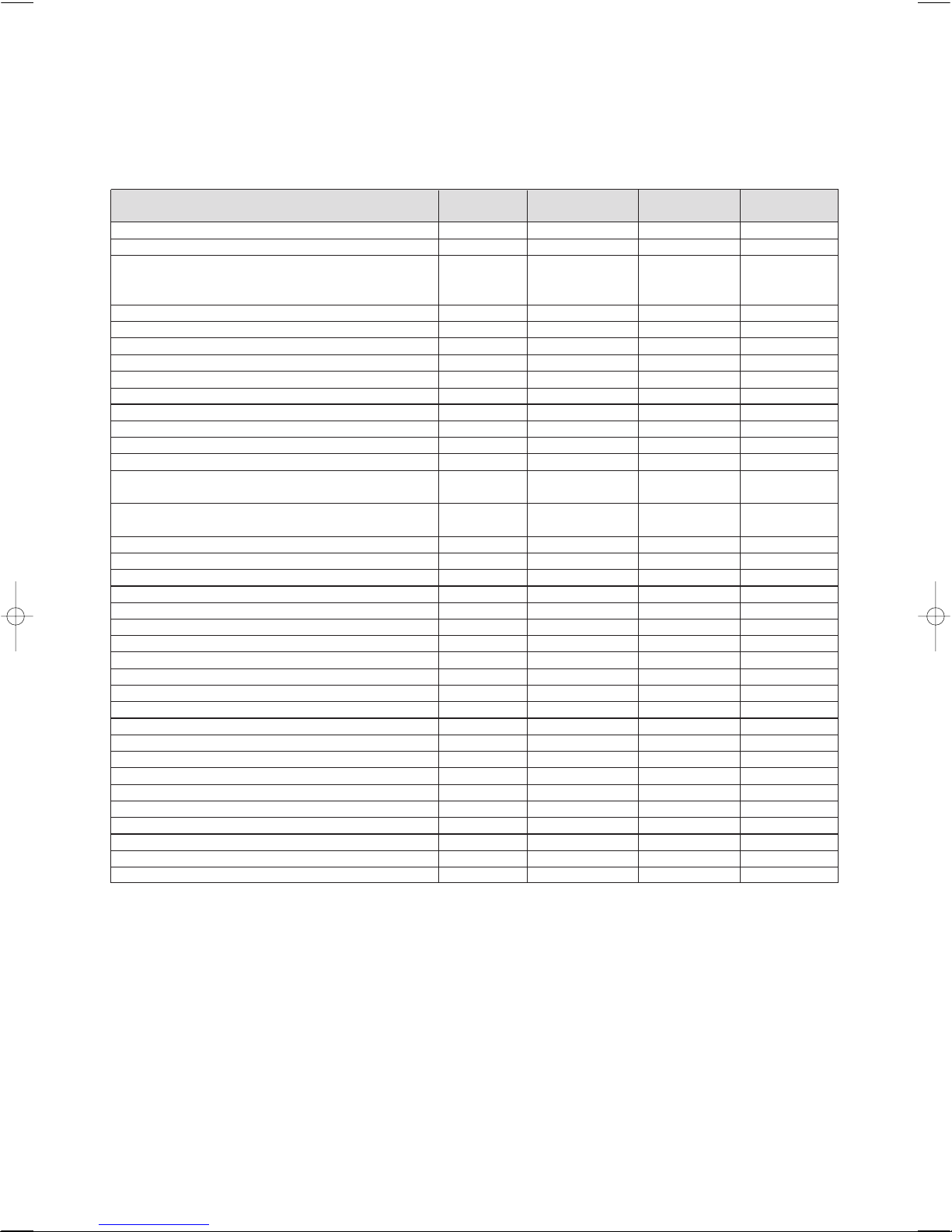
2.1 Technical data (1)
ecoMAX ecoMAX ecoMAX Units
824/2 E 828/2 E 835 E
Maximum CH heat input (G 20) (net) 18.4 22.4 27.0 kW
Maximum CH heat input (G 31) (net) 18.4 22.4 27.0 kW
CH heat output range
80 °C flow/60 °C return 11.0 – 18.4 13.4 – 22.4 10.5 – 27.0 kW
50 °C flow/30 °C return 11.6 – 19.4 14.1 – 23.6 11.0 – 28.4 kW
SEDBUK A A A Band
SAP Seasonal Efficiency 91.1 91.1 91.1 %
Maximum DHW heat input (net) 23.0 28.0 35.0 kW
Maximum DHW output 23.0 28.0 35.0 kW
DHW flow rate ∆T = 35 K rise 9.4 11.5 14.3 l/min
Appr. DHW flow rate at factory set temp. rise (DT = 42 °C) 7.9 9.6 11.9 l/min
Mains water pressure required for max. flow rate 0.5 0.5 0.5 bar
Minimum water flow rate 1.5 1.5 1.5 l/min
Mains water pressure required for min. flow rate 0.2 0.2 0.2 bar
Maximum inlet water pressure 10 10 10 bar
Inlet gas working pressure required
(natural gas) 20 20 20 mbar
Inlet gas working pressure required
(Propane) 37 37 37 mbar
Gas supply (G20) Gross CV (s.t.) 37.8 37.8 37.8 MJ/m
3
Gas supply (G31) Gross CV (s.t.) 95.65 95.65 95.65 MJ/m
3
Gas rate (natural gas) max. 2.43 2.96 3.7 m3/h
Gas rate (Propane) max. 1.78 2.18 2.7 kg/h
CH temperature flow range 30 – 85 30 – 85 30 – 85 °C
Minimum CH water flow (for 20 °C rise) 790 960 1160 l/h
Pump pressure available 0.25 0.25 0.25 bar
10 l expansion vessel pre–charge pressure 0.75 0.75 0.75 bar
Maximum CH system pressure 2.5 2.5 2.5 bar
Connections heating flow/return 22 22 22 mm
Gas inlet 15 15 15 mm
Pressure relief discharge pipework (min.) 15 15 15 mm
Condensate drain (min. internal drain) 19 19 19 mm
Weight 40 41 48 kg
Primary water content 1.8 2.0 2.4 l
Volume of condensate (max.) 2.1 2.5 3.3 l/h
Maximum flue gas temperature 70 70 70 °C
Electrical supply voltage 230/50 230/50 230/50 V ~/Hz
Internal fuse (slow) main voltage 4 4 4 A
Internal fuse (slow) low voltage 4 4 4 A
Power input 115 115 140 W
Page 6
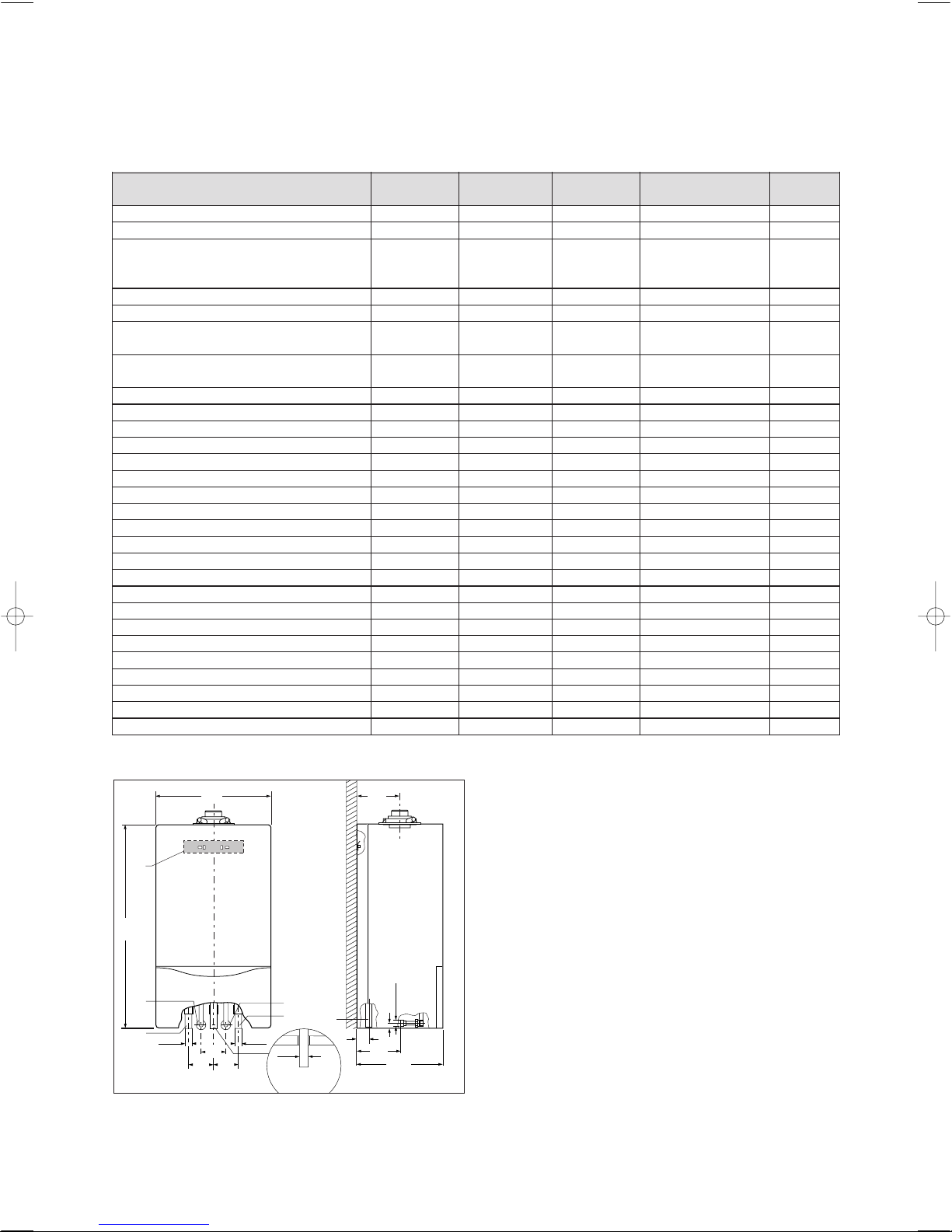
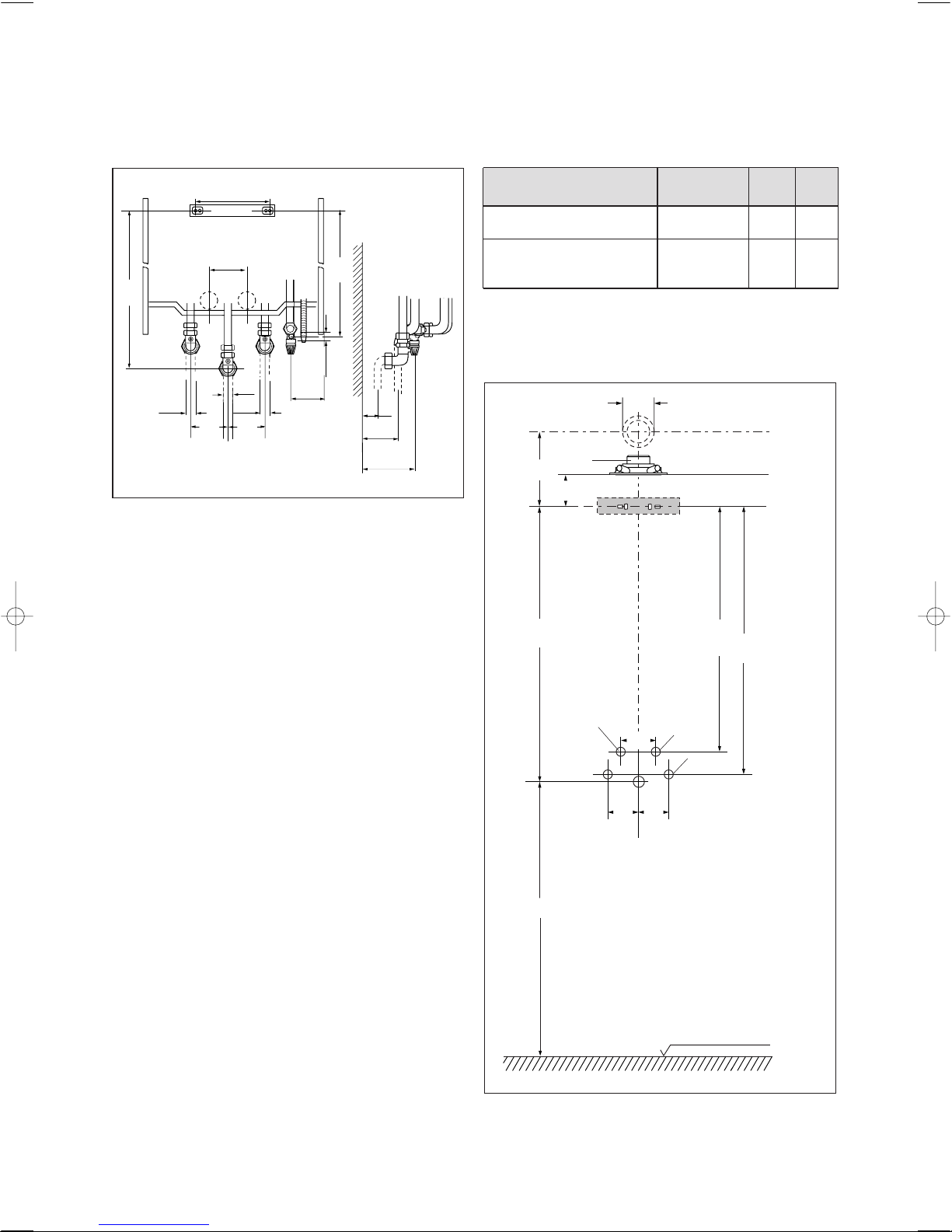
2.2 Dimensions
Fig. 2.1
2 Hanging bracket
3 Heating–system return
4 Cold–water inlet (ecoMAX 800/2 only)
5 Gas connection
6 Hot–water outlet (ecoMAX 800/2 only)
7 Heating–system flow
70
190
480
800
2
100
380*
7
Ø 20
100 100
Ø 20
5
3
7
Ø 20
20
R 1
/2
180
4
6
*(ecoMAX 635, 835: 450)
6
2 Boiler Specification
Instructions for installation and servicing ecoMAX6
2.1 Technical data (2)
ecoMAX 613/2 E 618/2 E 622/2 E 635 E Units
Maximum CH heat input (G 20) (net) 13.5 18.4 22.4 34.9 kW
Maximum CH heat input (G 31) (net) 13.5 18.4 22.4 34.9 kW
CH heat output range
80 °C flow/60 °C return 4.6 – 13.5 11.0 – 18.4 13.4 – 22.4 10.5 - 34.9 kW
50 °C flow/30 °C return 4.8 – 14.2 11.6 – 19.4 14.1 – 23.6 11.0 - 36.7 kW
SEDBUK A A A A Band
SAP Seasonal Efficiency 91.2 91.2 91.2 91.2 %
Inlet gas working pressure required
(natural gas) 20 20 20 20 mbar
Inlet gas working pressure required
(Propane) 37 37 37 37 mbar
Gas supply (G20) Gross CV (s.t.) 37.8 37.8 37.8 37.8 MJ/m
3
Gas supply (G31) Gross CV (s.t.) 95.65 95.65 95.65 95.65 MJ/m
3
Gas rate (natural gas) max. 1.43 1.95 2.37 3.7 m3/h
Gas rate (Propane) max. 1.05 1.43 1.74 2.7 kg/h
CH temperature flow range 30 – 85 30 – 85 30 – 85 30 - 85 °C
Minimum CH water flow (for 20 °C rise) 580 790 960 1480 l/h
Pump pressure available 0.25 0.25 0.25 0.25 bar
10l expansion vessel pre–charge pressure 0.75 0.75 0.75 0.75 bar
Maximum CH system pressure 2.5 2.5 2.5 2.5 bar
Connections heating flow/return 22 22 22 22 mm
Gas inlet 15 15 15 15 mm
Pressure relief discharge pipework (min.) 15 15 15 15 mm
Condensate drain (min. internal drain) 19 19 19 19 mm
Weight 39 39 40 41 kg
Primary water content 1.8 1.8 2.0 2,2 l
Volume of condensate (max.) 1.2 2.1 2.5 3,3 l/h
Maximum flue gas temperature 70 70 70 70 °C
Electrical supply voltage 230/50 230/50 230/50 230/50 V ~/Hz
Internal fuse (slow) main voltage 4 4 4 4 A
Internal fuse (slow) low voltage 4 4 4 4 A
Power input 115 115 115 115 W
Page 7
7
Boiler Specification 2
Instructions for installation and servicing ecoMAX 7
2.3 Boiler connections
Fig. 2.2
2.4 Scale drawing and fitting dimensions
Dimensions when combined with A ØB C*
the following system comp.: with 87° elbow
air/flue system Ø 60/100 235 60/100 _
air/flue system Ø 80/125 253 80/125 _
VANTAGE 120 _ _ 1101
VANTAGE 150 _ _ 1101
VANTAGE 200 _ _ _
Tab. 2.1 Dimensions used in combinations
*) Note: Dimension C must be observed if a Vaillant VANTAGE 120, 150 and
200 hot–water tank is to be installed under the heating unit.
Fig. 2.3 Fitting dimensions
94
1
Top edge of appliance
750
C
A
Air/flue duct centrer
3
717
Dimensions for
embedded installation
100 100
4
684
120
6
Ø B
Ø22
Ø22
25
33.5
100100
Ø 15
750
703
150
79
70
Ø15
113
Page 8
8
2 Boiler Specification
Instructions for installation and servicing ecoMAX8
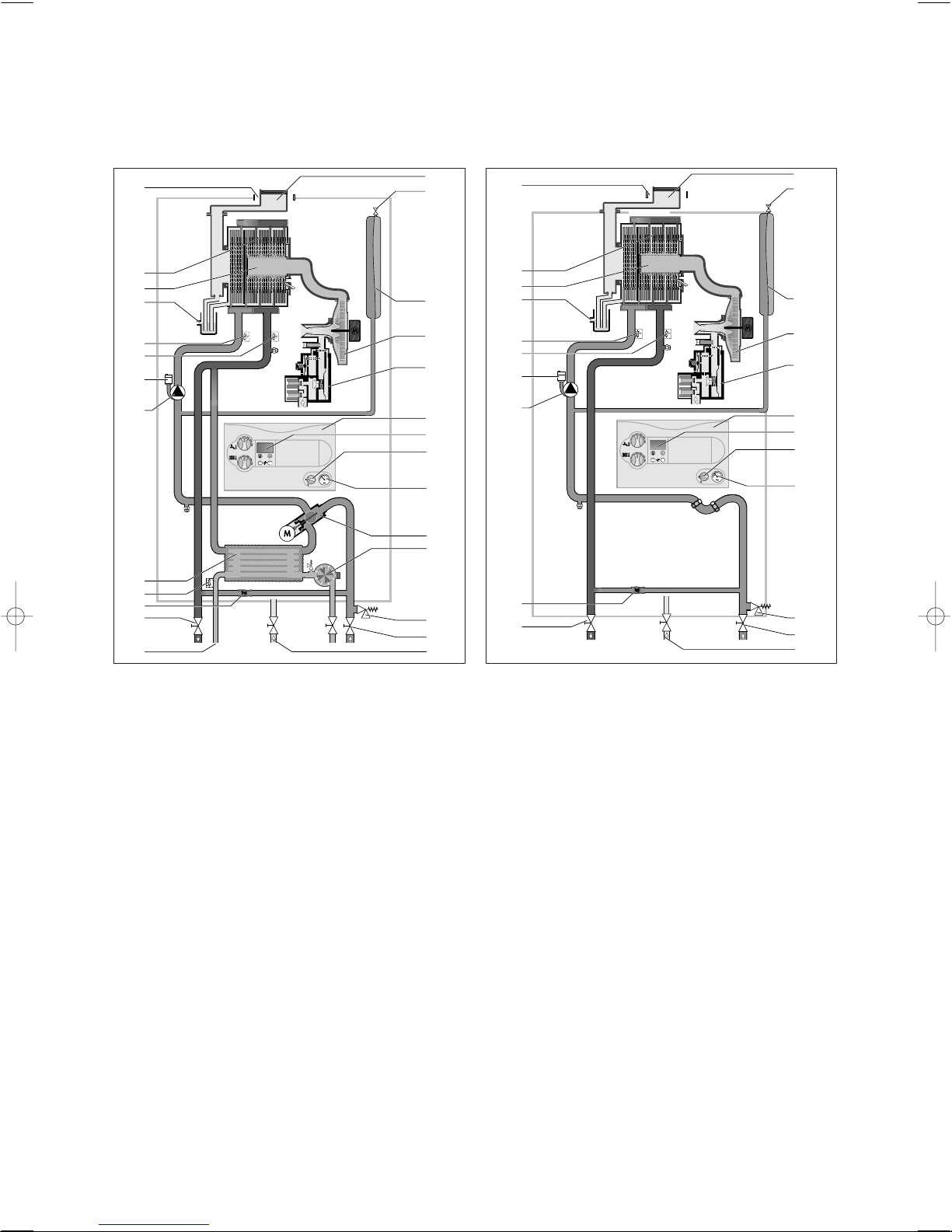
2.5 Functional diagrams
Fig. 2.4 Functional diagram ecoMAX 800/2, 835
1 Air duct
2 Main heat exchanger
3 Burner
4 Condensate trap
5 Temperature sensor (NTC 1)
6 Temperature sensor (NTC 2)
7 Automatic air vent
8 Circulating pump
9 DHW heat exchanger
10 Temperature sensor (NTC 3)
11 Automatic bypass valve
12 CH flow service valve
13 Domestic hot water outlet
14 Gas service valve
15 Cold water inlet
16 CH return service valve
17 Pressure relief valve
18 Aqua sensor
19 Diverter valve
20 Pressure gauge
21 Main ON/OFF control
22 Boiler display
23 Electronic box
24 Gas valve
25 Fan
26 Expansion vessel
27 Expansion vessel charging valve
28 Flue gas duct
Fig. 2.5 Functional diagram ecoMAX 600/2, 635
1 Air duct
2 Main heat exchanger
3 Burner
4 Condensate trap
5 Temperature sensor (NTC 1)
6 Temperature sensor (NTC 2)
7 Automatic air vent
8 Circulating pump
10 Automatic bypass valve
12 CH flow service valve
14 Gas service valve
16 CH return service valve
17 Pressure relief valve
20 Pressure gauge
21 Main ON/OFF control
22 Boiler display
23 Electronic box
24 Gas valve
25 Fan
26 Expansion vessel
27 Expansion vessel charging valve
28 Flue gas duct
28
27
26
2
4
5
6
7
8
10
12
3
1
25
24
22
23
21
20
17
16
14
28
27
26
2
4
5
6
7
8
9
10
11
12
13
3
1
25
24
22
23
21
20
19
18
17
16
14
Page 9
9
Boiler Specification 2
Instructions for installation and servicing ecoMAX 9
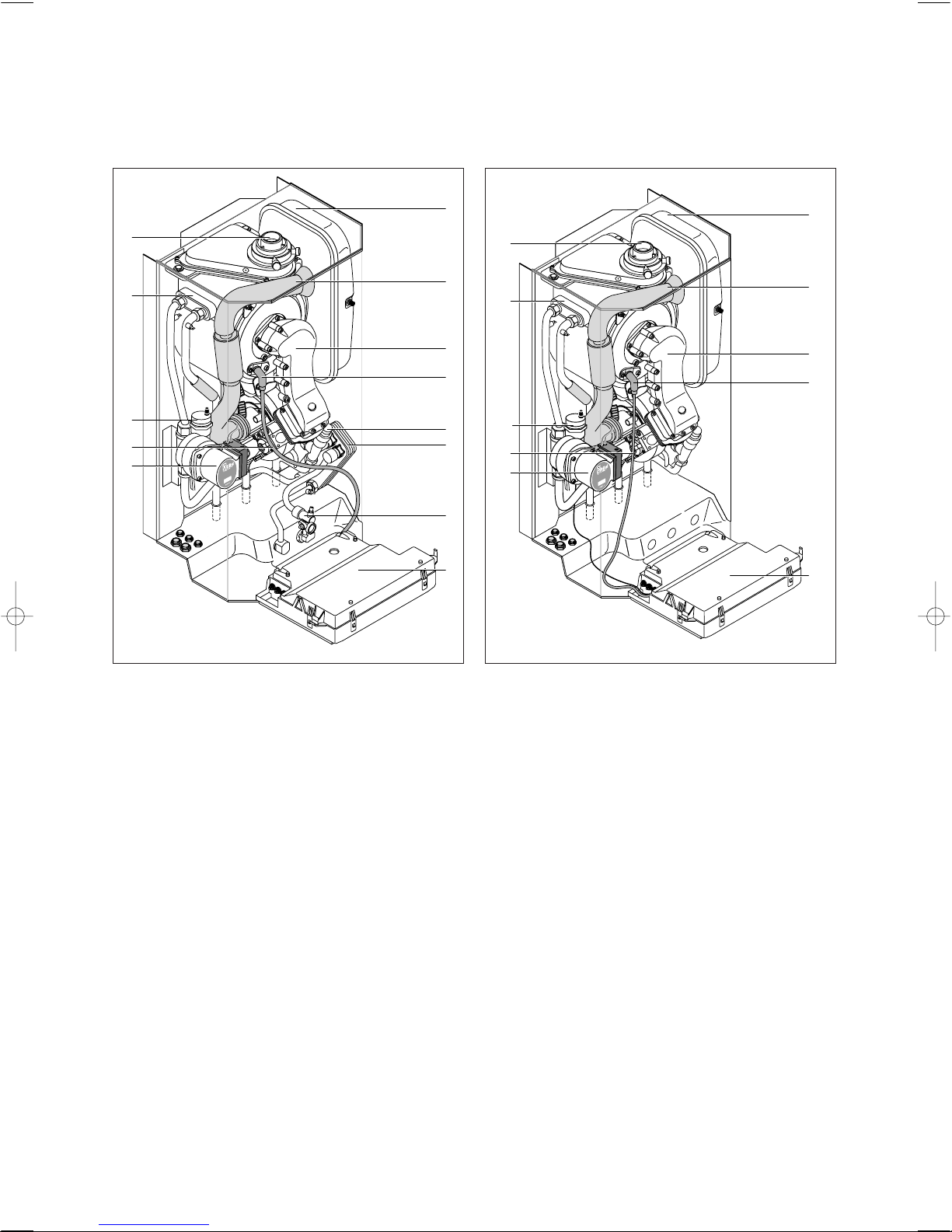
2.6 Design
Fig. 2.6 Functioning elements, ecoMAX 800/2 configuration
1 Expansion vessel
2 Air suction pipe
3 Burner assembly
4 Ignition electrode
5 Diverter valve
6 DHW heat exchanger
7 Aqua sensor
8 Electronic box
9 Circulating pump
10 Gas valve assembly
11 Auto air vent
12 Main Heat exchanger
13 Air/flue gas duct
Fig. 2.7 Functioning elements, ecoMAX 600/2 configuration
1 Expansion vessel
2 Air suction pipe
3 Burner assembly
4 Ignition electrode
8 Electronic box
9 Circulating pump
10 Gas valve assembly
11 Auto air vent
12 Main Heat exchanger
13 Air/flue gas duct
1
2
3
4
8
9
10
11
12
13
1
2
3
4
6
5
7
8
9
10
11
12
13
Page 10
10
2 Boiler Specification
3 General requirements
Instructions for installation and servicing ecoMAX10
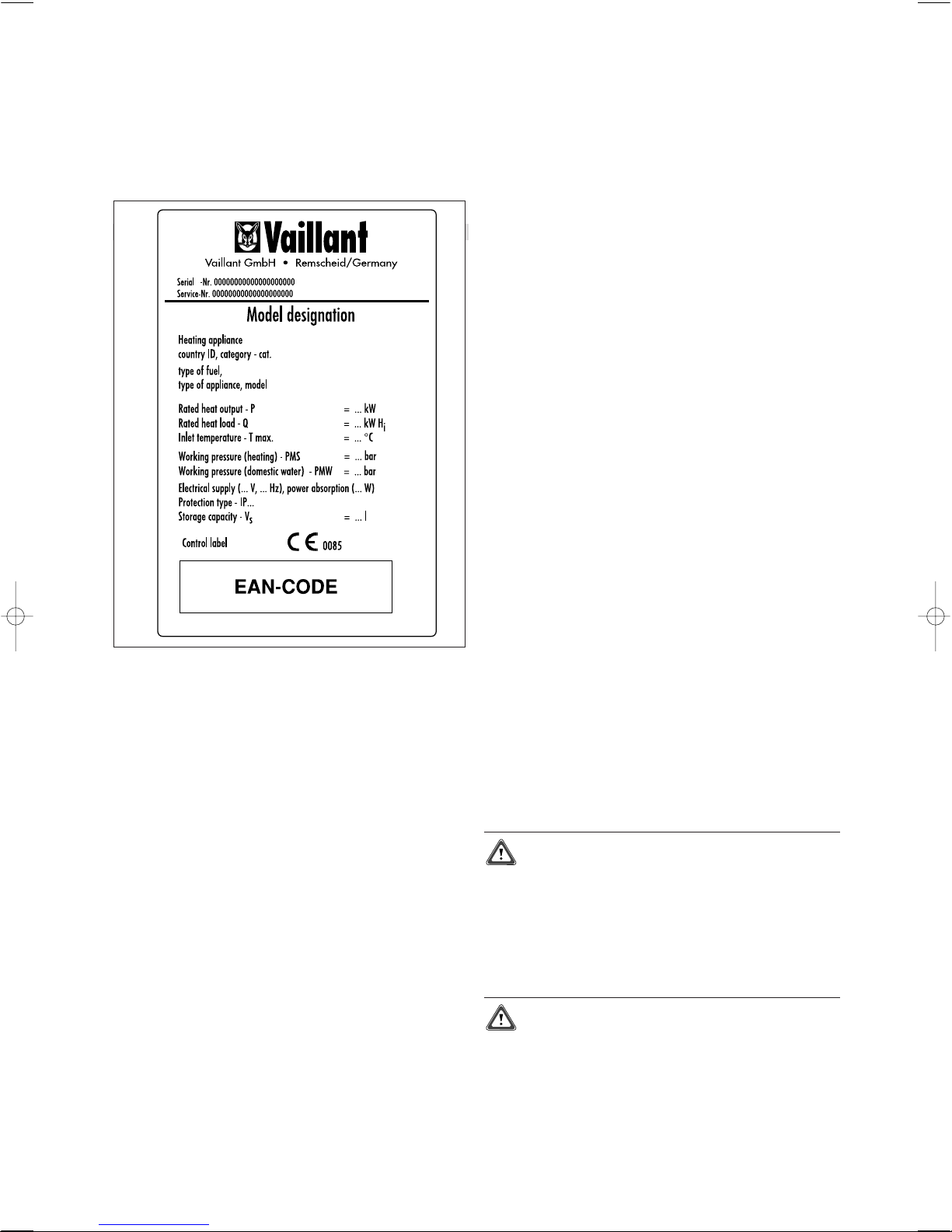
2.7 Identification plate
The identification plate of the Vaillant ecoMAX is supplied ready–attached to the bottom of the unit.
Fig. 2.8 Identification plate (example)
3 General requirements
3.1 Preliminary remarks
This appliance should only be installed in conjunction with
a Vaillant flue system. Install the flue system as detailed
in the separate flue installation instructions supplied
with this boiler.
3.2 Related documents
The installation of the boiler must be in accordance with
the relevant requirements of Gas Safety (Installation
and Use) Regulations 1998, Health and Safety Document
No. 635 (The Electricity at Work Regulations 1989),
BS7671 (IEE Wiring Regulations) and the Water Supply
(Water Fitting) Regulations 1999, or The Water Bylaws
2000 (Scotland). It should also be in accordance with the
relevant requirements of the Local Authority, Building
Regulations, including amendments to the Approved
Documents Part L and J 2002, The Building Regulations
(Scotland). The Building Regulations (Northern Ireland)
and the relevant recommendations of the following
British Standards:
BS 5440: Flues and ventilation of gas fired boilers not
exceeding 70 kW net:
– Part 1: Flues
– Part 2: Ventilation
BS 5449: Specification for forced circulation hot water
for domestic premises.
BS 5546: Specification for gas hot water supplies for
domestic premises.
BS 6700: Services supplying water for domestic use
within buildings and their curtilages.
BS 6798: Specification for installation of gas fired boilers not exceeding 60 kW input.
BS 6891: Specification for installation of low pressure
gas pipework up to 28 mm (R1) in domestic premises
(2nd family gas).
BS 7593: Treatment of water in domestic hot water central heating systems.
Institute of Gas Engineers Publication IGE/UP/7/1998:
”Guide for gas installations in timber framed housing”
Important:
The appliance must be installed and serviced by
a Competent Person as stated in the Gas Safety
(Installation and Use) Regulations 1998. In IE,
the installation must be in accordance with the
current edition of I.S.813 ‘Domestic Gas
Instal–lations’, the current Building Regulations
and reference should be made to the current
ETCI rules for electrical installation.
Important:
When tightening or loosening screwed connec-
tions always use suitable open–ended spanners
(not pipe wrench, or extensions, etc.).
Incorrect use and/or unsuitable tools can lead to
damage being caused (e.g. gas or water leakage)!
Page 11
11
General requirements 3
Instructions for installation and servicing ecoMAX 11
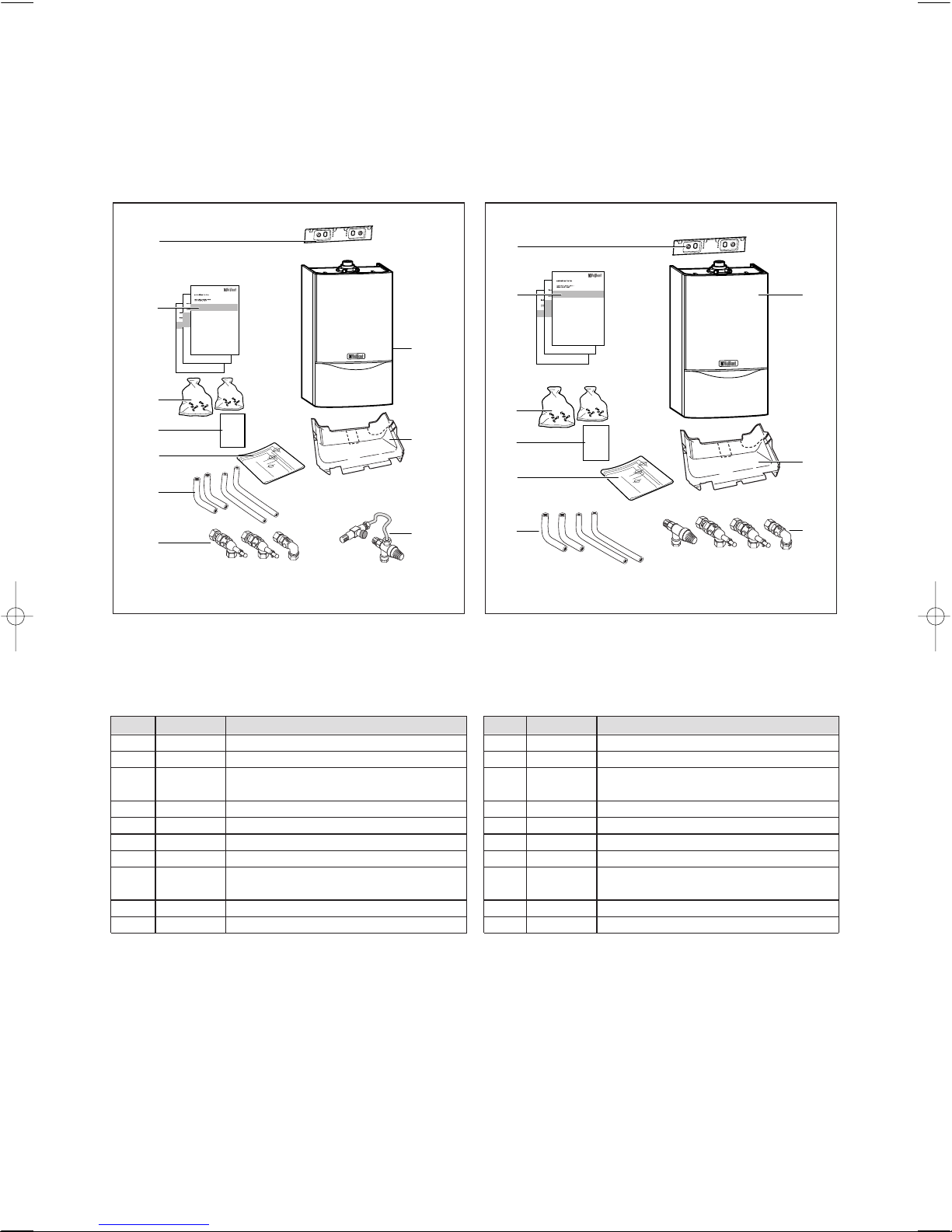
3.3 Contents included with boiler (ecoMAX 800/2)
Ensure that all contents are included before commencing installation.
Fig. 3.1 Items supplied with unit (ecoMAX 800)
DO NOT remove the boiler from the polystyrene base at
this stage.
Item Quantity Description
1 1 Boiler
2 1 Hanging bracket
3 3 Installation and Servicing, Users and
Flue Installation Instructions
4 1 Installation and connection accessories
5 2 Guarantee Card and Benchmark log book
6 1 Template
7 4 Copper tails for gas and water pipework
8 3 Flow and return service valve, gas service
valve
9 1 Pressure relief valve/double check valve
10 1 Lower cover (packed inside boiler)
Table 3.1 Items supplied with unit (ecoMAX 800)
3.4 Contents included with boiler (ecoMAX 600/2)
Ensure that all contents are included before commencing installation.
Fig. 3.2 Items supplied with unit (ecoMAX 600)
DO NOT remove the boiler from the polystyrene base at
this stage.
Item Quantity Description
1 1 Boiler
2 1 Hanging bracket
3 3 Installation and Servicing, Users and
Flue Installation Instructions
4 1 Installation and connection accessories
5 2 Guarantee Card and Benchmark log book
6 1 Template
7 4 Copper tails for gas and water pipework
8 3 Flow and return service valve, gas service
valve
9 1 Pressure relief valve
10 1 Lower cover (packed inside boiler)
Table 3.2 Items supplied with unit (ecoMAX 600)
4
5
2
6
7
3 1
10
9
10
9
1
4
5
2
6
7
8
3
Page 12
12
3 General requirements
Instructions for installation and servicing ecoMAX12
3.5 Boiler location
The location chosen for the boiler must permit the provision of a satisfactory flue termination. The location must
also provide adequate space for servicing and air circulation around the boiler. The boiler may be installed in
any room, although particular attention is drawn to the
requirements of BS7671 (IEE Regulations), the electrical
provisions of the Building Standards (Scotland)
Regula–tions, and in IE the current edition of IS813 and
the current ETCI rules, in respect of the installation of a
boiler in a room containing a bath or shower.
Note:
Where a room sealed boiler is installed in a room
containing a bath or shower, any electrical
switch or boiler control utilising mains electricity
should be so situated that it cannot be touched
by a person using the bath or shower.
Where the installation of the boiler will be in an unusual
location, special procedures may be necessary and BS
5546 and BS 6798 give detailed guidance on this aspect.
The boiler must be mounted on a flat, vertical wall, which
must be sufficiently robust to take the weight of the boiler. The boiler may be installed on a combustible wall,
subject to the requirements of the Local Authorities and
Building Regulations.
A compartment used to enclose the boiler must be designed and constructed specifically for this purpose. (An
existing cupboard or compartment may be used provided that it is modified for the purpose). Details of essential features of cupboard/compartment design including
airing cupboard installations are given in BS 6798. If the
boiler is to be fitted in a timber framed building, it should
be fitted in accordance with Institute of Gas Engineers
Publication IGE/UP/7/1998 ”Guide for Gas Installation in
Timber Framed Housing”.
3.6 Gas supply
The gas supplier should ensure the availability of an
ade–quate supply of gas. A gas meter may only be
connected to the service pipe by the supplier of gas or
their contrac–tor. An existing meter should be checked to
ensure that it is capable of passing the rate of gas supply required.
Installation pipes should be fitted in accordance with
BS 6891. In IE the current edition of IS 813. Pipework
from the meter to the boiler must be of an adequate
size. Do not use pipes of a smaller size than the boiler
gas connection (15 mm). The complete installation must
be tested for soundness and purged as described in
BS 6891.
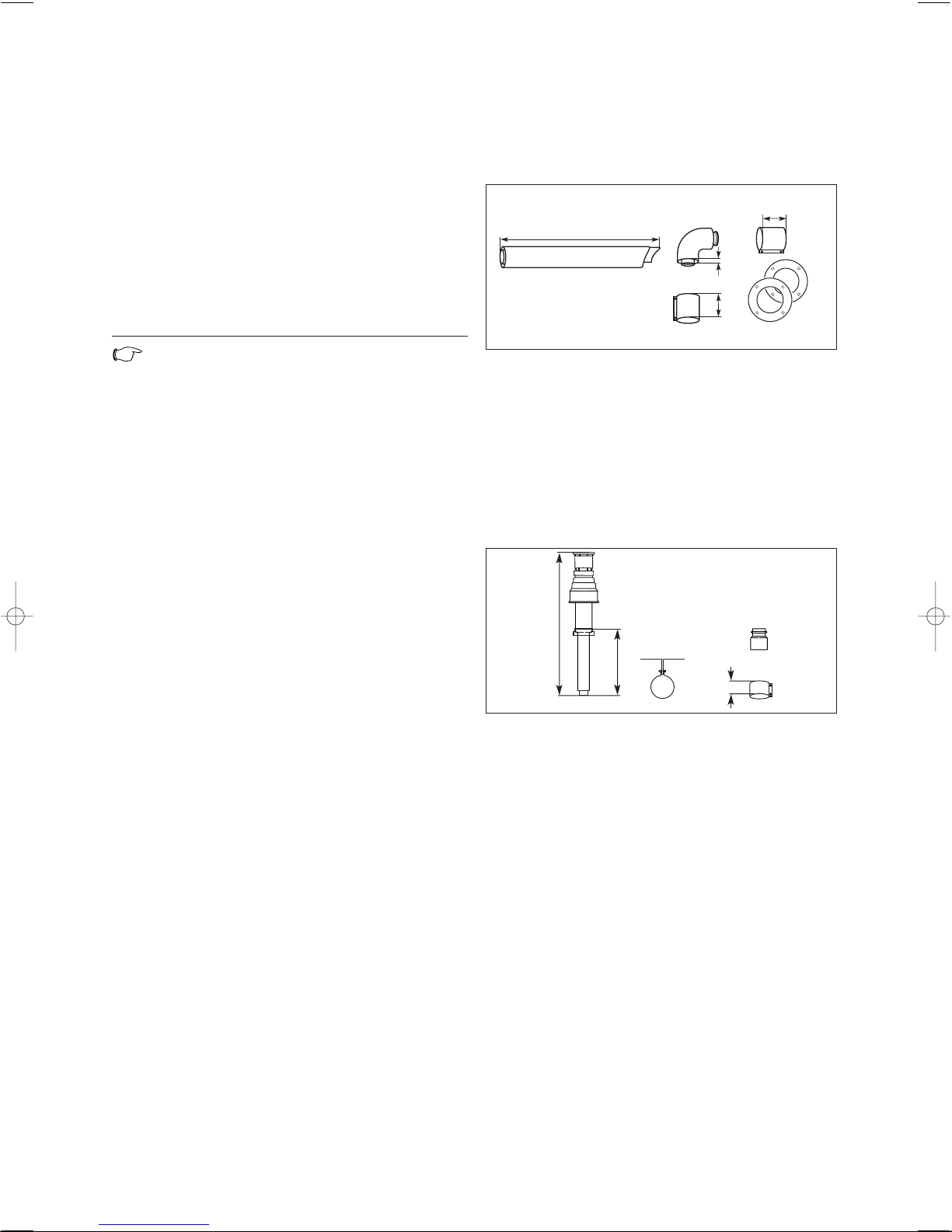
3.7 Flue system
3.7.1 Standard 100mm flue system
Fig. 3.3 Art.–No. 303 930
The standard 100 mm flue system (Art. No. 303 930) is
suitable for installations up to 740 mm measured from
the centre of the boiler flue outlet to the outside face of
the wall.
Flue extensions are available to extend this length up to
8 m for ecoMAX 828/2, 613/2, 618/2 and 622/2, 7 m for
ecoMAX 824/2 and 4 m for ecoMAX 635, 835. Both 90°
bends and 45° elbows are also available to increase siting flexibility.
Fig. 3.4 Art.–No. 303 900
3.7.2 Optional 125 mm flue system
A concentric flue system of 125 mm outside diameter is
available and can be used to achieve flue lengths up to
13 m for ecoMAX 613/2, 25 m for ecoMAX 618/2, 824/2,
30 m for ecoMAX 622/2 and 828/2 and 21 m for ecoMAX
635, 835. A vertical flue system is also available. Refer
to flue system installation instructions for full details.
1530
880
70
800
40
13
Page 13
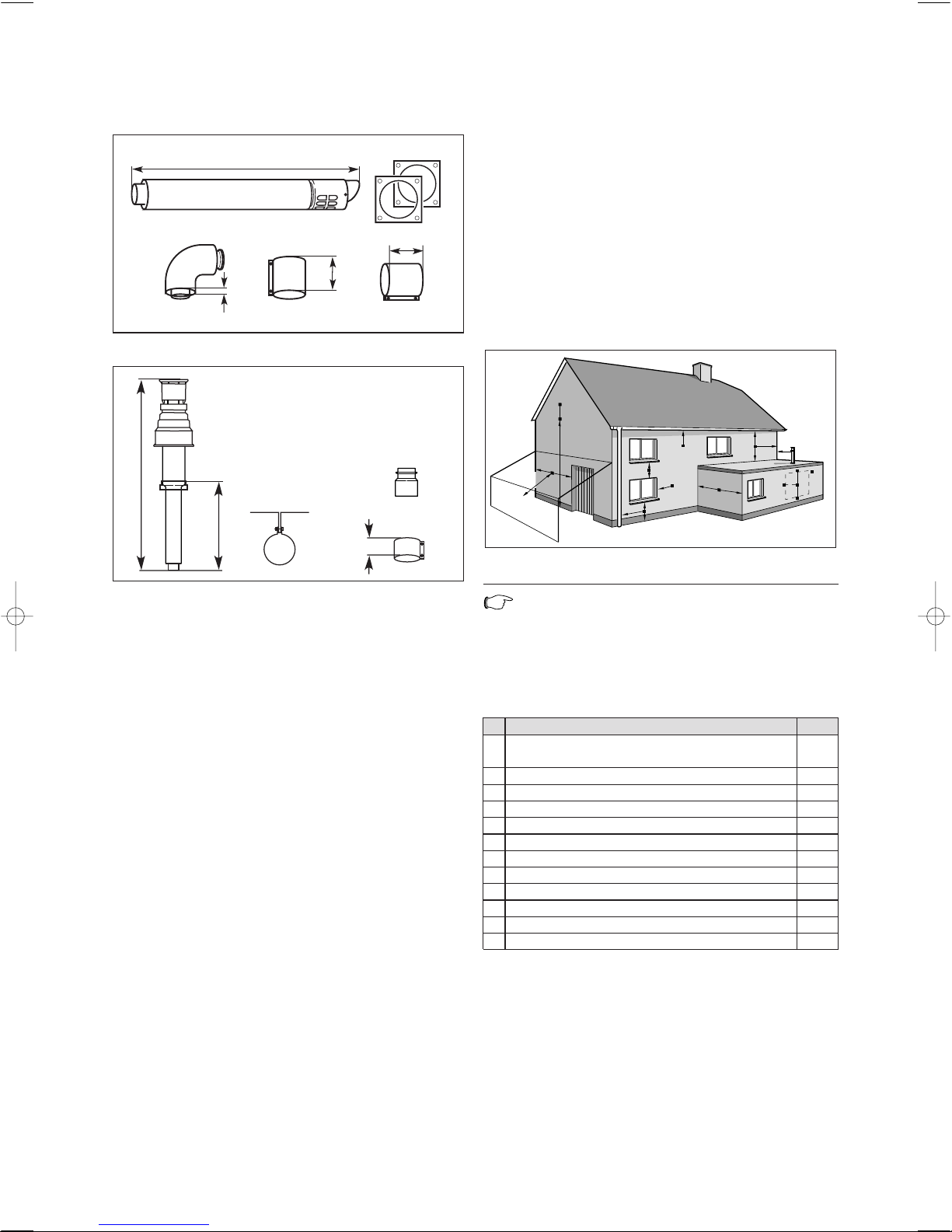
Fig. 3.5 Art.–No. 303 209
Fig. 3.6 Art.–No. 303 200
3.8 Flue termination
The following details refer to both flue systems.
a.The terminal must be positioned such that the produc-
ts of combustion can disperse freely at all times.
b.A plume of water vapour will sometimes be visible
from the flue terminal. Positions where this could be a
nuisance should be avoided.
c. If the terminal is fitted less than 2 m above a balcony,
above ground or above a flat roof to which people
have access then a suitable terminal guard must be
provided and fitted (made by Tower Flue Components,
Tonbridge, TN9 1TB).
Fig. 3.7 Flue termination
Note:
Vertical flues must not terminate within 600
mm of an openable window, air vent or any other
ventilation opening.
The flue assembly shall be so placed or sheilded as to
prevent ignition or damage to any pary of the building.
Terminal position mm
A Directly below an opening, above an opening or
horizontal to an opening, air brick, opening window, etc. 300
B Below gutters, soil pipes or drain pipes 75
C Below eaves 200
D Below balconies 200
E From vertical drain pipes and soil pipes 25
F From internal or external corners 300
G Above ground, roof or balcony 300
H From a surface facing a terminal 600
I From a terminal facing a terminal 1200
K Vertically from a terminal on the same wall 1500
L Horizontally from a terminal on the same wall 300
M Distance from adjacent for vertical Flue 500
Table 3.3 Terminal position for a fan assisted concentric flue
A
BCD
A
G
H, I
F
J
B
F
M
L
L
K
K
G
G
F
F
E
A
A
1530
880
70
70
1103
70
15
13
General requirements 3
Instructions for installation and servicing ecoMAX 13
Page 14
14
3 General requirements
Instructions for installation and servicing ecoMAX14
Note:
In addition, the terminal should not be nearer
than 150 mm to an opening in the building fabric
formed for the purpose of accommodating a
built–in element such as a window.
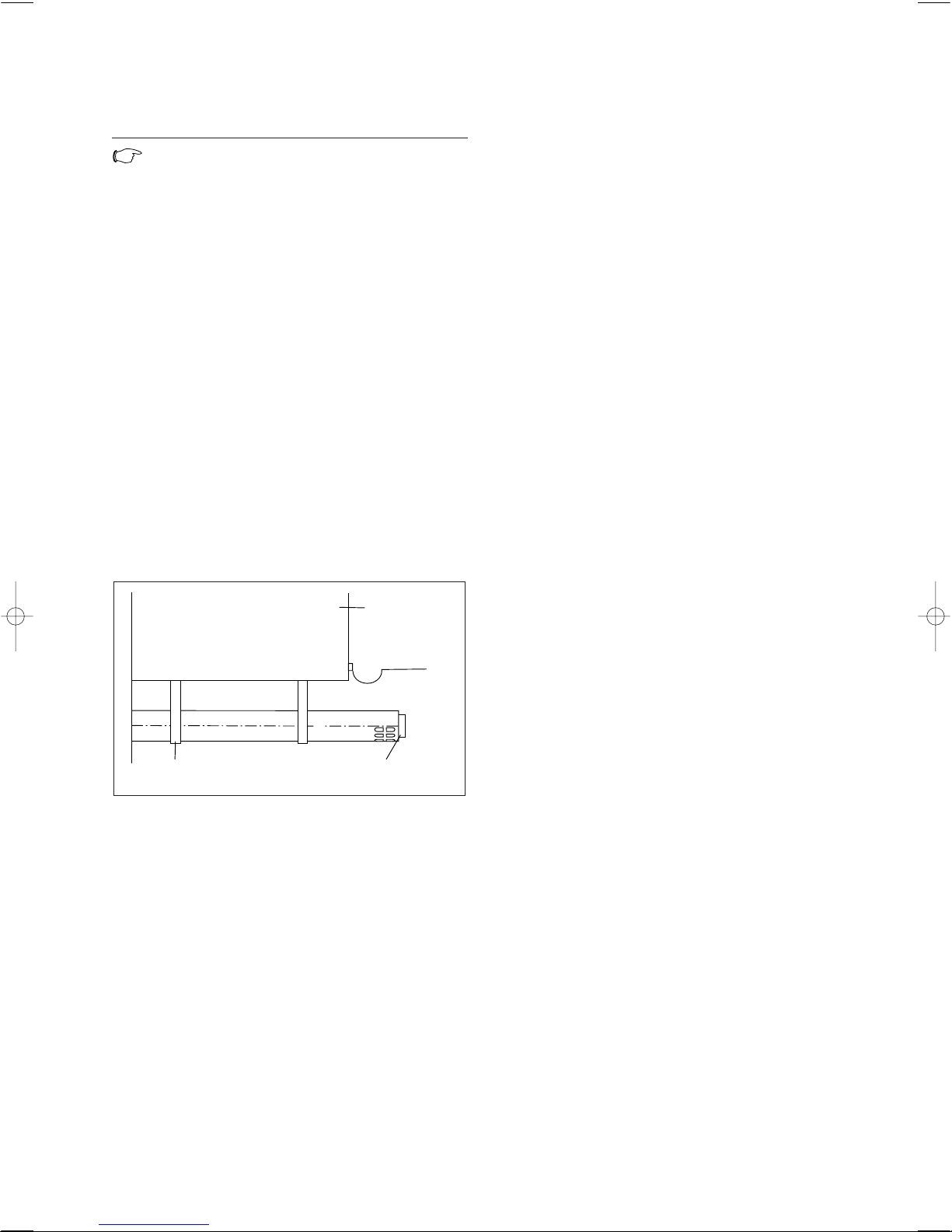
BS 5440–1 It is recommended that the fanned flue terminal should be positioned as follows:
a) at least 2m from an opening in the building directly
opposite, and
b) so that the products of combustion are not directly
directed to discharge across a boundary.
1) Dimensions B, C and D:
These clearances may be reduced to 25 mm without
affecting the performance of the boiler. In order to
ensure that the condensate plume does not affect
adjacent surfaces the terminal should be extended as
shown in fig. 3.8.
2) Dimension F:
This clearance may be reduced to 25 mm without
affecting the performance of the boiler. However, in
order to ensure that the condensate plume does not
affect adjacent surfaces a clearance of 300 mm is pre
ferred. For IE, recommendations are given in the current edition of IS 813.
Fig. 3.8
3.9 Air supply
Detailed recommendations for air supply are given in BS
5440: Part 2.
It is not necessary to have an air vent in the room or
internal space in which the boiler is installed.
3.9.1 Cupboard or compartment ventilation
The boilers are very high efficiency appliances. As a consequence the heat loss from the appliance casing during
operation is very low. For cupboard or compartment
installations it is therefore not necessary to provide any
high or low level permanent air vents for cooling purposes.
3.10 Electrical supply
A 230 V, ~ 50 Hz single phase electricity supply fused to
3 Amp. must be provided in accordance with the latest
edition of BS7671 (IEE Wiring Regulations) and any other
local regulations that may apply. In IE reference should
be made to the current edition of the ETCI rules. The
method of connection to the mains electricity supply must
provide a means of completely isolating the boiler and
its ancillary controls. Isolation is preferably by the use of
a fused three pin plug and unswitched shuttered socket
outlet, both complying with the requirements of BS 1363.
Alternatively, a 3 Amp. fused doublepole switch with a 3
mm contact separation on both poles may be used.
This appliance must be earthed.
3.11 Guide to system requirements
3.11.1 Water circulation system
Detailed recommendations for the water circulation
system are given in BS 6798 and BS 5449: Part 1 (for
small bore and micro bore central heating systems).
Pipework not forming part of the useful heating surface
should be insulated to help prevent heat loss and possible freezing, particularly where pipes are run through
roof spaces and ventilated underfloor spaces. Draining
taps must be located in accessible positions which permit the draining of the whole system including the boiler
and the hot water system. Draining taps should be at
least 1/2 in. BSP nominal size and be in accordance with
BS 2879. The boiler is suitable for use with minibore or
microbore systems. Copper tubing to BS 2871: Part 1
should be used for water carrying pipework. All capillary
joints in all DHW pipework must be made with lead free
solder. Particularly where a new boiler is to be fitted to
an existing system, it is good practice that the system is
thoroughly cleansed. This cleansing should take place
prior to the fitting of the new boiler and be in accordance with BS 7593. For advice on the application of system
cleansers contact Sentinel, Betz Dearborn Ltd. Widnes,
Cheshire, WA8 8UD. Tel: 0151 495 1861, or Fernox, Alpha
Fry Technologies, Tandem House, Marlow Way, Croydon,
CR0 4XS. Tel 0870 6015000
3.11.2 Filling and make up
The system can be filled using the built in filling loop
(ecoMAX 800) or via a separate filling point fitted at a
convinient position on the heating circuit. The connection
must be removed when filling is completed. Where local
Water Authority regulation does not allow temporary
connection, a sealed system filler pump with break tank
must be used. The heating system will not be filled automatically from the domestic hot water side. (Alternative
methods of filling sealed systems are given in BS 5449).
3.11.3 Pressure relief valve
A pressure relief valve is provided with the boiler. This
safety device is required on all sealed C.H. systems and
is preset at 3 bar and provided with a 15 mm compression connection for a discharge pipe, which must be of no
less than 15 mm in diameter. The pressure relief valve
must not be used for draining purposes.
balcony/eaves
flue extended to
clear any overhang
flue adequately
supported
gutter
Page 15
15
General requirements 3
Instructions for installation and servicing ecoMAX 15
3.11.4 Pressure gauge
This is factory fitted to the boiler and indicates the primary circuit pressure to facilitate filling and testing.
3.11.5 Expansion vessel
ecoMAX boilers incorporate a 10 litre expansion vessel
which is suitable for a sealed heating system with a
maximum water content of 100 litres.
If the nominal capacity of the built in expansion vessel is
not sufficient for the heating system (for instance in
case of modernization of old open systems) an additional expansion vessel can be installed external to the boiler. It should be fitted in the return pipe as close as possible to the boiler in accordance with BS 5449: Part 1.
Guidance on the sizing of an additional expansion vessel
is given in Table 3.4.
Vessel Volume [L]
Initial system pressure (bar) 1.0 1.5
Pressure relief valve setting (bar) 3.0
Total water content of system litres
25 2.7 3.9
50 5.4 7.8
100 10.9 15.6
125 13.6 19.5
150 16.3 23.4
175 19.1 27.3
200 21.8 31.2
225 24.5 35.1
250 27.2 39.0
275 30.0 42.9
300 32.7 46.8
325 35.7 50.7
350 38.1 54.6
375 40.9 58.5
400 43.6 62.4
425 46.3 66.3
450 49.0 70.2
475 51.8 74.1
500 54.5 78.0
For system volumes other than those
given above, multiply the
system volume by the factor across 0.109 0.156
Table 3.4 Sizing of additional expansion vessel
3.12 Pump specifications
3.12.1 Circulating pump
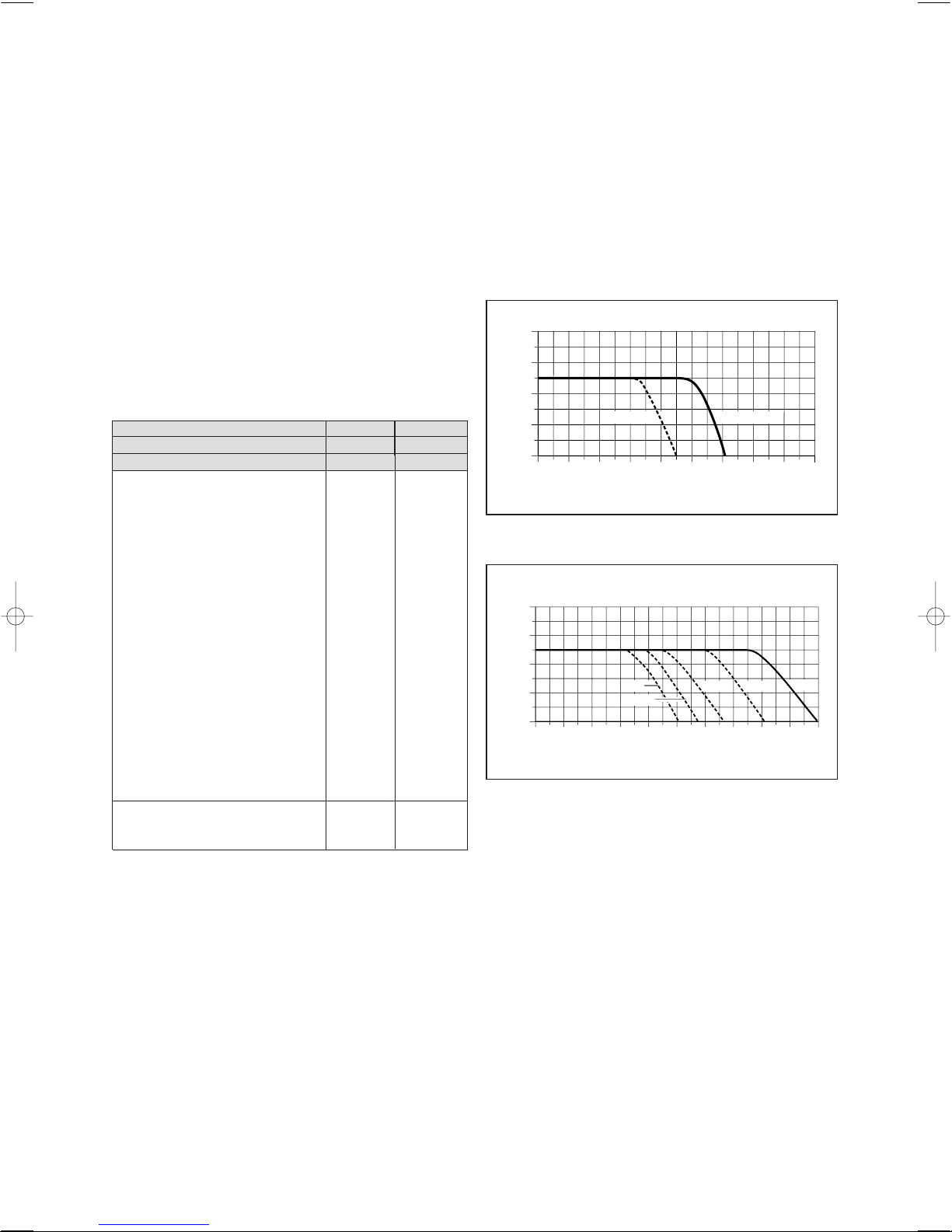
The circulating pump is included in the boiler. The pump
head available for the heating system is shown in fig. 3.9.
Circulating pump (ecoMAX 635 and 835 only):
The ecoMAX 635 and 835 boilers are fitted with a modulating circulating pump. The pump head available for the
heating system is shown in figure 3.10.
Fig. 3.9 Pump specifications ecoMAX 613/2, 618/2, 622/2,
824/2, 828/2
Fig. 3.10 Pump specifications ecoMAX 635, 835
3.12.2 System by–pass
An automatic system by–pass is included within the boiler. The boiler is suitable for use in systems with thermostatic radiator valves and no additional by–pass is
required.
3.12.3 Venting
The boiler is fitted with an automatic air vent. Additional
provision should be made to enable the heating system
to be vented during filling and commissioning either by
automatic air vents or manually.
3.13 Condensate trap
The boiler is fitted with a condensate trap incorporating
a water trap of 75 mm.
400
300
200
100
0
0 200 400 600 800 1000 1200 1600
Lift
[
mbar
]
1800
Volumeflow [l/h
]
1900
1400
100 %
53 %
60 %
70 %
85 %
400
300
200
100
0
0 200 400 600 800 1000 1200 1600
Lift
[
mbar
]
Volumeflow [l/h
]
1800
1400
Position IIIPosition II
Page 16
16
4 Boiler installation sequence
Instructions for installation and servicing ecoMAX16
4 Boiler installation sequence
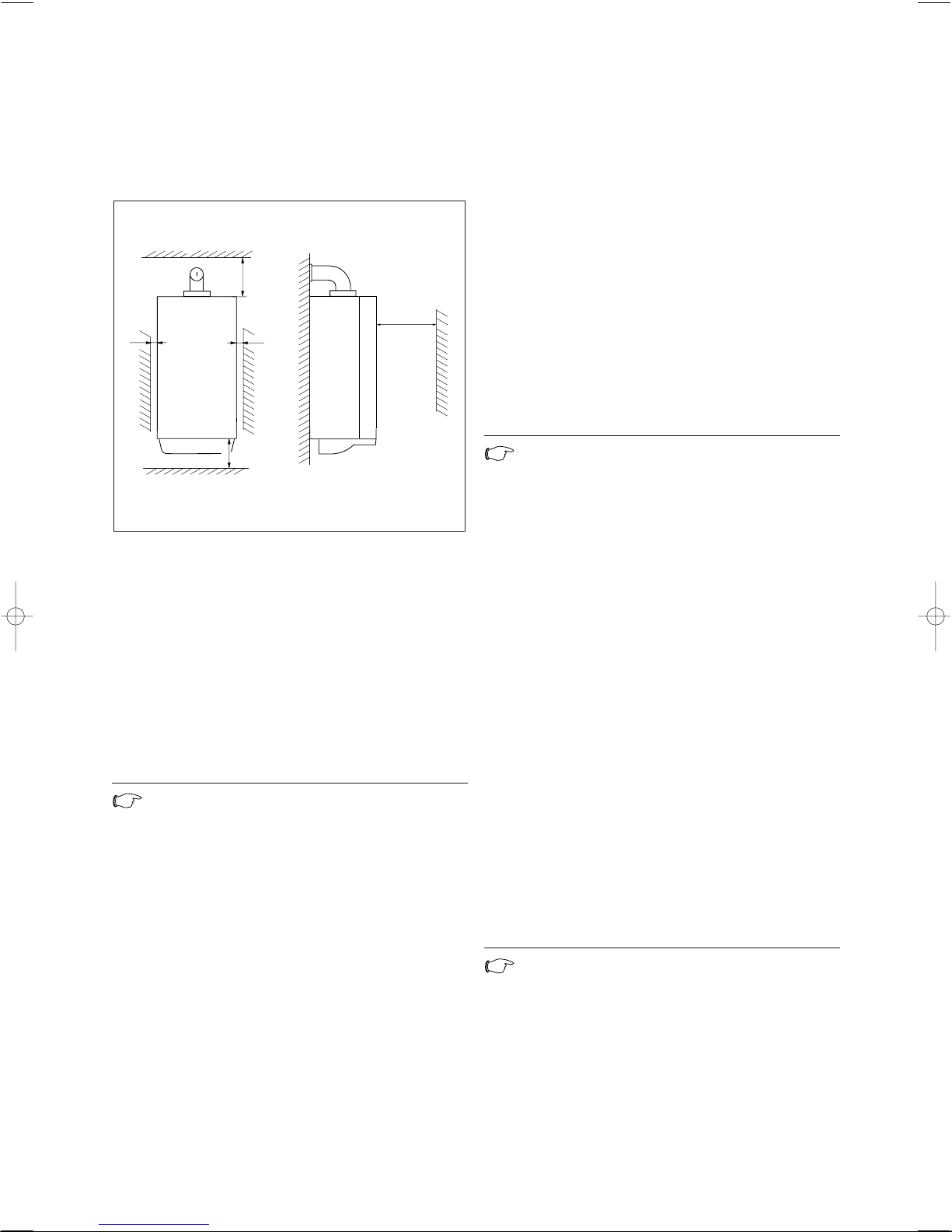
4.1 General
Fig. 4.1
The boiler should be mounted on a flat and vertical area
of wall of sufficient area for the boiler plus the required
clearances for installation and servicing (fig. 3.8). These
are shown on the installation template supplied with the
boiler and are:
– 5 mm either side of the boiler
– 145 mm below the boiler
– 205 mm* above the boiler when utilising the 100 mm
outside diameter flue
– 220 mm* above the boiler when utilising the 125 mm
outside diameter flue
– 500 mm in front of the boiler**
Note:
If the boiler is to be fitted in a timber framed
building, it should be fitted in accordance with
British Gas publication DM2 ‘Guide for gas
installations in timber framed housing’.
** This clearance is only required to enable easier access to the boiler for
servicing and may be provided by an openable door, etc.
4.1.1 Select position of boiler
Refer to section ‘Boiler location’ for information
regarding siting the appliance. In general the boiler must
be positioned such that:
• There is adequate space around the boiler for service
and maintenance
• The boiler can be correctly flued, i.e. the flue terminal
position is sited in accordance with these instructions
and the air/flue duct can be installed in accordance
with the flue installation instructions supplied.
• All necessary pipework can be connected, including
the pressure relief valve and condensate drain.
4.1.2 Unpack the boiler
To unpack the boiler, cut both plastic carton straps, open
box and lift out the polystyrene top packing. Lift the
cardbox box upwards.
Note:
Care should be taken not to scratch the white
surface of the boiler casing.
Packed in the boiler carton are the following:
• Boiler
• Flow and return central heating service valves
• Gas service valve
• Pressure relief valve and double check valve
(ecoMAX 800)
• Pre–formed copper pipework (for central heating flow
and return, gas and pressure relief valve connections)
• Boiler installation template
• Boiler hanging bracket
• Fixing screws, wall plugs and washers
• Installation and user instructions
• Flue installation instructions
• Guarantee card, envelope and Benchmark log book.
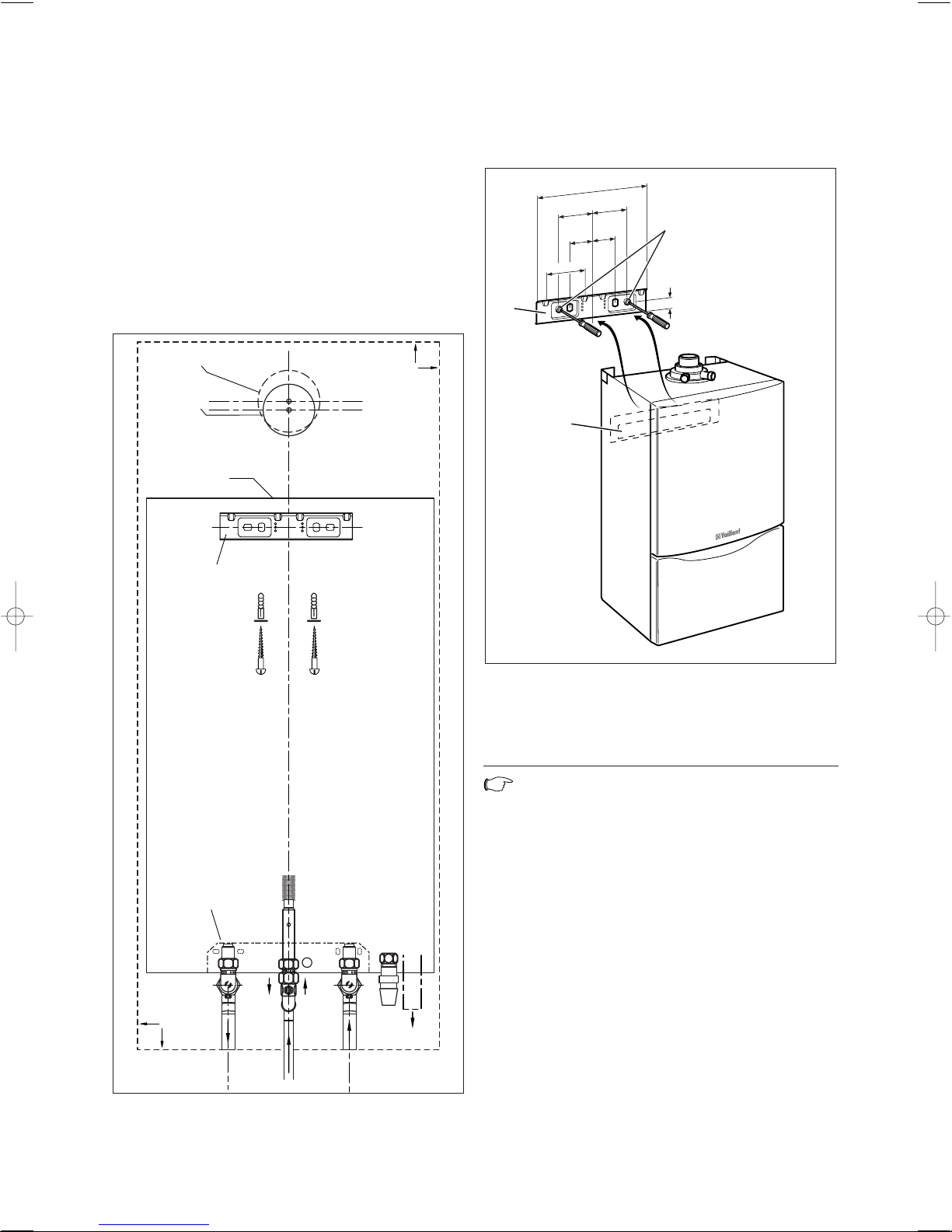
4.1.3 Using boiler template
Fix the paper template to the wall ensure that the
template is vertical.
The template shows:
– The position of the fixing holes for the boiler
mounting bracket (1).
– The position of the connections.
– The position of the flue exit hole.
Mark the position of the hanging bracket fixing holes (1).
Drill 2 holes Ø 8 mm for the hanging bracket.
Note:
Use alternative fixing holes where necessary.
min
min 5
min 5
min 500**
min 145
205/220*
Page 17
17
Boiler installation sequence 4
Instructions for installation and servicing ecoMAX 17
4.2 Rear flue exit
Mark the position of the air/flue duct and its circumference.
4.3 Other flue options
Flue instructions for other flue systems such as vertical
RSF flues, flues run to the side of the boiler and the use
of additional bends etc. are detailed in the flue
installation instructions provided with the boiler.
Remove the template from the wall and plug the drilled
holes using the wallplugs supplied.
Fig. 4.2 Using Boiler template
4.4 Fitting the boiler hanging bracket
Fig. 4.3 Fitting the boiler
Fix the hanging bracket (2) to the wall using the screws
supplied. (it may be necessary to use additional or
alternative fixings to ensure adequate support).
Note:
If the boiler is to be fitted in a timber framed
building ensure that the bracket is secured to a
substantial part of the timber frame capable of
taking the weight of the boiler.
4.5 Install the flue system
Install the flue system (refer to separate air/flue duct
installation instructions)
85
50
240
75
75
23
50
3
1
2
Boiler casing
Minimum
Clearances
Reqd.
Flow
D. H.W.
out
Cold
Mains in
Gas in Return
Condensale
discharge
Minimum Clearances
Reqd.
Flue hole
(60/100 mm
flue system)
Fixing holes and
Position for
optional
pre-instalation
connection
Flue hole
(80/125 mm
flue system)
Please use
the new
Boiler hanging
bracket
ecoMAX 824/2
ecoMAX 828/2
ecoMAX 835
ecoMAX 613/2
ecoMAX 618/2
ecoMAX 622/2
ecoMAX 635
Page 18

18
4 Boiler installation sequence
Instructions for installation and servicing ecoMAX18
4.6 Fitting the boiler
• Lift the boiler (3) up to the wall so that it is slightly
above the hanging bracket (1).
Note:
Lift the boiler from either side at the bottom
edge.
• Lower the boiler slowly onto the hanging bracket so
that the cross member at the rear of the boiler fully
engages onto the hanging bracket.
4.7 Removing the front case
Fig. 4.4 Removing/Refitting the case
To remove the front section of the case,
proceed as follows:
• Loosen the screw (1) on the bottom of the unit.
• Push in the two retaining clips (2) on the bottom of
the appliance until the case is released.
• Grasp the front case (3) by its bottom edge, pull it
towards the front and remove it by lifting it off the
unit.
4.8 Cold water mains inlet and hot water outlet
(ecoMAX 800)
Fig. 4.5 Fitting hot and cold water connections ecoMAX 800
Flush all foreign matter from the mains supply before
connecting to the boiler.
• Connect the cold water service valve (1) to the cold
inlet water connection of the appliance with the
washer provided and tighten.
• Connect a 15mm cold water inlet copper pipe (3) to the
cold water service valve (1) and tighten.
• Connect a 15 mm hot water outlet pipe (4) to the
outlet connection (5) of the appliance.
2
4
2
3
1
5
3
1
2
Page 19

19
Boiler installation sequence 4
Instructions for installation and servicing ecoMAX 19
4.9 Gas supply
Fig. 4.6 Fitting the gas connection ecoMAX 800
(picture shows ecoMAX 800)
• Connect the compression gas service cock and 15 mm
copper outlet tail as supplied with the appliance and
tighten.
• Connect a gas supply pipe of not less than 15 mm diameter to the copper tail.
• Tighten all connections.
(Ensure the gas supply pipework is adequately sized
such that a 20 mbar gas pressure is available at the
boiler inlet at full flow rate).
Important note (ecoMAX 835 boiler only):
The gas supply pipe must not be less than 22
mm diameter.
4.10 Central heating flow and return pipework
Fig. 4.7 Central heating flow and return pipework
(picture shows ecoMAX 800)
Before connecting the heating circuit to the boiler, all
pipework and radiators must be thoroughly flushed to
remove any installation debris.
• Connect the central heating flow and return service
valves to the appliance.
• Connect the 22 mm copper pipe tails to the service
valves as shown in the illustration and tighten the nuts.
• Connect the central heating pipework to the flow and
return tails.
Two additional tubes are supplied with the appliance for
top connection of the flow and return pipework within
the casing.
Page 20

20
4 Boiler installation sequence
Instructions for installation and servicing ecoMAX20
4.11 Pressure Relief Valve (ecoMAX 800)
Fig. 4.8 Fitting the pressure relief valve (ecoMAX 800)
The pressure relief valve and filling loop connection is
provided within the boiler cardboard box and should be
assembled as shown below.
• Remove plug from connection (1).
• Fit and install the complete unit ”pressure relief valve,
filling valve and flexible connection” (2) to the connection (1).
• Connect the corrugated hose (3) to the double check
valve (2a).
• Connect the discharge pipe (4) to the pressure relief
valve.
The discharge pipework should be as short as possible
and installed with a continuous fall away from the boiler.
The pipe should terminate in a position which ensures
that any discharge of water or steam from the valve cannot create a hazard to persons in or about the premises,or cause damage to any electrical components or
external wiring,and the point of discharge should be
clearly visible.
4.12 Pressure Relief Valve (ecoMAX 600)
Fig. 4.9 Fitting the pressure relief valve (ecoMAX 600)
A pressure relief valve is provided within the boiler cardboard box and should be assembled as shown below.
Connect a discharge pipe not less than 15 mm diameter
to the outlet of this valve.
The discharge pipework should be as short as possible
and installed with a continuous fall away from the boiler.
The pipe should terminate in a position which ensures
that any discharge of water or steam from the valve cannot create a hazard to persons in or about the premises,
or cause damage to any electrical components or external wiring, and the point of discharge should be clearly
visible.
Page 21

21
Boiler installation sequence 4
Instructions for installation and servicing ecoMAX 21
4.13 Condensate drain (fig. 4.10)
Connect the boiler condensate drain (1) to the condensate discharge pipe (2) the condensate discharge pipe
should be minimum of 19mm internal diameter (22mm
external diameter for any pipework installed external to
the property) and be made of an acid resistant material
(e.g. plastic overflow pipe).
The discharge pipe from the boiler condensate drain
must have a continuous fall (45mm per metre) and preferably be installed and terminated within the building to
prevent freezing. The condensate discharge pipe must
terminate in a suitable position, e.g.:
a)preferably the discharge pipe should be run and termi-
nate internally to the house soil and vent stack (at
least 450mm above the invert of the stack). A trap
giving a water seal of at least 75mm (3) should be
incorporated into the pipe run, and there must be an
air break (4) in the discharge pipe upstream of the
trap. This should be designed so that the condensate
cannot be discharged into the house if the condensate
pipe becomes blocked.
b)connecting into the internal discharge branch (e.g. sink
waste or washing machine) with an external termination, the condensate discharge pipe should have a minimum diameter of 22mm with no length restriction and
should incorporate a trap with a 75mm (3) seal The
connection should preferably be made down stream of
the sink waste trap. If the connection is only possible
upstream, then a air break is needed between the two
traps. This is normally provided by the sink waste. c)
terminating in a gully (5) below grid level (6) and
above the water level. The external pipe length should
be kept a short as possible to minimize the risk of freezing and should not be more than 3m.
d)At a condensate absorption point (soakaway) (7). The
external pipe length should not be more than 3m
Fig. 4.10
Fig. 4.11
Note:
If it is necessary to install any condensate
discharge pipework externally, then it should be
kept as short as possible to a maximum length
of 3m, be insulated with waterproof insulation
and have a continuous fall of a least 2.50 (i.e.
45mm for every metre length).
An optional siphon condensate discharge accessory is
available (Art. No. 2370104) and is for use where external discharge pipework is very exposed and at risk of
freezing. This accessory is for installation within the condensate discharge pipework immediately below the boiler.
Refer to ‘BS 6798 Specification for installation of
gas–fired boilers of rated input not exceeding 70 kW net’
for further information. Before operating the boiler the
condensate trap (1, fig.4.11) must be filled with water as
described in relevant section.
4.14 Connection to a VANTAGE cylinder (ecoMAX 600)
• For connecting a Vaillant VANTAGE cylinder please
refer to the VANTAGE installation instructions provided with the cylinder.
4.15 Connect the flue system to the boiler
• Refer to separate air/flue duct installation instructions
included with the boiler.
1
Internal
stackpipe
Internal
discharge system
Gulley Soakaway
ab c d
1
2
3
5
6
3
7
4
Page 22

22
4 Boiler installation sequence
Instructions for installation and servicing ecoMAX22
4.16 Electrical installation
4.16.1 General requirements
All electrical work shall be carried out by a competent
person and shall comply with BS7671 (IEE Regulations).
In IE, reference should be made to the current edition of
the ETCI rules. The boiler is supplied for connection to
230 V, ~ 50 Hz supply fused at 3 A rating. Connection to
the mains supply shall be made via a fused 3 pin plug to
an unswitched shuttered socket, both complying to the
requirements of BS1363.
(Alternatively, connection may be made via a 3 A fused
double pole isolator having a contact separation of at
least 3 mm in all poles and supplying the boiler and controls only). The point of connection to the mains supply
must allow complete electrical isolation of the boiler and
its ancillary controls. It should be readily accessible and
adjacent to the boiler. A 3 core flexible cord according to
BS6500 tables 6, 8 or 16 (3 x 0.75 to 3 x 1.5 mm
2
) should
be used.
Warning:
This appliance must be earthed.
Note:
DO NOT use boiler terminal connections
7–8–9.
Important:
Ensure that all cords pass through the cable
clamps in the rear of the control box and are
securely fixed. Ensure that the power supply is
connected such that the current carrying conductors become taut before the earth conductor
should the supply cord slip from the cable clamp.
Caution:
Mains connection terminals L and N remain live
even when the boiler on/off control is switched off.
4.16.2 Connection to the main supply
• Remove the front case and lower the control panel.
• Unclip the bottom of the terminal box cover and hinge
back to reveal the connection plugs.
• Pull out the power L, N and earth plug.
• Feed the power supply flex into the appliance and the
control panel through the cable clamps provided and
tighten.
• Connect the flex to the L,N and earth plug, reconnect
plug to terminal block.
Green/yellow (earth) wire – boiler terminal Earth sign
Blue (neutral) wire – boiler terminal N
Brown (live) wire – boiler terminal L
Note:
DO NOT use boiler terminal connections 7–8–9.
• Refit the terminal box cover by pushing into place until
it clips back into position.
• Raise the control panel.
Fig. 4.12 Wiring system
Fig. 4.13 Exposed rear view of electronic box
Page 23

23
Boiler installation sequence 4
Instructions for installation and servicing ecoMAX 23
4.16.3 Electronic board layout4.16.3 Electronic board layou
Fig. 4.14: Connection wiring ecoMAX 613/2, 618/2, 622/2, 824/2, 828/2
987
543
N
L
NL
Pump
Contact
therm
24V I
230V
RT 24V
230V
RT 230V
X 4
X 7
X 2
13
1
Coding resistance
1
1
1
X 6
Diagnostic connection
Diverter valve
Connection for multi–function module
306 253
Room thermostat 24 V: Connections 7, 8 and 9
Caution: DO NOT connect directly to mains
supply: danger of irreparable damage to
electronic system
Room thermostat 230 V/50 Hz
(remove bridge for connection)
Heating pump connection
Mains power supply: 230 V/50 Hz
Under–floor heating overload thermostat, 20 V
(remove bridge for connection)
Edge connector for Vaillant weather
compensator
Page 24

24
4 Boiler installation sequence
Instructions for installation and servicing ecoMAX24
4.16.3 Electronic board layout (continued)
Fig. 4.15: Connection wiring ecoMAX 635, 835
987
543
N
L
NL
Pump 2. Pump
Contact
therm
L N
24V I
230V
RT 24V
230V
RT 230V
X 4
X 10
X 7
X 8
X 2
13
X 6
1 1
1
1
1
Coding resistance
Diagnostic connection
Diverter valve (835 only)
Connection for multi–function module
306 253
Room thermostat 24 V: Connections 7, 8 and 9
Caution: DO NOT connect directly to mains
supply: danger of irreparable damage to electronic system
Room thermostat 230 V/50 Hz
(remove bridge for connection)
Heating pump connection
Mains power supply: 230 V/50 Hz
Under–floor heating overload thermostat, 20 V
(remove bridge for connection)
Edge connector for Vaillant
weather compensator
External CH pump
(adjustment via diagnostic system, diagnostic
setting d.16)
Page 25

25
Boiler installation sequence 4
Instructions for installation and servicing ecoMAX 25
4.16.3 Electronic board layout (continued)
Fig. 4.16 Connection wiring ecoMAX 824/2, 828/2
Electronic control box
Aqua sensor
NTC
Hot water outlet
Fan unit
Ignition electrode
NTC
flow
Priority reversing valve
Gas valve assembly
NTC
backflow
X 2/4 red
X 2/10 white
X 2/15 blue
Plug-in coupling
Pump
X 2/9 red (22 VDC)
X 2/24 blue (earth)
X 2/12 blue (earth)
X 2/7 grey (PWM)
X 2/3 black (Hall signal)
X 2/17 red (22 VDC)
X 4/3 brown C
X 4/2 pink D
X 4/1 black A
X 4/4 blue B
X 2/13 red (+ 5V)
X 2/23 black (earth)
X 2/1 green (signal)
987
543
N
L
NL
Pump
Contact
therm
24V I
230V
RT 24V
230V
RT 230V
X 4
X 7
X 2
13
1
Coding resistance
1
1
1
X 6
X 2/19 violet (signal)
Water Switch
Page 26

26
4 Boiler installation sequence
Instructions for installation and servicing ecoMAX26
4.16.3 Electronic board layout (continued)
Fig. 4.17: Connection wiring ecoMAX 835
Aqua sensor
NTC
Hot water outlet
Fan unit
Ignition electrode
Pump
NTC
flow
Priority reversing valve
Gas valve assembly
NTC
backflow
X 2/4 red
X 2/10 white
X 2/15 blue
Plug-in coupling
Electronic
control box
987
543
N
L
NL
Pump 2. Pump
Contact
therm
L N
24V I
230V
RT 24V
230V
RT 230V
X 4
X 10 X 7
X 8
X 6
X 2
Coding resistance
13
1
1 1
1
1
X 2/9 red (22 VDC)
X 2/24 blue (earth)
X 2/12 blue (earth)
X 2/7 grey (PWM)
X 2/3 black (Hall signal)
X 2/17 red (22 VDC)
X 4/3 brown C
X 4/2 pink D
X 4/1 black A
X 4/4 blue B
X 2/13 red (+ 5V)
X 2/23 black (earth)
X 2/1 green (signal)
X 2/19 violet (signal)
Water Switch
Page 27

27
Boiler installation sequence 4
Instructions for installation and servicing ecoMAX 27
4.16.3 Electronic board layout (continued)
Fig. 4.18 Connection wiring ecoMAX 613/2, 618/2, 622/2
Fan unit
Ignition electrode
NTC
flow
Gas valve assembly
NTC
backflow
X 2/4 red
X 2/10 white
X 2/15 blue
Plug-in coupling
Electronic control box
987
543
NL
NL
Pump
Contact
therm
24V I
230V
RT 24V
230V
RT 230V
X 4
X 7
X 2
13
1
Coding resistance
1
1
1
X 6
Pump
Water Switch
X 2/9 red (22 VDC)
X 2/24 blue (earth)
X 2/12 blue (earth)
X 2/7 grey (PWM)
X 2/3 black (Hall signal)
X 2/17 red (22 VDC)
Page 28

28
4 Boiler installation sequence
Instructions for installation and servicing ecoMAX28
4.16.3 Electronic board layout (continued)
Fig. 4.19: Connection wiring ecoMAX 635
Fan unit
Ignition electrode
Pump
NTC
flow
Gas valve assembly
NTC
backflow
X 2/4 red
X 2/10 white
X 2/15 blue
Plug-in coupling
Electronic
control box
987
543
N
L
NL
Pump 2. Pump
Contact
therm
L N
24V I
230V
RT 24V
230V
RT 230V
X 4
X 10 X 7
X 8
X 6
X 2
Coding resistance
13
1
1 1
1
1
X 2/9 red (22 VDC)
X 2/24 blue (earth)
X 2/12 blue (earth)
X 2/7 grey (PWM)
X 2/3 black (Hall signal)
X 2/17 red (22 VDC)
Water Switch
Page 29

29
Boiler installation sequence 4
Instructions for installation and servicing ecoMAX 29
4.16.4 Connection details for programmable thermostats
Fig. 4.20
LN
234
LN 3
4
1
ACL Drayton
Lyfestyle PT271, PT371
ACL Drayton
Digistat 2, 3, 4
ACL Drayton
Digistat RF - SCR Receiver
Danfoss Randall
TP4, TP5, TP5E
Danfoss Randall
TP5E RF with receiver RX1
Danfoss Randall
TP75
Grässlin Towerchron
RTC7
Honeywell
CM61, CM67, CM31, CM37
Horstmann
Centaurstat 1, 7
Landis & Staefa
REV 11, REV 15, REV 22
12
34
3
Sunvic
TLX 6501
Sunvic
TLX RFP, TLX RFD
Vaillant
VRT 230, 220
N1
3
N3
2
L
L
4
32
43
1
LN
234
LN 3
4
1
BC
2341
A
3
56
4
12
34
3
AB
34
C
12
4
34
3
LL1
34
Smiths Timeguard
ProgramaSTAT PRT11, PRT17
LN
4
LN
3
34
12
34
3
LN
234
LN 3
4
1
34
34
5
5
4.17 Controls (ecoMAX 800)
4.17.1 External electrical controls
The boiler terminals 3, 4 and 5 are for connecting external electrical controls such as a time switch and/or room
thermostat. Terminals 3 and 4 are linked together when
the boiler is supplied. If external controls are used, this
link must be removed, and the controls connected
across terminals 3 and 4. Terminal 5 is an additional
neutral connection for external neutrals such as from
the anticipator of a room thermostat.
4.17.2 Connection of external controls
4.17.3 Connection details for programmable room
thermostats
Fig. 4.19 shows the connection details where a programmable room thermostat (time switch with built in
room thermostat) is used to control the boiler.
Important:
The arrowed numbers indicate connection into
the relevant terminal in the boiler terminal strip.
Page 30

Fig. 4.22
3
987
MAINS
SUPPLY
230 V
50 Hz
L
L
LN
N
N
N
20 VDC (DO NOT USE 7, 8, 9 IN UK!)
3 A FUSE
SWITCH
CONTACTS
ROOM
THERMOSTAT
CLOCK
4
5
30
4 Boiler installation sequence
Instructions for installation and servicing ecoMAX30
4.17.4 Connection details for time switch
Fig. 4.21
LN
234
LN 3
4
1
ACL Drayton
Tempus 1, Tempus 2
Lyfestyle LP111, LP711
ACL Drayton
Switchmaster
SM300
ACL Drayton
Switchmaster 980
Danfoss Randall
103 Series
Danfoss Randall
Set 1E, TS975
Danfoss Randall
TS715
Grässlin Towerchron
QE1, QM1
Honeywell
ST610A, ST6100C
Horstmann
Channel Plus
H11, H17, 425 Coronet
Horstmann
Centaur Plus
C11, C17
LN
234
LN 4
3
1
Potterton Myson
EP 4002, EP 5002
Smiths Timeguard
SupplyMASTER
FST11, FST17
Sunvic
Select 107
N1
AB C
N4
2
L
L
3
34
12
65E
4L3
N
3
E
NE
234
NE
1
L
L
3
56
4
LN
234
LN 3
4
1
LN
234
LN 3
4
1
LN
234
LN 3
4
1
NE
234
NE
1
L
L
3
56
4
NE
234
NE
1
L
L
3
4
LN
234
LN 3
4
1
LN
234
LN 3
4
1
AB
DLN
LN
C
N
E
3
12
4
345E
12
4
432/L
1/N
3
65
mains supply
LN E
E
Landis & Staefa
RWB7, RWB30
Page 31

31Instructions for installation and servicing ecoMAX 31
4.17.5 Connection details for external time switches
and boiler terminal strip
Fig. 4.20 shows the connection details where a time
switch is used without a room thermostat to control the
boiler.
Important:
The arrowed numbers indicate connection into
the relevant terminal in the boiler terminal strip.
If a room thermostat is to be connected in addition to a
time switch the wire between the time switch ”ON” terminal and boiler terminal 4 should be broken by the
contacts of the room thermostat (see schematic layout,
Fig. 4.21).
4.17.6 Vaillant optional plug in timer accessories
Refer to the instructions supplied with the optional
accessories for connection details. Upon completion of
all electrical connections refit the terminal box cover by
pushing into place. The cover is secured by two locking
clips.
4.18 Controls (ecoMAX 600)
4.18.1 External electrical controls
The boiler terminals 3, 4 and 5 are for connecting external electrical controls such as a programmer, room thermostat, etc. Terminals 3 and 4 are linked together when
the boiler is supplied. If external controls are used, this
link must be removed, and the controls connected
across terminals 3 and 4. Terminal 5 is an additional
neutral connection for external controls.
4.18.2 Connection of external electrical controls
4.18.3 Connection details using an external wiring
centre
The boiler should be connected to the system controls
using an external wiring centre. Fig. 4.22, 4.23 shows
connection details for a system utilising a 3 port mid
position motorised valve, figure 4.24, 4.25 shows the
connection details for a system utilising two 2 port
motorised valves (Important: the arrowed numbers indicate connection into the relevant terminal of the external wiring centre).
4.19 Thermostatic radiator valves
The boiler has a built in automatic bypass valve making
it ideal for use in systems with thermostatic radiator valves (no separate system bypass is required). For optimum fuel economy where TRV’s are used they must be
used in conjunction with a boiler control interlock. A programmable room thermostat or separate timer and
room thermostat will ensure complete boiler shut down
when the heating demand is satisfied. (The radiator in
the room containing the room thermostat should not be
fitted with a TRV).
4.20 Frost protection
The boiler has an integral frost thermostat which is designed for protection of the boiler. To protect remote or
exposed parts of the heating system or property additional frost protection measures must be taken such as the
installation of an external frost thermostat. This frost
thermostat should be connected across the boiler terminals 3 and 4, in parallel with any external heating controls.
Note:
External frost protection cannot be used when
plug in timers are utilised.
4.21 Circulating pump
The boiler incorporates a built in circulating pump that is
fully prewired (no additional wiring is necessary). The
pump incorporates an automatic overrun period after
the boiler switches off.
4.22 Anti–cycling ‘economiser’ control
The boiler incorporates a built in anti–cycling control to
ensure that energy wasteful short cycling of the boiler
cannot occur. This control prevents the boiler from
re–igniting for a preset period after central heating operation (the hot water operation is unaffected by this control and hot water can be drawn at any time).
Note:
To temporarily override the anti–cycling control
turn the main boiler on/off switch to the off
position ”0” and then back to the on position
”I” after a few seconds.
4.23 Automatic pump spin control (APS)
The boiler incorporates a built in control which will spin
the built in circulating pump and operate the diverter
valve (ecoMAX 800) once in a 23 hour period. This control helps to prevent seizure when the boiler is not operated for a period of time. This control is not active
when the power supply to the appliance is turned off.
Boiler installation sequence 4
Page 32

32
4 Boiler installation sequence
Instructions for installation and servicing ecoMAX32
Fig. 4.23
Fig. 4.24
NL
234
53 8
76
1
not used
Lifestyle LP241, LP 522, LP 722
Tempus 6, Tempus 7
Danfoss Randall CP 715, FP715
Note: *Earth not required
Danfoss Randall Set 2E, Set 3E
Note: *Earth not required,
Link L - 2 - 5
Grässlin Towerchron QE2
Honeywell ST699B, ST799A
Note: Link L - 5 - 8
Honeywell ST6200, ST6300, ST6400
Horstmann Channel Plus H21, H27
Note: *Earth not required,
Link L - 2 - 5
Siemens-Landis & Staefa RWB2, RWB9
Potterton Myson EP 2002, EP 3002, EP 6002
Note: Link L - 5
Sunvic Select 207
NL
234
53 8
76
1
E
NL
234
53 8
76
1
E
*
NL
234
53 7
86
1
E
*
56
NL
234
53 8
76
1
N3
567
56
78
4
L
3
8
NL
234
53 8
76
1
NL
234
53 7
86
1
E
*
56
NL
234
53 8
76
1
NL
234
53 8
76
1
NL
234
53 8
76
1
E
5
not used
not used
not used
not used
not used
not used
not used
not used
not used
not used
Connection details for control systems utilising 3 port motorised valve
via external wiring centre/junction box
Diagram only applies to the specific controls mentioned
LN
LN
345
EN L
CENTRAL
HEATING
ON
HOT
WATER
ON
HOT
WATER
OFF
3 amp fused
main supply
ecoMAX
terminal strip
Programmer
for programmer connections see fig. 16.b
LN
LN
345
E5367 8
External wiring centre/junction box*
345678910
NNL
L
*Do not use pre-wired printed circuit board type
not used
EARTH BLUE
BROWN
OR
WHITE
GREY ORANGE
3 Port mid position motorised valve
4E5 89
ECA
N
4
N
4
2
4
4
3
3
3
3
3
2
2
2
2
1
1
L
2
1
L
1
1
1
1
3
CB
E
E
E
E
Vaillant VRT 9090
ACL Drayton Digistat 2, 3, 4
ACL Drayton RTS 1, 2
Danfoss Randall RX-1
Danfoss Randall RMT 230
Danfoss Randall RET 230
Tower SS
Honeywell T6360
Horstmann HRT 1
Siemens-Landys & Staefa RAD 1
Sunvic TLX 2000 series
5 9 6 L N E
Room thermostat
21 C
YL
3
3
2
2
BK
1
2
2
1
1
RED
C
1
1
3
ACL Drayton HTS3
Danfoss Randall ATC
Tower CS1
Honeywell L641
Horstmann HTC1
Siemens-Landis & Staefa RAM 1
Sunvic SA 2452
8 4 7 E
Cylinder thermostat
3E
2
E
Page 33

33
Boiler installation sequence 4
Instructions for installation and servicing ecoMAX 33
Fig. 4.25
Fig. 4.26
NL
234
53
not used
76
1
not used
Lifestyle LP241, LP 522, LP 722
Tempus 6, Tempus 7
Danfoss Randall CP 715, FP715
Note: *Earth not required
Danfoss Randall Set 2E, Set 3E
Note: *Earth not required,
Link L - 2 - 5
Grässlin Towerchron QE2
Honeywell ST699B, ST799A
Note: Link L - 5 - 8
Honeywell ST6200, ST6300, ST6400
Horstmann Channel Plus H21, H27
Note: *Earth not required,
Link L - 2 - 5
Siemens-Landis & Staefa RWB2, RWB9
Potterton Myson EP 2002, EP 3002, EP 6002
Note: Link L - 5
Sunvic Select 207
NL
234
53
not used
76
1
not used
NL
234
53
not used
76
1
E
5
not used
NL
234
53
76
1
E
not used
not used
NL
234
53
76
1
not used
E
*
not used
NL
234
53 7
6
1
E
*
not used
56
not used
NL
234
53
76
1
not used
not used
N3
567
56not used
7
4
L
3
8
not used
NL
234
53
76
1
not used
not used
NL
234
53 7
6
1
E
*
not used
56
not used
NL
234
53
76
1
not used
not used
Connection details for control systems utilising 2 x 2 port motorised valves
via external wiring centre/junction box
Diagram only applies to the specific controls mentioned
LN
LN
345
N L
CENTRAL
HEATING
ON
HOT
WATER
ON
HOT
WATER
OFF
3 amp fused
main supply
ecoMAX
terminal strip
Programmer
for programmer connections see fig. 16.d
LN
LN
345
5367 8
External wiring centre/junction box*
345678910
NNL
L
*Do not use pre-wired printed circuit board type
not used
EARTH BLUE BROWN GREY ORANGE
Hot water 2 port motorised valve
4E5 310
ECA
N
4
N
4
2
4
4
3
3
3
3
3
2
2
2
2
1
1
L
2
1
L
1
1
1
1
3
CB
E
E
E
E
Vaillant VRT 9090
ACL Drayton Digistat 2, 3, 4
ACL Drayton RTS 1, 2
Danfoss Randall RX-1
Danfoss Randall RMT 230
Danfoss Randall RET 230
Tower SS
Honeywell T6360
Horstmann HRT 1
Siemens-Landys & Staefa RAD 1
Sunvic TLX 2000 series
5 9 6 L N E
Room thermostat
21 C
YL
3
3
2
2
BK
1
2
2
1
1
RED
C
1
1
3
ACL Drayton HTS3
Danfoss Randall ATC
Tower CS1
Honeywell L641
Horstmann HTC1
Siemens-Landis & Staefa RAM 1
Sunvic SA 2452
10 7 E
Cylinder thermostat
3E
2
E
E
EARTH BLUE BROWN GREY ORANGE
Central heating 2 port motorised valve
4E5 39
Page 34

34
5 Commissioning Part I
Instructions for installation and servicing ecoMAX34
5 Commissioning Part I
5.1 Preliminary electrical checks
Check the electrical installation by carrying out short
circuit, earth continuity and resistance to earth tests and
a check for correct polarity.
5.2 Gas supply
The complete gas installation including the gas meter
must be inspected, tested for soundness and purged in
accordance with BS 6891. In IE the current edition of
IS 813. The gas supply to the boiler can be purged by
slackening the gas service valve beneath the boiler.
Ensure that there is adequate ventilation, extinguish all
naked flames and do not smoke whilst purging. After
purging, the gas service valve connection must be
retightened and tested for soundness. (The boiler itself
does not require purging as this will be done by the
automatic burner sequence control).
5.3 Cold water supply (ecoMAX 800)
Open all domestic hot water taps supplied by the boiler,
turn on the mains water supply to the boiler and open
the mains water isolating valve below the boiler. Water
will now flow through the boiler to the hot taps. Starting
with the lowest tap supplied, turn the hot taps off one at
a time until the hot water pipework is purged of air.
Check all hot and cold water pipework for leaks. Insert
drawing showing 2 filling valve positions
5.4 Filling the heating system (ecoMAX 800)
Proceed as follows to fill the system:
• Open all radiator valves on the system.
• Ensure that the boiler CH service valves are open.
• Check the flexible filling loop is connected.
• Locate the filling valve handle (1) and open.
• Locate the filling valve handle (2) and open to allow
water to enter the system. Starting with the lowest
radiator, open the radiator air release until water (clear
of bubbles) is emitted.
• Repeat this at all radiators until the complete system
is full, all air locks have been cleared and the boiler
pressure gauge reads 1.5 bar. Release any air from the
pump by slackening the centre screw. Turn off the filling valve (2) and fully close filling valve (1).
• The boiler is equipped with an automatic air release
valve. To allow this to vent the boiler, the cap on the
top must be slackened by 1 –2 turns (This cap must be
left slackened during boiler operation to ensure any
residual air or system gases are released).
• Check the heating system and boiler connections are
sound.
5.5 Initial system flush (”Cold”)
The whole of the heating system must be flushed out at
least twice: once cold, and once hot as instructed later
on page 68. Open all radiator or heating valves and the
boiler CH service valves and drain the heating system
and boiler completely from the lowest points of the
system via 1/2” BSP drain taps (opened full bore to remove any installation debris prior to lighting the boiler).
Refill the heating system. Check the operation of the
pressure relief valve by rotating the knob on the valve.
Now check the water pressure in the unit again (and add
more water if necessary). Close both filling valves and
disconnect the temporary connection.
5.6 Filling the heating system (ecoMAX 600)
The boiler and the heating system should be filled using
a filling method as described on page 15.
• Ensure that the boiler CH service valves are open.
• Partially open the filling valve and allow water to enter
the system. Starting with the lowest radiator, open the
radiator air release until water (clear of bubbles) is
emitted.
• Repeat this at all radiators until the complete system
is full, all air locks have been cleared and the boiler
pressure gauge reads 1.5 bar. Release any air from the
pump by slackening the centre screw.
• The boiler is equipped with an automatic air release
valve. To allow this to vent the boiler, the cap on the
top must be slackened by 1 – 2 turns. (This cap must
be left slackened during boiler operation to ensure any
residual air or system gases are released).
• Check the heating system and boiler connections are
sound.
5.7 Initial system flush (”Cold”)
The whole of the heating system must be flushed out at
least twice: once cold, and once hot as instructed later
on page 40.
• Open all radiator or heating valves and the boiler CH
service valves and drain the heating system and boiler
completely from the lowest points of the system via
1/2” BSP drain taps (opened full bore to remove any
installation debris prior to lighting the boiler).
• Refill the heating system.
• Check the operation of the pressure relief valve by
rotating the knob on the valve.
5.8 Filling condensate trap
Remove the lower part of the condensate trap
(1, fig. 5.1) by unscrewing and fill with water to about
10 mm from the top.
Refit to boiler.
Fig. 5.1 Filling the heating system (ecoMAX 800)
2
1
Page 35

35
Commissioning Part I 5
Instructions for installation and servicing ecoMAX 35
5.9 Adjusting pump speed
5.9.1 ecoMAX 613/2, 618/2, 622/2, ecoMAX 824/2,
828/2
The units are fitted with a two–speed pump. The pump is
delivered with the switch (1) set to position III.
Important note (ecoMAX 824/828 only):
The boiler should only be operated at pump setting III as the heating capacity for hot water is
reduced when operated at pump setting II.
It is possible, however, to change the pump setting from Level III to Level II manually when
there is noise coming from the heating system.
Fig. 5.2 Pump specifications ecoMAX 613/2, 618/2, 622/2,
824/2, 828/2
5.9.2 ecoMAX 635, 835
The ecoMAX 635, 835 are fitted with an automatic
modulating pump which regulates according to the resistance of the heating circuit.
Within the diagnostic system (see next page) it is possible to preset the pump to five resistance persentage
steps up to the maximum available output in 53, 60, 70,
85 and 100 %. Therefore when using this selection option the automatic modulation is switched off.
Note:
Where a mixing valve is fitted in the heating circuit (underfloor heating circuit) the pump setting in the diagnostic mode (d.14) should be set
to 100%.
Fig. 5.3 Pump specifications ecoMAX 635, 835
Modulating pump settings (ecoMAX 635, 835 only)
In order to set the pump from modulating to a number
of fixed persentage output values, please follow the
instruction below.
• Open the appliance to obtain access to the diagnostic
display.
• Turn the appliance ”on/off”–contol to the ”I”–position
(”on”).
1 Press the ”i” and ”+” buttons below the display simul-
taneously. The display will now show ”d.0”. Use the
”+” button to scroll up to ”d.14”.
2 Press the ”i”–button to display the diagnostic informa-
tion (e. g. factory setting ”auto” = pump modulation on).
3 Press the ”+” or ”–” button to select the pump resi-
stance value (0 = auto, 1 = 53%, 2 = 60%, 3 = 70%, 4
= 85%, 5 = 100% these figures represent the percentages of the maximum pump output).
400
300
200
100
0
0 200 400 600 800 1000 1200 1600
Lift
[
mbar
]
1800
Volumeflow [l/h
]
1900
1400
100 %
53 %
60 %
70 %
85 %
400
300
200
100
0
0 200 400 600 800 1000 1200 1600
Lift
[
mbar
]
1800
1400
Position III
Position II
Volumeflow [l/h
]
Page 36

36
5 Commissioning Part I
Instructions for installation and servicing ecoMAX36
When altering values the display will flash.
4 Press and hold the ”i”–button to save the required
value to memory. When the value is saved, the display
will stop flashing.
5 Diagnostic mode is cancelled as follows:
Press the ”i” and ”+”–buttons simultaneously
or Do not press any key for approximately four minutes. The display will now return to its normal state
(current heating–system flow temperature, e.g. 45°C).
≈ 5 sec
Appliance Maximum net heat input Maximum gas rate Maximum gas rate
in kW Natural gas in m3/h Propane in kg/h
ecoMAX 613/2 E 13.5 1.43 1.05
ecoMAX 618/2 E 18.4 1.95 1.43
ecoMAX 622/2 E 22.4 2.37 1.74
ecoMAX 635 34.9 3.70 2.70
ecoMAX 824/2 E 23.0 2.43 1.78
ecoMAX 828/2 E 28.0 2.96 2.18
ecoMAX 835 E 35.0 3.70 2.70
Tab. 5.1 Maximum gas rates.
Page 37

37
Commissioning Part I 5
Instructions for installation and servicing ecoMAX 37
5.10 Checking the gas supply settings
5.10.1 Factory–adjusted gas settings
Caution:
Before operating the boiler check the data badge
and ensure that the correct gas type appliance
has been installed.
The boiler is supplied ready adjusted and no further gas
adjustments are necessary, however both the gas inlet
working pressures and maximum gas rates should be
checked as detailed in 5.10.2 and 5.10.3.
5.10.2 Gas inlet working pressure
Check the inlet pressure as described below:
• Remove the front case from the boiler.
• Close the gas shutoff valve fitted to the boiler.
• Loosen the sealing screw marked ”in” (1) on the gas
valve assembly (Fig. 5.4).
• Connect a digital or a U gauge (2).
• Open the gas shutoff valve fitted to the boiler.
• Put the boiler into service (refer to the Instructions for
Use supplied with the boiler).
• Check the U gauge reading and ensure the inlet gas
pressure is between the pressures detailed below.
Natural gas:
DO NOT proceed with adjustment or attempt
to put the unit into service if the inlet working
pressure lies outside the 17–25 mbar range.
LPG:
DO NOT proceed with adjustment or attempt
to put the unit into service if the inlet working
pressure is lower than 37 mbar.
• Turn off the appliance, remove U gauge.
• Tighten the test point screw and test for soundness.
• Record appliance working gas inlet pressure (mbar) in
the Benchmark Installation, Commissioning and
Service Log Book
5.10.3 Check gas rate
The boiler is fitted with a fully modulating automatic gas
valve which ensures that the precise air/gas ratio is provided under all operating conditions.
The gas rate has been set during production and does
not require adjustment.
The gas rate of the boiler should be checked with the
front case fitted as follows:
• Activate full gas rate mode by simultaneously pressing
the ”+” and ”–” buttons on the display system
(ecoMAX 800, fully open the hot water tap to maximum water flow rate).
• Wait at least 5 minutes, or until the boiler has reached
its operating temperature
• With all other gas appliances turned off measure the
gas rate at the gas meter. Check that the gas rate is as
stated in Table 5.1.
Fig. 5.4 Measuring the inlet working pressure
1
2
Page 38

38
5 Commissioning Part I
Instructions for installation and servicing ecoMAX38
5.11 Refitting the case
Note:
Ensure that the front panel retaining cords are
positioned such that they will not become trapped in the casing.
• Hook the top of the front casing (4) over the lip on the
top of the boiler chassis and push the bottom of the
front casing (3) into place.
• Ensure the spring retaining clips (2) engage correctly.
• Tighten case securing screw (1).
Fig. 5.5 Removing/Refitting the case
5.12 Adjusting the central heating output (range rating)
The boilers are fully modulating for central heating, and
it is therefore not necessary to range rate the boiler.
However, if desired, it is possible to range rate the boiler,
as follows:
1 Press the ”i” and ”+” buttons simultaneously.
Fig. 5.6 ff Adjusting the central heating output
2 Keep the ”+” button pressed until ”d.0” is displayed.
The display runs from ”d.0” to ”d.99” before restarting at ”d.0”.
3 Press the ”i” button. The ”=” symbol is displayed. The
part–load setting is now displayed in kW.
4 Use the ”+” and ”–” buttons to increase or decrease
the value in steps of 1 kW. The displayed value will
flash while the adjustment procedure is being carried
out. The available ranges of settings are given in Tab.
5.2 on page 39.
3
1
2
4
Page 39

39
Commissioning Part I 5
Functional checks (commissioning part II) 6
Instructions for installation and servicing ecoMAX 39
5 Finally, keep the ”i” button pressed for about five
seconds, or until the display stops flashing. The value
is now saved to memory. The display will now return to
its normal state (current heating–system flow temperature, e.g. 45 °C).
Fig. 5.7 Adjusting the central heating output
6 Press the ”i” and ”+” buttons simultaneously to cancel
adjustment mode.
Adjustment mode is also cancelled if no button is operated for a period of 4 minutes.
Fig. 5.8 Adjustment of heating system part–load
Appliance Heating Output
in kW
ecoMAX 613/2 E 5 to 14
ecoMAX 618/2 E 11 to 19
ecoMAX 622/2 E 13 to 23
ecoMAX 635 10 to 35
ecoMAX 824/2 E 11 to 19
ecoMAX 824/2 E 13 to 23
ecoMAX 835 E 10 to 27
Tab. 5.2 Heating system part–load adjustment ranges
6 Functional checks (commissioning part II)
6.1 Functional checks
6.1.1 Procedure
Once the unit has been installed and the gas supply has
been checked, operate the system to ensure that it is
working correctly.
• Operate the system, following the operating instructions supplied with the boiler.
• Check the system for water leaks and escaping gas.
• Check that the flue has been correctly installed, according to the fitting instructions supplied with the flue
assembly.
• Check the burner for correct ignition and flame picture.
• ecoMAX 800: Check the hot water system for correct
operation.
• Check the heating system for correct operation.
Fig. 6.1 Test for correct functioning
I
0
≈ 5 sec
Page 40

40
6 Functional checks (commissioning part II)
Instructions for installation and servicing ecoMAX40
6.1.2 Hot–water supply (ecoMAX 800)
• Switch the unit on.
• Fully open one of the hot water taps in the system.
• Press the ”i” button
Status code ”S.14” appears on the display to indicate
that the hot–water supply is functioning correctly.
Fig. 6.2 Hot–water supply display messages (ecoMAX 800)
6.1.3 Heating system
• Switch the unit on.
• Ensure that there is a heating demand.
• Press the ”i” button.
Status code ”S.4” appears on the display to indicate that
the heating system is functioning correctly.
Fig. 6.3 Heating mode display messages
6.1.4 Final system flush (”Hot”)
• Turn on the boiler for central heating and allow the
boiler and system to reach temperature.
• Check that the heating system is watertight.
• Turn the boiler off and rapidly drain both boiler and
system while still hot
• Refill the system and release all air.
• Release water from the system until the system design
pressure of 1.0 bar is attained. (The actual reading on
the pressure gauge should ideally be 0.5 bar plus an
additional pressure corresponding to the highest point
of the system above the base of the boiler – 10 m head
equals an additional 1 bar reading on the pressure
gauge. The minimum pressure should not be less than
1 bar in any installation.) If the system is to be treated
with an inhibitor it should be applied at this stage in
accordance with the manufacturer’s instructions.
Further information can be obtained from Sentinel,
Betz Dearborn Ltd., Tel: 0151 4951861, or Fernox,
Alpha–Fry technologies. Tel: 0870 6015000.
• Disconnect the temporary filling connection.
• Refit the boiler casing.
• Attach the bottom cover to the boiler by sliding the
front edge of the cover into the lip at the bottom front
edge of the appliance chassis.
• Carefully push the rear of the bottom cover upwards
until the spring retaining clips engage at the side of
the appliance. It may be necessary to apapt the bottom cover by removing the easy break sections.
6.1.5 Handing over to the user
• Set the maximum radiator temperature control to the
desired setting.
• Set the maximum hot water temperature control to
the desired setting.
• Instruct the user in the safe and efficient operation of
the boiler, in particular the function of
–the boiler on/off control
–the maximum radiator temperature control
–the maximum hot water temperature control
(ecoMAX 800)
–the pressure gauge
• Show the user how to operate any external controls.
• Explain to the user the importance of having the boiler
regularly serviced by a competent servicing company.
To ensure regular servicing, it is strongly recommended that arrangements are made for a Maintenance
Agreement. Please contact Vaillant Service Solutions
(0870 6060 777) for further details.
• Record central heating operating pressure in the
Benchmark Log Book along with the heat input (kW)
and temperature difference between flow and return.
Failure to install and commission this appliance to the
manufacturers instructions may invaludate the warranty (Note: This does not affect your statutory rights).
• Leave the users instructions, installation instructions
and log book with the user.
Danger:
Note that if the boiler is run with an empty con-
densate trap there is a danger that fumes might
escape. Into the room and cause poisoning. For
this reason, it is important to ensure that the
trap is topped up each time the unit is cleaned.
Page 41

41
Servicing 7
Instructions for installation and servicing ecoMAX 41
7. Servicing
7.1 Inspection and servicing
To ensure the continued safe and efficient operation of
the boiler it is recommended that it is checked and serviced as necessary at regular intervals. The frequency of
servicing will depend upon the particular installation
conditions and usage, but in general the boiler should be
inspected once per year and serviced every second year.
We therefore recommend that a service contract be
taken out for the boiler. It is law that all servicing work is
carried out by a competent person (CORGI registered).
For safety reasons only genuine Vaillant spare parts
should be used when servicing the boiler.
Important
Failure to carry out work in accordance with
these instructions could result in personal
injury or damage to the property
7.2 Initial inspection
Every year the boiler should be inspected to check its
general condition. This inspection should include the boiler, flue, pipework and electrical connections for any
indications of damage or deterioration. A gas rate check
of the boiler and a visual inspection of the combustion
should also be carried out.
Every second year the compact thermal module should
be removed and the burner and heat exchanger cleaned.
All inspection and servicing work should be performed in
the order as per Table 7.1
No Description Inspection Service
1 Carry out functional check of boiler X X
2 Remove the compact thermal module X
3 Clean primary heat exchanger X
4 Clean burner X
5 Refit compact thermal module,
replace burner seals
(Spare part number 98 1046) X
6 Check general condition of
boiler and clean as necessary X X
7 Check electrical plugs and connections X X
8 Check/re-pressurise expansion
vessel as necessary X
9 Check and clean condensate trap
and connection pipes X X
10 Check ignition and burner flame picture X X
11 Check boiler for any leaks X X
12 Check air/gas flue system X X
13 Complete benchmark logbook X X
Table 7.1
Note:
The boiler is fitted with a combustion analysis
test point. A suitable combustion analyser can
be connected to this point to establish the combustion performance of the boiler.
It is not necessary to check the CO
2
content or
adjust the air ratio of the boiler during inspection or annual service.
This value requires checking and adjusting only
in the following instances: replacement of gas
valve, conversion to or from Natural Gas/ LPG
or if incorrect combustion is suspected.
Important
Before starting any maintenance work:
• Isolate the mains electricity supply by disconnecting
the plug at the socket outlet (if there is only an isolating switch remove the fuse from the switch).
• Turn OFF the gas supply at the gas service valve fitted
to the boiler.
• When removing any water carrying components ensure
that water is kept away from all electrical components.
• Always use new seals and O–rings when replacing parts.
• Always test for gas soundness and always carry out
functional checks after any service work and after
exchanging any gas carrying component.
• Always check earth continuity, polarity and resistance
to earth with a multimeter after any service work and
after exchanging any electrical component.
Before commencing any servicing or maintenance work,
carry out an initial inspection of the system as follows:
• Inspect the flue, pipework and electrical connections
for indications of damage or deterioration.
• Inspect the air supply and ventilation arrangements of
the installation.
• Check the heating and water system, in particular the
condition of radiator valves, evidence of leakage from
the heating system and dripping hot water taps.
7.2.1 Removing the compact thermal module
Turn off the boiler
• Isolate the electrical supply to the boiler.
• Remove boiler bottom cover by releasing the two
spring retaining lugs and lowering the rear of the bottom cover.
• Gently pull the bottom cover backwards to remove
from the appliance. Turn off the gas service valve.
• Turn off the boiler CH service valves.
• Loosen case retaining screw and release the front case
spring retaining clips located beneath the front edge
of the appliance.
• Remove the front casing by easing forward the bottom
edge and gently lifting.
• Lower electronic control box.
Page 42

42
7 Servicing
Instructions for installation and servicing ecoMAX42
Fig. 7.1 Removing the compact thermal module
Remove burner assembly
• Remove screw (1) and disconnect air inlet pipe (2).
• Disconnect gas supply from gas valve by undoing
union (4).
Fig. 7.2 Disconnecting gas supply from the gas valve assembly
• Disconnect HT lead and earth lead (3) from spark electrode.
• Remove five nuts (7) from burner manifold.
• Pull forward complete burner, gas valve and fan
assembly.
• Disconnect two electrical connections (5 and 6) from
fan and gas valve.
• Remove burner, gas valve and fan assembly (8) from
boiler (9).
Note:
The compact thermal module may be very hot
and care should be taken when removing the
module. The compact thermal module must not
be suspended from the corrugated gas tube.
Important:
Under no circumstances should the venturi tube
be removed and dismantled from the gas valve
as this part is sealed and gas checked during
production.
Fig. 7.3 Renewing the seals (1) and checking the burner flange
insulation (2)
7.2.2 Inspect main heat exchanger
With the burner and fan assembly removed it is now
possible to inspect the main heat exchanger.
Remove any loose deposits from the heat exchanger
using a soft brush and jet of water (ensure that water is
kept away from all electrical components.
Any water used to clean the main heat exchanger will
drain through the condensate trap).
Fig. 7.4 Inspecting the main heat exchanger
7.2.3 Inspect burner
• Visually inspect burner for signs of damage or deterioration.
• Ensure a gap of 4 mm exists between the spark electrode and earth probe.
• Check that the burner manifold sealing gasket is in
good condition.
• The burner is maintenance–free and does not require
cleaning. The burner must be replaced if its outer surface shows any signs of damage (fig. 7.5).
Fig. 7.5 Inspecting the burner
1
1
3
2
1
1
2
4
1
2
7
8
9
3
7
11
6
5
Page 43

43
Servicing 7
Instructions for installation and servicing ecoMAX 43
7.2.4 Refitting the compact thermal module
• Renew the silicone gaskets (1) (see Fig 7.3)
• Loosely position the burner, fan and gas valve assembly in place and reconnect the two electrical connections to the fan.
• Refit the burner, fan and gas valve assembly. Ensure
that the burner manifold gasket is correctly fitted and
that a good seal is obtained.
• Reconnect the gas supply to the gas valve, ensuring
that a new sealing washer is used and correctly located.
• Turn on the gas supply and test for soundness.
• Reconnect the HT lead and earth lead to the spark
electrode.
• Refit the air inlet pipe.
Danger:
The two silicone seals (1 - fig. 7.3) on the com-
pact thermal module ((SP no. 98-1046) must be
replaced each time the module is removed (for
example during maintenance). The burner flange
insulation (2 - fig. 7.3) on the compact thermal
module (SP no. 21-0734) may not show any
signs of damage; otherwise it must also be
replaced.
7.2.5 Cleaning the condensate trap
Fig. 7.6 Cleaning the condensate trap
• Unscrew the bottom section (1) of the condensate trap
(see fig. 7.6).
• Clean the bottom section of the trap by rinsing it out
with water.
• Refill with water to about 10 mm from the top.
• Screw the bottom section back onto the condensate
trap.
Danger:
Note that if the boiler is run with an empty con-
densate trap there is a danger that fumes might
escape into the room and cause poisoning. For
this reason, it is important to ensure that the
trap is topped up each time the unit is cleaned.
7.2.6 Check expansion vessel
Fig. 7.7 Checking expansion vessel admission pressure
Note:
It is not necessary to perform this check every
year – a check every three years is sufficient.
• Ensure the boiler CH service valves are closed.
• Release the pressure from the boiler.
• Remove valve cap from expansion vessel charge point.
• Check that the internal charge pressure of the expansion vessel is between 0.75 and 0.9 bar.
If the pressure is lower than this the vessel should be
repressurised using an air pump.
• Refit the valve cap.
• Repressurise boiler and heating system.
1
1
Page 44

44
7 Servicing
8 Troubleshooting
Instructions for installation and servicing ecoMAX44
7.3 Recommissioning the boiler
• Carry out electrical safety checks.
• Turn on the electrical supply.
• Open the boiler CH service valves.
• Carry out function checks of boiler operation as previously detailed.
• Check gas rate as previously detailed.
• Check water soundness.
• Refit case, ensuring that a good seal is obtained.
7.4 Tes t
Carry out the following checks once the maintenance
tasks have been completed:
• Start the unit up according to the instructions supplied
with the appliance.
• Check the unit for any signs of escaping gas or water
leaks.
• Check the air/flue duct system for leaks and correct
attachment.
• Check for excess ignition and ensure that the flame
burns regularly and smoothly.
• Check the heating system and hot–water supply for
correct functioning.
• Complete the Benchmark log book.
Fig. 7.8 Test for correct functioning
8 Troubleshooting
8.1 Logical fault finding procedure
These checks must be carried out before attempting to
use the fault finding guide.
1. Carry out electrical safety checks (See Section
‘Preliminary Electrical Checks’).
2.Check that the external electricity supply to the boiler
is on, and a supply of 230 V~ is present between boiler
terminals ‘L’ and ‘N’.
3.Check that the gas supply to the boiler is on, that it
has been correctly purged and that an inlet pressure
of 20 mbar is available at the gas valve. (See Section
‘Gas Supply’).
4.Ensure the heating system is full of water and charged
to between 1 and 1.5 bar. If not, refill and vent the
system. (See Section ‘Filling the heating system’).
Ensure boiler flow and return service valves are open.
5.Check that the main on/off control is set to the ‘on’
position.
6.Set the central heating temperature to maximum.
7. Set the domestic hot water temperature to maximum
(ecoMAX 800).
8.Check that all external controls are on and calling for
heat (if, no external controls are fitted, boiler terminals 3 and 4 must be linked). Check that the boiler
anti–cycling economiser is not engaged.
Fig. 8.1 Displaying of status codes
8.1.1 Status mode
The status mode provides information about the current
operating status of the boiler.
To display status mode proceed as follows:
• Press the ”i” button below the display, and a status
code will appear in the display indicating the current
operational status of the boiler (see table 8.1).
To cancel the status code mode proceed as follows:
• Press the ”i” button below the display or
• Do not press any key for approximately four minutes.
The display will now revert back to showing the current flow temperature.
I
0
Page 45

45
Troubleshooting 8
Instructions for installation and servicing ecoMAX 45
Key to status codes
Code Meaning ecoMAX 600 ecoMAX 800
S.0 No heat demand (heating operation) X X
S.1 Pump running (heating operation) X X
S.2 Pump running – pre ignition (heating operation) X X
S.3 Ignition sequence (heating operation) X X
S.4 Burner ignited (heating operation) X X
S.5 –
S.6 Heating system fan over run X X
S.7 Pump over run (heating operation) X X
S.8 Anti cycling mode (heating operation) X X
S.10 Hot water demand (hot water operation) X
S.11 Pump and fan running (hot water operation) X
S.13 Ignition sequence (hot water operation) X
S.14 Burner ignited (hot water operation) X
S.15 –
S.16 Fan over run (hot water operation) X
S.17 Pump over run (hot water operation) X
S.20 Warmstart demand (warm start) X
S.21 Pump and fan running (warm start) X
S.23 Ignition sequence (warm start) X
S.24 Burner ignited (warm start) X
S.25 –
S.26 Hot–water fan over run X
S.27 Pump over run (warm start) X
S.28 Anti cycling mode (warm start) X
S.30 No heating demand from external controls X X
S.32 Fan unit waiting period X X
S.34 Frost protection mode X X
S.36 No heating demand from low voltage controls X X
S.37 Fan unit waiting period X X
S.39 Contact thermostat has been activated (under floor systems) X X
S.53 Delay mode due to lack of water in system (~20 mins.) X X
S.54 Low water–level waiting period X X
Table 8.1 Status codes
Page 46

46
8 Troubleshooting
Instructions for installation and servicing ecoMAX46
8.1.2 Diagnosis modes
In order to assist with the pinpointing of a particular
fault it is possible to use the boiler display in a diagnostic mode to interrogate the boiler about the status of
certain components (Table 8.2).
• Press the ”i” and ”+” buttons below the display simultaneously. The display will now show ”d.0”.
• Use ”+” or ”–” buttons to scroll up or down to the desired diagnosic number.
• Press ”i” button to display the corresponding diagnosic information.
• If necessary, you can now alter the value by pressing
”+” or ”–” buttons. (When altering values display will
flash). Press and hold the ”i” button to save the value
to memory, when the value is saved the display will
stop flashing.
Diagnosic mode is cancelled as follows:
• Press the ”i” and ”+” buttons simultaneously or
• Do not press any key for approximately four minutes.
The display will now revert back to showing the current flow temperature.
Page 47

47
Troubleshooting 8
47
Key to diagnosis codes
Code Meaning Displayed/Adjustable values
d.0 Part load setting Adjustable values in kW
d.1 Water pump over run 1 – 60 min (factory–adjusted to 5 min)
d.2 Maximum burner anti cycling period at 20 °C
flow temperature 2 – 60 min (factory–adjusted to 20 min)
d.5 Flow temperature setting Target value in °C
d.7 Warmstart temperature setting (ecoMAX 800) Target value in °C
d.8 External controls heat demand 0 = room thermostat open (no demand)
1 = room thermostat closed (demand)
d.10 Pump status 1 = ON
0 = OFF
d.11 External pump status 1 = ON
0 = OFF
d.13 External circulation pump 1 = ON
when fitted (ecoMAX 835) 0 = OFF
d.14 Pump speed Set value for built–in pump.
(ecoMAX 635, 835) Factory setting: ”auto”; possible adjustments:
0 = auto, 1 = 53%, 2 = 60%, 3 = 70%, 4 = 85%, 5 = 100%
d.16 2ndpump 1 = DHW circulating pump
2 = external CH pump
3 = vantage loading pump
4 = solar pump
d.22 Domestic hot water demand 1 = ON
0 = OFF
d.23 Summer/Winter function (control knob) 1 = Winter
0 = Summer
d.24 Not applicable in GB –
d.25 Hot–water activation 1 = yes
via warm–start clock 0 = no
d.34 Current fan speed value Current value in rpm/10
d.35 Diverter valve position 0 = heating system
(ecoMAX 800) 1 = hot water
2 = mid position
d.40 Actual flow temperature Current value in °C
d.41 Actual return temperature Current value in °C
d.44 Actual ionisation–current value Current value /100 in µA
d.46 Outside–temperature correction Correction value in K
(only when VRC 410s is fitted)
d.47 Actual outside temperature Current value in °C
(only when VRC 410s is fitted)
d.60 Number over heat cut off operations Number
d.61 Number of lock outs Number of unsuccessful ignition operations at
last attempt
d.67 Remaining anti cycling period in min
d.68 No first start Number of unsuccessful attempted 1stignitions
d.69 No second start Number of unsuccessful attempted 2ndignitions
d.71 Maximum target value for heating system Max. target value for heating–system flow temp. flow temperature
(ecoMAX 800) adjustable value 40–85 °C
(factory–adjusted to 75 °C)
d.72 Pump over run (for loading warmstart) Pump over run period, in seconds, after filling
(ecoMAX 800) of an electronically–controlled hot–water tank (incl.
warm–start and filling via C1– C2);
factory–adjusted to 80 s
d.73 Offset warmstart temperature value Range: –15 K to +15 K
For solar applications: Switching difference Factory–adjusted to –5 K (ecoMAX 800).
for the solar pump Recommended setting for solar applications: +7 °C
d.80 Number of heating system operating hours in h
(Total) (ecoMAX 800)
d.81 Number of hot water system operating hours in h
(Total) (ecoMAX 800)
d.82 Number of heating system cycles (Total)
d.83 Number of hot water system cycles (Total)
Table 8.2 Diagnosis codes
Page 48

48
8 Troubleshooting
Instructions for installation and servicing ecoMAX48
8.1.3 Fault codes
Fault codes take priority over all other display functions
in the event of a system fault occurring (Table 8.3).
If multiple faults occur, the corresponding fault codes
are displayed alternately for about two seconds each.
8.1.4 Fault memory
The fault memory stores details of the ten most recent
faults.
• Press the ”i” and ”–” buttons simultaneously.
• Use the ”+” button to scroll back through the list of
memorised errors.
To cancel fault error memory display mode, proceed as
follows:
• Press the ”i” button below the display or
• Do not touch any key for about four minutes. The display will now revert back to showing the current flow
temperature.
Page 49

49
Troubleshooting 8
Instructions for installation and servicing ecoMAX
49
Key to Fault codes
Code Meaning Cause
F.0 Flow–NTC:
– NTC broken
– NTC cable broken Flow–NTC cable defective/broken NTC faulty
– Defective connection at NTC
– Defective connection at electronics
F.1 Return–NTC:
– NTC broken
– NTC cable broken Return–NTC cable defective/broken NTC faulty
– Defective connection at NTC
– Defective connection at electronics
F.10 Short circuit – flow–NTC (< 130 °C) NTC– plug shorted to casing, NTC defective
F.11 Short circuit – return–NTC (< 130 °C) NTC– plug shorted to casing
NTC defective
F.13 Short circuit in tank sensor NTC defective, earth leak/short circuit in cable loom,
damp plug connection
F.20 Over heat cut off activated Maximum temperature exceeded
No water in system
F.22 Low water or no water in appliance Pump defective
Pump lead defective
F.23 Water level low Pump obstructed, pump running at lower capacity,
Temperature range too wide Air in appliance, system pressure too low,
flow and backflow NTC reversed
F.24 Water level low Pump obstructed, pump running at lower capacity,
Temperature rises too fast ir in appliance, system pressure too low,
flow and backflow NTC reversed
F.25 Water Switch Water Switch - plug disconnected
System pressure too low Waterswitch activated
F.27 No demand to gas valve Electronic board defective
Gas valve defective
No gas
Insufficient gas
Incorrect gas valve adjustment
F.28 Boiler goes to lock out Electrode defective
Ignition lead defect
Electronic igniter defective
Check air inlet duct
F.29 Flame extinguished re–ignition unsuccessful Gas supply absent or insufficient
Check flue duct
F.32 Fan turning–speed malfunction Fan unit obstructed, plug–in fan connector not
(too fast at start–up) correctly inserted, Hall sensor defective, fault in cable
loom, defective electronic control system
F.60 Gas–valve control + defective Short circuit/earth (ground) leak in cable loom to gas
valves, gas valve assembly defective (earth/ground
leak from coils), electronic control system defective
Short circuit/earth (ground) leak in cable loom to gas
F.61 Gas–valve control – defective valves, gas valve assembly defective (earth/ground
leak from coils), electronic control system defective
F.62 Defective gas–valve closure mechanism Leak in gas valve assembly, electronic fault
F.63 EEPROM error Electronic fault
F.64 Electronic system/sensor fault Short circuit in flow or backflow NTC,
electronic fault
F.65 Electronic system temperature too high Electronic system affected by external heat source,
electronic fault
F.67 Electronic fault in flame system Electronic fault
(non–plausible flame signal)
Table 8.3
Page 50

50
8 Troubleshooting
Instructions for installation and servicing ecoMAX50
8.2 Test programs
The use of different test programs permits the activation of a range of special unit functions. Please refer to
Table 8.4 (below) for detailed information.
• Test programs P.1 to P.6 are activated by operating the
Power ON switch and pressing the ”+” button at the
same time (and keeping it pressed for five seconds).
”P.1” will now appear on the display
• Press the ”+” button to increase the test number
• Now press the ”i” button to start up the unit and
activate the test program
• Test programs can be aborted by pressing the ”i” and
”+” buttons at the same time. Test programs are also
cancelled if no button is operated for 15 minutes.
Display Meaning
P.1 Test program used when the unit runs at
full load after successful ignition
P.2 Test program used when the unit runs with
minimum gas consumption after successful
ignition
P.3 not applicable
P.4 not applicable
P.5 Program for STB (safety temperature
limiter) testing; the device heats up,
bypassing the regulator shutdown
procedure, until it reaches the STB
shutdown temperature of 97 °C
P.6 not applicable
Table 8.4 Test programs
Page 51

51
Parts replacement 9
Instructions for installation and servicing ecoMAX 51
9 Parts replacement
Ensure that ALL regulations are observed.
9.1 Safety instructions
The following safety instructions are to be followed
when installing replacement parts!
Important:
Before starting any maintenance work:
Isolate the mains electricity supply by disconnecting the plug at the socket outlet (if
there is only an isolating switch remove the fuse
from the switch).
• Turn off the gas supply at the gas service valve fitted
to the boiler.
• When removing any water carrying components ensure
that water is kept away from all electrical components.
• Always use new seals and O–rings when replacing parts.
• Always test for gas soundness and always carry out
functional checks after any service work and after
exchanging any gas carrying component.
• Always check earth continuity, polarity and resistance
to earth with a multimeter after any service work and
after exchanging any electrical component.
9.1.1 Initial preparation
• Turn off the boiler.
• Isolate the electrical supply to the boiler.
• Remove boiler bottom cover.
• Turn off the gas service valve.
• Turn off the boiler CH service valves.
• Turn off the cold water inlet service valve (ecoMAX 800).
• Remove front case
• Lower electronic control box.
• Release central heating water pressure by draining the
boiler from the drain points provided. (This needs only
to be carried out when detailed in these instructions).
• After installing replacement parts, recommission and
check boiler function as described in commissioning
section.
Note:
The boiler is fitted with a combustion analysis
test point. A suitable combustion analyser can
be connected at this point to establish the combustion performance of the boiler.
9.1.2 Removal of burner assembly
• Remove screw and disconnect air inlet pipe.
• Disconnect gas supply from gas valve by undoing union.
• Disconnect HT lead and earth lead from spark electrode.
• Remove five nuts from burner manifold.
• Disconnect two electrical connections from fan and
gas valve.
• Pull forward complete burner, gas valve and fan assembly.
• Remove burner, gas valve and fan assembly from boiler.
9.2 Replacement of burner
Fig. 9.1 Replacing the burner
• Turn off boiler.
• Remove front casing.
• Lower control box.
• Remove burner, gas valve and fan assembly as previously detailed.
• Remove 4 screws (1) securing burner to burner manifold.
• Fit new burner to manifold using the new sealing gasket supplied, ensuring that the notch in the burner aligns with the burner viewing window.
• Reassemble in reverse order.
• Recommission boiler as detailed.
9.3 Replacement of fan
• Turn off boiler.
• Remove front casing.
• Lower control box.
• Remove burner, gas valve and fan assembly as previously detailed.
• Remove 4 screws (1).
• Separate gas valve and fan assembly from burner
manifold (2).
• Remove 2 screws (3) securing gas valve to fan.
• Fit gas valve to new fan using the new sealing gasket
supplied.
• Refit gas valve and fan assembly to burner manifold
using the new sealing gasket supplied. Equally tighten
the four screws (1) to ensure a good seal is made.
• Reassemble burner, gas valve and fan assembly in
reverse order.
• Recommission boiler as previously detailed.
1
Page 52

52
9 Parts replacement
Instructions for installation and servicing ecoMAX52
9.4 Replacement of gas valve
• Turn off boiler.
• Remove front casing.
• Lower control box.
• Remove burner, gas valve and fan assembly as previously detailed.
• Remove 4 screws (1).
• Separate gas valve and fan assembly from burner
manifold (2).
• Remove 2 screws (3) securing gas valve to fan.
• Disconnect gas inlet supply connection from gas valve
by removing four screws. Refit the gas inlet supply
connection to the new gas valve using the new sealing
gasket supplied.
• Fit new gas valve to fan using the new sealing gasket
supplied.
• Refit gas valve and fan assembly to burner manifold
using the new sealing gasket supplied. Equally tighten
the four screws (1) to ensure a good seal is made.
• Reassemble burner, gas valve and fan assembly in
reverse order.
• Recommission boiler as previously detailed. Ensure
combustion analysis is carried out after part replacement as detailed in section 9.8.
Fig. 9.2 Replacing the gas valve
Fig. 9.3 Gas valve
9.5 Replacement of central heating expansion vessel
• Turn off boiler.
• Remove front casing.
• Lower control box.
• Drain boiler as previously described.
• Disconnect union (1) from expansion vessel.
• Remove two screws (2) and remove retaining bracket (3).
• Slide the expansion vessel forward to remove from the
boiler.
• Reassemble in reverse order.
• Recommission boiler as previously detailed.
Fig. 9.4 Replacing the expansion tank
2
3
1
4
2
3
2
1
1
Page 53

53
Parts replacement 9
Instructions for installation and servicing ecoMAX 53
9.6 Replacement of main heat exchanger
• Turn off boiler.
• Remove front casing.
• Lower control box.
• Drain boiler as previously described.
• Remove burner, gas valve and fan assembly as previously detailed.
• Disconnect condensate drain by removing spring clip
(4) and pulling condensate drain (5) downwards.
• Disconnect primary flow connection (7) from main
heat exchanger. (A flexible connection has been provided
in the flow pipe to allow easier access to the return
connection. The flow pipe can be carefully eased out
of the way by bending at the flexible connection).
• Disconnect primary return connection (6) from main
heat exchanger.
• Loosen nylon nut at bottom of heat exchanger.
• Slacken the two top securing bolts (8) and rotate
clamps away from heat exchanger.
• Fully remove bottom screw and securing clamp (8).
• Pull heat exchanger forwards to remove from the boiler.
• Drain any residual water from the heat exchanger.
• Reassemble in reverse order.
• Recommission boiler as previously detailed.
Fig. 9.5 Replacing the main heat exchanger
Fig. 9.6 Replacing the main heat exchanger
8
6
7
4
5
1
2
3
Page 54

54
9 Parts replacement
Instructions for installation and servicing ecoMAX54
9.7 Replacement of the electronic control board
Danger:
Ensure you observe the safety precautions
when replacing this component.
• Turn off boiler.
• Remove front casing.
• Lower control box.
• Unclip the back cover from the electronics box and
open the cover.
• Unclip the front cover from the electronics box and
remove the cover.
• Disconnect all wires from the circuit board.
• Unclip the circuit board and remove.
• Remove the display unit and (if fitted) the built–in
timer from the electronics box.
• Clip the new circuit board into position in the electronics box, reconnect all plug–in wires and refit back
cover of the switch box by clipping the cover back into
position.
• Raise the electronics box and reinstall the display unit
and (if fitted) the built–in timer. The display unit and
built–in timer are connected using the contact pins on
the circuit board.
• Recommission boiler as previously detailed.
The new circuit board must be adapted to the heating unit
and its system. To do so, carry out the adjustments to the
display system of the heating unit as shown in Tab. 9.1.
Note:
The values in Tab. 9.1 that appear in bold script
MUST be adjusted. All other values can be
adjusted as required, or the circuit board default
values can be retained
9.8 Check CO2content and adjust if necessary
(air–ratio adjustment)
Note:
Checking/adjustment of this value is required in
the following instances: replacement of gas
valve, conversion to or from Natural Gas/ LPG
or if incorrect combustion is suspected!
• Remove the case from the unit.
• Activate full gas rate mode by simultaneously pressing
the ”+” and ”–” buttons on the display system
(ecoMAX 800, fully open the hot water tap to maximum water flow rate).
• Wait at least five minutes, or until the unit has rea-
ched its operating temperature.
• Measure the level of CO
2
content at the exhaust–fume
test outlet (3) (Fig. 9.12). Check the reading against
the corresponding value in tab. 9.2.
• If the exhaust–fume setting requires adjustment,
remove the screw (4) and swivel the air suction pipe
(5) forwards through 90° (Fig. 9.12). DO NOT remove
the air suction pipe.
• Adjust the corresponding setting as required (see
Table 5.2, p. 39) by turning the screw (6) (see Fig. 9.13).
Natural gas:
Adjust in steps of no more than 1/8 of a turn,
and wait for each new value to stabilise (about
one minute).
LPG:
Adjust in small steps of no more than 1/16 of
a turn, and wait for each new value to stabilise
(about one minute).
Tab. 9.1 Values to be programmed in after installation of a new circuit board
Code Meaning Circuit board Setting for
ecoMAX 600
Setting for
ecoMAX 800setting
(default)
d.0 Heating system part load Adjustable values in kW 45 kW system-dep. system-dep.
d.1 Heating system pump over run 1 - 60 min 5 min system-dep. system-dep.
d.2 Heating system max. off-period 1 - 60 min 20 min system-dep. system-dep.
d.71 Max. target value for heating-system
flow temperature
40 - 85 °C 82 °C system-dep. system-dep.
d.72 Hot-water pump over run 0 -250 s 80 s system-dep. system-dep.
d.73
-15 K to +15 K
-9 K
Difference between warm start and
hot-water outlet target value
Displayed/Adjustable values
–
–
d.14 Pump speed Set value for built-in pump
0 (= auto), 53, 60, 70, 85, 100 %
0 = (auto) system-dep.
system-dep.
d.16
External CH pump
1, 2, 3, or 4
1
–
2
Page 55

55Instructions for installation and servicing ecoMAX 55
• Turn anti–clockwise to increase level of CO
2
content.
• Turn clockwise to reduce level of CO
2
content.
• Once the adjustment procedure is complete, swivel the
air suction pipe upwards and back into position.
• Re–check the level of CO2content.
• The adjustment procedure may have to be repeated.
• Press the ”+” and ”–” buttons simultaneously to deacti–vate full gas rate mode. Measurement mode is also
cancelled if no control button is operated for 15 minutes.
• Reposition air suction pipe and tighten screw (4).
• Raise control panel.
Adjustment Natural gas (H) Propane Unit
settings Tolerance Tolerance
CO2after 5 min. 9,0 ± 1,0 10,0 ± 0,5 Vol.–%
operation at full load
Adjusted for 15 22,5 kWh/m3
Wobbe index Wo
Tab. 9.2 Factory–adjusted gas settings
Fig. 9.12 Carrying out measurement of CO
2
levels, preparing for
air–ratio adjustment
Fig. 9.13 Carrying out air–ratio adjustment (gas supply settings)
10. Recycling and eventual scrapping
The design of all Vaillant products takes into account
the subsequent recycling and/or eventual safe scrapping
of each component used. Vaillant’s in–house rules set
strict standards in this respect. The selection process
used for choosing raw materials includes full consideration of their recycling characteristics, and of the breakdown and separation properties of subassemblies. We
also take fully into account the environmental and
health hazards involved in recycling and in the disposal
of non–reusable waste items.
10.1 The appliance
The Vaillant ecoMAX consists largely (92 %) of metal
components designed for eventual recycling by incorporation into the smelting process of a steelworks. This
gives these parts virtually unlimited scope for subsequent re–use. All plastic materials are duly identified to
facilitate sorting and separation when the time comes to
recycle the unit.
10.2 Packing
Vaillant endeavours to keep the amount of transport
packaging used for its equipment to the bare minimum
necessary. Subsequent re–use is taken into account
when selecting packaging materials. High–quality cardboard has long been a valuable secondary raw material
for the card and paper industry. The sections of EPS
(Styropor®) are required in order to protect equipment
in transit. EPS is 100 % recyclable and CFC–free. The
foil–wrapping and securing straps are likewise made of
recyclable plastic.
6
3
4
5
6
Recycling and eventual scrapping 10
Page 56

83 41 77_12 GB 10 2004 Subject to alteration
 Loading...