

Page 1
1
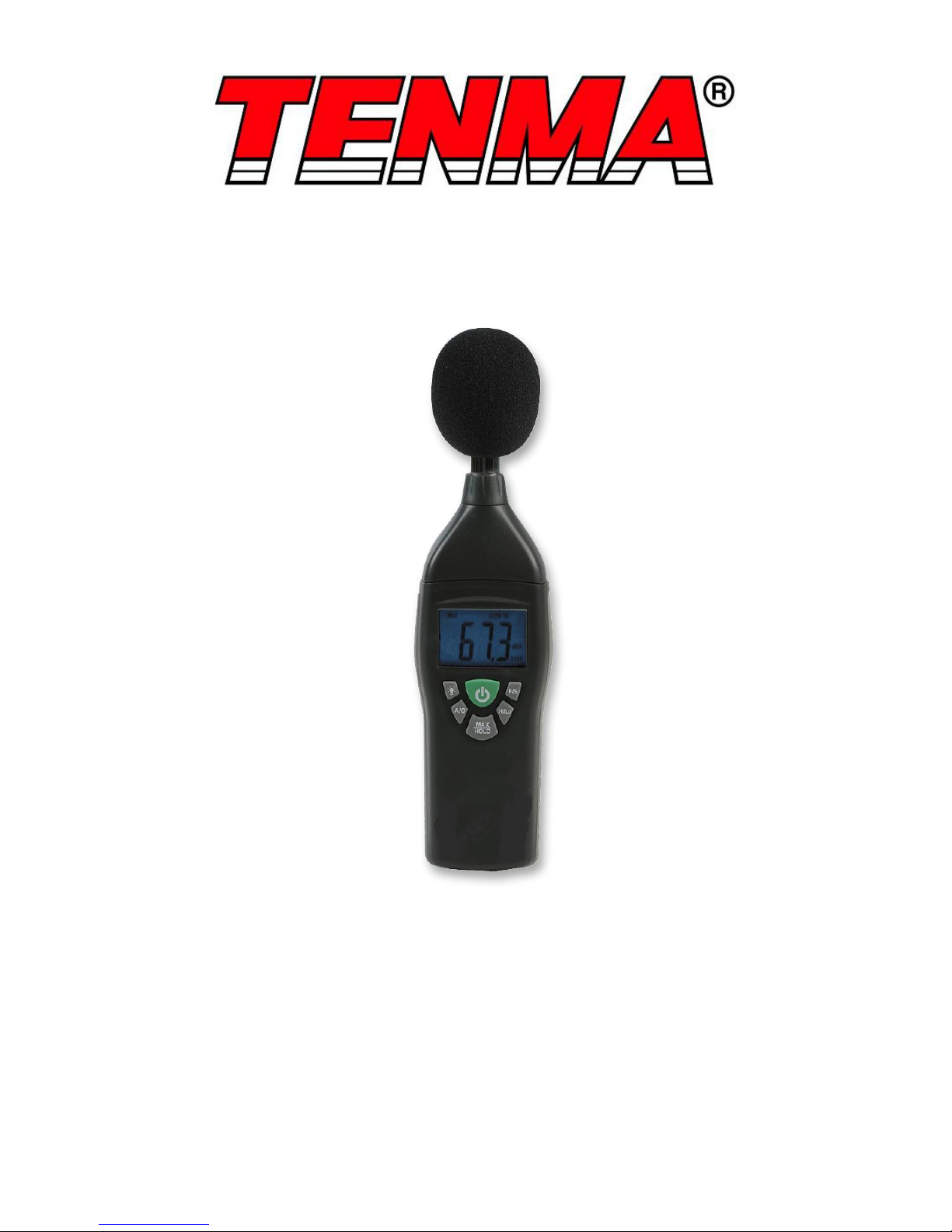
Model: 72-942
Sound Level Meter
Page 2
2
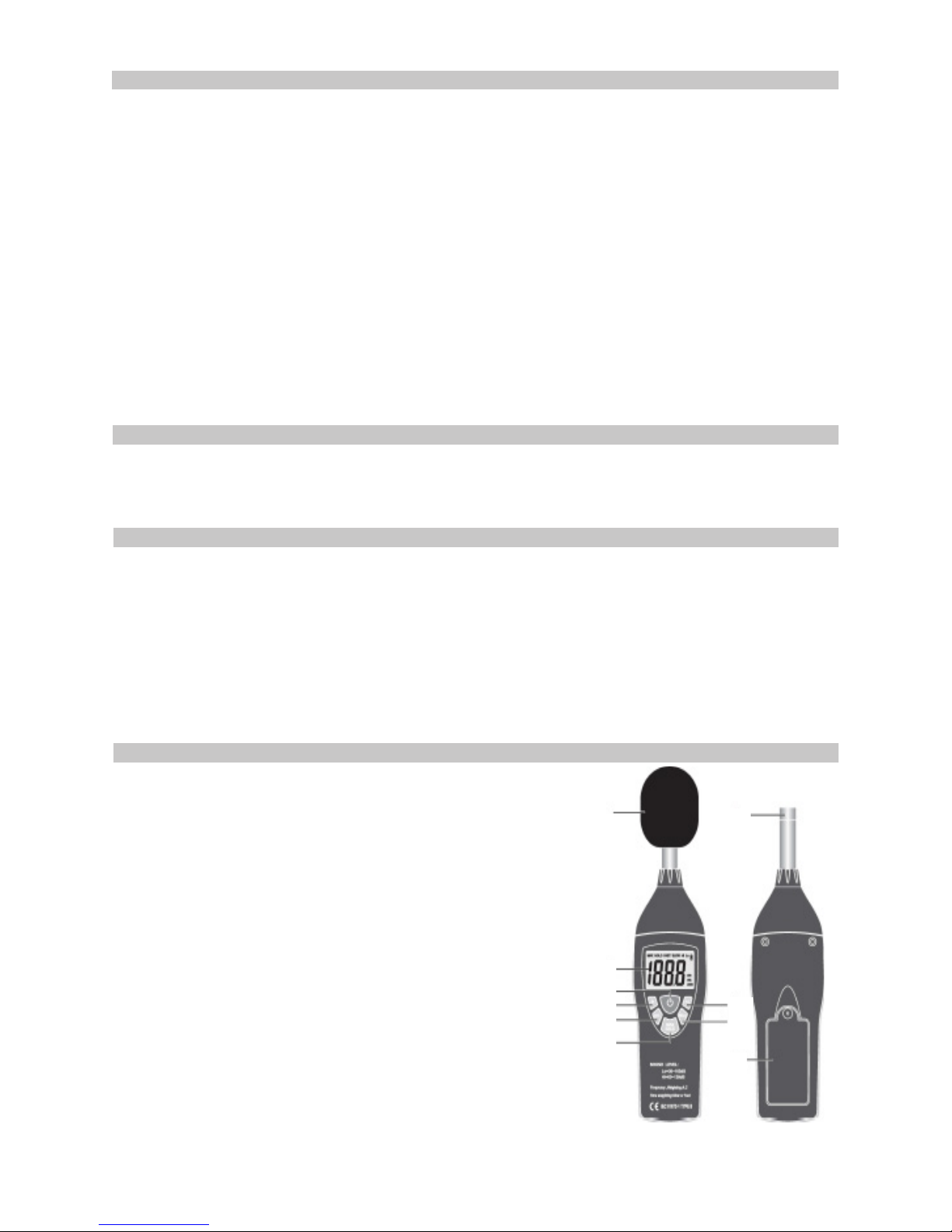
1. Windscreen.
If you operate at wind speed over 10m/sec, please
put protective accessories in front of the microphone.
2. LCD display.
3. Power ON/OFF button.
4. Backlight button ON/OFF.
5. Weighting A/C-Weighting Select Button.
A-Weighting. For general sound level measurements.
C-Weighting. For checking the low frequency content
of noise.
Note: If the C-Weighted level is much higher than the
A-Weighted level, then there is a large amount of lowfrequency noise.
6. Time Weighting Select Button.
F (fast response): for normal measurements (fast
varying noise).
S (slow response): for checking average level of uctuating noise.
Please read these instructions carefully before use and retain for future reference.
• Please operate according to this manual, otherwise the protection provided by the
device will be impaired or fail.
• Check the condition before using. If you nd any cracking, breakage, damage or
abnormality, or you consider the device broken, stop using the device immediately
• Do not store or operate the instrument at high temperature and high humidity
environment.
• Keep microphone dry and avoid severe vibration.
• Replace the batteries as soon as the low battery indicator appears on the display.
• Remove dead batteries from the meter or if it is not going to be used for a long time.
• Never mix old and new batteries together, or different types of batteries.
• Never dispose of batteries in a re, or attempt to recharge ordinary batteries.
• Before replacing the battery, turn off the sound level meter.
• To prolong battery life turn off the sound level meter after use.
IMPORTANT SAFETY INFORMATION
WHAT’S INCLUDED
FEATURES
FUNCTIONS
• Sound level meter with foam windshield
• 9V battery, 006P or IEC 6F22 or NEDA 1604. (included)
• Instruction manual
• This Sound Level Meter has been designed to meet the measurement requirements
of safety Engineers, Health, Industrial safety ofces and sound quality control in
various environments.
• This unit conforms to the IEC61672-1 type 2, ANSI S1 .4 type 2 for Sound Level
Meters.
• Ranges from 30dB to 130dB at frequencies between 31.5Hz and 8kHz.
• Display with 0.1 dB steps on a 4-digits LCD.
• Two equivalent weighted sound pressure levels, A and C.
1
2
3
4
5
8
6
7
10
9
Page 3
3
OPERATION
• To achieve more accurate measurement, use an extension cable to separate the
microphone from the main body so that the effect of unexpected sound reection
can be eliminated.
• Calibrate the instrument before operation if the instrument was not in use for a long
time or operated in an extreme environment.
• Turn on power and select the desired response time and weighting. If the sound
source consists of short bursts or only catching sound peak, set response to FAST.
To measure average sound, use the slow setting.
• Select A-weighting for general noise sound level and C-weighting for measuring
sound level of acoustic material.
• Select the desired level.
• Hold the instrument comfortably in hand or x on tripod and point the microphone at
the suspected noise source, the sound pressure level will be displayed.
• When MAX (maximum hold) mode is chosen. The instrument captures and holds
the maximum noise level for a long period using any of the time weightings and
ranges.
• When HOLD (data hold) mode is chosen. The hold function freezes the reading
in the display. Press the HOLD button momentarily to activate or to exit the HOLD
function.
7. Level Range Select Button.
Lo: 30 - 100dB.
Hi: 60 - 130dB.
Note: When “OVER” is indicated, the ranges witch to another range for measurement.
8. MAX/HOLD Button.
The “Max/Hold” position is used to measure the maximum level of sounds. The
maximum measured level is up dated continuously. Pressing the button again will
release the hold and allow a further measurement.
Data Hold button: Press and hold the Button for over 2 second to turn on or off data
hold function.
The hold function freezes the reading in the display.
9. Microphone.
½ inch Electret Condenser microphone.
10. Battery Cover.
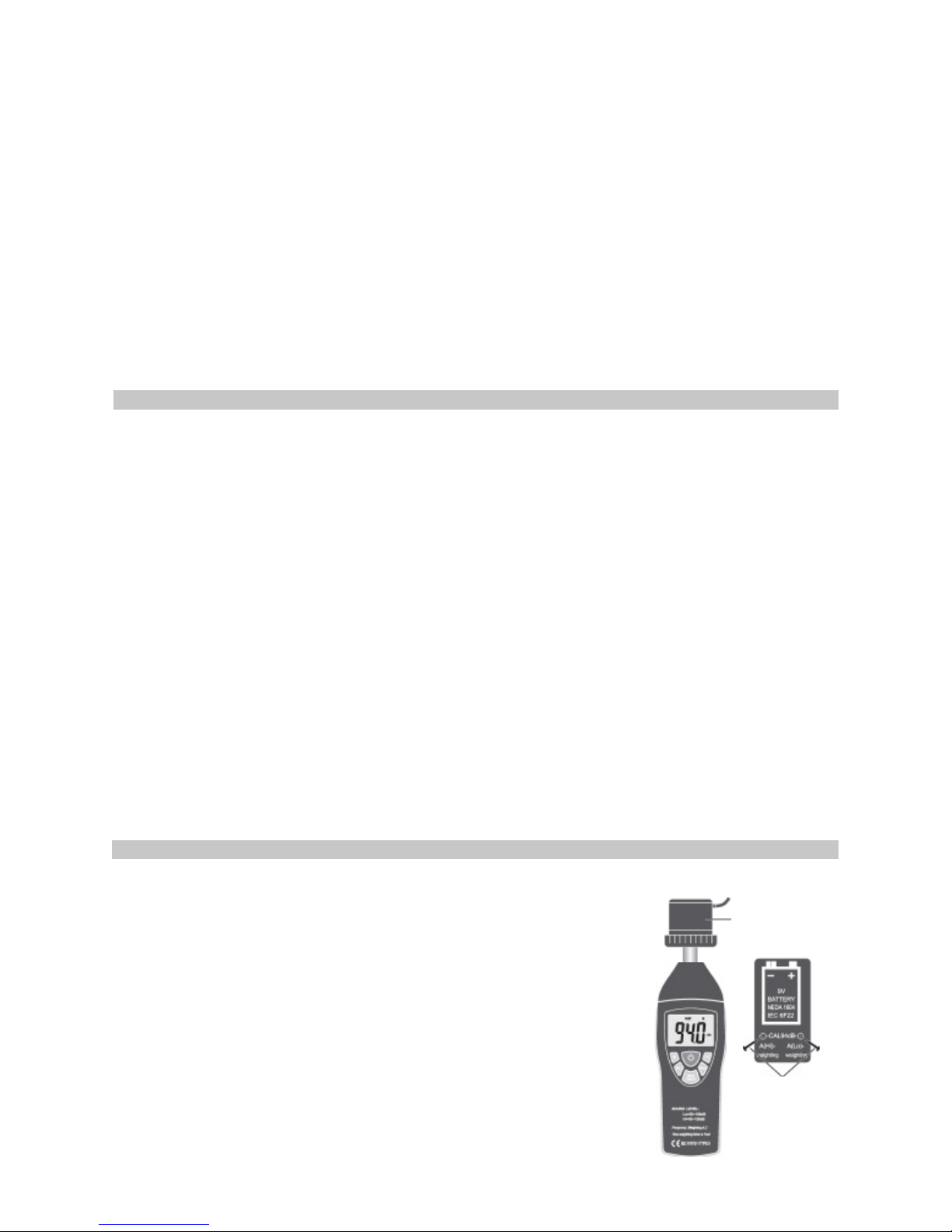
CALIBRATION FUNCTION
• Using a standard Acoustic Calibrator (94dB, 1 kHz Sine wave) make the following
buttons and function switch settings.
1. Display: dB, A, Hi or Lo, F.
2. Function: A-Weighting.
3. Response Time: FAST.
4. Level range: 30-100dB (Lo) or 60-130dB (Hi).
5. Measurement mode: MAX Hold and Data Hold Mode function
disable.
• Insert the microphone housing carefully into the insertion
hole of the calibrator.
• Open battery cover and remove the battery to adjust the
CAL94dB potentiometer of the unit.
• The level display will indicate the level being detected.
Acoustic
Calibrator
Adjust with
screwdriver
Page 4
4
MAINTENANCE
SPECIFICATIONS
Changing the battery
• To install or change the 9V battery, open the battery compartment. Replace only
with the same type of battery.
Cleaning the casing
• Wipe using a damp cloth or sponge. Do not use solvents as these may damage the
casing. Do not immerse in water.
Frequency range 31.5Hz to 8kHz
Measuring level range 30 to 130dB
Frequency weighting A/C
Microphone 1/2 inch electret condenser microphone
Display LCD 4 digits
Resolution 0.1dB
Display Up data 0.5 sec.
Time weighting FAST (125mS), SLOW (1 sec)
Level ranges Lo: 30-100dB / Hi: 60-130dB
Accuracy ±1.5dB (under reference conditions)
Alarm function OVER is show when input is out of range
Auto power off Auto shut down after approx.15 minutes of inactivity.
Operation temperature 0 to 40°C (32 to 104°F)
Operation humidity 10 to 90%RH
Altitude up to 2000 metres
Storage temperature -10 to 60°C (14 to 140°F)
Storage humidity 10 to 75%RH
Power supply One 9V battery, 006P or IEC 6F22 or NEDA 160
Power life About 50hrs (alkaline battery)
Dimensions 210(L) x 55(W) x 32(H)mm
Weight 230g (including battery)
INFORMATION ON WASTE DISPOSAL FOR CONSUMERS OF
ELECTRICAL & ELECTRONIC EQUIPMENT
These symbols indicate that separate collection of Waste Electrical and Electronic Equipment
(WEEE) or waste batteries is required. Do not dispose of these items with general household
waste. Separate for the treatment, recovery and recycling of the materials used. Waste batteries
can be returned to any waste battery recycling point which are provided by most battery retailers.
Contact your local authority for details of the battery and WEEE recycling schemes available in
your area.
Made in China. PR2 9PP
Man Rev 1.0
 Loading...