

Page 1

MS 290, 310, 390
Instruction Manual2 - 43
Page 2

English
Contents
1 Guide to Using this Manual.........................2
2 Safety Precautions......................................3
3 Reactive Forces.......................................... 7
4 Working Techniques................................... 8
5 Cutting Attachment................................... 15
6 Mounting the Bar and Chain..................... 16
7 Tensioning the Chain................................ 16
8 Checking Chain Tension...........................17
9 Fuel........................................................... 17
10 Fueling...................................................... 18
11 Chain Lubricant.........................................22
12 Filling Chain Oil Tank................................22
13 Checking Chain Lubrication...................... 22
14 Chain Brake.............................................. 23
15 Winter Operation.......................................23
16 Information Before You Start.................... 25
17 Starting / Stopping the Engine.................. 25
18 Operating Instructions...............................28
19 Oil Quantity Control...................................29
20 Taking Care of the Guide Bar................... 29
21 Air Filter System........................................30
22 Cleaning the Air Filter............................... 30
23 Adjusting the Carburetor........................... 30
24 Spark Arresting Screen in Muffler............. 31
25 Spark Plug................................................ 32
26 Storing the Machine.................................. 33
27 Checking and Replacing the Chain
Sprocket....................................................33
28 Maintaining and Sharpening the Saw Chain
.................................................................. 34
29 Maintenance and Care..............................38
30 Minimize Wear and Avoid Damage...........40
31 Main Parts.................................................40
32 Specifications............................................41
33 Ordering Spare Parts................................ 42
34 Maintenance and Repairs......................... 42
35 Disposal.................................................... 42
36 EC Declaration of Conformity................... 43
Dear Customer,
Thank you for choosing a quality engineered
STIHL product.
It has been built using modern production techni‐
ques and comprehensive quality assurance.
Every effort has been made to ensure your satis‐
faction and trouble-free use of the product.
Please contact your dealer or our sales company
if you have any queries concerning this product.
Your
Dr. Nikolas Stihl
1 Guide to Using this Manual
This Instruction Manual refers to a STIHL chain
saw, also called a machine in this Instruction
Manual.
1.1 Pictograms
Pictograms that appear on the machine are
explained in this Instruction Manual.
Depending on the machine and equipment ver‐
sion, the following pictograms may appear on the
machine.
Fuel tank; fuel mixture of gasoline
and engine oil
Tank for chain oil; chain oil
Engage and release chain brake
Coasting brake
Direction of chain travel
Ematic; chain oil flow adjustment
Tension saw chain
Intake air baffle: winter operation
Intake air baffle: summer operation
Handle heating
Actuate decompression valve
Original Instruction Manual
0000000394_026_GB
Printed on chlorine-free paper
Printing inks contain vegetable oils, paper can be recycled.
© ANDREAS STIHL AG & Co. KG 2022
0458-209-0121-B. VA0.L21.
Actuate manual fuel pump
2 0458-209-0121-B
Page 3

2 Safety Precautions English
1.2 Symbols in text
WARNING
Warning where there is a risk of an accident or
personal injury or serious damage to property.
NOTICE
Caution where there is a risk of damaging the
machine or its individual components.
1.3 Engineering improvements
STIHL's philosophy is to continually improve all
of its products. For this reason we may modify
the design, engineering and appearance of our
products periodically.
Therefore, some changes, modifications and
improvements may not be covered in this man‐
ual.
2 Safety Precautions
Special safety precautions must be
observed to reduce the risk of per‐
sonal injury when working with a
chain saw because of the very high
chain speed and very sharp cutters.
It is important that you read the
instruction manual before first use
and keep it in a safe place for future
reference. Non-observance of the
instruction manual may result in seri‐
ous or even fatal injury.
2.1 General
Observe all applicable local safety regulations,
standards and ordinances.
The use of noise emitting power tools may be
restricted to certain times by national or local
regulations.
If you have not used this model before: Have
your dealer or other experienced user show you
how to operate your machine or attend a special
course in its operation.
Minors should never be allowed to use a chain
saw.
Keep bystanders, especially children, and ani‐
mals away from the work area.
The user is responsible for avoiding injury to third
parties or damage to their property.
Do not lend or rent your chain saw without the
instruction manual. Be sure that anyone using it
understands the information contained in this
manual.
To operate a chain saw you must be rested, in
good physical condition and mental health. If you
have any condition that might be aggravated by
strenuous work, check with your doctor before
operating a chain saw.
Do not operate the chain saw if you are under
the influence of any substance (drugs, alcohol)
which might impair vision, dexterity or judgment.
To reduce the risk of accidents or injury, put off
the work in poor weather conditions (rain, snow,
ice, wind).
Persons with pacemakers only: The ignition sys‐
tem of your chain saw produces an electromag‐
netic field of a very low intensity. This field may
interfere with some pacemakers. To reduce
health risks, STIHL recommends that persons
with pacemakers consult their physician and the
pacemaker manufacturer before operating this
power tool.
2.2 Intended use
The machine may only be used to saw wood and
wooden objects.
Do not use the machine for any other purpose –
risk of accidents!
Do not modify the machine in any way – this may
increase the risk of personal injury. STIHL
excludes all liability for personal injury and dam‐
age to property caused while using unauthorised
attachments.
2.3 Clothing and Equipment
Wear proper protective clothing and equipment.
Clothing must be sturdy and snug-fit‐
ting, but allow complete freedom of
movement. Wear snug fitting clothing
with cut-retardant pads – no loose-fit‐
ting jacket.
Avoid clothing that could get caught on
branches, brush or moving parts of the machine.
Do not wear a scarf, necktie or jewellery. Tie up
and confine long hair (headscarf, cap, hard hat,
etc.).
Wear suitable safety shoes – with cutretardant material, non-slip soles and
steel toe caps.
0458-209-0121-B 3
Page 4

001BA115 KN
English 2 Safety Precautions
WARNING
To reduce the risk of eye injuries,
wear tight-fitting safety goggles con‐
forming to standard EN 166 or a face
shield. Make sure that the safety gog‐
gles and the face shield fit correctly.
Wear "personal" hearing protection – for exam‐
ple, ear defenders.
Wear a hard hat wherever there is any risk of
falling objects.
Wear sturdy protective gloves made
of a resistant material (e.g. leather).
STIHL can supply a comprehensive range of per‐
sonal protective equipment.
2.4 Transporting
Before any transport – even over short distances
– switch off the machine, engage the chain brake
and attach the chain scabbard. This avoids the
risk of the saw chain starting unintentionally.
Always carry the chain saw by the handle – with
the hot muffler away from your body, the guide
bar must point to the rear. To avoid serious burn
injuries, avoid touching hot parts of the machine,
especially the surface of the muffler.
In vehicles: Properly secure your saw to prevent
turnover, fuel spillage and damage.
2.5 Cleaning
Clean plastic parts with a cloth. Harsh detergents
can damage the plastic.
Clean the dust and dirt off the machine – do not
use any grease solvents for this purpose.
Clean the ventilation slots if necessary.
Do not use a high-pressure cleaner to clean the
machine. The hard jet of water can damage parts
of the machine.
2.6 Accessories
Only use those tools, guide bars, chains, chain
sprockets, accessories or technically equivalent
components that have been approved by STIHL
for this machine. If you have any questions in
this respect, consult a servicing dealer. Use only
high quality tools and accessories. Otherwise,
there may be a risk of accidents and damage to
the machine.
STIHL recommends the use of genuine STIHL
tools, guide bars, chains, chain sprockets and
accessories. They are specifically designed to
match your model and meet your performance
requirements.
2.7 Refuelling
Gasoline is an extremely flammable
fuel – keep clear of naked flames and
fire – do not spill any fuel – no smok‐
ing.
Switch off the engine before refuelling.
Never refuel the machine while the engine is still
hot – the fuel may spill over – risk of fire!
Open the fuel filler cap carefully so that any
excess pressure is relieved gradually and fuel
does not splash out.
The machine may only be refuelled in a well ven‐
tilated place. Clean the machine immediately if
fuel is spilled. Do not spill fuel over your clothing
– contaminated clothing must be changed imme‐
diately.
The machines can be equipped with the follow‐
ing filler caps as standard:
Cliplock filler cap (bayonet-type)
Place the cliplock filler cap (bayonettype) in position, turn as far as stop
and fold the cliplock down.
This helps reduce the risk of unit vibrations caus‐
ing an incorrectly tightened filler cap to loosen or
come off and spill quantities of fuel.
Look out for leaks! Never start the
engine if fuel has been spilled or is
leaking – Fatal burns may result!
2.8 Before Starting Work
Check that your saw is properly assembled and
in good condition – refer to appropriate chapters
in the instruction manual.
Check the fuel system for leaks, paying spe‐
–
cial attention to visible parts such as the tank
4 0458-209-0121-B
Page 5

001BA087 LÄ
2 Safety Precautions English
cap, hose connections and the manual fuel
pump (on machines so equipped). If there are
any leaks or damage, do not start the engine –
risk of fire. Have your saw repaired by a serv‐
icing dealer before using it again.
Check operation of chain brake, front hand
–
guard
Correctly mounted guide bar
–
Correctly tensioned chain
–
The trigger and trigger lockout must move
–
freely and spring back to the idle position
when they are released.
Master Control lever must move easily to
–
STOP, 0 or †
Check that the spark plug boot is secure – a
–
loose boot may cause arcing that could ignite
combustible fumes and cause a fire.
Never attempt to modify the controls or safety
–
devices in any way.
Keep the handles dry and clean – free from oil
–
and dirt – for safe control of the saw.
Make sure there is sufficient fuel and chain oil
–
in the tanks.
To reduce the risk of personal injury, do not
operate your saw if it is damaged or not properly
assembled.
2.9 Starting the chain saw
Always work on a level surface. Ensure a firm
and secure footing. Hold the machine securely –
the chain must not touch any objects or the floor
– danger of injury due to the rotating saw chain.
Your chain saw is a one-person saw. Do not
allow other persons to be in the working area –
not even while starting.
Do not start the chain saw if the chain is in a cut.
Move at least 3 meters away from the place
where the machine was refuelled and never start
the motor in enclosed spaces.
Lock the chain with the chain brake before start‐
ing – risk of injury due to rotating chain!
Do not drop-start the engine – start as described
in the Instruction Manual.
2.10 During operation
Ensure you always have a firm and safe footing.
Take special care when the bark is wet – danger
of slipping!
Always hold the chain saw firmly with both
hands: Right hand on the rear handle – even if
you are left-handed. To ensure reliable control,
wrap your thumbs tightly around the handlebar
and handle.
In the event of impending danger or in an emer‐
gency, switch off the engine immediately by mov‐
ing the Master Control lever / stop switch to
STOP, 0 or †.
Never let the machine run unattended.
Exercise caution with slippery surfaces, water,
snow, ice, steep slopes, uneven ground or green
wood that has just been stripped of its bark –
danger of slipping!
Use caution with tree stumps, roots, ditches –
danger of stumbling!
Do not work alone – keep within calling distance
of others who are trained in emergency proce‐
dures and can provide help in an emergency.
Helpers at the cutting site must also wear protec‐
tive clothing (helmet!) and stand well clear of the
branches being cut.
More care and attention than usual are required
when wearing ear protection, as warning sounds
(shouts, beeps, etc.) cannot be heard properly.
Take a break in good time to avoid tiredness or
exhaustion – risk of accidents!
Dust (e. g., sawdust), fumes and smoke pro‐
duced while using the machine may be hazard‐
ous to health. If dust is generated, wear a dust
mask.
When the engine is running: Note that the saw
chain continues to rotate for a short period after
you let go of the throttle trigger – coasting effect.
No smoking when working with or near the chain
saw - risk of fire! Combustible fuel vapour may
escape from the fuel system.
0458-209-0121-B 5
Page 6

English 2 Safety Precautions
Examine the saw chain periodically at short inter‐
vals and as soon as you note any tangible
changes:
Switch off the engine; wait until the saw chain
–
is stationary
Check condition and secure fitting
–
Check sharpness
–
Never touch the saw chain when the engine is
running. If the saw chain becomes jammed by an
object, switch off the engine immediately before
attempting to remove the object – risk of injury!
Always turn off the engine before leaving the
machine unattended.
To change the saw chain, switch off the engine.
Risk of injury from the motor starting unintention‐
ally!
Keep easily combustible materials (e. g., wood
chips, bark, dry grass, fuel) away from hot
exhaust gases and hot mufflers – risk of fire!
Mufflers with catalytic converters can become
especially hot.
Never work without chain lubrication – monitor
the oil level in the oil tank. Stop work immediately
if the oil level in the oil tank is too low and top up
with chain oil – see also "Topping up with chain
oil" and "Check chain lubrication".
If the machine is subjected to unusually high
loads for which it was not designed (e. g., heavy
impact or a fall), always check that it is in good
condition before continuing work – see also
"Before starting work".
Check the fuel system for leaks and make sure
the safety devices are working properly. Never
continue using a machine that is not in perfect
working order. In case of doubt, have the unit
checked by your servicing dealer.
Check for correct idling, so that the saw chain
stops moving when the throttle trigger is
released. Check the idle setting regularly and
correct when possible. Have the machine
repaired by a STIHL servicing dealer if the saw
chain still continues to move during idling.
The chain saw produces poisonous
exhaust gases as soon as the engine
starts. These gases may be colour‐
less and odourless and may contain
unburnt hydrocarbons and benzene.
Never work with the machine indoors
or in poorly ventilated areas, even if
your machine is equipped with a cata‐
lytic converter.
Ensure proper ventilation when working in
trenches, hollows or other confined locations –
risk of fatal injury from breathing toxic fumes!
If you feel sick, have a headache, vision prob‐
lems (e. g., your field of vision gets smaller),
hearing problems, dizziness or inability to con‐
centrate, stop work immediately. Such symptoms
may be caused by an excessively high concen‐
tration of exhaust emissions – risk of accident!
2.11 After finishing work
Switch off the motor, engage the chain brake and
attach the chain scabbard.
2.12 Storage
When the machine is not in use, it should be
stored in such a way that no-one is endangered.
Secure the machine against unauthorised use.
Store the machine in a safe, dry room.
2.13 Vibrations
Prolonged use of the power tool may result in
vibration-induced circulation problems in the
hands (whitefinger disease).
No general recommendation can be given for the
length of usage because it depends on several
factors.
The period of usage is prolonged by:
Hand protection (wearing warm gloves)
–
Work breaks
–
The period of usage is shortened by:
Any personal tendency to suffer from poor cir‐
–
culation (symptoms: frequently cold fingers,
tingling sensations).
Low outside temperatures.
–
The force with which the handles are held (a
–
tight grip restricts circulation).
Continual and regular users should monitor
closely the condition of their hands and fingers. If
any of the above symptoms appear (e.g. tingling
sensation in fingers), seek medical advice.
2.14 Maintenance and repairs
Always switch off the engine before any repair,
cleaning or maintenance work and any work on
the chain. Risk of injury if the engine starts inad‐
vertently!
Exception: adjustment of carburettor and idle
speed.
6 0458-209-0121-B
Page 7

001BA036 KN
001BA257 KN
3 Reactive Forces English
The machine must be serviced regularly. Do not
attempt any maintenance or repair work not
described in the Instruction Manual. All other
work should be carried out by a servicing dealer.
STIHL recommends that maintenance and repair
work be carried out only by authorised STIHL
dealers. STIHL dealers receive regular training
and are supplied with technical information.
Use only high-quality spare parts. Otherwise,
there may be a risk of accidents and damage to
the machine. If you have any questions in this
respect, consult a servicing dealer.
Do not modify the machine in any way – this may
increase the risk of personal injury –risk of acci‐
dents!
To reduce the risk of fire due to ignition outside
the cylinder, move the master control level to
STOP, 0 or † before turning the engine over on
the starter when the spark plug boot is removed
or the spark plug is unscrewed!
Do not service or store the machine near a
naked flame – risk of fire due to the fuel.
Check fuel cap regularly for tightness.
Use only spark plugs that are in perfect condition
and have been approved by STIHL – see "Speci‐
fications".
Check ignition lead (insulation in good condition,
secure connection).
Check that the muffler is in perfect working con‐
dition.
Do not use the machine if the muffler is damaged
or missing – risk of fire, damage to hearing!
Never touch a hot muffler – risk of burns!
The condition of the anti-vibration elements influ‐
ences vibration behaviour – inspect anti-vibration
elements periodically.
Inspect chain catcher – replace if damaged.
Switch off the engine
To check the chain tension
–
To retension the chain
–
To replace the chain
–
For remedying malfunctions
–
Observe sharpening instructions – for safe and
proper handling, always keep the chain and
guide bar in flawless condition. Keep the chain
properly sharpened, tensioned and well lubrica‐
ted.
Change chain, guide bar and chain sprocket in
due time.
Regularly check that the clutch drum is in perfect
working condition.
Always store fuel and chain lubricant only in the
specified type of containers and ensure they are
correctly labelled. Store in a dry, cool and secure
place protected against light and sunlight.
In the event of a chain brake malfunction, switch
off the machine immediately – risk of injury! Con‐
sult a servicing dealer – do not use the machine
until the malfunction has been remedied, see
"Chain brake".
3 Reactive Forces
The most common reactive forces that occur dur‐
ing cutting are: kickback, pushback and pull-in.
3.1 Dangers of kickback
Kickback can result in serious or fatal
injury.
(Kickback) occurs when the saw is suddenly
thrown up and back in an uncontrolled arc
towards the operator.
3.2 Kickback occurs if, e. g.,
when the upper quadrant of the bar nose unin‐
–
tentionally contacts wood or another solid
0458-209-0121-B 7
Page 8

001BA037 KN
A
001BA038 KN
B
English 4 Working Techniques
object, e.g. when another limb is touched acci‐
dentally during limbing.
when the chain at the nose of the guide bar is
–
pinched in the cut.
3.3 Quickstop chain brake:
This device reduces the risk of injury in certain
situations – it cannot prevent kickback. When
activated, the chain brake stops the saw chain
within a fraction of a second –
see the section "Saw chain" in this Instruction
Manual.
the chain pulls the saw forward –
risk, always engage the spiked bumper securely
in the tree or limb.
to reduce this
3.6 Pushback (B)
3.4 To reduce the risk of kickback
Work cautiously and avoid situations which
–
could cause kickback.
Hold the saw firmly with both hands and main‐
–
tain a secure grip.
always cut at full throttle.
–
Be aware of the location of the guide bar nose
–
at all times.
do not cut with the bar nose.
–
Take special care with small, tough limbs, they
–
may catch the chain.
never cut several limbs at once.
–
do not overreach.
–
never cut above shoulder height.
–
Use extreme caution when re-entering a previ‐
–
ous cut.
Do not attempt plunge cuts if you are not
–
experience in this cutting technique.
be alert for shifting of the log or other forces
–
that may cause the cut to close and pinch the
chain.
always cut with a correctly sharpened, prop‐
–
erly tensioned chain – the depth gauge setting
must not be too large.
Use a low kickback chain and a narrow radius
–
guide bar.
3.5 Pull-in (A)
Pushback occurs when the chain on the top of
the bar is suddenly pinched, caught or encoun‐
ters a foreign object in the wood. The reaction of
the chain drives the saw straight back toward the
operator – to avoid this risk:
Be alert to situations that may cause the top of
–
the guide bar to be pinched
Do not twist the guide bar in the cut
–
3.7 Exercise extreme caution
with leaners
–
with trees that have fallen unfavorably
–
between other trees and are under strain
when working in blowdown areas.
–
In these cases, do not use a chain saw – use a
hoist, winch or drag line instead.
Pull out exposed and cleared logs. Select clear
area for cutting.
Deadwood (dry, decayed or rotted wood) repre‐
sents a considerable risk that is difficult to
assess. Identifying the extent of the dangers is
complicated, if not impossible. Use aids such as
a cable winch or tractor in such cases.
When felling in the vicinity of roads, railways,
power lines, etc., take extra precautions. If nec‐
essary, inform the police, utility company or rail‐
way authority.
4 Working Techniques
Sawing and felling work, including all related
work (plunge cutting, limbing, etc.) may only be
carried out by persons who have been specially
trained and instructed. Persons who are not
Pull-in occurs when the chain on the bottom of
the bar is suddenly pinched, caught or encoun‐
ters a foreign object in the wood. The reaction of
8 0458-209-0121-B
experienced chain saw users should not carry
out any such work – increased risk of accidents!
Page 9

001BA082 KN
001BA033 KN
4 Working Techniques
English
Country-specific legislation on felling technique
must be complied with during felling work.
4.1 Sawing
chain saw in the vicinity of easily combustible
materials, dry plants or scrub. It is mandatory
that you ask the responsible forestry office about
the current fire hazard.
Do not operate your saw with the starting throttle
lock engaged. Engine speed cannot be control‐
led with the throttle trigger in this position.
Work calmly and carefully – in daylight conditions
and only when visibility is good. Ensure you do
not endanger others – stay alert at all times.
It is advisable for first-time users to practice cut‐
ting logs on a sawbuck – see "Sawing thin
wood".
Use the shortest possible guide bar: The chain,
guide bar and chain sprocket must match each
other and your saw.
If on a slope, stand on the uphill side of the log.
Watch out for rolling logs.
When working at heights:
Always use a lift bucket
–
Never use the machine while standing on a
–
ladder or in a tree
Never work on an insecure support
–
Never work above shoulder height
–
Never use the machine with just one hand
–
Begin cutting with the saw at full throttle and
engage the spiked bumper firmly in the wood,
and then continue cutting.
Position the saw so that your body is clear of the
cutting attachment.
Always pull the saw out of the cut with the chain
running.
Use your chain saw for cutting only. It is not
designed for prying or shoveling away limbs,
roots or other objects.
Do not underbuck freely hanging limbs.
Be careful when cutting scrub and young trees.
Thin shoots can be scooped up by the chain saw
and hurled towards the user.
Be careful when cutting splintered wood – Risk of
injury from ejected pieces of wood!
Make sure your saw does not touch any foreign
materials: Stones, nails, etc. may be flung off
and damage the saw chain. The chain saw may
kick back unexpectedly – risk of accident!
If a rotating saw chain hits a stone or another
hard object, sparks may be generated which may
ignite easily flammable materials under certain
conditions. Also dried-out plants and brushwood
are combustible, above all in hot and dry
weather. If there is a risk of fire, do not use the
Never work without the spiked bumper because
the saw may pull you forwards and off balance.
Always hold the spiked bumper securely against
the tree or limb.
At the end of the cut, the chain saw is no longer
supported by the cutting attachment in the cut.
The chain saw's weight must be borne by the
user – risk of loss of control!
Sawing thin wood:
Use a sturdy and stable support – sawhorse.
–
Never hold the log with your leg or foot.
–
never allow another person to hold the log or
–
help in any other way.
Limbing
use a low kickback chain.
–
Work with the saw supported wherever possi‐
–
ble.
do not stand on the log while limbing it.
–
do not cut with the bar nose.
–
watch for limbs which are under tension.
–
never cut several limbs at once.
–
Lying or standing logs under tension:
Always make the cuts in the correct order (first
compression side (1), then tension side (2)), oth‐
0458-209-0121-B 9
Page 10

1
001BA151 KN
2
1
001BA152 KN
2
001BA189 KN
001BA088 LÄ
2
/
1
2
1 1
/
1
2
001BA040 KN
B
B
English 4 Working Techniques
erwise the cutting attachment may stick in the cut
or kick back – risk of injury!
► Make relieving cut at the compression side (1)
► Make bucking cut at the tension side (2)
Be wary of pushback when making bucking cut
from the bottom upwards (underbuck).
NOTICE
Do not cut a lying log at a point where it is touch‐
ing the ground because the saw chain will other‐
wise be damaged.
Ripping:
4.2 Preparing for felling
Check that there are no other persons in the fell‐
ing area – other than helpers.
Make sure no-one is endangered by the falling
tree – the noise of your engine may drown any
warning calls.
Maintain a distance of at least 2 1/2 tree lengths
from the next felling site.
Determining direction of fall and escape path
Select gap in stand into which you want the tree
to fall.
Pay special attention to the following points:
The natural inclination of the tree
–
Unusually heavy limb structure, asymmetrical
–
growth, damage to tree
The wind direction and speed – do not fell in
–
high winds
Direction of slope
–
Neighboring trees
–
Snow load
–
Take the general condition of the tree into
–
account – be especially careful with trunk
damage or deadwood (brittle, rotten or dead
wood)
Sawing technique without use of the spiked
bumper – risk of pull-in – position the guide bar at
as shallow an angle as possible – be especially
careful – increased risk of kickback!
10 0458-209-0121-B
A Direction of fall
B Escape path (escape routes)
Establish escape paths for each worker –
–
approx. 45° diagonally opposite to the direc‐
tion of fall
Page 11

001BA146 KN
001BA271 KN
C
C
001BA153 KN
001BA153 KN
4 Working Techniques English
Clear escape paths, eliminate obstacles
–
Put down tools and equipment at a safe dis‐
–
tance – but not on the escape paths
When felling, stand only to the side of the fall‐
–
Determine direction of fall with gunning sight on
cover and fan housing
ing trunk and only move back laterally onto the
escape path
Plan escape paths on slopes parallel to the
–
slope
When walking away along the escape path,
–
watch out for falling limbs and watch the top of
the tree.
Preparing work area at base of tree
First clear the tree base and work area from
–
interfering limbs and brush to provide a secure
footing.
Carefully clear the base of the trunk (e.g., with
–
an axe) – sand, stones and other foreign
objects will blunt the saw chain
Your chainsaw has a gunning sight on the cover
and fan housing. Use this gunning sight.
Making the felling notch
When making a felling notch, align the chainsaw
so that the notch lies at a right angle to the direc‐
tion of fall.
During the procedure, various sequences are
permitted for making a felling notch with a bottom
(horizontal) cut and top (angled) cut – comply
with national legislation regarding felling techni‐
que.
► Make a bottom (horizontal) cut
► Make the top (angled) cut approx. 45°‑ 60° to
the bottom cut
Remove largest buttresses: first the largest
–
buttress – saw first vertically, then horizontally
Checking the direction of fall
– only if the tree is in sound condition
4.3 Felling notch
Preparing the felling notch
► Insert the chainsaw with guide bar in the bot‐
tom of the felling notch. The gunning sight
must point in the planned direction of fall – if
necessary, correct direction of fall by re-cutting
The felling notch (C) determines the direction of
the felling notch.
fall.
Important:
Make a felling notch at right angle to direction
–
of fall
Saw as close to the ground as possible
–
Cut to a depth of approx. 1/5 to 1/3 of the
–
diameter of the trunk
0458-209-0121-B 11
Page 12
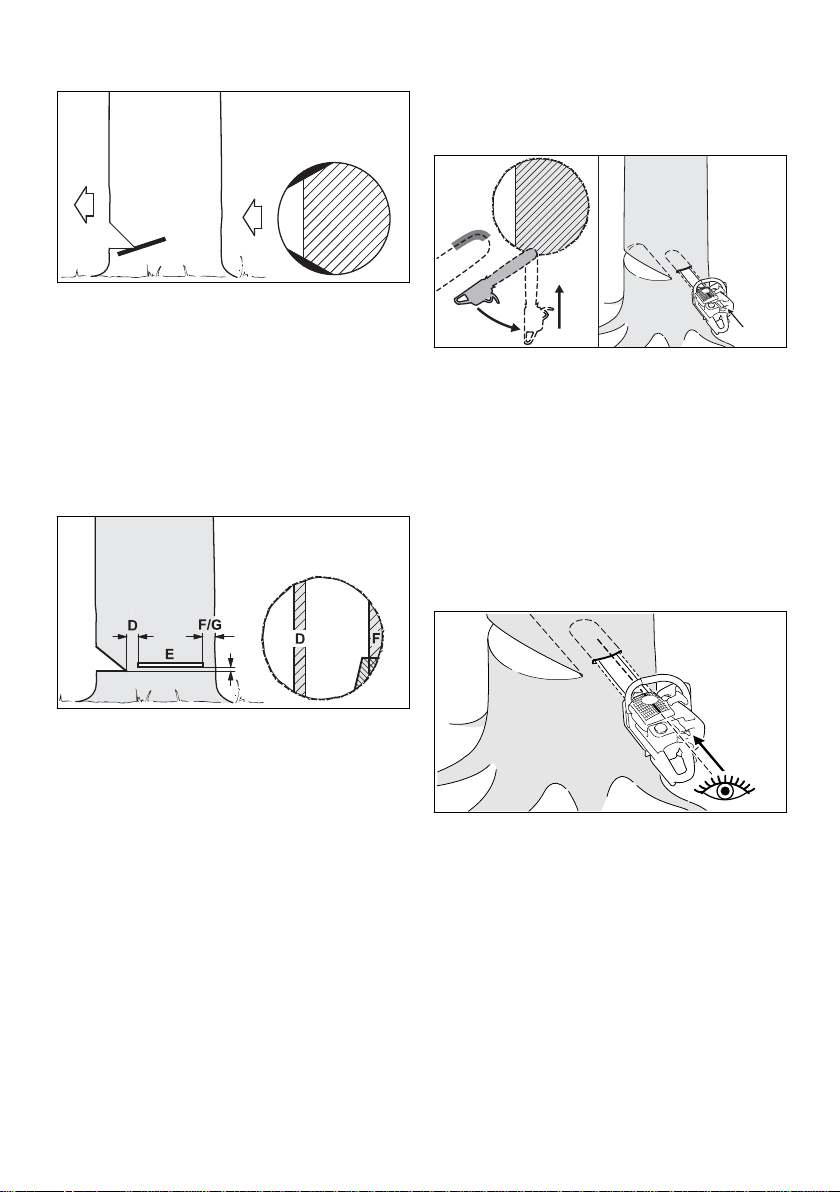
001BA150 KN
001BA259 KN
G
E
C
C
Ø
1/10
001BA269 KN
3.
1.
2.
001BA270 KN
English
4.4 Sapwood cuts
Sapwood cuts in long-fibered softwood help pre‐
vent sapwood splintering when the tree falls.
Make cuts at both sides of the trunk at same
height as bottom of felling notch to a depth of
about 1/10 of trunk diameter. On large diameter
trees, cut to no more than width of guide bar.
Do not make sapwood cuts if wood is diseased.
4.5 Basic information on felling cut
Basic dimensions
4 Working Techniques
With rotten trunks, leave a wider strip
–
Plunge cutting
For relieving cuts during shortening
–
For wood carving
–
► Use a low kickback saw chain and proceed
with special care
1. Begin cut by applying the lower portion of the
guide bar nose – do not use upper portion
because of risk of kickback. Cut at full
strength until the depth of the kerf is twice
the width of the guide bar
2. Swing the machine slowly into the plunge
cutting position – risk of kickback and push‐
back!
3. Make the plunge cut very carefully. Risk of
pushback.
The felling notch (C) determines the direction of
fall.
The hinge (D) functions like a real hinge to guide
the tree to the ground.
Width of hinge: approx. 1/10 of the trunk diam‐
–
eter
Never saw through the hinge while felling –
–
otherwise the tree will fall in a direction other
than the one planned – risk of accident!
With rotten trunks, leave a wider hinge
–
The tree is felled with the felling cut (E).
Cut horizontally
–
1/10 (at least 3 cm) of tree diameter higher
–
than bottom of felling notch (C).
The holding strap (F) or stabilizing strap (G) sup‐
ports the tree and helps prevent it from falling
prematurely.
Width of strip: approx. 1/10 to 1/5 of the trunk
–
diameter
Do not cut into the strip during the felling cut
–
12 0458-209-0121-B
Where possible, use a plunge blade. The plunge
blade and the upper/lower side of the guide bar
are parallel.
During plunge cutting, the plunge bar helps to
keep the hinge parallel in form, i.e. the same
thickness at all points. To do this, guide the
plunge bar parallel to the sink chord.
Felling wedges
Insert the felling wedge as soon as possible, i.e.
as soon as no obstruction of saw control is to be
expected. Position the felling wedge in the felling
cut and drive in with suitable tools.
Only use aluminum or plastic wedges – do not
use steel wedges. Steel wedges can seriously
Page 13
001BA260 KN
001BA261 KN
1.
2.
001BA273 KN
3.
001BA263 KN
4.
5.
1.
2.
3.
4 Working Techniques English
damage the saw chain and cause dangerous
kickback.
Select suitable felling wedges dependent on the
trunk diameter and the width of the kerf (ana‐
logue to felling cut (E)).
Contact the STIHL dealer for the selection of the
felling wedge (suitable length, width and height).
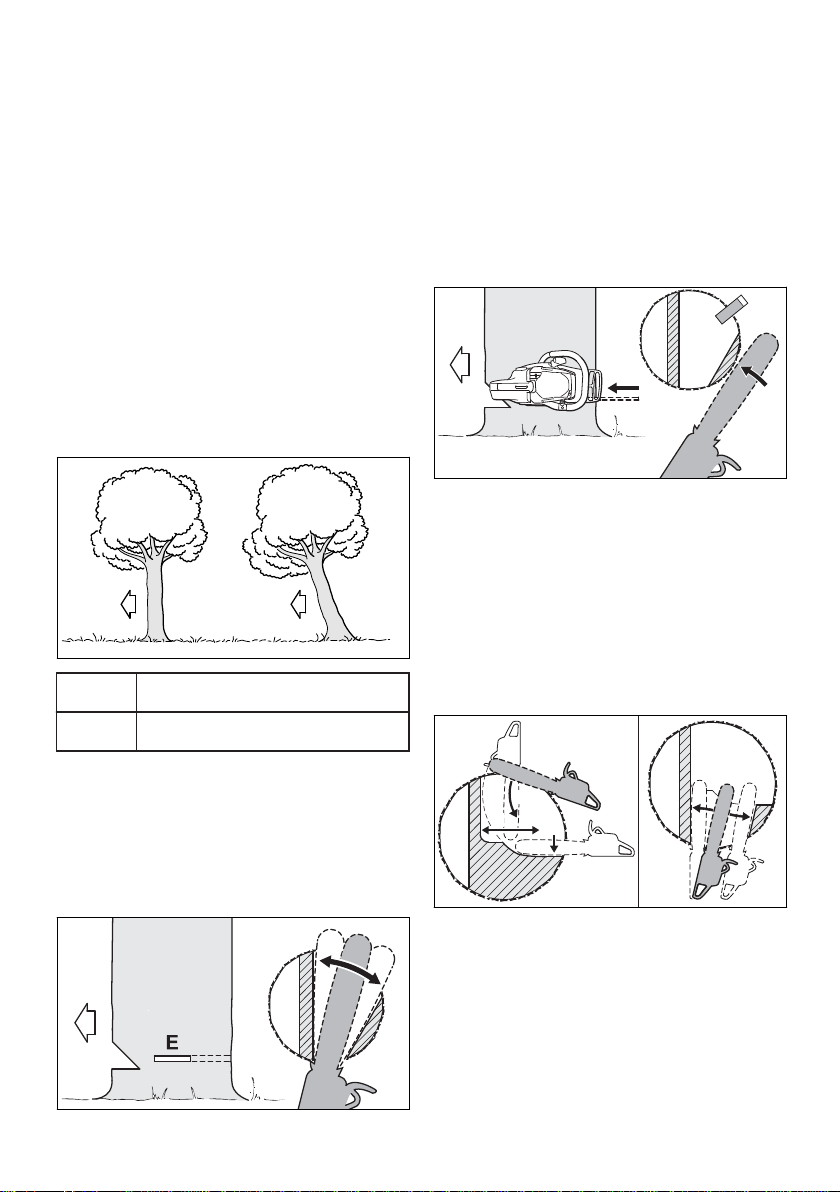
4.6 Selecting the appropriate felling cut
The selection of the appropriate felling cut is
dependent on the same tree characteristics that
must be noted when determining the direction of
fall and the escape paths.
There are various different features of these
characteristics. This User Manual will only
describe the two most commonly occurring var‐
iants:
left: Normal tree – vertically upright tree
with uniform crown
right: Leaner tree - crown pointing in direc‐
tion of fall
Shout a warning before starting the felling cut.
► Plunge cut the felling cut (E) – plunge the
guide bar fully in
► Engage the spiked bumper behind the hinge
and use this as the rotation point – reposition
the chainsaw as little as possible
► Make the felling cut up to the hinge (1)
Do not cut into the hinge
–
► Make the felling cut up to the stabilizing
strap (2)
Do not cut into the stabilizing strap
–
► Set the felling wedge (3)
Shout a second warning immediately before the
tree falls.
► Cut through the stabilizing strap, horizontal
level with the felling cut, with arms fully exten‐
ded
B) Thick trunks
Implement this felling cut when the trunk diame‐
ter is greater than the cutting length of the
machine.
4.7 Felling cut with stabilizing strap (normal tree)
A) Thin trunks
Implement this felling cut when the trunk diame‐
ter is smaller than the cutting length of the chain‐
saw.
Shout a warning before starting the felling cut.
► Engage the spiked bumper at the height of the
felling cut and use this as the rotation point –
0458-209-0121-B 13
reposition the chainsaw as little as possible
► Tip of the guide bar must penetrate the wood
before the hinge (1) – guide the chainsaw
absolutely horizontally and swivel as widely as
possible
► Make the felling cut up to the hinge (2)
Do not cut into the hinge
–
Page 14
001BA274 KN
6.
001BA265 KN
1.
2.
001BA266 KN
001BA267 KN
1.
2.
3.
4.
5.
6.
English 4 Working Techniques
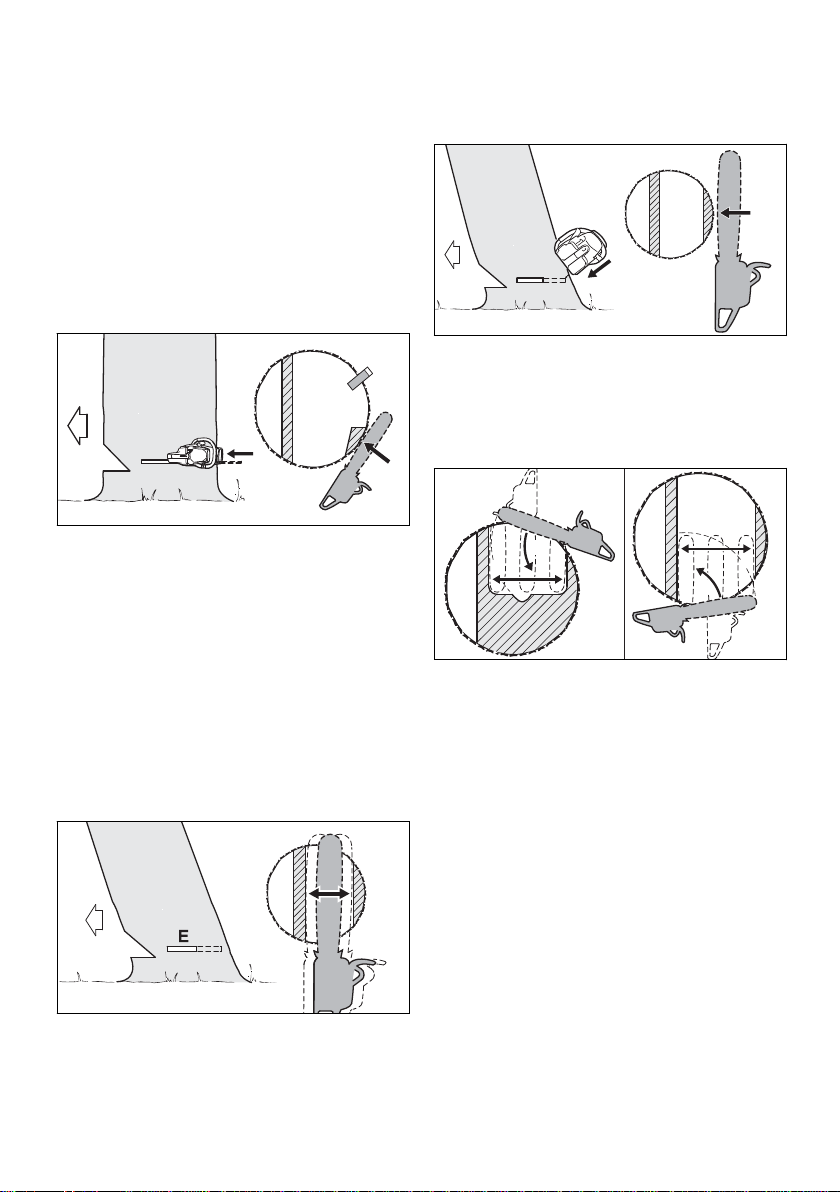
► Make the felling cut up to the stabilizing
strap (3)
Do not cut into the stabilizing strap
–
The felling cut must be continued on the oppo‐
► Make the felling cut towards the holding strap
(2)
Cut horizontally
–
Do not cut into the holding strap.
–
site side of the trunk.
Ensure that the second cut is at the same level
as the first cut.
► Plunge cut the felling cut
► Make the felling cut up to the hinge (4)
Do not cut into the hinge
–
► Make the felling cut up to the stabilizing
strap (5)
Do not cut into the stabilizing strap
–
Shout a second warning immediately before the
tree falls.
► With outstretched arms, cut through the hold‐
ing strap at a downward angle from outside.
B) Thick trunks
► Set the felling wedge (6)
Shout a second warning immediately before the
tree falls.
► Cut through the stabilizing strap, horizontal
level with the felling cut, with arms fully exten‐
ded
4.8 Felling Cut with Holding Strap (Leaner)
A) Thin trunks
Implement this felling cut when the trunk diame‐
ter is smaller than the cutting length of the chain‐
saw.
Perform this felling cut when the tree diameter is
greater than the cutting length of the chainsaw.
► Engage the spiked bumper behind the holding
strap and use it as a pivot – avoid reposition‐
ing the chainsaw more than necessary.
► The guide bar nose enters the wood (1) before
it reaches the hinge – hold the chainsaw hori‐
zontally and swing it as far as possible.
Do not cut into the holding strap or hinge.
–
► Make the felling cut up to the hinge (2)
Do not cut into the hinge
–
► Make the felling cut up to the holding strap (3)
Do not cut into the holding strap.
–
The felling cut must be continued on the oppo‐
site side of the trunk.
Ensure that the second cut is at the same level
► Plunge cut the guide bar into the trunk until it
exits on the other side
► Make the felling cut (E) towards the hinge (1)
Cut horizontally
–
Do not cut into the hinge
–
as the first cut.
► Engage the spiked bumper behind the hinge
and use this as the rotation point – reposition
the chainsaw as little as possible
14 0458-209-0121-B
Page 15

001BA268 KN
001BA248 KN
1
2
3
a
001BA244 KN
001BA245 KN
1
1
5 Cutting Attachment English
► Tip of the guide bar must penetrate the wood
before the holding strap (4) – guide the chain‐
saw absolutely horizontally and swivel as
widely as possible
► Make the felling cut up to the hinge (5)
Do not cut into the hinge
–
► Make the felling cut up to the holding strap (6)
Do not cut into the holding strap.
–
Shout a second warning immediately before the
tree falls.
► With outstretched arms, cut through the hold‐
ing strap at a downward angle from outside.
5 Cutting Attachment
A cutting attachment consists of the saw chain,
guide bar and chain sprocket.
The cutting attachment that comes standard is
designed to exactly match the chain saw.
5.1 Chain Scabbard
Your saw comes standard with a chain scabbard
that matches the cutting attachment.
If guide bars of different lengths are mounted to
the saw, always use a chain scabbard of the cor‐
rect length which covers the complete guide bar.
The length of the matching guide bars is marked
on the side of the chain scabbard.
Guide bars longer than 90 cm require one scab‐
bard extension. Guide bars longer than 120 cm
require two scabbard extensions.
Depending on the model, the scabbard exten‐
sion either comes standard with the saw or is
available as a special accessory.
5.2 Fitting Chain Scabbard Exten‐
sion
The pitch (t) of the saw chain (1), chain
–
sprocket and the nose sprocket of the Rollo‐
matic guide bar must match.
The drive link gauge (2) of the saw chain (1)
–
must match the groove width of the guide
bar (3).
If non-matching components are used, the cut‐
ting attachment may be damaged beyond repair
after a short period of operation.
► Push the scabbard extension and chain scab‐
bard together – the lugs (1) must engage in
the chain scabbard.
0458-209-0121-B 15
Page 16

143BA034 KN
1
2
001BA185 KN
001BA186 KN
143BA003 KN
3
1
1
2
4
001BA187 KN
1
133BA024 KN
English 6 Mounting the Bar and Chain
6 Mounting the Bar and
6.3 Fitting the chain
Chain
6.1 Removing the chain sprocket cover
WARNING
Wear work gloves to protect your hands from the
► Unscrew the nuts and take off the chain
sprocket cover.
sharp cutters.
► Fit the chain – start at the bar nose.
► Turn the screw (1) counterclockwise until the
tensioner slide (2) butts against the left end of
the housing slot.
6.2 Disengaging the chain brake.
► Fit the guide bar over the studs (1) – the cut‐
ting edges on the top of the bar must point to
the right.
► Engage the peg of the tensioner slide in the
locating hole (2) –- place the chain over
sprocket (3) at the same time.
► Turn the tensioning screw (4)clockwise until
there is very little chain sag on the underside
of the bar – and the drive link tangs are
engaged in the bar groove.
► Refit the sprocket cover and screw on the nuts
only fingertight.
► Go to chapter on "Tensioning the Saw Chain"
7 Tensioning the Chain
► Pull the hand guarad towards the front handle
until there is an audible click – the chain brake
is disengaged.
16 0458-209-0121-B
Page 17

143BA007 KN
8 Checking Chain Tension English
Retensioning during cutting work:
► Shut off the engine.
► Loosen the nuts.
► Hold the bar nose up.
► Use a screwdriver to turn the tensioning
screw (1) clockwise until the chain fits snugly
against the underside of the bar.
► While still holding the bar nose up, tighten
down the nuts firmly.
► Go to "Checking Chain Tension".
A new chain has to be retensioned more often
than one that has been in use for some time.
► Check chain tension frequently – see chapter
on "Operating Instructions".
8 Checking Chain Tension
► Shut off the engine.
► Wear work gloves to protect your hands.
► The chain must fit snugly against the under‐
side of the bar and it must still be possible to
pull the chain along the bar by hand.
► If necessary, retension the chain.
A new chain has to be retensioned more often
than one that has been in use for some time.
► Check chain tension frequently – see chapter
on "Operating Instructions".
9 Fuel
The engine requires a mixture of gasoline and
engine oil.
WARNING
Avoid direct skin contact with fuel and breathing
in of gasoline fumes.
9.1 STIHL MotoMix
STIHL recommends using STIHL MotoMix. This
pre-blended fuel is free of benzene and lead, is
distinguished by a high octane rating, and
always provides the proper mixing ratio.
STIHL MotoMix uses STIHL HP Ultra two-stroke
engine oil for optimum engine life.
MotoMix is not available in all markets.
9.2 Mixing fuel
NOTICE
Unsuitable fuels or a mixing ratio that deviates
from the specification can lead to severe engine
damage. The engine, seals, fuel lines and fuel
tank may be damaged if low-quality gasoline or
engine oil is used.
9.2.1 Gasoline
Use only high-quality gasoline with an octane rat‐
ing of at least 90 ROC – leaded or unleaded.
Gasoline with an alcohol component exceeding
10% can cause impaired engine performance in
engines with manually adjustable carburetors
and thus should not be used in these engines.
Engines with M-Tronic deliver full engine per‐
formance using gasoline with an alcohol compo‐
nent of up to 27% (E27).
9.2.2 Engine oil
If you mix the fuel yourself, use only STIHL twostroke engine oil or another high-performance
engine oil classified as JASO FB, JASO FC,
JASO FD, ISO-L-EGB, ISO-L-EGC or ISO-LEGD.
STIHL specifies STIHL HP Ultra two-stroke
engine oil or an equivalent high-performance
engine oil in order to maintain emission limits
over the machine’s service life.
9.2.3 Mixing ratio
with STIHL two-stroke engine oil 1:50; 1:50 =
1 part oil + 50 parts gasoline
9.2.4 Examples
Quantity of gaso‐
line
Liters Liters (ml)
1 0.02 (20)
5 0.10 (100)
10 0.20 (200)
15 0.30 (300)
20 0.40 (400)
25 0.50 (500)
► Pour oil into an approved safety fuel canister
first, then add gasoline and mix thoroughly
STIHL two-stroke
engine oil 1:50
0458-209-0121-B 17
Page 18

001BA229 KN
001BA240 KN
001BA218 KN
001BA219 KN
English 10 Fueling
9.3 Storing fuel mixture
Store in approved safety fuel canisters only in a
dry, cool and secure place protected against light
and sunlight.
Fuel mixture deteriorates with age – mix only as
much as needed for a few weeks. Do not store
fuel mixture for longer than 30 days. The fuel
mixture can become unusable more quickly if
exposed to light, sunlight or low or high tempera‐
tures.
STIHL MotoMix however can be stored for up to
5 years without any problems.
► Shake the canister containing the fuel mixture
thoroughly before refueling
WARNING
Pressure may have built up in the canister –
open it carefully.
► The fuel tank and the canister in which fuel
mixture is stored should be cleaned thoroughly
from time to time
Residual fuel and the liquid used for cleaning
must be disposed of in accordance with regula‐
tions and without harming the environment!
Depending on the version, filler cap and fuel tank
may be available with or without markings.
left: Filler cap - without markings
right: Filler cap - with markings on cap
and fuel tank
10.3 Filler cap without marking
10.3.1 To open:
10 Fueling
10.1 Preparing the machine
► Before fueling, clean the cap and the area
around it to ensure that no dirt falls into the
fuel tank
► Always position the machine so that the cap is
facing upwards
► Open bracket until it is vertical
► Turn the filler cap counterclockwise
(approx. 1/4 turn)
10.2 Different markings on filler caps
Filler caps and fuel tanks can be marked differ‐
ently.
18 0458-209-0121-B
Page 19

001BA224 KN
001BA220 KN
001BA221 KN
001BA222 KN
001BA223 KN
001BA225 KN
10 Fueling English
► Remove the filler cap
10.3.2 Filling with fuel
Take care not to spill fuel while fueling and do
not overfill the tank.
STIHL recommends using the STIHL filling sys‐
tem for fuel (special accessory).
► Fill with fuel
10.3.3 Closing
Bracket is in an upright position:
► Position filler cap – position markings on the
filler cap and the filler port must be aligned
with each other.
► Push the filler cap down as far as it will go
► Fold down the bracket as far as it will go
10.3.4 Checking the lock
The lug on the bracket must engage entirely in
–
the recess (arrow)
► Grip the filler cap – if the filler cap cannot be
moved or removed, then it is closed properly
10.3.5 If the filler cap can be moved or
removed
The base of the filler cap is twisted in relation to
the upper part.
► Hold the filler cap down and turn it clockwise
until it engages
0458-209-0121-B 19
Page 20

001BA227 KN
001BA226 KN
001BA236 KN
001BA232 KN
001BA234 KN
001BA237 KN
English 10 Fueling
left: Base of filler cap twisted
right: Base of filler cap correctly posi‐
tioned
► Fit filler cap and turn it counterclockwise until it
engages in the seat of the filling port
► Continue to turn the filler cap counterclockwise
(approx. 1/4 turn) – this will twist the base of
the cap into the correct position
► Turn the filler cap clockwise and close it – see
the section "Closing" and "Checking the lock"
10.4 Filler cap with marking
10.4.1 To open:
► Turn filler cap (approx. 1/4 turn)
Markings on filler cap and fuel tank must align
► Remove the filler cap
10.4.2 Filling with fuel
Take care not to spill fuel while fueling and do
not overfill the tank.
STIHL recommends using the STIHL filling sys‐
tem for fuel (special accessory).
► Fill with fuel
► Open bracket
20 0458-209-0121-B
Page 21

001BA234 KN
001BA233 KN
001BA231 KN
001BA235 KN
001BA241 KN
1
001BA238 KN
001BA239 KN
10 Fueling English
10.4.3 Closing
Bracket is in an upright position:
► Position filler cap – markings on filler cap and
fuel tank must align
► Push the filler cap down as far as it will go
► Hold the filler cap down and turn it clockwise
until it engages
Then the markings on filler cap and fuel tank will
align
Filler cap is locked
10.4.4 If the filler cap will not lock onto the
fuel tank
The base of the filler cap is twisted in relation to
the upper part.
► Remove the filler cap from the fuel tank and
look at it from above
left: Base of filler cap is twisted – interior
marking (1) is aligned with the exte‐
rior marking
right: Base of filler cap is in the correct
position – interior marking is below
the bracket. It does not align with
the exterior marking
► Fit filler cap and turn it counterclockwise until it
engages in the seat of the filling port
► Continue to turn the filler cap counterclockwise
(approx. 1/4 turn) – this will twist the base of
► Close bracket lock
the cap into the correct position
0458-209-0121-B 21
Page 22

001BA158 KN
143BA024 KN
English 11 Chain Lubricant
► Turn the filler cap clockwise and close it – see
section "Closing"
11 Chain Lubricant
For automatic and reliable lubrication of the
chain and guide bar – use only an environmen‐
tally compatible quality chain and bar lubricant.
Rapidly biodegradable STIHL BioPlus is recom‐
mended.
NOTICE
Biological chain oil must be resistant to aging
(e.g. STIHL BioPlus), since it will otherwise
quickly turn to resin. This results in hard deposits
that are difficult to remove, especially in the area
of the chain drive and chain. It may even cause
the oil pump to seize.
The service life of the chain and guide bar
depends on the quality of the lubricant. It is
therefore essential to use only a specially formu‐
lated chain lubricant.
WARNING
Do not use waste oil. Renewed contact with
waste oil can cause skin cancer. Moreover,
waste oil is environmentally harmful.
► Thoroughly clean the oil filler cap and the area
around it to ensure that no dirt falls into the
tank.
► Position the machine so that the filler cap is
facing up.
► Open the filler cap.
12.2 Fill up with chain oil.
► Refill the chain oil tank every time you refuel.
Take care not to spill chain oil while refilling and
do not overfill the tank.
STIHL recommends you use the STIHL filler noz‐
zle for chain oil (special accessory).
► Close the filler cap.
There must still be a small amount of oil in the oil
tank when the fuel tank is empty.
If the oil level in the tank does not go down, the
reason may be a fault in the oil supply system:
Check chain lubrication, clean the oilways, con‐
tact your dealer for assistance if necessary
STIHL recommends that you have servicing and
repair work carried out exclusively by an author‐
ized STIHL servicing dealer.
13 Checking Chain Lubrica‐
tion
NOTICE
Waste oil does not have the necessary lubricat‐
ing properties and is unsuitable for chain lubrica‐
tion.
12 Filling Chain Oil Tank
The saw chain must always spin off a small
12.1 Preparations
22 0458-209-0121-B
amount of oil.
NOTICE
Never operate your machine without chain lubri‐
cation. If the saw chain runs dry, the cutting
attachment may very quickly be damaged
beyond repair. Before starting work, always
check the chain lubrication and oil level in the
tank.
Every new saw chain needs a run-in time of 2 to
3 minutes.
Page 23

143BA011 KN
143BA012 KN
139BA016 KN
14 Chain Brake English
After the saw chain has run in, check the tension
of the chain and correct if necessary – see
"Checking the chain tension".
14 Chain Brake
14.1 Saw chain, lock
in an emergency
–
when starting
–
when idling
–
Press the hand guard towards the nose of the
guide bar with the left hand - or automatically
due to kickback: Saw chain is blocked - and
stops running.
14.2 Disengage the chain brake.
The chain brake is also activated by the inertia of
the front hand guard if the kickback force of the
saw is high enough: The hand guard is acceler‐
ated toward the bar nose – even if your left hand
is not behind the hand guard, e.g. during felling
cut.
The chain brake will operate only if the hand
guard has not been modified in any way.
14.3 Checking Operation of the
Chain Brake
Before starting work: Run engine at idle speed,
engage the chain brake (push hand guard
towards bar nose) and open the throttle wide for
(no more than 3 seconds) – the chain must not
rotate. The hand guard must be free of dirt and
easily moveable.
14.4 Chain Brake Maintenance
The chain brake is subject to (normal wear). It is
necessary to have it serviced and maintained
regularly by trained personnel. STIHL recom‐
mends that maintenance and repair work be car‐
ried out only by authorised STIHL dealers. The
following intervals must be complied with:
Full-time use: quarterly
Part-time use: every six months
occasional use: annually
15 Winter Operation
15.1 At temperatures below +10 °C
► Pull the hand guard back towards the front
handle.
NOTICE
The chain brake must be released before open‐
ing the throttle (except during functional check‐
out) and before sawing.
Running the engine at high revs with the chain
brake engaged (chain locked) will quickly dam‐
age the engine and chain drive (clutch, chain
brake).
0458-209-0121-B 23
► Turn the knob above the rear handle to the left
– slot vertical
► Pull off the carburetor box cover toward the
rear
Page 24

1
139BA001 KN
139BA002 KN
2
139BA005 TR
139BA018 KN
1
139BA019 KN
1
English 15 Winter Operation
► Lift off the prefilter (1)
►
► Unplug the spark plug boot (2) from the spark
plug
Insert the prefilter (1) so that the r symbol
(winter operation) is on top
► Replace the cover and lock it in place with the
knob
Heated air is now drawn in from around the cylin‐
der and mixed with cold air – this helps prevent
carburetor icing.
15.2 At temperatures above +20 °C
►
Always return the slide and prefilter to the s
position (summer operation)!
► Pry the slide (3) out of the shroud using a
screwdriver
► Turn the slide around by 180° and reinsert it to
the left next to the spark plug
► Press the spark plug boot onto the spark plug
again
24 0458-209-0121-B
Page 25

STOP
0
001BA140 KN
209BA014 KN
16 Information Before You Start English
NOTICE
Risk of engine malfunction – overheating!
16 Information Before You
Start
16.1 The four positions of the Mas‐
ter Control lever
When the throttle trigger is squeezed, the Master
Control lever returns from warm start n to the
operating position F.
To switch off the engine, set the Master Control
lever to Stop 0.
17 Starting / Stopping the
Engine
17.1 Starting the engine
17.1.1 only versions with decompression
valve
► press on the grommet in the direction shown
by the arrow – the decompression valve is
opened
It is closed automatically when the engine starts
for the first time.
► for this reason, press the decompression valve
again before each additional starting proce‐
dure
Stop 0 – engine off – ignition is switched off
Operating position F – engine is running or can
start
Warm start n – this position is for starting the
warm engine
Cold start l – this position is for starting the
cold engine
16.2 Adjust Master Control lever
The throttle trigger lockout and throttle trigger
must be pressed simultaneously to adjust the
Master Control lever from the operating posi‐
tion F to cold start l.
To set the Master Control lever to warm start n,
first set it to cold start l, then push the Master
Control lever into the warm start n position.
Changing to warm start n is only possible from
the cold start l position.
0458-209-0121-B 25
Page 26

2
1
0
209BA022 KN
3
4
STOP
143BA018 KN
English 17 Starting / Stopping the Engine
17.1.2 For all versions
► Observe safety precautions
► Push the hand guard (1) forwards:
the saw chain is blocked
► Simultaneously press the throttle trigger lock‐
out (2) and throttle trigger (3) – set master
control lever (4)
Position cold start l
If engine is cold (even if the engine has stalled
–
during opening of throttle after starting)
Position warm start n
If engine is warm (once the engine has been
–
running for approx. one minute)
► Place the chain saw securely on the ground
and assume a steady stance – the saw chain
must not touch any objects or the ground
WARNING
There must not be anyone within the swivel
range of the saw.
► With the left hand on handlebar, press the
chain saw firmly against the ground – thumb
wrapped around the handlebar
► Place your right foot into the rear handle
26 0458-209-0121-B
Page 27

143BA019 KN
143BA020 KN
4
5
6
0
STOP
209BA008 KN
17 Starting / Stopping the Engine English
on the handlebar – do not pull the starter rope
out all the way – risk of breakage! Do not let
the starter grip snap back – guide it vertically
back into the housing so that the starter rope
can rewind properly
With a new engine, pull the starter rope several
times to prime the fuel line.
another possibility:
► Clamp the rear handle between the knees or
thighs
► Grip the handlebar firmly with the left hand –
thumb wrapped around the handlebar
when engine begins to fire:
► press the decompression valve again
►
Move the Master Control lever (4) to the n
position and continue cranking – once the
engine runs, immediately blip the throttle trig‐
ger (5); the Master Control lever (4) jumps to
run F (6), and the engine begins to idle
► with the right hand, pull the starter grip slowly
until you feel it engage – and then give it a
brisk strong pull – simultaneously press down
0458-209-0121-B 27
Page 28

143BA012 KN
English 18 Operating Instructions
NOTICE
The engine must be switched to idle immediately
– otherwise, damage to the engine housing and
chain brake may occur when the chain brake is
locked.
17.3 When the fuel tank has run
completely empty and then
been refueled
► Press the decompression valve
► Pull the starter rope several times to prime the
fuel line
► Restart the engine
17.4 If the engine does not start
The Master Control lever was not returned to its
"warm start" position n in time when the engine
turned over the first time and has now flooded.
► Remove the spark plug, see "Spark plug"
► Dry the spark plug
► Crank the engine several times with the starter
– to clear the combustion chamber
► Reinstall the spark plug, see "Spark plug"
►
Set the Master Control lever to warm start n
– even if the engine is cold
► Press the decompression valve
► Restart the engine
18 Operating Instructions
18.1 During the break-in period
A factory new machine should not be run at high
revs (full throttle off load) for the first three tank
fillings. This avoids unnecessarily high loads dur‐
ing the break-in period. As all moving parts have
►
Pull the hand guard toward the handlebar: U
the chain brake is released –
the chain saw is ready for use
NOTICE
Open the throttle only when the chain brake is
off. Running the engine at high revs with the
chain brake engaged (chain locked) will quickly
damage the engine and chain drive (clutch,
chain brake).
► first always check chain lubrication
17.1.3 At very low temperatures
► Let the engine warm up briefly with the throttle
slightly open
► if necessary, configure for winter operation,
see "Winter Operation"
17.2 Switching off the engine
► Move the master control lever to the stop posi‐
tion 0
to bed in during the break-in period, the frictional
resistances in the shortblock are greater during
this period. The engine develops its maximum
power after about 5 to 15 tank fillings.
18.2 During work
NOTICE
Do not make the mixture leaner to achieve an
apparent increase in power – this could damage
the engine – see "Adjusting the Carburetor".
NOTICE
Open the throttle only when the chain brake is
off. Running the engine at high revs with the
chain brake engaged (chain locked) will quickly
damage the shortblock and chain drive (clutch,
chain brake).
18.2.1 Check chain tension frequently
A new saw chain must be retensioned more fre‐
quently than one that has been in use already for
an extended period.
28 0458-209-0121-B
Page 29

001BA157 KN
1
3
1
2
143BA026 KN
19 Oil Quantity Control English
18.2.2 Chain cold
Tension is correct when the chain fits snugly
against the underside of the bar but can still be
pulled along the bar by hand. Retension if neces‐
sary – see "Tensioning the Saw Chain".
18.2.3 Chain at operating temperature
The chain stretches and begins to sag. The drive
links must not come out of the bar groove on the
underside of the bar – the chain may otherwise
jump off the bar. Retension the chain – see "Ten‐
sioning the Saw Chain".
NOTICE
The chain contracts as it cools down. If it is not
slackened off, it can damage the crankshaft and
bearings.
18.2.4 After a long period of full-throttle oper‐
ation
After a long period of full-throttle operation, allow
engine to run for a while at idle speed so that the
heat in the engine can be dissipated by flow of
cooling air. This protects engine-mounted com‐
ponents (ignition, carburetor) from thermal over‐
load.
18.3 After finishing work
► Slacken off the chain if you have retensioned it
at operating temperature during work.
Use the adjusting screw (1) (on underside of
machine) to vary the oil feed rate as required.
Ematic position (E), medium oil flow rate –
► turn the adjusting screw to "E" (Ematic posi‐
tion).
To increase oil feed –
► turn the adjusting screw clockwise.
Turn reduce oil feed –
► turn the adjusting screw counterclockwise.
NOTICE
The chain must always be wetted with a film of
lubricant.
20 Taking Care of the Guide
Bar
NOTICE
Always slacken off the chain again after finishing
work. The chain contracts as it cools down. If it is
not slackened off, it can damage the crankshaft
and bearings.
18.3.1 Short-term storage
Wait for engine to cool down. Keep the machine
with a full tank of fuel in a dry place, well away
from sources of ignition, until you need it again.
18.3.2 Long-term storage
See "Storing the machine"
19 Oil Quantity Control
Adjustable flow oil pump is a special option.
Different quantities of oil are required for different
bar lengths, types of wood and cutting techni‐
ques.
► Turn the guide bar over – every time you
sharpen the chain and every time you replace
the chain – this helps avoid one-sided wear,
especially at the nose and underside of the
bar.
► Regularly clean the oil inlet hole (1), the oil‐
way (2) and the bar groove (3)
► Measure the groove depth – with the scale on
the filing gauge (special accessory) – in the
area used most for cutting
Chain type Chain pitch Minimum
groove
depth
Picco 1/4" P 4.0 mm
0458-209-0121-B 29
Page 30

139BA016 KN
139BA017 KN
3
2
1
2
English 21 Air Filter System
Rapid 1/4“ 4.0 mm
Picco 3/8" P 5.0 mm
Rapid 3/8“; 0.325“ 6.0 mm
Rapid 0.404“ 7.0 mm
If groove depth is less than specified:
► Replace the guide bar
The drive link tangs will otherwise scrape along
the bottom of the groove – the cutters and tie
straps will not ride on the bar rails.
21 Air Filter System
The air filter system can be adapted to suit differ‐
ent operating conditions by installing a choice of
filters. Changing the filter is quick and simple.
The saw comes standard with either a fabric filter
or a fleece filter.
21.1 Fabric filter
For normal operating conditions and winter oper‐
ation.
21.2 Fleece filter
For dry and very dusty work areas.
22 Cleaning the Air Filter
22.1 If there is a noticeable loss of
engine power
► Press the throttle trigger lockout and move the
Master Control lever to cold start k
► Turn the knob above the rear handle to the left
– slot vertical
► Pull off the carburetor box cover toward the
rear
► Clean away loose dirt from around the filter
Fouled air filters will impair engine performance,
increase fuel consumption and make the
machine more difficult to start.
► Pull off the prefilter (1) upward, unscrew slot‐
ted nut (2) and remove main filter (3)
► Separate the halves of the filter from one
another
► Knock out the filter or blow it clear with com‐
pressed air from the inside outwards.
In case of stubborn dirt:
► Wash the filter in STIHL special-purpose
cleaner (special accessories) or a clean, nonflammable cleaning liquid (e.g., warm soapy
water) and dry it.
22.1.1 Do not clean fleece filters with a brush!
► Replace damaged filter
► Reinstall filter
23 Adjusting the Carburetor
23.1 General Information
The carburetor comes from the factory with a
standard setting.
This setting provides an optimum fuel-air mixture
under most operating conditions.
Changing the setting of the high speed screw
alters the engine's power output and the maxi‐
mum off-load engine speed.
23.2 Standard Setting
► Shut off the engine.
► Check the air filter and clean or replace if nec‐
essary.
► Check the spark arresting screen (not in all
models, country-specific) in the muffler and
clean or replace if necessary.
30 0458-209-0121-B
Page 31

HL
209BA010 KN
209BA009 KN
L
LA
209BA011 KN
24 Spark Arresting Screen in Muffler English
23.3 Carburetors with H = 1 and
L = 1
► Carefully screw both adjusting screws down
onto their seats (clockwise).
► Turn the high speed screw (H) one full turn
counterclockwise.
► Turn the low speed screw (L) one full turn
counterclockwise.
23.4 Carburetors with H = 3/4 and
L = 1/4
► Turn high speed screw (H) counterclockwise
as far as stop (no more than 3/4 turn).
► Turn the low speed screw (L) carefully clock‐
wise as far as stop, then turn it back 1/4 turn.
23.5 Adjusting Idle Speed
► Carry out the standard setting.
► Start and warm up the engine.
23.5.1 Engine stops while idling
► Turn the idle speed screw (LA) clockwise until
the chain begins to run – then back it off
1/4 turn.
23.5.2 Saw chain runs while engine is idling
► Turn the idle speed screw (LA) counterclock‐
wise until the chain stops moving – then turn it
another 1/4 turn in the same direction.
WARNING
If the chain continues moving when the engine is
idling, have your saw checked and repaired by
your servicing dealer.
23.5.3 Erratic idling behavior, poor accelera‐
tion (even though standard setting of
low speed screw is correct)
Idle setting is too lean
► Turn the low speed screw (L) counterclock‐
wise, no further than stop on carburetors with
L = 1/4, until the engine runs and accelerates
smoothly.
It is usually necessary to change the setting of
the idle speed screw (LA) after every correction
to the low speed screw (L).
23.5.4 Fine Tuning for Operation at High Alti‐
tude
A slight correction of the setting may be neces‐
sary if engine does not run satisfactorily:
► Carry out the standard setting.
► Warm up the engine.
► Turn high speed screw (H) slightly clockwise
(leaner) – no further than stop.
NOTICE
After returning from high altitude, reset the car‐
buretor to the standard setting.
If the setting is too lean there is a risk of engine
damage due to insufficient lubrication and over‐
heating.
24 Spark Arresting Screen in
Muffler
0458-209-0121-B 31
In some countries, the muffler is fitted with a
spark arresting screen.
Page 32

1
1
1
139BA020 KN
139 BA021 KN
3
2
139BA016 KN
1
139BA001 KN
139BA002 KN
2
English 25 Spark Plug
WARNING
To reduce the risk of fire caused by hot particles
escaping from the machine, never operate the
machine without a spark arresting screen, or with
the spark arresting screen damaged. Do not
modify the muffler or spark arresting screen. To
reduce the risk of fire from accumulated debris
such as pine needles, branches or leaves,
ensure that the muffler plugs are in place before
taking up work.
NOTICE
According to the law or regulations in some
countries or federal states, certain operations
may only be carried out if a properly serviced
spark arresting screen is provided.
► If the engine is down on power, check the
spark arresting screen in the muffler
► Wait for the muffler to cool down
25 Spark Plug
► If the engine is down on power, difficult to start
or runs poorly at idle speed, first check the
spark plug.
► Fit a new spark plug after about 100 operating
hours – or sooner if the electrodes are badly
eroded. Install only suppressed spark plugs of
the type approved by STIHL – see "Specifica‐
tions".
25.1 Removing the spark plug
► Move the Master Control lever to 0
► Turn the knob above the rear handle to the left
– slot vertical
► Pull off the carburetor box cover toward the
rear
► Unscrew and remove the nuts (1)
► Lift off the prefilter (1)
► Remove the cover (2).
► Remove the spark arresting screen (3)
► Clean the dirty spark arresting screen, replace
when damaged or heavily carbonized
► Refit the spark arresting screen
► Install the cover
► If the muffler plugs are missing or damaged,
install new plugs
► Unplug spark plug boot (2)
► Unscrew spark plug
32 0458-209-0121-B
Page 33

000BA039 KN
A
1
000BA045 KN
001BA121 KN
26 Storing the Machine English
25.2 Checking the Spark Plug
► Clean dirty spark plug.
► Check electrode gap (A) and readjust if neces‐
sary – see "Specifications".
► Rectify the problems which have caused foul‐
ing of the spark plug.
Possible causes are:
Too much oil in fuel mix.
–
Dirty air filter.
–
Unfavorable running conditions.
–
► Dispose of fuel properly in accordance with
local environmental requirements.
► If a manual fuel pump is fitted: Press the man‐
ual fuel pump at least 5 times.
► Start the engine and run it at idling speed until
it stops.
► Remove saw chain and guide bar; clean and
spray with protective oil
► Thoroughly clean the machine - pay special
attention to the cylinder fins and air filter
► When using biological chain oil (e.g. STIHL
BioPlus), fill the lubricant oil tank
► Store the machine in a dry and secure location
Keep out of the reach of children and other
unauthorized persons
27 Checking and Replacing
the Chain Sprocket
► Remove chain sprocket cover, saw chain and
guide bar.
► Release chain brake – pull hand guard against
the front handle
27.1 Fit new chain sprocket
WARNING
after use of two saw chains or earlier
Arcing may occur if the adapter nut (1) is loose
or missing. Working in an easily combustible or
explosive atmosphere may cause a fire or an
explosion. This can result result in serious inju‐
ries or damage to property.
► Use resistor type spark plugs with a properly
tightened adapter nut.
25.3 Installing the spark plug
► Fit the spark plug by hand and screw it in
► Tighten spark plug with combination wrench
► Press the spark plug boot firmly onto the spark
plug
–
if the wear marks (arrows) are deeper than
–
0.5 mm – otherwise the service life of the saw
chain is reduced – use check gauge (special
accessory) to test
Using two saw chains in alternation helps pre‐
serve the chain sprocket.
STIHL recommends use of original STIHL chain
sprockets in order to ensure optimal functioning
of the chain brake.
26 Storing the Machine
For periods of about 30 days or longer
► Drain and clean the fuel tank in a well-ventila‐
ted area.
0458-209-0121-B 33
Page 34

001BA122 KN
1
2
4
5
6
1
2
3
6
689BA027 KN
a
English 28 Maintaining and Sharpening the Saw Chain
28 Maintaining and Sharpen‐
ing the Saw Chain
28.1 Sawing effortlessly with a prop‐
erly sharpened saw chain
A properly sharpened saw chain cuts through
wood effortlessly even with very little pushing.
Never use a dull or damaged saw chain – this
leads to increased physical strain, increased
vibration load, unsatisfactory cutting results and
increased wear.
► Clean the saw chain
► Check the saw chain for cracks and damaged
rivets
► Replace damaged or worn chain components
and adapt these parts to the remaining parts in
terms of shape and level of wear – rework
accordingly
Carbide-tipped (Duro) saw chains are especially
wear-resistant. For an optimal sharpening result,
STIHL recommends STIHL servicing dealers.
► Use a screwdriver to remove the E-clip (1)
► Remove the washer (2)
► Remove rim sprocket (3)
► Inspect transport profile on the clutch drum (4)
– if there are also heavy signs of wear, also
replace the clutch drum
► Remove clutch drum or spur chain
sprocket (5) including needle cage (6) from the
crankshaft – with QuickStop Super chain
brake, press throttle trigger lockout before‐
hand
WARNING
Compliance with the angles and dimensions lis‐
ted below is absolutely necessary. An improperly
sharpened saw chain – especially depth gauges
that are too low – can lead to increased kickback
tendency of the chain saw – risk of injury!
28.2 Chain pitch
27.2 Install spur chain sprocket / rim
► Clean crankshaft stub and needle cage and
► Slide needle cage onto the crankshaft stub
► After refitting, turn the clutch drum and/or spur
► Refit the rim sprocket – cavities toward the
► Refit washer and E-clip on the crankshaft
sprocket
lubricate with STIHL lubricant (special acces‐
sory)
chain sprocket approx. 1 full turn so that the
carrier for the oil pump drive engages – with
QuickStop Super chain brake, press throttle
trigger lockout beforehand
outside
The chain pitch marking (a) is embossed in the
area of the depth gauge of each cutter.
Marking (a) Chain pitch
Inches mm
7 1/4 P 6.35
1 or 1/4 1/4 6.35
6, P or PM 3/8 P 9.32
2 or 325 0.325 8.25
3 or 3/8 3/8 9.32
4 or 404 0.404 10.26
34 0458-209-0121-B
Page 35

A
B
689BA021 KN
689BA025 KN
001BA203 KN
28 Maintaining and Sharpening the Saw Chain English
The diameter of file to be used depends on the
chain pitch – see table "Sharpening tools".
The angles of the cutter must be maintained dur‐
ing resharpening.
28.4 File holder
28.3 Sharpening and side plate angles
► Use a file holder
Always use a file holder (special accessory, see
table "Sharpening tools") when sharpening saw
chains by hand. File holders have markings for
the sharpening angle.
Use only special saw chain files! Other files are
A Sharpening angle
STIHL saw chains are sharpened with a 30°
sharpening angle. Ripping chains, which are
sharpened with a 10° sharpening angle, are
exceptions. Ripping chains have an X in the des‐
ignation.
B Side plate angle
unsuitable in terms of shape and type of cutting.
28.5 To check the angles
The correct side plate angle results automatically
when the specified file holder and file diameter
are used.
Tooth shapes Angle (°)
A B
Micro = semi-chisel tooth, e. g.,
63 PM3, 26 RM3, 36 RM
Super = full chisel tooth, e. g.,
63 PS3, 26 RS, 36 RS3
Ripping chain, e. g., 63 PMX,
36 RMX
The angles must be identical for all cutters in the
saw chain. Varying angles: Rough, uneven run‐
ning of the saw chain, increased wear – even to
the point of saw chain breakage.
0458-209-0121-B 35
30 75
30 60
10 75
STIHL filing gauge (special accessory, see table
"Sharpening tools") – a universal tool for check‐
ing sharpening and side plate angles, depth
gauge setting, and tooth length, as well as clean‐
ing grooves and oil inlet holes.
28.6 Proper sharpening
► Select sharpening tools in accordance with
chain pitch
► Clamp guide bar if necessary
► Block saw chain – push the hand guard for‐
ward
► To advance the saw chain, pull the hand
guard toward the handlebar: The chain brake
is disengaged. With the Quickstop Super
chain brake system, additionally press the
throttle trigger lockout
► Sharpen frequently, removing little material –
two or three strokes of the file are usually suffi‐
cient for simple resharpening
Page 36

689BA018 KN
90°
689BA043 KN
689BA023 KN
a
2
689BA061 KN
1
English 28 Maintaining and Sharpening the Saw Chain
28.7 Depth gauge setting
The depth gauge determines the depth to which
the cutter penetrates the wood and thus the chip
thickness.
a Required distance between depth gauge and
cutting edge
When cutting softwood outside of the frost sea‐
son, the distance can be increased by up to
0.2 mm (0.008").
► Guide the file: horizontally (at a right angle to
the side surface of the guide bar) in accord‐
ance with the specified angle – according to
the markings on the file holder – rest the file
holder on the tooth head and the depth gauge
► File only from the inside outward
► The file only sharpens on the forward stroke –
lift the file on the backstroke
► Do not file tie straps and drive links
► Rotate the file a little periodically in order to
avoid uneven wear
► To remove file burr, use a piece of hardwood
► Check angle with file gauge
All cutters must be equally long.
With varying cutter lengths, the cutter heights
also vary and cause rough running of the saw
chain and chain breakage.
► All cutters must be filed down equal to the
length of the shortest cutter – ideally, one
should have this done by a servicing dealer
using an electric sharpener
Chain pitch Depth gauge
Distance (a)
Inches (mm) mm (Inches)
1/4 P (6.35) 0.45 (0.018)
1/4 (6.35) 0.65 (0.026)
3/8 P (9.32) 0.65 (0.026)
0.325 (8.25) 0.65 (0.026)
3/8 (9.32) 0.65 (0.026)
0.404 (10.26) 0.80 (0.031)
28.8 Lowering the depth gauges
The depth gauge setting is lowered when the
cutter is sharpened.
► Check the depth gauge setting after each
sharpening
► Lay the appropriate file gauge (1) for the chain
pitch on the saw chain and press it against the
cutter to be checked – if the depth gauge pro‐
trudes past the file gauge, the depth gauge
36 0458-209-0121-B
must be reworked
Saw chains with humped drive link (2) – upper
part of the humped drive link (2) (with service
Page 37

689BA051 KN
689BA044 KN
689BA052 KN
28 Maintaining and Sharpening the Saw Chain English
mark) is lowered at the same time as the depth
gauge of the cutter.
WARNING
The rest of the humped drive link must not be
filed; otherwise, this could increase the tendency
of the chain saw to kick back.
► Lay the file gauge on the saw chain – the high‐
est point of the depth gauge must be flush with
the file gauge
► After sharpening, clean the saw chain thor‐
oughly, removing any filings or grinding dust –
lubricate the saw chain thoroughly
► In the event of extended periods of disuse,
store saw chains in cleaned and oiled condi‐
tion
► Rework the depth gauge so that it is flush with
the file gauge
► Afterwards, dress the leading edge of the
depth gauge parallel to the service mark (see
arrow) – when doing this, be careful not to fur‐
ther lower the highest point of the depth gauge
WARNING
Depth gauges that are too low increase the kick‐
back tendency of the chain saw.
0458-209-0121-B 37
Page 38

English 29 Maintenance and Care
Sharpening tools (special accessories)
Chain pitch Round file^Round file File holder File gauge Taper square
file
Sharpening
1)
set
Inches (mm) mm (Inches)Part number Part number Part number Part number Part number
1/4P (6.35) 3.2 (1/8) 5605 771
3206
5605 750
4300
0000 893
4005
0814 252
3356
5605 007
1000
1/4 (6.35) 4.0 (5/32) 5605 772 40065605 750 43271110 893 40000814 252 33565605 007
1027
3/8 P (9.32) 4.0 (5/32) 5605 772
4006
0.325 (8.25) 4.8 (3/16) 5605 772
4806
3/8 (9.32) 5.2 (13/64) 5605 772
5206
0.404 (10.26) 5.5 (7/32) 5605 772
5506
1)
consisting of file holder with round file, taper square file and file gauge
5605 750
4327
5605 750
4328
5605 750
4329
5605 750
4330
1110 893
4000
1110 893
4000
1110 893
4000
1106 893
4000
0814 252
3356
0814 252
3356
0814 252
3356
0814 252
3356
5605 007
1027
5605 007
1028
5605 007
1029
5605 007
1030
29 Maintenance and Care
The following maintenance intervals apply for normal operat‐
ing conditions only. When working under difficult conditions
(high accumulation of dust, highly resinous lumber, lumber
from tropical trees, etc.) or longer than normal each day, the
specified intervals must be shortened accordingly. If you only
use the tool occasionally, extend the intervals accordingly.
Weekly
Before starting work
Whenever tank is refilled
Monthly
If faulty
Annually
If damaged
As required
Complete machine Visual inspection (condition,
X X
leaks)
Clean X
At the end of work and/or daily
Throttle trigger, throttle trigger
Function test X X
lockout, choke lever, stop
switch, master control lever
(dependent on equipment)
Chain brake Function test X X
Have checked by dealer
1)
X
Manual fuel pump (if present) check X
Fuel pick-up body / filter in fuel
tank
Have repaired by a specialist
1)
dealer
check X
Clean, replace filter insert X X
X
replace X X X
Fuel tank Clean X
Lubricating oil tank Clean X
1)
STIHL recommends STIHL servicing dealer
2)
When using professional chainsaws (with a power output of 3.4 kW or more) for the first time,
tighten the cylinder block screws after 10 to 20 hours of operation
38 0458-209-0121-B
Page 39

29 Maintenance and Care English
The following maintenance intervals apply for normal operat‐
ing conditions only. When working under difficult conditions
(high accumulation of dust, highly resinous lumber, lumber
from tropical trees, etc.) or longer than normal each day, the
specified intervals must be shortened accordingly. If you only
use the tool occasionally, extend the intervals accordingly.
Weekly
Monthly
If faulty
Annually
If damaged
Before starting work
Whenever tank is refilled
As required
Chain lubrication check X
At the end of work and/or daily
Saw chain Check, pay attention to
X X
sharpness
Checking the chain tension X X
sharpen X
Guide bar Check (wear, damage) X
Clean and turn over X
Deburr X
replace X X
Chain sprocket check X
Air filter Clean X X
replace X
Anti-vibration elements check X X
Have replaced by servicing
1)
dealer
X
Air intake on fan housing Clean X X X
Cylinder fins Clean X X X
Carburetor Check idle adjustment – saw
X X
chain must not rotate
Set the idle speed; if required
have the chainsaw repaired
by a specialist dealer
1)
Spark plug Adjust electrode gap X
Replace after 100 hours of
operation
Accessible screws and nuts
(except adjusting screws)
Tighten
2)
Chain catcher check X
replace X
Safety information label replace X
X
X
1)
STIHL recommends STIHL servicing dealer
2)
When using professional chainsaws (with a power output of 3.4 kW or more) for the first time,
tighten the cylinder block screws after 10 to 20 hours of operation
0458-209-0121-B 39
Page 40

23
22
21
20
19
18
17
16
15
13
12
10
9
8
7
6
5
4
3
2
1
209BA023 KN
11
14
English
30 Minimize Wear and Avoid
Damage
Observing the instructions in this manual helps
reduce the risk of unnecessary wear and dam‐
age to the power tool.
The power tool must be operated, maintained
and stored with the due care and attention
described in this owner's manual.
The user is responsible for all damage caused by
non-observance of the safety precautions, oper‐
ating and maintenance instructions in this man‐
ual. This includes in particular:
Alterations or modifications to the product not
–
approved by STIHL.
Using tools or accessories which are neither
–
30.2 Parts Subject to Wear and Tear
Some parts of the power tool are subject to nor‐
mal wear and tear even during regular operation
in accordance with instructions and, depending
on the type and duration of use, have to be
replaced in good time. Among other parts, this
includes:
Saw chain, guide bar
–
Drive components (clutch, clutch drum, chain
–
sprocket)
Filters (air, oil, fuel)
–
Starter mechanism
–
Spark plug
–
Components of antivibration system
–
31 Main Parts
30 Minimize Wear and Avoid Damage
approved or suitable for the product or are of a
poor quality.
Using the product for purposes for which it
–
was not designed.
Using the product for sports or competitive
–
events.
Consequential damage caused by continuing
–
to use the product with defective components.
30.1 Maintenance Work
All the operations described in the "Maintenance
Chart" must be performed on a regular basis. If
these maintenance operations cannot be per‐
formed by the owner, they should be performed
by a servicing dealer.
STIHL recommends that you have servicing and
repair work carried out exclusively by an author‐
ized STIHL servicing dealer. STIHL dealers are
regularly given the opportunity to attend training
courses and are supplied with the necessary
technical information.
If these maintenance operations are not carried
out as specified, the user assumes responsibility
for any damage that may occur. Among other
parts, this includes:
Damage to the engine due to neglect or defi‐
–
cient maintenance (e.g. air and fuel filters),
incorrect carburetor adjustment or inadequate
cleaning of cooling air inlets (intake ports, cyl‐
inder fins).
Corrosion and other consequential damage
–
resulting from improper storage.
Damage to the machine resulting from the use
–
of poor quality replacement parts.
40 0458-209-0121-B
1 Carburetor Box Cover Twist Lock
2 Carburetor adjusting screws
3 Spark plug boot
4 Chain sprocket cover
5 Chain sprocket
6 Chain brake
7 Chain tensioner
8 Chain catcher
9 Bumper spike
10 Guide bar
11 Oilomatic saw chain
12 Oil filler cap
Page 41

32 Specifications English
13 Muffler
14 Front hand guard
15 Front handle (handlebar)
16 Decompression valve (depending on equip‐
ment version)
17 Starter grip
18 Master Control lever
19 Fuel tank twist lock
20 Throttle trigger
21 Throttle lock
22 Rear handle
23 Rear hand guard
# Serial number
32 Specifications
32.1 Engine
STIHL single cylinder two-stroke engine
32.1.1 MS 290
Displacement:
Cylinder bore: 46 mm
Piston stroke: 34 mm
Engine power according
to ISO 7293:
Idle speed:
32.1.2 MS 310
Displacement:
Cylinder bore: 47 mm
Piston stroke: 34 mm
Engine power according
to ISO 7293:
Idle speed:
32.1.3 MS 390
Displacement:
Cylinder bore: 49 mm
Piston stroke: 34 mm
Engine power according
to ISO 7293:
Idle speed:
1)
1)
1)
32.2 Ignition system
Electronic magneto ignition
Spark plug (suppressed): Bosch WSR 6 F,
Electrode gap: 0.5 mm
3
56.5 cm
3.0 kW (4.1 HP) at
9500 rpm
2800 rpm
3
59.0 cm
3.2 kW (4.4 HP) at
9500 rpm
2800 rpm
3
64.1 cm
3.4 kW (4.1 HP) at
9500 rpm
2800 rpm
NGK BPMR 7 A
32.3 Fuel system
All position diaphragm carburetor with integral
fuel pump
Fuel tank capacity:
560 cm3 (0.56 l)
32.4 Chain lubrication
Fully automatic, speed-controlled oil pump with
reciprocating piston – additional manual oil flow
control
Oil tank capacity:
330 cm3 (0.33 l)
32.5 Weight
Dry, without cutting attachment
MS 290: 5.9 kg
MS 310: 5.9 kg
MS 390: 5.9 kg
32.6 Cutting attachment
Actual cutting length may be less than the speci‐
fied length
32.6.1 Rollomatic guide bars
Bar lengths (pitch .325"): 32, 37, 40, 45, 50 cm
Cutting length 3/8" pitch): 32, 37, 40, 45, 50,
Groove width: 1.6 mm
32.6.2 Saw chains .325"
Rapid Micro 3 (26 RM3) Type 3634
Rapid Micro (26 RM) Type 3629
Rapid Super (26 RS) Type 3639
Pitch: 0.325" (8.25 mm)
Drive link gauge: 1.6 mm
32.6.3 Saw chains 3/8"
Rapid Micro (36 RM) Type 3652
Rapid Super (36 RS) Type 3621
Rapid Super 3 (36 RS3) Type 3626
Pitch: 3/8" (9.32 mm)
Drive link gauge: 1.6 mm
32.6.4 Chain sprockets
7-tooth for 3/8" (spur chain sprocket)
Max. chain speed to ISO 11681:
Chain speed at maximum power
output:
7-tooth for 3/8" (rim sprocket)
Max. chain speed to ISO 11681:
Chain speed at maximum power
output:
7-tooth for .325“ (spur chain sprocket)
Max. chain speed to ISO 11681:
Chain speed at maximum power
output:
7-tooth for 0.325" (rim sprocket)
Max. chain speed to ISO 11681:
63 cm
27.5 m/s
21.7 m/s
27.5 m/s
21.7 m/s
27.5 m/s
21.7 m/s
27.8 m/s
1)
to ISO 11681 +/- 50 rpm
0458-209-0121-B 41
Page 42

English 33 Ordering Spare Parts
Chain speed at maximum power
output:
22.0 m/s
32.7 Noise and Vibration Data
For further details on compliance with Vibration
Directive 2002/44/EC see www.stihl.com/vib.
32.7.1 Sound pressure level L
ISO 22868
MS 290: 102 dB(A)
MS 310: 102 dB(A)
MS 390: 102 dB(A)
32.7.2
MS 290: 116 dB(A)
MS 310: 115 dB(A)
MS 390: 116 dB(A)
32.7.3 Vibration measurement a
Handle, left Handle,
MS 290:
MS 310:
MS 390:
The K‑factor in accordance with Directive
2006/42/EC is 2.0 dB(A) for the sound pressure
level and sound power level; the K‑factor in
accordance with Directive 2006/42/EC is
2.0 m/s2 for the vibration level.
Sound power level Lw to ISO 22868
ISO 22867
2
4.6 m/s
2
4.3 m/s
2
5.9 m/s
to
peq
hv,eq
right
5.7 m/s
4.7 m/s
5.1 m/s
to
2
2
2
32.8 REACH
REACH is an EC regulation and stands for the
Registration, Evaluation, Authorization and
Restriction of Chemical substances.
For information on compliance with the REACH
regulation (EC) No. 1907/2006 see
www.stihl.com/reach
32.9 Exhaust Emissions
The CO2 value measured in the EU type appro‐
val procedure is specified at
www.stihl.com/co2
in the product-specific technical data.
The measured CO2 value was determined on a
representative engine in accordance with a
standardized test procedure under laboratory
conditions and does not represent either an
explicit or implied guarantee of the performance
of a specific engine.
The applicable exhaust emission requirements
are fulfilled by the intended usage and mainte‐
nance described in this User Manual. The oper‐
ating license shall be void if the engine is modi‐
fied in any way.
33 Ordering Spare Parts
Please enter your saw model, serial number as
well as the part numbers of the guide bar and
saw chain in the spaces provided. This will make
re-ordering simpler.
The guide bar and saw chain are subject to nor‐
mal wear and tear. When purchasing these
parts, always quote the saw model, the part
numbers and names of the parts.
Model
Serial number
Guide bar part number
Chain part number
34 Maintenance and Repairs
Users of this machine may only carry out the
maintenance and service work described in this
user manual. All other repairs must be carried
out by a servicing dealer.
STIHL recommends that you have servicing and
repair work carried out exclusively by an author‐
ized STIHL servicing dealer. STIHL dealers are
regularly given the opportunity to attend training
courses and are supplied with the necessary
technical information.
When repairing the machine, only use replace‐
ment parts which have been approved by STIHL
for this power tool or are technically identical.
Only use high-quality replacement parts in order
to avoid the risk of accidents and damage to the
machine.
STIHL recommends the use of original STIHL
replacement parts.
Original STIHL parts can be identified by the
STIHL part number, the { logo and the
STIHL parts symbol K (the symbol may appear
alone on small parts).
35 Disposal
Observe all country-specific waste disposal rules
and regulations.
42 0458-209-0121-B
Page 43

000BA073 KN
36 EC Declaration of Conformity English
Guaranteed sound power level
MS 290: 117 dB(A)
MS 310: 116 dB(A)
MS 390: 117 dB(A)
The EC type examination was carried out by
DPLF
Deutsche Prüf- und Zertifizierungsstelle für Landund Forsttechnik GbR (NB 0363)
Spremberger Straße 1
D‑64823 Groß-Umstadt
STIHL products must not be thrown in the gar‐
bage can. Take the product, accessories and
packaging to an approved disposal site for envi‐
ronment-friendly recycling.
Contact your STIHL servicing dealer for the lat‐
est information on waste disposal.
Certification No.
MS 290: K-EG- 2009/3142
MS 310: K-EG- 2009/3091
MS 390: K-EG- 2009/3143
Technical documents deposited at:
ANDREAS STIHL AG & Co. KG
Produktzulassung
36 EC Declaration of Con‐
formity
ANDREAS STIHL AG & Co. KG
Badstr. 115
D‑71336 Waiblingen
Germany
The year of manufacture and serial number are
applied to the product.
Done at Waiblingen, 03.02.2020
ANDREAS STIHL AG & Co. KG
pp
declares under our sole responsibility that
Designation: Chainsaw
Make: STIHL
Series: MS 290
MS 310
MS 390
Serial identification number: 1127
Displacement
MS 290:
MS 310:
MS 390:
56.5 cm
59.0 cm
64.1 cm
3
3
3
Dr. Jürgen Hoffmann
Director Product Certification & Regulatory
Affairs
conforms to the relevant provisions of Directives
2011/65/EU, 2006/42/EC, 2014/30/EU and
2000/14/EC and has been developed and manu‐
factured in compliance with the following stand‐
ards in the versions valid on the date of produc‐
tion:
EN ISO 11681‑1, EN 55012, EN 61000‑6‑1
The measured and the guaranteed sound power
level have been determined in accordance with
Directive 2000/14/EC, Annex V, and standard
ISO 9207.
Measured sound power level
MS 290: 116 dB(A)
MS 310: 115 dB(A)
MS 390: 116 dB(A)
0458-209-0121-B 43
Page 44

www.stihl.com
*04582090121B*
0458-209-0121-B
*04582090121B*
0458-209-0121-B
 Loading...