

Page 1
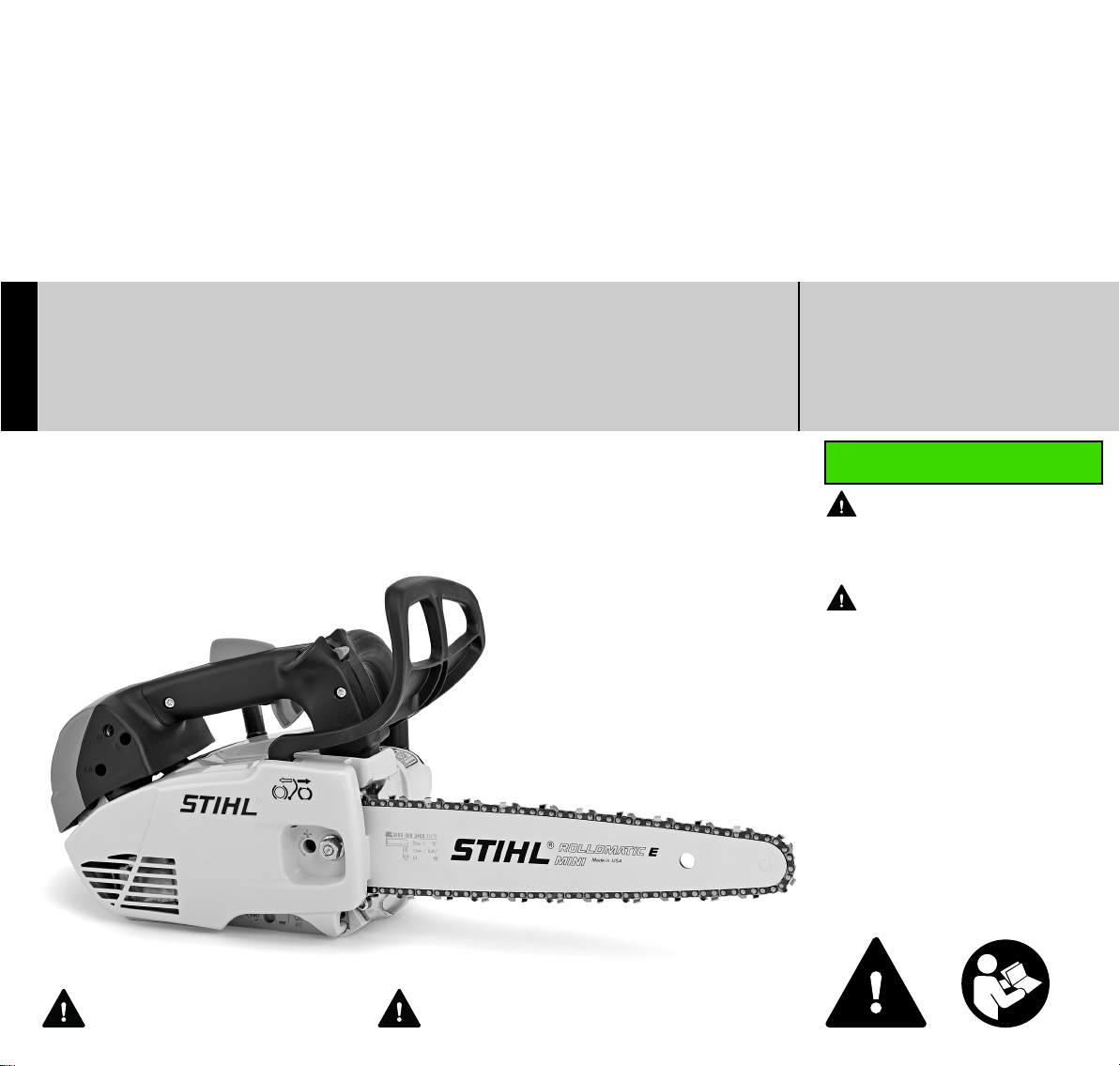
STIHL MS 150 TC
WARNING To reduce the risk of
kickback injury use STIHL reduced kickback bar
and STIHL low kickback chain as specified in
this manual or other available low kickback
components.
ADVERTENCIA Para reducir el
riesgo de lesionarse como resultado de un
culatazo, utilice la barra y la cadena de
contragolpe reducido de la forma especificada
en este manual o de otros componentes
reductores de contragolpe.
Read Instruction Manual thoroughly before
use and follow all safety precautions –
improper use can cause serious or fatal injury.
Antes de usar la máquina lea y siga todas las precauciones
de seguridad dadas en el manual de instrucciones – el uso
incorrecto puede causar lesiones graves o mortales.
{
Instruction Manual
Manual de instrucciones
Page 2

Instruction Manual
1 - 53
Manual de instrucciones
54 - 114
Page 3

Contents
English
Guide to Using this Manual 2
Safety Precautions and Working
Techniques 3
Cutting Attachment 21
Mounting the Bar and Chain 21
Tensioning the Saw Chain (side
chain tensioner) 23
Checking Chain Tension 23
Fuel 23
Original Instruction ManualPrinted on chlorine-free paper
Fueling 24
Chain Lubricant 26
Filling Chain Oil Tank 27
Checking Chain Lubrication 27
Chain Brake 28
Starting / Stopping the Engine 29
Operating Instructions 32
Taking Care of the Guide Bar 33
Cleaning the Air Filter 34
Engine Management 34
Adjusting the Carburetor 34
Spark Plug 35
Rewind Starter 37
Printing inks contain vegetable oils, paper can be recycled.
Storing the Machine 37
Checking and Replacing the Chain
Sprocket 37
Maintaining and Sharpening the
Saw Chain 38
Maintenance and Care 42
Main Parts 44
Specifications 46
Ordering Spare Parts 47
Maintenance and Repairs 47
Disposal 47
STIHL Incorporated Federal
Emission Control Warranty
Statement 48
STIHL Incorporated California
Exhaust and Evaporative
Emissions Control Warranty
Statement 50
Trademarks 52
This manual contains operating and
safety instructions for all STIHL
Professional Tree Service Chain Saws.
A professional tree service chain saw is
designed especially for in-tree
maintenance, tree surgery and other
cutting work in confined spaces such as
working from a rope and harness or from
a lift-bucket.
Allow only persons who fully understand
this manual to operate your chain saw.
To receive maximum performance and
satisfaction from your STIHL chain saw,
it is important that you read, understand
and follow the safety precautions and
the operating and maintenance
instructions in chapter "Safety
Precautions for Chain saw Users" and
"Safety Precautions" before using your
chain saw. For further information you
can go to www.stihlusa.com.
Contact your STIHL dealer or the STIHL
distributor for your area if you do not
understand any of the instructions in this
manual.
WARNING
Because a chain saw is a high-speed
wood-cutting tool, some special safety
precautions must be observed as with
any other power saw to reduce the risk
of personal injury. Careless or improper
use may cause serious or even fatal
injury.
{
© ANDREAS STIHL AG & Co. KG, 2014
0458-561-8621-B. VA5.K14.
0000006206_010_GB
MS 150 TC
This instruction manual is protected by copyright. All rights reserved, especially the rights to reproduce, translate and process
with electronic systems.
1
Page 4
English
Guide to Using this Manual
This Instruction Manual refers to a
STIHL chain saw, also called a machine
in this Instruction Manual.
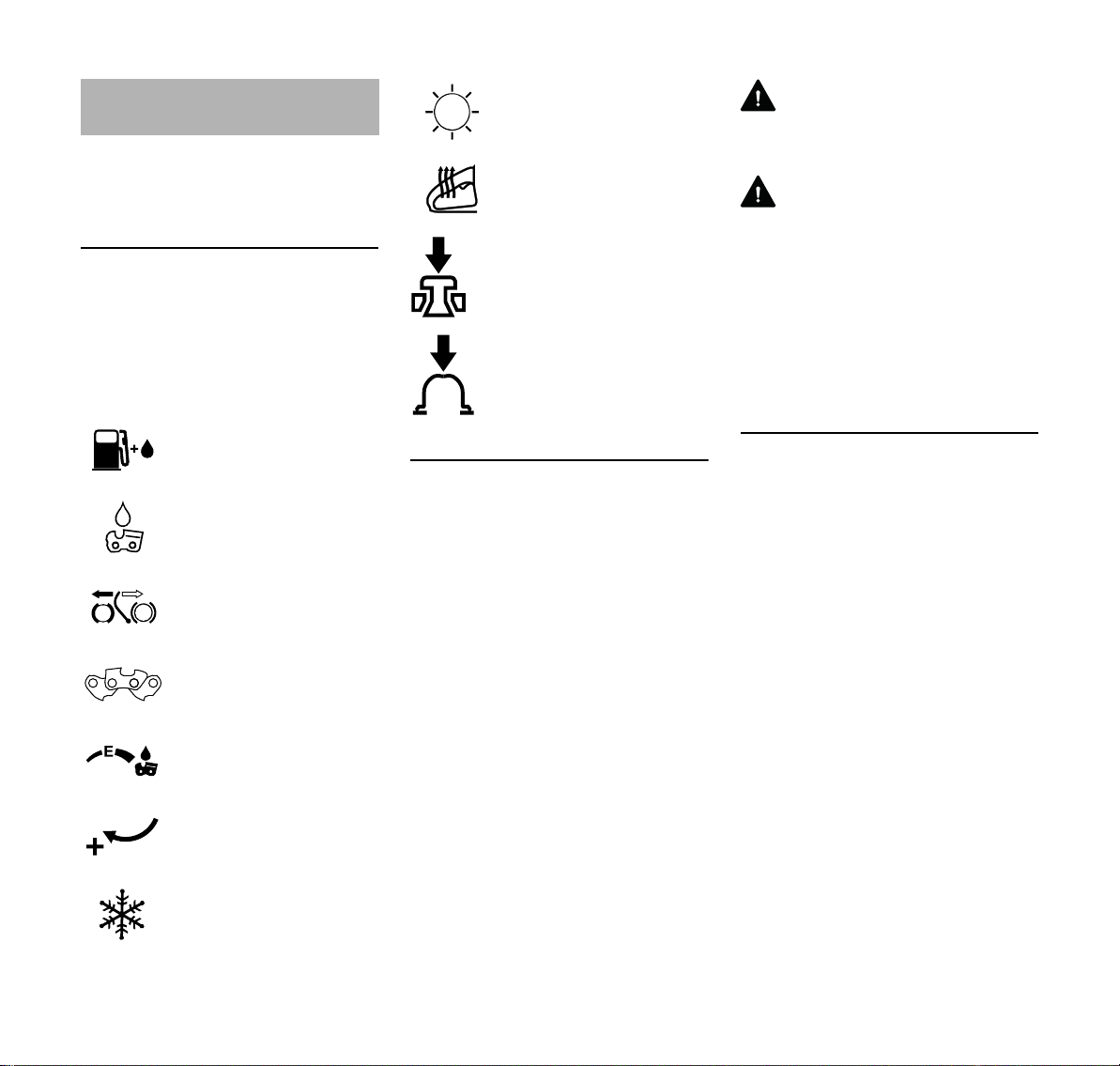
Pictograms
The meanings of the pictograms
attached to or embossed on the
machine are explained in this manual.
Depending on the model concerned, the
following pictograms may be on your
machine.
Fuel tank; fuel mixture of
gasoline and engine oil
Chain oil tank; chain oil
Engaging and disengaging the STIHL Quickstop
chain brake
Direction of chain rotation
Ematic; chain oil quantity
control
Tension the chain
Intake air preheating for
winter operation
Intake air for summer
operation
Handle heating
Operate decompression
valve
Operate manual fuel
pump
Symbols in Text
Many operating and safety instructions
are supported by illustrations.
The individual steps or procedures
described in the manual may be marked
in different ways:
N A bullet marks a step or procedure.
A description of a step or procedure that
refers directly to an illustration may
contain item numbers that appear in the
illustration. Example:
N Loosen the screw (1).
N Lever (2) ...
In addition to the operating instructions,
this manual may contain paragraphs
that require your special attention. Such
paragraphs are marked with the
symbols and signal words described
below:
DANGER
Indicates an imminent risk of severe or
fatal injury.
WARNING
Indicates a hazardous situation which, if
not avoided, could result in severe or
fatal injury.
NOTICE
Indicates a risk of property damage,
including damage to the machine or its
individual components.
Engineering Improvements
STIHL’s philosophy is to continually
improve all of its products. As a result,
engineering changes and improvements
are made from time to time. Therefore,
some changes, modifications and
improvements may not be covered in
this manual. If the operating
characteristics or the appearance of
your machine differs from those
described in this manual, please contact
your STIHL dealer or the STIHL
distributor for your area for assistance.
2
MS 150 TC
Page 5
English
Safety Precautions and
Working Techniques
This lightweight top handle chain saw is
designed specifically for in-tree surgery
and maintenance.
Due to its light weight and
special compact handle
design it is particularly
useful in confined spaces
such as in-tree work
where great maneuverability is required. For
other uses, however, a
saw with wider handle
spacing will normaly provide greater control. If the
operator is not properly
secured for two-hand
use, there is an
increased risk of injury
when working in a tree
from loss of control.
This increased risk includes injuries due
to not having a firm grip on the saw in
case of reactive forces or to loss of
control of the saw, leading, e.g., to leg
injuries from the chain saw "dropping" at
the end of the cut.
For this reason
these special
chain saws should
be used only for
work in a tree by
persons who are
trained in special
cutting and working techniques and
who are properly
secured (lift
bucket, ropes,
safety harness)
Regular chain saws with a less compact
design, i.e., (with wider spaced handles
for better control), should be used for all
other cutting work at ground level.
WARNING
Working in a tree requires the use of
special cutting and working techniques
which must be observed in order to
reduce the increased risk of personal
injury.
Never work in a tree unless you have
received specific, professional training
for such work, including training in the
use of the safety and other climbing
equipment, such as harnesses, ropes,
belts, climbing irons, snap hooks,
carabiners, etc.
Because a chain saw is a
high-speed, fast-cutting
power tool, special safety
precautions must be
observed to reduce the
risk of personal injury.
It is important that you
read, fully understand
and observe the following
safety precautions and
warnings. Read the
instruction manual and
the safety instructions
periodically. Careless or
improper use may cause
serious or fatal injury.
Save the instruction manual for future reference.
WARNING
The use of this chain saw may be
hazardous. The saw chain has many
sharp cutters. If the cutters contact your
flesh, they will cut you, even if the chain
is not moving.
WARNING
Reactive forces, including kickback, can
be dangerous. Pay special attention to
the section on reactive forces.
Have your STIHL dealer show you how
to operate your chain saw. All safety
precautions that are generally observed
when working with an axe or a hand saw
also apply to the operation of chain
saws. Observe all applicable federal,
state and local safety regulations,
standards and ordinances.
WARNING
Do not lend or rent your chain saw
without the instruction manual. Be sure
that anyone using it understands the
information contained in this manual.
The use of noise emitting chain saws
may be restricted to certain times by
national, state or local regulations.
Use your chain saw only for cutting
wooden objects.
WARNING
Do not use it for other purposes, since
misuse may result in personal injury or
property damage, including damage to
the chain saw.
MS 150 TC
3
Page 6

English
WARNING
Minors should never be allowed to use
this chain saw. Bystanders, especially
children, and animals should not be
allowed in the area where it is in use.
Most of these safety precautions and
warnings apply to the use of all STIHL
chain saws. Different models may have
different parts and controls. See the
appropriate section of your instruction
manual for a description of the controls
and the function of the parts of your
model.
WARNING
Always stop the engine and activate the
QuickStop Chainbrake before
transporting or carrying out any work on
the chain saw. This avoids the risk of the
engine starting unintentionally.
STIHL recommends the use of genuine
STIHL replacement parts. They are
specifically designed to match your
model and meet your performance
requirements.
Safe use of a chain saw involves
1 the operator
2 the chain saw
3 the use of the chain saw.
THE OPERATOR
Physical Condition
You must be in good physical condition
and mental health and not under the
influence of any substance (drugs,
alcohol, etc.) which might impair vision,
dexterity or judgment. Do not operate
this chain saw when you are fatigued.
WARNING
Be alert – if you get tired, take a break.
Tiredness may result in loss of control.
Working with any power tool can be
strenuous. If you have any condition that
might be aggravated by strenuous work,
check with your doctor before operating
this chain saw.
WARNING
Prolonged use of a chain saw (or other
power tools) exposing the operator to
vibrations may produce whitefinger
disease (Raynaud's phenomenon) or
carpal tunnel syndrome.
These conditions reduce the hand's
ability to feel and regulate temperature,
produce numbness and burning
sensations and may cause nerve and
circulation damage and tissue necrosis.
All factors which contribute to whitefinger disease are not known, but cold
weather, smoking and diseases or
physical conditions that affect blood
vessels and blood transport, as well as
high vibration levels and long periods of
exposure to vibration are mentioned as
factors in the development of whitefinger
disease. In order to reduce the risk of
whitefinger disease and carpal tunnel
syndrome, please note the following:
– Most STIHL chain saws are
available with an anti-vibration
("AV") system designed to reduce
the transmission of vibrations
created by the chain saw to the
operator's hands. An AV system is
recommended for those persons
using chain saws on a regular or
sustained basis.
– Wear gloves and keep your hands
warm. Heated handles, which are
available on some STIHL chain
saws, are recommended for cold
weather use.
– Keep the AV system well
maintained. A chain saw with loose
components or with damaged or
worn AV elements will tend to have
higher vibration levels.
– Keep the saw chain sharp and well
maintained. A dull saw chain will
increase cutting time, and pressing
a dull saw chain through wood will
increase the vibrations transmitted
to your hands.
– Maintain a firm grip at all times, but
do not squeeze the handles with
constant, excessive pressure. Take
frequent breaks.
All the above-mentioned precautions do
not guarantee that you will not sustain
whitefinger disease or carpal tunnel
syndrome. Therefore, continual and
regular users should closely monitor the
4
MS 150 TC
Page 7

English
condition of their hands and fingers. If
any of the above symptoms appear,
seek medical advice immediately.
WARNING
The ignition system of the STIHL unit
produces an electromagnetic field of a
very low intensity. This field may
interfere with some pacemakers. To
reduce the risk of serious or fatal injury,
persons with a pacemaker should
consult their physician and the
pacemaker manufacturer before
operating this chain saw.
Proper Clothing
WARNING
To reduce the risk of injury, the operator
should wear proper protective apparel.
Clothing must be sturdy
and snug-fitting, but allow
complete freedom of
movement. To reduce the
risk of cut injuries, wear
the type of overalls, long
pants or chaps that contain pads of cut-retardant
material, if feasible
depending on the individual application. Avoid
loose-fitting jackets,
scarfs, neckties, jewelry,
flared or cuffed pants,
unconfined long hair or
anything that could
become caught on
branches, brush or the
moving parts of the chain
saw. Secure hair so it is
above shoulder level.
Good footing is very
important. Wear sturdy
footwear with nonslip
soles suitable for climbing in trees. Never wear
sandals, flip-flops or go
barefoot.
Always wear heavy-duty
work gloves (e.g. made of
leather or wear resistant
material) when handling
the chain saw and the
cutting tool. Heavy-duty,
nonslip gloves improve
your grip and help to protect your hands.
To reduce the risk of
injury to your eyes never
operate your power tool
unless wearing goggles
or properly fitted protective glasses with
adequate top and side
protection complying with
ANSI Z87 "+" (or your
applicable national standard). If there is a risk of
injury to your face, STIHL
recommends that you
also wear a face shield or
face screen over your
goggles or protective
glasses.
Wear an approved safety
hard hat to reduce the
risk of injury to your head.
Chain saw noise may
damage your hearing.
Wear sound barriers (ear
plugs or ear mufflers) to
help protect your hearing.
Continual and regular
users should have their
hearing checked
regularly.
Be particularly alert and cautious when
wearing hearing protection because
your ability to hear warnings (shouts,
alarms, etc.) is restricted.
Use proper equipment at
all times to protect yourself from falling.
Any crew member in the cutting area
should also wear proper protective
clothing, especially hard hats, to protect
their heads.
MS 150 TC
5
Page 8
English
001BA275 KN
THE CHAIN SAW
For illustrations and definitions of the
chain saw parts see the chapter on
"Main Parts."
WARNING
Never modify this chain saw in any way.
Only attachments supplied by STIHL or
expressly approved by STIHL for use
with the specific STIHL model are
authorized. Although certain
unauthorized attachments are useable
with STIHL chain saws, their use may, in
fact, be extremely dangerous.
WARNING
Never operate your chain saw if it is
damaged, improperly adjusted or
maintained, or not completely or
securely assembled.
If this chain saw is subjected to
unusually high loads for which it was not
designed (e.g. heavy impact or a fall),
always check that it is in good condition
before continuing work. Check in
particular that the fuel system is tight (no
leaks) and that the controls and safety
devices are working properly. Do not
continue operating this chain saw if it is
damaged. In case of doubt, have it
checked by your STIHL servicing dealer.
THE USE OF THE CHAIN SAW
Transporting the Chain Saw
WARNING
Always stop the engine before putting
the chain saw down. Carrying a chain
saw with the engine running may be
extremely dangerous.
Accidental acceleration of the engine
can cause the saw chain to rotate.
Always engage the chain brake when
taking more than a few steps.
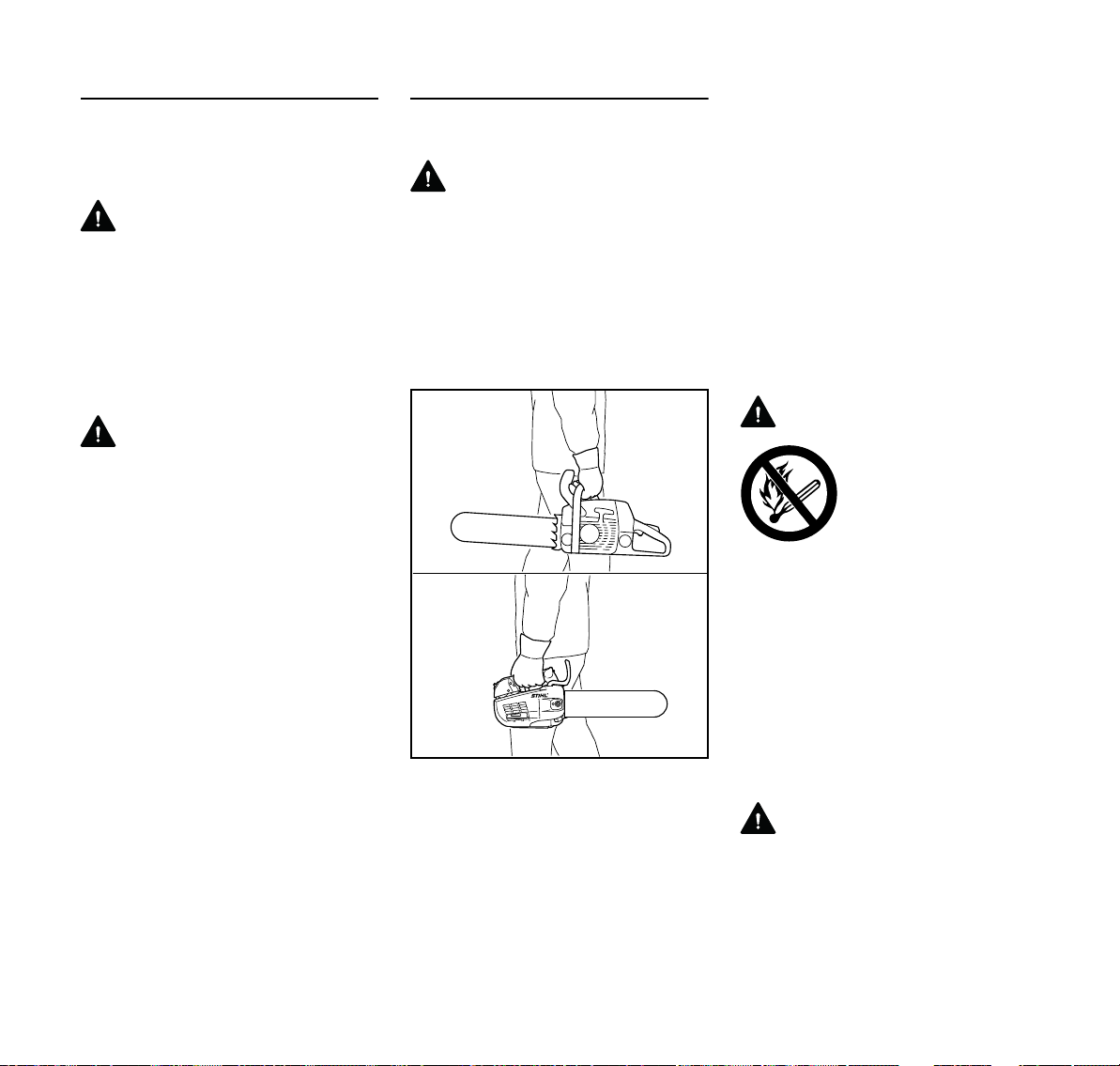
By hand: When transporting your chain
saw by hand, the engine must be shut
off and the chain saw must be in the
proper position, i.e., grip the top handle
and place the muffler away from the
body; the chain guard (scabbard) should
be over the saw chain and guide bar,
which should point backwards, away
from the direction in which you are
walking.
By vehicle: When transporting in a
vehicle, keep saw chain and bar covered
with the chain guard (scabbard).
Properly secure your chain saw to
prevent turnover, fuel spillage and
damage to the chain saw.
Fuel
Your STIHL chain saw uses an oil-
gasoline mixture for fuel (see the
chapter on "Fuel" of your instruction
manual).
WARNING
Gasoline is an extremely
flammable fuel. If spilled
and ignited by a spark or
other ignition source, it
can cause fire and serious burn injury or
property damage. Use
extreme caution when
handling gasoline or fuel
mix. Do not smoke or
bring any fire or flame
near the fuel or the chain
saw. Note that combustible fuel vapor may
escape from the fuel
system.
Fueling Instructions
WARNING
Fuel your chain saw in well-ventilated
areas, outdoors. Always shut off the
engine and allow it to cool before
refueling. Gasoline vapor pressure may
6
MS 150 TC
Page 9

English
001BA234 KN
1
001BA238 KN
001BA239 KN
build up inside the fuel tank depending
on the fuel used, the weather conditions
and the tank venting system.
In order to reduce the risk of burns and
other personal injury from escaping gas
vapor and fumes, remove the fuel filler
cap on your chain saw carefully so as to
allow any pressure build-up in the tank
to release slowly. Never remove the fuel
filler cap while the engine is running.
Select bare ground for fueling and move
at least 10 feet (3 m) from the fueling
spot before starting the engine. Wipe off
any spilled fuel before starting your
chain saw.
WARNING
Check for fuel leakage
while refueling and during
operation. If fuel leakage
is found, do not start or
run the engine until the
leak is fixed and any
spilled fuel has been
wiped away. Take care
not to get fuel on your
clothing. If this happens,
change your clothing
immediately.
Different models may be equipped with
different fuel caps.
Toolless cap with grip
WARNING
In order to reduce the risk of fuel spillage
and fire from an improperly tightened
fuel cap, correctly position and tighten
the fuel cap in the fuel tank opening.
To do this with this STIHL cap, raise the
grip on the top of the cap until it is upright
at a 90° angle. Insert the cap in the fuel
tank with the positioning mark on the
grip of the cap and the "open" mark on
the fuel tank opening lining up. Using the
grip, press the cap down firmly while
turning it clockwise as far as it will go
(approx. 1/4 turn). The positioning mark
on the cap should now line up with the
"closed" mark on the tank.
Fold the grip flush with
the top of the cap. Grip
the cap and check for
tightness. If the grip does
not lie completely flush
with the cap and the
detent on the grip does
not fit in the corresponding recess in the filler
opening, or if the cap is
loose in the filler opening,
the cap is not properly
seated and tightened and
you must repeat the
above steps.
Misaligned, damaged or broken cap
N If the cap does not drop fully into the
opening when the positioning marks
line up and/or if the cap does not
tighten properly when twisted, the
base of the cap may be prematurely
rotated (in relation to the top) to the
closed position. Such misalignment
can result from handling, cleaning
or an improper attempt at
tightening.
Left: Bottom of cap in closed posi-
tion – inner mark (1) in line
with outer mark.
Right: Bottom of cap in correct posi-
tion for installation – inner
mark is under the grip and
not in line with the outer
mark.
N To return the cap to the open
position for installation, turn the cap
(with the grip up) until it drops fully
into the tank opening. Next, twist the
cap counterclockwise as far as it will
go (approx. 1/4 turn) – this will twist
the base of the cap into the correct
MS 150 TC
7
Page 10

English
position for installation. Then, twist
the cap clockwise, closing it
normally.
N If your cap still does not tighten
properly, it may be damaged or
broken; immediately stop use of the
unit and take it to your authorized
STIHL dealer for repair.
See also the "Fueling" chapter in your
Instruction Manual for additional
information.
Before Operation
Take off the chain guard (scabbard) and
inspect the chain saw for proper
condition and operation. (See the
maintenance chart near the end of the
instruction manual.)
WARNING
Always check your chain saw for proper
condition and operation before starting,
particularly the throttle trigger, throttle
trigger lockout, stop switch and cutting
attachment. The throttle trigger must
move freely and always spring back to
the idle position. The Master Control
Lever / stop switch must move easily to
STOP, 0 or †. Never attempt to modify
the controls or safety devices.
WARNING
Check fuel system for leaks, especially
the visible parts, e.g., filler cap, hose
connections, manual fuel pump (only for
chain saws equipped with a manual fuel
pump). Do not start the engine if there
are leaks or damage – risk of fire! Have
the chain saw repaired by a STIHL
servicing dealer before using it.
WARNING
Check that the spark plug boot is
securely mounted on the spark plug – a
loose boot may cause arcing that could
ignite combustible fumes and cause a
fire.
For proper assembly of the bar and saw
chain follow the procedure described in
the chapter "Mounting the Bar and
Chain" of your instruction manual.
STIHL Oilomatic saw chain, guide bar
and sprocket must match each other in
gauge and pitch. Before replacing any
bar and chain, see the chapter entitled
"Specifications" in the instruction
manual and the chapter "Reactive
Forces including Kickback".
Since longer bars add weight and may
be more difficult to control, select the
shortest bar that will meet your cutting
needs.
WARNING
Proper tension of the chain is extremely
important. In order to avoid improper
setting, the tensioning procedure must
be followed as described in your
manual. Always make sure the
hexagonal nut(s) for the sprocket cover
is (are) tightened securely after
tensioning the saw chain in order to
secure the bar. Never start the chain
saw with the sprocket cover loose.
Check chain tension once more after
having tightened the nut(s) and
thereafter at regular intervals (whenever
the saw is shut off). If the saw chain
becomes loose while cutting, shut off the
engine and then tighten. Never try to
adjust the saw chain while the engine is
running!
WARNING
After adjusting a saw chain, start the
chain saw, let the engine run for a while,
then switch engine off and recheck saw
chain tension. Proper saw chain tension
is very important at all times.
Keep the handles clean and dry at all
times; it is particularly important to keep
them free of moisture, pitch, oil, fuel mix,
grease or resin in order for you to
maintain a firm grip and properly control
your chain saw .
WARNING
Be sure that the guide bar and saw chain
are clear of you and all other
obstructions and objects, including the
ground. If the upper quadrant of the tip of
the bar touches any object, it may cause
kickback to occur (see section on
reactive forces). Never attempt to start
the chain saw when the guide bar is in a
cut or kerf.
For specific starting instructions, see the
appropriate section of your instruction
manual.
Starting
WARNING
To reduce the risk of fire and burn
injuries, start the engine at least 10 feet
(3 m) from the fueling spot, outdoors
only.
Start and operate your chain saw
without assistance. For specific starting
instructions, see the appropriate section
of the instruction manual. Proper starting
methods reduce the risk of injury.
8
MS 150 TC
Page 11
English
0012BA008 KN
0012BA019 KN
H
L
WARNING
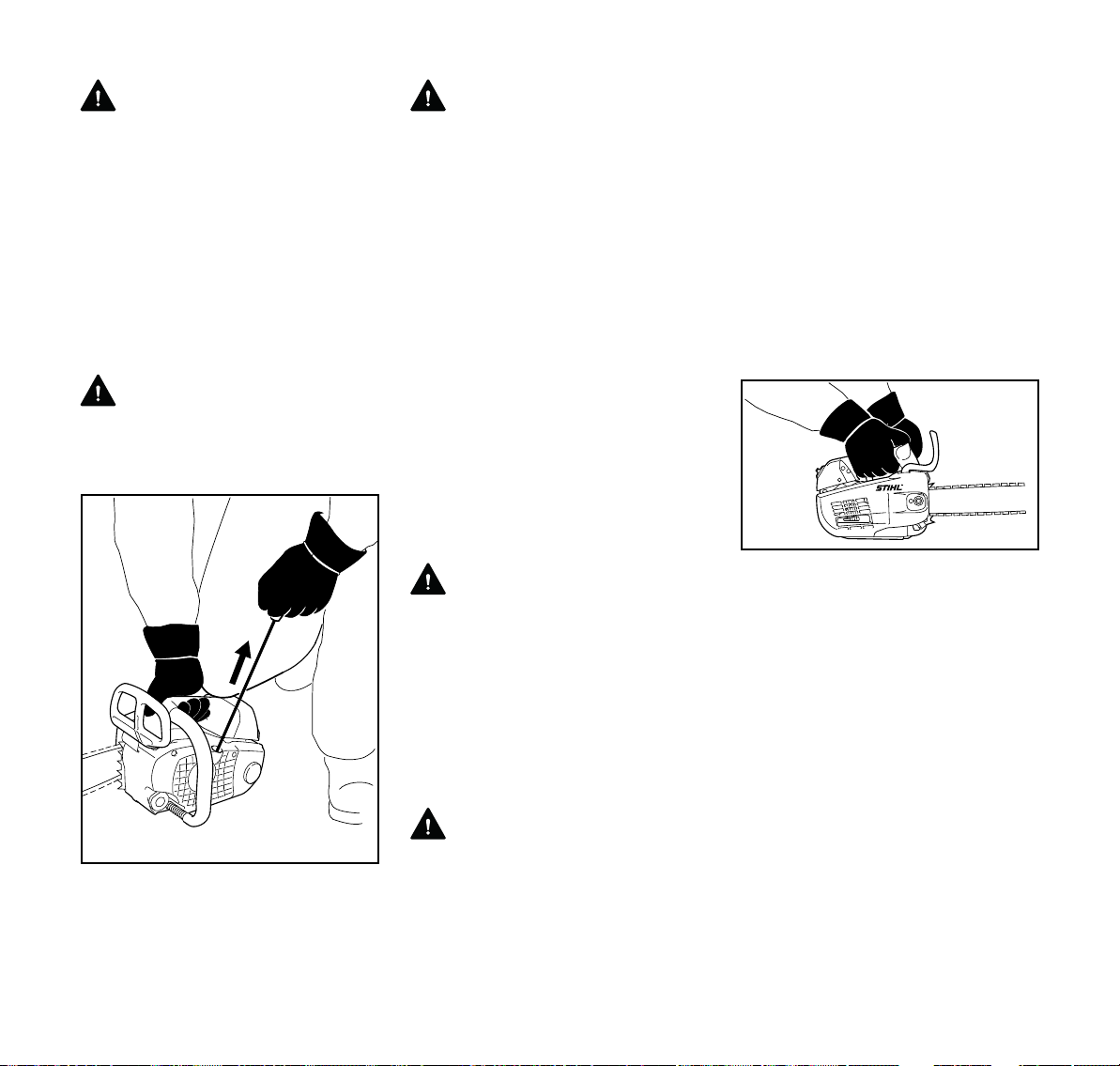
To reduce the risk of injury from saw
chain contact and / or reactive forces,
the chain brake must be engaged when
starting the saw. If your chain saw is
equipped with the Quickstop Plus chain
brake system, it is not sufficient to
engage that brake only for starting,
because the saw chain may begin to
rotate at high speed when the throttle
trigger lockout is depressed (releasing
the brake) in order to blip the throttle
trigger after starting.
WARNING
Do not drop start. This method is very
dangerous because you may lose
control of the saw.
WARNING
Be sure that the guide bar and saw chain
are clear of you and all other
obstructions and objects, including the
ground. When the engine is started, the
engine speed with the starting throttle
lock engaged will be fast enough for the
clutch to engage the sprocket and, if the
chain brake is not activated, turn the
chain. If the upper quadrant of the tip of
the bar touches any object, it may cause
kickback to occur (see section on
reactive forces). To reduce this risk,
always engage the chain brake before
starting. Never attempt to start the chain
saw when the guide bar is in a cut or
kerf.
Once the engine has started,
immediately blip the throttle trigger,
which should release the Master Control
lever to the run position and allow the
engine to slow down to idle.
WARNING
When you pull the starter grip, do not
wrap the starter rope around your hand.
Do not let the grip snap back, but guide
the starter rope to rewind it properly.
Failure to follow this procedure may
result in injury to your hand or fingers
and may damage the starter
mechanism.
Important Adjustments
should not move. For directions on how
to adjust idle speed, see the appropriate
section of your instruction manual.
If you cannot set the correct idle speed,
have your STIHL dealer check your
chain saw and make proper adjustments
and repairs.
Holding and Controlling the Chain Saw
Always hold the chain saw firmly with
both hands when the engine is running.
Place your left hand on the front handle
bar and your right hand on the control
handle and throttle trigger.
Left-handers should follow these
instructions too. Wrap your fingers
tightly around the handles, keeping the
handles cradled between your thumb
and forefinger. With your hands in this
position, you can best oppose and
absorb the push, pull and kickback
forces of your saw without losing control
(see section on reactive forces).
Place the chain saw on firm ground or
other solid surface in an open area.
Maintain good balance and secure
footing.
MS 150 TC
WARNING
To reduce the risk of personal injury
from loss of control and / or contact with
the running cutting tool, do not use your
chain saw with incorrect idle adjustment.
At correct idle speed, the cutting tool
9
Page 12
English
0012BA025 KN
0012BA020 KN
WARNING
To reduce the risk of serious or fatal injury to the
operator or bystanders
from loss of control,
never use the chain saw
with one hand. It is more
difficult for you to control
reactive forces and to
prevent the bar and chain
from skating or bouncing
along the limb or log.
Even for those compact
chain saw designed for
use in confined spaces,
one-handed operation
increases the risk that the
operator may lose
control.
WARNING
To reduce the risk of cut injuries, keep
hands and feet away from the cutting
tool. Never touch a moving cutting tool
with your hand or any other part of your
body.
branches because slender material may
catch the saw chain and be whipped
toward you or pull you off balance.
WARNING
Take extreme care in wet and freezing
weather (rain, snow, ice). Put off the
work when the weather is windy, stormy
or rainfall is heavy.
lift bucket), have both hands free for
operating the chain saw in a cramped
environment and have taken proper
precautions to avoid injury from falling
limbs or branches.
The use of climbing aids, such as spikes
or climbing irons, also require special
training. Always secure the chain saw
with a rope (tie to hinged ring) and attach
it to the lifeline. Cordon off the work area
in order to reduce the risk of injuries and
damage to bystanders or property (e. g.
motor vehicles) from falling branches.
Position the chain saw in such a way
that your body is clear of the cutting
attachment whenever the engine is
running. Stand to the left of cut while
bucking.
WARNING
Keep proper footing and balance at all
times. Special care must be taken in
slippery conditions (wet ground, snow)
and in difficult, overgrown terrain. Be
extremely cautious when working on
slopes or uneven ground. Watch for
hidden obstacles such as tree stumps,
roots, rocks, holes and ditches to avoid
stumbling. There is increased danger of
slipping on freshly debarked logs. For
better footing, clear away fallen
branches, scrub and cuttings. Use
extreme caution when cutting small-size
10
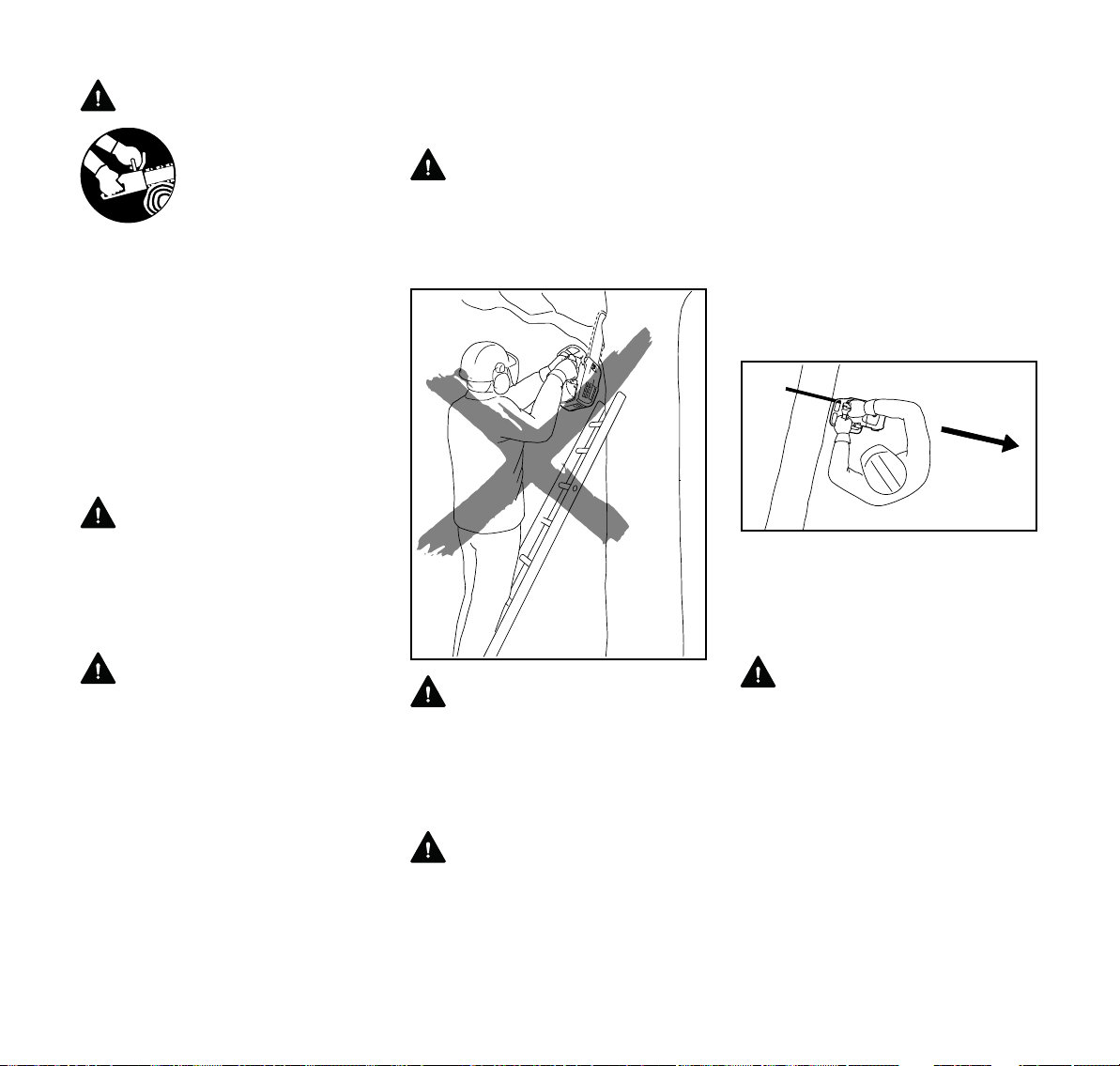
WARNING
To reduce the risk of injury from loss of
control, never work on a ladder or any
other insecure support. Never hold the
machine above shoulder height. Do not
overreach.
WARNING
Never work in a tree unless you have
received specific, professional training
for such work, are properly secured
(such as tackle and harness system or a
WARNING
To reduce the risk of falls, keep rotating
saw chain well clear of harness and
lifelines to avoid them being severed. It
is essential to use a double lifeline.
Check condition of harness, belts and
ropes at regular frequent intervals.
Always pull the saw out of the cut with
the chain running.
After finishing a cut, activate the chain
brake to lock the chain or shut down the
engine before moving the saw to
another position in the tree.
MS 150 TC
Page 13

English
Never put pressure on the chain saw
when reaching the end of a cut. The
pressure may cause the bar and rotating
saw chain to pop out of the cut or kerf, go
out of control and strike the operator or
some other object. If the rotating saw
chain strikes some other object, a
reactive force may cause the moving
saw chain to strike the operator.
STIHL recommends that first-time users
should cut logs on a sawhorse – see
"Cutting small logs."
Working Conditions
Operate and start your chain saw only
outdoors in a well-ventilated area.
Operate it under good visibility and
daylight conditions only. Work carefully.
WARNING
Your chain saw is a one-person
machine. Do not allow other persons in
the general work area, even when
starting. Stop the engine immediately if
you are approached.
WARNING
Even though bystanders should be kept
away from the running chain saw, never
work alone. Keep within calling distance
of others in case help is needed.
WARNING
To reduce the risk of injury to bystanders
and damage to property, never let your
chain saw run unattended. When it is not
in use (e. g. during a work break), shut it
off and make sure that unauthorized
persons do not use it.
WARNING
As soon as the engine is
running, this product generates toxic exhaust
fumes containing chemicals, such as unburned
hydrocarbons (including
benzene) and carbon
monoxide, that are
known to cause respiratory problems, cancer,
birth defects, or other
reproductive harm. Some
of the gases (e. g. carbon
monoxide) may be colorless and odorless. To
reduce the risk of serious
or fatal injury/illness from
inhaling toxic fumes,
never run the machine
indoors or in poorly ventilated locations. If exhaust
fumes become concentrated due to insufficient
ventilation, clear obstructions from work area to
permit proper ventilation
before proceeding and/or
take frequent breaks to
allow fumes to dissipate
before they become
concentrated.
WARNING
Operate your chain saw so that it
produces a minimum of noise and
emissions – do not run engine
unnecessarily and accelerate the engine
only for cutting.
WARNING
Use of this chain saw (including
sharpening the saw chain) can also
generate dust, mist and fumes
containing chemicals that are known to
cause respiratory problems, cancer,
birth defects, or other reproductive
harm. If you are unfamiliar with the risks
associated with the particular dust, mist
or fume at issue, consult your employer,
governmental agencies such as OSHA
and NIOSH and other sources on
hazardous materials. California and
some other authorities, for instance,
have published lists of substances
known to cause cancer, reproductive
toxicity, etc.
WARNING
Inhalation of certain dusts, especially
organic dusts such as mold or pollen,
can cause susceptible persons to have
an allergic or asthmatic reaction.
Substantial or repeated inhalation of
dust and other airborne contaminants, in
particular those with a smaller particle
size, may cause respiratory or other
illnesses. This includes wood dust,
especially from hardwoods, but also
from some softwoods such as Western
Red Cedar. Control dust (such as saw
dust), mists (such as oil mist from chain
lubrication) and engine fumes at the
source where possible. Use good work
practices, such as always cutting with a
properly sharpened saw chain (which
produces wood chips rather than fine
dust) and operating the unit so that the
wind or operating process directs any
dust raised by the chain saw away from
the operator. Follow the
recommendations of
MS 150 TC
11
Page 14

English
EPA/OSHA/NIOSH and occupational
and trade associations with respect to
dust ("particulate matter"). When the
inhalation of dust cannot be
substantially controlled, i.e., kept at or
near the ambient (background) level, the
operator and any bystanders should
wear a respirator approved by NIOSH /
MSHA for the type of dust encountered.
WARNING
Breathing asbestos dust is dangerous
and can cause severe or fatal injury,
respiratory illness or cancer. The use
and disposal of asbestos-containing
products have been strictly regulated by
OSHA and the Environmental Protection
Agency. Do not use your chain saw to
cut or disturb asbestos or asbestoscontaining products. If you have any
reason to believe that you might be
cutting asbestos, immediately stop
cutting and contact your employer or a
local OSHA representative.
Operating Instructions
WARNING
Do not operate your chain saw with the
starting throttle lock engaged. Cutting
with the starting throttle lock engaged
does not permit the operator proper
control of the chain saw or saw chain
speed. Begin and continue cutting with
the saw at full throttle, engage the
bumper spike firmly in the wood (if
possible) and then continue cutting.
Always work with the bumper spike so
that you have better control of the saw. If
you work without the bumper spike the
chain saw may pull you forwards
suddenly.
WARNING
Never touch a saw chain with your hand
or any part of your body when the engine
is running, even when the chain is not
rotating.
In the event of an emergency, switch off
the engine immediately – move the
Master Control Lever to STOP, 0 or †.
WARNING
Always stop the engine before putting
the chain saw down.
WARNING
The saw chain continues to move for a
short period after the throttle trigger is
released (flywheel effect).
Accelerating the engine while the saw
chain is blocked increases the load and
will cause the clutch to slip continuously.
This may occur if the throttle is
depressed for more than a few seconds
when the saw chain is pinched in the cut
or the chain brake is engaged. It can
result in overheating and damage to
important components (e. g. clutch,
polymer housing components) – which
can then increase the risk of injury, e. g.,
from the saw chain moving while the
engine is idling.
WARNING
Your chain saw is equipped with a chain
catcher. It is designed to reduce the risk
of personal injury in the event of a
thrown or broken saw chain. From time
to time, the catcher may be damaged or
removed. To reduce the risk of personal
injury, do not operate a chain saw with a
damaged or missing chain catcher.
WARNING
Inspect antivibration elements
periodically. Replace damaged, broken
or excessively worn antivibration
elements immediately, since they may
result in loss of control of the saw. A
"sponginess" in the feel of the saw,
increased vibration or increased
"bottoming" during normal operation
may indicate damage, breakage or
excessive wear. Antivibration elements
should always be replaced in sets. If you
have any questions as to whether the
antivibration elements should be
replaced, consult your STIHL servicing
dealer.
If this chain saw is subjected to
unusually high loads for which it was not
designed (e. g. heavy impact or a fall),
always check that it is in good condition
before continuing work. Check in
particular that the fuel system is tight (no
leaks) and that the controls and safety
devices are working properly. Do not
continue operating this chain saw if it is
damaged. In case of doubt, have it
checked by your STIHL servicing dealer.
Your chain saw is not designed for
prying or shoveling away limbs, roots or
other objects. Such use could damage
the cutting attachment or AV system.
WARNING
When sawing, make sure that the saw
chain does not touch any foreign
materials such as rocks, fences, nails
12
MS 150 TC
Page 15

English
and the like. Such objects may be flung
off, damage the saw chain or cause the
chain saw to kickback.
WARNING
If the rotating saw chain strikes a rock or
other hard object, sparks may be
created, which can ignite flammabale
materials under certain circumstances.
Flammable materials can include dry
vegetation and brush, particularly when
weather conditions are hot and dry. Do
not use your chain saw around
flammable materials or around dry
vegetation or brush when there is a risk
of fire or wildfire. Contact your local fire
authorities or the U.S. Forestry Service if
you have any question about whether
vegetation and weather conditions are
suitable for the use of a chain saw.
WARNING
Take special care when cutting
shattered wood because of the risk of
injury from slivers being caught and
thrown in your direction.
WARNING
Never modify your muffler. Any
modification could cause an increase in
heat radiation, sparks or sound level,
thereby increasing the risk of fire, burn
injury or hearing loss. You may also
permanently damage the engine. Have
your muffler serviced and repaired by
your STIHL servicing dealer only.
WARNING
The muffler and other parts of the engine
(e.g. fins of the cylinder, spark plug)
become hot during operation and remain
hot for a while after stopping the engine.
To reduce risk of burns, do not touch the
muffler and other parts while they are
hot. Keep the area around the muffler
clean. Remove excess lubricant and all
debris such as pine needles, branches
or leaves. Let the engine cool down
sitting on concrete, metal, bare ground
or solid wood (e.g. the trunk of a felled
tree) away from any combustible
substances.
WARNING
An improperly mounted or damaged
cylinder housing or a
damaged/deformed muffler shell may
interfere with the cooling process of the
muffler. To reduce the risk of fire or burn
injury, do not continue work with a
damaged or improperly mounted
cylinder housing or a
damaged/deformed muffler shell.
Your muffler is furnished with a spark
arresting screen designed to reduce the
risk of fire from the emission of hot
particles. Never operate your unit with a
missing or damaged spark arresting
screen. If your gas/oil mix ratio is correct
(i.e., not too rich), this screen will
normally stay clean as a result of the
heat from the muffler and need no
service or maintenance. If you
experience loss of performance and you
suspect a clogged screen, have your
muffler maintained by a STIHL servicing
dealer. Some state or federal laws or
regulations may require a properly
maintained spark arrester for certain
uses. See the "Maintenance, Repair and
Storing" section of these Safety
Precautions. Remember that the risk of
a brush or forest fire is greater in hot or
dry conditions.
WARNING
Some STIHL chain saws
are equipped with a catalytic converter, which is
designed to reduce the
exhaust emissions of the
engine by a chemical
process in the muffler.
Due to this process, the
muffler does not cool
down as rapidly as conventional mufflers when
the engine returns to idle
or is shut off. To reduce
the risk of fire and burn
injuries when using a catalytic converter, always
set your chain saw down
in the upright position and
never locate it where the
muffler is near dry brush,
grass, wood chips or
other combustible materials while it is still hot.
MS 150 TC
13
Page 16
English
001BA257 KN
001BA035 KN
DANGER
Do not rely on the chain
saw ’s insulation against
electric shock. To reduce
the risk of electrocution,
never operate this chain
saw in the vicinity of any
wires or cables (power,
etc.) which may be carrying electric current.To
reduce risk of electrocution, take extra
precautions when cutting
near power lines. Have
the power switched off
before starting cutting
work in the immediate
vicinity of power lines.
REACTIVE FORCES INCLUDING
KICKBACK
WARNING
Reactive forces may occur any time the
chain is rotating. Reactive forces can
cause serious personal injury.
The powerful force used to cut wood can
be reversed and work against the
operator. If the rotating saw chain is
suddenly and significantly slowed or
stopped by contact with any solid object
such as a log or branch or is pinched, the
reactive forces may occur instantly.
These reactive forces may result in loss
of control, which, in turn, may cause
serious or fatal injury. An understanding
of the causes of these reactive forces
may help you avoid the element of
surprise and loss of control. Surprise
contributes to accidents.
The most common reactive forces are:
– kickback,
– pushback,
– pull-in.
WARNING
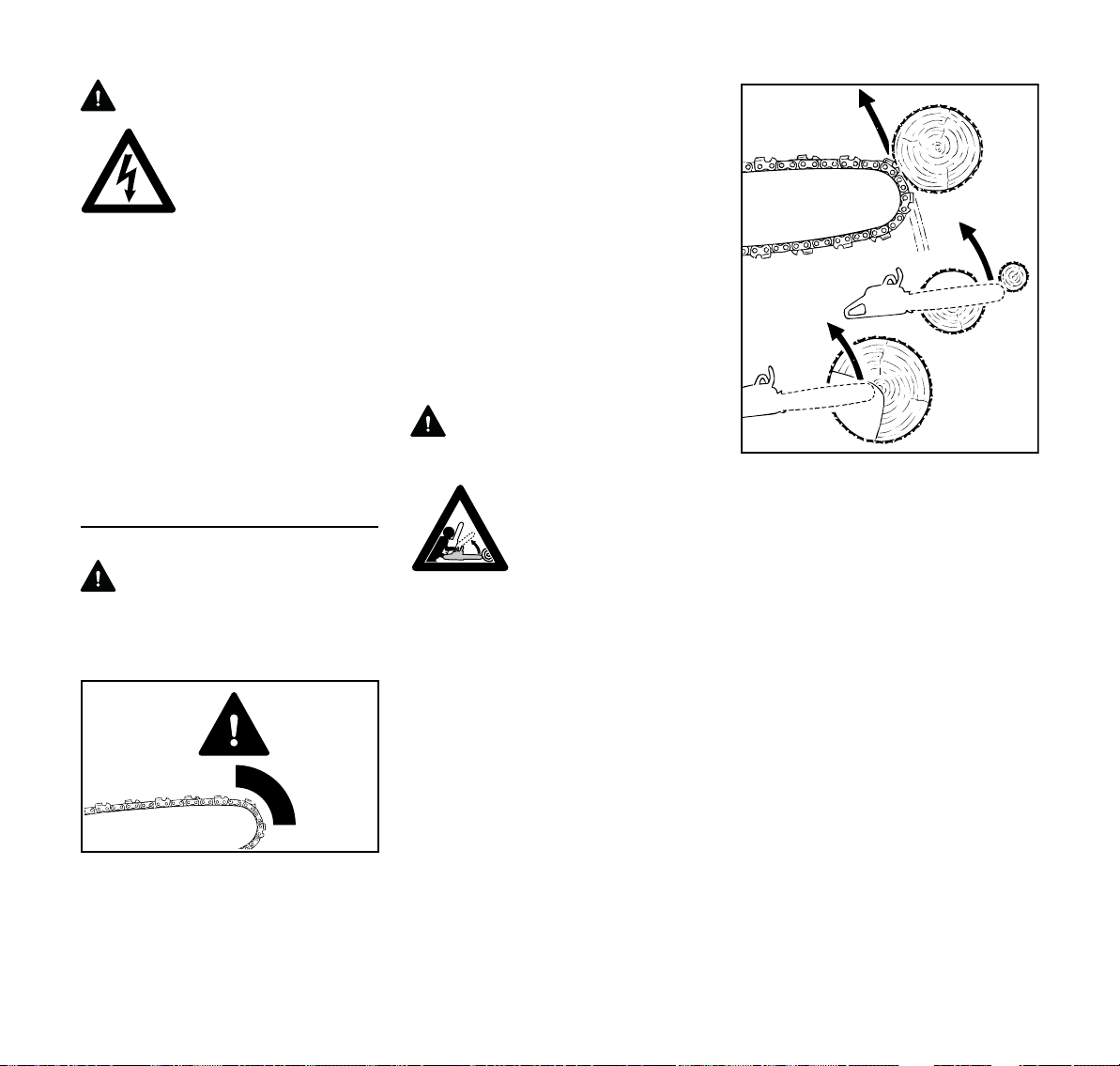
Kickback:
Kickback may occur
when the moving saw
chain near the upper
quadrant of the bar nose
contacts a solid object or
is pinched.
When this occurs, the energy driving the
saw chain can create a force that moves
the chain saw in a direction opposite to
the saw chain movement at the point
where the saw chain is slowed or
stopped. This may fling the bar up and
back in a lightning fast reaction mainly in
the plane of the bar and can cause
severe or fatal injury to the operator.
Kickback may occur, for example, when
the saw chain near the upper quadrant
of the bar nose contacts the wood or is
pinched during limbing or when it is
incorrectly used to begin a plunge or
boring cut.
The greater the force of the kickback
reaction, the more difficult it becomes for
the operator to control the chain saw.
Many factors influence the occurrence
and force of the kickback reaction.
These include saw chain speed, the
speed at which the bar and saw chain
contact the object, the angle of contact,
the condition of the saw chain and other
factors.
The type of bar and saw chain you use
is an important factor in the occurrence
and force of the kickback reaction. Some
STIHL bar and saw chain types are
designed to reduce kickback forces.
STIHL recommends the use of reduced
kickback bars and low kickback chains.
14
MS 150 TC
Page 17

English
Chain Saw Kickback Standard
The following standard apply with
respect to kickback:
– § 5.11 of ANSI/OPEI B175.1-2012
This standard, in the following referred
to as "the chain saw kickback standard"
sets certain performance and design
criteria related to chain saw kickback.
To comply with the chain saw kickback
standard:
a) Chain saws with a displacement of
less than 3.8 cubic inches (62 cm³)
– must, in their original condition,
meet a 45° computer derived
kickback angle when equipped with
certain cutting attachments,
– and must be equipped with at least
two devices to reduce the risk of
kickback injury, such as a chain
brake, low kickback saw chain,
reduced kickback bar, etc.
b) Chain saws with a displacement of
3.8 cubic inches (62 cm³) and
above
– must be equipped with at least one
device designed to reduce the risk
of kickback injury, such as a chain
brake, low kickback saw chain,
reduced kickback bar, etc.
The computer derived angles for chain
saws below 3.8 cubic inches (62 cm³)
displacement are measured by applying
a computer program to test results from
a kickback test machine.
WARNING
The computer derived angles of the
chain saw kickback standard may bear
no relationship to actual kickback bar
rotation angles that may occur in real life
cutting situations.
In addition, features designed to reduce
kickback injuries may lose some of their
effectiveness when they are no longer in
their original condition, especially if they
have been improperly maintained.
Compliance with the chain saw kickback
standard does not automatically mean
that in a real life kickback the bar and
saw chain will rotate at most 45°.
WARNING
In order for chain saws below 3.8 cubic
inches (62 cm³) displacement to comply
with the computed kickback angle
requirements of the chain saw kickback
standard use only the following cutting
attachments:
– bar and saw chain combinations
listed as complying in the
"Specifications" section of the
instruction manual or
– other replacement bar and saw
chain combinations marked in
accordance with the standard for
use on the chain saw or
– replacement saw chain designated
"low kickback saw chain."
See the section on "Low Kickback Saw
Chain and Reduced Kickback Bars."
Devices for Reducing the Risk of
Kickback Injury
Stihl recommends the use of green
labeled reduced kickback bars and low
kickback saw chains on your chain saw
equipped with a Stihl Quickstop chain
brake.
WARNING
To reduce the risk of injury, never use a
chain saw if the chain brake does not
function properly. Take the chain saw to
your local STIHL servicing dealer. Do
not use the chain saw until the problem
has been rectified.
STIHL Quickstop Chain Brake
STIHL has developed a saw chain
stopping system designed to reduce the
risk of injury in certain kickback
situations. It is called a Quickstop chain
brake.
MS 150 TC
15
Page 18

English
0012BA022 KN
H
L
There are two mechanisms for activating
the chain brake if it is in a properly
maintained condition:
– manual activation: If a kickback
occurs, the chain saw moves
upwards towards the user in a
rotating motion around the front
handle. The brake is designed to
engage if the left hand contacts the
front guard, which is the activation
lever for the brake, and pushes it
forward.
– inertia activation: All STIHL chain
saws are equipped with an interia
Quickstop chain brake. If the
kickback impulse is strong enough,
this alone is sufficient to engage the
brake even without contacting the
front hand guard.
WARNING
Never operate your chain saw without a
front hand guard. In a kickback situation
this guard helps protect your left hand
and other parts of your body. In addition,
removal of the hand guard on a chain
saw equipped with a Quickstop chain
brake will disable the activation
mechanism of the chain brake.
WARNING
No Quickstop or other chain brake
device prevents kickback. These
devices are designed to reduce the risk
of kickback injury, if activated, in certain
kickback situations. In order for the
Quickstop to reduce the risk of kickback
injury, it must be properly maintained
and in good working order. See the
chapter of your instruction manual
entitled "Chain Brake" and the section
"Maintenance, Repair and Storing" at
the end of these Safety Precautions. In
addition, there must be enough distance
between the bar and the operator to
ensure that the Quickstop has sufficient
time to activate and stop the chain
before potential contact with the
operator.
WARNING
An improperly maintained chain brake
may increase the time needed to stop
the saw chain after activation, or may
not activate at all.
WARNING
Never run the chain saw above idle
speed for more than 3 seconds when the
chain brake is engaged or when the saw
chain is pinched or otherwise caught in
the cut. Clutch slippage can cause
excessive heat, leading to severe
damage of the motor housing, clutch
and oiler component and may interfere
with the operation of the chain brake. If
clutch slippage in excess of 3 seconds
has occurred, allow the motor housing to
cool before proceeding and check the
operation of your chain brake as
described in the chapter entitled "Chain
Brake" of your instruction manual. Also
make sure that the saw chain is not
turning at idle speed (see above at
"Important Adjustments").
Low Kickback Saw Chain and Reduced
Kickback Bars
STIHL offers a variety of bars and saw
chains. STIHL reduced kickback bars
and low kickback saw chains are
designed to reduce the risk of kickback
injury. Other saw chains are designed to
achieve higher cutting performance or
sharpening ease, but in turn are more
prone to kickback.
STIHL has developed a color code
system to help you identify the STIHL
reduced kickback bars and low kickback
saw chains. Cutting attachments with
green warning labels on the packaging
are designed to reduce the risk of
kickback injury. The matching of green
marked or labeled chain saws under
3.8 cubic inches (62 cm³) displacement
with green labeled bars and green
labeled saw chains gives compliance
with the computed kickback angle
requirements of the chain saw standard
when the products are in their original
condition. Products with yellow labels
are for users with extraordinary cutting
16
MS 150 TC
Page 19

English
needs, having experience and
specialized training for dealing with
kickback.
STIHL recommends the use of its green
labeled reduced kickback bars, green
labeled low kickback saw chains and a
chain saw equipped with a STIHL
Quickstop chain brake for both
experienced and inexperienced chain
saw users.
Please ask your STIHL dealer to
properly match your chain saw with the
appropriate bar / saw chain combination
to reduce the risk of kickback injury.
Green labeled bars and saw chains are
recommended for all chain saws.
WARNING
Use of other, non-listed bar / saw chain
combinations may increase kickback
forces and the risk of kickback injury.
New bar / saw chain combinations may
be developed after publication of this
literature, which will, in combination with
certain chain saws, comply with the
chain saw standard as well. Check with
your STIHL dealer for such
combinations.
WARNING
Reduced kickback bars and low
kickback saw chains do not prevent
kickback, but they are designed to
reduce the risk of kickback injury. They
are available from your STIHL dealer.
WARNING
Even if your saw is equipped with a
Quickstop, a reduced kickback bar and /
or low kickback saw chain, this does not
eliminate the risk of injury by kickback.
Therefore, always observe all safety
precautions to avoid kickback situations.
Low Kickback Saw Chain
Some types of saw chains have
specially designed components to
reduce the force of nose contact
kickback. STIHL has developed low
kickback saw chain for your chain saw.
A "low kickback saw chain" is a saw
chain that has met the kickback
performance requirements of
ANSI/OPEI B175.1-2012 when tested
according to the provisions specified in
ANSI/OPEI B175.1-2012.
WARNING
There are potential chain saw and bar
combinations with which low kickback
saw chains can be used which have not
been specifically certified to comply with
the 45° computer derived kickback
angle of the chain saw standard. Some
low kickback saw chains have not been
tested with all chain saw and bar
combinations.
WARNING
A blunt or incorrectly sharpened saw
chain may reduce or negate the effects
of the design features intended to
reduce kickback energy. Improper
lowering or sharpening of the depth
gauges as well as changing the shape of
the cutters may increase the risk and the
energy of kickback. Always cut with a
properly sharpened saw chain.
Reduced Kickback Bars
STIHL green labeled reduced kickback
bars are designed to reduce the risk of
kickback injury when used with STIHL
green labeled low kickback saw chains.
WARNING
When used with other, more aggressive
saw chains, these bars may be less
effective in reducing kickback.
WARNING
For a properly balanced saw and in
order to comply with the chain saw
standard, use only bar lengths listed in
the specifications chapter of the
instruction manual for your chain saw.
To avoid kickback
The best protection from personal injury
that may result from kickback is to avoid
kickback situations:
1. Hold the chain saw firmly with both
hands and maintain a secure grip.
Don’t let go.
2. Be aware of the location of the guide
bar nose at all times.
3. Never let the nose of the guide bar
contact any object. Do not cut limbs
with the nose of the guide bar. Be
especially careful near wire fences
and when cutting small, tough limbs
and branches which may easily
catch the saw chain.
4. Don't overreach.
5. Don't cut above shoulder height.
6. Begin cutting and continue at full
throttle.
7. Cut only one branch at a time.
MS 150 TC
17
Page 20
English
001BA037 KN
A
001BA038 KN
B
8. Use extreme caution when
reentering a previous cut.
9. Do not attempt to plunge cut if you
are not experienced with these
cutting techniques.
10. Be alert for shifting of the branch or
other forces that may cause the cut
to close and pinch the saw chain.
11. Maintain saw chain properly. Cut
with a correctly sharpened, properly
tensioned saw chain at all times.
12. Stand to the side of the cutting path
of the chain saw.
Bow Guides
WARNING
Do not mount a bow guide on any STIHL
chain saw. Any chain saw equipped with
a bow guide is potentially very
dangerous. The risk of kickback is
increased with a bow guide because of
the increased kickback contact area.
Low kickback saw chain will not
significantly reduce the risk of kickback
injury when used on a bow guide.
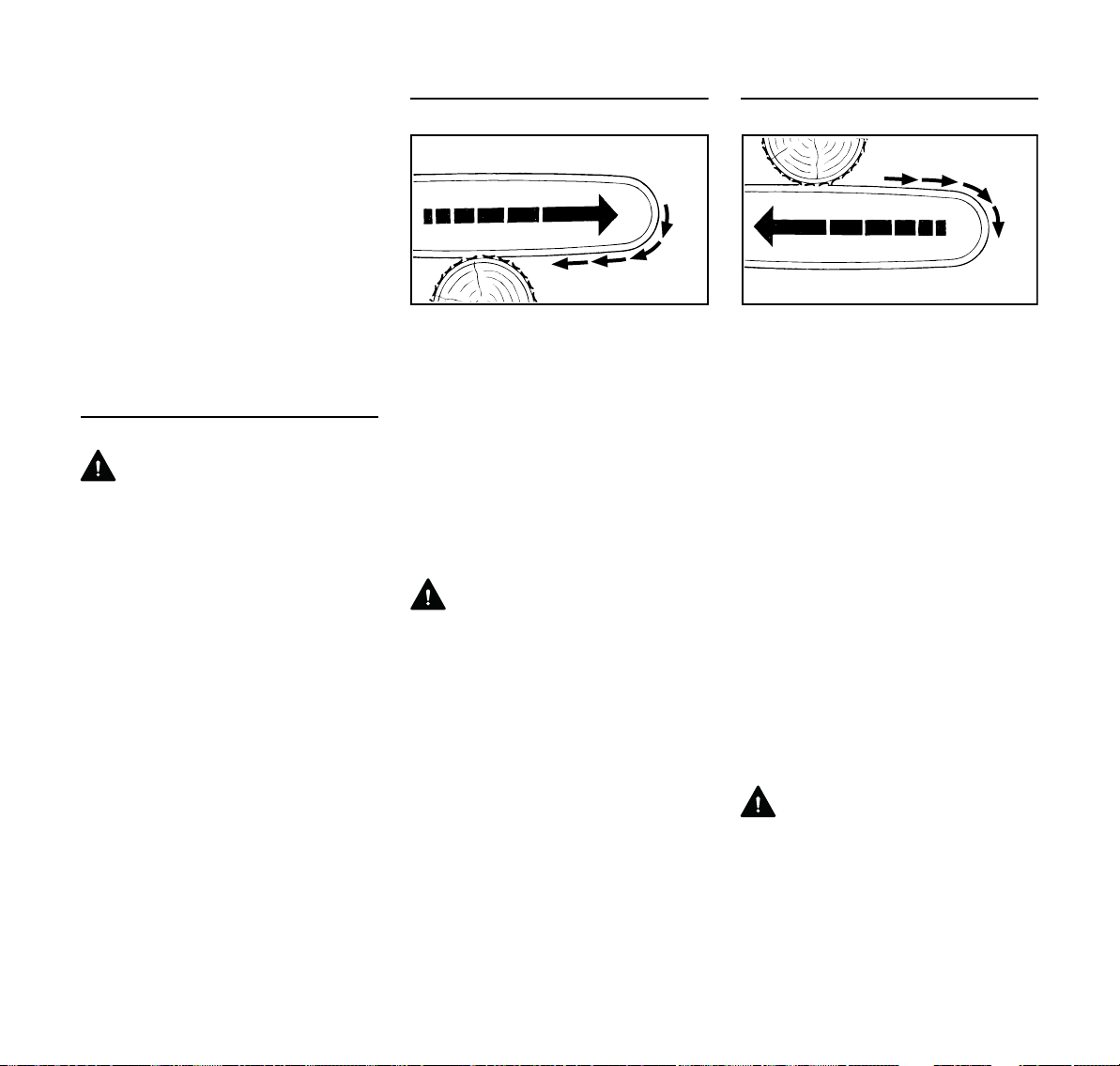
A=Pull-in
Pull-in occurs when the saw chain on the
bottom of the bar is suddenly stopped
when it is pinched, caught or encounters
a foreign object in the wood. The
reaction of the saw chain pulls the chain
saw forward and may cause the
operator to lose control.
Pull-in frequently occurs when the
bumper spike of the chain saw is not
held securely against the tree or limb
and when the saw chain is not rotating at
full speed before it contacts the wood.
WARNING
Use extreme caution when cutting small
size branches which may easily catch
the saw chain, be whipped towards you
or pull you off balance.
To avoid pull-in
1. Always start a cut with the saw
chain rotating at full speed and the
bumper spike in contact with the
wood.
2. The risk of pull-in may also be
reduced by using wedges to hold
open the kerf or cut.
B = Pushback
Pushback occurs when the saw chain on
the top of the bar is suddenly stopped
when it is pinched, caught or encounters
a foreign object in the wood. The
reaction of the saw chain may drive the
chain saw rapidly straight back toward
the operator and may cause loss of
chain saw control, which, in turn, may
cause serious or fatal injury. Pushback
frequently occurs when the top of the bar
is used for cutting.
To avoid pushback
1. Be alert to forces or situations that
may cause material to pinch the top
of the saw chain.
2. Do not cut more than one branch at
a time.
3. Do not twist the chain saw when
withdrawing the bar from a plunge
cut or underbuck cut because the
saw chain can pinch.
WARNING
This lightweight chain saw equipped
with a top handle is designed specifically
for in-tree surgery and maintenance. If
the operator is not proberly secured for
18
MS 150 TC
Page 21
English
1
001BA151 KN
2
1
001BA152 KN
2
two-hand use when using this saw in a
tree, there is an increased risk of injury
from loss of control.
For this reason this special chain saw
should be used only for work in a tree by
persons trained in special cutting and
working techniques. This type of chain
saw is not designed for cutting work on
the ground, such as felling and bucking.
Because this chain saw is not intended
for use on the ground, this manual does
not contain instructions for felling or for
limbing and bucking felled trees. For
instructions on these techniques when
using other STIHL chain saw models,
see the instruction manuals for these
other saws or the STIHL Chain Saw
Safety Manual, which is available free of
charge from your STIHL servicing
dealer.
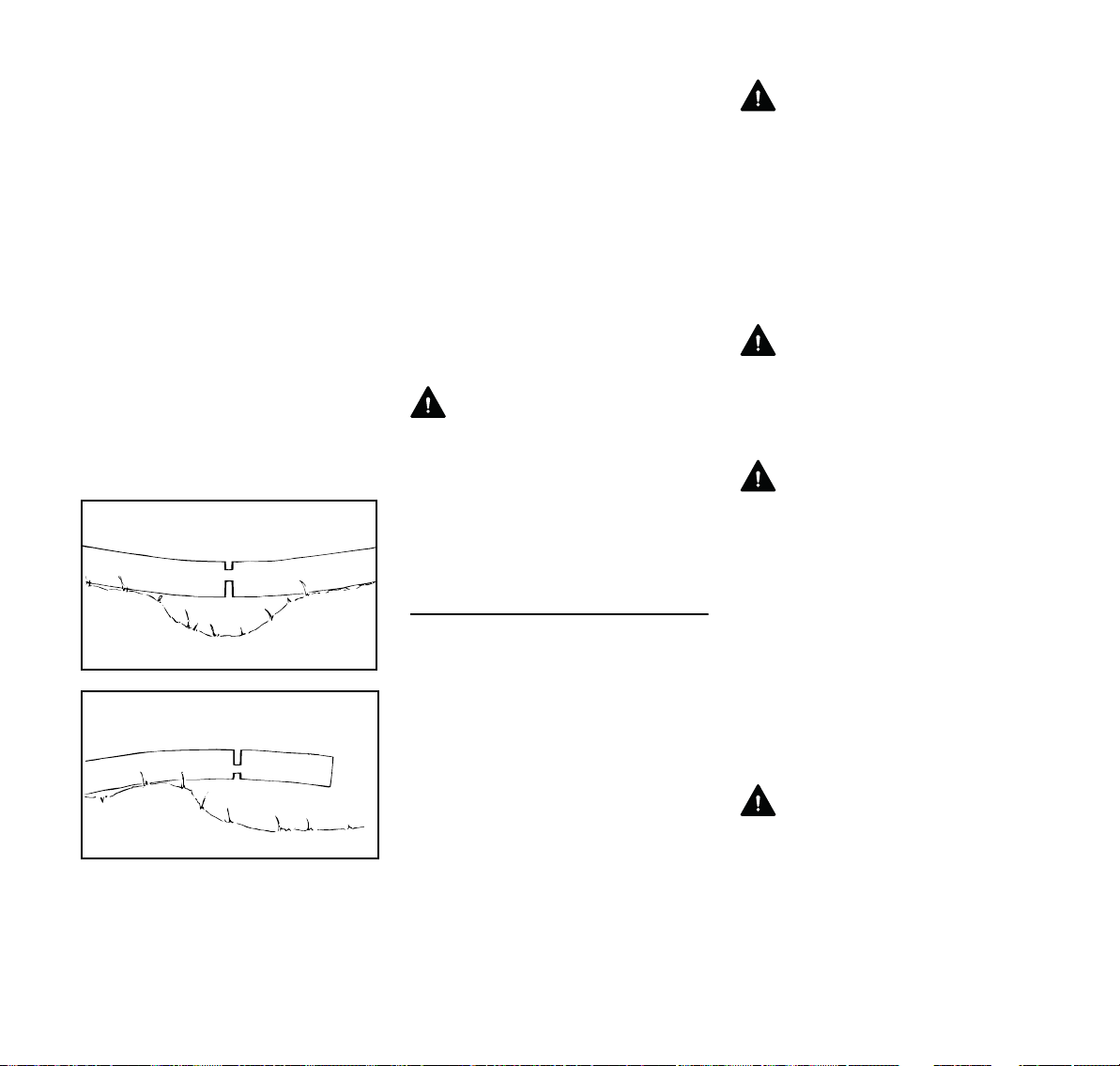
Logs or branches under strain:
Risk of pinching! Always start relieving
cut (1) at compression side. Then make
bucking cut (2) at tension side. If the saw
pinches, stop the motor and remove it
from the branch.
Only properly trained professionals
should work in an area where the trees,
logs, limbs and roots are tangled.
Working in "blow down" areas is
extremely hazardous. Drag the logs into
a clear area before cutting. Pull out
exposed and cleared logs first.
If conditions allow, work from a lift
bucket.
WARNING
Be extremely cautious when cutting
limbs under tension (spring poles). The
limbs could spring back toward the
operator and cause loss of control of the
saw and severe or fatal injury to the
operator.
MAINTENANCE, REPAIR AND
STORING
Maintenance, replacement, or repair of
the emission control devices and
systems may be performed by any
nonroad engine repair establishment or
individual. However, if you make a
warranty claim for a component which
has not been serviced or maintained
properly or if nonapproved replacement
parts were used, STIHL may deny
coverage.
WARNING
Use only identical STIHL replacement
parts for maintenance and repair. Use of
non-STIHL parts may cause serious or
fatal injury.
Strictly follow the maintenance and
repair instructions in the appropriate
section of your instruction manual.
Please refer to the maintenance chart in
this manual.
WARNING
Always stop the engine and make sure
that the cutting tool is stopped before
doing any maintenance or repair work or
cleaning the power tool.
WARNING
Do not attempt any maintenance or
repair work not described in your
instruction manual. Have such work
performed by your STIHL servicing
dealer only. For example, if improper
tools are used to remove the flywheel or
if an improper tool is used to hold the
flywheel in order to remove the clutch,
structural damage to the flywheel could
occur and could subsequently cause the
flywheel to burst.
Wear gloves when handling or
performing maintenance on saw chains.
WARNING
Use the specified spark plug and make
sure it and the ignition lead are always
clean and in good condition. Always
press spark plug boot snugly onto spark
plug terminal of the proper size. (Note: If
terminal has detachable SAE adapter
MS 150 TC
19
Page 22

English
nut, it must be securely attached.) A
loose connection between spark plug
terminal and the ignition wire connector
in the boot may create arcing that could
ignite combustible fumes and cause a
fire.
WARNING
Never test the ignition system with the
spark plug boot removed from the spark
plug or with a removed spark plug, since
uncontained sparking may cause a fire.
WARNING
Do not operate your power tool if the
muffler is damaged, missing or modified.
An improperly maintained muffler will
increase the risk of fire and hearing loss.
Your muffler is equipped with a sparkarresting screen to reduce the risk of
fire; never operate your power tool if the
screen is missing, damaged or clogged.
Remember that the risk of a brush or
forest fire is greater in hot or dry
weather.
In California, it is a violation of § 4442 or
§ 4443 of the Public Resources Code to
use or operate gasoline-powered tools
on forest-covered, brush-covered or
grass-covered land unless the engine’s
exhaust system is equipped with a
complying spark arrester that is
maintained in effective working order.
The owner/operator of this product is
responsible for properly maintaining the
spark arrester. Other states or
governmental entities/agencies, such as
the U.S. Forest Service, may have
similar requirements. Contact your local
fire agency or forest service for the laws
or regulations relating to fire protection
requirements.
Keep the chain, bar and sprocket clean;
replace worn sprockets or chains. Keep
the chain sharp. You can spot a dull
chain when easy-to-cut wood becomes
hard to cut and burn marks appear on
the wood. Keep the chain at proper
tension.
Tighten all nuts, bolts and screws except
the carburetor adjustment screws after
each use.
WARNING
In order for the chain brake on your
STIHL chain saw to properly perform its
function of reducing the risk of kickback
and other injuries, it must be properly
maintained. Like an automobile brake, a
chain saw chain brake incurs wear each
time it is engaged.
The amount of wear will vary depending
upon usage, conditions under which the
saw is used and other factors. Excessive
wear will reduce the effectiveness of the
chain brake and can render it
inoperable.
For the proper and effective operation of
the chain brake, the brake band and
clutch drum must be kept free of dirt,
grease and other foreign matter which
may reduce friction of the band on the
drum.
For these reasons, each STIHL chain
saw should be returned to trained
personnel such as your STIHL servicing
dealer for periodic inspection and
servicing of the brake system according
to the following schedule:
Heavy usage – every three months,
Moderate usage – twice a year,
Occasional usage – annually.
The chain saw should also be returned
immediately for maintenance whenever
the brake system cannot be thoroughly
cleaned or there is a change in its
operating characteristics.
For any maintenance of the emission
control system please refer to the
maintenance chart and to the limited
warranty statement near the end of the
instruction manual.
Do not clean your machine with a
pressure washer. The solid jet of water
may damage parts of the machine.
Store chain saw in a dry place and away
from children. Before storing for longer
than a few days, always empty the fuel
tank (see chapter "Storing the Machine"
in the instruction manual).
20
MS 150 TC
Page 23

English
001BA248 KN
1
2
3
a
001BA244 KN
3006BA001 KN
1
2011BA050 KN
2
Cutting Attachment
A cutting attachment consists of the saw
chain, guide bar and chain sprocket.
The cutting attachment that comes
standard is designed to exactly match
the chain saw.
– The pitch (t) of the saw chain (1),
chain sprocket and the nose
sprocket of the Rollomatic guide bar
must match.
– The drive link gauge (2) of the saw
chain (1) must match the groove
width of the guide bar (3).
If non-matching components are used,
the cutting attachment may be damaged
beyond repair after a short period of
operation.
Chain scabbard
Your saw comes standard with a chain
scabbard that matches the cutting
attachment.
If you use guide bars of different lengths
on the saw, the length of the chain
scabbard must be matched to the guide
bar to reduce the risk of injury. It should
cover the full length of the guide bar.
The length of the matching guide bars is
marked on the side of the chain
scabbard.
Mounting the Bar and Chain
Disengaging the Chain Brake
N Pull the hand guard towards the
front handle until there is an audible
click – the chain brake is
disengaged.
Removing the chain sprocket cover
N Unscrew the nut (1) and remove the
sprocket cover (2).
MS 150 TC
21
Page 24
English
2011BA051 KN
1
2
4
3
2011BA052 KN
2011BA053 KN
1
2
2011BA054 KN
3006BA028 KN
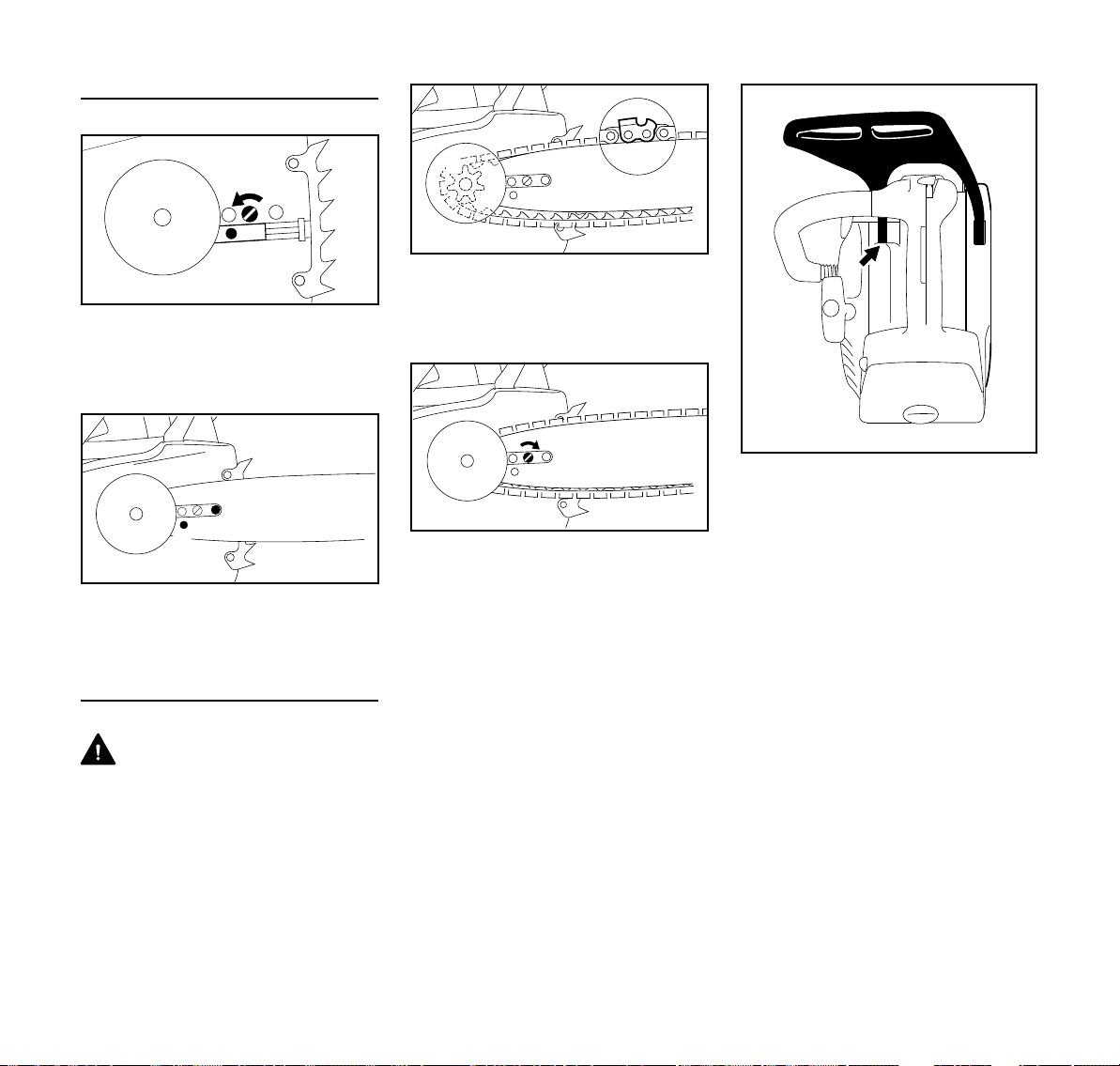
Mounting the guide bar
N Turn the screw (1)
counterclockwise until the tensioner
slide (2) butts against the left end of
the housing slot.
N Fit the guide bar over the stud (3)
and engage the peg of the tensioner
slide in the hole (4).
N Fit chain around the sprocket (1)
and over the guide bar – the cutting
edges on top of the bar must point to
the bar nose.
N Turn the tensioning screw (2)
clockwise until there is very little
chain sag on the underside of the
bar – and the drive link tangs are
engaged in the bar groove.
N Refit the chain sprocket cover –
the pivot pin on the hand guard must
engage the guard on the engine
housing – and then screw the nut
onto the stud fingertight.
N Go to chapter on "Tensioning the
Saw Chain"
Fitting the chain
WARNING
Wear work gloves to protect your hands
from the sharp cutters.
22
MS 150 TC
Page 25
English
1
2011BA056 KN
2011BA057 KN
Tensioning the Saw Chain
(side chain tensioner)
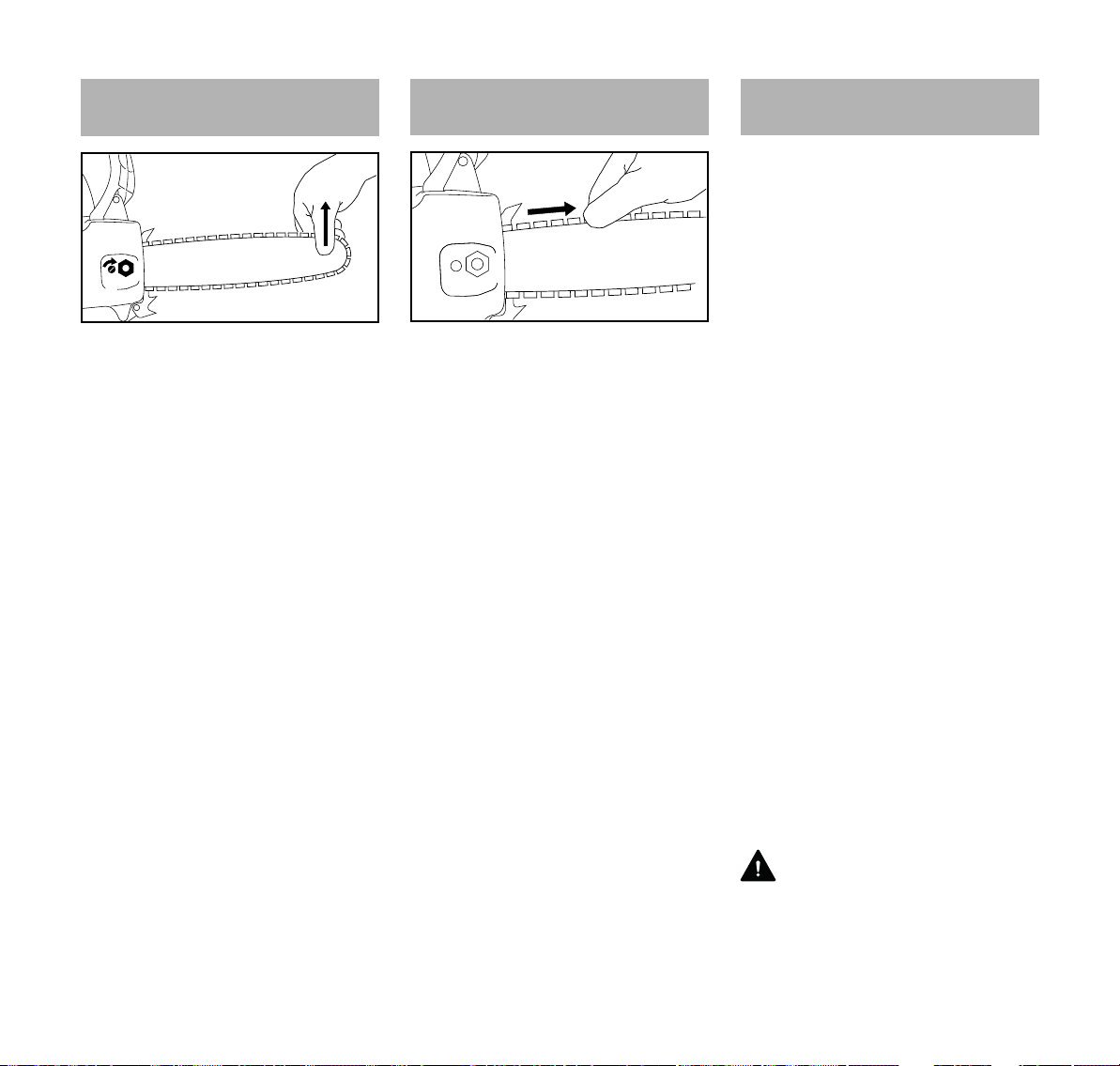
Retensioning during cutting work:
N Shut off the engine.
N Loosen the nut.
N Hold the bar nose up.
N Use a screwdriver to turn the
tensioning screw (1) clockwise until
the chain fits snugly against the
underside of the bar.
N While still holding the bar nose up,
tighten down the nut firmly.
N Go to "Checking Chain Tension".
A new chain has to be retensioned more
often than one that has been in use for
some time.
N Check chain tension frequently –
see chapter on "Operating
Instructions".
Checking Chain Tension
N Shut off the engine.
N Wear work gloves to protect your
hands.
N The chain must fit snugly against
the underside of the bar and it must
still be possible to pull the chain
along the bar by hand when the
chain brake is released.
N If necessary, retension the chain.
A new chain has to be retensioned more
often than one that has been in use for
some time.
N Check chain tension frequently –
see chapter on "Operating
Instructions".
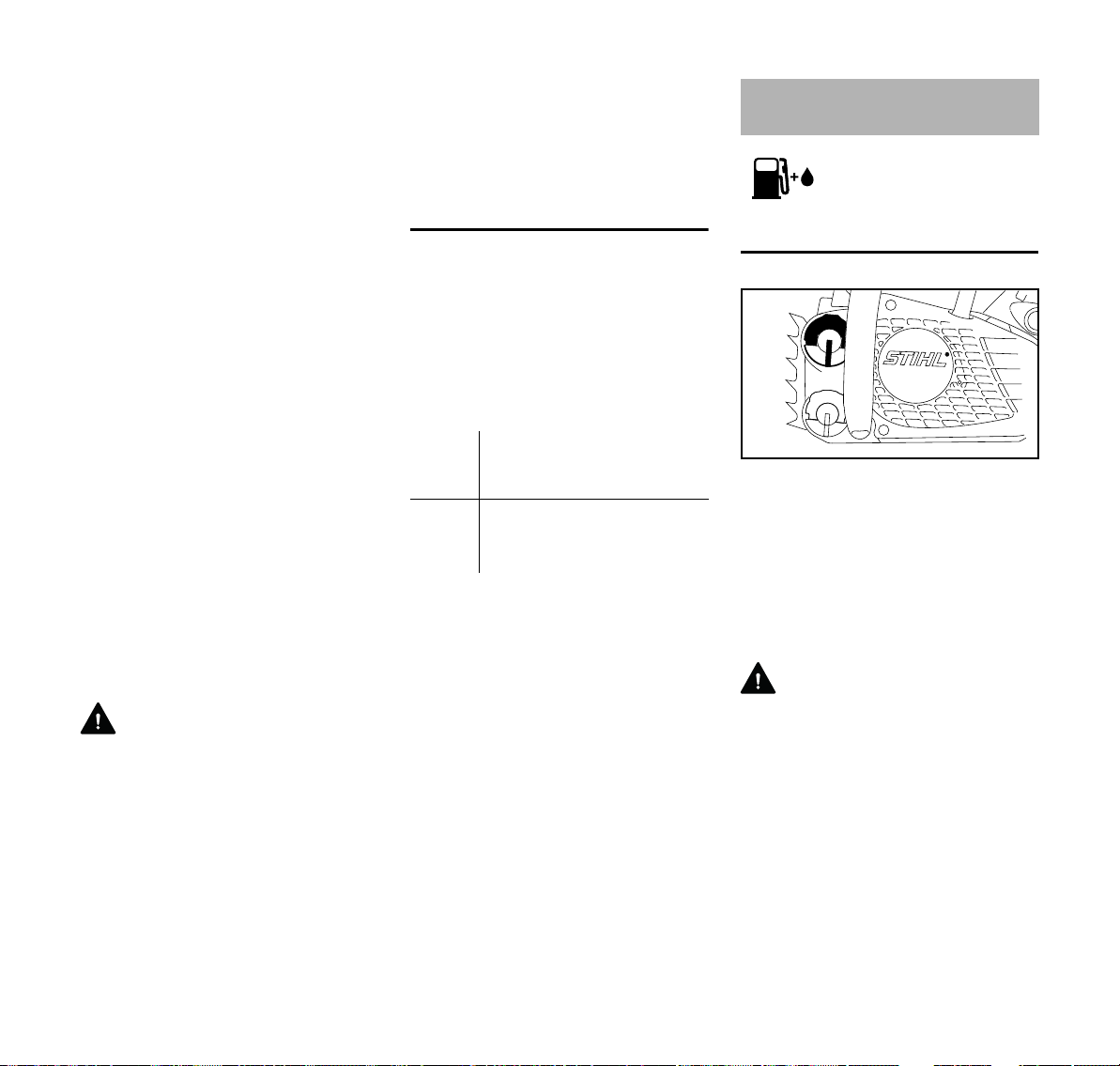
Fuel
This engine is certified to operate on
unleaded gasoline and the STIHL twostroke engine oil at a mix ratio of 50:1.
Your engine requires a mixture of highquality gasoline and two-stroke air
cooled engine oil.
Use mid-grade unleaded gasoline with a
minimum octane rating of 89 ((R+M)/2)
and no more than 10% ethanol content.
Fuel with a lower octane rating may
increase engine temperatures. This, in
turn, increases the risk of piston seizure
and damage to the engine.
The chemical composition of the fuel is
also important. Some fuel additives not
only detrimentally affect elastomers
(carburetor diaphragms, oil seals, fuel
lines, etc.), but magnesium castings and
catalytic converters as well. This could
cause running problems or even
damage the engine. For this reason
STIHL recommends that you use only
high-quality unleaded gasoline!
Gasoline with an ethanol content of
more than 10% can cause running
problems and major damage in engines
and should not be used.
The ethanol content in gasoline affects
engine running speed – it may be
necessary to readjust the carburetor if
you use fuels with various ethanol
contents.
WARNING
To reduce the risk of personal injury
from loss of control and/or contact with
the running cutting tool, do not use your
MS 150 TC
23
Page 26
English
2011BA058 KN
unit with incorrect idle adjustment. At
correct idle speed, the cutting tool
should not move.
If your power tool shows an incorrect idle
adjustment, have your STIHL dealer
check your power tool and make proper
adjustments and repairs.
The idle speed and maximum speed of
the engine change if you switch from a
fuel with a certain ethanol content to
another fuel with a much higher or lower
ethanol content.
This problem can be avoided by always
using fuel with the same ethanol
content.
Use only STIHL two-stroke engine oil or
equivalent high-quality two-stroke
engine oils that are designed for use
only in air cooled two-cycle engines.
We rec ommend STI HL H P Ul tra 2-Cycl e
Engine Oil since it is specially
formulated for use in STIHL engines.
Do not use BIA or TCW rated (twostroke water cooled) mix oils or other
mix oils that state they are for use in both
water cooled and air cooled engines
(e.g., outboard motors, snowmobiles,
chain saws, mopeds, etc.).
WARNING
Take care when handling gasoline.
Avoid direct contact with the skin and
avoid inhaling fuel vapor. When filling at
the pump, first remove the container
from your vehicle and place the
container on the ground before filling. To
reduce the risk of sparks from static
discharge and resulting fire and/or
explosion, do not fill fuel containers that
are sitting in or on a vehicle or trailer.
The container should be kept tightly
closed in order to limit the amount of
moisture that gets into the mixture.
The machine‘s fuel tank should be
cleaned as necessary.
Fuel mix ages
Only mix sufficient fuel for a few days
work, not to exceed 30 days of storage.
Store in approved fuel-containers only.
When mixing, pour oil into the container
first, and then add gasoline. Close the
container and shake it vigorously by
hand to ensure proper mixing of the oil
with the fuel.
Gasoline
Oil (STIHL 50:1 or equivalent high-quality oils)
US gal. US fl.oz.
12.6
2 1/2 6.4
5 12.8
Dispose of empty mixing-oil containers
only at authorized disposal locations.
Fueling
Preparations
N Before fueling, clean the filler cap
and the area around it to ensure that
no dirt falls into the tank.
Always thoroughly shake the mixture in
the canister before fueling your
machine.
N Position the machine so that the
filler cap is facing up.
WARNING
In order to reduce the risk of fire and
personal injury from escaping gas vapor
and fumes, remove the fuel filler cap
carefully so as to allow any pressure
build-up in the tank to release slowly.
24
MS 150 TC
Page 27
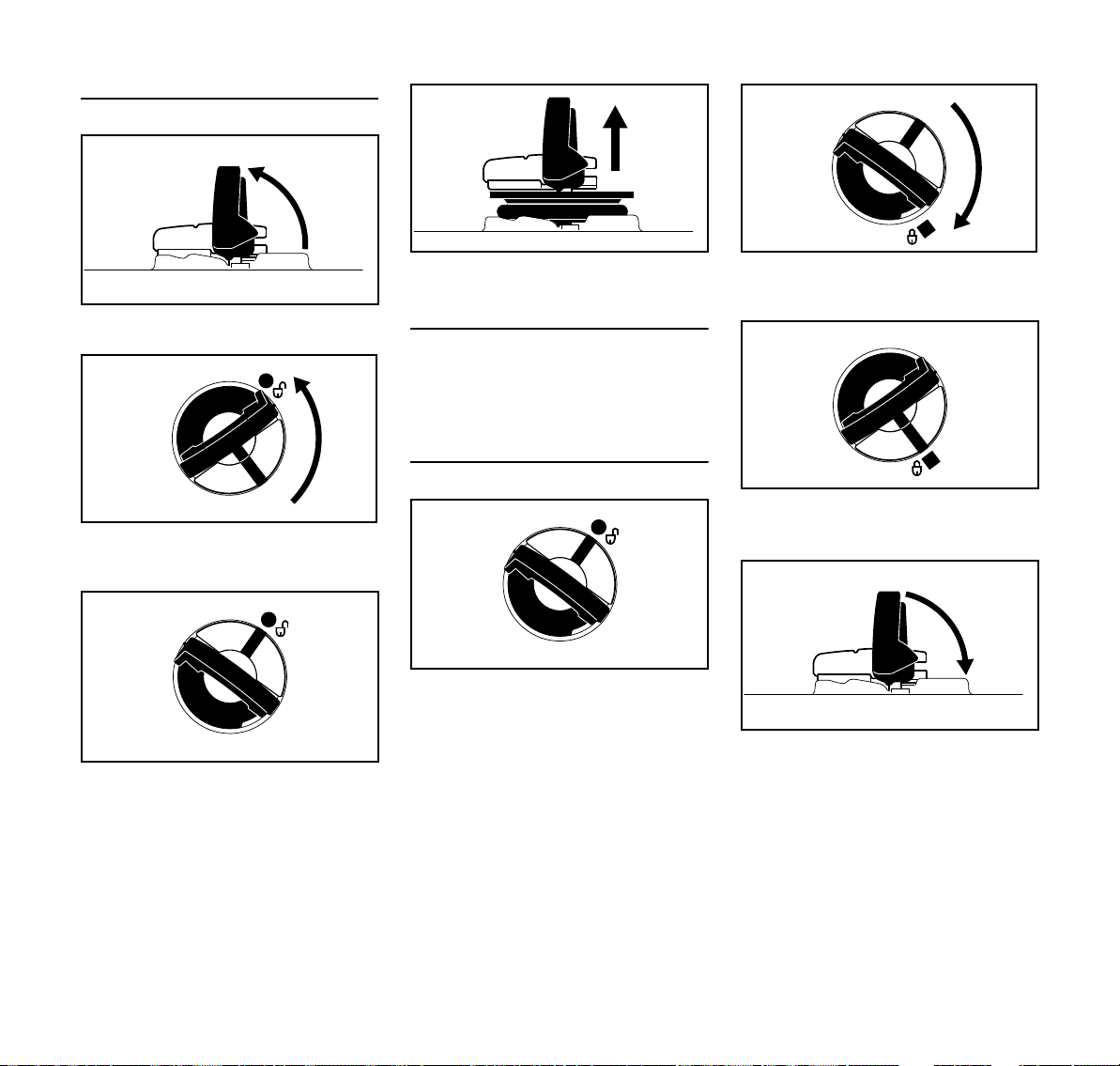
Opening
001BA236 KN
001BA232 KN
001BA234 KN
001BA237 KN
001BA234 KN
001BA233 KN
001BA231 KN
001BA235 KN
English
N Raise handle.
N Twist filler cap counterclockwise
(approx. 1/4 turn).
Markings on filler cap and housing must
align.
N Remove the filler cap.
Refueling
Take care not to spill fuel while fueling
and do not overfill the tank – leave
approx. 1/2" (13 mm) air space.
Closing
Handle is in an upright position:
N Position filler cap – markings on filler
cap and housing must align.
N Push the filler cap down as far as it
will go.
N Push the filler cap down and twist it
clockwise until it engages.
Then the markings on filler cap and
housing will align.
N Flip the handle down.
MS 150 TC
25
Page 28
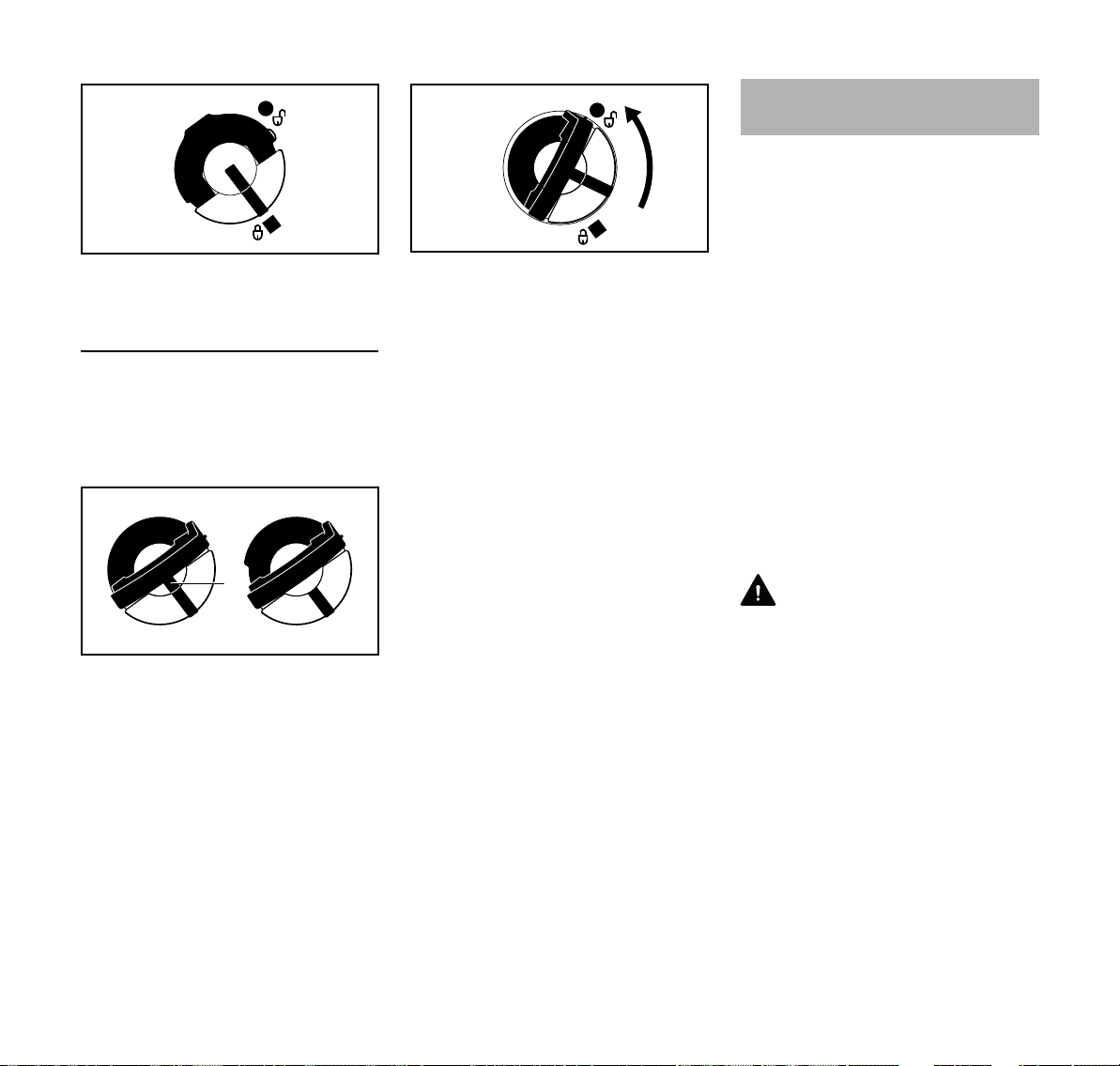
English
001BA241 KN
1
001BA238 KN
001BA239 KN
Filler cap is now closed.
If the filler cap will not engage into the
tank housing
The base of the filler cap is rotated in
relation to the upper part.
N Look at the black alignment marks
on the top of the filler cap.
N With the filler cap in the filling neck,
twist it counterclockwise until it
drops into its seat.
N Continue to twist the filler cap
counterclockwise (approx. 1/4 turn)
– this will twist the base of the cap
into the correct position.
N While pushing down on the cap,
twist the filler cap clockwise and
close it – see section "Closing."
Chain Lubricant
For automatic and reliable lubrication of
the chain and guide bar – use only an
environmentally compatible quality
chain and bar lubricant. Rapidly
biodegradable STIHL BioPlus is
recommended.
NOTICE
Biological chain oil must be resistant to
aging (e.g. STIHL BioPlus), since it will
otherwise quickly turn to resin. This
results in hard deposits that are difficult
to remove, especially in the area of the
chain drive and chain. It may even cause
the oil pump to seize.
The service life of the chain and guide
bar depends on the quality of the
lubricant. It is therefore essential to use
only a specially formulated chain
lubricant.
Left: Base of filler cap is rotated –
interior marking (1) is aligned
with the exterior marking.
Right: Base of filler cap is in the cor-
rect position – interior
marking is below the clip. It
does not align with the exterior marking.
26
WARNING
Do not use waste oil. Renewed contact
with waste oil can cause skin cancer.
Moreover, waste oil is environmentally
harmful.
NOTICE
Waste oil does not have the necessary
lubricating properties and is unsuitable
for chain lubrication.
MS 150 TC
Page 29

English
2011BA059 KN
142BA069 KN
Filling Chain Oil Tank
Preparations
N Thoroughly clean the oil filler cap
and the area around it to ensure that
no dirt falls into the tank.
N Position the machine so that the
filler cap faces up.
N Open the filler cap.
Filling up with chain oil
N Refill the chain oil tank every time
you refuel.
Take care not to spill chain oil while
refilling and do not overfill the tank.
N Closing the Tank Cap
There must still be a small amount of oil
in the oil tank when the fuel tank is
empty.
If the oil level in the tank does not go
down, the reason may be a fault in the oil
supply system: Check chain lubrication,
clean the oilways, contact your dealer
for assistance if necessary STIHL
recommends that you have servicing
and repair work carried out exclusively
by an authorized STIHL servicing
dealer.
Checking Chain Lubrication
The saw chain must always throw off a
small amount of oil.
NOTICE
Never operate your saw without chain
lubrication. If the chain runs dry, the
whole cutting attachment will be
irretrievably damaged within a very short
time. Always check chain lubrication and
the oil level in the tank before starting
work.
Every new chain has to be broken in for
about 2 to 3 minutes.
After breaking in the chain, check chain
tension and adjust if necessary – see
"Checking Chain Tension".
MS 150 TC
27
Page 30
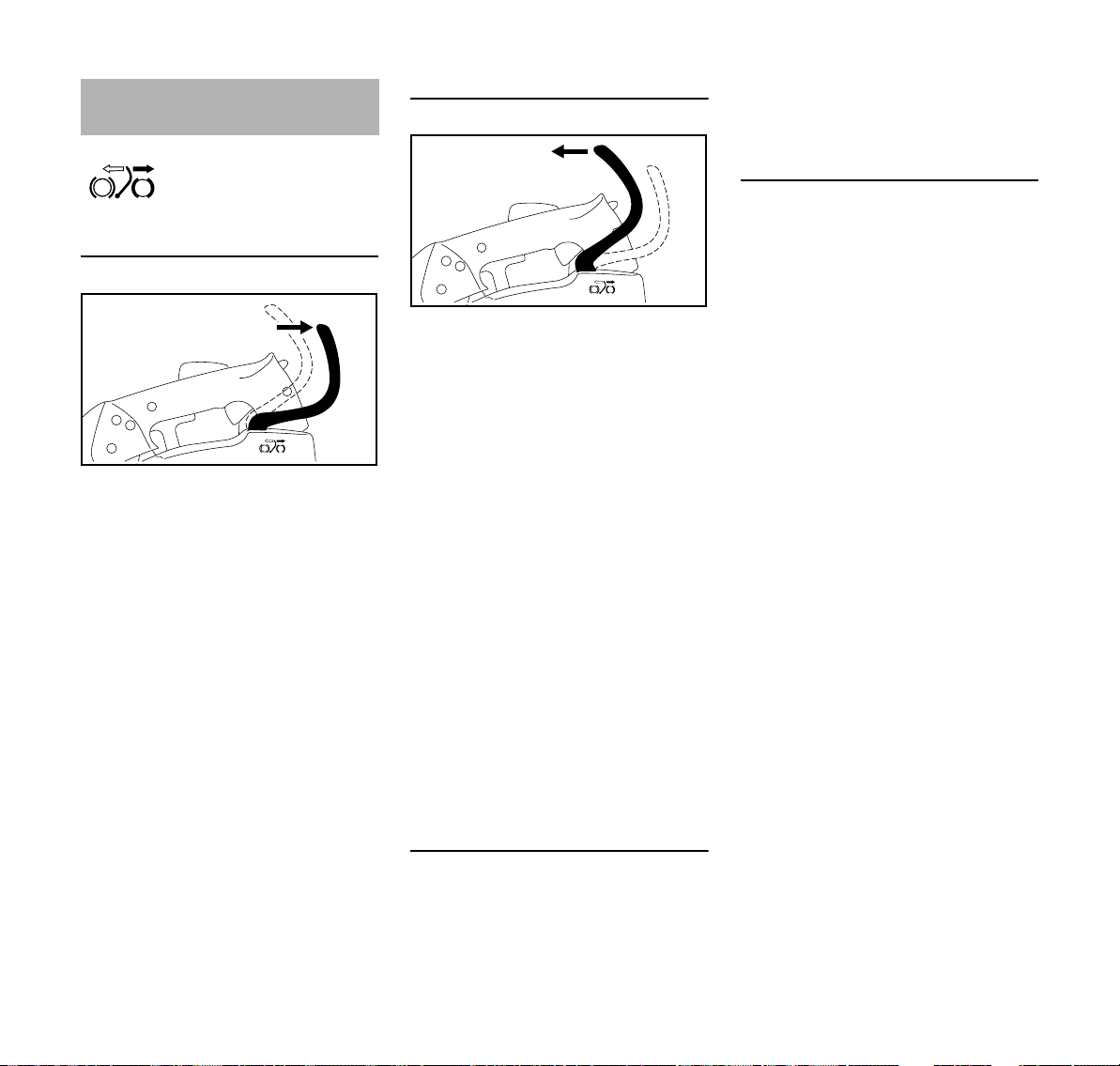
English
3006BA003 KN
3006BA001 KN
Chain Brake
Locking chain with chain brake
– in an emergency
– when starting
– at idling speed
The chain is stopped and locked when
the hand guard is pushed toward the bar
nose by the left hand – or when brake is
activated by inertia in certain kickback
situations.
Releasing the chain brake
N Pull the hand guard back toward the
front handle.
NOTICE
Always disengage chain brake before
accelerating engine and before starting
cutting work. The only exception to this
rule is when you check operation of the
chain brake.
High revs with the chain brake engaged
(chain locked) will quickly damage the
powerhead and chain drive (clutch,
chain brake).
The chain brake is designed to be
activated also by the inertia of the front
hand guard if the forces are sufficiently
high. The hand guard is accelerated
toward the bar nose - even if your left
hand is not behind the hand guard, e.g.
during a felling cut. The chain brake will
operate only if it has been properly
maintained and the hand guard has not
been modified in any way.
than 3 seconds – the chain must not
rotate. The hand guard must be free
from dirt and move freely.
Chain brake maintenance
The chain brake is subject to normal
wear. It is necessary to have it serviced
and maintained regularly by trained
personnel, such as your STIHL servicing
dealer, at the following intervals:
Full-time usage: every 3
months
Part-time usage: every 6
months
Occasional usage: every 12
months
28
Check operation of chain brake
Before starting work: Run engine at idle
speed, engage the chain brake (push
hand guard toward bar nose).
Accelerate up to full throttle for no more
MS 150 TC
Page 31

English
2011BA042 KN
2011BA043 KN
Starting / Stopping the
Engine
Positions of Master Control Lever
Stop 0 – engine off – the ignition is
switched off
Normal run position (F) – engine runs or
can fire.
Starting throttle n – for starting the
engine
Positions of Choke Shutter
Choke shutter closed l – for starting
the engine
Select this position:
– if the engine is cold
– if the engine stalls when you open
the throttle after starting.
– if the fuel tank was run until empty
(engine stopped).
Choke shutter open j – fo r starting the
engine
Select this position:
– if the engine is warm, i.e. if it has
been running for about one minute.
– after engine begins to fire,
– after clearing a flooded combustion
chamber.
The Master Control lever moves from
the starting throttle position (n) to the
run position (F) when you press down
the throttle trigger lockout and blip the
throttle trigger at the same time.
To switch off the engine, move the
Master Control lever to Stop (0).
Manual fuel pump
The manual fuel pump bulb must be
pressed:
– When starting for the first time.
– if the fuel tank was run until empty
(engine stopped).
MS 150 TC
Setting the Master Control Lever
To move the Master Control lever from
the normal run position (F) to starting
throttle (n), press down the throttle
trigger lockout and squeeze the throttle
trigger at the same time and hold them in
that position – now set the Master
Control lever.
29
Page 32

English
3006BA026 KN
2011BA014 KN
4
1
3006BA007 KN
2
3
3006BA021 KN
Holding the Saw
N Place your saw on the ground.
Make sure you have a firm footing –
check that the chain is not touching
any object or the ground.
N Hold the saw firmly with your right
hand on the top handle.
N Rest your right knee on the
carburetor box cover.
starter grip snap back. Guide it
slowly back into the housing so that
the starter rope can rewind properly.
Starting the Saw
WARNING
Bystanders must be well clear of the
general work area of the saw.
N Press the manual fuel pump bulb at
least nine times – even if the bulb is
already filled with fuel.
N Push the hand guard (1) forward –
the chain is locked.
N Press down the trigger lockout (2)
and pull the throttle trigger (3) at the
same time. Set Master Control
lever (4) to starting throttle
position (n).
N Set choke lever to required position.
Choke shutter closed (l)
Cranking
N Pull the starter grip slowly with your
right hand until you feel it engage –
and then give it a brisk strong pull
and push down the control handle at
the same time. Do not pull out the
starter rope to full length – it might
otherwise break. Do not let the
30
– if the engine is cold (also use this
position if the engine stopped when
you opened the throttle after
starting)
MS 150 TC
Page 33

English
3006BA022 KN
3006BA022 KN
4
3006BA008 KN
3
3006BA001 KN
Choke shutter open (j)
– if the engine is warm, i.e. if it has
been running for about one minute.
N Hold and start your saw as
described.
When engine begins to fire
As soon as the engine runs
N Press down trigger lockout and the
blip the throttle trigger (3) – the
Master Control lever (4) moves to
the run position (F) and the engine
settles down to idling speed.
NOTICE
Always disengage chain brake before
accelerating the engine. High revs with
the chain brake engaged (chain locked)
will quickly damage the clutch and chain
brake.
N After a cold start, warm up the
engine at varying speeds – your saw
is ready for operation.
At very low outside temperatures
If idling behavior is erratic or
acceleration is poor:
N Readjust carburetor if necessary,
see "Adjusting the Carburetor".
N If your saw is very cold (frost or ice
on machine), start the engine and
keep it at a high idle speed (with
chain brake disengaged) until it
reaches normal operating
temperature.
Stopping the engine
N Move the choke lever to the open
position (j).
N Hold and start your saw as
described.
MS 150 TC
N Pull the hand guard toward the
control handle to disengage the
chain brake.
N Move Master Control lever to
Stop 0.
31
Page 34

English
If engine does not start
If you did not move the Master Control
lever from the choke closed
position (l) to the choke open
position (j) quickly enough after the
engine began to fire, the engine is
probably flooded.
N Move Master Control lever to
Stop 0.
N Remove the spark plug – see
"Spark Plug".
N Dry the spark plug.
N Crank the engine several times with
the starter to clear the combustion
chamber.
N Refit the spark plug – see "Spark
Plug".
N Set Master Control lever to the
starting throttle position (n) – even
if the engine is cold.
N Now start the engine.
If fuel tank has been run completely dry
and then refueled
N Press manual fuel pump bulb at
least nine times.
N Set the Master Control lever to the
starting throttle position (n).
N Move the choke lever to the closed
position (l)
N Give the starter rope two pulls.
N Move the choke lever to the open
position (j).
N Now start the engine.
Operating Instructions
During the break-in period
A factory new machine should not be run
at high revs (full throttle off load) for the
first three tank fillings. This avoids
unnecessarily high loads during the
break-in period. As all moving parts
have to bed in during the break-in
period, the frictional resistances in the
shortblock are greater during this period.
The engine develops its maximum
power after about 5 to 15 tank fillings.
During work
NOTICE
Do not make the mixture leaner to
achieve an apparent increase in power –
this could damage the engine – see
"Adjusting the Carburetor".
NOTICE
Open the throttle only when the chain
brake is off. Running the engine at high
revs with the chain brake engaged
(chain locked) will quickly damage the
shortblock and chain drive (clutch, chain
brake).
Check chain tension frequently
A new saw chain must be retensioned
more frequently than one that has been
in use already for an extended period.
Chain cold
Tension is correct when the chain fits
snugly against the underside of the bar
but can still be pulled along the bar by
hand. Retension if necessary – see
"Tensioning the Saw Chain".
Chain at operating temperature
The chain stretches and begins to sag.
The drive links must not come out of the
bar groove on the underside of the bar –
the chain may otherwise jump off the
bar. Retension the chain – see
"Tensioning the Saw Chain".
NOTICE
The chain contracts as it cools down. If it
is not slackened off, it can damage the
crankshaft and bearings.
After a long period of full-throttle
operation
After a long period of full-throttle
operation, allow engine to run for a while
at idle speed so that the heat in the
engine can be dissipated by flow of
cooling air. This protects enginemounted components (ignition,
carburetor) from thermal overload.
After finishing work
N Slacken off the chain if you have
retensioned it at operating
temperature during work.
32
MS 150 TC
Page 35

English
2
3
1
143BA026 KN
NOTICE
Always slacken off the chain again after
finishing work. The chain contracts as it
cools down. If it is not slackened off, it
can damage the crankshaft and
bearings.
Short-term storage
Wait for engine to cool down. Keep the
machine with a full tank of fuel in a dry
place, well away from sources of
ignition, until you need it again.
Long-term storage
See "Storing the machine"
Taking Care of the Guide Bar
N Turn the guide bar over – every time
you sharpen the chain and every
time you replace the chain – this
helps avoid one-sided wear,
especially at the nose and
underside of the bar.
N Regularly clean the oil inlet hole (1),
the oilway (2) and the bar groove
(3).
N Measure the groove depth – with the
scale on the filing gauge (special
accessory) – in the area used most
for cutting.
Chain
type
Picco 1/4" P 0.16" (4.0 mm)
Rapid 1/4" 0.16" (4.0 mm)
Picco 3/8" P 0.20" (5.0 mm)
Rapid 3/8"; 0.325" 0.24" (6.0 mm)
Rapid 0.404" 0.28" (7.0 mm)
If groove depth is less than specified:
N Replace the guide bar.
The drive link tangs will otherwise
scrape along the bottom of the groove –
the cutters and tie straps will not ride on
the bar rails.
Chain pitch Minimum
groove depth
MS 150 TC
33
Page 36

English
3006BA009 KN
3009BA010 KN
L
H
3006BA011 KN
Cleaning the Air Filter
If there is a noticeable loss of engine
power
N Turn the twist lock 90°
counterclockwise.
N Remove the shroud upwards.
Engine Management Adjusting the Carburetor
Exhaust emissions are controlled by the
design of the fundamental engine
parameters and components (e.g.
carburation, ignition, timing and valve or
port timing) without the addition of any
major hardware.
General Information
The carburetor comes from the factory
with a standard setting.
This setting provides an optimum fuel-air
mixture under most operating
conditions.
Preparations
N Shut off the engine.
N Check the air filter and clean or
replace if necessary.
N Check the spark arresting screen
(not in all models, country-specific)
in the muffler and clean or replace if
necessary.
Standard Setting
N Remove the air filter upwards.
N Wash the filter in STIHL special
cleaner (special accessory) or a
clean, non-flammable solution (e.g.
warm soapy water) and then dry.
NOTICE
Do not use a brush to clean the filter.
Always replace a damaged filter.
34
N Turn high speed screw (H)
counterclockwise as far as stop (no
more than 3/4 turn).
N Turn the low speed screw (L)
clockwise as far as stop, then turn it
back 1/4 turn.
MS 150 TC
Page 37

English
3006BA025 KN
3006BA001 KN
Adjusting Idle Speed
N Carry out the standard setting.
N Start the engine.
Warm up the engine. Allow engine to
idle for 10 seconds before adjusting the
idle speed.
Engine stops while idling
N Turn the idle speed screw (LA)
clockwise until the chain begins to
run – then back it off 4 turns.
Saw chain runs while engine is idling
N Turn the idle speed screw (LA)
counterclockwise until the chain
stops moving – allow engine to run
at idle speed for 10 seconds.
N Turn the idle speed screw (LA)
clockwise until the chain begins to
run – then back it off 4 turns.
N Turn the low speed screw (L)
carefully counterclockwise, no
further than stop, until the engine
runs smoothly and accelerates well.
It is usually necessary to change the
setting of the idle speed screw (LA) after
every correction to the low speed
screw (L).
Fine Tuning for Operation at High
Altitude
A slight correction of the setting may be
necessary if the engine does not run
satisfactorily:
N Carry out the standard setting.
N Warm up the engine.
N Turn high speed screw (H) slightly
clockwise (leaner) – no further than
stop.
NOTICE
After returning from high altitude, reset
the carburetor to the standard setting.
If the setting is too lean there is a risk of
engine damage due to insufficient
lubrication and overheating.
Spark Plug
If engine is down on power, difficult to
start or runs poorly at idling speed, first
check the spark plug.
Fit a new spark plug after approx. 100
operating hours or earlier if the
electrodes are badly eroded.
Wrong fuel mix (too much engine oil in
the gasoline), a dirty air filter and
unfavorable running conditions (mostly
at part throttle etc.) affect the condition
of the spark plug. These factors cause
deposits to form on the insulator nose
which may result in trouble in operation.
Removing the Spark Plug
N Move the Master Control lever to 0
or STOP.
WARNING
If the chain continues moving when the
engine is idling, have your saw checked
and repaired by your servicing dealer.
Erratic idling behavior, poor acceleration
(even though standard setting of low
speed screw is correct)
Idle setting is too lean
MS 150 TC
N Disengaging the Chain Brake
35
Page 38

English
1
2011BA050 KN
2
2011BA029 KN
000BA039 KN
A
1
2
000BA071 KN
N Unscrew the nut (1) and remove the
sprocket cover (2).
N Pull off the spark plug boot.
N Unscrew the spark plug.
Checking the Spark Plug
Rectify problems that have caused
fouling of spark plug:
– too much oil in fuel mix,
– dirty air filter,
– unfavorable running conditions, e.g.
operating at part load.
Installing the spark plug
N Install the spark plug and connect
the spark plug boot (press it down
firmly) – reassembly all other parts
in the reverse sequence.
N Clean dirty spark plug.
N Check electrode gap (A) and
readjust if necessary – see
"Specifications."
N Use only resistor type spark plugs of
36
the approved range.
WARNING
To reduce the risk of fire and burn injury,
use only spark plugs authorized by
STIHL. Always press spark plug boot (1)
snugly onto spark plug terminal (2) of the
proper size. (Note: If terminal has
detachable SAE adapter nut, it must be
securely attached.) A loose connection
between spark plug boot and ignition
wire connector in the boot may create
arcing that could ignite combustible
fumes and cause a fire.
MS 150 TC
Page 39

English
2011BA045 KN
Rewind Starter Storing the Machine Checking and Replacing the
Chain Sprocket
To help prolong the wear life of the
starter rope, observe the following
points:
N Pull the starter rope only in the
direction specified.
N Do not pull the rope over the edge of
the guide bushing.
N Do not pull out the rope more than
specified.
N Do not allow the starter grip to snap
back, guide it back into the housing
slowly – see chapter on "Starting /
Stopping the Engine."
Have a damaged starter rope replaced
by your dealer before it breaks
completely. STIHL recommends that
you have servicing and repair work
carried out exclusively by an authorized
STIHL servicing dealer.
For periods of 3 months or longer
N Drain and clean the fuel tank in a
well ventilated area.
N Dispose of fuel properly in
accordance with local
environmental requirements.
N Run the engine until the carburetor
is dry – this helps prevent the
carburetor diaphragms sticking
together.
N Remove the saw chain and guide
bar, clean them and spray with
corrosion inhibiting oil.
N Thoroughly clean the machine – pay
special attention to the cylinder fins
and air filter.
N If you use a biological chain and bar
lubricant, e.g. STIHL BioPlus,
completely fill the chain oil tank.
N Store the machine in a dry, high or
locked location, out of the reach of
children and other unauthorized
persons.
N Remove the chain sprocket cover,
chain and guide bar.
N Disengage the chain brake: Pull the
hand guard toward the front handle.
Replace the chain sprocket
MS 150 TC
– after using two saw chains or
sooner
– if the wear marks (arrows) on the
sprocket are deeper than about
0.02 in (0.5 mm) since this would
reduce the life of the chain. You can
use a gauge (special accessory) to
check the depth of the wear marks.
It is best to use two saw chains in
rotation with one sprocket.
37
Page 40

English
2
3006BA015 KN
3006BA016 KN
3
3006BA017 KN
3006BA018 KN
4
A locking strip is required to block the
piston in the cylinder when the chain
sprocket and clutch are removed and
installed as described below. The
locking strip is supplied as standard with
the replacement sprocket.
STIHL recommends the use of original
STIHL sprockets to ensure correct
operation of the chain brake.
Removing
N Remove the spark plug boot (1).
N Unscrew the spark plug (2).
N Turn the clutch until the piston is
about bottom dead center.
N Insert the locking strip (3) into the
cylinder through the spark plug
hole.
N Turn the clutch clockwise until the
piston butts against the locking
strip.
N Loosen the clutch hexagon
clockwise (left-hand thread).
N Unscrew the clutch.
N Pull the chain sprocket (4) and
needle cage (5) off the crankshaft.
N Clean the crankshaft stub and
needle cage, and lubricate with
STlHL grease (special accessory).
Installing
N Push the needle cage and chain
sprocket onto the crankshaft.
N Screw the clutch onto the
crankshaft (counterclockwise).
N Tighten down the clutch to a torque
of 15 Nm.
N Remove the locking strip from the
cylinder. Fit the spark plug and
tighten it down firmly.
N Refit boot on the spark plug.
Maintaining and Sharpening
the Saw Chain
Sawing effortlessly with a properly
sharpened saw chain
A properly sharpened saw chain cuts
through wood effortlessly even with very
little pushing.
Never use a dull or damaged saw chain
– this leads to increased physical strain,
increased vibration load, unsatisfactory
cutting results and increased wear.
N Clean the saw chain
N Check the saw chain for cracks and
damaged rivets
N Replace damaged or worn chain
components and adapt these parts
to the remaining parts in terms of
shape and level of wear – rework
accordingly
Carbide-tipped (Duro) saw chains are
especially wear-resistant. For an optimal
sharpening result, STIHL recommends
STIHL servicing dealers.
WARNING
Compliance with the angles and
dimensions listed below is absolutely
necessary. An improperly sharpened
saw chain – especially depth gauges
that are too low – can lead to increased
kickback tendency of the chain saw –
risk of injury!
38
MS 150 TC
Page 41

English
689BA027 KN
a
A
B
689BA021 KN
689BA025 KN
001BA203 KN
Chain pitch
The chain pitch marking (a) is embossed
in the area of the depth gauge of each
cutter.
Marking (a) Chain pitch
Inches mm
7 1/4 P 6.35
1 or 1/4 1/4 6.35
6, P or PM 3/8 P 9.32
2 or 325 0.325 8.25
3 or 3/8 3/8 9.32
4 or 404 0.404 10.26
The diameter of file to be used depends
on the chain pitch – see table
"Sharpening tools".
The angles of the cutter must be
maintained during resharpening.
Sharpening and side plate angles
A Sharpening angle
STIHL saw chains are sharpened with a
30° sharpening angle. Ripping chains,
which are sharpened with a 10°
sharpening angle, are exceptions.
Ripping chains have an X in the
designation.
B Side plate angle
The correct side plate angle results
automatically when the specified file
holder and file diameter are used.
Tooth shapes Angle (°)
AB
Micro = semi-chisel tooth,
30 75
e. g., 63 PM3, 26 RM3,
36 RM
Super = full chisel tooth,
30 60
e. g., 63 PS3, 26 RS,
36 RS3
Ripping chain, e. g.,
10 75
63 PMX, 36 RMX
The angles must be identical for all
cutters in the saw chain. Varying angles:
Rough, uneven running of the saw
chain, increased wear – even to the
point of saw chain breakage.
File holder
N Use a file holder
Always use a file holder (special
accessory, see table "Sharpening tools")
when sharpening saw chains by hand.
File holders have markings for the
sharpening angle.
Use only special saw chain files! Other
files are unsuitable in terms of shape
and type of cutting.
To check the angles
STIHL filing gauge (special accessory,
see table "Sharpening tools") – a
universal tool for checking sharpening
and side plate angles, depth gauge
setting, and tooth length, as well as
cleaning grooves and oil inlet holes.
MS 150 TC
39
Page 42

English
689BA018 KN
90°
689BA043 KN
689BA023 KN
a
2
689BA061 KN
1
Proper sharpening
N Select sharpening tools in
accordance with chain pitch
N Clamp guide bar if necessary
N Block saw chain – push the hand
guard forward
N To advance the saw chain, pull the
hand guard toward the handlebar:
The chain brake is disengaged.
With the Quickstop Plus chain brake
system, additionally press the
throttle trigger lockout
N Sharpen frequently, removing little
material – two or three strokes of the
file are usually sufficient for simple
resharpening
markings on the file holder – rest the
file holder on the tooth head and the
depth gauge
N File only from the inside outward
N The file only sharpens on the
forward stroke – lift the file on the
backstroke
N Do not file tie straps and drive links
N Rotate the file a little periodically in
order to avoid uneven wear
N To remove file burr, use a piece of
hardwood
N Check angle with file gauge
All cutters must be equally long.
With varying cutter lengths, the cutter
heights also vary and cause rough
running of the saw chain and chain
breakage.
N All cutters must be filed down equal
to the length of the shortest cutter –
ideally, one should have this done
by a servicing dealer using an
electric sharpener
a Required distance between depth
gauge and cutting edge
When cutting softwood outside of the
frost season, the distance can be
increased by up to 0.2 mm (0.008").
Chain pitch Depth gauge
Distance (a)
Inches (mm) mm (Inches)
1/4 P (6.35) 0.45 (0.018)
1/4 (6.35) 0.65 (0.026)
3/8 P (9.32) 0.65 (0.026)
0.325 (8.25) 0.65 (0.026)
3/8 (9.32) 0.65 (0.026)
0.404 (10.26) 0.80 (0.031)
Lowering the depth gauges
The depth gauge setting is lowered
when the cutter is sharpened.
N Check the depth gauge setting after
each sharpening
N Guide the file: horizontally (at a righ t
angle to the side surface of the
guide bar) in accordance with the
specified angle – according to the
40
Depth gauge setting
The depth gauge determines the depth
to which the cutter penetrates the wood
and thus the chip thickness.
N Lay the appropriate file gauge (1)
for the chain pitch on the saw chain
and press it against the cutter to be
checked – if the depth gauge
protrudes past the file gauge, the
depth gauge must be reworked
MS 150 TC
Page 43

English
689BA051 KN
689BA044 KN
689BA052 KN
Saw chains with humped drive link (2) –
upper part of the humped drive link (2)
(with service mark) is lowered at the
same time as the depth gauge of the
cutter.
WARNING
The rest of the humped drive link must
not be filed; otherwise, this could
increase the tendency of the chain saw
to kick back.
N Afterwards, dress the leading edge
of the depth gauge parallel to the
service mark (see arrow) – when
doing this, be careful not to further
lower the highest point of the depth
gauge
N Lay the file gauge on the saw chain
– the highest point of the depth
gauge must be flush with the file
gauge
N After sharpening, clean the saw
chain thoroughly, removing any
filings or grinding dust – lubricate
WARNING
Depth gauges that are too low increase
the kickback tendency of the chain saw.
the saw chain thoroughly
N In the event of extended periods of
disuse, store saw chains in cleaned
and oiled condition
N Rework the depth gauge so that it is
flush with the file gauge
Sharpening tools (special accessories)
Chain pitch Round file ^ Round file File holder File gauge Taper square file Sharpening set
1)
Inches (mm) mm (Inches) Part number Part number Part number Part number Part number
1/4 P (6.35) 3.2 (1/8) 5605 771 3206 5605 750 4300 0000 893 4005 0814 252 3356 5605 007 1000
1/4 (6.35) 4.0 (5/32) 5605 772 4006 5605 750 4327 1110 893 4000 0814 252 3356 5605 007 1027
3/8 P (9.32) 4.0 (5/32) 5605 772 4006 5605 750 4327 1110 893 4000 0814 252 3356 5605 007 1027
0.325 (8.25) 4.8 (3/16) 5605 772 4806 5605 750 4328 1110 893 4000 0814 252 3356 5605 007 1028
3/8 (9.32) 5.2 (13/64) 5605 772 5206 5605 750 4329 1110 893 4000 0814 252 3356 5605 007 1029
0.404 (10.26) 5.5 (7/32) 5605 772 5506 5605 750 4330 1106 893 4000 0814 252 3356 5605 007 1030
1)
consisting of file holder with round file, taper square file and file gauge
MS 150 TC
41
Page 44

English
Maintenance and Care
The following information applies under normal operating conditions. The specified intervals must be
shortened accordingly when working for longer than normal each day or under difficult conditions
(extensive dust, highly resinous lumber, lumber from tropical trees, etc.). If the machine is only used
occasionally, the intervals can be extended accordingly.
Before starting work
At the end of work and/or
daily
Whenever tank is refilled
Weekly
Complete machine
Throttle trigger, throttle trigger lockout, choke
lever, choke control, stop switch, master control
lever (dependent on equipment)
Chain brake
Manual fuel pump (if present)
Fuel pick-up body / filter in fuel tank
Fuel tank Clean X
Lubricating oil tank Clean X
Chain lubrication Check X
Saw chain
Guide bar
Chain sprocket Check X
Air filter
Visual inspection (condition, leaks) XX
Clean X
Function tests XX
Function tests XX
Have checked by a specialist dealer
Check X
Have repaired by a specialist dealer
Check X
Clean, replace filter insert XX
Replace XXX
Check, pay attention to sharpness XX
Check chain tension XX
Sharpen X
Check (wear, damage) X
Clean and turn over X
Deburr X
Replace XX
Clean XX
Replace X
1)
1)
Monthly
Yearly
If faulty
If damaged
As required
X
X
42
MS 150 TC
Page 45

English
The following information applies under normal operating conditions. The specified intervals must be
shortened accordingly when working for longer than normal each day or under difficult conditions
(extensive dust, highly resinous lumber, lumber from tropical trees, etc.). If the machine is only used
occasionally, the intervals can be extended accordingly.
Before starting work
At the end of work and/or
daily
Whenever tank is refilled
Weekly
Monthly
Yearly
If faulty
If damaged
As required
Anti-vibration elements
Air intake on fan housing Clean XX X
Cylinder fins Clean XX
Carburetor
Spark plug
All accessible screws, nuts and bolts (not adjusting
screws)
Spark arresting screen in muffler
Chain catcher
Exhaust bore
Safety information label Replace X
1)
STIHL recommends STIHL servicing dealers
2)
During initial use of professional chain saws (with a power output of 3.4 kW or more), tighten the cylinder block screws after 10 to 20 hours of operation
Check XX
Have them replaced by a servicing dealer
Check idle adjustment – saw chain must not
rotate
Set the idle speed, have the chain saw repaired
by a servicing dealer
1)
1)
X
XX
X
Adjust electrode gap X
Replace after 100 hours of operation
2)
Tighten
Have checked by a specialist dealer
Have cleaned by a specialist dealer, or replaced
if necessary
1)
1)
X
X
X
Check X
Replace X
Decarbonise after 139 hours of operation, subsequently after every 150 hours of operation
X
MS 150 TC
43
Page 46

English
13
4
23
9
11
3006BA023 KN
14
15
10
18
16
25
#
H
LL
LA
1
2
3
5
6
7
8
12
17
19
20
21
22
24
Main Parts
1 Control Handle
2 Throttle Trigger Lockout
3 Master Control Lever
4 Throttle Trigger
5 Carburetor Adjusting Screws
6 Spark Plug Boot
7 Muffler
8 Chain Sprocket Cover
9 Chain Sprocket
10 Chain Brake
11 Chain Tensioner
12 Chain Catcher
13 Bumper Spike
14 Guide Bar
15 Oilomatic Saw Chain
16 Oil Filler Cap
17 Fuel Filler Cap
18 Front Hand Guard
19 Front Handle (Handlebar)
20 Starter Grip
21 Choke Lever
22 Manual Fuel Pump
23 Carburetor Box Cover
24 Carburetor Box Cover Twist Lock
25 Ring for Rope
# Serial Number
44
MS 150 TC
Page 47

English
Definitions
1 Control Handle
The support handle for the right
hand, located on the top of the saw.
2 Throttle Trigger Lockout
Must be depressed before the
throttle trigger can be activated.
3 Master Control Lever
Lever for choke control, starting
throttle, run and stop switch
position.
4 Throttle Trigger
Controls the speed of the engine.
5 Carburetor Adjusting Screws
For tuning the carburetor.
6 Spark Plug Boot
Connects the spark plug with the
ignition lead.
7 Muffler (with Spark Arresting
Screen)
Muffler reduces engine exhaust
noise and diverts exhaust gases
away from operator.
Spark arresting screen is designed
to reduce the risk of fire.
8 Chain Sprocket Cover
Covers the clutch and chain
sprocket.
9 Chain Sprocket
The toothed wheel that drives the
saw chain.
10 Chain Brake
A device to stop the rotation of the
chain. Is activated in a kickback
situation by the operator's hand or
by inertia.
11 Chain Tensioner
Permits precise adjustment of chain
tension.
12 Chain Catcher
Helps to reduce the risk of operator
contact by a chain when it breaks or
comes off the bar.
13 Bumper Spike
Toothed stop for holding saw steady
against wood.
14 Guide Bar
Supports and guides the saw chain.
15 Oilomatic Saw Chain
A loop consisting of cutters, tie
straps and drive links.
16 Oil Filler Cap
For closing the oil tank.
17 Fuel Filler Cap
For closing the fuel tank.
18 Front Hand Guard
Provides protection against
projecting branches and helps
prevent left hand from touching the
chain if it slips off the handlebar. It
also serves as the lever for chain
brake activation.
19 Front Handle (Handlebar)
Handlebar for the left hand at the
front of the saw.
20 Starter Grip
The grip of the pull starter, for
starting the engine.
21 Choke Lever
Eases engine starting by enriching
mixture.
22 Fuel Pump
Provides additional fuel feed for a
cold start.
23 Carburetor Box Cover
Covers the air filter and the
carburetor.
24 Carburetor Box Cover Twist Lock
Lock for carburetor box cover.
25 Ring for Rope
Pull-out ring for attaching rope.
Guide Bar Nose
The exposed end of the guide bar.
(not illustrated, see chapter
"Tensioning the Saw Chain")
Clutch
Couples engine to chain sprocket
when engine is accelerated beyond
idle speed. (not illustrated)
Anti-Vibration System
The anti-vibration system includes a
number of anti-vibration elements
designed to reduce the
transmission of vibrations created
by the engine and cutting
attachment to the operator's hands.
(not illustrated)
MS 150 TC
45
Page 48

English
Specifications
EPA / CEPA
The Emission Compliance Period
referred to on the Emissions
Compliance Label indicates the number
of operating hours for which the engine
has been shown to meet Federal
emission requirements.
Category
A = 300 hours
B = 125 hours
C = 50 hours
CARB
The Emission Compliance Period used
on the CARB-Air Index Label indicates
the terms:
Extended = 300 hours
Intermediate = 125 hours
Moderate = 50 hours
Engine
Single cylinder two-stroke engine
Displacement: 1.44 cu.in
23.6 cc
Bore: 1.34 in (34 mm)
Stroke: 1.02 in (26 mm)
Engine power to
ISO 7293:
Idle speed: 3,000 rpm
Max. permissible
speed (with cutting
attachment): 12,800 rpm
Ignition System
Electronic (breakerless) magneto
ignition
Spark plug (resistor
type): NGK CMR 6 H
Electrode gap: 0.020 in
Fuel System
All position diaphragm carburetor with
integral fuel pump
Fuel tank capacity: 6.8 fl.oz (0.2 l)
Chain Lubrication
Fully automatic, speed-controlled oil
pump
Oil tank capacity: 5.1 fl.oz (0.15 l)
1.3 HP (1.0 kW)
at 10,000 rpm
(0.5 mm)
Cutting Attachments
Recommended cutting attachments
conforming with applicable standards
when used on this model chain saw (see
the chapter on "Safety Precautions and
Working Techniques"):
Rollomatic E Mini guide bars
Reduced kickback STIHL guide bars
(with green label)
Bar lengths: 25, 30 cm (10, 12 in.)
Pitch: 1/4" P (6.35 mm)
Groove width: 1.1 mm (0.043 in)
Sprocket nose: 8-tooth
Actual cutting length will be less than
listed bar length.
Saw chain 1/4" P
Low kickback STIHL saw chain (with
green label)
Picco Micro 3 (71 PM3) Type 3670
Pitch: 1/4" P (6.35 mm)
Drive link gauge: 1.1 mm (0.043 in)
Chain sprocket
8-tooth for 1/4" P (spur sprocket)
Since new bar/chain combinations for
the MS 150 T may be developed after
publication of this manual, ask your
STIHL dealer for the latest STIHL
recommendations for use on the specific
model chain saw.
46
Weight
dry, without bar and chain
MS 150 TC: 5.7 lbs (2.6 kg)
MS 150 TC
Page 49

English
000BA073 KN
Ordering Spare Parts
Please enter your saw model, serial
number as well as the part numbers of
the guide bar and saw chain in the
spaces provided. This will make reordering simpler.
The guide bar and saw chain are subject
to normal wear and tear. When
purchasing these parts, always quote
the saw model, the part numbers and
names of the parts.
Model
Serial number
Guide bar part number
Chain part number
See "Specifications" in this manual for
the recommended reduced kickback
cutting attachments.
Maintenance and Repairs Disposal
Users of this unit should carry out only
the maintenance operations described
in this manual. STIHL recommends that
other repair work be performed only by
authorized STIHL servicing dealers.
Warranty claims following repairs can be
accepted only if the repair has been
performed by an authorized STIHL
servicing dealer using genuine STIHL
replacement parts.
Genuine STIHL parts can be identified
by the STIHL part number, the
{ logo and, in some cases, by
the STIHL parts symbol K. The
symbol may appear alone on small
parts.
Observe all country-specific waste
disposal rules and regulations.
STIHL products must not be thrown in
the garbage can. Take the product,
accessories and packaging to an
approved disposal site for environmentfriendly recycling.
Contact your STIHL servicing dealer for
the latest information on waste disposal.
MS 150 TC
47
Page 50

English
STIHL Incorporated Federal
Emission Control Warranty
Statement
Not for California
Your Warranty Rights and Obligations
The U.S. Environmental Protection
Agency (EPA) and STIHL Incorporated
are pleased to explain the Emission
Control System Warranty on your
equipment type engine. In the U.S. new
1997 and later model year small off-road
equipment engines must be designed,
built and equipped, at the time of sale, to
meet the U.S. EPA regulations for small
non road engines. The equipment
engine must be free from defects in
materials and workmanship which
cause it to fail to conform with U.S. EPA
standards for the first two years of
engine use from the date of sale to the
ultimate purchaser.
STIHL Incorporated must warrant the
emission control system on your small
off-road engine for the period of time
listed below provided there has been no
abuse, neglect or improper maintenance
of your small off-road equipment engine.
Your emission control system includes
parts such as the carburetor and the
ignition system. Also included may be
hoses, and connectors and other
emission-related assemblies.
Where a warrantable condition exists,
STIHL Incorporated will repair your
small off-road equipment engine at no
cost to you, including diagnosis (if the
diagnostic work is performed at an
authorized dealer), parts, and labor.
Manufacturer's Warranty Coverage
In the U.S., 1997 and later model year
small off-road equipment engines are
warranted for two years. If any emissionrelated part on your engine is defective,
the part will be repaired or replaced by
STIHL Incorporated free of charge.
Owner's Warranty Responsibilities
As the small off-road equipment engine
owner, you are responsible for the
performance of the required
maintenance listed in your instruction
manual. STIHL Incorporated
recommends that you retain all receipts
covering maintenance on your small offroad equipment engine, but STIHL
Incorporated cannot deny warranty
solely for the lack of receipts or for your
failure to ensure the performance of all
scheduled maintenance.
Any replacement part or service that is
equivalent in performance and durability
may be used in non-warranty
maintenance or repairs, and shall not
reduce the warranty obligations of the
engine manufacturer.
As the small off-road equipment engine
owner, you should be aware, however,
that STIHL Incorporated may deny you
warranty coverage if your small off-road
equipment engine or a part has failed
due to abuse, neglect, improper
maintenance or unapproved
modifications.
You are responsible for presenting your
small off-road equipment engine to a
STIHL service center as soon as a
problem exists. The warranty repairs will
be completed in a reasonable amount of
time, not to exceed 30 days.
If you have any questions regarding your
warranty rights and responsibilities,
please contact a STIHL customer
service representative at 1-800-4678445 or you can write to
STIHL Inc.,
536 Viking Drive, P.O. Box 2015,
Virginia Beach, VA 23450-2015
www.stihlusa.com
Coverage by STIHL Incorporated
STIHL Incorporated warrants to the
ultimate purchaser and each
subsequent purchaser that your small
off-road equipment engine will be
designed, built and equipped, at the time
of sale, to meet all applicable
regulations. STIHL Incorporated also
warrants to the initial purchaser and
each subsequent purchaser that your
engine is free from defects in materials
and workmanship which cause the
engine to fail to conform with applicable
regulations for a period of two years.
Warranty Period
The warranty period will begin on the
date the utility equipment engine is
purchased by the initial purchaser and
you have signed and sent back the
warranty card to STIHL.
If any emission-related part on your
engine is defective, the part will be
replaced by STIHL Incorporated at no
cost to the owner. Any warranted part
which is not scheduled for replacement
as required maintenance, or which is
scheduled only for regular inspection to
the effect of "repair or replace as
necessary" will be warranted for the
warranty period. Any warranted part
which is scheduled for replacement as
48
MS 150 TC
Page 51

English
required maintenance will be warranted
for the period of time up to the first
scheduled replacement point for that
part.
Diagnosis
You, as the owner, shall not be charged
for diagnostic labor which leads to the
determination that a warranted part is
defective. However, if you claim
warranty for a component and the
machine is tested as non-defective,
STIHL Incorporated will charge you for
the cost of the emission test. Mechanical
diagnostic work will be performed at an
authorized STIHL servicing dealer.
Emission test may be performed either
at STIHL Incorporated or at any
independent test laboratory.
Warranty Work
STIHL Incorporated shall remedy
warranty defects at any authorized
STIHL servicing dealer or warranty
station. Any such work shall be free of
charge to the owner if it is determined
that a warranted part is defective.
Any manufacturer-approved or
equivalent replacement part may be
used for any warranty maintenance or
repairs on emission-related parts and
must be provided without charge to the
owner. STIHL Incorporated is liable for
damages to other engine components
caused by the failure of a warranted part
still under warranty.
The following list specifically defines the
emission-related warranted parts:
– Air Filter
– Carburetor (if applicable)
– Fuel Pump
– Choke (Cold Start Enrichment
System) (if applicable)
– Control Linkages
– Intake Manifold
– Magneto or Electronic Ignition
System (Ignition Module or
Electronic Control Unit)
– Fly Wheel
– Spark Plug
– Injection Valve (if applicable)
– Injection Pump (if applicable)
– Throttle Housing (if applicable)
– Cylinder
– Muffler
– Catalytic Converter (if applicable)
– Fuel Tank
– Fuel Cap
– Fuel Line
– Fuel Line Fittings
– Clamps
– Fasteners
Where to make a Claim for Warranty
Service
Bring the product to any authorized
STIHL servicing dealer and present the
signed warranty card.
Maintenance Requirements
The maintenance instructions in this
manual are based on the application of
the recommended 2-stroke fuel-oil
mixture (see also instruction "Fuel").
Deviations from this recommendation
regarding quality and mixing ratio of fuel
and oil may require shorter maintenance
intervals.
Limitations
This Emission Control Systems
Warranty shall not cover any of the
following:
N repair or replacement required
because of misuse, neglect or lack
of required maintenance,
N repairs improperly performed or
replacements not conforming to
STIHL Incorporated specifications
that adversely affect performance
and/or durability, and alterations or
modifications not recommended or
approved in writing by STIHL
Incorporated,
and
N replacement of parts and other
services and adjustments
necessary for required maintenance
at and after the first scheduled
replacement point.
MS 150 TC
49
Page 52

English
STIHL Incorporated
California Exhaust and
Evaporative Emissions
Control Warranty Statement
For California only
Your Warranty Rights and Obligations
The California Air Resources Board
(CARB) and STIHL Incorporated are
pleased to explain the emission control
system warranty on your 2014 and later
small off-road equipment engine.
In California, new equipment that uses
small off-road engines must be
designed, built, and equipped to meet
the State's stringent anti-smog
standards. STIHL Incorporated must
warrant the emissions control system on
your small off-road engine for the period
listed below provided there has been no
abuse, neglect or improper maintenance
of your small off-road engine.
Your emissions control system may
include parts such as the carburetor or
fuel-injection system, the ignition
system, and catalytic converter. Also
included may be hoses, belts,
connectors or other emission-related
assemblies.
Where a warrantable condition exists,
STIHL Incorporated will repair your
small off-road equipment engine at no
cost to you including diagnosis, parts
and labor.
Manufacturer’s Warranty
Responsibilities
This emissions control system is
warranted for two years in California. If
any emissions-related part on your
equipment is defective, the part will be
repaired or replaced by STIHL
Incorporated free of charge.
Owner’s Warranty Responsibilities
As the small off-road equipment engine
owner, you are responsible for
performance of the required
maintenance listed in your instruction
manual. STIHL Incorporated
recommends that you retain all receipts
covering maintenance on your small offroad equipment engine, but STIHL
Incorporated cannot deny warranty
solely for the lack of receipts or your
failure to ensure the performance of all
scheduled maintenance.
As the small off-road equipment engine
owner, you should however be aware
that STIHL Incorporated may deny you
warranty coverage if your small off-road
equipment engine or a part has failed
due to abuse, neglect, or improper
maintenance or unapproved
modifications.
You are responsible for presenting your
small off-road equipment engine to a
STIHL servicing dealer as soon as the
problem exists. The warranty repairs
should be completed in a reasonable
amount of time, not to exceed 30 days. If
you have any questions regarding your
warranty rights and responsibilities,
please contact a STIHL customer
service representative at 1-800-4678445 or you can write to
STIHL Inc., 536 Viking Drive,
P.O. Box 2015,
Virginia Beach, VA 23450-2015.
www.stihlusa.com
Coverage by STIHL Incorporated
STIHL Incorporated warrants to the
ultimate purchaser and each
subsequent purchaser that your small
off-road equipment engine is designed,
built and equipped, at the time of sale, to
meet all applicable emission
regulations.
STIHL Incorporated also warrants to the
initial purchaser and each subsequent
purchaser that your engine is free from
defects in materials and workmanship
which cause the engine to fail to conform
to applicable emission regulations for a
period of two years.
Defects Warranty Period
The warranty periods will begin on the
date the utility equipment engine is
purchased by the initial purchaser. If any
emission-related part on your engine is
defective, the part will be replaced by
STIHL Incorporated at no cost to the
owner.
Add-on or modified parts that are not
exempted by CARB may not be used.
The use of any non-exempted add-on or
modified parts will be grounds for
disallowing a warranty claim. STIHL
Incorporated will not be liable to warrant
failures of warranted parts caused by the
use of a non-exempted add-on or
modified part.
50
MS 150 TC
Page 53

English
The warranty on emissions-related parts
will be interpreted as follows:
1. Any warranted part that is not
scheduled for replacement as
required maintenance in the written
instructions required in the
Emission Warranty Parts List (see
below) must be warranted for the
warranty period defined in
Subsection COVERAGE BY STIHL
INCORPORATED, see above. If
any such part fails during the period
of warranty coverage, it must be
repaired or replaced by the
manufacturer according to
Subsection (4) below. Any such part
repaired or replaced under the
warranty must be warranted for the
remaining warranty period.
2. Any warranted part that is
scheduled only for regular
inspection in the written instructions
required by the Emission Warranty
Parts List (see below) must be
warranted for the warranty period
defined in Subsection COVERAGE
BY STIHL INCORPORATED, see
above. A statement in such written
instructions to the effect of "repair or
replace as necessary" will not
reduce the period of warranty
coverage. Any such part repaired or
replaced under warranty must be
warranted for the remaining
warranty period.
3. Any warranted part that is
scheduled for replacement as
required maintenance in the written
instructions required by the
Emission Warranty Parts List (see
below) must be warranted for the
period of time prior to the first
scheduled replacement point for
that part. If the part fails prior to the
first scheduled replacement, the
part must be repaired or replaced by
the engine manufacturer according
to Subsection (4) below. Any such
part repaired or replaced under
warranty must be warranted for the
remainder of the period prior to the
first scheduled replacement point
for the part.
4. Repair or replacement of any
warranted part under the warranty
must be performed at a warranty
station at no charge to the owner.
5. Notwithstanding the provisions of
Subsection (4) above, warranty
services or repairs will be provided
at all manufacturer distribution
centers that are authorized to
service the subject engines.
6. The owner must not be charged for
diagnostic labor that leads to the
determination that a warranted part
is in fact defective, provided that
such diagnostic work is performed
at a warranty station.
Warranty Work
STIHL Incorporated shall remedy
warranty defects at any authorized
STIHL servicing dealer or warranty
station. Any such work shall be free of
charge to the owner if it is determined
that a warranted part is defective. Any
manufacturer approved or equivalent
replacement part may be used for any
warranty maintenance or repairs on
emission-related parts and must be
provided without charge to the owner.
STIHL Incorporated is liable for
damages to other engine components
caused by the failure of a warranted part
still under warranty.
Emission Warranty Parts List
Air Filter, Carburetor (if applicable), Fuel
Pump, Choke (Cold Start Enrichment
System) (if applicable), Control
Linkages, Intake Manifold, Magneto or
Electronic Ignition System (Ignition
Module or Electronic Control Unit), Fly
Wheel, Spark Plug, Injection Valve (if
applicable), Injection Pump (if
applicable), Throttle Housing (if
applicable), Cylinder, Muffler, Catalytic
Converter (if applicable), Fuel Tank,
Fuel Cap, Fuel Line, Fuel Line Fittings,
Clamps, Fasteners.
Where to make a Claim for Warranty
Service
Bring the STIHL product to any
authorized STIHL servicing dealer and
present the signed STIHL product
registration card, or the print-out of the
electronic product registration.
Limitations
The repair or replacement of any
warranted part otherwise eligible for
warranty coverage may be excluded
from such warranty coverage if STIHL
Incorporated demonstrates that the
STIHL product has been abused,
neglected, or improperly maintained,
and that such abuse, neglect, or
improper maintenance was the direct
cause of the need for repair or
replacement of the part. That
notwithstanding, any adjustment of a
component that has a factory installed,
MS 150 TC
51
Page 54

English
TM
STIHL
Injection
and properly operating, adjustment
limiting device is still eligible for warranty
coverage.
Trademarks
STIHL Registered Trademarks
®
STIHL
{
K
The color combination orange-grey
(U.S. Registrations #2,821,860;
#3,010,057, #3,010,058, #3,400,477;
and #3,400,476)
OILOMATIC
ROCK BOSS
STIHL Cutquik
STIHL DUROMATIC
STIHL Quickstop
STIHL ROLLOMATIC
STIHL WOOD BOSS
TIMBERSPORTS
WOOD BOSS
YARD BOSS
®
®
®
®
®
®
®
®
®
®
Some of STIHL’s Common Law
Trademarks
52
4-MIX ™
BioPlus ™
Easy2Start ™
EasySpool ™
AUTOCUT
EASYSTART
FARM BOSS
iCademy
MAGNUM
®
®
®
®
®
MasterWrench Service
MotoMix
®
®
ElastoStart ™
Ematic ™
FixCut ™
HT Plus ™
IntelliCarb ™
Master Control Lever ™
Micro ™
Pro Mark ™
MS 150 TC
Page 55

Quad Power ™
Quiet Line ™
STIHL Arctic ™
STIHL Compact ™
STIHL HomeScaper Series ™
STIHL Interchangeable Attachment
Series ™
STIHL M-Tronic ™
STIHL MiniBoss ™
STIHL MotoPlus 4 ™
STIHL Multi-Cut HomeScaper Series ™
STIHL OUTFITTERS ™
STIHL PICCO ™
STIHL PolyCut ™
STIHL PowerSweep ™
STIHL Precision Series ™
STIHL Protech ™
STIHL RAPID ™
STIHL SuperCut ™
STIHL Territory ™
TapAction ™
TrimCut ™
This listing of trademarks is subject to
change.
Any unauthorized use of these
trademarks without the express written
consent of
ANDREAS STIHL AG & Co. KG,
Waiblingen is strictly prohibited.
English
MS 150 TC
53
Page 56

Contenido
español / EE.UU
Acerca de este manual de
instrucciones 56
Medidas de seguridad y técnicas
de manejo 57
Accesorio de corte 79
Montaje de la espada y la cadena 79
Tensado de la cadena de aserrado
(tensor lateral de la cadena) 81
Revisión de tensión de la cadena 81
Combustible 81
Llenado de combustible 83
Lubricante de cadena 85
Llenado del tanque de aceite de la
cadena 85
Revisión de lubricación de la
cadena 86
Freno de la cadena 86
Arranque / parada del motor 87
Instrucciones para el uso 91
Cuidado de la espada 92
Limpieza del filtro de aire 92
Gestión del motor 93
Ajuste del carburador 93
Bujía 94
Dispositivo de arranque 96
Almacenamiento de la máquina 96
Revisión y sustitución del piñón de
cadena 97
Mantenimiento y afilado de la
cadena de aserrado 98
Información para mantenimiento 102
Componentes importantes 104
Especificaciones 106
Pedido de piezas de repuesto 107
Información de reparación 108
Desecho 108
Declaración de garantía de STIHL
Incorporated sobre sistemas de
control de emisiones según normas
Federales 108
Declaración de garantía de STIHL
Incorporated sobre el control de
emisiones de gases de escape y
emisiones por evaporación para el
Estado de California 111
Marcas comerciales 113
Este manual contiene las instrucciones
de funcionamiento y de seguridad para
todas las motosierras profesionales de
mantenimiento de árboles.
Las motosierras profesionales están
diseñadas para el mantenimiento y
cirugía de árboles, y otros trabajos de
corte en espacios confinados tales
como al usar un arnés y cuerda o un
canasto elevador..
Permita que solamente las personas
que comprenden la materia tratada en
este manual manejen su motosierra.
Para recibir el rendimiento y satisfacción
máximos de su motosierra STIHL, es
importante que lea, comprenda y
respete la precauciones de uso y
mantenimiento, en los capítulos
"Medidas de seguridad para usuarios de
motosierras" y "Medidas de seguridad",
antes de usar la motosierra. Para
obtener más información, puede visitar
el sitio www.stihlusa.com.
Comuníquese con su concesionario
STIHL o con el distribuidor STIHL de su
región si no entiende alguna de las
instrucciones incluidas en este manual.
ADVERTENCIA
Dado que la motosierra es una
herramienta para cortar madera que
funciona a gran velocidad, es necesario
tomar medidas especiales de seguridad
igual que con cualquier sierra
motorizada, para reducir el riesgo de
0000006206_010_EA
Manual de instrucciones original Impreso en papel libre de cloro.
Las tintas contienen aceites vegetales, el papel es reciclable.
© ANDREAS STIHL AG & Co. KG, 2014
0458-561-8621-B. VA5.K14.
{
54
Este manual de instrucciones está protegido por derechos de propiedad intelectual. Todos los derechos reservados, especialmente los derechos de reproducción, traducción y procesamiento con sistemas electrónicos.
MS 150 TC
Page 57

lesiones. El uso descuidado o
inapropiado puede causar lesiones
graves e incluso la muerte.
español / EE.UU
MS 150 TC
55
Page 58

español / EE.UU
Acerca de este manual de
instrucciones
Este Manual de instrucciones
corresponde a una motosierra STIHL,
que aquí también está representada por
el término "máquina".
Pictogramas
Todos los pictogramas que se
encuentran fijados o grabados en la
máquina se explican en este manual.
Según el modelo, los pictogramas
siguientes pueden aparecer en su
máquina.
Tanque de combustible;
mezcla de gasolina y
aceite de motor
Depósito de aceite de
cadena; aceite de
cadena
Aplicación y soltado del
freno de la cadena STIHL
Quickstop
Sentido de rotación de la
cadena
Ematic; control de cantidad de aceite de cadena
Tensión de la cadena
Precalentamiento del aire
de admisión para funcionamiento en invierno
Aire de admisión para
funcionamiento en
verano
Calentador de manillar
Uso de válvula de
descompresión
Uso de bomba manual de
combustible
Símbolos en el texto
Muchas de las instrucciones de uso y
seguridad vienen acompañadas de
ilustraciones.
Los pasos individuales o
procedimientos descritos en el manual
pueden estar señalados en diferentes
maneras:
N Se usa un punto para denotar un
paso o procedimiento.
Una descripción de un paso o
procedimiento que se refiere
directamente a una ilustración puede
contener números de referencia que
aparecen en la ilustración. Ejemplo:
N Suelte el tornillo (1).
N Palanca (2) ...
Además de las instrucciones de uso, en
este manual pueden encontrarse
párrafos a los que usted debe prestar
atención especial. Tales párrafos están
marcados con los símbolos y las
palabras identificadoras que se
describen a continuación.
PELIGRO
Indica un riesgo inminente de lesiones
graves o mortales.
ADVERTENCIA
Identifica una situación de peligro que,
al no evitarse, puede resultar en
lesiones graves o mortales.
INDICACIÓN
Indica el riesgo de daños a la propiedad,
incluyendo a la máquina o sus
componentes.
Mejoramientos técnicos
La filosofía de STIHL es mejorar
continuamente todos sus productos.
Como resultado de ello, periódicamente
se introducen cambios de diseño y
mejoras. Por lo tanto, es posible que
algunos cambios, modificaciones y
mejoras no se describen en este
manual. Si las características de
funcionamiento o la apariencia de su
máquina difieren de las descritas en
este manual, comuníquese con el
concesionario STIHL para obtener la
ayuda que requiera.
56
MS 150 TC
Page 59

español / EE.UU
Medidas de seguridad y
técnicas de manejo
Esta motosierra liviana equipada con un
mango superior está diseñada
específicamente para los trabajos de
arboricultura y el cuidado de árboles.
Debido a su peso liviano
y diseño especial con
mango compacto, es particularmente útil en
espacios confinados, tal
como los trabajos en
árboles que requieren de
una capacidad mayor de
maniobra. Si embargo,
para otros usos, una sierra con un espacio más
amplio entre mangos normalmente ofrece un
mayor control. Si el operador no está
debidamente apoyado
para usar la máquina con
las dos manos, se
aumenta el riesgo de
lesionarse al trabajar en
árboles debido a la
pérdida del control.
Este riesgo mayor incluye a las lesiones
que resultan de no tener la sierra
firmemente sujeta al producirse fuerzas
reactivas o la pérdida de control de la
sierra, lo cual puede producir, por
ejemplo, lesiones en las piernas debido
a la "caída" de la sierra cuando se
finaliza un corte.
Por esta razón,
solamente las personas calificadas
para llevar a cabo
las técnicas especiales de corte y
de trabajo en los
árboles deben
emplear estas
motosierras especiales, empleando
equipo de seguridad apropiado (tal
como los canastos elevadores,
cordones y arneses de seguridad).
Utilice motosierras regulares con diseño
menos compacto (es decir, con una
separación mayor entre mangos) para
todos los otros tipos de corte efectuados
a nivel del suelo.
ADVERTENCIA
Los trabajos en árboles requieren el
empleo de técnicas especiales de corte
que deben observarse para reducir el
riesgo aumentado de lesiones
personales.
Nunca trabaje en un árbol a menos que
tenga enseñanza profesional
específica, incluyendo instrucción en el
uso del equipo de trepar y de seguridad,
tal como los arneses, cordones, correas,
herramientas de trepar, ganchos,
mosquetones, etc.
Dado que la motosierra
es una herramienta
motorizada que funciona
a gran velocidad, es
necesario tomar medidas especiales de
seguridad para reducir el
riesgo de lesiones.
Es importante que usted
lea, comprenda bien y
respete las siguientes
advertencias y medidas
de seguridad. Lea el
manual de instrucciones
y las instrucciones de
seguridad
periódicamente. El uso
descuidado o inadecuado
puede causar lesiones
graves o incluso la
muerte. Conserve el
manual de instrucciones
para referencia en el
futuro.
ADVERTENCIA
El uso de esta motosierra puede ser
peligroso. La cadena de aserrado tiene
muchos cortadores afilados. Si los
cortadores entran en contacto con
alguna parte del cuerpo del operador, le
causarán una herida, aunque la cadena
esté detenida.
ADVERTENCIA
Las fuerzas reactivas, incluido el
contragolpe, pueden ser peligrosas.
Preste especial atención a la sección en
la que se habla de las fuerzas reactivas.
MS 150 TC
57
Page 60

español / EE.UU
Pida a su concesionario STIHL que le
enseñe el manejo de la motosierra.
Todas las medidas de seguridad que
por lo general se toman cuando se
trabaja con un hacha o sierra manual
también son aplicables al manejo de las
motosierras. Respete todas las
disposiciones, reglamentos y normas de
seguridad federales, estatales y locales
del caso.
ADVERTENCIA
No preste ni alquile nunca su motosierra
sin el manual de instrucciones.
Asegúrese de que todas las personas
que utilicen la máquina hayan
comprendido la información que
contiene este manual.
Es posible que el uso de motosierras
que producen ruido esté restringido a
determinados horarios por reglamentos
nacionales, estatales y locales.
Use la motosierra solamente para cortar
objetos de madera.
ADVERTENCIA
No se la debe utilizar con ningún otro
propósito, ya que el uso indebido puede
causar lesiones personales o daños a la
propiedad, incluso daños en la
motosierra.
ADVERTENCIA
Nunca se les debe permitir a los niños
que usen esta motosierra. No se debe
permitir la proximidad de otras
personas, especialmente de niños, ni de
animales en los lugares donde se esté
utilizando la máquina.
La mayoría de las medidas de seguridad
y avisos contenidos en este manual se
refieren al uso de todas las motosierras
de STIHL. Los distintos modelos pueden
contar con piezas y controles diferentes.
Vea la sección correspondiente de su
manual de instrucciones para tener una
descripción de los controles y la función
de los componentes de su modelo.
ADVERTENCIA
Siempre detenga el motor y active el
freno de cadena QuickStop antes de
transportar la motosierra o realizarle
algún trabajo de mantenimiento. De este
modo se impedirá que el motor arranque
inesperadamente.
STIHL recomienda el uso piezas de
repuesto originales de STIHL. Estas han
sido diseñadas específicamente para su
modelo y satisfacen sus necesidades de
rendimiento.
El uso seguro de una motosierra atañe a
1 el operador
2 la motosierra
3 el uso de la motosierra.
EL OPERADOR
Condición física
Usted debe estar en buenas
condiciones físicas y psíquicas y no
encontrarse bajo la influencia de
ninguna sustancia (drogas, alcohol,
etc.) que le pueda restar visibilidad,
destreza o juicio. No maneje esta
motosierra si está fatigado.
ADVERTENCIA
Esté alerta. Si se cansa, tómese un
descanso. El cansancio puede provocar
una pérdida del control. El uso de
cualquier herramienta motorizada es
fatigoso. Si usted padece de alguna
dolencia que pueda ser agravada por la
fatiga, consulte a su médico antes de
utilizar esta motosierra.
ADVERTENCIA
El uso prolongado de una motosierra (o
de otras herramientas motorizadas)
expone al operador a vibraciones que
pueden provocar el fenómeno de
Raynaud (dedos blancos) o el síndrome
del túnel carpiano.
Estas condiciones reducen la capacidad
de las manos de sentir y regular la
temperatura, producen entumecimiento
y ardor y pueden provocar trastornos
nerviosos y circulatorios, así como
necrosis de los tejidos.
No se conocen todos los factores que
contribuyen a la enfermedad de
Raynaud, pero se mencionan el clima
frío, el fumar y las enfermedades o
condiciones físicas que afectan los
vasos sanguíneos y la circulación de la
sangre, así como los altos niveles de
vibración por períodos prolongados. Por
lo tanto, para reducir el riesgo de la
enfermedad de dedos blancos y del
síndrome del túnel carpiano, sírvase
notar lo siguiente:
– La mayoría de las motosierras de
STIHL está equipada con un
sistema antivibración ("AV"), cuyo
propósito es reducir la transmisión
de las vibraciones creadas por la
58
MS 150 TC
Page 61

español / EE.UU
motosierra a las manos del
operador. Se recomienda el uso del
sistema AV a aquellas personas
que utilizan motosierras en forma
constante y regular.
– Use guantes y mantenga las manos
abrigadas. Para climas fríos se
recomienda el uso de mangos
calefaccionados, opción incluida en
algunas de las motosierras de
STIHL.
– Mantenga el sistema AV en buen
estado. Si la motosierra posee
componentes flojos o elementos AV
dañados o desgastados,
seguramente tendrá niveles más
altos de vibración.
– Mantenga la cadena de aserrado
afilada y en buenas condiciones.
Una cadena de aserrado sin filo
prolongará el tiempo de corte y,
cuando se la presione a través de la
madera, se incrementarán las
vibraciones transmitidas a las
manos.
– Agarre firmemente los mangos en
todo momento, pero no los apriete
con fuerza constante y excesiva.
Tómese descansos frecuentes.
Todas las precauciones antes
mencionadas no le garantizan que va a
estar totalmente protegido contra la
enfermedad de Raynaud o el síndrome
del túnel carpiano. Por lo tanto, los
operadores constantes y regulares
deben revisar con frecuencia el estado
de sus manos y dedos. Si aparece
alguno de los síntomas arriba
mencionados, consulte inmediatamente
al médico.
ADVERTENCIA
El sistema de encendido de la máquina
STIHL produce un campo
electromagnético de intensidad muy
baja. El mismo puede interferir con
algunos tipos de marcapasos. Para
reducir el riesgo de lesiones graves o
mortales, las personas portadoras de
marcapasos deben consultar a sus
médicos y al fabricante del marcapasos
antes de usar esta motosierra.
Vestimenta adecuada
ADVERTENCIA
Para reducir el riesgo de lesiones el
operador debe usar el equipo protector
adecuado.
La ropa debe ser de
confección fuerte y ajustada, pero no tanto que
impida la completa libertad de movimiento. Para
reducir el riesgo de sufrir
cortaduras, vista con
monos, pantalones largos o perneras que
tengan almohadillas de
material resistente a cortaduras de ser posible,
según la situación individual. Evite el uso de
chaquetas sueltas,
bufandas, corbatas,
joyas, pantalones acampanados o con vueltas,
pelo largo suelto o cualquier cosa que pueda
engancharse en las
ramas, matorrales o piezas en movimiento de la
motosierra. Sujétese el
pelo de modo que quede
sobre los hombros.
Es muy importante tener
una buena superficie de
apoyo para los pies.
Póngase zapatos resistentes con suela
antideslizante diseñados
para trepar árboles.
Nunca use sandalias,
ojotas ni ande descalzo.
MS 150 TC
59
Page 62

español / EE.UU
Siempre use guantes
gruesos (por ejemplo,
guantes de cuero o de
otro material resistente al
desgaste) para manipular
la motosierra y la herramienta de corte. Los
guantes gruesos y antideslizantes mejoran el
manejo y ayudan a proteger las manos.
Para reducir el riesgo de
lesionarse los ojos,
nunca maneje la herramienta motorizada si no
tiene puestas gafas o
anteojos de seguridad
bien ajustados con una
protección adecuada en
las partes superior y lateral que satisfagan la
norma ANSI Z87 "+" (o la
norma nacional correspondiente). Si existe el
riesgo de lesionarse el
rostro, STIHL recomienda que también se
use una careta o protector facial sobre las gafas
o anteojos de seguridad.
Use un casco aprobado
para reducir el riesgo de
lesionarse la cabeza. El
ruido de la motosierra
puede dañar sus oídos.
Siempre use amortiguadores del ruido (tapones
u orejeras) para protegerse los oídos. Los
usuarios constantes y
regulares deben someterse con frecuencia a un
examen o control
auditivo.
Esté especialmente alerta y tenga
cuidado cuando se usa protectores de
oídos, ya que los mismos reducen la
posibilidad de oír señales de
advertencia (gritos, alarmas, etc.).
Utilice equipos adecuados en todo momento
para protegerse contra
las caídas.
Los trabajadores en el lugar de corte
también deben llevar equipo protector
adecuado, especialmente los cascos
para la protección de la cabeza.
LA MOTOSIERRA
Para ver ilustraciones y definiciones de
los componentes de la motosierra,
consulte el capítulo sobre "Piezas
principales".
ADVERTENCIA
No realice modificaciones de ningún tipo
en esta motosierra. Utilice únicamente
los accesorios y repuestos
suministrados por STIHL o
expresamente autorizados por STIHL
para usarse con el modelo específico de
STIHL. Si bien es posible conectar a las
motosierras de STIHL ciertos
accesorios no autorizados, su uso
puede ser, en la práctica,
extremadamente peligroso.
ADVERTENCIA
No maneje nunca la motosierra si está
dañada, no está debidamente ajustada
o mantenida, o no fue armada completa
y adecuadamente.
Si la motosierra queda expuesta a
cargas excesivas para las cuales no
está diseñada (por ejemplo, impactos
severos o una caída), siempre
asegúrese de que se encuentre en
buenas condiciones antes de seguir con
60
MS 150 TC
Page 63

español / EE.UU
001BA275 KN
el trabajo. Inspeccione específicamente
la integridad del sistema de combustible
(ausencia de fugas), y asegúrese de
que los controles y dispositivos de
seguridad funcionen como corresponde.
No siga manejando la motosierra si está
dañada. En caso de dudas, pida que el
concesionario de servicio de STIHL la
revise.
USO DE LA MOTOSIERRA
Transporte de la motosierra
ADVERTENCIA
Siempre apague el motor antes de
apoyar la motosierra en el suelo.
Acarrear la motosierra con el motor
funcionando puede ser
extremadamente peligroso.
La aceleración accidental del motor
puede causar la rotación de la cadena
de aserrado. Siempre aplique el freno
de la cadena al llevar la motosierra por
más de unos pocos pasos.
Por mano: Para transportar la
motosierra manualmente, el motor debe
estar apagado y se debe colocar la
máquina en la posición adecuada, es
decir, sujetando la manija superior y
alejando el silenciador del cuerpo. El
protector (la funda) de la cadena debe
cubrir la cadena de aserrado y la
espada, que debe apuntar hacia atrás,
en sentido opuesto a la dirección de
transporte.
Por vehículo: Cuando transporte la
máquina en un vehículo, mantenga la
cadena de aserrado y la espada
cubiertas con el protector (la funda) de
la cadena. Sujete la motosierra
debidamente para impedir que se
vuelque, derrame combustible y se
dañe.
Combustible
La motosierra STIHL utiliza una mezcla
de aceite-gasolina como combustible
(vea el capítulo "Combustible" en el
manual de instrucciones).
ADVERTENCIA
La gasolina es un combustible muy inflamable.
Si se derrama y arde a
causa de una chispa u
otra fuente de ignición,
puede provocar un incendio y quemaduras graves
o daños a la propiedad.
Tenga sumo cuidado
cuando manipule gasolina o la mezcla de
combustible. No fume
cerca del combustible, ni
acerque ningún fuego o
llama expuesta a la motosierra o el combustible.
Puede escapar vapor
inflamable del sistema de
combustible.
Instrucciones para el llenado de
combustible
ADVERTENCIA
Llene de combustible la motosierra en
lugares bien ventilados, al aire libre.
Siempre apague el motor y deje que se
enfríe antes de llenar de combustible.
Dependiendo del combustible utilizado,
de las condiciones climáticas y del
sistema de ventilación del depósito, es
posible que se forme vapor de gasolina
a presión dentro del depósito de
combustible.
MS 150 TC
61
Page 64

español / EE.UU
001BA234 KN
Para reducir el riesgo de sufrir
quemaduras, así como otras lesiones
corporales ocasionadas por los escapes
de vapor de gasolina y otras
emanaciones, quite cuidadosamente la
tapa de llenado de combustible de la
motosierra, de modo que la presión que
se pueda haber acumulado en el tanque
se disipe lentamente. Nunca quite la
tapa de llenado de combustible mientras
el motor esté funcionando.
Elija una superficie despejada para
llenar el depósito y aléjese 3 m (10 pies)
por lo menos del lugar en que lo haya
llenado antes de arrancar el motor.
Limpie todo el combustible derramado
antes de arrancar la motosierra.
ADVERTENCIA
Compruebe que no existen fugas de combustible
mientras llena el depósito
y durante el funcionamiento de la máquina. Si
detecta alguna fuga de
combustible, no arranque el motor ni lo haga
funcionar sin antes reparar la fuga y limpiar el
combustible derramado.
Tenga cuidado de no
mancharse la ropa con
combustible. Si la mancha, cámbiesela
inmediatamente.
El tipo de tapa de llenado difiere con los
distintos modelos.
Tapa sin herramientas con empuñadura
ADVERTENCIA
Para reducir el riesgo de derramar
combustible y provocar un incendio
debido a una tapa de combustible mal
apretada, coloque la tapa en la posición
correcta y apriétela en la boca de
llenado del tanque.
Para hacer esto con esta tapa STIHL,
levante la empuñadura en la parte
superior de la tapa hasta dejarla vertical
a un ángulo de 90°. Inserte la tapa en la
boca de llenado del tanque, alineando
las marcas de posición en la
empuñadura de la tapa con la marca de
"abierto" en la boca del tanque. Utilice la
empuñadura para oprimir la tapa
firmemente hacia abajo mientras la gira
en sentido horario hasta que tope
(aprox. un cuarto de vuelta). La marca
de posición de la tapa ahora deberá
estar alineada con la marca de "cerrado"
en el tanque.
Doble la empuñadura
dejándola a ras con la
parte superior de la tapa.
Sujete la tapa y compruebe que esté bien
apretada. Si la
empuñadura no queda
completamente a ras con
la tapa y el tope de la
empuñadura no encaja
en la hendidura correspondiente de la abertura
de llenado, o si la tapa
está suelta en la boca de
llenado, la tapa no está
debidamente asentada ni
apretada y es necesario
repetir los pasos previamente descritos.
Tapa desalineada, dañada o rota
N Si la tapa no encaja completamente
en la abertura cuando se alinean las
marcas de posición y/o si la tapa no
se aprieta debidamente al girarla, la
base de la tapa puede haber girado
prematuramente (con relación a la
parte superior) hasta la posición
cerrada. Tal desalineación puede
ser resultado de la manipulación,
limpieza o un intento incorrecto de
apriete.
62
MS 150 TC
Page 65

español / EE.UU
1
001BA238 KN
001BA239 KN
A
izquierd
a:
Parte inferior de tapa en
posición cerrada – la marca
interior (1) está alineada con
la exterior.
A
derecha:
Parte inferior de tapa en
posición correcta para la
instalación – la marca interior
está bajo el mango y no alineada con la marca exterior.
N Para volver a colocar la tapa en
posición abierta para instalarla,
gírela (con la empuñadura hacia
arriba) hasta que caiga
completamente en la abertura del
tanque. A continuación, gire la tapa
en sentido contrahorario hasta que
tope (aprox. 1/4 de vuelta) – esto
gira la base de la tapa a la posición
correcta para la instalación. Luego
gire la tapa en sentido horario,
cerrándola de modo normal.
N Si aún no es posible apretar la tapa
de modo debido, la misma podría
estar averiada o rota; ponga la
máquina fuera de servicio de
inmediato y llévela a un
concesionario STIHL autorizado
para repararla.
Consulte también el capítulo
"Combustible" del Manual de
instrucciones para obtener información
adicional.
Antes de usar
Quite el protector de la cadena (la
funda) e inspeccione la motosierra para
verificar que está en buenas
condiciones de funcionamiento.
(Consulte la tabla de mantenimiento
cerca del final de este manual de
instrucciones.)
ADVERTENCIA
Siempre revise la motosierra para
comprobar que está en buenas
condiciones y que funciona
correctamente antes de arrancarla, en
particular el gatillo de aceleración y su
bloqueo, el interruptor de parada y la
herramienta de corte. El gatillo de
aceleración debe moverse libremente y
siempre debe regresar a la posición de
marcha en vacío por la acción de
resorte. La palanca de control
maestro/interruptor de parada deben
moverse fácilmente a las posiciones de
parada, 0 y †. Nunca intente modificar
los controles o los dispositivos de
seguridad.
ADVERTENCIA
Revise el sistema de combustible en
busca de fugas, especialmente las
partes visibles, por ejemplo, la tapa de
llenado, conexiones de mangueras y la
bomba de combustible manual
(únicamente para motosierras
equipadas con una bomba de
combustible de mano). No arranque el
motor si se observan fugas o daños –
¡Riesgo de incendios! Solicite al
concesionario STIHL que repare la
motosierra antes de usarla.
ADVERTENCIA
Asegúrese de que el casquillo de la
bujía esté firmemente colocado – un
casquillo suelto puede crear un arco
voltaico y encender los vapores del
combustible, provocando un incendio.
Para el armado de la espada y la
cadena de aserrado, siga el
procedimiento descrito en el capítulo
"Montaje de la espada y la cadena" del
manual de instrucciones. La cadena de
aserrado Oilomatic, la espada y el piñón
STIHL deben coincidir entre sí en
cuanto a calibre y paso. Antes de
cambiar una espada y cadena, consulte
el capítulo "Especificaciones" del
manual de instrucciones, la sección
"Fuerzas reactivas incluido el
contragolpe."
Ya que las espadas más largas son
pesadas y pueden ser más difíciles de
manejar, seleccione la espada más
corta que satisfaga sus necesidades de
corte.
ADVERTENCIA
La tensión adecuada de la cadena es
extremadamente importante. Para
evitar el ajuste inadecuado, ejecute los
procedimientos de tensado tal como se
describen en su manual. Para fijar la
espada en su lugar, siempre asegúrese
que la tuerca o tuercas hexagonales
MS 150 TC
63
Page 66

español / EE.UU
0012BA008 KN
para la cubierta del piñón quedan
firmemente apretadas después de
tensar la cadena de aserrado. Nunca
arranque la motosierra mientras la
cubierta del piñón está suelta.
Compruebe la tensión de la cadena una
vez más después de apretar la tuerca o
tuercas y de allí en adelante en
intervalos regulares (cada vez que se
apague la sierra). Si durante el corte la
cadena de aserrado llega a aflojarse,
apague el motor y ajuste la tensión.
¡Nunca trate de ajustar la cadena de
aserrado mientras el motor está
funcionando!
ADVERTENCIA
Después de ajustar la cadena de
aserrado, arranque la motosierra, deje
que el motor funcione por un rato y
después apáguelo y vuelva a comprobar
la tensión de la cadena de aserrado. Es
importante mantener la cadena de
aserrado correctamente tensada.
Mantenga los mangos limpios y secos
en todo momento; es particularmente
importante mantenerlos libres de
humedad, aceite, combustible, grasa o
resinas para garantizar que la
motosierra pueda empuñarse
firmemente para mantenerla bajo
control seguro.
ADVERTENCIA
Asegúrese que la espada y la cadena de
aserrado estén alejadas de su persona y
de las demás obstrucciones y objetos,
incluyendo el suelo. Si el cuadrante
superior de la punta de la espada choca
contra algún objeto, se puede producir
un contragolpe (vea la sección sobre
fuerzas reactivas). Nunca intente
arrancar la motosierra mientras la
espada está dentro de una ranura de
corte o entalla.
Para las instrucciones específicas de
arranque, vea la sección
correspondiente en el manual de
instrucciones.
Arranque
ADVERTENCIA
Para reducir la posibilidad de incendios
y lesiones por quemaduras, arranque el
motor al aire libre, por lo menos 3 m
(10 pies) del lugar en que lo haya
llenado.
Arrancar y usar su motosierra sin ayuda
de otra persona. Para las instrucciones
específicas de arranque, vea la sección
correspondiente del manual de
instrucciones. Los métodos correctos de
arranque reducen el riesgo de sufrir
lesiones.
ADVERTENCIA
Para reducir el riesgo de sufrir lesiones
debido a las fuerzas de reacción y/o al
contacto con la cadena de aserrado,
aplique el freno de la cadena antes de
arrancar la motosierra. Si la motosierra
tiene el sistema de freno de cadena
Quickstop Plus, no bastará con aplicar
el freno solamente para el arranque, ya
que la cadena de aserrado puede
empezar a girar a alta velocidad cuando
se pulsa el bloqueo del gatillo de
aceleración (y se suelta el freno) para
accionar momentáneamente el gatillo
de aceleración después del arranque.
ADVERTENCIA
Nunca arranque el motor por
lanzamiento de la máquina. Este
método es muy peligroso porque usted
puede perder el control de la motosierra.
Coloque la motosierra sobre suelo firme
u otra superficie sólida en un lugar
despejado. Mantenga el equilibrio y elija
un buen punto de apoyo para los pies.
ADVERTENCIA
Asegúrese que la espada y la cadena de
aserrado estén alejadas de su persona y
de las demás obstrucciones y objetos,
incluyendo el suelo. Después de
arrancar, la velocidad del motor con el
bloqueo de aceleración de arranque
activado será lo suficientemente rápida
para que el embrague engrane el piñón
y, si el freno de la cadena no está
activado, hará que gire la cadena. Si el
cuadrante superior de la punta de la
64
MS 150 TC
Page 67

español / EE.UU
0012BA019 KN
H
L
espada choca contra algún objeto, se
puede producir un contragolpe (vea la
sección sobre fuerzas reactivas). Para
reducir el riesgo, siempre active el freno
de la cadena antes de arrancar el motor.
Nunca intente arrancar la motosierra
mientras la espada está dentro de una
ranura de corte o entalla.
Tan pronto arranque, accione
inmediatamente por un breve momento
el gatillo de aceleración para desplazar
la palanca de control maestro a la
posición de marcha y permitir que el
motor se desacelere a marcha en vacío.
ADVERTENCIA
Cuando tire del mango de arranque, no
enrolle la cuerda de arranque alrededor
de la mano. No deje que el mango
retroceda bruscamente, sino guíe la
cuerda de arranque para que se enrolle
debidamente. Si no ejecuta este
procedimiento puede lastimarse la
mano o los dedos y también dañar el
mecanismo de arranque.
Ajustes importantes
ADVERTENCIA
Para reducir el riesgo de lesiones
personales debido a la pérdida de
control y / o al contacto con la
herramienta de corte en movimiento, no
use una motosierra cuyo régimen de
marcha en vacío está mal regulado.
Cuando el marcha en vacío está
correctamente regulado, la herramienta
de corte no debe moverse. Para
instrucciones acerca de cómo ajustar el
régimen de marcha en vacío, vea la
sección correspondiente del manual de
instrucciones.
Si no puede regular correctamente el
ralentí, pida a su concesionario STIHL
que revise la motosierra y haga los
ajustes o reparaciones
correspondientes.
Sujeción y control de la motosierra
Siempre sujete la motosierra
firmemente con ambas manos mientras
el motor está en marcha. Coloque la
mano izquierda en el mango delantero y
la derecha sobre el mango de control y
el gatillo de aceleración.
Las personas que trabajan con la mano
izquierda (zurdos) también deben seguir
estas instrucciones. Envuelva los dedos
firmemente en los mangos,
manteniéndolos sujetos entre los dedos
índice y pulgar. Con las manos en esta
posición, puede oponer y amortiguar
mejor las fuerzas de empuje y tirones,
así como las fuerzas de contragolpe de
la sierra, sin perder el control (vea la
sección sobre fuerzas reactivas).
ADVERTENCIA
Para reducir el riesgo de
perder el control de la
máquina y sufrir lesiones
graves o mortales, o causar ese tipo de lesiones a
quienes se encuentren
cerca del lugar de trabajo, nunca maneje la
motosierra con una sola
mano. Es más difícil controlar las fuerzas
reactivas y evitar el patinaje o rebote de la
espada y la cadena sobre
la rama o tronco. Incluso
en el caso de motosierras
compactas diseñadas
para usarse en espacios
estrechos, el manejo con
una sola mano aumenta
el riesgo de que el operador puede perder el
control de la máquina.
ADVERTENCIA
Para reducir el riesgo de lesionarse,
mantenga las manos y los pies alejados
de la herramienta de corte. No toque
nunca con las manos ni con cualquier
parte del cuerpo una herramienta de
corte en movimiento.
ADVERTENCIA
Mantenga los pies bien apoyados y
equilibrados en todo momento. Se debe
tener cuidado especial cuando las
condiciones del suelo son resbaladizas
(suelo húmedo, nieve) y en terreno difícil
y con mucha vegetación. Sea
sumamente precavido cuando trabaje
MS 150 TC
65
Page 68

español / EE.UU
0012BA025 KN
0012BA020 KN
en declives o terreno irregular. Para
evitar tropezarse, esté atento a los
obstáculos ocultos tales como tocones,
raíces, hoyos y zanjas. Existe un peligro
mayor de resbalarse en los troncos
recién descortezados. Para obtener un
punto de apoyo seguro, quite las ramas
caídas, los matorrales y el material
cortado. Proceda con mucho cuidado
cuando corte ramas pequeñas, ya que
el material fino puede enredarse en la
cadena y ser lanzado contra usted o
hacer que pierda el equilibrio.
ADVERTENCIA
Proceda con sumo cuidado cuando
trabaje en condiciones climáticas
húmedas o frías (lluvia, nieve, hielo).
Interrumpa el trabajo cuando hay
condiciones de mucho viento, tormenta
o lluvia intensa.
ADVERTENCIA
Para reducir el riesgo de lesiones
causadas por la pérdida del control,
nunca trabaje sobre una escalera o
cualquier otra superficie de soporte
poco seguro. Nunca mantenga la
máquina a una altura más arriba de los
hombros. No trate de alcanzar más lejos
de lo debido.
ADVERTENCIA
Nunca trabaje en un árbol a menos que
tenga la capacitación profesional para
ese tipo de trabajo, disponga de la
seguridad adecuada (tal como un
sistema de aparejos y correas o una
plataforma aérea de trabajo), tenga las
dos manos libres para manejar la
motosierra en un espacio estrecho y
haya tomado las medidas de precaución
para evitar ser lesionado por las ramas
que caen.
Para el uso de accesorios de trepar,
tales como las púas o soportes, también
se necesita enseñanza especial.
Siempre fije la motosierra con una
cuerda (atada a un anillo abisagrado) y
engánchela en la línea de seguridad.
Marque la zona de trabajo con barreras
adecuadas para reducir el riesgo de
lesiones y daños a las personas o a la
propiedad (tal como los automóviles)
causados por las ramas que caen.
Coloque la motosierra en una posición
tal que el cuerpo esté lejos del accesorio
de corte cuando el motor está
funcionando. Sitúese a la izquierda del
corte mientras está tronzando.
ADVERTENCIA
Para reducir el riesgo de caídas,
mantenga la motosierra en marcha bien
lejos del arnés y de las líneas de
seguridad para evitar cortar los mismos.
Es crítico usar una línea de seguridad
doble.
Revise la condición del arnés, de las
correas y de las cuerdas en intervalos
frecuentes y regulares. Siempre saque
la motosierra del corte con la cadena en
marcha.
66
MS 150 TC
Page 69

español / EE.UU
Después de terminar un corte, active el
freno de la cadena para bloquear la
cadena o apague el motor antes de
mover la sierra a otra posición en los
árboles.
Nunca ejerza presión sobre la
motosierra cuando llegue al final del
corte. La presión puede hacer que la
espada y la cadena de aserrado en
movimiento salten fuera de la ranura de
corte o entalla, se pierda el control de la
máquina y esta golpee al operador o
algún otro objeto. Si la cadena de
aserrado en movimiento hace impacto
en otro objeto, una fuerza reactiva
puede hacer que la cadena golpee al
operador.
STIHL recomienda que los usuarios
inexpertos realicen los cortes de troncos
sobre un caballete de aserrar (vea
"Corte de troncos pequeños").
Condiciones de trabajo
Maneje y arranque la motosierra
solamente al aire libre, en un lugar bien
ventilado. Manéjela solamente en
condiciones de buena visibilidad y a la
luz del día. Trabaje con mucho cuidado.
ADVERTENCIA
La motosierra es una máquina para una
sola persona. No deje que otras
personas estén en el lugar de trabajo,
aun durante el arranque. Apague el
motor inmediatamente si se le aproxima
alguna persona.
ADVERTENCIA
Si bien es necesario asegurarse de que
no haya nadie cerca de la motosierra en
marcha, nunca trabaje solo.
Manténgase a una distancia que le
permita comunicarse con otras
personas en caso de necesitar ayuda.
ADVERTENCIA
Para reducir el riesgo de ocasionar
lesiones a las personas en la cercanía y
daños a la propiedad, nunca deje la
motosierra en marcha desatendida.
Cuando no está en uso (por ejemplo
durante el descanso), apáguela y
asegúrese que las personas no
autorizadas no puedan usarla.
ADVERTENCIA
Tan pronto arranca, este
producto genera vapores
de escape tóxicos que
contienen productos
químicos (tales como
hidrocarburos sin quemar
y monóxido del carbono,
incluyendo el benceno)
considerados como causantes de enfermedades
respiratorias, cáncer,
defectos de nacimiento u
otra toxicidad reproductora. Algunos de estos
gases (por ej., monóxido
de carbono) pueden ser
incoloros e inodoros.
Para reducir el riesgo de
sufrir lesiones graves o
mortales por respirar
gases tóxicos, nunca
haga funcionar la
máquina puertas adentro
o en lugares mal ventilados. Si, debido a la falta
de ventilación adecuada,
los gases de escape se
concentran, elimine los
obstáculos de la zona de
trabajo para obtener
ventilación adecuada
antes de proceder y/o
tome descansos frecuentes para permitir la
disipación de los gases
antes de que se puedan
concentrarse.
MS 150 TC
67
Page 70

español / EE.UU
ADVERTENCIA
Haga funcionar la motosierra de modo
que produzca un mínimo de ruido y
emisiones - no haga funcionar el motor
sin necesidad y acelérelo solamente
para cortar.
ADVERTENCIA
El uso de esta motosierra (incluido el
afilado de la cadena de aserrado)
también puede generar polvo, vapores y
gases que contengan productos
químicos considerados como causantes
de enfermedades respiratorias, cáncer,
defectos de nacimiento u otra toxicidad
reproductora. Si usted desconoce los
riesgos asociados con el polvo o vapor
en cuestión, consulte con su empleador,
autoridades gubernamentales tales
como OSHA y NIOSH y otras fuentes de
información sobre materiales
peligrosos. Por ejemplo, el estado de
California y algunas otras autoridades
han publicado varias listas de
sustancias carcinógenas, de toxicidad
reproductora, etc.
ADVERTENCIA
La inhalación de ciertos polvos,
especialmente los polvos orgánicos,
tales como el moho o polen, puede
provocar reacciones alérgicas o
asmáticas en las personas sensibles. La
inhalación repetida o de grandes
cantidades de polvo u otros
contaminantes del aire, especialmente
los de partículas pequeñas puede
causar enfermedades respiratorias o de
otro tipo. Esto incluye el polvo,
especialmente de las maderas duras,
pero también de algunas maderas
blandas, tales como el cedro rojo
occidental. Controle el polvo (como el
aserrín), los vapores (como la neblina
de aceite causada por la lubricación de
la cadena) y los gases de escape del
motor en su punto de origen, cuando
sea posible. Emplee buenas prácticas
de trabajo, como utilizar siempre una
cadena de aserrado bien afilada (que
produzca virutas de madera en lugar de
polvo fino) y trabajar de manera que el
viento o el proceso de corte dirija el
polvo producido por la motosierra en
dirección contraria a la posición del
operador. Observe las
recomendaciones emitidas por
EPA/OSHA/NIOSH y las asociaciones
de trabajo y los sindicatos con respecto
al polvo ("materia particulada"). Cuando
sea imposible eliminar
significativamente la inhalación del
polvo, es decir mantener el nivel cerca
del valor ambiente, el operador y las
personas que se encuentren en la
cercanía siempre deberán usar un
respirador aprobado por NIOSH/MSHA
para el tipo de polvo presente en el
lugar.
ADVERTENCIA
La aspiración del polvo de asbesto es
peligrosa y puede causar lesiones
graves o mortales, enfermedades de las
vías respiratorias o cáncer. El uso y la
eliminación de los productos que
contienen asbesto están estrictamente
reglamentados por OSHA y el
Organismo para la Protección del Medio
Ambiente (EPA) de los EE.UU. No
utilice la motosierra para cortar ni alterar
productos de asbesto o que contengan
asbesto. Si por cualquier motivo cree
que está cortando asbesto, suspenda el
corte de inmediato y póngase en
contacto con su empleador o un
representante de OSHA local.
Instrucciones de manejo
ADVERTENCIA
No maneje la motosierra con el bloqueo
del gatillo de aceleración activado. La
operación de corte con el bloqueo del
gatillo de aceleración activado no
permite al operador tener un control
adecuado de la velocidad de la cadena
de aserrado o la motosierra. Empiece el
corte con la motosierra a máxima
aceleración, encaje la púa de tope
firmemente en la madera (de ser
posible) y siga cortando. Para mejorar el
control de la motosierra, siempre trabaje
con la púa de tope. De lo contrario, la
motosierra podría tirarlo bruscamente
hacia adelante.
ADVERTENCIA
No toque la cadena de aserrado con la
mano ni con ninguna otra parte del
cuerpo cuando el motor se encuentre en
marcha, aunque la cadena no esté
girando.
En caso de emergencia, apague el
motor inmediatamente: mueva la
palanca de control maestro a STOP
(parada), 0 o †.
ADVERTENCIA
Siempre apague el motor antes de
apoyar la motosierra en el suelo.
68
MS 150 TC
Page 71

español / EE.UU
ADVERTENCIA
La cadena de aserrado sigue en marcha
por un rato después que se suelta el
gatillo de aceleración (efecto de
volante).
Al aumentar la velocidad del motor con
la cadena de aserrado bloqueada se
aumenta la carga y se provoca el
patinaje continuo del embrague. Esto
puede ocurrir si se acciona el acelerador
durante un lapso de varios segundos
con la cadena de aserrado aprisionada
en la ranura de corte o el freno de la
cadena aplicado. En ese caso, podrían
sobrecalentarse y dañarse
componentes importantes (por ejemplo,
el embrague y las piezas de plástico
polimérico de la caja), lo que a su vez
aumentaría el riesgo de lesiones
causadas por el movimiento de la
cadena de sierra cuando el motor está
funcionando a régimen de marcha en
vacío.
ADVERTENCIA
Su motosierra está equipada con un
gancho retenedor para la cadena. Esta
pieza permite reducir el riesgo de
lesiones personales en caso de que la
cadena de aserrado se desprenda o
corte. De vez en cuando el gancho
puede dañarse o salirse. Para reducir el
riesgo de lesiones personales, no
maneje la motosierra si el gancho
retenedor de la cadena está dañado o
se ha perdido.
ADVERTENCIA
Inspeccione los elementos antivibración
periódicamente. Sustituya de inmediato
los que estén dañados, rotos o muy
desgastados, ya que pueden causar la
pérdida del control de la sierra. Si usted
siente una "esponjosidad" en la sierra,
aumento de la vibración o de tendencia
al "hundimiento" durante el manejo
normal, puede indicar algún daño, rotura
o exceso de desgaste. Los elementos
antivibración siempre deben sustituirse
en juegos. Ante cualquier duda acerca
de la sustitución de los elementos
antivibración, consulte a su
concesionario de servicio STIHL.
Si la motosierra experimenta cargas
excesivas para las cuales no fue
diseñada (por ejemplo, impactos
severos o una caída), asegúrese
siempre de que la máquina esté en
buenas condiciones antes de seguir con
el trabajo. Inspeccione específicamente
la integridad del sistema de combustible
(ausencia de fugas) y asegúrese que los
controles y dispositivos de seguridad
funcionan como es debido. No siga
manejando esta motosierra si está
dañada. En caso de dudas, pida que el
concesionario de servicio de STIHL la
revise.
La motosierra no está diseñada para ser
utilizada como palanca o pala en las
ramas, raíces u otros objetos. El chocar
contra este tipo de objetos puede dañar
el accesorio de corte o el sistema AV.
ADVERTENCIA
Mientras está cortando con la sierra,
asegúrese de que la cadena no toque
ninguna materia extraña, como rocas,
cercas, clavos y cosas por el estilo.
Estos objetos pueden salir despedidos y
dañar la cadena de aserrado o hacer
que esta retroceda o rebote.
ADVERTENCIA
Si la cadena de aserrado en movimiento
chocara contra una roca u otro objeto
macizo, se podrían despedir chispas
capaces de encender materiales
inflamables en determinadas
circunstancias. Entre los materiales
inflamables se incluyen la vegetación y
arbustos secos, en particular cuando el
estado del tiempo es caliente y seco. No
utilice la motosierra alrededor de
materiales inflamables ni de vegetación
o arbustos secos, donde exista riesgo
de incendio leve o grave. Comuníquese
con las autoridades locales de control
de incendios o con el servicio forestal de
los EE. UU. si tiene alguna duda en
cuanto a las condiciones de la
vegetación y el estado del tiempo para
el uso de una motosierra.
ADVERTENCIA
Tome precauciones especiales al cortar
madera astillada debido al riesgo de
lesiones causadas por las astillas
afiladas que pueden atraparse y salir
lanzadas.
ADVERTENCIA
Nunca modifique el silenciador. La
modificación del silenciador podría
causar el aumento del calor irradiado,
de las chispas y del nivel de ruido, lo que
aumentará el riesgo de incendios,
lesiones por quemadura o la pérdida
auditiva. Además, se podría dañar
permanentemente el motor. Haga
reparar el silenciador únicamente por el
concesionario de servicio STIHL.
MS 150 TC
69
Page 72

español / EE.UU
ADVERTENCIA
El silenciador y otros componentes del
motor (por ej., aletas del cilindro, bujía)
se calientan durante el funcionamiento y
permanecen calientes por un buen rato
después de apagar el motor. Para
reducir el riesgo de quemaduras, no
toque el silenciador ni los otros
componentes mientras están calientes.
Mantenga limpia la zona alrededor del
silenciador. Quite el lubricante excesivo
y toda la basura tal como las agujas de
pinos, ramas u hojas. Deje que el motor
se enfríe apoyado sobre una superficie
de hormigón, metal, suelo raso o
madera maciza (por ej., el tronco de un
árbol caído) lejos de cualquier sustancia
combustible.
ADVERTENCIA
Una caja de cilindro dañada o mal
instalada, o una envuelta del silenciador
dañada o deformada, puede perjudicar
el proceso de enfriamiento del
silenciador. Para reducir el riesgo de
incendio o lesiones por quemadura, no
continúe trabajando con una caja de
cilindro dañada o mal instalada, o una
envuelta del silenciador dañada o
deformada.
El silenciador tiene un chispero
diseñado para reducir el riesgo de
incendio debido a la emisión de
partículas calientes. Nunca haga
funcionar la unidad sin tener instalado el
chispero. Si la mezcla de gasolina y
aceite está correcta (no es demasiado
rica), en condiciones normales el
chispero quedará limpio como resultado
del calor del silenciador y no necesitará
servicio ni mantenimiento. Si el
rendimiento de su máquina comienza a
disminuir y sospecha que las rejillas
están obstruidas, haga reparar el
silenciador por un concesionario de
servicio STIHL. Para ciertas
aplicaciones, las leyes o los
reglamentos estatales o federales
pueden exigir el uso de un chispero en
buenas condiciones. Consulte la
sección "Mantenimiento, Reparación y
Almacenamiento" de estas Medidas de
seguridad. Recuerde que el riesgo de
incendios de matorrales o forestales es
mayor durante las estaciones calurosas
y secas.
ADVERTENCIA
Algunas motosierras
STIHL están equipadas
con un convertidor
catalítico, diseñado para
reducir las emisiones de
escape del motor
mediante un proceso
químico en el silenciador.
Debido a este proceso, el
silenciador no se enfría
tan rápidamente como
los del tipo convencional
cuando el motor vuelve a
marchar en vacío o se
apaga. Para reducir el
riesgo de incendios y
lesiones por quemadura
al usar un convertidor
catalítico, apoye siempre
la motosierra en posición
vertical y no la coloque
nunca donde el silenciador quede cerca de
material seco, como
matorrales, pasto, virutas de madera u otros
materiales combustibles,
mientras esté caliente.
70
MS 150 TC
Page 73

español / EE.UU
001BA257 KN
001BA035 KN
PELIGRO
No confíe en el aislamiento de la motosierra
contra choques
eléctricos. Para reducir el
riesgo de electrocución,
nunca opere la motosierra cerca de cables
(eléctricos, etc.) que puedan conducir corriente
eléctrica, y tome medidas
de precaución adicionales al realizar cortes
cerca de cables
eléctricos. Pida que se
corte la energía eléctrica
antes de empezar a trabajar cerca de líneas
eléctricas.
FUERZAS REACTIVAS, INCLUIDO EL
CONTRAGOLPE
ADVERTENCIA
Las fuerzas reactivas pueden ocurrir en
cualquier momento mientras la cadena
está girando. Las fuerzas reactivas
pueden causar lesiones graves.
La gran fuerza utilizada para cortar
madera puede cambiar de sentido y
actuar contra el operador. Si la cadena
de aserrado en movimiento se detiene
repentinamente al tocar un objeto
sólido, como un tronco o rama, o bien
queda aprisionada, las fuerzas reactivas
podrían generarse de inmediato. Esas
fuerzas reactivas pueden causar la
pérdida del control, lo que a su vez
puede causar lesiones graves o
mortales. Una buena comprensión de
las causas de estas fuerzas reactivas
puede ayudarle a evitar el elemento de
sorpresa y la pérdida del control. Las
sorpresas repentinas contribuyen a los
accidentes.
Las fuerzas reactivas más comunes
son:
– contragolpe,
– rechazo,
– tirón.
El contragolpe puede
ocurrir cuando la cadena
en movimiento cerca del
cuadrante superior de la
punta de la espada toca
un objeto sólido o queda
aprisionada.
Cuando esto sucede, la energía que
impulsa a la cadena puede crear una
fuerza que mueve a la motosierra en
sentido opuesto al movimiento de la
cadena, en el punto en el cual ésta
reduce su velocidad o se detiene. Esto
puede lanzar la espada hacia arriba y
hacia atrás de manera instantánea,
mayormente en el mismo plano de la
espada, posiblemente causando
lesiones graves o mortales al operador.
MS 150 TC
ADVERTENCIA
Contragolpe:
Puede ocurrir un contragolpe, por
ejemplo, cuando la cadena cerca del
cuadrante superior de la punta de la
espada entre en contacto con la madera
o quede aprisionada al cortar una rama,
71
Page 74

español / EE.UU
o se la utilice incorrectamente al
comenzar a penetrar o avanzar en el
corte.
Cuanto mayor la fuerza de la reacción
de rebote, tanto más difícil para el
operador controlar la sierra. Son
muchos los factores que afectan la
producción de contragolpes, así como
su intensidad. Estos incluyen la
velocidad de la cadena, la velocidad a la
que la espada y la cadena tocan el
objeto, el ángulo de contacto, la
condición de la cadena y otros factores.
El tipo de espada y de cadena de la
sierra es un factor importante en la
ocurrencia y la fuerza del contragolpe.
Algunos tipos de cadenas de aserrado y
espadas de STIHL están diseñados
para reducir las fuerzas de contragolpe.
STIHL recomienda el uso de espadas
de contragolpe reducido y cadenas de
bajo contragolpe.
Norma relativa al contragolpe de las
motosierras
Se aplica la siguiente norma con
respecto al contragolpe:
– § 5.11 de ANSI/OPEI B175.1-2012
Esta norma, denominada en lo sucesivo
"norma sobre contragolpe de las
motosierras", establece determinados
criterios de desempeño y diseño
relacionados con el contragolpe de la
motosierra.
Para cumplir con la norma aplicada al
contragolpe de las motosierras:
a) Las motosierras que posean una
cilindrada inferior a 62 cm³
(3,8 pulg³)
– deben tener, en su condición
original, un ángulo de contragolpe
de 45° calculado por computadora
cuando están equipadas con ciertos
accesorios de corte,
– y contar con un mínimo de dos
dispositivos destinados a reducir el
riesgo de lesiones por contragolpe,
como freno de cadena, cadena de
aserrado de bajo contragolpe,
espada de contragolpe reducido,
etc.
b) Las motosierras que posean una
cilindrada de 62 cm³ (3,8 pulg³) o
más
– deben tener al menos un dispositivo
destinado a reducir el riesgo de
lesiones por contragolpe, como
freno de cadena, cadena de
aserrado de bajo contragolpe,
espada de contragolpe reducido,
etc.
Los ángulos calculados por
computadora para las motosierras que
poseen una cilindrada inferior a 62 cm³
(3,8 pulg³) se miden mediante la
aplicación de un programa informático
para evaluar los resultados de una
máquina experimental de contragolpes.
ADVERTENCIA
Los ángulos calculados por
computadora indicados en la norma
relativa al contragolpe pueden no tener
ninguna relación con los ángulos reales
de rotación de contragolpe de la espada
que pueden ocurrir en situaciones
reales de corte.
Además, las características diseñadas
para reducir la posibilidad de lesiones
causadas por contragolpes pueden
perder algo de su eficiencia cuando no
están en sus condiciones originales,
especialmente si no han sido
mantenidas correctamente. El
cumplimiento con la norma relativa a
contragolpes de motosierras no significa
necesariamente que, en caso de que se
produzca un contragolpe real, la espada
y la cadena de aserrado girarán en un
ángulo no mayor que 45°.
ADVERTENCIA
Para que las motosierras con una
cilindrada inferior a 62 cm³ (3,8 pulg³)
cumplan con los requisitos que la norma
estipula en relación con el ángulo de
contragolpe calculado por computadora,
se deben utilizar únicamente los
siguientes accesorios de corte:
– las combinaciones de espadas y
cadenas de aserrado que aparecen
en la sección "Especificaciones" del
manual de instrucciones, u
– otras combinaciones de espadas y
cadenas de aserrado de repuesto,
que cumplan expresamente con la
norma que rige su uso con la
motosierra, o
– una cadena de aserrado de
repuesto designada como "cadena
de aserrado de bajo contragolpe".
Consulte la sección sobre "Cadena de
aserrado de bajo contragolpe y espadas
de contragolpe reducido"
Dispositivos para reducir el riesgo de
lesiones por contragolpe
Stihl recomienda utilizar espadas de
contragolpe reducido y cadenas de
aserrado de bajo contragolpe con
72
MS 150 TC
Page 75

español / EE.UU
0012BA022 KN
H
L
etiquetas verdes en las motosierras
equipadas con freno de cadena
QuickStop de Stihl.
ADVERTENCIA
Para reducir el riesgo de lesionarse, no
use la motosierra si el freno de la
cadena no funciona correctamente.
Lleve la motosierra al concesionario de
servicio de STIHL de su localidad. No
use la motosierra hasta haber corregido
la avería.
Freno rápido de la cadena Quickstop de
STIHL
STIHL ha desarrollado un sistema de
parada de la cadena de aserrado para
reducir el riesgo de lesiones en ciertas
situaciones de contragolpe. Se llama
freno rápido de la cadena Quickstop.
En una máquina debidamente
mantenida, hay dos mecanismos que
activan el freno de la cadena:
– Activación manual: Si se produce
un contragolpe, la motosierra se
moverá hacia arriba en dirección al
operador, en un movimiento de
rotación alrededor del mango
delantero. El freno se aplica cuando
la mano izquierda toca el protector
delantero, que es la palanca de
activación del freno, y lo empuja
hacia delante.
– Activación por inercia: Todas las
motosierras de STIHL están
equipadas con un freno de cadena
QuickStop de activación por inercia.
Un impulso de contragolpe lo
suficientemente fuerte bastará para
aplicar el freno, incluso sin tocar el
protector delantero de la mano.
ADVERTENCIA
Nunca maneje la motosierra sin tener
instalado el protector delantero de la
mano. En una situación de contragolpe
este protector ayuda a proteger la mano
izquierda y otras partes del cuerpo. Por
otro lado, si se quita el protector de la
mano en una motosierra equipada con
freno de cadena Quickstop, se
inhabilitará el mecanismo de activación
del freno de la cadena.
ADVERTENCIA
Ni el freno Quickstop ni ningún otro
dispositivo de freno de la cadena impide
el contragolpe. Estos dispositivos están
diseñados para reducir el riesgo de
lesiones por contragolpe, si se activan,
en ciertas situaciones de contragolpe.
Para que el freno Quickstop reduzca el
riesgo de lesiones por contragolpe,
debe estar bien cuidado y en buenas
condiciones de funcionamiento. Vea el
capítulo del manual de instrucciones
intitulado "Freno de la cadena" y la
sección "Mantenimiento, reparación y
almacenamiento" al final de estas
precauciones de seguridad. Además,
debe haber distancia suficiente entre la
espada y el operador para que el freno
Quickstop tenga tiempo suficiente para
activarse y detener la cadena antes del
posible contacto con el operador.
ADVERTENCIA
Si el freno de cadena no recibe un
mantenimiento adecuado, la cadena de
aserrado podría demorar más en
detenerse después de la activación o no
activarse en absoluto.
MS 150 TC
73
Page 76

español / EE.UU
ADVERTENCIA
Nunca maneje la motosierra por encima
de la velocidad de marcha en vacío
durante más de 3 segundos cuando el
freno de la cadena de aserrado esté
activado o la cadena se encuentre
aprisionada o atrapada en la ranura de
corte. El patinaje del embrague puede
causar calor excesivo, con el
consiguiente daño de la carcasa del
motor, del embrague y del componente
lubricador, y obstaculizar el
funcionamiento del freno de la cadena.
Si el embrague ha patinado por más de
3 segundos, deje que la carcasa del
motor se enfríe antes de proceder, y
pruebe el funcionamiento del freno de la
cadena tal como se describe en el
capítulo "freno de la cadena" del manual
de instrucciones. Asegúrese también de
que la cadena de aserrado no gire a la
velocidad de marcha en vacío (vea las
instrucciones mencionadas
anteriormente en "Ajustes
importantes").
Cadena de aserrado de bajo
contragolpe y espadas de contragolpe
reducido
STIHL ofrece una variedad de espadas
y cadenas de aserrado. Las espadas de
contragolpe reducido y las cadenas de
aserrado de bajo contragolpe de STIHL
están diseñadas para reducir el riesgo
de lesiones causadas por contragolpe.
Hay otras cadenas de aserrado
diseñadas para obtener un mejor
rendimiento de corte o facilitar el afilado,
pero estas también son más propensas
al contragolpe.
STIHL desarrolló un sistema de
codificación por color para ayudar a
identificar las espadas de contragolpe
reducido y las cadenas de aserrado de
bajo contragolpe. Los accesorios de
corte con etiquetas de aviso verdes o
etiquetas de color verde en el
empaquetado están diseñados para
reducir el riesgo de lesiones por
contragolpe. Al combinar motores que
poseen etiquetas verdes y tienen una
cilindrada inferior a 62 cm³ (3,8 pulg³)
con espadas y cadenas de aserrado
identificados también con etiquetas
verdes, se cumple con los
requerimientos que estipula la norma
sobre motosierras en relación con el
ángulo de contragolpe calculado por
computadora, cuando los productos se
encuentran en su condición original. Los
productos con etiquetas amarillas son
para los usuarios que tienen
necesidades de corte extraordinarias, y
que poseen experiencia y capacitación
especializada para hacer frente a los
contragolpes.
STIHL recomienda el uso de sus
espadas de contragolpe reducido con
etiqueta verde, cadenas de aserrado de
bajo contragolpe con etiqueta verde y
motosierras equipadas con freno de
cadena Quickstop STIHL, tanto para los
usuarios más experimentados como
para aquellos que no poseen
experiencia en el uso de motosierras.
Sírvase pedir a su concesionario STIHL
que le proporcione la combinación
apropiada de espada/cadena de
aserrado para su motosierra, con el fin
de reducir las lesiones por contragolpe.
Las espadas y cadenas de aserrado con
etiquetas verdes están recomendadas
para todas las motosierras.
ADVERTENCIA
El uso de otras combinaciones de
espadas/cadenas de aserrado no
indicadas podría incrementar las
fuerzas de contragolpe y, por
consiguiente, el riesgo de sufrir lesiones
por contragolpe. Es posible que,
después de la publicación de esta
información, se desarrollen nuevas
combinaciones de espadas/cadenas de
aserrado que también cumplan con la
norma al ser utilizadas con ciertas
motosierras. Consulte con su
concesionario STIHL acerca de dichas
combinaciones.
ADVERTENCIA
Las espadas de contragolpe reducido y
las cadenas de aserrado de bajo
contragolpe no impiden el contragolpe,
sino que están diseñadas para reducir el
riesgo de sufrir lesiones por ese factor.
Las puede adquirir a través de su
concesionario STIHL.
ADVERTENCIA
Aunque la sierra esté equipada con un
freno Quickstop, una espada de
contragolpe reducido y/o una cadena de
aserrado de bajo contragolpe, el riesgo
de que se produzcan lesiones por
contragolpe no desaparecerá. Por lo
tanto, respete siempre todas las
medidas de seguridad para evitar
situaciones de contragolpe.
Cadena de aserrado de bajo
contragolpe
Algunos tipos cadenas de aserrado
tienen componentes especialmente
diseñados para reducir la fuerza de
74
MS 150 TC
Page 77

español / EE.UU
contragolpe por contacto de la punta.
STIHL ha desarrollado una cadena de
aserrado de bajo contragolpe para su
motosierra.
Una "cadena de aserrado de bajo
contragolpe" es aquella que satisface
los requisitos de rendimiento de la
norma ANSI/OPEI B175.1-2012 al ser
sometida a prueba según las
disposiciones de esa norma.
ADVERTENCIA
Existen posibles combinaciones de
motosierra y espada con las que se
puede usar cadenas de aserrado de
bajo contragolpe, que no han sido
específicamente certificadas como
satisfactorias con respecto al ángulo de
contragolpe de 45° calculado por
computadora que estipula la norma
sobre motosierras. Algunas cadenas de
aserrado de bajo contragolpe no han
sido probadas con todas las
combinaciones de motosierra y espada.
ADVERTENCIA
Una cadena de aserrado desafilada o
mal afilada puede reducir o anular los
efectos de las características de diseño
destinadas a reducir la energía de los
contragolpes. Una reducción o afilado
incorrecto de los calibradores de
profundidad o la alteración de la forma
de las cuchillas puede aumentar la
posibilidad y la fuerza potencial de un
contragolpe. Utilice siempre una cadena
de aserrado bien afilada.
Espadas de contragolpe reducido
Las espadas de contragolpe reducido
de STIHL con etiqueta verde están
diseñadas para reducir el riesgo de
lesiones por contragolpe, cuando se las
utiliza con las cadenas de aserrado de
bajo contragolpe de STIHL con etiqueta
verde.
ADVERTENCIA
Cuando se usan con otras cadenas de
aserrado más agresivas, estas espadas
pueden ser menos eficaces para reducir
el contragolpe.
ADVERTENCIA
Para tener una motosierra debidamente
equilibrada y cumplir con la norma sobre
motosierras, solo debería utilizar
espadas con las longitudes indicadas en
el capítulo de especificaciones del
manual de instrucciones de la
motosierra.
Para evitar el contragolpe
La mejor protección contra lesiones
personales como resultado de un
contragolpe es evitar las situaciones de
contragolpe:
1. Sujete la motosierra firmemente
con ambas manos. No la suelte.
2. Sea consciente de la ubicación de
la punta de la espada en todo
momento.
3. Nunca deje que la punta de la
espada haga contacto con ningún
objeto. No corte ramas con la punta
de la espada. Preste especial
atención al trabajar cerca de vallas
de alambre y cuando corte ramas
pequeñas y duras que pudieran
fácilmente quedar enredadas en la
cadena.
4. No extienda los brazos más allá de
lo necesario.
5. No corte más arriba de la altura de
los hombros.
6. Empiece a cortar y continúe
trabajando a máxima aceleración.
7. Corte solamente una rama a la vez.
8. Tenga sumo cuidado cuando
vuelva a entrar a un corte
previamente iniciado.
9. No intente cortar por penetración de
la sierra si no tiene experiencia en
ese tipo de corte.
10. Esté atento al desplazamiento de la
rama o a la intervención de otras
fuerzas que puedan causar el cierre
del corte y el aprisionamiento de la
cadena de aserrado.
11. Cuide bien la cadena de la sierra.
Siempre corte con una cadena de
aserrado bien afilada y
correctamente tensada.
12. Sitúese a un lado de la trayectoria
de corte de la motosierra.
Guías en forma de arco
ADVERTENCIA
No instale una guía en forma de arco en
ninguna de las motosierras de STIHL.
Toda motosierra equipada con una guía
en forma de arco es potencialmente una
herramienta muy peligrosa. El riesgo de
contragolpe aumenta con una guía en
forma de arco debido a la mayor
superficie de contacto de contragolpe.
El uso de una guía en forma de arco con
una cadena de aserrado de bajo
contragolpe no reducirá
significativamente el riesgo de lesiones
por contragolpe.
MS 150 TC
75
Page 78

español / EE.UU
001BA037 KN
A
001BA038 KN
B
A = Tirón
El tirón se produce cuando la cadena de
aserrado en la parte inferior de la
espada se detiene repentinamente por
estar aprisionada, quedar atrapada o
entrar en contacto con algún objeto
extraño en la madera. Como reacción, la
cadena de aserrado tira de la motosierra
hacia adelante y el operador corre el
riesgo de perder el control de la
máquina.
El tirón suele producirse cuando la púa
de tope de la motosierra no está
firmemente sujeta contra el árbol o la
rama, y cuando la cadena de aserrado
no gira a velocidad máxima antes de
hacer contacto con la madera.
ADVERTENCIA
Tenga sumo cuidado al cortar ramas
pequeñas que pudieran enredarse
fácilmente en la cadena de aserrado,
salir despedidos en dirección a usted o
hacerle perder el equilibrio.
Para evitar los tirones
1. Siempre empiece el corte con la
cadena de aserrado girando a
velocidad máxima y la púa de tope
en contacto con la madera.
2. El riesgo de tirones también se
puede reducir colocando cuñas
para abrir la entalla o el corte.
B = Rechazo
El rechazo se produce cuando la
cadena de aserrado en la parte superior
de la espada se detiene repentinamente
por estar aprisionada, quedar atrapada
o entrar en contacto con algún objeto
extraño en la madera. La reacción de la
cadena de aserrado puede hacer que la
motosierra se mueva rápidamente hacia
atrás en dirección al operador, y podría
causar la pérdida de control de la
motosierra, lo cual, a su vez, podría
ocasionar lesiones graves o mortales. El
rechazo frecuentemente ocurre cuando
se utiliza la parte superior de la espada
para hacer los cortes.
Para evitar el rechazo
1. Esté atento a las fuerzas o
situaciones que puedan permitir
que el material aprisione la parte
superior de la cadena de aserrado.
2. No corte más de una rama a la vez.
3. No tuerza la motosierra al retirar la
espada de un corte con penetración
o un corte por debajo, ya que la
cadena de aserrado podría quedar
aprisionada.
ADVERTENCIA
Esta motosierra liviana equipada con un
mango superior está diseñada
específicamente para los trabajos de
arboricultura y el cuidado de árboles. Si
el operador no se encuentra
debidamente apoyado para usar esta
sierra con las dos manos en un árbol, se
aumenta el riesgo de lesiones por la
pérdida del control.
Por esta razón, solamente las personas
calificadas para llevar a cabo en los
árboles las técnicas especiales de corte
y de trabajo deben emplear esta
motosierra especial. Este tipo de
motosierra no está diseñada para
trabajos de corte en el suelo, tales como
la tala y tronzado de árboles. Debido al
hecho de que esta motosierra no está
diseñada para usarse en el suelo, este
manual no contiene instrucciones
acerca de la tala de árboles, ni acerca
del desrame de un árbol caído. Para
instrucciones acerca de estas técnicas
con otras motosierras STIHL, consulte
los manuales del propietario asociados
o el Manual de seguridad de
motosierras STIHL, disponible gratis de
su concesionario STIHL.
76
MS 150 TC
Page 79

español / EE.UU
1
001BA151 KN
2
1
001BA152 KN
2
Troncos o ramas bajo tensión:
¡Riesgo de aprisionamiento! Siempre
comience con un corte de distensión (1)
en el lado de compresión. Después
haga un corte de tronzado (2) en el lado
de tensión. Si la sierra queda
aprisionada, apague el motor y retírela
de la rama.
Únicamente los profesionales
capacitados deben trabajar en una zona
en que los troncos, ramas y raíces se
encuentran enredados. El trabajo en
zonas en las cuales se encuentran
árboles caídos por el viento es muy
arriesgado. Arrastre los troncos hasta
una zona despejada antes de comenzar
a cortar. Retire de la zona primero los
troncos aislados y despejados.
Si las condiciones lo permiten, trabaje
desde un cucharón elevador.
ADVERTENCIA
Sea precavido cuando corte ramas que
están bajo tensión (como pértigas de
salto). Las ramas podrían saltar hacia el
operador y causar la pérdida de control
de la sierra y lesiones graves o
mortales.
MANTENIMIENTO, REPARACIÓN Y
ALMACENAMIENTO
Los trabajos de mantenimiento,
reemplazo o reparación de los
dispositivos y sistemas de control de
emisiones de escape pueden ser
realizados por cualquier taller o técnico
de motores no diseñados para
vehículos. Sin embargo, si usted está
reclamando cobertura de garantía para
algún componente que no ha sido
reparado o mantenido debidamente, o
cuando se utilizan repuestos no
autorizados, STIHL puede denegar la
garantía.
ADVERTENCIA
Utilice solamente piezas de repuesto de
STIHL para el mantenimiento y la
reparación. El uso de piezas no
fabricadas por STIHL puede causar
lesiones graves o mortales.
Siga precisamente las instrucciones de
mantenimiento y reparación dadas en la
sección correspondiente del manual de
instrucciones. Consulte la tabla de
mantenimiento en este manual.
ADVERTENCIA
Siempre apague el motor y asegúrese
que la herramienta de corte está
detenida antes de hacer cualquier
trabajo de mantenimiento, reparación o
limpieza de la herramienta motorizada.
ADVERTENCIA
No intente hacer ningún trabajo de
mantenimiento o reparación que no esté
descrito en su manual de instrucciones.
Este tipo de trabajo debe ser realizado
únicamente por el concesionario de
servicio de STIHL. Por ejemplo, si se
utilizan herramientas inadecuadas para
retirar el volante del motor o para sujetar
el volante para retirar el embrague, se
puede causar daños estructurales en el
volante y, como consecuencia, el mismo
puede romperse durante el uso.
Use guantes para manipular o mantener
las cadenas de aserrado.
ADVERTENCIA
Use la bujía especificada y asegúrese
de que ella y el cable de encendido
estén limpios y en buen estado. Siempre
inserte el casquillo de la bujía bien
apretado en el borne de la bujía del
tamaño adecuado. (Nota: Si el borne
tiene una tuerca adaptadora SAE
desmontable, tiene que ser firmemente
instalada). Una conexión suelta entre el
borne de la bujía y el conector del cable
de encendido en el casquillo puede
crear un arco voltaico y encender los
vapores del combustible, provocando
un incendio.
MS 150 TC
77
Page 80

español / EE.UU
ADVERTENCIA
No pruebe nunca el sistema de
encendido con el casquillo
desconectado de la bujía, o sin tener
instalada la bujía, ya que las chispas al
descubierto pueden causar un incendio.
ADVERTENCIA
Nunca maneje su herramienta
motorizada si el silenciador está
dañado, se ha perdido o si fue
modificado. Un silenciador mal cuidado
aumenta el riesgo de incendio y puede
causar pérdida de audición. El
silenciador está equipado con un
chispero para reducir el riesgo de
incendio; no maneje nunca su
herramienta motorizada si le falta el
chispero o está dañado. Recuerde que
el riesgo de incendios de matorrales o
forestales es mayor durante las
estaciones calurosas y secas.
En California, es una violación de los
acápites § 4442 o § 4443 o del Código
de Recursos Públicos el uso de
herramientas con motor de gasolina en
tierras cubiertas por bosques, arbustos
o pasto a menos que el sistema de
escape del motor cuente con un
chispero que satisfaga los requisitos
legales y que reciba el mantenimiento
adecuado para estar en buenas
condiciones de funcionamiento. El
propietario/operador de este producto
es responsable del mantenimiento
adecuado del chispero. Otras
entidades/agencias estatales o
gubernamentales, tales como el
Servicio Forestal de los EE.UU., pueden
tener requisitos similares. Comuníquese
con el cuerpo de bomberos de su
localidad o con el servicio forestal para
informarse en cuanto a las leyes y
reglamentos relacionados con los
requisitos de protección contra
incendios.
Mantenga limpias la cadena, la barra y
el piñón; sustituya las ruedas o cadenas
desgastadas. Mantenga afilada la
cadena. Podrá notar que la cadena está
desafilada cuando la madera fácil de
cortar exige gran esfuerzo y cuando
aparecen marcas de quemaduras en la
madera. Mantenga la cadena
correctamente tensada.
Apriete todas las tuercas, pernos y
tornillos, excepto los tornillos de ajuste
del carburador, después de cada uso.
ADVERTENCIA
Para que el freno de la cadena de su
motosierra STIHL ejecute
correctamente su función de reducir el
riesgo de contragolpe y otras lesiones,
tiene que estar bien cuidado. Igual que
el freno de un automóvil, el freno de la
cadena de una motosierra se desgasta
cada vez que se accione.
La cantidad de desgaste variará
dependiendo del uso, las condiciones
en que se utiliza la sierra y otros
factores. El desgaste excesivo reducirá
la eficacia del freno de la cadena y lo
puede dejar inoperante.
Para el funcionamiento correcto y eficaz
del freno de la cadena, tanto la banda de
freno como el tambor del embrague
deben mantenerse limpios, sin tierra,
grasa u otra materia extraña que pueda
reducir la fricción de la banda sobre el
tambor.
Por estas razones, toda motosierra de
STIHL deberá ser entregada a personal
experto, tal como el personal del
concesionario de servicio STIHL, para la
inspección y servicio periódicos del
sistema de freno de acuerdo a los
intervalos indicados a continuación:
Uso intenso – cada tres meses, uso
moderado – dos veces al año, uso
ocasional – anualmente.
La motosierra deberá también llevarse
inmediatamente al taller cada vez que el
sistema de freno no pueda ser limpiado
a fondo o se produzca un cambio en sus
características de funcionamiento.
Para el mantenimiento del sistema de
control de emisiones, consulte la tabla
de mantenimiento y la declaración de
garantía limitada que se encuentran
cerca del final de este manual.
No limpie la máquina con una lavadora
a presión. El chorro fuerte de agua
puede dañar las piezas de la máquina.
Guarde la motosierra en un lugar seco y
lejos del alcance de los niños. Antes de
guardar la máquina por más de unos
pocos días, siempre vacíe el tanque de
combustible (vea el capítulo
"Almacenamiento de la máquina" en el
manual de instrucciones).
78
MS 150 TC
Page 81

español / EE.UU
001BA248 KN
1
2
3
a
001BA244 KN
3006BA001 KN
1
2011BA050 KN
2
Accesorio de corte
Un accesorio de corte consta de la
cadena de aserrado, la espada y el
piñón.
El accesorio de corte estándar ha sido
diseñado para usar específicamente
con esta motosierra.
– El paso (t) de la cadena de
aserrado (1), el piñón impulsor y el
piñón de la espada Rollomatic
deben corresponder entre sí.
– El grueso del eslabón impulsor (2)
de la cadena de aserrado (1) debe
corresponder con el ancho de la
ranura de la espada (3).
El uso de componentes no apareados
puede resultar en daños permanentes
del accesorio de corte dentro de poco
tiempo de uso.
Funda de la cadena
La sierra incluye como equipo estándar
una funda para la espada que
corresponde al accesorio de corte.
Para reducir el riesgo de lesiones al usar
espadas de largos diferentes en la
misma motosierra, asegúrese que el
largo de la funda sea apropiado para la
espada. Deberá cubrir toda la longitud
de la espada.
La longitud de las espadas guía
correspondientes se marca en el
costado de la funda.
Montaje de la espada y la
cadena
Cómo soltar el freno de la cadena
N Tire del protector de la mano hacia
el mango delantero hasta que se
escuche el "clic" – el freno de la
cadena ahora está suelto.
Retiro de la cubierta del piñón de la
cadena
N Destornille la tuerca (1) y quite la
cubierta (2) del piñón.
MS 150 TC
79
Page 82

español / EE.UU
2011BA051 KN
1
2
4
3
2011BA052 KN
2011BA053 KN
1
2
2011BA054 KN
3006BA028 KN
Montaje de la espada
N Gire el tornillo (1) en sentido
contrahorario, hasta que el tensor
deslizante (2) tope contra el
extremo izquierdo de la ranura de la
caja.
N Coloque la espada sobre el
espárrago (3) y enganche el
vástago del tensor deslizante en el
agujero (4).
N Coloque la cadena alrededor del
piñón (1) y sobre la espada. Los
filos encima de la espada deben
apuntar hacia la punta de la espada.
N Gire el tornillo tensor (2) en sentido
horario hasta que la cadena tenga
muy poca holgura por el lado
inferior de la espada – y las
pestañas de los eslabones
impulsores se enganchen en la
ranura de la espada.
N Vuelva a colocar la cubierta del
piñón –
el pasador de pivote en el protector
de la mano deben engancharse en
el manguito – luego, atornille la
tuerca en el espárrago con los
dedos.
N Pase al capítulo "Tensado de la
cadena de aserrado"
Instalación de la cadena
ADVERTENCIA
Use guantes para proteger las manos
de los cortadores afilados.
80
MS 150 TC
Page 83

español / EE.UU
1
2011BA056 KN
2011BA057 KN
Tensado de la cadena de
aserrado (tensor lateral de la
cadena)
Tensado durante el trabajo de corte:
N Apague el motor.
N Suelte la tuerca.
N Sostenga la punta de la espada
hacia arriba.
N Utilice un destornillador para girar el
tornillo tensor (1) en sentido horario
hasta que la cadena quede
ajustada contra el lado inferior de la
espada.
N Mientras aún sujeta la punta de la
espada hacia arriba, apriete
firmemente la tuerca.
N Pase a "Revisión de la tensión de la
cadena".
Es necesario volver a tensar las
cadenas nuevas con mayor frecuencia
que las que han estado en uso por algún
tiempo.
N Revise la tensión de la cadena
frecuentemente – vea el capítulo
"Instrucciones de manejo".
Revisión de tensión de la
cadena
N Apague el motor.
N Use guantes de trabajo para
protegerse las manos.
N La cadena debe quedar ajustada
firmemente contra el lado inferior de
la espada, pero debe ser posible
tirar de la cadena a lo largo de la
espada con la mano cuando se
suelta el freno de la cadena.
N De ser necesario, vuelva a tensar la
cadena.
Es necesario volver a tensar las
cadenas nuevas con mayor frecuencia
que las que han estado en uso por algún
tiempo.
N Revise la tensión de la cadena
frecuentemente – vea el capítulo
"Instrucciones de manejo".
Combustible
Este motor está certificado para
funcionar con una mezcla de 50 a 1 de
gasolina sin plomo y aceite STIHL para
motores de dos tiempos.
Su motor requiere una mezcla de
gasolina de alta calidad y aceite para
motores de dos tiempos enfriados por
aire.
Utilice gasolina sin plomo de grado
intermedio con un octanaje mínimo de
89 ((R+M)/2) y un contenido de etanol
no mayor que el 10%.
El combustible de octanaje bajo puede
aumentar la temperatura de
funcionamiento del motor. Esto, a su
vez, aumenta el riesgo de que se
agarrote el pistón y se dañe el motor.
La composición química del
combustible también es importante.
Algunos aditivos de combustible no
solamente tienen efectos perjudiciales
en los elastómeros (diafragmas de
carburador, sellos de aceite, tuberías de
combustible, etc.), sino también en las
piezas fundidas de magnesio y en los
convertidores catalíticos. Esto podría
causar problemas de funcionamiento e
incluso daño del motor. Por esta razón,
STIHL recomienda el uso exclusivo de
gasolina sin plomo reconocida de buena
calidad.
La gasolina con un contenido de etanol
mayor que el 10% puede causar
problemas de funcionamiento y averías
graves en motores, por lo cual no debe
utilizarse.
MS 150 TC
81
Page 84

español / EE.UU
El contenido de etanol en la gasolina
afecta el régimen de marcha del motor –
podría resultar necesario reajustar el
carburador si se utilizan combustibles
con diversos niveles de contenido de
etanol.
ADVERTENCIA
Para reducir el riesgo de lesiones
personales debido a la pérdida de
control y/o al contacto con la
herramienta de corte en movimiento, no
use una máquina cuyo régimen de
marcha en vacío está mal regulado.
Cuando el marcha en vacío está
correctamente regulado, la herramienta
de corte no debe moverse.
Si su herramienta motorizada indica que
el régimen de marcha en vacío está mal
regulado, pida a su representante de
STIHL que revise la herramienta
motorizada y haga los ajustes o
reparaciones correspondientes.
Las velocidades de ralentí y máxima del
motor varían si se cambia el
combustible por otro con un contenido
mayor o menor de etanol.
Este problema se evita si siempre se
utiliza combustible con un mismo
contenido de etanol..
Use solamente el aceite STIHL para
motores de dos tiempos o un aceite de
marca equivalente para motores de dos
tiempos diseñado para usar
exclusivamente con los motores de dos
tiempos enfriados por aire.
Se recomienda usar aceite STIHL HP
Ultra para motores de 2 tiempos, puesto
que éste ha sido formulado
especialmente para uso en motores
STIHL.
No use aceites para mezclar con
designaciones BIA o TCW (para
motores de dos tiempos enfriados por
agua) ni otros aceites para mezclar
diseñados para usar en motores
enfriados por agua o por aire (por
ejemplo, en motores marinos fuera de
borda, motonieves, sierras de cadenas,
bicimotos, etc.).
ADVERTENCIA
Manipule la gasolina con sumo cuidado.
Evite el contacto directo con la piel y
evite inhalar los vapores de
combustible. Cuando se reabastece de
combustible, quite primero el envase del
vehículo y colóquelo en el suelo antes
de llenarlo. Para reducir el riesgo de la
formación de chispas causadas por la
descarga de electricidad estática y un
posible incendio y/o explosión, no llene
los envases de combustible cuando
están colocados dentro de un vehículo o
remolque.
Mantenga el envase bien cerrado para
limitar la cantidad de humedad que
penetre en la mezcla.
Limpie el tanque de combustible de la
máquina según sea necesario.
Duración de la mezcla de combustible
Mezcle una cantidad suficiente de
combustible para trabajar unos pocos
días, no lo guarde por más de 30 días.
Guárdelo únicamente en envases
aprobados para combustible. Para el
proceso de mezclado, vierta el aceite en
el envase primero y luego agregue la
gasolina. Cierre el envase y agítelo
vigorosamente a mano para asegurar
que se mezclen bien el aceite y la
gasolina.
Gasolina
gal
EE.UU.
12,6
2 1/2 6,4
5 12,8
Deseche los envases vacíos usados
para mezclar el aceite únicamente en
vertederos autorizados para ello.
Aceite (STIHL 50:1 ó aceite
de alta calidad equivalente)
oz fl
EE.UU.
82
MS 150 TC
Page 85

español / EE.UU
2011BA058 KN
001BA236 KN
001BA232 KN
001BA234 KN
001BA237 KN
001BA234 KN
Llenado de combustible
Preparaciones
N Antes de llenar la máquina con
combustible, limpie a fondo la tapa
de llenado y la zona alrededor del
mismo para evitar la entrada de
tierra al tanque.
Siempre agite bien la mezcla en el
recipiente antes de llenar la máquina
con combustible.
N Coloque la máquina de modo que la
tapa de llenado quede orientada
hacia arriba.
ADVERTENCIA
Para reducir el riesgo de quemaduras,
así como de incendios y de lesiones
corporales ocasionadas por los escapes
de vapor de gasolina y otras
emanaciones, quite la tapa de llenado
de combustible cuidadosamente de
modo que la presión que se pueda
haber acumulado en el tanque se disipe
lentamente.
Apertura
N Levante la manija.
N Gire la tapa de llenado en sentido
contrahorario (aprox. 1/4 de vuelta).
Las marcas de la tapa deben quedar
alineadas con las de la caja.
N Quite la tapa de llenado.
Carga de combustible
Tenga cuidado de no derramar el
combustible y no llene en exceso el
tanque - Deje un espacio vacío de
aprox. 13 mm (1/2 pulg).
Cierre
La manija está en posición vertical:
N Coloque la tapa de llenado en
posición – las marcas en la tapa
deben quedar alineadas con las de
la caja.
N Empuje la tapa hacia abajo hasta
donde sea posible.
MS 150 TC
83
Page 86

español / EE.UU
001BA233 KN
001BA231 KN
001BA235 KN
001BA241 KN
1
001BA238 KN
001BA239 KN
N Mantenga presionada la tapa de
llenado y gírela en sentido horario
hasta que se enganche
Entonces las marcas de la tapa
quedarán alineadas con las de la caja.
N Gire la manija hacia abajo.
La tapa de llenado ahora está cerrada.
Si no es posible enganchar la tapa de
llenado en la caja del tanque
La base de la tapa de llenado está
inclinada con respecto a la parte
superior.
N Observe las marcas de alineación
negras en la parte superior de la
tapa de llenado.
A izquierda: La base de la tapa de lle-
nado se ha girado – la
marca interior (1) está alineada con la exterior.
A derecha: La base de la tapa de lle-
nado está en posición
correcta – la marca interior está debajo de la
pinza. No queda alineada
con la marca exterior.
N Con la tapa de llenado colocada en
el cuello de llenado, gírela en
sentido contrahorario hasta que
descienda a su asiento.
N Siga girando la tapa de llenado en
sentido contrahorario (aprox. 1/4 de
vuelta) – con este movimiento se
gira la base de la tapa a la posición
correcta
N Mientras empuja la tapa hacia
abajo, gírela en sentido horario y
ciérrela – consulte la sección
"Cierre."
84
MS 150 TC
Page 87

español / EE.UU
2011BA059 KN
Lubricante de cadena Llenado del tanque de aceite
de la cadena
Para la lubricación automática y
confiable de la cadena y espada – utilice
exclusivamente un lubricante de
calidad, compatible con el medio
ambiente, diseñado para uso con
cadenas y espadas. Se recomienda el
aceite STIHL BioPlus, el cual es
rápidamente biodegradable.
INDICACIÓN
El aceite de cadena biodegradable debe
ser resistente al envejecimiento (por
ejemplo, STIHL BioPlus), pues de lo
contrario se convertiría rápidamente en
resina. Esto produce como resultado
depósitos sólidos difíciles de quitar,
especialmente en las zonas del mando
de la cadena y la cadena misma. Hasta
puede causar el agarrotamiento de la
bomba de aceite.
La vida útil de la cadena y de la espada
depende de la calidad del lubricante.
Por lo tanto, es esencial usar un
lubricante de cadena de formulación
especial.
Preparaciones
N Limpie a fondo la tapa de llenado de
aceite y la zona alrededor de la
misma para evitar la entrada de
suciedad al tanque.
N Coloque la máquina de modo que la
tapa de llenado quede orientada
hacia arriba.
N Abra la tapa de llenado.
Todavía debe quedar un poco de aceite
en el tanque de aceite cuando el tanque
de combustible está vacío.
Si el nivel de aceite en el tanque no se
baja, es posible que existe un problema
en el suministro de aceite. Revise la
lubricación de la cadena, limpie los
conductos de aceite y comuníquese con
el concesionario para obtener ayuda.
STIHL recomienda que un
concesionario STIHL autorizado efectúe
los trabajos de mantenimiento y
reparación.
ADVERTENCIA
No use aceite de desecho. El contacto
repetido con aceite de desecho puede
causar cáncer en la piel. Además, el
aceite de desecho es dañino para el
ambiente.
INDICACIÓN
El aceite de desecho no tiene las
propiedades lubricantes necesarias y no
es adecuado para la lubricación de
cadenas.
MS 150 TC
Llene el tanque con el aceite de la
cadena.
N Llene el tanque de aceite de la
cadena cada vez que se llene con
combustible la máquina.
Tenga cuidado de no derramar el aceite
de la cadena y no llene en exceso el
tanque.
N Cierre la tapa del tanque
85
Page 88

español / EE.UU
142BA069 KN
3006BA003 KN
3006BA001 KN
Revisión de lubricación de la
cadena
La cadena de aserrado siempre debe
lanzar una pequeña cantidad de aceite.
INDICACIÓN
Nunca haga funcionar la sierra si la
cadena no está lubricada. Si la cadena
funciona sin lubricación, todo el
accesorio de corte sufrirá daños
permanentes en un lapso muy breve.
Siempre revise la lubricación de la
cadena y el nivel de aceite en el tanque
antes de empezar a trabajar.
Es necesario someter las cadenas
nuevas a un período de rodaje por 2 a 3
minutos.
Después del rodaje inicial de la cadena,
revise su tensión y ajústela de ser
necesario – vea el capítulo "Revisión de
la tensión de la cadena".
Freno de la cadena
Inmovilización de la cadena con el freno
de la cadena
– en caso de emergencia
– durante el arranque
– a marcha en vacío
La cadena está parada y bloqueada
cuando la mano izquierda del operador
empuja el protector de mano hacia la
punta de la espada – o cuando el freno
se activa por inercia en ciertas
situaciones de contragolpe.
Soltado del freno de la cadena
N Tire del protector de la mano hacia
el mango delantero.
INDICACIÓN
Siempre desconecte el freno de la
cadena antes de acelerar el motor y
antes de iniciar el trabajo de corte. La
única excepción a esta regla es cuando
se está probando el funcionamiento del
freno de la cadena.
El funcionamiento a velocidad alta con
el freno de la cadena aplicado (cadena
trabada) dañará rápidamente el motor y
el mando de la cadena (embrague, freno
de la cadena).
El freno de la cadena está diseñado
para ser activado también por la inercia
del protector delantero de la mano si las
fuerzas son suficientes. El protector es
empujado a gran velocidad hacia la
punta de la espada, aunque usted no
tenga la mano izquierda detrás del
protector, por ejemplo, durante un corte
de tala. El freno de la cadena funcionará
únicamente si ha recibido el
mantenimiento adecuado y el protector
de la mano no ha sido modificado de
manera alguna.
86
MS 150 TC
Page 89

español / EE.UU
2011BA042 KN
2011BA043 KN
Prueba del funcionamiento del freno de
la cadena
Antes de empezar a trabajar: Haga
funcionar el motor a marcha en vacío y
aplique el freno de la cadena (empuje el
protector de la mano hacia la punta de la
espada). Acelere a fondo por no más de
3 segundos – la cadena no debe girar. El
protector de la mano debe estar limpio y
moverse libremente.
Mantenimiento del freno de la cadena
El freno de la cadena está expuesto a
desgaste normal. Es necesario hacerlo
revisar en un lugar con personal
competente, como el concesionario
STIHL, cada vez que se cumplan los
siguientes intervalos:
Uso continuo: cada 3
meses
Uso a tiempo parcial: cada 6
meses
Uso esporádico: cada 12
meses
Arranque / parada del motor
Posiciones de la palanca de control
maestro
Stop 0 – motor apagado – el encendido
está apagado
Posición de marcha normal (F) – el
motor está en marcha o puede
arrancarse.
Acelerador de arranque n – para
arrancar el motor
Posiciones del obturador del
estrangulador
Obturador del estrangulador cerrado l
– para arrancar el motor
Elija esta posición:
– Si el motor está frío
– Si el motor se apaga al accionar el
acelerador después del arranque.
– Si se ha dejado que se agote el
combustible (el motor se para).
Obturador del estrangulador cerrado j
– para arrancar el motor
Elija esta posición:
– Si el motor está caliente, es decir ha
estado en marcha durante aprox.
un minuto.
– Después que el motor empieza a
encenderse
– Después de corregir la condición de
cámara de combustión ahogada.
MS 150 TC
Ajuste de la palanca de control maestro
Para mover la palanca de control
maestro de la posición de marcha
normal (F) a la posición de
arranque (n), pulse el bloqueo del
gatillo de aceleración y oprima
87
Page 90

español / EE.UU
3006BA026 KN
2011BA014 KN
simultáneamente sin soltar el gatillo de
aceleración – ahora posicione la
palanca de control maestro.
La palanca de control maestro se mueve
de la posición de aceleración de
arranque (n) a la posición de
marcha (F) cuando se opriman
simultáneamente el bloqueo del gatillo
de aceleración y el gatillo de
aceleración.
Para apagar el motor, mueva la palanca
de control maestro a Stop (0).
Bomba de combustible manual
Es necesario oprimir el bulbo de la
bomba de combustible manual:
– Cuando la arranque por primera
vez:
– Si se ha dejado que se agote el
combustible (el motor se para).
Sujeción de la motosierra
N Coloque la motosierra sobre el
suelo. Asegúrese de tener los pies
bien apoyados – verifique que la
cadena no esté en contacto con
ningún objeto ni con el suelo.
N Sujete la sierra firmemente con la
mano derecha colocada en el
mango superior.
N Coloque la rodilla derecha en la
cubierta de la caja del carburador
arranque totalmente hasta afuera,
se podría romper. No deje que el
mango de arranque salte
bruscamente hacia atrás. Guíelo
lentamente hacia el interior de la
caja para que la cuerda de arranque
se enrolle correctamente.
Arranque de la motosierra
ADVERTENCIA
Las personas ajenas al trabajo deben
mantenerse alejadas de la zona general
de uso de la sierra.
N Oprima el bulbo de la bomba de
combustible manual por lo menos
nueve veces, aunque el bulbo esté
lleno de combustible.
88
Arranque
N Con la mano derecha tire
lentamente del mango de arranque
hasta que sienta una resistencia
definitiva y en seguida dele un tirón
fuerte y rápido y, al mismo tiempo,
empuje hacia abajo el mango
delantero. No tire de la cuerda de
MS 150 TC
Page 91

español / EE.UU
4
1
3006BA007 KN
2
3
3006BA021 KN
3006BA022 KN
3006BA022 KN
4
3006BA008 KN
3
N Empuje hacia adelante el protector
de la mano (1) – la cadena está
bloqueada.
N Oprima el bloqueo del gatillo (2) y
tire del gatillo de aceleración (3) al
mismo tiempo. Ponga la palanca de
control maestro (4) en la posición
de aceleración de arranque (n ).
N Ponga la palanca del estrangulador
en la posición requerida.
Obturador del estrangulador
cerrado (l)
– Si el motor está frío (utilice esta
posición también si el motor se
apaga al accionar el acelerador
después del arranque)
Obturador del estrangulador
abierto (j)
– Si el motor está caliente, es decir ha
estado en marcha durante aprox.
un minuto.
N Sujete y arranque la motosierra de
la manera descrita.
Cuando el motor empieza a encenderse
N Mueva la palanca del estrangulador
a la posición abierta (j).
N Sujete y arranque la motosierra de
la manera descrita.
Tan pronto arranca
MS 150 TC
N Oprima el bloqueo del gatillo y luego
tire del gatillo de aceleración (3)
momentáneamente – La palanca de
control maestro (4) se mueve a la
89
Page 92

español / EE.UU
3006BA001 KN
posición de marcha (F) y el motor se
desacelera hasta llega a marcha en
vacío.
N Tire del protector de la mano contra
el mango de control para soltar el
freno de la cadena.
INDICACIÓN
Siempre suelte el freno de la cadena
antes de acelerar el motor. El
funcionamiento a velocidad alta con el
freno de la cadena aplicado (cadena
bloqueada) dañará rápidamente el
embrague y el freno de la cadena.
N Después del arranque en frío,
caliente el motor a regímenes
diferentes - la motosierra está lista
para usarse.
A temperaturas ambiente muy bajas
Si la velocidad de marcha en vacío es
errática, o la aceleración es débil
N Ajuste el carburador de ser
necesario; vea "Ajuste del
carburador".
N Si la sierra está muy fría (escarcha
o hielo en la máquina), arranque el
motor y manténgalo a marcha en
vacío alta (con el freno de la cadena
desengranado) hasta que alcance
la temperatura normal de marcha.
Parada del motor
N Mueva la palanca de control
maestro a la posición de parada 0.
Si el motor no arranca:
Si no se movió la palanca de control
maestro de la posición de estrangulador
cerrado (l) a la de estrangulador
abierto (j) con rapidez suficiente luego
de que el motor empezara a arrancar, la
cámara de combustión podría estar
ahogada.
N Mueva la palanca de control
maestro a la posición de parada 0.
N Quite la bujía – vea "Bujía".
N Seque la bujía.
N Haga girar el motor varias veces
con el arrancador para despejar la
cámara de combustión.
N Vuelva a colocar la bujía – vea
"Bujía".
N Coloque la palanca de control
maestro en la posición de
aceleración de arranque (n) –
aunque el motor esté frío.
N Ahora arranque el motor.
Si se ha dejado que se agote el
combustible y se ha vuelto a llenar el
tanque
N Comprima el bulbo de la bomba de
combustible manual por lo menos
nueve veces.
N Ponga la palanca de control
maestro en la posición de
aceleración de arranque (n).
N Mueva la palanca del estrangulador
a la posición cerrada (l).
N Dele dos tirones a la cuerda de
arranque.
N Mueva la palanca del estrangulador
a la posición abierta (j).
N Ahora arranque el motor.
90
MS 150 TC
Page 93

español / EE.UU
Instrucciones para el uso
Durante el período de rodaje
Una máquina nueva no debe hacerse
funcionar a velocidad alta (aceleración
máxima sin carga) por el lapso que tome
llenar el tanque tres veces. Esto evita la
imposición de cargas innecesariamente
altas durante el período de rodaje. Ya
que todas las piezas móviles deben
asentarse durante el período de rodaje
inicial, durante este tiempo la resistencia
causada por fricción en el bloque de
motor es más elevada. El motor
desarrolla su potencia máxima después
de haber llenado el tanque de 5 a 15
veces.
Durante el trabajo
INDICACIÓN
No empobrezca la mezcla para obtener
un aumento aparente de potencia – esto
puede dañar el motor – vea "Ajuste del
carburador" -
INDICACIÓN
Abra el acelerador sólo cuando el freno
de la cadena está suelto. El
funcionamiento del motor a velocidad
alta con el freno de la cadena aplicado
(cadena bloqueada) dañará
rápidamente el bloque de motor y el
mando de la cadena (embrague, freno
de la cadena).
Revise frecuentemente la tensión de la
cadena
Es necesario tensar una cadena de
aserrado nueva con mayor frecuencia
que una que ha estado en uso por un
período prolongado.
Cadena fría
La tensión es correcta cuando la cadena
encaja ajustadamente contra la parte
inferior de la espada pero todavía puede
ser tirada a lo largo de la espada con la
mano. Ténsela nuevamente de ser
necesario – Vea "Tensado de la cadena
de aserrado".
Cadena a temperatura de
funcionamiento
La cadena se estira y empieza a colgar
con soltura. Los eslabones impulsores
no deben salirse de la ranura en la parte
inferior de la espada – de lo contrario la
cadena puede saltarse de la espada.
Vuelva a tensar la cadena – Vea
"Tensado de la cadena de aserrado".
INDICACIÓN
La cadena se contrae al enfriarse. Si no
se suelta la tensión, se podría dañar el
cigüeñal y los cojinetes.
Después de un período prolongado a
aceleración máxima
Después de un período largo de
funcionamiento con el acelerador a
fondo, deje funcionar el motor por un
rato en ralentí de modo que el calor en
el motor sea disipado por la corriente de
aire de enfriamiento. Esto ayuda a evitar
que los componentes montados en el
motor (encendido, carburador) sufran
sobrecargas térmicas.
Después de terminar el trabajo
N Afloje la cadena si se ha vuelto a
tensar la cadena cuando está a
temperatura de funcionamiento
durante el trabajo.
INDICACIÓN
Suelte siempre la tensión de la cadena
después de terminar los trabajos. La
cadena se contrae al enfriarse. Si no se
suelta la tensión, se podría dañar el
cigüeñal y los cojinetes.
Almacenamiento por corto tiempo
Espere que el motor se enfríe. Guarde la
máquina con el tanque de combustible
lleno en un lugar seco, alejada de
fuentes de encendido, hasta que la
vuelva a utilizar.
Almacenamiento por largo tiempo
Consulte "Almacenamiento de la
máquina".
MS 150 TC
91
Page 94

español / EE.UU
2
3
1
143BA026 KN
3006BA009 KN
3009BA010 KN
Cuidado de la espada
N Dé vuelta a la espada – cada vez
que afile la cadena – y cada vez que
sustituya la cadena – con ello
ayudará a evitar que se produzca
desgaste por un solo lado,
especialmente en la punta y la cara
inferior de la espada.
N Limpie regularmente el orificio de
entrada de aceite (1), el conducto
de aceite (2) y la ranura de la
espada (3).
N Mida la profundidad de la ranura,
con el calibrador de rectificación
(accesorio especial), en la zona
utilizada para la mayoría de los
cortes.
Tipo de
cadena
Picco 1/4 pulg P 4,0 mm
Rapid 1/4 pulg 4,0 mm
Picco 3/8 pulg P 5,0 mm
Rapid 3/8 pulg;
Rapid 0,404 pulg 7,0 mm
Si la profundidad de la ranura es menor
que la especificada:
N Sustituya la espada.
De lo contrario las pestañas de los
eslabones impulsores rasparán la parte
inferior de la ranura – los cortadores y
las amarras no viajarán sobre los rieles
de la espada.
Paso de
cadena
0,325 pulg
Profundidad
mínima de
ranura
(0,16 pulg)
(0,16 pulg)
(0,20 pulg)
0,6 mm
(0,24 pulg)
(0,28 pulg)
Limpieza del filtro de aire
Si se nota una pérdida considerable de
la potencia del motor
N Gire el bloqueo giratorio 90° en
sentido contrahorario.
N Retire la envuelta hacia arriba.
N Retire el filtro de aire hacia arriba.
N Lave el filtro en un limpiador
especial STIHL (accesorio especial)
o una solución limpia y no
inflamable (por ejemplo, agua
jabonosa tibia) y séquelo.
INDICACIÓN
Nunca use un cepillo para limpiar el
filtro.
Un filtro dañado siempre debe
sustituirse.
92
MS 150 TC
Page 95

español / EE.UU
L
H
3006BA011 KN
Gestión del motor Ajuste del carburador
Las emisiones de gases de escape son
controladas por el diseño de parámetros
y componentes fundamentales del
motor (por ej. carburación, encendido,
regulación y regulación de las válvulas o
la lumbrera) sin la adición de ningún
equipo importante.
Información general
El carburador se ajusta en la fábrica al
ajuste estándar.
Este ajuste provee una mezcla óptima
de combustible y aire bajo la mayoría de
las condiciones de funcionamiento.
Preparaciones
N Apague el motor.
N Revise el filtro de aire y límpielo o
sustitúyalo de ser necesario.
N Revise el chispero del silenciador
(no se usa en todos los modelos, se
usa sólo en ciertos países) y
límpielo o sustitúyalo de ser
necesario.
Ajuste estándar
N Gire el tornillo de ajuste de
velocidad alta (H) en sentido
contrahorario hasta su tope (no más
que 3/4 de vuelta).
N Gire el tornillo de velocidad baja (L)
en sentido horario hasta que tope, y
después gírelo en sentido contrario
1/4 de vuelta.
Ajuste de marcha en vacío
N Lleve a cabo el ajuste normal.
N Arranque el motor.
Caliente el motor. Deje funcionar el
motor a velocidad de marcha en vacío
durante 10 segundos antes de ajustar la
marcha en vacío.
MS 150 TC
93
Page 96

español / EE.UU
3006BA025 KN
3006BA001 KN
El motor se para durante el
funcionamiento a marcha en vacío
N Gire el tornillo de ajuste de marcha
en vacío (LA) en sentido horario
hasta que la cadena comience a
funcionar, y después gírelo
4 vueltas en sentido contrario.
La cadena funciona mientras el motor
está a marcha en vacío
N Gire el tornillo de marcha en
vacío (LA) en sentido contrahorario
hasta que la cadena se detenga permita que el motor funcione a
marcha en vacío por 10 segundos.
N Gire el tornillo de ajuste de marcha
en vacío (LA) en sentido horario
hasta que la cadena comience a
funcionar, y después gírelo
4 vueltas en sentido contrario.
ADVERTENCIA
Si la cadena sigue en marcha cuando el
motor está funcionando a marcha en
vacío, pida a su concesionario de
servicio que revise y repare la
motosierra.
Funcionamiento irregular a marcha en
vacío, aceleración deficiente (aunque el
ajuste estándar del tornillo de velocidad
baja es correcto)
Ajuste de marcha en vacío con mezcla
muy pobre
N Gire el tornillo de ajuste de
velocidad baja (L) cuidadosamente
en sentido contrahorario, sin pasar
más allá del tope, hasta que el
motor funcione de modo uniforme y
se acelere adecuadamente.
Generalmente es necesario cambiar el
ajuste del tornillo de marcha en
vacío (LA) después de cada corrección
hecha al tornillo de velocidad baja (L).
Ajuste fino para funcionamiento a
alturas grandes
Una corrección muy leve puede ser
necesaria si el motor no funciona
correctamente:
N Lleve a cabo el ajuste normal.
N Caliente el motor.
N Gire el tornillo de ajuste de
velocidad alta (H) en sentido
horario (mezcla más pobre), pero
no más allá del tope.
INDICACIÓN
Después de que la máquina haya
regresado del punto a altura grande,
devuelva el carburador al ajuste normal.
Si el ajuste es demasiado pobre existe
el riesgo de dañar el motor debido a una
lubricación insuficiente y calor excesivo.
Bujía
Si el motor pierde potencia, es difícil
arrancarlo o funciona de modo irregular
a ralentí, revise la bujía primero.
Instale una bujía nueva después de
aprox. 100 horas de funcionamiento, o
más temprano si los electrodos están
muy gastados.
Si la mezcla del combustible es
incorrecta (demasiado aceite en la
gasolina), el filtro de aire está sucio, y
las condiciones de trabajo no son
favorables (especialmente a
aceleraciones intermedias) se afecta la
condición de la bujía. Estos factores
permiten la formación de depósitos en la
punta aislante, los cuales pueden
perjudicar el rendimiento.
Retiro de la bujía
N Mueva la palanca de control
maestro a 0 o STOP.
N Cómo soltar el freno de la cadena
94
MS 150 TC
Page 97

N Destornille la tuerca (1) y quite la
1
2011BA050 KN
2
2011BA029 KN
000BA039 KN
A
1
2
000BA071 KN
cubierta (2) del piñón.
N Quite el casquillo de la bujía.
N Destornille la bujía.
Revisión de la bujía
N Limpie la bujía si está sucia.
N Revise la separación entre
electrodos (A) y ajústela de ser
necesario – vea "Especificaciones".
N Utilice únicamente bujías tipo
resistencia cuyo margen de
rendimiento sea el aprobado.
Corrija los problemas que hayan
causado la contaminación de la bujía:
– demasiado aceite en la mezcla de
combustible,
– filtro de aire sucio,
– condiciones desfavorables de
funcionamiento, por ejemplo,
funcionando bajo carga parcial.
español / EE.UU
ADVERTENCIA
Para reducir el riesgo de incendio y de
quemaduras, utilice solamente las
bujías autorizadas por STIHL. Siempre
empuje el casquillo (1) de la bujía
firmemente en el borne (2) del tamaño
adecuado. (Nota: Si el borne tiene una
tuerca adaptadora SAE desmontable,
tiene que ser firmemente instalada).
Una conexión suelta entre el casquillo
de la bujía y el conector del cable de
encendido en el casquillo puede crear
un arco voltaico y encender los vapores
del combustible, provocando un
incendio.
MS 150 TC
95
Page 98

español / EE.UU
Instalación de la bujía
N Instale la bujía y conéctele su
casquillo (presiónelo con firmeza);
instale las piezas restantes
invirtiendo el orden de los pasos de
retiro.
Dispositivo de arranque Almacenamiento de la
máquina
Para prolongar la vida útil de la cuerda
de arranque, siempre observe los
puntos siguientes:
N Tire de la cuerda de arranque
solamente en el sentido
especificado.
N No tire de la cuerda sobre el borde
del buje guía.
N No tire de la cuerda más de lo
especificado.
N No deje que el mango de arranque
retroceda bruscamente, guíelo
lentamente hacia el interior de la
caja – vea el capítulo
"Arranque/Parada del motor."
Pida que el concesionario de servicio
sustituya la cuerda de arranque dañada
oportunamente. STIHL recomienda que
un concesionario STIHL autorizado
efectúe los trabajos de mantenimiento y
reparación.
Para intervalos de 3 meses o más
N Vacíe y limpie el tanque de
combustible en una zona bien
ventilada.
N Deseche el combustible de acuerdo
con los requerimientos locales de
protección del medio ambiente.
N Haga funcionar el motor hasta que
el carburador se seque. Esto ayuda
a evitar que los diafragmas del
carburador se peguen.
N Quite la cadena y la espada,
límpielas y rocíelas con aceite
inhibidor de corrosión.
N Limpie la máquina a fondo - preste
atención especial a las aletas del
cilindro y al filtro de aire.
N Si se usa lubricante biodegradable
para cadenas y espadas, tal como
STIHL BioPlus, llene
completamente el tanque de aceite
de la cadena.
N Guarde la máquina en un lugar seco
y elevado, o bajo llave, fuera del
alcance de los niños y de otras
personas no autorizadas.
96
MS 150 TC
Page 99

español / EE.UU
2011BA045 KN
2
3006BA015 KN
3006BA016 KN
3
3006BA017 KN
Revisión y sustitución del
piñón de cadena
N Quite la cubierta del piñón, la
cadena y la espada.
N Suelte el freno de la cadena: Tire
del protector de la mano hacia el
mango delantero.
Cambie el piñón
– después de usar dos cadenas de
aserrado o más a menudo
– si las marcas de desgaste (flechas)
en el piñón tienen una profundidad
mayor que aproximadamente
0,5mm (0,02pulg), ya que esta
condición acorta la vida útil de la
cadena. Puede usar un calibrador
(accesorio especial) para
comprobar la profundidad de las
marcas de desgaste.
Es mejor usar dos cadenas en rotación
con un piñón.
Es necesario emplear una tira de
bloqueo en el pistón con el cilindro
durante el retiro e instalación del piñón
de cadena y embrague, de la manera
descrita a continuación. La tira de
bloqueo se incluye como equipo
estándar con el piñón de repuesto.
STIHL recomienda el uso de piñones
originales de STIHL para asegurar el
funcionamiento correcto del freno de la
cadena.
Retiro
N Quite el casquillo de la bujía (1).
N Destornille la bujía (2).
N Gire el embrague hasta que el
pistón llegue a su punto muerto
inferior.
N Inserte la tira de bloqueo (3) en el
cilindro, a través del agujero de la
bujía.
N Gire el embrague en sentido horario
hasta que el pistón repose contra la
tira de bloqueo
N Afloje la parte hexagonal del
embrague en sentido horario
(roscas a la izquierda).
N Destornille el embrague.
MS 150 TC
97
Page 100

español / EE.UU
3006BA018 KN
4
689BA027 KN
a
N Retire el piñón de la cadena (4) y la
caja de cojinetes de aguja (5) del
cigüeñal.
N Limpie la caja de cojinetes de aguja
y la punta del cigüeñal y lubrique
con grasa STIHL (accesorio
especial).
Instalación
N Empuje la caja de cojinetes de
aguja y el piñón de la cadena sobre
el cigüeñal.
N Atornille (en sentido contrahorario)
el embrague en el cigüeñal.
N Apriete el embrague a un par de
15 Nm
N Retire la pletina de bloqueo del
cilindro. Coloque la bujía y apriétela
firmemente.
N Vuelva a instalar el casquillo en la
bujía.
Mantenimiento y afilado de la
cadena de aserrado
Aserrado sin esfuerzos con una cadena
debidamente afilada
Una cadena de aserrado debidamente
afilada corta la madera sin esfuerzo, con
empujarla muy poco.
Nunca utilice una cadena de aserrado
desafilada o dañada – esto causa un
aumento en el esfuerzo físico, un
aumento en las vibraciones, cortes no
satisfactorios y un aumento en el
desgaste.
N Limpie la cadena de aserrado
N Revise la cadena de aserrado en
busca de roturas y daños en sus
remaches
N Sustituya los componentes
dañados o averiados de la cadena y
adapte estas piezas a las piezas
restantes en lo que respecta a la
forma y nivel del desgaste –
modifique según corresponda
Las cadenas de aserrado con picas de
carburo (Duro) son particularmente
resistentes al desgaste. Para obtener
los mejores resultados en el afilado,
STIHL recomienda acudir a los
concesionarios de servicio STIHL.
puede aumentar la propensidad a
contragolpes de la motosierra – ¡riesgo
de lesionarse!
Paso de cadena
La marca (a) de paso de la cadena está
trabada en la zona del calibrador de
profundidad de cada cortador.
Marca (a) Paso de cadena
pulg mm
7 1/4 P 6,35
1 ó 1/4 1/4 6,35
6, P o PM 3/8 P 9,32
2 ó 325 0,325 8,25
3 ó 3/8 3/8 9,32
4 ó 404 0,404 10,26
El diámetro de la lima a utilizarse
depende del paso de la cadena – vea la
tabla de "Herramientas de afilado".
Es necesario mantener los ángulos de
los cortadores durante el afilado.
98
ADVERTENCIA
El cumplimiento con los ángulos y
dimensiones que se indican a
continuación es absolutamente
necesario. Una cadena de aserrado mal
afilada – especialmente si tiene
calibradores de profundidad muy bajos –
MS 150 TC
 Loading...