

Page 1
instructions
SOURCE
SOURCE 15PHE PE 4.6/100
Quick Information
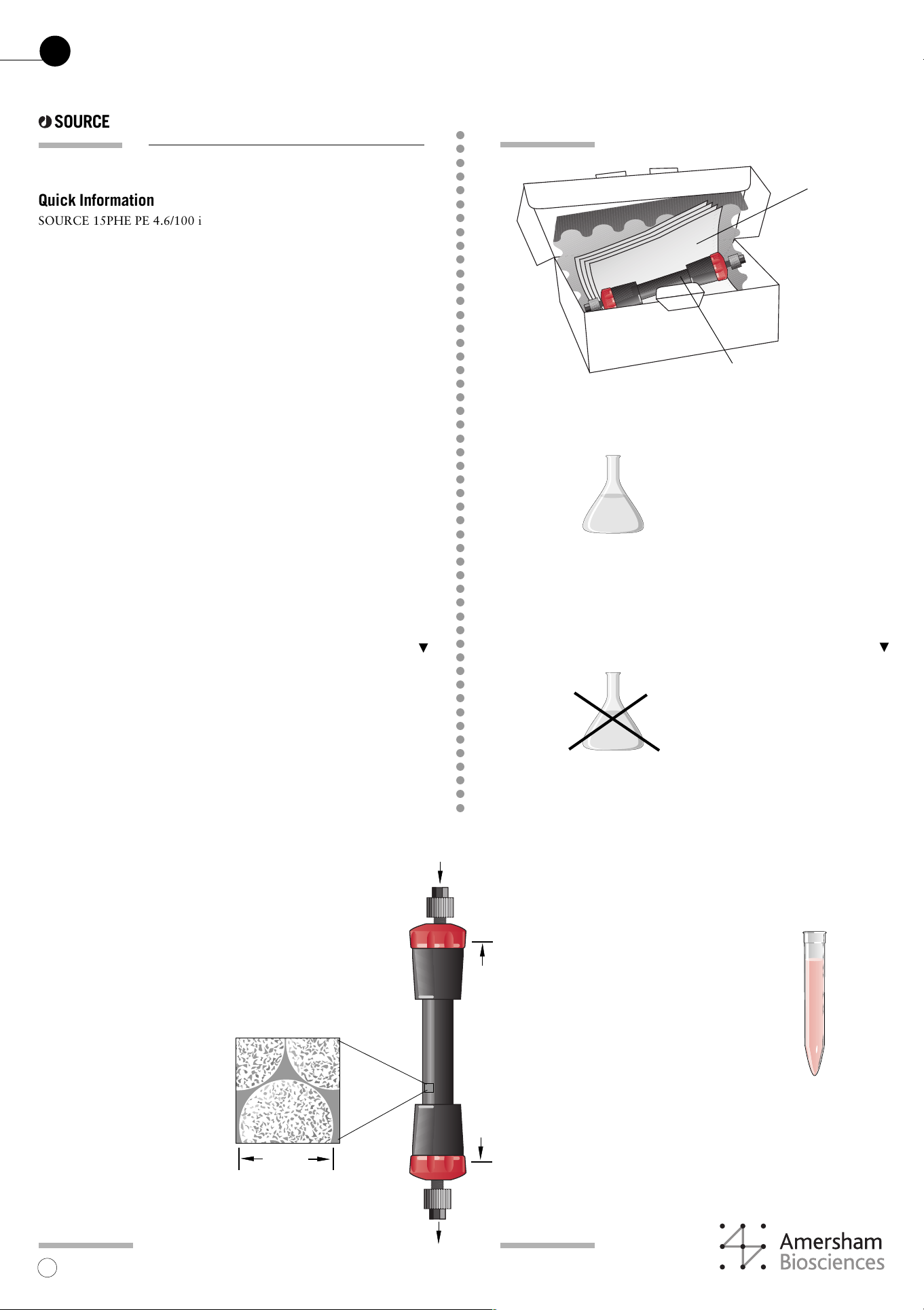
SOURCE 15PHE PE 4.6/100 is a pre-packed PEEK column for rapid
preparative hydrophobic interaction chromatography of proteins and
oligonucleotides.
Read the Instruction
The instructions on this page will help you get started quickly with
your new column.
The other side gives more in-depth information on optimisation and
trouble-shooting.
Column data
Matrix: Polystyrene/divinyl benzene
Ligand: Phenyl
Bead form: Rigid, spherical porous, monodisperse
Particle size: 15 µm
Capacity: At least 40 mg albumin/column
pH stability: Long term Short term
2–12 1–14
Temperature: Regular use Storage
+4 to +40 °C +4 to +30 °C
Pressure over the column Regular use Do not exceed
0.25–2.5 MPa 4 MPa
Flow rate: Regular use Maximum
(water at room temperature) 0.5–2.5 ml/min 5.0 ml/min
First time use
Equilibration of the column before initial use or after long term storage
or changing buffers:
1. 8 ml elution buffer.
2. 8 ml starting buffer.
Starting buffer: 50 mM phosphate buffer, 1.5 M (NH4)2SO4, pH 7.0
Elution buffer: 50 mM phosphate buffer, pH 7.0
Flow rate: 1.0 ml/min
▼
○○○○○○○○○○○○○○○○○○○○○○○○○○○○○○○○○○○○○○○○○○○○○○○○○○
Instructions
SOURCE 15PHE PE 4.6/100
Buffer and solvent resistance
De-gas and filter all buffers through a 0.22 µm filter.
Daily use
Aqueous solutions pH 2–12
Urea, up to 8 M
Acetonitrile, up to 30% in aqueous buffers
Cleaning
Acetonitrile, up to 30%
Ethanol, up to 100%
Methanol, up to 100%
2-propanol, up to 100%
Hydrochloric acid, up to 1 M
Sodium hydroxide, up to 2 M
Acetic acid, up to 50%
Guanidine hydrochloride, up to 8 M
Anionic, cationic and non-ionic detergents
Avoid
Unfiltered solutions
Oxidising agents
▼
Note: Before connecting the column, start the pump and remove
all air in the system, in particular in tubings and valves.
Try these conditions first
Before applying the sample, equilibrate the column.
Proceed according to the section “First time use”.
Starting buffer*: 50 mM phosphate buffer, 1.5 M (NH4)2SO4, pH 7.0
Elution buffer: 50 mM phosphate buffer, pH 7.0
Gradient: 0-100% B in 33 ml (20 CV)
Flow rate: 2.0 ml/min
* Use a lower concentration of ammonium sulphate if the protein of interest
begins to precipitate at this concentration.
Read the back of this instruction for information
on optimising a separation.
5 µm
Injection
valve
Sample requirements/recommendations
Recommended ≤ 40 mg protein/column
sample load:
Sample preparation: Filtered through a 0.22 µm filter or
centrifuged at 10 000 g for 10 min
Temperature*: Ambient
The sample should be dissolved in starting buffer.
*Hydrophobic interactions increases with increased
temperature. Results achieved at room temperature
may therefore not be reproduced in cold room, or
vice versa.
In Depth Information
Delivery/storage
The gel is delivered in 20% ethanol. If the column is to be stored for
more than two days after use, wash the column with at least 8 ml
distilled water and then equilibrate it with at least 8 ml 20% ethanol.
Bed length 100 mm, i.d. 4.6 mm
i 71-5002-34 AB 2002-08 • p1
Monitor
Page 2
Optimisation
Standard protocol
A first run can be performed as described in the section “Try these
conditions first”. If the result is unsatisfactory, consider the following:
Action Effect
Change pH/buffer* Weaker/stronger binding
Change salt* Selectivity change
Decrease the sample load Improved resolution
Decrease the flow rate Improved resolution
Use a shallower gradient Improved resolution, but broader
peaks and decreased concentration
in fractions
* Refer to the section “choice of buffer”
Note: Hydrophobic interaction increases with increased
temperature. Results achieved at room temperature may
therefore not be reproduced in cold room, or vice versa.
Choice of buffers
In general, the adsorption process is often more selective than the
desorption process and it is therefore important to optimize the
starting “binding” buffer conditions with respect to:
• pH
• salt concentration
• type of salt
The combination of salt and pH can be manipulated to give optimum
selectivity. Optimal conditions differ from application to application
and are best established by running linear gradients and by varying the
salt concentration and pH in the starting buffer.
The buffers given in the section “Try these conditions first” are
recommended as the first choice.
The Hofmeister series, Table 1, gives approximate guidelines in choosing
the type of salt to use. The most efficient salts are normally ammonium
sulphate (up to 2 M) and sodium sulphate (up to 1 M) but also
“weaker” salts such as sodium chloride (up to 4 M) can be considered.
Table 1. The Hofmeister series.
← Increasing binding effect
3-
Anions: PO
4
2-
>SO
>CH2COO- >Cl- >Br- >NO3- >ClO4- >I- >SCN
4
Cations: NH4+ >Rb+ >K+ >Na+ >Cs+ >Li+ >Mg+ >Ca2+>Ba
2+
-
← Increasing binding effect
▼
○○○○○○○○○○○○○○○○○○○○○○○○○○○○○○○○○○○○○○○○○○○○○○○○○○○○○○○○○○○○○○○○○○○○○○○○○○○○○○○○○○○○○
least 8 ml of 70% ethanol followed by 5 ml distilled water before
equilibrating the column.
If column performance is still not restored, inject a solution of 1 mg
pepsin/ml in 0.1 M acetic acid including 0.5 M NaCl and leave
overnight at room temperature or 1 hour at 37 °C. Depending on the
contamination, other enzymes can also be used, e.g. DNAase. After
enzymic treatment, repeat step 1–4 in the rigorous cleaning procedure
described above. Wash with elution buffer before equilibration with
starting buffer and sample application.
Trouble-shooting
Symptom Remedy
Increased back-pressure Using reverse flow at 0.5 ml/min, pump 15 of
the column ml elution buffer through the column.
Then return to normal flow direction and run
for 10 minutes at 2.0 ml/min.
Loss of resolution and/or Follow the procedure described in
decreasedsample recovery the section “More rigorous cleaning”.
Air in the column Reverse the flow direction and pump 20 ml of
well de-gassed starting buffer at a flow rate
of 0.5 ml/min.
DO NOT OPEN THE COLUMN!
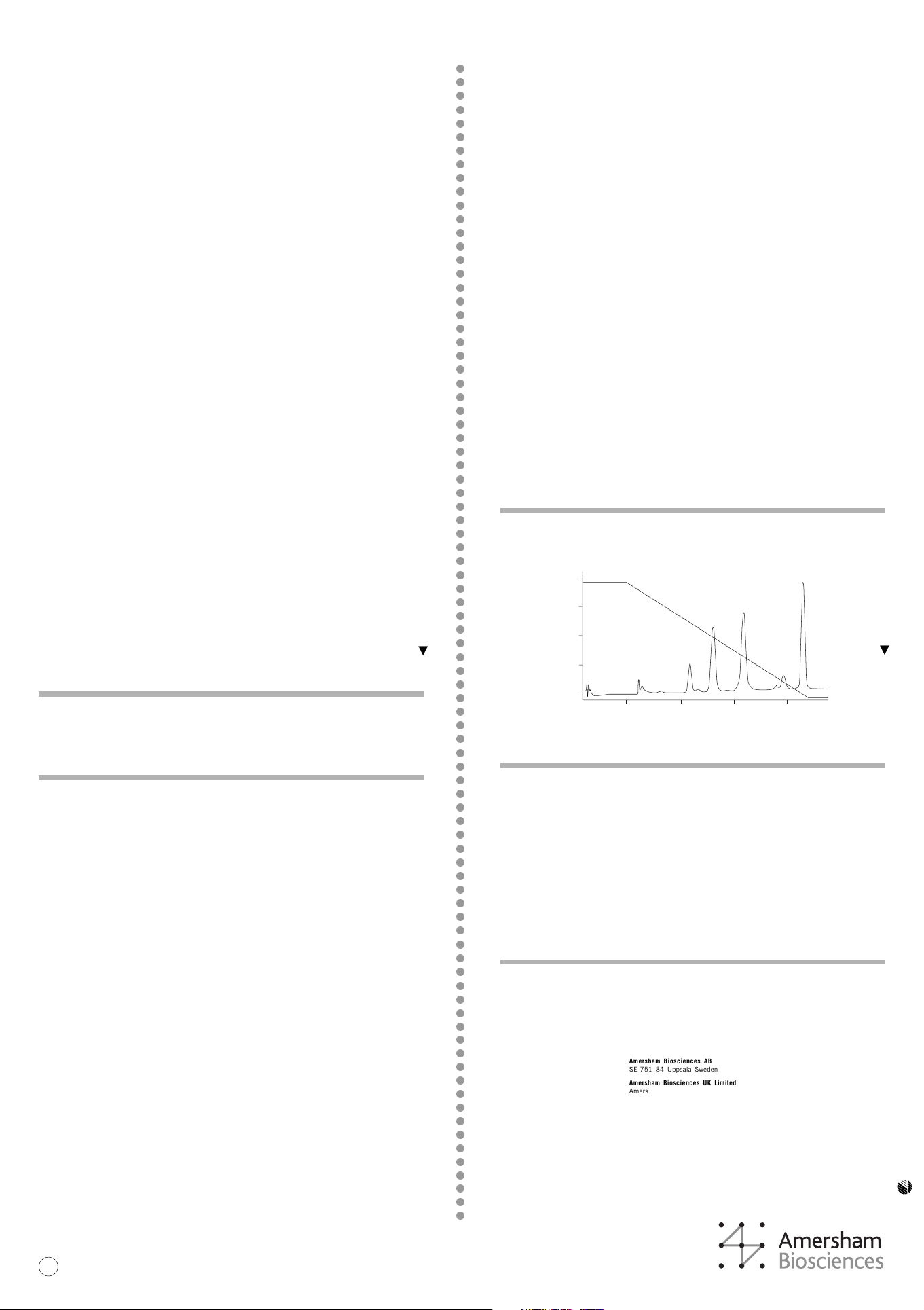
Column performance control
We recommend checking the column performance at regular intervals.
The function of the column can be checked as described in Figure 1.
0.080
0.060
0.040
0.020
0.000
AU
Sample: myoglobin, 2 mg/ml (SIGMA M-0630)
Sample volume: 25 µl
Starting buffer: 100 mM phosphate buffer, 2.0 M
Elution buffer: 100 mM phosphate buffer, pH 7.0
Gradient: 0–100% B in 31 min
Flow rate: 0.5 ml/min
0.0 10.0 20.0 30.0
ribonuclease A, 8 mg/ml (SIGMA R-5000)
lysozyme, 2 mg/ml (SIGMA L-6876)
-chymotrypsinogen A, 3.2 mg/ml (SIGMA C-4879)
(NH
pH 7.0
4)2SO4,
Fig 1. Typical chromatogram from a function test of SOURCE 15PHE PE
4.6/100.
▼
min
For more information, please refer to the handbook “Hydrophobic
Interaction Chromatography, Principles and Methods” available from
Amersham Biosciences.
Column cleaning
Regular cleaning:
After each run, wash the column with 8 ml distilled water.
Before next run, re-equilibrate the column with at least 8 ml starting
buffer until the UV base-line and pH/conductivity values are stable.
More rigorous cleaning:
Reverse the flow direction and run at a flow rate of 0.2 ml/min with the
following sequence of solutions:
1. 5 ml 30% isopropanol
2. 5 ml distilled water
3. 5 ml 1 M NaOH
4. 5 ml distilled water.
Note: Do not store the column in 1 M NaOH.
Depending of the nature of the contaminants, the following cleaning
solutions may also be appropriate:
70% ethanol
30% acetonitrile
2 M NaOH including 1 M NaCl
0.5% non-ionic detergent in 1 M acetic acid
Always rinse with 3 ml distilled water when any of the above cleaning
solutions have been used. If detergents have been used, rinse with at
Accessories
Designation No. per pack Code No.
On-line Filter 1 18-1118-01
Handbook:
“Hydrophobic Interaction Chromatography,
Principles and Methods” 1 18-1020-90
Ordering information
Designation No. per pack Code No.
SOURCE 15PHE PE 4.6/100 1 17-5071-01
SOURCE and Drop Design are trademarks of Amersham Biosciences Limited or its subsidiaries.
Amersham is a trademark of Nycomed Amersham plc. Milli-Q is a trademark of Millipore Corp.
All goods and services are sold sold subject to the terms and conditions of sale of the company within the Amersham
Biosciences group which supplies them. A copy of these terms and conditions is available on request.
© Amersham Biossciences AB 2002 – all rights reserved
Amersham Biosciences AB
SE-751 84 Uppsala Sweden
Amersham Biosciences UK Limited
Amersham Place, Little Chalfont
Bucks HP7 9NA England
Amersham Biosciences Corporation
P.O. Box 1327
Piscataway, NJ 08855 USA
Amersham Biosciences Europe GmbH
Postfach 5480
D-79021 Freiburg Germany
Amersham Biosciences K.K.
Sanken Building, 3-25-1
Shinjuku-ku, Tokyo 169-0073 Japan
Produced by Wikströms, Sweden 1020880, 08.2002
Printed matter. Licence 341 051
i 71-5002-34 AB 2002-08 • p2
 Loading...