

Page 1
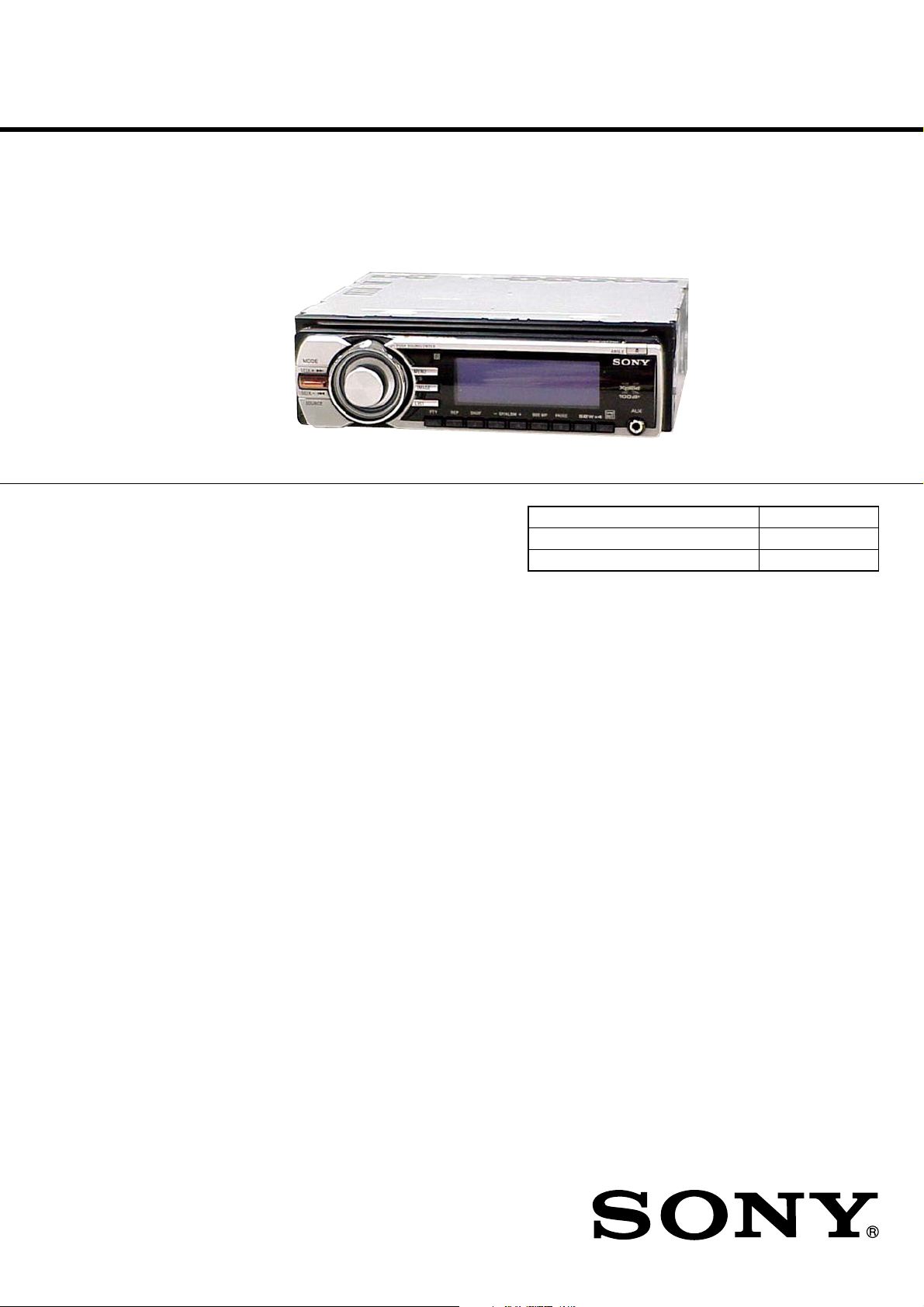
CDX-GT71W/GT710/GT760
SERVICE MANUAL
Ver. 1.2 2007.03
(Photo: CDX-GT710)
• The tuner and CD sections have no adjustments.
AUDIO POWER SPECIFICATIONS (US MODEL)
POWER OUTPUT AND TOTAL HARMONIC DISTORTION
23.2 watts per channel minimum continuous average power into
4 ohms, 4 channels driven from 20 Hz to 20 kHz with no more
than 5% total harmonic distortion.
US Model
CDX-GT71W/GT710
Canadian Model
AEP Model
UK Model
CDX-GT710
E Model
Chinese Model
CDX-GT760
Model Name Using Similar Mechanism NEW
CD Drive Mechanism Type MG-101FA-188//Q
Optical Pick-up Name DAX-25A
SPECIFICATIONS
CD player section
Signal-to-noise ratio 120 dB
Frequency response 10 – 20,000 Hz
Wow and flutter Below measurable limit
Tuner section
FM
Tuning range CDX-GT71W/GT710: US, Canadian model:
87.5 – 107.9 MHz
CDX-GT710: AEP, UK model:
87.5 – 108.0 MHz
CDX-GT760:
87.5 – 108.0 MHz (at 50 kHz step)
87.5 – 107.9 MHz (at 200 kHz step)
FM tuning interval CDX-GT760:
50 kHz/200 kHz switchable
Antenna terminal External antenna connector
Intermediate frequency 10.7 MHz/450 kHz
Usable sensitivity 9 dBf
Selectivity 75 dB at 400 kHz
Signal-to-noise ratio 67 dB (stereo), 69 dB (mono)
Harmonic distortion at 1 kHz
0.5% (stereo), 0.3% (mono)
Separation 35 dB at 1 kHz
Frequency response 30 – 15,000 Hz
AM (CDX-GT71W/GT710: US, Canadian model/GT760)
Tuning range CDX-GT71W/GT710: US, Canadian model:
530 – 1,710 kHz
CDX-GT760:
531 – 1,602 kHz (at 9 kHz step)
530 – 1,710 kHz (at 10 kHz step)
AM tuning interval CDX-GT760:
9 kHz/10 kHz switchable
Antenna terminal External antenna connector
Intermediate frequency 10.7 MHz/450 kHz
Sensitivity 30 µV
– Continued on next page –
FM/AM COMPACT DISC PLAYER
CDX-GT71W/GT710: US, Canadian Model/GT760
9-887-498-03
2007C04-1
© 2007.03
FM/MW/LW COMPACT DISC PLAYER
CDX-GT710: AEP, UK Model
Sony Corporation
eVehicle Division
Published by Sony Techno Create Corporation
Page 2
CDX-GT71W/GT710/GT760
MW/LW (CDX-GT710: AEP, UK model)
Tuning range MW: 531 – 1,602 kHz
Antenna terminal External antenna connector
Intermediate frequency 10.7 MHz/450 kHz
Sensitivity MW: 30 µV, LW: 40 µV
Power amplifier section
Outputs Speaker outputs (sure seal connectors)
Speaker impedance 4 – 8 ohms
Maximum power output
General
Outputs Audio outputs terminal (front/rear)
Inputs Telephone ATT control terminal
Tone controls Low: ±10 dB at 60 Hz (XPLOD)
Power requirements 12 V DC car battery (negative ground)
Dimensions Approx. 178 × 50 × 190 mm
Mounting dimensions Approx. 182 × 53 × 163 mm
Mass Approx. 1.6 kg (3 lb. 9 oz.)
Supplied accessories Card remote commander:
LW: 153 – 279 kHz
52 W × 4 (at 4 ohms)
Subwoofer output terminal (mono)
Power antenna relay control terminal
Power amplifier control terminal
Illumination control terminal
BUS control input terminal
BUS audio input terminal
Remote controller input terminal
Antenna input terminal
AUX input jack (stereo mini jack)
Mid: ±10 dB at 1 kHz (XPLOD)
High: ±10 dB at 10 kHz (XPLOD)
(7
1/8 × 2 × 7 1/2 in.) (w/h/d)
(7 1/4 × 2 1/8 × 6 1/2 in.) (w/h/d)
CDX-GT71W/GT710: US, Canadian model:
RM-X152
CDX-GT710: AEP, UK model:
RM-X154
CDX-GT760:
RM-X156
Parts for installation and connections (1 set)
SERVICE NOTES
NOTES ON HANDLING THE OPTICAL PICK-UP BLOCK
OR BASE UNIT
The laser diode in the optical pick-up block may suffer electrostatic
breakdown because of the potential difference generated by the
charged electrostatic load, etc. on clothing and the human body.
During repair, pay attention to electrostatic breakdown and also use
the procedure in the printed matter which is included in the repair
parts.
The flexible board is easily damaged and should be handled with
care.
NOTES ON LASER DIODE EMISSION CHECK
The laser beam on this model is concentrated so as to be focused on
the disc reflective surface by the objective lens in the optical pickup block. Therefore, when checking the laser diode emission,
observe from more than 30 cm away from the objective lens.
CAUTION
Use of controls or adjustments or performance of procedures
other than those specified herein may result in hazardous
radiation exposure.
If the optical pick-up block is defective, please replace the whole
optical pick-up block.
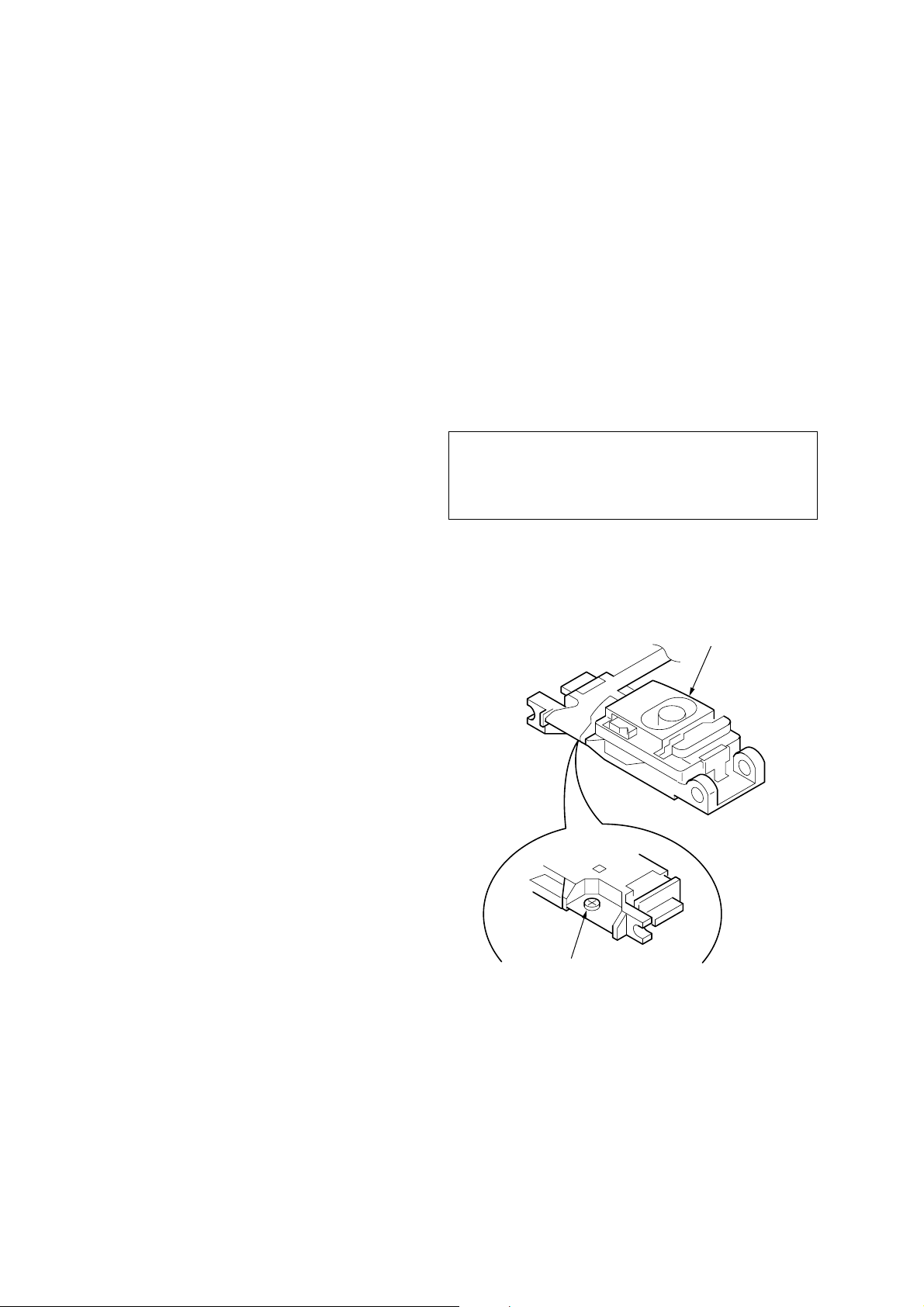
Never turn the semi-fix ed resistor located at the side of optical pickup block.
optical pick-up
Design and specifications are subject to change without
notice.
US and foreign patents licensed from Dolby
Laboratories.
SAFETY-RELATED COMPONENT WARNING!!
COMPONENTS IDENTIFIED BY MARK 0 OR DOTTED LINE
WITH MARK 0 ON THE SCHEMATIC DIAGRAMS AND IN
THE PARTS LIST ARE CRITICAL TO SAFE OPERATION.
REPLACE THESE COMPONENTS WITH SONY P ARTS WHOSE
PART NUMBERS APPEAR AS SHOWN IN THIS MANUAL OR
IN SUPPLEMENTS PUBLISHED BY SONY.
semi-fixed resistor
ATTENTION AU COMPOSANT AYANT RAPPORT
À LA SÉCURITÉ!!
LES COMPOSANTS IDENTIFIÉS P AR UNE MARQUE 0 SUR LES
DIAGRAMMES SCHÉMATIQUES ET LA LISTE DES PIÈCES
SONT CRITIQUES POUR LA SÉCURITÉ DE FONCTIONNEMENT.
NE REMPLACER CES COMPOSANTS QUE PAR DES PIÈCES
SONY DONT LES NUMÉROS SONT DONNÉS DANS CE MANUEL
OU DANS LES SUPPLÉMENTS PUBLIÉS PAR SONY.
2
Page 3
CDX-GT71W/GT710/GT760
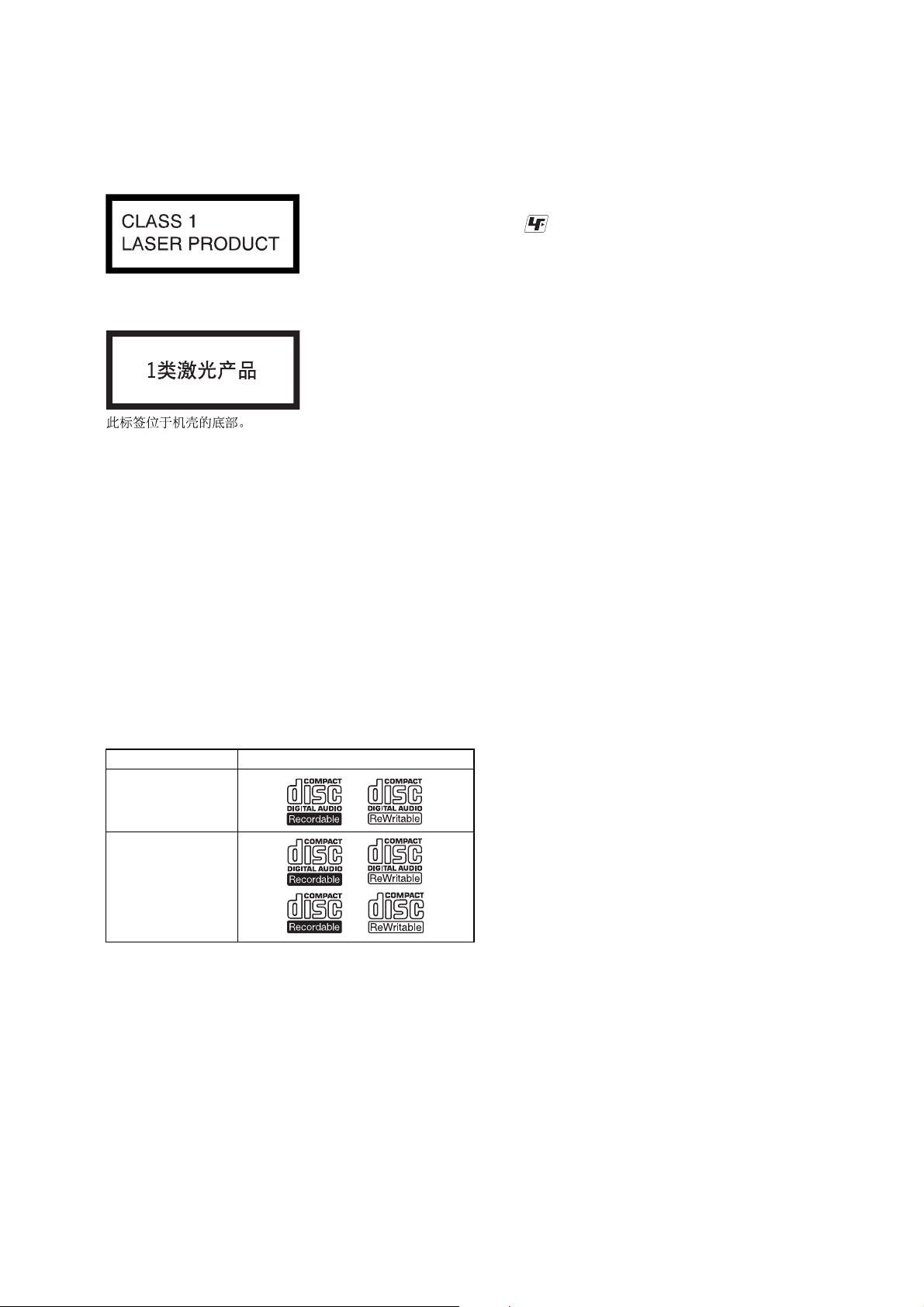
This compact disc player is classified as a CLASS 1 LASER
product. The CLASS 1 LASER PRODUCT label is located on the
exterior.
• CDX-GT710: AEP, UK model/CDX-GT760: E model
This label is located on the bottom of the chassis.
• CDX-GT760: Chinese model
Notes on Chip Component Replacement
•Never reuse a disconnected chip component.
• Notice that the minus side of a tantalum capacitor may be damaged
by heat.
TEST DISCS
Please use the following test discs for the check on the CD section.
UNLEADED SOLDER
•
Boards requiring use of unleaded solder are printed with the leadfree mark (LF) indicating the solder contains no lead.
(Caution:Some printed circuit boards may not come printed with
the lead free mark due to their particular size.)
: LEAD FREE MARK
Unleaded solder has the following characteristics.
• Unleaded solder melts at a temperature about 40°C higher than
ordinary solder.
Ordinary soldering irons can be used but the iron tip has to be
applied to the solder joint for a slightly longer time.
Soldering irons using a temperature regulator should be set to
about 350°C.
Caution:The printed pattern (copper foil) may peel away if the
heated tip is applied for too long, so be careful!
• Strong viscosity
Unleaded solder is more viscous (sticky, less prone to flow)
than ordinary solder so use caution not to let solder bridges
occur such as on IC pins, etc.
• Usable with ordinary solder
It is best to use only unleaded solder but unleaded solder may
also be added to ordinary solder.
YDES-18 (Part No. 3-702-101-01)
PATD-012 (Part No. 4-225-203-01)
• CD playback
You can play CD-DA (also containing CD TEXT*), CD-R/CDRW (MP3/WMA/AAC files also containing Multi Session) and
ATRAC CD (ATRAC3 and ATRAC3plus format).
Type of discs Label on the disc
CD-DA
MP3
WMA
AAC
ATRAC CD
*A CD TEXT disc is a CD-DA that includes information such as
disc, artist and track name.
3
Page 4

CDX-GT71W/GT710/GT760
Ver. 1.2
1. SERVICE NOTE........................................................ 5
2. GENERAL
Location of Controls........................................................ 6
Connections ..................................................................... 8
3. DISASSEMBLY
3-1. Base Panel Assy............................................................... 17
3-2. Sub Panel Assy ................................................................ 17
3-3. CD Mechanism Block ..................................................... 18
3-4. Driving Section (DB-F07)............................................... 18
3-5. Main Board...................................................................... 19
3-6. Servo Board..................................................................... 19
3-7. Chassis (T) Sub Assy....................................................... 20
3-8. Roller Arm Assy .............................................................. 20
3-9. Chassis (OP) Assy ........................................................... 21
4. DIAGNOSIS FUNCTION ........................................ 22
5. DIAGRAMS
5-1. Block Diagram –Main Section– ...................................... 25
5-2. Block Diagram –Display Section– .................................. 26
5-3. Printed Wiring Boards –Main Section–........................... 28
5-4. Schematic Diagram –Main Section (1/4)– ...................... 30
5-5. Schematic Diagram –Main Section (2/4)– ...................... 31
5-6. Schematic Diagram –Main Section (3/4)– ...................... 32
5-7. Schematic Diagram –Main Section (4/4)– ...................... 33
5-8. Printed Wiring Boards –Display Section–....................... 34
5-9. Printed Wiring Board –Base Panel Section– ................... 35
5-10. Schematic Diagram –Display Section– ........................... 36
TABLE OF CONTENTS
6. EXPLODED VIEWS
6-1. Main Section.................................................................... 46
6-2. Main Board Section......................................................... 47
6-3. Front Panel Section ......................................................... 48
6-4. CD Mechanism Section (MG-101FA-188//Q) ................ 49
7. ELECTRICAL PARTS LIST.................................. 50
4
Page 5
SECTION 1
D
SERVICE NOTE
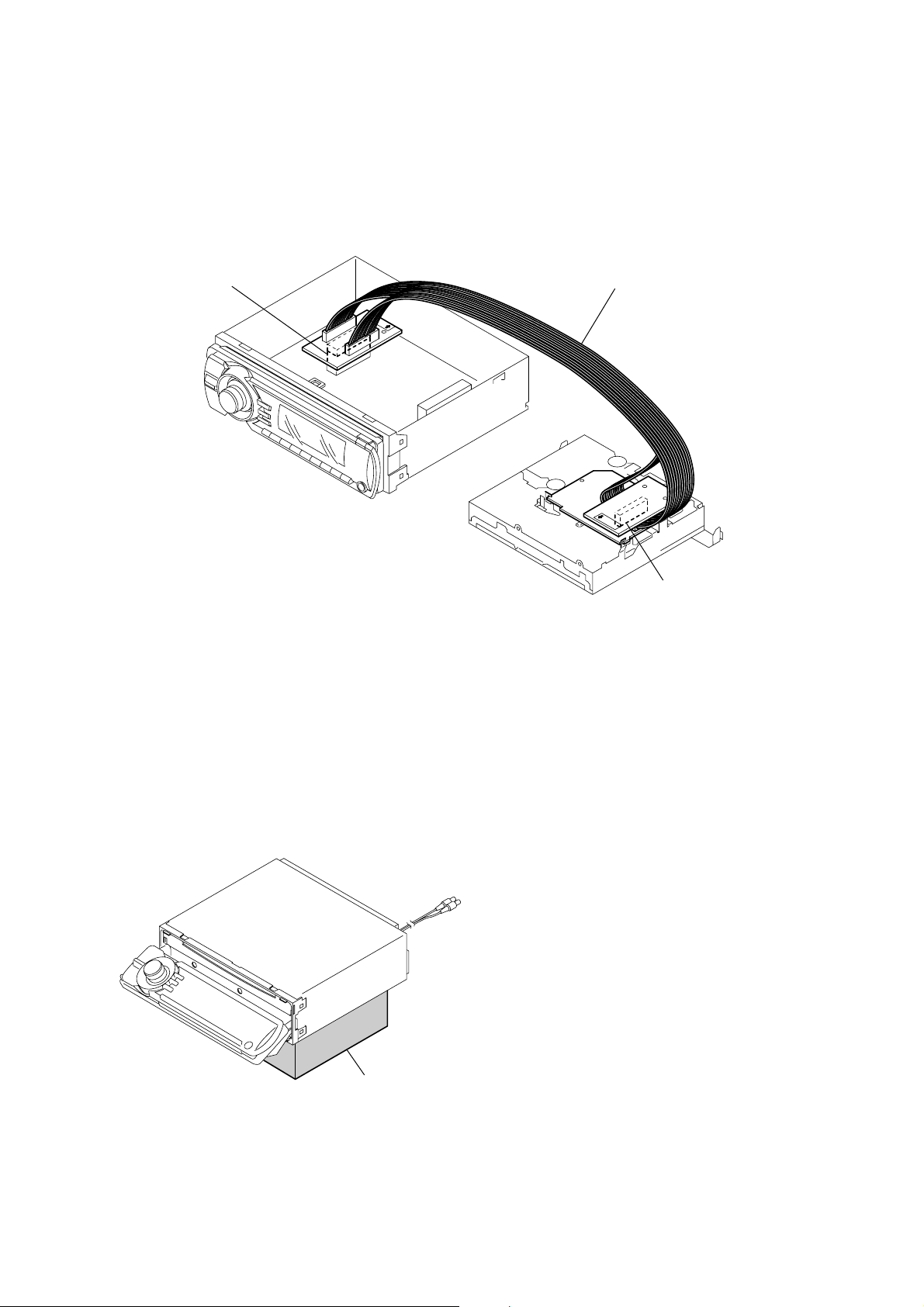
EXTENSION CABLE AND SERVICE POSITION
When repairing or servicing this set, connect the jig (extension cable)
as shown below.
• Connect the MAIN board (CNP301) and the SER VO board (CN2)
with the extension cable (Part No. J-2502-076-1).
MAIN BOARD
CNP301
CDX-GT71W/GT710/GT760
J-2502-076-1
NOTE FOR REPLACEMENT OF THE SERVO BOARD
When repairing, the complete SER VO board (A-1177-362-A) should
be replaced since any parts in the SER V O board cannot be repaired.
NOTE FOR THE OPENING OF THE FRONT PANEL
In this set, the front panel is lowered to below the bottom face when
it is opened.
When servicing the set, place it on a stand having a height of about
2 cm.
SERVO BOAR
CN2
stand
5
Page 6
CDX-GT71W/GT710/GT760
123 789 q
546
123 789 q
q
qhqjq
546
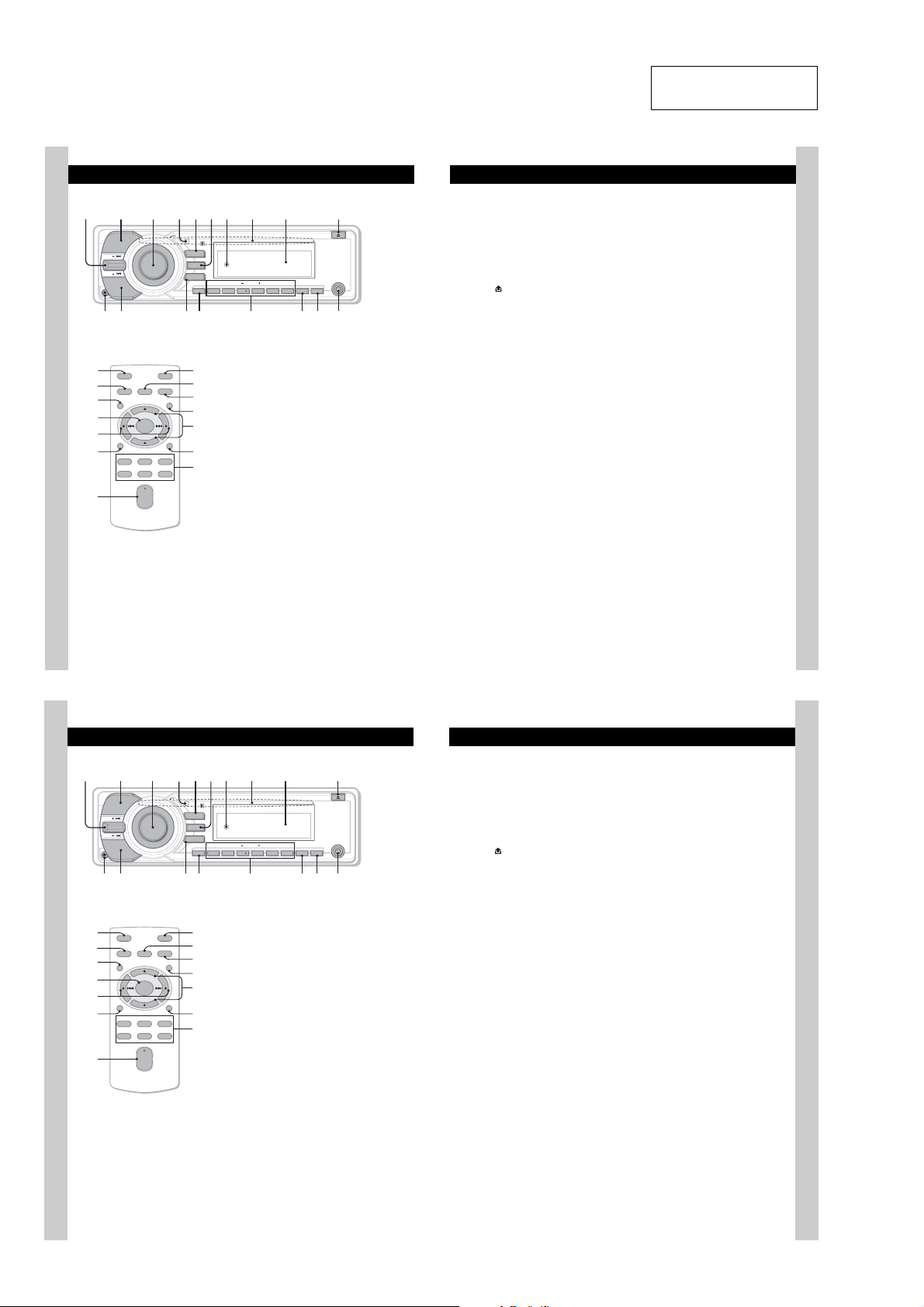
• LOCATION OF CONTROLS
• CDX-GT71W
Location of controls and basic operations
Main unit
ENTER
PUSH SOUND / ENTER
MENU
IMAGE
LIST
REP SHUF PAUSEBBE MPGP/ALBM
DSPL SCRL OFF
123456
qg qh qj qk
Refer to the pages listed for details. The
corresponding buttons on the card remote
commander control the same functions as those
on the unit.
ws
ATT
MODE
LIST/
CAT
+
–
SCRL
PAUSE
+
VOL
–
A SEEK +/– control
wd
2
wf
wg
qh
wh
CD/MD*
To sk ip tracks (press up/down); skip tracks
continuously (press up/down, then press up/
down again within about 1 second and hold);
reverse/fast-forward a track (press up/down
and hold).
Radio:
To tune in stations automatically (press up/
down); find a station manually (press up/
down and hold).
B MODE button 10, 13
To select th e radio band (FM/AM); select the
SAT tuner band (mode)*
C Volume control dial
To ad ju st volume.
SOUND button
To en te r sound setting.
ENTER button
To ap ply a menu setting.
D Receptor for the card remote
commander
E MENU button
To en te r menu.
F IMAGE button
To se lect the display image.
Movie mode 1-3 t Spectrum analyzer
mode 1-5 t Wall paper mode 1-3 t
normal play/reception mode
1
:
MODE
SEEK
SEEK
SOURCE
qa qs qdqf
Card remote commander
RM-X152
qj
OFF
qs
SOURCE SOUND
5
MENU
ql
w;
DSPL
qf
REP SHUF
132
465
wa
8
;
ANGLE
AUX
CDX-GT71W
2
; select the unit*3.
SECTION 2
GENERAL
G RESET button (Location behind the front
panel) 4
H Disc slot 6
To in sert the disc.
I Display window
J Z (eject)/ANGLE button 7
To ej ec t the disc/slide down the front panel
(press); angle the front panel in 3 po si t io ns
(press and hold).
K (front panel release) button 5
L SOURCE button
To po we r on; ch ange the source (Radio/CD/
1
MD*
/AUX/SAT*2).
M LIST button 11, 14
To li st up .
N DSPL (display) button 10
To ch an g e display items.
O Number buttons
1
CD/MD*
:
(1): REP 10, 14
(2): SHUF 10, 14
4
(3)/(4): GP*
(5): BBE MP 2
(6): PAUS E*
Radio:
To re ce ive stored stations (press); store
stations (press and hold).
P SCRL (scroll) button 10
To sc ro ll th e display item.
Q OFF button
To po we r off; stop th e source.
R AUX input jack 13
To co nnect a portable audio device.
The following buttons on the card remot e
commander have also different b utto ns/fun ctio ns
from the unit. Remove the insulation film before
use (page 4).
/ALBM*5 –/+
To s kip albums (press); skip albums
continuously (press and hold) .*
To a ct iv ate the BBE MP function, set
“BBE MP on.” To cancel, set “BBE MP
off.”
7
To p ause playback. To cancel, press
again.
6
This section is extracted
from instruction manual.
ql ENTER button
To complete a setting.
w; </, (SEEK –/+) buttons
1
CD/MD*
:
To s k ip tracks (press); skip tracks
continuously (press, then press again within
about 1 second and hold); fast-forward/
reverse a track (press and hold).
Radio:
To tune in stations automatically (press); fi nd
a station manually (press and hold).
wa VOL (volume) +/– button
To adjust volume.
ws AT T (attenuate) button
To att e nuate the sound. To cancel, press
again.
wd SOUND button
To ent e r sound setting.
wf LIST/CAT*
wg M/m (+/–) buttons
wh Number buttons
*1
*2
*3
*4
*5
*6
*7
Note
If the unit is turned off and the display disappears, it
cannot be operated with the card remote commander
unless
inserted to activate the unit first.
Tip
For details on how to replace the battery, see
“Replacing the lithium battery of the card remote
commander” on page 17.
2
button 11, 14
To list up.
To s e lect preset stations/skip groups (press);
skip groups continuously (press and hold).
1
CD/MD*
:
(1): REP 10, 14
(2): SHUF 10, 14
7
(6): PAUS E*
To pa use playback. To cancel, press
again.
Radio:
To r e c e ive stored st at ions (press); store
stations (press and hold).
When an MD changer is connected.
When the SAT tuner is connected.
When a CD/MD changer is connected.
When an ATRAC CD is played.
When an MP3/WMA/AAC is played.
If the changer is connected, the operation is
different, see page 14.
When playing bac k on this unit.
(SOURCE)
on the unit is pressed, or a disc is
9
• CDX-GT710: US, Canadian model
Location of controls and basic operations
Main unit
ENTER
PUSH SOUND / ENTER
MENU
IMAGE
LIST
REP SHUF PAUSEBBE MPGP/ALBM
DSPL SCRL OFF
123456
g
Refer to the pages listed for details. The
corresponding buttons on the card remote
commander control the same functions as those
on the unit.
ws
ATT
MODE
LIST/
CAT
+
–
SCRL
PAUSE
+
VOL
–
A SEEK +/– control
wd
2
wf
wg
qh
wh
CD/MD*
To sk ip tracks (press up/down); skip tracks
continuously (press up/down, then press up/
down again within about 1 second and hold);
reverse/fast-forward a track (press up/down
and hold).
Radio:
To tune in stations automatically (press up/
down); find a station manually (press up/
down and hold).
B MODE button 10, 13
To select th e radio band (FM/AM); select the
SAT tuner band (mode)*
C Volume control dial
To ad ju st volume.
SOUND button
To en te r sound setting.
ENTER button
To ap ply a menu setting.
D Receptor for the card remote
commander
E MENU button
To en te r menu.
F IMAGE button
To se lect the display image.
Movie mode 1-3 t Spectrum analyzer
mode 1-5 t Wall paper mode 1-3 t
normal play/reception mode
MODE
SEEK
SEEK
SOURCE
qa qs qdqf
Card remote commander
RM-X152
qj
OFF
qs
SOURCE SOUND
5
MENU
ql
w;
DSPL
qf
REP SHUF
132
465
wa
8
G RESET button (Location behind the front
;
ANGLE
AUX
CDX-GT710
k
1
:
2
; select the unit*3.
panel) 4
H Disc slot 6
To in sert the disc.
I Display window
J Z (eject)/ANGLE button 7
To ej ec t the disc/slide down the front panel
(press); angle the front panel in 3 positions
(press and hold).
K (front panel release) button 5
L SOURCE button
To po we r on; ch ange the source (Radio/CD/
1
/AUX/SAT*2).
MD*
M LIST button 11, 14
To li st up .
N DSPL (display) button 10
To ch an g e display items.
O Number buttons
1
CD/MD*
:
(1): REP 10, 14
(2): SHUF 10, 14
4
(3)/(4): GP*
(5): BBE MP 2
(6): PAUSE*
Radio:
To re ce ive stored stations (press); store
stations (press and hold).
P SCRL (scroll) button 10
To sc ro ll th e display item.
Q OFF button
To po we r off; stop th e source.
R AUX input jack 13
To co nnect a portable audio device.
The following buttons on the card remot e
commander have also different bu ttons/f unct ions
from the unit. Remove the insulation film before
use (page 4).
/ALBM*5 –/+
To s ki p al bu ms (press); skip albums
continuously (press and hold) .*
To a ct iv ate the BBE MP function, set
“BBE MP on.” To cancel, set “BBE MP
off.”
7
To p ause playback. To cancel, press
again.
ql ENTER button
To compl e te a setting.
w; </, (SEEK –/+) buttons
1
CD/MD*
:
To s k ip tracks (press); skip tracks
continuously (press, then press again within
about 1 second and hold); fast-forward/
reverse a track (press and hold).
Radio:
To tune in stations automatically (press); fi nd
a station manually (press and hold).
wa VOL (volume) +/– button
To adjust volume.
ws ATT (attenuate) button
To att e nuate the sound. To cancel, press
again.
wd SOUND button
To ent e r sound setting.
wf LIST/CAT*
wg M/m (+/–) buttons
wh Number buttons
6
*1
*2
*3
*4
*5
*6
*7
Note
If the unit is turned off and the display disappears, it
cannot be operated with the card remote commander
unless
inserted to activate the unit first.
Tip
For details on how to replace the battery, see
“Replacing the lithium battery of the card remote
commander” on page 17.
2
button 11, 14
To list up.
To s e le ct pr eset stations/skip groups (press);
skip groups continuously (press and hold).
1
CD/MD*
:
(1): REP 10, 14
(2): SHUF 10, 14
(6): PAUSE *
To pa use playback. To cancel, press
again.
Radio:
To r e c e ive stored stations (press); store
stations (press and hold).
When an MD changer is connected.
When the SAT tuner is connected.
When a CD/MD changer is connected.
When an ATRAC CD is played.
When an MP3/WMA/AAC is played.
If the changer is connected, the operation is
different, see page 14.
When playing bac k on this unit.
(SOURCE)
on the unit is pressed, or a disc is
7
9
6
Page 7
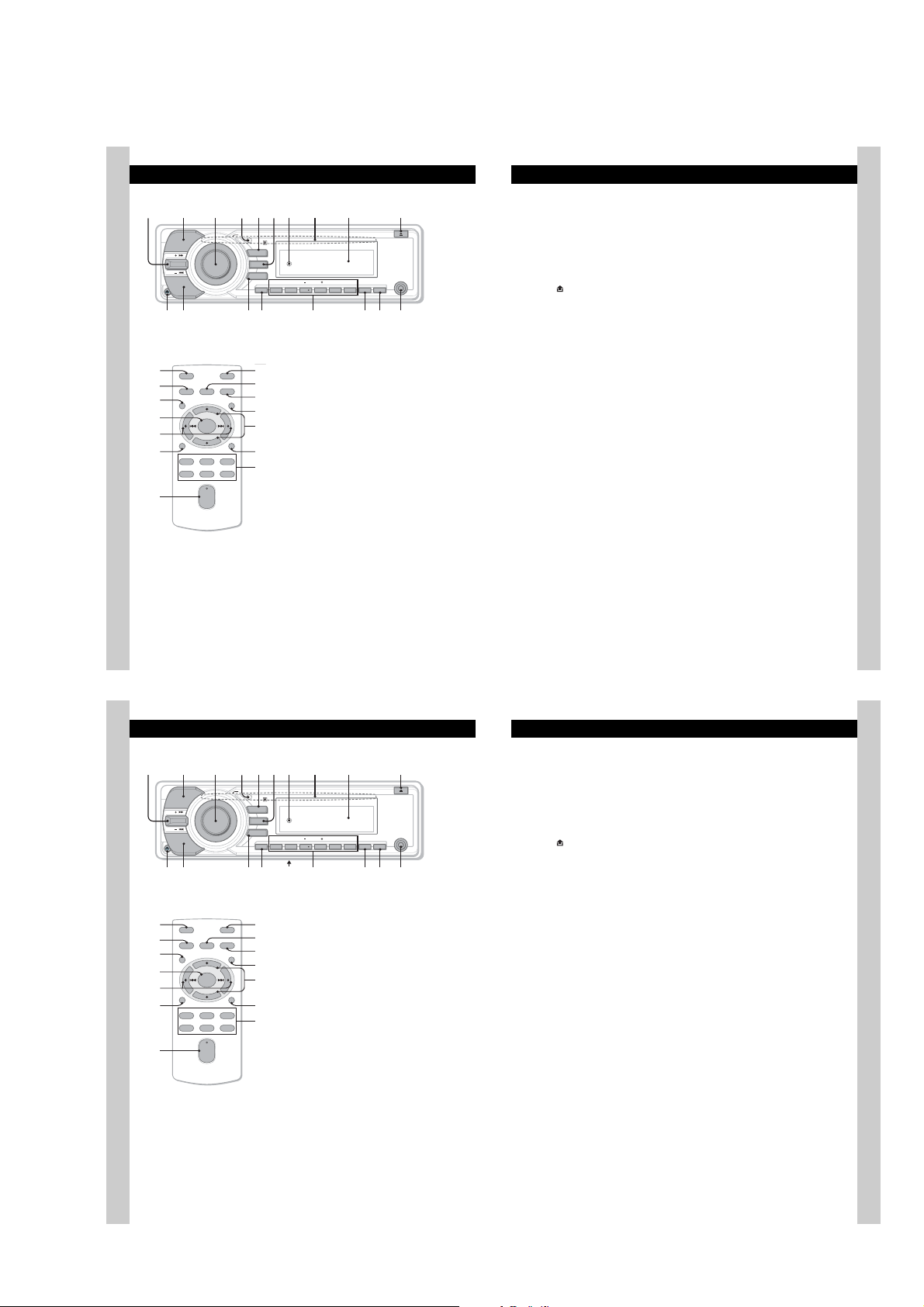
• CDX-GT710: AEP, UK model
123 789 q
546
Location of controls and basic operations
Main unit
ENTER
ENTER
PUSH SOUND / ENTER
MENU
IMAGE
LIST
REPPTY SHUF PAUSEBBE MPGP/ALBM
DSPL AF/TA OFF
123456
qg qh qj qk
Refer to the pages listed for details. The
corresponding buttons on the card remote
commander control the same functions as those
on the unit.
ws
ws
ATT
ATT
MODE
MODE
+
+
ñ
–
SCRL
SCRL
PAUSE
PAUSE
+
+
VOL
VOL
ñ
–
A SEEK +/– control
wd
wd
2
2
qd
qd
wf
wf
wg
wg
wh
wh
B MODE button 10, 15
C Volume control dial
D Receptor for the card remote
E MENU button
F IMAGE button
MODE
SEEK
SEEK
SOURCE
qa qs qdqf
Card remote commander
RM-X154
qj
qj
OFF
OFF
qs
qs
SOURCE SOUND
SOURCE SOUND
5
5
MENU LIST
MENU LIST
ql
ql
w;
w;
DSPL/PTY
DSPL/PTY
qf
qf
REP SHUF
REP SHUF
132
132
465
465
wa
wa
8
;
ANGLE
AUX
CDX-GT710
1
CD/MD*
:
To sk ip tracks (press up/down); skip tracks
continuously (press up/down, then press up/
down again within about 1 second and hold);
reverse/fast-forward a track (press up/down
and hold).
Radio:
To tune in stations automatically (press up/
down); find a station manually (press up/
down and hold).
To se l e ct th e radio band (FM/MW/LW);
2
select the unit*
To ad ju st volume.
SOUND button
To en te r sound setting.
ENTER button
To ap ply a menu setting.
commander
To en te r menu.
To se lect the display image.
Movie mode 1-3 t Spectrum analyzer
mode 1-5 t Wall paper mode 1-3 t
normal play/reception mode
.
CDX-GT71W/GT710/GT760
G RESET button (Location behind the front
panel) 4
H Disc slot 6
To in sert the disc.
I Display window
J Z (eject)/ANGLE button 7
To ej ec t the disc/slide down the front panel
(press); angle the front panel in 3 positions
(press and hold).
K (front panel release) button 5
L SOURCE button
To po we r on; ch ange the source (Radio/CD/
1
MD*
/AUX).
M LIST button 11, 15
To li st up.
N DSPL (Display)/PTY (Program Type)
button 12
To change display items/select PTY in RDS.
O Number buttons
1
CD/MD*
:
(1): REP 10, 15
(2): SHUF 10, 15
3
(3)/(4): GP*
(5): BBE MP 2
(6): PAUS E*
Radio:
To re ce ive stored stations (press); store
stations (press and hold).
P AF (Alternative Frequencies)/TA
(Traffic Announcement) button 11
To se t AF and TA in RDS.
Q OFF button
To po we r off; stop th e source.
R AUX input jack 14
To co nnect a portable audio device.
The following buttons on the card rem o t e
commander have also different bu ttons/f unct ions
from the unit. Remove the insulation film before
use (page 4).
/ALBM*4 –/+
To s kip albums (press); skip albums
continuously (press and hold) .*
To a ct iv ate the BBE MP function, set
“BBE MP on.” To cancel, set “BBE MP
off.”
6
To p ause playback. To cancel, press
again.
5
ql ENTER button
To complete a setting.
w; </, (SEEK –/+) buttons
1
CD/MD*
:
To skip tracks (press); skip tracks
continuously (press, then press again within
about 1 second and hold); fast-forward/
reverse a track (press and hold).
Radio:
To tune in stations automatically (press); find
a station manually (press and hold).
wa VOL (volume) +/– button
To adjust volume.
ws AT T (attenuate) button
To att e nuate the sound. To cancel, press
again.
wd SOUND button
To ent e r sound setting.
wf M/m (+/–) buttons
To s e le ct pr es et stations/skip groups (press);
skip groups continuously (press and hold).
wg SCRL (scroll) button 10
To s c roll the display item.
wh Number buttons
1
CD/MD*
:
(1): REP 10, 15
(2): SHUF 10, 15
6
(6): PAUS E*
To pa use playback. To cancel, press
again.
Radio:
To r e c e ive stored st at ions (press); store
stations (press and hold).
*1
When an MD changer is connected.
*2
When a CD/MD changer is connected.
*3
When an ATRAC CD is played.
*4
When an MP3/WMA/AAC is played.
*5
If the changer is connected, the operation is
different, see page 15.
*6
When playing bac k on this unit.
Note
If the unit is turned off and the display disappears, it
cannot be operated with the card remote commander
unless
(SOURCE)
inserted to activate the unit first.
Tip
For details on how to replace the battery, see
“Replacing the lithium battery of the card remote
commander” on page 18.
on the unit is pressed, or a disc is
9
• CDX-GT760
Location of controls and basic operations
Main unit
123 54678 9 q;
ENTER
PUSH SOUND / ENTER
MENU
IMAGE
LIST
DSPL SCRL OFF
wd
ATT
wf
MODE
2
LIST
+
–
+
VOL
–
qd
wg
SCRL
qj
PAUSE
wh
MODE
SEEK
SEEK
SOURCE
qa qs qdqf
Card remote commander
RM-X156
qk
OFF
qs
SOURCE SOUND
5
MENU
w;
wa
DSPL
qf
REP SHUF
132
465
ws
8
REP SHUF PAUSEBBE MPGP/ALBM
123456
qg
qh qj qk ql
Refer to the pages listed for details. The
corresponding buttons on the card remote
commander control the same functions as those
on the unit.
A SEEK +/– control
1
CD/MD*
:
To sk ip tracks (press up/down); skip tracks
continuously (press up/down, then press up/
down again within about 1 second and hold);
reverse/fast-forward a track (press up/down
and hold).
Radio:
To tune in stations automatically (press up/
down); find a station manually (press up/
down and hold).
B MODE button 10, 13
To select th e radio band (FM/AM); select the
2
unit*
.
C Volume control dial
To ad ju st volume.
SOUND button
To en te r sound setting.
ENTER button
To ap ply a menu setting.
D Receptor for the card remote
commander
E MENU button
To en te r menu.
F IMAGE button
To se lect the display image.
Movie mode 1-3 t Spectrum analyzer
mode 1-5 t Wall paper mode 1-3 t
normal play/reception mode
G RESET button (Location behind the front
panel) 4
H Disc slot 6
ANGLE
AUX
CDX-GT760
To in sert the disc.
I Display window
J Z (eject)/ANGLE button 7
To ej ec t the disc/slide down the front panel
(press); angle the front panel in 3 po si t io ns
(press and hold).
K (front panel release) button 5
L SOURCE button
To po we r on; ch ange the source (Radio/CD/
1
MD*
/AUX).
M LIST button 11, 14
To li st up.
N DSPL (display) button 10
To ch an g e display items.
O Frequency select switch (located on the
bottom of the unit)
See “Frequency select switch” i n t he
supplied installation/connections manual.
P Number buttons
1
CD/MD*
:
(1): REP 10, 14
(2): SHUF 10, 14
3
(3)/(4): GP*
(5): BBE MP 2
(6): PAUS E*
Radio:
To re ce ive stored stations (press); store
stations (press and hold).
Q SCRL (scroll) button 10
To sc ro ll th e display item.
R OFF button
To po we r off; stop th e source.
S AUX input jack 13
To co nnect a portable audio device.
/ALBM*4 –/+
To s kip albums (press); skip albums
continuously (press and hold) .*
To a ct iv ate the BBE MP function, set
“BBE MP on.” To cancel, set “BBE MP
off.”
6
To p ause playback. To cancel, press
again.
The following buttons on the card remote
commander have also different buttons/functions
from the unit. Remove the insulation film before
use (page 4).
w; ENTER button
To complete a setting.
wa </, (SEEK –/+) buttons
1
CD/MD*
:
To skip tracks (press); skip tracks
continuously (press, then press again within
about 1 second and hold); fast-forward/
reverse a track (press and hold).
Radio:
To tune in stations automatically (press); find
a station manually (press and hold).
ws VOL (volume) +/– button
To adjust volume.
wd AT T (attenuate) button
To att e nuate the sound. To cancel, press
again.
wf SOUND button
To ent e r sound setting.
wg M/m (+/–) buttons
To s e le ct pr eset stations/skip groups (press);
skip groups continuously (press and hold).
wh Number buttons
1
CD/MD*
:
(1): REP 10, 14
5
(2): SHUF 10, 14
(6): PAUS E*
To pa use playback. To cancel, press
again.
Radio:
To r e c e ive stored st at ions (press); store
stations (press and hold).
*1
When an MD changer is connected.
*2
When a CD/MD changer is connected.
*3
When an ATRAC CD is played.
*4
When an MP3/WMA/AAC is played.
*5
If the changer is connected, the operation is
different, see page 14.
*6
When playing bac k on this unit.
Note
If the unit is turned off and the display disappears, it
cannot be operated with the card remote commander
unless
(SOURCE)
inserted to activate the unit first.
Tip
For details on how to replace the battery, see
“Replacing the lithium battery of the card remote
commander” on page 17.
on the unit is pressed, or a disc is
6
9
7
Page 8
CDX-GT71W/GT710/GT760
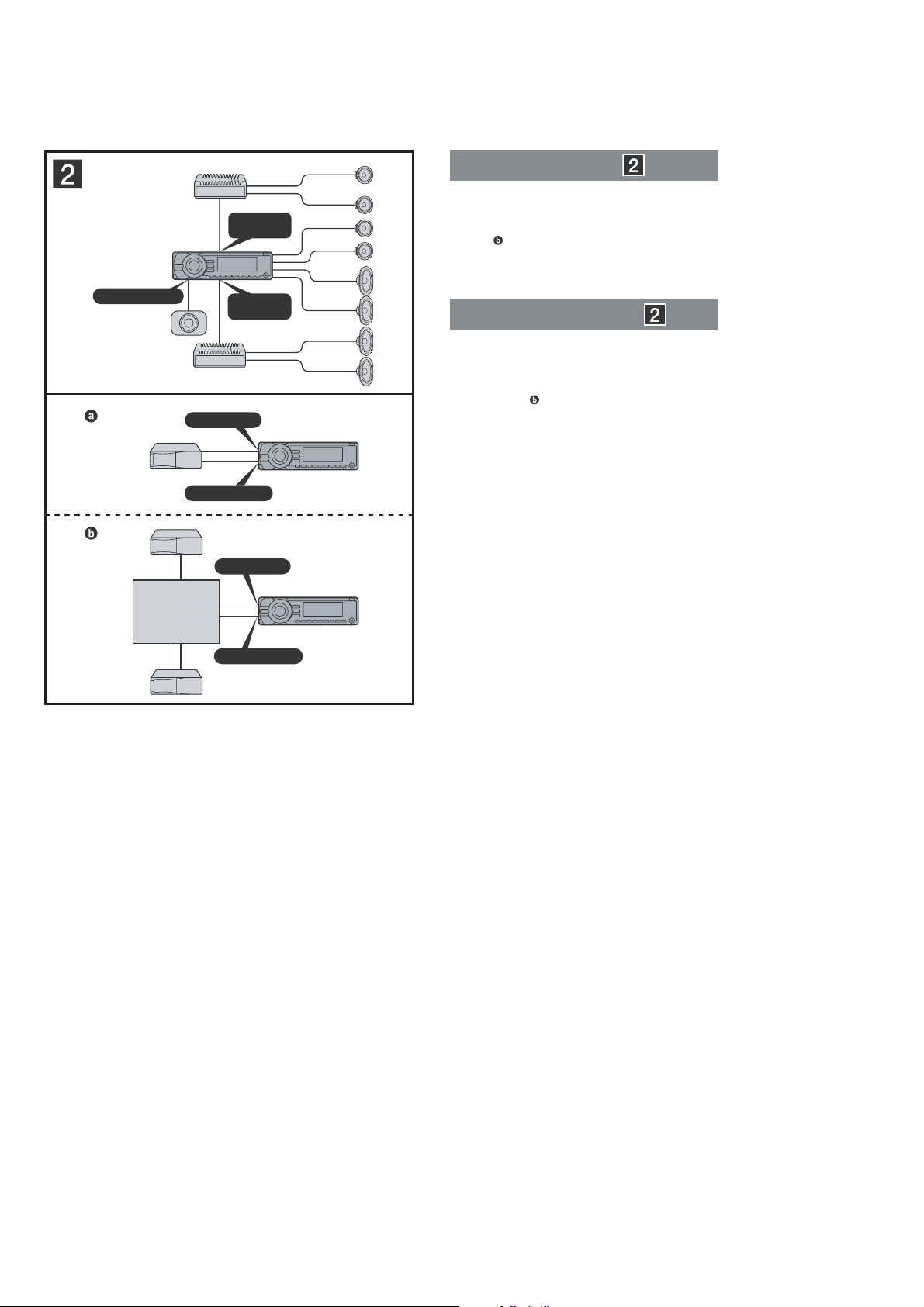
• CONNECTIONS
• CDX-GT71W
A
AUDIO OUT
FRONT
Connection example
Notes
(2-A)
•
Be sure to connect the ground (earth) lead before connecting
the amplifi er.
•
The alarm will only sound if the built-in amplifi er is used.
(2-B- )
Tip
For connecting two or more CD/MD changers, the source
selector XA-C40 (not supplied) is necessary.
B
SUB OUT (MONO)
Source selector*
Selector de fuente*
BUS AUDIO IN
BUS CONTROL IN
XA-C40
AUDIO OUT
REAR
BUS AUDIO IN
BUS CONTROL IN
*
not supplied
no suministrado
Ejemplo de conexiones
Notas
(2-A)
•
Asegúrese de conectar primero el cable de conexión a masa
antes de realizar la conexión del amplifi cador.
•
La alarma sonará únicamente si se utiliza el amplifi cador
incorporado.
Sugerencia
Si desea conectar dos o más cambiadores de CD/MD,
necesitará el selector de fuente XA-C40 (no suministrado).
(2-B-
)
8
Page 9
CDX-GT71W/GT710/GT760
3
1
2
4
5
6
7
AUDIO
OUT
REAR
AUDIO
OUT
FRONT
BUS
AUDIO
IN
AUDIO OUT
REAR
AUDIO OUT
FRONT
BUS AUDIO IN
*
2
BUS
CONTROL IN
REMOTE
IN
SUB OUT (MONO)
L
R
AMP REM
Max. supply current 0.3 A
Corriente máx. de alimentación de 0,3 A
Fuse (10 A)
Fusible (10 A)
Blue/white striped
Con rayas azules y blancas
ANT REM
Red
Rojo
Yellow
Amarillo
Black
Negro
Blue
Azul
White
Blanco
Green
Verde
Purple
Morado
White/black striped
Con rayas blancas y negras
Gray/black striped
Con rayas grises y negras
Green/black striped
Con rayas verdes y negras
Gray
Gris
Left
Izquierdo
Right
Derecho
*
1
RCA pin cord (not supplied)
*
2
Be sure to match the color-coded
cord for audio to the appropriate
jacks from the unit.
*
3
Supplied with XA-C40
*
4
Insert with the cord upwards.
*
1
Cable con terminales RCA
(no suministrado)
*
2
Aseg˙rese de hacer coincidir
el cable de audio codifi cado
con colores con las tomas
correspondientes de la unidad.
*
3
Suministrado con el XA-C40
*
4
Insertar con el cable hacia arriba.
Purple/black striped
Con rayas moradas y negras
*
1
Source selector
(not supplied)
Selector de fuente
(no suministrado)
XA-C40
Supplied with the CD/MD changer
Suministrado con el cambiador de CD/MD
Max. supply current 0.1 A
Corriente máx. de alimentación de 0,1 A
from car antenna (aerial)
desde la antena del automóvil
Left
Izquierdo
Right
Derecho
ATT
ILLUMINATION
Orange/white striped
Con rayas naranjas y blancas
Light blue
Azul celeste
*
1
*
4
*
3
2
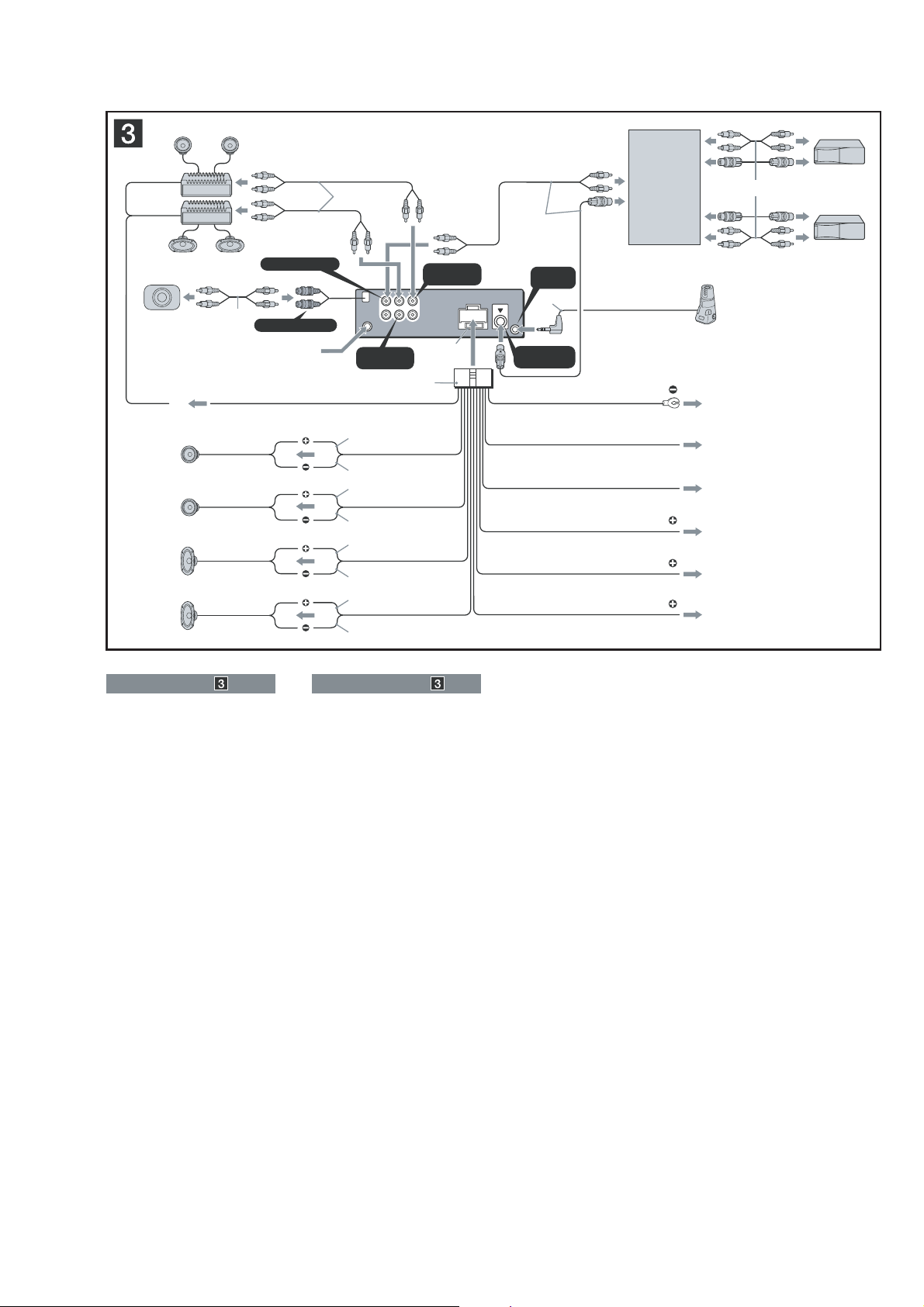
Connection diagram
1 To a metal surface of the car
First connect the black ground (earth) lead, then connect the
yellow and red power supply leads.
2 To the power antenna (aerial) control lead or
power supply lead of antenna (aerial) booster
Notes
•
It is not necessary to connect this lead if there is no power
antenna (aerial) or antenna (aerial) booster, or with a
manually-operated telescopic antenna (aerial).
•
When your car has a built-in FM/AM antenna (aerial) in
the rear/side glass, see “Notes on the control and power
supply leads.”
3 To AMP REMOTE IN of an optional power
amplifi er
This connection is only for amplifi ers. Connecting any other
system may damage the unit.
4 To the interface cable of a car telephone
5 To a car’s illumination signal
Be sure to connect the black ground (earth) lead to a metal
surface of the car fi rst.
6 To the +12 V power terminal which is
energized in the accessory position of the
ignition switch
Notes
•
If there is no accessory position, connect to the +12 V
power (battery) terminal which is energized at all times.
Be sure to connect the black ground (earth) lead to a
metal surface of the car fi rst.
•
When your car has a built-in FM/AM antenna (aerial) in
the rear/side glass, see “Notes on the control and power
supply leads.”
7 To the +12 V power terminal which is
Notes on the control and power supply leads
•
The power antenna (aerial) control lead (blue) supplies +12 V
DC when you turn on the tuner.
•
When your car has built-in FM/AM antenna (aerial) in the rear/
side glass, connect the power antenna (aerial) control lead
(blue) or the accessory power supply lead (red) to the power
terminal of the existing antenna (aerial) booster. For details,
consult your dealer.
•
A power antenna (aerial) without a relay box cannot be used
with this unit.
Memory hold connection
When the yellow power supply lead is connected, power will
always be supplied to the memory circuit even when the ignition
switch is turned off.
Notes on speaker connection
•
Before connecting the speakers, turn the unit off.
•
Use speakers with an impedance of 4 to 8 ohms, and with
adequate power handling capacities to avoid its damage.
•
Do not connect the speaker terminals to the car chassis, or
connect the terminals of the right speakers with those of the
left speaker.
•
Do not connect the ground (earth) lead of this unit to the
negative (–) terminal of the speaker.
•
Do not attempt to connect the speakers in parallel.
•
Connect only passive speakers. Connecting active speakers
(with built-in amplifi ers) to the speaker terminals may damage
the unit.
•
To avoid a malfunction, do not use the built-in speaker leads
installed in your car if the unit shares a common negative (–)
lead for the right and left speakers.
•
Do not connect the unit’s speaker leads to each other.
Note on connection
If speaker and amplifi er are not connected correctly, “FAILURE”
appears in the display. In this case, make sure the speaker and
amplifi er are connected correctly.
energized at all times
Be sure to connect the black ground (earth) lead to a metal
surface of the car fi rst.
Diagrama de conexión
1 A una superfi cie metálica del automóvil
Conecte primero el cable de conexión a masa negro,
y después los cables amarillo, y rojo de fuente de
alimentación.
2 Al cable de control de la antena motorizada
o al cable de fuente de alimentación del
amplifi cador de señal de la antena
Notas
•
Si no se dispone de antena motorizada ni de amplifi cador
de antena, o se utiliza una antena telescópica accionada
manualmente, no será necesario conectar este cable.
•
Si el automóvil incorpora una antena de FM/AM en el
cristal trasero o lateral, consulte “Notas sobre los cables
de control y de fuente de alimentación”.
3 A AMP REMOTE IN de un amplifi cador de
potencia opcional
Esta conexión es sólo para amplifi cadores. La conexión de
cualquier otro sistema puede dañar la unidad.
4 Al cable de interfaz de un teléfono para
automóvil
5 A una señal de iluminación del automóvil
Asegúrese de conectar primero el cable de conexión a masa
negro a una superfi cie metálica del automóvil.
6 Al terminal de alimentación de +12 V que
recibe energía en la posición de accesorio
del interruptor de encendido
Notas
•
Si no hay posición de accesorio, conéctelo al terminal de
alimentación (batería) de +12 V que recibe energía sin
interrupción.
Asegúrese de conectar primero el cable de conexión a
masa negro a una superfi cie metálica del automóvil.
•
Si el automóvil incorpora una antena de FM/AM en el
cristal trasero o lateral, consulte “Notas sobre los cables
de control y de fuente de alimentación”.
7 Al terminal de alimentación de +12 V que
recibe energía sin interrupción
Asegúrese de conectar primero el cable de conexión a masa
negro a una superfi cie metálica del automóvil.
Notas sobre los cables de control y de fuente de
alimentación
•
El cable de control de la antena motorizada (azul) suministrar·
cc de + 12 V cuando conecte la alimentación del sintonizador.
•
Si el automóvil dispone de una antena de FM/AM incorporada
en el cristal trasero o lateral, conecte el cable de control de
antena motorizada (azul) o el cable de fuente de alimentación
auxiliar (rojo) al terminal de alimentación del amplifi cador de
antena existente. Para obtener más información, consulte a su
distribuidor.
•
Con esta unidad no es posible utilizar una antena motorizada
sin caja de relé.
Conexión para protección de la memoria
Si conecta el cable de fuente de alimentación amarillo, el circuito
de la memoria recibirá siempre alimentación, aunque apague el
interruptor de encendido.
Notas sobre la conexión de los altavoces
•
Antes de conectar los altavoces, desconecte la alimentación
de la unidad.
•
Utilice altavoces con una impedancia de 4 a 8
capacidad de potencia adecuada para evitar que se dañen.
•
No conecte los terminales de altavoz al chasis del automóvil,
ni conecte los terminales del altavoz derecho con los del
izquierdo.
•
No conecte el cable de conexión a masa de esta unidad al
terminal negativo (–) del altavoz.
•
No intente conectar los altavoces en paralelo.
•
Conecte solamente altavoces pasivos. Si conecta altavoces
activos (con amplifi cadores incorporados) a los terminales de
altavoz, puede dañar la unidad.
•
Para evitar fallas de funcionamiento, no utilice los cables de
altavoz incorporados instalados en el automóvil si su unidad
comparte un cable negativo común (–) para los altavoces
derecho e izquierdo.
•
No conecte los cables de altavoz de la unidad entre sí.
Nota sobre la conexión
Si el altavoz y el amplifi cador no están conectados
correctamente, aparecerá “FAILURE” en la pantalla. Si es así,
compruebe la conexión del altavoz y el amplifi cador.
Ω
con la
9
Page 10
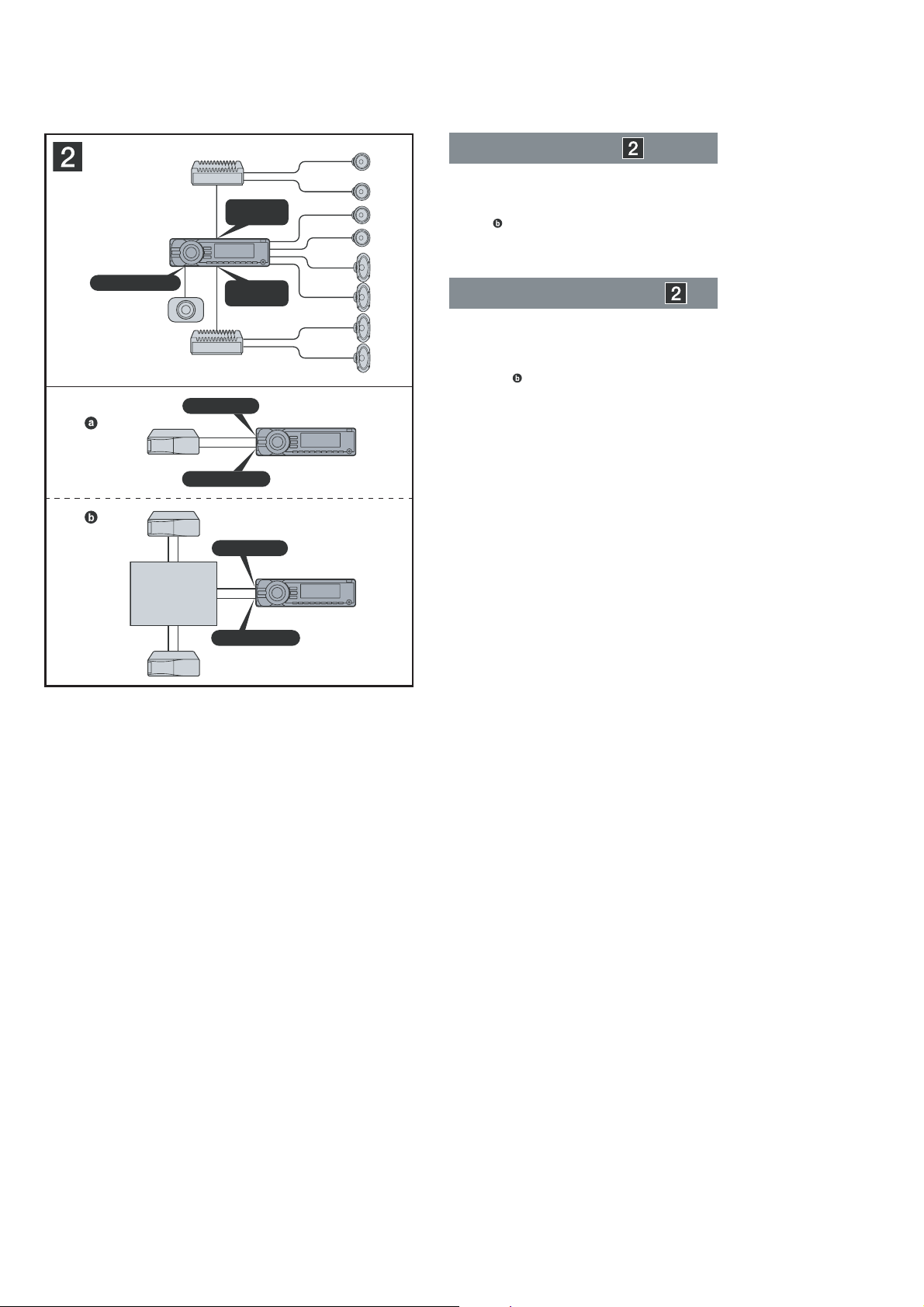
CDX-GT71W/GT710/GT760
• CDX-GT710: US, Canadian model
A
AUDIO OUT
FRONT
Connection example
Notes
(2-A)
•
Be sure to connect the ground (earth) lead before connecting
the amplifi er.
•
The alarm will only sound if the built-in amplifi er is used.
(2-B- )
Tip
For connecting two or more CD/MD changers, the source
selector XA-C40 (not supplied) is necessary.
B
SUB OUT (MONO)
Source selector*
Sélecteur de source*
XA-C40
AUDIO OUT
REAR
BUS AUDIO IN
BUS CONTROL IN
BUS AUDIO IN
BUS CONTROL IN
*
not supplied
non fourni
Exemple de raccordement
Remarques
•
•
Conseil
Dans le cas du raccordement de deux changeurs de CD/MD ou
plus, le sélecteur de source XA-C40 (non fourni) est requis.
(2-A)
Raccordez d’abord le câble de mise à la masse avant de
raccorder l’amplifi cateur.
L’alarme est émise uniquement lorsque l’amplifi cateur intégré
est utilisé.
(2
-B-
)
10
Page 11
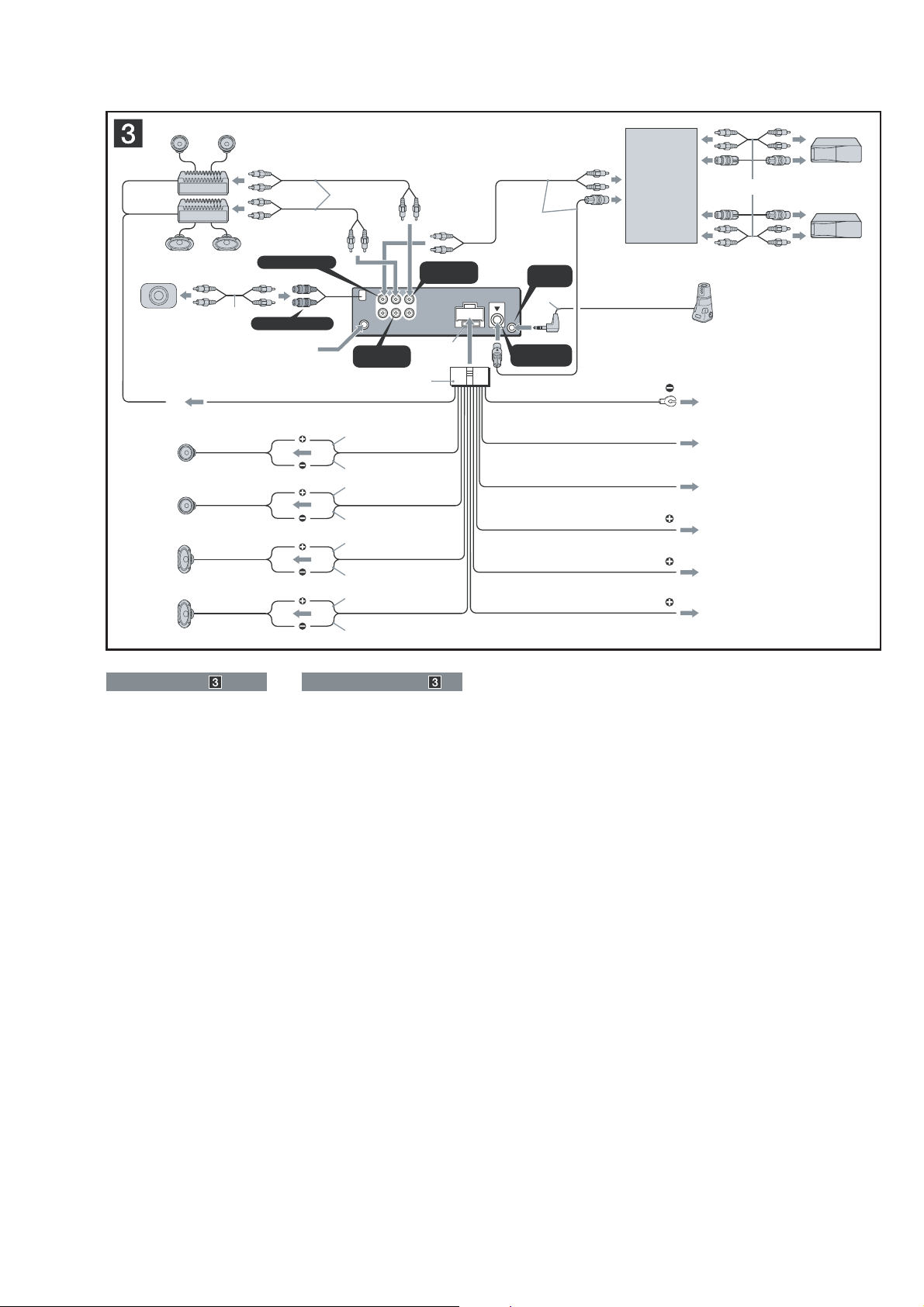
CDX-GT71W/GT710/GT760
3
1
2
4
5
6
7
AUDIO
OUT
REAR
AUDIO
OUT
FRONT
BUS
AUDIO
IN
AUDIO OUT
REAR
AUDIO OUT
FRONT
BUS AUDIO IN
*
2
BUS
CONTROL IN
REMOTE
IN
SUB OUT (MONO)
L
R
AMP REM
Max. supply current 0.3 A
Courant max. fourni 0,3 A
Fuse (10 A)
Fusible (10 A)
Blue/white striped
Rayé bleu/blanc
ANT REM
Red
Rouge
Yellow
Jaune
Black
Noir
Blue
Bleu
White
Blanc
Green
Vert
Purple
Mauve
White/black striped
Rayé blanc/noir
Gray/black striped
Rayé gris/noir
Green/black striped
Rayé vert/noir
Gray
Gris
Left
Gauche
Right
Droit
Left
Gauche
Right
Droit
Purple/black striped
Rayé mauve/noir
*
1
Source selector
(not supplied)
Sélecteur de source
(non fourni)
XA-C40
Supplied with the CD/MD changer
Fourni avec le changeur de CD/MD
Max. supply current 0.1 A
Courant max. fourni 0,1 A
from car antenna (aerial)
à partir de l’antenne de la voiture
ILLUMINATION
Light blue
Bleu ciel
Orange/white striped
Rayé orange/blanc
*
1
ATT
*
1
RCA pin cord (not supplied)
*
2
Be sure to match the color-coded cord
for audio to the appropriate jacks from
the unit.
*
3
Supplied with XA-C40
*
4
Insert with the cord upwards.
*
1
Cordon à broche RCA (non fourni)
*
2
Veillez à faire correspondre le code de
couleur du cordon audio à celui des
fiches correspondantes de l’appareil.
*
3
Fourni avec le XA-C40
*
4
Insérez avec le câble vers le haut.
*
4
*
3
2
Connection diagram
1 To a metal surface of the car
First connect the black ground (earth) lead, then connect the
yellow and red power supply leads.
2 To the power antenna (aerial) control lead or
power supply lead of antenna (aerial) booster
Notes
•
It is not necessary to connect this lead if there is no power
antenna (aerial) or antenna (aerial) booster, or with a
manually-operated telescopic antenna (aerial).
•
When your car has a built-in FM/AM antenna (aerial) in
the rear/side glass, see “Notes on the control and power
supply leads.”
3 To AMP REMOTE IN of an optional power
amplifi er
This connection is only for amplifi ers. Connecting any other
system may damage the unit.
4 To the interface cable of a car telephone
5 To a car’s illumination signal
Be sure to connect the black ground (earth) lead to a metal
surface of the car fi rst.
6 To the +12 V power terminal which is
energized in the accessory position of the
ignition switch
Notes
•
If there is no accessory position, connect to the +12 V
power (battery) terminal which is energized at all times.
Be sure to connect the black ground (earth) lead to a
metal surface of the car fi rst.
•
When your car has a built-in FM/AM antenna (aerial) in
the rear/side glass, see “Notes on the control and power
supply leads.”
7 To the +12 V power terminal which is
Notes on the control and power supply leads
•
•
•
Memory hold connection
When the yellow power supply lead is connected, power will
always be supplied to the memory circuit even when the ignition
switch is turned off.
Notes on speaker connection
•
•
•
•
•
•
•
•
Note on connection
If speaker and amplifi er are not connected correctly, “FAILURE”
appears in the display. In this case, make sure the speaker and
amplifi er are connected correctly.
energized at all times
Be sure to connect the black ground (earth) lead to a metal
surface of the car fi rst.
The power antenna (aerial) control lead (blue) supplies +12 V
DC when you turn on the tuner.
When your car has built-in FM/AM antenna (aerial) in the rear/
side glass, connect the power antenna (aerial) control lead
(blue) or the accessory power supply lead (red) to the power
terminal of the existing antenna (aerial) booster. For details,
consult your dealer.
A power antenna (aerial) without a relay box cannot be used
with this unit.
Before connecting the speakers, turn the unit off.
Use speakers with an impedance of 4 to 8 ohms, and with
adequate power handling capacities to avoid its damage.
Do not connect the speaker terminals to the car chassis, or
connect the terminals of the right speakers with those of the
left speaker.
Do not connect the ground (earth) lead of this unit to the
negative (–) terminal of the speaker.
Do not attempt to connect the speakers in parallel.
Connect only passive speakers. Connecting active speakers
(with built-in amplifi ers) to the speaker terminals may damage
the unit.
To avoid a malfunction, do not use the built-in speaker leads
installed in your car if the unit shares a common negative (–)
lead for the right and left speakers.
Do not connect the unit’s speaker leads to each other.
Schéma de raccordement
1 Vers un point métallique de la voiture
Branchez d’abord le câble de mise à la masse noir et,
ensuite, les câbles d’alimentation jaune et rouge.
2 Vers le câble de commande d’antenne
électrique ou le câble d’alimentation de
l’amplifi cateur d’antenne
Remarques
•
Il n’est pas nécessaire de raccorder ce câble s’il n’y a pas
d’antenne électrique ni d’amplifi cateur d’antenne, ou avec
une antenne télescopique manuelle.
•
Si votre voiture est équipée d’une antenne FM/AM
intégrée dans la vitre arrière/latérale, voir « Remarques
sur les câbles de commande et d’alimentation ».
3 Vers AMP REMOTE IN de l’amplifi cateur de
puissance en option
Ce raccordement s’applique uniquement aux amplifi cateurs.
Le branchement de tout autre système risque
d’endommager l’appareil.
4 Vers le cordon de liaison d’un téléphone de
voiture
5 Vers le connecteur du signal d’éclairage de
la voiture
Raccordez d’abord le câble de mise à la masse noir à un
point métallique du véhicule.
6 Vers la borne d’alimentation +12 V qui est
alimentée quand la clé de contact est sur la
position accessoires
Remarques
•
S’il n’y a pas de position accessoires, raccordez la borne
d’alimentation (batterie) +12 V qui est alimentée en
permanence.
Raccordez d’abord le câble de mise à la masse noir à un
point métallique du véhicule.
•
Si votre voiture est équipée d’une antenne FM/AM
intégrée dans la vitre arrière/latérale, voir « Remarques
sur les câbles de commande et d’alimentation ».
7 Vers la borne d’alimentation +12 V qui est
alimentée en permanence
Raccordez d’abord le câble de mise à la masse noir à un
point métallique du véhicule.
Remarques sur les câbles de commande et d’alimentation
•
Le câble de commande d’antenne électrique (bleu) fournit une
alimentation de + 12 V CC lorsque vous mettez la radio sous
tension.
•
Lorsque votre voiture est équipée d’une antenne FM/AM
intégrée dans la vitre arrière/latérale, raccordez le câble
de commande d’antenne (bleu) ou le câble d’alimentation
d’alimentation des accessoires (rouge) à la borne
d’alimentation de l’amplifi cateur d’antenne existant. Pour plus
de détails, consultez votre détaillant.
•
Une antenne électrique sans boîtier de relais ne peut pas être
utilisée avec cet appareil.
Raccordement pour la conservation de la mémoire
Lorsque le câble d’alimentation jaune est raccordé, le circuit
de la mémoire est alimenté en permanence même si la clé de
contact est sur la position d’arrêt.
Remarques sur le raccordement des haut-parleurs
•
Avant de raccorder les haut-parleurs, mettez l’appareil hors
tension.
•
Utilisez des haut-parleurs ayant une impédance de 4 à 8 ohms
avec une capacité électrique adéquate pour éviter de les
endommager.
•
Ne raccordez pas les bornes du système de haut-parleurs au
châssis de la voiture et ne raccordez pas les bornes des hautparleurs droit à celles du haut-parleur gauche.
•
Ne raccordez pas le câble de mise à la masse de cet appareil
à la borne négative (–) du haut-parleur.
•
N’essayez pas de raccorder les haut-parleurs en parallèle.
•
Raccordez uniquement des haut-parleurs passifs. Le
raccordement de haut-parleurs actifs (avec amplifi cateurs
intégrés) aux bornes des haut-parleurs peut endommager
l’appareil.
•
Pour éviter tout problème de fonctionnement, n’utilisez pas les
câbles des haut-parleurs intégrés installés dans votre voiture si
l’appareil possède un câble négatif commun (–) pour les hautparleurs droit et gauche.
•
Ne raccordez pas entre eux les cordons des haut-parleurs de
l’appareil.
Remarque sur le raccordement
Si les haut-parleurs et l’amplifi cateur ne sont pas raccordés
correctement, le message « FAILURE » s’affi che. Dans ce cas,
assurez-vous que les haut-parleurs et l’amplifi cateur sont bien
raccordés.
11
Page 12
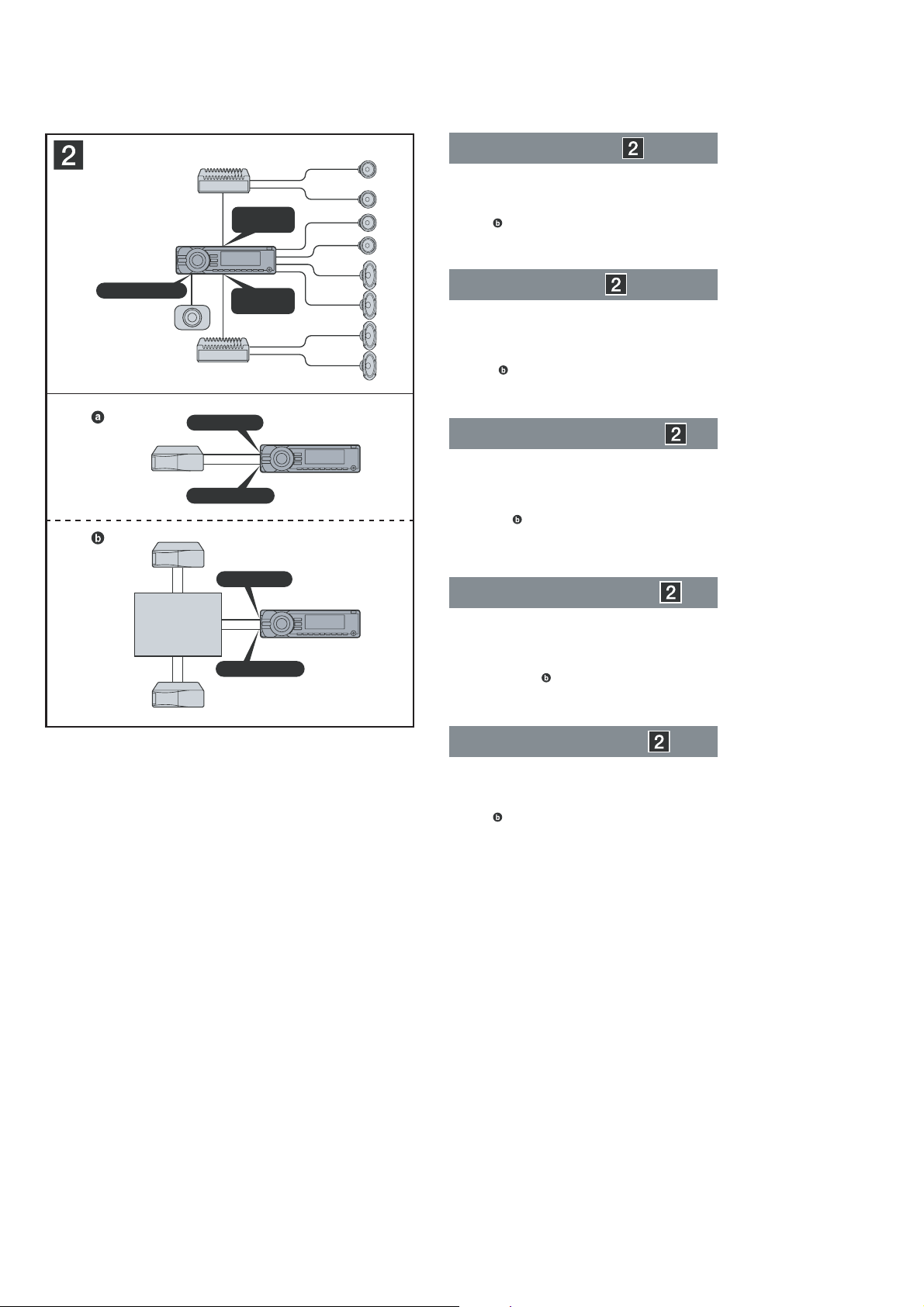
CDX-GT71W/GT710/GT760
• CDX-GT710: AEP, UK model
A
AUDIO OUT
FRONT
Connection example
Notes
(2-A)
•
Be sure to connect the ground (earth) lead before connecting
the amplifi er.
•
The alarm will only sound if the built-in amplifi er is used.
(2-B-
Tip
For connecting two or more CD/MD changers, the source
selector XA-C40 (not supplied) is necessary.
)
B
SUB OUT (MONO)
Source selector*
Signalquellenwähler*
Sélecteur de source*
Selettore di fonte*
Bronkeuzeschakelaar*
XA-C40
AUDIO OUT
REAR
BUS AUDIO IN
BUS CONTROL IN
BUS AUDIO IN
BUS CONTROL IN
*
not supplied
nicht mitgeliefert
non fourni
non in dotazione
niet bijgeleverd
Anschlussbeispiel
Hinweise
(2-A)
•
Schließen Sie unbedingt zuerst das Massekabel an, bevor Sie
den Verstärker anschließen.
•
Der Warnton wird nur ausgegeben, wenn der integrierte
Verstärker verwendet wird.
Tipp
(2-B-
Zum Anschließen von zwei oder mehr CD/MD-Wechslern wird
der Signalquellenwähler XA-C40 (nicht mitgeliefert) benötigt.
)
Exemple de raccordement
Remarques
•
•
Conseil
Dans le cas du raccordement de deux changeurs de CD/MD
ou plus, le sélecteur de source XA-C40 (non fourni) est
indispensable.
(2-A)
Raccordez d’abord le câble de mise à la masse avant de
connecter l’amplifi cateur.
L’alarme est émise uniquement lorsque l’amplifi cateur intégré
est utilisé.
(2-B- )
Esempio di collegamento
Note
(2-A)
•
•
Suggerimento
Per collegare due o più cambia CD/MD, occorre utilizzare il
selettore di fonte XA-C40 (non in dotazione).
Assicurarsi di collegare il cavo di terra prima di collegare
l’apparecchio all’amplifi catore.
L’allarme viene emesso solo se è in uso l’amplifi catore
incorporato.
(2-B- )
Voorbeeldaansluitingen
Opmerkingen
•
Sluit eerst de aarddraad aan voordat u de versterker aansluit.
•
U hoort de pieptoon alleen als de ingebouwde versterker wordt
gebruikt.
Tip
Om twee of meer CD/MD-wisselaars aan te sluiten, hebt u de
bronkeuzeschakelaar XA-C40 (niet bijgeleverd) nodig.
(2-A)
(2-B- )
12
Page 13
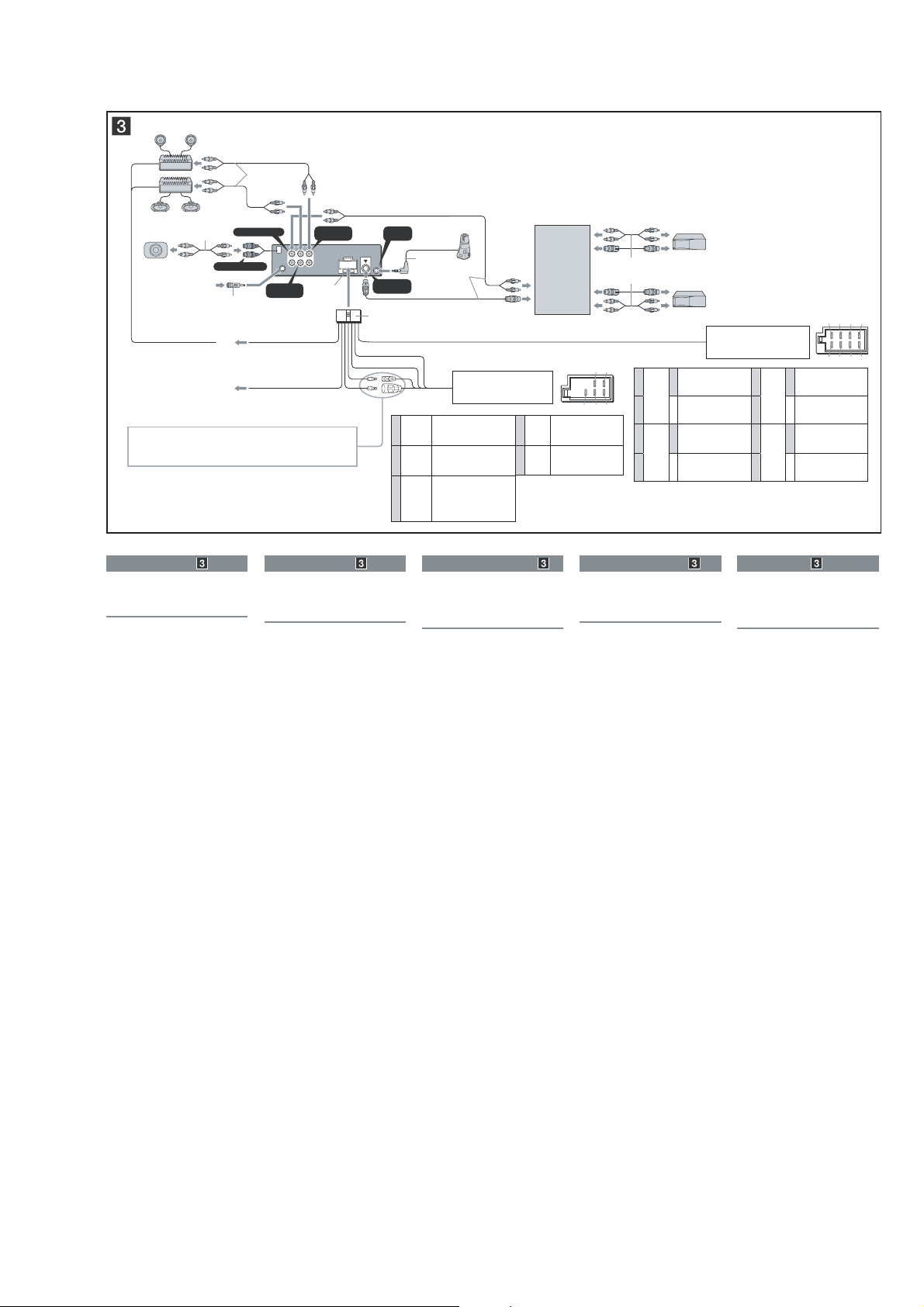
CDX-GT71W/GT710/GT760
L
R
AUDIO
OUT
REAR
AUDIO
OUT
FRONT
BUS
AUDIO
IN
57
48
13 57
24 68
A
B
6
AUDIO OUT
REAR
BUS
CONTROL IN
REMOTE
IN
AUDIO OUT
FRONT
BUS AUDIO IN
*
3
SUB OUT (MONO)
*1 from car antenna (aerial)
von Autoantenne
de l’antenne de la voiture
dall’antenna dell’auto
van een auto-antenne
Fuse (10 A)
Sicherung (10 A)
Fusible (10 A)
Fusibile (10 A)
Zekering (10 A)
AMP REM
Light blue
Hellblau
Bleu ciel
Azzurro
Lichtblauw
Blue/white striped
Blauweiß gestreift
Rayé bleu/blanc
Rigato blu e bianco
Blauw/wit gestreept
from the car’s power connector
vom Stromanschluss des Fahrzeugs
du connecteur d’alimentation de la voiture
dal connettore di alimentazione dell’auto
van de autovoedingsaansluiting
ATT
See “Power connection diagram” on the reverse side for details.
Näheres dazu fi nden Sie im „Stromanschlussdiagramm“. Blättern Sie dazu bitte um.
Voir le « Schéma de raccordement d’alimentation » au verso pour plus de détails.
Per ulteriori informazioni, vedere “Diagramma dei collegamenti di alimentazione” che si trova sul retro.
Zie "Voedingsaansluitschema" op de achterkant voor meer details.
Max. supply current 0.3 A
max. Versorgungsstrom 0,3 A
Courant d’alimentation maximum 0,3 A
Alimentazione massima fornita 0,3 A
Max. voedingsstroom 0,3 A
Negative polarity positions 2, 4, 6, and 8 have striped leads.
An den negativ gepolten Positionen 2, 4, 6 und 8 befi nden sich gestreifte Adern.
Les positions de polarité négative 2, 4, 6 et 8 sont dotées de cordons rayés.
Le posizioni a polarità negativa 2, 4, 6 e 8 hanno cavi rigati.
De posities voor negatieve polariteit (2, 4, 6 en 8) hebben gestreepte kabels.
1
Purple
Violett
Mauve
Viola
Paars
+
Speaker, Rear, Right
Lautsprecher hinten rechts
Haut-parleur, arrière, droit
Diffusore, posteriore, destro
Luidspreker, achter, rechts
5
White
Weiß
Blanc
Bianco
Wit
+
Speaker, Front, Left
Lautsprecher vorne links
Haut-parleur, avant, gauche
Diffusore, anteriore, sinistro
Luidspreker, voor, links
2–
Speaker, Rear, Right
Lautsprecher hinten rechts
Haut-parleur, arrière, droit
Diffusore, posteriore, destro
Luidspreker, achter, rechts
6–
Speaker, Front, Left
Lautsprecher vorne links
Haut-parleur, avant, gauche
Diffusore, anteriore, sinistro
Luidspreker, voor, links
3
Gray
Grau
Gris
Grigio
Grijs
+
Speaker, Front, Right
Lautsprecher vorne rechts
Haut-parleur, avant, droit
Diffusore, anteriore, destro
Luidspreker, voor, rechts
7
Green
Grün
Vert
Verde
Groen
+
Speaker, Rear, Left
Lautsprecher hinten links
Haut-parleur, arrière, gauche
Diffusore, posteriore, sinistro
Luidspreker, achter, links
4–
Speaker, Front, Right
Lautsprecher vorne rechts
Haut-parleur, avant, droit
Diffusore, anteriore, destro
Luidspreker, voor, rechts
8–
Speaker, Rear, Left
Lautsprecher hinten links
Haut-parleur, arrière, gauche
Diffusore, posteriore, sinistro
Luidspreker, achter, links
*
2
Supplied with the CD/MD changer
Mit dem CD/MD-Wechsler geliefert
Fourni avec le changeur de CD/MD
In dotazione con il cambia CD/MD
CD/MD-wisselaar bijgeleverd
Source selector
(not supplied)
Signalquellenwähler
(nicht mitgeliefert)
Sélecteur de source
(non fourni)
Selettore di fonte
(non in dotazione)
Bronkeuzeschakelaar
(niet bijgeleverd)
XA-C40
from the car’s speaker connector
vom Lautsprecheranschluss des Fahrzeugs
du connecteur de haut-parleur de la voiture
dal connettore del diffusore dell’auto
van de autoluidsprekeraansluiting
Positions 1, 2 and 3 do not have pins.
An Position 1, 2 und 3 befi nden sich keine Stifte.
Les positions 1, 2 et 3 ne comportent pas de broches.
Le posizioni 1, 2 e 3 non hanno piedini.
De posities 1, 2 en 3 hebben geen pins.
4
Yellow
Gelb
Jaune
Giallo
Geel
continuous power supply
permanente Stromversorgung
alimentation continue
alimentazione continua
continu voeding
5
Blue
Blau
Bleu
Blu
Blauw
power antenna (aerial) control
Motorantennensteuerung
antenne électrique
comando dell’antenna elettrica
bedieningskabel elektrische antenne
6
Orange/White
Orangeweiß
gestreift
Rayé orange/
blanc
Arancione/
bianco
Oranje/wit
switched illumination power supply
geschaltete
Beleuchtungsstromversorgung
alimentation de l’éclairage commutée
alimentazione illuminazione commutata
geschakelde voeding voor verlichting
7
Red
Rot
Rouge
Rosso
Rood
switched power supply
geschaltete Stromversorgung
alimentation commutée
alimentazione commutata
geschakelde voeding
8
Black
Schwarz
Noir
Nero
Zwart
ground (earth)
Masse
masse
terra
aarding
*
2
*
5
*
4
*
1
Note for the aerial connecting
If your car antenna (aerial) is an
ISO (International Organisation for
Standardisation) type, use the supplied
adaptor
2
to connect it. First connect
the car antenna (aerial) to the supplied
adaptor, then connect it to the antenna
(aerial) jack of the master unit.
*
2
RCA pin cord (not supplied)
*
3
Be sure to match the colour-coded cord
for audio to the appropriate jacks from
the unit.
*
4
Insert with the cord upwards
*
5
Supplied with XA-C40
*
1
Hinweis zum Anschließen der Antenne
Wenn Ihre Autoantenne der ISO-Norm (
Internationale Normungsgemeinschaft)
entspricht, schließen Sie sie mithilfe des
mitgelieferten Adapters
2
an. Verbinden
Sie zuerst die Autoantenne mit dem
mitgelieferten Adapter und verbinden Sie
diesen dann mit der Antennenbuchse
des Hauptgeräts.
*
2
Cinchkabel (nicht mitgeliefert)
*
3
Achten Sie darauf, das farbcodierte
Audiokabel mit den richtigen Buchsen
am Gerät zu verbinden.
*
4
Mit dem Kabel nach oben einsetzen
*
5
Mit dem XA-C40 geliefert
*
1
Remarque sur le raccordement de
l’antenne
Si votre antenne de voiture est de type
ISO (Organisation internationale de
normalisation), utilisez l’adaptateur fourni
pour la r
2
accorder. Raccordez d’abord
l’antenne de voiture à l’adaptateur fourni
et, ensuite, à la prise d’antenne de
l’appareil principal.
*
2
Cordon à broche RCA (non fourni)
*
3
Veillez à faire correspondre le code de
couleur du cordon audio à celui des
fiches correspondantes de l’appareil.
*
4
Insérez avec le câble vers le haut
*
5
Fourni avec le XA-C40
*
1
Opmerking bij de antenne-aansluiting
Indien uw auto is uitgerust met een
antenne van het type ISO (International
Organisation for Standardization),
moet u die aansluiten met behulp
van de bijgeleverde adapter
2
. Sluit
eerst de auto-antenne aan op de
bijgeleverde adapter en vervolgens de
antennestekker op het hoofdtoestel.
*
2
RCA-kabel (niet bijgeleverd)
*
3
Zorg ervoor dat de kleurcode van het
snoer voor audio overeenkomt met
de bijbehorende aansluitingen op het
apparaat.
*
4
Plaatsen met het snoer naar boven
*
5
XA-C40 bijgeleverd
*
1
Nota per il collegamento dell’antenna
Se l’antenna dell’auto è di tipo
ISO (International Organization for
Standardization), utilizzare l’adattatore
in dotazione per collegar
2
la. Collegare
prima l’antenna della macchina
all’adattatore in dotazione, quindi
collegarla alla presa dell’antenna
dell’apparecchio principale.
*
2
Cavo a piedini RCA (non in dotazione)
*
3
Assicurarsi che i cavi differenziati in base
al colore per l’audio corrispondano alle
prese appropriate dell’apparecchio.
*
4
Inserire con il cavo rivolto verso l’alto
*
5
In dotazione con il modello XA-C40
3
2
Connection diagram
A To AMP REMOTE IN of an optional power
amplifi er
This connection is only for amplifi ers. Connecting any other
system may damage the unit.
B To the interface cable of a car telephone
Warning
If you have a power antenna (aerial) without a relay box,
connecting this unit with the supplied power connecting
lead 3 may damage the antenna (aerial).
Notes on the control power and suppy leads
•
The power antenna (aerial) control lead (blue) supplies +12 V
DC when you turn on the tuner, or when you activate the AF
(Alternative Frequency) or TA (Traffi c Announcement) function.
•
When your car has built-in FM/MW/LW antenna (aerial) in the
rear/side glass, connect the power antenna (aerial) control
lead (blue) or the accessory power supply lead (red) to the
power terminal of the existing antenna (aerial) booster. For
details, consult your dealer.
•
A power antenna (aerial) without a relay box cannot be used
with this unit.
Memory hold connection
When the yellow power supply lead is connected, power will
always be supplied to the memory circuit even when the ignition
switch is turned off.
Notes on speaker connection
•
Before connecting the speakers, turn the unit off.
•
Use speakers with an impedance of 4 to 8 ohms, and with
adequate power handling capacities to avoid its damage.
•
Do not connect the speaker terminals to the car chassis, or
connect the terminals of the right speakers with those of the
left speaker.
•
Do not connect the ground (earth) lead of this unit to the
negative (–) terminal of the speaker.
•
Do not attempt to connect the speakers in parallel.
•
Connect only passive speakers. Connecting active speakers
(with built-in amplifi ers) to the speaker terminals may damage
the unit.
•
To avoid a malfunction, do not use the built-in speaker leads
installed in your car if the unit shares a common negative (–)
lead for the right and left speakers.
•
Do not connect the unit’s speaker leads to each other.
Note on connection
If speaker and amplifi er are not connected correctly, “FAILURE”
appears in the display. In this case, make sure the speaker and
amplifi er are connected correctly.
Anschlussdiagramm
A An AMP REMOTE IN des gesondert
erhältlichen Endverstärkers
Dieser Anschluss ist ausschließlich für Verstärker gedacht.
Schließen Sie nichts anderes daran an. Andernfalls kann
das Gerät beschädigt werden.
B An Schnittstellenkabel eines Autotelefons
Warnung
Wenn Sie eine Motorantenne ohne Relaiskästchen
verwenden, kann durch Anschließen dieses Geräts mit
dem mitgelieferten Stromversorgungskabel 3 die
Antenne beschädigt werden.
Hinweise zu den Steuer- und Stromversorgungsleitungen
•
Die Motorantennen-Steuerleitung (blau) liefert +12 V
Gleichstrom, wenn Sie den Tuner einschalten oder die
AF- (Alternativfrequenzsuche) oder die TA-Funktion
(Verkehrsdurchsagen) aktivieren.
•
Wenn das Fahrzeug mit einer in der Heck-/
Seitenfensterscheibe integrierten FM (UKW)/MW/LWAntenne ausgestattet ist, schließen Sie die MotorantennenSteuerleitung (blau) oder die Zubehörstromversorgungsleitung
(rot) an den Stromversorgungsanschluss des vorhandenen
Antennenverstärkers an. Näheres dazu erfahren Sie bei Ihrem
Händler.
•
Es kann nur eine Motorantenne mit Relaiskästchen
angeschlossen werden.
Stromversorgung des Speichers
Wenn die gelbe Stromversorgungsleitung angeschlossen ist,
wird der Speicher stets (auch bei ausgeschalteter Zündung) mit
Strom versorgt.
Hinweise zum Lautsprecheranschluss
•
Schalten Sie das Gerät aus, bevor Sie die Lautsprecher
anschließen.
•
Verwenden Sie Lautsprecher mit einer Impedanz zwischen 4 und
8 Ohm und ausreichender Belastbarkeit. Ansonsten können die
Lautsprecher beschädigt werden.
•
Verbinden Sie die Lautsprecheranschlüsse nicht mit dem
Wagenchassis und verbinden Sie auch nicht die Anschlüsse
des rechten mit denen des linken Lautsprechers.
•
Verbinden Sie die Masseleitung dieses Geräts nicht mit dem
negativen (–) Lautsprecheranschluss.
•
Versuchen Sie nicht, Lautsprecher parallel anzuschließen.
•
An die Lautsprecheranschlüsse dieses Geräts dürfen nur
Passivlautsprecher angeschlossen werden. Schließen Sie
keine Aktivlautsprecher (Lautsprecher mit eingebauten
Verstärkern) an, da das Gerät sonst beschädigt werden
könnte.
•
Um Fehlfunktionen zu vermeiden, verwenden Sie nicht die
im Fahrzeug installierten, integrierten Lautsprecherleitungen,
wenn am Ende eine gemeinsame negative (–) Leitung für den
rechten und den linken Lautsprecher verwendet wird.
•
Verbinden Sie nicht die Lautsprecherkabel des Geräts
miteinander.
Hinweis zum Anschließen
Wenn Lautsprecher und Verstärker nicht richtig angeschlossen
sind, erscheint „FAILURE“ im Display. Vergewissern Sie sich
in diesem Fall, dass Lautsprecher und Verstärker richtig
angeschlossen sind.
Schémas de raccordement
A Vers AMP REMOTE IN d’un amplifi cateur de
puissance facultatif
Ce raccordement est possible uniquement pour les
amplifi cateurs. Le raccordement à tout autre système peut
endommager l’appareil.
B Vers le cordon de liaison d’un téléphone de
voiture
Avertissement
Si vous disposez d’une antenne électrique sans boîtier
de relais, le branchement de cet appareil au moyen du
cordon d’alimentation fourni 3 risque d’endommager
l’antenne.
Remarques sur les câbles de commande et d’alimentation
•
Le câble de commande (bleu) fournit du courant continu de
+12 V lorsque vous mettez le tuner sous tension ou lorsque
vous activez la fonction AF (fréquence alternative) ou TA
(messages de radioguidage).
•
Si votre voiture est équipée d’une antenne FM/MW (GO)/LW
(PO) intégrée dans la vitre arrière/latérale, raccordez le câble
de commande d’antenne (bleu) ou le câble d’alimentation des
accessoires (rouge) au bornier de l’amplifi cateur d’antenne
existant. Pour plus de détails, consultez votre revendeur.
•
Une antenne électrique sans boîtier de relais ne peut pas être
utilisée avec cet appareil.
Raccordement pour la conservation de la mémoire
Lorsque le câble de commande d’antenne jaune est connecté, le
circuit de la mémoire est alimenté en permanence même si la clé
de contact est en position d’arrêt.
Remarques sur le raccordement des haut-parleurs
•
Avant de raccorder les haut-parleurs, mettez l’appareil hors
tension.
•
Utilisez des haut-parleurs ayant une impédance de 4 à 8 ohms
et une capacité adéquate sous peine de les endommager.
•
Ne raccordez pas les bornes du système de haut-parleurs au
châssis de la voiture ne connectez pas les bornes du hautparleur droit à celles du haut-parleur gauche.
•
Ne raccordez pas le câble de mise à la masse de cet appareil
à la borne négative (–) du haut-parleur.
• Ne tentez pas de raccorder les haut-parleurs en parallèle.
• Raccordez uniquement des haut-parleurs passifs. Le
raccordement de haut-parleurs actifs (avec des amplifi cateurs
intégrés) aux bornes des haut-parleurs pourrait endommager
l’appareil.
•
Pour éviter tout problème de fonctionnement, n’utilisez pas les
câbles des haut-parleurs intégrés installés dans votre voiture
si l’appareil dispose d’un câble négatif commun (–) pour les
haut-parleurs droit et gauche.
•
Ne raccordez pas entre eux les cordons des haut-parleurs de
l’appareil.
Remarque sur le raccordement
Si les enceintes et l’amplifi cateur ne sont pas raccordés
correctement, le message « FAILURE » s’affi che. Dans ce cas,
assurez-vous que les enceintes et l’amplifi cateur sont raccordés
correctement.
Schema di collegamento
A A AMP REMOTE IN di un amplifi catore di
potenza opzionale
Questo collegamento è riservato esclusivamente agli
amplifi catori. Non collegare un tipo di sistema diverso onde
evitare di causare danni all’apparecchio.
B Al cavo di interfaccia di un telefono per auto
Avvertenza
Quando si collega l’apparecchio con il cavo di
alimentazione in dotazione 3, si potrebbe danneggiare
l’antenna elettrica se questa non dispone di scatola a relè.
Note sui cavi di controllo e di alimentazione
•
Il cavo (blu) di controllo dell’antenna elettrica fornisce
alimentazione pari a +12 V CC quando si attiva il
sintonizzatore oppure la funzione TA (notiziario sul traffi co) o
AF (frequenza alternativa).
•
Se l’automobile è dotata di antenna FM/MW/LW incorporata
nel vetro posteriore/laterale, collegare il cavo (blu) di
controllo dell’antenna elettrica o il cavo (rosso) di ingresso
dell’alimentazione accessoria al terminale di alimentazione
del preamplifi catore dell’antenna esistente. Per ulteriori
informazioni, consultare il proprio fornitore.
•
Non è possibile usare un’antenna elettrica senza scatola a relè
con questo apparecchio.
Collegamento per la conservazione della memoria
Quando il cavo di ingresso alimentazione giallo è collegato,
viene sempre fornita alimentazione al circuito di memoria anche
quando l’interruttore di accensione è spento.
Note sul collegamento dei diffusori
•
Prima di collegare i diffusori spegnere l’apparecchio.
•
Usare diffusori di impedenza compresa tra 4 e 8 ohm e con
capacità di potenza adeguata, altrimenti i diffusori potrebbero
venire danneggiati.
•
Non collegare i terminali del sistema diffusori al telaio dell’auto
e non collegare i terminali del diffusore destro a quelli del
diffusore sinistro.
•
Non collegare il cavo di terra di questo apparecchio al
terminale negativo (–) del diffusore.
•
Non collegare i diffusori in parallelo.
•
Assicurarsi di collegare soltanto diffusori passivi, poiché
il collegamento di diffusori attivi, dotati di amplifi catori
incorporati, ai terminali dei diffusori potrebbe danneggiare
l’apparecchio.
•
Per evitare problemi di funzionamento, non utilizzare i cavi dei
diffusori incorporati installati nell’automobile se l’apparecchio
condivide un cavo comune negativo (–) per i diffusori destro e
sinistro.
•
Non collegare fra loro i cavi dei diffusori dell’apparecchio.
Nota sui collegamenti
Se l’amplifi catore e il diffusore non sono collegati correttamente,
“FAILURE” viene visualizzato nel display. In tal caso, accertarsi
che l’amplifi catore e il diffusore siano collegati correttamente.
Aansluitschema
A Naar AMP REMOTE IN van een optionele
versterker
Deze aansluiting is alleen bedoeld voor versterkers. Door
een ander systeem aan te sluiten kan het apparaat worden
beschadigd.
B Naar het interface-snoer van een
autotelefoon
Waarschuwing
Indien u een elektrische antenne hebt zonder relaiskast,
kan het aansluiten van dit apparaat met het bijgeleverde
netsnoer 3 de antenne beschadigen.
Opmerkingen over de bedienings- en voedingskabels
• De bedieningskabel elektrische antenn (blauw) levert +12 V
gelijkstroom wanneer u de tuner inschakelt of de AF
(Alternative Frequency) of TA (Traffi c Announcement) functie
activeert.
•Wanneer uw auto is uitgerust met een FM/MW/LW-antenne
in de achterruit/zijruit, moet u de bedieningskabel elektrische
antennl (blauw) of de hulpvoedingskabel (rood) aansluiten
op de voedingsingang van de bestaande antenneversterker.
Raadpleeg uw dealer voor meer details.
• Met dit apparaat is het niet mogelijk een automatische antenne
zonder relaiskast te gebruiken.
Instandhouden van het geheugen
Zolang de gele stroomdraad is aangesloten, blijft de
stroomvoorziening van het geheugen intact, ook wanneer het
contact van de auto wordt uitgeschakeld.
Opmerkingen betreffende het aansluiten van de luidsprekers
• Zorg dat het apparaat is uitgeschakeld, alvorens de
luidsprekers aan te sluiten.
• Gebruik luidsprekers met een impedantie van 4 tot 8 Ohm
en let op dat die het vermogen van de versterker kunnen
verwerken. Als u dit niet doet, kunnen de luidsprekers ernstig
beschadigd raken.
•Verbind in geen geval de aansluitingen van de luidsprekers
met het chassis van de auto en sluit de aansluitingen van de
rechter- en linkerluidspreker niet op elkaar aan.
•Verbind de aarddraad van dit apparaat niet met de negatieve
(–) aansluiting van de luidspreker.
• Probeer nooit de luidsprekers parallel aan te sluiten.
• Sluit geen actieve luidsprekers (met ingebouwde versterkers)
aan op de luidsprekeraansluiting van dit apparaat. Dit zal
leiden tot beschadiging van de actieve luidsprekers. Sluit dus
altijd uitsluitend luidsprekers zonder ingebouwde versterker
aan.
• Om defecten te vermijden mag u de bestaande
luidsprekerbedrading in uw auto niet gebruiken wanneer er een
gemeenschappelijke negatieve (–) draad is voor de rechter- en
linkerluidsprekers.
•Verbind de luidsprekerdraden niet met elkaar.
Opmerking over aansluiten
Als de luidspreker en versterker niet correct zijn aangesloten,
wordt "FAILURE" in het display weergegeven. In dit geval moet u
zorgen dat de luidspreker en versterker correct zijn aangesloten.
13
Page 14
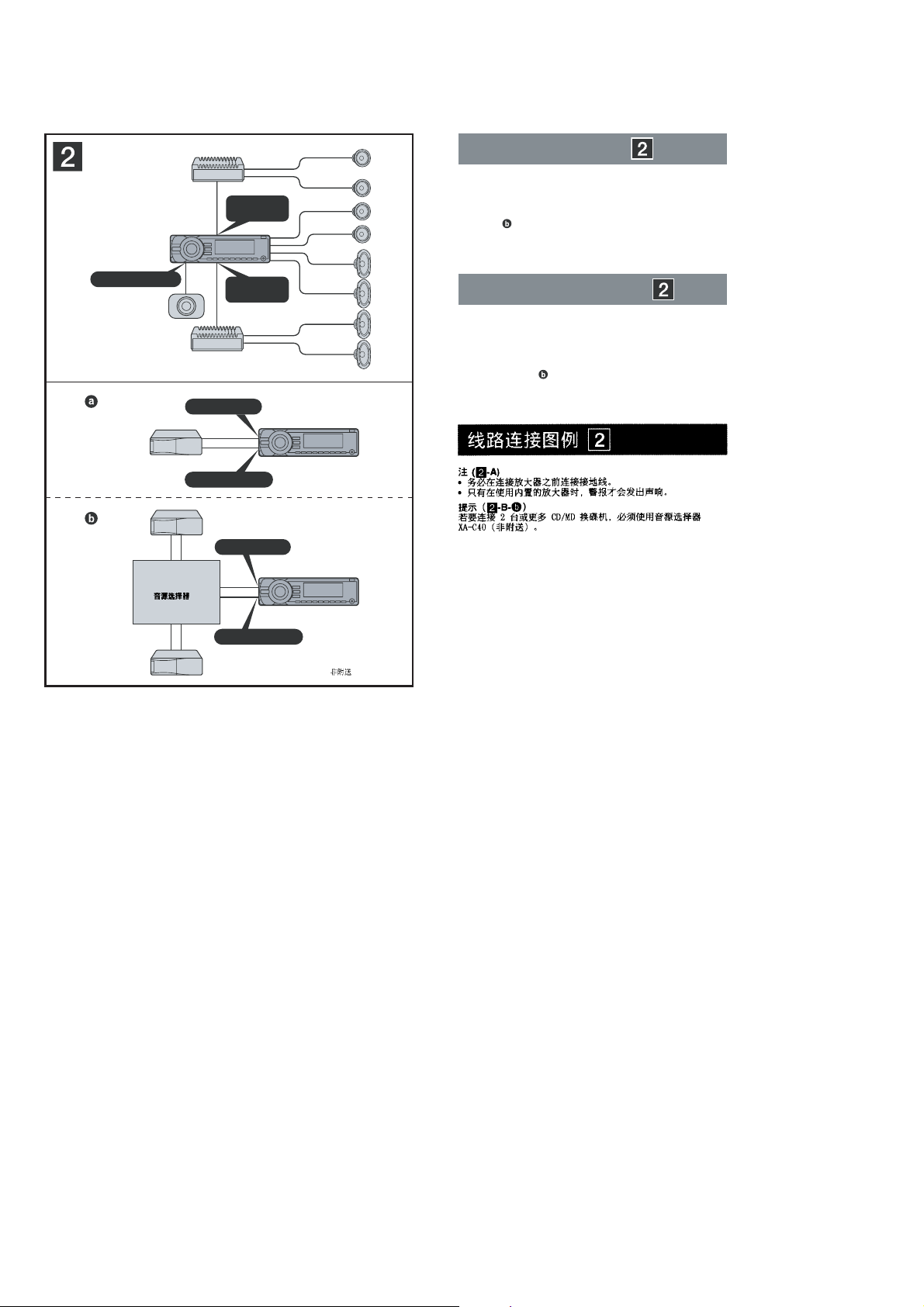
CDX-GT71W/GT710/GT760
• CDX-GT760
A
AUDIO OUT
FRONT
Connection example
Notes
(2-A)
•
Be sure to connect the ground (earth) lead before connecting
the amplifi er.
•
The alarm will only sound if the built-in amplifi er is used.
Tip
(2-B-
For connecting two or more CD/MD changers, the source
selector XA-C40 (not supplied) is necessary.
)
B
SUB OUT (MONO)
Source selector*
Selector de fuente*
BUS CONTROL IN
*
XA-C40
AUDIO OUT
BUS AUDIO IN
BUS AUDIO IN
BUS CONTROL IN
REAR
not supplied
*
no suministrado
Ejemplo de conexiones
Notas
(2-A)
•
Asegúrese de conectar primero el cable de conexión a masa
antes de realizar la conexión del amplifi cador.
•
La alarma sonará únicamente si se utiliza el amplifi cador
incorporado.
Sugerencia
Si desea conectar dos o más cambiadores de CD/MD,
necesitará el selector de fuente XA-C40 (no suminidtrado).
(2-B-
)
14
Page 15
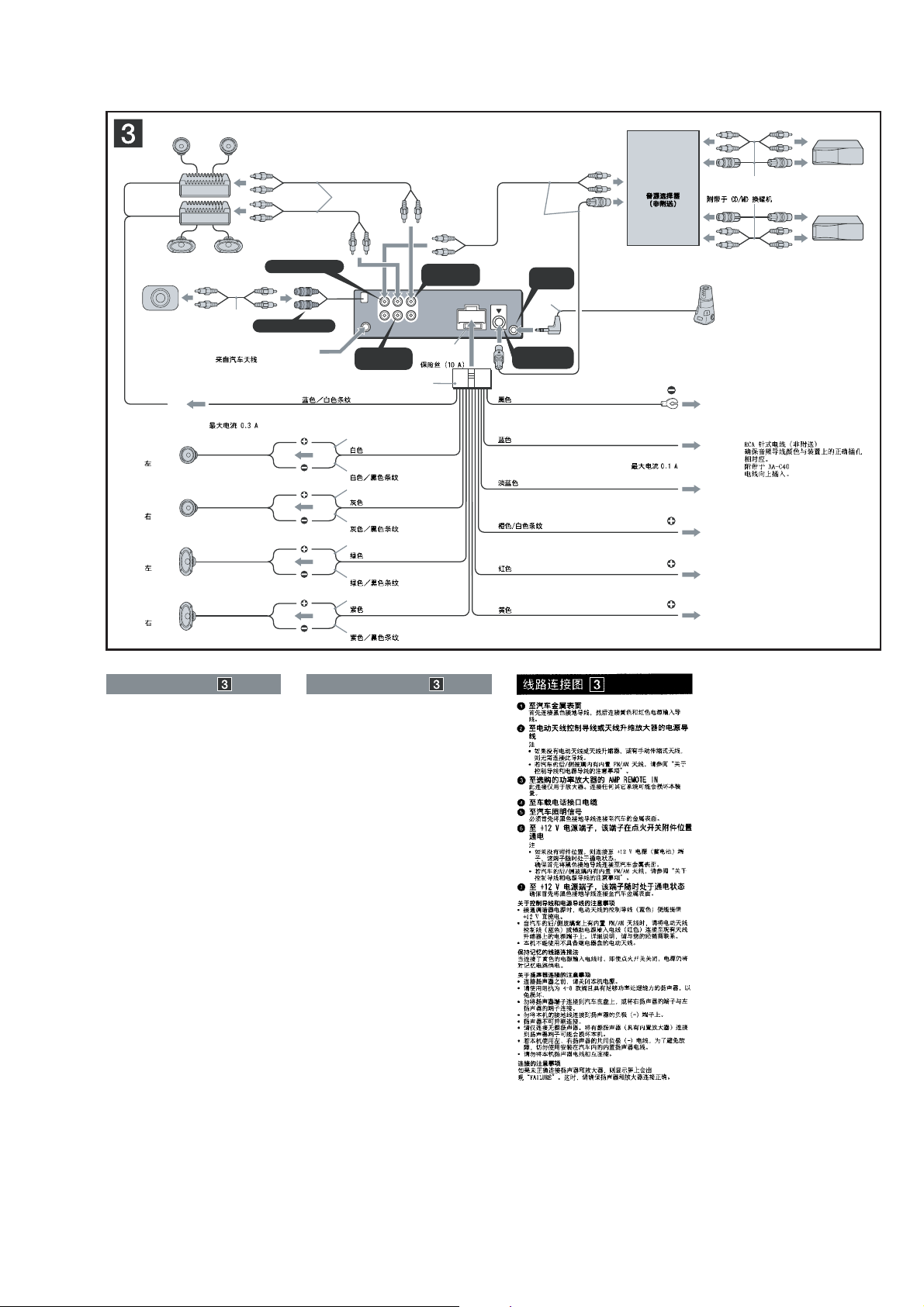
CDX-GT71W/GT710/GT760
3
1
2
4
5
6
7
AUDIO
OUT
REAR
AUDIO
OUT
FRONT
BUS
AUDIO
IN
AUDIO OUT
REAR
AUDIO OUT
FRONT
BUS
CONTROL IN
REMOTE
IN
SUB OUT (MONO)
L
R
BUS AUDIO IN
*
2
from car antenna (aerial)
desde la antena del automóvil
AMP REM
Max. supply current 0.3 A
Corriente máx. de alimentación de 0,3 A
Fuse (10 A)
Fusible (10 A)
Blue/white striped
Con rayas azules y blancas
Red
Rojo
Yellow
Amarillo
White
Blanco
Green
Verde
Purple
Morado
White/black striped
Con rayas blancas y negras
Grey/black striped
Con rayas grises y negras
Green/black striped
Con rayas verdes y negras
Grey
Gris
Left
Izquierdo
Right
Derecho
Left
Izquierdo
Right
Derecho
ANT REM
Black
Negro
Blue
Azul
Max. supply current 0.1 A
Corriente máx. de alimentación de 0,1 A
Purple/black striped
Con rayas moradas y negras
Source selector
(not supplied)
Selector de fuente
(no suminidtrado)
XA-C40
Supplied with the CD/MD changer
Suministrado con el cambiador de CD/MD
*
1
Orange/white striped
Con rayas naranjas y blancas
Light blue
Azul celeste
ATT
ILLUMINATION
*
1
*
1
RCA pin cord (not supplied)
*
2
Be sure to match the colour-coded
cord for audio to the appropriate jacks
from the unit.
*
3
Supplied with XA-C40
*
4
Insert with the cord upwards.
*
1
Cable con terminales RCA
(no suministrado)
*
2
Asegúrese de hacer coincidir el cable
de audio codifi cado con colores con
las tomas correspondientes de la
unidad.
*
3
Suministrado con el XA-C40
*
4
Insertar con el cable hacia arriba.
*
1
*
2
*
3
*
4
*
4
*
3
2
Connection diagram
1 To a metal surface of the car
First connect the black ground (earth) lead, then connect the
yellow and red power supply leads.
2 To the power antenna (aerial) control lead or
power supply lead of antenna (aerial) booster
Notes
•
It is not necessary to connect this lead if there is no power
antenna (aerial) or antenna (aerial) booster, or with a
manually-operated telescopic antenna (aerial).
•
When your car has a built-in FM/AM antenna (aerial) in
the rear/side glass, see “Notes on the control and power
supply leads.”
3 To AMP REMOTE IN of an optional power
amplifi er
This connection is only for amplifi ers. Connecting any other
system may damage the unit.
4 To the interface cable of a car telephone
5 To a car’s illumination signal
Be sure to connect the black ground (earth) lead to a metal
surface of the car fi rst.
6 To the +12 V power terminal which is
energized in the accessory position of the
ignition switch
Notes
•
If there is no accessory position, connect to the +12 V
power (battery) terminal which is energized at all times.
Be sure to connect the black ground (earth) lead to a
metal surface of the car fi rst.
•
When your car has a built-in FM/AM antenna (aerial) in
the rear/side glass, see “Notes on the control and power
supply leads.”
7 To the +12 V power terminal which is
energized at all times
Be sure to connect the black ground (earth) lead to a metal
surface of the car fi rst.
Notes on the control and power supply leads
•
The power antenna (aerial) control lead (blue) supplies +12 V
DC when you turn on the tuner.
•
When your car has built-in FM/AM antenna (aerial) in the rear/
side glass, connect the power antenna (aerial) control lead
(blue) or the accessory power supply lead (red) to the power
terminal of the existing antenna (aerial) booster. For details,
consult your dealer.
•
A power antenna (aerial) without a relay box cannot be used
with this unit.
Memory hold connection
When the yellow power supply lead is connected, power will
always be supplied to the memory circuit even when the ignition
switch is turned off.
Notes on speaker connection
•
Before connecting the speakers, turn the unit off.
•
Use speakers with an impedance of 4 to 8 ohms, and with
adequate power handling capacities to avoid its damage.
•
Do not connect the speaker terminals to the car chassis, or
connect the terminals of the right speakers with those of the
left speaker.
•
Do not connect the ground (earth) lead of this unit to the
negative (–) terminal of the speaker.
•
Do not attempt to connect the speakers in parallel.
•
Connect only passive speakers. Connecting active speakers
(with built-in amplifi ers) to the speaker terminals may damage
the unit.
•
To avoid a malfunction, do not use the built-in speaker leads
installed in your car if the unit shares a common negative (–)
lead for the right and left speakers.
•
Do not connect the unit’s speaker leads to each other.
Note on connection
If speaker and amplifi er are not connected correctly, “FAILURE”
appears in the display. In this case, make sure the speaker and
amplifi er are connected correctly.
Diagrama de conexión
1 A una superfi cie metálica del automóvil
Conecte primero el cable de conexión a masa negro, y después
los cables amarillo y rojo de entrada de alimentación.
2 Al cable de control de la antena motorizada
o al cable de fuente de alimentación del
amplifi cador de señal de la antena
Notas
•
Si no se dispone de antena motorizada ni de amplifi cador
de antena, o se utiliza una antena telescópica accionada
manualmente, no será necesario conectar este cable.
•
Si el automóvil incorpora una antena de FM/AM en el cristal
trasero o lateral, consulte “Notas sobre los cables de control y
de fuente de alimentación”.
3 A AMP REMOTE IN de un amplifi cador de
potencia opcional
Esta conexión es sólo para amplifi cadores. La conexión de
cualquier otro sistema puede dañar la unidad.
4 Al cable de interfaz de un teléfono para
automóvil
5 A una señal de iluminación del automóvil
Asegúrese de conectar primero el cable de conexión a masa
negro a una superfi cie metálica del automóvil.
6 Al terminal de alimentación de +12 V que
recibe energía en la posición de accesorio del
interruptor de la llave de encendido
Notas
•
Si no hay posición de accesorio, conéctelo al terminal de
alimentación (batería) de +12 V que recibe energía sin
interrupción.
Asegúrese de conectar primero el cable de conexión a masa
negro a una superfi cie metálica del automóvil.
•
Si el automóvil incorpora una antena de FM/AM en el cristal
trasero o lateral, consulte “Notas sobre los cables de control y
de fuente de alimentación”.
7 Al terminal de alimentación de +12 V que recibe
energía sin interrupción
Asegúrese de conectar primero el cable de conexión a masa
negro a una superfi cie metálica del automóvil.
Notas sobre los cables de control y de fuente de alimentación
•
El cable de control de la antena motorizada (azul) suministrará cc
de + 12 V cuando conecte la alimentación del sintonizador.
•
Si el automóvil dispone de una antena de FM/AM incorporada en
el cristal trasero o lateral, conecte el cable de control de antena
motorizada (azul) o el cable de entrada de alimentación auxiliar
(rojo) al terminal de alimentación del amplifi cador de antena
existente. Para obtener más información, consulte a su distribuidor.
•
Con esta unidad no es posible utilizar una antena motorizada sin
caja de relé.
Conexión para protección de la memoria
Si conecta el cable de entrada de alimentación amarillo, el circuito
de la memoria recibirá siempre alimentación, aunque apague el
interruptor de encendido.
Notas sobre la conexión de los altavoces
•
Antes de conectar los altavoces, desconecte la alimentación de la
unidad.
•
Utilice altavoces con una impedancia de 4 a 8 Ω con la capacidad
de potencia adecuada para evitar que se dañen.
•
No conecte los terminales de altavoz al chasis del automóvil, ni
conecte los terminales del altavoz derecho con los del izquierdo.
•
No conecte el cable de conexión a masa de esta unidad al
terminal negativo (–) del altavoz.
•
No intente conectar los altavoces en paralelo.
•
Conecte solamente altavoces pasivos. Si conecta altavoces
activos (con amplifi cadores incorporados) a los terminales de
altavoz, puede dañar la unidad.
•
Para evitar fallas de funcionamiento, no utilice los cables de
altavoz incorporados instalados en el automóvil si la unidad
comparte un cable negativo común (–) para los altavoces derecho
e izquierdo.
•
No conecte los cables de altavoz de la unidad entre sí.
Nota sobre la conexión
Si el altavoz y el amplifi cador no están conectados correctamente,
aparecerá “FAILURE” en la pantalla. Si es así, compruebe la
conexión del altavoz y el amplifi cador.
15
Page 16
CDX-GT71W/GT710/GT760
Ver. 1.2
SECTION 3
DISASSEMBLY
Note: This set can be disassemble according to the following sequence.
SET
3-1. BASE PANEL ASSY
(Page 17)
3-2. SUB PANEL ASSY
(Page 17)
3-3. CD MECHANISM BLOCK
(Page 18)
3-4. DRIVING SECTION (DB-F07)
(Page 18)
3-5. MAIN BOARD
(Page 19)
3-6. SERVO BOARD
(Page 19)
3-7. CHASSIS (T) SUB ASSY
(Page 20)
3-8. ROLLER ARM ASSY
(Page 20)
3-9. CHASSIS (OP) ASSY
(Page 21)
1. CHUCKING ARM SUB ASSY
(SUPPLEMENT-1 Page 1)
2. SLED MOTOR ASSY
(SUPPLEMENT-1 Page 2)
3. OPTICAL PICK-UP SECTION
(SUPPLEMENT-1 Page 3)
16
4. OPTICAL PICK-UP
(SUPPLEMENT-1 Page 3)
Page 17
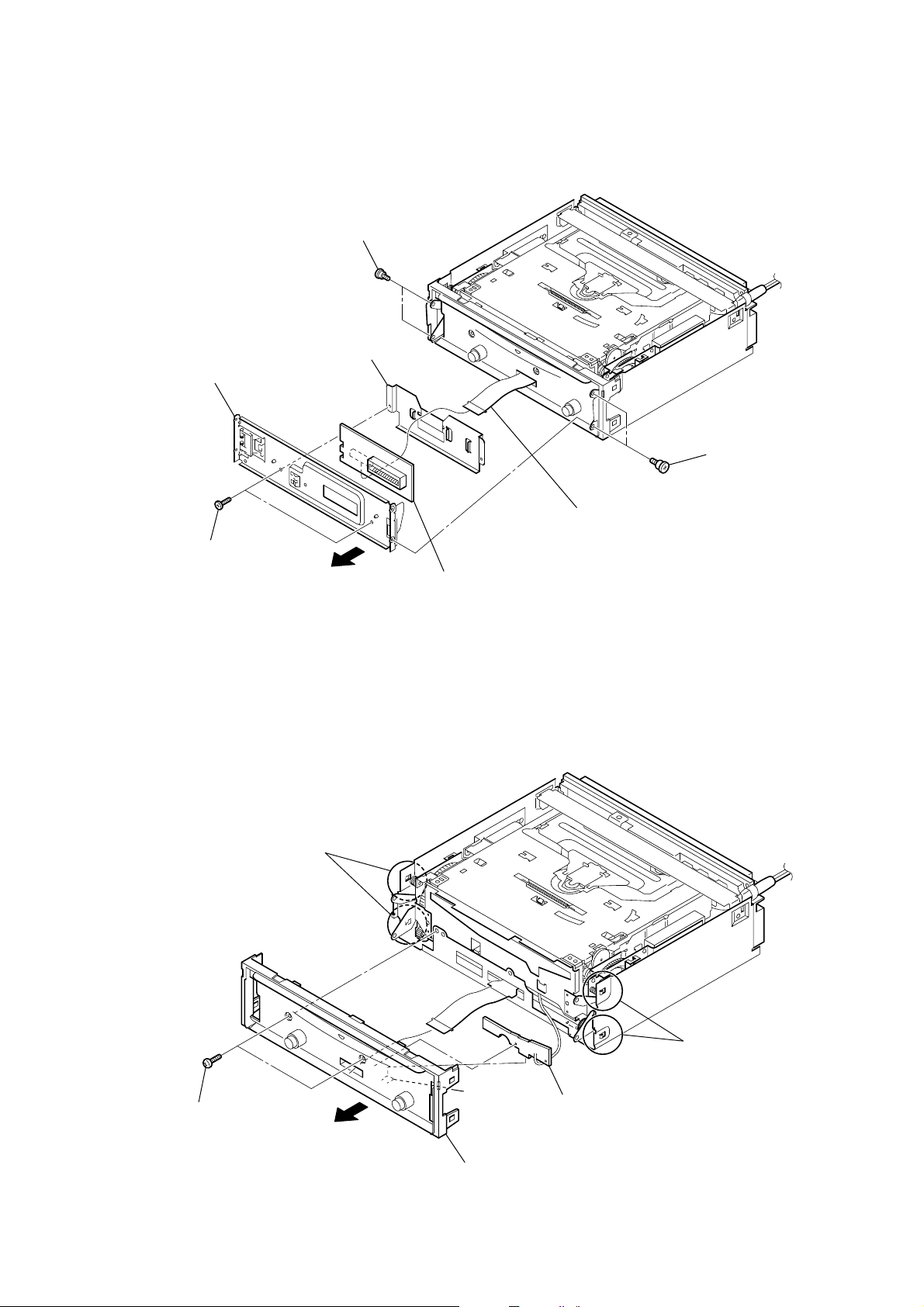
Note: Follow the disassembly procedure in the numerical order given.
s
3-1. BASE PANEL ASSY
2
two
screws
(panel F)
5
bracket (PWB)
8
base panel assy
CDX-GT71W/GT710/GT760
1
two
screw
(panel F)
4
two screws
3-2. SUB PANEL ASSY
3
(T)
two claws
3
7
BASE PANEL board
6
FLEXIBLE board (36 core)
(CN905)
(Take care not to pull the
flexible board excessively)
1
two
screws
(+PTT 2.6
×
2
two claws
5
claw
6)
4
7
sub panel assy
6
SUB PANEL board
17
Page 18
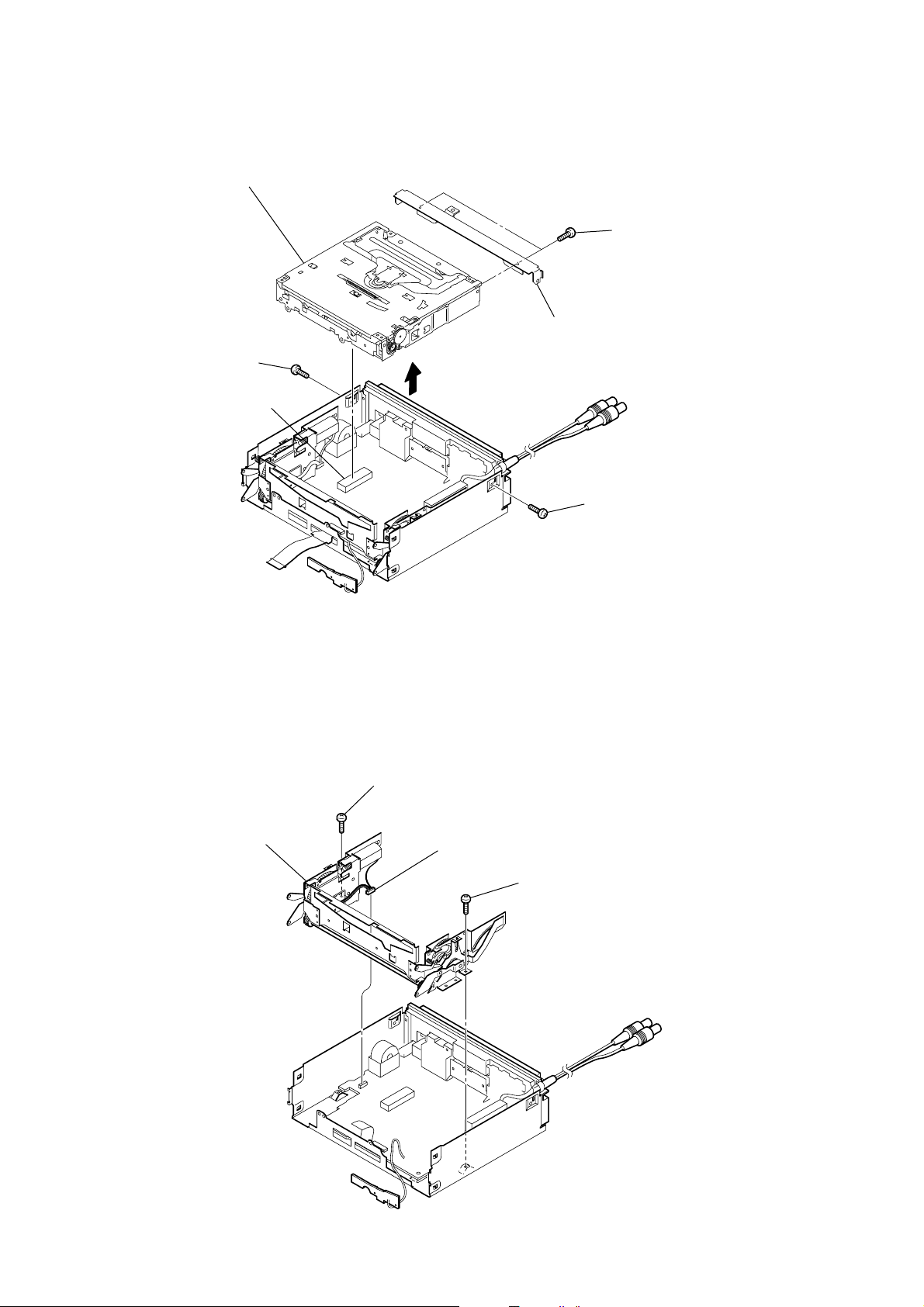
CDX-GT71W/GT710/GT760
3-3. CD MECHANISM BLOCK
7
CD mechanism block
2
screw
(+PTT 2.6
×
6)
4
CNP301
3
6
bracket (CD)
5
two
screws
(+PTT 2.6
×
4)
3-4. DRIVING SECTION (DB-F07)
4
driving section
(DB-F07)
3
screw
(+PTT 2.6
×
6)
1
CN702 (7P)
2
screw
(+PTT 2.6
screw
1
(+PTT 2.6
×
6)
×
6)
18
Page 19
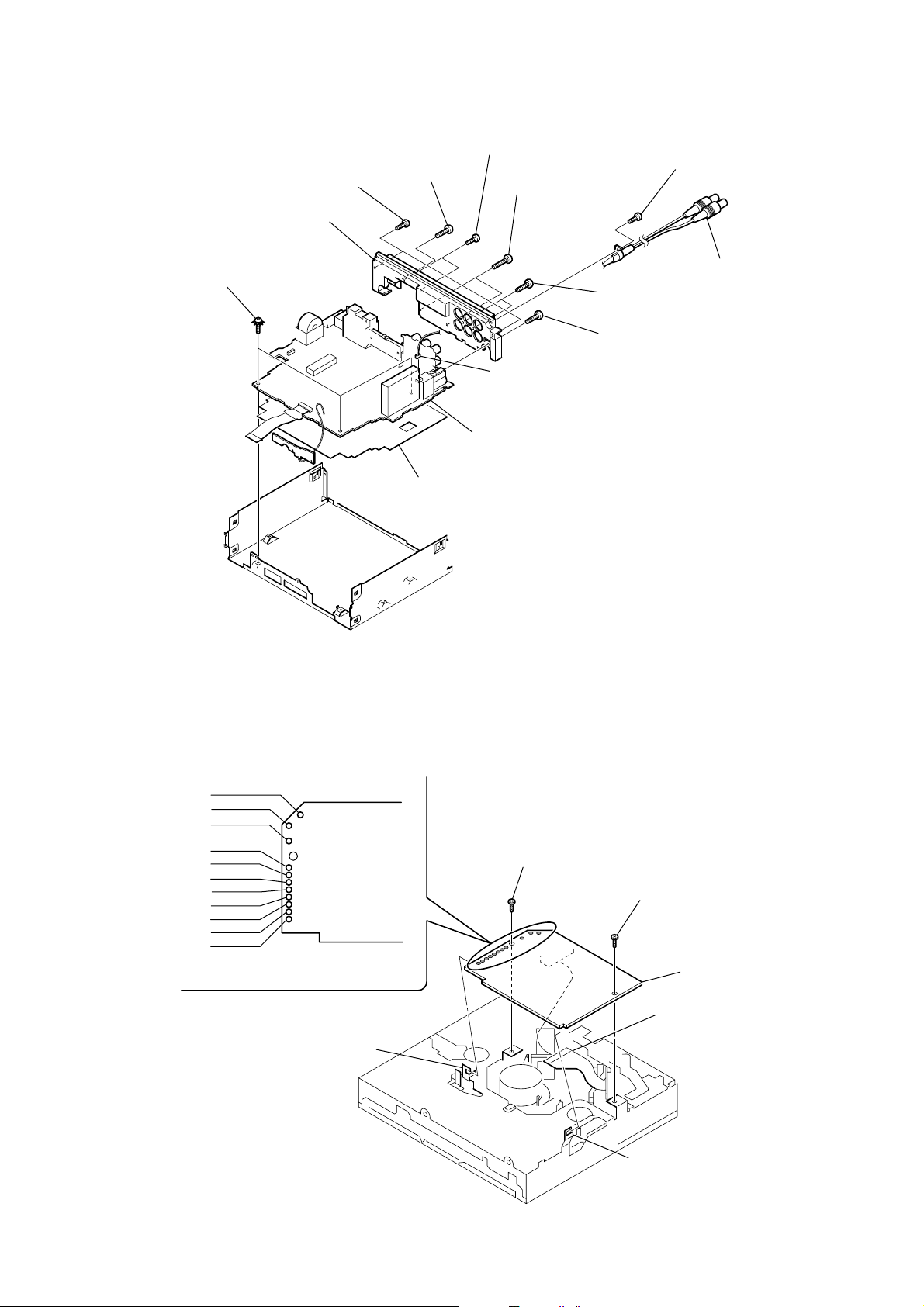
3-5. MAIN BOARD
)
1
three ground point
(+PTT 2.6
×
6)
2
two
screws
(+PTT 2.6
qd
heat sink
screws
8
screw
(+PTT 2.6
×
8)
×
10)
4
3
insulating sheet
9
two
screws
(+P 2.6
0
two
(+PTT 2.6
5
CN401 (3P)
MAIN board
×
8)
screws
CDX-GT71W/GT710/GT760
6
screw
×
12)
qa
two
(+PTT 2.6
qs
screw
(+PTT 2.6
screws
(+PTT 2.6
×
10)
×
10)
×
8)
7
cord (automobile)
3-6. SERVO BOARD
WHT
RED
BLK
WHT
RED
BLK
RED
ORG
BLU
YEL
GRY
1
Remove the eleven solders.
SERVO board
claw
2
toothed lock
(M 1.7
screw
×
2.5)
3
claw
toothed lock
(M 1.7
4
optical pick-up (16 core
(CN1)
screw
×
2.5)
5
SERVO board
19
Page 20

CDX-GT71W/GT710/GT760
3-7. CHASSIS (T) SUB ASSY
1
two precision
(+P 1.7
×
2.2)
screws
2
two precision
(+P 1.7
4
screws
×
2.2)
chassis (T) sub assy
3-8. ROLLER ARM ASSY
1
spring (RAL)
3
claw
5
roller arm assy
4
gear (RA1)
3
washer
20
2
spring (RAR)
Page 21

3-9. CHASSIS (OP) ASSY
)
1
7
coil spring (damper) (natural)
tension spring (KF)
4
slider (R)
CDX-GT71W/GT710/GT760
6
chassis (OP) assy
5
8
coil spring (damper) (green
3
Ver. 1.2
lever (D)
2
gear (LE1)
21
Page 22

CDX-GT71W/GT710/GT760
SECTION 4
DIAGNOSIS FUNCTION
Description of the Diagnostics function:
1. Setting the Diag display mode
With the power of f, press the [4] button, [5] button, and [4] button
on the set body or the remote control (for more than 2 seconds)
in turn.
2. Canceling the Diag display mode
During the Diag function mode, press the [OFF] button.
3. Initial display in the Diag display mode.
Just when the Diag mode is entered, “reset count” is displayed.
The display mode is switched by each rotation of
SEEK +/M > or SEEK – /. m keys.
Reset count display
DIAG
01 XX
Reset count by watchdog timer display
DIAG
02 XX
4. Contents of each display mode
4-1. Reset count display mode
DIAG
01 XX
Reset count
Diag code
01: Reset count
4-2. Reset count by watchdog timer display mode
(in hexadecimal format)
DIAG
02 XX
Reset count
Diag code
02: Number of resets by watchdog timer
4-3. Number of connected units display mode
(in hexadecimal format)
DIAG
03 XXX1
Number of connected units display
DIAG
03 XXX
1
Operating hours display
DIAG
04 XXXX
CD error information display
DIAG
1
05 XX
OFFSET/FAILURE error display
DIAG
06 1XXXXX
Show the number of connected units for
CD-C, MD-C and XM respectively from
the rightmost (in hexadecimal format).
Recency of information
1-3: 1 represents the latest.
Diag code
03: Number of connected unit.
The display mode is switched by each rotation of [4/GP/ALBM+] or
[3/GP/ALBM--] keys during the number of connected units display
mode.
No. of connected units history 1 (latest) display
DIAG
03 XXX1
No. of connected units history 2 display
DIAG
03 XXX2
No. of connected units history 3 display
DIAG
03 XXX3
22
Page 23

CDX-GT71W/GT710/GT760
4-4. Operating hours display mode
DIAG
04 XXXX
Operating hours
(in hexadecimal format)
Diag code
04: Operating hours
4-5. CD error information display mode
4-5-1. Error description
DIAG
05 XX1
Error description
(in hexadecimal
format)
Recency of information
1-3: 1 represents the latest.
Diag code
05: CD error information
4-5-2. Disc type and operating hours
DIAG
Error information
Indication Description
1X SERVO ERROR
3X LOADING ERROR
4X TRACK JUMP
5X TEXT ERROR
FX MECHA ERROR
05 XXXXX1
Disc type
Indication Disc type
Operating hours
Disc type
Recency of information
1-3: 1 represents the latest.
Diag code
05: CD error information
0 MP3
1 WMA
2 AAC
3ATRAC
8 CD/DA
F UNKNOWN
The display mode is switched by each rotation of [4/GP/ALBM+] or
[3/GP/ALBM--] keys during the CD error information display mode.
CD error info history 1 (latest)
Error description plus error details display
DIAG
05 XX1
CD error info history 1 (latest)
Disc type plus operating hours display
DIAG
05 XXXXX1
CD error info history 2
Error description plus error details display
DIAG
05 XX2
CD error info history 2
Disc type plus operating hours display
DIAG
05 XXXXX2
CD error info history 3
Error description plus error details display
DIAG
05 XX3
CD error info history 3
Disc type plus operating hours display
DIAG
05 XXXXX3
23
Page 24

CDX-GT71W/GT710/GT760
4-6. OFFSET/FAILURE error display mode
DIAG
06 XXXXX1
Operating hours
Error description
(0: OFFSET, 1: FAILURE)
Recency of information
1-3: 1 represents the latest.
Diag code
06: OFFSET/FAILURE
The display mode is switched by each rotation of [4/GP/ALBM+] or
[3/GP/ALBM--] keys during the OFFSET/FAILURE error display
mode.
OFFSET/FAILURE error history 1 (latest) display
DIAG
06 1XXXXX
OFFSET/FAILURE error history 2 display
DIAG
06 2XXXXX
OFFSET/FAILURE error history 3 display
DIAG
06 3XXXXX
24
Page 25

5-1. BLOCK DIAGRAM — MAIN SECTION —
CDX-GT71W/GT710/GT760
SECTION 5
DIAGRAMS
PJ501
(ANTENNA)
BUS
AUDIO
IN
CD
MECHANISM
UNIT
(MG-101FA)
PJ401 (1/2)
L
R
J991
AUX
TUX501
(TUNER UNIT)
1
ANT
VDD+5V
E2PVDD
TU-SCL
TU-SDA
S-METER
TU MUTE
E2P SCL
E2P SDA
QUALITY
MUTE CON
BUS-RCH
CD L
CD R
A ATT
CD ON
CDM ON
Z MUTE
EJECT OK
OPEN REQ
SYS RST
BU IN
BUS ON
LINK OFF
UNI CLK
UNI SI
UNI SO
DR+6V
BU+3.3V
A+3.3V
D+3.3V
L-CH
R-CH
10
VCC
11
15
13
14
16
17
RDS
ELECTRONIC VOLUME
IC401
OUTR1
24
OUTR2
23
1
BUS-LCH
2
BUS-RCH
CD-RCH
MECHA+6V
BU+3.3V
SERVO+3.3V
PLAG IN
CDON
CDMON
ZMUTE
EJECT OK
OPEN REQ
SYS RST
BU CHK
BUS ON
LINK OFF
UNI CLK
UNI SI
UNI SO
B
DISPLAY
SECTION
CD-RCH
AUX-RCH
TU-RCH
(Page 26)
AUX R-CH
4
3
TU-RCH
AUDIO+8.3V
TUNER+5V
REG
Q501
BU+3.3V
SCL
SDA
6
7
5
8
9
X551
8.664MHz
RDS DEMODULATOR
16
10
9
NOISE MASK
SWITCH
Q380
IC551
MPX
XTO
XTI
AUDIO+8.3V
BU+3.3V
REG
IC301
SCL
SDA
INTN
VDDA
VDDD
BU+5V
SCL
11
SDA
12
15
1
7
RDS+3.3V
SWITCH
Q551,552
5
6
7
9
3
4
CDMON
CDON
ZMUTE
EJECT OK
OPEN REQ
BU+3.3V
BUS-RCH
CD-LCH
CD-RCH
AUX-LCH
AUX-RCH
TU-LCH
TU-RCH
OUTF1
OUTF2
OUTS1
CLK
DATA
SOUT
MUTE
SCL
SDA
16
CDM ON
49
CD ON
50
Z DET
47
EJECT OK
46
OPEN REQ
83
VSM
21
TUNER ATT
23
EECKO
22
EESIO
19
NS MASK
82
QUALITY
18
TUNER ATT-IN
17
DAVN
R-CH
26
25
R-CH
22
17
18
19
28
SCL
29
SDA
30
SYSTEM CONTROL
IC303 (1/2)
E DATA
E MUTE
I2C CKO
I2C SIO
AMPSTB
AMP DIAG
ACC IN
TEL ATT
TEST IN
BUS ON
UNICKO
UNI SO
SYS RESET
E CLK
SP IN
ATT
BEEP
ILL IN
BU IN
UNI SI
E CLK
E DATA
SOUT
E MUTE
MUTE CONTROL
SWITCH
Q401,402
UNI CLK
BUS ON
E CLK
E DATA
SOUT
E MUTE
BU CHK
UNI SI
UNI SO
SCL
SDA
D128
D301
SYSRSTLINK OFF
37
36
85
35
27
28
25
20
41
40
52
51
53
54
57
5
73
4
3
56
MUTE
Q181
MUTE
Q171
D402
ILLUMINATION CHECK
Q121
12
11
10
8
9
13
RESET
STBY
MUTE
Q470
D401
BUS INTERFACE
IC110
BUS ON
CLK IN
B CHK
DATA OUT
DATA IN
RST
A
(Page 26)
I2C BUS CONTROLLED POWER AMP/
MULTIPLE VOLTAGE REGULATOR
12
IN FL
11
IN RL
BATT
SDA
2
SCL
DATA I/O
BUS ON
DISPLAY
SECTION
SDA
4
SCL
16
AC_GND
22
STB
25
DIAG
ACCESSORY CHECK
TELEPHONE ATTENATION
CHECK
Q103
BATT
3
4
CLK
6
1
2
RST
IC201
OUT FL+
OUT FL–
OUT RL+
OUT RL–
AMP REM
ANT REM
AUDIO+B
SERVO3.3V
MECHA6V
Q102
BATTERY
CHECK
Q101
BUS ON/OFF
LINK ON/OFF
VP
VP1
VP2
BU+B
ILL
SWITCH
Q110,111
SWITCH
Q112
5
3
9
7
29
27
35
20
6
30
37
31
33
34
D105
BATT
AUDIO+8.3V
BU+5V
SERVO+3.3V
MECHA+6V
ILL+10V
BATT
R-CH
PJ401 (2/2)
L
AUDIO OUT
REAR
CNP101
4
5
6
R
L
R
L
R
1
FL+
9
FL–
2
RL+
10
RL–
4
FR+
12
FR–
3
RR+
11
RR–
5
AMP-REM
6
ANT-REM
16
BATT
7
ACC
14
ILL
13
TEL ATT
15
TEST
TH100
7
1
2
3
8
: CD PLAY
: FM
: AM/MW/LW
: BUS
: AUX
AUDIO OUT
FRONT
(SUB OUT)
BATT
CNP102
BUS
CONTROL IN
R-CH
R-CH
F901
• R-CH is omitted due to same as L-CH.
• Signal Path
CDX-GT71W/GT710/GT760
GT710:AEP,UK MODEL
25 25
Page 26

CDX-GT71W/GT710/GT760
5-2. BLOCK DIAGRAM — DISPLAY SECTION —
KEY
MATRIX
LSW901 (1/2)–915 (1/2)
S903,904,
906 (2/2)
ROTARY
ENCODER
S906 (1/2)
CNJ101
(REMOTE IN)
X302
6MHz
X301
LED990
DISC
INDICATOR
DOOR INDICATOR
LED DRIVE
Q134
GT760
32.768kHz
BU+3.3V
84
88
78
77
55
86
87
11
13
9
8
95
KEY IN0
KEY ACK0
RE 0
RE 1
RC IN1
RC IN0
KEY ACK2
XOUT
XIN
XCOUT
XCIN
DOOR IND
SYSTEM CONTROL
IC303 (2/2)
DISP SI/RX
DISP SO/TX
DISP RESET
NOSE SW
DISP CE
CNVSS
93
98
99
100
7
90
91
NOSE SW
DETECT SWITCH
Q303
D303
X901
6.75MHz
S901
(NOSE DET)
DISPLAY CONTROL
85
KEY 1
KEY 2
86
1
SYS CE
SYS SO
29
SYS SI
30
SYS CLKDISP CKO
31
CNVSS
7
RESET
10
XOUT
11
XIN
13
IC901
LAT TA2 OUT
FL CLK OUT
GCP TAO OUT
BK TA3 OUT
GCP TA4 IN
FL DAT1
FL DAT2
FL DAT3
FL CLK
FL CLK IN
DIM
ILL RED
ILL BLUE
SIRCS
PLAG IN
24
33 6
99 5
3 4
35 7
5
100
28 11
22
19
93
92
91
89
71
FL900
VACUUM
FLUORESCENT DISPLAYS
LAT
12
SI1
SI2
SI3
CLK
GCP
BK
13
VDD1
VDD2
F1
F2
REMOTE CONTROL
SIGNAL RECEIVER
IC903
PLAG IN
14
17
1
I
3
18
I
20
MAIN
B
SECTION
(Page 25)
FL VDD+3.3V
FL VDD+55V
FL+1V
FL+4.3V
LED DRIVE
Q922
FL VDD+3.3V
LED920,922,
923,924,926,
927
LED DRIVE
Q920,921
ILL+10V
LSW901 (2/2)–915 (2/2)
BATT
BU+5V
MAIN
SECTION
(Page 25)
M904
(OPEN/CLOSE)
MOTOR+9V
REG
IC703
B+ SWITCH
Q702,703
A
STBY
RESET
BU+3.3V
7
1
OPEN/CLOSE
MOTOR DRIVE
IC702
OUT1
OUT2
FGND
VCC
SWITCH
BOARD
RESET
IC302
FIN
RIN
S301
FREQUENCY
SELECT
P SENSOR
DETECT
Q701
10K
9K
S902
RESET
FP I DET
TH301
AMP
IC701
DST SEL0
1
RESET
10
80
TEMP TR
MOT+
6439
MOT–
654
FP IDET
796
MOTOR ON
63
P SNSR
68
CLOSE SW
66
OPEN SW
67
FLD ON
FSW OUT
FL ON
FSW IN
FL B+
BU+3.3V
74
58
72
2
SWITCH
Q301,302
DC–DC
CONVERTER
CONTROL
Q621,622
FL ON/OFF
CONTROL
SWITCH
Q624
FL VDD+3.3V
CONVERTER
DC–DC
IC620
B+ CONTROL
SWITCH
Q623,642
5
VCC
4
OUT
7
CT
6
CS
1
IN
2
FB
BATT
TRANS
SWITCHING
DRIVE
Q620
BATT
TRANS ON/OFF
DETECT
SWITCH
Q641
T620
DC–DC
CONVERTER
TRANSFORMER
D622
D623
FL+4.3V
FL+1V
D620,621
FL VDD+55V
CDX-GT71W/GT710/GT760
2626
Page 27

CDX-GT71W/GT710/GT760
• NOTE FOR PRINTED WIRING BOARDS AND SCHEMATIC DIAGRAMS
THIS NOTE IS COMMON FOR PRINTED WIRING
BOARDS AND SCHEMATIC DIAGRAMS.
(In addition to this, the necessary note is
printed in each block.)
For schematic diagrams.
Note:
• All capacitors are in µF unless otherwise noted. (p: pF)
50 WV or less are not indicated except for electrolytics
and tantalums.
• All resistors are in Ω and 1/
specified.
• f : internal component.
• C : panel designation.
Note:
The components identified by mark 0 or dotted
line with mark 0 are criti-
cal for safety.
Replace only with part
number specified.
• A : B+ Line.
• B : B– Line.
• H : adjustment for repair .
•Voltages and waveforms are dc with respect to ground
under no-signal (detuned) conditions.
no mark : FM
(): AM/MW/L W
<>: CD PLAY
•Voltages are taken with a VOM (Input impedance 10 MΩ).
Voltage variations may be noted due to normal production
tolerances.
•Waveforms are taken with a oscilloscope.
Voltage variations may be noted due to normal production
tolerances.
• Circled numbers refer to waveforms.
• Signal path.
J : CD PLAY
F : FM
f : AM/MW/LW
L : BUS
g : AUX
• Abbreviation
CND : Canadian model
CH : Chinese model
MX : Mexican model
: Impossible to measure
∗
4
W or less unless otherwise
Note:
Les composants identifiés par
une marque 0 sont critiques
pour la sécurité.
Ne les remplacer que par une
piéce portant le numéro
spécifié.
For printed wiring boards.
Note:
• X : parts extracted from the component side.
• Y : parts extracted from the conductor side.
a
•
• : Pattern from the side which enables seeing.
(The other layers' patterns are not indicated.)
Caution:
Pattern face side: Parts on the pattern face side seen from the
(Side B) pattern face are indicated.
Parts face side: Parts on the parts face side seen from the
(Side A) parts face are indicated.
• Abbreviation
: Through hole.
C
Q
These are omitted
EB
E
CB
These are omitted
C
BE
These are omitted
CND : Canadian model
CH : Chinese model
MX : Mexican model
• WAVEFORMS
— MAIN Board —
1
IC303 8 (XCIN)
32.768 kHz
0.2 V/DIV, 20 µsec/DIV
2
IC303 qd (XIN)
6 MHz
0.5 V/DIV, 0.1
3
IC551 9 (XTI)
0.2 V/DIV, 0.1
µ
sec/DIV
8.664 MHz
µ
sec/DIV
0.6 Vp-p
1.4 Vp-p
0.8 Vp-p
— DISPLAY Board —
1
IC901 qd (XIN)
6.75 MHz
0.2 V/DIV, 0.1 µsec/DIV
0.4 Vp-p
CDX-GT71W/GT710/GT760
27 27
Page 28

CDX-GT71W/GT710/GT760
5-3. PRINTED WIRING BOARDS — MAIN SECTION —
• Semiconductor Location
Ref. No. Location Ref. No. Location
D101 B-10
(D102) C-9
(D103) C-9
(D104) E-10
(D105) E-10
D106 D-9
D108 D-8
(D109) D-9
(D110) B-7
D111 C-7
(D112) B-8
(D113) C-7
(D114) C-7
D115 C-8
D116 C-8
(D117) C-8
D118 C-6
D119 C-7
D120 C-6
D121 C-6
D125 D-8
D128 E-9
D138 C-8
D139 C-6
D301 F-9
D303 I-5
(D304) G-6
D401 D-5
D402 D-5
D404 G-3
(D501) F-2
D620 I-8
( ): SIDE B
D621 I-8
(D622) I-8
(D623) I-8
D625 H-9
D626 H-9
D640 I-9
(D703) E-10
(D814) I-5
(D823) H-5
(D824) I-5
(D825) H-5
(D826) H-5
D827 H-5
D828 H-5
D829 H-5
(D830) I-5
(D831) H-5
D836 H-5
IC110 E-10
(IC201) B-6
(IC301) E-5
IC302 E-5
IC303 F-5
IC401 F-3
IC551 I-3
IC620 H-9
IC701 F-11
IC702 F-10
IC703 E-11
LED990 G-13
LED990
(DISC INDICATOR)
Ref. No. Location
Q101 D-10
Q102 D-9
Q103 D-7
Q110 C-10
Q111 D-10
Q112 D-10
Q121 D-8
Q134 I-3
Q171 C-4
Q181 C-3
Q271 C-4
Q281 C-3
Q301 G-7
Q302 G-6
Q303 I-4
Q380 E-2
Q401 D-4
Q402 D-4
Q470 C-2
Q501 F-2
Q551 H-2
Q552 H-3
(Q620) I-9
Q621 G-10
Q622 H-10
Q623 G-9
Q624 H-9
Q641 I-9
Q642 G-9
Q701 F-10
Q702 E-10
Q703 E-10
R990
R991
C702
IC701
R711
BRN
: Uses unleaded solder.
D101
R116
Q110
Q111
Q101
R114
R118
R117
C707
R126
R703
11
(11)
Q702
Q701
R702
R625
Q622
C701
RED
IC703
R710
IC702
R708
1-872-392-
C703
Q112
IC110
Q703
Q621
R119
R627
R630
C625
R115
R701
R628
R629
Q641
R640
R704
Q642
IC620
D128
D301
R631
C626
C110
R127
C111
C630
D626
L620
R639
Q102
R633
D640
D106
R106
R104
Q623
D625
R632
C107
R383
R382
R392
Q624
R103
R381
D138
R108
R105
C104
R107
D116
D125
D115
R112
R120
R122
R621
R635
R121
R111
Q121
R110
D108
R123
R384
EXCEPT GT710:AEP,UK MODEL
GT71W/GT710:US,CND MODEL
R623
R622
R620
R634
D620
D621
D111
D119
Q103
R109
L301
R353
R354
GT710:AEP,UK MODEL/GT760
GT710:AEP,UK MODEL
Q301
R319
D118
R373
R375
R360
R318
R372
C216
C105
D139
R363
Q302
R325
R361
R362
R337
C217
R346
R366
R305
R357
C331
R341
R206
R205
D121
R304
R207
L303
CN801
C219
C218
R340
R350
D120
R365
IC303
R333
R339
C239
C238
R369
R370
R347
R377
D829
D828
D827
R336
D402
R323
R322
R401
R345
R344
23
IC302
14
C313
R309
R364
C317
R343
EXCEPT
GT760
R391
D836
R264
C430
D303
D401
R321
C429
R348
C209
R204
Q401
R303
GT760
C236
C206
GT710:AEP,UK MODEL
C332
R334
Q271
R203
C208
C237
C207
Q402
L402
R310
EXCEPT
GT710:AEP,UK MODEL
GT710:AEP,UK MODEL
R307
R306
GT760
R301
R335
R313
R400
RED
BRN
Q303
CN604 CN605
Q171
C433
IC401
Q134
R452
R454
Q281
Q181
R486
R451
R455
R453
C421
R423
D404
GT710:AEP,UK MODEL
Q552
FB552
C556
FB551
R553
R554
R368
R421
C557
JR610
L503
R424
R422
C422
R437
R552
C553
IC551
C558
JR602
Q470
R407
JR609
R402
GT710:AEP,UK MODEL
R501
Q551
1-872-391-
234567891011121314
Q501
C561
R555
R556
R557
R380
Q380
R551
11
(11)
1
A
B
C
D
E
R503
F
G
H
I
CDX-GT71W/GT710/GT760
A
BASE PANEL BOARD CN905
(Page 35)
J
2828
Page 29

CDX-GT71W/GT710/GT760
A
B
C
D
E
F
G
H
1
PJ501
(ANTENNA)
TUX501
(TUNER UNIT)
C514
EXCEPT
GT710:
AEP,UK
MODEL
C505
C544
C509
C510
I
234567891011 12 13 14
R502
R504
R521
R522
FB501
FB503
FB504
BUS
AUDIO IN
LR
-1 -2 -3 -4
R505
C242
R242
R142
R143
R243
CN401
C442
C443
GT710:AEP,UK MODEL
C503
C513
FB502
D501
C501
C406
C502
C405
GT710:AEP,UK MODEL
C559
C142
C183
C419
C428
R428
R426
C551
X551
LR
R185
R184
C283
FB402
R172
R182
C455
C424
C423
C420
C418
C552
C554
C555
C560
JR601
PJ401
AUDIO OUT
REAR
C288
R284
R420
R427
R425
C188
R285
C427
R282
AUDIO OUT
FRONT
LRLR
-5 -6
C178
C278
R175
R174
C173
C425
R202
C273
C202
C203
C201
R201
R272
C434
C410
C426
GT760
10K
9K
(FREQUENCY SELECT)
R275
R274
C401
S501
C212
X302
S301
C326
JR607
C327
C323
C315
C316
SUB OUT
(MONO)
C215
C214
C225
C226
IC301
R342
GT710:AEP,UK MODEL
C322
X301
D825
D826
D823
D824
L502
C232
D831
C211
C223
D830
R311
C318
R314
R312
D814
IC201
C311
C632
C512
TH301
D304
C325
C328
R315
C228
C210
C321
R332
C221
C342
C204
L304
R328
R327
C227
C205
YEL
D113
C340
D110
D114
C302
C351
C352
C620
D112
C301
FB332
C303
D622
FB334
R351
R352
C304
C121
D623
D117
C621
CNP101
C628
F901
C102
CNP301
R624
C629
T620
C306
R644
JR618
FB329
FB328
R626
R645
Q620
C305
C622
C334
C333
C103
R647
C229
R637
R636
1-872-391-
(BUS CONTROL IN)
321
8
654
D102
D103
D109
YEL
C623
C624
CNP102
CNP102
(11)
CNJ101
(REMOTE IN)
FB111
7
C112
C101
TH100
BATT
GT71W/GT710:US,CND MODEL/GT760
R101
D104
D105
R102
D703
CN702
R707
CN702
L101
C705
C708
C709
R706
WHT
RED
BLK
BLU
GRN
ORG
BRN
C706
C704
R709
M904
(OPEN/CLOSE)
BLK
BLU
GRN
ORG
BRN
CD
MECHANISM
UNIT
(MG-101FA)
CN2
DB-F07
11
GT710:AEP,UK MODEL
J
CDX-GT71W/GT710/GT760
29 29
Page 30

CDX-GT71W/GT710/GT760
5-4. SCHEMATIC DIAGRAM — MAIN SECTION (1/4) —
PJ501
TUX501
R502
C513
• Refer to page 27 for Waveforms.
• Refer to page 37 for IC Block Diagrams.
R504
C502
C544
R521
R522
C510
FB503
FB504
R505
C501
Q501
L503
R486
R501
D501
IC B/D
R172
R551
Q552
R552
C503
Q551
C514
R380
Q380
C551
FB551
C552
FB552
C554
C555
C556
C557
R554
C553
R553
R503
IC B/D
C558
C505
FB502
C509
IC551
C561
R557
X551
FB501
R555
R556
C559
C560
JR609
R437
R425
R427 C427
R426 R428
C428
D404
C418
C421
C422
C424
C405
C406
C419
C420
C425
C426
R421
R422
C423
R423
R424
IC401
R452
R454
R453
R455
R451
R420
C410
R182
C433
R282
C434
(Page 31)
C455
R272
L402
(Page 33)
CDX-GT71W/GT710/GT760
(Page 32)
3030
Page 31

5-5. SCHEMATIC DIAGRAM — MAIN SECTION (2/4) — • Refer to page 38 for IC Block Diagrams.
PJ401
CDX-GT71W/GT710/GT760
(Page 30)
C443 R402
Q470
C173 R174
Q171
Q181
C183
R184
C283
R284
Q281
Q271
C273
R274
C442
R407
R175
R185
R285
D402
FB402
R275
CN401
Q401
Q402
C178C278
C401
D401
R401
C288C188
R142
R143
C236
C238
C239 C219
C206
C218
C207C237
R201
C242C142
R242
R243
R203
R205
R206
R204
R207
C201
R202
C208
C209
IC B/D
C216
C217
C203
C202
C204
C215 C210
C228 C205 C227
IC201
D120
D121
D111
D110
D113
D112
D114
D115
D116
D117
D139
D119
D118D138
C211
C212
C221
C223
C214
C225
C226
C105
C104
D106
C107
R103
C229
CNP101
F901
L101
C103
D109
(Page 32)
(Page 33)
JR607
C232
Q103
Q121
Q102
R123
R104
R110
R111 R112
R109 D108
D125
R122
C121
R105
R106
C102
R121
R120
R108
R107
CDX-GT71W/GT710/GT760
31 31
Page 32

CDX-GT71W/GT710/GT760
5-6. SCHEMATIC DIAGRAM — MAIN SECTION (3/4) —
• Refer to page 27 for Waveforms.
• Refer to page 39 for IC Block Diagrams.
• Refer to page 41 for IC Pin Description of IC303.
(Page 30)
(Page 31)
JR618
R392
IC302
C313
R384
IC701
CN702
R116
FB111
D703
CNP301
C701
R709
C708
C112
R708
C709
R707
R706
C703
R702
R704
Q702
FB334
R351
FB332
R352
C304
R701
Q701
Q703
R710 R711
C302
L301
C301
R353
C351
C352
R354
C303
IC B/D
IC702
C704 C706 C707
D301
C705
IC B/D
IC703
R703
R361
R362
R373
R375
C331
R325
R328
R327
R337
TH301
R360
R363
R372
R315 C325
R305
R304
R341
TP9
R340
D304
R335
R312
R314
R313
R366
R346
C318
R350
R368
R333
R365
R357
R332
IC303
R377
R369
R370
R339
R381
R382
R383
FB329
C334
C333
FB328
C306
C305
CNJ101
PH1
S1
R1 R2
M904
C702
C327
R336
R347
IC301
C326 C311
R322R323
R344
R343
R345
R309
C317
R301 R303
S301
R334
R364
X301
R306
X302
R391
C315
C323
C316
C322
C332
R342
R310
R311
R307
R321
C321
C328
(Page 33)
CDX-GT71W/GT710/GT760
3232
Page 33

5-7. SCHEMATIC DIAGRAM — MAIN SECTION (4/4) — • Refer to page 40 for IC Block Diagrams.
(Page 30)
L303
Q624
R627
Q621
Q622
R633
R632 R631
Q642
R626
R628
R629
C624
IC620
R630
C625
D626
R625
Q623
C622
C623
C630
D625
C628
IC B/D
L620
C629
R636
R637
R644
Q302
T620
Q620
R645 R647
R318
D640
R639
Q301
D622
R319
C340
D623
Q641
R621
C621
R640C626
(Page 31)
L304
C342
C620
R634
R622
R623
R620
R624
D620
R635
D621
L502
C632
C512
D814
D831
D830
D829
D828
D827
D836
D826
D825
D824
D823
R400
D303
C429
C430
JR602
CDX-GT71W/GT710/GT760
CN801
Q303
(Page 36)
R348
(Page 32)
R126
D128
R127
C110
C111
IC B/D
IC110
Q111
Q112
R117
R118
D103
R119
D102
Q110
D101
R115
C101
R114
Q101
D104
D105
TH100
R101
R102
CNP102
Q134
JR610
JR601
R264
R990
R991
CN604
CN605
LED990
CDX-GT71W/GT710/GT760
33 33
Page 34

CDX-GT71W/GT710/GT760
5-8. PRINTED WIRING BOARDS — DISPLAY SECTION —
23456789101112
S904
LSW901
LED926
A
1
S904
MODE
LSW901
SEEK+ >
B
LED927
JR925
C
LSW902
SEEK– .
LSW902
S903
SOURCE
LED924
LED923
S903
D
LED920,922–924,926,927
(RING ILLUMINATION)
• Semiconductor Location
E
F
G
H
I
J
Ref. No. Location
D931 G-10
D932 G-10
D933 G-10
D934 G-10
D935 G-10
D936 G-10
D937 G-9
D938 G-9
D951 G-12
Ref. No. Location Ref. No. Location
D955 H-6
D956 H-6
LED924 C-3
LED926 B-4
LED927 B-3
IC901 H-7
IC903 A-6
Q920 I-5
Q921 H-5
LED920 C-5
Q922 I-5
LED922 B-5
LED923 C-4
R902
R913
R934
R921
R920
R914
R915
R936
R933
S906
S906
PUSH SOUND/ENTER
(VOLUME)
: Uses unleaded solder.
LED922
JR921
LED920
R912
R932
R931
R923
R922
R942
Q922
R917
Q921
Q920
2
1
R909
R910
R918
IC903
IC903
LSW904
LSW904
R937
R948
R949
R982
C981
3
4
LSW906
LSW905
LIST
(
D956
JC907
R981
LSW906
MENU
LSW903
LSW903
DSPL
EXCEPT
GT710:AEP,UK
DSPL/PTY
(GT710:AEP,UK)
R938
R916
D955
C916
FB918
C914
FB919
FB920
FB921
FB901
FB902
LSW905
IMAGE
)
R954
R955
1
FB903
R919
R956
C915
LSW912
1/REP
R911
IC901
X901
R958
X901
C925
FB917
R959
FB904
C919
LSW911
2/SHUF
R903
FB905
R950
FB908
C901
LSW910
3/GP/ALBM–
R904
R939
R924
R960
R926
C904
R951
C903
FL900
R925
R961
R953
R952
FB916
FB915
FB914
FB913
FB912
FB911
VACUUM FLUORECSENT DISPLAYS
LSW907
R907
D953
LSW907LSW908
6/PAUSE
R940
D952
(
GT710:AEP,UK
(GT710:AEP,UK)
JC902
R962
LSW909LSW910LSW911LSW912 LSW913
D935
D934
4
LSW908
5/BBE MP
R906
D932
D933
CN902
D931
LSW909
4/GP/ALBM+
C910
R905
R927
D938
D937
D936
B
BASE PANEL BOARD CN904
(Page 35)
LSW913
SCRL
EXCEPT
AF/TA
D954
C956
R908
D951
FB923
FB922
C957
)
C923
C958
17
R965
BRN
LSW914
LSW914
R3
R1
RED
R963
R964
OFF
R2
R929
18
13 14
J991
AUX
BRN
RED
ORG
YEL
GRN
11
YEL
20
R945
(11)
GRN
R944
R901
1-872-395-
R928
ORG
R946
LSW915
Z/ANGLE
LSW915
1-872-393-
R941
11
(11)
1-872-393-
11
(11)
CDX-GT71W/GT710/GT760
3434
Page 35

5-9. PRINTED WIRING BOARD — BASE PANEL SECTION —
CDX-GT71W/GT710/GT760
: Uses unleaded solder.
A
B
C
D
1
(NOSE DET)
S901
23456789
S902
RESET
24
CN904
23
2
1
E
F
G
H
(Page 28)
MAIN BOARD CN801
A
CN905
B
DISPLAY BOARD CN902
(Page 34)
1-872-394-
FMB4
11
(11)
I
FMB3
J
CDX-GT71W/GT710/GT760
35 35
1-872-394-
11
(11)
Page 36

CDX-GT71W/GT710/GT760
5-10. SCHEMATIC DIAGRAM — DISPLAY SECTION —
R922 R924 R926 R928R923 R925 R927 R929
R921 R901
R920
LSW902(2/2)
LSW906(2/2)
LSW901(2/2)
LSW905(2/2)
LSW904(2/2)
R936 R937 R938 R939 R940
R946
R945
LSW911(2/2)
LSW908(2/2)
LSW912(2/2)
LSW909(2/2)
LSW903(2/2)
LSW910(2/2)
Q920 Q921 Q922
LSW914(2/2)
LSW915(2/2)
LSW907(2/2)
• Refer to page 27 for Waveforms.
• Refer to page 44 for IC Pin Description of IC901.
EXCEPT
R931 R933R932 R934
R944
LED920 LED923
JR921LSW913(2/2)
LED922
R941
LED926 LED927
R942
(
LED924
JR925
)
GT710:AEP,UK
(GT710:AEP,UK)
R911
R903
R904
LSW910(1/2)
R905
LSW909(1/2)
R906
R907
R908 R915
LSW913(1/2)
EXCEPT
GT710:AEP,UK
(GT710:AEP,UK)
)
(
LSW906(1/2)LSW903(1/2)
LSW905(1/2)LSW912(1/2)
LSW904(1/2)LSW911(1/2)
LSW902(1/2)LSW908(1/2)
LSW901(1/2)LSW907(1/2)
S904
R909
R910
R912
R913
R914
LSW915(1/2)
LSW914(1/2)
S903
S906
R902
JC907
C914
C916
FB919
R917
R918
D955
D956
R948
R949
FB918
R916
R919
R982
R981
C981
IC903
IC901
C925
FB917
R952
FB916
FB915
FB914
FB913
FB912
R953
R951
FB911
(Page 33)
S902
S901
J991
CN902CN905 CN904
C923
D931
D932
D933
D934
D935
D936
C903
D937
D938
C904
FB923
TP915
TP912
R3
TP913
R1
TP914
R2
TP911
TP905
TP902
TP903
TP904
TP901
D952
D951
FB922
D954
D953
C910
FB921FB920 FB901
R960
R961
C901
FB902
FB903
R955
C915
R956
X901
R958
FL900
C919
FB904
R962
C956
FB908 FB905R959R954
R963 R964
R965
JC902
C957
C958
R950
CDX-GT71W/GT710/GT760
3636
Page 37

• IC BLOCK DIAGRAMS
IC401 BD3442FS-E2 (MAIN Board (1/4))
BUS-L
1
100k
2
BUS-R
100k
3
TU-L
TU-R
CD-L
CD-R
AUX-L
AUX-G
AUX-R
DS32
DS11
DS22
EBIAS
DS21
DS11
DS31
100k
4
100k
5
100k
6
100k
7
250k
8
250k
9
250k
10
11
12
13
14
15
16
INPUT
SELECTOR
INPUT
GAIN
SPECTRUM
ANALYZER
VOLUME1
/MUTE
TREBLE
/BASS
/MIDDLE
LPF
CDX-GT71W/GT710/GT760
FIL
32
31
30
29
28
27
26
25
24
23
22
21
20
19
18
17
GND
SDA
SCL
MUTE
VCCVCC
OUTF1
OUTF2
OUT-R1
OUT-R2
OUTS1
OUTS2
ADJ
SOUT
DATA
CLK
EFFECT
FADER
FADER
VOLUME2
FADER
FADER
FADER
FADER
I2C
BUS
LOGIC
VCC2
IC551 TDA7333013TR (MAIN Board (1/4))
INTERPOLATOR
1
VDDA
REF3
REF2
REF1
VSS
VDDD
RESETN
2
3
4
5
6
TM
7
8
INTN
MPX
RDS
DEMODULATOR &
SYNCHRONIZATION
RDSREG
BAND PASS
FILTER
RAM
BUFFER
&
CONTROL
LOGIC
3
SDAOUT
SDAIN
SCK
SPI
TESTREG
SIGMA DELTA
CONVERTER
TEST LOGIC
&
PIN MUX'S
OSCILLATOR
16
MPX
15
INTN
14
CSN
13
SA
12
SDA
11
SCL
10
XTO
9
XTI
SINC4
FILTER
SINC4REG
I2C/SPI
INTERFACE
2
37
Page 38

CDX-GT71W/GT710/GT760
IC201 TDA8588AJ/N2/R1 (MAIN Board (2/4))
TAB
1
OUT-FL–
3
OUT-FL+
5
OUT-RL–
7
9
OUT-RL+
IN-RL
11
S-GND
13
IN-RR
15
OUT-RR+
17
OUT-RR–
19
PROTECTION/
DIAGNOSTIC
2
SDA
I2C BUS
4
6
8
10
12
14
16
18
SCL
VP2
PGND3
SVR
IN-FL
IN-FR
AC_GND
PGND2
FL
RL
MUTE
MUTE
VP
RR
OUT-FR+
OUT-FR–
DIAG
SW2(ANT-REM)
SW1(AMP-REM)
REG3(SERVO+5V)
REG4(DR+B)
VP(REG)
REG(BU+5V)
21
23
25
27
29
31
33
35
37
CHIP DETECT/
DIAGNOSTIC
SWITCH
SWITCH
REFERENCE
DETECTION
VOLTAGE
FR
BATTERY
STANDBY/
MUTE
TEMPERATURE
PROTECTION
LOADDUMP
PROTECTION
ENABLE
REGULATOR
BACK-UP
SWITCHREGULATOR
LOGIC
20
VP1
22
STB
24
PGND1
26
RST
CRES
28
30
REG1(AUDIO+B)
32
GND
34
REG5(ILL)
36
CBU
38
Page 39

IC702 LB1930M-TLM-E (MAIN Board (3/4))
VCC
FIN
RIN
SGND
1
BUFFER
NC
2
3
4
BUFFER
5
CONTROL
CIRCUIT
MOTOR
DRIVE
CIRCUIT
10
9
8
7
6
CDX-GT71W/GT710/GT760
NC
OUT1
NC
OUT2
PGND
IC703 BA09CCOWFP-E2 (MAIN Board (3/4))
VCC
VREF
21 3 54
TSD
DRIVER
OCPOVP
N.C OUT N.CVCCCTL
39
Page 40

CDX-GT71W/GT710/GT760
IC620 NJM2377M (TE2) (MAIN Board (4/4))
REF
8 7 56
VREF
U.VLO
ER.AMP
0.52V
1 2 43
IN
OSC
F.B
CT
30µA
CS
PWM
IC110 BA8271F-E2 (MAIN Board (4/4))
L.O
S.C.P
GND
VCC
OUT
BUS ON
1
2
RST
BATT
3
4
CLK
5
VREF
6
DATA
GND
7 8
BUS ON
SWITCH
SWITCH
BATTERY
SWITCH
RESET
14
13
12
11
10
9
VCC
RESET
BUS ON
CLK IN
BU IN
DATA IN
DATA OUT
40
Page 41

CDX-GT71W/GT710/GT760
• IC PIN DESCRIPTION
IC303 M3062LFGPA01GP (SYSTEM CONTROL) (MAIN BOARD (3/4))
Pin No. Pin Name I/O Pin Description
1 DST SEL0 I Destination setting pin 0
2 FSW IN I D/D converter oscillator frequency count control signal input
3 UNI SO O SONY bus serial data signal output
4 UNI SI I SONY bus serial data signal input
5 UNI CKO O SONY bus serial clock signal output
6 BYTE I Connect to ground. (Fixed to “L”.)
7 CNVSS I Port for frash write H (Write switch) Normally operation: “L”
8 XCIN I Sub clock signal input (32.768 kHz)
9 XCOUT O Sub clock signal output (32.768 kHz)
10 RESET I Reset signal input
11 XOUT O Main clock signal output (6 MHz)
12 VSS — Ground pin
13 XIN I Main clock signal input (6 MHz)
14 VCC1 — Power supply pin (+3.3 V)
15 NMI I Non-maskable interruption signal input Fixed to “H” for external pull-up resistor.
16 CDM ON I CD mechanism deck power supply control request signal input
17 DAVN I
18 TUNER ATT IN I Tuner mute zero cross detect signal input
19 NS MASK O
20 BEEP O Beep signal output
21 TUNER ATT O Tuner mute signal output
22 EESIO (TU) I/O Tuner EEPROM serial data signal input/output
23 EECKO (TU) O Tuner EEPROM serial clock signal output
24 NC O Not used in this set. (Open)
25 ATT O Mute signal output
26 NC O Not used in this set. (Open)
27 I2C CKO O I2C bus serial clock signal output
28 I2C SIO I/O I2C bus serial data signal input/output
29 TX O Flash write data signal output
30 RX I Flash write data signal input
31 NC O Not used in this set. (Open)
32 NC O Not used in this set. (Open)
33 CD TX O CD flash write data signal output Not used in this set. (Open)
34 CD RX I CD flash write data signal input Not used in this set. (Open)
35 E MUTE O Electronic volume mute signal output
36 E DATA O Spectrum analyzer serial data signal output
37 E CLK O Spectrum analyzer serial clock signal output
38 NC O Not used in this set. (Open)
39 HOLD I
40 AMP DIAG I Amplifier self-diagnostic test function signal input
41 AMP STB O Amplifier standby signal output
42, 43 NC O Not used in this set. (Open)
44 WRI/WR I
45 WAKE UP OUT O CD mechanism wake up signal output Not used in this set. (Open)
AEP, UK model: RDS (Radio data system) data block synchronized detect
signal input US, Canadian, E, Chinese model: Not used.
AEP, UK model: Noise mask signal output
US, Canadian, E, Chinese model: Not used.
External data bus (HOLD) signal input
Fixed to “L” for external pull-down resistor.
External data bus (WRI/WR) signal input
Fixed to “H” for external pull-up resistor.
41
Page 42

CDX-GT71W/GT710/GT760
Pin No. Pin Name I/O Pin Description
46 OPEN REQ I CD mechanism open request signal input
47 EJECT OK O CD mechanism eject control signal output
48 P MONITOR O P-SNSR process monitor signal output
49 CD ON I CD servo power supply on/off control signal input
50 Z DET I CD zero mute signal input
51 ILL IN I Illumination detect signal input
52 ACC IN I Accessory detect signal input
53 TEL ATT I Telephone mute detect signal input
54 TEST IN I Test mode detect signal input
55 RC IN1 I Rotary commander shift key signal input
56 SYSRESET O System reset signal output
57 BUS ON O Bus on signal output
58 FSW OUT O D/D converter oscillator frequency change signal output
59 AAC SEL I AAC select signal input “H”: AAC off
60 VCC2 — Power supply pin (+3.3 V)
61 NC O Not used in this set. (Open)
62 VSS — Ground pin
63 MOTOR ON O Front panel motor drive power supply switch signal output
64 MOT+ O Front panel open/close control output (Motor open)
65 MOT– O Front panel open/close control output (Motor close)
66 CLOSE SW I Front panel close detect signal input
67 OPEN SW I Front panel open detect signal input
68 P SNSR I Drive mechanism gear rotary information signal input
69 USB ON O USB power supply oscillator on/off signal output Not used in this set.
70 DST SEL1 I Destination setting pin 1
71 DST SEL2 I Destination setting pin 2
72 FL ON O Vacuum fluorescent displays power supply on/off signal output
73 BU IN I Backup power supply detect signal input
74 FLD ON O Vacuum fluorescent displays driver power supply on/off signal output
75 HS EN O USB high side switch control signal output Not used in this set.
76 HS OC I USB high side switch overcurrent detection signal input Not used in this set.
77 RE 1 I Rotary encoder signal input 1
78 RE 0 I Rotary encoder signal input 0
79 FP IDET I Front panel overcurrent detection signal input
80 TEMP TR I Temperature detect signal input
81 NC O Not used in this set. (Open)
82 QUALITY I Tuner noise detect signal input
83 VSM I S meter voltage signal input
84 KEY IN0 I Key signal input 0
85 SP IN I Spectrum analyzer signal input from electronic volume
86 RC IN0 I Rotary commander signal input 0
87 KEY ACK2 I Rotary commander acknowledge signal input
88 KEY ACK0 I Key acknowledge signal input
89 NC O Not used in this set. (Open)
90 DISP RESET O Reset signal output to display IC
91 NOSE SW I Front panel detect signal input
92 NC O Not used in this set. (Open)
93 DISP CE O Chip enable signal output for display IC
94 AVSS — Ground pin
95 DOOR IND O Sub panel LED power supply control signal output
42
Page 43

CDX-GT71W/GT710/GT760
Pin No. Pin Name I/O Pin Description
96 VREF — Reference voltage pin for A/D converter
97 AVCC — Power supply pin (+3.3 V)
98 DISP SI/RX I Communication signal input from display IC
99 DISP SO/TX O Communication signal output to display IC
100 DISP CKO O Communication clock signal output to display IC
43
Page 44

CDX-GT71W/GT710/GT760
IC901 M30876FJBA01GP (DISPLAY CONTROL) (DISPLAY BOARD)
Pin No. Pin Name I/O Pin Description
1 SYS CE I Main chip enable signal input
2NCONot used in this set. (Open)
3FL DAT3 O Vacuum fluorescent displays serial data signal output 3
4NCONot used in this set. (Open)
5 FL CLK IN I Vacuum fluorescent displays serial clock signal input
6 BYTE I Connect to ground. (Fixed to “L”.)
7 CNVSS I Port for flash write H (write switch) Normally operation: “L”
8, 9 NC O Not used in this set. (Open)
10 RESET I Reset signal input
11 XOUT O Main clock signal output (6.75 MHz)
12 VSS — Ground pin
13 XIN I Main clock signal input (6.75 MHz)
14 VCC1 — Power supply pin (+3.3 V)
15 NMI I
16 to 18 NC O Not used in this set. (Open)
19 GCP TA4 IN I Vacuum fluorescent displays GCP TA4 signal input
20, 21 NC O Not used in this set. (Open)
22 BK TA3 OUT O Vacuum fluorescent displays BK TA3 signal output
23 NC O Not used in this set. (Open)
24 LAT TA2 OUT O Vacuum fluorescent displays latch TA2 signal output
25 to 27 NC O Not used in this set. (Open)
28 GCP TA0 OUT O Vacuum fluorescent displays GCP TA0 signal output
29 SYS SO O Main serial data signal output
30 SYS SI I Main serial data signal input
31 SYS CLK I Main serial clock signal input
32 NC O Not used in this set. (Open)
33 FL DAT1 O Vacuum fluorescent displays serial data signal output 1
34 NC O Not used in this set. (Open)
35 FL CLK I Vacuum fluorescent displays serial clock signal input
36 to 38 NC O Not used in this set. (Open)
39 HOLD I
40 to 43 NC O Not used in this set. (Open)
44 WRI/WR I
45 to 59 NC O Not used in this set. (Open)
60 VCC2 — Power supply pin (+3.3 V)
61 NC O Not used in this set. (Open)
62 VSS — Ground pin
63 to 70 NC O Not used in this set. (Open)
71 PLUG IN I AUX plug detect signal input
72 to 84 NC O Not used in this set. (Open)
85 KEY 1 I Key signal input 1
86 KEY 2 I Key signal input 2
87, 88 NC O Not used in this set. (Open)
89 SIRCS I SIRCS data signal input
90 NC O Not used in this set. (Open)
91 ILL BLUE O Illumination (blue) change control signal output
Non-maskable interruption signal input
Fixed to “H” for external pull-up resistor.
External data bus (Hold) signal input
Fixed to “L” for external pull-down resistor.
External data bus (WRI/WR) signal input
Fixed to “H” for external pull-up resistor.
44
Page 45

CDX-GT71W/GT710/GT760
Pin No. Pin Name I/O Pin Description
92 ILL RED O Illumination (red) change control signal output
93 DIM O Dimmer control signal output
94 AVSS — Ground pin
95 NC O Not used in this set. (Open)
96 VREF — Reference voltage power supply pin (+3.3 V)
97 AVCC — Power supply pin (+3.3 V)
98 NC O Not used in this set. (Open)
99 FL DAT2 O Vacuum fluorescent displays serial data signal output 2
100 FL CLK OUT O Vacuum fluorescent displays serial clock signal output 2
45
Page 46

CDX-GT71W/GT710/GT760
Ver. 1.2
NOTE:
• The mechanical parts with no reference
number in the exploded views are not supplied.
• Items marked “*” are not stocked since
they are seldom required for routine service.
Some delay should be anticipated
when ordering these items.
•Abbreviation
CND : Canadian model
CH : Chinese model
MX : Mexican model
IND : Indian model
6-1. MAIN SECTION
SECTION 6
EXPLODED VIEWS
• -XX and -X mean standardized parts, so
they may have some difference from the
original one.
• Color Indication of Appearance Parts
Example :
KNOB, BALANCE (WHITE) ... (RED)
RR
Parts Color Cabinet’s Color
• Accessories are given in the last of this parts list.
MG-101FA-188//Q
#1
The components identified by
mark 0 or dotted line with mark
0 are critical for safety.
Replace only with part number
specified.
Les composants identifiés par une
marque 0 sont critiques pour
la sécurité.
Ne les remplacer que par une piéce
portant le numéro spécifié.
A
#2
not supplied
not supplied
4
not supplied
#1
A
1
2
not supplied
#1
not supplied
(SUB PANEL board)
not supplied
(BASE PANEL board)
not supplied
6
5
F901
#1
1
3
Ref. No. Part No. Description Remark Ref. No. Part No. Description Remark
1 3-265-290-11 SCREW (PANEL F)
2 X-2149-941-1 PANEL ASSY, SUB
3 3-042-244-11 SCREW (T)
4 X-2149-765-1 PANEL ASSY, BASE
5 1-831-837-11 CORD (WITH CONNECTOR) (ISO) (POWER)
(AEP,UK)
5 1-833-102-11 CORD (WITH CONNECTOR) (POWER)
(EXCEPT AEP,UK,IND)
5 1-833-762-11 CONNECTION CORD FOR AUTOMOBILE
(POWER) (for Maruti Suzuki) (IND)
6 3-264-798-01 CAP
F901 1-532-877-11 FUSE (BLADE TYPE) (AUTO FUSE) 10A
#1 7-685-792-09 SCREW +PTT 2.6X6 (S)
#2 7-685-790-01 SCREW +PTT 2.6X4 (S)
46
Page 47

6-2. MAIN BOARD SECTION
3
#1
54
#3
CDX-GT71W/GT710/GT760
Ver. 1.2
#3
55
#5
#6
#4
#5
#5
#
53
#1
not supplied
TUX501
51
not supplied
52
not supplied
Ref. No. Part No. Description Remark Ref. No. Part No. Description Remark
51 A-1224-588-A MAIN BOARD, COMPLETE (US,CND)
51 A-1225-591-A MAIN BOARD, COMPLETE (AEP,UK)
51 A-1225-593-A MAIN BOARD, COMPLETE (E,CH,MX,IND)
52 1-872-512-11 FLEXIBLE BOARD
53 A-1221-342-A DB-F07//CN
54 3-376-464-11 SCREW (+PTT 2.6X6), GROUND POINT
55 1-833-835-11 CONNECTION CORD FOR AUTOMOBILE
(SUB OUT (MONO))
TUX501 A-3220-961-B TUNER UNIT (TUX-032)
#1 7-685-792-09 SCREW +PTT 2.6X6 (S)
#3 7-685-793-09 SCREW +PTT 2.6X8 (S)
#4 7-685-795-09 SCREW +PTT 2.6X12 (S)
#5 7-685-794-09 SCREW +PTT 2.6X10 (S)
#6 7-685-134-19 SCREW +P 2.6X8 TYPE2 NON-SLIT
47
Page 48

CDX-GT71W/GT710/GT760
Ver. 1.1
6-3. FRONT PANEL SECTION
not supplied
not supplied
not supplied
108
not supplied
(DISPLAY board)
not supplied
FL900
106
102
not supplied
109
not supplied
106
106
107
105
not supplied
101
not supplied
not supplied
104
Ref. No. Part No. Description Remark Ref. No. Part No. Description Remark
101 X-2176-691-1 BUTTON ASSY (S) (EXCEPT AEP,UK)
101 X-2176-692-1 BUTTON ASSY (S) (AEP,UK)
102 3-264-712-01 SPRING (OPEN)
103 X-2176-686-2 PANEL (SV) ASSY, FRONT (GT71W)
103 X-2176-687-2 PANEL (SV) ASSY, FRONT (GT710:US,CND)
103 X-2176-688-2 PANEL (SV) ASSY, FRONT (GT710:AEP,UK)
103 X-2176-689-2 PANEL (SV) ASSY, FRONT (GT760)
104 X-2176-693-2 COVER (KNOB) (SV) ASSY
105 2-698-329-01 PANEL (BACK)
106 3-250-543-21 SCREW (+B P-TITE M2)
103
107 X-2149-228-2 CASE ASSY (for FRONT PANEL) (EXCEPT US)
108 A-1226-163-A PANEL COMPLETE ASSY, FRONT (GT71W)
108 A-1226-164-A PANEL COMPLETE ASSY, FRONT (GT710:US)
108 A-1226-165-A PANEL COMPLETE ASSY, FRONT
108 A-1226-166-A PANEL COMPLETE ASSY, FRONT (GT760)
108 A-1237-955-A PANEL COMPLETE ASSY, FRONT (GT710:CND)
109 3-078-890-31 SCREW, TAPPING
FL900 1-519-842-11 VACUUM FLUORESCENT DISPLAY
(AUX board)
(GT710:AEP,UK)
48
Page 49

6-4. CD MECHANISM SECTION
(MG-101FA-188//Q)
NOTE: Refer to SUPPLEMENT-1 for disassembly of OPTICAL PICK-UP.
151
152
CDX-GT71W/GT710/GT760
Ver. 1.2
#7
not supplied
157
#7
not supplied
not supplied
not supplied
not supplied
not supplied
not supplied
not supplied
not supplied
153
155
154
not supplied
not supplied
156
156
Ref. No. Part No. Description Remark Ref. No. Part No. Description Remark
151 A-1177-168-A MECHANICAL BLOCK ASSY
152 A-1177-169-A DAXEV//Q
0153 X-2149-672-1 SERVICE ASSY, OP (DAX-25A)
154 2-626-869-01 SCREW (M2X3), SERRATION
155 3-348-998-31 SCREW (M1.4X2.5), TAPPING, PAN
156 3-352-758-31 SCREW (M1.7X2.5), TOOTHED LOCK
157 A-1177-362-A SERVO BOARD, COMPLETE
#7 7-627-000-08 SCREW, PRECISION +P 1.7X2.2 TYPE3
49
Page 50

CDX-GT71W/GT710/GT760
Ver. 1.2
DISPLAYBASE PANELAUX
NOTE:
• Due to standardization, replacements in
the parts list may be different from the
parts specified in the diagrams or the
components used on the set.
• -XX and -X mean standardized parts, so
they may have some difference from the
original one.
• RESISTORS
All resistors are in ohms.
METAL:Metal-film resistor.
METAL OXIDE: Metal oxide-film resistor.
F:nonflammable
•Abbreviation
CND : Canadian model
CH : Chinese model
MX : Mexican model
IND : Indian model
Ref. No. Part No. Description Remark Ref. No. Part No. Description Remark
AUX BOARD
**********
< JACK >
J991 1-820-664-11 SMALL TYPE JACK (WITH SWITCH) (AUX)
< FERRITE BEAD >
R1 1-500-329-21 INDUCTOR, FERRITE BEAD
R2 1-500-329-21 INDUCTOR, FERRITE BEAD
R3 1-500-329-21 INDUCTOR, FERRITE BEAD
*************************************************************
ELECTRICAL PARTS LIST
• Items marked “*” are not stocked since
they are seldom required for routine service.
Some delay should be anticipated
when ordering these items.
• SEMICONDUCTORS
In each case, u : µ, for example:
uA.. : µA.. uPA.. : µPA..
uPB.. : µPB.. uPC.. : µPC.. uPD.. : µPD..
• CAPACITORS
uF : µF
• COILS
uH : µH
SECTION 7
The components identified by
mark 0 or dotted line with mark
0 are critical for safety.
Replace only with part number
specified.
Les composants identifiés par une
marque 0 sont critiques pour
la sécurité.
Ne les remplacer que par une piéce
portant le numéro spécifié.
When indicating parts by reference
number, please include the board.
< DIODE >
D931 8-719-420-90 DIODE MA8051-M
D932 8-719-420-90 DIODE MA8051-M
D933 8-719-420-90 DIODE MA8051-M
D934 8-719-420-90 DIODE MA8051-M
D935 8-719-420-90 DIODE MA8051-M
D936 8-719-420-90 DIODE MA8051-M
D937 8-719-420-90 DIODE MA8051-M
D938 8-719-420-90 DIODE MA8051-M
D951 8-719-420-90 DIODE MA8051-M
D952 1-803-902-21 PROTECTOR CHIP, SURGE
BASE PANEL BOARD
*****************
< CONNECTOR >
CN904 1-820-630-11 SOCKET, CONNECTOR 24P
CN905 1-818-076-71 CONNECTOR, FFC/FPC (ZIF) 36P
< SWITCH >
S901 1-798-032-11 SWITCH, DETECTION (NOSE DET)
S902 1-786-653-21 SWITCH, TACTILE (RESET)
*************************************************************
DISPLAY BOARD
**************
< CAPACITOR >
C901 1-107-826-11 CERAMIC CHIP 0.1uF 10% 16V
C903 1-107-826-11 CERAMIC CHIP 0.1uF 10% 16V
C904 1-107-826-11 CERAMIC CHIP 0.1uF 10% 16V
C910 1-162-970-11 CERAMIC CHIP 0.01uF 10% 25V
C914 1-107-826-11 CERAMIC CHIP 0.1uF 10% 16V
C915 1-107-826-11 CERAMIC CHIP 0.1uF 10% 16V
C916 1-107-826-11 CERAMIC CHIP 0.1uF 10% 16V
C919 1-107-826-11 CERAMIC CHIP 0.1uF 10% 16V
C923 1-115-339-11 CERAMIC CHIP 0.1uF 10% 50V
C925 1-107-826-11 CERAMIC CHIP 0.1uF 10% 16V
C956 1-107-826-11 CERAMIC CHIP 0.1uF 10% 16V
C957 1-115-339-11 CERAMIC CHIP 0.1uF 10% 50V
C958 1-115-339-11 CERAMIC CHIP 0.1uF 10% 50V
C981 1-165-908-11 CERAMIC CHIP 1uF 10% 10V
D953 1-803-902-21 PROTECTOR CHIP, SURGE
D954 1-803-902-21 PROTECTOR CHIP, SURGE
D955 8-719-420-90 DIODE MA8051-M
D956 8-719-420-90 DIODE MA8051-M
< RESISTOR >
FB901 1-216-809-11 METAL CHIP 100 5% 1/10W
FB902 1-216-809-11 METAL CHIP 100 5% 1/10W
FB903 1-216-809-11 METAL CHIP 100 5% 1/10W
FB904 1-216-864-11 SHORT CHIP 0
FB905 1-216-809-11 METAL CHIP 100 5% 1/10W
FB908 1-216-809-11 METAL CHIP 100 5% 1/10W
FB911 1-216-864-11 SHORT CHIP 0
FB912 1-216-809-11 METAL CHIP 100 5% 1/10W
FB913 1-216-809-11 METAL CHIP 100 5% 1/10W
FB914 1-216-809-11 METAL CHIP 100 5% 1/10W
FB915 1-216-809-11 METAL CHIP 100 5% 1/10W
FB916 1-216-809-11 METAL CHIP 100 5% 1/10W
FB917 1-216-864-11 SHORT CHIP 0
FB918 1-216-864-11 SHORT CHIP 0
FB919 1-216-864-11 SHORT CHIP 0
FB920 1-216-809-11 METAL CHIP 100 5% 1/10W
FB921 1-216-809-11 METAL CHIP 100 5% 1/10W
FB922 1-216-864-11 SHORT CHIP 0
FB923 1-216-864-11 SHORT CHIP 0
< VACUUM FLUORESCENT DISPLAY >
FL900 1-519-842-11 VACUUM FLUORESCENT DISPLAY
< IC >
< CONNECTOR >
CN902 1-820-620-11 PLUG, CONNECTOR 24P
50
IC901 6-710-864-01 IC M30876FJBA01GP
IC903 6-600-163-01 IC RS-770 (IR)
Page 51

CDX-GT71W/GT710/GT760
DISPLAY
Ref. No. Part No. Description Remark Ref. No. Part No. Description Remark
< JUMPER RESISTOR >
JC902 1-216-864-11 SHORT CHIP 0
JC907 1-216-864-11 SHORT CHIP 0
JR921 1-216-864-11 SHORT CHIP 0
JR925 1-216-864-11 SHORT CHIP 0
< DIODE >
LED920 6-501-376-01 LED SO-194S-WM-SD-T
(RING ILLUMINATION)
LED922 6-501-376-01 LED SO-194S-WM-SD-T
(RING ILLUMINATION)
LED923 6-501-376-01 LED SO-194S-WM-SD-T
(RING ILLUMINATION)
LED924 6-501-376-01 LED SO-194S-WM-SD-T
(RING ILLUMINATION)
LED926 6-501-376-01 LED SO-194S-WM-SD-T
(RING ILLUMINATION)
LED927 6-501-376-01 LED SO-194S-WM-SD-T
(RING ILLUMINATION)
< SWITCH >
LSW901 1-798-019-11 SWITCH, TACTILE (WITH LED) (SEEK+ >)
LSW902 1-798-019-11 SWITCH, TACTILE (WITH LED) (SEEK– .)
LSW903 1-798-019-11 SWITCH, TACTILE (WITH LED) (DSPL)
(EXCEPT GT710:AEP,UK)
LSW903 1-798-019-11 SWITCH, TACTILE (WITH LED) (DSPL/PTY)
(GT710:AEP,UK)
LSW904 1-798-019-11 SWITCH, TACTILE (WITH LED) (LIST)
LSW905 1-798-019-11 SWITCH, TACTILE (WITH LED) (IMAGE)
LSW906 1-798-019-11 SWITCH, TACTILE (WITH LED) (MENU)
LSW907 1-798-019-11 SWITCH, TACTILE (WITH LED) (6/PAUSE)
LSW908 1-798-019-11 SWITCH, TACTILE (WITH LED) (5/BBE MP)
LSW909 1-798-019-11 SWITCH, TACTILE (WITH LED) (4/GP/ALBM +)
LSW910 1-798-019-11 SWITCH, TACTILE (WITH LED) (3/GP/ALBM –)
LSW911 1-798-019-11 SWITCH, TACTILE (WITH LED) (2/SHUF)
LSW912 1-798-019-11 SWITCH, TACTILE (WITH LED) (1/REP)
LSW913 1-798-019-11 SWITCH, TACTILE (WITH LED) (SCRL)
(EXCEPT GT710:AEP,UK)
LSW913 1-798-019-11 SWITCH, TACTILE (WITH LED) (AF/TA)
(GT710:AEP,UK)
LSW914 1-798-019-11 SWITCH, TACTILE (WITH LED) (OFF)
LSW915 1-798-019-11 SWITCH, TACTILE (WITH LED) (Z/ANGLE)
< TRANSISTOR >
Q920 6-550-752-01 TRANSISTOR DTC614TKT146
Q921 6-550-752-01 TRANSISTOR DTC614TKT146
Q922 6-550-752-01 TRANSISTOR DTC614TKT146
< RESISTOR >
R901 1-216-820-11 METAL CHIP 820 5% 1/10W
R902 1-216-821-11 METAL CHIP 1K 5% 1/10W
R903 1-216-821-11 METAL CHIP 1K 5% 1/10W
R904 1-216-821-11 METAL CHIP 1K 5% 1/10W
R905 1-216-822-11 METAL CHIP 1.2K 5% 1/10W
R906 1-216-823-11 METAL CHIP 1.5K 5% 1/10W
R907 1-216-824-11 METAL CHIP 1.8K 5% 1/10W
R908 1-216-825-11 METAL CHIP 2.2K 5% 1/10W
R909 1-216-820-11 METAL CHIP 820 5% 1/10W
R910 1-216-821-11 METAL CHIP 1K 5% 1/10W
R911 1-216-820-11 METAL CHIP 820 5% 1/10W
R912 1-216-821-11 METAL CHIP 1K 5% 1/10W
R913 1-216-822-11 METAL CHIP 1.2K 5% 1/10W
R914 1-216-823-11 METAL CHIP 1.5K 5% 1/10W
R915 1-216-824-11 METAL CHIP 1.8K 5% 1/10W
R916 1-216-845-11 METAL CHIP 100K 5% 1/10W
R917 1-218-871-11 METAL CHIP 10K 0.5% 1/10W
R918 1-218-871-11 METAL CHIP 10K 0.5% 1/10W
R919 1-216-864-11 SHORT CHIP 0
R920 1-216-820-11 METAL CHIP 820 5% 1/10W
R921 1-216-819-11 METAL CHIP 680 5% 1/10W
R922 1-216-818-11 METAL CHIP 560 5% 1/10W
R923 1-216-817-11 METAL CHIP 470 5% 1/10W
R924 1-216-818-11 METAL CHIP 560 5% 1/10W
R925 1-216-817-11 METAL CHIP 470 5% 1/10W
R926 1-216-818-11 METAL CHIP 560 5% 1/10W
R927 1-216-817-11 METAL CHIP 470 5% 1/10W
R928 1-216-818-11 METAL CHIP 560 5% 1/10W
R929 1-216-817-11 METAL CHIP 470 5% 1/10W
R931 1-216-814-11 METAL CHIP 270 5% 1/10W
R932 1-216-814-11 METAL CHIP 270 5% 1/10W
R933 1-216-814-11 METAL CHIP 270 5% 1/10W
R934 1-216-814-11 METAL CHIP 270 5% 1/10W
R936 1-216-815-11 METAL CHIP 330 5% 1/10W
R937 1-216-864-11 SHORT CHIP 0
R938 1-216-864-11 SHORT CHIP 0
R939 1-216-864-11 SHORT CHIP 0
R940 1-216-864-11 SHORT CHIP 0
R941 1-216-818-11 METAL CHIP 560 5% 1/10W
R942 1-216-814-11 METAL CHIP 270 5% 1/10W
R944 1-216-823-11 METAL CHIP 1.5K 5% 1/10W
R945 1-216-823-11 METAL CHIP 1.5K 5% 1/10W
R946 1-216-823-11 METAL CHIP 1.5K 5% 1/10W
R948 1-216-864-11 SHORT CHIP 0
R949 1-216-864-11 SHORT CHIP 0
R950 1-216-825-11 METAL CHIP 2.2K 5% 1/10W
R951 1-216-845-11 METAL CHIP 100K 5% 1/10W
R952 1-216-845-11 METAL CHIP 100K 5% 1/10W
R953 1-216-845-11 METAL CHIP 100K 5% 1/10W
R954 1-216-833-11 METAL CHIP 10K 5% 1/10W
R955 1-216-833-11 METAL CHIP 10K 5% 1/10W
R956 1-216-809-11 METAL CHIP 100 5% 1/10W
R958 1-216-825-11 METAL CHIP 2.2K 5% 1/10W
R959 1-216-845-11 METAL CHIP 100K 5% 1/10W
R960 1-216-845-11 METAL CHIP 100K 5% 1/10W
R961 1-216-845-11 METAL CHIP 100K 5% 1/10W
R962 1-216-845-11 METAL CHIP 100K 5% 1/10W
R963 1-216-017-11 RES-CHIP 47 5% 1/10W
R964 1-216-017-11 RES-CHIP 47 5% 1/10W
R965 1-216-864-11 SHORT CHIP 0
R981 1-216-813-11 METAL CHIP 220 5% 1/10W
R982 1-216-821-11 METAL CHIP 1K 5% 1/10W
< SWITCH >
S903 1-786-653-21 SWITCH, TACTILE (SOURCE)
S904 1-786-653-21 SWITCH, TACTILE (MODE)
S906 1-479-942-11 ENCODER, ROTARY (PUSH SOUND/ENTER,
VOLUME)
51
Page 52

CDX-GT71W/GT710/GT760
Ver. 1.2
DISPLAY MAIN
Ref. No. Part No. Description Remark Ref. No. Part No. Description Remark
< VIBRATOR >
X901 1-813-522-21 VIBRATOR, CERAMIC (6.75MHz)
*************************************************************
A-1224-588-A MAIN BOARD, COMPLETE (US,CND)
A-1225-591-A MAIN BOARD, COMPLETE (AEP,UK)
A-1225-593-A MAIN BOARD, COMPLETE (E,CH,MX,IND)
*********************
7-685-134-19 SCREW +P 2.6X8 TYPE2 NON-SLIT
7-685-794-09 SCREW +PTT 2.6X10 (S)
7-685-795-09 SCREW +PTT 2.6X12 (S)
C229 1-115-340-11 CERAMIC CHIP 0.22uF 10% 25V
C232 1-107-826-11 CERAMIC CHIP 0.1uF 10% 16V
C236 1-165-908-11 CERAMIC CHIP 1uF 10% 10V
C237 1-165-908-11 CERAMIC CHIP 1uF 10% 10V
C238 1-165-908-11 CERAMIC CHIP 1uF 10% 10V
C239 1-165-908-11 CERAMIC CHIP 1uF 10% 10V
C242 1-162-927-11 CERAMIC CHIP 100PF 5% 50V
C273 1-124-721-85 ELECT 10uF 20% 50V
(AEP,UK)
C273 1-126-964-11 ELECT 10uF 20% 50V
(EXCEPT AEP,UK)
C278 1-162-927-11 CERAMIC CHIP 100PF 5% 50V
< CAPACITOR >
C101 1-126-935-11 ELECT 470uF 20% 16V
C102 1-126-160-11 ELECT 1uF 20% 50V
C103 1-112-302-11 ELECT 3300uF 20% 16V
C104 1-162-964-11 CERAMIC CHIP 0.001uF 10% 50V
C105 1-162-964-11 CERAMIC CHIP 0.001uF 10% 50V
C107 1-107-826-11 CERAMIC CHIP 0.1uF 10% 16V
C110 1-162-970-11 CERAMIC CHIP 0.01uF 10% 25V
C111 1-162-970-11 CERAMIC CHIP 0.01uF 10% 25V
C112 1-162-964-11 CERAMIC CHIP 0.001uF 10% 50V
C121 1-124-231-61 ELECT 4.7uF 20% 16V
C142 1-162-927-11 CERAMIC CHIP 100PF 5% 50V
C173 1-124-721-85 ELECT 10uF 20% 50V
(AEP,UK)
C173 1-126-964-11 ELECT 10uF 20% 50V
(EXCEPT AEP,UK)
C178 1-162-927-11 CERAMIC CHIP 100PF 5% 50V
C183 1-124-721-85 ELECT 10uF 20% 50V
(AEP,UK)
C183 1-126-964-11 ELECT 10uF 20% 50V
(EXCEPT AEP,UK)
C188 1-162-927-11 CERAMIC CHIP 100PF 5% 50V
C201 1-164-489-11 CERAMIC CHIP 0.22uF 10% 16V
C202 1-162-923-11 CERAMIC CHIP 47PF 5% 50V
C203 1-126-961-11 ELECT 2.2uF 20% 50V
C204 1-107-907-11 ELECT 22uF 20% 50V
C205 1-115-340-11 CERAMIC CHIP 0.22uF 10% 25V
C206 1-165-908-11 CERAMIC CHIP 1uF 10% 10V
C207 1-165-908-11 CERAMIC CHIP 1uF 10% 10V
C208 1-162-927-11 CERAMIC CHIP 100PF 5% 50V
C209 1-162-927-11 CERAMIC CHIP 100PF 5% 50V
C210 1-115-340-11 CERAMIC CHIP 0.22uF 10% 25V
C211 1-165-908-11 CERAMIC CHIP 1uF 10% 10V
C212 1-126-934-11 ELECT 220uF 20% 16V
C214 1-126-964-11 ELECT 10uF 20% 50V
C215 1-115-340-11 CERAMIC CHIP 0.22uF 10% 25V
C216 1-162-927-11 CERAMIC CHIP 100PF 5% 50V
C217 1-162-927-11 CERAMIC CHIP 100PF 5% 50V
C218 1-165-908-11 CERAMIC CHIP 1uF 10% 10V
C219 1-165-908-11 CERAMIC CHIP 1uF 10% 10V
C221 1-126-933-11 ELECT 100uF 20% 16V
C223 1-126-964-11 ELECT 10uF 20% 50V
C225 1-165-908-11 CERAMIC CHIP 1uF 10% 10V
C226 1-126-176-11 ELECT 220uF 20% 10V
C227 1-115-340-11 CERAMIC CHIP 0.22uF 10% 25V
C228 1-115-340-11 CERAMIC CHIP 0.22uF 10% 25V
C283 1-124-721-85 ELECT 10uF 20% 50V
(AEP,UK)
C283 1-126-964-11 ELECT 10uF 20% 50V
(EXCEPT AEP,UK)
C288 1-162-927-11 CERAMIC CHIP 100PF 5% 50V
C301 1-125-972-61 ELECT 100uF 20% 16V
C302 1-107-826-11 CERAMIC CHIP 0.1uF 10% 16V
C303 1-125-972-61 ELECT 100uF 20% 16V
C304 1-107-826-11 CERAMIC CHIP 0.1uF 10% 16V
C305 1-125-972-61 ELECT 100uF 20% 16V
C306 1-107-826-11 CERAMIC CHIP 0.1uF 10% 16V
C311 1-126-916-11 ELECT 1000uF 20% 6.3V
C313 1-107-826-11 CERAMIC CHIP 0.1uF 10% 16V
C315 1-162-919-11 CERAMIC CHIP 22PF 5% 50V
C316 1-162-917-11 CERAMIC CHIP 15PF 5% 50V
C317 1-165-908-11 CERAMIC CHIP 1uF 10% 10V
C318 1-162-970-11 CERAMIC CHIP 0.01uF 10% 25V
C321 1-126-369-11 ELECT 220uF 20% 6.3V
C322 1-162-919-11 CERAMIC CHIP 22PF 5% 50V
C323 1-162-919-11 CERAMIC CHIP 22PF 5% 50V
C325 1-162-970-11 CERAMIC CHIP 0.01uF 10% 25V
C326 1-128-057-11 ELECT 330uF 20% 6.3V
C327 1-162-970-11 CERAMIC CHIP 0.01uF 10% 25V
C328 1-162-970-11 CERAMIC CHIP 0.01uF 10% 25V
C331 1-162-970-11 CERAMIC CHIP 0.01uF 10% 25V
C332 1-107-826-11 CERAMIC CHIP 0.1uF 10% 16V
C333 1-125-972-61 ELECT 100uF 20% 16V
C334 1-107-826-11 CERAMIC CHIP 0.1uF 10% 16V
C340 1-124-234-00 ELECT 22uF 20% 16V
C342 1-162-970-11 CERAMIC CHIP 0.01uF 10% 25V
C351 1-162-966-11 CERAMIC CHIP 0.0022uF 10% 50V
C352 1-162-966-11 CERAMIC CHIP 0.0022uF 10% 50V
C401 1-124-589-11 ELECT 47uF 20% 16V
C405 1-126-960-11 ELECT 1uF 20% 50V
C406 1-126-960-11 ELECT 1uF 20% 50V
C410 1-124-721-85 ELECT 10uF 20% 50V
(AEP,UK)
C410 1-126-964-11 ELECT 10uF 20% 50V
(EXCEPT AEP,UK)
C418 1-126-961-11 ELECT 2.2uF 20% 50V
C419 1-115-467-11 CERAMIC CHIP 0.22uF 10% 10V
C420 1-115-467-11 CERAMIC CHIP 0.22uF 10% 10V
C421 1-162-968-11 CERAMIC CHIP 0.0047uF 10% 50V
C422 1-162-968-11 CERAMIC CHIP 0.0047uF 10% 50V
C423 1-136-159-00 FILM 0.033uF 5% 50V
C424 1-136-159-00 FILM 0.033uF 5% 50V
52
Page 53

CDX-GT71W/GT710/GT760
MAIN
Ref. No. Part No. Description Remark Ref. No. Part No. Description Remark
C425 1-124-717-85 ELECT 1uF 20% 50V
(AEP,UK)
C425 1-126-960-11 ELECT 1uF 20% 50V
(EXCEPT AEP,UK)
C426 1-124-717-85 ELECT 1uF 20% 50V
(AEP,UK)
C426 1-126-960-11 ELECT 1uF 20% 50V
(EXCEPT AEP,UK)
C427 1-126-960-11 ELECT 1uF 20% 50V
C428 1-126-960-11 ELECT 1uF 20% 50V
C429 1-162-968-11 CERAMIC CHIP 0.0047uF 10% 50V
C430 1-162-968-11 CERAMIC CHIP 0.0047uF 10% 50V
C433 1-107-826-11 CERAMIC CHIP 0.1uF 10% 16V
C434 1-124-673-85 ELECT 100uF 20% 10V
(AEP,UK)
C434 1-126-933-11 ELECT 100uF 20% 16V
(EXCEPT AEP,UK)
C442 1-162-927-11 CERAMIC CHIP 100PF 5% 50V
C443 1-126-964-11 ELECT 10uF 20% 50V
C455 1-162-967-11 CERAMIC CHIP 0.0033uF 10% 50V
C501 1-162-970-11 CERAMIC CHIP 0.01uF 10% 25V
C628 1-164-004-11 CERAMIC CHIP 0.1uF 10% 25V
C629 1-126-933-11 ELECT 100uF 20% 16V
C630 1-164-004-11 CERAMIC CHIP 0.1uF 10% 25V
C632 1-107-826-11 CERAMIC CHIP 0.1uF 10% 16V
C701 1-107-826-11 CERAMIC CHIP 0.1uF 10% 16V
C702 1-107-826-11 CERAMIC CHIP 0.1uF 10% 16V
C703 1-107-826-11 CERAMIC CHIP 0.1uF 10% 16V
C704 1-107-826-11 CERAMIC CHIP 0.1uF 10% 16V
C705 1-126-947-11 ELECT 47uF 20% 35V
C706 1-107-826-11 CERAMIC CHIP 0.1uF 10% 16V
C707 1-164-004-11 CERAMIC CHIP 0.1uF 10% 25V
C708 1-107-826-11 CERAMIC CHIP 0.1uF 10% 16V
C709 1-107-826-11 CERAMIC CHIP 0.1uF 10% 16V
< CONNECTOR >
* CN401 1-564-506-11 PLUG, CONNECTOR 3P
CN604 1-785-900-21 CONNECTOR 5P
CN605 1-785-900-21 CONNECTOR 5P
* CN702 1-566-762-11 PIN, CONNECTOR (PC BOARD) 7P
CN801 1-818-076-71 CONNECTOR, FFC/FPC (ZIF) 36P
C502 1-126-964-11 ELECT 10uF 20% 50V
C503 1-126-963-11 ELECT 4.7uF 20% 50V
(AEP,UK)
C505 1-162-964-11 CERAMIC CHIP 0.001uF 10% 50V
C509 1-162-970-11 CERAMIC CHIP 0.01uF 10% 25V
C510 1-162-970-11 CERAMIC CHIP 0.01uF 10% 25V
C512 1-164-004-11 CERAMIC CHIP 0.1uF 10% 25V
C513 1-126-933-11 ELECT 100uF 20% 16V
C514 1-107-826-11 CERAMIC CHIP 0.1uF 10% 16V
(EXCEPT AEP,UK)
C544 1-162-970-11 CERAMIC CHIP 0.01uF 10% 25V
C551 1-126-947-11 ELECT 47uF 20% 35V
(AEP,UK)
C552 1-162-970-11 CERAMIC CHIP 0.01uF 10% 25V
(AEP,UK)
C553 1-107-826-11 CERAMIC CHIP 0.1uF 10% 16V
(AEP,UK)
C554 1-107-826-11 CERAMIC CHIP 0.1uF 10% 16V
(AEP,UK)
C555 1-107-826-11 CERAMIC CHIP 0.1uF 10% 16V
(AEP,UK)
C556 1-107-826-11 CERAMIC CHIP 0.1uF 10% 16V
(AEP,UK)
C557 1-107-826-11 CERAMIC CHIP 0.1uF 10% 16V
(AEP,UK)
C558 1-107-826-11 CERAMIC CHIP 0.1uF 10% 16V
(AEP,UK)
C559 1-162-917-11 CERAMIC CHIP 15PF 5% 50V
(AEP,UK)
C560 1-162-917-11 CERAMIC CHIP 15PF 5% 50V
(AEP,UK)
C561 1-162-959-11 CERAMIC CHIP 330PF 5% 50V
(AEP,UK)
C620 1-125-972-61 ELECT 100uF 20% 16V
C621 1-128-552-11 ELECT 47uF 20% 63V
C622 1-125-972-61 ELECT 100uF 20% 16V
C623 1-126-096-11 ELECT 10uF 20% 35V
C624 1-164-315-11 CERAMIC CHIP 470PF 5% 50V
C625 1-162-966-11 CERAMIC CHIP 0.0022uF 10% 50V
C626 1-115-339-11 CERAMIC CHIP 0.1uF 10% 50V
< JACK >
CNJ101 1-566-822-41 JACK (REMOTE IN)
< CONNECTOR >
CNP101 1-774-701-21 PIN, CONNECTOR 16P
CNP102 1-580-907-41 PLUG, CONNECTOR 8P (BUS CONTROL IN)
CNP301 1-820-611-11 CONNECTOR, BOARD TO BOARD 28P
< DIODE >
D101 8-719-057-80 DIODE MA8180-M-TX
D102 8-719-057-80 DIODE MA8180-M-TX
D103 8-719-058-24 DIODE RB501V-40TE-17
D104 8-719-422-64 DIODE MA8062-M
D105 8-719-057-80 DIODE MA8180-M-TX
D106 8-719-977-12 DIODE DTZ6.8B
D108 8-719-057-80 DIODE MA8180-M-TX
D109 6-501-571-01 DIODE 1N5404-C311-3
D110 8-719-053-18 DIODE 1SR154-400TE-25
D111 8-719-053-18 DIODE 1SR154-400TE-25
D112 8-719-053-18 DIODE 1SR154-400TE-25
D113 8-719-053-18 DIODE 1SR154-400TE-25
D114 8-719-053-18 DIODE 1SR154-400TE-25
D115 8-719-053-18 DIODE 1SR154-400TE-25
D116 8-719-053-18 DIODE 1SR154-400TE-25
D117 8-719-053-18 DIODE 1SR154-400TE-25
D118 8-719-053-18 DIODE 1SR154-400TE-25
D119 8-719-053-18 DIODE 1SR154-400TE-25
D120 8-719-053-18 DIODE 1SR154-400TE-25
D121 8-719-053-18 DIODE 1SR154-400TE-25
D125 6-501-193-01 DIODE 1SS355WTE-17
D128 6-501-654-01 DIODE LBAT54CLT1G
D138 8-719-057-80 DIODE MA8180-M-TX
D139 8-719-057-80 DIODE MA8180-M-TX
D301 6-501-656-01 DIODE LBAT54ALT1G
D303 6-501-193-01 DIODE 1SS355WTE-17
D304 6-501-193-01 DIODE 1SS355WTE-17
D401 6-501-193-01 DIODE 1SS355WTE-17
53
Page 54

CDX-GT71W/GT710/GT760
MAIN
Ref. No. Part No. Description Remark Ref. No. Part No. Description Remark
D402 6-500-335-01 DIODE MC2838-T112-1
D404 8-719-057-80 DIODE MA8180-M-TX
D501 8-719-977-03 DIODE DTZ5.6B
D620 8-719-053-18 DIODE 1SR154-400TE-25
D621 8-719-053-18 DIODE 1SR154-400TE-25
D622 6-501-089-01 DIODE RF101L2STE25
D623 8-719-067-83 DIODE RB161L-40TE25
D625 8-719-057-80 DIODE MA8180-M-TX
D626 8-719-420-90 DIODE MA8051-M
D640 6-501-193-01 DIODE 1SS355WTE-17
D703 6-500-334-01 DIODE MC2836-T112-1
D814 8-719-057-80 DIODE MA8180-M-TX
D823 8-719-977-12 DIODE DTZ6.8B
D824 8-719-977-12 DIODE DTZ6.8B
D825 8-719-977-12 DIODE DTZ6.8B
D826 8-719-977-12 DIODE DTZ6.8B
D827 8-719-977-12 DIODE DTZ6.8B
D828 8-719-977-12 DIODE DTZ6.8B
D829 8-719-977-12 DIODE DTZ6.8B
D830 8-719-977-12 DIODE DTZ6.8B
D831 8-719-977-12 DIODE DTZ6.8B
D836 8-719-977-12 DIODE DTZ6.8B
< FERRITE BEAD >
FB111 1-216-864-11 SHORT CHIP 0
FB328 1-216-295-11 SHORT CHIP 0
FB329 1-216-295-11 SHORT CHIP 0
FB332 1-216-295-11 SHORT CHIP 0
FB334 1-216-295-11 SHORT CHIP 0
FB402 1-414-813-11 FERRITE, EMI (SMD) (2012)
FB501 1-500-329-21 INDUCTOR, FERRITE BEAD
FB502 1-216-295-11 SHORT CHIP 0
FB503 1-500-329-21 INDUCTOR, FERRITE BEAD
FB504 1-500-329-21 INDUCTOR, FERRITE BEAD
FB551 1-216-001-00 RES-CHIP 10 5% 1/10W
(AEP,UK)
FB552 1-216-001-00 RES-CHIP 10 5% 1/10W
(AEP,UK)
JR618 1-216-295-11 SHORT CHIP 0
< COIL >
L101 1-456-617-11 COIL, CHOKE
L301 1-414-398-11 INDUCTOR 10uH
L303 1-414-398-11 INDUCTOR 10uH
L304 1-216-296-11 SHORT CHIP 0
L402 1-216-296-11 SHORT CHIP 0
L502 1-216-296-11 SHORT CHIP 0
L503 1-414-394-41 INDUCTOR 2.2uH
L620 1-457-073-11 INDUCTOR 47uH
< JACK >
PJ401 1-774-700-11 JACK, PIN 6P (BUS AUDIO IN,
AUDIO OUT REAR/FRONT)
PJ501 1-815-185-13 JACK (ANTENNA)
< TRANSISTOR >
Q101 8-729-027-43 TRANSISTOR DTC114EKA-T146
Q102 8-729-120-28 TRANSISTOR 2SC1623-L5L6
Q103 8-729-120-28 TRANSISTOR 2SC1623-L5L6
Q110 8-729-027-23 TRANSISTOR DTA114EKA-T146
Q111 8-729-027-23 TRANSISTOR DTA114EKA-T146
Q112 8-729-027-43 TRANSISTOR DTC114EKA-T146
Q121 8-729-120-28 TRANSISTOR 2SC1623-L5L6
Q134 8-729-027-43 TRANSISTOR DTC114EKA-T146
Q171 6-550-752-01 TRANSISTOR DTC614TKT146
Q181 6-550-752-01 TRANSISTOR DTC614TKT146
Q271 6-550-752-01 TRANSISTOR DTC614TKT146
Q281 6-550-752-01 TRANSISTOR DTC614TKT146
Q301 6-551-120-01 TRANSISTOR 2SA2119K
Q302 8-729-027-43 TRANSISTOR DTC114EKA-T146
Q303 8-729-027-43 TRANSISTOR DTC114EKA-T146
Q380 1-801-806-11 TRANSISTOR DTC144EKA (AEP,UK)
Q401 8-729-027-43 TRANSISTOR DTC114EKA-T146
Q402 8-729-027-23 TRANSISTOR DTA114EKA-T146
Q470 6-550-752-01 TRANSISTOR DTC614TKT146
Q501 6-551-431-01 TRANSISTOR 2SC6027T100-QR
< IC >
IC110 6-703-884-01 IC BA8271F-E2
IC201 6-705-359-02 IC TDA8588AJ/N2/R1
IC301 6-705-373-01 IC MM3123DPLE
IC302 8-759-659-13 IC PST3428UL
IC303 6-807-286-01 IC M3062LFGPA01GP
IC401 6-710-065-01 IC BD3442FS-E2
IC551 6-803-747-01 IC TDA7333013TR (AEP,UK)
IC620 6-705-542-01 IC NJM2377M(TE2)
IC701 8-759-693-13 IC NJM12904V(TE2)
IC702 8-759-527-33 IC LB1930M-TLM-E
IC703 6-706-999-01 IC BA09CC0WFP-E2
< JUMPER RESISTOR >
JR601 1-216-864-11 SHORT CHIP 0
JR602 1-216-864-11 SHORT CHIP 0
JR607 1-216-296-11 SHORT CHIP 0
JR609 1-216-864-11 SHORT CHIP 0
JR610 1-216-864-11 SHORT CHIP 0
54
Q551 8-729-026-49 TRANSISTOR 2SA1037AK-T146-R (AEP,UK)
Q552 1-801-806-11 TRANSISTOR DTC144EKA (AEP,UK)
Q620 6-551-131-01 FET 2SK3614-TD-E
Q621 8-729-027-23 TRANSISTOR DTA114EKA-T146
Q622 1-801-806-11 TRANSISTOR DTC144EKA
Q623 1-801-806-11 TRANSISTOR DTC144EKA
Q624 8-729-027-43 TRANSISTOR DTC114EKA-T146
Q641 8-729-027-53 TRANSISTOR DTC124TKA-T146
Q642 8-729-027-23 TRANSISTOR DTA114EKA-T146
Q701 1-801-806-11 TRANSISTOR DTC144EKA
Q702 1-801-806-11 TRANSISTOR DTC144EKA
Q703 8-729-027-23 TRANSISTOR DTA114EKA-T146
< RESISTOR >
R101 1-216-077-11 RES-CHIP 15K 5% 1/10W
R102 1-216-049-11 RES-CHIP 1K 5% 1/10W
R103 1-216-821-11 METAL CHIP 1K 5% 1/10W
R104 1-216-829-11 METAL CHIP 4.7K 5% 1/10W
R105 1-216-841-11 METAL CHIP 47K 5% 1/10W
Page 55

CDX-GT71W/GT710/GT760
Ver. 1.2
MAIN
Ref. No. Part No. Description Remark
R106 1-216-841-11 METAL CHIP 47K 5% 1/10W
R107 1-216-073-00 RES-CHIP 10K 5% 1/10W
R108 1-216-073-00 RES-CHIP 10K 5% 1/10W
R109 1-216-833-11 METAL CHIP 10K 5% 1/10W
R110 1-216-833-11 METAL CHIP 10K 5% 1/10W
R111 1-216-841-11 METAL CHIP 47K 5% 1/10W
R112 1-216-821-11 METAL CHIP 1K 5% 1/10W
R114 1-216-809-11 METAL CHIP 100 5% 1/10W
R115 1-216-809-11 METAL CHIP 100 5% 1/10W
R116 1-216-809-11 METAL CHIP 100 5% 1/10W
R117 1-216-821-11 METAL CHIP 1K 5% 1/10W
R118 1-216-821-11 METAL CHIP 1K 5% 1/10W
R119 1-216-829-11 METAL CHIP 4.7K 5% 1/10W
R120 1-216-073-00 RES-CHIP 10K 5% 1/10W
R121 1-216-073-00 RES-CHIP 10K 5% 1/10W
R122 1-216-845-11 METAL CHIP 100K 5% 1/10W
R123 1-216-837-11 METAL CHIP 22K 5% 1/10W
R126 1-216-851-11 METAL CHIP 330K 5% 1/10W
R127 1-216-851-11 METAL CHIP 330K 5% 1/10W
R142 1-216-821-11 METAL CHIP 1K 5% 1/10W
R143 1-216-833-11 METAL CHIP 10K 5% 1/10W
R172 1-216-864-11 SHORT CHIP 0
R174 1-216-813-11 METAL CHIP 220 5% 1/10W
R175 1-216-833-11 METAL CHIP 10K 5% 1/10W
R182 1-216-864-11 SHORT CHIP 0
R184 1-216-813-11 METAL CHIP 220 5% 1/10W
R185 1-216-833-11 METAL CHIP 10K 5% 1/10W
R201 1-216-841-11 METAL CHIP 47K 5% 1/10W
R202 1-216-811-11 METAL CHIP 150 5% 1/10W
R203 1-216-821-11 METAL CHIP 1K 5% 1/10W
R204 1-216-821-11 METAL CHIP 1K 5% 1/10W
R205 1-216-821-11 METAL CHIP 1K 5% 1/10W
R206 1-216-821-11 METAL CHIP 1K 5% 1/10W
R207 1-216-864-11 SHORT CHIP 0
R242 1-216-821-11 METAL CHIP 1K 5% 1/10W
R243 1-216-833-11 METAL CHIP 10K 5% 1/10W
R264 1-216-864-11 SHORT CHIP 0
R272 1-216-864-11 SHORT CHIP 0
R274 1-216-813-11 METAL CHIP 220 5% 1/10W
R275 1-216-833-11 METAL CHIP 10K 5% 1/10W
R282 1-216-864-11 SHORT CHIP 0
R284 1-216-813-11 METAL CHIP 220 5% 1/10W
R285 1-216-833-11 METAL CHIP 10K 5% 1/10W
R301 1-216-845-11 METAL CHIP 100K 5% 1/10W
(E,CH,MX,IND)
R303 1-216-845-11 METAL CHIP 100K 5% 1/10W
(E,CH,MX,IND)
R304 1-216-833-11 METAL CHIP 10K 5% 1/10W
R305 1-216-833-11 METAL CHIP 10K 5% 1/10W
R306 1-216-845-11 METAL CHIP 100K 5% 1/10W
R307 1-216-833-11 METAL CHIP 10K 5% 1/10W
(AEP,UK)
R309 1-216-845-11 METAL CHIP 100K 5% 1/10W
R310 1-216-839-11 METAL CHIP 33K 5% 1/10W
(AEP,UK)
R311 1-216-843-11 METAL CHIP 68K 5% 1/10W
(AEP,UK)
R312 1-216-843-11 METAL CHIP 68K 5% 1/10W
R313 1-216-839-11 METAL CHIP 33K 5% 1/10W
Ref. No. Part No. Description Remark
R314 1-216-843-11 METAL CHIP 68K 5% 1/10W
R315 1-216-842-11 METAL CHIP 56K 5% 1/10W
R318 1-216-833-11 METAL CHIP 10K 5% 1/10W
R319 1-216-821-11 METAL CHIP 1K 5% 1/10W
R321 1-216-845-11 METAL CHIP 100K 5% 1/10W
(EXCEPT AEP,UK)
R322 1-216-825-11 METAL CHIP 2.2K 5% 1/10W
R323 1-216-825-11 METAL CHIP 2.2K 5% 1/10W
R325 1-216-845-11 METAL CHIP 100K 5% 1/10W
R327 1-216-849-11 METAL CHIP 220K 5% 1/10W
R328 1-216-849-11 METAL CHIP 220K 5% 1/10W
R332 1-218-871-11 METAL CHIP 10K 0.5% 1/10W
R333 1-216-809-11 METAL CHIP 100 5% 1/10W
R334 1-216-841-11 METAL CHIP 47K 5% 1/10W
R335 1-216-839-11 METAL CHIP 33K 5% 1/10W
R336 1-216-845-11 METAL CHIP 100K 5% 1/10W
R337 1-216-841-11 METAL CHIP 47K 5% 1/10W
R339 1-216-809-11 METAL CHIP 100 5% 1/10W
R340 1-216-821-11 METAL CHIP 1K 5% 1/10W
R341 1-216-821-11 METAL CHIP 1K 5% 1/10W
R342 1-216-845-11 METAL CHIP 100K 5% 1/10W
R343 1-216-809-11 METAL CHIP 100 5% 1/10W
R344 1-216-809-11 METAL CHIP 100 5% 1/10W
R345 1-216-809-11 METAL CHIP 100 5% 1/10W
R346 1-216-833-11 METAL CHIP 10K 5% 1/10W
R347 1-216-809-11 METAL CHIP 100 5% 1/10W
R348 1-216-833-11 METAL CHIP 10K 5% 1/10W
R350 1-216-809-11 METAL CHIP 100 5% 1/10W
R351 1-216-821-11 METAL CHIP 1K 5% 1/10W
R352 1-216-821-11 METAL CHIP 1K 5% 1/10W
R353 1-216-864-11 SHORT CHIP 0
R354 1-216-864-11 SHORT CHIP 0
R357 1-218-871-11 METAL CHIP 10K 0.5% 1/10W
R360 1-216-845-11 METAL CHIP 100K 5% 1/10W
(US,CND)
R361 1-216-845-11 METAL CHIP 100K 5% 1/10W
(EXCEPT US,CND)
R362 1-216-845-11 METAL CHIP 100K 5% 1/10W
(EXCEPT AEP,UK)
R363 1-216-845-11 METAL CHIP 100K 5% 1/10W
(AEP,UK)
R364 1-216-845-11 METAL CHIP 100K 5% 1/10W
R365 1-216-845-11 METAL CHIP 100K 5% 1/10W
R366 1-216-845-11 METAL CHIP 100K 5% 1/10W
R368 1-216-864-11 SHORT CHIP 0
R369 1-216-864-11 SHORT CHIP 0
R370 1-216-864-11 SHORT CHIP 0
R372 1-216-864-11 SHORT CHIP 0
R373 1-216-845-11 METAL CHIP 100K 5% 1/10W
R375 1-216-845-11 METAL CHIP 100K 5% 1/10W
R377 1-216-845-11 METAL CHIP 100K 5% 1/10W
R380 1-216-809-11 METAL CHIP 100 5% 1/10W
(AEP,UK)
R381 1-216-864-11 SHORT CHIP 0
R382 1-216-864-11 SHORT CHIP 0
R383 1-216-864-11 SHORT CHIP 0
R384 1-216-864-11 SHORT CHIP 0
R391 1-216-845-11 METAL CHIP 100K 5% 1/10W
(US,CND,AEP,UK)
55
Page 56

CDX-GT71W/GT710/GT760
Ver. 1.2
MAIN SERVO SUB PANEL
Ref. No. Part No. Description Remark Ref. No. Part No. Description Remark
R392 1-216-845-11 METAL CHIP 100K 5% 1/10W
R400 1-216-864-11 SHORT CHIP 0
R401 1-216-017-11 RES-CHIP 47 5% 1/10W
R402 1-216-813-11 METAL CHIP 220 5% 1/10W
R407 1-216-833-11 METAL CHIP 10K 5% 1/10W
R640 1-216-845-11 METAL CHIP 100K 5% 1/10W
R644 1-216-134-00 RES-CHIP 2.2 5% 1/8W
R645 1-216-134-00 RES-CHIP 2.2 5% 1/8W
R647 1-216-134-00 RES-CHIP 2.2 5% 1/8W
R701 1-216-845-11 METAL CHIP 100K 5% 1/10W
R420 1-218-883-11 METAL CHIP 33K 0.5% 1/10W
R421 1-216-827-11 METAL CHIP 3.3K 5% 1/10W
R422 1-216-827-11 METAL CHIP 3.3K 5% 1/10W
R423 1-216-827-11 METAL CHIP 3.3K 5% 1/10W
R424 1-216-827-11 METAL CHIP 3.3K 5% 1/10W
R425 1-216-041-00 RES-CHIP 470 5% 1/10W
R426 1-216-041-00 RES-CHIP 470 5% 1/10W
R427 1-216-834-11 METAL CHIP 12K 5% 1/10W
R428 1-216-834-11 METAL CHIP 12K 5% 1/10W
R437 1-216-825-11 METAL CHIP 2.2K 5% 1/10W
R451 1-216-809-11 METAL CHIP 100 5% 1/10W
R452 1-216-864-11 SHORT CHIP 0
R453 1-216-864-11 SHORT CHIP 0
R454 1-216-864-11 SHORT CHIP 0
R455 1-216-864-11 SHORT CHIP 0
R486 1-216-864-11 SHORT CHIP 0
R501 1-216-821-11 METAL CHIP 1K 5% 1/10W
R502 1-216-864-11 SHORT CHIP 0
R503 1-216-864-11 SHORT CHIP 0
R504 1-216-864-11 SHORT CHIP 0
R505 1-216-864-11 SHORT CHIP 0
R521 1-500-329-21 INDUCTOR, FERRITE BEAD
R522 1-500-329-21 INDUCTOR, FERRITE BEAD
R551 1-216-833-11 METAL CHIP 10K 5% 1/10W
(AEP,UK)
R552 1-216-821-11 METAL CHIP 1K 5% 1/10W
(AEP,UK)
R553 1-216-801-11 METAL CHIP 22 5% 1/10W
(AEP,UK)
R554 1-216-845-11 METAL CHIP 100K 5% 1/10W
(AEP,UK)
R555 1-216-295-11 SHORT CHIP 0 (AEP,UK)
R556 1-216-295-11 SHORT CHIP 0 (AEP,UK)
R557 1-216-809-11 METAL CHIP 100 5% 1/10W
(AEP,UK)
R620 1-216-230-00 RES-CHIP 22K 5% 1/8W
R621 1-216-230-00 RES-CHIP 22K 5% 1/8W
R622 1-218-863-11 METAL CHIP 4.7K 0.5% 1/10W
R623 1-218-895-11 METAL CHIP 100K 0.5% 1/10W
R624 1-218-847-11 METAL CHIP 1K 0.5% 1/10W
R702 1-216-864-11 SHORT CHIP 0
R703 1-216-821-11 METAL CHIP 1K 5% 1/10W
R704 1-216-864-11 SHORT CHIP 0
R706 1-216-829-11 METAL CHIP 4.7K 5% 1/10W
R707 1-216-829-11 METAL CHIP 4.7K 5% 1/10W
R708 1-218-899-11 METAL CHIP 150K 0.5% 1/16W
R709 1-218-873-11 METAL CHIP 12K 0.5% 1/10W
R710 1-218-236-11 METAL CHIP 1 10% 1/4W
R711 1-218-236-11 METAL CHIP 1 10% 1/4W
< SWITCH >
S301 1-571-478-11 SWITCH, SLIDE (FREQUENCY SELECT)
(E,CH,MX,IND)
< TRANSFORMER >
T620 1-443-879-11 TRANSFORMER, DC-DC CONVERTER
< THERMISTOR >
TH100 1-801-792-21 THERMISTOR, POSITIVE
TH301 1-804-045-11 THERMISTOR
< TUNER UNIT >
TUX501 A-3220-961-B TUNER UNIT (TUX-032)
< VIBRATOR >
X301 1-813-202-11 VIBRATOR, CRYSTAL (32.768kHz)
X302 1-781-679-11 VIBRATOR, CRYSTAL (6MHz)
X551 1-813-173-11 VIBRATOR, CRYSTAL (8.664MHz) (AEP,UK)
*************************************************************
A-1177-362-A SERVO BOARD, COMPLETE
**********************
*************************************************************
SUB PANEL BOARD
****************
< DIODE >
LED990 6-501-547-01 LED CL-197HB1E-D-T (DISC INDICATOR)
R625 1-216-025-11 RES-CHIP 100 5% 1/10W
R626 1-216-848-11 METAL CHIP 180K 5% 1/10W
R627 1-216-846-11 METAL CHIP 120K 5% 1/10W
R628 1-216-841-11 METAL CHIP 47K 5% 1/10W
R629 1-216-833-11 METAL CHIP 10K 5% 1/10W
R630 1-216-837-11 METAL CHIP 22K 5% 1/10W
R631 1-216-821-11 METAL CHIP 1K 5% 1/10W
R632 1-216-823-11 METAL CHIP 1.5K 5% 1/10W
R633 1-216-821-11 METAL CHIP 1K 5% 1/10W
R634 1-216-295-11 SHORT CHIP 0
R635 1-216-803-11 METAL CHIP 33 5% 1/10W
R636 1-211-985-11 METAL CHIP 47 0.5% 1/10W
R637 1-216-839-11 METAL CHIP 33K 5% 1/10W
R639 1-216-801-11 METAL CHIP 22 5% 1/10W
56
< RESISTOR >
R990 1-216-825-11 METAL CHIP 2.2K 5% 1/10W
R991 1-216-825-11 METAL CHIP 2.2K 5% 1/10W
*************************************************************
Page 57

CDX-GT71W/GT710/GT760
Ver. 1.2
Ref. No. Part No. Description Remark Ref. No. Part No. Description Remark
MISCELLANEOUS
***************
PARTS FOR INSTALLATION AND CONNECTIONS
***************************************
81-831-837-11 CORD (WITH CONNECTOR) (ISO) (POWER)
(AEP,UK)
81-833-102-11 CORD (WITH CONNECTOR) (POWER)
(EXCEPT AEP,UK)
52 1-872-512-11 FLEXIBLE BOARD
55 1-833-835-11 CONNECTION CORD FOR AUTOMOBILE
(SUB OUT (MONO))
0153 X-2149-672-1 SERVICE ASSY, OP (DAX-25A)
F901 1-532-877-11 FUSE (BLADE TYPE) (AUTO FUSE) 10A
*************************************************************
ACCESSORIES
************
1-479-077-23 REMOTE COMMANDER (RM-X152) (US,CND)
1-479-077-43 REMOTE COMMANDER (RM-X154) (AEP,UK)
1-479-077-63 REMOTE COMMANDER (RM-X156)
(E,CH,MX,IND)
2-548-729-01 LID, BATTERY CASE (for RM-X152/X154/X156)
2-898-876-12 MANUAL, INSTRUCTION (ENGLISH,SPANISH)
(GT71W)
2-898-876-22 MANUAL, INSTRUCTION (ENGLISH,FRENCH)
(GT710:US,CND)
2-898-876-31 MANUAL, INSTRUCTION (ENGLISH,GERMAN,
FRENCH,ITALIAN,DUTCH)
(GT710:AEP,UK)
2-898-876-41 MANUAL, INSTRUCTION (ENGLISH,SPANISH,
SIMPLIFIED CHINESE)
(GT760)
2-898-922-11 MANUAL, INSTRUCTION, INSTALL
(ENGLISH,SPANISH)
(GT71W)
2-898-922-21 MANUAL, INSTRUCTION, INSTALL
(ENGLISH,FRENCH)
(GT710:US,CND)
201 X-3382-647-1 FRAME ASSY, FITTING
202 2-698-362-01 COLLAR
202 3-255-785-02 COLLAR (1DIN) (for Maruti Suzuki) (IND)
203 3-246-471-01 KEY (FRAME)
204 X-3381-154-1 SCREW ASSY (BS4), FITTING (GT760)
205 3-349-410-11 BUSHING (EXCEPT US,CND)
206 X-3382-926-1 SCREW ASSY (BS), FITTING (GT710:AEP,UK)
207 3-934-325-01 SCREW, +K (5X8) TAPPING (EXCEPT AEP,UK)
208 1-465-459-31 ADAPTOR, ANTENNA (AEP,UK)
209 1-831-837-11 CORD (WITH CONNECTOR) (ISO) (POWER)
209 1-833-762-11 CONNECTION CORD FOR AUTOMOBILE
210 1-833-102-11 CORD (WITH CONNECTOR) (POWER)
201
202
(POWER) (for Maruti Suzuki) (IND)
(EXCEPT AEP,UK,IND)
203
(AEP,UK)
× 2
204
205
207
× 4
206
205
2-898-922-31 MANUAL, INSTRUCTION, INSTALL (ENGLISH,
GERMAN,FRENCH,ITALIAN,DUTCH)
(GT710:AEP,UK)
2-898-922-41 MANUAL, INSTRUCTION, INSTALL (ENGLISH,
SPANISH,SIMPLIFIED CHINESE)
(GT760)
X-2149-228-2 CASE ASSY (for FRONT PANEL) (EXCEPT US)
*************************************************************
208
209
210
57
Page 58

CDX-GT71W/GT710/GT760
MEMO
58
Page 59

CDX-GT71W/GT710/GT760
US Model
CDX-GT71W/GT710
Canadian Model
SERVICE MANUAL
Ver. 1.2 2007.03
SUPPLEMENT-1
File this supplement with the service manual.
Subject: Notes for removal of the OPTICAL PICK-UP added.
DISASSEMBLY
1. CHUCKING ARM SUB ASSY
AEP Model
UK Model
CDX-GT710
E Model
Chinese Model
CDX-GT760
spring
1
Note: Have this portion receive the chassis.
Note: Be careful not to touch the turn table.
3
chucking arm sub assy
2
Note: Have this portion receive the chassis.
9-887-498-81
Page 60

CDX-GT71W/GT710/GT760
2. SLED MOTOR ASSY
2
three serration
(M 2
×
3
turn table
stand
screws
3)
sled mtor assy
1
spring
spring
Note:
Never remove these parts since they were adjusted.
stand
Note: Place the stand with care not to touch the turn table.
Note for Assembly
three serration
(M 2
×
3)
sled mtor assy
screws
Note: Take care to prevent the chassis from being bent
when tightening the three machine screws.
2
Page 61

3. OPTICAL PICK-UP SECTION
1
2
optical pick-up section
CDX-GT71W/GT710/GT760
Note: Be careful not to touch the lens and hologram
terminal when removing the optical pick-up section.
4. OPTICAL PICK-UP
2
5
Notes for Assembly
leaf spring (sub guide)
optical pick-up
1
pan tapping
(M 1.4
3
leaf spring (OP)
×
2.5)
screw
4
lead screw assy
Prevent the end of the
leaf spring (sub guide) from being
in contact with the OP slide base.
Prevent the end of the
leaf spring (sub guide) from being
in contact with the OP slide base.
There is space at the end of the
leaf spring (sub guide) to avoid
contact with the slide.
3
Page 62

CDX-GT71W/GT710/GT760
REVISION HISTORY
Clicking the version allows you to jump to the revised page.
Also, clicking the version at the upper on the revised page allows you to jump to the next revised page.
Ver. Date Description of Revision
1.0 2006.12 New
1.1 2007.01 Composition part change of FRONT PANEL (SV) ASSY. (ENG-07001)
1.2 2007.03 Indian model addition of CDX-GT760.
Notes for removal of the OPTICAL PICK-UP added.
(SUPPLEMENT-1) (ENG-07003)
4
 Loading...