

Page 1
ISSUED DATE : 2009-02-13
PRODUCT INFORMATION
PRODUCT INFORMATION
SAMSUNG TFT--
SAMSUNG TFT
SAMSUNG TFT-LCD PRODUCT INFORMATION
MODEL : LTM230HT02
MODEL : LTM230HT02
MODEL : LTM230HT02
www.jxlcd.com
www.jxlcd.com
LCD PRODUCT INFORMATION
LCD PRODUCT INFORMATION
Note : This is Product Information is subject to change after 3 months of issuing date.
Application Engineering Part 1, HD LCD Business
Samsung Electronics Co . , LTD.
1/34PageLTM230HT02MODEL
Page 2

PRODUCT INFORMATION
PRODUCT INFORMATION
Contents
General Description --------------------------------------------------------------------------------- (3)
1. Absolute Maximum Ratings ------------------------------------------------------------------- (4)
2. Optical Characteristics --------------------------------------------------------------------------- (6)
3. Electrical Characteristics ---------------------------------------------------------------------- (11)
3.1 TFT LCD Module
3.2 Back Light Unit
4. Block Diagram ----------------------------------------------------------------------------------- (16)
4.1 TFT LCD Module
4.2 Back Light Unit
5. Input Terminal Pin Assignment -------------------------------------------------------------- (17)
5.1 Input Signal & Power
5.2 LVDS Interface
5.3 Back Light Unit
5.4 Input Signals, Basic Display Colors and Gray Scale of Each Color
6. Interface Timing --------------------------------------------------------------------------------- (26)
6.1 Timing Parameters (DE only mode)
6.2 Timing Diagrams of interface Signal (DE only mode)
6.3 Power ON/OFF Sequence
6.4 VDD Power Dip Condition
7. Outline Dimension ------------------------------------------------------------------------------- (30)
8. General Precaution ------------------------------------------------------------------------------ (32)
8.1 Handling
www.jxlcd.com
www.jxlcd.com
8.2 Storage
8.3 Operation
8.4 Operation Condition Guide
8.5 Others
2/34PageLTM230HT02MODEL
Page 3
PRODUCT INFORMATION
General Description
Description
LTM230HT02 is a color active matrix liquid crystal display (LCD) that uses amorphous
silicon TFT (Thin Film Transistor) as switching components. This model is composed of
a TFT LCD panel, a driver circuit and a back light unit. The resolution of a 23” is 1920 x
1080 and this model can display up to 16.7 millions colors.
Features
High contrast ratio, high aperture structure
TN (Twisted Nematic) mode
Wide Viewing Angle
High speed response
FHD (1920 x 1080 pixels) resolution
2 CCFLs (Cold Cathode Fluorescent Lamp)
DE (Data Enable) only mode
LVDS (Low Voltage Differential Signaling) interface (2pixel/clock)
Compact Size Design
RoHS, TCO 03’ compliance
PRODUCT INFORMATION
Applications
Workstation & desktop monitors
Display terminals for AV application products
Monitors for industrial machine
* If the module is used to other applications besides the above, please contact SEC
in advance.
www.jxlcd.com
www.jxlcd.com
General Information
Haze 25% , Hard coating (3H)Surface Treatment
UnitSpecificationItems
mm0.2655(H) x 0.2655(W)Pixel Pitch
mm509.76(H) x 286.74(V)Active Display Area
colors16.7M (Hi-FRC)Display Colors
pixel1,920 x 1,080Number of Pixels
Note
RGB vertical stripePixel Arrangement
Normally WhiteDisplay Mode
cd/㎡250(Typ.)Luminance of White
3/34PageLTM230HT02MODEL
Page 4
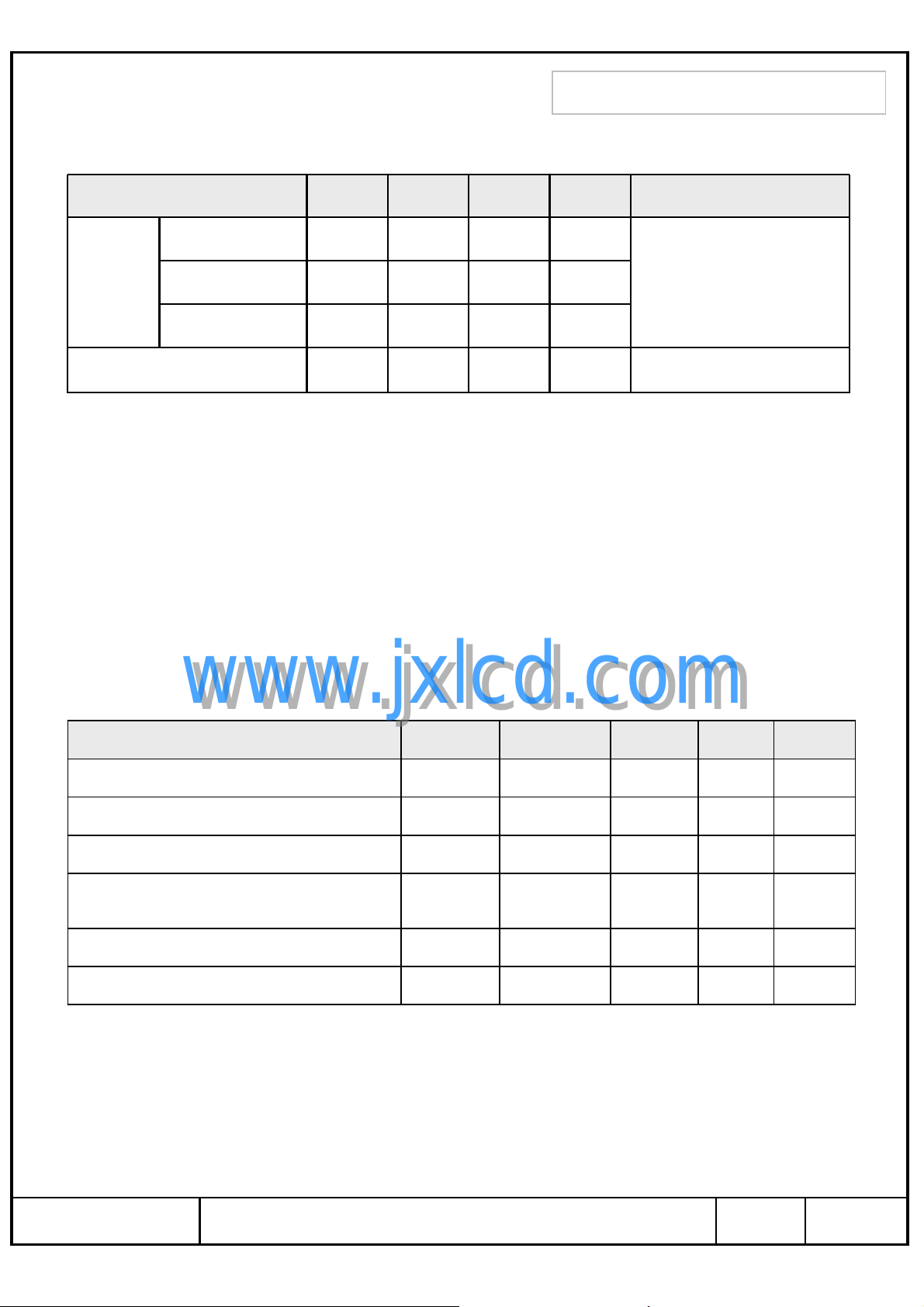
Mechanical Information
PRODUCT INFORMATION
PRODUCT INFORMATION
Max.
534.5
Module
312.2
size
12
2,550
Note (1) Mechanical tolerance is ± 0.5mm unless there is a special comment.
mm534.0533.5Horizontal (H)
mm311.7311.2Vertical (V) w/o inverter ass’y
mm--Depth (D)
1. Absolute Maximum Ratings
NoteUnitTyp.Min.Item
LCD module onlyg--Weight
If the condition exceeds maximum ratings, it can cause malfunction or unrecoverable
damage to the device.
Center of Glass surface temperature
Shock ( non - operating )
Vibration ( non - operating )
Note (1) Ta= 25 ± 2 °C
www.jxlcd.com
www.jxlcd.com
Power Supply Voltage
Data Signal
Storage temperature
(Operation)
DD
sig
STG
OPR
nop
nop
60-25T
500T
V5-V
℃
℃
NoteUnitMax.Min.SymbolItem
(1)V6.5GND-0.5V
(2)
(2)
(3)(5)G50-S
(4)(5)G1.5-V
4/34PageLTM230HT02MODEL
Page 5
PRODUCT INFORMATION
PRODUCT INFORMATION
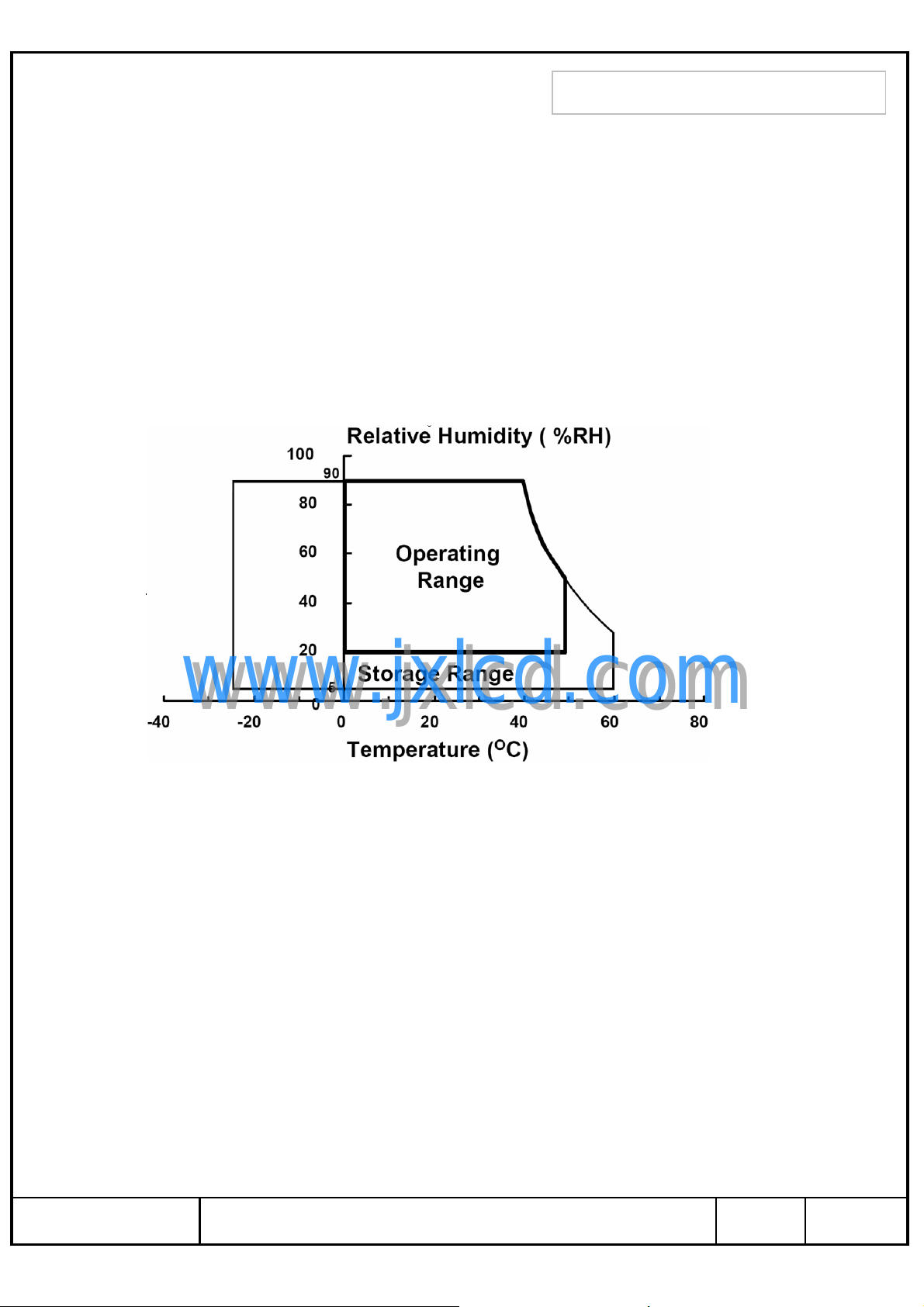
(2) Temperature and relative humidity range are shown in the figure below.
a. 90 % RH Max. (Ta ≤ 39 °C)
b. Maximum wet-bulb temperature at 39 °C or less. (Ta ≤ 39 °C)
c. No condensation
(3) 11ms, sine wave, one time for ±X, ±Y, ±Z axis
(4) 10-300 Hz, Sweep rate 10min, 30min for X,Y,Z axis
(5) At vibration and shock test, the fixture which holds the module to be tested has to be
hard and rigid enough so that the module would not be twisted or bent by the fixture.
(39,90)
(39,90)
(50,50.4)
(50,50.4)
(60,27.7)
(60,27.7)
25,5)
((--25,5)
www.jxlcd.com
www.jxlcd.com
Fig. Temperature and Relative humidity range
5/34PageLTM230HT02MODEL
Page 6
PRODUCT INFORMATION
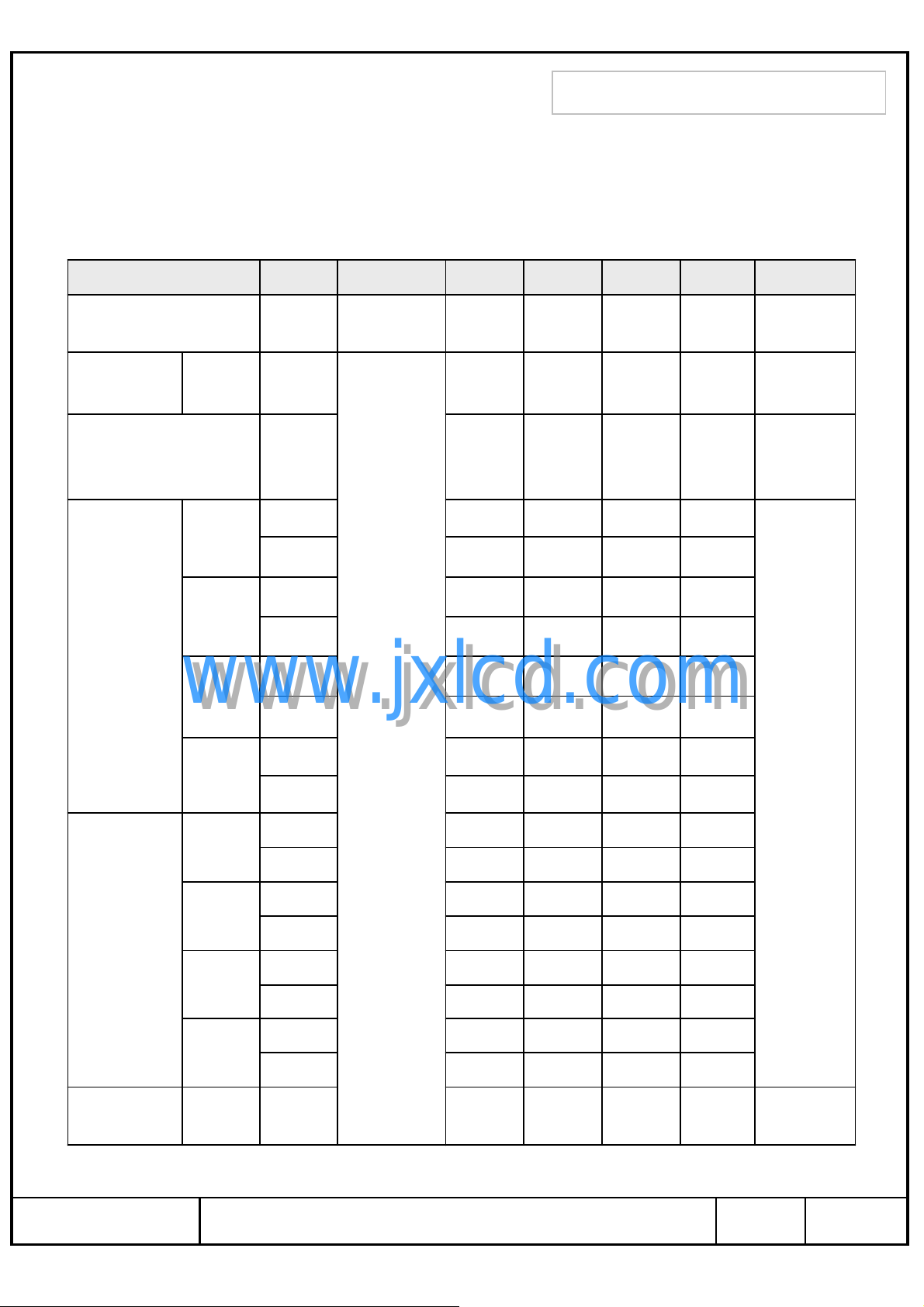
2. Optical Characteristics
PRODUCT INFORMATION
The optical characteristics should be measured in a dark room or equivalent.
Measuring equipment : SR-3, RD-80S (TOPCON),
(Ta = 25 ± 2°C, VDD=5V, fv= 60Hz, fDCLK= 67.3 MHz, IL = 7.5mArms)
EZ-Contrast (Eldim)
NoteUnitMax.Typ.Min.ConditionSymbolItem
Contrast Ratio
(Center of screen)
Response
Time(On/Off)
Luminance of White
(Center of screen)
Color
Chromaticity
(CIE 1931)
www.jxlcd.com
www.jxlcd.com
Red
Green
Blue
White
Rx
Ry
Gx
Gy
Bx
By
Wx
Wy
-1000600C/R
105-Tr + TfOn/Off
L
0.650
0.337
0.295
0.605
0.147
0.075
0.313
0.329
Normal
θ
=0
L,R
θ
=0
U,D
Viewing
Angle
0.620
0.307
0.265
0.575
0.117
0.045
0.283
0.299
-250200Y
0.680
0.367
0.325
0.635
0.177
0.105
0.343
0.359
msec
cd/m
2
(3)
SR-3
(5)
RD-80S
(6)
SR-3
(7),(8)
SR-3
Red
Color
Chromaticity
(CIE 1976)
C.G.L
(ACC ONLY)
* C.G.L : Color Grayscale Linearity
Green
Blue
White
△u'v'White
-0.453-Ru'
-0.528-Rv'
-0.122-Gu'
-0.563-Gv'
-0.163-Bu'
-0.187-Bv'
-0.198-Wu'
-0.468-Wv'
(9)0.02--
6/34PageLTM230HT02MODEL
Page 7

PRODUCT INFORMATION
PRODUCT INFORMATION
NoteUnitMax.Typ.Min.ConditionSymbolItem
-6500--Color Temperature
%-72--Color Gamut
θ
Hor.
Viewing
Angle
Ver.
Brightness Uniformity
(9 Points)
Note (1) Test Equipment Setup
The measurement should be executed in a stable, windless and dark room between
30min after lighting the back light at the given temperature for stabilization
of the back light. This should be measured in the center of screen.
Single lamp current : 7.5mA
Environment condition : Ta = 25 ± 2 °C
www.jxlcd.com
www.jxlcd.com
L
θ
R
θ
U
θ
D
uni
CR≥10
-8070
-8070
Degrees
-8070
-8070
%25--B
(8)
SR-3
(4)
SR-3
Field Photo detector
2°SR-3
TFT - LCD Module
Photo detector
Field
SR-3 : 40㎝
RD-80S : 50㎝
LCD Panel
The center of the screen
7/34PageLTM230HT02MODEL
Page 8

Note (2) Definition of test point
B
−
max
G
min
192 960 1728
PRODUCT INFORMATION
PRODUCT INFORMATION
Active Area
6
: Test Point
Note (3) Definition of Contrast Ratio (C/R)
: Ratio of gray max (Gmax) & gray min (Gmin) at the center point⑤ of the panel
3 2 1
CR
Gmax : Luminance with all pixels white
Gmin : Luminance with all pixels black
G
=
max
8 79
45
108
540
972
Note (4) Definition of 9 points brightness uniformity
www.jxlcd.com
www.jxlcd.com
Buni
= ×
100
Bmax : Maximum brightness
Bmin : Minimum brightness
Note (5) Definition of Response time : Sum of Tr, Tf
Display Data White(TFT off) Black(TFT on) White(TFT off)
Optical Instruments
Response
100%
90%
10%
B B
( max min)
0%
8/34PageLTM230HT02MODEL
Page 9

PRODUCT INFORMATION
PRODUCT INFORMATION
Note (6) Definition of Luminance of White : Luminance of white at center point⑤
Note (7) Definition of Color Chromaticity (CIE 1931, CIE1976)
Color coordinate of Red, Green, Blue & White at center point⑤
Note (8) Definition of Viewing Angle
: Viewing angle range (CR ≥ 10)
www.jxlcd.com
www.jxlcd.com
9/34PageLTM230HT02MODEL
Page 10
PRODUCT INFORMATION
PRODUCT INFORMATION
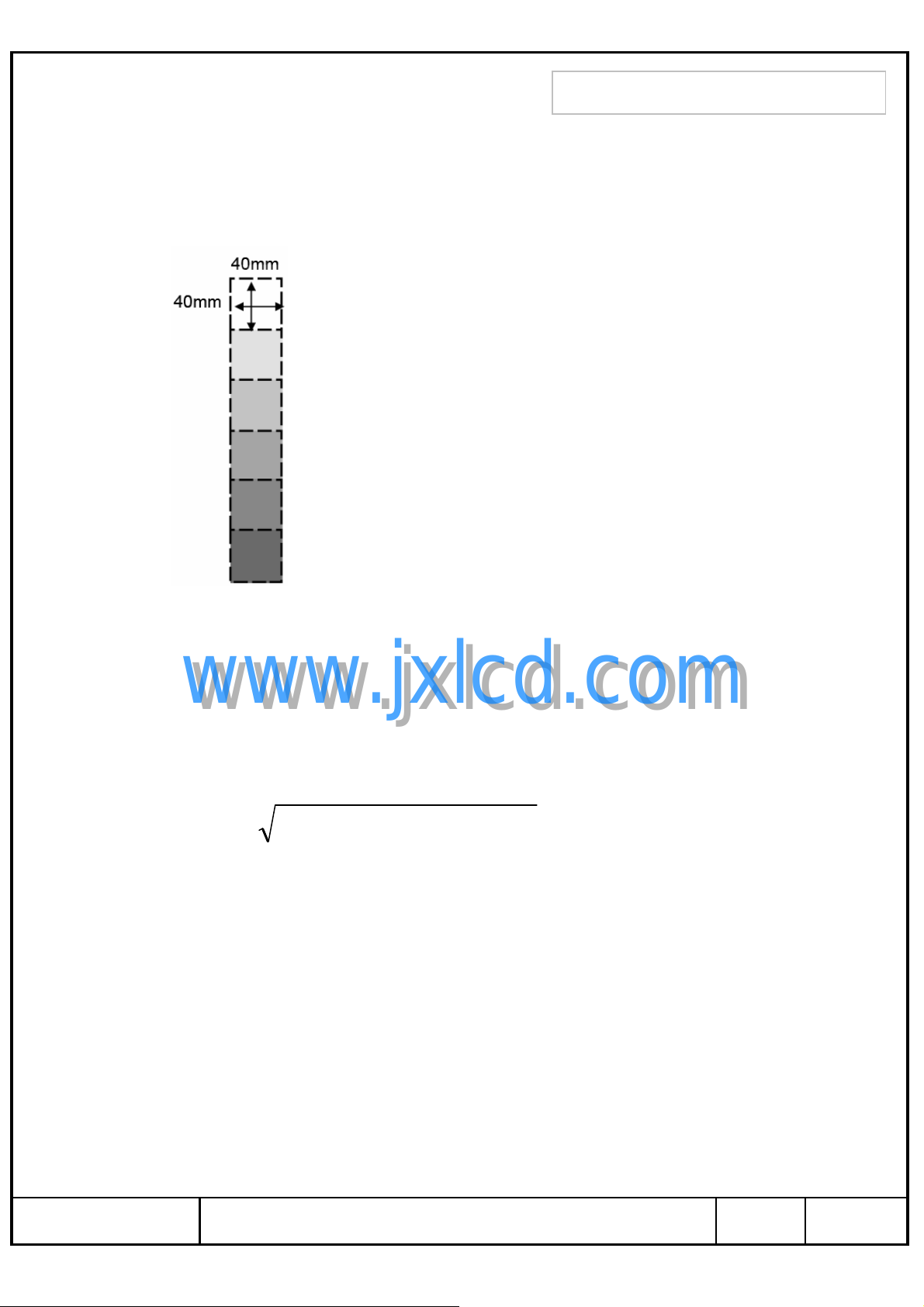
Note (9) Color Grayscale Linearity
a. Test image : 100% full white pattern with a test pattern as below
b. Test pattern : Squares, 40mm by 40mm in size, filled with 255, 225, 195, 165, 135 and
105 grays steps should be arranged at the center⑤ of the screen.
c. Test method
-1stgray step : move a square of 255 gray level should be moved into the center of the
screen and measure luminance and u’ and v’ coordinates.
www.jxlcd.com
www.jxlcd.com
- Next gray step : Move a 225 gray square into the center and measure both
luminance and coordinates, too.
d. Test evaluation
∆u'v'= (u' -u' ) +(v' -v' )
Where A, B : 2 gray levels found to have the largest color differences between them
i.e. get the largest Δu’ and Δv’ of each 6 pair of u’ and v’ and calculate the Δu’v’.
A B
2
A B
2
10/34PageLTM230HT02MODEL
Page 11

3. Electrical Characteristics
3.1 TFT LCD Module
The connector for display data & timing signal should be connected.
PRODUCT INFORMATION
PRODUCT INFORMATION
Ta = 25°C
NoteUnitMax.Typ.Min.SymbolItem
Voltage of Power Supply
Differential Input
Voltage for LVDS
Receiver Threshold
LVDS skew
LVDS
Input
Characteri
stics
Current of
Power
Supply
Differential input
voltage
Input voltage range
(single-ended)
Common mode
voltage
www.jxlcd.com
www.jxlcd.com
(a) Black
DD
SKEW
IN
V
CM
I
DD
0+
|VID|/2
1.2
(1)V5.55.04.5V
(2)mV+100--High
mV---100Low
(3)ps300-300t
(4)mV600200|VID|
(4)V2.40V
2.4(4)V
|VID|/2
mA-1,600mA-1,100-(b) White (5),(6)
mA2,2001,800-(c) Dot
Vsync Frequency
Hsync Frequency
Main Frequency
Rush Current
V
H
DCLK
RUSH
Note (1) The ripple voltage should be controlled under 10% of VDD.
Hz75.060.049.0f
kHz83.866.054.2f
MHz83.067.356.4f
(7)A5.0--I
11/34PageLTM230HT02MODEL
Page 12

PRODUCT INFORMATION
PRODUCT INFORMATION
(2)
Differential receiver voltage definitions and propagation delay and transition time test
circuit
a. All input pulses have frequency = 10MHz, tRor tF=1ns
b. CLincludes all probe and fixture capacitance
Note a.
Note b.
(3) LVDS Receiver DC parameters are measured under static and steady conditions
which may not be reflective of its performance in the end application.
T
LVDS Clk
LVDS Data
RX +/-
www.jxlcd.com
where tskew : skew between LVDS clock & LVDS data,
T : 1 period time of LVDS clock
cf) (-/+) of 300psec means LVDS data goes before or after LVDS clock.
(4) Definition of VIDand V
V
= 0V
DIFF
www.jxlcd.com
t
SKEW
using single-end signals
CM
V
= 0V
DIFF
Differential
Differential
12/34PageLTM230HT02MODEL
Page 13

PRODUCT INFORMATION
PRODUCT INFORMATION
(5) fV=60Hz, fDCLK = 67.3 MHz, VDD = 5.0V, DC Current.
(6) Power dissipation check pattern (LCD Module only)
a) Black Pattern b) White Pattern c) Dot Pattern
(7) Measurement Condition
100%
90%
10%
GND
www.jxlcd.com
www.jxlcd.com
T
=470㎲
RUSH
Rush Current I
can be measured when T
RUSH
. is 470㎲.
RUSH
V
DD
13/34PageLTM230HT02MODEL
Page 14

PRODUCT INFORMATION
PRODUCT INFORMATION
3.2 Back Light Unit
The back light unit is an edge - lighting type with 2 dual CCFLs ( Cold Cathode
Fluorescent Lamp ) The characteristics of two dual lamps are shown in the following tables.
Ta=25 ± 2°C
NoteUnitMax.Typ.Min.SymbolItem
Lamp Current
Lamp Voltage
Lamp Frequency
Asymmetry
Inverter
waveform
www.jxlcd.com
Note (1) Specified values are for a single lamp.
www.jxlcd.com
Lamp current is measured with current meter for high frequency as shown below.
Refer to the following block diagram of the back light unit for more information.
rate
Distortion
rate
L
L
L
(1)mArms8.07.54.0I
Vrms-875-V
(2)kHz60-40f
(3)Hour--50,000HrOperating Life Time
%10--Wasy
(4)
1.55541.4141.2726Wdis
0℃ : 1,840
--VsStartup Voltage
25℃: 1,510
(5)Vrms
LCD Module
HOT(RED)
COLD(WHITE)
I
1
A
INVERTER
HOT(BLUE)
COLD(GRAY)
Fig. Measurement point of Lamp Current
I
2
A
(SI1700)
14/34PageLTM230HT02MODEL
Page 15

PRODUCT INFORMATION
I
−
I
I
PRODUCT INFORMATION
(2) Lamp frequency which may produce interference with horizontal synchronous
frequency may cause line flow on the display. Therefore lamp frequency should be
detached from the horizontal synchronous frequency and its harmonics as far as
possible in order to avoid interference.
(3) Life time (Hr) is defined as the time when brightness of a lamp unit itself becomes
50% or less than its original value at the condition of Ta = 25±2°C and IL= 7.5mArms
(4) Designing a system inverter intended to have better display performance, power
efficiency and lamp reliability.
They would help increase the lamp lifetime and reduce leakage current.
a. The measurement should be done at typical lamp current.
b. The asymmetry rate of the inverter waveform should be less than 10%.
c. The distortion rate of the waveform should be √2 with ±10% tolerance.
- Inverter output waveform had better be more similar to ideal sine wave.
Asymmetry rate
| |I I
I
p
www.jxlcd.com
www.jxlcd.com
Fig. Wave form of the inverter
(5) If an inverter has shutdown function, it should keep its output for over 1 second
even if the lamp connector is open. Otherwise the lamps may not be turned on.
I
-p
Distortion rate
p - p
rms
I
p
| |
rms
or
×100
I
- p
| |
rms
15/34PageLTM230HT02MODEL
Page 16

4. BLOCK DIAGRAM
4.1 TFT LCD Module
RSDS
PRODUCT INFORMATION
PRODUCT INFORMATION
LVDS
pair #1
LVDS
pair #2
+5.0V
V
DD
CN1
(30pin)
LVDS (Rx)
Timing Controller
Power
Circuit
4.2 Back Light Unit
RSDS(Tx)
Control signal
Source Driver ICs
S1 S 1920
Control signal
Column Driver Circuit
TFT-LCD
(1920 x RGB x 1080 pixels)
Connector : YEON-HO 35001HS-02L or equivalent
www.jxlcd.com
www.jxlcd.com
LAMP(CCFL)
LAMP(CCFL)
LAMP(CCFL)
LAMP(CCFL)
1
2
1
2
HOT (Red)
COLD (White)
HOT(Blue)
COLD(Gray)
16/34PageLTM230HT02MODEL
Page 17

PRODUCT INFORMATION
5. Input Terminal Pin Assignment
PRODUCT INFORMATION
5.1. Input Signal & Power ( Connector : JAE FI-XB30SRLZ-HF11 or Compatible )
FUNCTIONSYMBOLPIN NO
Negative LVDS differential data outputRXO0N1
RXO0P2
RXO1N3
www.jxlcd.com
www.jxlcd.com
Positive LVDS differential data output
Negative LVDS differential data output
Positive LVDS differential data outputRXO1P4
Negative LVDS differential data outputRXO2N5
Positive LVDS differential data outputRXO2P6
GroundGND7
Negative Sampling Clock (ODD data)RXOC-8
Positive Sampling Clock (ODD data)RXOC+9
Negative LVDS differential data outputRXO3N10
Positive LVDS differential data outputRXO3P11
Negative LVDS differential data outputRXE0N12
Positive LVDS differential data outputRXE0P13
GroundGND14
Negative LVDS differential data outputRXE1N15
Positive LVDS differential data outputRXE1P16
GroundGND17
Negative LVDS differential data outputRXE2N18
Positive LVDS differential data outputRXE2P19
Negative Sampling Clock (EVEN data)RXEC-20
Positive Sampling Clock (EVEN data)RXEC+21
Negative LVDS differential data outputRXE3N22
Positive LVDS differential data outputRXE3P23
GroundGND24
* CE (For LCD internal use only. Do not connect)NC25
* CTL (For LCD internal use only. Do not connect)NC26
No ConnectionNC27
VDD28
VDD29
VDD30
* If the system already uses the 25, 26pins, it should keep under GND level
The voltage applied to those pins should not exceed -200mV.
Power Supply : +5V
17/34PageLTM230HT02MODEL
Page 18

Note) Pin number starts from Left side
▼
PRODUCT INFORMATION
PRODUCT INFORMATION
PCB
▼
Pin No. 1 Pin No. 30
#30#1
JAE FI-XB30SRLZ-HF11 or Compatible
#30#1
www.jxlcd.com
www.jxlcd.com
a. All GND pins should be connected together and also be connected to the
LCD’s metal chassis.
b. All power input pins should be connected together.
c. All NC pins should be separated from other signal or power.
Fig. Connector diagram
18/34PageLTM230HT02MODEL
Page 19

PRODUCT INFORMATION
PRODUCT INFORMATION
5.2 LVDS Interface
(1)
5.2.1 Odd Pixel Data (1st pixel data)
LVDS Transmitter ( DS90C383, DS90C385 ) Signal Interface
Device Input SignalDevice Input Pin
Red Odd Pixel Data (LSB) RO0TXIN0 51
Red Odd Pixel Data RO1TXIN1 52
Red Odd Pixel Data RO2TXIN2 54
Red Odd Pixel Data RO3TXIN3 55
Red Odd Pixel Data RO4TXIN4 56
Red Odd Pixel Data (MSB) RO7TXIN5 2
Red Odd Pixel Data RO5TXIN6 3
Green Odd Pixel Data (LSB)GO0TXIN7 4
Output
Signal
TXOUT0-
TXOUT0+
TXOUT3-
TXOUT3+
TXOUT0-
TXOUT0+
To LTM230HT02
Interface ( CN101 )
SymbolTerminalFunctionSymbolSymbolNo
No. 1
No. 2
No. 10
No. 11
No. 1
No. 2
RXO0-
RXO0+
RXO3-
RXO3+
RXO0-
RXO0+
Green Odd Pixel Data GO1TXIN8 6
Green Odd Pixel Data GO2TXIN9 7
Green Odd Pixel Data GO6TXIN108
www.jxlcd.com
www.jxlcd.com
Green Odd Pixel Data (MSB)GO7TXIN1110
Green Odd Pixel Data GO3TXIN1211
Green Odd Pixel Data GO4TXIN1312
Green Odd Pixel Data GO5TXIN1414
Blue Odd Pixel Data (LSB) BO0TXIN1515
Blue Odd Pixel Data BO6TXIN1616
Blue Odd Pixel Data (MSB) BO7TXIN1718
Blue Odd Pixel Data BO1TXIN1819
Blue Odd Pixel Data BO2TXIN1920
Blue Odd Pixel Data BO3TXIN2022
Blue Odd Pixel Data BO4TXIN2123
TXOUT1-
TXOUT1+
TXOUT3-
TXOUT3+
TXOUT1-
TXOUT1+
TXOUT3-
TXOUT3+
TXOUT1-
TXOUT1+
TXOUT2-
TXOUT2+
No. 3
No. 4
No. 10
No. 11
No. 3
No. 4
No. 10
No. 11
No. 3
No. 4
No. 5
No. 6
RXO1-
RXO1+
RXO3-
RXO3+
RXO1-
RXO1+
RXO3-
RXO3+
RXO1-
RXO1+
RXO2-
RXO2+
Blue Odd Pixel Data BO5TXIN2224
Red Odd Pixel Data RO6TXIN2750
TXOUT3-
TXOUT3+
No. 10
No. 11
RXO3-
RXO3+
19/34PageLTM230HT02MODEL
Page 20

5.2.2 Even Pixel Data (2nd pixel data)
LVDS Transmitter ( DS90C383, DS90C385 ) Signal Interface
PRODUCT INFORMATION
PRODUCT INFORMATION
Device Input SignalDevice Input Pin
Red Even Pixel Data (LSB) RE0TXIN0 51
Red Even Pixel Data RE1TXIN1 52
Red Even Pixel Data RE2TXIN2 54
Red Even Pixel Data RE3TXIN3 55
Red Even Pixel Data RE4TXIN4 56
Red Even Pixel Data (MSB) RE7TXIN5 2
Red Even Pixel Data RE5TXIN6 3
Green Even Pixel Data (LSB)GE0TXIN7 4
Green Even Pixel Data GE1TXIN8 6
Green Even Pixel Data GE2TXIN9 7
Output
Signal
TXOUT0-
TXOUT0+
TXOUT3-
TXOUT3+
TXOUT0-
TXOUT0+
TXOUT1-
TXOUT1+
To LTM230HT02
Interface ( CN101 )
SymbolTerminalFunctionSymbolSymbolNo
No. 12
No. 13
No. 22
No. 23
No. 12
No. 13
No. 15
No. 16
RXE0-
RXE0+
RXE3-
RXE3+
RXE0-
RXE0+
RXE1-
RXE1+
Green Even Pixel Data GE6TXIN108
www.jxlcd.com
www.jxlcd.com
Green Even Pixel Data (MSB)GE7TXIN1110
Green Even Pixel Data GE3TXIN1211
Green Even Pixel Data GE4TXIN1312
Green Even Pixel Data GE5TXIN1414
Blue Even Pixel Data (LSB) BE0TXIN1515
Blue Even Pixel Data BE6TXIN1616
Blue Even Pixel Data (MSB) BE7TXIN1718
Blue Even Pixel Data BE1TXIN1819
Blue Even Pixel Data BE2TXIN1920
Blue Even Pixel Data BE3TXIN2022
Blue Even Pixel Data BE4TXIN2123
Blue Even Pixel Data BE5TXIN2224
TXOUT3-
TXOUT3+
TXOUT1-
TXOUT1+
TXOUT3-
TXOUT3+
TXOUT1-
TXOUT1+
TXOUT2-
TXOUT2+
No. 22
No. 23
No. 15
No. 16
No. 22
No. 23
No. 15
No. 16
No. 18
No. 19
RXE3-
RXE3+
RXE1-
RXE1+
RXE3-
RXE3+
RXE1-
RXE1+
RXE2-
RXE2+
Red Even Pixel Data RE6TXIN2750
TXOUT3-
TXOUT3+
No. 22
No. 23
RXE3-
RXE3+
20/34PageLTM230HT02MODEL
Page 21

5.2 LVDS Interface (2)
5.2.3 Odd Pixel Data (1st pixel data)
LVDS Transmitter ( DS90C387 ) Signal Interface
PRODUCT INFORMATION
PRODUCT INFORMATION
Device Input SignalDevice Input Pin
Red Odd Pixel Data (LSB) RO0R1010
Red Odd Pixel Data RO1R119
Red Odd Pixel Data RO2R12 8
Red Odd Pixel Data RO3R13 7
Red Odd Pixel Data RO4R14 6
Red Odd Pixel Data (MSB) RO7R17 3
Red Odd Pixel Data RO5R15 5
Green Odd Pixel Data (LSB)GO0G10 2
Green Odd Pixel Data GO1G11 1
Green Odd Pixel Data GO2G12 100
www.jxlcd.com
www.jxlcd.com
Green Odd Pixel Data GO6G1694
Green Odd Pixel Data (MSB)GO7G1793
Output
Signal
A0M
A0P
A3M
A3P
A0M
A0P
A1M
A1P
A3M
A3P
To LTM230HT02
Interface ( CN101 )
No. 1
No. 2
No. 10
No. 11
No. 1
No. 2
No. 3
No. 4
No. 10
No. 11
SymbolTerminalFunctionSymbolSymbolNo
RXO0-
RXO0+
RXO3-
RXO3+
RXO0-
RXO0+
RXO1-
RXO1+
RXO3-
RXO3+
Green Odd Pixel Data GO3G1399
Green Odd Pixel Data GO4G1496
Green Odd Pixel Data GO5G1595
Blue Odd Pixel Data (LSB) BO0B1092
Blue Odd Pixel Data BO6B1686
Blue Odd Pixel Data (MSB) BO7B1785
Blue Odd Pixel Data BO1B1191
Blue Odd Pixel Data BO2B1290
Blue Odd Pixel Data BO3B1389
Blue Odd Pixel Data BO4B1488
Blue Odd Pixel Data BO5B1587
Red Odd Pixel Data RO6R164
A1M
A1P
A3M
A3P
A1M
A1P
A2M
A2P
A3M
A3P
No. 3
No. 4
No. 10
No. 11
No. 3
No. 4
No. 5
No. 6
No. 10
No. 11
RXO1-
RXO1+
RXO3-
RXO3+
RXO1-
RXO1+
RXO2-
RXO2+
RXO3-
RXO3+
21/34PageLTM230HT02MODEL
Page 22

5.2.4 Even Pixel Data (2nd pixel data)
LVDS Transmitter ( DS90C387 ) Signal Interface
PRODUCT INFORMATION
PRODUCT INFORMATION
Device Input SignalDevice Input Pin
Red Even Pixel Data (LSB) RE0R2084
Red Even Pixel Data RE1R2181
Red Even Pixel Data RE2R22 80
Red Even Pixel Data RE3R23 79
Red Even Pixel Data RE4R24 78
Red Even Pixel Data (MSB) RE7R27 75
Red Even Pixel Data RE5R25 77
Green Even Pixel Data (LSB)GE0G20 74
Green Even Pixel Data GE1G21 73
Green Even Pixel Data GE2G22 72
Green Even Pixel Data GE6G2666
www.jxlcd.com
www.jxlcd.com
Green Even Pixel Data (MSB)GE7G2765
Output
Signal
A4M
A4P
A7M
A7P
A4M
A4P
A5M
A5P
A7M
A7P
To LTM230HT02
Interface ( CN101 )
No. 12
No. 13
No. 22
No. 23
No. 12
No. 13
No. 15
No. 16
No. 22
No. 23
SymbolTerminalFunctionSymbolSymbolNo
RXE0-
RXE0+
RXE3-
RXE3+
RXE0-
RXE0+
RXE1-
RXE1+
RXE3-
RXE3+
Green Even Pixel Data GE3G2371
Green Even Pixel Data GE4G2470
Green Even Pixel Data GE5G2569
Blue Even Pixel Data (LSB) BE0B2064
Blue Even Pixel Data BE6B2658
Blue Even Pixel Data (MSB) BE7B2757
Blue Even Pixel Data BE1B2163
Blue Even Pixel Data BE2B2262
Blue Even Pixel Data BE3B2361
Blue Even Pixel Data BE4B2460
Blue Even Pixel Data BE5B2559
Red Even Pixel Data RE6R2676
A5M
A5P
A7M
A7P
A5M
A5P
A6M
A6P
A7M
A7P
No. 15
No. 16
No. 22
No. 23
No. 15
No. 16
No. 18
No. 19
No. 22
No. 23
RXE1-
RXE1+
RXE3-
RXE3+
RXE1-
RXE1+
RXE2-
RXE2+
RXE3-
RXE3+
22/34PageLTM230HT02MODEL
Page 23

5.2.5 Timing Diagrams of LVDS For Transmitting
LVDS Receiver : Integrated T-CON
PRODUCT INFORMATION
PRODUCT INFORMATION
www.jxlcd.com
www.jxlcd.com
23/34PageLTM230HT02MODEL
Page 24

5.3 Back Light Unit
Upper
Lower
Connect
or
Part No.
PRODUCT INFORMATION
PRODUCT INFORMATION
High VoltageRedHot1
GroundWhiteCold2
High VoltageBlueHot1
GroundGrayCold2
Yeonho 35001HS-02L or equivalent
FunctionColorInputPin No.
www.jxlcd.com
www.jxlcd.com
24/34PageLTM230HT02MODEL
Page 25

PRODUCT INFORMATION
PRODUCT INFORMATION
5.3 Input Signals, Basic Display Colors and Gray Scale of Each Color
DATA SIGNAL
COLOR
BASIC
COLOR
GRAY
SCALE
OF
RED
GRAY
SCALE
OF
GREEN
GRAY
SCALE
OF
BLUE
DISPLAY
(8bit)
DARK
↑
↓
LIGHT
DARK
↑
↓
LIGHT
DARK
↑
↓
LIGHT
www.jxlcd.com
www.jxlcd.com
BLUEGREENRED
::::::::::::::::::
::::::::::::::::::
::::::::::::::::::
::::::::::::::::::
::::::::::::::::::
::::::::::::::::::
GRAY
SCALE
LEVEL
B7B6B5B4B3B2B1B0G7G6G5G4G3G2G1G0R7R6R5R4R3R2R1R0
-000000000000000000000000BLACK
-111111110000000000000000BLUE
-000000001111111100000000GREEN
-111111111111111100000000CYAN
-000000000000000011111111RED
-111111110000000011111111MAGENTA
-000000001111111111111111YELLOW
-111111111111111111111111WHITE
R0000000000000000000000000BLACK
R1000000000000000000000001
R2000000000000000000000010
R3~
R252
R253000000000000000011111101
R254000000000000000011111110
R255000000000000000011111111RED
G0000000000000000000000000BLACK
G1000000000000000100000000
G2000000000000001000000000
G3~
G252
G253000000001111110100000000
G254000000001111111000000000
G255000000001111111100000000GREEN
B0000000000000000000000000BLACK
B1000000010000000000000000
B2000000100000000000000000
B3~
B252
B253111111010000000000000000
B254111111100000000000000000
B255111111110000000000000000BLUE
Note (1) Definition of Gray :
Rn : Red Gray, Gn : Green Gray, Bn : Blue Gray (n = Gray level)
Input Signal : 0 = Low level voltage, 1 = High level voltage
25/34PageLTM230HT02MODEL
Page 26

6. Interface Timing
6.1 Timing Parameters ( DE only mode )
PRODUCT INFORMATION
PRODUCT INFORMATION
NOTEUnitMAX.TYP.MIN.SYMBOLITEMSIGNAL
Clock
Hsync
Vsync
Vertical
Display Term
Horizontal
Display Term
Note (1) This product is DE only mode. The input of Hsync & Vsync signal does
www.jxlcd.com
www.jxlcd.com
not have an effect on normal operation.
Frequency
Active
Display
Period
Vertical Total
Active
Display
Period
Horizontal
Total
VD
HD
C
H
V
V
Clocks960960960T
H
clocks10401010990T
-MHz83.067.356.41/T
-kHz83.86654.2F
-Hz756049F
-Lines108010801080T
-Lines111811111105T
2pixel/
clock
2pixel/
clock
(2) Test Point : TTL control signal and CLK at LVDS Tx input terminal in system
(3) Internal Vcc = 3.3V
(4) Best operation clock frequency is
(5) Clock frequency = Frame frequency x
(6) Max, Min variation range is at main clock Typ value (
67.3
MHz (60Hz)
T
V
(Typ) x
T
H
(Typ)
67.3
MHz).
26/34PageLTM230HT02MODEL
Page 27

PRODUCT INFORMATION
PRODUCT INFORMATION
6.2 Timing diagrams of interface signal ( DE only mode )
T
V
T
VD
DE
T
H
T
HD
DE
T
VB
D
CLK
DATA
SIGNALS
T
C
www.jxlcd.com
www.jxlcd.com
T
C
T
D
CLK
DISPLAY
DATA
CH
T
DS
T
CL
0.5
V
CC
T
DH
0.5
V
CC
DE
T
ES
0.5
V
CC
27/34PageLTM230HT02MODEL
Page 28

PRODUCT INFORMATION
PRODUCT INFORMATION
6.3 Power ON/OFF Sequence
To prevent a latch-up or DC operation of the LCD Module, the power on/off
sequence should be as the diagram below.
300㎲
≤T1≤≤≤≤10msec
㎲㎲㎲≤≤≤
0≤≤≤≤T2≤≤≤≤50msec
0≤≤≤≤T3≤≤≤≤50msec
1sec≤≤≤≤T4
Back-Light
(Recommended)
500msec≤≤≤≤T5
100msec≤≤≤≤T6
www.jxlcd.com
www.jxlcd.com
T1 : VDDrising time from 10% to 90%
T2 : The time from VDDto valid data at power ON.
T3 : The time from valid data off to VDDoff at power Off.
T4 : VDDoff time for Windows restart
T5 : The time from valid data to B/L enable at power ON.
T6 : The time from valid data off to B/L disable at power Off.
The supply voltage of the external system for the Module input should be the same
as the definition of VDD.
Apply the lamp voltage within the LCD operation range. When the back light turns on
before the LCD operation or the LCD turns off before the back light turns off,
the display may momentarily show abnormal screen.
In case of VDD= off level,
please keep the level of input signals low or keep a high impedance.
T4 should be measured after the Module has been fully discharged between power off
and on period.
Interface signal should not be kept at high impedance when the power is on.
28/34PageLTM230HT02MODEL
Page 29

6.4 VDD Power Dip Condition
V
DD
90%
T
PRODUCT INFORMATION
PRODUCT INFORMATION
d
80%
GND
4.5V ≤ VDD≤ 5.5V
If VDD(typ.) x 80% ≤ VCC≤ VDD(typ) x 90%
Then, 0<Td ≤20msec
Note (1) The above conditions are for the glitch of the input voltage.
(2) For stable operation of an LCD Module power, please follow them.
www.jxlcd.com
www.jxlcd.com
i.e., if typ VDD x 80% ≤ Vcc ≤ typ VDD x 90%, then Tdshould be less than 20ms.
V
CC
29/34PageLTM230HT02MODEL
Page 30

7. Outline Dimension
[ Refer to the next page ]
PRODUCT INFORMATION
PRODUCT INFORMATION
www.jxlcd.com
www.jxlcd.com
30/34PageLTM230HT02MODEL
Page 31

www.jxlcd.com
www.jxlcd.com
Page 32

PRODUCT INFORMATION
8. General Precautions
8.1 Handling
(a) When the module is assembled, it should be attached to the system firmly
using all mounting holes. Be careful not to twist and bend the module.
(b) Because the inverter uses high voltages, it should be disconnected from power
source before it is assembled or disassembled.
(c) Refrain from strong mechanical shock and / or any force to the module.
In addition to damage, it may cause improper operation or damage to the module
and CCFT back light.
(d) Note that polarizer films are very fragile and could be damaged easily.
Do not press or scratch the surface harder than a HB pencil lead.
(e) Wipe off water droplets or oil immediately. If you leave the droplets for a long
time, staining or discoloration may occur.
PRODUCT INFORMATION
(f) If the surface of the polarizer is dirty, clean it using absorbent cotton or soft cloth.
(g) Desirable cleaners are water, IPA (Isopropyl Alcohol) or Hexane.
Do not use Ketone type materials (ex. Acetone), Ethyl alcohol, Toluene, Ethyl acid
or Methyl chloride. It might cause permanent damage to the polarizer due to chemical
reaction.
www.jxlcd.com
(h) If the liquid crystal material leaks from the panel, it should be kept away
from the eyes or mouth . In case of contact with hands, legs or clothes, it must
be washed away with soap thoroughly.
(i) Protect the Module from static, or the CMOS Gate Array IC would be damaged.
(j) Use finger-stalls with soft gloves in order to keep display clean during the
incoming inspection and assembly process.
(k) Do not disassemble the Module.
(l) Do not pull or fold the lamp wire.
(m) Do not adjust the variable resistor located on the Module.
www.jxlcd.com
(n) Protection film for polarizer on the Module should be slowly peeled off just before use
so that the electrostatic charge can be minimized.
(o) Pins of I/F connector should not be touched directly with bare hands.
32/34PageLTM230HT02MODEL
Page 33

PRODUCT INFORMATION
PRODUCT INFORMATION
8.2 Storage
(a) Do not leave the Module in high temperature, and high humidity for a long time.
It is highly recommended to store the Module with temperature from 0 to 35℃
and relative humidity of less than 70%.
(b) Do not store the TFT-LCD Module in direct sunlight.
(c) The Module should be stored in a dark place. It is prohibited to apply sunlight or
fluorescent light in storing.
8.3 Operation
(a) Do not connect or disconnect the Module in the "Power On" condition.
(b) Power supply should always be turned on/off by the item 6.3
"Power on/off sequence"
(c) Module has high frequency circuits. Sufficient suppression to the electromagnetic
interference should be done by system manufacturers. Grounding and shielding
methods may be important to minimize the interference.
www.jxlcd.com
www.jxlcd.com
(d) The cable between the back light connector and its inverter power supply should
be connected directly with a minimized length. A longer cable between
the back light and the inverter may cause lower luminance of lamp(CCFT) and
may require higher startup voltage(Vs).
8.4 Operation Condition Guide
(a) The LCD product should be operated under normal conditions.
Normal condition is defined as below;
- Temperature : 20±15℃
- Humidity : 65±20%
- Display pattern : continually changing pattern (Not stationary)
(b) If the product will be used in extreme conditions such as high temperature,
humidity, display patterns or operation time etc.., It is strongly recommended
to contact SEC for Application engineering advice. Otherwise, its reliability and
function may not be guaranteed. Extreme conditions are commonly found at
Airports, Transit Stations, Banks, Stock market, and Controlling systems.
33/34PageLTM230HT02MODEL
Page 34

PRODUCT INFORMATION
PRODUCT INFORMATION
8.5 Others
(a) Ultra-violet ray filter is necessary for outdoor operation.
(b) Avoid condensation of water. It may result in improper operation or disconnection
of electrode.
(c) Do not exceed the absolute maximum rating value. ( supply voltage variation,
input voltage variation, variation in part contents and environmental temperature,
and so on)
Otherwise the Module may be damaged.
(d) If the Module keeps displaying the same pattern for a long period of time,
the image may be "sticked" to the screen.
To avoid image sticking, it is recommended to use a screen saver.
(e) This Module has its circuitry PCB's on the rear side and should be handled
carefully in order not to be stressed.
(f) Please contact SEC in advance when you display the same pattern for a long time.
www.jxlcd.com
www.jxlcd.com
34/34PageLTM230HT02MODEL
 Loading...