

Page 1

Depending on the software installed or your service provider or country, some of the descriptions in this guide may not
match your phone exactly.
Depending on your country, your phone and accessories may appear different from the illustrations in this guide.
World Wide Web
http://www.samsungmobile.com
Printed in Korea
Code No.:GH68-19434A
English (HK). 08/2008. Rev. 1.0
Page 2
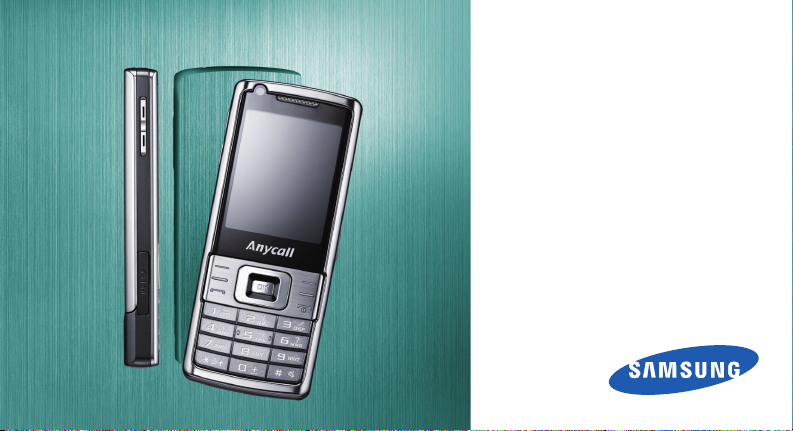
SGH-L708
user manual
Page 3
using this
manual
This user manual has been specially designed to
guide you through the functions and features of your
mobile phone. To get started quickly,
refer to “introducing your mobile phone,”
“assembling and preparing your mobile phone,”
and “using basic functions.”
ii
Instructional icons
Before you start, familiarise yourself with the icons
you will see in this manual:
Warning
—situations that could cause
injury to yourself or others
Caution
—situations that could cause
damage to your phone or other equipment
Note
—notes, usage tips, or additional
information
X
Refer to
—pages with related information;
for example: X p.12 (represents “see page
12”)
Page 4

→
[ ]
< >
Followed by
menus you must select to perform a step;
for example: Press [OK] → Messages →
Create message (represents [OK]
followed by Messages, followed by
Create message)
Square brackets
example: [ ] (represents the Power/
Menu exit key)
Angled brackets
different functions at each screen; for
example: <OK> (represents the OK
softkey)
—the order of options or
—phone keys; for
—softkeys that control
Copyright information
Rights to all technologies and products that
comprise this device are the property of their
respective owners:
• Bluetooth® is a registered trademark of the
Bluetooth SIG, Inc. worldwide—Bluetooth QD
ID: B014156.
• Java™ is a trademark of Sun Microsystems, Inc.
• Windows Media Player® is registered trademark
of Microsoft Corporation.
using this manual
iii
Page 5

safety and usage information 2
Safety warnings ..........................................2
contents
iv
Safety precautions ......................................4
Important usage information .......................7
introducing your mobile phone 9
Unpack .......................................................9
Phone layout .............................................10
Keys .........................................................11
Display ......................................................12
Icons .........................................................12
assembling and preparing your mobile
phone 14
Install the SIM or USIM card and battery ...14
Charge the battery ....................................16
Insert a memory card (optional) ................. 17
using basic functions 18
Turn your phone on and off .......................18
Page 6

Access menus ..........................................19
Customise your phone ..............................19
Use basic call functions ............................ 20
Send and view messages ......................... 21
Add and find contacts ...............................24
Use basic camera functions ......................25
Listen to music .........................................26
Browse the web ........................................ 28
using advanced functions 29
Use advanced call functions ..................... 29
Use advanced Phonebook functions .........31
Use advanced messaging functions .......... 32
Use advanced music functions .................34
using tools and applications 37
Use the Bluetooth wireless feature ............ 37
Print images ..............................................38
Record and play voice memos .................. 39
Use Java-powered games and applications 40
Use the RSS reader ..................................40
Upload photos and videos to the web ......42
Create and view world clocks ................... 43
Set and use alarms ...................................44
Use the calculator .....................................45
Convert currencies or measurements ....... 45
Set a countdown timer .............................45
Use the stopwatch .................................... 45
Create a new task .....................................46
Create a text memo ..................................46
Manage your calendar ..............................46
troubleshooting a
contents
v
Page 7

safety and
usage
information
Safety warnings
Keep your phone away from small
children and pets
Keep your phone and all accessories out of the
reach of small children or animals. Small parts may
cause choking or serious injury if swallowed.
Comply with the following precautions to avoid
dangerous or illegal situations and ensure peak
performance of your mobile phone.
2
Protect your hearing
Listening to a headset at high volumes
can damage your hearing. Use only the
minimum volume setting necessary to
hear your conversation or music.
Page 8

Install mobile phones and equipment
with caution
Ensure that any mobile phones or related equipment
installed in your vehicle are securely mounted. Avoid
placing your phone and accessories near or in an air
bag deployment area. Improperly installed wireless
equipment can cause serious injury when air bags
inflate rapidly.
Handle and dispose of batteries and
chargers with care
• Use only Samsung-approved batteries and
chargers specifically designed for your phone.
Incompatible batteries and chargers can cause
serious injuries or damage to your phone.
• Never dispose of batteries or phone in a fire.
Follow all local regulations when disposing used
batteries or phone.
• Never place batteries or phones on or in heating
devices, such as microwave ovens, stoves, or
radiators. Batteries may explode when
overheated.
• Never crush or puncture the battery. Avoid
exposing the battery to high external pressure,
which can lead to an internal short circuit and
overheating.
Avoid interference with pacemakers
Maintain a minimum of 15 cm (6 inches) between
mobile phones and pacemakers to avoid potential
interference, as recommended by manufacturers
and the independent research group, Wireless
Technology Research. If you have any reason to
suspect that your phone is interfering with a
pacemaker or other medical device, turn off the
phone immediately and contact the manufacturer of
the pacemaker or medical device for guidance.
safety and usage information
3
Page 9

Turn off the phone in potentially
explosive environments
Do not use your phone at refuelling points (service
stations) or near fuels or chemicals. Turn off your
phone whenever directed by warning signs or
safety and usage information
instructions. Your phone could cause explosions or
fire in and around fuel or chemical storage and
transfer areas or blasting areas. Do not store or carry
flammable liquids, gases, or explosive materials in
the same compartment as the phone, its parts, or
accessories.
Reduce the risk of repetitive motion
injuries
When sending text messages or playing games on
your phone, hold the phone with a relaxed grip,
press the keys lightly, use special features that
reduce the number of keys you have to press (such
as templates and predictive text), and take frequent
breaks.
4
Safety precautions
Drive safely at all times
Avoid using your phone while driving and obey all
regulations that restrict the use of mobile phones
while driving. Use hands-free accessories to
increase your safety when possible.
Follow all safety warnings and
regulations
Comply with any regulations that restrict the use of a
mobile phone in a certain area.
Use only Samsung-approved
accessories
Using incompatible accessories may damage your
phone or cause injury.
Page 10

Turn off the phone near medical
equipment
Your phone can interfere with medical equipment in
hospitals or health care facilities. Follow all
regulations, posted warnings, and directions from
medical personnel.
Turn off the phone or disable the
wireless functions when in an aircraft
Your phone can cause interference with aircraft
equipment. Follow all airline regulations and turn off
your phone or switch to a mode that disables the
wireless functions when directed by airline
personnel.
Protect batteries and chargers from
damage
• Avoid exposing batteries to very cold or very hot
temperatures (below 0° C/32° F or above 45° C/
113° F). Extreme temperatures can reduce the
charging capacity and life of your batteries.
• Prevent batteries from contacting metal objects,
as this can create a connection between the +
and - terminals of your batteries and lead to
temporary or permanent battery damage.
• Never use a damaged charger or battery.
Handle your phone carefully and
sensibly
• Do not allow your phone to get wet—liquids can
cause serious damage. Do not handle your
phone with wet hands. Water damage to your
phone can void your manufacturer’s warranty.
safety and usage information
5
Page 11

• Avoid using or storing your phone in dusty, dirty
areas to prevent damage to moving parts.
• Your phone is a complex electronic device—
protect it from impacts and rough handling to
avoid serious damage.
safety and usage information
• Do not paint your phone, as paint can clog
moving parts and prevent proper operation.
• Avoid using the phone’s camera flash or light
close to the eyes of children or animals.
• Your phone and memory cards may be damaged
by exposure to magnetic fields. Do not use
carrying cases or accessories with magnetic
closures or allow your phone to come in contact
with magnetic fields for extended periods of time.
6
Avoid interference with other electronic
devices
Your phone emits radio frequency (RF) signals that
may interfere with unshielded or improperly shielded
electronic equipment, such as pacemakers, hearing
aids, medical devices, and other electronic devices
in homes or vehicles. Consult the manufacturers of
your electronic devices to solve any interference
problems you experience.
Page 12

Important usage information
Use your phone in the normal position
Avoid contact with your phone’s internal antenna.
Allow only qualified personnel to service
your phone
Allowing unqualified personnel to service your phone
may result in damage to your phone and will void
your warranty.
Ensure maximum battery and charger
life
• Avoid charging batteries for more than a week, as
overcharging may shorten battery life.
• Over time, unused batteries will discharge and
must be recharged before use.
• Disconnect chargers from power sources when
not in use.
• Use batteries only for their intended purpose.
Handle SIM cards and memory cards
with care
• Do not remove a card while the phone is
transferring or accessing information, as this
could result in loss of data and/or damage to the
card or phone.
• Protect cards from strong shocks, static
electricity, and electrical noise from other devices.
• Frequent writing and erasing will shorten the life
span of memory cards.
• Do not touch gold-coloured contacts or terminals
with your fingers or metal objects. If dirty, wipe the
card with a soft cloth.
safety and usage information
7
Page 13

Ensure access to emergency services
Emergency calls from your phone may not be
possible in some areas or circumstances. Before
travelling in remote or undeveloped areas, plan an
alternate method of contacting emergency services
safety and usage information
personnel.
Specific Absorption Rate (SAR)
certification information
Your phone conforms to European Union (EU)
standards that limit human exposure to radio
frequency (RF) energy emitted by radio and
telecommunications equipment. These standards
prevent the sale of mobile phones that exceed a
maximum exposure level (known as the Specific
Absorption Rate, or SAR) of 2.0 watts per kilogram
of body tissue.
8
Page 14

introducing your
mobile phone
In this section, learn about your mobile phone’s
layout, keys, display, and icons.
Unpack
Check your product box for the following items:
• Mobile phone
• Battery
• Travel adapter (charger)
•User manual
The items supplied with your phone may vary
depending on the software and accessories
available in your region or offered by your
service provider.
You can obtain additional accessories from
your local Samsung dealer.
9
Page 15
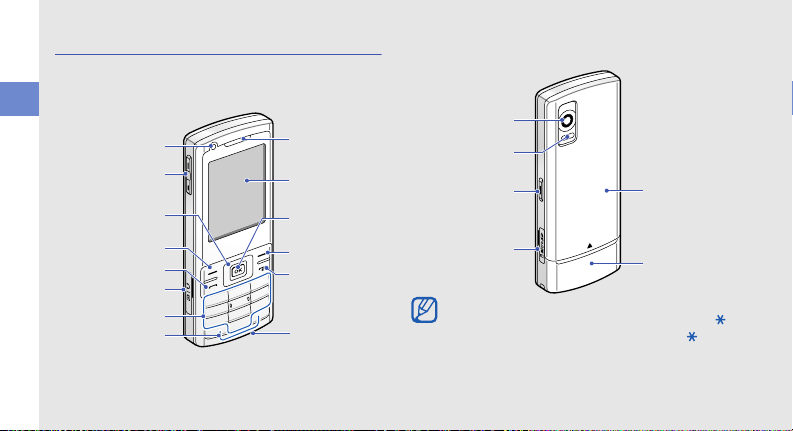
Phone layout
The front of your phone includes the following keys
and features:
introducing your mobile phone
Alphanumeric keys
10
Camera lens for
video calls
Volume key
4-way
navigation key
Left softkey
Dial key
Multifunction jack
Special
function keys
Earpiece
Display
Menu access/
Confirm key
Right softkey
Power/Menu
exit key
Mouthpiece
The rear of your phone includes the following keys
and features:
Camera lens
Flashbulb
Camera key
Memory card slot
Battery cover
Internal antenna
You can lock the keys to prevent any unwanted
phone operations. To lock, press and hold [ ].
To unlock these keys, press and hold [ ].
When the auto keypad lock is on, the keys will
be locked automatically after the display turns
off.
Page 16
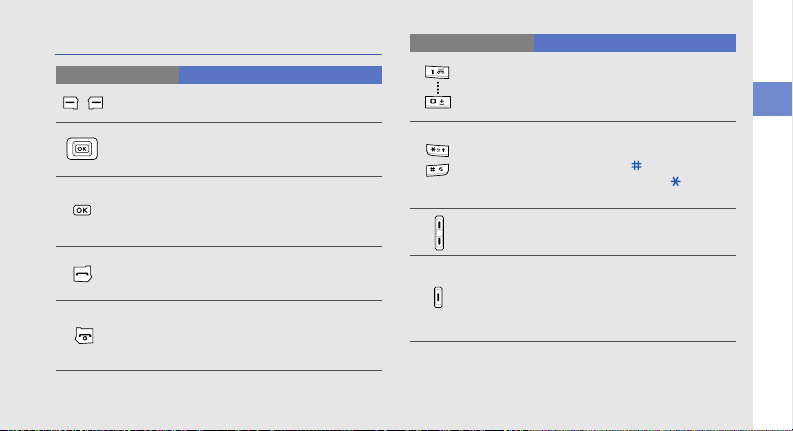
Keys
Key Function
Softkeys
4-way
navigation
Menu
access/
Confirm
Dial
Power/
Menu exit
Perform actions indicated at the
bottom of the display
In Idle mode, access user-defined
menus; In Menu mode, scroll
through menu options
In Idle mode, access Menu mode;
In Menu mode, select the
highlighted menu option or confirm
an input
Make or answer a call; In Idle mode,
retrieve recently dialled, missed, or
received numbers
Turn the phone on and off (press
and hold); End a call; In Menu
mode, cancel input and return to
Idle mode
Key Function
Alphanumeric
Special
function
Volu me
Camera
Enter numbers, letters and special
characters; In Idle mode, press and
hold [1] to access voice mails and
[0] to enter an international call prefix
Enter special characters or perform
special functions; In Idle mode,
press and hold [ ] for
profile; Press and hold [ ] to enter
a pause between numbers
Adjust the phone’s volume
In Idle mode, turn on the camera
(press and hold); In Camera mode,
take a photo or record a video;
From the dialling screen, make a
video call
introducing your mobile phone
Silent
11
Page 17

Display
Your phone’s display consists of three areas:
Icon line
introducing your mobile phone
12
Displays various icons
Text and graphic area
Displays messages,
instructions, and
information you enter
Softkey line
Displays the current actions
assigned to each softkey
Icons
Learn about the icons that appear on your display.
Icon Definition
Signal strength
GPRS network connected
Transferring data in GPRS network
EDGE network connected
Transferring data via EDGE network
UMTS network connected
Transferring data via UMTS network
Voice call in progress
No service available
Video call in progress
No service available
Roaming (outside of normal service area)
Page 18
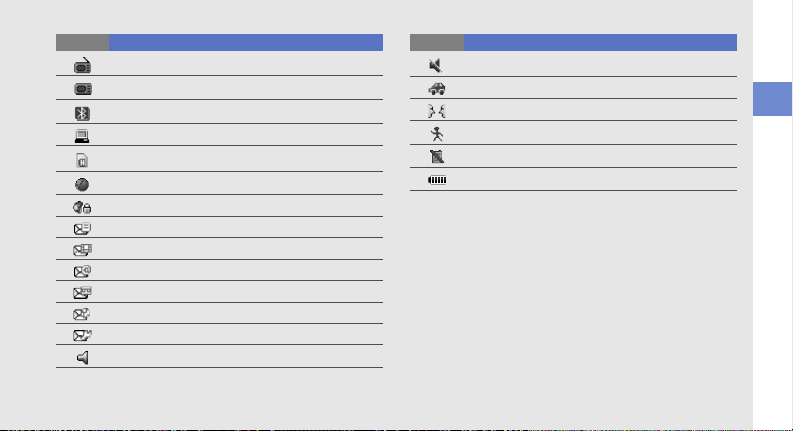
Icon Definition
FM radio on
FM radio suspended
Bluetooth activated
Connected with PC
Memory card inserted
Browsing the web
Connecting to secured web page
New text message (SMS)
New multimedia message (MMS)
New email message
New voice mail message
New push message
New configuration message
Normal profile activated
Icon Definition
Silent profile activated
Driving profile activated
Meeting profile activated
Outdoor profile activated
Offline profile activated
Battery power level
introducing your mobile phone
13
Page 19
assembling and
preparing your
mobile phone
Get started by assembling and setting up
your mobile phone for its first use.
14
Install the SIM or USIM card and battery
When you subscribe to a cellular service, you will
receive a Subscriber Identity Module, or SIM card,
with subscription details, such as your personal
identification number (PIN) and optional services. To
use UMTS or HSDPA services, you can purchase a
Universal Subscriber Identity Module (USIM) card.
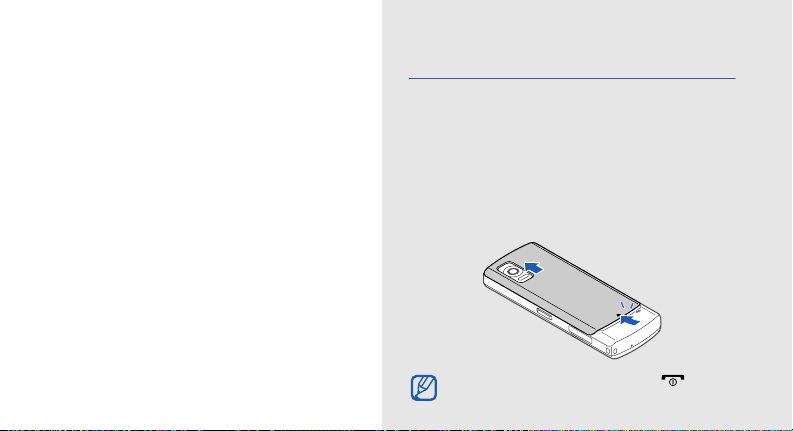
To install the SIM or USIM card and battery,
1. Remove the battery cover.
If the phone is on, press and hold [ ] to turn
it off.
Page 20
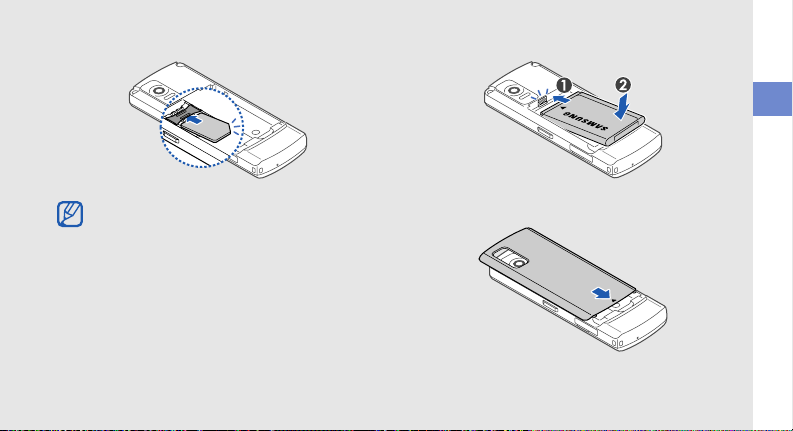
2. Insert the SIM or USIM card. 3. Insert the battery.
assembling and preparing your mobile phone
Place the SIM or USIM card in the phone with
the gold-coloured contacts facing down.
4. Replace the battery cover.
15
Page 21
Charge the battery
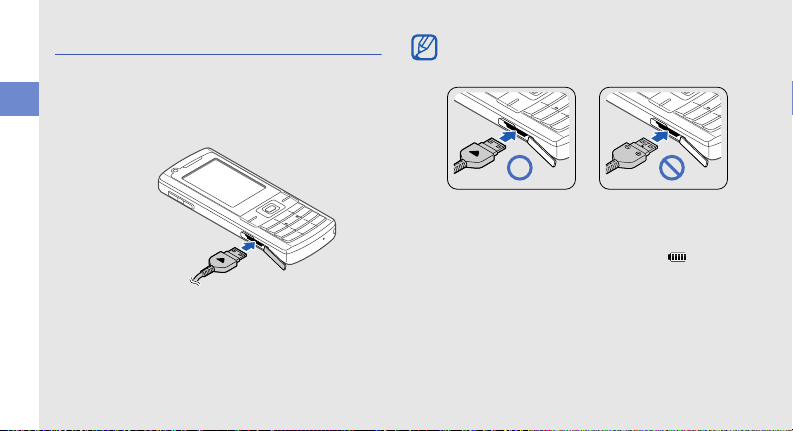
Before using the phone for the first time, you must
charge the battery.
1. Open the cover to the multifunction jack and plug
assembling and preparing your mobile phone
the small end of the travel adapter.
With the triangle
facing up
16
Improperly connecting the adapter can cause
serious damage to the phone. Any damages
by misuse are not covered by the warranty.
2. Plug the large end of the travel adapter into a
power outlet.
3. When the battery is fully charged (the icon is
no longer moving), unplug the travel adapter from
the power outlet.
Page 22
4. Unplug the travel adapter from the phone.
5. Close the cover to the multifunction jack.
About the low battery indicator
When your battery is low, the phone will emit a
warning tone and a low battery message. The
battery icon will also be empty and blinking. If
the battery level becomes too low, the phone
will automatically power off. Recharge your
battery to continue using your phone.
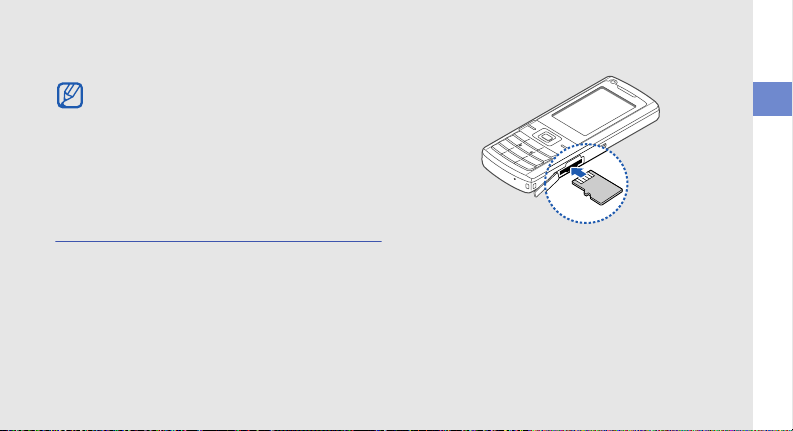
2. Insert a memory card with the label side facing
down.
assembling and preparing your mobile phone
Insert a memory card (optional)
To store additional multimedia files, you must insert a
memory card. Your phone accepts microSD™
memory cards up to 8 GB (depending on memory
card manufacturer and type).
1. Open the cover to the memory card slot on the
side of the phone.
3. Push the memory card in the memory card slot
until it locks in place.
To remove the memory card, push it gently until it
disengages from the phone, and then pull the card
out of the memory card slot.
17
Page 23

using basic
functions
Learn how to perform basic operations and use the
main features of your mobile phone.
18
Turn your phone on and off
To turn your phone on,
1. Press and hold [ ].
2. Enter your PIN and press <Confirm> (if
necessary).
To turn your phone off, repeat steps 1 above.
Switch to the Offline profile
By switching to the Offline profile, you can use your
phone’s non-network services in areas where
wireless devices are prohibited, such as aeroplane
and hospitals.
To switch to the Offline profile, press [OK] →
Settings → Phone profiles → Offline.
Follow all posted warnings and directions from
official personnel when in areas where wireless
devices are prohibited.
Page 24

Access menus
To access your phone’s menus,
1. Press a softkey for the menu you want.
2. Use the navigation key to scroll to a menu or
option.
3. Press <Select>, <Confirm>, or [OK] to confirm
the highlighted option.
4. Press <Back> to move up one level; Press [ ]
to return to Idle mode.
Customise your phone
Get more from your phone by customising it to
match your preferences.
Adjust the volume of the key tones
In Idle mode, press the Volume key up or down to
adjust the key tone volume.
Switch to or from the Silent profile
In Idle mode, press and hold [ ] to silence or
unsilence your phone.
Change your ringtone
1. In Idle mode, press [OK] → Settings → Phone
profiles.
2. Scroll to the profile you are using.
3. Press <Options> → Edit → Voice call ringtone
or Video call ringtone.
4. Scroll left or right to a memory location
(if necessary).
5. Select a ringtone category → a ringtone.
6. Press <Options> → Save.
To switch to another profile, select it from the list.
using basic functions
19
Page 25

Select a wallpaper (Idle mode)
1. In Idle mode, press [OK] → Settings → Display
and light settings → Display settings →
Wallpaper → Pictures.
2. Scroll left or right to a memory location
(if necessary).
using basic functions
3. Select an image category → an image.
4. Press <Set>.
Lock your phone
1. In Idle mode, press [OK] → Settings → Security
→ Phone lock.
2. Select On.
3. Enter a new 4- to 8-digit password and press
<Confirm>.
4. Enter the new password again and press
<Confirm>.
Set menu shortcuts
1. In Idle mode, press [OK] → Settings → Phone
settings → Shortcuts.
2. Select a key to use as a shortcut.
3. Select a menu to assign to the shortcut key.
20
Use basic call functions
Learn to make or answer calls and use basic call
functions.
Make a call
1. In Idle mode, enter an area code and a phone
number.
Page 26

2. Press [ ] to dial the number.
For a video call, press the Camera key.
3. To end the call, press [ ].
Answer a call
1. When a call comes in, press [ ].
2. For a video call, press <Show me>.
3. To end the call, press [ ].
Use the headset
By plugging the supplied headset into the
multifunction jack, you can make and answer calls:
• To redial the last call, press the headset button
twice.
• To answer a call, press and hold the headset
button.
• To end a call, press and hold the headset button.
using basic functions
Adjust the volume
To adjust the volume during a call, press the Volume
key up or down.
Use the speakerphone feature
1. During a call, press [OK] to activate the speaker.
2. To switch back to the earpiece, press [OK]
again.
Send and view messages
Learn to send or view text (SMS), multimedia (MMS),
or email messages.
Send a text or multimedia message
1. In Idle mode, press [OK] → Messages → Create
message → Message. You can also press
< > in Idle mode and select Create message
→ Message.
21
Page 27

2. Enter your message text. X Enter text
For sending as a text message, skip to step 6.
For attaching multimedia, continue with step 3.
3. Press <Options> → Add item, Create item, or
Add attachment and add an item.
4. Press <Options> → Add subject.
using basic functions
5. Enter a subject.
6. Scroll up and enter a destination number.
7. Press <Options> → Send to send the
message.
Send an email
1. In Idle mode, press [OK] → Messages → Create
message → Email. You can also press < > in
Idle mode and select Create message → Email.
2. Enter your email text.
22
3. Press <Options> → Add attachment or Create
item and attach a file (if necessary).
4. Scroll up and enter a subject.
5. Scroll up and enter an email address.
6. Press <Options> → Send to send the
message.
Enter text
When entering text, you can change the text input
mode:
• Press and hold [ ] and select an input mode;
press [ ] to switch between input modes.
• Press [ ] to change case in ABC or T9 mode, or
to switch to Number mode.
• Press and hold [ ] to switch to Symbol mode.
Page 28

Enter text in one of the following modes:
Mode Function
1. Press the appropriate alphanumeric
keys to enter pinyins.
2. Scroll left or right to select a pinyin.
OK
]. A number appears by each
character.
corresponding character.
to return to your message.
Pinyin
3. Press [
4. Scroll up or down to select a character.
5. Press an alphanumeric key to enter the
6. When you are finished, press <
Clear
>
Mode Function
1. Press [1] through [5] to enter strokes.
Press [
stroke to enter. This will insert a
placeholder.
2. Press [
Stroke
ABC
character.
3. Scroll up or down to select a character.
4. Press an alphanumeric key to enter the
corresponding character.
5. When you are finished, press <
to return to your message.
Press the appropriate alphanumeric key
until the character you want appears on the
display.
6
] when you are unsure which
OK
]. A number appears by each
Clear
using basic functions
>
23
Page 29

Mode Function
1. Press the appropriate alphanumeric
keys to enter an entire word.
T9
using basic functions
Number
Symbol
2. When the word displays correctly, press
[
0
] to insert a space. If the correct word
does not display, press the navigation
key down to select an alternate word.
Press the appropriate alphanumeric key to
enter a number.
Press the appropriate alphanumeric key to
select a symbol.
View text or multimedia messages
1. In Idle mode, press [OK] → Messages → Inbox.
You can also press < > in Idle mode and
select Inbox.
2. Select a text or multimedia message.
24
View an email
1. In Idle mode, press [OK] → Messages → Email
inbox. You can also press < > in Idle mode
and select Email inbox.
2. Press <Options> → Download.
3. Select an email or a header.
4. If you selected a header, press <Options> →
Retrieve to view the body of the email.
Add and find contacts
Learn the basics of using the Phonebook feature.
Add a new contact
1. In Idle mode, enter a phone number and press
<Options>.
2. Select Add to Phonebook → a memory location
(phone or SIM) → New.
Page 30

3. Select a number type (if necessary).
4. Enter contact information.
5. Press [OK], or press <Options> → Save to add
the contact to memory.
Find a contact
1. In Idle mode, press [OK] → Phonebook.
2. Enter the first few letters of the name you want to
find.
3. Select the contact’s name from the search list.
Once you have found a contact, you can:
• call the contact by pressing
• edit the contact information by pressing
<
Options> → Edit
[]
Use basic camera functions
Learn the basics to capture and view photos and
videos.
Capture photos
1. In Idle mode, press and hold the Camera key to
turn on the camera.
2. Rotate the phone anti-clockwise to landscape
view.
3. Aim the lens at the subject and make any
adjustments.
4. Press [OK] or the Camera key to take a photo.
The photo is saved automatically.
5. Press < > to take another photo (step 2).
using basic functions
25
Page 31

View photos
In Idle mode, press [OK] → My files → Images →
My photos → a photo file.
View videos
In Idle mode, press [OK] → My files → Videos →
My video clips → a video file.
Capture videos
1. In Idle mode, press and hold the Camera key to
using basic functions
turn on the camera.
2. Rotate the phone anti-clockwise to landscape
view.
3. Press [1] to switch to Recording mode.
4. Aim the lens at the subject and make any
adjustments.
5. Press [OK] or the Camera key to start recording.
6. Press [OK] or the Camera key to stop recording.
The video is saved automatically.
7. Press <Back> to record another video (step 3).
26
Listen to music
Learn how to listen to music via the music player or
FM radio.
Listen to the FM radio
1. Plug the supplied headset into the phone’s
multifunction jack.
2. In Idle mode, press [OK] → Applications → FM
Radio.
3. Press [OK] to turn on the FM radio.
4. Scroll left or right to a radio station.
5. To turn off the FM radio, press [OK].
Page 32

Listen to music files
Start by transferring files to your phone or memory
card:
• Download from the wireless web. X p. 28
• Download from a PC with the optional Samsung
PC Studio. X p. 34
• Receive via Bluetooth. X p. 38
• Copy to your memory card. X p. 35
• Synchronise with Windows Media Player 11.
X
p. 34
After transferring music files to your phone or
memory card,
1. In Idle mode, press [OK] → Music player.
2. Select a music category → a music file.
3. Control playback using the following keys:
Key Function
OK
Volume
Navigation
Pause or resume playback
Adjust the volume up or down
• Left: Skip backward; Scan
backward in a file (press and hold)
• Right: Skip forward; Scan forward
in a file (press and hold)
• Up: Open the playlist
• Down: Stop playback
using basic functions
27
Page 33

Browse the web
Learn to access and bookmark your favourite web
pages.
Browse web pages
1. In Idle mode, press [OK] → Internet → Go to
using basic functions
homepage to launch your service provider’s
homepage. You can also press < > in Idle
mode.
2. Navigate web pages using the following keys:
Key Function
Scroll up or down on a web page
Select an item
Return to the previous page
>
Access a list of browser options
>
28
Navigation
OK
<
Back
<
Options
Bookmark your favourite web pages
1. In Idle mode, press [OK] → Internet →
Bookmarks.
2. Press <Options> → Add bookmark.
3. Enter a page title and a web address (URL).
4. Press <Save>.
Page 34

using advanced
Use advanced call functions
Learn about your phone’s additional calling
capabilities.
functions
Learn how to perform advanced operations and use
additional features of your mobile phone.
View and dial missed calls
Your phone will display calls you have missed on the
display. To dial the number of a missed call,
1. Press <View>.
2. Scroll to the missed call you want to dial.
3. Press [ ] to dial.
Call a recently dialled number
1. In Idle mode, press [ ] to display a list of
recent numbers.
2. Scroll to the number you want and press [ ] to
dial.
29
Page 35

Hold a call or retrieve a held call
Press <Hold> to place a call on hold or press
<Retrieve> to retrieve a held call.
Dial a second call
If your network supports this function, you can dial
using advanced functions
another number during a call:
1. Press <Hold> to place the first call on hold.
2. Enter the second number to dial and press
[].
3. Press <Swap> to switch between the two calls.
4. To end the call on hold, press <Options> → End
call → Held call.
5. To end the current call, press [ ].
30
Answer a second call
If your network supports this function, you can
answer a second incoming call:
1. Press [ ] to answer the second call.
The first call is automatically placed on hold.
2. Press <Swap> to switch between the calls.
Make a multiparty call (conference call)
1. Call the first party you want to add to the
multiparty call.
2. While connected to the first party, call the
second party.
The first party is automatically placed on hold.
3. When connected to the second party, press
<Options> → Join.
Page 36

4. Repeat steps 1 and 2 to add more parties (if
necessary).
5. To end the multiparty call, press [ ].
Call an international number
1. In Idle mode, press and hold [0] to insert the +
character.
2. Enter the complete number you want to dial
(country code, area code, and phone number),
and then press [ ] to dial.
Call a contact from Phonebook
You can call numbers directly from Phonebook
using stored contacts. X p. 24
1. In Idle mode, press [OK] → Phonebook.
2. Scroll to the number you want to dial and press
[ ] to dial.
Use advanced Phonebook functions
Learn to create namecards, set speed dial numbers,
and create groups of contacts.
Create a namecard
1. In Idle mode, press [OK] → Phonebook.
2. Press <Options> → My contact details.
3. Enter your personal details and press <Options>
→ Save.
You can send your namecard by attaching it to
a message or email or transferring it via the
Bluetooth wireless feature.
Set speed dial numbers
1. In Idle mode, press [OK] → Phonebook.
2. Scroll to a contact to assign.
31
using advanced functions
Page 37

3. Press <Options> → Assign speed dial.
4. Scroll to a number you want to set (2-9) and
press <Select>.
The contact is saved to the speed dial number.
You can now call this contact from Idle mode
by pressing and holding the assigned speed
using advanced functions
dial number.
Create a group of contacts
By creating groups of contacts, you can assign
ringtones and caller ID photos to each group or send
messages and emails to an entire group. Start by
creating a group:
1. In Idle mode, press [OK] → Phonebook.
2. Scroll left or right to Groups.
3. Press <Options> → Create group.
4. Enter a group name and press [OK].
32
5. Press <Options> → Group settings.
6. To set the caller ID image, press [OK] → an
image category → an image.
7. To set a group ringtone, scroll down and press
[OK] → a ringtone category → a ringtone.
8. Press <Options> → Save.
Use advanced messaging functions
Learn to create templates and use templates to
create new messages.
Create a text template
1. In Idle mode, press [OK] → Messages →
Templates → Text templates. You can also
press < > in Idle mode and select Templates
→ Text templates.
Page 38

2. Press <Add new> to open a new template
window.
3. Enter your text and press [OK] to save the
template.
Create a multimedia template
1. In Idle mode, press [OK] → Messages →
Templates → Multimedia templates. You can
also press < > in Idle mode and select
Templates → Multimedia templates.
2. Press <Add new> to open a new template
window.
3. Create a multimedia message, with a subject
and desired attachments, to use as your
template. X p. 21
4. Press <Options> → Save as template to save
the template.
Insert text templates in new messages
1. To start a new message, press [OK] →
Messages → Create message → a message
type. You can also press < > in Idle mode and
select Create message → a message type.
2. In the text field, and press <Options> → Insert
→ Text template → a template.
Create a message from a multimedia
template
1. In Idle mode, press [OK] → Messages →
Templates → Multimedia templates. You can
also press < > in Idle mode and select
Templates → Multimedia templates.
2. Scroll to the template you want and press
<Options> → Send.
Your template opens as a new multimedia
message.
using advanced functions
33
Page 39

Use advanced music functions
Learn to prepare music files, create playlists, and
store radio stations.
Copy music files via Samsung PC Studio
1. In Idle mode, press [OK] → Settings → Phone
using advanced functions
settings → USB settings → Samsung PC
studio.
2. Press [ ] to return to Idle mode.
3. Using an optional PC data cable, connect the
multifunction jack on your phone to a PC.
4. Run Samsung PC Studio and copy files from the
PC to the phone.
Refer to the Samsung PC Studio help for more
information.
34
Synchronise your phone with Windows
Media Player
1. In Idle mode, press [OK] → Settings → Phone
settings → USB settings → Media player.
2. Press [ ] to return to Idle mode.
3. Using an optional PC data cable, connect the
multifunction jack on your phone to a PC with
Windows Media Player installed.
When connected, a pop-up window will appear
on the PC.
4. Select Sync digital media files to this device in
the pop-up window on the PC.
5. Edit or enter your phone’s name in the pop-up
window (if necessary), and then click Finish.
6. Select and drag the music files you want to the
sync list.
7. Click Start Sync.
Page 40

Copy music files to a memory card
1. Insert a memory card.
2. In Idle mode, press [OK] → Settings → Phone
settings → USB settings → Mass storage.
3. Press [ ] to return to Idle mode.
4. Using an optional PC data cable, connect the
multifunction jack on your phone to a PC.
When connected, a pop-up window will appear
on the PC.
5. Select Open folder to view files in the pop-up
window on the PC.
6. Copy files from the PC to the memory card.
Create a playlist
1. In Idle mode, press [OK] → Music player →
Playlists.
2. Press <Options> → Create playlist.
3. Enter a title for your new playlist and press [OK].
4. Select the new playlist.
5. Press <Options> → Add → Files.
6. Select the files you want to include and press
<OK>.
Customise your music player settings
Learn to adjust the playback and sound settings for
your music player.
1. In Idle mode, press [OK] → Music player.
2. Press <Options> → Player settings.
3. Adjust the settings to customise your music
player.
4. Press <Save>.
using advanced functions
35
Page 41

Store radio stations automatically
1. Plug the supplied headset into the phone’s
multifunction jack.
2. In Idle mode, press [OK] → Applications → FM
Radio.
3. Press [OK] to start the FM radio.
using advanced functions
4. Press <Options> → Self tuning.
5. Press <Yes> to confirm (if necessary).
The radio scans and saves available stations
automatically.
36
Page 42

using tools and
applications
Learn how to work with your mobile phone’s tools
and additional applications.
Use the Bluetooth wireless feature
Learn about your phone’s ability to connect to other
wireless devices for exchanging data and using
hands-free features.
Turn on the Bluetooth wireless feature
1. In Idle mode, press [OK] → Settings → Network
settings → Bluetooth → Activation → On.
2. To allow other devices to locate your phone,
select My phone’s visibility → On.
Find and pair with other Bluetoothenabled devices
1. In Idle mode, press [OK] → Settings → Network
settings → Bluetooth → My devices → Search
new device.
2. Scroll to a device and press <Select>.
37
Page 43

3. Enter a PIN for the Bluetooth wireless feature or
the other device’s Bluetooth PIN, if it has one,
and press <OK>.
When the owner of the other device enters the
same code or accepts the connection, pairing is
complete.
using tools and applications
Send data using the Bluetooth wireless
feature
1. Select the file or item from one of your phone’s
applications that you want to send.
2. Press <Options> → Send contact detail via,
Send, Send via, or Send URL → Bluetooth or
Via bluetooth (when sending contact data,
specify which data to send).
38
Receive data using the Bluetooth
wireless feature
1. Enter the PIN for the Bluetooth wireless feature
and press <OK> (if necessary).
2. Press <Yes> to confirm that you are willing to
receive data from the device (if necessary).
Print images
Learn to print your image with an optional PC data
cable or the Bluetooth wireless feature.
To use an optional PC data cable,
1. Connect the multifunction jack on your phone to
a compatible printer.
2. Open an image. X p. 26
3. Press <Options> → Print via → USB.
4. Set print options and print the image.
Page 44

To use the Bluetooth wireless feature,
1. Open an image.
2. Press <Options> → Print via → Bluetooth.
3. Select a Bluetooth-enabled printer and pair with
the printer. X p. 37
4. Set print options and print the image.
Record and play voice memos
Learn to operate your phone’s voice recorder.
Record a voice memo
1. In Idle mode, press [OK] → Applications →
Voice recorder.
2. Press [OK] to start recording.
3. Speak your memo into the microphone.
4. When you are finished speaking, press the
navigation key down.
Play a voice memo
1. From the voice recorder screen, press
<Options> → My voice clips.
2. Select a file.
3. Control the playback using the following keys:
Key Function
OK
Volume
Navigation
Pause or resume playback
Adjust the volume up or down
• Left: Scan backward in a file
• Right: Scan forward in a file
• Down: Stop playback
using tools and applications
39
Page 45

Use Java-powered games and applications
Learn to use games and applications powered by
award-winning Java technology.
Play games
using tools and applications
1. In Idle mode, press [OK] → My files → Games
and more.
2. Select a game from the list and follow the
onscreen instructions.
Available games may vary, depending on your
service provider or region. Game controls and
options may vary.
40
Launch applications
1. In Idle mode, press [OK] → My files → Games
and more → an application.
2. Press <Options> to access a list of various
options and settings for your application.
Use the RSS reader
Learn to use the RSS reader to get the latest news
and information from your favourite websites.
Add feeds
To add by entering the address of an RSS feed,
1. In Idle mode, press [OK] → Applications → RSS
reader → My feeds.
2. Select Get feed.
Page 46

3. Enter the address of an RSS feed and press
[OK].
4. Select the feed you want and check through the
details.
5. Press <Subscribe>.
6. Press <Options> → Add new to add more feeds
(if necessary).
To add by searching a web feed on a website,
1. In Idle mode, press [OK] → Applications → RSS
reader → Search.
2. Enter a web address to search for web feeds
and press <Search>.
3. Select the feed you want and check through the
details.
4. Press <Subscribe> to save in My feeds.
Read RSS feeds
1. In Idle mode, press [OK] → Applications → RSS
reader → My feeds.
2. Press <Options> → Update → Selected or All
to get the latest content.
3. Select a feed → an updated post.
Customise RSS reader settings
1. In Idle mode, press [OK] → Applications → RSS
reader → Settings.
2. Customise the settings as desired.
3. Press <Save>.
using tools and applications
41
Page 47

Upload photos and videos to the web
Learn to post your photos and videos to photo
sharing websites and blogs.
Activate the ShoZu account
using tools and applications
1. In Idle mode, press [OK] → Settings →
Application settings → MobileBlog settings →
ShoZu activation.
2. Select On.
3. Press <Yes> to confirm.
4. Follow the onscreen instructions to activate the
account.
42
Create a new destination
1. In Idle mode, press [OK] → Settings →
Application settings → MobileBlog settings →
Destinations.
2. Press <Options> → Create new.
3. Follow the onscreen instructions to add a new
destination site.
4. Repeat steps 2 and 3 above to add more
destinations.
Upload a file
1. From an application, such as My files or
Camera, select or capture a photo or video.
2. Press <Options> → Upload to web.
3. Select a destination you want to post to.
4. Enter a new file name and information and press
<Upload>.
Page 48

Create and view world clocks
Learn to view the time in another city and set world
clocks to appear on your display.
Create a world clock
1. In Idle mode, press [OK] → Applications →
World clock.
2. Press <Options> → Add.
3. Scroll left or right to a time zone.
4. To set daylight saving time, scroll down and
press [OK].
5. Press <OK> to save your world clock.
6. To add more world clocks, repeat steps 2-5
above.
Add a world clock to your display
In Dual Clock Display mode, you can view clocks
with two different time zones on your display.
After you have saved world clocks,
1. In Idle mode, press [OK] → Applications →
World clock.
2. Scroll to the world clock you want to add and
press <Options> → Set as second clock.
3. Press <Options> → Display settings.
4. Scroll left or right to Dual.
5. Scroll down, and then scroll left or right to a dual
clock style.
6. Press <Save>.
using tools and applications
43
Page 49

Set and use alarms
Learn to set and control alarms for important events.
Set a new alarm
1. In Idle mode, press [OK] → Alarms.
2. Scroll to an empty alarm location and press [OK].
using tools and applications
3. Set alarm details.
You can set either the FM radio or a sound for
the alarm tone.
4. Press <Options> → Save.
The auto power-up feature sets the phone to
automatically turn on and sound the alarm at
the designated time if the phone is turned off.
44
Stop an alarm
When the alarm sounds,
• Press <OK> or [OK] to stop an alarm without
snooze.
• Press <OK> or [OK] to stop an alarm with
snooze, or press <Snooze> or any key to silence
the alarm for the snooze period.
Deactivate an alarm
1. In Idle mode, press [OK] → Alarms.
2. Scroll to the alarm you want to deactivate and
press [OK].
3. Scroll down (if necessary).
4. Scroll left or right to Off.
5. Press [OK].
Page 50

Use the calculator
1. In Idle mode, press [OK] → Applications →
Calculator.
2. Use the keys that correspond to the calculator
display to perform basic mathematical
operations.
Convert currencies or measurements
1. In Idle mode, press [OK] → Applications →
Converter → a conversion type.
2. Enter the currencies or measurements and units
in the appropriate fields.
Set a countdown timer
1. In Idle mode, press [OK] → Applications →
Timer.
2. Press <Set>.
3. Enter hours or minutes to count down and press
<OK>.
4. Press [OK] to begin or pause the countdown.
5. When the timer expires, press <OK> to stop the
alert.
Use the stopwatch
1. In Idle mode, press [OK] → Applications →
Stopwatch.
2. Press [OK] to begin and record lap times.
3. When you are finished, press <Stop>.
4. Press <Reset> to clear recorded times.
using tools and applications
45
Page 51

Create a new task
1. In Idle mode, press [OK] → Applications →
Task.
2. Press <Options> → Create.
3. Enter the details of the task.
using tools and applications
4. Press <Options> → Save.
Create a text memo
1. In Idle mode, press [OK] → Applications →
Memo.
2. Press <Options> → Create.
3. Enter your memo text and press [OK].
46
Manage your calendar
Learn to change the calendar view and create
events.
Change the calendar view
1. In Idle mode, press [OK] → Calendar.
2. Press <Options> → View mode → Daily view
or Weekly view.
Create an event
1. In Idle mode, press [OK] → Calendar.
2. Press <Options> → Create → an event type.
3. Enter the details of the event as required.
4. Press <Options> → Save.
Page 52

troubleshooting
If you are having trouble with your mobile phone, try these troubleshooting procedures before contacting a service
professional.
When you turn on your phone, the following
messages may appear:
Message Try this to solve the problem:
Please
insert SIM
card
Phone lock
Ensure that the SIM or USIM card is
installed correctly.
When the phone lock feature is
enabled, you must enter the password
you set for the phone.
Message Try this to solve the problem:
When using the phone for the first time
or when the PIN requirement is
PIN lock
PUK lock
enabled, you must enter the PIN
supplied with the SIM or USIM card.
You can disable this feature by using
the
PIN lock
menu.
Your SIM or USIM card is blocked,
usually as a result of entering your PIN
incorrectly several times. You must
enter the PUK supplied by your
service provider.
a
Page 53

Your phone displays “Call not allowed” or “No
service.”
• When you are in areas with weak signals or poor
reception, you may lose reception. Move to
another area and try again.
• You cannot access some options without a
subscription. Contact your service provider for
more details.
troubleshooting
You enter a number, but the call is not dialled.
• Ensure that you have pressed the Dial key: [ ].
• Ensure that you have accessed the right cellular
network.
• Ensure that you have not set call barring for the
phone number.
b
Another caller cannot reach you.
• Ensure that your phone is turned on.
• Ensure that you have accessed the right cellular
network.
• Ensure that you have not set call barring for the
phone number.
Another caller cannot hear you speaking.
• Ensure that you are not covering the built-in
microphone.
• Ensure that the microphone is close to your
mouth.
• If using a headset, ensure that it is properly
connected.
The phone beeps and the battery icon flashes.
Your battery is low. Recharge or replace the battery to
continue using the phone.
Page 54

The audio quality of the call is poor.
• Ensure that you are not blocking the phone’s
internal antenna.
• When you are in areas with weak signals or poor
reception, you may lose reception. Move to
another area and try again.
You select a contact to call, but the call is not
dialled.
• Ensure that the correct number is stored in the
contact list.
• Re-enter and save the number, if necessary.
The battery does not charge properly or
sometimes the phone turns itself off.
• The battery terminals may be dirty. Wipe both
gold-coloured contacts with a clean, soft cloth
and try charging the battery again.
• If the battery will no longer charge completely,
dispose of the old battery properly and replace it
with a new battery.
Your phone is hot to the touch.
When you use several applications at once, your
phone requires more power and may heat up.
This is normal and should not affect your phone’s
lifespan or performance.
troubleshooting
c
 Loading...