

Page 1
DLP TV
user manual
imagine the possibilities
Thank you for purchasing this Samsung product.
To receive more complete service, please
register your product at
www.samsung.com/global/register
Model Serial No.
Page 2
A Guide to Digital TV
What is Digital Television?
Digital television (DTV) is a new way of transmitting high quality video and audio to your TV set. Using DTV, broadcasters can
transmit high definition TV (HDTV) images, Dolby digital surround audio, and new services such as multicasting (transmitting
more than one program on the same TV channel) and datacasting. Several of these services can be combined into a single digital
broadcast.
Digital Television Services
Digital Picture Quality
DTV programs are transmitted in two different formats. The first is Standard Definition Television (SDTV) and the second is High
Definition Television (HDTV).
SDTV
program formats include 480-line interlaced (480i) and 480-line progressive (480p) video. 480i programs are essentially
a digital version of our current analog TV programs, while the 480p format offers improved image detail over 480i. Some 480p
programs are broadcast in widescreen and are comparable to progressive-scan DVD movies in image quality.
HDTV
program formats include 1080-line interlaced (1080i) and 720-line progressive (720p). Both HDTV formats are always
broadcast in widescreen, and offer much higher picture quality than SDTV.
U.S.A Only
The product unit accompanying this user manual is licensed under certain intellectual property rights of certain third parties. In
particular, this product is licensed under the following US patents:
5,991,715, 5,740,317, 4,972,484, 5,214,678, 5,323,396, 5,539,829, 5,606,618, 5,530,655, 5,777,992, 6,289,308, 5,610,985, 5,481,643,
5,544,247, 5,960,037, 6,023,490, 5,878,080, and under US Published Patent Application No. 2001-44713-A1.
This license is limited to private non-commercial use by end-user consumers for licensed contents. No rights are granted for
commercial use. The license does not cover any product unit other than this product unit and the license does not extend to any
unlicensed product unit or process conforming to ISO/IEC 11172-3 or ISO/IEC 13818-3 used or sold in combination with this
product unit. The license only covers the use of this product unit to encode and/or decode audio files conforming to the ISO/IEC 111723 or ISO/IEC 13818-3. No rights are granted under this license for product features or functions that do not conform to the ISO/IEC
11172-3 or ISO/IEC 13818-3.
Other countries
The product unit accompanying this user manual is licensed under certain intellectual property rights of certain third parties. This license
is limited to private non-commercial use by end-user consumers for licensed contents. No rights are granted for commercial use. The
license does not cover any product unit other than this product unit and the license does not extend to any unlicensed product unit or
process conforming to ISO/IEC 11172-3 or ISO/IEC 13818-3 used or sold in combination with this product unit. The license only covers
the use of this product unit to encode and/or decode audio files conforming to the ISO/IEC 11172-3 or ISO/IEC 13818-3. No rights are
granted under this license for product features or functions that do not conform to the ISO/IEC 11172-3 or ISO/IEC 13818-3.
SAMSUNG ELECTRONICS NORTH AMERICAN LIMITED WARRANTY STATEMENT
Subject to the requirements, conditions, exclusions and limitations of the original Limited Warranty supplied with Samsung Electronics
(SAMSUNG) products, and the requirements, conditions, exclusions and limitations contained herein, SAMSUNG will additionally
provide Warranty Repair Service in the United States on SAMSUNG products purchased in Canada, and in Canada on SAMSUNG
products purchased in the United States, for the warranty period originally specified, and to the Original Purchaser only.
The above described warranty repairs must be performed by a SAMSUNG Authorized Service Center. Along with this Statement,
the Original Limited Warranty Statement and a dated Bill of Sale as Proof of Purchase must be presented to the Service Center.
Transportation to and from the Service Center is the responsibility of the purchaser.
Conditions covered are limited only to manufacturing defects in material or workmanship, and only those encountered in normal use
of the product.
Excluded, but not limited to, are any originally specified provisions for, in-home or on-site services, minimum or maximum repair times,
exchanges or replacements, accessories, options, upgrades, or consumables.
For the location of a SAMSUNG Authorized Service Center, please call toll-free:
In the United States : 1-800-SAMSUNG (1-800-726-7864) In Canada : 1-800-SAMSUNG
See the warranty card for more information on warranty terms.
®
© 2008 Samsung Electronics Co., Ltd. All rights reserved.
English - 2
Page 3

Q&A
1. Is the antenna I use for existing TV reception good enough for DTV?
Over-the-air (OTA) digital TV broadcasting uses the same channels as analog TV and works well with many existing TV antennas.
However, DTV broadcast channel assignments are different than analog channels. You should find out whether your local DTV
broadcasts are on VHF (channels 2-13) or UHF (channels 14-69) to see if you need a different antenna.
If your DTV channels are on UHF and you already get good UHF reception, your present antenna may work fine. The same holds
true for VHF DTV reception. Note that in some markets, both VHF and UHF channels are used for DTV broadcasts.
You can find out the latest DTV channel assignments for your area by browsing selected Internet web sites such as www.titantv.
com, www.10000watts.com, and www.fcc.gov.
2. How difficult is it to receive DTV signals indoors?
This depends on whether your local DTV stations are running full power or not and how close your location is to the transmission
tower. DTV receivers do not require as much signal as analog TV receivers to produce high-quality images and sound.
Once the DTV signal level exceeds a certain threshold at the receiver, the digital video and audio data is decoded at the same
quality it was originally encoded for broadcast.
This is a big advantage for DTV over analog TV - there is no noise, ghosting, static, or scratchy audio.
3. How can I connect an antenna in my townhouse, co-operative apartment, condominium,
or apartment?
The Federal Communications Commission’s OTARD Rule (part of the Telecommunications Act of 1996) allows residents of
condominiums, townhouse, or members of neighborhood associations to put up outside antennas for reception of broadcast TV
signals as long as those antennas are not located in common areas and are no more than 12’ in height.
Residents of rental units (apartments, etc.) are not covered by the OTARD rules and will have to use indoor antennas to receive
DTV broadcasts. It is possible that the landlord of an apartment complex can provide broadcast DTV signals via a master TV
antenna system to each apartment.
4. Can I connect my DTV set-top receiver to my cable TV service?
Cable TV systems use a different method for transmitting digital TV programs that is currently incompatible with broadcast DTV set-
top receivers. So you will still need to use an outdoor or indoor antenna to receive OTA broadcast DTV programs.
The good news is that you won’t have to pay a monthly or per-program charge to watch OTA DTV and HDTV programs. They’re
free, unlike subscription satellite TV or premium cable TV. All you need is an antenna and a DTV set-top receiver to enjoy clear,
sharp widescreen images and high-quality audio.
English - 3
Page 4

Contents
General Information
Viewing Position ...................................................................... 5
List of Features ....................................................................... 5
Checking Parts ........................................................................ 6
English
Viewing the Control Panel ....................................................... 6
Viewing the Connection Panel ................................................ 8
Remote Control ....................................................................... 9
Installing Batteries in the Remote Control ............................. 10
Connections
Connecting VHF and UHF Antennas .................................... 10
Connecting Cable TV .............................................................11
Connecting a DVD Player or Cable Box / Satellite receiver
(Set-Top Box) via HDMI ........................................................ 12
Connecting a DVD Player or Cable Box / Satellite receiver
(Set-Top Box) via DVI ........................................................... 12
Connecting a DVD Player or Cable Box / Satellite receiver
(Set-Top Box) via Componet cables ..................................... 13
Connecting a Camcorder ...................................................... 13
Connecting a VCR ................................................................ 14
Connecting a Digital Audio System ....................................... 15
Connecting an Amplier / DVD Home Theater ..................... 15
Connecting a PC ................................................................... 16
Operation
Channel Control
Managing Channels .............................................................. 41
Clearing Scrambled Channels - Digital ................................. 47
Fine Tuning Analog Channels ............................................... 47
Checking the Digital-Signal Strength .................................... 48
PC Display
Using Your TV as a Computer (PC) Display ......................... 49
Display Modes ...................................................................... 49
Setting up the TV with your PC ............................................. 50
Time Setting
Setting the Time .................................................................... 52
Function Description
Selecting a Menu Language ................................................. 56
Using the V-Chip ................................................................... 57
Viewing Closed Captions (On-Screen Text Messages) - Digital .......
Viewing Closed Captions (On-Screen Text Messages) - Analog
Adjusting the TV On/Off Melody Sound ................................ 67
Setting the Light Effect .......................................................... 67
Setting the Entertainment mode ........................................... 68
Upgrading the Software ........................................................ 69
65
..... 66
Turning the TV On and Off .................................................... 16
Plug & Play Feature .............................................................. 17
Changing Channels .............................................................. 19
Adjusting the Volume ............................................................ 20
Viewing the Display ............................................................... 20
Viewing the Menus ................................................................ 20
Using the TOOLS Button ...................................................... 21
Memorizing the Channels ..................................................... 21
To Select the Source ............................................................. 23
To Edit the Input Source Name .............................................23
Picture Control
Changing the Picture Standard ............................................. 24
Customizing the Picture Settings .......................................... 24
Adjusting the Detailed Settings ............................................. 25
Conguring Picture Options ................................................. 27
Using the 3D Function .......................................................... 32
Resetting the Picture Settings to the Factory Defaults ......... 33
Viewing Picture-in-Picture ..................................................... 34
Sound Control
Using Automatic Sound Settings ........................................... 36
Customizing the Sound ......................................................... 36
Setting the TruSurround XT .................................................. 37
Choosing Preferred Language .............................................. 38
Choosing a Multi-Channel Sound (MTS) Track - Analog ...... 38
Automatic Volume Control .................................................... 39
Setting the TV Speakers On/Off ............................................ 39
Listening to the Sound of the Sub (PIP) Picture ................... 40
Resetting the Sound Settings to the Factory Defaults .......... 40
WISELINK
Using the Photo List .............................................................. 72
Viewing a Photo or Slide Show ............................................. 77
Using the Music List .............................................................. 81
Playing a Music File .............................................................. 85
Using the Setup Menu .......................................................... 87
About Anynet+
What is Anynet+? .................................................................. 88
Connecting Anynet+ Devices ................................................ 88
Setting Up Anynet
Recording .............................................................................. 90
Listening through a Receiver (Home theater) ....................... 91
Troubleshooting for Anynet
+ ............................................................... 89
+ ................................................. 91
Appendix
Troubleshooting .................................................................... 92
Cleaning and Maintaining Your TV ........................................ 93
Using Your TV in Another Country ........................................ 93
Technical Specications ........................................................ 94
Symbols
®
Press
Important
Note
One-Touch
Button
English - 4
Page 5
General Information
Viewing Position
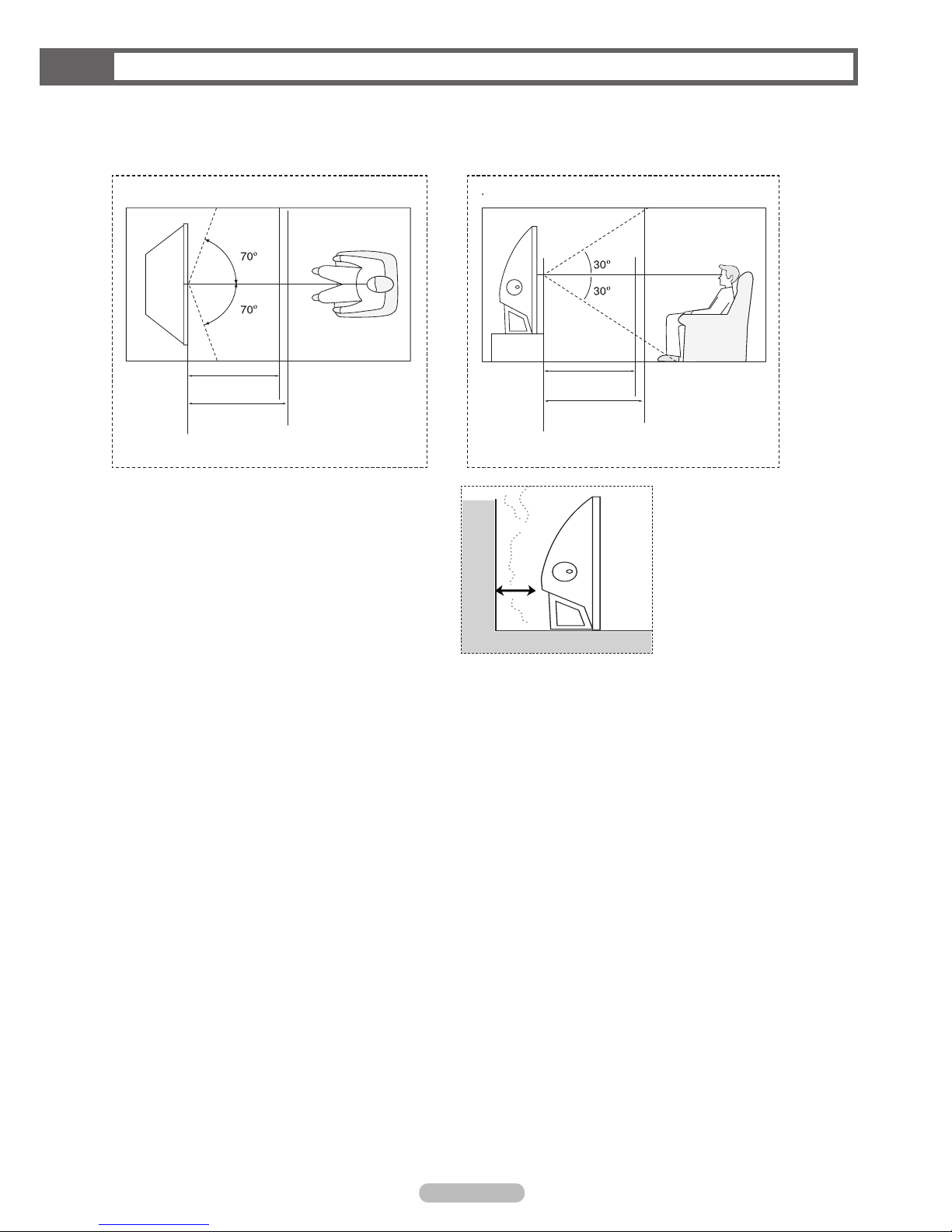
To optimize your viewing comfort, please follow the guidelines below for viewing distance.
If viewing for an extended period of time, sit as far back from the screen as possible.
< Top view> < Side view>
61 screen :
At least 7.2 feet
67 screen :
At least 8.0 feet
®
When installing the product, make sure to keep it away from
the wall (more than 10cm / 4inches) for ventilation purposes.
Poor ventilation may cause an increase in the internal
temperature of the product, resulting in a shortened
component life and degraded performance.
61 screen :
At least 7.2 feet
67 screen :
At least 8.0 feet
List of Features
Your TV is designed and engineered using the latest technology. It is a full-featured, high-performance unit that exceeds
industry standards. In addition, it has these special features:
Easy-to-operate remote control
Dynamic menus and Navigating menus by using the menu map
Easy-to-use on-screen menu system you can access from the side panel or remote control
Automatic timer to turn the TV on and off at any time you choose
Adjustable picture and sound settings and the ability to memorize your favorite settings
Automatic channel tuning for up to 181 channels
A special filter to reduce or eliminate reception problems
Fine tuning control for the sharpest picture possible
A built-in multi-channel sound decoder for stereo and bilingual listening
Built-in, dual channel speakers
A special sleep timer
Widescreen TV with adjustable image size
Life-like clear images provided by DNle technology
Detailed settings mode to correspond with your color preference
HDMI/DVI connection of your PC to this TV
Digital Input jack
Digital Audio Output (OPTICAL) jack
Easy-to-use channel list menu.
WISELINK enables you to view and play photo (JPEG) and audio files (MP3) through the TV’s WISELINK jack.
AV network system (Anynet+) that enables you to easily control Samsung audio-video(AV) devices from this TV.
3D Effect Gaming Functiont
English - 5
Page 6
Checking Parts
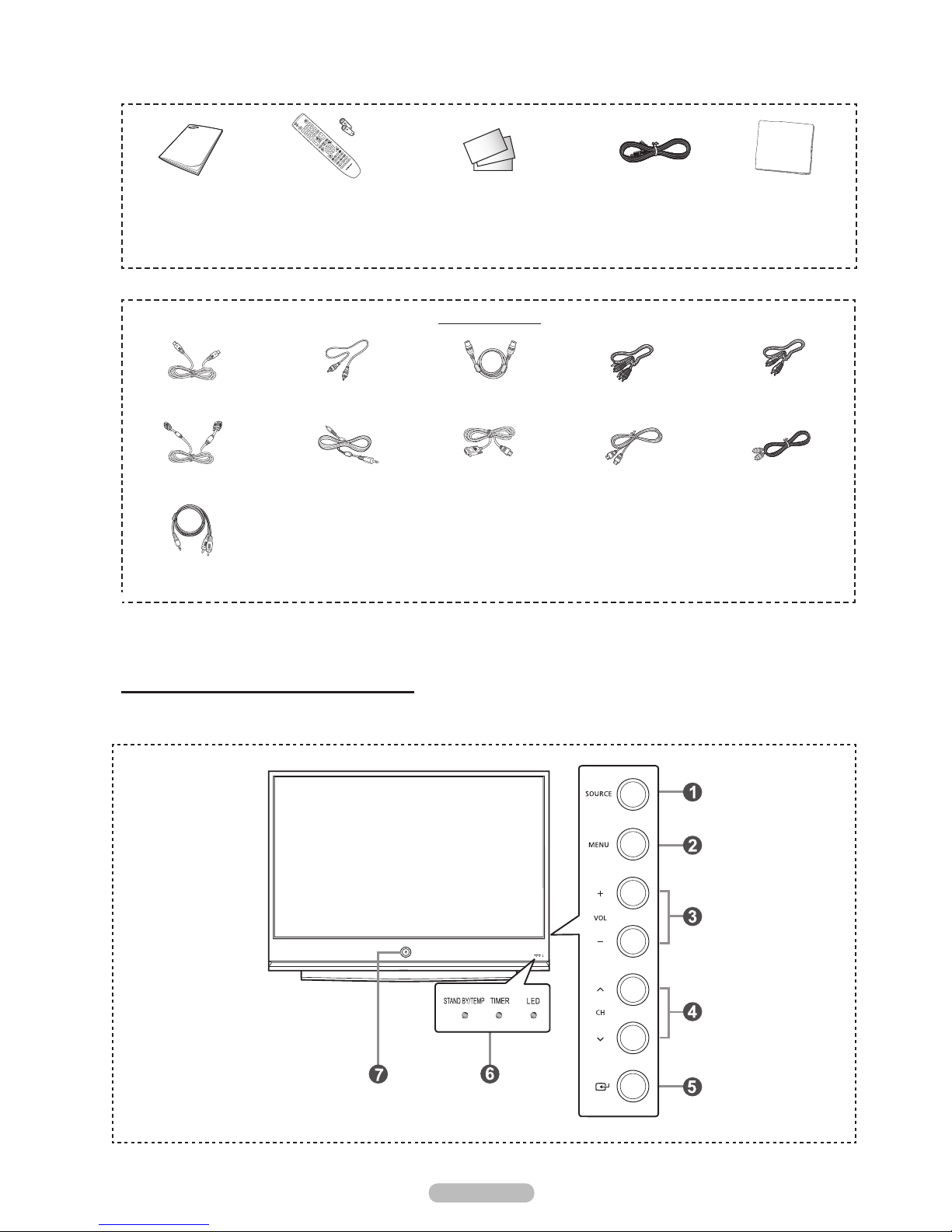
Owner’s Instructions Remote Control
(BN59-00673A)/
AAA Batteries
Warranty Card/
Registration Card/
Safety Guide Manual/
Quick Guide Manual
(Not available in all locations)
Power Cord
(3903-000144)
Cloth-Clean
Sold Separately
S-Video Cable Video Cable Antenna Cable
D-Sub Cable PC Audio Cable HDMI/DVI Cable HDMI Cable Optical Cable
3.5 mm Stereo
mini-plug/ 2RCA Cable
Component Cables
Audio Cables
Viewing the Control Panel
Buttons on the Lower-Right Part of the Panel
The buttons on the lower-right panel control your TV’s basic features, including the on-screen menu.
To use the more advanced features, you must use the remote control.
®
The product color and shape may vary depending on the model.
Continued...
English - 6
Page 7

1
SOURCE
Toggles between all the available input sources
(TV, AV1, AV2, S-Video, Component1, Component2,
PC, HDMI1, HDMI2, HDMI3/DVI or USB).
2
MENU
Press to see an on-screen menu of your TV’s features.
3
+ VOL –
Press to increase or decrease the volume.
In the on-screen menu, use the + VOL – buttons as
5
(ENTER)
Press to confirm a selection.
6
Indicator Lights
Blinks and turns off when the power is on and lights up
in stand-by mode.
7
POWER
Press to turn the TV on and off.
Remote Control Sensor
Aim the remote control towards this spot on the TV.
you would use the and buttons on the remote
control.
4
CH
Press to change channels.
In the on-screen menu, use the
CH
buttons as
you would use the and buttons on the remote
control.
®
When using the on-screen menu the volume adjustment and channel selection buttons have the same function as the
/// buttons on the remote control.
If the remote control no longer works or you have lost it, you can use controls on the panel of the TV.
Indicator Light Key
( : On, : Blinking, : Off)
STAND BY/TEMP TIMER LED Indication
®
It takes about 30 seconds for the TV to warm up, so normal brightness may not appear immediately.
The TV has a fan to keep the inside LED from overheating. You’ll occasionally hear it working.
Standby state.
The picture will automatically appear in about 15 seconds.
Auto Timer ON/OFF has been set and the set will automatically be turned on in about 15 seconds.
A cooling fan inside the set is not operating normally.
LED may be defective. Please contact a certified technician.
English - 7
Page 8
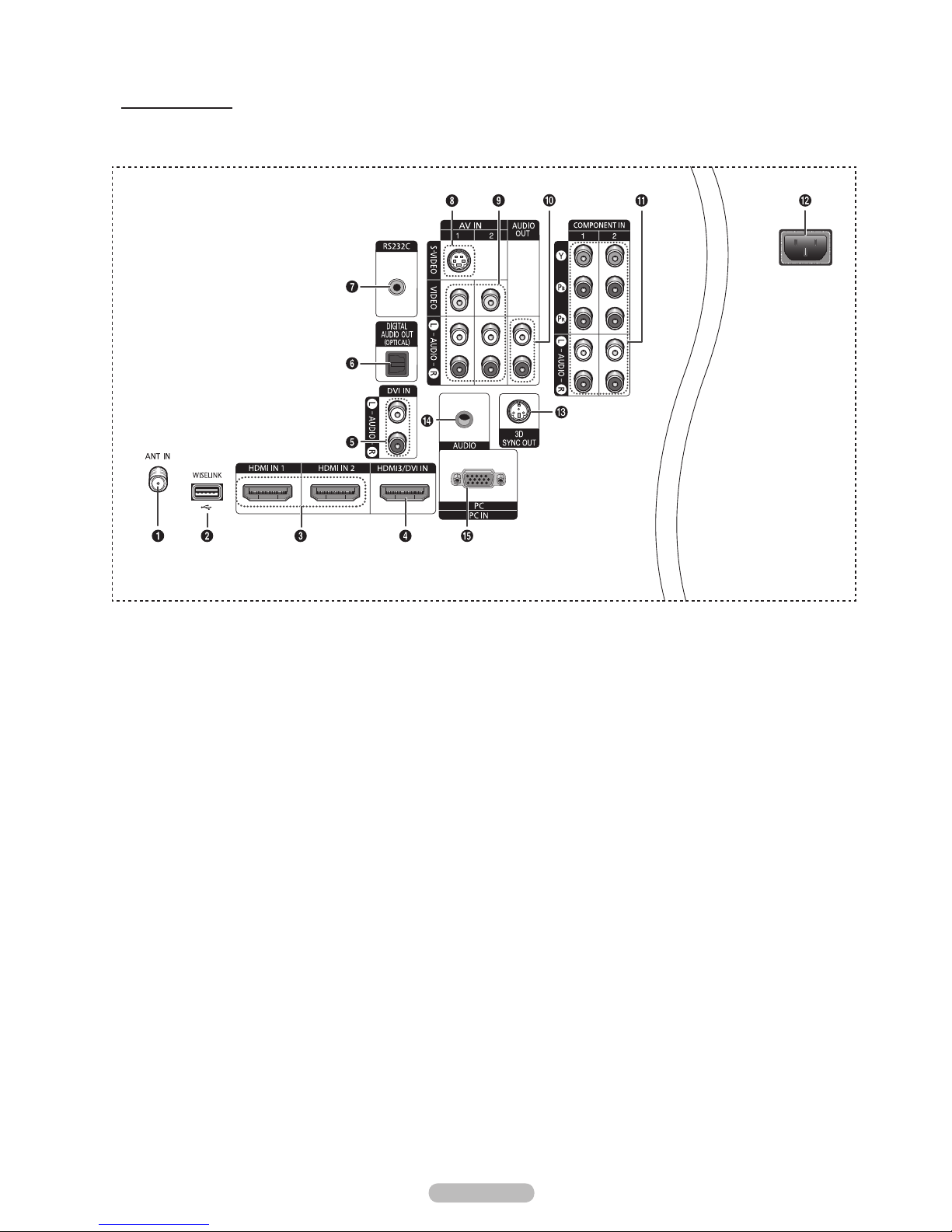
Viewing the Connection Panel
Side Panel Jacks
Use the side panel jacks to connect A/V components that will be connected continuously, such as VCR or DVD players.
For more information on connecting equipment, see pages 10~16.
®
The product color and shape may vary depending on the model.
1
ANT IN
75 Coaxial connector for Air/Cable Network.
2
WISELINK
Connect an USB mass storage device to view photo files
(JPEG) and play audio files (MP3).
3
HDMI IN 1, HDMI IN 2
Connect to the HDMI jack of a device with HDMI output.
4
HDMI3/DVI IN
Connect to the HDMI jack of a device with HDMI output.
This input can also be used as a DVI connection with
separate analog audio inputs. An optional HDMI/DVI cable
will be necessary to make this connection.
When using an optional HDMI/DVI adapter, the DVI analog
audio inputs on your TV allow you to receive left and right
audio from your DVI device.
5
DVI IN (AUDIO-L/R)
Connect to the DVI audio output jack of an external device.
6
DIGITAL AUDIO OUT (OPTICAL)
Connect to a Digital Audio component.
7
RS232C
Connector for service only
8
S-VIDEO
Video input for external devices with an
S-Video output, such as a Camcorder or VCR.
9
VIDEO/AUDIO-L/R (AV IN 1, 2)
Video input for external devices, such as a Camcorder or
VCR.
0
AUDIO OUT-L/R
Audio outputs for external devices.
!
COMPONENT IN 1, 2
Video (Y/PB/PR) and audio (L-AUDIO-R) component inputs.
@
POWER IN
Connect the supplied power cord.
#
3D SYNC OUT
Connect to 3D IR Emitter.
$
PC AUDIO IN
Connect to the audio output jack on your PC.
%
PC IN
Connect to the video output jack on your PC.
English - 8
Page 9

Remote Control
You can use the remote control up to a distance of about 23 feet from the TV.
1 POWER
Turns the TV on and off.
2 TV
Selects the TV mode directly.
3 NUMERIC BUTTONS
Press to change the channel.
4
Press to select additional channels
(digital and analog) being broadcast
by the same station. For example,
to select channel “54-3”, press “54”,
then press “
” and “3”.
5 MUTE
Press to temporarily cut off the
sound.
6
Press to increase or decrease the
VOL
volume.
7 SOURCE
Press to display and select the
available video sources.
8 CH LIST
Used to display Channel Lists on the
screen.
9 TOOLS
Use to quickly select frequently used
functions.
0 UP / DOWN / LEFT /
RIGHT / ENTER
Use to select on-screen menu items
and change menu values.
! INFO
Press to display information on the
TV screen.
@ COLOR BUTTONS
Use these button in the CH LIST and
W.LINK.
# CC
Controls the caption decoder.
$ E.MODE
Press to select the preset display
and sound modes for sports, cinema
and games.
^ ON/OFF
Press to backlight the buttons on the
remote.
This function is convenient for using
at night or when the room is dark.
(Using the remote control with the
light button set to On will reduce the
battery usage time.)
& PRE-CH
Tunes to the previous channel.
* CH
Press to change channels.
( MENU
Displays the main on-screen menu.
) W.LINK (WISELINK)
This function enables you to view
and play photo and music files from
an external USB device. (Refer to
pages 72 (Photo) and 81 (Music))
a RETURN
Returns to the previous menu.
b EXIT
Press to exit the menu.
c MTS
Press to choose stereo, mono or
Separate Audio Program (SAP
broadcast).
d DMA (Digital Media Adapter)
Use this when connecting a
Samsung DMA device through an
HDMI interface and switching to
DMA mode.
For more information on the
operating procedures, refer to the
user manual of the DMA.
This button is available when
®
“Anynet(HDMI-CEC)” is “On”.
(see page 88)
e P.SIZE
Picture size selection.
f FAV.CH
Press to switch to your favorite
channels.
%
Use these buttons in the DMA,
W.LINK and Anynet+ modes. (
: This remote can be used to control
recording on Samsung recorders
with the Anynet+ feature)
The performance of the remote control may be affected by bright light.
®
English - 9
Page 10
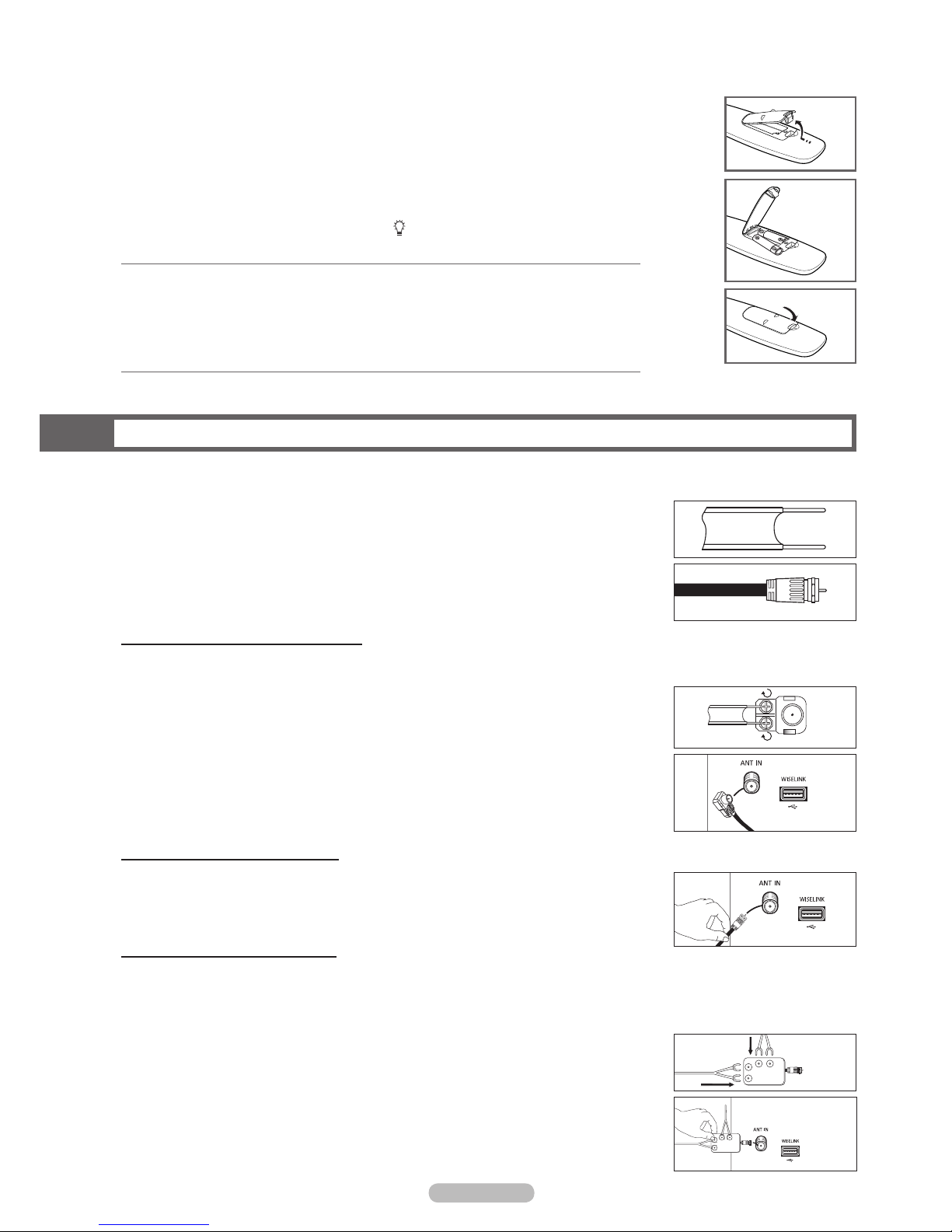
Installing Batteries in the Remote Control
1 Lift the cover at the back of the remote control upward as shown in the figure.
2 Install two AAA size batteries.
®
Make sure to match the “+” and “–” ends of the batteries with the diagram inside the compartment.
Do not mix battery types, i.e. alkaline and manganese.
3 Close the cover as shown in the figure.
®
Remove the batteries and store them in a cool and dry place if you won’t be using the remote
control for a long time. The remote control can be used up to about 23 feet from the TV. (Assuming
typical TV usage, the batteries last for about one year.))
®
Using the remote control with the On/Off( ) light button set to On will reduce the battery usage
time.
®
If the remote control doesn’t work! Check the following
1. Is the TV power on?
2. Are the plus and minus ends of the batteries reversed?
3. Are the batteries drained?
4. Is there a power cut, or is the power cord unplugged?
5. Is there a special fluorescent light or a neon sign nearby?
Connections
Connecting VHF and UHF Antennas
If your antenna has a set of leads that look like this, see “Antennas with 300 Flat Twin
Leads” below.
If your antenna has one lead that looks like this, see “Antennas with 75 Round Leads”.
If you have two antennas, see “Separate VHF and UHF Antennas”.
Antennas with 300 Flat Twin Leads
If you are using an off-air antenna (such as a roof antenna or “rabbit ears”) that has 300 twin flat leads, follow the
directions below.
1 Place the wires from the twin leads under the screws on a 300-75 adapter (not supplied).
Use a screwdriver to tighten the screws.
2 Plug the adaptor into the ANT IN terminal on the side of the TV.
Antennas with 75 Round Leads
1 Plug the antenna lead into the ANT IN terminal on the side of the TV.
Separate VHF and UHF Antennas
If you have two separate antennas for your TV (one VHF and one UHF), you must combine the two antenna signals before
connecting the antennas to the TV. This procedure requires an optional combiner-adaptor (available at most electronics
shops).
1 Connect both antenna leads to the combiner.
2 Plug the combiner into the ANT IN terminal on the bottom of the side panel.
English - 10
Page 11
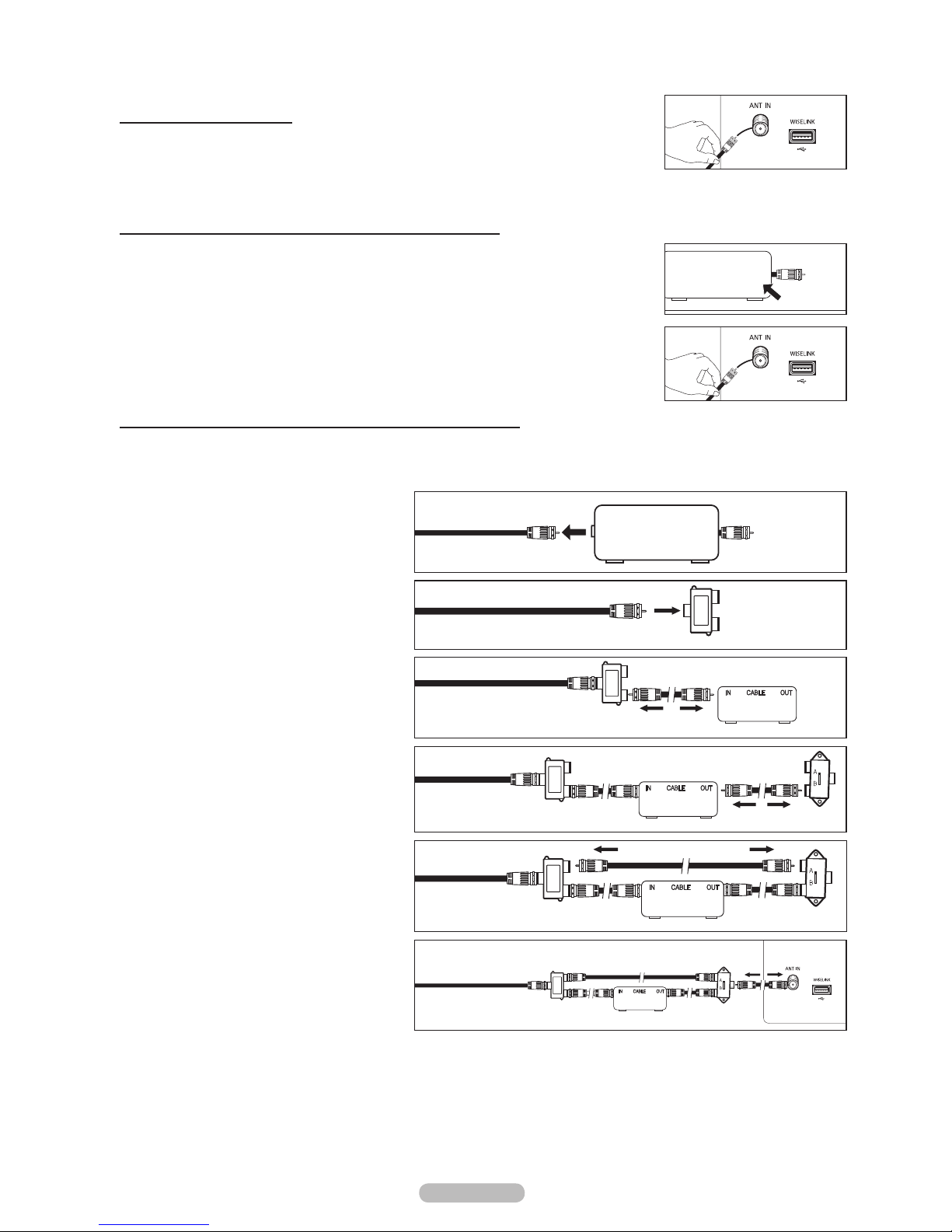
Connecting Cable TV
To connect to a cable TV system, follow the instructions below.
Cable without a Cable Box
1 Plug the incoming cable into the ANT IN terminal on the side of the TV.
®
Because this TV is cable-ready, you do not need a cable box to view unscrambled cable
channels.
Connecting to a Cable Box that Descrambles All Channels
1 Find the cable that is connected to the ANT OUT terminal on your cable box.
®
This terminal might be labeled “ANT OUT”, “VHF OUT” or simply, “OUT”.
2 Connect the other end of this cable to the ANT IN terminal on the side of the TV.
Connecting to a Cable Box that Descrambles Some Channels
If your cable box descrambles only some channels (such as premium channels), follow the instructions below. You will need
a two-way splitter, an RF (A/B) switch, and four lengths of Antenna cable. (These items are available at most electronics
stores.)
1 Find and disconnect the cable that is connected
to the ANT IN terminal on your cable box.
®
This terminal might be labeled “ANT IN”,
“VHF IN” or simply, “IN”.
ANT IN
ANT IN
ANT OUT
2 Connect this cable to a two-way splitter.
Incoming
cable
Splitter
3 Connect an Antenna cable between an
OUTPUT terminal on the splitter and the IN
terminal on the cable box.
Incoming
cable
Splitter
Cable Box
4 Connect an Antenna cable between the ANT
OUT terminal on the cable box and the B–IN
terminal on the RF(A/B) switch.
Incoming
cable
Splitter
Cable Box
RF (A/B)
Switch
5 Connect another cable between the other OUT
terminal on the splitter and the A–IN terminal on
the RF (A/B) switch.
Incoming
cable
6 Connect the last Antenna cable between the
OUT terminal on the RF (A/B) switch and the
Splitter
Cable Box
TV Side
RF (A/B)
Switch
ANT IN terminal on the side of the TV.
Incoming
cable
Splitter
Cable Box
RF (A/B)
Switch
After you have made this connection, set the A/B switch to the “A” position for normal viewing. Set the A/B switch to the “B” position to
view scrambled channels. (When you set the A/B switch to “B”, you will need to tune your TV to the cable box’s output channel, which
is usually channel 3 or 4.)
English - 11
Page 12
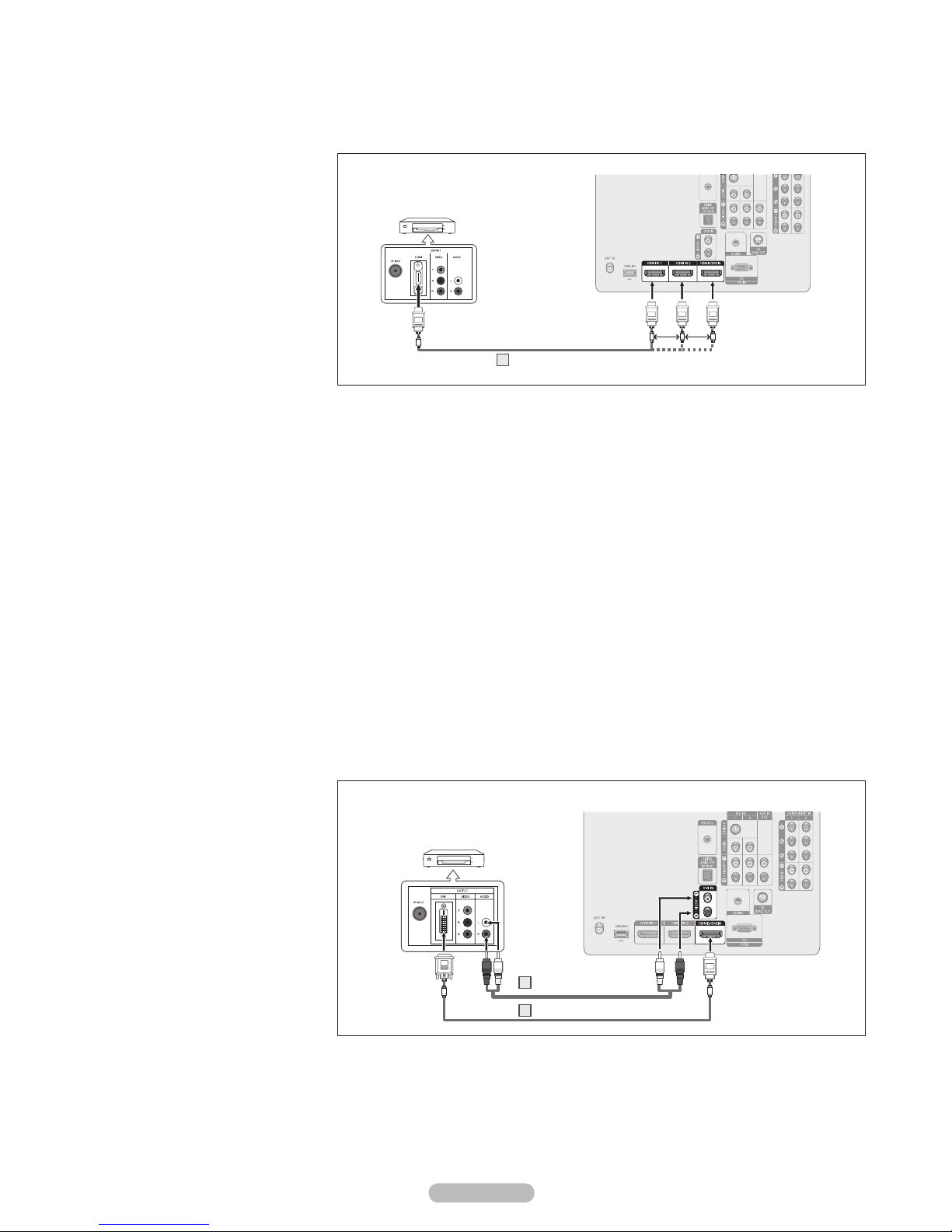
Connecting a DVD Player or Cable Box / Satellite receiver (Set-Top Box) via HDMI
This connection can only be made if there is an HDMI Output jack on the external device. This connection will
provide the highest quality picture.
1 Connect an HDMI Cable
between the HDMI IN (1, 2 or
3) on the TV and the HDMI
jack on the DVD Player or
Cable Box / Satellite receiver
(Set-Top Box).
TV Side Panel
DVD Player or Cable Box /
Satellite receiver (Set-Top Box)
or or
HDMI Cable (Not supplied)1
What is HDMI?
• HDMI, or high-definition multimedia interface, is an interface that enables the
transmission of digital audio and video signals using a single cable.
• The difference between HDMI and DVI is that the HDMI device is smaller in size and
has the HDCP (High Bandwidth Digital Copy Protection) coding feature installed.
Each DVD Player or Cable Box / Satellite receiver (Set-Top Box) has a different
®
back panel configuration.
The TV may not output sound and pictures may be displayed with abnormal color
®
when DVD Player or Cable Box / Satellite receivers supporting HDMI versions
older than 1.3 are connected. When connecting an older HDMI cable and there is
no sound, connect the HDMI cable to the HDMI3/DVI IN jack and the audio cables
to the HDMI3/DVI IN [R-AUDIO-L] jacks on the back of the TV. If this happens,
contact the company that provided the DVD Player or Cable Box / Satellite receiver
to confirm the HDMI version, then request an upgrade.
HDMI cables that do not support HDMI version 1.3 may cause annoying flicker or
®
no screen display.
Connecting a DVD Player or Cable Box / Satellite receiver (Set-Top Box) via DVI
This connection can only be made if there is a DVI Output jack on the external device.
1 Connect a HDMI/DVI Cable
or DVI-HDMI Adapter
between the HDMI3/DVI IN
jack on the TV and the DVI
jack on the DVD Player or
Cable Box/Satellite receiver
(Set-Top Box).
2 Connect Audio Cables
between the HDMI3/DVI IN
[R-AUDIO-L] jack on the TV
and the DVD Player or Cable
Box / Satellite receiver (SetTop Box).
DVD Player or Cable Box /
Satellite receiver (Set-Top Box)
Audio Cable (Not supplied)2
HDMI/DVI Cable (Not supplied)1
Each DVD Player or Cable Box / Satellite receiver (Set-Top Box) has a different
®
back panel configuration.
When connecting a DVD Player or Cable Box / Satellite receiver (Set-Top Box),
®
match the color of the connection terminal to the cable.
When using an HDMI / DVI cable connection, you must use the HDMI3/DVI IN
®
jack.
TV Side Panel
English - 12
Page 13
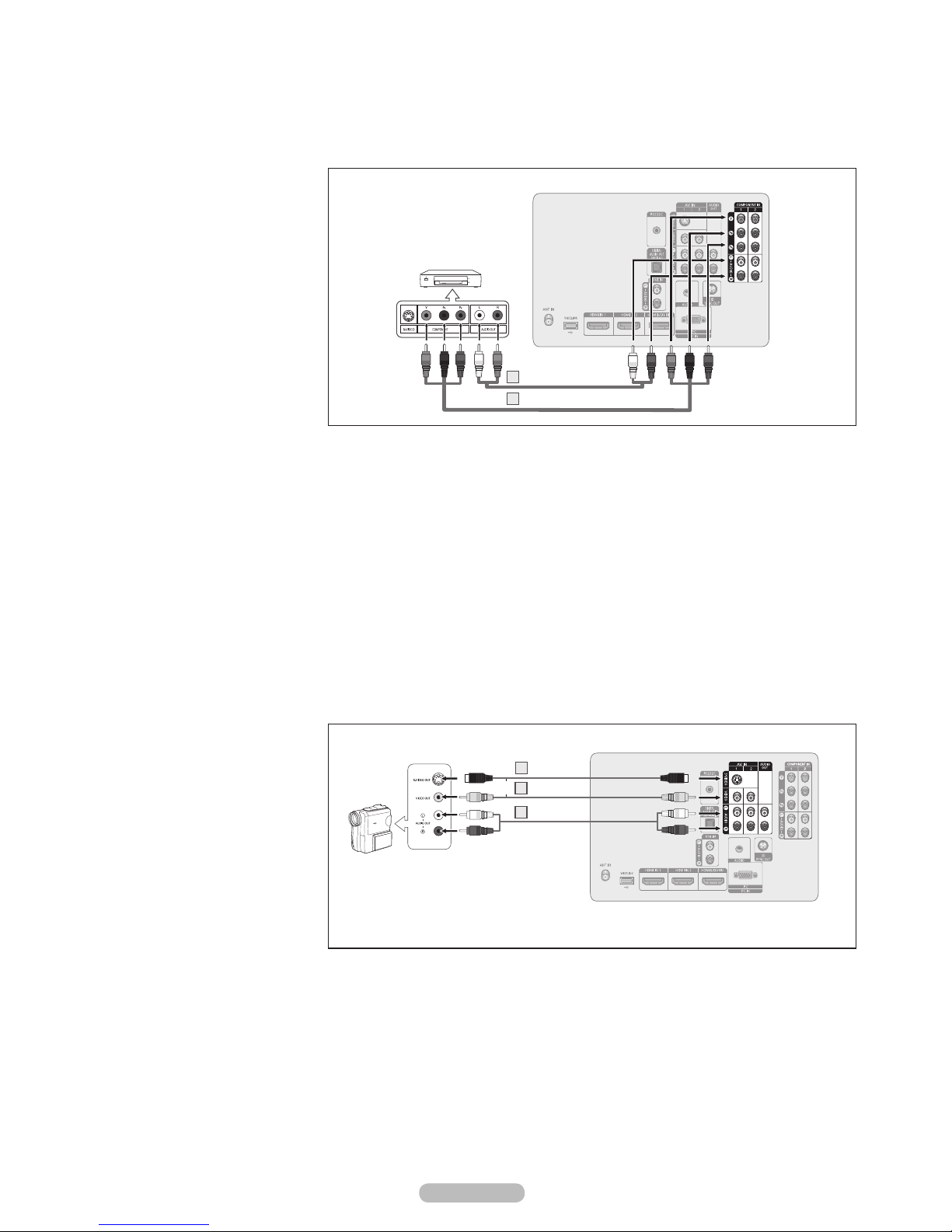
Connecting a DVD Player or Cable Box / Satellite receiver (Set-Top Box) via
Componet cables
The side panel jacks on your TV make it easy to connect a DVD Player/Cable Box/Satellite receiver (Set-Top Box)
to your TV.
1 Connect Component Cables
between the COMPONENT
B
IN (1 or 2) [Y, P
, PR]
jacks on the TV and the
COMPONENT [Y, P
B
, PR]
jacks on the DVD Player
or Cable Box / Satellite
receiver(Set-Top Box).
2 Connect Audio Cables
between the COMPONENT
IN (1 or 2) [R-AUDIO-L] jacks
on the TV and the AUDIO
OUT jacks on the DVD Player
or Cable Box / Satellite
receiver (Set-Top Box).
TV Side Panel
DVD Player or Cable Box /
Satellite receiver (Set-Top Box)
Audio Cable (Not supplied)2
Component Cable (Not supplied)1
Component video separates the video into Y (Luminance (brightness)), PB (Blue)
®
and PR (Red) for enhanced video quality. Be sure to match the component video
and audio connections. For example, if connecting the Component video cable to
COMPONENT IN 1, connect the audio cable to COMPONENT IN 1 also.
Each DVD Player or Cable Box or Satellite receiver (Set-Top Box) has a different
®
back panel configuration.
When connecting a DVD Player or Cable Box or Satellite receiver (Set-Top Box),
®
match the color of the connection terminal to the cable.
Connecting a Camcorder
The side panel jacks on your TV make it easy to connect a camcorder to your TV.
They allow you to view the camcorder tapes without using a VCR
1 Connect a Video Cable
(or S-Video Cable) between
the AV IN (1 or 2) [VIDEO]
(or S-VIDEO) jack on the TV
and the VIDEO OUT jack on
the Camcorder.
2 Connect Audio Cables
between the AV IN (1 or 2)
[L-AUDIO-R] jacks on the TV
and the AUDIO OUT jacks on
the Camcorder.
Camcorder
Each Camcorder has a different back panel configuration.
®
When connecting a Camcorder, match the color of the connection terminal to the cable
®
1
S-Video Cable (Not supplied)
or
Video Cable (Not supplied)1
Audio Cable (Not supplied)2
TV Side Panel
.
English - 13
Page 14

Connecting a VCR
Video Connection
These instructions assume that you have already connected your TV to an antenna or a cable TV system (according
to the instructions on pages 10~11). Skip step 1 if you have not yet connected to an antenna or a cable system.
1 Unplug the cable or antenna
from the back of the TV.
2 Connect the cable or antenna
to the ANT IN terminal on the
back of the VCR.
3 Connect an Antenna Cable
between the ANT OUT
terminal on the VCR and the
ANT IN terminal on the TV.
4 Connect a Video Cable
between the VIDEO OUT
jack on the VCR and the AV
IN (1 or 2) [VIDEO] jack on
the TV.
5 Connect Audio Cables
between the AUDIO OUT
jacks on the VCR and the AV
IN (1 or 2) [VIDEO] jacks on
the TV.
S-Video Connection
TV Side Panel
VCR Rear Panel
Antenna cable(Not supplied)3
Video Cable(Not supplied)4
Audio Cable(Not supplied)5
If you have a “mono” (non-stereo) VCR, use a Y-connector (not supplied) to hook
®
2
up to the right and left audio input jacks of the TV.
If your VCR is stereo, you must connect two cables.
Each VCR has a different back panel configuration.
®
When connecting a VCR, match the color of the connection terminal to the cable.
®
Your Samsung TV can be connected to an S-Video jack on a VCR.
(This connection delivers a better picture as compared to a standard VCR.)
1 To begin, follow steps 1–3
in the previous section to
connect the antenna or cable
to your VCR and your TV.
2 Connect an S-Video Cable
between the S-VIDEO OUT
jack on the VCR and the AV
IN 1 [S-VIDEO] jack on the
TV.
3 Connect Audio Cables
between the AUDIO OUT
jacks on the VCR and the AV
IN 1 or 2 [R-AUDIO-L] jacks
on the TV.
VCR Rear Panel
TV Side Panel
Antenna cable(Not supplied)1
S-Video Cable(Not supplied)2
3
Audio Cable (Not supplied)
An S-Video may be included with your VCR. (If not, check your local electronics store.)
Each VCR has a different back panel configuration.
®
When connecting a VCR, match the color of the connection terminal to the cable.
®
English - 14
Page 15
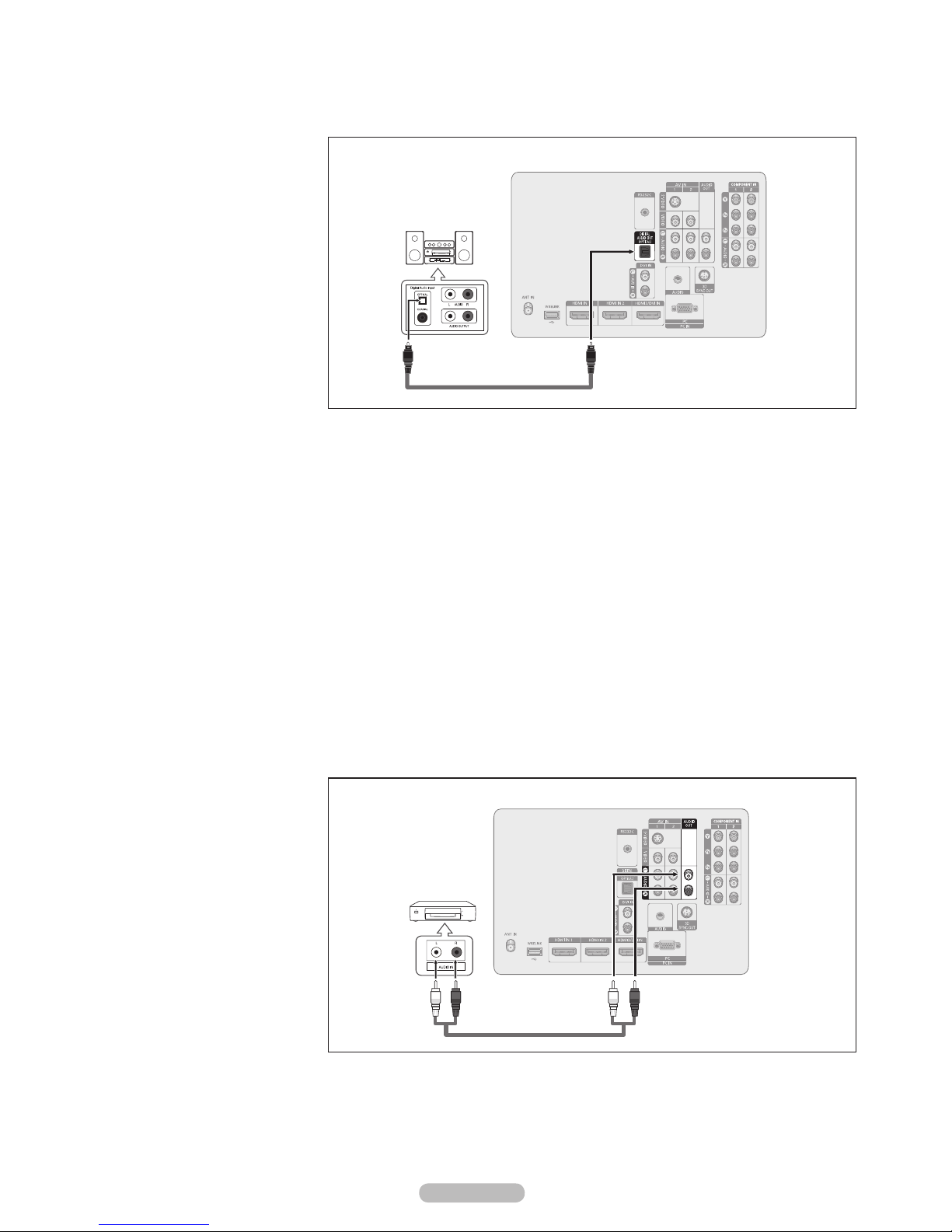
Connecting a Digital Audio System
The side panel jacks on your TV make it easy to connect a Digital Audio System to your TV.
1 Connect an Optical Cable
between the DIGITAL AUDIO
OUT (OPTICAL) jack on
the TV and the Digital Audio
Input (OPTICAL) jacks on the
Digital Audio System.
When a Digital Audio System
is connected to the “DIGITAL
AUDIO OUT (OPTICAL)”
jack:
Decrease the volume of the
TV, and adjust the volume
level with the system’s
volume control.
TV Side Panel
Digital Audio System
Optical Cable (Not supplied)
What is OPTICAL?
• An optical cable converts an electric signal into an optical light signal, and transmits
it through glass fibers. S/PDIF is a transmission system of digital audio in the form of
a light wave that uses a glass conductor.
Each Digital Audio System has a different back panel configuration.
®
When the receiver (home theater) is set to On, you can hear sound output from
®
the TV’s Optical jack. When the TV is displaying a DTV(air) signal, the TV will send
out 5.1 channel sound to the Home theater receiver. When the source is a digital
component such as a DVD and is connected to the TV via HDMI, only 2 channel
sound will be heard from the Home Theater receiver.
If you want to hear 5.1 channel audio, connect the DIGITAL AUDIO OUT
(OPTICAL) jack on the DVD player or Cable/Satellite Box directly to an Amplifier or
Home Theater, not the TV.
Connecting an Amplifier / DVD Home Theater
1 Connect Audio Cables
between the AUDIO OUT
[R-AUDIO-L] jacks on the TV
and AUDIO IN [L-AUDIO-R]
jacks on the Amplifier/DVD
Home Theater.
When an audio amplifier is
connected to the “AUDIO
OUT [R-AUDIO-L]” jacks
terminals: Decrease the
volume of the TV, and adjust
the volume level with the
Amplifier’s volume control.
TV Side Panel
Amplifier /
DVD Home Theater
Audio Cable (Not supplied)
Each Amplifier / DVD Home Theater has a different back panel configuration.
®
When connecting an Amplifier / DVD Home Theater, match the color of the
®
connection terminal to the cable.
English - 15
Page 16
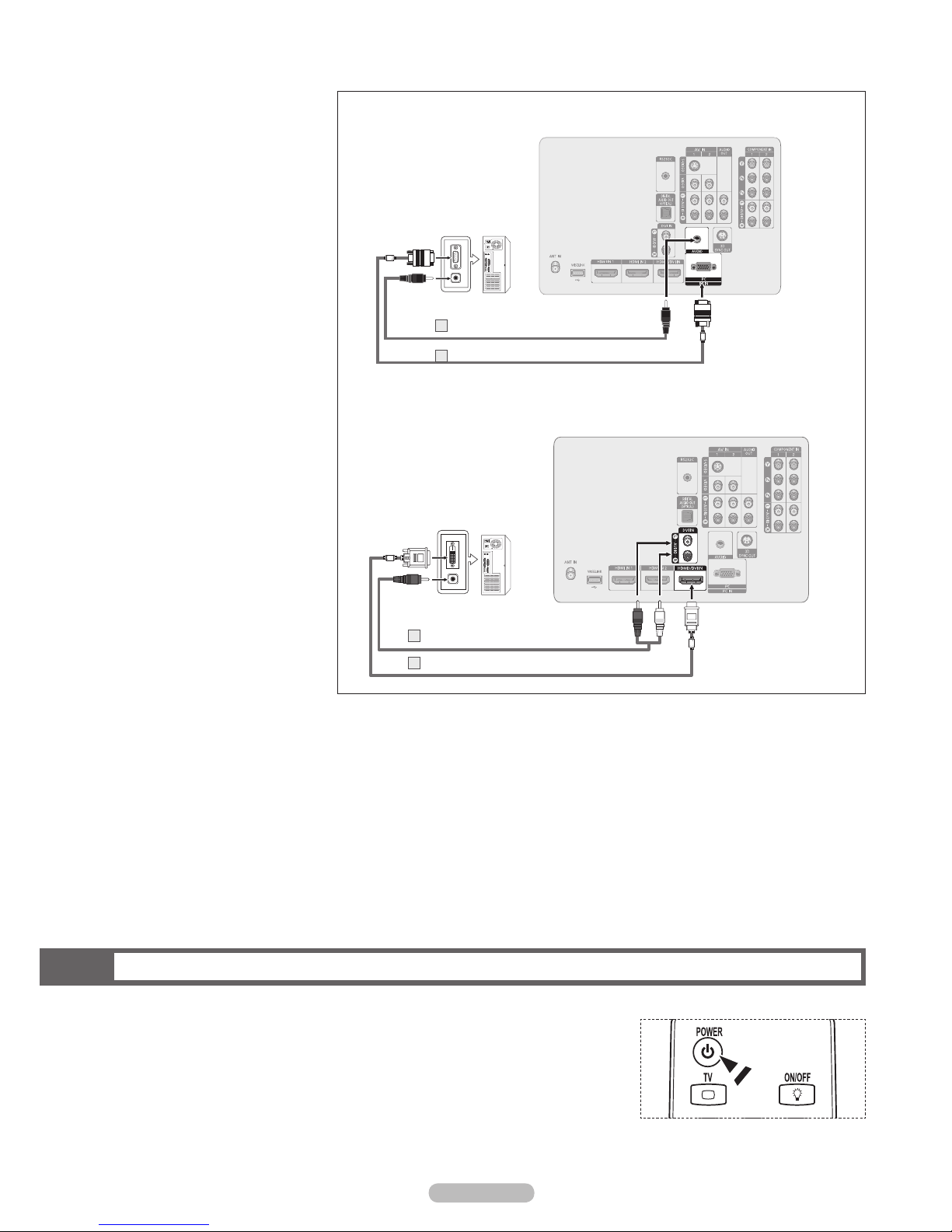
Connecting a PC
Using the D-Sub Cable
1 Connect a D-Sub Cable
between PC IN [PC] jack on
the TV and the PC output
jack on your computer.
2 Connect a PC Audio Cable
between the PC IN [AUDIO]
jack on the TV and the Audio
Out jack of the sound card on
your computer.
Using the HDMI/DVI Cable
1 Connect a HDMI/DVI cable
between the HDMI3/DVI IN
jack on the TV and the PC
output jack on your computer.
2
Connect a 3.5 mm Stereo
mini-plug/2RCA Cable cable
between the
DVI IN
[RAUDIO-L] jack on the TV
and the Audio Out jack of the
sound card on your computer.
Using the D-Sub Cable
PC
PC Audio Cable (Not supplied)2
D-Sub Cable (Not supplied)1
Using the HDMI/DVI Cable
PC
TV Side Panel
TV Side Panel
3.5 mm Stereo mini-plug/2RCA Cable (Not supplied)2
HDMI/DVI Cable (Not supplied)1
Each PC has a different back panel configuration.
®
When connecting a PC, match the color of the connection terminal to the cable.
®
When using an HDMI/DVI cable connection, you must use the HDMI3/DVI IN
®
terminal.
Operation
Turning the TV On and Off
Press the POWER button on the remote control.
You can also use the POWER button on the TV.
English - 16
Page 17
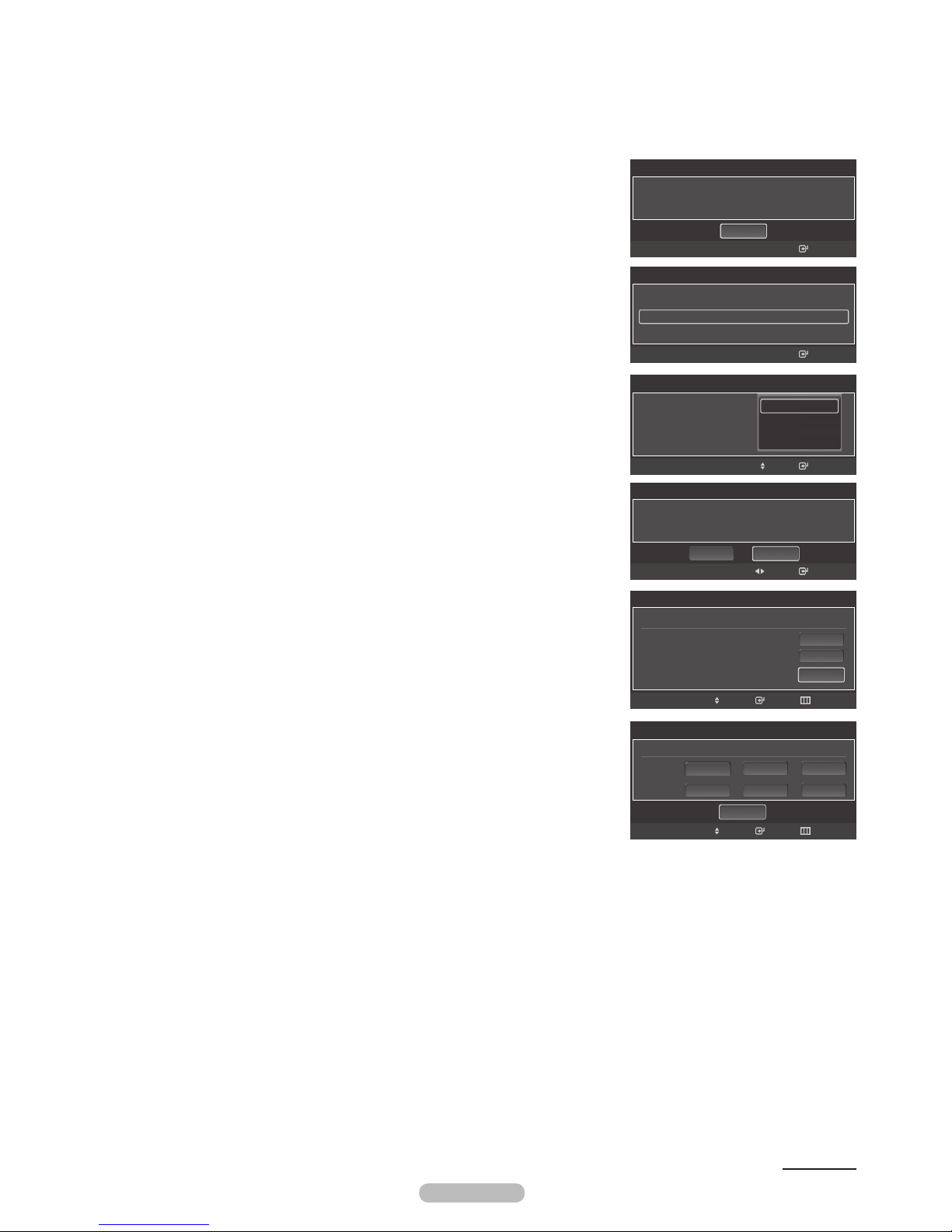
Plug & Play Feature
The first time you turn on your new TV, choose your basic settings for language, input source and channels, and
time of day using the plug and play feature. The TV will store these settings in memory. Storing the channels in
memory will allow you to scan the stored channels rather than have to enter their digits each time you want to
change channels.
When the TV is initially powered on, basic settings proceed automatically:
1 Press the POWER button on the remote control.
Menu Language, Store Demo, Channels and Time will
be set.
The message Menu Language, Store Demo, Channels and Time will be set.
is automatically displayed.
Plug & Play
OK
Enter
2 Press the ENTER button to enter the language.
Press the or button to select language, then press the ENTER button.
The message Select 'Home Use' when installing this TV in your home. i s
Select Language of the OSD.
Menu Language : English
automatically displayed.
3 Press the or button to select Store Demo or Home Use, then press the
ENTER button.
The default selection is Home Use.
®
We recommend setting the TV to Home Use mode for the best picture in
®
Select Language of the OSD.
Menu Language : English
your home environment.
Store Demo mode is only intended for use in retail environments.
®
If the unit is accidentally set to Store Demo mode and you want to return
®
Select 'Home Use' when installing this TV in your home.
to Home Use (Standard): Press the Volume button on the TV. When the
volume OSD is displayed, press and hold the MENU button on the TV for 5
seconds.
Select the Antenna source to memorize
4 Press the or button to memorize the channels of the selected connection,
then press the ENTER button.
Air: Air antenna signal.
®
Air
Cable
Auto
Cable: Cable antenna signal.
Auto: Air and Cable antenna signals.
In Cable mode, you can select the correct analog signal source among
®
STD, HRC, and IRC by pressing the or button, then press the ENTER
button. If you have Digital cable, select the signal source for both Analog
and Digital. Contact your local cable company to identify the type of cable
Selects the cable system.
Analog
Digital
system that exists in your particular area.
Plug & Play
Plug & Play
Plug & Play
Store Demo
Plug & Play
Move
Plug & Play
STD
Move
English
Español
Français
Move
Home Use
HRC IRC
HRC IRCSTD
Start
Enter
Enter
EnterMove
Start
Start
Start
SkipEnter
SkipEnter
SkipEnterMove
Continued...
English - 17
Page 18
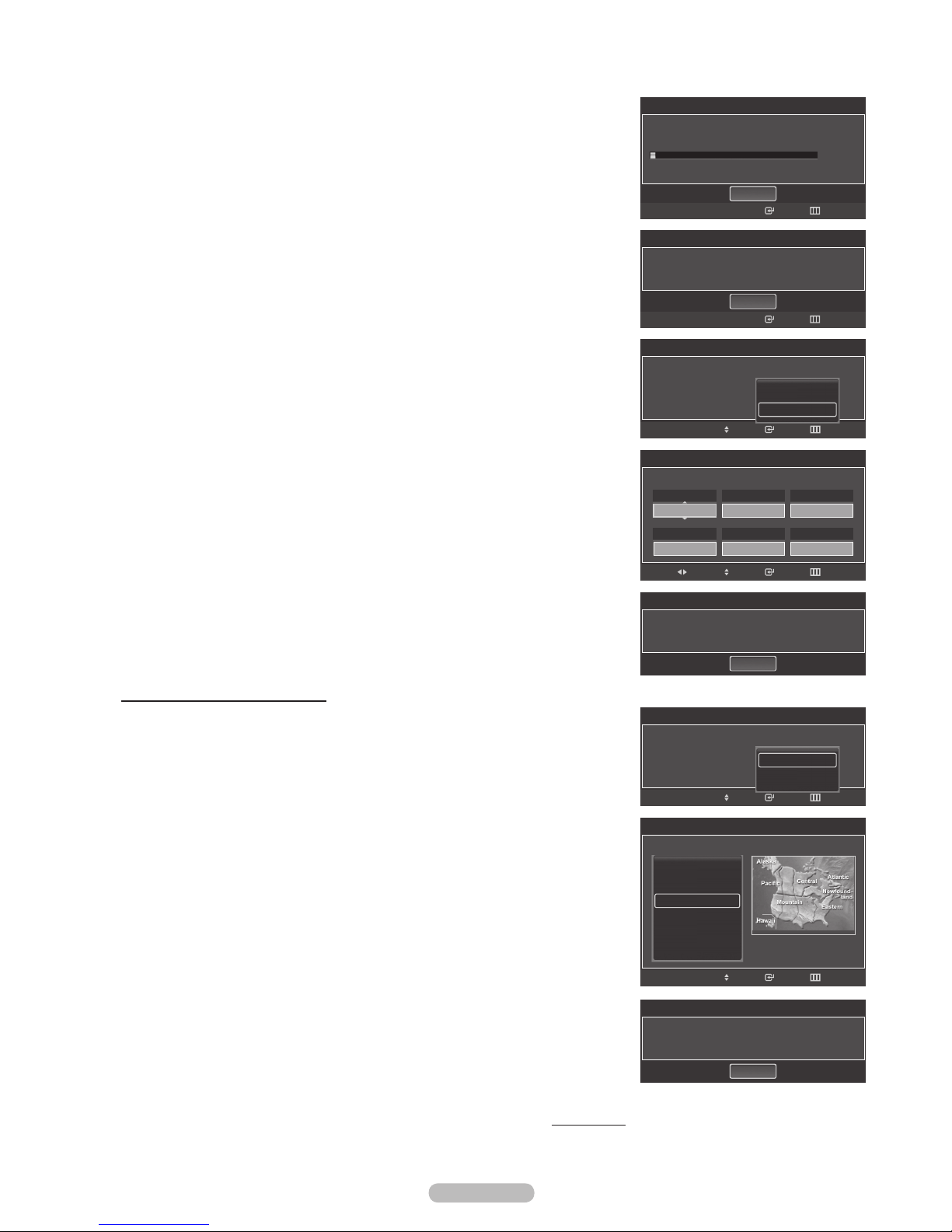
5 The TV will begin memorizing all of the available channels.
After all the available channels are stored, the Auto program menu reappears.
Press the ENTER button when channel memorization is complete.
The Clock Mode menu is displayed.
To stop the search before it has nished, press the ENTER button with
®
stop selected.
Plug & Play
Auto Program in Progress.
DTV Air : -- Air : -DTV Cable : -- Cable : --
Stop
Plug & Play
Auto Program is incomplete.
7 channels are memorized.
Air : 7 Cable : 0
OK
Air
3%
Enter Skip
Enter Skip
6 Press the ENTER button.
Press the or button to select Manual for setting the current time
manually, then press the ENTER button. The message Set current date and
time. is displayed.
If you select Auto, Set to daylight saving time. is displayed, then go to
®
Set the Clock Mode.
Clock Mode : Auto
step 9.
7 Press the or button to move to Month, Day, Year, Hour, Minute, or
am/pm.
Set current date and time
Set the date and time you want by pressing the or button, then press the
ENTER button.
You can set the month, day, year, hour, and minute directly by pressing the
®
number buttons on the remote control.
8 The message Enjoy your watching. is displayed.
When you have nished, press the ENTER button.
Even if the ENTER button is not pressed, the message will automatically
®
disappear after several seconds.
Setting the Clock Automatically
9 Press the ENTER button.
Press the or button to select Off or On, then the ENTER button.
The message Select the time zone in which you live. is displayed.
Set to daylight saving time.
DST : Off
Month
01
Hour
12
Plug & Play
Auto
Manual
Plug & Play
Day
01
Minute
00
Plug & Play
Enjoy your watching.
OK
Plug & Play
Off
On
Move
SkipEnterMove
Yea r
2008
am/pm
am
SkipEnterAdjustMove
SkipEnter
10 Press the or button to highlight the time zone for your local area (and
to move the highlight to the appropriate time zone on the map of the United
States).
Press the ENTER button.
If clock is not automatically set, see pages 52~53 to set the clock.
11 The message Enjoy your watching. is displayed.
When you have nished, press the ENTER button.
Even if the ENTER button is not pressed, the message will automatically
®
disappear after several seconds.
English - 18
Continued...
Plug & Play
Select the time zone in which you live.
Newfoundland
Atlantic
Eastern
Central
Mountain
Pacific
Plug & Play
Enjoy your watching.
OK
SkipEnterMove
Page 19
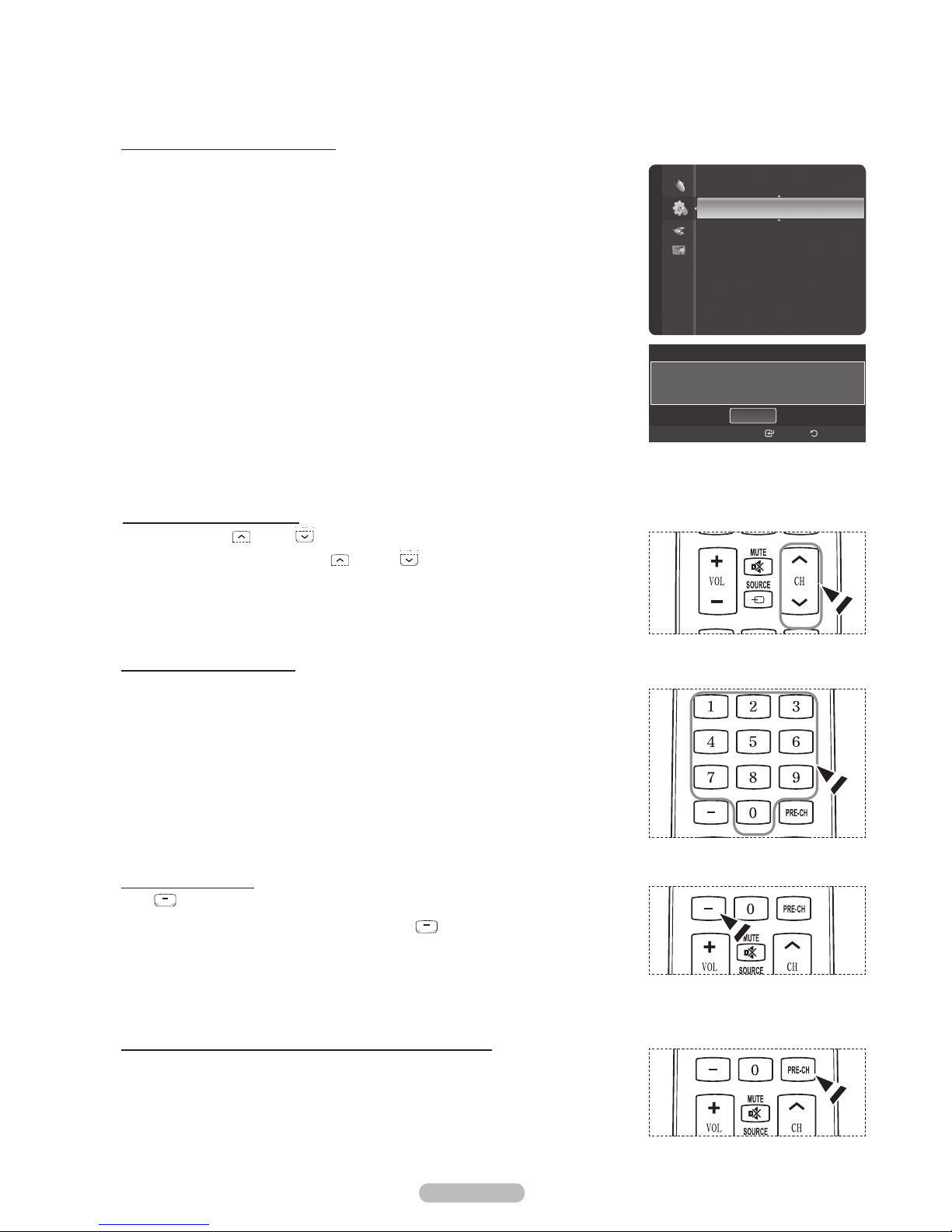
If you want to reset this feature...
1 Press the MENU button to display the menu.
Press the or button to select Setup, then press the ENTER button.
2 Press the ENTER button to select Plug & Play. For further details on setting
up options, refer to the pages 17~18.
The Plug & Play feature is only available in the TV .
®
Changing Channels
Using the Channel Buttons
1 Press the CH or CH button to change channels.
When you press the CH or CH button, the TV changes channels
®
in sequence. You will see all the channels that the TV has memorized.
(The TV must have memorized at least three channels). You will not
see channels that were either erased or not memorized. See page 21 to
memorize channels.
Setup
Plug & Play
Language : English
Time
V-Chip
Caption
External Settings
Entertainment : Off
PIP
Plug & Play
Menu Language, Store Demo, Channels and Time will
be set.
EnterOKReturn
Using the Number Buttons
1 Press the number buttons to go directly to a channel. For example, to select
channel 27, press 2, then 7.
The TV will change channels when you press the second number.
For quick channel change, press the number buttons, then press the ENTER
®
button.
You can press number buttons on Remote control for direct channel access,
®
press the same Number button again to switch between digital and analog
TV channels broadcast by the same station.
Using the “-” Button
The “
1 For example, for Channel 7-1, press 7, then
” button is used to select stations that broadcast a digital signal.
, then 1.
HD indicates the TV is receiving a Digital High Definition signal.
®
SD indicates the TV is receiving a Standard Definition signal.
For quick channel change, press the number buttons, then press the ENTER
®
button.
Using the PRE-CH Button to select the Previous Channel
Use the number buttons to quickly tune to any channel.
1 Press the PRE-CH button. The TV will switch to the last channel viewed.
To quickly switch between two channels that are far apart, tune to one
®
channel, then use the number button to select the second channel.
Then use the PRE-CH button to quickly alternate between them.
English - 19
Page 20
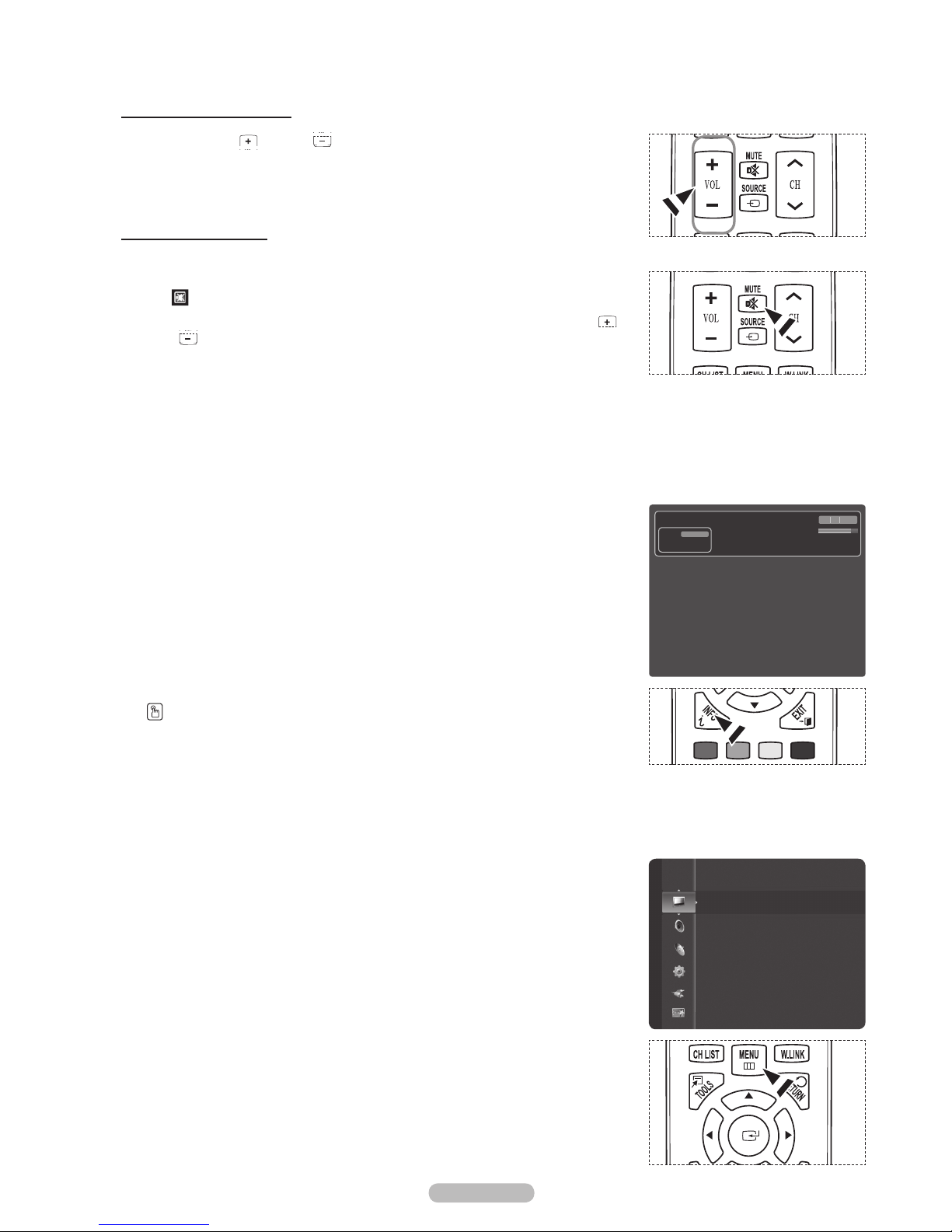
Adjusting the Volume
Using the Volume Buttons
1 Press the VOL or VOL button to increase or decrease the volume.
Using the Mute Button
At any time, you can cut off the sound using the MUTE button.
1 Press MUTE and the sound cuts off.
The is displayed on the screen.
2 To turn mute off, press the MUTE button again, or simply press the VOL
VOL
button.
or
Viewing the Display
The display identifies the current channel and the status of certain audio-video settings.
1 Press the INFO button on the remote control.
The TV will display the channel, the type of sound, and the status of certain
picture and sound settings.
Press the INFO button once more or wait approximately 10 seconds and it disappears
automatically.
Viewing the Menus
1 With the power on, press the MENU button.
The main menu appears on the screen. The menu’s left side has icons:
Picture, Sound, Channel, Setup, Input, Application.
2 Press the or button to select one of the icons.
Then press the ENTER button to access the icon’s sub-menu.
TV #1
DTV Air
13-1
Picture
Wed, Jan 2 12:28am
Dolby Digital
M. Spillane’s Mike Hammer
Bonocrunch
Mode : Standard
Contrast : 95
Brightness : 45
Sharpness : 50
Color : 50
Tint (G/R) : G50/R50
Detailed Settings
Picture Options
11:36 pm - 12:42 am
480i 4:3 English
3 Press the EXIT button to exit.
It takes about one minute until the on-screen menu disappears.
®
English - 20
Page 21
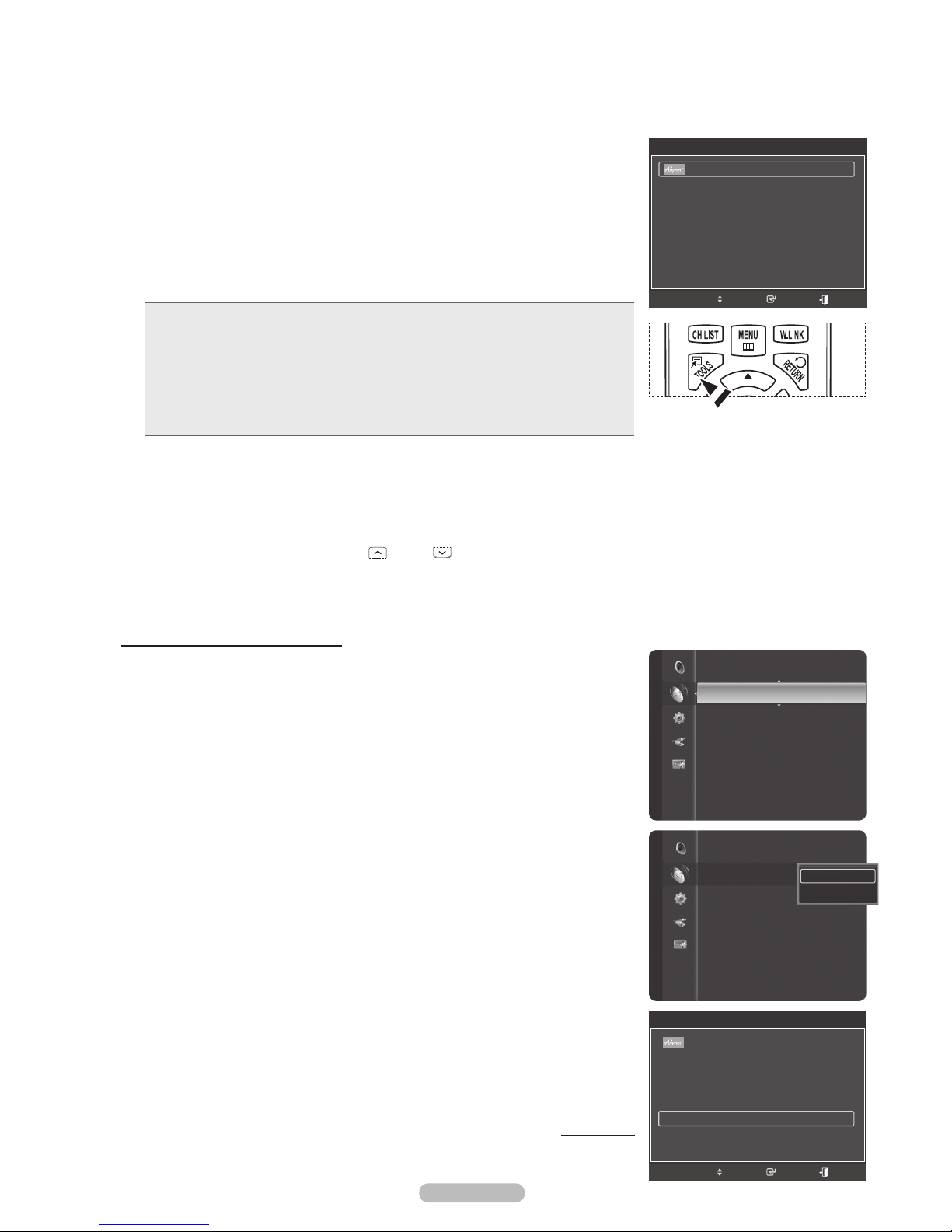
Using the TOOLS Button
You can use the TOOLS button to select your frequently used functions quickly and easily. The TOOLS menu
changes depending on which external input mode you are viewing.
1 Press the TOOLS button.
The TOOLS menu will appear.
2 Press the / button to select a menu, then press the ENTER button.
3 Press the ////ENTER buttons to display, change, or use the selected
items.
Device List
Picture Mode : Standard
Sound Mode : Custom
Sl eep Time r : O ff
Add to Favorite
Switch to Cable
TOOLS
For a more detailed description of each function, refer to the corresponding
page.
Move Enter
• 3D Effect, see page 32
• Device List, see page 88
• Picture Mode, see page 24
• Sound Mode, see page 36
• Sleep Timer, see page 55
• Add to Favorite, see page 43
• Delete from Favorite, see page 43
• Switch to Cable, see page 21
Exit
Memorizing the Channels
Your TV can memorize and store all of the available channels for both air and cable channels. After the available
CH
channels are memorized, use the
to change channels by entering the channel digits. There are three steps for memorizing channels: selecting a
broadcast source, memorizing the channels (automatic) and adding and deleting channels (Channel Lists).
or CH button to scan through the channels. This eliminates the need
Selecting the Video Signal-source
Before your television can begin memorizing the available channels, you must
specify the type of signal source that is connected to the TV (i.e. an Air or a Cable
system).
1 Press the MENU button to display the menu.
Press the or button to select Channel, then press the ENTER button.
2 Press the ENTER button to select Antenna.
Press the or button to select Air or Cable, then press the ENTER button.
Press the EXIT button to exit.
Continued...
Antenna
:
Auto Program
Clear Scrambled Channel
Channel List
Fine Tune
Signal Strength
ChannelChannel
Antenna
:
Auto Program
Clear Scrambled Channel
Channel List
Fine Tune
Signal Strength
TOOLS
Device List
Picture Mode : Standard
Sound Mode : Custom
Sl eep Time r : O ff
Add to Favorite
Switch to Cable
Air
Air
Air
Cable
English - 21
Move
Enter
Exit
Page 22
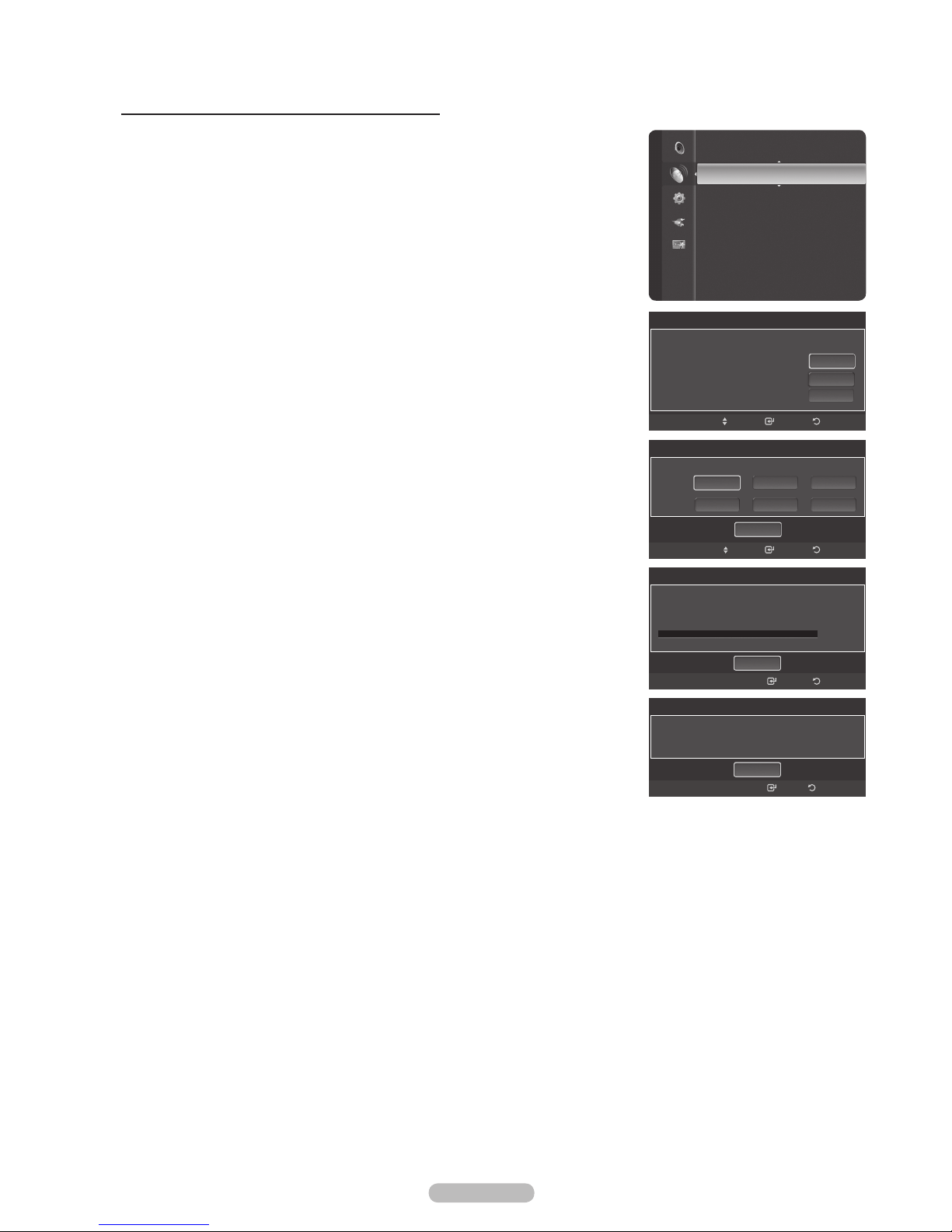
Storing Channels in Memory (Automatic Method)
1 Press the MENU button to display the menu.
Press the or button to select Channel, then press the ENTER button.
Channel
2 Press the or button to select Auto Program, then press the ENTER
button.
3 Press the or button to select an antenna connection, then press the
ENTER button.
Air: Air antenna signal.
®
Cable: Cable antenna signal.
Auto: Air and Cable antenna signals.
Select the antennas to memorize.
Air
Cable
Auto
4 When selecting the Cable TV system:
Press the ENTER button to start the auto program.
Press the or to select the correct analog signal cable system source
among STD, HRC, and IRC, then press the ENTER button. If you have Digital
Select the cable system.
Analog
Digital
cable TV, select the cable system signal source for both Analog and Digital.
STD, HRC, and IRC identify various types of cable TV systems.
®
Contact your local cable company to identify the type of cable system
that exists in your particular area. At this point the signal source has been
selected.
5 The TV begins memorizing all available stations.
After all the available channels are stored, it starts to remove scrambled
®
Auto Program in Progress.
DTV Air : -- Air : 3
DTV Cable : -- Cable : --
channels (see page 47). The Auto program menu then reappears.
If you want to stop Auto Programming, press the ENTER button.
®
The Stop Auto Program? message will be displayed. Select Yes by
pressing the or button, then press the ENTER button.
Auto Program is incomplete.
3 channels are memorized.
Air : 3 Cable : 0
Press the EXIT button to exit.
Antenna : Air
Auto Program
Channel List
Clear Scrambled Channel
Fine Tune
Signal Strength
Auto Program
Start
Start
Start
Move
Auto Program
STD
Move
Auto Program
Auto Program
HRC IRC
HRC IRCSTD
Start
Stop
OK
ReturnEnter
ReturnEnter
Air 3
3%
Enter Return
ReturnEnter
English - 22
Page 23
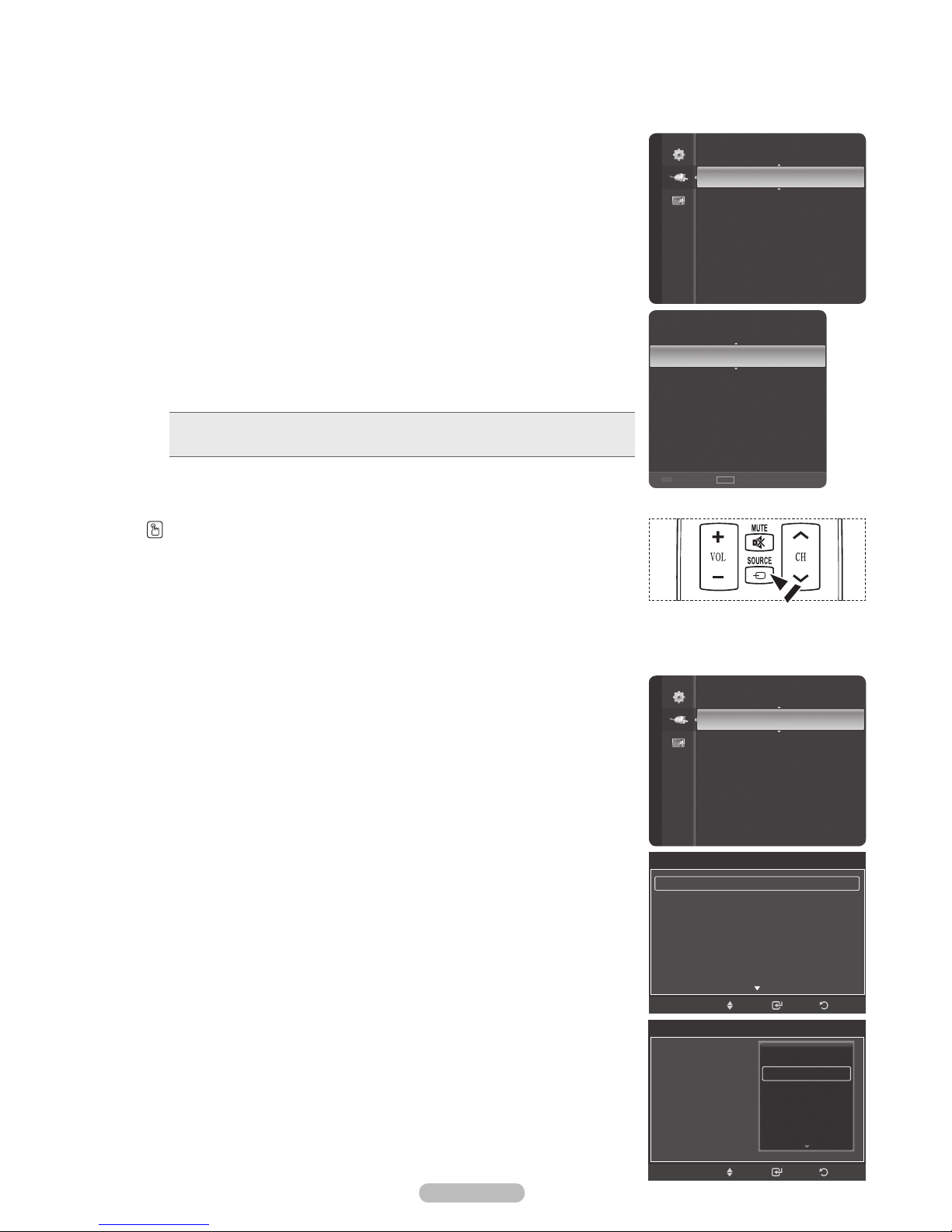
To Select the Source
Use to select TV or other external input sources such as DVD players or Cable Box/Satellite receivers (Set-Top
Box) connected to the TV. Use to select the input source of your choice.
Press the MENU button to display the menu.
1
Press the or button to select Input, then press the ENTER button.
2 Press the ENTER button to select Source List.
Press the or button to select the signal source, then press the ENTER
button.
Available signal sources: TV, AV1, AV2, S-Video, Component1,
®
Component2, PC, HDMI1, HDMI2, HDMI3/DVI, USB.
You can choose only those external devices that are connected to the TV. In
®
the Source List, connected inputs will be highlighted and sorted to the top.
Inputs that are not connected will be sorted to the bottom.
Using the Color buttons on the remote with the Source list.
®
• Red (Refresh): Refreshes the connecting external devices.
• TOOLS (Option): Displays the Edit Name and Information menus.
Input
Source List
Edit Name
TV
AV1
AV2
S-Video
Component1
Component2
PC
Refresh Option
----
----
----
----
----
----
TOOLS
You can also press the SOURCE button on the remote control to view an external
signal source.
To Edit the Input Source Name
You can name the device connected to the input jacks to make your input source selection easier.
1 Press the MENU button to display the menu.
Press the or button to select Input, then press the ENTER button.
Press the or button to select Edit Name, then press the ENTER button.
2 Press the or button to select AV1, AV2, S-Video, Component1,
Component2, PC, HDMI1, HDMI2, or HDMI3/DVI input jack, then press the
ENTER button.
3 Press the or button to select VCR, DVD, Cable STB, Satellite STB, PVR
STB, AV Receiver, Game, Camcorder, PC, TV, IPTV, Blu-Ray, HD DVD or
Digital Media Adapter input source, then press the ENTER button.
Press the EXIT button to exit.
When a PC with a resolution of 1920 x 1080@60Hz is connected to the
®
HDMI3/DVI port, you should set the HDMI3/DVI mode to PC in the Edit
Name of the Input mode.
Input
Source List
Edit Name
Edit Name
AV1 :
AV2 :
S-Video :
Component1 :
Component2 :
PC :
HDMI1 :
Edit Name
AV1 :
AV2 :
S-Video :
Component1 :
Component2 :
PC :
HDMI1 :
----
----
----
----
----
----
----
Enter ReturnMove
----
----
----
VCR
----
DVD
----
Cable STB
----
Satellite STB
PVR STB
Enter ReturnMove
English - 23
Page 24
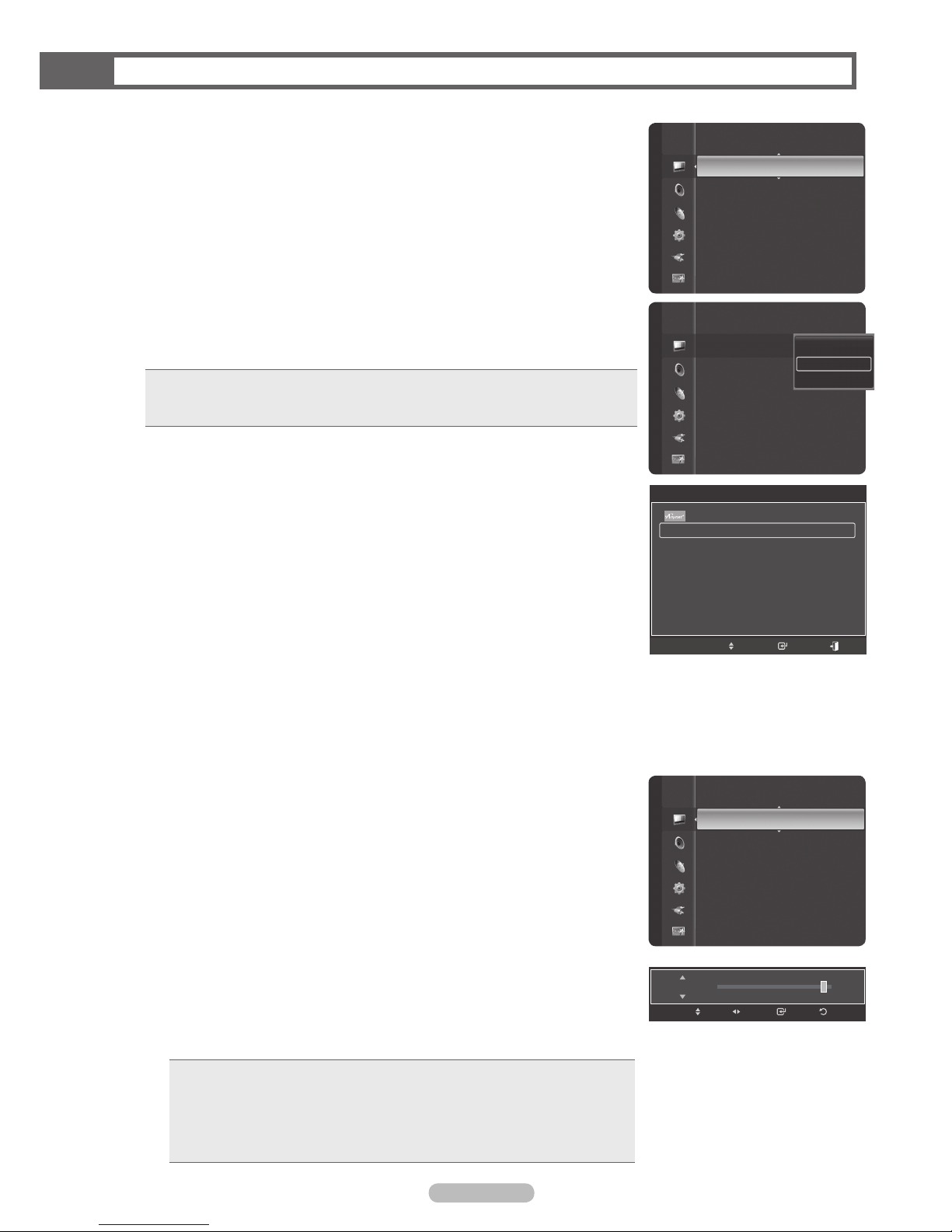
Picture Control
Changing the Picture Standard
You can select the type of picture which best corresponds to your viewing
requirements.
1 Press the MENU button to display the menu.
Press the ENTER button to select Picture.
2 Press the ENTER button to select Mode.
Press the or button to select Dynamic, Standard, or Movie.
Press the ENTER button.
• Dynamic: Select the picture for high-definition in a bright room.
• Standard: Select the picture for the optimum display in the normal environment.
• Movie: Select the picture for viewing movies in a dark room.
3 Press the EXIT button to exit.
Easy Setting
1 Press the TOOLS button on the remote control.
2 Press the or button to select Picture Mode.
3 Press the or button to select the required option.
Picture
Mode : Standard
Contrast : 95
Brightness : 45
Sharpness : 50
Color : 50
Tint (G/R) : G50/R50
Detailed Settings
Picture Options
Picture
Mode :
Contrast : 100
Brightness : 45
Sharpness : 50
Color : 50
Tint (G/R) : G50/R50
Detailed Settings
Picture Options
TOOLS
Device Listt
Picture Mode : Standard
Sound Mode : Custom
Sl eep Time r : O ff
Add to Favorite
Switch to Cable
Dynamic
Standard
Movie
Customizing the Picture Settings
Your television has several setting options that allow you to control the picture quality.
1 To select the desired picture mode, follow the “Changing the Picture Standard”
instructions number 1 to 2.
2 Press the or button to select Contrast, Brightness, Sharpness, Color, or
Tint (G/R), then press the ENTER button.
3 Press the or button to decrease or increase the value of a particular item.
Press the ENTER button.
Press the EXIT button to exit.
• When you make changes to Contrast, Brightness, Sharpness, Color, or
®
Tint (G/R) the OSD will be adjusted accordingly.
• When in PC mode, Tint, Sharpness and Color are not available.
• Each adjusted setting will be stored separately according to its input mode.
• Contrast: Adjusts the contrast level of the picture.
• Brightness: Adjusts the brightness level of the picture.
• Sharpness: Adjusts the edge definition of the picture.
• Color: Adjusts color saturation of the picture.
• Tint(G/R): Adjusts the color tint of the picture by compensating the red and
green color.
Picture
Move Enter
Mode
:
Contrast : 95
Brightness : 45
Sharpness : 50
Color : 50
Tint (G/R) : G50/R50
Detailed Settings
Picture Options
Standard
Exit
95Contrast
ReturnEnterAdjustMove
English - 24
Page 25
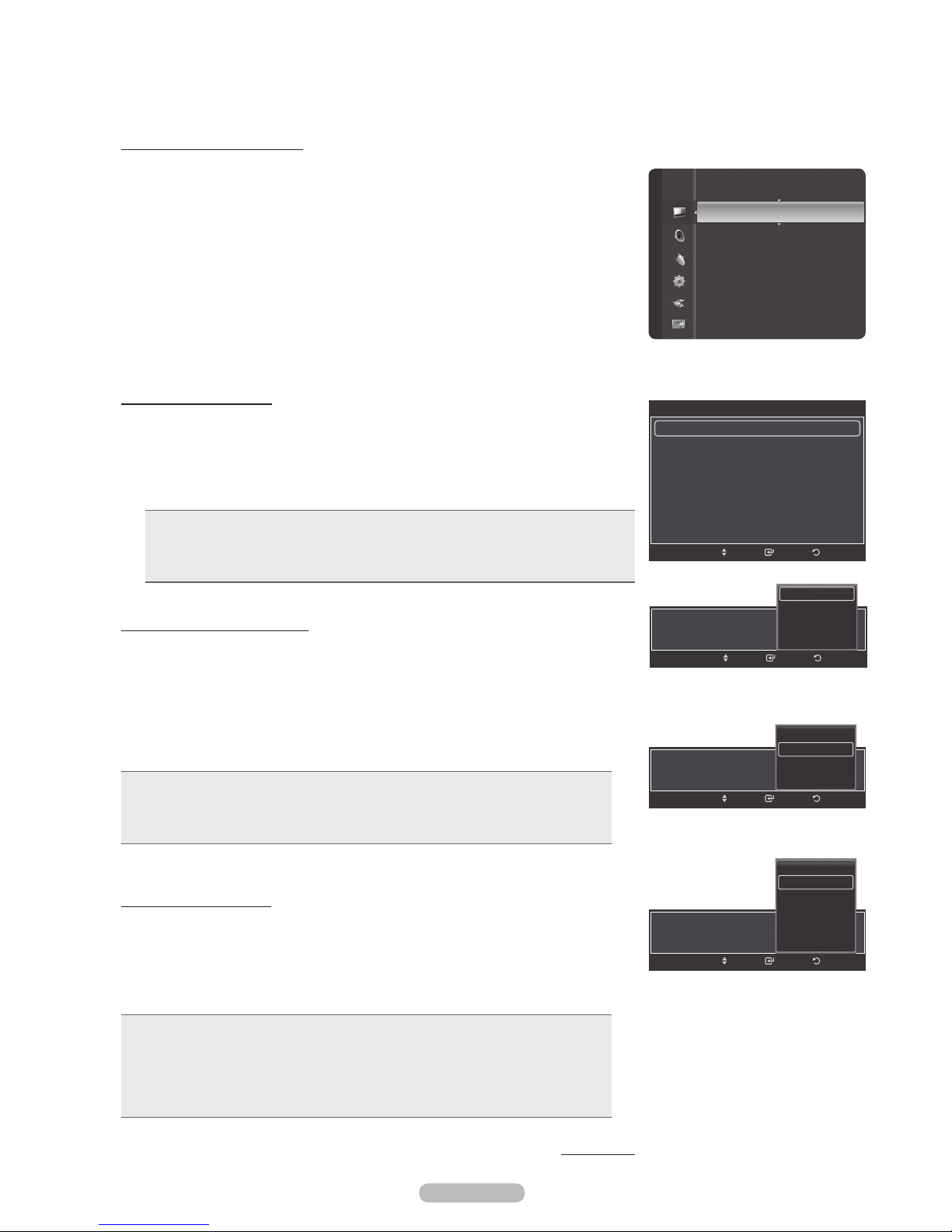
Adjusting the Detailed Settings
Samsung’s new TVs allow you to make even more precise picture settings than previous models. See below to
adjust detailed picture settings.
Activating Detailed Settings
1 Press the MENU button to display the menu.
Press the ENTER button to select Picture.
2 Press the ENTER button to select Mode.
Press the or button to select Standard or Movie, then press the ENTER
button.
Detailed Settings is available in Standard or Movie mode.
®
3 Press the or button to select Detailed Settings, then press the ENTER
button.
®
In PC mode, you can only make changes to Dynamic Contrast, Gamma and
White Balance from among the Detailed Settings items.
Activating Black adjust
You can select the black level on the screen to adjust the screen depth.
4 Press the or button to select Black adjust, then press the ENTER button.
5 Press the or button to select Off, Low, Medium or High.
Press the ENTER button.
• Off: Turns off the black adjustment function.
• Low: Sets the black color depth to low.
• Medium: Sets the black color depth to medium.
• High: Sets the black color depth to high.
Activating Dynamic Contrast
You can adjust the screen contrast so that the optimal contrast is provided.
Color : 50
Picture
Tint (G/R) : G50/R50
Detailed Settings
Picture Options
Picture Reset
Detailed Settings
Black Adjust : Off
Dynamic Contrast : Low
LED Control : Auto
Gamma : 0
White Balance : 0
Flesh Tone : 0
Edge Enhancement : On
ReturnEnterMove
Off
Low
Black Adjust : Low
Medium
High
ReturnEnterMove
6 Press the or button to select Dynamic Contrast, then press the
ENTER button.
7
Press the or button to select Off, Low, Medium or High.
Press the ENTER button.
• Off: Turns off the dynamic contrast adjustment function.
• Low: Sets the dynamic contrast to low.
• Medium: Sets the dynamic contrast to medium.
• High: Sets the dynamic contrast to high.
Activating LED Control
You can select the Brightness of the LED by surrounding brightness.
8 Press the or button to select LED Control, then press the ENTER button.
9 Press the or button to decrease or increase the value.
Press the ENTER button.
• Auto : Sets the LED Brightness to the Auto Mode.
• Max : Sets the LED Brightness to the Max Mode.
• High : Sets the LED Brightness to the High Mode.
• Medium : Sets the LED Brightness to the Medium Mode.
• Low : Sets the LED Brightness to the Low Mode.
• Min : Sets the LED Brightness to the Min(Minimum) Mode.
Off
Low
Dynamic Contrast : Low
LED Control
Medium
High
Auto
Max
High
Medium
Low
Min
ReturnEnterMove
ReturnEnterMove
Continued...
English - 25
Page 26
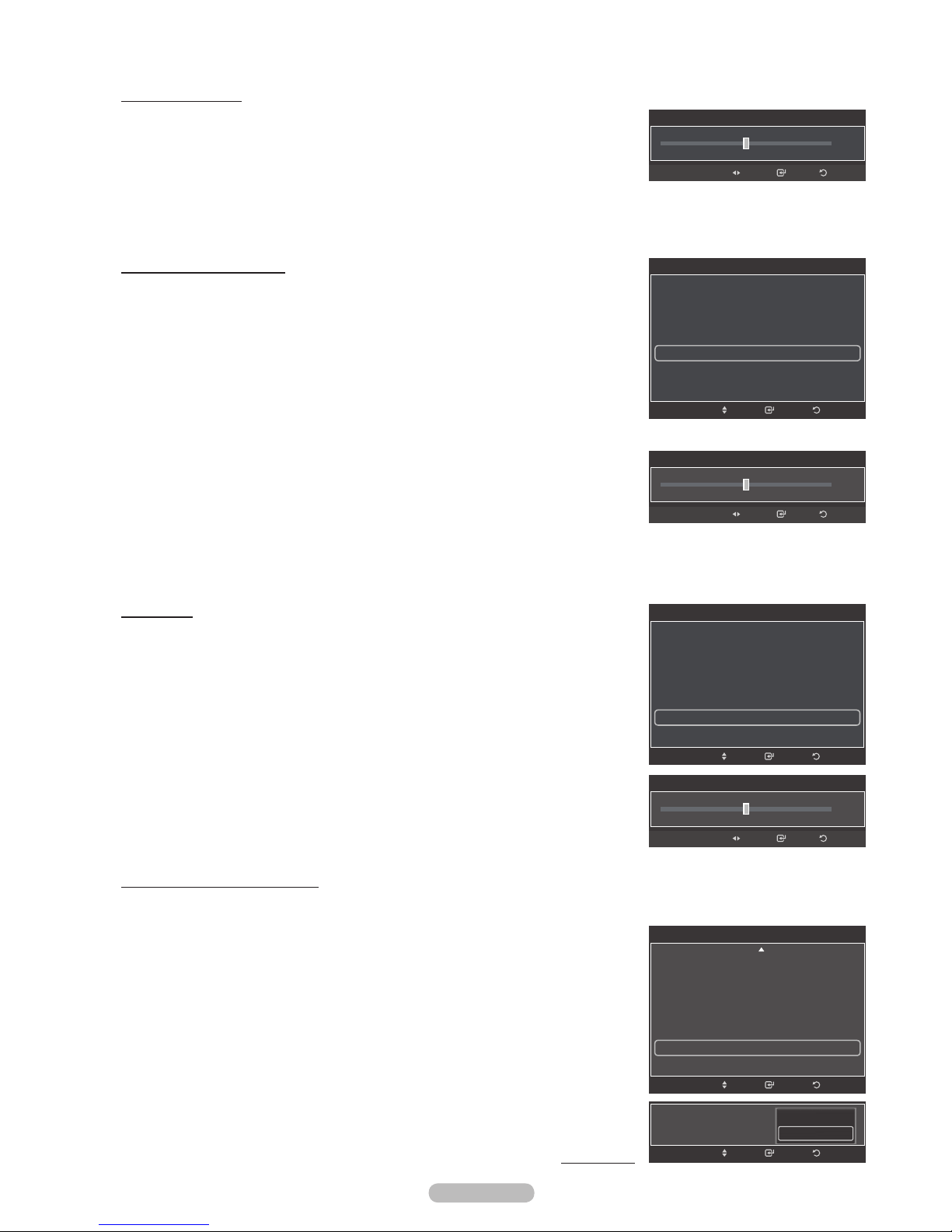
Activating Gamma
You can adjust the Primary Color (Red, Green, Blue) Intensity. (-3 ~ +3)
10 Press the or button to select Gamma, then press the ENTER button.
11 Press the or button to decrease or increase the value.
Press the ENTER button.
Gamma
0
Enter ReturnAdjust
Activating White Balance
You can adjust the color temperature for more natural picture colors.
12 Press the or button to select White Balance, then press the ENTER
button.
13 Select the required option by pressing the or button, then press the
Black Adjust : Off
Dynamic Contrast : Low
LED Control : Auto
Gamma : 0
White Balance : 0
Flesh Tone : 0
Edge Enhancement : On
ENTER button.
14 Press the or button to decrease or increase the value of a particular item.
(-10~+10)
Press the ENTER button.
®
Changing the adjustment value will refresh the adjusted screen.
Flesh Tone
You can emphasize the pink flesh tone in the picture.
15 Press the or button to select Flesh Tone, then press the ENTER button.
16 Press the or button to decrease or increase the value.
Press the ENTER button.
Changing the adjustment value will refresh the adjusted screen.
®
Black Adjust : Off
Dynamic Contrast : Low
LED Control : Auto
Gamma : 0
White Balance : 0
Flesh Tone : 0
Edge Enhancement : On
Detailed Settings
White Balance
Adjust
Detailed Settings
Enter Return
ReturnEnterMove
0
ReturnEnterMove
Activating Edge Enhancement
You can emphasize object boundaries in the picture.
17 Press the or button to select Edge Enhancement, then press the
ENTER button.
18 Press the or button to select Off or On. Press the ENTER button.
English - 26
Continued...
Flesh Tone
Detailed Settings
Dynamic Contrast : Low
LED Control : Auto
Gamma : 0
White Balance : 0
Flesh Tone : 0
Edge Enhancement : On
xvYCC : Off
Move
Edge Enhancement : On
0
Enter ReturnAdjust
ReturnEnter
Off
On
ReturnEnterMove
Page 27
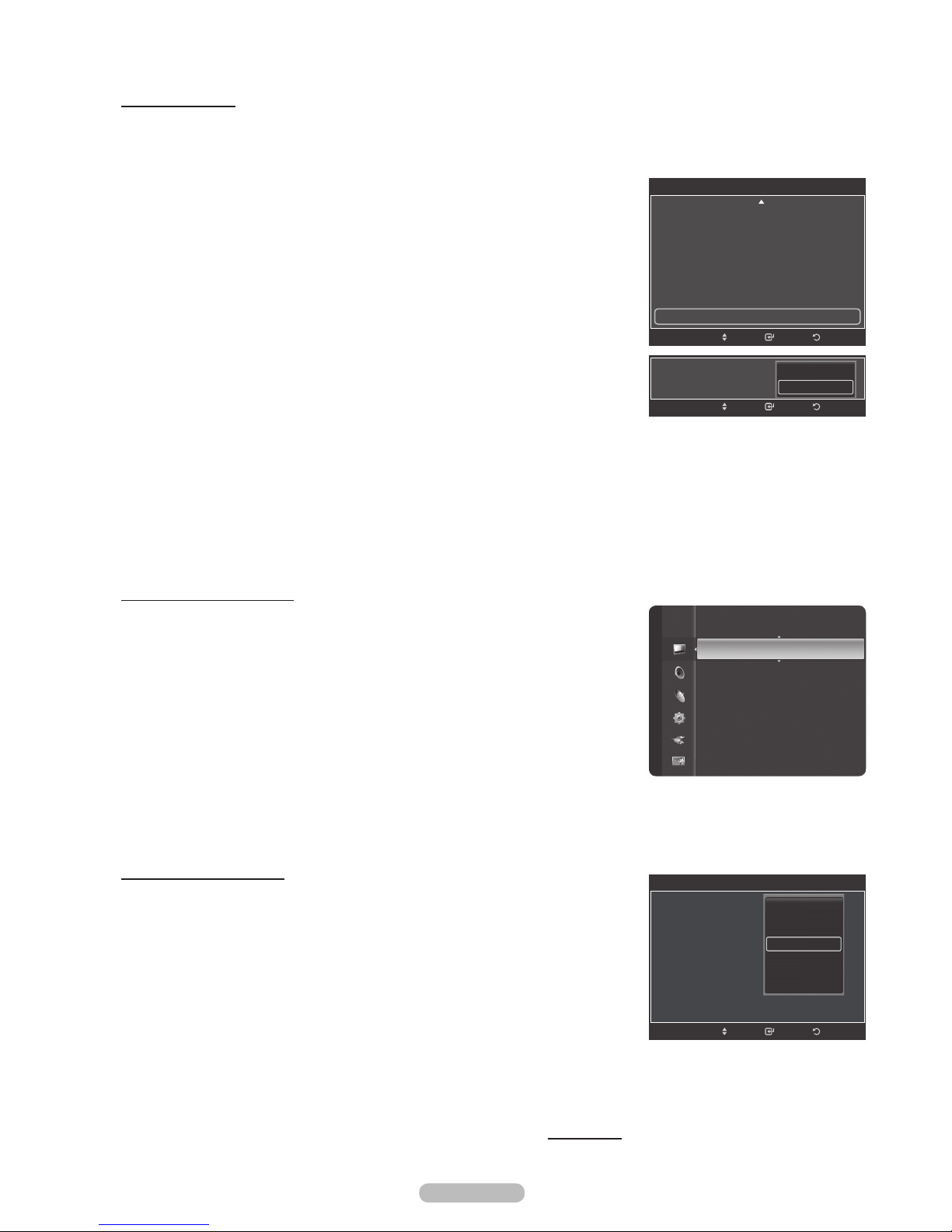
Activating xvYCC
Setting the xvYCC mode to On increases detail and color space when watching
movies from an external device (ie. DVD player) connected to the HDMI or
Component IN jacks.
19 Press the or button to select xvYCC, then press the ENTER button.
Detailed Settings
Dynamic Contrast : Low
LED Control : Auto
Gamma : 0
White Balance
Flesh Tone : 0
Edge Enhancement : On
xvYCC : Off
Move
ReturnEnter
20 Press the or button to select Off or On.
Press the ENTER button.
®
xvYCC is available when the picture mode is set to Movie, and the
external input is set to HDMI or Component mode.
Configuring Picture Options
Activating Picture Options
1 Press the MENU button to display the menu.
Press the ENTER button to select Picture.
2 Press the or button to select Picture Options, then press the ENTER
button.
3 Press the or button to select a particular item. Press the ENTER button.
When you are satised with your setting, press the ENTER button.
®
In PC mode, you can only make changes to the Color Tone, Position,
®
Size and Color Gamut from among the items in Picture Options.
xvYCC : On
Tint (G/R) : G50/R50
Picture
Detailed Settings
Picture Options
Picture Reset
Off
On
ReturnEnterMove
Adjusting the Color Tone
1 Follow the Activating Picture Options instructions numbers 1 and 2.
2 Press the or button to select Color Tone, then press the ENTER button.
3 Press the or button to select Cool2, Cool1, Normal, Warm1 or Warm2.
Press the ENTER button.
Warm1 or Warm2 is only activated when the picture mode is Movie.
®
Settings can be adjusted and stored for each external device
®
you have connected to an input of the TV.
English - 27
Continued...
Picture Options
Color Tone :
Size :
Position :
Digital NR :
DNle
HDMI Black Level : 2min
Film Mode : Off
Move
Cool2
Cool1
Normal
Warm1
: 2min
Warm2
ReturnEnter
Page 28
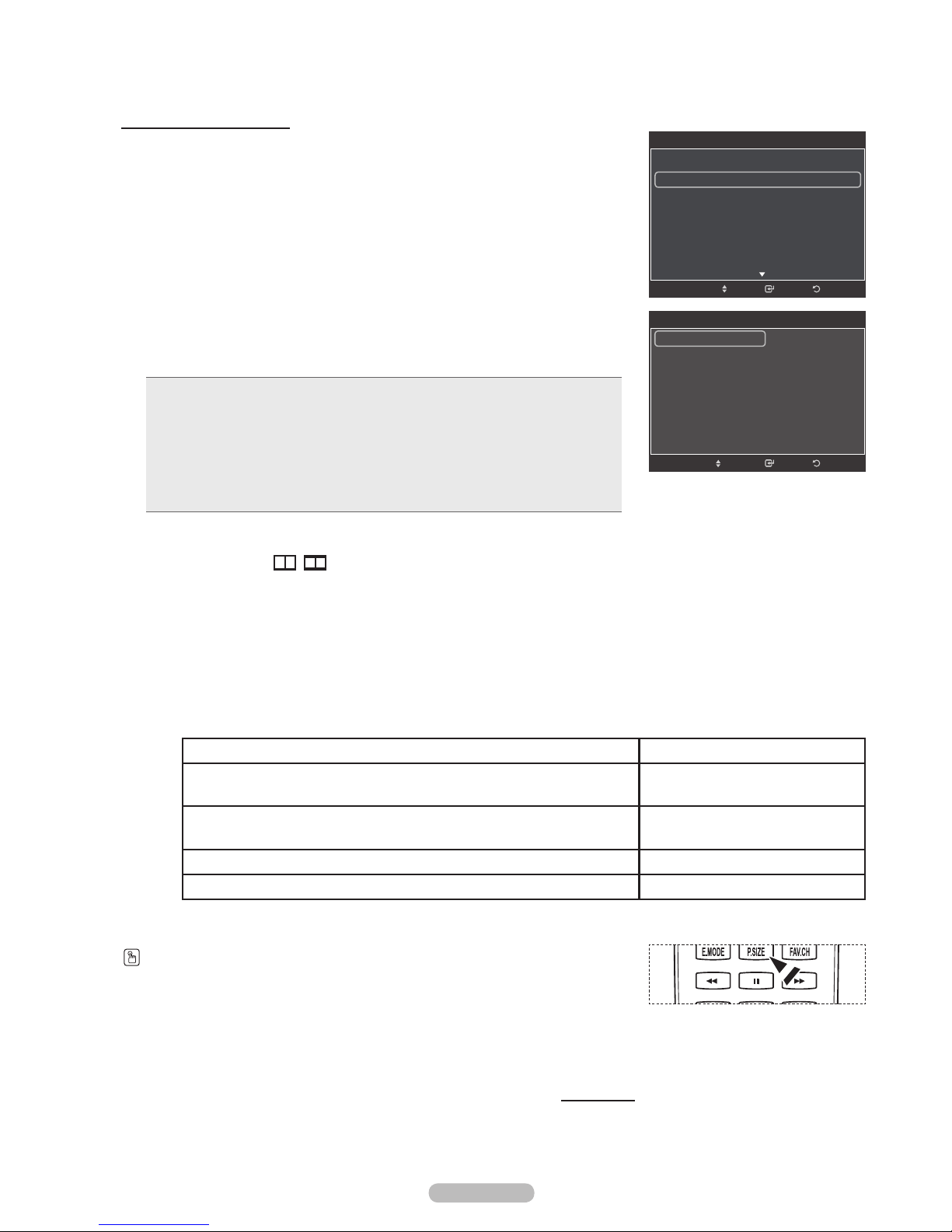
Changing the Screen Size
Occasionally, you may want to change the size of the image on your screen. Your
TV comes with six screen size options, each designed to work best with specic
types of video input. Your cable box or satellite receiver may have its own set of
screen sizes as well. In general, though, you should view the TV in 16:9 mode as
much as possible.
1 Follow the Activating Picture Options instructions numbers 1 and 2.
(Refer to page 27)
Picture Options
Color Tone : Normal
Size : 16:9
Position
Digital NR : Auto
DNle : Off
HDMI Black Level : Low
Film Mode : Off
2 Press the or button to select Size, then press the ENTER button.
3 Press the or button to select the screen format you want.
Press the ENTER button.
Press the EXIT button to exit.
• 16:9 : Sets the picture to 16:9 wide mode.
• Zoom1 : Magnifies the size of the picture on the screen.
• Zoom2 : Expands the Zoom1 format picture.
• Wide Fit : Enlarges the aspect ratio of the picture to fit the entire screen.
• 4:3 : Sets the picture to 4:3 normal mode.
• Just Scan
DTV(1080i), HDMI (720p/1080i/1080p) or Component (1080i/1080p) signals
are input.
When Double ( , ) mode has been set in PIP, the Picture Size cannot be set.
®
Temporary image retention may occur when viewing a static image on the set for more than two hours.
®
After selecting Zoom1, Zoom2 or Wide Fit:
®
: Use this function to see the full image without any cutoff when
16:9
Zoom1
Zoom2
Wide Fit
4:3
Just Scan
Move
Size
Move
ReturnEnter
ReturnEnter
Press the or button to select Position, then press the ENTER button.
Press the or button to move the picture up and down.
Reset: Press the or button to select Reset, then press the ENTER button. You can initialize the setting.
HD (High Definition)
®
16:9 - 1080i/1080p (1920x1080), 720p (1280x720)
Settings can be adjusted and stored for each external device you have connected to an input of the TV.
®
Input Source Picture Size
ATV, Video, S-Video, DTV(480i, 480p), Component(480i, 480p),
HDMI(480p)
DTV(1080i), Component(1080i,1080p), HDMI(720p, 1080i,
1080p)
DTV(720p),Component(720p) 16:9, 4:3, Wide Fit
PC, HDMI3/DVI(PC timing) Wide TV, Wide PC, 4:3
Alternately, you can press the P.SIZE button on the remote control repeatedly to change
the picture size.
16:9, Zoom1, Zoom2, 4:3
16:9, 4:3, Wide Fit, Just Scan
Continued...
English - 28
Page 29
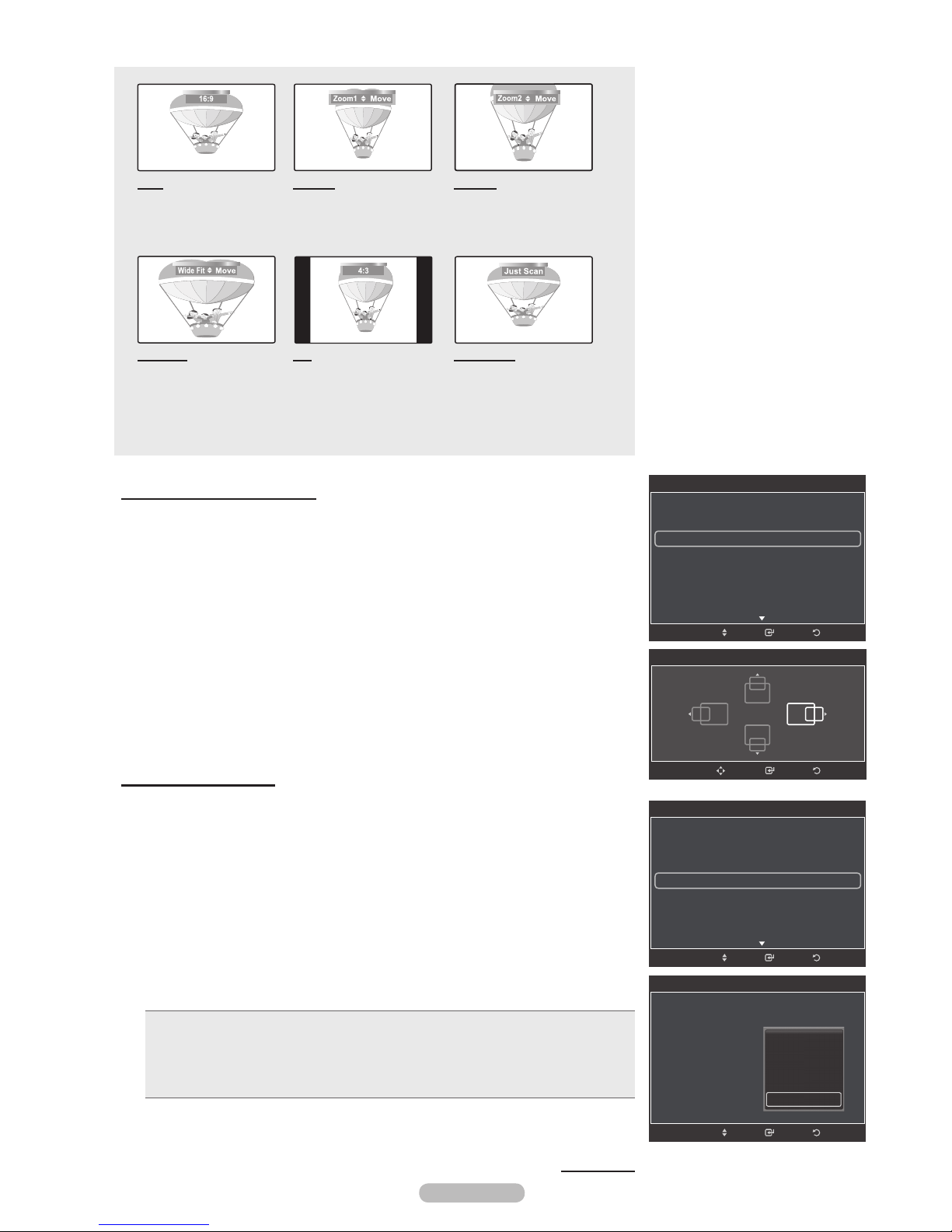
16:9
Sets the picture to 16:9
wide mode.
Zoom1
The screen size when
Wide screen is vertically
enlarged.
Zoom2
The screen size when
the Zoom1 screen is
vertically enlarged.
Wide Fit
Enlarges the aspect ratio
of the picture to fit the
entire screen.
4:3
Sets the picture to 4:3
normal mode.
Just Scan
Use this function to see the full
image without any cutoff when
HDMI (720p/1080i/1080p) or
DTV(1080i),Component(1080i/
1080p) signals are input.
Adjusting the Screen Position
You can adjust the horizontal and vertical position of the screen.
1 Follow the Activating Picture Options instructions numbers 1 and 2.
(Refer to page 27)
2 Press the or button to select Posion, then press the ENTER button.
Digital Noise Reduction
If the broadcast signal received by your TV is weak, you can activate the Digital
Noise Reduction feature to help reduce any static and ghosting that may appear
on the screen.
1 Follow the Activating Picture Options instructions numbers 1 and 2.
(Refer to page 27)
2 Press the or button to select Digital NR, then press the ENTER button.
Picture Options
Color Tone : Cool1
Size : 16:9
Position
Digital NR : Auto
DNle : Off
HDMI Black Level : Normal
Film Mode : Off
Color Tone : Normal
Size : 16:9
Position
Digital NR : Auto
DNle : Off
HDMI Black Level : Low
Film Mode : Off
Move
Position
Adjust
Picture Options
ReturnEnter
ReturnEnter
3 Press the or button to select Off, Low, Medium, High or Auto.
Press the ENTER button.
• Off: Turns the screen noise reduction function off.
• Low: Reduces screen noise at a low level.
• Medium: Reduces screen noise at a medium level.
• High: Reduces screen noise at a high level.
• Auto: Automatically recognizes and reduces screen noise.
Press the EXIT button to exit.
English - 29
Continued...
Move
Picture Options
Color Tone : Normal
Size : 16:9
Position
Digital NR : High
DNle : Off
HDMI Black Level : Normal
Film Mode : Off
Off
Low
Medium
Hight
Auto
Move
ReturnEnter
ReturnEnter
Page 30
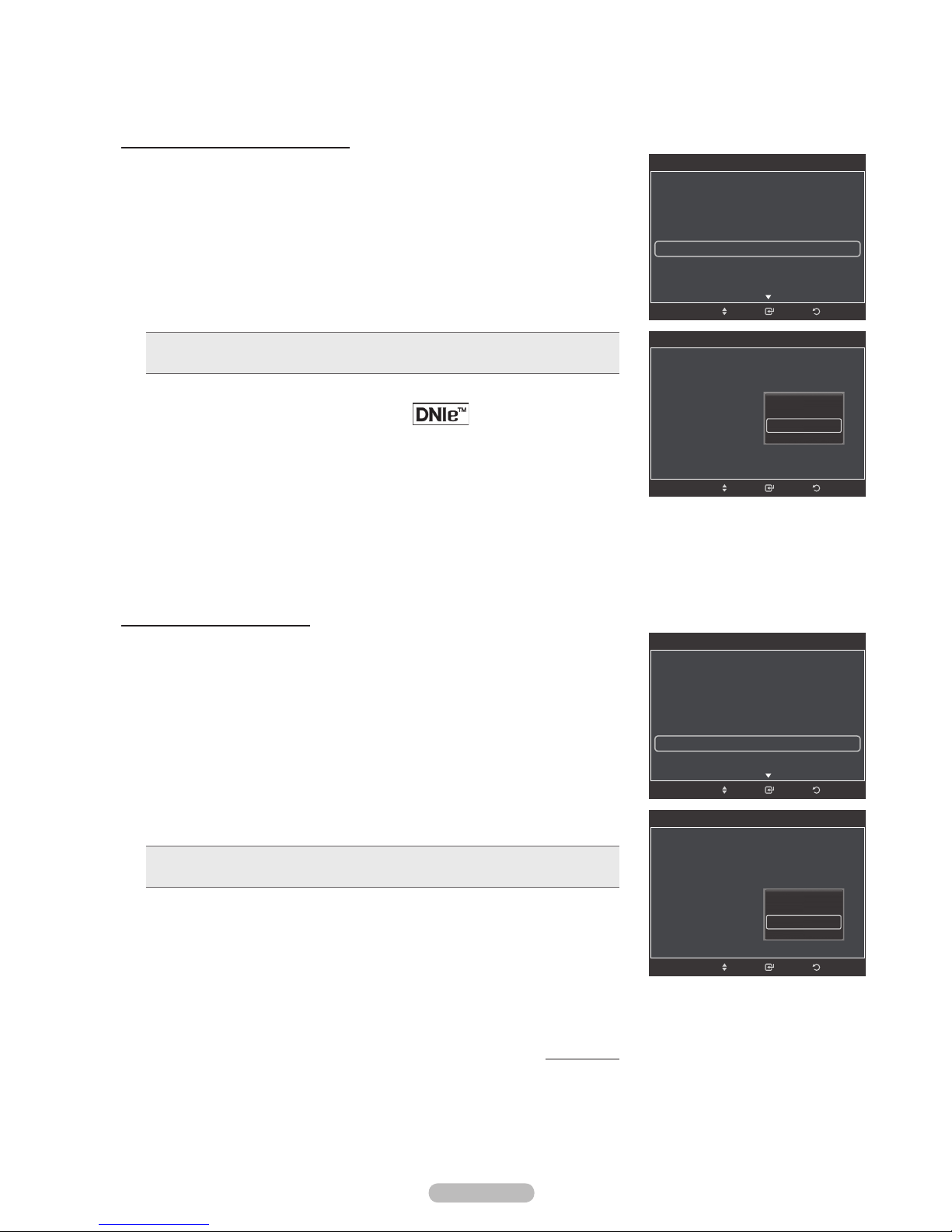
DNIe (Digital Natural Image engine)
This TV includes the DNIe function to provide high visual quality. If you set
DNIe to on, you can view the screen with the DNIe feature activated.
1 Follow the Activating Picture Options instructions numbers 1 and 2.
(Refer to page 27)
2 Press the or button to select DNIe, then press the ENTER button.
Picture Options
Color Tone : Normal
Size : 16:9
Position
Digital NR : Auto
DNle : Off
HDMI Black Level : Low
Film Mode : Off
3 Press the or button to select On or Off or then press the ENTER button.
• Off: Switches off the DNIe mode.
• On: Switches on the DNIe mode.
Press the EXIT button to exit.
DNIe™ (Digital Natural Image engine)
®
This feature brings you a more detailed image with 3D noise reduction
and detailed, contrast and white enhancement.
DNIe is only available in Dynamic mode.
®
This function doesn't work when the Input Source is PC.
®
Setting the HDMI Black Level
Use this function to adjust the Black Level of the picture while in HDMI mode.
1 Follow the Activating Picture Options instructions numbers 1 and 2.
(Refer to page 27)
2 Press the or button to select HDMI Black Level, then press the ENTER
button.
Move
Picture Options
Color Tone : Normal
Size : 16:9
Position
Digital NR : Autoh
DNle : Off
HDMI Black Level : Normal
Film Mode : Off
Color Tone : Cool1
Size : 16:9
Position
Digital NR : Auto
DNle : Off
HDMI Black Level : Low
Film Mode : Off
Off
On
Move
Picture Options
ReturnEnter
ReturnEnter
3 Press the or button to select Normal or Low, then press the ENTER
button.
• Normal: The screen gets brighter.
• Low: The screen gets darker.
This function is active only when an external device is connected to via
®
HDMI. HDMI Black Level function may not be compatible with or external
devices.
Press the EXIT button to exit.
English - 30
Continued...
Move
Picture Options
Color Tone : Normal
Size : 16:9
Position
Digital NR : Auto
DNle : Off
HDMI Black Level : Normal
Film Mode : Off
Normal
Low
Move
ReturnEnter
ReturnEnter
Page 31

Setting the Film Mode
The TV can be set to automatically sense and process lm signals from all
sources and adjust the picture for optimum quality.
1 Follow the Activating Picture Options instructions numbers 1 and 2.
(Refer to page 27)
2 Press the or button to select Film Mode, then press the ENTER button.
Picture Options
Size : 16:9
Position
Digital NR : Auto
DNle : Off
HDMI Black Level : Low
Film Mode : Off
Blue Only Mode : Off
Move
ReturnEnter
3 Press the or button to select Off or Auto, then press the ENTER button.
Press the EXIT button to exit.
Film mode is supported in ATV, DTV(480i/1080i), Video, S-Video,
®
Component(480i / 1080i) and HDMI(1080i).
Setting the Blue Only Mode
You can emphasize the Blue color by switching off the Red and Green colors.
This function is for AV device measurement experts. This function displays the
blue signal only by removing the red and green signals from the video signal so
as to provide a Blue Filter effect that is used to adjust the Color and Tint of video
equipment such as DVD players, Home Theaters, etc.
Using this function, you can adjust the Color and Tint to preferred values appropriate to the signal level of each video device using the Red/Green/Blue/ Cyan/Magenta/Yellow Color Bar Patterns, without using an additional Blue Filter.
1 Follow the Activating Picture Options instructions numbers 1 and 2..
(Refer to page 27)
2 Press the or button to select Blue Only Mode, then press the ENTER
button.
3 Press the or button to select Off or On, then press the ENTER button.
Press the EXIT button to exit.
Blue Only Mode is available when the picture mode is set to Movie or
®
Standard.
This function doesn't work when the Input Source is PC.
®
Picture Options
Size : 16:9
Position
Digital NR : Auto
DNle : Off
HDMI Black Level : Normal
Film Mode : Off
Blue Only Mode : Off
Digital NR : Auto
DNle : Off
HDMI Black Level : Low
Film Mode : Off
Blue Only Mode : Off
Color Gamut : Wide
3D Effect : Off
Digital NR : Auto
DNle : Auto
HDMI Black Level : Normal
Film Mode : Off
Blue Only Mode : Off
Color Gamut : Wide
3D Effect : Off
Off
Auto
Move
Picture Options
Move
Picture Options
Off
On
Move
ReturnEnter
ReturnEnter
ReturnEnter
Continued...
English - 31
Page 32

Setting the Color Gamut
You can choose your favorite color gamut. Color gamut means a color matrix made up
with the basic colors of Red, Green and Blue.
1 Follow the Activating Picture Options instructions numbers 1 and 2.
(Refer to page 27)
2 Press the or button to select Color Gamut, then press the ENTER button.
3 Press the or button to select Wide, Normal, or sRGB, then press the ENTER button.
Press the EXIT button to exit.
Wide: Displays the native color gamut of panel device.
Normal: Normal Color Gamut offers flat and natural color tone.
sRGB: Supports color tone of sRGB format.
Digital NR : Auto
DNle : Off
HDMI Black Level : Normal
Film Mode : Off
Blue Only Mode : Off
Color Gamut : Wide
3D Effect : Off
Digital NR : Auto
DNle : Off
HDMI Black Level : Normal
Film Mode : Off
Blue Only Mode : Off
Color Gamut : Wide
3D Effect : Off
Picture Options
Move
Picture Options
Wide
Normal
sRGB
Move
ReturnEnter
ReturnEnter
Using the 3D Function
You can enjoy 3D movies and games on your TV. The 3D effects function enables you to view 3D images using special 3D
glasses.
3D Glasses
(Not supplied)
3D IR Emitter
(Not supplied)
PC
HDMI/DVI Cable (Not supplied)
TV Side Panel
ଖGThe appearance of the 3D glasses (including Emitter) may differ depending on the model of your glasses.
1 Connect a HDMI/DVI cable between the HDMI3/DVI jack on the TV and the PC output jack on your computer.
2 Connect a 3.5mm Stereo/2RCA cable between the DVI IN (HDMI3/DVI) [RAUDIO-L] jack on the TV and the Audio
Out jack of the sound card on your computer.
3 Connect the Emitter to the 3D SYNC OUT port on the rear panel of the TV.
4 Turn the TV on and set the source of the TV to HDMI3/DVI.
For more information on the 3D glasses (including the Emitter), refer to the user manual of your 3D glasses.
®
Adjust the PC resolution:
®
3D Effect Mode is only available in HDMI3/DVI input signal(640x480@60Hz, 800x600@60Hz,1024x768@60Hz,1280x
720@60Hz,1280 x1024@60Hz, 1360x768@60Hz or 1920x1080p@60Hz).
The 3D IR Emitter communicates with the 3D glasses.
®
Therefore, the 3D IR Emitter should be located near the 3D glasses.
It is activated when the HDMI or DVI input signal is RGB, and DVI Sound is supported.
®
When the power is turned on or off, the mode changes to the default (Off) and the Format is saved.
®
The 3D Effect is turned on or off regardless of the Picture Mode.
®
When 3D Effect is on, only the Contrast, Brightness, 3D Effect,Position, and Reset picture menus are activated.
®
To use the 3D Effect function, a graphics card supporting 3D or 3D software is required.
®
Continued...
English - 32
Page 33

To use the 3D Effect function, a graphics card supporting 3D or 3D software is required.
®
3D glasses (including the Emitter) not manufactured by Samsung, RealD, or ilixco may not be supported.
®
The 3D glasses and the Emitter must be manufacturer by the same company.
®
If you play a game or watch TV while wearing the 3D glasses for long periods of time, you may experience eyestrain or
®
a headache.
Changing the Mode
Provides the function to turn on the 3D Effect. You can choose
between Mode1 and Mode2. To achieve the 3D effect, the 3D glasses shutter back
and forth from the left to right and vice versa (left/right sync)..
1 Connect the TV, PC and 3D IR Emitter as shown in the gure.
2 Press the SOURCE button to select HDMI3/DVI.
3 Press the MENU button to display the menu.
Press the or button to select Picture, then press the ENTER button.
4 Press the or button to select Picture Options then press the ENTER
button.
Press the or button to select 3D Effect then press the ENTER button.
5 Presss the or button to select Off, Mode1, or Mode2, then press the
ENTER button.
Press the EXIT button to exit.
Off: Turns the 3D Effect function off.
Mode1: Mode 1 operates with right sync rst.
Mode2: Mode 2 operates with left sync rst.
If the 3D effect is not working properly, it means the Mode and 3D glasses may
®
not be syncing properly. To put them in sync, switch to the other mode.
Easy Setting
1 Press the TOOLS button on the remote control.
Picture Options
Digital NR : Auto
DNle : Off
HDMI Black Level : Normal
Film Mode : Off
Blue Only Mode : Off
Color Gamut : Normal
3D Effect : Off
Move
Picture Options
Digital NR : Auto
DNle : Off
HDMI Black Level : Normal
Film Mode : Off
Blue Only Mode : Off
Color Gamut : Wide
3D Effect : Off
3D Effect : Off
Device Listt
Picture Mode : Standard
Sound Mode : Custom
Sleep Timer : Of f
Off
Mode1
Mode2
Move
TOOLS
ReturnEnter
ReturnEnter
2 Press the or button to select 3D Effect.
3 Press the ENTER button to start the 3D Effect.
Resetting the Picture Settings to the Factory Defaults
1 To select the desired picture mode, follow the Changing the Picture Standard
instructions numbers 1 and 2. (see page 24)
2 Press the or button to select Picture Reset, then press the ENTER button.
Press the or button to select OK or Cancel then press the ENTER button.
Press the EXIT button to exit.
Each mode can be reset.
®
Picture
Picture
Move Enter
Detailed Settings
Picture Options
Picture Reset
Detailed Settings
Picture Options
Picture Reset
OK
Cancel
Exit
English - 33
Page 34

Viewing Picture-in-Picture
You can use the PIP feature to simultaneously watch the TV tuner (analog broadcasts only) and one external
video source. (See page 40 to select the PIP picture sound.)
This product has one built-in tuner, which does not allow PIP to function in the same mode.
Please see ‘PIP Settings’ below for details.
While V-Chip (See page 57) is in operation, the PIP function cannot be used.
®
Activating Picture-in-Picture
1 Press the MENU button to display the menu.
Press the or button to select Setup, then press the ENTER button.
Press the or button to select PIP, then press the ENTER button.
2 Press the ENTER button again.
Press the or button to select On, then press the ENTER button.
If you turn the TV off while watching in PIP mode and turn it on again, the
®
PIP window will disappear.
You can view Analog TV broadcasts on the PIP screen (sub-picture) when
®
the main picture is from an external device connected to HDMI IN 1, HDMI
IN 2, HDMI3/DVI, Component1, 2 or PC.
When 3D Effect is set to on, PIP mode is changed to off.
®
PIP Settings
®
Main picture Sub picture
Component 1, 2
HDMI IN 1, HDMI IN 2, HDMI3/DVIPCAnalog TV broadcasts only
Changing the Size of the PIP Window
3 Press the or button to select Size, then press the ENTER button.
Press the or button to select the desired size of the PIP window, then press
the ENTER button.
You may notice that the picture in the PIP window becomes slightly
®
unnatural when you use the main picture to view a game or karaoke.
Entertainment : Off
Setup
Energy Saving : Off
PIP
SW Upgrade
PIP
PIP : Off
Size :
Position :
Air/cable : Cable
Channel : Cable 3
PIP : On
Size :
Position :
Air/cable : Cable
Channel : Cable 3
Move
Off
On
ReturnEnter
PIP
English - 34
Continued...
Move
ReturnEnter
Page 35

Changing the Position of the PIP Window
4 Press the or button to select Position, then press the ENTER button.
Press the or button to select the desired PIP window position, then press
the ENTER button.
In Double Window (
®
be selected.
) and Double Wide (
) modes, Position cannot
Air/Cable
5 Press the or button select Antenna, then press the ENTER button.
Press the or button to select Air or Cable, then press the ENTER button.
Air: Air antenna signal.
®
Cable: Cable antenna signal.
Changing the PIP Channel
6 Press the or button to select Channel, then press the ENTER button.
Press the or button at the bottom of the remote to select the desired
channel in the PIP window, then press the ENTER button.
Press the EXIT button to exit.
You can select only analog TV broadcasts on the PIP screen (sub-picture).
®
PIP
PIP : On
Size :
Position :
Air/cable : Cable
Channel : Cable 3
able
Cable 3
Air 11
ReturnEnter
ReturnEnter
Move
PIP
PIP : On
Size :
Position :
Air/cable : C
Channel : Cable 3
PIP : On
Size :
Position :
Air/cable : Cable
Channel :
Air
Cable
Move
PIP
Easy Setting
1 Press the TOOLS button on the remote control.
2 Press the or button to select PIP, then press the ENTER button.
3 Press the or button to select a particular item.
4 Press the or button to select the required option.
5 Press the EXIT or TOOLS button to exit.
English - 35
ReturnEnterMove
TOOLS
Device List
Picture Mode : Standard
Sound Mode : Custom
Sl eep Time r : O ff
PIP
ReturnEnterMove
PIP
PI P O n
Size :
Position :
Air/Cable : Cable
Channel : Cable 3
Move
Adjust
Return
Page 36

Sound Control
Using Automatic Sound Settings
Sound Sound
You can select the sound mode to best suit the programming you're watching.
1 Press the MENU button to display the menu.
Press the or button to select Sound, then press the ENTER button.
2 Press the ENTER button to select Mode. Press the or button to select
Standard, Music, Movie, Speech, or Custom sound setting, then press the
ENTER button.
Sound
Press the EXIT button to exit.
• Standard : selects the normal sound mode.
• Music : emphasizes music over voices.
• Movie : provides the best sound for movies.
• Speech : emphasizes voice over other sounds.
• Custom : recalls your customized sound settings.(see Customizing the Sound).
Easy Setting
1 Press the TOOLS button on the remote control.
2 Press the or button to select Sound Mode.
3 Press the or button to select the required option.
Picture Mode : Standard
Sound Mode : Custom
Sl eep Time r : O ff
Add to Favorite
Switch to Cable
Mode
:
Equalizer
SRS TruSurround XT : Off
Preferred Language : English
Multi-Track Sound : Stereo
Auto Volume : Off
TV Speaker : On
Sound Select : Main
Mode
:
Equalizer
SRS TruSurround XT : Off
Preferred Language : English
Multi-Track Sound : Stereo
Auto Volume : Off
TV Speaker : On
Sound Reset : Main
TOOLS
Device Listt
Custom
Standard
Music
Movie
Speech
Custom
Customizing the Sound
1 Press the MENU button.
Press the or button to select Sound, then press the ENTER button.
2 Press the or button to select Equalizer, then press the ENTER button.
3 Press the ENTER button to select Mode.
Press the or button to select a particular item (Standard, Music, Movie,
Speech, Custom), then press the ENTER button.
4 Press the or button to select a particular frequency to adjust.
Press the or button to increase or decrease the level of the particular
frequency.
• Mode: Selects the sound mode among the predefined settings.
• Balance L/R: Adjusts the balance between the right and left speaker.
• Bandwidth Adjustment (100Hz, 300Hz, 1kHz, 3kHz, 10kHz):
To adjust the level of different bandwidth frequencies.
English - 36
Continued...
Move Enter
Mode : Custom
Equalizer
SRS TruSurround XT : Off
Preferred Language : English
Multi-Track Sound : Stereo
Auto Volume : Off
TV Speaker : On
Sound Select : Main
Sound Reset
Equalizer
Mode : Standard
Balance L R
100Hz - +
300Hz - +
1kHz - +
3kHz - +
10kHz - +
Equalizer
Mode : Custom
Balance L R
100Hz - +
300Hz - +
1kHz - +
3kHz - +
10kHz - +
Move
Adjust
Standard
Music
Movie
Speech
Custom
ReturnEnterMove
ReturnEnter
Exit
Page 37

Resetting the Equalizer Settings to the Factory Defaults
5 Press the or button to select Reset, then press the ENTER button.
The equalizer resets to the factory defaults.
®
Press the EXIT button to exit.
Balance L R
100Hz - +
300Hz - +
1kHz - +
3kHz - +
10kHz - +
Reset
Custom mode returns to default settings.
Equalizer
Move
ReturnEnter
Setting the TruSurround XT
TruSurround XT is a patented SRS technology that solves the problem of playing 5.1 multichannel content over
two speaker. TruSurround delivers a compelling, virtual surround sound experience through any two-speaker
playback system, including internal television speakers. It is fully compatible with all multi channel formats.
Press the MENU button to display the menu.
1
Press the or button to select Sound, then press the ENTER button.
2 Press the or button to select SRS TruSurround XT, then press the
ENTER button.
3 Press the or button to select Off or On, then press the ENTER button.
Press the EXIT button to exit.
TruSurround XT, SRS and Symbol are trademarks of
SRS Labs, Inc.
TruSurround XT technology is incorporated under license
from SRS Labs, Inc.
Sound
Sound
Mode : Custom
Equalizer
SRS TruSurround XT : Off
Preferred Language : English
Multi-Track Sound : Stereo
Auto Volume : Off
TV Speaker : On
Sound Select : Main
Sound Reset
Mode : Custom
Equalizer
SRS TruSurround XT : Off
Preferred Language : English
Multi-Track Sound : Stereo
Auto Volume : Off
TV Speaker : On
Sound Select : Main
Sound Reset
Off
On
English - 37
Page 38

Choosing Preferred Language
The digital-TV transmission system is capable of simultaneous transmission of many audio tracks (for example,
simultaneous translations of the program into foreign languages).
Preferred language
1 Press the MENU button to display the menu.
Press the or button to select Sound, then press the ENTER button.
2 Press the or button to select Preferred Language, then press the ENTER
button.
3 Press the or button to choose the language (English, Spanish, or French)
you want, then press the ENTER button.
Press the EXIT button to exit.
You can only select the language from among the actual languages being
®
broadcast.
Preferred Language is available only in Digital TV mode.
®
Press the MTS button on the remote control to listen to the language other than the
preferred language.
Sound
Sound
Equalizer
SRS TruSurround XT : Off
Preferred Language : English
Multi-Track Sound : Stereo
Auto Volume : Off
TV Speaker : On
Sound Select : Main
Sound Reset
Equalizer
SRS TruSurround XT : Off
Preferred Language : English
Multi-Track Sound : Mono
Auto Volume : Off
TV Speaker : On
Sound Select : Main
Sound Reset
English
Spanish
French
Choosing a Multi-Channel Sound (MTS) Track - Analog
Depending on the particular program being broadcast, you can listen to Mono, Stereo or SAP.
Multi-Track Sound
1 Press the MENU button to display the menu.
Press the or button to select Sound, then press the ENTER button.
2 Press the or button to select Multi-Track Sound, then press the ENTER
button.
3 Press the or button to select a setting you want, then press the ENTER
button.
Press the EXIT button to exit.
• Mono : Choose for channels that are broadcasting in mono or if you are having
difficulty receiving a stereo signal.
• Stereo : Choose for channels that are broadcasting in stereo.
• SAP : Choose to listen to the Separate Audio Program, which is usually a
foreignlanguage translation.
Multi-Track Sound is available only in Analog TV mode.
®
Depending on the particular program being broadcast, you can listen to
®
Mono, Stereo or SAP.
Sound
Sound
SRS TruSurround XT : Off
Preferred Language : English
Multi-Track Sound : Stereo
Auto Volume : Off
TV Speaker : On
Sound Select : Main
Sound Reset
SRS TruSurround XT : Off
Preferred Language : English
Multi-Track Sound : Mono
Auto Volume : Off
Internal Mute
Sound Select : Main
Sound Reset
Mono
Stereo
: Off
SAP
Press the MTS buttons on the remote control to select Mono, Stereo, or SAP.
English - 38
Page 39

Automatic Volume Control
Reduces the difference in volume level among broadcasters.
1 Press the MENU button to display the menu.
Press the or button to select Sound, then press the ENTER button.
2 Press the or button to select Auto Volume, then press the ENTER button.
3 Press the or button to select Off or On, then press the ENTER button.
Press the EXIT button to exit.
Setting the TV Speakers On/Off
Sound output from the TV speakers is muted.
Sound
Sound
Preferred Language : English
Multi-Track Sound : Stereo
Auto Volume : Off
TV Speaker : On
Sound Select : Main
Sound Reset
Preferred Language : English
Multi-Track Sound : Stereo
Auto Volume : Off
TV Speaker : Off
Sound Select : Main
Sound Reset
Off
On
1 Press the MENU button to display the menu.
Press the or button to select Sound, then press the ENTER button.
2 Press the or button to select TV Speaker, then press the ENTER button.
3 Press the or button to select Off or On, then press the ENTER button.
Press the EXIT button to exit.
• When TV Speaker is set to Off, you can operate only Preferred
®
Language(in digital TV mode), Multi-Track Sound(in analog TV mode),
Sound Select(in PIP mode) and Sound Reset in Sound menu.
• The VOL
, VOL and MUTE buttons do not operate when the TV
Speaker is set to Off.
Audio Out Optical (R/L Out) to Sound SystemTV’s Internal Speakers
Component, PC, HDMI
Mute
Speaker Output
Mute
TV
Sound Output
Sound Output
Mute
TV Speaker Off
TV Speaker On
Video No Signal
TV
Mute
Speaker Output
Mute
AV, S-Video
Mute
Speaker Output
Mute
Sound
Sound
AV, S-Video
Sound Output
Sound Output
Mute
Multi-Track Sound : Stereo
Auto Volume : Off
TV Speaker : On
Sound Select : Main
Sound Reset
Multi-Track Sound : Stereo
Auto Volume : Off
TV Speakers : Off
Sound Select : Main
Sound Reset
Off
On
Component, PC, HDMI
Sound Output
Sound Output
Mute
English - 39
Page 40

Listening to the Sound of the Sub (PIP) Picture
When the PIP feature is activated, you can listen to the sound of the sub (PIP) picture.
1 Press the MENU button to display the menu.
Press the or button to select Sound, then press the ENTER button.
Sound
2 Press the or button to select Sound Select, then press the ENTER button.
3 Press the or button to select Main or Sub, then press the ENTER button.
Press the EXIT button to exit.
• Main: Used to listen to the sound of the main picture.
• Sub: Used to listen to the sound of the sub picture.
You can select this option when PIP is set to On. (See page 34)
®
Sound
Resetting the Sound Settings to the Factory Defaults
Auto Volume : Off
TV Speaker : On
Sound Select : Main
Sound Reset
Auto Volume : Off
TV Speaker : On
Sound Select : Main
Sound Reset
Main
Sub
You can restore the Sound settings to the factory defaults.
1 Press the MENU button.
Press the or button to select Sound, then press the ENTER button.
Press the or button to select Sound Reset, then press the ENTER button.
2 Press the or button to select Reset All, Reset Sound Mode, or Cancel,
then press the ENTER button.
• Reset All: All the sound values return to default settings.
• Reset Sound Mode: Currently set values return to default settings.
• Cancel : Select the sound reset options.
TV Speaker : On
Sound
Sound Select : Main
Sound Reset
Sound Reset
Select the sound reset options.
Reset All
Reset Sound Mode
Move
Audio settings changed to default.
Cancel
Enter Return
English - 40
Page 41

Channel Control
Managing Channels
Using this menu, you can Add/Delete or set Favorite channels and use the program guide for digital broadcasts.
Viewing All Channels
Show all currently available channels. To use the Channel List function, rst run Auto
Program (see page 22).
1 Press the MENU button.
Press the or button to select Channel, then press the ENTER button.
Press the or button to select Channel List, then press the ENTER button.
2 Press the button to select Added Channels.
3 Press the or button to select All Channels, then press the ENTER button.
Shows all currently available channels.
4 Press the or button to select a channel to view, then press the ENTER
button.
Channel
Added Channels
All Channels
Auto Program
Clear Scrambled Channel
Channel List
Fine Tune
Signal Strength
6-1 Air
7 Air
7-1 Air D-2
9 Air
9-1 Air D-1
10 Air
10-1 Air DTV
11-1 Air DTV
19 Air
22 Air
Air Antenna Zoom
6-1 Air
7 Air
7-1 Air D-2
9 Air
9-1 Air D-1
10 Air
10-1 Air DTV
11-1 Air DTV
19 Air
22 Air
Air Antenna Zoom
TOOLS
Select Option Next Program
TOOLS
Select Option Next Program
Press the CH LIST button on the remote control to bring up the channel lists.
Using the Color buttons on the Remote with the Channel List
•
Red (Antenna): Switches to DTV air or DTV cable.
•
Green (Zoom): Enlarges or shrinks a channel number.
•
Yellow (Select): Selects multiple channel lists.
•
TOOLS (Option): Displays the Add (or Delete), Add to Favorite(or Delete from
Favorite), Timer Viewing, and Channel Name Edit menus.
A gray-colored channel indicates the channel has been deleted.
®
The Add menu only appears for deleted channels.
A channel marked with mark means the channel has been set as a Favorite.
®
The Delete from Favorite menu only appears for channels with the mark.
Continued...
English - 41
Page 42

Erasing and Adding Channels
You can delete or add a channel to display the channels you want.
1 Press the MENU button.
Press the or button to select Channel, then press the ENTER button.
Press the or button to select Channel List, then press the ENTER button.
2 Press the button to select Added Channels.
3 Press the or button to select All Channels.
Shows all currently available channels.
Press the ENTER button.
4 Press the or button to select a channel to delete, then press the TOOLS
button.
5 Press the ENTER button to select Delete.
All deleted channels will be shown on Added Channels menu.
6 Press the EXIT button to exit.
You can also add a channel to the Added Channels menu in the same
®
manner.
A channel must be deleted before it can be added back to the Added
®
Channels list.
To Add (Restore) a channel back to the Added Channel List, follow steps 1-3
®
above, press the or button to select a channel to add, the press the
Tools button. Press the ENTER button to select Add.
Channel
Auto Program
Clear Scrambled Channel
Channel List
Fine Tune
Signal Strength
6-1 Air
Added Channels
7 Air
7-1 Air D-2
9 Air
9-1 Air D-1
10 Air
10-1 Air DTV
11-1 Air DTV
19 Air
22 Air
Air Antenna Zoom
6-1 Air
All Channels
7 Air
7-1 Air D-2
9 Air
9-1 Air D-1
10 Air
10-1 Air DTV
11-1 Air DTV
19 Air
22 Air
Air Antenna Zoom
6-1 Air
Added Channels
7 Air
7-1 Air D-2
9 Air
9-1 Air D-1
10 Air
10-1 Air DTV
11-1 Air DTV
19 Air
22 Air
Air Antenna Zoom
TOOLS
Select Option Next Program
TOOLS
Select Option Next Program
Delete
Add to Favorite
Timer Viewing
Channel Name Edit
Auto Program
TOOLS
Select Option Next Program
Press the CH LIST button on the remote control to bring up the channel lists.
English - 42
Page 43

Setting Your Favorite Channels
You can set channels you watch frequently as favorites.
1 Press the MENU button.
Press the or button to select Channel, then press the ENTER button.
Press the or button to select Channel List, then press the ENTER button.
2 Press the button to select Added Channels.
Channel
Auto Program
Clear Scrambled Channel
Channel List
Fine Tune
Signal Strength
3 Press the or button to select All Channels, then press the ENTER button.
Added Channels
Shows all currently available channels.
4 Press the or button to select a channel as a favorite channel, then press
the TOOLS button.
5 Press the or button to select Add to Favorite, then press the ENTER
Added Channels
button.
The “” symbol will be displayed and the channel will be set as a favorite.
6 To cancel your favorite channel selection, press the TOOLS button when a
favorite channel is selected. Press the or button to select Delete from
Favorite, then press the ENTER button. The channel is deleted from Favorites
and the “” mark disappears.
Favorite
Press the EXIT button to exit.
You can also Add or Delete a channel from Favorites in the Added
®
Channels menu in the same manner.
All favorite channels will be shown on Favorite menu.
®
Press the CH LIST button on the remote control to bring up the channel lists.
6-1 SBS
7 Air
7-1 Air
9 Air
9-1 KBS D-1
10 Air
10-1 EBS DTV
11-1 MBC DTV
19 Air
22 Air
Air Antenna Zoom
6-1 SBS
7 Air
7-1 Air
9 Air
9-1 KBS D-1
10 Air
10-1 EBS DTV
11-1 MBC DTV
19 Air
22 Air
Air Antenna Zoom
6-1 SBS
7-1 KBS D-2
9-1 KBS D-1
10-1 EBS DTV
11-1 MBCDTV
Air Antenna Zoom Option
Delete
Add to Favorite
Timer Viewing
Channel Name Edit
Auto Program
Select Option
Delete
Delete from Favorite
Timer Viewing
Channel Name Edit
Auto Program
Select Option
TOOLS
TOOLS
TOOLS
To select the favorite channels you have set up, press the FAV.C H button on the
remote control.
Easy Setting
1 Press the TOOLS button on the remote control.
2 Press the or button to select Add to Favorite or Delete from Favorite,
then press the ENTER button.
The current channel is added to or deleted from Favorites.
®
English - 43
Continued...
Device List
Picture Mode : Standard
Sound Mode : Custom
Sleep Timer : Off
Add to Favorite
Switch to Cable
TOOLS
Move
Enter
Exit
Channel Add/Delete
DTV Air 7-1 In Memory
Delete
Return
CH Change
Enter
Page 44

Reserving a Program (Time Viewing)
If you reserve a program you want to watch, the channel is automatically switched
to the reserved channel in the Channel List; even when you are watching another
channel.
To reserve a program, set the current time rst. (See pages 51~52). Reserved
chanels can only be set if they are in the Channel List (See page 44).
1 Press the MENU button.
Press the or button to select Channel, then press the ENTER button.
Press the or button to select Channel List, then press the ENTER button.
2 Press the or button to select a channel, then press the TOOLS button.
3 Press the or button to select Timer Viewing, then press the ENTER
button.
The Reserve a Program (Timer Viewing) screen appears.
4 Press the /// buttons to reserve a program and then press the ENTER
button.
Reserving a program has been completed.
Press the EXIT button to exit.
You can also reserve a program in the All Channels or Favorite menus
®
using the same procedures.
For information on how to confirm a viewing reservation, refer to page 45.
®
Only memorized channels can be reserved channels.
Channel
Auto Program
Clear Scrambled Channel
Channel List
Fine Tune
Signal Strength
6-1 Air
Added Channels
7 Air
7-1 Air D-2
9 Air
9-1 Air D-1
10 Air
10-1 Air DTV
11-1 Air DTV
19 Air
22 Air
Air Antenna Zoom
Antenna Channel Repeat
DTV Air 7-1 Once
Date
01-01-2008
Delete
Delete from Favorite
Timer Viewing
Channel Name Edit
Auto Program
TOOLS
Select Option Next Program
Timer Viewing
Start Time
10:09 am
Enter ReturnMove Adjust
You can set the channel, month, day, year, hour and minute directly by
®
pressing the number buttons on the remote control.
Press the CH LIST button on the remote control to bring up the channel lists.
Digital Program Guide and Viewing Reservation
Added Channels
When a digital channel is selected, and you press the button, the Program Guide
for the channel appears. You can reserve a program according to the procedures
described above.
: A program currently being broadcast.
: A reserved program.
Air Antenna Zoom
Continued...
6-1 SBS 2007/2/3
7 Air 2007/2/3
7-1 KBS D-2
9 Air 02:27 am
9-1 KBS D-1 02:35 am
10 Air 03:21 am
10-1 EBS DTV 04:33 am
11-1 MBC DTV 06:00 am
19 Ai r 06:36 am
22 Ai r
0
1:30 am
TOOLS
Select Option Next Program
English - 44
Page 45

Confirming a Viewing Reservation
You can view, modify or delete a reservation.
1 Press the MENU button.
Press the or button to select Channel, then press the ENTER button.
Channel
Press the or button to select Channel List, then press the ENTER button.
2 Press the button to select Added Channels.
3 Press the or button to select Programmed, then press the ENTER button.
You can view the program reservations.
Modifying a viewing reservation
4 To select a reservation item to be modied, press the or button and then
Added Channels
press the TOOLS button.
5 Press the ENTER button to select Change Info.
6 Press the /// buttons to change a reservation setting and then press the
ENTER button.
The reservation modication is applied.
Air Antenna Zoom
Canceling a reservation
4 To select a reservation item to be canceled, press the or button, and then
press the TOOLS button.
Programed
5 Press the or button to select Cancel Schedules, then press the ENTER
button.
6 Press the or button to select OK, then press the ENTER button.
The viewing reservation has been canceled.
Press the EXIT button to exit.
Air Antenna Zoom
Auto Program
Clear Scrambled Channel
Channel List
Fine Tune
Signal Strength
6 Air
6-1 Air
7 Air
7-1 Air
9 Air
9-1 Air
10 Air
10-1 Air
11 Ai r
2007/2/3
03:15 am
04: 15 a m 6- 1 Ai r No Pro gra m Na me
2007/2/4
02: 14 a m 6- 1 Ai r No Pro gra m Na me
2007/2/5
02: 15 a m 6- 1 Ai r No Pro gra m Na me
TOOLS
Select Option
6- 1 Air
TOOLS
Select Option Information
No Program Name
Programmed Menu
• Numeric buttons: You can enter numbers.
• Change Info: Select to change a viewing reservation.
• Cancel Schedules: Select to cancel a viewing reservation.
• Information: Select to view a viewing reservation.
Press the CH LIST button on the remote control to bring up the channel lists.
Continued...
Programed
2007/2/3
3: 15 a m
6- 1 Air
4:1 5 am 6-1 Air No P rog ram Nam e
2007/2/4
2:1 4 am 6-1 Air No P rog ram Nam e
2007/2/5
2:1 5 am 6-1 Air No P rog ram Nam e
Air Antenna Zoom
No Program Name
Change Info
Cancel Schedules
Information
TOOLS
Select Option Information
English - 45
Page 46

Labeling Channels - Analog
Channels can labeled so that their call letters appear whenever the channel is
selected.
1 Press the MENU button.
Press the or button to select Channel, then press the ENTER button.
Channel
Press the or button to select Channel List, then press the ENTER button.
2 Press the or button to select the channel to be assigned a new name, then
press the TOOLS button.
Added Channels
3 Press the or button to select Channel Name Edit, then press the ENTER
button.
Air Antenna Zoom
Auto Program
Clear Scrambled Channel
Channel List
Fine Tune
Signal Strength
6 Air
6-1 Air
7 Air
7-1 Air
9 Air
9-1 Air
10 Air
10-1 Air
Select Option
TOOLS
4 Press the /// button to select a letter, then press the ENTER button.
Added Channels
• Numeric buttons: You can enter numbers.
• Red button: You can switch between English letters and Characters.
• Green button: You can delete an already entered letter or character.
• Yellow button: You can enter a blank space.
• Blue button: Press this button to finish renaming a channel.
Air Antenna Zoom
5 When you have nished, press the blue button to assign the new name.
6
Press the EXIT button to exit.
The names of digital broadcasting channels are automatically assigned and
®
cannot be labelled.
Storing Channels in Memory (Auto Program)
Channels can labeled so that their call letters appear whenever the channel is
selected.
1 Press the MENU button.
Added Channels
Press the or button to select Channel, then press the ENTER button.
Press the or button to select Channel List, then press the ENTER button.
2 Press the or button to select the channel to be assigned a new name, then
press the TOOLS button.
Air Antenna Zoom
A
V
6 Air
6-1 Air
7 Air
7-1 Air
9 Air
9-1 Air
10 Air
10-1 Air
_
6 Air
6-1 Air
7 Air
7-1 Air
9 Air
9-1 Air
10 Air
10-1 Air
Delete
Add to Favorite
Timer Viewing
Channel Name Edit
Auto Program
Select Option
Channel Name Edit
Delete
Add to Favorite
Timer Viewing
Channel Name Edit
Auto Program
Select Option
TOOLS
TOOLS
Number
Character
Delete
Blank
Done
Enter ReturnMove
3 Press the or button to select Auto Program, then press the ENTER
button.
For further details on setting up options, refer to the page 22.
®
Press the EXIT button to exit.
English - 46
Page 47

Clearing Scrambled Channels - Digital
The Clear Scrambled Channel function is used to filter out scrambled channels after Auto Program is completed.
This process may take up to 20-30 minutes.
1 Press the MENU button.
Press the or button to select Channel, then press the ENTER button.
Press the or button to select Clear Scrambled Channel, then press the
ENTER button. It searches scrambled channels, which are to be removed from
the list.
To stop searching scrambled channels;
Press the ENTER button to select Stop.
Press the button to select Yes, then press the ENTER button.
Channel
Auto Program
Clear Scrambled Channel
Channel List
Fine Tune
Signal Strength
2 When the scrambled channel searching is completed, press the ENTER button.
Press the EXIT button to exit.
This function is only available in Cable mode.
®
Removing scrambled channel.
Fine Tuning Analog Channels
Use fine tuning to manually adjust a particular channel for optimal reception.
1 Press the MENU button to display the menu.
Press the or button to select Channel, then press the ENTER button.
2 Press the or button to select Fine Tune, then press the ENTER button.
3 Press the or button to adjust the fine tuning.
To store the ne tuning setting in the TV’s memory, press the ENTER
button.
If you do not store the fine-tuned channel in memory, adjustments are not
®
saved.
4 To reset the fine tuning setting, press the button to select Reset, then press
the ENTER button.
Press the EXIT button to exit.
Only analog TV channels can be fine tuned.
®
“ * ” will appear next to the number of fine-tuned channels.
®
Channel
Cable 6
Cable 6
Cable 6* Fine Tuned
Clear Scrambled Channel
DTV Cable 122
3%
Stop
Clear Scrambled Channel
Channel List
Fine Tune
Signal Strength
Fine Tune
Reset
Move
Move
Adjust
Adjust
Save
Fine Tune
Reset
Save
Fine Tune
ReturnEnter
0
Return
+5
Return
+5
English - 47
Reset
Save
Enter
Return
+5
Return
Move
Adjust
Fine Tune
Cable 6* Fine Tuned
Reset
Move
Page 48

Checking the Digital-Signal Strength
Unlike analog channels, which can vary in reception quality from “snowy” to clear, digital (HDTV) channels
have either perfect reception quality or you will not receive them at all. So, unlike analog channels, you cannot
fine tune a digital channel. You can, however, adjust your antenna to improve the reception of available digital
channels.
1 Press the MENU button to display the menu.
Press the or button to select Channel, then press the ENTER button.
2 Press the or button to select Signal Strength, then press the ENTER
button. If the signal strength meter indicates that the signal is weak, physically
adjust your antenna to increase the signal strength.
Continue to adjust the antenna until you find the best position with the strongest
signal.
Press the EXIT button to exit.
Channel
Channel List
Fine Tune
Signal Strength
Signal Strength
OK
Enter Return
English - 48
Page 49

PC Display
Using Your TV as a Computer (PC) Display
Setting Up Your PC Software (Based on Windows XP)
The Windows display-settings for a typical computer are shown below. The actual screens on your PC will probably be
different, depending upon your particular version of Windows and your particular video card. However, even if your actual
screens look different, the same basic set-up information will apply in almost all cases. (If not, contact your computer
manufacturer or Samsung Dealer.)
1 First, click on Control Panel on the Windows start menu.
2 When the control panel window appears, click on Appearance and Themes and a
display dialog-box will appear.
3 When the control panel window appears, click on Display and a display dialogbox will
appear.
4 Navigate to the Settings tab on the display dialog-box.
The correct size setting (resolution)
Optimum: 1920 X 1080 pixels
If a vertical-frequency option exists on your display settings dialog box, the correct
value is 60 or 60 Hz. Otherwise, just click OK and exit the dialog box.
Display Modes
If the signal from the system equals the standard signal mode, the screen is adjusted automatically. If the signal
from the system doesn’t equal the standard signal mode, adjust the mode by referring to your videocard user
guide; otherwise there may be no video. For the display modes listed below, the screen image has been optimized
during manufacturing.
D-Sub Input
Mode Resolution Horizontal Frequency (kHz) Vertical Frequency (Hz) Pixel Clock Frequency (MHz) Sync Polarity (H/V)
IBM
VESA
CVT 1920 x 1080RB 66.587 59.934 138.500 + / -
640 x 350
720 x 400
640 x 480
640 x 480
640 x 480
800 x 600
800 x 600
800 x 600
1024 x 768
1024 x 768
1024 x 768
1280 x 1024
1280 x 1024
1360 x 768
HDMI/DVI Input
Mode Resolution Horizontal Frequency (kHz) Vertical Frequency (Hz) Pixel Clock Frequency (MHz) Sync Polarity (H/V)
640 x 480
VESA
CEA 1920 x 1080p 67.500 60.000 148.500 + / +
800 x 600
1024 x 768
1280 x 1024
1360 x 768
31.469
31.469
31.469
37.861
37.500
37.879
48.077
46.875
48.363
56.476
60.023
63.981
79.976
47.712
31.469
37.879
48.363
63.981
47.712
70.086
70.087
59.940
72.809
75.000
60.317
72.188
75.000
60.004
70.069
75.029
60.020
75.025
60.015
59.940
60.317
60.004
60.020
60.015
25.175
28.322
25.175
31.500
31.500
40.000
50.000
49.500
65.000
75.000
78.750
108.000
135.000
85.500
25.175
40.000
65.000
108.000
85.500
+ / -
- / +
- / -
- / -
- / + / +
+ / +
+ / +
- / -
- / + / +
+ / +
+ / +
+ / +
- / + / +
- / + / +
+ / +
English - 49
Page 50

Setting up the TV with your PC
How to Auto Adjust
Use the Auto Adjust function to have the TV set automatically adjust the video
signals it receives from the PC. The function also automatically fine-tunes the
settings and adjusts the frequency values and positions.
1 The message Auto Adjustment in progress. Please wait. appears on the
screen and the picture adjustments are automatically activated.
Press the EXIT button to exit.
This function does not work in DVI-Digital mode.
®
Preset: Press the SOURCE button to select PC mode.
®
2 Press the MENU button to display the menu.
Press the or button to select Picture, then press the ENTER button.
Press the or button to select Auto Adjustment, then press the ENTER
button.
Picture
Mode
: Standard
Contrast : 95
Brightness : 45
Sharpness : 50
Auto Adjustment
Screen
Detailed Settings
Picture Options
Brightness : 45
Picture
Sharpness : 50
Auto Adjustment
Screen
Detailed Settings
Picture Options
Picture Reset
Auto Adjustment in progress. Please Wait.
Adjusting the Screen Quality
The purpose of the picture quality adjustment is to remove or reduce picture
noise. If the noise is not removed by fine tuning alone, then make the vertical
frequency adjustments and fine tune again. After the noise has been reduced,
re-adjust the picture so that it is aligned in the center of the screen.
Preset: Press the SOURCE button to select PC mode.
®
1 Press the MENU button to display the menu.
Press the or button to select Picture, then press the ENTER button.
Press the or button to select Screen, then press the ENTER button.
English - 50
Continued...
Picture
Coarse
Fine
Position
Image Reset
Coarse
Move
Sharpness : 50
Auto Adjustment
Screen
Detailed Settings
Picture Options
Picture Reset
Move
Adjust
Screen
50
2
ReturnEnter
50
ReturnEnter
Page 51

Changing the Screen Position
Adjust the PC's screen positioning if it does not fit the TV Screen.
Preset: Press the SOURCE button to select PC mode.
®
1 Press the MENU button to display the menu.
Press the or button to select Picture, then press the ENTER button.
Press the or button to select Screen, then press the ENTER button.
2 Press the or button to select Position, then press the ENTER button.
Picture
Coarse
Fine
Position
Image Reset
Sharpness : 50
Auto Adjustment
Screen
Detailed Settings
Picture Options
Picture Reset
Screen
50
2
3 Press the or button to adjust the V-Position.
Press the or button to adjust the H-Position.
Press the ENTER button.
Press the EXIT button to exit.
Press the P. S I ZE button on the remote control to change the picture size.
®
Wide PC: The picture position ( , ) and size ( ) adjustment are available by
pressing the /// button.
Initializing the Screen Position
You can replace all image settings with the factory default values.
Preset: Press the SOURCE button to select PC mode.
®
1 Press the MENU button to display the menu.
Press the or button to select Picture, then press the ENTER button.
Press the or button to select Screen, then press the ENTER button.
Coarse
Fine
Position
Image Reset
Adjust
Wide PC
Move
Position
S
T
Screen
ReturnEnter
ReturnEnter
50
2
2 Press the or button to select Image Reset, then press the ENTER button.
The message Image Reset is completed. appears on the screen.
Press the EXIT button to exit.
Easy Setting
1 Press the TOOLS button on the remote control.
2 Press the or button to select Auto Adjustment, then press the ENTER
button.
English - 51
Move
Image Reset is completed.
Device List
Move
TOOLS
Enter
Picture Mode : Standard
Sound Mode : Custom
Sleep Timer : Off
Auto Adjustment
ReturnEnter
Exit
Page 52

Time Setting
Setting the Time
Setting the clock is necessary in order to use the various timer features of the TV. Also, you can check the time
while watching the TV. (Just press the INFO button.)
Option 1: Setting the Clock Manually
1 Press the MENU button to display the menu.
Press the or button to select Setup, then press the ENTER button.
Press the or button to select Time, then press the ENTER button.
2 Press the ENTER button to select Clock.
3 Press the ENTER button to select Clock Mode.
Press the or button to select Manual, then press the ENTER button.
4 Press the or button to select Clock Set, then press the ENTER button.
Plug & Play
Setup
Language : English
Time
V-Chip
Caption
External Settings
Entertainment : Off
PIP
SW Upgrade
Time
Clock : -- : -- --
Sleep Timer : Off
Timer 1 : Inactivated
Timer 2 : Inactivated
Timer 3 : Inactivated
Move
Clock
Clock Mode : Auto
Clock Set
Time Zone
DST : Off
Move
Clock Mode : Manual
Clock Set
Time Zone
DST : Off
Auto
Manual
Clock
ReturnEnter
ReturnEnter
5 Press the or button to move to Month, Day, Year, Hour, Minute, or
am/pm. Set the date and time you want by pressing the or button, then
press the ENTER button.
Press the EXIT button to exit.
The current time will appear every time you press the INFO button.
®
You can set the Month, Day, Year, Hour, Minute, and am/pm directly by
®
pressing the number buttons on the remote control.
English - 52
Continued...
Month
01
Hour
12
Move
Move
Adjust
Clock Set
Day
01
Minute
00
ReturnEnter
Year
2008
am/pm
am
Enter Return
Page 53

Option 2: Setting the Clock Automatically
The Clock can be set automatically if you are receiving a digital signal.
1 Press the MENU button to display the menu.
Press the or button to select Setup, then press the ENTER button.
Press the or button to select Time, then press the ENTER button.
2 Press the ENTER button to select Clock.
3 Press the ENTER button to select Clock Mode.
Press the or button to select Auto, then press the ENTER button.
4 Press the or button to select Time Zone, then press the ENTER button.
Plug & Play
Setup
Language : English
Time
V-Chip
Caption
External Settings
Entertainment : Off
PIP
SW Upgrade
Time
Clock : -- : -- --
Sleep Timer : Off
Timer 1 : Inactivated
Timer 2 : Inactivated
Timer 3 : Inactivated
Move
Clock
Clock Mode : Auto
Clock Set
Time Zone
DST : Off
Move
Clock Mode : Auto
Clock Set
Time Zone
DST : Off
Auto
Manual
Clock
ReturnEnter
ReturnEnter
5 Press the or button to highlight the Time Zone for your local area, then
press the ENTER button.
6 Press the or button to select DST (Daylight Saving Time), then press the
ENTER button.
Press the or button to select On or Off, then press the ENTER button.
Press the EXIT button to exit.
Depending on the broadcast station and signal, the auto time may not be set
®
correctly. If this occurs, set the time manually.
Antenna or Cable must be connected in order to set the time automatically.
®
Continued...
Move
Time Zone
Newfoundland
Atlantic
Eastern
Central
Mountain
Pacific
Move
Clock
Clock Mode : Auto
Clock Set
Time Zone
DST :
Move
Off
On
ReturnEnter
ReturnEnter
ReturnEnter
English - 53
Page 54

Setting the On/Off Timer
Use this feature to set the TV to turn on or off at a desired time. You must set
the clock first.
Press the MENU button to display the menu.
1
Press the or button to select Setup, then press the ENTER button.
Press the or button to select Time, then press the ENTER button.
Setup
Plug & Play
Language : English
Time
V-Chip
Caption
External Settings
Entertainment : Off
PIP
SW Upgrade
2 Three different On/Off Timer Settings can be made.
Press the or button to select Timer1, Timer2, or Timer3, then press the
ENTER button. The timer menu is displayed.
Press the or button to adjust hour, then press the button to move to the
next step. Set other items using the same method as above.
3 Press the or button to select the desired item below.
Press the or button to adjust the setting.
Press the EXIT button to exit.
On Time: Set the Hour, Minute, am/pm, and Activate/Inactivate.
•
(To activate timer with the setting you've chosen, set to Activate.)
Off Time: Set the Hour, Minute, am/pm, and Activate/Inactivate.
•
(To activate timer with the setting you've chosen, set to Activate.)
Volume: Set the required volume level.
•
Contents: When the On Time is active, you can turn on a specic channel or
•
play back contents such as photo or audio les.
TV/USB: Select TV or USB. (Make sure that an USB device is connected to
–
your TV.)
Antenna: Select Air or Cable.
–
Channel: Select the desired channel.
–
Music: Select the folder containing MP3 les on the USB device.
–
Photo: Select the folder containing JPEG les on the USB device.
–
Repeat: Select Once, Everyday, Mon~Fri, Mon~Sat, Sat~Sun, or Manual.
•
When Manual is selected, Press the button to select the desired day of
®
•
the week. Press the ENTER button over the desired day and the mark
will appear.
Time
Clock : 12:00 am
Sleep Timer : Off
Timer 1 : Inactivated
Timer 2 : Inactivated
Timer 3 : Inactivated
Move
Timer 1
On Time
12 00 am Inactivate
Off Time
12 00 am Inactivate
Volume Contents
TV
Sun
Cable 3
Mon
Adjust
Tue
Wed
10
Repeat
Once
Move
The
ReturnEnter
Fri
Sat
ReturnEnter
You can set the hour, and minute directly by pressing the number buttons on
®
the remote control.
Auto Power Off
®
When you set the timer On, the television will eventually turn off, if no
controls are operated for 3 hours after the TV was turned on by timer.
This function is only available in timer On mode and prevents overheating,
which may occur if a TV is on for too long time.
Continued...
English - 54
Page 55

Setting the Sleep Timer
The sleep timer automatically shuts off the TV after a preset time (30, 60, 90,
Setup
120, 150 and 180 minutes).
Press the MENU button to display the menu.
1
Press the or button to select Setup, then press the ENTER button.
Press the or button to select Time, then press the ENTER button.
2 Press the or button to select Sleep Timer, then press the ENTER button.
3 Press the or button to select the minute, then press the ENTER button.
To cancel the set sleep timer:
Press the or button to select Off, then press the ENTER button.
Press the EXIT button to exit.
Clock :
Sleep Timer :
Timer 1 :
Timer 2 :
Timer 3 :
Plug & Play
Language : English
Time
V-Chip
Caption
External Settings
Entertainment : Off
PIP
SW Upgrade
Time
Off
30 min.
60 min.
90 min.
120 min.
150 min.
180 min.
Move
ReturnEnter
Easy Setting
1 Press the TOOLS button on the remote control.
2 Press the or button to select Sleep Timer, then press the ENTER button.
3 Press the or button to select the minute, then press the ENTER button.
4 Press the EXIT or TOOLS button to exit.
TOOLS
Device List
Picture Mode : Standard
Sound Mode : Custom
Sleep Timer : Off
Add to Favorite
Switch to Cable
Move Enter
Exit
English - 55
Page 56

Function Description
Selecting a Menu Language
1 Press the MENU button to display the menu.
Press the or button to select Setup, then press the ENTER button.
Press the or button to select Language, then press the ENTER button.
2 Press the or button to select the appropriate language: English, Español,
or Français, then press the ENTER button.
Press the EXIT button to exit.
Setup
Setup
Plug & Play
Language : English
Time
V-Chip
Caption
External Settings
Entertainment : Off
PIP
SW Upgrade
Plug & Play
Language : English
Time
V-Chip
Caption
External Settings
Entertainment : Off
PIP
SW Upgrade
English
Español
Français
English - 56
Page 57

Using the V-Chip
U.S.A Only
This product is covered by the following U.S. patents : US4,930,158 US4,930,160
The V-Chip feature automatically locks out programs that are deemed inappropriate for children. The user must
enter a PIN (personal ID number) before any of the V-Chip restrictions are set up or changed.
V-Chip function is not available in HDMI, Component or PC mode.
®
Setting Up Your Personal ID Number (PIN)
1 Press the MENU button to display the menu.
Press the or button to select Setup, then press the ENTER button.
2 Press the or button to select V-Chip, then press the ENTER button.
The message Enter PIN will appear. Enter your 4 digit PIN number.
The default PIN number of a new TV set is 0-0-0-0.
®
3 The V-Chip screen will appear.
Press the or button to select Change PIN, then press the ENTER button.
The Change PIN screen will appear. Choose any 4 digits for your PIN and
enter them. Re-enter the same 4 digits. When the message PIN is changed
successfully. is displayed, your PIN has been memorized.
Press the EXIT button to exit.
If you forget the PIN, press the remote-control buttons in the following
®
sequence, which resets the pin to 0-0-0-0 : Power Off. MUTE 8 2
4 Power On.
Language : English
Setup
Time
V-Chip
Caption
External Settings
Entertainment : Off
PIP
SW Upgrade
V-Chip
Enter PIN
* ***
Enter PIN
0~9
V-Chip Lock : On
TV Parental Guidelines
MPAA Rating
Canadian English
Canadian French
Downloadable U.S.Rating
Change PIN
Move
Return
ReturnEnter
English - 57
Continued...
Enter new PIN.
Confirm new PIN.
V-Chip
Change PIN
Enter PIN
0~9
Return
Page 58

How to Enable/Disable the V-Chip
1 Press the MENU button to display the menu.
Press the or button to select Setup, then press the ENTER button.
Enter PIN
2 Press the or button to select V-Chip, then press the ENTER button.
The message Enter PIN will appear. Enter your 4 digit PIN number.
3 The V-Chip screen will appear.
To enable the V-Chip feature, press the ENTER button so that the V-Chip Lock
field is On. (Pressing the or button will alternate between On and Off.)
Press the ENTER button.
Press the EXIT button to exit.
V-Chip Lock : Off
TV Parental Guidelines
MPAA Rating
Canadian English
Canadian French
Downloadable U.S.Rating
Change PIN
How to Set up Restrictions Using “TV Parental Guidelines”
First, set up a personal identification number (PIN), and enable the V-Chip.
(See previous section.) Parental restrictions can be set up using either of two
methods: The TV guidelines or the MPAA rating.
Press the MENU button to display the menu.
1
Press the or button to select Setup, then press the ENTER button.
Setup
V-Chip
* ***
Enter PIN
0~9
V-Chip
Off
On
Move
Language : English
Time
V-Chip
Caption
External Settings
Entertainment : Off
PIP
SW Upgrade
Return
ReturnEnter
2 Press the or button to select V-Chip, then press the ENTER button.
The message Enter PIN will appear. Enter your 4 digit PIN number.
3 The V-Chip screen will appear. Press the or button to select TV Parental
Guidelines, then press the ENTER button.
English - 58
Continued...
V-Chip
Enter PIN
* ***
Enter PIN
0~9
V-Chip
V-Chip Lock : On
TV Parental Guidelines
MPAA Rating
Canadian English
Canadian French
Downloadable U.S.Rating
Change PIN
Move
Return
ReturnEnter
Page 59

4 The TV Parental Guidelines screen will appear.
Press the or button to select one of the six aged based categories:
• TV-Y: All children. The themes and elements in this program are specifically designed
for a very young audience, including children from ages two to six.
• TV-Y7:
•
•
•
•
Directed to older children. The themes and elements in this program may
include mild physical or comedic violence, or may frighten children under the age of
seven.
TV-G: General audience. It contains little or no violence, no strong language, and little
or no sexual dialog or situations.
TV-PG: Parental guidance suggested. This program may contain infrequent coarse
language, limited violence, some suggestive sexual dialog and situations.
TV-14: Parents strongly cautioned. This program may contain sophisticated themes,
sexual content, strong language and more intense violence.
TV-MA: Mature audiences only. This program may contain mature themes, profane
language, graphic violence and explicit sexual content.
5 At this point, one of the TV-Ratings is selected.
Press the ENTER button. Depending on your existing setup, the “
be selected. (Blank = Unblocked,
= Blocked) While “ ” is selected, press the
” symbol will
ENTER button to block or unblock the category.
To select a different TV-Rating, press the or button and then repeat the
process.
Allow All: Press to unlock all TV ratings.
®
Block All: Press to lock all TV ratings.
The TV-Y, TV-Y7, TV-G, TV-PG, TV-14 and TV-MA have additional options.
®
See the next step to change any of the following sub-ratings:
TV Parental Guidelines
Allow All
Block All
ReturnEnterMove
• ALL: Lock all TV ratings. • L: Adult language.
•
FV: Fantasy violence. • S: Sexual situation.
•
D: Sexually suggestive dialog. • V: Violence.
The V-Chip will automatically block certain categories that are “more
®
restrictive”. For example, if you block TV-Y category, then TV-Y7 will
automatically be blocked. Similarly, if you block the TV-G category, then all
the categories in the “young adult” group will be blocked (TV-G, TV-PG,
TV-14, and TV-MA). The subratings (D, L, S, V) work together similarly.
(See next section.)
6 How to set the FV, D, L, S and V sub-ratings. First, select one of these TV-
Ratings: TV-Y, TV-Y7, TV-G, TV-PG, TV-14, or TV-MA (See Step 4), and press
the ENTER button. The “
sub-rating. While “
” symbol will be displayed for each
” is selected, press the button to go to a sub rating.
Press the ENTER to block the sub rating. To select a different TV-Rating,
press the or button and then repeat the process.
7 Press the EXIT button to clear all the screens. (Or proceed to the next section,
and set up additional restrictions based on the MPAA codes.)
These categories consist of two separate groups: TV-Y and TV-Y7 (young
®
children through age 7), and TV-G through TV-MA (everybody else).
The restrictions for these two groups work independently: If a household
includes very young children as well as young adults, the TV guidelines must
be set up separately for each age group.
Continued...
English - 59
Page 60

How to Set up Restrictions Using “MPAA Ratings” (G, PG, PG-13, R, NC-17, X, NR )
The MPAA rating system uses the Motion Picture Association of America
(MPAA) system, and its main application is for movies. When the V-Chip
lock is on, the TV will automatically block any programs that are coded with
objectionable ratings (either MPAA or TV-Ratings).
Press the MENU button to display the menu.
1
Press the or button to select Setup, then press the ENTER button.
Setup
Language : English
Time
V-Chip
Caption
External Settings
Entertainment : Off
PIP
SW Upgrade
2 Press the or button to select V-Chip, then press the ENTER button.
The message Enter PIN will appear. Enter your 4 digit PIN number.
3 The V-Chip screen will appear. Press the or button to select MPAA
Rating, then press the ENTER button.
4 Press the or button to select an appropriate restriction.
Press the ENTER button to activate the restriction selected.
The “
” symbol is indicated. While “ ” is selected, press the ENTER button to
block or unblock the category.
Press the EXIT button to exit.
• G: General audience (no restriction).
• PG: Parental guidance suggested.
• PG-13: Parents strongly cautioned.
• R: Restricted. Children under 17 should be accompanied by an adult.
• NC-17: No children under age 17.
• X: Adults only.
• NR: Not rated.
V-Chip
Enter PIN
* ***
Enter PIN
0~9
V-Chip
V-Chip Lock : On
TV Parental Guidelines
MPAA Rating
Canadian English
Canadian French
Downloadable U.S.Rating
Change PIN
Move
MPAA Rating
Return
ReturnEnter
Allow All
Block All
ReturnEnterMove
Allow All: Press to unlock all TV ratings.
®
Block All: Press to lock all TV ratings.
The V-Chip will automatically block any category that is more restrictive.
®
For example, if you block the PG-13 category, then R, NC-17 and X will
automatically be blocked also.
While a particular category is selected, press the ENTER button to activate
®
it. The “
” symbol will be displayed. Press the ENTER button to block or
unblock the category.
Continued...
English - 60
Page 61

How to Set up Restrictions Using “Canadian English”
1 Press the MENU button to display the menu.
Press the or button to select Setup, then press the ENTER button.
2 Press the or button to select V-Chip, then press the ENTER button.
The message Enter PIN will appear. Enter your 4 digit PIN number.
3 The V-Chip screen will appear. Press the or button to select Canadian
English, then press the ENTER button.
Language : English
Setup
Time
V-Chip
Caption
External Settings
Entertainment : Off
PIP
SW Upgrade
V-Chip
Enter PIN
* ***
Enter PIN
0~9
V-Chip
V-Chip Lock : On
TV Parental Guidelines
MPAA Rating
Canadian English
Canadian French
Downloadable U.S.Rating
Change PIN
Return
4 Press the or button to select an appropriate restriction.
Press the ENTER button to activate the restriction selected. The “
” symbol is
indicated.
Press the EXIT button to exit.
Allow All: Press to unlock all TV ratings.
®
Block All: Press to lock all TV ratings.
• C: Programming intended for children under age 8.
• C8+:
Programming generally considered acceptable for children 8 years and over
to watch on their own.
• G: General programming, suitable for all audiences.
• PG: Parental guidance.
• 14+: Programming contains themes or content which may not be suitable for
viewers under the age of 14.
• 18+: Adult programming.
The V-Chip will automatically block any category that is “more restrictive”.
®
For example, if you block G category, then PG, 14+ and 18+ will
automatically be blocked also.
Continued...
Move
Canadian English
ReturnEnter
Allow All
Block All
ReturnEnterMove
English - 61
Page 62

How to Set up Restrictions Using “Canadian French”
1 Press the MENU button to display the menu.
Press the or button to select Setup, then press the ENTER button.
2 Press the or button to select V-Chip, then press the ENTER button.
The message Enter PIN will appear. Enter your 4 digit PIN number.
3 The V-Chip screen will appear. Press the or button to select Canadian
French, then press the ENTER button.
Language : English
Setup
Time
V-Chip
Caption
External Settings
Entertainment : Off
PIP
SW Upgrade
V-Chip
Enter PIN
* ***
Enter PIN
0~9
V-Chip
V-Chip Lock : On
TV Parental Guidelines
MPAA Rating
Canadian English
Canadian French
Downloadable U.S.Rating
Change PIN
Return
4 Press the or button to select an appropriate restriction.
Press the ENTER button to activate the restriction selected. The “
” symbol is
indicated.
Press the EXIT button to exit.
Allow All: Press to unlock all TV ratings.
®
Block All: Press to lock all TV ratings.
• G: General.
• 8 ans+: Not recommended for young children.
• 13 ans+: Programming may not be suitable for children under the age of 13.
• 16 ans+: Programming is not suitable for children under the age of 16.
• 18 ans+: Programming restricted to adults.
The V-Chip will automatically block any category that is “more restrictive”.
®
For example, if you block 8 ans+ category, then 13 ans+, 16 ans+ and 18
ans+ will automatically be blocked also.
Move
Canadian French
ReturnEnter
Allow All
Block All
ReturnEnterMove
Continued...
English - 62
Page 63

Using the V-Chip for Digital channels
Parental restriction information can be used while watching DTV channels.
1 Press the MENU button to display the menu.
Press the or button to select Setup, then press the ENTER button.
2 Press the or button to select V-Chip, then press the ENTER button.
The message Enter PIN will appear. Enter your 4 digit PIN number.
3 The V-Chip screen will appear. Press the or button to select
Downloadable U.S. Rating, then press the ENTER button.
If information is not downloaded from the broadcasting station, the
®
Downloadable U.S. Rating menu is deactivated.
Parental restriction information is automatically downloaded while watching
®
DTV channels. It may take several seconds.
The Downloadable U.S. Rating menu is available for use after information
®
is downloaded from the broadcasting station. However, depending on the
information from the broadcasting station, it may not be available for use.
Language : English
Setup
Time
V-Chip
Caption
External Settings
Entertainment : Off
PIP
SW Upgrade
V-Chip
Enter PIN
* ***
Enter PIN
0~9
V-Chip
V-Chip Lock : On
TV Parental Guidelines
MPAA Rating
Canadian English
Canadian French
Downloadable U.S.Rating
Change PIN
Move
Return
ReturnEnter
4 Press the or button to select an appropriate restriction.
Press the ENTER button to activate the restriction selected.
The “
” symbol is indicated.
Press the EXIT button to exit.
Allow All: Press to unlock all TV ratings.
®
Block All: Press to lock all TV ratings.
Parental restriction levels differ depending on the broadcasting station.
®
The default menu name and downloadable US rating changes depending on
®
the downloaded information.
Even if you set the on-screen display to your desired language, the
®
Downloadable U.S. Rating menu will appear in English only.
The rating will automatically block certain categories that are more
®
restrictive.
The rating titles (for example: Humor Level..etc) and TV ratings (for
®
example: DH,MH,H..etc) may differ depending on the broadcasting station.
Continued...
Rating title
Downloadable U.S. Rating
Humor Level
DH
MH
H
VH
EH
The number of
current rating
information
1/2
Allow All
Block All
ReturnEnterMove
The number of all
rating information
English - 63
Page 64

How to Reset the TV after the V-Chip Blocks a Channel (“Emergency Escape”)
If the TV is tuned to a restricted channel, the V-Chip will block it. The screen
will go blank and the following message will appear:
Press the ENTER button to select OK.
1
To resume normal viewing, tune to a different channel using CH
CH
button. Under certain conditions (depending on the rating of the local TV
or
programs) the V-Chip might lock out all the channels. In this case, use the
V-Chip function for an “emergency escape”:
2 Enter your PIN, then press the ENTER button, and press the or button to
temporarily disable the V-Chip Lock.
If you forget the PIN, press the remote-control buttons in the following
®
sequence, which resets the pin to 0-0-0-0 : Power Off. MUTE 8 2
4 Power On.
Received Rating : TV-G/MPAA X/Canadian English : C8+
This channel is blocked by V-Chip. Prees ENTER to
unblock.
OK
CH
Change
Channel Is Locked by
MPAA R/A/K/T
Use the NUMBER buttons to enter your
pin number to unlock all channels.
Press MENU for main menu.
Press EXIT to clear PIN.
Enter
English - 64
Page 65

Viewing Closed Captions (On-Screen Text Messages) - Digital
The Digital Captions function operates on digital channels.
1 Press the MENU button to display the menu.
Press the or button to select Setup, then press the ENTER button.
2 Press the or button to select Caption, then press the ENTER button.
3 Press the ENTER button to select Caption.
Press the or button to select On, then press the ENTER button.
4 Press the or button to select Caption Mode, then press the ENTER button.
Press the or button to select submenu (Default, Service1~Service6,
CC1~CC4 or Text 1~Text4) you want, then press the ENTER button.
5 Press the or button to select Digital Caption Options, then press the
ENTER button.
Caption Options are available only when Default, Service1~Service6 can be
®
selected in Caption Mode.
Service1~6 in digital caption mode may not be available depending on the
®
broadcast.
6 Press the or button to select Size, then press the ENTER button.
Press the or button to select the desired caption option, then press the
ENTER button.
Press the or button to select the desired sub-menu options (see options
below), then press the ENTER button.
Press the EXIT button to exit.
The availability of captions depends on the program being broadcast.
®
Default means to follow the standard set by the broadcaster.
®
Foreground and Background cannot be set to have the same color.
®
Foreground Opacity and Background Opacity cannot be both set to
®
Transparent.
• Size: This option consists of Default, Small, Standard, and Large. The default is Default.
• Font Style: This option consists of Default, Style0 ~ Style7. You can change the font you
want. The default is Default.
• Foreground Color: This option consists of Default, White, Black, Red, Green, Blue,
Yellow, Magenta, and Cyan. You can change the color of the letter.
The default is Default.
• Background Color: This option consists of Default, White, Black, Red, Green, Blue,
Yellow, Magenta, and Cyan. You can change the background color of the caption.
The default is Default.
• Foreground Opacity: This option consists of Default, Transparent, Translucent, Solid,
and Flashing. You can change the opacity of the letter.
• Background Opacity: This option consists of Default, Transparent, Translucent, Solid,
and Flashing. You can change the background opacity of the caption.
• Return to Default: This option sets each of Size, Font Style, Foreground Color,
Background Color, Foreground Opacity, and Background Opacity to its default.
Time
Setup
V-Chip
Caption
External Settings
Entertainment : Off
PIP
SW Upgrade
Caption
Caption : On
Caption Mode : Default
Digital Caption Options
Caption : On
Caption Mode : Default
Digital Caption Options
Caption : On
Caption Mode : Default
Digital Caption Options
Digital Caption Options
Size : Default
Font Style : Default
Foreground Color : Default
Background Color : Default
Foreground Opacity : Default
Background Opacity : Default
Return to Default
Move
Move
Move
Move
Off
On
ReturnEnter
Caption
Default
Service1
Service2
ReturnEnter
Caption
ReturnEnter
ReturnEnter
Press the CC button on the remote control to turn the Caption On or Off.
English - 65
Page 66

Viewing Closed Captions (On-Screen Text Messages) - Analog
The Analog Caption function operates in either analog TV channel mode or when a signal is supplied from an
external device to TV. (Depending on the broadcasting signal, the Analog Caption function may operate on digital
channels.)
1
Press the MENU button to display the menu.
Press the or button to select Setup, then press the ENTER button.
2 Press the or button to select Caption, then press the ENTER button.
3 Press the ENTER button to select Caption.
Press the or button to select On, then press the ENTER button.
4 Press the or button to select Caption Mode, then press the ENTER
button. Press the or button to select submenu (CC1~CC4 or Text1~Text4)
you want, then press the ENTER button.
Press the EXIT button to exit.
• The default is Default.
• CC1: The Primary Synchronous Caption Service. These are captions in the primary
language that must be in sync with the sound, preferably matched to a specific frame.
• CC2: The Special Non-Synchronous Use Captions.This channel carries data that is intended
to augment information carried in the program.
• CC3: Secondary Synchronous Caption Service.
Alternate program-related caption data, typically second language captions.
• CC4: Special Non-Synchronous Use Captions. Similar to CC2.
• Text1: First Text Service. This may be various non-program related data.
• Text2: Second Text Service. Additional data, usually not program related.
• Text3/Text4: Third and Fourth Text Services. These data channels should be used only if
Text1 and Text2 are not sufficient.
Time
Setup
V-Chip
Caption
External Settings
Entertainment : Off
PIP
SW Upgrade
Caption
Caption : On
Caption Mode : Default
Digital Caption Options
Move
Caption : On
Caption Mode : Default
Digital Caption Options
Move
Caption : On
Caption Mode : Default
Digital Caption Options
Move
Off
On
ReturnEnter
Caption
ReturnEnter
Caption
Default
CC1
CC2
ReturnEnter
• The Caption feature doesn’t work in COMPONENT, PC, HDMI(DVI)
®
modes.
• The availability of captions depends on the program being broadcast.
You can also press the CC button on the remote control to select Captions
On or Off.
English - 66
Page 67

Adjusting the TV On/Off Melody Sound
The TV power on/off melody sound volume can be adjusted.
1 Press the MENU button to display the menu.
Press the or button to select Setup, then press the ENTER button.
2 Press the or button to select External Settings, then press the ENTER
button.
3 Press the ENTER button to select Melody.
Press the or button to select Off, Low, Medium, or High, then press the
ENTER button.
• Off: Turns off the melody function.
•
Low: Sets the melody volume to low.
•
Medium: Sets the melody volume to medium.
•
High: Sets the melody volume to high.
Press the EXIT button to exit.
The Melody does not play
®
- When no sound is output from the TV because the MUTE button has been
pressed,
- When no sound is output from the TV because the VOL
been reduced to minimum with the VOL
button.
button has
- When the TV is turned off by Timer function.
V-Chip
Setup
Caption
External Settings
Entertainment : Off
PIP
SW Upgrade
External Settings
Melody : On
Light Effect : Default
Move
Off
Low
Medium
High
ReturnEnter
Manufactured under license from Dolby Laboratories.
Dolby and the double-D symbol are trademarks of Dolby
Laboratories.
Setting the Light Effect
You can turn the blue LED on the front of your TV on/off.
1 Press the MENU button to display the menu.
Press the or button to select Setup, then press the ENTER button.
2 Press the or button to select External Settings, then press the ENTER
button.
3 Press the or button to select Light Effect, then press the ENTER button.
Press the or button to select Off, In Standby, In Watching TV, or Always,
then press the ENTER button.
Press the EXIT button to exit.
• Off: The LED is always off.
• In Standby:
• In Watching TV:
• Always: The LED is always lit.
Set the Light Effect to Off to reduce power consumption.
®
The LED lights while in Standby mode and it turns off when your TV is turned on.
The LED lights when watching TV and it turns off when your TV is turned off.
V-Chip
Setup
Caption
External Settings
Entertainment : Off
PIP
SW Upgrade
External Settings
Melody : On
Light Effect : Default
Move
Off
In Standby
In Watching TV
Always
ReturnEnter
English - 67
Page 68

Setting the Entertainment mode
The Entertainment mode enables you to select the optimal display and sound for sports, cinema and games.
1 Press the MENU button to display the menu.
Press the or button to select Setup, then press the ENTER button.
2 Press the or button to select Entertainment, then press the ENTER
button.
3 Press the or button to select Off, Sports, Cinema or Game, then press
the ENTER button.
• Off: Switches the Entertainment function off.
• Sports: Provides the optimal picture and sound quality for sports.
• Cinema: Provides the optimal picture and sound quality for movie watching. You can
experience a richer picture and enhanced sound.
• Game: Provides the optimal picture and sound quality for games. This mode accelerates
the playing speed when using an external game console connected to the TV.
Press the EXIT button to exit.
If you set any of the three Entertainment modes to On, the settings will be locked and
®
can not be adjusted. If you want to make Picture and Sound mode adjustments, the
Entertainment mode must be turned off.
The Entertainment settings are saved for each input source.
®
Setup
Setup
Caption
External Settings
Entertainment : Off
PIP
SW Upgrade
Caption
External Settings
Entertainment : O
PIP
SW Upgrade
ff
Off
Sports
Cinema
Game
You can press the E.MODE button on the remote control repeatedly to change the
Entertainment setting.
English - 68
Page 69

Upgrading the Software
Samsung may offer upgrades for your TV’s firmware in the future. Please contact the Samsung call center at
1-800-SAMSUNG to receive information about downloading upgrades and using a USB drive. Upgrades will be
possible by connecting a USB drive to the USB port located on the side of your TV.
1 Insert a USB drive containing the firmware upgrade into the USB Upgrade Port
on the side of the TV.
Software can not be upgraded through the LAN connection.
®
2 Press the MENU button to display the menu.
Press the or button to select Setup, then press the ENTER button.
Setup
3 Press the or button to select SW Upgrade, then press the ENTER button.
4 The message Scanning for USB... It may take up to 30 seconds. is displayed.
Scanning for USB.....
It may take up to 30 seconds.
5 If the firmware on the USB is properly recognized, the message Upgrade
version xxxx to version xxxx? The system would be reset after upgrade. is
displayed.
Press the or button to select OK, then press the ENTER button.
The upgrade starts.
Upgrade version XXXX to version XXXX ? The
system would be reset after upgrade.
Please be careful not to disconnect the power or remove the USB drive while
upgrades are being applied.
The TV will shut off and turn on automatically after completing the firmware
upgrade.
TV Side Panel
USB Drive
Entertainment : Off
PIP
SW Upgrade
Software Upgrade
Software Upgrade
OK
Cancel
When software is upgraded, video and audio settings you have made will
®
return to their default (factory) settings. We recommend you write down your
settings so that you can easily reset them after the upgrade.
English - 69
Page 70

WISELINK
CH LIST
This function enables you to view and listen to photo (JPEG) and audio les
(MP3) saved on a USB Mass Storage Class (MSC) device.
1 Press the POWER button on the remote control or front panel.
The TV is powered on.
®
2 Connect a USB device containing JPEG and/or MP3 les to the
WISELINK jack (USB jack) on the side of the TV.
If you enter the WISELINK mode with no USB device connected the message “No external storage device found. Check the
®
connection status.” will appear. In this case, insert the USB device, exit the screen by pressing the W.LINK button on the
remote control and enter the WISELINK screen again.
PTP(Picture Transfer Protocol) is supported, but MTP(Media Transfer Protocol) is not supported.
®
The le system only supports FAT16/32 (The NTFS le system is not supported).
®
Certain types of USB Digital camera and audio devices may not be compatible with this TV.
®
Wiselink only supports USB Mass Storage Class devices (MSC). MSC is a Mass Storage Class Bulk-Only Transport device.
®
Examples of MSC are Thumb drives and Flash Card Readers (Both USB HDD and HUB are not supported.)
Please connect directly to the USB port of your TV. If you are using a separate cable connection, there may be a USB
®
Compatibility problem.
Before connecting your device to the TV, please back up your les to prevent them from damage or loss of data. SAMSUNG
®
is not responsible for any data le damage or data loss.
Do not disconnect the USB device while it is loading.
®
MSC supports MP3 and JPEG files, and the PTP device supports JPEG files only. If you try to play a corrupted or
®
unsupported le, the "File Format Not Supported" message will be displayed.
Only sequential jpeg format is supported.
®
Photo and audio les must be named in English, French or Spanish. If not, the les can not be played. Change the le names
®
to English, French or Spanish if necessary.
The maximum supported JPEG resolution is 15360X8640 pixels.
®
For unsupported or corrupted les, the “Not Supported File Format” message is displayed.
®
The higher the resolution of the image, the longer it takes to display on the screen.
®
TV Side Panel
USB Drive
Using the Remote Control Button in WISELINK Menu
Button Operations
Move the cursor and select an item.
Select the currently selected item.
During a Slide Show or Music Play:
- Pressing the ENTER button during play pauses the play.
- Pressing the ENTER button during pause resumes the play.
Play or pause the Slide Show or Music le.
Return to the previous menu.
Run various functions from the Photo and Music menus.
Stop the current slide show or Music le.
Jump to previous group / Jump to next group.
Show le information.
CH /
W.LINK
Exit WISELINK mode.
Stop WISELILNK mode and Returns to TV mode.
Stop the current function and return to the WISELINK main menu.
English - 70
Page 71

Using the WISELINK Menu
1 Press the MENU button. Press the or button to select Application,
then press the ENTER button.
2 Press the or button to select WISELINK, then press the ENTER
button.
The WISELINK menu is diplayed.
®
Press the W.LINK button on the remote control to display the WISELINK menu.
Press the SOURCE button on the remote control repeatedly to select USB,
then press the ENTER button.
3 Press the Red button, then press the or button to select the
corresponding USB Memory Device. Press the ENTER button.
This function differs depending on the USB Memory Device connected
®
to TV.
WISELINK
Photo
Device
USB
PHOTO
Music Setup
Exit
851.98MB/995.00MB Free
USB
The selected USB device name appears at the bottom left of the
®
screen.
4 Press the or buttonto select an icon (Photo, Music, Setup), then
press the ENTER button.
To exit WISELINK mode, press the W.LINK button on the remote
®
control.
Continued...
English - 71
Page 72

Using the Photo List
This menu shows Photo files and folders saved on an USB memory device.
Photo List
1 Press the W.LINK button on the remote control to display the WISELINK
menu.
2 Press the or button to select Photo, then press the ENTER button.
This menu only shows files whose file extension is jpg. Files of other
®
formats such as bmp or tiff will not be displayed.
Photo files are displayed.
®
Press the ENTER button over a photo icon to show the currently
®
selected photo in full screen.
Press the (Play) button to start the Slide Show.
®
When moving to a photo, loading may take a few seconds.
®
At this point, the loading icon will appear at the screen.
Certain types of USB Digital camera and audio devices may not be
®
compatible with this TV.
Folders are displayed first and they are followed by all photo files
®
in the current folder. The folders and JPEG files are sorted in
alphabetical order.
If the photo is displayed in full screen, you can zoom in and out or
®
rotate the photo on the screen.
It make take a little time to load photo file Thumbnail images.
®
Photos without EXIF information may not be displayed as thumbnail
®
images in the PHOTO LIST depending on the picture quality and
resolution.
WISELINK
Photo
Device
USB
Photo
Preference
Monthly
Timeline
Device
USB
851.98MB/995.00MB Free
USB
PHOTO
Music Setup
Exit
image_1.jpg
Month : Jan
Date : Jan.01.2008
Color :
Gray
Composition :
Folder : P-other
Favorite :
(((
Jan Nov
Favorites Setting
Select Jump
TOOLS
Option
Screen Display
1 Currently selected photo
Shows the currently selected photo.
2 Photo Information Window
Shows information about the currently selectedphoto.
You can change the Color, Compositon, and Favorite.
Photo
image_1.jpg
Month : Jan
Date : Jan.01.2008
Color :
Composition :
Folder : P-other
Favorite :
Gray
(((
1
2
1File(s) Selected
6
3 Current Sort Standard
USB
Preference
Monthly
Timeline
Jan Nov
34
Device
Favorites Setting
Se lec t Jump
TOOLS
Option
75
Press the or button to change the standard for
sorting photos.
(Monthly, Timeline, Color, Composition, Folder,
Preference)
The item that is selected as the sorting standing is
highlighted in the Photo Information Window.
4 View Groups
Shows the sorting groups. The sorting group including the currently selected photo is highlighted.
5 Current Device
Shows the currently selected device name. Press the Red button to select a device.
6 Item Selection Information
Shows the number of photos that are selected by pressing the Yellow button.
Continued...
English - 72
Page 73

7 Help Items
• Red(Device) button: Selects a connected device.
• Green(Favorites Setting) button: Changes the favorites setting for the selected photo.
Press this button repeatedly until the desired value appears. (Refer to page 73)
• Yellow(Select) button: Selects photos from the photo list. Selected photos are marked with
a symbol
on the left.
• TOOLS(Option) button: Displays the Slide Show, Play Current Group, Delete, Change
Group info (in Color or Composition group), Information or Safe Remove menus.
•
Jump: Jumps to the previous sorting group / Jumps to the next sorting group.
Sorting Photo List
You can sort photos in the Photo List by a particular standard.
1 Press the W.LINK button on the remote control to display the WISELINK
menu.
2 Press the or button to select Photo, then press the ENTER button.
Photo files are displayed.
®
3 Press the or button to select a sorting standard.
(Monthly, Timeline, Color, Composition, Folder, Preference)
• Monthly: Sorts photos by month.
It sorts and shows photos in the file by month. It sorts only by month (from
®
January to December) regardless of year.
• Timeline: Sorts photos by time.
It sorts and shows photos by date. It sorts by year and month from the earliest
®
photo.
• Color: Sorts photos by color. (You can change the photo color information.)
• Composition: Sorts photos by composition.
(You can change the compositional information of photos)
• Folder: Sorts photos by folder.
If there are many folders in USB, the photos files are shown in order in each
®
folder. The photo file in the Root folder is shown first and the others are shown in
alphabetical order by name.
• Preference: Sorts photos by preference. (Favorite)
(You can change the photo preferences.)
4 Press ENTER button to start the Slide Show in the order selected by the
user.
Wiselink identifies the color and composition of images and groups
®
them accordingly by analyzing images on the USB device.
®
The “Composition” and “Color” information extracted from a photo file
may different from what you selected.
®
The photos are sorted according to the newly selected sorting
standard.
®
Photo information is automatically set. You can change the Color,
Composition, and Favorite.
®
Photos for which information cannot be displayed are set as
Unclassified.
®
PTP does not support folder sort mode.
WISELINK
Photo
Device Exit
USB
Photo
Preference
Monthly
Timeline
Device
USB
851.98MB/995.00MB
USB
PHOTO
Music Setup
image_1.jpg
Month : Jan
Date : Jan.01.2008
Color :
Gray
Composition :
Folder : P-other
Favorite :
(((
Jan Nov
Favorites Setting
Select Jump
TOOLS
Option
Continued...
English - 73
Page 74

Sorting photos by month
Photo
1 Select Monthly as the sorting standard in the Photo List.
2 Press the or buttons to select from the sublist of files grouped by
Month.
3 Press the Tools button.
4 Press the or button to highlight Play Current Groups.
Preference
Monthly
USB
Photo
5 Press ENTER button to play the the selected group of photo files from the
sublist.
Preference
Monthly
USB
image_1.jpg
Month : Jan
Date : Jan.01.2008
Color :
Gray
Composition :
Folder : P-other
Favorite :
(((
Jan Nov
Timeline
Device
Timeline
Device
Favorites Setting
image_1.jpg
Month : Jan
Date : Jan.01.2008
Color :
Composition :
Folder : P-other
Favorite :
Jan Nov
Favorites Setting
Select Jump
Gray
(((
Select Jump
Slide Show
Play Current Group
Delete
Information
TOOLS
Option
TOOLS
Option
Sorting photos by time
Photo
1 Select Timeline as the sorting standard in the Photo List.
2 Press the or buttons to select from the sublist of files grouped by
Timeline.
3 Press the Tools button.
4 Press the or button to highlight Play Current Groups.
Timeline
USB
Photo
5 Press ENTER button to play the the selected group of photo files from the
sublist.
Timeline
USB
Sorting photos by folder
Photo
1 Select Folder as the sorting standard in the Photo List.
2 Press the or buttons to select from the sublist of files grouped by
Folder.
3 Press the Tools button.
4 Press the or button to highlight Play Current Groups.
Composition
Preference
USB
Photo
5 Press ENTER button to play the the selected group of photo files from the
sublist.
image_1.jpg
Month : Jan
Date : Jan.01.2008
Color : Gray
Composition :
Folder : P-other
Favorite :
(((
Monthly
Jan Nov
Color
Device
Monthly
Color
Device
Folder
Device
Favorites Setting
Month : Jan
Date : Jan.01.2008
Color : Gray
Composition :
Folder : P-other
Favorite :
Jan Nov
Favorites Setting
Month : Jan
Date : Jan.01.2008
Color : Gray
Composition :
Folder : P-other
Favorite :
Jan Nov
Favorites Setting
Month : Jan
Date : Jan.01.2008
Color : Gray
Composition :
Folder : P-other
Favorite :
image_1.jpg
(((
image_1.jpg
(
((
image_1.jpg
(
((
Select Jump
Select Jump
Select Jump
Slide Show
Play Current Group
Delete
Information
TOOLS
Option
TOOLS
Option
Slide Show
Play Current Group
Delete
Information
TOOLS
Option
English - 74
Continued...
USB
Composition
USB Tra sh
Folder
Preference
Device
Favorites Setting
Select Jump
TOOLS
Option
Page 75

Changing the color information
1 Select Color as the sorting standard in the Photo List and press the
or button to select a photo.
®
Changing the information of multiple files
Press the or button to select the desired photo in the Photo list.
Then press the yellow button.
Repeat the above operation to select multiple photos.
The
mark appears to the left of the selected photo.
Photo
image_1.jpg
Month : Jan
Date : Jan.01.2008
Color : Gray
Composition :
Folder : P-other
Favorite :
Delete Selected File
Change Group Info
Deselect All
(((
Safe Remove
2 Press the TOOLS button.
3 Press the or button to select Change Group info.
Press the ENTER button.
USB
4 Press the or button to select the desired option, then press the
ENTER button.
®
®
Color information change completed.
The group information of the current file is updated and the file is
moved to the new group.
®
Color option: Red, Yellow, Green, Blue, Magenta, Black, Gray,
Unclassified.
5 Press the Enter button to start the Slide Show.
®
All images are displayed by the Color group.
USB
Changing the composition information
1 Select Composition as the sorting standard in the Photo List and press
the or button to select a photo.
®
Changing the information of multiple files
Press the or button to select the desired photo in the Photo list.
Then press the yellow button.
Repeat the above operation to select multiple photos.
The
mark appears to the left of the selected photo.
2 Press the TOOLS button.
USB
3 Press the or button to select Change Group Info.
Press the ENTER button.
4 Press the or button to select the desired option, then press the
ENTER button.
®
The group information of the current file is updated and the file is
moved to the new group.
®
5 Press the Enter button to start the Slide Show.
®
Composition option: (horizontal), (vertical), (object),
(perspective),
(pattern), Unclassified.
All images are displayed by the Composition group in the SlideShow.
USB
Timeline
Color
Composition
Device
Photo
Timeline
Color
Composition
Device
Photo
Color
Composition
Folder
Device
Photo
Color
Composition
Folder
Device
Favorites Setting
Month : Jan
Date : Jan.01.2008
Color : Gray
Composition :
Folder : P-other
Favorite :
Favorites Setting
Month : Jan
Date : Jan.01.2008
Color : Gray
Composition :
Folder : P-other
Favorite :
Unclassified
Favorites Setting
Month : Jan
Date : Jan.01.2008
Color : Gray
Composition :
Folder : P-other
Favorite :
Unclassified
Favorites Setting
Select Jump
image_1.jpg
(((
Select Jump
image_1.jpg
(((
Select Jump
image_1.jpg
(((
Select Jump
TOOLS
Option
TOOLS
Option
Delete Selected File
Change Group Info
Deselect All
Safe Remove
TOOLS
Option
Unclassified
TOOLS
Option
Changing the Favorites setting
1 Press the or button to select the desired photo in the Photo list.
®
Changing the information of multiple files
Press the or button to select the desired photo in the Photo list.
Then press the yellow button.
Repeat the above operation to select multiple photos.
The
mark appears to the left of the selected photo.
2 Press the Green button repeatedly until the desired setting appears.
To exit WISELINK mode, press the W.LINK button on the remote control.
®
®
Favorites settings change completed.
Users can select the number of stars (up to 3) according to their
preference.
®
Favorite option:
(((, (((, (((, (((
3 Press the Enter button to start the Slide Show.
.
Continued...
English - 75
Page 76

Deleting the Photo files
1 Press the or button to select the desired photo in the Photo list.
2 Press the TOOLS button.
3 Press the or button to select Delete, then press the ENTER button.
®
The Selected File(s) :IMG_0 ... 1 File(s) Delete this file? message
appear.s
®
When a read-only file is deleted, the This is read only file. Delete this
file? message appear.
4 Press the or button to select OK, then press the ENTER button.
®
®
The photo is deleted.
If you select Cancel, the deletion is cancelled.
5 To exit WISELINK mode, press the W.LINK button on the remote control.
®
®
®
You cannot remove the PTP-connected digital camera picture files.
While removing files, don’t remove the USB memory device.
You cannot recover a deleted photo file.
Deleting Multiple Photos
1 Press the or button to select the desired photo in the Photo list.
Then press the yellow button.
®
®
Repeat the above operation to select multiple photos.
The mark appears to the left of the selected photo.
Photo
Preference
Monthly
Timeline
Device
USB
Selected File(s): IMG_0... 1 File(s)
image_1.jpg
Month : Jan
Date : Jan.01.2008
Color :
Gray
Composition :
Folder : P-other
Favorite :
(((
Jan Nov
Favorites Setting
Delete
Delete this file?
OK
Cancel
Silde Show
Play Current Group
Delete
Information
Select Jump
TOOLS
Option
2 Press the TOOLS button.
Photo
3 Press the or button to select Delete selected File, then press the
ENTER button.
4 Press the or button to select Selected File(s) :IMG_0 ... 2 File(s)
Delete selected File, then press the ENTER button.
®
®
The selected photos are deleted.
If you select Cancel, the deletion is cancelled.
USB
5 To exit WISELINK mode, press the W.LINK button on the remote control.
®
®
You cannot remove the read-only files from the selected ones.
You cannot recover a deleted photo file.
Viewing the Photo Information
The photo file information including the order of the file in the current directory,
the name, the size, the resolution, the date modified and the path is displayed.
1 Press the or button to select the desired photo in the Photo list.
2 Press the TOOLS button.
Name : image_1.JPG
Size : 2.8MB
Resolution : 3008x2000
Date : Jan.1.2008
Path : /Photo/
3 Press the or button to select Information, then press the ENTER
button.
®
The information on the selected photo appears.
image_1.jpg
Month : Jan
Date : Jan.01.2008
Color :
Composition :
Folder : P-other
Favorite :
Preference
Jan Nov
Monthly
Timeline
Device
Selected File(s): IMG_0... 2 File(s)
Favorites Setting
Delete
Delete this file?
OK
Photo Info
OK
Gray
(((
Select Jump
Cancel
Slide Show
Delete selected File
Deselect All
Safe Remove
1File(s) Selected
TOOLS
Option
Press the INFO button to viewing the information.
Continued...
English - 76
Page 77

Viewing a Photo or Slide Show
Viewing a photo
1 Press the W.LINK button on the remote control to display the WISELINK
menu.
2 Press the or button to move to Photo, then press the ENTER
button.
®
Photo files are displayed.
3 Press the or button to select the desired photo in the Photo list.
4 Press the ENTER button over a photo icon.
®
The currently selected photo is displayed in full screen.
Viewing a Slide Show
USB
Photo
1 Press the W.LINK button on the remote control to display the WISELINK
menu.
2 Press the or button to move to Photo, then press the ENTER
button.
®
3 Press the or button to select the desired photo in the Photo list.
®
Photo files are displayed.
USB
To perform a SlideShow with only the selected files,
Press the or button to select the desired photo in the Photo list.
Then press the yellow button. Repeat the above operation to select
®
multiple photos. The
If you select one file, the Slide Show will not be performed.
mark appears to the left of the selected photo.
4 Press the TOOLS button.
5 Press the or button to select Slide Show or Play Current Group,
then press the ENTER button.
image_1.jpg 440x440 104.1KB 2008/1/1
Slide Show Previous Next
Month : Jan
Date : Jan.01.2008
Color :
Composition :
Folder : P-other
Favorite :
Preference
Jan Nov
Monthly
Timeline
Device
Favorites Setting
TOOLS
image_1.jpg
Gray
(((
Select Jump
Option Return
Silde Show
Play Current Group
Delete
Information
TOOLS
Option
• Slide Show: All files in the photo list will be used for the Slide Show.
(If you have selected a file, only the selected file will be used for the Slide Show.)
• Play Current Group: Only the photos in the sorting group including the selected file
will be used for the Slide Show.
®
During the slide show, files are displayed in order from the currently
shown file.
®
®
The Slide Show progresses in the order sorted in the Photo list.
Music files can be automatically played during the Slide Show if the
Background Music is set to On.
While a photo list is displayed, press the (Play) button on the remote
control to start slide show.
Slide show function information icon (Displayed at the top left of the screen).
Icon Current OSD Function
(Photo) SlideShow Photo SlideShow is in progress.
You are able to pause a Slide Show by pressing the
Photo Pause
the remote control during a Slide Show.
To resume the Slide Show, press the
control again.
(pause)/ ENTER button on the remote
(pause)/ ENTER button on
Continued...
English - 77
Page 78

Using the option menu during a slide show (or Viewing a Photo)
1 During a slide show(or viewing a photo), Press the TOOLS button to set
the option.
2 Press the or button to select the desired option. Then press the
ENTER button.
Start Slide Show (Stop Slide Show)
You can start or stop a Slide Show.
Press the or button to select Start Slide Show (or Stop Slide Show),
then press the ENTER button.
Rotate
You can rotate images in full screen mode.
Press the or button to select Rotate, then press the ENTER button.
Press the or button repeatedly to rotate the photo by the desired
amount.
Whenever you press the button, it rotates by 270, 180, 90, and 0.
®
Whenever you press the button, it rotates by 90, 180, 270, and 0.
®
If you have select Zoom, the Rotate function is deactivate
®
The rotated file is not saved.
®
The Rotating function information icon (is displayed at the top right of the
®
screen)
Icon Current OSD Function
0
90
180
270
Rotating (0°) This rotates a photo to its original position
Rotating (90°) This rotates a photo by 90 degrees
Rotating (180°) This rotates a photo by 180 degrees
Rotating (270°) This rotates a photo by 270 degrees
TOOLS
Stop Slide Show
Rotate
Zoom
Slide Show Speed : Normal
Background Music : Off
Background Music Setting
Picture Mode : Standard
Sound Mode : Custom
Information
Enter
Move
Rotate
Exit
90
Continued...
English - 78
Page 79

Zoom
You can zoom into images in full screen mode.
Press the or button to select Zoom, then press the ENTER button.
Press the or button repeatedly to increase or decrease the Zoom effect.
(x1 x2 x4)
To move the enlarged photo image, press the ENTER button, then press the
/// buttons.
Note that when the enlarged picture is smaller than the original screen
®
size, the location change function doesn’t work.
The enlarged file is not saved.
®
If you have select Rotate, the Zoom function is deactivate
®
Zoom function information icon is displayed at the top right of the screen.
®
Icon Current OSD Function
X2
X4
X1
Zoom (x 2) Zoom-into a photo at 2x.
Zoom (x 4) Zoom-into a photo at 4x.
Zoom (x 1) Restore a photo to its original size.
Pan Down Pan down to view the lower part of a zoomed-in photo.
Pan Up Pan up to view the upper part of a zoomedin photo.
Pan Right Pan right to view the right side of a zoomed-in photo.
X2
Zoom
X2
Move Ent er Return
Pan Left Pan left to view the left side of a zoomed-in photo.
Slide Show Speed
You can select the slide show speed.
Press the or button to select Slide Show Speed.
Press the or button to select the desired option. (Fast Slow
Normal)
You can select the SlideShow speed only during a slide show.
®
Background Music
If you set Background Music to On, the background music will be played
when viewing photos one by one or in a Slide Show.
Press the or button to select Background Music.
Press the or button to select On or Off.
If you set Background Music to On, a screen appears immediately
®
where you can set the Background Music.
• On: When the background music is available, if you select On, the music is played back.
To use this feature, there must be music and photo files stored on the USB device.
• Off: Background music is not played.
TOOLS
Stop Slide Show
Rotate
Zoom
Slide Show Speed : Normal
Background Music : Off
Background Music Setting
Picture Mode : Standard
Sound Mode : Custom
Information
Enter
Move
TOOLS
Stop Slide Show
Rotate
Zoom
Slide Show Speed : Normal
Background Music : Off
Background Music Setting
Picture Mode : Standard
Sound Mode : Custom
Information
Move
Enter
Exit
Exit
Continued...
English - 79
Page 80

Background Music Setting
You can set the background music.
Press the or button to select Background Music Setting, then press
the ENTER button.
If you turn off the Background Music, even if the Background Music
®
Settings have been set up, the background music will not be played.
Loading music files is needed to change BGM mode. Play music files in
®
music category to load.
Background Music setting menu is displayed.
®
Press the or button to select the desired BGM(Background music)
mode. (Shuffle, Selected file, Mood)
• Shuffle: Plays music files in arandom order.
• Selected file: Plays a selected music file.
• Mood: Plays music files of a particular mood only.
Selecting the background music file
®
Press the or button to set BGM Mode to Selected file.
Press the or button to select Selected Music File, then press the
ENTER button.
Press the or button to select a music file, then press the yellow
button.
The
mark appears to the left of the selected music.
Repeat the above operation to select multiple music files.
Press the ENTER button.
TOOLS
Stop Slide Show
Rotate
Zoom
Slide Show Speed : Normal
Background Music : Off
Background Music Setting
Picture Mode : Standard
Sound Mode : Custom
Information
Enter
Move
Background Music setting
BGM Mode Selected file
BGM Mood : Calm
Select Music File
Adjust
Move
Background Music setting
BGM Mode Selected file
BGM Mood : Calm
Select Music File
Move
ReturnEnter
ReturnEnter
Exit
Selecting the background music file in mood
®
Press the or button to set BGM Mode to Mood.
Press the or button to select BGM Mood. Then press or button
to select the desired BGM mood (Calm, Rhythmical, Sad, Exciting). Press
../Music/ 2 File(s) Selected
the ENTER button.
Wiselink identifies the mood of the music files and groups them
accordingly be analyzing the music files on the USB device
BGM mode option: Energetic, Rhythmical, Sad, Exciting, Calm.
01-glen_hansard_and_marketa_irglova-fallin...
02-marketa_irglova_and_glen_hansard-if_yo...
05-glen_hansard-lies
Picture Mode
You can set the Picture mode. (Refer to page 24)
Sound Mode
You can set the Sound mode.(Refer to page 36)
BGM Mode : Mood
BGM Mood Calm
Select Music File
Information
The photo file information including the order of the file in the current directory,
the name, the size, the resolution, the date modified and the path is displayed.
(Refer to page 75)
Safe Remove
You can remove the device safely from the TV.
Press the or button to select Safe Remove, then press the ENTER
button.
The “Safely removing USB device”. message appears and then the “USB
device can now be safely removed from TV.” appears.
Remove the USB device from the TV.
Background Music setting
Music
Select
Move
Background Music setting
Move
Enter
Return
ReturnEnter
Continued...
English - 80
Page 81

Using the Music List
This menu shows MP3 files from among the files saved on a USB memory device.
1 Press the W.LINK button on the remote control to display the WISELINK
menu.
2 Press the or button to select Music, then press the ENTER button.
Music files are displayed.
®
To select a file on the previous / next group, press the (REW) or
®
(FF) button to move to the previous / next group.
Screen Display
1 Currently selected music
Shows the currently selected music.
2 Current Sort Standard
Press the or button to change the standard for
sorting music files. (Title, Artist, Mood, Genre, Folder,
Preference)
3 View Groups
Music
If Everyone Cared
Nickelback
All The Right Reas..
2005
Blues
Energetic (((
Shows the sorting groups. The sorting group including
USB
Preference
Title
Artist
2 3
G H I J L P S T V
Device
the currently selected music file is highlighted.
4 Current Device
Shows the currently selected device name. Press the
Red button to select a device.
WISELINK
Photo
Device Exit
USB
Music
If Everyone Cared
Nickelback
All The Right Reas..
2005
Blues
Energetic (((
Preference
F G H I J L P S T V
Title
Favorites Setting
USB
Artist
Device
If You Want Me
Marketa lrgl...
Once Ost
2007
Soundtrack
Sad (((
Favorites Setting
USB
MUSIC
Music Setup
If You Want Me
Marketa lrgl...
Once Ost
2007
Soundtrack
Sad (((
Select Jump
1
Calm (((
Se lec t Jump
851.98MB/995.00MB Free
Lies
Glen Hansard
Once Ost
2007
Soundtrack
Calm (((
TOOLS
Option
1File(s) Selected
Lies
Glen Hansard
Once Ost
2007
Soundtrack
TOOLS
Option
5
64
5 Item Selection Information
Shows the number of music files that are selected by pressing the Yellow button.
6 Help Items
• Red(Device) button: Selects a connected device.
• Green(Favorites Setting) button: Changes the favorites setting for the selected music. Press this button repeatedly until the desired value
appears. (Refer to page 79)
• Yellow(Select) button: Selects music files from the music list. Selected music files are marked with a symbol
•
• TOOLS(Option) button: Displays the Play Current Group, Delete, Change Group info (in Mood group), Information or Safe Remove
menus.
Jump: Jumps to the previous sorting group / Jumps to the next sorting group.
on the left.
Continued...
English - 81
Page 82

Sorting Music List
You can sort music files in the Music List by a particular standard.
1 Press the W.LINK button on the remote control to display the WISELINK
WISELINK
menu.
2 Press the or button to select to Music, then press the ENTER
button.
Music files are displayed.
®
3 Press the or button to select a sorting standard.
(Title, Artist, Mood, Genre, Folder, Preference)
• Title: Sorts music files by the title.
It sorts the Music titles in alphabetical order, and shows the music file.
®
• Artist: Sorts music files by the artist.
It sorts the music file by artist in alphabetical order.
®
• Mood: Sorts music files by the mood.
(You can change the music mood information.)
• Genre: Sorts music files by the genre.
• Folder: Sorts music files by the folder.
If there are many folders in USB, the files are shown in order in each folder.
®
The music file in the Root folder is shown first and the others are shown in
alphabetical order by name.
• Preference: Sorts music files by preference. (Favorite)
(You can change the music files preferences.)
USB
Music
Energetic (((
USB
4 Press ENTER button to start playing music in the order selected by the
user.
Music files are sorted according to the newly selected sorting
®
standard.
Music information is set automatically and you can change the
®
Favorite information.
Music files for which information cannot be displayed are set to
®
“Unclassified”.
If there is no title information for a music file, the filename is displayed.
®
If no information is available for the Genre, Artist, Album, or Year, the
®
corresponding item is displayed as blank.
USB
MUSIC
Photo
Device Exit
If Everyone Cared
Nickelback
All The Right Reas..
2005
Blues
Preference
F G H I J L P S T V
Title
Artist
Device
Music Setup
If You Want Me
Marketa lrgl...
Once Ost
2007
Soundtrack
Sad (((
Favorites Setting
Select Jump
851.98MB/995.00MB Free
Lies
Glen Hansard
Once Ost
2007
Soundtrack
Calm (((
TOOLS
Option
Sorting music files by the title
1 Select Title as the sorting standard in the Music List.
2 Press the or buttons to select from the sublist of files grouped in
alphabetical order.
3 Press the TOOLS button.
4 Press the or buttons to highlight Play Current Group.
5 Press ENTER button to play the selected group of music files from the
sublist.
Sorting music files by artist
1 Select Artist as the sorting standard in the Music List.
2 Press the or button to select from the sublist of files grouped by
artist.
3 Press the TOOLS button.
4 Press the or buttons to highlight Play Current Group.
5 Press ENTER button to play the selected group of music files from the
sublist.
Music
If Everyone Cared
Nickelback
All The Right Reas..
2005
Blues
Energetic (((
Preference
Title
Artist
Device
USB
Music
Gold
Interference
Once Ost
2007
Soundtrack
Sad (((
Artist
Genre
Mood
Device
USB
If You Want Me
Sad (((
F G H I J L P S T V
Favorites Setting
If You Want Me
Sad (((
...
Favorites Setting
Play Current Group
Delete
Information
Marketa lrgl...
Once Ost
Safe Remove
2007
Soundtrack
Select Jump
Play Current Group
Delete
Marketa lrgl...
Change Group Info
Once Ost
2007
Information
Soundtrack
Select Jump
Lies
Glen Hansard
Once Ost
2007
Soundtrack
Calm (((
TOOLS
Option
Black Capricorn Day
Jamiroquai
Synkronized
1999
Acid Jazz
Exciting (((
TOOLS
Option
Continued..
English - 82
Page 83

Sorting music files by genre
1 Select Genre as the sorting standard in the Music List.
2 Press the or button to select from the sublist of files grouped by
genre.
3 Press the TOOLS button.
4 Press the or buttons to highlight Play Current Group
5 Press ENTER button to play the selected group of music files from the
sublist.
Music
Gold
Interference
Once Ost
2007
Soundtrack
Sad (((
Artist
Genre
Mood
Device
USB
If You Want Me
Marketa lrgl...
Once Ost
2007
Soundtrack
Sad (((
Blues ...
Favorites Setting
Select Jump
Play Current Group
Black Capricorn Day
Delete
Change Group Info
Information
Jamiroquai
Synkronized
1999
Acid Jazz
Exciting (((
TOOLS
Option
Sorting music files by folder
1 Select Folder as the sorting standard in the Music List.
2 Press the or button to select from the sublist of files grouped by
folder.
3 Press the TOOLS button.
4 Press the or buttons to highlight Play Current Group.
5 Press ENTER button to play the selected group of music files from the
sublist.
Changing the Mood information
1 Select Mood as the sorting standard in the Music List and press the
or button to select a music file.
2 Press the TOOLS button.
3 Press the or button to select Change Group Info.
Press the ENTER button.
4 Press the or button to select the desired option, then press the
ENTER button
5 Press ENTER button to start playing music. It is appeared the message
Changed successfully.
Mood information change completed.
®
The group information of the current file is updated and the file is
®
moved to the new group.
®
Mood option: Unclassified, Energetic, Rhythmical, Sad, Exciting, Calm.
All music files are played by the Mood group.
®
Wiselink identifies the mood of the music files and groups them
®
accordingly by analyzing the music files on the USB device.
The “Mood” information extracted from a music file may differ from
®
what you selected.
Music
Gold
Interference
Once Ost
2007
Soundtrack
Sad (((
Mood
Folder
Preference
Device
USB
Music
Gold
Interference
Once Ost
2007
Soundtrack
Sad (((
Genre
Mood
Folder
Device
USB
Marketa lrgl...
Once Ost
2007
Soundtrack
Select Jump
Marketa lrgl...
Once Ost
2007
Soundtrack
Select Jump
Play Current Group
Black Capricorn Day
Delete
Change Group Info
Information
Play Current Group
Delete
Change Group Info
Information
Jamiroquai
Synkronized
1999
Acid Jazz
Exciting (((
TOOLS
Option
Black Capricorn Day
Jamiroquai
Synkronized
1999
Acid Jazz
Exciting (((
TOOLS
Option
If You Want Me
Sad (((
USB Trash.
Favorites Setting
If You Want Me
Sad (((
Rhythmical Sad Exciting Calm ...
Favorites Setting
Changing the information of multiple files
1 Press the or button to select the desired music in the Music list.
Then press the yellow button.
Repeat the above operation to select multiple music.
The mark appears to the left of the selected music.
2 Press the Green button repeatedly until the desired setting appears.
Favorites settings change completed.
Favorite option:
®
Users can select the number of stars (up to 3) according to their
®
preference.
(((, (((, (((, (((
3 Press the ENTER button to start playing music.
English - 83
Continued...
Music
Gold
Interference
Once Ost
2007
Soundtrack
Sad (((
Energetic Rhythmical Sad Exciting Calm Unclassified
Genre
Mood
Folder
Device
USB
If You Want Me
Marketa lrgl...
Once Ost
2007
Soundtrack
Sad (((
Rhythmical Sad Exciting Calm ...
Favorites Setting
Select Jump
Black Capricorn Day
Jamiroquai
Synkronized
1999
Acid Jazz
Exciting (((
TOOLS
Option
Page 84

Deleting the Music files
1 Press the or button to select the desired music file in the music list.
2 Press the TOOLS button.
3 Press the or button to select Delete, then press the ENTER button.
The (for example) Selected File(s) :music_0 ... 1 File(s) Delete this
®
file? message appear.
When read-only files is deleted, the This is read only file. Delete this
®
file? message appear.
4 Press the or button to select OK, then press the ENTER button.
The music is deleted.
®
If you select Cancel, the deletion is cancelled.
®
5 To exit WISELINK mode, press the W.LINK button on the remote control.
While removing files, don’t remove the USB memory device.
®
You cannot recover deleted a deleted music files.
®
Deleting Multiple Music files
1 Press the or button to select the desired music in the music list.
Then press the yellow button.
Repeat the above operation to select multiple music files.
®
The mark appears to the left of the selected music files.
®
2 Press the TOOLS button.
3 Press the or button to select Delete selected File, then press the
ENTER button.
The (for example) Selected File(s) :music_0 ... 2File(s) Delete the
®
selected files? message appear.
4 Press the or button to select OK, then press the ENTER button.
The selected music files are deleted.
®
If you select Cancel, the deletion is cancelled.
®
5 To exit WISELINK mode, press the W.LINK button on the remote control.
You cannot remove the read-only files from the selected ones.
®
You cannot restore the deleted music files.
®
Music
If Everyone Cared
Nickelback
All The Right Reas..
2005
Blues
Energetic (((
Preference
Title
Artist
Device
USB
Selected File(s): IMG_0... 1 File(s)
Delete the selected files?
If You Want Me
Marketa lrgl...
Once Ost
2007
Soundtrack
Sad (((
F G H I J L P S T V
Favorites Setting
Delete
OK
Cancel
Music
If Everyone Cared
Nickelback
All The Right Reas..
2005
Blues
Energetic (((
Preference
Title
Artist
Device
USB
If You Want Me
Marketa lrgl...
Once Ost
2007
Soundtrack
Sad (((
F G H I J L P S T V
Favorites Setting
Play Current Group
Delete
Information
Safe Remove
Calm (((
Select Jump
1File(s) Selected
Delete selected File
Deselect All
Safe Remove
Calm (((
Select Jump
Lies
Glen Hansard
Once Ost
2007
Soundtrack
TOOLS
Option
Lies
Glen Hansard
Once Ost
2007
Soundtrack
TOOLS
Option
Viewing the Information
The music file information including the order of the file in the current
directory, the name, the size, the date modified and the path is displayed.
1 Press the or button to select the desired music in the music list.
2 Press the TOOLS button.
3 Press the or button to select Information, then press the ENTER
button.
The information on the selected file appears.
®
Press the INFO button to viewing the information.
English - 84
Continued...
Delete
Selected File(s): IMG_0... 1 File(s)
Delete the selected files?
OK
Name : 014 Hey boy.mp3
Size : 5.2MB
Date : Jan.1.2008
Path : /Music/
Cancel
Music Info
OK
Page 85

Playing a Music File
Playing a music file
1 Press the W.LINK button on the remote control to display the WISELINK
menu.
2 Press the or button to select Music, then press the ENTER button.
3 Pressing the ENTER button to select a music file to be played, then press
the ENTER button.
®
This menu only shows files with the MP3 file extension. Files with
other file extensions are not displayed, even if they are saved on the
same USB device.
®
®
®
®
®
®
®
Music files and existing folders are displayed.
Press the ENTER button over a music icon to play the music.
Press the (play) button over a music icon to play the music.
(REW) or (FF) buttons do not function during play.
Press the (pause) / ENTER button while playing a MP3 file to
pause the file. Press the
(stop) button to exit Play mode.
The selected file is displayed at the top with its playing time.
To adjust the music volume, press the VOL or VOL button on
the remote control. To mute the sound, press the MUTE button on the
remote control.
®
The playing duration of a mp3 file may be displayed as ‘00:00:00’ if its
playing time information is not found at the start of the file.
4 To exit WISELINK mode, press the W.LINK button on the remote control.
Playing the music group
Music
If Everyone Cared
Nickelback
All The Right Reas..
2005
Blues
Energetic (((
Preference
Title
Artist
Device
USB
7/14 00:01:15 00:05:41
If You Want Me
USB
Pause Previous Next
If You Want Me
Marketa lrgl...
Once Ost
2007
Soundtrack
Sad (((
F G H I J L P S T V
Favorites Setting
Select Jump
TOOLS
Option Return
Lies
Glen Hansard
Once Ost
2007
Soundtrack
Calm (((
TOOLS
Option
1 Press the W.LINK button on the remote control to display the WISELINK
menu.
2 Press the or button to select Music, then press the ENTER button.
3 Press the or button to select the desired music file.
4 Press the TOOLS button.
5 Press the or button to select Play Current Group, then press the
ENTER button.
®
The music files in the sorting group including the selected file are
played.
6 To exit WISELINK mode, press the W.LINK button on the remote control.
Continued...
Music
If Everyone Cared
Nickelback
All The Right Reas..
2005
Blues
Energetic (((
Preference
Title
Artist
Device
USB
If You Want Me
Sad (((
F G H I J L P S T V
Favorites Setting
Play Current Group
Delete
Marketa lrgl...
Information
Once Ost
2007
Soundtrack
Safe Remove
Select Jump
Lies
Glen Hansard
Once Ost
2007
Soundtrack
Calm (((
TOOLS
Option
English - 85
Page 86

Playing the selected music files
Music
2File(s) Selected
1 Press the W.LINK button on the remote control to display the WISELINK
menu.
2 Press the or button to select Music, then press the ENTER button.
3 Press the or button to select the desired music file, then press the
yellow button.
Repeat the above operation to select multiple music files.
®
4 Press the (
®
®
The mark appears to the left of the selected music files.
/ ENTER) button.
Only the selected file is played.
Press the Stop ( ) button while playing to stop the current item and
USB
to return to the music list.
5 To exit WISELINK mode, press the W.LINK button on the remote control.
USB
Music function information icon (Displayed at the top left of the screen).
Icon Current OSD Function
(Music) Repeat When all music files in the folder(or the selected file) are repeated. Music Repeat Mode is On.
(Music) One
When all music files in the folder(or the selected file) are played once. Music Repeat Mode is
Off.
If Everyone Cared
Nickelback
All The Right Reas..
2005
Blues
Energetic (((
Preference
Title
Artist
Device
1/2 00:01:15 00:05:41
If Everyone Cared
Pause Previous Ne xt
If You Want Me
Marketa lrgl...
Once Ost
2007
Soundtrack
Sad (((
F G H I J L P S T V
Favorites Setting
TOOLS
Calm (((
Select Jump
Option Return
Lies
Glen Hansard
Once Ost
2007
Soundtrack
TOOLS
Option
(Music) Play/Pause
When pressing the
(play)/ (pause) button on the remote control while music is playing.
Repeating Music Play
1 While a Music file is playing, Press the TOOLS button.
2 Press the or button to select Music Repeat Mode.
3 Press the or button to select On or Off.
• On: Plays back all music fi les in the folder(or the selected file) repeatedly.
• Off: Doesn’t play back repeatedly.
4 To exit WISELINK mode, press the W.LINK button on the remote control.
Continued...
TOOLS
Music Repeat Mode On
Picture Mode : Dynamic
Sound Mode : Custom
Information
Safe Remove
AdjustMove
Exit
English - 86
Page 87

Using the Setup Menu
Setup displays the user settings of the WISELINK menu.
1 Press the W.LINK button on the remote control to display the WISELINK
menu.
2 Press the or button to select Setup, then press the ENTER button.
3 Press the or button to select the desired option.
(Slide Show Speed, Music Repeat Mode, Screen Saver Run Time,
Information, Safe Remove)
4 Press the or button to select the option, then press the ENTER
button.
Slide Show Speed
Select to control the slide show speed.
Press the or button to select Slide Show Speed.
Press the or button to select Fast, Slow or Normal.
Music Repeat Mode
Select to repeatedly play music files.
Press the or button to select Music Repeat Mode.
Press the or button to select On or Off.
Home
SETUP
Photo
Device Exit
USB
Setup
Slide Show Speed : Normal
Music Repeat Mode : On
Screen Saver Run Time : 5 min
Information
Safe Remove
Device Move Adjust Return
USB
Setup
Slide Show Speed : Normal
Music Repeat Mode : On
Screen Saver Run Time : 5 min
Information
Safe Remove
Music Setup
USB
851.98MB/995.00MB Free
Screen Saver Run Time
Select to set the waiting time before the screen saver appears.
Press the or button to select Screen Saver Run Time.
Press the or button to select 1 min, 3 min or 5 min.
Information
Select to viewing the information of the connected device.
Press the or button to select Information, then press the ENTER button.
Safe Remove
You can remove the device safely from the TV. (Refer to page 80)
Device Move Adjust Return
USB
Setup
Slide Show Speed Normal
Music Repeat Mode On
Screen Saver Run Time 5 min
Information
Safe Remove
Device Move Adjust Return
USB
Device Info
Device Type : USB
Device : USB????
Available memory : 852.90MB
Total memory : 995.00MB
OK
To exit WISELINK mode, press the W.LINK button on the remote control.
English - 87
Page 88

About Anynet+
What is Anynet+?
Anynet+ is a function that enables you to control all connected Samsung devices that support Anynet+ with your
Samsung TV’s remote.
Connecting Anynet+ Devices
The Anynet+ system can be used only with Samsung devices that have the Anynet+ feature. To be sure your
Samsung device has this feature, check if there is an Anynet+ logo on it.
To connect to a TV
TV
Anynet+ Device 1 Anynet+ Device 2 Anynet+ Device 3
HDMI 1.3 Cable
To connect to a Home Theater
TV
HDMI 1.3 Cable
HDMI 1.3 Cable
Anynet+ Device 1 Anynet+ Device 2
Home Theater
HDMI 1.3 Cable
HDMI 1.3 Cable
Anynet+ Device 3
Connect the [HDMI IN 1], [HDMI
IN 2] or [HDMI3/DVI IN] jack on
the TV and the HDMI OUT jack
of the corresponding Anynet+
device using an HDMI cable.
1. Connect the [HDMI IN 1],
[HDMI IN 2] or [HDMI3/DVI
IN] jack on the TV and
the HDMI OUT jack of the
corresponding Anynet+
device using an HDMI
cable.
2. Connect the HDMI IN jack
of the home theater and
the HDMI OUT jack of the
corresponding Anynet+
device using an HDMI
cable.
Optical Cable
Connect the Optical cable between the Digital Audio Out (Optical) jack on your TV and the Digital Audio Input on the
®
Home Theater.
Connect only one Home Theater.
®
When following the connection above, the Optical jack only outputs 2 channel audio. You will only hear sound from the
®
Home Theater’s Front Left and Right speakers and the subwoofer. If you want to hear 5.1 channel audio, connect the
DIGITAL AUDIO OUT (OPTICAL) jack on the DVD player or Cable/Satellite Box (ie Anynet Device 1 or 2) directly to
the Amplifier or Home Theater, not the TV. Please see the home theater’s user manual for more information.
Some HDMI cables may not support Anynet+ functions.
®
Anynet+ works when the AV device supporting Anynet+ is in the Standby or On status.
®
Anynet+ supports up to 12 AV devices in total. Note that you can connect up to 3 devices of the same type.
®
HDMI 1.3 Cable
HDMI 1.3 Cable
English - 88
Page 89

Setting Up Anynet
+
The following settings help set the Anynet+ functions.
To use the Anynet+ Function, Anynet+ (HDMI-CEC) must be set to On
1 Press the MENU button. Press the or button to select Application, then
press the ENTER button.
2 Press the or button to select Anynet+ (HDMI-CEC), then press the
Application
WISELINK
Anynet+ (HDMI-CEC)
ENTER button.
3 Press the or button to select On, then press the ENTER button.
The Anynet+ (HDMI-CEC) function is enabled.
®
If you select Off, Anynet+ (HDMI-CEC) is disabled.
®
When the Anynet+ (HDMI-CEC) function is disabled, all the Anynet+ related
®
operations are deactivated.
Setting an Anynet+ Device to turn Off Automatically when the TV is Turned Off
2 Press the or button to select Auto Turn Off, then press the ENTER button.
3 Press the or button to select Yes, then press the ENTER button.
The Auto Turn Off function is enabled.
®
If you select No, the Auto Turn Off function is canceled.
®
Anynet+ (HDMI-CEC) :
Auto Turn Off :
Anynet+ (HDMI-CEC) :
Auto Turn Off :
Anynet+ (HDMI-CEC)
Move
Anynet+ (HDMI-CEC)
Move
Press the EXIT button to exit.
The active source on the TV remote must be set to TV to use the Anynet+ function.
®
If you set Auto Turn Off to Yes, sconnected external devices are also turned off when the TV is turned off.
®
If an external device is still recording, it may or may not turn off.
Off
On
ReturnEnter
No
Yes
ReturnEnter
Scanning and Switching between Anynet+ Devices
1 Press the TOOLS button.
Anynet+ devices connected to the TV are listed.
®
If you cannot find a device you want, press the red button to scan for
®
devices.
2 Press the or button to select a particular device and press the ENTER
button. It is switched to the selected device.
Only when you set Anynet+ (HDMI-CEC) to On in the Application menu,
®
the Device List menu appears.
View TV
Device List
Recording : DVD
DVD Menu
DVD Menu
Pi ctu re S ize : 16 :9
Picture Mode : Standard
Sound Mode : Custom
3 If you cannot find a device you want, press the or button to select
Searching Connections, then press the ENTER button.
The message Configuring Anynet+ connection... is displayed.
When searching devices complete, the connected devices are listed in the
Anynet+ menu.
Switching to the selected devices may take up to 2 minutes. You cannot cancel the operation during the switching
®
operation.
The time required to scan for devices is determined by the number of connected devices.
®
When the device scan is complete, the number of devices found are not displayed.
®
Although the TV automatically scans devices when it is turned on using the POWER button, devices connected when
®
the TV is already on are not displayed in the device list. In this case, select the Searching Connections menu to search
devices.
If you have selected an external device by pressing the SOURCE button, you cannot use the Anynet+ function. Make
®
sure to switch to an external Anynet+ device by using the TOOLS button.
TOOLS
Move Enter
Exit
Continued...
English - 89
Page 90

Anynet+ Menu
The Anynet
View TV Switches from Anynet+ to TV broadcast mode.
Device List Displays the Anynet+ device list.
Recording: (Device_Name) Starts a recording. (This menu works only for a device supporting recording.)
(Device_Name) Menu Shows the menu of the connected device.
(Device_Name) Operation Shows the play control menu of the connected device.
Timer Recording Allows reserving a recording. (This menu works only for a device supporting recording
Stop Recording Stops recording.
Receiver Sound is output through the receiver (home theater).
Setup You can set the Anynet+ (HDMI-CEC), auto turn off, and searching connections for using
+
menu changes depending on the type and status of the Anynet+ devices connected to the TV.
Anynet+ Menu Description
Example: When a DVD Recorder is connected, the DVD Recorder’s title menu appears.
Example: When a DVD Recorder is connected, the play control menu of the DVD
Recorder appears.
reservations.)
Anynet+.
TV Remote Control Buttons Available in Anynet+ Mode
Device Type Operating Status Available Buttons
Numeric buttons
Anynet+ Device
Device with built-in Tuner
Audio Device
After switching to the device, when the menu of the
corresponding device is displayed on the screen.
After switching to the device, while playing a file
After switching to the device, when you are watching
a TV program
When a Receiver is activated
/ / / / buttons
Color buttons
EXIT button
(Backward search)
(Forward search)
(Stop)
(Play/Pause)
/
/
button
button
CH
VOL
MUTE button
The Anynet+ function only works when the active source on the TV remote control is set to TV.
®
The REC button works only while in the recordable state.
®
You cannot control Anynet+ devices using the buttons on the side of the TV. You can control Anynet+ devices only
®
using the TV remote control.
The TV remote control may not work under certain conditions. In this case, reselect the Anynet+ device.
®
The Anynet+ functions do not operate with other manufacturers’ products.
®
The , operations may differ depending on the device.
®
Recording
You can make a recording of a TV program using a Samsung recorder.
1 Press the TOOLS button.
2 Press the or button to select Recording Immediately and press the ENTER button. Recording begins.
When there is more than one recording device
When multiple recording devices are connected, the recording devices are listed.
Press the or button to select a recording device and press the ENTER button.
Recording begins.
When the recording device is not displayed
Select Device List and press the red button to search devices.
Press the EXIT button to exit.
You can record the source streams by selecting Record after pressing the TOOLS
®
button.
Pressing the REC button will record whatever you are currently watching. If you
®
are watching video from another device, the video from the device is recorded.
Before recording, check whether the antenna jack is properly connected to the recording device. To properly connect
®
an antenna to a recording device, refer to the recording device's users manual.
English - 90
TOOLS
View TV
Device List
Recording : DVD
DVD Menu
DVD Menu
Picture Size : 16:9
Picture Mode : Standard
Sound Mode : Custom
Move Enter
Exit
Page 91

Listening through a Receiver (Home theater)
TOOLS
You can listen to sound through a receiver instead of the TV speaker.
1 Press the TOOLS button.
Press the or button to select Receiver, then press the ENTER button.
2 Press the or button to select to On, then press the ENTER button.
Now you can listen to sound through the receiver.
3 Press the EXIT button to exit.
When the receiver (home theater) is set to On, you can hear sound output from
®
the TV’s Optical jack. When the TV is displaying a DTV(air) signal, the TV will send out 5.1 channel sound to the Home
theater receiver. When the source is a digital component such as a DVD and is connected to the TV via HDMI, only 2
channel sound will be heard from the Home Theater receiver.
If your receiver supports audio only, it may not appear in the device list.
®
The receiver will work when you have properly connected the Optical IN jack of the receiver to the Optical Out jack of
®
the TV.
When using the WISELINK feature, sound may not output properly through the receiver.
®
When listening through the receiver, there are restrictions for using the PIP and audio-related(MTS, Preferred
®
language) menus.
If there is a power interruption to the TV when the “Receiver” is set to “On” (by disconnecting the power cord or a
®
power failure), the TV Speaker may be set to “Off” when you turn the TV on again. (see page 39)
View TV
Device List
Recording : DVD
DVD Menu
DVD Menu
Pi ctu re S ize : 16 :9
Picture Mode : Standard
Sound Mode : Custom
Move Enter
Exit
Troubleshooting for Anynet
Symptom Solution
Anynet+ does not work. Check if the device is an Anynet+ device. The Anynet+ system supports Anynet+ devices
+
I want to start Anynet
I want to exit Anynet
The message Connecting to
Anynet+ device... appears on the
screen.
+
The Anynet
The connected device is not
displayed.
The TV program cannot be
recorded.
The TV sound is not output through
the receiver
device does not play.
.
. Check if the Anynet+ device is properly connected to the TV and check if the Anynet+
+
. Select View TV in the Anynet+ menu.
+
only.
Connect only one receiver (home theater).
Check if the Anynet+ device power cord is properly connected.
Check the Anynet+ device’s Video/Audio/HDMI 1.3 cable connections.
Check whether Anynet+ (HDMI-CEC) is set to On in the Anynet+ setup menu.
Check whether the TV remote control is in TV mode.
Check whether it is Anynet+ exclusive remote control.
Anynet+ doesn’t work in certain situations. (Searching channels, Operating WISELINK)
When connecting or removing the HDMI 1.3 cable, please make sure to search devices
again or your TV off and on again.
Check if the Anynet+ Function of Anynet+ device is set on.
(HDMI-CEC) is set to On in the Anynet+ Setup menu.
Press the TV button on the TV remote control to switch to TV. Then press the TOOLS
button to show the Anynet+ menu and select a menu you want.
Press the SOURCE button on the TV remote control and select a device other than
Anynet+ devices.
Press CH, CH LIST, PRE-CH, and FAV.CH to change the TV mode.
(Note that the channel button operates only when an Anynet+ device with a built-in tuner
is not connected.)
You cannot use the remote control when you are configuring Anynet+ or switching to a
view mode.
Use the remote control when the Anynet+ setting or switching to view mode is complete.
You cannot use the play function when Plug & Play is in progress.
Check whether or not the device supports Anynet+ functions.
Check whether or not the HDMI 1.3 cable is properly connected.
Check whether Anynet+ (HDMI-CEC) is set to On in the Anynet+ setup menu.
Search Anynet+ devices again.
You can connect an Anynet+ device using the HDMI 1.3 cable only. Some HDMI cables
may not support Anynet+ functions.
Check whether the antenna jack on the recording device is properly connected.
Connect the optical cable between TV and the receiver.
English - 91
Page 92

Appendix
Troubleshooting
If the TV seems to have a problem, first try this list of possible problems and solutions.
If none of these troubleshooting tips apply, call your nearest Samsung service center.
Problem Possible Solution
Poor picture quality. Try another channel.
Poor sound quality. Try another channel.
No picture or sound. Try another channel.
No sound or sound is too low at
maximum volume.
Picture rolls vertically. Check all connections.
The TV operates erratically. Unplug the TV for 30 seconds, then try operating it again.
The TV won’t turn on. Make sure the wall outlet is working.
Remote control malfunctions Replace the remote control batteries.
Digital broadcasting screen problem. Please check the digital signal strength and input antenna.
The image is too light or too dark. Adjust the Brightness and Contrast.
The image is too large or too small. Adjust the Size settings.
The visual qualities of digital channels
vary.
Screen is black and power indicator
light blinks steadily.
Although the TV caption shows HD,
the visual quality is not satisfactory.
A distorted picture appears in the
corner of the screen.
The “Resets all settings to the default
values” message appears.
Adjust the antenna.
Check all wire connections.
Adjust the antenna.
Press the SOURCE button.
Make sure the TV is plugged in.
Check the antenna connections.
Make sure the MUTE button is off.
First, check the volume of units connected to your TV (digital broadcasting receiver, DVD, cable
broadcasting receiver, VCR, etc.). Then, adjust the TV volume accordingly.
Clean the upper edge of the remote control (transmission window).
Check the battery terminals.
Press the TV button to put your remote control in the TV mode.
Make sure the remote has batteries.
Check that the “+” and “-” ends of the batteries are inserted correctly.
Adjust the Fine tuning.
The visual qualities of digital channels may vary depending on the original production method
(analog or digital).
- If the original production method is digital: High visual quality.
- If the original production method is analog: The digital program displayed on the screen is
originally an analog program which has been converted to digital.
The visual quality is of an SD(Standard Definition) grade.
On your computer; check the Power and Signal Cable.
The TV is using its power management system.
Move the computer’s mouse or press any key on the keyboard.
On your equipment check (STB, DVD, etc) ; Power and Signal Cable.
The TV is using its power management system.
Press the Source button on the panel or remote control.
Turn the TV off and on.
The HD(High Definition) caption that appears when switching channels or when pressing the
Information button on the remote control means the selected channel is a digital channel. If the
broadcasting station converts an analog signal into digital and transmits the signal, the visual
quality may not be perfect.
If Just Scan is selected in some external devices, a distorted picture may appear in the corner
of the screen. This symptom is caused by external devices, not the TV.
This appears when you press and hold the EXIT button for a while. The product settings are
reset to the factory defaults.
English - 92
Page 93

Cleaning and Maintaining Your TV
Please follow these guidelines to get the maximum performance from your TV.
Placement
Do not put the TV near extremely hot, cold, humid or dusty places.
Do not place the TV near appliances with electric motors that create magnetic fields, such as vacuum cleaners.
Keep the ventilation openings clear; do not place the TV on a soft surface, such as cloth or paper.
Place the TV in a vertical position only.
Liquids
Do not handle liquids near or on the TV. Liquids that spill into it can cause serious damage.
Cabinet
Never open the cabinet or touch the parts inside.
Wipe your TV with a clean, dry cloth. Never use water, cleaning fluids, wax, or chemicals.
Do not put heavy objects on top of the cabinet.
This DLP TV projects the image onto a large screen by applying an optical system.
If you place the TV set face down, it might cause a problem because dirt, or some other contaminant may become attached to the
inside of the TV set.
Temperature
If your TV is suddenly moved from a cold to a warm place, unplug the power cord, and allow at least two hours for moisture that may
have formed inside the unit to dry completely.
Using Your TV in Another Country
If you plan to take your TV with you to a foreign country, please be aware of the different
television systems that are in use around the world. A TV designed for one system may not work
properly with another system due to differences in the TV channel frequencies.
English - 93
Page 94

Technical Specifications
The descriptions and characteristics in these owner’s instructions are given for information purposes only and
are subject to modification without notice.
Model Name HL61A750A1F HL67A750A1F
Screen Size (Diagonal) 61 inch 67 inch
PC Resolution 1920 x 1080 @ 60 Hz 1920 x 1080 @ 60 Hz
Sound (Output)
Dimension (W x H x D) 54.8 x 37.9 x 15.5 inches
Weight 71.2 lbs (31.8 kg) 86.7 lbs (39.3 kg)
Environmental Considerations
Operating Temperature
Operating Humidity
Storage Temperature
Storage Humidity
This device is a Class B digital apparatus.
®
Design and specifications are subject to change without prior notice.
®
For the power supply and Power Consumption, refer to the label attached to the product.
®
(1391 x 961 x 392 mm)
50 °F to 104 °F (10 °C to 40 °C)
10% to 80%, non-condensing
-4 °F to 113 °F (-20 °C to 45 °C)
5% to 95%, non-condensing
10W X 2
60.8 x 41.5 x 16.6 inches
(1544 x 1054 x 421 mm)
50 °F to 104 °F (10 °C to 40 °C)
10% to 80%, non-condensing
-4 °F to 113 °F (-20 °C to 45 °C)
5% to 95%, non-condensing
English - 94
Page 95

This product uses parts of the software from the Independent JPEG Group.
This product uses parts of the software owned by the Freetype Project (www.freetype.org).
This product uses some software programs which are distributed under the GPL/LGPL license. Accordingly, the following GPL and LGPL
software source codes that have been used in this product can be provided after asking to vdswmanager@samsung.com.
GPL software: Linux Kernel, Busybox, Binutils
LGPL software: Glibc, libusb, libgphoto2
The GNU General Public License (GPL)
Version 2, June 1991
Copyright (C) 1989, 1991 Free Software Foundation, Inc.
59 Temple Place, Suite 330, Boston, MA 02111-1307 USA
Everyone is permitted to copy and distribute verbatim copies
of this license document, but changing it is not allowed.
Preamble
The licenses for most software are designed to take away your freedom to share and change it. By contrast, the GNU General Public License is intended to
guarantee your freedom to share and change free software-to make sure the software is free for all its users. This General Public License applies to most
of the Free Software Foundation’s software and to any other program whose authors commit to using it. (Some other Free Software Foundation software is
covered by the GNU Library General Public License instead.) You can apply it to your programs, too.
When we speak of free software, we are referring to freedom, not price. Our General Public Licenses are designed to make sure that you have the freedom
to distribute copies of free software (and charge for this service if you wish), that you receive source code or can get it if you want it, that you can change the
software or use pieces of it in new free programs; and the at you know you can do these things.
To protect your rights, we need to make restrictions that forbid anyone to deny you these rights or to ask you to surrender the rights. These restrictions
translate to certain responsibilities for you if you distribute copies of the software, or if you modify it.
For example, if you distribute copies of such a program, whether gratis or for a fee, you must give the recipients all the rights that you have. You must make
sure that they, too, receive or can get the source code. And you must show them these terms so they know their rights.
We protect your rights with two steps: (1) copyright the software, and (2) offer you this license which gives you legal permission to copy, distribute and/or
modify the software.
Also, for each author’s protection and ours, we want to make certain that everyone understands that there is no warranty for this free software. If the software
is modified by someone else and passed on, we want its recipients to know that what they have is not the original, so that any problems introduced by others
will not reflect on the original authors’ reputations.
Finally, any free program is threatened constantly by software patents. We wish to avoid the danger that redistributors of a free program will individually
obtain patent licenses, in effect making the program proprietary. To prevent this, we have made it clear that any patent must be licensed for everyone’s free
use or not licensed at all.
The precise terms and conditions for copying, distribution and modification follow.
TERMS AND CONDITIONS FOR COPYING, DISTRIBUTION AND MODIFICATION
0. This License applies to any program or other work which contains a notice placed by the copyright holder saying it may be distributed under the terms of
this General Public License. The “Program”, below, refers to any such program or work, and a “work based on the Program” means either the Program or
any derivative work under copyright law: that is to say, a work containing the Program or a portion of it, either verbatim or with modifications and/or translated
into another language. (Hereinafter, translation is included without limitation in the term “modification”.) Each licensee is addressed as “you”.
Activities other than copying, distribution and modification are not covered by this License; they are outside its scope. The act of running the Program is not
restricted, and the output from the Program is covered only if its contents constitute a work based on the Program (independent of having been made by
running the Program). Whether that is true depends on what the Program does.
1. You may copy and distribute verbatim copies of the Program’s source code as you receive it, in any medium, provided that you conspicuously and
appropriately publish on each copy an appropriate copyright notice and disclaimer of warranty; keep intact all the notices that refer to this License and to the
absence of any warranty; and give any other recipients of the Program a copy of this License along with the Program.
You may charge a fee for the physical act of transferring a copy, and you may at your option offer warranty protection in exchange for a fee.
2. You may modify your copy or copies of the Program or any portion of it, thus forming a work based on the Program, and copy and distribute such
modifications or work under the terms of Section 1 above, provided that you also meet all of these conditions:
a) You must cause the modified files to carry prominent notices stating that you changed the files and the date of any change.
b) You must cause any work that you distribute or publish, that in whole or in part contains or is derived from the Program or any part thereof, to be
licensed as a whole at no charge to all third parties under the terms of this License.
c) If the modified program normally reads commands interactively when run, you must cause it, when started running for such interactive use in the
most ordinary way, to print or display an announcement including an appropriate copyright notice and a notice that there is no warranty (or else, saying
that you provide a warranty) and that users may redistribute the program under these conditions, and telling the user how to view a copy of this License.
(Exception: if the Program itself is interactive but does not normally print such an announcement, your work based on the Program is not required to
print an announcement.)
Continued...
English - 95
Page 96

These requirements apply to the modified work as a whole. If identifiable sections of that work are not derived from the Program, and can be reasonably
considered independent and separate works in themselves, then this License, and its terms, do not apply to those sections when you distribute them as
separate works. But when you distribute the same sections as part of a whole which is a work based on the Program, the distribution of the whole must be on
the terms of this License, whose permissions for other licensees extend to the entire whole, and thus to each and every part regardless of who wrote it.
Thus, it is not the intent of this section to claim rights or contest your rights to work written entirely by you; rather, the intent is to exercise the right to control
the distribution of derivative or collective works based on the Program.
In addition, mere aggregation of another work not based on the Program with the Program (or with a work based on the Program) on a volume of a storage
or distribution medium does not bring the other work under the scope of this License.
3. You may copy and distribute the Program (or a work based on it, under Section 2) in object code or executable form under the terms of Sections 1 and 2
above provided that you also do one of the following:
a) Accompany it with the complete corresponding machine-readable source code, which must be distributed under the terms of Sections 1 and 2 above
on a medium customarily used for software interchange; or,
b) Accompany it with a written offer, valid for at least three years, to give any third party, for a charge no more than your cost of physically performing
source distribution, a complete machine-readable copy of the corresponding source code, to be distributed under the terms of Sections 1 and 2 above
on a medium customarily used for software interchange; or,
Accompany it with the information you received as to the offer to distribute corresponding source code. (This alternative is allowed only for
c)
noncommercial distribution and only if you received the program in object code or executable form with such an offer, in accord with Subsection b above.)
The source code for a work means the preferred form of the work for making modifications to it. For an executable work, complete source code means
all the source code for all modules it contains, plus any associated interface definition files, plus the scripts used to control compilation and installation of
the executable. However, as a special exception, the source code distributed need not include anything that is normally distributed (in either source or
binary form) with the major components (compiler, kernel, and so on) of the operating system on which the executable runs, unless that component itself
accompanies the executable.
If distribution of executable or object code is made by offering access to copy from a designated place, then offering equivalent access to copy the source
code from the same place counts as distribution of the source code, even though third parties are not compelled to copy the source along with the object
code.
4. You may not copy, modify, sublicense, or distribute the Program except as expressly provided under this License. Any attempt otherwise to copy, modify,
sublicense or distribute the Program is void, and will automatically terminate your rights under this License. However, parties who have received copies, or
rights, from you under this License will not have their licenses terminated so long as such parties remain in full compliance.
5. You are not required to accept this License, since you have not signed it. However, nothing else grants you permission to modify or distribute the Program
or its derivative works. These actions are prohibited by law if you do not accept this License. Therefore, by modifying or distributing the Program (or any
work based on the Program), you indicate your acceptance of this License to do so, and all its terms and conditions for copying, distributing or modifying the
Program or works based on it.
6. Each time you redistribute the Program (or any work based on the Program), the recipient automatically receives a license from the original licensor to
copy, distribute or modify the Program subject to these terms and conditions. You may not impose any further restrictions on the recipients’ exercise of the
rights granted herein. You are not responsible for enforcing compliance by third parties to this License.
7. If, as a consequence of a court judgment or allegation of patent infringement or for any other reason (not limited to patent issues), conditions are
imposed on you (whether by court order, agreement or otherwise) that contradict the conditions of this License, they do not excuse you from the conditions
of this License. If you cannot distribute so as to satisfy simultaneously your obligations under this License and any other pertinent obligations, then as a
consequence you may not distribute the Program at all. For example, if a patent license would not permit royalty-free redistribution of the Program by all
those who receive copies directly or indirectly through you, then the only way you could satisfy both it and this License would be to refrain entirely from
distribution of the Program.
If any portion of this section is held invalid or unenforceable under any particular circumstance, the balance of the section is intended to apply and the section
as a whole is intended to apply in other circumstances.
It is not the purpose of this section to induce you to infringe any patents or other property right claims or to contest validity of any such claims; this section
has the sole purpose of protecting the integrity of the free software distribution system, which is implemented by public license practices. Many people have
made generous contributions to the wide range of software distributed through that system in reliance on consistent application of that system; it is up to the
author/donor to decide if he or she is willing to distribute software through any other system and a licensee cannot impose that choice.
This section is intended to make thoroughly clear what is believed to be a consequence of the rest of this License.
8. If the distribution and/or use of the Program is restricted in certain countries either by patents or by copyrighted interfaces, the original copyright holder
who places the Program under this License may add an explicit geographical distribution limitation excluding those countries, so that distribution is permitted
only in or among countries not thus excluded. In such case, this License incorporates the limitation as if written in the body of this License.
9. The Free Software Foundation may publish revised and/or new versions of the General Public License from time to time. Such new versions will be similar
in spirit to the present version, but may differ in detail to address new problems or concerns.
Each version is given a distinguishing version number. If the Program specifies a version number of this License which applies to it and “any later version”,
you have the option of following the terms and conditions either of that version or of any later version published by the Free Software Foundation. If the
Program does not specify a version number of this License, you may choose any version ever published by the Free Software Foundation.
Continued...
English - 96
Page 97

10. If you wish to incorporate parts of the Program into other free programs whose distribution conditions are different, write to the author to ask for
permission. For software which is copyrighted by the Free Software Foundation, write to the Free Software Foundation; we sometimes make exceptions for
this. Our decision will be guided by the two goals of preserving the free status of all derivatives of our free software and of promoting the sharing and reuse of
software generally.
NO WARRANTY
11. BECAUSE THE PROGRAM IS LICENSED FREE OF CHARGE, THERE IS NO WARRANTY FOR THE PROGRAM, TO THE EXTENT PERMITTED
BY APPLICABLE LAW. EXCEPT WHEN OTHERWISE STATED IN WRITING THE COPYRIGHT HOLDERS AND/OR OTHER PARTIES PROVIDE THE
PROGRAM “AS IS” WITHOUT WARRANTY OF ANY KIND, EITHER EXPRESSED OR IMPLIED, INCLUDING, BUT NOT LIMITED TO, THE IMPLIED
WARRANTIES OF MERCHANTABILITY AND FITNESS FOR A PARTICULAR PURPOSE. THE ENTIRE RISK AS TO THE QUALITY AND PERFORMANCE
OF THE PROGRAM IS WITH YOU. SHOULD THE PROGRAM PROVE DEFECTIVE, YOU ASSUME THE COST OF ALL NECESSARY SERVICING,
REPAIR OR CORRECTION.
12. IN NO EVENT UNLESS REQUIRED BY APPLICABLE LAW OR AGREED TO IN WRITING WILL ANY COPYRIGHT HOLDER, OR ANY OTHER
PARTY WHO MAY MODIFY AND/OR REDISTRIBUTE THE PROGRAM AS PERMITTED ABOVE, BE LIABLE TO YOU FOR DAMAGES, INCLUDING ANY
GENERAL, SPECIAL, INCIDENTAL OR CONSEQUENTIAL DAMAGES ARISING OUT OF THE USE OR INABILITY TO USE THE PROGRAM (INCLUDING
BUT NOT LIMITED TO LOSS OF DATA OR DATA BEING RENDERED INACCURATE OR LOSSES SUSTAINED BY YOU OR THIRD PARTIES OR A
FAILURE OF THE PROGRAM TO OPERATE WITH ANY OTHER PROGRAMS), EVEN IF SUCH HOLDER OR OTHER PARTY HAS BEEN ADVISED OF
THE POSSIBILITY OF SUCH DAMAGES.
END OF TERMS AND CONDITIONS
How to Apply These Terms to Your New Programs
If you develop a new program, and you want it to be of the greatest possible use to the public, the best way to achieve this is to make it free software which
everyone can redistribute and change under these terms.
To do so, attach the following notices to the program. It is safest to attach them to the start of each source file to most effectively convey the exclusion of
warranty; and each file should have at least the “copyright” line and a pointer to where the full notice is found.
One line to give the program’s name and a brief idea of what it does.
Copyright (C) <year> <name of author>
This program is free software; you can redistribute it and/or modify it under the terms of the GNU General Public License as published by the Free
Software Foundation; either version 2 of the License, or (at your option) any later version.
This program is distributed in the hope that it will be useful, but WITHOUT ANY WARRANTY; without even the implied warranty of MERCHANTABILITY
or FITNESS FOR A PARTICULAR PURPOSE. See the GNU General Public License for more details.
You should have received a copy of the GNU General Public License along with this program; if not, write to the Free Software Foundation, Inc., 59
Temple Place, Suite 330, Boston, MA 02111-1307 USA
Also add information on how to contact you by electronic and paper mail.
If the program is interactive, make it output a short notice like this when it starts in an interactive mode:
Gnomovision version 69, Copyright (C) year name of author Gnomovision comes with ABSOLUTELY NO WARRANTY; for details type `show w’. This is
free software, and you are welcome to redistribute it under certain conditions; type `show c’ for details.
The hypothetical commands `show w’ and `show c’ should show the appropriate parts of the General Public License. Of course, the commands you use may
be called something other than `show w’ and `show c’; they could even be mouse-clicks or menu items--whatever suits your program.
You should also get your employer (if you work as a programmer) or your school, if any, to sign a “copyright disclaimer” for the program, if necessary. Here is
a sample; alter the names:
Yoyodyne, Inc., hereby disclaims all copyright interest in the program `Gnomovision’ (which makes passes at compilers) written by James Hacker.
signature of Ty Coon, 1 April 1989
Ty Coon, President of Vice
This General Public License does not permit incorporating your program into proprietary programs. If your program is a subroutine library, you may consider
it more useful to permit linking proprietary applications with the library. If this is what you want to do, use the GNU Library General Public License instead of
this License.
Continued...
English - 97
Page 98

GNU Lesser General Public License (LGPL)
Version 2.1, February 1999
Copyright (C) 1991, 1999 Free Software Foundation, Inc. 59 Temple Place, Suite 330, Boston, MA 02111-1307 USA Everyone is permitted to copy and
distribute verbatim copies of this license document, but changing it is not allowed.
[This is the first released version of the Lesser GPL. It also counts as the successor of the GNU Library Public License, version 2, hence the version
number 2.1.]
Preamble
The licenses for most software are designed to take away your freedom to share and change it. By contrast, the GNU General Public Licenses are intended
to guarantee your freedom to share and change free software--to make sure the software is free for all its users.
This license, the Lesser General Public License, applies to some specially designated software packages--typically libraries--of the Free Software
Foundation and other authors who decide to use it. You can use it too, but we suggest you first think carefully about whether this license or the ordinary
General Public License is the better strategy to use in any particular case, based on the explanations below.
When we speak of free software, we are referring to freedom of use, not price. Our General Public Licenses are designed to make sure that you have the
freedom to distribute copies of free software (and charge for this service if you wish); that you receive source code or can get it if you want it; that you can
change the software and use pieces of it in new free programs; and that you are informed that you can do these things.
To protect your rights, we need to make restrictions that forbid distributors to deny you these rights or to ask you to surrender these rights. These restrictions
translate to certain responsibilities for you if you distribute copies of the library or if you modify it.
For example, if you distribute copies of the library, whether gratis or for a fee, you must give the recipients all the rights that we gave you. You must make
sure that they, too, receive or can get the source code. If you link other code with the library, you must provide complete object files to the recipients, so that
they can relink them with the library after making changes to the library and recompiling it. And you must show them these terms so they know their rights.
We protect your rights with a two-step method: (1) we copyright the library, and (2) we offer you this license, which gives you legal permission to copy,
distribute and/or modify the library.
To protect each distributor, we want to make it very clear that there is no warranty for the free library. Also, if the library is modified by someone else and
passed on, the recipients should know that what they have is not the original version, so that the original author’s reputation will not be affected by problems
that might be introduced by others.
Finally, software patents pose a constant threat to the existence of any free program. We wish to make sure that a company cannot effectively restrict the
users of a free program by obtaining a restrictive license from a patent holder. Therefore, we insist that any patent license obtained for a version of the library
must be consistent with the full freedom of use specified in this license.
Most GNU software, including some libraries, is covered by the ordinary GNU General Public License. This license, the GNU Lesser General Public License,
applies to certain designated libraries, and is quite different from the ordinary General Public License. We use this license for certain libraries in order to
permit linking those libraries into non-free programs.
When a program is linked with a library, whether statically or using a shared library, the combination of the two is legally speaking a combined work, a
derivative of the original library. The ordinary General Public License therefore permits such linking only if the entire combination fits its criteria of freedom.
The Lesser General Public License permits more lax criteria for linking other code with the library.
We call this license the “Lesser” General Public License because it does Less to protect the user’s freedom than the ordinary General Public License. It also
provides other free software developers Less of an advantage over competing non-free programs. These disadvantages are the reason we use the ordinary
General Public License for many libraries. However, the Lesser license provides advantages in certain special circumstances.
For example, on rare occasions, there may be a special need to encourage the widest possible use of a certain library, so that it becomes a de-facto
standard. To achieve this, non-free programs must be allowed to use the library. A more frequent case is that a free library does the same job as widely used
non-free libraries. In this case, there is little to gain by limiting the free library to free software only, so we use the Lesser General Public License.
In other cases, permission to use a particular library in non-free programs enables a greater number of people to use a large body of free software. For
example, permission to use the GNU C Library in non-free programs enables many more people to use the whole GNU operating system, as well as its
variant, the GNU/Linux operating system.
Although the Lesser General Public License is Less protective of the users’ freedom, it does ensure that the user of a program that is linked with the Library
has the freedom and the wherewithal to run that program using a modified version of the Library.
The precise terms and conditions for copying, distribution and modification follow. Pay close attention to the difference between a “work based on the library”
and a “work that uses the library”. The former contains code derived from the library, whereas the latter must be combined with the library in order to run.
TERMS AND CONDITIONS FOR COPYING, DISTRIBUTION AND MODIFICATION
0. This License Agreement applies to any software library or other program which contains a notice placed by the copyright holder or other authorized party
saying it may be distributed under the terms of this Lesser General Public License (also called “this License”). Each licensee is addressed as “you”.
A “library” means a collection of software functions and/or data prepared so as to be conveniently linked with application programs (which use some of those
functions and data) to form executables.
The “Library”, below, refers to any such software library or work which has been distributed under these terms. A “work based on the Library” means either
the Library or any derivative work under copyright law: that is to say, a work containing the Library or a portion of it, either verbatim or with modifications and/
or translated straightforwardly into another language. (Hereinafter, translation is included without limitation in the term “modification”.)
Continued...
English - 98
Page 99

“Source code” for a work means the preferred form of the work for making modifications to it. For a library, complete source code means all the source code
for all modules it contains, plus any associated interface definition files, plus the scripts used to control compilation and installation of the library.
Activities other than copying, distribution and modification are not covered by this License; they are outside its scope. The act of running a program using the
Library is not restricted, and output from such a program is covered only if its contents constitute a work based on the Library (independent of the use of the
Library in a tool for writing it). Whether that is true depends on what the Library does and what the program that uses the Library does.
1. You may copy and distribute verbatim copies of the Library’s complete source code as you receive it, in any medium, provided that you conspicuously and
appropriately publish on each copy an appropriate copyright notice and disclaimer of warranty; keep intact all the notices that refer to this License and to the
absence of any warranty; and distribute a copy of this License along with the Library.
You may charge a fee for the physical act of transferring a copy, and you may at your option offer warranty protection in exchange for a fee.
2. You may modify your copy or copies of the Library or any portion of it, thus forming a work based on the Library, and copy and distribute such
modifications or work under the terms of Section 1 above, provided that you also meet all of these conditions:
a) The modified work must itself be a software library.
b) You must cause the files modified to carry prominent notices stating that you changed the files and the date of any change.
c) You must cause the whole of the work to be licensed at no charge to all third parties under the terms of this License.
d) If a facility in the modified Library refers to a function or a table of data to be supplied by an application program that uses the facility, other than as
an argument passed when the facility is invoked, then you must make a good faith effort to ensure that, in the event an application does not supply such
function or table, the facility still operates, and performs whatever part of its purpose remains meaningful.
(For example, a function in a library to compute square roots has a purpose that is entirely well-defined independent of the application. Therefore,
Subsection 2d requires that any application-supplied function or table used by this function must be optional: if the application does not supply it, the
square root function must still compute square roots.)
These requirements apply to the modified work as a whole. If identifiable sections of that work are not derived from the Library, and can be reasonably
considered independent and separate works in themselves, then this License, and its terms, do not apply to those sections when you distribute them as
separate works. But when you distribute the same sections as part of a whole which is a work based on the Library, the distribution of the whole must be on
the terms of this License, whose permissions for other licensees extend to the entire whole, and thus to each and every part regardless of who wrote it.
Thus, it is not the intent of this section to claim rights or contest your rights to work written entirely by you; rather, the intent is to exercise the right to
control the distribution of derivative or collective works based on the Library.
In addition, mere aggregation of another work not based on the Library with the Library (or with a work based on the Library) on a volume of a storage
or distribution medium does not bring the other work under the scope of this License.
3. You may opt to apply the terms of the ordinary GNU General Public License instead of this License to a given copy of the Library. To do this, you must
alter all the notices that refer to this License, so that they refer to the ordinary GNU General Public License, version 2, instead of to this License. (If a newer
version than version 2 of the ordinary GNU General Public License has appeared, then you can specify that version instead if you wish.) Do not make any
other change in these notices.
Once this change is made in a given copy, it is irreversible for that copy, so the ordinary GNU General Public License applies to all subsequent copies and
derivative works made from that copy.
This option is useful when you wish to copy part of the code of the Library into a program that is not a library.
4. You may copy and distribute the Library (or a portion or derivative of it, under Section 2) in object code or executable form under the terms of Sections 1
and 2 above provided that you accompany it with the complete corresponding machine-readable source code, which must be distributed under the terms of
Sections 1 and 2 above on a medium customarily used for software interchange.
If distribution of object code is made by offering access to copy from a designated place, then offering equivalent access to copy the source code from the
same place satisfies the requirement to distribute the source code, even though third parties are not compelled to copy the source along with the object
code.
5. A program that contains no derivative of any portion of the Library, but is designed to work with the Library by being compiled or linked with it, is called a
“work that uses the Library”. Such a work, in isolation, is not a derivative work of the Library, and therefore falls outside the scope of this License.
However, linking a “work that uses the Library” with the Library creates an executable that is a derivative of the Library (because it contains portions of
the Library), rather than a “work that uses the library”. The executable is therefore covered by this License. Section 6 states terms for distribution of such
executables.
When a “work that uses the Library” uses material from a header file that is part of the Library, the object code for the work may be a derivative work of the
Library even though the source code is not. Whether this is true is especially significant if the work can be linked without the Library, or if the work is itself a
library. The threshold for this to be true is not precisely defined by law.
If such an object file uses only numerical parameters, data structure layouts and accessors, and small macros and small inline functions (ten lines or less
in length), then the use of the object file is unrestricted, regardless of whether it is legally a derivative work. (Executables containing this object code plus
portions of the Library will still fall under Section 6.)
Continued...
English - 99
Page 100

Otherwise, if the work is a derivative of the Library, you may distribute the object code for the work under the terms of Section 6. Any executables containing
that work also fall under Section 6, whether or not they are linked directly with the Library itself.
6. As an exception to the Sections above, you may also combine or link a “work that uses the Library” with the Library to produce a work containing portions
of the Library, and distribute that work under terms of your choice, provided that the terms permit modification of the work for the customer’s own use and
reverse engineering for debugging such modifications.
You must give prominent notice with each copy of the work that the Library is used in it and that the Library and its use are covered by this License. You must
supply a copy of this License. If the work during execution displays copyright notices, you must include the copyright notice for the Library among them, as
well as a reference directing the user to the copy of this License. Also, you must do one of these things:
a) Accompany the work with the complete corresponding machine-readable source code for the Library including whatever changes were used in the
work (which must be distributed under Sections 1 and 2 above); and, if the work is an executable linked with the Library, with the complete machinereadable “work that uses the Library”, as object code and/or source code, so that the user can modify the Library and then relink to produce a modified
executable containing the modified Library. (It is understood that the user who changes the contents of definitions files in the Library will not necessarily
be able to recompile the application to use the modified definitions.)
b) Use a suitable shared library mechanism for linking with the Library. A suitable mechanism is one that (1) uses at run time a copy of the library
already present on the user’s computer system, rather than copying library functions into the executable, and (2) will operate properly with a modified
version of the library, if the user installs one, as long as the modified version is interface-compatible with the version that the work was made with.
c) Accompany the work with a written offer, valid for at least three years, to give the same user the materials specified in Subsection 6a, above, for a
charge no more than the cost of performing this distribution.
d) If distribution of the work is made by offering access to copy from a designated place, offer equivalent access to copy the above specified materials
from the same place.
e) Verify that the user has already received a copy of these materials or that you have already sent this user a copy.
For an executable, the required form of the “work that uses the Library” must include any data and utility programs needed for reproducing the executable
from it. However, as a special exception, the materials to be distributed need not include anything that is normally distributed (in either source or binary form)
with the major components (compiler, kernel, and so on) of the operating system on which the executable runs, unless that component itself accompanies
the executable.
It may happen that this requirement contradicts the license restrictions of other proprietary libraries that do not normally accompany the operating system.
Such a contradiction means you cannot use both them and the Library together in an executable that you distribute.
7. You may place library facilities that are a work based on the Library side-by-side in a single library together with other library facilities not covered by this
License, and distribute such a combined library, provided that the separate distribution of the work based on the Library and of the other library facilities is
otherwise permitted, and provided that you do these two things:
a) Accompany the combined library with a copy of the same work based on the Library, uncombined with any other library facilities. This must be
distributed under the terms of the Sections above.
b) Give prominent notice with the combined library of the fact that part of it is a work based on the Library, and explaining where to find the
accompanying uncombined form of the same work.
8. You may not copy, modify, sublicense, link with, or distribute the Library except as expressly provided under this License. Any attempt otherwise to copy,
modify, sublicense, link with, or distribute the Library is void, and will automatically terminate your rights under this License. However, parties who have
received copies, or rights, from you under this License will not have their licenses terminated so long as such parties remain in full compliance.
9. You are not required to accept this License, since you have not signed it. However, nothing else grants you permission to modify or distribute the Library
or its derivative works. These actions are prohibited by law if you do not accept this License. Therefore, by modifying or distributing the Library (or any work
based on the Library), you indicate your acceptance of this License to do so, and all its terms and conditions for copying, distributing or modifying the Library
or works based on it.
10. Each time you redistribute the Library (or any work based on the Library), the recipient automatically receives a license from the original licensor to copy,
distribute, link with or modify the Library subject to these terms and conditions. You may not impose any further restrictions on the recipients’ exercise of the
rights granted herein. You are not responsible for enforcing compliance by third parties with this License.
11. If, as a consequence of a court judgment or allegation of patent infringement or for any other reason (not limited to patent issues), conditions are
imposed on you (whether by court order, agreement or otherwise) that contradict the conditions of this License, they do not excuse you from the conditions
of this License. If you cannot distribute so as to satisfy simultaneously your obligations under this License and any other pertinent obligations, then as a
consequence you may not distribute the Library at all. For example, if a patent license would not permit royalty-free redistribution of the Library by all those
who receive copies directly or indirectly through you, then the only way you could satisfy both it and this License would be to refrain entirely from distribution
of the Library.
If any portion of this section is held invalid or unenforceable under any particular circumstance, the balance of the section is intended to apply, and the
section as a whole is intended to apply in other circumstances.
It is not the purpose of this section to induce you to infringe any patents or other property right claims or to contest validity of any such claims; this section
has the sole purpose of protecting the integrity of the free software distribution system which is implemented by public license practices. Many people have
made generous contributions to the wide range of software distributed through that system in reliance on consistent application of that system; it is up to the
author/donor to decide if he or she is willing to distribute software through any other system and a licensee cannot impose tha
t choice.
Continued...
English - 100
 Loading...