

Page 1
SAMTRON 96BDF/98BDF
Page 2

Main > Index
Main Page On-Screen Display
Safety Instructions Troubleshooting
Notational Check List
Power Q & A
Installation Self-Test Feature Check
Cleaning
Other
Introduction Specifications
Unpacking General Specifications
Front Preset Timing Modes
Rear PowerSaver
Bottom
Setup Information
Connecting Your Monitor Service
Installing the Monitor Driver Terms
Automatic Regulatory
Manual
Base Installation
Authority
Page 3

Notational
Power
Installation
Clean
Other
Main > Safety Instructions > Notational
Failure to follow directions noted by this symbol could result in bodily harm or damage to
equipment.
Prohibited Important to read and understand at all times
Do not disassemble Disconnect the plug from the outlet
Do not touch Grounding to prevent an electric shock
Page 4
Notational
Power
Installation
Clean
Other
Main > Safety Instructions > Power
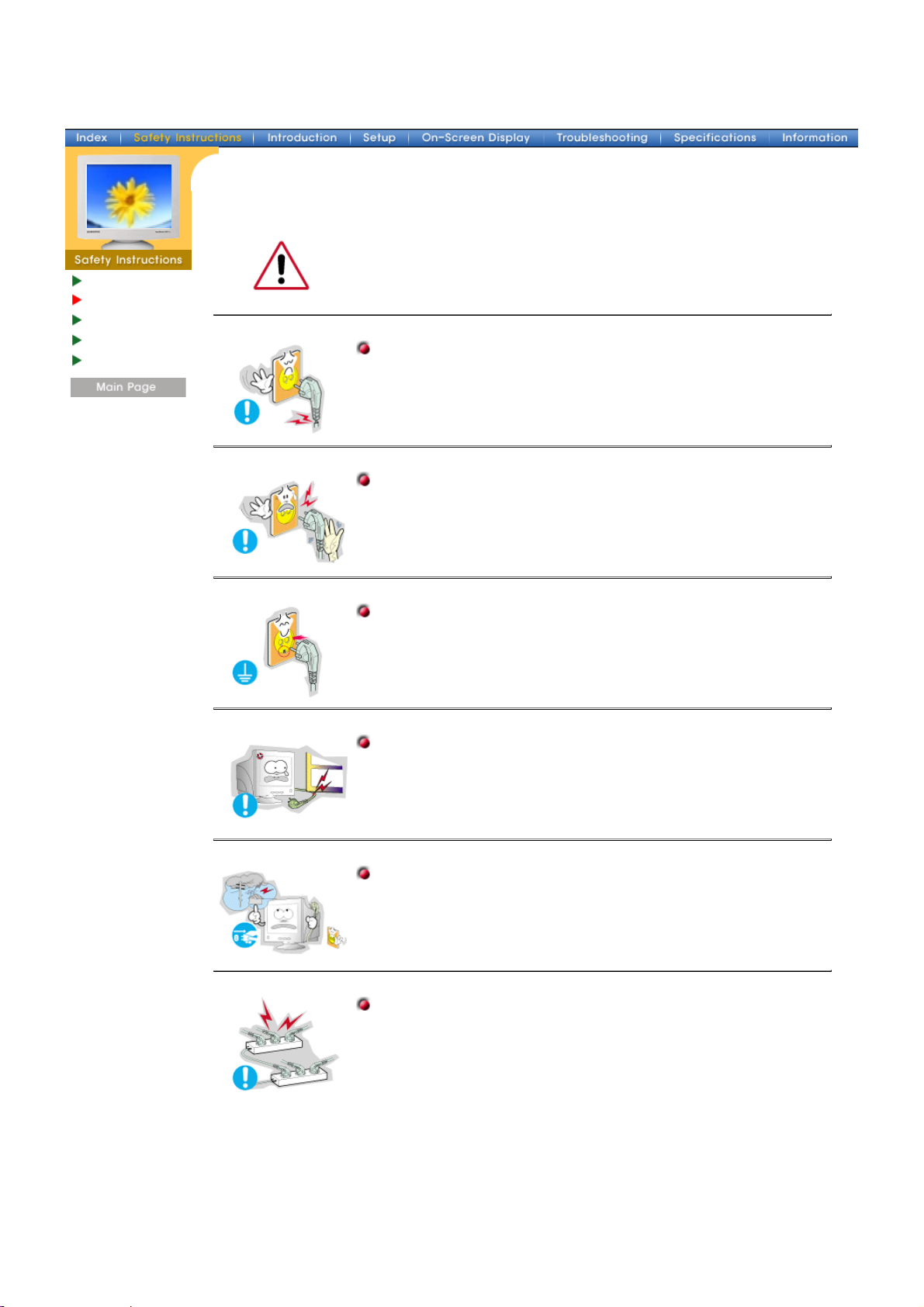
When not used for extended periods of time, set your PC to DPMS. If using
a screen saver, set it to the active screen mode.
If the size of your monitor is small, or if the same image is present for long
z
periods of time, you may see afterimages due to damage to the
fluorescent substance on the inside of the CRT.
Do not use a damaged or loose plug.
This may cause an electric shock or fire.
z
Do not pull the plug out by the wire nor touch the plug with wet
hands.
This may cause an electric shock or fire.
z
Use only a properly grounded plug and recepticle.
An improper ground may cause electric shock or equipment
z
damage.
Do not excessively bend the plug and wire nor place heavy objects
upon them, which could cause damage.
Failure to do so may cause an electric shock or fire.
z
Disconnect the plug from the outlet during storms or lightening or
if it is not used for a long period of time.
Failure to do so may cause an electric shock or fire.
z
Do not connect too many extension cords or plugs to an outlet.
This may cause a fire.
z
Page 5
Notational
Power
Installation
Clean
Other
Main > Safety Instructions > Installation
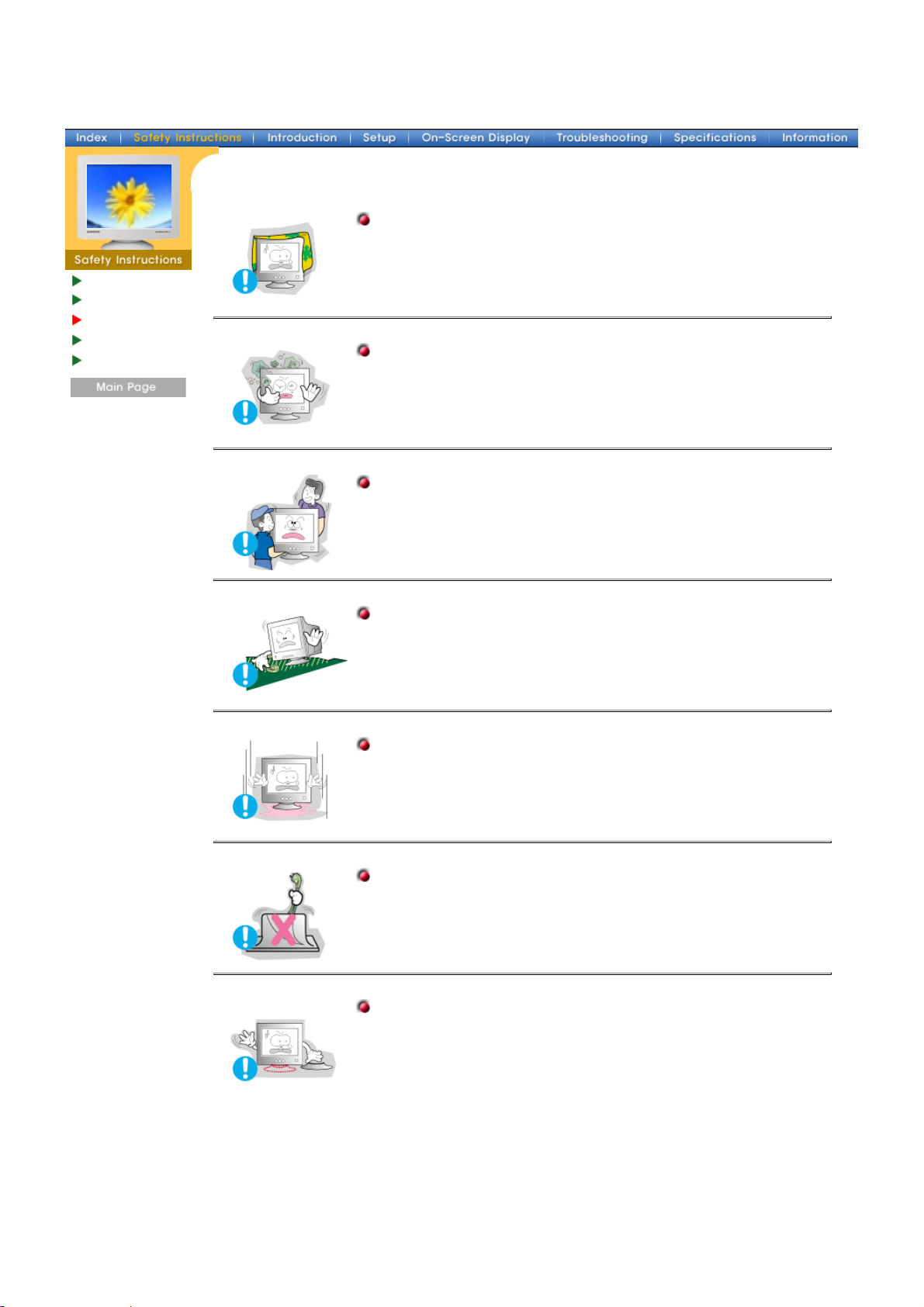
Do not cover the vents on the monitor cabinet.
Bad ventilation may cause a breakdown or fire.
z
Put your monitor in a location with low humidity and a minimum of
dust.
An electric shock or fire could result inside the monitor.
z
Do not drop the monitor when moving it.
This may cause damage to the product or human body.
z
Place the monitor on a flat and stable surface.
The monitor can cause injury by falling.
z
Set down the monitor carefully.
It could be damaged or broken.
z
Do not place the monitor face down.
The CRT surface may be damaged.
z
Do not use the monitor without the monitor stand.
It could break down or cause a fire due to bad ventilation.
z
If the monitor must be used without the supplied stand, take steps
z
to insure proper ventilation.
Page 6
Notational
Power
Installation
Clean
Other
Main > Safety Instructions > Clean
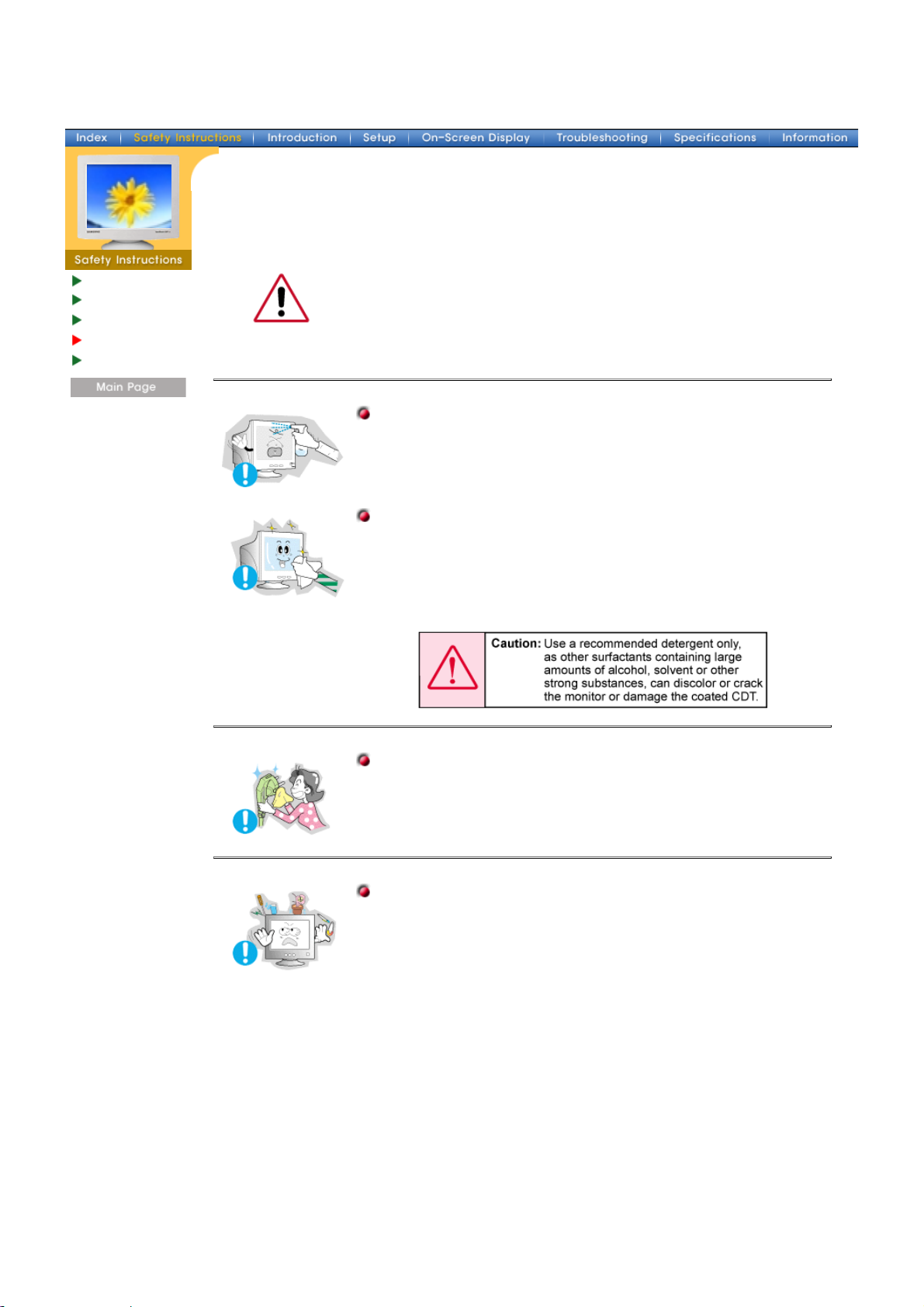
When cleaning the monitor case or the surface of the CRT, wipe with a
slightly moistened, soft fabric.
Do not clean Flat monitor with water. Use a water-diluted mild
detergent.
(Some detergents contain significant amounts of alcohol-based solvents,
which can damage (color change) or crack the monitor case. The
antiglare/anti-static surface coating on the CRT may also be affected.)
Dilute the detergent (1:10 ratio) with water before using.
Do not spray detergent directly on the monitor.
Use the recommended detergent with a smooth cloth.
You can prevent the coated CRT from being damaged or the
z
monitor cabinet from being dissolved, cracked or discolored.
You can buy a recommended detergent at any Samsung Service
z
Center.
If the connector between the plug and the pin is dusty or dirty,
clean it properly with a dry cloth.
A dirty connector can cause an electric shock or fire.
z
Do not set a glass of water, chemicals or any small metal objects
on the monitor.
This may cause damage, electric shock or a fire.
z
If a foreign substance gets into the monitor, disconnect the plug
z
and then contact a service center.
Page 7

Notational
Power
Installation
Clean
Other
Main > Safety Instructions > Other
Do not remove cover(or back). No user serviceable parts inside.
This may cause an electric shock or a fire.
z
Refer servicing to qualified service personnel.
z
If your monitor does not operate normally - in particular, if there are
any unusual sounds or smells coming from it - unplug it
immediately and contact an authorized dealer or service.
This may cause an electric shock or a fire.
z
Do not place any heavy objects on the monitor.
This may cause an electric shock or a fire.
z
For each hour of looking at the monitor, you should let your eyes
rest for 5 minutes.
This will reduce eye fatigue.
z
Do not use or store inflammable substances near the monitor.
This may cause an explosion or fire.
z
Do not try to move the monitor by pulling on the wire or the signal
cable.
This may cause a breakdown, electric shock or a fire due to
z
damage to the cable.
Do not move the monitor right or left by pulling only the wire or the
signal cable.
This may cause a breakdown, electric shock or a fire due to
z
damage to the cable.
Never insert anything metallic into the monitor openings.
This may cause an electric shock, fire or injury.
z
Page 8

Keep the monitor away from any magnetic substances.
This may cause discoloring or distortion of the image.
z
Page 9

Unpacking
Front
Rear
Bottom
Monitor and Stand
(Some models include a stand attached. )
Please make sure the following items are
included with your monitor. If any items are
missing,
contact your dealer.
Power Cord
Stand
Quick Setup Guide
Warranty Card
(Not available in all locations)
User's Guide and
Driver Installation CD
USB Hub (Option)
Page 10

Unpacking
Front
Rear
Bottom
1. Exit button
2,3. Adjust buttons
4. Menu button
5. Power indicator
Use this button to Exit the active menu or the OSD.
These buttons allow you to highlight and adjust items in the menu.
Use this button to open the OSD and activate a highlighted menu item.
This light glows green during normal operation, and blinks green once as
the monitor saves your adjustments.
6. Power button
See PowerSaver described in the manual for further information regarding power saving
Note:
Use this button to turn the monitor on and off.
functions. For energy conservation, turn your monitor OFF when it is not needed, or when
leaving it unattended for long periods.
Page 11

Unpacking
Front
Rear
Bottom
1. Power port
2. Signal Cable
Note:
(The configuration at the back of the monitor may vary from product to product.)
Connect the power cord for your monitor to the power port on the back of
the monitor.
Connect the signal cable to the video port on your computer, video board,
video card, or graphics card.
See Connecting Your Monitor for further information regarding cable connections.
Page 12

Unpacking
Front
Rear
Bottom
1. Signal Cable
2. Power port
3. Tilt/Swivel Base
Connect the signal cable to the video port on your computer, video board,
video card, or graphics card.
Connect the power cord for your monitor to the power port on the back of
the monitor.
You can separate the base from the monitor.
Page 13
Connecting
Your Monitor
Installing the
Monitor Driver
Base Installation
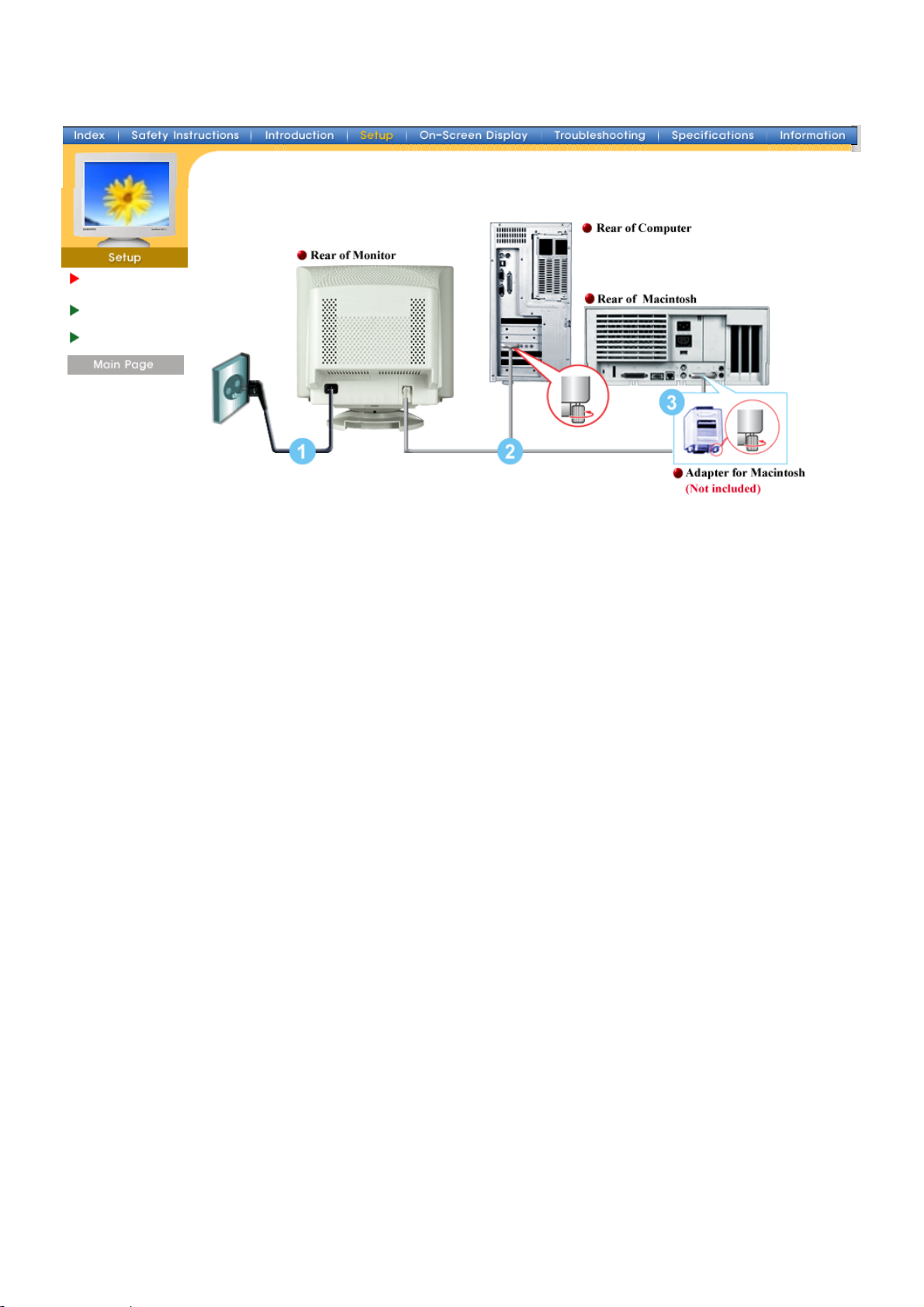
1. Connect the power cord for your monitor to the power port on the back of the monitor.
Plug the power cord for the monitor into a nearby outlet.
2. Connect the signal cable to the video port on your computer, video board, video card, or
graphics card.
3. If you are using a Macintosh computer, connect the cable to a Macintosh adapter, and set the
pins on your adapter(Adapter not included). A PC-compatible computer does not need an
adapter.
4. Turn on your computer and monitor. If your monitor displays an image, installation is complete.
Page 14
Automatic
Manual
Connecting Your
Monitor
Installing the
Monitor Driver
Base Installation
When prompted by the operating system for the monitor driver, insert the CD-ROM
included with this monitor. Driver installation is slightly different from one operating
system to another. Follow the directions as appropriate for the operating system you
have.
Prepare a blank disk and download the driver program file at the Internet web site shown
here.
Internet web site : http://www.samtron.com/
z
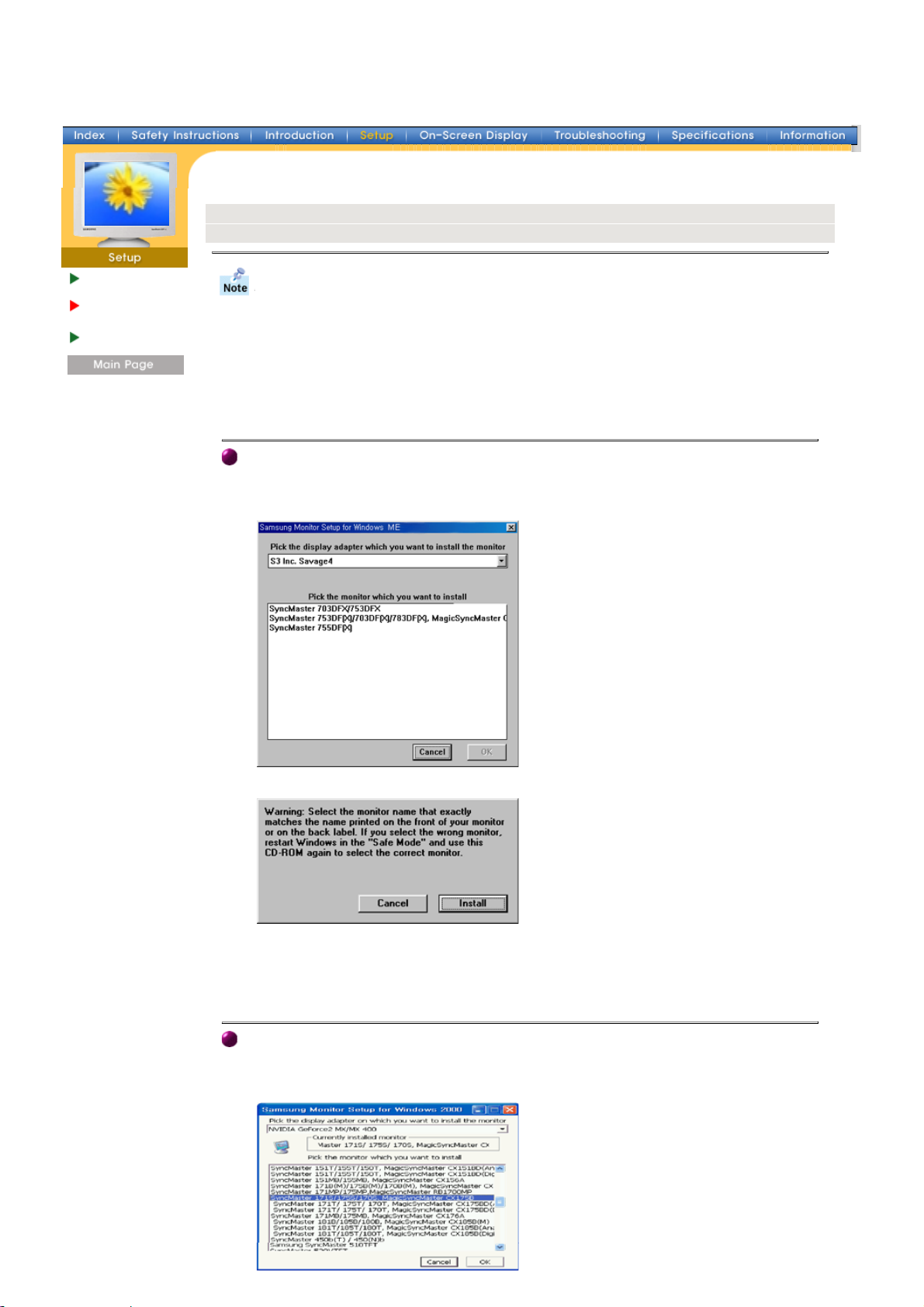
Windows ME
1. Insert CD into the CD-ROM driver.
2. Click "Windows ME Driver".
3. Choose your monitor model in the model list, then click the "OK" button.
4. Click the "Install" button in the "Warning" window.
5. Monitor driver installation is completed.
Windows XP/2000
1. Insert CD into the CD-ROM driver.
2. Click "Windows XP/2000 Driver".
3. Choose your monitor model in the model list, then click the "OK" button.
Page 15
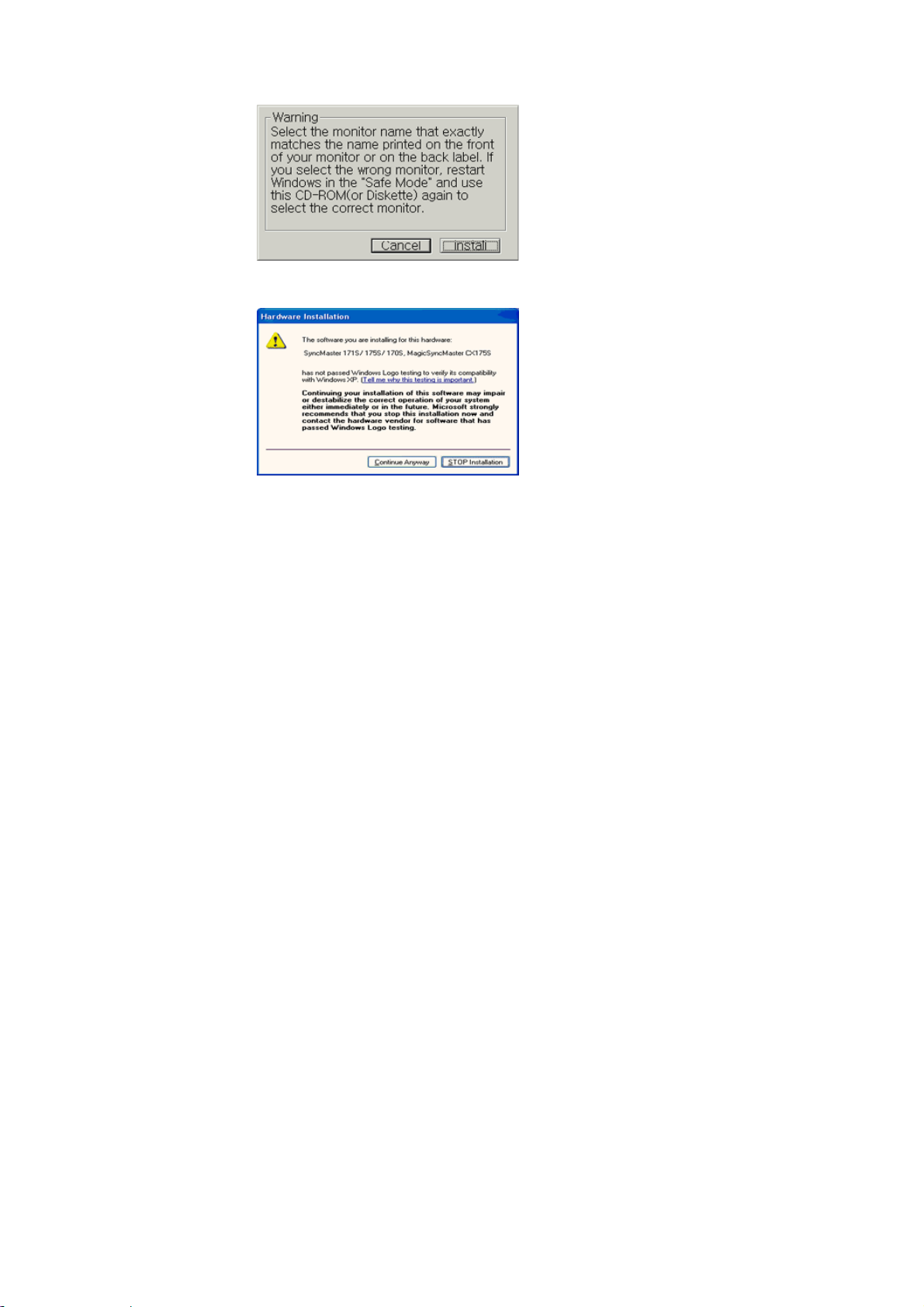
4. Click the "Install" button in the "Warning" window.
5. If you can see following "Message" window, then click the "Continue Anyway" button.
Then click "OK" button.
This monitor driver has been applied to Microsoft for the Windows logo, and this
installation does not damage the correct operation of your system. The Windows logo
certified driver will be posted on Samtron Monitor Homepage in the future then you can
download it.
http://www.samtron.com/.
6. Monitor driver installation is completed.
Page 16

Automatic
p
Manual
Connecting Your
Monitor
Installing the
Monitor Driver
Base Installation
Windows XP
Windows 2000
|
Windows Me
|
Windows NT
|
|
Linux
When prompted by the operating system for the monitor driver, insert the CD-ROM
included with this monitor. Driver installation is slightly different from one operating
system to another. Follow the directions as appropriate for the operating system you
have.
Prepare a blank disk and download the driver program file at the Internet web site shown
here.
Internet web site : http://www.samtron.com/
z
Microsoft® Windows® XP Operating System
1. Insert CD into the CD-ROM driver.
2. Click "Start" —> "Control Panel" then click the "Appearance and Themes" Icon.
3. Click "Display" icon and choose the "Settings" tab then click "Advanced..".
4. Click the "Properties" button on the "Monitor" tab and select "Driver" tab.
5. Click "U
date Driver.." and select "Install from a list or.." then click "Next" button.
Page 17

6. Select "Don't search ,I will.." then click "Next" and then click "Have disk".
7. Click the "Browse" button then choose A:(D:\Driver) and choose your monitor model in the
model list and click the "Next" button.
8. If you can see following "Message" window, then click the "Continue Anyway" button. Then
click "OK" button.
This monitor driver has been applied to Microsoft for the Windows logo, and this installation
does not damage the correct operation of your system. The Windows logo certified driver will
be posted on Samtron Monitor Homepage in the future then you can download it.
http://www.samtron.com/.
9. Click the "Close" button then click "OK" button continually.
Page 18

10. Monitor driver installation is completed.
Microsoft® Windows® 2000 Operating System
When you can see "Digital Signature Not Found" on your monitor, follow these steps.
1. Choose "OK" button on the "Insert disk" window.
2. Click the "Browse" button on the "File Needed" window.
3. Choose A:(D:\Driver) then click the "Open" button and then click "OK" button.
How to install
1. Click "Start" , "Setting" , "Control Panel".
2. Double click the "Display" Icon.
3. Choose the "Settings" tab and then click "Advanced..".
4. Choose "Monitor".
Case1: If the "Properties" button is inactive, it means your monitor is properly configured.
Case2: If the "Properties" button is active, click the "Properties" button then follow next
5. Click "Driver" and then click on "Update Driver.." then click on the "Next" button.
6. Choose "Display a list of the known drivers for this device so that I can choose a
specific driver" then click "Next" and then click "Have disk".
7. Click the "Browse" button then choose A:(D:\Driver).
8. Click the "Open" button, then click "OK" button.
9. Choose your monitor model and click the "Next" button then click "Next" button.
10. Click the "Finish" button then the "Close" button.
Please stop installation
steps continually.
If you can see the "Digital Signature Not Found" window then click the "Yes"button.
And click the "Finish" button then the "Close" button.
Microsoft® Windows® Millennium Operating System
1. Click "Start" , "Setting" , "Control Panel".
2. Double click "Display" icon.
3. Select the "Settings" tab and click "Advanced Properties" button.
4. Select the "Monitor" tab.
5. Click the "Change" button in the "Monitor Type" area.
6. Choose "Specify the location of the driver".
7. Choose "Display a list of all the driver in a specific location.." then click "Next" button.
8. Click the "Have Disk" button
9. Specify A:\(D:\driver) then click "OK" button.
10. Select "Show all devices" and choose the monitor that corresponds to the one you
connected to your computer and click "OK".
11. Continue choosing "Close" button and "OK" button until you close the Display Properties
dialogue box.
(You can get some other screen for warning message or others, then click the appreciate
option for your monitor.)
Page 19

Microsoft® Windows® NT Operating System
1. Click Start, Settings, Control Panel, and then double-click Display icon.
2. In Display Registration Information window, click Settings Tab and then click All Display
Modes.
3. Select a mode that you wish to use (Resolution, Number of colors and Vertical frequency)
and then click OK.
4. Click Apply button if you see the screen working normally after clicking Test. If the screen
is not normal, change to a different mode (lower mode of resolution, colors or frequency).
Note: If there is no Mode at All Display Modes, select the level of resolution and vertical
frequency by referring to the Preset Display Modes in the user guide.
Linux Operating System
To execute X-Window, you need to make the X86Config file, which is a type of system setting
file.
1. Press Enter at the first and the second screen after executing the X86Config file.
2. The third screen is for setting your mouse.
3. Set a mouse for your computer.
4. The next screen is for selecting a keyboard.
5. Set a Keyboard for your computer.
6. The next screen is for setting your monitor.
7. First of all, set a horizontal frequency for your monitor. (You can enter the frequency
directly.)
8. Set a vertical frequency for your monitor. (You can enter the frequency directly.)
9. Enter the model name of your monitor. This information will not affect the actual
execution of X-Window.
10. You have finished setting up your monitor.
Execute X-Window after setting other requested hardware.
Page 20

Connecting Your
Monitor
Installing the
Monitor Driver
Base Installation
Tilt/Swivel Base
Attaching and Removing the Base
|
With the built-in pedestal, you can tilt and/or swivel the monitor for the most comfortable
viewing angle.
The base is detachable.
Note:
If your monitor was supplied with the base detached, attach the base as follows.
Remove the twist-tie before attaching the base to the monitor.
Page 21

Attaching the Base
1. Place the monitor upside-down on a flat work surface.
2. Align the tabs on the base with the corresponding slots on the bottom of the monitor.
3. Press the base onto the monitor until the tabs are fully engaged in the slots.
4. Push the base toward the front of the monitor until the release latch clicks into the locked
position.
* Do not bend the snap.
Removing the Base
5. Squeeze and pull up on the release latch on the base.
6. Push the base toward the back of the monitor and lift up to remove the base.
Note: The base will align with the monitor slots in only one position.
Page 22

On Screen Display (OSD) Menu System
1 Exit butt
U
this butt
on:
2,3 Adjust buttons:
4 Menu button:
se
OSD.
These buttons allow you to highlight and
adjust items in the menu.
Use this button to open the OSD and activate
a highlighted menu item.
on to Exit the active menu or the
Page 23

On Screen Display (OSD) Menu System
With the menu off, push the menu button.
Push the - button or + button until the Brightness
screen is displayed.
Push the menu button to open the Brightness adjustment screen.
Use the + button to increase the brightness or - button to decrease the
brightness.
Brightness
Contrast
With the menu off, push the menu button.
Push the - button or + button until the Contrast
screen is displayed.
Push the menu button to open the Contrast adjustment screen.
Use the + button to increase the contrast or - button to decrease the
contrast.
Adjust the Brightness.
Adjust the Contrast.
Menu How to adjust
Page 24

On Screen Display (OSD) Menu System
Follow these instructions to change the Position of
the monitor’s entire display.
With the menu off, push the menu button.
Push the - button or + button until the H-Position screen is
displayed.
Push the menu button to open the H-Position adjustment screen.
Use the - and + buttons to change the Horizontal
position of the monitor’s viewing area.
Menu How to adjust
H-Position
V-Position
With the menu off, push the menu button.
Push the - button or + button until the V-Position screen is
displayed.
Push the menu button to open the V-Position adjustment screen.
Use the - and + buttons to change the vertical
position of the monitor’s viewing area.
Follow these instructions to change the Position of
the monitor’s entire display.
Page 25

On Screen Display (OSD) Menu System
Follow these instructions to change the Size of
the monitor’s entire display.
Menu How to adjust
H-Size
Follow these instructions to change the Size of
the monitor’s entire display.
V-Size
With the menu off, push the menu button.
Push the - button or + button until the H-Size screen is displayed.
Push the menu button to open the H-Size adjustment screen.
Use the - and + buttons to change the Horizontal
Size of the monitor’s viewing area.
With the menu off, push the menu button.
Push the - button or + button until the V-Size screen is displayed.
Push the menu button to open the V-Size adjustment screen.
Use the - and + buttons to change the Vertical
Size of the monitor’s viewing area
Page 26

On Screen Display (OSD) Menu System
Menu How to adjust
Adjust the pincushion setting when the sides of the display
are bowed in or bowed out
Pincushion
With the menu off, push the menu button.
Push the - button or + button until the Pincushion
screen is displayed.
Push the menu button to open the Pincushion
adjustment screen.
Use the - button or + button to adjust the pincushion setting.
Adjust the trapezoid setting when the top or bottom of the
display is too large or small.
Trapezoid
With the menu off, push the menu button.
Push the - button or + button until the Geometry
screen is displayed.
Push the menu button again and then press the - or + button until
the Trapezoid screen appears.
Push the menu button to open the Trapezoid adjustment screen.
Use the - button or + button to adjust the trapezoid setting.
Page 27

Adjust the rotation setting when the entire display
is tilted left or right.
Rotation
On Screen Display (OSD) Menu System
Menu How to adjust
Adjust the parallelogram setting when the display is leaning
left or right.
Parallelogram
With the menu off, push the menu button.
Push the - button or + button until the Geometry
screen is displayed.
Push the menu button again and then press the - or + button until
the Parallelogram screen appears.
Push the menu button to open the Parallelogram
adjustment screen.
Use the - button or + button to adjust the parallel setting.
With the menu off, push the menu button.
Push the - button or + button until the Geometry
screen is displayed.
Push the menu button again and then press the - or + button until
the Rotation screen appears.
Push the menu button to open the Rotation
adjustment screen.
Use the - button or + button to adjust the rotation setting.
Page 28

On Screen Display (OSD) Menu System
Menu How to adjust
Adjust the pinbalance setting when the sides of the display are
bowed towards the left or right.
Pinbalance
Adjust the linearity setting when the display image is
compressed at the left, right or top, bottom.
V-Linearity
With the menu off, push the menu button.
Push the - button or + button until the Geometry
screen is displayed.
Push the menu button.
Push the - button or + button until the V-Linearity
screen is displayed.
Push the menu button to open the V-Linearity adjustment screen.
Use the - button or + button to adjust the vertical linearity.
With the menu off, push the menu button.
Push the - button or + button until the Geometry
screen is displayed.
Push the menu button again and then press the - or + button until
the Pinbalance screen appears.
Push the menu button to open the Pinbalance
adjustment screen.
Use the - button or + button to adjust the pinbalance setting.
Page 29

On Screen Display (OSD) Menu System
Menu How to adjust
Language
With the menu off, push the menu button.
Push the - button or + button until the Language
screen is displayed.
Push the menu button to open the Language selection screen.
Use the - button or + button to select the language you would like to
use.
Note The language chosen affects only the language of the
OSD. It has no effect on any software running on the
computer.
Follow these steps to change the language used in the menu.
You can choose one of ten languages.
English,German,French, Italian, Portuguese, Spanish, Swedish,
Russian, Polish, or Magyar.
(Some OSD languages may not appear in some areas.)
Page 30

On Screen Display (OSD) Menu System
A “Moiré” pattern can appear on your screen, looking like a
series of concentric circles or arcs. To eliminate this pattern,
use the clear moiré adjustments.
Menu How to adjust
H-Moire
With the menu off, push the menu button.
Push the - button or + button until the Advanced
screen is displayed.
Push the menu button again and then press the - or + button until
the H-Moire screen appears.
Push the menu button to open the H-Moire
adjustment screen.
Use the - button or + button to adjust horizontal moiré.
A “Moiré” pattern can appear on your screen, looking like a
series of concentric circles or arcs. To eliminate this pattern,
use the clear moiré adjustments.
V-Moire
With the menu off, push the menu button.
Push the - button or + button until the Advanced
screen is displayed.
Push the menu button again and then press the - or + button until
the V-Moire screen appears.
Push the menu button to open the V-Moire
adjustment screen.
Use the - button or + button to adjust vertical moiré.
Page 31

On Screen Display (OSD) Menu System
Menu How to adjust
Some video cards use video signals higher than 1.0V which
causes the display to be very bright. For those video cards,
use this feature to select the 1.0V Level.
Video Input Level
With the menu off, push the menu button.
Push the - button or +button until the Advanced
screen is displayed.
Push the menu button again and then press the - or + button until
the Video Input Level screen appears.
Push the menu button to open the Video Input Level
selection screen.
Use the - button or + button to select 0.7 V or 1.0 V.
Color temperature is a measure of the “warmth” of the image
colors. The available range is between 6500 to 9300K.
Color Temperature
With the menu off, push the menu button.
Push the - button or + button until the Advanced
screen is displayed.
Push the menu button again and then press the - or + button until
the Color Temperature screen appears.
Push the menu button to open the Color Temperature selection
screen.
Press the - or + button to select 9300K(Bluish colors)
or 6500K(Reddish colors).
Page 32

On Screen Display (OSD) Menu System
Menu How to adjust
Follow these instructions to get a close-up or a longshot view
of the monitor’s viewing area.
Zoom
With the menu off, push the menu button.
Push the - button or + button until the Zoom
screen is displayed.
Push the menu button to open the Zoom adjustment screen.
Use the - button to decrease the screen viewing area.
Use the + button to enlarge the screen viewing area.
Page 33

Note The monitor may buzz momentarily, the image colors may
change and the image will jiggle for a few seconds.
These effects are normal.
On Screen Display (OSD) Menu System
The Degauss feature will remove color impurities caused by
magnetic fields.
You can use this function to turn on the power of the monitor
or change the power saving mode to the normal mode.
Do not use the Degauss feature more than once within a
30-minute period.
Menu How to adjust
Degauss
With the menu off, push the menu button.
Push the - button or + button until the Degauss
screen is displayed.
Push the menu button to execute the degauss function.
The degaussing screen will appear.
Note If you have selected “Yes”, all settings listed above will be
reset. All other settings will remain the same.
CAUTION This operation resets all of the data in the user memory
area for the current timing signal.
Use the recall feature to reset these monitor settings to their
original levels: Position, Size, Pincushion, Trapezoid,
Parallelogram, Pinbalance, Rotation, H-Moire and V-Moire.
Recall
With the menu off, push the menu button.
Push the - button or + button until the Recall
screen is displayed.
Push the menu button to open the Recall adjustment screen.
Push the + button to select Yes.
If you don’t want to reset the monitor, use the - button to select No.
Page 34

On Screen Display (OSD) Menu System
Menu How to adjust
The information on this screen shows Display Timing , User
Timing and Factory Timing.
Display Timing
With the menu off, push the menu button.
Push the - button or + button until the Display Timing
screen is displayed.
Push the menu button to open the Display Timing adjustment screen.
Use the - button to see user control mode and thedefault mode.
Push and hold in the menu button for 10 seconds or more
to Lock the OSD.
(In this case, even if you click the menu button the control
screen will not be printed.)
Push and hold in the menu button for 10 seconds or more
to Unlock the OSD.
OSD Lock/Unlock
Note You can see the frequency(user control mode) used by the user,
the polarity of the operational signals, the default frequency(default mode)
set when you buy the monitor and the resolution level.
Page 35

Check List
Q & A
Self-Test Feature
Check
Before calling for service, check the information in this section to see if you can remedy any
problems yourself. If you do need assistance, please call the phone number on the
warranty card, the phone number on the Information section or contact your dealer.
Symptom Check List Solutions
No images on the
screen. I cannot
turn on the monitor.
Is the power cord connected
properly?
Can you see "
Check Signal Cable
No Connection,
" on the
screen?
Check the power cord connection
and supply.
Check the signal cable connection.
If the power is on, reboot the
computer to see the initial
screen(the login screen), which
can be seen.
Can you see "
Range
Sync. Out of
" on the screen?
There is no image on the
screen. Is the power indicator
on the monitor blinking at 1
second intervals?
If the initial screen (the login screen)
appears, boot the computer in the
applicable mode (the safe mode for
Windows ME/XP/2000) and then
change the frequency of the video
card.
(Refer to the Preset Timing Modes)
Note: If the initial screen (the login
screen) does not appear, contact a
service center or your dealer.
You can see this message when the
signal from the video card exceeds
the maximum resolution and
frequency that the monitor can
properly handle.
Adjust the maximum resolution and
frequency that the monitor can
properly handle.
The monitor is in PowerSaver mode.
Press a key on the keyboard or
move the mouse to activate the
monitor and restore the image on the
screen.
I cannot see the On
Screen Display.
The image on the
screen is shaking.
Have you locked the
Screen Display (OSD)
On
Menu to
prevent changes?
Check the monitor configuration
to see if it is in Interlace Mode.
(Interlace Mode: Vertical
Unlock the OSD by pressing the
MENU button for at least 10
seconds.
The signal from the video card
exceeds the maximum resolution
and frequency of the monitor.
frequency 43Hz, 87Hz(i), etc)
Are there any magnetic
products such as a power
adapter, speaker or a high
Move the monitor away from
anything that can create a strong
magnetic field.
voltage wire near by?
Is the voltage stable? The screen image can appear to
shake or vibrate at a particular time
of day due to low supply voltage.
The screen image can also appear to shake or vibrate if there is a
problem with the video card or the computer's main board.
Page 36

The screen shows
strange colors or
just black and
white.
Is the screen displaying only
one color as if looking at the
screen through a cellophane
paper?
Check the signal cable connection.
Make sure the video card is fully
inserted in it's slot.
The screen
suddenly has
become
unbalanced.
The screen is out of
focus or OSD
cannot be adjusted.
The screen is
partially distorted.
Have the screen colors become
strange after running a program
or due to a crash between
applications?
Has the video card been set
properly?
Have you changed the video
card or the driver?
Have you adjusted the
resolution or frequency to the
monitor?
The screen can be unbalanced due to the cycle of the video card
signals. Readjust Position by referring to the OSD.
Have you adjusted the
resolution or frequency on the
monitor?
Are there any magnetic
products such as an adapter,
speaker or a high voltage wire
near the monitor?
Reboot the computer.
Set the video card by referring to the
video card manual.
Adjust screen image position and
size using the OSD.
Adjust the resolution and frequency
at the video card.
(Refer to the Preset Timing Modes).
Adjust the resolution and frequency
of the video card.
(Refer to the Preset Timing Modes).
Enter the OSD and perform a
"Degauss".
Keep the monitor away from any
magnetic products.
LED is blinking but
no images on the
screen.
There are only 16
colors shown on the
screen. The screen
colors have
changed after
changing the video
card.
There is a message
that reads
"Unrecognized
monitor, Plug & Play
(VESA DDC) monitor
found".
Check the following items if there is trouble with the monitor.
Is the frequency properly
adjusted when checking the
Display Timing on the menu?
Have the Windows colors been
set properly?
Has the video card been set
properly?
Have you installed the monitor
driver?
See the video card manual to
see if the Plug & Play (VESA
DDC) function can be
supported.
Adjust the frequency properly by
referring to the video card manual
and the Preset Timing Modes.
(The maximum frequency per
resolution may differ from product to
product.)
For Windows ME/XP/2000:
Set the colors properly at the
Control Panel, Display, Settings
Set the video card by referring to the
video card manual.
Install the monitor driver according to
the Driver Installation Instructions.
Install the monitor driver according to
the Driver Installation Instructions.
.
1. Check if the power cord and the cable are properly connected to the computer.
2. Check if the computer beeps more than 3 times when booting.
(If it does, request an after-service for the main board of the computer.)
3. If you installed a new video card or if you assembled the PC, check if the installed the adapter
(video) driver and the monitor driver.
4. Check if the scanning ratio of the video screen is set at 75Hz or 85Hz.
(Do not exceed 60Hz when using the maximum resolution.)
5. If you have problems in installing the adapter (video) driver, boot the computer in Safe Mode,
remove the Display Adapter at the "
reboot the computer to reinstall the adapter (video) driver.
Note:
If problems repeatedly occur, contact an authorized service center.
Control Panel, System, Device Administrator
" and then
Page 37

Question Answer
Check List
Q & A
Self-Test Feature
Check
How can I change the frequency? Frequency can be changed by reconfiguring the video
card.
Note that video card support can vary, depending on the
version of the driver used.
(Refer to the computer or the video card manual for
How can I adjust the resolution?
details.)
Windows ME/XP/2000: Set the resolution at the
Panel, Display, Settings
.
* Contact the video card manufacturer for details.
How can I set the Power Saving
function?
Windows ME/XP/2000: Set the function at BIOS-SETUP
of the computer or the screen saver. (Refer to
Windows/Computer Manual).
The monitor makes a sound when it
is turned on.
This is normal as some sound may be generated when
the metal case and the electromagnet, which are
installed to block any electromagnetic waves, interact
with each other.
How can I clean the outer
case/Picture tube?
Disconnect the power cord and then clean the monitor
with a soft cloth, using either a cleaning solution or plain
water.
Do not leave any remains of the detergent nor scratch
the case. Do not allow any water to go inside the monitor.
Control
Page 38

Main > Troubleshooting > Self-Test Feature Check
Check List
Q & A
Self-Test
Feature Check
Self-Test Feature Check
Warning Messages
|
Environment
|
Your monitor provides a self test feature that allows you to check whether your monitor is
functioning properly.
1. Turn off both your computer and the monitor.
2. Unplug the video cable from the back of the computer.
3. Turn on the monitor.
If your monitor works normally, the following screen appears.
Failure of any of the boxes to appear indicates a problem with your monitor. This box
also appears during normal operation if the video cable becomes disconnected or
damaged.
Useful Tips
|
4. Turn off your monitor and reconnect the video cable; then turn on both your computer and the
monitor.
If your monitor screen remains blank after using the previous procedure, check your
video controller and computer system; your monitor is functioning properly.
If there is something wrong with the input signal, a message appears on the screen or
the screen goes blank although the power indicator LED is still on. The message may
indicate that the monitor is out of scan range or that you need to check the signal cable.
The location and the position of the monitor may influence the quality and other
features of the monitor.
Page 39

1.If th
ere are any woofer speakers near the monitor, unplug and relocate the woofer to another
room.
2. Remove all electronic devices such as radios, fans, clocks and telephones that are within 3
feet (one meter) of the monitor.
3. Degauss the monitor if any devices were removed from the area.
A monitor recreates visual signals received from the PC. Therefore, if there is trouble with the
z
PC or the video card, this can cause the monitor to become blank, have poor coloring, noise,
Sync. Out of Range, etc. In this case, first check the source of the problem, and then contact
a service center or your dealer.
Judging the monitor's working condition
z
If there is no image on the screen or an "Sync. Out of Range" message comes up,
disconnect the cable from the computer while the monitor is still powered on.
If there is a message coming up on the screen or if the screen goes white, this means
{
the monitor is in working condition.
In this case, check the computer for trouble.
{
Page 40

General
PowerSaver
Preset Timing
Modes
General
Model Name SAMTRON 96BDF
Picture Tube
Type 19"(48cm) DynaFlat (45.8cm viewable)
Deflection angle 90 °
Dot Pitch 0.26mm (Horizontal)
Screen type Aluminized tri-color phosphor dot trio with black matrix.
Anti-doming invar shadow mask.
Multi-layer coated with anti-static.
Maximum Resolution
1600 Dots, 1200 Lines
Active Display
Horizontal 352 ± 3 mm
Vertical 264 ± 3 mm
Synchronization
Horizontal 30 ~ 85 kHz
Vertical 50 ~ 160 Hz
Input Signal Definition
Video Signal RGB, Analog 0.7 Vpp positive at 75 ohms
Sync Signal Separate H/V sync, TTL level, positive or negative
Display Color
Unlimited
Maximum Pixel Clock
185 MHz
Power Supply
90 ~ 264VAC rms, 60/50 Hz ± 3Hz
Power Consumption
110W (Maximum), 100W (Nominal)
Dimensions (WxDxH)
440 x 459 x 455 mm (with Stand)
Weight
22.0 kg
Environmental considerations
Operating Temperature 32°F ~ 104°F(0°C ~ 40°C)
Humidity 10% ~ 80%, non-condensing
Storage Temperature -4°F ~113°F (-20°C ~ 45°C)
Humidity 5% ~ 95%, non-condensing
Plug and Play Capability
This monitor can be installed on any Plug & Play compatible system. Interaction of the monitor and
computer systems will provide the best operating conditions and monitor settings. In most cases,
monitor installation will proceed automatically, unless the user wishes to select alternate settings.
Note: Design and specifications are subject to change without prior notice.
Page 41

General
PowerSaver
Preset Timing
Modes
General
Model Name SAMTRON 98BDF
Picture Tube
Type 19"(48cm) DynaFlat (45.8cm viewable)
Deflection angle 90 °
Dot Pitch 0.26mm (Horizontal)
Screen type Aluminized tri-color phosphor dot trio with black matrix.
Anti-doming invar shadow mask.
Multi-layer coated with anti-static.
Maximum Resolution
1600 Dots, 1200 Lines
Active Display
Horizontal 352 ± 3 mm
Vertical 264 ± 3 mm
Synchronization
Horizontal 30 ~ 85 kHz
Vertical 50 ~ 160 Hz
Input Signal Definition
Video Signal RGB, Analog 0.7 Vpp positive at 75 ohms
Sync Signal Separate H/V sync, TTL level, positive or negative
Display Color
Unlimited
Maximum Pixel Clock
185 MHz
Power Supply
90 ~ 264VAC rms, 60/50 Hz ± 3Hz
Power Consumption
110W (Maximum), 100W (Nominal)
Dimensions (WxDxH)
440 x 459 x 455 mm (with Stand)
Weight
22.0 kg
Environmental considerations
Operating Temperature 32°F ~ 104°F(0°C ~ 40°C)
Humidity 10% ~ 80%, non-condensing
Storage Temperature -4°F ~113°F (-20°C ~ 45°C)
Humidity 5% ~ 95%, non-condensing
Plug and Play Capability
This monitor can be installed on any Plug & Play compatible system. Interaction of the monitor and
computer systems will provide the best operating conditions and monitor settings. In most cases,
monitor installation will proceed automatically, unless the user wishes to select alternate settings.
Note: Design and specifications are subject to change without prior notice.
Page 42

General
PowerSaver
Preset Timing
Modes
This monitor has a built-in power management system called PowerSaver. This system saves
energy by switching your monitor into a low-power mode when it has not been used for a certain
amount of time. The monitor automatically returns to normal operation when you move the
computer's mouse or press a key on the keyboard. For energy conservation, turn your monitor OFF
when it is not needed, or when leaving it unattended for long periods. The PowerSaver system
operates with a VESA DPMS compliant video card installed in your computer. Use a software utility
installed on your computer to set up this feature.
State Normal Operation
Power-off Mode EPA/ENERGY
2000
Power Indicator Green Green, Blinking
Power Consumption
100W(Nominal)
110W(Maximum)
Less than 2W
This monitor is EPA E
NERGY STAR
®
compliant and ENERGY2000 compliant when
used with a computer equipped with VESA DPMS functionality.
As an E
NERGY STAR
the E
NERGY STAR
®
Partner, SAMSUNG has determined that this product meets
®
guidelines for energy efficiency.
Page 43

If the signal transferred from the computer is the same as the following Preset Timing Modes, the
screen will be adjusted automatically. However, if the signal differs, the screen may go blank while
the power LED is on. Refer to the video card manual and adjust the screen as follows.
General
PowerSaver
Preset Timing
Modes
Table 1. Preset Timing Modes
Horizontal
Display Mode
Frequency
(kHz)
IBM, 640 x 480 31.469 59.940 25.175 -/-
Vertical
Frequency
(Hz)
Pixel Clock
(MHz)
IBM, 720 x 400 31.469 70.087 28.322 -/+
VESA, 640 x 480 37.500 75.000 31.500 -/VESA, 640 x 480 43.269 85.008 36.000 -/VESA, 800 x 600 53.674 85.061 56.250 +/+
VESA, 1024 x 768 60.023 75.029 78.750 +/+
VESA, 1024 x 768 68.677 84.997 94.500 +/+
VESA, 1280 x 1024 79.976 75.025 135.00 +/+
Horizontal Frequency
The time to scan one line connecting the right edge to the left edge of
the screen horizontally is called Horizontal Cycle and the inverse
number of the Horizontal Cycle is called Horizontal Frequency. Unit: kHz
Vertical Frequency
Like a fluorescent lamp, the screen has to repeat the same image many
times per second to display an image to the user. The frequency of this
repetition is called Vertical Frequency or Refresh Rate. Unit: Hz
Sync Polarity
(H/V)
Page 44

Service
Terms
Regulatory
Authority
SAMTRON SEOUL
15TH FL, JOONGANG DAILY NEWS BLDG. 7, SOONHWA-DONG,CHUNG-KU,
SEOUL, KOREA, 100-759
TEL : (82-2) 727-3114
SAMTRON U.S.A.
SAMTRON COMPUTER PRODUCTS CUSTOMER SERVICE
400 Valley Road Suite 201, Mt. Arlington, NJ 07856
TEL : 973-601-6200, FAX : 973-601-6001
1-800-SAMTRON (1-800-726-8766)
SAMTRON CANADA
SAMSUNG ELECTRONICS CANADA INC.
7037 FINANCIAL DRIVE
MISSISSAUGA, ONTARIO L5N 6R3
TEL : 1-800-726-7864
FAX : 905-542-1199
SAMTRON EUROPE
SAMSUNG ELECTRONICS GMBH
SAMSUNG-HAUS, AM KRONBERGER HANG 6
65824 SCHWALBACH/TS., GERMANY
TEL: 49 (0180) 5121213*
FAX: 49 (0180) 5121214*
* EURO 0,12/MIN.
SAMTRON TOKYO
17TH, HAMACHO CENTER BLDG. 2-31-1, NIHONBASHI-HAMACHO,
CHOU-KU, TOKYO 103, JAPAN
TEL : (81-3) 5641-9860 FAX : (81-3) 5641-9861
SAMTRON SWEDEN
SAMSUNG ELECTRONICS SYENSKA, AB
BOX 713, S- 194 27 UPPLANDS VÄSBY
TEL : 468- 590- 966- 00 FAX : 468- 590- 966- 50
SAMTRON MEXICO
SAMSUNG ELECTRONICS MEXICO, S.A. DE C. V. Mina No. 200,
ESQ. GAVILANCOL. GUADALUPE DEL MORAL IZTAPALAPA,
MEXICO, D.F. C.P. 09300
TEL. : (525) 686-0800
FAX : (525) 686-5094
IMPORTADO POR: SAMSUNG ELECTRONICS MEXICO S.A. DE C.V.
SATURNO 44 COL. NVA. INDUSTRIAL VALLEJO
DEL. GUSTAVO A. MADERO C.P. 07700
MEXICO D.F. TEL. 5747-5100
RFC: SEM950215S98
EXPORTADO POR: SAMSUNG ELECTRONICS CO.,LTD.
JOONG-ANG DAILY NEWS BLDG.
7 SOON-WHA-DONG CHUNG-KU,
C.P.O BOX 2775, 1144 SEOUL, KOREA
Page 45

Service
Terms
Regulatory
Authority
Information > Terms
Dot Pitch
The image on a monitor is composed of red, green and blue dots. The closer the dots, the
higher the resolution. The distance between two dots of the same color is called the 'Dot Pitch'.
Unit: mm
Vertical Frequency
The screen must be redrawn several times per second in order to create and display an image
for the user. The frequency of this repetition per second is called Vertical Frequency or Refresh
Rate. Unit: Hz
Example: If the same light repeats itself 60 times per second, this is regarded as 60 Hz. In this
case, flickering of the screen can be detected. To avoid this problem, there is a
Flicker-free Mode using a vertical frequency over 70 Hz.
Horizontal Frequency
The time to scan one line connecting the right edge to the left edge of the screen horizontally is
called Horizontal Cycle. The inverse number of the Horizontal Cycle is called Horizontal
Frequency. Unit: kHz
Interlace and Non-Interlace Methods
Showing the horizontal lines of the screen from the top to the bottom in order is called the NonInterlace method while showing odd lines and then even lines in turn is called the Interlace
method. The Non-Interlace method is used for the majority of monitors to ensure a clear image.
The Interlace method is the same as that used in TVs.
Plug & Play
This is a function that provides the best quality screen for the user by allowing the computer and
the monitor to exchange information automatically. This monitor follows the international
standard VESA DDC for the Plug & Play function.
Resolution
The number of horizontal and vertical dots used to compose the screen image is called
'resolution'. This number shows the accuracy of the display. High resolution is good for
performing multiple tasks as more image information can be shown on the screen.
Example: If the resolution is 1024 X 768, this means the screen is composed of 1024
horizontal dots (horizontal resolution) and 768 vertical lines (vertical resolution).
Page 46

Main > Information > Regulatory
Service
Terms
Regulatory
Authority
FCC Information
European Notice (Europe only)
TCO'95-Ecological requirements for personal computers (TCO applied model only)
TCO'99-Ecological requirements for personal computers (TCO applied model only)
IC Compliance Notice
|
PCT Notice
|
MPR II Compliance
|
VCCI
|
|
|
FCC Information
User Instructions
The Federal Communications Commission Radio Frequency Interference Statement includes the
following warning:
Note: This equipment has been tested and found to comply with the limits for a Class B digital
device, pursuant to Part 15 of the FCC Rules. These limits are designed to provide reasonable
protection against harmful interference in a residential installation. This equipment generates,
uses, and can radiate radio frequency energy and, if not installed and used in accordance with
the instructions, may cause harmful interference to radio communications. However, there is no
guarantee that interference will not occur in a particular installation. If this equipment does cause
harmful interference to radio or television receptions, which can be determined by turning the
equipment off and on, the user is encouraged to try to correct the interference by one or more of
the following measures:
Reorient or relocate the receiving antenna.
z
Increase the separation between the equipment and receiver.
z
Connect the equipment into an outlet on a circuit different from that to which the receiver is
z
connected.
Consult the dealer or an experienced radio/TV technician for help.
z
User Information
Changes or modifications not expressly approved by the party responsible for compliance could
void the user's authority to operate the equipment. If necessary, consult your dealer or an
experienced radio/television technician for additional suggestions. You may find the booklet
called How to Identify and Resolve Radio/TV Interference Problems helpful. This booklet was
prepared by the Federal Communications Commission. It is available from the U.S. Government
Printing Office, Washington, DC 20402, Stock Number 004-000-00345-4.
The party responsible for product compliance:
SAMSUNG ELECTRONICS CO., LTD
America QA Lab of Samsung
3351 Michelson Drive,
Suite #290, Irvine, CA92612 USA
Tel) 949-975-7310
Fax) 949-922-8301
Warning
User must use shielded signal interface cables to maintain FCC compliance for the product.
Provided with this monitor is a detachable power supply cord with IEC320 style terminations. It
may be suitable for connection to any UL Listed personal computer with similar configuration.
Before making the connection, make sure the voltage rating of the computer convenience outlet
is the same as the monitor and that the ampere rating of the computer convenience outlet is
equal to or exceeds the monitor voltage rating.
For 120 Volt applications, use only UL Listed detachable power cord with NEMA configuration 515P type (parallel blades) plug cap. For 240 Volt applications use only UL Listed Detachable
power supply cord with NEMA configuration 6-15P type (tandem blades) plug cap.
IC Compliance Notice
This Class B digital apparatus meets all requirements of the Canadian Interference-Causing
Equipment Regulations of ICES-003.
Cet appareil Numérique de classe B respecte toutes les exigences du Règlemont NMB-03 sur les
équipements produisant des interférences au Canada.
Page 47

MPR II Compliance
This monitor complies with SWEDAC(MPR II) recommendations for reduced electric and
magnetic fields.
European Notice (Europe only)
Products with the CE Marking comply with both the EMC Directive (89/336/EEC), (92/31/EEC),
(93/68/EEC) and the Low Voltage Directive (73/23/EEC) issued by the Commission of the
European Community.
Compliance with these directives implies conformity to the following European Norms:
EN55022:1998 - Radio Frequency Interference
z
EN55024:1998 - Electromagnetic Immunity
z
EN61000-3-2:1995+A1+A2 - Power Line Harmonics
z
EN61000-3-3:1995 - Voltage Fluctuations
z
EN60950 - Product Safety.
z
PCT Notice
VCCI
This is a Class B product based on the standard of the Voluntary Control Council for Interference
by Information Technology Equipment (VCCI). If this is used near a radio or television receiver in
a domestic environment, it may cause radio interference. Install and use the equipment according
to the instruction manual.
TCO'95-Ecological requirements for personal computers (TCO applied model only)
AB general requirements
AB2 Written Eco-document acompanying the products
Congratulations! You have just purchased a TCO'95 approved and labelled product! Your choice
has provided you with a product developed for professional use. Your purchase has also
contributed to reducing the burden on the environment and to the further development of
environmentally-adapted electronic products.
Why do we have environmentally-labelled monitors?
In many countries, environmental labelling has become an established method for encouraging
the adaptation of goods and services to the environment.The main problem as far as monitors
and other electronic equipment are concerned is that environmentally harmful substances are
used both in the products and during their manufacture. Since it has not been possible so far for
the majority of electronic equipment to be recycled in a satisfactory way, most of these potentially
damaging substances sooner or later enter Nature.
Page 48

There are also other characteristics of a monitor, such as energy consumption levels, that are
important from both the working and natural environment viewpoints. Since all types of
conventional electricity generation have a negative effect on the environment (acidic and climateinfluencing emissions, radioactive waste, etc.) it is vital to conserve energy. Electronic equipment
in offices consumes an enormous amount of energy, since it is often routinely left running
continuously.
What does labelling involve?
This product meets the requirements for the TCO'95 scheme, which provides for international
environmental labelling of monitors. The labelling scheme was developed as a joint effort by the
TCO (The Swedish Confederation of Professional Employees), Naturskyddsforeningen (The
Swedish Society for Nature Conservation) and NUTEK (The National Board for Industrial and
Technical Development in Sweden).
The requirements cover a wide range of issues: environment, ergonomics, usability, emission of
electrical and magnetic fields, energy consumption and electrical and fire safety.
The environmental demands concern among other things restrictions on the presence and use of
heavy metals, brominated and chlorinated flame retardants, CFCs (freons), and chlorinated
solvents. The product must be prepared for recycling and the manufacturer is obliged to have an
environmental plan, which must be adhered to in each country where the company conducts its
operations policy. The energy requirements include a demand that the monitor after a certain
period of inactivity shall reduce its power consumption to a lower level, in one or more stages.
The length of time to reactivate the monitor shall be reasonable for the user.
Labelled products must meet strict environmental demands, for example in respect of the
reduction of electric and magnetic fields, along with physical and visual ergonomics and good
usability.
TCO Development Unit 1996-11-29
On the page this folder you will find a brief summary of the environmental requirements met by
this product.
The complere environmental criteria document may be ordered from:
TCO Development Unit
S-11494 Stockholm
Sweden
Fax: +46 8 782 92 07
E-mail (Internet):
development@tco.se
Current information regarding TCO'95-approved and labelled products may also
be obtained via the Internet, using the address:
http://www.tco-info.com/
TCO'95 is a co-operative project between(3 logos)
Environmental Requirements
Brominated flame retardants are present in printed circuit boards, cables, wires, casings and
housings. In turn, they delay the spread of fire. Up to thirty percent of the plastic in a computer
casing can consist of flame retardant substances. These are related to another group of
environmental toxins, PCBs, which are suspected to give rise to similar harm, including
reproductive damage in fish eating birds and mammals, due to the bioaccumulative processes.
Flame retardants have been found in human blood and researchers fear that disturbances in
foetus development may occur.
TCO'95 demand requires that plastic components weighing more than 25 grams must not
z
contain organically bound chlorine and bromine.
Lead
Lead can be found in picture tubes, display screens, solders and capacitors. Lead damages the
nervous system and in higher doses, causes lead poisoning.
TCO'95 requirement Permits the inclusion of lead since no replacement has yet been
z
developed.
Cadmium
Cadmium is present in rechargeable batteries and in the colour generating layers of certain
computer displays. Cadmium damages the nervous system and is toxic in high doses.
TCO'95 requirement states that batteries may not contain more than 25 ppm (parts per million)
z
of cadmium. The colour-generating layers of display screens must not contain any cadmium.
Mercury
Mercury is sometimes found in batteries, relays and switches. Mercury damages the nervous
system and is toxic in high doses.
TCO'95 requirement states that batteries may not contain more than 25 ppm (parts per million)
z
of mercury. It also demands that no mercury is present in any of the electrical or electronics
components concerned with the display unit.
Page 49

CFCs (freons)
CFCs (freons) are sometimes used for washing printed circuit boards and in the manufacturing of
expanded foam for packaging. CFCs break down ozone and thereby damage the ozone layer in
the stratosphere, causing increased reception on Earth of ultraviolet light with consequent
increased risks of skin cancer (malignant melanoma).
The relevant TCO'95 requirement: Neither CFCs nor HCFCs may be used during the
z
manufacturing of the product or its packaging.
TCO'99-Ecological requirements for personal computers (TCO applied model only)
Congratulations!
You have just purchased a TCO'99 approved and labelled product! Your choice has provided you
with a product developed for professional use. Your purchase has also contributed to reducing
the burden on the environment and also to the further development of environmentally adapted
electronics products.
This product meets the requirements for the TCO'99 scheme which provides for an international
environmental and quality labelling labelling of personal computers. The labelling scheme was
developed as a joint effort by the TCO(The Swedish Confederation of Professional Employees),
Svenska Naturskyddsforeningen(The Swedish Society for Nature Conservation), Statens
Energimyndighet(The Swedish National Energy Administration) and SEMKO AB.
The requirements cover a wide range of issuse: environment, ergonomics, usability, reduction of
electric and magnetic fields, energy consumption and electrical safety.
Why do we have environmentally labelled computers?
In many countries, environmental labelling has become an established method for encouraging
the adaptation of goods and services to the environment. The main problem, as far as computers
and other electronics equipment are concerned, is that environmentally harmful substances are
used both in the products and during their manufacture. Since it is not so far possible to
satisfactorily recycle the majority of electronics equipment, most of these potentially damaging
substances sooner or later enter nature.
There are also other characteristics of a computer, such as energy consumption levels, that are
important from the viewpoints of both the work (internal) and natural (external) environments.
Since all methods of electricity generation have a negative effect on the environment (e.g. acidic
and climate-influencing emissions, radioactive waste), it is vital to save energy. Electronics
equipment in offices is often left running continuously and thereby consumes a lot of energy.
What does labelling involve?
The environmental demands has been developed by Svenska Naturskyddsforeningen (The
Swedish Society for Nature Conservation). These demands impose restrictions on the presence
and use of heavy metals, brominated and chlorinated flame retardants, CFCs(freons)and
chlorinated solvents, among other things. The product must be prepared for recycling and the
manufacturer is obliged to have an environmental policy which must be adhered to in each
country where the company implements its operational policy.
The energy requirements include a demand that the computer and/or display, after a certain
period of inactivity, shall reduce its power consumption to a lower level in one or more stages.
The length of time to reactivate the computer shall be reasonable for the user.
Below you will find a brief summary of the environmental requirements met by this product. The
complete environmental criteria document may be ordered from:
TCO Development
SE-114 94 Stockholm, Sweden
Fax: +46 8 782 92 07
Email (Internet):
development@tco.se
Current information regarding TCO'99 approved and labelled products may also be obtained via
the Internet, using the address:
http://www.tco-info.com/
Page 50

Environmental requirements
Flame retardants
Flame retardants are present in printed circuit boards, cables, wires, casings and housings. Their
purpose is to prevent, or at least to delay the spread of fire. Up to 30% of the plastic in a
computer casing can consist of flame retardant substances. Most flame retardants contain
bromine or chloride, and those flame retardants are chemically related to another group of
environmental toxins, PCBs. Both the flame retardants containing bromine or chloride and the
PCBs are suspected of giving rise to severe health effects, including reproductive damage in fisheating birds and mammals, due to the bio-accumulative* processes. Flame retardants have been
found in human blood and researchers fear that disturbances in foetus development may occur.
The relevant TCO'99 demand requires that plastic components weighing more than 25 grams
must not contain flame retardants with organically bound bromine or chlorine. Flame retardants
are allowed in the printed circuit boards since no substitutes are available.
Cadmium**
Cadmium is present in rechargeable batteries and in the colour-generating layers of certain
computer displays. Cadmium damages the nervous system and is toxic in high doses. The
relevant TCO'99 requirement states that batteries, the colour-generating layers of display screens
and the electrical or electronics components must not contain any cadmium.
Mercury**
Mercury is sometimes found in batteries, relays and switches. It damages the nervous system
and is toxic in high doses. The relevant TCO'99 requirement states that batteries may not contain
any mercury. It also demands that mercury is not present in any of the electrical or electronics
components associated with the labelled unit. There is however one exception. Mercury is, for the
time being, permitted in the back light system of flat panel monitors as today there is no
commercially available alternative. TCO aims on removing this exception when a Mercury free
alternative is available.
CFCs (freons)
The relevant TCO'99 requirement states that neither CFCs nor HCFCs may be used during the
manufacture and assembly of the product. CFCs (freons) are sometimes used for washing
printed circuit boards. CFCs break down ozone and thereby damage the ozone layer in the
stratosphere, causing increased reception on earth of ultraviolet light with e.g. increased risks of
skin cancer (malignant melanoma) as a consequence.
Lead**
Lead can be found in picture tubes, display screens, solders and capacitors. Lead damages the
nervous system and in higher doses, causes lead poisoning. The relevant TCO'99 requirement
permits the inclusion of lead since no replacement has yet been developed.
* Bio-accumulative is defined as substances which accumulate within living organisms.
** Lead, Cadmium and Mercury are heavy metals which are Bio-accumulative.
Page 51

Information in this document is subject to change without notice.
© 2002 Samsung Electronics Co., Ltd. All rights reserved.
Service
Terms
Regulatory
Authority
Reproduction in any manner whatsoever without the written permission of Samsung Electronics
Co., Ltd. is strictly forbidden.
Samsung Electronics Co., Ltd. shall not be liable for errors contained herein or for incidental or
consequential damages in connection with the furnishing, performance, or use of this material.
The Samsung logo and Samtron are registered trademarks of Samsung Electronics Co., Ltd.;
Microsoft, Windows and Windows NT are registered trademarks of Microsoft Corporation;
VESA, DPMS and DDC are registered trademarks of Video Electronics Standard Association;
the E
NERGY STAR
Protection Agency (EPA). As an E
determined that this product meets the E
name and logo are registered trademarks of the U.S. Environmental
NERGY STAR
Partner, Samsung Electronics Co., Ltd. has
NERGY STAR
guidelines for energy efficiency. All other
product names mentioned herein may be the trademarks or registered trademarks of their
respective owners.
 Loading...