

Page 1
1
COLI FLUORO-MEDIUM
Anreicherungsmedium zur gleichzeitigen, einfachen
Detektion von Coliformen und E. coli in Wassern,
Lebensmitteln und Milchprodukten
2923
Zusammensetzung in g/l (angenähert):
Tryptose ................................................................................. 5,0
Natriumchlorid ....................................................................... 5,0
Dikaliumphosphat .................................................................. 2,7
Kaliumphosphat ..................................................................... 2,0
Natriumpyruvat ...................................................................... 1,0
Sorbitol ................................................................................... 1,0
Tryptophan ............................................................................ 1,0
Natriumlaurylsulfat ................................................................. 0,1
Chromogene/Fluorogene .................................................... 0,23
pH-Wert ................................................................... 6,8 ± 0,2
HERSTELLUNG
17 g des Mediums werden in 1 l destilliertem Wasser suspendiert. Zum Lösen unter Rühren erhitzen und ca. 1 min. aufkochen
lassen. Man sterilisiere 15 Minuten lang bei 121 °C. Leicht abkühlen lassen und in geeignete Röhrchen gießen. Kühl und dunkel
(ca. 6 °C) aufbewahren.
EINSATZGEBIET
Coli Fluoro-Medium wird verwendet zur gleichzeitigen Detektion von coliformen Bakterien und E. coli in Wasser,
Lebensmittelproben und Milchprodukten. Die spezielle Komposition des Mediums mit Pepton, Sorbitol, etc., garantiert ein
schnelles Bakterienwachstum, auch von infektiösen Coliformen. Coli Fluoro-Medium enthält einen Phosphatpuffer, der ein gutes
Wachstum der Gesamt-Coliformen ermöglicht. Laurylsulfat inhibiert Gram-positive Bakterien.
Nach der Inoculation werden die Röhrchen für 18 - 24 Stunden bei 35 ± 2°C inkubiert und dann das Medium auf Pigmentbildung
analysiert. Die Kombination chromogener Reagenzien ergibt ein doppeltes Indikatorsystem: a) Coliforme und E.coli enthalten β-
Galaktosidase, die durch Spaltung des chromogenen Substrates das Medium grün-blau anfärbt und b) ein für E. coli
hochspezifisches Enzym schneidet MUG und erzeugt nach Anregung mit Licht von 366 nm Wellenlänge eine blaue Fluoreszenz.
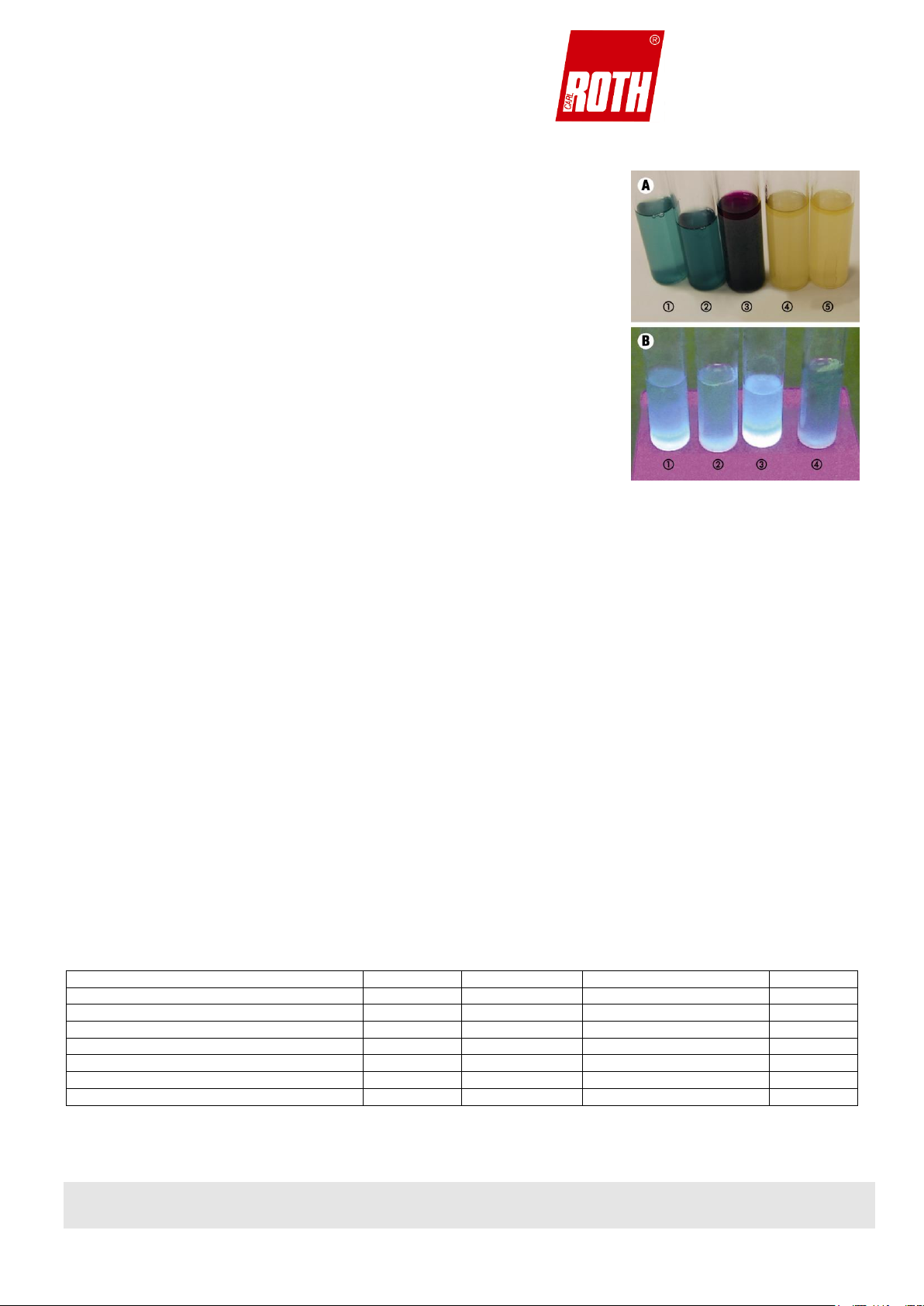
Folglich zeigt der Farbwechsel die Gegenwart von Coliformen (Abb A. 1, 2), während die blaue Fluoreszenz unter UV-Licht die
schnelle Detektion von E. coli ermöglicht (Abb. B 1,3). Zur Validierung der Gegenwart von E. coli wurde Tryptophan in die
Formulierung eingearbeitet, das nach Zusatz von Kovac-Reagenz eine Indolreaktion hervorruft. Bei Gegenwart von E.coli im
Medium wird durch Spaltung von Tryptophan Indol erzeugt, das mit 4-di-Methylaminobenzaldehyd reagiert und eine dunkelrote
Farbe ergibt (Abb. A 3).
Coliforme Bakterien sind Gram-negative, stäbchenförmige Bakterien, die keine taxonomische Gruppe darstellen, sondern durch
die Eigenschaft charakterisiert sind, aus Lactose unter Säure und Gasbildung Energie gewinnen zu können. Sie kommen vor
allem im Darm von Warmblütern vor, können allerdings auch einige Zeit außerhalb der natürlichen Umgebung überleben und sind
damit bestens geeignet zur Untersuchung von Wasserproben auf fäkale Verunreinigungen. Allerdings leben einige coliforme
Bakterien auch im Boden und in Oberflächenwassern, so dass eine entsprechende Verunreinigung von Wasserproben auch auf
andere Fehler in der Wasseraufbereitung zurückzuführen sein kann.
MIKROBIOLOGISCHE TESTS
Die folgenden Ergebnisse wurden erzielt nach Inkub. von Referenzstämmen bei einer Temperatur von 35 ± 2 °C für 18-24 Std.
Microorganismus
Wachstum
Mediumfarbe
Fluoreszenz (365 nm)
Indol
Escherichia coli ATCC 25922 (Fig. A and B)
gut
blau - grünlich
+
+
Escherichia coli ATCC 8739
gut
blau – grünlich
+
+
Enterobacter aerogenes ATCC 13048
gut
blau – grünlich
-
-
Klebsiella pneumoniae ATCC 8090
gut
blau – grünlich
-
-
Citrobacter freundii ATCC 8090 (Fig. B)
gut
blau - grünlich
-
Shigella flexnerii ATCC 12022
gut
kein Wechsel
-
Salmonella typhimurium ATCC 14028
gut
kein Wechsel
-
Nach: Manafi, M., Kneifel, F.A. Bascon, S (1991) Microbiol. Rev. 55; 335-348. Ossmer, R. (1993) Simultaneous Detection of Total Coliforms and
E. coli-Fluorocult LMX-Broth. - 15th international Symposium/FOOD MICRO 1993. The Interntional Committee on Food Microbiology and
Hygiene, Bingen/Rhine.
COLI FLUORO-MEDIUM 100 g 2923.2
500 g 2923.1
Produkt-Datenblatt
Page 2
2
COLI FLUORO BROTH
Enrichment medium for the simultaneous and easy detection
of Coliforms and E. coli in water and foods and dairy products
2923
Approximate formula in g/l:
Tryptose ................................................................................. 5.0
Sodium chloride ..................................................................... 5.0
Dipotassium phosphate ......................................................... 2.7
Potassium phosphate ............................................................ 2.0
Sodium pyruvate .................................................................... 1.0
Sorbitol ................................................................................... 1.0
Tryptophan ............................................................................ 1.0
Sodium laurly sulphate .......................................................... 0.1
Chromogenes/Fluorogenes ................................................. 0.23
Final pH ................................................................... 6.8 ± 0.2
PREPARATION
Suspend 17 g of the medium in 1 l distilled water. Solubilise under heating with frequent agitation and boil for approx. 1 min.
Sterilize at 121 ºC for 15 minutes. Let slightly cool and pour into suitable vials. Store in the dark at approx. 6 °C.
USES
Coli Fluoro Broth is used for simultaneous detection of coliform bacteria and E. coli in food and water samples and in diary
products. The interaction of ingredients in the medium, such as peptone, sorbitol, etc., grants a quick bacterial growth, including
infectious Coliforms. Coli Fluoro Broth contains a Phosphate buffer to ensure the high growth of the total number of Coliforms.
Lauryl sulphate inhibits Gram-positive bacteria.
Inoculate and incubate at 35 ± 2°C during 18-24 hours. Once incubation is completed, the broth is analyzed for pigment formation,
the combination of chromogenic compounds providing a double indicator system: a) Coliforms and E.coli contain β-galactosidase
which cleaves the chromogenic substrate, staing the broth greenish-blue. b) An enzyme highly specific to E.coli cleaves MUG,
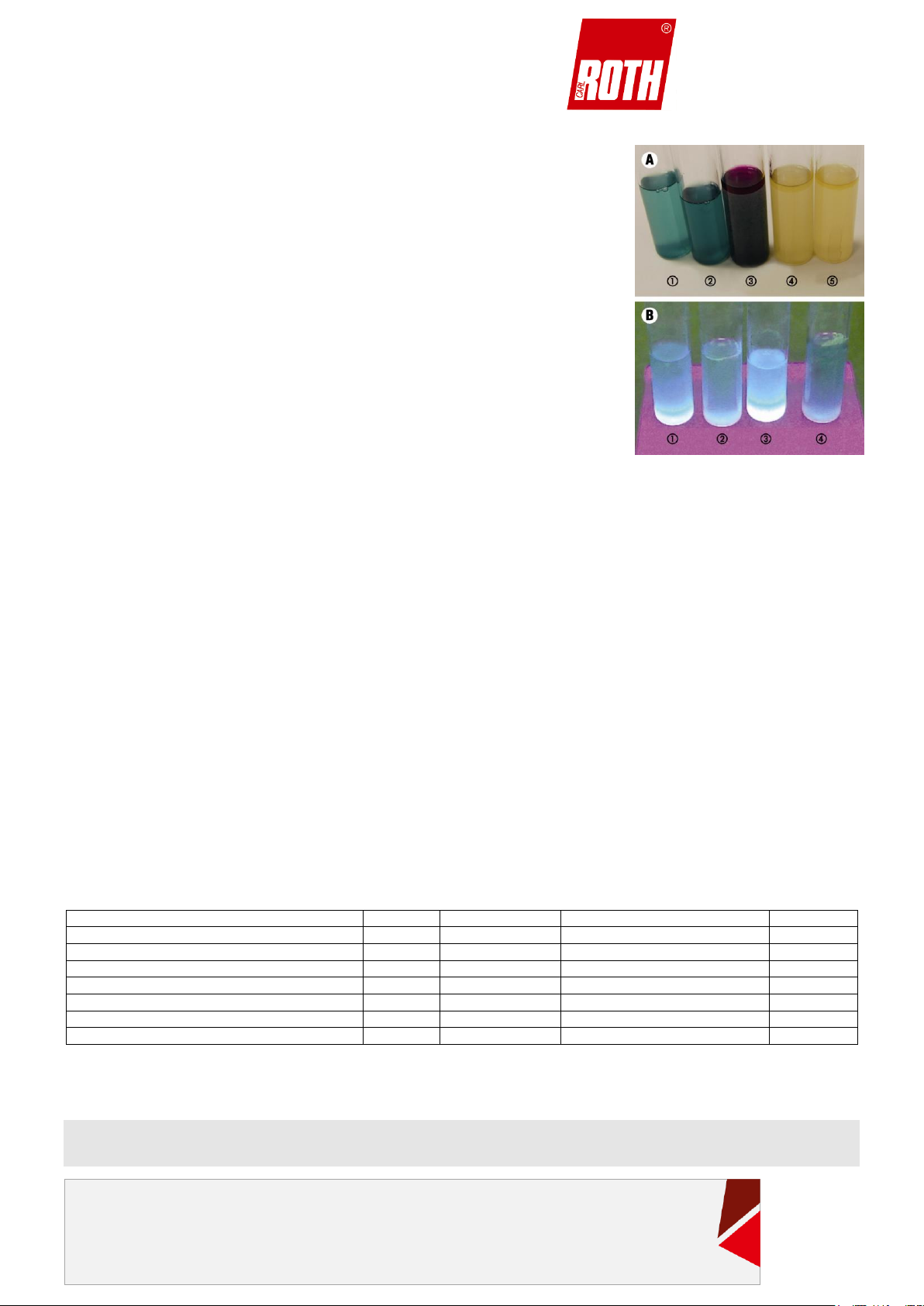
resulting in a blue fluorescence under excitation with 366 nm wavelength. Thus, the colour change indicates the presence of
Coliforms (Fig. A 1, 2), while blue fluorescence under UV light allows the rapid detection of E.coli (Fig. B 1,3). For validation of the
presence of E. coli, tryptophane has been included that promotes the indol reaction after adding Kovac’s reagent. When E.coli is
present in the medium, indol is liberated through tryptophane cleavage and reacts with 4-dimethylaminobenzaldehyde to form a
dark red dye (Fig. A 3).
Coliform bacteria are Gram-negative, bacillary bacteria which do not represent a taxonomic group, but are characterized for being
able to produce energy from lactose under acid and aerosis. They are prevalent particularly in the intestines of warm-blooded
animals. They can, however, survive for a time outside their natural environment and are therefore extremely suitable for
analyzing water samples for faecal contamination. However, some types of coliform bacteria do in fact live in the soil and in
surface waters with the result that the respective contamination of the water samples may be ascribed to other errors during
treatment of water.
MICROBIOLOGICAL TEST
The following results were obtained from type cultures after incubation at a temp. of 35 ± 2 °C and observed after 18-24 hours.
Microorganisms
Growth
Medium Colour
Fluorescence (365 nm)
Indol
Escherichia coli ATCC 25922 (Fig. A and B)
Good
Blue-greenish
+
+
Escherichia coli ATCC 8739
Good
Blue-greenish
+
+
Enterobacter aerogenes ATCC 13048
Good
Blue-greenish
-
-
Klebsiella pneumoniae ATCC 8090
Good
Blue-greenish
-
-
Citrobacter freundii ATCC 8090 (Fig. B)
Good
Blue-greenish
-
Shigella flexnerii ATCC 12022
Good
Without change
-
Salmonella typhimurium ATCC 14028
Good
Without change
-
Acc. to: Manafi, M., Kneifel, F.A. Bascon, S (1991) Microbiol. Rev. 55; 335-348. Ossmer, R. (1993) Simultaneous Detection of Total Coliforms and
E. coli-Fluorocult LMX-Broth. - 15th international Symposium/FOOD MICRO 1993. The Interntional Committee on Food Microbiology and
Hygiene, Bingen/Rhine.
COLI FLUORO BROTH 100 g 2923.2
500 g 2923.1
Carl Roth GmbH + Co. KG
Schoemperlenstraße 3-5 • 76185 Karlsruhe • P.O. Box 100121 • 76231 Karlsruhe
Phone: +49 (0) 721/ 5606-0 • Fax: +49 (0) 721/ 5606-149 • [email protected] • www.carlroth.com
The company is a limited partnership with headquarters in Karlsruhe, reg. court Mannheim HRA 100055. Roth Chemie GmbH, with h eadquarters in Karlsruhe,
reg. court Mannheim HRB 100428, is the personally liable partner. Managing Director: André Houdelet. Sales tax identification number: DE 143621073. sse 06/2021
Product Data Sheet
 Loading...