

Page 1
CLED-Agar (Cystein-Lactose-Electrolyt Defizienter Agar)
Zur Kultivierung, Differenzierung und Zählung von allen gram-positiven und gram-negativen
Harnwegsbakterien. Inhibierend für das Ausschwärmen von Proteus.
2835
Zusammensetzung in g/l (angenähert):
Caseinpepton........................................................................ 4,0
Gelatinepepton ..................................................................... 4,0
Rindfleischextrakt ............................................................. 3,0
Lactose............................................................................ 10,0
L-Cystein ....................................................................... 0,128
Bromthymolblau .............................................................. 0,02
Agar .................................................................................... 15,0
pH-Wert .................................................................... 7,3 ± 0,2
HERSTELLUNG
36 g des Mediums werden in einem Liter destillierten Wasser suspendiert. Man lasse die Mischung für 10 – 15 min.
stehen und mische dann gut. Unter häufigem Rühren/Schütteln wird das Medium erhitzt bis es vollständig gelöst ist.
Eine Minute lang kochen lassen. Man sterilisiere 15 Minuten lang bei 121 °C und gieße in Petrischalen. Farbe: grün
EINSATZGEBIET
CLED-Agar ist ein nicht-selektives, differenzierendes Agarmedium zur Kultivierung und Zählung von Mikroorganismen der
Harnwege. Das Ausschwärmen von Proteus wird durch das Weglassen von Natriumchlorid verhindert. Zusätzlich
unterstützt dieser Umstand das Wachstum, die Differenzierung und die hierdurch mögliche Identifikation einer großen
Vielzahl von Bakterien, die Harnwegsinfektionen verursachen. Nach Säureproduktion durch Lactosefermentation durch
z.B. E.coli oder Staphylococcus färbt der pH-Indikator Bromphenolblau den Agar gelb. Die Inokulation des Mediums erfolgt
durch die Verdünnungsmethode oder durch Ausstreichen des Harns mittels einer kalibrierten Impföse. Die Kolonien werden
nach einer Inkubation von max. 24 Stunden bei 35 ± 2 °C ausgezählt; die mikrobielle Belastung des Harns wird
angegeben in Kolonien pro ml. (Eine Inkubation für mehr als 24 Stunden kann durch die Säureproduktion von stark
vertretenen Lactose-fermentierenden Bakterien in einer vollständigen Pinkfärbung des Agars resultieren, die nichtLactose-fermentierende Spezies maskiert.) Eine Belastung von 105 Kol. / ml wird als signifikante, klinische Infektion der
Harnwege angesehen.
Harnwegsinfektionen-verursachende Mikroorganismen sind in der Regel in großem Überfluss und nur in einer
vorherrschenden Spezies im Urin vorhanden. In den meisten Fällen handelt es sich bei der infektionsauslösenden Spezies
um E. coli.
MIKROBIOLOGISCHE TESTS
Die folgenden Ergebnisse wurden erzielt nach Inkubation von Referenzstämmen im angegebenen Medium / Agar bei
einer Temperatur von 35 ± 2 °C für 24 - 48 Stunden.
Koloniefarben im Allgemeinen:
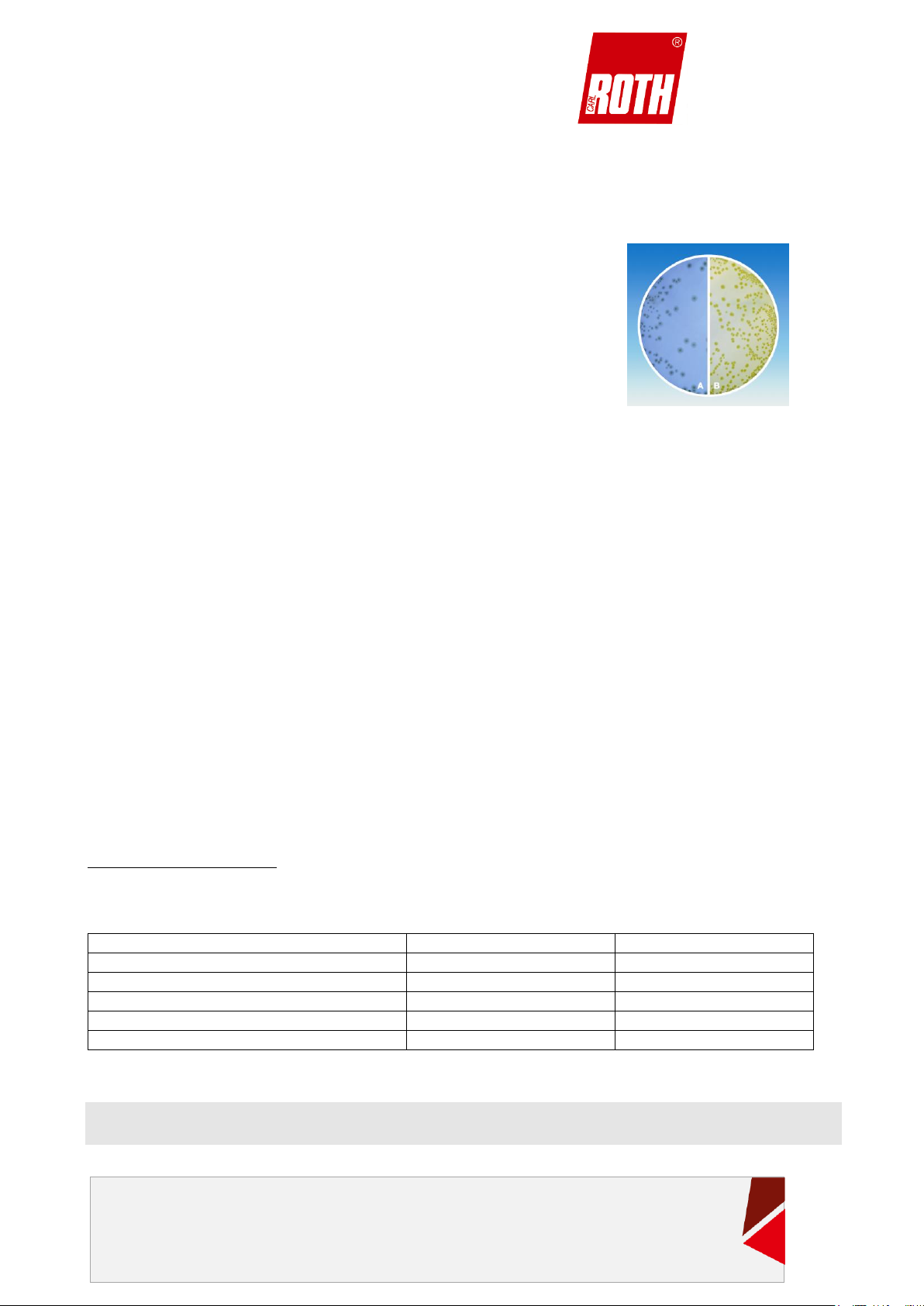
Staphylococcus aureus: Dunkles Gelb, Ø 0,75 mm. Agar gelb gefärbt.
Proteus vulgaris: Durchscheinend, blau, klein. Agar unverändert.
Echerichia coli: Groß, helles Gelb, opak. Zentrum kräftiges Gelb*. Agar gelb gefärbt.
Mikroorganismen
Wachstum
Kolonienfarbe
Enterobacter aerogenes ATCC 13048
Gut
Helles Gelb-Blau
Escherichia coli ATCC 25922
Gut
Gelb*
Proteus vulgaris ATCC 29905
Gut (kein Schwärmen)
Blau bis Blaugrün
Staphylococcus aureus ATCC 25923
Gut
Gelb
Streptococcus faecalis ATCC 19433
Gut
Hellgelb
*Bitte beachten: Nicht-Lactose-fermentierende Stämme können blaue Kolonien zeigen.
CLED-Agar 500 g 2835.1
1 kg 2835.2
Escherichia coli
ATCC 25922
Proteus vulgaris
ATCC 29905
Produkt-Datenblatt
Carl Roth GmbH + Co. KG
Schoemperlenstraße 3-5 • 76185 Karlsruhe • Postfach 100121 • 76231 Karlsruhe
Telefon: +49 (0) 721/ 5606-0 • Fax: +49 (0) 721/ 5606-149 • [email protected] • www.carlroth.de
Die Firma ist eine Kommanditgesellschaft mit Sitz in Karlsruhe, Reg. Gericht Mannheim HRA 100055. Persönlich haftende Gesellschafterin ist die Roth Chemie GmbH
mit Sitz in Karlsruhe, Reg. Gericht Mannheim HRB 100428. Geschäftsführer: André Houdelet sse 06/2021
Page 2
CLED Agar (Cysteine Lactose Electrolyte Deficient Agar)
For cultivation, differentiation and enumeration of gram-positive and gram-negative bacteria
from the urinary tract. Inhibits swarming of Proteus.
2835
Approximate formula in g/l:
Casein peptone..................................................................... 4.0
Gelatine peptone .................................................................. 4.0
Beef extract ...................................................................... 3.0
Lactose............................................................................ 10.0
L-Cysteine ..................................................................... 0.128
Bromothymol blue ........................................................... 0.02
Agar .................................................................................... 15.0
Final pH .................................................................. 7.3 ± 0.2
PREPARATION
Suspend 36 g of the medium in one liter of distilled or deionised water. Soak for 10 – 15 mins. and mix well.
Heat with frequent agitation until complete dissolution. Boil for one minute and sterilize at 121 ºC for 15 minutes.
Pour intro Petri dishes. Colour: green
USES
CLED agar is a non selective, differential plating medium for the growth and enumeration of microorganisms of the urinary
tract. Swarming of Proteus is inhibited by omitting sodium chloride. Additionally, this enhances the growth of the great
majority of bacteria causing urinary tract infections, supporting their differentiation and, subsequently, identification. Due to
acid production based on lactose fermentation by e.g. E. coli or Staphylococcus, the pH indicator bromophenol blue stains
the agar yellow. Inoculation of the medium can be performed by dilution method or by streaking the agar surface with a
calibrated loop. Colonies are counted after max. 24 hours incubation at 35 ± 2 °C and microbial count is reported as
colonies per ml urine. (Incubation for longer than 24 hours may result in a pink staining of the whole medium due to acid
formation caused by lactose-fermenters, masking non-lactose fermenting species.) A count of 105 col. / ml is referred to
as a significant clinical infection of the urinary tract.
Microorganisms causing infection of the urinary tract are generally abundant of one species only.
Most frequently, E. coli is identified as the major component of these infections.
MICROBIOLOGICAL TEST
The following results were obtained in the performance of the given medium from type cultures after incubation at a
temperature of 35 ± 2 °C and observed after 24 - 48 hours.
Colony colours in general:
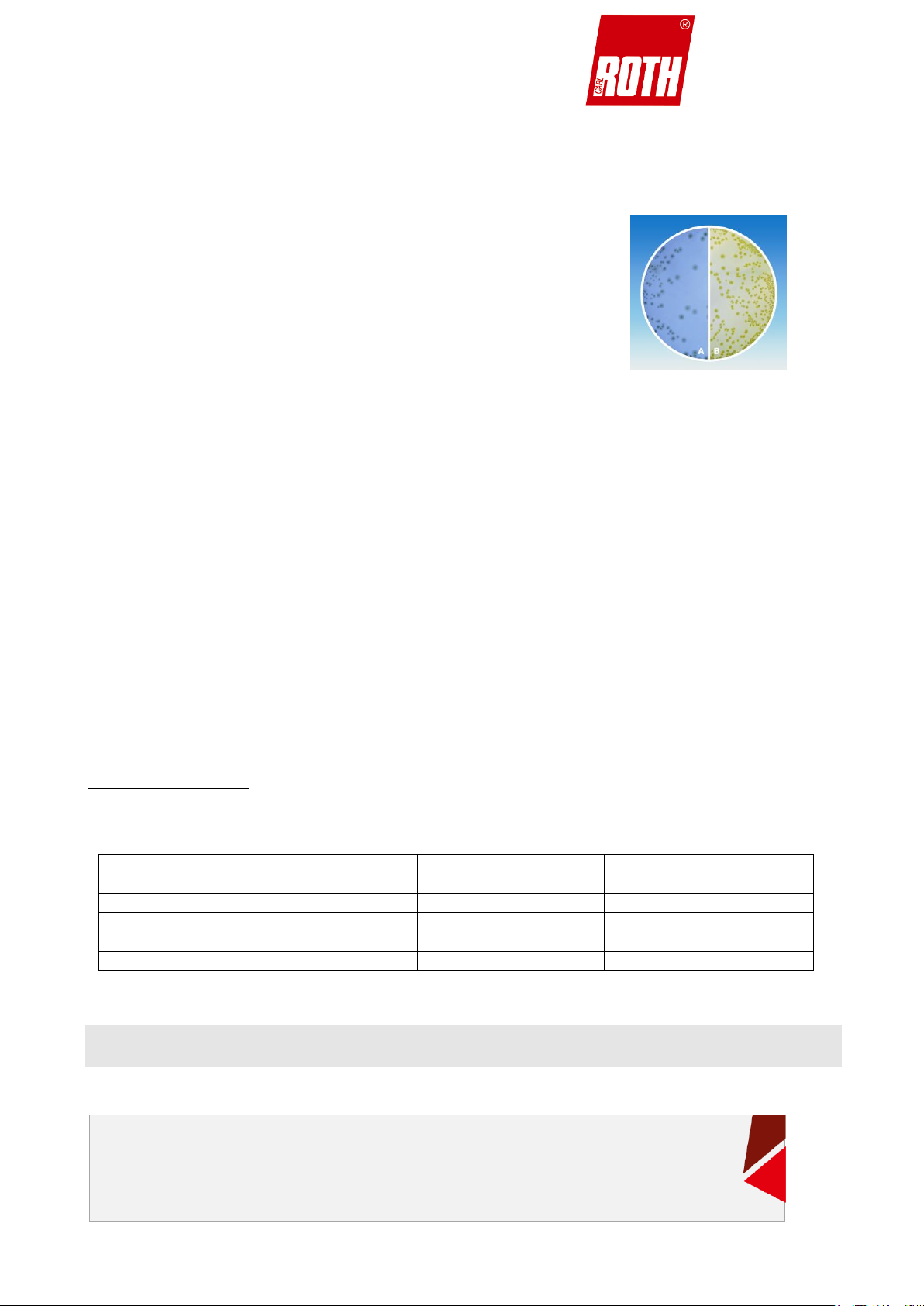
Staphylococcus aureus: Deep yellow, Ø 0.75 mm. Yellow agar.
Proteus vulgaris: Translucent, blue, small. Agar unchanged.
Echerichia coli: large, elevated yellow, opaque, centre more intense yellow*. Yellow agar.
Microorganisms (test strains)
Growth
Colony Colour
Enterobacter aerogenes ATCC 13048
Good
light yellow-blue
Escherichia coli ATCC 25922
Good
yellow*
Proteus vulgaris ATCC 29905
Good (no swarming)
blue to blue green
Staphylococcus aureus ATCC 25923
Good
yellow
Streptococcus faecalis ATCC 19433
Good
light yellow
*Note: Non lactose fermenting strains may show blue to violet colonies.
CLED-Agar 500 g 2835.1
1 kg 2835.2
Escherichia coli
ATCC 25922
Proteus vulgaris
ATCC 29905
Carl Roth GmbH + Co. KG
Schoemperlenstraße 3-5 • 76185 Karlsruhe • P.O. Box 100121 • 76231 Karlsruhe
Phone: +49 (0) 721/ 5606-0 • Fax: +49 (0) 721/ 5606-149 • [email protected] • www.carlroth.com
The company is a limited partnership with headquarters in Karlsruhe, reg. court Mannheim HRA 100055. Roth Chemie GmbH, with h eadquarters in Karlsruhe,
reg. court Mannheim HRB 100428, is the personally liable partner. Managing Director: André Houdelet. Sales tax identification number: DE 143621073. sse 06/2021
Product Data Sheet
 Loading...