

Page 1
Product Data Sheet
00813-0100-4148, Rev GB
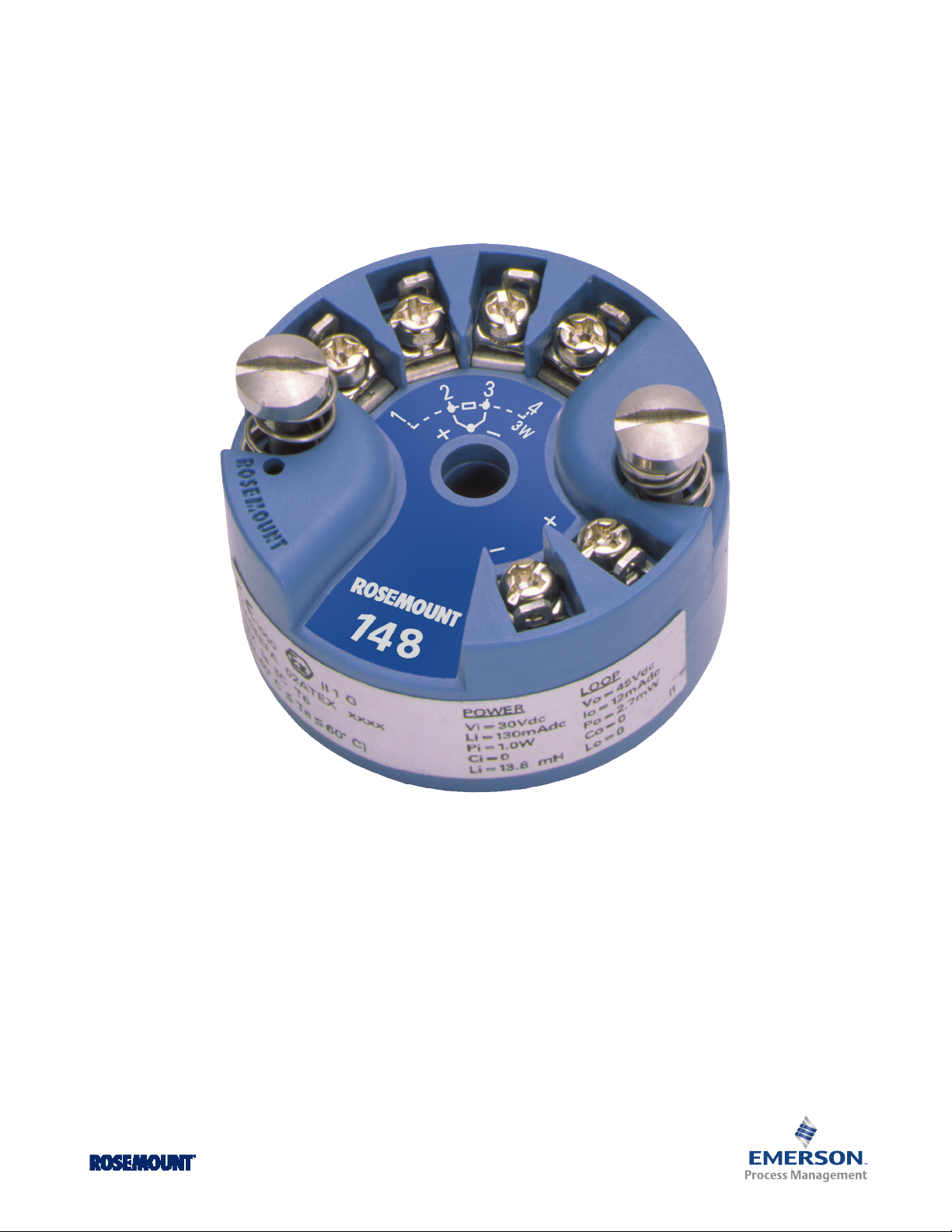
Rosemount 148 Temperature Transmitter
January 2015
Basic temperature transmitter offers a cost-effective solution for temperature monitoring points.
Standard transmitter design provides flexible and reliable performance in process environments.
Experience lower overall installation costs when compared to wiring sensor directly, reducing the need for
expensive extension wires and multiplexers.
PC-based HART
®
configuration interface delivers a programmer, cables, and the software needed for
transmitter configuration.
Explore the benefits of a complete point solution from Rosemount Temperature.
Page 2
Rosemount 148
January 2015
Rosemount 148 Temperature Transmitter
Basic temperature transmitter offers a cost-effective solution for temperature monitoring points
DIN B style head mount transmitter
Variety of DIN B enclosure options
4-20 mA analog protocol
Single sensor capability with universal sensor inputs (RTD, T/C, ohms)
PC-based configuration
Standard transmitter design provides flexible and reliable performance in process environments
Offers improved measurement accuracy and reliability over direct-wiring a sensor to the digital control system for a lower overall
installation cost
One-year stability rating reduces maintenance costs
PC-based configuration interface delivers a programmer, cables, and the software needed for transmitter configuration
Compensation for ambient temperature enhances transmitter performance
Explore the benefits of a complete point solution from Rosemount Temperature Measurement
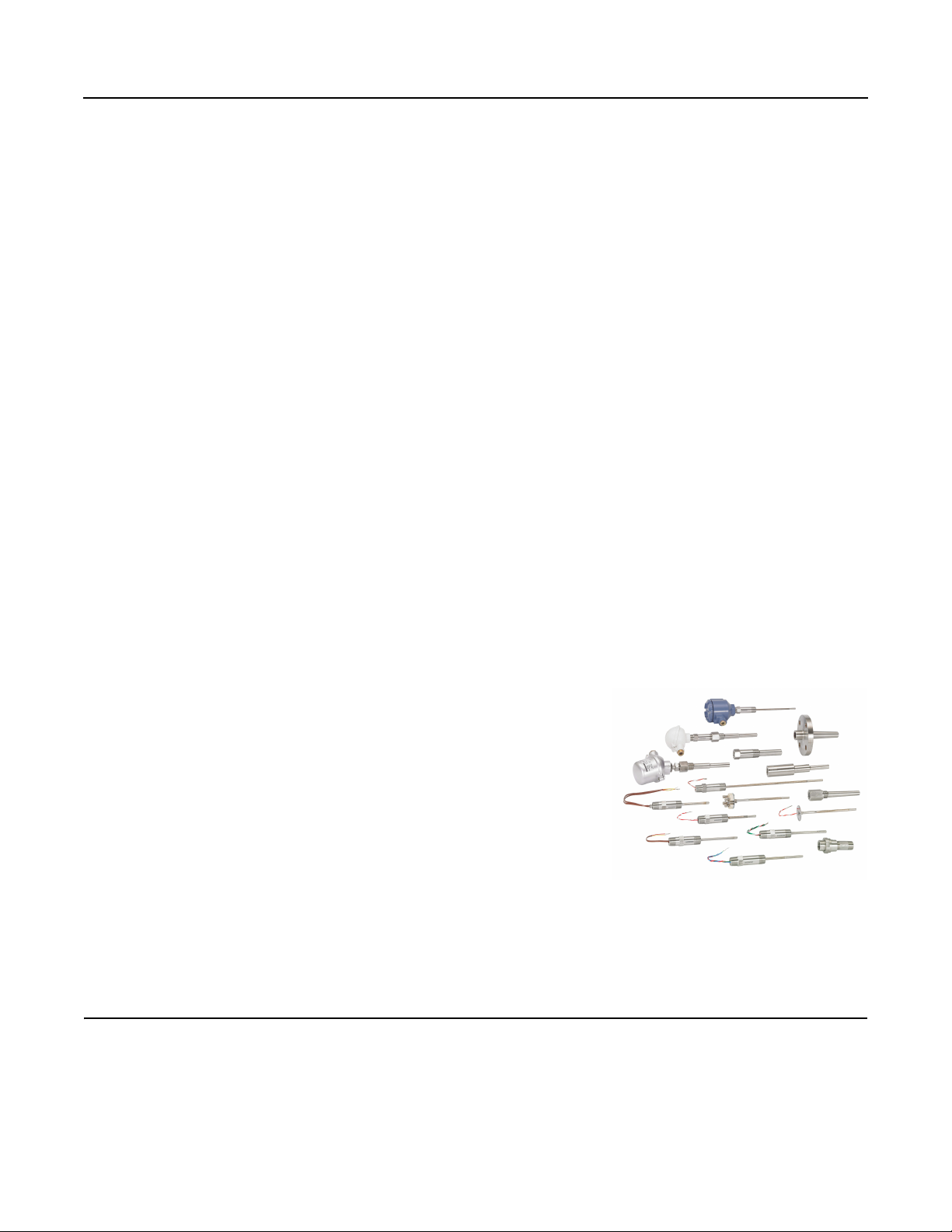
An “Assemble To Sensor” option enables Emerson to provide a complete point
temperature solution, delivering an installation-ready transmitter and sensor
assembly.
Emerson offers a selection of RTDs, thermocouples, and thermowells that bring
superior durability and Rosemount reliability to temperature sensing,
complementing the Rosemount Transmitter portfolio.
Contents
Ordering Information . . . . . . . . . . . . . . . . . . . . . . . . . . . . . . . 4
Rosemount 148 Configuration Interface Specifications . . . . . 6
Transmitter Specifications . . . . . . . . . . . . . . . . . . . . . . . . . . . . 7
2
Dimensional Drawings . . . . . . . . . . . . . . . . . . . . . . . . . . . . . . 10
Product Certifications . . . . . . . . . . . . . . . . . . . . . . . . . . . . . . 11
www.rosemount.com
Page 3

January 2015
Rosemount 148
Experience global consistency and local support from numerous worldwide Rosemount Temperature manufacturing sites
World-class manufacturing provides globally consistent
product from every factory and the capacity to fulfill the
needs of any project, large or small.
Experienced Instrumentation Consultants help select the
right product for any temperature application and advise on
best installation practices.
An extensive global network of Emerson service and support
personnel can be on-site when and where needed.
Looking to measure more temperature points in a cost effective way? Consider a wireless temperature
solution. The Rosemount 148 Wireless Temperature Transmitter is solid performing, yet economical.
For temperature installations that require reliable measurement and can benefit from HART functionality,
the Rosemount 148 Temperature Transmitter is a cost-effective solution.
www.rosemount.com
3
Page 4
Rosemount 148
January 2015
Ordering Information
The Rosemount 148 Temperature Transmitter has a standard transmitter design that
provides reliable performance in process environments.
Transmitter features include:
4-20 mA Analog Output
Variety of DIN B enclosure options
3-Point Calibration Certificate (Option Code Q4)
Assemble to Sensor option (Option Code XA)
Specification and selection of product materials, options, or components must be made by the purchaser of the equipment.
See page 8 for more information on Material Selection.
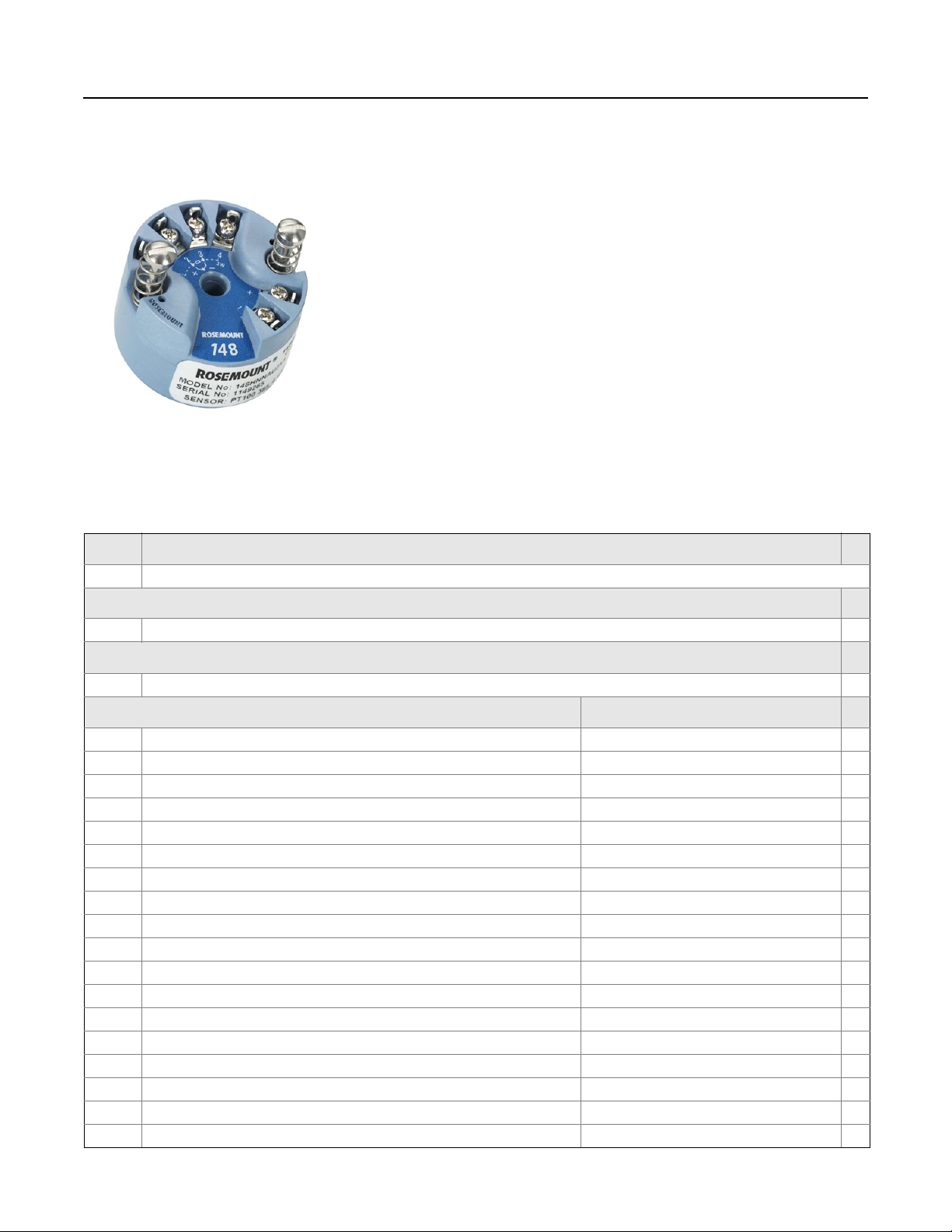
Table 1. Rosemount 148 PC-Programmable Temperature Transmitter Ordering Information
★ The Standard offering represents the most common options. The starred options (★) should be selected for best delivery.
__The Expanded offering is subject to additional delivery lead time.
Model Product description
148 PC Programmable Temperature Transmitter
Transmitter t ype
H DIN B Head Mount ★
Transmitter output
NAnalog Output ★
Product certifications Enclosure option codes permitted
I5 FM Intrinsic Safety and Class 1, Division 2 A, B, U, G, H, N ★
(1)
E5
K5
I6 CSA Intrinsic Safety and Class 1, Division 2 A, B, U, G, H, N ★
K6
I1 ATEX Intrinsic Safety All enclosures ★
E1
N1
NC ATEX Type n Component without enclosure N ★
ND
I7 IECEx Intrinsic Safety All enclosures ★
E7
N7
NG IECEx Type n without enclosure N ★
KM Technical Regulations Customs Union (EAC) Flameproof, Intrinsic Safety A, U, G, H ★
IM Technical Regulations Customs Union (EAC) Intrinsic Safety All enclosures ★
EM Technical Regulations Customs Union (EAC) Flameproof A, U, G, H ★
NA No approvals All enclosures ★
FM Explosion-Proof A, U, G, H ★
(1)
FM Intrinsic Safety, Explosion-Proof, and Class 1, Division 2 A, U, G, H ★
(1)
CSA Intrinsic Safety, Explosion-Proof, and Class 1, Division 2 A, U, G, H ★
(1)
ATEX Flameproof A, U, G, H ★
(1)
ATEX Type n with enclosure A, U, G, H ★
(1)
ATE X Dust A, U, G, H ★
(1)
IECEx Flameproof and Dust A, U, G, H ★
(1)
IECEx Type n with enclosure A, U, G, H ★
4
www.rosemount.com
Page 5
January 2015
Rosemount 148
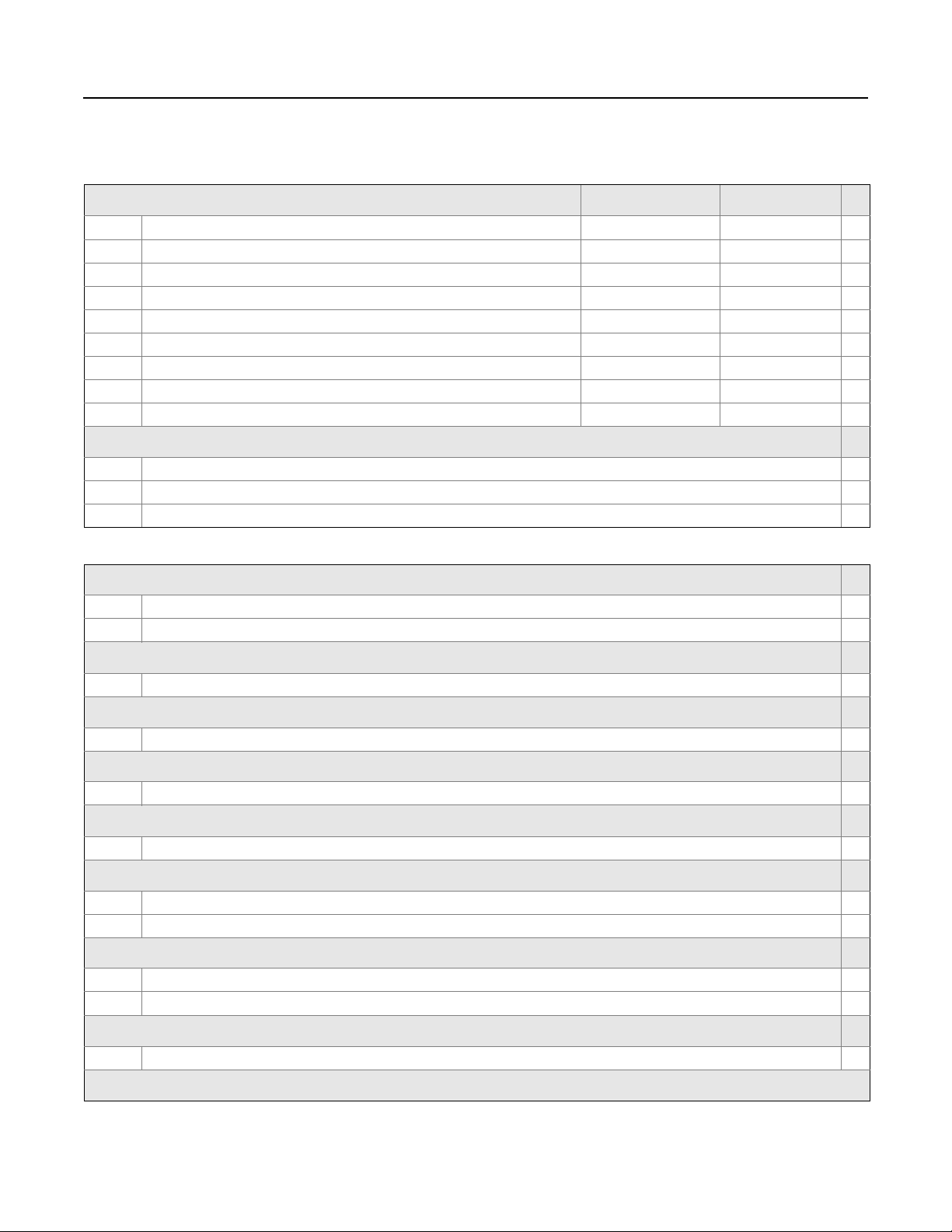
Table 1. Rosemount 148 PC-Programmable Temperature Transmitter Ordering Information
★ The Standard offering represents the most common options. The starred options (★) should be selected for best delivery.
__The Expanded offering is subject to additional delivery lead time.
Enclosure options Material IP rating
A Connection Head Aluminum IP68 ★
U Universal Head (Junction Box) Aluminum IP68 ★
B BUZ Head Aluminum IP65 ★
C BUZ Head Polypropylene IP65 ★
N No Enclosure N/A N/A ★
G Connection Head SST IP68
H Universal Head (Junction Box) SST IP68
S Sanitary Connection Head, DIN B Polished SST IP66
F Sanitary Connection Head, DIN A Polished SST IP66/IP68
Conduit entry size
1 M20 ⫻ 1.5 (CM20) ★
2
0 No Enclosure ★
1
/2-14 in. NPT ★
Options (include with selected model number)
Alarm level configuration
A1 NAMUR alarm and saturation levels, high alarm ★
CN NAMUR alarm and saturation levels, low alarm ★
Calibration certificate
Q4 Calibration Certificate (3-point Calibration) ★
Line filter
F6 60 Hz Line Voltage Filter ★
External ground option (available w/enclosures U, H)
G1 External Ground Lug Assembly ★
Cover chain option (available w/enclosures U, H)
G3 Cover Chain ★
Cable gland option
G2 Cable Gland–Explosion Proof–7.5 mm - 11.9 mm ★
G4 Cable Gland–Explosion Proof, Thin Wire - 3.0 mm - 8.0 mm ★
Conduit electrical connector
GE M12, 4-pin, Male Connector (eurofast®) ★
GM A size Mini, 4-pin, Male Connector (minifast®) ★
Assemble to options
XA Sensor Specified Separately and Assembled to Transmitter ★
Typical model number: 148 H N I5 U1 A1 XA
(1) Approval Codes E1, N1, N7, ND, E5, K5, K6, and E7 require an enclosure.
www.rosemount.com
5
Page 6

Rosemount 148
January 2015
Rosemount 148 Configuration Interface Specifications
Configuration software
(1)
The Rosemount 148 PC-based configuration software for the
Rosemount 148 allows comprehensive configuration of the
transmitters. Used in conjunction with various Rosemount or
user-supplied hardware modems, the software provides the
tools necessary to configure the 148 Transmitters including the
following parameters:
Process Variable
Sensor Type
Number of Wires
Engineering Units
Transmitter Tag Information
Damping
Alarming Parameters
Configuration hardware
The 148 Configuration Interface has 3 hardware options as
follows:
Software only
USB HART modem and software
(Part #: 00148-1601-0003)
USB (Universal Serial Bus) HART modem
Customer must provide separate loop power supply and
resistor.
Requires PC with USB port
Suitable for use with powered loops
Figure 1. Rosemount 148 Transmitter Accessories
A
B
C
A. Mounting Hardware
B. Transmitter
C. Rail Clip
(Part #: 00148-1601-0002)
Customer must provide appropriate communications
hardware (modem, power supply, etc.).
Serial HART modem and software
(Part #: 00148-1601-0004)
Serial HART modem
Customer must provide separate loop power supply and
resistor.
Requires PC serial port
Suitable for use with powered loops
(1) The Rosemount configuration soft ware is compatible with Microsoft®
6
™
Windows
ble with Windows NT and Windows 2000.
XP, Windows 7 32-bit and Windows 7 64-bit. It is not compati-
Table 2. Rosemount 148 Transmitter Accessories
External Ground Screw Assembly Kit 00644-4431-0001
Kit, Hardware for Mounting a 148 to a
DIN Rail (see left picture-top hat rail,
00248-1601-0001
symmetric)
Snap Rings Kit (used for assembly to DIN
Plate Style sensor)
00644-4432-0001
www.rosemount.com
Page 7

January 2015
Transmitter Specifications
Rosemount 148
Functional specifications
Inputs
User-selectable; sensor terminals rates to 42.4 Vdc. See
“Transmitter accuracy and ambient temperature effects” on
page 8 for sensor options.
Output
2-wire 4–20 mA, linear with temperature or input
Isolation
Input/Output isolation tested to 500 Vac rms (707 Vdc) at 50/60
Hz.
Supply voltage DC
Standard: 12 to 35 V
Intrinsic Safety: 12 to 28 V
Minimum voltage across terminals
12 Vdc
Humidity limits
0 - 95% relative humidity, non-condensing
NAMUR recommendations
Turn-on t im e
Performance within specifications is less than 5.0 seconds after
power is applied to the transmitter, when damping value is set
to zero seconds.
Update rate
Less than 0.5 seconds
Damping
32 seconds maximum, 5 seconds default.
Recommended minimum measuring span
18 °F (10 °C)
Software detected failure mode
The values at which the transmitter drives its output in failure
mode depends on device configuration. The device can be
configured to meet NAMUR-compliant (NAMUR
recommendation NE 43) operation. The values for standard and
NAMUR-compliant operation are as follows:
Table 3. Operation Parameters
Standard
(1)
NAMUR
NE43-Compliant
(1)
The 148 meets the following NAMUR recommendations:
NE 21 - Electromagnetic compatibility (EMC) for Process and
Laboratory Apparatus
NE 43 - Standard of the signal level breakdown information of
digital transmitters
Transient protection
The optional Rosemount 470 Transient Protector prevents
damage from transients induced by lightning, welding, heavy
electrical equipment, or switch gears. Refer to the 470 Product
Data Sheet (document number 00813-0100-4191) for more
information.
Temperature limits
Operating Limit
-40 to 185 °F (-40 to 85 °C)
Storage Limit
-58 to 248 °F (-50 to 120 °C)
Linear
Output:
Fail High: 21 ≤ I ≤ 23 (default) 21 ≤ I ≤ 23 (default)
Fail Low: I ≤ 3.75 I ≤ 3.6
(1) Measured in milliamperes.
Certain hardware failures, such as microprocessor failures, will
always drive the output to greater than 23 mA.
3.9 ≤ I ≤ 20.5 3.8 ≤ I ≤ 20.5
www.rosemount.com
7
Page 8

Rosemount 148
1234234 12 34 1234
1
2-wire
RTD and ⍀
3-wire RTD
and ⍀
(1)
4-wire RTD
and ⍀
T/C
January 2015
Performance specifications
Material selection
Emerson provides a variety of Rosemount product with various
product options and configurations including materials of
construction that can be expected to perform well in a wide
range of applications. The Rosemount product information
presented is intended as a guide for the purchaser to make an
appropriate selection for the application. It is the purchaser’s
sole responsibility to make a careful analysis of all process
parameters (such as all chemical components, temperature,
pressure, flow rate, abrasives, contaminants, etc.), when
specifying product, materials, options and components for the
particular application. Emerson Process Management is not in a
position to evaluate or guarantee the compatibility of the
process fluid or other process parameters with the product,
options, configuration or materials of construction selected.
EMC (Electromagnetic Compatibility) NAMUR
NE21 standard
The 148 meets the requirements for NAMUR NE21 Rating.
Susceptibility Parameter Influence
ESD
Radiated 80 – 1000 MHz at 10 V/m AM None
6 kV contact discharge
8 kV air discharge
None
CE mark
The 148 meets all of the requirements listed under IEC 61326:
Amendment 1, 2006.
Power supply effect
Less than ±0.0055 of span per volt
Vibration effect
The 148 is tested to the following specifications with no effect
on performance:
Frequency Vibration
10 to 60 Hz 0.21 mm displacement
60 to 2000 Hz 3 g peak acceleration
Stability
For RTD and thermocouple inputs, the transmitter will have a
stability of ±0.15% of reading or 0.15 °C (whichever is greater)
for twelve months.
Sensor connections
Figure 2. 148 Sensor Connections Diagram
Burst 1 kV for I.O. None
Surge
Conducted 150 kHz to 80 MHz at 10 V None
0.5 kV line–line
1 kV line–ground (I.O. tool)
None
(1) Rosemount Inc. provides 4-wire sensors for all single element RTDs. You
can use these RTDs in 3-wire configurations by leaving the unneeded leads
disconnected and insulated with electrical tape.
Transmitter accuracy and ambient temperature effects
Note
The accuracy and ambient temperature effect is the greater of the fixed and percent of span values (see example
below).
Table 4. 148 Transmitter Input Options, Accuracy, and Ambient Temperature Effects
Temperature effects per 1.0 °C
(1.8 °F) change in ambient
temperature
(2)(3)
Sensor
2-, 3-, 4-wire RTDs
(4)
Pt 100
Pt 100
Ni 120
Cu 10
(a = 0.00385) –200 to 850 –328 to 1562 0.3 °C (0.54 °F) ±0.15 0.009 °C (0.016 °F) ±0.006
(5)
(a = 0.003916) –200 to 645 –328 to 1193 0.3 °C (0.54 °F) ±0.15 0.009 °C (0.016 °F) ±0.006
(6)
(7)
Transmitter input ranges
(1)
Accuracy
°C °F Fixed % of span Fixed % of span
–70 to 300 –94 to 572 0.2 °C (0.36 °F) ±0.15 0.006 °C (0.011 °F) ±0.006
–50 to 250 –58 to 482 3 °C (5.40 °F) ±0.15 0.09 °C (0.16 °F) ±0.006
8
www.rosemount.com
Page 9

January 2015
0.320.09
2
+0.31° C=
Table 4. 148 Transmitter Input Options, Accuracy, and Ambient Temperature Effects
Rosemount 148
Temperature effects per 1.0 °C
(1.8 °F) change in ambient
temperature
(2)(3)
Sensor
Thermocouples
(9)(10)
Type B
(9)
Type J
(11)
(9)
Type K
(9)
Type N
(9)
Type R
(9)
Type S
Transmitter input ranges
(8)
(1)
Accuracy
100 to 1820 212 to 3308 2.3 °C (4.05 °F) ±0.15 0.084 °C (0.150 °F) ±0.006
–180 to 760 –292 to 1400 0.8 °C (1.35 °F) ±0.15 0.03 °C (0.054 °F) ±0.006
–180 to 1372 –292 to 2502 0.8 °C (1.35 °F) ±0.15 0.03 °C (0.054 °F) ±0.006
–200 to 1300 –328 to 2372 1.2 °C (2.16 °F) ±0.15 0.03 °C (0.054 °F) ±0.006
0 to 1768 32 to 3214 1.8 °C (3.24 °F) ±0.15 0.09 °C (0.16 °F) ±0.006
0 to 1768 32 to 3214 1.5 °C (2.70 °F) ±0.15 0.09 °C (0.16 °F) ±0.006
2-, 3-, 4-wire Ohm Input 0 to 2000 ohms 1.1 ohm ±0.15 0.042 ohm ±0.009
(1) Input ranges are for transmitter only. Actual sensor (RTD or Thermocouple) operating ranges may be more limited.
(2) Change in ambient is with reference to the calibration temperature of the transmitter at 68 °F (20 °C) from factory.
(3) Ambient temperature effect specification valid over minimum temperature span of 28°C (50°F)
(4) IEC 751, 1995.
(5) JIS 1604, 1981.
(6) Edison Cur ve No. 7.
(7) Edison Copper Winding No. 15.
(8) Total accu racy for ther mocouple measu rement: sum of accuracy +0. 5 °C.
(9) NIST Monograph 175, IEC 584.
(10) Fixed accuracy for NIST Type B is ±5.4 °F (±3.0 °C) from 212 to 572 °F (100 to 300 °C).
(11) Fixed accuracy for NIST Type K is ±1.3 °F (±0.7 °C) from -292 to -130 °F (-130 to -90 °C).
Transmitter accuracy example
When using a Pt 100 (a = 0.00385) sensor input with a 0 to 100 °C span, use the greater of the two calculated values. In this case, the
accuracy would be +/-0.3 °C.
Transmitter temperature effects example
Transmitters can be installed in locations where the ambient temperature is between –40 and 85 °C (–40 and 185 °F). In order to
maintain excellent accuracy performance, each transmitter is individually characterized over this ambient temperature range at the
factory.
When using a Pt 100 (a = 0.00385) sensor input with a 0–100 °C span at 30 °C ambient temperature:
Temperature Effects: 0.009 °C x (30 - 20) = 0.09 °C
Total transmitter error
Worst Case Transmitter Error: Accuracy + Temperature Effects = 0.3 °C + 0.09 °C = 0.39 °C
Total Probable Transmitter Error:
www.rosemount.com
9
Page 10

Rosemount 148
44 (1.7)
33 (1.3)
12.9 (0.51)
24.5 (0.97)
50 (1.97)
Dimensional Drawings
Figure 3. Rosemount 148 Temperature Transmitter
Top view Side view
DIN Rail mounting kit
January 2015
Dimensions are in millimeters (inches).
10
www.rosemount.com
Page 11

January 2015
Product Certifications
Rosemount 148
Approved Manufacturing Locations
Rosemount Inc. - Chanhassen, Minnesota, USA
Rosemount Temperature GmbH - Germany
Emerson Process Management Asia Pacific - Singapore
European Directive Information
A copy of the EC Declaration of Conformity can be found at the
end of the Quick Start Guide. The most recent revision of the EC
Declaration of Conformity can be found at
www.rosemount.com.
Ordinary Location Certification from FM Approvals
As standard, the transmitter has been examined and tested to
determine that the design meets the basic electrical,
mechanical, and fire protection requirements by FM Approvals,
a nationally recognized test laboratory (NRTL) as accredited by
the Federal Occupational Safety and Health Administration
(OSHA).
North America
E5 FM Explosionproof, Dust-Ignitionproof, and Nonincendive
Certificate: 3032198
Standards: FM Class 3600:1998, FM Class 3611:2004,
FM Class 3615:1989, FM Class 3810:2005,
IEC 60529: 2001, NEMA - 250: 1991
Markings: XP CL I, DIV 1, GP B, C, D; DIP CL II/III, DIV 1,
GP E, F, G; NI CL I, DIV 2, GP A, B, C, D;
≤ T
T5(-50 °C
Rosemount drawing 00148-1065; Type 4X;
IP66/68
I5 FM Intrinsic Safety and Nonincendive
Certificate: 3032198
Standards: FM Class 3600:1998, FM Class 3610:1999,
FM Class 3611:2004, FM Class 3810:2005,
IEC 60529: 2001, NEMA - 250: 1991
Markings: IS CL I/II/III, DIV 1, GP A, B, C, D, E, F, G; NI CL1,
DIV 2, GP A, B, C, D; T6(-50 °C
T5(-50 °C
Rosemount drawing 00148-1055; Type 4X;
IP66/68
≤ +85 °C); when installed per
a
≤ T
≤ T
≤ +75 °C) when installed per
a
a
≤ +40 °C),
Special Conditions for Safe Use (X):
1. When no enclosure option is selected, the Model 148
Temperature Transmitter shall be installed in an enclosure
meeting the requirements of ANSI/ISA S82.01 and S82.03
or other applicable ordinary location standards.
2. No enclosure or Buz Head option cannot be selected to
maintain a Type 4X rating.
3. Enclosure option must be selected to maintain a Type 4
Rating.
I6 CSA Intrinsic Safety and Division 2
Certificate: 1091070
Standards: CAN/CSA C22.2 No. 0-M90, CSA Std. C22.2 No.
25-1966, CAN/CSA C22.2 No. 94-M91,
CAN/CSA C22.2 No. 157-92, CSA C22.2 No.
213-M1987, C22.2 No 60529-05
Markings: IS CL I, DIV 1 GP A, B, C, D when installed per
Rosemount drawing 00248-1056; Suitable for
CL I DIV 2 GP A, B, C, D when installed per
Rosemount drawing 00248-1055;
≤ T
T6(-50 °C
T5(-50 °C ≤ Ta ≤ +60 °C); Type 4X, IP66/68 for
enclosure options “A”, “G”, “H”, “U”; Seal not
required (See drawing 00248-1066)
K6 CSA Explosionproof, Intrinsic Safety, and Division 2
Certificate: 1091070
Standards: CAN/CSA C22.2 No. 0-M90, CSA Std. C22.2 No.
25-1966, CSA Std. C22.2 No. 30-M1986,
CAN/CSA C22.2 No. 94-M91, CSA Std. C22.2
No.142-M1987, CAN/CSA C22.2 No. 157-92,
CSA C22.2 No. 213-M1987, C22.2 No
60529-05
Markings: XP CL I/II/III, DIV 1, GP B, C, D, E, F, G when
installed per Rosemount drawing 00248-1066;
IS CL I, DIV 1 GP A, B, C, D when installed per
Rosemount drawing 00248-1056; Suitable for
CL I DIV 2 GP A, B, C, D when installed per
Rosemount drawing 00248-1055;
T6(-50 °C
T5(-50 °C
enclosure options “A”, “G”, “H”, “U”; Seal not
required (See drawing 00248-1066)
≤ +40 °C),
a
≤ T
≤ +40 °C),
a
≤ T
≤ +60 °C); Type 4X, IP66/68 for
a
www.rosemount.com
11
Page 12

Rosemount 148
January 2015
Europe
E1 ATE X Flam eproof
Certificate: FM12ATEX0065X
Standards: EN 60079-0: 2012, EN 60079-1: 2007, EN
60529:1991 +A1:2000
Markings: II 2 G Ex d IIC T6…T1 Gb,
≤ T
T6(-50 °C
T5…T1(-50 °C ≤ Ta ≤ +60 °C);
See Table 5 at the end of the Product Certifications section
for Process Temperatures
Special Conditions for Safe Use (X):
1. See certificate for ambient temperature range.
2. The non-metallic label may store an electrostatic charge
and become a source of ignition in Group III environments.
3. Guard the LCD display cover against impact energies
greater than 4 joules.
4. Consult the manufacturer if dimensional information on
the flameproof joints is necessary.
I1 ATEX Intrinsic Safety
Certificate: Baseefa08ATEX0030X
Standards: EN 60079-0: 2012, EN 60079-11: 2012
Markings: II 1 G Ex ia IIC T5/T6 Ga,
T5(-60 °C ≤ Ta ≤ + 80 °C),
T6(-60 °C ≤ Ta ≤ + 60 °C);
See Table 6 at the end of the Product Certifications section
for Entity Parameters
Special Condition for Safe Use (X):
1. The apparatus must be installed in an enclosure which
affords it a degree of protection of at least IP20.
Non-metallic enclosures must have a surface resistance of
less than 1GΩ; light allow or zirconium enclosures must be
protected from impact and friction when installed.
N1 ATEX Type n - with enclosure
Certificate: BAS00ATEX3145
Standards: EN 60079-0:2012, EN 60079-15:2010
Markings: II 3 G Ex nA IIC T5 Gc (-40 °C
NC ATEX Type n - without enclosure
Certificate: Baseefa13ATEX0092X
Standards: EN 60079-0:2012, EN 60079-15:2010
Markings: II 3 G Ex nA IIC T5/T6 Gc,
T5(-60 °C
T6(-60 °C
Special Condition for Safe Use (X):
1. The Model 148 Temperature Transmitter must be installed
in a suitably certified enclosure such that it is afforded a
degree of protection of at least IP54 in accordance with IEC
60529 and EN 60079-15.
≤ +40 °C),
a
≤ T
≤ + 80 °C),
a
≤ T
≤ + 60 °C);
a
≤ T
≤ + 70 °C);
a
ND ATE X Dust
Certificate: FM12ATEX0065X
Standards: EN 60079-0: 2012, EN 60079-31: 2009, EN
60529:1991 +A1:2000
Markings: II 2 D Ex tb IIIC T130 °C Db,
≤ T
(-40 °C
See Table 5 at the end of the Product Certifications section
for Process Temperatures
Special Conditions for Safe Use (X):
1. See certificate for ambient temperature range.
2. The non-metallic label may store an electrostatic charge
and become a source of ignition in Group III environments.
3. Guard the LCD display cover against impact energies
greater than 4 joules.
4. Consult the manufacturer if dimensional information on
the flameproof joints is necessary.
≤ + 70 °C); IP66
a
Technical Regulations Customs Union (EAC)
KM, IM, EM Contact an Emerson Process Management
representative for additional information.
International
E7 IECEx Flameproof and Dust
Certificate: IECEx FMG 12.0022X
Standards: IEC 60079-0:2011, IEC 60079-1:2007-04, IEC
60079-31:2008
≤ T
Markings: Ex d IIC T6…T1 Gb, T6(-50 °C
T5…T1(-50 °C ≤ Ta ≤ + 60 °C); Ex tb IIIC T130 °C
Db, (-40 °C ≤ Ta ≤ +70 °C); IP66;
See Table 5 at the end of the Product Certifications section
for Process Temperatures
Special Conditions for Safe Use (X):
1. See certificate for ambient temperature range.
2. The non-metallic label may store an electrostatic charge
and become a source of ignition in Group III environments.
3. Guard the LCD display cover against impact energies
greater than 4 joules.
4. Consult the manufacturer if dimensional information on
the flameproof joints is necessary.
≤ +40 °C),
a
12
www.rosemount.com
Page 13

January 2015
Rosemount 148
I7 IECEx Intrinsic Safety
Certificate: IECEx BAS 08.0011X
Standards: IEC 60079-0:2011, IEC 60079-11:2011
≤ T
≤ T
≤ +70 °C)
a
≤ + 80 °C),
a
Markings: Ex ia IIC T5/T6 Ga, T5(-60 °C
T6(-60 °C ≤ Ta ≤ + 60 °C);
See Table Table 6 at the end of the Product Certifications
section for Entity Parameters
Special Condition for Safe Use (X):
1. The apparatus must be installed in an enclosure which
affords it a degree of protection of at least IP20.
Non-metallic enclosures must have a surface resistance of
less than 1GΩ; light allow or zirconium enclosures must be
protected from impact and friction when installed.
N7 IECEx Type n - with enclosure
Certificate: IECEx BAS 07.0055
Standards: IEC 60079-0:2011, IEC 60079-15:2010
Markings: Ex nA IIC T5 Gc; T5(-40 °C
Additional Specification Tables
Table 5. Process Temperatures
Temperature
class
Ambient
tem p era tu re
Process temperature w/o LCD display cover (°C)
No ext. 3-in. 6-in. 9-in.
NG IECEx Type n - without enclosure
Certificate: IECEx BAS 13.0052X
Standards: IEC 60079-0:2011, IEC 60079-15:2010
Markings: Ex nA IIC T5/T6 Gc; T5(-60 °C
T6(-60 °C ≤ Ta ≤ + 60 °C)
Special Condition for Safe Use (X):
1. The Model 148 Temperature Transmitter must be installed
in a suitably certified enclosure such that it is afforded a
degree of protection of at least IP54 in accordance with IEC
60529 and IEC 60079-15.
≤ T
≤ + 80 °C),
a
Combinations
K5 Combination of E5 and I5
T6 -50 °C to + 40 °C 55 55 60 65
T5 -50 °C to + 60 °C 70 70 70 75
T4 -50 °C to + 60 °C 100 110 120 130
T3 -50 °C to + 60 °C 170 190 200 200
T2 -50 °C to + 60 °C 280 300 300 300
T1 -50 °C to + 60 °C 440 450 450 450
Table 6. Entity Parameters
HART loop terminals + and - Sensor terminals 1 to 4
Voltage U
Current I
Power P
Capacitance C
Inductance L
i
i
i
i
i
30 V 45 V
130 mA 26 mA
1 W 290 mW
3.6 nF 2.1 nF
0 mH 0 μH
www.rosemount.com
13
Page 14

Rosemount 148
00813-0100-4148, Rev GB
Rosemount World Headquarters
Emerson Process Management
6021 Innovation Blvd
Shakopee, MN 55379, USA
+1 800 999 9307 or +1 952 906 8888
+1 952 949 7001
RFQ.RMD-RCC@EmersonProcess.com
North America Regional Office
Emerson Process Management
8200 Market Blvd.
Chanhassen, MN 55317, USA
+1 800 999 9307 or +1 952 906 8888
+1 952 949 7001
RMT-NA.RCCRFQ@emerson.com
Latin America Regional Office
Emerson Process Management
1300 Concord Terrace, Suite 400
Sunrise, Florida, 33323, USA
+1 954 846 5030
+1 954 846 5121
RFQ.RMD-RCC@EmersonProcess.com
Product Data Sheet
January 2015
Europe Regional Office
Emerson Process Management Europe GmbH
Neuhofstrasse 19a P.O. Box 1046
CH 6340 Baar
Switzerland
+41 41 768 6111
+41 (0) 41 768 6300
RFQ.RMD-RCC@EmersonProcess.com
Asia Pacific Regional Office
Emerson Process Management Asia Pacific Pte Ltd
1 Pandan Crescent
Singapore 128461
+65 6777 8211
+65 6777 0947
Enquiries@AP.EmersonProcess.com
Middle East and Africa Regional Office
Emerson Process Management
Emerson FZE P.O. Box 17033,
Jebel Ali Free Zone - South 2
Dubai, United Arab Emirates
+971 4 8118100
+971 4 8865465
RFQ.RMTMEA@Emerson.com
Standard Terms and Conditions of Sale can be found at:
www.rosemount.com\terms_of_sale.
The Emerson logo is a trademark and service mark of Emerson Electric Co.
Rosemount and Rosemount logotype are registered trademarks of Rosemount Inc.
HART is a registered trademark of the HART Communication Foundation.
eurofast and minifast are registered trademarks of TURCK.
Microsoft is a registered trademark of Microsoft Corporation in the United States
and other countries.
Windows is a trademark of Microsoft Corp oration in the United States and other
countries.
All other marks are the property of their respective owners.
© 2015 Rosemount Inc. All rights reserved.
 Loading...