

Page 1

®
R&S
RT-ZZ80
Transmission Line Probe
User Manual
(>9Úç2)
1409.7689.02 ─ 02
User Manual
Test & Measurement
Page 2

This User Manual describes the following R&S®RT-ZZ models and options:
●
R&S®RT-ZZ80 (1409.7608.02)
© 2014 Rohde & Schwarz GmbH & Co. KG
Mühldorfstr. 15, 81671 München, Germany
Phone: +49 89 41 29 - 0
Fax: +49 89 41 29 12 164
E-mail: [email protected]
Internet: www.rohde-schwarz.com
Subject to change – Data without tolerance limits is not binding.
R&S® is a registered trademark of Rohde & Schwarz GmbH & Co. KG.
Trade names are trademarks of the owners.
The following abbreviations are used in this manual: R&S®RT-ZZ80 is abbreviated as R&S RT-ZZ80.
R&S®RTO is abbreviated as R&S RTO.
Page 3

Basic Safety Instructions
Always read through and comply with the following safety instructions!
All plants and locations of the Rohde & Schwarz group of companies make every
effort to keep the safety standards of our products up to date and to offer our
customers the highest possible degree of safety. Our products and the auxiliary
equipment they require are designed, built and tested in accordance with the
safety standards that apply in each case. Compliance with these standards is
continuously monitored by our quality assurance system. The product described
here has been designed, built and tested in accordance with the EC Certificate of
Conformity and has left the manufacturer’s plant in a condition fully complying
with safety standards. To maintain this condition and to ensure safe operation,
you must observe all instructions and warnings provided in this manual. If you
have any questions regarding these safety instructions, the Rohde & Schwarz
group of companies will be happy to answer them.
Furthermore, it is your responsibility to use the product in an appropriate manner.
This product is designed for use solely in industrial and laboratory environments
or, if expressly permitted, also in the field and must not be used in any way that
may cause personal injury or property damage. You are responsible if the product
is used for any purpose other than its designated purpose or in disregard of the
manufacturer's instructions. The manufacturer shall assume no responsibility for
such use of the product.
The product is used for its designated purpose if it is used in accordance with its
product documentation and within its performance limits (see data sheet,
documentation, the following safety instructions). Using the product requires
technical skills and, in some cases, a basic knowledge of English. It is therefore
essential that only skilled and specialized staff or thoroughly trained personnel
with the required skills be allowed to use the product. If personal safety gear is
required for using Rohde & Schwarz products, this will be indicated at the
appropriate place in the product documentation. Keep the basic safety
instructions and the product documentation in a safe place and pass them on to
the subsequent users.
Observing the safety instructions will help prevent personal injury or damage of
any kind caused by dangerous situations. Therefore, carefully read through and
adhere to the following safety instructions before and when using the product. It is
also absolutely essential to observe the additional safety instructions on personal
safety, for example, that appear in relevant parts of the product documentation. In
these safety instructions, the word "product" refers to all merchandise sold and
distributed by the Rohde & Schwarz group of companies, including instruments,
1171.0000.52 - 07 Page 1
Page 4

Basic Safety Instructions
systems and all accessories. For product-specific information, see the data sheet
and the product documentation.
Safety labels on products
The following safety labels are used on products to warn against risks and
dangers.
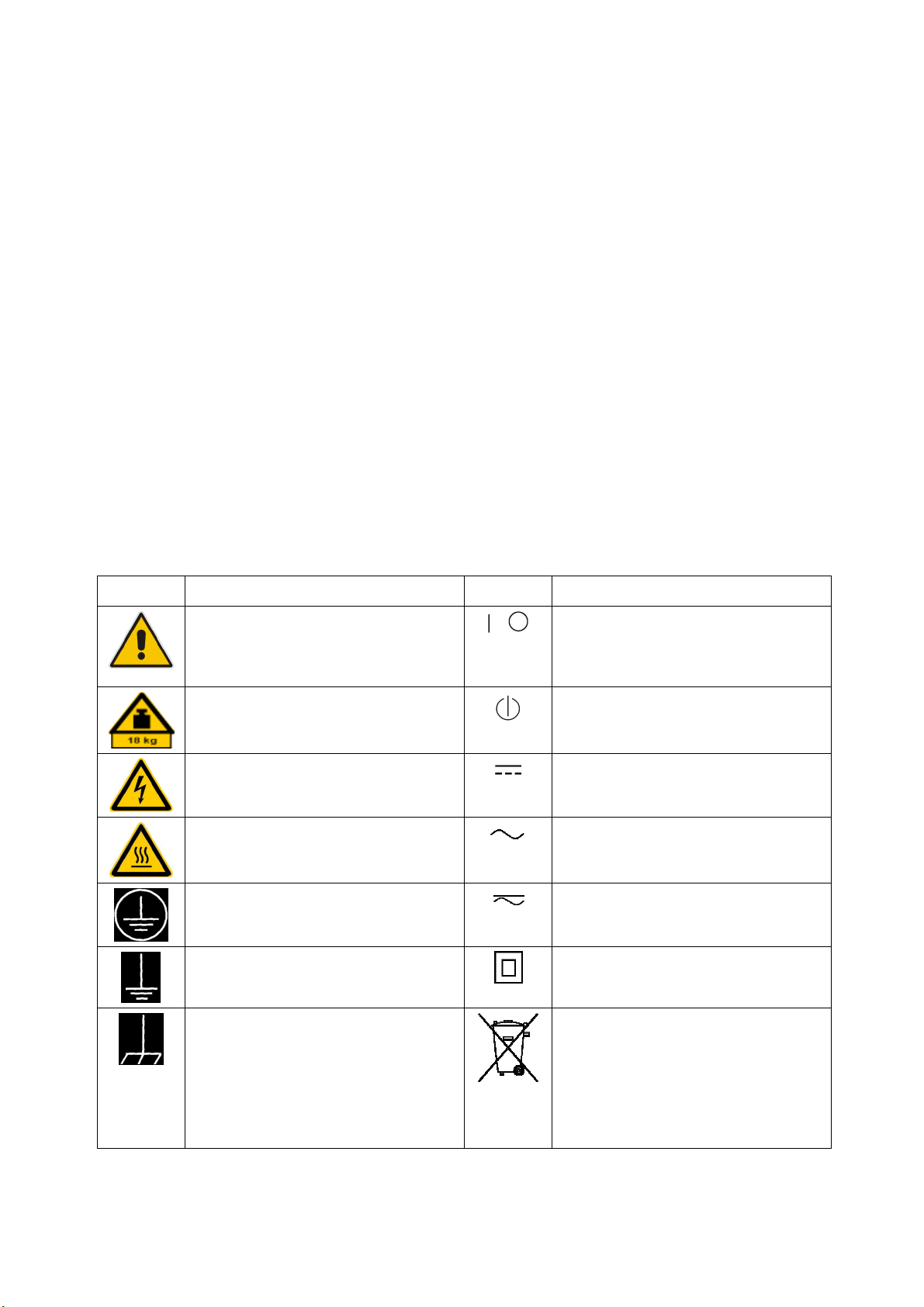
Symbol Meaning Symbol Meaning
Notice, general danger location
Observe product documentation
Caution when handling heavy
equipment
Danger of electric shock Direct current (DC)
Warning! Hot surface Alternating current (AC)
Protective conductor terminal Direct/alternating current (DC/AC)
Ground
Ground terminal
ON/OFF supply voltage
Standby indication
Device fully protected by double
(reinforced) insulation
EU labeling for batteries and
accumulators
For additional information, see
section "Waste
disposal/Environmental
protection", item 1.
Be careful when handling
electrostatic sensitive devices
Warning! Laser radiation
For additional information, see
section "Operation", item 7.
EU labeling for separate collection
of electrical and electronic devices
For additonal information, see
section "Waste
disposal/Environmental
protection", item 2.
1171.0000.52 - 07 Page 2
Page 5

Basic Safety Instructions
Signal words and their meaning
The following signal words are used in the product documentation in order to
warn the reader about risks and dangers.
Indicates a hazardous situation which, if not avoided, will
result in death or serious injury.
Indicates a hazardous situation which, if not avoided, could
result in death or serious injury.
Indicates a hazardous situation which, if not avoided, could
result in minor or moderate injury.
Indicates information considered important, but not hazardrelated, e.g. messages relating to property damage.
In the product documentation, the word ATTENTION is
used synonymously.
These signal words are in accordance with the standard definition for civil
applications in the European Economic Area. Definitions that deviate from the
standard definition may also exist in other economic areas or military applications.
It is therefore essential to make sure that the signal words described here are
always used only in connection with the related product documentation and the
related product. The use of signal words in connection with unrelated products or
documentation can result in misinterpretation and in personal injury or material
damage.
Operating states and operating positions
The product may be operated only under the operating conditions and in the
positions specified by the manufacturer, without the product's ventilation being
obstructed. If the manufacturer's specifications are not observed, this can result in
electric shock, fire and/or serious personal injury or death. Applicable local or
national safety regulations and rules for the prevention of accidents must be
observed in all work performed.
1. Unless otherwise specified, the following requirements apply to Rohde &
Schwarz products:
predefined operating position is always with the housing floor facing down, IP
protection 2X, use only indoors, max. operating altitude 2000 m above sea
level, max. transport altitude 4500 m above sea level. A tolerance of ±10 %
shall apply to the nominal voltage and ±5 % to the nominal frequency,
overvoltage category 2, pollution severity 2.
1171.0000.52 - 07 Page 3
Page 6

Basic Safety Instructions
2. Do not place the product on surfaces, vehicles, cabinets or tables that for
reasons of weight or stability are unsuitable for this purpose. Always follow the
manufacturer's installation instructions when installing the product and
fastening it to objects or structures (e.g. walls and shelves). An installation that
is not carried out as described in the product documentation could result in
personal injury or even death.
3. Do not place the product on heat-generating devices such as radiators or fan
heaters. The ambient temperature must not exceed the maximum temperature
specified in the product documentation or in the data sheet. Product
overheating can cause electric shock, fire and/or serious personal injury or
even death.
Electrical safety
If the information on electrical safety is not observed either at all or to the extent
necessary, electric shock, fire and/or serious personal injury or death may occur.
1. Prior to switching on the product, always ensure that the nominal voltage
setting on the product matches the nominal voltage of the AC supply network.
If a different voltage is to be set, the power fuse of the product may have to be
changed accordingly.
2. In the case of products of safety class I with movable power cord and
connector, operation is permitted only on sockets with a protective conductor
contact and protective conductor.
3. Intentionally breaking the protective conductor either in the feed line or in the
product itself is not permitted. Doing so can result in the danger of an electric
shock from the product. If extension cords or connector strips are
implemented, they must be checked on a regular basis to ensure that they are
safe to use.
4. If there is no power switch for disconnecting the product from the AC supply
network, or if the power switch is not suitable for this purpose, use the plug of
the connecting cable to disconnect the product from the AC supply network. In
such cases, always ensure that the power plug is easily reachable and
accessible at all times. For example, if the power plug is the disconnecting
device, the length of the connecting cable must not exceed 3 m. Functional or
electronic switches are not suitable for providing disconnection from the AC
supply network. If products without power switches are integrated into racks or
systems, the disconnecting device must be provided at the system level.
1171.0000.52 - 07 Page 4
Page 7

Basic Safety Instructions
5. Never use the product if the power cable is damaged. Check the power cables
on a regular basis to ensure that they are in proper operating condition. By
taking appropriate safety measures and carefully laying the power cable,
ensure that the cable cannot be damaged and that no one can be hurt by, for
example, tripping over the cable or suffering an electric shock.
6. The product may be operated only from TN/TT supply networks fuse-protected
with max. 16 A (higher fuse only after consulting with the Rohde & Schwarz
group of companies).
7. Do not insert the plug into sockets that are dusty or dirty. Insert the plug firmly
and all the way into the socket provided for this purpose. Otherwise, sparks
that result in fire and/or injuries may occur.
8. Do not overload any sockets, extension cords or connector strips; doing so
can cause fire or electric shocks.
9. For measurements in circuits with voltages V
> 30 V, suitable measures
rms
(e.g. appropriate measuring equipment, fuse protection, current limiting,
electrical separation, insulation) should be taken to avoid any hazards.
10. Ensure that the connections with information technology equipment, e.g. PCs
or other industrial computers, comply with the IEC60950-1/EN60950-1 or
IEC61010-1/EN 61010-1 standards that apply in each case.
11. Unless expressly permitted, never remove the cover or any part of the housing
while the product is in operation. Doing so will expose circuits and
components and can lead to injuries, fire or damage to the product.
12. If a product is to be permanently installed, the connection between the
protective conductor terminal on site and the product's protective conductor
must be made first before any other connection is made. The product may be
installed and connected only by a licensed electrician.
13. For permanently installed equipment without built-in fuses, circuit breakers or
similar protective devices, the supply circuit must be fuse-protected in such a
way that anyone who has access to the product, as well as the product itself,
is adequately protected from injury or damage.
14. Use suitable overvoltage protection to ensure that no overvoltage (such as
that caused by a bolt of lightning) can reach the product. Otherwise, the
person operating the product will be exposed to the danger of an electric
shock.
15. Any object that is not designed to be placed in the openings of the housing
must not be used for this purpose. Doing so can cause short circuits inside the
product and/or electric shocks, fire or injuries.
1171.0000.52 - 07 Page 5
Page 8

Basic Safety Instructions
16. Unless specified otherwise, products are not liquid-proof (see also section
"Operating states and operating positions", item 1). Therefore, the equipment
must be protected against penetration by liquids. If the necessary precautions
are not taken, the user may suffer electric shock or the product itself may be
damaged, which can also lead to personal injury.
17. Never use the product under conditions in which condensation has formed or
can form in or on the product, e.g. if the product has been moved from a cold
to a warm environment. Penetration by water increases the risk of electric
shock.
18. Prior to cleaning the product, disconnect it completely from the power supply
(e.g. AC supply network or battery). Use a soft, non-linting cloth to clean the
product. Never use chemical cleaning agents such as alcohol, acetone or
diluents for cellulose lacquers.
Operation
1. Operating the products requires special training and intense concentration.
Make sure that persons who use the products are physically, mentally and
emotionally fit enough to do so; otherwise, injuries or material damage may
occur. It is the responsibility of the employer/operator to select suitable
personnel for operating the products.
2. Before you move or transport the product, read and observe the section titled
"Transport".
3. As with all industrially manufactured goods, the use of substances that induce
an allergic reaction (allergens) such as nickel cannot be generally excluded. If
you develop an allergic reaction (such as a skin rash, frequent sneezing, red
eyes or respiratory difficulties) when using a Rohde & Schwarz product,
consult a physician immediately to determine the cause and to prevent health
problems or stress.
4. Before you start processing the product mechanically and/or thermally, or
before you take it apart, be sure to read and pay special attention to the
section titled "Waste disposal/Environmental protection", item 1.
5. Depending on the function, certain products such as RF radio equipment can
produce an elevated level of electromagnetic radiation. Considering that
unborn babies require increased protection, pregnant women must be
protected by appropriate measures. Persons with pacemakers may also be
exposed to risks from electromagnetic radiation. The employer/operator must
evaluate workplaces where there is a special risk of exposure to radiation and,
if necessary, take measures to avert the potential danger.
1171.0000.52 - 07 Page 6
Page 9

Basic Safety Instructions
6. Should a fire occur, the product may release hazardous substances (gases,
fluids, etc.) that can cause health problems. Therefore, suitable measures
must be taken, e.g. protective masks and protective clothing must be worn.
7. Laser products are given warning labels that are standardized according to
their laser class. Lasers can cause biological harm due to the properties of
their radiation and due to their extremely concentrated electromagnetic power.
If a laser product (e.g. a CD/DVD drive) is integrated into a Rohde & Schwarz
product, absolutely no other settings or functions may be used as described in
the product documentation. The objective is to prevent personal injury (e.g.
due to laser beams).
8. EMC classes (in line with EN 55011/CISPR 11,
55022/CISPR 22, EN 55032/CISPR 32)
Class A equipment:
Equipment suitable for use in all environments except residential
environments and environments that are directly connected to a lowvoltage supply network that supplies residential buildings
Note: Class A equipment is intended for use in an industrial environment.
This equipment may cause radio disturbances in residential environments,
due to possible conducted as well as radiated disturbances. In this case,
the operator may be required to take appropriate measures to eliminate
these disturbances.
Class B equipment:
Equipment suitable for use in residential environments and environments
that are directly connected to a low-voltage supply network that supplies
residential buildings
Repair and service
1. The product may be opened only by authorized, specially trained personnel.
Before any work is performed on the product or before the product is opened,
it must be disconnected from the AC supply network. Otherwise, personnel will
be exposed to the risk of an electric shock.
and analogously with EN
2. Adjustments, replacement of parts, maintenance and repair may be performed
only by electrical experts authorized by Rohde & Schwarz. Only original parts
may be used for replacing parts relevant to safety (e.g. power switches, power
transformers, fuses). A safety test must always be performed after parts
relevant to safety have been replaced (visual inspection, protective conductor
test, insulation resistance measurement, leakage current measurement,
functional test). This helps ensure the continued safety of the product.
1171.0000.52 - 07 Page 7
Page 10

Basic Safety Instructions
Batteries and rechargeable batteries/cells
If the information regarding batteries and rechargeable batteries/cells is not
observed either at all or to the extent necessary, product users may be exposed
to the risk of explosions, fire and/or serious personal injury, and, in some cases,
death. Batteries and rechargeable batteries with alkaline electrolytes (e.g. lithium
cells) must be handled in accordance with the EN 62133 standard.
1. Cells must not be taken apart or crushed.
2. Cells or batteries must not be exposed to heat or fire. Storage in direct sunlight
must be avoided. Keep cells and batteries clean and dry. Clean soiled
connectors using a dry, clean cloth.
3. Cells or batteries must not be short-circuited. Cells or batteries must not be
stored in a box or in a drawer where they can short-circuit each other, or
where they can be short-circuited by other conductive materials. Cells and
batteries must not be removed from their original packaging until they are
ready to be used.
4. Cells and batteries must not be exposed to any mechanical shocks that are
stronger than permitted.
5. If a cell develops a leak, the fluid must not be allowed to come into contact
with the skin or eyes. If contact occurs, wash the affected area with plenty of
water and seek medical aid.
6. Improperly replacing or charging cells or batteries that contain alkaline
electrolytes (e.g. lithium cells) can cause explosions. Replace cells or batteries
only with the matching Rohde & Schwarz type (see parts list) in order to
ensure the safety of the product.
7. Cells and batteries must be recycled and kept separate from residual waste.
Rechargeable batteries and normal batteries that contain lead, mercury or
cadmium are hazardous waste. Observe the national regulations regarding
waste disposal and recycling.
Transport
1. The product may be very heavy. Therefore, the product must be handled with
care. In some cases, the user may require a suitable means of lifting or
moving the product (e.g. with a lift-truck) to avoid back or other physical
injuries.
2. Handles on the products are designed exclusively to enable personnel to
transport the product. It is therefore not permissible to use handles to fasten
the product to or on transport equipment such as cranes, fork lifts, wagons,
1171.0000.52 - 07 Page 8
Page 11

Basic Safety Instructions
etc. The user is responsible for securely fastening the products to or on the
means of transport or lifting. Observe the safety regulations of the
manufacturer of the means of transport or lifting. Noncompliance can result in
personal injury or material damage.
3. If you use the product in a vehicle, it is the sole responsibility of the driver to
drive the vehicle safely and properly. The manufacturer assumes no
responsibility for accidents or collisions. Never use the product in a moving
vehicle if doing so could distract the driver of the vehicle. Adequately secure
the product in the vehicle to prevent injuries or other damage in the event of
an accident.
Waste disposal/Environmental protection
1. Specially marked equipment has a battery or accumulator that must not be
disposed of with unsorted municipal waste, but must be collected separately. It
may only be disposed of at a suitable collection point or via a
Rohde & Schwarz customer service center.
2. Waste electrical and electronic equipment must not be disposed of with
unsorted municipal waste, but must be collected separately.
Rohde & Schwarz GmbH & Co. KG has developed a disposal concept and
takes full responsibility for take-back obligations and disposal obligations for
manufacturers within the EU. Contact your Rohde & Schwarz customer
service center for environmentally responsible disposal of the product.
3. If products or their components are mechanically and/or thermally processed
in a manner that goes beyond their intended use, hazardous substances
(heavy-metal dust such as lead, beryllium, nickel) may be released. For this
reason, the product may only be disassembled by specially trained personnel.
Improper disassembly may be hazardous to your health. National waste
disposal regulations must be observed.
4. If handling the product releases hazardous substances or fuels that must be
disposed of in a special way, e.g. coolants or engine oils that must be
replenished regularly, the safety instructions of the manufacturer of the
hazardous substances or fuels and the applicable regional waste disposal
regulations must be observed. Also observe the relevant safety instructions in
the product documentation. The improper disposal of hazardous substances
or fuels can cause health problems and lead to environmental damage.
For additional information about environmental protection, visit the
Rohde & Schwarz website.
1171.0000.52 - 07 Page 9
Page 12

Instrucciones de seguridad elementales
Instrucciones de seguridad elementales
¡Es imprescindible leer y cumplir las siguientes instrucciones e
informaciones de seguridad!
El principio del grupo de empresas Rohde & Schwarz consiste en tener nuestros
productos siempre al día con los estándares de seguridad y de ofrecer a nuestros
clientes el máximo grado de seguridad. Nuestros productos y todos los equipos
adicionales son siempre fabricados y examinados según las normas de
seguridad vigentes. Nuestro sistema de garantía de calidad controla
constantemente que sean cumplidas estas normas. El presente producto ha sido
fabricado y examinado según el certificado de conformidad de la UE y ha salido
de nuestra planta en estado impecable según los estándares técnicos de
seguridad. Para poder preservar este estado y garantizar un funcionamiento libre
de peligros, el usuario deberá atenerse a todas las indicaciones, informaciones
de seguridad y notas de alerta. El grupo de empresas Rohde & Schwarz está
siempre a su disposición en caso de que tengan preguntas referentes a estas
informaciones de seguridad.
Además queda en la responsabilidad del usuario utilizar el producto en la forma
debida. Este producto está destinado exclusivamente al uso en la industria y el
laboratorio o, si ha sido expresamente autorizado, para aplicaciones de campo y
de ninguna manera deberá ser utilizado de modo que alguna persona/cosa
pueda sufrir daño. El uso del producto fuera de sus fines definidos o sin tener en
cuenta las instrucciones del fabricante queda en la responsabilidad del usuario.
El fabricante no se hace en ninguna forma responsable de consecuencias a
causa del mal uso del producto.
Se parte del uso correcto del producto para los fines definidos si el producto es
utilizado conforme a las indicaciones de la correspondiente documentación del
producto y dentro del margen de rendimiento definido (ver hoja de datos,
documentación, informaciones de seguridad que siguen). El uso del producto
hace necesarios conocimientos técnicos y ciertos conocimientos del idioma
inglés. Por eso se debe tener en cuenta que el producto solo pueda ser operado
por personal especializado o personas instruidas en profundidad con las
capacidades correspondientes. Si fuera necesaria indumentaria de seguridad
para el uso de productos de Rohde & Schwarz, encontraría la información debida
en la documentación del producto en el capítulo correspondiente. Guarde bien
las informaciones de seguridad elementales, así como la documentación del
producto, y entréguelas a usuarios posteriores.
1171.0000.52 - 07 Page 10
Page 13

Instrucciones de seguridad elementales
Tener en cuenta las informaciones de seguridad sirve para evitar en lo posible
lesiones o daños por peligros de toda clase. Por eso es imprescindible leer
detalladamente y comprender por completo las siguientes informaciones de
seguridad antes de usar el producto, y respetarlas durante el uso del producto.
Deberán tenerse en cuenta todas las demás informaciones de seguridad, como
p. ej. las referentes a la protección de personas, que encontrarán en el capítulo
correspondiente de la documentación del producto y que también son de
obligado cumplimiento. En las presentes informaciones de seguridad se recogen
todos los objetos que distribuye el grupo de empresas Rohde & Schwarz bajo la
denominación de "producto", entre ellos también aparatos, instalaciones así
como toda clase de accesorios. Los datos específicos del producto figuran en la
hoja de datos y en la documentación del producto.
Señalización de seguridad de los productos
Las siguientes señales de seguridad se utilizan en los productos para advertir
sobre riesgos y peligros.
Símbolo Significado SímboloSignificado
Aviso: punto de peligro general
Observar la documentación del
producto
Atención en el manejo de
dispositivos de peso elevado
Peligro de choque eléctrico Corriente continua (DC)
Advertencia: superficie caliente Corriente alterna (AC)
Conexión a conductor de
protección
Conexión a tierra
Conexión a masa
Tensión de alimentación de
PUESTA EN MARCHA / PARADA
Indicación de estado de espera
(standby)
Corriente continua / Corriente
alterna (DC/AC)
El aparato está protegido en su
totalidad por un aislamiento doble
(reforzado)
Distintivo de la UE para baterías y
acumuladores
Más información en la sección
"Eliminación/protección del medio
ambiente", punto 1.
1171.0000.52 - 07 Page 11
Page 14

Instrucciones de seguridad elementales
Símbolo Significado SímboloSignificado
Aviso: Cuidado en el manejo de
dispositivos sensibles a la
electrostática (ESD)
Advertencia: rayo láser
Más información en la sección
"Funcionamiento", punto 7.
Distintivo de la UE para la
eliminación por separado de
dispositivos eléctricos y
electrónicos
Más información en la sección
"Eliminación/protección del medio
ambiente", punto 2.
Palabras de señal y su significado
En la documentación del producto se utilizan las siguientes palabras de señal
con el fin de advertir contra riesgos y peligros.
Indica una situación de peligro que, si no se evita,
causa lesiones graves o incluso la muerte.
Indica una situación de peligro que, si no se evita,
puede causar lesiones graves o incluso la muerte.
Indica una situación de peligro que, si no se evita,
puede causar lesiones leves o moderadas.
Indica información que se considera importante, pero
no en relación con situaciones de peligro; p. ej., avisos
sobre posibles daños materiales.
En la documentación del producto se emplea de forma
sinónima el término CUIDADO.
Las palabras de señal corresponden a la definición habitual para aplicaciones
civiles en el área económica europea. Pueden existir definiciones diferentes a
esta definición en otras áreas económicas o en aplicaciones militares. Por eso se
deberá tener en cuenta que las palabras de señal aquí descritas sean utilizadas
siempre solamente en combinación con la correspondiente documentación del
producto y solamente en combinación con el producto correspondiente. La
utilización de las palabras de señal en combinación con productos o
documentaciones que no les correspondan puede llevar a interpretaciones
equivocadas y tener por consecuencia daños en personas u objetos.
1171.0000.52 - 07 Page 12
Page 15

Instrucciones de seguridad elementales
Estados operativos y posiciones de funcionamiento
El producto solamente debe ser utilizado según lo indicado por el fabricante
respecto a los estados operativos y posiciones de funcionamiento sin que se
obstruya la ventilación. Si no se siguen las indicaciones del fabricante, pueden
producirse choques eléctricos, incendios y/o lesiones graves con posible
consecuencia de muerte. En todos los trabajos deberán ser tenidas en cuenta las
normas nacionales y locales de seguridad del trabajo y de prevención de
accidentes.
1. Si no se convino de otra manera, es para los productos Rohde & Schwarz
válido lo que sigue:
como posición de funcionamiento se define por principio la posición con el
suelo de la caja para abajo, modo de protección IP 2X, uso solamente en
estancias interiores, utilización hasta 2000 m sobre el nivel del mar, transporte
hasta 4500 m sobre el nivel del mar. Se aplicará una tolerancia de ±10 %
sobre el voltaje nominal y de ±5 % sobre la frecuencia nominal. Categoría de
sobrecarga eléctrica 2, índice de suciedad 2.
2. No sitúe el producto encima de superficies, vehículos, estantes o mesas, que
por sus características de peso o de estabilidad no sean aptos para él. Siga
siempre las instrucciones de instalación del fabricante cuando instale y
asegure el producto en objetos o estructuras (p. ej. paredes y estantes). Si se
realiza la instalación de modo distinto al indicado en la documentación del
producto, se pueden causar lesiones o, en determinadas circunstancias,
incluso la muerte.
3. No ponga el producto sobre aparatos que generen calor (p. ej. radiadores o
calefactores). La temperatura ambiente no debe superar la temperatura
máxima especificada en la documentación del producto o en la hoja de datos.
En caso de sobrecalentamiento del producto, pueden producirse choques
eléctricos, incendios y/o lesiones graves con posible consecuencia de muerte.
Seguridad eléctrica
Si no se siguen (o se siguen de modo insuficiente) las indicaciones del fabricante
en cuanto a seguridad eléctrica, pueden producirse choques eléctricos, incendios
y/o lesiones graves con posible consecuencia de muerte.
1. Antes de la puesta en marcha del producto se deberá comprobar siempre que
la tensión preseleccionada en el producto coincida con la de la red de
alimentación eléctrica. Si es necesario modificar el ajuste de tensión, también
se deberán cambiar en caso dado los fusibles correspondientes del producto.
1171.0000.52 - 07 Page 13
Page 16

Instrucciones de seguridad elementales
2. Los productos de la clase de protección I con alimentación móvil y enchufe
individual solamente podrán enchufarse a tomas de corriente con contacto de
seguridad y con conductor de protección conectado.
3. Queda prohibida la interrupción intencionada del conductor de protección,
tanto en la toma de corriente como en el mismo producto. La interrupción
puede tener como consecuencia el riesgo de que el producto sea fuente de
choques eléctricos. Si se utilizan cables alargadores o regletas de enchufe,
deberá garantizarse la realización de un examen regular de los mismos en
cuanto a su estado técnico de seguridad.
4. Si el producto no está equipado con un interruptor para desconectarlo de la
red, o bien si el interruptor existente no resulta apropiado para la desconexión
de la red, el enchufe del cable de conexión se deberá considerar como un
dispositivo de desconexión.
El dispositivo de desconexión se debe poder alcanzar fácilmente y debe estar
siempre bien accesible. Si, p. ej., el enchufe de conexión a la red es el
dispositivo de desconexión, la longitud del cable de conexión no debe superar
3 m).
Los interruptores selectores o electrónicos no son aptos para el corte de la red
eléctrica. Si se integran productos sin interruptor en bastidores o
instalaciones, se deberá colocar el interruptor en el nivel de la instalación.
5. No utilice nunca el producto si está dañado el cable de conexión a red.
Compruebe regularmente el correcto estado de los cables de conexión a red.
Asegúrese, mediante las medidas de protección y de instalación adecuadas,
de que el cable de conexión a red no pueda ser dañado o de que nadie pueda
ser dañado por él, p. ej. al tropezar o por un choque eléctrico.
6. Solamente está permitido el funcionamiento en redes de alimentación TN/TT
aseguradas con fusibles de 16 A como máximo (utilización de fusibles de
mayor amperaje solo previa consulta con el grupo de empresas Rohde &
Schwarz).
7. Nunca conecte el enchufe en tomas de corriente sucias o llenas de polvo.
Introduzca el enchufe por completo y fuertemente en la toma de corriente. La
no observación de estas medidas puede provocar chispas, fuego y/o lesiones.
8. No sobrecargue las tomas de corriente, los cables alargadores o las regletas
de enchufe ya que esto podría causar fuego o choques eléctricos.
9. En las mediciones en circuitos de corriente con una tensión U
> 30 V se
eff
deberán tomar las medidas apropiadas para impedir cualquier peligro (p. ej.
medios de medición adecuados, seguros, limitación de tensión, corte
protector, aislamiento etc.).
1171.0000.52 - 07 Page 14
Page 17

Instrucciones de seguridad elementales
10. Para la conexión con dispositivos informáticos como un PC o un ordenador
industrial, debe comprobarse que éstos cumplan los estándares IEC609501/EN60950-1 o IEC61010-1/EN 61010-1 válidos en cada caso.
11. A menos que esté permitido expresamente, no retire nunca la tapa ni
componentes de la carcasa mientras el producto esté en servicio. Esto pone a
descubierto los cables y componentes eléctricos y puede causar lesiones,
fuego o daños en el producto.
12. Si un producto se instala en un lugar fijo, se deberá primero conectar el
conductor de protección fijo con el conductor de protección del producto antes
de hacer cualquier otra conexión. La instalación y la conexión deberán ser
efectuadas por un electricista especializado.
13. En el caso de dispositivos fijos que no estén provistos de fusibles, interruptor
automático ni otros mecanismos de seguridad similares, el circuito de
alimentación debe estar protegido de modo que todas las personas que
puedan acceder al producto, así como el producto mismo, estén a salvo de
posibles daños.
14. Todo producto debe estar protegido contra sobretensión (debida p. ej. a una
caída del rayo) mediante los correspondientes sistemas de protección. Si no,
el personal que lo utilice quedará expuesto al peligro de choque eléctrico.
15. No debe introducirse en los orificios de la caja del aparato ningún objeto que
no esté destinado a ello. Esto puede producir cortocircuitos en el producto y/o
puede causar choques eléctricos, fuego o lesiones.
16. Salvo indicación contraria, los productos no están impermeabilizados (ver
también el capítulo "Estados operativos y posiciones de funcionamiento",
punto 1). Por eso es necesario tomar las medidas necesarias para evitar la
entrada de líquidos. En caso contrario, existe peligro de choque eléctrico para
el usuario o de daños en el producto, que también pueden redundar en
peligro para las personas.
17. No utilice el producto en condiciones en las que pueda producirse o ya se
hayan producido condensaciones sobre el producto o en el interior de éste,
como p. ej. al desplazarlo de un lugar frío a otro caliente. La entrada de agua
aumenta el riesgo de choque eléctrico.
18. Antes de la limpieza, desconecte por completo el producto de la alimentación
de tensión (p. ej. red de alimentación o batería). Realice la limpieza de los
aparatos con un paño suave, que no se deshilache. No utilice bajo ningún
concepto productos de limpieza químicos como alcohol, acetona o diluyentes
para lacas nitrocelulósicas.
1171.0000.52 - 07 Page 15
Page 18

Instrucciones de seguridad elementales
Funcionamiento
1. El uso del producto requiere instrucciones especiales y una alta concentración
durante el manejo. Debe asegurarse que las personas que manejen el
producto estén a la altura de los requerimientos necesarios en cuanto a
aptitudes físicas, psíquicas y emocionales, ya que de otra manera no se
pueden excluir lesiones o daños de objetos. El empresario u operador es
responsable de seleccionar el personal usuario apto para el manejo del
producto.
2. Antes de desplazar o transportar el producto, lea y tenga en cuenta el capítulo
"Transporte".
3. Como con todo producto de fabricación industrial no puede quedar excluida
en general la posibilidad de que se produzcan alergias provocadas por
algunos materiales empleados Slos llamados alérgenos (p. ej. el níquel)S. Si
durante el manejo de productos Rohde & Schwarz se producen reacciones
alérgicas, como p. ej. irritaciones cutáneas, estornudos continuos,
enrojecimiento de la conjuntiva o dificultades respiratorias, debe avisarse
inmediatamente a un médico para investigar las causas y evitar cualquier
molestia o daño a la salud.
4. Antes de la manipulación mecánica y/o térmica o el desmontaje del producto,
debe tenerse en cuenta imprescindiblemente el capítulo
"Eliminación/protección del medio ambiente", punto 1.
5. Ciertos productos, como p. ej. las instalaciones de radiocomunicación RF,
pueden a causa de su función natural, emitir una radiación electromagnética
aumentada. Deben tomarse todas las medidas necesarias para la protección
de las mujeres embarazadas. También las personas con marcapasos pueden
correr peligro a causa de la radiación electromagnética. El
empresario/operador tiene la obligación de evaluar y señalizar las áreas de
trabajo en las que exista un riesgo elevado de exposición a radiaciones.
6. Tenga en cuenta que en caso de incendio pueden desprenderse del producto
sustancias tóxicas (gases, líquidos etc.) que pueden generar daños a la salud.
Por eso, en caso de incendio deben usarse medidas adecuadas, como p. ej.
máscaras antigás e indumentaria de protección.
1171.0000.52 - 07 Page 16
Page 19

Instrucciones de seguridad elementales
7. Los productos con láser están provistos de indicaciones de advertencia
normalizadas en función de la clase de láser del que se trate. Los rayos láser
pueden provocar daños de tipo biológico a causa de las propiedades de su
radiación y debido a su concentración extrema de potencia electromagnética.
En caso de que un producto Rohde & Schwarz contenga un producto láser (p.
ej. un lector de CD/DVD), no debe usarse ninguna otra configuración o
función aparte de las descritas en la documentación del producto, a fin de
evitar lesiones (p. ej. debidas a irradiación láser).
8. Clases de compatibilidad electromagnética (conforme a EN 55011 / CISPR
11; y en analogía con EN 55022 / CISPR 22, EN 55032 / CISPR 32)
Aparato de clase A:
Aparato adecuado para su uso en todos los entornos excepto en los
residenciales y en aquellos conectados directamente a una red de
distribución de baja tensión que suministra corriente a edificios
residenciales.
Nota: Los aparatos de clase A están destinados al uso en entornos
industriales. Estos aparatos pueden causar perturbaciones radioeléctricas
en entornos residenciales debido a posibles perturbaciones guiadas o
radiadas. En este caso, se le podrá solicitar al operador que tome las
medidas adecuadas para eliminar estas perturbaciones.
Aparato de clase B:
Aparato adecuado para su uso en entornos residenciales, así como en
aquellos conectados directamente a una red de distribución de baja
tensión que suministra corriente a edificios residenciales.
Reparación y mantenimiento
1. El producto solamente debe ser abierto por personal especializado con
autorización para ello. Antes de manipular el producto o abrirlo, es obligatorio
desconectarlo de la tensión de alimentación, para evitar toda posibilidad de
choque eléctrico.
2. El ajuste, el cambio de partes, el mantenimiento y la reparación deberán ser
efectuadas solamente por electricistas autorizados por Rohde & Schwarz. Si
se reponen partes con importancia para los aspectos de seguridad (p. ej. el
enchufe, los transformadores o los fusibles), solamente podrán ser sustituidos
por partes originales. Después de cada cambio de partes relevantes para la
seguridad deberá realizarse un control de seguridad (control a primera vista,
control del conductor de protección, medición de resistencia de aislamiento,
medición de la corriente de fuga, control de funcionamiento). Con esto queda
garantizada la seguridad del producto.
1171.0000.52 - 07 Page 17
Page 20

Instrucciones de seguridad elementales
Baterías y acumuladores o celdas
Si no se siguen (o se siguen de modo insuficiente) las indicaciones en cuanto a
las baterías y acumuladores o celdas, pueden producirse explosiones, incendios
y/o lesiones graves con posible consecuencia de muerte. El manejo de baterías y
acumuladores con electrolitos alcalinos (p. ej. celdas de litio) debe seguir el
estándar EN 62133.
1. No deben desmontarse, abrirse ni triturarse las celdas.
2. Las celdas o baterías no deben someterse a calor ni fuego. Debe evitarse el
almacenamiento a la luz directa del sol. Las celdas y baterías deben
mantenerse limpias y secas. Limpiar las conexiones sucias con un paño seco
y limpio.
3. Las celdas o baterías no deben cortocircuitarse. Es peligroso almacenar las
celdas o baterías en estuches o cajones en cuyo interior puedan
cortocircuitarse por contacto recíproco o por contacto con otros materiales
conductores. No deben extraerse las celdas o baterías de sus embalajes
originales hasta el momento en que vayan a utilizarse.
4. Las celdas o baterías no deben someterse a impactos mecánicos fuertes
indebidos.
5. En caso de falta de estanqueidad de una celda, el líquido vertido no debe
entrar en contacto con la piel ni los ojos. Si se produce contacto, lavar con
agua abundante la zona afectada y avisar a un médico.
6. En caso de cambio o recarga inadecuados, las celdas o baterías que
contienen electrolitos alcalinos (p. ej. las celdas de litio) pueden explotar. Para
garantizar la seguridad del producto, las celdas o baterías solo deben ser
sustituidas por el tipo Rohde & Schwarz correspondiente (ver lista de
recambios).
7. Las baterías y celdas deben reciclarse y no deben tirarse a la basura
doméstica. Las baterías o acumuladores que contienen plomo, mercurio o
cadmio deben tratarse como residuos especiales. Respete en esta relación
las normas nacionales de eliminación y reciclaje.
Transporte
1. El producto puede tener un peso elevado. Por eso es necesario desplazarlo o
transportarlo con precaución y, si es necesario, usando un sistema de
elevación adecuado (p. ej. una carretilla elevadora), a fin de evitar lesiones en
la espalda u otros daños personales.
1171.0000.52 - 07 Page 18
Page 21

Instrucciones de seguridad elementales
2. Las asas instaladas en los productos sirven solamente de ayuda para el
transporte del producto por personas. Por eso no está permitido utilizar las
asas para la sujeción en o sobre medios de transporte como p. ej. grúas,
carretillas elevadoras de horquilla, carros etc. Es responsabilidad suya fijar los
productos de manera segura a los medios de transporte o elevación. Para
evitar daños personales o daños en el producto, siga las instrucciones de
seguridad del fabricante del medio de transporte o elevación utilizado.
3. Si se utiliza el producto dentro de un vehículo, recae de manera exclusiva en
el conductor la responsabilidad de conducir el vehículo de manera segura y
adecuada. El fabricante no asumirá ninguna responsabilidad por accidentes o
colisiones. No utilice nunca el producto dentro de un vehículo en movimiento
si esto pudiera distraer al conductor. Asegure el producto dentro del vehículo
debidamente para evitar, en caso de un accidente, lesiones u otra clase de
daños.
Eliminación/protección del medio ambiente
1. Los dispositivos marcados contienen una batería o un acumulador que no se
debe desechar con los residuos domésticos sin clasificar, sino que debe ser
recogido por separado. La eliminación se debe efectuar exclusivamente a
través de un punto de recogida apropiado o del servicio de atención al cliente
de Rohde & Schwarz.
2. Los dispositivos eléctricos usados no se deben desechar con los residuos
domésticos sin clasificar, sino que deben ser recogidos por separado.
Rohde & Schwarz GmbH & Co.KG ha elaborado un concepto de eliminación
de residuos y asume plenamente los deberes de recogida y eliminación para
los fabricantes dentro de la UE. Para desechar el producto de manera
respetuosa con el medio ambiente, diríjase a su servicio de atención al cliente
de Rohde & Schwarz.
3. Si se trabaja de manera mecánica y/o térmica cualquier producto o
componente más allá del funcionamiento previsto, pueden liberarse
sustancias peligrosas (polvos con contenido de metales pesados como p. ej.
plomo, berilio o níquel). Por eso el producto solo debe ser desmontado por
personal especializado con formación adecuada. Un desmontaje inadecuado
puede ocasionar daños para la salud. Se deben tener en cuenta las directivas
nacionales referentes a la eliminación de residuos.
1171.0000.52 - 07 Page 19
Page 22

Instrucciones de seguridad elementales
4. En caso de que durante el trato del producto se formen sustancias peligrosas
o combustibles que deban tratarse como residuos especiales (p. ej.
refrigerantes o aceites de motor con intervalos de cambio definidos), deben
tenerse en cuenta las indicaciones de seguridad del fabricante de dichas
sustancias y las normas regionales de eliminación de residuos. Tenga en
cuenta también en caso necesario las indicaciones de seguridad especiales
contenidas en la documentación del producto. La eliminación incorrecta de
sustancias peligrosas o combustibles puede causar daños a la salud o daños
al medio ambiente.
Se puede encontrar más información sobre la protección del medio ambiente en
la página web de Rohde & Schwarz.
1171.0000.52 - 07 Page 20
Page 23

Grundlegende Sicherheitshinweise
Lesen und beachten Sie unbedingt die nachfolgenden Anweisungen und
Sicherheitshinweise!
Alle Werke und Standorte der Rohde & Schwarz Firmengruppe sind ständig
bemüht, den Sicherheitsstandard unserer Produkte auf dem aktuellsten Stand zu
halten und unseren Kunden ein höchstmögliches Maß an Sicherheit zu bieten.
Unsere Produkte und die dafür erforderlichen Zusatzgeräte werden entsprechend
der jeweils gültigen Sicherheitsvorschriften gebaut und geprüft. Die Einhaltung
dieser Bestimmungen wird durch unser Qualitätssicherungssystem laufend
überwacht. Das vorliegende Produkt ist gemäß EU-Konformitätsbescheinigung
gebaut und geprüft und hat das Werk in sicherheitstechnisch einwandfreiem
Zustand verlassen. Um diesen Zustand zu erhalten und einen gefahrlosen
Betrieb sicherzustellen, muss der Benutzer alle Hinweise, Warnhinweise und
Warnvermerke beachten. Bei allen Fragen bezüglich vorliegender
Sicherheitshinweise steht Ihnen die Rohde & Schwarz Firmengruppe jederzeit
gerne zur Verfügung.
Darüber hinaus liegt es in der Verantwortung des Benutzers, das Produkt in
geeigneter Weise zu verwenden. Das Produkt ist ausschließlich für den Betrieb in
Industrie und Labor bzw., wenn ausdrücklich zugelassen, auch für den
Feldeinsatz bestimmt und darf in keiner Weise so verwendet werden, dass einer
Person/Sache Schaden zugefügt werden kann. Die Benutzung des Produkts
außerhalb des bestimmungsgemäßen Gebrauchs oder unter Missachtung der
Anweisungen des Herstellers liegt in der Verantwortung des Benutzers. Der
Hersteller übernimmt keine Verantwortung für die Zweckentfremdung des
Produkts.
Die bestimmungsgemäße Verwendung des Produkts wird angenommen, wenn
das Produkt nach den Vorgaben der zugehörigen Produktdokumentation
innerhalb seiner Leistungsgrenzen verwendet wird (siehe Datenblatt, Dokumentation, nachfolgende Sicherheitshinweise). Die Benutzung des Produkts
erfordert Fachkenntnisse und zum Teil englische Sprachkenntnisse. Es ist daher
zu beachten, dass das Produkt ausschließlich von Fachkräften oder sorgfältig
eingewiesenen Personen mit entsprechenden Fähigkeiten bedient werden darf.
Sollte für die Verwendung von Rohde & Schwarz-Produkten persönliche
Schutzausrüstung erforderlich sein, wird in der Produktdokumentation an
entsprechender Stelle darauf hingewiesen. Bewahren Sie die grundlegenden
Sicherheitshinweise und die Produktdokumentation gut auf und geben Sie diese
an weitere Benutzer des Produkts weiter.
1171.0000.51 - 07 Seite 1
Page 24

Grundlegende Sicherheitshinweise
Die Einhaltung der Sicherheitshinweise dient dazu, Verletzungen oder Schäden
durch Gefahren aller Art auszuschließen. Hierzu ist es erforderlich, dass die
nachstehenden Sicherheitshinweise vor der Benutzung des Produkts sorgfältig
gelesen und verstanden sowie bei der Benutzung des Produkts beachtet werden.
Sämtliche weitere Sicherheitshinweise wie z.B. zum Personenschutz, die an
entsprechender Stelle der Produktdokumentation stehen, sind ebenfalls
unbedingt zu beachten. In den vorliegenden Sicherheitshinweisen sind sämtliche
von der Rohde & Schwarz Firmengruppe vertriebenen Waren unter dem Begriff
„Produkt“ zusammengefasst, hierzu zählen u. a. Geräte, Anlagen sowie
sämtliches Zubehör. Produktspezifische Angaben entnehmen Sie bitte dem
Datenblatt sowie der Produktdokumentation.
Sicherheitskennzeichnung von Produkten
Die folgenden Sicherheitskennzeichen werden auf den Produkten verwendet, um
vor Risiken und Gefahren zu warnen.
Symbol Bedeutung Symbol Bedeutung
Achtung, allgemeine
Gefahrenstelle
Produktdokumentation beachten
Vorsicht beim Umgang mit
Geräten mit hohem Gewicht
Gefahr vor elektrischem Schlag Gleichstrom (DC)
Warnung vor heißer Oberfläche Wechselstrom (AC)
Schutzleiteranschluss
Erdungsanschluss
Masseanschluss
EIN/AUS-Versorgungsspannung
Stand-by-Anzeige
Gleichstrom/Wechselstrom
(DC/AC)
Gerät durchgehend durch
doppelte (verstärkte) Isolierung
geschützt
EU-Kennzeichnung für Batterien
und Akkumulatoren
Weitere Informationen in Abschnitt
"Entsorgung / Umweltschutz",
Punkt 1.
1171.0000.51 - 07 Seite 2
Page 25

Grundlegende Sicherheitshinweise
Symbol Bedeutung Symbol Bedeutung
Achtung beim Umgang mit
elektrostatisch gefährdeten
Bauelementen
Warnung vor Laserstrahl
Weitere Informationen in Abschnitt
"Betrieb", Punkt 7.
EU-Kennzeichnung für die
getrennte Sammlung von Elektround Elektronikgeräten
Weitere Informationen in Abschnitt
"Entsorgung / Umweltschutz",
Punkt 2.
Signalworte und ihre Bedeutung
Die folgenden Signalworte werden in der Produktdokumentation verwendet, um
vor Risiken und Gefahren zu warnen.
Kennzeichnet eine Gefahrensituation, die zum Tod oder zu
schweren Verletzungen führt, wenn sie nicht vermieden
wird.
Kennzeichnet eine Gefahrensituation, die zum Tod oder zu
schweren Verletzungen führen kann, wenn sie nicht
vermieden wird.
Kennzeichnet eine Gefahrensituation, die zu leichten oder
mittelschweren Verletzungen führen kann, wenn sie nicht
vermieden wird.
Kennzeichnet Informationen, die als wichtig angesehen
werden, sich jedoch nicht auf Gefahren beziehen, z.B.
Warnung vor möglichen Sachschäden.
Diese Signalworte entsprechen der im europäischen Wirtschaftsraum üblichen
Definition für zivile Anwendungen. Neben dieser Definition können in anderen
Wirtschaftsräumen oder bei militärischen Anwendungen abweichende
Definitionen existieren. Es ist daher darauf zu achten, dass die hier
beschriebenen Signalworte stets nur in Verbindung mit der zugehörigen
Produktdokumentation und nur in Verbindung mit dem zugehörigen Produkt
verwendet werden. Die Verwendung von Signalworten in Zusammenhang mit
nicht zugehörigen Produkten oder nicht zugehörigen Dokumentationen kann zu
Fehlinterpretationen führen und damit zu Personen- oder Sachschäden führen.
1171.0000.51 - 07 Seite 3
Page 26

Grundlegende Sicherheitshinweise
Betriebszustände und Betriebslagen
Das Produkt darf nur in den vom Hersteller angegebenen Betriebszuständen und
Betriebslagen ohne Behinderung der Belüftung betrieben werden. Werden die
Herstellerangaben nicht eingehalten, kann dies elektrischen Schlag, Brand
und/oder schwere Verletzungen von Personen, unter Umständen mit Todesfolge,
verursachen. Bei allen Arbeiten sind die örtlichen bzw. landesspezifischen
Sicherheits- und Unfallverhütungsvorschriften zu beachten.
1. Sofern nicht anders vereinbart, gilt für R&S-Produkte Folgendes:
als vorgeschriebene Betriebslage grundsätzlich Gehäuseboden unten,
IP-Schutzart 2X, nur in Innenräumen verwenden, Betrieb bis 2000 m ü. NN,
Transport bis 4500 m ü. NN, für die Nennspannung gilt eine Toleranz von
±10%, für die Nennfrequenz eine Toleranz von ±5%,
Überspannungskategorie 2, Verschmutzungsgrad 2.
2. Stellen Sie das Produkt nicht auf Oberflächen, Fahrzeuge, Ablagen oder
Tische, die aus Gewichts- oder Stabilitätsgründen nicht dafür geeignet sind.
Folgen Sie bei Aufbau und Befestigung des Produkts an Gegenständen oder
Strukturen (z.B. Wände und Regale) immer den Installationshinweisen des
Herstellers. Bei Installation abweichend von der Produktdokumentation
können Personen verletzt, unter Umständen sogar getötet werden.
3. Stellen Sie das Produkt nicht auf hitzeerzeugende Gerätschaften (z.B. Radiatoren und Heizlüfter). Die Umgebungstemperatur darf nicht die in der
Produktdokumentation oder im Datenblatt spezifizierte Maximaltemperatur
überschreiten. Eine Überhitzung des Produkts kann elektrischen Schlag,
Brand und/oder schwere Verletzungen von Personen, unter Umständen mit
Todesfolge, verursachen.
Elektrische Sicherheit
Werden die Hinweise zur elektrischen Sicherheit nicht oder unzureichend
beachtet, kann dies elektrischen Schlag, Brand und/oder schwere Verletzungen
von Personen, unter Umständen mit Todesfolge, verursachen.
1. Vor jedem Einschalten des Produkts ist sicherzustellen, dass die am Produkt
eingestellte Nennspannung und die Netznennspannung des
Versorgungsnetzes übereinstimmen. Ist es erforderlich, die Spannungseinstellung zu ändern, so muss ggf. auch die dazu gehörige Netzsicherung
des Produkts geändert werden.
2. Bei Produkten der Schutzklasse I mit beweglicher Netzzuleitung und Gerätesteckvorrichtung ist der Betrieb nur an Steckdosen mit Schutzkontakt und
angeschlossenem Schutzleiter zulässig.
1171.0000.51 - 07 Seite 4
Page 27

Grundlegende Sicherheitshinweise
3. Jegliche absichtliche Unterbrechung des Schutzleiters, sowohl in der Zuleitung
als auch am Produkt selbst, ist unzulässig. Es kann dazu führen, dass von
dem Produkt die Gefahr eines elektrischen Schlags ausgeht. Bei Verwendung
von Verlängerungsleitungen oder Steckdosenleisten ist sicherzustellen, dass
diese regelmäßig auf ihren sicherheitstechnischen Zustand überprüft werden.
4. Sofern das Produkt nicht mit einem Netzschalter zur Netztrennung
ausgerüstet ist, beziehungsweise der vorhandene Netzschalter zu
Netztrennung nicht geeignet ist, so ist der Stecker des Anschlusskabels als
Trennvorrichtung anzusehen.
Die Trennvorrichtung muss jederzeit leicht erreichbar und gut zugänglich sein.
Ist z.B. der Netzstecker die Trennvorrichtung, darf die Länge des
Anschlusskabels 3 m nicht überschreiten.
Funktionsschalter oder elektronische Schalter sind zur Netztrennung nicht
geeignet. Werden Produkte ohne Netzschalter in Gestelle oder Anlagen
integriert, so ist die Trennvorrichtung auf Anlagenebene zu verlagern.
5. Benutzen Sie das Produkt niemals, wenn das Netzkabel beschädigt ist.
Überprüfen Sie regelmäßig den einwandfreien Zustand der Netzkabel. Stellen
Sie durch geeignete Schutzmaßnahmen und Verlegearten sicher, dass das
Netzkabel nicht beschädigt werden kann und niemand z.B. durch Stolperfallen
oder elektrischen Schlag zu Schaden kommen kann.
6. Der Betrieb ist nur an TN/TT Versorgungsnetzen gestattet, die mit höchstens
16 A abgesichert sind (höhere Absicherung nur nach Rücksprache mit der
Rohde & Schwarz Firmengruppe).
7. Stecken Sie den Stecker nicht in verstaubte oder verschmutzte Steckdosen/buchsen. Stecken Sie die Steckverbindung/-vorrichtung fest und vollständig in
die dafür vorgesehenen Steckdosen/-buchsen. Missachtung dieser Maßnahmen kann zu Funken, Feuer und/oder Verletzungen führen.
8. Überlasten Sie keine Steckdosen, Verlängerungskabel oder Steckdosenleisten, dies kann Feuer oder elektrische Schläge verursachen.
9. Bei Messungen in Stromkreisen mit Spannungen U
> 30 V ist mit geeigneten
eff
Maßnahmen Vorsorge zu treffen, dass jegliche Gefährdung ausgeschlossen
wird (z.B. geeignete Messmittel, Absicherung, Strombegrenzung,
Schutztrennung, Isolierung usw.).
10. Bei Verbindungen mit informationstechnischen Geräten, z.B. PC oder
Industrierechner, ist darauf zu achten, dass diese der jeweils gültigen
IEC60950-1 / EN60950-1 oder IEC61010-1 / EN 61010-1 entsprechen.
1171.0000.51 - 07 Seite 5
Page 28

Grundlegende Sicherheitshinweise
11. Sofern nicht ausdrücklich erlaubt, darf der Deckel oder ein Teil des Gehäuses
niemals entfernt werden, wenn das Produkt betrieben wird. Dies macht
elektrische Leitungen und Komponenten zugänglich und kann zu
Verletzungen, Feuer oder Schaden am Produkt führen.
12. Wird ein Produkt ortsfest angeschlossen, ist die Verbindung zwischen dem
Schutzleiteranschluss vor Ort und dem Geräteschutzleiter vor jeglicher
anderer Verbindung herzustellen. Aufstellung und Anschluss darf nur durch
eine Elektrofachkraft erfolgen.
13. Bei ortsfesten Geräten ohne eingebaute Sicherung, Selbstschalter oder
ähnliche Schutzeinrichtung muss der Versorgungskreis so abgesichert sein,
dass alle Personen, die Zugang zum Produkt haben, sowie das Produkt selbst
ausreichend vor Schäden geschützt sind.
14. Jedes Produkt muss durch geeigneten Überspannungsschutz vor Überspannung (z.B. durch Blitzschlag) geschützt werden. Andernfalls ist das
bedienende Personal durch elektrischen Schlag gefährdet.
15. Gegenstände, die nicht dafür vorgesehen sind, dürfen nicht in die Öffnungen
des Gehäuses eingebracht werden. Dies kann Kurzschlüsse im Produkt
und/oder elektrische Schläge, Feuer oder Verletzungen verursachen.
16. Sofern nicht anders spezifiziert, sind Produkte nicht gegen das Eindringen von
Flüssigkeiten geschützt, siehe auch Abschnitt "Betriebszustände und
Betriebslagen", Punkt 1. Daher müssen die Geräte vor Eindringen von
Flüssigkeiten geschützt werden. Wird dies nicht beachtet, besteht Gefahr
durch elektrischen Schlag für den Benutzer oder Beschädigung des Produkts,
was ebenfalls zur Gefährdung von Personen führen kann.
17. Benutzen Sie das Produkt nicht unter Bedingungen, bei denen Kondensation
in oder am Produkt stattfinden könnte oder ggf. bereits stattgefunden hat, z.B.
wenn das Produkt von kalter in warme Umgebung bewegt wurde. Das
Eindringen von Wasser erhöht das Risiko eines elektrischen Schlages.
18. Trennen Sie das Produkt vor der Reinigung komplett von der
Energieversorgung (z.B. speisendes Netz oder Batterie). Nehmen Sie bei
Geräten die Reinigung mit einem weichen, nicht fasernden Staublappen vor.
Verwenden Sie keinesfalls chemische Reinigungsmittel wie z.B. Alkohol,
Aceton, Nitroverdünnung.
1171.0000.51 - 07 Seite 6
Page 29

Grundlegende Sicherheitshinweise
Betrieb
1. Die Benutzung des Produkts erfordert spezielle Einweisung und hohe
Konzentration während der Benutzung. Es muss sichergestellt sein, dass
Personen, die das Produkt bedienen, bezüglich ihrer körperlichen, geistigen
und seelischen Verfassung den Anforderungen gewachsen sind, da
andernfalls Verletzungen oder Sachschäden nicht auszuschließen sind. Es
liegt in der Verantwortung des Arbeitsgebers/Betreibers, geeignetes Personal
für die Benutzung des Produkts auszuwählen.
2. Bevor Sie das Produkt bewegen oder transportieren, lesen und beachten Sie
den Abschnitt "Transport".
3. Wie bei allen industriell gefertigten Gütern kann die Verwendung von Stoffen,
die Allergien hervorrufen - so genannte Allergene (z.B. Nickel) - nicht generell
ausgeschlossen werden. Sollten beim Umgang mit R&S-Produkten allergische
Reaktionen, z.B. Hautausschlag, häufiges Niesen, Bindehautrötung oder
Atembeschwerden auftreten, ist umgehend ein Arzt aufzusuchen, um die
Ursachen zu klären und Gesundheitsschäden bzw. -belastungen zu
vermeiden.
4. Vor der mechanischen und/oder thermischen Bearbeitung oder Zerlegung des
Produkts beachten Sie unbedingt Abschnitt "Entsorgung / Umweltschutz",
Punkt 1.
5. Bei bestimmten Produkten, z.B. HF-Funkanlagen, können funktionsbedingt
erhöhte elektromagnetische Strahlungen auftreten. Unter Berücksichtigung
der erhöhten Schutzwürdigkeit des ungeborenen Lebens müssen Schwangere
durch geeignete Maßnahmen geschützt werden. Auch Träger von
Herzschrittmachern können durch elektromagnetische Strahlungen gefährdet
sein. Der Arbeitgeber/Betreiber ist verpflichtet, Arbeitsstätten, bei denen ein
besonderes Risiko einer Strahlenexposition besteht, zu beurteilen und zu
kennzeichnen und mögliche Gefahren abzuwenden.
6. Im Falle eines Brandes entweichen ggf. giftige Stoffe (Gase, Flüssigkeiten
etc.) aus dem Produkt, die Gesundheitsschäden verursachen können. Daher
sind im Brandfall geeignete Maßnahmen wie z.B. Atemschutzmasken und
Schutzkleidung zu verwenden.
1171.0000.51 - 07 Seite 7
Page 30

Grundlegende Sicherheitshinweise
7. Produkte mit Laser sind je nach ihrer Laser-Klasse mit genormten
Warnhinweisen versehen. Laser können aufgrund der Eigenschaften ihrer
Strahlung und aufgrund ihrer extrem konzentrierten elektromagnetischen
Leistung biologische Schäden verursachen. Falls ein Laser-Produkt in ein
R&S-Produkt integriert ist (z.B. CD/DVD-Laufwerk), dürfen keine anderen
Einstellungen oder Funktionen verwendet werden, als in der Produktdokumentation beschrieben, um Personenschäden zu vermeiden (z.B. durch
Laserstrahl).
8. EMV Klassen (nach EN 55011 / CISPR 11; sinngemäß EN 55022 / CISPR 22,
EN 55032 / CISPR 32)
Gerät der Klasse A:
Ein Gerät, das sich für den Gebrauch in allen anderen Bereichen außer
dem Wohnbereich und solchen Bereichen eignet, die direkt an ein
Niederspannungs-Versorgungsnetz angeschlossen sind, das
Wohngebäude versorgt.
Hinweis: Geräte der Klasse A sind für den Betrieb in einer industriellen
Umgebung vorgesehen. Diese Geräte können wegen möglicher
auftretender leitungsgebundener als auch gestrahlten Störgrößen im
Wohnbereich Funkstörungen verursachen. In diesem Fall kann vom
Betreiber verlangt werden, angemessene Maßnahmen zur Beseitigung
dieser Störungen durchzuführen.
Gerät der Klasse B:
Ein Gerät, das sich für den Betrieb im Wohnbereich sowie in solchen
Bereichen eignet, die direkt an ein Niederspannungs-Versorgungsnetz
angeschlossen sind, das Wohngebäude versorgt.
Reparatur und Service
1. Das Produkt darf nur von dafür autorisiertem Fachpersonal geöffnet werden.
Vor Arbeiten am Produkt oder Öffnen des Produkts ist dieses von der
Versorgungsspannung zu trennen, sonst besteht das Risiko eines elektrischen
Schlages.
2. Abgleich, Auswechseln von Teilen, Wartung und Reparatur darf nur von R&Sautorisierten Elektrofachkräften ausgeführt werden. Werden sicherheitsrelevante Teile (z.B. Netzschalter, Netztrafos oder Sicherungen) ausgewechselt, so dürfen diese nur durch Originalteile ersetzt werden. Nach
jedem Austausch von sicherheitsrelevanten Teilen ist eine Sicherheitsprüfung
durchzuführen (Sichtprüfung, Schutzleitertest, Isolationswiderstand-,
Ableitstrommessung, Funktionstest). Damit wird sichergestellt, dass die
Sicherheit des Produkts erhalten bleibt.
1171.0000.51 - 07 Seite 8
Page 31

Grundlegende Sicherheitshinweise
Batterien und Akkumulatoren/Zellen
Werden die Hinweise zu Batterien und Akkumulatoren/Zellen nicht oder
unzureichend beachtet, kann dies Explosion, Brand und/oder schwere
Verletzungen von Personen, unter Umständen mit Todesfolge, verursachen. Die
Handhabung von Batterien und Akkumulatoren mit alkalischen Elektrolyten (z.B.
Lithiumzellen) muss der EN 62133 entsprechen.
1. Zellen dürfen nicht zerlegt, geöffnet oder zerkleinert werden.
2. Zellen oder Batterien dürfen weder Hitze noch Feuer ausgesetzt werden. Die
Lagerung im direkten Sonnenlicht ist zu vermeiden. Zellen und Batterien
sauber und trocken halten. Verschmutzte Anschlüsse mit einem trockenen,
sauberen Tuch reinigen.
3. Zellen oder Batterien dürfen nicht kurzgeschlossen werden. Zellen oder
Batterien dürfen nicht gefahrbringend in einer Schachtel oder in einem
Schubfach gelagert werden, wo sie sich gegenseitig kurzschließen oder durch
andere leitende Werkstoffe kurzgeschlossen werden können. Eine Zelle oder
Batterie darf erst aus ihrer Originalverpackung entnommen werden, wenn sie
verwendet werden soll.
4. Zellen oder Batterien dürfen keinen unzulässig starken, mechanischen Stößen
ausgesetzt werden.
5. Bei Undichtheit einer Zelle darf die Flüssigkeit nicht mit der Haut in Berührung
kommen oder in die Augen gelangen. Falls es zu einer Berührung gekommen
ist, den betroffenen Bereich mit reichlich Wasser waschen und ärztliche Hilfe
in Anspruch nehmen.
6. Werden Zellen oder Batterien, die alkalische Elektrolyte enthalten (z.B.
Lithiumzellen), unsachgemäß ausgewechselt oder geladen, besteht
Explosionsgefahr. Zellen oder Batterien nur durch den entsprechenden R&STyp ersetzen (siehe Ersatzteilliste), um die Sicherheit des Produkts zu
erhalten.
7. Zellen oder Batterien müssen wiederverwertet werden und dürfen nicht in den
Restmüll gelangen. Akkumulatoren oder Batterien, die Blei, Quecksilber oder
Cadmium enthalten, sind Sonderabfall. Beachten Sie hierzu die landesspezifischen Entsorgungs- und Recycling-Bestimmungen.
1171.0000.51 - 07 Seite 9
Page 32

Grundlegende Sicherheitshinweise
Transport
1. Das Produkt kann ein hohes Gewicht aufweisen. Daher muss es vorsichtig
und ggf. unter Verwendung eines geeigneten Hebemittels (z.B. Hubwagen)
bewegt bzw. transportiert werden, um Rückenschäden oder Verletzungen zu
vermeiden.
2. Griffe an den Produkten sind eine Handhabungshilfe, die ausschließlich für
den Transport des Produkts durch Personen vorgesehen ist. Es ist daher nicht
zulässig, Griffe zur Befestigung an bzw. auf Transportmitteln, z.B. Kränen,
Gabelstaplern, Karren etc. zu verwenden. Es liegt in Ihrer Verantwortung, die
Produkte sicher an bzw. auf geeigneten Transport- oder Hebemitteln zu
befestigen. Beachten Sie die Sicherheitsvorschriften des jeweiligen Herstellers
eingesetzter Transport- oder Hebemittel, um Personenschäden und Schäden
am Produkt zu vermeiden.
3. Falls Sie das Produkt in einem Fahrzeug benutzen, liegt es in der alleinigen
Verantwortung des Fahrers, das Fahrzeug in sicherer und angemessener
Weise zu führen. Der Hersteller übernimmt keine Verantwortung für Unfälle
oder Kollisionen. Verwenden Sie das Produkt niemals in einem sich bewegenden Fahrzeug, sofern dies den Fahrzeugführer ablenken könnte. Sichern
Sie das Produkt im Fahrzeug ausreichend ab, um im Falle eines Unfalls
Verletzungen oder Schäden anderer Art zu verhindern.
Entsorgung / Umweltschutz
1. Gekennzeichnete Geräte enthalten eine Batterie bzw. einen Akkumulator, die
nicht über unsortierten Siedlungsabfall entsorgt werden dürfen, sondern
getrennt gesammelt werden müssen. Die Entsorgung darf nur über eine
geeignete Sammelstelle oder eine Rohde & Schwarz-Kundendienststelle
erfolgen.
2. Elektroaltgeräte dürfen nicht über unsortierten Siedlungsabfall entsorgt
werden, sondern müssen getrennt gesammelt werden.
Rohde & Schwarz GmbH & Co. KG hat ein Entsorgungskonzept entwickelt
und übernimmt die Pflichten der Rücknahme und Entsorgung für Hersteller
innerhalb der EU in vollem Umfang. Wenden Sie sich bitte an Ihre
Rohde & Schwarz-Kundendienststelle, um das Produkt umweltgerecht zu
entsorgen.
1171.0000.51 - 07 Seite 10
Page 33

Grundlegende Sicherheitshinweise
3. Werden Produkte oder ihre Bestandteile über den bestimmungsgemäßen
Betrieb hinaus mechanisch und/oder thermisch bearbeitet, können ggf.
gefährliche Stoffe (schwermetallhaltiger Staub wie z.B. Blei, Beryllium, Nickel)
freigesetzt werden. Die Zerlegung des Produkts darf daher nur von speziell
geschultem Fachpersonal erfolgen. Unsachgemäßes Zerlegen kann
Gesundheitsschäden hervorrufen. Die nationalen Vorschriften zur Entsorgung
sind zu beachten.
4. Falls beim Umgang mit dem Produkt Gefahren- oder Betriebsstoffe entstehen,
die speziell zu entsorgen sind, z.B. regelmäßig zu wechselnde Kühlmittel oder
Motorenöle, sind die Sicherheitshinweise des Herstellers dieser Gefahrenoder Betriebsstoffe und die regional gültigen Entsorgungsvorschriften
einzuhalten. Beachten Sie ggf. auch die zugehörigen speziellen
Sicherheitshinweise in der Produktdokumentation. Die unsachgemäße
Entsorgung von Gefahren- oder Betriebsstoffen kann zu Gesundheitsschäden
von Personen und Umweltschäden führen.
Weitere Informationen zu Umweltschutz finden Sie auf der Rohde & Schwarz
Home Page.
1171.0000.51 - 07 Seite 11
Page 34

Consignes de sécurité fondamentales
Lisez et respectez impérativement les instructions et consignes de sécurité
suivantes
Dans un souci constant de garantir à nos clients le plus haut niveau de sécurité
possible, l’ensemble des usines et des sites du groupe Rohde & Schwarz
s’efforce de maintenir les produits du groupe en conformité avec les normes de
sécurité les plus récentes. Nos produits ainsi que les accessoires nécessaires
sont fabriqués et testés conformément aux directives de sécurité en vigueur. Le
respect de ces directives est régulièrement vérifié par notre système d’assurance
qualité. Le présent produit a été fabriqué et contrôlé selon le certificat de
conformité CE et a quitté l’usine en un parfait état de sécurité. Pour le maintenir
dans cet état et en garantir une utilisation sans danger, l’utilisateur doit respecter
l’ensemble des consignes, remarques de sécurité et avertissements qui se
trouvent dans ce manuel. Le groupe Rohde & Schwarz se tient à votre disposition
pour toutes questions relatives aux présentes consignes de sécurité.
Il incombe ensuite à l’utilisateur d’employer ce produit de manière appropriée. Le
produit est exclusivement destiné à l’utilisation en industrie et en laboratoire
et/ou, si cela a été expressément autorisé, également aux travaux extérieurs ; il
ne peut en aucun cas être utilisé à des fins pouvant causer des dommages aux
personnes ou aux biens. L’exploitation du produit en dehors de son utilisation
prévue ou le non-respect des consignes du constructeur se font sous la
responsabilité de l’utilisateur. Le constructeur décline toute responsabilité en cas
d’utilisation non conforme du produit.
L’utilisation conforme du produit est supposée lorsque celui-ci est employé selon
les consignes de la documentation produit correspondante, dans la limite de ses
performances (voir fiche technique, documentation, consignes de sécurité ciaprès). L’utilisation du produit exige des compétences dans le domaine et
connaissances de base en anglais. Il faut donc considérer que le produit ne doit
être utilisé que par un personnel qualifié ou des personnes formées de manière
approfondie et possédant les compétences requises. Si, pour l’utilisation des
produits Rohde & Schwarz, l’emploi d’un équipement personnel de protection
s’avérait nécessaire, il en serait alors fait mention dans la documentation produit
à l’emplacement correspondant. Gardez les consignes fondamentales de sécurité
et la documentation produit dans un lieu sûr et transmettez ces documents aux
autres utilisateurs.
1171.0000.53 - 07 Page 1
Page 35
Consignes de sécurité fondamentales
La stricte observation des consignes de sécurité a pour but d’exclure des
blessures ou dommages survenant de tous types de danger. A cet effet, il est
nécessaire de lire avec soin et de bien comprendre les consignes de sécurité cidessous avant l’utilisation du produit et de les respecter lors de l’utilisation du
produit. Toutes les autres consignes de sécurité comme par exemple pour la
protection de personnes, qui sont présentées à l’emplacement correspondant de
la documentation produit, doivent également être impérativement respectées.
Dans les présentes consignes de sécurité, l’ensemble des marchandises
commercialisées par le groupe Rohde & Schwarz, notamment les appareils, les
installations ainsi que les accessoires, est regroupé sous le terme « produit ».
Pour les indications spécifiques au produit, voir la fiche technique ainsi que la
documentation produit.
Marquages de sécurité des produits
Les symboles de sécurité ci-après sont utilisés sur les produits pour avertir des
risques et dangers.
Symbole Signification SymboleSignification
Avis, source générale de danger
Se référer à la documentation
produit
Attention lors de la manipulation
d’appareils ayant un poids élevé
Risque de choc électrique Courant continu (CC)
Avertissement, surface chaude Courant alternatif (CA)
Connexion du conducteur de
protection
Point de mise à la terre
Point de mise à la masse
Tension d’alimentation MARCHE /
ARRET
Indicateur de veille
Courant continu/alternatif (CC/CA)
Appareil protégé par isolation
double (renforcée)
Marquage UE pour piles, batteries
et accumulateurs
Pour plus d’informations, voir le
paragraphe "Elimination /
Protection de l’environnement",
point 1.
1171.0000.53 - 07 Page 2
Page 36
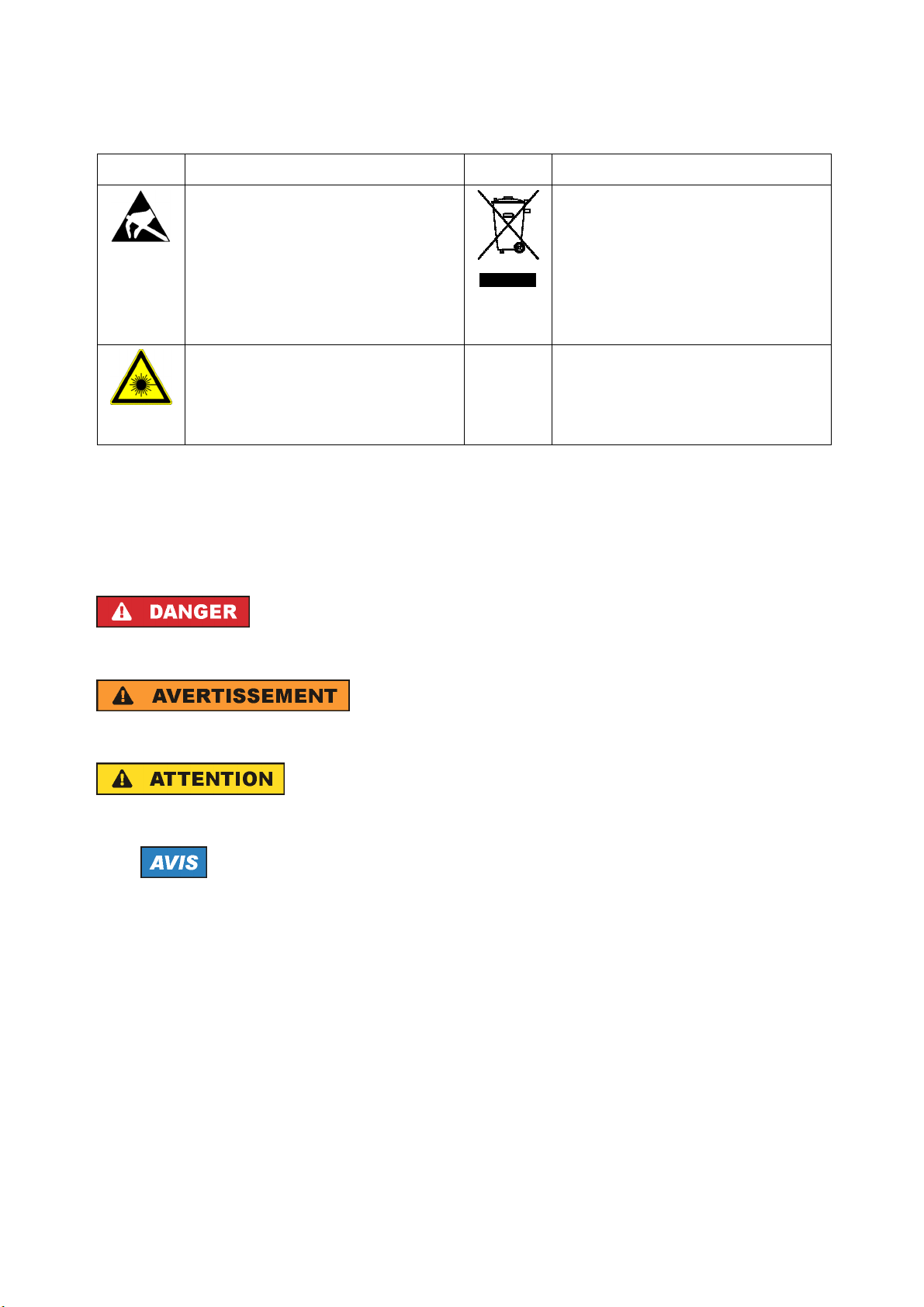
Consignes de sécurité fondamentales
Symbole Signification SymboleSignification
Avis : Prudence lors de la
manipulation de composants
sensibles aux décharges
électrostatiques
Avertissement, rayon laser
Pour plus d’informations, voir le
paragraphe "Fonctionnement",
point 7.
Marquage UE pour la collecte
séparée d’appareils électriques et
électroniques
Pour plus d’informations, voir le
paragraphe "Elimination /
Protection de l’environnement",
point 2.
Mots de signalisation et significations
Les mots de signalisation suivants sont utilisés dans la documentation produit
pour avertir des risques et dangers.
Indique une situation dangereuse qui, si elle n’est
pas évitée, causera des blessures graves ou
mortelles.
Indique une situation dangereuse qui, si elle n’est
pas évitée, pourrait causer des blessures graves
ou mortelles.
Indique une situation dangereuse qui, si elle n’est
pas évitée, pourrait causer des blessures mineures
ou modérées.
Indique une information considérée comme
importante, mais qui n’a pas trait à un danger
particulier, par exemple, messages relatifs à des
dommages matériels.
Dans la documentation produit, est synonyme du
terme PRUDENCE.
1171.0000.53 - 07 Page 3
Page 37

Consignes de sécurité fondamentales
Ces mots de signalisation correspondent à la définition habituelle utilisée dans
l’espace économique européen pour des applications civiles. Des définitions
divergentes peuvent cependant exister dans d’autres espaces économiques ou
dans le cadre d’applications militaires. Il faut donc veiller à ce que les mots de
signalisation décrits ici ne soient utilisés qu’en relation avec la documentation
produit correspondante et seulement avec le produit correspondant. L’utilisation
des mots de signalisation en relation avec des produits ou des documentations
non correspondants peut conduire à des erreurs d’interprétation et par
conséquent à des dommages corporels ou matériels.
Etats et positions de fonctionnement
L’appareil ne doit être utilisé que dans les états et positions de fonctionnement
indiqués par le constructeur. Toute obstruction de la ventilation doit être
empêchée. Le non-respect des indications du constructeur peut provoquer des
chocs électriques, des incendies et/ou des blessures graves pouvant
éventuellement entraîner la mort. Pour tous les travaux, les directives locales
et/ou nationales de sécurité et de prévention d’accidents doivent être respectées.
1. Sauf stipulations contraires, les produits Rohde & Schwarz répondent aux
exigences ci-après :
faire fonctionner le produit avec le fond du boîtier toujours en bas, indice de
protection IP 2X, utilisation uniquement à l’intérieur, fonctionnement à une
altitude max. de 2000 m au-dessus du niveau de la mer, transport à une
altitude max. de 4500 m au-dessus du niveau de la mer, tolérance de ±10 %
pour la tension nominale et de ±5 % pour la fréquence nominale, catégorie de
surtension 2, indice de pollution 2.
2. Ne jamais placer le produit sur des surfaces, véhicules, dépôts ou tables non
appropriés pour raisons de stabilité et/ou de poids. Suivre toujours strictement
les indications d’installation du constructeur pour le montage et la fixation du
produit sur des objets ou des structures (par exemple parois et étagères). En
cas d’installation non conforme à la documentation produit, il y a risque de
blessures, voire de mort.
3. Ne jamais placer le produit sur des dispositifs générant de la chaleur (par
exemple radiateurs et ventilateurs à air chaud). La température ambiante ne
doit pas dépasser la température maximale spécifiée dans la documentation
produit ou dans la fiche technique. Une surchauffe du produit peut provoquer
des chocs électriques, des incendies et/ou des blessures graves pouvant
éventuellement entraîner la mort.
1171.0000.53 - 07 Page 4
Page 38

Consignes de sécurité fondamentales
Sécurité électrique
Si les consignes relatives la sécurité électrique ne sont pas ou insuffisamment
respectées, il peut s’ensuivre des chocs électriques, des incendies et/ou des
blessures graves pouvant éventuellement entraîner la mort.
1. Avant chaque mise sous tension du produit, il faut s’assurer que la tension
nominale réglée sur le produit correspond à la tension nominale du secteur. Si
la tension réglée devait être modifiée, remplacer le fusible du produit si
nécessaire.
2. Pour les produits de la classe de protection I, pourvus d’un câble secteur
mobile et d’un connecteur secteur, leur utilisation n’est admise qu’avec des
prises munies d’un contact de protection raccordé à la terre et d’un
conducteur de protection avec prise de terre.
3. Toute déconnexion intentionnelle du conducteur de protection, dans le câble
ou dans le produit lui-même, est interdite. Elle entraîne un risque de choc
électrique au niveau du produit. En cas d’utilisation des câbles prolongateurs
ou des multiprises, ceux-ci doivent être examinés régulièrement afin de
garantir le respect des directives de sécurité.
4. Si l’appareil n’est pas doté d’un interrupteur secteur pour le couper du secteur
ou si l’interrupteur secteur disponible n’est pas approprié pour couper
l’appareil du secteur, le connecteur mâle du câble de raccordement est à
considérer comme interrupteur.
L’interrupteur doit être à tout moment facilement accessible. Si, par exemple,
le connecteur secteur sert d’interrupteur, la longueur du câble de
raccordement ne doit pas dépasser 3 m.
Les commutateurs fonctionnels ou électroniques ne sont pas appropriés pour
couper l’appareil du secteur. Si des produits sans interrupteur secteur sont
intégrés dans des baies ou systèmes, le dispositif d’interruption secteur doit
être reporté au niveau du système.
5. Ne jamais utiliser le produit si le câble secteur est endommagé. Vérifier
régulièrement le parfait état du câble secteur. Prendre les mesures
préventives et dispositions nécessaires pour que le câble secteur ne puisse
pas être endommagé et que personne ne puisse subir de préjudice, par
exemple en trébuchant sur le câble ou par des chocs électriques.
6. L’utilisation des produits est uniquement autorisée sur des réseaux secteur de
type TN/TT protégés par des fusibles d’une intensité max. de 16 A (pour toute
intensité supérieure, consulter le groupe Rohde & Schwarz).
1171.0000.53 - 07 Page 5
Page 39

Consignes de sécurité fondamentales
7. Ne jamais brancher le connecteur dans des prises secteur sales ou
poussiéreuses. Enfoncer fermement le connecteur jusqu’au bout de la prise.
Le non-respect de cette mesure peut provoquer des arcs, incendies et/ou
blessures.
8. Ne jamais surcharger les prises, les câbles prolongateurs ou les multiprises,
cela pouvant provoquer des incendies ou chocs électriques.
9. En cas de mesures sur les circuits électriques d’une tension efficace > 30 V,
prendre les précautions nécessaires pour éviter tout risque (par exemple
équipement de mesure approprié, fusibles, limitation de courant, coupe-circuit,
isolation, etc.).
10. En cas d’interconnexion avec des équipements informatiques comme par
exemple un PC ou un ordinateur industriel, veiller à ce que ces derniers soient
conformes aux normes IEC 60950-1 / EN 60950-1 ou IEC 61010-1 / EN
61010-1 en vigueur.
11. Sauf autorisation expresse, il est interdit de retirer le couvercle ou toute autre
pièce du boîtier lorsque le produit est en cours de service. Les câbles et
composants électriques seraient ainsi accessibles, ce qui peut entraîner des
blessures, des incendies ou des dégâts sur le produit.
12. Si un produit est connecté de façon permanente, établir avant toute autre
connexion le raccordement du conducteur de protection local et du conducteur
de protection du produit. L’installation et le raccordement ne doivent être
effectués que par une personne qualifiée en électricité.
13. Sur les appareils installés de façon permanente sans fusible ni disjoncteur
automatique ni dispositifs de protection similaires intégrés, le circuit
d’alimentation doit être sécurisé de sorte que toutes les personnes ayant
accès au produit et le produit lui-même soient suffisamment protégés contre
tout dommage.
14. Chaque produit doit être protégé de manière appropriée contre les éventuelles
surtensions (par exemple dues à un coup de foudre). Sinon les utilisateurs
sont exposés à des risques de choc électrique.
15. Ne jamais introduire d’objets non prévus à cet effet dans les ouvertures du
boîtier, étant donné que cela peut entraîner des courts-circuits dans le produit
et/ou des chocs électriques, incendies ou blessures.
1171.0000.53 - 07 Page 6
Page 40

Consignes de sécurité fondamentales
16. Sauf spécification contraire, les produits ne sont pas protégés contre
l’infiltration de liquides, voir aussi le paragraphe "Etats et positions de
fonctionnement", point 1. Il faut donc protéger les appareils contre l’infiltration
de liquides. La non-observation de cette consigne entraînera le risque de choc
électrique pour l’utilisateur ou d’endommagement du produit, ce qui peut
également mettre les personnes en danger.
17. Ne pas utiliser le produit dans des conditions pouvant occasionner ou ayant
occasionné des condensations dans ou sur le produit, par exemple lorsque
celui-ci est déplacé d’un environnement froid dans un environnement chaud.
L’infiltration d’eau augmente le risque de choc électrique.
18. Avant le nettoyage, débrancher le produit de l’alimentation (par exemple
secteur ou pile). Pour le nettoyage des appareils, utiliser un chiffon doux non
pelucheux. N’utiliser en aucun cas de produit de nettoyage chimique, tel que
de l’alcool, de l’acétone ou un solvant à base de cellulose.
Fonctionnement
1. L’utilisation du produit exige une formation spécifique ainsi qu’une grande
concentration. Il est impératif que les personnes qui utilisent le produit présent
les aptitudes physiques, mentales et psychiques requises ; sinon des
dommages corporels ou matériels ne pourront pas être exclus. Le choix du
personnel qualifié pour l’utilisation du produit est sous la responsabilité de
l’employeur/l’exploitant.
2. Avant de déplacer ou transporter le produit, lire et respecter le paragraphe
"Transport".
3. Comme pour tous les biens produits de façon industrielle, l’utilisation de
matériaux pouvant causer des allergies (allergènes, comme par exemple le
nickel) ne peut être totalement exclue. Si, lors de l’utilisation de produits
Rohde & Schwarz, des réactions allergiques surviennent – telles que éruption
cutanée, éternuements fréquents, rougeur de la conjonctive ou difficultés
respiratoires – il faut immédiatement consulter un médecin pour en clarifier la
cause et éviter toute atteinte à la santé.
4. Avant le traitement mécanique et/ou thermique ou le démontage du produit, il
faut impérativement observer le paragraphe "Elimination / Protection de
l’environnement", point 1.
1171.0000.53 - 07 Page 7
Page 41

Consignes de sécurité fondamentales
5. Selon les fonctions, certains produits tels que des installations de
radiocommunication RF peuvent produire des niveaux élevés de rayonnement
électromagnétique. Etant donné la vulnérabilité de l’enfant à naître, les
femmes enceintes doivent être protégées par des mesures appropriées. Des
porteurs de stimulateurs cardiaques peuvent également être menacés par des
rayonnements électromagnétiques. L’employeur/l’exploitant est obligé
d’évaluer et de repérer les lieux de travail soumis à un risque particulier
d’exposition aux rayonnements et de prévenir tous les dangers éventuels.
6. En cas d’incendie, des matières toxiques (gaz, liquides, etc.) pouvant nuire à
la santé peuvent émaner du produit. Il faut donc, en cas d’incendie, prendre
des mesures adéquates comme par exemple le port de masques respiratoires
et de vêtements de protection.
7. Les produits laser sont munis d’avertissements normalisés d’après leur
catégorie laser. En raison des caractéristiques de leur rayonnement et en
raison de leur puissance électromagnétique extrêmement concentrée, les
lasers peuvent provoquer des dommages biologiques. Si un produit laser est
intégré dans un produit Rohde & Schwarz (par exemple lecteur CD/DVD), il ne
faut pas utiliser de réglages ou fonctions autres que ceux décrits dans la
documentation produit pour éviter tout dommage corporel (par exemple causé
par rayon laser).
8. Classes CEM (selon EN 55011 / CISPR 11 ; selon EN 55022 / CISPR 22, EN
55032 / CISPR 32 par analogie)
Appareil de la classe A :
Appareil approprié à un usage dans tous les environnements autres que
l’environnement résidentiel et les environnements raccordés directement à
un réseau d’alimentation basse tension qui alimente des bâtiments
résidentiels.
Remarque : Les appareils de la classe A sont destinés à être utilisés dans
un environnement industriel. Ces appareils peuvent provoquer des
perturbations radioélectriques dans l’environnement résidentiel en raison
de perturbations susceptibles de se présenter sur des lignes ou d’être
rayonnées. Dans ce cas, l’exploitant peut exiger la mise en œuvre de
mesures appropriées pour éliminer ces perturbations.
Appareil de la classe B :
Appareil approprié à un usage dans l’environnement résidentiel ainsi que
dans les environnements raccordés directement à un réseau d’alimentation
basse tension qui alimente des bâtiments résidentiels.
1171.0000.53 - 07 Page 8
Page 42

Consignes de sécurité fondamentales
Réparation et service après-vente
1. Le produit ne doit être ouvert que par un personnel qualifié et autorisé. Avant
de travailler sur le produit ou de l’ouvrir, il faut le couper de la tension
d’alimentation ; sinon il y a risque de choc électrique.
2. Les travaux d’ajustement, le remplacement des pièces, la maintenance et la
réparation ne doivent être effectués que par des électroniciens qualifiés et
autorisés par Rohde & Schwarz. En cas de remplacement de pièces
concernant la sécurité (notamment interrupteur secteur, transformateur
secteur ou fusibles), celles-ci ne doivent être remplacées que par des pièces
d’origine. Après chaque remplacement de pièces concernant la sécurité, une
vérification de sécurité doit être effectuée (contrôle visuel, vérification du
conducteur de protection, mesure de la résistance d’isolation et du courant de
fuite, test de fonctionnement). Cela assure le maintien de la sécurité du
produit.
Piles, batteries et accumulateurs/cellules
Si les instructions concernant les piles, batteries et accumulateurs/cellules ne
sont pas ou insuffisamment respectées, cela peut provoquer des explosions, des
incendies et/ou des blessures graves pouvant entraîner la mort. La manipulation
de piles, batteries et accumulateurs contenant des électrolytes alcalins (par
exemple cellules de lithium) doit être conforme à la norme EN 62133.
1. Les cellules ne doivent pas être démontées, ouvertes ni réduites en
morceaux.
2. Ne jamais exposer les cellules, piles ou batteries à la chaleur ni au feu. Ne
pas les stocker dans un endroit où elles sont exposées au rayonnement direct
du soleil. Tenir les cellules, piles et batteries au sec. Nettoyer les raccords
sales avec un chiffon sec et propre.
3. Ne jamais court-circuiter les cellules, piles ou batteries. Les cellules, piles ou
batteries ne doivent pas être gardées dans une boîte ou un tiroir où elles
peuvent se court-circuiter mutuellement ou être court-circuitées par des
matériaux conducteurs. Une cellule, pile ou batterie ne doit être retirée de son
emballage d’origine que lorsqu’on l’utilise.
4. Les cellules, piles ou batteries ne doivent pas être exposés à des chocs
mécaniques de force non admissible.
5. En cas de manque d’étanchéité d’une cellule, le liquide ne doit pas entrer en
contact avec la peau ou les yeux. S’il y a contact, rincer abondamment
l’endroit concerné à l’eau et consulter un médecin.
1171.0000.53 - 07 Page 9
Page 43

Consignes de sécurité fondamentales
6. Il y a danger d’explosion en cas de remplacement ou chargement incorrect
des cellules, piles ou batteries qui contiennent des électrolytes alcalins (par
exemple cellules de lithium). Remplacer les cellules, piles ou batteries
uniquement par le type Rohde & Schwarz correspondant (voir la liste des
pièces de rechange) pour maintenir la sécurité du produit.
7. Il faut recycler les cellules, piles ou batteries et il est interdit de les éliminer
comme déchets normaux. Les accumulateurs ou piles et batteries qui
contiennent du plomb, du mercure ou du cadmium sont des déchets spéciaux.
Observer les directives nationales d’élimination et de recyclage.
Transport
1. Le produit peut avoir un poids élevé. Il faut donc le déplacer ou le transporter
avec précaution et en utilisant le cas échéant un moyen de levage approprié
(par exemple chariot élévateur) pour éviter des dommages au dos ou des
blessures.
2. Les poignées des produits sont une aide de manipulation exclusivement
réservée au transport du produit par des personnes. Il est donc proscrit
d’utiliser ces poignées pour attacher le produit à ou sur des moyens de
transport, tels que grues, chariots élévateurs, camions etc. Vous êtes
responsable de la fixation sûre des produits à ou sur des moyens de transport
et de levage appropriés. Observer les consignes de sécurité du constructeur
des moyens de transport ou de levage utilisés pour éviter des dommages
corporels et des dégâts sur le produit.
3. L’utilisation du produit dans un véhicule se fait sous l’unique responsabilité du
conducteur qui doit piloter le véhicule de manière sûre et appropriée. Le
constructeur décline toute responsabilité en cas d’accidents ou de collisions.
Ne jamais utiliser le produit dans un véhicule en mouvement si cela pouvait
détourner l’attention du conducteur. Sécuriser suffisamment le produit dans le
véhicule pour empêcher des blessures ou dommages de tout type en cas
d’accident.
Elimination / Protection de l’environnement
1. Les appareils marqués contiennent une pile / batterie ou un accumulateur, qui
ne doit pas être éliminé(e) avec les déchets urbains non triés, mais doit faire
l’objet d’une collecte séparée. Les piles / batteries ou accumulateurs peuvent
uniquement être éliminé(e)s par des points de collecte appropriés ou par un
centre de service après-vente Rohde & Schwarz.
1171.0000.53 - 07 Page 10
Page 44

Consignes de sécurité fondamentales
2. Les déchets d’équipements électriques et électroniques ne doivent pas être
éliminés avec les déchets urbains non triés, mais doivent être collectés
séparément.
Rohde & Schwarz GmbH & Co. KG a développé un concept d’élimination et
assume toutes les obligations en matière de reprise et d’élimination, valables
pour les fabricants au sein de l’UE. Veuillez vous adresser à votre centre de
service après-vente Rohde & Schwarz pour éliminer le produit de manière
écologique.
3. Si les produits ou leurs composants sont travaillés mécaniquement et/ou
thermiquement au-delà de l’utilisation prévue, des matières dangereuses
(poussières contenant des métaux lourds comme par exemple du plomb, du
béryllium ou du nickel) peuvent se dégager le cas échéant. Le démontage du
produit ne doit donc être effectué que par du personnel qualifié. Le démontage
inadéquat peut nuire à la santé. Les directives nationales pour l’élimination
des déchets doivent être observées.
4. Si, en cas d’utilisation du produit, des matières dangereuses ou des
combustibles sont dégagés qui exigent une élimination spéciale, comme par
exemple liquides de refroidissement ou huiles moteurs qui sont à changer
régulièrement, les consignes de sécurité du fabricant de ces matières
combustibles ou dangereuses ainsi que les directives d’élimination des
déchets en vigueur au niveau régional doivent être respectées. Les consignes
de sécurité spéciales correspondantes dans la documentation produit sont à
respecter le cas échéant. L’élimination non conforme des matières
dangereuses ou combustibles peut provoquer des atteintes à la santé et des
dommages écologiques.
Pour plus d’informations concernant la protection de l’environnement, voir la page
d’accueil de Rohde & Schwarz.
1171.0000.53 - 07 Page 11
Page 45

Customer Support
Technical support – where and when you need it
For quick, expert help with any Rohde & Schwarz equipment, contact one of our Customer
Support Centers. A team of highly qualified engineers provides telephone support and will
work with you to find a solution to your query on any aspect of the operation, programming
or applications of Rohde & Schwarz equipment.
Up-to-date information and upgrades
To keep your instrument up-to-date and to be informed about new application notes related
to your instrument, please send an e-mail to the Customer Support Center stating your
instrument and your wish.
We will take care that you will get the right information.
Europe, Africa, Middle East
North America
Latin America
Asia/Pacific
China
Phone +49 89 4129 12345
Phone 1-888-TEST-RSA (1-888-837-8772)
Phone +1-410-910-7988
Phone +65 65 13 04 88
Phone +86-800-810-8228 /
+86-400-650-5896
1171.0500.22-06.00
Page 46

R&S®RT-ZZ80
Contents
Contents
1 Product Description.............................................................. 5
1.1 Safety Instructions for R&S RT-ZZ80..................................................5
1.2 Key Features and Key Characteristics............................................... 6
1.3 Unpacking the Instrument....................................................................7
1.3.1 Inspecting the Contents.......................................................................... 8
1.4 Description of the Probe...................................................................... 8
1.4.1 Probe Head.............................................................................................8
1.4.2 SMA Connector and SMA to BNC Adapter.............................................9
1.5 Accessories and Items....................................................................... 10
1.5.1 Accessories Supplied............................................................................11
1.5.2 Optional Accessories............................................................................ 12
1.5.3 Service Accessories..............................................................................13
2 Putting into Operation.........................................................14
2.1 Connecting the Probe to the R&S RTO Oscilloscope..................... 16
2.2 Auto Zero............................................................................................. 16
3 Connecting the Probe to the DUT...................................... 18
4 Measurement Principles..................................................... 21
4.1 Signal Integrity of the Transferred Signal........................................ 23
4.1.1 Bandwidth............................................................................................. 23
4.1.2 Performance with Different Connection Types..................................... 24
4.2 Signal Loading of the Input Signal....................................................27
4.2.1 Transmission Line Probes.................................................................... 27
4.2.2 Input Impedance................................................................................... 28
4.3 Attenuation Dependence on Source Impedance............................. 30
3User Manual 1409.7689.02 ─ 02
Page 47

R&S®RT-ZZ80
Contents
5 Maintenance and Service....................................................32
5.1 Service Strategy..................................................................................32
5.2 Returning the Probe for Servicing.................................................... 32
5.3 Cleaning...............................................................................................33
5.4 Calibration Interval............................................................................. 33
Index..................................................................................... 34
4User Manual 1409.7689.02 ─ 02
Page 48

R&S®RT-ZZ80
Product Description
Safety Instructions for R&S RT-ZZ80
1 Product Description
1.1 Safety Instructions for R&S RT-ZZ80
When handling R&S RT-ZZ80 transmission line probes, the following basic rules
must be observed. Prior to using a probe, read the applicable manual including
the safety instructions. Keep the safety instructions and the product documentation in a safe place and pass them on to other users. Use the R&S RT-ZZ80
exclusively within the measurement ranges specified in the applicable data
sheets. Rohde & Schwarz accepts no responsibility for misuse of the product.
Use only the accessories supplied with the R&S RT-ZZ80.
Risk of electric shock
Do not connect an R&S RT-ZZ80 to any voltage that exceeds the maximum
permissible input voltage specified in the data sheet. Non-compliance with
this instruction carries the risk of an electric shock.
Make sure not to cause any short circuits when performing measurements
on sources with high output currents. Short circuits may cause injuries or
burns.
Risk of injury caused by pointed object
The pins of the probe are extremely pointed and can easily penetrate
clothes and the skin.
Therefore, handle the probe pins with great care. When transporting the
probe, e.g. when carrying it in a pocket or tool bag, always use the box supplied with the probe. To exchange a probe pin, use tweezers or pliers to
avoid injuries.
5User Manual 1409.7689.02 ─ 02
Page 49
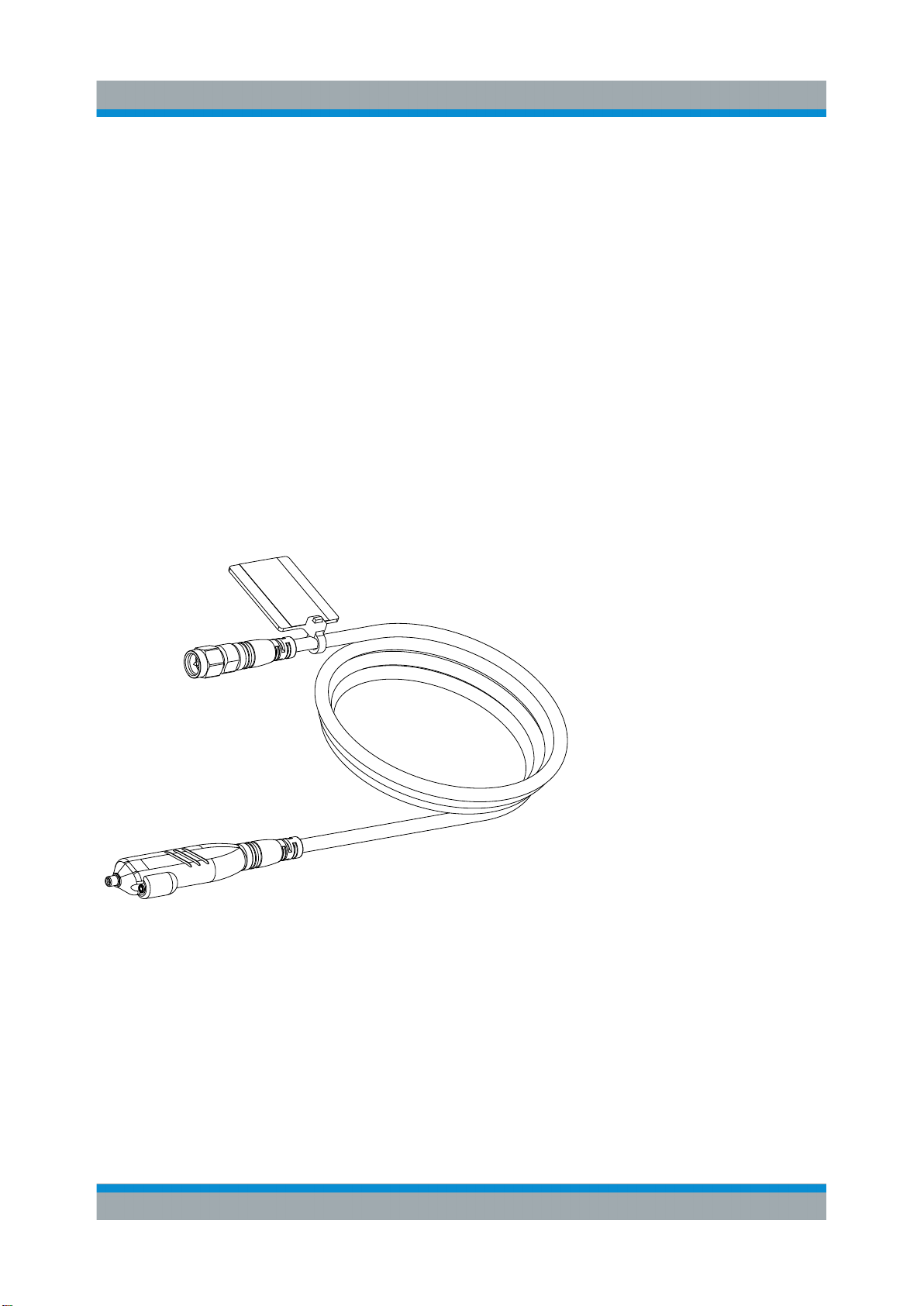
R&S®RT-ZZ80
Product Description
Key Features and Key Characteristics
1.2 Key Features and Key Characteristics
Transmission line probes like R&S RT-ZZ80 are a special type of passive probes.
They are based on an impedance controlled microwave cable (transmission line),
which is terminated into a 50 Ω input impedance of the measuring instrument.
Compared to standard passive probes, the main differences of transmission line
probes are:
●
Higher bandwidth
●
Higher input impedance at high frequencies
●
Lower input impedance at DC
Thus transmission line probes are best suited for measurements of broadband
single-ended signals in impedance controlled environments, for example, 50 Ω
lines.
The R&S RT-ZZ80 has a wide dynamic range. High input levels up to 20 V (RMS)
can be measured without distortion. The low inherent noise enables the measurement of small input signals.
The comprehensive accessory set allows this probe to be connected to a wide
variety of devices under test (DUT) without impairing the very high bandwidth,
short rise time and the low input capacitance of the R&S RT-ZZ80.
6User Manual 1409.7689.02 ─ 02
Page 50

R&S®RT-ZZ80
Product Description
Unpacking the Instrument
The R&S RT-ZZ80 has a standard SMA connector. For BNC input terminals the
BNC to SMA adapter R&S RT-ZA10 is delivered with the probe. Thus the probe
can be connected to any Rohde & Schwarz oscilloscope and to most other highfrequency measuring instruments.
The key characteristics of the probe are the following:
Bandwidth DC to 8 GHz
Maximum input voltage 20 V (RMS)
Input resistance 500 Ω
Input capacitance 0.3 pF
Full dynamic range over the entire frequency range
No harmonic distortions
Negligible noise contribution
Standard SMA connector
1.3 Unpacking the Instrument
The carrying case contains the following items:
●
R&S RT-ZZ80 transmission line probe
●
Carrying case
●
Accessory vials
●
User manual
●
R&S RT-ZZ80 data sheet
●
Calibration certificate
●
Documentation of calibration values (if
ordered)
7User Manual 1409.7689.02 ─ 02
Page 51

R&S®RT-ZZ80
Product Description
Description of the Probe
1.3.1 Inspecting the Contents
●
Inspect the package for damage.
Keep a damaged package and the cushioning material until the contents have
been checked for completeness and the instrument has been tested.
If the packaging material shows any signs of stress, notify the carrier as well
as your Rohde & Schwarz service center. Keep the package and cushioning
material for inspection.
●
Inspect the probe.
If there is any damage or defect, or if the R&S RT-ZZ80 transmission line
probe does not operate properly, notify your Rohde & Schwarz service center.
●
Inspect the accessories.
If the contents are incomplete or damaged, notify your Rohde & Schwarz service center.
Accessories supplied with the instrument are listed in chapter 1.5.1, "Accesso-
ries Supplied", on page 11.
1.4 Description of the Probe
The probe consists of the probe head for connection to the DUT, the probe cable,
and the SMA connector.
Probe connection:
●
To a base unit with SMA inputs: direct connection
●
To a base unit with BNC connectors: using the SMA to BNC adapter delivered
with the probe
1.4.1 Probe Head
The small and lightweight probe head is designed for easy handling and high-performance measurements. The probe head is used for connecting the probe and
the DUT. Different accessories for the signal and ground sockets allow the probe
head to be connected to a wide range of DUTs.
8User Manual 1409.7689.02 ─ 02
Page 52
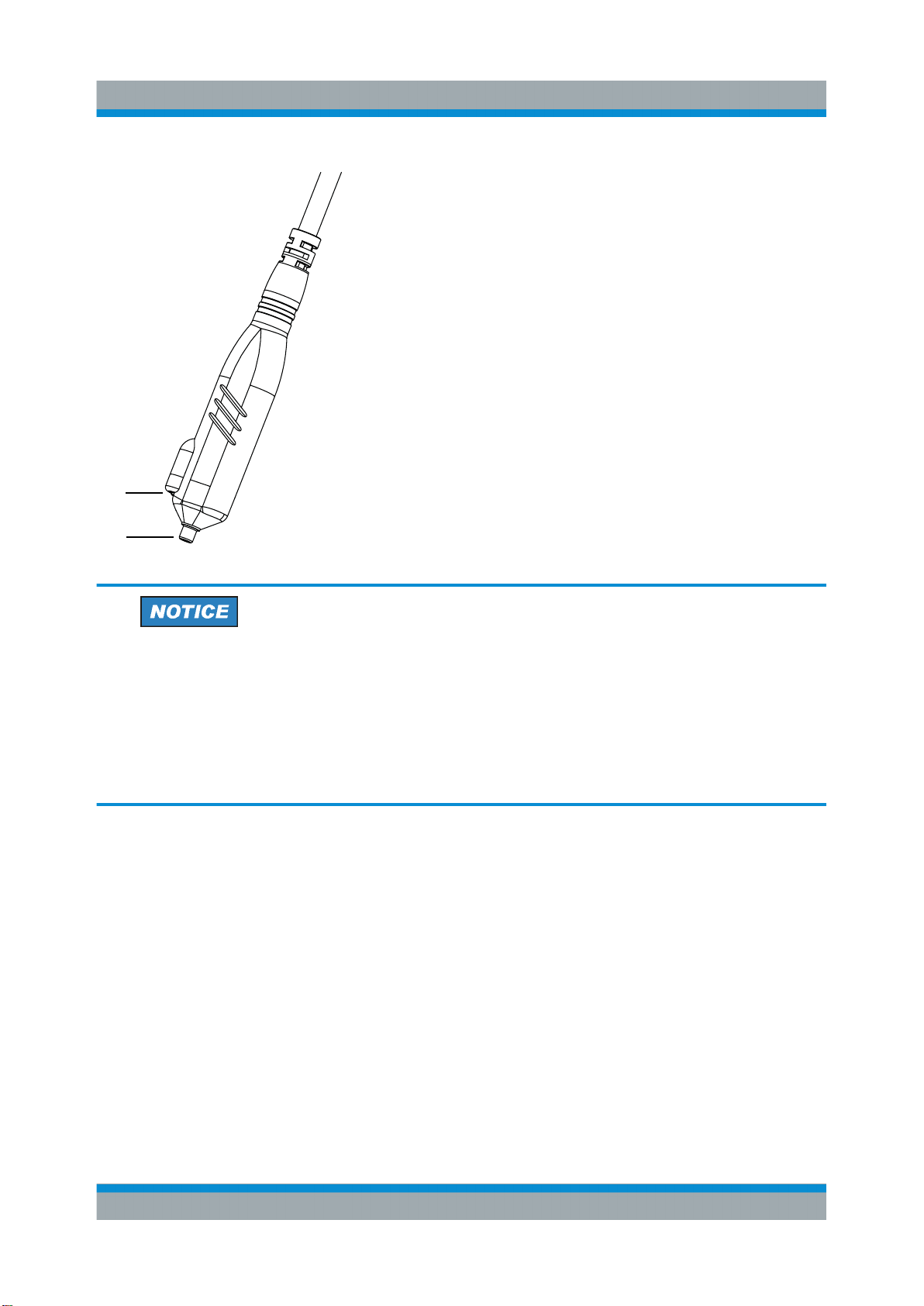
R&S®RT-ZZ80
1
2
Product Description
Description of the Probe
(1) Signal socket
(2) Ground socket
The accessories supplied for the probe head
sockets are listed in chapter 1.5.1, "Accesso-
ries Supplied", on page 11.
The ground socket is compatible with 0.64 mm
(25 mil) square pins and 0.6 mm to 0.8 mm
(24 mil to 35 mil) round pins.
Special accessories for signal socket
The signal socket of the R&S RT-ZZ80 has a special design to ensure optimal performance. The signal socket is not compatible to standard accessories based on 0.64 mm (25 mil) square pins or 0.8 mm (35 mil) round pins.
Use only special accessories for R&S RT-ZZ80 provided by Rohde &
Schwarz.
1.4.2 SMA Connector and SMA to BNC Adapter
The R&S RT-ZZ80 has an SMA male connector for connection to the instrument.
To connect the probe to an Rohde & Schwarz oscilloscope, for example, to an
R&S RTO, you need the SMA to BNC adapter that is delivered with the probe.
Screw the SMA connector on the SMA to BNC adapter as shown below.
► Use a torque wrench to tighten the SMA connector.
9User Manual 1409.7689.02 ─ 02
Page 53

R&S®RT-ZZ80
1
2
SMA-BNC adapter
lead,
15 cm / 5.9 in
ground adapter,
square pin
ground pin, pogo
ground pin, solder in
signal adapter, square pin
signal pin
signal pin, solder in
lead
6 cm / 2.4 in
micro clip
mini clip
marker band kit
Product Description
Accessories and Items
(1) SMA connector
(2) SMA to BNC adapter
1.5 Accessories and Items
The figure below shows all accessories that are available for the R&S RT-ZZ80
transmission line probe.
Fig. 1-1: Available accessories
10User Manual 1409.7689.02 ─ 02
Page 54

R&S®RT-ZZ80
Product Description
Accessories and Items
Leads, mini clip and micro clip are not included in the delivery.
1.5.1 Accessories Supplied
The following table shows the accessories supplied with the R&S RT-ZZ80 transmission line probe.
Table 1-1: Accessories supplied
Item Quantity Description
50 Signal pin, solder in
2 Signal pin
2 Signal adapter, square pin
10 Ground pin, solder in
2 Ground pin, pogo
2 Ground adapter, square pin
11User Manual 1409.7689.02 ─ 02
Page 55
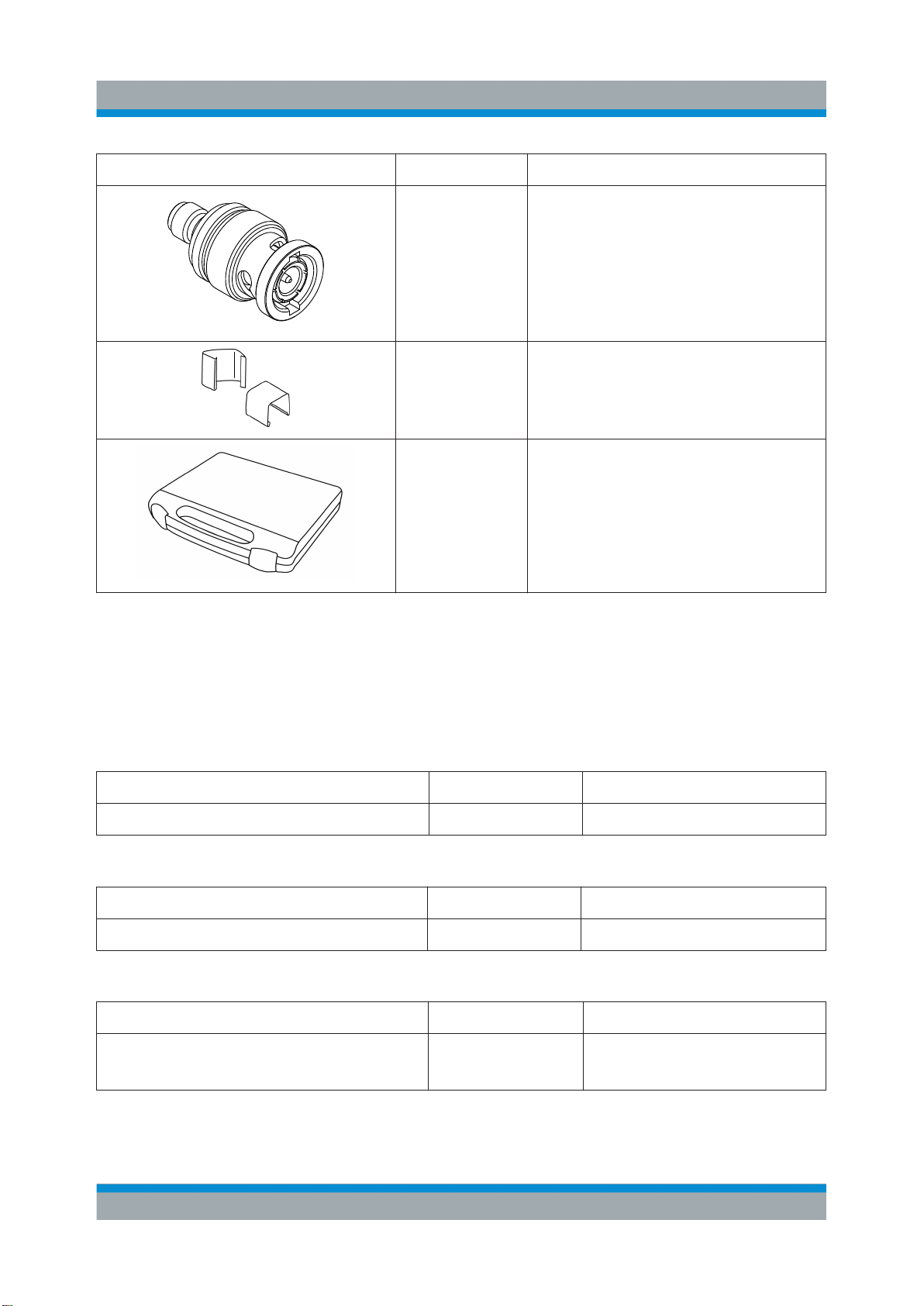
R&S®RT-ZZ80
Product Description
Accessories and Items
Item Quantity Description
R&S RT-ZA10
1.5.2 Optional Accessories
1
SMA (female) to BNC (male) adapter
1 Marker band kit
1 Carrying case with foam inlay
If the included accessories do not meet individual customer requirements, Rohde
& Schwarz offers different accessory sets for sale.
Table 1-2: R&S RT-ZA4 mini clips
Item Quantity Description
Mini clip 10 This set contains mini clips.
Table 1-3: R&S RT-ZA5 micro clips
Item Quantity Description
Micro clip 4 This set contains micro clips.
Table 1-4: R&S RT-ZA6 lead set
Item Quantity Description
Lead, 6 cm / 2.4 in
Lead, 15 cm / 5.9 in
5
5
This set contains short and
long leads.
12User Manual 1409.7689.02 ─ 02
Page 56

R&S®RT-ZZ80
Product Description
Accessories and Items
1.5.3 Service Accessories
The following accessories are optionally available for servicing the probe.
Table 1-5: R&S RT-ZK2 service kit
The R&S RT-ZK2 service kit is used for calibrating
the R&S RT-ZZ80 transmission line probe, for making performance tests and for servicing. The service
kit includes all adapters and accessories to connect
the probe to the required measuring instruments.
The R&S RT-ZZ80 Service Manual is included in
the service kit CD-ROM.
Table 1-6: R&S RT-ZZ80 Service Manual
The Service Manual contains a detailed description
of the performance test for verifying the probe specifications.
All service accessories and items can be ordered from your Rohde &
Schwarz service center.
13User Manual 1409.7689.02 ─ 02
Page 57

R&S®RT-ZZ80
Putting into Operation
2 Putting into Operation
The R&S RT-ZZ80 transmission line probe has been designed to withstand a
moderate amount of physical and electrical stress. You should treat the probe
with care. It can be damaged if excessive force is applied to the probe tip.
Exercise care to prevent the probe from receiving mechanical shock.
Avoid putting excessive strain on the probe cable or exposing it to sharp
bends.
Store the probe in a shock-resistant case such as the foam-lined shipping
case that came with the probe.
Voltages above the specified limits of the R&S RT-ZZ80 transmission line
probe may damage the probe.
Do not exceed the specified limits.
During operation, the probe may heat up slightly. This is normal behavior and not
a sign of malfunction.
14User Manual 1409.7689.02 ─ 02
Page 58

R&S®RT-ZZ80
Wrist strap with cord
Ground connection
of operational site
Heel strap
Floor mat
Putting into Operation
Risk of damaging electronic components
To avoid damage of electronic components, the operational site must be
protected against electrostatic discharge (ESD).
Wrist strap with cord
Building ground
Floor mat
Heel strap
Ground connection
of operational site
The following two methods of ESD protection may be used together or separately:
●
Wrist strap with cord to ground connection
●
Conductive floor mat and heel strap combination
15User Manual 1409.7689.02 ─ 02
Page 59

R&S®RT-ZZ80
Putting into Operation
Connecting the Probe to the R&S RTO Oscilloscope
2.1 Connecting the Probe to the R&S RTO Oscillo-
scope
The R&S RT-ZZ80 transmission line probe has been designed for use with
R&S RTO oscilloscopes.
1. Connect the SMA connector of the probe to the SMA to BNC adapter, see
chapter 1.4.2, "SMA Connector and SMA to BNC Adapter", on page 9.
2. Connect the SMA to BNC adapter to one of the BNC input connectors of the
oscilloscope. Turn the collar until it clicks, and check that it is locked securely.
3. On the "Vertical" menu of the R&S RTO, select "Probe Setup".
4. Select the "Predefined probe": "RT-ZZ80".
If you use another oscilloscope, make sure to configure the following settings:
●
Input impedance of the channel = 50 Ω
●
Unit = V
●
Attenuation = 10 : 1
2.2 Auto Zero
The auto zero procedure performs an automatic correction of the zero error displayed on the oscilloscope's screen. The waveform is set to 0 V on the horizontal
centerline of the oscilloscope.
The R&S RT-ZZ80 has no zero error. However, differences in DUT and oscilloscope ground levels may cause zero errors to be displayed on the oscilloscope's
16User Manual 1409.7689.02 ─ 02
Page 60

R&S®RT-ZZ80
screen. If the DUT is not floating but ground-referenced, an auto zero routine may
improve the measurement results.
1. Connect the probe to the R&S RTO oscilloscope and configure the probe as
described in chapter 2.1, "Connecting the Probe to the R&S RTO Oscillo-
scope", on page 16.
2. Short the signal pin and the ground pin together and connect them to the
ground of the DUT.
Putting into Operation
Auto Zero
3. Start the auto zero procedure on the R&S RTO:
"Vertical" menu > "Probe Setup" > "Ch" tab > "Auto zero"
17User Manual 1409.7689.02 ─ 02
Page 61
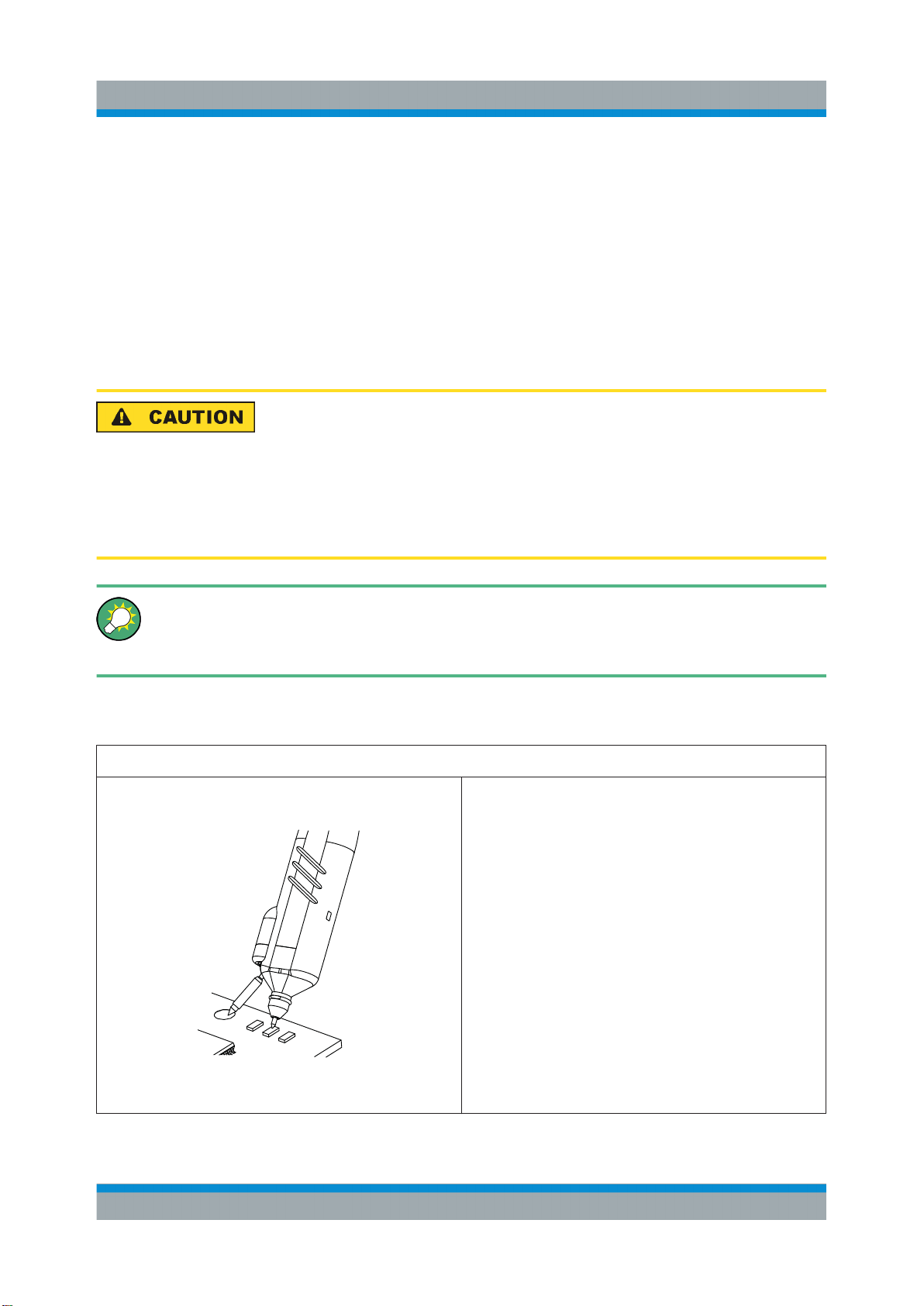
R&S®RT-ZZ80
Connecting the Probe to the DUT
3 Connecting the Probe to the DUT
This chapter describes the different ways of connecting the probe to the DUT. In
addition, the accessories supplied are described and their use is explained.
In order to achieve optimum RF performance, the connections should always be
as short as possible. If long connections cannot be avoided, they should preferably be used for the ground socket.
Risk of injuries
The included probe pins are exceptionally sharp and must be handled with
extreme care. To prevent injuries, always use tweezers when inserting or
removing pins.
Some solder-in accessories are very fine and sensitive. The probe should
be stabilized by using appropriate means (e.g. adhesive tape, probe positioner) in order to protect the solder joint from excessive mechanical stress.
Pins
Signal pin and ground pin, pogo
Using the signal pin and ground pin, manual
measurements can be performed without or
with only minor limitation of the measurement
bandwith. Best results are achieved if the distance between signal and ground is small.
Even with maximum distance, rise times
shorter than 55 ps can be reached.
Because the spring-loaded ground pin compensates for minor unevenness and movements, this pin can establish a firm contact
with the test point. It fits into the ground socket
of the probe head.
The distance to the signal pin can be varied by
turning the ground pin.
Distance range:
0 mm to 10 mm (0 mil to 400 mil)
18User Manual 1409.7689.02 ─ 02
Page 62
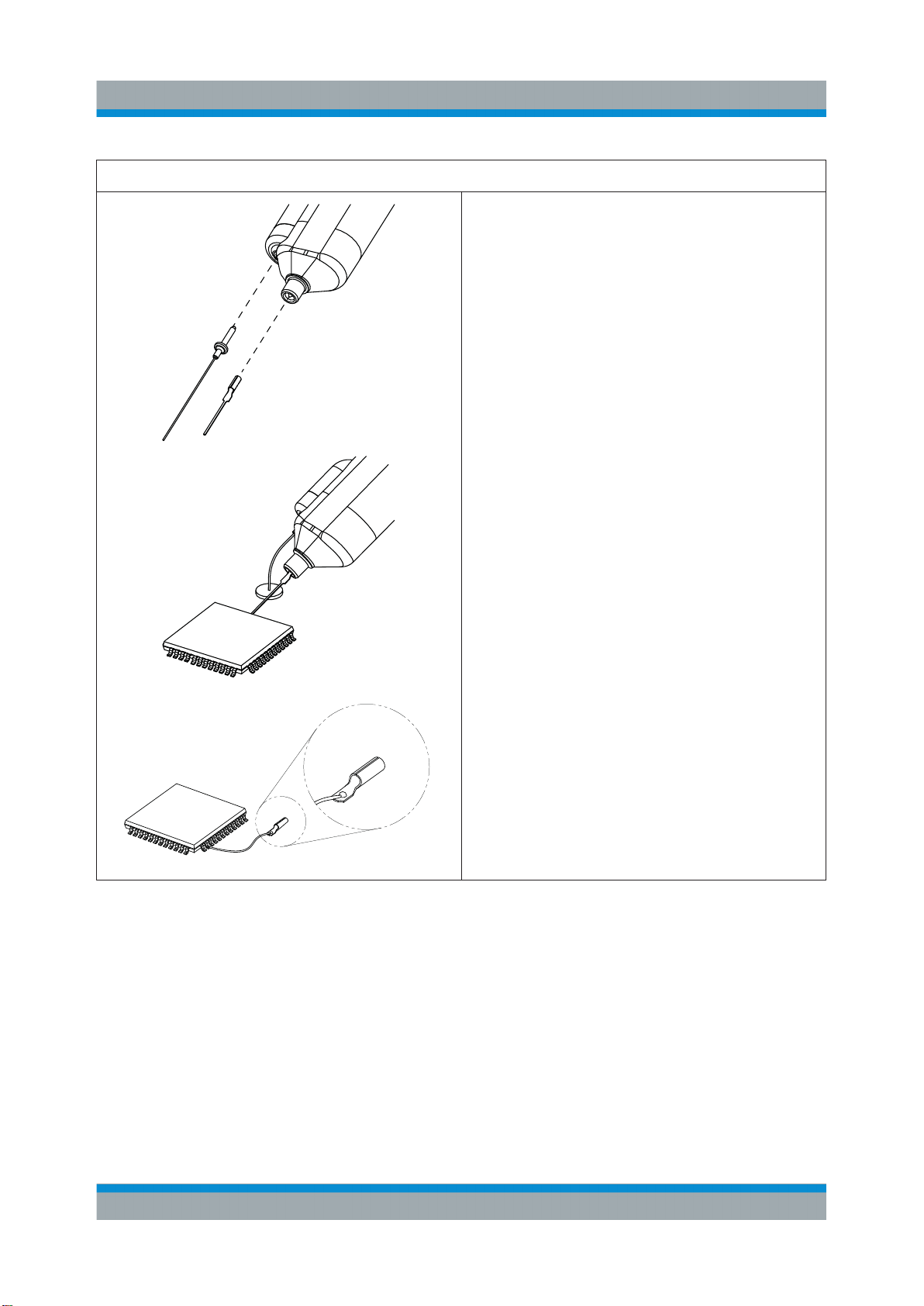
R&S®RT-ZZ80
Signal pin, solder in, and ground pin, solder-in
Connecting the Probe to the DUT
Using two solder-in pins for ground and signal,
the R&S RT-ZZ80 is soldered directly into the
circuit.
The pins can be exchanged on the probe and
can remain in the circuit. Thus, you can plug
the probe on different test points.
Use tweezers to insert the solder-in pins into
the sockets on the probe, and then cut to the
appropriate length. Keep the pins as short as
possible.
The fine wires on this adapter are best suited
to make secure contact with small contact
points, such as SMT components or IC pins.
Alternatively, the signal pin has a solder tail for
direct soldering of wires.
Distance range:
0 mm to 20 mm (0 mil to 800 mil)
19User Manual 1409.7689.02 ─ 02
Page 63
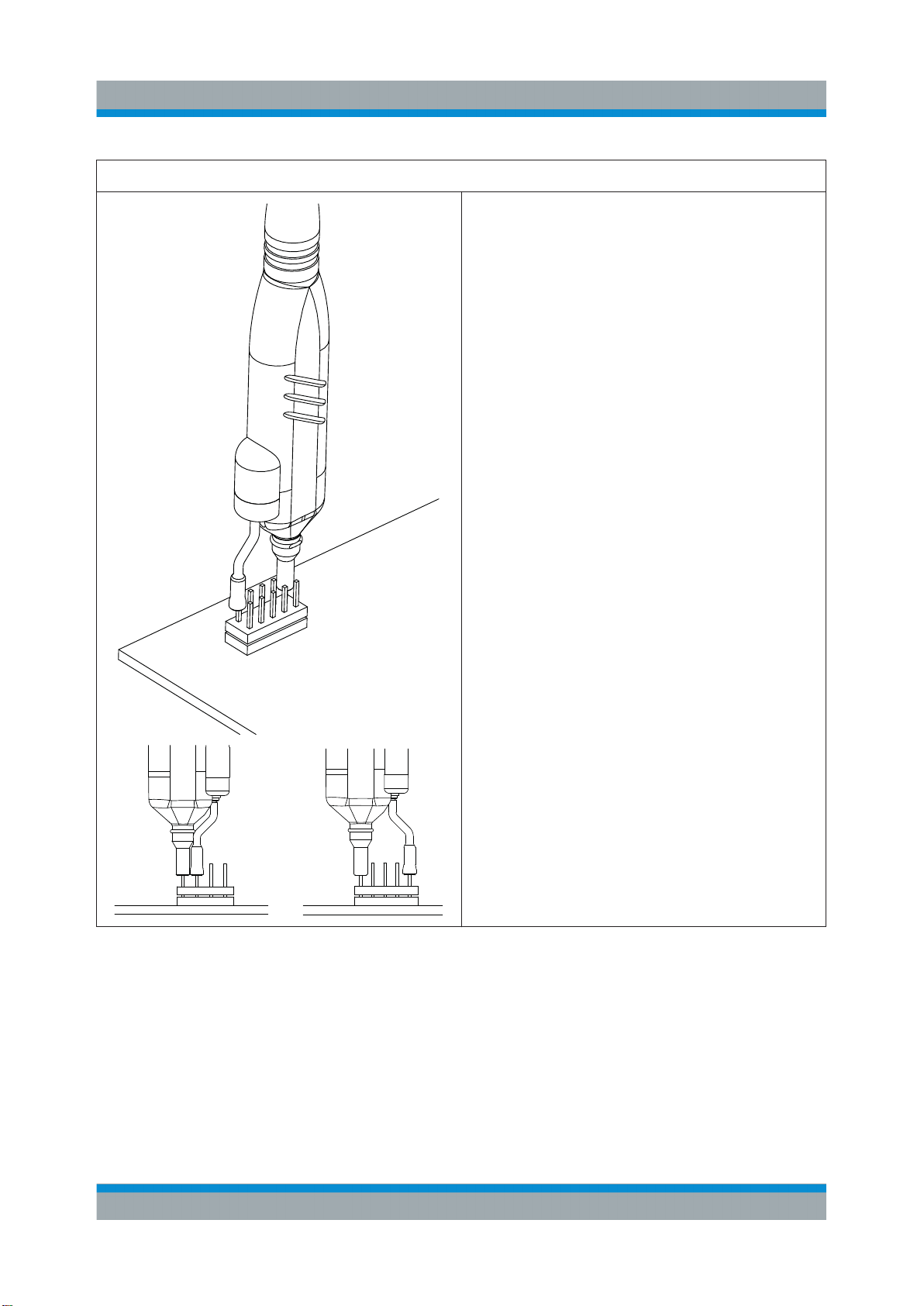
R&S®RT-ZZ80
Signal adapter, square pin, and ground adapter, square pin
Connecting the Probe to the DUT
Using two square-in pin adapters for ground
and signal, the probe can be connected
directly to a pin strip.
The sockets are compatible with 0.64 mm
(25 mil) square pins and 0.6 mm to 0.8 mm
(24 mil to 35 mil) round pins.
The distance between the signal and ground
adapter can be adjusted by turning the ground
adapter.
Distance range:
2.54 mm to 10.16 mm (100 mil to 400 mil)
20User Manual 1409.7689.02 ─ 02
Page 64

R&S®RT-ZZ80
Measurement Principles
4 Measurement Principles
The R&S RT-ZZ80 transmission line probe provides an electrical connection
between the DUT and the oscilloscope. The probe transfers the voltage of the
electrical signal tapped off the DUT to the oscilloscope, where it is displayed
graphically. Although a probe has a wide variety of specifications, these specifications can be grouped into two classes of basic requirements:
●
High signal integrity of the transferred signal:
With an ideal probe, the output signal that is transferred to the base unit would
be identical to the input signal between the probe tips, and signal integrity
would be extremely high. Every real probe, however, will transfer the input signal in altered form. A good probe causes only minimum alterations.
How the probe can fulfill this requirement is mainly determined by its bandwidth.
●
Acceptable loading of the input signal:
Every probe is a load for the signal to be measured. This means that the signal to be measured changes as soon as the probe is connected. A good
probe should cause a minimum change to the signal, also at higher frequencies.
How the probe can fulfill this requirement is mainly determined by its input
impedance.
The parameters of a probe are usually specified for a minimally short connection
between the probe and the DUT. With longer connections, the connection inductance has a significant effect on the measurement.
The high-frequency behavior of probes is typically characterized in a 50 Ω measurement environment. The probe is connected to a 50 Ω line that is fed by a
source with 50 Ω internal impedance and that is terminated into 50 Ω.
The figure 4-1 shows the equivalent circuit model of a probe that is connected to
the DUT.
21User Manual 1409.7689.02 ─ 02
Page 65

R&S®RT-ZZ80
2V
S
50 Ω
50 Ω
Circuit ground
Probe ground
R
in
500 Ω
C
in
0.3 pF
DUT
L
con
V
in
R
S
R
L
25||
LSS
RRR
Fig. 4-1: Equivalent circuit model of the R&S RT-ZZ80 probe
Table 4-1: Designations
Abbreviation Description
Measurement Principles
V
S
V
in
Voltage at the test point without probe connected
Voltage at the test point with probe connected,
corresponds to the input voltage of the probe
R
S
R
L
R
in
C
in
L
con
Source resistance of the DUT
Load resistance of the DUT
Input resistance of the probe
Input capacitance of the probe
Connection inductance,
depends on the type of connection
In a 50 Ω system, the output resistance of the source, the load resistance of the
DUT and the characteristic impedance of all lines equal exactly 50 Ω. However,
the behavior of the probe in the circuit is determined by the effective source impedance which is the impedance present in the DUT between the probe tip and
ground.
Effective source impedance:
22User Manual 1409.7689.02 ─ 02
Page 66
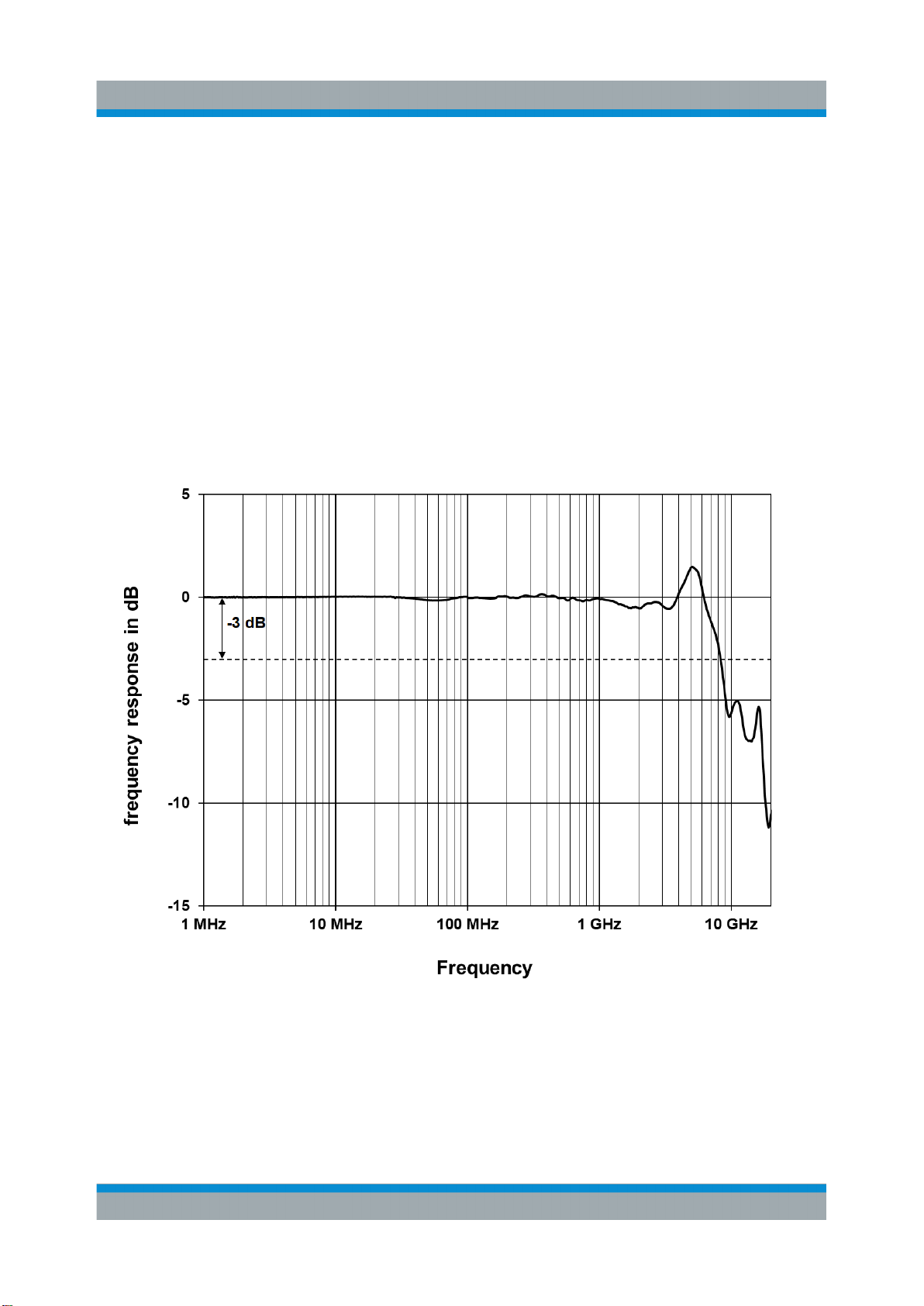
R&S®RT-ZZ80
Measurement Principles
Signal Integrity of the Transferred Signal
4.1 Signal Integrity of the Transferred Signal
The following sections describe the effect that bandwidth and the type of connection have on signal integrity.
4.1.1 Bandwidth
The bandwidth BW of a probe is one of its specific parameters. The bandwidth of
the probe and the bandwidth of the base unit together form the system bandwidth. The following explanations refer to the probe itself, but can also be applied
to the entire system.
Fig. 4-2: Amplitude frequency response of the R&S RT-ZZ80
The bandwidth
●
Specifies the maximum frequency at which a purely sinusoidal signal is still
transferred at 70 % (–3 dB) of its amplitude.
See figure 4-2
23User Manual 1409.7689.02 ─ 02
Page 67

R&S®RT-ZZ80
BW
t
rise
5.0
Measurement Principles
Signal Integrity of the Transferred Signal
●
Specifies the transferable spectrum for other waveforms. E.g. with square
wave signals, the fifth harmonic should still be within the bandwidth for a high
signal integrity.
●
Determines the minimum measurable signal rise time. The rise time t
of the
rise
probe is inversely proportional to its bandwidth. The following approximation
applies:
The figure 4-3 shows a typical step response of an R&S RT-ZZ80 transmission
line probe.
Fig. 4-3: Step response of the R&S RT-ZZ80
In addition to bandwidth, a constant amplitude frequency response of the probe is
decisive for high signal integrity. The figure 4-2 shows the typical amplitude frequency response of an R&S RT-ZZ80 transmission line probe.
4.1.2 Performance with Different Connection Types
The table 4-2 shows three types of connection between probe and DUT as well
as the associated rise times, bandwidths, input impedances and overshoots. The
longer the connection to the DUT, the higher the connection inductance L
con
.
24User Manual 1409.7689.02 ─ 02
Page 68
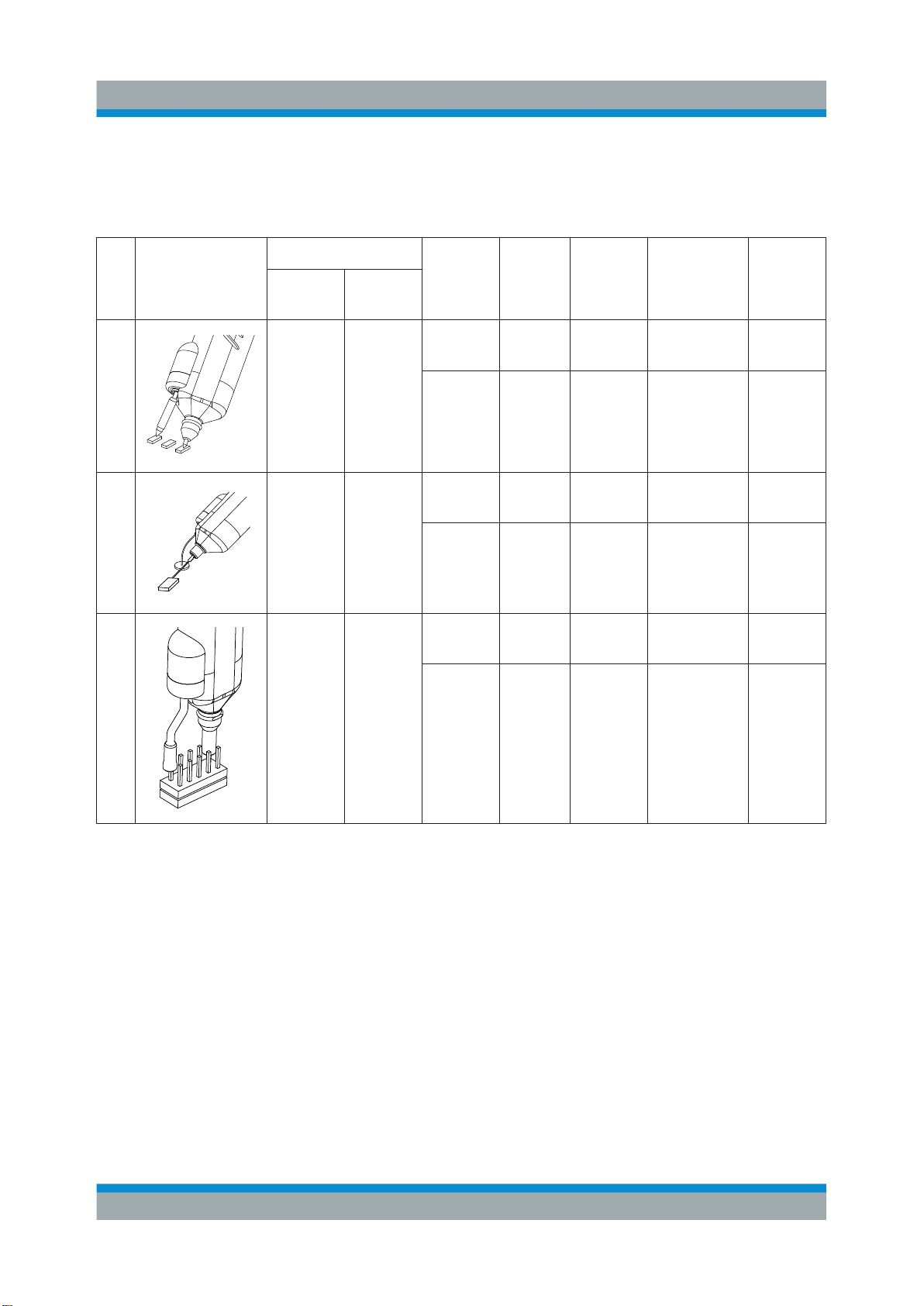
R&S®RT-ZZ80
Measurement Principles
Signal Integrity of the Transferred Signal
Table 4-2: Typical rise time, bandwidth, input impedance and overshoot with different
connection types
No Connection
Type
1
2
3
Connection
Signal
socket
signal
pin
signal
pin, sol-
der in
signal
adapter,
square
pin
Ground
socket
ground
pin,
pogo
ground
pin, sol-
der in
ground
adapter,
square
pin
wide
spacing
narrow
spacing
short
pins
long
pins
wide
spacing
narrow
spacing
Rise
time
55 ps 7.5 GHz 100 Ω 12 %
49 ps 9.5 GHz 80 Ω 24 %
54 ps 8 GHz 130 Ω 11 %
53 ps 5 GHz 165 Ω 14 %
56 ps 8,5 GHz 100 Ω 12 %
49 ps 11 GHz 45 Ω 32 %
Band-
width
Min. input
impedance
|Z
|
min
Overshoot
25User Manual 1409.7689.02 ─ 02
Page 69
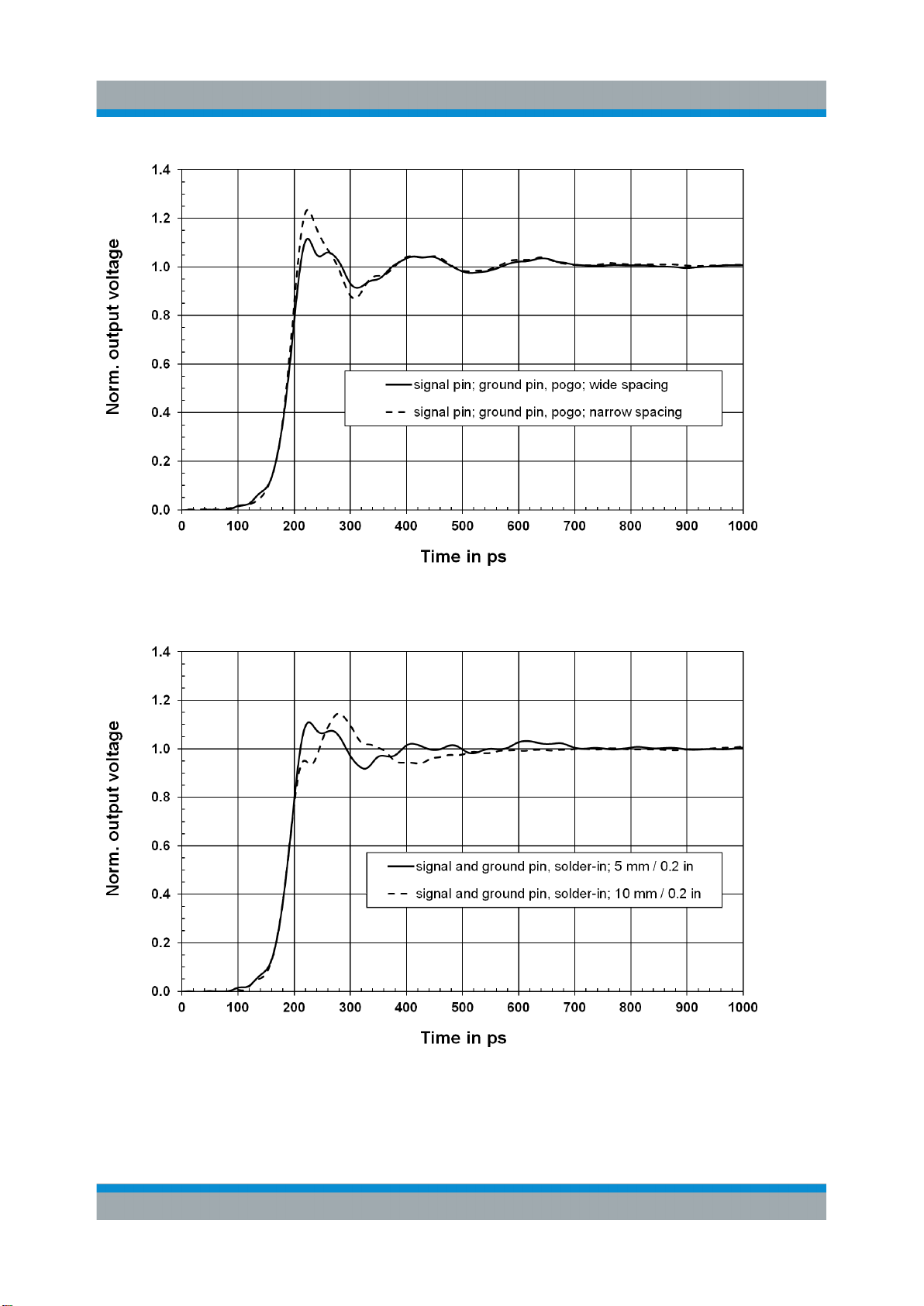
R&S®RT-ZZ80
Measurement Principles
Signal Integrity of the Transferred Signal
Fig. 4-4: Step response of the R&S RT-ZZ80 with a type 1 connection
Fig. 4-5: Step response of the R&S RT-ZZ80 with a type 2 connection
26User Manual 1409.7689.02 ─ 02
Page 70
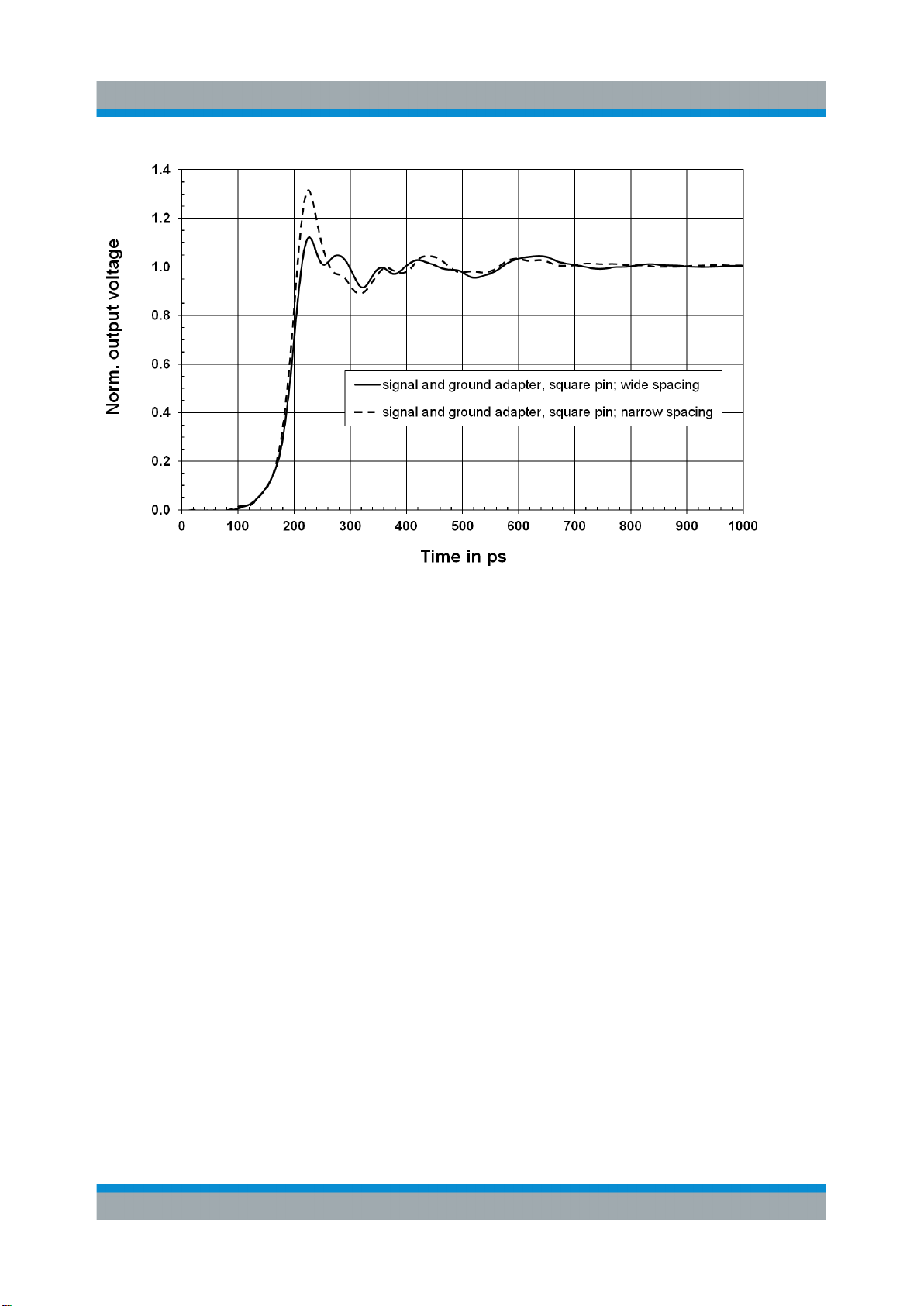
R&S®RT-ZZ80
Measurement Principles
Signal Loading of the Input Signal
Fig. 4-6: Step response of the R&S RT-ZZ80 with a type 3 connection
4.2 Signal Loading of the Input Signal
The previous section dealt with the transfer function and step response of the
probe. This section describes how the probe influences the input signal.
4.2.1 Transmission Line Probes
Traditional passive probes have a high input impedance at DC (typically from
1 MΩ to 10 MΩ) that quickly decreases with rising frequency. For DC, the load of
the DUT is usually negligible, but high-frequency signals are loaded all the more.
On the contrary, transmission line probes have a very low input impedance at DC,
typically from a few 100 Ω to 1 kΩ. This results in a significant higher load of the
DUT at DC than the load caused by a traditional passive probe and can lead to a
malfunction of the circuit.
27User Manual 1409.7689.02 ─ 02
Page 71

R&S®RT-ZZ80
Measurement Principles
Signal Loading of the Input Signal
Application range of transmission line probes
Use the R&S RT-ZZ80 only for measurements of low-impedance sources,
preferably in 50 Ω or 75 Ω impedance controlled environments.
The advantage of transmission line probes is the nearly constant input impedance
over the frequency range, even at very high frequencies. Thus, transmission line
probes are qualified also for measurements of very broadband signals, which
cannot be measured using traditional passive probes.
4.2.2 Input Impedance
The input signal loading caused by the probe is determined by its input impedance Zin. The figure 4-1 presents an equivalent circuit model.
Zin consists of the following probe-specific parameters.
●
Input resistance R
●
Input capacitance C
●
Minimum input impedance |Z
in
in
|
min
The resulting input impedance versus frequency is indicated in figure 4-7. The
trace shows three characteristic areas that can be assigned to Rin, Cin, and |Z
The resulting loading of a step signal at the input of the probe is given in fig-
ure 4-8.
The connection inductance L
has only a minor effect on the signal loading and
con
is therefore not taken into account in the following.
min
|.
28User Manual 1409.7689.02 ─ 02
Page 72
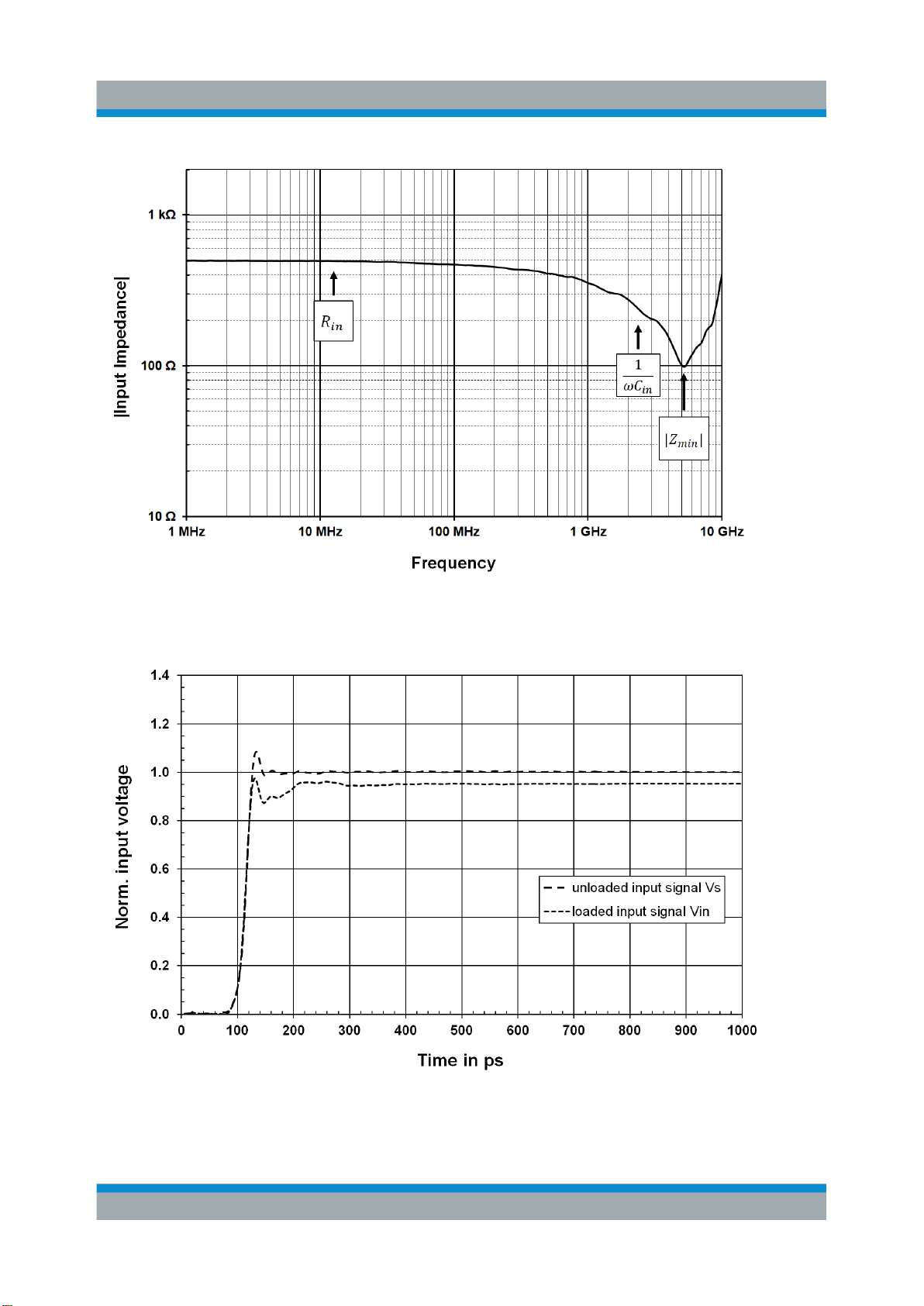
R&S®RT-ZZ80
Measurement Principles
Signal Loading of the Input Signal
Fig. 4-7: Magnitude of the input impedance of the R&S RT-ZZ80 probe as a function of fre-
quency
Fig. 4-8: Signal loading caused by the R&S RT-ZZ80 probe at an effective source impe-
dance of 25 Ω
29User Manual 1409.7689.02 ─ 02
Page 73

R&S®RT-ZZ80
Measurement Principles
Attenuation Dependence on Source Impedance
4.2.2.1 Input Resistance R
in
The input resistance determines the loading of the DUT at DC and frequencies up
to 1 GHz. In this area, the input impedance is near-constant. For DC signals, the
input resistance is 500 Ω.
4.2.2.2 Input Capacitance Cin and Minimum Input Impedance |Z
min
|
The input capacitance Cin causes the input impedance to decrease for high frequencies above 1 GHz. Cin is very low - typically under 300 fF. This low input
capacitance minimizes the load of high-frequency signals.
The minimum input impedance |Z
| mainly depends on the the connection
min
inductance and the connection type. An overview is given in table 4-2.
4.3 Attenuation Dependence on Source Impedance
The previous sections made clear that probes exert a load on the signal to be
measured and change its characteristic. The signal at the test point where the
probe makes contact (Vin) is therefore different from the signal that was present
before the probe was connected (VS).
In contrast to most other probes, the load of the R&S RT-ZZ80 is not negligible
for DC and low-frequency signals. Therefore, the attenuation of the probe
depends on the impedance of the signal source. The figure 4-9 shows the unloaded and loaded input voltages as well as the output voltage of the probe in an
50 Ω environment.
For the R&S RT-ZZ80, the output signal is a good representation of the loaded
input signal. The loaded input signal differs from the unloaded signal mainly by a
lower voltage swing, while the shapes of both signals are almost identical.
30User Manual 1409.7689.02 ─ 02
Page 74

R&S®RT-ZZ80
Sinin
out
R´ZU
U
Ω50
0952.0
Ω25Ω500
Ω50
in
out
U
U
Measurement Principles
Attenuation Dependence on Source Impedance
Fig. 4-9: Input and output signals at an effective source impedance of 25
Ω
To calculate the exact attenuation of the probe, use the following equation:
U
: output voltage
out
U
: unloaded input voltage
in
Z
: input impedance of R&S RT-ZZ80
in
R´
: effective source impedance
S
Example for an 50 Ω environment:
31User Manual 1409.7689.02 ─ 02
Page 75

R&S®RT-ZZ80
Maintenance and Service
Service Strategy
5 Maintenance and Service
5.1 Service Strategy
Rohde & Schwarz probes are high-precision, high-performance instruments that
extend the limits of today’s technological possibilities. Like all Rohde & Schwarz
instruments, Rohde & Schwarz probes are of high quality and require only minimum service and repair. However, if the probe needs to be serviced, contact your
Rohde & Schwarz service center. Return a defective probe to the Rohde &
Schwarz service center for diagnosis and exchange.
You can return the R&S RT-ZZ80 transmission line probe for calibration. The service personnel will perform the required tests.
5.2 Returning the Probe for Servicing
Use the original packaging to return your Rohde & Schwarz probe to your
Rohde & Schwarz service center.
If you cannot use the original packaging, consider the following:
1. Use a sufficiently sized box.
2. Protect the probe from damage and moisture (e.g. with bubble wrap).
3. Use some kind of protective material (e.g. crumpled newspaper) to stabilize
the probe inside the box.
4. Seal the box with tape.
5. Address the package to your nearest Rohde & Schwarz service center.
32User Manual 1409.7689.02 ─ 02
Page 76

R&S®RT-ZZ80
Maintenance and Service
Cleaning
5.3 Cleaning
To clean the exterior of the probe, use a soft cloth moistened with either distilled
water or isopropyl alcohol. Before using the probe again, make sure to dry it completely.
Instrument damage caused by cleaning agents
Cleaning agents contain substances that may damage the instrument; for
example, solvent may damage the labeling or plastic parts.
Never use cleaning agents such as solvents (thinners, acetone, etc.), acids,
bases or other substances
5.4 Calibration Interval
The recommended calibration interval for R&S RT-ZZ80 transmission line probe
is two years. For servicing, send the probe to your nearest Rohde & Schwarz service center (see chapter 5.2, "Returning the Probe for Servicing", on page 32).
33User Manual 1409.7689.02 ─ 02
Page 77

R&S®RT-ZZ80
Index
Index
A
Accessories ............................................. 11
Attenuation .............................................. 30
B
Bandwidth ................................................23
C
Cleaning .................................................. 33
Clips ........................................................ 12
Connecting to DUT ..................................18
Connecting to R&S RTO ......................... 16
I
Input capacitance .................................... 30
Input impedance ......................................28
Input resistance ....................................... 30
L
Leads .......................................................12
M
Using accessories
Ground adapter, square pin ................20
Ground pin, pogo ................................ 18
Ground pin, solder in .......................... 19
Signal adapter, square pin ..................20
Signal pin ............................................ 18
Signal pin, solder in ............................ 19
Maintenance ............................................32
P
Pins
Inserting and removing ....................... 18
Usage ................................................. 18
Probe
Calibration ...........................................33
Cleaning ..............................................33
Connection ..........................................16
Returning ............................................ 32
Probe head ................................................8
Probing principles ....................................21
S
Service .................................................... 32
Service kit ................................................13
Signal integrity .........................................23
Signal loading ..........................................27
Source impedance .................................. 30
Step response ......................................... 24
U
Unpacking ................................................. 7
34User Manual 1409.7689.02 ─ 02
 Loading...