

Page 1

R&S®NRP-Z Series
Power Sensors
Instrument Security Procedures
(;×8ÀÂ)
1173.0850.52 ─ 04
Instrument Security Procedures
Page 2

R&S®NRP-Z Series
Contents
1 Overview................................................................................................. 2
2 Instrument Models Covered..................................................................2
3 Security Terms and Definitions............................................................ 4
4 Types of Memory and Information Storage in the R&S NRP-Zxx......4
5 Secure Erase Procedures......................................................................7
6 Instrument Declassification.................................................................. 7
1 Overview
Contents
In many cases, it is imperative that the R&S NRP-Zxx Power Sensors are used in a
secured environment. Generally these highly secured environments do not allow any
test equipment to leave the area unless it can be proven that no user information
leaves with the test equipment. Security concerns can arise when devices need to
leave a secured area e.g. to be calibrated or serviced.
This document describes the types of memory and their usage in the R&S NRP-Zxx. It
provides a statement regarding the volatility of all memory types and specifies the
steps required to declassify an instrument through memory clearing or sanitization procedures. These sanitization procedures are designed for customers who need to meet
the requirements specified by the US Defense Security Service (DSS).
2 Instrument Models Covered
Product name Order number
R&S NRP-Z11 1138.3004.02
1138.3004.04
R&S NRP-Z21 1137.6000.02
R&S NRP-Z22 1137.7506.02
R&S NRP-Z23 1137.8002.02
R&S NRP-Z24 1137.8502.02
R&S NRP-Z27 1169.4102.02
R&S NRP-Z28 1170.8008.02
2Instrument Security Procedures 1173.0850.52 ─ 04
Page 3

R&S®NRP-Z Series
Instrument Models Covered
Product name Order number
R&S NRP-Z31 1169.2400.02
1169.2400.04
R&S NRP-Z37 1169.3206.02
R&S NRP-Z41 1171.8801.02
R&S NRP-Z51 1138.0005.02
1138.0005.03
1138.0005.62
R&S NRP-Z52 1138.0505.02
1138.0505.18
1138.0505.62
R&S NRP-Z55 1138.2008.02
1138.2008.03
1138.2008.04
R&S NRP-Z56 1171.8201.02
R&S NRP-Z57 1171.8401.02
R&S NRP-Z58 1173.7031.02
R&S NRP-Z61 1171.7505.02
R&S NRP-Z81 1137.9009.02
R&S NRP-Z85 1411.7501.02
R&S NRP-Z86 1417.0109.40
1417.0109.44
R&S NRP-Z91 1168.8004.02
1168.8004.04
1168.8004.08
R&S NRP-Z92 1171.7005.02
1171.7005.42
R&S NRP-Z98 1170.8508.02
R&S NRP-Z211 1417.0409.02
1417.0409.04
R&S NRP-Z221 1417.0309.02
R&S NRP-Z311 1171.8601.02
R&S FSH-Z1 1155.4505.02
R&S FSH-Z18 1165.1909.02
3Instrument Security Procedures 1173.0850.52 ─ 04
Page 4

R&S®NRP-Z Series
3 Security Terms and Definitions
Clearing
The term "clearing" is defined in Section 8-301a of DoD 5220.22-M, "National Industrial
Security Program Operating Manual (NISPOM)". Clearing is the process of eradicating
the data on media so that the data can no longer be retrieved using the standard interfaces on the instrument. Therefore, clearing is typically used when the instrument is to
remain in an environment with an acceptable level of protection.
Sanitization
The term "sanitization" is defined in Section 8-301b of DoD 5220.22-M, "National
Industrial Security Program Operating Manual (NISPOM)". Sanitization is the process
of removing or eradicating stored data so that the data cannot be recovered using any
known technology. Instrument sanitization is typically required when an instrument is
moved from a secure to a non-secure environment, such as when it is returned for service of calibration.
Security Terms and Definitions
The memory sanitization procedures described in this document are designed for customers who need to meet the requirements specified by the US Defense Security Service (DSS). These requirements are specified in the "Clearing and Sanitization Matrix"
in Section 14.1.16 of the ISFO "Manual for the Certification and Accreditation of Classified Systems under the NISPOM".
Instrument declassification
The term "instrument declassification" refers to procedures that must be undertaken
before an instrument can be removed from a secure environment, for example when
the instrument is returned for calibration. Declassification procedures include memory
sanitization or memory removal, or both. The declassification procedures described in
this document are designed to meet the requirements specified in DoD 5220.22-M,
"National Industrial Security Program Operating Manual (NISPOM)", Chapter 8.
4 Types of Memory and Information Storage
in the R&S NRP-Zxx
The Power Sensor contains various memory components.
The following table provides an overview of the memory components that are part of
your instrument. For a detailed description regarding type, size, usage and location,
refer to the subsequent sections.
4Instrument Security Procedures 1173.0850.52 ─ 04
Page 5

R&S®NRP-Z Series
Types of Memory and Information Storage in the R&S NRP-Zxx
Volatile Memory
Memory type Size Content Volatility User data Sanitization
procedure
CMOS-
1
SRAM
2
SDRAM
(MAIN processor)
EEPROM
Flash
1
All except the R&S NRP-Z81/-Z85/-Z86
2
R&S NRP-Z81/-Z85/-Z86 only
4.1 Volatile Memory
1Mbyte Used by the
16 Mbyte Used by the
2
2 x 26 bytes
2 Mbytes
8 Mbytes
1
2
processor for
firmware operation
processor for
firmware operation
●
Boot
loader
●
Calibration data
●
Firmware
●
S-parameter data
Volatile Yes Turn off instru-
ment power
(disconnect
USB)
Volatile Yes Turn off instru-
ment power
(disconnect
USB)
Non-volatile No None required
Non-volatile Yes Secure Erase
procedure
(see Chap-
ter 5, "Secure
Erase Procedures",
on page 7)
The volatile memory in the instrument does not have battery backup. It loses its contents as soon as power is removed from the instrument (disconnect USB). The volatile
memory is not a security concern.
Removing power from this memory meets the memory sanitization requirements specified in the "Clearing and Sanitization Matrix" in Section 5.2.5.5.5 of the ISFO Process
Manual for the Certification and Accreditation of Classified Systems under the NISPOM.
CMOS-SRAM
All except R&S NRP-Z81/-Z85/-Z86
The CMOS-RAM is used by the processor to operate the firmware. It has a size of
1 Mbyte.
Sanitization procedure: Turn off instrument power (disconnect USB)
SDRAM (MAIN processor)
R&S NRP-Z81/-Z85/-Z86 only
The SDRAM is used by the processor to operate the firmware. It ha a size of 16 Mbyte.
Sanitization procedure: Turn off instrument power (disconnect USB)
5Instrument Security Procedures 1173.0850.52 ─ 04
Page 6
R&S®NRP-Z Series
Types of Memory and Information Storage in the R&S NRP-Zxx
Non-Volatile Memory
4.2 Non-Volatile Memory
The Power Sensors contain various non-volatile memories. Out of these, only the
Flash memory contains user data.
EEPROM
R&S NRP-Z81/-Z85/-Z86 only
The EEPROMs on each of the two potentiometer chips have a size of 26 bytes each.
They do not contain information and cannot be accessed.
Sanitization procedure: None required (no user data)
Flash
The size of the Flash memory depends on the Power Sensor model.
●
All except R&S NRP-Z81/-Z85/-Z86:
2 Mbyte
●
R&S NRP-Z81/-Z85/-Z86:
8 Mbyte
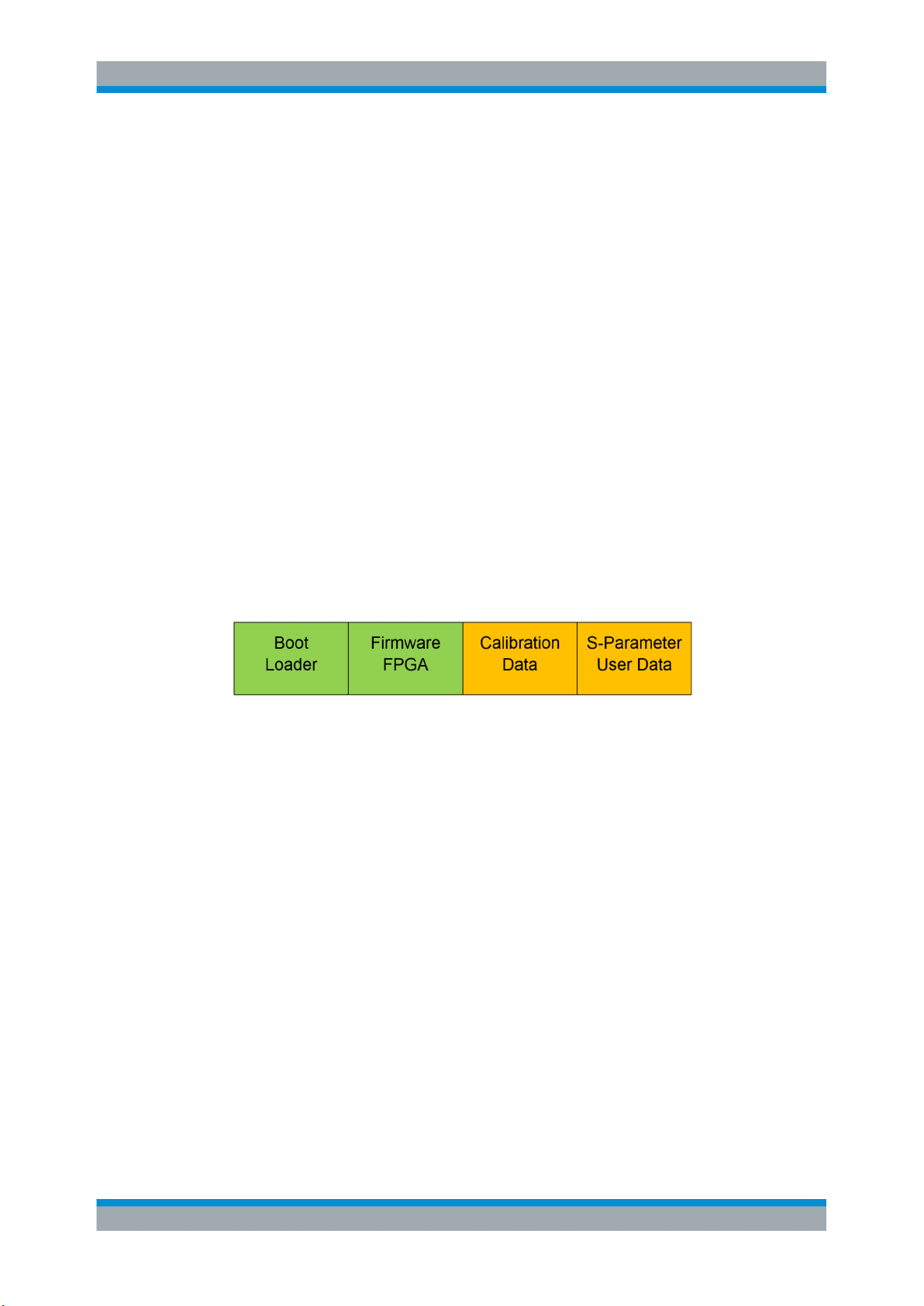
The Flash memory is partitioned into different sections, each of which contains different information.
Figure 4-1: Logical sections of the Flash memory
●
Boot loader:
This section contains boot code to start the firmware during power-on.
This section is initialized during production and during firmware updates. It cannot
be accessed and is not modified during instrument operation.
●
Firmware, including FPGA:
This section contains program code and constant data.
This section cannot be accessed and is not modified during instrument operation.
●
Calibration data, S-parameter and user data:
This section contains the calibration data required to operate a Power Sensor and
the S-parameter data that contains information about the used frequency ranges.
You can upload S-parameter data into the sensor and download S-parameter data
from the sensor.
Only this section of the Flash memory contains user data.
Note that the Flash memory does not contain any kind of setup information (for example recently used RF frequency) or other measurement parameters or results.
Sanitization procedure: Secure Erase procedure
6Instrument Security Procedures 1173.0850.52 ─ 04
Page 7

R&S®NRP-Z Series
5 Secure Erase Procedures
Because the CMOS-RAM and SDRAM are erased when power is removed from the
Power Sensor, they do not pose a security risk. The EEPROM contains no user data.
Therefore, it is deemed that it does not pose a risk either.
The Flash memory is the only memory type that does not lose its contents when power
is removed and can contain user data.
You can sanitize the Flash memory with the NrpzSanitizer software, which is available
from Rohde & Schwarz. The software removes all user data from the Flash memory.
Contact the Power Sensor product management for more information.
To sanitize the Flash memory, you have to connect the Power Sensor to a PC on
which the software is installed.
The software triggers the following actions.
●
●
●
●
●
Secure Erase Procedures
The firmware is temporarily saved in the SRAM (or SDRAM in case of the
R&S NRP-Z81/-Z85/-Z86).
A full sector erase command as per manufacturer data sheet is applied to every
single sector of the Flash memory. This explicitly includes sectors that might be
declared as defect.
Every addressable location of the Flash memory is overwritten by a single character.
Another full sector erase command as per manufacturer data sheet is applied to
every single sector of the Flash memory, including defect sectors.
The contents of the Flash memory are recreated and firmware is restored.
The Secure Erase procedure meets the memory sanitization requirements specified in
the "Clearing and Sanitization Matrix" in Section 14.1.16 of the ISFO Process Manual
for the Certification and Accreditation of Classified Systems under the NISPOM.
6 Instrument Declassification
Before you can remove the Power Sensor from a secured area (for example to perform
service or calibration), all classified user data needs to be removed. You can declassify
the Power Sensor as follows.
Following these steps removes all user data from the Power Sensor. The Power Sensor can now leave the secured area.
1. Connect the Power Sensor via USB to a PC on which the NrpzSanitizer software is
installed.
2. Start the NrpzSanitizer software and select the "Elements to Sanitize".
● "Reset S-Parameter to a Clean Dataset"
● "Sanitize Power Sensor"
7Instrument Security Procedures 1173.0850.52 ─ 04
Page 8

R&S®NRP-Z Series
3. Select "Execute" to sanitize the Power Sensor.
4. After memory sanitization, disconnect the Power Sensor from USB to remove
These declassification procedures meet the needs of customers working in secured
areas.
Validity of instrument calibration after declassification
Since calibration data is lost during the declassification procedure, the Power Sensor
needs to be recalibrated. Please contact your local Rohde & Schwarz service center.
Instrument Declassification
Note that this option completely erases all data on the Power Sensor (firmware,
bootloader, FPGA, S-Parameter etc.).
See Chapter 5, "Secure Erase Procedures", on page 7 for more information about
the effects of the sanitization.
power supply.
© 2017 Rohde & Schwarz GmbH & Co. KG
Mühldorfstr. 15, 81671 München, Germany
Phone: +49 89 41 29 - 0
Fax: +49 89 41 29 12 164
Email: [email protected]
Internet: www.rohde-schwarz.com
Subject to change – Data without tolerance limits is not binding.
R&S® is a registered trademark of Rohde & Schwarz GmbH & Co. KG.
Trade names are trademarks of their owners.
Throughout this manual, products from Rohde & Schwarz are indicated without the ® symbol , e.g.
R&S®NRP-Zxx is indicated as R&S NRP-Zxx.
8Instrument Security Procedures 1173.0850.52 ─ 04
 Loading...