

Page 1

R&S®NRP2
Power Meter
Instrument Security Procedures
(;ÚÝP2)
1176.7932.02 ─ 02
Instrument Security Procedures
Page 2

R&S®NRP2
Contents
Contents
1 Overview................................................................................................. 2
2 Instrument Models Covered..................................................................2
3 Security Terms and Definitions............................................................ 2
4 Types of Memory and Information Storage in the R&S NRP2........... 3
5 Instrument Declassification.................................................................. 6
1 Overview
In many cases, it is imperative that the R&S NRP2 Power Meters are used in a
secured environment. Generally these highly secured environments do not allow any
test equipment to leave the area unless it can be proven that no user information
leaves with the test equipment. Security concerns can arise when devices need to
leave a secured area e.g. to be calibrated or serviced.
This document describes the types of memory and their usage in the R&S NRP2. It
provides a statement regarding the volatility of all memory types and specifies the
steps required to declassify an instrument through memory clearing or sanitization procedures. These sanitization procedures are designed for customers who need to meet
the requirements specified by the US Defense Security Service (DSS).
2 Instrument Models Covered
Table 2-1: Power Meter models
Product name Order number
R&S NRP2 1144.1374.02
3 Security Terms and Definitions
Clearing
The term "clearing" is defined in Section 8-301a of DoD 5220.22-M, "National Industrial
Security Program Operating Manual (NISPOM)". Clearing is the process of eradicating
the data on media so that the data can no longer be retrieved using the standard inter-
2Instrument Security Procedures 1176.7932.02 ─ 02
Page 3

R&S®NRP2
Types of Memory and Information Storage in the R&S NRP2
faces on the instrument. Therefore, clearing is typically used when the instrument is to
remain in an environment with an acceptable level of protection.
Sanitization
The term "sanitization" is defined in Section 8-301b of DoD 5220.22-M, "National
Industrial Security Program Operating Manual (NISPOM)". Sanitization is the process
of removing or eradicating stored data so that the data cannot be recovered using any
known technology. Instrument sanitization is typically required when an instrument is
moved from a secure to a non-secure environment, such as when it is returned for service of calibration.
The memory sanitization procedures described in this document are designed for customers who need to meet the requirements specified by the US Defense Security Service (DSS). These requirements are specified in the "Clearing and Sanitization Matrix"
in Section 14.1.16 of the ISFO "Manual for the Certification and Accreditation of Classified Systems under the NISPOM".
Instrument declassification
The term "instrument declassification" refers to procedures that must be undertaken
before an instrument can be removed from a secure environment, for example when
the instrument is returned for calibration. Declassification procedures include memory
sanitization or memory removal, or both. The declassification procedures described in
this document are designed to meet the requirements specified in DoD 5220.22-M,
"National Industrial Security Program Operating Manual (NISPOM)", Chapter 8.
4 Types of Memory and Information Storage
in the R&S NRP2
The Power Meter contains various memory components.
The following table provides an overview of the memory components that are part of
your instrument. For a detailed description regarding type, size, usage and location,
refer to the subsequent sections.
3Instrument Security Procedures 1176.7932.02 ─ 02
Page 4

R&S®NRP2
Types of Memory and Information Storage in the R&S NRP2
Non-Volatile Memory
Memory type Size Content Volatility User
SDRAM 64 Mbyte Temporary information storage
Display memory (LCD display controller)
Flash 16 Mbyte
4.1 Volatile Memory
80 kbyte Display information Volatile Yes Turn off
The volatile memory in the instrument does not have battery backup. It loses its contents as soon as power is removed from the instrument. The volatile memory is not a
security concern.
for operating system and instrument firmware
●
Bootloader and application
firmware
●
User data:
– Frequency-dependent
offset tables
– User-defined setups
– Window titles
– Sensor test results
Sanitization
Data
Volatile Yes Turn off
Non-volatile Yes "Erase non-
procedure
instrument
power
instrument
power
volatile data"
procedure
(see "Flash"
on page 5)
Removing power from this memory meets the memory sanitization requirements specified in the "Clearing and Sanitization Matrix" in Section 5.2.5.5.5 of the ISFO Process
Manual for the Certification and Accreditation of Classified Systems under the NISPOM.
SDRAM
The SDRAM has a size of 64 Mbyte and contains temporary information storage for
operating system and instrument firmware. The SDRAM loses its memory as soon as
power is removed.
Sanitization procedure: Turn off instrument power
Display memory
The display memory has a size of 80 kbyte and contains display information. The display memory loses its memory as soon as power is removed.
Sanitization procedure: Turn off instrument power
4.2 Non-Volatile Memory
The R&S NRP2 contains one non-volatile memory.
The non-volatile memory of the R&S NRP2 is not a security concern.
4Instrument Security Procedures 1176.7932.02 ─ 02
Page 5
R&S®NRP2
Types of Memory and Information Storage in the R&S NRP2
Non-Volatile Memory
Flash
The R&S NRP2 Power Meter has one 16 Mbyte Flash memory device.
The Flash memory is partitioned in two regions:
●
Bootloader and application firmware
●
User data: Frequency-dependent offset tables, user-defined setups, window titles,
sensor test results
User data is not erased when power is removed from the instrument.
The R&S NRP2 provides a sanitizing procedure that ensures that user data is irretrievably removed from the instrument.
Sanitization procedure: "Erase non-volatile data" procedure
To sanitize the internal Flash memory, perform the following steps:
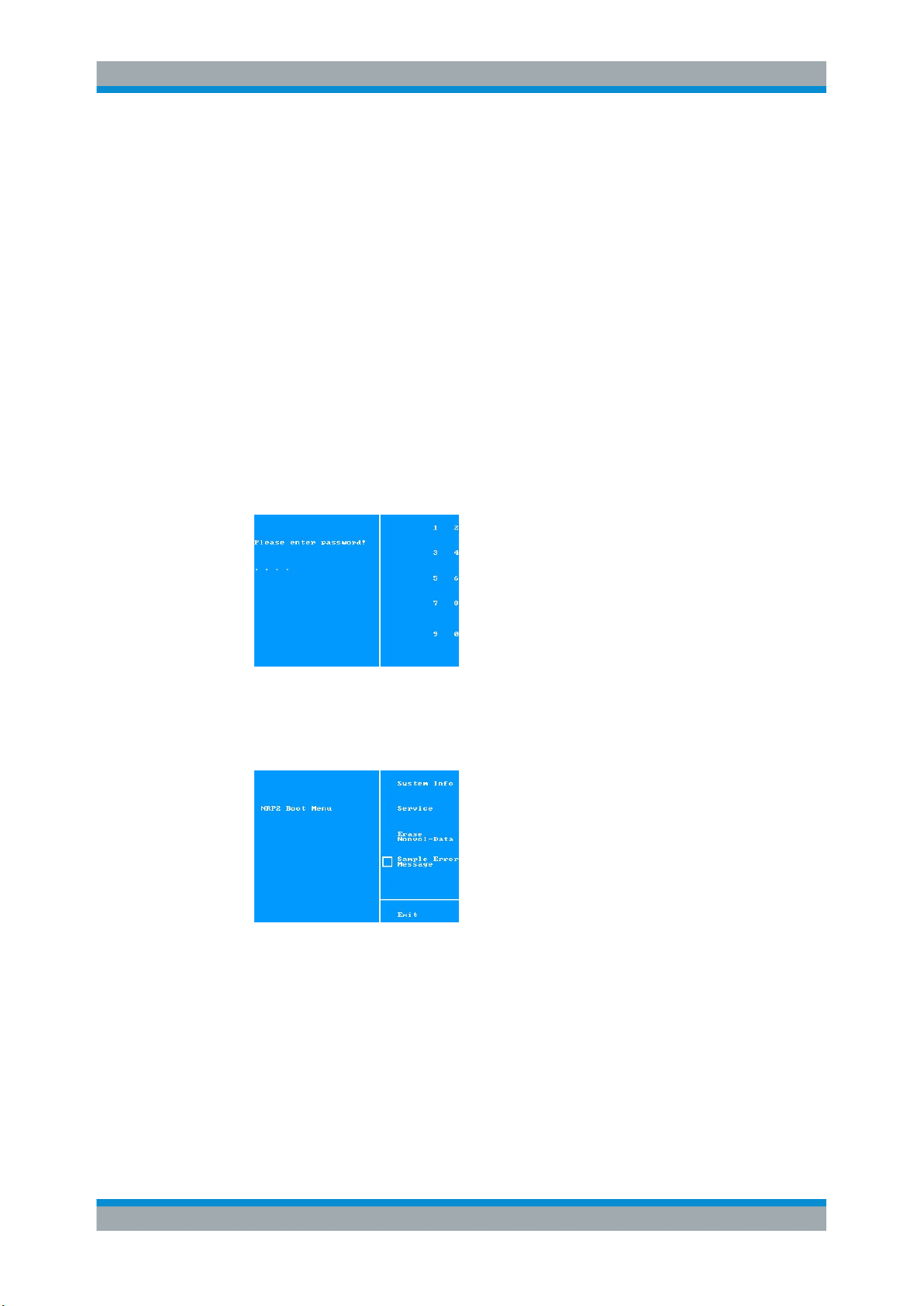
1. Immediately after powering-on the unit, press the "Bootmenu" softkey.
A password screen appears.
Figure 4-1: Password screen
2. Enter the password "7396". Press the "OK" softkey.
The boot menu appears.
Figure 4-2: Boot menu screen
3. Press the "Erase Nonvol-Data" softkey.
The warning message "Attention! All saved data will be lost!" appears.
4. Confirm by pressing the ENTER/MENU key. The process of erasing the nonvolatile
system memory takes some seconds. It is finished when the boot menu reappears
and the item "Erase Nonvol-Data" is checked.
5. Press the "Exit" softkey to reboot the unit.
5Instrument Security Procedures 1176.7932.02 ─ 02
Page 6

R&S®NRP2
Instrument Declassification
6. After rebooting, the message box "Non-volatile Memory is empty EEPROM is
defective" appears. Close the message box by pressing the "Erase Nonvol-Data"
key.
The R&S NRP2 uses the factory default parameters.
5 Instrument Declassification
Before you can remove the Power Meter from a secured area (for example to perform
service or calibration), all classified user data needs to be removed. You can declassify
the Power Meter as follows:
1. Sanitize the non-volatile memory, as described in "Flash" on page 5.
2. Turn off the Power Meter. This will sanitize the volatile memory.
Following these steps removes all user data from the Power Meter. The Power Meter
can now leave the secured area.
These declassification procedures meet the needs of customers working in secured
areas.
© 2017 Rohde & Schwarz GmbH & Co. KG
Mühldorfstr. 15, 81671 München, Germany
Phone: +49 89 41 29 - 0
Fax: +49 89 41 29 12 164
Email: [email protected]
Internet: www.rohde-schwarz.com
Subject to change – Data without tolerance limits is not binding.
R&S® is a registered trademark of Rohde & Schwarz GmbH & Co. KG.
Trade names are trademarks of their owners.
Throughout this manual, products from Rohde & Schwarz are indicated without the ® symbol , e.g.
R&S®NRP2 is indicated as R&S NRP2.
6Instrument Security Procedures 1176.7932.02 ─ 02
 Loading...