

Page 1
Q-TECH
COR PORATI ON
Description
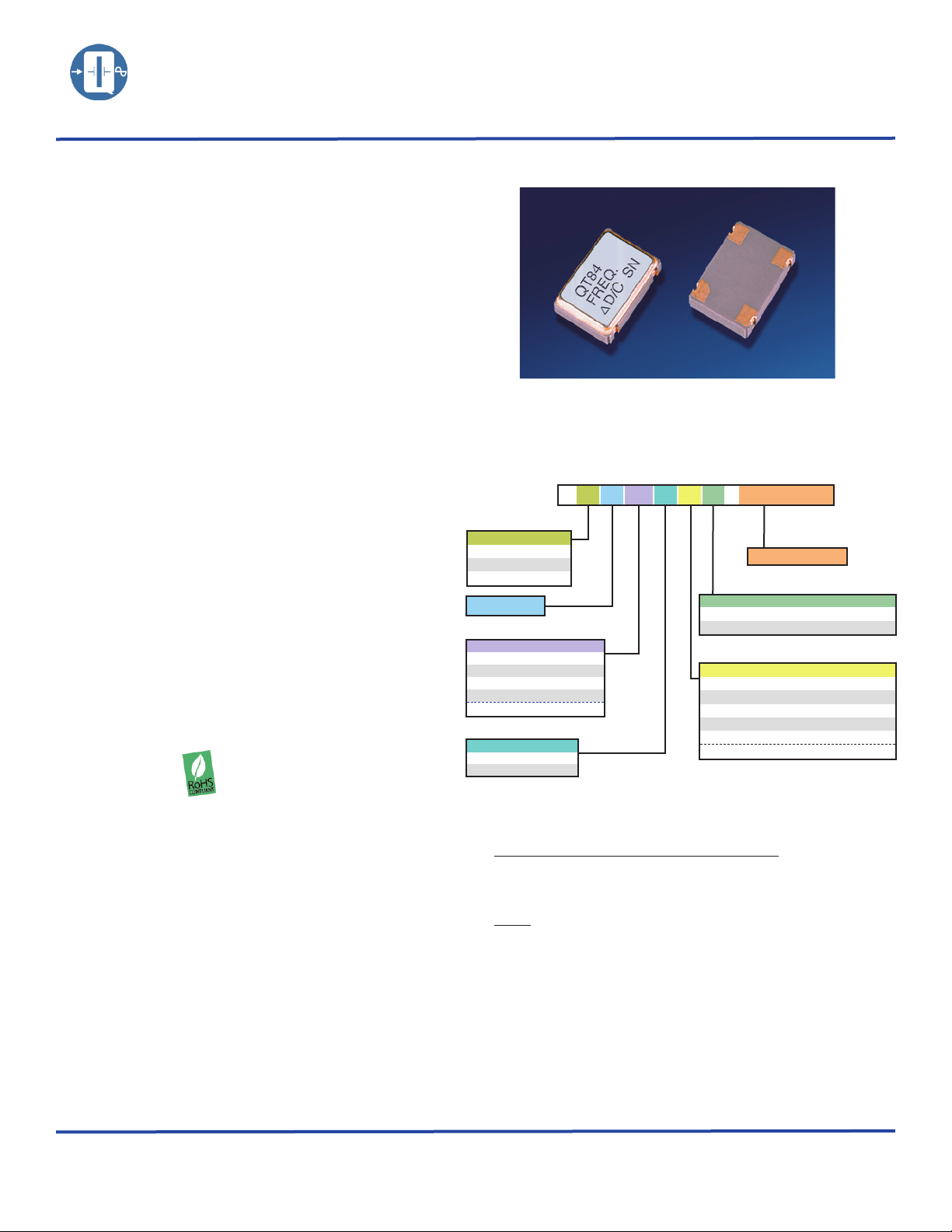
Q-Tech’s surface mount 7 x 5 mm oscillator series consist
of an IC 5Vdc, 3.3Vdc, 2.5Vdc, 1.8Vdc clock square wave
generator and a miniature strip AT quartz crystal built in a
low profile ceramic package with gold plated contact pads.
This is the smallest package Q-Tech has ever offered for
High Reliability applications.
Features
• Made in the USA
• ECCN: EAR99
• Broad frequency range from 500kHz to 160MHz
• Small footprint
• LVHCMOS, HCMOS, and TTL compatible
• 5.0Vdc, 3.3Vdc, 2.5Vdc, 1.8Vdc supply
• Able to meet 36000G shock, half sine, 0.5ms
• Wide operating temperature range
• Tri-State Output (Option D)
• Hermetically sealed ceramic package
• Fundamental and 3rd Overtone designs
• Full or partial military screening tests available
• Tape and reel packaging
• Lead free tinning available
• RoHS compliant
MINIATURE SMD CRYSTAL OSCILLATORS
Ordering Information
QT84HCD10M-5 0 . 0 0 0 MHz
Q T 84 HC D 10 M - 50.000MHz
Solder Dip Option:
T = Standard
S = Solder Dip (*)
G =Solder Dip (*)
Package
Logic & Supply Voltage:
HC = HCMOS +5.0V
L = LVHCMOS +3.3V
N = LVHCMOS +2.5V
R = LVHCMOS +1.8V
See notes (**)
Tristate Option:
Blank = No Tristate
D = Tristate
LOW PROFILE QT84
1.8 to 5.0Vdc - 500kHz to 160MHz
(Sample part number)
Output Frequency
Screening Option:
Blank=No Screening
M=Per MIL-PRF-55310, Level B
Frequency vs. Temperature Code:
7 = ± 75ppm at -55ºC to +125ºC
10 = ± 100ppm at -55ºC to +125ºC
11 = ± 50ppm at -40ºC to +85ºC
17 = ± 75ppm at -60ºC to +125ºC
18 = ± 100ppm at -60ºC to +125ºC
See notes (**)
Applications
Available for temperatures up to +200ºC with Q-Tech MCM number.
(*) Hot Solder Dip options for an additional cost:
• Designed to meet today’s requirements for low
voltage applications
• High shock applications
• Gun launched munitions and systems
• Smart munitions
• Instrumentation
• Navigation
S = Sn60/Pb40 per MIL-PRF 55310
G = Lead free Alloy SAC305 (96.5% Sn, 3% Ag, 0.5% Cu)
(**)Notes
• Supply voltage, frequency stability vs. temperature codes
may not be available in all frequencies.
• For Non-Standard requirements, contact Q-Tech Corporation
at Sales@Q-Tech.com
• Avionics
• Microprocessor clock
Specifications subject to change without prior notice.
Q-TECH Corporation - 10150 W. Jefferson Boulevard, Culver City 90232 - Tel: 310-836-7900 - Fax: 310-836-2157 - www.q-t ech.c om
QPDS-0003, Rev G, February 2013 (ECO# 10720)
1 of 6
Page 2
Q-TECH
COR PORATI ON
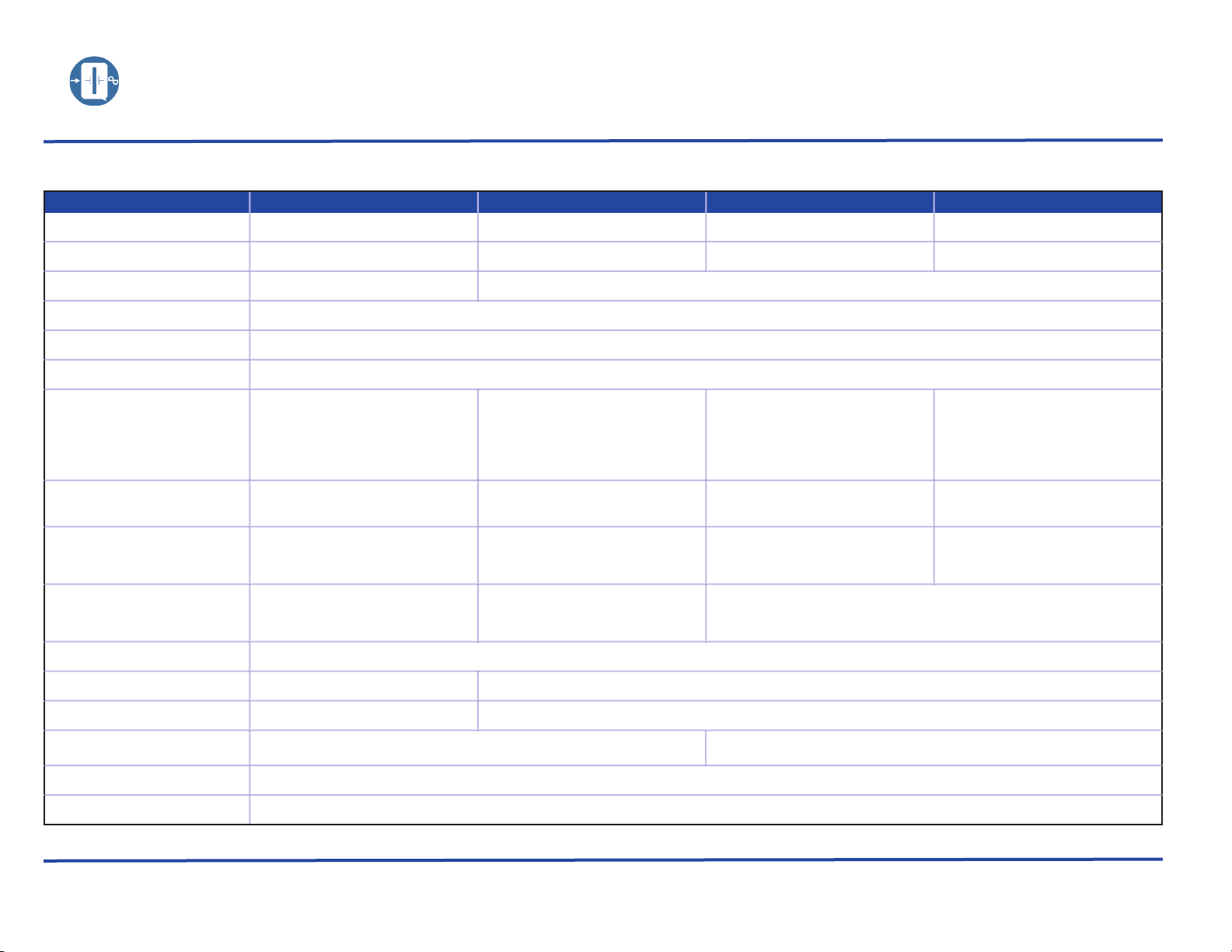
Electrical Characteristics
LOW PROFILE QT84
MINIATURE SMD CRYSTAL OSCILLATORS
1.8 to 5.0Vdc - 500kHz to 160MHz
Parameters
Output frequency range (Fo)
Supply voltage (Vdd)
Maximum Applied Voltage
(Vdd max.)
Frequency stability (∆F/∆T) See Option codes
Operating temperature (Topr) See Option codes
Storage temperature (Tsto) -62ºC to + 125ºC
20 mA max. - 500kHz ~ < 16MHz
25 mA max. - 16MHz ~ < 32MHz
Operating supply current
(Idd) (No Load)
Symmetry
(50% of ouput waveform or
1.4Vdc for TTL)
Rise and Fall times
(with typical load)
Output Load
35 mA max. - 32MHz ~ < 50MHz
45/55% max. - 500kHz ~ < 21MHz
40/60% max. - 21 ~ ≤ 50MHz
3ns max. - Fo ≥ 40 - 50MHz
HC
500kHz — 50.000MHz
5.0Vdc ± 10%
7.0Vdc
6ns max. - Fo < 40MHz
(between 10% to 90%)
15pF // 10kohms
50pF max. or 10TTL
500kHz — 160.000MHz 500kHz — 133.000MHz
6 mA max. - 500kHz ~ < 16MHz
10 mA max. - 16MHz ~ < 32MHz
20 mA max. - 32MHz ~ < 60MHz
30 mA max. - 60MHz ~ < 100MHz
40 mA max. - 100MHz ~ < 130MHz
50 mA max. - 130MHz ~ ≤160MHz
45/55% max. - 500kHz ~ < 21MHz
40/60% max. - 21 ~ ≤ 160MHz
6ns max. - 500kHz ~ < 40MHz
3ns max. - 40 ~ ≤ 16 0MHz
(30pF max. for F ≤ 50MHz)
L
3.3Vdc ± 10% 2.5Vdc ± 10%
(between 10% to 90%)
15pF // 10kohms
N R
5.0Vdc
6 mA max. - 500kHz ~ < 40MHz
15 mA max. - 40MHz ~ < 60MHz
25 mA max. - 60MHz ~ < 85MHz
35 mA max. - 85MHz ~ ≤ 133MHz
45/55% max. - 500kHz ~ < 21MHz
40/60% max. - 21 ~ ≤ 133MHz
5ns max. - 500kHz ~ < 40MHz
3ns max. - 40 ~ ≤ 133MHz
(between 10% to 90%)
500kHz — 100.000MHz
1.8Vdc ± 10%
4 mA max. - 500kHz ~ < 40MHz
10 mA max. - 40MHz ~ < 50MHz
20 mA max. - 50MHz ~ < 85MHz
25 mA max. - 85MHz ~ ≤ 100MHz
45/55% max. - 500kHz~ < 21MHz
40/60% max. - 21 ~ ≤ 100MHz
5ns max. - 500kHz ~ < 40MHz
3ns max. - 40 ~ ≤ 100MHz
(between 10% to 90%)
15pF // 10kohms
Start-up time (Tstup) 10ms max.
Output voltage (Voh/Vol)
Output Current (Ioh/Iol)
Enable/Disable
Tristate function Pin 1
Jitter RMS 1σ (at 25ºC) See Page 5
Aging (at 70ºC)
0.9 x Vdd min.; 0.1 x Vdd max.
± 24mA max.
VIH ≥ 2.2V Oscillation;
VIL ≤ 0.8V High Impedance
± 5ppm max. first year / ± 2ppm max. per year thereafter
0.9 x Vdd min.; 0.1 x Vdd max.
± 4mA max.
VIH ≥ 0.7 x Vdd Oscillation;
VIL ≤ 0.3 x Vdd High Impedance
Q-TECH Corporation - 10150 W. Jefferson Boulevard, Culver City 90232 - Tel: 310-836-7900 - Fax: 310-836-2157 - www.q-te ch.com
QPDS-0003, Rev G, February 2013 (ECO# 10720)
2 of 6
Page 3

Q-TECH
.102
(2.6)
0.055
(1.4)
0.040
(1.0)
(2.0)
0.079
12
34
max.
0.197±.006
(5.00±0.15)
0.276±.006
(7.0±0.2)
12
4 3
(5.08±0.2)
0.2±.008
R 0.200
(R .008)
(4X)
P/N
FREQ.
D/C S/N
0.079
(2.0)
(5.08)
0.2
(1.8)
(4.2)
0.165
0.071
C BYPASS
(6.86)
0.27
COR PORATI ON
Package Outline and Pin Connections
Dimensions are in inches (mm)
LOW PROFILE QT84
MINIATURE SMD CRYSTAL OSCILLATORS
1.8 to 5.0Vdc - 500kHz to 160MHz
Pin No.
1
2
3
4
An external bypass capacitor 0.01µF
is required between Vdd and GND
Function
TRISTATE or N/C
GND/CASE
OUTPUT
VDD
Package Information Marking Information
• Package material: 91% AL2O
• Weight: .15g typ., 2g max.
• Termination pads (4x): Tungsten
• Termination finish: Nickel Underplate: 100μ ~ 250μ inches
Q-TECH Corporation - 10150 W. Jefferson Boulevard, Culver City 90232 - Tel: 310-836-7900 - Fax: 310-836-2157 - www.q-t ech.c om
QPDS-0003, Rev G, February 2013 (ECO# 10720)
3
Gold Plated: 50μ ~ 80μ inches
Hot Solder Dip Sn60/Pb40 Finish (optional per P.O)
Lead Free Tinning (SAC305) finish (optional per P.O)
Line 1: P/N (QT84L9M)
Line 2: Frequency (500.000K)
Line 3: ESD Symbol + D/C (YYWW) + S/N
3 of 6
Page 4

Q-TECH
Vdd
GND
0.1xVdd
0.9xVdd
VOH
VOL
Tr Tf
TH
T
0.5xVdd
SYMMETRY = x 100%
TH
T
0 20 40 60 80 100 120 140 160
180
200 220 240 260
280
300 320 340 360 380 400 420 Time (s)
25
50
75
100
125
150
175
200
225
250
TEMP(*C)
0
60s min.
120s max.
60s min.
120s max.
225º min.
240º max.
60s min.
150s max.
240º
Ramp down (6ºC/s Max)
Ramp up (3ºC/s Max)
TYPICAL REFLOW PROFILE FOR Sn-Pb ASSEMBLY
-
-
Output
Ground
4
3
2
0.1µF
15pF
1
Tristate Function
Power
supply
10k
mA
Vdc
+
+
+
(*)
or
0.01µF
QT84
(*) CL includes probe and jig capacitance
Typical test circuit for CMOS logic
-50
-40
-30
-20
-10
0
10
20
30
40
50
-55 -50 -45 -40 -35 -30 -25 -20 -15 -10 -5 0 5 10 15 20 25 30 35 40 45 50 55 60 65 70 75 80 85 90 95 100 105
Frequency Stability (PPM)
Temperature (°C)
FVT QT84HC6-3.6864MHz
Ø178±1
26
FEEDING (PULL) DIRECTION
Ø13.0±0.5
120°
2.5
0.16
Ø1.5
12±0.1
2.0
1.75±0.1
0.3±.005
2.0±0.1
24.0±0.3
5.72±0.1
4.0±0.1
or
Ø330±1
Ø1.5
7.70
11.5
5°Max
P/N
FREQUENCY
D/C S/N
COR PORATI ON
LOW PROFILE QT84
MINIATURE SMD CRYSTAL OSCILLATORS
1.8 to 5.0Vdc - 500kHz to 160MHz
Output Waveform (Typical)
Frequency vs. Temperature Curve
Reflow Profile
Test Circuit
The Tristate function on pin 1 has a built-in pull-up resistor so it can be left
floating or tied to Vdd without deteriorating the electrical performance.
Embossed Tape and Reel Information for QT84
Environmental and Mechanical Specifications
Temperature cycling MIL-STD-883, Method 1010, Cond. B
Constant acceleration MIL-STD-883, Method 2001, Cond. A, Y1
Seal: Fine and Gross Leak MIL-STD-883, Method 1014, Cond. A and C
Vibration sinusoidal MIL-STD-202, Method 204, Cond. D
Shock, non operating MIL-STD-202, Method 213, Cond. I
Resistance to solder heat MIL-STD-202, Method 210, Cond. B
Resistance to solvents MIL-STD-202, Method 215
Solderability MIL-STD-202, Method 208
ESD Classification MIL-STD-883, Method 3015, Class 1 HBM 0 to 1,999V
Moisture Sensitivity Level J-STD-020, MSL=1
QPDS-0003, Rev G, February 2013 (ECO# 10720)
Q-TECH Corporation - 10150 W. Jefferson Boulevard, Culver City 90232 - Tel: 310-836-7900 - Fax: 310-836-2157 - www.q-t ech.c om
Environmental Test Test Conditions
Dimensions are in mm. Tape is compliant to EIA-481-A.
Reel size (Diameter in mm)
178
Qty per reel (pcs)
1,000
4 of 6
Page 5

Q-TECH
COR PORATI ON
Jitter And Phase Noise
As data rate increases, effect of jitter becomes critical
with its budget tighter. Jitter is the deviation of a timing
event of a signal from its ideal position. Jitter is
complex and is composed of both random jitter (RJ) and
deterministic jitter (DJ) components.
Random Jitter (RJ) is theoretically unbounded and
Gaussian in distribution, while Deterministic Jitter (DJ)
is bounded and does not follow any predictable
distribution.
Q-Tech utilizes the EZJIT Plus jitter analysis software
with Noise reduction software that supports Agilent
Infinium real-time oscilloscope. Measure at its
maximum sampling rate 40Gs/s and memory depth, we
can separate the signal’s aggregate total jitter into
Random Jitter (RJ) and Deterministic Jitter (DJ).
Since Random Jitter is unbounded and Gaussian in
style, the Total Jitter is a function of Bit Error Rate
(BER).
LOW PROFILE QT84
MINIATURE SMD CRYSTAL OSCILLATORS
1.8 to 5.0Vdc - 500kHz to 160MHz
Figure 1: Jitter Analysis of a QT84LD-40MHZ
TJ = RJ + DJ
Where:
RJ = RJ(rms) x 2α + DJ(p-p)
BER
10E-3
10E-6
10E-9
10E-12
α
3.1
4.75
6
7.0
Typical Jitter at BER=10E-12
Frequency
16MHz (5.0V)
32MHz (3.3V)
40MHz (3.3V)
50MHz (5.0V)
100MHz (3.3V)
125MHz (3.3V)
DJ
(p-p) psRJ(rms) ps
2.7 3.6 54.3
1.97 1.13 18.1
2.2 1.14 18.5
1.65 1.18 18.4
1.25 0.95 14.8
1.15 0.96 14.9
Typical Phase Noise
Frequency
16MHz
32MHz
40MHz
125MHz
10Hz 100Hz 1kHz 10kHz 100kHz 1MHz
-91 -122 -147 -158 -162 -166 0.79
-77 -109 -133 -141 -145 -153 0.33
-79 -110 -130 -141 -145 -152 0.31
-74 -106 -133 -141 -146 -153 0.15
TJ
ps
Figure 2: Jitter Analysis of a QT84L-106.25MHZ
Phase Jitter
(ps) *
Q-TECH Corporation - 10150 W. Jefferson Boulevard, Culver City 90232 - Tel: 310-836-7900 - Fax: 310-836-2157 - www.q-t ech.c om
QPDS-0003, Rev G, February 2013 (ECO# 10720)
5 of 6
Page 6

LOW PROFILE QT84
Q-TECH
COR PORATI ON
Phase Noise and Phase Jitter Integration
Phase noise is measured in the frequency domain, and is expressed as a ratio of signal power to noise power measured in a 1Hz bandwidth
at an offset frequency from the carrier, e.g. 10Hz, 100Hz, 1kHz, 10kHz, 100kHz, etc. Phase noise measurement is made with an Agilent
E5052A Signal Source Analyzer (SSA) with built-in outstanding low-noise DC power supply source. The DC source is floated from the
ground and isolated from external noise to ensure accuracy and repeatability.
In order to determine the total noise power over a certain frequency range (bandwidth), the time domain must be analyzed in the frequency
domain, and then reconstructed in the time domain into an rms value with the unwanted frequencies excluded. This may be done by
converting L(f) back to Sφ(f) over the bandwidth of interest, integrating and performing some calculations.
MINIATURE SMD CRYSTAL OSCILLATORS
1.8 to 5.0Vdc - 500kHz to 160MHz
Symbol
∫L(f)
Sφ (f)=(180/Π)x√2 ∫L(f)df
RMS jitter = Sφ (f)/(fosc.360°) Jitter(in seconds) due to phase noise. Note Sφ (f) in degrees.
Integrated single side band phase noise (dBc)
Spectral density of phase modulation, also known as RMS phase error (in degrees)
Definition
The value of RMS jitter over the bandwidth of interest, e.g. 10kHz to 20MHz, 10Hz to 20MHz, represents 1 standard deviation of phase
jitter contributed by the noise in that defined bandwidth.
Figure below shows a typical Phase Noise/Phase jitter of a QT84L11, 3.3Vdc, 106.25MHz clock at offset frequencies 10Hz to 1MHz,
and phase jitter integrated over the bandwidth of 12kHz to 1MHz.
QT84L11, 3.3Vdc, 106.25MHz
Revision History
ECO REV REVISION SUMMARY Page
10452 E
10623 F
10720 G
Q-TECH Corporation - 10150 W. Jefferson Boulevard, Culver City 90232 - Tel: 310-836-7900 - Fax: 310-836-2157 - www.q-t ech.c om
QPDS-0003, Rev G, February 2013 (ECO# 10720)
Change date code marking format to YYWW (year/week)
Corrected landing pattern dimensions
Add Solder Dip option G 1
Modified Package Material From 90% AL2O3 to 91% AL2O
Features: Modified 36000G shock to half sine, 0.5ms
Ordering Information: Added Frequency vs. Temperature code 17 & 18
Change Rise and Fall Time from 30MHz to 40MHz 2
3
3
3
1
6 of 6
 Loading...