

Page 1
Jiva
TP/LT
-
5600/5700/5800/
8000
Touch Terminal w/ Slim Base
FCC Notes:
This equipment generates, uses, and can radiate radio frequency
energy and, if not installed and used in accordance with the instructions manual, may
cause interference to radio communications. It has been tested and found to comply
with limits for a Class A digital device pursuant to subpart J of Part 15 of FCC Rules,
which are designed to provide reasonable protection against interference when operated
in a commercial environment. Operation of this equipment in a residential area is likely
to cause interference in which case the user at his own expense will be required to take
whatever measures to correct the interference.
Warranty Limits:
Warranty terminates automatically when any person other than the authorized
technicians opens the machine. The user should consult his/her dealer for the problem
happened. Warranty voids if the user does not follow the instructions in application of
this merchandise. The manufacturer is by no means responsible for any damage or
hazard caused by improper application.
About This Manual:
Posiflex has made every effort for the accuracy of the content in this manual. However,
Posiflex will assume no liability for any technical inaccuracies or editorial or other
errors or omissions contained herein, nor for direct, indirect, incidental, consequential
or otherwise damages, including without limitation loss of data or profits, resulting
from the furnishing, performance, or use of this material.
This information is provided “as is” and Posiflex Inc. expressly disclaims any
warranties, expressed, implied or statutory, including without limitation implied
warranties of merchantability or fitness for particular purpose, good title and against
infringement.
The information in this manual contains only essential hardware concerns for general
user and is subject to change without notice. Posiflex reserves the right to alter product
designs, layouts or drivers without notification. The system integrator shall provide
applicative notices and arrangement for special options utilizing this product. The user
may find the most up to date information of the hardware from web sites:
http://www.posiflex.com
All data should be backed-up prior to the installation of any drive unit or storage
peripheral. Posiflex will not be responsible for any loss of data resulting from the use,
disuse or misuse of this or any other Posiflex product.
All rights are strictly reserved. No part of this documentation may be reproduced,
stored in a retrieval system, or transmitted in any form or by any means, electronic,
mechanical, photocopying, or otherwise, without prior express written consent from
Posiflex Inc. the publisher of this documentation.
© Copyright Posiflex Inc. 2006
All brand and product names and trademarks are the property of their respective holders.
P/N: 16280901030
User’s Manual
Rev. B1
or http://www.posiflex.com.tw or http://www.posiflexusa.com
Part 1
Page 2

ALERT TO OUR HONORABLE CUSTOMERS:
l Please always read thoroughly all the instructions and documents
delivered with the product before you do anything about it. Don’t
take any premature action before you have a full understanding of
the consequences.
l This product contains inside a Lithium battery and maybe also a
sealed type Lead acid battery if the UPS battery option is ordered.
Please always follow local environmental protection laws /
regulations for disposal of used batteries and always replace only
with battery of same type.
l If you have an UPS battery installed in the product:
² Temperature above 40°C must be strictly avoided as it
could cause termination of battery life and unexpected result
even if the battery is not in work.
² Do not power off the system just by shutting off the AC
power leaving the battery supporting the whole system till
completely exhausted. Repeatedly using it up or improper
maintenance reduces the battery life dramatically.
² Always fully recharge the battery at least once every 3
months if the battery is not connected.
² Always disconnect the UPS battery from the system if the
system is to be left OFF for more than 72 hours to prevent
possible damage. Only connect the UPS battery back right
before you are going to re-power on the system.
² Replace the battery as soon as the monitoring software
indicates the battery is out of service. Attempt to recharge a
dead battery is dangerous!
² A separate battery monitor is not required for this series.
DAILY MAINTENANCE GUIDE
For regular cleaning of the Jiva systems, please use only soft haired
brush or dry soft cloth. You may use moist soft cloth to remove stains when
necessary. Apply only proper amount of mild neutral detergent for obstinate
stains. Please pay attention that never use Acryl dissolving solvent or
Polycarbonate dissolving solvent. You may apply ammonia-based glass
cleaner only on the screen surface.
Part 2
Page 3

Standard Features:
a) CPU: Eden 667 MHz or up for TP/LT-5600;C3 800 MHz for TP/LT-
5700; C3 1.0 GHz for TP/LT-5800; Celeron 2.0 GHz for TP/LT-8000
b) Jiva TP/LT-5800/8000 has both system fan and CPU fan with a fan
control software in preloaded OS.
c) An advanced slim base design supporting 2
nd
LCD display or pole
mount customer display in desktop mount application and easy wall
mount conversion, storage room for HDD for TP/LT-5800/8000 series
and optional UPS battery for all series in both desktop and wall mount
applications
d) Support Win 2000, Win XP Pro, WEPOS and Linux environment for
Jiva TP/LT-5800/8000
e) Support Win CE.NET on CF card or Linux LAN boot for Jiva TP/LT-
5600/5700
f) High quality 15” TFT active matrix LCD panel
g) Vertical type LCD panel with easy tilt angle adjustment from 17.5° to
76.5°
h) Durable resistive type (leading edge Infra Red type optional) touch
panel that endures 35 million touches min. at same spot (for Jiva TP
only)
i) Long life touch panel that endures 35 million touches at same spot (for
Jiva TP only)
j) Spill proof water resistant structure allowing easy cleaning
k) Easy maintenance construction
l) Various I/O ports supported, including:
1. one PS/2 KB port
2. one PS/2 mouse port
3. 4 serial ports with capability for +5V DC support (reduce to 3 ports
for TP-5600/5700/5800 models with RS232 interface touch panel)
4. one parallel port
5. 2 USB ports (and optional 4 more normal or 2 more with power)
6. one LAN port 10/100 base T Ethernet
7. one external VGA monitor port
8. one Compact Flash memory card connector (for Jiva TP/LT-
5600/5700 only)
9. one IDE connector and HDD power connector for HDD in base (for
Jiva TP/LT-5800/8000 only)
10. one DC 12 V power input connector
11. one UPS battery connector
12. one CR port for control over 2 cash drawers max.
13. audio ports (1 Microphone input and 2 optional slim type speakers)
Part 3
Page 4
m) Touch control functions: left/right button, double click, drag & draw
(for Jiva TP only)
n) Dual display support (per OS capability)
o) VGA memory size shared from system memory (16 – 64 MB for
TP/LT-5600/5700/5800, 16 – 128 MB for TP/LT-8000)
p) Support high performance DDR DRAM with maximum memory size
1GB for TP/LT-5600/5700/5800, 2GB for TP/LT-8000 in two
modules
q) Integrated structure for optional security devices (KP-100, SD-100, SD-
200 or BC-100U) and optional top mount customer display PD-302
r) Software programmable MSR parameters for Win 2000 or Win XP pro
Optional Items:
Note: The underlined items in the following list means that option must be
set prior to shipment from the factory. The rest items can be set by the
dealers.
a) DDR SDRAM memory expansion up to 1GB for TP/LT-
5600/5700/5800 or up to 2GB for TP/LT-8000
b) Infra-Red type touch panel durable for 50 million touches min. at same
spot (for Jiva TP only)
c) Audio amplifier circuit (for TP/LT-5600/5700/5800) and a pair of
speakers in cable cover area
d) Side mount upgrade kit among:
² Security upgrade kit KP100 covering keypad and optional KB
interface MSR
² Security upgrade kit SD100 covering options of USB interface MSR
and iButton reader
² Security upgrade kit SD200 covering options of USB interface MSR
or optical scan type finger reader
² Bar code card reader BC-100U
e) Integrated rear top mount LCD customer display PD-302
f) Base mount PD2501 VFD pole display or PD305 low profile LCD
customer display or 12.1” 2nd LCD panel monitor LM-6201 or 15” 2nd
LCD monitor
g) 2 in 1 cash drawer control cable (CCBLA-238)
h) USB interface external slim type CD ROM drive
i) UPS battery in base
j) Preload OS
k) Interface select for resistive touch panel among PS2, RS232 and USB
l) Wall mount screw kit for solid wood and concrete walls
Part 4
Page 5
the end
INSTALLATION GUIDES
CAUTION: Before any installation or cable connection to the set, please
always make certain that the system is turned off and the
external power source to the set is removed to prevent electric
hazard! Never touch any metal pin in the connectors or
circuits to avoid high voltage hazard or electrostatic discharge
damage unless the operator is well grounded. Failure to do the
above will void the product warranty!
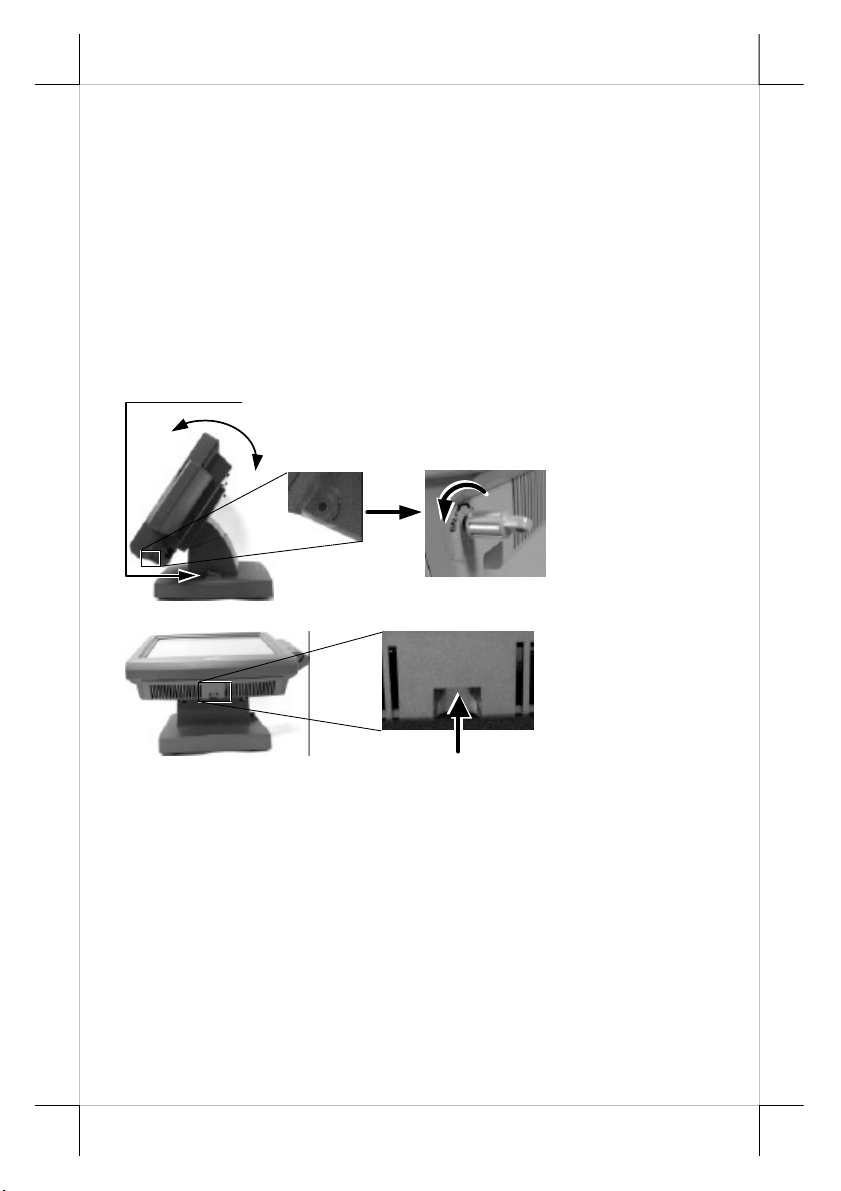
OPENING CABLE COVER
Please follow steps A to G sequentially with reference to pictures
below to remove the cable cover.
Step A: Push lock/release lever back
Step B: Turn panel to most horizontal position
Step C: Insert the tip of a latchkey into one latch hole
Step D: Turn this key
counterclockwise to
Step E: Do the same on the opposite side
Step F: Take the latchkey out of the hole
Step G: Pull at the removal hollow toward the user
DISCONNECTING CABLES
After removal of the cable cover, the connector area will be accessible
then. Please first note orientations of every existing cable connection and
then disconnect every cable properly before separation of main unit and the
adjustable stand assembly. Please note that the click lock spring has to be
pressed down prior to pulling out the connector such as the LAN port or the
CR port. Please also note that the fixing screws have to be loosened free prior
to disconnection such as the COM ports or the LPT port. Please always hold
the connector head itself instead of pulling on the cable wire when
disconnecting any connector. Failure to do this could damage the cable and
jack that is considered as an artificial destruction. Damages due to incorrect
Part 5
Page 6
Cable Passage To Main Unit For
disconnection operation are not covered by product warranty!
SEPARATING MAIN UNIT
In order to settle the touch terminal properly in a point of sale system,
all the cable connections have to be routed through its base, the stand assembly.
Therefore, please observe the procedures from A to C below to separate the
main unit from the stand assembly after all cables in cable cover disconnected.
Step B: Press the Lock/Release button and meantime ...
Step C: Slide the base stand assembly
to this direction to separate
Step A: Prepare a soft clean flat surface, such as
a piece of cloth on the desk to seat the
front surface of main unit
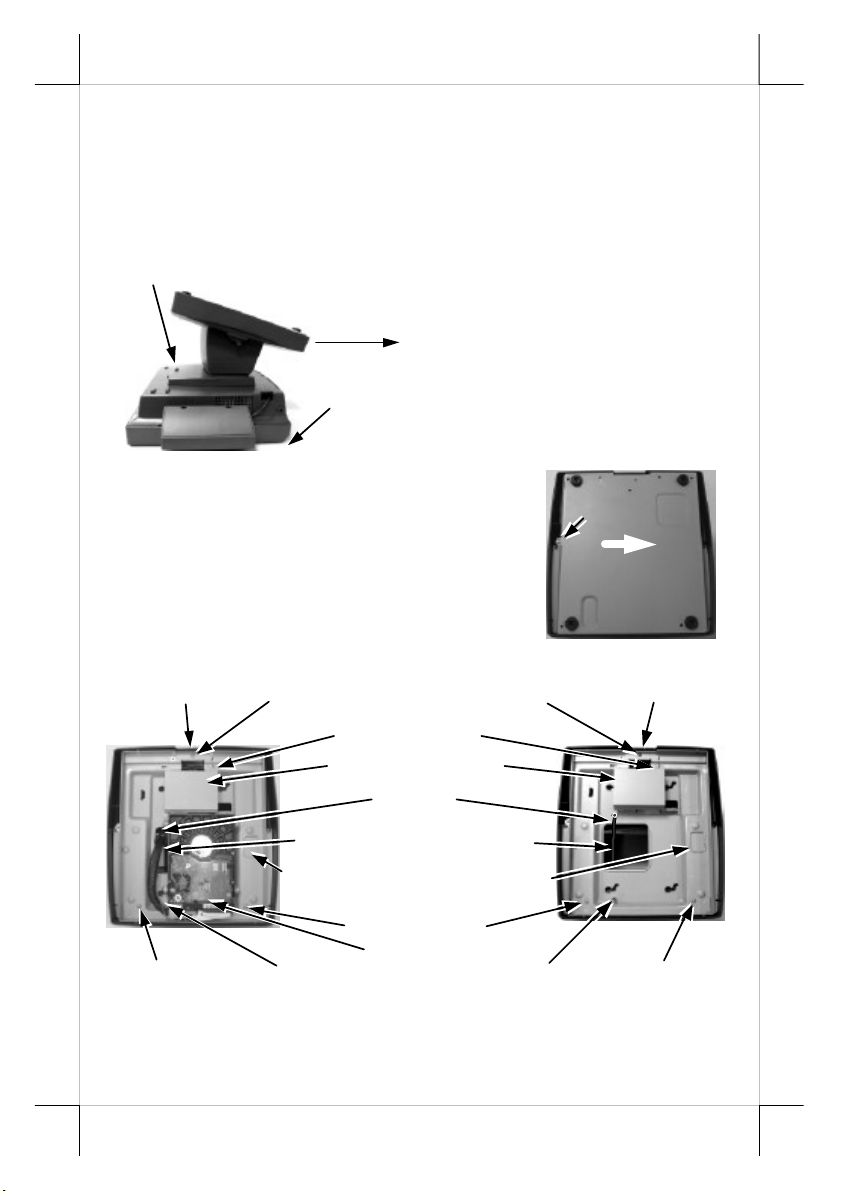
OPENING STAND ASSEMBLY
Take the adjustable stand assembly and turn
it up side down to show the bottom of the base.
Remove the bottom plate fixing screw and push the
bottom plate aside as in right picture to open.
Take the bottom plate up and the inside of
the base stand looks like this in the left picture below.
However, there will be no HDD in base for TP/LT5600/5700 and its picture is shown at right.
Cable Exit
Base Box Screw
Base Box Screw
Base Box Screw
UPS Battery Bracket
Fixing Screw
UPS Battery Bracket
Cable tie
Cable Passage To Main Unit For
Desktop Mount Application
Wall Mount Application
Base Box Screw
HDD Unit
HDD Bracket Fixing Screw Post
Bottom Plate
Fixing Screw
Push Bottom
Plate This
Way To Open
Cable Exit
Base Box Screw
Part 6
Page 7

CABLE ROUTING
Please route all cables through the cable passage to main unit in
desktop mount application. Hold them together with the cable tie. Pass all
cables (but those for HDD and UPS battery) through the cable exit to external
connections. Then fix back the bottom plate if there is no option unit to install.
INSTALLING UPS BATTERY
The optional UPS battery is delivered in the
carton if it is ordered. Please remove the UPS battery
bracket fixing screw and slide left the UPS battery
bracket to take it out. Put the battery in and remount the
bracket as in the right picture (There will be no HDD
for TP/LT-5600/5700). Please pay particular attention
to the environment requirements for UPS battery in
next chapter “USING THE TOUCH POS”.
WALL MOUNTING
Select a flat surface on wall of adequate strength and with proper
ventilation and space condition. Please use the right material to hold this
terminal according the wall material (Drywall, concrete,
solid wood, etc). Consult with your contractor if it is
necessary. A fully equipped system may weigh up to 10
kgs or 22 lbs. Take the separated
bottom plate and remove the 4
rubber feet to work as the wall
mount bracket. Fix this bracket to wall at the 3 arrowed
holes in the right picture with proper materials. Release
the base box from the base stand by removing the 3
screws as arrowed in the left picture (There will be no HDD for TP/LT5600/5700). Release the cable tie and reroute all cables through the cable
passage to main unit for wall mount application and through the cable exit to
external connections. If there is HDD installed in the base unit, pass the UPS
battery cable and the HDD power cable evenly under the HDD bracket and
through the wall mount passage to main unit to prevent cable damage.
Hook the base box onto the bottom plate now
fixed on the wall as wall mount
bracket and fix a screw on top
side as arrowed in upper left
picture. Align the four matching
pegs on the back of the main
unit as circled in right picture
with the four matching holes in the bracket as marked
Part 7
Page 8

in squares in lower left picture and allow the main unit to slide down the
winding grooves in the wall mount backpack - originally the base box. The
stand assembly is not engaged in wall mount operation. Connect all cables
coming out of the backpack into the cable cover area of main unit.
The area required for wall mount application is determined by the
main unit dimensions and is 375 mm in width and 315 mm in height.
BASE MOUNT UPGRADE KIT
On rear edge of the stand assembly, there is a rear
connect cover. Either a 12” 2nd LCD display panel option
LM-6201 or a VFD customer display option PD-2501 can
be installed here for desktop mount application after
removing this cover. However, the 15” 2nd LCD display
can be installed without removing this cover.
12” 2nd LCD Panel Or Customer Display
This rear connect cover can be removed
with metal chassis assembled in the base cover.
Refer to the inside view of the base unit after
removal of UPS battery bracket at right use a flat
head screwdriver to pick the plastic hook plate of the
rear connect cover from inside to remove the cover.
Fit the latest base of PD-2501 or LM-6201 to the
rear connect cover opening. For LM6201, please first route its cable through
this opening and have it pass the passage
arrowed in left picture. For PD-2501,
please have its cable go through the
normal cable exit (under the joint base) as in the right picture.
Fit 2 screws through washers to hold the joint tight. For low profile customer
display PD-305, the installation procedure is same. Remember to enable the +5
V DC supply in the COM port of main unit for PD-2501 or PD-305 or the
system. Please note that if the base (joining mechanism) of the PD or LM is of
older version for earlier large base of TP-59/70/82 series, there will be minor
styling discrepancy with the universal base of the system.
15” 2nd LCD Panel
A bracket kit including a steel bracket and 2 types of
screws as in the left picture will be provided with the 15” 2nd
LCD panel. Use 3 smaller screws to fix the bracket to outside of
the bottom plate from inside as circled in the below left picture that is the
bottom view of the base stand. Then use the 4 larger screws to fix the monitor
support rod from bottom as arrowed in the same picture. The overall assembly
Part 8
Page 9

will look like the right picture.
Route the VGA through the
cable exit of the base stand to
the main unit. Connect the
attached power adaptor for its
power source.
ROUTING THE CABLES
Place all the cables required for connections to the
main unit except those for the integrated attachment
through the front part inside the stand assembly. Be sure
not to damage any cable during this operation.
Route Cables through Front Part
Connect this End to Main Unit
Now, turn the adjustable stand assembly back to normal orientation
and arrange all cables to come out of the area for mounting main unit from the
bottom edge for ease of later operation.
PREPARING THE MAIN UNIT
On the back of the main unit, there are 4 matching pegs and a service
window. Push open the service window in the direction as indicated in the
picture, one can find a button cell battery socket and several jumpers for some
technical settings. Please note that only those qualified technicians may adjust
in the service window with information from Posiflex and the contents in the
service window may change without notice as time develops.
Service Window
Push Open To
The Right
required to support the system real time clock. The used up batteries must be
recycled and disposed of under guidance of local legislations. The jumpers in
this window are designated for VGA port and COM port power supply
function. Please consult your dealer for technical support on setup of these
jumpers. A new Lithium battery can support the system RTC for about 3 years.
4 Matching
Pegs
Li Battery
Risk Of Explosion If Battery Is Replaced By An Incorrect Type
Dispose Of Used Batteries According To Local Regulations
CAUTION
This battery socket accepts a 3 V button cell Lithium battery (CR2032)
Part 9
Page 10

Dongle Hooked On Rear Top
After the battery is nearly exhausted, the user must change a new battery
otherwise the system RTC and system configuration setup will be lost.
SIDE & REAR TOP MOUNT UPGRADE KIT
Please follow the instructions in the manuals delivered with the side
mount upgrade kit: KP100, SD100, SD200 or BC100 and the rear top mount
upgrade kit PD302 to fit them in Jiva system construction.
The USB power arrangement in this system has been particularly
designed to help smooth start up of the fingerprint sensor in SD200.
WIRELESS PRINTER
The whole Jiva series can access the Posiflex wireless thermal printer
PP7700 in Windows environment except Win CE. To do this, a wireless
Dongle DG2000 for this printer must be separately purchased and installed to
one of the serial COM ports in Jiva system. Please enable the + 5 V DC power
support for this COM port. Notice 2 hooks on rear side of the Dongle and also
2 hooks on either top corner on rear side of main unit of the Jiva system.
Match the hooks to mount the Dongle to either corner of the Jiva system.
Should there be more than 2 Dongles to be installed in the application for the
advantage of several fixed predetermined connections without need for
connection alteration in process, the third Dongle and afterwards have to attach
to the appropriate positions by use of the self-adhesive tape because Jiva series
supports only 2 rear top corners with hooks.
The Posiflex wireless connection supports various application
environments from having single Dongle to control single wireless printer to
having single Dongle to control multiple wireless printers and further to having
multiple Dongles to control multiple wireless printers. Unlike usual wireless
printer solutions that requires the application software to use the printer server
in WLAN the Posiflex wireless connection supports a genuine virtual cable
connection thus supports the application software to use even the so-called
direct I/O method for controlling the printer. The user may install the relevant
driver prior to the application software if the software did not include the
Posiflex wireless connection driver elements. The driver can be found together
in delivery of the wireless printer or the Posiflex Product Information CD of
version 1.9 or above, or please find it on our web http://www.posiflex.com
Hooks On Rear Side Of Dongle
Corner Of Jiva System
Hooks On Rear Side Of Jiva
or
Part 10
Page 11

Round Part
Slot Part
http://www.posiflex.com.tw
DESKTOP MOUNTING
Matching Pegs
Match the matching pegs on the back of the main unit against the
matching holes on the stand assembly. First aim the matching pegs toward the
upper round part of the hole and make sure that all pegs are inside the holes.
Then slide the main unit down to move the pegs into the lower slot part of the
holes till it clicks. Note that all the cables come out of the stand from the lower
edge and won’t get trapped by this mounting operation. If later on you want to
remove the main unit from the stand, you’ll have to press down the
lock/release button on back of the stand at the time lifting the main unit.
For desk top/counter application, the adjustable stand assembly
requires a base of 265 mm deep and 282 mm wide. However, please take also
the main unit into consideration. If the main unit is tilted to near vertical
position, the total height is 373 mm. When the main unit is tilted to near
horizontal position, the total height required is 296 mm.
Matching Holes
Removal Hollow
CONNECTING CABLES
When later the main unit and stand assembly are to be re-assembled
for application, please connect all required cables to the appropriate connectors.
Please make sure that each connector is connected to the correct port with the
correct orientation. Damages due to incorrect connection or orientation are
not covered by product warranty!
Some connectors, such as the LAN connector, or the cash drawer
connector have to be inserted until a click is heard. It is recommended that
connectors such as the external VGA connector, the LPT port connector and
the COM port connectors, be screwed into place once seated. If the COM1 port
must be used, the COM1 terminator that occupies the COM1 port must be
removed and safely preserved for future use. However, when using the COM1
port, it is advisable to use devices that provide proper hardware handshaking
signals in order to keep other embedded system features. A serial mouse is one
example of a device that does not support handshaking.
Adjust the slack of each cable and close the cable cover. Use the same
Part 11
Page 12

plastic latchkey that is used when removing the cable cover, but be sure to turn
it in the clockwise direction to lock the cover in place. Re-adjust the tilt angle
of the screen for best viewing.
Connect the cables to appropriate external devices through the cable
exit at the bottom of stand assembly. Please make sure that each connector has
to be connected to the right device in the right way.
CAUTION: On doing any insertion or extraction of any connector, please
always hold the connector head itself instead of pulling on the
cable wire. Failure to do this could damage the cable and jack
that is considered as an artificial destruction and is not
covered by the warranty.
OPERATING SYSTEM RECOVERY
For Jiva TP/LT-5600/5700, if not using a remote boot operating
system, the operating system exists in the Compact Flash Card. Therefore,
once the Compact Flash is damaged for any reason, the thin client may fail to
boot. A bootable new Compact Flash Card will be required to have the
workstation back to work. Please follow instructions given by the System
Integrator to deal with situations like that. One more advice for CF Card
application is that in spite of the fact that it is used in the way like an ordinary
HDD, usual system management utilities such as FDISK.EXE or
FORMAT.COM shall never be used on CF Card otherwise the boot sector
of operating system itself may be damaged and causing the CF Card no longer
bootable.
For Jiva TP/LT-5800/8000, the preloaded operating system exists in
the HDD in base. Once the software system on HDD collapses, it is possible to
restore the operating system onto a physically intact HDD with use of the
Recovery CD that comes with the preloaded operating system. Please follow
the instruction from your system integrator for system / software restoration.
Follow the instructions below for operating system recovery only if your
system integrator does not advise otherwise.
For the Jiva TP/LT-5800/8000 preloaded with Windows XP Pro or
WEPOS on HDD, Posiflex provides recovery CD delivered with the touch
terminal for the preloaded operating system. The System Integrator shall take
care of software restoration after OS recovered. A Posiflex supplied USB
interface CDROM drive or the internal type IDE interface CDROM drive with
the cable kit mentioned earlier will be required for such action. Other brand
CDROM drive may require its specific driver different from what supported in
the recovery CD.
Please use the recovery CD in rescue operation only. Using it
otherwise may wipe out whatever stored in the HDD! All upgrade devices
drivers needed for manual installation in usual way are available in the
Part 12
Page 13

subfolder “\drivers” in OS recovered HDD and the latest versions of these
required drivers will be available on our web: http://www.posiflex.com.tw.
Now please follow instructions from your system integrator for
software recovery.
OPERATING SYSTEM INSTALLATION
This product is a highly professionalized equipment. The installation
of an OS into a machine without any preloaded OS could constitute major
difficulty for average user who either has barely limited technical knowledge
of this professionalized equipment or is insufficiently equipped with necessary
facilities to accomplish such a task. Therefore, OS installation into a system
without preloaded OS is highly discouraged. Posiflex shall not be responsible
for any technical support to questions arisen due to non-preloaded OS.
Part 13
Page 14

USING THE TOUCH POS
APPLICATION ENVIRONMENT
It is very important that you check the following operational
guidelines:
Ventilation
This terminal must NOT be operated in an environment with
restricted ventilation. The installation should be such that there is at least
25mm air clearance around any top or side ventilation holes. The installation
must also be such that there is a free flow of air around the unit at ALL times.
Operating Environment
The equipment must not be operated or stored in extremes of both
temperature and humidity/moisture. (Operating range 5°C to 40°C and up to
80% humidity – non condensing)
UPS Battery (option)
General care:
The UPS battery is consumables beyond product warranty. Please
definitely observe the alerts in beginning of this manual. If the equipment is to
be powered off for more than few days , please always disconnect the battery
from the system. Reconnect it and turn on the system to recharge the battery
for 1 ~ 2 hours every 3 months for temperature lower than 30°C. Recharge for
1 ~ 2 hours every month for temperature over 30°C. Temperature above 40°C
must be strictly avoided as it could cause termination of battery life and
unexpected result even if the battery is not in work. The UPS battery can
support basically the data preservation and smooth running of the system
during intermittent or few minutes (3 ~ 8 min. for TP/LT-5600/5700/5800 or 2
~ 6 min. for TP/LT-8000 depending on loading and battery condition) power
failure.
Battery replacement:
In the preloaded OS for a Jiva system, there is a built in utility Power
Manager that will interface the UPS battery monitor status with user. When
battery monitor disables the battery charging as designed while the UPS
function of the system is originally enabled, in other words the UPS battery is
found out of order if actually installed, there will be a popup message as the
picture at right asking the user to agree disabling the
UPS function. The system will operate under
deactivated UPS function no matter agreed or not.
However, the monitoring goes on and the popup
message will come back on next system power up boot if not agreed. In any
case, please replace the used up UPS battery at power off if the battery is well
Part 14
Page 15

connected there but found inoperable by such messages.
Emergency treatment:
The battery is constructed maintenance free and leakproof. It is well
protected in Jiva system as long as the ambient temperature remains below
30°C and the ventilation of the Jiva system remains free. However, should any
accident happen and the sulfuric acid from the battery spills on skin or clothing,
wash immediately with water. If the acid comes in contact with eyes, rinse
eyes with large amount of clean water and see a doctor immediately. A larger
external battery may be connected to give an extended operation. Please check
your dealer about this capability when required.
WARNING:
If there are any signs of over charging or leakage of electrolyte
please contact your dealer immediately
Power Supply
The operating voltage range of the power adaptor should cover the
local power supply for proper operation. The power cable, the power outlet
and any power fusing arrangements must conform to local safety regulations.
Please never do any connection / disconnection when system is still
powered on. Please always keep the external power adaptor in a free air
circulation.
Serial Port – COM1
COM1 serial port must always be occupied by a suitable serial device
or COM1 terminator (as supplied). If this port is left vacant or connected with
something like a mouse the cash drawer control and the power management
function may fail to work correctly.
POWER ON/OFF
There must always be at least 10 seconds waiting before switching on
again once the system is powered off successfully.
LED Indicator
There is an LED in the logo area or under the printed logo and serves
for several purposes. The relationship between LED status and other
conditions is summarized in following table:
Part 15
Page 16

LED Status System Status External Power UPS Battery Powering Up
Off Off Off Not present Not possible
Off Off Off Present Not allowed
Green Off On No influence Allowed
Blue On On No influence Not required
Blue/flash On Off Activated Not required
Green/rapid
flash
On Off
Running at
low capacity
Not required
Hardware Power Switch
The power switch located at left side of the main unit is a slide type
switch. This switch controls the power on/off of the system. This switch turns
the system on when slid downward, only when external power is present. The
switch will always spring back to its original position when pressure is
removed. This switch turns the system off when slid downward again during
power on status. However, if the system hangs due to any reason such as
software resource conflict a simple slide of the switch may fail to turn off the
power. In this case, please utilize the forced power off feature by pressing the
switch downward, and holding for within 10 seconds. In case the turmoil is so
vigorous that some hardware registers may be confused causing trouble for
system restart or even this forced power off, please disconnect the UPS battery
if installed and the AC power supply for few minutes. This may allow all
hardware registers to reset.
This switch can also be programmed as an ON only switch. That
means, if the application program issues a command compliant with the Jiva
series technical manual, this switch will always turn the system on when
activated, but will not power off the system when depressed again (the forced
power off feature will not work in this mode). When using this feature, please
make sure that the software application has the ability to power off the
machine. In preloaded Windows, “Posiflex Power Switch Manager” in
“Posiflex Tools” in the Program Files helps managing these functions.
Software Support Features
The Jiva series provides a software power off command for
application program maneuvers. The Jiva also provides a specific means for
the software to detect if the system is working on external or UPS battery
power. Due to this feature, compatible software applications have the ability to
change operating conditions when running on standard/backup power. The
software programmer may take reference from the Jiva technical manual to
apply such features.
Part 16
Page 17

Automatic Power On Control
The system may also turn on according to some preset conditions
such as Modem Ring Up and Alarm Clock Wake Up or LAN Wake Up.
To utilize Modem Ring Up or Alarm Clock Wake Up function, the
user should enter the CMOS setup by pressing “Del” key at system boot up,
choose for “PM Wake Up Events” in “Power Management Setup” and make
the “Ring Power Up Control” enabled for Modem Ring Up or select the
“Power Up by Alarm” for Alarm Clock Wake Up. Save the configuration and
exit the CMOS setup program. The Preset Power On Control will then be
ready. For LAN wakeup, an operating caller system connected through LAN to
the system is required. It also requires a qualified networking technician to
check the LAN chip ID of the system for the caller system to wake up.
When the Jiva system is turned off after a successful boot up, the
preset automatic power on functions will keep monitoring for the preset
conditions and turn on the system when the preset conditions are met.
Please note that if the Jiva system is improperly turned off before a
complete boot up procedure, the above preset power on control functions will
be disabled until next turning off after a complete boot up.
DISPLAY ISSUES
Main LCD Display
For best viewing result please set your display resolution at 1024 x
768 with high color.
In configuration of system memory for TP/LT-5600/5700/5800, max.
64 MB can be shared as the video memory and max. 128 MB for TP/LT-8000.
VGA Port
The VGA port in the Jiva system supports TM4115 touch monitor,
LM6212 LCD monitor or TM7112 touch monitor if there is no base mount 2nd
LCD display. This port supports either mirror mode (identical image) or
extended mode dual display function for WinXP . To support the DC power to
these Posiflex monitor, use the DC adaptor to connect into the monitor (for
TM-4115 / TM-7112) or its VGA cable (for LM-6212) or use Posiflex VGA +
power cable and set an internal jumper in Jiva main unit to supply the required
power through the VGA connector (for LM-6212). Do not connect other
monitor to this port before the power in this port is disabled.
CUSTOMER DISPLAY
Please follow the instructions on the manual that comes along with
the customer display PD-2501 or PD302 when it is installed.
Part 17
Page 18

SERIAL PORTS – COM1/2/3/4
In Jiva system, there are 4 serial ports available. All the serial ports
can supply a +5 V DC through pin 9 after proper jumper setting change. All 4
ports are standard RS232 serial ports as status at delivery.
When a serial Modem is to be used in Jiva system, it is most
recommended to use COM2 or COM3 or COM4 port for this purpose. In this
way any hardware resource conflict is eliminated and the MODEM ring up
function can be supported. For models of TP-5600/5700/5800 using RS232
interface touch control such as the Infra Red type touch, COM4 is occupied
and covered. Please never try to open the cover. Otherwise the product
warranty is voided.
SOUND PORTS
The audio port on Jiva system with slim base supports a Microphone
in and a stereo line out jacks. There is a single channel internal audio amplifier
in the output port to drive the 2 slim type speakers installed in the I/O area
inside cable cover as in the picture below with 1 W audio power (For TP/LT5615/5715/5815 this item is an option).
Should the application demand for
higher audio power, please first ask
your dealer to disable the internal audio
amplifier and connect a pair of
speakers with booster or amplifier to
this port. Please note that this modification is a highly technical operation and
should not be handled by any person else. Please also note that the number and
types of I/O ports shown in picture above may evolve with time without notice.
2 speakers
FAN CONTROL
In the preloaded OS for Jiva system, there is an embedded function
that keeps monitoring the interior temperature and the fan revolution rate and
regulating each required fan power to gain maximum ventilation effect with
lowest possible noise. The end user may select “Start”, “Programs”, “Posiflex
Tools”, “Posiflex Fan Control Tools”, “Enable Posiflex Fan Controller” in
sequence to enable this function. This tool will remain enabled even after
system turning off/on until being disabled.
On occasion of system unexpected shutdown, please review the
ventilation condition and environment temperature of the system. Check if the
fan is stuck by contaminants such as dry grease or threads. Try to correct the
situation when the system is off and cooled down. You may power up the
system again after the system cooled down and trouble cause removed.
However, if the situation repeats again and again, please consult your dealer
for possibly fan replacement on worn out.
Part 18
Page 19

TOUCH PANEL (for TP models only)
All paragraphs below are applicable in TP-5615, TP-5715, TP-5815
or TP-8015 only. The user of LT-5615, LT-5715, LT-5815 or LT-8015 can
ignore them and consider this user’s manual ends here.
Mouse Emulation
The touch panel in Jiva TP system uses PS2, RS232 or USB interface.
When its driver is properly installed, this touch panel works exactly like a
standard mouse. However, if the system is running under safe mode, most
drivers are disabled in this mode and the touch panel calibration is therefore
not guaranteed. It is recommended to use a standard USB mouse or keyboard
in this mode.
All the below mentioned mouse emulation functions can be
manipulated through relevant software. The system can give a beep and a click
on the left button of a mouse at the point when the touch panel is touched. If
the point touched is dragged across the screen surface, it works as the mouse
drag and drop feature. If the point is touched, released and touched within a
short time interval, it is double-clicking left button of the mouse. To obtain the
effect like clicking on the right button of a mouse, touching any point on the
screen surface after touching the right-click sticky button results as a click on
the right button of the mouse at that point.
Posiflex Touch Terminal Manager
A program named “Posiflex Touch Terminal Manager” and a rightclick sticky button tool in the program group “Posiflex Tools” is installed in
the preloaded Windows system with a PS/2 interface touch panel controller.
This program can also be obtained by download from the POSIFLEX web site.
RS232 Touch Controller
If the Jiva TP system purchased is the leading edge Infra Red type
touch models, the touch controller is of RS232 interface. The “Posiflex Touch
Terminal Manager” above should be disregarded. In these models within TP5615, TP-5715 or TP-5815, the COM4 position of the system will be covered
in the connection area. Removal of this cover will void the product
warranty!!
Once the RS232 touch controller driver is installed, the user can
utilize it to control the mouse emulation. Please click “Start”, “Settings”
“Control Panel” and “Elo Touchscreen” or just click the “elo” icon in tool tray
to engage this utility. However, with this touch controller driver, certain
display mode like full screen display of Windows DOS box should be avoided.
Posiflex USB Touch Manager
A program named “Posiflex USB Touch Manager” and a right-click
Part 19
Page 20

T31454
sticky button tool in the program group “Posiflex USB Touch Tools” is
installed in the preloaded Windows system with a USB interface touch panel
controller. This program can also be obtained by download from the
POSIFLEX web site.
警告使用者
這是甲類的資訊產品,在居住的環
境中使用時,可能會造成射頻干
擾,在這種情況下,使用者會被要
求採取某些適當的對策。
Part 20
 Loading...