

Page 1
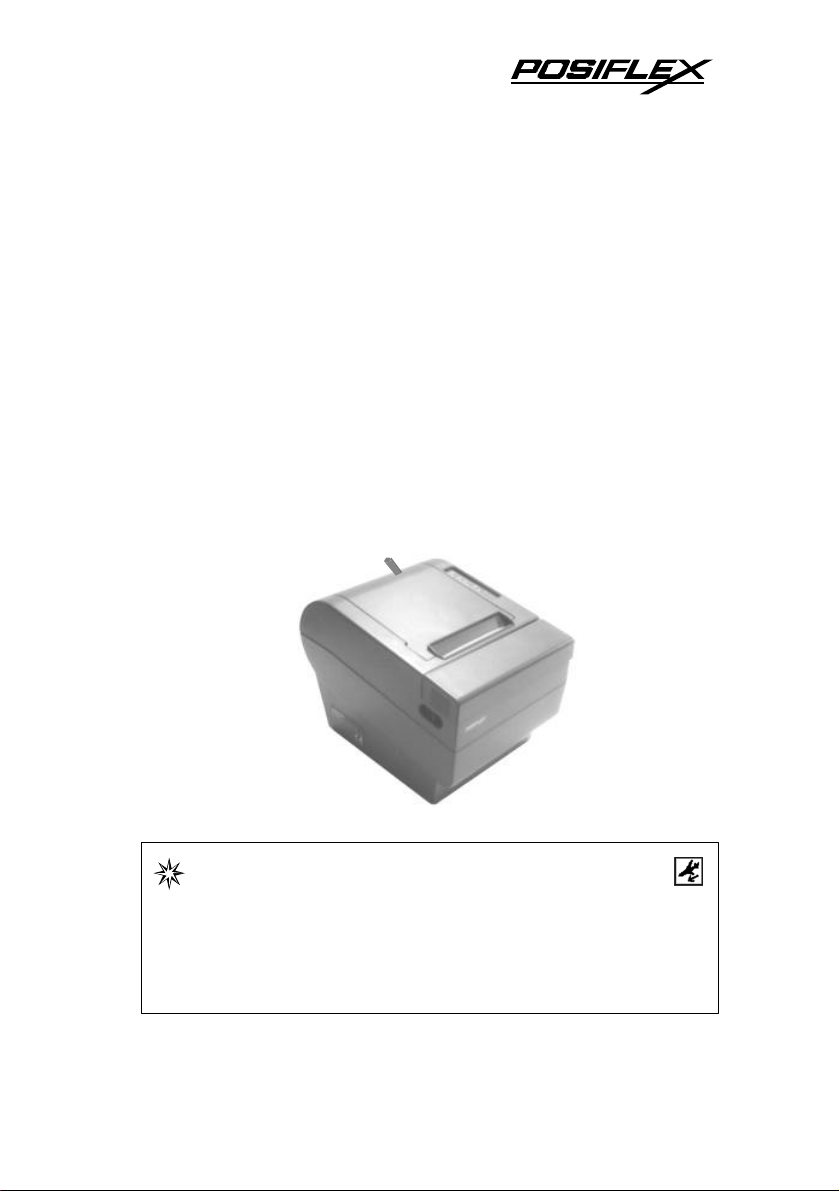
Aura
PP7700 Series
User's Guide
IMPORTANT!!!!
Wireless POS
Thermal Printer
Rev.: Original
Please read carefully before using this printer
Before opening the Top Hood, make sure there is no
paper jam or cutter jam trouble. (Read page 3-4,
3-5 and Warranty Limit in the user’s Manual.)
Page 2

Federal Communications Commission Radio Frequency
Interference Statement
This equipment has been tested and found to comply with the limits for a Class A digital device,
pursuant to Part 15 of the FCC Rules. These limits are designed to provide reasonable protection against
harmful interference when the equipment is operated in a commercial environment. This equipment
generates, uses, and can radiate radio frequency energy and, if not installed and used in accordance with
the instruction manual, may cause harmful interference to radio communications. Operation of this
equipment in a residential area is likely to cause harmful interference in which case the user will be
required to correct the interference at his own expense.
For compliance with Federal Noise Interference Standard, this equipment requires a shielded cable.
This statement will be applied only for the printers marketed in U.S.A.
CE manufacturer’s Declaration of Conformity
(EC Council Directive 89/336/EEC of 3 May 1989)
This product has been designed and manufactured in accordance with the International Standards
EN50081-1/01.92 and EN50082-1/01.92 following the provisions of the Electro Magnetic
Compatibility Directive of the European Communities as of May 1989
Warranty Limits
Warranty will terminate automatically when the machine is opened by any person other than
the authorized technicians. The user should consult his/her dealer for the problem happened. Warranty
voids if the user does not follow the instructions in application of this merchandise. The manufacturer is
by no means responsible for any damage or hazard caused by improper application.
About This Manual
This manual is aimed to assist the user to utilize the Aura (PP7700) series which is a series of
wireless POS thermal printers delicately designed to work with either serial or parallel interface
connection. This manual covers both operational and technical aspects. This manual covers also the
Epson emulation commands and some special features of the printer.
The manufacturer of the Aura (PP7700) series heartily apologizes to the user for reserving the
right to change or to modify this manual without notice due to the rapid and constant progress and
improvement on science and technology. The user may always obtain the most up to date information
through our web sites: http://www.posiflex.com.tw or http://www.posiflex.com
© Copyright Posiflex Inc. 2004
All rights are strictly reserved. No part of this documentation may be reproduced, stored in a
retrieval system, or transmitted in any form or by any means, electronic, mechanical, photocopying, or
otherwise, without the prior written consent of Posiflex Inc. the publisher of this documentation.
Other brand and product names are trademarks and registered trademarks and service marks of
their respective owners.
P/N: 19300900010
Page 3

Table Of Contents
GETTING STARTED . . . . . . . . . . . . . . . . . . . . . 1 -- 1
CONGRATULATION . . . . . . . . . . . . . . . . . . . . . . 1 -- 1
PRODUCT BRIEFING . . . . . . . . . . . . . . . . . . . . . 1 -- 1
UNPACKING . . . . . . . . . . . . . . . . . . . . . . . . . . . . . 1 -- 2
OPTIONS . . . . . . . . . . . . . . . . . . . . . . . . . . . . . . . . 1 -- 2
MAIN PARTS ON THE EXTERIOR . . . . . . . . . 1 -- 3
INDICATORS . . . . . . . . . . . . . . . . . . . . . . . . . . . . 1 -- 4
OPERATING ENVIRONMENT . . . . . . . . . . . . . 1 -- 4
USEFUL TIPS . . . . . . . . . . . . . . . . . . . . . . . . . . . . 1 -- 5
QUICK START-UP . . . . . . . . . . . . . . . . . . . . . . . . 2 -- 1
LOADING PAPER . . . . . . . . . . . . . . . . . . . . . . . . .2 -- 1
Desk Top Application . . . . . . . . . . . . . . . . . . . 2 -- 1
When To Replace Paper . . . . . . . . . . . . . . . . . 2 -- 2
CONNECTION/SET UP . . . . . . . . . . . . . . . . . . . . 2 -- 2
Serial Connection . . . . . . . . . . . . . . . . . . . . . . . 2 -- 2
Wireless Connection . . . . . . . . . . . . . . . . . . . . 2 -- 2
General concepts . . . . . . . . . . . . . . . . . . . . . . 2 -- 2
Physical and driver installation . . . . . . . . . . 2 -- 3
Making wireless connection . . . . . . . . . . . . . 2 -- 7
Automatic re-connection at power on . . . . 2 -- 9
Flexible wireless connection . . . . . . . . . . . . . 2 -- 9
Signal Detection (to select a proper printer location)
. . . . . . . . . . . . . . . . . . . . . . . . . . . . . . . . . . . . . . 2 -- 10
Peripheral Connection . . . . . . . . . . . . . . . . . . 2 -- 11
Power Connection . . . . . . . . . . . . . . . . . . . . . . 2 -- 12
Power On . . . . . . . . . . . . . . . . . . . . . . . . . . . . . 2 -- 12
Self Test . . . . . . . . . . . . . . . . . . . . . . . . . . . . . . 2 -- 12
SPECIAL ADJUSTMENTS . . . . . . . . . . . . . . . . . 2 -- 13
Paper Near End Sensor . . . . . . . . . . . . . . . . . 2 -- 13
Paper Roll Placement . . . . . . . . . . . . . . . . . . . 2 -- 14
i
Page 4

Spacer Plate . . . . . . . . . . . . . . . . . . . . . . . . . . . 2 -- 14
Paper Cutting . . . . . . . . . . . . . . . . . . . . . . . . . . 2 -- 15
Wall Mount Application . . . . . . . . . . . . . . . . . 2 -- 15
MAINTENANCE GUIDES . . . . . . . . . . . . . . . . . . . . 3 -- 1
MAINTENANCE GUIDE LINES . . . . . . . . . . . . 3 -- 1
GENERAL CLEANING . . . . . . . . . . . . . . . . . . . .3 -- 1
PRINT HEAD CLEANING . . . . . . . . . . . . . . . . . 3 -- 1
TROUBLE SHOOTING . . . . . . . . . . . . . . . . . . . .3 -- 2
General Problems . . . . . . . . . . . . . . . . . . . . . . 3 -- 2
Printing Problems . . . . . . . . . . . . . . . . . . . . . . 3 -- 2
Paper Jam Problems . . . . . . . . . . . . . . . . . . . . 3 -- 4
Auto Cutter Problems . . . . . . . . . . . . . . . . . . . 3 -- 4
Graphic Printer Speed . . . . . . . . . . . . . . . . . . 3 -- 5
Wireless Connection Concerns . . . . . . . . . . . . 3 -- 5
Advanced Analysis Tool . . . . . . . . . . . . . . . . . 3 -- 7
SPECIFICATIONS . . . . . . . . . . . . . . . . . . . . . . . . . . . 4 -- 1
PRINTER . . . . . . . . . . . . . . . . . . . . . . . . . . . . . . . . 4 -- 1
PAPER . . . . . . . . . . . . . . . . . . . . . . . . . . . . . . . . . . .4 -- 1
POWER ADAPTOR . . . . . . . . . . . . . . . . . . . . . . . 4 -- 2
TECHNICAL INFORMATION . . . . . . . . . . . . . . . . 5 -- 1
INTERFACES . . . . . . . . . . . . . . . . . . . . . . . . . . . . 5 -- 1
Wireless Interface . . . . . . . . . . . . . . . . . . . . . . 5 -- 1
Peripheral Interface . . . . . . . . . . . . . . . . . . . . 5 -- 2
SETUP WINDOW . . . . . . . . . . . . . . . . . . . . . . . . .5 -- 2
INTERNAL SWITCH . . . . . . . . . . . . . . . . . . . . . . 5 -- 4
SOFTWARE COMMANDS . . . . . . . . . . . . . . . . .5 -- 5
Paper Out Alarm . . . . . . . . . . . . . . . . . . . . . . . 5 -- 5
Enhancement Commands . . . . . . . . . . . . . . . . 5 -- 5
CHARACTER CODE PAGES . . . . . . . . . . . . . . . 5 -- 7
ii
Page 5

I. GETTING STARTED
A. CONGRATULATION
You have made a very wise decision by purchasing the easy
loading; low noise; high resolution; light weight; high reliability
wireless thermal printer Aura PP7700 series of Posiflex products.
This series of printers has been elegantly designed for a Point-OfSale, kitchen & kiosk application. The manufacturer of this
printer not only wishes to take this opportunity to congratulate
your smart investment on buying this printer but also likes to
express the wishes for your prosperous future by using it.
B. PRODUCT BRIEFING
The Aura PP7700 series communicates to a Dongle installed
on a COM port of Posiflex POS system through a wireless way
and performs thermal printing particularly designed for POS
applications. This unique wireless communication architecture not
only frees the user from messy cabling setup in multiple host vs.
multiple printer environment but also provides the easiest
adaptability for conventional POS software to utilize the cutting
edge technology with least modification needs.
The Aura PP7700 series printer uses thermal sensitive paper
in form of a roll at a width of 80 mm (standard) or 58 mm
(option). The Aura PP7700 series printer serves the stand-alone
desk top application as well as the application within a Posiflex
integrated POS system equally perfect.
The Aura PP7700 supports a guillotine type auto cutter for
paper partial cut and a manual cut mechanism. The Aura series
also supports user’s company’s LOGO downloading for superior
performance. It even supports some enhancement capability for
1 - 1
Page 6

reminder function to persons around. It can be used to drive a
separately purchased kitchen bell for such reminder function in
noisy environment. This printer also supports application in
different countries of various kinds of power systems by changing
the power cord to the power adaptor.
C. UNPACKING
Followings are items you may find when you carefully
unpack the carton that delivers Aura series printer. If there is any
discrepancy or problem, contact your dealer immediately. Be sure
to save the packing materials in case the printer needs to be
shipped at some point in the future.
• The printer itself
‚ Thermal paper roll 80 mm wide
ƒ One piece of spacer plate
„ One of the power sources:
a Power adaptor + power cord (depend on country type
ordered).
b Power supply cable (when no power adaptor ordered)
This printer power supply cable is used to supply power to
the printer from the Posiflex POS system.
… This User’s Manual
D. OPTIONS
• 58 mm paper guide adaptor (can be modified at
distributor’s site only)
• Kitchen bell
• Wall mount kit
1 - 2
Page 7
Antenna
Power LED
• Language to add to standard model: Japanese Kanji;
Korean; Traditional Chinese or Simplified Chinese
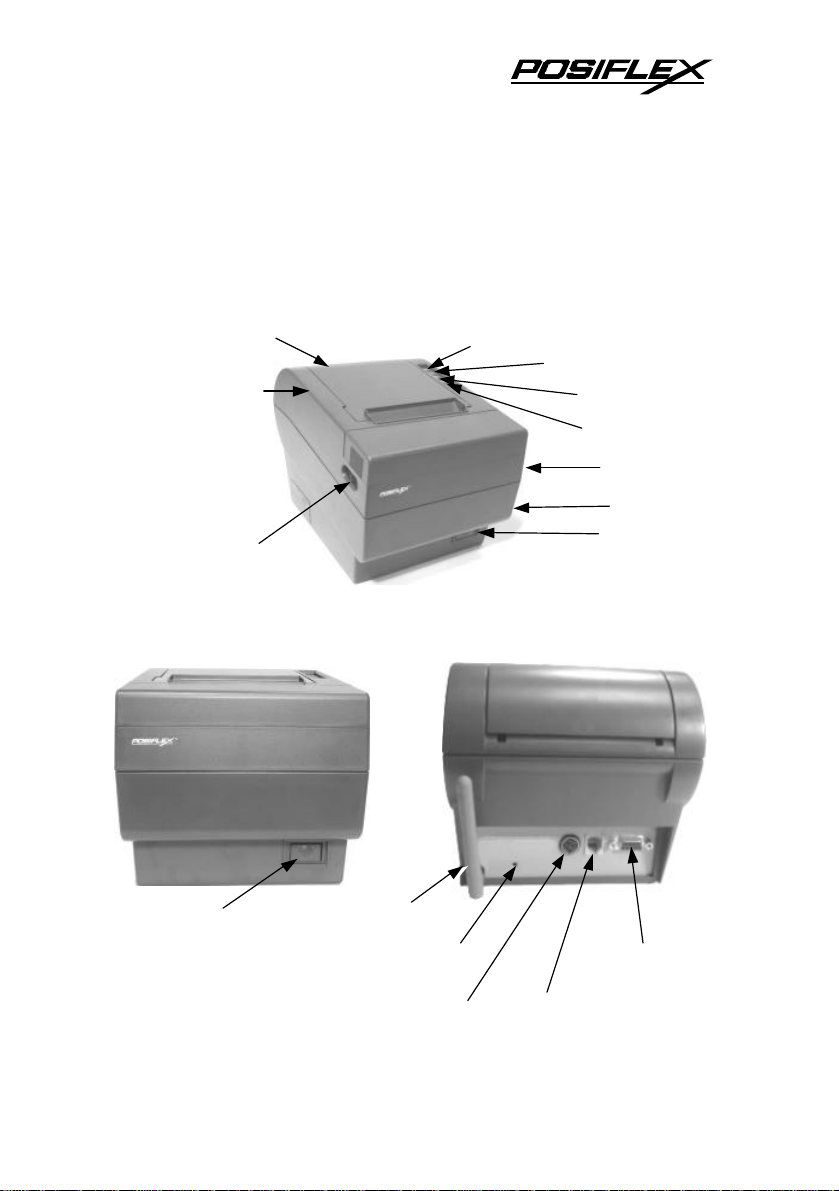
E. MAIN PARTS ON THE EXTERIOR
Top Hood
Top Cover
Hood Release
Front View Rear View
Power Switch
Frame Ground
Power Connector Peripheral Connector
Error LED
Paper Out LED
FEED Switch
Serial Connector
Cutter Cover
Bottom Cover
Power Switch
1 - 3
Page 8
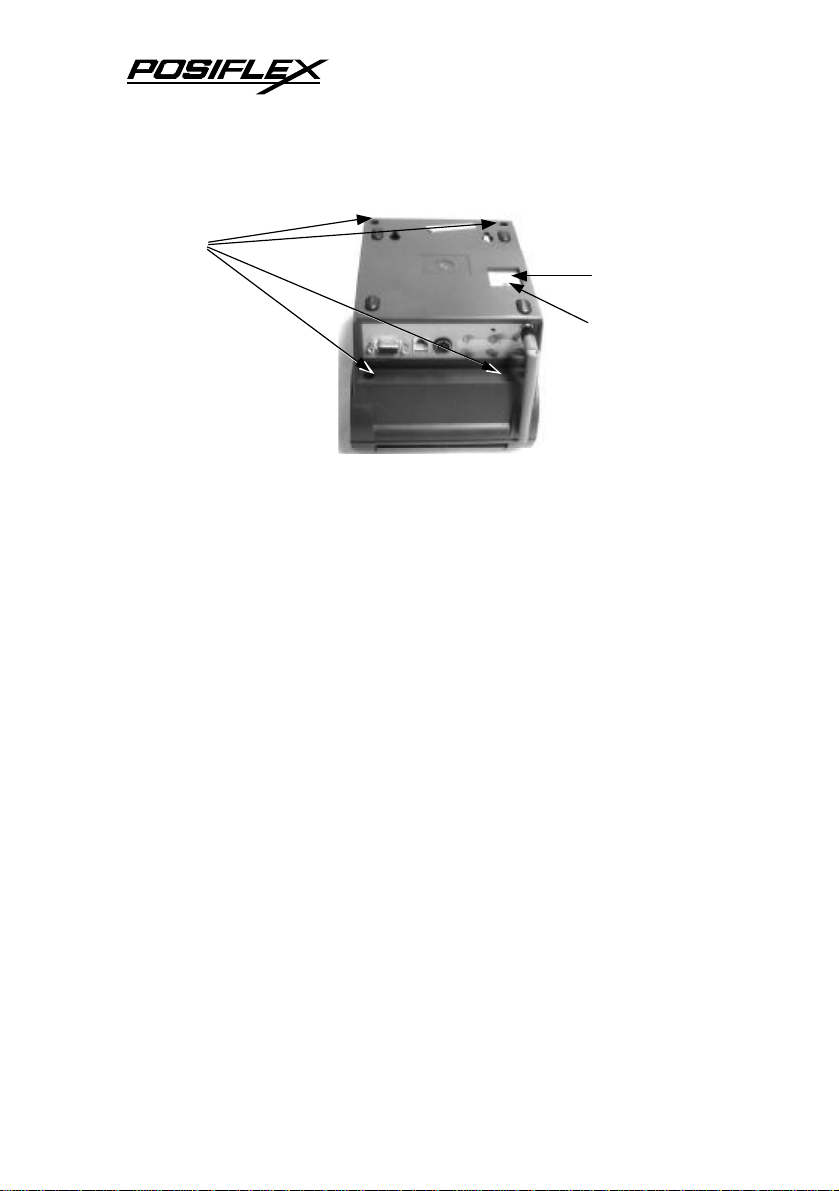
Window Plate
Screws
F. INDICATORS
• Power LED: green
• Error LED: red
• Paper Out LED: red
Bottom View
Setup Window
Screw
G. OPERATING ENVIRONMENT
• Place the printer on a sturdy, level surface.
• Choose a place that is well ventilated and free of
excessive dust, smoke or fume.
• Do not put the printer under direct sunlight or near a
heater.
• Avoid such environment with large number or size of
metal objects in the neighborhood for siting of either the
wireless printer or the wireless Dongle (connected to the
host)
1 - 4
Page 9

• Try to prevent as much as possible any obstacle
between printer and host PC such as metal plate, wire
mesh or any other materials of metal.
• Ideal room temperature is from 5ºC to 40ºC. Ideal
humidity is from 20% to 85% RH (no condensation).
• Use a grounded AC power outlet.
• Use only the power cord and power adaptor furnished
with the printer.
• Do not use a power outlet of a circuit shared with any
equipment that causes great electrical noise, such as
motors.
• Do not use a power outlet of a circuit shared with any
equipment that uses a lot of power, such as a copier or a
coffee maker.
• Do not touch any connector contacts to avoid possible
electrostatic damage.
• Do not allow the cut receipt to slide back into the cutter
during the operation. As this would lead to multiple
cutting at the lower edge of a receipt and the multiple
cut thin slips tend to cause mechanical malfunction.
• Since the paper roll is highly thermal sensitive, please
keep them in a dark place that is 20º and 65% RH when
not installed in the printer.
H. USEFUL TIPS
• Do not touch the areas around the print head and motor
during or right after printing. It can be very hot.
1 - 5
Page 10

• Do not use thermal paper containing Sodium (Na+),
Potassium (K+) and Chlorine (Cl-) ions that can harm
the print head thermal elements.
• Use only water paste, starch paste, polyvinyl paste or
CMC paste when gluing thermal paper.
• Use of volatile organic solvents such as alcohol, ester
and ketone on thermal paper can cause discoloration.
• Some adhesive tapes on thermal paper may cause
discoloration or faded printing.
• Use only products made from polyethylene,
polypropylene or polyester for storage of thermal paper.
If thermal paper touches anything includes phthalic acid
ester plasticizer for a long time, the image formation
ability may be reduced or the printed image may fade.
• If thermal paper touches diazzo copy paper immediately
after copying, the printed surface may be discolored.
• Thermal paper must not be stored with the printed
surfaces against each other as the printing may be
transferred between the surfaces.
• If the surface of thermal paper is scratched with a hard
object such as a nail, the paper may become discolored.
• Store thermal paper away from high temperature and
humidity. Avoid extended exposure to direct light.
• Do not set any liquid or drinks such as coffee on the
printer case
1 - 6
Page 11
II. QUICK START-UP
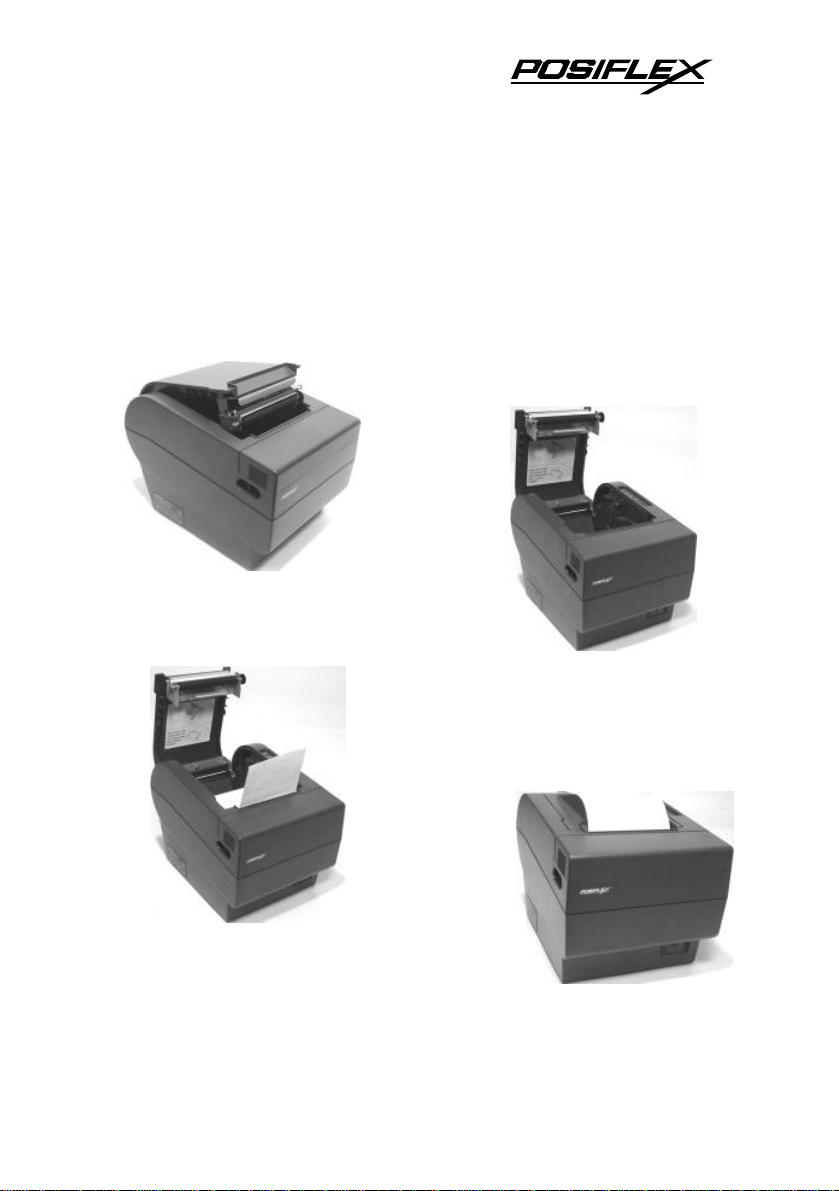
A. LOADING PAPER
1. Desk Top Application
1. Slide the hood lock toward the
front of the printer to release the
hood.
2. Raise the released hood wide open
manually.
3. Drop the thermal paper roll inside
the printer in the orientation as
shown in the picture.
4. Close the
hood
back
leaving
the tail of
the paper
roll coming out of the opening
between the hood and the top cover.
Tear off excessive paper.
2 - 1
Page 12
2. When To Replace Paper
Whenever the printer gives paper out signal or a red line
appears on the thermal paper, it is the proper timing for replacing
the paper. Do not wait till the print engine is dragging the paper
roll at the very end. It is recommended not to turn off the power
only for paper replacement for this model. However, please pay
extreme attention not to touch the still hot thermal elements or
any electrically live part. Remove the leftover and replace a new
paper roll as illustrated above to prevent excessive paper dust in
the printer and consequently possibility for paper jam.
B. CONNECTION / SET UP
1. Serial Connection
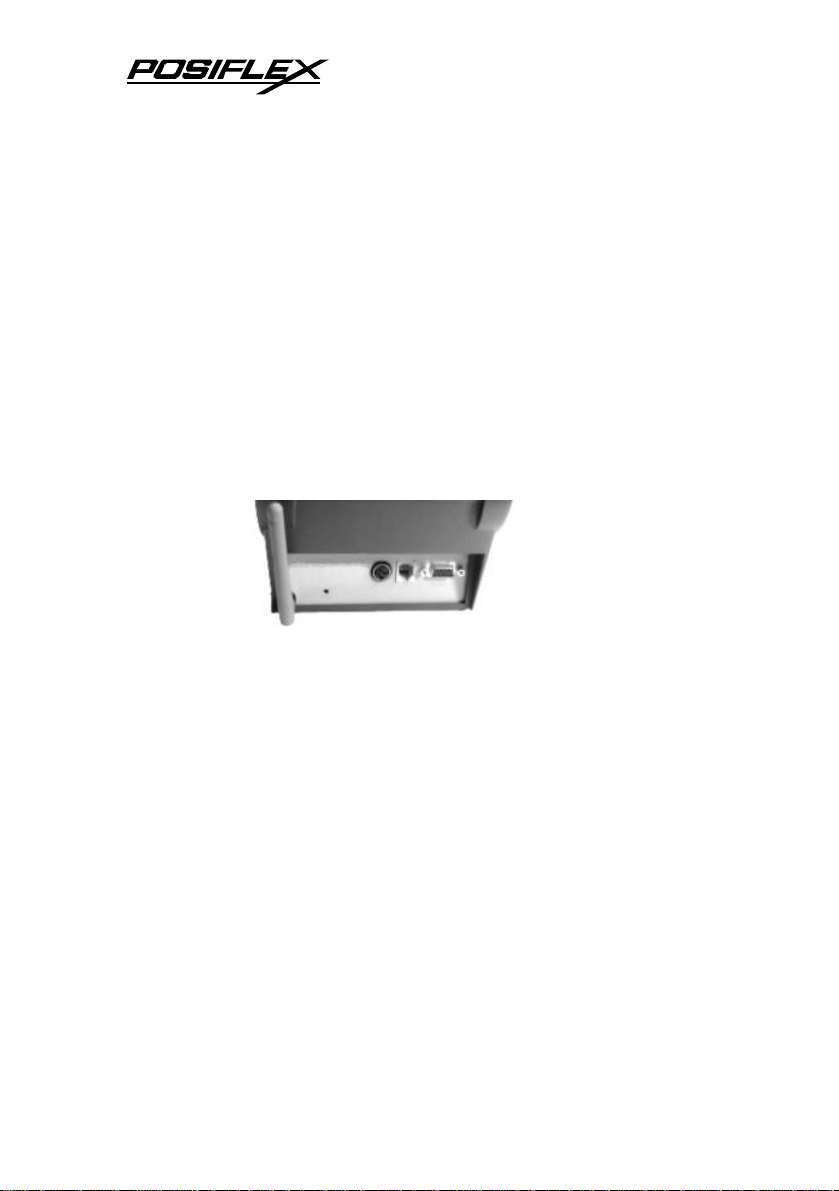
All the external connectors are in the recessed area at the
rear bottom. The serial connector should be used only in specific
technical applications like debug testing or firmware upgrade.
Nothing should be connected to this port in normal operation.
2. Wireless Connection
a. General concepts
The standard PP7700 delivered is equipped with the
wireless interface. A wireless Dongle DG2000 to control this
printer must be separately purchased and installed to one of the
serial COM ports of Posiflex POS system. We know that usual
wireless printer solutions require the application software to use
the printer server in WLAN. In distinction, the Posiflex wireless
2 - 2
Page 13

connection supports a genuine virtual cable connection thus
supports the application software to use even the so-called direct
I/O method for controlling the printer. The Posiflex wireless
connection supports various application environments from
having single Dongle to control single wireless printer to having
single Dongle to control multiple wireless printers and further to
having multiple Dongles to control multiple wireless printers as
long as certain discipline in printer-Dongle connection and
disconnection procedures are well organized in the application
program.
In general practice, the application program provided by
system integrators should have included the programming
elements for the Posiflex wireless connection driver and the user
should follow the arrangement of the application program
accordingly. However, if the software did not take care of the
wireless connection, the user may install the relevant driver prior
to the execution of the application software. The driver can be
found together in delivery of the wireless printer or the Posiflex
Product Information CD of version 1.9 or above, or please visit
our web http://www.posiflex.com or http://www.posiflex.com.tw
for it.
Procedures below are applicable to the situation that the
wireless connection is not covered by the application program
only.
b. Physical and driver installation
1. Select a place free from strong RF interferences and metal
objects for set-up of the wireless printer. Do the Dongle
installation according to its installation guide. Avoid
excessive obstacles such as metal plate, wire mesh or RC
wall etc. in between. Refer to section “Signal detection” for
help to find the most suitable position setup as the radio
frequency signals are concerned.
2 - 3
Page 14
2. At the host system that the Dongle is connected, be sure to
terminate any application program or to uninstall any driver
occupying the COM port that the Dongle is connected. Select
the proper COM port if requested by the installation program.
If there are multiple Dongles installed on several COM ports
in the host, you have to free all COM ports to be used for
wireless connection before driver installation and select the
COM ports used one by one if requested in the installation
program. Reboot system after installation complete. Detail
illustrations are as below.
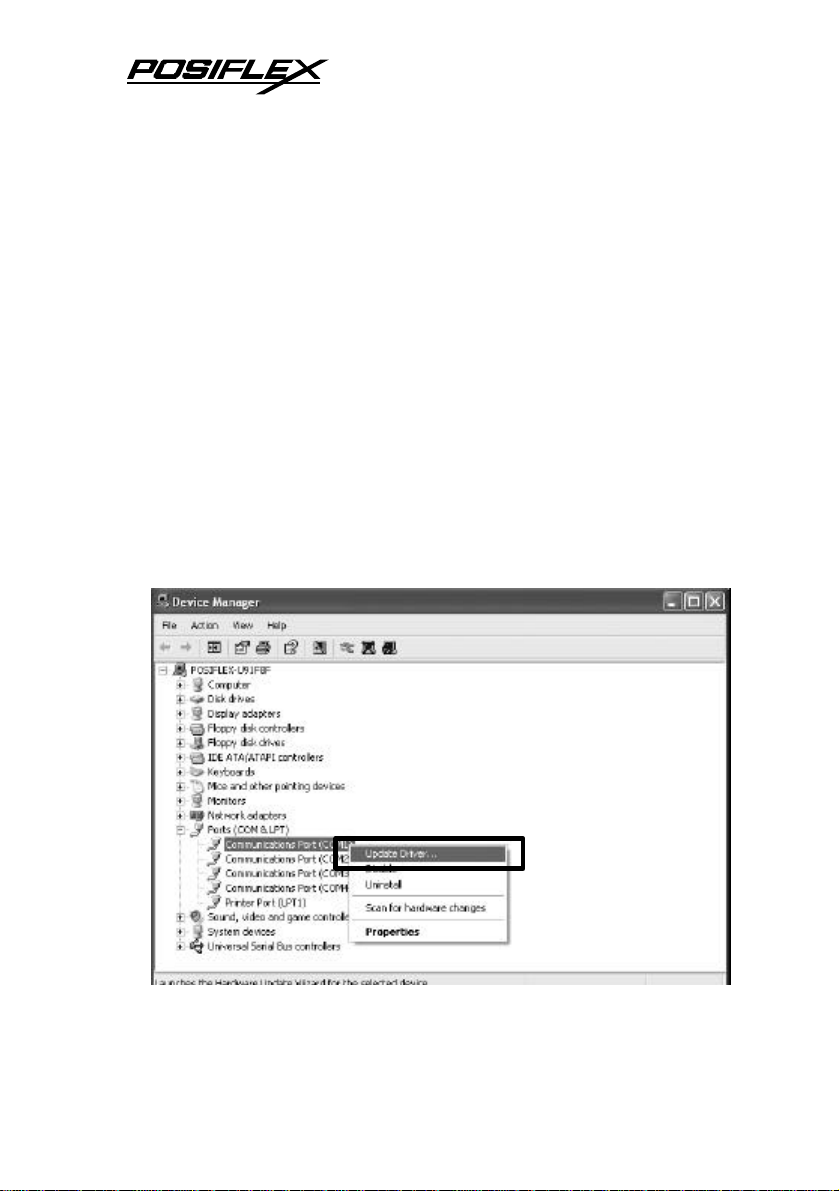
First copy or decompress the drivers to a subfolder in the host
system where Dongle DG2000 is attached. Then in the host
system click “Start” --> “Settings” --> “Control Panel” -->
“System” –> “Hardware” –“Device Manager” --> “COM & LPT”.
Click the right button of mouse at the COM port that DG2000 is
attached and select “Update Driver” as below.
2 - 4
Page 15

In “Hardware Update Wizard” that appears after this, choose
“Install from a list or specific location (Advanced)” --> “Don’t
search, I will choose the driver to install” --> “Have Disk” -->
“Browse” and find the subfolder where the drivers were stored.
Select “ComBtDrv.inf”.
Click “Open” --> “OK”, “Posiflex Wireless Dongle” and a
warning message on digital signature will show up in “Hardware
Update Wizard”.
2 - 5
Page 16

Ignore this message and click “Next”, a warning dialogue box
will pop up.
Select “Continue Anyway” to exit the “Hardware Installation.”
warning dialogue box
2 - 6
Page 17

Click Finish to close the wizard. Check that in “Device Manager”
the “Communications Port” should be changed to “Posiflex
Wireless Dongle” to conclude the driver installation.
c. Making wireless connection
1. Please follow instruction of the application program if it
covers the wireless connection because it may then utilize
some more practical naming of the wireless printer in use.
Follow procedures below for first time connecting a wireless
printer to the Dongle if the application program does not take
care of this part.
2. Please find under the bottom of the wireless printer PP7700
that you want to connect a BT ID printed on a label near the
serial number. Write it down on a piece of paper for later
2 - 7
Page 18

setup procedure since this BT ID could mean lengthy and
hard to memorize by heart to average people.
3. At the host system that the Dongle is connected, first make
sure that the COM port is exclusively free for Posiflex
wireless connection. Then execute the “Posiflex Wireless
Printer Setup” (or “BTSetUp.exe” as filename) and select the
COM port that the Dongle is connected. If there are more
than one Dongle connected in a host system, please do the
setup procedure for one Dongle at a time.
4. Check in the above screen that when the Dongle is well
installed and recognized by the software a 12 digit Dongle ID
will appear in the field for “HOST: BT Address”. Double
check the installation if it still shows “NONE” here. Do a
“Query Printer” and in the “PRINTER” field all BT ID of the
wireless printers within communication range will be
displayed. Select the BT ID that match the one for wireless
printing that you wrote down previously. Clicking for
“Connect” will engage that printer to be connected to the
2 - 8
Page 19

COM port of the Dongle as if they were physically connected.
In other words, you may now send all command / data to the
COM port with Dongle to control / print at the PP7700
without excessive restrictions. You may then select for next
COM port, do another “Query Printer” and another
“Connect” for next Dongle if it exists.
d. Automatic re-connection at power on
1. One of the advantages with Posiflex wireless connection is
that it mimics a real physical cable connection very faithfully.
Whenever you connected a POS printer to a COM port in the
host system, you would expect the connection remains there
if you power off and back on either the host or the printer
before you make the “Disconnect” operation. This would be
particularly important in the more or less straightforward
application on fixed port (Dongle)-printer-pair relationship
with multiple Dongles and multiple printers in the overall
space but enjoying the convenience of no messy cables. This
is default supported in Posiflex wireless connection.
2. If for any reason this automatic reconnection at power up is
disabled, you may re-activate this function by including a
program shortcut in the system “StartUp” menu. Please
include the software parameter select “BTSetUp.exe /X /C”
in the shortcut.
e. Flexible wireless connection
1. Average wireless printer utilizing printer server concept in
WLAN provides good flexibility for multiple hosts to print
on multiple printers. Posiflex managed for POS application
something more than the flexibility in its wireless connection
in a different approach. It concerns the controlling Dongle
(host) and the wireless POS printer in the print task execution.
Considering the fact that most POS printers operate on a
“Line Print” basis, if several print jobs from one host have to
2 - 9
Page 20

be carried out consecutively while unfortunately at the same
time another print job is sent from another terminal, without
the exclusive function, the printer may perform a confusing
interlaced print as the combined result.
2. The security of exclusive relationship is achieved at the cost
of discipline for “Disconnect” operation. To obtain flexible
connection in the multiple Dongles multiple wireless printers
environment, the “Disconnect” must be exercised by the
application program or by manual after each meaningful
finish of print job(s). The programmer may refer to
“BTLoader.txt” in the driver to have the process done in an
AP. To “Disconnect” manually, please select “NONE”
selected in the “PRINTER” field of “BTsetup.exe” and click
“Connect”. Then the Dongle can be connected to another
wireless printer and that wireless printer can be freed for
connection to other Dongle if required.
3. Signal Detection (to select a proper
printer location)
The Posiflex wireless printer PP7700 is designed and
manufactured to operate within 100 meters distance from the
correspondent Dongle in free space. However, in the real world
the Electro-Magnetic wave propagation is greatly influenced by
the surrounding environment and the relative antenna setup. As a
general guidance, arranging the wireless printer and the Dongle in
a horizontal plane of same height and their antennas to be parallel
to each other and also away from the machine body or any metal
yields best performance in most cases.
To get a best communication performance there is a very
important Posiflex provided “Signal detect” feature to help users
in determining the most suitable location setup for the wireless
printer. Please first remove the paper roll out of PP7700 and
connect power to it as described in coming section. Turning on
2 - 10
Page 21

the power while the “Feed” button is pressed can prepare PP7700
for the signal detect operation. Now in the host Posiflex POS
system, please execute the “Connect” with the BT ID of the
PP7700 entered in the appropriate field and click for “Connect”.
Ignore any warning message that would popup later. Press the
“Feed” button on PP7700 again and PP7700 will flash its Error
LED to indicate the wireless connection condition. The faster the
LED flash (up to a little bit faster than 1 flash / sec) indicates a
better connection condition. If the signal detect signal flashes too
slow or even steady on or off, it may need to shorten the printer -host distance or to check the environment again and you may
move the PP7700 around and adjust the antenna direction before
final decision on location setup. Please adjust the position of the
host system and Dongle antenna direction when necessary. It is
quite commonly experienced that several centimeter move or
turning the directions of either the host or the printer can make
significant influences. Please also take into consideration the
operation area of operating personnel as human body usually
influences wireless communication a lot.
After fixing the location setup you may turn off PP7700 and
reload the paper roll to prepare for normal operation. Terminate
the “Signal detect” function at the host and go for application
program at the host system.
4. Peripheral Connection
The peripheral controller is a RJ11 jack near the serial
connector. With use of Posiflex cash drawer cable 20863018001
(CCBLA-180-1) come with cash drawer, this port can control a
Posiflex cash drawer CR3100 or CR3200 or CR4000 or CR4100.
If a Posiflex special split cable 20867023800 (CCBLA-238) is
used instead, this port can control two cash drawers of above
models.
2 - 11
Page 22

When the printer is used as a kitchen printer and a kitchen
bell is prepared, please use this port for kitchen bell connection
instead.
5. Power Connection
The power connector is a 3 pin jack next to the peripheral
connector. Either a Posiflex supplied power adaptor or a printer
power cable from a Posiflex POS system can be connected to this
connector to supply power for this printer. During insertion of the
power plug, be sure to hear the click to obtain a firm contact.
CAUTION: Before doing the insertion or extraction of the
power plug, be sure to pull the outer sleeve of the
plug backward to release the internal latch.
Failure to do this could damage the power plug.
Such damage is considered as an artificial
destruction and is not covered by the warranty.
6. Power On
When all the above cable connections are made correctly,
you may connect your power adaptor to the wall outlet. Make
sure that the type of power cord and the voltage requirement of
the power adaptor meet the local power conditions. Now the
printer is ready for power on.
7. Self Test
With the paper roll loaded in the printer press and hold
down the feed button while push the on / off switch on. The
printer will then perform a self test. A sample slip of self test
result is printed below.
The header of this slip is printed in text mode and the rest
part is in page mode. If FEED button is pressed at this moment, a
2 - 12
Page 23

Sensor Head
font table will be printed in text mode again. To exit the test
printing, please turn the printer off and on again.
C. SPECIAL ADJUSTMENTS
1. Paper Near End Sensor
The near end sensor for paper roll
in the printer is now able to have the
printer work with paper rolls of several
bobbin sizes. Please refer to the picture
at right from inside the paper roll
compartment that there are a fixing
screw and a sensor head in the wall.
2 - 13
Fixing Screw
Page 24

Bobbin I.D.
Bobbin O.D.
Thermal
Surface
Slightly release the fixing screw to adjust the position of sensor
head. The acceptable paper roll bobbin outer diameter is between
18 and 22mm. This adjustment allows sensor activation on paper
roll overall diameter between 21 and 23.6 mm unless for too light
bobbins. Remember, for smaller roll diameter, the sensor head
should go higher.
2. Paper Roll Placement
When the paper
roll to put (back) in is
already nearly used up,
the paper roll must be
placed in the way that
the paper roll touches
the sensor head from
the outer surface but never allow the sensor head to ride on the
bobbin body between the inner and outer diameter of the paper
roll bobbin nor to go into the inner diameter of the paper roll
bobbin. It is also noticed that some market available paper roll has
extremely light bobbin, easily causing the paper roll to go off
position when paper feeding with low remaining paper. In this
case, the paper near end sensor may function abnormally and it
would be a good solution to set in the setup window to have the
printer to send busy only when input buffer is full and not based
on every off line signal.
Paper
3. Spacer Plate
If the paper roll is of width less than the standard 80 / 58
mm, it may run away from the paper near end sensor during
application resulting in an error status. In this case, please stick
the spacer plate to the wall opposite to the paper near end sensor
in the paper roll compartment. Each spacer plate compensates 1
mm paper roll width shortage. There will be 1 spacer plate in the
2 - 14
Page 25

accessory of the printer. If the user uses narrower paper roll and
requires more spacer plates, it can be purchased from Posiflex.
4. Paper Cutting
The paper advance after a protective cut is now set to 12
mm. In case the user uses direct cut instead of protective cut to
have something like a logo printed on top of each slip, it is also
highly suggested to print the logo and necessary paper feeding to
make 12 mm paper advance right after each cut to prevent curling
up and jamming of paper front edge inside the paper exit slot.
5. Wall Mount Application
In wall mount application, the paper near end sensor will
not have proper operation and it is suggested to set in the setup
window to have the printer to send busy only when input buffer is
full and not based on every off line signal.
2 - 15
Page 26

Page 27

III. MAINTENANCE GUIDES
A. MAINTENANCE GUIDE LINES
• Always turn off and disconnect power before opening
the cover.
• The areas around the print head and motor become very
hot during and just after printing, do not touch them.
• When handling the interior of the thermal printer, please
pay attention not to be hurt by any sharp edge of the
metal parts.
B. GENERAL CLEANING
Please use soft hair brush or compressed air to clear away
any dust or paper scraps accumulation inside the printer. Check
also the area of the auto-cutter regularly.
C. PRINT HEAD CLEANING
The print head is located underneath the roll paper passage
at the exit as in the picture below. You can clean the thermal
elements of the print head and paper sensor gently using a cotton
swab moistened with isopropyl alcohol solvent.
NOTE: Never do this when print head is still hot
Do not touch the print head thermal elements
Do not scratch the print head
Thermal Elements
Paper Sensor
3 - 1
Page 28

Before putting back the paper roll for printing, alcohol
solvent must be dried completely.
D. TROUBLE SHOOTING
This section gives solutions to some printer problems you
may have.
1. General Problems
No LED lights up on control panel when switched on –
Make sure that the power supply cables are correctly plugged into
the printer, the power adaptor and to the power outlet. Make sure
that power is supplied to the power outlet. If the outlet is
controlled by a switch or timer, try use another outlet.
2. Printing Problems
Nothing can be printed with ERROR LED ON – Check
the Paper Out LED. If it is ON, most probably the paper roll is not
installed or is at or near the end. Install a new paper roll. If the
Paper Out LED is OFF, please check if the print hood is properly
closed. There are 2 internal check points inside the printer to
assure the locking of the hood for a decent printing. Therefore any
dislocation of the hood may cause an error status and inhibition to
printing. Press down the hood at middle of the opening when
closing it till it audibly clicks into place. If both situations are not
the cause, please try pulling the hood lock forward. If the top
hood won’t release automatically, check for paper jam described
in next item.
If there is no paper jam and the printer has been printing for
quite a period of time, the print head may be overheated. It will
usually cool back in few minutes and the printing will resume.
3 - 2
Page 29

If there is no paper jam and the print head is not overheated,
turn off the printer and wait for half a minute then turn it back on.
If the problem still remains, contact a qualified service person.
Nothing can be printed with ERROR LED OFF – Try to
run self test according to previous chapter to check if the printer
itself works properly. If the self test passes, check the following:
a. Check the signal of the wireless interface at both the
printer and computer.
b. Check the printer data communication settings against the
computer. The printer settings can be found easily on the
self test print out.
If the problem remains or the self test fails, contact your
dealer or a qualified service person.
Poor printing quality – Contaminants like paper scraps and
dusts on the thermal print head can lower the print quality
drastically. Clean the print head as described in previous section.
Printer trembles when printing – Since PP7700 prints at
180 mm / sec that is extremely high speed, the printer may
tremble due to frequent engagement of the brake and acceleration
of the motor. Such situation in turn can be consequences of very
complicated printer operation command or heavily dense printing
(like in inverse printing) in print content or irregular / insufficient
data flow received from the host. When this happens, the print
speed will be dragged down drastically since the motor has to be
stopped frequently. Avoiding such draw backs can free the printer
from trembling and degraded performance. As a common practice,
increasing the communication baud rate could be a smart decision.
3 - 3
Page 30

3. Paper Jam Problems
Paper is jammed inside the printer – Turn off the printer
and open the print hood by releasing the hood lock. Remove the
jammed paper and reinstall the paper roll. Close the hood properly
and firmly. Then turn on the printer for operation.
If the auto cutter is jammed, the print hood will be locked.
Please first resolve the auto cutter problems per description in
next item and then come back to deal with the paper jam. Never
force open the print hood. Please also clear away any
contaminants accumulated in the cutter track above the thermal
elements.
Auto Cutter Track
Thermal Elements
4. Auto Cutter Problems
In case any foreign materials like a staple or paper clip or
excessive paper scraps fall into the auto cutter mechanism the
auto cutter may lock up and so does the print hood. In such case,
please pull the cutter cover forward to expose the cutter
mechanism. Apply some mechanical assistance below to reset the
cutter blade back to its home position. Please lift up if exist a
transparent protective cover over the adjustment wheel. Turn this
wheel downward. When the cutter blade returns to its standard
position, a hole in the plastic gear will show up in the window as
illustrated below. Then aim the guide of the cutter cover and push
it back to position when finish. The lock up of the print hood can
then be released after this problem solved.
Please use manual cutter as temporary alternative measure
once the auto cutter malfunctioned.
3 - 4
Page 31

Open Cutter Cover
when hood locked
5. Graphic Printing Speed
The RS232 protocol for printer Dongle connection defaults
to 19200 bps. However, this setting could appear insufficient for
graphic printing mode. In such case, please change the RS232
baud rate to 38400 bps for the Dongle on the host system.
6. Wireless Connection Concerns
There are several conditions that could lead to poor wireless
connection message/status. Following discussions are attempts to
cover advices on what to do.
Printer goes into error status with intact wireless
connection: -- This may occur for example if the printer top hood
is opened during normal operation (maybe for paper roll change
or else) and all E-M field conditions remain unchanged. The Error
LED on PP7700 will lit. The wireless connection driver in the
host system will indicate loss of connection and keep trying for
reconnection till time out. If the error status of PP7700 is expelled
before the host time out, the wireless connection resumes
automatically without trouble. If the host already timed out when
PP7700 returns normal, just re-initiate the wireless connection
and everything will be OK. However, if the situation occurs due
to paper out in middle of a receipt printing, the receipt would be
Turn the wheel downward till a hole in
the plastic gear appears in this window
Lift transparent
protective foil
3 - 5
Page 32

printed in two parts from two rolls of paper but every item will be
printed.
Printer fails to respond such as being powered off: -- The
wireless connection will resume when the printer comes back
alive. However the data sent when the printer goes off if it
happens at printing process will be lost. So it is quite advisable for
the application program to provide an option for end user to send
command to the printer to clear the residual memory of last
printing and resend the last printing job.
Wireless connection jammed: -- This situation could occur
when a large block of conductive material comes in the radio
wave propagation path or strike of strong RF interference. If the
situation happens when printer not printing, both printer and host
recover automatically after the blocking or the interference is
removed. However, when it happens during printing, there will be
data loss. Therefore it is also quite advisable for the application
program to provide an option for end user to send command to the
printer to clear the residual memory of last printing and resend the
last printing job.
Wireless connection broken by accidents on host side: --
If the DG-2000 connected to the host is abruptly disengaged by
accident, the wireless connection will definitely be interrupted.
However, the wireless connection does not automatically come
back after you reconnect the DG-2000 back to the original COM
port of the host. The application program may have to be
terminated and re-initialized if it does not provide the option to
close the COM port and then re-open the COM port for DG-2000
connection. If the AP does not release the control of COM port on
termination, even the OS may have to be restarted.
3 - 6
Page 33

7. Advanced Analysis Tool
This printer supports Hexadecimal Dump for experienced
user to view exactly what data is received by the printer. This can
be useful in finding software problems.
To start the dump mode: Turn off printer; Open print hood;
Hold down FEED button while turning printer on; Close the hood.
To stop the dump mode: Press the FEED button to print out
the last line; Turn off the printer.
During dump mode: The host still can access/connect /send
data to PP7700 through the wireless connection, At PP7700 all
commands except DLE EOT and DLE ENQ are disabled.
3 - 7
Page 34

Page 35

IV. SPECIFICATIONS
A. PRINTER
ITEM SPECIFICATION
Printing method Thermal sensitive line dot method
Printing speed 180 mm /sec.
Maximum Printable Width 72 mm (for 576 dots/line)
Default Printing Width 64 mm (for 512 dots/line)
Dot 320 to 321 in 512 dots / line
Print Segmentation Position
Print Segmentation Vertical
Shift
Paper feed method Friction auto-feed
Paper load method Drop and use
Auto-cutter capability Partial cut (1 point at center left)
Manual cutter Saw tooth blade
Dot Pitch 0.125 x 0.125 mm
Input power type DC
Input voltage 24 V + / - 5 %
Dimension (mm) 148 (W) x 199 (D) x 144 (H)
Weight 1.35 Kg net
configuration. (Avoid printing
ladder type bar code here)
Max. 0.06 mm
B. PAPER
Paper type Thermal roll paper
Paper roll formation External side is heat-sensitive side
Paper width 80 (or 58) + 0 / - 1 mm
Paper roll outer diameter 83 mm max.
Paper roll inner diameter 12 + 1 / - 0 mm
Paper thickness 60 ~ 80 um
4 - 1
Page 36

C. POWER ADAPTOR
ITEM REQUIREMENT
INPUT VOLTAGE 100 V AC ~ 250 V AC
INPUT FREQUENCY 50 ~ 60 HZ
INPUT CURRENT 1.5 A MAX. @ 115 V AC
OUTPUT VOLTAGE + 24 V DC
OUTPUT POWER 60 W
STATIC LOAD 0 A ~ 2.5 A
OUTPUT REGULATION + / - 5 %
MTBF 30,000 HRS
EMI STANDARDS VDE – B, FCC – B, VCCI – B
4 - 2
Page 37

00 bps, none parity, 8 data bits, 1
Search for wireless printer in range of
each Dongle (discover) and register a
virtual COM port for each printer
One Printer for each Dongle. Direct
I/O control or OPOS driver can be
ter. No AP
Multiple printers for one Dongle or
multiple printers for multiple Dongles.
Dynamic Link Library functions are
Time Required for Dongle
Printer Connection
Average 5 seconds. Worst case 10
V. TECHNICAL INFORMATION
A. INTERFACES
1. Wireless Interface
Wireless Features Specification
ITEM SPECIFICATION
Frequency Band 2.4 ~ 2.4835 GHz
Transmission Range 100 meters in free space
RS232 Protocol for Dongle
Dongle Application COM port of Posiflex POS systems
Command/Control Algorithm
ITEM FUNCTION
192
stop bit (use 38400 bps for graphics)
Setup Utility
Dedicated Connection
Non-dedicated Connection
Establishment
5 - 1
(connect)
utilized to control prin
modification required.
provided for AP to control printers.
seconds.
Page 38

1 6
6 1
2. Peripheral Interface
The connector for peripheral control is a 6P6C RJ11 jack
with the following pin assignment. The best recommended cash
drawers to this connector are Posiflex CR3100, CR3200, CR4000
and CR4100. Using the cable 20863018001 (CCBLA-180-1)
delivered with the cash drawer, the Aura series can control one
dedicated cash drawer. However, by using an optional split cable
20867023800 (CCBLA-238), Aura series controls two cash
drawers through this connector. Please connect the CR1 plug to
the cash drawer (CRA) to be opened by command Esc p 1 n1 n2
and the CR2 plug to the cash drawer (CRB) to be opened by
command Esc p 0 n1 n2.
6P6C RJ11 jack
6 pin plug
PIN # Definition Description
1 FG Frame ground
2 CRB
Drawer kick for cash drawer controlled by
software command Esc p 0 n1 n2
3 SENSE Input peripheral status
4 VCC + 24 V DC supply
5 CRA
Drawer kick for cash drawer controlled by
software command Esc p 1 n1 n2
6 SG Signal ground
B. SETUP WINDOW
On bottom cover of the Aura series thermal printer, there is
screwed a metal plate for setup window. In this window, there is a
8 position DIP switch for printer setup. Please use proper tool to
5 - 2
Page 39

change the switch setting when necessary. The switch position
counting starts from the nearest edge of printer. The ON direction
points to the connector area of the printer. The OFF direction
points to the power switch. The functions of each position may
evolve with the revisions of the firmware. The information below
applies to the latest version to the date of print of this manual.
This 8 position DIP switch works as following:
Switch
position
1/2/3/4
5 Busy on “buffer full” Busy on “off line”
6 Immediate cut Protective cut
7 CR code effective CR code ineffective
8 Factory internal setting Application standard mode
Effect of Switch positions 1 & 2 & 3 & 4 should be fixed to
1 & 2 ON and 3 & 4 OFF for proper connection with wireless unit.
For switch position 5, if the switch is set to ON, the busy
signal is sent to host only when input buffer is full. When it is set
to OFF, busy signal is sent to host whenever an off line status
occurs. Therefore, signals including the paper near end detect will
generate busy signal to the host. Consequently, the printing may
be stopped even when there is still a long way to go before the
paper roll is actually exhausted. Taking the paper out beep into
consideration, the printer will keep on beeping at Paper End
(completely no paper) till paper is replaced when S1-5 is ON. Yet
when S1-5 is OFF, the printer will keep on beeping every 3
seconds at Paper Near End (still long paper in replace) till paper is
replaced.
For switch position 6, when it is set to OFF, there will be a
20 mm paper feed before cutting when software does not define
this point and there will be further 10 mm paper after cutting to
prevent paper jam. Before setting this switch to ON, please make
ON OFF
Set to ON, ON, OFF, OFF
5 - 3
Page 40

Wireless interface
sure that your software will take care of enough paper feed for the
paper jam prevention issue.
For switch position 8, when it is set to ON in the field, the
printer maybe subject to unpredictable damages and must be
strictly prevented.
The factory default for each position is listed below:
Switch Position 1 2 3 4 5 6 7 8
w/ auto cutter
ON ON OFF OFF OFF OFF OFF OFF
C. INTERNAL SWITCH
There is an extra internal 4 position DIP switch in PP7700
for more technical settings. To access these setup, please first turn
off the printer power and disconnect every cable from the printer.
Remove 4 screws from bottom of printer and remove the plastic
bottom cover with the power switch pressed. The 4 position DIP
switch seats beside the 8 position DIP switch for setup window
with the switch position counting starts from the nearest side to
the 8 position DIP switch.
This 4 position DIP switch works as following:
Switch position Setting Effect
ê
1 Factory internal setting Default Special mode
2
3
4
must be applied in some special application only. The print speed
is fixed at 42.5 lines/sec.
paper width. When the printer is installed with the 58 mm paper
Function ON OFF
Paper width 58 mm 80 mm
Line format 576 dots / line 512 dots / line
Reserved N. A. N. A.
The Switch position 1 default set to ON. The OFF status
Switch position 2 is usually set to OFF for use with 80 mm
5 - 4
Page 41

guide adaptor for use with the paper roll of 58 mm width, the
switch should be set to ON in PP7700.
Switch position 3 is usually set to OFF for ESC/POS
command application that prints at 512 dots / line. Only technical
users shall set this switch to ON and make the printer work in the
576 dots / line format.
D. SOFTWARE COMMANDS
The Aura thermal printer supports all commands applicable
to Epson printer TM-T88II. The only difference is the
smoothening command in enlarged text fonts. Please visit our
web site http://www.posiflex.com.tw, http://www.posiflextw.com
or http://www.posiflexusa.com for detail description of the
supported commands if required.
1. Paper Out Alarm
When Paper End signal is detected, the printer keeps on
intensive beeping and stops receiving data till the signal is
neutralized. When Paper Near End signal is detected, the
printer gives a beep every 3 seconds and stops receiving data.
2. Enhancement Commands
Following commands are included in the printer firmware:
ESC ‘o’: Beep command
GS ‘o’ m: Beep definition (0 < m ≦ 16, default 3 seconds)
ESC ‘p’ m n1 n2: Cash drawer kick or kitchen bell drive
command
GS ‘p’ m n: Beep when cash drawer remain open (0 < m <
256, n = ‘0’ or ‘1’)
Explanations as below:
ESC ‘o’: Beep command
5 - 5
Page 42

Hexadecimal codes are: 1B 6F
Printer beeps when this command is received per condition
set by beep definition.
GS ‘o’ m: Beep definition (0 < m ≦ 16, default 3 seconds)
Hexadecimal codes are: 1D 6F m
This command defines length of beep as m seconds when
beep command is received. When m = 0, default applies.
ESC ‘p’ m n1 n2: Kitchen bell drive command (m = ‘0’, 0
≦ n1 ≦ n2 ≦ 255)
Hexadecimal codes are: 1B 70 m n1 n2
This command can be used to drive a kitchen bell
purchased from Posiflex when this printer is used as a kitchen
printer and the environment could be so noisy that the beeper for
reminding the kitchen staff of the printing can be not loud enough.
After fixing the kitchen bell onto say a kitchen wall, connect the
cable from the bell to the peripheral connector on the printer.
Then use this command with m set to 0 and both n1 and n2 set to
255. The printer will be able to drive the kitchen bell for about
half a second on each such command. If this command is sent to
the printer multiple times consecutively, the bell will ring for
about half a second and rest for also about half a second then ring
again for multiple times.
GS ‘p’ m n: Beep when cash drawer remain open (0 < m
< 256, n = ‘0’ or ‘1’)
Hexadecimal codes are: 1D 70 m n
If the cash drawer connected to the printer remains open for
more than m seconds, the printer beeps until the drawer is closed.
If m = 0, this function is disabled. The factory default of the
printer is set to disable this function. The parameter n in this
command identifies the way cash drawer indicates drawer open
status. n = ‘0’ (30H) applies to drawers giving an “open” signal
5 - 6
Page 43

when cash drawer is opened. n = ‘1’ (31H) applies to drawers
giving a “short” signal when drawer is opened. Any value of the
parameters outside the defined range will cause the entire
command ignored.
E. CHARACTER CODE PAGES
Aura PP-7700 series supports all code pages and
international character sets applicable to Epson printer TM-T88.
Page 0 (PC437: USA)
Page 1 (Katakana)
Page 2 (PC850: Multilingual)
Page 3 (PC860: Portuguese)
Page 4 (PC863: Canadian-French)
Page 5 (PC865: Nordic)
Page 255 (Thai)
Further support to some double byte language system can be
achieved by adding each relevant font chip in standard model:
Japanese: Kanji
Korean: KCS5601
Traditional Chinese: Big 5
Simplified Chinese: GB2312
The international character sets supported in basic ASCII
range include USA; France; Germany; UK; Denmark I; Sweden;
Italy; Spain; Japan; Norway; Denmark II; Spain II; Latin America;
Korea for character set code from 0 to D and Ex-Jugoslavia for
character set code F.
If any undefined code (<00> to <1F>) or an undefined
<ESC>, <FS>, or <GS> command sequence beyond these tables
is received, the code or the sequence of codes will be discarded.
(However, when image print data, character registration data, or
command parameters are received, they are handled as ordinary
data.)
5 - 7
Page 44

The user may visit our web at http://www.posiflex.com.tw or
http://www.posiflex.com for a view of the fonts in the code pages
and character sets.
5 - 8
 Loading...