

Page 1
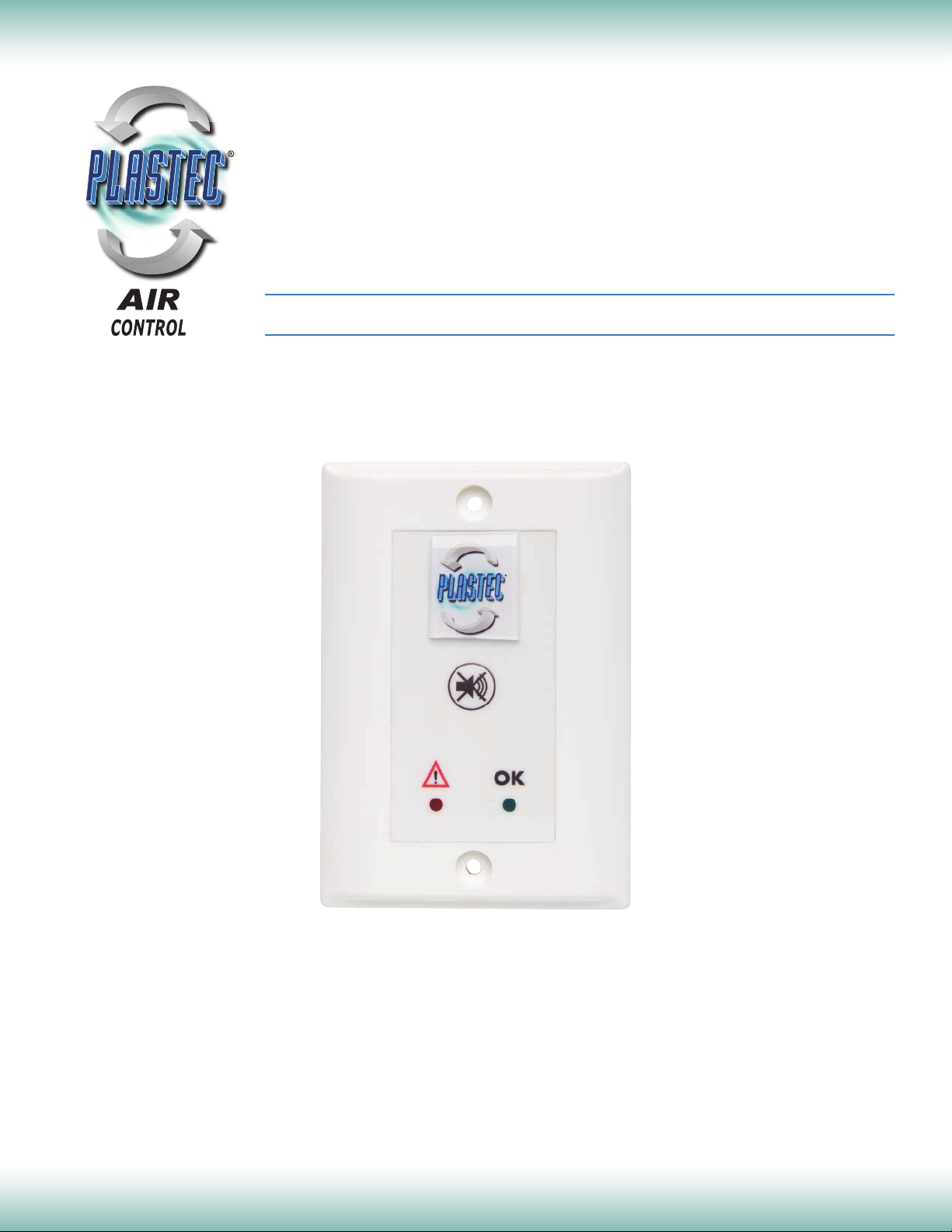
Laboratory Airflow Monitor
TYPE JUNIOR
Owner’s Manual and Technical Specifications
PLASTEC® VENTILATION, INC.
2216 60th Drive East • Bradenton, Florida 34203
(941) 751-7596 • Fax (941) 751-7598 • www.plastecvent.net
Page 2
Laboratory Airflow Monitor
TYPE JUNIOR
General Description
BENEFITS
• Safety: in accordance with latest EU
laboratory standard EN 14175
• Ease of installation and maintenance
• Stable and accurate sensor reading
• Attractive design
FEATURES
• Audio alarm
• 1 Push button: Mute
COLORS
Plastic fascia is available in white standard
color.
INTERNATIONAL STANDARDS
COMPLIANCE
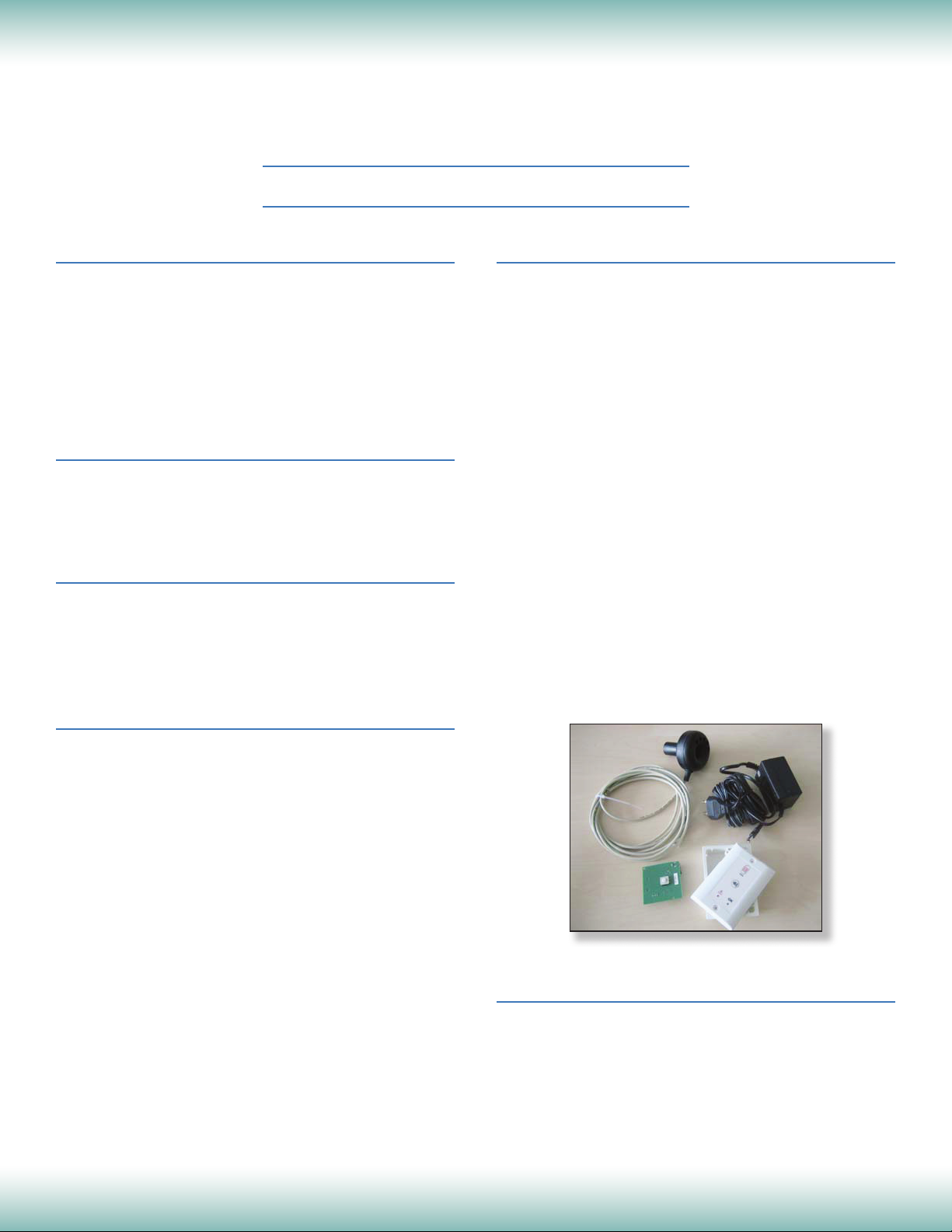
COMPONENTS
• Circuit Board:
Panel mounted circuit board to be installed
vertically onto fume cupboard with 2x Ø
2.8 mm / 0.11" screws. IP55 protection
ensured by “O” ring seal. Face plate to be
supplied with chemical resistant plastic
sticker (vertical) with control/push buttons
on fascia. Surface box mounting included.
• Sensor:
To be installed inside fume hood. Sensor
measures air speed variations inside fume
hood. Supplied with a 3.5 m / 11.48'
shielded cable with pin connections onto
controller circuit board.
• Power Supply:
115 VAC to 12 VDC power transformer
directly into controller circuit board. Comes
with a wall plug and cord. Adaptor may be
required to fit local power socket.
In accordance with:
- European laborator standard EN 14175-2
- Electromagnetic standards EN
61326 : 1997/A1 : 1998/A2 : 2001/A3 : 2003
(Test report RC-05-42060-1) US FCC Part 15
Class B edition 2005 (Test report RC-05 42060-2-A)
- European RoHS directive governing disposal
and recycling of electronics
- French laboratory standard XPX 15203 of
Sept. 1996
- CE
2216 60th Drive East • Bradenton, Florida 34203
(941) 751-7596 • Fax (941) 751-7598 • www.plastecvent.net
PACKING
• Supplied in cardboard box which includes
controller circuit board, face plate, sensor
and power transformer.
2
Page 3
Laboratory Airflow Monitor
TYPE JUNIOR
Operating Principle
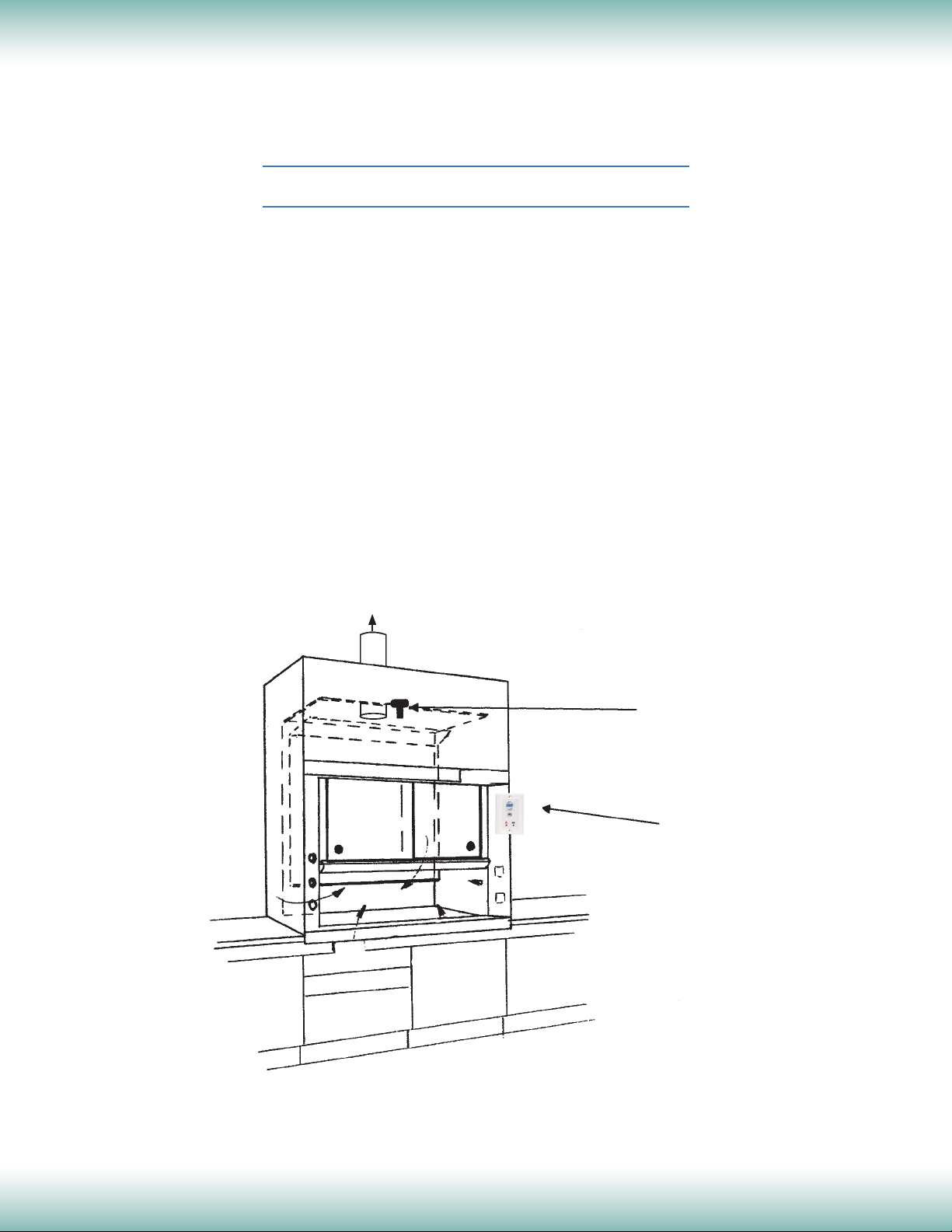
When the fume extraction fan is running, it causes negative pressure inside
the fume cupboard. If the sash is lowered, the negative pressure becomes
more intense causing air to be drawn through the sash opening at an increased
velocity. Conversely, if the sash is raised, the negative pressure becomes less
intense and air velocity reduces.
If an opening is made in the wall of the fume cupboard, air will enter it at a
velocity determined by the same negative pressure that is drawing air into the
sash opening. By sensing the air velocity through an opening, we can determine
its level at the sash opening.
PLASTEC® AirControl exploits this by the placing of a numerical sensor, or
thermal anemometer, into a hole in the cupboard and sending the air velocity
measurement obtained to a display on the fascia panel.
The air velocity level is displayed on the fascia by LED illumination. An audible
alarm will also sound if the air velocity is too low.
SENSOR
PLASTEC
JUNIOR
AIRCONTROL
®
2216 60th Drive East • Bradenton, Florida 34203
(941) 751-7596 • Fax (941) 751-7598 • www.plastecvent.net
3
Page 4
Laboratory Airflow Monitor
TYPE JUNIOR
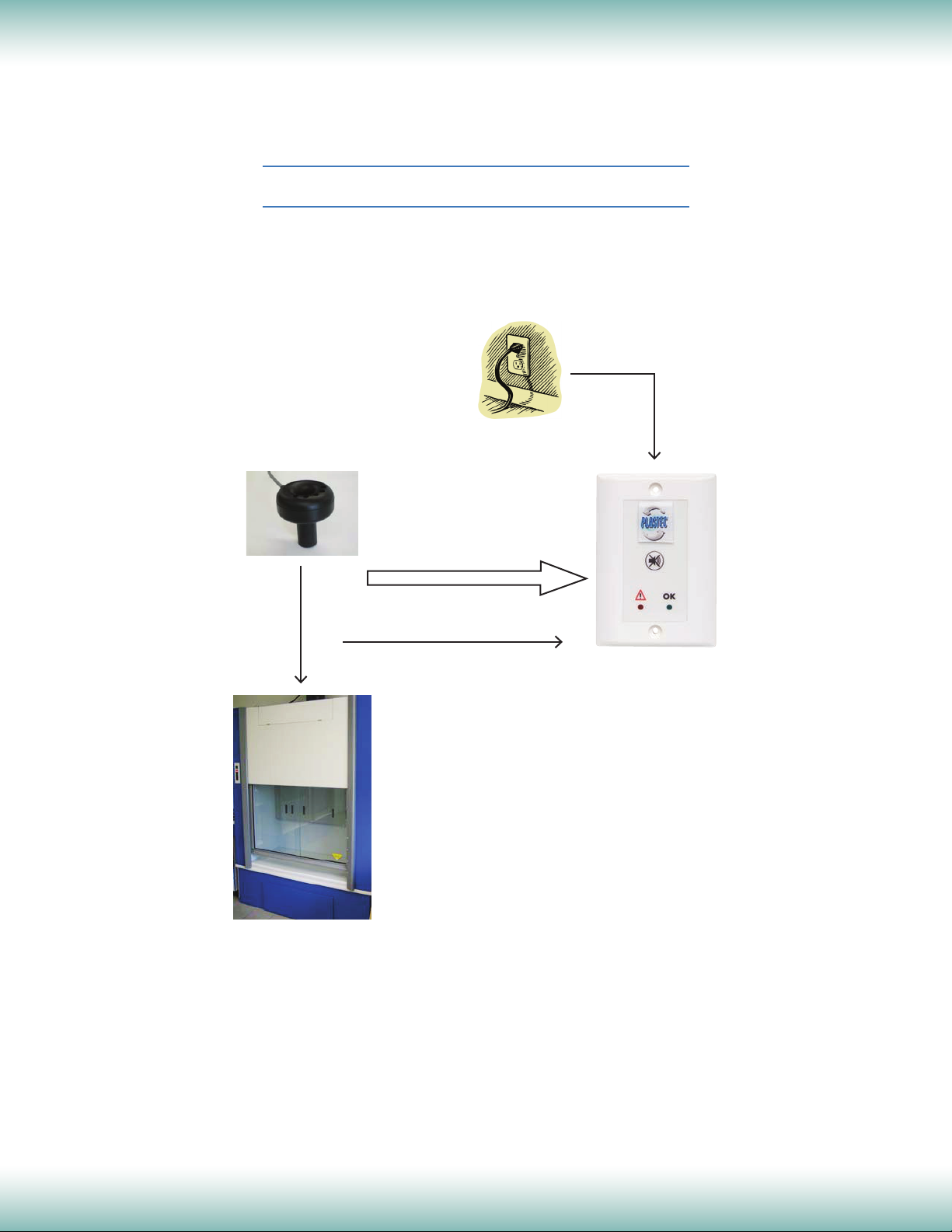
Schematic JUNIOR
115 VAC /12 VDC
Power Supply
Controller
Sensor
Sensor
Signal Input
Sash movement
=
Pressure decrease
or increase
Sash High Alarm Input
2216 60th Drive East • Bradenton, Florida 34203
(941) 751-7596 • Fax (941) 751-7598 • www.plastecvent.net
4
Page 5
Laboratory Airflow Monitor
TYPE JUNIOR
Specifications
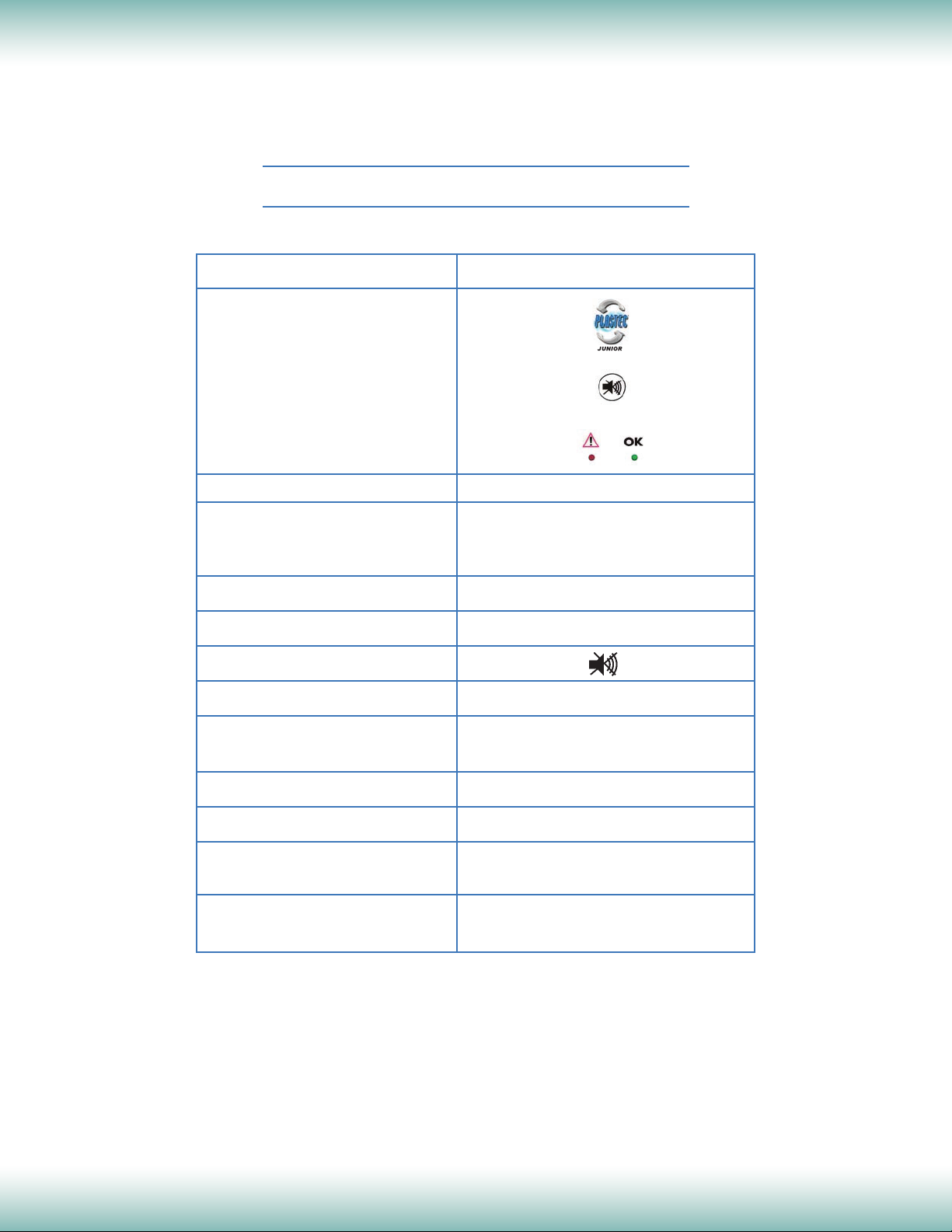
Junior AirControl
Part Number 819699
1 green LED for normal air speed
Display – Visual 1 red LED flashing for alarm
No digital display
Alarm Setpoint
Alarm Indication
Alarm Mute
Mounting Flush or surface box
Calibration
Power Requirement 12 VDC (power supply included)
Orientation Vertical only
Front fascia: 100L x 70W x 10D mm
Monitor Dimensions (metric)
Front fascia: 3.94" x 2.76" x 0.39"
Monitor Dimensions (U.S.)
Surface box: 3.94" x 0.79" x 0.79"
Standard: below 0.39m/s / 78 FPM
1 red LED flashing and audible buzzer
Factory pre-calibrated @ 0.5m/s / 100 FPM
Recalibration possible
Surface box: 100L x 20W x 20D mm
2216 60th Drive East • Bradenton, Florida 34203
(941) 751-7596 • Fax (941) 751-7598 • www.plastecvent.net
5
5
Page 6
Laboratory Airflow Monitor
TYPE JUNIOR
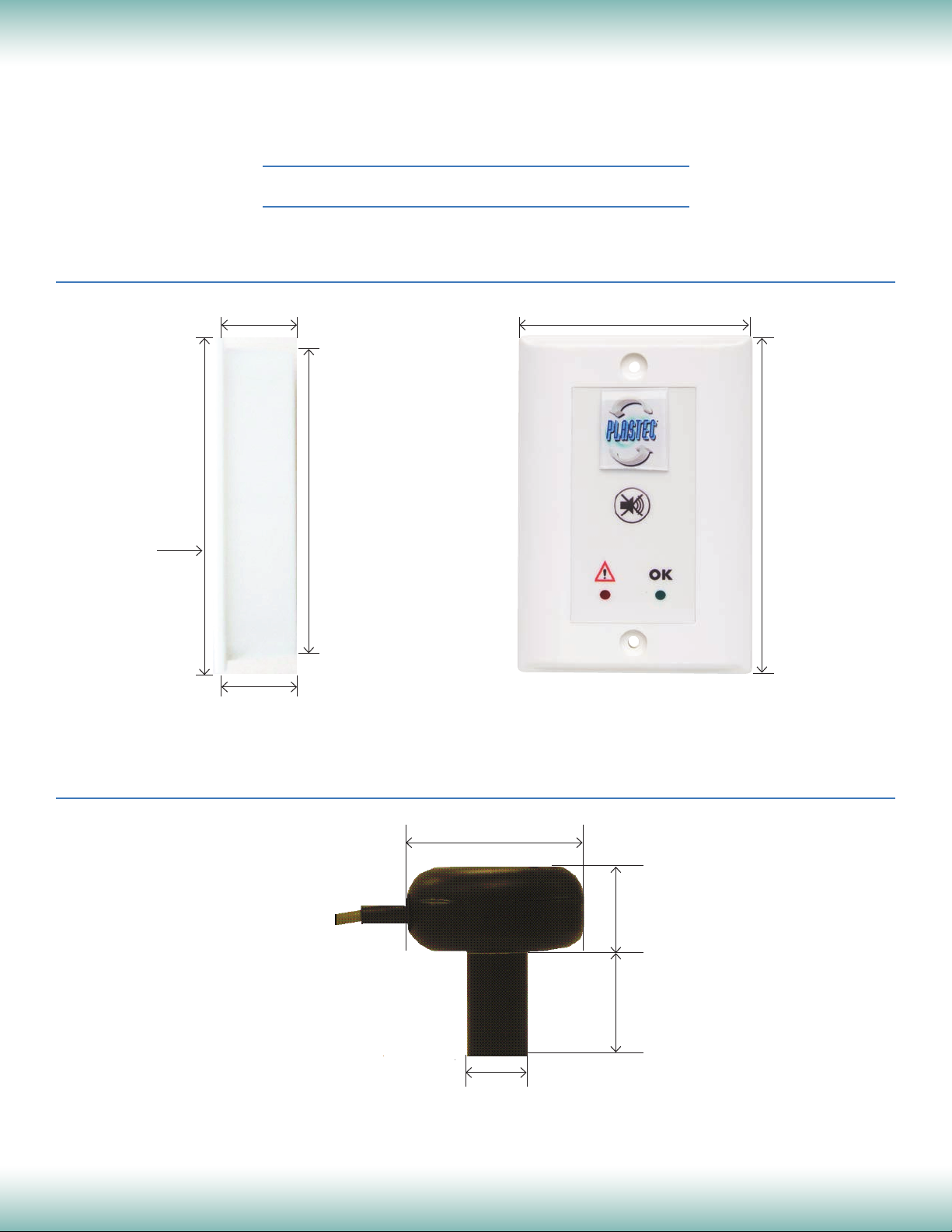
MONITOR & MOUNTING BOX
Specifications
100 mm / 3.94"
Mounting Box
20 mm / 0.79"
20 mm / 0.79"
70 mm / 2.76"
90 mm / 3.54"
100 mm / 3.94"
Vis Ø 2.8 mm / 0.11"
SENSOR
Cable L = 3.5m / 137.76” (11.48')
NOTE: All dimensions in mm / inches
(941) 751-7596 • Fax (941) 751-7598 • www.plastecvent.net
65 mm / 2.56"
28 mm / 1.10"
40 mm / 1.57"
Ø 22 mm / 0.87"
2216 60th Drive East • Bradenton, Florida 34203
6
Page 7
Laboratory Airflow Monitor
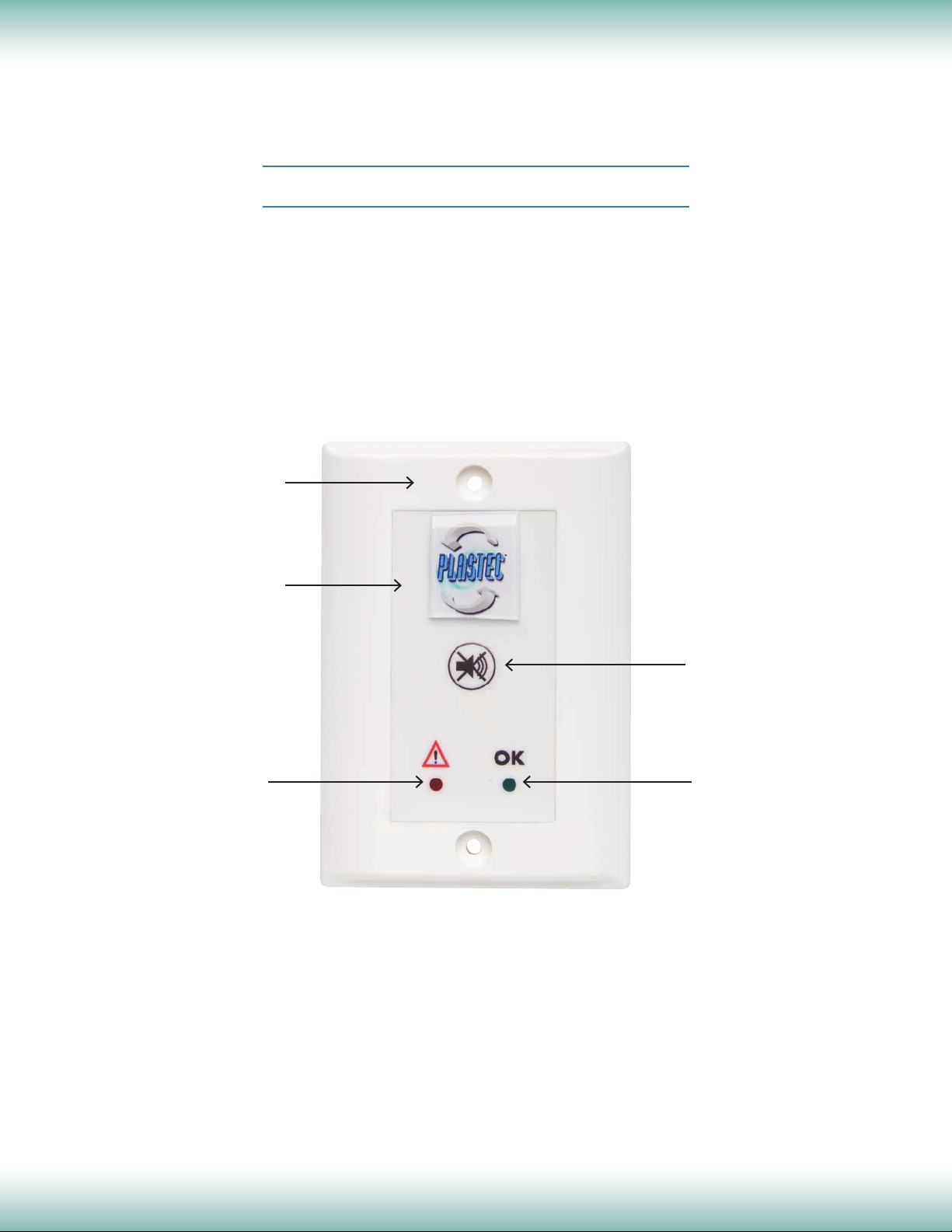
Front plate/fascia
TYPE JUNIOR
Overall View
Chemical and pressure
resistant sticker
Flashing red LED for
alarm: air speed too low
Alarm Mute push button
1 green LED lit up:
Airow OK
2216 60th Drive East • Bradenton, Florida 34203
(941) 751-7596 • Fax (941) 751-7598 • www.plastecvent.net
7
Page 8
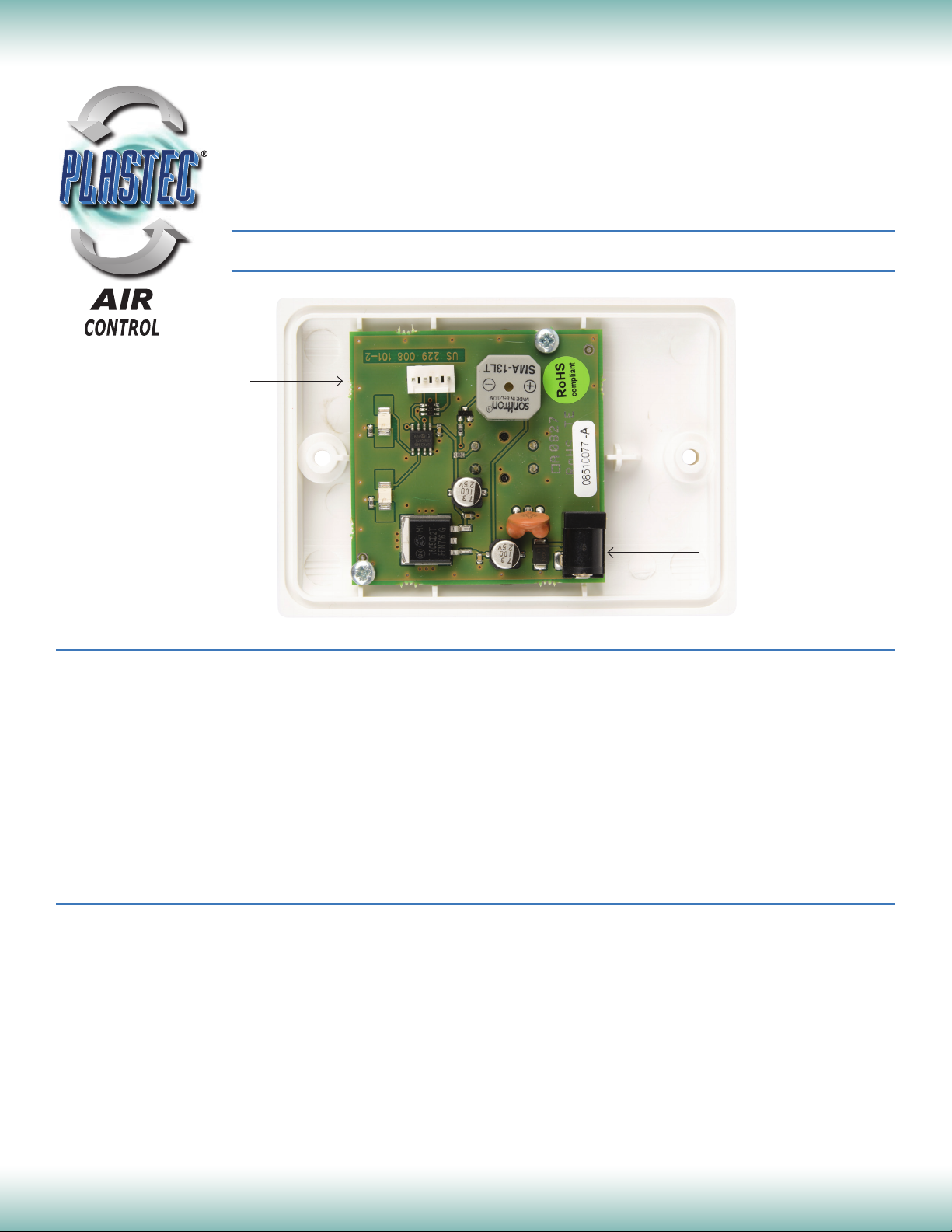
Sensor Connection
Laboratory Airflow Monitor
TYPE JUNIOR
Contacts and Wiring
Power Supply:
115 VAC / 12 VDC input
INSTALLATION
1) Drill a Ø 23mm / 0.91" hole either in the top or side of the fume cupboard to allow sensor
positioning. Make sure sensor is not in a turbulent zone where the pressure can fluctuate but
where it can monitor stable changes in pressure. Attention should be paid to dead zones near the
top of the fume cupboard.
2) Proceed with wiring as seen on page “Contacts & Wiring”.
3) Position and secure monitor to service panel of the fume cupboard with the two self-tapping
screws supplied. Do not forget to position ‘O’ ring seal into the moulded groove in the back of
the face plate.
SENSOR RECALIBRATION PROCEDURE
If you experience difficulties with monitor calibration, you may need to recalibrate sensor itself by
following this procedure:
1) Connect sensor to energized monitor. Place sensor in a sealed bag to ensure no air is travelling
through it.
2) Push simultaneously for about 10s. Green and Red LED illuminates.
3) Remove sensor from bag and place into the fume cupboard.
4) Push simultaneously for about 10s. LED red is off, validating new sensor calibration.
2216 60th Drive East • Bradenton, Florida 34203
(941) 751-7596 • Fax (941) 751-7598 • www.plastecvent.net
8
Page 9

Laboratory Airflow Monitor
TYPE JUNIOR
Contacts and Wiring
MAINTENANCE
Front plate and stickers of airflow monitor may be cleaned with mild soap and water on a damp
cloth to remove finger marks, oils and residue. Do not use abrasives. Do not allow liquids to enter
the plastic casing. Dry the monitor thoroughly after cleaning.
TROUBLESHOOTING
PROBLEM CHECK
No indicators Power supply may not be plugged into AC supply.
Improper alarm set point Airflow sensor is factory precalibrated at 0.5 m/s or 100 FPM. Field
reading may be different if sensor is not properly located or hood
design affects stable airflow. If intended air speed is different than
0.5 m/s / 100 FPM or if actual anemometer reading is different,
follow Sensor Recalibration Procedure page 1.
WARRANTY
PLASTEC® Ventilation, Inc. warrants its equipment, products and parts, to be free from defects in
workmanship and material under normal use and service for one year after delivery to the first user.
Product must be returned to point of purchase, with dated bill of sale, within one year of purchase.
If factory return is required, please contact distributor first.
2216 60th Drive East • Bradenton, Florida 34203
(941) 751-7596 • Fax (941) 751-7598 • www.plastecvent.net
9
 Loading...