

Page 1
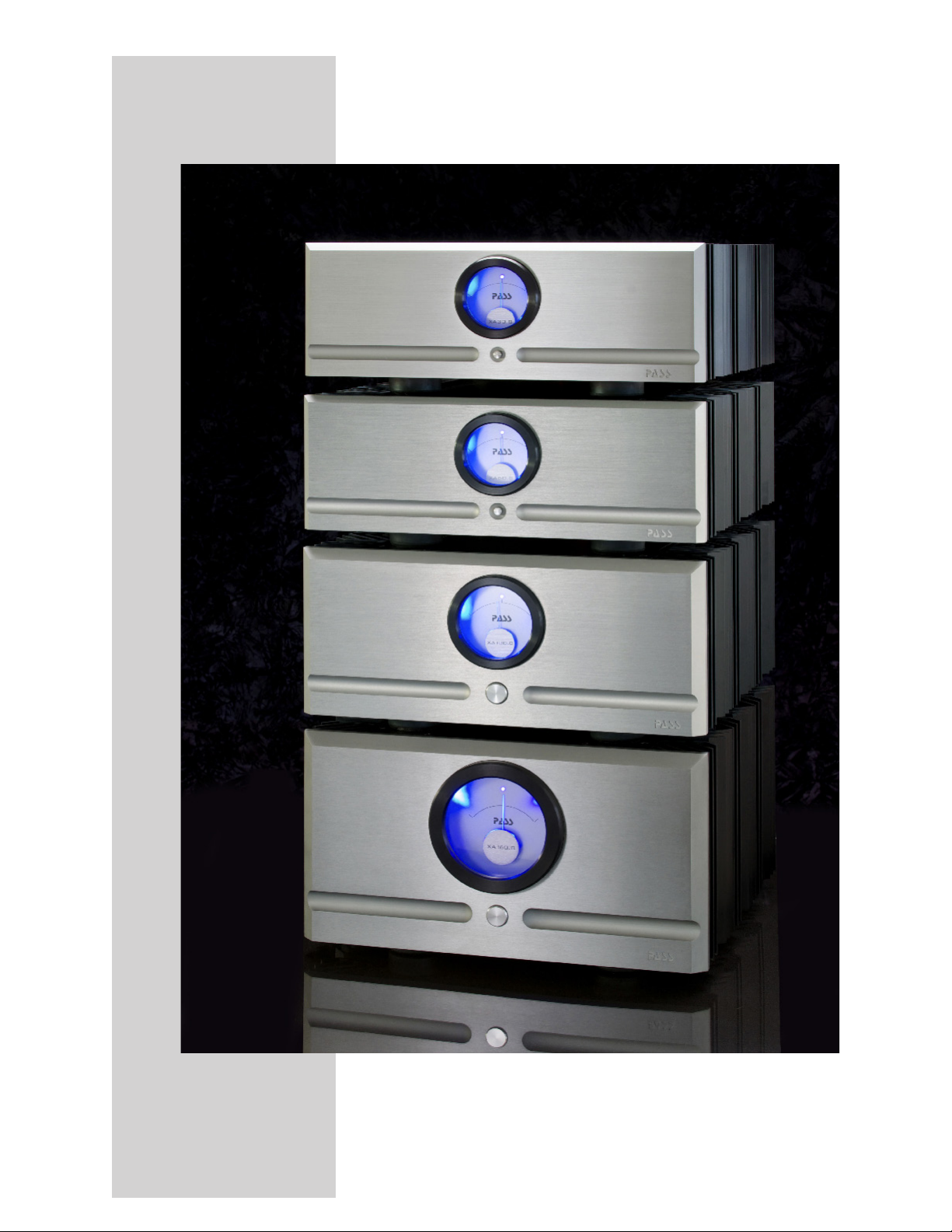
PASS
TM
March, 2014
Point 8 Owner’s Manual
1
Page 2

READ ME FIRST
I fully realize that many, if not all, owners will rush to hook up the
amplier without reading this operating manual.
However, this amplier is different in a number of ways, and if you only
read these pages you will probably save us both some time and trouble.
Heat and Ventilation - The X.8 and XA.8 ampliers consume quite a
bit of power during operation and convert most of it into heat. Pick a
location where the amplier can get some fresh air to remove the heat.
Do not enclose the amplier in a closed cabinet. Give it lots of space.
CAUTION!
Before operating this amplier, verify that the voltage label near the AC input
connector on the amplier indicates an operating voltage compatible with the voltage
level of the electrical outlet you intend to use. In all instances the amplier requires a
50hz- 60hz supplied electrical service.
Do not defeat the safety purpose of the polarized or grounding type power plug
supplied with this product. A grounding type plug has two blades and a third
grounding prong. The grounding prong is provided for your safety. If the provided
power cord plug does not t your outlet, consult an electrician for replacement of the
obsolete outlet.
The mains power cord is intended to be the safety disconnect device for this apparatus
and shall remain accessible and operable at all times.
Unplug this apparatus during lightening storms or when unused for long periods of
time.
On the rear panel is a master switch and additionally a fuse holder on the
smaller amps. The fuse holder accepts type 3AG (6.3mm x 32mm) 250
volt glass fuses of the slow blow variety.
Please consult the Pass Laboratories factory if you have any question on
these fuses or need replacements. The larger amps do not have any user
serviceable fuses. On these larger ampliers the rear panel switch is a
thermal magnetic circuit breaker.
2
Page 3

Input Connection and Input Impedance
The ampliers take either a single-ended (RCA) or balanced (XLR)
input connection. The input impedance is 50 Kohms single-ended and
100 Kohms balanced, and the input capacitance is just a few picofarads
so anything will drive it. If you are using RCA inputs, then you want
to use the gold input jumper to short the (-) input (pin 3) of the XLR
connector to ground (pin 1) as shown:
Output Connection
You can hook this amplier up to any normal loudspeaker without
danger of damage. Note, however that both the (+) Red output
connection and the (-) Black output connection are live There is no
ground reference at the speaker terminals. The black (-) speaker
terminal must never be treated as ground.
This can be important when you are hooking up active sub-woofers to
the output of the amp – if you need a signal ground connection then
use the white ground terminal provided on the rear panel.
The white signal ground connection is not a safety ground. Safety
ground is provided only by the detachable power cord. Never defeat the
safety purpose of the power cord.
NOTE
The Audio outputs of this power amplier are considered class 2 (CL2) circuits
in North America. This means the wire connected between the amplier and the
speaker(s) shall be rated at minimum Class 2 (CL2) and shall be installed according
to the U.S. National Electrical Code (NEC) Article 725 or Canadian Electrical
Code (CEC) section 16.
3
Page 4

Operation
After proper connection you can turn the amplier on via the switch on
the front panel or by placing a 12VDC voltage on the remote turn on
terminals on the back panel; once the rear panel circuit breaker is on.
The stand-by LED will light up, the meter will light up, and the meter
will slowly move to near the center position of the dial. The ampliers
take a while to fully warm up, usually about an hour or so.
Introduction
For many years there has been considerable faith that if we simply keep
improving the measurements of components such as ampliers then
they will sound better. Initially this was truly the case – equipment
was sufciently awed from an objective standpoint that better
measurements matched up with subjective experience.
At some level of objective quality there started to be a disconnect, and
some audiophiles began to lose the faith. One of the responses to this
was to examine more exotic sources of distortion in the equipment
while some others simply worked to continue to reduce the aws that
were already understood. There’s no doubt that some real progress
resulted from these efforts, and now you can purchase products at
reasonable prices which measure far better than the old stuff.
But the disconnect between the customer’s perceptions and the
measurements persists, and there have been cases of state-of-the-art
engineering resulting in economic failure, apparently because people
didn’t care for the sound.
Well, of course you are dealing with people, and that will complicate
any endeavor. The customer wants what the customer wants. I have
heard arguments that audiophiles are irrational, that decisions are based
on appearance or cost or advertising. Certainly there is plenty of that,
and there have been plenty of blind tests that have demonstrated that
“audiophiles can’t hear the difference”, at least in the context of that test.
But I don’t think that’s the whole story. My experience is that under
the right conditions the customer can often hear the difference, and his
observations are not to be ignored.
4
Page 5

First, it has to be acknowledged that the science of cognitive perception
is still in its infancy, and the ear is not really a microphone and the brain
is not a tape recorder. The data we do have on this subject is a little like
quantum mechanics – we have to change our view to make sense of the
illusions and paradoxes that accompany the interpretation of sensory
input.
With regard to ampliers at least, I think we already have the
measurement data in hand. The problem is in our failure to interpret it
with respect to human perception.
This puts some emphasis back on listening tests - extensive long-term
tests with reliable listeners and familiar equipment and environments.
This is not a cheap and easy procedure. Even assuming that the
listener(s) really can hear, we still have the vagaries of individual taste,
and not a large population of qualied listeners and systems.
In the end, even if we can design around the perceptions of a small
qualied listening panel, we are still inevitably aiming at a minority
audience in the real world. That’s OK with me – One percent of this
market is still a lot of ampliers.
The thing is, I don’t think the audiophile wants technical perfection. He
wants to be happy.
Look at it this way: In the market there are rows of bottled drinking
water. Some are contaminated with natural mineral content and
carbonated, some have sugar-based substances added, some have been
harvested from glaciers. They all appear to be more expensive than
gasoline. Where is the pure distilled water? Probably on the bottom
shelf, possibly even elsewhere in the store. It seems to be the least
popular, even if it is cheaper than gasoline.
Since the release of the X.5 series seven years ago we began working on
what has now become the X.8 ampliers. They embody everything we
know, and while I can’t divulge all the details, I can tell you about some
things which might interest you.
5
Page 6

More is More
There are times when “less is more”, particularly if you are building little “ea
watt” ampliers, where simple Class A circuits sound exceptionally good when
the loudspeaker is easy and the musical material isn’t too complex or dynamic.
Arguably I pioneered the solid state genre with the 1994 single-stage “Zen
Amp” and subsequent designs.
The X.8 series is intended to deliver some of the qualities qualities found in
these little ampliers, but with dramatically more power and accuracy. The
formula is simple: More hardware for more power with fewer stages and
lower distortion with less feedback. In addition, The various elements of
the ampliers have to be individually adjusted to operate in the harmony that
delivers the musical experience.
More Class A
The redesigned output stages of the X.8 series takes the lessons learned from
the Xs ampliers – bigger hardware biased more deeply into the Class A
operating region. In turn, the Xs design was inspired by the successes of the
X.5 series of ampliers from 2006.
Two important things emerged with the X.5 series, the rst being the value
of a large push-pull Class A operating envelope for low distortion and good
control of a loudspeaker. Even the Class AB models of the X.5’s had large
Class A bias values, so that the performance enjoyed Class A operation at
ordinary listening levels.
The second element is the higher level of single-ended Class A bias current
applied to the output stage, allowing arbitrary control of the values and ratios
of the second and third harmonic characteristic. The subtle qualities of this
approach result in a sonic signature which is unique to the X.8 series, but
goes back to character of previous ampliers which have had a particularly
successful sound. These ampliers had good measurement specs – low
distortion, wide bandwidth, high current, and so on, but were not “state of the
art” in any particular category, simply a good balance of these qualities.
One thing they also had in common was that the distortion they did have
was a balance of low order harmonics, dominantly second at low levels and
dominantly third at high power.
6
Page 7

Are we deliberately creating distortion to achieve this? No. We
are optimizing the remaining distortion character of an already low
distortion amplier for a superior musical character.
More Heat Sink
Part of the “more and bigger hardware” is more metal. One of the rst
things you will notice is that the smaller amplier models, the X150.8,
X250.8, XA30.8, XA60.8 and XA100.8 have new and larger heat sinks
(and also more output devices). This upgrade was essential to dissipate
the energy of the larger bias currents.
More Front End
Some of the biggest improvements come from the design of the
“front end” circuit which contains the rst two of the three stages of
the amplier - the input stage and the voltage gain stage. In the X.5
series, all the ampliers had essentially the same front end circuit, usable
interchangeably. This is not quite true of the X.8 series, where each
model has subtle differences design to most perfectly complement the
differences found in each output stage. Each amplier in the X.8 series
has a individual characteristic depending on the number of devices, heat
sinking, supply voltage and push-pull versus single-ended bias currents.
The output stages of each model have individual transfer curves and its
their favorite feedback gures which must be complemented by the front
ends. This was accomplished by using measurements to set a baseline
objective performance and then adjusting the circuitry through extensive
listening on six different systems.
The front ends use a mix of four each of complementary Jfet, Mosfet,
and Bipolar devices by Toshiba. These have been discontinued, but we
had the wisdom to have a large inventory of these superior parts. We
run these matched input Jfet devices undegenerated for the square-law
character, followed by Bipolar cascodes and matched Common Source
mode Mosfets.
We have carefully adjusted the bias and loading off the Drains of the
gain devices, which selects the most appropriate load-line character and
the feedback around the output stage.
7
Page 8

The voltage gain stages of the ampliers also sport much larger heat
sinks for much higher bias currents, critical to low distortion and driving
the large output stages.
The result is a front end with high stability, low distortion and noise. It
has a very high input and is DC coupled. There are no compensation
capacitors – in fact there are no capacitors in the amplier circuit except
across the shunt bias regulators and (obviously) the power supply.
More Power Supply
The power supplies for the X.8 series are generally larger than their
predecessors. The models X150.8, X250.8, XA30.8, XA60.8, and
XA100.8 have a third more storage capacitance and some new CRC
ltering to round out the edges of the supply ripple.
We have incorporated additional RF ltering in the AC primary circuits.
The supplies still use paralleled fast/soft rectiers and very large toroidal
transformers from Plitron. The power on/off switching is new, with
a 400 amp Triac taking the inrush surge and then paralleled by a high
current relay. The new system has a stand-by draw in conformance to 1
watt requirements.
The front end circuits of the ampliers have massively larger power
supply decoupling – the ripple is now measured in microvolts. This
coupled with interleaved layout techniques has reduced the output noise
of the ampliers by another 10 dB. The range between peak output and
average noise oor is greater than 130 dB.
Conclusion
So there you have it. Pass Laboratories celebrates its twenty-second year
by presenting the some of the best ampliers we have ever made. If you
have heard the qualities of the highly acclaimed Xs series of ampliers
you will have had a taste of what we offer here – ampliers that bridge
the gap between measured performance and subjective experience:
Ampliers that invite you into the music.
2013 Nelson Pass
8
Page 9

9
Page 10

Warranty Information
All Pass Laboratories products purchased new from an authorized Pass
Laboratories dealer in North America are covered by a transferable, limited 3-year
warranty.
This warranty includes parts and labor charges incurred at the repair facility.
Consequential damages are specically not covered and damage due to
modication or physical abuse is also not covered.
The customer assumes responsibility for shipping and insurance to and from the
factory, or a factory specied repair facility.
Non-North American customers should consult with their original Pass Labs
dealer or distributor for warranty repair instruction prior to contacting the factory
or shipping product for repair. Non-North American product must be returned to
the country of origin for warranty service. Foreign distributors are only required
to offer warranty service on Pass Laboratories product that they have imported.
Conditions of warranty service and customer rights for product purchased outside
the United States may vary depending upon the distributor and local laws. Please
check with your local distributor for specic information.
Any modications to Pass Laboratories products that have not received written
factory approval nullify all claims and void the warranty. Should a modied
product be returned to the factory for repair the owner will be required to pay all
necessary charges for the repair in addition to those charges required to return the
product to its original conguration.
In the case of safety issues, no product shall be returned to the customer without
those safety issues being corrected to the most recent accepted standards.
Removal or alteration of original Pass Labs serial numbers voids the factory
warranty. Product with altered or missing serial numbers will be suspected as
counterfeit product. Pass Laboratories will not repair or in any way indemnify
any counterfeit or cloned product.
Pass Laboratories does not offer products in voltages intended for international
markets either to authorized Pass Labs dealers or to third parties located in the
United States or Canada.
10
Page 11

For your protection please read the following:
Water and moisture: Electrical devices should not be used near water ( as per
example, near a bathtub, washbasin, kitchen sink, laundry tub, wet basement
or swimming pool ). Care should be taken such that objects do not have the
opportunity to fall, and that liquid is never spilled onto or into the device
enclosure through openings.
Power Sources: An electrical device must be connected to a mains power source
in strict accordance with the supplied product owner’s manual. Please verify that
the AC mains voltage specied in the product manual matches those requirements
indicated on the unit and the AC voltage provided to your location by the power
company.
Grounding: Adequate precautions should be taken so that the grounding
provisions built into an electrical product are never defeated.
Power Cords: Pass Laboratories provides a power supply cord that meets all
legislated requirements for the market in which the product was originally sold.
If you choose to substitute an after-market product we urge you to choose one that
is fully safety rated by the necessary local authority.
Power Cord Protection: Power supply cords should be routed so that they are
not likely to be walked on, abraded, or pinched by items placed on or against
them, paying particular attention to cords where they enter plugs or exit from a
device. Never under any circumstance insert a cut or damaged power cord into a
mains power socket.
Power and Signal: Cables should never be connected / disconnected with
equipment powered up. Failure to heed this warning may damage or destroy
equipment.
Ventilation: Power-ampliers run hot, but you should be able to place your
hands on them without discomfort. You must allow for this heat in installation,
by providing for free air circulation around the product. Electronics should not be
subjected to sources of excessive radiant heat. Excessive heat can shorten the life
of the product and may cause the electronics to self-protect and shut down.
Servicing: To reduce the risk of re, electrical shock or other injuries, the user
should not attempt to service the device beyond that which is described in the
operating instructions. All other servicing must be referred to qualied service
personnel.
11
Page 12

Pass Laboratories Inc.
13395 New Airport Rd.
Suite G
Auburn, CA 95602
tel: (530) 878-5350
fax: (530) 878-5358
www.passlabs.com
© 2014 Pass Laboratories Inc.
“PASS”, “Pass”, “Pass Labs”, “Pass Laboratories”,
“Supersymmetery”, “Aleph”, and “Zen” and are all registered trademarks of Pass
Laboratories, Inc., and all rights thereto are protected by law.
12
 Loading...